1. Introduction
The use of metaheuristic algorithms in the computational sciences has received significant attention following their capability to address complex optimization problems that the traditional gradient-based or exhaustive search techniques cannot provide viable solutions to them [
1,
2]. These are population-based or single-agent methods that simulate natural or artificial processes to search and exploit high-dimensional landscapes, using randomness, selection mechanisms, and adaptive operators to escape local optima. Examples of such representative families of metaheuristics are evolutionary algorithms (based on biological evolution) [
3], swarm intelligence algorithms (based on animal collective behavior) [
4], and physics-based optimizers (based on natural laws) [
5]. Their major strength is that they strike a balance between exploration of a large search space and exploitation of the most promising solutions, which makes them powerful and adaptable in solving diverse types of problems.
The design tasks that involve the use of engineering design are usually multi-variable, non-linear goals, with complex constraints, like safety margin, cost limits, or performance requirements. Conventional optimization techniques, such as linear or non-linear programming techniques, may not fare well in situations where there are discontinuities or where the black-box functionality of interest is costly to obtain analytical gradients or approximate such gradients [
6]. Metaheuristics provide a very strong alternative: they do not make use of derivative information but instead are based on the assessment of the objective function of candidate solutions, and hence are general-purpose and relatively easy to implement. Adaptive metaheuristics can also explore rough, multi-modal surfaces in the parameter space by stochastically sampling the parameter space, finding better design configurations. In the last ten years, engineers have been able to embrace the techniques in structural optimization, aerodynamic design, energy distribution, among other real-life problems of the real world [
7].
The Puzzle Optimization Algorithm (POA) is one of the numerous metaheuristic frameworks that have been developed, which is characterized by a cooperative and adaptive model of search agents [
8]. Based on the concept of natural puzzle-like interactions, or more metaphorically, the behavior of specific foraging animals, POA places multiple agents in a solution space and coordinates their movements based on two high-level phases: a global
exploration phase (moving towards prey) and a local
exploitation phase (winging on the water surface) [
9]. In the exploration, the agents approach and detach themselves from a specified agent of food according to their fitness levels. They do small local adjustments to optimize promising solutions in the exploitation phase, which involves less information than in the exploration phase [
10]. This two-stage strategy enables POA to explore new areas, as well as increase its search in those areas that have high probabilities of having optima. Its ability to combine global and local search heuristics has been successful in many benchmark tasks and real-life optimization problems [
11].
Although effective, the baseline POA can be ineffective in a situation where the optimization problem is very nonlinear, multi-modal, or has strong constraints. Such environments regularly occur in engineering design problems, where an orthodox methodology may be susceptible to local optima or not adequately diversified in searching the larger search space. In order to overcome these weaknesses, the Enhanced Puzzle Optimization Algorithm (EPOA) supplements POA with new operators based on evolutionary computation, i.e., crossover, mutation, and an elitism mechanism. These genetic-inspired improvements make EPOA create a more diverse population and ensure the best answer at any point, therefore, reducing premature convergence and enhancing general robustness. It is not the invention of crossover, mutation, and elitism as such that contributes to scientific contributions, but rather their deployment towards POA in such a way that each operator corrects a particular vulnerability of the original update process.
The driving problems of EPOA are the engineering design issues of a wide range. Engineers are often required to trade off several parameters and meet non-linear constraints that indicate safety, cost, or performance. Techniques based strongly on gradient information or local searching may not be adequate in such situations, particularly in cases where precise analytical gradients are not known or discontinuities occur. EPOA, in its turn, takes advantage of the strength of stochastic sampling, movement in the direction of the promising solutions, and repeated refinements (which are based on mutation) to exhaust the design space. This functionality enables it to move over complicated objective surfaces and determine the best design configurations.
The key contributions are as follows:
In this paper, EPOA was suggested that incorporated the ideas of uniform crossover, random-resetting mutation, and explicit elitism into POA in order to mitigate the drawbacks of premature convergence and loss of diversity while maintaining the two-phase search logic.
The proposed method was given a full mathematical formulation, a bound-handling policy, readable pseudocode, and more detailed workflow diagrams in this paper.
The proposed EPOA ranked 1st on 11 CEC2022 functions and ranked 3rd on the rest of the functions, with a significant decrease in mean error compared with baseline POA and most current optimizers.
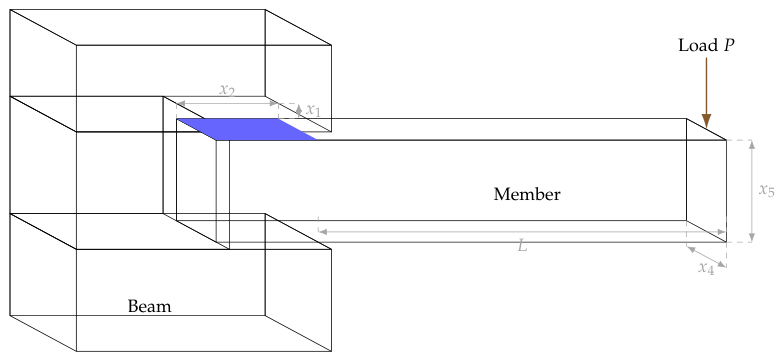
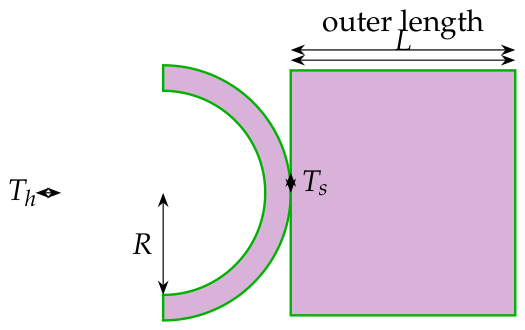
In this paper, the applicability of EPOA to six canonical constrained engineering design problems was discussed using standard performance statistics along with convergence and boxplot analyses.
The remainder of this paper is organized as follows.
Section 2 reviews representative metaheuristic families and clarifies the research gap addressed in this study.
Section 3 presents the baseline POA, the motivation for enhancement, and the full formulation of EPOA.
Section 4 describes the experimental design and comparison protocol.
Section 5 reports the benchmark and engineering results,
Section 6 interprets the main findings and limitations, and
Section 7 concludes the paper.
2. Related Work and Research Gap
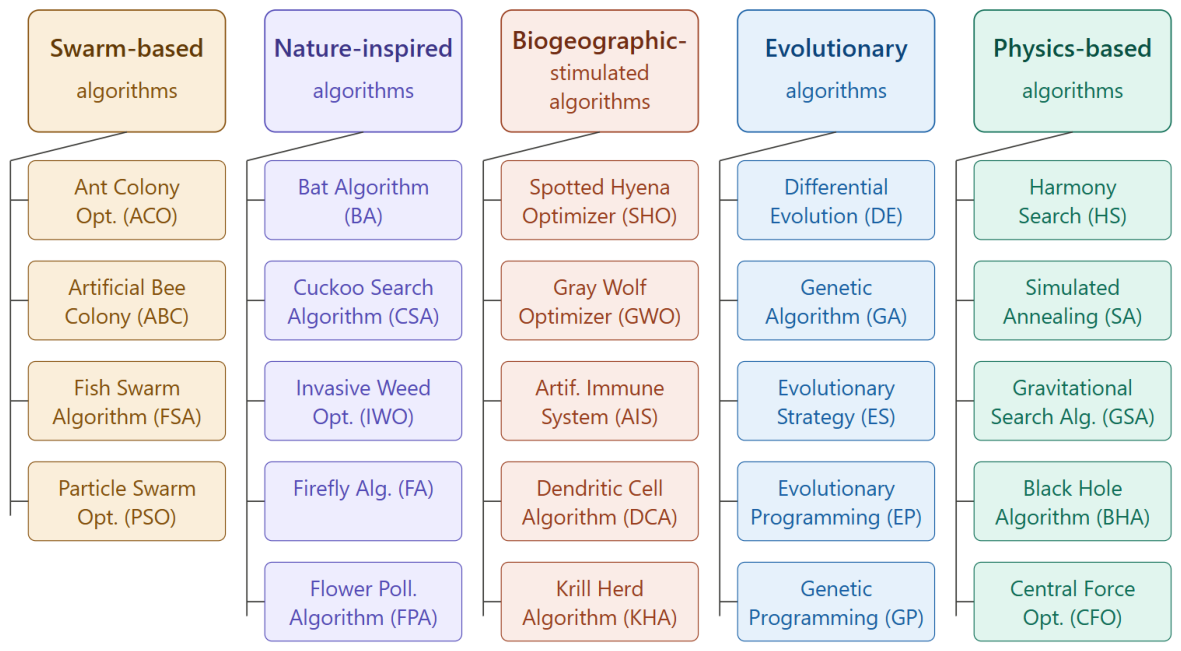
Metaheuristic optimization can be summarized into four broad families: (i)
evolutionary and population-based methods that rely on selection, variation, and explicit or implicit population models; (ii)
swarm and bio-inspired methods that model decentralized interactions among agents; (iii)
physics-based methods that abstract natural laws and dynamical processes; and (iv)
socio-cognitive or human-inspired methods that emulate learning, competition, or collective decision-making.
Figure 1 summarizes this grouping for readability and provides representative examples from the literature reviewed in this section.
Population-based evolutionary computation begins with Evolutionary Programming [
12], Evolution Strategies [
13], and Genetic Algorithms [
14], and later extends to coevolution [
15], Cultural Algorithms [
16], Genetic Programming [
17], Estimation of Distribution [
18], and Differential Evolution [
19]. Grammar- and expression-driven variants include Grammatical Evolution [
20] and Gene Expression Programming [
21]; hybrid and quantum-inspired refinements broaden the design space [
22,
23], as do competitive and imperialist models [
24]. More recent directions refine sampling and variation via Differential and Backtracking searches and fractal mechanisms [
25,
26,
27], alongside task-specific operators such as Synergistic Fibroblast Optimization [
28].
Swarm intelligence abstracts collective behavior into decentralized search. Foundational exemplars include Ant Colony Optimization [
29] and Particle Swarm Optimization (continuous and binary forms) [
30,
31,
32], with immune-system and clonal models adding selection and memory effects [
33,
34]. A wide ecosystem of animal and microbial swarms followed–fish, bacteria, birds, bees, wolves, whales, butterflies, grasshoppers, salps, and more–yielding algorithms such as Artificial Fish Swarm and Bacterial Foraging [
35,
36]; bee-inspired heuristics and Shuffled Frog Leaping [
37,
38,
39,
40,
41,
42,
43,
44]; and later packs and herds including Krill Herd, Wolf/Grey Wolf, Ant Lion, Dragonfly, Crow, Whale, Butterfly, Grasshopper, and Salp swarms [
45,
46,
47,
48,
49,
50,
51,
52,
53,
54,
55]. Additional species metaphors continue to appear (e.g., Chicken/Bird swarms, Virus Colony, Shark Smell, Squirrel, Mouth-Brooding Fish, Selfish Herd) [
56,
57,
58,
59,
60,
61,
62].
Physics-inspired heuristics map search to thermodynamic, dynamical, or cosmological processes: microcanonical and simulated annealing [
63,
64]; diffusion/particle interactions and variable neighborhoods [
65,
66,
67]; Harmony Search [
68]; gravitational, central-force, and black-hole families [
69,
70,
71,
72]; water and river dynamics and intelligent water drops [
73,
74,
75]; charged, electromagnetic, spiral, and ray trajectories [
76,
77,
78,
79]; and models of curved or galactic spaces and atmospheric or mine-blast phenomena [
80,
81,
82,
83].
Socio-cognitive and human-inspired methods emulate learning, competition, and organization in human systems. Examples include society and civilization models, human-inspired optimization, league championships, social-emotional interaction, brainstorming, teaching-learning, anarchic societies, and sports leagues [
84,
85,
86,
87,
88,
89,
90,
91]. Big Bang–Big Crunch [
92] and photosynthesis-inspired search [
93] further illustrate the breadth of analogies that have shaped the development of metaheuristics.
Overall, the reviewed literature shows that improvements in metaheuristics often come not from inventing entirely new low-level operators, but from integrating well-understood mechanisms into an existing search backbone in a way that resolves identifiable failure modes. In the case of POA, the most relevant open question is therefore whether classical operators such as crossover, mutation, and elitism can be coupled with POA’s search dynamics in a way that measurably improves diversity retention, convergence stability, and performance on constrained engineering problems. This gap motivated the EPOA formulation developed in the next section.
3. Proposed Method
This section first summarizes the baseline Puzzle Optimization Algorithm (POA), then explains the design rationale behind the enhancement, and finally presents the mathematical formulation, pseudocode, and workflow of the proposed Enhanced Puzzle Optimization Algorithm (EPOA).
3.1. Baseline Puzzle Optimization Algorithm
POA is a population-based, game-inspired metaheuristic that models each candidate solution as a “puzzle”, where the decision variables are the puzzle pieces and the objective function evaluates how well the puzzle is assembled. A notable feature of POA is that it is parameter-free in the sense that it does not rely on a large set of algorithm-specific control parameters. The search proceeds in two stages per iteration: (i) guided imitation, where a solution adjusts its pieces by following a randomly chosen guiding member with acceptance conditioned on fitness improvement, and (ii) piece suggestion, where a solution replaces a subset of its pieces with pieces suggested by other population members.
Although POA has shown competitive performance on several benchmark suites and practical optimization problems, it may still suffer from premature convergence and limited population diversity in highly multimodal or high-dimensional landscapes [
94,
95]. Moreover, because the basic formulation does not include an explicit elitism mechanism, a high-quality solution may be lost after a stochastic update [
96]. These limitations motivated the development of EPOA.
3.2. Design Rationale for EPOA
The proposed change was motivated by two feasible deficiencies. To begin with, there are a few agents in hard multimodal landscapes that could be drawn to common areas of the search space, and then diversity in the population is reduced, and the search can get stuck in a good but globally optimum basin. This tendency is evident in the later reported results: the means of the errors generated in baseline POA are 62.836 on F1 and 2370.962 on F6, and the EPOA decreases the numbers to 0.004 and 7.239, respectively. The scale of these variations is in line with premature convergence and lack of diversity in the baseline approach.
Second, limited engineering problems typically have small regions of feasibility. In the design of welded beams or pressure vessels, such as one a candidate may have an attractive objective value and then become infeasible following a stochastic perturbation that breaks stress, deflection, or thickness. And even in cases where there is no explicit elitism mechanism, the best feasible solution identified to date may not make it through such updates. It was due to this reason that the suggested EPOA assumed crossover, mutation, and elitism into POA such that new candidate solutions would be produced while the best-so-far solution would be maintained.
3.3. Mathematical Formulation of EPOA
EPOA was developed as an enhancement of POA. The original POA already balances exploration and exploitation through two complementary phases, but it may still become trapped in local optima when it is applied to highly nonlinear or constrained problems. EPOA therefore preserved the basic POA structure while adding mechanisms that increase diversity and strengthen global search.
Specifically, EPOA retained the two POA phases: a global exploration step, in which each agent updates its position relative to a designated “food” agent, and a local exploitation step, in which agents refine their positions through smaller perturbations. To reduce the risk of premature convergence, EPOA then incorporated genetic operators that generate new candidate solutions and broaden the sampling of the search space over time. In addition, an explicit elitism step was added so that the best solution discovered so far could not be overwritten by weaker offspring.
The reason for these classical operators is unique to POA. A large population of agents can be directionally concentrated around the identical food-directed movement pattern in a baseline POA, reducing the effective search directions of the agents in the population. Uniform crossover combats this effect by a process of recombining the coordinates of different promising agents and hence generating candidate points not restricted to an individual food-centered path. Random-resetting mutation plays a complementary role: when the shrinking exploitation step becomes too local, a reset of one coordinate can reopen a blocked search direction and help the algorithm jump from a poor basin into a more promising one. Elitism makes these more aggressive variations practical, because the best-so-far feasible solution is copied forward even if several offspring deteriorate. In that sense, the improvement in EPOA should not be interpreted as a “secret” in the operators themselves, but as a consequence of coupling those common operators with POA’s exploration/exploitation backbone in a way that directly addresses POA’s observed failure modes.
Exploration phase. In each iteration
t, a random agent, referred to as the “food”, is chosen from the population. All other agents update their positions in relation to this food according to
In Equation (
1),
denotes the position of the
i-th agent at iteration
t,
is the randomly selected food agent,
scales the global movement, and
is a small factor (often 1 or 2). Agents with worse fitness move toward the food agent, whereas better agents move away to probe new regions.
Exploitation phase. After exploration, each agent refines its position locally by applying a smaller perturbation:
where
controls the perturbation intensity,
is a random vector in
, ⊙ denotes elementwise multiplication, and MaxIt is the maximum number of iterations. The factor
decreases over time, enabling progressively finer local refinement.
Genetic operators. To enrich the population and avoid local stagnation, uniform crossover and random mutation were incorporated after the POA-specific phases. If
and
denote two parent solutions, the offspring
and
are generated as
where
for each index
j. Offspring then undergo mutation. For example, a randomly selected coordinate
k in
is updated as
where
and
is the feasible range of the
k-th variable. Every newly generated or updated position is clipped to remain in
.
The combined use of exploration (
1), exploitation (
2), crossover (
3), mutation (
4), and elitism provided EPOA with a stronger ability to maintain diversity, intensify local refinement, and preserve the best solution found so far, the pseudocode is shown in Algorithm 1.
| Algorithm 1 Pseudocode of the Enhanced Puzzle Optimization Algorithm (EPOA) |
- 1:
Input: Population size N, maximum iterations MaxIt, bounds and , dimension D, objective function , crossover probability , mutation probability . - 2:
Randomly initialize the population in . - 3:
for to N do - 4:
Evaluate . - 5:
end for - 6:
Determine the global best solution and its fitness . - 7:
for to MaxIt do - 8:
Randomly select an agent as the food position. - 9:
for to N do - 10:
Update using the exploration rule in Equation ( 1). - 11:
Apply bound handling and keep the new position only if it improves fitness. - 12:
end for - 13:
for to N do - 14:
Update using the exploitation rule in Equation ( 2). - 15:
Apply bound handling and keep the new position only if it improves fitness. - 16:
end for - 17:
Shuffle the population and form parent pairs. - 18:
for each pair do - 19:
Apply crossover with probability . - 20:
Apply mutation with probability . - 21:
Evaluate offspring and replace parents if the offspring are better. - 22:
end for - 23:
Reinsert the best-so-far solution (elitism). - 24:
Update and if a better solution is found. - 25:
end for - 26:
Output: and .
|
3.4. Algorithmic Workflow and Flowchart
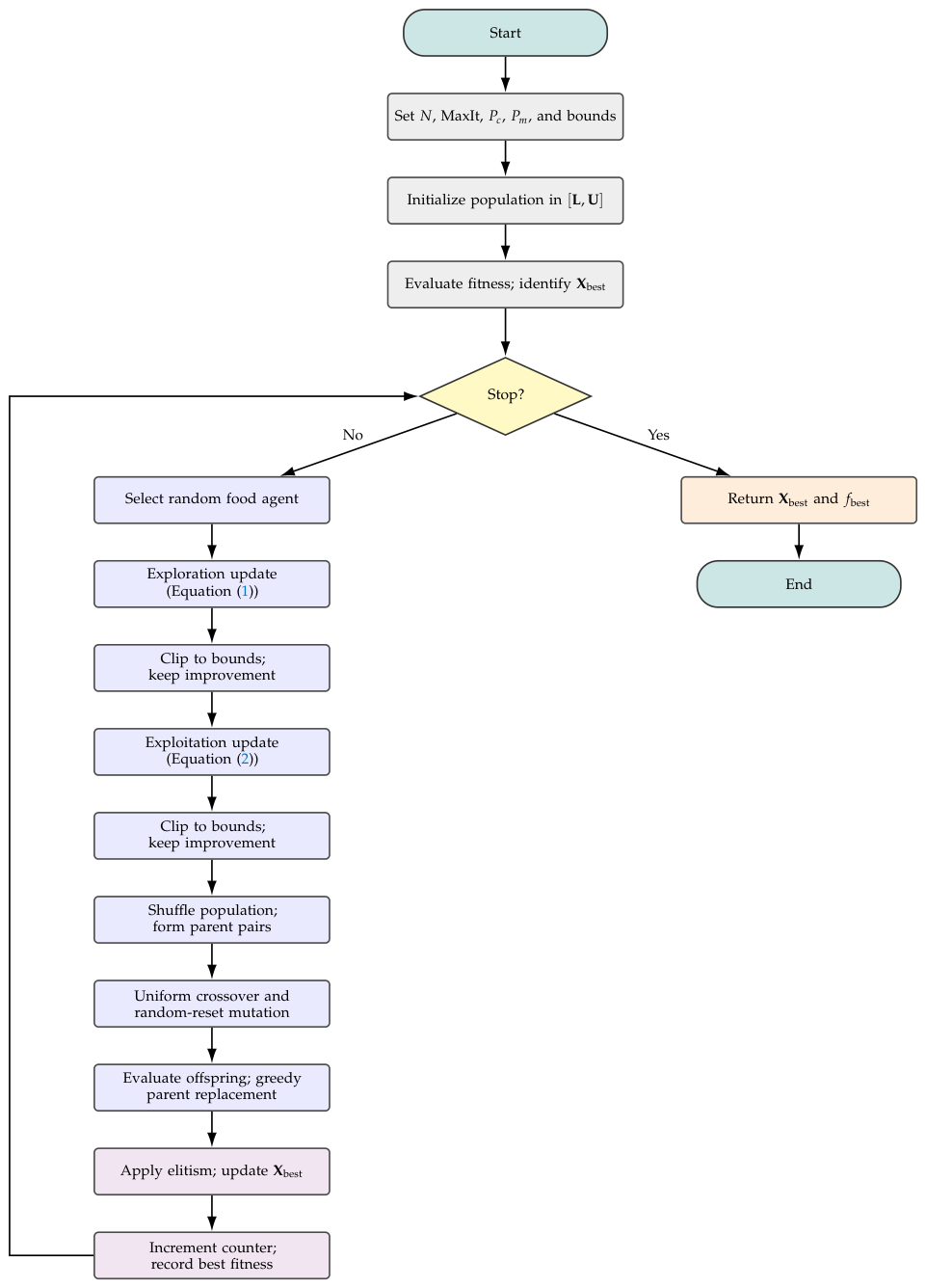
Figure 2 shows the EPOA flowchart in a more detailed manner compared with the earlier manuscript version. The flowchart clearly indicates that there is a flow of the initializations, evaluation, two POA phases, bound handling, greedy replacement, genetic operators, elitism, and the iteration/termination logic.
3.5. Search Dynamics in EPOA
The two POA phases still provide the main search dynamics of EPOA. The exploration operator in Equation (
1) promotes longer moves relative to the selected food agent, which helps the population cover distant regions of the search space. The exploitation operator in Equation (
2) scales the perturbation amplitude by
, so local refinements naturally become more conservative near the end of the run.
What changed in EPOA is the feedback around these two phases. After the POA-based movement, crossover and mutation reintroduce structural diversity, while elitism prevents regression by retaining the best-so-far solution. This interaction is significant: the POA steps lead to search direction, the genetic operators to the diversification of the search and the stabilization of the search is achieved by elitism. All these elements justify why EPOA is able to spend time in the initial iterations exploring widely and still converging reliably in the late iterations without having to repeat the exploration equation in the second form.
6. Discussion
6.1. Interpreting the CEC2022 Results
The benchmark outcomes reflect the fact that the suggested changes were not cosmetic. Compared with baseline POA, EPOA yielded significantly smaller errors on a few challenging functions, with F
1 and F
6 being among them. This trend confirms the design logic presented in
Section 3: the additional crossover and mutation processes assisted the search to avoid population collapse, whereas elitism ensured the maintenance of good candidate solutions following stochastic updates.
The findings also indicate that EPOA was especially effective in functions where search-space coverage as well as late-stage refinement were significant. It was not necessarily the first method, but F12 was not a dominant one. This finding is practical as it demonstrates that the suggested improvement increased performance significantly without suggesting an overall excellence across all landscapes.
6.2. Interpreting the Convergence and Robustness Analyses
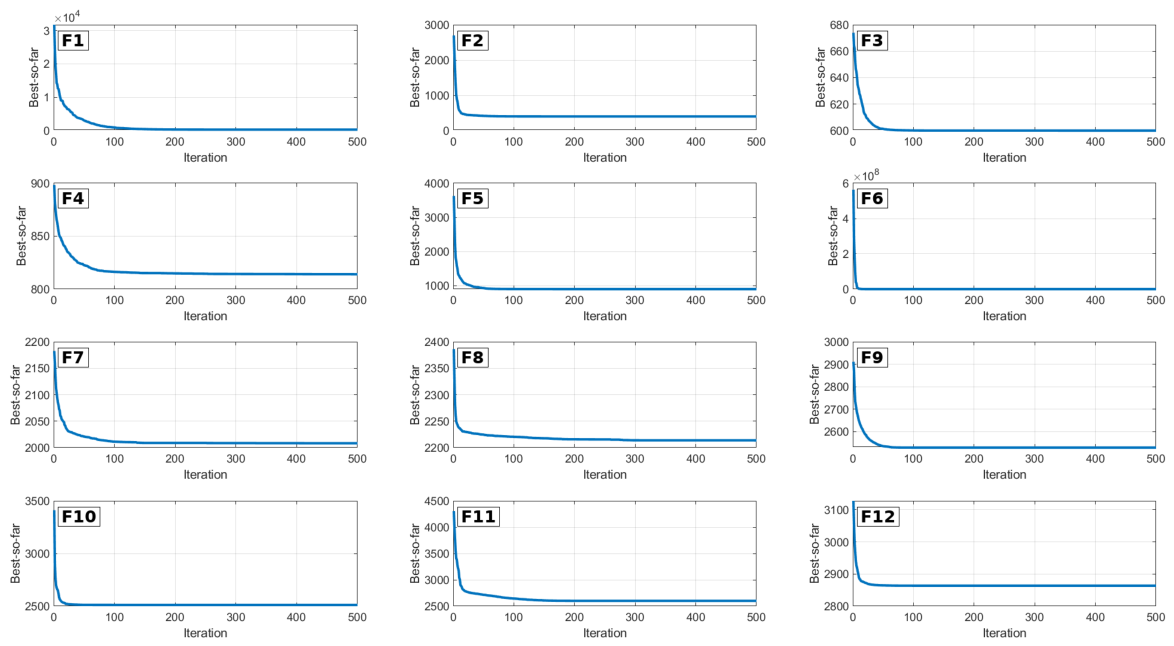
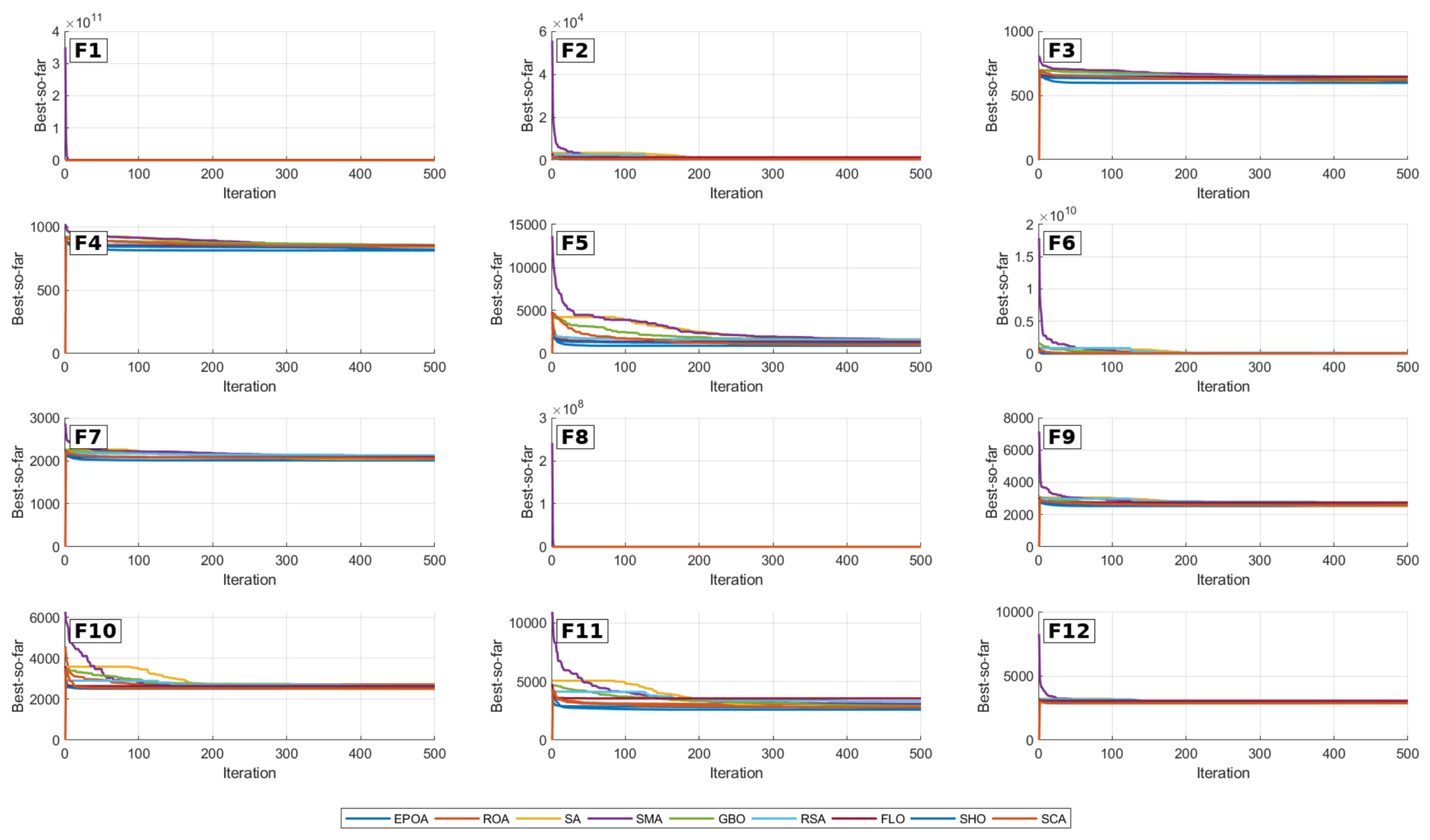
The convergence curves are additional evidence for the last summary statistics. EPOA fell very fast in the early stages of numerous functions, then leveled off, which is expected to be the case in the presence of an efficient balance between exploration and exploitation. The comparison curves also demonstrate that some of the competing methods either progressed more slowly or stagnated at a lower fitness.
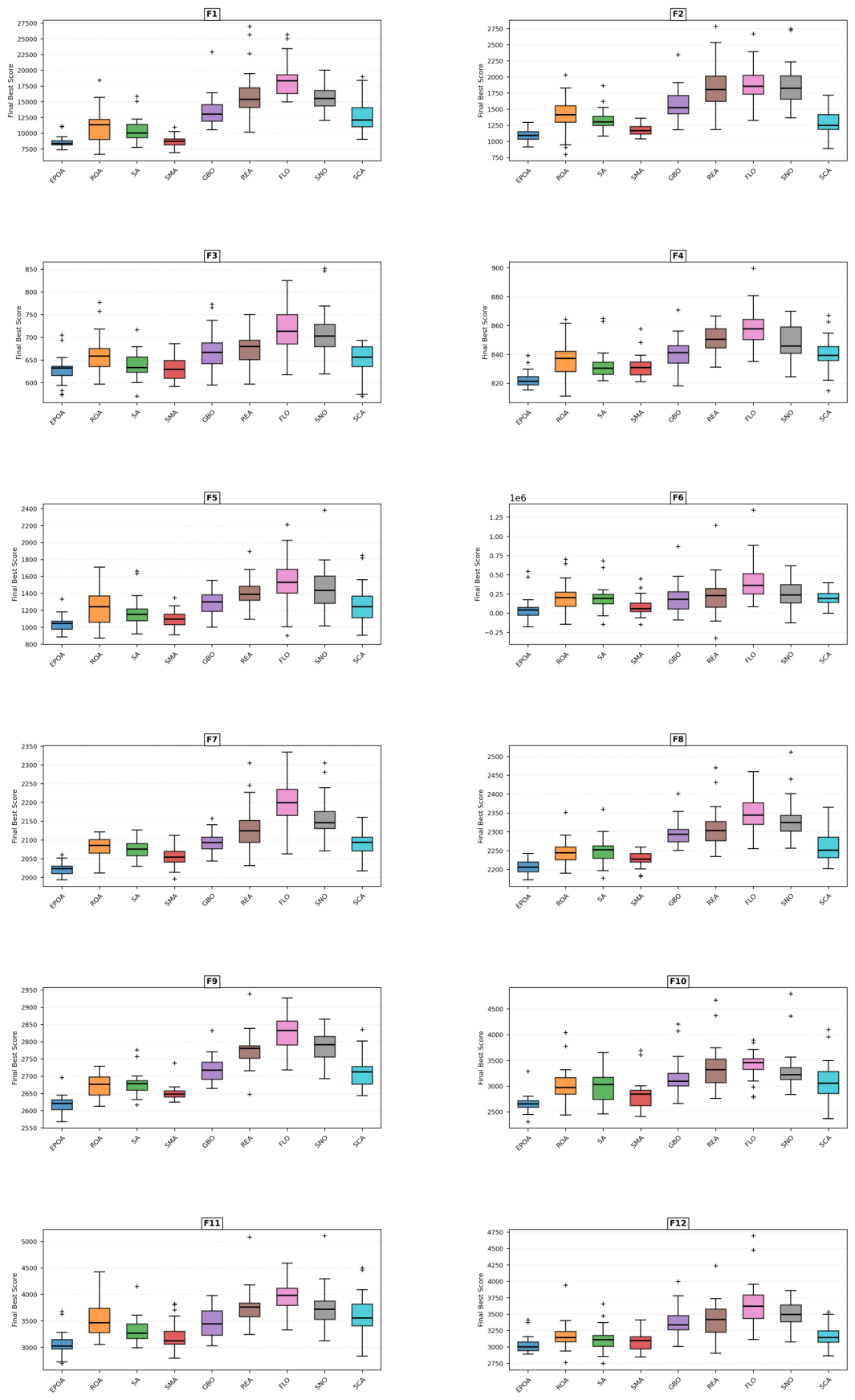
This picture is supplemented by the boxplots that demonstrate the distribution of results at repeated runs. EPOA has a lower median and a relatively small interquartile range on a number of functions, which is evidence of not only excellent average performance but also excellent repeatability. One can see wider spreads of certain competing methods show sensitivity to both initialization and search dynamics. In the more difficult cases, it is also evident from the boxplots that there is variability; hence, the discussion cannot be based on best-case results alone, but on the central tendency as well as the dispersion.
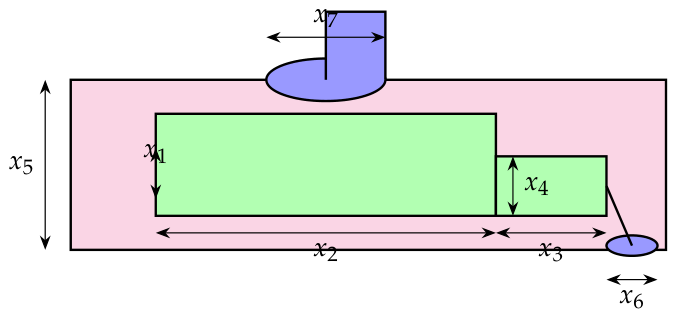
6.3. Interpreting the Engineering Design Results
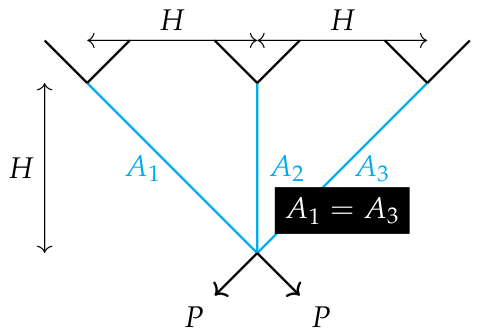
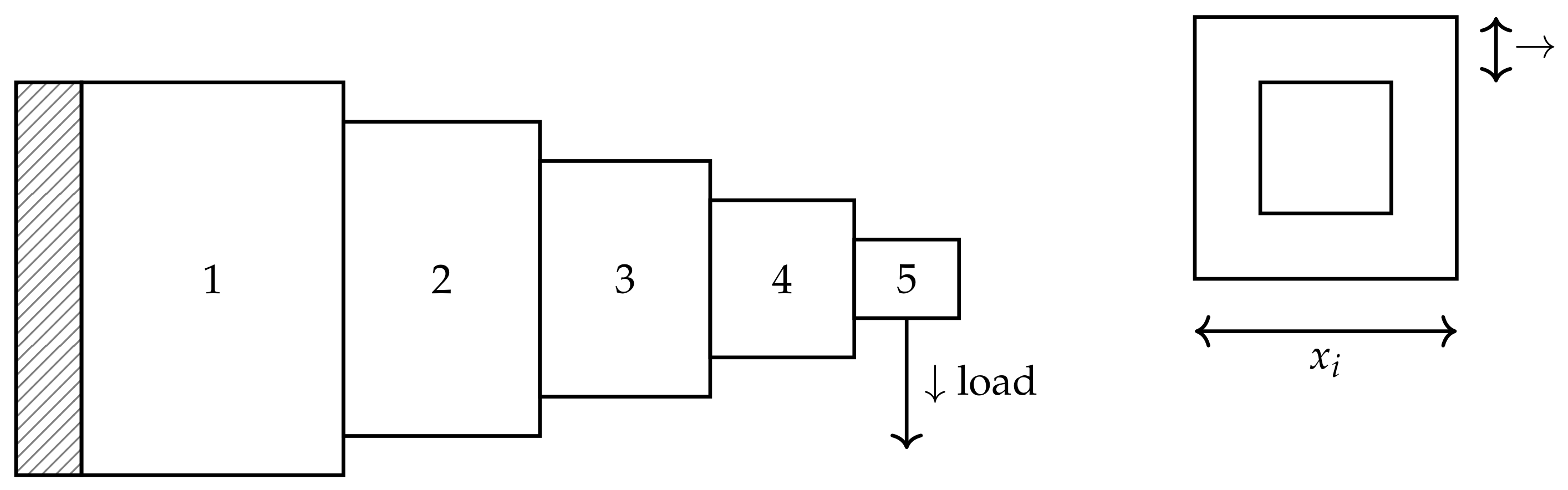
The more detailed pattern is revealed in the engineering-design experiments, compared with the benchmark suite. On the welded-beam and pressure-vessel problems, EPOA was most competitive, and on the speed-reducer, three-bar truss, and cantilever-beam ones, it was very competitive. This is a positive finding since these issues can be characterized in terms of nonlinear goals and constraints on feasibility, and this is exactly where diversity maintenance and elitism come into play.
Simultaneously, the engineering outcomes reveal that EPOA failed to be the most competent technique in all design issues. On the speed reducer, FOX scored the highest minimum value, and in the cases of the three-bar truss and cantilever beam, FOX scored the same or slightly higher than EPOA. This result must be viewed as a positive one, as opposed to being a secret: it indicates that EPOA is strong when faced with extremely dissimilar constrained problems, yet that performance remains conditional on the geometry and the structure of the task constraints. Lastly, the only tension/compression spring table reports runtime, meaning the discussion of computational time is restricted to that case and does not speculate on how things would work otherwise.
6.4. Limitations and Future Directions
The current research is also limited. Their crossover and mutation rates and the chosen constraint-handling strategy can still make EPOA’s performance dependent. Future research needs to explore adaptive operator control, specific rules for feasibility or repair, multi-objective extensions, and ablation studies that measure the contribution of each improvement separately.
7. Conclusions
EPOA, as proposed in this paper, is a specific improvement of POA by use of uniform crossover, random-resetting mutation, and explicit elitism. The approach enhanced diversity conservation and convergence security without losing the original search logic by integrating these classical operators within POA’s exploration–exploitation backbone.
The experimental findings indicated that EPOA provided the dominant performance in the CEC2022 suite, was competitive with classic GA and PSO references, and generated robust feasible solutions of six constrained engineering design problems. These results, combined with the previous ones, are an indication that EPOA is a valid and strong extension of POA to complex continuous optimization and engineering design.