1. Introduction
Bridge infrastructure forms a critical backbone of modern transportation networks, enabling economic activity, regional connectivity, and societal mobility. However, a significant portion of the global bridge stock is approaching or exceeding its design life, while simultaneously being subjected to increasing traffic demands, heavier axle loads, and evolving environmental stressors [
1,
2,
3]. These combined effects have accelerated structural deterioration processes, including fatigue, corrosion, material degradation, and progressive stiffness loss, thereby elevating the risk of functional impairment and, in extreme cases, catastrophic failure. In this context, ensuring the safety, serviceability, and resilience of bridge systems has become a pressing engineering challenge [
4,
5,
6].
Traditional bridge inspection and maintenance strategies are predominantly based on periodic visual assessments and scheduled interventions. While widely implemented, such approaches are inherently limited: they are labor-intensive, subjective, and often incapable of detecting early-stage or hidden damage [
7,
8,
9]. Moreover, the intermittent nature of inspections restricts the ability to track the continuous evolution of structural condition, leading to reactive rather than proactive maintenance strategies. These limitations have motivated a paradigm shift toward data-driven, condition-based, and performance-based infrastructure management [
4,
10].
Structural Health Monitoring (SHM) and Bridge Health Identification (BHI) have emerged as key enablers of this transformation. By continuously or periodically measuring structural responses under operational conditions, SHM systems provide rich datasets that can be leveraged to assess structural integrity, detect anomalies, and support decision-making for maintenance and rehabilitation. Within this framework, BHI focuses on extracting meaningful indicators of structural condition, particularly those derived from dynamic behavior, to characterize the health state of bridges and identify deviations from baseline performance [
11,
12,
13,
14].
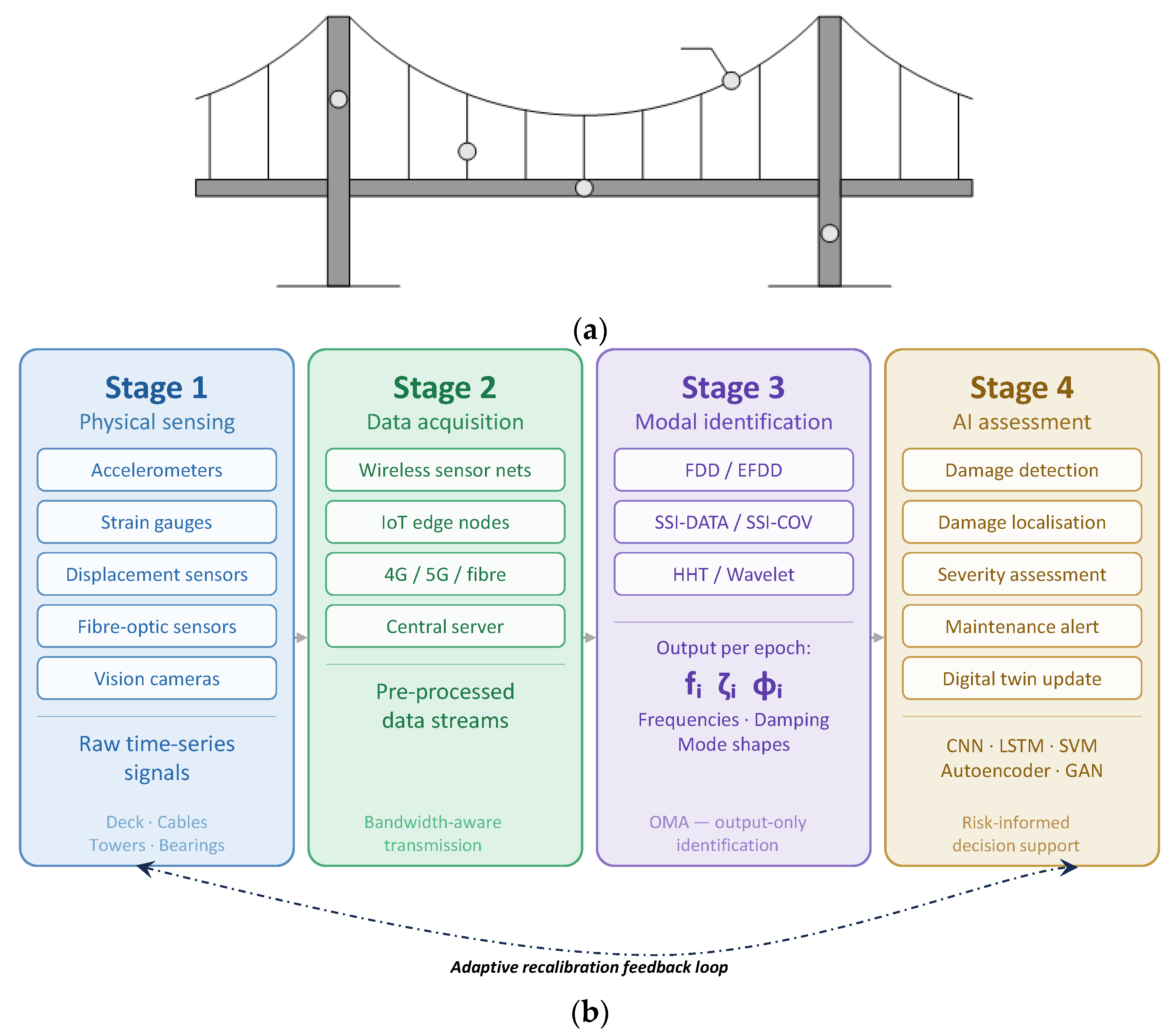
Modern BHI relies heavily on distributed sensing systems capable of data acquisition under operational conditions. As illustrated in
Figure 1a, various types of sensors, such as accelerometers, displacement sensors, strain gauges, fiber-optic sensors, temperature sensors, and vision-based devices, can be strategically installed along critical components of a bridge, including the deck, cables, towers, bearings, and supports. These sensors continuously record structural responses induced by traffic, wind, temperature variation, and other environmental effects, providing the raw data required for modal identification and subsequent damage assessment. The spatial distribution and density of sensors play a crucial role in accurately capturing mode shapes and detecting localized damage, particularly in complex bridge systems with multiple modes. Consequently, optimal sensor placement and multi-point measurement strategies are fundamental prerequisites for reliable SHM and data-driven BHI frameworks.
Beyond sensing alone, intelligent bridge monitoring requires an integrated data-processing pipeline. As shown in
Figure 1b, raw measurements acquired from field sensors are transmitted through wireless or wired acquisition systems, pre-processed for noise reduction and synchronization, and then analyzed using modal identification techniques such as FDD, EFDD, SSI-DATA, SSI-COV, HHT, and wavelet-based methods. The extracted modal features can subsequently be used as inputs to artificial intelligence models for damage detection, localization, severity assessment, maintenance alert generation, and digital twin updating. This workflow highlights the functional link between sensing infrastructure, structural dynamics, and intelligent decision-support systems.
Among various indicators, modal parameters play a central role in vibration-based BHI [
15,
16,
17,
18,
19,
20,
21]. These parameters represent intrinsic properties of the structural system and are directly linked to its mass–stiffness–damping characteristics. Structural damage, such as cracking, section loss, or connection degradation, alters stiffness distribution and energy dissipation mechanisms, leading to measurable changes in modal properties. As a result, modal parameters provide a compact yet powerful representation of structural condition and have been widely adopted for damage detection, localization, and evaluation in bridge engineering [
22,
23,
24,
25,
26,
27].
The extraction of modal parameters from output-only measurements has been greatly facilitated by advances in Operational Modal Analysis (OMA), which enables system identification using ambient excitations such as earthquake, traffic, wind, and microtremors [
28,
29,
30]. Frequency-domain methods (e.g., Peak Picking, Frequency Domain Decomposition), time-domain approaches (e.g., Stochastic Subspace Identification), and hybrid time–frequency techniques have been extensively developed and applied to bridge systems. In parallel, rapid progress in sensing technologies—including wireless sensor networks, fiber-optic systems, and vision-based monitoring—has enabled high-resolution, multi-source data acquisition, further enhancing the potential of dynamic-based BHI [
26,
31,
32,
33,
34].
Despite these advances, several challenges remain. Modal properties are influenced not only by damage but also by environmental and operational variability, such as temperature fluctuations, humidity, and traffic conditions, complicating the interpretation of changes. Furthermore, modern SHM systems generate large volumes of heterogeneous data, making traditional model-based analysis increasingly difficult to scale and automate. These challenges have catalyzed the integration of Artificial Intelligence (AI) and Machine Learning (ML) into BHI, enabling data-driven pattern recognition, outlayer detection, and predictive modeling [
31,
35].
AI and ML techniques, including supervised, unsupervised, semi-supervised, and deep learning (DL) methods, have demonstrated significant potential in extracting damage-sensitive features, handling complex and high-dimensional datasets, and improving diagnostic accuracy. More recently, emerging paradigms such as physics-informed learning, transfer learning, and reinforcement learning (RL) have further expanded the capabilities of BHI systems, enabling improved generalization, decision-making, and integration with digital twin frameworks. Nevertheless, key limitations persist, including data scarcity, lack of standardized benchmark datasets, limited interpretability of models, and insufficient integration of physical knowledge with data-driven approaches [
36,
37,
38,
39].
Although numerous review studies have addressed SHM, vibration-based damage detection, or AI applications in civil engineering, most existing works treat these domains separately or provide only limited integration between structural dynamics and intelligent data-driven methods. In particular, a comprehensive synthesis that systematically links modal parameter mechanics with AI/ML methodologies in the specific context of BHI remains lacking.
This paper aims to address this gap by providing an integrated, modal- and AI-centric review of BHI. The main contributions of this study are as follows:
To establish a unified perspective on BHI by positioning modal parameters as the fundamental link between structural mechanics, sensing technologies, and data-driven intelligence.
To critically review and compare modal parameter extraction techniques, including frequency-domain, time-domain, and hybrid OMA methods, with emphasis on their applicability to real-world bridge monitoring.
To systematically analyze AI and ML approaches for BHI, covering supervised, unsupervised, DL, RL, and transfer learning, and to evaluate their strengths, limitations, and practical challenges.
To identify key research gaps related to data availability, environmental variability, model interpretability, and scalability, and to highlight emerging directions such as physics-informed AI, self-supervised learning, and graph-based modeling.
To provide a forward-looking perspective on the convergence of AI-driven BHI and digital twin technologies for next-generation intelligent infrastructure systems.
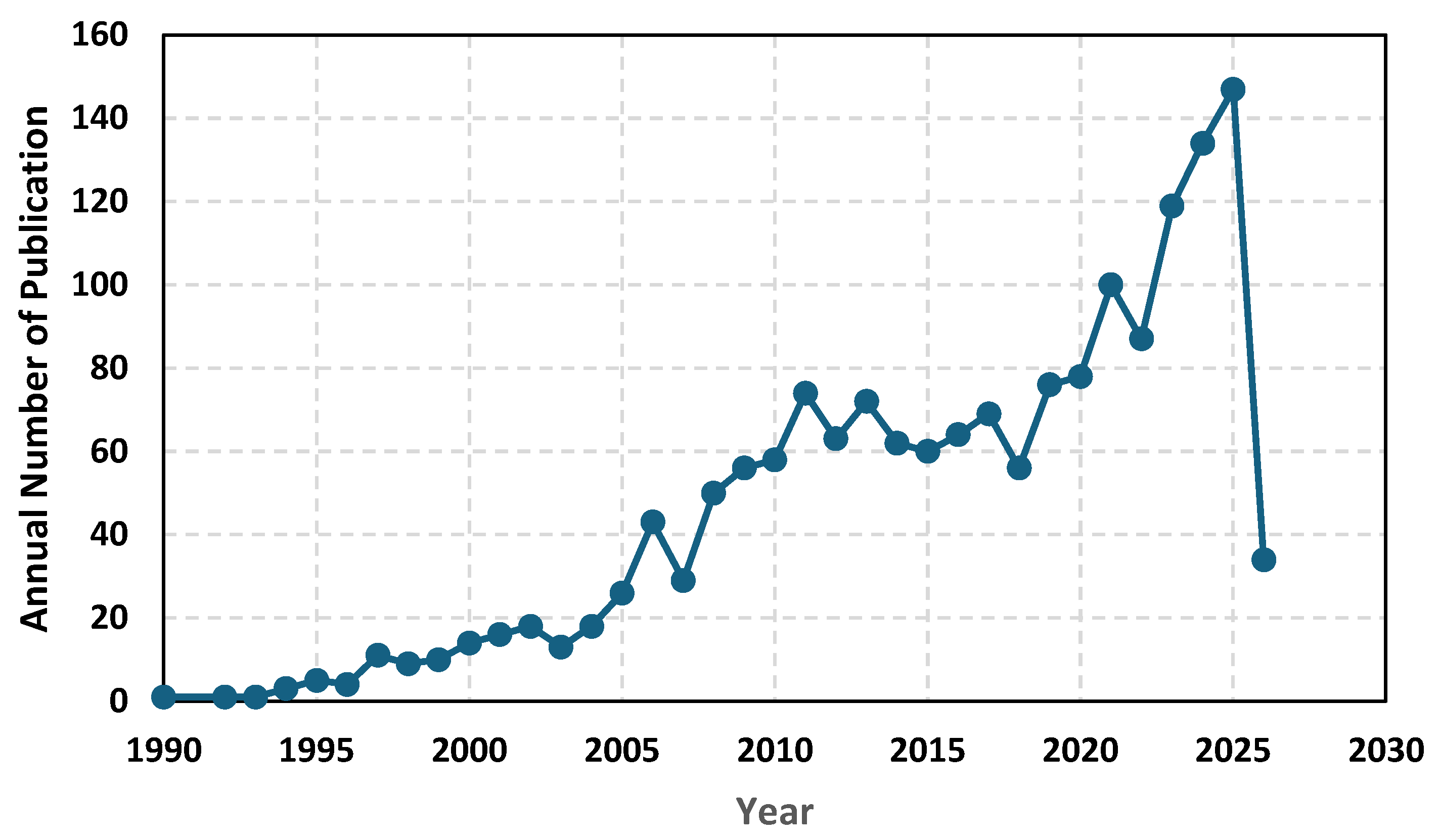
In recent years, research on bridge health monitoring and data-driven structural identification has experienced rapid growth, driven by advances in measurement technologies, computational power, and AI. As illustrated in
Figure 2, the number of annual publications in this domain has increased significantly over the past three decades, with a particularly sharp rise after 2010. This trend reflects the growing importance of intelligent infrastructure systems and highlights the increasing integration of modal analysis and ML techniques in bridge engineering. The surge in publications in recent years further underscores the need for comprehensive review studies that systematically synthesize developments across both structural dynamics and AI-based methodologies.
Although a growing number of review papers have addressed structural health monitoring, operational modal analysis, vibration-based damage detection, or artificial intelligence in civil engineering, most existing studies examine these themes in isolation. General SHM reviews often discuss sensing technologies and damage detection strategies without providing a detailed bridge-specific synthesis of modal identification workflows. Reviews focused on OMA typically emphasize signal processing and system identification theory but provide limited discussion on how extracted modal parameters are translated into intelligent diagnostic frameworks. Likewise, reviews on AI in civil engineering often cover broad applications such as materials design, construction management, and image-based inspection, without systematically linking AI models to vibration-based bridge health identification.
As a result, several important gaps remain in the current literature:
- (1)
Limited integration between sensing systems, modal analysis, and machine learning;
- (2)
Insufficient bridge-specific guidance on selecting methods under different operational scenarios;
- (3)
Limited coverage of Automated Operational Modal Analysis (AOMA) as a scalable monitoring solution;
- (4)
Insufficient discussion of uncertainty, interpretability, and deployment constraints;
- (5)
Lack of a unified roadmap toward digital twin-enabled bridge management.
The unique contribution of the present review is to address these gaps through a bridge-focused, modal- and AI-centric perspective. Rather than treating modal analysis and artificial intelligence as separate research streams, this paper establishes their functional connection within a complete bridge health identification pipeline—from sensing and modal parameter extraction to feature generation, automated diagnosis, and decision support. In addition, the paper critically compares major methodological families, discusses practical implementation challenges, and outlines future research directions toward physics-informed AI, multi-modal fusion, uncertainty-aware systems, and intelligent digital twins.
The remainder of this paper is organized as follows.
Section 2 presents model identification techniques, focusing on frequency-domain, time-domain, and hybrid methods for modal parameter extraction.
Section 3 reviews AI and ML approaches for BHI, including their theoretical foundations and practical applications.
Section 4 discusses key research gaps and future directions. Finally, conclusions are drawn in
Section 5.
2. Model Identification
Reliable BHI fundamentally relies on robust model identification techniques capable of transforming raw vibration measurements into physically meaningful modal parameters [
17,
40,
41]. Within the framework of OMA, this task is particularly challenging because excitation forces are typically unknown, stochastic, and often non-stationary, leading to output-only identification problems.
From a signal processing and system identification perspective, modal parameter extraction involves solving an inverse problem under uncertainty, where measurement noise, environmental variability, and multiple modes introduce significant ambiguity [
42,
43]. Consequently, the choice of identification method must balance robustness, computational efficiency, and sensitivity to close modes. Existing approaches can be broadly categorized into frequency-domain, time-domain, and hybrid time–frequency methods, each relying on distinct mathematical formulations and exhibiting different performance characteristics under realistic bridge monitoring conditions [
44].
2.1. Frequency Domain Methods
Frequency-domain methods constitute the most intuitive class of OMA techniques, as they operate on spectral representations of structural responses, typically through power spectral density (PSD) matrices or frequency response functions [
45,
46,
47]. Their widespread use in bridge monitoring stems from their relatively low computational cost and straightforward implementation.
The Peak Picking (PP) method represents the simplest formulation, where modal frequencies are approximated by identifying peaks in the PSD. While computationally efficient, PP is fundamentally limited by its reliance on assumptions of light damping and well-separated modes. In practical bridge applications, where modal overlap and environmental noise are prevalent, spectral peaks tend to broaden and merge, leading to biased or ambiguous frequency estimates. Moreover, PP provides no reliable framework for damping estimation and only indirect approximations of mode shapes, significantly limiting its applicability beyond preliminary analyses [
48].
To address these shortcomings, Frequency Domain Decomposition (FDD) extends PP by exploiting the singular value decomposition (SVD) of the spectral density matrix [
49,
50]. At resonance frequencies, the first singular value is assumed to be dominated by a single structural mode, and the corresponding singular vector approximates the mode shape. Compared to PP, FDD significantly improves noise robustness and modal separation, particularly in multi-channel measurement systems with adequate spatial coverage [
51].
However, FDD remains a non-parametric technique and does not explicitly model system dynamics. As a result, damping estimation is unreliable, and performance degrades when excitation deviates from broadband assumptions or when modes are close. These limitations are partially mitigated in Enhanced Frequency Domain Decomposition (EFDD), which introduces a time-domain interpretation through inverse Fourier transformation of narrow spectral bands. By analyzing the free-decay response, EFDD enables approximate damping estimation via logarithmic decrement.
Despite its improved capabilities, EFDD is highly sensitive to user-defined parameters, such as frequency bandwidth selection and windowing, which can introduce significant variability in damping estimates. Furthermore, both FDD and EFDD assume linear, time-invariant behavior, limiting their applicability in scenarios involving non-stationary loading (e.g., traffic-induced harmonics) or nonlinear structural responses.
Representative applications of FDD and its variants in bridge health monitoring are summarized in
Table 1. The selected studies highlight both methodological extensions of classical FDD and practical strategies to improve robustness under noise, environmental variability, and operational excitation conditions.
2.2. Time Domain Methods
Time-domain identification methods provide a more rigorous framework by explicitly modeling the structural system in a stochastic state-space representation [
57,
58,
59]. Unlike frequency-domain approaches, these methods operate directly on time-series data and are therefore better suited for handling close modes, high damping, and colored noise.
The Eigensystem Realization Algorithm (ERA), particularly when combined with the Natural Excitation Technique (NExT), enables modal identification under ambient excitation by interpreting response correlations as free-decay responses [
15,
60]. This approach provides a theoretically consistent framework for extracting modal parameters and has been successfully applied in controlled environments. However, its performance is highly dependent on accurate estimation of correlation functions, which can be challenging in short or noisy datasets. Additionally, ERA requires careful selection of model order and block dimensions, limiting its robustness in automated large-scale applications.
Stochastic Subspace Identification (SSI) has emerged as the benchmark time-domain method for bridge monitoring. By projecting measured data into lower-dimensional subspaces, SSI enables consistent estimation of system matrices and modal parameters [
60,
61,
62,
63,
64]. Its use of stabilization diagrams provides a systematic mechanism for distinguishing physical modes from spurious modes, making it particularly effective in complex, high-dimensional systems.
Nevertheless, SSI is not without limitations. Its computational cost is significantly higher than that of frequency-domain methods, and its performance is sensitive to user-defined thresholds and model order selection. Moreover, stabilization diagram interpretation, while powerful, often requires expert judgment or additional clustering algorithms, posing challenges for full automation in long-term monitoring systems.
AutoRegressive Moving Average (ARMA) models offer a statistically grounded alternative, representing structural responses as stochastic processes. While conceptually simple, ARMA methods suffer from strong sensitivity to model order selection and are prone to overfitting or spurious pole identification in high-dimensional systems. Consequently, their applicability to large-scale bridge monitoring is generally limited compared to subspace-based methods.
In comparative terms, time-domain approaches, particularly SSI, provide superior accuracy and robustness in realistic monitoring conditions. However, these advantages come at the expense of increased computational complexity and reduced transparency in parameter tuning, which may hinder their deployment in resource-constrained or real-time applications.
Representative applications of SSI methods in bridge monitoring are summarized in
Table 2. These studies demonstrate the evolution from classical covariance- and data-driven SSI toward enhanced and probabilistic formulations aimed at improving robustness to noise, outliers, and operational variability.
2.3. Hybrid and Advanced Methods
The assumptions of linearity, stationarity, and broadband excitation underlying classical OMA methods are often violated in real bridge environments. Traffic loads, environmental variations, and potential nonlinear behavior introduce non-stationary and multi-component signals, necessitating more advanced analysis techniques.
Time–frequency methods, such as the Wavelet Transform (WT), address these challenges by providing localized representations in both time and frequency domains. This enables improved identification of transient events and separation of overlapping modal components. However, WT-based approaches require careful selection of wavelet functions and scales, and often rely on subsequent modal identification procedures, limiting their standalone applicability [
71,
72,
73].
The Hilbert–Huang Transform (HHT), based on Empirical Mode Decomposition (EMD), offers an adaptive framework for analyzing nonlinear and non-stationary signals. By decomposing signals into intrinsic mode functions (IMFs), HHT provides high-resolution time–frequency information that can reveal subtle damage-induced changes. Despite its potential, HHT suffers from well-known issues such as mode mixing, sensitivity to noise, and lack of theoretical rigor, which complicate its consistent application in large-scale monitoring systems [
73,
74].
More broadly, hybrid approaches aim to combine the strengths of classical OMA methods with advanced signal processing techniques. While these methods show promise in handling complex signals, they often introduce additional parameters and computational overhead, raising concerns regarding robustness, repeatability, and scalability.
The selection of an appropriate modal identification technique depends on multiple factors, including signal-noise ratio, computational resources, and the nature of the measured signals. Frequency-domain, time-domain, and hybrid approaches each exhibit distinct strengths and limitations when applied to BHI. In particular, their performance varies in terms of robustness to measurement noise, computational efficiency, and their ability to handle non-stationary or nonlinear structural responses. To provide a concise comparison, the key characteristics of these three classes of methods are summarized in
Table 3.
Although modal identification methods are commonly classified according to their mathematical formulation, their practical suitability also depends strongly on bridge type, structural complexity, excitation characteristics, and monitoring objectives. In engineering applications, the most effective method is not necessarily the most advanced algorithm, but the one that offers the best balance between reliability, computational efficiency, and deployability under field conditions. To provide practical guidance,
Table 4 summarizes the applicability of major modal identification methods according to representative bridge types, recommended monitoring scenarios, and key implementation considerations.
3. AI and ML Methods for BHI
AI and ML have become central to BHI, driven by the increasing availability of large-scale, heterogeneous datasets from SHM systems [
13,
75]. Unlike traditional physics-based approaches, AI-based methods frame BHI as a pattern recognition and statistical inference problem, where damage is inferred from data-driven features rather than explicit mechanical inversion [
75,
76].
Existing AI/ML approaches in BHI can be broadly categorized into supervised, unsupervised, DL, RL, and transfer learning paradigms, each with distinct assumptions regarding data availability, interpretability, and scalability. While these methods have demonstrated strong performance in controlled environments, their real-world deployment remains constrained by data limitations, environmental variability, and lack of generalization.
To provide a structured perspective,
Table 5 summarizes the main categories of AI/ML methods in BHI.
In many bridge health identification applications, machine learning models do not operate directly on raw vibration signals, but rather on engineered features derived from modal analysis. After applying Operational Modal Analysis (OMA) or related system identification techniques, modal parameters are extracted from measured responses and converted into numerical descriptors that reflect the structural condition of the bridge.
Typical modal features used as ML inputs include the following:
Natural frequencies: Changes in frequencies may indicate stiffness loss, damage progression, or boundary-condition variation.
Damping ratios: Variations in damping can reflect cracking, frictional mechanisms, joint degradation, or energy dissipation changes.
Mode-shape components: Spatial vibration patterns at sensor locations provide information about global and local structural behavior.
Mode-shape curvature or strain-energy indices: Sensitive indicators for damage localization.
Frequency shifts relative to baseline states: Useful for anomaly detection and condition tracking.
Modal Assurance Criterion (MAC) values: Quantify similarity between current and reference mode shapes.
These quantities can be arranged into feature vectors or feature matrices and then supplied to ML algorithms such as Support Vector Machines, Random Forests, Neural Networks, Autoencoders, or clustering methods. For example, a classifier may use changes in the first three natural frequencies and corresponding damping ratios to distinguish healthy and damaged states, while an unsupervised model may learn the normal distribution of modal features and detect future deviations as anomalies.
The use of modal features offers two important advantages: (1) dimensionality reduction compared with raw sensor signals, and (2) improved physical interpretability, since the ML predictions remain linked to structural dynamics rather than purely abstract data patterns.
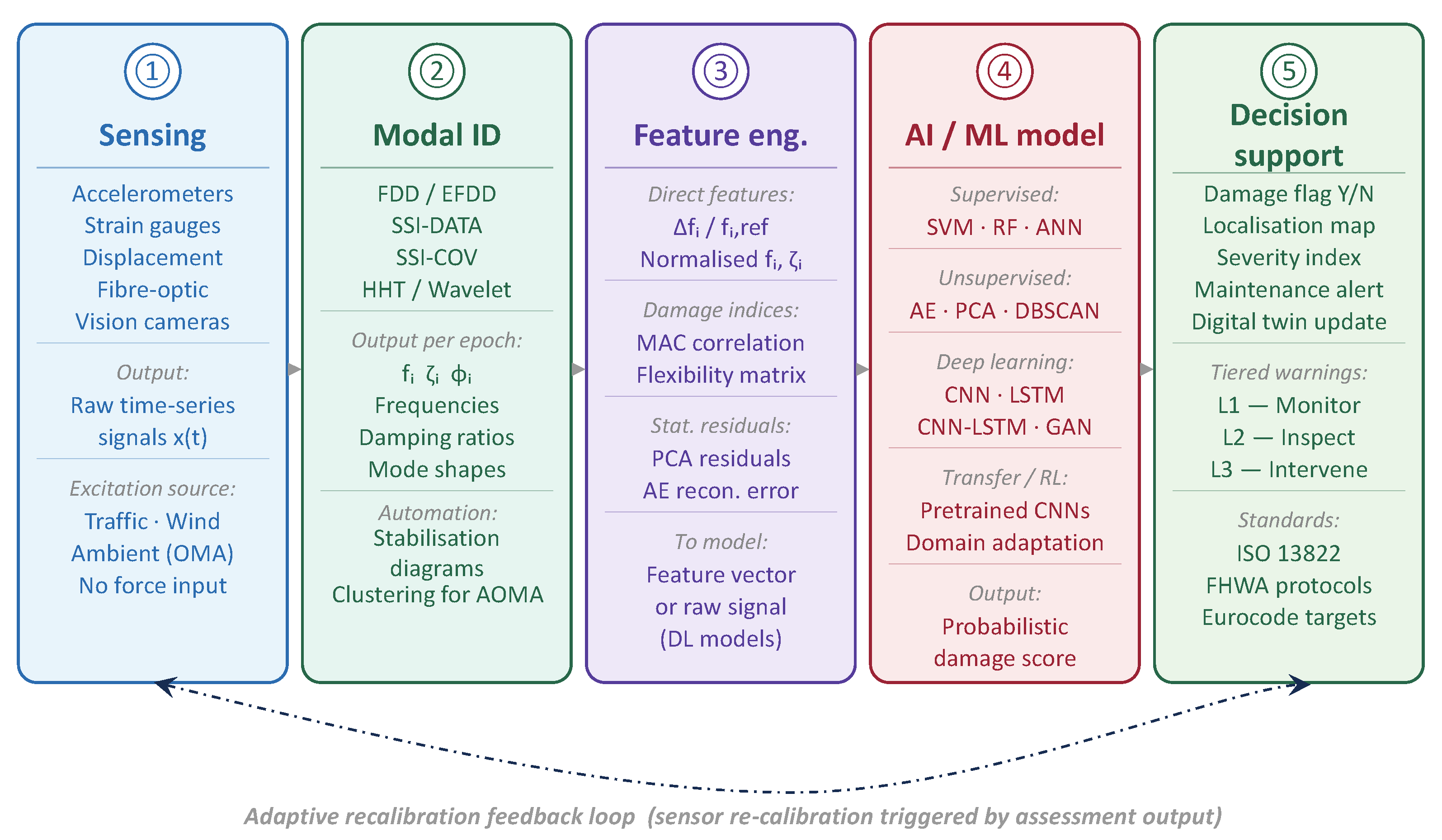
Figure 3 highlights that effective bridge intelligence systems are not based on isolated algorithms, but on continuous interaction among sensing, modal analysis, learning models, and decision feedback mechanisms.
3.1. Supervised Learning
Supervised learning methods rely on labeled datasets where structural states (e.g., healthy or damaged) are predefined. In BHI, these methods are primarily used for classification (damage detection/localization) and regression (damage severity estimation).
Among classical approaches, Support Vector Machines (SVMs) remain widely used due to their strong generalization capability in small datasets. By maximizing the margin between classes, SVMs perform well in high-dimensional feature spaces, particularly when modal parameters or frequency-domain features are used. However, their performance is highly dependent on kernel selection and becomes computationally expensive for large datasets [
77,
78,
79,
80,
81,
82,
83,
84].
Tree-based models, such as Decision Trees and Random Forests, provide improved interpretability through feature importance analysis. They are particularly useful in identifying damage-sensitive features but may suffer from overfitting (single trees) or reduced interpretability (ensemble models) [
85,
86,
87,
88,
89].
Artificial Neural Networks (ANNs) offer higher flexibility and nonlinear mapping capability. They have been successfully applied in damage detection and regression tasks, especially when combined with engineered features. However, their performance is strongly influenced by network architecture, training data size, and regularization strategies [
90,
91,
92,
93,
94,
95,
96].
Despite their effectiveness, supervised methods face fundamental limitations in BHI:
Scarcity of labeled damage data;
Class imbalance (dominance of healthy data);
Poor transferability across different bridge types;
Sensitivity to environmental variability.
These challenges significantly limit their applicability in real-world monitoring systems.
3.2. Unsupervised Learning
Unsupervised learning methods eliminate the need for labeled data by identifying patterns, clusters, or anomalies directly from measured responses. This makes them particularly suitable for long-term SHM, where damage labels are rarely available.
Clustering techniques such as K-Means and DBSCAN are commonly used to group structural states or detect outliers. While K-Means is computationally efficient, it requires predefined cluster numbers and struggles with complex data distributions. DBSCAN, on the other hand, can identify arbitrarily shaped clusters and isolate noise but is sensitive to parameter selection [
97,
98,
99,
100].
Principal Component Analysis (PCA) is widely used for dimensionality reduction and baseline modeling. By projecting data onto a lower-dimensional space, PCA enables detection of deviations from normal structural behavior. However, its linear nature limits its effectiveness in capturing nonlinear structural dynamics [
101,
102,
103,
104,
105].
Autoencoders (AEs) and Variational Autoencoders (VAEs) extend this concept by learning nonlinear representations of healthy-state behavior. Reconstruction errors serve as damage indicators, making these models effective for anomaly detection. Nevertheless, their performance depends heavily on the quality of training data and threshold selection strategies [
106,
107,
108].
Overall, unsupervised methods provide a practical solution for real-world BHI, but their reliability is strongly influenced by:
3.3. Deep Learning
DL models have significantly advanced BHI by enabling automatic feature extraction from raw or minimally processed data. Unlike traditional ML, these models learn hierarchical representations directly from time-series signals, images, or multi-modal data.
Convolutional Neural Networks (CNNs) are widely used for both vibration-based and vision-based applications. In vibration analysis, CNNs process spectrograms or wavelet scalograms, while in visual inspection, they detect cracks and surface defects. Their ability to capture spatial patterns makes them highly effective for damage localization [
109,
110,
111,
112].
Recurrent Neural Networks (RNNs) and Long Short-Term Memory (LSTM) networks are designed for sequential data and are particularly suitable for long-term monitoring. They can model temporal dependencies and detect deviations in structural response over time [
113,
114,
115].
Hybrid architectures, such as CNN–LSTM models, combine spatial and temporal learning, offering improved performance in complex environments with varying operational conditions.
Generative Adversarial Networks (GANs) provide a promising solution to data scarcity by generating synthetic damage data. They are increasingly used for data augmentation and digital twin applications, although training instability remains a key challenge [
116,
117,
118,
119,
120].
Despite their advantages, DL methods face several limitations:
High data requirements;
Significant computational cost;
Limited interpretability (black-box nature);
Sensitivity to domain shift.
As deep learning models exhibit varying performance depending on data characteristics and application scenarios,
Table 6 provides a structured comparison of their strengths, application domains, and key limitations in the context of bridge health identification.
3.4. RL Method
RL introduces a decision-making framework where an agent interacts with the environment to optimize long-term performance [
121,
122]. In BHI, RL is primarily used for:
By modeling bridge systems as Markov Decision Processes (MDPs), RL enables the development of adaptive, cost-effective maintenance strategies. Deep RL methods further extend these capabilities to high-dimensional systems.
However, RL applications in BHI remain limited due to:
Difficulty in defining realistic reward functions;
High computational demands;
Dependence on accurate simulation environments.
3.5. Transfer Learning
Transfer learning addresses the fundamental challenge of data scarcity by leveraging knowledge from related domains. In BHI, this approach is particularly effective in:
Vision-based damage detection (using pretrained CNNs);
Simulation-to-real data transfer;
Cross-bridge model generalization.
Pretrained models significantly reduce training time and data requirements. However, their performance depends strongly on the similarity between source and target domains. In cases of significant domain mismatch, negative transfer may occur, reducing model accuracy.
4. Automated Operational Modal Analysis (AOMA): Advances in FDD and SSI-Based Methods
AOMA has emerged as a critical advancement in bridge health identification, enabling the extraction of modal parameters without extensive user intervention. Traditional OMA techniques, while robust, often require expert judgment for peak selection, mode validation, and parameter tuning. This dependence on manual processing limits scalability for long-term SHM systems, particularly when dealing with large datasets and continuous monitoring scenarios. Consequently, recent research has focused on developing automated frameworks that integrate signal processing, data-driven approaches, and clustering algorithms to achieve reliable and scalable modal identification.
4.1. Automated Frequency-Domain Methods
Frequency-domain approaches, particularly FDD and EFDD, have been widely adopted in AOMA due to their simplicity and computational efficiency. However, conventional implementations rely heavily on subjective decisions, such as peak selection and bandwidth definition. To address these limitations, several automated FDD-based methodologies have been proposed.
As summarized in
Table 7, early developments focused on eliminating user interaction by introducing fully automated FDD algorithms capable of identifying modal parameters directly from spectral data. These approaches enable seamless integration into SHM systems and provide default modal estimates without requiring expert intervention. Subsequent studies have combined FDD with time-domain techniques such as SSI, improving robustness under noisy measurements and enhancing modal reliability.
More recent advancements incorporate advanced signal processing and statistical learning techniques. For example, the use of time-dependent MAC combined with CWT has improved the discrimination between physical and spurious ones. Similarly, DF, Gaussian Mixture Models (GMM), and clustering-based threshold optimization have been introduced to automate mode validation and eliminate spurious modes. Enhanced EFDD-based frameworks further address damping estimation challenges by introducing modal domain filtering and automated peak selection strategies, making them suitable for continuous monitoring applications.
Overall, automated FDD and EFDD methods offer the following:
However, their performance may still be affected by close modes, noise contamination, and sensitivity to spectral parameters.
4.2. Automated Time-Domain Methods: SSI-DATA Approaches
Time-domain methods, particularly SSI, have become the benchmark for high-accuracy modal identification in bridge structures. The SSI-DATA variant, which operates directly on measured data without explicit covariance estimation, has been widely extended toward automation.
As presented in
Table 8, automated SSI-DATA frameworks primarily rely on clustering algorithms to distinguish physical modes from spurious modes. Early approaches introduced structured workflows consisting of preprocessing, decomposition, and realization stages, combined with adaptive Hankel matrix sizing and automated model order selection. These developments significantly reduced user intervention and improved identification accuracy.
Clustering techniques play a central role in SSI automation. Hybrid clustering strategies combining K-means and hierarchical clustering enable robust grouping of stable poles, while adaptive thresholding techniques allow data-driven identification of modal clusters. More advanced methods employ HVC and statistical filtering to perform multi-stage noise elimination, improving robustness in complex and noisy environments.
The main advantages of automated SSI-DATA methods include the following:
High accuracy in identifying close modes and highly damped modes;
Robustness under noisy conditions;
Reduced dependence on expert judgment.
Nevertheless, these methods remain computationally demanding and sensitive to clustering parameters and model-order selection strategies.
4.3. Automated Time-Domain Methods: SSI-COV Approaches
The covariance-driven variant of SSI (SSI-COV) has also been extensively developed for automated modal identification. Compared to SSI-DATA, SSI-COV benefits from explicit use of covariance structures, providing enhanced stability in long-term monitoring applications.
As summarized in
Table 9, recent SSI-COV-based AOMA methods have introduced a wide range of clustering and ML techniques to automate modal identification. These include hierarchical clustering, K-means, DBSCAN, GMM, and density peak clustering.
A key advancement in SSI-COV automation is the incorporation of uncertainty quantification. Probabilistic clustering approaches integrate variability in modal parameters—such as frequency and MAC—into the identification process, enabling more robust discrimination of physical modes. Additionally, density-based clustering methods (e.g., DBSCAN and its variants) have proven effective in identifying close modes and filtering out noise without requiring predefined cluster numbers.
More recently, DL techniques have been integrated into SSI frameworks. For example, CNNs have been used to classify modal parameters based on uncertainty diagrams, introducing a new paradigm that combines physics-based identification with data-driven classification.
Other notable advancements include the following:
Adaptive threshold selection for fully automated workflows;
Multi-stage filtering strategies for noise elimination;
Real-time modal tracking for continuous monitoring;
Hybrid clustering frameworks combining statistical and ML techniques.
Overall, SSI-COV-based AOMA methods provide the following:
High robustness and reliability;
Superior performance in complex and noisy environments;
Strong potential for large-scale SHM deployment.
However, challenges remain in computational efficiency, parameter tuning, and integration with real-time monitoring systems.
4.4. Synthesis and Research Trends in AOMA
Across both frequency-domain and time-domain approaches, a clear trend toward full automation and integration with ML techniques can be observed. While FDD-based methods offer simplicity and efficiency, SSI-based approaches provide higher accuracy and robustness, particularly for complex bridge systems.
Recent research increasingly focuses on the following:
Hybrid frameworks combining FDD and SSI;
Data-driven clustering and probabilistic filtering;
Integration of DL for mode classification;
Automated thresholding and parameter tuning;
Real-time and large-scale deployment in SHM systems.
Despite these advances, several challenges persist, including sensitivity to environmental variability, lack of standardized validation datasets, and limited integration of uncertainty quantification into practical decision-making frameworks. Addressing these issues is essential for achieving reliable, scalable, and fully autonomous bridge health identification systems.
Despite the significant progress achieved by clustering-based AOMA frameworks, their reliability under highly complex conditions remains an open challenge. In the presence of closely spaced modes, nonlinear structural responses, and non-stationary excitations, the distinction between physical and spurious modes becomes less clear, reducing the robustness of automated clustering and threshold-based selection procedures. In such cases, modal clusters may partially overlap, weak modes may be suppressed, and subtle changes associated with early-stage damage may remain undetected.
Moreover, fully automated pipelines may introduce systematic bias when their decisions are governed only by statistical similarity indicators such as frequency proximity, damping consistency, or modal assurance criteria, without sufficient incorporation of physical constraints. This limitation is particularly important in long-term monitoring, where environmental and operational variability may produce modal changes comparable to or greater than those caused by minor structural damage.
Therefore, although current AOMA techniques provide substantial advantages in scalability and efficiency, they should not always be interpreted as complete substitutes for expert judgment. A more reliable direction is the development of hybrid AOMA frameworks that integrate clustering algorithms with uncertainty quantification, physics-informed mode validation, and selective expert oversight for ambiguous cases. Such strategies can reduce false positives and false negatives while preserving the practical benefits of automation.
4.5. Critical Performance Synthesis of Existing Methods for Intelligent Bridge Health Identification
A key challenge in the intelligent era is not only developing new algorithms but selecting methods that provide an effective balance among accuracy, computational efficiency, automation capability, robustness, and decision reliability. Based on the reviewed literature, the major methodological families can be critically synthesized as follows.
4.5.1. Frequency-Domain OMA Methods
Methods such as PP, FDD, and EFDD are computationally efficient and attractive for continuous monitoring systems with limited processing resources. Their implementation is relatively straightforward, making them suitable for routine monitoring and rapid modal screening. However, their precision may decrease in the presence of closely spaced modes, low signal-to-noise ratios, or strong non-stationary excitation. They are most effective when modal separation is clear and ambient excitation is approximately broadband.
4.5.2. Time-Domain Methods
SSI-based methods generally provide higher accuracy and more stable modal estimates than classical frequency-domain approaches, especially in complex bridge systems with coupled modes or higher modal density. Their ability to distinguish physical from spurious modes through stabilization diagrams makes them highly reliable for detailed structural assessment. However, these benefits are achieved at higher computational cost and greater dependence on parameter tuning or clustering-based automation.
4.5.3. Hybrid Time–Frequency Methods
Wavelet-based and adaptive decomposition methods offer improved sensitivity to transient events, evolving damage states, and non-stationary signals. They are particularly valuable for bridges exposed to variable traffic loading, seismic events, or changing environmental conditions. Nevertheless, their performance may depend strongly on parameter selection, signal preprocessing quality, and computational burden.
4.5.4. AI and Machine Learning Methods
Machine learning significantly enhances automation and predictive capability. Supervised models often achieve high classification accuracy when representative labeled datasets are available, whereas unsupervised approaches are advantageous when damage labels are limited. Deep learning can outperform conventional methods in high-dimensional or multi-modal datasets through automatic feature learning. However, model precision in real applications depends heavily on data quality, domain generalization, and environmental compensation. Interpretability also remains a critical issue for engineering acceptance.
4.5.5. Automated Operational Modal Analysis (AOMA)
AOMA methods represent a major step toward scalable intelligent monitoring because they reduce dependence on expert intervention and enable processing of long-term datasets. Their main benefit lies in operational efficiency and consistency. However, in highly complex scenarios involving closely spaced modes, nonlinear behavior, or weak damage signatures, fully automated decisions may still require uncertainty checks and selective expert validation.
4.5.6. Practical Guidance for Intelligent Deployment
For practical implementation:
High efficiency/low-cost monitoring: Prefer FDD/EFDD or lightweight anomaly detection models.
High accuracy in complex systems: Prefer SSI-based or hybrid approaches.
Real-time automation: Use AOMA with adaptive clustering and quality control.
Sparse labeled data: Use unsupervised, transfer learning, or self-supervised methods.
High-confidence decision support: Combine AI outputs with uncertainty quantification and physics-based validation.
4.6. Critical Evaluation of Methods Under Real-World Monitoring Conditions
Although a wide range of methods has been developed for bridge health identification, their practical performance depends strongly on the monitoring environment, bridge characteristics, data quality, and operational objective. Therefore, a critical comparison is necessary to clarify when each method is likely to outperform others and where important limitations remain.
In general, frequency-domain methods such as PP, FDD, and EFDD are advantageous when the bridge response is dominated by relatively well-separated modes, excitation is approximately broadband, and rapid low-cost analysis is required. These methods are especially attractive for routine monitoring because of their simplicity, transparency, and relatively low computational demand. However, their performance may deteriorate under real-world conditions involving closely spaced modes, high damping, low signal-to-noise ratio, or strongly non-stationary excitation. In such cases, peak broadening, spectral overlap, and sensitivity to bandwidth selection can reduce accuracy and repeatability.
By contrast, time-domain approaches, particularly SSI-based methods, generally outperform frequency-domain methods in complex bridge systems with dense modal content, coupled modes, or noisy measurements. Their state-space formulation allows more reliable extraction of physical modes and better discrimination of spurious poles, especially in long-span or dynamically complex bridges. However, these benefits come at the cost of higher computational demand, more sensitive parameter selection, and greater dependence on stabilization-diagram interpretation or clustering-based automation. In practice, their performance may still degrade when data length is insufficient, environmental variability is strong, or automated pole classification is poorly calibrated.
Hybrid time–frequency methods can outperform classical OMA techniques when the bridge response is non-stationary or contains transient components, such as variable traffic loading, moving vehicle interaction, or seismic excitation. Their main strength lies in improved localization of time-varying modal content. However, their wider practical use remains constrained by parameter sensitivity, reduced methodological standardization, and increased computational complexity.
For AI- and ML-based approaches, performance is strongly conditioned by the representativeness of the available training data. Supervised methods may outperform classical statistical or threshold-based approaches when sufficiently rich labeled datasets are available and the target conditions are consistent with the training domain. However, in real bridge monitoring, labeled damage data are scarce, class imbalance is severe, and environmental effects often mask damage signatures. Under these conditions, model accuracy reported in controlled studies may not transfer directly to field deployment. Unsupervised and self-supervised approaches are often more realistic for practice, but they remain sensitive to threshold selection, baseline drift, and environmental confounding.
AOMA frameworks offer substantial advantages in scalability and efficiency for long-term bridge monitoring, especially when large datasets make manual interpretation impractical. Nevertheless, automation does not eliminate the risk of systematic bias. Fully automated pipelines may miss weak modes, merge close modal clusters, or misclassify environmentally induced changes as structural anomalies if physical constraints and uncertainty checks are not adequately incorporated. Therefore, the most reliable practical frameworks are likely to be hybrid systems that combine automation with uncertainty quantification, environmental normalization, and selective expert validation.
A further challenge is that many studies report strong performance using laboratory data, simulations, or single-bridge case studies, while fewer studies provide cross-structure validation under diverse operational conditions. This limits direct comparison of reported accuracy, precision, and robustness across methods. For this reason, benchmark datasets and long-term monitored bridge case studies are essential for future progress. Real-world applications should ideally include different bridge typologies, environmental conditions, traffic patterns, sensor layouts, and damage scenarios to support meaningful validation and transferability assessment.
5. Research Gaps and Future Directions
To transition bridge health identification (BHI) from research prototypes to deployable engineering systems, future studies should focus not only on new algorithms, but also on implementable technical frameworks. The following pathways are proposed.
5.1. Physics-Informed Artificial Intelligence
Future AI models should integrate structural mechanics directly into the training process. This can be achieved by incorporating equations of motion, modal relationships, boundary constraints, and stiffness–mass consistency into loss functions or network architectures. A practical implementation pathway is to combine finite element (FE) simulations with monitoring data, where simulated responses provide physically meaningful priors and field data are used for calibration and updating. Such hybrid models can improve generalization while reducing dependence on large, labeled datasets.
In addition, future developments may employ differentiable physics solvers and reduced-order digital surrogates that allow rapid gradient-based updating during operation. This can significantly accelerate model calibration and enable near-real-time structural state estimation for large bridge networks.
5.2. Multi-Modal Data Fusion
Real bridges are monitored using heterogeneous sensors such as accelerometers, strain gauges, temperature sensors, cameras, and traffic counters. Future systems should fuse these data streams through synchronized acquisition platforms and unified preprocessing pipelines. Transformer-based models, graph neural networks, and attention mechanisms offer promising tools for learning relationships among multiple sensing modalities. Practical implementation requires timestamp alignment, missing-data handling, sensor reliability weighting, and scalable data storage architectures.
A further practical direction is adaptive sensor fusion, in which the contribution of each sensing modality is dynamically adjusted according to data quality, environmental conditions, sensor health, and operational relevance. Such adaptive weighting can improve robustness under partial sensor failure or temporary data corruption.
5.3. Uncertainty-Aware Decision Support
Engineering decisions should not rely solely on deterministic predictions. Future BHI systems should quantify epistemic and aleatory uncertainty using Bayesian neural networks, Monte Carlo dropout, deep ensembles, or probabilistic state-space models. These uncertainty estimates can then be linked with structural reliability indices, fragility curves, and maintenance thresholds to support risk-informed inspection and intervention planning.
Beyond uncertainty estimation itself, practical implementation should include decision dashboards that translate probabilistic outputs into actionable maintenance priorities, confidence levels, and recommended intervention windows for bridge managers.
5.4. Digital Twin Integration
Digital twins can be implemented by coupling a continuously updated numerical model with real-time sensor data. A practical workflow includes (1) baseline FE model development, (2) sensor network deployment, (3) real-time modal feature extraction, (4) parameter updating through optimization or Bayesian inference, and (5) predictive simulation under future loading scenarios. Cloud-edge architectures can support continuous operation while reducing communication latency.
A critical requirement for digital twin implementation in bridge health monitoring is reliable synchronization between the physical structure and its virtual counterpart. In practice, this synchronization should be achieved through continuous data acquisition, automated feature extraction, and recursive model updating rather than one-time model calibration. Real-time measurements from accelerometers, strain sensors, temperature sensors, vision systems, and traffic monitoring devices can be assimilated into the twin using sequential updating techniques such as Kalman filtering, particle filtering, Bayesian inference, or optimization-based parameter correction.
However, perfect agreement between the physical bridge and the digital model is neither realistic nor necessary. Sensor noise, missing data, environmental effects, and simplifications in numerical modeling inevitably introduce uncertainty and model mismatch. Therefore, future digital twins should explicitly quantify uncertainty instead of providing deterministic outputs only. Confidence bounds on modal parameters, damage indices, and predicted responses are essential for trustworthy engineering decisions.
The level of model fidelity required depends strongly on the operational objective. For example, reduced-order or surrogate models may be sufficient for continuous anomaly detection, modal trend tracking, and rapid alert systems because they provide computational efficiency for real-time use. In contrast, high-fidelity finite element models with updated boundary conditions, material degradation laws, and nonlinear behavior may be required for detailed damage diagnosis, load-rating assessment, retrofit planning, and remaining service life prediction.
Consequently, an effective bridge digital twin should be multi-layered and adaptive, combining fast low-order models for continuous monitoring with selectively activated high-fidelity simulations for deeper diagnosis when abnormal behavior is detected. This hierarchical strategy offers a practical pathway toward reliable decision-support systems in intelligent bridge management.
5.5. Edge Intelligence and Real-Time Deployment
Many bridge monitoring systems operate under bandwidth and power constraints. Therefore, future algorithms should be optimized for deployment on embedded devices through model compression, pruning, quantization, and lightweight architectures. Local processing at sensor nodes or gateways can reduce raw data transmission and enable near-real-time anomaly detection.
A scalable future architecture may combine on-site edge analytics for rapid alerts with cloud-based platforms for historical learning, cross-bridge benchmarking, and computationally intensive predictive simulations.
5.6. Standardized Benchmarking and Validation
A major barrier to progress is the lack of common benchmark datasets and evaluation protocols. Future work should establish open repositories containing long-term bridge monitoring data, environmental metadata, and verified damage scenarios. Standard metrics for detection accuracy, false alarm rates, computational cost, and robustness should be adopted to enable fair comparison among methods.
In addition, benchmarking initiatives should include bridges of different structural types, climatic conditions, traffic environments, and deterioration mechanisms to ensure that developed methods are transferable beyond a single case study or region.
5.7. Human-in-the-Loop Intelligent Infrastructure
Although automation is rapidly advancing, expert engineering judgment remains essential in safety-critical systems. Future BHI platforms should therefore incorporate human-in-the-loop frameworks, where automated algorithms perform continuous screening while engineers review uncertain or high-risk cases. Such collaboration can reduce false alarms, improve trust, and accelerate adoption in practice.
5.8. Sustainability and Lifecycle-Oriented Monitoring
Future intelligent bridge management should also integrate sustainability objectives with structural performance assessment. Monitoring outputs can be linked with lifecycle cost models, carbon assessment, maintenance scheduling, and resilience planning to support decisions that are not only technically sound, but also economically and environmentally optimal.
6. Conclusions
This paper presented a comprehensive review of bridge health identification (BHI) from a modal- and AI-centric perspective, with emphasis on the growing transition from conventional inspection practices toward intelligent, data-driven monitoring systems. The reviewed literature confirms that no single method is universally optimal; rather, the most effective strategy depends on structural complexity, monitoring objectives, data quality, and operational constraints.
From the perspective of modal identification, frequency-domain methods such as Peak Picking (PP), Frequency Domain Decomposition (FDD), and Enhanced Frequency Domain Decomposition (EFDD) remain attractive due to their simplicity, computational efficiency, and ease of implementation. These methods are particularly suitable for preliminary assessment, routine monitoring, and bridges with well-separated modes under approximately stationary ambient excitation. However, their reliability may decrease in the presence of closely spaced modes, strong noise contamination, or highly non-stationary loading.
Time-domain approaches, particularly Stochastic Subspace Identification (SSI), generally provide higher robustness and more consistent modal estimates in complex bridge systems. They are better suited for long-span, multi-component, or dynamically coupled bridges where modal density is high and accurate parameter estimation is required. Nevertheless, these methods involve higher computational cost and often require more careful parameter selection or automation strategies.
Hybrid and advanced time–frequency methods offer additional capability for analyzing transient, nonlinear, or non-stationary responses. These approaches are especially relevant for bridges subjected to traffic bursts, changing operational conditions, seismic events, or evolving damage states. Their wider adoption, however, depends on improving parameter robustness, repeatability, and computational efficiency.
The review also demonstrates that AI and ML methods have significantly expanded the scope of BHI by enabling automated feature extraction, anomaly detection, condition classification, and predictive maintenance. Supervised learning methods can be highly effective when labeled datasets are available, whereas unsupervised learning offers practical advantages in real monitoring systems where damage labels are scarce. Deep learning provides powerful representation learning for high-dimensional and multi-modal data, but its deployment is still constrained by data requirements, interpretability, and domain transfer challenges.
Recent advances in Automated Operational Modal Analysis (AOMA) indicate strong potential for scalable bridge monitoring. However, fully automated frameworks should be applied cautiously in highly complex scenarios involving closely spaced modes, nonlinear behavior, or severe environmental variability, where uncertainty quantification and selective expert validation may still be necessary.
Based on the reviewed evidence, the following guidance is suggested for future use:
Routine monitoring and resource-limited applications: Prefer computationally efficient methods such as FDD/EFDD or reduced-order AI screening tools.
Complex bridge systems requiring high accuracy: Use SSI-based methods combined with automated clustering and uncertainty checks.
Non-stationary or nonlinear conditions: Consider hybrid time–frequency approaches and adaptive learning models.
Sparse labeled data environments: Prioritize unsupervised, self-supervised, or transfer learning strategies.
Decision-support applications: Integrate probabilistic outputs, risk metrics, and maintenance optimization frameworks.
Next-generation smart infrastructure: Develop digital twins that combine continuous sensing, model updating, and AI-assisted prediction.