
Study on Foundation Constraint Modeling of a Sea-Crossing Cable-Stayed Bridge Under Combined Wind–Wave Actions

Abstract
1. Introduction
2. Simulation of the Interaction Between Circular End-Shaped Bridge Foundation and Foundation Soil
Foundation Restraint Model
- (1)
- Rigidly embedded restraint model
- (2)
- Multi-spring model based on the m-method
- The interaction between the foundation and the soil is assumed to be linear elastic, and spring elements with stiffness varying linearly with depth are used to simulate the interaction.
- Within the same soil layer, the equivalent spring stiffness values are assumed to be equal and constant.
- Friction between the foundation and the soil layers is neglected.
3. Comparative Analysis of the Effects of Foundation Restraint Models on the Structural Dynamic Effects of Cross-Sea Bridges
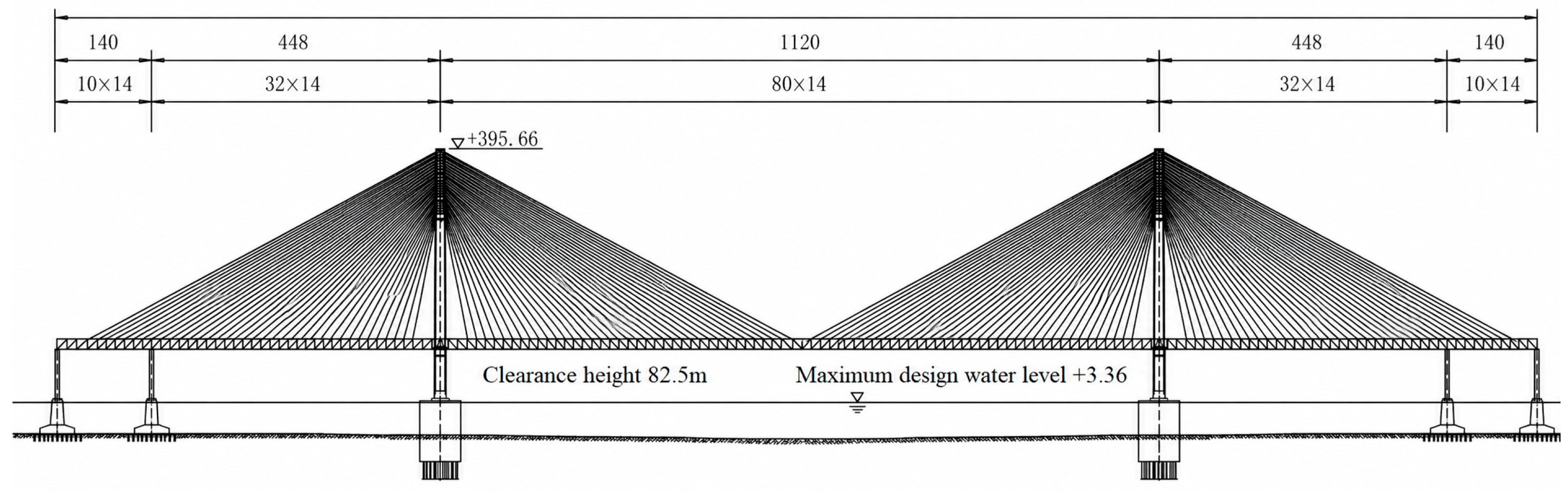
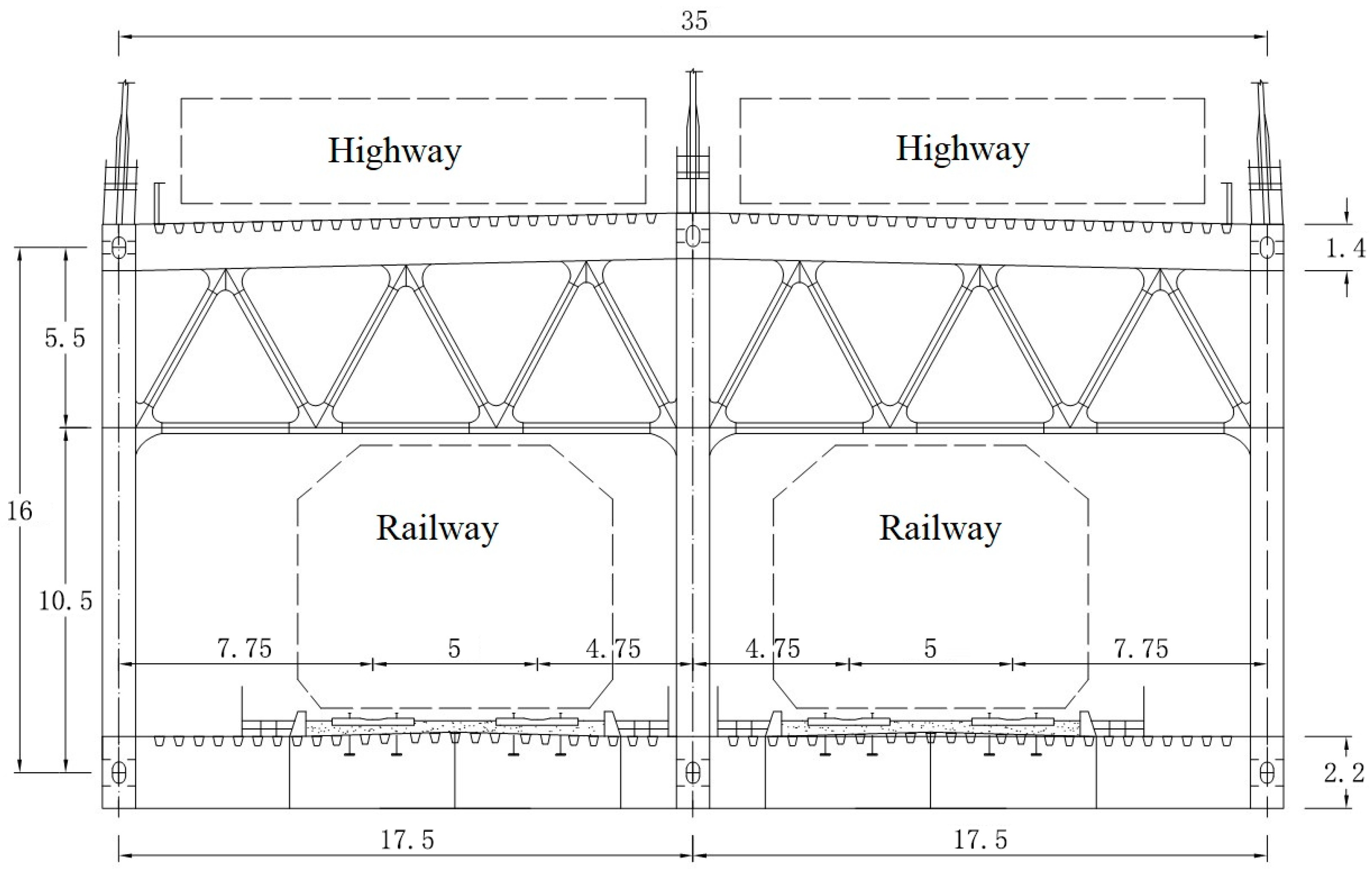
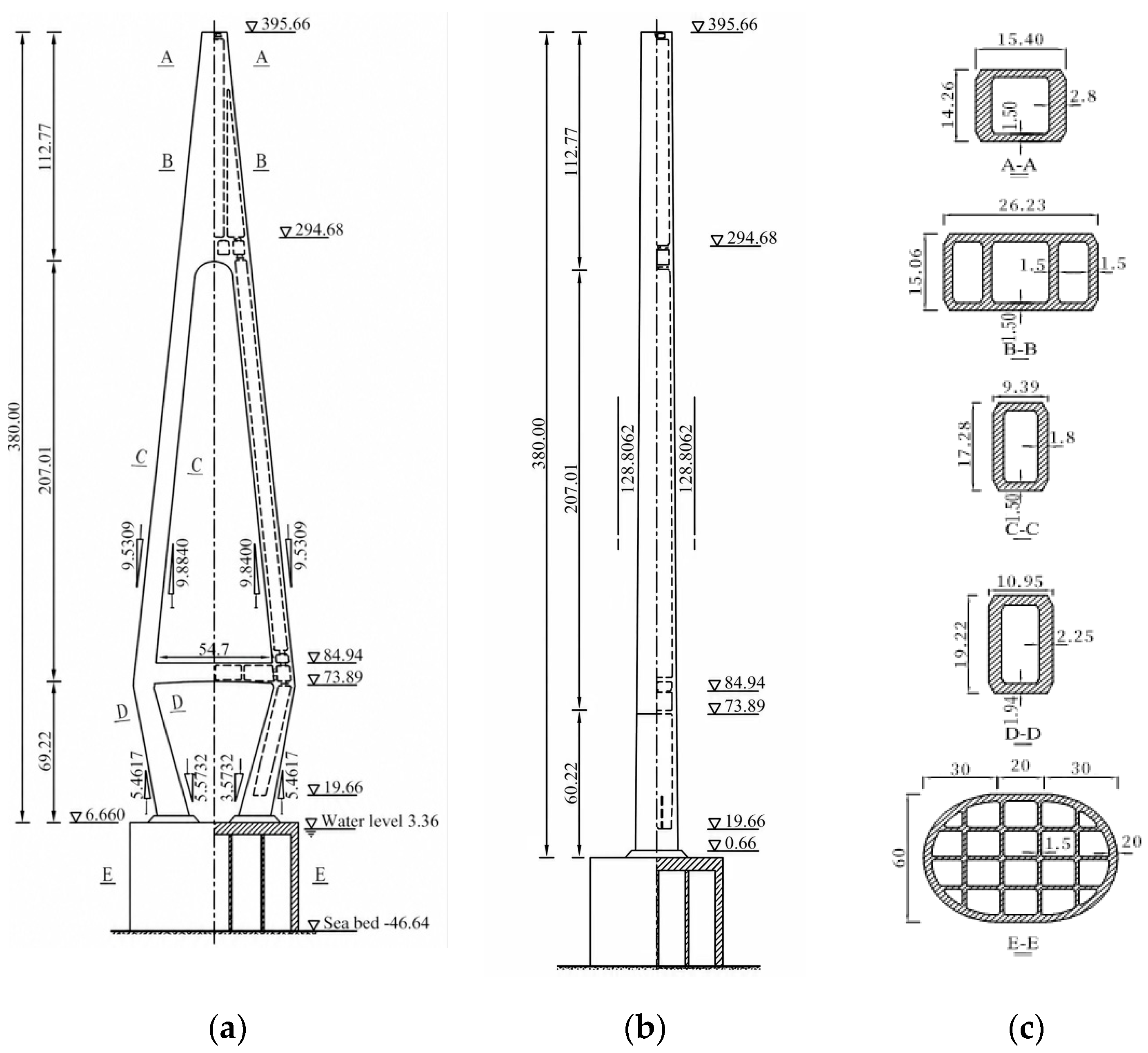
3.1. Introduction of Actual Engineering
3.2. Wind and Wave Design Parameters
3.3. Finite Element Modeling and Verification of Bridge Structures
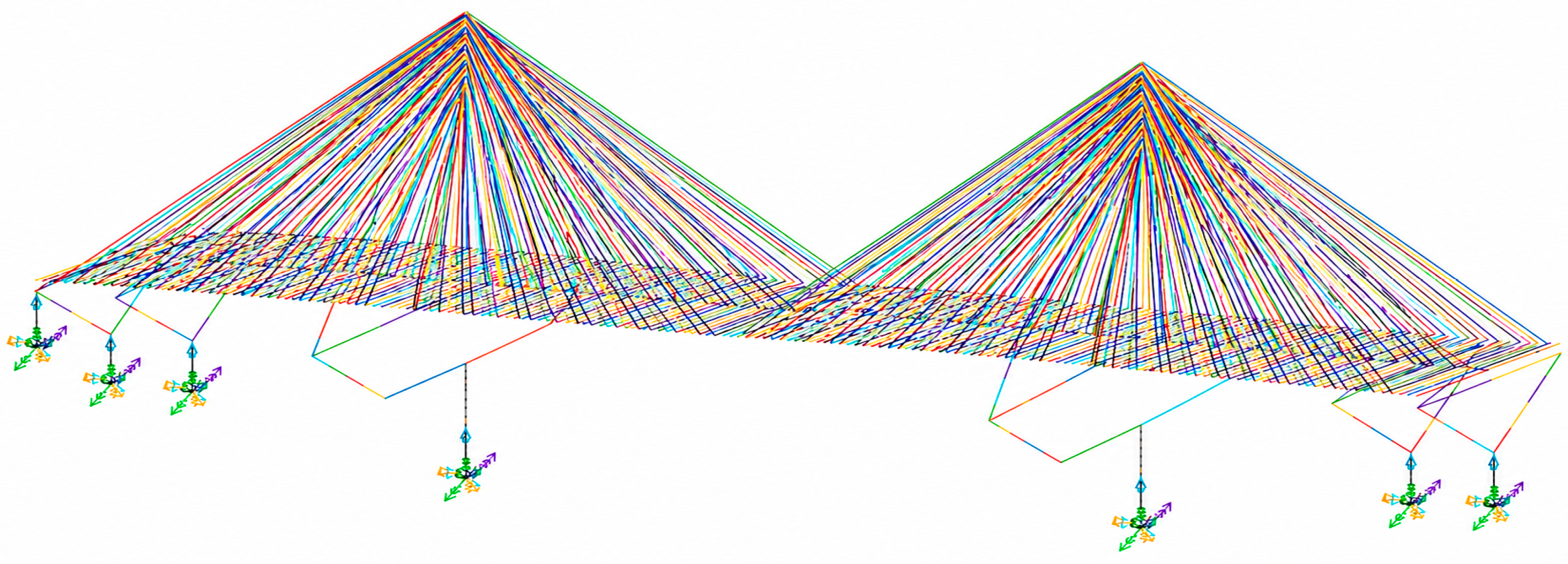
3.3.1. Finite Element Model of Bridge Structure
3.3.2. Model Constraints and Boundary Conditions
3.3.3. Node Configuration of the m-Method Foundation Spring Model
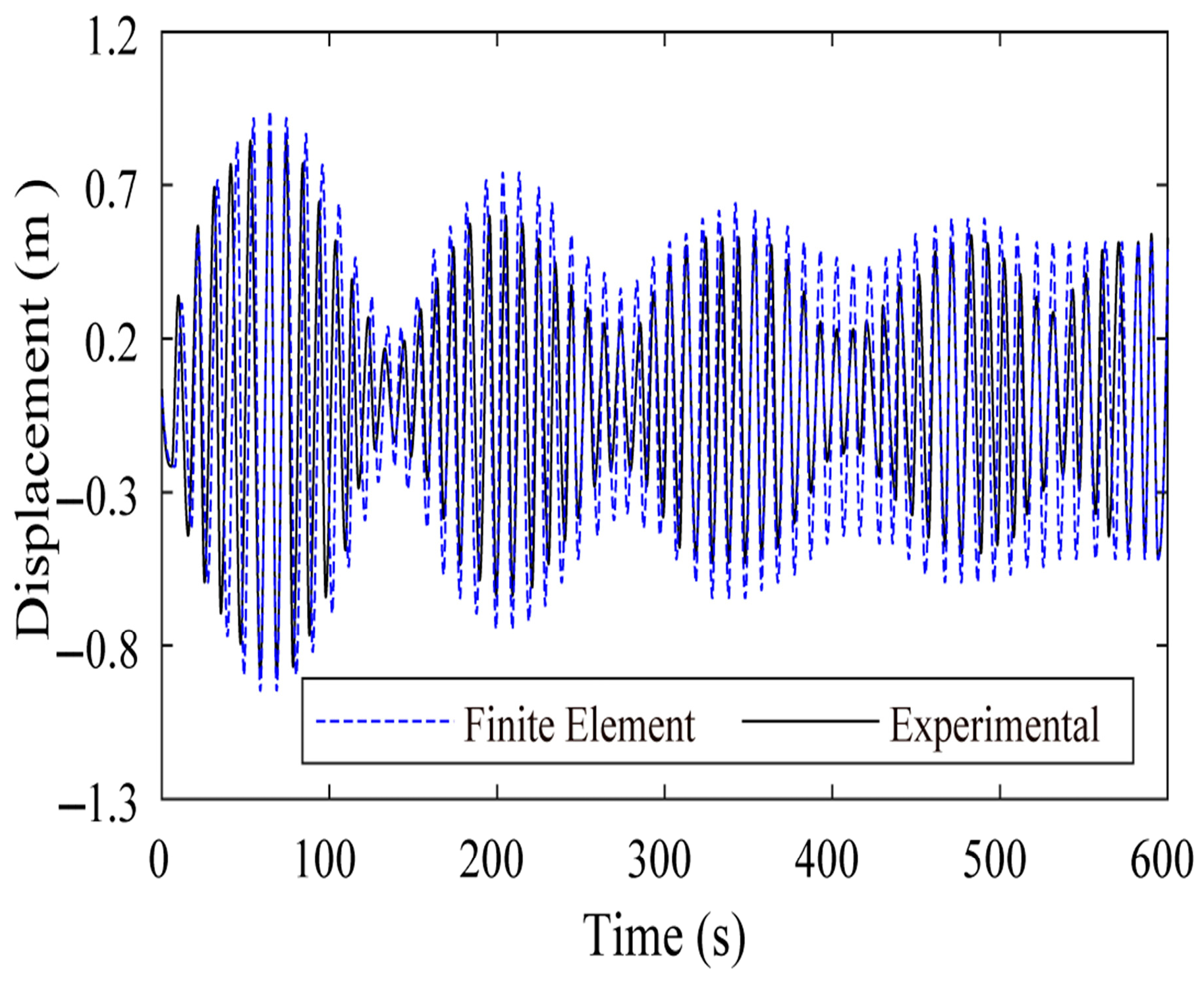
3.3.4. Finite Element Modeling and Validation of the Bridge Structure
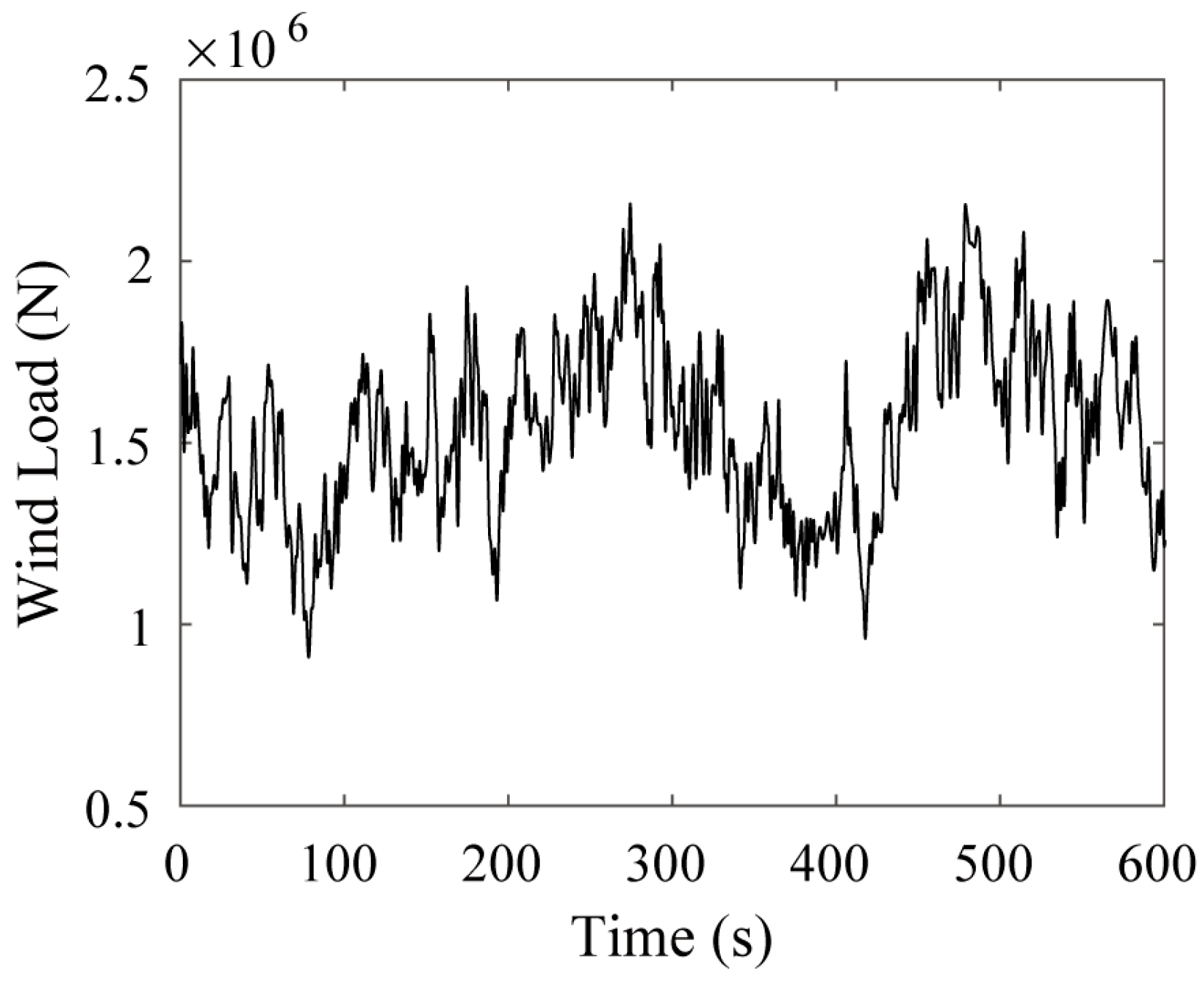
3.4. Wind and Wave Load Calculation Method
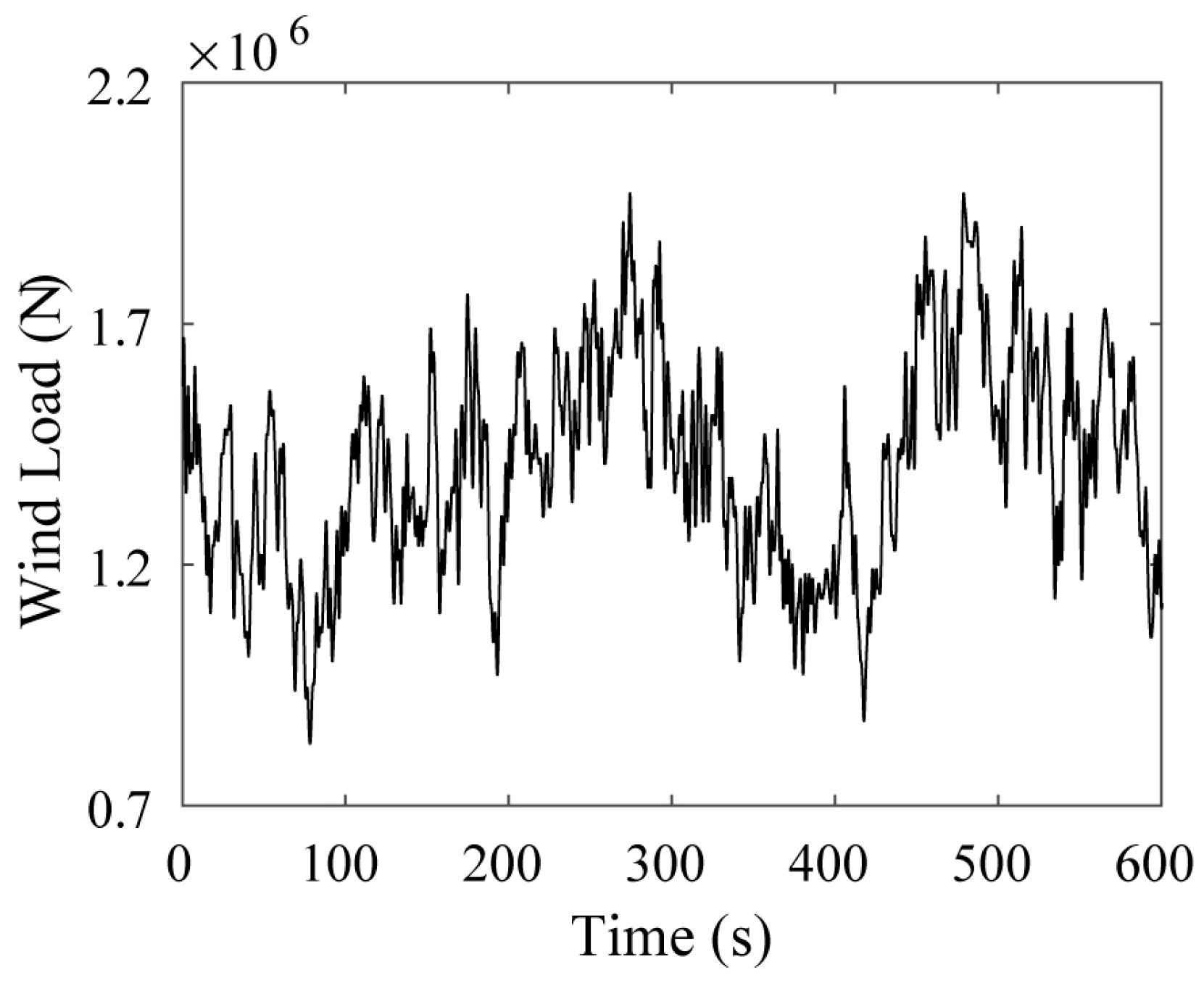
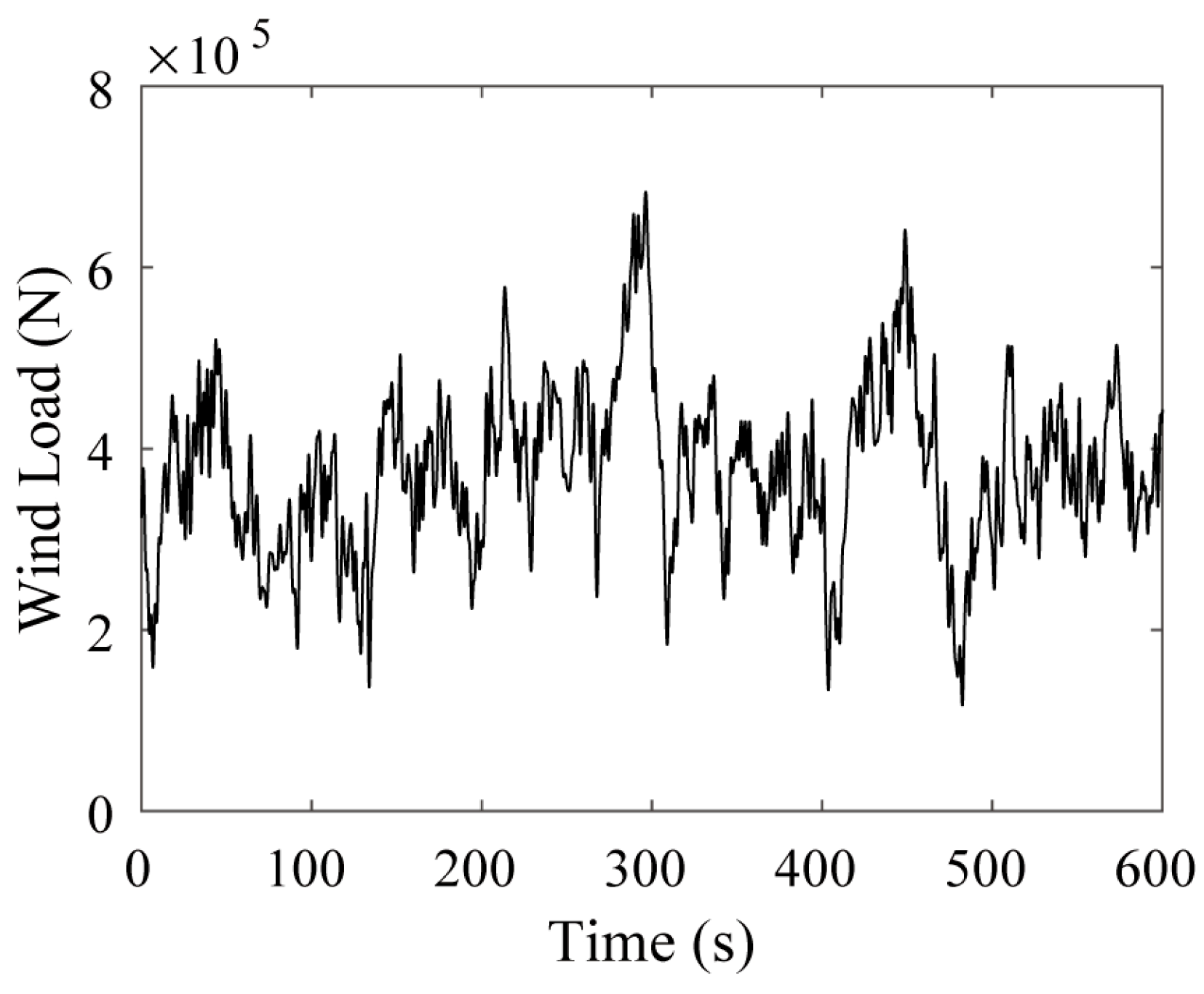
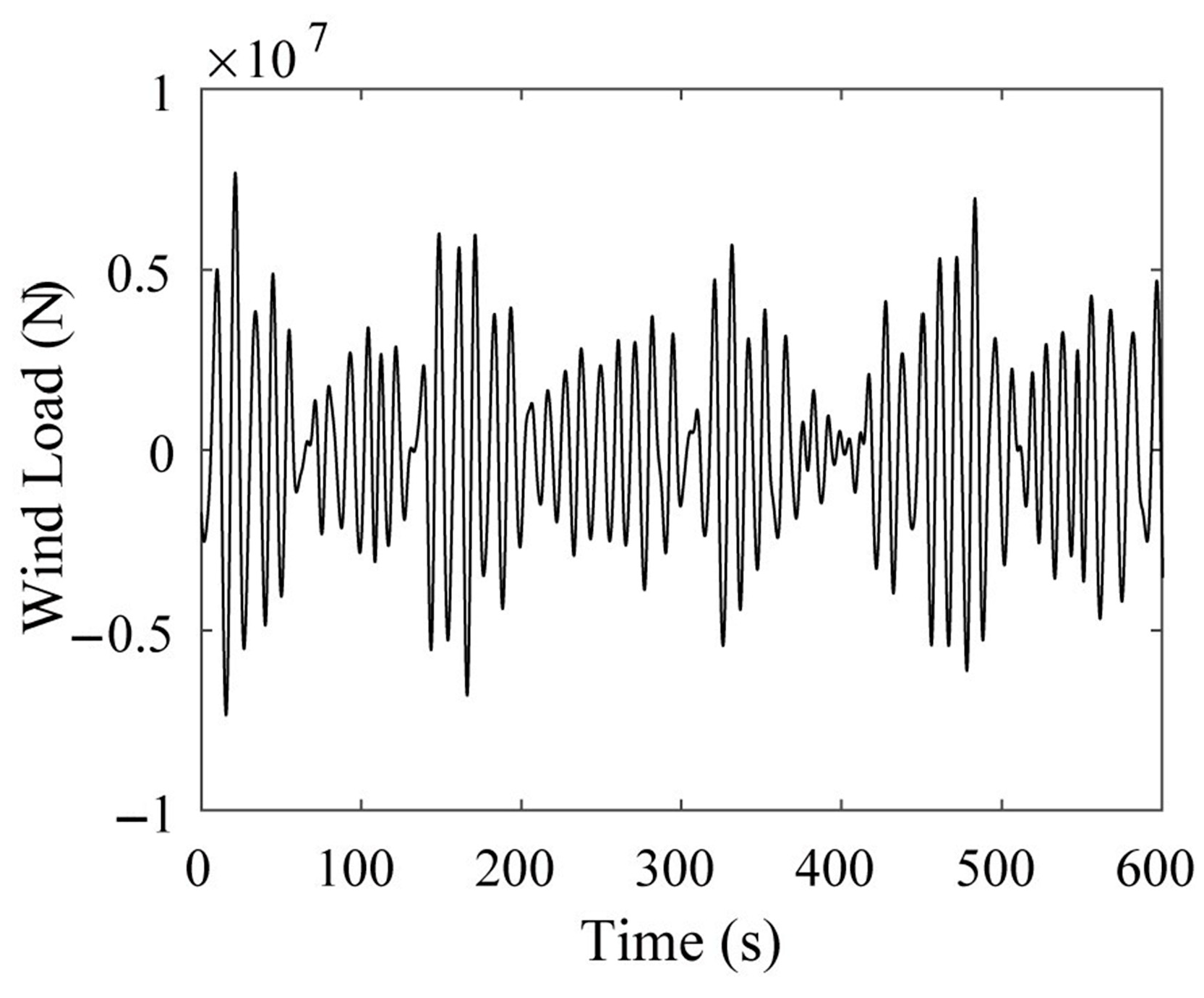
3.4.1. Wind Load Calculation
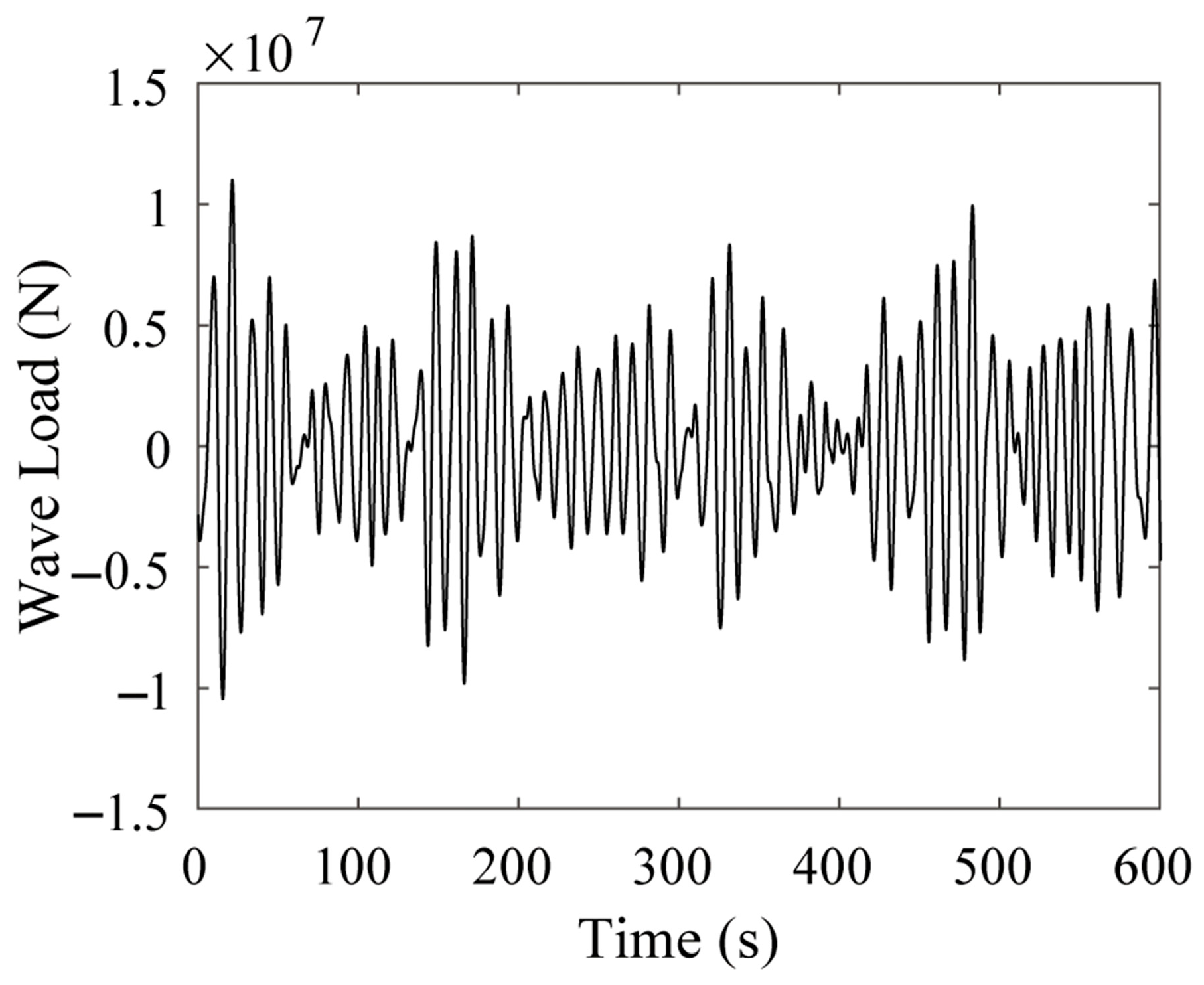
3.4.2. Wave Load Calculation
3.5. Comparative Analysis of the Dynamic Response of the Cross-Sea Bridge
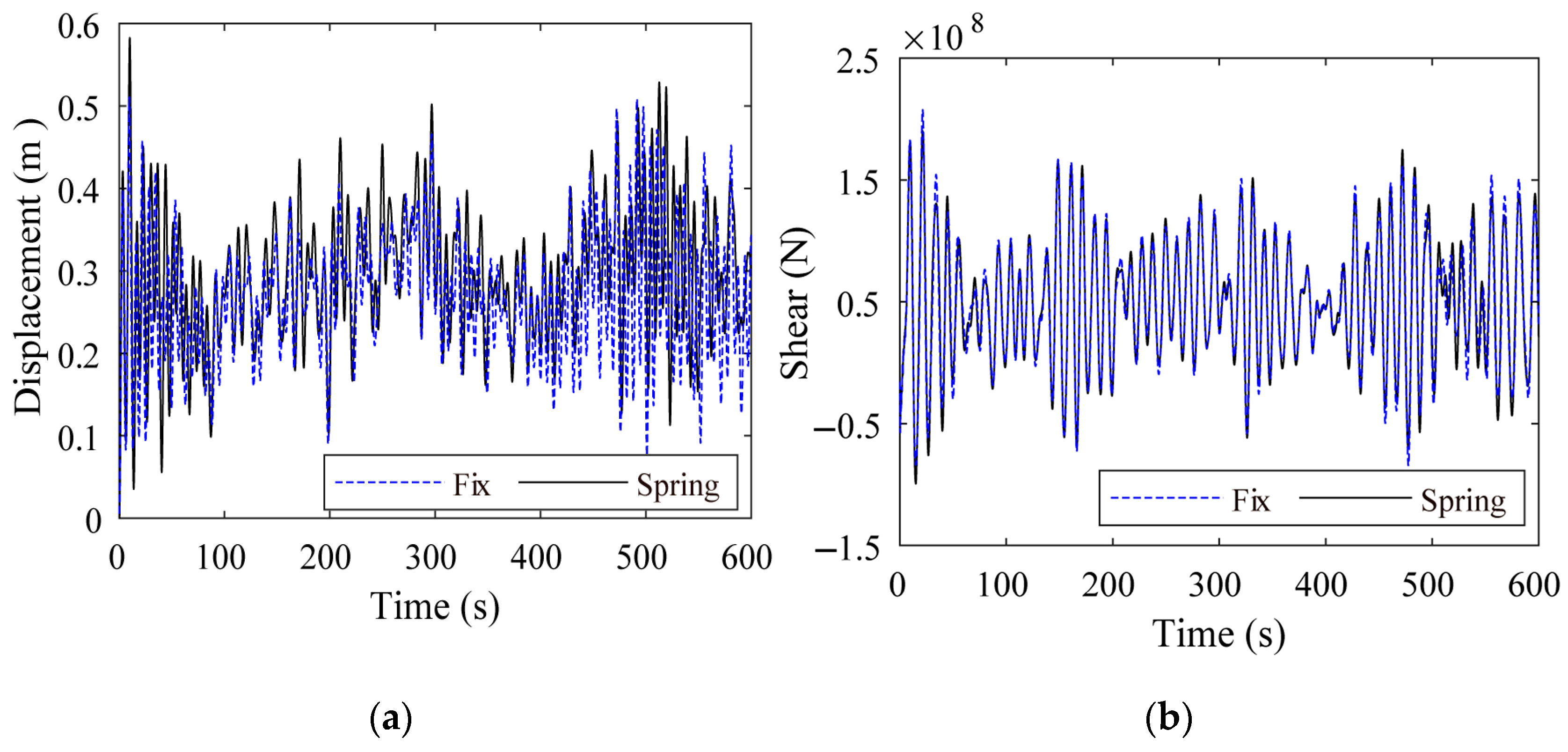
3.5.1. Comparative Analysis of the Dynamic Response of Bridge Towers
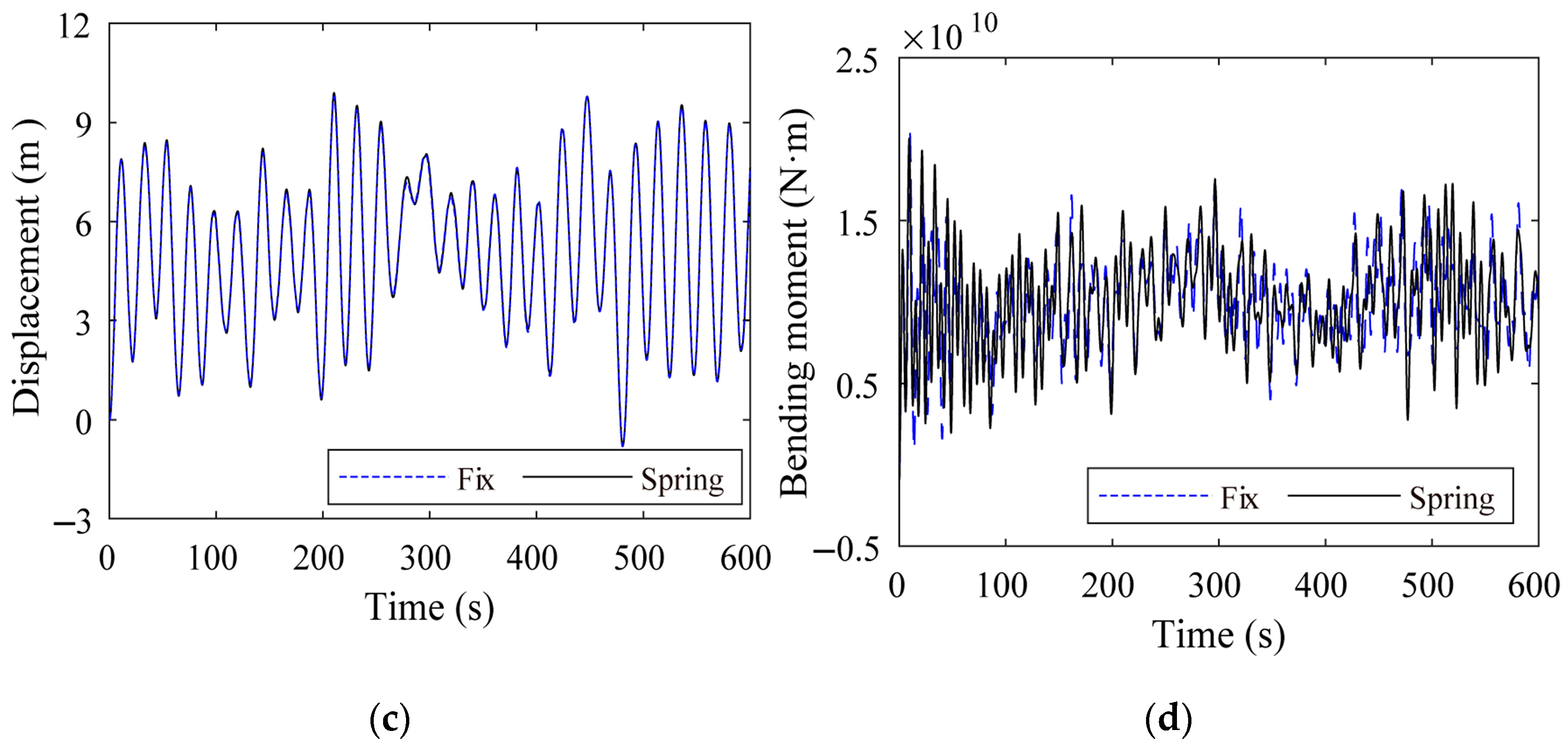
3.5.2. Comparative Analysis of the Dynamic Response of the Entire Bridge
4. Conclusions
- (1)
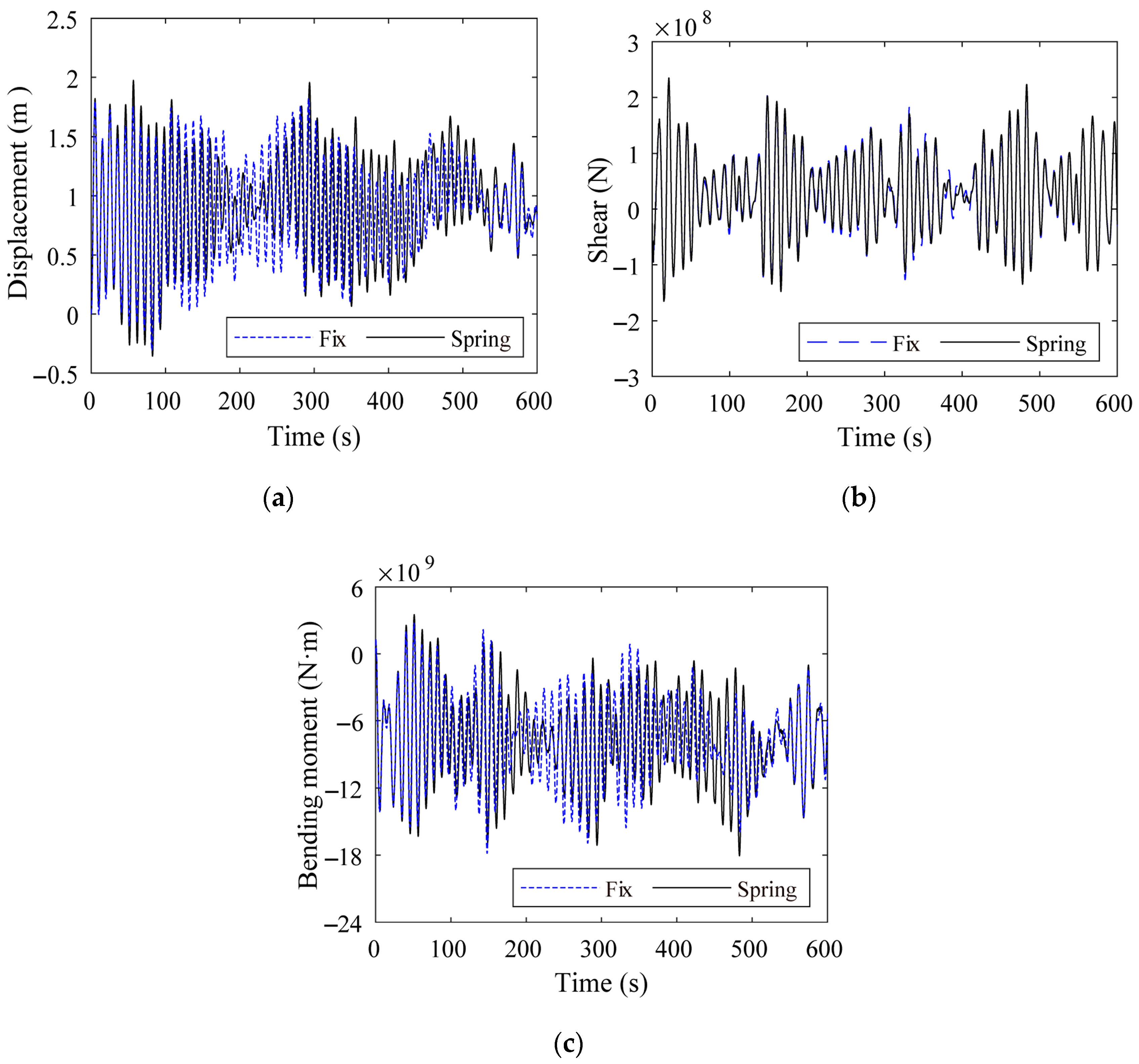
- The spring-based and rigid-fixity restraint models both exhibit measurable influences on the dynamic responses of the bridge tower and the full-bridge system. The maximum discrepancy in the mean dynamic response reaches 5.44% for the tower and 7.83% for the full bridge. Although the foundation soil at the project site is relatively stiff, the substantial horizontal loads induced by the wind–wave environment necessitate a more realistic representation of the force-deformation behavior at the foundation–superstructure interface. The spring-based model captures this interaction more accurately, whereas the rigid-fixity model neglects the actual soil deformation.
- (2)
- For both the bridge tower and the full-bridge system, the structural displacement responses obtained under the spring-based restraint are significantly larger than those computed using the rigid-fixity model. This indicates that simplifying the soil restraint as a fully rigid boundary neglects the portion of deformation contributed by soil flexibility, thereby leading to an underestimation of the displacement response at the top of the structure.
- (3)
- When the foundation soil is relatively stiff, the rigid-fixity model may be adopted during the preliminary design stage of cross-sea bridges to achieve higher computational efficiency while meeting general accuracy requirements. However, in the detailed design stage where higher precision is required, the spring-based restraint model should be employed to simulate soil–foundation interaction. Although this approach involves greater computational complexity, it provides a more realistic representation of foundation forces and deformations, thereby enhancing the reliability of dynamic response analysis and structural safety assessment.
Author Contributions
Funding
Institutional Review Board Statement
Informed Consent Statement
Data Availability Statement
Conflicts of Interest
References
- Wei, C.; Zhou, D.; Ou, J. Experimental study of the hydrodynamic responses of a bridge tower to waves and wave currents. J. Waterw. Port Coast. Ocean Eng. 2017, 143, 04017002. [Google Scholar] [CrossRef]
- Bai, X.; Guo, A.; Liu, H.; Chen, W.; Liu, G.; Liu, T.; Chen, S.; Li, H. Experimental investigation on a freestanding bridge tower under wind and wave loads. Struct. Eng. Mech. Int’l J. 2016, 57, 951–968. [Google Scholar] [CrossRef]
- Bi, C.; Xu, Q. Comparative study on simplified method of soil-pile dynamic Interaction. J. Jiamusi Univ. Nat. Sci. Ed. 2015, 33, 481–485. (In Chinese) [Google Scholar] [CrossRef]
- Kitagawa, M. Technology of the akashi kaikyo bridge. Struct. Control Health Monit. 2004, 11, 75–90. [Google Scholar] [CrossRef]
- Xu, Y.L.; Ko, J.M.; Yu, Z. Modal analysis of tower-cable system of Tsing Ma long suspension bridge. Eng. Struct. 1997, 19, 857–867. [Google Scholar] [CrossRef]
- Chaudhary, M.T.A. Effect of soil-foundation-structure interaction and pier column non-linearity on seismic response of bridges supported on shallow foundations. Aust. J. Struct. Eng. 2016, 17, 67–86. [Google Scholar] [CrossRef][Green Version]
- Raheem, S.E.A.; Hayashikawa, T. Soil-structure interaction modeling effects on seismic response of cable-stayed bridge tower. Int. J. Adv. Struct. Eng. 2013, 5, 8. [Google Scholar] [CrossRef]
- Zhou, M.; Yuan, W.; Zhang, Y. Parameter sensitivity analysis of equivalent anchorage length for elevated pile caps. J. Chang. Univ. Nat. Sci. Ed. 2010, 30, 47–52. (In Chinese) [Google Scholar] [CrossRef]
- Wei, G.; Qi, Y. Application of Simplified Model of the Pile Foundation in Earthquake—Resistance of Bridge. J. Railw. Eng. Soc. 2008, 25, 20–23. (In Chinese) [Google Scholar] [CrossRef]
- Wu, X.; Yilin, L.; Pan, H. Stability analysis of high piers and large span continuous rigid Frame bridge based on energy method. J. Railw. Sci. Eng. 2017, 14, 290–295. [Google Scholar] [CrossRef]
- Maravas, A.; Mylonakis, G.; Karabalis, D.L. Simplified discrete systems for dynamic analysis of structures on footings and piles. Soil Dyn. Earthq. Eng. 2014, 61, 29–39. [Google Scholar] [CrossRef]
- Fan, B.; Li, Y.; Song, S.; An, Y. Hydrodynamic effect and seismic system of a deep-water cable-stayed bridge in high-seismic-intensity areas. China Earthq. Eng. J. 2022, 44, 1024–1033. (In Chinese) [Google Scholar] [CrossRef]
- Liu, C.; Jiang, Z.; Yu, H. Safety analysis for bridge pier under nearby road construction and operation. Measurement 2020, 151, 107169. [Google Scholar] [CrossRef]
- Liu, H.; Tao, X.; Tao, Z.; Zhang, S. Importance of seismic hydrodynamic pressure for design of bridge pier in deep water from a numerical case study. IOP Conf. Ser. Earth Environ. Sci. 2019, 330, 022032. [Google Scholar] [CrossRef]
- Chen, H.; Fang, C.; Li, Y. Nonlinear buffeting responses of a coastal long-span bridge under the coupled wind, wave and current loads. Ocean Eng. 2024, 293, 116661. [Google Scholar] [CrossRef]
- Koronides, M.; Michailides, C.; Onoufriou, T. Nonlinear Soil–Pile–Structure Interaction Behaviour of Marine Jetty Structures. J. Mar. Sci. Eng. 2024, 12, 1153. [Google Scholar] [CrossRef]
- Fang, C.; Xu, C.; Li, Y.; Li, X. Directional effects on the nonlinear response of vehicle-bridge system under correlated wind and waves. Ocean Eng. 2024, 310, 118718. [Google Scholar] [CrossRef]
- Sun, Y.; Zhang, T.; Li, M.; Shi, J.; Su, Y.; Qin, Y.; Di, J.; Sun, R. Effects of an Upstream Bridge on the Aerodynamic Interference and Wind-Induced Responses of a Long-Span Cable-Stayed Bridge. Appl. Sci. 2025, 15, 9534. [Google Scholar] [CrossRef]
- Yang, Y.; Li, J.; Zou, W.; Chen, B. Numerical Investigation of Flow and Scour around Complex Bridge Piers in Wind–Wave–Current Conditions. J. Mar. Sci. Eng. 2024, 12, 23. [Google Scholar] [CrossRef]
- Yang, R.; Li, Y.; Xu, C.; Yang, Y.; Fang, C. Directional effects of correlated wind and waves on the dynamic response of long-span sea-crossing bridges. Appl. Ocean Res. 2023, 132, 103483. [Google Scholar] [CrossRef]
- Shahzad, M.M.; Khan, M.H.F.; Lee, D. Parametric sensitivity analysis of soil properties for retrofitted offshore wind turbine jacket substructures under combined environmental loading. Ocean Eng. 2025, 341, 122690. [Google Scholar] [CrossRef]
- Bayat, M.; Andersen, L.V.; Ibsen, L.B. p-y-ẏ curves for dynamic analysis of offshore wind turbine monopile foundations. Soil Dyn. Earthq. Eng. 2016, 90, 38–51. [Google Scholar] [CrossRef]
- Løken, I.B.; Kaynia, A.M. Effect of foundation type and modelling on dynamic response and fatigue of offshore wind turbines. Wind Energy 2019, 22, 1667–1683. [Google Scholar] [CrossRef]
- Alkhoury, P.; Soubra, A.H.; Rey, V.; Aït-Ahmed, M. A full three-dimensional model for the estimation of the natural frequencies of an offshore wind turbine in sand. Wind Energy 2021, 24, 699–719. [Google Scholar] [CrossRef]
- Wu, T.; Qiu, W. Dynamic analyses of pile-supported bridges including soil-structure interaction under stochastic ice loads. Soil Dyn. Earthq. Eng. 2020, 128, 105879. [Google Scholar] [CrossRef]
- Gerolymos, N.; Gazetas, G. Winkler model for lateral response of rigid caisson foundations in linear soil. Soil Dyn. Earthq. Eng. 2006, 26, 347–361. [Google Scholar] [CrossRef]
- JTG/TD63-2021; Specifications for Design of Foundation of Highway Bridges and Culverts. China Communications Press: Beijing, China, 2021. (In Chinese)
- Hetényi, M. Beams on Elastic Foundation; University of Michigan Press: Ann Arbor, MI, USA, 1946; Volume 16. [Google Scholar] [CrossRef]
- Matlock, H. Correlation for design of laterally loaded piles in soft clay. In Proceedings of the Offshore Technology Conference, Houston, TX, USA, 22–24 April 1970; p. OTC-1204-MS. [Google Scholar] [CrossRef]
- JTS 3363-2019; Specification for Design of Foundation of Highway Bridges and Culverts. China Communications Press: Beijing, China, 2019. (In Chinese)
- Du, Y.; Song, L.; Mao, H.; Zhi, S.; Qian, G. Wind speed observation and design wind speed calculation for cross-channel project over Qiongzhou Strait. Acta Sci. Nat. Univ. Sunyatseni 2005, 44, 98–101. (In Chinese) [Google Scholar] [CrossRef]
- Zhang, Z.; Wang, Y.; Sun, S.; Fan, Z.; Dai, T.; Jia, Z. Experimental validation of virtual strain sensing methods for offshore jacket platforms. Appl. Ocean Res. 2025, 160, 104632. [Google Scholar] [CrossRef]
- Jiang, J.; Zhang, Z.; Wei, Z. Engineering geological features on submarine cable route along Qiongzhou strait. Hydrogr. Surv. Charting 2010, 30, 58–60. (In Chinese) [Google Scholar] [CrossRef]
- Wei, C. Wind, Wave and Current Joint Actions and Dynamic Responses of Long Span Sea-Crossing Cable-Stayed Bridges. Doctoral Dissertation, Dalian University of Technology, Dalian, China, 2018. Available online: https://d.wanfangdata.com.cn/thesis/Ch1UaGVzaXNOZXdTb2xyOVMyMDI2MDQxNTE0Mjg1MRIIWTM2MzUyNjAaCGt4ODQxc3Fy (accessed on 2 February 2026). (In Chinese)
- Liu, H. Wind, Experimental and Simulation of Large-Scaled Bridge Under Wind and Wave Coupling Actions. Master Dissertation, Harbin Institute of Technology, Harbin, China, 2018. Available online: https://d.wanfangdata.com.cn/thesis/Ch1UaGVzaXNOZXdTb2xyOVMyMDI2MDQxNTE0Mjg1MRIHRDU5MTc3MxoINTFmZ2lybmk%3D (accessed on 2 February 2026). (In Chinese)
- Zheng, S.; Li, Y.; Tao, Q. Wind tunnel test on the aerodynamic parameters of Tianxingzhou highway-railway bridge across Yangtze River. China Railw. Sci. 2007, 28, 25–31. (In Chinese) [Google Scholar] [CrossRef]
- Kaimal, J.C.; Wyngaard, J.C.J.; Izumi, Y.; Coté, O.R. Spectral characteristics of surface-layer turbulence. Q. J. R. Meteorol. Soc. 1972, 98, 563–589. [Google Scholar] [CrossRef]
- Hasselmann, K.; Barnett, T.P.; Bouws, E.; Carlson, H.; Cartwright, D.E.; Enke, K.; Ewing, J.A.; Gienapp, A.; Hasselmann, D.E.; Kruseman, P. Measurements of wind-wave growth and swell decay during the Joint North Sea Wave Project (JONSWAP). Ergaenzungsheft Zur. Dtsch. Hydrogr. Z. Reihe A 1973. [Google Scholar] [CrossRef][Green Version]
- Shinozuka, M.; Jan, C.M. Digital simulation of random processes and its applications. J. Sound Vib. 1972, 25, 111–128. [Google Scholar] [CrossRef]
- Yang, Y.; Zhang, Z.; Yang, J. Simulation of Stochastic Wind Field on Long Span Cable-stayed Bridge. In Proceedings of the 2023 5th International Conference on Hydraulic, Civil and Construction Engineering (HCCE 2023); Atlantis Press: Dordrecht, The Netherlands, 2024; pp. 674–683. [Google Scholar] [CrossRef]








| Structural Parts | E (N/m2) | ν | Density (kg/m3) |
|---|---|---|---|
| caisson foundation | 3.00 × 10¹⁰ | 0.2 | 2.5 × 10³ |
| Cushion cap | 3.00 × 10¹⁵ | 0.2 | 2.5 × 10³ |
| Lower tower | 3.55 × 10¹⁰ | 0.2 | 2.5 × 10³ |
| Cross beam for tower | 3.55 × 10¹⁰ | 0.2 | 2.5 × 10³ |
| Middle tower | 3.55 × 10¹⁰ | 0.2 | 2.5 × 10³ |
| Upper tower | 3.55 × 10¹⁵ | 0.2 | 2.1 × 10³ |
| main girder | 3.55 × 10¹⁰ | 0.2 | 2.0 × 10³ |
| Fishbone crossbeam | 2.10 × 10¹¹ | 0.3 | 2.6 × 10⁴ |
| Lower gravity foundation | 2.10 × 10¹⁶ | 0.3 | 1.0 × 100 |
| Upper gravity foundation | 3.55 × 10¹⁰ | 0.2 | 2.5 × 10³ |
| Pier column for gravity foundation | 3.55 × 10¹⁰ | 0.2 | 2.5 × 10³ |
| Soil Type | and (kN/m4) | Soil Type | and (kN/m4) |
|---|---|---|---|
| Flow-plastic clay, IL > 1.0, soft plastic cohesive soil 1.0 ≥ IL > 0.75, mud | 3000–5000 | Hard or stiff to semi-stiff clay IL ≤ 0, coarse sand; dense silty soil | 20,000–30,000 |
| Plastic clay, 0.75 ≥ IL > 0.25, silty clay; marine mud | 5000–10,000 | Gravel, angular gravel, rounded gravel, crushed stone, cobbles | 30,000–80,000 |
| Hard-plastic clay, 0.25 ≥ IL ≥ 0, fine sand, medium sand, medium-dense silty soil | 10,000–20,000 | Dense gravelly sand; dense pebbles; cobbles | 80,000–120,000 |
| Constraint Type | Natural Frequency (Hz) | |||
|---|---|---|---|---|
| Mode Order | 1st | 2nd | 3rd | 4th |
| Rigidly Fixed | 0.045 | 0.058 | 0.127 | 0.158 |
| Spring | 0.045 | 0.058 | 0.126 | 0.150 |
| Node Number | b (m) | m (kN/m4) | z (m) | h (m) | k (kN/m) |
|---|---|---|---|---|---|
| 2 | 72.9 | 3.00 × 10⁴ | 40 | 4 | 3.50 × 10⁸ |
| 3 | 72.9 | 3.00 × 10⁴ | 36 | 4 | 3.15 × 10⁸ |
| 4 | 72.9 | 1.00 × 10⁴ | 32 | 4 | 9.33 × 10⁷ |
| 5 | 72.9 | 1.00 × 10⁴ | 28 | 4 | 8.16 × 10⁷ |
| 6 | 72.9 | 9.00 × 10³ | 24 | 4 | 6.30 × 10⁷ |
| 7 | 72.9 | 9.00 × 10³ | 20 | 4 | 5.25 × 10⁷ |
| 8 | 72.9 | 7.00 × 10³ | 16 | 4 | 3.27 × 10⁷ |
| 9 | 72.9 | 7.00 × 10³ | 12 | 4 | 2.45 × 10⁷ |
| 10 | 72.9 | 6.00 × 10³ | 8 | 4 | 1.40 × 10⁷ |
| 11 | 72.9 | 5.00 × 10³ | 4 | 4 | 5.83 106 |
| Order | Mode Shape | Calculated Frequency (Hz) | Test Frequency (Hz) |
|---|---|---|---|
| 1 | First order bending along the bridge | 0.099 | 0.094 |
| 2 | First order bending of cross-bridge | 0.179 | 0.189 |
| Restraint Type | Top Tower Displacement (m) | Base Shear (N) | Base Moment (N·m) | ||||||
|---|---|---|---|---|---|---|---|---|---|
| Mean | Std | Maximum | Mean | Std | Maximum | Mean | Std | Maximum | |
| Embedded model | 3.89 × 10⁻¹ | 1.60 × 10⁻¹ | 8.09 × 10⁻¹ | 8.56 × 10⁷ | 4.61 × 10⁷ | 2.19 × 10⁸ | 4.28 × 10⁹ | 1.92 × 10⁹ | 9.92 × 10⁹ |
| Spring model | 4.08 × 10⁻¹ | 1.68 × 10⁻¹ | 8.74 × 10⁻¹ | 8.61 × 10⁷ | 4.64 × 10⁷ | 2.27 × 10⁸ | 4.31 × 10⁹ | 1.93 × 10⁹ | 1.06 × 10¹⁰ |
| Error | 4.66% | 5.76% | 7.44% | 0.58% | 0.65% | 3.52% | 0.70% | 0.52% | 6.42% |
| Restraint Type | Top Tower Displacement (m) | Base Shear (N) | Base Moment (N·m) | ||||||
|---|---|---|---|---|---|---|---|---|---|
| Mean | Std | Maximum | Mean | Std | Maximum | Mean | Std | Maximum | |
| Embedded model | 1.25 × 100 | 2.18 × 10⁻¹ | 1.83 × 100 | 3.60 × 10⁷ | 6.30 × 10⁶ | 5.17 × 10⁷ | 1.01 × 10¹⁰ | 1.77 × 10⁹ | 1.42 × 10¹⁰ |
| Spring model | 1.28 × 100 | 2.22 × 10⁻¹ | 1.84 × 100 | 3.61 × 10⁷ | 6.36 × 10⁶ | 5.18 × 10⁷ | 1.03 × 10¹⁰ | 1.79 × 10⁹ | 1.43 × 10¹⁰ |
| Error | 2.34% | 1.80% | 0.54% | 0.28% | 0.94% | 0.19% | 1.94% | 1.12% | 0.70% |
| Restraint Type | Top Tower Displacement (m) | Base Shear (N) | Base Moment (N·m) | ||||||
|---|---|---|---|---|---|---|---|---|---|
| Mean | Std | Maximum | Mean | Std | Maximum | Mean | Std | Maximum | |
| Embedded model | 1.39 × 100 | 2.39 × 10⁻¹ | 2.00 × 100 | 1.13 × 10⁸ | 4.72 × 10⁷ | 2.42 × 10⁸ | 1.25 × 10¹⁰ | 2.41 × 10⁹ | 1.86 × 10¹⁰ |
| Spring model | 1.47 × 100 | 2.45 × 10⁻¹ | 2.09 × 100 | 1.14 × 10⁸ | 4.75 × 10⁷ | 2.51 × 10⁸ | 1.27 × 10¹⁰ | 2.48 × 10⁹ | 1.96 × 10¹⁰ |
| Error | 5.44% | 2.50% | 4.31% | 0.88% | 0.63% | 3.59% | 1.57% | 2.82% | 5.10% |
| Restraint Type | Base Shear (N) | Base Moment (N·m) | ||||
|---|---|---|---|---|---|---|
| Mean | Std | Maximum | Mean | Std | Maximum | |
| Embedded model | 6.02 × 10⁷ | 2.94 × 10⁷ | 1.26 × 10⁸ | 2.35 × 10⁹ | 1.09 × 10⁹ | 4.85 × 10⁹ |
| Spring model | 6.04 × 10⁷ | 3.02 × 10⁷ | 1.27 × 10⁸ | 2.37 × 10⁹ | 1.11 × 10⁹ | 4.87 × 10⁹ |
| Error | 0.33% | 2.65% | 0.79% | 0.84% | 1.80% | 0.41% |
| Restraint Type | Top Tower Displacement (m) | Mid-Span Displacement (m) | ||||
|---|---|---|---|---|---|---|
| Mean | Std | Maximum | Mean | Std | Maximum | |
| Embedded model | 5.10 × 10⁻² | 2.32 × 10⁻² | 9.64 × 10⁻² | 1.87 × 10⁻² | 1.08 × 10⁻² | 4.53 × 10⁻² |
| Spring model | 5.21 × 10⁻² | 2.36 × 10⁻² | 1.03 × 10⁻¹ | 1.91 × 10⁻² | 1.12 × 10⁻² | 4.80 × 10⁻² |
| Error | 2.11% | 1.70% | 6.41% | 2.09% | 3.57% | 5.63% |
| Restraint Type | Base Shear (N) | Base Moment (N·m) | ||||
|---|---|---|---|---|---|---|
| Mean | Std | Maximum | Mean | Std | Maximum | |
| Embedded model | 6.19 × 10⁷ | 7.99 × 10⁶ | 8.46 × 10⁷ | 1.19 × 10¹⁰ | 1.32 × 10⁹ | 1.59 × 10¹⁰ |
| Spring model | 6.20 × 10⁷ | 8.03 × 10⁶ | 8.49 × 10⁷ | 1.22 × 10¹⁰ | 1.38 × 10⁹ | 1.63 × 10¹⁰ |
| Error | 0.16% | 0.50% | 0.35% | 2.46% | 4.35% | 2.45% |
| Restraint Type | Top Tower Displacement (m) | Mid-Span Displacement (m) | ||||
|---|---|---|---|---|---|---|
| Mean | Std | Maximum | Mean | Std | Maximum | |
| Embedded model | 3.63 × 10⁻¹ | 4.25 × 10⁻² | 4.90 × 10⁻¹ | 8.14 × 100 | 1.15 × 100 | 9.78 × 100 |
| Spring model | 3.75 × 10⁻¹ | 4.32 × 10⁻² | 4.95 × 10⁻¹ | 8.14 × 100 | 1.15 × 100 | 9.89 × 100 |
| Error | 3.20% | 1.62% | 1.01% | 0.09% | 0.00% | 1.11% |
| Restraint Type | Base Shear (N) | Base Moment (N·m) | ||||
|---|---|---|---|---|---|---|
| Mean | Std | Maximum | Mean | Std | Maximum | |
| Embedded model | 1.12 × 10⁸ | 2.78 × 10⁷ | 1.73 × 10⁸ | 1.33 × 10¹⁰ | 1.76 × 10⁹ | 1.76 × 10¹⁰ |
| Spring model | 1.14 × 10⁸ | 2.82 × 10⁷ | 1.73 × 10⁸ | 1.37 × 10¹⁰ | 1.80 × 10⁹ | 1.77 × 10¹⁰ |
| Error | 1.75% | 1.42% | 0.00% | 2.92% | 2.22% | 0.57% |
| Restraint Type | Top Tower Displacement (m) | Mid-Span Displacement (m) | ||||
|---|---|---|---|---|---|---|
| Mean | Std | Maximum | Mean | Std | Maximum | |
| Embedded model | 3.65 × 10⁻¹ | 5.25 × 10⁻² | 5.08 × 10⁻¹ | 8.13 × 100 | 1.15 × 100 | 9.79 × 100 |
| Spring model | 3.96 × 10⁻¹ | 5.52 × 10⁻² | 5.29 × 10⁻¹ | 8.14 × 100 | 1.16 × 100 | 9.89 × 100 |
| Error | 7.83% | 4.89% | 3.97% | 0.12% | 0.86% | 1.01% |
Disclaimer/Publisher’s Note: The statements, opinions and data contained in all publications are solely those of the individual author(s) and contributor(s) and not of MDPI and/or the editor(s). MDPI and/or the editor(s) disclaim responsibility for any injury to people or property resulting from any ideas, methods, instructions or products referred to in the content. |
© 2026 by the authors. Licensee MDPI, Basel, Switzerland. This article is an open access article distributed under the terms and conditions of the Creative Commons Attribution (CC BY) license.
Share and Cite
Chen, L.; Zhang, B.; Zhou, D. Study on Foundation Constraint Modeling of a Sea-Crossing Cable-Stayed Bridge Under Combined Wind–Wave Actions. Eng 2026, 7, 209. https://doi.org/10.3390/eng7050209
Chen L, Zhang B, Zhou D. Study on Foundation Constraint Modeling of a Sea-Crossing Cable-Stayed Bridge Under Combined Wind–Wave Actions. Eng. 2026; 7(5):209. https://doi.org/10.3390/eng7050209
Chicago/Turabian StyleChen, Liuhang, Bo Zhang, and Daocheng Zhou. 2026. "Study on Foundation Constraint Modeling of a Sea-Crossing Cable-Stayed Bridge Under Combined Wind–Wave Actions" Eng 7, no. 5: 209. https://doi.org/10.3390/eng7050209
APA StyleChen, L., Zhang, B., & Zhou, D. (2026). Study on Foundation Constraint Modeling of a Sea-Crossing Cable-Stayed Bridge Under Combined Wind–Wave Actions. Eng, 7(5), 209. https://doi.org/10.3390/eng7050209