Article

Multi-Equipment Coordinated Scheduling Considering Dynamic Changes in Truck Handover Points Under Hybrid Traffic in Automated Container Terminals


Institute of Logistics Science and Engineering, Shanghai Maritime University, 1500 Haigang Avenue, Shanghai 201306, China
*
Author to whom correspondence should be addressed.
Eng 2026, 7(4), 181; https://doi.org/10.3390/eng7040181
Submission received: 10 March 2026 / Revised: 2 April 2026 / Accepted: 10 April 2026 / Published: 15 April 2026

Abstract

With the rapid maturation of autonomous driving technology, the hybrid traffic of Internal Container Trucks (ICTs) and External Container Trucks (ECTs) has become a major trend in Automated Container Terminals (ACTs), imposing higher demands on the interaction efficiency between trucks and Yard Cranes (YCs). This paper proposes a comprehensive optimization strategy for the coordinated scheduling of ICTs, ECTs and YCs under hybrid traffic. First, a task combination strategy for ICTs is designed to improve ICT utilization by pairing delivery and retrieval tasks across yard blocks. Second, a Chebyshev-motion-based coordination strategy for YC gantry and trolley movements is developed to reduce travel time and optimize handover points. Third, a mixed-integer programming model is formulated to minimize total energy consumption. An Improved Hybrid Genetic Algorithm (IHGA) is then developed, incorporating chaotic initialization, simulated annealing-based mutation, and dual local search to enhance convergence and solution quality. Simulation results confirm that the proposed model and strategy effectively reduce the total energy consumption of task execution, and the designed algorithm outperforms comparative algorithms in both optimization capability and convergence speed. Overall, the research provides theoretical support for future automated terminal development and practical guidance for achieving efficient and sustainable port operations.

1. Introduction

Automated Container Terminals (ACTs) represent an inevitable trend in port development [1]. Early ACTs predominantly adopted an end-loading (EL) operation mode (e.g., Port of Hamburg, Xiamen Ocean Gate Container Terminal), dividing yard operations into two parts: interaction with Internal Container Trucks (ICTs) (including Automated Guided Vehicles (AGVs), Intelligent Guided Vehicles (IGVs) and other internal horizontal transport vehicles) on the seaside, and interaction with External Container Trucks (ECTs) on the landside. This mode conserves terminal space and facilitates the separation of ICTs and ECTs. However, the end-loading mode forces Yard Cranes (YCs) to travel long distances, increasing energy consumption at the terminal. Moreover, traditional container terminals normally adopt side-loading (SL) mode, which makes the end-loading mode unsuitable for automation retrofitting. Therefore, many newly constructed ACTs now adopt the side-loading mode (e.g., Beijiang Terminal C, Tianjin Port, China; Tobishima Terminal, Port of Nagoya, Japan) [2]. Under the side-loading mode, the interactions between ICTs, ECTs and YCs become more frequent, placing higher demands on equipment coordination. Some ACTs adopt spatial isolation (e.g., dedicated interactive yards in Nansha Terminal IV, Guangzhou Port, China) or temporal isolation (e.g., roadway gate-based scheduling in Beijiang Terminal C, Tianjin Port, China) to separate ICTs and ECTs. However, in recent years, major terminals have begun exploring conditional hybrid operation schemes that mix autonomous and human-driven trucks (e.g., Terminal D, Laem Chabang Port, Thailand; CSP Wuhan, China; Ningbo Zhoushan Port, China). With the gradual advancement of autonomous driving, breakthroughs in vehicle-infrastructure coordination, and the formulation of relevant regulations, full hybrid-flow operations in newly built automated terminals are expected to become the mainstream trend [3,4,5].
In the context of fully hybrid truck flows under the side-loading mode, the development of effective scheduling and coordination strategies is critical to improving terminal operational efficiency. Therefore, this paper aims to minimize the collaborative operational energy consumption among ICTs, ECTs, and YCs under hybrid traffic scenarios, while also coordinating YC gantry and trolley movements. When a YC is unloaded, Chebyshev motion [6] is used so that the trolley can move concurrently with the gantry, reducing both YC operation time and vehicle waiting time. A coordinated scheduling model for ICTs, ECTs, and YCs is then established to investigate how hybrid ICT/ECT traffic and the YC Chebyshev motion affect the overall operation energy consumption of the terminal.
The main contributions of this paper are as follows:
(1)
A coordinated scheduling model that considers dynamic changes in truck handover points under the “side-loading + hybrid ICT/ECT flow” configuration is proposed to achieve integrated optimization among ICTs, ECTs, and YCs within the ACT framework.
(2)
A Chebyshev-motion-based coordination strategy for YC gantry and trolley movements is proposed to reduce the overall operation time of YCs and the waiting time between devices, thereby enhancing terminal operational efficiency.
(3)
A task combination strategy for ICTs is proposed, where ICT tasks are preprocessed, and delivery and retrieval tasks within the same or adjacent yard blocks are merged and assigned to available ICTs to enhance truck utilization.
(4)
An Improved Hybrid Genetic Algorithm (IHGA) is designed, which incorporates chaotic mapping for population initialization, and employs strategies such as fitness sharing and elite preservation during evolution. It also applies the Variable Neighborhood Search (VNS) and the Improved Sine Cosine Algorithm (ISCA) with a certain probability to enhance solution diversity and explore broader solution spaces.
The remainder of this paper is organized as follows. Section 2 provides a comprehensive review of related literature; Section 3 constructs a mixed-integer programming (MIP) model aiming to minimize task execution energy consumption; Section 4 presents an improved hybrid genetic algorithm to solve the proposed problem; Section 5 validates the algorithm’s effectiveness through numerical experiments and provides an in-depth analysis of the results; Section 6 concludes the study and discusses its limitations and future research directions.

2. Literature Review

The coordinated scheduling among various types of equipment within a port is a critical factor influencing the operational efficiency of ACTs, and researchers worldwide have been exploring methods to enhance the efficiency of container handling operations. Based on the coordination targets and modeling approaches, existing studies can be categorized into two groups: one focuses on the joint scheduling of ICTs with YCs or Quay Cranes (QCs), while the other gradually incorporates ECTs into the coordination framework.

2.1. Research on the Coordinated Scheduling Between ICTs and YCs/QCs

As the primary carriers of horizontal transportation within terminals, ICTs have been the focus of coordination studies involving QCs and YCs. Zhong et al. [7] proposed a joint scheduling model of AGVs and YCs to minimize their energy consumption. The model considers collision-free routing and AGV capacity constraints, and they designed a novel bi-level genetic algorithm (BGA) to solve the problem. Zhao et al. [8] proposed a coordination model of AGVs and twin Automated Yard Lifting Cranes (AYLCs) to minimize total energy consumption, while considering mutual interference between twin AYLCs. Chen et al. [9] proposed a time-expanded network model to synchronize AGVs and YCs by integrating path planning and time-window optimization, and solved it through task decomposition and iterative cost adjustment. Gong et al. [10] investigated the joint scheduling of YCs and AGVs considering container stacking and bidirectional transport. Luo et al. [11] formulated an MIP model for QC-IGV joint scheduling under the loading mode to minimize total operational energy consumption. Fereidoonian et al. [12] developed a bi-objective MIP model for vessel loading/unloading scheduling at container terminals, considering container flow time, truck energy and emission minimization, truck sharing, and empty trip reduction. Yue et al. [13] introduced coordination constraints between QCs and AGVs and optimized their allocation ratio to minimize energy consumption, considering various operational constraints. Fontes et al. [14] developed a bi-objective MILP model for QC-AGV coordination and solved it using a multi-population biased random-key genetic algorithm, with adjustable AGV speeds to improve synchronization. Zhang et al. [15] proposed a dual-cycle AGV scheduling model to minimize AGV waiting time and improve loading efficiency, considering QC operation time variability. Duan et al. [16] developed a multi-objective mixed-integer programming model for QC-AGV integrated scheduling, aiming to minimize the makespan of vessels. Ji et al. [17] developed a bi-level model for coordinating AGVs, QCs, and Automated Stacking Cranes (ASCs) to minimize the overall makespan. Lu et al. [18] proposed a three-stage model to coordinate QCs, ASCs, and AGVs, aiming to reduce total handling time at automated terminals. Wang et al. [19] addressed the joint scheduling of QCs, transport vehicles, and YCs using a reinforcement learning-based method. Zhong et al. [20,21] proposed a MIP model to minimize AGV delay in integrated scheduling, focusing on path optimization and conflict avoidance for multi-AGV operations in automated terminals.
Most existing studies focusing on the joint scheduling of ICTs with QCs or YCs are predominantly based on end-loading (EL) modes, in which ICTs and ECTs are spatially separated, resulting in relatively straightforward scheduling. In contrast, with the diversification of terminal operation modes, particularly the adoption of side-loading (SL) configurations, the interactions among ICTs, ECTs and YCs in the yard area become more frequent. This leads to intensified resource competition and operational conflicts, and consequently, substantially higher scheduling complexity. Existing research has paid insufficient attention to such complex scenarios and fails to adequately incorporate the coordination requirements inherent in side-loading modes.

2.2. Research on the Coordinated Scheduling Between ICTs, ECTs and YCs

For ECTs, relatively few studies have included them in the research scope, but some scholars have begun to consider this factor. For instance, Wang et al. [22] proposed a MIP model to minimize the task delays of artificial intelligence transport robots (ARTs) and ECTs in parallel-layout terminals, and solved it using a branch-and-price heuristic. Gao et al. [23] addressed the scheduling problem of multiple YCs by formulating a multi-objective optimization model that minimizes both the longitudinal travel distance of YCs and the total waiting time of ICTs and ECTs. The model adopts a truck-based partitioning strategy and simultaneously solves the vehicle assignment and crane routing subproblems. Chu et al. [24] developed a coordinated scheduling model for ACTs under uncertain transport speeds, integrating two handling modes: “dual-trolley QC + AGV + ARMG” and “single-trolley QC + container truck + ARMG”. The model was solved using a simulated annealing particle swarm optimization (SA-PSO) algorithm. Han et al. [25] proposed a tri-objective model for jointly scheduling YCs and ECTs in U-shaped terminals and solved it using an enhanced NSGA-III algorithm. Peng et al. [26] proposed a bi-objective MIP model for the integrated scheduling of dual cantilever yard cranes (DCYCs) and path planning of AGVs and ECTs in U-shaped terminals. The model minimizes makespan and energy consumption, while addressing intra-block conflicts between DCYCs, balancing workloads, and optimizing the parking positions and entry times of AGVs and ECTs. Li et al. [27] developed a MIP model for the coordinated scheduling of ICTs and RCSs in multimodal container transport systems, aiming to minimize the makespan, ECT waiting time, and ICT transport time. They further proposed a digital twin-based hybrid rescheduling strategy to manage real-time uncertainties through proactive–reactive and global–local adjustments. Daniil et al. [28] proposed an MIP model for optimizing truck queuing at gates and internal routing within terminals. The model, which accounts for external parking zones, multiple gates, and internal road networks, aims to determine optimal routes and time slots for trucks.
In recent years, research incorporating ECTs into the coordinated scheduling framework has gradually increased. However, most models still rely on fixed handover points and segregated traffic management modes, leaving a notable gap in studies addressing hybrid ICT-ECT operations and dynamic handover points. This limits their capacity to accommodate the complex operational scenarios that may arise in future terminals. Therefore, there is an urgent need to develop a coordinated scheduling model for ICTs and ECTs that is capable of adapting to dynamic and complex operational environments.
In summary, as shown in Table 1, existing research on coordinated scheduling in ACTs exhibits the following distinct characteristics. In terms of equipment composition, most studies focus on the joint scheduling of ICTs with QCs or YCs, while studies incorporating ECTs into the coordination framework remain limited (as shown in the second to fifth columns of Table 1). Regarding traffic management, the vast majority adopt a segregated strategy, where ICT and ECT operations are separated either spatially or temporally. With respect to handover point settings, fixed handover points dominate the literature, while studies on dynamic handover points are virtually absent.
These characteristics reveal several common gaps in current research. On one hand, resource competition and handover coordination between ICTs and ECTs in the yard area have not been adequately investigated. Most studies treat the two as independent systems, overlooking the temporal coupling and conflicts between transport vehicles in real-world operations (as shown in the seventh column of Table 1). On the other hand, existing models predominantly employ segregated traffic management modes and fixed handover point settings (as shown in the sixth column of Table 1), which struggle to accommodate the requirements of future terminal scenarios involving hybrid traffic operations. Under hybrid traffic and side-loading modes, scheduling models must embed effective coordination strategies between trucks and yard cranes, optimize task allocation, reduce waiting times, and alleviate congestion on the yard side.

3. Mathematical Modeling

3.1. Model Description

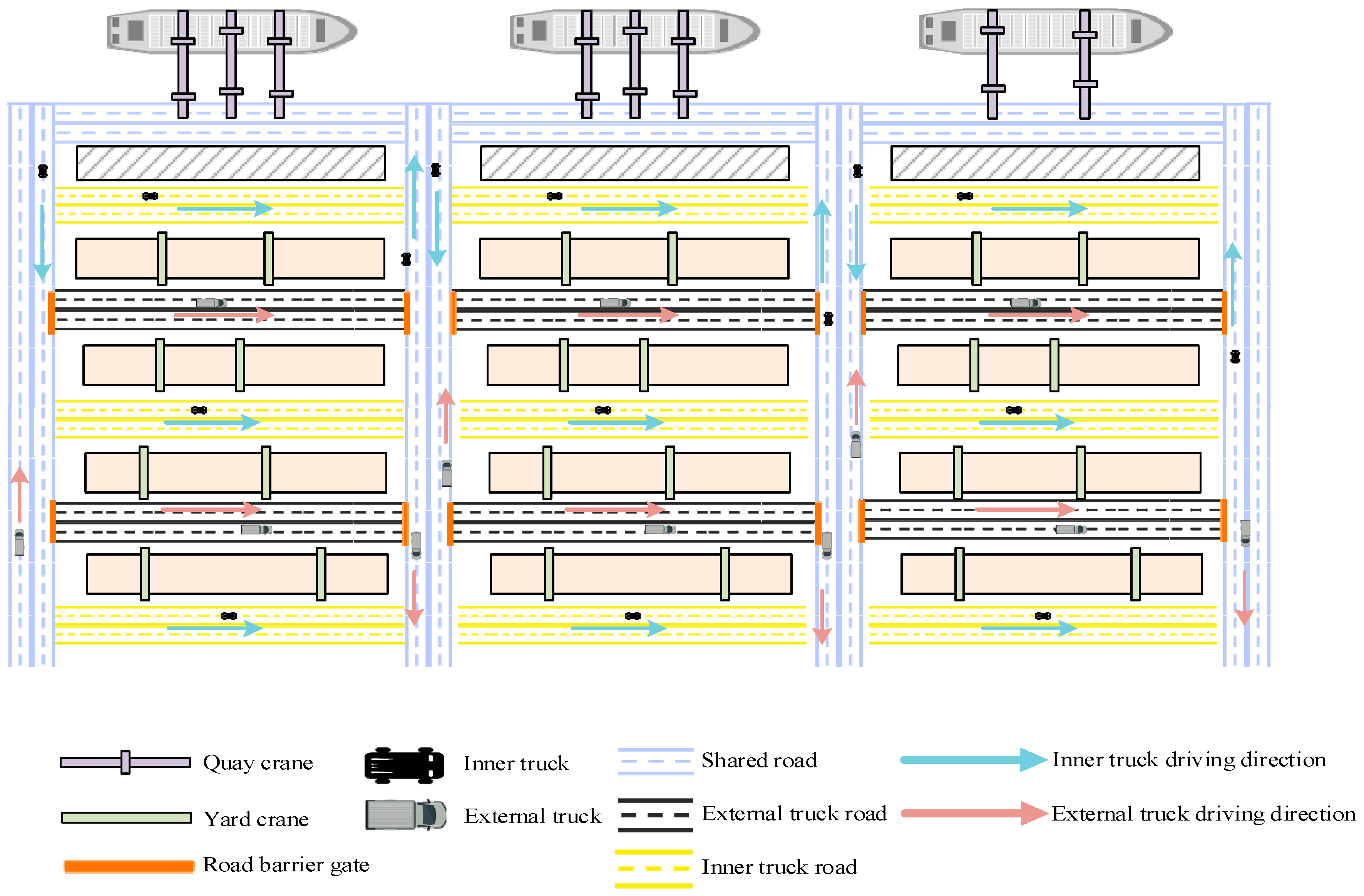
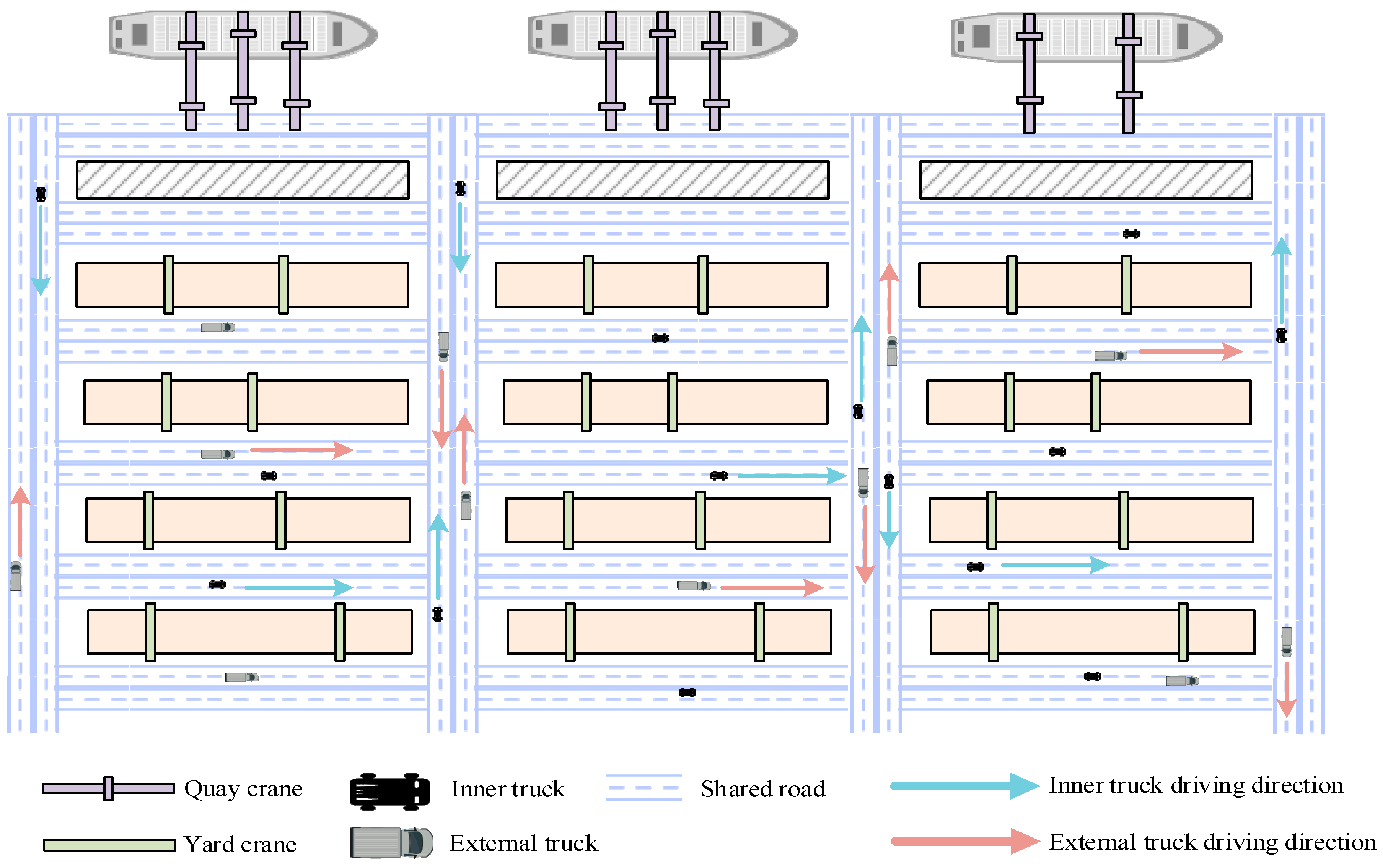
Beijiang Terminal C of Tianjin Port, China, is a typical side-loading ACT (as shown in Figure 1), where ICTs and ECTs enter the yard simultaneously. Their spatiotemporal conflicts are mitigated by alternating driving routes and gated access along ECT lanes. Based on this layout, a “side-loading + hybrid ICT/ECT flow” configuration is proposed in this study (as shown in Figure 2). In this layout, ICTs and ECTs share the same lanes, and both sides of each yard block allow loading and unloading by either type of truck. The resultant flexibility intensifies the need for precise coordination between trucks and YCs.
In this scenario, both ICTs and ECTs enter the yard for operations and can choose handover points on either side of the yard block based on their specific mission location. Therefore, selecting appropriate handover points for both ICTs and ECTs is crucial. Proper handover point selection can reduce truck travel distance, YC travel distance, and inter-equipment waiting time. Considering the characteristics of the YCs, reducing the overall operating time of the YCs can also reduce waiting time and energy consumption. Furthermore, task allocation has a significant impact on the total energy consumption required to complete the task.
To address these challenges, the study optimizes the assignment of handover points to trucks, thereby reducing YC travel and inter-equipment waiting times. Additionally, a synchronized gantry-trolley control strategy for YCs is implemented to shorten individual task durations and lower overall energy consumption. Accordingly, this study proposes a coordinated scheduling model under the “side-loading + hybrid ICT/ECT flow” mode to achieve integrated optimization among ICTs, ECTs, and YCs.

3.2. Assumptions and Parameter Settings

3.2.1. Assumptions

Without loss of generality, the following assumptions are made in this study:
(1)
The operation schedule of QCs is assumed to be known. ICTs only wait for a single container handling time upon arrival at the QC, and other waiting times are ignored.
(2)
Truck startup, acceleration, and deceleration times are neglected. Trucks are assumed to travel at constant speed on all segments, with only two speed levels considered: loaded and unloaded.
(3)
Each QC, YC, and truck can only execute one container task at a time.
(4)
Each ECT executes only one task per visit to the port.
In addition, this paper mainly focuses on task allocation under the hybrid traffic mode, aiming to validate the effectiveness of the proposed strategy. The primary interactions among trucks considered in this study occur at handover points rather than along travel paths. To simplify the model, truck access to critical resources is managed through handover point occupancy constraints, which ensure that no two trucks can occupy the same handover point simultaneously, thereby effectively preventing conflicts in the vicinity of handover points. A detailed investigation of path-level conflict and collision avoidance is left for future work [29].

3.2.2. Parameter Settings

The parameter variables used in this paper are presented as follows: Table 2 lists the parameters along with their meanings, and Table 3 details the decision variables and their corresponding meanings.

3.3. Coordinated Scheduling of ICTs, ECTs, and YCs Based on an Integrated Optimization Strategy

3.3.1. Handover Point Selection Strategy Based on YC Chebyshev Motion

(1)
Coordination strategy of gantry and trolley movement based on Chebyshev motion
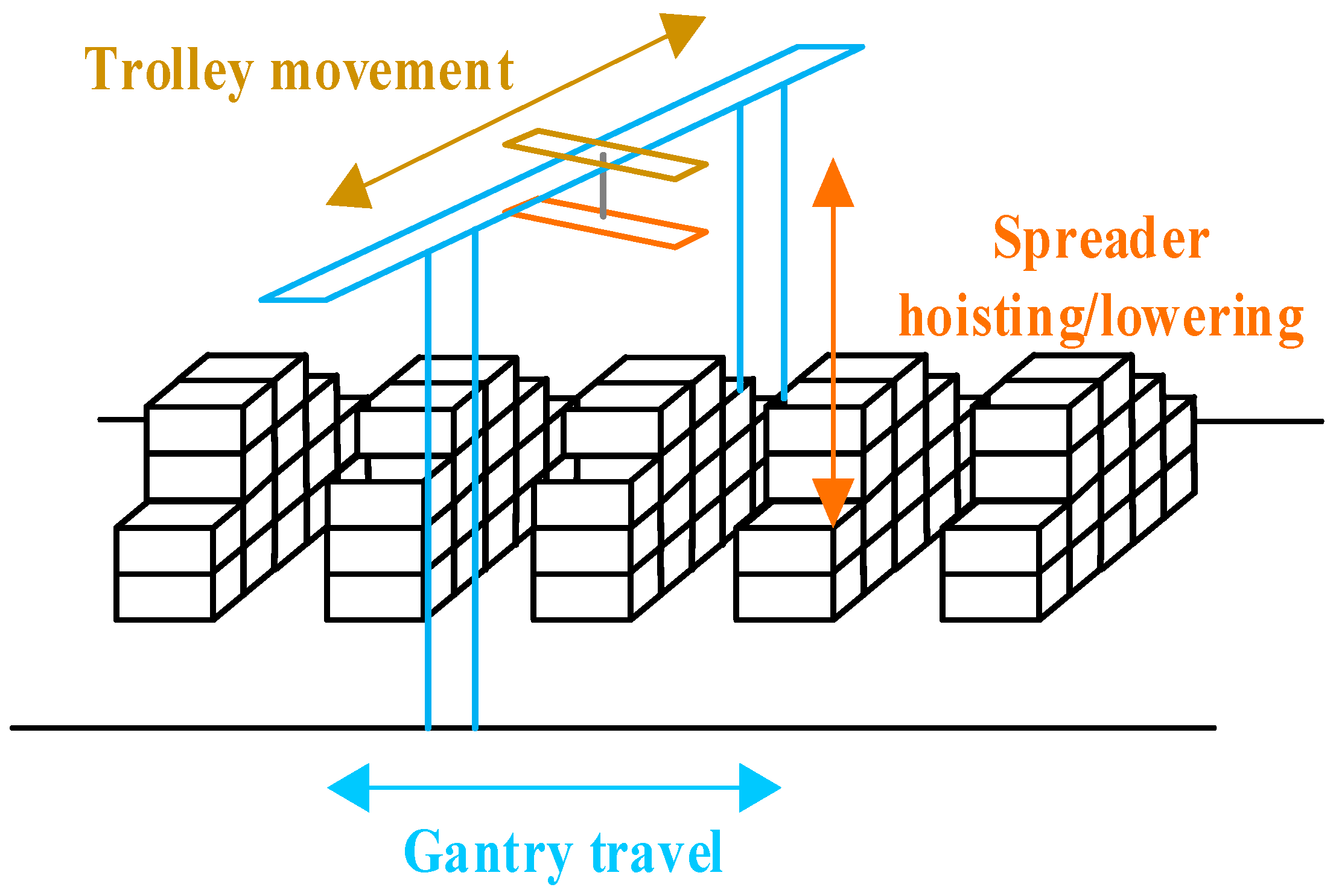
In ACTs, a YC usually consists of three moving components: gantry (portal frame), trolley, and spreader (as shown in Figure 3, the direction of the arrow indicates the direction of device movement.). The gantry moves along the yard block and the trolley is mounted on the gantry arm and moves perpendicular to the gantry, while the spreader is used to lift or lower containers to or from the stack.
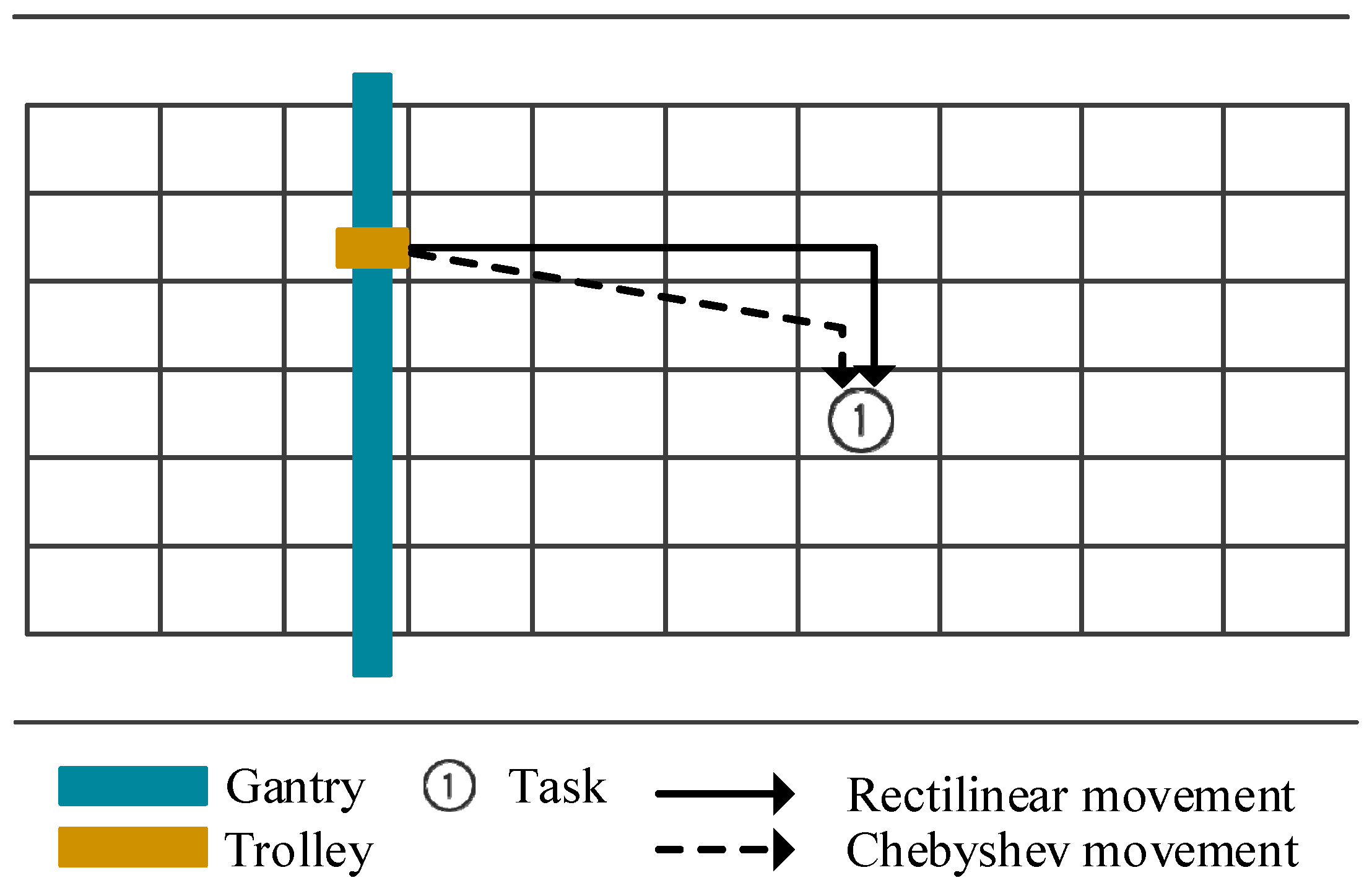
Traditional YC movement follows linear paths, where the trolley can only move to the target row after the gantry reaches the target bay. However, the latest technology allows YCs to apply Chebyshev metrics to both gantry and trolley movements, thereby reducing travel time [30], as illustrated in Figure 4. Therefore, this paper proposes a coordinated movement strategy for gantry and trolley based on Chebyshev motion to reduce overall YC operation time and inter-equipment waiting time, thereby improving terminal efficiency.
(2)
Handover point selection strategy based on YC Chebyshev motion
In the round-the-clock operation of ACTs, the previous task completion positions of gantry and trolley, along with the potential for ICTs to operate continuously, can be used to guide the choice of the next handover point, thereby reducing YC travel distance and inter-equipment waiting times to minimize overall energy consumption. Accordingly, this paper proposes the following handover point selection strategies:
(1)
Rule 1: If an ICT executes consecutive tasks within the same yard block, the handover points should be selected on the same side of the block.
(2)
Rule 2: If an ICT executes consecutive tasks in adjacent yard blocks, the handover points should be located on adjacent sides of the two blocks.
(3)
Rule 3: Select the handover bay on the side that minimizes the trolley travel time of the YC.
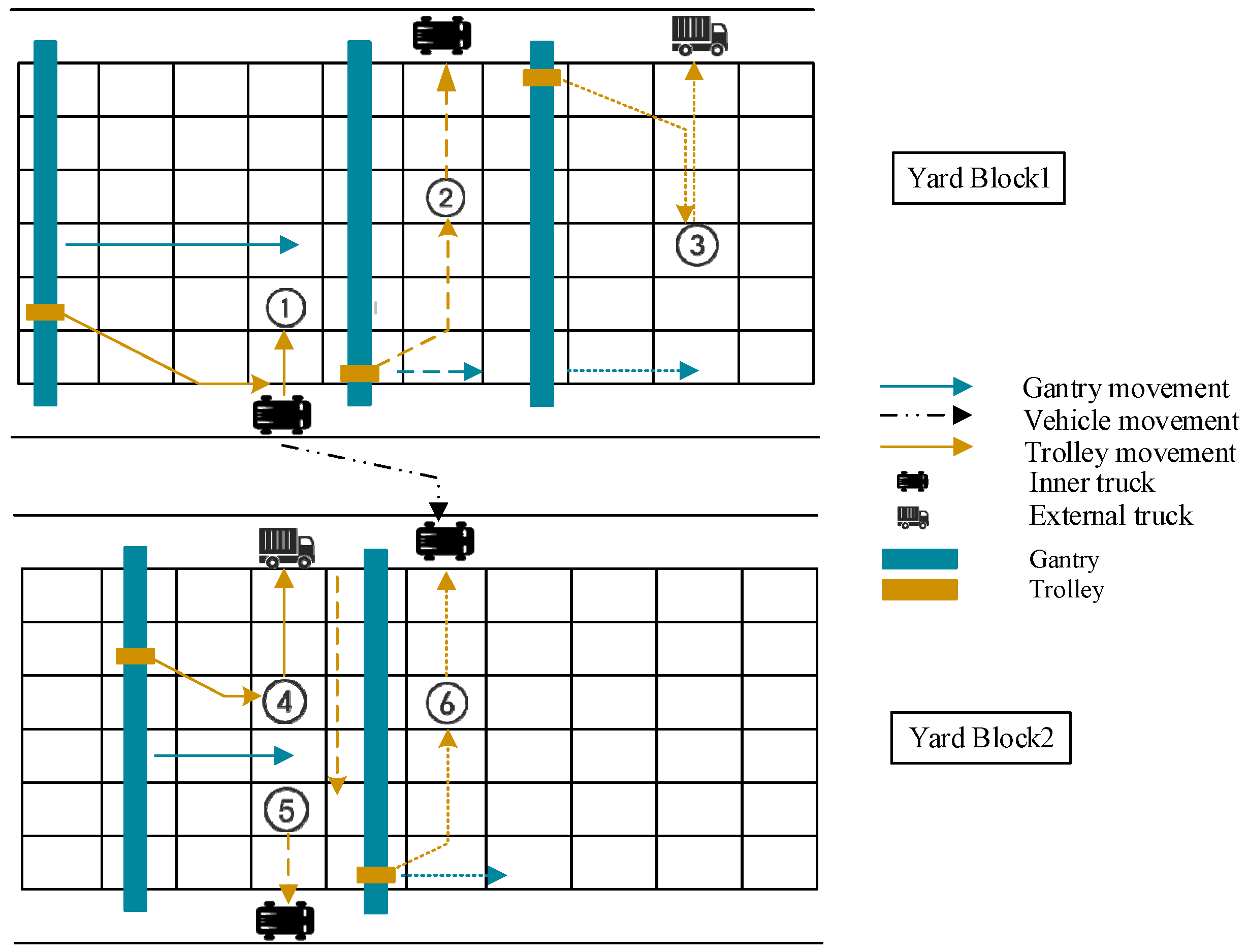
For example, as shown in Figure 5, Task ① is an ICT delivery task, Tasks ②, ⑤, and ⑥ are ICT retrieval tasks, and Tasks ③ and ④ are ECT retrieval tasks. When YC executes Task ①, the trolley is allowed to move simultaneously with the gantry. If the gantry movement time exceeds that of the trolley, the ICT’s waiting time is determined by the gantry; otherwise, it is determined by the trolley. If the ICT also executes Task ⑥ consecutively, the handover point for Task ⑥ can be selected on the side of block 2 facing block 1, reducing the truck’s empty travel distance. In addition, tasks ④ and ⑤ share the same target bay; by unifying their handover points, a portion of the gantry’s travel distance can be reduced.

3.3.2. Task Combination Strategy for ICTs

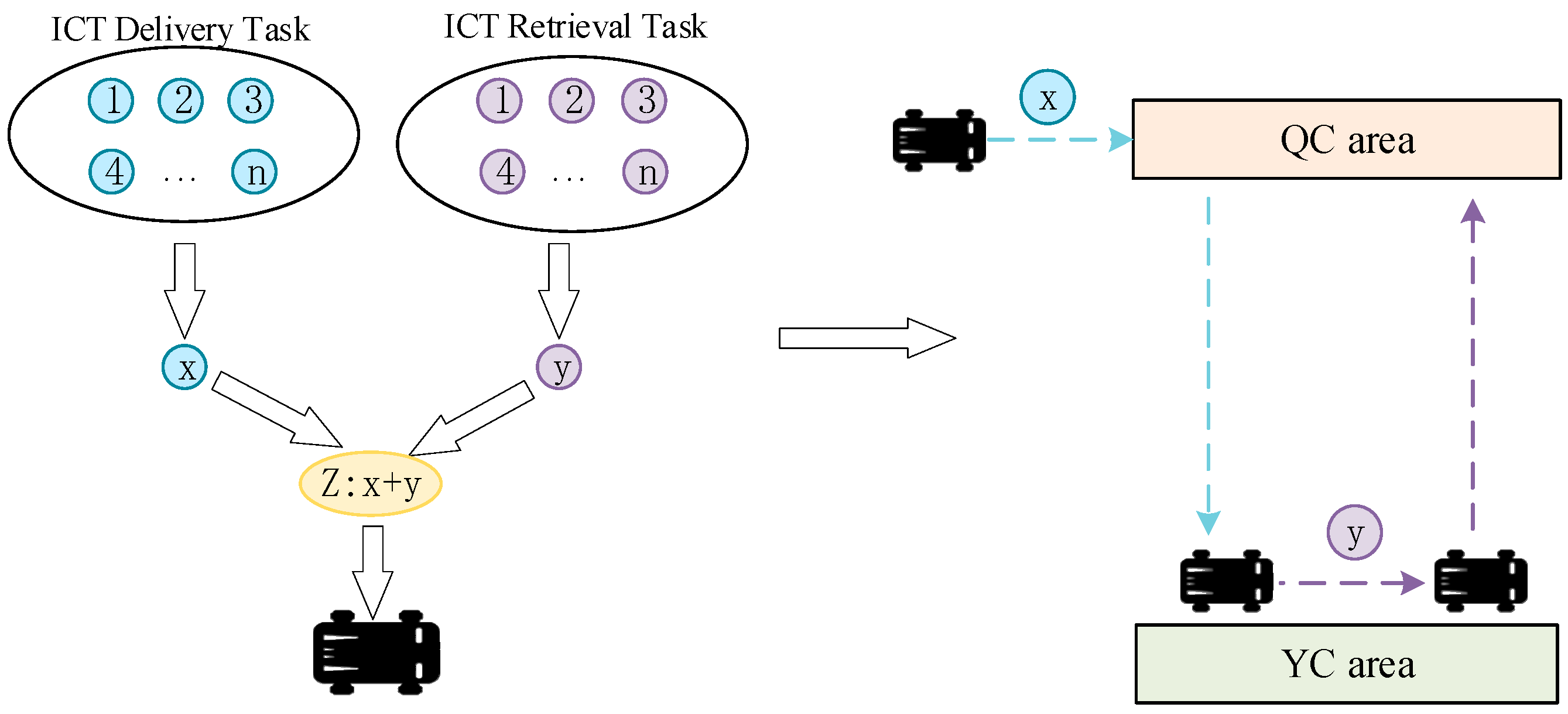
Due to the operational characteristics of ICTs, each ICT can execute two container tasks consecutively, first completing a delivery task followed by a retrieval task. Specifically, if an ICT can first pick up a container to be stored at the QC area and deliver it to the yard area, and then collect an export container from the yard and deliver it back to the QC area, it can significantly improve truck utilization, reduce empty travel time, and thereby lower the overall energy consumption of container handling operations. Based on this observation, this paper proposes a task-combination strategy for ICTs: whenever possible, pre-match a delivery task x and a retrieval task y that are located in the same or neighboring yard blocks, and assign the resulting composite task Z to the earliest available ICT. Any unmatched tasks are still dispatched according to the earliest-availability rule. As shown in Figure 6, task pair (x, y) is merged into composite task Z. Once assigned to the earliest available ICT, the truck executes x (QC to YC), then y (YC to QC), before receiving its next assignment.

3.3.3. Coordinated Scheduling Model for ICTs, ECTs and YCs Based on Integrated Optimization Strategy

Considering the simultaneous entry of ICTs and ECTs into the yard for operations, this study aims to minimize the total energy consumption of YCs, ICTs and ECTs during task execution. An optimization model for YC scheduling and handover point selection is established, which assigns appropriate handover points to ICTs and ECTs based on task sequence and type. When selecting handover points, the model considers ICT utilization and cross-block operations, as well as the operational characteristics of ECTs, aiming to reduce the overall operational time of ECTs while also considering the occupancy status of handover points.
Based on the above analysis, this study proposes a coordinated scheduling model of ICTs, ECTs and YCs, aiming to minimize the total energy consumption for completing all tasks.
min W T = W I + W K + W C
W I = i I j , j J { ( t j i I , A t j i I , S ) e I , L + ( t j i I , L t j i I , E ) e I , U L + [ ( t j i I , E t j i I , A ) + ( t j i I , S t j i I , L ) ] e I , W } , τ ( j ) S i I j , j J { ( t j i I , L t j i I , S ) e I , L + ( t j i I , A t j i I , E ) e I , U L + [ ( t j i I , S t j i I , A ) + ( t j i I , E t j i I , L ) ] e I , W } , τ ( j ) S
W K = k K j J { ( t j k K , P t j k K , S ) e K , L + ( t j k K , L t j k K , E ) e K , U L + ( t j k K , E t j k K , P ) e K , W } , τ ( j ) U k K j J { ( t j k K , E t j k K , S ) e K , L + ( t j k K , P t j k K , A ) e K , U L + ( t j k K , S t j k K , P ) e K , W } , τ ( j ) U
W C = c C j J ( t j c C , L e C , L + t j c C , E T e C , U L + t j c C , W e C , W + 4 e P )
Equation (1) is the objective function that aims to minimizing the total energy consumption for task completion. Equations (2), (3) and (4) respectively represent the energy consumption calculations for ICTs, ECTs and YCs.
t j c C , E T = max { | b j p P b j | t 3 , | r j p P r j | t 4 } Y j j c , τ ( j ) S o r U , τ ( j ) S o r U max { | b j b j | t 3 , | r j r j | t 4 } Y j j c , τ ( j ) S o r U , τ ( j ) S o r U max { | b j p P b j p P | t 3 , | r j p P r j p P | t 4 } Y j j c , τ ( j ) S o r U , τ ( j ) S o r U max { | b j b j p P | t 3 , | r j r j p P | t 4 } Y j j c , τ ( j ) S o r U , τ ( j ) S o r U j , j J , p P , c C
t j c C , L = | r j r j p P | , j J , p P , c C
t j c C , W = { | t j c C , A t j i I , A | X j i + | t j c C , A t j k K , P | Z j k } Y j c , j J , i I , k K , c C
Equations (5)–(7) describe the computation of YC idle time, loaded time, and waiting time under Chebyshev motion.
j J X j i 1 , i I
j J Z j k 1 , k K
j J X j i + j J Z j k = 1 , i I , k K
j J j J , j j X j j i 1 , i I
j J j J , j j ( X j j i + X j j i ) 1 , i I
j J j J , j j X j j i = 1 , Z ˜ j j = 1
j J Y j c = 1 , c C
j J j J , j j Y j j c = 1 , c C
j J j J , j j ( Y j j c + Y j j c ) = 1 , c C
j J P j p = 1 , p P
Equations (8)–(17) represent the relevant constraints. Constraints (8)–(10) specify that each task can only be handled by either one ICT or one ECT, and each handling task can only be executed once. Constraints (11) and (12) define the service sequence of tasks by ICTs. Constraint (13) defines if two tasks are combined, they must be executed by the same ICT. Constraint (14) ensures that each task is operated by exactly one YC. Constraints (15) and (16) define the operation sequence of containers by YCs. Constraint (17) states that each task corresponds to only one handover point.
b t 0 b t 1 1
0 b t 0 B / 2
B / 2 + 1 b t 1 B
t j i I , L = t j i I , S + d j i I , E / v I , U L , τ ( j ) S , j J , i I
t j i I , A = t j i I , L + d j i I , L / v I , L + t j i p I , W P + t 2 , τ ( j ) S , j J , i I , p P
t j i I , E = t j i I , A + t j i I , W + t 1 , τ ( j ) S , j J , i I
t j i I , A = t j i I , S + d j i I , E / v I , U L + t j i p I , W P , τ ( j ) S , j J , i I , p P
t j i I , L = t j i I , A + d j i I , L / v I , L + t j i I , W + t 1 , τ ( j ) S , j J , i I
t j i I , E = t j i I , L + t 2 , τ ( j ) S , j J , i I
t j i I , S t j i I , E + M ( 1 X j j i ) , j , j J , i I
t j k K , P = t j k K , S + d j k K , L / v K , L + t j k p K , W P , τ ( j ) U , j J , k K , p P
t j k K , E = t j k K , P + t j k K , W + t 1 , τ ( j ) U , j J , k K
t j k K , L = t j k K , E + d j k K , E / v K , N L , τ ( j ) U , j J , k K
t j k K , A = t j k K , S , τ ( j ) U , j J , k K
t j k K , P = t j k K , A + d j k K , E / v K , N L + t j k p K , W P , τ ( j ) U , j J , k K , p P
t j k K , S = t j k K , P + t j k K , W + t 1 , τ ( j ) U , j J , k K
t j k K , E = t j k K , S + d j k K , L / v K , L , τ ( j ) U , j J , k K
t j k K , L = t j k K , E , τ ( j ) U , j J , k K
t j c C , A = t j c C , S + t j c C , E T , j J , c C
t j c C , E = t j c C , A + t j c C , W + t j c C , L + 2 t 1 , j J , c C
t j c C , S t j c C , E + M ( 1 Y j j c ) , j , j J , c C
P ¯ j j p p min P j p , P j p
P ¯ j j p + P ¯ j j p 1
t j p P , S t j p P , E , P ¯ j j p = 1
Equation (18) ensures that the minimum safety distance between two YCs is at least one bay. Equations (19) and (20) define the movement ranges of the left-side and right-side YCs, respectively. Equations (21)–(26) ensure the time sequence of ICT operations. Equation (27) guarantees the constraints that must be satisfied by ICTs when handling consecutive tasks. Equations (28)–(35) maintain the chronological order of ECTs operations. Equations (36) and (37) ensure the chronological sequence of YCs operations. Equation (38) ensures the constraints for YCs when handling consecutive tasks. Equations (39)–(41) ensure the constraints that must be satisfied when different tasks occupy the same handover point.

4. Improved Hybrid Genetic Algorithm

As a mature heuristic optimization method, the Genetic Algorithm (GA) has been widely validated and applied in the field of ACT scheduling. With its strong global search capability, GA can effectively handle large-scale complex optimization problems while maintaining good convergence performance in multi-dimensional decision spaces. The core advantage of GA lies in its adaptive mechanism. By employing flexible encoding strategies and evolutionary operations, the algorithm adapts to diverse task requirements and dynamic changes in terminal operations. This adaptability makes GA particularly suitable for scheduling problems characterized by multiple constraints and objectives. Moreover, GA achieves an effective balance between rapid convergence and deep local search, providing robust support for optimizing high-dimensional solution spaces. However, the joint scheduling problem of ICTs, ECTs and YCs is NP-hard, and traditional GA still has limitations when addressing such problems.
Based on the above analysis, this study integrates multiple improvement strategies into the classical GA framework to address its limitations in complex scheduling problems. Specifically, solution quality and robustness are enhanced through hybrid initialization, adaptive mutation, and hybrid local search mechanisms. An encoding scheme is designed to comprehensively consider task types and handover points, accurately capturing the relationship between tasks and handover points. In the initialization phase, Piecewise Linear Chaotic Mapping (PWLCM) is employed to generate a well-distributed initial population. During the evolution process, a simulated annealing-based mutation mechanism is introduced to dynamically adjust the mutation intensity through a temperature decay schedule. Meanwhile, an elitism strategy is adopted to retain high-quality solutions, and a shared fitness evaluation mechanism is introduced to reduce redundancy and improve search efficiency. Furthermore, a hybrid local search strategy combining Variable Neighborhood Search (VNS) and an Improved Sine Cosine Algorithm (ISCA) is constructed, which strengthens local exploitation while preserving global exploration capabilities, thereby expanding the search space and improving solution quality.
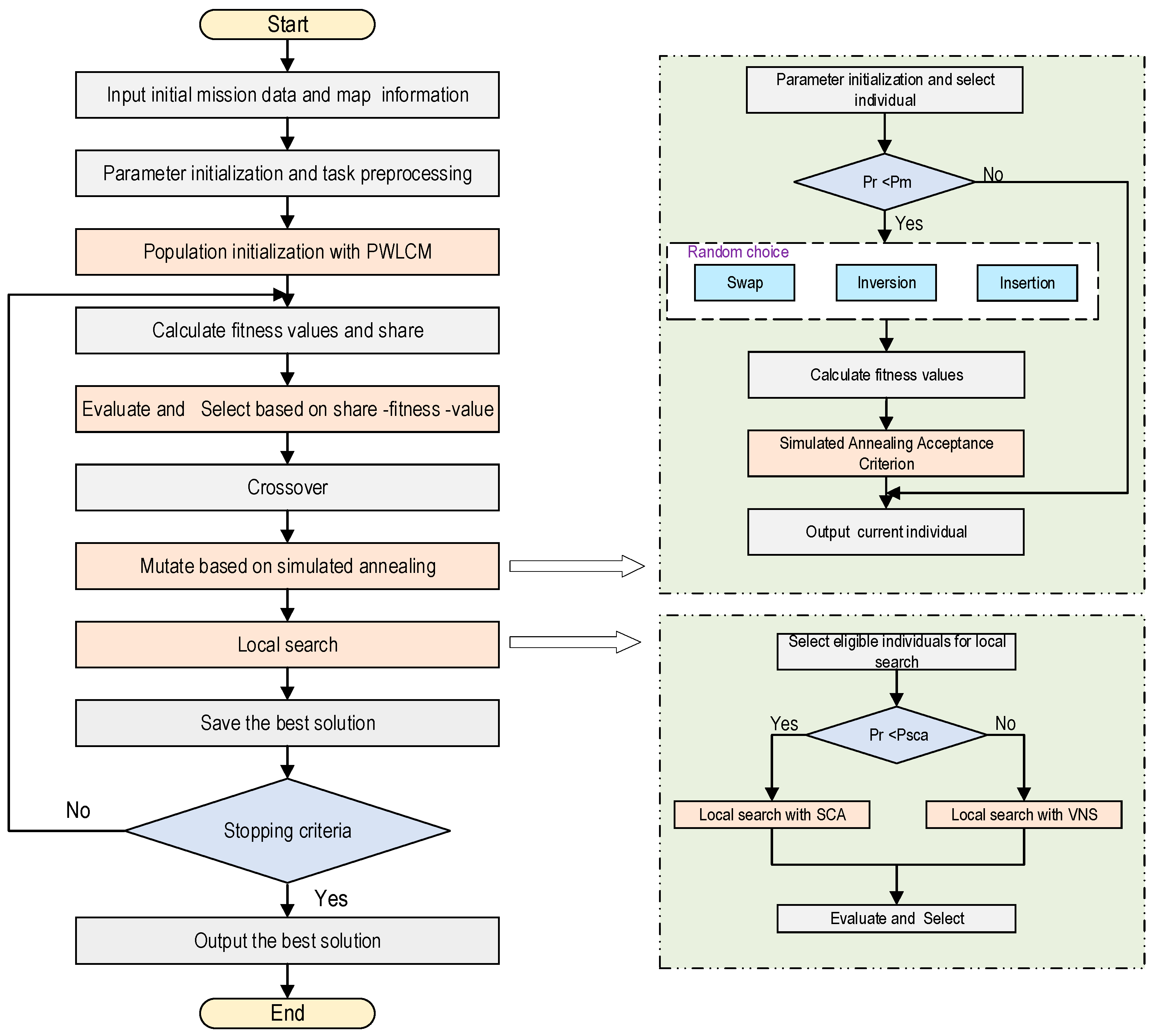
As shown in the algorithm flowchart Figure 7, the proposed IHGA follows the procedure outlined below:
Step 1: Input initial mission data and map information.
Step 2: Initialize algorithm parameters. Perform task preprocessing.
Step 3: Generate the initial population using PWLCM to enhance population diversity.
Step 4: Calculate fitness values for each individual based on the objective function, and apply a shared fitness evaluation mechanism to reduce redundancy.
Step 5: Evaluate and select individuals based on their shared fitness values using a tournament selection mechanism.
Step 6: Perform crossover operations on selected parent pairs with a fixed probability to generate offspring individuals.
Step 7: Apply simulated annealing-based mutation to the offspring individuals, dynamically adjusting the mutation intensity through a temperature decay schedule. As the number of iterations increases, the mutation probability gradually decreases.
Step 8: Perform hybrid local search on the mutated individuals. If the random probability is less than the threshold, apply VNS to exploit the current solution through multiple neighborhood structures, enhancing local exploitation capability. Otherwise, apply ISCA to leverage its sine-cosine mechanism to assist in escaping local optima.
Step 9: Save the best solution found so far using an elitism strategy.
Step 10: Check whether the stopping criteria are satisfied. If not, return to Step 4 for the next generation.
Step 11: Output the best solution as the final optimized result.

4.1. Encoding and Decoding

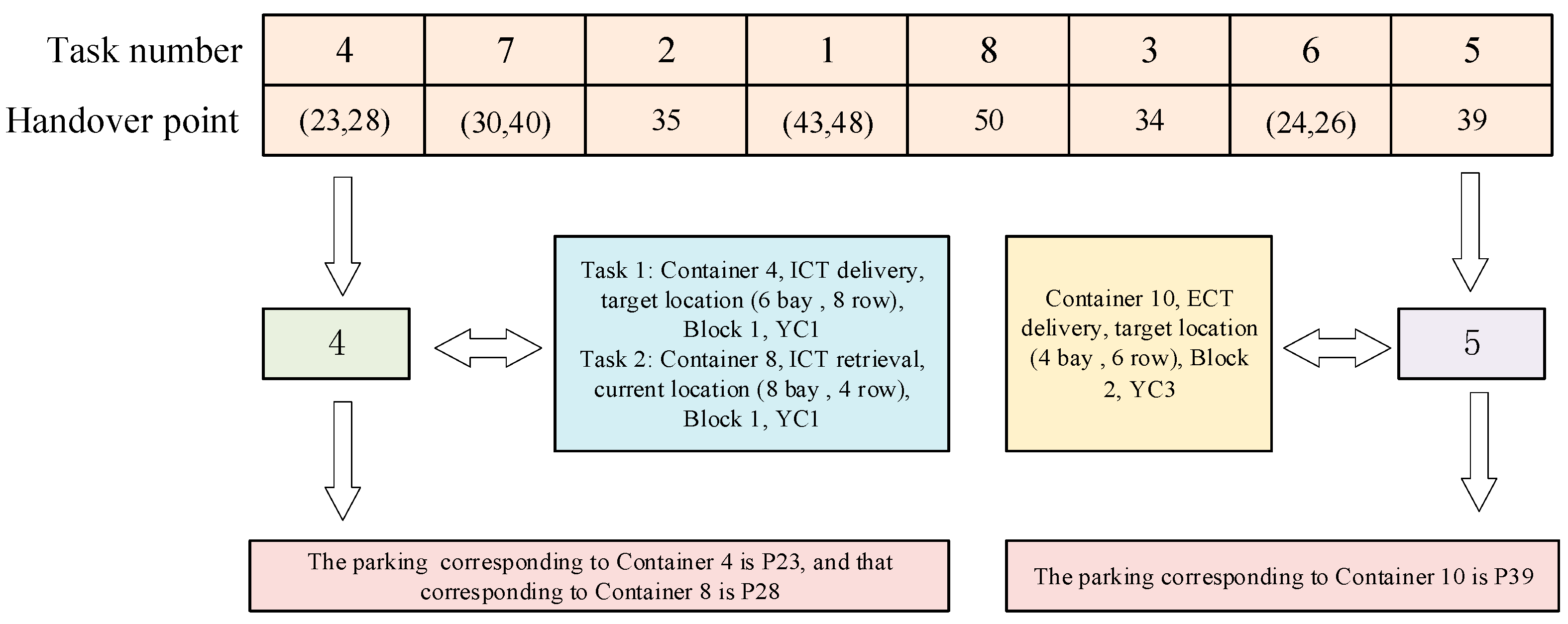
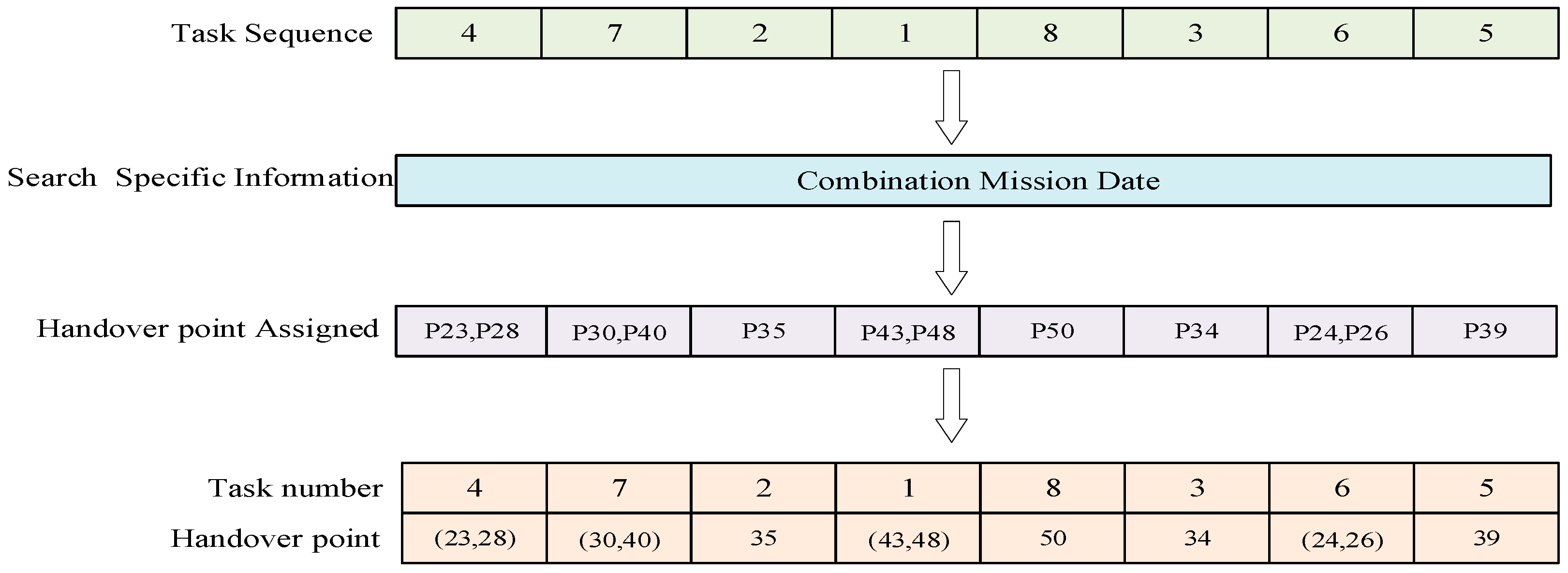
This paper adopts a two-layer matrix encoding structure to represent the scheduling solution, where the chromosome length equals the total number of operations after task combination. The upper layer records task IDs, and their sequence directly determines the execution order. The lower layer specifies the corresponding handover point allocation for each task. Based on this structure, the system assigns the earliest available handling equipment according to the task sequence. Figure 8 illustrates the encoding process for 12 container handling tasks. First, ICT tasks are preprocessed through task combination, reducing the original 12 tasks to 8 and renumbering them. A random permutation method is then used to generate the task execution order, forming the first row of the encoding matrix. Finally, based on the task combination list, the system retrieves detailed scheduling information and allocates spatial resources while considering handover point availability, forming the second row of the matrix.
The decoding process adopts a classification strategy and performs corresponding decoding operations based on task attributes, as shown in Figure 9. For combined tasks, the system sequentially decodes the handover point information in the lower layer of the encoding matrix, assigning the first position to the first subtask in the combination, the second position to the second subtask, and so on. For independent tasks, the system directly establishes a one-to-one mapping between the lower-layer location information and the corresponding task.

4.2. Chaotic Initialization

The algorithm employs Piecewise Linear Chaotic Mapping (PWLCM) for population initialization to enhance solution diversity and global search capability. PWLCM offers strong chaotic properties, combining structural simplicity with complex nonlinear dynamic behavior. By applying piecewise linear transformations to variables within the unit interval, the mapping achieves high sensitivity to initial conditions, broad trajectory coverage, and non-repetitive sequences—key features for effective population initialization. These properties ensure a uniform distribution of the initial population in the solution space, providing high-quality starting solutions for the evolutionary search and effectively mitigating local clustering issues often caused by traditional random initialization. The mapping function is defined as follows:
H n + 1 = H n p , 0 H n < p H n p 0.5 p , p H n < 0.5 1 p H n 0.5 p , 0.5 H n < 1 p 1 H n p , 1 p H n < 1
Here, p is the control parameter, which affects the distribution density and traversal speed of the chaotic sequence. In this study, p = 0.3 is selected to ensure both desirable chaotic properties and numerical stability. During the population initialization phase, the algorithm uses this chaotic mapping to generate random sequences for handover point selection, effectively replacing traditional uniform random number methods. Through a combination of multiplication, flooring, and modulo operations, the algorithm maps the continuous interval [ 0 , 1 ) to a discrete integer domain [ 0 , n 1 ] to match the discrete nature of handover point allocation. Meanwhile, the transformation preserves the unpredictability of the chaotic sequence, ensuring a high-quality distribution of initial solutions. The transformation process adopts a linear mapping function:
H ( i )   = L B + ( U B L B ) P ( i )
where U B and L B denote the upper and lower bounds of the parking position index, and P ( i ) is the i t h element of the chaotic sequence.

4.3. Mutation Based on Simulated Annealing

To enhance the global search ability of the algorithm and avoid premature convergence to local optima, this paper incorporates a Simulated Annealing (SA)-based acceptance mechanism into the mutation operator. This mechanism makes probabilistic decisions on whether to accept a new solution after mutation, thereby effectively expanding the exploration range of the solution space. The algorithm performs mutation on individuals with a predefined probability, randomly selecting from three types of neighborhood perturbation strategies: (1) swap operation, which randomly exchanges two elements in the task sequence; (2) reverse operation, which selects a continuous segment in the sequence and completely reverses its order; (3) insertion operation, which relocates a randomly selected task to another position in the sequence. The acceptance criterion for mutated solutions is as follows: if the fitness of the new solution is better than the current one, the mutation is accepted unconditionally; if the fitness deteriorates, the solution is accepted with a certain probability, which is computed by the following formula:
P = e Δ f T
Inferior individuals may also be accepted, where Δ f = f n e w f c u r r e n t denotes the fitness difference, and T is the temperature parameter in the simulated annealing process. If a random number is less than the acceptance probability, the new solution is accepted; otherwise, the mutation is rejected and the original individual is retained. This probabilistic acceptance mechanism allows the algorithm to maintain a convergence trend while tolerating temporary performance degradation, thereby enhancing its capability to escape local optima.

4.4. Improved Sine Cosine Algorithm (ISCA)

To improve local search performance, this paper introduces an adaptive search operator based on trigonometric functions. Leveraging the nonlinear properties of sine and cosine functions, the operator determines search direction and step size around the current solution, systematically generating candidate solutions within its neighborhood. The search radius is adaptively reduced over iterations to gradually narrow the exploration range. In implementation, the search vector is dynamically computed based on the positional relationship between the current solution and the global best. An adaptive inertia weight is applied to adjust the search strength, ensuring a balance between exploration efficiency and convergence stability. The update formula is defined as follows:
X i j t + 1 = X i j t + r 1 cos ( r 2 ) | r 3 X b e s t t X i j t | , r 4 0.5 X i j t + r 1 sin ( r 2 ) | r 3 X b e s t t X i j t | , r 4 < 0.5
r 1 = a t a T
where X b e s t t denotes the best individual position at iteration t .
To enhance the convergence of the algorithm in the later search phase, this paper defines r 1 as a nonlinearly decreasing function with respect to the number of iterations:
r t = r 0 1 t T 2
where r 0 is the initial amplitude, T is the maximum number of iterations, and t is the current iteration count. Meanwhile, the algorithm introduces a dynamic weight ω to adjust the update amplitude of the solution:
ω t = ω max ω max ω min t T
where ω max and ω min denote the maximum and minimum weights, respectively. This mechanism maintains a large weight in the early stage to expand the search scope, and gradually reduces it to enhance stability in the later stage.

5. Experimental Result and Analysis

The simulation system was implemented in Python 3.9 using PyCharm Community Edition 2024.1.4 on Windows 11. All experiments were conducted on a Lenovo laptop (manufactured in China) equipped with an AMD Ryzen™ 7 7840H @ 3801 MHz (China-supplied model, manufactured by TSMC) processor and 16 GB RAM.

5.1. Experimental Parameter Settings

Based on existing studies of Beijiang Terminal C of Tianjin Port [31,32], the experimental settings are defined as follows: The terminal is equipped with three single-trolley QCs and six yard blocks, each sized 30 bays × 11 rows. Each yard is served by two double cantilever AYCs responsible for container handling across the yard. The vertical distance from the QC area to the yard is 60 m, and the vertical distance from the virtual ECT entrance to the yard is 20 m. The lane width between adjacent yard areas is 23 m. The horizontal path length within the yard, the vertical path from the QC area to the yard, and the vertical path from the ECT entrance to the yard are all set to 2. The basic parameters of the model and equipment are shown in Table 4. The algorithm-related parameter settings are as follows: Population size N = 100 , maximum number of generations G = 500 , crossover probability P c = 0.8 , mutation probability P m = 0.1 , simulated annealing temperature T = 150 ° , and local search selection probability P s c a = 0.5 .

5.2. Validation of Effectiveness

5.2.1. Model Verification

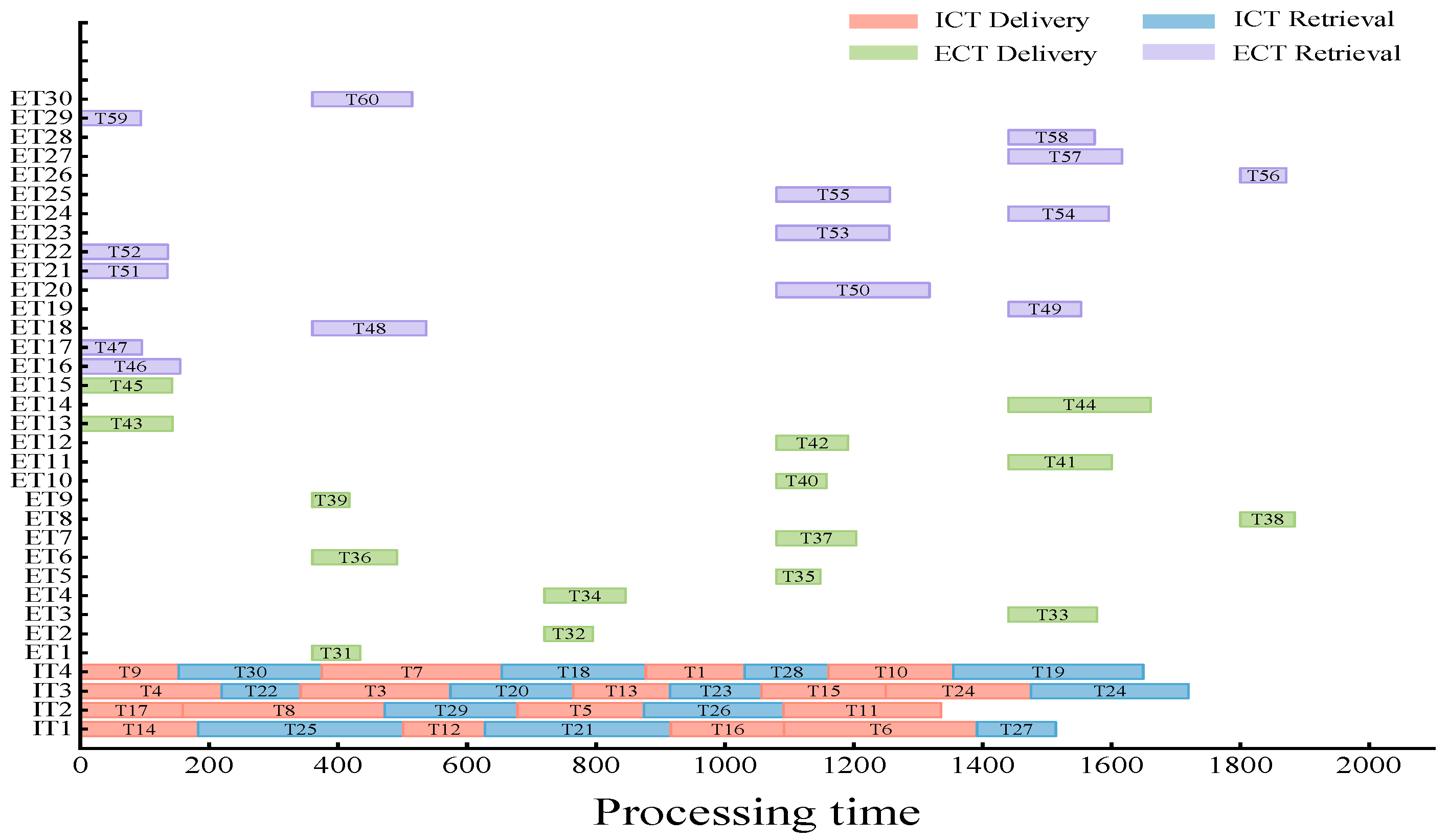
To verify the effectiveness of the proposed model, experiments were conducted on various instances, where the number of tasks increased from (I100, E100) to (I300, E400) with varying numbers of ICTs. The results, presented in the first to fifth columns of Table 5, demonstrate that the proposed model achieves strong performance across different task scales, proving that it can obtain effective solutions under various instance sizes. Due to space limitations, a representative instance involving 60 container handling tasks (including 30 ICT tasks and 30 ECT tasks) with 4 ICTs is selected to illustrate the specific scheduling scheme. Figure 10 presents the Gantt chart of the scheduling scheme obtained by the IHGA, in which each rectangle represents a task. The width of each rectangle corresponds to the task duration, and the number inside indicates the task ID. As shown in the figure, the generated schedule satisfies all operational constraints, demonstrating that the proposed model can effectively represent the practical scheduling problem. In summary, the proposed model demonstrates both solution effectiveness under varying task scales and fidelity in representing real-world operational constraints.

5.2.2. Algorithm Verification

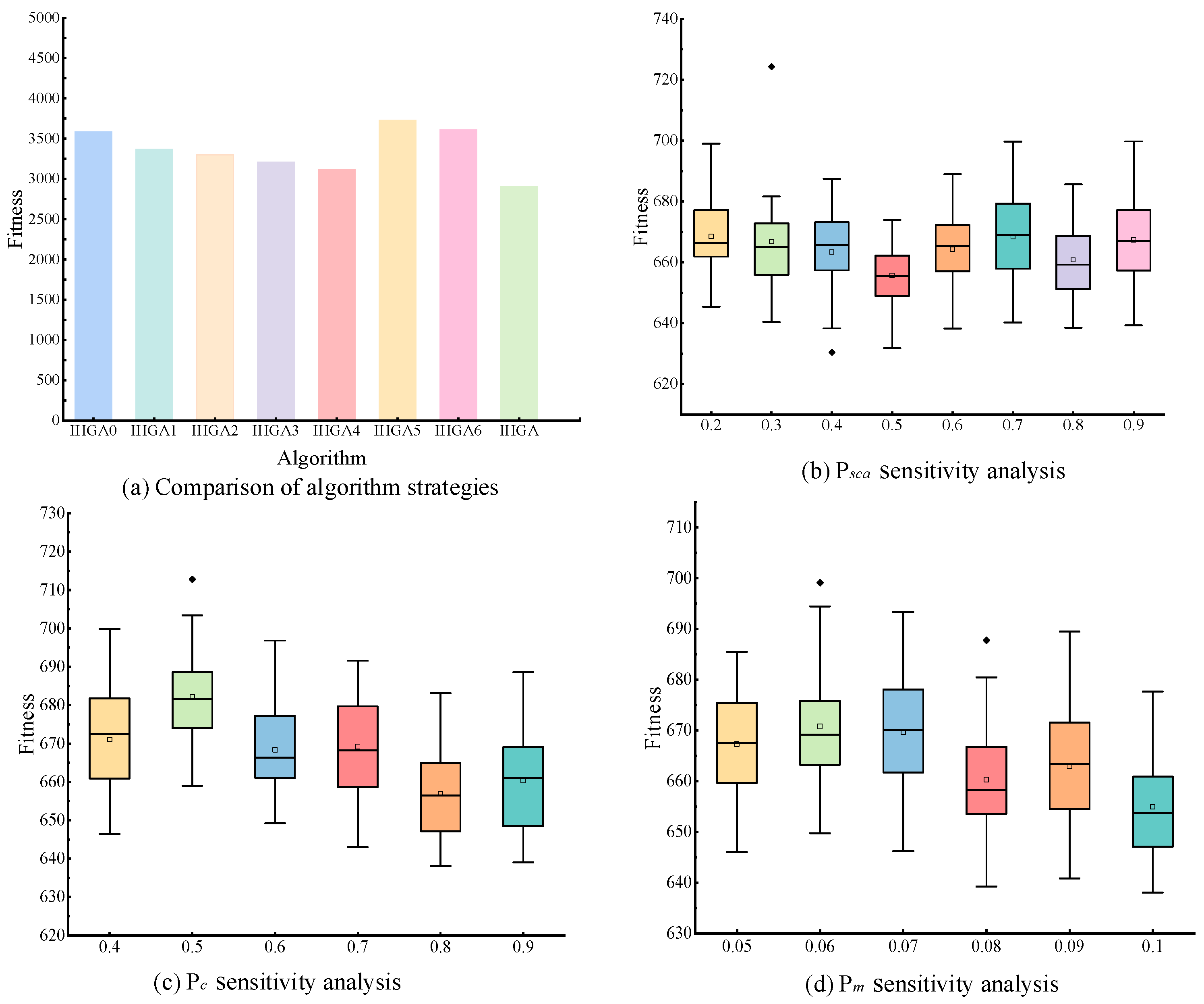
To verify the effectiveness of the algorithmic improvement strategy, we conducted ablation experiments in this section. Figure 11a shows the experimental results. IHGA0 represents the initial GA, IHGA1 represents the GA + PWLCM initialization strategy, IHGA2 represents the GA + PWLCM initialization + SA-based mutation strategy, IHGA3 represents the GA + PWLCM initialization + SA-based mutation + VNS, IHGA4 represents the GA + PWLCM initialization + SA-based mutation + ISCA, IHGA5 represents the GA + PWLCM initialization + VNSA, and IHGA6 represents the GA + PWLCM initialization + ISCA. IHGA is the algorithm proposed in this paper. As Figure 11a shows, IHGA achieves the lowest total energy consumption and performs well. Since the fitness of IHGA1 and IHGA2 is relatively close, IHGA5 and IHGA6 were further designed to verify the effectiveness of the SA-based mutation strategy. Comparison with IHGA3 and IHGA4 shows that the SA-based mutation strategy has a significant impact on the overall algorithm.
Furthermore, the relevant parameters P s c a , P c , and P m in IHGA have a significant impact on its performance. This paper conducts an in-depth analysis of these parameters, as shown in Figure 11b–d. As can be seen from the figure, when P s c a = 0.5, P c = 0.8, and P m = 0.1, the interquartile range of the fitness value is small, indicating extremely low data variability. The median and mean are both at low levels compared to other parameters. Therefore, in this paper, the values of P s c a , P c , and P m are set to 0.5, 0.8, and 0.1, respectively.
Through the ablation experiments and parameter sensitivity analysis, the effectiveness of the proposed IHGA is validated. As demonstrated in Figure 11a, the complete IHGA achieves the lowest total energy consumption among all algorithm variants, confirming that each incorporated improvement strategy—PWLCM chaotic initialization, simulated annealing-based mutation, VNS, and ISCA—contributes positively to the overall optimization performance. Notably, the comparison between IHGA3/IHGA4 and IHGA5/IHGA6 reveals that the simulated annealing-based mutation strategy plays a particularly significant role in enhancing algorithm performance. Furthermore, the parameter analysis in Figure 11b–d identifies the optimal parameter configuration ( P s c a = 0.5, P c = 0.8, and P m = 0.1) that minimizes fitness variability and achieves low median and mean fitness values. In summary, the proposed IHGA demonstrates superior effectiveness in solving the coordinated scheduling problem, with each improvement mechanism making a meaningful contribution to its overall performance.

5.3. Comparative Experiments

5.3.1. Comparison of Chebyshev Motion Strategies

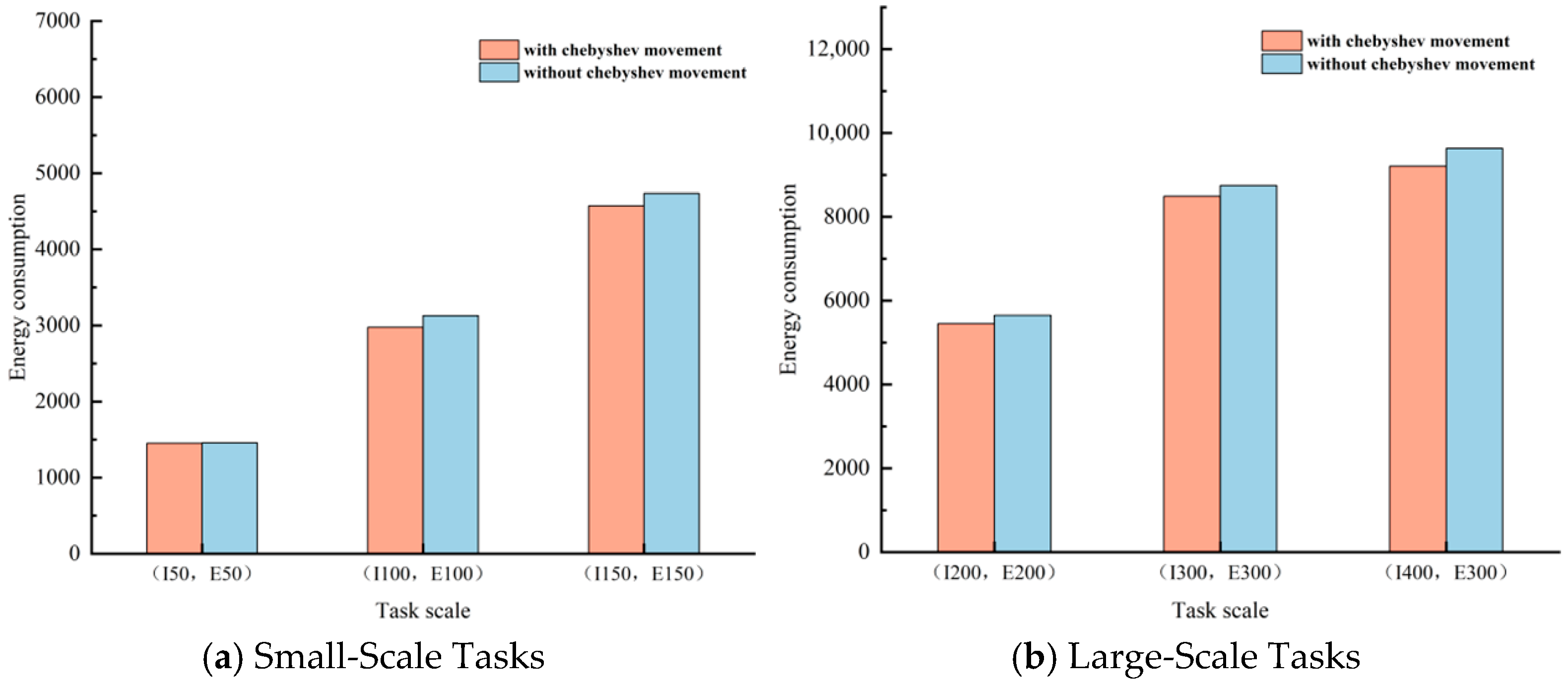
This section investigates the impact of applying Chebyshev motion to YCs on the total energy consumption for task completion. Experiments are conducted for both small-scale instances—50, 100 and 150 tasks each for ICTs and ECTs—and large-scale instances with 200, 300 and 400 tasks per category. As shown in Figure 12, under small-scale and large-scale task scenarios, Chebyshev motion helps reduce the total energy consumption. These findings confirm that incorporating Chebyshev motion in terminal operations can reduce the empty travel time of YCs, thereby shortening their total operational time. Moreover, when ICTs and ECTs arrive in advance, Chebyshev motion helps reduce their waiting time for YC operations, thus contributing to an overall reduction in the total energy consumption for completing all tasks.

5.3.2. Comparison of Different Operation Strategies and Modes

This paper investigates two handling modes: the hybrid operation mode and the conventional operation mode. In both modes, each bay position is assigned a dedicated handling point, meaning loading and unloading operations can be performed at both vertical sides of each bay within the yard. In the hybrid operation mode, the effects of the task combination strategy and the non-combination strategy are compared. By analyzing these different strategies and operation modes, the study aims to evaluate their impact on the total energy consumption for task completion.
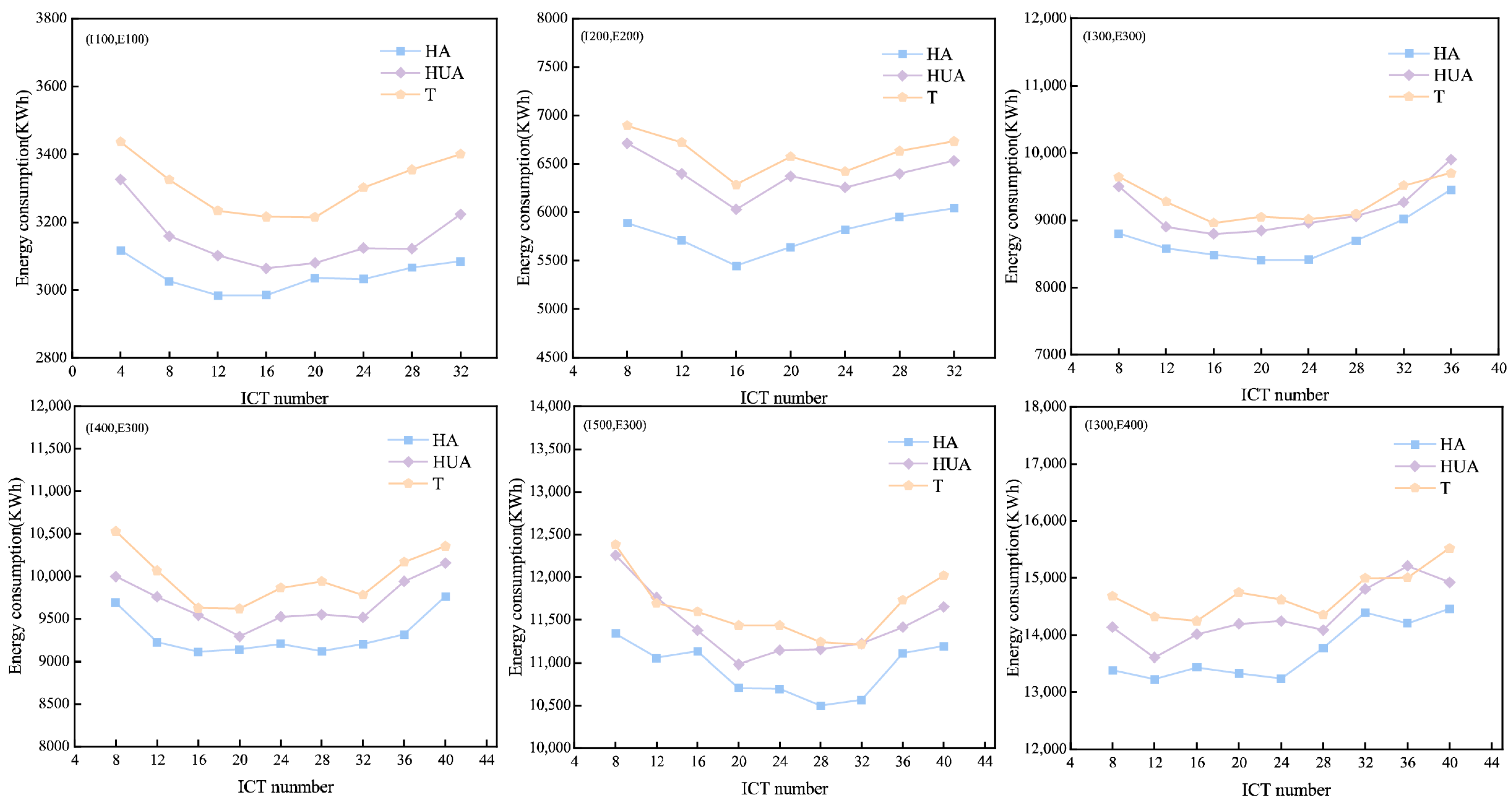
Figure 13 illustrates the performance metrics under different operation strategies and handling modes. Experiments were conducted under varying task scales by adjusting the number of ICTs accordingly. Here, HA represents the task combination strategy under the hybrid handling mode, while HUA represents the non-task combination strategy under the hybrid mode. T represents the traditional handling mode where ICTs and ECTs operate separately. (I100, E100) indicates a scenario with 100 ICT tasks and 100 ECT tasks. The experimental results indicate that the proposed task combination strategy under the hybrid mode performs best in the terminal system, achieving the lowest total energy consumption. As shown, when the number of tasks is (I100, E100), regardless of the number of ICTs, the total energy consumption relationship remains HA < HUA < T, and when the number of ICTs is 16, all three modes achieve the lowest energy consumption point. However, as the number of tasks increases, with the rise in ICT count, the total energy consumption of HUA—initially better than T—gradually approaches that of T, and in some cases, even becomes worse than T. In contrast, HA consistently maintains the lowest energy consumption, regardless of the task volume or the number of ICTs.
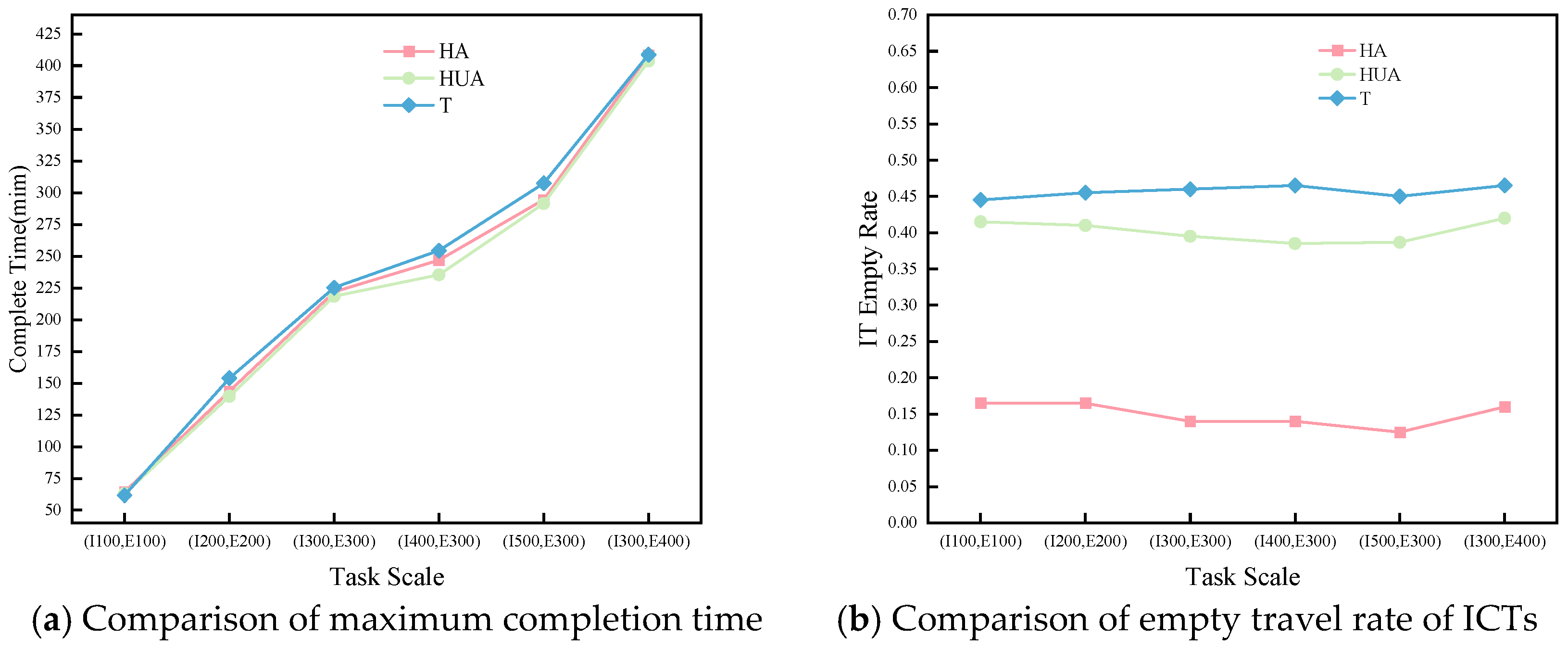
Furthermore, as shown in Figure 14a, although the total energy consumption of HA is consistently lower than that of HUA and T, there is no significant difference in the makespan among the three. This indicates that HA reduces the total energy consumption for task completion without sacrificing the makespan, providing an efficient and reliable optimization solution for practical port applications. Additionally, Figure 14b shows that the empty load ratio of internal trucks under HA has been significantly reduced, which is highly beneficial for improving internal truck utilization and reducing their energy consumption.
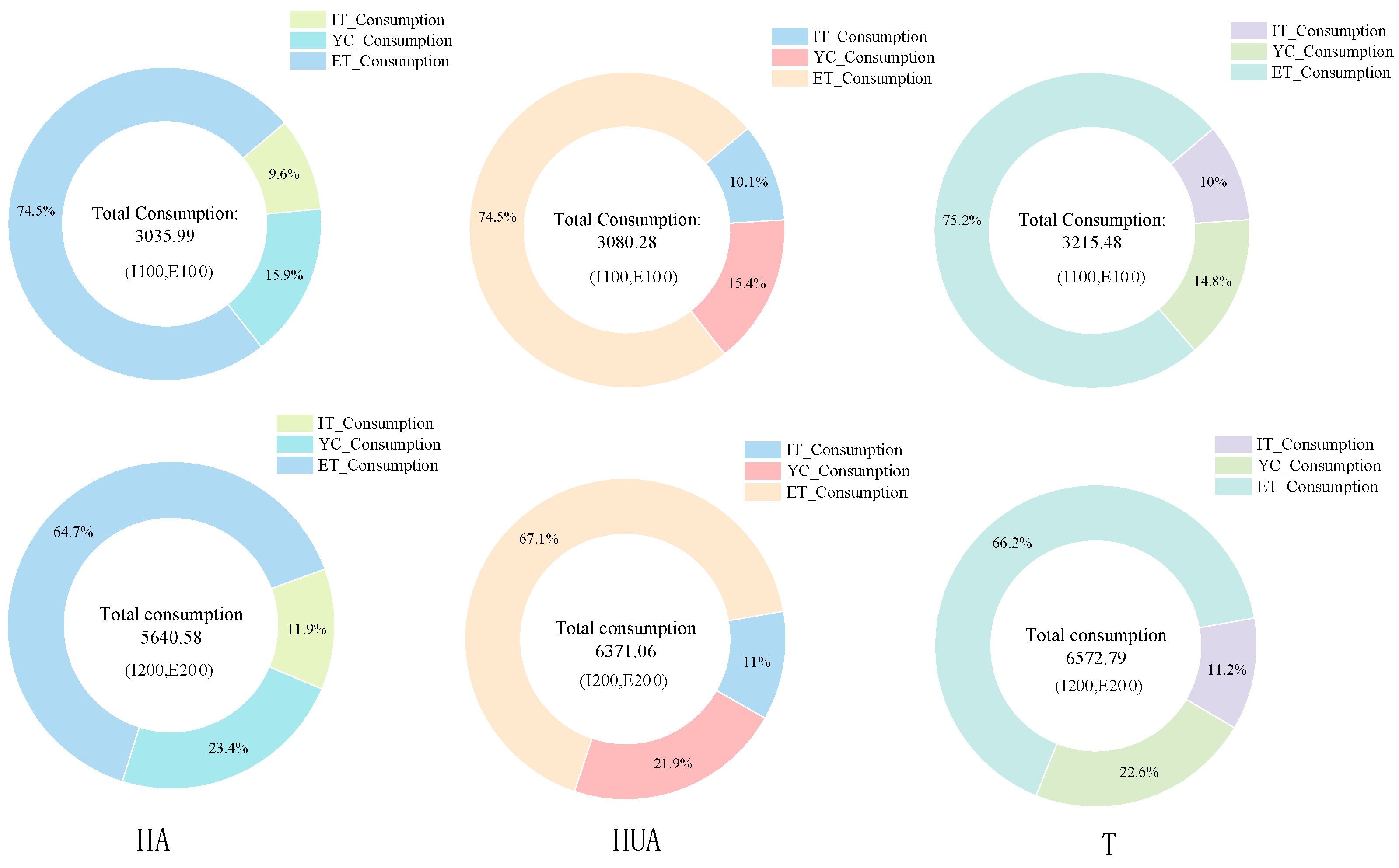
As shown in Figure 15, the energy consumption of ECTs accounts for a relatively large proportion of the total energy consumption. Therefore, reducing the energy consumption of ECTs is of critical importance in scheduling.
Table 5 presents the results of MT, ITEC, ETEC, and YCEC under three modes—HA, HUA, and T—when the number of tasks increases from (I100, E100) to (I300, E400) with varying numbers of ICTs. In the table, MT represents the maximum completion time, ITEC represents the ICT energy consumption, ETEC represents the ECT energy consumption, and YCEC represents the YC energy consumption. The results indicate that HA outperforms the other two modes in terms of both ITEC and ETEC. However, in certain cases, MT and YCEC under HA may be higher than those under the other two modes. This could be because the HA mode prioritizes task assignments to reduce total energy consumption (e.g., by assigning tasks preferentially to ECTs), which may increase the travel distance of some YCs, thereby increasing their energy consumption and completion time. Further analysis indicates that as the number of tasks increases, HA’s advantage in reducing ETEC becomes more pronounced.
Under the HUA mode, as the number of ICTs/ECTs increases, their random selection of handling points may lead to increased conflicts in handling point occupancy. This can affect the operational time of the vehicles and subsequently impact the overall process, resulting in an increase in the total energy consumption for task completion. In contrast, under the T mode, the loading and unloading areas for ICTs and ECTs are separated. Consequently, there are fewer conflicts regarding handover point occupancy, which does not disrupt the vehicle operation process, leading to lower total energy consumption compared to the HUA mode. Under the HA mode, due to the task combination strategy, each ICT typically handles two tasks within the same or adjacent yard blocks in most cases, and the dynamic allocation of handover points is implemented. This results in a more reasonable assignment of handover points and reduces the occurrence of handling point conflicts, thus avoiding the situation observed in the HUA mode.

5.3.3. Comparison Between Task Combination and Fixed Handover Point Strategy

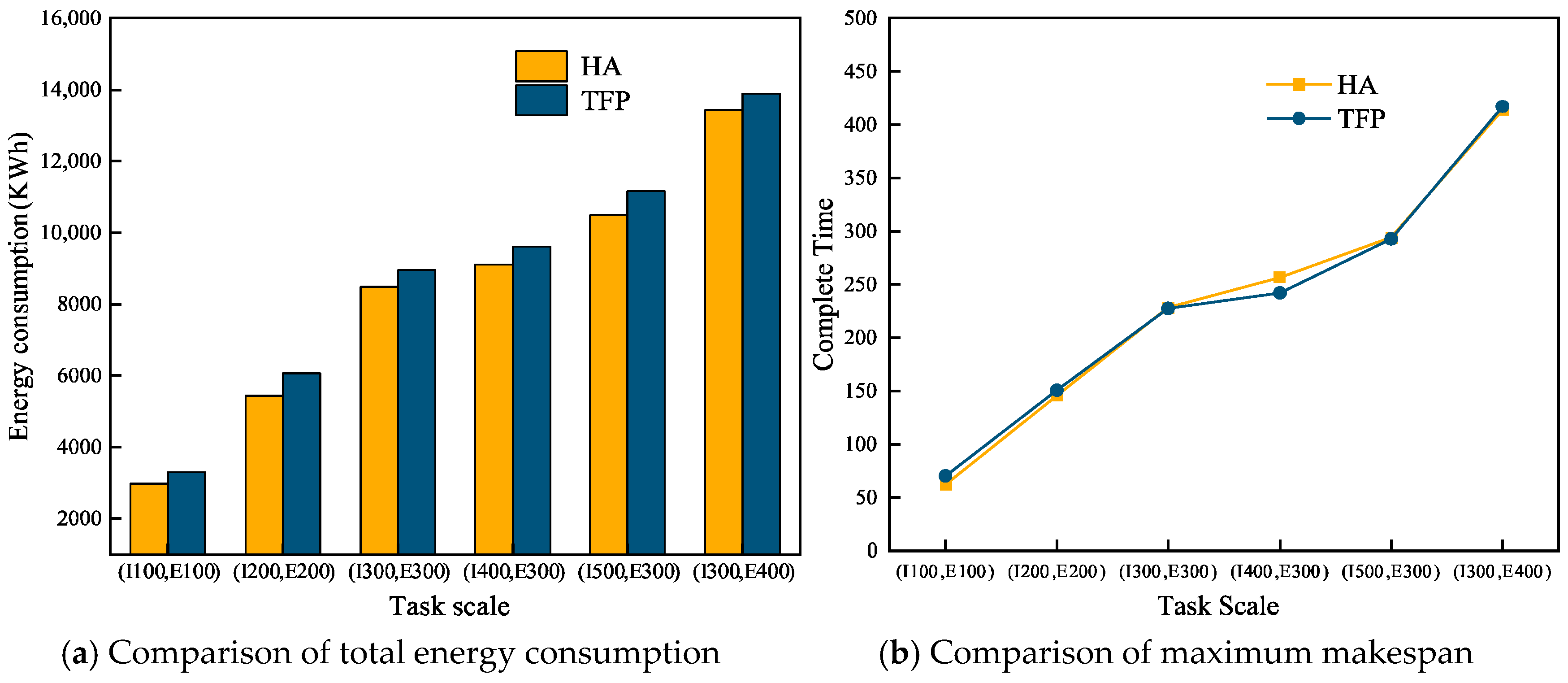
In this section, the proposed task combination strategy under the hybrid handling mode is compared with the fixed handover point strategy, in which ICTs and ECTs operate separately as adopted in Reference [22]. Each yard block is evenly configured with 10 handover points. Figure 16a,b illustrate the differences in total energy consumption and makespan between the two strategies. Here, TFP represents the fixed handover point strategy in traditional handling mode. It can be observed that the proposed HA strategy consistently achieves lower total energy consumption across various task scales without increasing the overall makespan. Table 6 presents MT, ITEC, ETEC, and YCEC, which represent the maximum completion time, ICT energy consumption, ECT energy consumption, and YC energy consumption under the handling strategy adopted in the referenced literature. MT (%), ITEC (%), ETEC (%), and YCEC (%) denote the comparative results between the strategy from the literature and the proposed HA strategy. As shown in Table 6, the proposed HA strategy significantly reduces MT (%), ITEC (%), ETEC (%), and YCEC (%), with average reductions of 2.68%, 8.28%, 4.13%, and 4.80%, respectively. However, there are some scenarios where the YC energy consumption is higher, which aligns with the observations from previous experimental results.

5.3.4. Comparison Between Different Algorithms

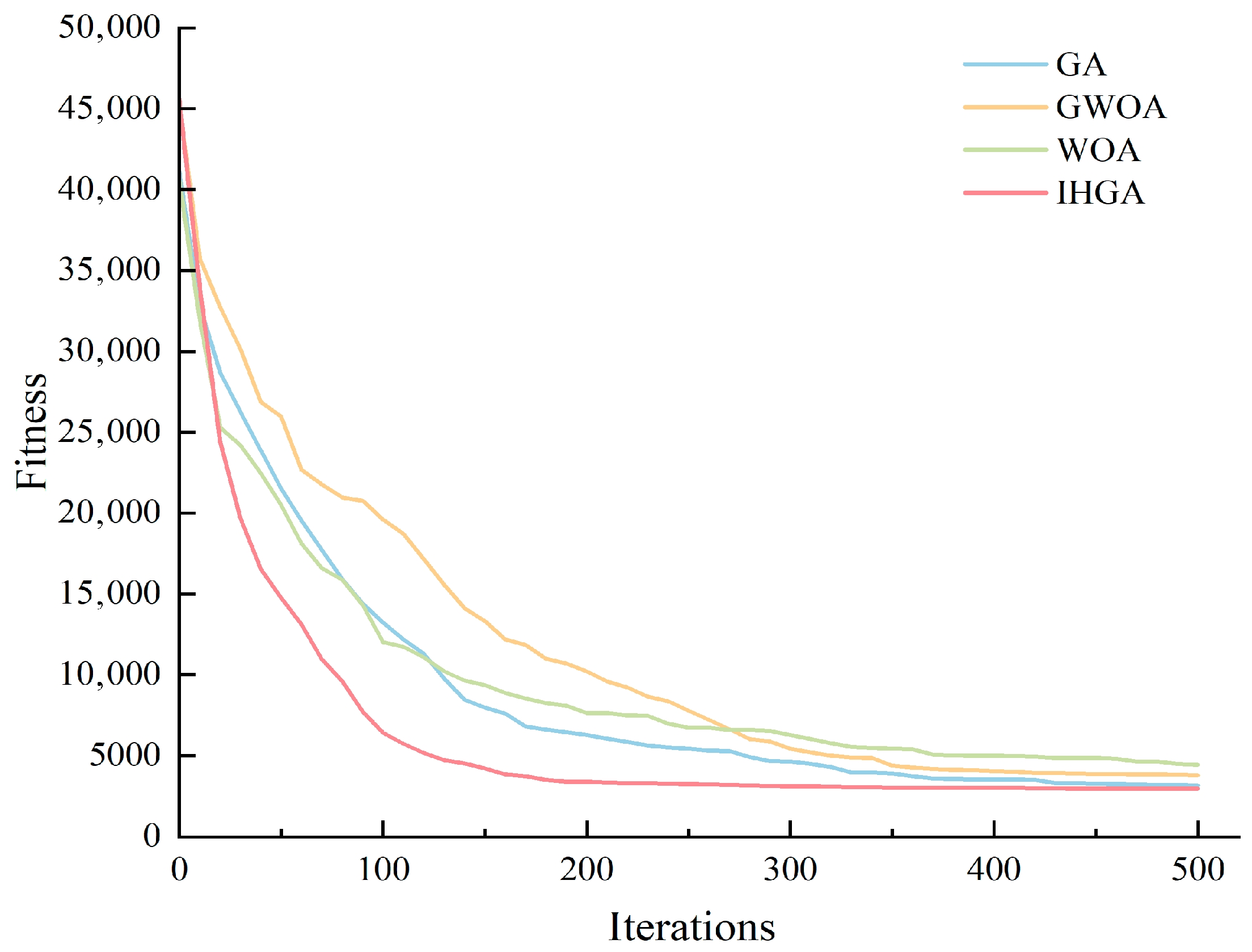
To demonstrate the superiority of the proposed IHGA in task solving, this section conducted comparative experiments involving four algorithms: WOA (Whale Optimization Algorithm) [33], GWOA (Grey Wolf Optimization Algorithm) [34], GA [35], and IHGA. The experiments were conducted on a case involving 200 tasks and 8 ICTs, and the convergence trends and performance of each algorithm were analyzed. The convergence performance of the algorithms is shown in Figure 17. The results indicate that the IHGA achieves a faster convergence rate, with its fitness value stabilizing around 3000. Compared with the WOA and GWOA, both IHGA and GA obtained better solutions, while IHGA demonstrated superior stability.
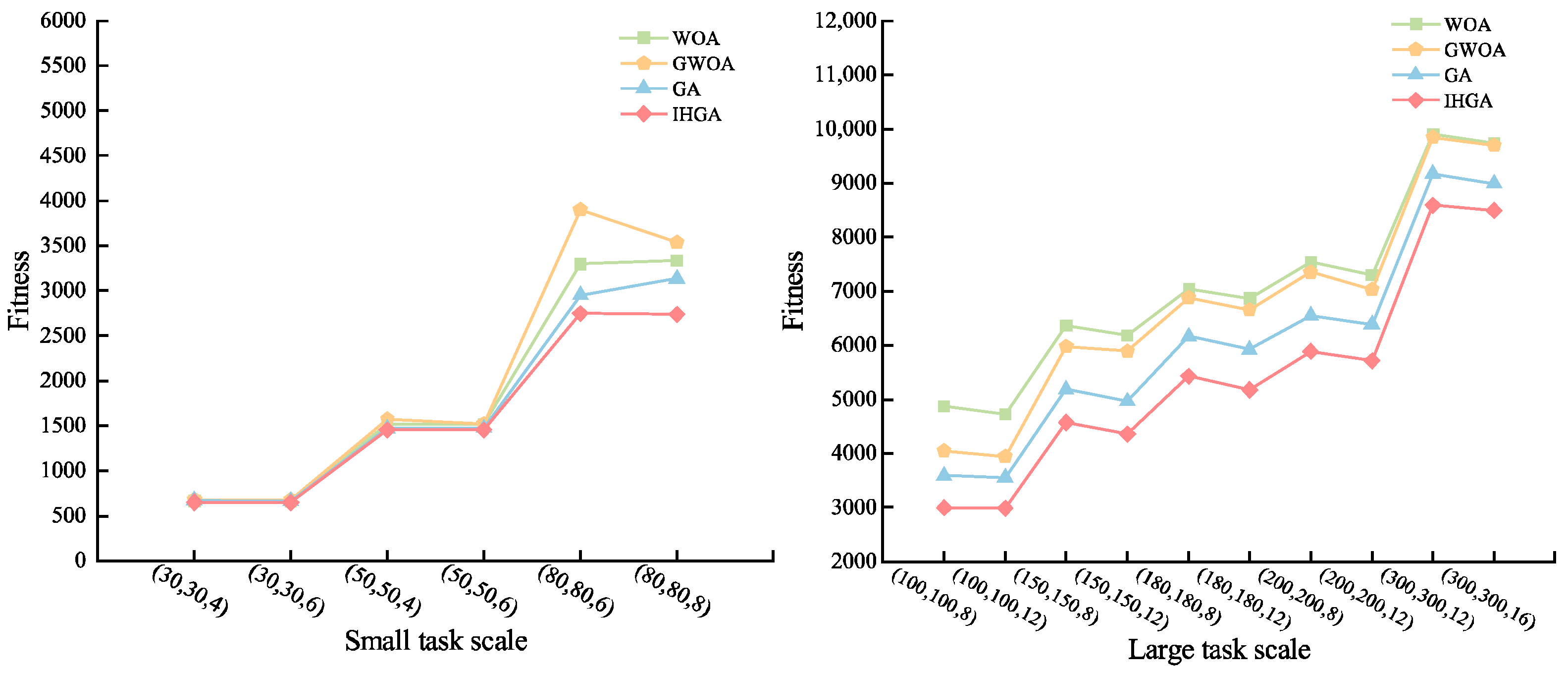
To comprehensively evaluate the performance of different algorithms under varying task scales and numbers of ICTs, both small-scale and large-scale experimental instances are designed in this section. The objective function value is used as the evaluation metric. The number of tasks ranges from 60 to 600. The small-scale experiment includes six groups of instances, and the large-scale experiment consists of ten groups of instances. Each instance is executed ten times, and the average value is taken as the final result to ensure the stability and reliability of the experimental results.
As shown in Figure 18, the IHGA consistently outperforms the other algorithms in minimizing the total energy consumption across all instances, demonstrating superior performance in addressing the ICT and ECT scheduling problem. In small-scale cases, the performance differences among the algorithms are relatively minor. However, as the number of tasks increases and the complexity of the problem grows, the performance gap between the algorithms gradually widens. Specifically, the IHGA maintains solution quality even in medium and large-scale problems, further proving its excellence.

6. Conclusions

This paper investigates the coordinated scheduling problem among ICTs, ECTs, and YCs under the “side-loading and hybrid ICT-ECT flow” mode. The study highlights the significance of considering ECT dispatching to enhance the overall efficiency of ACT operations. A task combination strategy for ICTs is proposed and shown to be an effective approach for reducing the total energy consumption in the hybrid operation mode. Additionally, a Chebyshev-motion-based coordination strategy for YC gantry and trolley movements is developed, along with a handover point selection strategy based on this motion behavior. To address the optimization problem, an MIP model is constructed, incorporating constraints related to sequencing, timing, and handover point allocation to minimize the total energy consumption of all tasks. An Improved Hybrid Genetic Algorithm (IHGA) is developed to solve the model. Experimental results demonstrate that the IHGA achieves superior performance in solving the collaborative scheduling problem, leading to high-quality solutions. A comprehensive evaluation under varying task scales and ICT quantities confirms that the proposed task combination strategy effectively reduces overall energy consumption, highlighting its practical advantages.
From a managerial perspective, the proposed model offers several actionable insights for terminal managers. First, the task combination strategy enables managers to improve ICT utilization by efficiently pairing delivery and retrieval tasks within or across yard blocks, thereby reducing empty truck trips and lowering operational costs. Second, the dynamic handover point allocation mechanism helps avoid resource congestion caused by fixed handover points, allowing managers to achieve smoother equipment coordination without additional infrastructure investment. Third, the Chebyshev-motion-based YC coordination strategy reduces crane travel time and energy consumption, providing a direct pathway for managers to enhance yard-side operational efficiency. Fourth, the model’s ability to optimize ECT scheduling offers a key entry point for energy management, supporting port operators in achieving green port development goals while maintaining throughput performance. Overall, this study provides terminal managers with a decision-support tool that balances energy efficiency and operational performance, enabling practical improvements in daily scheduling and long-term planning.
Experimental results demonstrate that under hybrid traffic and side-loading modes, optimized scheduling strategies can achieve dual improvements in energy consumption and operational efficiency without additional equipment investment. In future terminal operations, the task combination strategy under the hybrid handling mode can be adopted to effectively reduce the total energy consumption for task completion, while a dynamic handover point allocation mechanism can be implemented to avoid resource congestion caused by fixed handover points. Furthermore, the scheduling optimization of ECTs can serve as a key entry point for energy management, reducing their overall operation time through coordinated scheduling, thereby contributing to the goal of green port development. Overall, this study provides a novel perspective and methodology for addressing collaborative scheduling problems under hybrid operations, supporting the optimization of terminal operations and the sustainable development of automated container terminals.
Despite these contributions, several challenges remain for future research. Issues such as obstacle avoidance among ICTs and potential conflicts during hybrid ICT-ECT operations are not yet fully addressed. Moreover, the current model does not account for coordination with QCs or dynamic factors in ACT operations. Future research can be expanded in the following directions: (1) Investigate joint scheduling of ICTs, ECTs, YCs, and QCs to enhance terminal-wide coordination and performance. (2) Model and resolve potential route conflicts and collision avoidance between ICTs and ECTs to more accurately reflect real-world operations. (3) Incorporate uncertain factors (e.g., ECT delays or early arrivals) into the scheduling process to generate robust and adaptive solutions. In addition, further refinement and validation of the proposed model under broader and more complex operational scenarios will be necessary to ensure its generalizability and robustness.

Author Contributions

Conceptualization, S.H.; Methodology, S.H.; Software, S.H.; Writing—Original Draft, S.H.; Data Curation, Q.Z.; Formal Analysis, Q.Z.; Supervision, F.Y. and Y.Y.; Project Administration, F.Y. and Y.Y.; Funding Acquisition, F.Y. and Y.Y.; Writing—Review & Editing, F.Y.; Validation, F.Y. and Y.Y. All authors have read and agreed to the published version of the manuscript.

Funding

This research was funded by the National Key Research and Development Program of China [2025YFE0125600].

Institutional Review Board Statement

Not applicable.

Informed Consent Statement

Not applicable.

Data Availability Statement

The original contributions presented in this study are included in the article. Further inquiries can be directed to the corresponding author.

Conflicts of Interest

The authors declare that there are no conflicts of interest in this publication.

Nomenclature

The following abbreviations are used in this manuscript:
Abbreviations
ICTsInternal Container Trucks
ECTsExternal Container Trucks
ACTsAutomated Container Terminals
YCsYard Cranes
IHGAImproved Hybrid Genetic Algorithm
VNSVariable Neighborhood Search
ISCAImproved Sine Cosine Algorithm
MIPMixed-integer Programming
QCsQuay Cranes
ELEnd-loading
SLSide-loading
GAGenetic Algorithm
PWLCMPiecewise Linear Chaotic Mapping
SASimulated Annealing
HAHybrid traffic with assigned task combination
HUAHybrid traffic with unassigned task combination
TTraditional traffic mode
MTMaximum completion time
ITECICTs energy consumption
ETECECTs energy consumption
YCECYCs energy consumption
TFPTraditional handling mode with fixed handover point strategy
WOAWhale Optimization Algorithm
GWOAGrey Wolf Optimization Algorithm

References

  1. Yu, H.; Deng, Y.; Zhang, L.; Xiao, X.; Tan, C. Yard operations and management in automated container terminals: A review. Sustainability 2022, 14, 3419. [Google Scholar] [CrossRef]
  2. Ma, M.; Yu, F.; Xie, T.; Yang, Y. A hybrid speed optimization strategy based coordinated scheduling between AGVs and yard cranes in U-shaped container terminal. Comput. Ind. Eng. 2024, 198, 110712. [Google Scholar] [CrossRef]
  3. Xiang, X.; Feng, C.; Zeng, J.; Ding, X.; Zhou, P.; Li, S.; Liao, W. Research on port autonomous driving hybrid traffic scheduling method based on adaptive right of way management. In Proceedings of the Ninth International Conference on Electromechanical Control Technology and Transportation (ICECTT 2024); SPIE: Nuremberg, Germany, 2024; pp. 1077–1084. [Google Scholar]
  4. Ng, S.H.; Ong, R.; Zhou, C. Traffic Strategy for Mixed Traffic in Container Terminals. In IRC-SET 2021; Springer: Singapore, 2022; pp. 13–27. [Google Scholar]
  5. Horst, E. Design of a Traffic Control System for Autonomous Vehicles in Container Terminals with Mixed Traffic. Bachelor’s Thesis, University of Twente, Enschede, The Netherlands, 2019. [Google Scholar]
  6. Lee, B.K.; Kim, K.H. Comparison and evaluation of various cycle-time models for yard cranes in container terminals. Int. J. Prod. Econ. 2010, 126, 350–360. [Google Scholar] [CrossRef]
  7. Zhong, Z.L.; Guo, Y.Y.; Zhang, J.H.; Yang, S.X. Energy-aware Integrated Scheduling for Container Terminals with Conflict-free AGVs. J. Syst. Sci. Syst. Eng. 2023, 32, 413–443. [Google Scholar] [CrossRef]
  8. Zhao, Q.; Ji, S.; Zhao, W.; De, X. A multilayer genetic algorithm for automated guided vehicles and dual automated yard cranes coordinated scheduling. Math. Probl. Eng. 2020, 2020, 5637874. [Google Scholar] [CrossRef]
  9. Chen, X.C.; He, S.W.; Zhang, Y.X.; Tong, L.; Shang, P.; Zhou, X.S. Yard crane and AGV scheduling in automated container terminal: A multi-robot task allocation framework. Transp. Res. Part C-Emerg. Technol. 2020, 114, 241–271. [Google Scholar] [CrossRef]
  10. Gong, S.; Lou, P.; Hu, J.; Zeng, Y.; Fan, C. An Improved Whale Optimization Algorithm for the Integrated Scheduling of Automated Guided Vehicles and Yard Cranes. Mathematics 2025, 13, 340. [Google Scholar] [CrossRef]
  11. Luo, Y.; Liang, X.; Zhang, Y.; Tang, K.; Li, W. Energy-aware integrated scheduling for quay crane and igv in automated container terminal. J. Mar. Sci. Eng. 2024, 12, 376. [Google Scholar] [CrossRef]
  12. Fereidoonian, F.; Sadjadi, S.J.; Heydari, M.; Al-e-Hashem, S.M.J.M. A timely efficient and emissions-aware multiobjective truck-sharing integrated scheduling model in container terminals. Proc. Inst. Mech. Eng. Part M J. Eng. Marit. Environ. 2024, 238, 982–1008. [Google Scholar] [CrossRef]
  13. Yue, L.; Fan, H.; Zhai, C. Joint configuration and scheduling optimization of a dual-trolley quay crane and automatic guided vehicles with consideration of vessel stability. Sustainability 2019, 12, 24. [Google Scholar] [CrossRef]
  14. Fontes, D.; Homayouni, S.M. A bi-objective multi-population biased random key genetic algorithm for joint scheduling quay cranes and speed adjustable vehicles in container terminals. Flex. Serv. Manuf. J. 2023, 35, 241–268. [Google Scholar] [CrossRef]
  15. Zhang, H.; Qi, L.; Luan, W.; Ma, H. Double-cycling AGV scheduling considering uncertain crane operational time at container terminals. Appl. Sci. 2022, 12, 4820. [Google Scholar] [CrossRef]
  16. Duan, Y.; Ren, H.; Xu, F.; Yang, X.; Meng, Y. Bi-Objective Integrated Scheduling of Quay Cranes and Automated Guided Vehicles. J. Mar. Sci. Eng. 2023, 11, 1492. [Google Scholar] [CrossRef]
  17. Ji, S.W.; Luan, D.; Chen, Z.R.; Guo, D. Integrated scheduling in automated container terminals considering AGV conflict-free routing. Transp. Lett.-Int. J. Transp. Res. 2021, 13, 501–513. [Google Scholar]
  18. Lu, Y. The Three-Stage Integrated Optimization of Automated Container Terminal Scheduling Based on Improved Genetic Algorithm. Math. Probl. Eng. 2021, 2021, 6792137. [Google Scholar] [CrossRef]
  19. Wang, Q.; Tong, X.; Li, Y.; Wang, C.; Zhang, C. Integrated Scheduling Optimization for Automated Container Terminal: A Reinforcement Learning-Based Approach. IEEE Trans. Intell. Transp. Syst. 2025, 26, 10019–10035. [Google Scholar] [CrossRef]
  20. Zhong, M.; Yang, Y.; Dessouky, Y.; Postolache, O. Multi-AGV scheduling for conflict-free path planning in automated container terminals. Comput. Ind. Eng. 2020, 142, 106371. [Google Scholar] [CrossRef]
  21. Zhong, M.S.; Yang, Y.S.; Zhou, Y.M.; Postolache, O. Application of hybrid GA-PSO based on intelligent control fuzzy system in the integrated scheduling in automated container terminal. J. Intell. Fuzzy Syst. 2020, 39, 1525–1538. [Google Scholar] [CrossRef]
  22. Wang, Z.; Zeng, Q.; Li, X.; Qu, C. A branch-and-price heuristic algorithm for the ART and external truck scheduling problem in an automated container terminal with a parallel layout. Transp. Res. Part E-Logist. Transp. Rev. 2024, 184, 103464. [Google Scholar] [CrossRef]
  23. Gao, Y.F.; Ge, Y.E. Integrated scheduling of yard cranes, external trucks, and internal trucks in maritime container terminal operation. Marit. Policy Manag. 2023, 50, 629–650. [Google Scholar] [CrossRef]
  24. Chu, L.; Liang, D.; Zhou, Y.; Zhang, J. Optimal Model and Algorithm Design for the Multi-Equipment Resource Collaborative Scheduling of Automated Terminals Considering the Mixing Process. Adv. Eng. Inform. 2024, 23, 479–490. [Google Scholar] [CrossRef]
  25. Han, Y.; Zheng, H.; Ma, W.; Yan, B.; Ma, D. Integrated Scheduling of Automated Rail-Mounted Gantries and External Trucks in U-Shaped Container Terminals. IEEE Trans. Autom. Sci. Eng. 2025, 22, 7394–7408. [Google Scholar] [CrossRef]
  26. Peng, W.H.; Wang, D.J.; Qiu, H.X.; Chu, F.; Yin, Y.Q. Integrated Optimization on Double-Side Cantilever Yard Crane Scheduling and Green Vehicle Path Planning at U-Shaped Yard. IEEE Trans. Intell. Transp. Syst. 2025, 26, 3684–3699. [Google Scholar] [CrossRef]
  27. Li, J.; Chang, D.; Wen, F. Digital twin enhanced rescheduling based on hybrid strategy in intermodal container terminal. Comput. Oper. Res. 2025, 180, 107053. [Google Scholar] [CrossRef]
  28. Baldouski, D.; Krész, M.; Dávid, B. Scheduling truck arrivals for efficient container flow management in port logistics. Cent. Eur. J. Oper. Res. 2025, 33, 791–818. [Google Scholar] [CrossRef]
  29. Zhu, J.; Ma, F. Scheduling of twin automatic stacking cranes and automated guided vehicle considering buffer mode on automated container terminal. Comput. Ind. Eng. 2024, 193, 110271. [Google Scholar] [CrossRef]
  30. Zhou, C.; Lee, B.K.; Li, H. Integrated optimization on yard crane scheduling and vehicle positioning at container yards. Transp. Res. Part E-Logist. Transp. Rev. 2020, 138, 101966. [Google Scholar] [CrossRef]
  31. Tang, X.; Zhang, Y.; Gao, Y.; Yang, R. Lock Station Allocation in Unlocking and Padlocking Operation of ART in Automated Container Terminal. In Proceedings of the 2021 6th International Conference on Transportation Information and Safety (ICTIS); IEEE: New York, NY, USA, 2021; pp. 1408–1413. [Google Scholar]
  32. Xu, Y.; Zhang, Y.; Chen, P.; Yang, R.; Gao, Y. Simulation Analysis of Isolated Lane Layout in Automated Container Terminal Yard. In Proceedings of the 2021 6th International Conference on Transportation Information and Safety (ICTIS); IEEE: New York, NY, USA, 2021; pp. 1414–1418. [Google Scholar]
  33. Mirjalili, S.; Lewis, A. The Whale Optimization Algorithm. Adv. Eng. Softw. 2016, 95, 51–67. [Google Scholar] [CrossRef]
  34. Mirjalili, S.; Mirjalili, S.M.; Lewis, A. Grey Wolf Optimizer. Adv. Eng. Softw. 2014, 69, 46–61. [Google Scholar] [CrossRef]
  35. Zhang, Q.L.; Hu, W.X.; Duan, J.G.; Qin, J.Y. Cooperative Scheduling of AGV and ASC in Automation Container Terminal Relay Operation Mode. Math. Probl. Eng. 2021, 2021, 5764012. [Google Scholar] [CrossRef]
Figure 1. Layout of Beijiang Terminal C of Tianjin Port.
Eng 07 00181 g001
Figure 2. Layout of Side-loading + Hybrid truck flow Port.
Eng 07 00181 g002
Figure 3. Schematic diagram of the movements of yard crane components.
Eng 07 00181 g003
Figure 4. Schematic of Chebyshev motion.
Eng 07 00181 g004
Figure 5. Schematic of handover point selection.
Eng 07 00181 g005
Figure 6. Schematic of Task Combination Strategy.
Eng 07 00181 g006
Figure 7. Flowchart of the Improved Hybrid Genetic Algorithm.
Eng 07 00181 g007
Figure 8. Schematic of encoding.
Eng 07 00181 g008
Figure 9. Schematic of decoding.
Eng 07 00181 g009
Figure 10. Gantt chart of task execution.
Eng 07 00181 g010
Figure 11. Algorithm strategy comparison & sensitivity analysis.
Eng 07 00181 g011
Figure 12. Total Energy Consumption Comparison.
Eng 07 00181 g012
Figure 13. Total energy consumption comparison.
Eng 07 00181 g013
Figure 14. Comparative performance analysis under different operational strategies and modes.
Eng 07 00181 g014
Figure 15. Energy consumption ratio analysis.
Eng 07 00181 g015
Figure 16. Comparison of different handling strategies.
Eng 07 00181 g016
Figure 17. Convergence comparison among algorithms.
Eng 07 00181 g017
Figure 18. Comparison of different algorithms.
Eng 07 00181 g018
Table 1. Summary of research on coordinated scheduling in ACTs.
AuthorEquipmentTraffic
Management
Handover Point
Setting
Model ObjectiveAlgorithm
QCYCICTECTMTECMMCTMDT
Zhong (2023) [7]Segregated+ EL BGA
Zhao (2020) [8]Segregated+ EL IMGA
Chen (2020) [9]Segregated+ SLFixed ADMM
Gong (2025) [10]Segregated+ EL IWOA
Luo (2024) [11]Segregated+ SLFixed ISSA
Fereidoonian (2024) [12]Segregated+ SLFixed NSGA&MPSO
Yue (2019) [13]Segregated+ EL GA
Fontes (2023) [14]Segregated+ EL Mp-BRKGA
Zhang (2022) [15]Segregated+ EL HPSO
Duan (2023) [16]Segregated+ EL NSGA-II
Ji (2021) [17]Segregated+ EL CRS-BAGA
Lu (2021) [18]Segregated+ EL PGA
Wang (2025) [19]Segregated+ SLFixed RL
Zhong (2020) [20,21]Segregated+ EL HGA-PSO
Wang (2024) [22]Segregated+ SLFixed B&PHA
Gao (2023) [23]Segregated+ SLFixed NSGA
Chu (2024) [24]Segregated+ EL SAPSO
Han (2024) [25]Segregated+ SLFixed NSGA-III
Peng (2025) [26]Segregated+ SLFixed IMOPSO
Li (2025) [27]Segregated+ SLFixed MOPSO
This paperHybrid+ SLDynamic IHGA
√: included; —: not included; SL: side-loading; EL: end-loading.
Table 2. Parameters.
SymbolsMeaning of Symbols
B Maximum number of bays in the container yard
R Maximum number of rows in the container yard
J Set of containers in the yard
C Set of yard cranes in the yard, where c C denotes any yard crane in the block, with c = 0 representing a left-side yard crane and c = 1 representing a right-side yard crane
I Set of ICTs
K Set of ECTs
v I , L Loaded travel speed of ICT
v I , U L Unloaded travel speed of ICT
v K , L Loaded travel speed of ECT
v K , U L Unloaded travel speed of ECT
e I , L Loaded energy consumption per unit time of ICT
e I , U L Unloaded energy consumption per unit time of ICT
e I , W Waiting energy consumption per unit time of ICT
e K , L Loaded energy consumption per unit time of ECT
e K , U L Unloaded energy consumption per unit time of ECT
e K , W Waiting energy consumption per unit time of ECT
e C , L Loaded energy consumption per unit time of YC
e C , U L Unloaded energy consumption per unit time of YC
e C , W Waiting energy consumption per unit time of YC
M An infinite positive integer
t 1 Time to pick/place a container by the YC
t 2 Loading/unloading time at the QC
t 3 Time for gantry of YC to move one bay
t 4 Time for trolley of YC to move one row
e P Energy for picking or placing a container
W T Total energy for all tasks
W I Total energy consumption of ICTs
W K Total energy consumption of ECTs
W C Total energy consumption of YCs
d j i I , E Empty travel distance of ICT- i when executing task j
d j i I , L Loaded travel distance of ICT- i when executing task j
d j k K , E Empty travel distance of ECT- k when executing task j
d j k K , L Loaded travel distance of ECT- k when executing task j
t j c C , A The time of YC- c arrives at the handover point for task j
t j c C , E The end time of YC- c to handle task j
t j c C , E T Empty travel time of YC- c when executing task j
t j c C , L Loaded travel time of YC- c when executing task j
t j c C , W The time of YC- c waits for ICTs or ECTs when executing task j
t j c C , S The start time of YC- c to handle task j
t j i I , A The time of ICT- i arrives at the handover position for task j
t j i I , E End time of ICT- i executing task j
t j i I , L The time of ICT- i arrives at the QC handover point for task j
t j i I , S The actual time when ICT- i picks up the container j and starts operations
t j i I , W The time of ICT- i waits for YC when executing task j
t j i p I , W P The time of ICT- i waits for handover point for task j
t j k K , A The arrival time of ECT- k for task j
t j k K , E End time of ECT- k when executing task j
t j k K , L The leave time of ECT- k upon completing task j
t j k K , P The time of ECT- k arrives at the handover position for task j
t j k K , S Start time of ECT- k when executing task j
t j k K , W The time of ECT- k waits for YC when executing task j
t j k p K , W P The time of ECT- k waits for handover point for task j
t j p P , S Start time of task j occupying handling point p
t j p P , E End time of task j occupying handling point p
b j p P Task j corresponding handover point corresponds to the bay position,
( b j , r j ) Task j target position
( b 0 , r 0 ) Virtual task starting position
τ ( j ) The type of task j , τ ( j ) { S , S , U , U } , where S : the ICT delivers the container, S : the ICT retrieves the container, U : the ECT delivers the container, U : the ECT retrieves the container
Table 3. Decision variables.
SymbolsMeaning of Symbols
X j i if task j is assigned to ICT- i , then X j i = 1 , otherwise X j i = 0
X j j i if ICT- i executes task j after completing task j , then X j j i = 1 , otherwise X j j i = 0
Y j c if YC- c executes task j , then Y j c = 1 , otherwise Y j c = 0
Y j j c if YC- c executes task j after task j , then Y j j c = 1 , otherwise Y j j c = 0
Z j k if task j is assigned to ECT- k , then Z j k = 1 , otherwise Z j k = 0
Y ˜ j if task j is executed by a left-side crane Y ˜ j = 0 , if executed by a right-side crane Y ˜ j = 1
P j p if task j is executed in handover point p , then P j p = 1 , otherwise P j p = 0
Z ˜ j j if task j and task j are combined Z ˜ j j = 1 , otherwise Z ˜ j j = 0
P ¯ j j p if both task j and task j select handover point p , and task j is earlier than task j , then P ¯ j j p = 1 , otherwise P ¯ j j p = 0
Table 4. Experimental Parameters.
ParameterValue
v I , L , v I , U L , v K , L , v K , N L 4   m / s , 6   m / s , 5.56   m / s , 9.72   m / s
e I , L , e I , U L , e I , W 48.85   kWh , 28.40   kWh , 9.80   kWh
e K , L , e K , U L , e K , W 474.24   kWh , 379.39   kWh , 853.63   kWh
e C , L , e C , U L , e C , W 64.15   kWh , 48.85   kWh , 35.26   kWh
t 1 , t 2 , t 3 , t 4 12   s , 12   s , 4   s , 2   s
e P 6.49   kWh
Table 5. Experimental results under different task scales.
TaskHybrid Traffic with Assigned Task CombinationHybrid Traffic with Unassigned Task CombinationTraditional Traffic Mode
MT
(min)
ITECETECYCECMT
(min)
ITECETECYCECMT
(min)
ITECETECYCEC
100,100,869.92200.212268.89557.1175.42219.732348.16591.4381.70231.622489.74603.33
100,100,1265.04231.362245.22498.9766.52247.902325.22528.7271.71265.932435.20532.63
100,100,1662.45260.742222.28502.0862.42281.032289.90493.2567.29295.852419.33500.36
200,200,12153.31518.583752.621439.54146.61629.044214.441556.24165.14581.464533.431606.49
200,200,16145.97599.243450.701397.30144.44621.823956.831452.69153.95656.784210.851417.40
200,200,20143.70673.093647.281320.21139.70700.324274.071396.67148.96739.964350.291482.55
300,300,16228.38933.335207.612348.09223.22970.825427.392398.51231.731009.285698.092248.99
300,300,20221.931054.265146.132209.97218.511094.975392.492359.82225.301132.555540.752377.18
300,300,24218.821177.145032.302205.02209.291193.975365.832402.21219.771245.785339.882428.14
400,300,24240.771377.425454.772373.19234.861424.695700.072395.96243.431478.915783.032602.45
400,300,28256.761555.915355.662206.49232.491560.105594.822395.39245.601646.115732.882561.49
400,300,32237.701661.255255.562282.11232.151695.285609.442209.31237.691742.175844.992189.32
500,300,28293.961882.475918.002696.66283.751926.876256.362971.15293.732007.256345.082889.74
500,300,32287.422028.375764.432773.47281.572079.616058.613082.67286.072144.896093.142974.16
500,300,36287.612214.185824.033068.25285.102278.926190.892944.66296.882373.136315.033042.98
300,400,16414.241413.637368.664656.55409.331460.007809.104745.87425.801511.588205.204526.22
300,400,20408.471662.957413.424257.13403.661704.627921.064567.39408.721730.678191.064824.86
300,400,24411.801926.577092.234219.06407.321973.907670.894601.02404.871970.627858.694787.87
Table 6. Comparison with fixed handover point strategy.
TaskMT
(min)
ITECETECYCECMT
(%)
ITEC
(%)
ETEC
(%)
YCEC
(%)
100,100,879.62230.862467.75569.95−12.18−13.28−5.70 −2.25
100,100,1270.66262.172478.37526.49−7.95−11.75−6.65 −5.23
100,100,1670.51300.662488.07504.25−11.43−13.28−7.55 −0.43
200,200,12162.82577.95 4154.18 1573.72 −5.84−10.21−6.84 −8.53
200,200,16150.64653.973956.151454.47−3.10−20.70−9.03 −3.93
200,200,20147.48732.933772.911342.10−2.56−8.06−2.35 −1.64
300,300,16227.361002.325485.042485.310.45−6.89−3.58 −5.51
300,300,20223.551122.745311.932258.38−0.72−6.06−2.21 −2.17
300,300,24225.051262.685402.402325.74−2.77−6.77−4.84 −5.19
400,300,24247.041500.455688.902438.67−2.54−8.20−2.91 −2.69
400,300,28242.051626.475555.672423.446.08−4.34−2.55 −8.95
400,300,32241.861768.345441.622516.55−1.72−6.06−2.42 −9.32
500,300,28292.782003.236118.233042.960.40−6.04−2.31 −11.37
500,300,32295.342198.545950.163320.25−2.68−7.73−2.21 −16.48
500,300,36284.912332.876152.852972.780.95−5.06−3.78 3.23
300,400,16417.291496.877777.024616.57−0.73−5.55−3.71 0.87
300,400,20415.251755.147633.494419.49−1.63−5.30−2.04 −3.67
300,400,24412.612002.797480.334356.62−0.20−3.80−3.67 −3.15
Disclaimer/Publisher’s Note: The statements, opinions and data contained in all publications are solely those of the individual author(s) and contributor(s) and not of MDPI and/or the editor(s). MDPI and/or the editor(s) disclaim responsibility for any injury to people or property resulting from any ideas, methods, instructions or products referred to in the content.