
Prediction of Heat Transfer in Building Walls of Different Materials Using Neural Networks and Finite Difference Methods



Abstract
1. Introduction
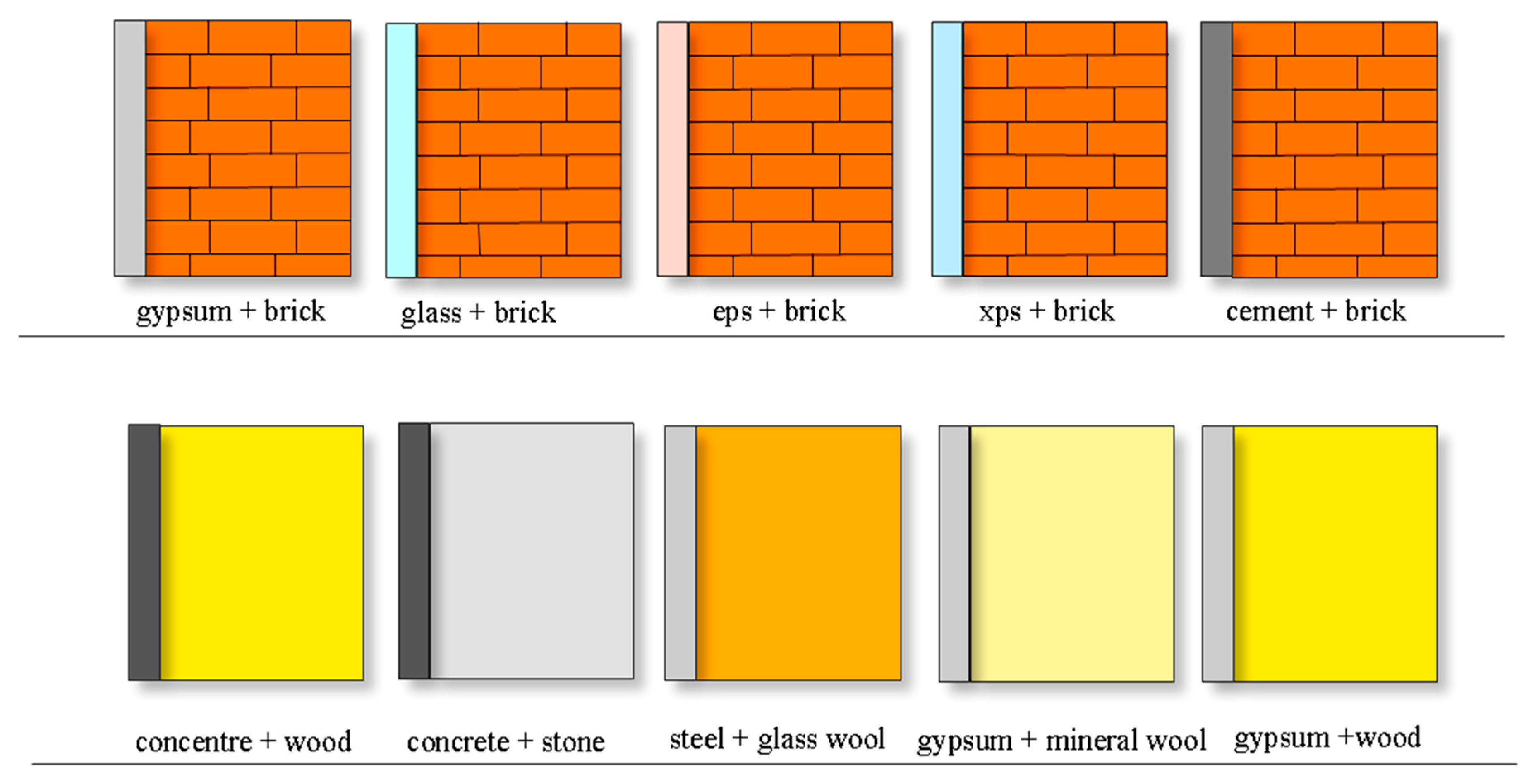
2. Geometry and Material Properties
- Inner layer (adjacent to the interior environment): Includes materials such as gypsum, glass, EPS, XPS, cement, concrete, and steel.
- Outer layer (adjacent to the exterior environment): Includes materials such as brick, wood, stone, glass wool, and mineral wool.
Methodology
3. The Equations Used in the Transient Simulations
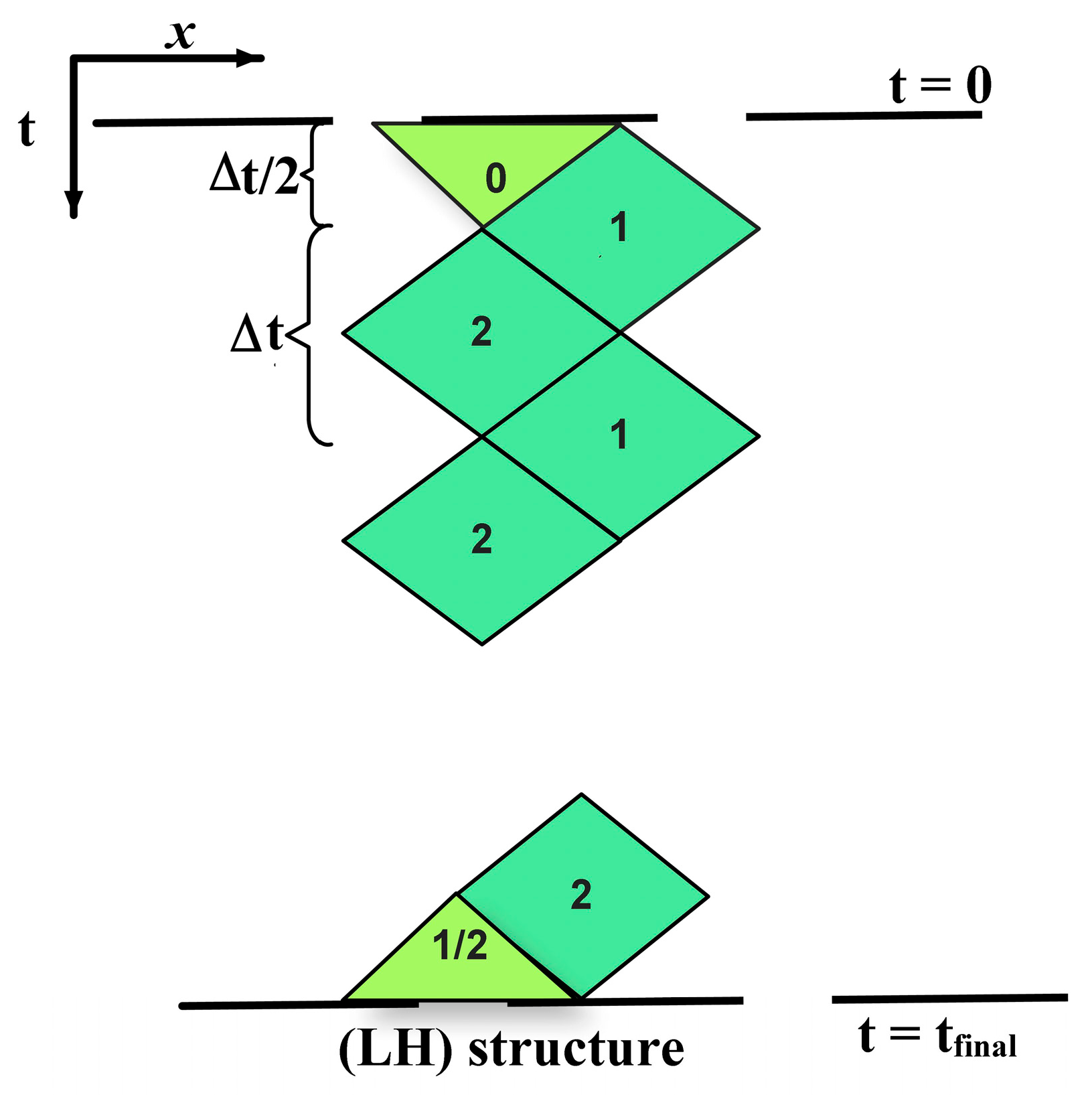
3.1. The Leapfrog–Hopscotch Formulation and Structure
3.2. Numerical Simulation of the Wall
3.3. Initial and Boundary Conditions
4. Results for the Simulation Walls
4.1. Calculation of Heat Loss Through Walls
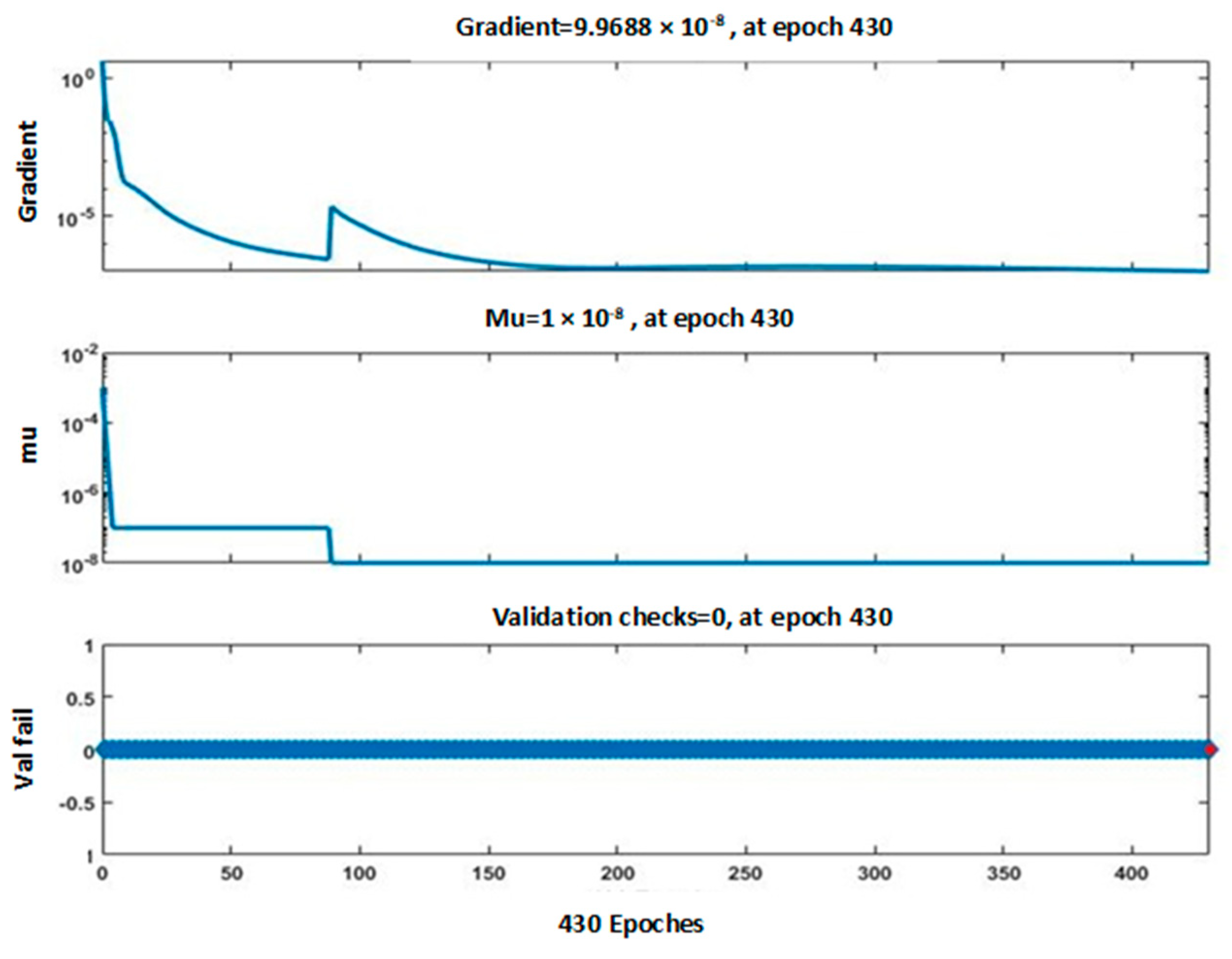
4.2. Verification and Validation
5. Conclusions
Author Contributions
Funding
Institutional Review Board Statement
Informed Consent Statement
Data Availability Statement
Conflicts of Interest
Nomenclature
| Symbols | Greek symbols | ||
| LH | Leapfrog–Hopscotch | ρ | Mass density [kg/m3] |
| C | Heat capacity [J/K] | Δ | Difference |
| c | Specific heat [J/(kgK)] | α | Thermal diffusivity [m2/s] |
| U | Overall heat transfer coefficient [W/(m2K)] | Time step size [s] | |
| K | Convection coefficient [1/s] | Realistic values of the non-black body [W/(m2.K4)] | |
| k | Thermal conductivity [W/(m.K)] | σ | Coefficient of the radiation term [s−1°K−3] |
| L | Thickness [m] | ε | Emisivity |
| Q | Heat transfer rate [W] | δ | Factor to indicate Daily mean temperature |
| R | Thermal resistance [K/W] | Subscripts | |
| heat generation [W/m2] | a | Ambient air | |
| q | Heat source rate [K/s] | l | Left side |
| u | Temperature [K] | r | Right side |
| t | Time [s] | p, g, ins | Panel, Gypsum and Insulation |
| ANN | Artificial Neural Networks | c | Convection |
| FDM | Finite Difference Methods | ||
References
- International Energy Agency (IEA). Buildings Tracking Report 2023; IEA Publications: Paris, France, 2023. [Google Scholar]
- Pérez-Lombard, L.; Ortiz, J.; Pout, C. A review on buildings energy consumption information. Energy Build. 2008, 40, 394–398. [Google Scholar] [CrossRef]
- Łach, Ł.; Svyetlichnyy, D. Advances in Numerical Modeling for Heat Transfer and Thermal Management: A Review of Computational Approaches and Environmental Impacts. Energies 2025, 18, 1302. [Google Scholar] [CrossRef]
- Santamouris, M. Cooling the buildings: Past, present and future. Energy Build. 2016, 128, 617–638. [Google Scholar] [CrossRef]
- Asdrubali, F.; D’Alessandro, F.; Schiavoni, S. A review of unconventional sustainable building insulation materials. Sustain. Mater. Technol. 2015, 4, 1–17. [Google Scholar] [CrossRef]
- Ascione, F.; Bianco, N.; De Masi, R.F.; Mauro, G.M.; Vanoli, G.P. A new methodology for cost-optimal analysis by means of the multi-objective optimization of building energy performance. Energy Build. 2016, 111, 420–434. [Google Scholar] [CrossRef]
- Omle, I.; Kovács, E.; Bolló, B. Applying recent efficient numerical methods for long-term Simulations of heat transfer in walls to optimize thermal insulation. Results Eng. 2023, 20, 101476. [Google Scholar] [CrossRef]
- Kaynakli, O. A review of the economical and optimum thermal insulation thickness for building applications. Renew. Sustain. Energy Rev. 2012, 16, 415–425. [Google Scholar] [CrossRef]
- Bolattürk, A. Optimum insulation thicknesses for building walls with respect to cooling and heating degree-hours in the warmest zone of Turkey. Energy Build. 2008, 40, 763–773. [Google Scholar] [CrossRef]
- Cabeza, L.F.; Barreneche, C.; Miró, L.; Morera, J.M.; Bartolí, E.; Fernández, A.I. Low carbon and low embodied energy materials in buildings: A review. Renew. Sustain. Energy Rev. 2013, 23, 536–542. [Google Scholar] [CrossRef]
- Serrano, S.; Barreneche, C.; Fernández, A.I.; Farid, M.M.; Cabeza, L.F. Composite Gypsum Containing Fatty-Ester PCM to Be Used as Constructive System: Thermophysical Characterization of Two Shape-Stabilized Formulations. Energy Build. 2015, 86, 190–193. [Google Scholar] [CrossRef]
- Cosentino, L.; Fernandes, J.; Mateus, R. A review of natural bio-based insulation materials. Energies 2023, 16, 4676. [Google Scholar] [CrossRef]
- Gossard, D.; Lartigue, B.; Thellier, F. Multi-objective optimization of a building envelope for thermal performance using genetic algorithms and artificial neural networks. Energy Build. 2013, 67, 253–260. [Google Scholar] [CrossRef]
- Machairas, V.; Tsangrassoulis, A.; Axarli, K. Algorithms for optimization of building design: A review. Renew. Sustain. Energy Rev. 2014, 31, 101–112. [Google Scholar] [CrossRef]
- Kalogirou, S.A. Artificial neural networks in energy applications in buildings. Int. J. Low-Carbon Technol. 2006, 1, 201–216. [Google Scholar] [CrossRef]
- Tsanas, A.; Xifara, A. Accurate quantitative estimation of energy performance of residential buildings using statistical machine learning tools. Energy Build. 2012, 49, 560–567. [Google Scholar] [CrossRef]
- Ascione, F.; Bianco, N.; Mauro, G.M.; Napolitano, D.F.; Vanoli, G.P. Artificial neural networks to predict energy performance and retrofit scenarios for any member of a building category: A novel approach. Appl. Energy 2017, 208, 997–1017. [Google Scholar] [CrossRef]
- Ozel, M. Effect of wall orientation on the optimum insulation thickness by using a dynamic method. Appl. Energy 2011, 88, 2429–2435. [Google Scholar] [CrossRef]
- Ozel, M. Thermal, Economical and Environmental Analysis of Insulated Building Walls in a Cold Climate. Energy Convers. Manag. 2013, 76, 674–684. [Google Scholar] [CrossRef]
- Askar, A.H.; Kovács, E.; Bolló, B. Prediction and optimization of thermal loads in buildings with different shapes by neural networks and recent finite difference methods. Buildings 2023, 13, 2862. [Google Scholar] [CrossRef]
- Askar, A.H.; Kovács, E.; Bolló, B. Multi-objective optimization for house roof using artificial neural network model. Multidiszcip. Tudományok 2023, 13, 11–25. [Google Scholar] [CrossRef]
- Chou, J.S.; Bui, D.T. Modeling heating and cooling loads by artificial intelligence for energy-efficient building design. Energy Build. 2014, 82, 437–446. [Google Scholar] [CrossRef]
- Kadhim, S.A.; Al-Ghezi, M.K.S.; Shehab, W.Y. Optimum orientation of non-tracking solar applications in Baghdad City. Int. J. Heat Technol. 2023, 41, 125–134. [Google Scholar] [CrossRef]
- Omle, I.; Askar, A.H.; Kovács, E. Optimizing the design of container house walls using argon and recycled plastic materials. Buildings 2024, 14, 3944. [Google Scholar] [CrossRef]
- McCulloch, W.S.; Pitts, W. A logical calculus of the ideas immanent in nervous activity. Bull. Math. Biophys. 1990, 52, 99–115. [Google Scholar] [CrossRef]
- Fan, X.; Wang, L.; Li, S. Predicting chaotic coal prices using a multi-layer perceptron network model. Resour. Policy 2016, 50, 86–92. [Google Scholar] [CrossRef]
- Zarei, T.; Behyad, R. Predicting the water production of a solar seawater greenhouse desalination unit using multi-layer perceptron model. Sol. Energy 2019, 177, 595–603. [Google Scholar] [CrossRef]
- Heidari, M.; Shamsi, H. Analog programmable neuron and case study on VLSI implementation of multi-layer perceptron (MLP). Microelectron. J. 2019, 84, 36–47. [Google Scholar] [CrossRef]
- Holman, J.P. Heat Transfer, 10th ed.; McGraw-Hill Education: New York, NY, USA, 2010. [Google Scholar]
- Khayrullaev, H.; Omle, I.; Kovács, E. Exploring the performance of some efficient explicit numerical methods with good stability properties for Huxley’s equation. Mathematics 2025, 13, 207. [Google Scholar] [CrossRef]
- Incropera, F.P.; DeWitt, D.P.; Bergman, T.L.; Lavine, A.S. Fundamentals of Heat and Mass Transfer, 8th ed.; Wiley: Hoboken, NJ, USA, 2020. [Google Scholar]
- Omle, I.; Kovács, E.; Bolló, B. The effect of surface triangular roughness inspired by nature with different angles on the interaction between free convection and surface radiation in a square cavity. Heat Transf. Res. 2024, 55, 1–24. [Google Scholar] [CrossRef]
- Open-Meteo. Historical forecast API. [Internet]. Available online: https://open-meteo.com/en/docs/historical-forecast-api#location_and_time (accessed on 20 October 2025).





| Material | |||
| Brick | 800 | 1600 | 0.74 |
| Gypsum | 977 | 805 | 0.29 |
| Glass | 750 | 2500 | 0.8 |
| EPS | 1300 | 30 | 0.04 |
| XPS | 1400 | 40 | 0.03 |
| Cement | 840 | 1300 | 0.6 |
| Concrete | 880 | 2200 | 1.5 |
| Stone | 800 | 2600 | 2.5 |
| Wood | 1500 | 500 | 0.13 |
| Steel | 490 | 7850 | 50 |
| Glass wool | 700 | 120 | 0.039 |
| Mineral wool | 900 | 100 | 0.035 |
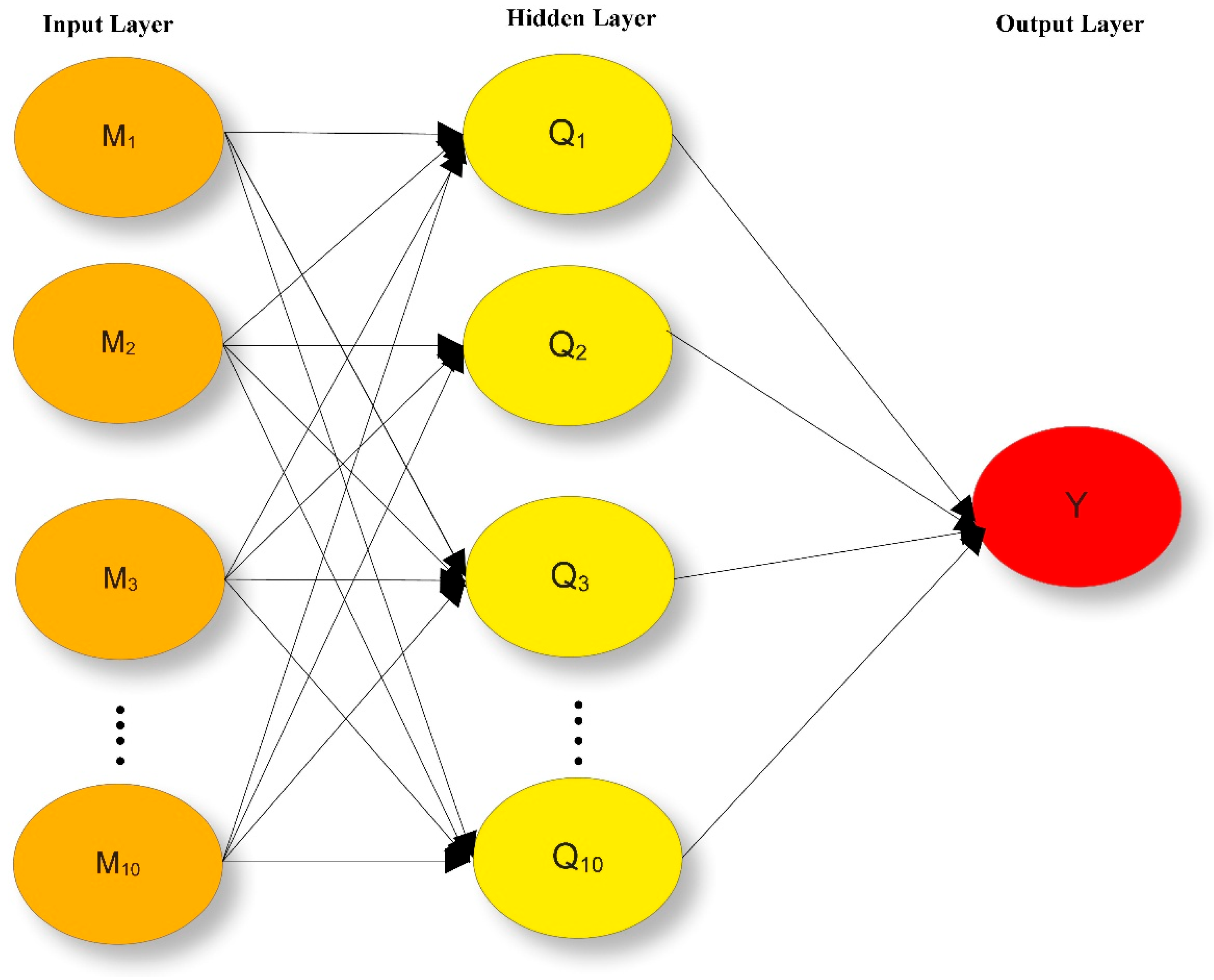
| Input | Materials | Thickness of Wall |
|---|---|---|
| Model 1 | Brick + gypsum | 0.21–0.38 |
| Model 2 | Brick + glass | 0.21–0.38 |
| Model 3 | Brick + eps | 0.21–0.38 |
| Model 4 | Brick + exp | 0.21–0.38 |
| Model 5 | Brick + cement | 0.21–0.38 |
| Model 6 | Wood + concrete | 0.21–0.38 |
| Model 7 | Stone + concrete | 0.21–0.38 |
| Model 8 | Glass wool + steel | 0.21–0.38 |
| Model 9 | Mineral wool + steel | 0.21–0.38 |
| Model 10 | Wood + gypsum | 0.21–0.38 |
| ε | |||
|---|---|---|---|
| Left Elements (inside) | 8 | 3.97 | 0.7 |
| Right Elements (outside) | 0.6–25 | 4.82 | 0.85 |
| Month | Period | Avg. Temp (°C) | Min–Max Temp (°C) | Solar Radiation (W/m2) | Wind Speed (m/s) |
|---|---|---|---|---|---|
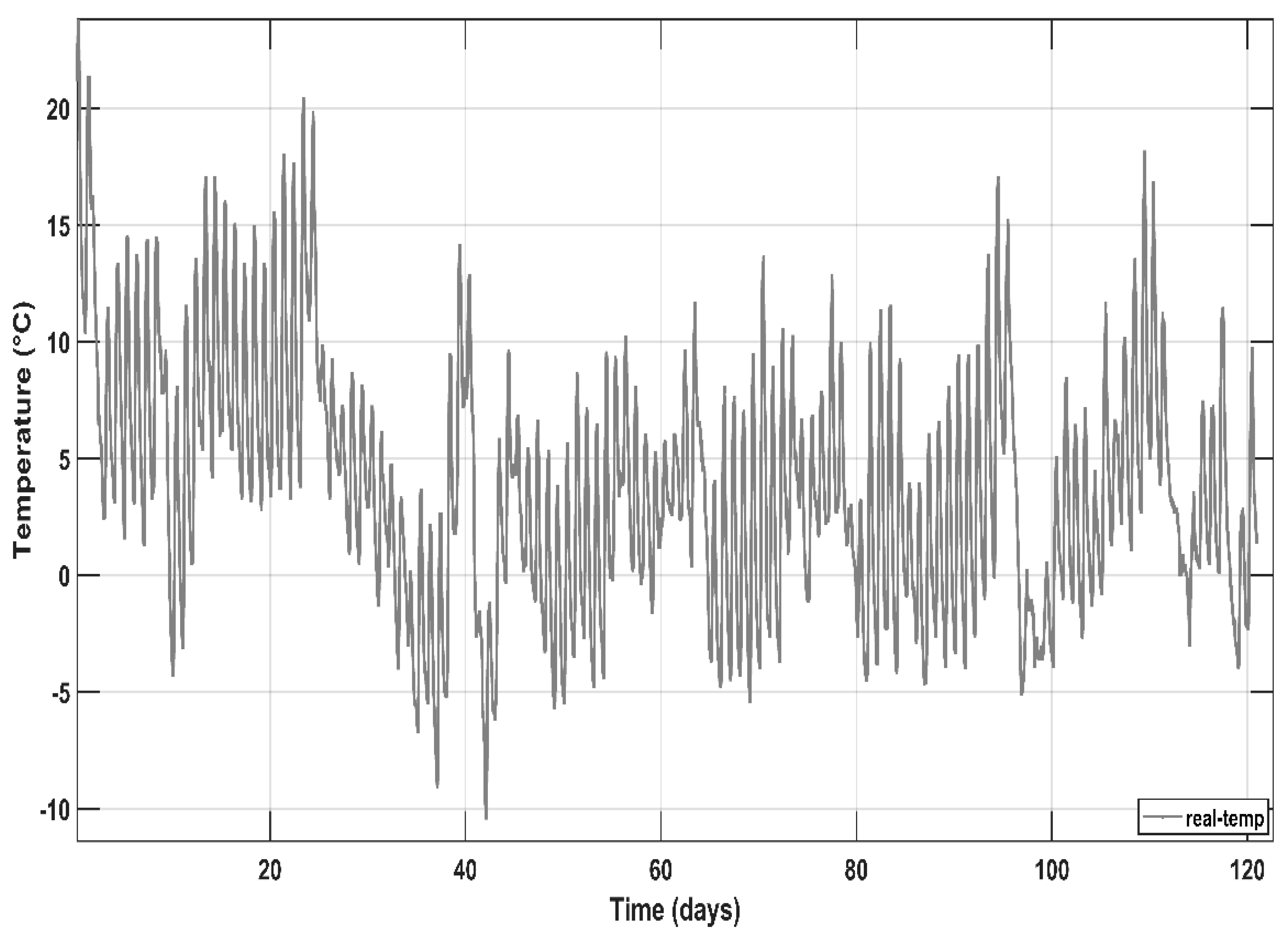
| November | 4–30 November 2024 | 7.4 | 1.5 to 13.0 | 112.5 | 3.5 |
| December | 1–31 December 2024 | 3.1 | −1.5 to 8.5 | 88.1 | 3.1 |
| January | 1–31 January 2025 | 2.0 | −3.5 to 6.9 | 96.4 | 3.9 |
| February | 1–28 February 2025 | 5.0 | −1.0 to10.5 | 140.0 | 4.1 |
| March | 1–4 March 2025 | 9.1 | 3.0 to 15.0 | 169.2 | 4.4 |
| Material | Thickness [m] | ||
|---|---|---|---|
| 0.20 | 0.26 | 0.35 | |
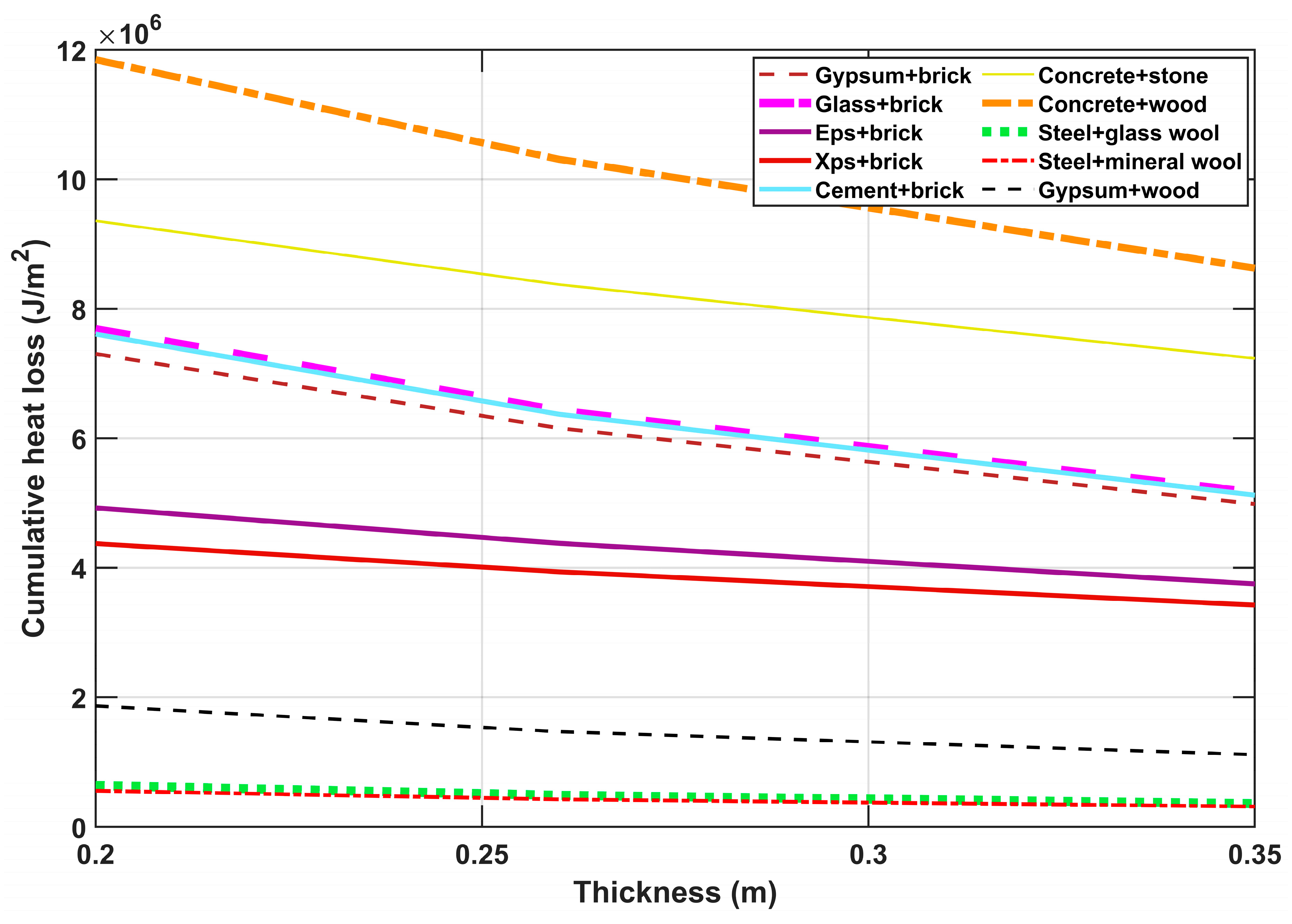
| Gypsum + Brick | 7,304,327 | 6,156,467 | 4,983,441 |
| Glass + Brick | 7,683,709 | 6,423,156 | 5,156,308 |
| EPS + Brick | 4,924,894 | 4,377,518 | 3,751,439 |
| XPS + Brick | 4,373,783 | 3,937,325 | 3,423,808 |
| Cement + Brick | 7,608,736 | 6,370,799 | 5,122,631 |
| Concrete + Wood | 9,359,141 | 8,374,744 | 7,233,596 |
| Concrete + Stone | 11,848,689 | 10,308,546 | 8,628,443 |
| Glass Wool + Steel | 640,516 | 489,960 | 361,234 |
| Mineral Wool + Steel | 560,011 | 427,521 | 316,398 |
| Gypsum + Wood | 1,864,810 | 1,468,140 | 1,112,413 |
Disclaimer/Publisher’s Note: The statements, opinions and data contained in all publications are solely those of the individual author(s) and contributor(s) and not of MDPI and/or the editor(s). MDPI and/or the editor(s) disclaim responsibility for any injury to people or property resulting from any ideas, methods, instructions or products referred to in the content. |
© 2026 by the authors. Licensee MDPI, Basel, Switzerland. This article is an open access article distributed under the terms and conditions of the Creative Commons Attribution (CC BY) license.
Share and Cite
Khayrullaev, H.; Omle, I.; Kovács, E. Prediction of Heat Transfer in Building Walls of Different Materials Using Neural Networks and Finite Difference Methods. Eng 2026, 7, 173. https://doi.org/10.3390/eng7040173
Khayrullaev H, Omle I, Kovács E. Prediction of Heat Transfer in Building Walls of Different Materials Using Neural Networks and Finite Difference Methods. Eng. 2026; 7(4):173. https://doi.org/10.3390/eng7040173
Chicago/Turabian StyleKhayrullaev, Husniddin, Issa Omle, and Endre Kovács. 2026. "Prediction of Heat Transfer in Building Walls of Different Materials Using Neural Networks and Finite Difference Methods" Eng 7, no. 4: 173. https://doi.org/10.3390/eng7040173
APA StyleKhayrullaev, H., Omle, I., & Kovács, E. (2026). Prediction of Heat Transfer in Building Walls of Different Materials Using Neural Networks and Finite Difference Methods. Eng, 7(4), 173. https://doi.org/10.3390/eng7040173