

Autonomous Vehicles and Vertical Road Design: A Parametric Assessment of Stopping Sight Distance and Vertical Curve Lengths


Abstract
1. Introduction
1.1. Study’s Motivation
- How can road safety and operational efficiency be ensured when assumptions about human reaction and visual perception no longer apply?
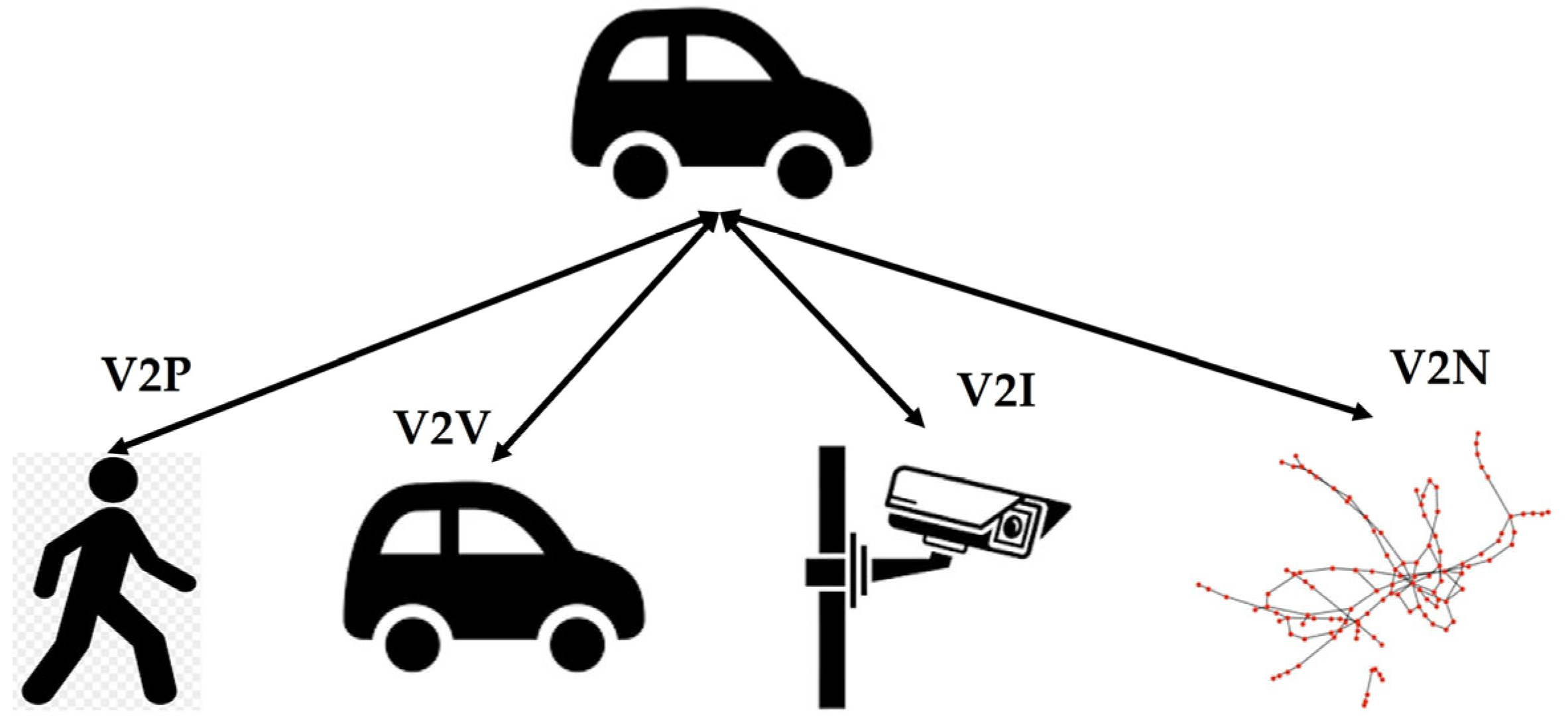
- What adjustments may be needed in geometric features such as vertical curve lengths and minimum sight distances because of the different perceptions and reactions?
- How might qualitative factors, such as construction practices, signage materials, and operational requirements, be affected?
1.2. Core Aspects of Road Geometric Design
1.3. Road-Related Challenges from AV Deployment
1.4. Aim and Objectives
- To present the necessary design background on SSD and vertical alignment based on both international and national standards.
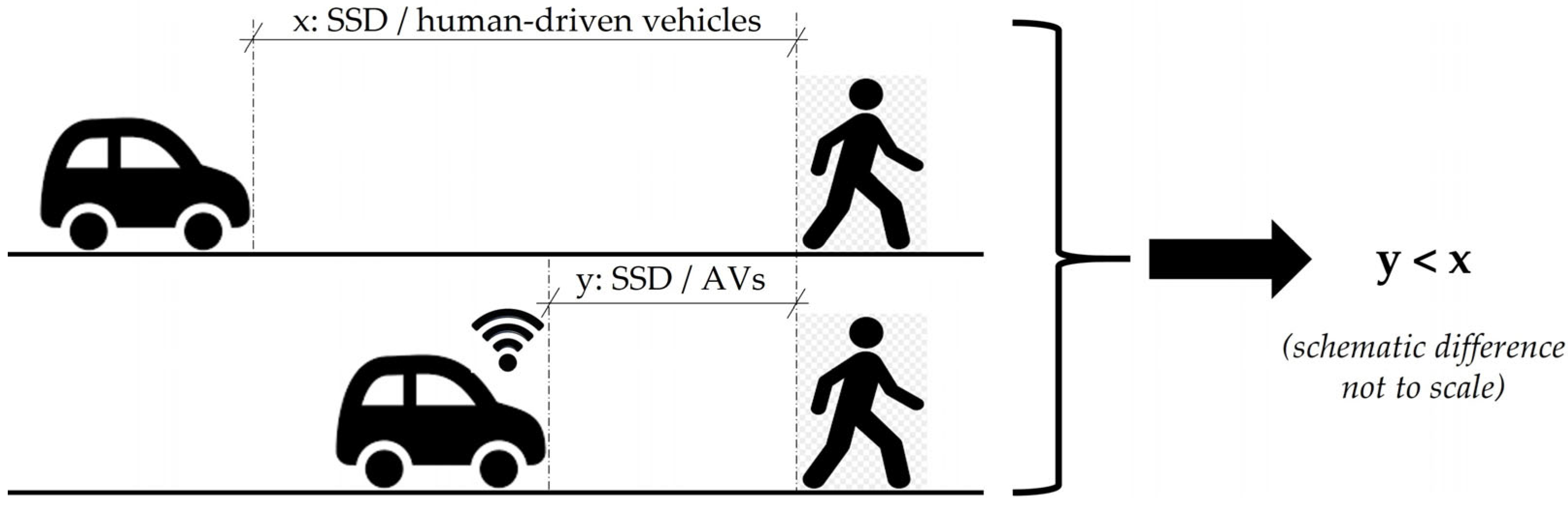
- To quantify the potential effects of AV deployment on these design parameters, considering changes in vehicle perception–reaction time, and sensor layout for obstacle identification based on literature observations.
- To compare the resulting SSD values and corresponding vertical curve length requirements under HDV and AV assumptions.
2. Methodology and Assumptions
2.1. Stopping Sight Distance
- : perception–reaction distance (m);
- : braking distance (m);
- V: design speed (km/h);
- : perception–reaction time (s);
- a: vehicle deceleration (m/s2);
- g: acceleration due to gravity, equal to 9.81 m/s2;
- slope: longitudinal grade (m/m), positive for ascending segments and negative for descending segments.
2.2. Length of Vertical Curves
- : radius of the vertical curve (m);
- : the algebraic difference in grade of two successive segments (dimensionless); for example, assuming two segments with grades +5% and −3% yields a of 0.08;
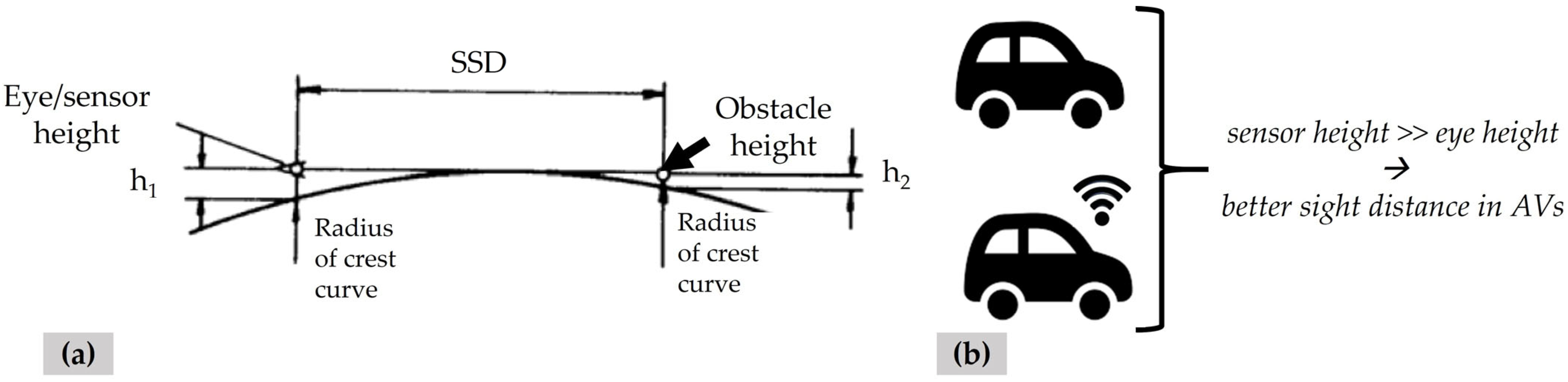
- : eye/sensor height (m);
- : obstacle height (m).
- : radius of the vertical curve (m);
- : the algebraic difference in grade of two successive segments (dimensionless); for example, assuming two segments with grades −2% and +5% yields a of 0.07;
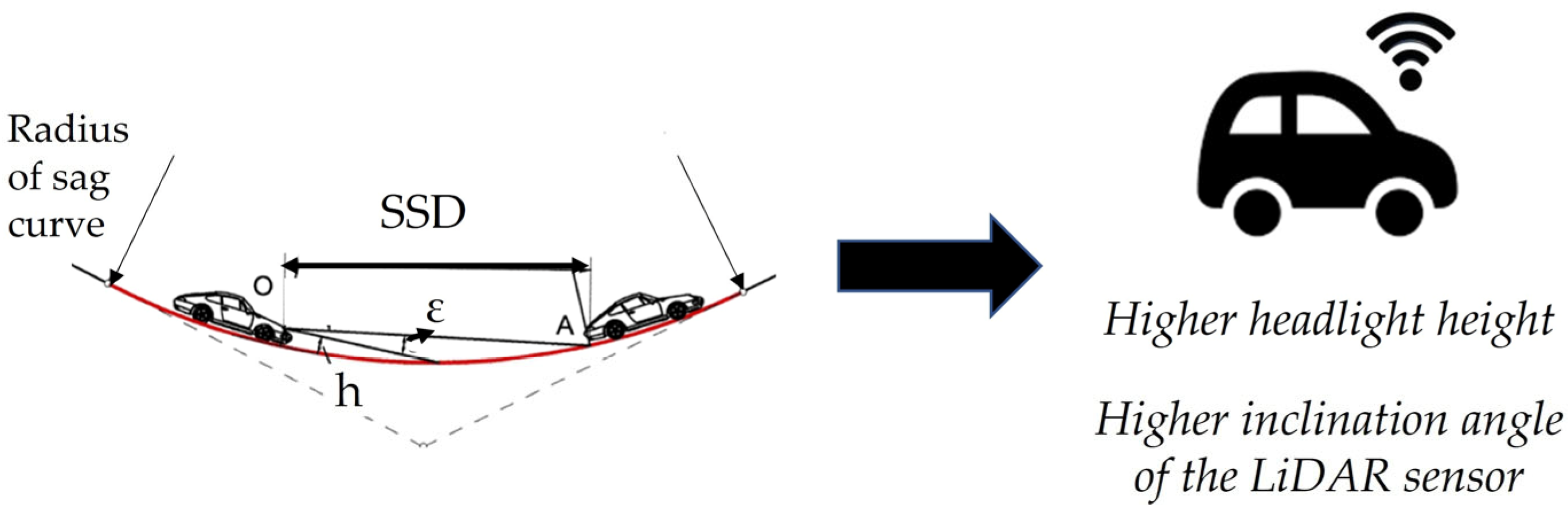
- : headlight/sensor height (m);
- : inclination angle of the headlight beam or LIDAR sensor (in degrees).
3. Results
3.1. Calculation of SSD
3.2. Calculation of Vertical Curve Lengths
4. Discussion
4.1. Practical Study’s Implications
4.2. Study’s Limitations and Prospects
5. Conclusions
- The parametric investigation confirms that modifications in reaction time directly affect the perception–reaction component of SSD and, consequently, the geometric control parameters governing crest and sag vertical curves. While speed remains the governing variable in high-speed environments due to braking dominance, reduced reaction time can induce design sensitivity primarily in low and intermediate speeds.
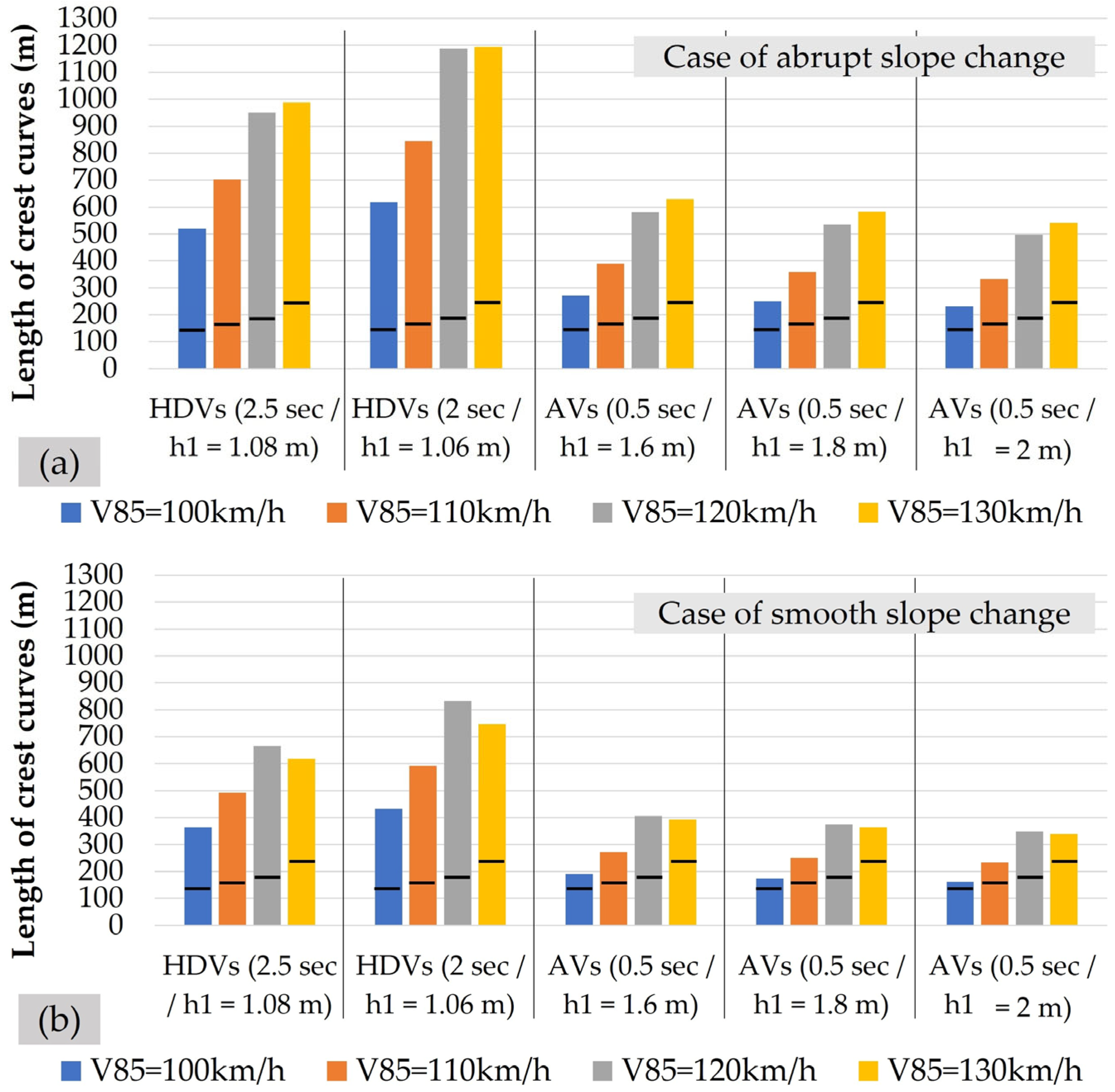
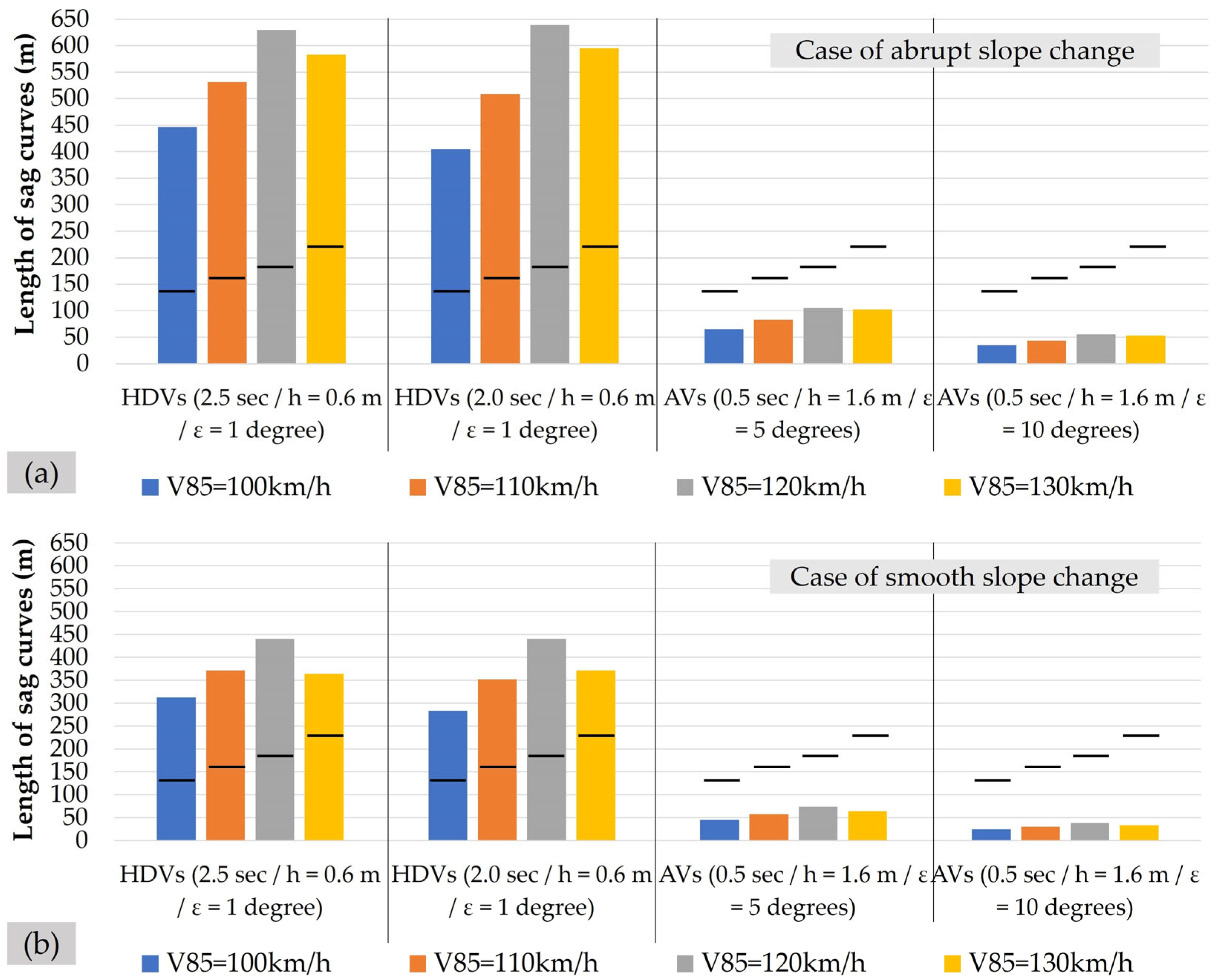
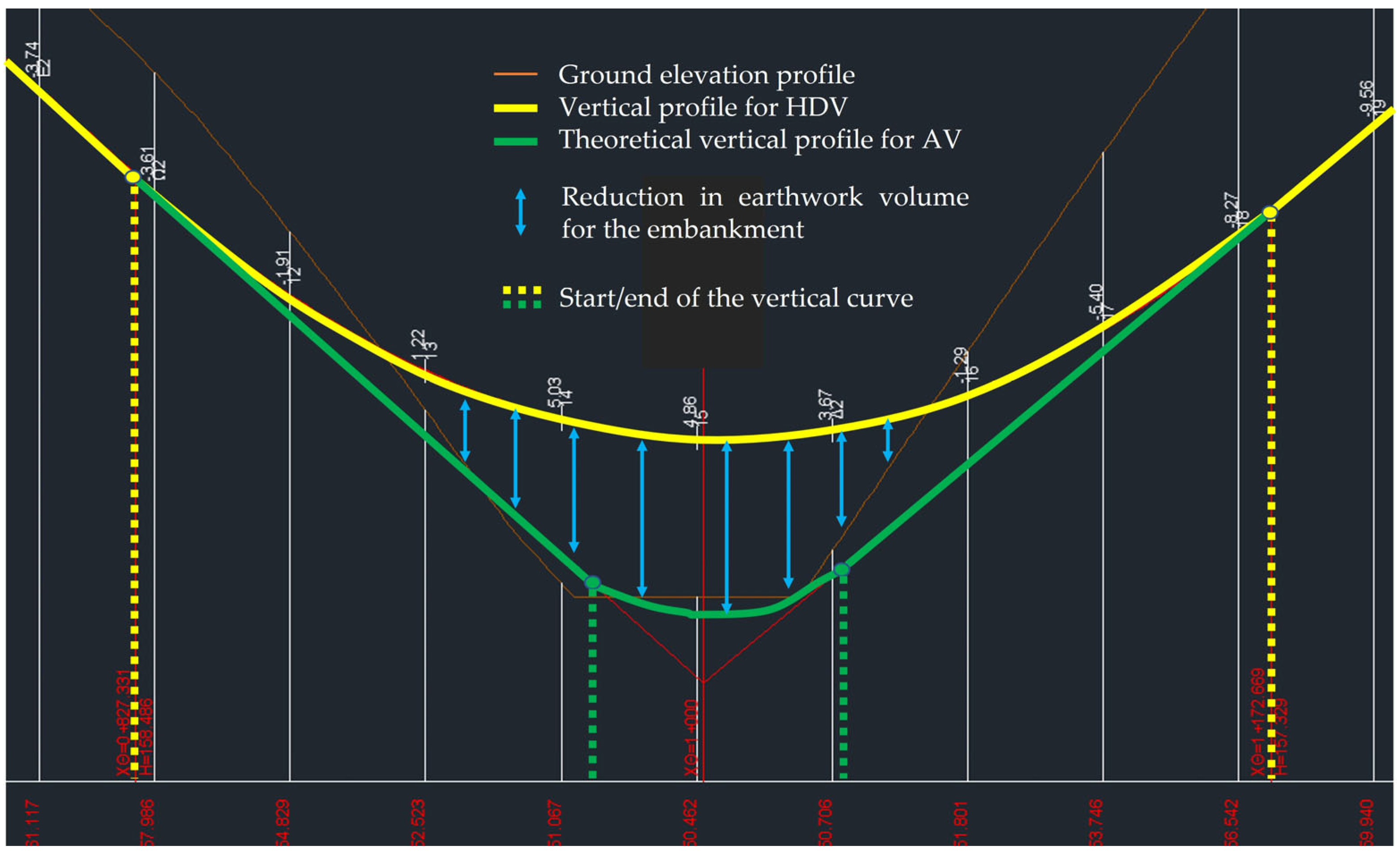
- For crest curves, increased sensor height in AVs combined with reduced reaction time leads to shorter curve lengths compared to HDVs. For sag curves, the sensor inclination angle emerges as a critical geometric parameter influencing visibility-controlled design limits. Nevertheless, vertical curve design is not governed solely by visibility criteria.
Funding
Data Availability Statement
Conflicts of Interest
References
- Hartmann, A.; Ling, F.Y.Y. Value creation of road infrastructure networks: A structural equation approach. J. Traffic Transp. Eng. (Engl. Ed.) 2016, 3, 28–36. [Google Scholar] [CrossRef]
- Ministry of Environment, Regional Planning and Public Works. Guidelines for the Design of Road Projects (OMOE-X); Ministry of Environment, Regional Planning and Public Works: Athens, Greece, 2001.
- Elkhazindar, A.; Hafez, M.; Ksaibati, K. Incorporating Pavement Friction Management into Pavement Asset Management Systems: State Department of Transportation Experience. CivilEng 2022, 3, 541–561. [Google Scholar] [CrossRef]
- Plati, C.; Pomoni, M.; Loizos, A.; Yannis, G. Stochastic Prediction of Short-Term Friction Loss of Asphalt Pavements: A Traffic Dependent Approach. In Proceedings of the 9th International Conference on Maintenance and Rehabilitation of Pavements—Mairepav9; Raab, C., Ed.; Lecture Notes in Civil Engineering; Springer: Cham, Switzerland, 2020; Volume 76. [Google Scholar] [CrossRef]
- Loizos, A.; Spiliopoulos, K.; Cliatt, B.; Gkyrtis, K. Structural pavement responses using nonlinear finite element analysis of unbound materials. In Proceedings of the 10th International Conference on Bearing Capacity of Roads, Railways and Airfields (BCRRA), Athens, Greece, 28–30 June 2017; pp. 1343–1350. [Google Scholar]
- Mihalj, T.; Li, H.; Babić, D.; Lex, C.; Jeudy, M.; Zovak, G.; Babić, D.; Eichberger, A. Road Infrastructure Challenges Faced by Automated Driving: A Review. Appl. Sci. 2022, 12, 3477. [Google Scholar] [CrossRef]
- Khan, Z.H.; Ali, F.; Altamimi, A.B.; Gulliver, T.A. Effect of human-driven, autonomous, and connected autonomous vehicles on geometric highway design. Alex. Eng. J. 2025, 127, 1073–1080. [Google Scholar] [CrossRef]
- Othman, K. Impact of Autonomous Vehicles on the Physical Infrastructure: Changes and Challenges. Designs 2021, 5, 40. [Google Scholar] [CrossRef]
- Čudina Ivančev, A.; Džambas, T.; Dragčević, V. The Impact of Autonomous Vehicles on the Transportation Network with a Focus on the Physical Road Infrastructure. Infrastructures 2025, 10, 347. [Google Scholar] [CrossRef]
- Tengilimoglu, O.; Carsten, O.; Wadud, Z. Implications of automated vehicles for physical road environment: A comprehensive review. Transp. Res. Part E 2023, 169, 102989. [Google Scholar] [CrossRef]
- Mavromatis, S.; Psarianos, B. Analytical model to determine the influence of horizontal alignment of two-axle heavy vehicles on upgrades. J. Transp. Eng. 2003, 129, 583–589. [Google Scholar] [CrossRef]
- AASHTO Green Book. A Policy on Geometric Design of Highways and Streets, 7th ed.; AASHTO: Washington, DC, USA, 2018. [Google Scholar]
- Wu, X.; Chen, F.; Bo, W.; Shuai, Y.; Zhang, X.; Da, W.; Liu, H.; Chen, J. Analysis of Factors Influencing Driving Safety at Typical Curve Sections of Tibet Plateau Mountainous Areas Based on Explainability-Oriented Dynamic Ensemble Learning Strategy. Sustainability 2025, 17, 7820. [Google Scholar] [CrossRef]
- Kalita, K.; Maurya, A.K. Probabilistic Geometric Design of Highways: A Review. Transp. Res. Procedia 2020, 48, 1244–1253. [Google Scholar] [CrossRef]
- Tafidis, P.; Farah, H.; Brijs, T.; Pirdavani, A. Safety implications of higher levels of automated vehicles: A scoping review. Transp. Rev. 2022, 42, 245–267. [Google Scholar] [CrossRef]
- Uzzaman, A.; Muhammad, W. A Comprehensive Review of Environmental and Economic Impacts of Autonomous Vehicles. Control Syst. Optim. Lett. 2024, 2, 303–309. [Google Scholar] [CrossRef]
- Zhao, H.; Meng, M.; Li, X.; Xu, J.; Li, L. A survey of autonomous driving frameworks and simulators. Adv. Eng. Inform. 2024, 62, 102850. [Google Scholar] [CrossRef]
- Gkyrtis, K.; Pomoni, M. Use of Historical Road Incident Data for the Assessment of Road Redesign Potential. Designs 2024, 8, 88. [Google Scholar] [CrossRef]
- Paliotto, A.; Meocci, M. Development of a Network-Level Road Safety Assessment Procedure Based on Human Factors Principles. Infrastructures 2024, 9, 35. [Google Scholar] [CrossRef]
- Gkyrtis, K.; Botzoris, G.; Kokkalis, A. Exploratory Analysis of Young Drivers’ Speed and Vehicle Lateral Positioning on Simulated Rural and Highway Roads. Infrastructures 2026, 11, 106. [Google Scholar] [CrossRef]
- Sadaf, M.; Iqbal, Z.; Javed, A.R.; Saba, I.; Krichen, M.; Majeed, S.; Raza, A. Connected and Automated Vehicles: Infrastructure, Applications, Security, Critical Challenges, and Future Aspects. Technologies 2023, 11, 117. [Google Scholar] [CrossRef]
- Rezwana, S.; Lownes, N. Interactions and Behaviors of Pedestrians with Autonomous Vehicles: A Synthesis. Future Transp. 2024, 4, 722–745. [Google Scholar] [CrossRef]
- Khoury, J.; Amine, K.; Abi Saad, R. An Initial Investigation of the Effects of a Fully Automated Vehicle Fleet on Geometric Design. J. Adv. Transp. 2019, 2019, 6126408. [Google Scholar] [CrossRef]
- Hula, A.; de Zwart, R.; Mons, C.; Weijermars, W.; Boghani, H.; Thomas, P. Using reaction times and accident statistics for safety impact prediction of automated vehicles on road safety of vulnerable road users. Saf. Sci. 2023, 162, 106091. [Google Scholar] [CrossRef]
- Zeng, J.; Yang, P.; Qian, Y.; Wei, X. Simulation Study of Mixed Traffic Flow Considering the Autonomous Driving with Hard Shoulder Running. Eng. Lett. 2025, 33, 4899–4909. [Google Scholar]
- Amelink, M.; Kulmala, R.; Jaaskelainen, J.; Sacs, I.; Narroway, S.; Niculescu, M.; Rey, L.; Alkim, T. EU EIP SA4.2: Road Map and Action Plan to Facilitate Automated Driving on TEN Road Network–Version 2020; European ITS Platform: Online, 2020. [Google Scholar]
- Hafiz, D.; Zohdy, I. The City Adaptation to the Autonomous Vehicles Implementation: Reimagining the Dubai City of Tomorrow. In Advanced Controllers for Smart Cities; Springer: Berlin/Heidelberg, Germany, 2021; pp. 27–41. [Google Scholar]
- Makahleh, H.Y.; Ferranti, E.J.S.; Dissanayake, D. Assessing the Role of Autonomous Vehicles in Urban Areas: A Systematic Review of Literature. Future Transp. 2024, 4, 321–348. [Google Scholar] [CrossRef]
- Na, H.; Kim, D.G.; Kang, J.M.; Lee, C. The Development of a Lane Identification and Assessment Framework for Maintenance Using AI Technology. Appl. Sci. 2025, 15, 7410. [Google Scholar] [CrossRef]
- Li, Z.; Bao, Z.; Meng, H.; Shi, H.; Li, Q.; Yao, H.; Li, X. Interaction dataset of autonomous vehicles with traffic lights and signs. Commun. Transp. Res. 2025, 5, 100201. [Google Scholar] [CrossRef]
- Yu, H.; Jiang, R.; He, Z.; Zheng, Z.; Li, L.; Liu, R.; Chen, X. Automated vehicle-involved traffic flow studies: A survey of assumptions, models, speculations, and perspectives. Transp. Res. Part C Emerg. Technol. 2021, 127, 103101. [Google Scholar] [CrossRef]
- Welde, Y.; Qiao, F. Effects of autonomous and automated vehicles on stopping sight distance and vertical curves in geometric design. In Proceedings of the 13th Asia Pacific Transportation Development Conference; American Society of Civil Engineers: Reston, VA, USA, 2020; pp. 715–724. [Google Scholar]
- Zhao, Y.; Ying, X.; Li, J. Research on geometric design standards for freeways under a fully autonomous driving environment. Appl. Sci. 2022, 12, 7109. [Google Scholar] [CrossRef]
- Birhane, F.; Sakr, A.M.; El-Basyouny, K. Next-generation Road design for autonomous driving: Shifting the focus from human drivers consideration. Innov. Infrastruct. Solut. 2026, 11, 90. [Google Scholar] [CrossRef]
- Kim, C.; Kim, J.; Kim, I. Identifying critical urban traffic risks for autonomous vehicle crash severity. J. Transp. Saf. Secur. 2026, 18, 426–446. [Google Scholar] [CrossRef]
- Farhan, A.; Kattan, L.; Waters, N.; Tay, R. A system dynamics approach for assessing the impacts of autonomous vehicles on collision frequency. Transp. Lett. 2025, 17, 1414–1429. [Google Scholar] [CrossRef]



| V85 (km/h) | a (m/s2) |
|---|---|
| 50 | 4.4 |
| 60 | 4.2 |
| 70 | 4.0 |
| 80 | 3.8 |
| 90 | 3.6 |
| 100 | 3.4 |
| 110 | 3.3 |
| 120 | 3.1 |
| 130 | 3.0 |
| Vehicle Type (Reaction Time, Sensor Height) | Operation Speed (km/h) | Slope Change Δs | Length of Crest Curve (m) | % Change in Length of Crest Curve |
|---|---|---|---|---|
| HDV (t = 2 s, = 1.06 m) | 100 | 0.10 | 618 | - |
| AV (t = 0.5 s, = 1.6 m) | 100 | 0.10 | 271 | −56% |
| AV (t = 0.5 s, = 1.8 m) | 100 | 0.10 | 249 | −60% |
| AV (t = 0.5 s, = 2 m) | 100 | 0.10 | 231 | −63% |
| HDV (t = 2 s, = 1.06 m) | 130 | 0.05 | 747 | - |
| AV (t = 0.5 s, = 1.6 m) | 130 | 0.05 | 393 | −47% |
| AV (t = 0.5 s, = 1.8 m) | 130 | 0.05 | 364 | −51% |
| AV (t = 0.5 s, = 2 m) | 130 | 0.05 | 339 | −55% |
| Vehicle Type (Reaction Time, Headlight Height and Angle) | Operation Speed (km/h) | Slope Change Δs | Length of Sag Curve (m) | % Change In Length of Sag Curve |
|---|---|---|---|---|
| HDV (t = 2 s, m, ε = 1°) | 100 | 0.10 | 405 | - |
| AV (t = 0.5 s, h = 1.6 m, ε = 5°) | 100 | 0.10 | 65 | −84% |
| AV (t = 0.5 s, h = 1.6 m, ε = 10°) | 100 | 0.10 | 35 | −91% |
| HDV (t = 2 s, m, ε = 1°) | 130 | 0.05 | 371 | - |
| AV (t = 0.5 s, h = 1.6 m, ε = 5°) | 130 | 0.05 | 64 | −83% |
| AV (t = 0.5 s, h = 1.6 m, ε = 10°) | 130 | 0.05 | 33 | −91% |
Disclaimer/Publisher’s Note: The statements, opinions and data contained in all publications are solely those of the individual author(s) and contributor(s) and not of MDPI and/or the editor(s). MDPI and/or the editor(s) disclaim responsibility for any injury to people or property resulting from any ideas, methods, instructions or products referred to in the content. |
© 2026 by the author. Licensee MDPI, Basel, Switzerland. This article is an open access article distributed under the terms and conditions of the Creative Commons Attribution (CC BY) license.
Share and Cite
Pomoni, M. Autonomous Vehicles and Vertical Road Design: A Parametric Assessment of Stopping Sight Distance and Vertical Curve Lengths. CivilEng 2026, 7, 28. https://doi.org/10.3390/civileng7020028
Pomoni M. Autonomous Vehicles and Vertical Road Design: A Parametric Assessment of Stopping Sight Distance and Vertical Curve Lengths. CivilEng. 2026; 7(2):28. https://doi.org/10.3390/civileng7020028
Chicago/Turabian StylePomoni, Maria. 2026. "Autonomous Vehicles and Vertical Road Design: A Parametric Assessment of Stopping Sight Distance and Vertical Curve Lengths" CivilEng 7, no. 2: 28. https://doi.org/10.3390/civileng7020028
APA StylePomoni, M. (2026). Autonomous Vehicles and Vertical Road Design: A Parametric Assessment of Stopping Sight Distance and Vertical Curve Lengths. CivilEng, 7(2), 28. https://doi.org/10.3390/civileng7020028