
Thermal Performance-Driven Simulation and Optimization of Tessellated Façade Shading Systems in Mediterranean Educational Buildings

 ,
, 
 ,
, 

Abstract
1. Introduction
2. Materials and Methods
2.1. Study Area
2.2. Thermal Metrics and Their Role in Educational Buildings
2.3. Modeling and Thermal Performance Analysis Tools
2.3.1. Simulation Assumptions and Boundary Conditions
2.3.2. Modeling: Building and the Tessellated Patterns
2.3.3. Thermal Performance Simulation
2.4. Multi-Objective Optimization Framework
Compromise Programming Method
3. Results
3.1. Thermal Performance of the Base-Case Façade (No Shading Screen)
3.1.1. Energy Flow Analysis
3.1.2. Energy Use Intensity
3.1.3. Load Duration Curves (Heating and Cooling Demand)
3.1.4. Zone Temperature Curves (Thermal Comfort Conditions)
3.1.5. Extraction and Synthesis of Thermal Performance Metrics
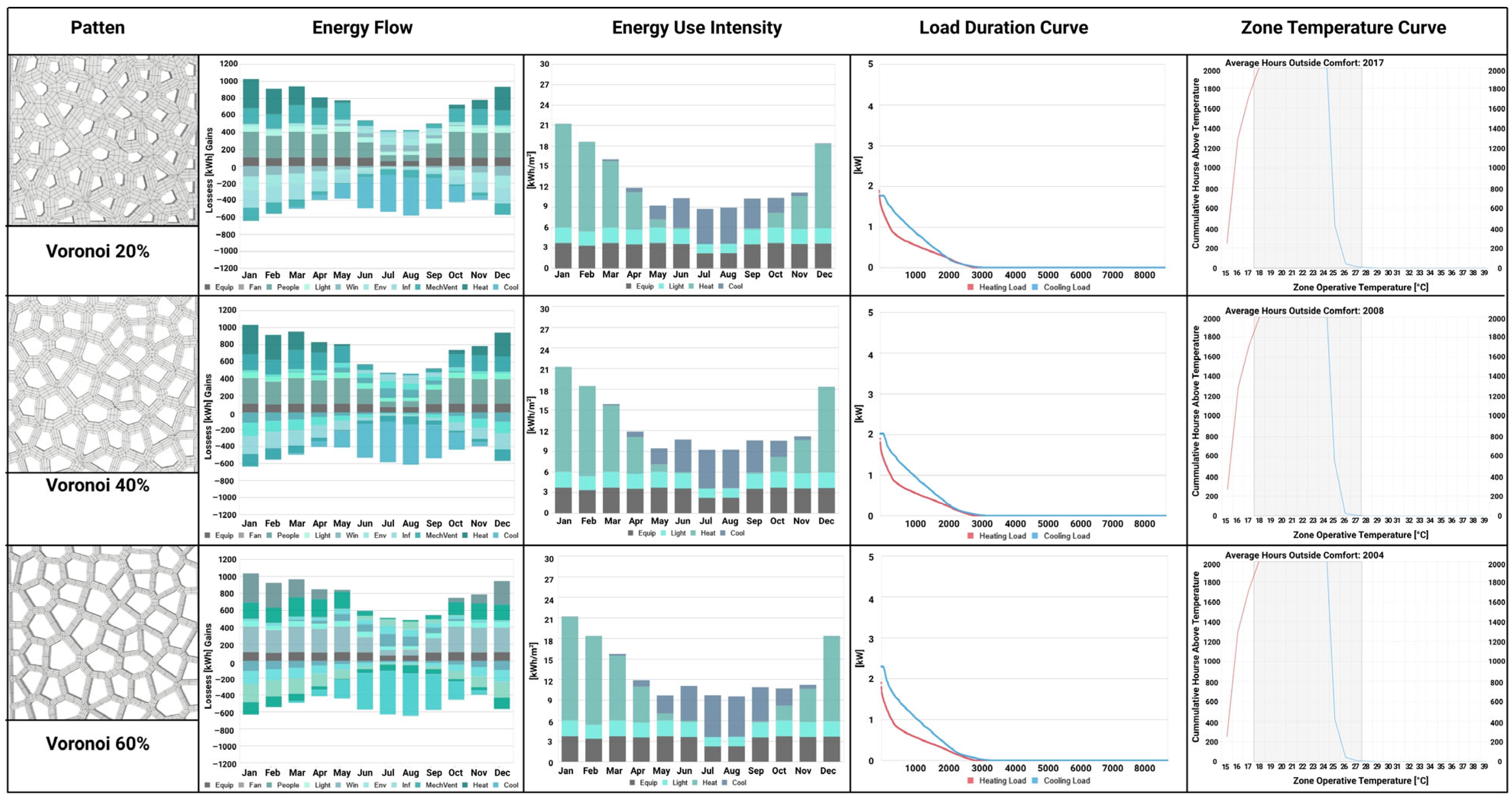
3.2. Thermal Performance of Voronoi Tessellated Façade Patterns
Comparative Analysis of Voronoi Perforation Ratios
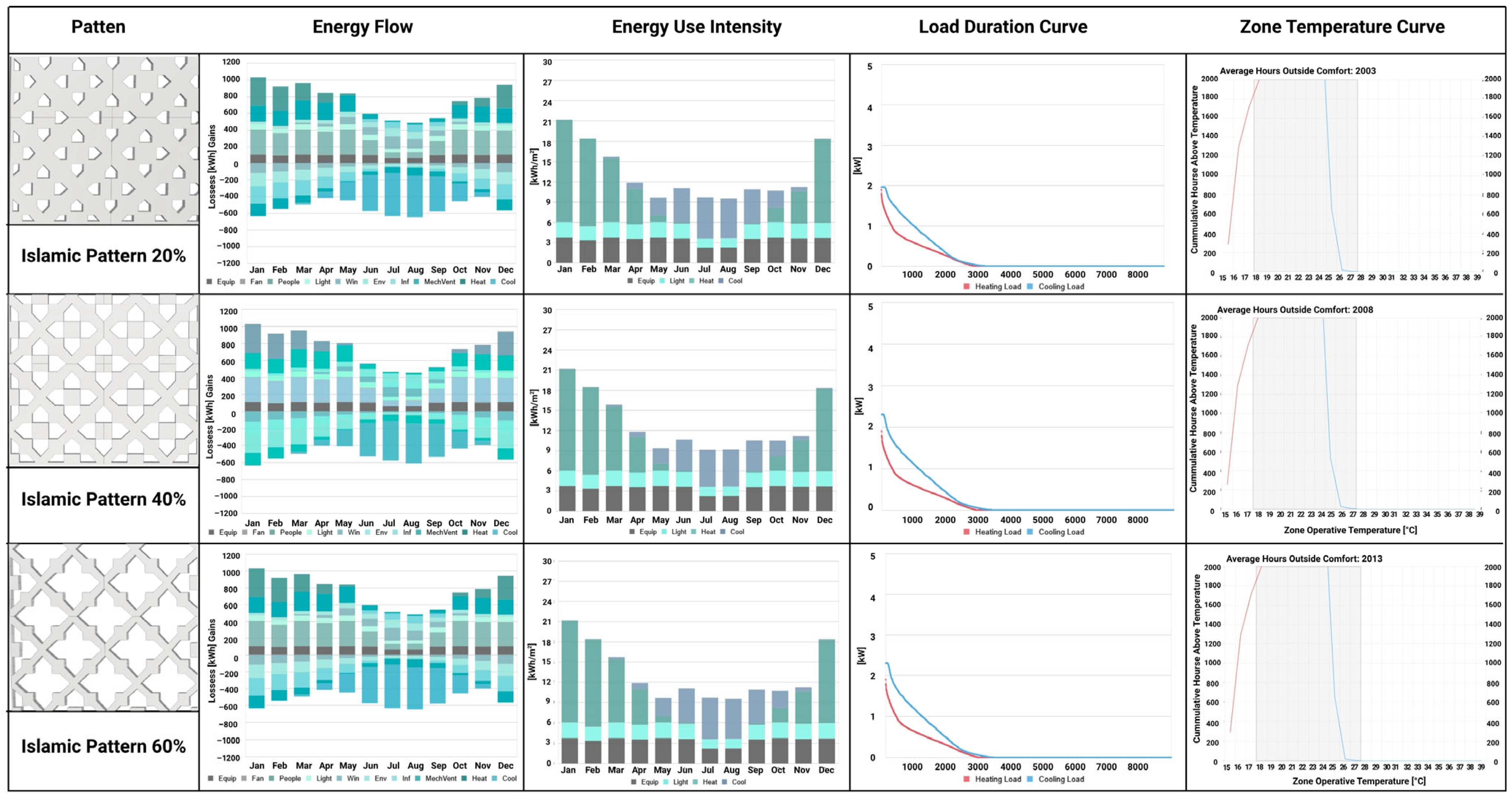
3.3. Thermal Performance of Islamic Geometric Tessellated Façade Patterns
Comparative Thermal Performance of Islamic Pattern Perforation Ratios
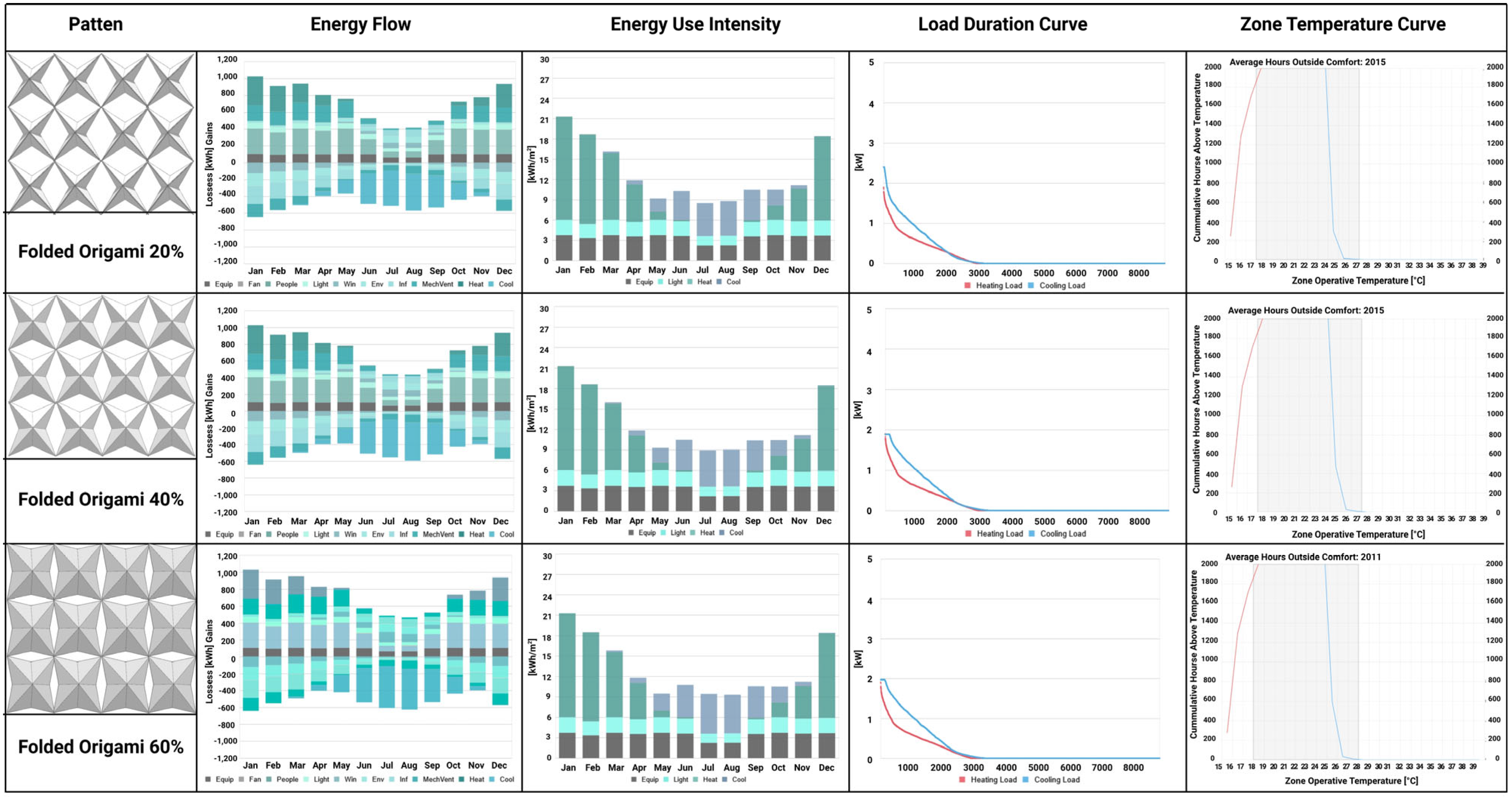
3.4. Thermal Performance of Folded Origami Tessellated Façade Patterns
Simulation Results for Folding Patterns
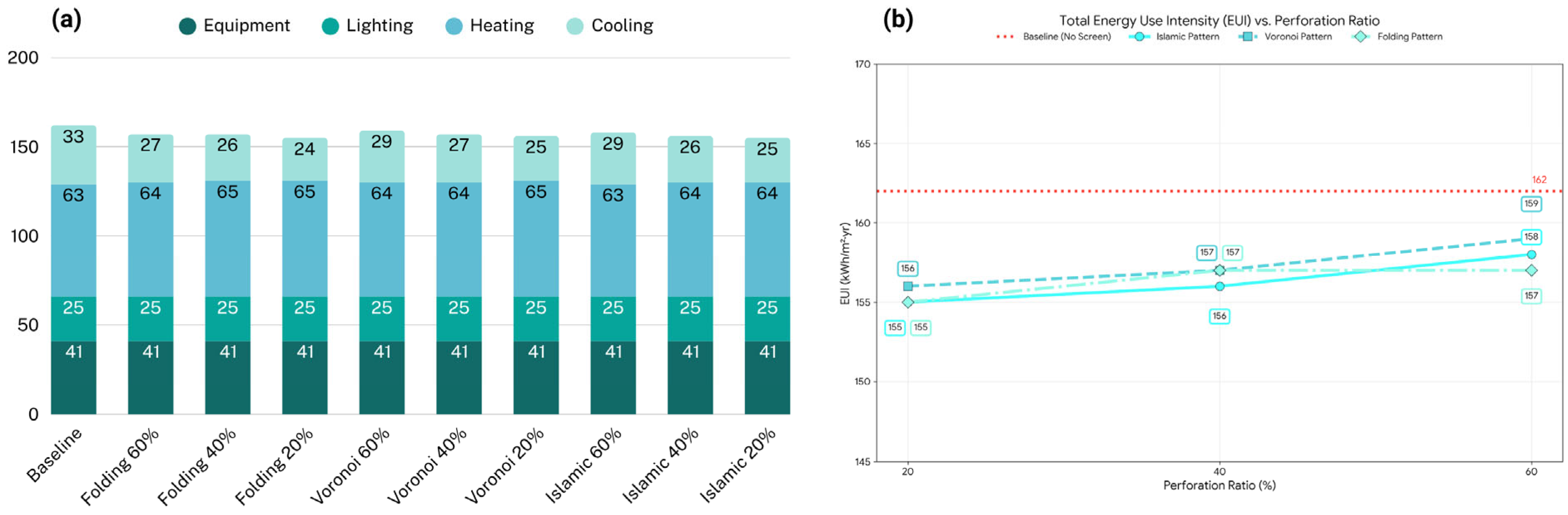
3.5. Thermal Performance Compression Between All Patterns and the Base Case
3.6. Multi-Objective Optimization
Compromise Programming
4. Discussion
4.1. Interpretation of the Findings
4.2. Contribution of the Study in Respect to Prior Literature
4.3. Implications for Architectural Design and Energy Policy
4.4. Limitations and Future Research Directions
5. Conclusions
Author Contributions
Funding
Institutional Review Board Statement
Informed Consent Statement
Data Availability Statement
Acknowledgments
Conflicts of Interest
Abbreviations
| SDG | Sustainable Development Goals (United Nations) |
| BIM | Building Information Modeling |
| EPW | EnergyPlus Weather |
| UPVC | Plasticized Polyvinyl Chloride (used in window frames) |
| HVAC | Heating, Ventilation, and Air Conditioning |
| LCA | Life Cycle Assessment |
| WWR | Window-to-Wall Ratio |
| kWh | Kilowatt-hour |
| kW | Kilowatt |
| J | Joule |
| NSGA-II | Non-dominated Sorting Genetic Algorithm II |
| SPEA-2 | Strength Pareto Evolutionary Algorithm-2 |
| IEQ | Indoor Environmental Quality |
| MOO | Multi-objective Optimization |
| ASHRAE | American Society of Heating, Refrigerating, and Air-Conditioning Engineers |
| ISO | International Organization for Standardization |
| PMV | Predicted Mean Vote |
References
- Sadineni, S.B.; Madala, S.; Boehm, R.F. Passive building energy savings: A review of building envelope components. Renew. Sustain. Energy Rev. 2011, 15, 3617–3631. [Google Scholar] [CrossRef]
- Ascione, F.; Bianco, N.; De Masi, R.F.; Mauro, G.M.; Vanoli, G.P. Design of the building envelope: A novel multi-objective approach for the optimization of energy performance and thermal comfort. Sustainability 2015, 7, 10809–10836. [Google Scholar] [CrossRef]
- Khan, O.; Parvez, M.; Seraj, M.; Yahya, Z.; Devarajan, Y.; Nagappan, B. Optimising building heat load prediction using advanced control strategies and artificial intelligence for HVAC system. Therm. Sci. Eng. Prog. 2024, 49, 102484. [Google Scholar] [CrossRef]
- Nasrollahzadeh, N. Comprehensive building envelope optimization: Improving energy, daylight, and thermal comfort performance of the dwelling unit. J. Build. Eng. 2021, 44, 103418. [Google Scholar] [CrossRef]
- Mahlia, T.M.I.; Taufiq, B.N.; Masjuki, H.H. Correlation between thermal conductivity and the thickness of selected insulation materials for building wall. Energy Build. 2007, 39, 182–187. [Google Scholar] [CrossRef]
- Zhang, L.; Mao, W.U. Review of metal matrix composites with high thermal conductivity for thermal management applications. Prog. Nat. Sci. Mater. Int. 2011, 21, 189–197. [Google Scholar] [CrossRef]
- Moosavi, L.; Mahyuddin, N.; Ab Ghafar, N.; Ismail, M.A. Thermal performance of atria: An overview of natural ventilation effective designs. Renew. Sustain. Energy Rev. 2014, 34, 654–670. [Google Scholar] [CrossRef]
- Shaikh, P.H.; Nor, N.B.M.; Nallagownden, P.; Elamvazuthi, I.; Ibrahim, T. A review on optimized control systems for building energy and comfort management of smart sustainable buildings. Renew. Sustain. Energy Rev. 2014, 34, 409–429. [Google Scholar] [CrossRef]
- Daemei, A.B.; Bradecki, T.; Pancewicz, A.; Razzaghipour, A.; Darvish, A.; Jamali, A.; Abbaszadegan, S.M.; Askarizad, R.; Kazemi, M.; Sharifi, A. An experimental analysis and deep learning model to assess the cooling performance of green walls in humid climates. Front. Energy Res. 2024, 12, 1447655. [Google Scholar] [CrossRef]
- Tootkaboni, M.P.; Ballarini, I.; Corrado, V. Towards climate resilient and energy-efficient buildings: A sensitivity analysis on building components and cooling strategies. Build. Environ. 2025, 270, 112473. [Google Scholar] [CrossRef]
- Aruta, G.; Ascione, F.; Iovane, T.; Mastellone, M. Thermal resilience to climate change of energy retrofit technologies for building envelope. Energy 2025, 327, 136489. [Google Scholar] [CrossRef]
- Zhang, Y.; Li, H.; Wang, J. Multi-agent augmented NSGA-II for high-dimensional building energy performance optimization. Energy Inform. 2024, 7, 94. [Google Scholar] [CrossRef]
- Dastoum, M.; Guevara, C.S.; Arranz, B. Efficient daylighting and thermal performance through tessellation of geometric patterns in building façade: A systematic review. Energy Sustain. Dev. 2024, 83, 101563. [Google Scholar] [CrossRef]
- Jin, M.; Bai, Z.; Zhang, X. Research and innovative application of biomimetic tessellation principles. J. Eng. Mech. Mach. 2023, 8, 401. [Google Scholar] [CrossRef]
- Hays, N.; Badarnah, L.; Jain, A. Biomimetic design of building façades: An evolutionary-based computational approach inspired by elephant skin for cooling in hot and humid climates. Front. Built Environ. 2024, 10, 1309621. [Google Scholar] [CrossRef]
- Chen, P.; Tang, H. A framework for adaptive façade optimization design based on building envelope performance characteristics. Buildings 2024, 14, 2646. [Google Scholar] [CrossRef]
- Zhang, X.; Zhang, H.; Wang, Y.; Shi, X. Adaptive façades: Review of designs, performance evaluation, and control systems. Buildings 2022, 12, 2112. [Google Scholar] [CrossRef]
- Abdelhamid, M.; Alsaadani, S.; El Sayad, Z. The effect of parametric patterned façade variations on daylight quality, visual comfort, and daylight performance in architecture studio-based tutoring. J. Daylighting 2023, 10, 90–112. [Google Scholar] [CrossRef]
- Kahramanoğlu, B.; Alp, N.Ç. Enhancing visual comfort with Miura-ori-based responsive façade model. J. Build. Eng. 2023, 69, 106241. [Google Scholar] [CrossRef]
- Kızılörenli, E.; Maden, F. Modular responsive façade proposals based on semi-regular and demi-regular tessellation: Daylighting and visual comfort. Front. Archit. Res. 2023, 12, 601–612. [Google Scholar] [CrossRef]
- Hachem, C.; Elsayed, M. Patterns of façade system design for enhanced energy performance of multistory buildings. Energy Build. 2016, 130, 366–377. [Google Scholar] [CrossRef]
- Bande, L.; Asmelash, Y.; Ahmad, A.; Cyiza, A.; Berengueres, J. Evaluation of an existing validated Emirati house versus a new parametric design based on the local social environment through the application of advanced tools. Buildings 2023, 13, 2627. [Google Scholar] [CrossRef]
- Ningsih, T.A.; Chintianto, A.; Pratomo, C.; Milleza, M.H.; Rahman, M.A.; Chairunnisa, I. Hexagonal responsive facade prototype in responding sunlight. In Proceedings of the International Conference on Computational Design and Robotic Fabrication; Springer Nature: Singapore, 2022; pp. 418–431. [Google Scholar] [CrossRef]
- Fathy, A.; Kaaniche, K.; Alanazi, T.M. Recent approach based social spider optimizer for optimal sizing of hybrid PV/wind/battery/diesel integrated micro grid in Aloud region. IEEE Access 2020, 8, 57630–57645. [Google Scholar] [CrossRef]
- Li, D.H.W.; Tsang, E.K.W. An analysis of daylighting performance for office buildings in Hong Kong. Build. Environ. 2008, 43, 1446–1458. [Google Scholar] [CrossRef]
- Bande, L.; Hamad, H.; Alqahtani, D.; Alnahdi, N.; Ghunaim, A.; Fikry, F.; Alkhatib, O. Design of innovative parametric/dynamic façade integrated in the library extension building on UAEU campus. Buildings 2022, 12, 1101. [Google Scholar] [CrossRef]
- Maksoud, A.; Mushtaha, E.; Al-Sadoon, Z.; Sahall, H.; Toutou, A. Design of Islamic parametric elevation for interior, enclosed corridors to optimize daylighting and solar radiation exposure in a desert climate: A case study of the University of Sharjah, UAE. Buildings 2022, 12, 161. [Google Scholar] [CrossRef]
- Hosseini, S.N.; Hosseini, S.M.; HeiraniPour, M. The role of Orosi’s Islamic geometric patterns in the building façade design for improving occupants’ daylight performance. J. Daylighting 2020, 7, 201–221. [Google Scholar] [CrossRef]
- Tabadkani, A.; Banihashemi, S.; Hosseini, M.R. Daylighting and visual comfort of oriental sun responsive skins: A parametric analysis. Build. Simul. 2018, 11, 663–676. [Google Scholar] [CrossRef]
- Nazari, S.; Keshavarz Mirza Mohammadi, P.; Sareh, P. A multi-objective optimization approach to designing window and shading systems considering building energy consumption and occupant comfort. Eng. Rep. 2023, 5, e12726. [Google Scholar] [CrossRef]
- Emami, N.; Giles, H. Geometric patterns, light and shade: Quantifying aperture ratio and pattern resolution in the performance of shading screens. Nexus Netw. J. 2016, 18, 197–222. [Google Scholar] [CrossRef]
- Youssef, M.A.A.; Elkordy, A.M.; Sobh, H.A. Performative design optimization for shading screens. IOP Conf. Ser. Mater. Sci. Eng. 2020, 974, 012026. [Google Scholar] [CrossRef]
- Hosseini, S.M.; Heidari, S. General morphological analysis of Orosi windows and morpho butterfly wing’s principles for improving occupant’s daylight performance through interactive kinetic façade. J. Build. Eng. 2022, 59, 105027. [Google Scholar] [CrossRef]
- Beffa, G.; Pedrotta, T.; Colombaroli, D.; Henne, P.D.; van Leeuwen, J.F.; Süsstrunk, P.; Tinner, W. Vegetation and fire history of coastal north-eastern Sardinia (Italy) under changing Holocene climates and land use. Veg. Hist. Archaeobot. 2016, 25, 271–289. [Google Scholar] [CrossRef]
- Papadimas, C.D.; Hatzianastassiou, N.; Matsoukas, C.; Kanakidou, M.; Mihalopoulos, N.; Vardavas, I. The direct effect of aerosols on solar radiation over the broader Mediterranean basin. Atmos. Chem. Phys. 2012, 12, 7165–7185. [Google Scholar] [CrossRef]
- Garau, C.; Askarizad, R.; Pinna, F. Urban governance to support adaptable solutions for conversion of residual street spaces into social spaces. Sci. Rep. 2025, 15, 32241. [Google Scholar] [CrossRef] [PubMed]
- Salvati, A.; Coch, H. Urban climate and building energy performance in compact cities in Mediterranean climate. In Urban Microclimate Modelling for Comfort and Energy Studies; Springer: Berlin/Heidelberg, Germany, 2021; pp. 105–135. [Google Scholar] [CrossRef]
- Jia, L.R.; Han, J.; Chen, X.; Li, Q.Y.; Lee, C.C.; Fung, Y.H. Interaction between thermal comfort, indoor air quality and ventilation energy consumption of educational buildings: A comprehensive review. Buildings 2021, 11, 591. [Google Scholar] [CrossRef]
- Wang, Y.; Kuckelkorn, J.; Zhao, F.Y.; Liu, D.; Kirschbaum, A.; Zhang, J.L. Evaluation on classroom thermal comfort and energy performance of passive school building by optimizing HVAC control systems. Build. Environ. 2015, 89, 86–106. [Google Scholar] [CrossRef]
- Costanzo, V.; Yao, R.; Li, X.; Liu, M.; Li, B. A multi-layer approach for estimating the energy use intensity on an urban scale. Cities 2019, 95, 102467. [Google Scholar] [CrossRef]
- Oliveti, G.; Arcuri, N.; Bruno, R.; De Simone, M. An accurate calculation model of solar heat gains through glazed surfaces. Energy Build. 2011, 43, 269–274. [Google Scholar] [CrossRef]
- Oliveti, G.; Arcuri, N.; De Simone, M.; Bruno, R. Solar heat gains and operative temperature in attached sunspaces. Renew. Energy 2012, 39, 241–249. [Google Scholar] [CrossRef]
- Crolla, K.; Sheikh, A.T. Grasshopper VR: Development of an immersive visualisation interface for parametric design workspaces. Virtual Real. 2025, 29, 133. [Google Scholar] [CrossRef]
- Ajouz, R. Parametric design of steel structures: Fundamentals of parametric design using Grasshopper. Steel Constr. 2021, 14, 185–195. [Google Scholar] [CrossRef]
- Honningdalsnes, E.H.; Marstein, E.S.; Nygård, M.M.; Wiig, M.S.; Riise, H.N. Benchmarking irradiation models for photovoltaic applications: A comparative analysis of radiance-based tools. Sol. Energy 2025, 296, 113566. [Google Scholar] [CrossRef]
- ANSI/ASHRAE Standard 55-2020; Thermal Environmental Conditions for Human Occupancy. American Society of Heating, Refrigerating and Air-Conditioning Engineers: Atlanta, GA, USA, 2020.
- ISO 7730:2025; Ergonomics of the Thermal Environment—Analytical Determination and Interpretation of Thermal Comfort Using Calculation of the PMV and PPD Indices and Local Thermal Comfort Criteria. ISO: Geneva, Switzerland, 2025.
- ISO 7726:2025; Ergonomics of the Thermal Environment—Instruments and Methods for Measuring Physical Quantities. ISO: Geneva, Switzerland, 2025.
- d’Ambrosio Alfano, F.R.; Olesen, B.W.; Pepe, D.; Palella, B.I. Working with Different Building Energy Performance Tools: From Input Data to Energy and Indoor Temperature Predictions. Energies 2023, 16, 743. [Google Scholar] [CrossRef]
- EN 16798-1:2019; Energy Performance of Buildings—Ventilation for Buildings—Part 1: Indoor Environmental Input Parameters for Design and Assessment of Energy Performance of Buildings Addressing Indoor Air Quality, Thermal Environment, Lighting and Acoustics. CEN: Brussels, Belgium, 2019.
- Cho, J.-H.; Wang, Y.; Chen, I.-R.; Chan, K.S.; Swami, A. A survey on modeling and optimizing multi-objective systems. IEEE Commun. Surv. Tutor. 2017, 19, 1867–1901. [Google Scholar] [CrossRef]
- Pohekar, S.D.; Ramachandran, M. Application of multi-criteria decision making to sustainable energy planning. Renew. Sustain. Energy Rev. 2004, 8, 365–381. [Google Scholar] [CrossRef]
- Diakaki, C.; Grigoroudis, E.; Kolokotsa, D. Towards a multi-objective optimization approach for improving energy efficiency in buildings. Energy Build. 2008, 40, 1747–1754. [Google Scholar] [CrossRef]
- Rachman, A.P.; Ichwania, C.; Mangkuto, R.A.; Pradipta, J.; Koerniawan, M.D.; Sarwono, J. Comparison of multi-criteria decision-making methods for selection of optimum passive design strategy. Energy Build. 2024, 314, 114285. [Google Scholar] [CrossRef]
- Castillo de Leon de Romero, R.N.; Paris-Viviana, O.; Bosch, M. Thermal performance evaluation of a double-skin façade with latticework solar protection: A case study in a humid tropical climate (Panama). Energy Build. 2026, 351, 116747. [Google Scholar] [CrossRef]
- Al-Rqaibat, S.; Al-Khdairat, M.; Hamad, L.; Al-Husban, S. Evaluating daylighting performance of parametric mashrabiya in Mediterranean climate: A simulation-based approach. J. Daylighting 2025, 12, 397–419. [Google Scholar] [CrossRef]
- Mohamed, M.; Bande, L. Parametric study and comparative efficiency of Islamic geometric patterns as a retrofit strategy in mid-rise buildings of Al Ain city, Abu Dhabi, UAE. In Sustainable Development and Planning XII; WIT Press: Billerica, MA, USA, 2022; Volume 258, pp. 317–327. [Google Scholar] [CrossRef]
- Chuan, N.S.B.S.; Razif, F.M.; Mydin, M.A.O.; Mohidin, H.H.B.; Chung, L.P. Solar responsive façade as Siamese cultural aesthetic frontage in Malaysia. J. Adv. Res. Appl. Sci. Eng. Technol. 2023, 29, 62–76. [Google Scholar] [CrossRef]
- Moosavi, S.M.; Cornadó, C.; Askarizad, R.; Dastoum, M. Translation of social, spatial, and cultural dynamics of Persian cultural heritage houses: A prescriptive approach for contemporary housing architecture in Iran. Architecture 2026, 1–32. [Google Scholar]
- Goharian, A.; Daneshjoo, K.; Mahdavinejad, M.; Yeganeh, M. Voronoi geometry for building façade to manage direct sunbeams. J. Sustain. Archit. Civ. Eng. 2022, 31, 109–124. [Google Scholar] [CrossRef]
- Hosseini Vajari, M.; Behzadnasab, M.; Yamini, E.; Soltani, M. Optimizing bio-inspired macro-structures for enhanced thermal efficiency in multi-skin façade buildings. J. Build. Eng. 2025, 110, 112994. [Google Scholar] [CrossRef]
- Kızılörenli, E.; Orhon, A.V. Tessellation-based origami-inspired movable façade for daylighting and exposure optimization: Assessing different movement approaches. J. Daylighting 2025, 12, 252–264. [Google Scholar] [CrossRef]
- Chang, T.; Jiang, W.; Zhuang, Z.; Xiang, P. Multi-performance oriented optimal design of novel bistable-deployable PV skin configuration for space habitats. Build. Environ. 2025, 285, 113547. [Google Scholar] [CrossRef]
- Ibrahim, M.; Fayed, S. Solar radiation analysis: Computational performance analysis for the foldable axis of a responsive external skin on the south façade. Innov. Infrastruct. Solut. 2024, 9, 202. [Google Scholar] [CrossRef]
- Rafati, N.; Hazbei, M.; Eicker, U. Louver configuration comparison in three Canadian cities utilizing NSGA-II. Build. Environ. 2023, 229, 109939. [Google Scholar] [CrossRef]
- Ramezani, M.; Taheri, S.; Gorgabi, M.S.; Shamsaei, M.; Khezri, M. Energy and daylighting trade-offs in residential window design: Multi-objective optimization for hot-arid regions. Sci. Rep. 2026, 16, 3458. [Google Scholar] [CrossRef] [PubMed]
- Duan, H.; Dong, Y.; Ji, Q. Multi-objective optimization of windows and PV louvers on the south façade for cold-region office buildings using machine learning and NSGA-II. Build. Environ. 2026, 288, 113984. [Google Scholar] [CrossRef]
- Li, L.; Qi, Z.; Ma, Q.; Zhang, Y.; Wang, X.; Liu, Y. Evolving multi-objective optimization framework for early-stage building design: Improving energy efficiency, daylighting, view quality, and thermal comfort. Build. Simul. 2024, 17, 2097–2123. [Google Scholar] [CrossRef]
- Asgari, S.; Haghir, S.; Noorzai, E. Reducing energy consumption in operation and demolition phases by integrating multi-objective optimization with LCA and BIM. Energy Effic. 2023, 16, 54. [Google Scholar] [CrossRef]
- Bagheri Moghaddam, F.; Fort Mir, J.M.; Navarro Delgado, I.; Redondo Domínguez, E. Evaluation of thermal comfort performance of a vertical garden on a glazed façade and its effect on building and urban scale: Case study of an office building in Barcelona. Sustainability 2021, 13, 6706. [Google Scholar] [CrossRef]
- Azimi, M.; Mahdavinejad, M.; Yeganeh, M.; Zamani, Z. Real-time adaptive algae bioreactor façades: A novel method for dynamic daylight and thermal efficiency optimization in buildings. Energy Convers. Manag. 2025, 346, 120409. [Google Scholar] [CrossRef]
- ISO 17772-1:2017; Energy Performance of Buildings—Indoor Environmental Quality—Part 1: Indoor Environmental Input Parameters for the Design and Assessment of Energy Performance of Buildings. ISO: Geneva, Switzerland, 2017.
- ISO 15265:2004; Ergonomics of the Thermal Environment—Risk Assessment Strategy for the Prevention of Stress or Discomfort in Thermal Working Conditions. ISO: Geneva, Switzerland, 2004.
- Alfano, F.R.d’A.; Palella, B.I.; Riccio, G. On the transition from thermal discomfort to heat stress as a function of the PMV value. Ind. Health 2013, 51, 285–296. [Google Scholar] [CrossRef]



| Metric | Definition | Application in Educational Buildings |
|---|---|---|
| Energy Use Intensity | Expressed in kWh/m2/year, Energy Use Intensity measures the total annual energy consumption required for space cooling, reflecting the building’s overall energy efficiency. | Indicates the cooling energy demand in classrooms, assisting in identifying façade configurations that reduce operational energy costs while maintaining comfort. |
| Solar Heat Gain | Represents the amount of solar radiation transmitted through glazing and indirectly transferred through the building envelope, contributing to the internal heat load of a space. | Evaluates how different tessellated façade patterns mitigate direct solar gain and overheating in classrooms exposed to intense radiation. |
| Hourly Operative Temperature | Refers to the time-based variation in indoor operative temperature, integrating the effects of air temperature and mean radiant temperature. | Assesses temporal stability of indoor thermal conditions throughout school hours, ensuring consistent comfort during teaching and learning activities. |
| Peak Cooling Demand | Reflects the building’s sensitivity to solar heat gains, envelope performance, and internal loads. | Represents the maximum cooling capacity required to maintain thermal comfort in educational buildings during peak summer conditions. |
| Parameter | Multipurpose Classroom |
|---|---|
| Function | Teaching and learning space |
| Floor-to-Ceiling Height | 5.00 m |
| Room Dimensions (L × W) | 7.0 m × 4.0 m |
| Orientation | East-facing |
| Window-to-Wall Ratio | 0.40 |
| Window Dimensions | 2.00 m (W) × 2.80 m (H) |
| Wall Material | White gypsum plaster (U-value: 1.60 W/m2·K) |
| Ceiling Material | White gypsum plaster (U-value: 1.20 W/m2·K) |
| Floor Material | Gray mosaic tile (U-value: 2.10 W/m2·K) |
| Window and Door Frames | UPVC frame with double glazing (U-value: 2.80 W/m2·K) |
| Shading Device Type | Parametric tessellated screen applied externally |
| Category | Parameter | Symbol | Description | Optimization Role |
|---|---|---|---|---|
| Design Variables | Tessellation pattern type | X | Façade geometric typology, including nature-inspired (Voronoi), Islamic geometric, folding-based patterns, and the unshaded baseline configuration | Discrete decision variable |
| Perforation ratio (%) | X | Ratio of open area to total façade area, evaluated at 20%, 40%, and 60% for tessellated façades | Discrete decision variable | |
| Objective Functions | Annual Solar Heat Gain (kWh) | O1 | Total annual solar heat gains transmitted through the façade and glazing, extracted from Energy Flow analysis | Minimize |
| Annual Energy Use Intensity (kWh/m2·year) | O2 | Annual building energy consumption normalized by floor area, derived from Energy Use Intensity results | Minimize | |
| Hours Outside Comfort (h/year) | O3 | Total annual hours during which zone operative temperature exceeds the defined comfort range, derived from zone temperature curves | Minimize | |
| Peak Cooling Demand (kW) | O4 | Maximum instantaneous cooling load required to maintain indoor thermal conditions, extracted from load duration curves | Minimize |
| Metric | Numerical Value | Source/Graph | Explanation/Interpretation |
|---|---|---|---|
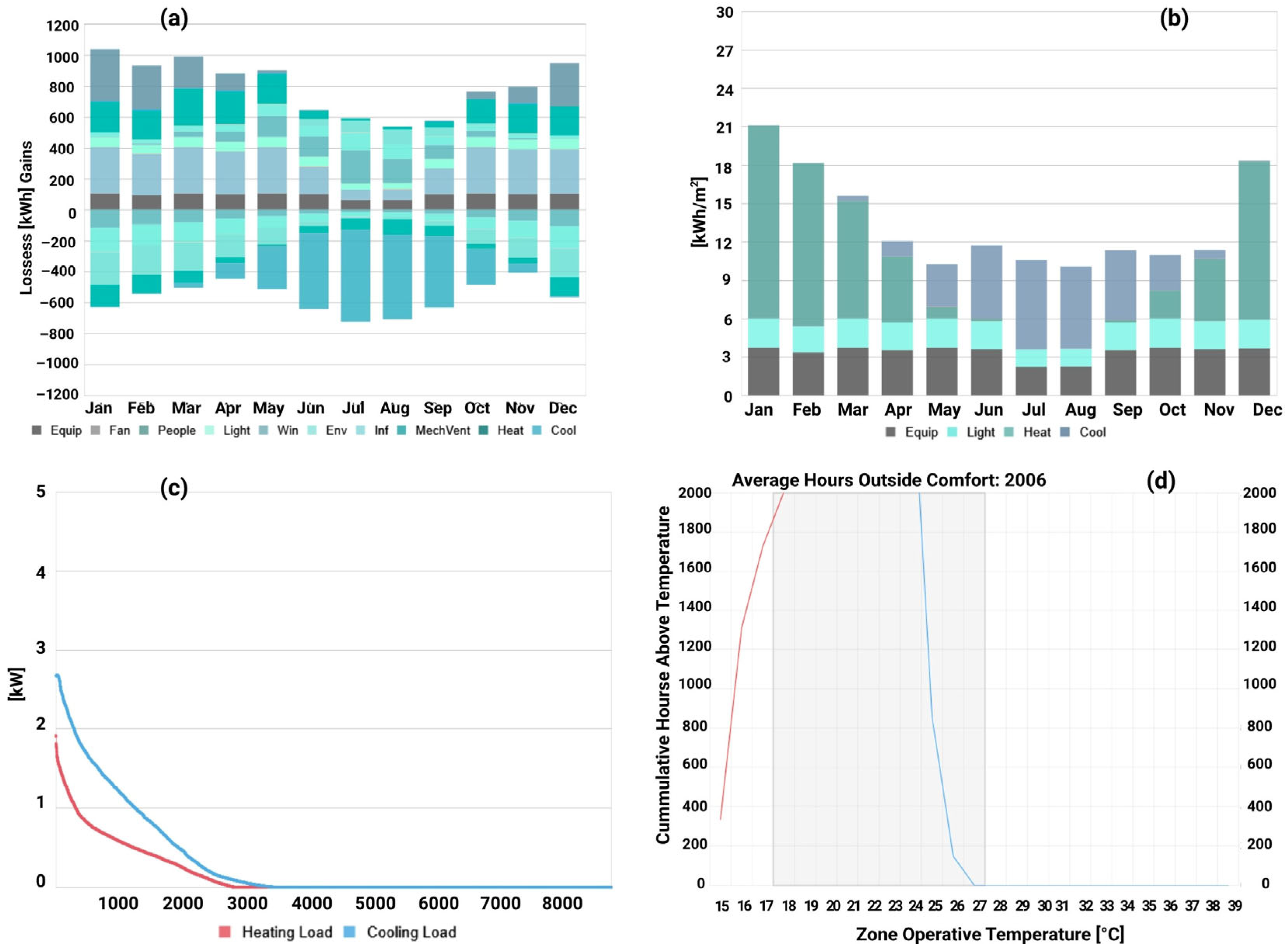
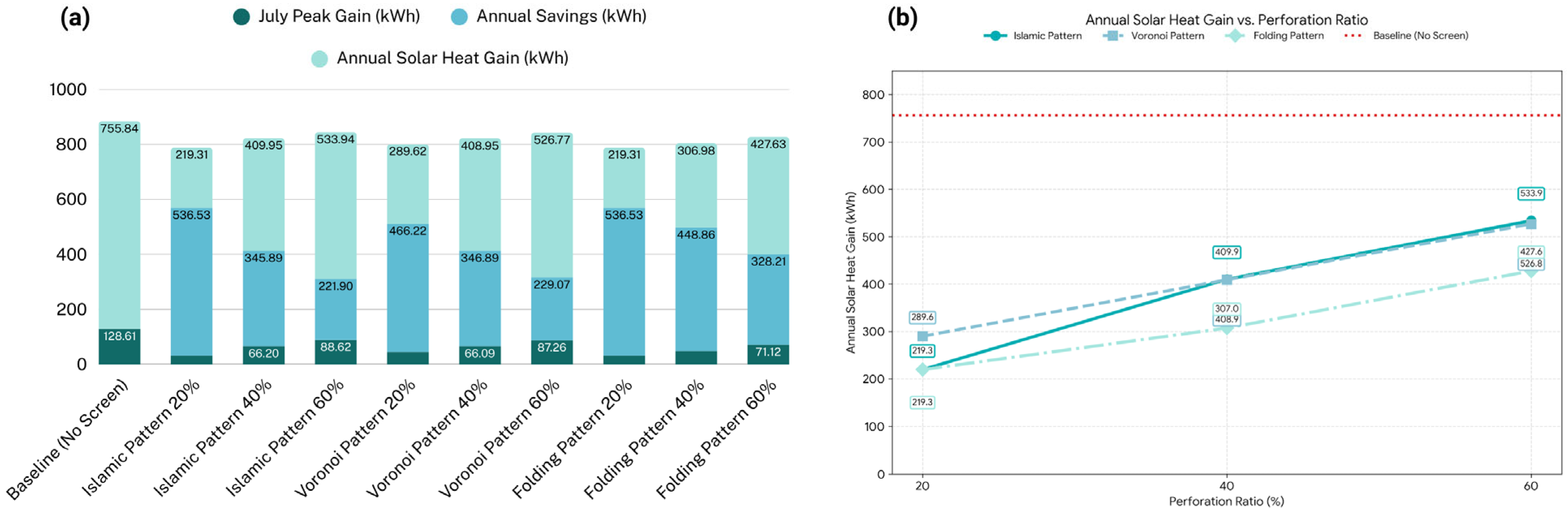
| Annual Solar Heat Gain (kWh) | 755.84 | Zone Windows Total Transmitted Solar Radiation Energy | Excessive summer solar gains dominate the internal heat balance and drive cooling demand. |
| Total Energy Use Intensity (kWh/m2·year) | 162 | Energy Use Intensity | High annual energy demand, with cooling. |
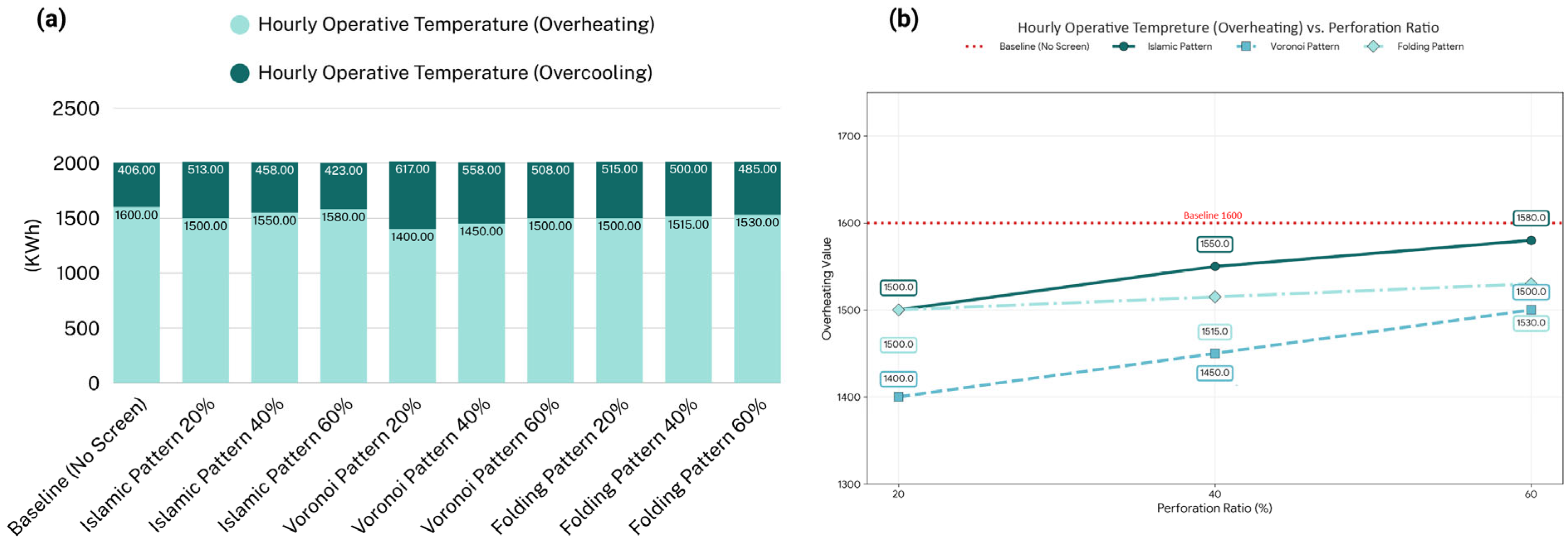
| Hourly Operative Temperature h/year > 26 °C | Total ≈ 2006 Overheating ≈ 1600 | Zone Temperature Curves | Hourly Operative Temperature |
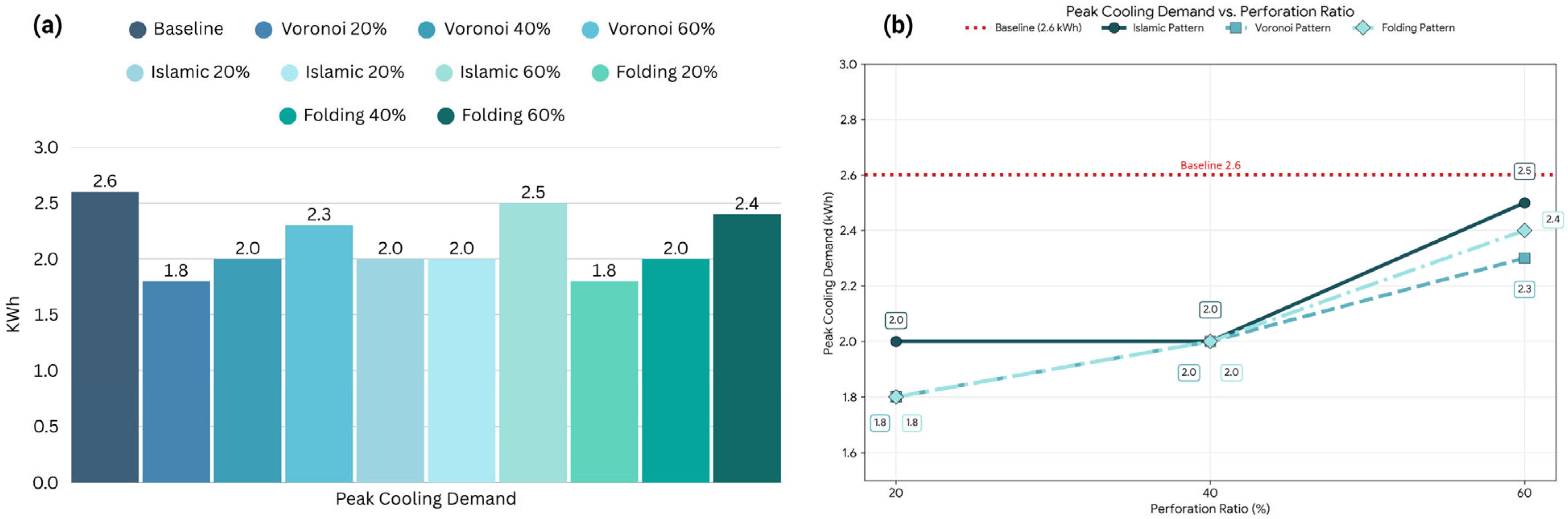
| Peak Cooling Demand (kW) | 2.6 | Load Duration | Reflects the building’s sensitivity to solar heat gains, envelope performance, and internal loads |
| Metric | Voronoi 20% | Voronoi 40% | Voronoi 60% | Interpretation | |
|---|---|---|---|---|---|
| Annual Solar Heat Gain (kWh) | 289.62 | 408.95 | 526.77 | Solar heat gain increases with perforation, indicating reduced shading effectiveness. | |
| Annual Energy Use Intensity (kWh/m2·year) | 156 | 157 | 158 | Cooling energy demand increases as perforation ratio increases. | |
| Hourly Operative Temperature h/year > 26 °C | Total Overheating | ≈2017 ≈1400 | ≈2008 ≈1450 | ≈2008 ≈1500 | Higher perforation leads to more frequent overheating. |
| Peak Cooling Demand (kW) | 1.8 | 2 | 2.3 | Cooling demand raises with increasing perforation. | |
| Metric | Islamic 20% | Islamic 40% | Islamic 60% | Interpretation | |
|---|---|---|---|---|---|
| Annual Solar Heat Gain (kWh) | 290.88 | 409.95 | 533.94 | Solar heat gain increases as perforation increases, indicating reduced shading effectiveness. | |
| Annual Energy Use Intensity (kWh/m2·year) | 155 | 156 | 157 | Cooling energy demand rises progressively with higher perforation ratios. | |
| Hourly Operative Temperature h/year > 26 °C | Total Overheating | ≈2013 ≈1500 | ≈2008 ≈1550 | ≈2003 ≈1580 | Overheating hours remain high, with limited variation across perforation levels. |
| Peak Cooling Demand (kW) | 2 | 2.4 | 2.5 | Cooling demand raises with increasing perforation. | |
| Metric | Folding 20% | Folding 40% | Folding 60% | Interpretation | |
|---|---|---|---|---|---|
| Annual Solar Heat Gain (kWh) | 219.31 | 306.98 | 427.63 | Overheating hours remain high, with limited variation across perforation levels. | |
| Annual Energy Use Intensity (kWh/m2·year) | 155 | 157 | 157 | Cooling energy demand rises progressively with higher perforation ratios. | |
| Hourly Operative Temperature h/year > 26 °C | Total Overheating | ≈2015 ≈1500 | ≈2015 ≈1515 | ≈2015 ≈1530 | Occupant dissatisfaction increases with higher perforation ratios. |
| Peak Cooling Demand (kW) | 1.80 | 2 | 2.40 | Cooling demand raises with increasing perforation. | |
| Design Parameters | O1 Solar Heat Gain | O2 Annual Energy Use Intensity | O3 Hours Outside Comfort (Overheating) | O4 Peak Cooling Demand |
|---|---|---|---|---|
| Voronoi 20% | 289.62 | 156 | 1400 | 1.8 |
| Voronoi 40% | 408.95 | 157 | 1450 | 2 |
| Voronoi 60% | 526.77 | 158 | 1500 | 2.3 |
| Islamic 20% | 290.88 | 155 | 1500 | 2 |
| Islamic 40% | 409.95 | 156 | 1550 | 2.4 |
| Islamic 60% | 533.94 | 157 | 1580 | 2.5 |
| Folding 20% | 219.31 | 155 | 1500 | 1.8 |
| Folding 40% | 306.98 | 157 | 1515 | 2 |
| Folding 60% | 427.63 | 157 | 1530 | 2.4 |
| Baseline | 755.84 | 162 | 1600 | 2.6 |
| Design Scenario | O1 | O2 | O3 | O4 | O1 Norm | O2 Norm | O3 Norm | O4 Norm | Compromise Lp (p = 2) | Rank |
|---|---|---|---|---|---|---|---|---|---|---|
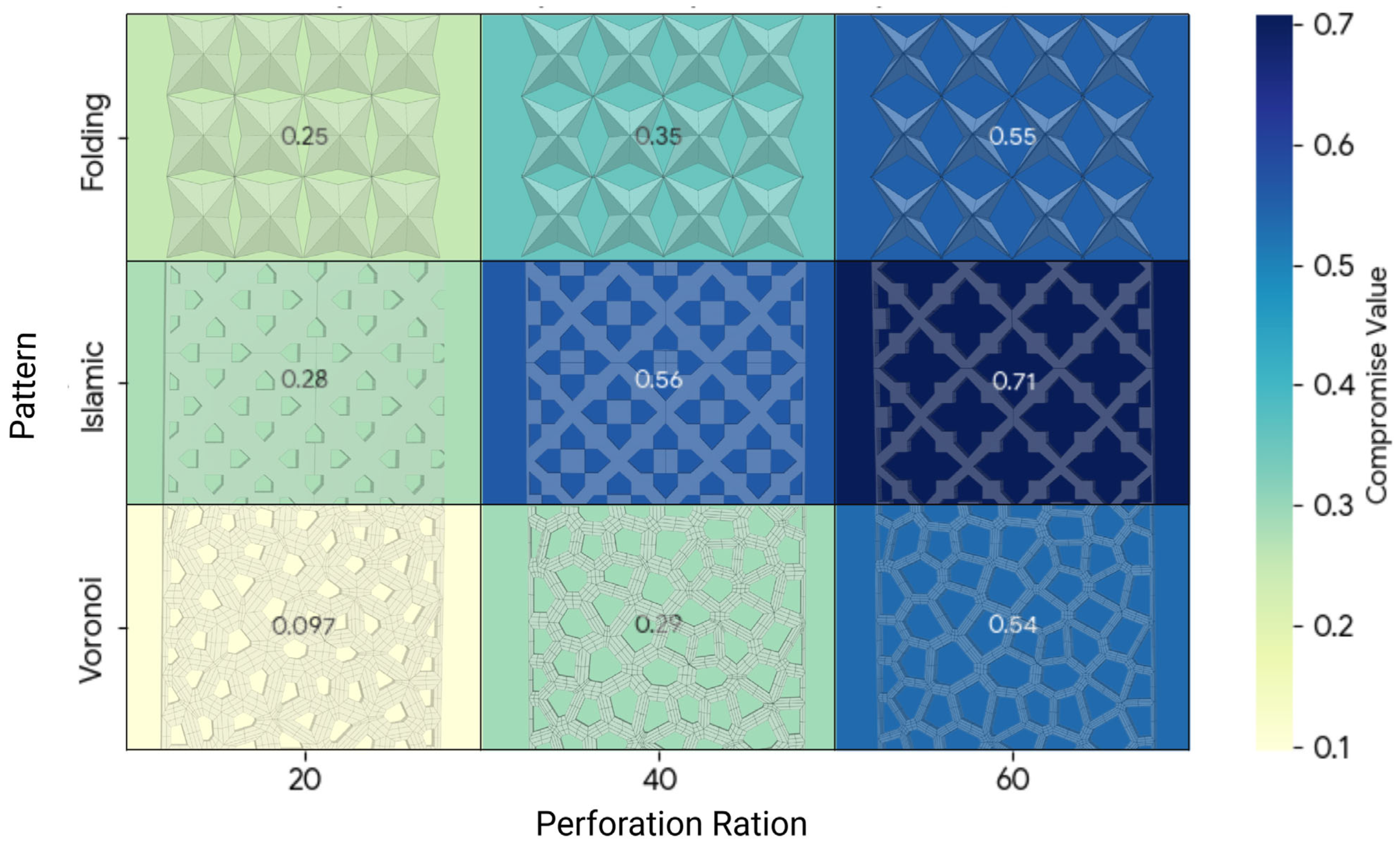
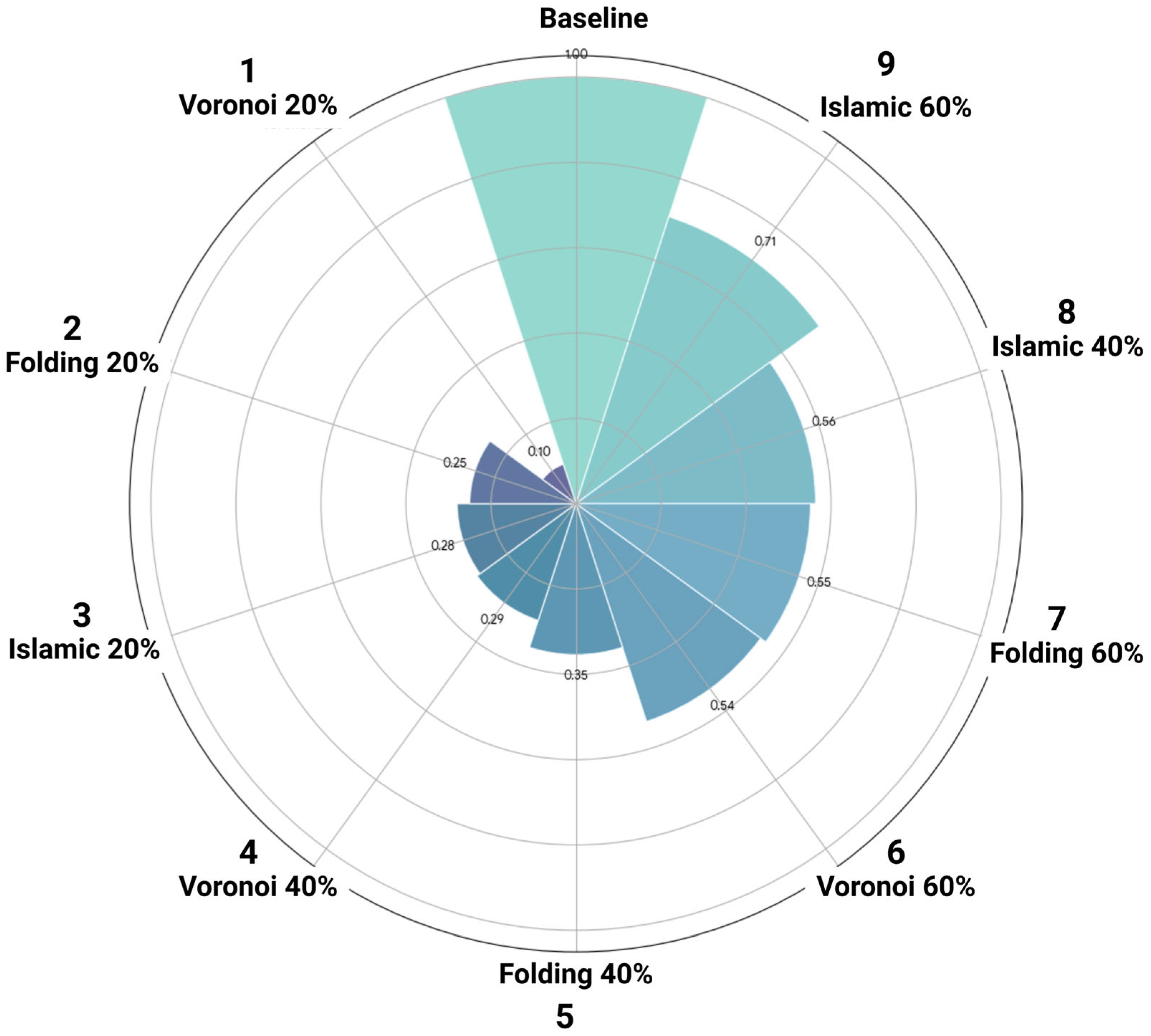
| Voronoi 20% | 289.62 | 156 | 1400 | 1.8 | 0.131046 | 0.142857 | 0 | 0 | 0.096929 | 1 |
| Folding 20% | 219.31 | 155 | 1500 | 1.8 | 0 | 0 | 0.5 | 0 | 0.25000 | 2 |
| Islamic 20% | 290.88 | 155 | 1500 | 2 | 0 | 0 | 0.5 | 0.25 | 0.28736 | 3 |
| Voronoi 40% | 408.95 | 157 | 1450 | 2 | 0.353456 | 0.285714 | 0.25 | 0.25 | 0.287908 | 4 |
| Folding 40% | 306.98 | 157 | 1515 | 2 | 0.163402 | 0.285714 | 0.575 | 0.25 | 0.354068 | 5 |
| Voronoi 60% | 526.77 | 158 | 1500 | 2.3 | 0.573053 | 0.428571 | 0.5 | 0.625 | 0.536817 | 6 |
| Folding 60% | 427.63 | 157 | 1530 | 2.4 | 0.388273 | 0.285714 | 0.65 | 0.75 | 0.551677 | 7 |
| Islamic 40% | 409.95 | 156 | 1550 | 2.4 | 0.35532 | 0.142857 | 0.75 | 0.75 | 0.56384 | 8 |
| Islamic 60% | 533.94 | 157 | 1580 | 2.5 | 0.586416 | 0.285714 | 0.9 | 0.875 | 0.707309 | 9 |
| Baseline | 755.84 | 162 | 1600 | 2.6 | 1 | 1 | 1 | 1 | 1 | 10 |
Disclaimer/Publisher’s Note: The statements, opinions and data contained in all publications are solely those of the individual author(s) and contributor(s) and not of MDPI and/or the editor(s). MDPI and/or the editor(s) disclaim responsibility for any injury to people or property resulting from any ideas, methods, instructions or products referred to in the content. |
© 2026 by the authors. Licensee MDPI, Basel, Switzerland. This article is an open access article distributed under the terms and conditions of the Creative Commons Attribution (CC BY) license.
Share and Cite
Dastoum, M.; Abdelhamid, Y.M.S.; Elareef, E.; Sánchez-Guevara, C.; Arranz, B.; Askarizad, R. Thermal Performance-Driven Simulation and Optimization of Tessellated Façade Shading Systems in Mediterranean Educational Buildings. CivilEng 2026, 7, 26. https://doi.org/10.3390/civileng7020026
Dastoum M, Abdelhamid YMS, Elareef E, Sánchez-Guevara C, Arranz B, Askarizad R. Thermal Performance-Driven Simulation and Optimization of Tessellated Façade Shading Systems in Mediterranean Educational Buildings. CivilEng. 2026; 7(2):26. https://doi.org/10.3390/civileng7020026
Chicago/Turabian StyleDastoum, Mana, Yasmine Mahmoud Saad Abdelhamid, Esraa Elareef, Carmen Sánchez-Guevara, Beatriz Arranz, and Reza Askarizad. 2026. "Thermal Performance-Driven Simulation and Optimization of Tessellated Façade Shading Systems in Mediterranean Educational Buildings" CivilEng 7, no. 2: 26. https://doi.org/10.3390/civileng7020026
APA StyleDastoum, M., Abdelhamid, Y. M. S., Elareef, E., Sánchez-Guevara, C., Arranz, B., & Askarizad, R. (2026). Thermal Performance-Driven Simulation and Optimization of Tessellated Façade Shading Systems in Mediterranean Educational Buildings. CivilEng, 7(2), 26. https://doi.org/10.3390/civileng7020026