Reliability of Behavioral and fNIRS Neural Responses: Assessments During Posture–Inhibitory Control Dual Tasking


Abstract
1. Introduction
2. Materials and Methods
2.1. Participants
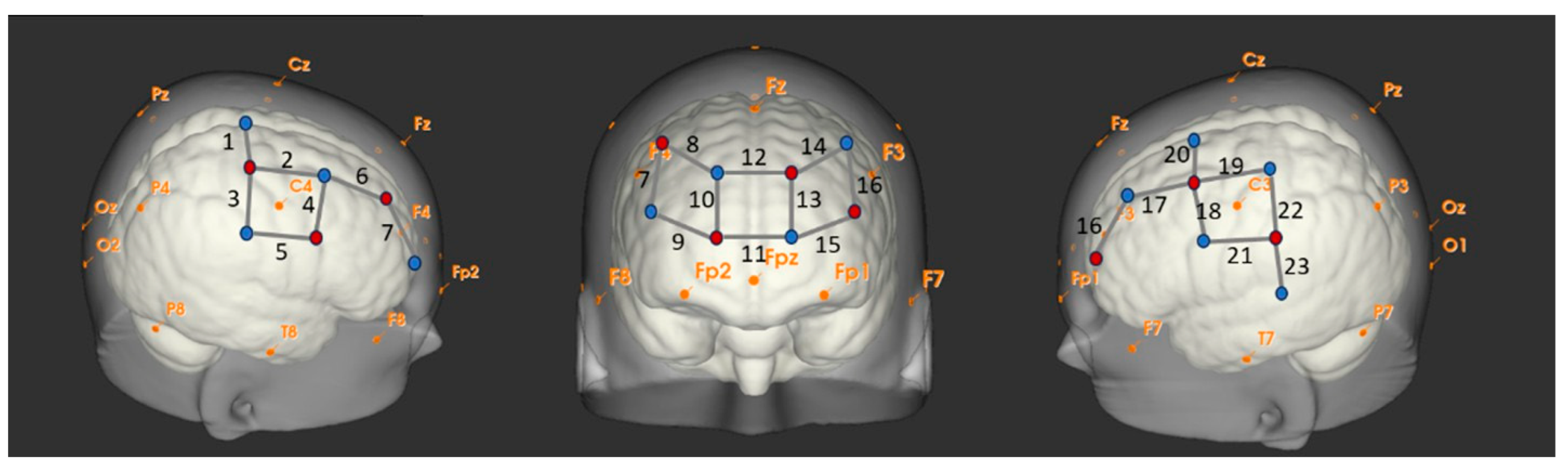
2.2. fNIRS Measurements
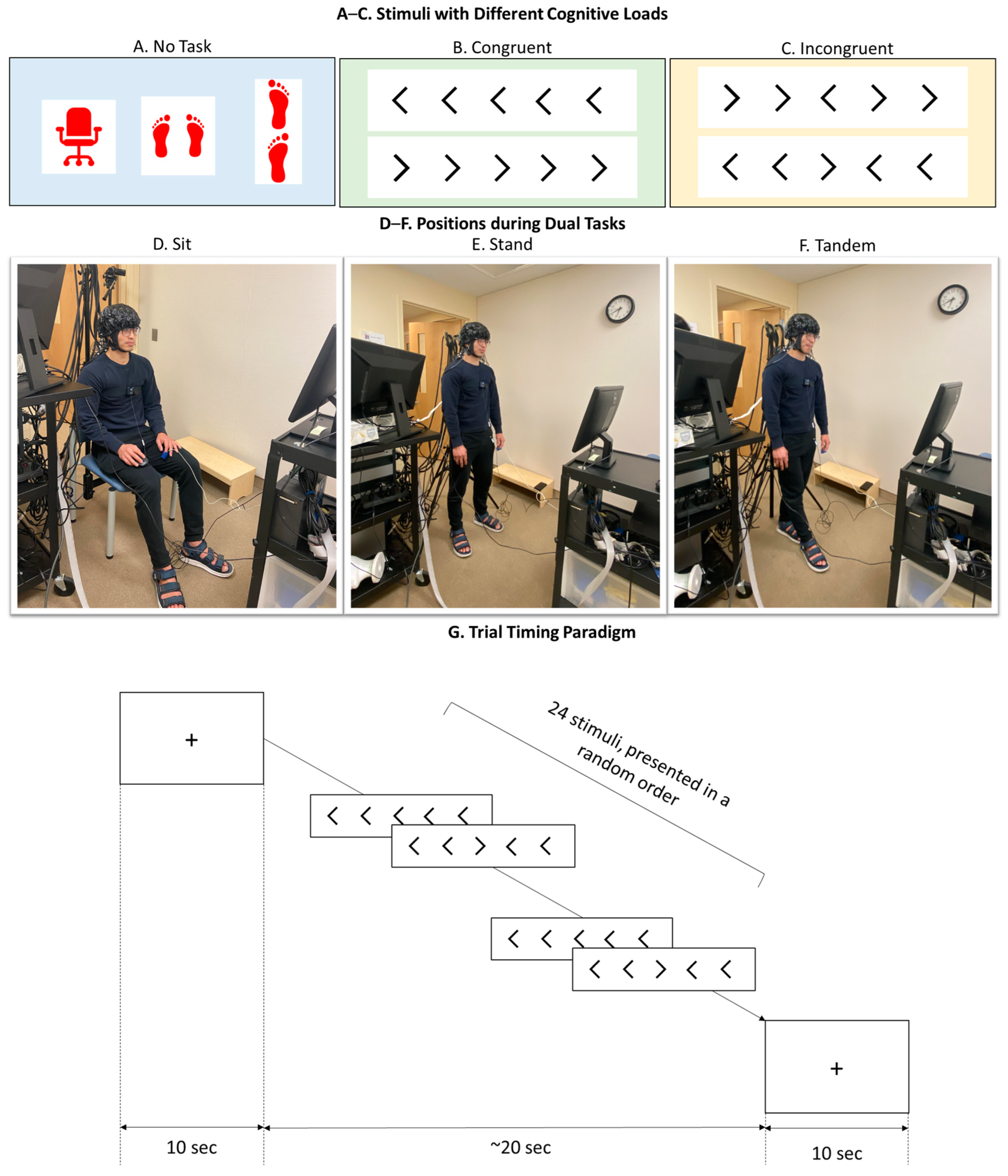
2.3. Experimental Procedures
2.4. fNIRS Data Processing
2.5. Dual-Task Interference
2.6. Statistical Analyses
3. Results
3.1. Behavioral Performance During Posture–Inhibitory Dual Task (Accuracy and Reaction Time)
3.2. Cortical Activation During Posture–Inhibitory Dual Task
3.3. Reliability of Behavioral Performance and Cortical Activation After Sit-to-Stand Transitions
3.4. Exploratory Analysis of Cortical Activation Before and After Sit-to-Stand Transitions
4. Discussion
4.1. Effects of Inhibitory Demands and Postural Control on Behavioral Performance and Cortical Activation During Dual Tasks: An Under-Additive Pattern
4.2. Acceptable Behavioral Test–Retest Reliability but Variable Neural Test–Retest Reliability Following Sit-to-Stand Transitions
4.3. Potential Influence of Short Bout of Physical Activities on Dual-Task Neural Activity (Methodological Consideration)
4.4. Limitations and Future Directions
5. Conclusions
Supplementary Materials
Author Contributions
Funding
Institutional Review Board Statement
Informed Consent Statement
Data Availability Statement
Acknowledgments
Conflicts of Interest
References
- MacPherson, S.E. Definition: Dual-tasking and multitasking. Cortex 2018, 106, 313–314. [Google Scholar] [CrossRef]
- Leone, C.; Feys, P.; Moumdjian, L.; D’Amico, E.; Zappia, M.; Patti, F. Cognitive-motor dual-task interference: A systematic review of neural correlates. Neurosci. Biobehav. Rev. 2017, 75, 348–360. [Google Scholar] [CrossRef] [PubMed]
- Pashler, H. Dual-task interference in simple tasks: Data and theory. Psychol. Bull. 1994, 116, 220–244. [Google Scholar] [CrossRef] [PubMed]
- Navon, D.; Miller, J. Role of outcome conflict in dual-task interference. J. Exp. Psychol. Hum. Percept. Perform. 1987, 13, 435–448. [Google Scholar] [CrossRef]
- Friedman, A.; Polson, M.C.; Dafoe, C.G.; Gaskill, S.J. Dividing attention within and between hemispheres: Testing a multiple resources approach to limited-capacity information processing. J. Exp. Psychol. Hum. Percept. Perform. 1982, 8, 625–650. [Google Scholar] [CrossRef] [PubMed]
- Van Impe, A.; Coxon, J.P.; Goble, D.J.; Wenderoth, N.; Swinnen, S.P. Age-related changes in brain activation underlying single- and dual-task performance: Visuomanual drawing and mental arithmetic. Neuropsychologia 2011, 49, 2400–2409. [Google Scholar] [CrossRef]
- Wu, T.; Liu, J.; Hallett, M.; Zheng, Z.; Chan, P. Cerebellum and integration of neural networks in dual-task processing. NeuroImage 2013, 65, 466–475. [Google Scholar] [CrossRef]
- Gruber, O. Effects of domain-specific interference on brain activation associated with verbal working memory task performance. Cereb. Cortex 2001, 11, 1047–1055. [Google Scholar] [CrossRef]
- Johannsen, L.; Li, K.Z.; Chechlacz, M.; Bibi, A.; Kourtzi, Z.; Wing, A.M. Functional neuroimaging of the interference between working memory and the control of periodic ankle movement timing. Neuropsychologia 2013, 51, 2142–2153. [Google Scholar] [CrossRef]
- Just, M.A.; Keller, T.A.; Cynkar, J. A decrease in brain activation associated with driving when listening to someone speak. Brain Res. 2008, 1205, 70–80. [Google Scholar] [CrossRef]
- Rémy, F.; Wenderoth, N.; Lipkens, K.; Swinnen, S.P. Dual-task interference during initial learning of a new motor task results from competition for the same brain areas. Neuropsychologia 2010, 48, 2517–2527. [Google Scholar] [CrossRef]
- Lloyd-Fox, S.; Blasi, A.; Elwell, C.E. Illuminating the developing brain: The past, present and future of functional near infrared spectroscopy. Neurosci. Biobehav. Rev. 2010, 34, 269–284. [Google Scholar] [CrossRef]
- McPartland, J.C.; Lerner, M.D.; Bhat, A.; Clarkson, T.; Jack, A.; Koohsari, S.; Matuskey, D.; McQuaid, G.A.; Su, W.C.; Trevisan, D.A. Looking back at the next 40 years of ASD neuroscience research. J. Autism. Dev. Disord. 2021, 51, 4333–4353. [Google Scholar] [CrossRef] [PubMed]
- Fujita, H.; Kasubuchi, K.; Wakata, S.; Hiyamizu, M.; Morioka, S. Role of the frontal cortex in standing postural sway tasks while dual-tasking: A functional near-infrared spectroscopy study examining working memory capacity. BioMed Res. Int. 2016, 2016, 7053867. [Google Scholar] [CrossRef]
- Marusic, U.; Taube, W.; Morrison, S.A.; Biasutti, L.; Grassi, B.; De Pauw, K.; Meeusen, R.; Pisot, R.; Ruffieux, J. Aging effects on prefrontal cortex oxygenation in a posture-cognition dual-task: An fNIRS pilot study. Eur. Rev. Aging. Phys. Act. 2019, 16, 2. [Google Scholar] [CrossRef]
- Saraiva, M.; Fuentes-García, J.P.; Vilas-Boas, J.P.; Castro, M.A. Relationship between physical activity level and sleep quality with postural control and hemodynamic response in the prefrontal cortex during dual-task performance. Physiol. Behav. 2022, 255, 113935. [Google Scholar] [CrossRef]
- St George, R.J.; Hinder, M.R.; Puri, R.; Walker, E.; Callisaya, M.L. Functional near-infrared spectroscopy reveals the compensatory potential of pre-frontal cortical activity for standing balance in young and older adults. Neuroscience 2021, 452, 208–218. [Google Scholar] [CrossRef]
- Rosso, A.L.; Cenciarini, M.; Sparto, P.J.; Loughlin, P.J.; Furman, J.M.; Huppert, T.J. Neuroimaging of an attention demanding dual-task during dynamic postural control. Gait Posture 2017, 57, 193–198. [Google Scholar] [CrossRef] [PubMed]
- Xu, G.; Zhou, M.; Chen, Y.; Song, Q.; Sun, W.; Wang, J. Brain activation during standing balance control in dual-task paradigm and its correlation among older adults with mild cognitive impairment: A fNIRS study. BMC. Geriatr. 2024, 24, 144. [Google Scholar] [CrossRef] [PubMed]
- Diamond, A. Executive functions. Annu. Rev. Psychol. 2013, 64, 135–168. [Google Scholar] [CrossRef]
- Lee, S.H.; Pitt, M.A. Implementation of an online spacing flanker task and evaluation of its test-retest reliability using measures of inhibitory control and the distribution of spatial attention. Behav. Res. Methods 2024, 56, 5947–5958. [Google Scholar] [CrossRef]
- de Rond, V.; Gilat, M.; D’Cruz, N.; Hulzinga, F.; Orban de Xivry, J.J.; Nieuwboer, A. Test-retest reliability of functional near-infrared spectroscopy during a finger-tapping and postural task in healthy older adults. Neurophotonics 2023, 10, 025010. [Google Scholar] [CrossRef]
- Huang, Y.; Mao, M.; Zhang, Z.; Zhou, H.; Zhao, Y.; Duan, L.; Kreplin, U.; Xiao, X.; Zhu, C. Test-retest reliability of the prefrontal response to affective pictures based on functional near-infrared spectroscopy. J. Biomed. Opt. 2017, 22, 16011. [Google Scholar] [CrossRef] [PubMed]
- Su, W.C.; Culotta, M.; Tsuzuki, D.; Bhat, A. Movement kinematics and cortical activation in children with and without autism spectrum disorder during sway synchrony tasks: An fNIRS study. Sci. Rep. 2021, 11, 15035. [Google Scholar] [CrossRef]
- Su, W.C.; Tsuzuki, D.; Srinivasan, S.; Bhat, A. Neural Effects of Creative Movement, General Movement, and Sedentary Play Interventions on Interpersonal Synchrony in Children with Autism Spectrum Disorder: A Preliminary fNIRS Study. Brain Sci. 2024, 15, 683. [Google Scholar] [CrossRef]
- Mol, A.; Woltering, J.H.H.; Colier, W.N.J.M.; Maier, A.B.; Meskers, C.G.M.; van Wezel, R.J.A. Sensitivity and reliability of cerebral oxygenation responses to postural changes measured with near-infrared spectroscopy. Eur. J. Appl. Physiol. 2019, 119, 1117–1125. [Google Scholar] [CrossRef]
- Bornstein, M.H.; Putnick, D.L.; Esposito, G. Continuity and stability in development. Child Dev. Perspect. 2017, 11, 113–119. [Google Scholar] [CrossRef]
- Szturm, T.J.; Sakhalkar, V.S.; Kanitkar, A.; Nankar, M. Computerized dual-task testing of gait and visuospatial cognitive functions; test-retest reliability and validity. Front. Hum. Neurosci. 2017, 11, 105. [Google Scholar] [CrossRef] [PubMed]
- Eriksen, C.W. The flankers task and response competition: A useful tool for investigating a variety of cognitive problems. In Visual Selective Attention; Bundesen, C., Shibuya, H., Eds.; Lawrence Erlbaum Associates, Inc.: Mahwah, NJ, USA, 1995; pp. 101–118. [Google Scholar]
- Bohannon, R.W.; Crouch, R. 1-minute sit-to-stand test: Systematic review of procedures, performance, and clinimetric properties. J. Cardiopulm. Rehabil. Prev. 2019, 39, 2–8. [Google Scholar] [CrossRef]
- Borg, G. Borg’s Perceived Exertion and Pain Scales; Human Kinetics: Champaign, IL, USA, 1998. [Google Scholar]
- Huppert, T.J.; Diamond, S.G.; Franceschini, M.A.; Boas, D.A. HomER: A review of time-series analysis methods for near-infrared spectroscopy of the brain. Appl. Opt. 2009, 48, D280–D298. [Google Scholar] [CrossRef] [PubMed]
- Yücel, M.A.; Lühmann, A.V.; Scholkmann, F.; Gervain, J.; Dan, I.; Ayaz, H.; Boas, D.; Cooper, R.J.; Culver, J.; Elwell, C.E.; et al. Best practices for fNIRS publications. Neurophotonics 2021, 8, 012101. [Google Scholar] [CrossRef]
- Cooper, R.J.; Selb, J.; Gagnon, L.; Phillip, D.; Schytz, H.W.; Iversen, H.K.; Ashina, M.; Boas, D.A. A systematic comparison of motion artifact correction techniques for functional near-infrared spectroscopy. Front. Neurosci. 2012, 6, 147. [Google Scholar] [CrossRef]
- Jahani, S.; Setarehdan, S.K.; Boas, D.A.; Yücel, M.A. Motion artifact detection and correction in functional near-infrared spectroscopy: A new hybrid method based on spline interpolation method and Savitzky-Golay filtering. Neurophotonics 2018, 5, 015003. [Google Scholar] [CrossRef]
- Kocsis, L.; Herman, P.; Eke, A. The modified Beer-Lambert law revisited. Phys. Med. Biol. 2006, 51, N91–N98. [Google Scholar] [CrossRef]
- Nguyen, T.; Babawale, O.; Kim, T.; Jo, H.J.; Liu, H.; Kim, J.G. Exploring brain functional connectivity in rest and sleep states: A fNIRS study. Sci. Rep. 2018, 8, 16144. [Google Scholar] [CrossRef]
- Ye, J.C.; Tak, S.; Jang, K.E.; Jung, J.; Jang, J. NIRS-SPM: Statistical parametric mapping for near-infrared spectroscopy. Neuroimage 2009, 44, 428–447. [Google Scholar] [CrossRef]
- Diamond, S.G.; Huppert, T.J.; Kolehmainen, V.; Franceschini, M.A.; Kaipio, J.P.; Arridge, S.R.; Boas, D.A. Dynamic physiological modeling for functional diffuse optical tomography. NeuroImage 2006, 30, 88–101. [Google Scholar] [CrossRef]
- Sato, H.; Fuchino, Y.; Kiguchi, M.; Katura, T.; Maki, A.; Yoro, T.; Koizumi, H. Intersubject variability of near-infrared spectroscopy signals during sensorimotor cortex activation. J. Biomed. Opt. 2005, 10, 44001. [Google Scholar] [CrossRef] [PubMed]
- Ichikawa, H.; Nakato, E.; Igarashi, Y.; Okada, M.; Kanazawa, S.; Yamaguchi, M.K.; Kakigi, R. A longitudinal study of infant view-invariant face processing during the first 3-8 months of life. NeuroImage 2019, 186, 817–824. [Google Scholar] [CrossRef] [PubMed]
- Su, W.C.; Dashtestani, H.; Miguel, H.O.; Condy, E.; Buckley, A.; Park, S.; Perreault, J.B.; Nguyen, T.; Zeytinoglu, S.; Millerhagen, J.; et al. Simultaneous multimodal fNIRS-EEG recordings reveal new insights in neural activity during motor execution, observation, and imagery. Sci. Rep. 2023, 13, 5151. [Google Scholar] [CrossRef] [PubMed]
- Li, L.; Zeng, L.; Lin, Z.J.; Cazzell, M.; Liu, H. Tutorial on use of intraclass correlation coefficients for assessing intertest reliability and its application in functional near-infrared spectroscopy-based brain imaging. J. Biomed. Opt. 2015, 20, 50801. [Google Scholar] [CrossRef] [PubMed]
- Moreau, D.; Chou, E. The acute effect of high-intensity exercise on executive function: A meta-analysis. Perspect. Psychol. Sci. 2019, 14, 734–764. [Google Scholar] [CrossRef]
- Park, S.Y.; Reinl, M.; Schott, N. Effects of acute exercise at different intensities on fine motor-cognitive dual-task performance while walking: A functional near-infrared spectroscopy study. Eur. J. Neurosci. 2021, 54, 8225–8248. [Google Scholar] [CrossRef] [PubMed]
- Talamonti, D.; Vincent, T.; Fraser, S.; Nigam, A.; Lesage, F.; Bherer, L. The benefits of physical activity in individuals with cardiovascular risk factors: A longitudinal investigation using fNIRS and dual-task walking. J. Clin. Med. 2021, 10, 579. [Google Scholar] [CrossRef]
- Vrinceanu, T.; Blanchette, C.A.; Intzandt, B.; Lussier, M.; Pothier, K.; Vu, T.T.M.; Nigam, A.; Bosquet, L.; Karelis, A.D.; Li, K.Z.H.; et al. A comparison of the effect of physical activity and cognitive training on dual-task performance in older adults. J. Gerontol. B Psychol. Sci. Soc. Sci. 2022, 77, 1069–1079. [Google Scholar] [CrossRef]
- Mehren, A.; Özyurt, J.; Lam, A.P.; Brandes, M.; Müller, H.H.O.; Thiel, C.M.; Philipsen, A. Acute effects of aerobic exercise on executive function and attention in adult patients with ADHD. Front. Psychiatry 2019, 10, 132. [Google Scholar] [CrossRef] [PubMed]
- Mehren, A.; Özyurt, J.; Thiel, C.M.; Brandes, M.; Lam, A.P.; Philipsen, A. Effects of acute aerobic exercise on response inhibition in adult patients with ADHD. Sci. Rep. 2019, 9, 19884. [Google Scholar] [CrossRef]
- Pontifex, M.B.; Saliba, B.J.; Raine, L.B.; Picchietti, D.L.; Hillman, C.H. Exercise improves behavioral, neurocognitive, and scholastic performance in children with attention-deficit/hyperactivity disorder. J. Pediatr. 2013, 162, 543–551. [Google Scholar] [CrossRef]
- Mekari, S.; Dupuy, O.; Martins, R.; Evans, K.; Kimmerly, D.S.; Fraser, S.; Neyedli, H.F. The effects of cardiorespiratory fitness on executive function and prefrontal oxygenation in older adults. GeroScience 2019, 41, 681–690. [Google Scholar] [CrossRef]



| Accuracy | Reaction Time | |||
|---|---|---|---|---|
| M | SE | M | SE | |
| Pre-Sit-to-Stand | ||||
| Sit, Congruent | 98.70 | 0.50 | 427.26 | 31.35 |
| Sit, Incongruent | 95.44 | 3.19 | 453.47 | 19.38 |
| Stand, Congruent | 98.83 | 0.54 | 373.16 | 19.03 |
| Stand, Incongruent | 95.44 | 3.07 | 411.37 | 16.46 |
| Tandem, Congruent | 98.83 | 0.38 | 372.66 | 16.97 |
| Tandem, Incongruent | 96.09 | 3.10 | 411.61 | 11.91 |
| Post-Sit-to-Stand | ||||
| Sit, Congruent | 98.33 | 0.55 | 349.62 | 11.46 |
| Sit, Incongruent | 94.72 | 3.32 | 410.55 | 13.70 |
| Stand, Congruent | 99.17 | 0.45 | 352.41 | 13.38 |
| Stand, Incongruent | 94.44 | 3.32 | 391.27 | 20.49 |
| Tandem, Congruent | 98.89 | 0.49 | 353.09 | 18.35 |
| Tandem, Incongruent | 95.00 | 3.26 | 389.78 | 13.56 |
| No-Task | Congruent | Incongruent | ||||
|---|---|---|---|---|---|---|
| M | SE | M | SE | M | SE | |
| Pre-Sit-to-Stand | ||||||
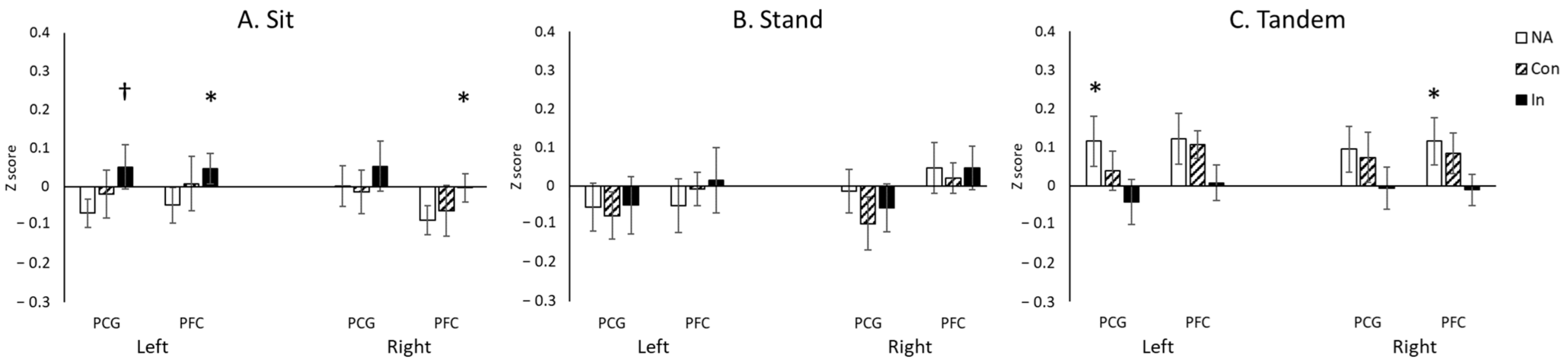
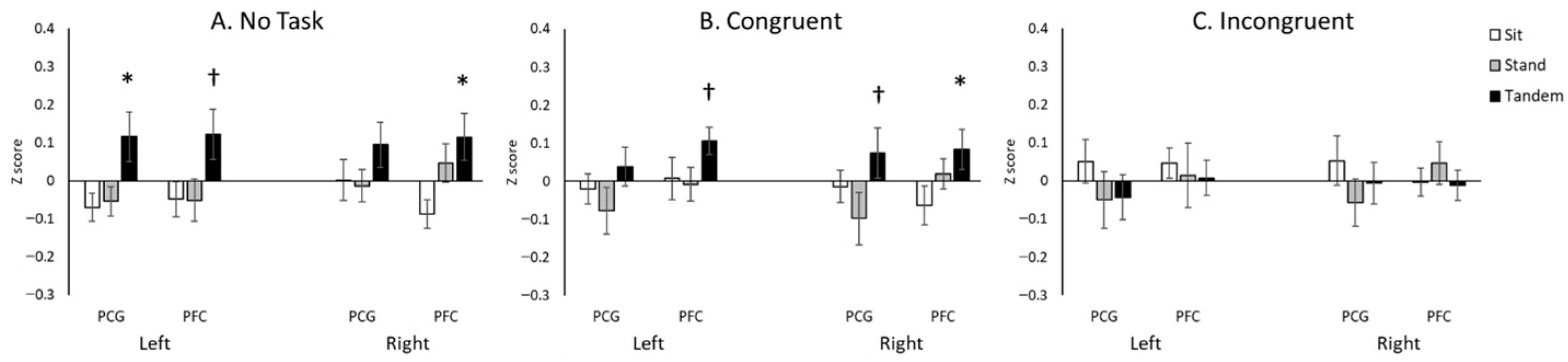
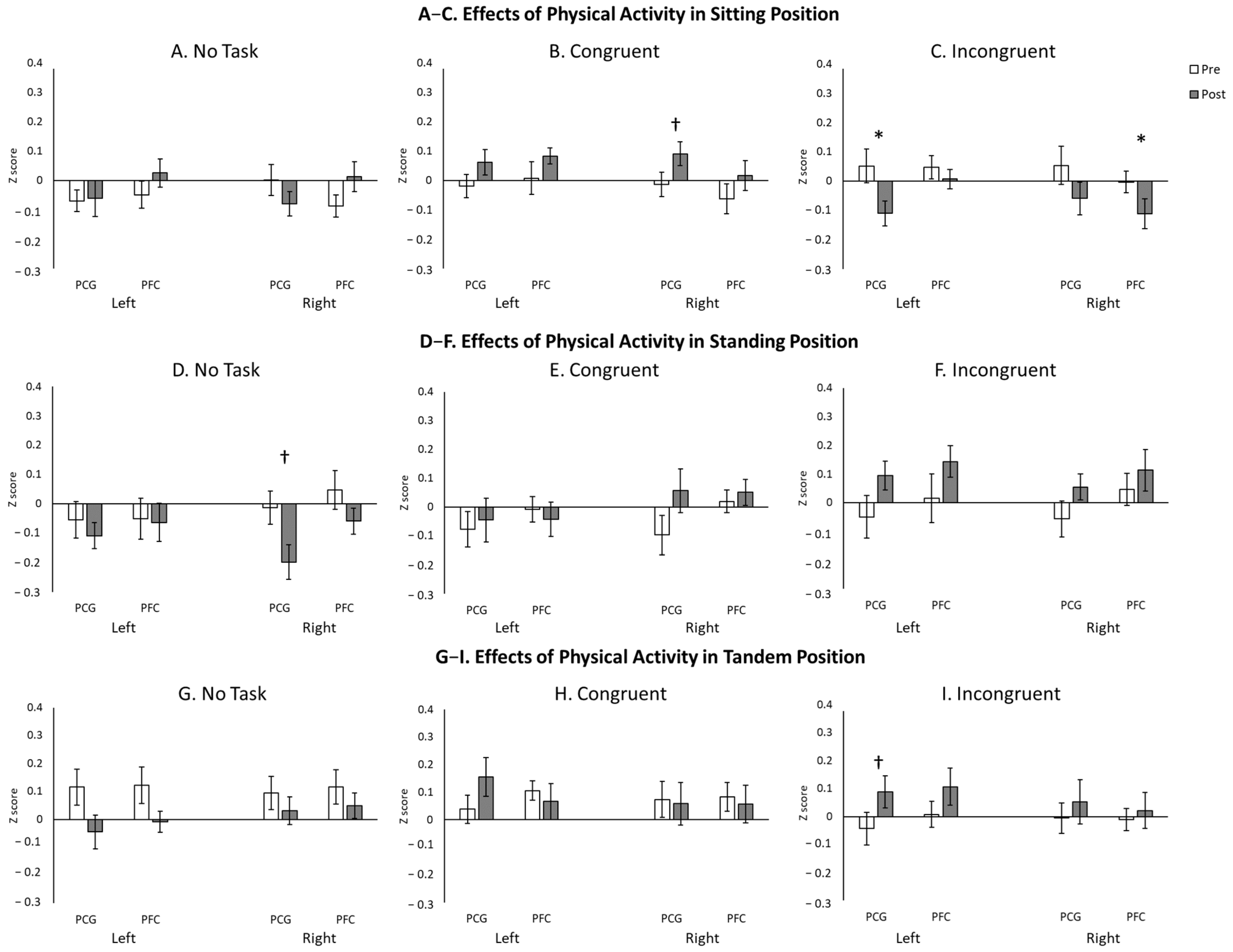
| Sit, Left PCG | −0.07 | 0.04 | −0.02 | 0.04 | 0.05 | 0.06 |
| Sit, Left PFC | −0.05 | 0.05 | 0.01 | 0.06 | 0.05 | 0.04 |
| Sit, Right PCG | 0.00 | 0.05 | −0.01 | 0.04 | 0.05 | 0.06 |
| Sit, Right PFC | −0.09 | 0.04 | −0.06 | 0.05 | 0.00 | 0.04 |
| Stance, Left PCG | −0.05 | 0.06 | −0.08 | 0.06 | −0.05 | 0.07 |
| Stance, Left PFC | −0.05 | 0.07 | −0.01 | 0.04 | 0.01 | 0.09 |
| Stance, Right PCG | −0.01 | 0.06 | −0.10 | 0.07 | −0.06 | 0.06 |
| Stance, Right PFC | 0.05 | 0.07 | 0.02 | 0.04 | 0.05 | 0.06 |
| Tandem, Left PCG | 0.12 | 0.06 | 0.04 | 0.05 | −0.04 | 0.06 |
| Tandem, Left PFC | 0.12 | 0.07 | 0.11 | 0.04 | 0.01 | 0.05 |
| Tandem, Right PCG | 0.09 | 0.06 | 0.07 | 0.07 | −0.01 | 0.05 |
| Tandem, Right PFC | 0.12 | 0.06 | 0.08 | 0.05 | −0.01 | 0.04 |
| Post-Sit-to-Stand | ||||||
| Sit, Left PCG | −0.06 | 0.06 | 0.06 | 0.04 | −0.11 | 0.04 |
| Sit, Left PFC | 0.03 | 0.05 | 0.08 | 0.03 | 0.01 | 0.03 |
| Sit, Right PCG | −0.08 | 0.04 | 0.09 | 0.04 | −0.06 | 0.06 |
| Sit, Right PFC | 0.01 | 0.05 | 0.02 | 0.05 | −0.11 | 0.05 |
| Stance, Left PCG | −0.11 | 0.04 | −0.05 | 0.08 | 0.10 | 0.05 |
| Stance, Left PFC | −0.06 | 0.07 | −0.04 | 0.06 | 0.14 | 0.06 |
| Stance, Right PCG | −0.20 | 0.06 | 0.06 | 0.08 | 0.05 | 0.05 |
| Stance, Right PFC | −0.06 | 0.04 | 0.05 | 0.05 | 0.11 | 0.07 |
| Tandem, Left PCG | −0.04 | 0.06 | 0.16 | 0.07 | 0.09 | 0.06 |
| Tandem, Left PFC | −0.01 | 0.04 | 0.07 | 0.07 | 0.11 | 0.07 |
| Tandem, Right PCG | 0.03 | 0.05 | 0.06 | 0.08 | 0.05 | 0.08 |
| Tandem, Right PFC | 0.05 | 0.05 | 0.06 | 0.07 | 0.02 | 0.06 |
| Variables | ICC | 95% CI Lower Bound | 95% CI Upper Bound | Pearson Correlation |
|---|---|---|---|---|
| Behavioral Measures | ||||
| Reaction Time in Sitting, Congruent | 0.24 | −0.15 | 0.62 | 0.33 |
| Reaction Time in Sitting, Incongruent | 0.47 | −0.09 | 0.80 | 0.72 ** |
| Reaction Time in Standing, Congruent | 0.54 | 0.08 | 0.81 | 0.83 ** |
| Reaction Time in Standing, Incongruent | 0.57 | 0.08 | 0.83 | 0.68 ** |
| Reaction Time in Tandem, Congruent | 0.36 | −0.19 | 0.73 | 0.66 ** |
| Reaction Time in Tandem, Incongruent | 0.95 | 0.86 | 0.98 | 0.97 ** |
| Cortical Activation | ||||
| Sitting, Congruent, Left PCG | −0.04 | −0.45 | 0.42 | −0.04 |
| Sitting, Congruent, Left PFC | −0.49 | −0.81 | −0.02 | −0.62 ** |
| Sitting, Congruent, Right PCG | 0.11 | −0.29 | 0.51 | 0.12 |
| Sitting, Congruent, Right PFC | −0.62 | −0.89 | −0.18 | −0.61 ** |
| Sitting, Incongruent, Left PCG | 0.07 | −0.28 | 0.46 | 0.09 |
| Sitting, Incongruent, Left PFC | 0.72 | 0.40 | 0.88 | 0.75 ** |
| Sitting, Incongruent, Right PCG | 0.35 | −0.08 | 0.69 | 0.38 |
| Sitting, Incongruent, Right PFC | 0.49 | 0.06 | 0.77 | 0.59 ** |
| Standing, Congruent, Left PCG | −0.06 | −0.54 | 0.43 | −0.05 |
| Standing, Congruent, Left PFC | −0.17 | −0.62 | 0.33 | −0.17 |
| Standing, Congruent, Right PCG | −0.24 | −0.61 | 0.24 | −0.25 |
| Standing, Congruent, Right PFC | −0.06 | −0.53 | 0.42 | −0.06 |
| Standing, Incongruent, Left PCG | −0.32 | −0.67 | 0.15 | −0.37 |
| Standing, Incongruent, Left PFC | −0.38 | −0.73 | 0.11 | −0.417 |
| Standing, Incongruent, Right PCG | −0.74 | −0.95 | −0.31 | −0.79 ** |
| Standing, Incongruent, Right PFC | −0.23 | −0.65 | 0.27 | −0.23 |
| Tandem, Congruent, Left PCG | −0.02 | −0.44 | 0.43 | −0.02 |
| Tandem, Congruent, Left PFC | 0.02 | −0.46 | 0.48 | 0.03 |
| Tandem, Congruent, Right PCG | 0.06 | −0.44 | 0.52 | 0.06 |
| Tandem, Congruent, Right PFC | 0.12 | 0.38 | 0.56 | 0.12 |
| Tandem, Incongruent, Left PCG | 0.21 | −0.21 | 0.59 | 0.23 |
| Tandem, Incongruent, Left PFC | −0.04 | −0.47 | 0.42 | −0.04 |
| Tandem, Incongruent, Right PCG | −0.18 | −0.62 | 0.32 | −0.18 |
| Tandem, Incongruent, Right PFC | −0.41 | −0.78 | 0.09 | −0.43 |
Disclaimer/Publisher’s Note: The statements, opinions and data contained in all publications are solely those of the individual author(s) and contributor(s) and not of MDPI and/or the editor(s). MDPI and/or the editor(s) disclaim responsibility for any injury to people or property resulting from any ideas, methods, instructions or products referred to in the content. |
© 2026 by the authors. Licensee MDPI, Basel, Switzerland. This article is an open access article distributed under the terms and conditions of the Creative Commons Attribution (CC BY) license.
Share and Cite
Su, W.-C.; George, T.; Bornstein, M.H.; Nguyen, T.; Gandjbakhche, A. Reliability of Behavioral and fNIRS Neural Responses: Assessments During Posture–Inhibitory Control Dual Tasking. NeuroSci 2026, 7, 54. https://doi.org/10.3390/neurosci7030054
Su W-C, George T, Bornstein MH, Nguyen T, Gandjbakhche A. Reliability of Behavioral and fNIRS Neural Responses: Assessments During Posture–Inhibitory Control Dual Tasking. NeuroSci. 2026; 7(3):54. https://doi.org/10.3390/neurosci7030054
Chicago/Turabian StyleSu, Wan-Chun, Tony George, Marc H. Bornstein, Thien Nguyen, and Amir Gandjbakhche. 2026. "Reliability of Behavioral and fNIRS Neural Responses: Assessments During Posture–Inhibitory Control Dual Tasking" NeuroSci 7, no. 3: 54. https://doi.org/10.3390/neurosci7030054
APA StyleSu, W.-C., George, T., Bornstein, M. H., Nguyen, T., & Gandjbakhche, A. (2026). Reliability of Behavioral and fNIRS Neural Responses: Assessments During Posture–Inhibitory Control Dual Tasking. NeuroSci, 7(3), 54. https://doi.org/10.3390/neurosci7030054