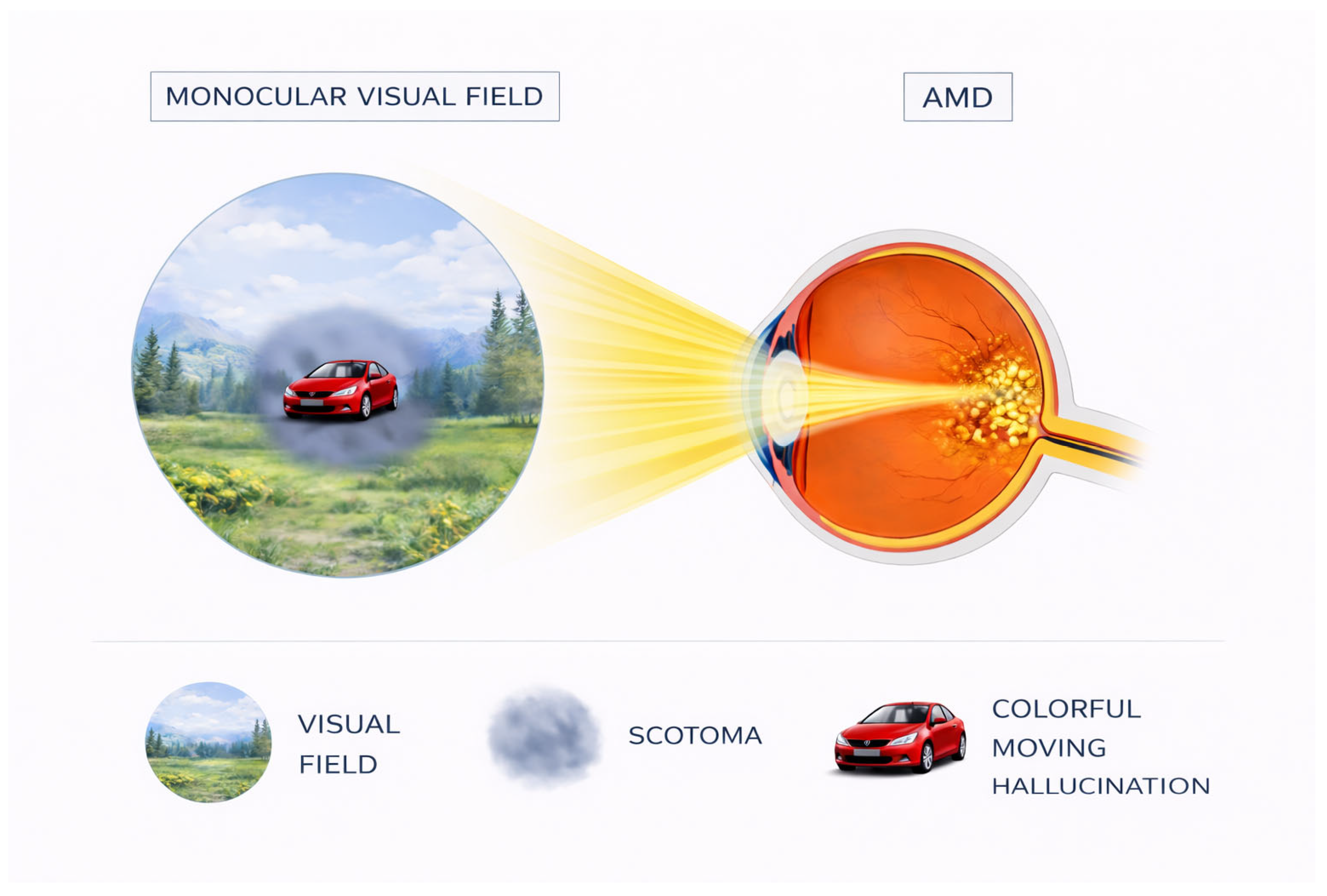
1. Introduction
The history of Charles Bonnet syndrome (CBS) begins in 1760 with the publication of “Essai analytique sur les facultés de l’âme,” a book written by the Swiss naturalist, philosopher, and biologist Charles Bonnet. In what some consider the first scientific publication on hallucinatory experiences [
1], Bonnet described the visual phenomena experienced by his grandfather, Charles Lullin. Lullin, an 89-year-old magistrate, began perceiving unusual visual perceptions following cataract surgery: men, women, birds, and buildings of variable dimensions and forms, none of which were evoked by external stimuli. Importantly, Lullin maintained full consciousness and was aware that these visions were not real but rather creations of his mind [
2,
3]. Interestingly, it was not Charles Bonnet who named this syndrome after himself, but rather his compatriot Georges de Morsier [
4], who later used Bonnet’s name in recognition of his being the first to describe the condition. The phenomenon of visual hallucinations following visual loss has been documented throughout medical history. In a compelling case reported by Cohn in his scientific article “Phantom Vision” [
5], a man who lost his left eye in an explosion and underwent surgical removal of the entire ocular bulb subsequently experienced visual sensations of malformed clouds emanating from the now-empty orbit. Cohn documented seven individuals who, after partial or complete vision loss, began experiencing visual sensations from their missing or non-functioning eyes. Although Cohn did not use the term, these individuals were likely experiencing Charles Bonnet syndrome [
5].
CBS is defined by the presence of complex visual hallucinations in individuals with visual impairment who retain intact cognitive function and insight into the unreality of their hallucinatory experiences [
1,
6]. These hallucinations can range from simple geometric patterns to elaborate scenes involving people, animals, and landscapes. The syndrome has garnered renewed scientific interest in recent years for several reasons: first, the aging population and increased prevalence of age-related visual impairment have led to greater clinical recognition of CBS [
7]; second, CBS offers a unique window into visual processing mechanisms in the brain [
8]; and third, the condition has been recently included in the 11th revision of the International Classification of Diseases (ICD-11), facilitating more standardized diagnosis and research [
9]. Despite this increased attention, CBS remains underdiagnosed and often poorly understood by healthcare professionals [
10]. Furthermore, the exact neurobiological mechanisms underlying visual hallucinations in CBS continue to be debated.
This review was motivated by the clinical imperative to develop a more comprehensive understanding of CBS patients beyond isolated theoretical frameworks. Despite significant advances in specific domains of CBS research, clinicians face challenges in translating compartmentalized mechanistic models into holistic patient assessment and management. The fragmentation of explanatory models across ophthalmological, neurological, and psychiatric perspectives has created barriers to integrated care. Visual hallucinations in CBS represent a complex phenomenon that transcends traditional disciplinary boundaries, necessitating a synthesis of diverse evidence to inform clinical practice.
To address this clinical need, we synthesized evidence from multiple disciplines to develop an integrated understanding of CBS pathophysiology. We conducted a comprehensive literature search using PubMed, Web of Science, and Google Scholar databases for articles published between 1980 and 2025, with particular emphasis on research from the past two decades. Search terms included “Charles Bonnet syndrome,” “visual hallucinations,” “deafferentation,” “cortical hyperexcitability,” “visual impairment hallucinations,” “predictive processing hallucinations,” and “neural desynchronization.” We prioritized peer-reviewed empirical studies, computational models, neuroimaging investigations, and clinical reports that contributed to understanding CBS mechanisms. Additionally, we identified relevant articles through citation tracking from seminal papers.
By developing a unified conceptual framework that bridges multiple levels of explanation, from cellular mechanisms to network dynamics to phenomenological experience, this review aims to facilitate more nuanced clinical reasoning and potentially guide more targeted therapeutic approaches. While not claiming exhaustive coverage of all CBS literature, this review encompasses major theoretical frameworks and empirical findings that inform current understanding of CBS pathophysiology, addressing an unmet need in clinical settings where practitioners must consider the multifaceted nature of visual hallucinations when evaluating and treating patients with CBS.
To achieve this goal, we have organized the review around an integrated multilevel framework. We begin by examining the epidemiology and clinical features of CBS, establishing its prevalence, risk factors, and distinctive hallucination characteristics. We then explore mechanistic explanations, starting with deafferentation as the initial trigger, followed by computational evidence that illustrates how the brain responds to sensory deprivation. Next, we move beyond simple hyperexcitability models to discuss how neural desynchronization across visual processing hierarchies disrupts normal predictive processing. We integrate these perspectives into a cohesive model that explains the complex phenomenology of CBS hallucinations. We then examine the clinical implications of this integrated model for diagnosis and treatment approaches, discussing both pharmacological and non-pharmacological interventions. Finally, we outline promising avenues for future research that could further advance our understanding of this fascinating condition and lead to improved therapeutic strategies.
4. Emerging Perspectives: Beyond Simple Hyperexcitability
4.1. Neural Desynchronization and Hierarchical Predictive Processing
Neural desynchronization refers to the loss of temporal coordination between different brain areas that normally work together. It is similar to musicians in an orchestra losing their common rhythm, compromising the harmony of the entire performance.
Within a computational framework, hallucinations arise when the precision assigned to sensory prediction errors is systematically reduced, allowing higher-level priors to dominate perceptual inference even in the absence of corroborating input. This perspective fundamentally reframes our understanding of CBS hallucinations, shifting the focus from local hyperexcitability to global disruptions in inferential processing across the visual hierarchy. According to predictive processing frameworks, visual perception emerges from the dynamic interplay between bottom-up sensory signals, top-down predictions, and precision-weighting mechanisms [
38,
39]. Bottom-up signals convey information from the retina to higher visual areas, carrying prediction errors that indicate discrepancies between expected and actual sensory input. Top–down predictions, generated by higher-order brain regions, constrain the interpretation of sensory information based on prior knowledge and contextual cues. Precision-weighting of prediction errors describes how the brain assigns different levels of importance (or ‘weight’) to errors that arise when brain predictions do not match sensory input. It is similar to how we decide how much to trust information based on its presumed reliability. These precision-weighting mechanisms, in turn, adjust the relative influence of prediction errors and prior expectations, effectively modulating the system’s confidence in sensory evidence. In the context of CBS, severe reductions in sensory input due to visual impairment produce several critical consequences. The ongoing generation of top-down predictions continues in the absence of corrective sensory feedback, allowing internally generated visual content to propagate unchecked. This leads to an altered balance between feedforward and feedback signaling within the visual hierarchy, with feedback influences becoming disproportionately influential. As a result, internally generated visual content emerges that is not effectively constrained by external reality, yet retains the structure and organization of normal visual representations. Concurrently, reduced precision-weighting of sensory prediction errors diminishes the system’s ability to distinguish between externally and internally generated activity.
While the predictive processing framework offers substantial explanatory power for CBS phenomena, we must acknowledge that direct empirical testing of these specific mechanisms in CBS populations remains limited. Much of the current application of predictive processing to CBS relies on extrapolation from computational principles, neuroimaging findings in other perceptual domains, and analogies with other conditions featuring altered perception. Future studies specifically designed to test predictive processing hypotheses in CBS patients, perhaps examining precision-weighting mechanisms directly, will be crucial for validating this theoretical framework.
This computational perspective provides a coherent explanation for several otherwise puzzling features of CBS hallucinations, including their semantic organization, which reflects stored visual representations, their episodic nature, which mirrors fluctuations in precision-weighting, and their content specificity, which aligns with the category-selective organization of the visual system.
4.2. Neurochemical Mechanisms and Neurotransmitter Systems
From a predictive processing perspective, neuromodulatory systems such as acetylcholine and serotonin regulate the gain and precision of prediction errors, thereby shaping the balance between bottom-up evidence and top-down expectations rather than directly generating perceptual content. Acetylcholine, in particular, plays a crucial role in signaling the expected precision of sensory input. Under normal conditions, high cholinergic tone enhances the gain of sensory units, effectively increasing the weight assigned to bottom-up information. In CBS, alterations in cholinergic signaling may reduce the precision of sensory evidence, allowing prior expectations to exert greater influence over perceptual content. This mechanism could explain why anticholinergic medications sometimes exacerbate hallucinations, while acetylcholinesterase inhibitors have shown promise in reducing CBS symptoms in some case reports [
35]. Other neurotransmitter systems may also contribute to CBS pathophysiology through their effects on predictive processing. GABAergic inhibition shapes the specificity and contrast of visual representations, potentially explaining why benzodiazepines can occasionally reduce hallucination severity. Serotonergic systems modulate the integration of sensory and contextual information, potentially accounting for the reported efficacy of some serotonergic agents in CBS treatment [
40].
Importantly, this neurochemical perspective suggests that pharmacological interventions might be most effective when targeted toward restoring the balance between bottom-up and top-down influences rather than simply reducing cortical excitability. This hypothesis could guide more rational approaches to CBS treatment development.
4.3. Neurophysiological Evidence
At the computational level, altered functional connectivity reflects a breakdown in hierarchical coordination, impairing the system’s ability to integrate predictions and prediction errors across levels of the visual hierarchy. Recent neurophysiological investigations have provided important insights into these functional alterations associated with CBS.
4.3.1. Electroencephalography (EEG) Findings
DaSilva Morgan et al. [
41] conducted a comprehensive EEG study comparing CBS patients with visually impaired controls without hallucinations. Their findings revealed that CBS patients exhibited reduced occipital alpha power and alpha-reactivity, suggesting altered inhibitory control in visual processing regions, alongside increased occipital theta power and elevated theta/alpha ratios, indicative of a shift toward slower oscillatory activity associated with reduced sensory precision. Overall, these patients displayed a pattern of cortical slowing in visual areas, consistent with altered processing dynamics rather than simple hyperexcitation. These results support a desynchronization model in which normal oscillatory coordination between visual processing stages is disrupted. Notably, the neurophysiological changes were more pronounced in patients experiencing complex hallucinations compared to those with simple hallucinations, pointing to a potential neural signature associated with hallucination complexity. Piarulli et al. [
34] used high-density EEG to investigate dynamic changes in brain activity during active hallucinations in a single case. Their analysis revealed reduced delta and theta power in frontal regions, suggesting alterations in top-down control, while alpha power increased in occipital and posterior medial regions, potentially reflecting enhanced internal generation of visual content. Additionally, small-world properties in theta networks were disrupted, indicating less efficient information transfer, and alpha signal complexity increased in medial frontal, left posterior, and right centroposterior regions, suggesting more chaotic processing dynamics.
Taken together, these EEG findings provide direct evidence that hallucinations in CBS involve complex alterations in neural dynamics and network coordination rather than simple increases in excitability. The observed changes in oscillatory patterns are consistent with predictive processing accounts of CBS, reflecting a disrupted balance between bottom-up and top-down processing within the visual system.
4.3.2. Transcranial Magnetic Stimulation (TMS) Evidence
TMS studies have provided direct evidence regarding cortical excitability in CBS. DaSilva Morgan et al. [
41] used phosphene induction to probe visual cortex excitability and found greater variability in phosphene thresholds among CBS patients compared to controls, suggesting unstable excitability rather than consistent hyperexcitability. Moreover, phosphene thresholds were significantly negatively correlated with hallucination severity, indicating that more severe hallucinations were associated with greater instability. Patients experiencing complex hallucinations also exhibited more widespread phosphene induction, reflecting altered spatial specificity of visual cortical responses. These findings imply that although overall phosphene thresholds may not differ markedly between CBS patients and controls, the stability of cortical excitability is compromised in CBS, with increased instability corresponding to more severe hallucinations. This pattern aligns with the predictive processing perspective, which attributes hallucinations to disrupted precision-weighting rather than to a simple increase in excitability.
Beyond its mechanistic insights, the TMS evidence underscores the potential of non-invasive brain stimulation as both a research tool and a therapeutic approach for CBS. By transiently modulating cortical excitability, TMS may help normalize visual processing patterns and potentially reduce the frequency or intensity of hallucinations.
4.4. Neuroimaging Evidence
Functional MRI studies have revealed altered patterns of visual cortical activation in CBS that go beyond simple hyperexcitability. In a seminal investigation, Ffytche et al. [
27] demonstrated content-specific activation during hallucinations, with specialized visual areas engaging in accordance with the content being hallucinated, for example, face-selective regions activating during face hallucinations. This finding confirmed that hallucinations recruit the same neural substrates involved in normal perception of the corresponding stimuli. More recently, DaSilva Morgan et al. [
41] reported reduced activation in primary visual cortex and ventral extrastriate areas in response to visual stimulation among CBS patients, suggesting a paradoxical decrease in responsiveness to external input despite spontaneous internal activation. Similarly, Bridge et al. [
33] observed subtle differences in visual responses to object stimuli, with a tendency toward greater activation contrasts between objects and scrambled stimuli, indicating altered categorical processing in the ventral visual stream rather than uniform hyperactivity. Collectively, these findings suggest that the visual cortex in CBS does not merely exhibit increased activity but demonstrates altered activation patterns that reflect disrupted processing hierarchies and imbalances between different visual pathways. The content-specific activation observed during hallucinations provides particularly compelling evidence that hallucinations arise from structured internal representations rather than from random neural firing.
Resting-state functional connectivity analyses have further illuminated network-level alterations underlying CBS hallucinations. Unlike task-based functional magnetic resonance imaging (fMRI) studies, which focus on activation patterns during specific activities, resting-state analyses reveal intrinsic communication patterns between brain regions, offering insights into how hallucinations may emerge from altered network dynamics. Bridge et al. [
33] found subtle but significant differences in connectivity between the lateral occipital cortex, critical for object recognition and other brain regions, with a trend toward stronger local connectivity within visual processing areas in CBS patients who experienced more frequent or intense hallucinations. This heightened local connectivity may reflect an internally focused processing loop less constrained by external input, facilitating the emergence of hallucination-like percepts. Complementing these results, Piarulli et al. [
34] used high-density EEG to capture connectivity dynamics during active hallucinatory episodes in a case study. They observed altered functional relationships between visual processing regions and components of the default mode network (DMN), a system typically associated with internally directed cognition, autobiographical memory, and self-referential processing. Such changes suggest a mechanism whereby visual representations, normally constrained by the DMN during rest, become inappropriately activated and interpreted as external percepts. Altogether, these findings indicate a fundamental reorganization of information flow within and between visual and non-visual networks in CBS, showing that hallucinations involve altered patterns of communication across distributed neural systems rather than isolated hyperactivity. This network perspective helps explain both the structured content of hallucinations, which draw on existing visual representations and their percept-like phenomenology, arising from altered integration between perceptual and reality-monitoring networks.
In contrast, structural neuroimaging studies have produced inconsistent evidence regarding anatomical differences in CBS patients, offering important clues about the syndrome’s nature. Firbank et al. [
42] conducted a comprehensive morphometric analysis comparing CBS patients with visually impaired controls without hallucinations, employing voxel-based morphometry, cortical thickness analysis, and diffusion tensor imaging. They found no significant structural differences after controlling for age, sex, and degree of visual impairment, suggesting that CBS hallucinations may not rely on detectable macroscopic abnormalities beyond those associated with vision loss. Martial et al. [
43] reported altered cortical thickness in visual processing regions in a single-case study. However, these findings must be interpreted cautiously due to the lack of age-matched controls and the inherent limitations of single-case designs, which may reflect individual variability rather than hallucination-specific changes. The relative absence of consistent structural alterations in CBS contrasts sharply with conditions such as schizophrenia or dementia with Lewy bodies, where hallucinations typically coincide with detectable brain changes. This dissociation between functional and structural findings supports the view that CBS hallucinations emerge primarily from altered functional dynamics within anatomically preserved circuits rather than from structural damage to specific regions. This perspective aligns with the integrated model developed throughout this review, positing that hallucinations in CBS arise from adaptive responses to sensory deprivation that reorganize functional information processing while preserving structural integrity, with implications for conceptualizing CBS as a functional disorder and for developing interventions targeting neural dynamics rather than structural abnormalities.
These emerging perspectives on neural desynchronization, neurochemical mechanisms, and hierarchical processing offer valuable insights into specific aspects of CBS. The neurophysiological evidence reveals complex patterns of altered oscillatory activity and unstable cortical excitability rather than simple hyperactivation. Neurochemical findings suggest dynamic rather than static alterations in neurotransmitter systems. Neuroimaging studies demonstrate altered functional connectivity patterns across distributed networks rather than isolated cortical changes. Collectively, these findings point to CBS as a network-level disorder involving disrupted coordination across multiple brain systems. However, a comprehensive understanding requires an integrated model that synthesizes these diverse perspectives across multiple levels of explanation, from cellular adaptations to network dynamics to computational principles. The following section presents such a model, drawing together the empirical and theoretical threads explored thus far into a unified framework that bridges these complementary levels of analysis.
5. Integrated Model: Neural Desynchronization and Selective Disinhibition
The body of evidence accumulated over the past several decades has gradually shifted scientific understanding of CBS from earlier models centered solely on cortical hyperexcitability toward a more nuanced, integrated perspective. Classic accounts provided valuable initial frameworks, but recent advances across multiple disciplines now enable a more comprehensive synthesis. As we have seen, deafferentation provides the initial condition necessary for CBS but cannot explain the structured content or episodic nature of hallucinations. Release phenomena help explain how deafferented cortex generates structured visual content, but struggle to account for the global network dynamics involved. The neurophysiological evidence reveals complex patterns of altered oscillatory activity and unstable excitability rather than simple hyperactivation, while neuroimaging findings demonstrate altered functional connectivity across distributed networks rather than isolated regional changes. These observations, together with insights from predictive processing frameworks (
Section 4.1) and neurochemical mechanisms, demand a more sophisticated explanatory model.
By synthesizing these diverse insights from computational neuroscience, neurophysiology, neuroimaging, and clinical observations, we propose a model of CBS pathophysiology that operates across multiple levels of analysis and explanation, building upon earlier network-based approaches [
8,
26]. This integrated model centers on neural desynchronization and selective disinhibition as key mechanisms that link the various empirical findings and theoretical perspectives discussed thus far.
5.1. A Multilevel Explanatory Framework
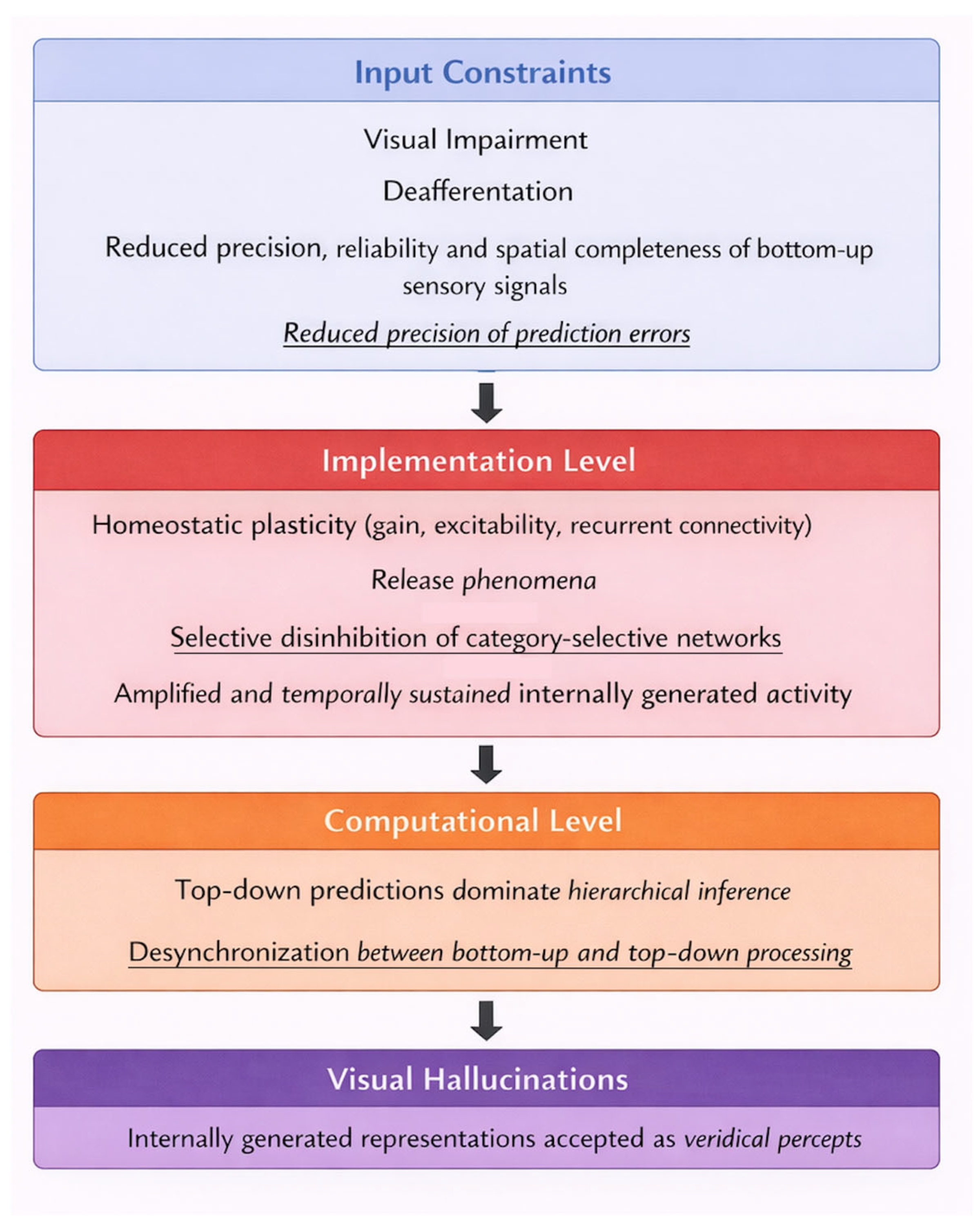
The preceding sections have addressed Charles Bonnet syndrome at complementary levels of explanation, each capturing essential but partial aspects of its pathophysiology. Deafferentation describes the altered sensory input regime imposed by visual impairment, release phenomena specify the neural mechanisms through which cortical systems respond to sustained deprivation, and predictive processing frameworks formalize the inferential principles governing perceptual experience under uncertainty. The integration of these perspectives provides a unified, multilevel model of CBS grounded in Marr’s framework of computational neuroscience [
26].
At the level of input constraints, visual deafferentation reduces the precision, reliability, and spatial completeness of bottom-up sensory signals. This alteration does not merely weaken sensory drive but fundamentally changes the statistical structure of the perceptual environment encountered by the visual system. As a result, perceptual inference must operate under conditions of chronically elevated uncertainty, particularly in deafferented regions of the visual field. At the implementation level, neural systems adapt to this altered input regime through homeostatic and plastic mechanisms that regulate gain, excitability, and recurrent connectivity. Release phenomena emerge as a consequence of these adaptations, enabling internally generated activity within higher-order visual areas to become amplified and temporally sustained. Importantly, the activity that is released reflects learned representational structure and semantic organization rather than undifferentiated noise, providing a mechanistic substrate for the content-rich nature of CBS hallucinations, as demonstrated in computational simulations [
32]. At the computational level, predictive processing models explain how these implementation-level changes translate into conscious perceptual experience [
38,
39]. Reduced sensory precision attenuates the impact of prediction errors, allowing top-down predictions to dominate hierarchical inference. Under these conditions, internally generated representations are more likely to be accepted as veridical percepts, particularly when hierarchical coordination and temporal synchronization between visual areas are disrupted. Hallucinations thus arise not from a failure of perception per se, but from a systematic shift in the inferential balance that normally distinguishes internally generated activity from externally caused sensory input [
44], as schematized in
Figure 2.
5.2. Key Components of the Integrated Model
According to this integrated perspective, several interconnected mechanisms contribute to CBS hallucinations. Deafferentation and subsequent cellular adaptation play a central role: loss of visual input triggers homeostatic processes that alter the excitability of deafferented neurons. Rather than resulting in uniform hyperexcitability, these adaptations produce complex patterns of altered neural dynamics, including receptor upregulation, changes in local inhibitory circuit function, and modifications in synaptic strength, which collectively reshape the response properties of visual neurons. This view is supported by recent evidence of variable rather than uniformly decreased phosphene thresholds in CBS patients [
37]. Disrupted hierarchical processing further contributes to hallucinations, as the visual system normally relies on a balance between bottom-up sensory input and top-down predictions. In CBS, diminished bottom-up signals allow unconstrained top-down influences to dominate perception, a phenomenon reflected in fMRI findings showing that hallucinations recruit the same category-selective regions involved in normal perception of corresponding stimuli [
27]. At the network level, CBS is characterized by altered synchronization between distributed brain networks rather than isolated cortical hyperactivity. EEG studies reveal changes in oscillatory patterns that provide direct evidence of desynchronization, particularly between early visual areas and higher-order regions involved in object recognition, attention, and semantic processing, which may compromise the brain’s ability to distinguish internally generated activity from external sensory input [
34]. This is complemented by selective disinhibition, in which specific neural circuits become disinhibited based on their pre-existing organization and connectivity patterns. Such selectivity explains why hallucinations often contain semantically meaningful and structured content, frequently reflecting culturally familiar objects and faces rather than random visual features, as observed by Ffytche in his investigations of content-specific hallucination mechanisms [
8]. Finally, the transient, state-dependent nature of hallucinations suggests that these neural alterations interact with fluctuating brain states influenced by factors such as arousal, attention, and environmental context. This state dependence accounts for the episodic occurrence of hallucinations and their modulation by changes in lighting, attention, or general arousal level, patterns that cannot be easily reconciled with models based solely on hyperexcitability.
It is important to distinguish between components of this model that have strong empirical support and those that remain more hypothetical. The role of deafferentation as an initial trigger and the content-specific activation during hallucinations are well-established empirically. However, specific claims about the role of neurotransmitters in precision-weighting and the exact nature of desynchronization between hierarchical levels represent theoretical extensions that, while consistent with available evidence, require further direct investigation in CBS populations.
Our perspective could extend and complement the Perception and Attention Deficit (PAD) model proposed by Collerton et al. [
25], which emphasizes the interaction between impaired sensory processing and top-down attentional mechanisms in generating complex visual hallucinations. While the PAD model focuses primarily on the functional interplay between attentional binding and object perception within scene representations, our framework adds a crucial mechanistic layer by specifying the neurophysiological substrate underlying these interactions: neural desynchronization. Where Collerton et al. [
25] highlight the behavioral and cognitive consequences of combined attentional and perceptual deficits, our model illuminates the dynamic neural processes through which these deficits manifest, specifically, the disruption of synchronized activity between distributed visual networks. This desynchronization mechanism provides a neurophysiological explanation for how the attentional and perceptual components identified in the PAD model interact at the implementation level.
Our approach also builds upon the comprehensive review by Christoph et al. [
45], who similarly highlight deafferentation, predictive coding, and the PAD model as key mechanisms in CBS pathophysiology. While their analysis provides an excellent synthesis of existing theoretical frameworks, our focus on desynchronization as a unifying neurophysiological principle offers a novel perspective that integrates these diverse accounts. Where Christoph et al. [
45] present these mechanisms as parallel explanatory frameworks, our model proposes that neural desynchronization represents a common pathway through which various pathophysiological processes ultimately manifest as hallucinations.
5.3. Explanatory Power of the Integrated Model
This integrated perspective provides an explanatory framework for key observations that are not adequately accounted for by simple hyperexcitability models. It accounts for the semantic richness and organization of hallucination content, which reflects pre-existing representational structures rather than random neural firing [
32], as well as the episodic nature of hallucinations, consistent with fluctuations in network states rather than continuous hyperactivity. The model also explains the lack of correlation between the severity of visual impairment and hallucination complexity, indicating that factors beyond deafferentation alone shape the characteristics of hallucinations.
This integrated model also reconciles several apparently contradictory findings in the CBS literature. First, it resolves the paradox of why CBS patients show both increased and decreased cortical activity in different studies. Our model explains this through region-specific alterations in excitation-inhibition balance rather than global hyperexcitability. Second, it addresses the contradiction between preserved insight and vivid hallucinations by distinguishing between perceptual inference mechanisms (which are disrupted) and higher-order reality monitoring systems (which remain intact). Third, it explains the puzzling observation that improving visual input sometimes worsens hallucinations before improving them, a finding consistent with temporary destabilization of predictive processing as the system recalibrates to new precision weightings. Fourth, it reconciles the variable efficacy of pharmacological interventions targeting different neurotransmitter systems, as these may address different components of the desynchronized network depending on individual patient characteristics. Finally, it explains why hallucination content often reflects culturally familiar imagery despite arising from deafferentation. The released activity draws upon existing representational structures shaped by prior experience rather than random neural firing.
Neurophysiological evidence further supports this view, revealing complex patterns of altered cortical activity and connectivity rather than straightforward excitatory changes [
37,
41]. Additionally, the preservation of insight in most CBS patients suggests that reality-monitoring systems remain at least partially intact despite altered perceptual processing, a finding consistent with predictive processing accounts that distinguish between perceptual inference and higher-order belief evaluation [
38,
44]. The variable efficacy of different treatment approaches underscores the likelihood that hallucinations arise from multiple interacting mechanisms rather than a single pathophysiological process. By conceptualizing CBS as a disorder of neural synchronization and predictive inference, this integrated model offers a more comprehensive framework for understanding the syndrome’s diverse manifestations and for developing targeted therapeutic strategies, extending earlier network-based models to incorporate advances in computational neuroscience and predictive processing theory [
8,
25].
While building on the foundations established by previous frameworks, such as the PAD model, and synthesized in recent reviews, such as that of Christoph et al. [
45], our desynchronization-centered approach adds mechanistic specificity that may guide future research and therapeutic interventions. By focusing on the temporal dynamics of neural activity rather than simply its amplitude or location, this model opens new avenues for investigation using techniques that can directly assess neural synchronization, such as magnetoencephalography (MEG), high-density EEG, and connectivity analyses of functional neuroimaging data.
The integrated neural desynchronization model presented above has significant implications beyond theoretical understanding. By reconceptualizing CBS as a disorder involving complex interactions across multiple neural systems rather than simple hyperexcitability, this framework opens new avenues for diagnosis and treatment that more precisely target the underlying mechanisms.
To clarify the added value of our framework and to explicitly contrast it with previous accounts,
Table 1 summarizes the principal theoretical models of Charles Bonnet syndrome across levels of explanation, core mechanisms, and explanatory scope. It highlights the specific contributions of neural desynchronization, selective disinhibition, and precision-weighting within a multilevel framework.
5.4. Empirical Predictions and Testable Hypotheses
To operationalize this framework and provide concrete guidance for future empirical studies, we formulate several specific, testable hypotheses that follow directly from the proposed integration of deafferentation, hierarchical inference, and neural desynchronization. These predictions span multiple levels of analysis and can be addressed using currently available neurophysiological and neuroimaging techniques.
At the level of oscillatory dynamics, we predict that the phenomenological distinction between simple and complex hallucinations will be reflected in distinct patterns of neural activity. Specifically, simple geometric hallucinations, such as grids, zigzags, or colored patches, should be associated with increased alpha and beta power (8–30 Hz) localized to early visual cortex (V1/V2), reflecting altered local gain regulation and intrinsic excitability. In contrast, complex semantic hallucinations involving faces, objects, or scenes should recruit category-selective regions in the ventral visual stream and be characterized by increased gamma-band activity (30–80 Hz), which is known to support feature binding and semantic processing. These oscillatory signatures can be directly tested using source-localized high-density EEG or MEG recordings during active hallucination episodes.
From the perspective of hierarchical connectivity, our model predicts systematic alterations in the balance between bottom-up and top-down information flow during hallucinatory experiences. Specifically, patients should exhibit reduced effective connectivity from early visual cortex to higher-order visual areas, reflecting weakened sensory constraints on perceptual inference, alongside increased top-down connectivity from frontal and parietal regions to visual cortex, reflecting the dominance of prior expectations. These directional connectivity patterns can be quantified through dynamic causal modeling or Granger causality analysis applied to fMRI or EEG data, providing a direct test of the hierarchical imbalance central to predictive processing accounts of hallucinations.
At the network level, we hypothesize that the episodic nature of CBS hallucinations reflects transient disruptions in large-scale functional integration. Hallucinatory episodes should coincide with reductions in functional connectivity, measured via coherence, phase-locking, or other synchronization metrics, between early visual cortex and frontoparietal control networks. This desynchronization would compromise the brain’s ability to effectively distinguish internally generated activity from externally driven sensory input. Time-resolved connectivity analysis comparing periods with and without hallucinations within the same patients would provide a powerful approach to testing this prediction, controlling for individual differences and capturing the dynamic nature of the phenomenon. Individual differences in hallucination phenomenology may also be systematically related to baseline neural architecture. We predict that the specific content of hallucinations, for example, whether patients predominantly experience faces, objects, or scenes, will correlate with the strength of resting-state functional connectivity between early visual cortex and corresponding category-selective regions in the ventral stream. For instance, patients with stronger connectivity between V1 and the fusiform face area may be more likely to experience face hallucinations. This prediction can be tested through correlation analyses relating baseline connectivity profiles to detailed phenomenological characterization of hallucination content.
Finally, our framework generates predictions regarding treatment response that may have direct clinical utility. We hypothesize that effective therapeutic interventions, whether neuromodulatory (e.g., transcranial direct current stimulation) or pharmacological (e.g., cholinergic agents), will restore more balanced hierarchical coordination and reduce pathological desynchronization between visual and control networks. These neural changes should be measurable as alterations in effective connectivity and oscillatory coupling patterns from pre- to post-treatment assessments, and their magnitude may correlate with clinical improvement in hallucination frequency or severity. Collectively, these falsifiable predictions provide concrete targets for future investigation using high-density EEG and MEG, multimodal neuroimaging approaches combining fMRI with electrophysiology, and longitudinal study designs incorporating real-time phenomenological reporting. By translating the present theoretical framework into specific empirical hypotheses, we aim to facilitate the transition from conceptual models to data-driven refinement of our understanding of Charles Bonnet Syndrome pathophysiology.
5.5. Multifactorial Influences and Integrated Care
While this review focuses primarily on neural mechanisms, it is important to acknowledge that CBS is a multifactorial syndrome influenced by factors beyond neural circuitry. Psychological, peripheral visual system, and environmental factors all contribute to the manifestation and experience of visual hallucinations in visually impaired individuals.
Psychological factors, including stress, anxiety, and social isolation, have been identified as potential modulators of hallucination experiences [
7,
12,
17]. From the perspective of our integrated model, these psychological states may influence hallucination threshold and content by affecting the precision-weighting mechanisms central to predictive processing. Stress and anxiety can alter arousal levels and neurotransmitter balance, potentially destabilizing the already compromised balance between bottom-up and top-down processing in visually impaired individuals. Social isolation may reduce external sensory stimulation and contextual anchoring, further enabling internally generated content to dominate perception. Conversely, social engagement and psychological well-being may strengthen reality-monitoring processes and provide competing sensory input that constrains hallucinatory experiences.
Peripheral visual system factors also play important roles beyond simply initiating deafferentation. The specific pattern of visual loss (central vs. peripheral, gradual vs. sudden, complete vs. partial) may influence both the likelihood of developing hallucinations and their phenomenological characteristics [
22]. For instance, the spatial correspondence between scotomata and hallucination content suggests that the precise topography of retinal damage shapes hallucinatory experiences. Additionally, fluctuations in intraocular pressure, retinal blood flow, or medication effects on the peripheral visual system may contribute to the episodic nature of hallucinations by dynamically altering the quality and quantity of residual visual input.
Environmental conditions, including lighting, visual complexity, and multisensory stimulation, can significantly modulate hallucination frequency [
14,
17]. These factors likely operate by altering the reliability and precision of available sensory evidence, thereby shifting the balance of predictive processing. Improved lighting may enhance the precision of residual visual input, allowing bottom-up signals to more effectively constrain perceptual inference. Similarly, multisensory stimulation may provide alternative sources of reliable sensory evidence that reduce reliance on vision-based predictions.
Our neural desynchronization model provides a framework for understanding how these diverse factors converge to influence hallucination experiences. By conceptualizing hallucinations as arising from altered precision-weighting and network synchronization, we can explain how psychological, peripheral, and environmental factors modulate CBS symptoms through their effects on these core neural mechanisms. This perspective suggests that comprehensive clinical care should address multiple contributing factors rather than focusing exclusively on neural or ophthalmological interventions. An integrated approach combining visual rehabilitation, psychological support, environmental modifications, and, when appropriate, pharmacological or neuromodulatory treatments, is likely to be most effective for managing this complex syndrome. To illustrate the theoretical clinical implications derived from each explanatory framework,
Table 2 summarizes the major theoretical models of CBS alongside their corresponding therapeutic perspectives.
7. Future Research Directions
The integrated model of CBS presented in this review suggests several promising avenues for future investigation. By approaching CBS as a complex disorder involving interactions across multiple levels, from cellular mechanisms to network dynamics to inferential processing, researchers can develop more comprehensive and targeted approaches to understanding and treating this condition.
7.1. Neurodynamic Investigations
A major limitation of the current literature is the relative scarcity of data capturing neural activity during ongoing hallucinatory episodes. Addressing this gap represents a critical priority for future research, as real-time monitoring of brain activity during hallucinations has the potential to substantially advance our understanding of CBS. The integration of high-density EEG or magnetoencephalography (MEG) with experience-sampling methodologies would make it possible to characterize the neural dynamics that precede, accompany, and follow hallucinatory experiences with high temporal resolution. Such approaches could help determine whether specific neural signatures reliably predict hallucination onset and whether these signatures vary systematically as a function of hallucination content or complexity. Within this context, further investigation of oscillatory dynamics constitutes a particularly promising avenue. More detailed characterization of frequency-specific oscillatory patterns and their relationship to hallucination phenomenology could shed light on the mechanisms underlying different hallucinatory experiences. While our integrated model generates specific predictions regarding distinct oscillatory profiles for simple versus complex hallucinations (
Section 5.4), empirical validation of these predictions remains a priority. Similarly, determining whether effective therapeutic interventions selectively normalize specific aspects of aberrant oscillatory activity represents a critical test of mechanism-based treatment approaches. Addressing these issues would provide direct empirical tests of the neural dynamics proposed by the integrated model outlined in this review.
In addition, the study of cross-frequency coupling, such as interactions between theta and gamma bands, may offer crucial insights into how disrupted hierarchical processing contributes to hallucinations in CBS. Under normal conditions, cross-frequency coupling supports the integration of information across multiple temporal and spatial scales in perceptual processing. Alterations in these coupling patterns could impair coordination between different levels of the visual hierarchy, providing a mechanistic account of how internally generated activity comes to be misattributed to external sensory sources.
7.2. Network-Level Approaches
Advanced analytical approaches offer powerful tools for probing the network-level alterations that underlie CBS hallucinations. In particular, methods such as dynamic causal modeling and related techniques that infer directed interactions between brain regions may help clarify changes in effective connectivity within the visual system and beyond. By characterizing the directionality of information flow, these approaches could reveal whether hallucinations primarily reflect aberrant bottom-up signaling, disinhibited top-down influences, or a combination of both, thereby providing a direct empirical test of central predictions derived from predictive processing accounts of hallucination generation. Graph-theoretical analyses provide a complementary perspective by enabling quantitative characterization of large-scale network topology and information flow within visual processing hierarchies. Metrics capturing network segregation, integration, and small-world properties may reveal how alterations in connectivity patterns relate to specific hallucinatory features. For example, differences in network organization may distinguish patients who experience complex, semantically rich hallucinations from those whose experiences are limited to simpler visual phenomena, offering insights into how network topology constrains perceptual content.
Finally, multimodal integration approaches that combine structural, functional, and neurochemical measures hold particular promise for developing comprehensive models of CBS pathophysiology. By integrating indices of structural connectivity derived from diffusion imaging with functional dynamics measured through fMRI or EEG, alongside neurochemical profiles assessed using magnetic resonance spectroscopy, future studies could elucidate how multiple interacting factors converge to produce hallucinations in individual patients. Such integrative frameworks would move the field beyond single-modality explanations and toward a more complete understanding of the network-level mechanisms that give rise to CBS hallucinations.
7.3. Precision Medicine Approaches
The marked heterogeneity observed in CBS presentations highlights the potential value of subtype identification approaches. Determining whether distinct neurobiological mechanisms underlie different hallucinatory phenomenologies, such as simple versus complex experiences, colored versus achromatic imagery, or static versus dynamic percepts, could substantially refine both theoretical models and clinical management strategies. Addressing this question will require studies involving larger and well-characterized cohorts of CBS patients, combining standardized assessments of hallucination features with detailed neuroimaging and electrophysiological measures. Such efforts would allow researchers to move beyond descriptive classifications and toward biologically informed subtypes of CBS. Closely related to this goal is the development of reliable biomarkers; this represents a critical step toward more personalized treatment approaches. Identifying neurophysiological or neuroimaging markers that predict treatment response could guide clinical decision-making and reduce reliance on trial-and-error strategies. For instance, specific EEG signatures might differentiate patients more likely to benefit from acetylcholinesterase inhibitors as opposed to antipsychotic medications, while patterns of functional connectivity could help identify individuals who are most likely to respond to non-invasive brain stimulation techniques.
Ultimately, these precision-oriented approaches could enable genuinely targeted interventions tailored to individual patterns of neural dysregulation. Rather than applying uniform treatments across a heterogeneous patient population, clinicians could select pharmacological agents, stimulation parameters, or behavioral interventions based on objectively measured neural characteristics. Such personalized medicine strategies have the potential to improve therapeutic outcomes while simultaneously minimizing unnecessary medication exposure and associated side effects.
7.4. Translational Research
Computational modeling provides a powerful framework for integrating the diverse empirical findings reviewed here and for generating testable predictions about the mechanisms underlying CBS. Further development of biologically plausible models that simulate how alterations in neural circuits give rise to hallucinatory percepts could help bridge the gap between cellular-level changes and subjective perceptual experience. Importantly, such models could be fitted to individual patient data, potentially revealing mechanistic differences across CBS subtypes and offering principled guidance for the selection of targeted interventions.
Although animal models cannot capture the subjective phenomenology of hallucinations, ethologically relevant models of sensory deafferentation nonetheless offer valuable opportunities to investigate the cellular and molecular processes that accompany adaptation to visual loss. These approaches could clarify specific changes in synaptic function, neurotransmitter signaling, and large-scale network dynamics that follow deafferentation, thereby identifying novel biological targets for therapeutic intervention.
At the translational level, there is a growing need for mechanism-based clinical trials that focus on specific aspects of neural dysregulation rather than on symptom suppression alone. Designing interventions around hypothesized mechanisms, such as restoring excitation–inhibition balance, enhancing cholinergic modulation of sensory precision, or stabilizing network dynamics, would allow clinical trials to simultaneously test mechanistic predictions and evaluate therapeutic efficacy. Incorporating biomarkers linked to the targeted mechanism would further strengthen this approach, enabling researchers to assess target engagement directly and to determine whether modulation of the proposed neural process is associated with meaningful clinical improvement.
Despite significant progress in understanding CBS, several aspects of the integrated model presented here remain hypothetical or based on inference from indirect data. The application of predictive processing frameworks to CBS, while theoretically compelling, awaits more direct empirical validation. Similarly, the precise roles of specific neurotransmitter systems in modulating the balance between bottom-up and top-down processing in CBS require further investigation with techniques that can capture dynamic neurochemical changes during hallucinatory episodes. These limitations highlight the need for studies specifically designed to test key predictions of the integrated model, particularly those examining the relationship between neural desynchronization and hallucination phenomenology. Such work would strengthen the empirical foundation of the theoretical framework advanced in this review.
8. Conclusions
Charles Bonnet syndrome offers a uniquely informative window into the neural mechanisms underlying visual perception and conscious experience. The evidence reviewed here indicates that CBS hallucinations do not arise from simple hyperexcitability of the deafferented visual cortex, but rather from complex alterations in the dynamics of distributed neural networks supporting visual processing. By situating CBS within an integrated framework that spans sensory constraints, neural implementation, and computational inference, this review highlights how hallucinations emerge from dynamic interactions across multiple levels of explanation, underscoring the necessity of multiscale approaches for both understanding and treating this condition. Central to this framework is the desynchronization between bottom-up sensory signals and top-down predictive processes, further modulated by neurotransmitter systems and contextual factors. Visual deafferentation establishes the initial conditions by reducing the precision of sensory input, release mechanisms shape the emergence of structured internal representations, and failures of predictive inference explain how these internally generated representations are misattributed to external reality rather than recognized as endogenous perceptual activity. This integrated perspective reconciles several apparently contradictory findings in the literature and provides a coherent account of key clinical features of CBS. It helps explain why only a subset of visually impaired individuals develop hallucinations, why hallucinatory content is often semantically rich and structured, and why hallucinations tend to occur episodically rather than as a continuous perceptual state. Moreover, it accounts for the marked heterogeneity in treatment response, suggesting that different therapeutic approaches may engage distinct components of a multilevel pathophysiology rather than a single underlying mechanism. It should be emphasized that the therapeutic implications discussed above are largely mechanistically inspired and not yet supported by robust large-scale clinical trials. Current treatment approaches remain empirical and exploratory, underscoring the need for adequately powered randomized studies. Beyond its specific relevance to CBS, the neural desynchronization framework advanced here has broader implications for understanding hallucinatory phenomena across clinical and non-clinical contexts. More generally, it offers insights into the neural basis of perception and consciousness, illustrating how perceptual experience emerges from the ongoing negotiation between sensory evidence and prior expectations and how disruptions to this balance can profoundly alter the experience of reality. As experimental tools and analytical methodologies continue to advance, our understanding of CBS is likely to evolve further, opening the door to more refined diagnostic strategies and mechanism-targeted interventions. Progress in this field will depend on research that fully embraces the complexity of neural systems across multiple levels of explanation, from molecular and cellular mechanisms to network dynamics and computational principles. Ultimately, continued investigation of CBS promises not only to improve clinical care for affected individuals but also to deepen our fundamental understanding of how the brain constructs visual reality and what happens when these constructive processes go awry.