
Article

A Novel H∞/H2 Pole Placement LFC Controller with Measured Disturbance Feedforward Action for Disturbed Interconnected Power Systems


1
Electrical & Computer Engineering Department, Faculty of Engineering, Beirut Arab University (BAU), Tripoli 11-5020, Lebanon
2
College of Engineering and Technology, American University of the Middle East, Egaila 54200, Kuwait
3
Energy and Thermo-Fluid Group, Lebanese International University (LIU), Bekaa 146404, Lebanon
4
Energy and Thermo-Fluid Group, The International University of Beirut (BIU), Beirut 11-0236, Lebanon
5
Laboratory of Sciences in Information and Systems (LIS), Faculty of Sciences, Universite Aix-Marseille, 13284 Marseille, France
*
Author to whom correspondence should be addressed.
Automation 2025, 6(4), 90; https://doi.org/10.3390/automation6040090
Submission received: 12 October 2025 / Revised: 27 November 2025 / Accepted: 30 November 2025 / Published: 8 December 2025
(This article belongs to the Section Automation in Energy Systems)

Abstract

Load Frequency Control (LFC) is essential for ensuring frequency stability in modern power systems subject to load fluctuations, uncertainties, and increasing renewable penetration. This paper introduces a novel hybrid control framework that unifies H∞ stability guarantees, H2 performance, and pole placement for transient shaping. Its originality is threefold. First, it models load variation as a measurable disturbance (D12 = 0, D21 ≠ 0), departing from the standard assumption of an unknown input. This enables a low-order H∞ controller that improves transient response, enhances robustness, and reduces energy consumption. Second, the framework explicitly accounts for a wider spectrum of real-world uncertainties, including governor and turbine dynamics and the transmission-line synchronizing power coefficient. Third, it integrates explicit energy optimization to reduce mechanical stress and extend equipment lifespan. This strategy yields substantial energy savings by minimizing fuel use and operational costs. Simulation results confirm its superiority: the proposed H∞/H2 pole placement controller with measured disturbances achieves a 98% reduction in control energy relative to a standard H∞ controller, along with a 70% reduction in overshoot and a drastic improvement in settling time—from 7 s to 0.2 s—compared to a conventional H∞/H2 controller. These results establish the proposed framework as a new benchmark for robust, efficient, and high-performance LFC design.

1. Introduction

Load Frequency Control (LFC) is a fundamental component of power system operation, ensuring stability, reliability, and efficient energy distribution. In interconnected systems, maintaining frequency stability becomes increasingly challenging under varying load conditions, parameter variations—such as turbine–governor time constant deviations—growing renewable penetration, and evolving grid architectures. Over recent decades, extensive research has introduced numerous approaches to meet these challenges. Based on their primary focus, existing strategies can be grouped into several themes:
  • Conventional Control Techniques:
These foundational methods—primarily PID and FOPID controllers—have been refined using adaptive tuning and LQR-based techniques to enhance stability and transient response. Studies such as [1,2,3] demonstrate their ability to handle nonlinear dynamics and diverse operating conditions. For example, Ref. [1] presents a hybrid EOA-AFFOPID approach combining FOPID control with fuzzy logic, enabling dynamic real-time coefficient adjustment and notable performance improvements.
  • Intelligent Control Methods:
This category explores AI and ML techniques—including fuzzy logic, neural networks, and hybrid AI—to address nonlinearities and uncertainties. Works such as [4,5,6,7] report significant enhancements in stability and transient response. For instance, Ref. [4] applies fuzzy logic for PI gain scheduling in an LFC framework, while Ref. [5] introduces an adaptive neural control scheme based on differential flatness and B-spline neural networks to stabilize transients. Similarly, Ref. [7] proposes a local LFC approach leveraging fuzzy systems for unknown-dynamics estimation and adaptive control law formulation supplemented by an auxiliary signal to counteract both fuzzy approximation errors and external disturbances.
  • Optimization-Based Approaches:
Genetic algorithms, particle swarm optimization, and hybrid metaheuristics have been widely applied for controller tuning and system optimization. Studies such as Refs. [8,9,10,11,12,13,14] illustrate this. For example, Ref. [8] optimizes FOPID scaling factors using PSO, while Ref. [10] employs a hybrid PSO–Artificial Hummingbird Algorithm for PID tuning using ITAE. In [12], a disturbance observer-based controller is developed with PSO-optimized gains.
  • Renewable Energy Integration:
These works address the challenges posed by intermittent and low-inertia renewable generation. Studies such as Refs. [15,16,17] introduce virtual inertia control, hybrid storage, and robust control techniques. For instance, Ref. [15] presents adaptive MPC for multi-area systems with photovoltaic integration, accounting for nonlinearities such as dead bands and GRCs; Ref. [16] employs a state observer and sliding-mode controller; and Ref. [17] proposes a virtual inertia control structure enabling simultaneous damping and inertia emulation.
  • Multi-Area and Decentralized Control:
This group addresses the complexity of decentralized systems using observers, sliding-mode controllers, predictive controllers, and H∞ control. Contributions such as Refs. [18,19,20,21,22,23,24,25,26,27,28,29,30,31,32,33,34] emphasize improved coordination and resilience. For example, Ref. [20] proposes a distributed MPC scheme using Laguerre functions to reduce computational burden, while Ref. [24] develops an extended-state observer-based LFC scheme for multi-area systems. Additionally, [28] introduces a decentralized guaranteed cost controller using LMIs, and Ref. [30] designs a second-order sliding-mode controller with reduced chattering via state estimation. Reference [31] presents a dual-mode controller that switches between PI and MPC, optimized by a novel hybrid algorithm (PUDA). Furthermore, Ref. [32] introduces a novel two-area gas-hydro-thermal model and develops a sliding mode control strategy with a state observer (SPSMCBSO) to improve performance and estimate states, proving stability via a Lyapunov-based LMI approach. A significant recent contribution by Wang et al. [34] offers a hybrid LFC scheme that simplifies control in multi-area systems by designating “responsible” and “free” areas, combining a game-theoretic baseline controller with a disturbance compensator.
  • Hybrid and Advanced Control Techniques:
These studies fuse conventional control with AI, optimization, or advanced mathematical tools. Works such as Refs. [35,36,37] exemplify this trend. For example, Ref. [35] presents an adaptive LFC strategy under Denial-of-Service attacks with formal stability guarantees, and Ref. [37] develops a reinforcement-learning-based fuzzy-PID controller for islanded microgrids.
  • Cybersecurity in LFC:
With rising cyber threats, resilient control and intrusion detection mechanisms have gained importance, as explored in Refs. [38,39,40]. For instance, Ref. [39] proposes an Automatic Intrusion Mitigation Unit to counter data manipulation attacks, while Ref. [40] develops a fault-tolerant H∞ estimator robust to sensor and communication failures, using information from adjacent areas and LMI techniques.
  • Emerging Technologies and Applications:
Recent research incorporates electric vehicles, blockchain, and IoT into LFC frameworks [41,42,43]. Examples include a fuzzy–SMC controller tuned by Modified Gannet Optimization Algorithm MGOA for EV-rich grids [41], a fractional-order controller (1 + PD/FOPID) optimized with the Manta Ray Foraging Optimization (MRFO) algorithm by MRFO [42], and a hybrid FOPID–TID controller tuned with Artificial Ecosystem Optimization AEO [43].
Beyond conventional stability criteria, this work places special emphasis on energy conservation. By optimizing control effort and ensuring that each area manages its own load variations, the proposed controller minimizes inefficient cross-area energy transfers and reduces overall fuel consumption, aligning LFC strategies with modern sustainability goals.

1.1. Centralized vs. Decentralized Controllers

Centralized and decentralized control approaches are fundamental strategies for managing interconnected power systems. Both have distinct advantages, challenges, and applications depending on the grid size, complexity, and operational requirements. Centralized Control uses a single center to collect global data, optimize performance, and coordinate commands system-wide. Its strengths include global optimization and high precision, but it suffers from communication dependency, scalability issues, and a single point of failure. Decentralized Control relies on local controllers operating independently based on regional data. It offers robustness, scalability, and faster local response but may lead to suboptimal global performance and inter-area coordination challenges.
Given the distinct advantages of both paradigms, the selection of a control architecture is often dictated by specific grid priorities and existing infrastructure. The proven effectiveness of centralized control for achieving high reliability and global optimization is demonstrated by its implementation in large-scale, interconnected systems such as the Saudi Arabia National Grid, which relies on centralized coordination for economic dispatch and system security, and the China Southern Power Grid, which utilizes it for resource optimization and stability management [44]. Conversely, the merits of decentralized control—namely its robustness and scalability—are exemplified in systems like the European Network of Transmission System Operators (ENTSO-E), where autonomous TSOs coordinate via decentralized protocols for tie-line power exchange, and India’s Regional Load Dispatch Centers (RLDCs), which manage localized frequency control with minimal centralized oversight.
This work adopts a centralized control architecture to improve transient performance by minimizing the peak control vector and settling time of the Area Control Error (ACE). A novel mixed H∞/H2/Pole Placement approach is proposed, which innovatively treats load variation as a measured disturbance. The controller is designed and validated under a comprehensive set of realistic parameter variations to ensure robust performance.

1.2. Identifying the Specific Gap

Most prior LFC research has focused on designing robust controllers—such as H∞ or pole-placement methods—while treating load variation as an unknown disturbance. However, modern power plants are already equipped with sensors that measure load changes. Leveraging this information remains an underexplored opportunity. Furthermore, minimizing actuator energy—which directly reduces operational costs and mechanical stress—has received limited attention. Ineffective LFC strategies lead to excessive fuel consumption and accelerated wear of mechanical components.
Another overlooked dimension in previous work is the impact of variations in governor and turbine time constants, transmission-line reactance, damping coefficients, and inertia constants—parameters that frequently drift due to blade erosion [45], mechanical aging, actuator wear, valve stiction, hydraulic degradation [46,47,48], conductor damage, sensor faults [49], or even cyberattacks [50]. Communication failures [40] can also alter effective system parameters and compromise stability [51,52].

1.3. Novel Contribution

We introduce a multi-objective controller that integrates H∞, H2, and Pole Placement techniques. The key innovation lies in treating load variation as a measurable disturbance (D12 = 0, D21 ≠ 0), in contrast to prior work that assumes it is unknown. Our framework also explicitly incorporates turbine–governor time constant variations and transmission-line parameter uncertainties, enabling the design of a low-order H∞ controller that significantly reduces computational burden.
The resulting controller achieves:
  • Robust Stability (H∞): Against uncertainties in turbine, governor, and grid parameters.
  • Optimal Energy Minimization (H2): Substantial reductions in actuator energy, fuel consumption, and overall operational cost.
  • Superior Transient Performance (Pole Placement): Direct control over settling time and overshoot of the ACE.

1.4. Validation and Demonstrated Superiority

We conduct a rigorous comparative analysis of three controllers:
  • Standard H∞/H2: Becomes unstable under severe uncertainties.
  • H∞/H2/Pole Placement: Remains stable but suffers from a long settling time (~7 s) and high peak values.
  • Proposed H∞/H2/Pole Placement with Measured Disturbance: Demonstrates clear superiority.
The results are conclusive:
  • 98% reduction in actuator energy consumption compared to the standard H∞ controller.
  • 98% reduction in the peak value of the control signal.
  • 70% reduction in overshoot and a drastically shortened settling time from 7 s to 0.2 s.
By correctly modeling the measurable nature of load disturbance, the proposed controller delivers unparalleled performance. The massive reduction in control energy translates into fuel savings, lower operating costs, reduced emissions, and significantly extended equipment lifespan

1.5. Scope of Work and Assumptions

This study assumes a centralized control architecture. Communication delays are assumed to fall within a stability region characterized by the stability radius in the delay-parameter space [53,54,55,56]. For the purposes of this design, and given modern high-speed communication infrastructure, we assume these delays are negligible, as their impact on stability is minimal when they are an order of magnitude smaller than the system’s dominant time constant.
The Phasor Measurement Unit (PMU), with typical reporting latencies around 20 ms [57], provides high-speed synchronized data at 30–60 frames per second, GPS-time-synchronized measurements with ±1 μs accuracy, and high precision with <1% Total Vector Error, as mandated by the IEEE C37.118.1 standard [58]. This enables real-time, wide-area monitoring of frequency, phase angles, and tie-line power flows [59,60]. Phasor Data Concentrators (PDCs) aggregate PMU measurements from multiple generators and tie-lines. The system-wide net load change is then estimated in near real-time by the Energy Management System (EMS), calculated as the difference between the total measured generation and the total measured tie-line power flows. This enables the proposed H∞ control framework to treat load fluctuations as effectively measured disturbances.
When combined with low-latency communication backbones such as 5G URLLC (~1–10 ms end-to-end) [61] or fiber optics (~0.5 ms per 100 km propagation delay), the resulting latencies are orders of magnitude smaller than the dominant turbine-governor time constants (0.5–2 s) [62,63,64,65], making their impact on the core control concepts presented here secondary.
For future work, this framework can be extended to explicitly account for significant communication delays using advanced robust control techniques, such as incorporating Pade approximations into the H∞ synthesis or performing a μ-analysis to guarantee stability and performance over a defined delay margin. Additionally, further studies could explore dynamic PMU placement and optimal PDC aggregation strategies to improve load estimation accuracy under varying system conditions and contingencies.

1.6. Paper Organization

Section 2 presents the LFC system model. Section 3 develops the H∞ controller for load disturbances and parameter variations, comparing it with a PID controller under normal and disturbed conditions. Section 4 introduces an H∞/H2 controller demonstrating improved energy efficiency but instability under severe disturbances. Section 5 presents the H∞/H2 pole-placement controller, improving robustness and transient performance. Section 6 introduces the key innovation—treating load variation as a measured disturbance—drastically reducing transient time and control peaks while maintaining stability. Section 7 concludes the paper and outlines future work.

2. LFC System Model

2.1. Power System Dynamic Modeling

Consider an interconnected power system comprising N control areas, where each area maintains local frequency stability while regulating power exchange with neighboring regions through tie-lines. The system dynamics can be represented through linearized equations around a stable operating point, valid for small load variations typical in normal operation. In this section, we will be investigating the Load Frequency Control (LFC) problem in a multi-area power grid. A two-area interconnected power grid, as shown in Figure 1, will be used as the study model.
For each control area i { 1 , 2 , , N } , the dynamic behavior is characterized by four state variables:
  • Δ f i : Frequency deviation from nominal value
  • Δ P m i : Mechanical power output deviation
  • Δ P g i : Governor valve position deviation
  • Δ P t i e i : Tie-line power exchange deviation
The governing differential equations are derived from swing equations, turbine-governor dynamics, and power flow relationships:
Frequency Dynamics:
d Δ f i d t = D i H i Δ f i + 1 H i Δ P m i 1 H i Δ P t i e i 1 H i Δ P d i
where H i represents the equivalent inertia constant, D i denotes the load-damping coefficient, and Δ P d i accounts for load disturbances.
Mechanical Power Response:
d Δ P m i d t = 1 T t i Δ P m i + 1 T t i Δ P g i
with T t i characterizing the turbine time constant.
Tie-Line Power Flow:
d Δ P t i e i d t = 2 π j = 1 , j i N T i j Δ f i Δ f j
where T i j defines the synchronizing coefficient between areas i and j .
Governor Dynamics:
d Δ P g i d t = 1 R i T g i Δ f i 1 T g i Δ P g i 1 T g i u i
Here, R i represents the speed droop characteristic, T g i the governor time constant, and u i the control input from the Automatic Generation Control system.

2.2. State-Space Representation

The collective dynamics of area i can be compactly represented in state-space form.
x ˙ i = A i i x i + B i u i + j = 1 , j i N A i j x j + F i Δ P d i
y i = C i x i
The system matrices are structured as:
x i = Δ f i Δ P m i Δ P g i Δ P t i e i T   A i i = D i H i 1 H i 0 1 H i 0 1 T t i 1 T t i 0 1 R i T g i 0 1 T g i 0 2 π j i T i j 0 0 0 ,   A i j = 0 0 0 0 0 0 0 0 0 0 0 0 2 π T i j 0 0 0
B i = 0 0 1 T g i 0 T , F i = 1 H i 0 0 0 T , C i = 1 0 0 0 0 0 0 1

2.3. Augmented Multi-Area System

The complete N -area interconnected system is obtained by aggregating individual area dynamics:
X ˙ = A X + B U + F W   Y = C X   X = x 1 T x 2 T x N T T , U = u 1 u 2 u N T ,   W = Δ P d 1 Δ P d 2 Δ P d N T   A = A 11 A 12 A 1 N A 21 A 22 A 2 N A N 1 A N 2 A N N ,
B = blkdiag B 1 , B 2 , , B N ,   F = blkdiag F 1 , F 2 , , F N , C = blkdiag C 1 , C 2 , , C N
The key performance metric ACE i   is the Area Control Error (ACE) for area i , serving as the primary control objective. β i is the Frequency Bias Factor of Area i .
ACE i = β i Δ f i + Δ P t i e i , β i = 1 R i + D i
Modern power generation facilities are inherently equipped with comprehensive monitoring systems that continuously track frequency deviations ( Δ f i ) and Area Control Error (ACEi) for operational security and protection functions. Real-time frequency data is typically acquired through Phasor Measurement Units (PMUs), while dedicated power flow instrumentation monitors tie-line power exchanges. This existing measurement infrastructure eliminates the requirement for additional specialized sensors or cross-area signal communication in the proposed control architecture. Load fluctuations are incorporated within the framework as exogenous disturbance inputs. Initial performance evaluation contrasts the H controller against conventional PID control, with simulation results confirming the H approach’s superior performance in minimizing peak deviations and enhancing transient response characteristics of the ACE signal, as detailed in Section 3.4.

3. Robust Control Framework

3.1. H∞ Performance Criterion

The H∞ norm serves as a critical robustness measure for stable dynamical systems, characterizing the peak magnitude of the frequency response. Mathematically, it represents the maximum possible power gain from input to output signals:
G = sup ω σ m a x ( G j ω )
The primary objective in H∞ control synthesis is to attenuate the influence of disturbance inputs ω on regulated outputs z by minimizing the worst-case energy amplification in the feedback system. This approach ensures robust performance by reducing the impact of external disturbances on critical system outputs.
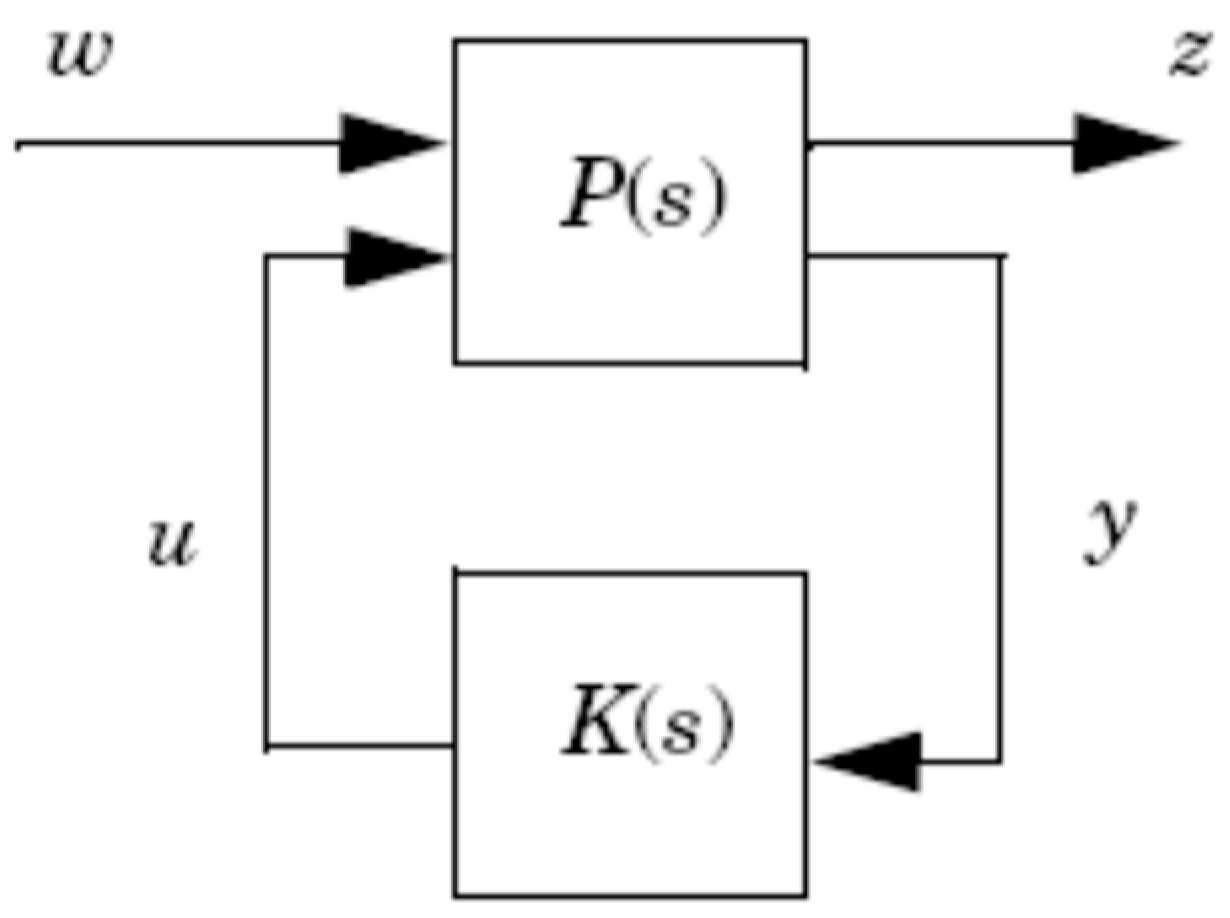
The foundational first step in our control design is to formulate the generalized plant model P(s), whose architecture is depicted in Figure 2. This structure is not merely an illustration; it is an essential template that encapsulates all open-loop relationships between the following signals:
Exogenous inputs (w): Disturbances, noise, and reference commands.
Control signals (u): The commands computed by the controller.
Performance outputs (z): The signals we wish to keep small, representing tracking errors, control efforts, etc.
Measured outputs (y): The sensor signals available to the controller.
P s is decomposed into a partitioned matrix structure:
z s y s = P 11 s P 12 s P 21 s P 22 s w s u s
The closed-loop mapping from exogenous inputs w to controlled outputs z is characterized by the lower linear fractional transformation:
F P , K = P 11 + P 12 K I P 22 K 1 P 21
The fundamental objective of H control synthesis is to determine a stabilizing linear time-invariant controller K s that minimizes the H norm of this closed-loop transfer function. Alternatively, the design problem can be formulated as determining the existence of a stabilizing controller that ensures the closed-loop gain remains below a specified performance bound γ :
F P , K < γ
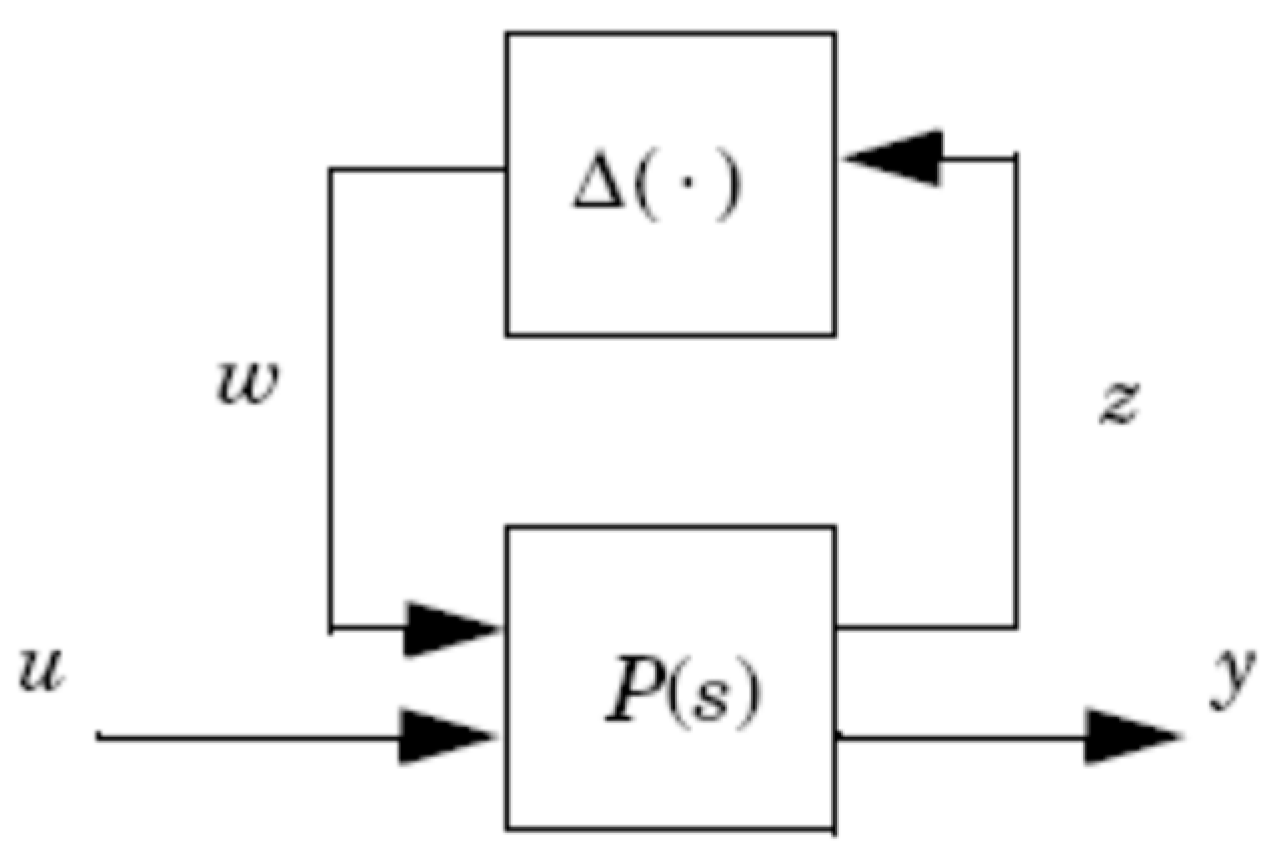
The core H∞ robust performance problem is visualized in the optimization framework of Figure 3. This structure introduces an uncertainty block Δ, representing any stable, norm-bounded dynamic uncertainty satisfying ∥Δ∥∞ < 1. This can include dynamics from a Pade approximation of communication time delays or bounded variations in physical parameters. The synthesis objective is to find a stabilizing controller K that minimizes the worst-case gain from the disturbance input w to the controlled output z for all possible uncertainties in this set.
Applying the small gain theorem to this framework provides the condition for robust stability. The control law u = K(s)y guarantees stability of the uncertain closed-loop system if the nominal closed-loop transfer function satisfies:
F P , K < 1

3.2. LMI Formulations for Robust Control Synthesis

3.2.1. Mathematical Foundations

The bounded real lemma provides the fundamental theoretical basis for H∞ control synthesis in the continuous-time domain. Consider a linear time-invariant system represented by the transfer function:
T s = D + C s I A 1 B
which may not necessarily be in minimal realization form.
The following conditions are mathematically equivalent:
  • The H∞ norm satisfies T s < γ with the matrix A exhibiting asymptotic stability (all eigenvalues possessing negative real parts)
  • There exists a symmetric positive definite matrix X satisfying the linear matrix inequality [66]:
    A T X + X A X B C T B T X γ I D T C D γ I 0

3.2.2. Controller Parameterization

The dynamic output feedback controller is represented in state-space form as:
K s = D K + C K s I A K 1 B K
A controller of order k achieves γ -suboptimal H∞ performance if and only if there exists a positive definite matrix X c l R n + k × n + k satisfying the closed-loop LMI condition:
A c l T X c l + X c l A c l X c l B c l C c l T B c l T X c l γ I D c l T C c l D c l γ I 0

3.2.3. Evolution of H∞ Synthesis Methods

Traditional approaches to H∞ control relied on solving algebraic Riccati equations (AREs), which inherently produce full-order controllers matching the plant dimension [67]. A significant advancement emerged through the work of Apkarian and Gahinet, who pioneered a convex optimization framework based on linear matrix inequalities [66]. This methodology extends the state-space parameterization concepts introduced in [68] and offers enhanced flexibility compared to classical techniques including Q-parameterization methods [69].
Within the LMI framework, the conventional Riccati equations are superseded by Riccati inequalities. The complete family of γ -suboptimal H∞ controllers, encompassing reduced-order implementations, is characterized by symmetric matrix pairs X , Y  satisfying:
    A T X + X A + X γ 2 B 1 B 1 T B 2 B 2 T X + C 1 T C 1 0 A Y + Y A T + Y γ 2 C 1 T C 1 C 2 T C 2 Y + B 1 B 1 T 0 X 0 , Y 0 , ρ X Y γ 2

3.2.4. Convex Optimization Formulation

The H∞ performance optimization is reformulated as a convex LMI problem [66]. The objective is to minimize γ subject to the existence of symmetric matrices R = R T and S = S T satisfying:
N 12 0 0 I T A R + R A T R C 1 T B 1 C 1 R γ I D 11 B 1 T D 11 T γ I N 12 0 0 I 0
N 21 0 0 I T A T S + S A S B 1 C 1 T B 1 T S γ I D 11 T C 1 D 11 γ I N 21 0 0 I 0
R I I S 0
N 12 and N 21 represent basis matrices for the null spaces of B 2 T D 12 T and C 2 D 21 , respectively.

3.2.5. Application to Power System Control

This research employs the LMI-based H∞ control methodology developed by Apkarian and Gahinet [66]. The synthesized controller demonstrates exceptional robustness properties, effectively handling:
  • Fluctuations in load demand and generation patterns
  • Parametric uncertainties arising from modeling inaccuracies
  • Environmental variations affecting system dynamics (temperature, pressure, humidity)
  • Equipment aging and performance degradation over time
  • Component faults in turbines, governors, and transmission infrastructure [45,46,47,48,49,50,51]
Addressing these robustness considerations is paramount for ensuring reliable system operation and maintaining effective Load Frequency Control performance in modern power networks.

3.3. Synthesis of a Robust H∞ Controller for Interconnected Systems with Parametric Uncertainties

Having established the H∞ control framework, the critical next step is to formulate the specific model of the disturbed interconnected power system to be compatible with this synthesis procedure. Key varying parameters include load demand, turbine and governor time constants, and transmission line reactance. To effectively apply H∞ synthesis, these parametric uncertainties must be represented within the generalized plant framework. This is achieved by defining an extended disturbance input vector ωi that encapsulates not only load variations but also the magnitudes of the parameter variations themselves. The control synthesis problem is thus structured as a minimization problem, aiming to find a stabilizing controller that minimizes the worst-case energy gain (the H∞ norm) from this extended disturbance vector ωi to the regulated outputs (e.g., area control errors and frequency deviations). This ensures the resulting controller is robust against both exogenous load disturbances and internal variations in the system’s dynamic parameters, guaranteeing prescribed performance levels across a wide range of operating conditions. The disturbance vector has been extended to include not only load variations but also variations in the turbine time constant, governor time constant, and transmission line transient reactance.
ω i = Δ P d i T T i T G i T T i j T
The state-space representation of the system, incorporating the extended disturbance vector, is given by:
x i ˙ t = A i i + Δ A i i x i t + B i + Δ B i u i t + j i n A i j + Δ A i j x j t + F i + Δ F i Δ P d i t ,
d i t = Δ A i i x i t + Δ B i u i t + j i n Δ A i j x j t + F i + Δ F Δ P d i t .
X ˙ i = A i + Δ A i X i + B ω i + Δ B ω i ω i + B i + Δ B i U i
X ˙ i = A i X i + B ω i ω i + B i U i + Δ A i X i + Δ B ω i ω i + Δ B i U i
Δ A i = A i T T i Δ T T i + A i T G i Δ T G i + A i T T i j Δ T T i j
We can easily verify that:
Δ A i X i = 0 Δ T T i T T i 2 Δ P m i Δ P g i Δ T G i T G i 2 Δ P g i Δ f i R i 2 π Δ T T i j Δ f i T
Δ B i U = 0 0 Δ T G i T G i 2 U 0 T
Δ A i X i + Δ B i U + B ω i ω i = B ω i ω i = Δ P d i H i Δ T T i T T i 2 Δ P m i Δ P g i Δ T G i T G i 2 Δ P g i Δ f i R i Δ T G i T G i 2 U 2 π Δ T i j Δ f i Δ f j T
B ω i ω i = 1 H i 0 0 0 0 1 T T i 2 0 0 0 0 1 T G i 2 0 0 0 0 2 π Δ P d i T T i T G i Δ P g i Δ f i R i U T T i j Δ f i Δ f j
B ω = B ω 1 0 4 x 4 0 4 x 4 0 4 x 4 B ω 2 0 4 x 4 0 4 x 4 0 4 x 4 B ω n
ω i = Δ P d i T T i T G i Δ P g i Δ f i R i U T T i j Δ f i Δ f j
ω = ω 1 ω 2 ω n 1 ω n T

3.4. Performance Evaluation of the H∞ Controller and Motivation for H∞/H2 Synthesis

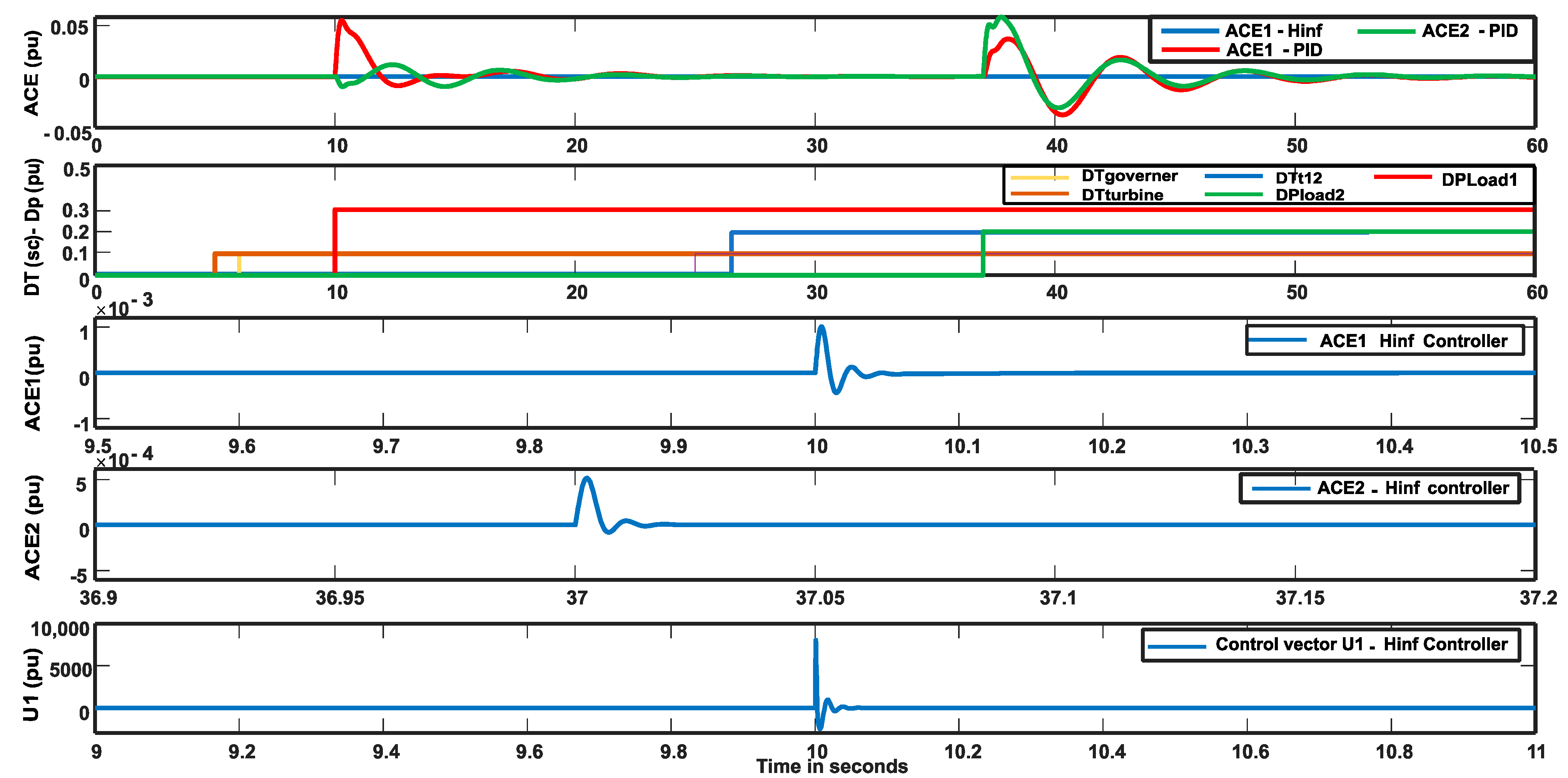
The H∞ controller was synthesized based on the LMI formulation (Equation (18)) and applied to the state-space model representing parametric uncertainties (Equations (20) and (21)). Simulation results demonstrate that the controller effectively regulates the Area Control Error (ACEi), achieving a significantly faster transient response and better disturbance rejection compared to a conventional PID controller, as illustrated in Figure 4.
Under simultaneous variation conditions (e.g., ΔPLoad1 = 0.3 pu, ΔPLoad2 = 0.2 pu, ΔTt1 = 0.1 s, ΔTg1 = 0.1 s, ΔTt12 = 0.2 pu), the PID controller exhibits large and prolonged deviations in ACE. In contrast, the H∞ controller maintains robust performance.
However, this improved dynamic performance comes at a cost. A key drawback of the synthesized H∞ controller is the excessive amplitude of the control signal (actuator force), which reaches an impractically high value of 10,000 pu in our simulations (Figure 4). This limitation raises serious concerns regarding the feasibility and economic implementation of the pure H∞ controller in real-world applications, as it would require actuators with an impossibly large range.
To address this critical issue, a mixed H∞/H2 control strategy is proposed. This approach is aimed at constraining the H2 norm of the control signal, which is directly related to its energy and variance. The H∞/H2 controller is designed to minimize the H2 norm of the control input while ensuring the H∞ norm from disturbances to the controlled output (ACEi) remains within an acceptable bound. This dual-objective optimization results in a controller that retains the robustness of the H∞ approach but with a substantially reduced and practical control effort, offering a more energy-efficient and implementable solution.

4. Hybrid H∞/H2 Control Architecture

4.1. Inherent Constraints of H∞ Control Formulations

Conventional H∞ control synthesis emphasizes robust stability and disturbance attenuation characteristics but exhibits several practical limitations. This approach predominantly addresses worst-case performance scenarios while frequently overlooking other essential design objectives, including measurement noise suppression and control effort optimization through H2 norm minimization.
These specific performance aspects are more effectively handled by alternative methodologies such as Linear Quadratic Gaussian (LQG) control and H2-norm optimization techniques, which focus on expected energy minimization rather than worst-case disturbance rejection.
To address these complementary requirements, contemporary control synthesis increasingly adopts multi-criteria optimization frameworks. These integrated approaches simultaneously incorporate both H∞ and H2 performance specifications, enabling systematic trade-offs between robust stability guarantees, disturbance rejection capabilities, and control energy efficiency.

4.2. Integrated H∞/H2 Control Synthesis

4.2.1. Dual-Channel Output Formulation

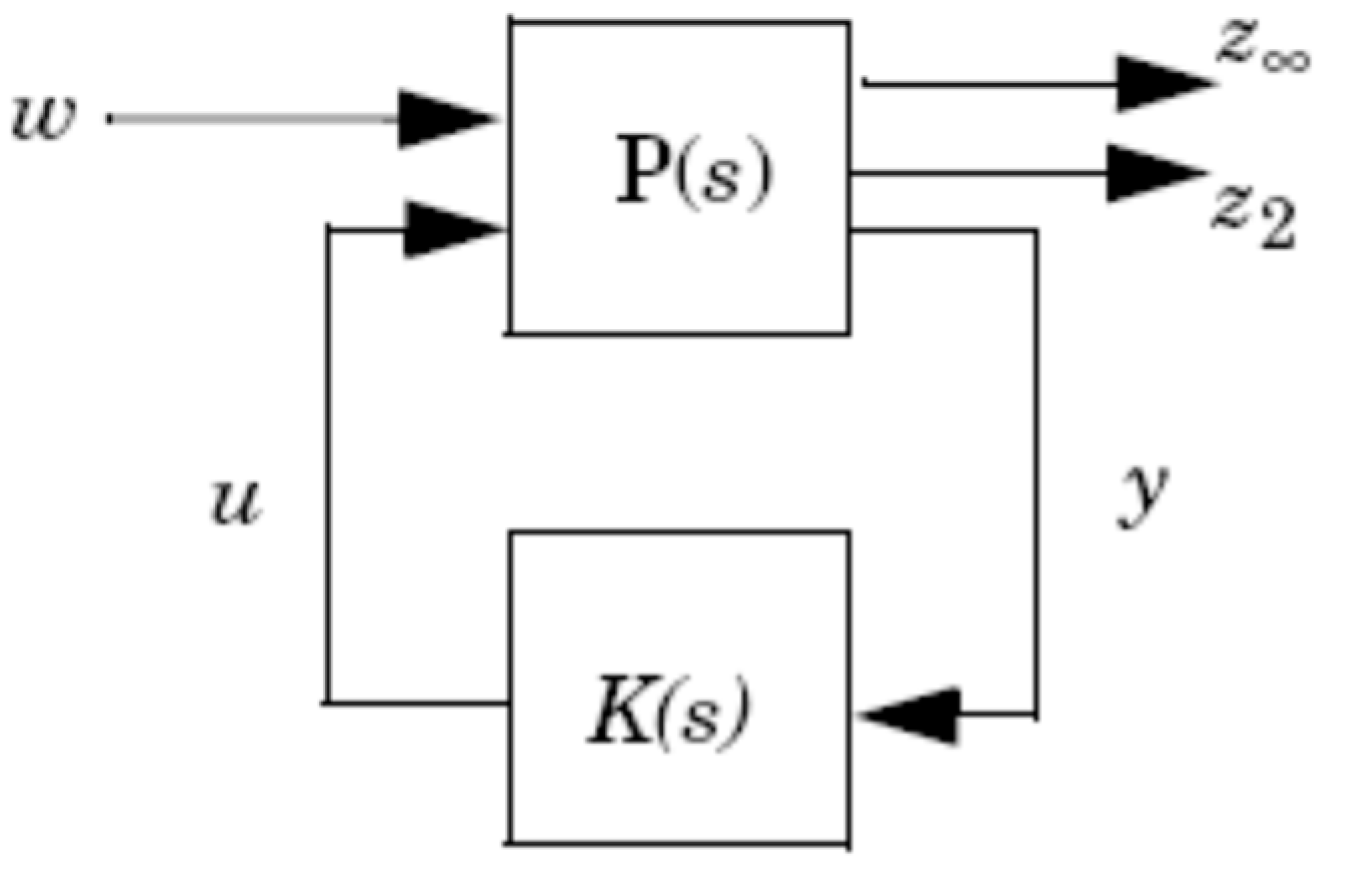
The control architecture employs two distinct output channels to address complementary performance objectives, as shown in Figure 5:
  • z : H∞ performance channel for worst-case disturbance attenuation
  • z 2 : H2 performance channel for stochastic noise suppression and control effort optimization
The generalized plant dynamics are characterized by the state-space representation:
x ˙ = A x + B 1 ω + B 2 u z = C x + D 1 ω + D 2 u z 2 = C 2 x + D 21 ω + D 22 u y = C y x + D y 1 ω
where x denotes the state vector, ω represents exogenous disturbances, u is the control input vector, and y contains measured outputs.
The central insight of this dual-channel architecture is that by strategically defining z 2 = u , the H2 synthesis procedure is transformed into a direct minimization of control energy, which is the source of mechanical stress and fuel inefficiency.

4.2.2. Control Energy Optimization

The H2 performance channel is configured to directly penalize control effort:
C 2 = 0 , D 21 = 0 , D 22 = I
This configuration yields:
z 2 = u
Consequently, the H2 norm minimization directly reduces the control input energy, corresponding to the mechanical work performed by the actuation system.

4.2.3. Controller Dynamics Formulation

The dynamic output feedback controller is represented as:
ζ ˙ = A K ζ + B K y u = C K ζ + D K y
where ζ represents the controller’s internal state vector.
The interconnected closed-loop system dynamics are described by:
  x ˙ c l = A c l x c l + B c l ω z = C c l 1 x c l + D c l 1 ω z 2 = C c l 2 x c l + D c l 2 ω
The closed-loop matrices A c l , B c l , C c l 1 , D c l 1 , C c l 2 , D c l 2 encapsulate the combined plant-controller dynamics.

4.2.4. Multi-Objective Design Specifications

The controller synthesis addresses three fundamental design requirements:
1.
Internal Stability: The controller K must ensure exponential stability of the closed-loop system.
2.
H∞ Performance Bound: The H∞ norm from w to z must satisfy T w z K γ .
3.
H2 Performance Optimization: Among all controllers satisfying conditions 1 and 2, minimize the H2 norm T w 2 z 2 K 2 .
The multi-objective synthesis is formulated as the constrained optimization:
m i n K T w 2 z 2 K 2 2 subject   to   T w z K 2 γ 2

4.2.5. LMI Conditions for H2 Performance

The H2 performance specification is transformed into convex LMI constraints. For the closed-loop system (26) with D c l 2 = 0 (ensured by Equation (23)), the H2 norm bound T w z 2 2 < ν holds if there exist symmetric matrices X 2 0 and Q satisfying:
A c l X 2 + X 2 A c l T B c l B c l T I 0
Q C c l 2 X 2 X 2 C c l 2 T X 2 0 , Tr Q < ν 2

4.3. Performance Evaluation of the Mixed H∞/H2 Controller

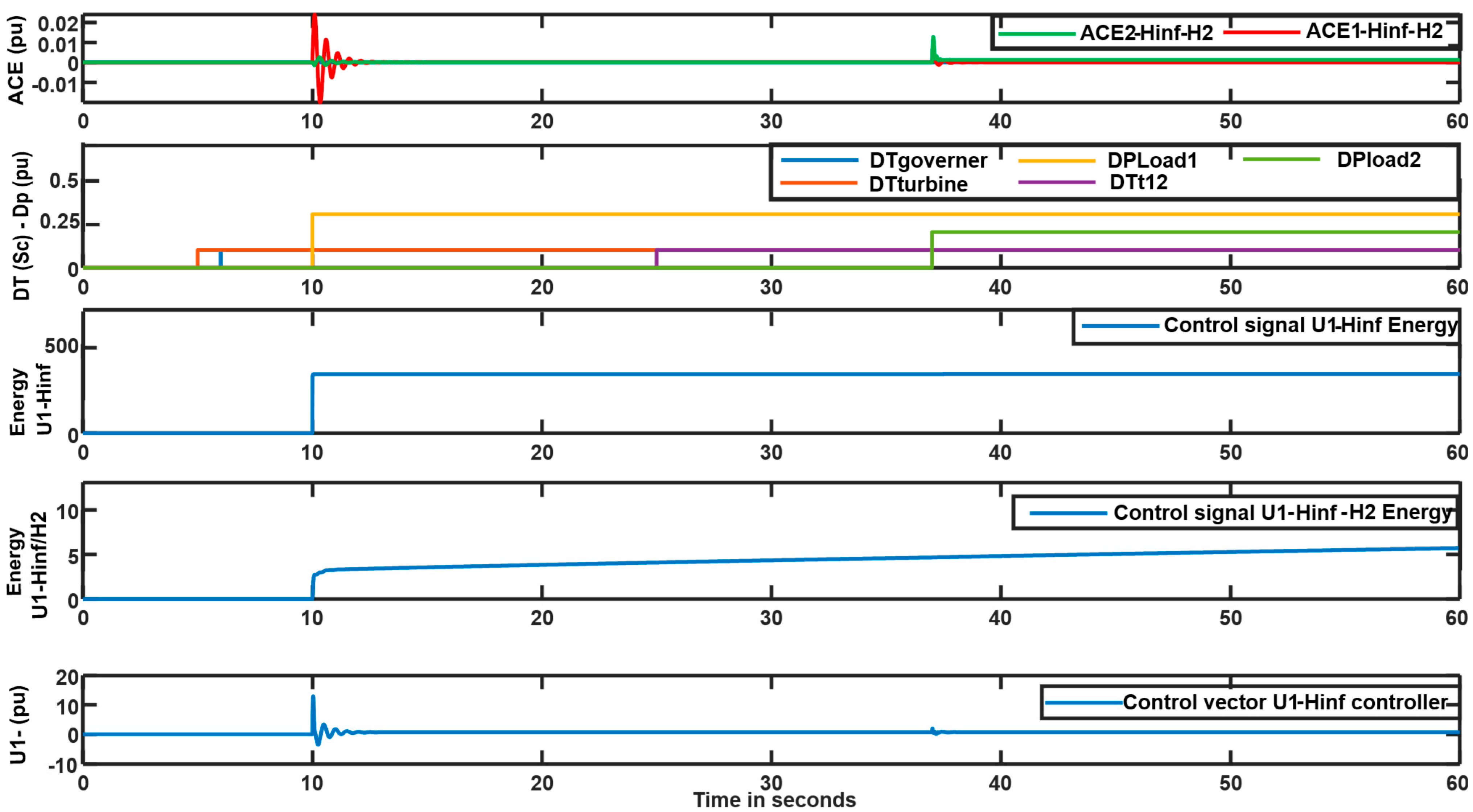
The simulation results demonstrate a substantial improvement in both actuator force amplitude and control energy consumption following the implementation of the mixed H∞/H2 controller. Figure 6 illustrates the closed-loop performance under identical load and parametric variations as the pure H∞ controller.
The key performance metrics show dramatic enhancement:
  • Control Effort (Actuator Force): The peak amplitude of the control signal u was reduced by three orders of magnitude, from an impractical 10,000 pu to a feasible 10 pu.
  • Control Energy: The energy of the control signal, which is directly associated with mechanical wear and fuel consumption, was reduced from 400 units to just 5 units.
Critically, these significant reductions in control effort are achieved without compromising the system’s dynamic performance. The Area Control Error (ACEi) response retains excellent performance characteristics:
  • Low Overshoot: The overshoot remains as low as 0.02 pu.
  • Fast Settling Time: The transient response settles within 1 s.
These results, summarized in Figure 6, confirm that the mixed H∞/H2 synthesis successfully achieves its primary objective: delivering robust performance (H∞) with drastically reduced and practical control effort (H2).

4.4. Identification of a Stability Limit

Despite its superior performance under standard operating conditions, the robustness of the H∞/H2 controller has a limit. To stress-test the controller, the magnitude of the parametric uncertainty was significantly amplified by introducing a large variation of +0.2 s in both the turbine and governor time constants.
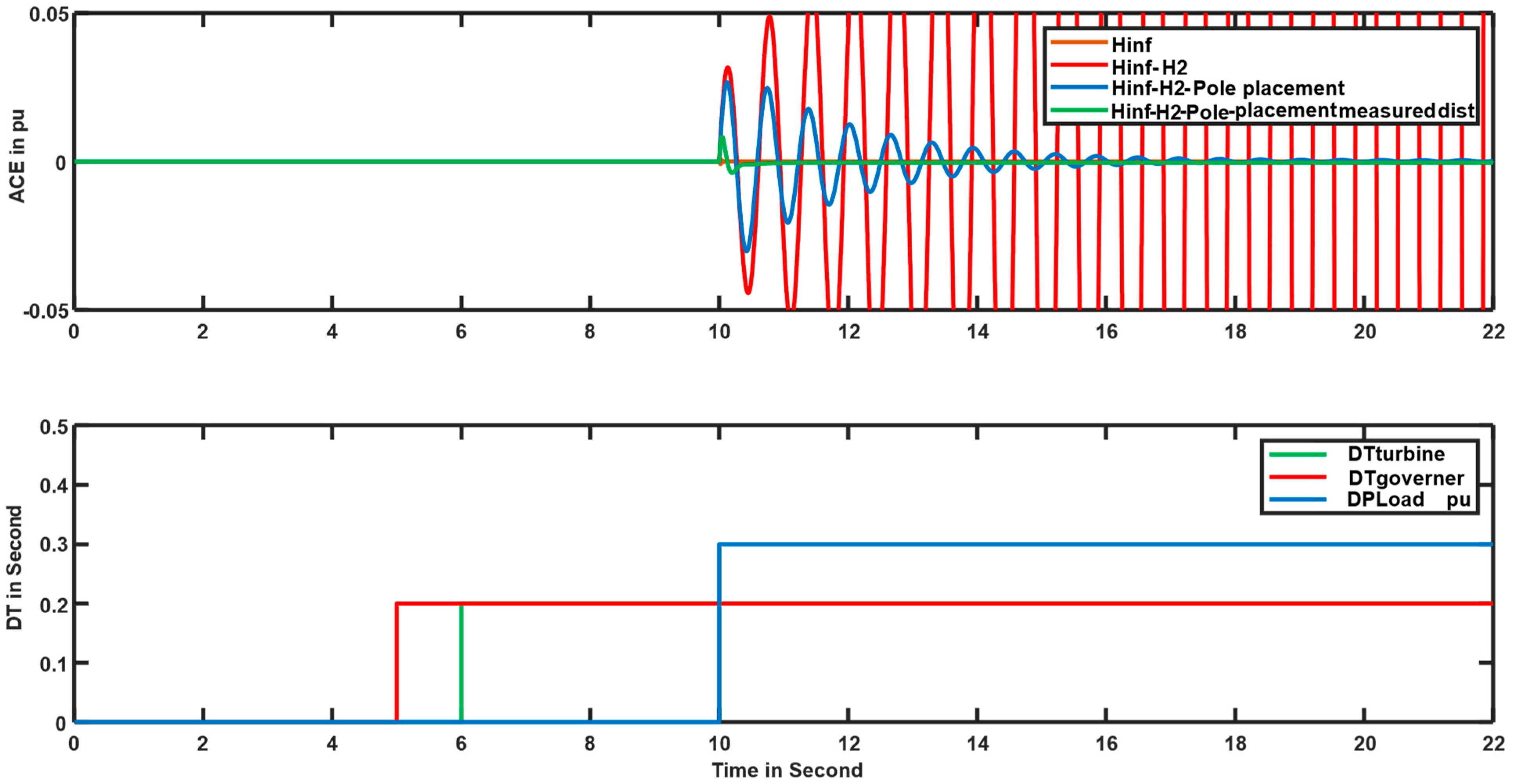
Under these intensified conditions, the stability of the system is compromised. As depicted in Figure 7, the ACE1 response governed by the H∞/H2 controller becomes unstable. This instability reveals a critical vulnerability to large, simultaneous variations in multiple system parameters, a scenario that can occur in practice due to component faults or extreme ambient conditions.
This newly identified limitation necessitates a further enhancement to the control strategy to guarantee robustness even under these extreme scenarios. The following section introduces a pole placement constraint to the mixed H∞/H2 synthesis to overcome this stability issue and ensure reliable operation across a wider range of uncertainties.

5. Enhancing Robustness via Pole Placement Constraints

The instability observed in Section 4.4 under extreme parametric variations, while the H∞ constraint was still satisfied, reveals a key limitation of conventional robust synthesis: it provides guarantees on input-output performance but does not offer explicit control over the closed-loop pole locations. The poles of a system directly dictate key transient response characteristics such as settling time, damping, and overshoot, which are critical for overall stability, especially in interconnected power systems.
To overcome this limitation and ensure stability against the identified large-scale parameter variations, a multi-objective control design framework is adopted. This advanced framework integrates the H∞ and H2 performance criteria with explicit pole placement constraints.
This integrated approach enables the concurrent optimization of:
  • Robust Performance (H∞): Worst-case disturbance rejection.
  • Control Effort (H2): Minimization of actuator energy and stress.
  • Transient Response (Pole Placement): Direct shaping of the dynamic response to ensure adequate damping and settling time, even under severe uncertainties.
By constraining the closed-loop poles to a predefined region in the complex s-plane (e.g., a conic sector to ensure minimum damping ratio), the synthesis algorithm is forced to generate a controller that not only meets performance and effort goals but also possesses inherent dynamic characteristics that guarantee stability against a wider range of perturbations. This makes the resulting controller particularly well-suited for ensuring reliable Load Frequency Control (LFC) in modern power networks experiencing significant generation and transmission parameter variations.
The mathematical implementation involves adding further LMI constraints to the existing H∞/H2 optimization problem (Equations (18)–(28)) to enforce that the eigenvalues of the closed-loop matrix Acl lie within the desired region, a well-established practice in convex optimization-based control.

5.1. Robustness Enhancement Through Pole Region Constraints

The stability limitations identified in Section 4.4 necessitate the incorporation of explicit pole placement constraints within the control synthesis framework. This augmentation ensures that all closed-loop eigenvalues reside within a specified region D of the complex plane, thereby guaranteeing prescribed transient response characteristics including damping ratios and settling times while enhancing robustness against significant parametric variations.

5.1.1. LMI Region Characterization

The desired pole location constraints are formulated using Linear Matrix Inequality regions. A subset D C constitutes an LMI region if there exist Hermitian matrices L and M such that:
D = { z C : L + z M + z M T 0 }
where L = L T = { λ i j } 1 i , j m and M = { μ i j } 1 i , j m define the geometric characteristics of the region.

5.1.2. Pole Placement LMI Condition

A necessary and sufficient condition for the closed-loop system matrix A c l to have all eigenvalues within region D is the existence of a symmetric positive definite matrix X p o l satisfying [70]:
λ i j X p o l + μ i j A c l X p o l + μ j i X p o l A c l T 1 i , j m 0 , X p o l 0
To maintain computational tractability in the multi-objective synthesis, a common Lyapunov matrix is employed across all performance constraints:
X = X = X 2 = X p o l

5.1.3. Controller Variable Transformation

The synthesis employs a congruence transformation and change of variables through factorization of the Lyapunov matrix:
X = X 1 X 2 1 , X 1 = R I M T 0 , X 2 = 0 S I N T
The controller variables are transformed according to:
B K = N B ~ K + S B 2 D K C K = C ~ K M T + D K C y R A K = N A ~ K M T + N B ~ K C y R + S B 2 C ~ K M T + S A + B 2 D K C y R
This transformation converts the original non-convex constraints into a convex optimization problem solvable via Linear Matrix Inequalities.

5.2. Multi-Objective LMI Formulation

The complete synthesis problem is formulated as the convex optimization:
m i n α γ 2 + β Tr Q subject   to   LMI   constraints   for : H   performance   with   bound   γ H 2   performance   with   bound   ν Pole   region   constraint   D
The specific LMI constraints are given by [66,70,71]:
A R + R A T + B 2 C K + C K T B 2 T A K T + A + B 2 D K C Y B 1 + B 2 D K D y 1 H H H C R + D 2 C K A T S + S A + B K C Y + C y T B K T H C + D 2 D K C K S B 1 + B K D y 1 I D 1 + D 2 D K D y 1 H H γ 2 I 0
Q C 2 R + D 22 C ~ K C 2 + D 22 D K C y C 2 R + D 22 C ~ K T R I C 2 + D 22 D K C y T I S 0
λ i j R I I S + μ i j A R + B 2 C ~ K A + B 2 D K C y A ~ K S A + B ~ K C y + μ j i R A T + C ~ K T B 2 T A ~ K T A + B 2 D K C y T A T S + C y T B ~ K T 1 i , j m 0

5.3. Performance Bounds

Let γ * and Q * denote the optimal solutions of the LMI problem. The resulting closed-loop system satisfies the performance bounds:
T γ * , T 2 2 Tr Q *
This ensures both robust stability and optimal performance within the specified constraints.
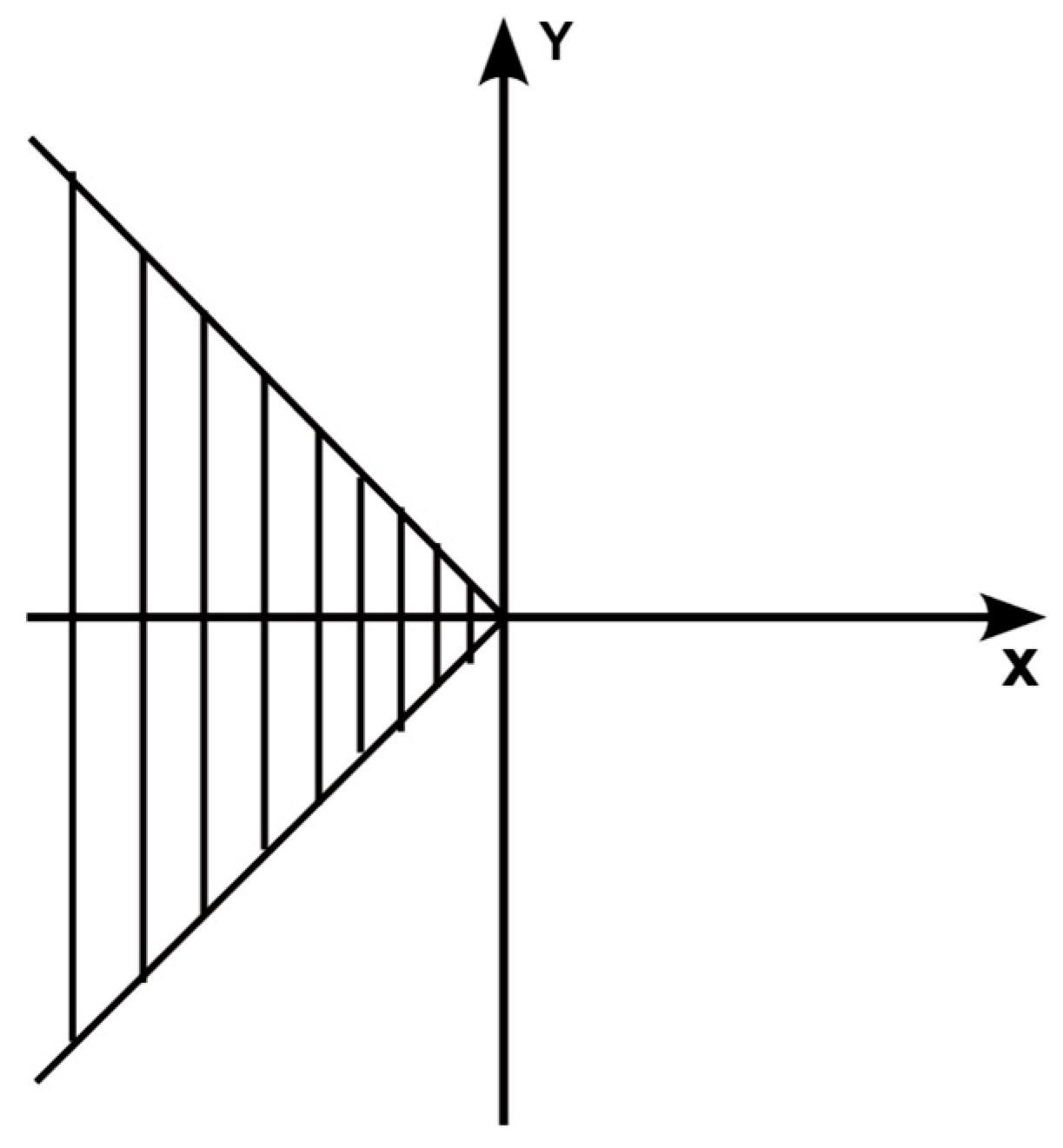
To achieve that higher oscillating modes are attenuated more rapidly while maintaining design flexibility, a conic LMI region is employed in the synthesis. This approach ensures increased damping for higher frequencies without imposing large conservatism. Specifically, The LMI region is defined as a cone with X0 = −0.1 and an angle of π/4. The algorithm integrates three key objectives:
  • H∞ norm constraint ensuring that it remains below 0.01,
  • A minimum H2 norm for the control vector u, and
  • Pole placement within the cone, ensuring stability and improved transient response.
A cone-shaped region (Figure 8) is characterized by the property that as the oscillation frequency increases, the attenuation factor also increases, leading to enhanced system performance and robustness.

5.4. Performance of the Enhanced Controller

The efficacy of the enhanced H∞/H2 controller with pole placement is demonstrated in Figure 7. Under the previously destabilizing conditions (a large increase of +0.2 s in both turbine and governor time constants), the new controller successfully regulates the Area Control Error (ACE1) to zero.
The response is characterized by:
  • Stability: The system remains stable under extreme parametric uncertainty.
  • Fast Convergence: ACE is driven to zero within a short settling time.
  • Acceptable Transients: The response exhibits well-damped, acceptable transient behavior.
  • Low Effort: It maintains the low control effort and energy consumption achieved by the mixed H∞/H2 synthesis.
In contrast, the original H∞/H2 controller (without pole placement) becomes unstable under these same conditions, as shown for comparison in Figure 7. This result validates that the integration of pole placement constraints successfully enhances the robustness of the control system, ensuring reliable performance across a wider range of operating conditions and fault scenarios.

6. Performance Enhancement via Measured Disturbance Compensation

A final crucial enhancement for achieving optimal stability, energy efficiency, and reduced transient peaks involves the explicit treatment of the unknown input disturbance ΔPd as a measured disturbance. Given that real-time load power is a readily measurable parameter in modern power plants, this signal can be directly utilized by the controller for feedforward compensation. This allows the controller to proactively counteract the effect of load changes before they significantly impact frequency and tie-line power, leading to superior dynamic performance and robustness.
This modification is reflected in the output equation of the generalized plant formulation. The measured output vector Y i is augmented to include the load disturbance P d i :
Y i = C 2 i X i + D 21 i ω i + D 22 i U i
C 2 i = 1 0 0 0 0 0 0 1 0 0 0 0
D 22 i = 0 3 × 1 ; Y i = f i P t i e i P d i T ;
D 21 i ω i = 0 0 0 0 0 0 0 0 1 0 0 0 Δ P d i T T i T G i Δ P g i Δ f i R i U T T i j Δ f i Δ f j
The controlled vector becomes:
Z i = C 1 i X i + D 11 i ω i + D 1 i U i
C 1 i = β i 0 0 1 0 0 0 1
D 11 i = 0 2 × 4   D 12 i = 0 2 × 1   Z i = A C E i P t i e i

6.1. Controller Synthesis via the LMI Framework for Non-Standard Plants

The H∞ controller is designed using the LMI constraints established by Apkarian and Gahinet [66]. This method was selected over classical state-space solutions due to its significantly relaxed assumptions, which are better suited to the structure of our generalized plant.
The LMI approach requires only two fundamental assumptions:
  • Assumption 1. The pair (A, B2) is stabilizable, and the pair (A, C2) is detectable.
  • Assumption 2. The direct feedthrough matrix D22 = 0.
Assumption 1 is both necessary and sufficient to ensure the plant can be stabilized by dynamic output feedback. Assumption 2 is made without loss of generality and greatly simplifies the numerical synthesis.
Critically, this method does not require the customary “regularity” assumptions mandated by classical Riccati equation-based solutions [69]. These classical assumptions, which are often not met in practical applications like ours, are:
  • Assumption 3. D12 has full column rank and D21 has full row rank.
  • Assumption 4. The subsystems P12(s) and P21(s) have no invariant zeros on the imaginary axis.
  • As detailed in the plant formulation (Equations (36) and (37)), our system explicitly violates assumption 3:
  • D12 = 0 (does not have full column rank).
  • D21 is non-zero but does not have full row rank.
Therefore, the classical state-space formulas are inapplicable to our problem. The LMI-based framework, however, remains entirely valid and provides a convex, computationally tractable solution for synthesizing the robust controller that incorporates both feedback and measured disturbance feedforward action. This makes it the superior and necessary choice for this application. The final controller synthesis is thus performed by solving the LMI optimization problem (34) under the constraints for H∞ performance, H2 performance, and pole placement, based on the generalized plant defined by Equations (20) and (21)) and the input-output structure defined in Equations (36) and (37)).

6.2. Synthesis of a Low-Order H∞ Controller via Structured LMIs

Reference [72] addresses the special case, where D12 = 0 and D21 ≠ 0, by proposing a low-order H∞ controller. The existence of such a controller is formulated as a feasibility problem involving a Bilinear Matrix Inequality (BMI), defined in terms of the controller’s coefficient matrix and a Lyapunov matrix. To tackle the complexity of the BMI, Ref. [72] introduces two sufficient conditions that convert the problem into a set of Linear Matrix Inequalities (LMIs). This transformation is achieved by imposing a block-diagonal structure on an equivalent form of the Lyapunov matrix within the BMI. Furthermore, by appropriately defining this equivalent matrix as block-diagonal—aligned with the desired controller order—the BMI is fully reducible to an LMI problem. Since the block-diagonal structure can be freely selected, the controller order can also be specified arbitrarily, allowing for flexibility in designing low-order H∞ controllers.
Theorem 1 [72].
Assume  D 12 = 0 ,  rank B 2 = m r m . The system (38) is stabilizable with the  H  disturbance attenuation level  γ via a low order controller (39) if there exists a positive definite matrix  P with block diagonal structure as (40):
x ˙ = A x + B 1 w + B 2 u z = C 1 x + D 11 w + D 12 u y = C 2 x + D 21 w ,
x ^ ˙ = A ^ x ^ + B ^ y u = C ^ x ^ + D ^ y ,
= P 1 0 0 P 2 R n + n ^ × n + n ^ ,
where P 1 R n ^ + m r × n ^ + m r , P 2 R n m r × n m r , and a matrix  W y R n ^ + m r × n ^ + q , satisfying the LMI
F 11 T + F 11 F 12 C ^ 1 T F 12 T γ I D ~ 11 T C ^ 1 D ~ 11 γ I < 0 .
Here,
F 11 = P A ^ + W y 0 C ^ 2 , F 12 = P B ^ 1 + W y 0 D ~ 21 ,
And
A ^ = T 1 A ~ T , B ^ 1 = T 1 B ~ 1 , C ^ 1 = C ~ 1 T , C ^ 2 = C ~ 2 T ,
where  T R n + n ^ × n + n ^  and  V R n ^ + m r × n ^ + m  are nonsingular matrices satisfying
T 1 B ~ 2 V 1 = I n ^ + m r 0 0 0 R n + n ^ × n ^ + m .
If the LMI (41) is feasible, one of the controller coefficient matrices is computed as
G = V 1 G 1 G 2 R n ^ + m × n ^ + q ,
where  G 1 = P 1 1 W y R n ^ + m r × n ^ + q , and  G 2 R m m r × n ^ + q  is an arbitrary matrix.

6.3. Cyber-Physical Resilience Analysis

The measured-disturbance feedforward architecture necessitates robust handling of communication impairments and cyber threats. Our framework is designed with a multi-layer protection strategy that recognizes the distinct nature of these challenges.
-
Anomaly Detection via Forecasting:
Long Short-Term Memory (LSTM) neural networks provide high-fidelity load forecasting [73]. Significant deviations between measured and forecasted loads,
P L meas P L LSTM > τ fault ,
trigger automatic reconfiguration to treat Δ P load as an unmeasured disturbance. This maintains stability through the robust H feedback loop, effectively mitigating issues arising from simple sensor faults or communication loss on the load measurement channel.
-
Resilience to System-Wide Cyber-Attacks:
It is critical to distinguish between a single faulty sensor and a coordinated cyber-attack. Sophisticated false-data injection attacks may compromise multiple PMUs simultaneously (e.g., frequency, tie-line power, and load) to create a consistent but false system state.
In such scenarios, the problem transcends the control layer and becomes a system-wide data integrity issue. Our method is robust because:
  • The robust H controller provides a stable foundation, preventing catastrophic failure even if it receives manipulated data.
  • Detecting coordinated, multi-sensor attacks requires a dedicated security layer. Graph-theory-based methods can detect physically inconsistent measurement patterns across the network [74,75], identifying violations of grid physical laws invisible to a controller examining a single measurement channel.
Therefore, our control framework operates in synergy with higher-level security monitoring: it handles local measurement uncertainty and gracefully degrades under communication faults, while specialized network-level detectors identify sophisticated coordinated cyber-attacks for operator intervention.

6.4. Incorporation of Renewable Forecasting Errors into the Disturbance Vector

The integration of renewable energy introduces stochastic variability that must be explicitly considered in the disturbance vector. Two practical cases arise depending on the availability of real-time measurements. In Scenario A, when renewable generation is directly measured at the plant connection point (e.g., utility-scale wind or solar farms equipped with SCADA/PMU metering), the net load disturbance is computed as
Δ P d i net = Δ P d i Δ P ^ ren ,
and injected into the measured disturbance channel. This removes the renewable component from the unknown disturbance set, allowing perfect feedforward compensation and reducing the conservativeness of the H design.
In Scenario B, for unmeasured or distributed renewable generation, forecasting techniques such as LSTM neural networks can be employed, which have demonstrated high prediction accuracy in power systems [73]. The renewable power is decomposed as:
Δ P ren actual = Δ P ^ ren + ε ren ,
where ε ren  is the forecasting error. The extended disturbance vector for area i is thus augmented as
ω i = Δ P d i Δ P ^ ren ε ren Δ T T i Δ T G i Δ T T i j ,
with disturbance propagation characterized by the augmented input matrix
B ω , i = 1 / H i 1 / H i 0 0 0 0 0 1 / T T i 2 0 0 0 0 0 1 / T G i 2 0 0 0 0 0 2 π .
The variance of the forecasting errors E ε k 2 determines the energy of the disturbance entering the H channel.
-
Effect on the H bound:
Forecasting errors are included explicitly in the extended disturbance vector through the decomposition
P r e n = P ^ r e n + ε r e n .
The H∞ performance bound γ represents the worst-case gain from the extended disturbance vector ω’ to the controlled output z (‖T_(z←ω’) ‖∞ < γ). The structural modification of the disturbance matrix B ω , i —particularly the addition of a second column identical to the first—fundamentally changes how disturbances are mapped to the system states. This enables two key advantages for the H∞ synthesis:
-
Critical Flexibility in Weighting Function Design: The separation of disturbances into dis tinct channels enables the application of tailored weighting functions for each disturbance type in the generalized plant framework. The net load disturbance Δ P d i Δ P ^ ren , can be weighted to emphasize low-frequency attenuation, while the forecast error ( ε ren ) can be weighted according to its specific stochastic spectrum. This is a decisive advantage over the conventional approach of using a single, compromise weighting function for a combined, unknown disturbance, which inevitably leads to conservative performance.
The controller can now allocate different attenuation levels to the net load disturbance ( Δ P d i Δ P ^ ren ) and the forecast error ( ε r e n ) through tailored weighting functions in the generalized plant.
-
Practical Performance Optimization: While the theoretical γ bound represents the worst-case gain, the actual output performance depends on the product γ·‖ω’‖. Since ‖ ε r e n ‖ ≪ Δ P ren actual , the actual impact on system performance remains small:
z ε     γ · ε r e n     γ ·   Δ P ren actual .

6.5. Comparative Performance Analysis and Discussion

The superior performance of the proposed multi-objective control strategy is unequivocally demonstrated through a comprehensive comparative analysis. Figure 7 illustrates the dynamic response of the Area Control Error (ACE1) under simultaneous load change and significant parameter uncertainty for four distinct controllers:
  • Standard H∞ Controller
  • Mixed H∞/H2 Controller
  • Mixed H∞/H2 Controller with Pole Placement
  • Proposed Controller: Mixed H∞/H2 with Pole Placement and Measured Disturbance (ΔPd) Compensation.
The proposed controller demonstrates clear superiority, synthesizing enhanced H∞ disturbance attenuation, optimal H2 energy minimization, and precisely shaped transient dynamics. Quantitatively, it reduces the settling time from approximately 7 s to just 0.2 s and decreases the overshoot by 70% compared to the other stable controllers.
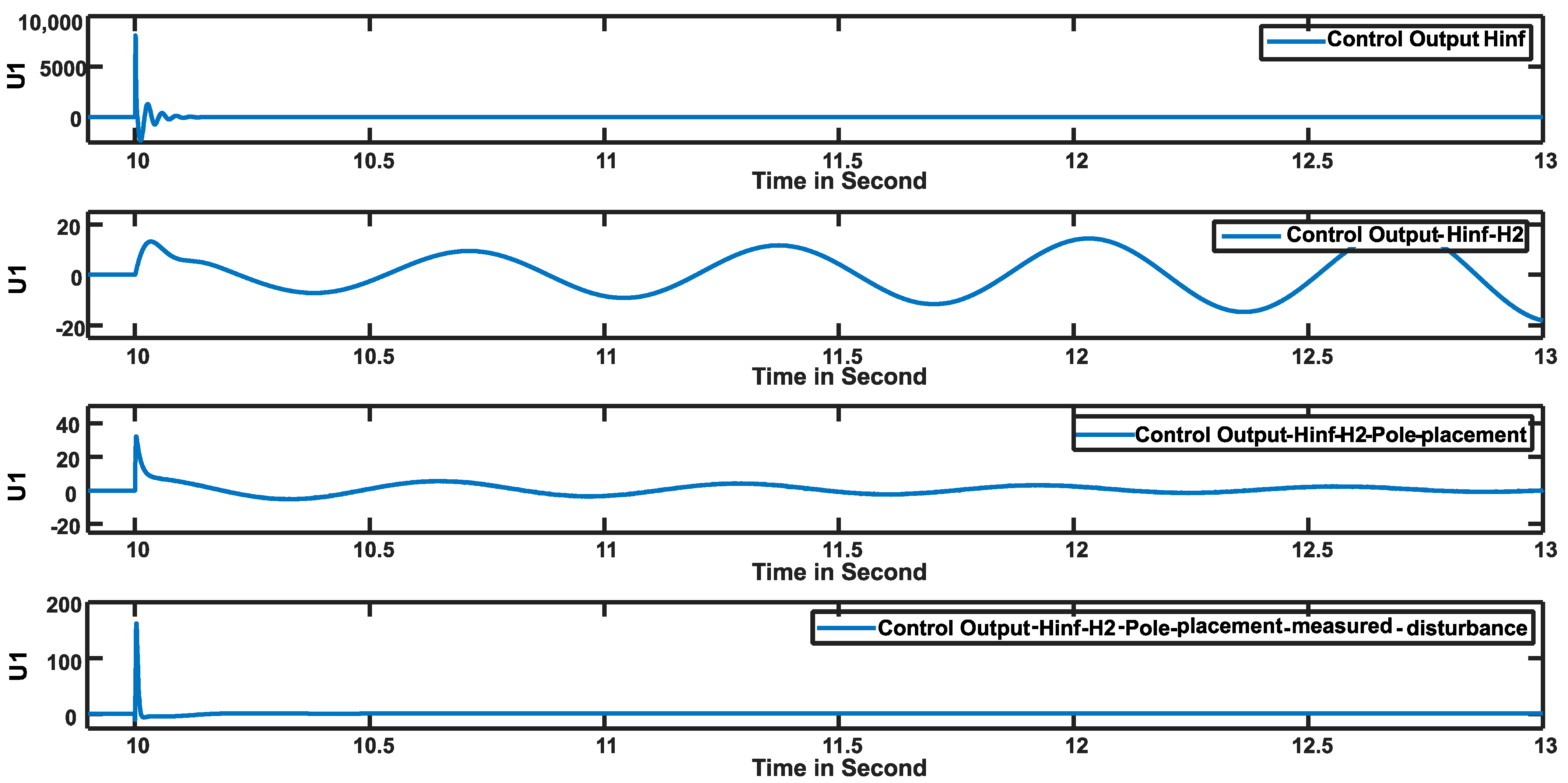
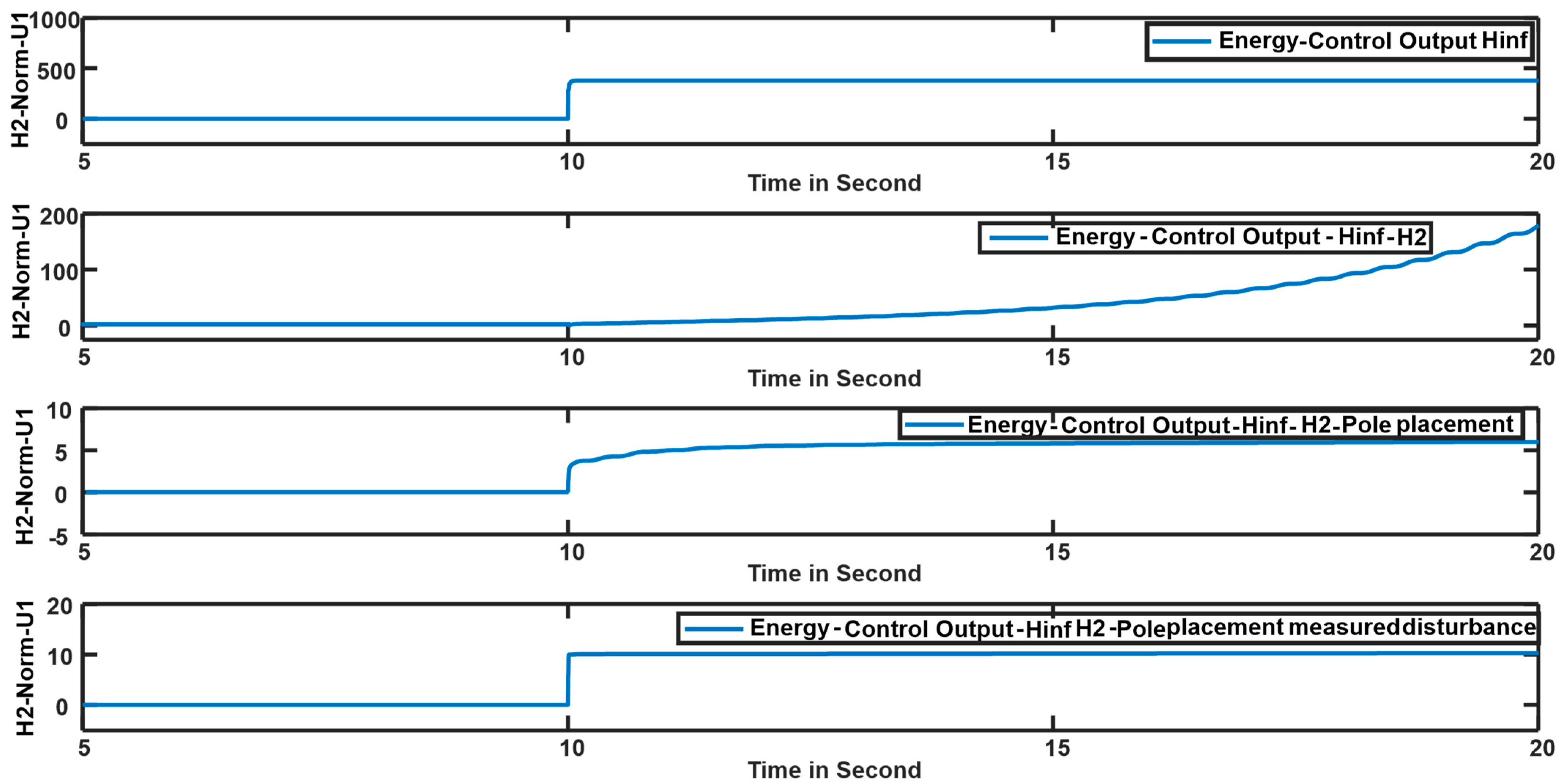
The practical benefits of reducing control effort are quantified in Figure 9 and Figure 10, which compare the control vector amplitude and energy across all four controllers. The results reveal critical insights:
  • The pure H∞ controller generates an impractically high control effort (10,000 pu amplitude, 400 units of energy), rendering it unsuitable for real-world application due to excessive actuator stress and energy consumption.
  • The H∞/H2 controller fails to maintain stability under the tested severe parametric variations, becoming unstable.
  • The H∞/H2 controller with Pole Placement successfully stabilizes the system but does not fully exploit the available information for optimal performance.
  • The Proposed Controller not only guarantees robust stability but also achieves a dramatic 98% reduction in both control energy and peak control amplitude relative to the standard H∞ design.
This reduction in control effort translates directly into significant operational and economic benefits:
  • Minimized Mechanical Stress: Drastically reduced peak turbine torque and valve actuation extends the operational lifespan of turbine components and governors.
  • Improved Fuel Efficiency: Lower control energy consumption is directly linked to reduced fuel usage during regulation.
  • Enhanced Practical Viability: The controller operates within the practical limits of real actuators, moving from a theoretical solution to an implementable control law.
The results confirm that the progressive integration of H2 optimization, pole placement constraints, and measured disturbance feedforward action creates a synergistic effect. This multi-objective approach delivers a controller that is not only mathematically robust but also engineered for practicality, efficiency, and longevity in modern power systems.
In summary, the quantitative results in Table 1 and Table 2 demonstrate the superiority of the proposed H∞/H2/Pole Placement controller with measured disturbance. The key achievements include:
  • A dramatic 98% reduction in the peak control signal and 97.5% reduction in control energy compared to the standard H∞ controller, indicating significantly reduced actuator stress and energy consumption.
  • Maintained robust stability under severe turbine-governor time constant variations, where the basic H∞/H2 controller fails.
  • Consistent high performance across various load disturbance magnitudes ( Δ P = 0.1 0.4 pu), maintaining 97–98% energy reduction.
  • Excellent transient response with fast settling time (0.2 s) and minimal overshoot (0.83%), outperforming the H∞/H2/Pole Placement controller without measured disturbance.
These results conclusively demonstrate that the strategic treatment of load variation as a measured disturbance enables unprecedented control efficiency while guaranteeing robust stability and superior dynamic performance.

7. Conclusions

This paper has introduced and validated a novel multi-objective controller for Load Frequency Control (LFC) in interconnected power systems, integrating H∞ robustness, H2 energy minimization, and direct pole placement for transient-response shaping. The proposed design effectively addresses the critical challenge posed by simultaneous load variations and parametric uncertainties in turbine, governor, and transmission-line dynamics.
A key contribution of this work is the reformulation of load variation as a measurable disturbance, enabling the synthesis of a practical, low-order controller through a specialized LMI framework. This formulation facilitates proactive feedforward compensation, which is shown to be instrumental in achieving superior performance.
Simulation results demonstrate clear superiority over traditional PID and standard H∞/H2 controllers. The proposed method significantly enhances stability margins, reduces settling time by an order of magnitude, cuts overshoot by 70%, and achieves a 98% reduction in control energy and peak actuator effort. These improvements translate into tangible operational benefits, including extended equipment lifespan, reduced mechanical stress, and improved fuel efficiency.
The demonstrated performance, grounded in a rigorous mathematical framework, provides a strong foundation for broader application. The proposed H∞/H2 pole-placement measured-disturbance control framework is structurally scalable to multi-area systems via direct application of its LMI-based synthesis to N-area models. The implementation architecture can be tailored to grid resources; for example, a centralized controller is suitable for advanced infrastructures such as the Saudi Arabian National Grid.
Future work will focus on extending this framework to address broader challenges:
-
Variable Communication Delays:
The present work assumes negligible delays. Future research will investigate adaptive predictive control schemes, leveraging stochastic Lyapunov methods and µ-synthesis, to accommodate variable communication delays commonly encountered in wide-area monitoring systems.
-
Decentralized Architectures:
Having established the benefits of a centralized architecture, a natural next step is to extend the framework to large-scale networks via a hierarchical control structure. Such a structure would employ local robust controllers in each area, coordinated by a supervisory layer that manages inter-area dynamics and provides measured-disturbance feedforward for wide-area events. The synthesis of these controllers forms a complex optimization problem that future studies will address using non-smooth optimization theory [76], ensuring robust performance while respecting communication and structural constraints in large power grids.
-
Integration with Renewables:
Future work will adapt the control framework to maintain performance in systems with high penetration of inverter-based renewable energy sources, which significantly alter system inertia.
-
Cyber-Physical Resilience:
Future work will explore the incorporation of this control strategy within cyber-resilient LFC architectures to ensure physical performance while mitigating cyber threats.
-
Gain-Scheduled Extension:
In this study, the controller design and performance evaluation were carried out using a linearized turbine–governor model around a nominal operating point. For the large-signal disturbances considered (approximately 10% load variations), the robust H∞ design guarantees closed-loop stability by explicitly accounting for bounded parametric uncertainties (ΔA, ΔB). However, under more pronounced nonlinear operating conditions, the performance of the linear time-invariant controller may become limited. These regimes represent a natural direction for future research. A gain-scheduled extension of the proposed H∞/H2 controller could be developed, in which the controller parameters vary with the instantaneous operating point.
-
Controller Order Reduction:
Future work will also investigate systematic controller-order reduction. This will involve applying model-reduction techniques (such as balanced truncation or Hankel-norm approximation) to the full-order design, followed by a rigorous analysis of the trade-offs between computational complexity, implementation cost, and closed-loop performance.

Author Contributions

Conceptualization, C.N.; methodology, R.G., M.K. and R.O.; software, C.N.; validation, R.G., M.K. and R.O.; formal analysis, R.G. and M.K.; investigation, R.G., M.K. and R.O.; resources, R.O.; data curation, C.N. and R.G.; writing—original draft preparation, C.N.; writing—review and editing, C.N., R.G., M.K. and R.O.; visualization, C.N.; supervision, R.O.; project administration, C.N. All authors have read and agreed to the published version of the manuscript.

Funding

This research received no external funding.

Data Availability Statement

The data presented in this study are available within the article. The MATLAB code developed for this study is not publicly available. Requests concerning the code may be directed to the corresponding author.

Acknowledgments

The authors utilized ChatGPT, DeepSeek for the purpose of language editing and proofreading of the manuscript.

Conflicts of Interest

The authors declare no conflict of interest.

References

  1. Shafiee, M.; Sajadinia, M.; Zamani, A.-A.; Jafari, M. Enhancing the Transient Stability of Interconnected Power Systems by Designing an Adaptive Fuzzy-Based Fractional Order PID Controller. Energy Rep. 2024, 11, 394–411. [Google Scholar] [CrossRef]
  2. Hote, Y.V.; Jain, S. PID controller design for load frequency control: Past, present and future challenges. IFAC Pap. OnLine 2018, 51, 604–609. [Google Scholar] [CrossRef]
  3. Sabahi, K.; Tavan, M. T2FPID Load Frequency Control for a two-area Power System Considering Input Delay. In Proceedings of the 2020 28th Iranian Conference on Electrical Engineering (ICEE), Tabriz, Iran, 4–6 August 2020; pp. 1–5. [Google Scholar] [CrossRef]
  4. Çam, E.; Kocaarslan, I. Load Frequency Control in Two Area Power Systems Using Fuzzy Logic Controller. Energy Convers. Manag. 2005, 46, 233–243. [Google Scholar] [CrossRef]
  5. Tapia-Olvera, R.; Beltran-Carbajal, F.; Valderrabano-Gonzalez, A. Adaptive Neural Trajectory Tracking Control for Synchronous Generators in Interconnected Power Systems. Appl. Sci. 2023, 13, 561. [Google Scholar] [CrossRef]
  6. Bano, F.; Ayaz, M.; Baig, D.-E.; Rizvi, S.M.H. Intelligent Control Algorithms for Enhanced Frequency Stability in Single and Interconnected Power Systems. Electronics 2024, 13, 4219. [Google Scholar] [CrossRef]
  7. Yousef, H.A. Adaptive fuzzy logic load frequency control of multi-area power system. Int. J. Electr. Power Energy Syst. 2015, 68, 384–395. [Google Scholar] [CrossRef]
  8. Doan, D.V.; Nguyen, K.; Thai, Q.V. Load-Frequency Control of Three-Area Interconnected Power Systems with Renewable Energy Sources Using Novel PSO~PID-Like Fuzzy Logic Controllers. Eng. Technol. Appl. Sci. Res. 2022, 12, 8597–8604. [Google Scholar] [CrossRef]
  9. Seyyedabbasi, A.; Kiani, F. Sand Cat Swarm Optimization: A Nature-Inspired Algorithm to Solve Global Optimization Problems. Eng. Comput. 2022, 39, 2627–2651. [Google Scholar] [CrossRef]
  10. Younis, W.; Yameen, M.Z.; Tayab, A.; Qamar, H.G.M.; Ghith, E.; Tlija, M. Enhancing Load Frequency Control of Interconnected Power System Using Hybrid PSO-AHA Optimizer. Energies 2024, 17, 3962. [Google Scholar] [CrossRef]
  11. Mahmud, M.A.; Hossain, M.J.; Pota, H.R. Nonlinear observer design for interconnected power systems. IEEE Trans. Power Syst. 2012, 27, 831–840. [Google Scholar]
  12. Zapanta, J.M.; Santiago, R.M.; Abundo, M.L. Load Frequency Control of Interconnected Power System Using Particle Swarm Optimization Based Disturbance Observer-Enhanced PI Controller. IEEE Access 2023, 11, 10008353. [Google Scholar]
  13. Orka, N.A.; Muhaimin, S.S.; Shahi, N.S.; Ahmed, A. An enhanced gradient based optimized controller for load frequency control of a two area automatic generation control system. In Engineering Applications of Modern Metaheuristics; Springer: Cham, Switzerland, 2022. [Google Scholar]
  14. Yousuf, S.; Yousuf, V.; Gupta, N.; Alharbi, T.; Alrumayh, O. Enhanced Control Designs to Abate Frequency Oscillations in Compensated Power System. Energies 2023, 16, 2308. [Google Scholar] [CrossRef]
  15. Zeng, G.-Q.; Xie, X.-Q.; Chen, M.-R. An Adaptive Model Predictive Load Frequency Control Method for Multi-Area Interconnected Power Systems with Photovoltaic Generations. Energies 2017, 10, 1840. [Google Scholar] [CrossRef]
  16. Huynh, V.V.; Minh, B.L.N.; Amaefule, E.N.; Tran, A.-T.; Tran, P.T. Highly robust observer sliding mode based frequency control for multi area power systems with renewable power plants. Electronics 2021, 10, 274. [Google Scholar] [CrossRef]
  17. Kerdphol, T.; Rahman, F.S.; Mitani, Y. Virtual Inertia Control Application to Enhance Frequency Stability of Interconnected Power Systems with High Renewable Energy Penetration. Energies 2018, 11, 981. [Google Scholar] [CrossRef]
  18. Sharma, D.; Mishra, S. Non-linear disturbance observer-based improved frequency and tie-line power control of modern interconnected power systems. IET Gener. Transm. Distrib. 2019, 13, 3564–3573. [Google Scholar] [CrossRef]
  19. Dhbaibi, S.; Tlili, A.S.; Elloumi, S.; Braiek, N.B. H∞ Decentralized Observation and Control Interconnected Systems. ISA Trans. 2009, 48, 458–467. [Google Scholar] [CrossRef]
  20. Zheng, Y.; Zhou, J.; Xu, Y.; Zhang, Y.; Qian, Z. A Distributed Model Predictive Control Based Load Frequency Control Scheme for Multi-Area Interconnected Power System Using Discrete-Time Laguerre Functions. ISA Trans. 2017, 68, 127–140. [Google Scholar] [CrossRef]
  21. Mustafa, G.I.Y.; Masum, M.; Siam, M. A new model-free control for load frequency control of interconnected power systems based on nonlinear disturbance observer. Energy Rep. 2024, 12, 4998–5008. [Google Scholar] [CrossRef]
  22. Huynh, V.V.; Vo, H.-D.; Minh, B.L.N.; Nguyen, T.M.; Tai, Y.W. Observer output feedback load frequency control for a two-area interconnected power system. J. Adv. Eng. Comput. 2018, 2, 1. [Google Scholar] [CrossRef]
  23. Bondalapati, S.; Dey, R.; Barna, C.; Balas, V.E. H∞-static output feedback based load frequency control of an interconnected power system with regional pole placement. Int. J. Comput. Commun. Control 2024, 19. [Google Scholar] [CrossRef]
  24. Huynh, V.V.; Tran, P.T.; Tran, T.A.; Tuan, D.H.; Phan, V.-D. Extended state observer-based load frequency controller for three-area interconnected power system. TELKOMNIKA (Telecommun. Comput. Electron. Control) 2021, 19, 1001–1009. [Google Scholar] [CrossRef]
  25. Fernando, T.; Emami, K.; Yu, S.; Iu, H.; Wong, K.P. A novel quasi-decentralized functional observer approach to LFC of interconnected power systems. In Proceedings of the 2016 IEEE Power and Energy Society General Meeting (PESGM), Boston, MA, USA, 17–21 July 2016; p. 1. [Google Scholar] [CrossRef]
  26. Yan, W.; Sheng, L.; Xu, D.; Yang, W.; Liu, Q. H∞ Robust Load Frequency Control for Multi-Area Interconnected Power System with Hybrid Energy Storage System. Appl. Sci. 2018, 8, 1748. [Google Scholar] [CrossRef]
  27. Chen, Y.H. Decentralized robust control system design for large-scale uncertain systems. Int. J. Control 1988, 47, 1195–1205. [Google Scholar] [CrossRef]
  28. Tlili, A.S.; Braiek, N.B. Decentralized Observer-Based Guaranteed Cost Control for Nonlinear Interconnected Systems. Int. J. Control Autom. 2009, 2, 29–45. [Google Scholar]
  29. Alhelou, H.H.; Golshan, M.E.H.; Hatziargyriou, N.D. Deterministic Dynamic State Estimation-Based Optimal LFC for Interconnected Power Systems Using Unknown Input Observer. IEEE Trans. Smart Grid 2019, 11, 1582–1592. [Google Scholar] [CrossRef]
  30. Tran, A.-T.; Minh, B.L.N.; Huynh, V.V.; Tran, P.T.; Amaefule, E.N.; Phan, V.-D.; Nguyen, T.M. Load Frequency Regulator in Interconnected Power System Using Second-Order Sliding Mode Control Combined with State Estimator. Energies 2021, 14, 863. [Google Scholar] [CrossRef]
  31. Mahendran, M.V.; Vijayan, V. Model-predictive control-based hybrid optimized load frequency control of multi-area power systems. IET Gener. Transm. Distrib. 2021, 15, 1521–1537. [Google Scholar]
  32. Huynh, V.V.; Pham, V.-T.; Tran, P.T.; Nguyen, T.M.; Phan, V.-D. Advanced Sliding Mode Observer Design for Load Frequency Control of Multiarea Multisource Power Systems. Int. Trans. Electr. Energy Syst. 2022, 2022, 1–21. [Google Scholar] [CrossRef]
  33. Mi, Y.; Fu, Y.; Wang, C.; Wang, P. Decentralized sliding mode load frequency control for multi area power systems. IEEE Trans. Power Syst. 2013, 28, 4301–4309. [Google Scholar] [CrossRef]
  34. Wang, B.; Li, Y.; Chen, Y. A novel hybrid LFC scheme for multi-area interconnected power systems considering coupling attenuation. Sci. Rep. 2024, 14, 21129. [Google Scholar] [CrossRef]
  35. Tian, G.; Wang, F. Data-Driven Load Frequency Control for Multi-Area Power System Based on Switching Method under Cyber Attacks. Algorithms 2024, 17, 233. [Google Scholar] [CrossRef]
  36. Ranjan, S.; Jaiswal, S.; Latif, A.; Das, D.C.; Sinha, N.; Hussain, S.M.S.; Ustun, T.S. Isolated and interconnected multi-area hybrid power systems: A review on control strategies. Energies 2021, 14, 8276. [Google Scholar] [CrossRef]
  37. Esmaeili, M.; Shayeghi, H.; Nejad, H.M.; Younesi, A. Reinforcement learning based PID controller design for LFC in a microgrid. COMPEL Int. J. Comput. Math. Electr. Electron. Eng. 2017, 36, 1287–1297. [Google Scholar] [CrossRef]
  38. Qiao, S.; Liu, X.; Xiao, G.; Ge, S.S. Observer-Based Sliding Mode Load Frequency Control of Power Systems under Deception Attack. Complexity 2021, 2021, 8092206. [Google Scholar] [CrossRef]
  39. Badal, F.R.; Nayem, Z.; Sarker, S.K.; Datta, D.; Fahim, S.R.; Muyeen, S.M.; Sheikh, R.I.; Das, S.K. A novel intrusion mitigation unit for interconnected power systems in frequency regulation to enhance cybersecurity. Energies 2021, 14, 1401. [Google Scholar] [CrossRef]
  40. Wang, W.; Liu, X.; Wu, Z.; Li, Y.; Guo, Z.; Sun, Q. Distributed state estimation of interconnected power systems with time-varying disturbances and random communication link failures. Energy Convers. Econ. 2024, 5, 382–395. [Google Scholar] [CrossRef]
  41. Begum, B.; Jena, N.K.; Sahu, B.K.; Bajaj, M.; Blazek, V.; Prokop, L. Frequency stability improvement in EV-integrated power systems using optimized fuzzy-sliding mode control and real-time validation. Sci. Rep. 2025, 15, 5782. [Google Scholar] [CrossRef]
  42. El-Sousy, F.F.M.; Alqahtani, M.H.; Aljumah, A.S.; Aly, M.; Almutairi, S.Z.; Mohamed, E.A. Design optimization of improved fractional-order cascaded frequency controllers for electric vehicles and electrical power grids utilizing renewable energy sources. Fractal Fract. 2023, 7, 603. [Google Scholar] [CrossRef]
  43. Ahmed, E.M.; Mohamed, E.A.; Elmelegi, A.; Aly, M.; Elbaksawi, O. Optimum modified fractional order controller for future electric vehicles and renewable energy-based interconnected power systems. IEEE Access 2021, 9, 29993–30010. [Google Scholar] [CrossRef]
  44. China Southern Power Grid Company. Annual Report April 2021. Available online: https://www.csg.cn (accessed on 10 October 2025).
  45. Malik, T.H.; Bak, C. Challenges in detecting wind turbine power loss: The effects of blade erosion, turbulence, and time averaging. Wind. Energy Sci. 2025, 10, 227–243. [Google Scholar] [CrossRef]
  46. Vorobev, P.; Greenwood, D.M.; Bell, J.H.; Bialek, J.W.; Taylor, P.C.; Turitsyn, K. Deadbands, droop, and inertia impact on power system frequency distribution. IEEE Trans. Power Syst. 2019, 34, 3098–3108. [Google Scholar] [CrossRef]
  47. Choo, Y.C.; Muttaqi, K.; Negnevitsky, M. Modelling of hydraulic governor-turbine for control stabilization. ANZIAM J. 2008, 49, 681–698. [Google Scholar] [CrossRef]
  48. Landry, C.; Nicolet, C.; Comes, J.; Avellan, F. Methodology to Determine the Parameters of the Hydraulic Turbine Governor for Primary Control. RENOVHydro Project, Tech. Rep., 2015. Available online: https://www.hdynamics.ch/Profile/Publications/pdf/HYDRO_2019_2_Landry.pdf (accessed on 10 October 2025).
  49. Zhou, X.; Dou, Z.; Zhang, W.; Zhang, Y.; Wang, D.; Zhang, C.; Xu, D. Distributed sliding mode fault-tolerant LFC for multiarea interconnected power systems under sensor fault. Complexity 2022, 2022, 6271232. [Google Scholar] [CrossRef]
  50. Liu, X.; Liang, Y.; Qiao, S.; Yang, G.; Wang, P. Active fault-tolerant load frequency control for multi-area power systems with electric vehicles under deception attacks. IET Control. Theory Appl. 2024, 18, 109–124. [Google Scholar] [CrossRef]
  51. Anderson, P.M.; Fouad, A.A. Power System Control and Stability, 2nd ed.; IEEE Press: Piscataway, NJ, USA, 2003. [Google Scholar]
  52. Nohra, C.; Ghandour, R.; Khaled, M.; Outbib, R. Robust FDI for turbine-governor and network parameters in interconnected power systems via mixed H∞/pole placement observers. Results Control Optim. 2025, 21, 100619. [Google Scholar] [CrossRef]
  53. Michiels, W.; Niculescu, S.-I. Stability, Control, and Computation for Time-Delay Systems: An Eigenvalue-Based Approach, 2nd ed.; SIAM: Philadelphia, PA, USA, 2014. [Google Scholar]
  54. Jia, H.; Dong, C. The Small Signal Stability Region of Power Systems with Time Delay; School of Electrical and Information Engineering, Tianjin University: Tianjin, China, 2019. [Google Scholar]
  55. Zhu, J.; Qi, T.; Ma, D.; Chen, J. Limits of Stability and Stabilization of Time-Delay Systems: A Small Gain Approach; Springer: Cham, Switzerland, 2015. [Google Scholar]
  56. Gao, Q.; Karimi, H.R. Stability, Control and Application of Time-Delay Systems; Springer: Singapore, 2021. [Google Scholar]
  57. Blair, S.M.; Syed, M.H.; Roscoe, A.J.; Burt, G.M.; Braun, J.-P. Measurement and analysis of PMU reporting latency for smart grid protection and control applications. IEEE Access 2019, 7, 48689–48698. [Google Scholar] [CrossRef]
  58. IEEE Std C37.118.1-2011; IEEE Standard for Synchrophasor Measurements for Power Systems. IEEE Press: Piscataway, NJ, USA, 2011.
  59. Hojabri, M.; Dersch, U.; Papaemmanouil, A.; Bosshart, P. A comprehensive survey on phasor measurement unit applications in distribution systems. Energies 2019, 12, 4552. [Google Scholar] [CrossRef]
  60. Biswal, C.; Sahu, B.K.; Mishra, M.; Rout, P.K. Real-time grid monitoring and protection: A comprehensive survey on the advantages of phasor measurement units. Energies 2023, 16, 4054. [Google Scholar] [CrossRef]
  61. Pradhan, A.; Das, S.; Piran, J.; Han, Z. A survey on physical layer security of ultra/hyper reliable low latency communication in 5G and 6G networks: Recent advancements, challenges, and future directions. IEEE Access 2024, 12, 112320–112353. [Google Scholar] [CrossRef]
  62. Kundur, P. Power System Stability and Control; McGraw-Hill: New York, NY, USA, 1994. [Google Scholar]
  63. Åström, K.J.; Murray, R.M. Feedback Systems; Princeton University Press: Princeton, NJ, USA, 2008. [Google Scholar]
  64. Wu, J.; Liu, C.; Tao, J.; Liu, S.; Gao, W. Hybrid traffic scheduling in 5G and time-sensitive networking integrated networks for communications of virtual power plants. Appl. Sci. 2023, 13, 7953. [Google Scholar] [CrossRef]
  65. Muyizere, D.; Letting, L.K.; Munyazikwiye, B.B. Effects of communication signal delay on the power grid: A review. Electronics 2022, 11, 874. [Google Scholar] [CrossRef]
  66. Apkarian, P.; Gahinet, P. A linear matrix inequality approach to H∞ control. Int. J. Robust Nonlinear Control 1994, 4, 421–448. [Google Scholar]
  67. Doyle, J.C.; Glover, K.; Khargonekar, P.; Francis, B. State-space solutions to standard H2 and H∞ control problems. IEEE Trans. Autom. Control 1989, 34, 831–847. [Google Scholar] [CrossRef]
  68. Gahinet, P. A Convex Parametrization of H∞ Suboptimal Controllers. In Proceedings of the Conference on Decision and Control (CDC), Tuscon, AZ, USA, 16–18 December 1992; pp. 937–942. [Google Scholar]
  69. Zhou, K.; Doyle, J.C.; Glover, K. Robust and Optimal Control; Prentice Hall: Upper Saddle River, NJ, USA, 1996. [Google Scholar]
  70. Chilali, M.; Gahinet, P.M. H∞ design with pole placement constraints: An LMI approach. IEEE Trans. Autom. Control 1996, 41, 358–367. [Google Scholar] [CrossRef]
  71. Scherer, C.; Chilali, M.; Gahinet, P. Multiobjective Output-Feedback Control via LMI Optimization. IEEE Trans. Autom. Control 1997, 42, 896–911. [Google Scholar] [CrossRef]
  72. Zhai, G.; Murao, S.; Koyama, N.; Yoshida, M. Low Order H∞ Controller Design: An LMI Approach. In Proceedings of the 7th European Control Conference (ECC), Cambridge, UK, 31 August–3 September 2003; pp. 3070–3075. [Google Scholar]
  73. Nehme, B.; Hajj, E.; Nohra, C. Energy consumption predictions using a neural network. Energy Inform. 2025, 8, 139. [Google Scholar] [CrossRef]
  74. Doostmohammadian, M.; Zarrabi, H.; Charalambous, T. Sensor fault detection and isolation via networked estimation: Rank-deficient dynamical systems. Int. J. Control 2023, 96, 2853–2870. [Google Scholar] [CrossRef]
  75. Doostmohammadiany, M.; Charalambous, T.; Shafie-Khah, M.; Meskin, N.; Khan, U.A. Simultaneous distributed estimation and attack detection/isolation in social networks: Structural observability, Kronecker-product network, and Chi-square detector. In Proceedings of the IEEE International Conference on Autonomous Systems (ICAS), Montreal, QC, Canada, 11–13 August 2021; pp. 1–5. [Google Scholar] [CrossRef]
  76. Apkarian, P.; Noll, D.; Pellanda, P.C. Nonsmooth H∞ Synthesis. ONERA-CERT, Centre d’Etudes et de Recherche de Toulouse, Control System Department, Toulouse, France, and IME, Electrical Engineering Department, Rio de Janeiro, Brazil. Available online: http://pierre.apkarian.free.fr/papers/frequency.pdf (accessed on 10 October 2025).
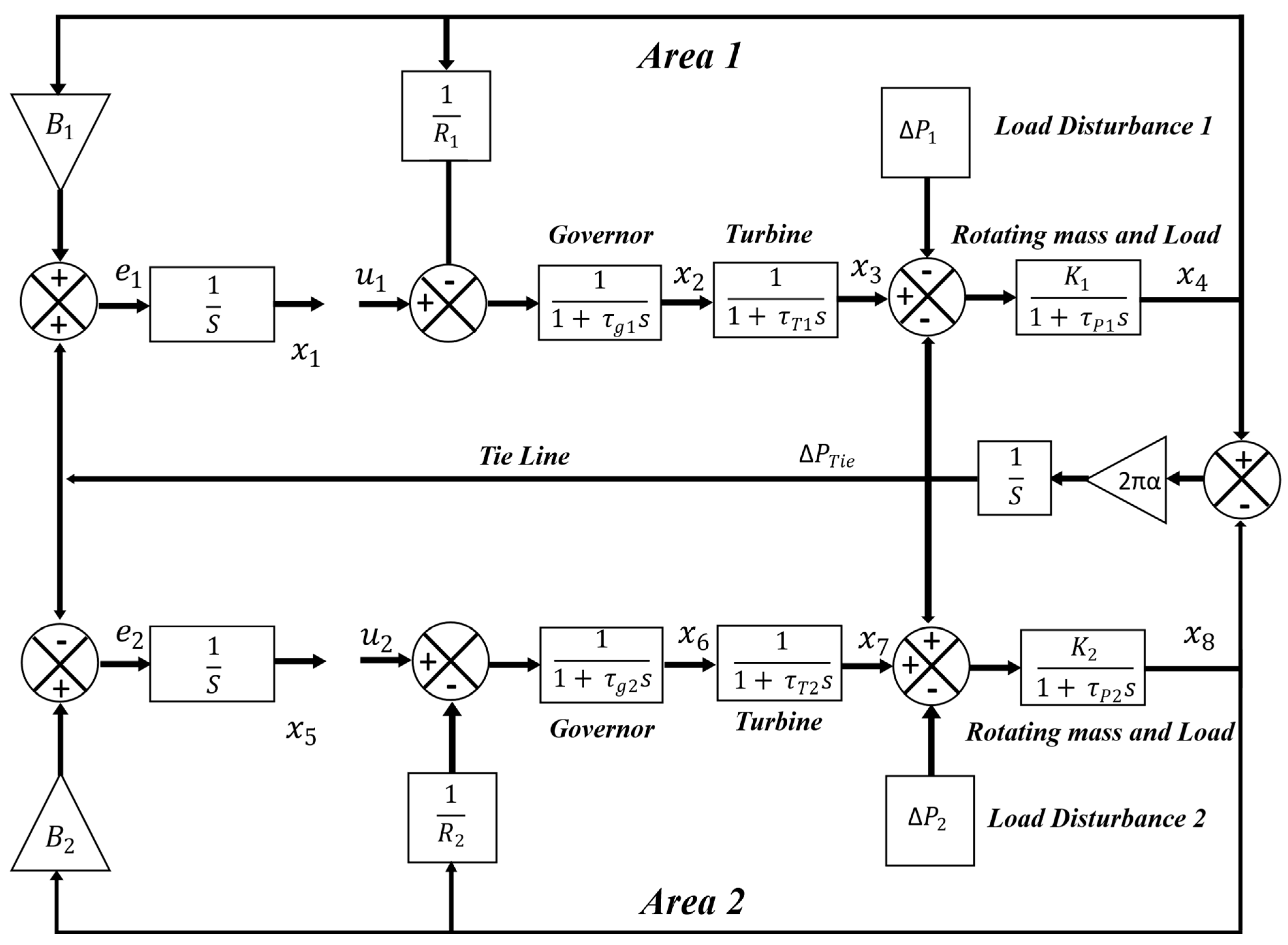
Figure 1. Automatic Generation Control (AGC) block diagram for a two area system.
Automation 06 00090 g001
Figure 2. Generalized plant configuration for H∞ control synthesis.
Automation 06 00090 g002
Figure 3. H∞ optimization framework with structured uncertainty.
Automation 06 00090 g003
Figure 4. ACEi responses and control vector U for ΔPloadi and ΔT variations using H∞ and PID controllers.
Automation 06 00090 g004
Figure 5. Control system architecture with dual performance channels.
Automation 06 00090 g005
Figure 6. ACEi, control energy, and control vector amplitude for a load change in the presence of time constant variations, comparing the H∞ and H∞/H2 controllers.
Automation 06 00090 g006
Figure 7. Instability of the ACEi response under high turbine and governor time constant variations, motivating the need for enhanced control via pole placement.
Automation 06 00090 g007
Figure 8. Graphical representation of the conic LMI region for pole placement.
Automation 06 00090 g008
Figure 9. Control vector amplitude for H∞, H∞/H2, H∞/H2 with pole placement, and H∞/H2 with pole placement and measured disturbance.
Automation 06 00090 g009
Figure 10. Control Vector Energy for H∞, H∞/H2, H∞/H2 with Pole Placement, and H∞/H2 with Pole Placement and Measured Disturbance.
Automation 06 00090 g010
Table 1. Comprehensive performance comparison of controllers.
Performance MetricStandard H∞H∞/H2H∞/H2/Pole PlacementProposed Controller (Measured Disturbance)Improvement vs. Standard H∞
Peak Control Signal (pu)8000-3316598% reduction
Control Energy (H2 norm)400-5.21097.5% reduction
Settling Time (s)0.011-7.00.2-
Overshoot (%)0.15%-2.6%0.83%-
Stability (Large Turbine/Gov. Variation)StableUnstableStableStableSuperior robustness
Table 2. Control energy H∞ vs. measured disturbance controller.
Control EnergyStandard H∞Proposed Controller
(Measured Disturbance)
Control Energy (ΔP = 0.1 pu)1283.797% reduction
Control Energy (ΔP = 0.4 pu)5101597% reduction
Peak Control (ΔP = 0.1 pu)27005498% reduction
Peak Control (ΔP = 0.4 pu)10,80021698% reduction
Disclaimer/Publisher’s Note: The statements, opinions and data contained in all publications are solely those of the individual author(s) and contributor(s) and not of MDPI and/or the editor(s). MDPI and/or the editor(s) disclaim responsibility for any injury to people or property resulting from any ideas, methods, instructions or products referred to in the content.