
Article

A Quantum Chemical Study on the Relative Stability of Diaminodinitroethylene Isomers

by
Krzysztof K. Zborowski
1,* and
Urszula Lelek-Borkowska
2
1
Faculty of Chemistry, Jagiellonian University in Krakow, Gronostajowa 2, 30-387 Kraków, Poland
2
Department of Chemistry and Corrosion of Metals, Faculty of Foundry Engineering, AGH-University of Science and Technology, Reymonta 23, 30-059 Kraków, Poland
*
Author to whom correspondence should be addressed.
Organics 2026, 7(1), 8; https://doi.org/10.3390/org7010008
Submission received: 4 October 2025 / Revised: 26 January 2026 / Accepted: 2 February 2026 / Published: 10 February 2026

Abstract

This study aims to investigate the relative stability of the diaminodinitroethylene isomers (cis, trans, and gem). To achieve this goal, calculations at several levels of theory were carried out. The B3LYP, PBE0, and CAM-B3LYP functionals, based on density functional theory (DFT), were used. G4 and MP2 calculations were also executed. All calculation methods predicted that the gem isomer is the most stable, while the cis isomer is the least stable. The energy order obtained for the isomers studied was rationalized by analysis of the detected intramolecular hydrogen bonding, electron delocalization, charge distribution, and changes in atomic energies in the structures studied. The origins of the superior stability of the gem isomer are demonstrated and justified.

Graphical Abstract

1. Introduction

Intensive research into developing new, more efficient and safer explosives is still widely conducted [1]. The application of theoretical methods to the study of explosive compounds is particularly valuable. This is because studying such compounds is especially dangerous, and it is much better to obtain information about their properties in silico without the dangers associated with laboratory testing [2]. Explosives that are safe to use and have reduced susceptibility to ignition are particularly valuable [3]. Diaminodinitroethylene is one of many systems that meet these conditions [4].
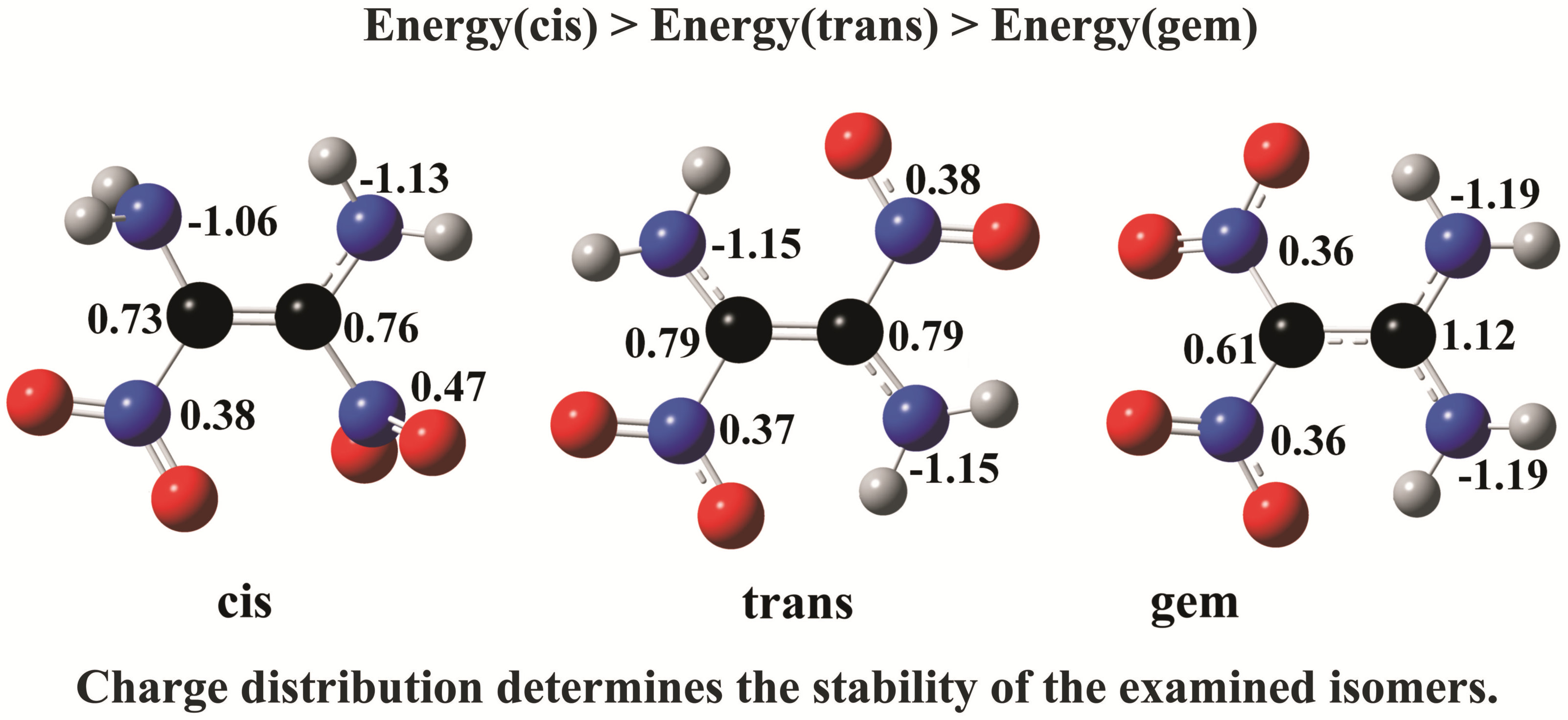
The diaminodinitroethylene system, abbreviated in this study as DADNE, has three possible structural isomers: cis, trans, and gem (see Figure 1) [5,6]. One of them, the gem isomer, 1,1-diamino-2,2-dinitroethylene, is well known as the FOX-7 explosive material [7]. It is valued for its high detonation efficiency and relatively low sensitivity to stimuli [8]. FOX-7 applications focus mainly on its use as a highly stable and efficient explosive for the production of low-sensitivity ammunition, replacing more dangerous substances, as well as in composite materials, where it combines high power with safety in use [9]. It is ideal for tasks requiring high power and stability, and is a key element in research into a new generation of safer explosives [10].
Several theoretical studies on the different properties of this system have been published. Among others, the Fukui function of DADNE was investigated [11]. Solid-state properties were also calculated [12]. Recently, novel push–pull systems originating from structural combinations of geminal and cis DADNE have been treated computationally [13]. Several papers are dedicated to the mechanism of FOX-7 decomposition [14,15,16].
The relative stability of DADNE isomers has also been studied previously [17,18,19]. It was reported that the gem isomer is the most stable one. In this work, such calculations are repeated by using a wide spectrum of quantum chemical methods. The main aim of this study is to present a rationalization for the highest stability of the gem isomer. Thus, the focus of research is on the search for the reasons why one DADNE isomer is more or less stable than others. The origins of the differences in stability are discussed on the basis of the existence and strength of intramolecular hydrogen bonding, the degree of electron delocalization, the atomic charge networks, and the relative atomic energies of the isomers studied.
In this study, we will examine the energy differences between DADNE isomers using advanced quantum chemistry methods at a higher level of calculation than in previous studies. We will use a number of properties related to the relative energies of chemical molecules to interpret the results obtained, such as hydrogen bonding, electron delocalization, charge distribution and the distribution of the molecule’s total energy among its atoms, as well as electrostatic potential maps. Most of these methods have never before been employed in the study of the DADNE molecule. Our interpretation will be based on determining measurable numerical parameters or creating maps that illustrate these properties rather than on generally accepted beliefs about their influence on chemical bond energies.

2. Methods

Quantum chemistry has a variety of different computational methods for modeling the structures and energies of molecules. Among these, several are used in this study. Calculations of DADNE isomers were performed using three very popular DFT functionals, namely B3LYP [20], CAM-B3LYP [21], and PBE0 [22]. The D3 version of Grimme’s empirical dispersion corrections [23] was added to all DFT functionals. In addition, two other methods (MP2 [24] and Gaussian-4 (G4) [25]) were used to calculate more accurate energy differences between the studied isomers. The G4 method is the latest version of the Gn approaches and has been specially designed to provide highly accurate molecular energy calculations. In the case of G4, the computations start with geometry optimization and frequency calculations at the B3LYP level. Several calculations are then performed, including the Hartree–Fock limit, MP2 and CCSD(T). The result is a very precise energy value for the molecular system [26]. Calculations (except for the G4 method, where the basis set is predefined) were performed using the 6-311++G** [27] and aug-cc-pvTZ basis sets [28]. Comparative calculations were also performed in the aqueous phase using the PCM method [29,30]. Equilibrium structures of the studied compounds were found, and their stability was tested by frequency calculations. Quantum chemical calculations were performed using the Gaussian program [31]. All structures obtained have only real vibrations, which means that they correspond to minima on the potential energy surface. The atoms-in-molecules (AIM) method [32] was used to calculate atomic charges and energies and to investigate the strength of intramolecular hydrogen bonds. The AIM method allows the total charge and total electronic energy to be split into atomic contributions. The energy of each atom in the most stable tautomer is subtracted from the energies of its counterparts in other tautomers. Thus, a positive value of the relative atomic energy indicates greater stability of the atom in the most stable tautomer, whereas a negative value indicates the greater stability of the respective atom in another tautomer with higher total energy [33]. The electron density of the molecules was analyzed using the AIM methodology with the AIMAll version 11.10.16 program [34]. Additional charge partitioning was performed using the GAPT [35] and Hirshfeld [36] population analyses. The harmonic oscillator model of aromaticity (HOMA) index [37,38] was used to evaluate the electron delocalization in the studied isomers. This very useful index is commonly used to determine aromaticity (the cyclic delocalization of electrons in a molecular ring), but it can also be used to evaluate the electron delocalization in acyclic fragments of chemical species [39]. Maps of the molecular electrostatic potential, which visualize the charge around the compound under study, have been prepared [40].

3. Results

Diaminodinitroethylene, like other ethylene derivatives of the general formula C2X2Y2 (where C2 represents the ethene skeleton, and X and Y are two different substituents), can potentially exist in three structural isomer forms: cis, trans and gem. In the cis and trans isomers, the same substituents are attached to different carbon atoms. In addition, there are different dihedral angles between the same substituents. This is about zero for the cis isomer and about 180 degrees for the trans isomer. The gem isomer is characterized by the attachment of the same substituents to the same carbon atom. All these isomers are shown schematically in Figure 1.

3.1. Calculations of Relative Energies

The aim of this study is to calculate and compare the relative energies of the DADNE isomers. To achieve this goal, quantum calculations were carried out at several levels of theory. The calculations located the equilibrium structures of the studied isomers and determined their energetic parameters. A comparison of the calculated thermochemical data showed that for all methods used in this study, the lowest energies (indicating the highest stability) are always associated with the gem isomer. Representatives of the calculated energies for different DADNE isomers are summarized in Table 1 Sums of electronic energies and vibrational corrections (E + ZPE) and free energies (G) are included. They are presented as relative values, i.e., differences between the most stable gem isomer and others (values calculated for the gem isomer are subtracted from those obtained for the cis or trans structures). The raw energies and free energies of DADNE isomers at all the theoretical levels used in this study, as well as the geometries of the analysed structures at the PBE/6-311++G** level, are available as Supplementary Data. Calculations of the relative energies of DADNE isomers have already been performed at various levels of theory; see Table 1. It is difficult to compare the results of this study with those of previous studies. Previous calculations were usually performed using fairly low functional bases, so the results of the calculations performed in this work should provide a better estimate of the energy differences between the isomers studied. More importantly, previous studies base their predictions solely on energy differences, often without even oscillation corrections, rather than free energy (as in this study). It is well known that, thermodynamically, the most stable phase is the one with the lowest free energy. For these reasons, the results found in the literature are quite different from ours. However, there is a correlation between the earlier and current results for B3LYP and MP2. It can also be seen that when calculations were performed at a high theoretical level (CCD/CCSD) and in a high basis set ((aug)-cc-pVDZ and cc-pVTZ), they are quite similar to the results obtained using the G4 method.
From the data in Table 1, it is possible to quickly establish an energetic order for the isomers studied. Thus, the gem isomer, with the lowest energy value, has the highest stability. The energy values determining the intermediate stability are predicted for the trans structure. The cis isomer, with the highest energy, has the lowest stability. The energy differences between the studied isomers are different at different levels of theory. The lowest energy differences between DADNE isomers are observed with the MP2 method (about 35 kJ/mol between gem and cis and about 12 kJ/mol between the gem and trans isomers). The relative stability energies evaluated by all DFT methods are higher (about 60 kJ/mol and 20 kJ/mol). The G4 relative stability energies between the gem and trans isomers are similar to those predicted by the DFT methods. In contrast, the G4 relative stability energy for the gem and cis isomers is in the middle of the MP2 and DFT predictions, about 50 kJ/mol. The G4 method is expected to give the most accurate energies. Therefore, to select the DFT method for further analysis, the energetic differences predicted by the G4 and DFT methods were compared. The PBE0 functional has the closest energy differences to G4. Hence, the PBE0 wave functions will be analyzed in the next sections. Conversely, MP2 produced the most divergent results. Therefore, caution should be exercised when using this approach for calculations involving nitro and/or amino groups. Similar to our results, energy differences between DADNE isomers for the MP2 method were also obtained in the work cited in Table 1. To examine the influence of the functional basis and the solvent, calculations were performed using the PBE0 functional, which was selected for further analysis, and the aug-cc-pvTZ functional basis. The influence of the functional basis on the results is rather small. However, the inclusion of the solvent has a greater impact, which will be discussed later.

3.2. Structural Properties of Calculated Structures

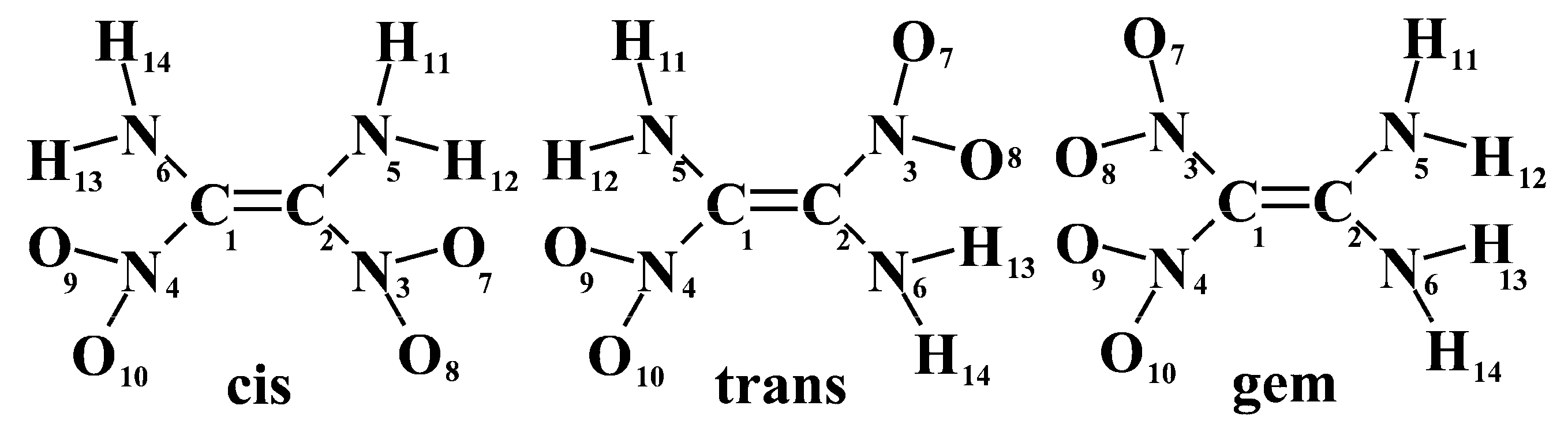
The molecular structures of the isomers studied at the PBE0/6-311++G** level are shown in Figure 2. Structures optimized by other methods used in this study are generally very similar, with only small variations in geometric parameters observed. Theoretically, these isomers have quite high symmetry, C2v, C2h, and C2v for the cis, trans, and gem isomers, respectively. However, none of these compounds reach a minimum in their possible highest symmetry structure. Such structures always have an imaginary frequency detected in the vibrational analysis, proving that such structures are unstable. For the cis isomer, the planarity is significantly disturbed by the strong out-of-plane twisting of an amino and a nitro group. For the trans and gem isomers, the distortion of planarity is not as great as for the cis isomer. However, these structures also fail to achieve the highest possible symmetry. The reason for this is that, for example, the natural tendency of the amino group is slightly non-planar.

3.3. Hydrogen Bond Properties

The intramolecular hydrogen bonds detected by the AIM method are also shown in Figure 2. Hydrogen bonding is one of the most popular stabilizing forces [41]. Thus, the presence of hydrogen bonds provides information about the energetic stabilization of the structure in which they are detected.
Out-of-plane twisting of some groups in the cis isomer results in the absence of hydrogen bonding in this structure. Thus, no hydrogen bonds were detected in this case. In contrast, there are four intramolecular hydrogen bonds in the trans structure, while two such bonds are present in the gem isomer; see Figure 2. The hydrogen bond lengths, angles and electron densities at the hydrogen bond critical points are summarized in Table 2. Since hydrogen bonds are stabilizing forces for chemical structures, their absence is one of the reasons why the cis structure has the lowest stability of all possible structures of DADNE. On the other hand, the gem structure, which has the highest stability, has two hydrogen bonds, while the trans isomer, with intermediate stability, has four. Moreover, in the gem isomer, there is a repulsive interaction between two oxygens, O8 and O9, of the nitro groups (also detected by the AIM calculations). However, it should be emphasized that the hydrogen bonds in the gem isomer are stronger than those detected in the trans isomer. The gem hydrogen bonds are described by a significantly shorter HB length, a larger angle and a higher electron density at the HB critical point.

3.4. Delocalization in DADNE Isomers

Delocalization is also considered to be one of the factors responsible for the stability of molecular structures. It is particularly important for unsaturated cyclic structures (where the phenomenon of the so-called aromaticity is well known), but it is also important for acyclic structures [39]. It is, therefore, worth investigating the delocalization levels of the isomers under study. The HOMA method was used for this purpose. Numerical values were determined at the PBE0/6-311++G** level. In the framework of the HOMA model, the fully delocalized structure has a HOMA index value equal to 1, while the HOMA value for the non-delocalized structure is 0. The cis isomer has its HOMA value almost exactly in the middle of the HOMA scale. It is equal to 0.48 and increases to 0.65 and 0.73 for the trans and gem isomers, respectively. Figure 2 shows the HOMO orbitals of the studied isomers, as well as the values of the dihedral angles around the C=C bond. As can be seen, the π orbital structure is most strongly deformed in the cis isomer and least deformed in the trans isomer. Conversely, the dihedral angles around the C=C bond are closest to 180° in the cis isomer. However, in this isomer, the amino and nitro groups are most deviated from the average plane of the molecule. The increase in delocalization in the gem isomer is expected to be the result of strong hydrogen bonding. In this isomer, the hydrogen bonds are parallel to the carbon–carbon bond, which could potentially shorten it. Consequently, the carbon–carbon bond length falls within the range of a delocalized bond. In contrast, the carbon–carbon bond length in the cis and trans isomers is within the range of a double bond (see Figure 3). The order of delocalization established by these HOMA values is identical to the stability order presented above. This result supports the idea that higher electron delocalization is a stabilizing factor for chemical structures.

3.5. Charge Distribution

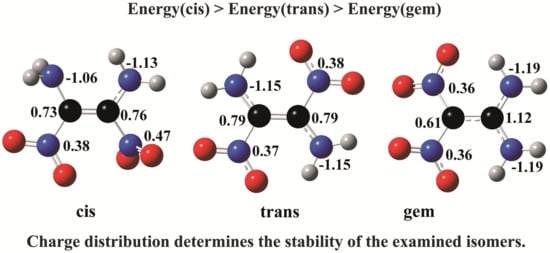
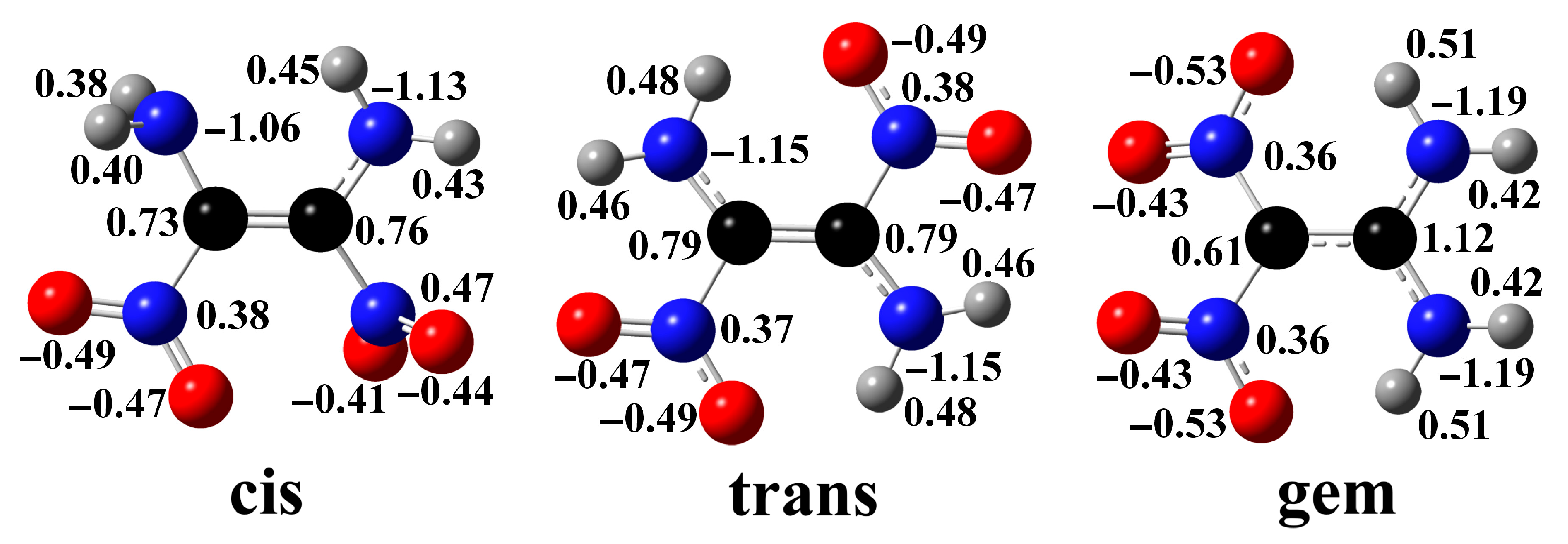
The charge distribution is also an important property that can give us significant information about the stability of chemical compounds. For this reason, the atomic charges were determined and are shown in Figure 3. In general, all studied isomers have a positively charged core formed by two carbon atoms. This core is surrounded by nitrogen atoms, with two kinds of charge. The nitrogen atoms of the amino groups have a large negative charge, while nitro’s nitrogen has a moderate positive charge (the peripheral part of the studied compounds has positively charged hydrogens of the amino groups and negatively charged oxygens belonging to the nitro groups). The absolute values of hydrogen and oxygen charges are almost the same. The charges of the carbon atoms in the cis and trans isomers are highly positive and very similar. The total positive charge on the carbon atoms in the gem isomer is even greater. However, the distribution of positive charge between the carbon atoms is different. In the trans and cis isomers, the charges of the carbon atoms are equal or nearly equal, respectively. In the gem isomer, however, the carbon atoms differ in that one has a greater positive charge than the other. The ways in which the carbons interact with the rest of the molecule are also different in the gem isomer. The C2 atom (the atom with the highest positive charge) interacts with two negatively charged nitrogen atoms of the amino groups. At the same time, the C1 carbon atom (with the reduced positive charge) is bonded to two positively charged nitrogens from the nitro groups. These interactions result in the appearance of large areas of coulombic attraction, which are not observed in the cis and trans isomers. This neutralizes the Coulomb repulsion caused by the proximity of two positively charged atoms. Such an alternating distribution of positive and negative charges leads to additional stabilization of the gem structure of the diaminodinitroethylene molecule. A similar process does not occur in the cis and trans isomers, where each carbon atom interacts with one nitrogen of the amine group and one nitrogen of the nitro group.

3.6. Changes in Atomic Energies Among Studied Isomers

Table 3 shows the relative changes in the atomic energies of the same atoms in different isomers. The atoms with positive relative energies have their lowest atomic energies in the most stable gem isomer. The largest changes in energy are observed for the C2 atom. The C2 atomic energies of the trans and cis isomers are more than 5 and 700 kJ/mol lower, respectively, than those of the most stable gem isomer. The accumulation of two nitro substituents in the gem structure does not promise to be energetically beneficial for the nitrogen atoms of the nitro groups. The atomic energies of most hydrogen atoms are lower in the trans and, in particular, cis isomers. The stabilization of the aforementioned atoms in the higher-energy isomers is counterbalanced by the stabilization in the gem isomer nitrogen atoms forming the amino groups. Connecting two amino groups to the same carbon atom significantly lowers their energy. Additionally, all the oxygen atoms are stabilized, with the most stable being those involved in strong hydrogen bonds with the amino moieties, as observed in the gem isomer. It is clear that the changes in atomic energies reflect the changes in atomic charges (discussed earlier) and electrostatic potential maps (see next paragraph).

3.7. Molecular Electrostatic Potential Maps

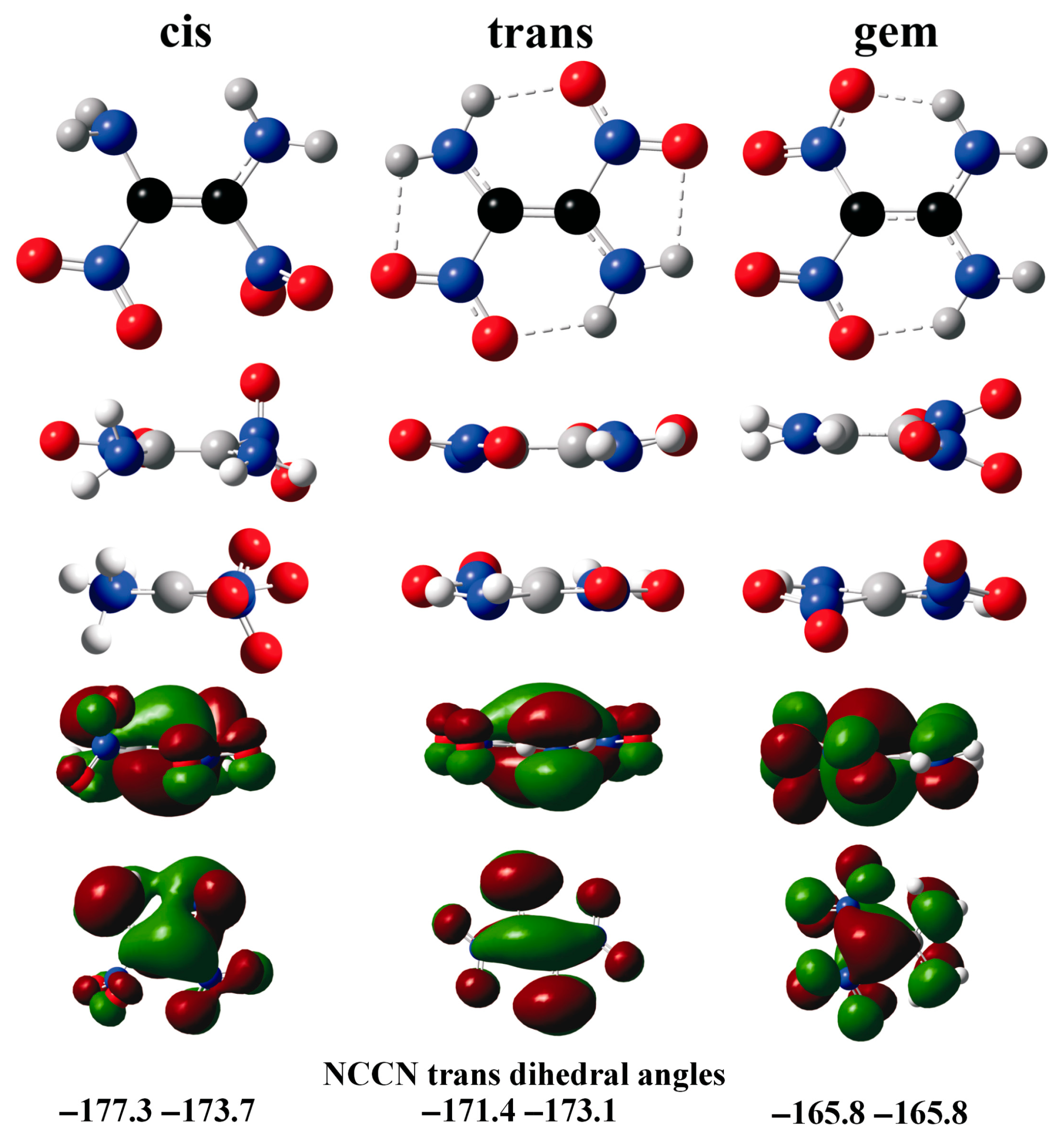
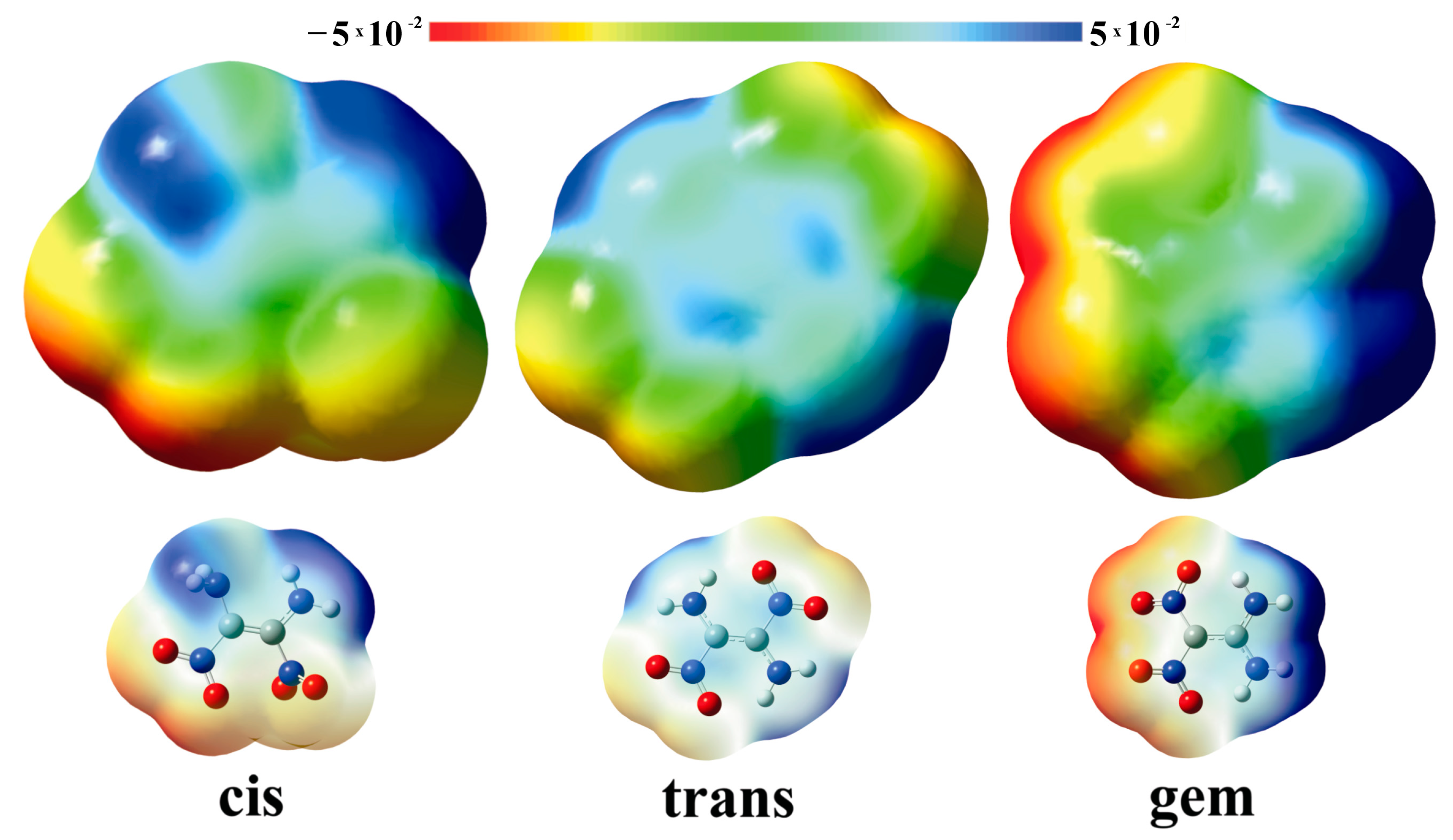
Finally, let us look at the molecular electrostatic potential (MEP) maps of the isomers studied, which are shown in Figure 4. As can be seen from the figure, the electronic structures of the cis and trans isomers are completely different from that of the gem isomer. The cis and trans isomers are characterized by a mosaic of small areas with different potentials. In contrast, the potential structure of the gem isomer is ordered. On one side are areas of negative potential, which transition smoothly into positive potentials as we move towards the other end of the gem DADNE. The ordered, dipole-like structure of the compound, with large areas of positive and negative potential, stabilizes the molecule as a whole. The fact that such a dipole structure is important for the stabilization of the studied system is also visible from the results obtained using water as a solvent in the PCM method. Interaction with a polar solvent, such as water, causes further stabilization of the gem isomer over the cis isomer due to its dipole charge distribution in the former. Water also causes charge polarization in the trans isomer, which results in a reduction in the energy difference between the gem and trans isomers.

4. Conclusions

The quantum mechanical calculations performed in this study show that among all the possible isomers of the DADNE molecule, the gem isomer is the most stable. At all levels of calculation used, the DADNE isomers form the same energetic order: gem > trans > cis. The degree of energetic stabilization of the gem isomer depends on the calculation level. The highest stabilization is found at the DFT level, moderate for the G4 method, and the lowest for MP2. The energy order determined by the calculations agrees with experimental data, where the gem isomer is observed [42].
The present study justifies the highest stability of the gem isomer in several ways. This research takes a novel, comprehensive approach to the subject by carrying out a detailed analysis of precisely calculated values of properties related to molecular energy. Particular attention was paid to charge distribution and electrostatic potential mapping. While chemistry is governed by electromagnetic forces, an approach that focuses on these properties, directly responsible for these interactions, is quite uncommon. The gem isomer forms the strongest hydrogen bonds of all the structures studied. The gem isomer also has the highest electron delocalization. Analysis of the atomic contributions to the total energies of the molecules studied, provided by the atoms in molecules theory, revealed which atoms are responsible for the stability of the gem isomer. The most important atoms for this effect are the nitrogen and oxygen atoms in the DADNE molecule. However, it seems that the driving force that stabilizes the gem isomer is the molecular charge distribution. In the gem isomer, the carbon atom with the highest positive charge interacts only with the negatively charged nitrogen atom. The opposite situation occurs in the case of the second carbon atom. This greatly reduces the repulsive Coulomb interaction observed in other DADNE isomers. The results and conclusions presented in this paper relate only to the isolated DADNE molecule. Studies on the stability of DADNE clusters are in progress.

Supplementary Materials

The following supporting information can be downloaded at https://www.mdpi.com/article/10.3390/org7010008/s1, energies and free energies of DADNE isomers at different levels of theory alongside the geometries of the analysed structures at the PBE/6-311++G** level.

Author Contributions

Conceptualization, U.L.-B.; Methodology, K.K.Z.; Software, K.K.Z.; Validation, U.L.-B. and K.K.Z.; Writing—Original Draft Preparation, U.L.-B.; Writing—Review and Editing, U.L.-B. and K.K.Z.; Supervision, K.K.Z.; Project Administration, U.L.-B.; Funding Acquisition, U.L.-B. All authors have read and agreed to the published version of the manuscript.

Funding

Project number 16.16.170.654/B407, realized at the AGH University of Krakow, supported this study.

Data Availability Statement

The raw data supporting the conclusions of this article will be made available by the authors on request.

Acknowledgments

This research was carried out with the support of the Interdisciplinary Centre for Mathematical and Computational Modelling at the University of Warsaw (ICM UW).

Conflicts of Interest

The authors declare no conflicts of interest.

References

  1. Bruce, A.; Timmerman, L.E.; Fiakpui, N.A.; Lessey, L.; Beardah, M.S.; Daeid, N.N.; Menard, H. A Scientometric Review of Explosives Research: Challenges and Opportunities. Forensic Sci. Inter. 2025, 373, 112513. [Google Scholar] [CrossRef] [PubMed]
  2. Yan, Q.-L.; Zeman, S. Theoretical Evaluation of Sensitivity and Thermal Stability for High Explosives Based on Quantum-chemistry Methods: A Brief Review. Int. J. Quantum. Chem. 2013, 113, 1049–1061. [Google Scholar] [CrossRef]
  3. Nair, U.R.; Asthana, S.N.; Rao, A.S.; Gandhe, B.R. Advances in High-energy Materials. Defence Sci. J. 2010, 60, 137–151. [Google Scholar] [CrossRef]
  4. Trzciński, W.A.; Belaada, A. 1,1-Diamino-2,2-dinitroethene (DADNE, FOX-7)-Properties and Formulations (a Review). Cent. Eur. J. Energ. Mater. 2016, 13, 527–544. [Google Scholar] [CrossRef]
  5. Trzciński, W.A.; Cudziło, S.; Chyłek, Z.; Szymańczyk, L. Investigation of Detonation Characteristics and Sensitivity of DADNE—Based Phlegmatized Explosives. J. Hazard. Mater. 2008, 157, 605–612. [Google Scholar] [CrossRef]
  6. Mishra, V.S.; Vadali, S.R.; Garg, R.K.; Joshi, V.S.; Wasnik, R.D.; Asthana, S. Studies on FOX-7 Based Melt-cast High Explosive Formulations. Cent. Eur. J. Energ. Mater. 2013, 10, 569–580. [Google Scholar]
  7. Latypov, N.V.; Bergman, J.; Langlet, A.; Wellmar, U.; Bemm, U. Synthesis and Reactions of 1,1-diamino-2,2-dinitroethylene. Tetrahedron 1998, 54, 11525–11536. [Google Scholar] [CrossRef]
  8. Sikder, A.K.; Sikder, N. A Review of Advanced High Performance, Insensitive and Thermally Stable Energetic Materials Emerging for Military and Space Applications. J. Hazard. Mater. 2004, 112, 1–15. [Google Scholar] [CrossRef]
  9. Trzciński, W.A.; Cudziło, S.; Chyłek, Z.; Szymańczyk, L. Detonation Properties and Thermal Behavior of FOX-7-based Explosives. J. Energ. Mater. 2013, 31, 72–85. [Google Scholar] [CrossRef]
  10. Florczak, B. A Comparison of Properties of Aluminized Composite Propellants Containing HMX and FOX-7. Cent. Eur. J. Energ. Mater. 2008, 5, 103–111. [Google Scholar]
  11. Giannerini, T.; Borges, I. Molecular Electronic Topology and Fragmentation Onset via Charge Partition Methods and Nuclear Fukui Functions: 1,1-diaminodinitroethylene. Braz. Chem. Soc. 2015, 26, 851–859. [Google Scholar] [CrossRef]
  12. Ju, X.; Xiao, H. Periodic DFT Study on 1,1-diamino Dinitroethylene Crystal. Chin. J. Chem. Phys. 2004, 17, 407–410. [Google Scholar]
  13. Türker, L. Tautomerism in a DADNE Embedded Pull-Push Type Structures-A DFT Treatise. Chem. J. 2020, 6, 199–208. [Google Scholar]
  14. Gindulyte, A.; Massa, L.; Huang, L.; Karle, J. Mechanism of 1,1-diamino-2,2-dinitroethylene Decomposition: A Density Functional Theory Study. J. Phys. Chem. A 1999, 103, 11045–11051. [Google Scholar] [CrossRef]
  15. Gindulyte, A.; Massa, L.; Huang, L.; Karle, J. Decomposition Mechanism of 1,1-Diamino Dinitroethylene (Fox-7): An Overview of the Quantum Chemical Calculation. Theor. Comput. Chem. 2003, 12, 91–109. [Google Scholar]
  16. Krisyuk, B.E.; Zakharov, V.V.; Chukanov, N.V. On the Mechanism of Thermal Decomposition of 1,1-Diamino-2,2-dinitroethene (FOX-7) and its Cyclic Derivatives. Cent. Eur. J. Energ. Mater. 2020, 17, 20–30. [Google Scholar] [CrossRef]
  17. Politzer, P.; Concha, M.C.; Grice, M.E.; Murray, J.S.; Lane, P.; Habibollazadeh, D. Computational investigation of the structures and relative stabilities of amino/nitro derivatives of ethylene. J. Mol. Struct. 1998, 452, 75–83. [Google Scholar] [CrossRef]
  18. Kimmel, A.V.; Sushko, P.V.; Kuklja, M.M. The structure and decomposition chemistry of isomer defects in a crystalline DADNE. J. Energ. Mater. 2010, 28, 128–139. [Google Scholar] [CrossRef]
  19. Anfu, J.; Heming, X.; Haishan, D.; Xuedong, G.; Jinshan, L.; Zunyao, W. The Theoretical Study on Structure and Property of Diamino-dinitroethylene. Acta Chim. Sin. 2001, 59, 39–47. [Google Scholar]
  20. Becke, A.D. Density-functional thermochemistry. III. The Role of Exact Exchange. J. Chem. Phys. 1993, 98, 5648–5652. [Google Scholar] [CrossRef]
  21. Yanai, T.; Tew, D.; Handy, N. A New Hybrid Exchange-correlation Functional Using the Coulomb-attenuating Method (CAM-B3LYP). Chem. Phys. Lett. 2004, 393, 51–57. [Google Scholar] [CrossRef]
  22. Adamo, C.; Barone, V. Toward Reliable Density Functional Methods Without Adjustable Parameters: The PBE0 Model. J. Chem. Phys. 1999, 110, 6158–6170. [Google Scholar] [CrossRef]
  23. Grimme, S.; Antony, J.; Ehrlich, S.; Krieg, H. A Consistent and Accurate Ab Initio Parametrization of Density Functional Dispersion Correction (DFT-D) for the 94 Elements H-Pu. J. Chem. Phys. 2010, 132, 154104. [Google Scholar] [CrossRef] [PubMed]
  24. Møller, C.; Plesset, M.S. Note on an Approximation Treatment for Many-electron Systems. Phys. Rev. 1934, 46, 618–622. [Google Scholar] [CrossRef]
  25. Curtiss, L.A.; Redfern, P.C.; Raghavachari, K. Gaussian-4 theory. J. Chem. Phys. 2007, 126, 084108. [Google Scholar] [CrossRef]
  26. Curtiss, L.A.; Redfern, P.C.; Raghavachari, K. Gn Theory. WIREs Comput. Mol. Sci. 2011, 1, 810–825. [Google Scholar] [CrossRef]
  27. McLean, A.D.; Chandler, G.S. Contracted Gaussian Basis Sets for Molecular Calculations. I. Second Row Atoms, Z = 11–18. J. Chem. Phys. 1980, 72, 5639–5648. [Google Scholar] [CrossRef]
  28. Kendall, R.A.; Dunning, T.H., Jr.; Harrison, R.J. Electron Affinities of the First-row Atoms Revisited. Systematic Basis Sets and Wave Functions. J. Chem. Phys. 1992, 96, 6796–6806. [Google Scholar] [CrossRef]
  29. Cossi, M.; Barone, V.; Cammi, R.W.; Tomasi, J. Ab initio study of solvated molecules: A new implementation of the Polarizable Continuum Model (PCM). Chem. Phys. Lett. 1996, 255, 327–335. [Google Scholar] [CrossRef]
  30. Tomasi, J.; Mennucci, B.; Cammi, R. Quantum mechanical continuum solvation models. Chem. Rev. 2005, 105, 2999–3093. [Google Scholar] [CrossRef]
  31. Frisch, M.J.; Trucks, G.W.; Schlegel, H.B.; Scuseria, G.E.; Robb, M.A.; Cheeseman, J.R.; Scalmani, G.; Barone, V.; Mennucci, B.; Petersson, G.A.; et al. Gaussian 09 Revision D.01; Gaussian Inc.: Wallingford, CT, USA, 2013. [Google Scholar]
  32. Bader, R.W.F. Atoms in Molecules: A Quantum Theory; Oxford University Pres: Oxford, UK, 1990. [Google Scholar]
  33. Zborowski, K.K. An Atoms-in-molecules Study on Selected Tautomeric Triads. Chem. Phys. Lett. 2012, 545, 144–147. [Google Scholar] [CrossRef]
  34. Keith, T.A. AIMAll, version 11.10.16; TK Gristmill Software: Overland Park, KS, USA, 2011.
  35. Ciosłowski, J. A New Population Analysis Based on Atomic Polar Tensors. J. Am. Chem. Soc. 1989, 111, 8333–8336. [Google Scholar] [CrossRef]
  36. Hirshfeld, F.L. Bonded-atom Fragments for Describing Molecular Charge Densities. Theor. Chim. Acta 1977, 44, 129–138. [Google Scholar] [CrossRef]
  37. Kruszewski, J.; Krygowski, T.M. Definition of aromaticity basing on the harmonic oscillator model. Tetrahedron Lett. 1972, 13, 3839–3842. [Google Scholar] [CrossRef]
  38. Krygowski, T.M. Crystallographic Studies of Inter- and Intramolecular Interactions Reflected in Aromatic Character of Pi Electron Systems. J. Chem. Inf. Comput. Sci. 1993, 33, 70–78. [Google Scholar] [CrossRef]
  39. Raczyńska, E.D.; Kosińska, W.; Ośmiałowski, B.; Gawinecki, R. Tautomeric Equilibria in Relation to Pi-Electron Delocalization. Chem. Rev. 2005, 105, 3561–3612. [Google Scholar] [CrossRef]
  40. Murray, J.S. Molecular Electrostatic Potentials: Concepts and Applications; Elsevier Science: Amsterdam, The Netherlands, 1996. [Google Scholar]
  41. Grabowski, S. Hydrogen Bonding—New Insights; Springer: Dordrecht, The Netherlands, 2006. [Google Scholar]
  42. Bemm, U.; Östmark, H. 1,1-Diamino-2,2-dinitroethylene—A Novel Energetic Material with Infinite Layers in Two Dimensions. Acta Crystallogr. C 1998, 54, 1997–1999. [Google Scholar] [CrossRef]
Figure 1. Schematic structures of DADNE isomers and atom numbering scheme.
Organics 07 00008 g001
Figure 2. Multiple viewing angles of optimized DADNE isomers geometries at the PBE0/6-311++G** level and visualization of their HOMO orbitals.
Organics 07 00008 g002
Figure 3. Atomic charges of DADNE isomers (PBE0/6-311++G**).
Organics 07 00008 g003
Figure 4. Molecular electrostatic potential (MEP) of the investigated isomers.
Organics 07 00008 g004
Table 1. Relative energies (sum of electronic and zero-point vibrational energy, E + ZPE) and free energies (G) between the most stable gem isomer and higher energy isomers at different levels of theoretical calculations.
MethodE + ZPE [kJ/mol]G [kJ/mol]
CisTransCisTrans
B3LYP/6-311++G**61.1016.9058.1917.00
CAM-B3LYP/6-311++G**65.0128.2462.2328.04
PBE0/6-311++G**64.2320.7061.2221.00
PBE0/aug-cc-pvTZ67.4022.2564.7223.04
PBE0/6-311++G**/PCM74.8046.7476.6046.61
MP2/6-311++G**36.5712.2833.6212.08
G449.8521.2545.3722.45
MP2/6-31G** (no ZPE) [19]48.6936.45
HF/6-31G** (no ZPE) [19]69.5754.05
B3LYP/6-31G** (no ZPE) [19]71.1222.14
B3P86/6-31+G** [17]70.2517.54
B3LYP/different basis sets (no ZPE) [18]67.36–70.2919.25–23.0
CCD-CCSD/different basis sets (no ZPE) [18]41.42–46.4424.27–28.03
Table 2. Properties of intramolecular hydrogen bonds (HBs) at the PBE0/6-311++G** level.
IsomerHB LengthHB AngleElectron Density of HB Critical Point
cisno detected hydrogen bonds
trans
O7H111.9153123.330.0306
O10H141.9153123.330.0306
O8H132.0851103.980.0250
O9H122.0852103.990.0250
gem
O7H111.8058130.000.0385
O10H141.8058130.000.0385
Table 3. Relative energies of cis and trans isomer atoms in comparison to the atoms of the most stable gem isomer (PBE0/6-311++G**).
AtomCisTrans
C163.2213.0
C2−733.3−561.5
N3106.8-0.5
N4−14.6−0.5
N5186.9129.3
N6495.4128.8
O784.830.8
O833.411.9
O929.311.9
O1043.530.8
H11−69.9−38.5
H1226.453.0
H13−24.753.0
H14−162.0−38.5
Total65.222.8
Disclaimer/Publisher’s Note: The statements, opinions and data contained in all publications are solely those of the individual author(s) and contributor(s) and not of MDPI and/or the editor(s). MDPI and/or the editor(s) disclaim responsibility for any injury to people or property resulting from any ideas, methods, instructions or products referred to in the content.