Article

Study on the Mixture Patterns and Dynamic Growth Rate of Sequential Transport of Refined Oil and Liquid Ammonia Based on Their Low Solubility Characteristics

1
Shaanxi Yanchang Petroleum Emerging Industry Co., Ltd., Xi’an 710075, China
2
College of Pipeline and Civil Engineering, China University of Petroleum (East China), Qingdao 266580, China
*
Authors to whom correspondence should be addressed.
Fuels 2026, 7(2), 29; https://doi.org/10.3390/fuels7020029
Submission received: 25 February 2026 / Revised: 30 March 2026 / Accepted: 16 April 2026 / Published: 5 May 2026

Abstract

Ammonia, as a hydrogen carrier and clean fuel, has an increasingly urgent demand for large-scale transportation. Utilizing the existing refined oil pipeline network for sequential transportation of ammonia and refined oil is an economically and efficiently feasible solution. However, the unique micro-solubility characteristics of ammonia and refined oil can cause significant differences in the mixing mechanism of the two substances during sequential transportation in the pipeline compared to traditional oil products. This study conducts transient flow numerical simulation and mechanism research on the mixing problem during the sequential transportation process of ammonia and refined oil under the influence of micro-solubility transfer. Using the ANSYS Fluent platform and combining it with the dynamic mesh technology, a sequential transportation pipeline model was constructed. In the VOF multiphase flow model framework, the Fick diffusion and convective transfer theories were coupled. Through the development of user-defined functions, a transfer model was established to describe the ammonia dissolution process in refined oil during sequential transportation. This model characterizes the axial transfer process of the two-phase flow and the dissolution transfer in the pipeline. Then, the correctness and accuracy of the transfer model were verified, proving that the model has reliable simulation capabilities. To evaluate the comprehensive influence of various engineering factors on the mixing law, this study selected seven key parameters. It then designed and simulated multiple sets of comparative conditions. The influence of each parameter on the development of the mixing section was analyzed, and a sensitivity analysis was conducted. Subsequently, using the growth rate of the mixing length (dL/dt) as the dependent variable to represent the dynamic development of the mixing process, and using the above seven parameters as independent variables, a semi-empirical fitting formula was established. This formula can comprehensively reflect the coupling effect of multiple factors. The results show that the model has good generalization ability and extrapolation robustness. It provides a prediction model and theoretical tool with certain engineering practical value. This can be used for predicting the amount of mixing and optimizing operating parameters in actual pipeline sequential transportation systems.

1. Introduction

1.1. Research Background and Significance

As a promising new fuel, ammonia has gained significant attention in recent years due to its zero-carbon emissions and ease of liquefaction for transportation. Against the backdrop of declining demand for fossil fuels, future refined oil pipeline throughput is expected to decrease, leading to increased blending volumes and rising operational costs. Transporting liquid ammonia through existing refined oil pipelines can effectively resolve external liquid ammonia transportation challenges. It can simultaneously increase pipeline throughput, reduce blending losses, and fully leverage the pipeline system’s potential [1,2]. Future refined oil pipeline systems may feature sequential transportation scenarios involving multiple liquid chemical products, including refined oil and liquid ammonia.
During the continuous transportation of long-distance refined oil pipelines, the mixing of different media is inevitable. Compared with the traditional liquid mixing method in refined oil pipelines, the mutual solubility of liquid ammonia and refined oil is relatively poor. When using the existing refined oil pipelines for sequential transportation, the micro-solubility characteristics between liquid ammonia and refined oil need to be taken into consideration. Therefore, the core challenge in the sequential transportation of refined oil and liquid ammonia lies in addressing the micro-dissolution mass transfer problem. This problem occurs when two media with significantly different physical properties are alternately transported through the same pipeline.
Huang Weihe et al. [3] pointed out that future research should focus on sequential transfer processes for liquid ammonia and refined oil, as well as liquid mixing treatment. Regarding theoretical models, foreign scholars’ studies on traditional refined oil sequential transfer and oil–water immiscible medium displacement flow have provided important references for this field. The Birge formula, derived early on based on pipeline data, laid the foundation for research. Austin and Palfrey [4] developed the widely adopted Austin-Palfrey empirical formula based on Birge’s mixture model. Baptista et al. [5] deepened the investigation into convective transfer effects in fluids and established the foundation for oil mixture calculations with their one-dimensional mixture model. Rachid et al. [6] experimentally analyzed mixed oil phenomena, incorporating factors like pipe diameter variation and pumping operations to refine the model. Ekambara [7] established a two-dimensional mixed oil model by improving the turbulent diffusion coefficient. Deng Songsheng et al. [8] proposed a two-dimensional computational model for mixed oil based on boundary layer theory. Lu Yuling and many other scholars have also pointed out that the viscosity of the oil–water mixture is related to the structure of oil–water dispersion [9,10]. Li et al. [11] established a hydrodynamic model for water-driven oil displacement in downslope moving pipelines based on liquid–liquid two-phase flow theory and momentum transfer equations. Fang et al. [12] investigated the water phase’s capacity to carry residual oil in pipelines, revealing the dual-effect mechanism of inclination angle. Yan Chen et al. [13] analyzed the shortcomings in the formation mechanism of oil–water mixtures, the displacement flow of immiscible fluids, and the characteristics of water-carried oil during water flooding in pipelines. They also proposed five future research directions, covering interface morphology, flow field characteristics, and other aspects. Kjølaas et al. [14] used measured droplet sizes to construct a gravity diffusion model for oil–water two-phase flow. They also demonstrated that the model can be simplified to the Sauter mean diameter and uniform diffusivity. Pourari et al. [15] used a multi-fluid Eulerian approach and a population balance model to numerically simulate the flow of dispersed water in the oil phase within a horizontal pipe. They also validated the droplet size and phase distribution. Olados et al. [16] experimentally studied the displacement flow of immiscible fluids in an inclined pipe. They discovered the adhesion phenomenon caused by the displacing fluid and its effect on removal efficiency. Hasnain and Alba [17] used a lubrication model to theoretically analyze the buoyancy displacement of immiscible fluids in an inclined pipe. He revealed phenomena such as capillary bulging and interface jump caused by immiscibility. Although these models do not directly address liquid ammonia, their modeling approaches and methodologies provide valuable insights for studying liquid ammonia-refined oil mixtures.
With technological advancements, numerical simulation has become a crucial tool for studying the evolution of mixed oil. Computational Fluid Dynamics (CFD) simulations enable in-depth analysis of fluid flow, heat transfer, and mass transfer behaviors during sequential pumping processes. Researchers worldwide are exploring its application in simulating the sequential transport of various media. Through CFD simulations, Teng Lin et al. [18] Employed OLGA 2022 software to establish a simulation model for liquid ammonia long-distance pipelines. They analyzed the impact of parameters such as pipe diameter and flow rate on hydraulic and thermal characteristics. In doing so, they achieved simulation of these properties. Simplifying liquid ammonia and refined oil as immiscible liquids, Huang Xin et al. [19] established a two-phase flow model for sequential transport of liquid ammonia/refined oil using a coupled phase-field method and fluid control equations. The study focused on investigating the effects of transport sequence, flow velocity, and pipeline inclination angle on the two-phase flow patterns during liquid ammonia—refined oil sequential transport. The team also developed a test apparatus for evaluating the characteristic patterns of liquid ammonia/refined oil mixtures, enabling assessment of how parameters such as temperature and pressure influence mixture morphology.
Overall, current research on refined oil-liquid ammonia mixture development primarily relies on CFD methods, typically treating liquid ammonia and refined oil as immiscible media within two- or three-dimensional pipeline flow models. Such models overlook the slight solubility characteristics between liquid ammonia and refined oil. They feature numerous grid nodes. They also involve substantial computational demands. These factors make them unsuitable for simulating long-distance pipelines. Therefore, it is necessary to establish a low-dimensional model for mixture development. This model accounts for the slight solubility characteristics between liquid ammonia and refined oil. It enables rapid and efficient characterization of mixture development in long-distance pipelines. This will inject new service capabilities into existing refined oil pipelines, supporting the safe and efficient transportation of green energy.

1.2. Key Research Focus of This Paper

  • Based on the VOF model, a liquid–liquid two-phase flow model incorporating Fick’s diffusion law and convective mass transfer theory was developed to account for the micro-solubility mass transfer between liquid ammonia and refined oil.
  • Based on extensive three-dimensional simulations, an empirical formula for mixture development is derived to enhance computational efficiency in simulating liquid ammonia-refined oil mixture propagation in long-distance pipelines.

2. Model Construction and Test Methods

2.1. Development of the Physical Simulation Model

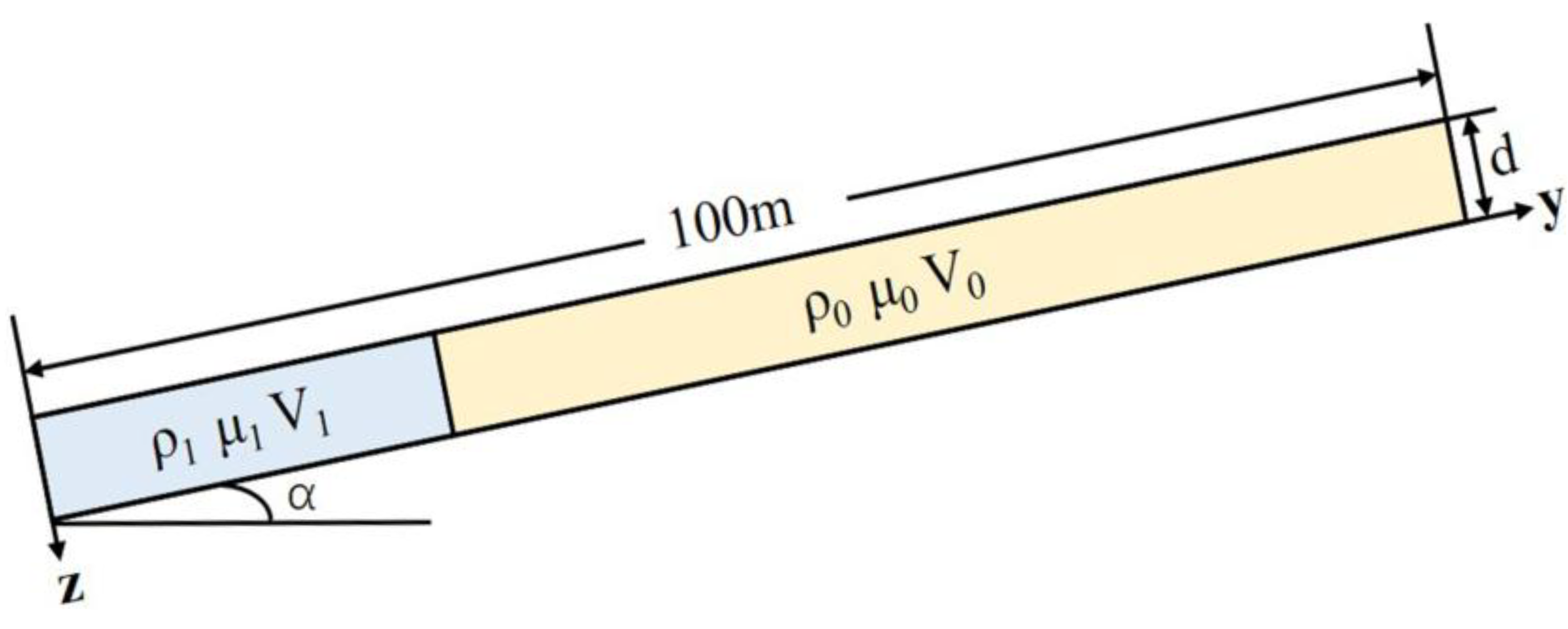
Figure 1 for the pipeline. The pipeline transports refined oil and liquid ammonia, with a 100 m long section serving as the simulation object. Simulate the sequential flow process where the trailing fluid with density ρ1, viscosity μ1, and volume fraction V1 propels the leading fluid with density ρ0, viscosity μ0, and volume fraction V0.
To simplify calculations, the model neglects the mixture formed during fluid displacement. The initial contact interface between the two fluids is defined at the y = 0 m cross-section of the pipeline, serving as the starting point for the simulation. Since the flow at the mixture interface is unsteady, initial conditions must be specified. The pipeline is set to be filled with the leading oil product and in a steady state, with the concentration of the leading oil product at all points within the pipeline being 1. The pipeline outlet boundary condition is set as a pressure outlet, while the inlet boundary condition is set as a velocity inlet. The standard wall function method and no-slip boundary condition are applied to the pipeline wall.

2.2. Physical and Chemical Properties of Liquid Ammonia and Refined Oil

Liquid ammonia has a density of approximately 610 kg/m3, a boiling point of −33.5 °C, and a viscosity of about 1.39 × 10⁻⁴ kg/m·s. The density of refined oil typically ranges between 750 and 830 kg/m3, with specific values depending on the liquid type (Such as gasoline, diesel, or heavy oil). Secondly, the viscosity of refined oil varies significantly, generally ranging from 5 × 10⁻⁴ to 4 × 10⁻³ kg/m·s. Temperature changes markedly affect their fluidity, with viscosity increasing at lower temperatures. Additionally, the surface tension of refined oil typically lies between 0.02 and 0.03 N/m. It should be noted that liquid ammonia, as a polar chemical substance, has a relatively low solubility when mixed with non-polar hydrocarbon refined oil. However, it is not completely immiscible. At normal temperature and pressure, liquid ammonia is slightly soluble in refined oil.

2.3. Grid

2.3.1. Mesh Independence

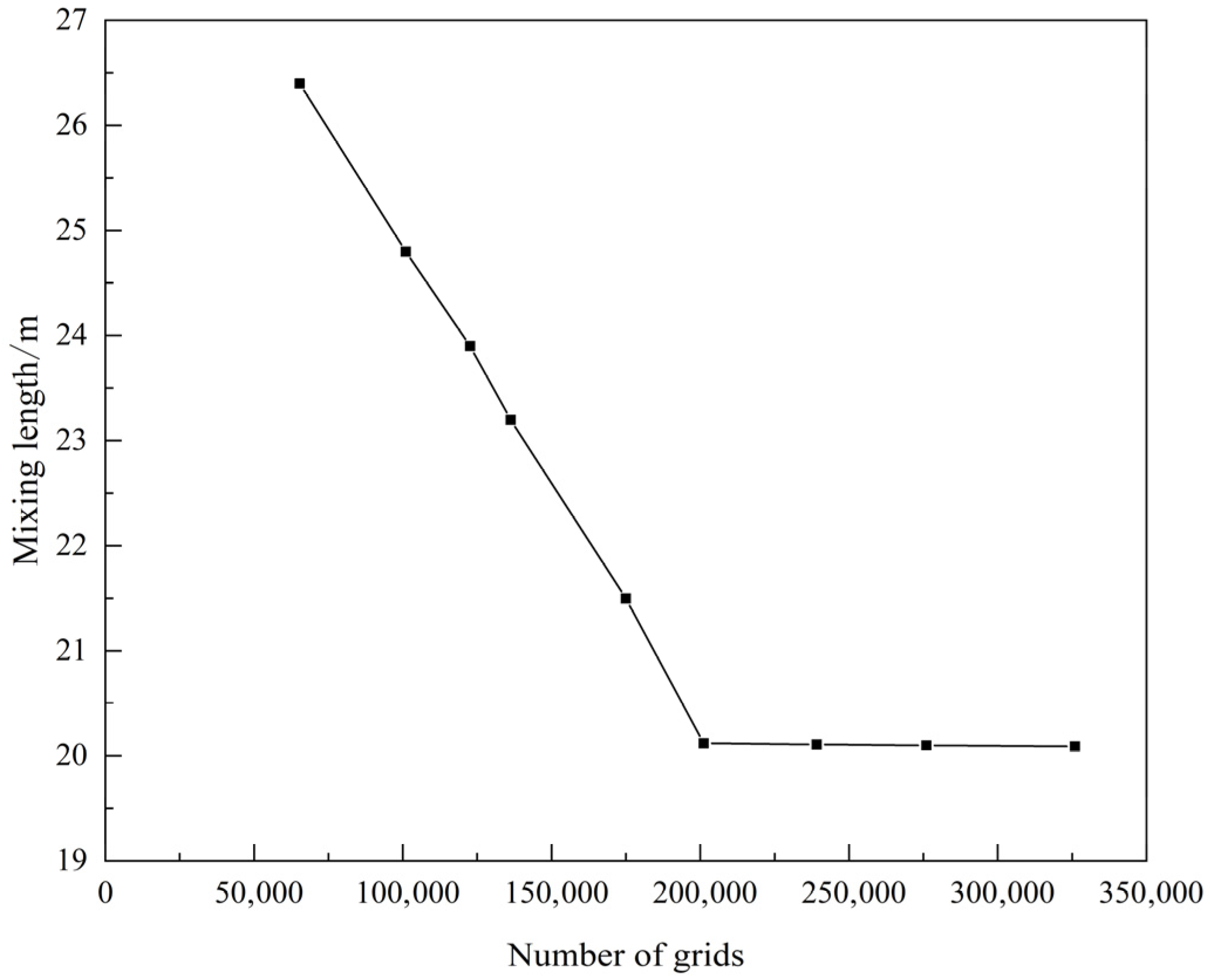
In the verification of grid independence, the liquid mixing length is the most direct and crucial output quantity that characterizes the sequential transportation process. It is also the main basis for subsequent parameter influence analysis and semi-empirical formula modeling. Therefore, it is taken as the core verification indicator for grid convergence. Nine grid schemes were compared in ascending order of grid size, with the number of grid cells set to 65,248, 100,940, 122,576, 136,240, 174,885, 201,085, 239,075, 275,945, 325,933. All other simulation conditions remained consistent: pipeline flow velocity v = 1 m/s, pipeline inclination angle α = 0°, and transport sequence as follows: refined oil moves forward, liquid ammonia moves backward. As can be seen from Figure 2, as the number of grids increases, the length of the mixed liquid section gradually decreases. When the number of grids is greater than 2 × 10⁵, the length of the mixed liquid section remains basically stable and does not change significantly anymore. Therefore, 2 × 10⁵ grids are selected as the grid scheme for the subsequent simulation calculations.

2.3.2. Dynamic Mesh Technology

During the numerical simulation of sequential transportation in long-distance pipelines, the phenomenon of fluid mixing mainly occurs in the interface region where the two media come into contact. The longer the pipeline, the more realistic the development of the mixing section. To accurately capture the formation, development and evolution of the mixing section, and to overcome the limitation of fixed calculation domain length in the simulation of long-distance transportation processes, this study introduces the dynamic mesh technology. The implementation of the moving grid is achieved through the ANSYS Fluent platform and combined with user-defined functions (UDF). The core mechanism lies in using the DEFLINE_CG_MOTION macro definition to calculate the domain exit boundary. This causes the grid nodes to translate along the pipeline axis in a rigid body motion form. In this study, the moving speed of the exit boundary is set to be consistent with the mean axial velocity of the fluid inside the pipeline, with zero lateral and vertical velocity components. Thus, the moving grid domain and the fluid domain are synchronously extended axially. The moving grid mechanism can be activated at any time. During this process, the internal grid points adaptively adjust with the boundary movement. This ensures that the grid quality does not decrease and effectively copes with the dynamic deformation and stretching of the computational domain. The key point of this design is to ensure that the liquid mixture front remains at a relatively fixed position relative to the dynamic exit boundary. This is achieved by synchronizing the grid growth with the fluid flow velocity. This ensures that the two-phase liquid mixture interface remains within the computational domain. This not only ensures that the simulation does not break due to the interface moving outside the domain, but also guarantees that the interface area is always in the core simulation area. This area has higher grid resolution and better quality. It provides a reliable numerical basis for long-term and stable capture of key physical processes such as interface morphology evolution, concentration field diffusion, and development of the liquid mixture section.
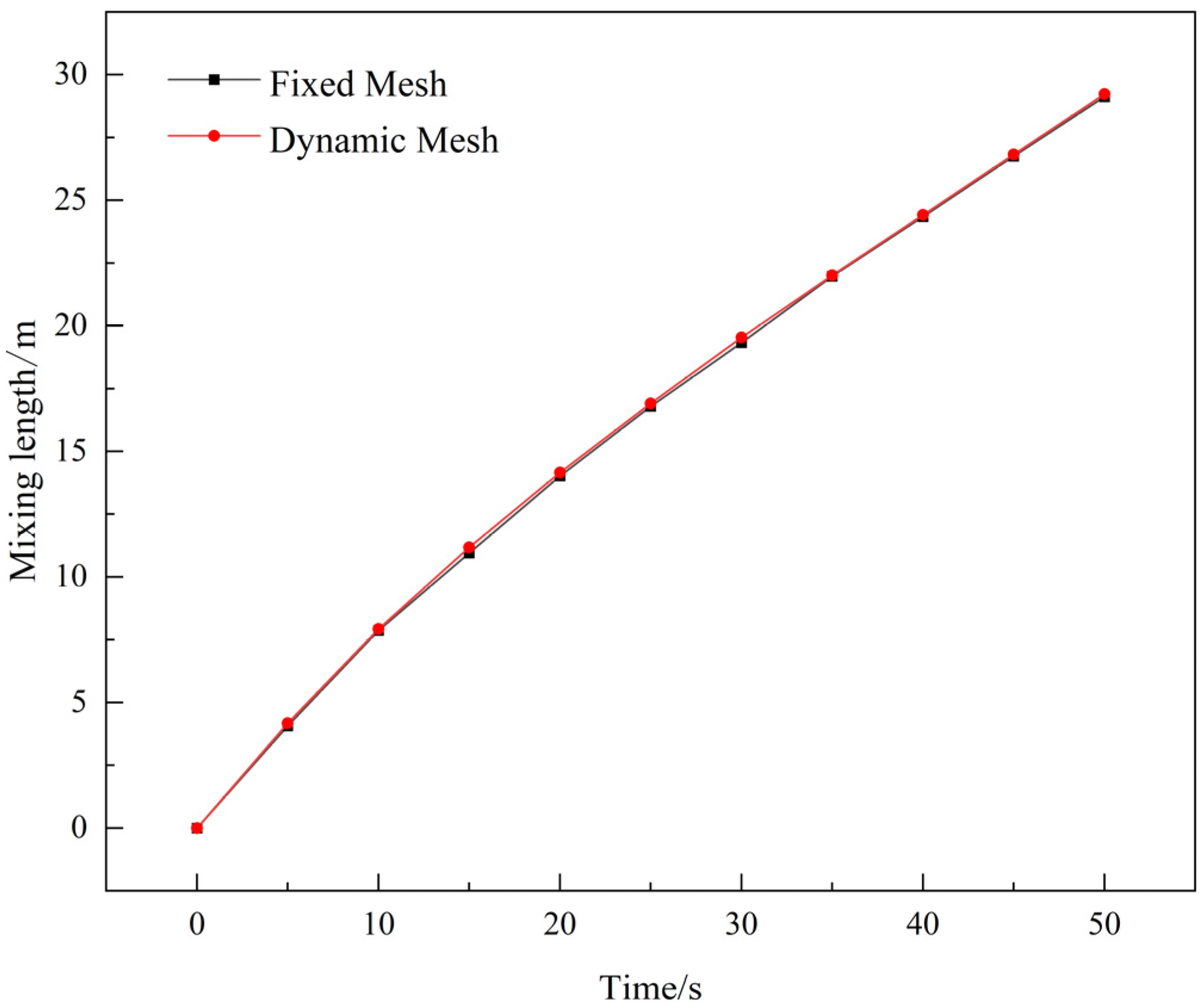
The accuracy of the calculation results of the moving grid method was verified to ensure that the grid movement would not introduce additional errors. In this paper, the correctness was verified using a 100 m pipe section as an example, with specific calculation parameters adopting the standard data for horizontal pipelines. The simulation results are shown in Figure 3. The same initial conditions and duration were simulated for the fixed-grid pipeline, and the changes in the mixed liquid length over time were compared. In the core area far from the influence of the boundary, the results of the dynamic grid extension segment were in good agreement with those of the corresponding position of the fixed-grid pipeline. Therefore, the moving grid method does not cause additional numerical errors in the simulation results.

2.4. Solver Settings

The research employed the CFD solver FLUENT [20] based on the finite volume method. The solver used a split solver and employed the pressure-velocity coupling algorithm. The time step was set at 0.01 s. The momentum equation adopted the QUICK discretization format suitable for hexahedral or quadrilateral grids, and the pressure term was represented using the PRESTO! format to suppress the false flow caused by gravity stratification. The process of mixed liquid transportation in the pipeline is changing over time and belongs to a transient calculation model. PISO has more advantages when performing transient calculations and is suitable for situations with very large grid distortions. Therefore, this study used the PISO algorithm.

2.5. Model Establishment

2.5.1. Basic Control Equation

The amount of liquid mixing in the sequential transportation pipeline is significantly reduced when it operates in a turbulent flow state compared to when it operates in a laminar flow state. Therefore, sequential transportation always adopts the operation in a turbulent flow. The Reynolds time-averaging method is used in the calculation of turbulence. This method represents instantaneous velocity, concentration, etc., as the sum of the time-averaged value and the pulsating value. It substitutes them into the corresponding equations. Then it performs time-averaging operations on the equations [21]. The time-averaged equations of the basic control equations for sequential liquid mixing are expressed as Equations (1)–(3):
Continuity Equation:
ρ t + · ρ v = 0
Momentum conservation equation (Navier–Stokes equation):
ρ u i t + · ρ v v = p + · μ v + v T + ρ g + F s t
Energy equation:
t ρ E + · v ρ E + p = · λ e f f T + S h
In the equation, ρ represents the density of the fluid, measured in kg/m3; v denotes the fluid velocity, measured in m/s; p indicates the fluid pressure, measured in Pa; μ is the dynamic viscosity coefficient, measured in Pa·s; v T represents the turbulent viscosity, also measured in Pa·s; g is the gravitational acceleration, measured in m/s2; Fst represents the surface tension source term, measured in N/m3; E is the energy per unit mass, measured in J/kg; λeff is the effective thermal conductivity, where λeff = λ + λt, with λt being the turbulent thermal conductivity, measured in W/(m·℃); Sh is the source term of the energy equation, measured in W/(m·℃).
Laurend and Sparding proposed the standard κ-ε model, which demonstrates excellent numerical stability and computational efficiency when dealing with fully developed turbulent flows. It is suitable for the high Reynolds number flow conditions involved in the sequential pipeline transportation process. When coupled with the VOF multiphase flow model, the standard k-ε model exhibits good convergence performance and can meet the macroscopic characterization requirements for the main flow field and turbulent structure. Compared to models such as RNG k-ε, Realizable k-ε, and k-ε SST, the standard k-ε model has advantages in terms of computational cost and robustness. This study focuses on the macroscopic liquid mixing length and mass transfer behavior rather than the detailed analysis of local fine turbulent structures. Therefore, this model can meet the precision requirements of the research. The k equation is an accurate formula, while the ε equation is derived from experimental results. Therefore, the standard κ-ε model is an equation based on turbulent kinetic energy and diffusivity, and is derived from empirical formulas. The κ-ε transport equation is shown in Equations (4)–(6):
ρ k t + ρ k u i x i = x j μ + μ t σ k k x j + G k ρ ε + G b Y M + S k
ρ ε t + ρ ε u i x i = x j μ + μ t σ ε ε x j + G l ε ε k G k + G 3 ε G b G 2 ε ρ ε 2 K + S ε
μ t = ρ C μ k 2 ε
In the formula, κ represents turbulent kinetic energy, measured in m2/s2; ε represents turbulent dissipation rate, measured in m2/s3; σκ and σε are the Prandtl numbers corresponding to the κ equation and the ε equation, respectively; Gκ is the turbulent generation rate, indicating the influence of velocity gradient and viscosity on turbulent kinetic energy, measured in kg/(m∙s3); Gb is the turbulent kinetic energy generated by buoyancy, YM is the fluctuation caused by diffusion in compressible flow, and Sk and Sε are defined by the user.
The values of the empirical constants in the k-ε model are shown in Table 1:

2.5.2. Semi-Soluble Mass Transfer Model

The VOF model [22,23,24,25,26] is a classic method for tracking liquid–liquid interfaces. However, the traditional VOF model is based on the assumption of complete immiscibility and forces the solubility coefficient of the liquid–liquid system to be zero. The VOF method obtains the solution of the interface through the continuity equation. For the phase q, the following equation is shown in Equation (7):
α q t + V q α q = S α q ρ q + 1 ρ q p = 1 n   m p q m q p
In the equation, m p q represents the mass transfer from phase p to phase q, and m q p represents the mass transfer from phase q to phase p. Under these conditions, the characteristic constants for each phase can be determined using either conventional values or custom values. Additionally, the initial term is zero. Equation (8) lays the foundation for the calculation of the volume fraction of the main phase:
q = 1 n   α q = 1
However, in the simulation of sequential transportation of refined oil and liquid ammonia, ignoring the actual solubility of liquid ammonia in hydrocarbons will lead to a deviation in the prediction of the length of the mixed transition zone. It directly affects the accuracy of the mixed oil cutting position. According to “GB17930-2016 Vehicle Gasoline” [27] and “GB/T259 Determination of Water-Soluble Acids and Bases in Petroleum Products” [28], the mandatory requirement for testing the pH range of ‘water-insoluble acids or bases’ is 5.0 to 9.0. Calculations show that when the ammonia content in the gasoline exceeds 2.8 × 10⁻⁷ mol/mol, the pH value of the gasoline is too high, and the quality of the gasoline does not meet the standards. According to the solubility data series published by the National Institute of Standards and Technology of the United States, at normal temperature and pressure, the solubility of ammonia in refined oil can reach the order of 10−2 mol/mol [29], far exceeding the allowable concentration of water-soluble bases in gasoline. This inevitably affects the quality indicators of gasoline. Therefore, the influence of solubility needs to be considered in the simulation.
Based on the Fluent VOF model framework, by combining Fick’s diffusion law with convective mass transfer theory, and integrating volume fraction equations, mixed momentum equations, concentration field control equations, etc., a mass transfer control equation for the interface between refined oil and liquid ammonia was established. Using UDF, the dynamic coupling of interface mass transport and inter-phase mass source terms was realized. A mass transfer model applicable to micro-soluble liquids was proposed. This model can more accurately describe the diffusion and dissolution behaviors of liquid ammonia in the sequential transportation and mixing section of refined oil and liquid ammonia.
The mass transfer rate is essentially determined by both the mass transfer capacity and the driving force. In turbulent flow, the mass transfer rate formula dominated by convective mass transfer is as shown in Equations (9) and (10):
N A = k · C A , I F C A , B P
s h = k · d D = 0.023 · R e 0.8 · S c 0.33
In the equation, NA represents the mass transfer rate, measured in mol/(m2·s); k represents the mass transfer coefficient, measured in m/s; CA,IF is the concentration of the mass transfer source, measured in kg/m3; CA,BP is the concentration of the main fluid, also measured in kg/m3; d is the pipe diameter, measured in m; D is the diffusion coefficient, measured in m2/s; Re is the Reynolds number; Sc is the Schmidt number.
The concentration difference between the interface and the bulk phase (CA,IF − CA,BP) serves as the driving force for mass transfer. The interface concentration is determined by the thermodynamic equilibrium of the two phases and represents the “source” of material transfer, while the bulk phase concentration is determined by the flow and mixing processes and represents the “endpoint” of material transfer. Under the influence of the concentration difference, ammonia molecules will diffuse from the high-concentration interface to the low-concentration bulk phase until equilibrium is reached. Considering the micro-solubility characteristics of ammonia in the refined oil and combining the dilute solution assumption, In this study, the solubility of ammonia in gasoline at normal temperature (25 °C) and normal pressure (1 atm) was set at 2 kg/m3, and the unit conversion was performed. It was calculated that the solubility concentration of ammonia in gasoline was 1.57 × 10⁻² mol/mol. Therefore, approximately 0.0157 mol of ammonia is dissolved in every 1 mol of gasoline, which is consistent with the solubility data published by the National Institute of Standards and Technology of the United States.
The concentration field control equation is determined based on the generalized mass transfer equation, and its function is to describe the temporal and spatial evolution process of the dissolved concentration of liquid ammonia in the oil phase. The generalized mass transfer equation is as shown in Equation (11):
C t + C u = D L C + S m
In the equation, C represents the concentration of liquid ammonia, measured in kg/m3; t denotes time, measured in seconds; u represents the velocity field of the fluid, measured in m/s; ∇ is the gradient operator; DL is the molecular diffusion coefficient, measured in m2/s; Sm is the inter-phase mass source term, measured in kg/m3·s.
This model can achieve mass transfer between two liquids with a customizable transfer coefficient and saturated solubility concentration, reflecting the solubility concentration of liquid ammonia in the oil. It can calculate the length of the non-compliant refined oil section. This provides a basis for cutting the mixed liquid section and ensures that the gasoline quality meets the standards.

2.6. Model Feasibility Verification

To verify the accuracy, reliability, and wide applicability of the micro-dissolution mass transfer coupling model, a validation scheme consisting of two types of extreme operating conditions was designed. The core idea is that when a coupling model with sound physical mechanisms and correct numerical implementation describes a specific process with parameters pushed to extreme values, it should reasonably degrade to the classical models. Those classical models are widely accepted and verified under these extreme conditions. By quantitatively comparing the results of the custom model under extreme parameters with the predictions of these classical models, the correctness of its numerical implementation and physical logic can be effectively verified.
Based on this, the verification is carried out from two dimensions: first, under the limit of zero solubility, to check whether the model naturally degenerates into an interface tracking problem that does not consider interphase mass exchange, consistent with the classical VOF model; second, under the limit of very high solubility, to check whether the model degenerates into an instantaneous mixing problem of components, consistent with the component transport model. By comparing these two extreme working conditions, the correctness of the coupled model at both boundaries can be systematically verified. This ensures that simulation results within the practical finite solubility parameter range are authentic and reliable. It also guarantees the accuracy of subsequent parameter studies and mechanism analyses.

2.6.1. Verification of Zero Solubility

When the saturated solubility of liquid ammonia in refined oil is set to 0 kg·m−3, according to the mass transfer rate equation, the mass transfer driving force at the interface is always zero, and theoretically, no mass transfer occurs between the two phases. At this time, the governing equations of the coupled mass transfer model only include the continuity equation, momentum equation, and phase volume fraction equation. The mixing process is solely driven by the combined effects of convective shear, interfacial tension, turbulent diffusion, and gravity. In ANSYS Fluent, the built-in standard VOF model is directly invoked, using the same turbulence model and solver settings.
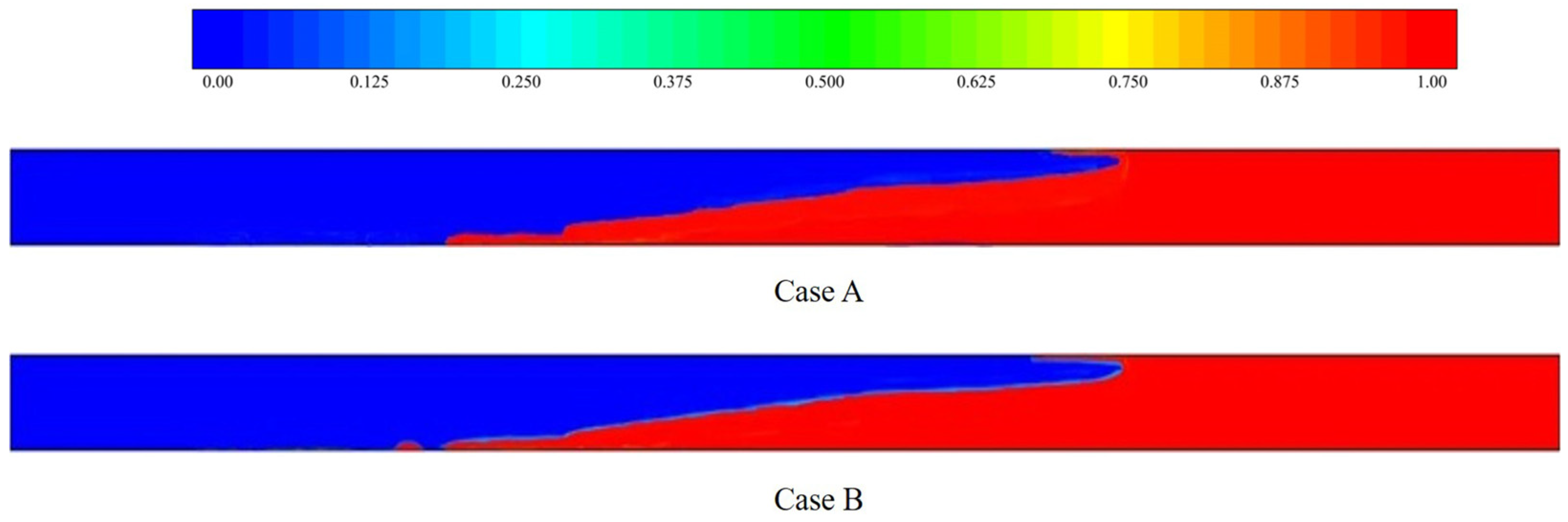
One of the core comparison indicators is the interface morphology, that is, the spatial distribution and geometric shape of the liquid ammonia–oil interface. By observing and comparing the cloud diagram of axial cross-sectional phase volume fraction of the pipe over the same period, one can intuitively judge the degree of agreement in interface evolution. The pipe geometry, mesh, initial conditions, boundary conditions, physical parameters, and solver time step are all set exactly the same. The only variable is: Case A uses the standard VOF model, while Case B uses the coupled mass transfer model developed in this study, with zero solubility set. Post-processing is performed on the calculation results at the same physical time, and the comparison results of phase volume fraction cloud maps are shown in Figure 4. In terms of interface morphology, under the zero solubility condition, the simulation results of Case A and Case B remain highly consistent, with the phase interface contours and interface fluctuations captured by the coupled mass transfer model being in close agreement with the results of the standard VOF model. Both models clearly reproduce the typical ‘finger-like’ interlacing and stretching patterns of the interface caused by uneven velocity distribution. This high consistency in morphology indicates that the introduction of the custom mass transfer model did not alter or interfere with the underlying flow’s effect on the interface.
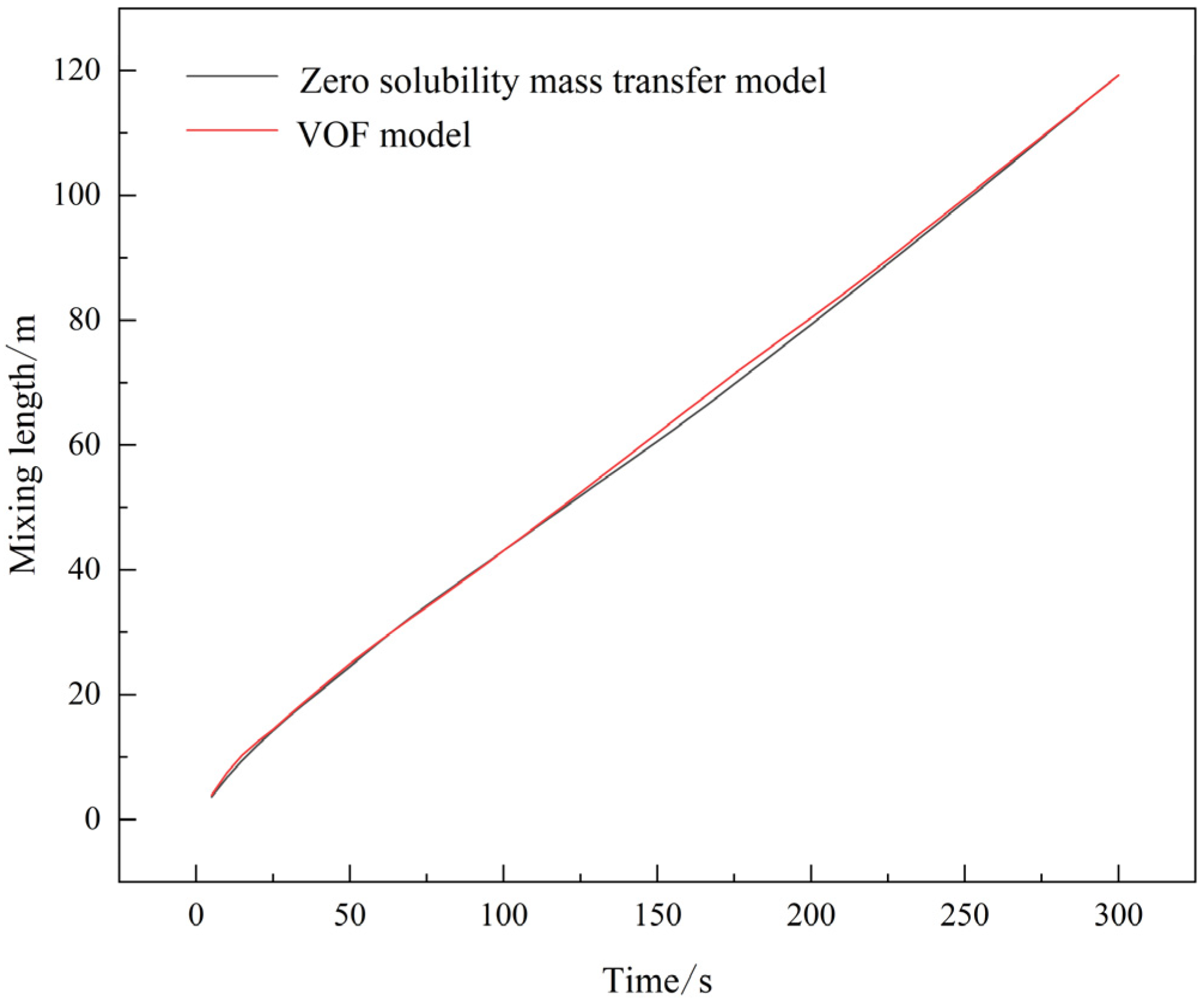
The second core comparison metric is the mixing length. This is the length of the region along the pipe’s axial section where the volumetric fraction of liquid ammonia is between 1% and 99%. It is the most direct macroscopic physical quantity for measuring the degree of mixing. Quantitative comparison can be made by comparing the historical curves of mixing length versus time in the two cases. During the entire simulation period, the curves of mixing length increasing over time calculated by the mass transfer model and the classical VOF model almost completely overlap, as shown in Figure 5. To further quantify the differences, we extracted the mixing length data at multiple key physical time points for statistical analysis, and the results show that the relative error at all comparison time points is less than 1.5%. This error range is entirely within the acceptable range for engineering numerical simulations.
Based on the dual verification of the aforementioned morphological and quantitative data, it can be seen that under the limiting condition of zero saturated solubility, the predictions of the coupled mass transfer model regarding the motion of the two-phase interface and the development of mixing are statistically consistent with those of the standard VOF model. This demonstrates that when the mass transfer effect is artificially disabled, the customized model can accurately degenerate into a standard interface-tracking problem. The newly added mass transfer computation module remains inactive and introduces no numerical interference. This lays a solid foundation of reliability for the model to carry out simulation calculations under actual solubility parameters in subsequent studies.

2.6.2. Verification of Extremely High Solubility

When the saturation concentration of liquid ammonia in refined oil is set high enough, the mass transfer driving force at the interface becomes extremely large, and the mass transfer rate becomes extremely fast. An ideal situation of complete dissolution is simulated, in which the moment the two fluids come into contact, the liquid ammonia dissolves and disperses uniformly into the adjacent oil phase. Under this extreme, the phase interface is difficult to maintain, rapidly blurring and disappearing, and the problem degenerates into the transport of a single phase (oil phase) carrying one dissolved component (liquid ammonia). The component transport model in the ANSYS Fluent 2023 software is directly used. This model treats liquid ammonia as a component dissolved in the oil phase. It describes the mixing process by solving the mass fraction transport equation. The governing equation of this transport equation is formally consistent with the generalized mass transfer equation in this study. In the component transport model, a reasonable axial diffusion coefficient needs to be set according to the flow state and pipeline geometry.
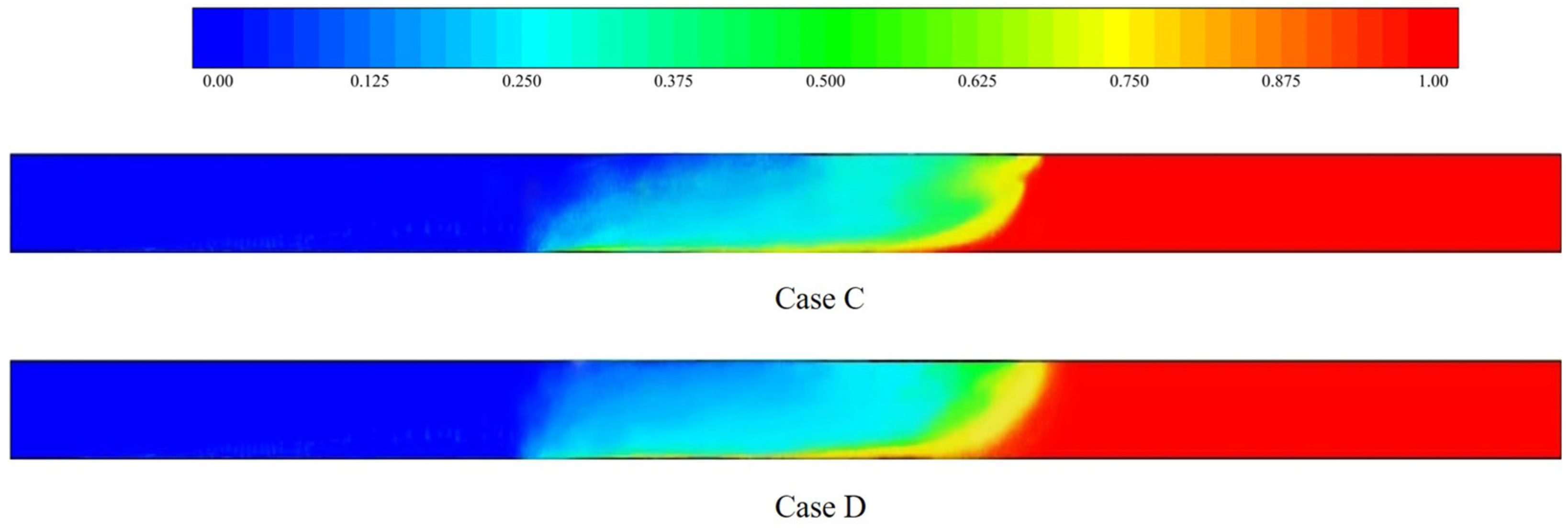
One of the core comparison indicators is the interface morphology. Under conditions of extremely high solubility, the sharp phase interface in the coupled mass transfer model no longer exists and is replaced by a concentration gradient field of dissolved ammonia in the oil phase. Both morphologies exhibit a smooth transition concentration front, and the similarity in their shape and gradient is an important basis for validation. The pipeline geometry, mesh, initial conditions, boundary conditions, physical properties, and time step for solving were all set identically. The only variable is that Case C uses the component transport model, while Case D uses the coupled mass transfer model set to extremely high solubility. Post-processing was performed on the calculation results at the same physical times, and the comparison results of axial cross-sectional cloud maps of the pipeline are shown in Figure 6. The comparison clearly shows that the overall shape of the dissolved ammonia concentration diffusion front in Case C, the front’s tilt angle, and the axial spreading range in the pipeline are all highly similar to the diffusion front in Case D; both exhibit the typical parabolic front morphology. The high degree of morphological agreement fundamentally demonstrates that the coupled mass transfer model is consistent with the component transport model under strong mass transfer conditions.
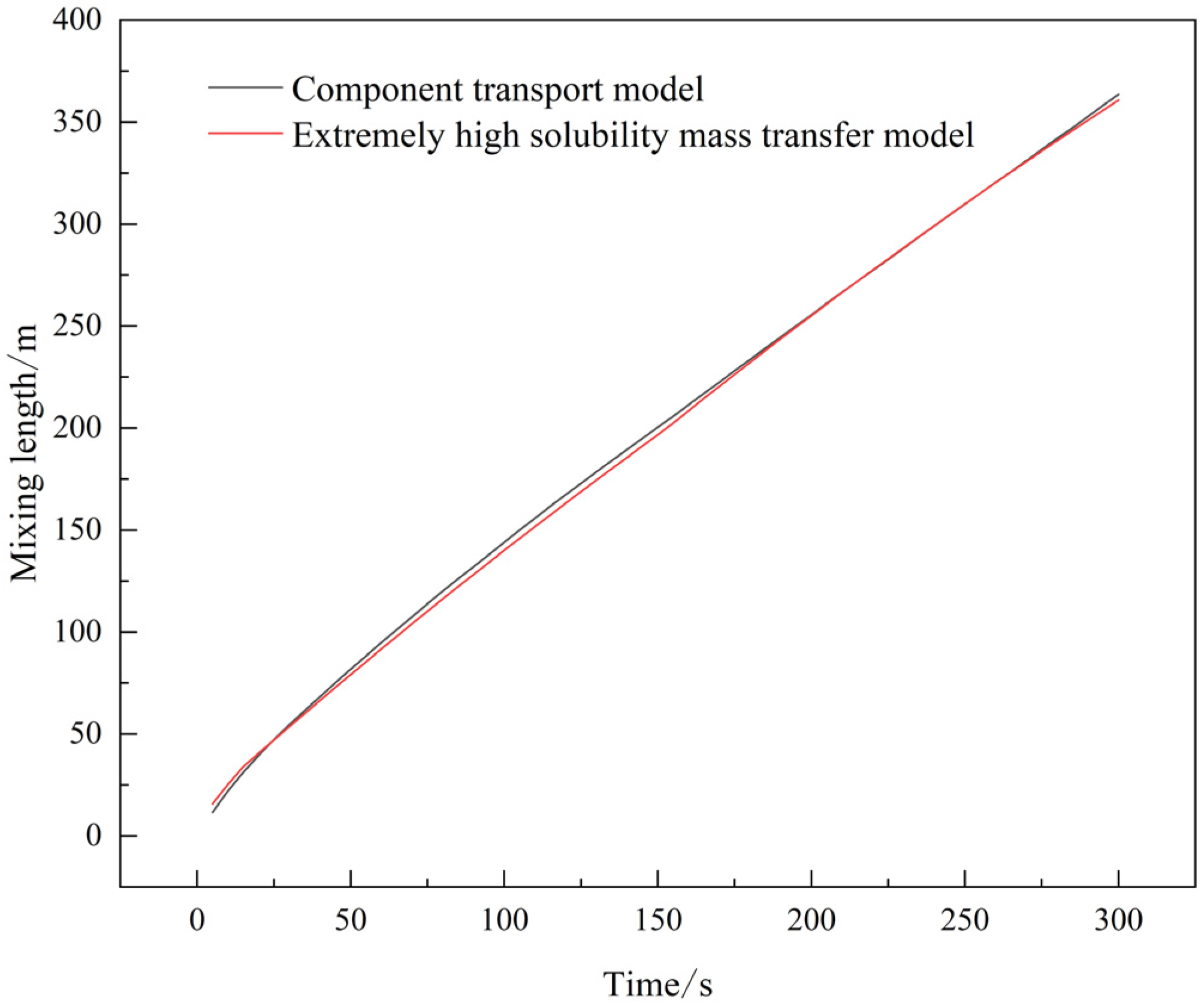
The second key comparison metric is the mixing length. In this paper, the mixing length is defined as the region where the ammonia volume fraction ranges from 1% to 99%. This threshold range is a commonly used engineering convention in VOF multiphase flow simulations for defining the mixing zone. It can effectively exclude extremely low concentration trailing areas caused by numerical diffusion. At the same time, it retains the main characteristics of the mixing zone. By comparing the development curves of mixing length over time calculated from the two models, it can be observed that the trends are almost completely consistent. Both show an approximately linear increase over time. In addition, the slopes of the two growth curves are also very close. The similarity of the slopes indicates that the overall mixing rate of substances in the flow direction in the coupled mass transfer model is basically consistent with that in the component transport model, as shown in Figure 7. Although the inherent differences in the model frameworks may lead to slight deviations in the absolute values of the mixing length, the consistency in the evolution trends is sufficient to demonstrate that the macroscopic mixing physical mechanisms described by both models are equivalent.
In summary, in the theoretical limit where the saturated solubility concentration approaches infinity, the simulation results of the coupled mass transfer model are basically consistent with those of the component transport model in the two key aspects of spatial morphology and mixed liquid length. This indicates that when the dissolution mass transfer process is extremely intensified, the model can reasonably degrade. It shifts from tracking the two-phase interface to describing the mixing and diffusion of components within a single phase. This achieves theoretical consistency under the other extreme conditions. It also ensures the reliability of the simulation results when the model is applied within the actual solubility parameter range.

2.7. Simulation Plan Design

In order to clarify the independent influence mechanisms of factors such as Atwood number, pipe inclination angle, average viscosity, fluid flow rate, pipe diameter, and interfacial tension on the mixing liquid law of sequential liquid ammonia—refined oil transportation, this study employed the method of controlling variables for a series of numerical simulations. This method strictly maintained consistency in other parameters while systematically changing only a single target variable. It aimed to precisely isolate the influence of each factor. Through controlling variables, we can clearly separate the independent influence of each single factor on the length and growth rate of the mixed liquid. This effectively avoids the coupling effect and results in confusion caused by the simultaneous change in multiple factors. In doing so, it establishes a clear causal relationship and quantitatively evaluates the sensitivity ranking of different factors. This lays the foundation for accurately identifying key influencing factors and understanding their intrinsic physical mechanisms in the future.
The determination of the ranges of each parameter is mainly based on the typical operating conditions of the finished oil pipeline transportation in our country. The selected flow rate, pipe diameter, and viscosity parameters are consistent with the operating parameter ranges stipulated in current regulations. These include the Design Specifications for Oil Pipeline Engineering, the Operation Specifications for Finished Oil Pipelines, and the Series of Pipe Dimensions for Petrochemical Industry and other regulations [30,31,32,33]. This consistency ensures that the research results have certain engineering representativeness and practical application value.
Ultimately, based on the series of simulation results, the relationship curves between each factor and the length of the mixed liquid can be systematically plotted. The influence trends and internal physical mechanisms can be analyzed, and ultimately, a comprehensive comparison and extraction of the rules of multiple factors’ influence can be achieved. This will provide direct theoretical support for the optimization design and operation control of the pipeline system. Ultimately, using this method, pure “factor-response” data can be obtained. A systematic multivariate nonlinear regression analysis will then be conducted, with the growth rate of the mixed liquid length as the dependent variable. This will establish a semi-empirical fitting formula. The control variable simulation plan table is shown in Table 2.

3. Result Analysis and Formula Fitting

3.1. The Key Parameters That Affect the Length of the Mixed Liquid

3.1.1. Density Difference

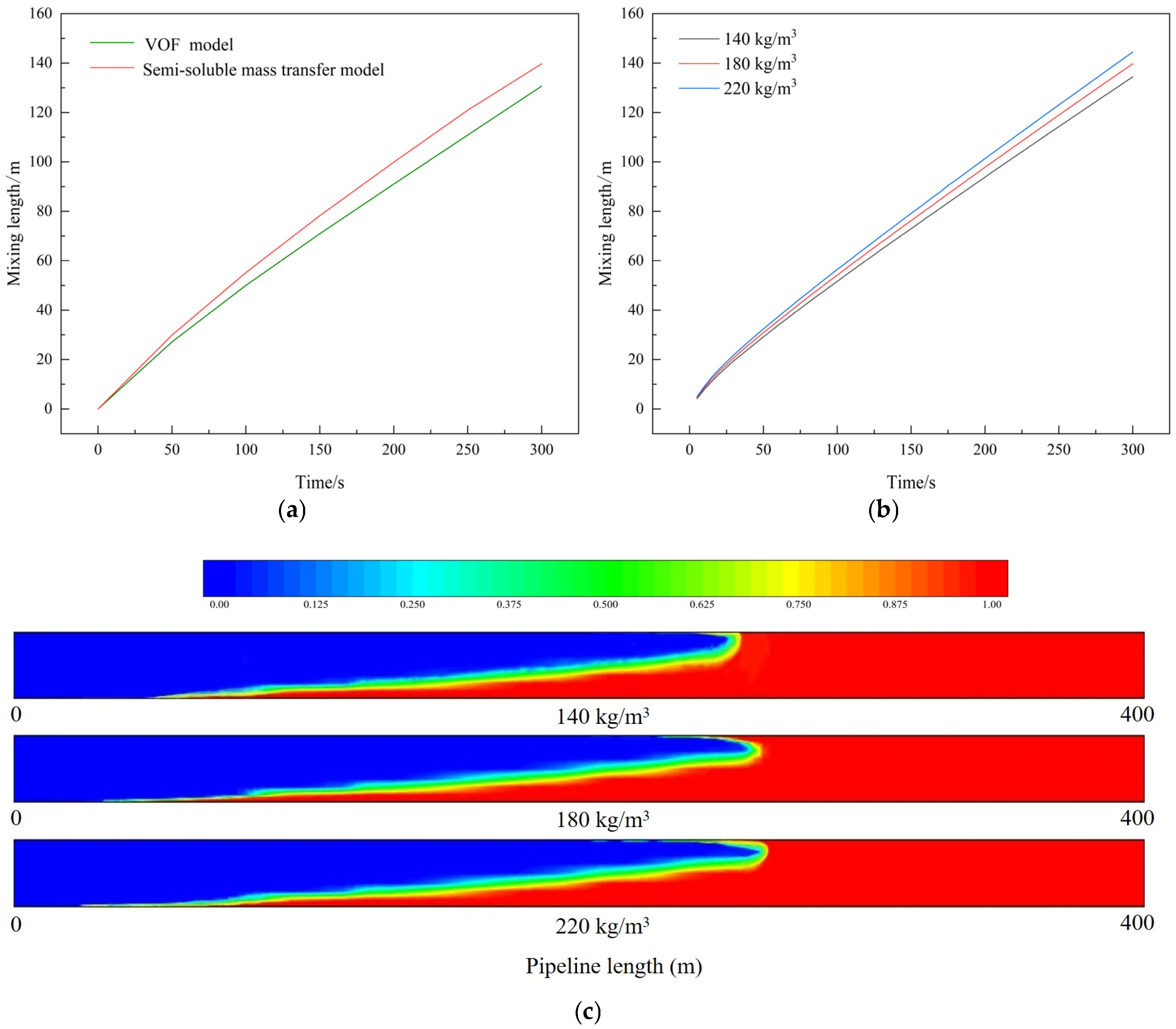
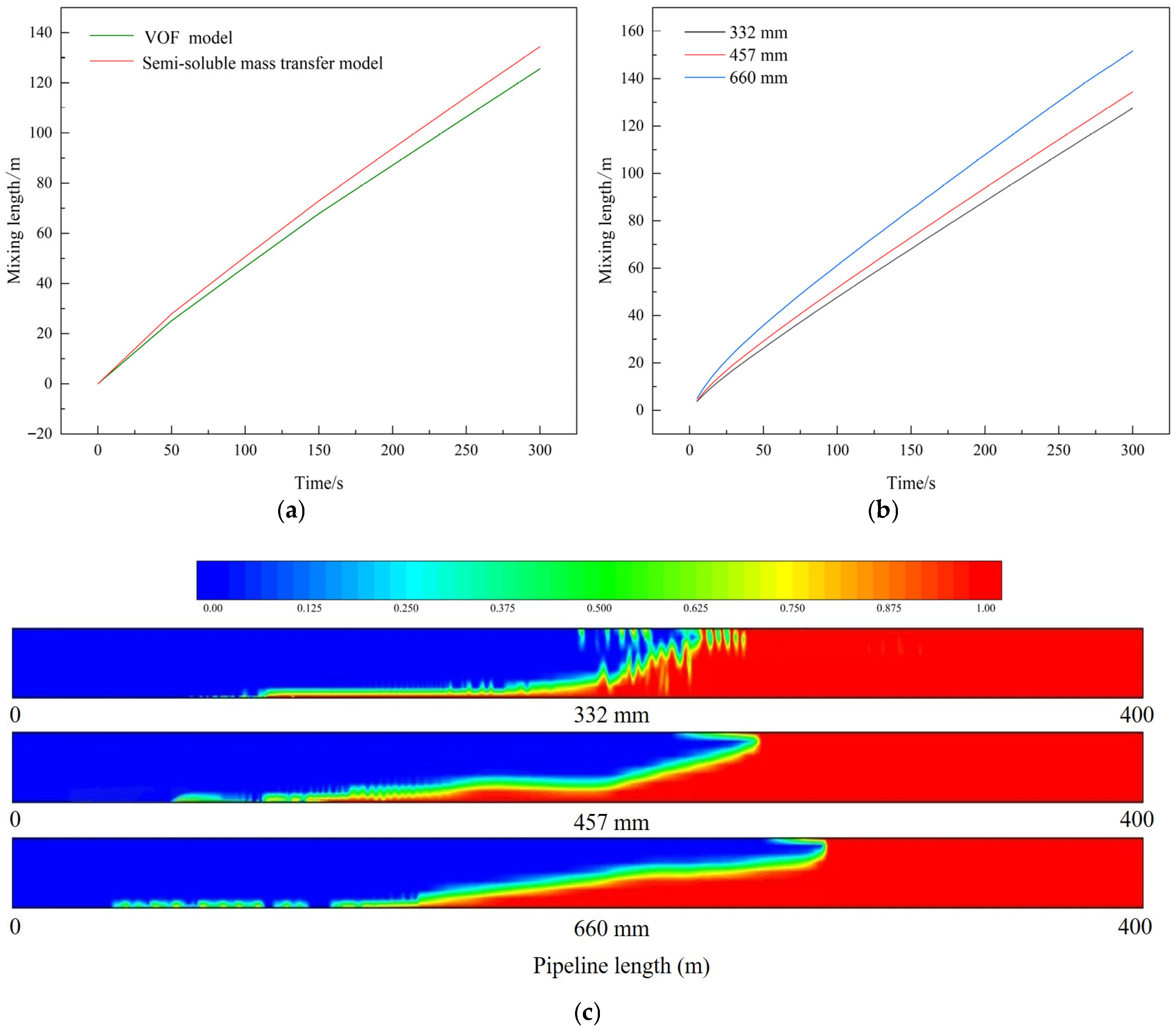
Different liquids will generate gravitational thrust due to their density differences. A significant density difference will enhance the gravity stratification effect (heavy phase sinks, light phase rises). For the two immiscible liquids, liquid ammonia and refined oil, the existence of density differences during liquid flow will strengthen the influence of gravity on the mixing process. When other conditions are the same, taking a density difference of 180 kg/m3 as an example, the comparison of the implementation effects of the micro-dissolution mass transfer model and the traditional VOF model is shown in Figure 8a.
The greater the density difference between liquid ammonia and oil products, the stronger the disturbance of the mixing interface, and the more significant the RT instability and the faster its development. The more significant the gravitational stratification effect caused. The oil sinks to the bottom, and the liquid ammonia floats on the top, generating a relatively clear and stable interface. Due to the micro-dissolution of the refined oil and liquid ammonia, the two only slowly mix at the interface. Therefore, under the action of fluid flow force, the liquid ammonia is more likely to be pushed into the oil products from the top of the pipeline, increasing the length of the mixed liquid. The comparison of the length of the mixed liquid under different density differences is shown in Figure 8b.
From Figure 8c, it can be seen that the greater the density difference between the two liquids, the longer the length of the concentration oscillation zone at the tail of the mixed liquid segment, and the greater the tailing degree of the mixed liquid. From the comparison of the cloud charts of the stratification law changes, it can be seen that the greater the density difference, the sharper the mixed liquid head, making the liquid ammonia more likely to be pushed into the oil layer. A larger density difference causes the two liquids to clearly stratify, and the following liquid ammonia, “like fingers”, protrude into the preceding oil layer.

3.1.2. Pipeline Inclination Angle

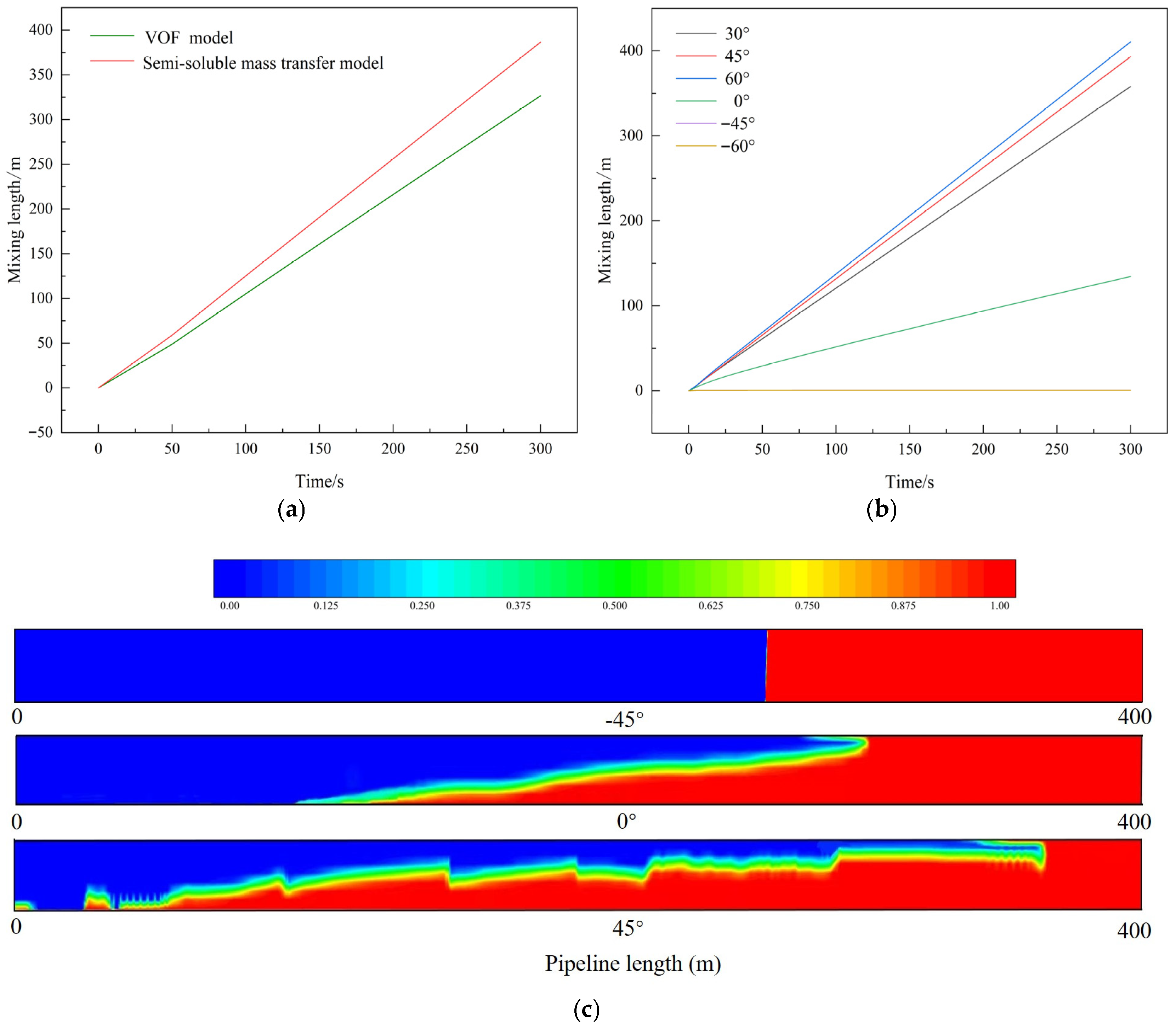
When the pipeline is in an inclined state, the change in the inclination angle alters the direction of the component of the gravitational force, significantly affecting the interface stability, turbulence mixing intensity, and stratification state during the sequential transportation of liquid ammonia and refined oil. This, in turn, has an impact on the length and concentration distribution of the mixed liquid. To analyze the influence of pipeline inclination on the mixed liquid, six working conditions with inclination angles of 0°, 30°, 45°, 60°, −45°, and −60° were simulated, respectively, under the condition that other parameters remained unchanged for comparison. Taking an inclination angle of 45° as an example, the comparison of the implementation effects of the micro-solubility mass transfer model and the traditional VOF model is shown in Figure 9a.
The mixed liquid segment formed when liquid ammonia in the pipeline pushes the refined oil uphill is longer, and the length of the mixed liquid gradually increases with the increase in the inclination angle. On the one hand, due to the upward inclination of the pipeline, the gravitational force on the fluid is enhanced. At this time, the light fluid liquid ammonia supports the heavy fluid refined oil, and the trend of the denser refined oil embedding into the liquid ammonia along the axial direction of the pipeline is strengthened. This results in an increase in the length of the mixed liquid segment. On the other hand, the micro-solubility of liquid ammonia and refined oil leads to the dissolution of the small liquid droplets of liquid ammonia in the refined oil, further prolonging the length of the mixed liquid segment. When the oil flows downhill, the oil is affected by gravity, and there is very little mixing with the liquid ammonia, making it difficult to remain on the pipe wall. Therefore, the length of the mixed liquid remains in a relatively stable state. The comparison of the lengths of the mixed liquid under different inclination angles is shown in Figure 9b.
According to Figure 9c, when the pipeline is in a downhill state, the heavy fluid refined oil supports the light fluid liquid ammonia, and low-density liquid ammonia has almost no downward embedding trend under the influence of gravity, so the mixed liquid interface is stable, clear, and flat without disturbance, no discontinuous phase is observed, the length of the mixed liquid is very small and remains stable, and the contact interface between the liquids is almost perpendicular. When the pipeline is in an uphill state, the rear-flowing liquid ammonia floats upward and embeds into the advancing refined oil, and as time increases, the mixed liquid segment becomes a narrow and long area, with liquid ammonia accumulating above the pipeline.

3.1.3. Average Viscosity

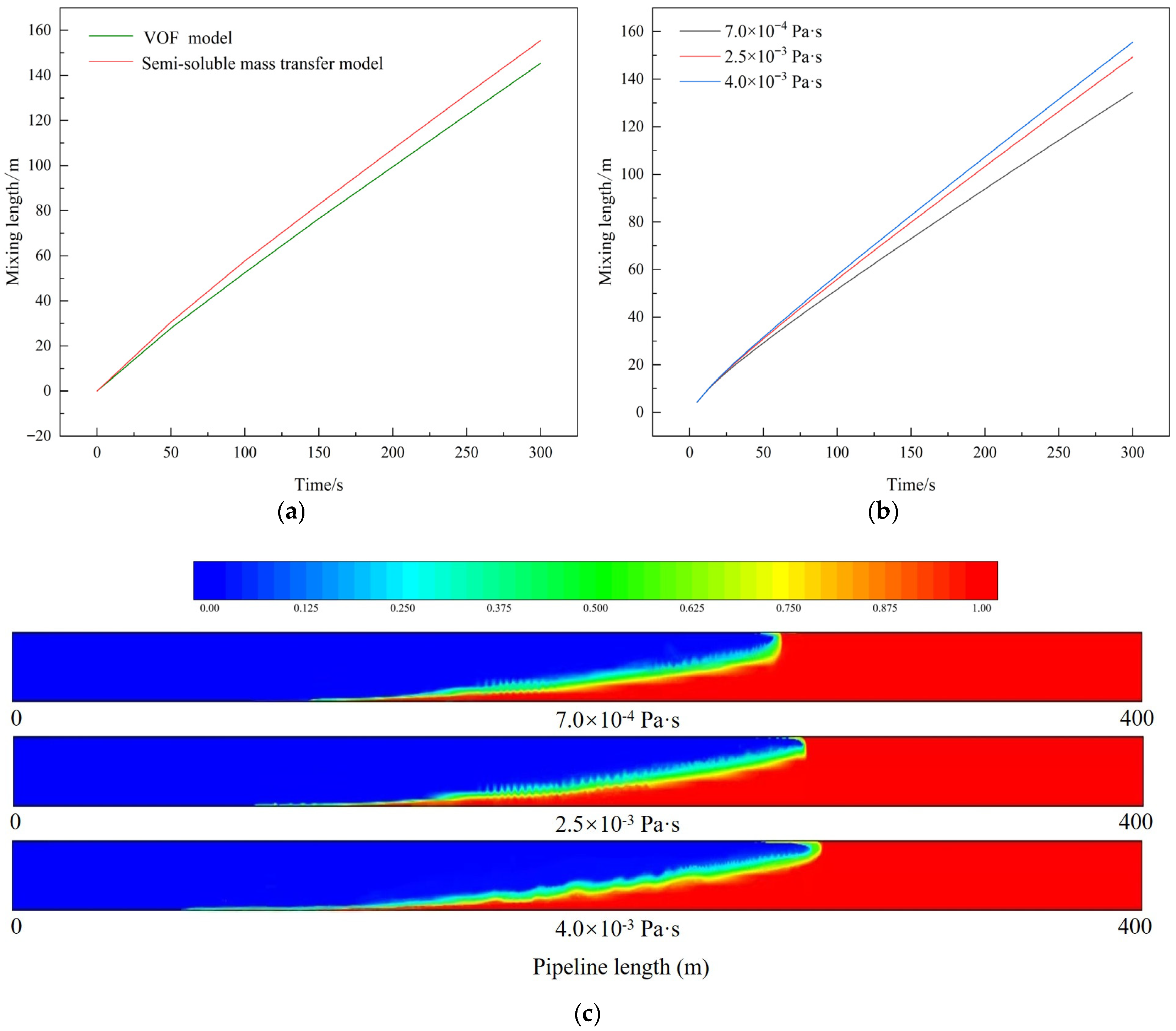
The difference in viscosity can cause the flow velocity distribution of the fluids on both sides of the interface to be different, increasing the instability of the flow. Taking an average viscosity of 6.2 × 10⁻⁴ kg/m·s as an example, the comparison of the implementation effects between the micro-solubility mass transfer model and the traditional VOF model is shown in Figure 10a. A larger viscosity difference usually enhances the shear and suction forces at the contact interface, thereby intensifying the turbulence disturbance and significantly increasing the mixing length. As shown in Figure 10b, when other conditions are the same, the greater the viscosity difference between liquid ammonia and oil, the more intense the mutual diffusion, and a more significant shear stress will be generated at the interface. The low-viscosity fluid is more likely to be “dragged” or “sucked” into the high-viscosity region by the high-viscosity fluid. This results in enhanced suction and disturbance. Consequently, the range of mutual penetration of the two liquids becomes larger, and the process becomes longer. This significantly increases the contact area between the two fluids and the mixing length.
The change in viscosity has a relatively small impact on the concentration distribution of the mixed liquid and the stratification pattern. As can be seen from Figure 10c, as the viscosity difference increases, the contact interface between the two liquids presents a zigzag structure. Due to the strong adhesion of the high-viscosity oil phase to the pipe wall and its slow movement, the length of the concentration oscillation zone at the tail of the mixed liquid segment is longer, and the degree of liquid tailing is greater.

3.1.4. Flow Rate

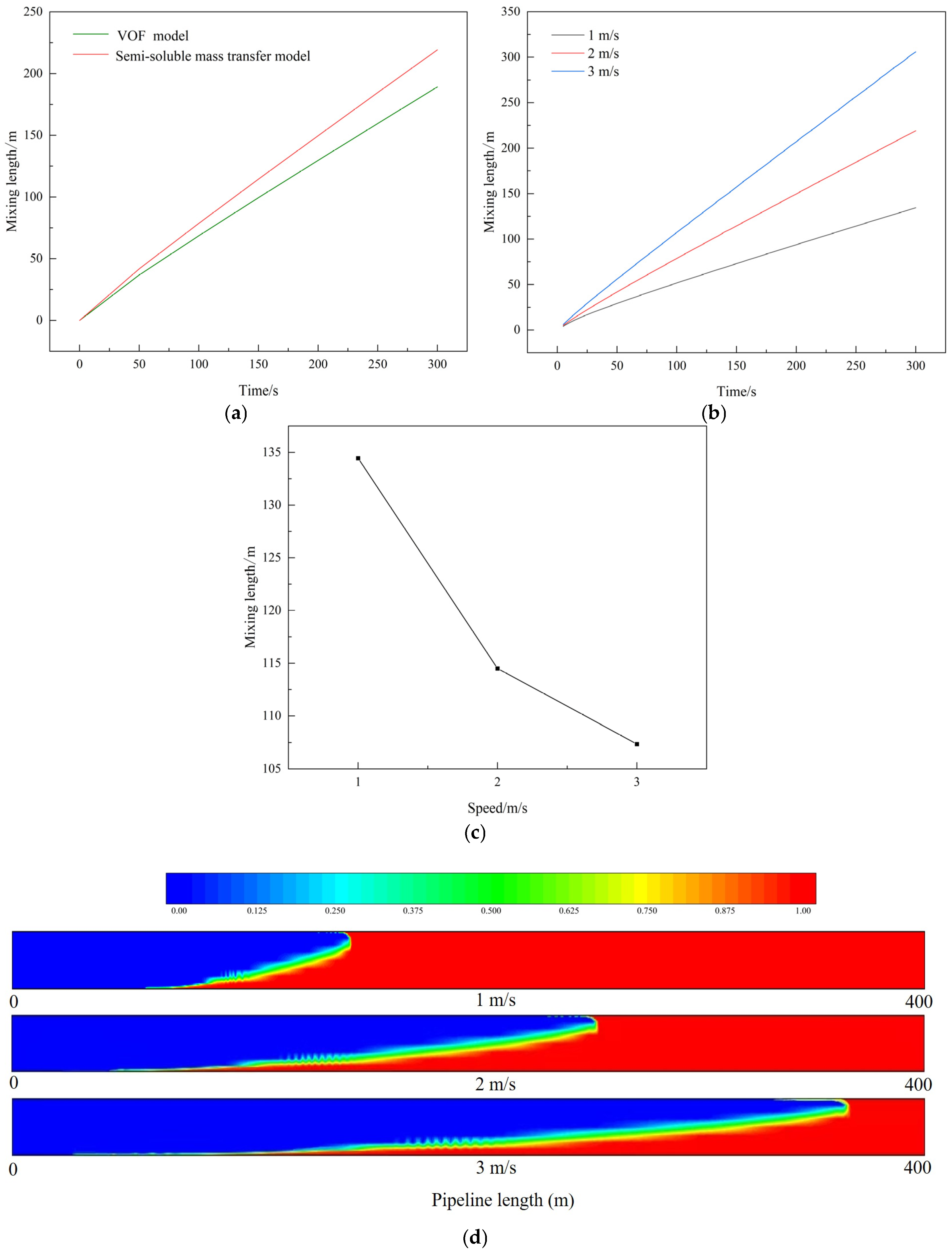
Under the simulated conditions where the pipeline is kept in a horizontal state with a diameter of 457 mm and the pipeline transportation temperature is 25 °C, simulations were conducted for three flow velocities of 1 m/s, 2 m/s, and 3 m/s. Taking the flow velocity of 2 m/s as an example, the comparison of the implementation effects between the micro-solubility mass transfer model and the traditional VOF model is shown in Figure 11a. Figure 11b shows that as the flow velocity increases, the length of the mixed liquid increases within the same time period. Figure 11c indicates that at the same position of the pipeline, the faster the fluid flow rate, the shorter the mixed liquid length at the same position; the slower the flow rate, the longer the mixed liquid length at the same pipe section position. This is because, as the flow rate increases, the scouring force of the subsequent fluid, liquid ammonia, on the laminar boundary layer of the preceding fluid, refined oil increases, and the displacement effect of liquid ammonia on the refined oil increases, thereby reducing the length of the mixed liquid section.
From Figure 11d, it can be seen that as the flow rate increases, the mixed liquid head gradually becomes “sharp”, the concentration gradient area near the pipe wall slightly weakens due to the increase in flow rate, and a long tail with a slight decrease in concentration appears at the tail of the mixed liquid section. Although the increase in flow rate significantly changes the length of the mixed liquid section, no rupture of the mixed liquid interface occurred; the stability of the mixed liquid interface was relatively good, and no discontinuous phase was generated.

3.1.5. Diameter of the Pipe

The change in the inner diameter of the pipeline determines the size of the flow area. This affects the balance of convective and diffusive intensities at the interface of the mixed liquid. As a result, differences in the volume of the mixed liquid occur. Taking a 457 mm pipeline diameter as an example, the comparison of the implementation effects of the micro-solubility mass transfer model and the traditional VOF model is shown in Figure 12a. As the pipeline diameter increases, the length of the mixed liquid continuously increases. This is because when the pipeline diameter becomes larger, the cross-sectional height of the pipeline increases, and the upward path of liquid ammonia becomes longer, providing a larger space for stratification. The comparison of the length of the mixed liquid under different pipeline diameters is shown in Figure 12b.
As can be seen from Figure 12c, when the pipeline diameter is small, the two phases are broken into small droplets and mixed with each other; as the pipeline diameter increases, the two liquids are completely stratified, but there are continuous and small-amplitude fluctuations at the interface; when the pipeline diameter is large, the oil phase and liquid ammonia are clearly and stably stratified, the length of the mixed liquid segment increases significantly, and the bottom oil layer shows retention or extremely slow movement, and the degree of tailing of the mixed liquid becomes greater.

3.1.6. Interface Tension

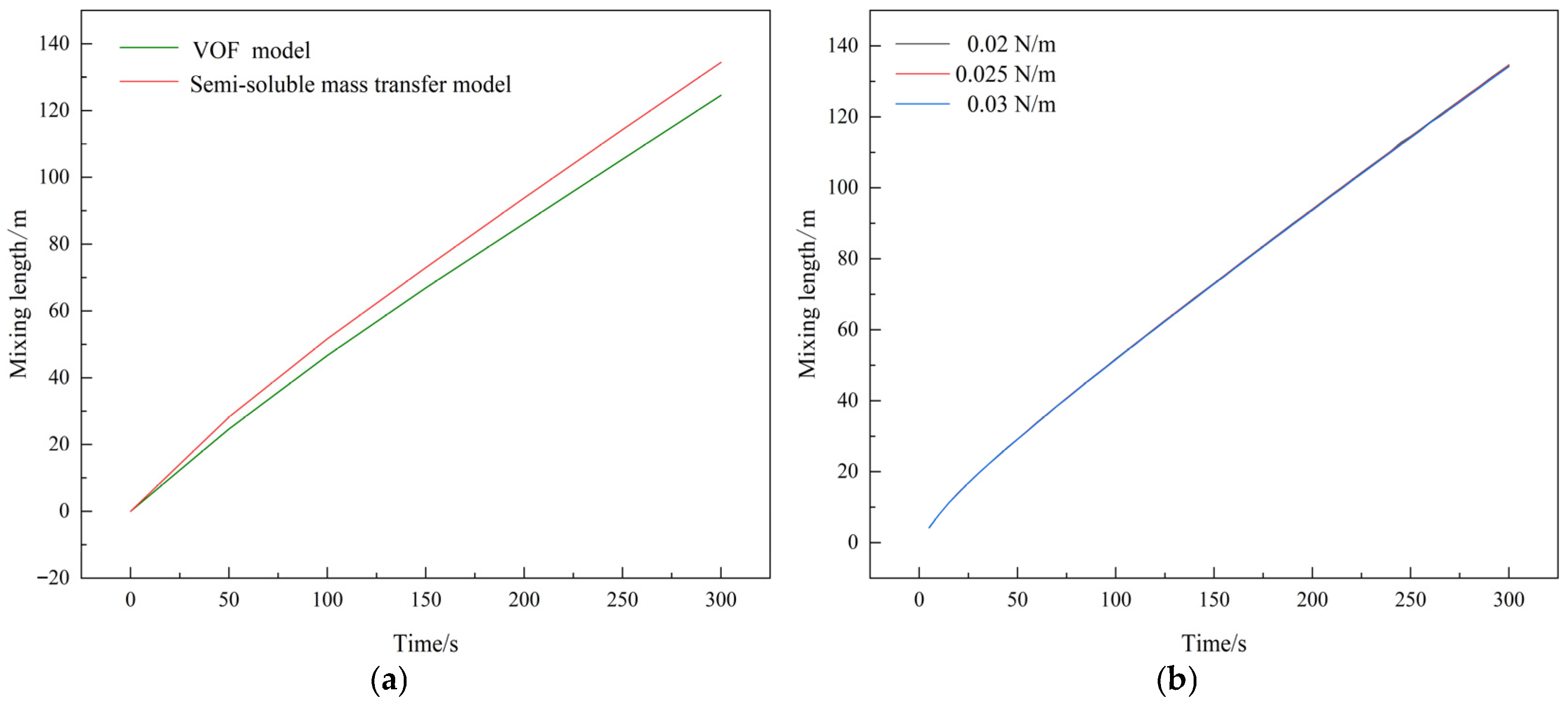
Based on the simulation results, under the conditions studied, during high-speed flow, the turbulent kinetic energy level is relatively high, which can overcome the influence of interfacial tension, tear, and mix the fluids. At this time, the turbulence intensity becomes the core factor determining the mixing length. The density difference, viscosity difference, and gravitational effect also form a masking or suppression of the influence of interfacial tension. Therefore, the influence of surface tension on the mixing length is not significant; even if the interfacial tension is different, the degree of mixing is mainly controlled by high viscosity, resulting in almost no influence of the tension difference being observed. However, it should be noted that surface tension is considered in the VOF model through the source term of the momentum equation, and its effect is not limited to changing the mixing length. Even in the turbulent-dominated flow conditions, surface tension still has a crucial impact on the morphology of the phase interface, the occurrence and development of emulsification, and the separation and evolution of droplets. Furthermore, it influences the phase distribution, thereby indirectly affecting the mass transfer process between phases. The specific mechanism of surface tension in emulsification, droplet separation, and phase distribution regulation, as well as its indirect influence on the mass transfer process, needs to be further explored in subsequent studies. The comparison of the implementation effects of the micro-solubility mass transfer model and the traditional VOF model is shown in Figure 13a. The comparison of mixture lengths under different interfacial tensions is shown in Figure 13b.

3.2. Formula Fitting of the Mixture Length

3.2.1. Select the Independent Variable and the Dependent Variable

The Atwood number (At), pipe inclination angle (θ), average viscosity (μavg), flow velocity (v), mixing length (L0), and interfacial tension (F) were introduced as independent variables. Among them, the regression coefficient of Atwood’s number characterizes the relative contribution of the gravity stratification effect in the mixing process, and its sign and magnitude can correspond to the dependence of the Froude number in the inertial-gravity equilibrium; the coefficient of the pipe inclination reflects the modulation effect of the gravity component along the flow direction, which is consistent with the classical theory of the instability of the stratified flow interface; the coefficient of the average viscosity reflects the inhibitory effect of viscous dissipation on turbulent mixing, which can be analogized to the influence law of the Reynolds number on the development of the mixing layer; the coefficients of the flow velocity and the pipe diameter, respectively, represent the driving effects of inertial force and scale effect on the development of the mixed liquid, which conform to the basic characteristics of the speed-scale coupling in turbulent diffusion. The obtained empirical formula has consistency in form and physical connotation with the multiphase flow proportion law, providing a quantitative basis for further revealing the mixing mechanism of sequential transportation of microprecipitating media. The derivative of mixing length with respect to time (growth rate, dL/dt) served as the dependent variable. Curve smoothing was performed using Origin 2022 software. The At number and average viscosity are expressed by Equations (12) and (13), respectively:
Atwood number:
A t = ρ h ρ l ρ h + ρ l
In the equation, ρ h , ρ l represent the densities of the heavy and light fractions, respectively, in kg/m3.
Average viscosity:
μ a v g = e l n μ 1 + l n μ 2 2 = μ 1 · μ 2
In the equation, μ1 and μ2 represent the concentrations of liquid ammonia and refined oil, respectively, in kg/m·s.

3.2.2. Fitting Method and Principle

In the process of model construction for this study, the classic control variable method was adopted to design simulation scenarios. The influence of each single variable change on the development of the mixed liquid section was analyzed one by one, and sensitivity analysis was also conducted. During this process, each variable was analyzed independently, and the variable dimensions were limited. There was a complex nonlinear coupling relationship between the growth rate of the mixed liquid length and various parameters. Linear models or simple polynomial models were difficult to fully capture this complex correlation. The traditional nonlinear regression methods not only meet the modeling requirements but also maintain good model simplicity and interpretability. Therefore, for predicting mixing length, a nonlinear least-squares fitting method was employed. This method is based on the Levenberg–Marquardt algorithm. It was used to establish a multivariate power-law model that characterizes the complex relationship between mixing length and fluid dynamic parameters. The fitted model employs a generalized power-law equation, formulated as shown in Equation (14):
y = b 1 · x 1 b 2 · x 2 b 3 · x 3 b 4 · x 4 b 5 · x 5 b 6 · x 6 b 7
In the equation, b1 to b7 represent the coefficients; x1 to x6 are the independent variables; y is the dependent variable.
This model characterizes the nonlinear growth relationship under multi-physical coupling interactions, consistent with the physical properties of fluid mixing processes. Concurrently, the LM algorithm is implemented using the lsqcurvefit function, whose core principle is an enhanced Gauss–Newton method. It exhibits lower sensitivity to initial values compared to the pure Gauss–Newton method, thereby demonstrating superior robustness. The objective function is expanded using Taylor series, and the parameter increment Δb is iteratively solved:
J T J + λ I · b = J T y y ^
J denotes the Jacobian matrix, and λ represents the damping factor. The core advantage of the LM algorithm lies in its adaptive optimization mechanism, which dynamically adjusts the damping factor to balance convergence speed and stability. As λ approaches 0, it degenerates into the Gauss–Newton method for quadratic convergence; when λ is significantly greater than 1, it transitions to gradient descent to ensure stability. Computation terminates when the residual sum of squares ‖y − ŷ‖2 reaches its minimum value. All initial values are set to 0.5, aligning with typical parameter ranges for power-law models and preventing convergence into local minima.
During the fitting process, pipelines are categorized into two states based on their inclination angle: horizontal pipe segments (inclination angle α = 0°) and inclined pipe segments (inclination angle α ≠ 0°). When pipelines are inclined, the cosine term precisely characterizes the gravitational effect of the inclination angle on the mixed liquid interface. The introduction of the cosine correction term innovatively resolves the geometric sensitivity issue in modeling mixed liquids within inclined pipelines.

3.2.3. Fitting Results and Accuracy Validation

The coefficient of determination (R2) and root mean square error (RMSE) are adopted as performance metrics for the prediction model. The evaluation metrics are expressed as shown in Equations (16) and (17), where yi and ŷi represent the actual value and predicted value of the sample, respectively, and n denotes the sample size.
  • Coefficient of Determination R2:
R 2 = 1 i = 1 n y i y ^ i 2 i = 1 n y i y ¯ i 2
2.
Root Mean Square Error RMSE:
R M S E = 1 n i = 1 n y i y ^ i 2
Through systematic analysis of simulation results for the mixing processes in horizontal and inclined pipe sections, significant differences were identified in the evolution mechanisms and dominant influencing factors of the mixing interface within these two types of sections. In gently inclined sections, mixing is primarily governed by turbulent diffusion and viscous shear effects. Conversely, in steeply inclined sections, the axial component of gravity significantly enhances buoyancy forces, triggering more complex Rayleigh-Taylor instabilities that substantially alter the growth patterns of the mixing layer. Given these differing physical mechanisms, a single fitting formula cannot accurately describe the mixing dynamics in both flow regimes simultaneously. Therefore, regression analysis was conducted separately for horizontal and inclined pipe sections, establishing more targeted section-specific fitting formulas.
To ensure the applicability and scalability of the proposed fitting formula under long-distance pipeline conditions, a segmented validation approach was employed to construct and evaluate the low-dimensional model. Based on data obtained from numerical simulations, the first 80% of samples were allocated as the training set for parameter fitting and mathematical model construction, while the remaining 20% served as the test set to evaluate the model’s generalization capability and extrapolation performance on unknown data. This division strategy aims to simulate the model’s behavior when extrapolating from known scales to longer-distance pipelines. It thereby verifies the model’s reliability and robustness at actual engineering scales. This provides theoretical justification and data support for the formula’s engineering application and further promotion. The specific forms of the formulas for horizontal and inclined pipe sections are shown in Equations (18) and (19).
  • Horizontal Pipe Segment Formula (Inclination Angle α = 0°):
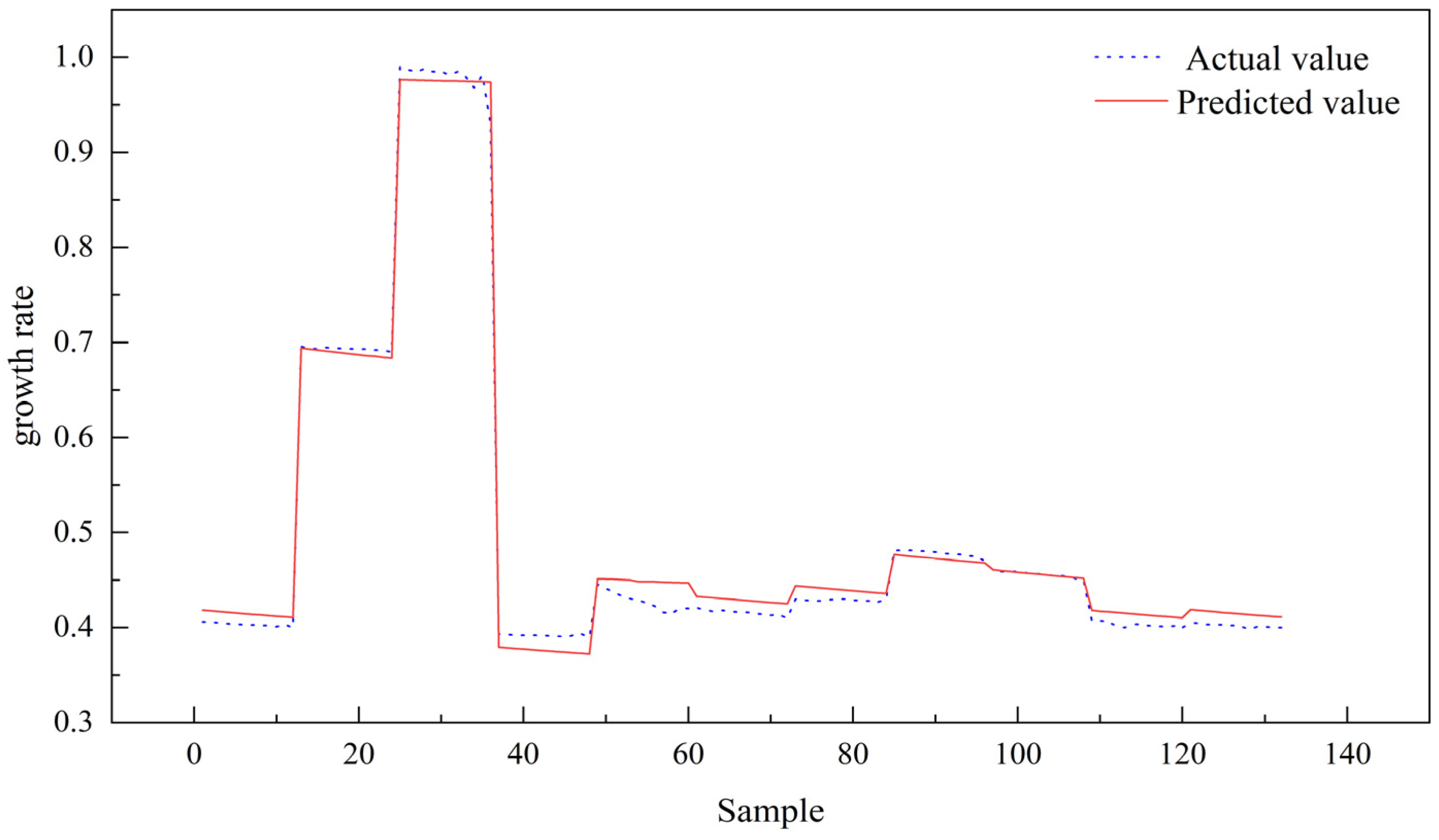
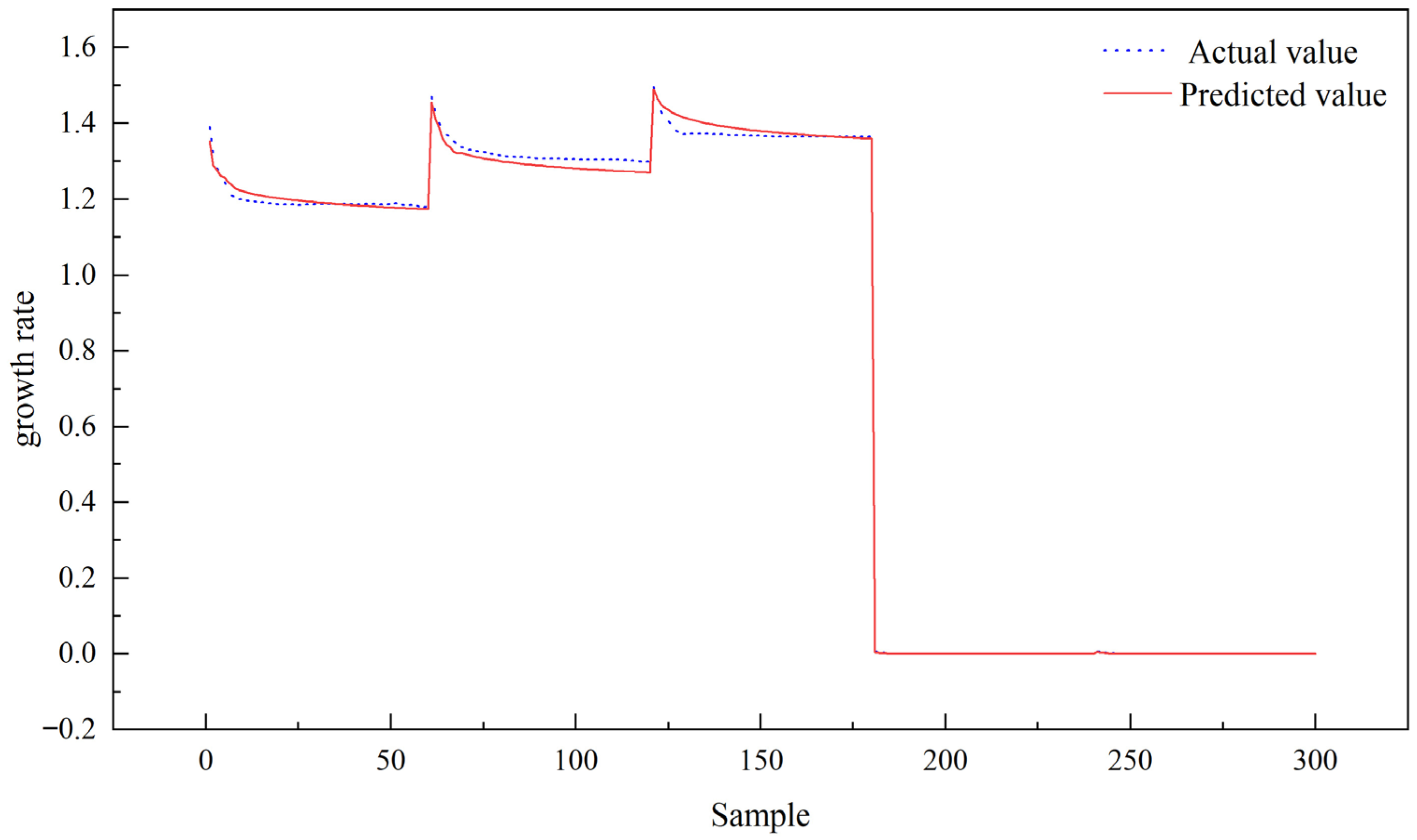
d L d t = 0.5344 a 0.1698 b 0.169 c 0.3251 d 0.7948 e 0.1022 f 0.0038
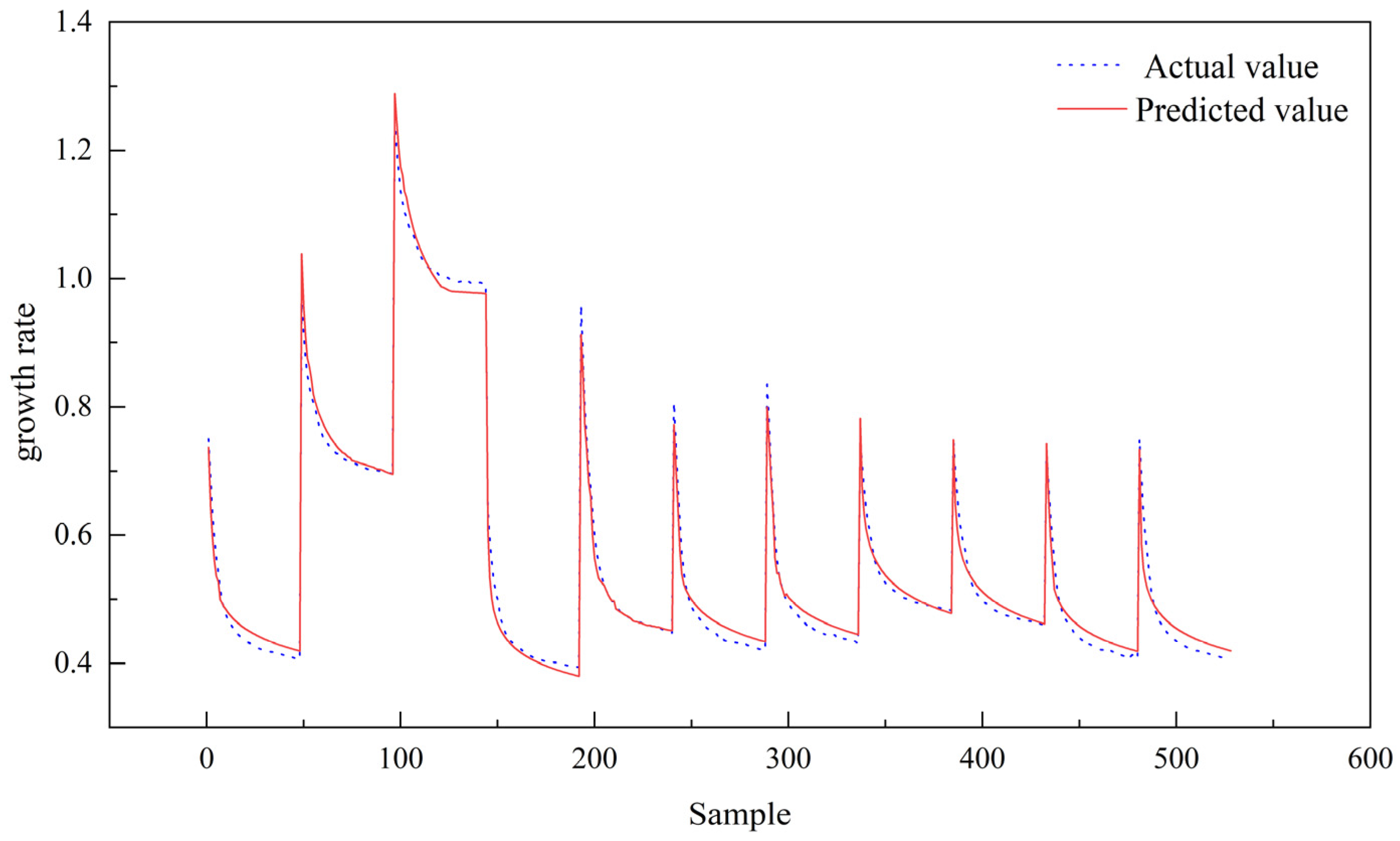
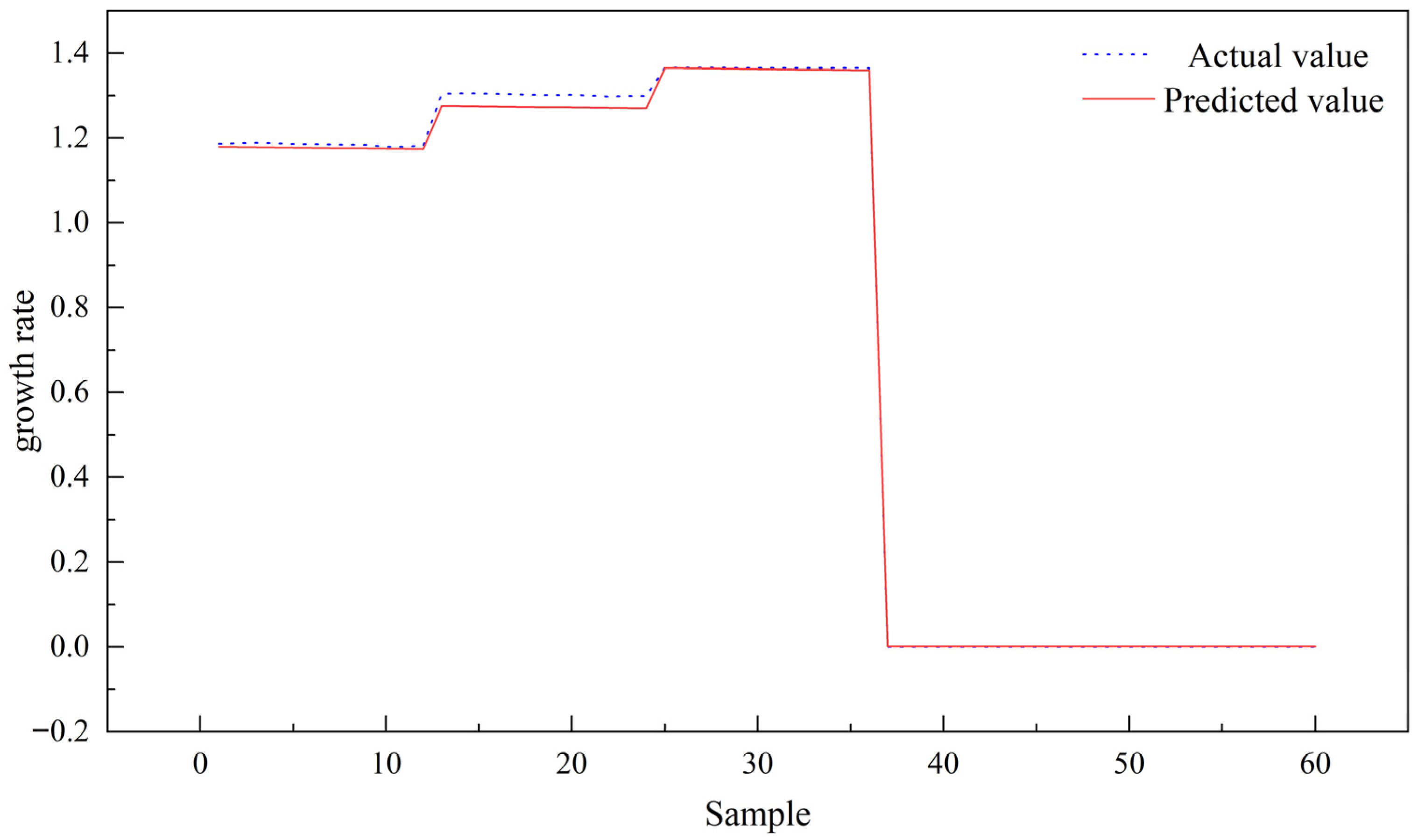
In the equation, a represents the At number; b denotes the average viscosity; c indicates the pipe diameter; d signifies the flow velocity; e represents the mixing length; and f denotes the interfacial tension. Figure 14 shows the comparison between the fitted training set data and the original data. Figure 15 presents the comparison between the predicted test set data and the original data. The fitted training set data achieved R2 = 0.99007 and RMSE = 1.28 × 10⁻². The test set data yielded R2 = 0.97216 and RMSE = 1.86 × 10⁻².
2.
Formula for Inclined Pipe Sections (Inclination angle α ≠ 0°):
d L d t = 3.3962 a 5.1744 b 11.9144 c 13.8286 d 0.045 e 0.021752 cos f 0.023293
In the equation, a represents the At number; b denotes the average viscosity; c indicates the pipe diameter; d signifies the flow velocity; e represents the mixing length; and f denotes the pipe inclination angle. Figure 16 shows the comparison between the training set fitting data and the original data, while Figure 17 displays the comparison between the test set prediction data and the original data. The fitted training set data yielded R2 = 0.99112 and RMSE = 1.37 × 10⁻²; the test set data yielded R2 = 0.98533 and RMSE = 1.62 × 10⁻².

4. Discussion

This study constructed a mass transfer model that takes into account the micro-dissolution characteristics, and innovatively established the growth rate of the mixed liquid length (dL/dt) as the core dynamic indicator. It systematically revealed the evolution mechanism of the mixed liquid during the sequential transportation process of refined oil and liquid ammonia. The research results were comprehensively explained in the context of the development of multiphase flow theory and the demands of engineering practice. Their scientific connotations and application values were deeply explored. The future exploration paths were also envisioned.
The main theoretical progress of this study lies in the first time that the “micro-dissolution” characteristic between refined oil and liquid ammonia was incorporated into the numerical simulation framework of pipeline sequential transportation. Traditional numerical studies usually simplify the relationship between fluids as complete miscibility or complete immiscibility, which essentially ignores the dynamic mass transfer process at the phase interface caused by limited solubility. The simulation results clearly show that micro-dissolution mass transfer has a significant and non-negligible influence on the mixed liquid pattern. This discovery confirms that at the liquid ammonia-refined oil interface, in addition to the physical mixing caused by fluid shear and convection diffusion, there is also a continuous mass exchange of dissolution and precipitation. This process affects the stability of the interface and the expansion mode of the mixed liquid section. Therefore, the VOF-mass transfer coupled model constructed in this study breaks through the limitations of traditional multiphase flow models in such problems. It provides a more realistic concentration field evolution image that is closer to physical reality. It also offers new theoretical tools for understanding the complex behavior of micro-dissolving fluid systems.
Another important innovation of this study lies in the shift in the research perspective from static results to dynamic processes. Most existing studies focus on the final mixed liquid volume or the mixed liquid length at a specific time, which is a static description. This study creatively takes the growth rate of the mixed liquid length (dL/dt) as the dynamic core indicator. It establishes a high-precision empirical relationship with multiple physical parameters through multivariate nonlinear regression (R2 > 0.99). This transformation has significant methodological and engineering practical significance. Theoretically, focusing on the growth rate enables us to directly understand the dynamic driving mechanism of the mixed liquid process rather than merely evaluating its final state. In engineering applications, this model provides a basis for real-time optimization control of sequential transportation. The empirical formulas obtained establish an efficient bridge between CFD simulations and rapid engineering evaluations, significantly improving the efficiency of technology selection and optimization. It should be noted that although the empirical formula established in this study shows high prediction accuracy on both the training set and the test set, there is still a certain risk of overfitting. This is because the multivariate nonlinear regression model has a flexible function form and a high degree of parameter freedom. In this study, based on a limited number of numerical simulation conditions, the number of independent variables is relatively large. As a result, random fluctuations in the data or specific patterns under certain conditions can easily be incorporated into the model structure. This will weaken the generalization ability for new conditions. Although preliminary verification has been conducted by dividing the training set and the test set, it is still difficult to completely rule out the possibility of overfitting. Future research will further enhance the robustness and generalization ability of the model. This will be achieved by expanding the sample size, introducing cross-validation methods, and combining regularization regression techniques such as ridge regression or LASSO.
The significance of this work goes beyond a specific fluid system and has implications in a broader context. Firstly, it directly responds to the urgent need for the transformation of energy infrastructure towards a low-carbon model. Ammonia, as a hydrogen carrier and zero-carbon fuel, has its storage and transportation as a key link. Utilizing existing refined oil pipelines for sequential transportation is a highly cost-effective solution, and this study provides core theoretical and tool support for the safe and economic operation of this technology. Secondly, the rigorous modeling of the “micro-dissolution” physical state, which is often simplified as “immiscible,” provides a reference research paradigm for other fields where partially miscible fluid processing processes are widespread. Finally, by revealing complex mechanisms and establishing high-precision prediction tools, this study promotes the further “transparency” of multiphase flow processes in pipelines, laying a scientific foundation for the operation decision-making of intelligent pipelines.
In practical engineering applications, the transportation of liquid ammonia involves several important issues, such as corrosion, material compatibility, and transportation safety, which directly affect the safe operation and long-term reliability of the pipeline system. It is necessary to briefly discuss these issues. Firstly, liquid ammonia is corrosive to common pipeline materials such as carbon steel, and it is prone to cause stress corrosion cracking under water-containing conditions. Studies have shown that dissolved oxygen, moisture, and impurities in liquid ammonia can significantly accelerate the corrosion rate, leading to thinning of the pipe wall and local pitting corrosion. Therefore, in the selection of pipeline materials and anti-corrosion design, materials with excellent anti-ammonia corrosion performance (such as low-carbon steel) should be given priority, and the moisture content in liquid ammonia should be strictly controlled. In some cases, coating or cathodic protection measures can be adopted for anti-corrosion. Secondly, Liquid ammonia may cause swelling, aging, or brittleness in commonly used non-metallic materials in the pipeline system. These materials include rubber seals, polytetrafluoroethylene gaskets, and polymer coatings. This affects the sealing performance and long-term stability of the system. When selecting materials, sealing materials that have been tested for ammonia resistance should be given priority, such as EPDM rubber, polyether ether ketone, etc. Regular material aging assessment and replacement should be carried out to ensure the reliability of system sealing. Finally, liquid ammonia is toxic and flammable. According to relevant regulations such as the “Regulations on the Safety Management of Hazardous Chemicals” and the “Law on the Protection of Petroleum and Natural Gas Pipelines”, liquid ammonia pipeline transportation must strictly follow safety norms. Main safety measures include: setting up leakage monitoring and alarm systems, configuring emergency shut-off devices, formulating leakage emergency plans, and delineating safety protection distances. In the sequential transportation process, the presence of the mixing section may increase the risk of leakage. The cutting and switching operations should be optimized based on the characteristics of the mixing to reduce safety risks. In conclusion, issues such as corrosion, material compatibility, and transportation safety are non-negligible operational factors in the sequential transportation of liquid ammonia and refined oil in engineering applications. Although they are not directly reflected in this research model, these factors serve as important boundary conditions for engineering implementation. They will be further considered in subsequent studies in combination with specific working conditions. This will enhance the engineering applicability of the research results.
Based on the current results, several research directions for future exploration are worthy of in-depth investigation. Due to the fact that the research is in its early stage, the toxicity of liquid ammonia is strong, and there are high requirements for safety and process, etc., the system experimental verification has not been completed yet. This paper mainly uses the extreme comparison verification method to preliminarily verify the correctness of the model. It should be noted that this verification is based only on theoretical extreme cases and lacks experimental or on-site data support. The primary task for the future is to conduct experiments to verify the prediction results of the model through empirical methods, adjust the parameters, and conduct strict verification of the model. Secondly, the research can be extended to more realistic engineering conditions, such as variable flow rate transportation, multiple batch alternation, pipeline systems, and scenarios considering the influence of inner wall roughness. Meanwhile, the potential role of surface tension in aspects such as emulsification, droplet separation, and phase distribution may be exerted. The indirect influence of this on mass transfer needs to be further explored in subsequent studies. Thirdly, in the subsequent research, the length of the non-standard product zone was predicted. An ammonia concentration threshold was introduced. The distance from the point of contact between the two phases to the point where the ammonia solubility in the oil phase drops below the maximum allowable concentration was then calculated. This was done to more directly serve the oil cutting and quality control in the sequential pipeline transportation. It laid the foundation for conducting more research with engineering application value in the future. Fourthly, in this study, a fixed solubility (2 kg/m3) was adopted as the model input parameter. However, during actual pipeline transportation, the solubility of liquid ammonia in the refined oil is affected by factors such as temperature and pressure, and may undergo dynamic changes, resulting in complex variations in the actual solubility. Given that these factors may have potential impacts on the mixing behavior, subsequent research will conduct a sensitivity analysis of the solubility parameters. This analysis will systematically evaluate the quantitative effects of solubility changes under temperature and pressure fluctuations on the mixing length and mass transfer process. The goal is to further verify the applicability and reliability of the model in a wider range of operating conditions. Fifthly, the current verification of grid independence is based on a single metric of liquid mixture length. In future research, the grid sensitivity of microscopic physical quantities such as concentration distribution and velocity field can be considered. A systematic analysis of the concentration distribution of the liquid mixture under different solubility conditions should be conducted. On this basis, a more comprehensive grid sensitivity analysis should be carried out. This analysis should be based on multiple physical quantities, such as the concentration field and velocity field. The goal is to further enhance the reliability and persuasiveness of the numerical simulation results. Sixthly, the training data consists of only 16 cases, and more simulations or cross-validation are needed to reduce the risk of overfitting. Meanwhile, in the subsequent research, as the dataset expands, we will attempt to re-express the empirical correlation of the growth rate of the mixed liquid volume using dimensionless numbers. This will enhance the general applicability and theoretical completeness of the model. Finally, by integrating this dynamic prediction model with machine learning algorithms, real-time data collection and monitoring systems (SCADA), and developing an intelligent liquid blending prediction and cutting decision support system, it is the ultimate direction for transforming the theoretical research value into industrial practical effectiveness.


5. Conclusions

Based on the ANSYS platform and incorporating moving mesh technology, a transient flow model for the sequential transportation of refined oil-liquid ammonia was constructed. This successfully simulated the evolution of the mixture interface under various operating conditions. The study innovatively proposed a VOF-Micro-Soluble Mass Transfer Model, introducing for the first time the Micro-solubility characteristics of refined oil and liquid ammonia. A mass transfer model for the coupled convection-diffusion equation was developed, quantifying the influence of dissolution effects on mixture length. Through numerical simulation, theoretical modeling, and data analysis, this study systematically investigated the variation patterns of mixing length during sequential transport of refined oil and liquid ammonia. A predictive formula for the growth rate of the mixture length was successfully derived. Key findings are as follows:
  • The slightly soluble nature of refined oil and liquid ammonia significantly influences the mixing process and cannot be ignored. Comparing models incorporating slightly soluble mass transfer with idealized models neglecting dissolution effects reveals that slight solubility affects the mixing length within the mixing zone. This indicates that introducing slightly soluble mass transfer models is crucial for accurately simulating the mixing development patterns in this specific refined oil-ammonia system.
  • Pipeline inclination angle is the most sensitive parameter affecting mixing length patterns. Among all influencing factors, changes in pipeline inclination angle exert the most pronounced effect on mixing length. The mixing behavior within horizontal and inclined pipe sections exhibits fundamental differences, with gravitational stratification being one of the dominant factors. Secondly, flow velocity—which directly determines the flow Reynolds number—is the second most sensitive factor.
  • An empirical formula with high accuracy for predicting the growth rate of the mixing length is proposed. This study employs the mixing length growth rate as the prediction target. Based on extensive simulation data, a fitting formula was derived using multivariate nonlinear regression, with Atwood number, pipe inclination angle, average viscosity, flow velocity, and initial mixing length as independent variables. This formula achieves a high R2 of 0.99 and root mean square error (RMSE) below 5%. Verification demonstrates that this formula effectively predicts the growth rate of the mixing zone under various operating conditions. It shows good agreement with simulation results and demonstrates strong generalization capability.
The proposed mixing growth rate formula features a concise form with clearly defined parameters, combining high fitting quality with robust predictive capability. It serves as a practical prediction tool for estimating mixing volumes during engineering design and optimizing separation schemes during operation. This significantly contributes to pipeline safety and economic operation. These findings provide valuable guidance for engineering practice.

Author Contributions

Conceptualization, G.L.; methodology, L.C.; software, Z.W.; validation, L.C. and Z.W.; formal analysis, L.C.; investigation, J.W. and Z.W.; resources, J.W. and G.L.; data curation, Z.W.; writing—original draft preparation, J.W. and Z.W.; writing—review and editing, L.C.; visualization, J.W. and Z.W.; supervision, G.L.; funding acquisition, J.W. All authors have read and agreed to the published version of the manuscript.

Funding

This research received no external funding.

Data Availability Statement

The authors confirm that the data supporting the findings of this study are available from the corresponding author upon reasonable request.

Conflicts of Interest

Author Jiong Wang is employed by the company Shanxi Yanchang Petroleum Emerging Industry Co., Ltd., Xi’an 710075, China. The remaining authors declare that the research was conducted in the absence of any potential or financial relationships that could be construed as a potential conflict of interest.

Abbreviations

The following abbreviations are used in this manuscript:
CFDComputational Fluid Dynamics
VOFVolume of Fluid
UDFUser-Defined Functions
AtThe Atwood number
θPipe Inclination Angle
μavgAverage Viscosity
vFlow Velocity
L0Mixing Length
FInterfacial Tension
dL/dtGrowth Rate, the derivative of mixing length with respect to time
R2The Coefficient of Determination
RMSERoot Mean Square Error

References

  1. Huang, X.; Teng, L.; Nie, C.F.; Liu, L.Q.; Yan, F.; Qiu, S.J.; Luo, Y.; Jiang, L.L. Research Progress on Sequential Transport Technology for Liquid Ammonia/Methanol/Refined Oil. Oil Gas Storage Transp. 2023, 42, 1337–1351. [Google Scholar] [CrossRef]
  2. Huang, X.; Shi, H.X.; Li, Y.L.; Li, W.D.; Yin, P.B.; Li, Z.C.; Teng, L.; Jiang, L.L. Study on Two-Phase Flow Patterns in Sequential Transport Processes of Liquid Ammonia and Refined Oil. Oil Gas Storage Transp. 2024, 43, 1099–1108. [Google Scholar] [CrossRef]
  3. Huang, W.H.; Liu, G.; Chen, L.; Yang, W.; Yuan, Z.Y. Current Status and Prospects of Mixed Oil Sequential Transportation in China’s Refined Oil Pipelines. J. China Univ. Pet. (Nat. Sci. Ed.) 2023, 47, 122–129. [Google Scholar] [CrossRef]
  4. Austin, J.E.; Palfrey, J.R. Mixing of miscible but dissimilar liquids in serial flow in a pipeline. Proc. Inst. Mech. Eng. 1963, 178, 377–389. [Google Scholar] [CrossRef]
  5. Baptista, R.M.; de Freitas Rachid, F.B.; Carneiro de Araujo, J.H. Estimating mixing volumes between batches in multiproduct pipelines. In Proceedings of the 2000 3rd International Pipeline Conference. Volume 2: Integrity and Corrosion; Offshore Issues; Pipeline Automation and Measurement; Rotating Equipment; American Society of Mechanical Engineers: New York, NY, USA, 2000; Volume 40252, p. V002T08A008. [Google Scholar] [CrossRef]
  6. Rachid, F.B.F.; Araujo, J.H.C.; Baptista, R.M. The influence of pipeline diameter variation on the mixing volume in batch transfers. In Proceedings of the 2002 4th International Pipeline Conference, Parts A and B; American Society of Mechanical Engineers: New York, NY, USA, 2002; Volume 36207, pp. 997–1004. [Google Scholar] [CrossRef]
  7. Ekambara, K.; Joshi, J.B. Axial mixing in pipe flows: Turbulent and transition regions. Chem. Eng. Sci. 2003, 58, 2715–2724. [Google Scholar] [CrossRef]
  8. Deng, S.S.; Pu, J.N. Comparison of two-dimensional and one-dimensional oil mixing models for sequential transfer of refined oil. Oil Gas Storage Transp. 1997, 16, 16–18. [Google Scholar]
  9. Liu, W.D.; Guo, L.J. Experimental Study on Friction Resistance Characteristics of Oil-Water Two-Phase Flow in Horizontal Pipes. J. Eng. Thermophys. 2002, 23, 627–630. [Google Scholar] [CrossRef]
  10. Lü, Y.L. Study on Droplet Characteristics and Pressure Drop Laws of Oil-Water Two-Phase Dispersed Flow. Ph.D. Thesis, China University of Petroleum (East China), Dongying, China, 2012. [Google Scholar] [CrossRef]
  11. Li, G.; Fang, G.; Kou, Z.; Chen, S.; Duan, J.; Chen, Y. Oil–Water Hydrodynamics Model during Oil Displacement by Water in Down-Hill Mobile Pipeline. Processes 2024, 12, 1238–1240. [Google Scholar] [CrossRef]
  12. Fang, G.; Li, G.; Kou, Z.; Liu, H.; Duan, J.; Chen, Y. Flow Characteristics of Oil-Carrying by Water in Downward-Inclined and Horizontal Mobile Pipeline. Energies 2024, 17, 4779. [Google Scholar] [CrossRef]
  13. Chen, Y.; Li, G.; Duan, J.; Liu, H.; Xu, S.; Guo, Y.; Hua, W.; Jiang, J. Review of Oil–Water Flow Characteristics of Emptying by Water Displacing Oil in Mobile Pipelines. Energies 2023, 16, 2174. [Google Scholar] [CrossRef]
  14. Kjølaas, J.; Schümann, H.; Gonzalez, D.; Johansen, S.T. Modelling of dispersed oil/water flow in a near-horizontal pipe. Chem. Eng. Sci. 2022, 263, 118074. [Google Scholar] [CrossRef]
  15. Pouraria, H.; Park, K.-H.; Seo, Y. Numerical Modelling of Dispersed Water in Oil Flows Using Eulerian-Eulerian Approach and Population Balance Model. Processes 2021, 9, 1345. [Google Scholar] [CrossRef]
  16. Oladosu, O.; Hasnain, A.; Brown, P.; Frigaard, I.; Alba, K. Density-stable displacement flow of immiscible fluids in inclined pipes. Phys. Rev. Fluids 2019, 4, 044007. [Google Scholar] [CrossRef]
  17. Hasnain, A.; Alba, K. Buoyant displacement flow of immiscible fluids in inclined ducts: A theoretical approach. Phys. Fluids 2017, 29, 052102. [Google Scholar] [CrossRef]
  18. Teng, L.; Lin, J.H.; Yin, P.B.; Li, W.D.; Huang, X.; Li, J.Q.; Luo, Y.; Jiang, L.L. Numerical Simulation of Factors Affecting Hydraulic and Thermal Characteristics of Liquid Ammonia Pipelines. Oil Gas Storage Transp. 2023, 42, 283–290. [Google Scholar] [CrossRef]
  19. Huang, X.; Li, Y.L.; Li, W.D.; Shi, H.X.; Yin, P.B.; Li, Z.C.; Teng, L.; Jiang, L.L. Phase Equilibrium and Pressure-Reducing Phase Transition Patterns in Liquid Ammonia- Refined Oil Mixture Systems. Acta Chim. Sin. 2025, 76, 71–80. [Google Scholar] [CrossRef]
  20. Wen, Z.; Shi, L.C.; Ren, Y.R. Fluent Fluid Computation Application Tutorial; Tsinghua University Press: Beijing, China, 2009; pp. 81–95. [Google Scholar]
  21. Zhang, Q.S.; Wang, H.; Lu, Y.H. Numerical Simulation of Mixed Oil Concentration in Sequential Pipeline Transportation by PHOENICS. Nat. Gas Pet. 2007, 25, 13–15. [Google Scholar]
  22. Roe, P.L. Approximate Riemann solvers, parameter vectors and different schemes. J. Comp. Phys. 1981, 43, 357–372. [Google Scholar] [CrossRef]
  23. Jameson, A.; Schmidt, W.; Turkel, E. Numerical solution of the Euler equation by finite volume methods with Runge-Kutta time stepping schemes. In Proceedings of the 14th Fluid and Plasma Dynamics Conference, Palo Alto, CA, USA, 23–25 June 1981; pp. 81–1259. [Google Scholar] [CrossRef]
  24. Ni, R.H. A Multiple grid scheme for solving the Euler equation. AIAA J. 1982, 20, 1565–1571. [Google Scholar] [CrossRef] [PubMed]
  25. van Leer, B.; Lee, W.; Roe, P.L.; Powell, K.G.; Tai, C. Design of optimally smoothing multistage schemes for the Euler equations. Commun. Appl. Numer. Methods 1989, 8, 89–93. [Google Scholar] [CrossRef]
  26. Zhu, H.J.; Lin, Y.H.; Xie, L.H. Practical Tutorial on FLUENT Fluid Analysis and Simulation; People’s Posts and Telecommunications Press: Beijing, China, 2010; p. 4. [Google Scholar]
  27. GB17930-2016; Motor Gasoline. National Technical Committee for Standardization of Petroleum Products and Lubricants. China Standards Press: Beijing, China, 2016.
  28. GB/T 259-2023; Determination of Water-Soluble Acids and Bases in Petroleum Products. State Administration for Market Regulation, Standardization Administration of China. China Standards Press: Beijing, China, 2023.
  29. IUPAC-NIST Solubility Data Series IUPAC, Version 1.1. [DB/OL]. (2024-11-14) [2025-03-12]; 2012. Available online: https://srdata.nist.gov/solubility/ (accessed on 14 April 2026).
  30. GB 50253-2003; Design Code for Oil and Gas Pipeline Projects. 2006 edition; China National Petroleum Corporation, China Planning Press: Beijing, China, 2007.
  31. SY/T 6695-2024; National Energy Administration. Operation Specifications for Refined Oil Pipelines. Petroleum Industry Press: Beijing, China, 2024.
  32. Wang, H.Y.; Zhang, D.J. (Eds.) Handbook of Design and Installation of Petroleum Chemical Pipelines, 4th ed.; China Petrochemical Press Co., Ltd.: Beijing, China, 2014. [Google Scholar]
  33. SH/T 3405-2012; China Petrochemical Corporation. Petrochemical Steel Pipe Size Series. China Planning Press: Beijing, China, 2016.
Figure 1. Schematic diagram of the refined oil-liquid ammonia sequential pipeline model.
Fuels 07 00029 g001
Figure 2. Comparison chart of the mixture length variation with the number of grids.
Fuels 07 00029 g002
Figure 3. Verification of calculation result accuracy for dynamic mesh method.
Fuels 07 00029 g003
Figure 4. Comparison of concentration distribution between mass transfer model and VOF model.
Fuels 07 00029 g004
Figure 5. Comparison of mixing length variation between mass transfer model and VOF model.
Fuels 07 00029 g005
Figure 6. Comparison of concentration distributions between mass transfer model and component transport model.
Fuels 07 00029 g006
Figure 7. Comparison of mixed liquid length variation between mass transfer model and component transport model.
Fuels 07 00029 g007
Figure 8. Comparison chart of mixed liquid length changes under different density differences. (a) Comparison between Mass Transfer Model and VOF Model under Density Effect; (b) The pattern of length changes in mixtures with different density differences; (c) Comparison of concentration distributions at different density differences.
Fuels 07 00029 g008
Figure 9. Comparison chart of mixed liquid length changes at different inclination angles. (a) Comparison between mass transfer model and VOF model under inclination effects; (b) Variation pattern of mixed liquid length at different inclinations; (c) Comparison of concentration distributions at different inclination angles.
Fuels 07 00029 g009
Figure 10. Comparison chart of mixed liquid length changes under different viscosities. (a) Comparison of mass transfer model and VOF model under viscosity effects; (b) The pattern of length changes in mixtures with different viscosity differences; (c) Comparison of concentration distributions with different viscosity differences.
Fuels 07 00029 g010
Figure 11. Comparison chart of mixed liquid length changes under different flow rates. (a) Comparison between mass transfer and VOF model under flow velocity influence; (b) The variation pattern of the mixing length of the mixture with different flow rates over time; (c) The variation pattern of the mixing length of the mixture with different flow rates over time; (d) Comparison of concentration distributions at different flow rates.
Fuels 07 00029 g011
Figure 12. Comparison chart of mixed liquid length changes under different pipe diameters. (a) Comparison between mass transfer and VOF model under pipe diameter influence; (b) Variation pattern of mixed liquid length for different pipe diameters; (c) Comparison of concentration distribution for different pipe diameters.
Fuels 07 00029 g012
Figure 13. Comparison chart of mixed liquid length changes under different interfacial tensions. (a) Comparison of mass transfer and VOF model under the influence of interfacial tension; (b) The pattern of length changes in miscible liquids with different interfacial tensions.
Fuels 07 00029 g013
Figure 14. Comparison of training set data for horizontal pipe sections.
Fuels 07 00029 g014
Figure 15. Comparison of Test Set Data for Horizontal Pipe Segments.
Fuels 07 00029 g015
Figure 16. Comparison of training set data for inclined pipe segments.
Fuels 07 00029 g016
Figure 17. Comparison of test set data for inclined pipe sections.
Fuels 07 00029 g017
Table 1. Empirical constants of the k-ε model.
cμc1c2σkσε
0.091.441.921.01.3
Table 2. Control variable simulation plan.
Group NumberAtwood NumberAverage ViscosityPipeline Inclination AngleDiameter Flow RateInterface Tension
10.1030.00033045710.025
20.1290.00033045710.025
30.1530.00033045710.025
40.1030.000333045710.025
50.1030.000334545710.025
60.1030.000336045710.025
70.1030.00033−4545710.025
80.1030.00033−6045710.025
90.1030.00062045710.025
100.1030.00078045710.025
110.1030.00033033210.025
120.1030.00033066010.025
130.1030.00033045720.025
140.1030.00033045730.025
150.1030.00033045710.02
160.1030.00033045710.03
Disclaimer/Publisher’s Note: The statements, opinions and data contained in all publications are solely those of the individual author(s) and contributor(s) and not of MDPI and/or the editor(s). MDPI and/or the editor(s) disclaim responsibility for any injury to people or property resulting from any ideas, methods, instructions or products referred to in the content.