Article

Calibrated Intrusive Reduced-Order Model of Burgers’ Equation Using a Combination of Proper Orthogonal Decomposition and LSTM Deep Learning Algorithm

by
Mina Golzar
1,
Mohammad Kazem Moayyedi
2,
Faranak Fotouhi-Ghazvini
1,*,
Maryam Vahabi
3 and
Hossein Fotouhi
3,*
1
Department of Computer Engineering and IT, University of Qom, Qom 3716146611, Iran
2
CFD and Turbulence Research Laboratory, Department of Mechanical Engineering, University of Qom, Qom 3716146611, Iran
3
Department of Computer Science and Engineering, Malardalen University (MDU), Box 883, 721 23 Västerås, Sweden
*
Authors to whom correspondence should be addressed.
Modelling 2026, 7(3), 91; https://doi.org/10.3390/modelling7030091 (registering DOI)
Submission received: 21 January 2026 / Revised: 4 May 2026 / Accepted: 5 May 2026 / Published: 9 May 2026
(This article belongs to the Special Issue Machine Learning and Artificial Intelligence in Modelling)

Abstract

Modelling plays a critical role in many engineering applications. Partial differential equations (PDEs) are ubiquitous, describing various physical phenomena such as fluid flow, electromagnetism, and quantum mechanics. Although some of these equations have analytical solutions, many require high-fidelity simulations of parametric PDEs. In general, high-fidelity simulations are computationally expensive and often infeasible for real-time or multi-query applications. This challenge has led to the development of reduced-order models (ROMs). Over the past few decades, ROMs have emerged as a practical solution for simulating, controlling, and optimizing large-scale and complex dynamical systems. This paper introduces a novel Calibrated Intrusive Reduced-Order Modelling (CIROM) approach for the efficient and accurate simulation of the one-dimensional Burgers’ equation, employed as a canonical benchmark because it is a simplified fundamental partial differential equation that captures the behaviour of many real-world phenomena. The proposed method, combining the strengths of proper orthogonal decomposition (POD) and long short-term memory (LSTM) networks, effectively reduces computational complexity while addressing inherent instabilities in classical reduced-order models. Unlike traditional POD-ROMs, which often suffer from error accumulation and instability at high Reynolds numbers, the CIROM employs an iterative LSTM-based error correction mechanism to learn and compensate for truncation and projection errors. This study is benchmark-oriented and does not aim to provide a general PDE solver. The performance of the proposed method is rigorously evaluated across a broad range of Reynolds numbers, including interpolation and extrapolation scenarios, demonstrating robust extrapolation within moderate ranges. Comprehensive numerical experiments confirm that the CIROM outperforms both pure intrusive ROMs and purely data-driven LSTM models in terms of prediction accuracy, stability, and computational cost.

1. Introduction

The Burgers’ equation is a simplified Navier–Stokes equation created by removing the pressure term [1]. It contains three key terms, transient, convective, and diffusive, each demonstrating unique behaviour due to the nature of partial differential equations (PDEs). Because of its nonlinear convective term, the Burgers’ equation serves as a valuable prototype for studying turbulence, nonlinear wave propagation, and convection-dominated transport phenomena. For instance, Bec and Khanin introduced different methods to analyze the Burgers’ equation [2]. Bouchaud and Mézard [3] proposed a straightforward technique to calculate the velocity difference in the Burgers’ equation across dimensions. Bayona et al. [4] developed a numerical approach to approximate the one-dimensional Burgers’ equation using a subgrid scales–variational multi-scale (OSGS-VMS) method. Their results show that this method is effective for modelling turbulent flow behaviour.
A dominant paradigm for dimensionality reduction in this context is the proper orthogonal decomposition (POD) method, which approximates flow variables through an expansion of empirical eigenmodes [5]. While POD has proven effective across various applications, including flow reconstruction [6] and the analysis of turbulent structures [7], its integration with Galerkin projection (POD–Galerkin) reveals a critical limitation: despite successes in moderately nonlinear regimes [8], these classical ROMs frequently suffer from numerical instability and a marked loss of accuracy when applied to convection-dominated problems, particularly at elevated Reynolds numbers.
Their results showed high accuracy in modelling with the POD method. Among ROM techniques, proper orthogonal decomposition (POD) stands out as a widely adopted method for dimensionality reduction. Despite such successes, classical POD–Galerkin ROMs often suffer from numerical instability and loss of accuracy in nonlinear or convection-dominated regimes, especially at high Reynolds numbers.
To address the inherent limitations of classical POD-ROM, the literature reveals several evolutionary trajectories:
  • Advancements in Intrusive and Hybrid Methods: Early efforts focused on modifying the intrusive POD–Galerkin framework itself. Abbasi and Mohammadpour [9] demonstrated that increasing the number of retained eigenmodes could enhance accuracy for Reynolds numbers up to 100 in systems with Neumann boundary conditions. Moayyedi [10] extended this line of inquiry by exploring boundary control mechanisms within a POD-based reduced-order dynamical system, though validation remained confined to short time durations and a Reynolds number of 100. Rafiq and Bazaz [11] introduced APOD and NLMM-based ROMs specifically for the Burgers’ equation, yet their validation was limited to low Reynolds numbers (20 and 25), highlighting a persistent gap in addressing higher Reynolds regimes. A significant advancement was made by Sahyoun et al. [12], who proposed localized POD clustering strategies—time-based, space-based, and space–time-based—to better capture nonlinear dynamics, successfully extending the applicable range up to Re = 300. Despite this progress, these purely intrusive or semi-intrusive approaches often incur prohibitive computational costs or remain inherently limited by their dependence on the predefined modal basis when faced with strongly nonlinear, convection-dominated flows.
  • Foundational Developments and Broad Applications of POD: The POD method, originating from Lumley [5], has become a cornerstone of reduced-order modelling for nonlinear systems [13,14]. Its effectiveness has been demonstrated across a wide spectrum of applications, including jet-flow reconstruction [6], the analysis of turbulent structures [7], parametric ROM development [8], sensor validation, model analysis, pattern recognition, aerospace design, and environmental modelling [15,16,17,18,19,20,21,22,23,24,25,26,27,28,29,30,31,32,33,34]. This extensive body of work attests to the versatility and robustness of POD as a dimensionality reduction technique. However, despite its widespread adoption, classical POD–Galerkin ROMs frequently suffer from numerical instability and loss of accuracy when applied to convection-dominated problems, particularly at elevated Reynolds numbers—a limitation that has motivated the integration of data-driven methods.
  • Emergence of Data-Driven and Nonintrusive Frameworks: A paradigm shift toward augmenting or replacing intrusive projection with machine learning has gained momentum. San and colleagues [35] pioneered an equation-free approach using artificial neural networks (ANNs) to map the temporal evolution of POD coefficients, demonstrating applicability up to Re = 1000. Xie et al. [36] proposed a data-driven filtered ROM (DDF-ROM) incorporating a closure step to model unresolved mode interactions, successfully validating their framework for transient channel flow at Reynolds numbers up to 1000. Concurrently, nonintrusive methods have been developed that require only the ability to export velocity data [37] or utilize convolutional autoencoders for large-scale spatiotemporal challenges [38], with applications including the Burgers’ equation [39] and fluid–structure interaction problem [40].
  • POD Integration with Recurrent Neural Architectures: Recent years have witnessed increasing sophistication in combining POD with recurrent neural networks. Golzar et al. [41] implemented a reduced-order model combining dynamic mode decomposition with LSTM for ocean data applications, demonstrating acceptable accuracy with significantly reduced computation time. Hajisharifi and colleagues [42] introduced a nonintrusive, data-driven ROM for DEM-CFD simulations, employing an LSTM network to calculate reduced coefficients. Zhang and colleagues [43] systematically compared POD-LSTM and POD-GRU models for predicting unstable flow fields, revealing important trade-offs: LSTM performs well at predicting velocity fields while GRU excels at pressure fields, with performance characteristics varying across different numbers of POD modes. Lee et al. [40] enhanced parametric model order reduction by combining POD with a modified Nouveau Variational Autoencoder (mNVAE) for flow field interpolation in fluid–structure interaction problems.
While the aforementioned studies represent significant strides, a critical examination reveals persistent shortcomings that this paper aims to address:
  • Intrusive Methods: Purely intrusive methods [8,11,12], while physically grounded, lack the flexibility to adapt to unseen flow regimes and suffer from truncation-induced loss of dissipative dynamics, leading to instability at higher Reynolds numbers.
  • Nonintrusive/Black-Box Methods: Conversely, data-driven approaches [34,37,38,40,42,44] treat the reduced system as a black box. Although computationally efficient, they do not explicitly leverage governing physical equations, limiting their interpretability and robustness under extrapolation.
  • Limitations of Existing POD-LSTM Hybrids: Crucially, studies combining POD with LSTM [42,44] employ the network as a predictive surrogate for the entire reduced-order dynamic. They do not utilize the network to specifically learn and correct the truncation error inherent in the intrusive POD projection. This error, arising from discarded higher modes, is a primary source of inaccuracy and instability in convection-dominated systems.
Most existing studies evaluate performance under interpolation scenarios but rarely assess extrapolation to significantly different flow regimes [42,44,45], limiting confidence in real-world engineering applications. This analysis underscores a clear research gap: the absence of a framework that integrates the physical fidelity of an intrusive POD–Galerkin formulation with a mechanism for systematically learning and correcting its truncation-induced errors. Most existing hybrids either sacrifice physical structure for flexibility or fail to explicitly target the truncation error as a learnable quantity, instead opting to replace the physics altogether. The proposed CIROM framework directly addresses this gap by embedding LSTM-based error correction within the intrusive POD structure, while rigorously evaluating performance under both interpolation and extrapolation scenarios across a wide range of Reynolds numbers.
Although the combination of POD and LSTM has been previously applied to fluid flow problems, the present work introduces several key innovations:
  • Stabilization Via Error Learning: Unlike prior studies, our CIROM framework employs LSTM not only to predict the dynamics of the system but also to iteratively learn and correct the error introduced by truncation in the POD process. This error correction acts as a stabilization mechanism, compensating for lost dissipative effects, especially in high Reynolds number regimes.
  • Generalization Across Reynolds Numbers: The proposed method is trained on a limited set of Reynolds numbers but evaluated on both interpolation and extrapolation scenarios. Our results show the method’s robustness and generalizability, which is often not addressed in similar POD-LSTM studies.
  • Iterative POD-LSTM Integration: We propose an iterative loop between POD and LSTM, where the reconstructed flow is continuously refined based on learned residuals. This feedback loop structure improves convergence and model accuracy.
To the best of our knowledge, no previous POD-LSTM framework explicitly utilizes an error-driven stabilization approach combined with iterative refinement and generalization testing over a wide Reynolds number range.
To rigorously assess the performance, stability, and computational efficiency of the proposed CIROM framework, the Burgers’ equation is employed as a canonical benchmark problem due to its analytical tractability and relevance as a simplified convection-dominated system. This approach enables systematic validation under varying Reynolds numbers and parametric conditions before deployment to more complex, nonlinear systems governed by the Navier–Stokes equations in practical engineering applications. The insights gained here are essential for ensuring the CIROM’s robustness and readiness for integration into real-time digital twin frameworks for engineering systems.

2. Governing Equations

The Burgers’ equation, in its viscous version, describes the interplay between nonlinear convection and viscous diffusion, making it a useful tool for analyzing shock waves, turbulence, and boundary layer phenomena [46]. The concept of turbulence, particularly the turbulent flow velocity field, can be described using the Navier–Stokes equations, a nonlinear dynamical system, due to the presence of the nonlinear term. The Burgers’ equation, a simplified form of the Navier–Stokes equations assuming no pressure changes, exhibits nonlinear behaviour similar to turbulence. Like the Navier–Stokes equations, the Burgers’ equation’s behaviour is governed by a nonlinear term. Because of this similarity, methods developed for the Navier–Stokes equations are often applicable to the Burgers’ equation. Therefore, using the Burgers’ equation as a test field offers a suitable alternative to the Navier–Stokes equations under turbulent flow conditions. The dimensionless form of this equation is provided in relation (1).
u t + u u x = 1 Re 2 u x 2

Direct Numerical Simulation

To obtain the required data (snapshots), the numerical solution of the viscous Burgers’ equation is employed. For this purpose, the first-order upwind method is utilized to compute the separated form of the nonlinear term as follows:
u u x = u i u i u i 1 Δ x i f u i > 0 u i u i + 1 u i Δ x i f u i < 0
For the linear diffusion term, the second-order central difference method is employed:
2 u x 2 = u i + 1 2 u i u i 1 Δ x 2
The numerical simulations used in this study employ the fourth-order Runge–Kutta method for time integration, ensuring accurate capture of the flow field’s temporal evolution [47]. The code utilized in this study directly generates numerical simulation results, which have been validated against the exact solution of the one-dimensional Burgers’ equation [8].

3. Proper Orthogonal Decomposition

POD is a technique to find an optimal set of orthogonal bases to represent a data set. The POD method creates an orthogonal n-dimensional coordinate system that can describe a set of assumed field snapshots, providing a more accurate approximation. It aims to identify a basis that better represents the data than other orthogonal bases that could be used for the same purpose. Karhunen–Loève initially introduced the concept of POD as a method for statistical data analysis [48]. Since then, various researchers have contributed to developing and refining POD techniques, including Kosambi [49], Loève [50], Karhunen [51], Pugachev [52], and Obukhov [53], each of whom proposed methods for computing proper orthogonal functions. POD’s core principle is finding a set of orthonormal basis functions. These basis functions map each vector in the sample space to a unique representation, and they are assumed to belong to a vector space, such as a Hilbert space [54]. The resulting basis functions exhibit properties similar to Fourier functions, including orthogonality and symmetry [55]. Each vector within the sample space can be represented as a linear combination of these basis functions. Given the non-square structure of the snapshot matrix, various approaches can be employed to compute these bases. This study utilizes the singular value decomposition (SVD) method. Assuming that it is an arbitrary vector in the space and that the set of orthonormal bases for this space is known, the vector can be written as a linear combination of these bases in Equation (4) [56,57].
X = i = 1 n a i φ i

4. Deep Learning

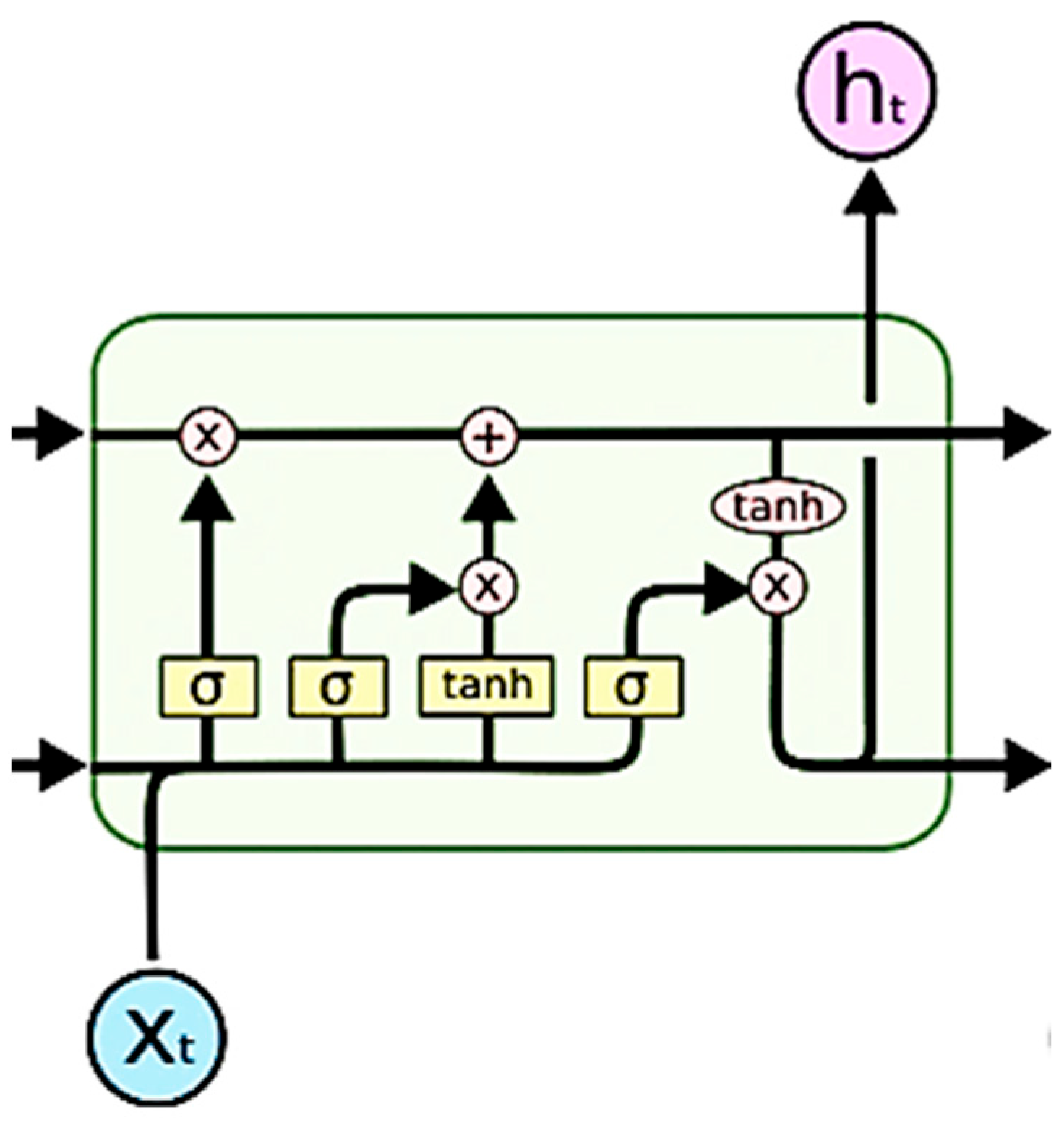
One example of a nonlinear dynamic system is the problems related to fluid mechanics and geophysical flows. Over the past three decades, machine learning methods, especially neural networks, have become highly effective tools for modelling and analyzing these systems. Initially, neural networks were used to learn the solutions of ordinary and partial differential equations. Later, it became evident that these networks could also be used to discover hidden variables and reduce the number of parameters often involved in partial differential equations. Recurrent neural networks have evolved with the advent of long short-term memory (LSTM) networks, which are considered one of the most significant achievements in artificial intelligence. This method models dynamic systems and develops data-driven models [58]. LSTM networks emerged as a revolutionary solution to address the inherent limitations of recurrent neural networks (RNNs), particularly the issue of vanishing gradients. The architecture of LSTMs is similar to that of RNNs, with a few key differences. LSTM networks are chosen because of their established capacity to capture long-term temporal dependencies in sequential data, which is essential for modelling the evolving dynamics of reduced-order coefficients. While GRU and Transformer architectures provide computational benefits, the enhanced memory capability of LSTM balances complexity and performance effectively for the current problem scale, validating its choice for this research. Figure 1 shows the internal structure of LSTM networks. Like recurrent neural networks (RNNs), long short-term memory (LSTM) networks have a sequential, chain-like architecture but consist of four layers instead of a single one. The core component of an LSTM is the state cell, depicted as the horizontal line at the top of Figure 1. LSTM networks can modify the state cell by either incorporating new information or discarding existing data. These modifications are controlled by structures known as gates, which regulate information flow. Each gate comprises a single-layer sigmoid neural network integrated with a pointwise multiplication operator. In the initial stage of an LSTM, the forget gate, implemented through a sigmoid layer, determines which information should be discarded from the cell state.
Based on ht−1 and xt, this gate produces an output value of either zero or one within the state cell Ct−1 for each unit. A value of one indicates that the entire current state cell value (Ct−1) is retained and transferred to Ct, while a value of zero signifies the complete removal of the information stored in (Ct−1). The forget gate is computed using the following equation:
f t = σ ( W f · [ h t 1 , x t ] + b f )
The second step focuses on identifying the new information to be stored in the state cell, which is carried out in two stages. The first stage involves the input gate, a sigmoid layer that regulates which data should be updated. Secondly, a hyperbolic tangent layer generates a vector of values C ˜ t to be added to the state cell. Finally, the two parts are combined to update the value of the state cell. Equation (6) is used to carry out this update process on the state cell.
i t = σ ( W i · [ h t 1 , x t ] + b i ) C ˜ t = tanh ( W c · [ h t 1 , x t ] + b c )
Then, the old state cell, C t 1 , must be updated using the new state cell, C t , according to Equation (7).
C t = f t C t 1 + i t C ˜ t
Finally, the next step involves determining what information should be sent to the output. The value of the state cell determines the output, but it undergoes processing through a specific filtering mechanism. Initially, a sigmoid layer selects which portion of the state cell should contribute to the output. Subsequently, the updated state cell value from previous steps is processed through a hyperbolic tangent layer (note that this ensures the values are between −1 and +1). The output of this hyperbolic tangent layer is then multiplied by the output from the previous sigmoid layer [59,60].
o t = σ ( W o [ h t 1 , x t ] + b o )
h t = o t tanh ( C t )

5. Physics-Informed Reduced-Order Model Based on POD Method

An intrusive reduced-order model (ROM) facilitates a direct integration with the governing partial differential equations (PDEs) by employing projection methodologies such as Galerkin projection, thereby guaranteeing a robust coupling and maintaining physical consistency. Specifically, intrusive ROMs project the full-order PDE operators onto a reduced basis—typically created through proper orthogonal decomposition (POD)—to derive a set of coupled ordinary differential equations (ODEs) that dictate the time evolution of the modal coefficients. This contrasts with nonintrusive approaches, which rely solely on data-driven regression without explicit involvement of the PDE operators. Reynolds decomposition decomposes the governing equation for the system’s dynamical behaviour into a time-averaged and fluctuation part. This decomposition, introduced by Osborne Reynolds in fluid dynamics, enables the separation of time-averaged and transient elements of the flow.
U ( x , t ) = U ¯ ( x ) + u ( x , t )
The fluctuation term in the equation is calculated using the Galerkin approximation, as represented by Equation (11). In Equation (11), ϕ i are orthonormal bases and a i are time coefficients. The mean part is calculated in the form of Equation (12), where each element i corresponds to an observed snapshot:
u ( x , t ) = i = 1 N a i ( t )   ϕ i ( x )
U ¯ ( x ) = 1 N U i ( x )
By replacing the relations related to the mean part and the fluctuations of the instantaneous field in the Burgers’ equation (Equation (1)), the following result is obtained:
ϕ i ( x ) × 1 N d d t ( a i ( t ) ) + ( U ¯ × a i ( t ) × 1 N ϕ i ( x ) + u ¯ × 1 N U ¯ + a i ( t ) × 1 N ( U ¯ , ϕ i ( x ) ) + a i ( t ) × a j ( t ) × i = j = 1 N ( ϕ i ( x ) , ϕ j ( x ) ) ) = 1 Re ( 2 U ¯ + a i ( t ) × 1 N 2 ϕ i ( x ) )
Basis functions satisfy the following relationship based on the orthogonality property in POD:
( ϕ i ( x ) , ϕ k ( x ) ) = δ i , k = 1 i = k 0 i k
By substituting Equation (14) into Equation (13), a new form of the governing equation is obtained as follows:
d a k ( t ) d t = A i j k × a i ( t ) × a j ( t ) + B i k × a i ( t ) + C k
The above equation represents a first-order ODE for modal coefficients that will be solved in different time steps.

6. Errors Resources in Reduced-Order Models

The errors in a ROM refer to the discrepancy between the real values of a physical system and those predicted by the ROM. This discrepancy arises from the inherent approximations involved in reducing the complexity of the original system to a lower-dimensional representation. Reduced-order models (ROMs) introduce errors due to several factors:
  • Truncation Error: The reduction in dimensionality in ROMs, which involves eliminating a significant portion of the flow field dynamics, leads to inaccuracies in representing the complex dynamics of the full-order system. The high-dimensional system’s behaviour might not be fully represented by the chosen reduced subspace, leading to inaccuracies when the reduced-order model is used to simulate or analyze the system.
  • Projection Error: Truncation error occurs when an infinite process or a continuous function is approximated by a finite, discrete representation. Many numerical computations involve infinite series, integrals, or derivatives, which are approximated by finite sums, finite differences, or other discrete methods.
Galerkin-based reduced-order modelling (GROM) has demonstrated effectiveness in numerically simulating relatively simple flows, such as transient flow past a circular cylinder at low Reynolds numbers. This method constructs the reduced-order model (ROM) using a set of basis functions, enabling efficient computational performance. However, the standard GROM method encounters challenges when applied to turbulent flow simulations due to the limited number of basis functions used in ROM construction, which is constrained by computational efficiency considerations. While these basis functions adequately capture the dynamics of laminar flows, they fail to represent the complex behaviour of turbulent flows. ROM closure models have been introduced for turbulent flow simulations to address this limitation. Various ROM closure approaches have been proposed, with the selection depending on the specific application and the available system information.

7. Development of New Calibrated ROMs

Over the years, various adaptations of the stabilized reduced-order model (ROM) introduced in [61] have been developed [62,63,64,65], aiming to improve stabilization techniques for greater accuracy and robustness across diverse flow conditions. Notable advancements have been achieved, particularly in the design of stabilized ROMs incorporating mode-dependent artificial viscosity. This method applies artificial viscosity selectively to higher-index POD modes, which correspond to smaller-scale flow structures. A mode-dependent artificial viscosity approach for stabilization is presented in [66], where a stabilized ROM is formulated for the Navier–Stokes equations. The authors implemented stabilization by incorporating a nonlinear viscosity term into the reduced-order model. The corresponding coefficients are computed through a variational data-assimilation framework, which involves solving a constrained optimization problem. Variable transformations have traditionally been employed to enhance the stability of high-fidelity computational fluid dynamics (CFD) models. More recently, their use has expanded to develop efficient and accurate reduced-order models (ROMs) [67,68,69]. By transforming the governing equations into a more stable form, variable transformations can alleviate numerical instabilities during ROM construction and simulation. Huang [70] proposed a projection-based ROM for multi-scale and multiphysics problems. A model with minimum square error with variable transformation (MP-LSVT) was derived to enhance overall stability. Moayyedi et al. [71] presented a reduced-order model based on DMD for convection–diffusion equations. They used the eddy viscosity approach for stabilization, and comparing their results with direct numerical solutions shows an improvement in the accuracy of the proposed method. Research comparing two stabilized reduced-order models (ROMs) for modelling convection-dominated incompressible flow was given by Siena et al. [72]. The Finite Volume approach simulated solutions in parameter space to produce a reduced basis by proper orthogonal decomposition (POD). Galerkin projection of the Navier–Stokes equations was used to calculate the ROM solution. They employed two stabilizing techniques—introducing global artificial viscosity and changing viscosity for distinct POD modes—and shortened POD modes to improve accuracy and efficiency. Their approach produces better accuracy when tested on fluid flow in a model of a medical device.
Multiple factors can contribute to numerical instability in reduced-order models (ROMs) for fluid dynamics. Various stabilized ROMs have been proposed to mitigate the numerical oscillations induced by these instability sources (see [61,73,74,75,76,77,78,79,80,81] for details). Benosman et al. [82] introduced a learning-based framework for stabilizing reduced-order models (ROMs). Their approach utilized extremum-seeking (ES) techniques to automatically adjust and optimize the free parameters within closure models. In this paper, which uses the Burgers’ equation, the viscous term diminishes as the Reynolds number increases. Similarly to turbulent flow conditions, the effect of the viscous term decreases with increasing Reynolds numbers. This reduction in dissipation necessitates a corresponding decrease in the dissipation required for the stability of the reduced-order dynamical system. However, this reduced dissipation may lead to divergent responses. Error learning is employed within the model to address this instability and compensate for the lost dissipation, restoring system stability. By incorporating error learning, the error is used as a surrogate for the effects of the modes eliminated during the dimensionality reduction process. To quantitatively assess the effectiveness of the proposed approach, the root mean square error (RMSE) is employed to measure the deviation between the predicted values generated by the proposed method and the corresponding results obtained from the full-order model. The RMSE is calculated using Equation (16), which computes the difference between the desired quantity at various points for the FOMs and ROMs.
R M S E ( u ) = i = 1 n ( u i F O M u i R O M ) n

7.1. Reduced-Order Model Based on POD Method and LSTM Network

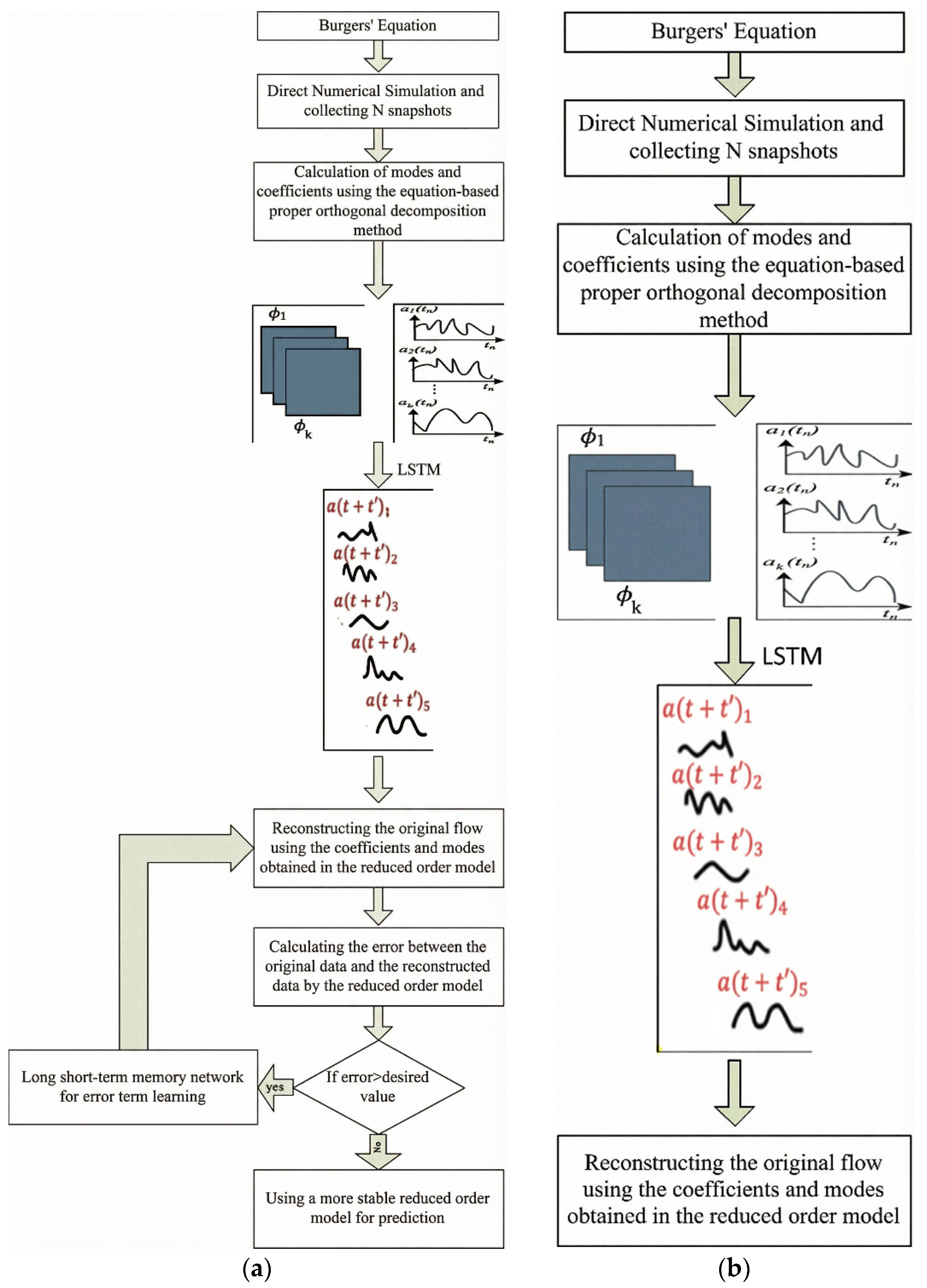
This research presents a hybrid framework for flow prediction that utilizes both proper orthogonal decomposition (POD) and long short-term memory (LSTM) networks. The POD method is first applied to the available flow data to reduce the model’s dimensionality by selecting a predetermined number of modes. Figure 2 illustrates the flowchart of the proposed approach vs. POD-ROM. The figure shows that the POD method is initially employed to reduce dimensionality and extract the relevant modes. Subsequently, the main flow is predicted using the obtained temporal coefficients and spatial modes. As explained in Section 6, reconstructing the original flow with limited modes introduces an inherent error. This research employs an LSTM network to learn and incorporate the error term to mitigate this prediction error. The reconstructed flow is then updated, and this iterative process continues until the error reaches an acceptable level. The proposed hybrid framework combines the strengths of POD and LSTM to achieve accurate flow prediction. POD efficiently reduces the dimensionality of the flow data, while LSTM effectively learns and incorporates the error term to improve prediction accuracy. The framework employs an iterative approach to refine the flow prediction, continuously updating the reconstructed flow based on the error term learned by the LSTM network. This iterative process ensures that the predicted flow converges to the real flow, minimizing the overall prediction error.

Calibration of the Reduced-Order Model Using Deep Learning

Reduced-order models (ROMs) based on proper orthogonal decomposition (POD) have gained popularity in complex systems simulations due to their computational efficiency. However, a significant limitation of POD-ROMs lies in their inherent accuracy limitations, primarily caused by the truncation of higher-order modes. This truncation introduces errors, as the discarded modes contribute to the overall flow dynamics. As discussed, various stabilization techniques have been proposed to improve POD-ROMs’ performance. These techniques aim to address the issue of mode truncation by introducing additional terms or modifications to the ROM equations. This paper proposes an alternative approach to enhance the accuracy of POD-ROMs by incorporating an error term into the model. The error term is estimated using a long short-term memory (LSTM) network, a recurrent neural network (RNN) well-suited for modelling temporal dependencies. The LSTM network is trained on the difference between the POD-ROM and the baseline results obtained from a high-fidelity simulation. This training process enables the LSTM network to learn the patterns and relationships between the POD-ROM predictions and the flow behaviour. Once trained, the LSTM network can predict the error term for new flow scenarios. The expected error term is then added to the POD-ROM solution for a more accurate prediction. This approach effectively compensates for the errors introduced by mode truncation, improving overall accuracy. The present work introduces a novel Calibrated Intrusive Reduced-Order Model (CIROM) that uniquely combines the Galerkin projection-based ROM with LSTM-based error correction and stabilization. Unlike traditional POD-ROMs that suffer from instabilities at high Reynolds numbers due to truncation errors, the CIROM employs an iterative feedback loop where the LSTM network learns and corrects residual errors dynamically, enhancing both accuracy and stability in reduced-order models under varying operating conditions, which is vital for practical engineering deployment. The LSTM-based correction term may be interpreted as a data-driven closure operator approximating the unresolved modal interactions omitted through POD truncation. While derived empirically, its structure preserves the intrusive ROM formulation and acts as an adaptive dissipative mechanism restoring stability. Furthermore, this study evaluates the generalizability of the proposed framework across a wide range of Reynolds numbers, including interpolation and extrapolation scenarios, which are often overlooked in previous POD-LSTM models.
We propose a method that shifts the focus of LSTM training from generating correction terms for errors due to mode truncation in the mode coefficient space to predicting correction terms for errors in the reconstructed field space (i.e., U exact U ^ , where U exact is the exact field from the full-order model (FOM) and U ^ is the approximate reconstructed field from the reduced-order model (ROM)). This approach aligns with emerging trends in hybrid data-driven ROMs, where corrections are applied directly to the physical field rather than solely in the modal space.
Step-by-Step Process:
  • Basis Construction and Initial Evolution (Offline Stage):
    • Use POD on FOM snapshots to extract basis functions Φ k ( x ) for k = 1 , , R using singular value decomposition (SVD), retaining the first R modes capturing at least 95% of total energy.
    • Evolve modal coefficients a k ( t ) using a standard Galerkin ROM (GROM):
      d a k d t = f k ( a 1 , , a R ) , k = 1 , , R
      where f k includes projected linear and nonlinear terms from the governing equations (e.g., Burgers’ or Navier–Stokes). This equation can be written for each mode i as:
      d a i d t = j , k A i j k a j a k + j B i j a j + C i
    • Reconstruct the approximate field:
      U ^ ( x , t ) = k = 1 R a k ( t ) Φ k ( x )
  • LSTM Training for Field Residual Prediction:
    • Training Data: Collect pairs of ( U ^ ( x , t i ) , Δ U ( x , t i ) ) , where Δ U ( x , t i ) = U exact ( x , t i ) U ^ ( x , t i ) from offline FOM simulations. Include temporal sequences (e.g., lookback windows of 5–10 time steps) to leverage LSTM’s memory.
    • LSTM Architecture: A spatiotemporal LSTM that takes U ^ ( x , t k ) as input and predicts Δ U ^ ( x , t k ) , an estimate of the residual field.
      Input Shape: Flattened or gridded field U ^ (e.g., vector of size N x × N y for 2D fields), plus optional parameters like R e .
      Output Shape: Predicted residual field Δ U ^ of the same dimension.
      Loss Function: Mean Squared Error (MSE) on the residual field:
      l = 1 N i = 1 N Δ U ^ ( x , t i ) Δ U ( x , t i ) 2 2
      Optimization: Train using Adam optimizer to minimize L , focusing on capturing patterns in reconstruction errors (e.g., due to nonlinearity or unresolved scales).
  • Projection of the Field Error into Modal Space
This step forms the crucial link between the LSTM’s field-space prediction and the intrusive correction of the modal dynamics. The predicted residual field, Δ U L S T M = Δ U ^ ( x , t k ) , contains the information about the truncated modes and their nonlinear interactions. To incorporate this information into the evolution equation for the resolved modes, we project it back onto the POD basis functions ϕ i . This projection yields a modal correction term, c i ( t ) , for each mode:
c i ( t ) = Δ U L S T M ( x , t ) , ϕ i ( x ) = Ω Δ U L S T M ( x , t ) ϕ i ( x ) d x
where the inner product is computed using second-order trapezoidal quadrature. The vector c ( t ) = c 1 ( t ) , , c r ( t ) T presents the instantaneous influence of the predicted field error on the dynamics of each modal coefficient. The correction term can be viewed as a nonlinear approximation of the unresolved quadratic modal interactions discarded during POD truncation.
Equation (19) reconstructs the reduced-order approximation using a truncated POD expansion over r modes. The LSTM does not operate on individual spatial points independently; instead, the reconstructed field at each time step is flattened into a global state vector of dimension N x = 100 . Temporal dependencies are learned through a sliding window of length T w = 10 , resulting in LSTM inputs of shape T w N x .
The projection in Equation (21) is performed numerically using second-order trapezoidal integration over the spatial domain. Since the POD basis functions remain fixed and orthonormal, the projection preserves the orthogonality of the reduced basis and does not introduce additional modal coupling beyond the learned correction.
The computational cost of this projection scales as O ( r N x ) per time step and accounts for approximately 15–18% of the total CIROM online run time.
4.
Online Prediction and Correction:
During the online phase, the trained LSTM is coupled with the GROM solver. The modal correction term, c(t) is added as a source term to the original governing equation. This results in the final, Calibrated Intrusive Reduced-Order Model (CIROM) equation:
d a C I R O M d t = f ( a ) + c ( t )
Or, written for each modal coefficient, as requested for clarification:
d a i d t = j , k A i , j , k a j a k + j B i j a j + C i S tan d a r d   G R O M + Δ U L S T M ( x , t ) , ϕ i ( x ) L S T M b a s e d   C o r r e c t i o n   T e r m
At each time step t k during online prediction:
  • The trained LSTM predicts the residual field compute Δ U L S T M based on the current state a k ( t ) .
  • The modal correction vector c(t) is computed by projecting Δ U L S T M onto the POD bases.
  • The corrected system is solved numerically to advance the modal coefficients to the next time step.
  • Finally, the corrected physical field is obtained by adding the LSTM’s prediction to the ROM reconstruction:
U c o r r e c t e d ( x , t k ) = U ^ ( x , t k ) + Δ U ^ ( x , t k )
This corrected field can be used for visualization, control, or further evolution. This correction term for stabilizing the evolution of ROM trajectories, retaining accuracy in long-term prediction and improving generalization to parameter regimes not seen during projection (i.e., extrapolation in Reynolds number), is crucial. The proposed error term-based approach offers several advantages over traditional stabilization techniques:
  • Adaptability: The LSTM network can learn the error characteristics for specific flow scenarios, providing a more adaptive approach than fixed stabilization parameters.
  • Computational Efficiency: Using the LSTM network for error term estimation offers computational efficiency, rendering it well-suited for real-time or near-real-time applications.
  • Generalizability: The method can be applied to various POD-ROMs and flow problems, demonstrating its versatility.
Table 1 compares the CIROM method with other correction approaches. Unlike purely data-driven black-box models, this proposed method serves as a physics-aware corrector—it operates within a physically structured intrusive ROM. This hybrid architecture ensures:
  • The baseline dynamics are physics-based (from Galerkin projection);
  • The data-driven module only modifies residual errors;
  • The model maintains interpretability, modularity, and control.
Table 1. Comparison of CIROM with other correction approaches. ✖️ indicates that the method does not satisfy the property; ✅ indicates that the property is satisfied.
MethodStabilityGeneralizationInterpretability
Classical POD–ROM✖️✖️
Pure Data-Driven✖️✖️
CIROM (ours)

8. Results

The Burgers’ equation stands as a benchmark problem in the study of nonlinear fluid flows and remains an active area of research. This nonlinear partial differential equation is often used to evaluate newly developed numerical models, reduced-order techniques, and error estimates [45]. The novel approach presented in this paper utilizes different Reynolds numbers for training, enabling more accurate output results even for high Reynolds numbers. To assess the effectiveness of this method, various conditions are considered.
Table 2 summarizes the key parameters and components used for both the numerical data generation and the deep learning training stages of the CIROM. It includes the spatial and temporal resolution of the DNS solver, Reynolds numbers used in training and testing, POD truncation level, and LSTM architecture details. This consolidated view facilitates reproducibility and offers practical guidance for implementing or extending the proposed framework.
In order to evaluate the performance of the proposed Calibrated Intrusive Reduced-Order Model (CIROM), a comparative analysis with other methods reported in the literature, such as data-driven models and GROMs, is discussed. Table 3 presents a comparison between the reconstruction error and run time of the proposed CIROM method, classical intrusive ROM and data-driven models. The calculated error is the accumulative error; all the exact solution data are subtracted from the reconstructed value, and finally, the evaluation is done. The CIROM achieves lower RMSE values while maintaining reasonable computational costs, illustrating its effective stabilization and generalization capabilities.

8.1. Studying the Performance of CIROM Under Variations in Effective Parameters

Training and testing experiments were conducted to evaluate the performance of the proposed method. In the training phase, 1000 snapshots of the field with Reynolds numbers of 5000 and 7000 were used. Here, methods with the size of 10 modes are trained and tested with the training and testing datasets.

8.1.1. Reynolds Number Changes

This section aims to investigate the effect of changing the Reynolds number as an important parameter. The proposed method is evaluated using different Reynolds numbers. In one of the evaluations, similar Reynolds numbers were used in the train and test processes. In the other two assessments, the Reynolds numbers in the training and testing stages have different values, and the results show that the proposed method gives good predictions in these cases.
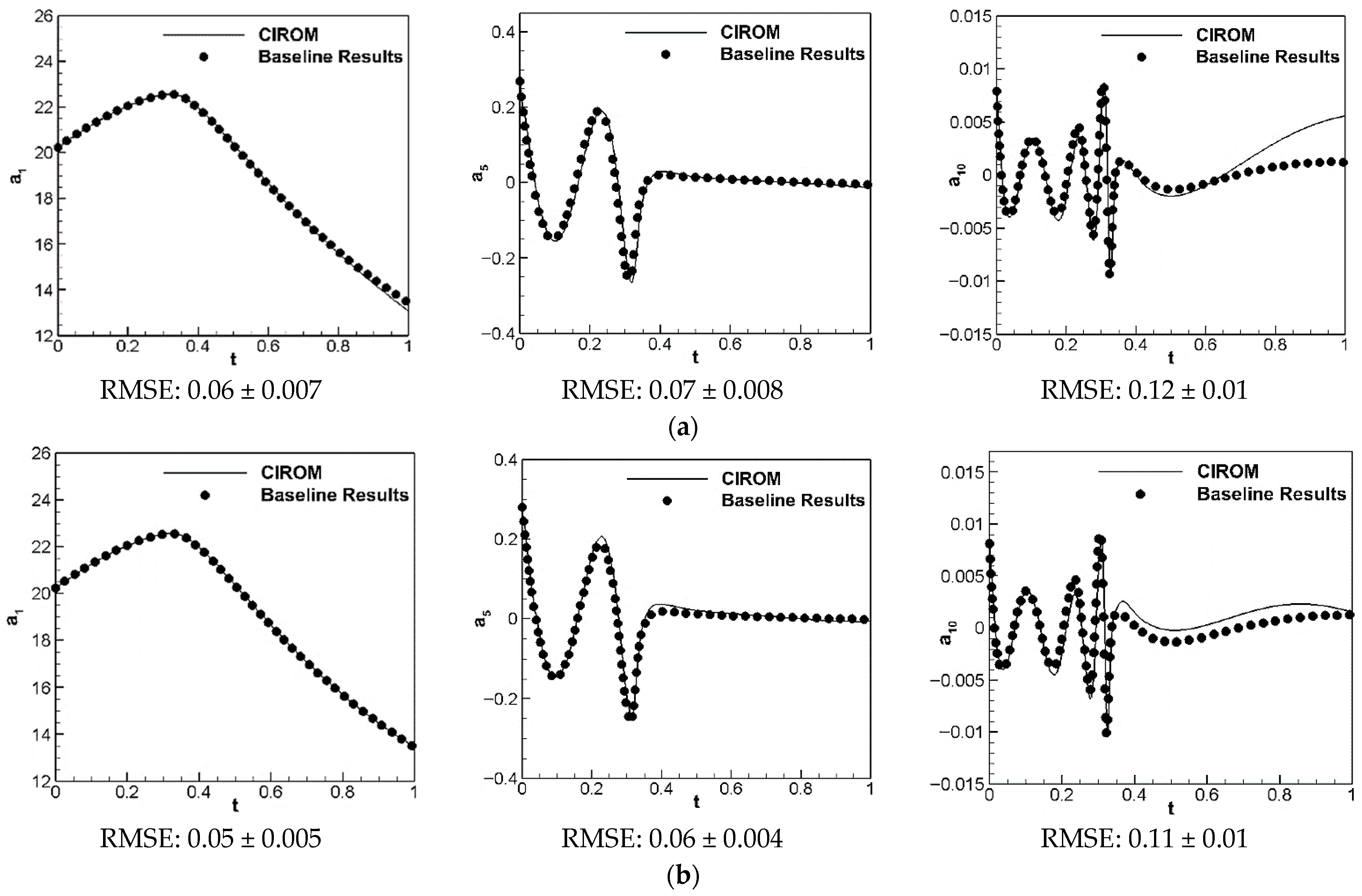
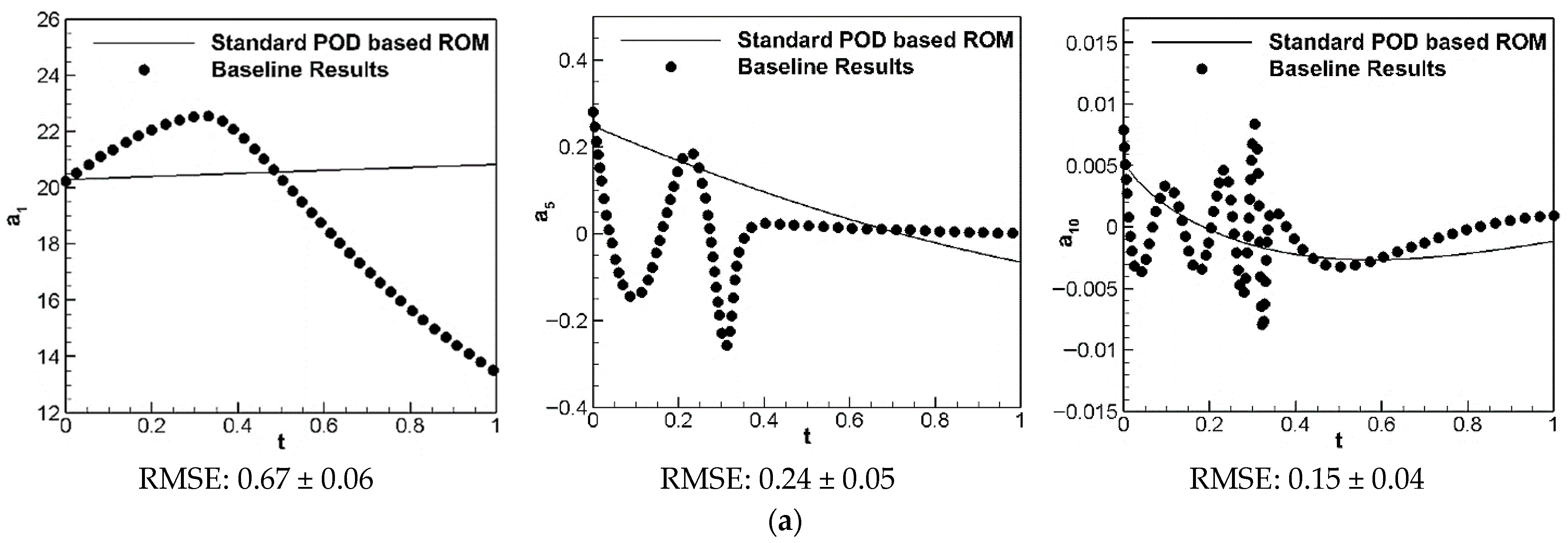
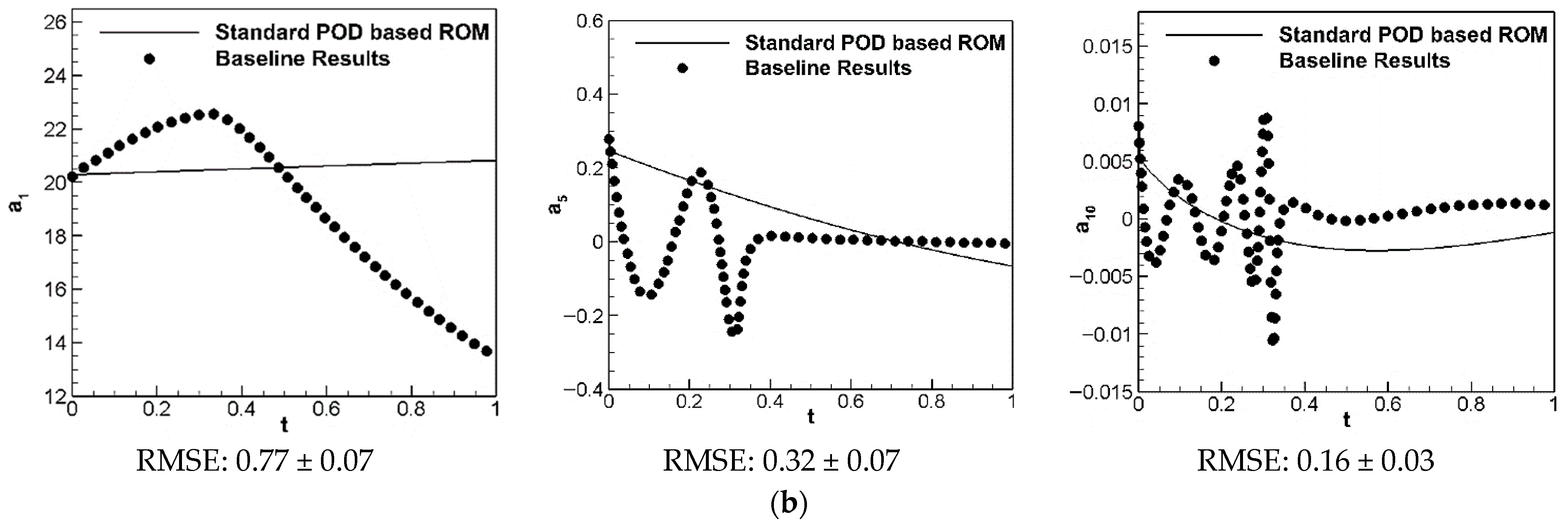
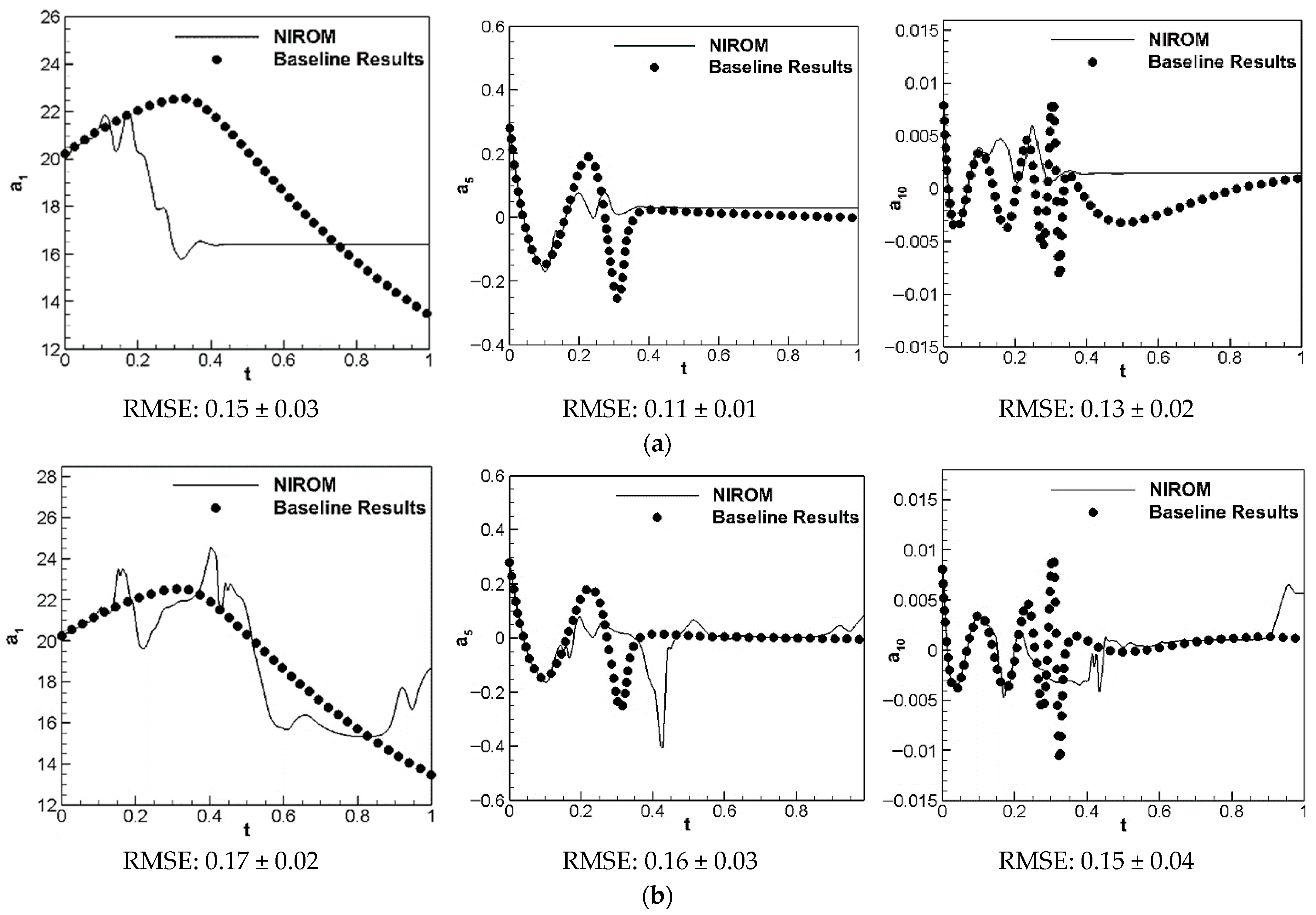
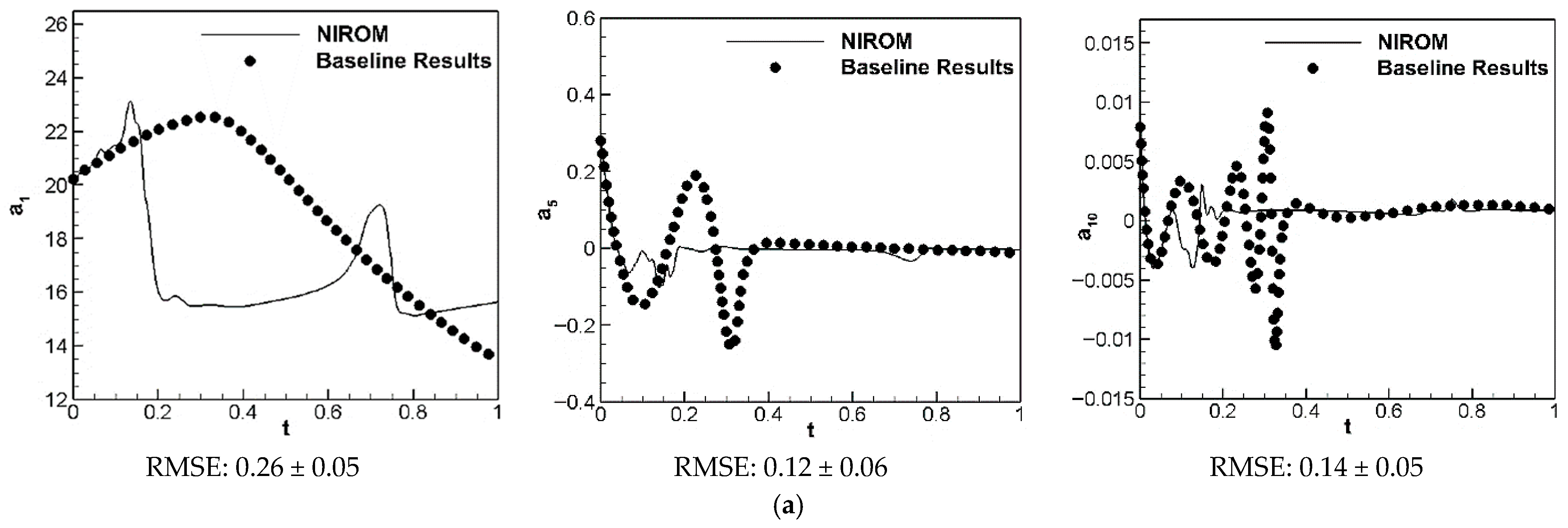
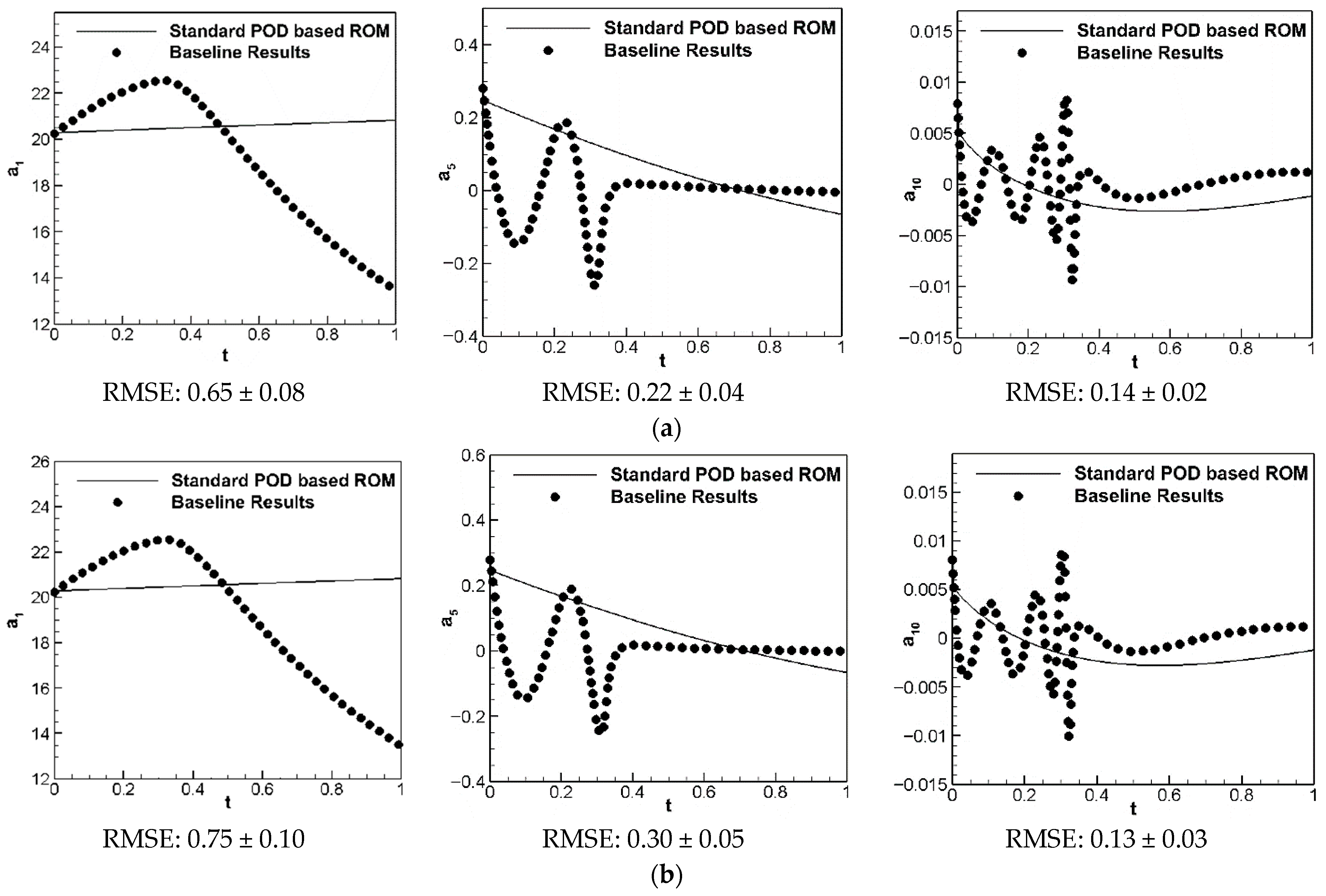
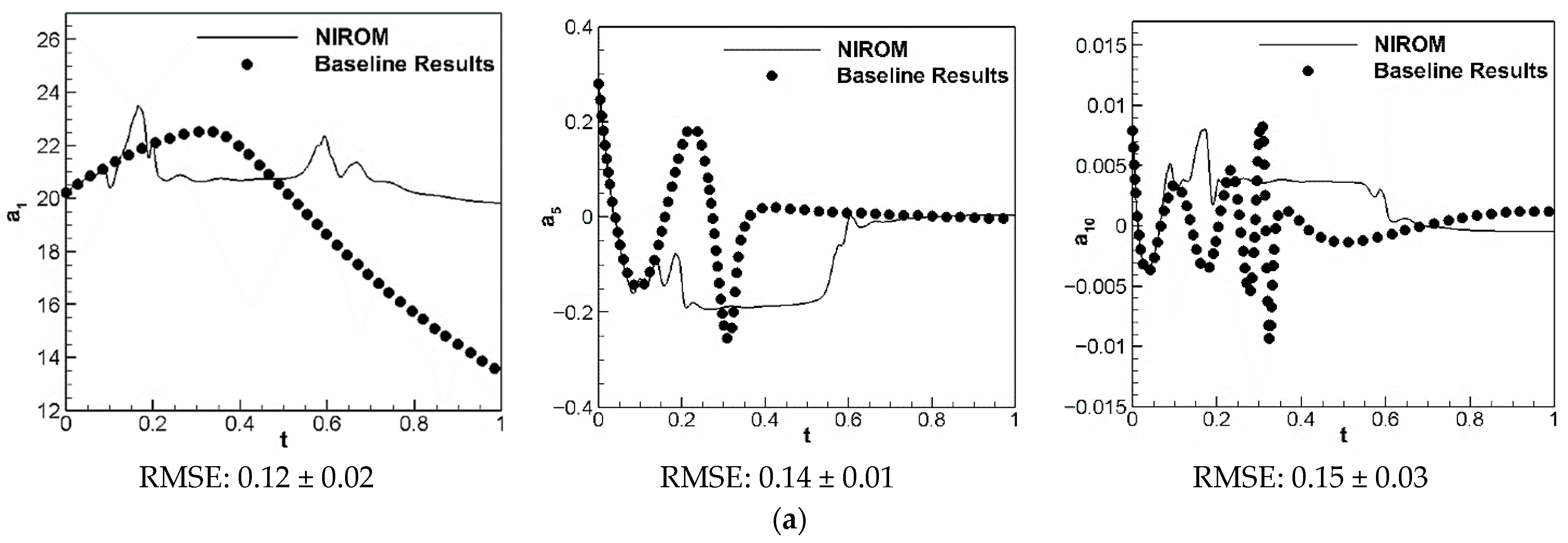
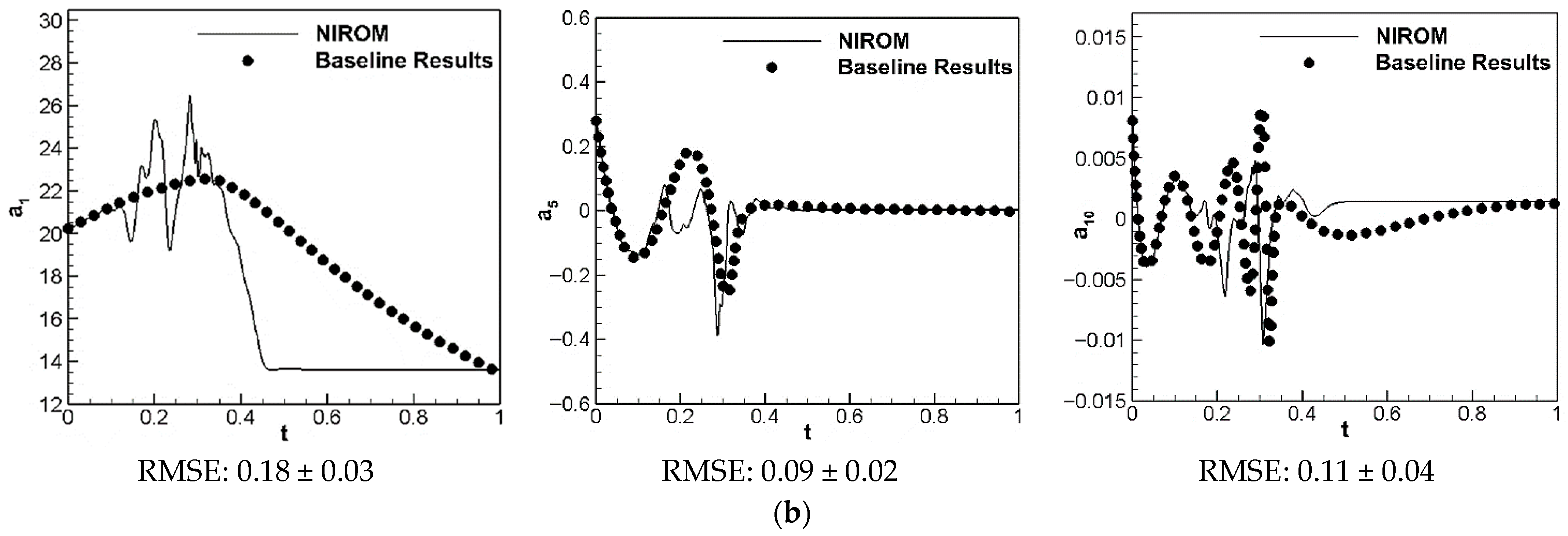
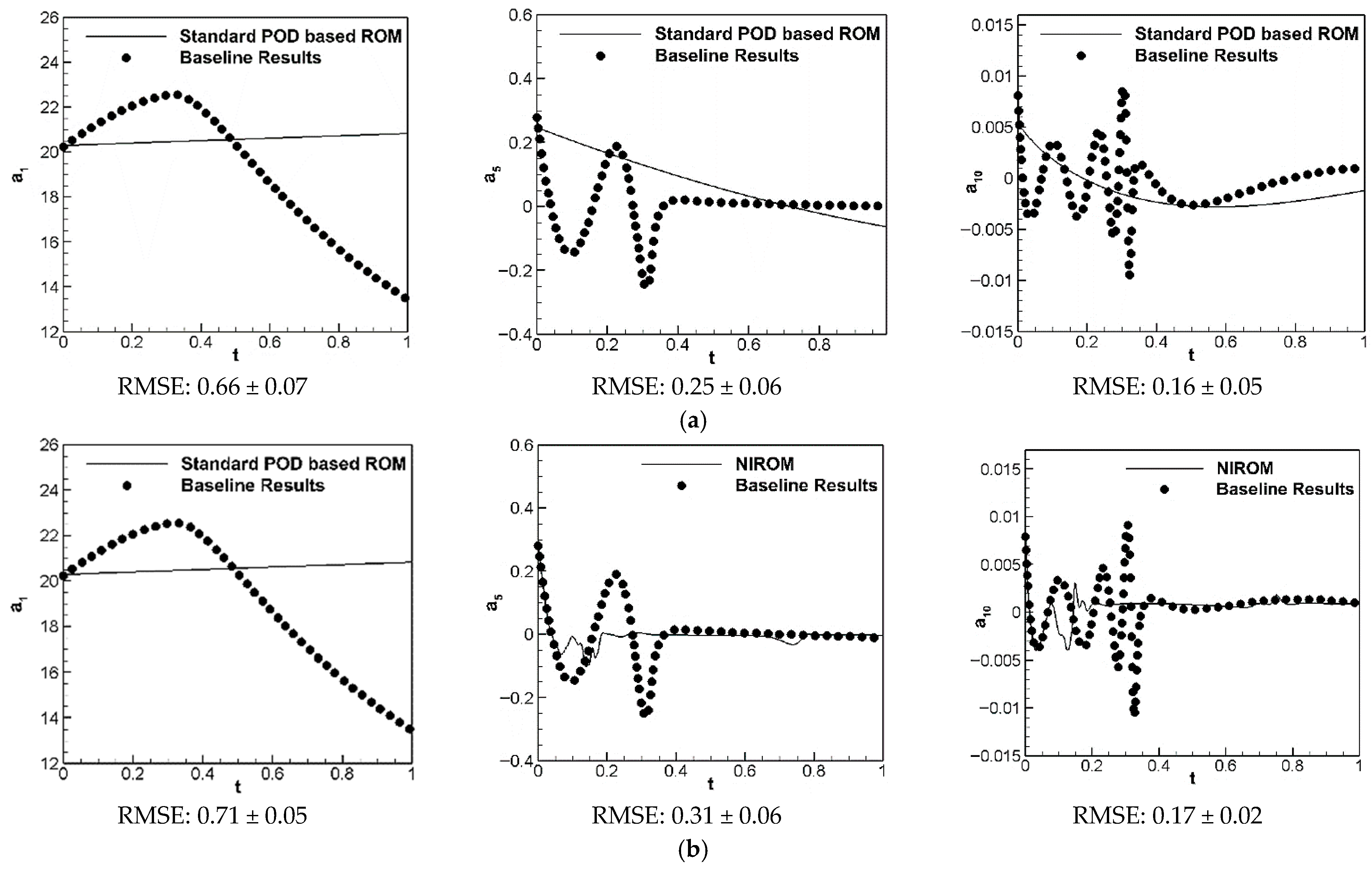
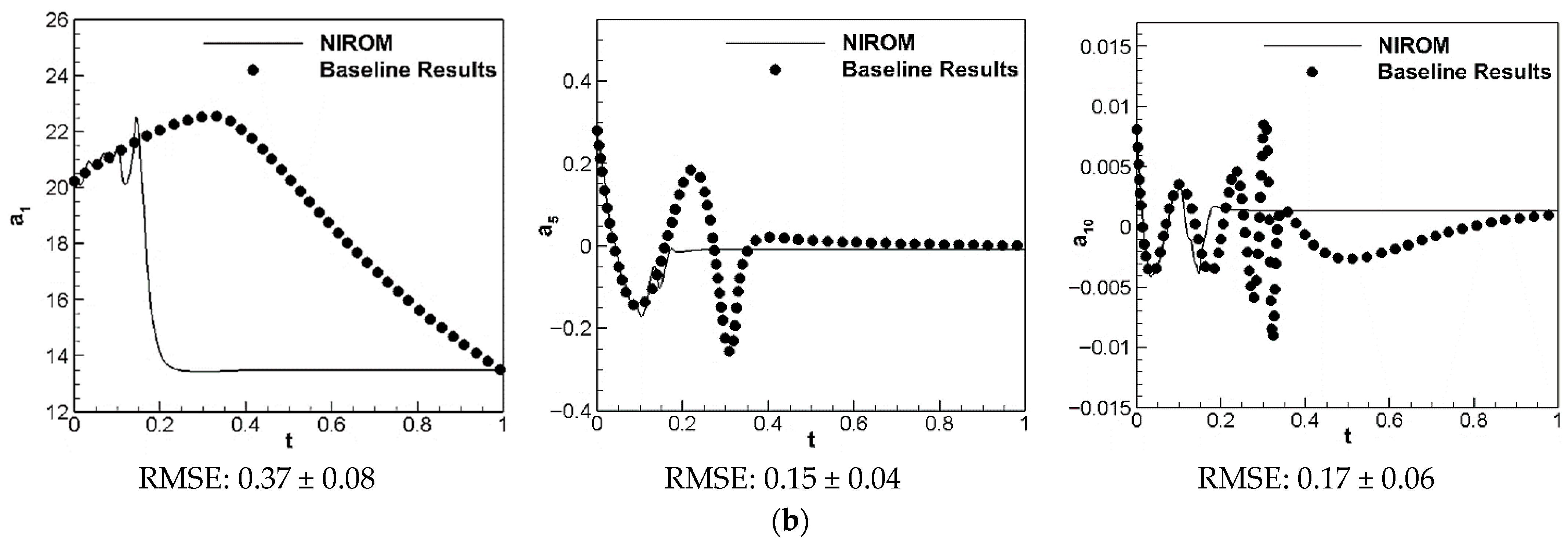
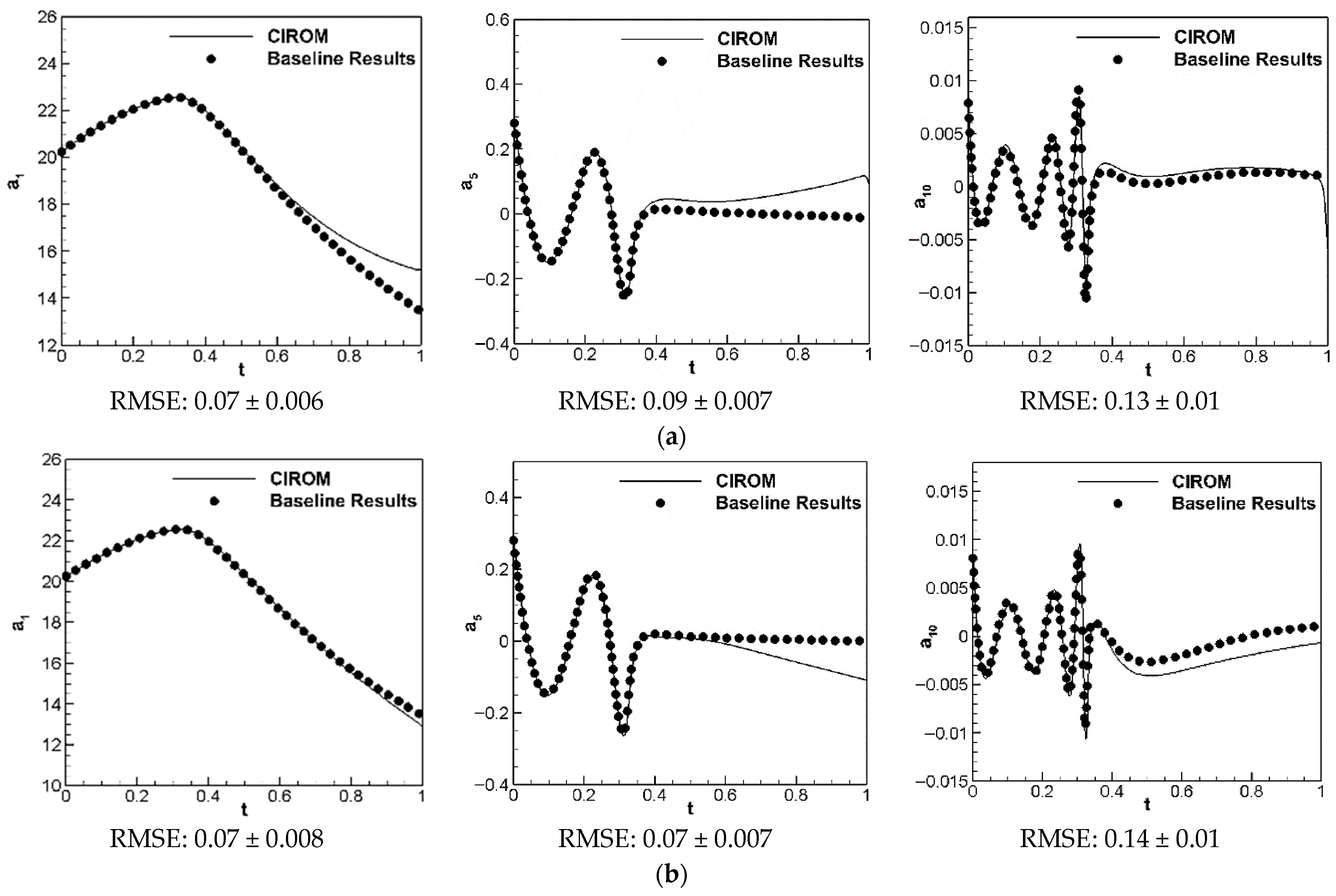
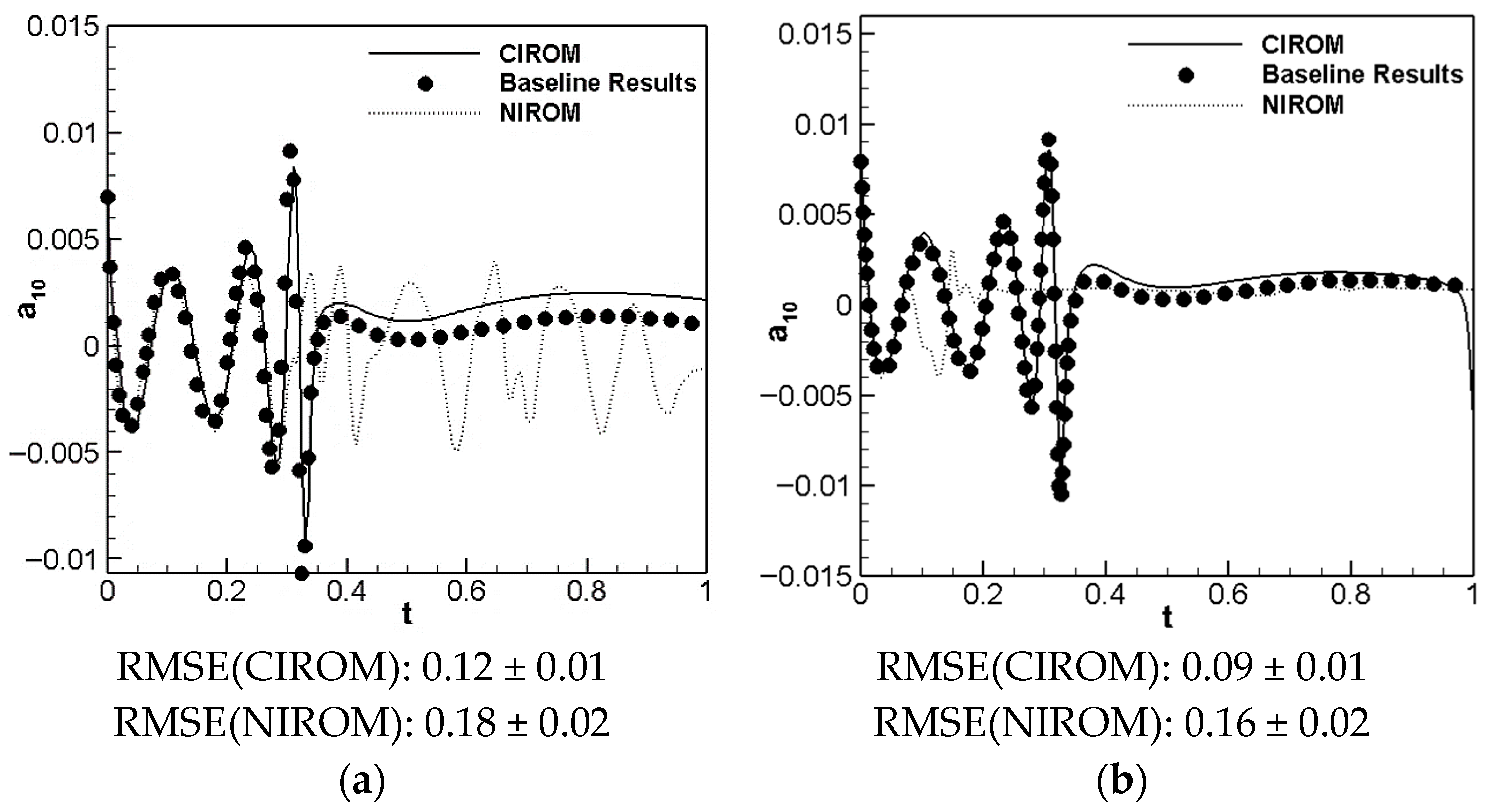
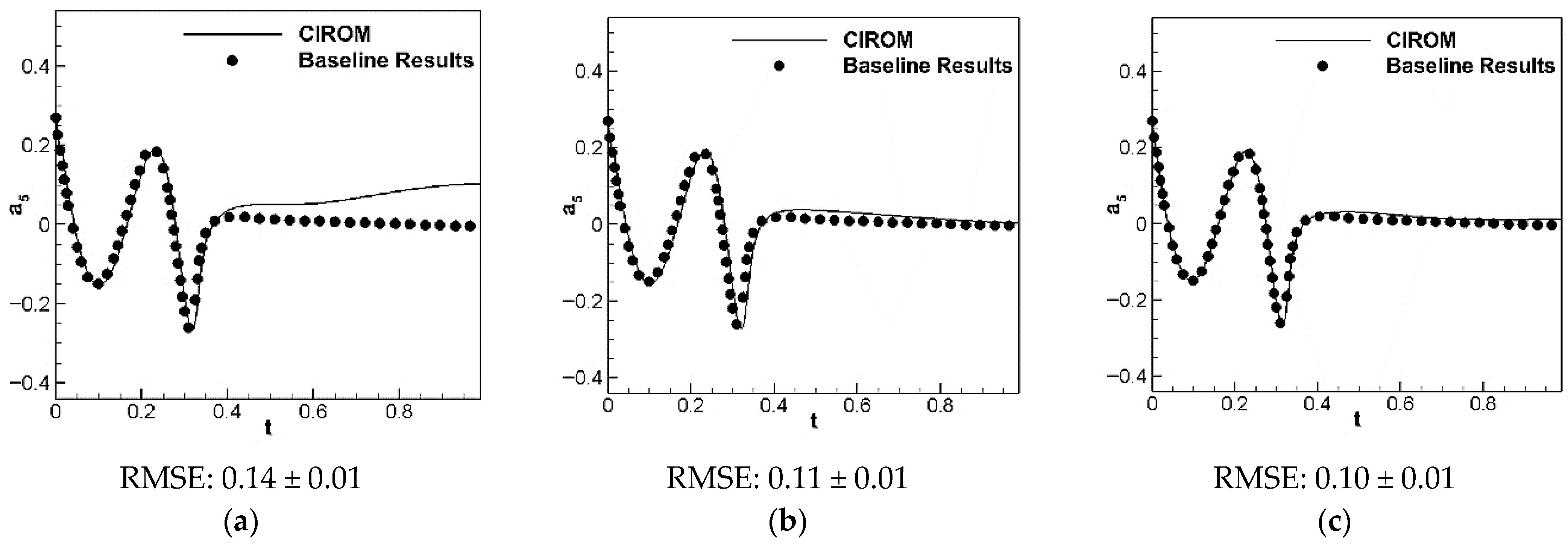
To evaluate the accuracy of the proposed method under known conditions, the model was trained using a dataset generated at Reynolds numbers of 5000 and 7000. The same Reynolds numbers were then used for testing. This setup enables an initial assessment of how well the model can reproduce the solution of the Burgers’ equation for conditions seen during training. Figure 3 illustrates the temporal coefficients obtained from the exact solution and those computed using the intrusive reduced-order model for both Reynolds numbers and with 1000 snapshots. The comparison shows noticeable differences, particularly for higher Reynolds numbers, indicating the limited accuracy of this baseline approach. Figure 4 presents the results of the data-driven method (based solely on LSTM) in predicting the temporal coefficients with 1000 snapshots. While the predictions follow the overall trend of the baseline results, some deviations are observed, especially in capturing finer variations. Figure 5 displays the results of the proposed CIROM method combining POD and LSTM with 1000 snapshots. The predicted coefficients show relatively good agreement with exact results for both Reynolds numbers, demonstrating improved accuracy over the previous two methods. This indicates that the CIROM framework effectively reconstructs the solution behaviour of the Burgers’ equation, even at Reynolds number 7000.
Table 4 presents the results as mean ± standard deviation over five independent runs with 1000 snapshots.
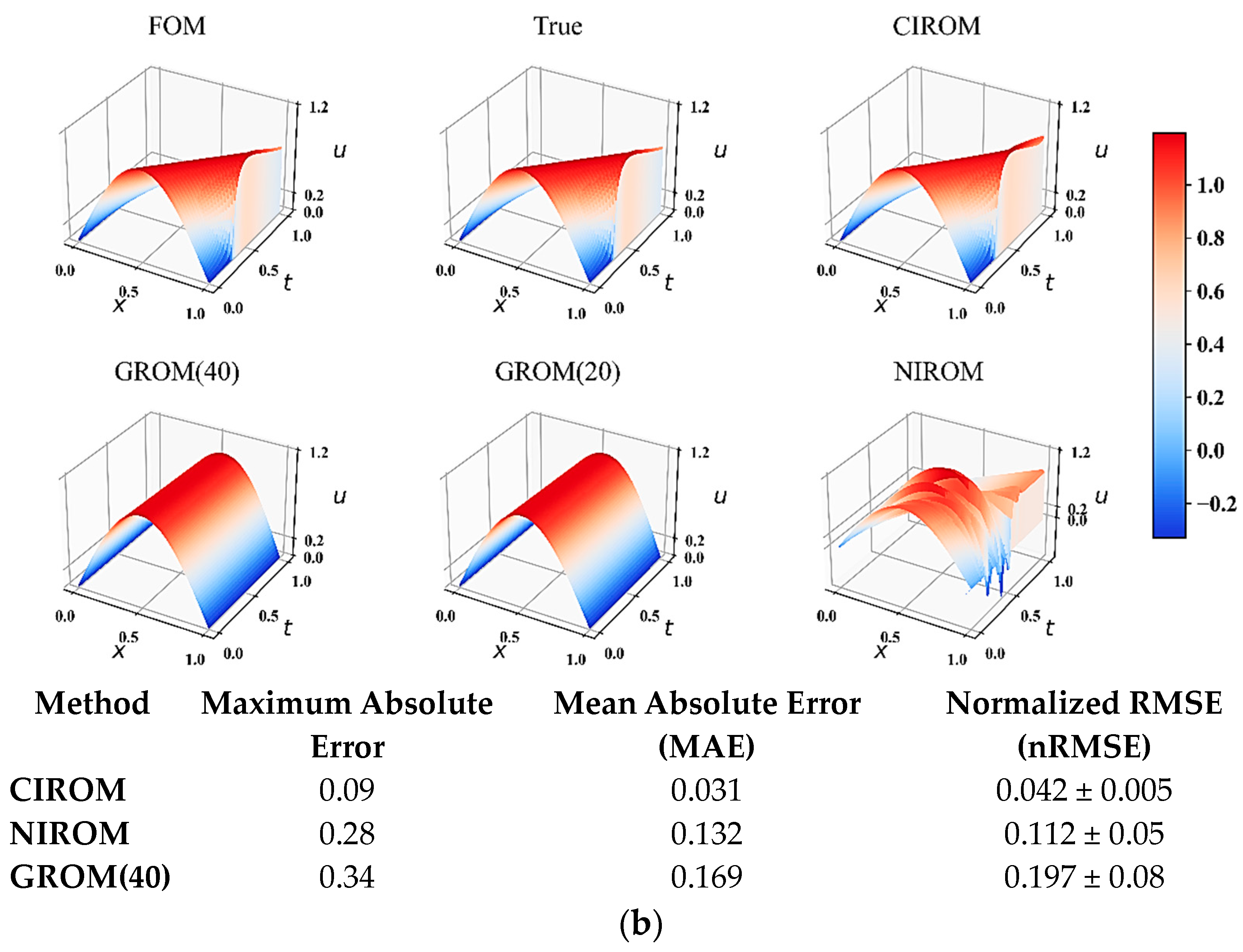
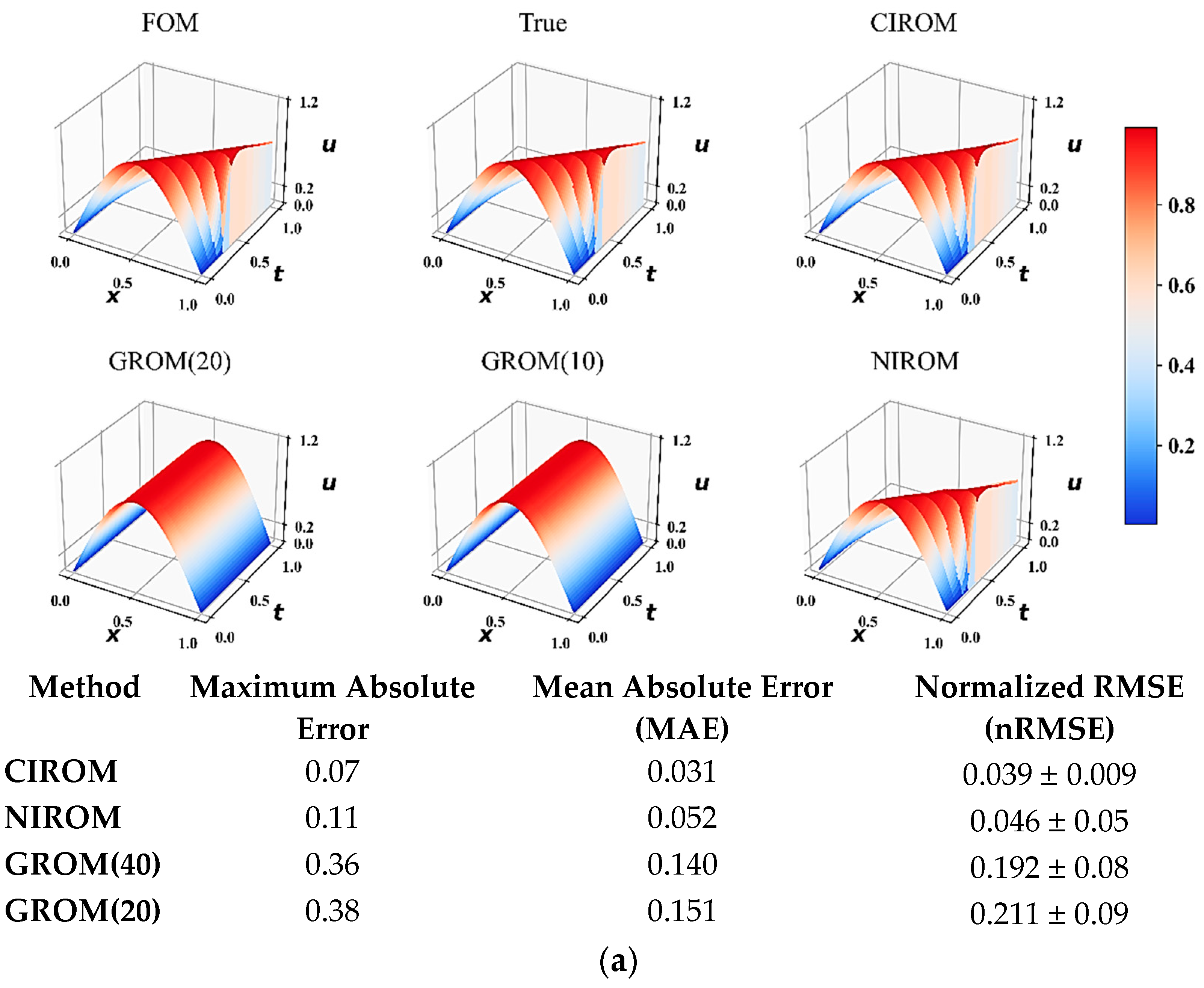
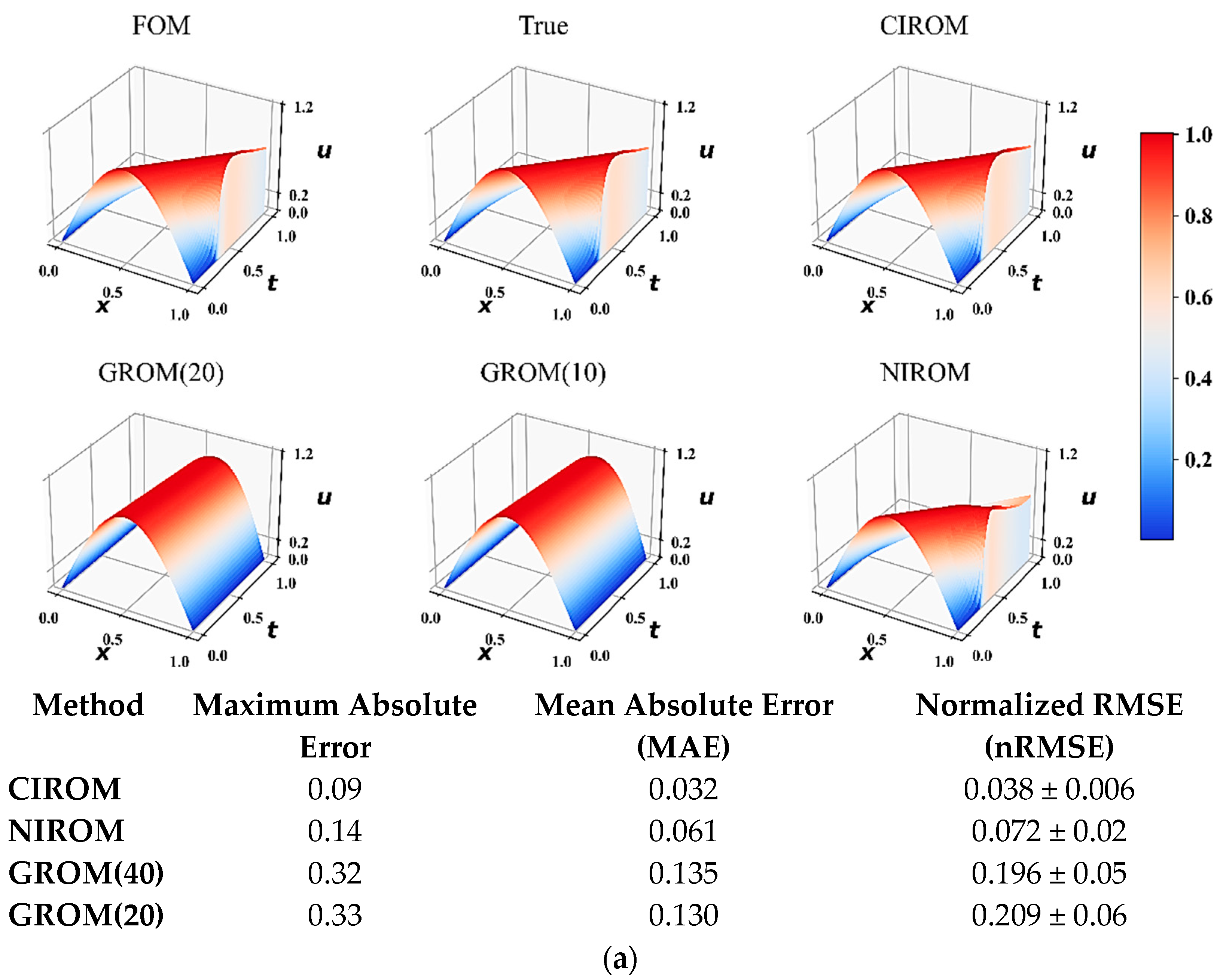
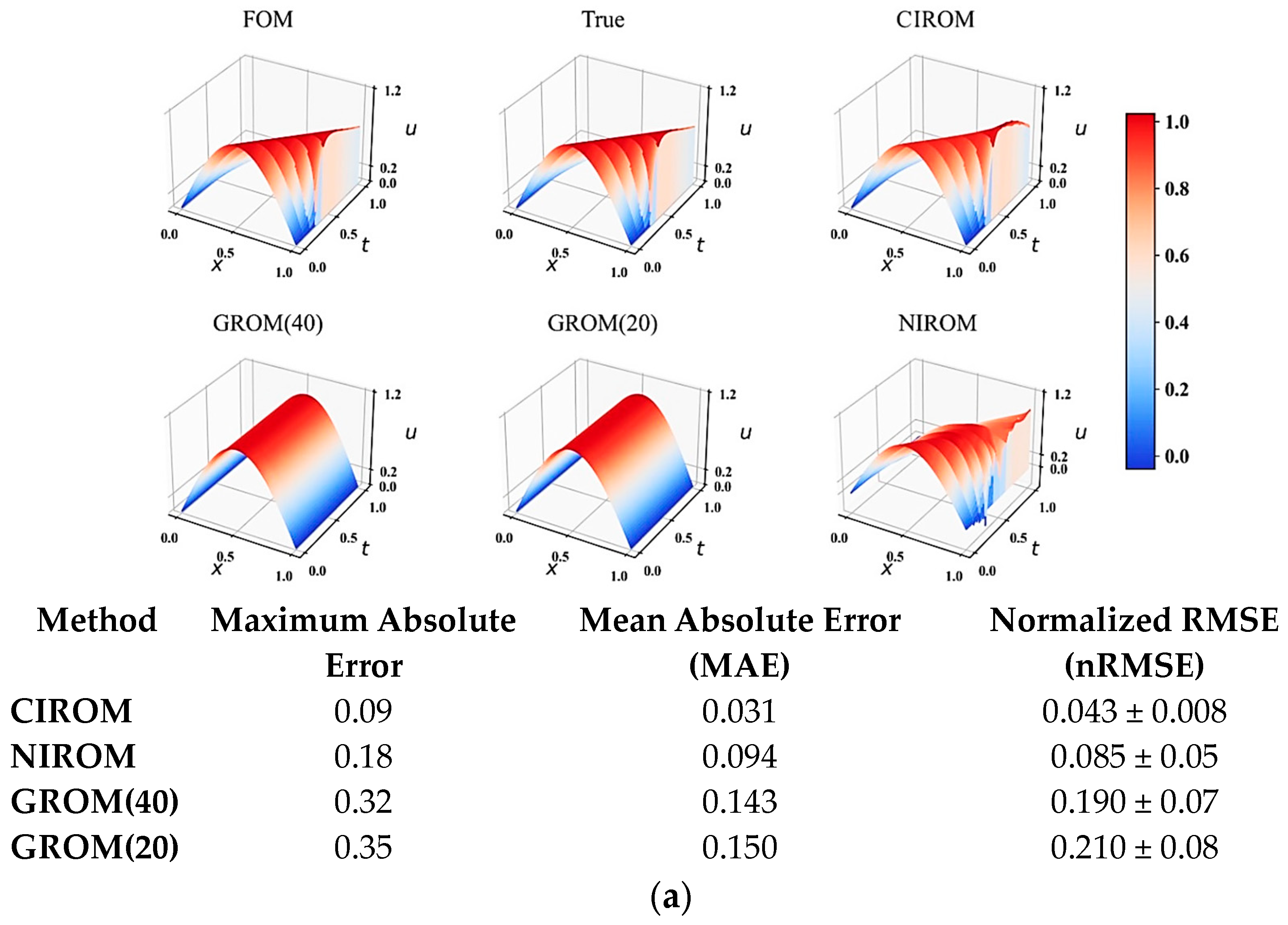
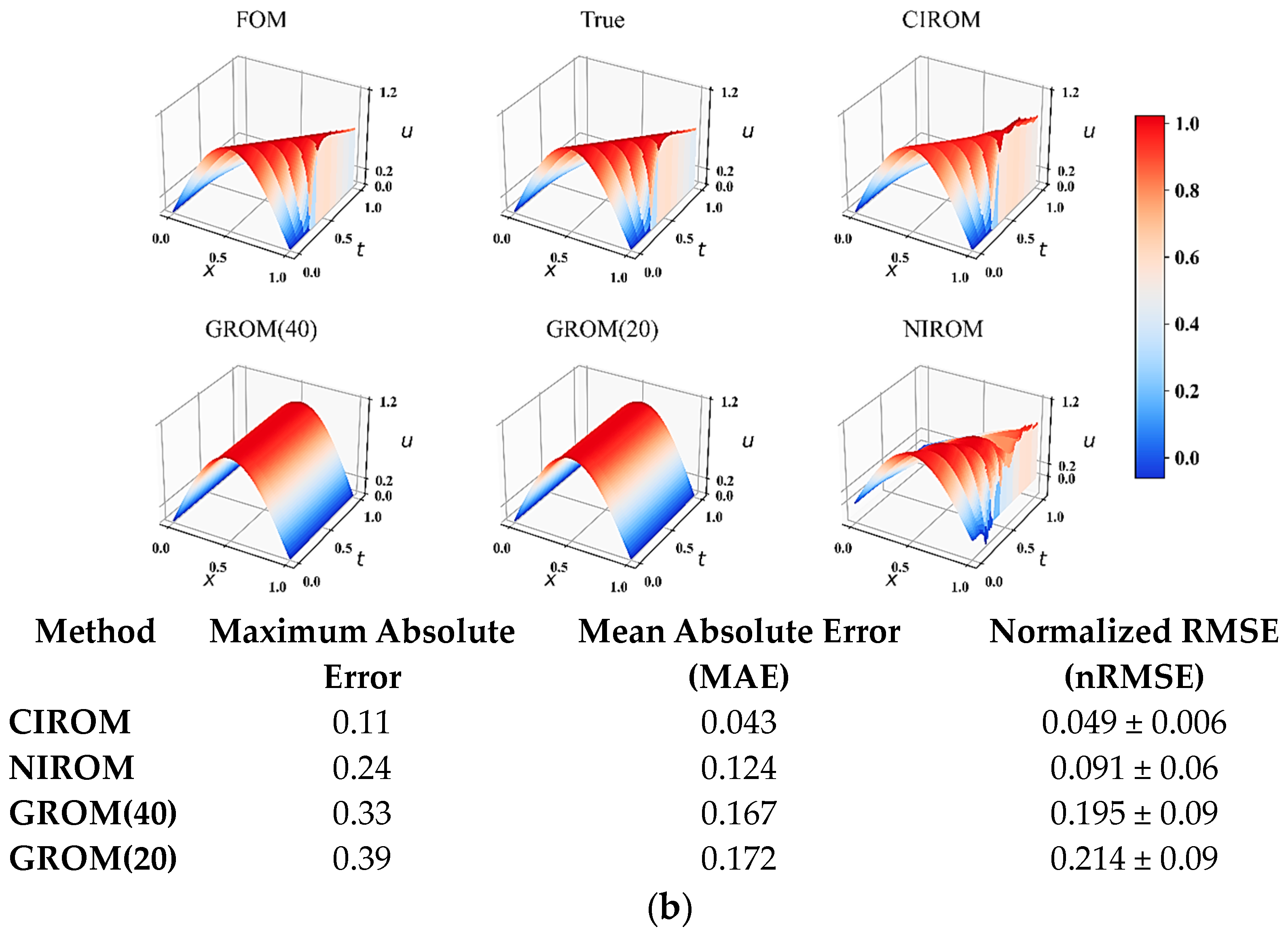
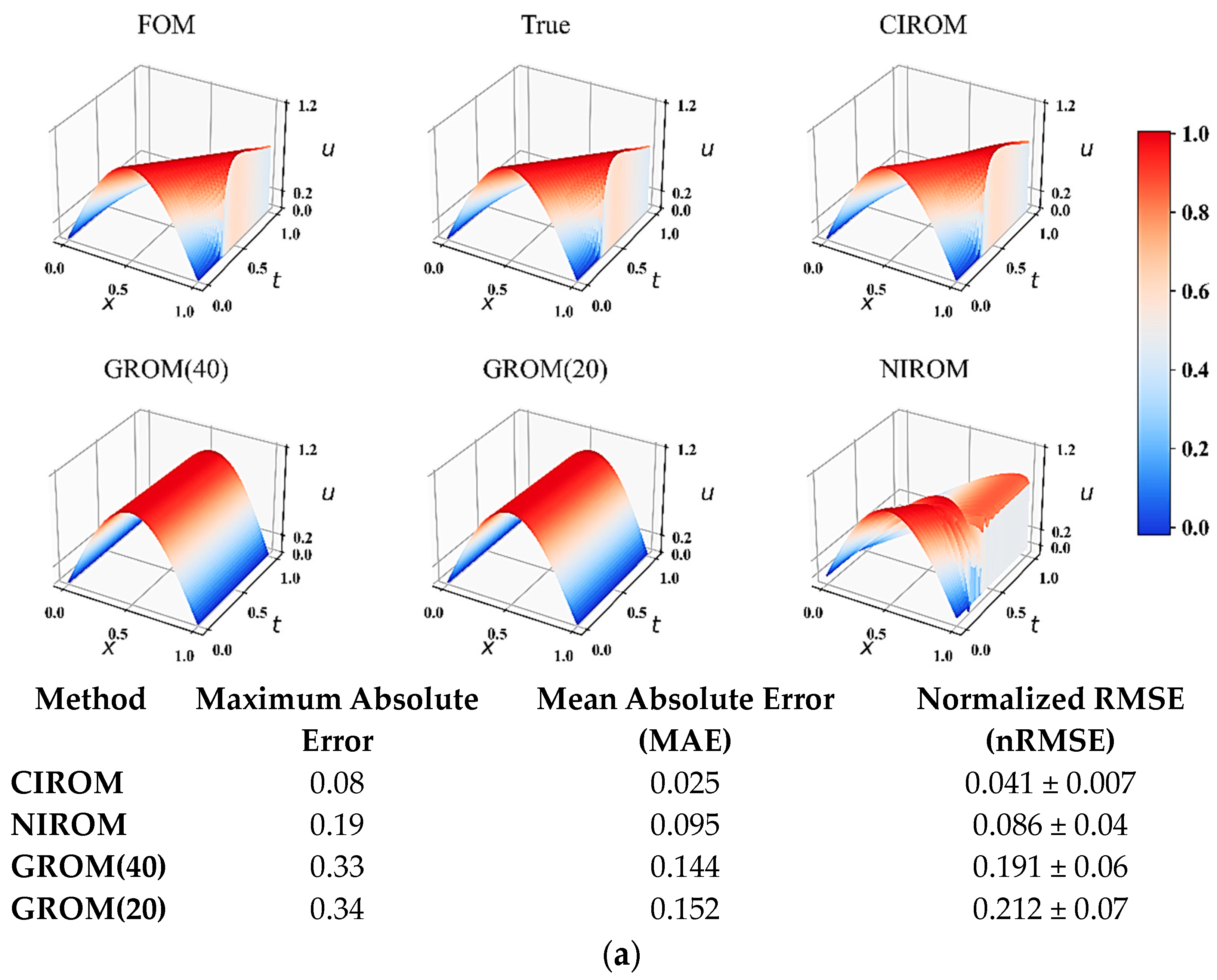
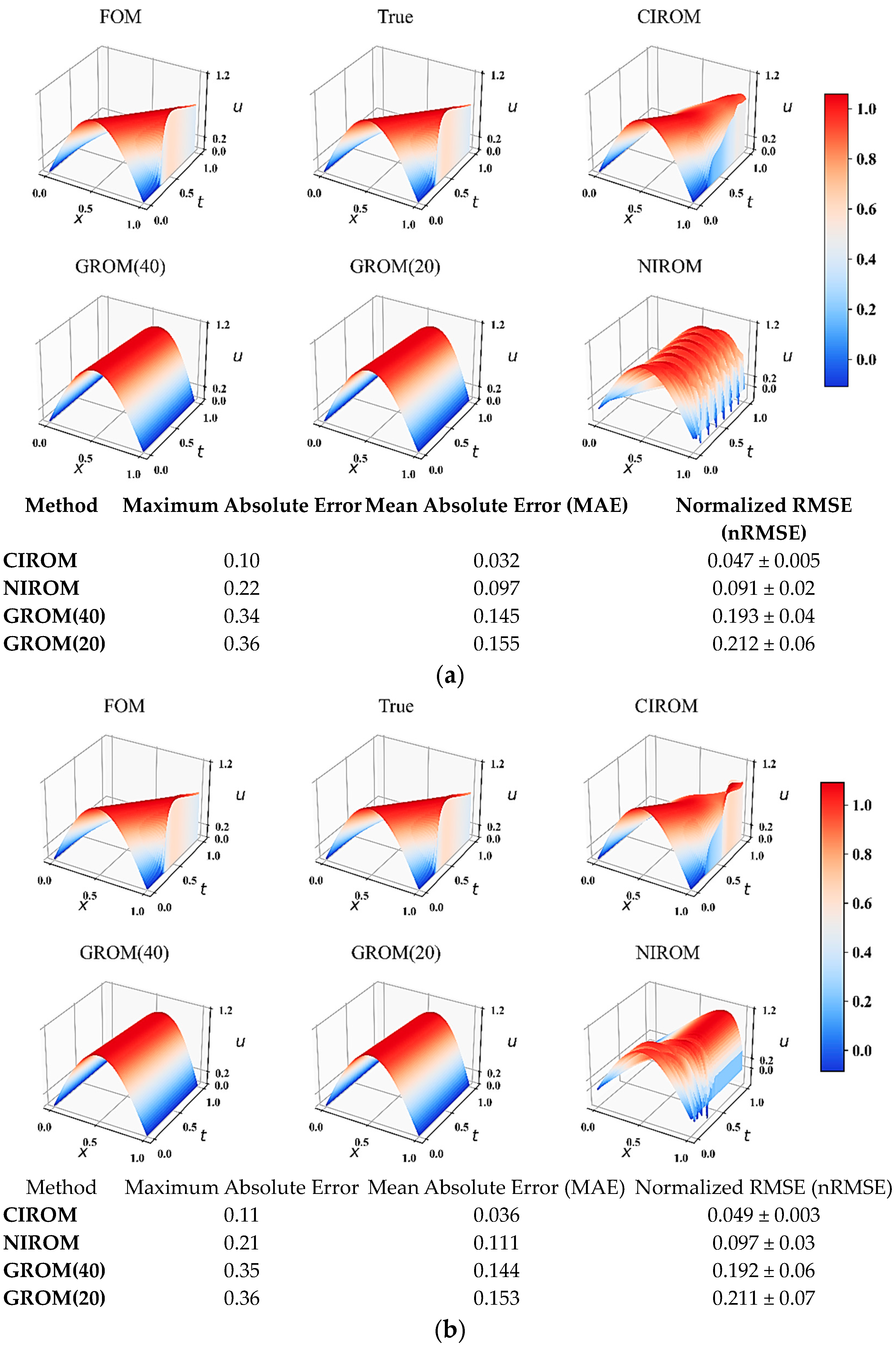
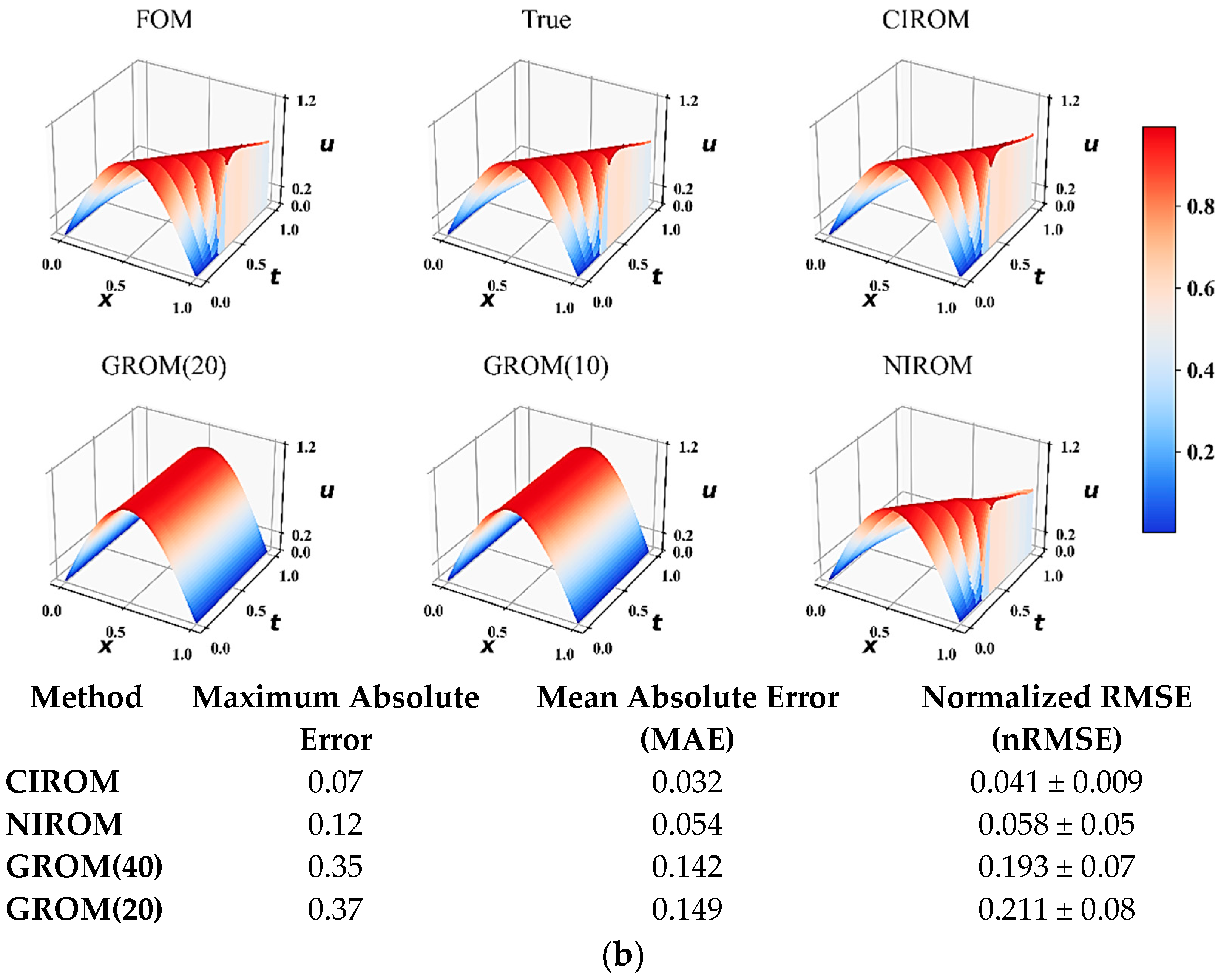
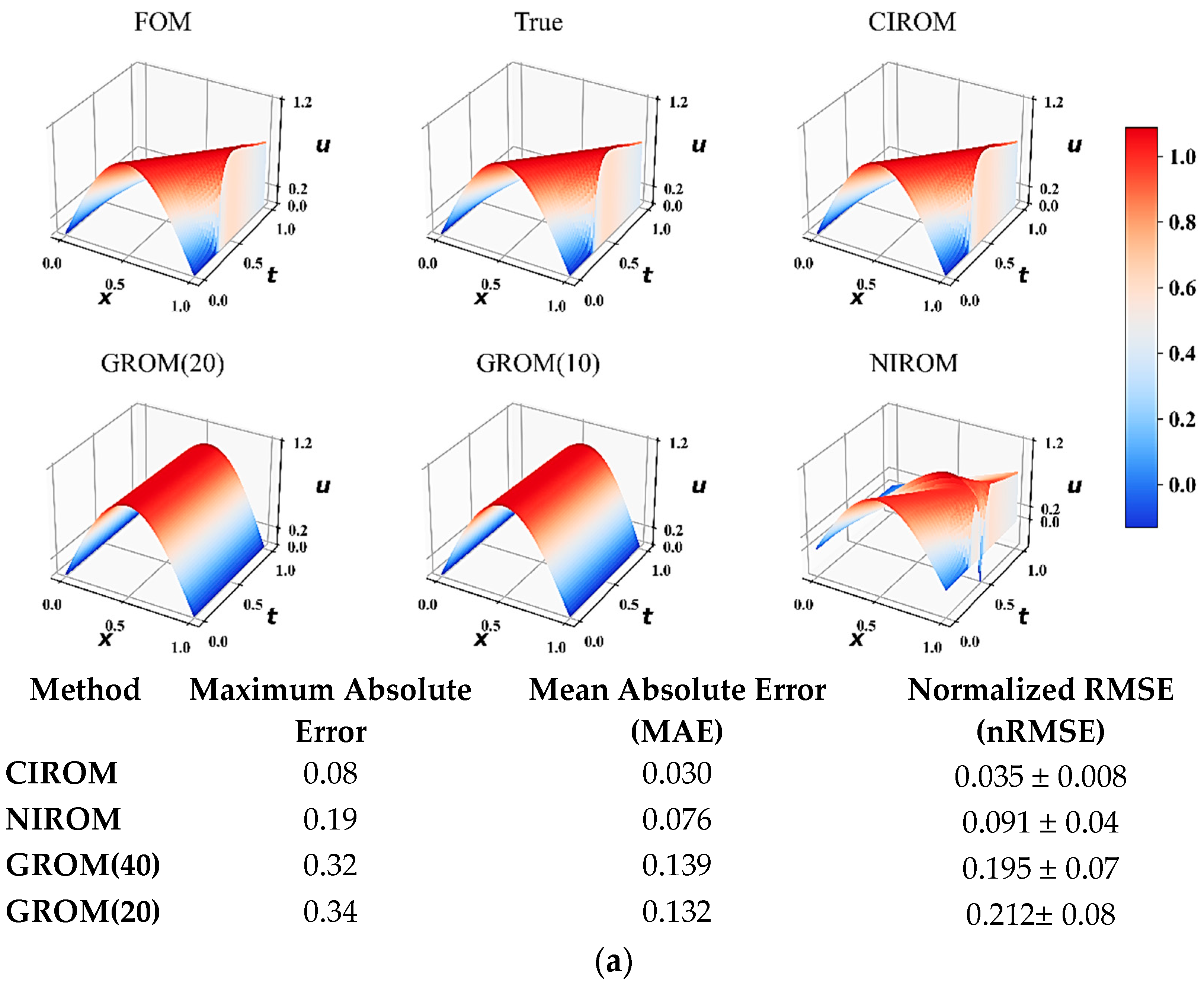
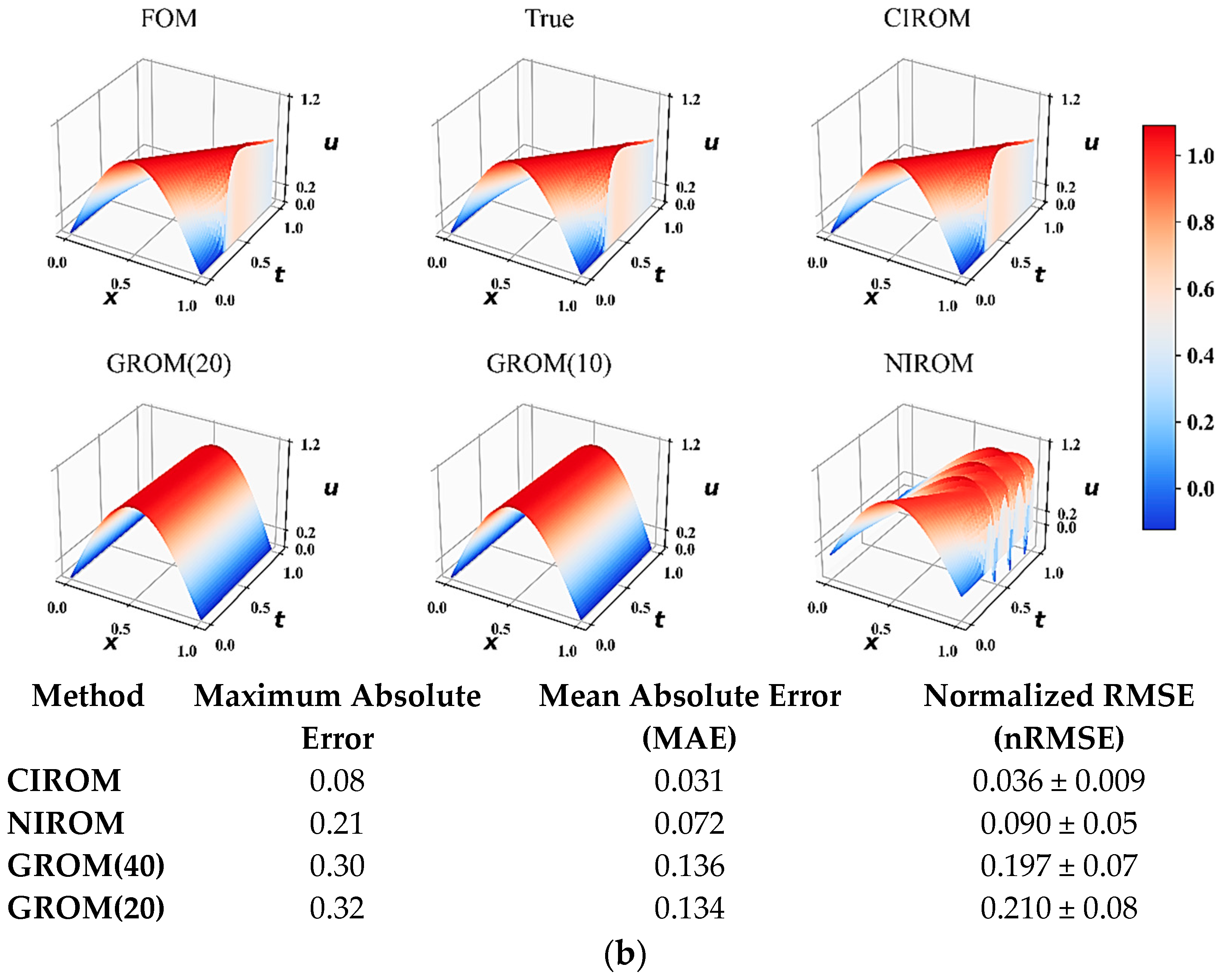
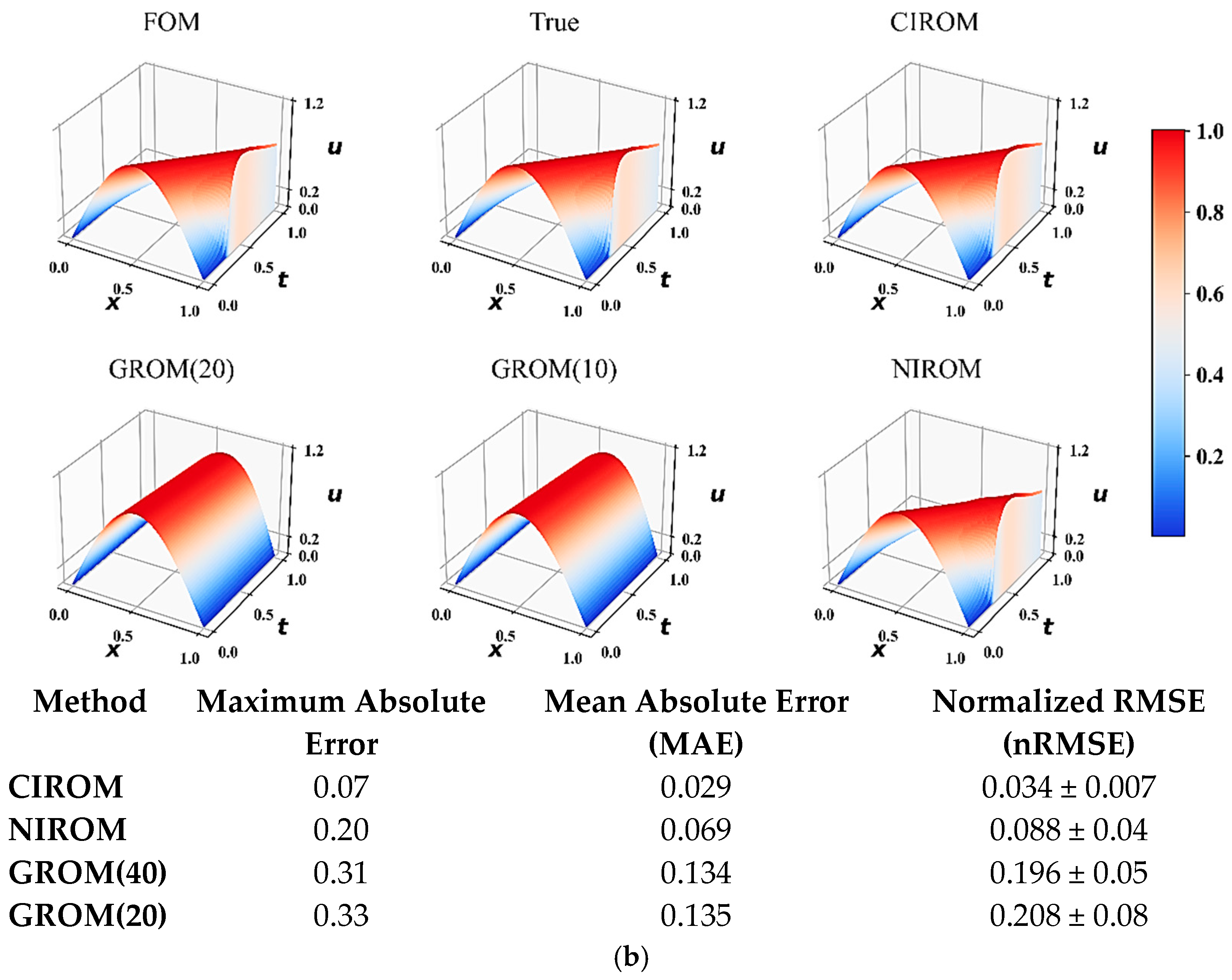
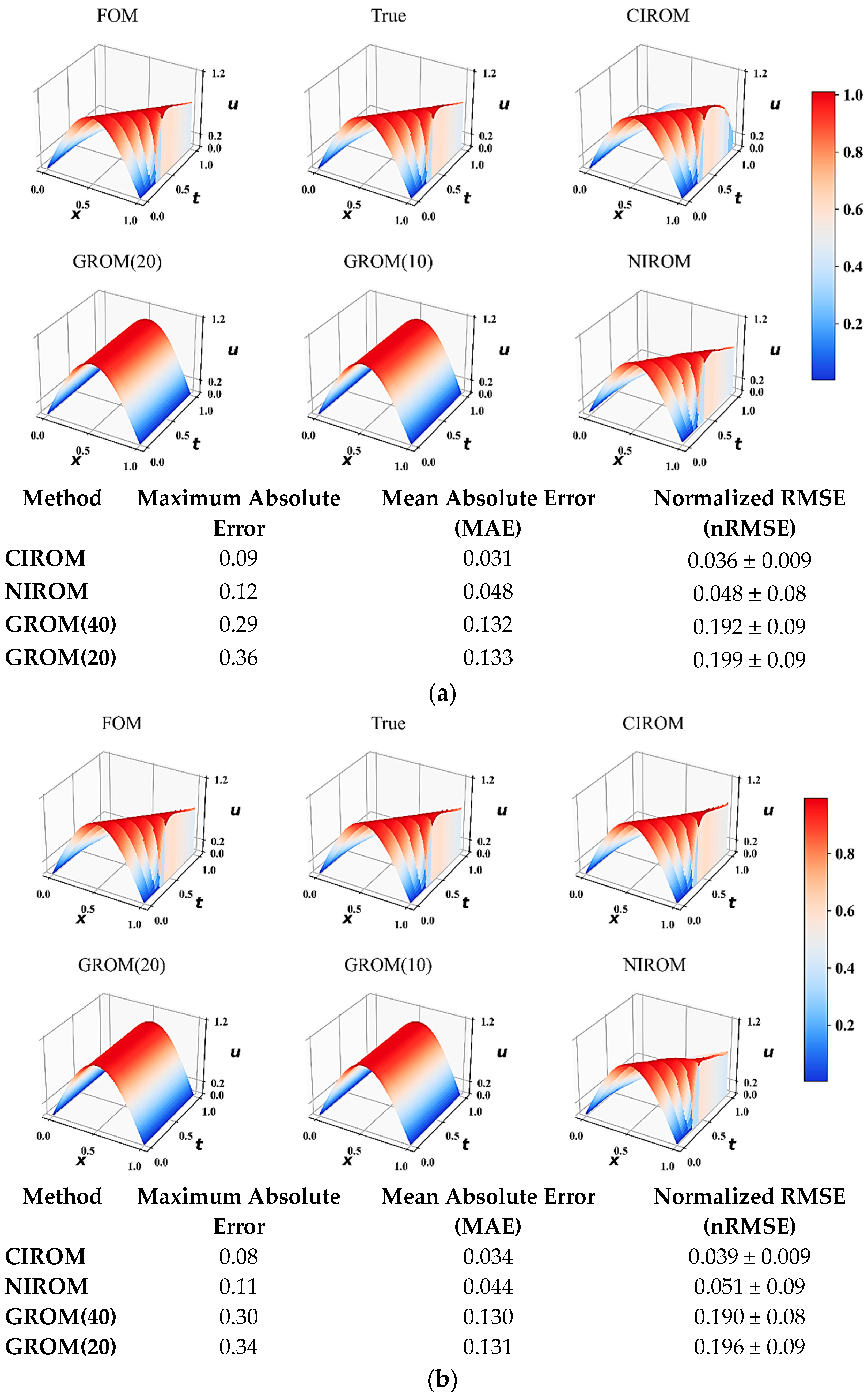
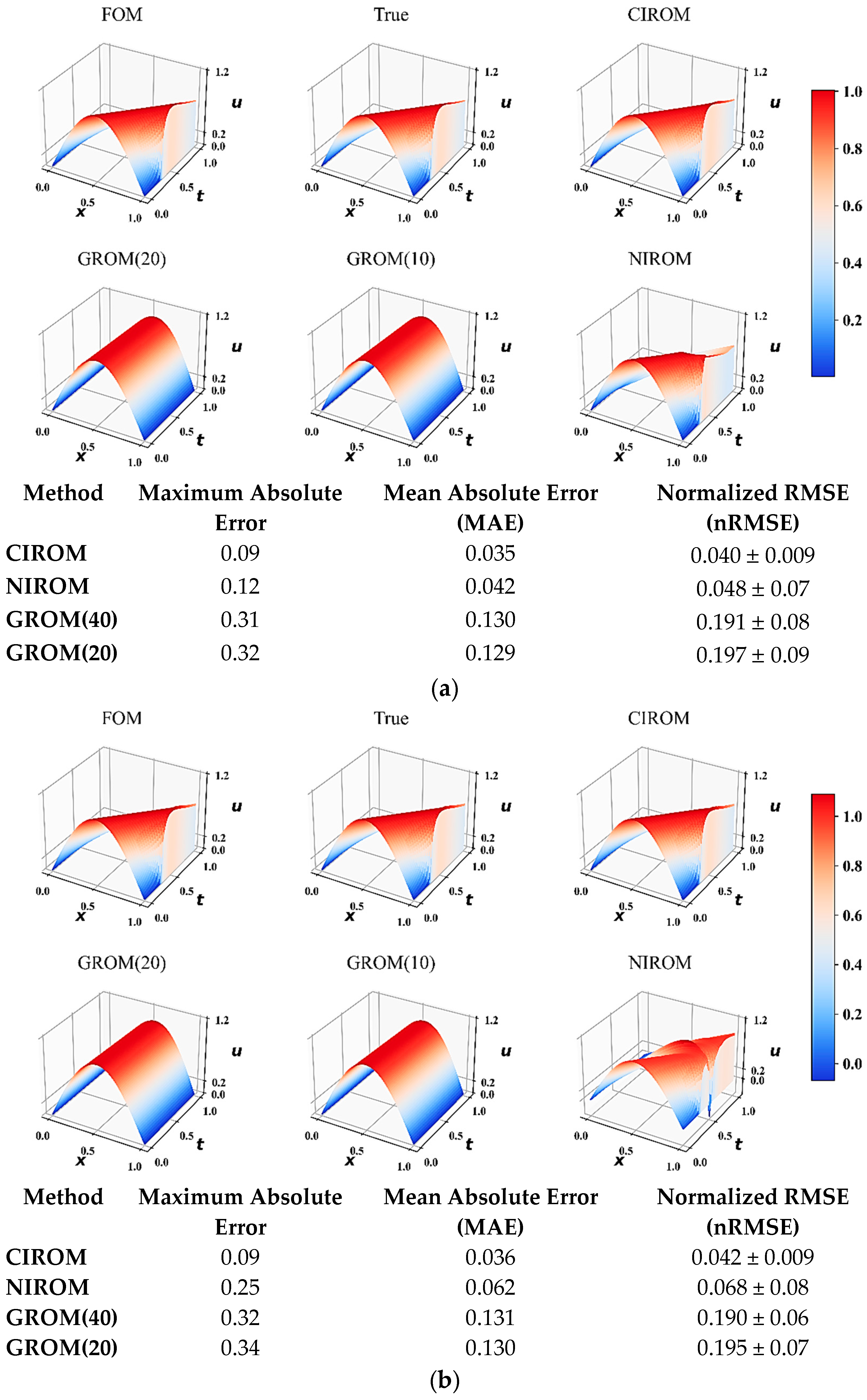
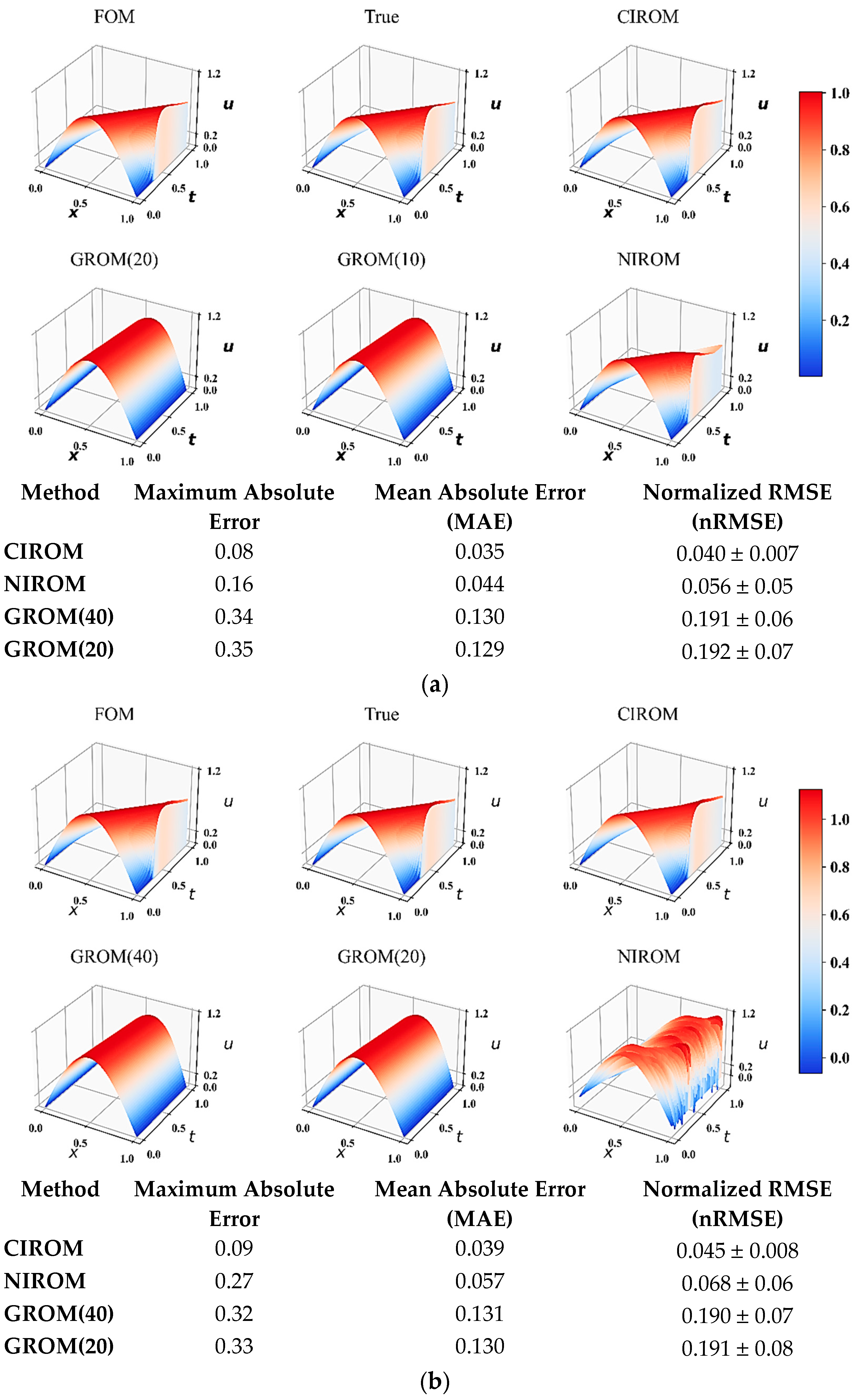
To analyze the effect of the number of snapshots on model performance, three different training datasets were considered with 100, 500, and 1000 snapshots, respectively. The aim is to observe how increasing the amount of training data influences the accuracy and stability of the reduced-order model. Figure 6 shows the spatiotemporal solution of the Burgers’ equation obtained by exact solution and the intrusive, nonintrusive and the CIROM when trained with only 100 snapshots. The truncated data leads to noticeable discrepancies between the predicted and true responses, especially in regions with sharp gradients. Figure 7 presents the results using 500 snapshots for training. Compared to Figure 6, the CIROM yields more accurate predictions, with improved alignment with the DNS results. This indicates that with more training samples, the model can better capture complex variations in the solution. Figure 8 illustrates the case where 1000 snapshots are used. The CIROM’s prediction closely follows the DNS output with minimal deviation, confirming that increasing the number of snapshots enhances both the accuracy and robustness of the model.
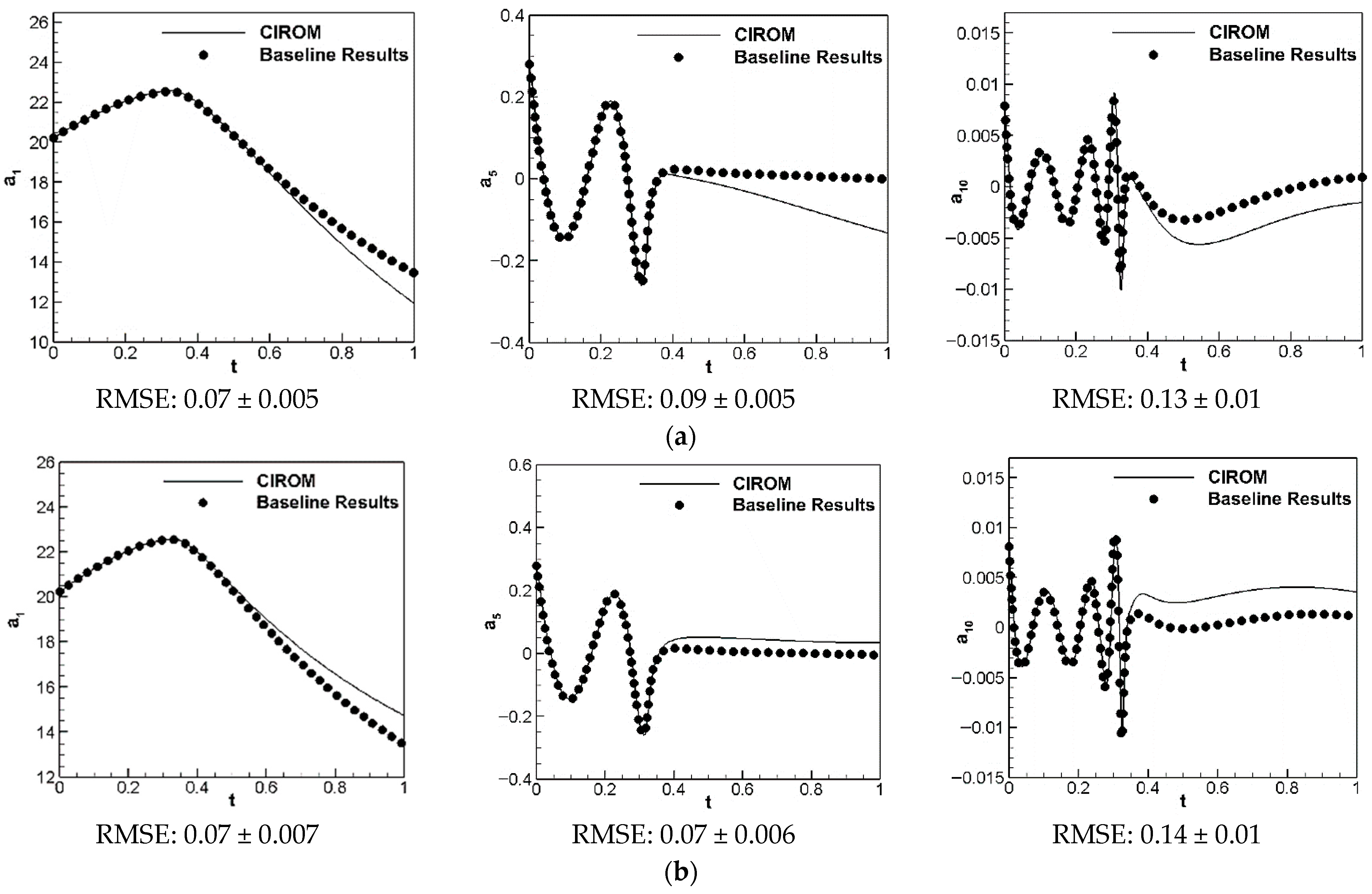
To further evaluate the performance of the proposed CIROM method, the model—trained using data at Reynolds numbers of 5000 and 7000—was tested using intermediate Reynolds numbers of 5500 and 6500. These Reynolds numbers lie within the range of the training data but were not directly used during the training phase. The goal of this evaluation is to investigate the model’s capability to handle new, but related, conditions not explicitly seen during training. Figure 9 shows the predicted temporal coefficients obtained by the intrusive ROM with 1000 snapshots. Although the general pattern is captured, noticeable discrepancies remain between the predicted and exact solution coefficients, particularly in the case of Reynolds number 6500. Figure 10 presents the results of the data-driven method using LSTM with 1000 snapshots. The predicted coefficients better align with the exact results compared to the intrusive method, but slight differences are still visible. Figure 11 illustrates the performance of the proposed CIROM method with 1000 snapshots. The predicted temporal coefficients show relatively good agreement with the exact solution for both Reynolds numbers, indicating that the model is capable of generalizing to Reynolds numbers within the training range, even though they were not explicitly included in the training dataset.
To further assess the spatial–temporal prediction quality of the CIROM, the reconstructed solutions are visualized for intermediate Reynolds numbers not used during training but within the training range. Figure 12 shows the spatial–temporal response of the Burgers’ equation for Reynolds numbers 5500 and 6500 when only 100 snapshots were used for training. The CIROM captures the general pattern, but noticeable deviations exist, especially in regions with steeper gradients or rapid transitions. Figure 13 displays the results using 500 training snapshots. The predicted solution exhibits better alignment with the DNS data, with fewer visible artifacts and more accurate reproduction of the solution structure compared to the case with 100 snapshots. Figure 14 illustrates the model predictions when the model was trained with 1000 snapshots. The CIROM output compared to another models closely matches the DNS data for both Reynolds numbers, indicating that increasing the number of training snapshots significantly improves model fidelity in the spatial–temporal response.
To evaluate the generalization capability of the proposed CIROM beyond the conditions seen during training, the model—trained using data corresponding to Reynolds numbers 5000 and 7000—was tested using unseen Reynolds numbers 4500 and 7500. These values lie outside the training range, making this an extrapolation scenario that challenges the robustness of the reduced-order model. Figure 15 shows the temporal coefficients predicted by the intrusive ROM method with 1000 snapshots. As expected, the results display noticeable deviation from the DNS data, especially for the more extreme Reynolds number of 7500. The inability to capture accurate temporal dynamics in this case indicates the poor extrapolation performance of the purely intrusive approach. Figure 16 presents the predictions from the data-driven method using LSTM with 1000 snapshots. While the model performs slightly better than the intrusive method, its accuracy still degrades outside the training range, particularly in capturing the sharp transitions of the temporal coefficients. Figure 17 shows the results of the proposed CIROM with 1000 snapshots. The predicted coefficients align relatively well with the DNS data, even though the Reynolds numbers used for testing were not included in the training process. This demonstrates the model’s improved generalization ability and robustness in extrapolation scenarios. The demonstrated ability to generalize to Reynolds numbers outside the training range highlights the practical applicability of the CIROM in real-world scenarios, where system parameters often vary unpredictably. This capability is critical for deploying ROMs in control, optimization, and uncertainty quantification tasks, marking an important step towards more intelligent and reliable reduced-order modelling frameworks. To analyze the spatial–temporal accuracy of the reconstructed solution, Figure 18, Figure 19 and Figure 20 visualize the predicted and reference (DNS) solutions. Figure 18 displays the spatial–temporal solution for Reynolds numbers 4500 and 7500 using 100 snapshots for training. The CIROM captures the broad patterns, but several discrepancies are present, indicating insufficient learning due to the limited training data. Figure 19 shows the results when 500 snapshots are used. The predictions are considerably improved, with better resolution of sharp features and smoother transitions, suggesting that increased training data improves generalization to out-of-distribution conditions. Figure 20 presents the solution reconstructed from a model trained with 1000 snapshots. The predicted spatial–temporal field closely matches the exact solution, confirming that the proposed CIROM maintains good accuracy even under conditions not seen during training, provided sufficient training data is available.
To assess the robustness limits of the proposed CIROM framework beyond moderate extrapolation, additional tests were conducted at Reynolds numbers significantly outside the training range, specifically Re = 3000 and Re = 9000.
Table 5 reports the accumulated modal RMSE for the CIROM across increasing extrapolation distances.
The results indicate that the CIROM maintains stable and accurate predictions up to approximately Re ≈ 8500. Beyond this threshold, performance degradation becomes noticeable due to mismatch between the fixed POD basis and evolving flow dynamics. This behaviour highlights the intrinsic limitation of fixed-basis intrusive ROMs under extreme parameter shifts.

8.1.2. Dataset Changes Due to the Number of Snapshots

In this case, the performances of the CIROM and NIROM were tested on datasets with 100 and 1000 snapshots. The network parameters were adjusted to maintain the quality of the solution under these conditions. Figure 21 compares the exact solution with the data-driven method and the CIROM for datasets of 100 and 1000 snapshots. As shown in this figure, when the data volume is reduced, the accuracy of the NIROM method decreases. The figure demonstrates that the number of snapshots is a critical parameter in the accuracy of the NIROM model. As the number of snapshots increases, the model can learn complex flow characteristics, significantly improving its accuracy.
In addition, Figure 21 presents the results of the CIROM method with different snapshots. As shown in this figure, although the proposed method has a more accurate answer with a higher number of snapshots, it also has an acceptable and accurate answer with a lower number of snapshots.

8.1.3. LSTM Network Parameter Changes

These parameters include the number of epochs and time window size. In Figure 21, the network parameters remained unchanged. The network parameters were adjusted to compensate for the small snapshots and achieve more accurate results, including the number of iterations and the time window size. As shown in Figure 22, better results were obtained with these adjustments. By increasing the number of network iterations, as shown in Figure 22, part b, the prediction accuracy improved compared to part a. Additionally, as seen in part c, the overlap between the CIROM method and the exact solution increased with the additional network iterations and changes in the time window. Although by changing the network parameters better results were obtained, the execution time also increases.

8.2. Sensitivity Analysis and Error Propagation

To gain deeper insight into the generalization capabilities of the proposed CIROM, we conducted both sensitivity and error propagation analyses.
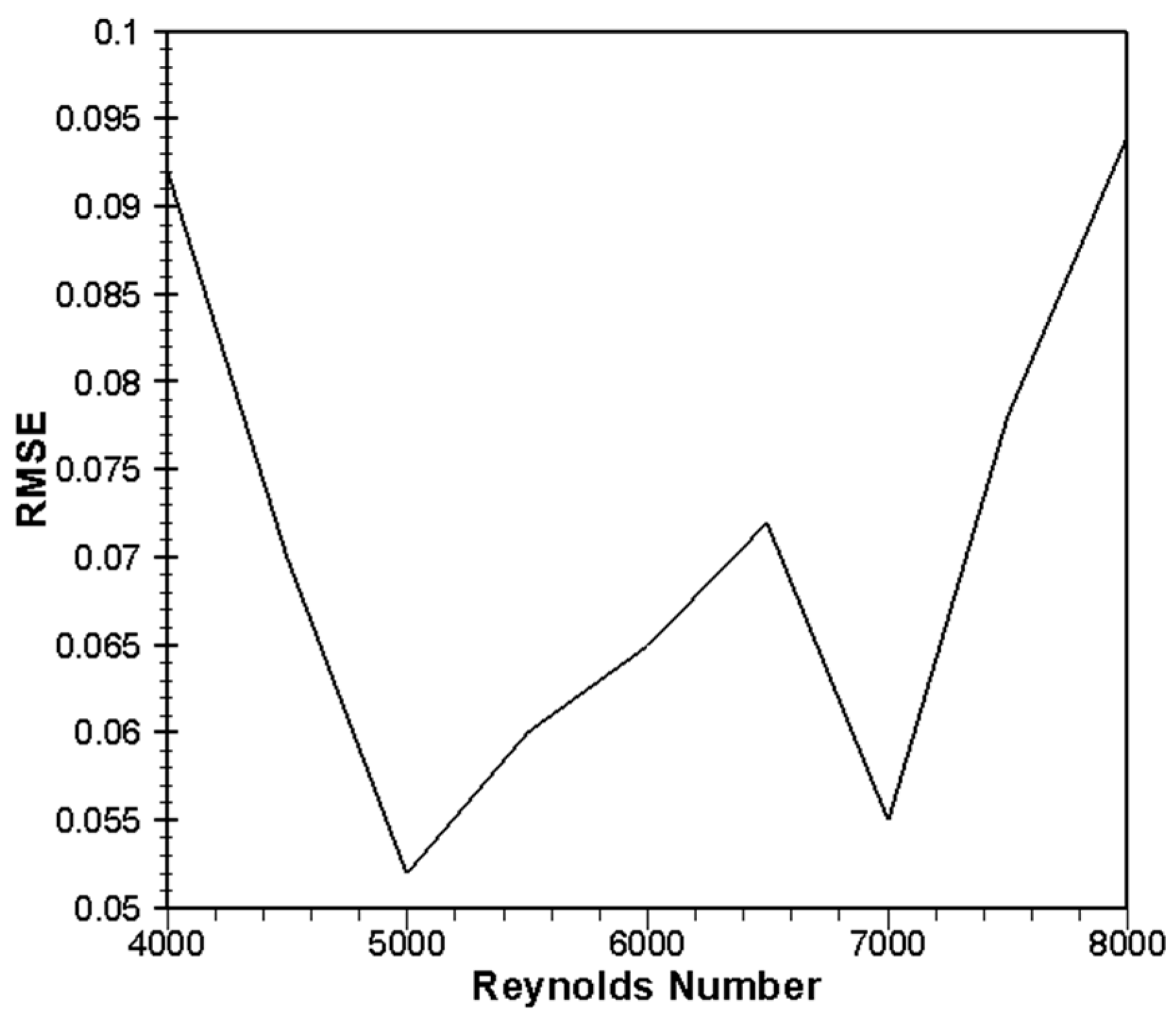
Reynolds Number Sensitivity Analysis: We evaluated the model’s robustness by testing it on Reynolds numbers that were not used during training (5000 and 7000). The root mean square error (RMSE) was measured for a range of Reynolds numbers spanning both inside and outside the training range. The accumulative reconstruction error is defined as the root mean square deviation integrated over all retained modes and time steps:
R M S E a c c = 1 r N t i = 1 r k = 1 N t ( a i p r e d ( t k ) a i D N S ( t k ) ) 2
which quantifies the global temporal–modal deviation of the reduced dynamics.
As shown in Figure 23, the RMSE increases gradually when testing conditions deviate from training conditions. This trend implies that the model is relatively stable under interpolation and near-extrapolation and that its generalization does not abruptly fail.
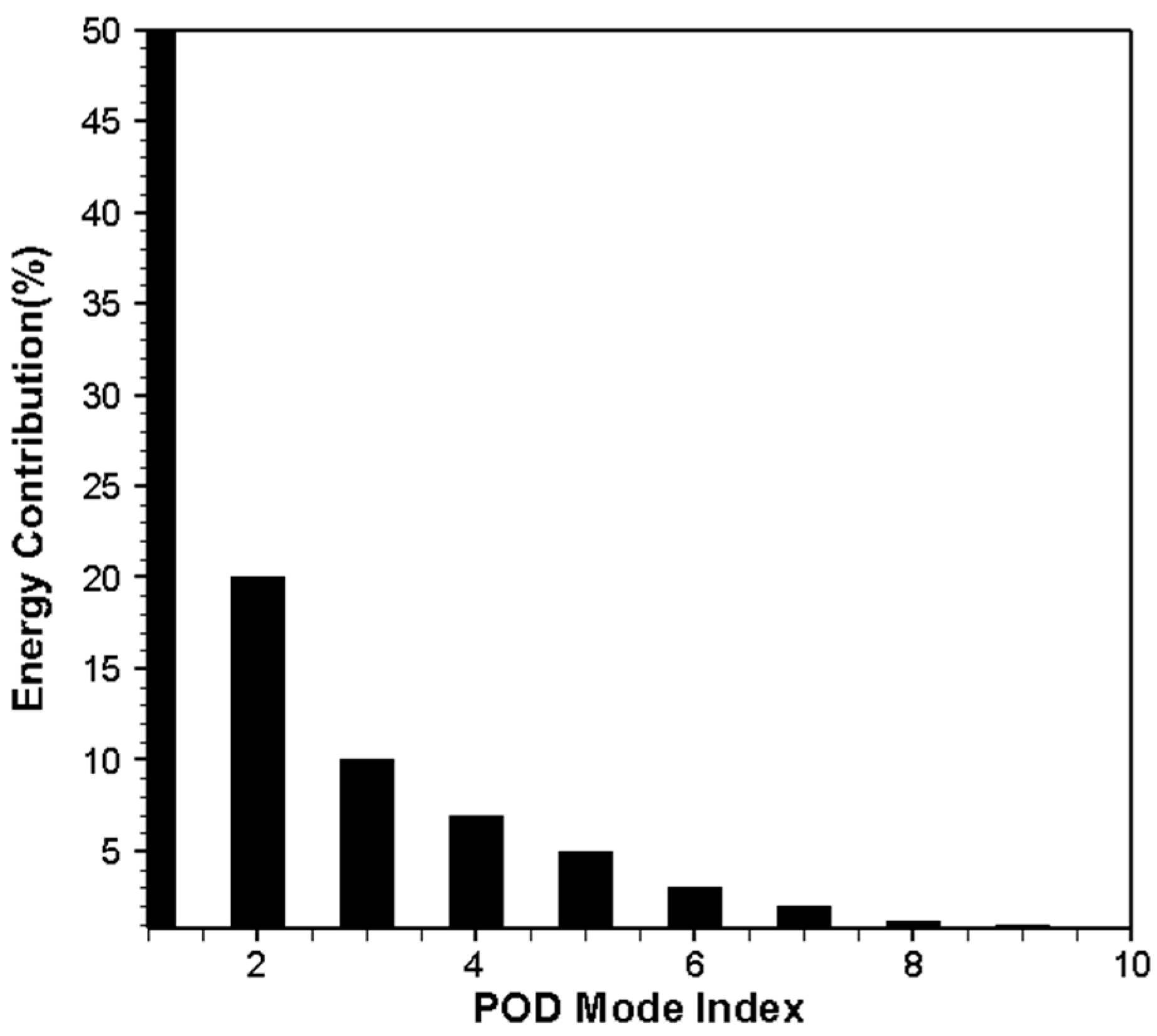
POD Mode Energy Distribution: To further understand the generalizability, we examined the energy captured by the dominant POD modes. Figure 24 shows that over 95% of the total energy is captured by the first five modes, and this distribution remains relatively stable across Reynolds numbers between 4500 and 7500. This supports the hypothesis that the reduced-order basis remains representative even across moderate flow condition shifts.
We have conducted additional tests with three, four, five, six, and 10 modes to evaluate the trade-off between accuracy and computational cost, with detailed quantitative results provided in Table 6.
The results show diminishing returns beyond five modes: while 10 modes reduce error by only 27% compared to five modes, the computational cost nearly doubles (speedup drops from 7.4× to 4.1×). Thus, five modes represent an optimal trade-off point.
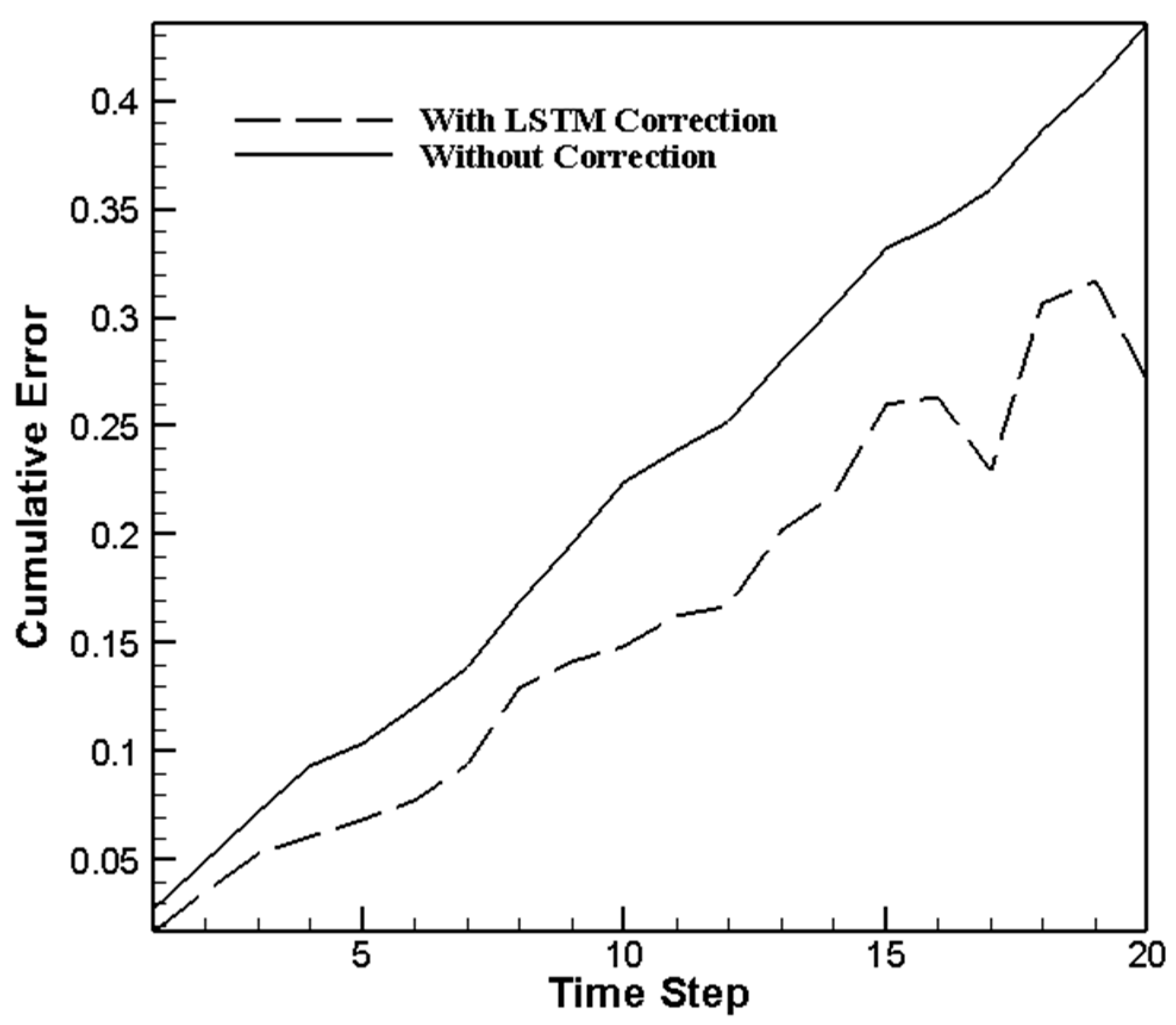
Temporal Error Propagation in LSTM Predictions: We also investigated how prediction errors evolve over time. As seen in Figure 25, when the error correction loop via LSTM is removed, the cumulative error grows significantly. The proposed CIROM leverages an iterative LSTM-based correction that significantly mitigates this growth. This finding highlights the importance of error-aware learning in maintaining stability, especially in extrapolation scenarios.
These analyses validate the model’s generalization ability not only empirically but also structurally. However, they also highlight limitations: for Reynolds numbers too far outside the training range (e.g., <4000 or >8000), performance degradation becomes significant due to spatial–temporal basis mismatch and long-term error accumulation. This confirms the need for further training diversity or adaptive retraining mechanisms for broader applicability. The result of the parameter sensitivity analysis of the proposed method and the traditional pod-based reduced-order model is summarized in Table 7.
These experiments demonstrate that CIROM not only corrects the limitations of POD-ROMs but also provides robust performance across a range of realistic conditions, confirming its potential as a next-generation surrogate modelling tool in nonlinear systems governed by convection–diffusion dynamics.

9. Conclusions

In this study, a Calibrated Intrusive Reduced-Order Model (CIROM) that integrates POD–Galerkin projection with LSTM-based residual learning to stabilize and enhance reduced dynamics was introduced for convection-dominated systems. The approach was validated on the Burgers’ equation, serving as a canonical benchmark to demonstrate computational efficiency and accuracy across varying Reynolds numbers while preparing the framework provides a validated foundation for extension toward Navier–Stokes systems. While validated on the Burgers’ benchmark equation, the framework provides a principled foundation for extension to higher-dimensional nonlinear flow systems. However, this paper is benchmark-oriented and not a general PDE solver. The proposed CIROM framework demonstrates robust extrapolation performance within moderate Reynolds number variations around the training regime. While accuracy gradually degrades for larger parameter shifts due to POD basis mismatch, the method significantly extends the stability and predictive range compared to classical POD-ROMs and purely data-driven models. This model demonstrates high accuracy, especially when the number of training snapshots is sufficient and optimal network parameters are selected. The CIROM has great potential as a powerful method for dimensionality reduction and the simulation of complex dynamical systems. Compared to classical closure ROMs employing fixed eddy viscosity or variational stabilization, the CIROM provides an adaptive, data-informed closure that learns unresolved nonlinear interactions directly from full-order dynamics. Unlike operator inference approaches requiring the regression of reduced operators, the CIROM operates as a residual corrector, preserving physical ROM structure while enhancing robustness. The advantages of the hybrid framework are listed below:
The proposed method outperforms both data-driven and intrusive methods, reducing computational cost while maintaining accuracy.
The method demonstrates robust generalization within moderate extrapolation ranges, producing accurate results even when tested on out-of-range Reynolds numbers.
The method’s robustness and accuracy make it a promising tool for modelling and predicting flow behaviour under varying conditions.
This directly addresses a bottleneck in practical engineering deployment of ROMs.
Dimensionality Reduction: POD effectively reduces the problem’s computational complexity by extracting dominant flow patterns.
Error Correction: LSTM networks effectively learn and incorporate the error term to enhance prediction accuracy.
Iterative Refinement: The iterative approach ensures that the predicted flow converges to the actual flow, minimizing overall prediction error.
Adaptability: The framework can be adapted to various flow prediction tasks by adjusting the number of POD modes and the architecture of the LSTM network.
Integrating POD for dimensionality reduction and LSTM for error correction provides a powerful tool for simulating complex dynamical systems with reduced computational costs. Future research should focus on enhancing the stability and scalability of the CIROM, expanding its applicability to multi-dimensional systems, digital twins in industrial CFD workflows, predictive maintenance (detecting anomalies in pipeline or HVAC systems), design optimization (rapid parametric studies in engineering contexts), online control of fluid processes in industry and further leveraging machine learning techniques for real-time flow control and optimization.

Author Contributions

Conceptualization, M.K.M.; Methodology, M.G., M.K.M. and F.F.-G.; Software, M.G.; Validation, M.G.; Writing—original draft, M.G.; Writing—review and editing, M.K.M., F.F.-G., M.V. and H.F.; Supervision, M.K.M. and F.F.-G.; Project administration, M.K.M. All authors have read and agreed to the published version of the manuscript.

Funding

This research was funded by R2Microgrid project under the RESILIENT competence center, financed by the Swedish Energy Agency and co-financed by Mälardalen University and industrial partners, and by the Excellence in Production Research Framework through XPRES (Excellence in Production Research).

Data Availability Statement

The data supporting this study’s findings are available from the corresponding author upon reasonable request.

Conflicts of Interest

The authors declare no conflicts of interest.

References

  1. Burgers, J.M. Mathematical examples illustrating relations occurring in the theory of turbulent fluid motion. In Selected Papers of JM Burgers; Springer: Berlin/Heidelberg, Germany, 1995; pp. 281–334. [Google Scholar]
  2. Bec, J.; Khanin, K. Burgers turbulence. Phys. Rep. 2007, 447, 1–66. [Google Scholar] [CrossRef]
  3. Bouchaud, J.-P.; Mézard, M. Velocity fluctuations in forced Burgers turbulence. Phys. Rev. E 1996, 54, 5116–5121. [Google Scholar] [CrossRef]
  4. Bayona, C.; Baiges, J.; Codina, R. Variational multiscale approximation of the one-dimensional forced Burgers equation: The role of orthogonal subgrid scales in turbulence modeling. Int. J. Numer. Methods Fluids 2018, 86, 313–328. [Google Scholar] [CrossRef]
  5. Lumley, J.L. The structure of inhomogeneous turbulent flows. In Atmospheric Turbulence and Radio Wave Propagation; Defense Technical Information Center: Fort Belvoir, VA, USA, 1967. [Google Scholar]
  6. Wu, Z.; Laurence, D.; Utyuzhnikov, S.; Afgan, I. Proper orthogonal decomposition and dynamic mode decomposition of jet in channel crossflow. Nucl. Eng. Des. 2019, 344, 54–68. [Google Scholar] [CrossRef]
  7. Abreu, L.I.; Cavalieri, A.V.; Schlatter, P.; Vinuesa, R.; Henningson, D.S. Spectral proper orthogonal decomposition and resolvent analysis of near-wall coherent structures in turbulent pipe flows. J. Fluid Mech. 2020, 900, A11. [Google Scholar] [CrossRef]
  8. Moayyedi, M.K.; Sabaghzadeghan, F. Development of parametric and time dependent reduced order model for diffusion and convection-diffusion problems based on proper orthogonal decomposition method. Amirkabir J. Mech. Eng. 2021, 53, 4241–4260. [Google Scholar]
  9. Abbasi, F.; Mohammadpour, J. Nonlinear model order reduction of Burgers’ equation using proper orthogonal decomposition. In Proceedings of the 2015 American Control Conference (ACC), Chicago, IL, USA, 1–3 July 2015; pp. 583–588. [Google Scholar]
  10. Moayyedi, M.K. Reduced Order Model for Boundary Instigation of Burgers Equation of Turbulence Using Direct and Indirect Control Approaches. AUT J. Mech. Eng. 2019, 3, 173–186. [Google Scholar]
  11. Rafiq, D.; Bazaz, M.A. Efficient computation of 1D and 2D nonlinear Viscous Burgers’ equation. Int. J. Dyn. Control 2021, 9, 1523–1535. [Google Scholar] [CrossRef]
  12. Sahyoun, S.; Djouadi, S.M. Time, space, and space-time hybrid clustering POD with application to the Burgers’ equation. In Proceedings of the 53rd IEEE Conference on Decision and Control, Los Angeles, CA, USA, 15–17 December 2014; pp. 2088–2093. [Google Scholar]
  13. Segala, D.B.; Chelidze, D. Robust and dynamically consistent model order reduction for nonlinear dynamic systems. J. Dyn. Syst. Meas. Control 2014, 137, 021011. [Google Scholar] [CrossRef]
  14. Carlberg, K.T. Model Reduction of Nonlinear Mechanical Systems via Optimal Projection and Tensor Approximation. Ph.D. Thesis, Stanford University, Stanford, CA, USA, 2011. [Google Scholar]
  15. Azeez, M.F.A.; Vakakis, A.F. Numerical and experimental analysis of a continuous overhung rotor undergoing vibro-impacts. Int. J. Non-Linear Mech. 1999, 34, 415–435. [Google Scholar] [CrossRef]
  16. Kappagantu, R.; Feeny, B. An “optimal” modal reduction of a system with frictional excitation. J. Sound Vib. 1999, 224, 863–877. [Google Scholar] [CrossRef]
  17. Liang, Y.; Lin, W.; Lee, H.; Lim, S.; Lee, K.; Sun, H. Proper orthogonal decomposition and its applications–part II: Model reduction for MEMS dynamical analysis. J. Sound Vib. 2002, 256, 515–532. [Google Scholar] [CrossRef]
  18. Ma, X.; Vakakis, A.F.; Bergman, L.A. Karhunen-Loeve modes of a truss: Transient response reconstruction and experimental verification. AIAA J. 2001, 39, 687–696. [Google Scholar] [CrossRef]
  19. Ma, X.; Vakakis, A.F. Karhunen-Lo-ccedil; ve Decomposition of the Transient Dynamics of a Multibay Truss. AIAA J. 1999, 37, 939–946. [Google Scholar] [CrossRef] [PubMed]
  20. Steindl, A.; Troger, H. Methods for dimension reduction and their application in nonlinear dynamics. Int. J. Solids Struct. 2001, 38, 2131–2147. [Google Scholar] [CrossRef]
  21. Friswell, M.I.; Inman, D.J. Sensor validation for smart structures. J. Intell. Mater. Syst. Struct. 1999, 10, 973–982. [Google Scholar] [CrossRef]
  22. Kerschen, G.; De Boe, P.; Golinval, J.-C.; Worden, K. Sensor validation using principal component analysis. Smart Mater. Struct. 2004, 14, 36–42. [Google Scholar] [CrossRef]
  23. Feeny, B. On proper orthogonal co-ordinates as indicators of modal activity. J. Sound Vib. 2002, 255, 805–817. [Google Scholar] [CrossRef]
  24. Han, S.; Feeny, B. Application of proper orthogonal decomposition to structural vibration analysis. Mech. Syst. Signal Process. 2003, 17, 989–1001. [Google Scholar] [CrossRef]
  25. Fukunaga, K. Introduction to Statistical Pattern Recognition; Elsevier: Amsterdam, The Netherlands, 2013. [Google Scholar]
  26. Xiao, D.; Fang, F.; Du, J.; Pain, C.; Navon, I.; Buchan, A.; Elsheikh, A.H.; Hu, G. Non-linear Petrov–Galerkin methods for reduced order modelling of the Navier–Stokes equations using a mixed finite element pair. Comput. Methods Appl. Mech. Eng. 2013, 255, 147–157. [Google Scholar] [CrossRef]
  27. Xiao, D.; Fang, F.; Pain, C.; Hu, G. Non-intrusive reduced-order modelling of the Navier–Stokes equations based on RBF interpolation. Int. J. Numer. Methods Fluids 2015, 79, 580–595. [Google Scholar] [CrossRef]
  28. Fang, F.; Zhang, T.; Pavlidis, D.; Pain, C.; Buchan, A.; Navon, I. Reduced order modelling of an unstructured mesh air pollution model and application in 2D/3D urban street canyons. Atmos. Environ. 2014, 96, 96–106. [Google Scholar] [CrossRef]
  29. Diez, M.; Campana, E.F.; Stern, F. Design-space dimensionality reduction in shape optimization by Karhunen–Loève expansion. Comput. Methods Appl. Mech. Eng. 2015, 283, 1525–1544. [Google Scholar] [CrossRef]
  30. Manzoni, A.; Salmoiraghi, F.; Heltai, L. Reduced Basis Isogeometric Methods (RB-IGA) for the real-time simulation of potential flows about parametrized NACA airfoils. Comput. Methods Appl. Mech. Eng. 2015, 284, 1147–1180. [Google Scholar] [CrossRef]
  31. Chen, X.; Akella, S.; Navon, I. A dual-weighted trust-region adaptive POD 4-D Var applied to a finite-volume shallow water equations model on the sphere. Int. J. Numer. Methods Fluids 2012, 68, 377–402. [Google Scholar] [CrossRef]
  32. Ştefănescu, R.; Sandu, A.; Navon, I.M. Comparison of POD reduced order strategies for the nonlinear 2D shallow water equations. Int. J. Numer. Methods Fluids 2014, 76, 497–521. [Google Scholar] [CrossRef]
  33. Bistrian, D.A.; Navon, I.M. An improved algorithm for the shallow water equations model reduction: Dynamic Mode Decomposition vs POD. Int. J. Numer. Methods Fluids 2015, 78, 552–580. [Google Scholar] [CrossRef]
  34. Xiao, D.; Heaney, C.; Mottet, L.; Fang, F.; Lin, W.; Navon, I.; Guo, Y.; Matar, O.; Robins, A.; Pain, C. A reduced order model for turbulent flows in the urban environment using machine learning. Build. Environ. 2019, 148, 323–337. [Google Scholar] [CrossRef]
  35. San, O.; Maulik, R.; Ahmed, M. An artificial neural network framework for reduced order modeling of transient flows. Commun. Nonlinear Sci. Numer. Simul. 2019, 77, 271–287. [Google Scholar] [CrossRef]
  36. Xie, X.; Mohebujjaman, M.; Rebholz, L.G.; Iliescu, T. Data-driven filtered reduced order modeling of fluid flows. SIAM J. Sci. Comput. 2018, 40, B834–B857. [Google Scholar] [CrossRef]
  37. Bai, Z.; Peng, L. Non-intrusive nonlinear model reduction via machine learning approximations to low-dimensional operators. Adv. Model. Simul. Eng. Sci. 2021, 8, 28. [Google Scholar] [CrossRef]
  38. Abdedou, A.; Soulaimani, A. Reduced-order modeling for stochastic large-scale and time-dependent flow problems using deep spatial and temporal convolutional autoencoders. Adv. Model. Simul. Eng. Sci. 2023, 10, 7. [Google Scholar] [CrossRef] [PubMed]
  39. Padmanabhan, N. Reduced order model of a convection-diffusion equation using Proper Orthogonal Decomposition. arXiv 2023, arXiv:2303.07176. [Google Scholar] [CrossRef]
  40. Lee, S.; Jang, K.; Lee, S.; Cho, H.; Shin, S. Parametric model order reduction by machine learning for fluid–structure interaction analysis. Eng. Comput. 2024, 40, 45–60. [Google Scholar] [CrossRef]
  41. Golzar, M.; Moayyedi, M.K.; Fotouhi, F. A surrogate non-intrusive reduced order model of quasi-geostrophic turbulence dynamics based on a combination of LSTM and different approaches of DMD. J. Turbul. 2023, 24, 474–505. [Google Scholar] [CrossRef]
  42. Hajisharifi, A.; Halder, R.; Girfoglio, M.; Beccari, A.; Bonanni, D.; Rozza, G. A LSTM-enhanced surrogate model to simulate the dynamics of particle-laden fluid systems. arXiv 2024, arXiv:2403.14283. [Google Scholar] [CrossRef]
  43. Zhang, Q.; Wang, H.; Dong, J.; Zhong, G.; Sun, X. Prediction of sea surface temperature using long short-term memory. IEEE Geosci. Remote Sens. Lett. 2017, 14, 1745–1749. [Google Scholar] [CrossRef]
  44. Xing-Wei, Z.; Jian-Qiao, C.; Ke, Z.; Shi-Xiong, Z.; Hao-Xiang, H. Predictions for unsteady flow fields with deep learning models of LSTM and GRU. IEEE Access 2024, 12, 144788–144811. [Google Scholar] [CrossRef]
  45. Abbasi, M.H.; Iapichino, L.; Besselink, B.; Schilders, W.; van de Wouw, N. Error estimates for model order reduction of Burgers’ equation. IFAC-PapersOnLine 2020, 53, 5609–5616. [Google Scholar] [CrossRef]
  46. Ortiz Ortiz, R.D.; Martínez Núñez, O.; Marín Ramírez, A.M. Solving Viscous Burgers’ Equation: Hybrid Approach Combining Boundary Layer Theory and Physics-Informed Neural Networks. Mathematics 2024, 12, 3430. [Google Scholar] [CrossRef]
  47. Sabaghzadeghan, F. Development the Reduce Order Model for Convection-Diffusion and Diffusion Problems Based on Proper Orthogonal Decomposition and Dynamic Mode Decomposition. Master’s Thesis, University of Qom, Qom, Iran, 2019. [Google Scholar]
  48. Moayyedi, M. Reconstruction of Gappy Unsteady Flow Fields using Improved Reduced Order POD Model based on Temporal Decomposition Procedure. Amirkabir J. Mech. Eng. 2017, 49, 101–112. [Google Scholar]
  49. Kosambi, D. Statistics in function space. In DD Kosambi; Selected Works in Mathematics and Statistics; Springer: Berlin/Heidelberg, Germany, 2016; pp. 115–123. [Google Scholar]
  50. Loeve, M. Functions aleatoires du second ordre. In Processus Stochastique et Mouvement Brownien; Jacques Gabay: Paris, France, 1948; pp. 366–420. [Google Scholar]
  51. Karhunen, K. Über Lineare Methoden in der Wahrscheinlichkeitsrechnung; Akadem. Abhandlung; Universitat Helsinki: Helsinki, Finland, 1947. [Google Scholar]
  52. Pugachev, V.S. The general theory of correlation of random functions. Izv. Ross. Akad. Nauk. Seriya Mat. 1953, 17, 401–420. [Google Scholar]
  53. Obukhov, A. Statistical description of continuous fields. Trans. Geophys. Int. Acad. Nauk USSR 1954, 24, 3–42. [Google Scholar]
  54. Rahman, S.M.; Ahmed, S.E.; San, O. A dynamic closure modeling framework for model order reduction of geophysical flows. Phys. Fluids 2019, 31, 046602. [Google Scholar] [CrossRef]
  55. Moayyedi, M.; Sabetghadam, F.; Taeibi-Rahni, M. Calibrated Reduced Order POD Model for Simulation of Unsteady Incompressible Flows. Fluid Mech. Aerodyn. J. 2012, 1, 29–39. [Google Scholar]
  56. Liang, Y.; Lee, H.; Lim, S.; Lin, W.; Lee, K.; Wu, C. Proper orthogonal decomposition and its applications—Part I: Theory. J. Sound Vib. 2002, 252, 527–544. [Google Scholar] [CrossRef]
  57. Ravindran, S. Proper Orthogonal Decomposition in Optimal Control of Fluids; NASA: Washington, DC, USA, 1999; Volume 99.
  58. Brunton, S.L.; Noack, B.R.; Koumoutsakos, P. Machine learning for fluid mechanics. Annu. Rev. Fluid Mech. 2020, 52, 477–508. [Google Scholar] [CrossRef]
  59. Olah, C. Understanding LSTM Networks. Available online: https://colah.github.io/posts/2015-08-Understanding-LSTMs/ (accessed on 12 March 2025).
  60. Cheng, J.; Dong, L.; Lapata, M. Long short-term memory-networks for machine reading. arXiv 2016, arXiv:1601.06733. [Google Scholar]
  61. Aubry, N.; Holmes, P.; Lumley, J.L.; Stone, E. The dynamics of coherent structures in the wall region of a turbulent boundary layer. J. Fluid Mech. 1988, 192, 115–173. [Google Scholar] [CrossRef]
  62. Podvin, B.; Lumley, J. A low-dimensional approach for the minimal flow unit. J. Fluid Mech. 1998, 362, 121–155. [Google Scholar] [CrossRef]
  63. Podvin, B. On the adequacy of the ten-dimensional model for the wall layer. Phys. Fluids 2001, 13, 210–224. [Google Scholar] [CrossRef]
  64. Podvin, B.; Le Quéré, P. Low-order models for the flow in a differentially heated cavity. Phys. Fluids 2001, 13, 3204–3214. [Google Scholar] [CrossRef]
  65. Podvin, B. A proper-orthogonal-decomposition–based model for the wall layer of a turbulent channel flow. Phys. Fluids 2009, 21, 015111. [Google Scholar] [CrossRef]
  66. Wells, D.R. Stabilization of POD-ROMs. Ph.D. Thesis, Virginia Tech, Blacksburg, VA, USA, 2015. [Google Scholar]
  67. Kramer, B.; Willcox, K.E. Nonlinear model order reduction via lifting transformations and proper orthogonal decomposition. AIAA J. 2019, 57, 2297–2307. [Google Scholar] [CrossRef]
  68. Swischuk, R.; Kramer, B.; Huang, C.; Willcox, K. Learning physics-based reduced-order models for a single-injector combustion process. AIAA J. 2020, 58, 2658–2672. [Google Scholar] [CrossRef]
  69. Qian, E.; Kramer, B.; Peherstorfer, B.; Willcox, K. Lift & learn: Physics-informed machine learning for large-scale nonlinear dynamical systems. Phys. D Nonlinear Phenom. 2020, 406, 132401. [Google Scholar]
  70. Huang, C.; Wentland, C.R.; Duraisamy, K.; Merkle, C. Model reduction for multi-scale transport problems using model-form preserving least-squares projections with variable transformation. J. Comput. Phys. 2022, 448, 110742. [Google Scholar] [CrossRef]
  71. Moayyedi, M.K.; Bigdeloo, F.; Khakzari, Z. Stabilization of Intrusive DMD based Reduced Order Model of the Convection-Diffusion Equations. Iran. J. Mech. Eng. Trans. ISME 2024, 25, 41–64. [Google Scholar]
  72. Siena, P.; Girfoglio, M.; Quaini, A.; Rozza, G. Stabilized POD Reduced Order Models for convection-dominated incompressible flows. arXiv 2024, arXiv:2404.19600. [Google Scholar] [CrossRef]
  73. Amsallem, D.; Farhat, C. Stabilization of projection-based reduced-order models. Int. J. Numer. Methods Eng. 2012, 91, 358–377. [Google Scholar] [CrossRef]
  74. Balajewicz, M.J.; Dowell, E.H.; Noack, B.R. Low-dimensional modelling of high-Reynolds-number shear flows incorporating constraints from the Navier–Stokes equation. J. Fluid Mech. 2013, 729, 285–308. [Google Scholar] [CrossRef]
  75. Ballarin, F.; Manzoni, A.; Quarteroni, A.; Rozza, G. Supremizer stabilization of POD–Galerkin approximation of parametrized steady incompressible Navier–Stokes equations. Int. J. Numer. Methods Eng. 2015, 102, 1136–1161. [Google Scholar] [CrossRef]
  76. Barone, M.F.; Kalashnikova, I.; Segalman, D.J.; Thornquist, H.K. Stable Galerkin reduced order models for linearized compressible flow. J. Comput. Phys. 2009, 228, 1932–1946. [Google Scholar] [CrossRef]
  77. Bergmann, M.; Bruneau, C.-H.; Iollo, A. Enablers for robust POD models. J. Comput. Phys. 2009, 228, 516–538. [Google Scholar] [CrossRef]
  78. Cordier, L.; El Majd, B.A.; Favier, J. Calibration of POD reduced-order models using Tikhonov regularization. Int. J. Numer. Methods Fluids 2010, 63, 269–296. [Google Scholar] [CrossRef]
  79. Kalashnikova, I.; Barone, M.F. On the stability and convergence of a Galerkin reduced order model (ROM) of compressible flow with solid wall and far-field boundary treatment. Int. J. Numer. Methods Eng. 2010, 83, 1345–1375. [Google Scholar] [CrossRef]
  80. Pacciarini, P.; Rozza, G. Stabilized reduced basis method for parametrized advection–diffusion PDEs. Comput. Methods Appl. Mech. Eng. 2014, 274, 1–18. [Google Scholar] [CrossRef]
  81. Wang, Z.; Akhtar, I.; Borggaard, J.; Iliescu, T. Proper orthogonal decomposition closure models for turbulent flows: A numerical comparison. Comput. Methods Appl. Mech. Eng. 2012, 237, 10–26. [Google Scholar] [CrossRef]
  82. Benosman, M.; Kramer, B.; Boufounos, P.T.; Grover, P. Learning-based reduced order model stabilization for partial differential equations: Application to the coupled Burgers’ equation. In Proceedings of the 2016 American Control Conference (ACC), Boston, MA, USA, 6–8 July 2016; pp. 1673–1678. [Google Scholar]
Figure 1. LSTM internal structure [59].
Modelling 07 00091 g001
Figure 2. Steps of the training and prediction of modal coefficients using (a) the proposed method. (b) POD-ROM.
Modelling 07 00091 g002
Figure 3. Time history of modal coefficients obtained from the exact solution and intrusive reduced-order model. (a) Training and testing with Reynolds number of 5000, (b) training and testing with Reynolds number of 7000.
Modelling 07 00091 g003
Figure 4. Time history of modal coefficients obtained from the exact solution and nonintrusive reduced-order model. (a) Training and testing with Reynolds number of 5000, (b) training and testing with Reynolds number of 7000.
Modelling 07 00091 g004aModelling 07 00091 g004b
Figure 5. Time history of modal coefficients obtained from the exact solution and the proposed model. (a) Training and testing with Reynolds number of 5000, (b) training and testing with Reynolds number of 7000.
Modelling 07 00091 g005
Figure 6. The spatial–temporal response of the Burgers’ equation from the exact solution, the intrusive and nonintrusive ROMs and the CIROM with 100 snapshots. (a) Training and testing with Reynolds number of 5000, (b) training and testing with Reynolds number of 7000.
Modelling 07 00091 g006aModelling 07 00091 g006b
Figure 7. The spatial–temporal response of the Burgers’ equation from the exact solution, the intrusive and nonintrusive ROMs and the CIROM with 500 snapshots. (a) Training and testing with Reynolds number of 5000, (b) training and testing with Reynolds number of 7000.
Modelling 07 00091 g007aModelling 07 00091 g007b
Figure 8. The spatial–temporal response of the Burgers’ equation from the exact solution, the intrusive and nonintrusive ROMs and the CIROM with 1000 snapshots. (a) Training and testing with Reynolds number of 5000, (b) training and testing with Reynolds number of 7000.
Modelling 07 00091 g008
Figure 9. Time history of modal coefficients obtained from the exact solution and intrusive reduced-order model. (a) Training with Reynolds numbers 5000 and 7000 and testing with Reynolds number of 5500. (b) Training with Reynolds numbers 5000 and 7000 and testing with Reynolds number of 6500.
Modelling 07 00091 g009aModelling 07 00091 g009b
Figure 10. Time history of modal coefficients obtained from the exact solution and nonintrusive reduced-order model. (a) Training with Reynolds numbers 5000 and 7000 and testing with Reynolds number of 5500. (b) Training with Reynolds numbers 5000 and 7000 and testing with Reynolds number of 6500.
Modelling 07 00091 g010
Figure 11. Time history of modal coefficients obtained from the exact solution and the proposed model. (a) Training with Reynolds numbers 5000 and 7000 and testing with Reynolds number of 5500. (b) Training with Reynolds numbers 5000 and 7000 and testing with Reynolds number of 6500.
Modelling 07 00091 g011
Figure 12. The spatial–temporal response of the Burgers’ equation from the exact solution and the intrusive and nonintrusive ROMs and the CIROM with 100 snapshots. (a) Training with Reynolds numbers 5000 and 7000 and testing with Reynolds number of 5500. (b) Training with Reynolds numbers 5000 and 7000 and testing with Reynolds number of 6500.
Modelling 07 00091 g012aModelling 07 00091 g012b
Figure 13. The spatial–temporal response of the Burgers’ equation from the exact solution and the intrusive and nonintrusive ROMs and the CIROM with 500 snapshots. (a) Training with Reynolds numbers 5000 and 7000 and testing with Reynolds number of 5500. (b) Training with Reynolds numbers 5000 and 7000 and testing with Reynolds number of 6500.
Modelling 07 00091 g013aModelling 07 00091 g013b
Figure 14. The spatial–temporal response of the Burgers’ equation from the exact solution, the intrusive and nonintrusive ROMs and the CIROM with 1000 snapshots. (a) Training with Reynolds numbers 5000 and 7000 and testing with Reynolds number of 5500. (b) Training with Reynolds numbers 5000 and 7000 and testing with Reynolds number of 6500.
Modelling 07 00091 g014aModelling 07 00091 g014b
Figure 15. Time history of modal coefficients obtained from the exact solution and intrusive reduced-order model. (a) Training with Reynolds numbers 5000 and 7000 and testing with Reynolds number of 4500. (b) Training with Reynolds numbers 5000 and 7000 and testing with Reynolds number of 7500.
Modelling 07 00091 g015
Figure 16. Time history of modal coefficients obtained from the exact solution and nonintrusive reduced-order model. (a) Training with Reynolds numbers 5000 and 7000 and testing with Reynolds number of 4500. (b) Training with Reynolds numbers 5000 and 7000 and testing with Reynolds number of 7500.
Modelling 07 00091 g016aModelling 07 00091 g016b
Figure 17. Time history of modal coefficients obtained from the exact solution and the proposed model. (a) Training with Reynolds numbers 5000 and 7000 and testing with Reynolds number of 5500. (b) Training with Reynolds numbers 5000 and 7000 and testing with Reynolds number of 6500.
Modelling 07 00091 g017
Figure 18. The spatial–temporal response of the Burgers’ equation from the exact solution, the intrusive and nonintrusive ROMs and the CIROM with 100 snapshots. (a) Training with Reynolds numbers 5000 and 7000 and testing with Reynolds number of 4500. (b) Training with Reynolds numbers 5000 and 7000 and testing with Reynolds number of 7500.
Modelling 07 00091 g018
Figure 19. The spatial–temporal response of the Burgers’ equation from the exact solution, the intrusive and nonintrusive ROMs and the CIROM with 500 snapshots. (a) Training with Reynolds numbers 5000 and 7000 and testing with Reynolds number of 4500. (b) Training with Reynolds numbers 5000 and 7000 and testing with Reynolds number of 7500.
Modelling 07 00091 g019
Figure 20. The spatial–temporal response of the Burgers’ equation from the exact solution, the intrusive and nonintrusive ROMs and the CIROM with 1000 snapshots. (a) Training with Reynolds numbers 5000, 7000 and testing with Reynolds number of 4500. (b) Training with Reynolds numbers 5000, 7000 and testing with Reynolds number of 7500.
Modelling 07 00091 g020
Figure 21. Time history of modal coefficients obtained from the exact solution, the nonintrusive ROM and the proposed model. Training with 5000 and 7000 Reynolds numbers and testing with Reynolds number 4500, (a) with 100 snapshots, and (b) with 1000 snapshots.
Modelling 07 00091 g021
Figure 22. Time history of modal coefficients obtained from the exact solution and the proposed method. Training with 5000 and 7000 Reynolds numbers and testing with Reynolds number 4500 and 200 snapshots, (a) without changing parameters of LSTM, (b) increasing epochs, and (c) increasing epochs and changing the time window.
Modelling 07 00091 g022
Figure 23. Sensitivity of RMSE for different Reynolds numbers in the testing phase.
Modelling 07 00091 g023
Figure 24. Energy contribution of each POD mode in representing the dynamics of the flow field.
Modelling 07 00091 g024
Figure 25. Temporal propagation of cumulative prediction error with and without LSTM correction.
Modelling 07 00091 g025
Table 2. Summary of CIROM system configuration and dataset specifications.
ComponentSpecification
Governing Equation1D viscous Burgers’ equation (dimensionless)
Domainx ∈ [0, 1]
Grid Size100 spatial nodes
Time IntegrationRunge–Kutta 4th order (Δt = 0.001)
Total Simulation Time1.0 (1000 time steps)
Reynolds Numbers (Train)5000, 7000
Reynolds Numbers (Test)4500, 5500, 6500, 7500
POD Modes Retained5
LSTM Input Window10-time steps
LSTM Hidden Layers2 LSTM layers (64 and 32 units) + Dense layer
Optimizer/LRAdam/0.001
Batch Size32
Number of Epochs300
Training Samples1980 per Re (total ≈ 3960 sequences)
Loss FunctionRoot Mean Squared Error (RMSE)
FrameworksPython 3.8, TensorFlow 2.10, NumPy 1.23
HardwareNVIDIA RTX 2080 Ti
Training set70% of the snapshots
Test set15%
Validation set15%
Table 3. Comparison of CIROM and other methods.
Comparison CriteriaCIROMIntrusiveData-Driven
Reconstruction error (Re = 7000, number of snapshots = 500)0.07 ± 0.0050.6 ± 0.050.08 ± 0.007
Run time (s)13.524537.505411.5635
Table 4. Quantitative comparison of ROM performance at different Reynolds numbers (mean RMSE ± standard deviation over 5 independent runs with 1000 snapshots).
MethodRe = 5000Re = 7000
Intrusive ROM0.41 ± 0.040.62 ± 0.05
Data-Driven0.052 ± 0.0050.081 ± 0.006
CIROM0.043 ± 0.0030.068 ± 0.004
Table 5. Accumulated modal RMSE of CIROM at Reynolds numbers beyond the training range (extrapolation test).
Reynolds NumberAccumulative RMSE
85000.095 ± 0.008
90000.112 ± 0.009
Table 6. Sensitivity analysis of POD mode truncation: effect on energy capture, prediction error, and computational speedup. # denotes the number of POD modes; bold text indicates the best values.
# ModesEnergy CapturedRelative Error (t = 1.0)Speedup vs. DNS
389.7%0.142 ± 0.0099.2×
493.4%0.098 ± 0.0078.3×
596.2%0.067 ± 0.0067.4×
697.5%0.058 ± 0.0066.5×
1099.1%0.049 ± 0.0054.1×
Table 7. Conclusion of parameter sensitivity analysis.
ParameterPOD-ROM SensitivityCIROM Sensitiity
Reynolds NumberHighLow
Snapshots CountHighModerate
Disclaimer/Publisher’s Note: The statements, opinions and data contained in all publications are solely those of the individual author(s) and contributor(s) and not of MDPI and/or the editor(s). MDPI and/or the editor(s) disclaim responsibility for any injury to people or property resulting from any ideas, methods, instructions or products referred to in the content.