A Semi-Analytical Finite Layer Method for Analyzing the 3D Coupled Electro-Mechanical Behavior of Exponentially Graded Piezoelectric Circular Hollow Microscale Cylinders



Abstract
1. Introduction
2. The Basic Equations of the 3D CCST
3. The Semi-Analytical FLM
3.1. Generalized Displacement Model
3.2. The Principle of Stationary Potential Energy
3.3. Surface and Edge Boundary Conditions and Continuity Conditions
3.4. The Finite Layer Element Equations
4. Illustrative Examples
4.1. Validation and Comparison Studies
4.2. Parametric Analysis
5. Conclusions
- The current semi-analytical FLM for analyzing EG piezoelectric circular hollow microcylinders could be reduced to one for analyzing EG piezoelectric circular hollow macroscale cylinders by setting the material length-scale parameter to zero. Our semi-analytical FLM could also be reduced to the form used to analyze EG elastic circular hollow microcylinders by ignoring the piezoelectric effect. Furthermore, the current semi-analytical FLM was validated for accuracy and convergence by comparing its solutions with relevant 3D solutions reported in the literature.
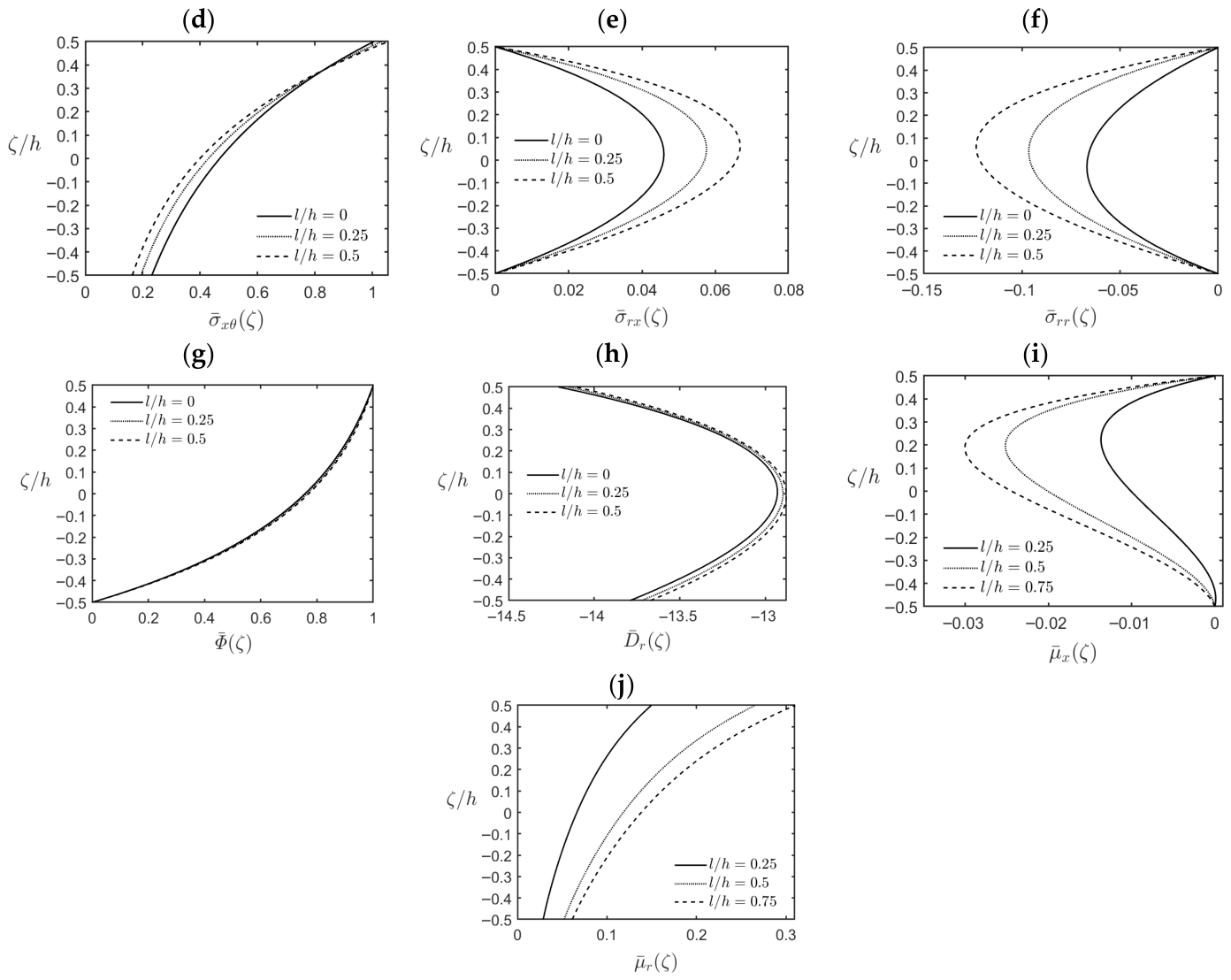
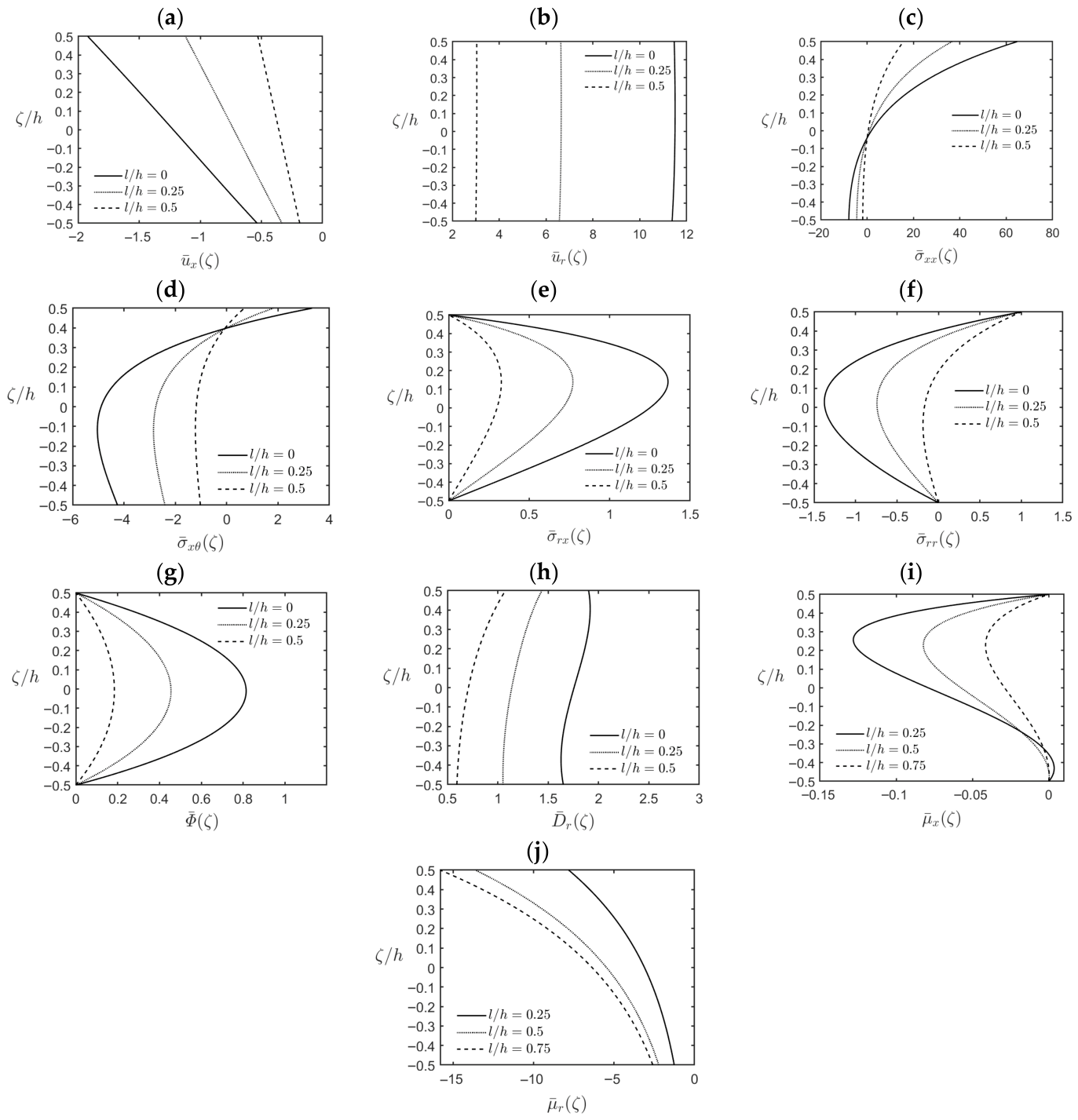
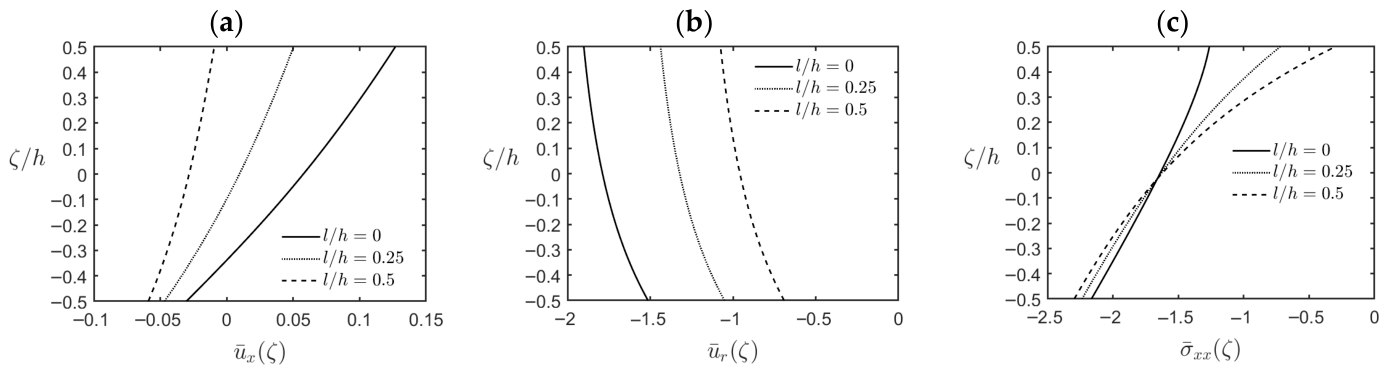
- An increase in the material length-scale parameter stiffened the microcylinder, decreasing its elastic deformation, transverse stresses, and in-surface stresses.
- The results for the applied-load (sensor) cases showed that the material length-scale parameter significantly affected the distributions of elastic and electric variables along the thickness direction. However, the results for the applied-voltage (actuator) cases showed that the material length-scale parameter significantly affected the distributions of elastic variables along the thickness direction, as compared with those of electric variables.
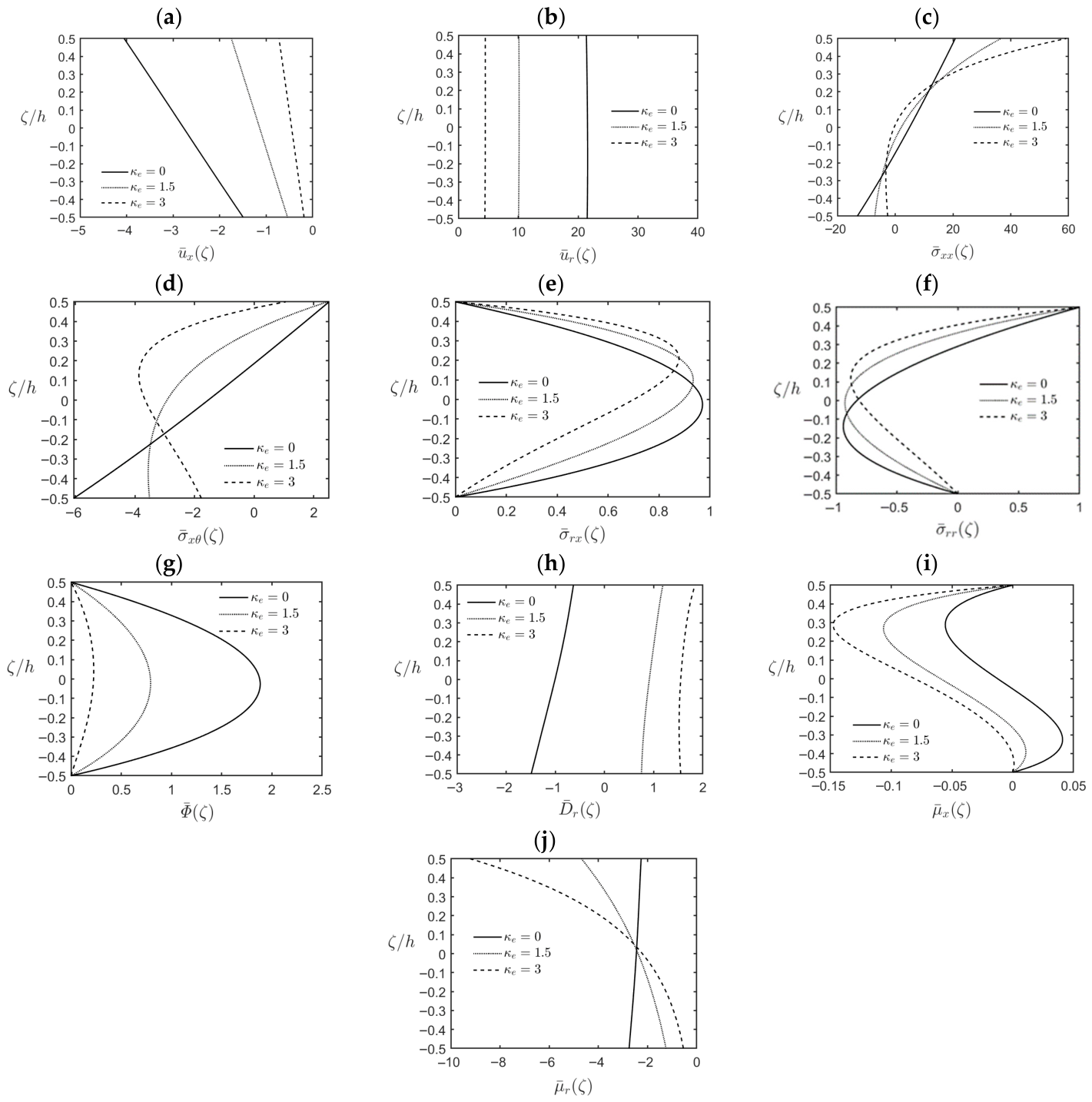
- The variations in the elastic and electric variables along the thickness direction for a nonhomogeneous microcylinder were more pronounced than those for a homogeneous microcylinder. The higher the inhomogeneity index, the more pronounced the variations in the elastic and electric variables along the thickness direction.
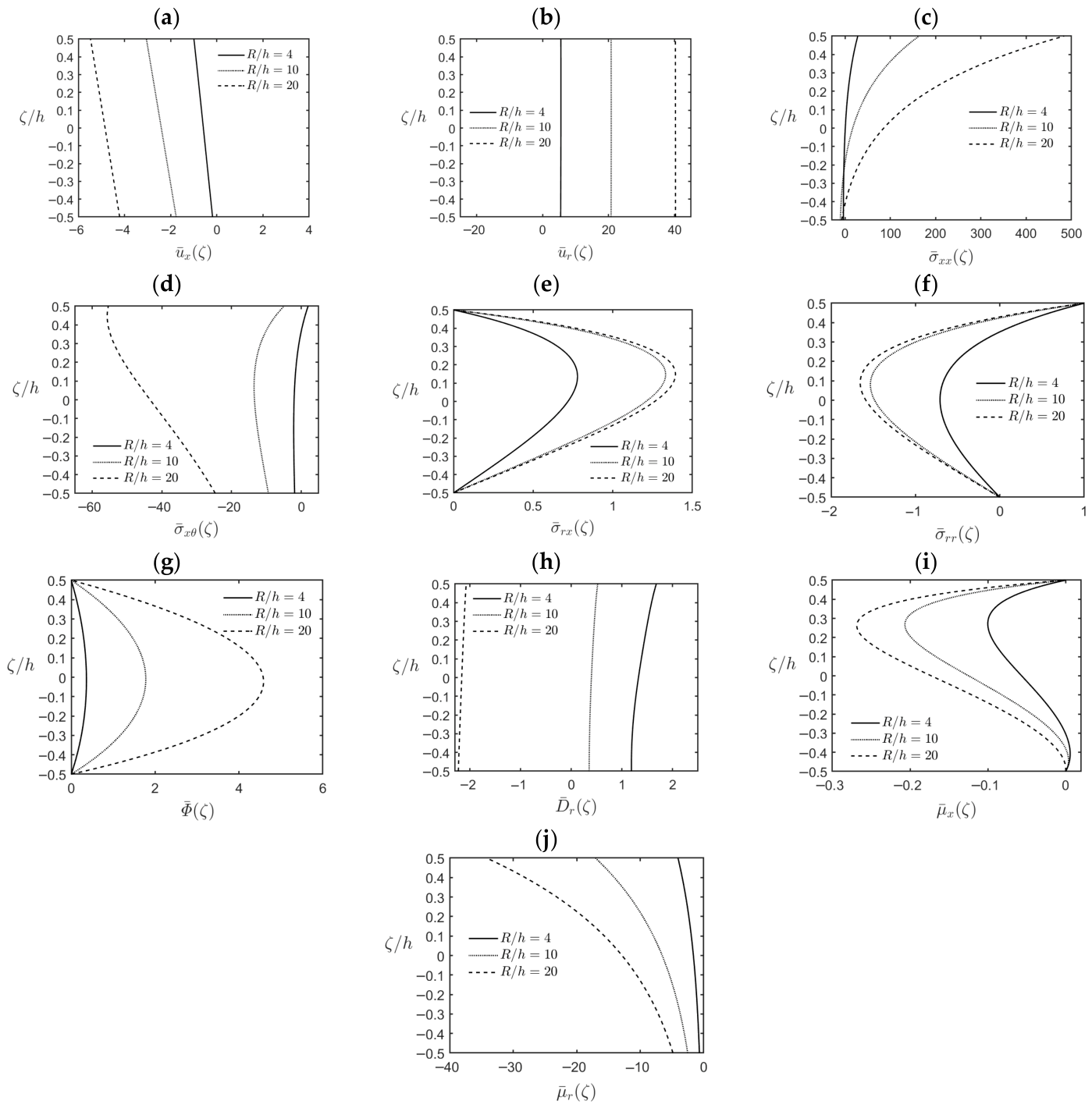
- An increase in the thickness of the microcylinder stiffened it, decreasing its elastic deformation, transverse stresses, and in-surface stresses.
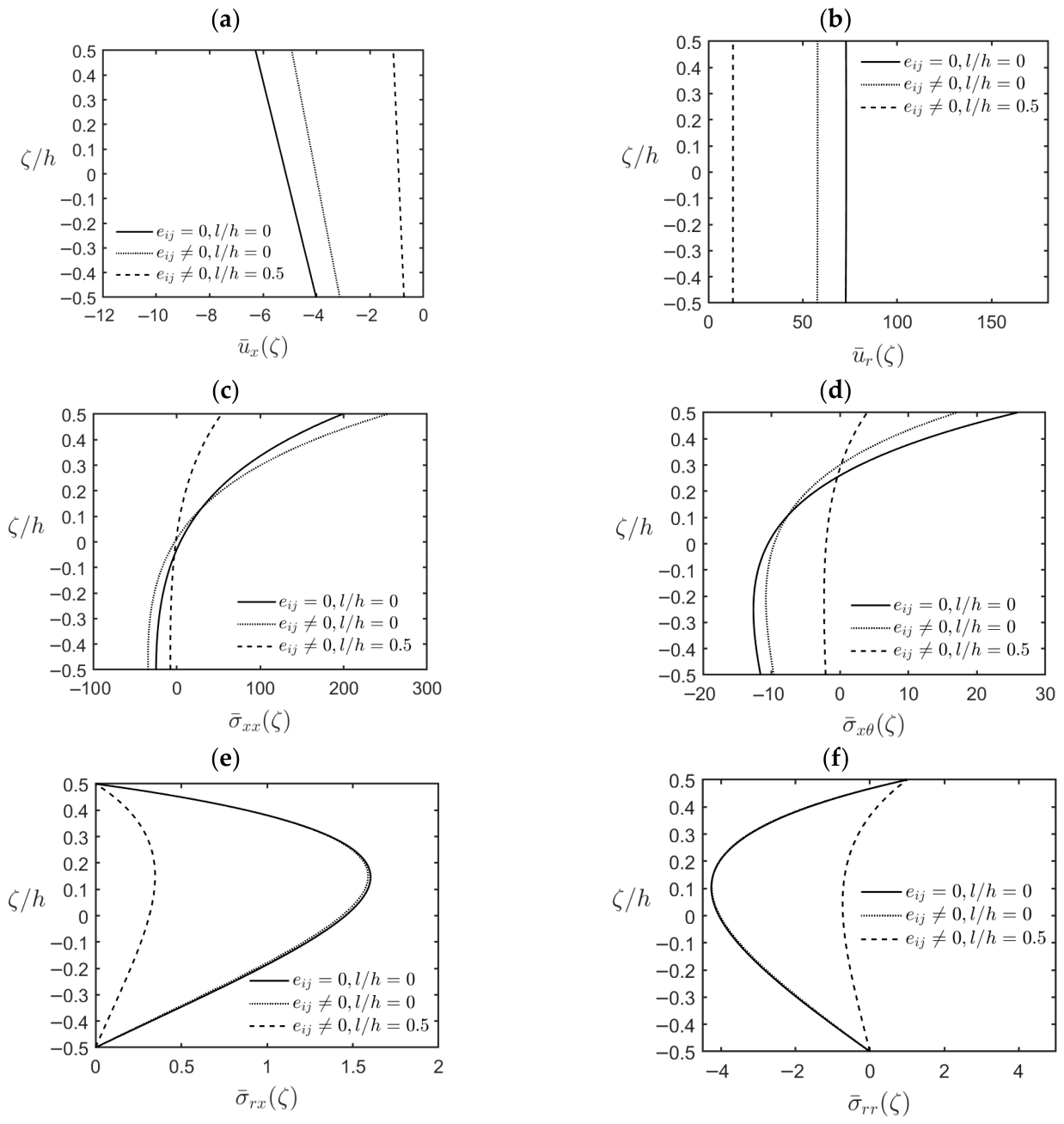
- The piezoelectric effect stiffened the microcylinder, resulting in decreased displacements and in-surface and transverse stresses within the microcylinder.
- In the case of l/h = 0.5 and the material length-scale parameter’s effect on the displacements and stresses induced in the microcylinder was more significant than the piezoelectric effect.
Author Contributions
Funding
Institutional Review Board Statement
Informed Consent Statement
Data Availability Statement
Conflicts of Interest
Abbreviations
| CCM | Classical continuum mechanics |
| CCST | Consistent couple-stress theory |
| CST | Couple stress theory |
| EG | Exponentially graded |
| FG | Functionally graded |
| FLM | Finite layer method |
| FSDT | First-order shear deformation theory |
| HSDT | Higher-order shear deformation theory |
| MCST | Modified couple-stress theory |
| PVDF | Polyvinylidene difluoride |
| PZT | Lead zirconium titanate |
| RSDT | Refined shear deformation theory |
| 2D | Two-dimensional |
| 3D | Three-dimensional |
Appendix A. The Detailed Expressions of Relevant Shape Functions
Appendix B. The Detailed Expressions of
References
- Gartia, A.K.; Chakraverty, S. Advanced computational modeling and mechanical behavior analysis of multi-directional functionally graded nanostructures: A comprehensive review. Comput. Model. Eng. Sci. 2025, 142, 2405–2455. [Google Scholar] [CrossRef]
- Sayyad, A.S.; Wagh, H.N. A review of production techniques, classifications, material gradation rules, and industrial applications of functionally graded materials. J. Ceram. Compos. 2026, 2, 23–57. [Google Scholar]
- Doan, D.V.; Minh, P.V.; Ke, T.V.; Nhung, N.T.C.; Thom, D.V. An overview of functionally graded materials: From civil applications to defense and aerospace industries. J. Vibr. Eng. Technol. 2025, 13, 68. [Google Scholar] [CrossRef]
- Wu, C.P.; Tan, T.F.; Hsu, H.T. A size-dependent finite element method for the 3D free vibration analysis of functionally graded graphene platelets-reinforced composite cylindrical microshells based on the consistent couple stress theory. Materials 2023, 16, 2363. [Google Scholar] [CrossRef]
- Wu, C.P.; Liu, Y.C. A review of semi-analytical numerical methods for laminated composite and multilayered functionally graded elastic/piezoelectric plates and shells. Compos. Struct. 2016, 47, 1–15. [Google Scholar] [CrossRef]
- Wu, C.P.; Chiu, K.H.; Wang, Y.M. A review on the three-dimensional analytical approaches of multilayered and functionally graded piezoelectric plates and shells. CMC-Comput. Mater. Contin. 2008, 8, 93–132. [Google Scholar]
- Wu, C.P.; Li, K.W. Multi-objective optimization of functionally graded beams using a genetic algorithm with non-dominated sorting. J. Compos. Sci. 2021, 5, 92. [Google Scholar] [CrossRef]
- Ding, S.; Wu, C.P. Optimization of material composition to minimize the thermal stresses induced in FGM plates with temperature-dependent material properties. Int. J. Mech. Mater. Des. 2018, 14, 527–549. [Google Scholar] [CrossRef]
- Liu, Y.; Qin, Z.; Chu, F. Investigation of magneto-electro-thermo-mechanical loads on nonlinear forced vibrations of composite cylindrical shells. Commun. Nonlin. Sci. Numer. Simul. 2022, 107, 106146. [Google Scholar] [CrossRef]
- Wu, C.P.; Chang, T.Y. A size-dependent element-free Galerkin method for analyzing the three-dimensional free vibration characteristics of functionally graded cylindrical microshells based on the consistent strain gradient theory. Mech. Bas. Des. Struct. Mach. 2026, 54, 2564815. [Google Scholar] [CrossRef]
- Tian, Y.; Xiang, W. A novel analytical solution method for eigen-buckling of microplates based on a modified strain gradient theory. Meccanica 2026, 61, 11. [Google Scholar] [CrossRef]
- Kaur, M.; Kumar, S.; Sharma, V. Dynamics of horizontal shear waves propagating in size-dependent sandwich plates using consistent couple stress theory. Phys. Mesomech. 2025, 28, 547–568. [Google Scholar] [CrossRef]
- Tounsi, A.; Kaci, A.; Tounsi, A.; Al-Osta, M.A.; Yaylaci, M.; Mohamed, S.M.Y.; Althobaiti, S.; Selim, M.M. Quasi-3D plate theory for size-dependent static and free vibration analysis of FG microplate with porosities based on a modified couple stress theory. Mech. Adv. Mater. Struct. 2026, 33, 2462687. [Google Scholar] [CrossRef]
- Shang, Y.; Pan, M.D.; Cen, S.; Li, C.F. Challenges and advances in conventional finite elements for couple stress elasticity: A comprehensive review. Arch. Comput. Methods Eng. 2026, 33, 3059–3079. [Google Scholar] [CrossRef]
- Song, Z.W.; Lai, S.K.; Lim, C.W. A new insight into the paradoxical integral and differential constitutive relations of Eringen nonlocal theory. J. Eng. Mech. 2025, 151, 04024112. [Google Scholar] [CrossRef]
- Song, Z.W.; Lai, S.K.; Lim, C.W.; Li, C. Theoretical examination for the consistency of Eringen’s nonlocal theories in nanomaterial modeling. Int. J. Appl. Mech. 2025, 17, 2550044. [Google Scholar] [CrossRef]
- Karamanli, A.; Nguyen, N.D.; Lee, S.; Vo, T.P. Improved FSDT for forced vibration analysis of nanobeams under moving concentrated loads via doublet mechanics. Mech. Bas. Des. Struct. Mach. 2026, 54, 2548857. [Google Scholar] [CrossRef]
- Ailawalia, P.; Ajay, K.J.; Marin, M. Analysis of a functionally graded orthotropic micropolar solid with non-homogeneous properties along two directions. Mech. Bas. Des. Struct. Mach. 2026, 54, 2543552. [Google Scholar] [CrossRef]
- Wu, C.P.; Hsu, H.T. A Hermitian Cn finite cylindrical layer method for 3D size-dependent buckling and free vibration analyses of simply supported FG piezoelectric cylindrical sandwich microshells subjected to axial compression and electric voltages. Z. Angew. Math. Mech. 2024, 104, e202300472. [Google Scholar] [CrossRef]
- Shaban, M.; Minaeii, S.; Kalhori, H. Size-dependent flexural analysis of thick microplates using consistent couple stress theory. J. Compos. Sci. 2025, 9, 142. [Google Scholar] [CrossRef]
- Zhang, M.; Guo, J. Bending, free vibration and buckling of layered piezoelectric semiconductor nanoplates based on modified couple stress theory. Acta Mech. 2025, 236, 519–540. [Google Scholar] [CrossRef]
- Toupin, R.A. Elastic materials with couple-stresses. Arch. Ration. Mech. Anal. 1962, 11, 385–414. [Google Scholar] [CrossRef]
- Mindlin, R.D.; Tiersten, H.F. Effects of couple-stresses in linear elasticity. Arch. Ration. Mech. Anal. 1962, 11, 415–448. [Google Scholar] [CrossRef]
- Koiter, W.T. Couple stresses in the theory of elasticity, I and II. Phil. Trans. Roy. Soc. Lond. B 1964, 67, 17–44. [Google Scholar]
- Eringen, A.C. Theory of micropolar elasticity. In Fracture; Eringen, A.C., Ed.; Academic Press: New York, NY, USA, 1968. [Google Scholar]
- Hadjesfandiari, A.R.; Dargush, G.F. Couple stress theory for solids. Int. J. Solids Struct. 2011, 48, 2496–2510. [Google Scholar] [CrossRef]
- Hadjesfandiari, A.R. Size-dependent piezoelectricity. Int. J. Solids Struct. 2013, 50, 2781–2791. [Google Scholar] [CrossRef]
- Yang, F.; Chong, A.C.M.; Lam, D.C.C.; Tong, P. Couple stress-based strain gradient theory for elasticity. Int. J. Solids Struct. 2002, 39, 2731–2743. [Google Scholar] [CrossRef]
- Babadi, A.F.; Beni, Y.T. Size-dependent continuum-based model of a flexoelectric functionally graded cylindrical nanoshell. Math. Methods Appl. Sci. 2020, 2020, 5860–5885. [Google Scholar]
- Wei, L.; Qing, H. Bending, buckling and vibration analysis of bi-directional functionally graded circular/annular microplate based on MCST. Compos. Struct. 2022, 292, 115633. [Google Scholar] [CrossRef]
- Wu, C.P.; Lin, E.L. Free vibration analysis of porous functionally graded piezoelectric microplates resting on an elastic medium subjected to electric voltages. Arch. Mech. 2022, 74, 463–511. [Google Scholar]
- Wu, C.P.; Hu, H.X. A unified size-dependent plate theory for static bending and free vibration analyses of micro- and nano-scale plates based on the consistent couple stress theory. Mech. Mater. 2021, 162, 104085. [Google Scholar] [CrossRef]
- Beni, Y.T.; Mehralian, F.; Zeighampour, H. The modified couple stress functionally graded cylindrical thin shell formulation. Mech. Adv. Mater. Struct. 2016, 23, 791–801. [Google Scholar] [CrossRef]
- Zeighampour, H.; Shojaeian, M. Buckling analysis of functionally graded sandwich cylindrical micro/nanoshells based on the couple stress theory. J. Sandw. Struct. Mater. 2019, 21, 917–937. [Google Scholar] [CrossRef]
- Razavi, H.; Babadi, A.F.; Beni, Y.T. Free vibration analysis of functionally graded piezoelectric cylindrical. Compos. Struct. 2017, 160, 1299–1309. [Google Scholar] [CrossRef]
- Beni, Y.T.; Mehralian, F.; Razavi, H. Free vibration analysis of size-dependent shear deformable functionally graded cylindrical shell on the basis of modified couple stress theory. Compos. Struct. 2015, 120, 65–78. [Google Scholar] [CrossRef]
- Arefi, M. Third-order electro-elastic analysis of sandwich doubly curved piezoelectric micro shells. Mech. Bas. Des. Struct. Mach. 2021, 49, 781–810. [Google Scholar] [CrossRef]
- Wang, Y.; Xie, K.; Fu, T.; Zhang, W. A unified modified couple stress model for size-dependent free vibrations of FG cylindrical microshells based on high-order shear deformation theory. Eur. Phys. J. Plus 2020, 135, 71. [Google Scholar] [CrossRef]
- Zhang, X.; Wang, C.; Hu, P. 18-DOF triangular quasi-conforming element for couple stress theory. CMES-Comput. Model. Eng. 2016, 111, 473–492. [Google Scholar]
- Wu, C.P.; Lu, Y.A. A Hermite-family C1 finite layer method for the three-dimensional free vibration analysis of exponentially graded piezoelectric microplates based on the consistent couple stress theory. Int. J. Struct. Stab. Dyn. 2023, 23, 2350044. [Google Scholar] [CrossRef]
- Wu, C.P.; Hsu, C.H. A three-dimensional weak formulation for stress, deformation, and free vibration analyses of functionally graded microscale plates based on the consistent couple stress theory. Compos. Struct. 2022, 296, 115829. [Google Scholar] [CrossRef]
- Saada, A.S. Elasticity Theory and Applications; Pergamon Press: New York, NY, USA, 1974. [Google Scholar]
- Reddy, J.N. Energy and Variational Methods in Applied Mechanics; Wiley: New York, NY, USA, 1984. [Google Scholar]
- Kapuria, S.; Sengupta, S.; Dumir, P.C. Assessment of shell theories for hybrid piezoelectric cylindrical shell under electromechanical load. Int. J. Mech. Sci. 1998, 40, 461–477. [Google Scholar] [CrossRef]
- Zhong, Z.; Shang, E.T. Three-dimensional exact analysis of a simply supported functionally graded piezoelectric plate. Int. J. Solids Struct. 2003, 40, 5335–5352. [Google Scholar] [CrossRef]
- Wu, C.P.; Syu, Y.S.; Lo, J.Y. Three-dimensional solutions of multilayered piezoelectric hollow cylinders by an asymptotic approach. Int. J. Mech. Sci. 2007, 49, 669–689. [Google Scholar] [CrossRef]
- Kapuria, S.; Sengupta, S.; Dumir, P.C. Three-dimensional solutions for simply-supported piezoelectric cylindrical shell for axisymmetric load. Comput. Meth. Appl. Mech. Eng. 1997, 140, 139–155. [Google Scholar] [CrossRef]
- Lam, D.C.C.; Yang, F.; Chong, A.C.M.; Wang, J.; Tong, P. Experiments and theory in strain gradient elasticity. J. Mech. Phys. Solids 2003, 51, 1477–1508. [Google Scholar] [CrossRef]




| Moduli | PVDF (Kapuria et al. [44]) | PZT-4 (Zhong and Shang [45]) |
|---|---|---|
| c11 (GPa) | 3.0 | 139 |
| c22 (GPa) | 3.0 | 139 |
| c33 (GPa) | 3.0 | 115 |
| c12 (GPa) | 1.5 | 77.8 |
| c13 (GPa) | 1.5 | 74.3 |
| c23 (GPa) | 1.5 | 74.3 |
| c44 (Gpa) | 0.75 | 25.6 |
| c55 (Gpa) | 0.75 | 25.6 |
| c66 (Gpa) | 0.75 | 30.6 |
| e24 (C/m2) | 0.0 | 12.7 |
| e15 (C/m2) | 0.0 | 12.7 |
| e31 (C/m2) | −0.15 × 10⁻² | −5.2 |
| e32 (C/m2) | 0.285 × 10⁻¹ | −5.2 |
| e33 (C/m2) | −0.51 × 10⁻¹ | 15.1 |
| η11 (C2/Nm2) | 0.1062 × 10⁻⁹ | 6.46 × 10⁻⁹ |
| η22 (C2/Nm2) | 0.1062 × 10⁻⁹ | 6.46 × 10⁻⁹ |
| η33 (C2/Nm2) | 0.1062 × 10⁻⁹ | 5.62 × 10⁻⁹ |
| l (m) a | 8.8 × 10⁻⁶ | 8.8 × 10⁻⁶ |
| (m) a | 17.6 × 10⁻⁶ | 17.6 × 10⁻⁶ |
| R/h | Theories | |||||||||||
|---|---|---|---|---|---|---|---|---|---|---|---|---|
| 4 | Hermitian C2 FLM (nl = 1) | 0.43729 | 1.04655 | 0.63721 | 0.81996 | 0.34774 | −0.38417 | 1.04155 | 1.23225 | 0.07125 | 0.58587 | 1.58097 |
| Hermitian C2 FLM (nl = 2) | 0.43729 | 1.04655 | 0.63721 | 0.81996 | 0.34778 | −0.38421 | 1.04156 | 1.23224 | 0.07125 | 0.58587 | 1.58100 | |
| Asymptotic solutions (Wu et al. [46]) | 0.4373 | 1.0466 | 0.6372 | 0.8200 | 0.3478 | −0.3842 | 1.042 | 1.232 | 0.0712 | 0.5859 | 1.581 | |
| 3D solutions (Kapuria et al. [47]) | 0.4373 | 1.0466 | 0.6372 | 0.8200 | 0.3478 | −0.3842 | 1.042 | 1.232 | 0.0712 | 0.5859 | 1.581 | |
| 10 | Hermitian C2 FLM (nl = 1) | 0.42819 | 1.01726 | 0.71591 | 0.79131 | 0.34732 | −0.36234 | 1.01327 | 1.09055 | 0.06957 | 0.53463 | 1.58695 |
| Hermitian C2 FLM (nl = 2) | 0.42819 | 1.01726 | 0.71591 | 0.79131 | 0.34732 | −0.36234 | 1.01327 | 1.09054 | 0.06957 | 0.53463 | 1.58695 | |
| Asymptotic solutions (Wu et al. [46]) | 0.4282 | 1.0173 | 0.7159 | 0.7913 | 0.3474 | −0.3623 | 1.013 | 1.091 | 0.0696 | 0.5346 | 1.587 | |
| 3D solutions (Kapuria et al. [47]) | 0.4282 | 1.0173 | 0.7159 | 0.7913 | 0.3473 | −0.3623 | 1.013 | 1.091 | 0.0696 | 0.5346 | 1.587 | |
| 100 | Hermitian C2 FLM (nl = 1) | 0.42474 | 1.00167 | 0.76166 | 0.76931 | 0.34483 | −0.34634 | 1.00112 | 1.00892 | 0.06786 | 0.50347 | 1.58366 |
| Hermitian C2 FLM (nl = 2) | 0.42474 | 1.00167 | 0.76166 | 0.76931 | 0.34483 | −0.34634 | 1.00112 | 1.00892 | 0.06786 | 0.50347 | 1.58366 | |
| Asymptotic solutions (Wu et al. [46]) | 0.4247 | 1.0017 | 0.7617 | 0.7693 | 0.3448 | −0.3463 | 1.001 | 1.009 | 0.0679 | 0.5035 | 1.584 | |
| 3D solutions (Kapuria et al. [47]) | 0.4247 | 1.002 | 0.7617 | 0.7693 | 0.3448 | −0.3463 | 1.001 | 1.009 | 0.0679 | 0.5035 | 1.584 |
| R/h | Theories | |||||||||||
|---|---|---|---|---|---|---|---|---|---|---|---|---|
| 4 | Hermitian C2 FLM (nl = 1) | 0.19377 | −0.63721 | −53.9941 | −68.0172 | −0.09738 | 0.12349 | 0.45624 | −0.54903 | −0.21576 | −0.12375 | 0.52845 |
| Hermitian C2 FLM (nl = 2) | 0.19377 | −0.63721 | −53.9939 | −68.0175 | −0.09742 | 0.12354 | 0.45620 | −0.54897 | −0.21577 | −0.12376 | 0.52845 | |
| Asymptotic solutions (Wu et al. [46]) | 0.1938 | −0.6372 | −53.99 | −68.02 | −0.0974 | 0.1235 | 0.4562 | −0.5490 | −0.2158 | −0.1238 | 0.528 | |
| 3D solutions (Kapuria et al. [47]) | 0.1938 | −0.6372 | −53.49 | −68.02 | −0.0974 | 0.1235 | 0.4562 | −0.5490 | −0.2158 | −0.1238 | 0.528 | |
| 10 | Hermitian C2 FLM (nl = 1) | 0.15614 | −0.71591 | −57.4170 | −63.2631 | −0.11982 | 0.13076 | 0.45702 | −0.49342 | −0.24578 | −0.11850 | 0.51197 |
| Hermitian C2 FLM (nl = 2) | 0.15614 | −0.71591 | −57.4170 | −63.2631 | −0.11982 | 0.13076 | 0.45702 | −0.49342 | −0.24578 | −0.11850 | 0.51197 | |
| Asymptotic solutions (Wu et al. [46]) | 0.1561 | −0.7159 | −57.42 | −63.26 | −0.1198 | 0.1308 | 0.4570 | −0.4934 | −0.2458 | −0.1185 | 0.512 | |
| 3D solutions (Kapuria et al. [47]) | 0.1561 | −0.7159 | −57.42 | −63.28 | −0.1198 | 0.1308 | 0.4570 | −0.4934 | −0.2458 | −0.1185 | 0.512 | |
| 100 | Hermitian C2 FLM (nl = 1) | 0.13032 | −0.76166 | −59.9128 | −60.5131 | −0.13133 | 0.13244 | 0.45973 | −0.46335 | −0.25896 | −0.11538 | 0.50123 |
| Hermitian C2 FLM (nl = 2) | 0.13032 | −0.76166 | −59.9128 | −60.5131 | −0.13133 | 0.13244 | 0.45973 | −0.46335 | −0.25896 | −0.11538 | 0.50123 | |
| Asymptotic solutions (Wu et al. [46]) | 0.1303 | −0.7617 | −59.91 | −60.51 | −0.1313 | 0.1324 | 0.4597 | −0.4634 | −0.2590 | −0.1154 | 0.501 | |
| 3D solutions (Kapuria et al. [47]) | 0.1303 | −0.7617 | −59.91 | −60.51 | −0.1313 | 0.1324 | 0.4597 | −0.4634 | −0.2590 | −0.1154 | 0.501 |
Disclaimer/Publisher’s Note: The statements, opinions and data contained in all publications are solely those of the individual author(s) and contributor(s) and not of MDPI and/or the editor(s). MDPI and/or the editor(s) disclaim responsibility for any injury to people or property resulting from any ideas, methods, instructions or products referred to in the content. |
© 2026 by the authors. Licensee MDPI, Basel, Switzerland. This article is an open access article distributed under the terms and conditions of the Creative Commons Attribution (CC BY) license.
Share and Cite
Wu, C.-P.; Hsu, H.-T. A Semi-Analytical Finite Layer Method for Analyzing the 3D Coupled Electro-Mechanical Behavior of Exponentially Graded Piezoelectric Circular Hollow Microscale Cylinders. Appl. Mech. 2026, 7, 44. https://doi.org/10.3390/applmech7020044
Wu C-P, Hsu H-T. A Semi-Analytical Finite Layer Method for Analyzing the 3D Coupled Electro-Mechanical Behavior of Exponentially Graded Piezoelectric Circular Hollow Microscale Cylinders. Applied Mechanics. 2026; 7(2):44. https://doi.org/10.3390/applmech7020044
Chicago/Turabian StyleWu, Chih-Ping, and Hao-Ting Hsu. 2026. "A Semi-Analytical Finite Layer Method for Analyzing the 3D Coupled Electro-Mechanical Behavior of Exponentially Graded Piezoelectric Circular Hollow Microscale Cylinders" Applied Mechanics 7, no. 2: 44. https://doi.org/10.3390/applmech7020044
APA StyleWu, C.-P., & Hsu, H.-T. (2026). A Semi-Analytical Finite Layer Method for Analyzing the 3D Coupled Electro-Mechanical Behavior of Exponentially Graded Piezoelectric Circular Hollow Microscale Cylinders. Applied Mechanics, 7(2), 44. https://doi.org/10.3390/applmech7020044