1. Introduction
Existing reinforced concrete (RC) structures frequently require reassessment because service demands, load combinations, and performance expectations evolve over time. In such contexts, accurate estimation of current flexural stiffness—rather than only ultimate strength—becomes critical for evaluating deflection limits, crack control, and reserve capacity during upgrades or changes in occupancy. Time-dependent phenomena, particularly creep and shrinkage, drive progressive curvature growth under sustained bending. Simultaneously, cracking and tension stiffening evolve, producing stiffness states that depend on both load level and load history. Credible structural evaluation therefore requires an evidence-based understanding of (a) how sustained loading modifies the stiffness of cracked RC beams upon reloading and (b) how such effects can be represented within section-based numerical tools suitable for engineering assessment. The present study is motivated by these needs and investigates the experimentally observable—and numerically reproducible—mechanisms governing creep-induced stiffness reduction and subsequent cyclic response in RC beams [
1].
In recent years, structural resilience and life-cycle performance frameworks have emphasized the role of time-dependent degradation mechanisms in reinforced concrete systems. Probabilistic and reliability-based investigations demonstrate that aging, corrosion, and long-term deterioration significantly influence structural performance metrics [
2,
3]. Experimental studies further show that sustained loading combined with environmental exposure can accelerate degradation and alter stiffness evolution in RC members [
4,
5]. While these works contribute to durability and reliability assessment, relatively limited attention has been given to directly quantifying how prolonged sustained service-level loading affects subsequent load–unload response and functional stiffness recovery in flexural members. In requalification scenarios, the key question extends beyond accumulated creep deflection to whether prior sustained loading alters the structural resilience of RC beams when subjected to renewed or cyclic demands.
RC behaves as a coupled composite in which compressive concrete exhibits time-dependent strains, while the tensile zone response is governed by cracking, bond behavior, and tension stiffening. Under sustained bending, creep increases compressive strains and redistributes stresses, whereas shrinkage introduces additional curvature through restraint and differential strains. Contemporary predictive frameworks underscore both the importance and uncertainty of creep–shrinkage modeling. The RILEM B3 recommendation [
6] remains a widely adopted reference, while the later RILEM B4 model [
7] extends applicability to multi-decade predictions and broader calibration. These formulations highlight that reliable long-term deformation estimates require explicit consideration of aging, drying, and environmental influences.
Beyond code-based models, mechanistic and semi-mechanistic approaches continue to refine understanding of time-dependent behavior. Solidification-theory-inspired models incorporate aging more explicitly in creep and shrinkage evolution, enabling step-by-step analysis [
8]. Multiscale investigations further link macroscopic creep and shrinkage to humidity-driven microcracking and C–S–H mechanisms, explaining the nonlinear sensitivity of time-dependent deformation to environmental conditions [
9]. Collectively, these studies reinforce a key structural implication: long-term stiffness is not constant but emerges from interacting viscoelasticity, cracking, drying, and bond-mediated load transfer.
In practice, flexural stiffness is often represented using effective inertia or equivalent-section concepts that approximate cracking, tension stiffening, and time-dependent deformation. However, simplified deflection models may produce systematic bias when cracking states or reinforcement types vary. Bischoff’s re-evaluation of effective moment-of-inertia formulations illustrates the need for modeling approaches consistent with actual cracking and tension stiffening behavior [
10].
Importantly, tension stiffening itself evolves with time. Empirical and mechanistic studies suggest that cumulative cracking and internal damage reduce the concrete contribution between cracks under sustained loading. Beeby and Scott report that tension stiffening can decay toward a long-term value within weeks, implying that instantaneous serviceability stiffness may not represent the stiffness governing months-long deformation [
11].
Shrinkage further complicates stiffness interpretation. Sectional analyses based on measured curvature may misidentify stiffness if shrinkage-induced strains are not separated from load-induced strains. Kaklauskas proposed methods to eliminate shrinkage effects from moment–curvature relationships [
12], while subsequent work emphasized the direct influence of shrinkage on tension stiffening behavior [
13]. Thus, cracked stiffness reflects not only applied moment but also shrinkage and bond interactions.
Load history introduces an additional dimension. Experimental comparisons between sustained and repeated loading show that repeated loading can produce larger deformations and permanent stiffness reductions due to cracking and bond deterioration [
14]. Computational approaches addressing combined sustained and repeated loading highlight cyclic creep and stiffness evolution as governing mechanisms [
15]. At a mechanistic level, cyclic creep is linked to fatigue growth of subcritical microcracks, as formalized by Bažant and Hubler [
16], providing a theoretical bridge between repeated loading and time-dependent strain accumulation. These mechanisms affect both compression-zone creep and tension-zone cracking, thereby modifying reloading stiffness.
Serviceability performance is further influenced by crack evolution under repeated loads. Oh and Kim developed crack-width models incorporating bond stress–slip behavior and residual crack states [
17], linking crack development directly to stiffness degradation and unloading slopes.
Long-term beam experiments provide essential validation benchmarks. Early studies demonstrated the feasibility and sensitivity of curvature-based prediction for long-term deflection [
18]. More recent investigations confirm that sustained load magnitude significantly influences creep–shrinkage development and motivate improved predictive formulations [
19]. Reybrouck et al. [
1] presented rare multi-month datasets under high sustained loads, highlighting both the scarcity and value of such experiments. Other programs varying sustained load levels and examining post-creep behavior provide insight into how prior loading histories influence subsequent performance [
20,
21].
From a modeling perspective, section-based layered or fiber approaches offer an effective balance between physical representation and computational tractability. Such models can incorporate nonlinear compression, cracked tension with tension stiffening, reinforcement response, and time-dependent strain components. Layered formulations have been successfully applied to long-term deflection prediction while retaining cracking-state dependence [
22]. Extended nonlinear frameworks accounting for creep, shrinkage, and cracking in continuous beams further demonstrate the structural implications of time-dependent effects [
23]. Constitutive-equivalent strategies for serviceability analysis integrate instantaneous and time-dependent behavior within practical modeling environments [
24].
Nevertheless, although stiffness deterioration under repeated loading has been examined experimentally [
25,
26], most investigations focus on short-term cyclic degradation or strengthened members subjected to fatigue-type regimes. Few studies have systematically combined long-duration sustained loading with subsequent controlled loading–unloading cycles to isolate residual stiffness degradation in unstrengthened RC beams. Moreover, while cyclic concrete models are well established, validated section-based frameworks that simultaneously represent creep, cracking evolution, cyclic damage, and post-exposure reloading stiffness remain limited.
Despite significant advances in creep modeling and cyclic behavior analysis, a gap persists in directly linking sustained creep exposure to subsequent load–unload stiffness response governing structural resilience and requalification decisions. Long-term deflection, cyclic degradation, and fatigue are often treated independently, and experimental evidence quantifying stiffness loss without proportional reduction in ultimate capacity remains scarce.
Building on established creep–shrinkage models and tension-stiffening-based sectional analysis, the present study addresses this gap by: (i) experimentally characterizing residual flexural and cyclic behavior of RC beams after prolonged sustained loading; (ii) evaluating creep-induced effects on structural resilience as reflected in load–unload stiffness response; and (iii) developing and validating a layered fiber model capable of reproducing creep–damage interaction and post-exposure cyclic stiffness trends. The combined experimental–numerical framework provides a physically interpretable and practically implementable pathway for assessing existing RC beams subjected to sustained service loads and evolving structural demands.
In addition to the above considerations, it is worth noting that the authors have recently developed a complementary 1D finite-element framework enabling the physically based simulation of long-term creep, tension-stiffening decay, and creep-induced damage evolution in reinforced-concrete members [
27]. This new framework, validated against an extensive database of 55 RC beams, provides independent confirmation of the numerical robustness of the layered-section formulation and of the adopted Newton–Raphson solution strategy. Building on this broader foundation, the present paper focuses on a different and largely unexplored aspect of long-term behavior: the residual stiffness, cyclic response, and reloading characteristics of RC beams after prolonged sustained loading. This distinction ensures that the present contribution remains original and complementary to recent advances while addressing a critical gap regarding post-creep structural resilience.
The novelty of this study lies in providing new experimental evidence on the reloading stiffness, residual curvature, and cyclic response of RC beams after prolonged sustained loading, behaviors that are rarely documented in previous long-term investigations. In addition, the combined experimental–numerical framework developed here offers a practical tool for structural assessment, allowing engineers to quantify stiffness loss and evaluate the post-creep performance of existing RC members.
3. Numerical Model
3.1. Constitutive Model for Cyclic Compression of Concrete
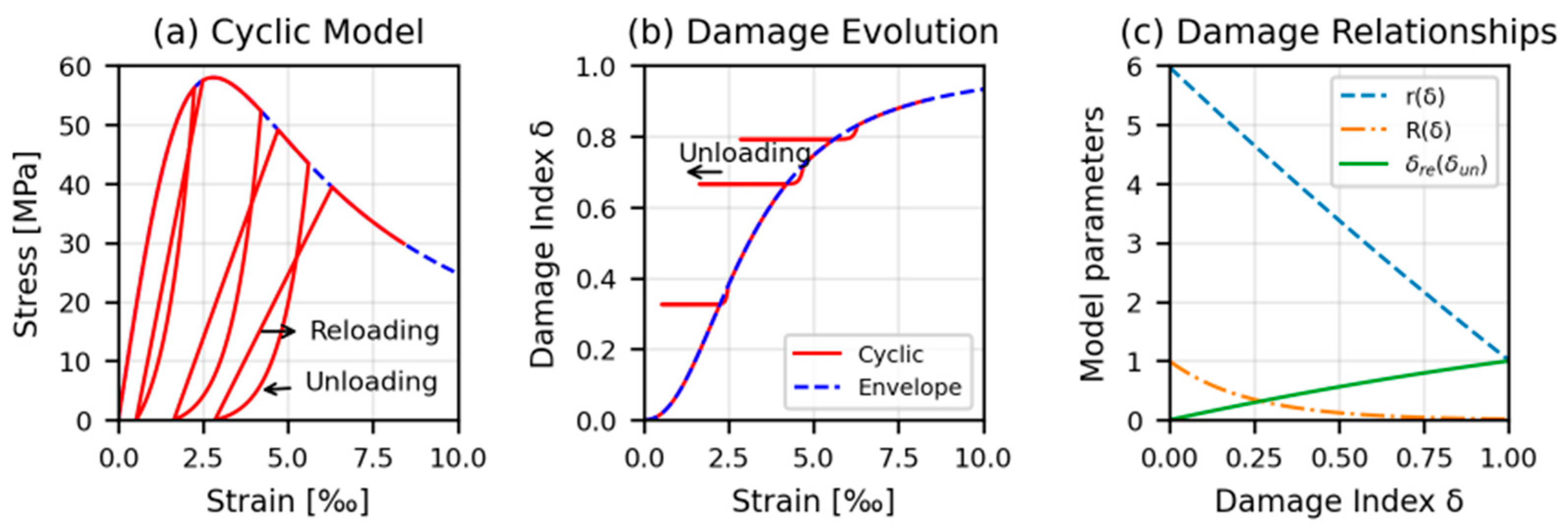
A uniaxial constitutive model for plain concrete subjected to cyclic compressive loading is adopted. The model is based on the envelope theory and on a scalar damage variable, following the framework proposed by Breccolotti et al. [
33]. The formulation is intended to reproduce stiffness degradation, plastic strain accumulation, and progressive damage growth under arbitrary cyclic compression histories. According to this model, all stress–strain paths remain on or below the monotonic compressive envelope curve, with a unique relationship between points on this curve and the damage variable. Damage is an irreversible, non-decreasing internal parameter that does not evolve during unloading, while plastic strain and unloading stiffness are solely determined by the current damage level. During reloading, damage progresses in a nonlinear manner, accelerating as the envelope curve is approached, reflecting the increasing material degradation near peak stress.
The compressive envelope curve is represented by a Carreira and Chu [
34] stress–strain model, calibrated to comply with the material properties specified in Eurocode 2 [
35]. This model was selected in this work instead of the Collins model adapted in Breccolotti et al. [
33] because of its superior ability to capture stress degradation along the descending branch up to large deformations. The compressive stress is expressed as:
The damage variable
is defined as a function of the strain on the envelope curve:
This definition ensures that damage increases monotonically with strain and reaches unity asymptotically at very large strains. The formulation is consistent with the definition proposed by Breccolotti et al. and allows the envelope curve to be interpreted as a sequence of damage states.
For a given damage level δun corresponding to an unloading point on the envelope curve, the plastic strain εpl obtained after complete unloading is determined through the ratio
where the parameter r is expressed as a polynomial function of damage [
33]:
This relationship, calibrated from experimental data, ensures a unique correspondence between damage and residual plastic strain and reflects the increased irreversibility associated with higher damage levels.
Unloading from a point on the envelope curve is characterized by a nonlinear stress–strain relationship. During unloading, damage remains constant .
The unloading stress is defined as:
where the parameters D1 and D2 are given by
,
. R is the ratio between the unloading tangent modulus and the initial elastic modulus
. This formulation ensures continuity of stress and stiffness at the unloading point and reproduces the experimentally observed degradation of unloading stiffness.
After complete unloading, reloading occurs linearly in the stress–strain space until the envelope curve is reached again. The damage level associated with the reloading intersection point is computed as [
33]:
The corresponding strain is obtained by inversing the envelope damage law. Damage evolution during reloading is nonlinear and governed by:
where
and the parameters
, were calibrated against experimental cyclic compression tests. This formulation ensures slow damage growth at low stress levels and rapid accumulation as the envelope curve is approached.
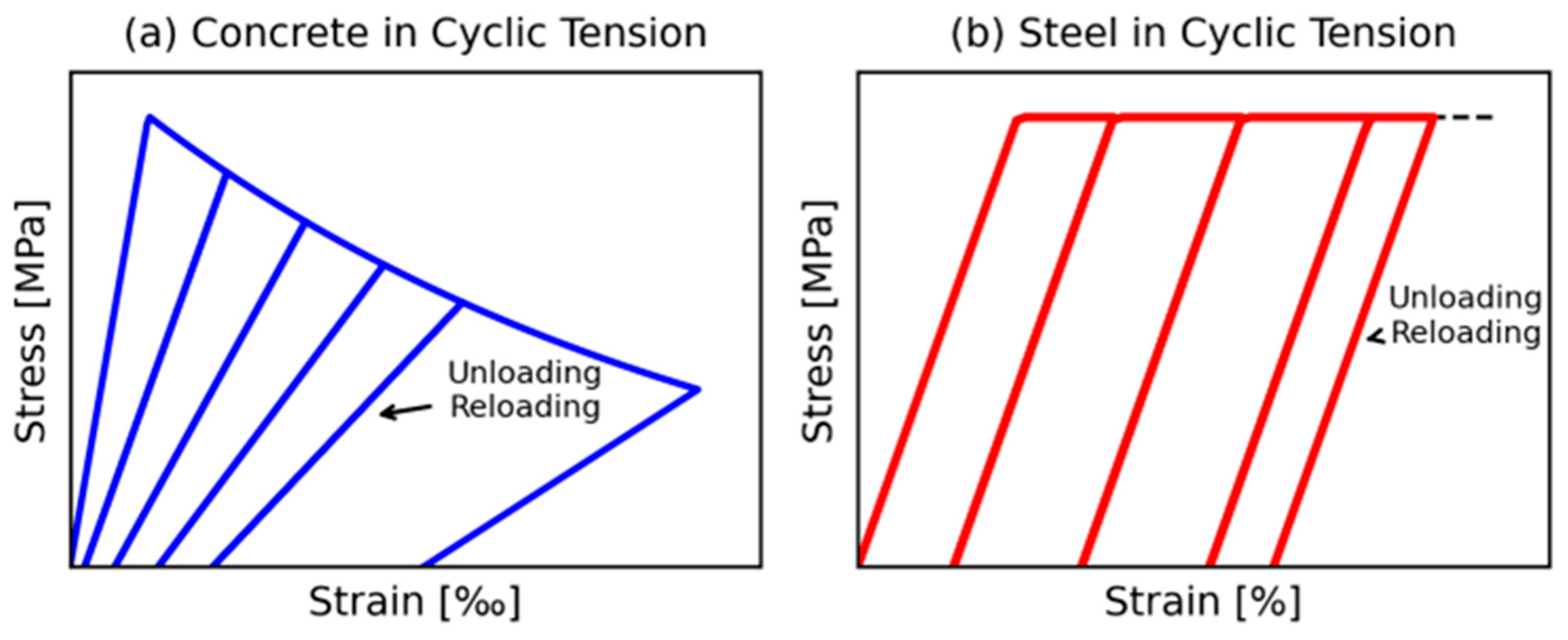
The constitutive model allows simulation of arbitrary cyclic compression histories. Each cycle consists of loading along the envelope, unloading at constant damage to zero stress, and reloading with nonlinear damage accumulation. Progressive cycles lead to increasing residual strains, stiffness degradation, and a gradual shift in the stress–strain response toward the descending branch of the envelope curve. The model is illustrated in
Figure 5.
3.2. Constitutive Model for Cyclic Tension of Concrete
The cyclic tensile response of concrete adopted in this study is based on the constitutive model proposed by Sima et al. [
36]. The formulation describes the tensile behavior of concrete through a fracture-energy-based softening law combined with stiffness degradation during unloading and reloading cycles. The monotonic tensile envelope is defined by a linear elastic branch up to the tensile strength
fctm followed by an exponential softening branch. The stress–strain relationship is expressed as:
α is a material parameter governing the post-peak softening behavior. To ensure objectivity with respect to the characteristic length of the finite element mesh, α is determined from the fracture energy
GF according to:
where
lch is the characteristic length associated with the crack bandwidth.
Cyclic loading effects are incorporated by tracking the maximum tensile strain attained during the loading history. Upon unloading from a previously reached maximum strain, a linear unloading–reloading rule is adopted, in accordance with experimental observations reported by Reinhardt and adopted by Sima et al. [
36]. The unloading and reloading stiffness
Enew is assumed to degrade with increasing damage and is defined as
.
The unloading and reloading paths are defined by a straight line passing through the unloading point and intersecting the strain axis at a residual strain εpl, given by .
During unloading and reloading, the stress is therefore computed as:
This simplified implementation preserves the essential features of the cyclic tensile model proposed by Sima et al. [
36], namely the fracture-energy-based post-peak softening, stiffness degradation with increasing tensile damage, and the representation of crack opening through residual strains. The model is presented in
Figure 6a.
3.3. Constitutive Model for Cyclic Steel Behavior
The cyclic stress–strain response of reinforcing steel adopted in this study is based on an idealized uniaxial elastoplastic model with isotropic hardening neglected [
35]. The monotonic backbone curve is defined by a linear elastic branch with Young’s modulus
Es up to the yield stress
fy, followed by a perfectly plastic plateau. The stress–strain relationship for the backbone curve is given by:
where
is the yield strain.
During the loading phase of each cycle, the stress evolution is governed by elastic reloading with slope Es until the backbone curve is reached. At each incremental strain step, the trial stress obtained from elastic reloading is compared with the backbone stress corresponding to the same strain, and the minimum of the two values is selected. This loading rule ensures that the stress state never exceeds the yield surface and that plastic yielding occurs consistently once the yield stress is reached. When the prescribed maximum strain of a cycle exceeds the yield strain, plastic deformation develops. The plastic strain associated with the cycle is computed as:
This plastic strain represents the permanent deformation remaining after complete unloading.
Unloading is assumed to be purely elastic with slope Es, in agreement with classical elastoplastic theory for steel. The unloading path therefore proceeds linearly from the maximum stress point to zero stress at the accumulated plastic strain εpl. This unloading rule enforces the physical condition that, after yielding, zero stress does not correspond to zero strain but to a non-zero residual strain, reflecting irreversible plastic deformation.
At the beginning of the subsequent cycle, reloading starts from the previously accumulated plastic strain at zero stress. Reloading follows the same elastic slope
Es until the backbone curve is re-engaged, after which plastic yielding occurs again if the strain exceeds the yield threshold. In this manner, plastic strain accumulates monotonically from cycle to cycle, while the elastic stiffness remains unchanged. The model is illustrated in
Figure 6b.
3.4. Layered Fiber Model
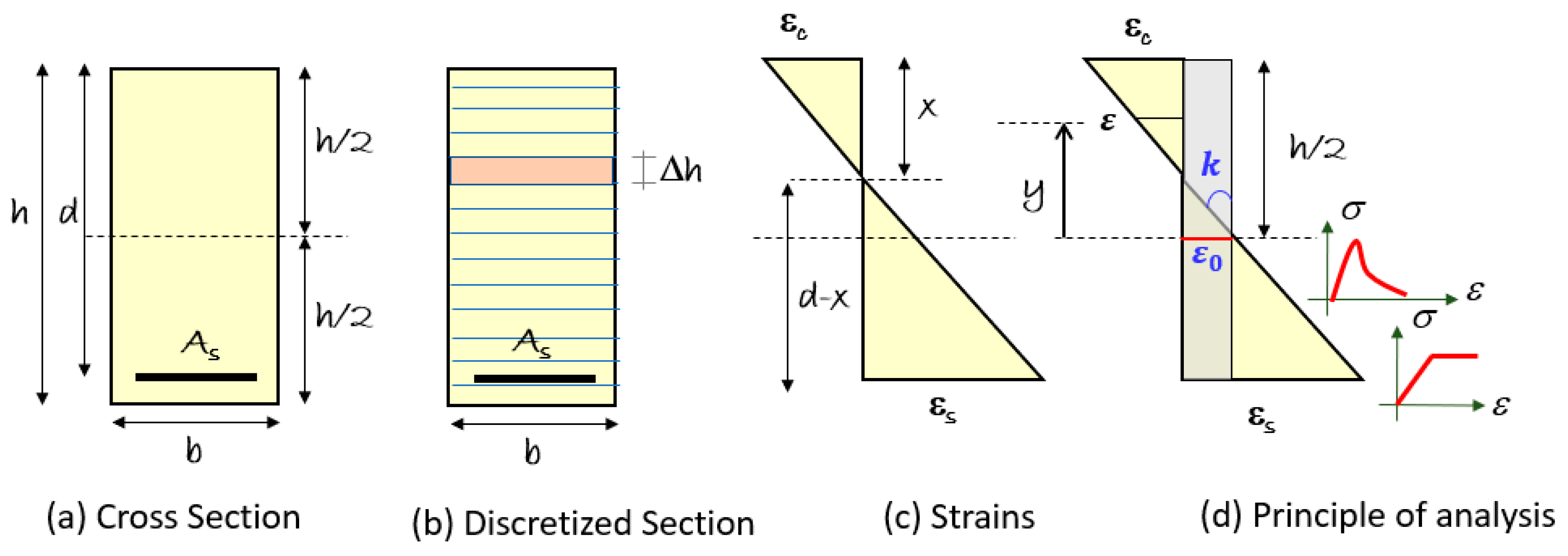
The layered fiber section model analyzes reinforced-concrete (RC) cross-sections under axial force and bending by discretizing the concrete into horizontal fibers and treating reinforcing bars explicitly [
37,
38,
39]. This established approach is adopted here to compute the instantaneous nonlinear flexural response of cracked sections with plane-sections kinematics and consistent equilibrium (
Figure 7).
Assuming plane sections remain plane, the strain at any point is expressed as
, where
ε0 is the reference strain and
κ the curvature. Concrete and steel stresses are computed from their respective constitutive laws, and section forces and moments are obtained by numerical integration across fibers and steel layers. Discretizing the section into ns concrete fibers of width b and thickness
Δh, and steel areas
As at level
ys, the axial force
N and the bending moment
Mint are:
Section equilibrium is enforced by (pure bending) or by matching a prescribed axial force, and by matching Mint to the element demand.
For a given target a two-unknown problem in (ε0,κ) is solved with Newton–Raphson. The residual vector is , and the 2 × 2 Jacobian is formed numerically (forward differences). To ensure robust convergence near stiffness transitions, a small regularization is added to the Jacobian and a back-tracking line search is used. Convergence is accepted when falls below tolerance or the trial step becomes negligible. The converged and κ define the section response returned to the 1D element routine.
During loading, stresses follow the monotonic envelopes of the stress–strain laws; during unloading, the algorithm switches automatically to the unloading branches with damage-dependent stiffness; and during reloading, the response follows the reloading paths until the envelope is re-entered, after which stresses evolve again along the envelope. Once equilibrium is reached, the curvature κ provided by the sectional solutions is integrated along the beam length to obtain the deflection, ensuring compatibility between local and global response . Applying this procedure consistently during loading, unloading, and reloading allows the model to track the residual curvature and the corresponding residual deflection after complete unloading in each cycle.
The complete layered-section numerical framework, including all constitutive models described in
Section 3.1,
Section 3.2 and
Section 3.3 and the Newton–Raphson equilibrium procedure, was fully implemented by the authors in MATLAB R2015. The code was written from scratch without relying on any external libraries, toolboxes, or pre-built numerical packages. All routines—stress–strain updates, damage evolution, fiber integration, Jacobian construction, and line-search-based nonlinear solution algorithms—were explicitly programmed to ensure full control over the numerical process and to allow transparent verification of each computational step.
All parameters of the cyclic concrete laws used in this study, both the cyclic compression model of Breccolotti et al. [
33] and the cyclic tensile model of Sima et al. [
36], were adopted directly from the original formulations without any calibration to the present tests. Only the material-specific inputs such as the elastic modulus, compressive strength, and tensile strength were set equal to the experimentally measured values. The layered-section model assumes perfect bond between concrete and reinforcing steel, and tension stiffening is represented in an averaged manner at the section level through the tensile softening law, without explicit simulation of bond–slip along the beam. The applicability of the model is limited to bending and low-cycle quasi-static loading; shear mechanisms, bond-slip deterioration, bar buckling, and high-cycle fatigue phenomena are not represented in the present framework.
Although the constitutive laws of concrete in compression and tension are piecewise, Newton–Raphson iterations are applied at the sectional equilibrium level and not directly to material plastic strains. At each iteration, fiber stresses are evaluated on their active constitutive branch, and a branch-consistent tangent modulus is used to assemble the sectional Jacobian. Numerical robustness is enhanced by Jacobian regularization near stiffness transitions and by a back-tracking line-search procedure. This strategy is identical to that adopted in our complementary study published recently [
27], where the same layered-section formulation and Newton–Raphson equilibrium procedure were validated against 55 long-term RC beam tests without convergence difficulties.
4. Experimental Results
4.1. Instantaneous and Creep Behavior of Tested Beams
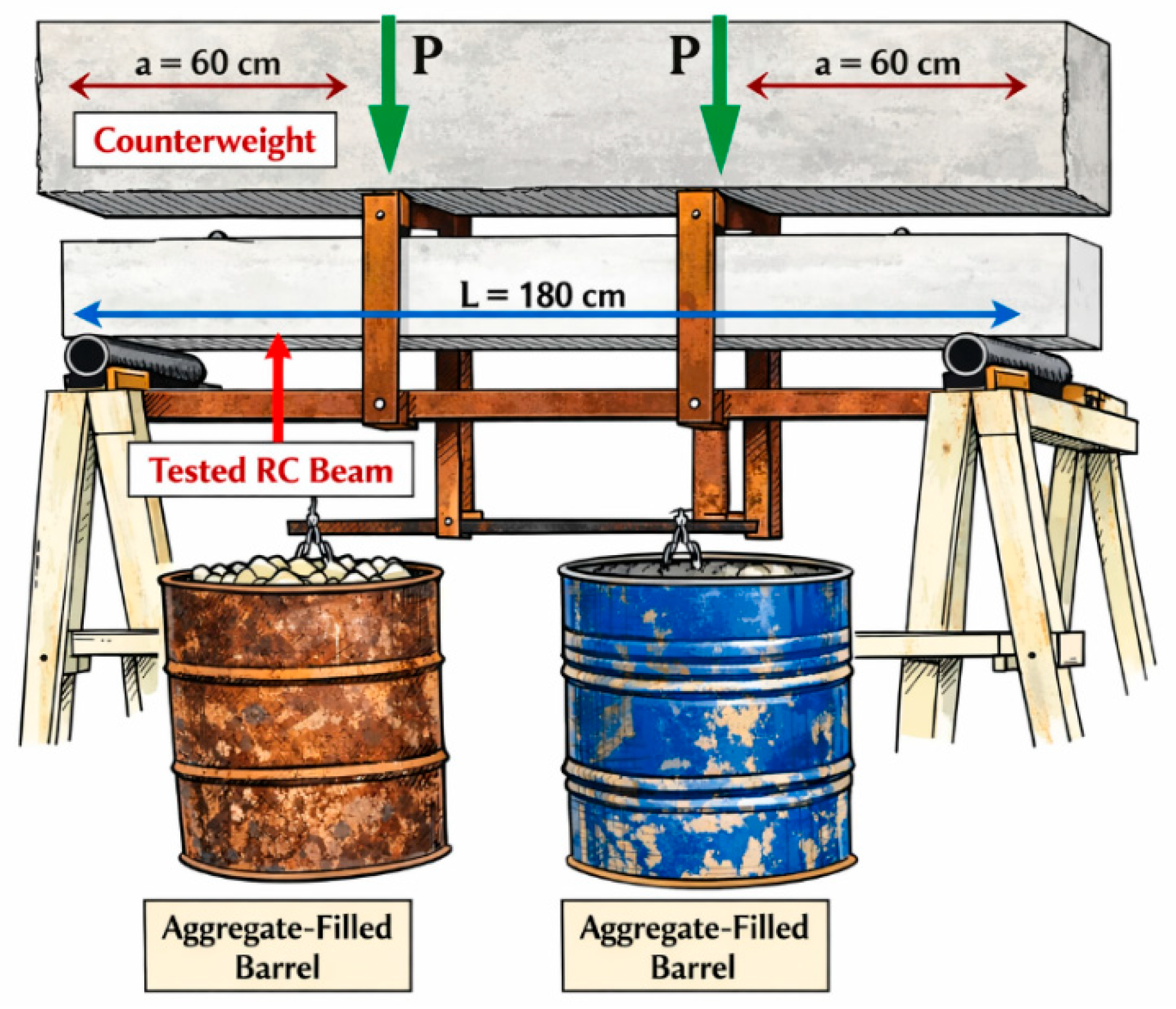
The main aim of the experimental program was to characterize the long-term flexural response of reinforced-concrete beams in their cracked state. To ensure that cracking developed before the sustained-loading phase, the applied bending moment was chosen to exceed the calculated cracking moment Mcr, thereby placing the beams under realistic service-level conditions. The cracking moment was determined as corresponding to a cracking load . The yielding moment, computed through the developed analytical model that incorporates post-cracking residual tensile strength, was found to be equivalent to a yielding load of Accordingly, the sustained moment was set to , representing 43% of My. Under this loading level, the concrete experienced a maximum compressive stress of 12.4 MPa (about 40% of its compressive strength), while the reinforcing steel carried a tensile stress of 214.3 MPa (approximately 42% of its yield strength), ensuring elastic steel behavior and stable cracking suitable for long-term deformation assessment.
If, however, the contribution of concrete in tension is neglected the yielding moment is reduced to 11.92 kN.m and the applied moment represents 50% of the yielding moment. Under this load, the three beams exhibited an average instantaneous mid-span deflection of 3.16 mm with a standard deviation of 0.45 mm, while the resulting average crack spacing was 163 mm, with a standard deviation of 11 mm, confirming consistent crack formation across specimens. The analytical model predicted an instantaneous deflection of 3.18 mm, demonstrating its strong capability to accurately capture the initial cracked-section behavior. The initial cracked stiffness corresponds to the mechanical stiffness of the beam at Day 0, measured immediately after the first application of the sustained load, when the section is cracked but no creep or time-dependent effects have yet developed.
Shrinkage effects were explicitly evaluated using Eurocode-based predictions. During the 210-day test period, the shrinkage-induced mid-span deflection was found to be 0.04 mm, representing only 1% of the instantaneous deflection. Thus, shrinkage can be neglected, and the observed long-term deformation may be attributed almost entirely to creep [
27].
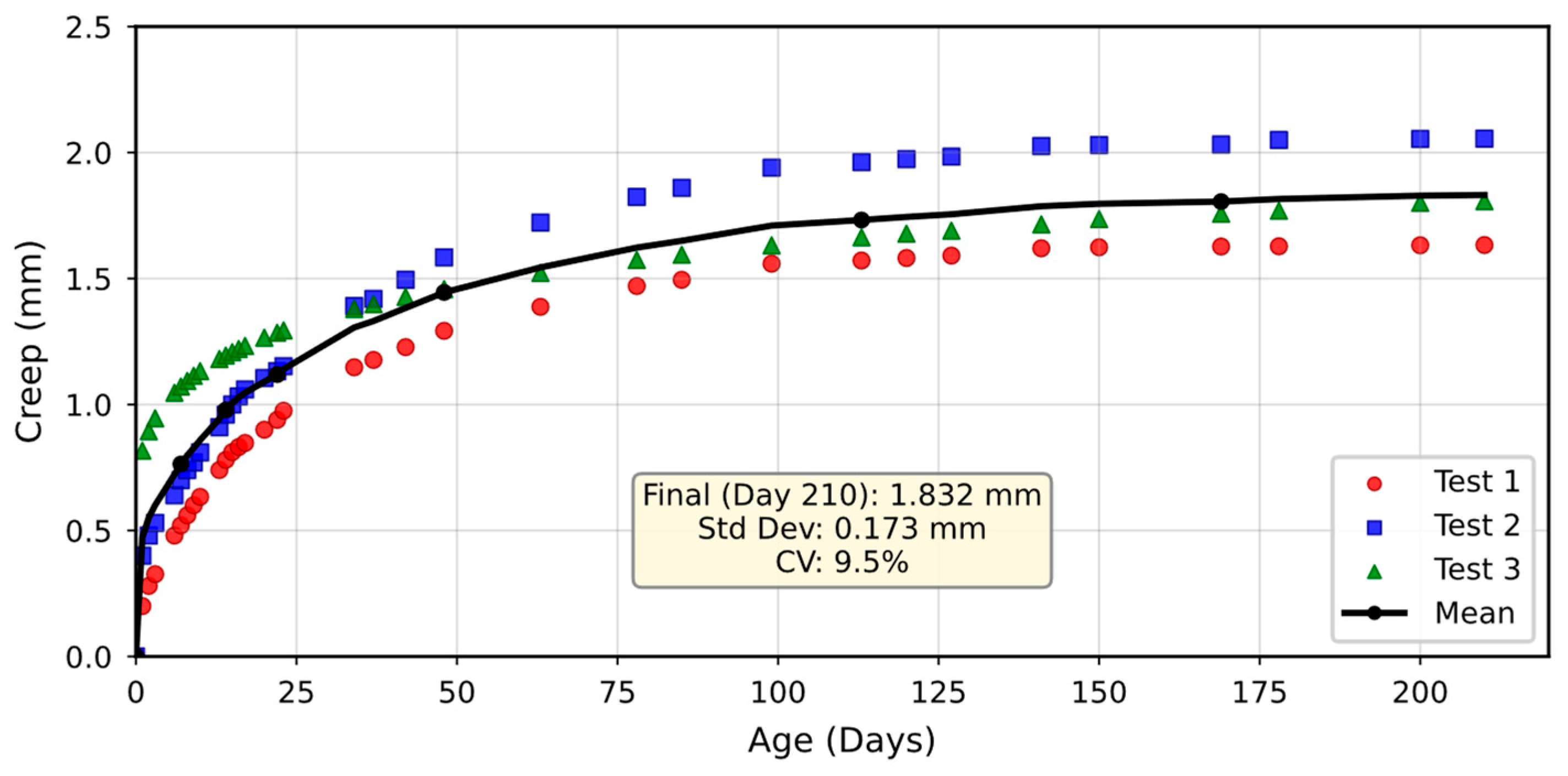
Figure 8 presents the evolution of mid-span creep deflection for three beams (Tests 1–3) over 210 days, together with the ensemble mean. All series exhibit the classic primary-to-secondary creep progression: a rapid increase during the first ~60–70 days (the mean reaches ≈1.6 mm by ~Day 70), followed by a steadily diminishing rate thereafter as the curves approach an asymptote. At Day 210, the mean creep is 1.832 mm with a standard deviation of 0.173 mm and coefficient of variation of 9.5%, indicating modest scatter and good repeatability across specimens. At the end of the 210-day creep phase, the beams were fully unloaded and kept in the laboratory in preparation for the subsequent loading–unloading tests. These additional long-term deflections reflect purely viscoelastic creep behavior and do not imply mechanical stiffness degradation, which develops only during the unloading–reloading cycles
4.2. Flexural Behavior of Beams
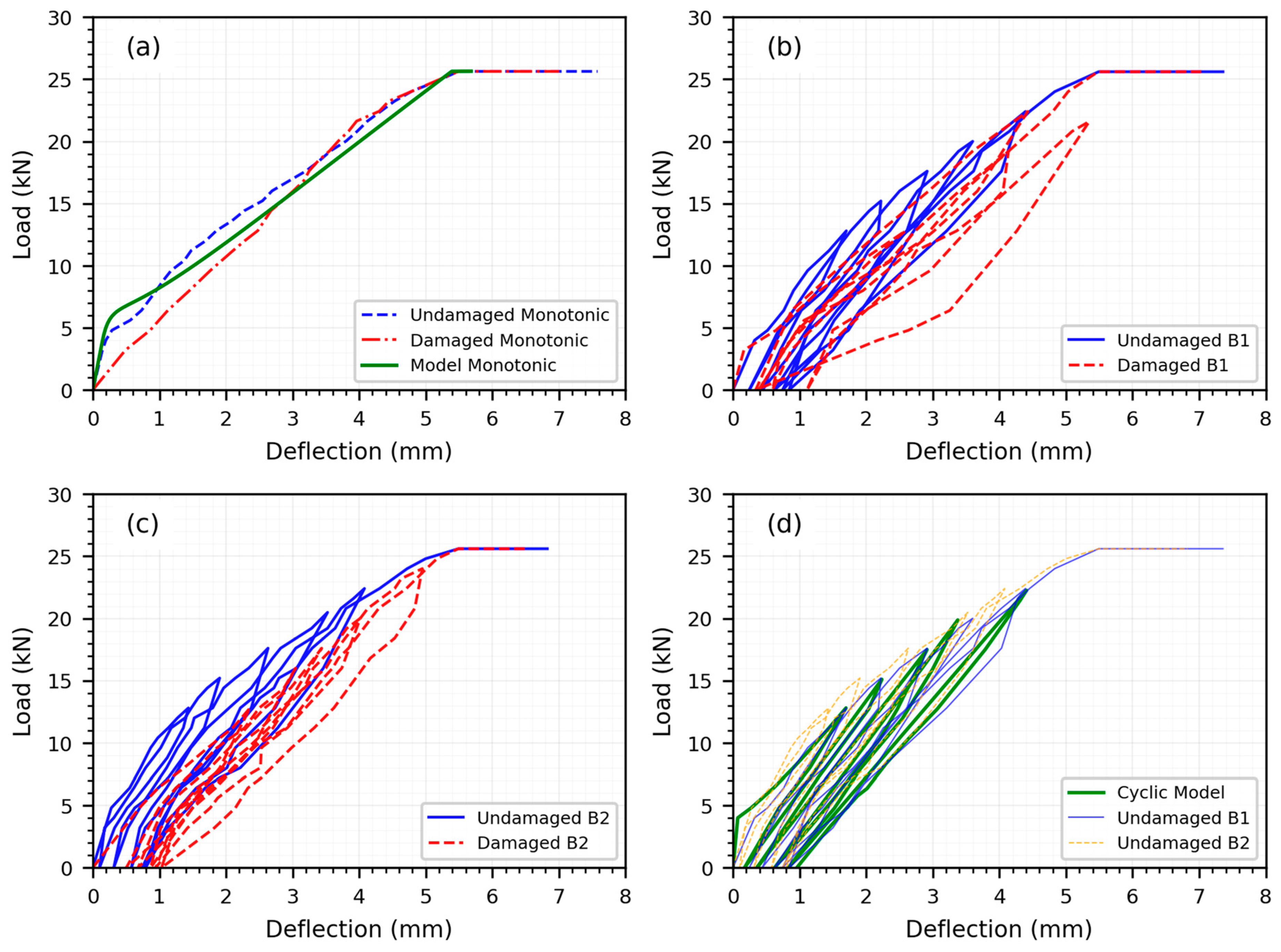
Figure 9 summarizes the flexural responses obtained from monotonic and loading–unloading tests. As seen in
Figure 9a, the developed model reproduces the monotonic behavior of the undamaged reference beam with high fidelity, accurately capturing the initial, cracking, and plateau phases preceding failure. This close agreement between the numerical prediction and the experimental curve confirms the reliability of the obtained results and validates the robustness of the experimental procedure and measurements.
It is worth noting that the present validation focuses specifically on the loading and cyclic response of the tested beam configuration, as this aspect represents the core contribution of this work. The broader validation of the layered fiber model—including comparisons with 55 long-term RC beam tests covering a wide range of geometries, reinforcement ratios, load levels, and environmental histories—has already been carried out in our complementary study recently published in CivilEng [
27]. That publication establishes the reliability of the long-term constitutive and sectional framework, while the current manuscript extends this foundation by providing new experimental evidence on stiffness-loss ratios, residual curvature after creep, and the cyclic damage mechanisms that have not been documented in previous long-duration studies.
Three distinct stiffness states must be considered when interpreting
Figure 9: (i) the initial cracked stiffness at Day 0, (ii) the creep-induced curvature accumulated during the 210-day period, and (iii) the effective stiffness upon reloading. Because creep does not induce mechanical damage in the adopted model, the reduced initial slope observed for the long-term-loaded beams in
Figure 9b,c reflects the mechanical stiffness state at the beginning of reloading, not stiffness loss during the creep phase.
Figure 9b and
Figure 9c present the cyclic responses of beams B1 and B2, respectively. These designations are used solely to simplify the presentation and have no further structural or experimental significance. For the beams previously subjected to long-term sustained loading (damaged beams), the response reveals an absence of a clearly defined linear elastic phase. Furthermore, for a given load level, the deflection of the damaged beams is significantly higher than that of the undamaged beams, directly reflecting the loss of flexural stiffness induced by long-term loading. This behavior is accompanied by earlier deviation from linearity and wider hysteresis loops, providing clear experimental evidence of the progressive degradation produced by sustained service load levels.
Figure 9d presents a comparison between the cyclic model predictions and the undamaged B1 and B2 experimental curves. The cyclic model exhibits a distinct hysteretic behavior with unloading–reloading cycles, capturing the stiffness degradation and permanent deformation characteristics. This comparison validates the model’s capability to simulate the nonlinear load-deflection response under cyclic loading conditions.
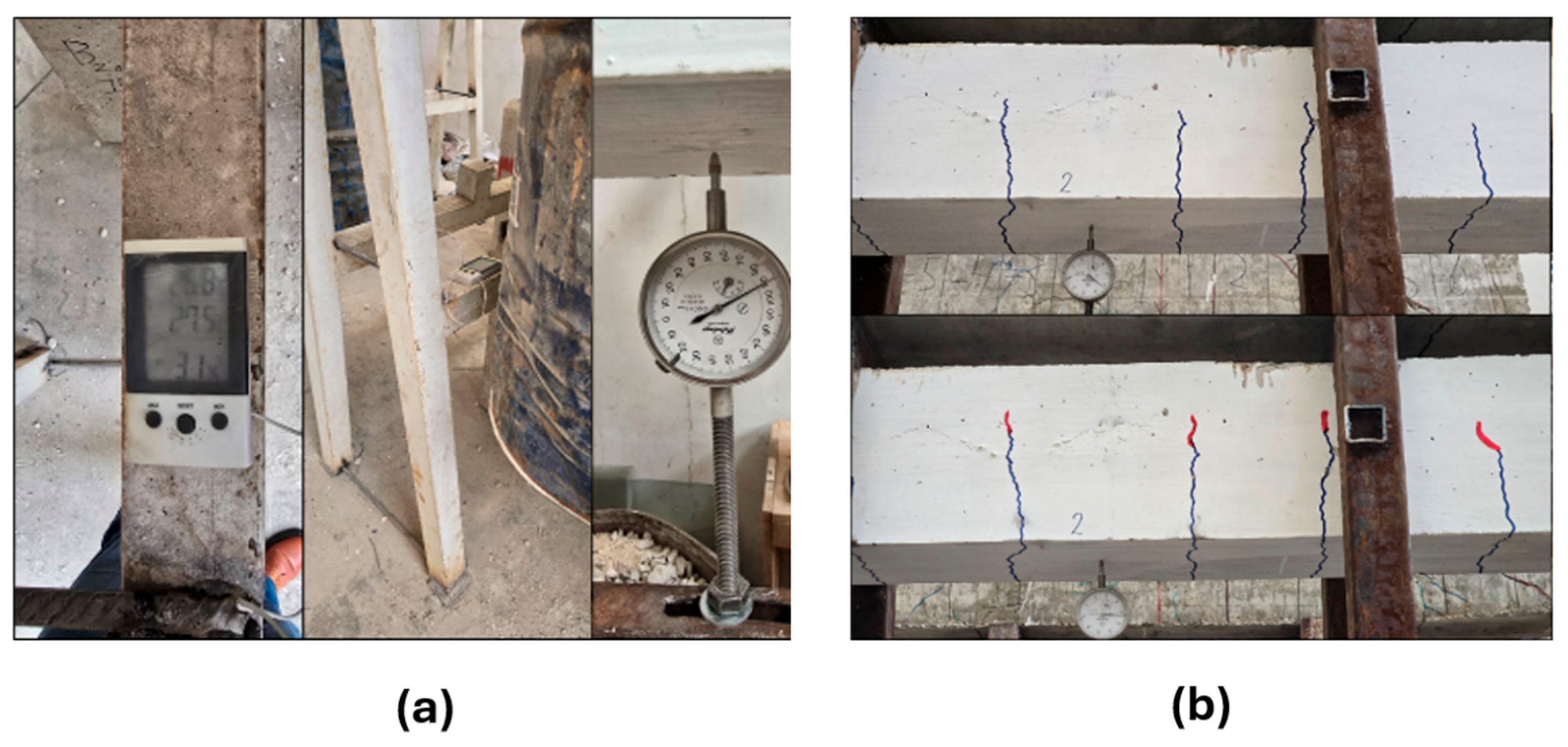
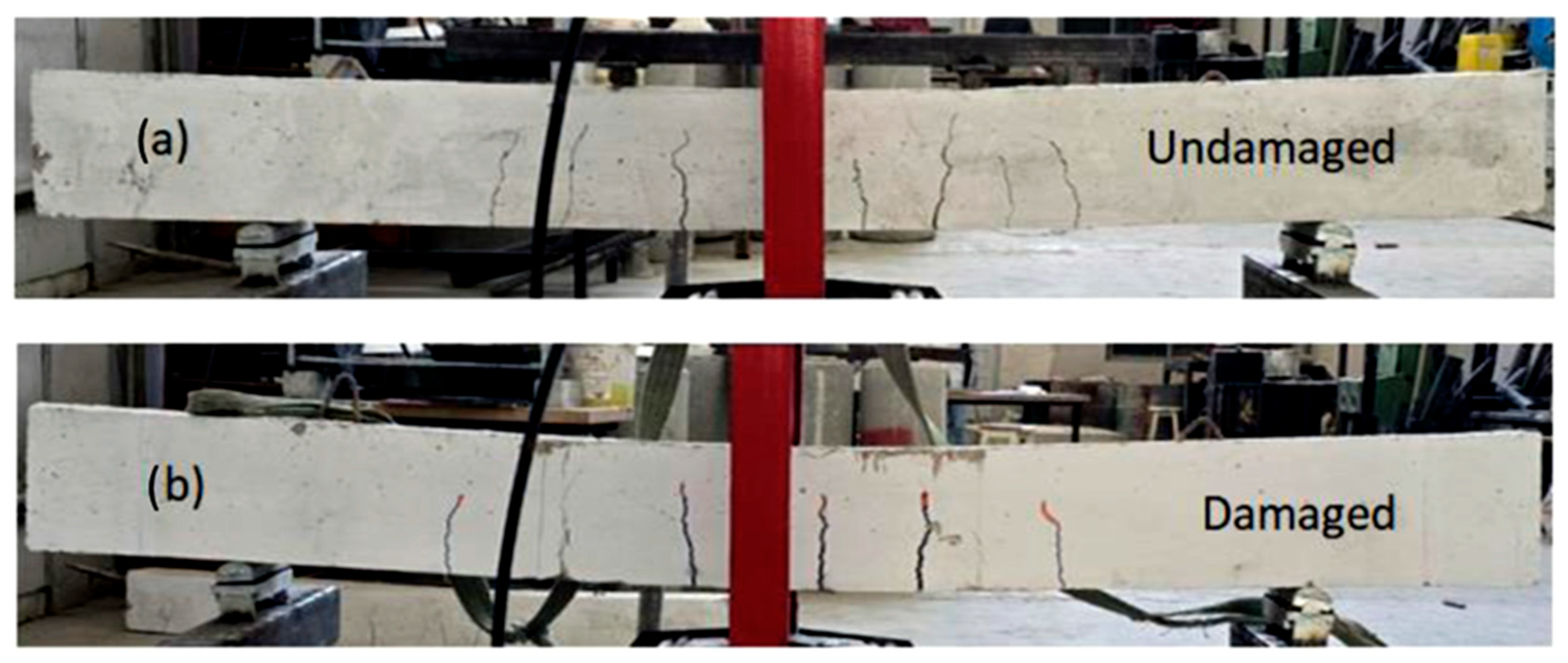
Figure 10 shows the crack patterns of the undamaged and creep-damaged beams at failure. The reference (undamaged) beam exhibits a total of seven flexural cracks, with a maximum crack height of 16.4 cm and an average crack spacing of approximately 12.21 cm. In contrast, the damaged beam, which had already developed its crack pattern during the sustained-loading phase, contains six pre-existing cracks; these cracks extend to a maximum height of 16.1 cm at mid-span and are more widely spaced, with an average spacing of about 16 cm. The comparison indicates that long-term loading does not significantly modify the maximum crack height but leads to a slightly reduced number of cracks and a noticeably larger spacing, consistent with the formation of fewer but more dominant cracks under creep.
4.3. Creep Loading-Unloading Induced Damage
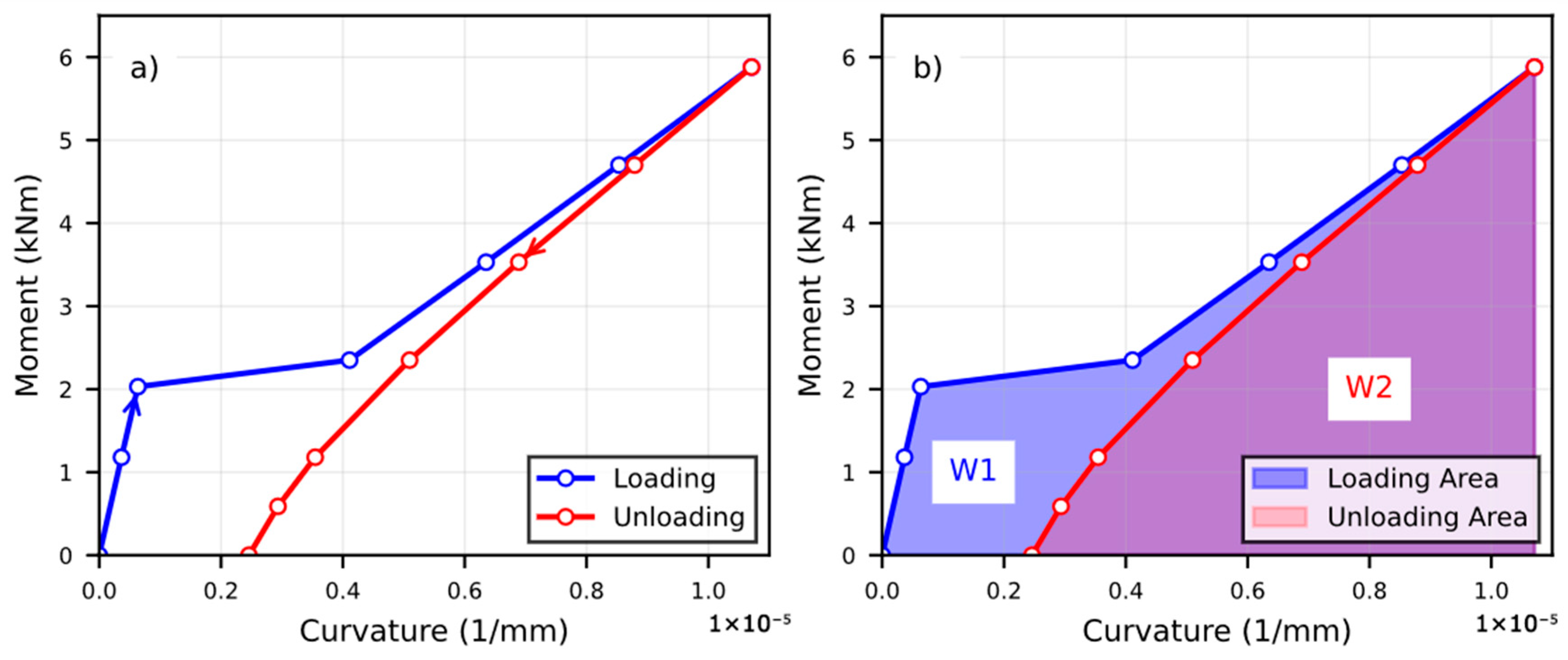
The moment–curvature responses in
Figure 11a were obtained directly from the constitutive model, which computed both loading and unloading branches of the creep cycle while enforcing the assumption that mechanical damage does not evolve during the sustained loading phase; in practice, this means that the stiffness of the section remains unchanged throughout creep and the total curvature increase during hold is attributed solely to viscoelastic deformation, with no degradation of the elastic–mechanical backbone [
40]. Accordingly, the unloading path was generated from the mechanical curvature, i.e., the curvature associated with the undamaged, purely mechanical response, so that upon release of the applied moment the trajectory follows the model’s elastic–mechanical stiffness rather than the softer, creep-inflated total response. This construction produces an unloading curve that intersects the curvature axis at a nonzero value, thereby reproducing the permanent (residual) curvature left after complete unloading.
The stiffness degradation of the section is evaluated using an energy-based damage index derived from the cyclic moment–curvature response. In this formulation, the mechanical work input during loading, denoted , is obtained as the area beneath the loading branch of the moment–curvature curve , while W2 corresponds to the recoverable work computed from the unloading branch . The damage variable is then defined as , which expresses the fraction of input energy that cannot be recovered upon unloading and therefore provides a direct measure of global stiffness loss. This energy-based formulation offers a thermodynamically consistent and physically meaningful quantification of section degradation, as it links stiffness reduction directly to the inelastic energy dissipated during the cycle. For the present case, applying this definition yields a damage value of approximately 25%, indicating a moderate but significant reduction in the effective stiffness of the section after the loading–unloading process.
The energy-based damage index of ≈25% corresponds in magnitude to the experimentally observed reduction in EIeff between damaged and reference beams during the first reloading cycle (≈27–38% for beam B1), confirming consistency between numerical and experimental indicators.
4.4. Stiffness Degradation of Undamaged and Damaged Beams
The flexural stiffness,
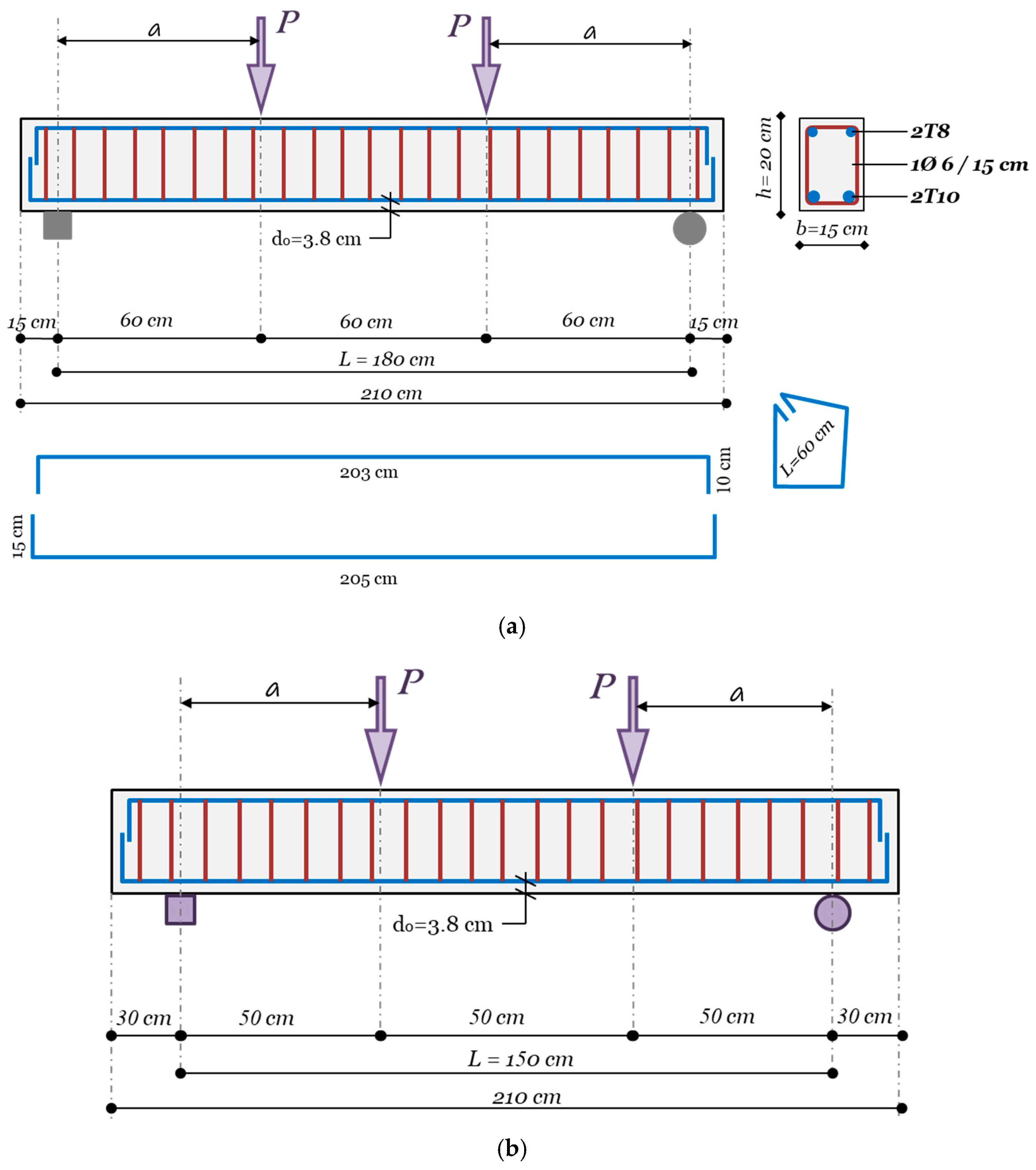
EIeff, for each cycle was obtained directly from the load–deflection curves by inverting the closed-form mid-span deflection of a simply supported beam under symmetric four-point bending, using the following expression evaluated with the measured deflection
Δ (test geometry as in
Figure 2b).
For the analytical model the curvature, κ, is an output.
The analysis of flexural rigidity (
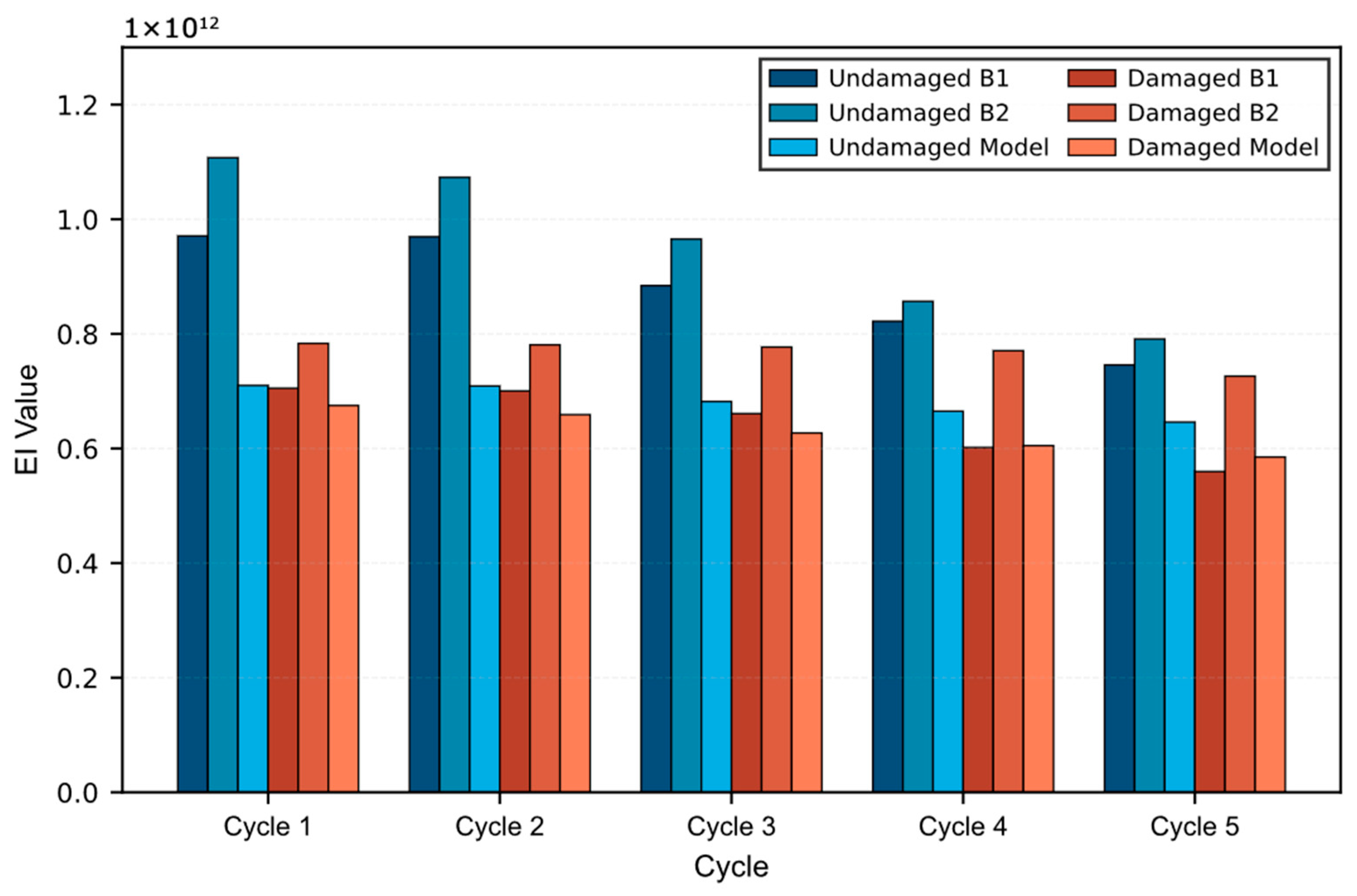
EI) across five loading cycles reveals distinct degradation patterns between undamaged and damaged states, with the progression of stiffness loss intensifying as cycles advance (
Table 1 and
Figure 12). B1 and B2, originating from the same material batch, exhibit comparable behavior, though some variations arise from inherent uncertainties in material properties and test conditions rather than fundamental structural differences. In cycle 1, undamaged specimens show substantially higher stiffness than their damaged counterparts, with undamaged B1 (9.71 × 10
11 N.mm
2) and B2 (11.07 × 10
11 N.mm
2) exceeding damaged B1 (7.05 × 10
11 N.mm
2) and B2 (7.83 × 10
11 N.mm
2) by 37.7% and 41.6%, respectively. The minor discrepancy between B1 and B2 within the same state reflects typical experimental scatter due to material inhomogeneity and testing variability. The model specimen shows the smallest initial gap, with undamaged (7.10 × 10
11 N.mm
2) exceeding damaged (6.75 × 10
11 N.mm
2) by only 5.2%. Notably, all EI values across both states and all specimen types remain within the same order of magnitude (10
11 N·mm
2), indicating that despite the observed degradation, the fundamental stiffness scale is preserved throughout the testing program. As cycling progresses, the loss accumulation becomes increasingly pronounced. For undamaged specimens, B1 loses −0.1% by cycle 2, accelerating to −8.9% by cycle 3, and reaching −16.8% by cycle 4 and −27.4% by cycle 5, while B2 follows a similar trajectory with losses of −3.1%, −12.8%, −22.6%, and −28.6% over the same intervals. This progressive increase in loss with cycles indicates cumulative damage mechanisms activating as loading continues. The undamaged model exhibits a more moderate but still escalating loss pattern, from −0.1% in cycle 2 to −3.9% in cycle 3, −6.3% by cycle 4, and finally −9.0% by cycle 5.
Damaged B1 shows losses of −0.7%, −6.3%, −14.7%, and −20.6% by cycles 2 through 5, respectively—consistently lower than its undamaged counterpart at each stage. Most notably, damaged B2 demonstrates remarkable resistance to further degradation, with minimal loss increments of −0.3%, −0.8%, −1.6%, and only −7.3% by cycle 5. The damaged model shows intermediate progression, with losses of −2.2%, −7.0%, −10.3%, and −13.3% across the cycles.
The magnitude of the stiffness shortfall between damaged and undamaged beams during the 1st cycle is consistent in order with the energy-based stiffness loss quantified in
Section 4.3 (damage d ≈ 25%). This proximity in scale—despite expected specimen-to-specimen variability—supports the modeling assumption adopted in
Section 4.3, namely, that the mechanical damage remains unchanged during the sustained loading phase and that the additional long-term curvature accrued under creep is predominantly viscoelastic. The observed experimental gaps in initial
EIeff at reloading and the energy-based damage index inferred from the moment–curvature loops therefore provide mutually consistent measures of stiffness degradation.
The scatter observed between beams of the same group (typically 5–15% in EIeff) is consistent with material variability and test uncertainties, comparable to the scatter observed in creep deflections.
5. Conclusions
This study examined the effects of long-term sustained loading on the flexural behavior of reinforced-concrete beams through combined experimental and numerical investigation, showing that 210 days of loading produced significant creep deflection but did not reduce ultimate load capacity, as damaged and undamaged beams reached similar failure moments and exhibited comparable crack heights.
Long-term-loaded beams nevertheless experienced a clear reduction in initial stiffness, most pronounced during the first loading cycle and progressively less evident in subsequent cycles, while cyclic tests revealed larger deflections, earlier stiffness softening, and wider hysteresis loops. Crack patterns indicated fewer but more widely spaced cracks after sustained loading, consistent with the development of dominant cracks.
The layered fiber model accurately captured monotonic and cyclic responses, including stiffness evolution, and residual curvature, confirming that creep-induced stiffness reduction acts as mechanical damage superimposed on time-dependent deformation. Overall, the findings demonstrate that long-term loading alters stiffness and cyclic response without compromising ultimate strength, thereby providing practical insight for evaluating existing RC structures.
In practice, engineers should incorporate stiffness reduction into serviceability assessments, consider creep-induced damage in requalification procedures, and employ refined layered fiber models for structural evaluation. Future studies should explore a wider range of sustained load levels and durations, examine environmental effects, and investigate additional structural configurations and combined sustained-plus-cyclic loading scenarios.
For the beams tested in this study, effective stiffness during the first reloading cycle decreased by approximately 25–40%, consistent with the energy-based damage index. These results can inform requalification efforts, for instance, through a stiffness reduction factor applied to code-based serviceability values or via layered fiber models for refined assessment. While the qualitative trends are general, the numerical reductions are specific to the tested configuration.