Review

Research Trends on Invasive Marine Species in the Mediterranean: A Bibliometric and Topic Modeling Analysis


by
Dimitris Klaoudatos
1,*,
Stefanos Gkourtsoulis
1,
Dimitris Pafras
1 and
Alexandros Theocharis
1,2
1
Department of Ichthyology and Aquatic Environment, University of Thessaly, Fytokou Street, 38 446 Volos, Greece
2
National Institute of Aquatic Resources, Technical University of Denmark, North Sea Science Park, 9850 Hirtshals, Denmark
*
Author to whom correspondence should be addressed.
Oceans 2026, 7(3), 37; https://doi.org/10.3390/oceans7030037
Submission received: 25 January 2026 / Revised: 2 April 2026 / Accepted: 20 April 2026 / Published: 24 April 2026

Abstract

The Mediterranean Sea is both a global biodiversity hotspot and the world’s most heavily invaded marine region, where non-indigenous species arrivals are accelerating under intensifying shipping, Suez Canal traffic, aquaculture, and climate warming. Yet, despite rapidly growing research activity, a comprehensive synthesis of the scientific literature on Mediterranean marine invasions has been lacking. This study provides the first Mediterranean-wide combined bibliometric and topic-modeling analysis of invasive marine species research, using 3521 unique documents retrieved from Scopus and Web of Science. We quantify temporal growth in publications and citations, map the conceptual structure of the field through co-citation, co-word, and topic modeling, and reveal pronounced regional and thematic biases. Latent Dirichlet Allocation resolves 13 coherent topics, dominated by first records of non-native species, invasive macroalgae, alien species diversity, and ecological impacts, with strong signals for Lessepsian migration and climate-driven range shifts, particularly in the Eastern Mediterranean. Spatial and thematic analyses reveal pronounced regional biases, with invasion hotspots in the Aegean and Levantine seas contrasted by comparatively sparse coverage of western and central sub-basins, and notable gaps in predictive modeling and socioeconomic assessments. The results underscore the need to rebalance effort toward under-studied regions and themes, while leveraging existing collaboration networks and methodological advances to support MSFD (Marine Strategy Framework Directive) implementation, International Maritime Organization (IMO) instruments, and broader ecosystem-based management. The reproducible framework presented here offers a baseline for periodically tracking research evolution and guiding adaptive, transboundary governance of Mediterranean marine bio-invasions.

1. Introduction

The Mediterranean Sea has long been a hotspot for marine biological invasions, with evidence suggesting that human-mediated introductions began millennia ago through ancient shipping vectors such as hull fouling and solid ballast, potentially as early as the Bronze Age and well-documented by the 13th century with species like the soft-shelled clam Mya arenaria translocated from North America to Europe [1]. The rate of invasions accelerated dramatically following the opening of the Suez Canal in 1869, facilitating Lessepsian migration of Indo-Pacific species into the eastern Mediterranean, a process that has introduced over 53% of the nearly 1000 alien species recorded in the basin, with invasions increasing by 40% in the last decade alone due to climate warming, shipping intensification, and aquaculture [2,3]. These invasions are characterized by rapid establishment of thermophilic species in warming waters, leading to ecosystem shifts, biodiversity loss through competition and predation, and occasional fishery benefits, though negative impacts predominate; notable examples include the invasive green alga Caulerpa cylindracea, which alters native assemblages via rapid colonization, the venomous silver-cheeked toadfish Lagocephalus sceleratus, causing economic losses in fisheries, and the lionfish Pterois miles, which disrupts food webs through predation on native species [4,5].
Building on this context, a critical challenge emerges: despite the Mediterranean being recognized as the world’s most heavily invaded marine region, the scientific response has not evolved evenly across space and themes [3]. Research effort is strongly concentrated in the eastern basin, the primary entry point for Indo Pacific species [6], whereas western and central sub regions remain comparatively under represented [7]. Despite this, much of the literature continues to focus on first records and case studies of emblematic invaders [5,8], with relatively fewer basin-wide syntheses that evaluate how research has developed in terms of structure, thematic breadth, and integration. As a result, it remains unclear whether the rapid growth in publication output has translated into a diversification of research themes beyond taxonomic inventories, which critical dimensions, such as predictive modeling, western Mediterranean coverage, and socioeconomic impacts, remain systematically underexplored [3,6,9,10,11]. Together, these gaps highlight the need for a systematic, quantitative synthesis capable of assessing how Mediterranean marine invasion research has evolved across time, space, and themes.
Bibliometric analysis, also known as scientometrics, has emerged as a rigorous method for evaluating the trajectory of scientific research by applying mathematical and statistical techniques to large volumes of bibliographic data, enabling the identification of patterns, trends, and intellectual structures within a field [12,13,14]. Bibliometric and topic modeling analyses have proven particularly effective in marine-related domains for revealing thematic evolution, collaboration patterns, and emerging research gaps. For instance, a recent bibliometric review at the marine-medical research interface identified dominant topics such as natural product biochemistry and trace substances/genetics, while highlighting interdisciplinary convergence trends through Hierarchical Dirichlet Process modeling and social network analysis [15]. These approaches are well-suited to fragmented and rapidly expanding fields like marine bio-invasions, where they can uncover knowledge bases, research fronts, and understudied themes. This approach is particularly valuable in handling voluminous, fragmented, and controversial research streams, as it facilitates performance analysis and science mapping to uncover knowledge bases, research fronts, and collaboration networks [16,17,18]. Tools such as bibliometrix in R, VOSviewer (v1.6.20.), and Biblioshiny (v4.3) support comprehensive workflows, from data collection across databases like Scopus and Web of Science to visualization and interpretation, ensuring transparency and reproducibility [19,20,21]. By merging datasets from multiple sources, bibliometric studies mitigate biases inherent in single-database analyses, providing a more complete overview of scholarly output and addressing challenges like database coverage disparities [20,22,23].
In marine biology and related fields, bibliometric analysis offers a powerful lens for synthesizing evidence on ecosystem dynamics and resource management, as demonstrated in studies of fisheries where overexploitation and environmental pressures necessitate integrated assessments [24,25,26]. For instance, employing bibliometric techniques to review models such as Ecopath with Ecosim and Assessment for All reveals trends in stock assessment and ecosystem modeling, highlighting gaps in data-limited contexts and the need for ecosystem-based approaches like Ecosystem Based Fisheries Management (EBFM) [24,27,28]. Drawing on merged data from Scopus, Web of Science, and specialized repositories like EcoBase, such analyses underscore the utility of relational and evaluative metrics in marine-related research, facilitating the mapping of interdisciplinary contributions and informing sustainable strategies amid ongoing biological invasions and climate impacts [12,19,29].
To address these gaps, this study is guided by three explicit research questions: (i) How has scientific research on invasive marine species in the Mediterranean evolved temporally, geographically, and thematically over the past five decades? (ii) How is research effort distributed across Mediterranean sub-regions, and what thematic specialisations characterise each basin’s scientific output? (iii) Do emerging themes, such as climate-mediated range expansions, Lessepsian migration, genomic surveillance, and novel introduction pathways, represent a substantive shift in scientific focus or remain peripheral relative to long-standing descriptive paradigms?
By explicitly framing the analysis around these questions, the study moves beyond a general descriptive overview and provides a diagnostic assessment of how Mediterranean invasion science aligns with emerging ecological understanding and management needs. In doing so, it delivers novel insight into structural biases, thematic saturation, and persistent knowledge gaps, while establishing a quantitative baseline to inform future research prioritization and evidence-based policy development under initiatives such as the EU Marine Strategy Framework Directive and relevant International Maritime Organization conventions.

2. Materials and Methods

2.1. Data Sources and Search Strategy

A comprehensive bibliometric analysis was performed to map the scientific literature on invasive species with a specific focus on the Mediterranean region (Mediterranean Sea). Data acquisition and processing followed a multi-stage, semi-automated workflow implemented in R (version 4.3.1) using the bibliometrix package to ensure reproducibility, traceability, and analytical robustness [16]. Bibliographic records were retrieved from the Web of Science Core Collection and Scopus on 3 November 2025 using a harmonized search strategy that combined invasive and non-indigenous species terminology with Mediterranean geographic descriptors. WoS searches were restricted to three citation indexes (SCIE, SSCI, ESCI), twelve subject categories (Agricultural Economics and Policy, Development Studies, Ecology, Economics, Environmental Sciences, Environmental Studies, Fisheries, Marine and Freshwater Biology, Oceanography, Social Sciences Interdisciplinary, Water Resources), Articles and Review Articles in English, covering 1970–2024. Scopus searches were analogously restricted to six subject areas (Agricultural and Biological Sciences, Environmental Science, Social Sciences, Economics Econometrics and Finance, Earth and Planetary Sciences, Multidisciplinary), Articles and Reviews at final publication stage, in English, covering 1969–2024. Searches were conducted in the Topic Search field in Web of Science and the TITLE–ABS–KEY field in Scopus, acknowledging inherent differences in database coverage and indexing [30]. Due to export limitations, records were downloaded in batches, merged, and subjected to a three-stage deduplication procedure based on DOI matching, exact title–year matching, and fuzzy title comparison using a Jaro–Winkler distance threshold [19,20]. This rigorous cleaning process is essential to mitigate the disparities in database coverage and metadata quality between Scopus and Web of Science [16,19].
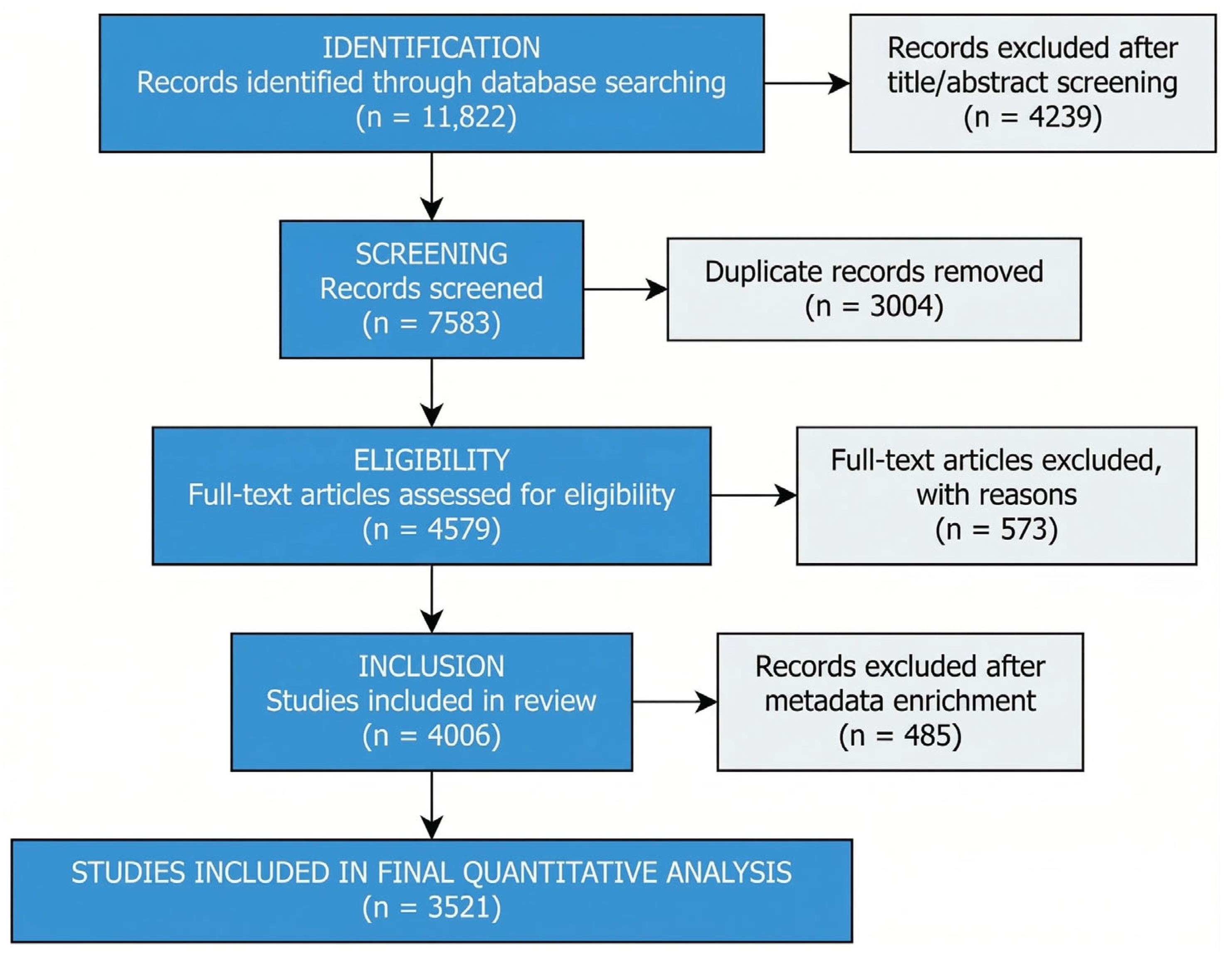
The consolidated dataset underwent extensive refinement, including metadata completeness checks, field harmonization, and enrichment via the CrossRef API to recover missing DOIs, abstracts, and publication years where available [31]. Following established protocols for bibliometric transparency, all modifications were logged to maintain full data provenance and ensure the reproducibility of the workflow [16,32]. A controlled vocabulary was applied to standardize invasion terminology, harmonize taxonomic nomenclature, and assign studies to Mediterranean sub-basins using a hierarchical geographic scoring system. A strict marine-focused filtering protocol excluded terrestrial-only studies while retaining relevant transitional-water research. Author keywords were normalized, and publications were automatically classified into four thematic research pillars, Biology, Ecology, Impact, and Management, based on keyword frequencies in titles and abstracts. A final audit evaluated dataset integrity through metadata completeness metrics, temporal publication trends, database overlap analyses, and a PRISMA-style flow diagram (Figure 1), confirming the suitability of the dataset for subsequent bibliometric analyses [33]. This approach ensures that the selection and screening process is transparent, reproducible, and meets the rigorous standards for systematic evidence synthesis [16,34].

2.2. Bibliometrics Analysis Methodology

The refined bibliometric dataset was analyzed using an integrated, reproducible framework implemented entirely in R (version 4.3.1). Each publication was algorithmically assigned a primary geographic region within the Mediterranean and a primary thematic research pillar based on author affiliations, keywords, and title–abstract content, using a rule-based classification system informed by domain expertise [12,16]. It is important to acknowledge that such automated classification approaches involve inherent simplifications; interdisciplinary studies addressing multiple themes may not be fully captured by assignment to a single primary pillar, and the resulting categorizations should be interpreted as broad approximations of dominant thematic signatures rather than definitive or mutually exclusive classifications. All excluded records were systematically logged with explicit removal criteria to ensure transparency and auditability in accordance with PRISMA standards [33] (see Supplementary Materials). Bibliometric performance indicators, including publication output, citation metrics, authorship patterns, journal impact, and author productivity indices, were calculated using the bibliometrix package [16], with temporal trends assessed through dual-axis analyses combining annual publication volume and normalized citation impact [21].
Science mapping approaches were applied to characterise the conceptual, intellectual, and social structure of the field through co-word, co-citation, and bibliographic coupling analyses. Thematic structure and evolution were explored using strategic diagrams based on Callon’s centrality and density measures, trend-topic analyses, and three-field Sankey visualizations linking authors, keywords, and journals [17,35]. Research gaps were identified through a bivariate heatmap intersecting thematic pillars with Mediterranean sub-regions, highlighting under-represented and saturated research areas.

2.3. Topic Modeling Methodology

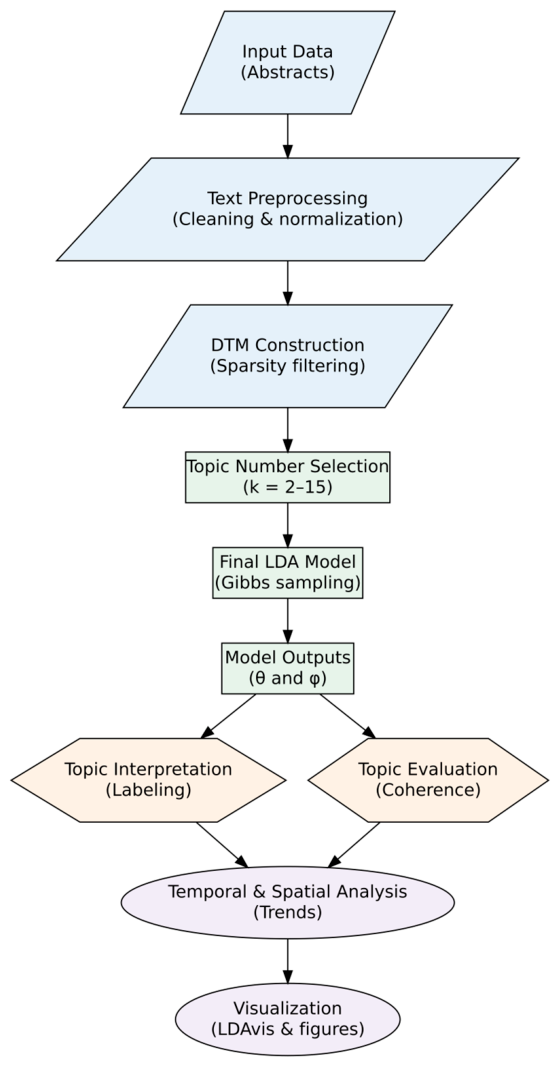
Latent Dirichlet Allocation (LDA) [36] was applied to the corpus of scientific abstracts to identify latent thematic structures (Figure 2). It is important to note that only records with non-empty abstracts were included in the topic modeling analysis, as LDA requires textual content for semantic processing. Articles without abstracts were excluded from this specific component of the study but were retained in all bibliometric analyses presented in Section 3.1. Of the 3521 records in the final corpus, 3514 possessed non-empty abstracts and were included in the LDA analysis; the remaining 7 records lacking abstracts were excluded from topic modelling.
Text preprocessing involved conversion to lowercase, removal of punctuation, numbers, and English stop words, whitespace normalization, and construction of a document–term matrix using the tm package in R (version 4.3.1) [37]. Sparse terms occurring in fewer than 1% of documents were removed, and empty documents were excluded to improve model robustness. The optimal number of topics was determined using a multi-metric consensus approach implemented in the ldatuning package [38], evaluating models with k = 2–15 based on metrics [39,40,41,42]. The final model was fitted using collapsed Gibbs sampling [43] with 2000 iterations, a 1000-iteration burn-in, a thinning interval of 100, and a fixed random seed to ensure reproducibility. Model outputs included document–topic and topic–term probability matrices, from which topic prevalence was quantified as the mean document–topic probability. Each document was assigned to a dominant topic based on the highest probability, and topics were manually labeled using the most probable terms and domain-informed interpretation [36,44]. Model quality was assessed with probabilistic topic coherence scores, and relationships among topics were explored through Pearson correlation of document–topic probabilities and topic co-occurrence networks [45]. Temporal dynamics were analyzed by aggregating dominant topic assignments by publication year and visualized using LOESS smoothing, rolling averages, and generalized additive models [46,47]. Spatial and thematic distributions were evaluated through cross-tabulation with Mediterranean sub-regions and visualized with heatmaps and map-based representations. Interactive topic exploration was facilitated with LDAvis [44], using a term relevance parameter of λ = 0.6, while static representations highlighted the most prevalent topics.
While LDA provides a powerful tool for identifying latent thematic structures, several methodological constraints warrant acknowledgment. The analysis is limited to abstract text, which provides condensed summaries that may not fully capture the depth or nuance of full-text content. Additionally, the statistical nature of the method means that topic interpretations involve some degree of subjectivity, and alternative preprocessing choices, different numbers of topics, or the inclusion of full-text content could yield somewhat different thematic configurations. The topics presented here should therefore be understood as statistically derived approximations of the conceptual landscape rather than definitive ontological categories.

3. Results

3.1. Bibliometrics Analysis

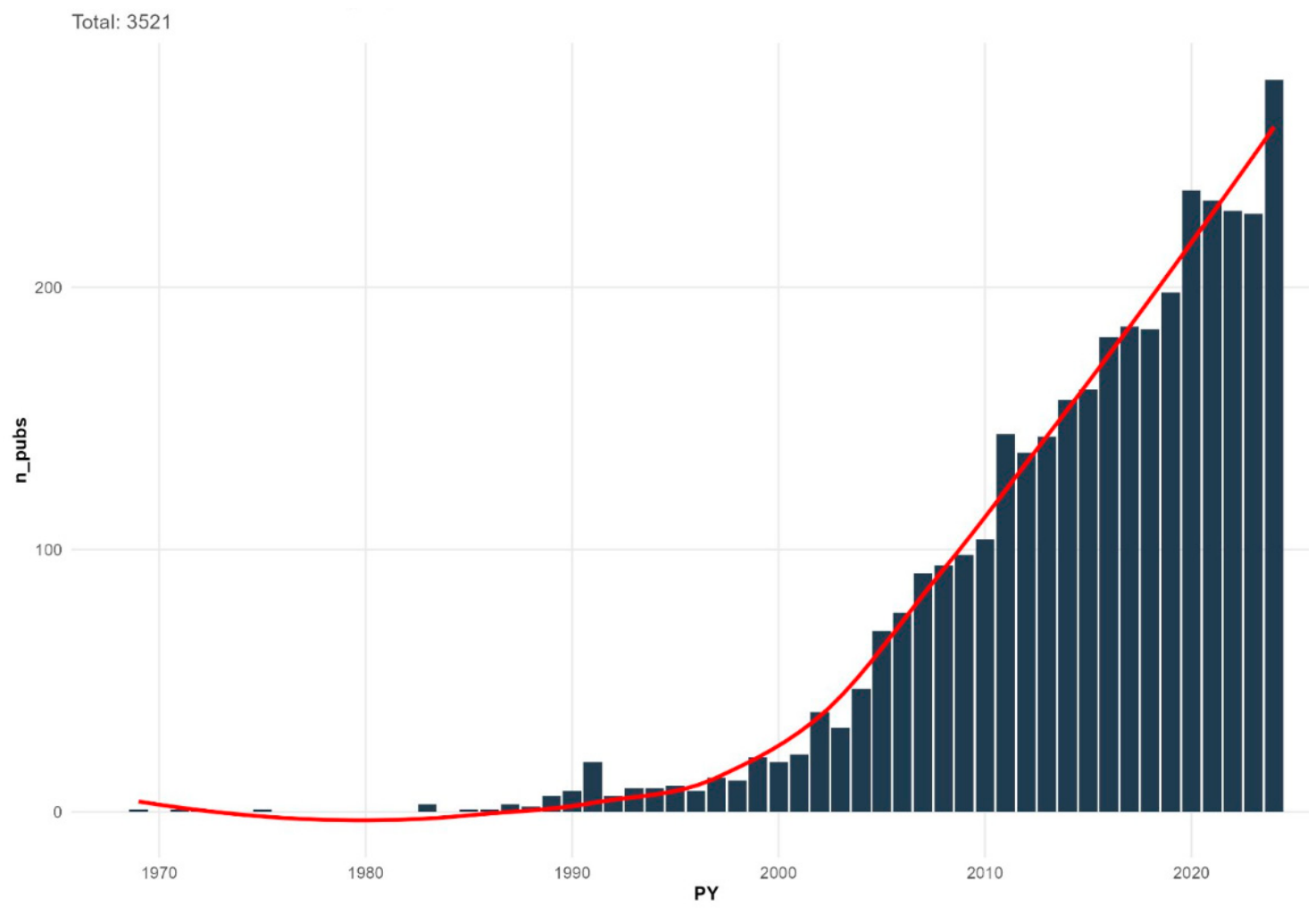
The annual scientific publications on invasive marine species in the Mediterranean Sea from 1969 to 2025 (Figure 3) reveal three distinct phases of research activity. From 1969 to the late 1990s, the field remained in a “latent” stage, characterized by sporadic and minimal publication counts, often totaling fewer than 10 papers per year. A period of accelerated growth began around 2000, coinciding with increased global awareness of biodiversity loss and biological invasions, with a sharp rise around 2005 indicating an “Inflection Point”.
By the mid-2010s, the volume of research surged significantly, consistently exceeding 100 publications annually and peaking at over 200 publications in the early 2020s. A red trend line overlaid on the bar chart indicates a non-linear, exponential-like growth trajectory, suggesting that interest in Mediterranean invasive species has become a high-priority focal point within marine research, encompassing not only descriptive biology but also ecology, climate science, and management-oriented studies. The total corpus of 3521 publications reflects a robust and rapidly expanding body of literature that underpins the current understanding of Mediterranean bio-invasions.
The most frequent keywords and bigrams extracted from the bibliometric dataset highlight the primary thematic pillars of invasive marine species research in the Mediterranean. Among keywords, Non-Indigenous Species and Mediterranean Sea are the most dominant topics, each appearing in over 1000 instances. These are closely followed by broad ecological concepts such as Biological Invasion, Invasive Species, and Biodiversity. Notably, Climate Change emerges as a high-ranking topic, underscoring its perceived role as a driver of species range shifts. More specific terms, including Lessepsian Migration and First Record, indicate a strong research focus on the introduction of Indo-Pacific species through the Suez Canal.
Analysis of two-word keyword combinations further reinforces these patterns. The most frequent bigrams include terms such as non-indigenous species and Mediterranean Sea, reflecting the core conceptual focus of the field, while a high degree of geographic specificity is evident in the prominence of sub-regional terms such as Aegean Sea, Adriatic Sea, and Black Sea. In addition, taxon-specific and vector-related phrases (for example, Caulerpa taxifolia, Mnemiopsis leidyi, ballast water) highlight the strong emphasis on species-level case studies and management-oriented concerns within the literature.
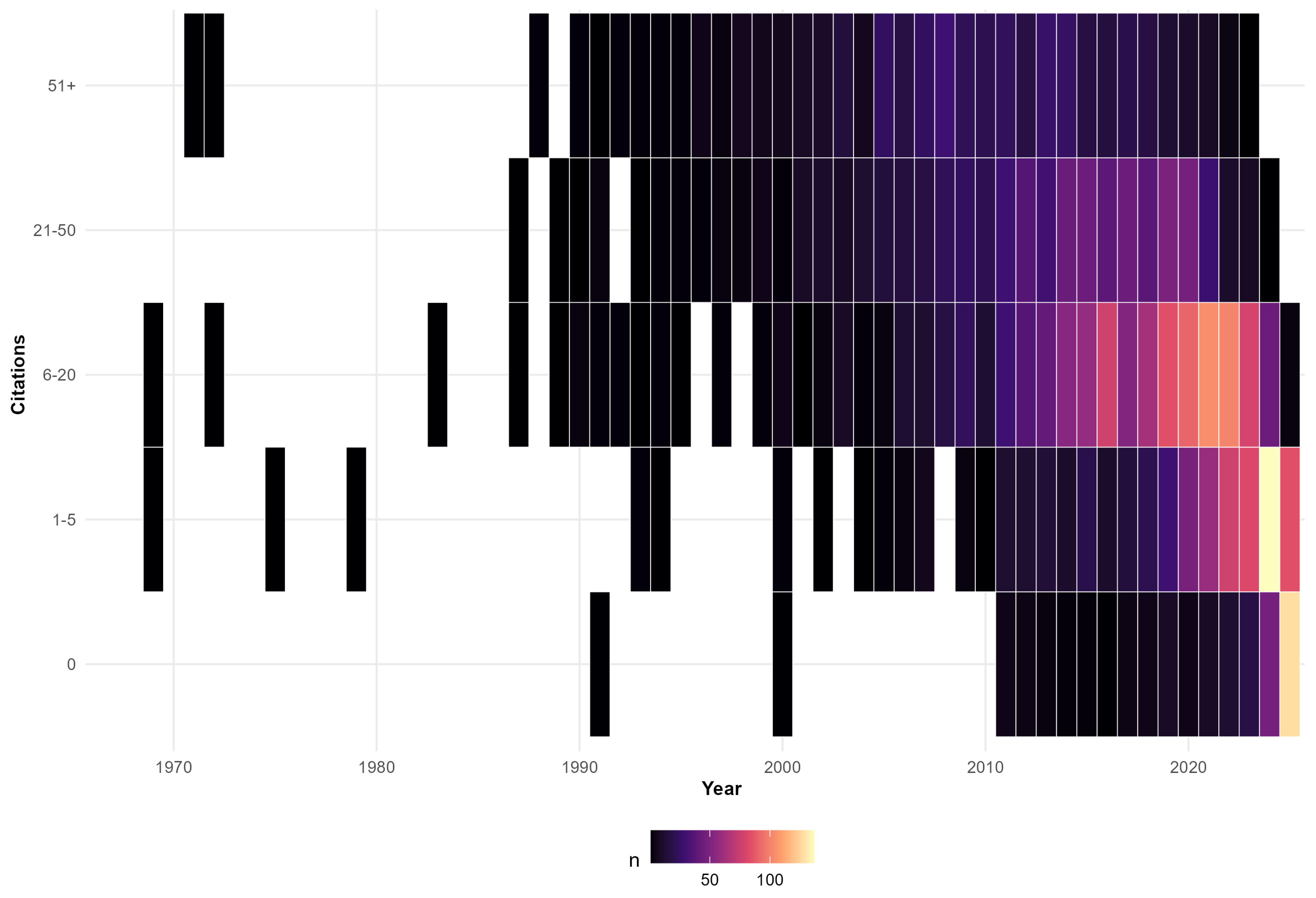
Figure 4 visualizes the evolution of citation impact for publications on invasive marine species in the Mediterranean from 1969 to 2025, categorized into five citation cohorts (0, 1–5, 6–20, 21–50, and 51+ citations). The plot reveals a clear temporal shift in the density and impact of literature. In the early period (1969–1990), citations were sparse and scattered, with only a few highly cited “foundational” papers (51+ cohort) appearing intermittently, representing seminal early works that remained relevant for decades. From the mid-1990s to 2010, there was a noticeable stabilization and darkening of the heatmap across all citation tiers, indicating a growing and more interconnected body of research.
The most significant transition occurs after 2010, where the “6–20” and “21–50” citation cohorts show a marked increase in density. Notably, the high density in the “1–5” and “6–20” cohorts for the most recent years (2020–2025) reflects the influx of new research that is gaining immediate traction in the scientific community. The persistent presence of the “51+” cohort throughout the 2000s and 2010s highlights the emergence of high-impact studies that serve as the primary references for the field.
The analysis of journal impact revealed a specialized and high-quality publishing landscape for Mediterranean invasive species research, with PLOS ONE, Biological Invasions, and Aquatic Invasions emerging as leading outlets with the highest median citation impacts. Regional expertise was strongly represented by Mediterranean Marine Science, which, despite being a specialized regional journal, maintained a competitive citation profile alongside broader international titles like Marine Pollution Bulletin. While newer, open-access journals such as BioInvasions Records and Diversity-Basel showed slightly lower median citations, they contribute significantly to the volume and rapid dissemination of data. Overall, the data indicated that high-impact research is not restricted to generalist journals but is robustly supported by discipline-specific publications dedicated to aquatic bio-invasions and marine ecology.
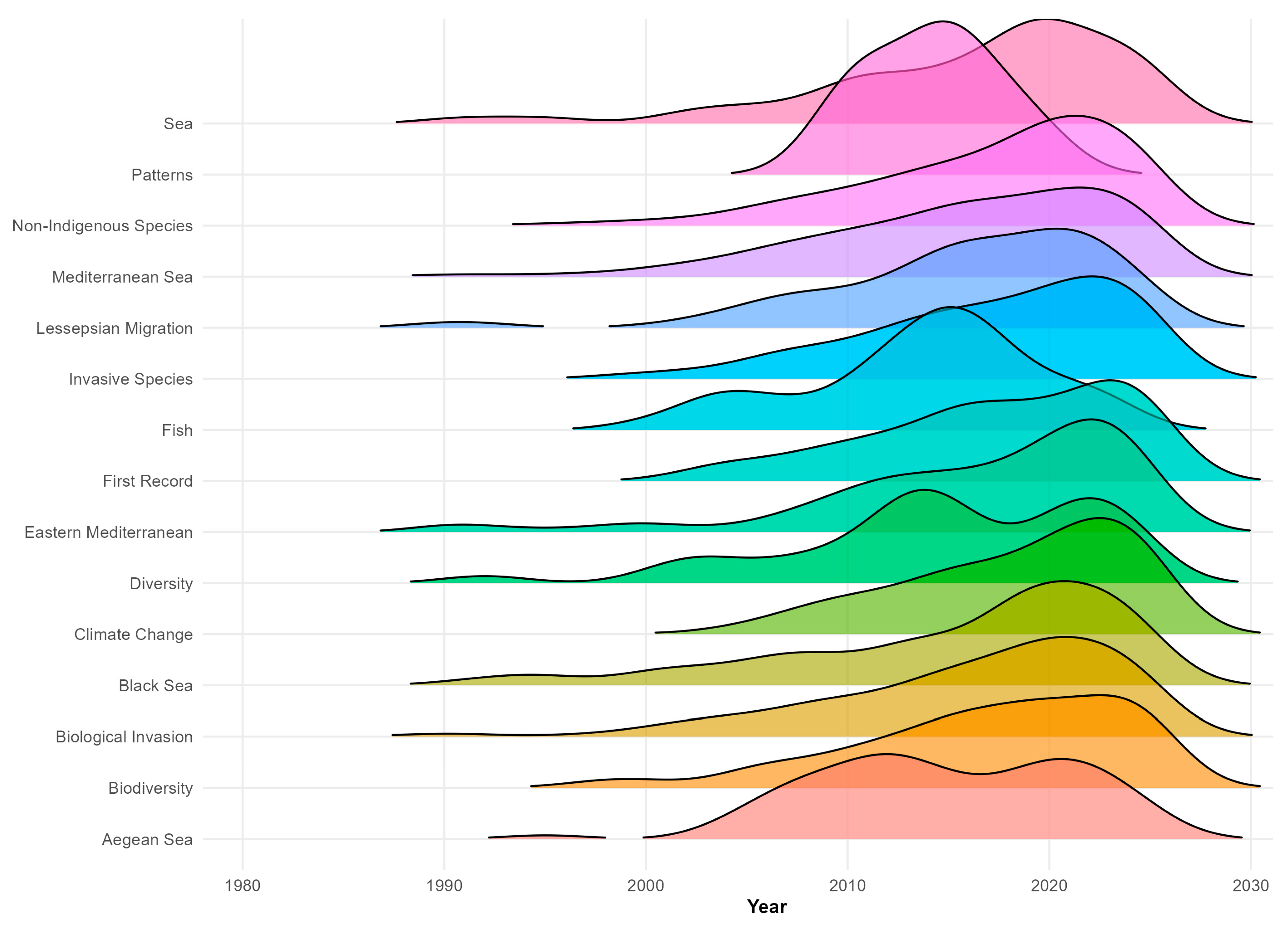
The thematic evolution and temporal shifts in keyword frequency within Mediterranean invasive species research from the late 1980s through 2025 (Figure 5) revealed that foundational terms such as “Mediterranean Sea”, “Lessepsian Migration”, and “Non-Indigenous Species” have maintained a consistent presence, with their peak intensity shifting significantly toward the 2010–2020 decade. A critical transition is observed around 2015, where the focus on “Climate Change” and “Biological Invasion” began to surge, mirroring the global shift from purely descriptive biology to process-oriented ecological research. The analysis in Figure 5 begins in the late 1980s rather than 1969 due to the consistent availability of author keywords in database records from this period onward; earlier records frequently lack keyword metadata and are too sparse for meaningful density estimation.
Furthermore, the plot highlighted the rise in specific regional and taxonomic focal points; for instance, interest in the ‘Aegean Sea’ and the general term ‘Fish’ shows a concentrated density in the most recent five-year period. Conversely, older, broader terms like ‘Sea’ or ‘Patterns’ exhibit flatter, more dispersed distributions, indicating a specialization of the lexicon over time. This thematic ‘thickening’ in the 2020s, when considered alongside the co-occurrence of these terms with process-oriented keywords such as ‘climate change’ and ‘range expansion’.
The co-citation network (Figure S1; Supplementary Materials) highlighted a highly interconnected and collaborative intellectual structure within Mediterranean invasive species research. The network is characterized by several central nodes representing seminal works, most notably the work of Zenetos et al., (2022) [3] and Katsanevakis et al., (2014) [6], identified as primary bibliographic anchors, which serve as the primary bibliographic anchors for the field. These high-degree nodes are linked by a dense web of citations, indicating a strong consensus and a shared foundational literature among researchers. The presence of prominent authors like Galil, Zenetos, and Katsanevakis across multiple time periods underscores the long-term influence of key experts in shaping the Mediterranean bio-invasion discourse.
The co-word network analysis (Figure S2; Supplementary Materials) revealed a highly interconnected intellectual structure characterized by two distinct thematic clusters. The primary, more expansive cluster (red) is centered on the core pillars of the field, including “Mediterranean Sea,” “biological invasion,” “non-indigenous species,” and “biodiversity.” This cluster integrates specific drivers such as “climate change” and “Lessepsian migration” with regional focuses like the “Black Sea,” “Aegean Sea,” and “Adriatic Sea,” alongside various taxonomic groups including “fish,” “mollusca,” and “algae.” A secondary, more specialized cluster (blue) emerges at the top of the network, focusing on ecological processes and management frameworks, with key nodes for “growth,” “communities,” “conservation,” and “management”.

3.2. Topic Modeling

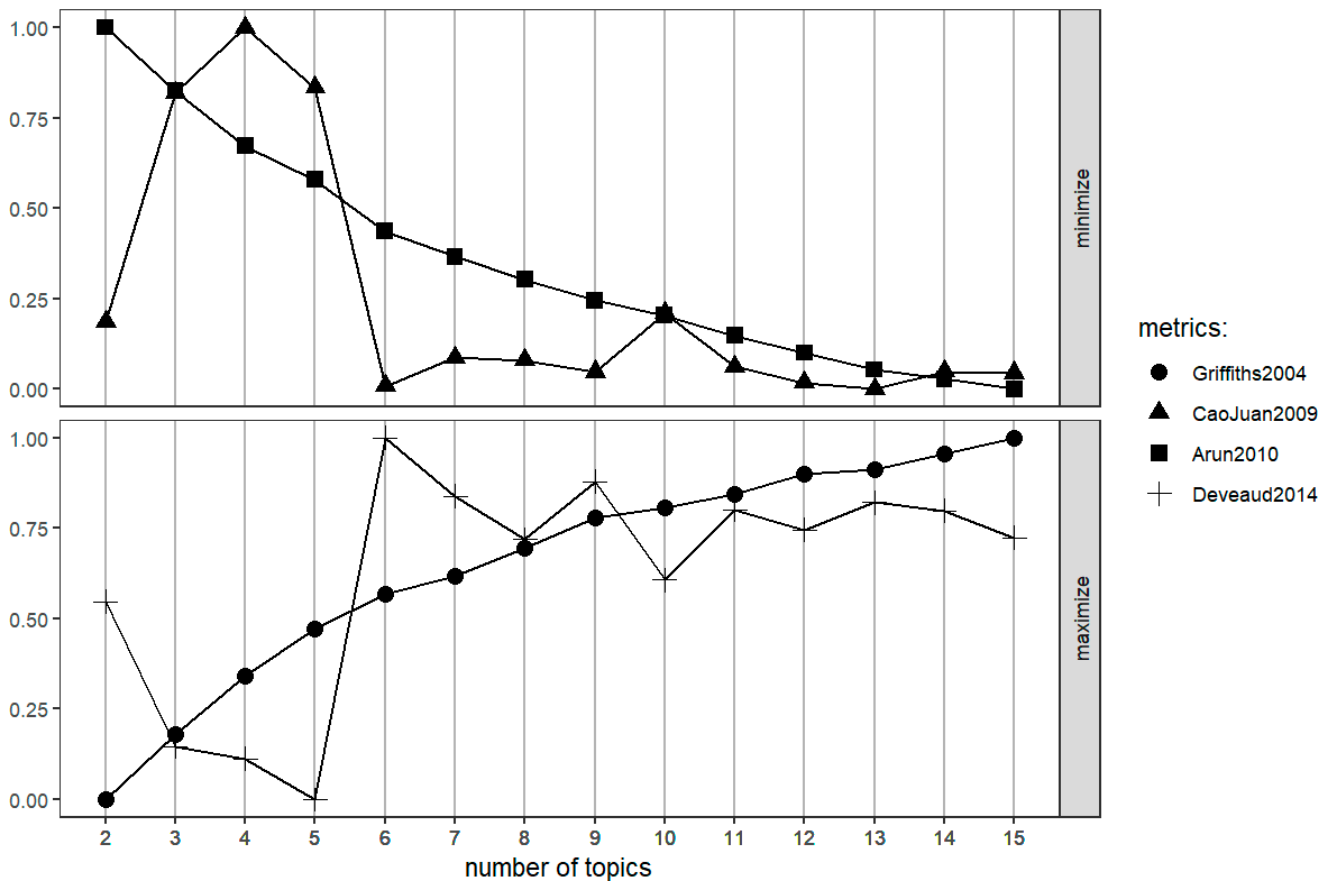
The optimal number of topics for the LDA model was determined by evaluating four statistical metrics across a range of 2 to 15 topics (Figure 6). To ensure the model captured the high level of thematic granularity present in the Mediterranean invasive species literature, 13 topics were selected for the final analysis.
This decision is supported by the Arun 2010 metric [41], which reaches its global minimum at this point, and the Griffiths 2004 metric [39], which continues to show an upward trajectory, indicating increased model log-likelihood. By opting for 13 topics, the model effectively minimizes information loss and provides a more detailed breakdown of the specialized sub-disciplines, such as specific regional impacts, vector management, and taxonomic distributions, that a simpler model might overlook.
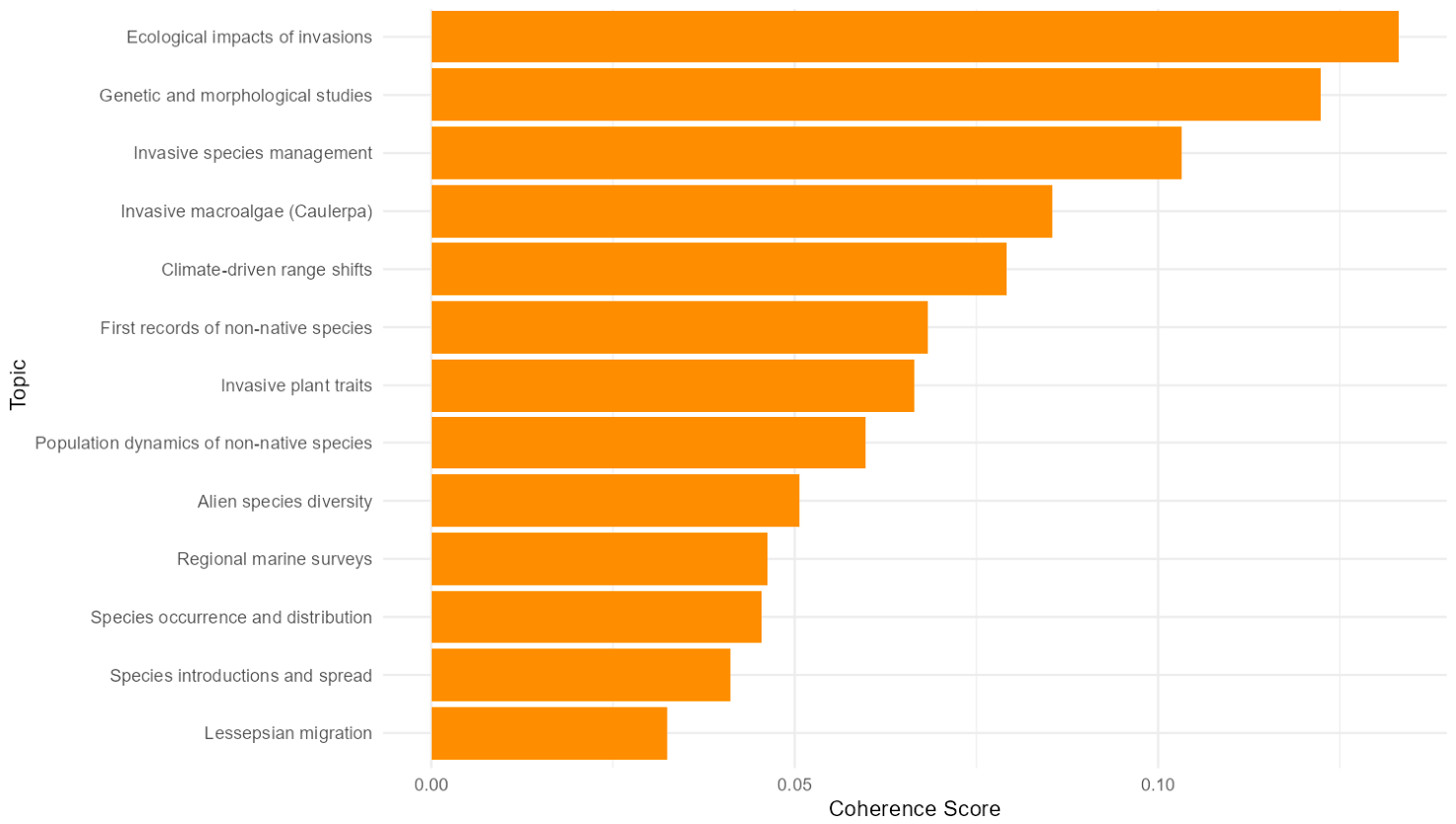
The analysis of topic coherence scores (Figure 7) provides a quantitative measure of the relative semantic consistency of the 13 statistically derived LDA topics, offering one indicator of their interpretability while acknowledging that coherence metrics capture only certain dimensions of thematic structure. The results indicate that “Ecological impacts of invasions” achieves the highest coherence score, followed closely by “Genetic and morphological studies” and “Invasive species management”. Conversely, topics such as “Lessepsian migration” and “Species introductions and spread” exhibit lower coherence scores, which likely reflects the broad and multidisciplinary nature of these subjects, spanning diverse taxonomic groups and varied ecological contexts. Overall, the distribution of scores across the topics confirms that the model has successfully captured distinct, meaningful thematic clusters ranging from highly specialized technical fields to broader, integrative ecological phenomena.
The analysis of topic prevalence across the research corpus identifies the specific thematic priorities that have shaped the field of Mediterranean invasive species research (Figure S3; Supplementary Materials). The most dominant theme is “First records of non-native species,” which significantly exceeds all other topics with nearly 500 associated documents, underscoring the foundational importance of taxonomic reporting and monitoring in this region. This is closely followed by studies on specific high-impact invaders, notably “Invasive macroalgae (Caulerpa),” and broader assessments of “Alien species diversity”.
While foundational topics like “Genetic and morphological studies” and “Regional marine surveys” maintain high prevalence, the model also captures a significant volume of research dedicated to process-oriented themes such as “Population dynamics,” “Invasive species management,” and “Ecological impacts”. Notably, specialized drivers like “Lessepsian migration” and “Climate-driven range shifts” appear as distinct, well-established topics, reflecting the unique environmental and geographic pressures of the Mediterranean basin. The distribution across these 13 topics suggests a research portfolio that appears to integrate traditional descriptive biology with ecological modeling and conservation management, though these patterns represent statistically derived approximations of thematic emphasis rather than definitive boundaries between research areas.
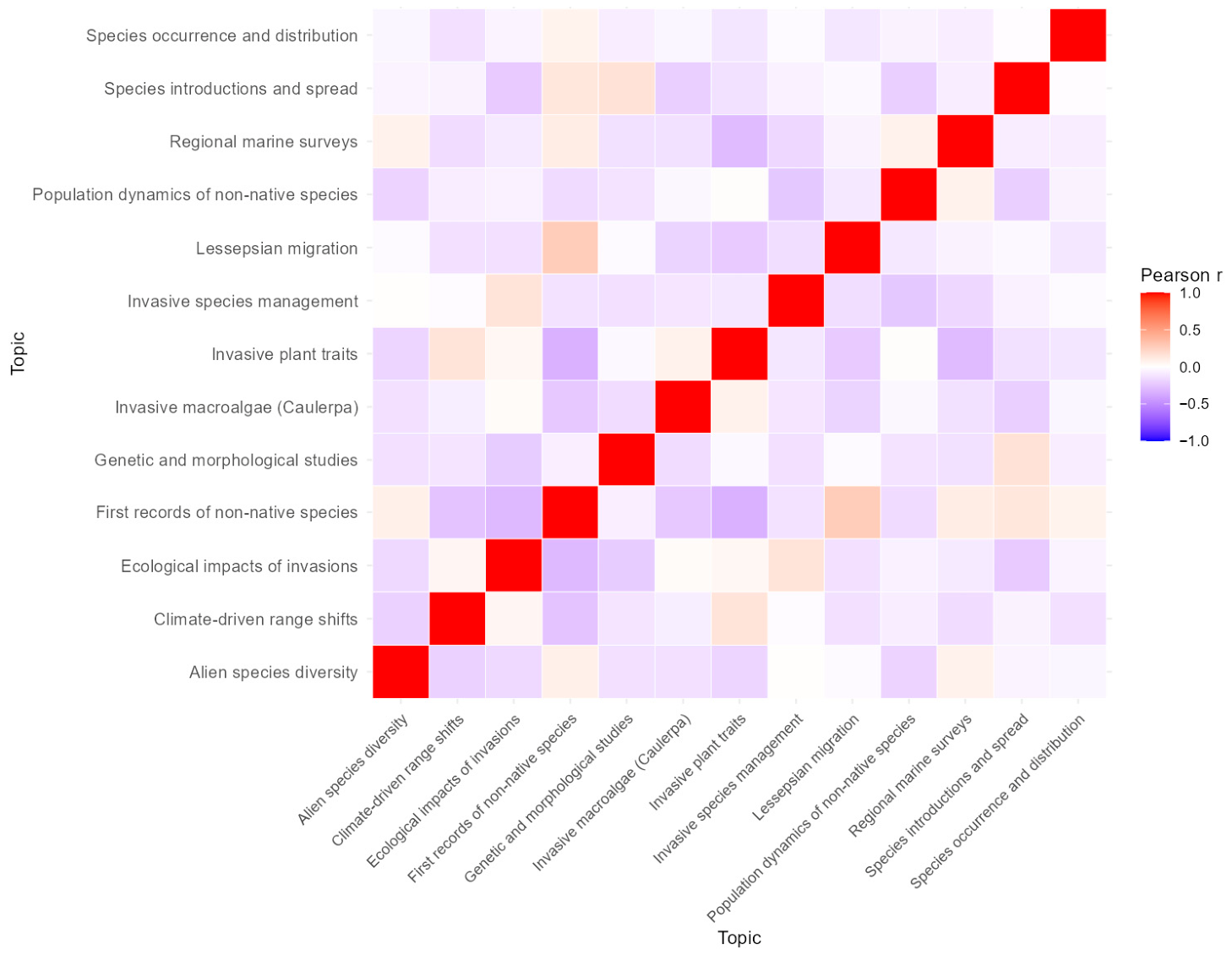
Positive associations are observed between the topics “Alien species diversity” and “Climate-driven range shifts,” as well as between “Ecological impacts of invasions” and “First records of non-native species” (Figure 8). These relationships reflect weak to moderate correlation strengths based on the heatmap visualization and should be interpreted as descriptive patterns rather than statistically tested associations.
Conversely, neutral or weak correlations (light-blue shades) suggest limited co-occurrence between certain topics, such as “Genetic and morphological studies,” which shows minimal association with regionally focused survey-based research. Rather than indicating functional or structural independence, these patterns may reflect differences in research scope, scale, or methodological focus. Overall, the map provides an exploratory overview of how research themes tend to co-appear, suggesting a possible, though not definitive, alignment between observational studies on non-native species and investigations of their ecological consequences.
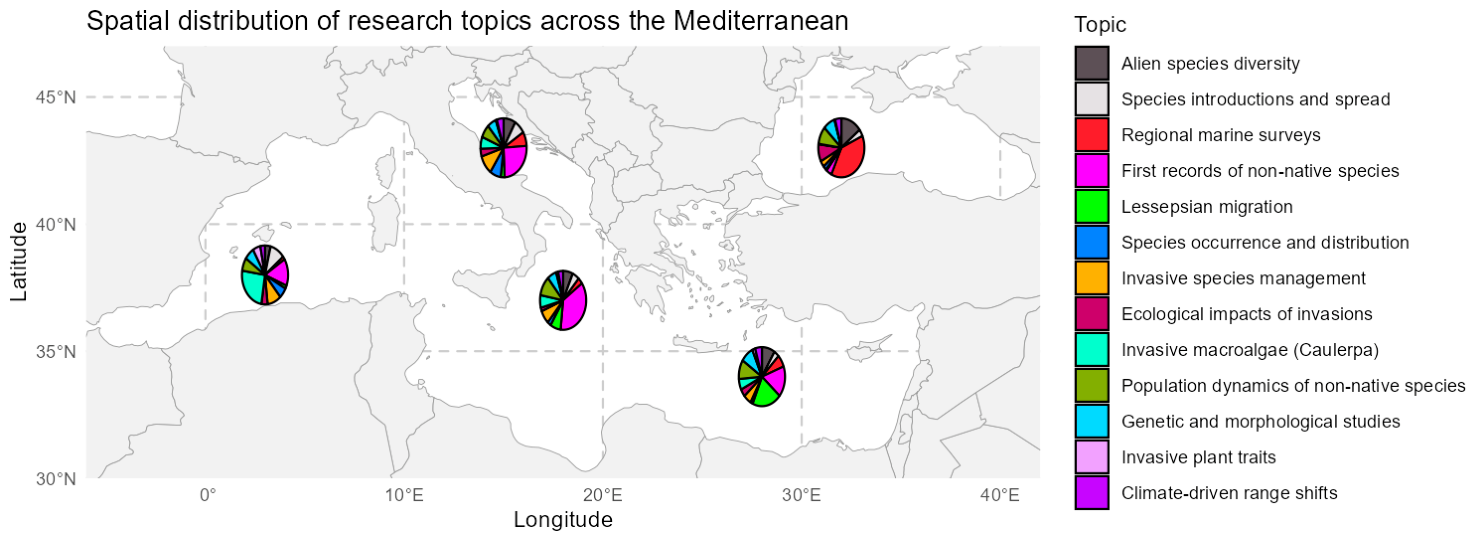
The map of the Mediterranean Sea provides a spatially explicit view of how research effort and thematic priorities are distributed across five key geographical sub-regions: the Western Mediterranean, Adriatic Sea, Central Mediterranean, Aegean Sea, and Black Sea (Figure 9). Using pie charts to represent the local proportion of the 13 LDA topics, the figure highlights a significant regional specialization in scientific literature. In the Aegean Sea, a dominant proportion of research is dedicated to “Lessepsian migration” and “First records of non-native species,” confirming its role as a critical gateway for Indo-Pacific arrivals via the Suez Canal. Conversely, the Western Mediterranean and Adriatic Sea show a more diverse topical mix, with a higher prevalence of studies focused on “Invasive macroalgae (Caulerpa)” and “Invasive species management”. The Black Sea stands out for its concentration on “Regional marine surveys” and “Alien species diversity”. This spatial heterogeneity underscores that while the invasive species challenge is basin-wide, the research agenda is heavily shaped by local introduction pathways and specific regional ecological threats.
The thematic-regional heatmap (Figure S4; Supplementary Materials) provides a granular, volume-based perspective that complements the proportional data from Figure 10. It identifies the Eastern Mediterranean as the primary scientific hub, boasting the highest absolute document counts for foundational topics like “First records of non-native species” and “Lessepsian migration,” reflecting its status as the frontline for Suez Canal-mediated introductions. A significant “General/Other” category also emerges, showing that a large body of research, particularly concerning “Invasive plant traits” and “Invasive macroalgae (Caulerpa)”, addresses the basin as a holistic system rather than focusing on fragmented sub-regions. Other regions exhibit distinct specializations, such as the Black Sea’s focus on “Regional marine surveys” and the Adriatic’s prioritization of “First records,” highlighting how local monitoring efforts are tailored to the specific environmental pressures and introduction pathways of each sub-basin.
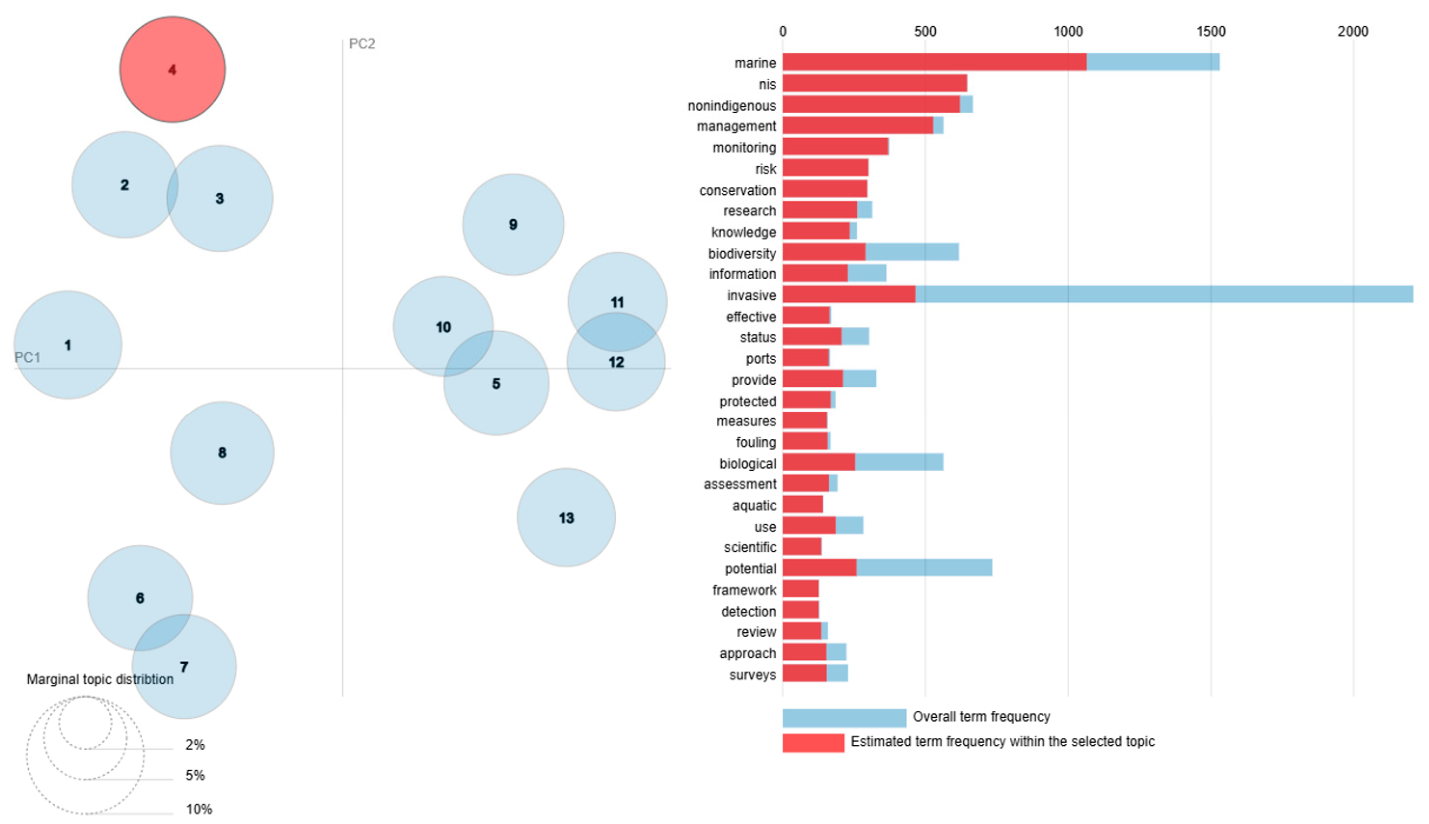
The LDAvis intertopic distance map and term frequency bar chart provide a multidimensional visualization of the semantic structure of the research corpus, with Topic 4, interpreted as focusing on marine non-indigenous species monitoring and management, emerging as the most prevalent theme based on the highest mean document–topic probability (θ) (Figure 10). On the left, the intertopic distance map plots the 13 topics using multidimensional scaling of their word distributions, showing that topics are distributed across the semantic space with limited overlap, suggesting thematically distinct research areas. On the right, the bar chart displays the top 30 most salient terms for the selected topic (Topic 4) at a relevance parameter of λ = 0.6. The red bars represent the estimated frequency of each term within Topic 4, while the blue bars represent their overall frequency in the entire corpus. Terms such as “marine,” “NIS” (non-indigenous species), “management,” and “monitoring” exhibit high relative importance within this topic.
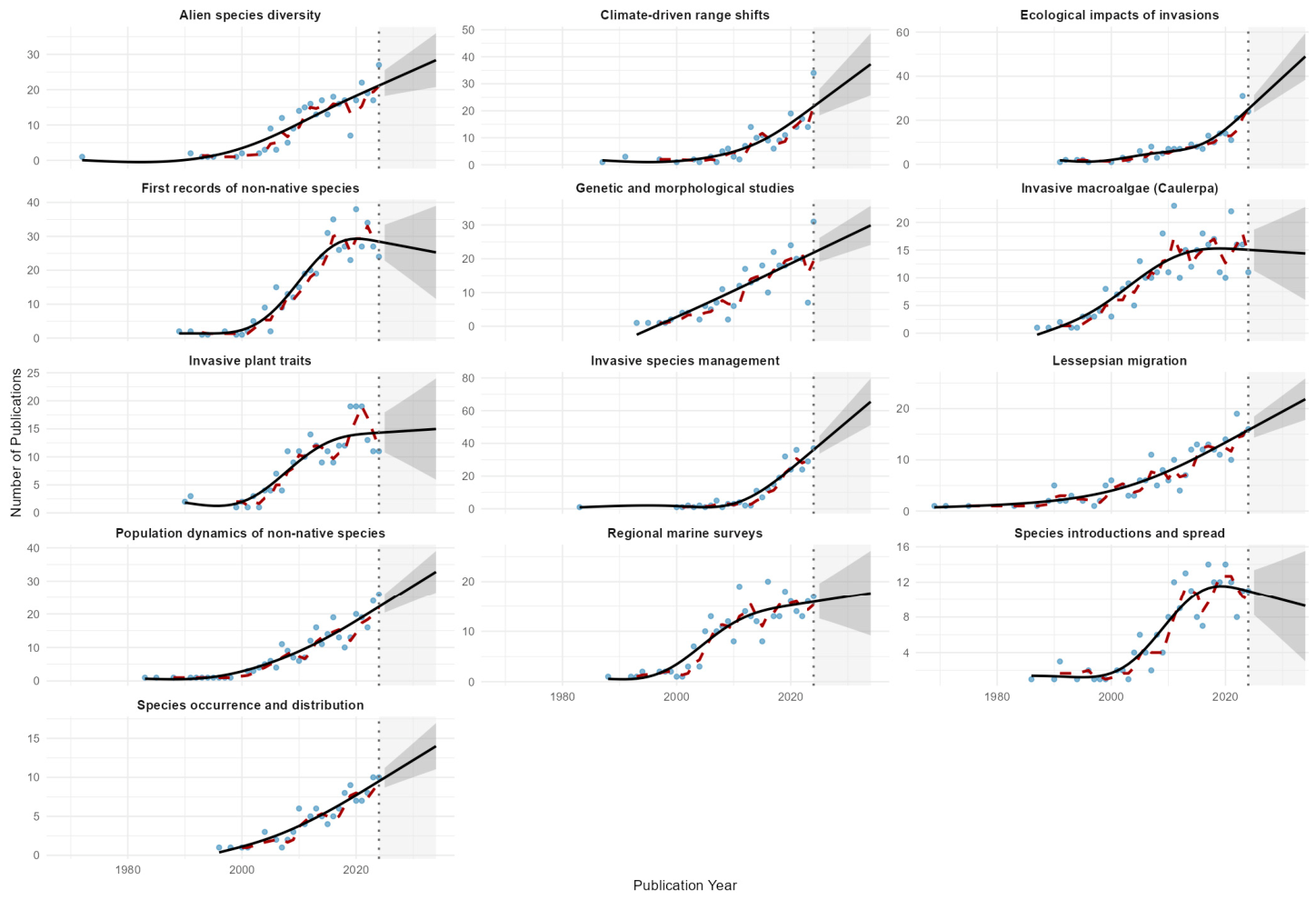
The faceted visualization presents a comprehensive analysis of historical research trends and future projections for the 13 identified research topics within the Mediterranean invasive species corpus (Figure 11). Each facet utilizes observed data points represented by semi-transparent blue dots, complemented by a dashed red line showing the rolling average to highlight short-term fluctuations. The primary long-term trend is modeled using a Generalized Additive Model (GAM) [47] that transitions into a linear forecast beyond the vertical dotted line, which marks the boundary between historical data and predictions. A translucent ribbon in the forecast region visualizes the associated uncertainty, providing a statistical range for future publication volumes. While topics like “Ecological impacts of invasions” and “Lessepsian migration” show strong projected upward trajectories, others like “First records of non-native species” and “Species introductions and spread” appear to be reaching a plateau or show stabilizing trends, reflecting the evolving maturity of different sub-disciplines.

4. Discussion

Mediterranean marine bio-invasions have evolved from a peripheral research concern into a central lens for understanding how global change reshapes regional biodiversity, ecosystem functioning, and resource use [48,49]. Framed against accelerating climate change, intensifying maritime traffic, and expanding coastal development, invasive species in this semi-enclosed, heavily utilized basin now represent both a biodiversity crisis and a natural experiment for examining ecological responses to cumulative human pressures [50]. Within this context, this study provides the first dedicated bibliometric and topic-modeling synthesis of invasive marine species research in the Mediterranean, offering a structured framework to examine how scientific attention and thematic priorities have developed and evolved over time.

4.1. Evolution of the Field

The synthesis of the bibliometric data reveals a dynamic research landscape where global environmental drivers and local geographic realities converge. While the drivers of biological invasion, such as climate change, are global in scale, their impacts are studied intensely at the local level [51]. This is evident in the strong correlation between “Climate-driven range shifts” and “Alien species diversity”, reflecting how rising sea temperatures accelerate the establishment of tropical species in Mediterranean hotspots.
The simultaneous acceleration in both region-specific terms (Aegean Sea) and global driver keywords (climate change), evident in Figure 5, combined with the correlations between Lessepsian migration, alien species diversity, and climate-driven range shifts in the LDA model (Figure 8), supports the interpretation that contemporary research increasingly embeds regional monitoring within the framework of global environmental change. This integration is further evidenced by the co-occurrence patterns in recent publications, where taxonomic and geographic terms are increasingly paired with process-oriented language (Section 3.1).
Overall, the field has transitioned from a niche area of interest to a dominant pillar of Mediterranean marine science. The initial exponential growth in publication volume observed since the early 2000s corresponds directly with the thematic shift toward high-priority global issues like Climate Change and Biodiversity loss. This is not merely a quantitative increase; the citation cohort heatmap confirms a qualitative shift in research impact. While early studies were sparse, the period 2010–2024 is characterized by a dense accumulation of mid-to-high citation tiers, indicating increasing interconnectedness and rapid uptake within the scientific community.
The observed transition from sparse, low-impact early contributions to a dense, highly cited body of work suggests that invasive species have become a core lens through which Mediterranean marine change is conceptualized, rather than a peripheral conservation issue [52]. This acceleration indicates a maturation of the field, with research evolving from an initial emphasis on documenting first records of non-native species toward increasingly integrative, theory-driven, and management-oriented investigations that build cumulatively on prior knowledge. The rise in both publication volume and mid-to-high citation cohorts implies that new contributions are not only more numerous but also more central to the scientific dialogue, reflecting a consolidation of shared concepts, reference literature, and methodological standards [53].
This evolution also mirrors broader shifts in global environmental governance, where bio-invasions are increasingly framed alongside climate change, pollution, and overexploitation as systemic pressures on marine socio-ecological systems [54]. The strong emphasis on themes such as climate-driven range shifts, pathway analysis, and ecosystem impacts suggests that Mediterranean bio-invasion research is now tightly coupled to policy agendas on biodiversity loss, blue economy, and climate adaptation. In practical terms, this means that the field is better positioned to generate the types of syntheses, indicators, and risk assessments required by regional conventions and EU directives, while at the same time facing heightened expectations to deliver actionable, cross-sectoral knowledge.
At the same time, the disproportionate growth of certain thematic and regional clusters points to apparent imbalances in research attention that may have important implications for future work. The concentration of high-impact studies around the Eastern Mediterranean “gateway” and a limited set of emblematic taxa and pathways suggests that other sub-basins, vectors, and organism groups may be comparatively less represented within the analyzed literature. These patterns should be interpreted cautiously, as they may partly reflect methodological constraints related to the search strategy and keyword selection used to construct the dataset, potentially influencing the visibility of certain regions or research themes. Nevertheless, if such imbalances correspond to genuine differences in research coverage, they could translate into blind spots in surveillance and impact assessment, particularly in western and central areas where climate warming and maritime traffic are rapidly intensifying [55]. Conversely, the current trajectory also indicates a growing capacity for synthetic and comparative analyses, which could be leveraged to disseminate methodological advances and conceptual frameworks from well-studied hotspots to historically less-studied regions [56,57].

4.2. Thematic Structure and Research Priorities

The prevalence of bigrams such as “Lessepsian migration” and “Eastern Mediterranean” suggests that while the research is expanding, it remains deeply rooted in the unique corridors of Indo-Pacific invasion. The alignment between the surge in paper counts and the high density of “6–20” and “21–50” citation cohorts underscores the Mediterranean’s role as a global laboratory for studying biological invasions under the influence of anthropogenic warming. The persistence of these core terms across keyword analyses, co-word networks, and topic modeling underscores a cohesive intellectual structure where foundational processes, Suez Canal-mediated dispersal, rapid taxonomic reporting, and thermophilic range expansion form the bedrock of the field [58]. Complementing this, the LDA results reveal a balanced portfolio of 13 topics with high coherence in areas like ecological impacts, genetic studies, and management, alongside high prevalence for first records and macroalgal invasions. This thematic architecture demonstrates that research is not fragmented but organized around a few dominant pillars that integrate descriptive biology with mechanistic ecology and applied solutions, while the correlation matrix shows meaningful linkages that reflect real interdisciplinary convergence.
These patterns imply that the Mediterranean literature has achieved sufficient maturity to support evidence-based prioritization, yet the relative underrepresentation of certain areas, such as predictive modeling, socioeconomic evaluations, and multi-species interactions, signals opportunities for strategic refocusing [3,8]. The high coherence and volume in management-oriented topics suggest a field increasingly attuned to applied needs, where scientific outputs can directly inform pathway regulation, rapid response protocols, and restoration strategies [59]. However, the dominance of pathway- and region-specific themes also risks creating knowledge silos that overlook emerging threats like microplastic rafting or aquaculture escapes, which appear as nascent citation bursts but lack dedicated thematic clusters [60].
From an implications perspective, this thematic map provides a valuable diagnostic tool for aligning research funding and capacity-building with policy gaps. For instance, the strong Eastern Mediterranean signal paired with western underrepresentation highlights the need to transfer methodological expertise from Lessepsian hotspots to emerging invasion fronts, ensuring that surveillance and control capacity scales with risk. Similarly, the coupling between high-impact citation clusters and process-oriented topics indicates that the field is well-poised to contribute to ecosystem-based management frameworks, provided that investments prioritize the underrepresented frontiers of modeling, economics, and policy evaluation.

4.3. Spatial Patterns and Regional Biases

The Eastern Mediterranean serves as a unique “natural laboratory,” with research overwhelmingly dominated by Suez Canal-mediated arrivals [11]. This region acts as a dispersal hub, where high document volumes for “First records” and “Lessepsian migration” track the rise in Indo-Pacific species. The spatial distribution of topics aligns with dominant human activities: the Aegean and Levantine basins focus on Canal-introduced species, while the Western Mediterranean and Adriatic show more diversified research into shipping-mediated vectors and management-heavy topics like “Invasive macroalgae (Caulerpa)”. Ultimately, the shift from sporadic early reporting to modern, high-impact citation clusters indicates that the field is moving toward integrated, basin-wide management frameworks [7,61].
The geographic partitioning of research effort, as quantified through topic prevalence heatmaps and sub-basin proportional analyses, reveals a clear gradient where invasion hotspots generate disproportionate scientific attention. In the Eastern Mediterranean, the Aegean and Levantine seas dominate with high volumes of Lessepsian and first-record studies, reflecting their role as primary incursion zones via the Suez Canal, while Black Sea research clusters around regional surveys and diversity assessments [6,52]. By contrast, the Western Mediterranean and Adriatic exhibit more balanced portfolios emphasizing management and vector control, particularly for established invaders like Caulerpa, with the Central Mediterranean showing intermediate specialization. This configuration implies that research priorities are finely tuned to local pathway dominance and ecological histories, creating a spatially explicit knowledge base that captures both unique threats and convergent pressures. The Eastern “laboratory” effect accelerates understanding of climate-facilitated range expansions, yielding transferable insights on rapid establishment dynamics, whereas western diversification fosters practical management tools like eradication protocols [62]. However, the resulting imbalance, Eastern overrepresentation versus western sparsity, could exacerbate asymmetries in policy readiness, as understudied basins face accelerating risks from warming and shipping without commensurate baseline data or modeling support [7].
For implications, these spatial signatures offer a diagnostic framework for resource allocation, identifying leverage points such as Aegean expertise for early-warning systems or Adriatic protocols for control [63]. The expanding “General/Other” footprint signals potential for synthetic studies that integrate sub-basin gradients into basin-scale models of connectivity and risk propagation, directly supporting MSFD indicator harmonization and transboundary action plans [63]. Proactively addressing biases through western-focused surveys and collaborative networks could thus evolve regional disparities into a strength, enabling predictive, adaptive management across the entire Mediterranean invasion arena [64].

4.4. Methodological Considerations and Limitations

This study is subject to some methodological and data-related limitations that should be considered when interpreting the results. First, the analysis is limited to records retrieved from major citation databases, which, despite broad coverage, underrepresent grey literature, non-indexed regional journals, and some early national case studies, potentially leading to conservative estimates of historical and local research effort [55]. Second, the search strategy and marine-focused filtering rely on predefined invasion-related terms, controlled vocabularies, and metadata quality; consequently, studies addressing invasive species indirectly or within broader ecosystem contexts may be omitted, and coastal or transitional water studies may be misclassified [9]. Third, despite the implementation of a multi-stage deduplication and metadata enrichment workflow, residual issues such as incomplete abstracts, inconsistent affiliations, or occasional mismatches may influence publication counts, geographic assignments, and network analyses [16,65]. Fourth, the topic modeling analysis was necessarily restricted to documents containing abstracts. While this excludes some publication types such as short communications and conference abstracts, these records were fully represented in the bibliometric analyses, ensuring that the overall research landscape is comprehensively captured. Nevertheless, the thematic insights derived from LDA reflect only those studies with sufficient textual metadata. Fifth, the automated assignment of studies to thematic pillars based on keyword frequencies entails inherent uncertainty, particularly in an interdisciplinary field where terminology often overlaps across research areas. Although the rule-based classification was informed by domain expertise, studies addressing multiple themes may not be fully captured by a single primary assignment. Accordingly, the thematic patterns and the pillar–sub-region heatmap should be interpreted as indicative of relative emphases rather than as strict or exhaustive categorizations. Sixth, the topic-modeling results are subject to limitations inherent to applying LDA to abstract text. Abstracts provide condensed representations that may not fully capture methodological detail or conceptual nuance, and topic labeling necessarily involves interpretive judgment. While topic number selection and coherence evaluation were carefully optimized, alternative modeling choices could produce somewhat different structures. The identified topics should therefore be viewed as statistically robust but approximate representations of the research landscape, and interpretive language has been correspondingly moderated. Finally, the bibliometric and topic modeling approaches introduce interpretative constraints, as citation-based indicators are influenced by time since publication and Latent Dirichlet Allocation imposes simplifying assumptions on thematic structure [36]. Overall, the identified patterns should be interpreted as structured approximations of the research landscape rather than an exhaustive census; however, the use of transparent and reproducible workflows supports the robustness of the main conclusions.

4.5. Management and Policy Implications and Future Directions

The bibliometric and topic-modeling analysis presented here provides a structured overview of research trends that can inform discussions on future priorities for invasive-species governance in the Mediterranean, rather than prescribing specific management actions. By synthesizing how research effort, themes, and regional emphases have evolved, the study helps organize a fragmented literature in ways that may be relevant for surveillance design, risk assessment, and strategic planning [10].
From a management perspective, the prominence of themes such as first records, Lessepsian migration, climate-driven range shifts, and invasive macroalgae indicates areas where the scientific literature is relatively well developed, potentially offering a stronger evidentiary basis for further applied research and evaluation. Conversely, the comparatively limited representation of predictive modeling, socioeconomic assessments, and certain sub-basins highlights areas where additional research investment could enhance the knowledge base available to decision-makers [66]. In this sense, the alignment, or misalignment, between research density and management-relevant topics may help identify priorities for future capacity building, rather than demonstrating readiness for implementation [59].
The visualization of topic–region associations also offers a descriptive perspective on how research attention is distributed across the Mediterranean, which may be useful for considering transboundary coordination needs. For example, the strong focus on the Eastern Mediterranean relative to western and central sub-basins suggests an uneven distribution of scholarly attention within the analyzed corpus, warranting further examination of whether this reflects differences in invasion pressure, research capacity, or data availability. Similarly, the increasing appearance of basin-wide thematic treatments may signal a gradual shift toward more integrative perspectives, although the extent to which this translates into harmonized monitoring frameworks or shared management approaches cannot be inferred from bibliometric patterns alone.
Looking ahead, observed topic trajectories and the recurrent co-occurrence of climate-related themes with alien species diversity suggest that Mediterranean bioinvasion research is increasingly situated within broader discussions of climate change and marine system transformation. This trend points to potential intersections with climate adaptation, marine spatial planning, and blue-economy research, rather than indicating established policy integration. The analytical framework developed here can be periodically updated to track shifts in research emphasis over time. In this way, the study contributes a flexible and repeatable synthesis tool that supports reflective, evidence-informed discussion of future research and management directions, rather than delivering definitive operational guidance for Mediterranean bioinvasions.
An additional refinement for future work would be to integrate journal quartile classifications (Q1–Q4) into the performance analysis, which would allow a more nuanced assessment of the visibility and impact of Mediterranean invasion studies across the scholarly publishing landscape.

5. Conclusions

This study shows that research on invasive marine species in the Mediterranean has evolved from a largely descriptive and fragmented literature into a mature and rapidly expanding field, characterized by strong growth in publications, increasing citation impact, and a cohesive core of contributing countries and institutions. However, this expansion remains uneven, with research effort strongly concentrated in the Eastern Mediterranean and around Suez Canal–mediated introductions, while western and central sub-basins remain comparatively underrepresented. Thematic analyses indicate that first records and taxonomic inventories continue to dominate the literature, reflecting the ongoing importance of baseline monitoring, but are increasingly complemented by studies on climate-driven range expansions, Lessepsian migration, ecological impacts, and management. In contrast, predictive modeling and socioeconomic assessments remain marginal, suggesting that conceptual development has not fully kept pace with emerging management and policy needs. Overall, the findings indicate that Mediterranean invasion science is sufficiently mature to inform evidence-based decision-making, yet constrained by persistent geographic and thematic biases. Rebalancing research effort across sub-basins and strengthening underdeveloped analytical and socioeconomic dimensions will be essential for advancing basin-wide understanding and effective management of marine bio-invasions.

Supplementary Materials

The following supporting information can be downloaded at: https://www.mdpi.com/article/10.3390/oceans7030037/s1, Figure S1: Co-citation network of influential publications in Mediterranean invasive species research. Node size reflects citation frequency; larger nodes indicate works that are more frequently co-cited and serve as foundational references. Clusters represent distinct research communities or thematic traditions within the literature, with closely connected nodes indicating shared intellectual frameworks.; Figure S2: Co-word network analysis of keyword co-occurrences in Mediterranean invasive species research, revealing two main thematic clusters. The larger cluster (red) centers on core invasion concepts including ‘biological invasion,’ ‘non-indigenous species,’ and ‘biodiversity,’ and integrates regional foci (‘Aegean Sea,’ ‘Adriatic Sea’) with driver terms such as ‘climate change’ and ‘Lessepsian migration.’ The secondary cluster (blue) focuses on ecological processes and management frameworks, with key nodes including ‘growth,’ ‘communities,’ ‘conservation,’ and ‘management.’ Node size reflects keyword frequency; proximity indicates strength of co-occurrence.; Figure S3: Thematic prevalence within the publication corpus, showing the distribution of documents across 13 identified Latent Dirichlet Allocation (LDA) topics.; Figure S4: Thematic-regional intensity map showing the number of documents per LDA topic across Mediterranean sub-regions, highlighting the concentration of research in the Eastern basin and generalized Mediterranean studies. Supplement Excel File: Excluded Records.

Author Contributions

Conceptualization, D.K. and A.T.; methodology, D.K., S.G. and A.T.; software, D.K., S.G. and A.T.; validation, S.G. and D.P.; formal analysis, D.K., S.G. and A.T.; investigation, S.G. and D.P.; resources, S.G. and D.P.; data curation, S.G. and D.P.; writing—original draft preparation, D.K. and A.T.; writing—review and editing, D.K., S.G., D.P. and A.T.; visualization, D.K. and A.T.; supervision, D.K.; project administration, D.K. All authors have read and agreed to the published version of the manuscript.

Funding

This research received no external funding.

Data Availability Statement

No new data were created or analyzed in this study.

Conflicts of Interest

The authors declare no conflicts of interest.

References

  1. Ojaveer, H.; Galil, B.S.; Carlton, J.T.; Alleway, H.; Goulletquer, P.; Lehtiniemi, M.; Marchini, A.; Miller, W.; Occhipinti-Ambrogi, A.; Peharda, M.; et al. Historical Baselines in Marine Bioinvasions: Implications for Policy and Management. PLoS ONE 2018, 13, e0202383. [Google Scholar] [CrossRef]
  2. Coll, M.; Piroddi, C.; Steenbeek, J.; Kaschner, K.; Ben Rais Lasram, F.; Aguzzi, J.; Ballesteros, E.; Bianchi, C.N.; Corbera, J.; Dailianis, T.; et al. The Biodiversity of the Mediterranean Sea: Estimates, Patterns, and Threats. PLoS ONE 2010, 5, e11842. [Google Scholar] [CrossRef] [PubMed]
  3. Zenetos, A.; Albano, P.G.; Garcia, E.L.; Stern, N.; Tsiamis, K.; Galanidi, M. Established Non-Indigenous Species Increased by 40% in 11 Years in the Mediterranean Sea. Mediterr. Mar. Sci. 2022, 23, 196–212. [Google Scholar] [CrossRef]
  4. Galil, B.S. Alien Species in the Mediterranean Sea—Which, When, Where, Why? Hydrobiologia 2008, 606, 105–116. [Google Scholar] [CrossRef]
  5. Kleitou, P.; Crocetta, F.; Giakoumi, S.; Giovos, I.; Hall-Spencer, J.M.; Kalogirou, S.; Kletou, D.; Moutopoulos, D.K.; Rees, S. Fishery Reforms for the Management of Non-Indigenous Species. J. Environ. Manag. 2021, 280, 111690. [Google Scholar] [CrossRef]
  6. Katsanevakis, S.; Coll, M.; Piroddi, C.; Steenbeek, J.; Ben Rais Lasram, F.; Zenetos, A.; Cardoso, A.C. Invading the Mediterranean Sea: Biodiversity Patterns Shaped by Human Activities. Front. Mar. Sci. 2014, 1, 32. [Google Scholar] [CrossRef]
  7. Bonanno, G.; Orlando-Bonaca, M. Non-Indigenous Marine Species in the Mediterranean Sea—Myth and Reality. Environ. Sci. Policy 2019, 96, 123–131. [Google Scholar] [CrossRef]
  8. Tiralongo, F.; Hall-Spencer, J.M.; Giovos, I.; Kleitou, P. Biological Invasions in the Mediterranean Sea. Front. Mar. Sci. 2022, 9, 1016168. [Google Scholar] [CrossRef]
  9. Seebens, H.; Blackburn, T.M.; Dyer, E.E.; Genovesi, P.; Hulme, P.E.; Jeschke, J.M.; Pagad, S.; Pyšek, P.; Winter, M.; Arianoutsou, M.; et al. No Saturation in the Accumulation of Alien Species Worldwide. Nat. Commun. 2017, 8, 14435. [Google Scholar] [CrossRef]
  10. Wray, A.K.; Agnew, A.C.; Brown, M.E.; Dean, E.M.; Hernandez, N.D.; Jordon, A.; Morningstar, C.R.; Piccolomini, S.E.; Pickett, H.A.; Daniel, W.M.; et al. Understanding Gaps in Early Detection of and Rapid Response to Invasive Species in the United States: A Literature Review and Bibliometric Analysis. Ecol. Inform. 2024, 84, 102855. [Google Scholar] [CrossRef]
  11. Galil, B.S.; Boero, F.; Campbell, M.L.; Carlton, J.T.; Cook, E.; Fraschetti, S.; Gollasch, S.; Hewitt, C.L.; Jelmert, A.; Macpherson, E.; et al. ‘Double Trouble’: The Expansion of the Suez Canal and Marine Bioinvasions in the Mediterranean Sea. Biol. Invasions 2015, 17, 973–976. [Google Scholar] [CrossRef]
  12. Donthu, N.; Kumar, S.; Mukherjee, D.; Pandey, N.; Lim, W.M. How to Conduct a Bibliometric Analysis: An Overview and Guidelines. J. Bus. Res. 2021, 133, 285–296. [Google Scholar] [CrossRef]
  13. Pritchard, A. Statistical Bibliography; An Interim Bibliography; North-Western Polytechnic School of Librarianship: London, UK, 1969. [Google Scholar]
  14. Broadus, R.N. Toward a Definition of “Bibliometrics”. Scientometrics 1987, 12, 373–379. [Google Scholar] [CrossRef]
  15. Zamani, M.; Melnychuk, T.; Eisenhauer, A.; Gäbler, R.; Schultz, C. Investigating Past, Present, and Future Trends on Interface between Marine and Medical Research and Development: A Bibliometric Review. Mar. Drugs 2025, 23, 34. [Google Scholar] [CrossRef]
  16. Aria, M.; Cuccurullo, C. Bibliometrix: An R-Tool for Comprehensive Science Mapping Analysis. J. Informetr. 2017, 11, 959–975. [Google Scholar] [CrossRef]
  17. Cobo, M.J.; López-Herrera, A.G.; Herrera-Viedma, E.; Herrera, F. Science Mapping Software Tools: Review, Analysis, and Cooperative Study among Tools. J. Am. Soc. Inf. Sci. Technol. 2011, 62, 1382–1402. [Google Scholar] [CrossRef]
  18. Zupic, I.; Čater, T. Bibliometric Methods in Management and Organization. Organ. Res. Methods 2015, 18, 429–472. [Google Scholar] [CrossRef]
  19. Lim, W.M.; Kumar, S.; Donthu, N. How to Combine and Clean Bibliometric Data and Use Bibliometric Tools Synergistically: Guidelines Using Metaverse Research. J. Bus. Res. 2024, 182, 114760. [Google Scholar] [CrossRef]
  20. Echchakoui, S. Why and How to Merge Scopus and Web of Science during Bibliometric Analysis: The Case of Sales Force Literature from 1912 to 2019. J. Mark. Anal. 2020, 8, 165–184. [Google Scholar] [CrossRef]
  21. Waltman, L. A Review of the Literature on Citation Impact Indicators. J. Informetr. 2016, 10, 365–391. [Google Scholar] [CrossRef]
  22. Martín-Martín, A.; Orduna-Malea, E.; Thelwall, M.; López-Cózar, E.D. Google Scholar, Web of Science, and Scopus: A Systematic Comparison of Citations in 252 Subject Categories. J. Informetr. 2018, 12, 1160–1177. [Google Scholar] [CrossRef]
  23. Mongeon, P.; Paul-Hus, A. The Journal Coverage of Web of Science and Scopus: A Comparative Analysis. Scientometrics 2016, 106, 213–228. [Google Scholar] [CrossRef]
  24. Aboussalam, S.; Khalil, K.; Coll, M.; Damsiri, Z.; Elkalay, K. Fisheries Management Models in the Mediterranean Sea: An In–Depth Review. Fish. Manag. Ecol. 2025, 33, 409–424. [Google Scholar] [CrossRef]
  25. FAO. The State of Mediterranean and Black Sea Fisheries—Special Edition; General Fisheries Commission for the Mediterranean: Rome, Italy, 2023. [Google Scholar]
  26. Piroddi, C.; Colloca, F.; Tsikliras, A.C. The Living Marine Resources in the Mediterranean Sea Large Marine Ecosystem. Environ. Dev. 2020, 36, 100555. [Google Scholar] [CrossRef]
  27. Skern-Mauritzen, M.; Ottersen, G.; Handegard, N.O.; Huse, G.; Dingsør, G.E.; Stenseth, N.C.; Kjesbu, O.S. Ecosystem Processes Are Rarely Included in Tactical Fisheries Management. Fish Fish. 2016, 17, 165–175. [Google Scholar] [CrossRef]
  28. Townsend, H.; Harvey, C.J.; DeReynier, Y.; Davis, D.; Zador, S.G.; Gaichas, S.; Weijerman, M.; Hazen, E.L.; Kaplan, I.C. Progress on Implementing Ecosystem-Based Fisheries Management in the United States through the Use of Ecosystem Models and Analysis. Front. Mar. Sci. 2019, 6, 641. [Google Scholar] [CrossRef]
  29. Colléter, M.; Valls, A.; Guitton, J.; Lyne, M.; Arreguín-Sánchez, F.; Christensen, V.; Gascuel, D.D.; Pauly, D. EcoBase: A Repository Solution to Gather and Communicate Information from EwE Models; Fisheries Centre Research Report; Fisheries Centre, University of British Columbia: Vancouver, BC, Canada, 2013; Volume 21, 60p. [Google Scholar]
  30. Pranckutė, R. Web of Science (WoS) and Scopus: The Titans of Bibliographic Information in Today’s Academic World. Publications 2021, 9, 12. [Google Scholar] [CrossRef]
  31. Hendricks, G.; Tkaczyk, D.; Lin, J.; Feeney, P. Crossref: The Sustainable Source of Community-Owned Scholarly Metadata. Quant. Sci. Stud. 2020, 1, 414–427. [Google Scholar] [CrossRef]
  32. Holler, J.; Kedron, P. Mainstreaming Metadata into Research Workflows to Advance Reproducibility and Open Geographic Information Science. Int. Arch. Photogramm. Remote Sens. Spat. Inf. Sci. 2022, 48, 201–208. [Google Scholar] [CrossRef]
  33. Page, M.J.; McKenzie, J.E.; Bossuyt, P.M.; Boutron, I.; Hoffmann, T.C.; Mulrow, C.D.; Shamseer, L.; Tetzlaff, J.M.; Akl, E.A.; Brennan, S.E.; et al. The PRISMA 2020 Statement: An Updated Guideline for Reporting Systematic Reviews. BMJ 2021, 372, n71. [Google Scholar] [CrossRef]
  34. Moher, D.; Liberati, A.; Tetzlaff, J.; Altman, D.G. Preferred Reporting Items for Systematic Reviews and Meta-Analyses: The PRISMA Statement. BMJ 2009, 339, b2535. [Google Scholar] [CrossRef] [PubMed]
  35. Callon, M.; Courtial, J.P.; Laville, F. Co-Word Analysis as a Tool for Describing the Network of Interactions between Basic and Technological Research: The Case of Polymer Chemsitry. Scientometrics 1991, 22, 155–205. [Google Scholar] [CrossRef]
  36. Blei, D.M.; Ng, A.Y.; Jordan, M.I. Latent Dirichlet Allocation. J. Mach. Learn. Res. 2003, 3, 993–1022. [Google Scholar]
  37. Feinerer, I. Introduction to the Tm Package Text Mining in R. 2011. Available online: https://cran.r-project.org/web/packages/tm/vignettes/tm.pdf (accessed on 25 January 2026).
  38. Nikita, M.; Chaney, N. Ldatuning: Tuning of Latent Dirichlet Allocation Models, R Package Version 1.0.2. 2016. Available online: https://github.com/nikita-moor/ldatuning (accessed on 25 January 2026).
  39. Griffiths, T.L.; Steyvers, M. Finding Scientific Topics. Proc. Natl. Acad. Sci. USA 2004, 101, 5228–5235. [Google Scholar] [CrossRef]
  40. Cao, J.; Xia, T.; Li, J.; Zhang, Y.; Tang, S. A Density-Based Method for Adaptive LDA Model Selection. Neurocomputing 2009, 72, 1775–1781. [Google Scholar] [CrossRef]
  41. Arun, R.; Suresh, V.; Veni Madhavan, C.E.; Narasimha Murthy, M.N. On Finding the Natural Number of Topics with Latent Dirichlet Allocation: Some Observations. In Proceedings of the Pacific-Asia Conference on Knowledge Discovery and Data Mining; Springer: Berlin/Heidelberg, Germany, 2010; pp. 391–402. [Google Scholar]
  42. Deveaud, R.; SanJuan, E.; Bellot, P. Accurate and Effective Latent Concept Modeling for Ad Hoc Information Retrieval. Doc. Numér. 2014, 17, 61–84. [Google Scholar] [CrossRef]
  43. Van Dyk, D.A.; Park, T. Partially Collapsed Gibbs Samplers: Theory and Methods. J. Am. Stat. Assoc. 2008, 103, 790–796. [Google Scholar] [CrossRef]
  44. Sievert, C.; Shirley, K. LDAvis: A Method for Visualizing and Interpreting Topics. In Proceedings of the Workshop on Interactive Language Learning, Visualization, and Interfaces, Baltimore, MD, USA, 27 June 2014; pp. 63–70. [Google Scholar]
  45. Röder, M.; Both, A.; Hinneburg, A. Exploring the Space of Topic Coherence Measures. In Proceedings of the Eighth ACM International Conference on Web Search and Data Mining, Shanghai, China, 2–6 February 2015; pp. 399–408. [Google Scholar]
  46. Cleveland, W.S. Robust Locally Weighted Regression and Smoothing Scatterplots. J. Am. Stat. Assoc. 1979, 74, 829–836. [Google Scholar] [CrossRef]
  47. Hastie, T.J. Generalized Additive Models. In Statistical Models in S; Routledge: Abingdon, UK, 2017; pp. 249–307. [Google Scholar]
  48. Azzurro, E.; Smeraldo, S.; D’Amen, M. Spatio-temporal Dynamics of Exotic Fish Species in the Mediterranean Sea: Over a Century of Invasion Reconstructed. Glob. Change Biol. 2022, 28, 6268–6279. [Google Scholar] [CrossRef]
  49. Beca-Carretero, P.; Winters, G.; Teichberg, M.; Procaccini, G.; Schneekloth, F.; Zambrano, R.H.; Chiquillo, K.; Reuter, H. Climate Change and the Presence of Invasive Species Will Threaten the Persistence of the Mediterranean Seagrass Community. Sci. Total Environ. 2024, 910, 168675. [Google Scholar] [CrossRef]
  50. Occhipinti-Ambrogi, A. Biopollution by Invasive Marine Non-Indigenous Species: A Review of Potential Adverse Ecological Effects in a Changing Climate. Int. J. Environ. Res. Public Health 2021, 18, 4268. [Google Scholar] [CrossRef] [PubMed]
  51. Azzurro, E.; Sbragaglia, V.; Cerri, J.; Bariche, M.; Bolognini, L.; Ben Souissi, J.; Busoni, G.; Coco, S.; Chryssanthi, A.; Fanelli, E.; et al. Climate Change, Biological Invasions, and the Shifting Distribution of Mediterranean Fishes: A Large-scale Survey Based on Local Ecological Knowledge. Glob. Change Biol. 2019, 25, 2779–2792. [Google Scholar] [CrossRef] [PubMed]
  52. Slišković, M.; Gudelj, A.; Piria, M. A Systematic Analysis of the Mediterranean Sea (IHO Sea Area) in the WRiMS Database. Diversity 2024, 16, 358. [Google Scholar] [CrossRef]
  53. Wang, J.; Zhao, W.; Ding, J.; Liu, Y. Shifting Research Paradigms in Landscape Ecology: Insights from Bibliometric Analysis. Landsc. Ecol. 2025, 40, 63. [Google Scholar] [CrossRef]
  54. Niederman, T.E.; Aronson, J.N.; Gainsbury, A.M.; Nunes, L.A.; Dreiss, L.M. US Imperiled Species and the Five Drivers of Biodiversity Loss. BioScience 2025, 75, 524–533. [Google Scholar] [CrossRef] [PubMed]
  55. Pyšek, P.; Richardson, D.M.; Pergl, J.; Jarošík, V.; Sixtová, Z.; Weber, E. Geographical and Taxonomic Biases in Invasion Ecology. Trends Ecol. Evol. 2008, 23, 237–244. [Google Scholar] [CrossRef]
  56. Novoa, A.; Richardson, D.M.; Pyšek, P.; Meyerson, L.A.; Bacher, S.; Canavan, S.; Catford, J.A.; Čuda, J.; Essl, F.; Foxcroft, L.C.; et al. Invasion Syndromes: A Systematic Approach for Predicting Biological Invasions and Facilitating Effective Management. Biol. Invasions 2020, 22, 1801–1820. [Google Scholar] [CrossRef]
  57. Kueffer, C.; Pyšek, P.; Richardson, D.M. Integrative Invasion Science: Model Systems, Multi-site Studies, Focused Meta-analysis and Invasion Syndromes. New Phytol. 2013, 200, 615–633. [Google Scholar] [CrossRef]
  58. Stevenson, E.A.; Robertson, P.; Hickinbotham, E.; Mair, L.; Willby, N.J.; Mill, A.; Booy, O.; Witts, K.; Pattison, Z. Synthesising 35 Years of Invasive Non-Native Species Research. Biol. Invasions 2023, 25, 2423–2438. [Google Scholar] [CrossRef]
  59. Katsanevakis, S.; Wallentinus, I.; Zenetos, A.; Leppäkoski, E.; Çinar, M.E.; Oztürk, B.; Grabowski, M.; Golani, D.; Cardoso, A.C. Impacts of Invasive Alien Marine Species on Ecosystem Services and Biodiversity: A Pan-European Review. Aquat. Invasions 2014, 9, 391–423. [Google Scholar] [CrossRef]
  60. Ricciardi, A.; Blackburn, T.M.; Carlton, J.T.; Dick, J.T.A.; Hulme, P.E.; Iacarella, J.C.; Jeschke, J.M.; Liebhold, A.M.; Lockwood, J.L.; MacIsaac, H.J.; et al. Invasion Science: A Horizon Scan of Emerging Challenges and Opportunities. Trends Ecol. Evol. 2017, 32, 464–474. [Google Scholar] [CrossRef]
  61. Galanidi, M.; Gratsia, E.; Zenetos, A. Backdating First Records of Non-Indigenous Species in the Mediterranean: Are Initial Findings Underestimated? Mediterr. Mar. Sci. 2025, 26, 642–656. [Google Scholar] [CrossRef]
  62. Katsanevakis, S.; Nikolaou, A.; Tsirintanis, K.; Rilov, G. Lessepsian Migration in the Mediterranean Sea in an Era of Climate Change: Plague or Boon? Sci. Talks 2025, 13, 100412. [Google Scholar] [CrossRef]
  63. Galanidi, M.; Aissi, M.; Ali, M.; Bakalem, A.; Bariche, M.; Bartolo, A.G.; Bazairi, H.; Beqiraj, S.; Bilecenoglu, M.; Bitar, G.; et al. Validated Inventories of Non-Indigenous Species (NIS) for the Mediterranean Sea as Tools for Regional Policy and Patterns of NIS Spread. Diversity 2023, 15, 962. [Google Scholar] [CrossRef]
  64. Morelli, T.L.; Brown-Lima, C.J.; Allen, J.M.; Beaury, E.M.; Fusco, E.J.; Barker-Plotkin, A.; Laginhas, B.B.; Quirion, B.R.; Griffin, B.; McLaughlin, B.; et al. Translational Invasion Ecology: Bridging Research and Practice to Address One of the Greatest Threats to Biodiversity. Biol. Invasions 2021, 23, 3323–3335. [Google Scholar] [CrossRef]
  65. Van Eck, N.J.; Waltman, L. Software Survey: VOSviewer, a Computer Program for Bibliometric Mapping. Scientometrics 2010, 84, 523–538. [Google Scholar] [CrossRef]
  66. Essl, F.; Dullinger, S.; Rabitsch, W.; Hulme, P.E.; Hülber, K.; Jarošík, V.; Kleinbauer, I.; Krausmann, F.; Kühn, I.; Nentwig, W.; et al. Socioeconomic Legacy Yields an Invasion Debt. Proc. Natl. Acad. Sci. USA 2011, 108, 203–207. [Google Scholar] [CrossRef] [PubMed]
Figure 1. Study selection and screening workflow for the systematic review (Prisma analysis), showing the number of records identified in Scopus and Web of Science, their combination and de-duplication (basic and strict), and the final number of studies included.
Oceans 07 00037 g001
Figure 2. Workflow of the topic modeling analysis based on Latent Dirichlet Allocation (LDA), including text preprocessing, topic number optimization, model fitting, evaluation, and visualization. Colors indicate major analytical stages.
Oceans 07 00037 g002
Figure 3. Annual evolution and growth trajectory of scientific publications on invasive marine species in the Mediterranean Sea (1969–2025) (red trend line indicates a non-linear, exponential-like growth trajectory).
Oceans 07 00037 g003
Figure 4. Heatmap of citation cohorts over time (1969–2025), illustrating the increasing density and scientific impact of Mediterranean invasive species research.
Oceans 07 00037 g004
Figure 5. Ridge plot of the thematic evolution and temporal density of dominant keywords in Mediterranean invasive species research from the late 1980s through 2025. The temporal range begins in the late 1980s due to the systematic availability of author keywords in database records from this period; earlier records (1969–1985) were excluded from this specific analysis due to sparse keyword metadata and low publication volume that would preclude reliable density estimation.
Oceans 07 00037 g005
Figure 6. Statistical diagnostic for choosing the optimal number of topics (k = 13) for the LDA topic modeling analysis [39,40,41,42].
Oceans 07 00037 g006
Figure 7. Coherence scores for the 13 LDA topics, representing the semantic consistency and internal interpretability of each identified research theme.
Oceans 07 00037 g007
Figure 8. Correlation matrix of 13 identified research topics, using Pearson r coefficients to illustrate thematic interdependencies across the Mediterranean invasive species corpus.
Oceans 07 00037 g008
Figure 9. Spatial distribution of research topics across the Mediterranean basin, showing the relative prevalence of 13 LDA topics within five key sub-regions.
Oceans 07 00037 g009
Figure 10. LDAvis intertopic distance map and top salient terms for the most prevalent topic (Topic 4), illustrating the semantic landscape and term frequency distributions at λ = 0.6.
Oceans 07 00037 g010
Figure 11. Historical trends and linear forecasts of publication volume across 13 research topics, illustrating the projected growth and stabilization of key themes in Mediterranean invasive species literature (black line, trend; blue dots, data points; red dash line, rolling average).
Oceans 07 00037 g011
Disclaimer/Publisher’s Note: The statements, opinions and data contained in all publications are solely those of the individual author(s) and contributor(s) and not of MDPI and/or the editor(s). MDPI and/or the editor(s) disclaim responsibility for any injury to people or property resulting from any ideas, methods, instructions or products referred to in the content.