
Article

Cyanoterphenyl-Based Liquid Crystal Dimers Functionalized with a Phosphinic Acid Bridging Group
Key Laboratory of High Performance Polymer Materials and Technology of Ministry of Education, State Key Laboratory of Analytical Chemistry for Life Science, School of Chemistry and Chemical Engineering, Nanjing University, Nanjing 210023, China
*
Author to whom correspondence should be addressed.
Chemistry 2026, 8(5), 62; https://doi.org/10.3390/chemistry8050062
Submission received: 31 March 2026 / Revised: 24 April 2026 / Accepted: 30 April 2026 / Published: 4 May 2026

Abstract

Phosphorus is an indispensable key element in life systems and materials science. Here in this work, several cyanoterphenyl-based phosphinic acid-bridged liquid crystal (LC) dimers of 2(CTOn)P (n = 6, 11) and their methyl esterification derivatives of 2(CTOn)P1E have been synthesized through hydrophosphination reaction followed by Suzuki coupling. The cyanoterphenyl LC dimers of 2(CTOn)P and methyl esterified 2(CTOn)P1E exhibit rich enantiotropic LC mesophases such as nematic (N), smectic A (SmA) and highly ordered smectic E (SmE), rather than the monotropic N or twist bend nematic (NTB) displayed by the analogous phosphinic acid-bridged cyanobiphenyl LC dimers of 2(CBOn)P as reported previously. The phase transition temperatures of the cyanoterphenyl LC dimers 2(CTOn)P are also significantly higher than those of the cyanobiphenyl series, which is attributed to the larger π-conjugated system of cyanoterphenyl as compared with cyanobiphenyl, resulting in much enhanced π-π stacking interactions. However, the significantly enhanced interactions also make them extremely insoluble; thus, a different two-step synthesis pathway combining hydrophosphination with Suzuki coupling reactions was adopted. It is worth pointing out that by combining multiple characterization techniques, including DEPT 135°, 13C NMR, and HR-MS spectra, the definite molecular composition and structure of a byproduct with a third pro-mesogen attached via a branching alkyl spacer has been unambiguously demonstrated, which evidently deepens our understanding of the free radical-mediated hydrophosphination reaction mechanism, thereby providing valuable guidance for diminishing side reactions and achieving well-preparation of the high-purity phosphorus-containing LC dimers. Such phosphinic acid functionalized LC materials are envisioned to bear some unique application prospects.

1. Introduction

Liquid crystal (LC) dimers, first reported by Vorländer in 1927 [1], are a unique class of small-molecule liquid crystals. Their molecular architecture consists of two rigid mesogens linked with a flexible spacer. LC dimers were originally investigated to serve as a simplified model for understanding the behavior of more complex main-chain and side-chain liquid crystalline polymers [2,3,4]. A key reason why the LC dimers study has attracted extensive attention is their unique thermotropic phase behaviors. One impressive phenomenon is the odd-even effect. This effect refers to the alternating trend exhibited in mesomorphic temperatures and phase transition entropy changes dependent on the odd or even methylene number of the flexible alkyl spacer [2,3,4,5]. Principally, this alternation arises from differences in the molecular shape, that is, dimers with even-numbered spacers tend to adopt a more extended linear conformation, while those with odd-numbered spacers exhibit a bent or curved structure. Besides the odd-even effect, another fascinating property possessed by some LC dimers is the twisted-bend nematic (NTB) phase. The NTB phase was first independently predicted theoretically by Meyer [6] and Dozov [7], where spontaneous symmetry breaking occurred for non-chiral, bent-shaped molecules to self-assemble into locally chiral helical superstructures. These structures contain an equal mixture of left-handed and right-handed twists. The pitch of the helices in NTB is usually much smaller than that of the common cholesteric phase (N*), though determined specifically by varied molecular structures in NTB, which generally falls within a narrow range of approximately 10 nm [8,9,10,11]. Although a number of twist-bend nematogens have been reported, those that exhibit NTB phase through direct NTB–I (isotropic state) transition remain very scarce from either pure compounds or the mixtures [12,13,14,15,16,17].
Linkages between the spacer and mesogens play an important role in the mesomorphic properties of LC dimers. Up to now, various linking groups have been explored, ranging from common methylene [18,19,20,21] or ether bonds [18,19,20,21,22,23,24,25,26,27] to more recently explored imine [14,15,27], thioether [28,29,30,31,32,33,34,35], and selenoether [36,37]. Moreover, the introduction of specific functional groups within the alkyl spacer has proved to provide another means for modulating the mesomorphic performance and further endowing the LC dimers with additional functions. Such as diynes [38,39,40,41], disulfides [42,43,44], triazoles [45], or imidazoles [46], have been embedded in the spacer to offer enhanced reactivity and regulated mesomorphic behaviors. Recently, our group reported a series of phosphinic acid-bridged cyanobiphenyl dimers 2(CBOn)P, which demonstrated that the introduction of a phosphinic acid linking group in the middle of the alkyl spacer, not only endowed with unique reactivity but also provided a powerful handle for modulating mesomorphic behaviors and further self-assembly capability, as evidenced by the formation of homeotropic nematic phases and a unique I-NTB direct phase transition [47]. However, it is somewhat regrettable that these phase transitions are only observable as monotropic LC mesophases during the cooling process [47].
Here in this work, we report the preparation of several cyanoterphenyl-based phosphinic-bridged LC dimers, designated as 2(CTOn)P (n = 6, 11), along with their methyl esterified derivatives, 2(CTOn)P1E. The resulting LC dimers exhibited a wide variety of enantiotropic mesophases, such as nematic (N), smectic A (SmA), and highly ordered SmE phases. Notably, as compared to their cyanobiphenyl analogs, the expansion of the π-conjugated system in the cyanoterphenyl core led to a remarkable increase in phase transition temperatures, and the transformation from monotropic low-order N phase to various enantiotropic mesophases, including high-order SmE phase. Furthermore, through unambiguous elucidation of the structure of a key branched byproduct via combining DEPT (Distortionless enhancement by polarization transfer) 135°, 13C NMR, and HR-MS characterizations, we got convincing evidence for the free radical-mediated reaction pathway and insights into the hydrophosphination reaction mechanism, which is pivotal for the future design of high-yield, high-purity advanced phosphorus-containing liquid crystalline materials.

2. Materials and Methods

2.1. General

1H, 13C and 31P nuclear magnetic resonance (NMR) measurements were conducted on a Bruker AVANCE III 400 MHz NMR spectrometer (Bruker, Billerica, MA, USA) in CDCl3 at 25 °C using tetramethylsilane (TMS) as an internal standard. High resolution mass spectroscopy (HR-MS) measurements were carried out using Thermo Scientific Q Exactive (manufactured by Thermo Fisher Scientific, Waltham, MA, USA) in APCI mode, ranging 100–1500 Da with the accuracy of four decimal points. The thermogravimetric analysis (TGA) was recorded on a Mettler-Toledo TGA/DSC 1 (manufactured by Mettler-Toledo, Zurich, Switzerland) at a heating rate of 30 °C min−1. Differential scanning calorimetry (DSC) thermograms were recorded on a Mettler-Toledo DSC 1 at a heating or cooling rate of 30 °C min−1. Polarized optical microscopy (POM) was employed to characterize thermal transitions, observe and photograph the LC textures, with a microscope of cross-polarizer equipped with a Leitz-350 heating stage (manufactured by Ernst Leitz, Wetzlar, Germany) and a Nikon (D3100) digital camera (manufactured by Nikon, Tokyo, Japan). The samples for POM investigation were sandwiched between two clean glass slides by melt-pressing. Small- and wide-angle X-ray scattering (SAXS/WAXS) analyses were performed at 40 kV and 50 mA with an Anton Paar SAXSess mc2 equipped with a Kratky block-collimation system and a temperature control unit of Anton Paar TCS 300, wherein the q range covered by the imaging-plate (IP) was from 0.06 to 29 nm−1, q = 4π sin θ/λ, 2θ was the scattering angle and the wavelength λ = 0.1542 nm of the Cu-Kα radiation.

2.2. Synthesis Procedures and Characterization

The detailed synthesis procedures and characterization data are provided in the Supporting Information.

3. Results and Discussion

3.1. Synthesis and Structural Characterization

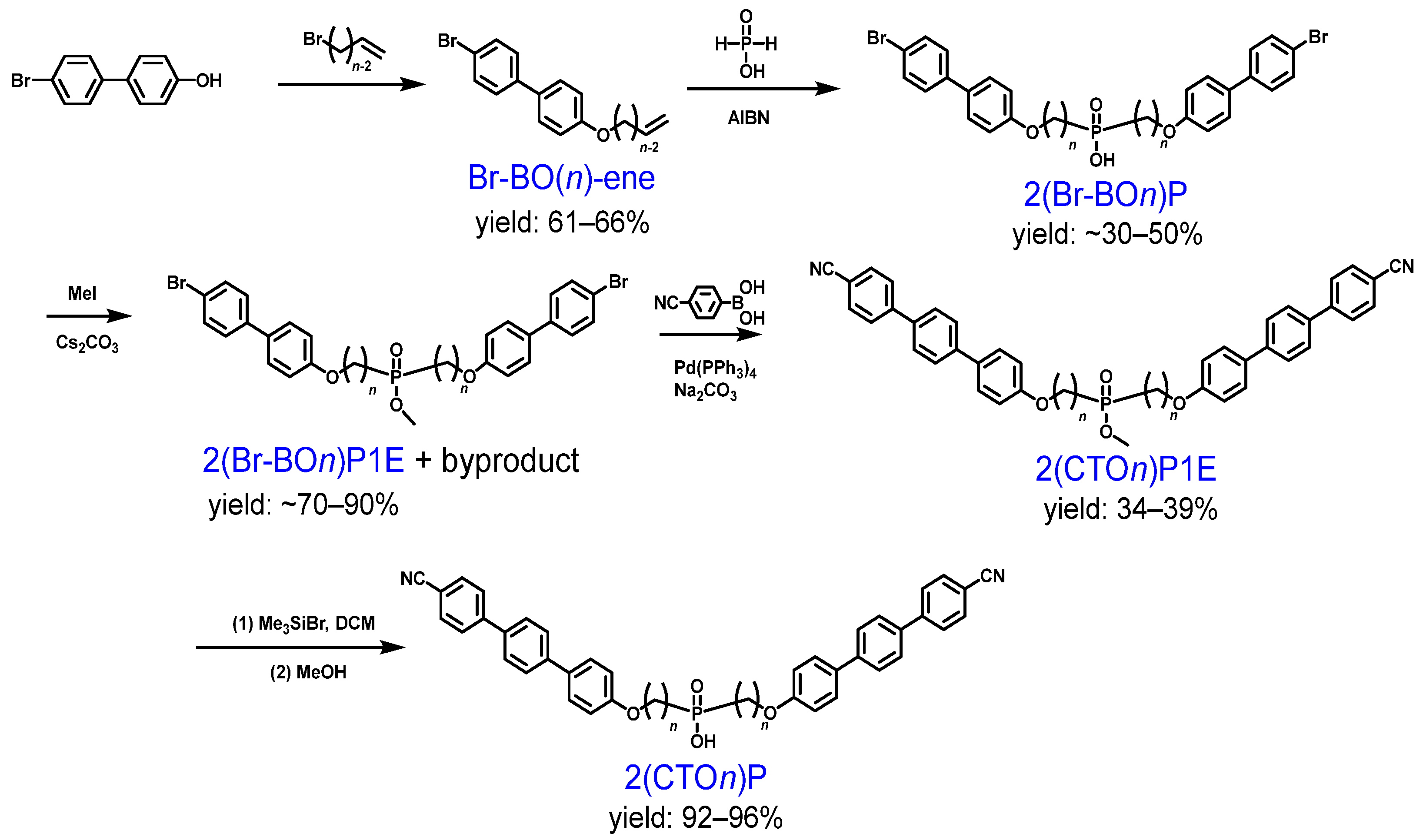
The synthetic route for the desired LC dimers of different length alkyl spacers bridged with a phosphinic acid or methyl ester group is presented in Scheme 1. The bromobiphenyl precursors terminated with a vinyl (–ene) group, Br-BO(n)-ene, were synthesized through a typical Williamson etherification reaction between 4-bromo-4′-hydroxybiphenyl and the corresponding ω-bromoalkyl-1-ene. Subsequently, the intermediates of 2(Br-BOn)P with a phosphinic acid bridging group were obtained via a free radical-mediated hydrophosphination reaction between slightly excessive vinyl-terminated bromobiphenyl precursors and hypophosphorous acid, triggered by the initiator of AIBN. After a simple purification without column chromatography, the crude product, mainly including the two-side addition 2(Br-BOn)P, a one-side addition impurity and an unknown byproduct, was utilized directly for the next reaction.
Then esterification of the phosphinic acid with methyl iodide (MeI) was conducted to gain crude esterified product, including the both side addition product of 2(Br-BOn)P1E, the one-side addition impurity and the unknown byproduct introduced in the previous step. In this step, the byproduct was also esterified. For n = 11, the esterified byproduct was separated to apply for careful characterizations as well to find out its definite molecular composition and structure, denoted as 2(Br-BO11)P1E-byproduct.
Finally, the bromobiphenyl-terminated intermediate product of 2(Br-BOn)P1E underwent a Suzuki coupling reaction with p-cyanophenylboronic acid in the presence of a palladium catalyst to obtain the methyl esterified derivatives of cyanoterphenyl LC dimers of 2(CTOn)P1E. Then followed by a nucleophilic dealkylation reaction with trimethylbromosilane (Me3SiBr), the cyanoterphenyl LC dimers of 2(CTOn)P bridged with a phosphinic acid group were synthesized, with both side alkyl spacer methylene number n = 6, 11.
The markedly enhanced π-π stacking interactions between cyanoterphenyl mesogens make 2(CTOn)P extremely insoluble, thereby hampering its direct preparation according to the same synthetic route for the cyanobiphenyl LC dimers of 2(CBOn)P, which was successfully employed through the hydrogen transfer addition reaction between vinyl-terminated mesogen precursors with hypophosphorous acid in our previous report [47]. To address the challenge of solubility issues, as shown in Scheme 1, starting from brominated biphenyl precursors, the esterified derivatives of methyl phosphinate LC dimers of 2(CTOn)P1E have been first synthesized. Finally, the phosphinic acid-bridged cyanoterphenyl LC dimers of 2(CTOn)P were prepared through dealkylation and purification by Soxhlet extraction.
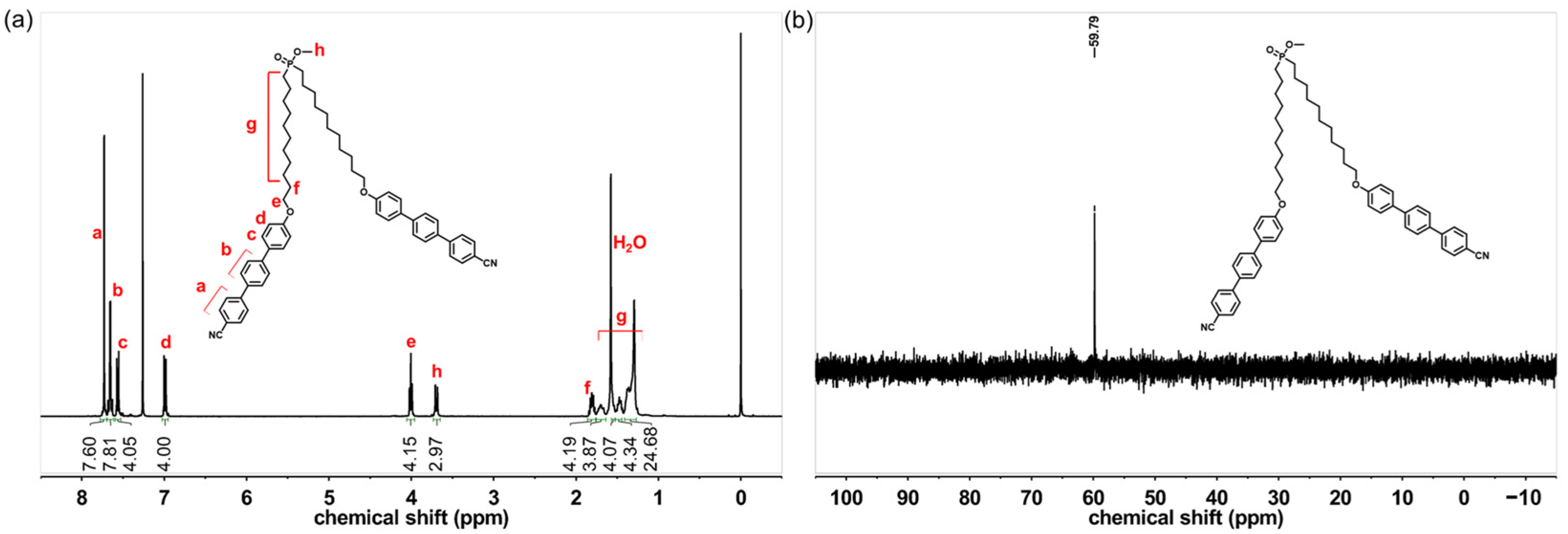
All the key intermediates and the esterified LC dimers of 2(CTOn)P1E were fully characterized with 1H and 31P NMR; some spectra and characterization data are provided in the Supporting Information. Taking one of the LC dimers of 2(CTO11)P1E as an example (Figure 1), all signals in its 1H NMR spectrum (Figure 1a) are observed with expected chemical shifts and integral ratios consistent with the proposed structure. Notably, the methyl proton signals (h) of the phosphinate methyl ester exhibit an unusual doublet due to 3JH–P coupling. Furthermore, a single peak at 59.8 ppm displays in the 31P NMR spectrum (Figure 1b), confirming the correct structure of the symmetric both side addition product and ruling out the presence of phosphinic acid byproducts or other phosphorus-containing impurities.
The 1H NMR spectra of the phosphinic acid bridged LC dimers of 2(CTOn)P (n = 6, 11) display no discernible signals besides the internal standard TMS, attributable to their extremely poor solubility in all common deuterated solvents, which also indirectly confirms that the LC dimer products are free from soluble impurities, such as the reactant esterified LC dimers of 2(CTOn)P1E or other byproducts. Given that the corresponding methyl ester LC dimers of 2(CTOn)P1E as the precursors have been fully characterized and unambiguously confirmed, the correct composition of the derived phosphinic acid bridged LC dimers of 2(CTOn)P (n = 6, 11) can be confidently assured, corroborated also by their thermal properties and LC phase behaviors as demonstrated below.

3.2. The Precise Determination of the Composition and Structure of a Branched Tri-Mesogenic Byproduct for In-Depth Understanding the Free Radical Mediated Hydrophosphination Reaction Mechanism

As mentioned in the preceding Section 3.1 about synthesis and structural characterization, during the preparation of the methyl esterified precursor 2(Br-BO11)P1E, directly using the crude intermediate of 2(Br-BO11)P containing a minor one-side addition impurity and an unknown byproduct obtained via a free radical-mediated hydrophosphination reaction, the derivatized byproduct of 2(Br-BO11)P1E was completely separated and thoroughly characterized as below.
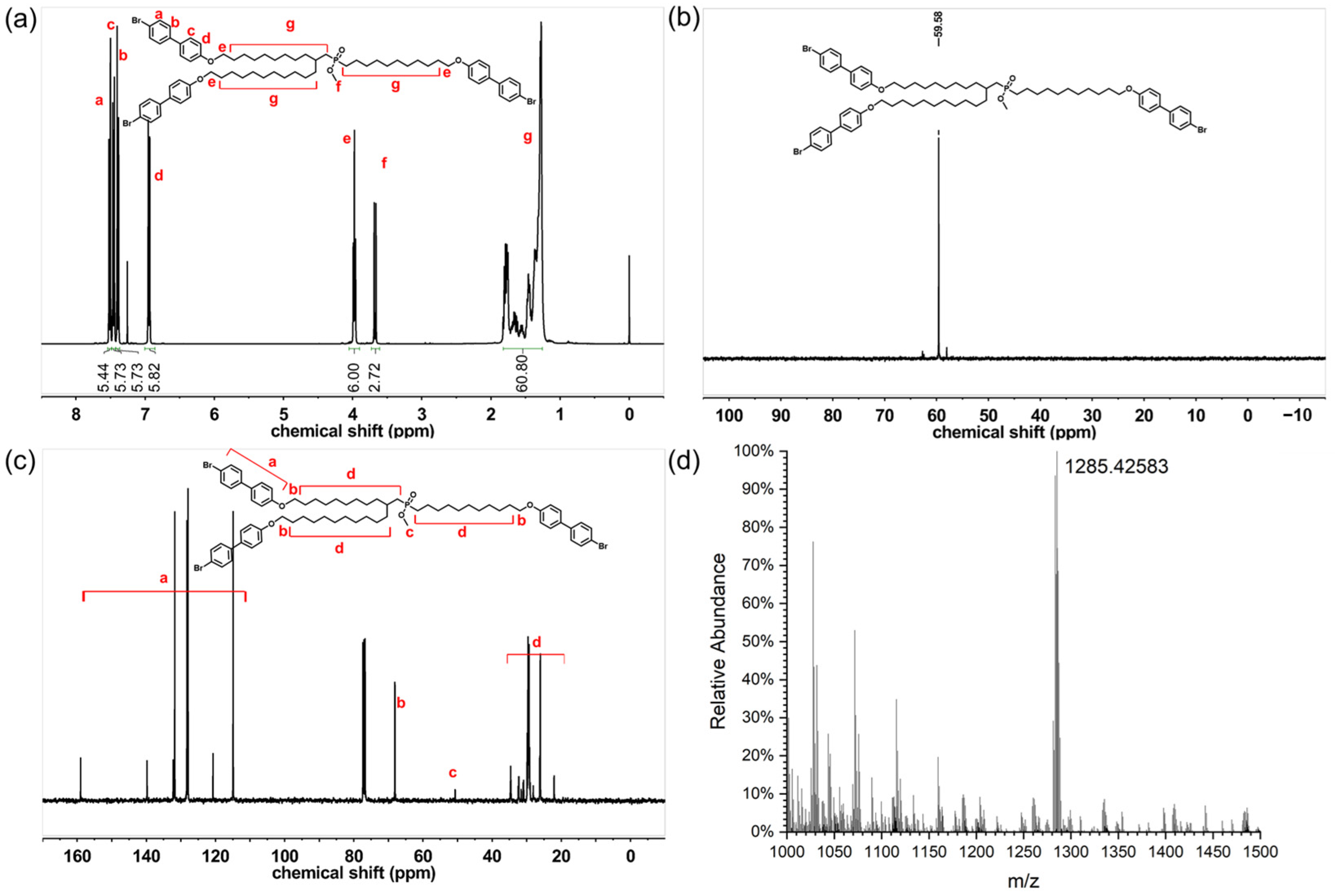
Figure 2 presents the 1H, 13C and 31P NMR spectra and HR-MS profile for the purified 2(Br-BO11)P1E-byproduct. In the 1H NMR spectrum (Figure 2a), the integral ratio of peaks e (the methylene proton adjacent to phenolic oxygen, RCH2OPh-) and f (the methyl phosphinate, CH3O-P=O) is approximately 6:3, which indicates a molar ratio of 1:3 for the methyl ester and bromobiphenyl unit, significantly deviating from the expected 1:2 ratio of the target LC dimer and implying a three pro-mesogen substituted structure. The 31P NMR spectrum reveals no significant shift in the phosphorus resonance of the byproduct as compared to the target LC dimer (Figure 2b), which indicates a largely unchanged chemical environment of the P atom and agrees with the bridging group of methyl phosphinate featuring only one-alkyl substitution at both sides. As shown in Figure 2c, though the other resonances are virtually indistinguishable from those of the target LC dimer, the aliphatic carbon signals (δ 20~35 ppm) provide crucial structural clues for elucidating the precise molecular composition and structure of the byproduct, with further detailed characterization as follows.
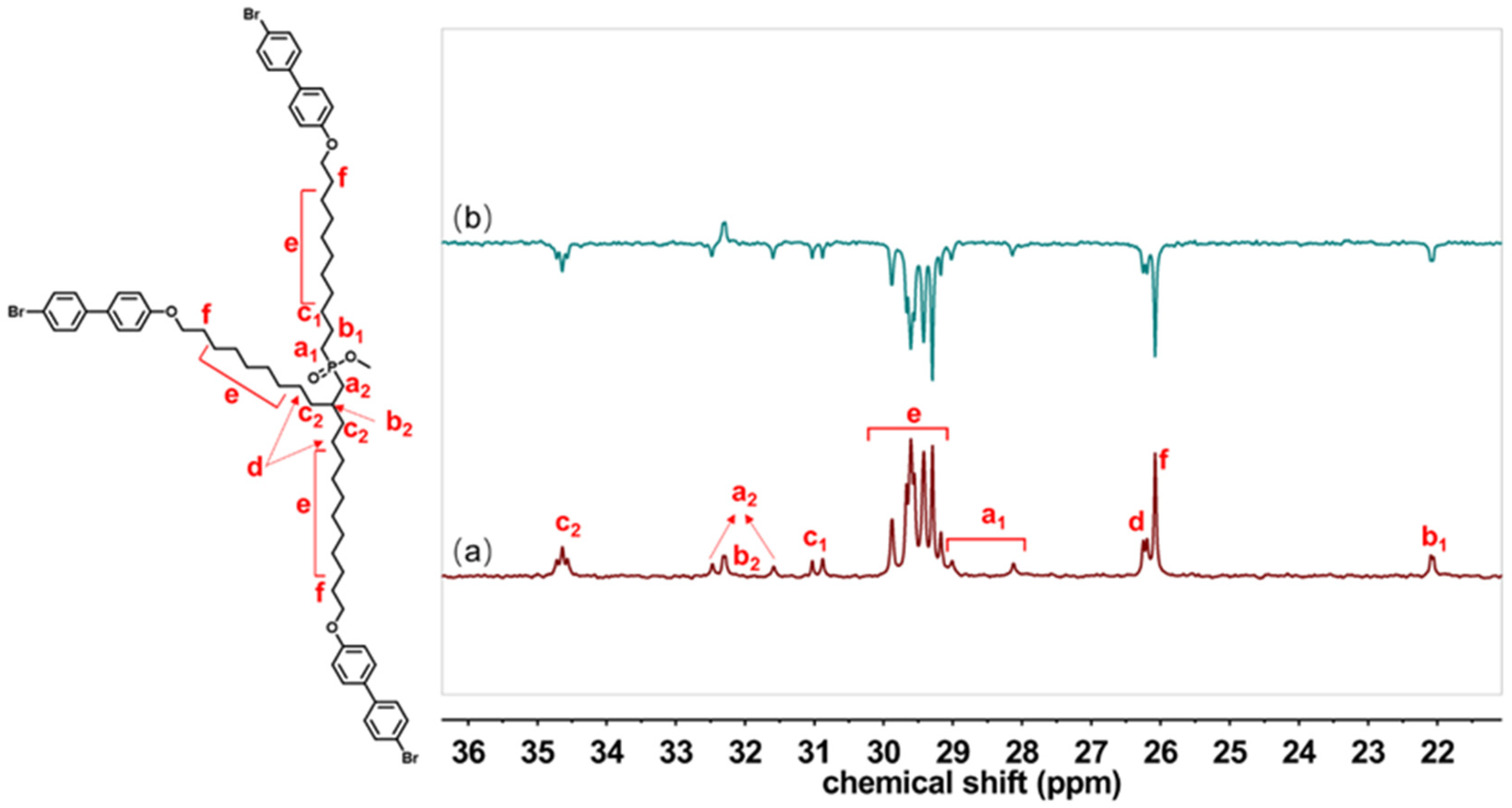
A close inspection of the aliphatic carbon signals in the 13C NMR spectrum helped to establish the accurate connectivity of the alkyl chain within the byproduct, which was further corroborated by the DEPT 135° spectrum (Figure 3). The carbon-phosphorus internuclear distances were analytically determined by calculating the JC–P coupling constants from the spectral splitting patterns. For instance, peaks a1 and a2 can be well assigned to methylene carbons directly bonded to phosphorus (–CH2-P=O), which is supported by a 1JC–P coupling constant of approximately 89.0 Hz, despite the wide separation and spectral overlap affecting the doublet for a2. Furthermore, their negative signals in the DEPT 135° spectrum confirm their CH2 carbon character. These 13C NMR data manifest that there are exactly two methylene groups attached to the phosphorus center. Applying the aforementioned method, the coupling constants for peaks b1 and b2 were identified as approximately 3.0 Hz of 2JC–P, whereas those for c1 and c2 were found to be 7.0~15.0 Hz of 3JC–P. Notably, the signal for c2 is actually of double doublets, indicating overlap of two closely spaced doublets. Furthermore, the positive signal for peak b2 in the DEPT 135° spectrum indicates that it originates from either a methyl (CH3) or a methine (CH) carbon. Given its high chemical shift of 32.3 ppm and combining the other structural analyses discussed earlier, this peak is definitely attributed solely to a methine (CH) carbon. Based on the above analyses, the molecular structure of 2(Br-BO11)P1E-byproduct is conclusively established as illustrated in the left panel of Figure 3. Furthermore, HR-MS(APCI) [m/z calc. for [M + H]+, C70H93Br3O5P+, 1285.4264; found 1285.4258 (Figure 2d)] also well validates the proposed composition and structure as derived from the NMR data.
Based on the above in-depth characterizations and comprehensive analyses, the definite molecular composition and structure of a branched triple pro-mesogenic byproduct have been unambiguously determined. Structurally, such a byproduct compound differs from the target LC dimer only with an additional bromo-substituted biphenyl similarly tethered via an alkyl spacer. It is worth pointing out that when the bridging group is present as the polar phosphinic acid rather than its methyl ester, this byproduct is virtually indistinguishable from the target product by spectroscopic characterizations such as Fourier transform infrared (FTIR), 1H and 31P NMR spectra. The formation of this byproduct can be rationalized from the free radical-mediated hydrophosphination reaction mechanism, where the free radical intermediate may occasionally attack another terminal alkene before being terminated by H-atom transfer, thus an additional mesogen-attached chain is introduced through branching in the β-position of the bridging phosphinic acid group. Under normal conditions with good solubility, this low-quantity byproduct can be completely removed and purified through careful column chromatographic separation. However, for those introducing unique mesogens with too strong interactions or excessively ultralong alkyl spacers resulting in extremely low solubility and extra difficulty in finding suitable solvents, the purification and separation processes will encounter huge challenges.
Here, we devoted considerable effort to separate and thoroughly characterize the byproducts, which is of quite significance for in-depth understanding of the free radical-mediated hydrophosphination reaction mechanism and guiding more efficient preparation of such functionalized LC dimer materials with high purity under optimized reaction conditions. It is noteworthy that even the introduction of trace amounts of such branching tri-mesogen attached byproducts, due to their thermal properties and phase behaviors being highly similar yet fundamentally distinct from those of LC dimers, may heavily mislead our judgment on their phase behaviors and lead to erroneous conclusions. This system serves as a valuable reminder case for the synthesis of novel LC compounds or other organic functional materials; careful and rigorous characterizations of the product composition and structure are required to exclude any contamination of closely related impurities.

3.3. Thermal Properties and Mesomorphic Phase Behaviors

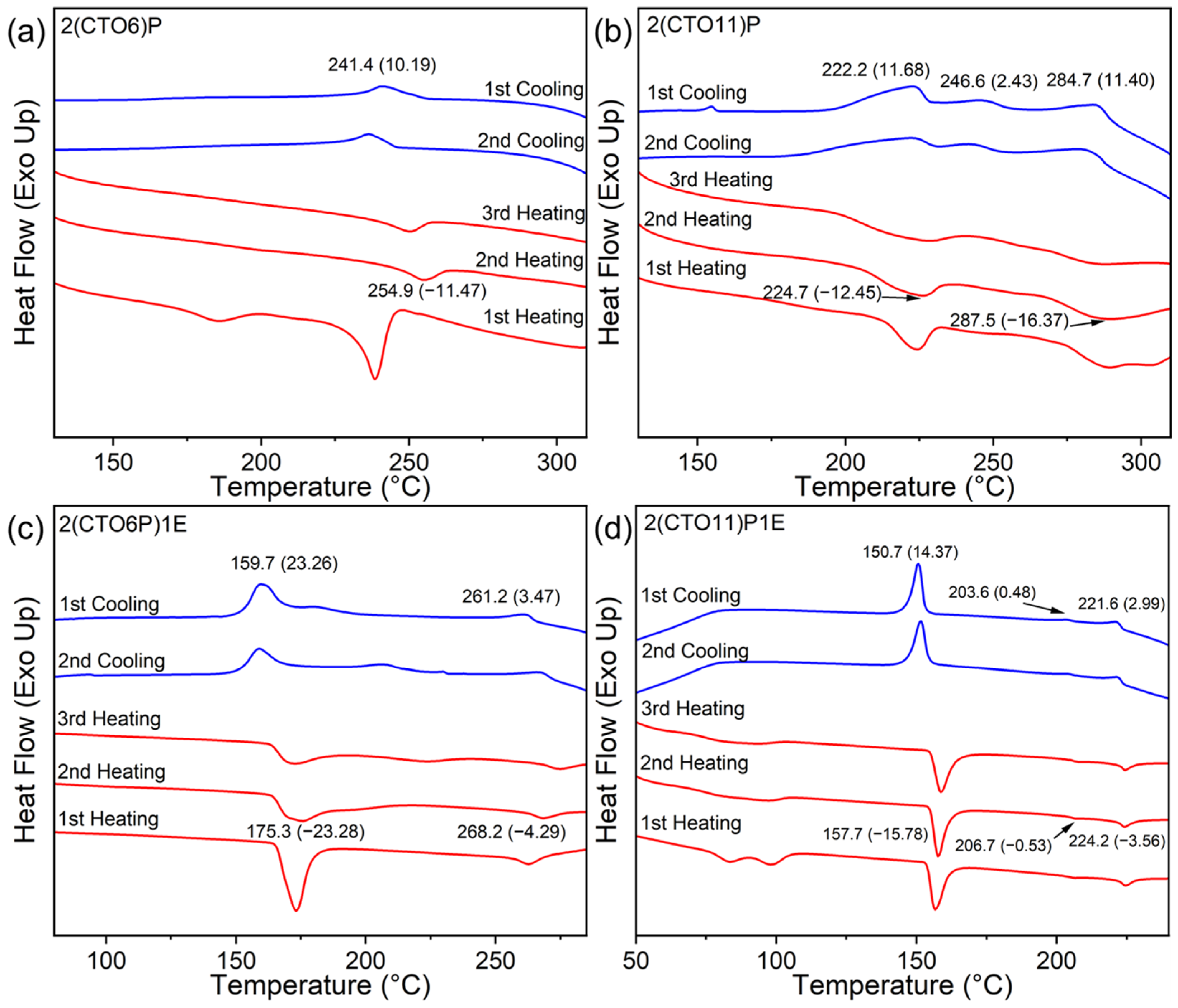
Thermogravimetric analysis (TGA) revealed that all the dimers exhibited relatively high thermal stability, with the esterified LC dimers possessing about 30 K higher thermal decomposition temperature than their phosphinic acid-bridged LC dimers. Specifically, thermal decomposition temperatures (5% weight loss, T5%) of 2(CTO6)P and 2(CTO11)P were measured to be 334.1 °C and 357.3 °C, respectively. The corresponding esterified derivatives, 2(CTO6)P1E and 2(CTO11)P1E, exhibited slightly higher thermal stability, with T5% = 361.5 °C and 389.6 °C, respectively (Figure S7). DSC analysis attempts at a normal heating and cooling rate of 10 °C min−1 indicated that these LC dimers underwent certain decomposition upon prolonged thermal exposure. To avoid the influence of potential thermal decomposition, a higher heating/cooling rate of 30 °C min−1 was adopted to shorten the exposure time at elevated temperatures, and the maximum testing temperature was limited below 320 °C. DSC thermograms of the cyanoterphenyl LC dimers and their esterified derivatives, obtained under a relatively high heating and cooling rate (30 °C min−1), are shown in Figure 4. Although minor baseline fluctuations are evident in the high-temperature regime, quite good reproducibility is manifested with multiple repeated heating and cooling cycles.
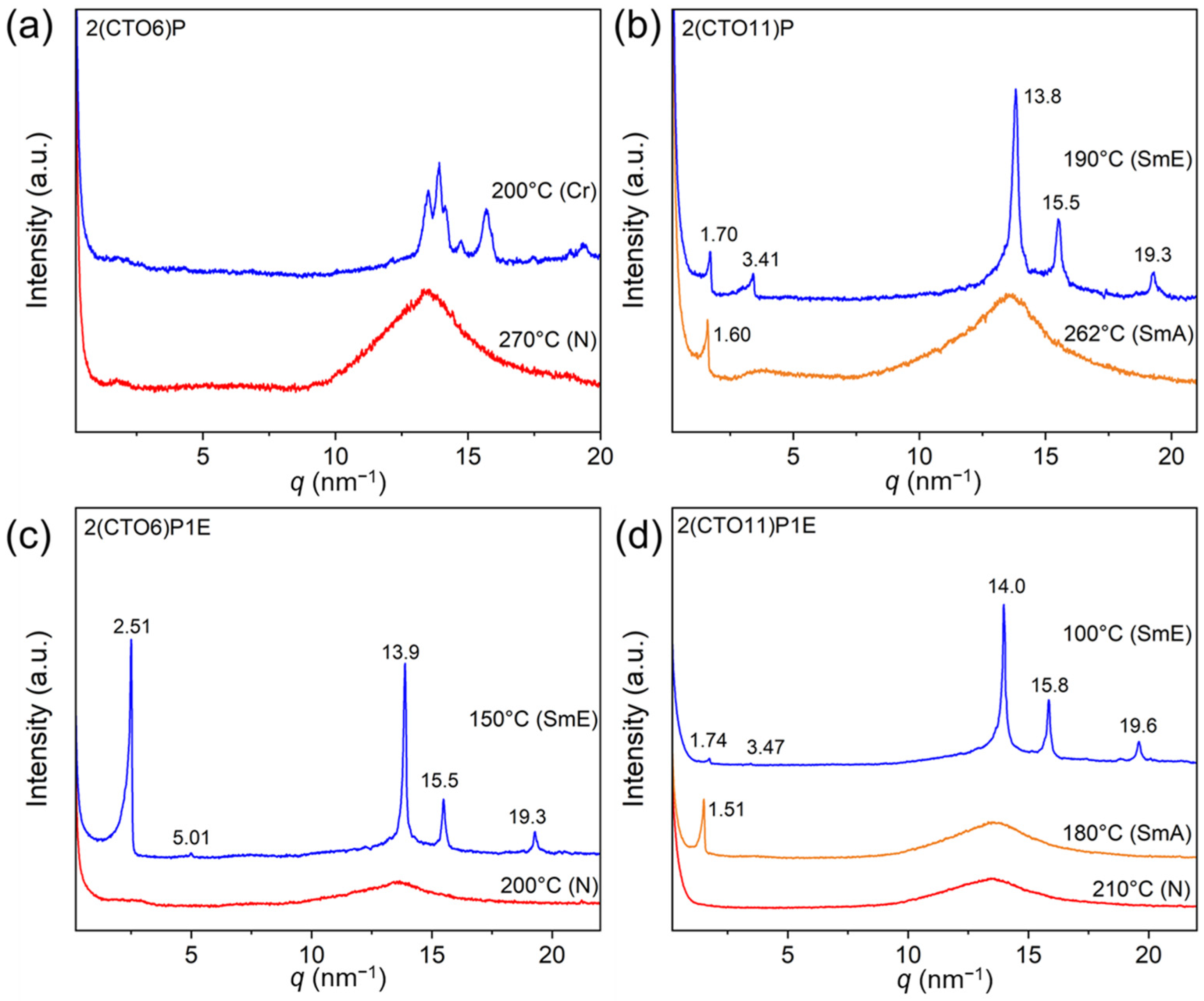
Upon heating to 320 °C, the LC dimer of 2(CTO6)P with a shorter spacer on both sides, 6-methylene, did not reach its clearing point. The onset of accelerated thermal decomposition at around the cut-off temperature interfered with the detection of the phase transition peak, preventing the determination of the isotropization temperature by the DSC measurement (Figure 4a). Under POM observation (Figure S8), 2(CTO6)P exhibited an enantiotropic nematic phase with a clearing point at approximately 350 °C. It displayed a full dark field upon cooling from the isotropic state into the nematic phase naturally (Figure S8a), which turned bright birefringence upon slight shearing with a finger contact pressure, especially more pronounced at the bubble edges of the thin film sample (Figure S8b), indicative of homeotropic alignment between the substrates. Such a homeotropic phenomenon is similar to that observed from the cyanobiphenyl series [47], which is attributed to noncovalent interactions (hydrogen bonds, electrostatic interactions) between the bridged phosphinic acid and surface polar groups such as hydroxyl of the glass substrate. Furthermore, the crystalline phase upon cooling below 240 °C exhibits a marble texture under the cross-polarized optical microscope (150 °C, Figure S8c). SAXS/WAXS analysis results further provide corroborative evidence for the N phase, with only a broad band and Cr phase showing multiple sharp peaks (Figure 5a).
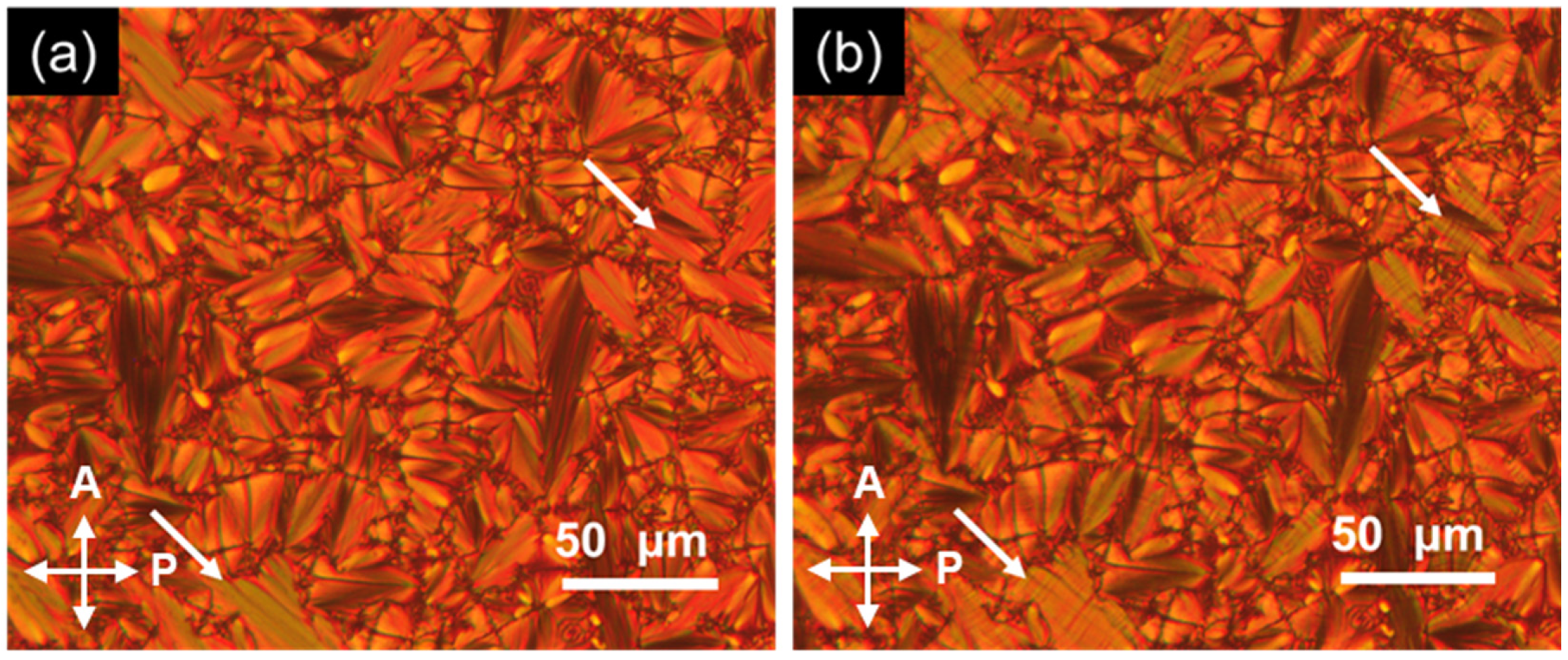
The DSC curves of LC dimer 2(CTO11)P with a longer spacer on both sides, 11-methylene, exhibit three exothermic peaks upon cooling, located at 284.7 °C, 246.6 °C and 222.2 °C, respectively (Figure 4b). Notably, the clearing point of 287.5 °C for 2(CTO11)P during the second heating scan is significantly lower than that of 2(CTO6)P (about 350 °C). By correlating the characteristics of POM textures (Figure 6) and SAXS/WAXS patterns (Figure 5b), the phase transition at 284.7 °C is assigned to I–SmA, while the peak at 222.2 °C corresponds to the SmA–SmE transition. The POM images of the SmA phase display a typical focal conic texture (Figure 6a). Upon cooling down to the SmE phase, distinct transverse striations superimpose on the fan-shaped domains of the focal conic characteristic for SmE texture (Figure 6b, as indicated with arrows to highlight the corresponding changed areas). In the SAXS/WAXS patterns as shown in Figure 5b, three distinct peaks in the wide-angle region at q = 13.8, 15.5, and 19.3 nm−1 corresponding to the (110), (200) and (210), respectively, indicative of the rectangular ordered arrangement at the molecular level in the SmE phase (a = 0.81 nm, b = 0.55 nm). In addition, the (001) peak shifts from 1.60 nm−1 to 1.70 nm−1 with the phase transition from SmA to SmE and a second-order peak at 3.41 nm−1 emerges clearly, indicating that the interlayer spacing d = 2π/q, reduces slightly from 3.93 nm in SmA to 3.69 nm in a more ordered, regular and compact SmE phase. It is noteworthy that despite the existence of a small exothermic peak at 246.6 °C during DSC cooling cycles for 2(CTO11)P, both the POM texture and SAXS/WAXS patterns remained unchanged, with SmA characteristics preserved. It is supposed that such a minor exothermic peak at 246.6 °C with enthalpy change ΔH = 2.43 J g−1 was ascribed to the local adjustment of either the alkyl spacer or the hydrogen bonds between the phosphinic acid groups, without disturbing the overall SmA layered packing mode. Compared to 2(CTO6)P, which has a shorter 6-methylene spacer, only exhibited a nematic phase, 2(CTO11)P, featuring an extended 11-methylene spacer, displayed not only SmA but also the highly ordered SmE phase. Comparative analysis demonstrates that the introduction of a longer flexible spacer facilitates the formation of a lamellar mesophase and even highly ordered smectic LC phases.
The esterified LC dimer derivatives showed moderately reduced transition temperatures, along with even more abundant LC phase behaviors. 2(CTO6)P1E with a shorter spacer on both sides of 6-methylene exhibits enantiotropic N and SmE phases. DSC cooling curves of 2(CTO6)P1E display two distinct exothermic peaks at 261.2 °C and 159.7 °C, respectively, during the first cooling scan (Figure 4c), corresponding to the I–N and N–SmE phase transitions. POM investigation reveals a characteristic Schlieren texture for the N phase as photographed at 260 °C (Figure S9a). Notably, for the esterified LC dimer of 2(CTO6)P1E in its N phase, almost unchanged Schlieren textures were exhibited without transforming into a dark-field even for long-time annealing, suggesting that homeotropic alignment was prevented after the bridged phosphinic acid group was esterified into methyl phosphinate. Upon cooling below the second transition temperature of 159.7 °C, the SAXS/WAXS patterns of 2(CTO6)P1E at 150 °C displayed q = 2.51, 5.01 nm−1 of (001) and (002) lamellar peaks in the small angle area, together with three quite strong peaks at 13.9, 15.5, and 19.3 nm−1 (Figure 5c), corresponding to the Miller indices (110), (200), and (210) characteristic of a molecular packing rectangular lattice (a = 0.81 nm, b = 0.55 nm), confirming unambiguously an ordered smectic SmE phase. The POM texture of the SmE phase (150 °C, Figure S9b) evolved from the foregoing nematic Schlieren texture and was somewhat shape-inherited, which can be supercooled to room temperature and kept for a long time.
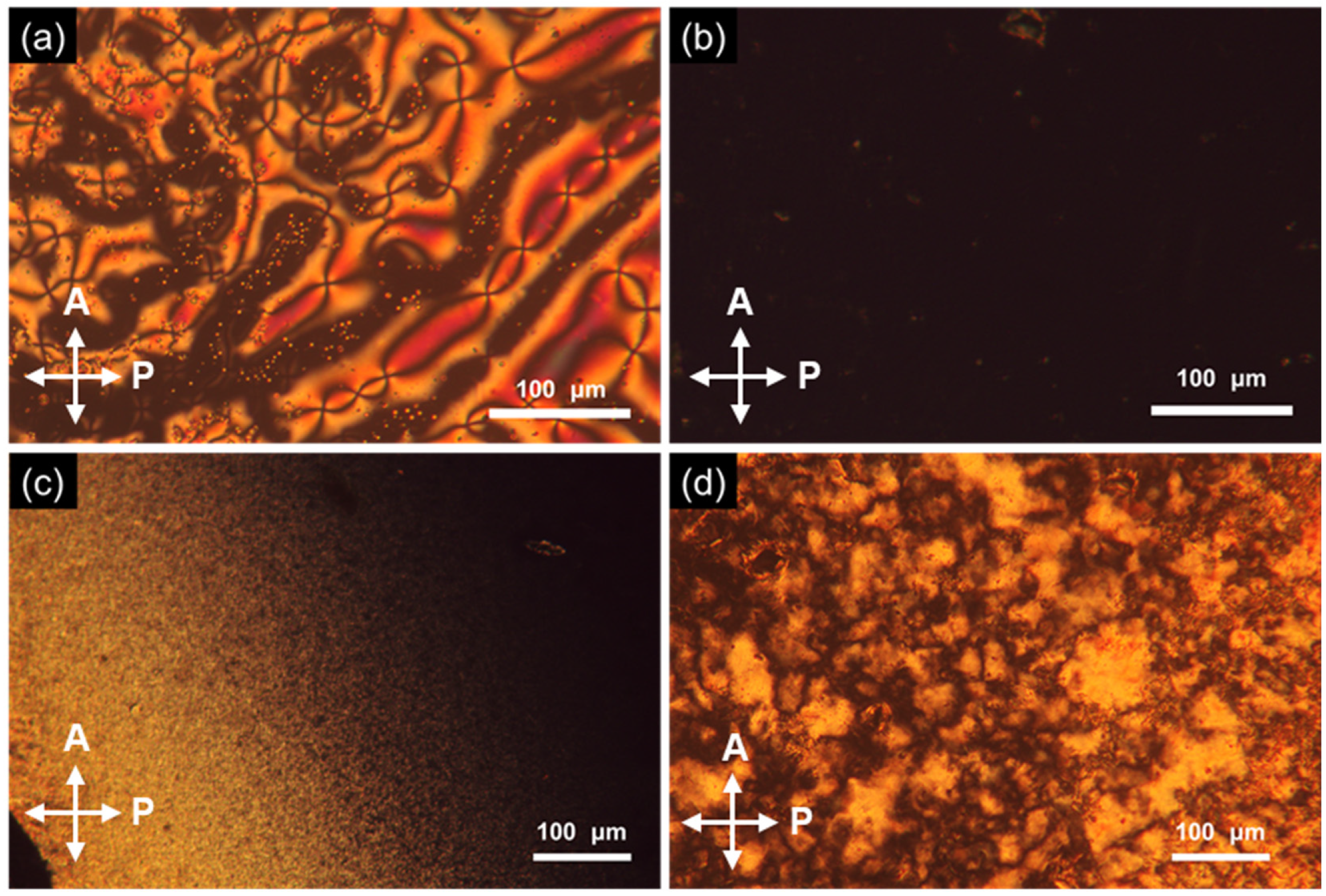
Among all four investigated LC dimers, the methyl esterified derivative of 2(CTO11)P1E featuring a longer spacer on both sides of 11-methylene presented the most diverse mesomorphic behaviors of enantiotropic N, SmA, and SmE phases. Corresponding to the three endothermic peaks observed during the second and subsequent DSC heating scans for 2(CTO11)P1E, the three exothermic peaks exhibiting during the first cooling scan of 221.6, 203.6, and 150.7 °C (Figure 4d), belonged to the I–N, N–SmA, and SmA–SmE phase transitions, respectively, indicative of the progressively increased order of the three LC mesophases upon cooling. Figure 7 shows representative POM textures for all the LC mesophases N, SmA and SmE. Thereinto, the N phase displays a typical Schlieren texture (Figure 7a), then this texture gradually disappears upon cooling below 204 °C to enter the SmA phase, forming a homeotropic extinction texture with the mesogens perpendicular to the substrate plane (Figure 7b). Notably, when a slight shearing of the finger contact pressure was applied to the SmA sample in the homeotropic state, a grainy texture quickly developed (Figure 7c). This texture would disappear and return to the dark field once the pressure was released. Upon further cooling to pass through the SmA–SmE transition, a mosaic birefringent texture appeared (Figure 7d), somewhat like that of the crystal phase, manifesting the soft crystal character of the SmE phase.
Based on the comparative analysis of SAXS/WAXS measurements as shown in Figure 5, the interlayer spacing d = 4.16 nm (q = 1.51 nm−1) in SmA phase of the esterified LC dimer of 2(CTO11)P1E (absence of hydrogen bonding interactions) is larger than that of d = 3.93 nm (q = 1.60 nm−1) in the SmA of 2(CTO11)P. For 2(CTO11)P1E in the SmE phase, the characteristic SAXS/WAXS peaks at q = 14.0, 15.8, and 19.6 nm−1, well assigned to the (110), (200), and (210), respectively, confirmed a rectangular molecular lattice with parameters of a = 0.79 nm and b = 0.55 nm. The layer spacing d = 3.61 nm in the SmE phase for 2(CTO11)P1E as deduced from the first and second-order peaks of q = 1.74, 3.47 nm−1 is obviously diminished as compared to d = 4.16 nm in SmA phase (Figure 5d), while it is significantly larger when compared with d = 2.50 nm for 2(CTO6)P1E (deduced from its first and second-order peaks of q = 2.51, 5.01 nm−1 (Figure 5c), which manifests the highly ordered compact packing of SmE versus SmA loosely packing a lower order, and in the same SmE phase, the layer spacing significantly increased with the spacer length from both side 6-methylene extending to 11-methylene.
The phase transition temperatures and corresponding enthalpy changes, as well as the phase assignments of all four synthesized cyanoterphenyl-based LC dimers, are summarized in Table 1. In sharp contrast to only monotropic N or twist-bend nematic (NTB) phases formed in the previously reported phosphinic acid-bridged cyanobiphenyl dimers 2(CBOn)P [47], the cyanoterphenyl LC dimers 2(CTOn)P and their methyl ester derivatives 2(CTOn)P1E (n = 6, 11) exhibit a rich variety of enantiotropic mesophases, including N, SmA, and highly ordered SmE phases. Furthermore, the phase transition temperatures for the cyanoterphenyl series are substantially higher than those of the cyanobiphenyl analogs. This difference is attributed to the significantly extended π-conjugated system with an additional phenyl for the cyanoterphenyl as compared to the common cyanobiphenyl mesogen, which markedly strengthens the π–π stacking interactions.

4. Conclusions

In summary, several cyanoterphenyl-based phosphinic-bridged LC dimers of 2(CTOn)P (n = 6, 11) and their esterified methyl phosphinate derivatives of 2(CTOn)P1E have been well prepared. To overcome the huge challenge of quite poor solubility of the cyanoterphenyl-based mesogen involved system, the esterified LC dimers 2(CTOn)P1E were synthesized first via a two-step strategy of a hydrophosphination reaction followed by a Suzuki coupling, then the corresponding phosphinic acid bridged LC dimers of 2(CTOn)P were achieved through a dealkylation reaction. Furthermore, the structure of a key byproduct featuring a branched alkyl spacer attached to three mesogens was unambiguously determined through comprehensive characterizations by combining DEPT 135°, 13C NMR, and HR-MS. The precise determination of the composition and structure of the key byproduct facilitates accurately identifying the reaction pathways, which is of great importance for an in-depth understanding of the free radical-mediated hydrophosphination reaction mechanism and guiding the syntheses of such functionalized LC dimer materials more efficiently under optimized reaction conditions. Thanks to the expanded π-conjugation terphenyl mesogenic core with strengthened π-π stacking interactions, with the exception of 2(CTO6)P exhibiting only an enantiotropic nematic (N) phase, all the other investigated LC dimers display rich enantiotropic mesophases, including N, SmA and highly ordered SmE phases, which were systematically identified by DSC, POM and SAXS/WAXS analyses. Such phosphinic acid-functionalized LC materials are envisioned to have some unique application prospects.

Supplementary Materials

The following supporting information can be downloaded at: https://www.mdpi.com/article/10.3390/chemistry8050062/s1, Synthesis and structural characterization; Figure S1. 1H NMR spectrum of Br-BO(11)-ene in CDCl3; Figure S2. 1H NMR spectrum of Br-BO(6)-ene in CDCl3; Figure S3. 1H NMR spectrum of the crude product of 2(Br-BO11)P in CDCl3, which remained small amount of one-side addition impurity; Figure S4. 31P NMR spectrum of the crude product of 2(Br-BO11)P in CDCl3, which remained small amount of one-side addition impurity; Figure S5. 1H NMR spectrum of 2(CTO6)P1E in CDCl3; Figure S6. 31P NMR spectrum of 2(CTO6)P1E in CDCl3; Figure S7. TGA profiles of cyanoterphenyl dimers 2(CTOn)P and corresponding esterified derivatives 2(CTOn)P1E; Figure S8. POM texture images of 2(CTO6)P upon cooling from 350°C to (a) 250°C in N phase, (b) 250°C in N phase, after a slight shearing, (c) 150°C in Cr phase; Figure S9. POM texture images of 2(CTO6)P1E at (a) 260°C in N phase, (b) 150°C in SmE phase.

Author Contributions

Conceptualization, D.C. and D.W.; methodology, D.W., M.Y., F.C. and D.C.; software, D.W.; validation, M.Y., F.C. and D.C.; formal analysis, D.W. and D.C.; investigation, D.W., M.Y., F.C. and J.H.; resources, D.C.; data curation, D.W.; writing—original draft preparation, D.W. and D.C.; writing—review and editing, D.W., M.Y., F.C., J.H. and D.C.; supervision, D.C.; project administration, D.C.; funding acquisition, D.C. All authors have read and agreed to the published version of the manuscript.

Funding

This work was supported by the National Natural Science Foundation of China (Grants Nos. 52273181 and 21875098), and partly by the Engineering Research Center of Photoresist Materials (MOE).

Data Availability Statement

The original contributions presented in this study are included in the article/Supplementary Materials. Further inquiries can be directed to the corresponding author.

Acknowledgments

The authors have reviewed and edited the output and take full responsibility for the content of this publication.

Conflicts of Interest

The authors declare no competing financial interests.

References

  1. Vorländer, D. Über die natur der kohlenstoffketten in kristallin-flüssigen substanzen. Z. Phys. Chem. 1927, 126U, 449–472. [Google Scholar] [CrossRef]
  2. Watanabe, J.; Komura, H.; Niiori, T. Thermotropic liquid crystals of polyesters having a mesogenic 4,4-bibenzoate unit Smectic mesophase properties and structures in dimeric model compounds. Liq. Cryst. 1993, 13, 455–465. [Google Scholar] [CrossRef]
  3. Luckhurst, G.R. Liquid crystal dimers and oligomers: Experiment and theory. Macromol. Symp. 1995, 96, 1–26. [Google Scholar] [CrossRef]
  4. Imrie, C.T.; Karasz, F.E.; Attard, G.S. Comparison of the mesogenic properties of monomeric, dimeric, and side-chain polymeric liquid crystals. Macromolecules 1993, 26, 545–550. [Google Scholar] [CrossRef]
  5. Imrie, C.T.; Henderson, P.A. Liquid crystal dimers and higher oligomers: Between monomers and polymers. Chem. Soc. Rev. 2007, 36, 2096–2124. [Google Scholar] [CrossRef]
  6. Meyer, R.B. Structural Problems in Liquid Crystal Physics, Molecular Fluids: Summer School in Theoretical Physics. In Les Houches Lectures 1973; Balian, R., Weil, G., Eds.; Gordon and Breach: New York, NY, USA, 1976; pp. 271–273. [Google Scholar]
  7. Dozov, I. On the spontaneous symmetry breaking in the mesophases of achiral banana-shaped molecules. Europhys. Lett. 2001, 56, 247. [Google Scholar] [CrossRef]
  8. Chen, D.; Porada, J.H.; Hooper, J.B.; Klittnick, A.; Shen, Y.; Tuchband, M.R.; Korblova, E.; Bedrov, D.; Walba, D.M.; Glaser, M.A.; et al. Chiral heliconical ground state of nanoscale pitch in a nematic liquid crystal of achiral molecular dimers. Proc. Nat. Acad. Sci. USA 2013, 110, 15931–15936. [Google Scholar] [CrossRef]
  9. Borshch, V.; Kim, Y.K.; Xiang, J.; Gao, M.; Jákli, A.; Panov, V.P.; Vij, J.K.; Imrie, C.T.; Tamba, M.G.; Mehl, G.H.; et al. Nematic twist-bend phase with nanoscale modulation of molecular orientation. Nat. Commun. 2013, 4, 2635. [Google Scholar] [CrossRef]
  10. Zhu, C.; Tuchband, M.R.; Young, A.; Shuai, M.; Scarbrough, A.; Walba, D.M.; Maclennan, J.E.; Wang, C.; Hexemer, A.; Clark, N.A. Resonant carbon K-edge soft X-ray scattering from lattice-free heliconical molecular ordering: Soft dilative elasticity of the twist-bend liquid crystal phase. Phys. Rev. Lett. 2016, 116, 147803. [Google Scholar] [CrossRef] [PubMed]
  11. Cao, Y.; Feng, J.; Nallapaneni, A.; Arakawa, Y.; Zhao, K.; Zhang, H.; Mehl, G.H.; Zhu, C.; Liu, F. Deciphering helix assembly in the heliconical nematic phase via tender resonant X-ray scattering. J. Mater. Chem. C 2021, 9, 10020–10028. [Google Scholar] [CrossRef]
  12. Mandle, R.J.; Davis, E.J.; Voll, C.C.A.; Archbold, C.T.; Goodby, J.W.; Cowling, S.J. The relationship between molecular structure and the incidence of the NTB phase. Liq. Cryst. 2015, 42, 688–703. [Google Scholar]
  13. Cruickshank, E.; Strachan, G.J.; Thapa, K.; Pociecha, D.; Salamończyk, M.; Storey, J.M.D.; Gorecka, E.; Lavrentovich, O.; Imrie, C.T. Cyanobiphenyl-based liquid crystal dimers and the twist-bend nematic phase: On the role played by the length and parity of the spacer. Liq. Cryst. 2024, 51, 1446–1470. [Google Scholar] [CrossRef]
  14. Dawood, A.A.; Grossel, M.C.; Luckhurst, G.R.; Richardson, R.M.; Timimi, B.A.; Wells, N.J.; Yousif, Y.Z. On the twist-bend nematic phase formed directly from the isotropic phase. Liq. Cryst. 2016, 43, 2–12. [Google Scholar] [CrossRef]
  15. Dawood, A.A.; Grossel, M.C.; Luckhurst, G.R.; Richardson, R.M.; Timimi, B.A.; Wells, N.J.; Yousif, Y.Z. Twist-bend nematics, liquid crystal dimers, structure–property relations. Liq. Cryst. 2017, 44, 106–126. [Google Scholar] [CrossRef]
  16. Arakawa, Y.; Arai, Y.; Horita, K.; Komatsu, K.; Tsuji, H. Twist–Bend Nematic phase behavior of cyanobiphenyl-based dimers with propane, ethoxy, and ethylthio spacers. Crystals 2022, 12, 1734. [Google Scholar] [CrossRef]
  17. Arakawa, Y.; Horita, K.; Igawa, K. Phase behaviour of ester-linked cyanobiphenyl dimers and fluorinated analogues: The direct isotropic to twist-bend nematic phase transition. Liq. Cryst. 2023, 50, 2216–2228. [Google Scholar] [CrossRef]
  18. Paterson, D.A.; Walker, R.; Storey, J.M.D.; Imrie, C.T. Molecular structure and the twist-bend nematic phase: The role of spacer length in liquid crystal dimers. Liq. Cryst. 2023, 50, 725–736. [Google Scholar] [CrossRef]
  19. Strachan, G.J.; Majewska, M.M.; Pociecha, D.; Storey, J.M.D.; Imrie, C.T. Using lateral substitution to control conformational preference and phase behaviour of benzanilide-based liquid crystal dimers. ChemPhysChem 2023, 24, e202200758. [Google Scholar] [CrossRef] [PubMed]
  20. Strachan, G.J.; Harrison, W.T.A.; Storey, J.M.D.; Imrie, C.T. Understanding the remarkable difference in liquid crystal behaviour between secondary and tertiary amides: The synthesis and characterisation of new benzanilide-based liquid crystal dimers. Phys. Chem. Chem. Phys. 2021, 23, 12600–12611. [Google Scholar] [CrossRef]
  21. Shimomura, Y.; Sheng, B.; Arakawa, Y.; Iwai, R.; Konishi, G. Liquid crystal dimers based on seven-membered bridged stilbene exhibiting twist-bend nematic phases. Crystals 2026, 16, 111. [Google Scholar] [CrossRef]
  22. Baishya, B.; Pradhan, A.K.; Paul, A.; Bhattacharyya, A.; Dahal, H.; Roy, M.; Sudhakar, A.A.; Paul, M.K. New azo-functionalized symmetrical liquid crystal dimers: Synthesis, photophysical studies, mesomorphism and DFT studies. Dye. Pigm 2025, 235, 112652. [Google Scholar] [CrossRef]
  23. Zhao, W.; Shen, L.; Liu, Y.; Chen, F.; Zhang, C.; Chen, D. Electron and hole ambipolar transport hybrid liquid crystal dimers of C60 and triphenylene with varied length alkyl tails. Soft Matter 2025, 21, 8348–8359. [Google Scholar] [CrossRef] [PubMed]
  24. Cruickshank, E.; Walker, R.; Strachan, G.J.; Goode, C.H.F.; Majewska, M.M.; Pociecha, D.; Gorecka, E.; Storey, J.M.D.; Imrie, C.T. The influence of the imine bond direction on the phase behaviour of symmetric and non-symmetric liquid crystal dimers. J. Mol. Liq. 2023, 391, 123226. [Google Scholar] [CrossRef]
  25. Ranjitha, B.S.; Sandhya Kumari, D.; Shetty, A.; Shanker, G.; Alaasar, M.; Pashameah, R.; Hegde, G. Impact of terminal group on azobenzene liquid crystal dimers for photo-responsive optical storage devices. J. Mol. Liq. 2023, 383, 121985. [Google Scholar] [CrossRef]
  26. Loska, B.; Arakawa, Y.; Merkel, K. Mix and match: Twist-bend nematic behaviour in liquid crystal dimer mixtures of the CBOnOCB. Liq. Cryst. 2025, 1–17. [Google Scholar] [CrossRef]
  27. Archbold, C.T.; Mandle, R.J.; Andrews, J.L.; Cowling, S.J.; Goodby, J.W. Conformational landscapes of bimesogenic compounds and their implications for the formation of modulated nematic phases. Liq. Cryst. 2017, 44, 2079–2088. [Google Scholar] [CrossRef]
  28. Arakawa, Y.; Komatsu, K.; Shiba, T.; Tsuji, H. Methylene- and thioether-linked cyanobiphenyl-based liquid crystal dimers CBnSCB exhibiting room temperature twist-bend nematic phases and glasses. Mater. Adv. 2021, 2, 1760–1773. [Google Scholar] [CrossRef]
  29. Arakawa, Y.; Komatsu, K.; Inui, S.; Tsuji, H. Thioether-linked liquid crystal dimers and trimers: The twist-bend nematic phase. J. Mol. Struct. 2020, 1199, 126913. [Google Scholar] [CrossRef]
  30. Arakawa, Y.; Ishida, Y.; Tsuji, H. Ether- and thioether-linked naphthalene-based liquid-crystal dimers: Influence of chalcogen linkage and mesogenic-arm symmetry on the incidence and stability of the twist–bend nematic phase. Chem. Eur. J. 2020, 26, 3767–3775. [Google Scholar] [CrossRef]
  31. Arakawa, Y.; Ishida, Y.; Komatsu, K.; Arai, Y.; Tsuji, H. Thioether-linked benzylideneaniline-based twist-bend nematic liquid crystal dimers: Insights into spacer lengths, mesogenic arm structures, and linkage types. Tetrahedron 2021, 95, 132351. [Google Scholar] [CrossRef]
  32. Arakawa, Y.; Komatsu, K.; Feng, J.; Zhu, C.; Tsuji, H. Distinct twist-bend nematic phase behaviors associated with the ester-linkage direction of thioether-linked liquid crystal dimers. Mater. Adv. 2021, 2, 261–272. [Google Scholar] [CrossRef]
  33. Arakawa, Y.; Komatsu, K.; Ishida, Y.; Igawa, K.; Tsuji, H. Carbonyl- and thioether-linked cyanobiphenyl-based liquid crystal dimers exhibiting twist-bend nematic phases. Tetrahedron 2021, 81, 131870. [Google Scholar] [CrossRef]
  34. Arakawa, Y.; Komatsu, K.; Ishida, Y.; Tsuji, H. Thioether-linked azobenzene-based liquid crystal dimers exhibiting the twist-bend nematic phase over a wide temperature range. Liq. Cryst. 2021, 48, 641–652. [Google Scholar] [CrossRef]
  35. Arakawa, Y.; Komatsu, K.; Shiba, T.; Tsuji, H. Phase behaviors of classic liquid crystal dimers and trimers: Alternate induction of smectic and twist-bend nematic phases depending on spacer parity for liquid crystal trimers. J. Mol. Liq. 2021, 326, 115319. [Google Scholar] [CrossRef]
  36. Arakawa, Y.; Shiba, T.; Igawa, K. Selenium-linked cyanobiphenyl-based liquid crystal dimers: The effects of chalcogen linkage and spacer length on the twist-bend nematic phase. Liq. Cryst. 2024, 51, 1506–1522. [Google Scholar] [CrossRef]
  37. Arakawa, Y.; Tsuji, H. Selenium-linked liquid crystal dimers for twist-bend nematogens. J. Mol. Liq. 2019, 289, 111097. [Google Scholar] [CrossRef]
  38. Hammond, P.T.; Rubner, M.F. Thermochromism in liquid crystalline polydiacetylenes. Macromolecules 1997, 30, 5773–5782. [Google Scholar] [CrossRef]
  39. Moigne, J.L.; Soldera, A.; Guillon, D.; Skoulios, A. Acetylenic and diacetylenic liquid-crystalline monomers: Towards ordered conjugated polymers. Liq. Cryst. 1989, 6, 627–639. [Google Scholar] [CrossRef]
  40. Angkaew, S.; Wang, H.-Y.; Lando, J.B. Diacetylenes for novel molecular composites. Chem. Mater. 1994, 6, 1444–1451. [Google Scholar] [CrossRef]
  41. Hammond, P.T.; Rubner, M.F. Synthesis and characterization of new mesogenic diacetylene monomers and their polymers. Macromolecules 1995, 28, 795–805. [Google Scholar] [CrossRef]
  42. Lee, H.-C.; Lu, Z.; Henderson, P.A.; Achard, M.F.; Mahmood, W.A.K.; Yeap, G.-Y.; Imrie, C.T. Cholesteryl-based liquid crystal dimers containing a sulfur–sulfur link in the flexible spacer. Liq. Cryst. 2012, 39, 259–268. [Google Scholar] [CrossRef]
  43. Osman, F.; Yeap, G.-Y.; Takeuchi, D. Synthesis and mesomorphic behaviour of new disulphide bridge 4-n-alkoxybenzylidine-4′-bromoaniline. Liq. Cryst. 2014, 41, 106–112. [Google Scholar] [CrossRef]
  44. Tufaha, N.; Gibb, C.J.; Storey, J.M.D.; Imrie, C.T. Can even-membered liquid crystal dimers exhibit the twist-bend nematic phase? The preparation and properties of disulphide and thioether linked dimers. Liq. Cryst. 2023, 50, 1362–1374. [Google Scholar] [CrossRef]
  45. Al-shargabi, A.; Yeap, G.-Y.; Mahmood, W.A.K.; Han, C.-C.; Lin, H.-C.; Ito, M.M. Liquid crystal dimers containing Cholesteryl and Triazole-containing mesogenic units. Liq. Cryst. 2020, 47, 219–230. [Google Scholar] [CrossRef]
  46. Mallik, S.; Nayak, A.; Daschakraborty, S.; Kumar, S.; Suresh, K.A. Supramolecular self-assembly of ionic discotic liquid crystalline dimer with DNA at interfaces. Chem. Sel. 2018, 3, 7318–7326. [Google Scholar] [CrossRef]
  47. Wang, D.; Liu, J.; Zhao, W.; Zeng, Y.; Huang, J.; Fang, J.; Chen, D. Facile synthesis of liquid crystal dimers bridged with a phosphonic group. Chem. Eur. J. 2022, 28, e202202146. [Google Scholar] [CrossRef]
Scheme 1. Synthetic route of the cyanoterphenyl LC dimers 2(CTOn)P with a phosphinic acid bridging group and the esterified methyl phosphinate 2(CTOn)P1E (n = 6, 11).
Chemistry 08 00062 sch001
Figure 1. (a) 1H NMR, (b) 31P NMR spectra of the methyl esterified LC dimer of 2(CTO11)P1E (in CDCl3).
Chemistry 08 00062 g001
Figure 2. (a) 1H NMR, (b) 31P NMR, (c) 13C NMR spectra (in CDCl3), and (d) HR-MS profile of 2(Br-BO11)P1E-byproduct.
Chemistry 08 00062 g002
Figure 3. (a) 13C NMR, and (b) DEPT 135° spectra in the aliphatic region of 2(Br-BO11)P1E-byproduct.
Chemistry 08 00062 g003
Figure 4. DSC thermograms of (a) 2(CTO6)P, (b) 2(CTO11)P, (c) 2(CTO6)P1E, (d) 2(CTO11)P1E. (Heating or cooling rate 30 °C min−1, transition peak temperatures in °C, enthalpy changes within parentheses in J g−1, with the positive values standing for exothermic and negative for endothermic).
Chemistry 08 00062 g004
Figure 5. SAXS/WAXS profiles of (a) 2(CTO6)P, (b) 2(CTO11)P, (c) 2(CTO6)P1E, (d) 2(CTO11)P1E.
Chemistry 08 00062 g005
Figure 6. POM texture images of 2(CTO11)P at (a) 240 °C in SmA phase, (b) 180 °C in SmE phase, with P indicating the polarization direction of the polarizer, while A indicating that of the analyzer.
Chemistry 08 00062 g006
Figure 7. POM texture images of 2(CTO11)P1E (a) at 220 °C, Schlieren texture, N phase, (b) at 180 °C, homeotropic, SmA phase, (c) 180 °C, after a slight shearing on the sample b), (d) at 100 °C, mosaic, SmE phase.
Chemistry 08 00062 g007
Table 1. Transition temperatures and corresponding enthalpy changes, together with the phase assignments of the synthesized four cyanoterphenyl-based LC dimers.
Sample CodePhase Transition Temperature T/°C (Enthalpy Change ΔH/J g−1)
HeatingCooling
2(CTO6)PCr 254.9 (−11.47) N 350 # (334.1 *) II 350 # N 241.4 (10.19) Cr
2(CTO11)PSmE 224.7 (−12.45) SmA 287.5 (−16.37) I 357.3 *I 284.7 (11.40) SmA 246.6 (2.43), 222.2 (11.68) SmE
2(CTO6)P1ESmE 175.3 (−23.28) N 268.2 (−4.29) I 361.5*I 261.2 (3.47) N 159.7 (23.26) SmE
2(CTO11)P1ESmE 157.7 (−15.78) SmA 206.7 (−0.53) N 224.2 (−3.56) I 389.6 *I 221.6 (2.99) N 203.6 (0.48) SmA 150.7 (14.37) SmE
The phase transition temperatures and corresponding enthalpy changes were extracted from the first cooling and the second heating scan by DSC at a rate of 30 °C min−1. # Obtained from POM observation. * Decomposition temperature (with 5% weight loss).
Disclaimer/Publisher’s Note: The statements, opinions and data contained in all publications are solely those of the individual author(s) and contributor(s) and not of MDPI and/or the editor(s). MDPI and/or the editor(s) disclaim responsibility for any injury to people or property resulting from any ideas, methods, instructions or products referred to in the content.