Article

Influence of Morpholine Substitution on DNBS-Based 1,8-Naphthalimide Fluorescent Probes for H2S Detection

Department of Chemistry, University of Nebraska at Kearney, 2504 9th Ave, Kearney, NE 68849, USA
*
Author to whom correspondence should be addressed.
Chemistry 2026, 8(5), 59; https://doi.org/10.3390/chemistry8050059
Submission received: 29 March 2026 / Revised: 20 April 2026 / Accepted: 28 April 2026 / Published: 1 May 2026
(This article belongs to the Special Issue Fluorescent Chemosensors and Probes for Detection and Imaging)

Abstract

A series of morpholine-appended 1,8-naphthalimide probes (S1–S5) was developed to investigate the influence of the morpholine moiety on H2S detection. All probes exhibited characteristic absorption and emission features and responded to H2S with fluorescence enhancement, although the intensity varied markedly across the series. S2 displayed the highest signal enhancement, while S5 showed minimal response, highlighting the critical role of a two-carbon spacer between the morpholine group and the fluorophore for optimal sensing. Kinetic analysis revealed that S1–S4 followed similar reaction profiles, whereas S5 reacted faster but produced a weaker signal. S2 maintained reliable performance across pH 4–9 and in DMSO-containing media and demonstrated excellent selectivity over common biothiols and other potentially interfering species. These findings provide a clear structure–activity relationship for morpholine-based fluorescent probes and inform the rational design of highly selective H2S sensors.

1. Introduction

In the past decade, Hydrogen sulfide (H2S) has attracted significant interest as an endogenous gaseous signaling molecule alongside nitric oxide (NO) and carbon monoxide (CO) [1]. Endogenously generated primarily through the enzymatic activity of cystathionine β-synthase (CBS), cystathionine γ-lyase (CSE), and 3-mercaptopyruvate sulfurtransferase (3-MST), H2S participates in a variety of physiological processes, including regulation of vascular tone, neuromodulation, redox homeostasis, and cytoprotection [2,3,4,5,6,7,8]. Increasing evidence indicates that dysregulated H2S metabolism is closely associated with numerous human diseases, such as cardiovascular disorders, neurodegenerative diseases, inflammation, and cancer [9,10,11,12]. Since H2S is a small, highly diffusible, and chemically reactive species, precisely monitoring its concentration and distribution in biological systems is essential for elucidating its physiological and pathological roles [13].
In recent years, it has become clear that the biological activities of H2S strongly depend on its subcellular localization. Among various organelles, lysosomes play a central role in intracellular degradation, metabolic regulation, and signaling pathways [14]. Lysosomes maintain a highly acidic microenvironment and are responsible for the turnover of biomolecules through autophagy and endocytosis [15]. Perturbations in lysosomal function have been implicated in a wide range of pathological conditions, including lysosomal storage disorders, neurodegeneration, and cancer [16,17,18]. Emerging studies suggest that abnormal levels of H2S within lysosomes may disrupt lysosomal homeostasis, influence redox balance, and contribute to disease progression [19,20,21]. Consequently, the development of molecular tools capable of monitoring H2S specifically within lysosomes is of considerable importance for understanding the biological roles of this gasotransmitter in subcellular contexts [22].
Compared with conventional instrument-based methods, fluorescent probes provide a low-cost platform with rapid sample preparation and high sensitivity. Owing to their excellent spatiotemporal resolution and compatibility with cellular imaging, fluorescent probes have emerged as powerful tools for detecting reactive sulfur species in living systems [23]. To achieve lysosome-selective imaging, the incorporation of lysosome-targeting moieties into fluorescent probes is a common and effective strategy [24]. Among the various targeting groups, morpholine has been widely utilized as a lysosome-directing scaffold due to its weakly basic nature [25]. Morpholine-containing molecules tend to accumulate in lysosomes through protonation and ion trapping within the acidic lysosomal lumen. As a result, morpholine scaffold has become one of the most frequently employed targeting units in the design of lysosome-specific fluorescent probes [26].
For selective H2S detection, the 2,4-dinitrobenzenesulfonyl (DNBS) group has been extensively used as a recognition and reaction site in fluorescent probe design [27]. DNBS acts as an efficient fluorescence quencher when attached to fluorophores, typically through photoinduced electron transfer (PET) mechanism. In the presence of H2S, nucleophilic attack by HS triggers cleavage of the DNBS moiety, resulting in the release of the free fluorophore and restoration of fluorescence [28,29,30]. This reaction-based sensing mechanism provides high selectivity and sensitivity toward H2S over other biologically relevant thiols and reactive species, making DNBS one of the most widely adopted platforms for H2S-responsive fluorescent sensors [31].
Although morpholine groups are frequently incorporated into fluorescent probes to enable lysosomal targeting, their potential influence on the intrinsic sensing performance of reaction-based probes has not been investigated. The introduction of a morpholine moiety may affect probe properties such as electronic distribution, protonation behavior, and local microenvironmental interactions, which could potentially affect the reactivity of the sensing unit and thus the overall sensing performance.
In this research, we investigate the effect of a morpholine targeting unit on the sensing properties of DNBS-based fluorescent probes for H2S detection. Using 1,8-naphthalimide as the fluorophore scaffold, five morpholine-appended probes (S1–S5) were designed in which the distance between the fluorophore and the morpholine moiety was varied. This design allows evaluation of whether the morpholine unit modulates the sensing capability of the probe. Based on the data obtained in this study, incorporation of a morpholine-containing substituent at the imide nitrogen of 1,8-naphthalimide markedly influenced H2S sensing performance. These findings provide insight into how lysosome-targeting groups modulate the behavior of fluorescent probes and may inform the rational design of lysosome-targeted fluorescent sensors.

2. Materials and Methods

2.1. General

All reagents used for synthesis and spectroscopic measurements were obtained in analytical grade from commercial suppliers, including Sigma-Aldrich (St. Louis, MO, USA), Fisher Scientific (Pittsburgh, PA, USA), TCI (Portland, OR, USA), and Ambeed (Buffalo Grove, IL, USA), and were used without further purification unless otherwise noted. UV–vis absorption spectra were recorded on a Cary Series UV–Vis spectrophotometer (Cary 8454, Agilent Technologies, Santa Clara, CA, USA). Fluorescence measurements were performed on a Spectrofluorometer (FluoroMax-4, Horiba Scientific, Irvine, CA, USA) using a 0.5 cm quartz cuvette, with excitation and emission slit widths set between 1 and 5 nm. 1H and 13C NMR spectra were acquired at room temperature on a NMR spectrometer (400 MHz, Ascend 400, Bruker, Billerica, MA, USA). All intermediates and final compounds were purified using a CombiFlash NextGen 300+ system (Teledyne ISCO, Lincoln, NE, USA). Sodium hydrosulfide (NaHS, Fisher Scientific (Pittsburgh, PA, USA)) was used as the H2S source for solution-based measurements in this study. Limit of detection (LOD) was calculated as 3 σ/κ. σ is the standard deviation of the blank signal with 20 measurements. κ is the slope of the NaHS calibration curve.

2.2. Synthesis and Characterization

Probe S1–S5 were synthesized via multiple-step reactions as shown in Scheme 1. 1H NMR and 13C NMR spectroscopy were used for characterization.
5-hydroxy-2-morpholino-1H-benzo[de]isoquinoline-1,3(2H)-dione (M1) 3-Hydroxy-1,8-naphthalic anhydride (214 mg, 1.0 mmol) and 4-aminomorpholine (122 mg, 1.2 mmol) were dissolved in THF (3 mL), and the reaction mixture was refluxed for 3 h. After completion of the reaction, the mixture was poured into cold water (50 mL), resulting in the formation of a precipitate. The solid was collected by vacuum filtration to afford the crude product, which was subsequently purified by column chromatography using dichloromethane/ethyl acetate (3:1, v/v) as the eluent. The product was obtained as a light yellow solid (190 mg, 64%). 1H NMR (400 MHz, DMSO-d6) δ: 3.36 (m, 4H), 3.73 (t, J = 4.5 Hz, 4H), 7.64 (s, 1H), 7.73 (t, J = 7.9 Hz, 1H), 8.01 (s, 1H), 8.17–8.29 (m, 2H), 10.05 (s, 1H). 13C NMR (100 MHz, DMSO-d6) δ:51.3, 67.2, 116.0, 122.2, 122.5, 123.5, 125.0, 127.8, 127.9, 132.9, 133.8, 156.6, 163.4, 163.8.
2-morpholino-1,3-dioxo-2,3-dihydro-1H-benzo[de]isoquinolin-5-yl 2,4-dinitrobenzenesulfonate (S1) M1 (149 mg, 0.5 mmol) was reacted with 2,4-dinitrobenzenesulfonyl chloride (200 mg, 0.75 mmol) in pyridine (1 mL) at 90 °C for 2.5 h. After completion of the reaction, the mixture was cooled to room temperature and poured into cold water (20 mL), resulting in the formation of a precipitate. The solid was collected by vacuum filtration to afford the crude product. Purification by column chromatography using dichloromethane/ethyl acetate (1:19, v/v) as the eluent provided the product as a pale yellow solid (203 mg, 77%). 1H NMR (400 MHz, DMSO-d6) δ: 3.38 (t, J = 4.4 Hz, 4H), 3.74(t, J = 4.5 Hz, 4H), 7.39 (d, J = 9.1 Hz, 1H), 7.94 (t, J = 7.9 Hz, 1H), 8.14–8.54 (m, 5H), 8.97 (s, 1H). 13C NMR (100 MHz, DMSO-d6) δ: 51.2, 67.3, 121.1, 122.5, 123.3, 123.7, 123.9, 125.6, 126.7, 128.8, 130.2, 130.9, 133.2, 134.1, 140.5, 142.7, 153.0, 154.7, 162.8, 163.4.
5-hydroxy-2-(2-morpholinoethyl)-1H-benzo[de]isoquinoline-1,3(2H)-dione (M2) 3-Hydroxy-1,8-naphthalic anhydride (214 mg, 1.0 mmol) and 4-(2-aminoethyl)morpholine (195 mg, 1.5 mmol) were dissolved in THF (3 mL), and the reaction mixture was refluxed for 3 h. After completion of the reaction, the mixture was poured into cold water (50 mL), resulting in the formation of a precipitate. The solid was collected by vacuum filtration to afford the crude product, which was subsequently purified by column chromatography using dichloromethane/ethyl acetate (3:1, v/v) as the eluent. The product was obtained as a light yellow solid (218.0 mg, 67%). 1H NMR (400 MHz, DMSO-d6) δ: 2.42–2.49 (m, 4H), 2.55 (t, J = 7.2 Hz, 2H) 3.48–3.58 (m, 4H), 4.17 (t, J = 7.0 Hz, 2H), 7.65 (s 1H), 7.73 (t, J = 7.8 Hz, 1H), 8.02 (s, 1H), 8.20–8.28 (m, 2H), 10.5 (s, 1H). 13C NMR (100 MHz, DMSO-d6) δ: 37.3, 53.9, 56.0, 66.7, 116.2, 122.3, 122.6, 123.8, 127.8, 127.9, 128.0, 133.0, 133.8, 156.6, 163.6, 163.9.
2-(2-morpholinoethyl)-1,3-dioxo-2,3-dihydro-1H-benzo[de]isoquinolin-5-yl 2,4-dinitrobenzenesulfonate (S2) M2 (163 mg, 0.5 mmol) was reacted with 2,4-dinitrobenzenesulfonyl chloride (200 mg, 0.75 mmol) in pyridine (1 mL) at 90 °C for 2.5 h. After completion of the reaction, the mixture was cooled to room temperature and poured into cold water (20 mL), resulting in the formation of a precipitate. The solid was collected by vacuum filtration to afford the crude product. Purification by column chromatography using acetate as the eluent provided the product as light yellow solid (173 mg, 62%). 1H NMR (400 MHz, DMSO-d6) δ: 2.37–2.49 (m, 4H), 2.58 (t, J = 7.2 Hz, 2H) 3.48–3.61 (m, 4H), 4.20 (t, J = 7.2 Hz, 2H), 7.44 (d, J = 9.1 Hz, 1H), 7.94 (t, J = 7.5 Hz, 1H), 8.33 (s, 1H), 8.38 (s, 1Hz), 8.42–8.56 (m, 3H), 8.98 (s, 1H). 13C NMR (100 MHz, DMSO-d6) δ:37.5, 53.8, 56.0, 66.6, 121.1, 122.5, 122.7, 123.5, 123.9, 125.4, 125.8, 128.9, 130.2, 131.0, 133.3, 134.3, 140.4, 142.7, 153.0, 154.6, 163.0, 163.6.
5-hydroxy-2-(3-morpholinopropyl)-1H-benzo[de]isoquinoline-1,3(2H)-dione (M3) 3-Hydroxy-1,8-naphthalic anhydride (214 mg, 1.0 mmol) and N-(3-Aminopropyl)morpholine (216 mg, 1.5 mmol) were dissolved in THF (3 mL), and the reaction mixture was refluxed for 3 h. After completion of the reaction, the mixture was poured into cold water (50 mL), resulting in the formation of a precipitate. The solid was collected by vacuum filtration to afford the crude product, which was subsequently purified by column chromatography using ethyl acetate as the eluent. The product was obtained as a yellow solid (245.0 mg, 72%). 1H NMR (400 MHz, DMSO-d6) δ: 1.79 (p, J = 6.4 Hz, 2H), 2.29 (m, 4H), 2.37 (t, J = 6.6 Hz, 2H), 3.33 (m, 4H), 4.10 (t, J = 7.4 Hz, 2H), 7.65 (s, 1H), 7.73 (t, J = 7.9 Hz, 1H), 8.02 (s, 1H), 8.20–8.28 (m, 2H). 13C NMR (100 MHz, DMSO-d6) δ: 24.4, 38.8, 53.6, 56.5, 66.5, 116.1, 122.3, 122.5, 122.6, 124.0, 127.8, 127.9, 132.9, 133.8, 156.7, 163.7, 164.1.
2-(3-morpholinopropyl)-1,3-dioxo-2,3-dihydro-1H-benzo[de]isoquinolin-5-yl 2,4-dinitrobenzenesulfonate (S3) M 3 (170 mg, 0.5 mmol) was reacted with 2,4-dinitrobenzenesulfonyl chloride (200 mg, 0.75 mmol) in pyridine (2 mL) at 90 °C for 2.5 h. After completion of the reaction, the mixture was cooled to room temperature and poured into cold water (20 mL), resulting in the formation of a precipitate. The solid was collected by vacuum filtration to afford the crude product. Purification by column chromatography using acetate as the eluent provided the product as a yellow solid (205 mg, 72%). 1H NMR (400 MHz, DMSO-d6) δ: 1.81 (p, J = 6.2 Hz, 2H), 2.29 (m, 4H), 2.38 (t, J = 6.6 Hz, 2H), 3.38 (m, 4H), 4.06 (t, J = 7.3 Hz, 2H), 7.40 (d, J = 9.2 Hz, 1H), 7.93 (t J = 7.9 Hz, 1H), 8.32 (s, 1H), 8.37 (s, 1H), 8.44 (d, J = 8.2 Hz, 1H),8.46–8.55 (m, 2H), 8.97 (s, 1H). 13C NMR (100 MHz, DMSO-d6) δ:24.2, 49.2, 53.8, 56.3, 66.6, 121.1, 122.5, 122.9, 123.3, 123.8, 125.6, 125.8, 128.9, 130.2, 130.9, 133.2, 134.3, 140.5, 142.7, 153.1, 154.7, 163.1, 163.7.
5-hydroxy-2-(4-morpholinophenyl)-1H-benzo[de]isoquinoline-1,3(2H)-dione (M4) 3-Hydroxy-1,8-naphthalic anhydride (214 mg, 1.0 mmol) and 4-morpholinoaniline (267 mg, 1.5 mmol) were dissolved in 2-methoxyethanol (2 mL), and the reaction mixture was refluxed for 5 h. After completion of the reaction, the mixture was poured into cold water (50 mL), resulting in the formation of a precipitate. The solid was collected by vacuum filtration to afford the crude product, which was subsequently purified by column chromatography using dichloromethane/ethyl acetate (3:1, v/v) as the eluent. The product was obtained as a yellow solid (295.0 mg, 79%). 1H NMR (400 MHz, DMSO-d6) δ: 3.18 (t, J = 4.6 Hz, 4H), 3.78 (t, J = 4.7 Hz, 4H), 7.04 (d, J = 8.6 Hz, 2H), 7.19 (d, J = 8.8 Hz, 2H), 7.68 (s, 1H), 7.75 (t, J = 7.8 Hz, 1H), 8.02 (s, 1H), 8.21–8.31 (m, 2H), 10.66 (s, 1H). 13C NMR (100 MHz, DMSO-d6) δ: 48.8, 66.6, 115.5, 116.1, 122.4, 123.0, 124.5, 127.5, 127.7, 127.8, 129.8, 133.0, 134.0, 156.8, 164.1, 164.4.
2-(4-morpholinophenyl)-1,3-dioxo-2,3-dihydro-1H-benzo[de]isoquinolin-5-yl 2,4-dinitrobenzenesulfonate (S4) M4 (187 mg, 0.5 mmol) was reacted with 2,4-dinitrobenzenesulfonyl chloride (200 mg, 0.75 mmol) in pyridine (2 mL) at 90 °C for 2.5 h. After completion of the reaction, the mixture was cooled to room temperature and poured into cold water (20 mL), resulting in the formation of a precipitate. The solid was collected by vacuum filtration to afford the crude product. Purification by column chromatography using dichloromethane/ethyl acetate (3:1, v/v) as the eluent provided the product as a yellow solid (214 mg, 71%). 1H NMR (400 MHz, DMSO-d6) δ: 3.19 (t, J = 4.6 Hz, 4H), 3.78 (t, J = 4.6 Hz, 4H), 7.06 (d, J = 9.0 Hz, 2H), 7.21 (d, J = 8.9 Hz, 2H), 7.40 (d, J = 9.2 Hz, 1H), 7.96 (t, J = 7.8 Hz, 1H), 8.32 (s, 1H), 8.42 (s, 1H), 8.45–8.54 (m, 3H), 8.97 (s, 1H). 13C NMR (100 MHz, DMSO-d6) δ:48.7, 66.6, 115.4, 120.9, 122.6, 123.4, 123.6, 123.9, 126.2, 127.2, 128.9, 129.8, 130.3, 131.1, 133.4, 134.3, 140.4, 142.7, 151.2, 152.9, 154.7, 163.5, 164.0.
5-hydroxy-2-(4-morpholinobenzyl)-1H-benzo[de]isoquinoline-1,3(2H)-dione (M5) 3-Hydroxy-1,8-naphthalic anhydride (214 mg, 1.0 mmol) and 4-morpholinobenzylamine (288 mg, 1.5 mmol) were dissolved in 2-methoxyethanol (3 mL), and the reaction mixture was refluxed for 5 h. After completion of the reaction, the mixture was poured into cold water (50 mL), resulting in the formation of a precipitate. The solid was collected by vacuum filtration to afford the crude product, which was subsequently purified by column chromatography using dichloromethane/ethyl acetate (3:1, v/v) as the eluent. The product was obtained as a yellow solid (299.0 mg, 77%). 1H NMR (400 MHz, DMSO-d6) δ: 3.03 (t, J = 4.4 Hz, 4H), 3.70 (t, J = 4.8 Hz, 4H), 5.13 (s, 2H), 6.86 (d, J = 8.4 Hz, 2H), 7.26 (d, J = 8.4 Hz, 2H), 7.67 (s, 1H), 7.74 (t, J = 7.9 Hz, 1H), 8.04 (s, 1H), 8.20–8.32 (m, 2H), 10.59 (s, 1H). 13C NMR (100 MHz, DMSO-d6) δ: 42.8, 49.0, 66.5, 115.4, 116.4, 122.2, 122.4, 122.6, 123.8, 127.8, 128.1, 128.5, 129.4, 133.2, 133.8, 150.7, 156.6, 163.7, 164.0.
2-(4-morpholinobenzyl)-1,3-dioxo-2,3-dihydro-1H-benzo[de]isoquinolin-5-yl 2,4-dinitrobenzenesulfonate (S5) M5 (187 mg, 0.5 mmol) was reacted with 2,4-dinitrobenzenesulfonyl chloride (233 mg, 0.6 mmol) in pyridine (1 mL) at 90 °C for 3.0 h. After completion of the reaction, the mixture was cooled to room temperature and poured into cold water (20 mL), resulting in the formation of a precipitate. The solid was collected by vacuum filtration to afford the crude product. Purification by column chromatography using dichloromethane/ethyl acetate (4:1, v/v) as the eluent provided the product as a light yellow solid (207 mg, 67%). 1H NMR (400 MHz, DMSO-d6) δ: 3.04 (t, J = 4.5 Hz, 4H), 3.70 (t, J = 4.7 Hz, 4H), 5.16 (s, 2H), 6.87 (d, J = 8.4 Hz, 2H), 7.28 (d, J = 8.4 Hz, 2H), 7.43 (d, J = 9.4 Hz, 1H), 7.94 (t, J = 7.6 Hz, 1H), 8.26–8.63 (m, 5H), 8.97 (s, 1H). 13C NMR (100 MHz, DMSO-d6) δ:42.9, 52.2, 65.1, 116.4, 118.8, 119.2, 122.2, 122.5, 122.6, 123.7, 126.1, 127.8, 128.0, 128.1, 129.3, 131.2, 133.2, 133.8, 145.1, 147.9, 156.6, 163.7, 164.1.

3. Results and Discussion

Morpholine is a widely used scaffold to design fluorescent sensors, particularly for lysosome-targeted applications. Among its derivatives, 4-(2-aminoethyl)morpholine is most frequently employed. However, the influence of the spacer between the morpholine unit and the fluorophore on sensing performance has been rarely investigated. To address this gap, 1,8-naphthalimide was selected as the fluorophore to construct five DNBS-based probes (S1–S5) for H2S detection. In these designs, the morpholine moiety was introduced at the N-amide position of 1,8-naphthalimide through linkers of varying length and composition relative to the 1,8-naphthalimide: S1 (no spacer), S2 (two-carbon linker), S3 (three-carbon linker), S4 (phenyl linker), and S5 (benzyl linker). This structural variation enabled an evaluation of how the morpholine-appended substituent influences H2S sensing performance, providing insight into its role in probe design.

3.1. Physical Properties

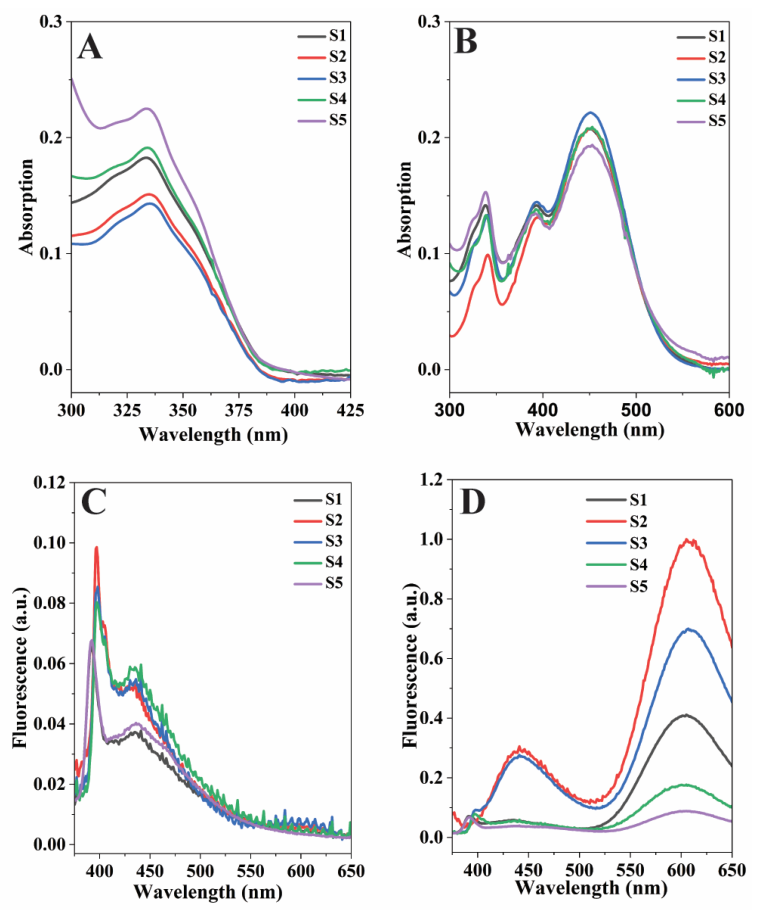
All probes (S1–S5) showed similar absorption features in DMSO/PBS (7:3, v/v; pH 7.4, 0.1 mM), with a maximum at 338 nm attributed to the naphthalene unit (Figure 1A). The fluorescence spectra displayed only weak emission at 445 nm, consistent with quenching by the dinitrobenzenesulfonyl ester group through a photoinduced electron transfer (PET) process (Figure 1C) [30]. Addition of NaHS (500 μM) resulted in remarkable spectral changes for all probes. The absorption at 338 nm decreased, accompanied by the appearance of a new band at 452 nm, consistent with H2S-induced nucleophilic aromatic substitution (SNAr) (Figure 1B) [28]. In parallel, a new emission band at 605 nm was observed in the presence of NaHS (Figure 1D). The magnitude of fluorescence enhancement varied among the probes, with S2 exhibiting the greatest response and S5 the weakest, indicating differential reactivity toward H2S. These results indicated that variations in the morpholine substituent influence probe reactivity. Consistent with the fluorescence data, changes in the absorption intensities at 338 and 452 nm followed the same trend, further confirming that S1–S5 exhibit differential reactivity toward H2S (Figure S1).

3.2. Quantitative Detection of H2S

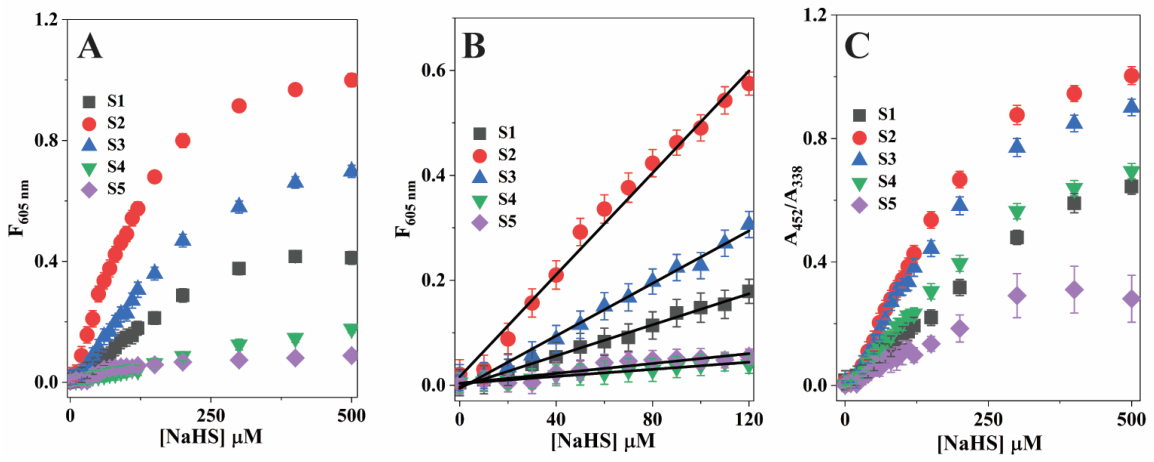
To evaluate the sensing performance of probes S1–S5 toward H2S, NaHS titrations were conducted in DMSO/PBS buffer (7:3, v/v; pH 7.4). Absorption and emission spectra were recorded after incubating S1–S5 (10 μM) with increasing concentrations of NaHS (0–500 μM) for 30 min. Upon NaHS addition, all probes exhibited fluorescence enhancement at 605 nm. Among them, S2 displayed the most pronounced response, reaching a plateau at 500 μM NaHS. S1 and S3 also approached saturation at this concentration; however, their fluorescence intensities were only ~40% and ~60% of S2, respectively. In contrast, S4 and S5 showed minimal fluorescence enhancement under identical conditions (Figure 2A). Since both the magnitude of fluorescence enhancement and the speed of reaching saturation are essential for DNBS-based probes in H2S detection, S2 shows the best overall performance among this series. In contrast, S4 and S5 are not suitable for H2S detection under these conditions due to the deficient fluorescence enhancement after reacting with H2S. Structurally, S4 and S5 incorporated phenyl and benzyl linkers, respectively, between the morpholine group and the 1,8-naphthalimide core. These aromatic linkers may facilitate fluorescence quenching via a PET process, resulting in low emission intensity. S1 contained a morpholine group directly attached to the 1,8-naphthalimide, which may also cause some quenching, but to a lesser extent than in S4 and S5, leading to a lower fluorescence response.
Linearity and a well-defined linear range also are important parameters for evaluating fluorescent probes. For probes S1–S5, the fluorescence intensity showed a linear correlation to NaHS concentration over the range of 0–120 μM (Figure 2B). Although S4 and S5 exhibited very weak fluorescence enhancement, they still showed a clear linear trend like the other probes. The limits of detection (LODs) for S1–S5 were calculated to be 2.0, 0.4, 1.1, 6.2, and 8.2 μM, respectively. Moreover, absorption titrations were also performed and displayed consistent trends. The absorbance ratio (A452nm/A338nm) was used to monitor the H2S detection process. As the NaHS concentration increased, this ratio increased accordingly, indicating the occurrence of the H2S-triggered SNAr reaction. Among the five probes, S2 exhibited the highest A452/A338 ratio, suggesting the greatest sensitivity toward H2S (Figure 2C). Overall, both absorption and emission titrations demonstrated that the morpholine substituent plays a critical role in modulating probe sensitivity. Probes containing a two- or three-carbon spacer between the morpholine moiety and the fluorophore showed optimal sensing performance. In contrast, direct attachment of morpholine to the fluorophore reduced sensitivity, while incorporation of phenyl or benzyl linkers between the morpholine and fluorophore significantly diminished the probes’ response to H2S.
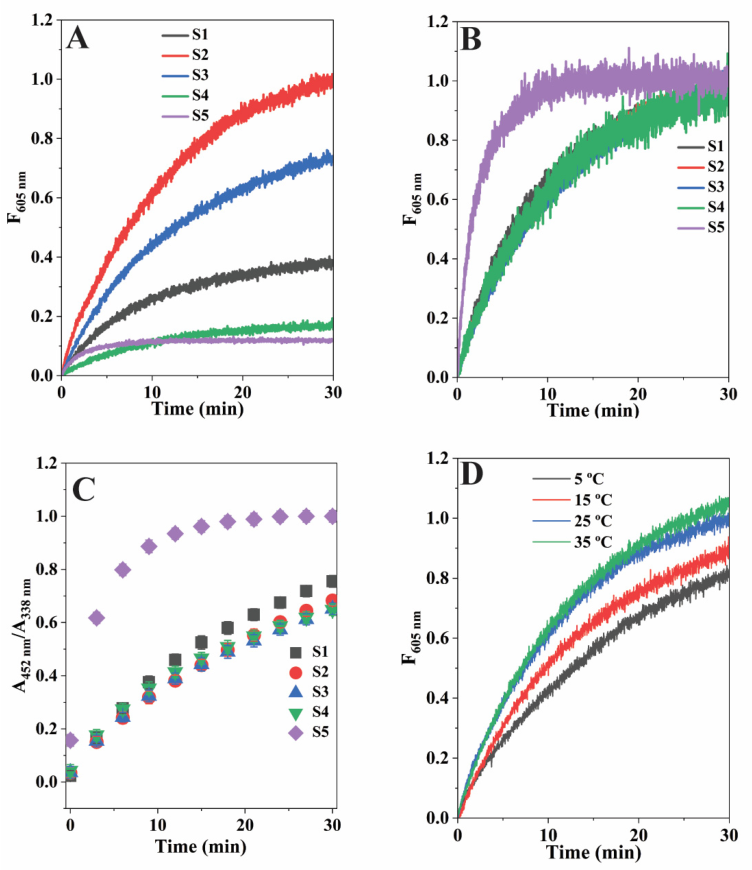
To evaluate the kinetics of probes S1–S5 for detecting NaHS, each probe (10 μM) was incubated with NaHS (500 μM) in DMSO/PBS buffer (7:3, v/v; 0.1 M, pH 7.4) at room temperature, and the fluorescence emission at 605 nm was monitored over 30 min (Figure 3A). All probes exhibited a time-dependent fluorescence enhancement, reaching a plateau within 30 min. Among them, S2 displayed the greatest fluorescence enhancement, whereas S5 showed the weakest response, consistent with the NaHS titration results. Despite variations in fluorescence intensity, S1–S4 exhibited comparable kinetic profiles. Upon normalization of the emission at 605 nm (Figure 3B), these probes showed nearly identical responses over the 30 min period. In contrast, S5 reached its maximum fluorescence intensity within 7 min, indicating a significantly faster response to NaHS. However, its relatively low fluorescence output limited its practical utility for H2S detection. Kinetic measurements were also performed using UV–vis absorption spectroscopy under the same conditions. The absorbance ratio (A452/A338) increased gradually over 30 min (Figure 3C), consistent with the fluorescence-based results. Notably, S5 again exhibited the fastest response among the probes. The response time of reaction-based sensors depends on multiple factors, including sensor structure, solvent, and temperature. DNSB-based H2S sensors exhibit a broad range of response times, from nearly instantaneous reactions to up to 2 h [31,32,33]. The response times observed for S1–S5 fall within this range and remain acceptable for H2S detection, including in biological environments. Given its high fluorescence response, S2 was selected for further temperature-dependent kinetic analysis. The temperature driven kinetics was examined at 5, 15, 25, and 35 °C (Figure 3D). An increase in temperature led to higher fluorescence intensity at 30 min, indicating that elevated temperatures facilitate the H2S-triggered SNAr reaction. However, the overall kinetic profiles remained similar across the temperature range studied. Although H2S solubility and dissociation are temperature dependent, the sensing performance of S2 did not exhibit significant variation between 5 and 35 °C.
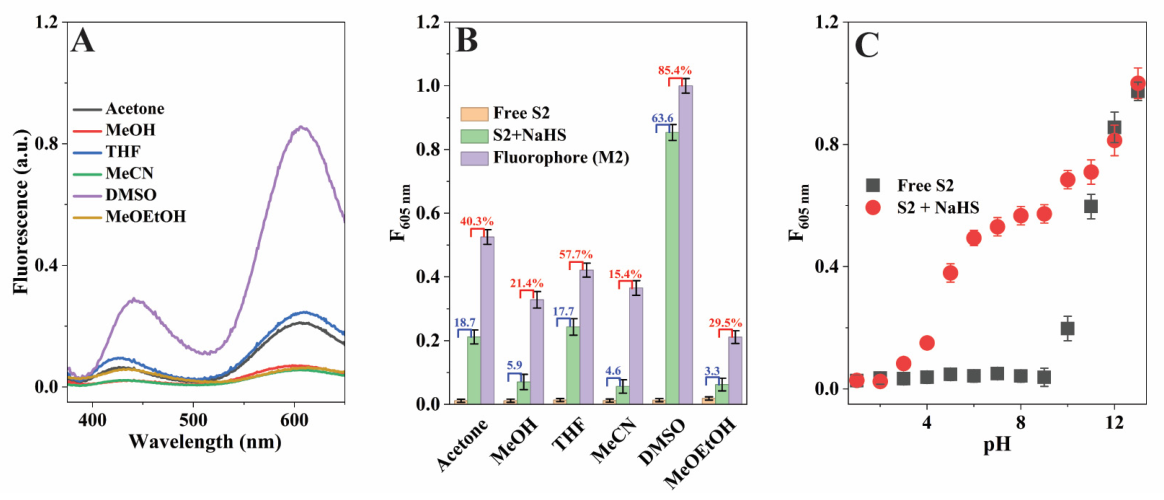
A comparison of the responses of probes S1–S5 toward NaHS, including sensitivity and reaction kinetics, identified S2 as the most responsive probe with the strongest fluorescence signal toward H2S. Therefore, more studies were conducted for S2. Owing to the solvent-dependent photophysical properties of the 1,8-naphthalimide scaffold, the sensing performance of S2 was evaluated in different solvents. Six solvents—acetone, methanol (MeOH), tetrahydrofuran (THF), acetonitrile (MeCN), dimethyl sulfoxide (DMSO), and 2-methoxyethanol (MeOEtOH)—were used to prepare 70% solvent/PBS buffer solutions (pH 7.4, 0.1 mM) to examine solvent effects on H2S detection (Figure 4A). S2 (10 μM) was incubated with NaHS (500 μM) for 30 min in each medium, and the fluorescence emission at 605 nm was measured and compared with fluorophore (M2) and free S2. Upon addition of NaHS, S2 showed fluorescence enhancement in all solvents, with significant differences in magnitude. The largest enhancement was observed in DMSO (63.6-fold), whereas the weakest response was observed in MeOEtOH (3.3-fold). Because solvation effects significantly influenced fluorescence emission, the emission at 605 nm of NaHS-treated S2 was compared with that of the corresponding fluorophore (M2) at the same concentration. The fluorescence recovery rates of S2 after treating NaHS (500 mM) were 40.3% (acetone), 21.4% (MeOH), 57.7% (THF), 15.4% (MeCN), 85.4% (DMSO), and 29.5% (MeOEtOH) (Figure 4B). These results indicate that the SNAr reaction between S2 and NaHS proceeds most efficiently in DMSO medium, leading to effective cleavage of the 2,4-dinitrobenzenesulfonyl group and the strongest fluorescence restoration.
In aqueous solution, H2S exists in equilibrium with HS and S2−, and the dissociation is governed by the pH of the medium. As a result, H2S detection is inherently pH dependent. Moreover, DNBS-based probes exhibit intrinsic pH sensitivity. Therefore, the sensing performance of S2 was evaluated over a pH range of 1–13 in both the absence and presence of NaHS (Figure 4C). At pH 1–4, S2 showed negligible fluorescence enhancement upon addition of NaHS, as H2S is the predominant species and exhibits weak nucleophilicity, leading to limited reaction with S2. In the pH range of 4–9, a significant fluorescence increase was observed, consistent with HS as the dominant species with higher nucleophilicity. At pH > 10, an increase in background fluorescence was observed even in the absence of NaHS, likely due to competing hydrolysis of the DNBS ester by hydroxide. These results indicated that S2 was effective for H2S detection under near-neutral conditions, with an optimal working pH range of 4–10.
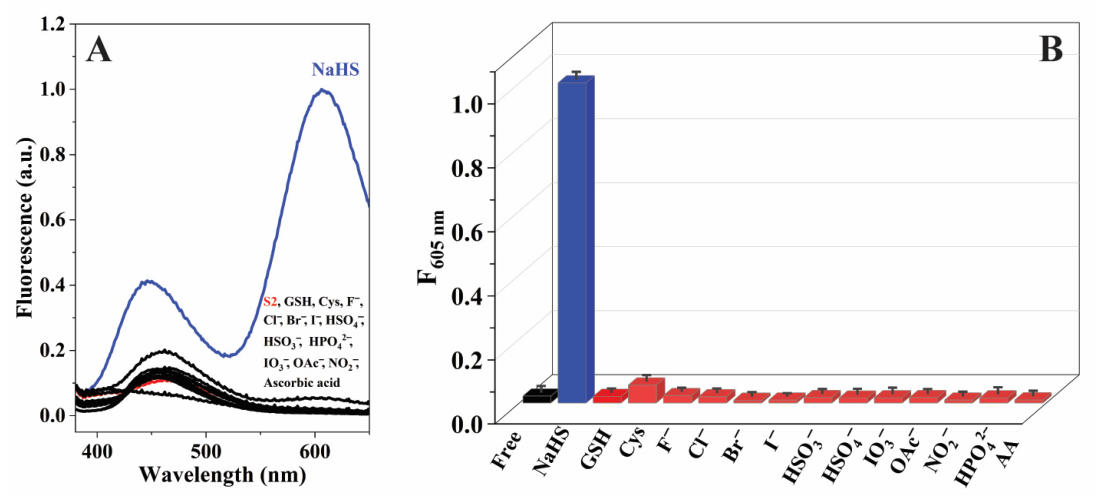
High selectivity toward the target analyte is a critical requirement for fluorescent probes. S2 was designed as a DNBS-based sensor that functioned via an H2S-triggered SNAr reaction, leveraging the higher nucleophilicity of HS relative to other species to achieve selective detection. However, DNBS-based probes have been reported to exhibit responses toward competing nucleophiles, particularly biothiols, which can lead to undesired signal interference. To assess this possibility, the selectivity of S2 (10 μM) was evaluated by incubation with a panel of potential interferents, including F, Cl, Br, I, HSO3, HSO4, IO3, OAc, NO2, HPO42−, and ascorbic acid (100 μM each), as well as glutathione (GSH) and cysteine (Cys) at 1.0 mM to reflect their relatively high intracellular concentrations. All measurements were conducted in DMSO/PBS buffer (7:3, v/v; 0.1 M, pH 7.4) at room temperature. After 30 min of incubation, fluorescence emission at 605 nm was recorded. As shown in Figure 5, only NaHS yielded a pronounced fluorescence response at 605 nm, demonstrating the high selectivity of S2 for H2S. Cysteine induced a minimal increase in fluorescence; however, which was negligible compared to that of NaHS. All other species did not show any signal. Overall, these results indicate that common anions and biologically relevant species did not significantly interfere with H2S detection by S2.

4. Conclusions

In summary, five morpholine-containing probes (S1–S5) were synthesized and evaluated to elucidate the influence of the morpholine moiety on the sensing performance of 1,8-naphthalimide-based H2S probes. All probes exhibited similar absorption and emission profiles and responded to H2S with fluorescence enhancement; however, the magnitude of the response varied substantially. Among them, S2 displayed the most remarkable fluorescence enhancement, whereas S5 showed the weakest response, highlighting significant differences in sensitivity across the series. Structural comparison suggests that a two-carbon spacer between the morpholine unit and the fluorophore, as in S2, is optimal for H2S detection. Kinetic studies revealed that S1–S4 share comparable reaction profiles, while S5 exhibits a more rapid response but with limited signal output. Probe S2 demonstrated robust sensing performance over a broad pH range (4–9), with DMSO identified as the optimal co-solvent under the tested conditions. Furthermore, S2 showed excellent selectivity for H2S over a range of potentially competing species, including biologically relevant thiols. Overall, this work elucidates the structure–property relationships of morpholine-containing fluorescent probes and provides practical insights for the design of fluorescent sensors.

Supplementary Materials

The following supporting information can be downloaded at: https://www.mdpi.com/article/10.3390/chemistry8050059/s1, 1H NMR and 13C NMR spectra for compounds M and S. Figure S1: The absorption change in S1–S5 in the presence of NaHS. Table S1: Compare the sensing ability of S1–S5 to H2S probes recently reported. References [34,35,36,37,38,39,40] are cited in the Supplementary Materials.

Author Contributions

Investigation, T.D., S.F.-B. and N.B.; writing—original draft preparation, H.C.; writing—review and editing, H.C.; project administration, H.C.; funding acquisition, H.C. All authors have read and agreed to the published version of the manuscript.

Funding

This work was financially supported by the Nebraska EPSCoR (OIA-2044049).

Data Availability Statement

The original contributions presented in this study are included in the article/supplementary material. Further inquiries can be directed to the corresponding author.

Acknowledgments

We are grateful for the support from the Nebraska EPSCoR via the Undergraduate Research Experience (URE) program (OIA-2044049). This work was performed in the UNK INSpRE core facility.

Conflicts of Interest

The authors declare no conflicts of interest.

References

  1. Gadalla, M.M.; Snyder, S.H. Hydrogen sulfide as a gasotransmitter. J. Neurochem. 2010, 113, 14–26. [Google Scholar] [CrossRef]
  2. Miyamoto, R.; Otsuguro, K.; Yamaguchi, S.; Ito, S. Neuronal regulation of expression of hydrogen sulfide-producing enzyme cystathionine β-synthase in rat spinal cord astrocytes. Neurosci. Res. 2015, 97, 52–59. [Google Scholar] [CrossRef]
  3. Pan, L.L.; Liu, X.H.; Gong, Q.H.; Yang, H.B.; Zhu, Y.Z. Role of cystathionine γ-lyase/hydrogen sulfide pathway in cardiovascular disease: A novel therapeutic strategy? Antioxid. Redox Signal. 2012, 17, 106–118. [Google Scholar] [CrossRef] [PubMed]
  4. Rao, S.P.; Dobariya, P.; Bellamkonda, H.; More, S.S. Role of 3-mercaptopyruvate sulfurtransferase (3-MST) in physiology and disease. Antioxidants 2023, 12, 603. [Google Scholar] [CrossRef]
  5. Lv, B.; Chen, S.; Tang, C.; Jin, H.; Du, J.; Huang, Y. Hydrogen sulfide and vascular regulation—An update. J. Adv. Res. 2020, 27, 85–97. [Google Scholar] [CrossRef]
  6. Wang, M.; Zhu, J.; Pan, Y.; Dong, J.; Zhang, L.; Zhang, X.; Zhang, L. Hydrogen sulfide functions as a neuromodulator to regulate striatal neurotransmission in a mouse model of Parkinson’s disease. J. Neurosci. Res. 2015, 93, 487–494. [Google Scholar] [CrossRef] [PubMed]
  7. Deng, A.; Chen, L.; Huang, H.; Tang, Q.; Lu, Y.; Cao, J.; Liu, Y.; Wu, Y.; Pan, F.; Li, Y.; et al. Hydrogen sulfide regulation in redox homeostasis and programmed cell death: Mechanistic insights and implications in cancer. J. Adv. Res. 2025, in press. [Google Scholar] [CrossRef] [PubMed]
  8. Mallardi, D.; Chimienti, G.; Maqoud, F.; Orlando, A.; Drago, S.; Malerba, E.; Virgilio, C.D.; Akbarali, H.I.; Russo, F. The dual role of exogenous hydrogen sulfide (H2S) in intestinal barrier mitochondrial function: Insights into cytoprotection and cytotoxicity under non-stressed conditions. Antioxidants 2025, 14, 384. [Google Scholar] [CrossRef]
  9. Pan, L.L.; Qin, M.; Liu, X.H.; Zhu, Y.Z. The role of hydrogen sulfide on cardiovascular homeostasis: An overview with update on immunomodulation. Front. Pharmacol. 2017, 8, 686. [Google Scholar] [CrossRef]
  10. Tripathi, S.J.; Chakraborty, S.; Miller, E.; Pieper, A.A.; Paul, B.D. Hydrogen sulfide signalling in neurodegenerative diseases. Br. J. Pharmacol. 2026, 183, 83–100. [Google Scholar] [CrossRef]
  11. Whiteman, M.; Winyard, P.G. Hydrogen sulfide and inflammation: The good, the bad, the ugly and the promising. Expert Rev. Clin. Pharmacol. 2011, 4, 13–32. [Google Scholar] [CrossRef]
  12. Gao, W.; Liu, Y.F.; Zhang, Y.X.; Wang, Y.; Jin, Y.; Yuan, H.; Liang, X.; Ji, X.; Jiang, Q.; Wu, D. The potential role of hydrogen sulfide in cancer cell apoptosis. Cell Death Discov. 2024, 10, 114. [Google Scholar] [CrossRef]
  13. Yang, M.; Zhou, Y.; Wang, K.; Luo, C.; Xie, M.; Shi, X.; Lin, X. Review of chemical sensors for hydrogen sulfide detection in organisms and living cells. Sensors 2023, 23, 3316. [Google Scholar] [CrossRef] [PubMed]
  14. Tu, S.; Le, Y.; Yang, L.; Yi, Q.; Feng, T.; Yang, J.; Yang, T.; Wu, T.; Zhu, W.; Liu, L. Unraveling hydrogen sulfide detection and lysosome-mitochondria fusion in mitophagy using dual phenothiazine-based fluorescence probes. Sens. Actuator B Chem. 2024, 406, 135408. [Google Scholar] [CrossRef]
  15. Mahapatra, K.K.; Mishra, S.R.; Behera, B.P.; Patil, S.; Gewirtz, D.A.; Bhutia, S.K. The lysosome as an imperative regulator of autophagy and cell death. Cell. Mol. Life Sci. 2021, 78, 7435–7449. [Google Scholar] [CrossRef]
  16. Platt, F.M.; d’Azzo, A.; Davidson, B.L.; Neufeld, E.F.; Tifft, C.J. Lysosomal storage diseases. Nat. Rev. Dis. Primers 2018, 4, 27. [Google Scholar] [CrossRef]
  17. Udayar, V.; Chen, Y.; Sidransky, E.; Jagasia, R. Lysosomal dysfunction in neurodegeneration: Emerging concepts and methods. Trends Neurosci. 2022, 45, 184–199. [Google Scholar] [CrossRef]
  18. Fennelly, C.; Amaravadi, R.K. Lysosomal Biology in Cancer. Methods Mol. Biol. 2017, 1594, 293–308. [Google Scholar] [PubMed]
  19. Zhao, H.; Yang, Y.; Liu, H.; Wang, H. The Role of hydrogen sulfide targeting autophagy in the pathological processes of the nervous system. Metabolites 2022, 12, 879. [Google Scholar] [CrossRef]
  20. Xie, Z.Z.; Liu, Y.; Bian, J.S. Hydrogen sulfide and cellular redox homeostasis. Oxid. Med. Cell. Longev. 2016, 2016, 6043038. [Google Scholar] [CrossRef] [PubMed]
  21. Jin, Y.Q.; Yuan, H.; Liu, Y.F.; Zhu, Y.W.; Wang, Y.; Liang, X.Y.; Gao, W.; Ren, Z.G.; Ji, X.Y.; Wu, D.D. Role of hydrogen sulfide in health and disease. MedComm 2024, 5, e661. [Google Scholar] [CrossRef]
  22. Li, S.; Liu, Y.; Yang, T.; Deng, M.; Cheng, D.; He, L. Lysosome-specific near-infrared fluorescent probe with large stokes shift for H2S imaging in U87 cells and brain glioma mice. Sens. Actuator B Chem. 2025, 426, 137109. [Google Scholar] [CrossRef]
  23. Smith, H.M.; Pluth, M.D. Advances and opportunities in H2S measurement in chemical biology. JACS Au 2023, 3, 2677–2691. [Google Scholar] [CrossRef] [PubMed]
  24. Li, G.; Ma, S.; Tang, J.; Ye, Y. Lysosome-targeted two-photon fluorescent probes for rapid detection of H2S in live cells. New J. Chem. 2019, 43, 1267–1274. [Google Scholar] [CrossRef]
  25. Liu, T.; Xu, Z.; Spring, D.R.; Cui, J. A lysosome-targetable fluorescent probe for imaging hydrogen sulfide in living cells. Org. Lett. 2013, 15, 2310–2313. [Google Scholar] [CrossRef] [PubMed]
  26. Liu, X.; Zhang, X.; Han, Y.; Li, X.; Li, J. Application and suggestions of morpholine ring as a lysosome targeting group. Chemistry 2025, 7, 82. [Google Scholar] [CrossRef]
  27. Fosnacht, K.G.; Pluth, M.D. Activity-based fluorescent probes for hydrogen sulfide and related reactive sulfur species. Chem. Rev. 2024, 124, 4124–4257. [Google Scholar] [CrossRef]
  28. Dvorak, T.; Hernandez-Sandoval, H.; Cheku, S.; Mora Valencia González, M.; Borer, L.; Grieser, R.; Carlson, K.A.; Cao, H. Development of a rapid-response fluorescent probe for H2S: Mechanism elucidation and biological applications. Biosensors 2025, 15, 174. [Google Scholar] [CrossRef]
  29. Levinn, C.M.; Pluth, M.D. direct comparison of triggering motifs on chemiluminescent probes for hydrogen sulfide detection in water. Sens. Actuators B Chem. 2021, 329, 129235. [Google Scholar] [CrossRef]
  30. Dvorak, T.; Cheku, S.; Borer, L.; Hernandez-Sandoval, H.; Carlson, K.A.; Cao, H. Structure–function analysis of hydroxy-1,8-naphthalimide photoacids for ESPT-driven H2S probes. ACS Omega 2025, 10, 31138–31146. [Google Scholar] [CrossRef] [PubMed]
  31. Lee, S.; Sung, D.-B.; Lee, J.S.; Han, M.S. A fluorescent probe for selective facile detection of H2S in serum based on an albumin-binding fluorophore and effective masking reagent. ACS Omega 2020, 5, 32507–32514. [Google Scholar] [CrossRef]
  32. Wang, W.; Gan, Y.; Jiang, H.; Fang, M.; Wu, Z.; Zhu, W.; Li, C. A novel DNBS-based fluorescent probe for the detection of H2S in cells and on test strips. J. Fluoresc. 2025, 35, 2109–2120. [Google Scholar] [CrossRef]
  33. Sontisiri, P.; Promrug, D.; Srichaimoon, L.; Arthan, D.; Pimtong, W.; Thongyoo, P. A novel photoactivatable coumarin-based fluorescent “turn-on” probe: Synthesis and applications for H2S detection in living cells and zebrafish models. Bioorg. Chem. 2025, 160, 108447. [Google Scholar] [CrossRef]
  34. Zhang, M.; Yang, Y.; Hai, Z.; Zhang, S.; Zhao, B. A mitochondria-targeted near-infrared fluorescent probe for detecting H2S, Cys, and GSH simultaneously in tumors. Chem. Commun. 2025, 61, 13960–13963. [Google Scholar] [CrossRef]
  35. Cai, W.; Xin, T.; Tu, Y.; Sun, L.; Liao, G.; Liu, G.; Fan, C. A near-infrared turn-on fluorescent probe for the detection of hydrogen sulfide in water samples and food spoilage. Anal. Chim. Acta 2024, 1320, 342992. [Google Scholar] [CrossRef]
  36. Pak, Y.L.; Li, J.; Ko, K.C.; Kim, G.; Lee, J.Y.; Yoon, J. Mitochondria-Targeted Reaction-Based Fluorescent Probe for Hydrogen Sulfide. Anal. Chem. 2016, 88, 5476–5481. [Google Scholar] [CrossRef]
  37. Hu, R.; Xie, L.; Liao, G.; Liu, G.; Fan, C. A highly selective fluorescent probe for hydrogen sulfide detection in food, water, and living cells. J. Food Compos. Anal. 2024, 137, 106888. [Google Scholar] [CrossRef]
  38. Khan, A.R.; Mansuri, S.; Kanvah, S.; Dutta, S. Design of a NIR fluorescent chemosensor for the detection and imaging of hydrogen sulfide and cysteine in living cells and blood serum. J. Mol. Struct. 2025, 1351, 144386. [Google Scholar] [CrossRef]
  39. Ranjana, M.; Bera, A.; Kashyap, N.N.; Sunil, D.; Sudhakar, Y.N.; Vennapusa, S.R.; Upadhya, D.; Kulkarni, S.D. Indole-functionalized naphthalimide: A dual electrochemical and ratiometric fluorescent sensor for detection of hydrogen sulfide. Discov. Appl. Sci. 2025, 7, 1424. [Google Scholar] [CrossRef]
  40. Li, S.; Li, Q.; Yang, Z.; Wen, W.; Yan, M.; Ren, H. A ratiometric NIR fluorescent probe for simultaneous detection of H2S and viscosity: Applications in environmental monitoring and bioimaging. Talanta Open 2025, 12, 100564. [Google Scholar] [CrossRef]
Scheme 1. Synthetic routes for the preparation of probes S1–S5.
Chemistry 08 00059 sch001
Figure 1. Absorption and emission spectra of probes S1–S5 (10 μM) in DMSO/PBS buffer (7:3, v/v; pH 7.4, 0.1 mM). (A) Absorption spectra of S1–S5. (B) Absorption spectra of S1–S5 after incubation with NaHS (500 μM) for 30 min at room temperature. (C) Emission spectra of S1–S5 (λex = 338 nm). (D) Emission spectra of S1–S5 after incubation with NaHS (500 μM) for 30 min at room temperature (λex = 338 nm).
Chemistry 08 00059 g001
Figure 2. Probes S1–S5 were titrated with NaHS over a concentration range of 0–500 μM in DMSO/PBS buffer (7:3, v/v; pH 7.4, 0.1 mM). (A) Fluorescence emission at 605 nm increased progressively with increasing NaHS concentration (λex = 338 nm). (B) A linear correlation between fluorescence intensity at 605 nm and NaHS concentration was observed over the range of 0–120 μM. (C) The absorbance ratio (A452nm/A338nm) increased with increasing NaHS concentration.
Chemistry 08 00059 g002
Figure 3. Comparative kinetic analysis of S1–S5 in response to NaHS. (A) Time-dependent fluorescence intensity at 605 nm for S1–S5 (10 μM) over 30 min following addition of NaHS (500 μM) in DMSO/PBS buffer (7:3, v/v; 0.1 M, pH 7.4) (λex = 338 nm). (B) Kinetic profiles of S1–S5 based on normalized fluorescence intensity measured at 605 nm. (C) Corresponding time-dependent absorption kinetics (A452nm/A338nm) under identical conditions. (D) Temperature-dependent fluorescence kinetics of S2 (10 μM) upon treatment with NaHS (500 μM) over the range 5–35 °C (λex = 338 nm).
Chemistry 08 00059 g003
Figure 4. (A) Solvent-dependent sensing performance of probe S2 toward H2S. Fluorescence emission spectra of S2 in solvent/PBS buffer (7:3, v/v; pH 7.4, 0.1 mM) after incubation with NaHS (500 μM) for 30 min at room temperature (λex = 338 nm). (B) Fluorescence response at 605 nm of S2 in different solvent systems after treatment with NaHS (500 μM). (C) Effect of pH on H2S detection for probe S2 in DMSO/PBS buffer (7:3, v/v; pH 7.4, 0.1 mM).
Chemistry 08 00059 g004
Figure 5. Selectivity of S2 toward H2S over competing species. Probe S2 (10 μM) was incubated with various potential interferents, including HS, F, Cl, Br, I, HSO3, HSO4, IO3, OAc, NO2, HPO42−, ascorbic acid (100 μM), glutathione (GSH), and cysteine (Cys) (1.0 mM). The measurements were carried out in DMSO/PBS buffer (7:3, v/v; 0.1 M, pH 7.4) at room temperature, and fluorescence spectra were recorded after 30 min incubation. (A) Emission spectra of S2 in the presence of the different species. (B) The change of fluorescence intensity at 605 nm (λex = 338 nm) in the presence of different species.
Chemistry 08 00059 g005
Disclaimer/Publisher’s Note: The statements, opinions and data contained in all publications are solely those of the individual author(s) and contributor(s) and not of MDPI and/or the editor(s). MDPI and/or the editor(s) disclaim responsibility for any injury to people or property resulting from any ideas, methods, instructions or products referred to in the content.