
Article

Removal of Crystal Violet from Water by Sulfonated Hydrogel: Nonlinear Adsorption Modeling and Thermodynamics

by
Ahmed Galal Ibrahim
Department of Chemistry, Faculty of Science (Boys), Al-Azhar University, Nasr City, Cairo 11884, Egypt
Chemistry 2026, 8(4), 46; https://doi.org/10.3390/chemistry8040046
Submission received: 17 February 2026 / Revised: 29 March 2026 / Accepted: 1 April 2026 / Published: 4 April 2026
(This article belongs to the Section Physical Chemistry and Chemical Physics)

Abstract

This report investigates the capacity of crystal violet (CV) uptake from aqueous solutions by a sulfonated gel (Sulfo-Gel) made via free radical polymerization of acrylamide and sulfonic monomer (3-Allyloxy-2-hydroxy-1-propanesulfonic acid sodium salt). CV uptake was examined through a batch technique, assessing the effects of various conditions, including uptake time, solution pH, gel dose, initial concentration of dye, and temperature. Results showed that the hydrogel adsorbent removed 74.88% of the CV dye at a gel dose of 500 mg/L in a neutral medium at initial CV concentration of 30 mg/L and contact time 100 min. The adsorption kinetics were best depicted by nonlinear fitting of pseudo-first-order model. Additionally, adsorption isotherms were analyzed using nonlinear fitting of the Langmuir, Freundlich, Temkin, and Dubinin–Radushkevich models, with the data fitting the Temkin model most effectively. Thermodynamic studies signified the exothermic nature of the adsorption process and its spontaneity.

1. Introduction

With industrial development, significant amounts of dye have been used for coloring purposes, and their release of from various sources into wastewater has increased to a huge amount, posing a threat to human health as a result of pollution of the water environment. Although some dyes are safe for coloring, others are toxic, carcinogenic, and cause undesirable esthetic aspects [1]. Dyes in wastewater, even at concentrations below 1 mg/L, inhibit sunlight penetration into water bodies, which can jeopardize aquatic plant life by slowing photosynthesis [2,3]. Additionally, the synthetic nature of many dyes renders them poorly biodegradable, making their removal from water exceptionally challenging [4,5]. Among dyes, crystal violet (CV) is mainly a monovalent cationic dye, and it is used for coloring cellulosic fiber, wool, hair, and paper [6]. Despite its industrial utility, CV is considered toxic at a concentration of ≈1 ppb and may cause some diseases to people or workers in the dyeing field, such as eye burn resulting in permanent cornea/eye damage. Inhaling this dye can cause a brief episode of rapid or difficult breathing, along with nausea, vomiting, excessive sweating, diarrhea, hypermotility, and abdominal pain [7,8].
To address dye contamination, various methods have been established for the removal of dyes from colored wastewater, including membrane separation, ion-exchange, adsorption, electrochemical methods, coagulation–flocculation, reverse osmosis, degradation by oxygen and ozone, photocatalysis, and microbial degradation [9,10,11,12,13,14,15,16,17]. Among these, adsorption has emerged as a promising alternative for pollutant removal due to its simplicity, versatility, cost-effectiveness, wide applicability, efficiency, and the availability and recovery of adsorbents [18,19]. Naturally, the choice of adsorbent strongly affects process efficiency. In this context, hydrogels have attracted significant attention as adsorbents for dye removal. The hydrogels are known as three-dimensional, crosslinked polymers that are insoluble in solvents yet highly hydrophilic; they tend to swell up in water to hundreds of times their original size [4,19]. This swelling property increases effective surface area and provides holes or channels that enhance accessibility to active sites, thereby improving the adsorption performance. Compared with conventional adsorbents, hydrogels are characterized by stability in various environmental conditions such as pH and heat. In addition, they operate simply and can be shaped in various forms [20]. Consequently, the literature contains many studies on hydrogel adsorbents for removing synthetic dyes from water [4,21,22,23].
For example, Ilgin et al. synthesized anionic hydrogels from N-tert-butylmaleamic acid and acrylamide or 2-hydroxyethyl methacrylate by free radical polymerization and used them to remove methylene blue (MB) and crystal violet (CV) cationic dyes from aqueous solutions [20]. Likewise, Pashaei-Fakhri et al. fabricated an alginate-based hydrogel for the CV dye sorption, and they found that the adsorption is pH-dependent, exothermic, and follow the Redlich–Peterson isotherm model and pseudo-second-order kinetic model [24]. Liu et al., using free radical polymerization, prepared cationic hydrogel p(dimethyl diallyl ammonium chloride-co-acrylamide)@chitosan for effective elimination of anionic dye Congo Red from water systems, fitting their data with pseudo-second-order kinetic model and the Hill isotherm model [25].
Notably, the presence of sulfonate groups in hydrogels is of considerable importance in the adsorption process. Their negative charge enables the adsorbent to interact effectively with the cations or the cationic molecules. Also, their hydrophilicity increases the swelling properties of the hydrogel, therefore increasing the accessible surface area for adsorption [23,26]. Several studies illustrate this effect: Üzüm et al. fabricated a sulfonate-containing magnetic semi-IPN hydrogel from polymerizing acrylamide and 2-acrylamido-2-methyl-1-propanesulfonic acid in the presence of p(ethylene glycol) for the adsorption of Janus Green B from aqueous solutions [27]; anionic p(sodium p-styrene sulfonate) has been used for eliminating the cationic methylene blue dye from its aqueous solutions [28]; and Li et al. used p(sodium p-styrene sulfonate-co-N-methylol acrylamide) for coating cotton fiber to be used as an adsorbent for the cationic dyes (rhodamine B, malachite green, and methylene blue), reporting predominant electrostatic interactions and thermodynamic favorability at higher temperatures [26]. In another work [23], a sulfonated hydrogel consisting of sodium styrene sulfonate and acrylonitrile was utilized for effective CV uptake from wastewater.
Although numerous studies have demonstrated effective removal of cationic dyes using sulfonated hydrogels, still utilizing a 3-allyloxy-2-hydroxy-1-propanesulfonic acid-containing hydrogel for removing the crystal violet dye has not been reported yet. Recently, we fabricated sulfonated hydrogels consisting of acrylamide and the sulfonated monomer 3-allyloxy-2-hydroxy-1-propanesulfonic acid sodium salt by free radical crosslinking gelation in water using methylene bisacrylamide as a crosslinking agent. Our prior work demonstrated a maximum swelling ratio of 4353.8% and a maximum adsorption capacity of 703.2 mg/g for methylene blue [19]. Building on these findings and in this connection, we investigate adsorption of the widely used cationic dye crystal violet from aqueous solution onto this new sulfonated hydrogel (Sulfo-Gel). Specifically, we examine the impact of different parameters, including adsorption time, initial concentration of CV, gel dose, pH, and temperature, and we analyze nonlinear kinetics and isotherms and the thermodynamics parameters to elucidate the adsorption mechanism.

2. Materials and Methods

2.1. Chemicals of Study

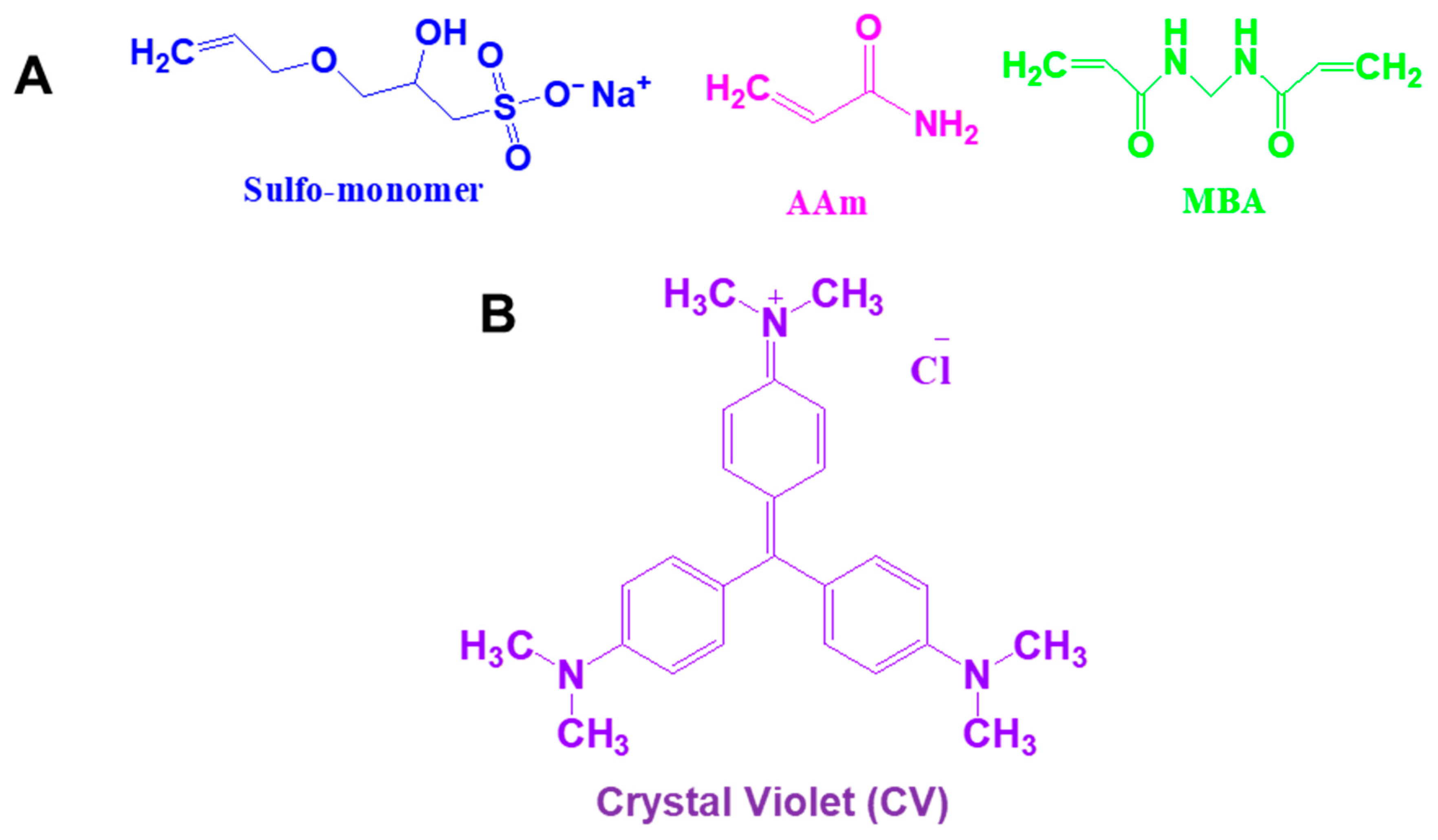
Sulfo monomer (3-Allyloxy-2-hydroxy-1-propanesulfonic acid sodium salt) and acrylamide (AAm) were purchased from Sigma-Aldrich Company Ltd. (Taufkirchen, Germany) and were used for synthesis of the sulfonated gel according to the procedure described in our published paper [19]. Ammonium persulfate (an initiator, APS) and methylene bisacrylamide (crosslinker, MBA) were obtained from Merck (Taufkirchen, Germany). Crystal violet (CV, λmax = 598 nm, molar mass 393 g mol−1, Color index 42555) was purchased from Fluka (Buchs, Switzerland). Double-distilled water was prepared in our laboratory for this study. The structures of sulfo monomer, AAm, MBA, and CV are presented in Figure 1.

2.2. Synthesis of the Sulfo-Gel Adsorbent

The Sulfo-Gel adsorbent was prepared as described in our previous work [19]. Briefly, monomers (30 mmol total: 85% acrylamide, 1.810 g; 15% sulfo monomer, 2.452 g) were dissolved in 20 mL of distilled water containing the APS initiator (0.3 mmol, 0.07 g) and MBA crosslinker (0.3 mmol, 0.046 g). The crosslinker-to-monomer and initiator-to-monomer ratios were 1%. The solution was heated to 80 °C until gelation occurred. The resulting gel was washed several times with water and dried at 60 °C to constant weight. The gel fraction was 72%. The sample, designated Sulfo-Gel, was stored for adsorption experiments. In our previous work [19], the chemical composition of Sulfo-Gel was confirmed by Fourier transform infrared spectroscopy (Cary 630 FTIR, Agilent Technologies, Santa Clara, CA, USA). Its three-dimensional porous network was examined by scanning electron microscopy (Quanta 250 FEG, FEI), and the thermal behavior was analyzed by thermogravimetric analysis (TGA, LINSEIS STA PT1600) under a nitrogen atmosphere.

2.3. Determination of Point of Zero Charge (PZC)

In this experiment, the pH at which the charge on the surface of the Sulfo-Gel is zero (pHPZC) was determined following the procedure reported by Brungesh et al. [30] with slight modification. This pH point is important to identify the charge on the total surface of the adsorbent; if pH > pHPZC, the surface is negative, and if pH < pHPZC, the surface is positive. Practically, the method of determination could be summarized as follows: A stock solution (500 mL) of 0.01 N NaCl was prepared. To a series of 75 mL glass bottles, 50 mL of 0.01 N NaCl was added, and the initial pH of the solutions was adjusted using 0.01 N HCl and/or 0.01 N NaOH solutions to be in the range of 2–10. After reaching the pH value to a constant, 0.01 g of gel was added into each bottle, and the bottles were capped tightly and kept at ambient temperature under shaking for 48 h. After that, the final pH of the solutions was measured by a pH meter (AD1030). Then, the initial pH (x-axis) was plotted against ΔH (y-axis) (ΔH = final pH − initial pH). The point at which the curve obtained intersects with the x-axis is called the point of zero charge (pHPZC).

2.4. CV Adsorption

First, a stock CV solution (0.5 g CV per L of double-distilled water) was prepared, and other concentrations were obtained by serial dilution. All concentrations were verified using a double beam UV-Vis spectrophotometer. Next, 0.1 M HCl or 0.1 M NaOH solution was used to adjust the solution pH. A calibration curve for CV was constructed by plotting absorbance versus concentration (2.5–10 mg/L) at the maximum wavelength (λmax = 598 nm) [6,31,32]; the resulting equation was y = 0.2117x − 0.5062 (R2 = 0.9924).
Batch adsorption experiments were conducted by submerging specific weights of the adsorbent in distilled water for 200 min to allow swelling; this duration was chosen because prior swelling-time measurements for the same Sulfo-Gel formulation showed the swelling curve plateaued well before 6 h and no statistically significant increase in swelling was observed after 200 min [19]. The swollen adsorbent was then transferred to a CV solution (100 mL) of 10 mg/L concentration at 25 °C, stirred at 200 rpm, and maintained at pH 7. During adsorption process, aliquots were withdrawn periodically and the remaining dye concentrations were measured spectrophotometrically at a wavelength (λmax) of 598 nm utilizing the pre-prepared calibration curve. The effects of adsorption parameters including uptake time (0–200 min), solution pH (3.2–11), gel dose (250–1000 mg/L), initial concentration of dye (5–30 mg/L), and temperature (25–50 °C) on the adsorption efficiency of the Sulfo-Gel were assessed. Each adsorption experiment was performed three times, and the reported values are averages. Calculations were conducted using the following equations.
q t = C 0 C t V m  
q e = C 0 C e V m  
R   % = C o C t C o × 100
where qt and qe represent the adsorption capacity (amount of dye removed by one gram of adsorbent) at time t and at equilibrium, respectively; R% indicates the removal percentage; V (L) signifies the volume of the dye solution; and m (g) indicates the weight of the dried hydrogel piece. C0, Ct and Ce denote the concentrations of dye solution at time = 0, time = t, and equilibrium, respectively.

3. Results and Discussion

3.1. Dye Adsorption and Its Mechanism

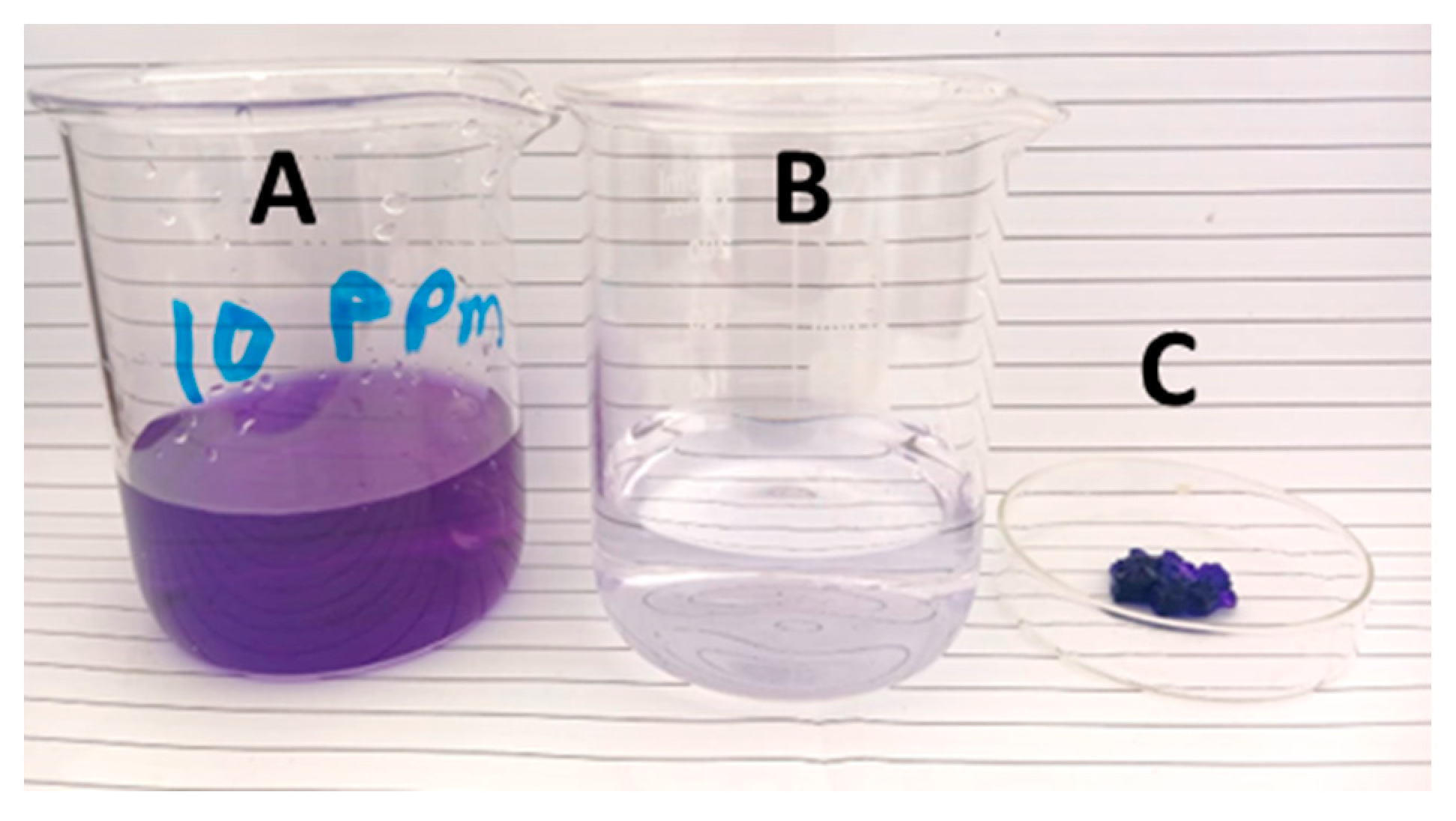
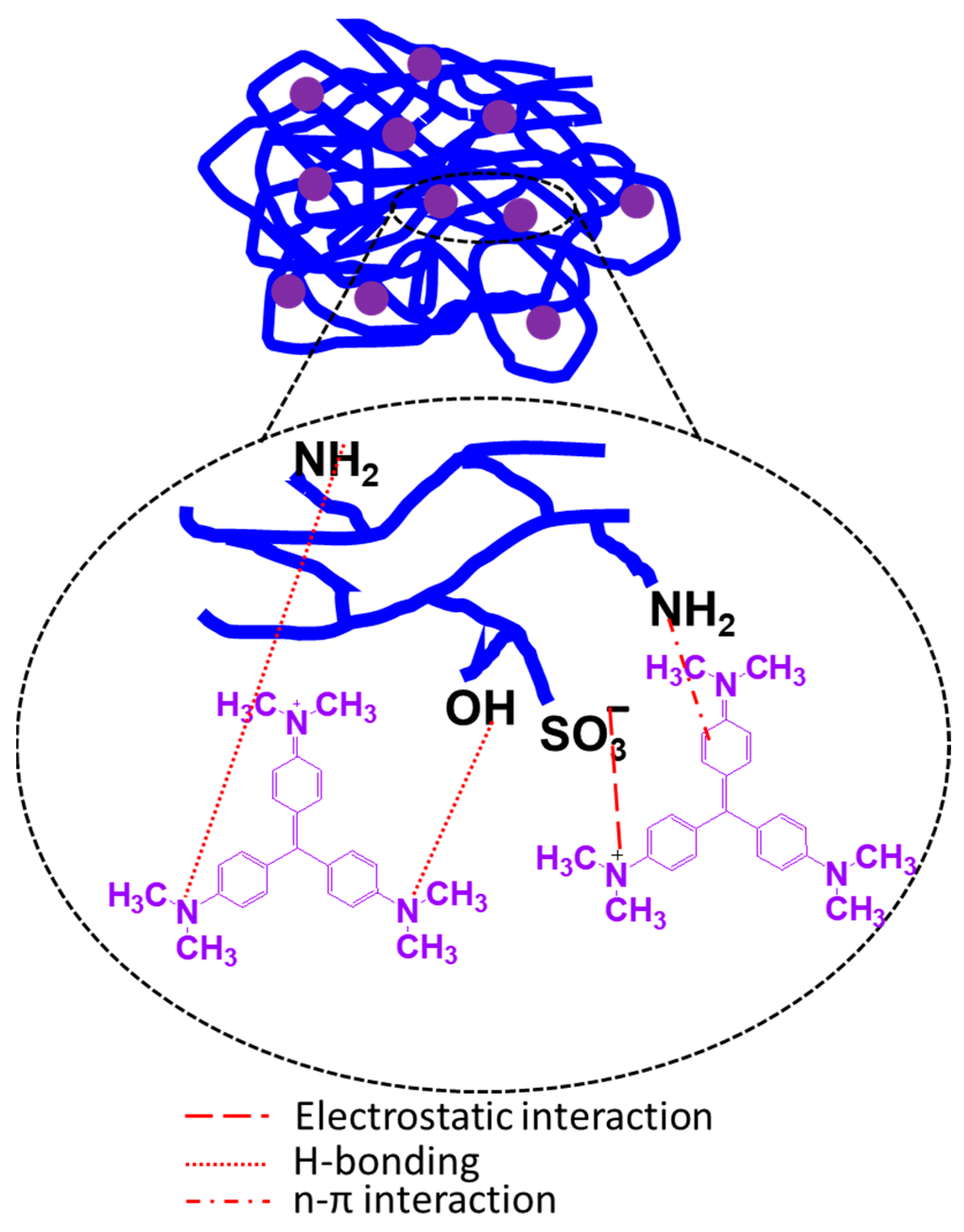
In this study, we examined the adsorption capacity of the tested adsorbent, Sulfo-Gel, for removing the cationic dye crystal violet (CV) from aqueous solutions. This was evaluated by observing the color change of the CV solution. A sample of the adsorbent (500 mg/L) was added to an aqueous solution of CV (10 mg/L), and the mixture was stirred at 200 rpm for two hours at 25 °C. The resulting color change was documented, as illustrated in Figure 2. Initially, the CV solution appeared violet (Figure 2A), which changed to nearly colorless (Figure 2B) following the adsorption process. This indicates a significant reduction in CV concentration, as evidenced by the Sulfo-Gel turning violet from its original transparent state (Figure 2C). This suggests that Sulfo-Gel can effectively remove CV from the solution. As shown in Figure 3, CV is a cationic dye, while Sulfo-Gel contains functional groups such as amino groups (NH2), hydroxyl groups (OH), and negatively charged sulfonate groups (SO3Na). The adsorption of CV onto Sulfo-Gel likely occurs through several mechanisms: first, hydrogen bonding between the amino and hydroxyl groups of the adsorbent and the amino groups of the dye; second, electrostatic interactions between the cationic dye and the negatively charged adsorbent; third, cation exchange between the cationic CV and Na+ ions from the ionization of SO3Na; and fourth, hydrophobic interactions between hydrogen atoms from the adsorbent and the benzene rings of the dye [6,33].
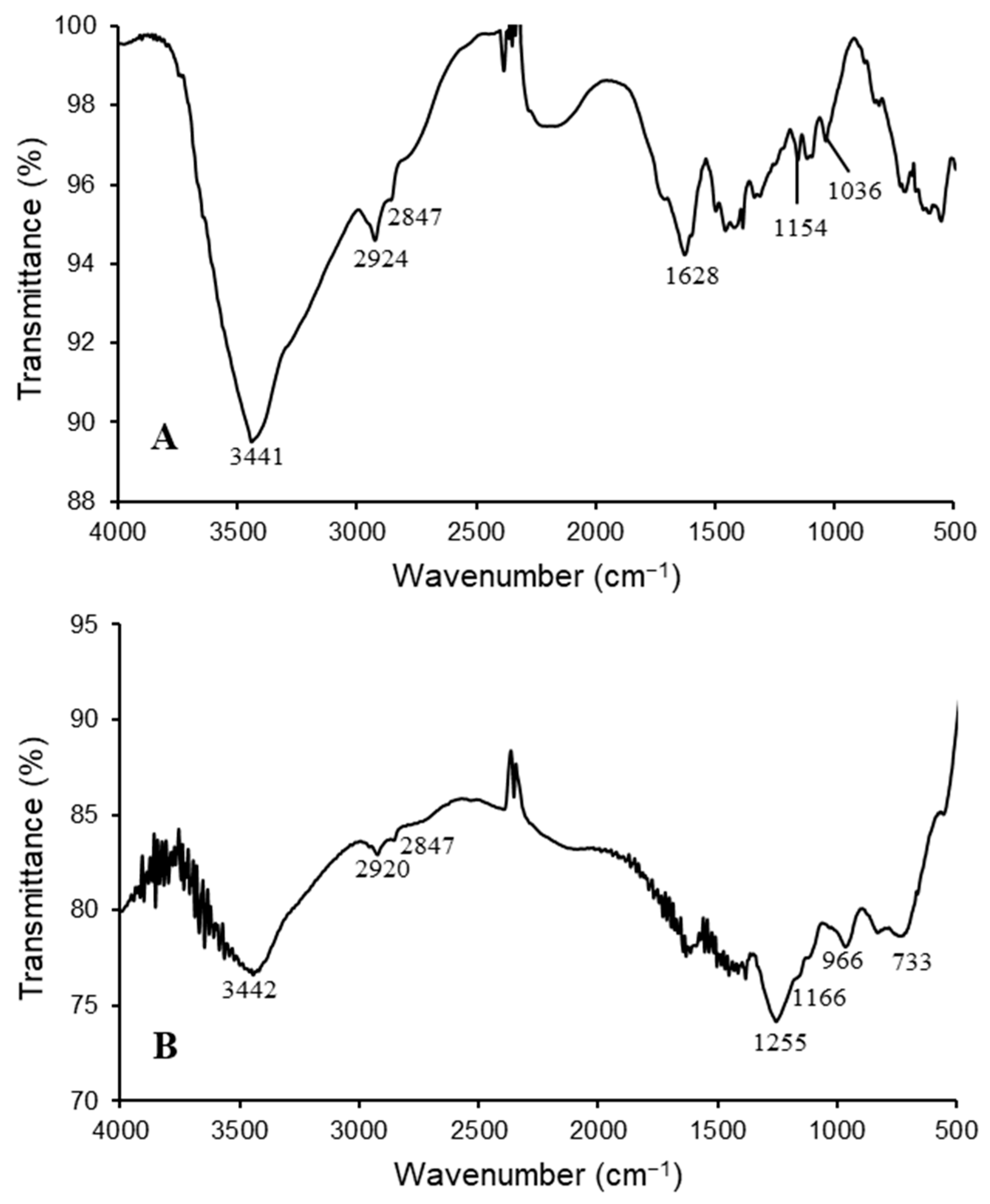
Fourier transform infrared (FTIR) analysis was conducted using a Cary 630 FTIR spectrometer (Agilent Technologies Company, Santa Clara, CA, USA) to verify the adsorption of CV dye onto the Sulfo-Gel adsorbent. As shown in Figure 4A, the adsorbent exhibited a broad peak at 3441 cm−1, attributed to the stretching vibrations of OH and NH groups, as well as peaks at 2924 and 2847 cm−1 corresponding to aliphatic C-H stretching. A peak at 1628 cm−1 represents C=O stretching, while peaks at 1154 and 1036 cm−1 relate to the stretching vibrations of SO2 [19,34]. The N-H bending vibration was observed as a shoulder at 1595 cm−1. The peak at 554 cm−1 is attributed to C-S stretching. These spectral features collectively confirm the chemical structure of Sulfo-Gel, indicating the presence of various functional groups that enhance its adsorption properties. Comparing Figure 4A,B reveals that some peaks have shifted or changed, and new peaks have emerged, such as those at 1555 cm−1 (C=C aromatic rings) and 1166 cm−1 (aliphatic C-N stretch of tertiary amine) [35]. This suggests an interaction between the functional groups of the adsorbent and the cationic crystal violet molecules during the adsorption process. The peaks of SO3 are shifted to lower wavenumbers from 1154 and 1036 cm−1 to 1124 and 966 cm−1, indicating the participation of sulfonate groups in electrostatic interactions with positively charged tertiary amines in CV molecules. In addition, the kind of hydrogen bonding interaction plays a crucial role in the adsorption process, which is confirmed by the intensity change of the N-H bending at 1595 cm−1 (Figure 4B).

3.2. Effect of Contact Time

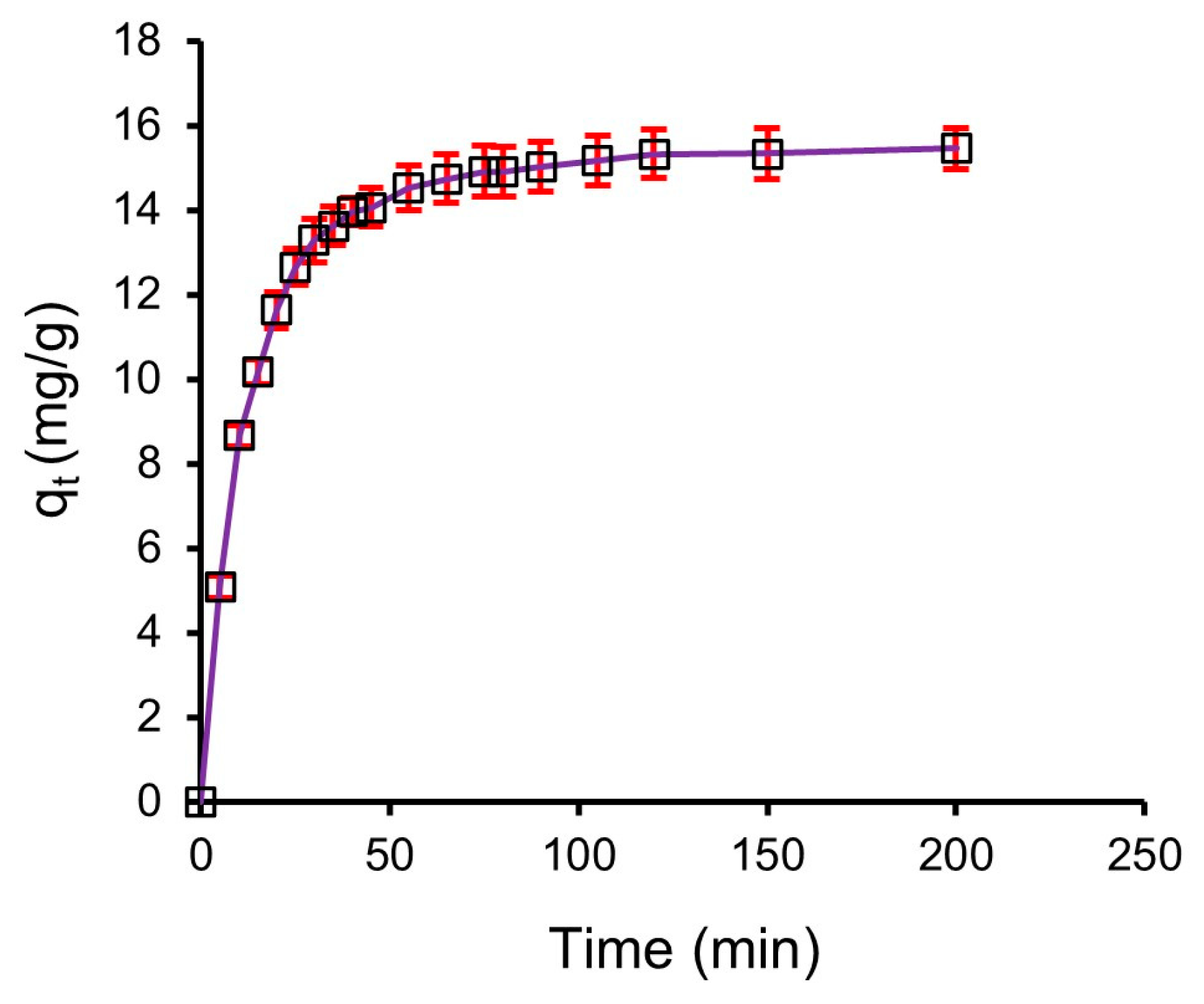
The capacity of Sulfo-Gel to absorb CV dye from aqueous solutions was investigated at a contact time of 0–200 min, with a Co of 10 mg/L, a pH of 7, a gel dose of 500 mg/L, and a temperature of 25 °C. As presented in Figure 5, the capacity of Sulfo-Gel to remove the dye increases rapidly at first, followed by a slower rate until it reaches a maximum value of 15.3 mg/g. This trend can be rationalized as follows: during the initial adsorption period (0–50 min), all binding sites on the gel surface are available for interaction with the crystal violet molecules, allowing for rapid migration of the dye from the bulk solution to the adsorbent surface. After about 50 min, the curve begins to level off, indicating a significant slowdown in the adsorption rate. This plateau suggests that most of the available adsorption sites on the gel have been occupied, and further adsorption is limited by the diffusion of dye molecules within the adsorbent network. By around 120 min, the adsorption stabilizes, indicating that equilibrium has been reached, with little to no further increase in dye adsorption beyond this point.

3.3. Sorption Kinetics

Adsorption kinetics are crucial for understanding the rate of adsorption, and both pseudo-first-order and pseudo-second-order kinetic equations were applied to examine the experimental data [23]. To elucidate the adsorption mechanism of crystal violet onto Sulfo-Gel at the solid–liquid interface, kinetic studies were conducted using these two models. The kinetics of adsorption were assessed by measuring the amount of CV adsorbed from a neutral aqueous solution at various time intervals, maintaining an initial CV concentration of 10 mg/L, gel dose of 500 mg/L, and temperature of 25 °C. The pseudo-first-order model assumes physical interactions between Sulfo-Gel and crystal violet molecules, while the pseudo-second-order model supposes chemical interactions. Both models were thoroughly examined and compared. The equations for these models are presented as Equations (4) and (5), respectively [23,36].
q t = q e 1 ( 1 e K 1 t )
q t = ( K 2   q e 2   t ) / ( 1 + K 2   q e   t )
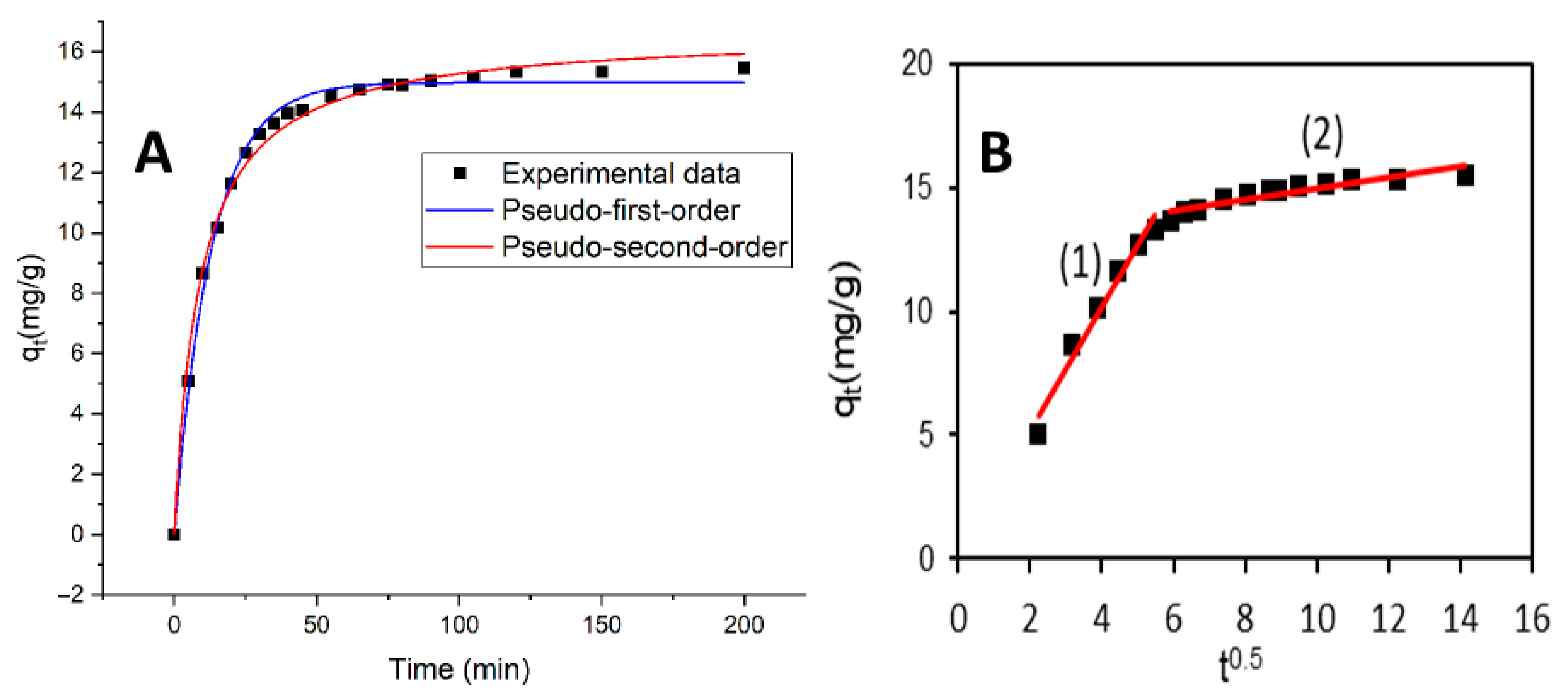
where K1 (min−1) and K2 (g mg−1 min−1) indicate adsorption rate constants, qe1 and qe2 represent the theoretical equilibrium adsorption, calculated from pseudo- first-order and pseudo-second-order equations, respectively. The nonlinear plots of the two models are presented in Figure 6, and the calculated parameters are summarized in Table 1. As presented, the correlation coefficient (R2) for the pseudo-first-order model (0.9944) is higher than that of the pseudo-second-order model (0.9928), indicating that the pseudo-first-order model adequately describes the removal of CV by the Sulfo-Gel adsorbent used in this study. This conclusion is further supported by the low value of the statistical error parameter, chi-square (χ2), which was 0.093 for the pseudo-first-order model and 0.11964 for the pseudo-second-order model. Additionally, the calculated adsorption capacity (qe1) for the pseudo-first-order model was 14.98 mg/g, which is very close to the experimental value of 15.33 mg/g. Similar fits to the pseudo-first-order model were observed in studies conducted by Pashaei-Fakhri et al. [24], Li [31], and Sharma et al. [37] for the removal of CV using acrylamide-sodium alginate hydrogel, poly(acrylic acid-acrylamide-methacrylate)/amylose Semi-IPN hydrogel, and poly(acrylamide)-Gum Arabic nanohydrogel, respectively. Based on these findings, it can be concluded that the removal of CV by the Sulfo-Gel adsorbent occurs through physical interactions.

3.4. Investigation of the Diffusion Mechanism

In this study, the diffusion mechanism and the rate-controlling step of adsorption were investigated using the intraparticle diffusion model, which describes the movement of adsorbate molecules from the bulk solution through the external boundary layer and into the pores of the adsorbent. It was reported that the use of hydrogel adsorbents makes the adsorption mechanism pass through multi-stages because of their combined external surface adsorption, boundary-layer effects, and internal pore diffusion [38]. For these reasons, the intraparticle diffusion model was tested for fitting the adsorption data. The equation of this model [39] is:
q t   = K i   t 0.5   + I
where Ki (mg/(g·min0.5)) indicates the rate constant, and I (mg/g) is the intercept, which is proportional to the thickness and contribution of the external boundary layer.
Figure 6B represents the plot of qt versus t0.5 and Table 1 lists the calculated parameters from the slopes and the intercepts. The figure shows that there are two distinct linear regions that do not pass through the origin. This behavior indicates that intraparticle diffusion mode is occurring but is not the sole rate-controlling step for the entire adsorption process of CV by the Sulfo-Gel adsorbent; other mechanisms (for example, film diffusion or surface adsorption) also contribute [25,36,40]. Physically, the two linear regions represent successive stages of the adsorption process: Stage 1 might be attributed to rapid external adsorption and surface uptake. At short contact times, CV dye molecules move quickly from the bulk solution to the adsorbent surface and are rapidly adsorbed at available surface sites and this is indicated by the relatively large slope (higher Ki (1)), which reflects faster mass transfer in this stage and a smaller influence of internal diffusion. This stage is followed by a slower intraparticle diffusion and pore filling (Stage 2). After the readily accessible surface sites are occupied, adsorption becomes controlled by diffusion of dye molecules into the gel network and smaller pores. The decreased slope (lower Ki (2)) indicates that internal diffusion within the gel matrix limits the rate during this stage. The nonzero intercepts I for each linear region quantify the contribution of the external boundary layer and immediate surface adsorption: larger I values imply a greater role of boundary-layer resistance and surface adsorption prior to intraparticle diffusion. Because neither line passes through the origin, film diffusion (boundary-layer resistance) and/or instantaneous surface adsorption contribute appreciably alongside intraparticle diffusion [41,42]. Similar findings were reported for adsorption of cationic dyes by other hydrogels [6,43,44,45].

3.5. Effect of Initial CV Concentration

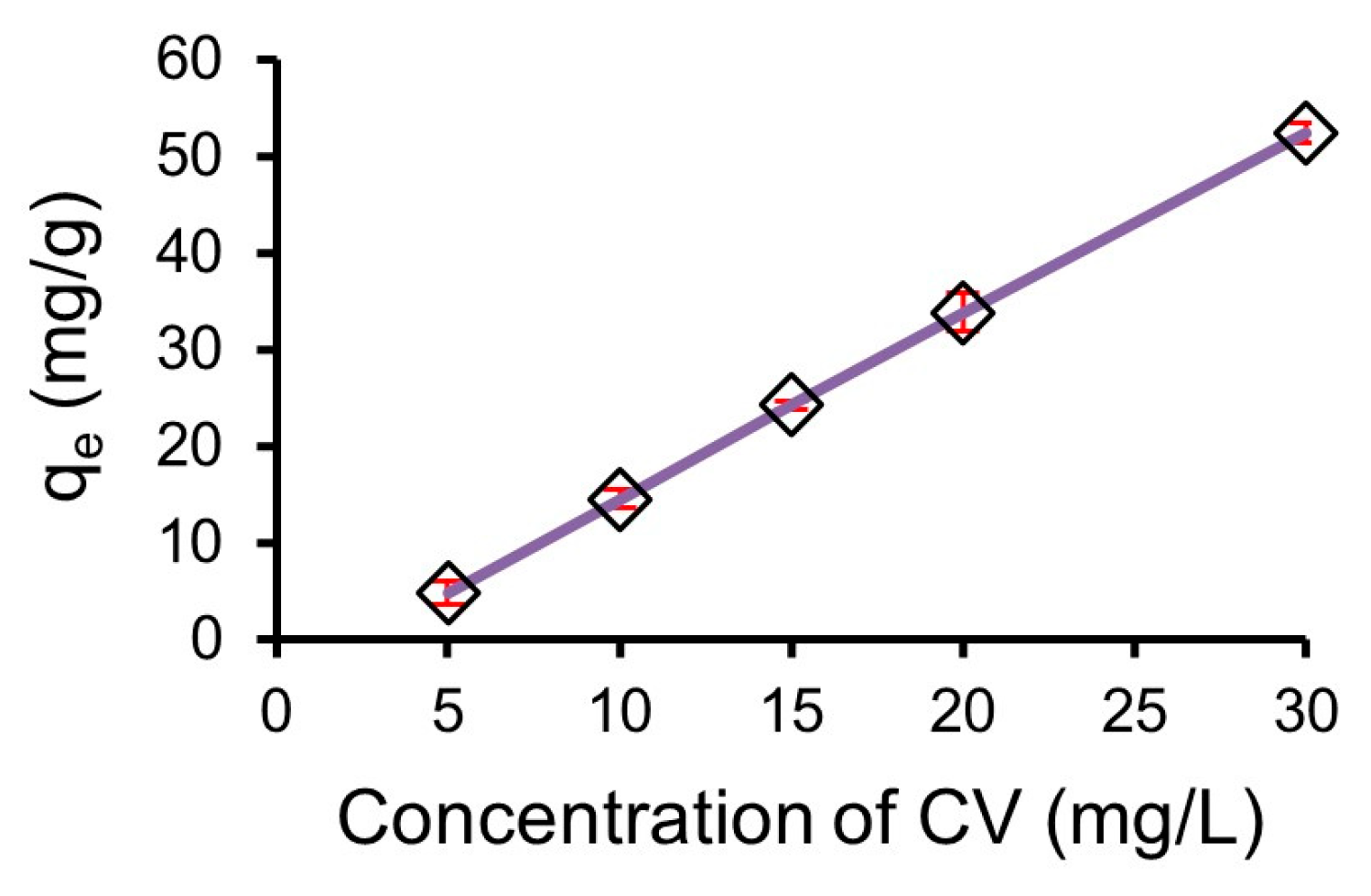
Figure 7 illustrates the effect of CV concentration (5–30 mg/L) on its amount adsorbed by Sulfo-Gel under the following conditions: pH 7, a gel dose of 500 mg/L, stirring at 200 rpm, a temperature of 25 °C, and a contact time of 100 min. The results indicate a significant increase in the equilibrium adsorption amount (qe) with higher initial CV concentrations. Specifically, the adsorption capacity reached 52 mg/g at a CV concentration of 30 mg/L, compared to just 5 mg/g at 5 mg/L. At lower initial concentrations, there is less competition among dye molecules for the active sites on the adsorbent, resulting in lower removal percentages and adsorption capacities. As the initial dye concentration increases, the molecules diffuse more rapidly toward the adsorbent surface, enhancing interaction. At 30 mg CV/L, Sulfo-Gel achieved an adsorption of 52 mg/g, with an 87% removal efficiency, demonstrating the adsorbent’s effectiveness at higher CV concentrations.

3.6. Adsorption Isotherms

For further interpretation of the adsorption mechanism and energetic heterogeneity of Sulfo-Gel, four traditional isotherm models (Langmuir, Freundlich, Temkin, and Dubinin–Radushkevich) were tested over a concentration range of 5–30 mg/L. The Langmuir model assumes monolayer adsorption on a surface with energetically uniform active sites and an equilibrium between the adsorbed and free phases. The Freundlich model describes the inhomogeneity of adsorption on the adsorbent surface with sites of varying affinities. The Temkin model assumes that the heat of adsorption decreases linearly with increasing surface coverage, indicating interactions between adsorbate molecules. The Dubinin–Radushkevich (D–R) model focuses on adsorption on a heterogeneous surface and is often used to distinguish between physical and chemical adsorption [20,39]. The nonlinear isotherms of these four models are represented by Equations (7)–(10) [23,39], respectively, and the calculated parameters are displayed in Table 2.
q e = q m K L   C e 1 + K L C e
q e = k f   C e 1 / n
q e = B ln A T C e
q e = q s exp ( K D R   [ R T l n 1 + 1 C e ] 2 )
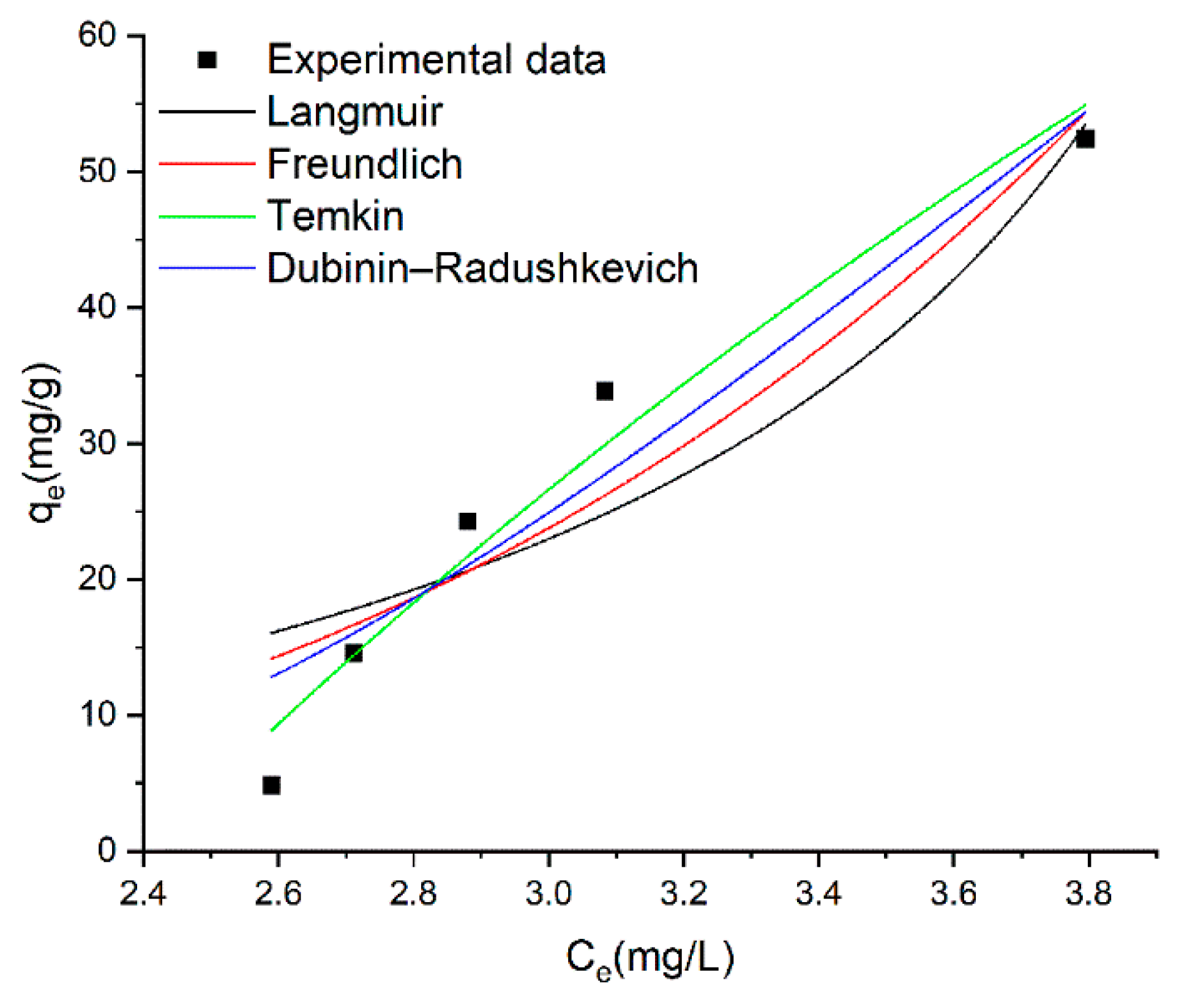
where qm (maximum adsorption capacity, mg/g) and KL (constant, L/mg) are the Langmuir parameters. Kf (constant, L/g) and n (adsorption intensity) are Freundlich parameters. AT (equilibrium binding constant, L/g) and B (constant, J/mol) are Temkin parameters. qs (theoretical saturation capacity, mg/g) and KDR (constant, mol2/kJ2) are the D–R parameters. R and T are the gas constant (8.314 J/mol K) and the absolute temperature (K), respectively. The nonlinear isotherm fits of the experimental data using the four models are presented in Figure 8. As commonly used in the literature, R2 and χ2 were employed to evaluate the quality of each fit [23,46]. As presented in Table 3, the Temkin model gave higher R2 and lowest χ2, compared to the other models, indicating it best describes the CV adsorption by the Sulfo-Gel adsorbent. This outcome indicates that the heat of adsorption decreases linearly with surface coverage, consistent with significant adsorbate–adsorbate interactions. This result is particularly significant in relation to the sulfonated acrylamide-based hydrogel (Sulfo-Gel), where the introduction of negatively charged sulfonate groups together with the amino groups of the acrylamide units creates surface heterogeneity that affects the adsorption process. The decrease in interaction energy among adsorbed molecules as coverage increases reflects variations in adsorption energies across different sites. This observation aligns with the predictions of the Temkin model, emphasizing its appropriateness for characterizing the adsorption behavior observed in our experiments. Conversely, the Langmuir model poorly represented the adsorption data, yielding a low R2 (0.8270), a high χ2 (77.362), and physically implausible parameters, including negative qm and KL, which indicate that the assumptions of uniform active sites and monolayer adsorption do not hold for the Sulfo-Gel system, likely due to the heterogeneous nature of the adsorbent surface arising from the presence of both sulfonate and amino functional groups. The Freundlich model produced a moderate R2 value of 0.8754 and a χ2 value of 55.705. The calculated 1/n value (3.51967) is outside the typical favorable range (0 < 1/n < 1) [47], indicating unfavorable adsorption conditions and suggesting that the Freundlich isotherm does not adequately represent the adsorption behavior in this system. The D-R isotherm produced an R2 value of 0.9125 and a χ2 value of 39.090, indicating that it was better than that of the Langmuir and Freundlich models, but not as effective as the Temkin model.

3.7. Effect of Gel Dose on CV Adsorption

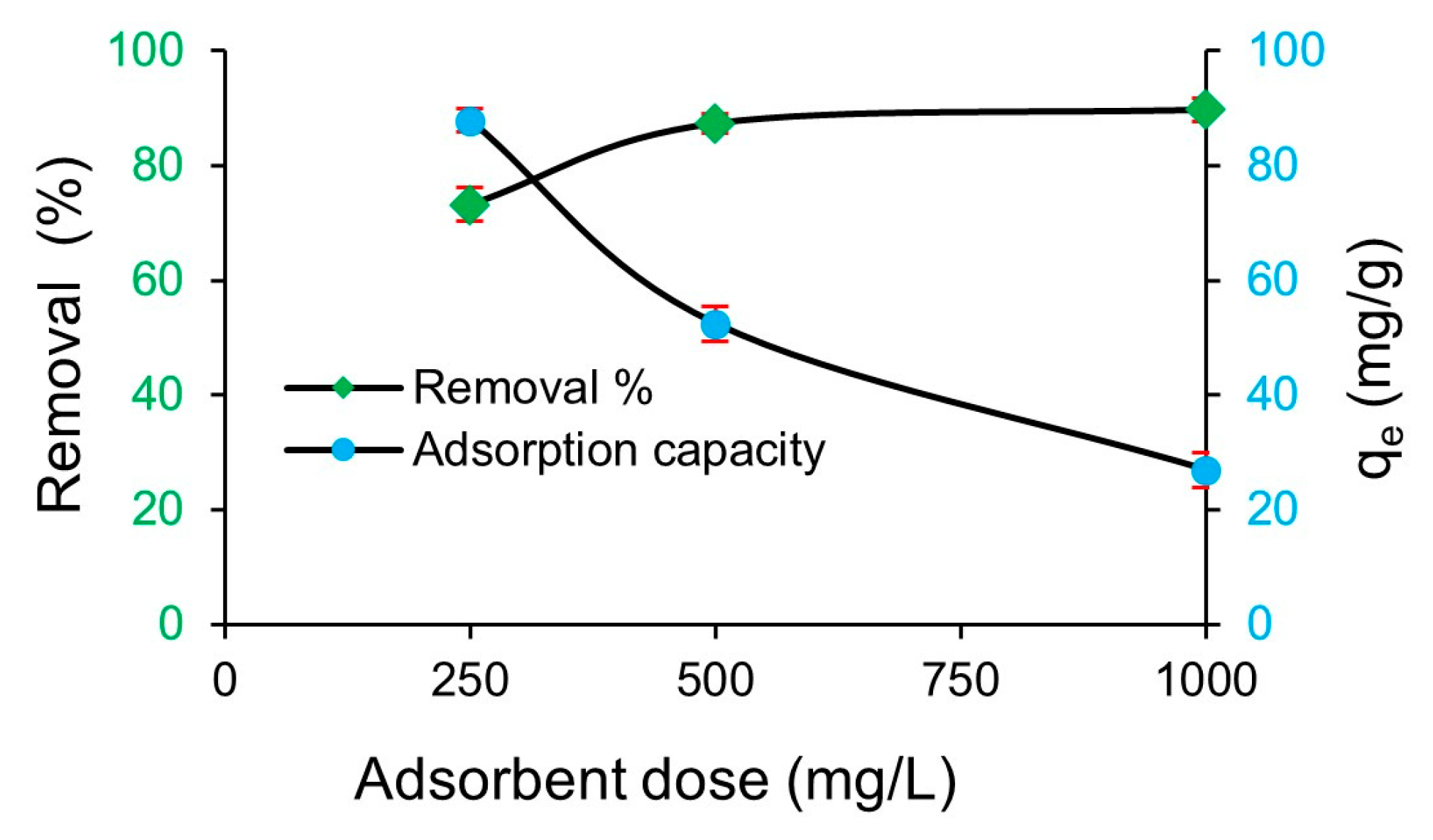
The effect of the Sulfo-Gel dose on the removal percentage of crystal violet dye from aqueous solution and the adsorption capacity qe was conducted at 250, 500, and 1000 mg adsorbent/L, while the other conditions were fixed as follows: contact time, 100 min; pH, 7; stirring, 200 rpm; and initial CV concentration, 30 mg/L. The results are shown in Figure 9, which can be analyzed as follows: as the adsorbent dose increases, the removal percentage of crystal violet dye also increases initially. It increased from 73.2% at 250 mg adsorbent/L to 87.3% at 500 mg adsorbent/L. This is due to more available adsorption sites on the adsorbent, which allows for greater surface area of interaction with the dye molecules [20,37,48]. However, after 500 mg/L, the removal percentage approximately plateaus, indicating that most of the dye has been removed and additional adsorbent does not significantly enhance removal efficiency. This may be due to the aggregation and overlapping of active sites at the higher dosage which reduce the active surface available for the adsorption process and increase the diffusion path [49,50]. However, the adsorption capacity decreases as the adsorbent dose increases. This is because, although more adsorbent is added, the concentration of dye remains constant (30 mg/L). With an increased amount of adsorbent, the ratio of dye molecules to available sites decreases, leading to lower values. At lower adsorbent doses, it is higher as more dye is adsorbed per unit of adsorbent. As the dose increases, the saturation of adsorption sites occurs, reducing the efficiency per unit adsorbent. Similar trends were observed in the literature [19,51,52,53].

3.8. Point of Zero Charge and Effect of pH on Dye Adsorption

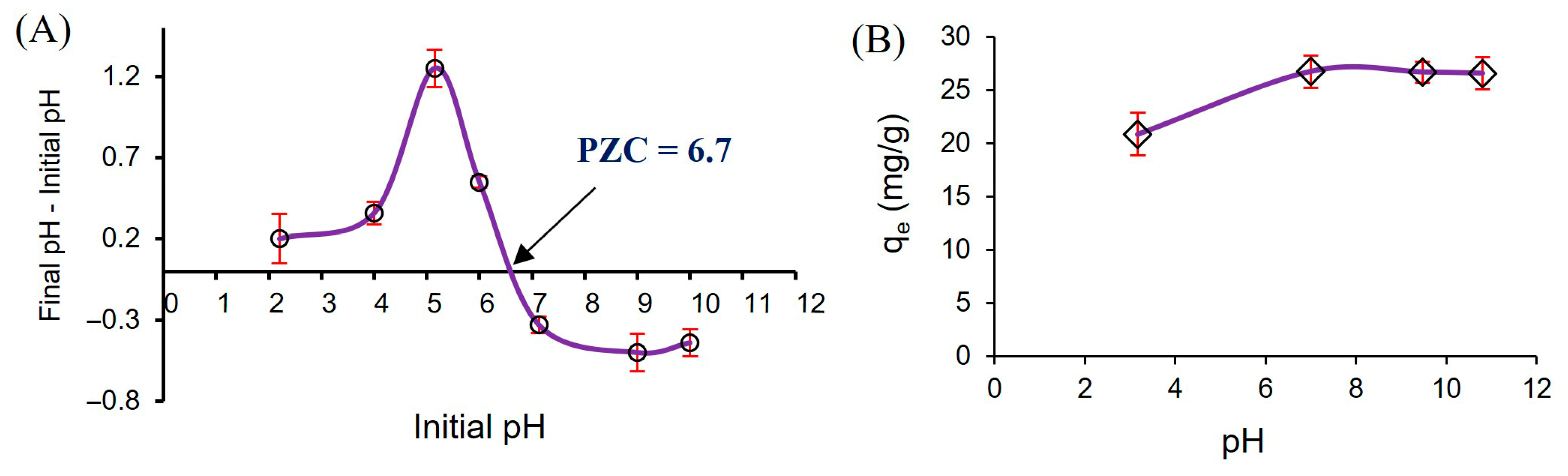
Figure 10A shows that the pH value of the point of zero charge for the Sulfo-Gel is 6.7, indicating that the surface of Sulfo-Gel becomes positively charged below pHPZC = 6.7, and positively charged above this point. The adsorption capacity of the Sulfo-Gel was tested at the pH values (3.2, 7, 9.5, 11). The other conditions were adjusted to 25 °C, initial dye concentration of 30 mg/L, and gel dose of 1000 mg/L, contact time 100 min, and stirring 200 rpm. The results presented in Figure 10B signified that the adsorption capacity of the Sulfo-Gel slightly increased by changing the pH of the adsorption medium from acidic to neutral. In the acidic medium (pH < pHPZC), there is an excess from H+ ions which neutralize in a competitive manner the negatively charged adsorption sites on the adsorbent and hence block it. This reduces the availability of the adsorbent to bind with the cationic dye molecules. At pH above pHPZC, the functional groups (–OH, –NH2, and –SO3) of the Sulfo-Gel become deprotonated and thus the gel shows enhanced electrostatic bonding with the dye molecules resulting in increased qe. The no significant change in the adsorption capacity between pH 7 and 11 could due to the stability of sulfonate groups under these conditions [26]. It is worth noting that the color of the CV solution changed from violet to greenish yellow below pH 3, and this may be due to the protonation of the nitrogen atoms in the CV structure. This observation was also reported in [23]. So, the adsorption was performed at pH values higher than 3.

3.9. Effect of Temperature on CV Adsorption and Thermodynamics

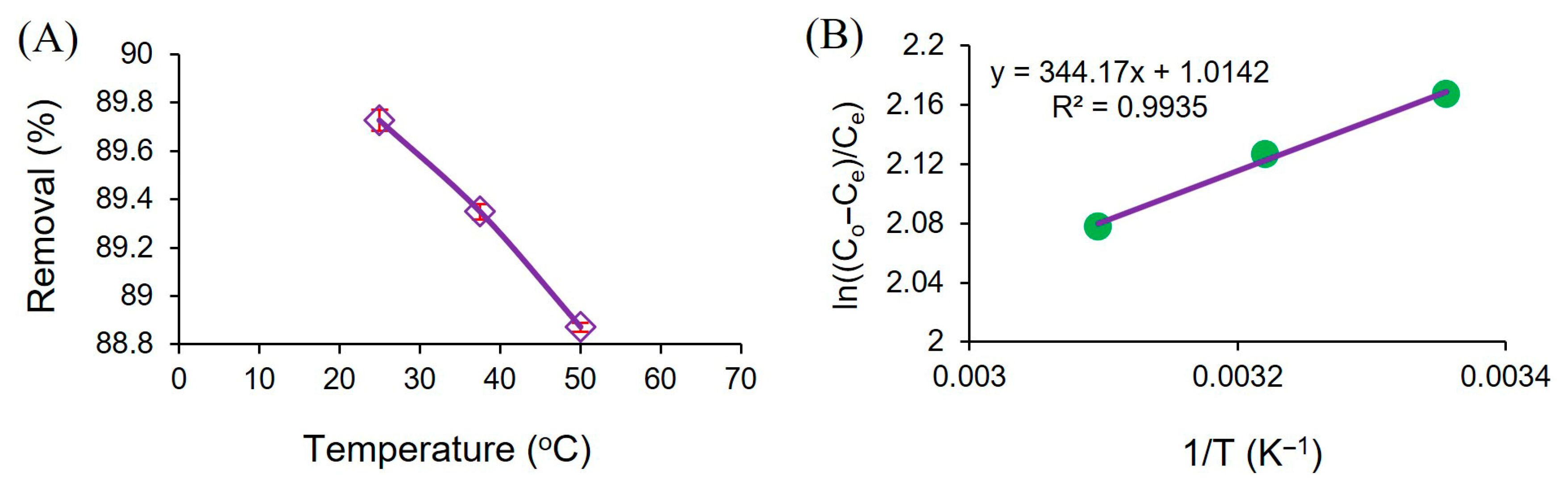
Adsorption of CV dye was studied at various temperatures to explain the thermodynamics of the removal process. Here, the adsorption experiments were conducted at 25, 37.5, and 50 °C while other conditions were held constant: initial CV concentration of 30 mg/L, stirring at 200 rpm, pH 7, gel dose 1000 mg/L, and contact time 100 min. Figure 11A shows the CV removal percentage versus temperature and indicates that removal (%) decreases with increasing temperature, indicating an exothermic adsorption process and increased desorption of CV at higher temperatures [24]. To demonstrate this behavior, the thermodynamic parameters (Gibbs free energy change, ∆G; enthalpy change, ∆H; and entropy change, ∆S) for CV removal by Sulfo-Gel were calculated from the Van’t Hoff equations [52,54,55] using the experimental adsorption data at 25, 37.5, and 50 °C.
G = R T   ln C o C e C e
ln C o C e C e = S R H R T  
where R and T indicate the gas constant (8.314 J mol−1 K−1) and the solution temperature (in Kelvin), respectively, and (Co − Ce)/Ce gives the distribution coefficient constant. Figure 11B shows the plot of ln(Co − Ce)/Ce) versus 1/T, which gives a straight line; the intercept and slope were used to calculate ∆S and ∆H, respectively. The values listed in Table 3 indicate a negative ∆H, confirming that the CV adsorption on Sulfo-Gel surface is exothermic. This means that the Sulfo-Gel is more effective at removing CV dye from aqueous solution at low temperatures. Similar findings have been reported for CV adsorption on p(acrylamide-co-maleic acid)/montmorillonite nanocomposite, p(acrylonitrile-co-sodium styrene sulfonate), and acrylamide/graphene oxide/sodium alginate hydrogel by Aref et al. [6], Altaleb [23], and Pashaei-Fakhri et al. [24], respectively. The positive ∆S value reveals an increased affinity of CV molecules for the Sulfo-Gel surface and enhanced randomness at the adsorbent–solution interface. Additionally, the negative ∆G values confirm the spontaneous nature of the adsorption process [56], and their values are in the range of −20 to 0 kJ/mol indicating the physisorption process [57].

3.10. Comparison with Other Reported Adsorbents

Table 4 summarizes the adsorption capacities of different adsorbents that have been documented in previous studies for removal of crystal violet (CV). As shown, the adsorption capacity of any adsorbent depends on its type, surface structure, experimental conditions, and other factors. Comparing the performance of the presently studied Sulfo-Gel alongside these listed materials reflects how effective Sulfo-Gel is at removing CV from aqueous solutions; it shows a relatively high qmax value—higher than most previously reported adsorbents. Additionally, many reported adsorbents require long contact times (hours) to reach equilibrium and attain their maximum adsorption. For example, poly(acrylamide-acrylic acid) hydrogel reported by Li et al. [32] reached maximum adsorption after 72 h; poly(acrylic acid-acrylamide-butyl methacrylate)/amylose semi-IPN reported by Li [31] and montmorillonite/poly(acrylamide-co-maleic acid) reported by Aref et al. [6] reached their maxima after 50 h; other materials required 44 h [29], 24 h [58], 16 h [59], and 8 h [60]. Such long contact times between the adsorbent and the dye solution are not economically favorable for practical application. By contrast, except for magnetic carrageenan-g-poly (methacrylic acid)/Fe3O4 nanocomposites reported by Gholami et al. [61], which achieved a qmax of 27.42 mg/g in 15 min, the presently studied Sulfo-Gel reached a qmax of 52.41 mg/g after 100 min, substantially faster than most materials listed in Table 4 while delivering a higher capacity. Essentially, the results suggest that Sulfo-Gel has strong potential as an efficient option for treating water contaminated with this particular dye.

4. Conclusions

This study demonstrates that the sulfonated acrylamide hydrogel (Sulfo-Gel) is an effective adsorbent for eliminating the cationic crystal violet from its aqueous solutions under neutral conditions. The adsorption results indicated a high adsorption capacity of the Sulfo-Gel (qmax = 52.41 mg CV/g adsorbent at 30 mg/L initial CV concentration, 100 min contact time), higher than many adsorbents found in the published works. The adsorption process was found to follow a pseudo-first-order kinetic model, and it was well described by the Temkin isotherm model. The intraparticle diffusion model indicated a two-stage adsorption mechanism in which rapid surface uptake is followed by slower intraparticle diffusion; the intraparticle diffusion is not the sole mechanism for describing the process. The thermodynamic study reveals the adsorption is spontaneous and exothermic, indicating greater effectiveness at lower temperatures, eliminating the cost of high temperatures. Therefore, it can be concluded that the Sulfo-Gel used in this study can act as a promising and effective material for eliminating the CV cationic dye from the water. In addition to these results, there is a significant need to conduct further studies to optimize the reuse of this adsorbent over multiple cycles in order to enhance its economic value. Also, the performance in real industrial or municipal wastewater (with competing ions and/or natural organic matter) remains to be established.

Funding

This research received no external funding.

Data Availability Statement

Available upon request from the corresponding author.

Conflicts of Interest

The author declares no conflicts of interest.

Abbreviations

The following abbreviations are used in this manuscript:
CVCrystal violet
AAmAcrylamide
APSAmmonium persulfate
MBAMethylene bisacrylamide
FTIRFourier transform infrared
Semi-IPNSemi-interpenetrated networks
AAAcrylic acid
BMAButyl methacrylate
PNIPAmPoly(N-isopropylacrylamide)
GMAGlycidyl methacrylate
VPAVinylphosphonic acid
SASodium alginate
AAMP2-acrylamido-2-methyl-1-propanesulfonic acid
MAMaleic acid
SMASodium methacrylate
PVAPoly vinyl alcohol
PMAAPoly methacrylic acid

References

  1. Ibrahim, A.G.; Elkony, A.M.; El-Bahy, S.M. Methylene blue uptake by gum arabic/acrylic amide/3-allyloxy-2-hydroxy-1-propanesulfonic acid sodium salt semi-IPN hydrogel. Int. J. Biol. Macromol. 2021, 186, 268–277. [Google Scholar] [CrossRef]
  2. Bhattacharyya, R.; Ray, S.K. Enhanced adsorption of synthetic dyes from aqueous solution by a semi-interpenetrating network hydrogel based on starch. J. Ind. Eng. Chem. 2014, 20, 3714–3725. [Google Scholar] [CrossRef]
  3. Ali, I.; Alharbi, O.M.L.; Alothman, Z.A.; Badjah, A.Y. Kinetics, thermodynamics, and modeling of amido black dye photodegradation in water using Co/TiO2 nanoparticles. Photochem. Photobiol. 2018, 94, 935–941. [Google Scholar] [CrossRef]
  4. Ibrahim, A.G.; Sayed, A.Z.; Abd El-Wahab, H.; Sayah, M.M. Synthesis of a hydrogel by grafting of acrylamide-co-sodium methacrylate onto chitosan for effective adsorption of Fuchsin basic dye. Int. J. Biol. Macromol. 2020, 159, 422–432. [Google Scholar] [CrossRef]
  5. Kenawy, E.-R.; Ghfar, A.A.; Wabaidur, S.M.; Khan, M.A.; Siddiqui, M.R.; Alothman, Z.A.; Alqadami, A.A.; Hamid, M. Cetyltrimethylammonium bromide intercalated and branched polyhydroxystyrene functionalized montmorillonite clay to sequester cationic dyes. J. Environ. Manag. 2018, 219, 285–293. [Google Scholar] [CrossRef]
  6. Aref, L.; Navarchian, A.H.; Dadkhah, D. Adsorption of crystal violet dye from aqueous solution by poly (acrylamide-co-maleic acid)/montmorillonite nanocomposite. J. Polym. Environ. 2017, 25, 628–639. [Google Scholar] [CrossRef]
  7. Mani, S.; Bharagava, R.N. Exposure to crystal violet, its toxic, genotoxic and carcinogenic effects on environment and its degradation and detoxification for environmental safety. Rev. Environ. Contam. Toxicol. 2016, 237, 71–104. [Google Scholar]
  8. Tkaczyk-Wlizło, A.; Mitrowska, K. Occurrence and ecotoxicological risk assessment of pharmacologically active dyes in the environmental water of Poland. Chemosphere 2023, 313, 137432. [Google Scholar] [CrossRef]
  9. Hube, S.; Eskafi, M.; Hrafnkelsdóttir, K.F.; Bjarnadóttir, B.; Bjarnadóttir, M.Á.; Axelsdóttir, S.; Wu, B. Direct membrane filtration for wastewater treatment and resource recovery: A review. Sci. Total Environ. 2020, 710, 136375. [Google Scholar] [CrossRef] [PubMed]
  10. Joseph, J.; Radhakrishnan, R.C.; Johnson, J.K.; Joy, S.P.; Thomas, J. Ion-exchange mediated removal of cationic dye-stuffs from water using ammonium phosphomolybdate. Mater. Chem. Phys. 2020, 242, 122488. [Google Scholar] [CrossRef]
  11. Yagub, M.T.; Sen, T.K.; Afroze, S.; Ang, H.M. Dye and its removal from aqueous solution by adsorption: A review. Adv. Colloid. Interface Sci. 2014, 209, 172–184. [Google Scholar] [CrossRef]
  12. Brillas, E.; Martínez-Huitle, C.A. Decontamination of wastewaters containing synthetic organic dyes by electrochemical methods. An updated review. Appl. Catal. B Environ. 2015, 166, 603–643. [Google Scholar] [CrossRef]
  13. Teh, C.Y.; Budiman, P.M.; Shak, K.P.Y.; Wu, T.Y. Recent advancement of coagulation–flocculation and its application in wastewater treatment. Ind. Eng. Chem. Res. 2016, 55, 4363–4389. [Google Scholar] [CrossRef]
  14. Moradihamedani, P. Recent advances in dye removal from wastewater by membrane technology: A review. Polym. Bull. 2022, 79, 2603–2631. [Google Scholar] [CrossRef]
  15. Helmy, Q.; Suryawan, I.W.K.; Notodarmojo, S. Ozone-Based Processes in Dye Removal. In Advanced Oxidation Processes in Dye-Containing Wastewater; Springer: Singapore, 2022; Volume 1, pp. 91–128. [Google Scholar]
  16. Khan, S.; Noor, T.; Iqbal, N.; Yaqoob, L. Photocatalytic dye degradation from textile wastewater: A review. ACS Omega 2024, 9, 21751–21767. [Google Scholar] [CrossRef]
  17. Bhatia, D.; Sharma, N.R.; Singh, J.; Kanwar, R.S. Biological methods for textile dye removal from wastewater: A review. Crit. Rev. Environ. Sci. Technol. 2017, 47, 1836–1876. [Google Scholar] [CrossRef]
  18. Gamal, A.; Ibrahim, A.G.; Eliwa, E.M.; El-Zomrawy, A.H.; El-Bahy, S.M. Synthesis and characterization of a novel benzothiazole functionalized chitosan and its use for effective adsorption of Cu (II). Int. J. Biol. Macromol. 2021, 183, 1283–1292. [Google Scholar] [CrossRef] [PubMed]
  19. Elkony, A.M.; Ibrahim, A.G.; Abu El-Farh, M.H.; Abdelhai, F. Synthesis of Acrylamide-co-3-Allyloxy-2-hydroxy-1-propanesulfonic acid sodium salt Hydrogel for efficient Adsorption of Methylene blue dye. Int. J. Environ. Anal. Chem. 2021, 103, 1751–1770. [Google Scholar] [CrossRef]
  20. Ilgin, P.; Ozay, H.; Ozay, O. Selective adsorption of cationic dyes from colored noxious effluent using a novel N-tert-butylmaleamic acid based hydrogels. React. Funct. Polym. 2019, 142, 189–198. [Google Scholar] [CrossRef]
  21. Hernandez-Martínez, A.R.; Lujan-Montelongo, J.A.; Silva-Cuevas, C.; Mota-Morales, J.D.; Cortez-Valadez, M.; Ruíz-Baltazar, Á.D.J.; Cruz, M.; Herrera-Ordonez, J. Swelling and methylene blue adsorption of poly(N,N-dimethylacrylamide-co-2-hydroxyethyl methacrylate) hydrogel. React. Funct. Polym. 2018, 122, 75–84. [Google Scholar] [CrossRef]
  22. Mustafa, F.H.A.; ElRab, E.K.M.G.; Kamel, R.M.; Elshaarawy, R.F.M. Cost-effective removal of toxic methylene blue dye from textile effluents by new integrated crosslinked chitosan/aspartic acid hydrogels. Int. J. Biol. Macromol. 2023, 248, 125986. [Google Scholar] [CrossRef]
  23. Altaleb, H.A. Effective removal of hazardous cationic dye from polluted water using sulfonated copolymer hydrogel: Synthesis, nonlinear isotherm, and kinetics investigation. J. Saudi Chem. Soc. 2024, 28, 101852. [Google Scholar] [CrossRef]
  24. Pashaei-Fakhri, S.; Peighambardoust, S.J.; Foroutan, R.; Arsalani, N.; Ramavandi, B. Crystal violet dye sorption over acrylamide/graphene oxide bonded sodium alginate nanocomposite hydrogel. Chemosphere 2021, 270, 129419. [Google Scholar] [CrossRef]
  25. Liu, H.; Zhang, H.; Ye, Z.; Xiong, G. Efficient removal of anionic dye congo red by Chitosan/Poly (dimethyl diallyl ammonium chloride-co-acrylamide) composite hydrogel. Int. J. Biol. Macromol. 2025, 294, 139462. [Google Scholar] [CrossRef] [PubMed]
  26. Li, L.; Dou, B.; Lan, J.; Shang, J.; Wang, Y.; Yu, J.; Ren, E.; Lin, S. Scalable sulfonate-coated cotton fibers as facile recyclable adsorbents for the highly efficient removal of cationic dyes. Cellulose 2022, 29, 7445–7463. [Google Scholar] [CrossRef]
  27. Üzüm, Ö.B.; Bayraktar, İ.; Kundakcı, S.; Karadağ, E. Swelling behaviors of novel magnetic semi-IPN hydrogels and their application for Janus Green B removal. Polym. Bull. 2020, 77, 847–867. [Google Scholar] [CrossRef]
  28. Dasgupta, J.; Singh, A.; Kumar, S.; Sikder, J.; Chakraborty, S.; Curcio, S.; Arafat, H.A. Poly (sodium-4-styrenesulfonate) assisted ultrafiltration for methylene blue dye removal from simulated wastewater: Optimization using response surface methodology. J. Environ. Chem. Eng. 2016, 4, 2008–2022. [Google Scholar] [CrossRef]
  29. Zhang, Q.; Zhang, T.; He, T.; Chen, L. Removal of crystal violet by clay/PNIPAm nanocomposite hydrogels with various clay contents. Appl. Clay Sci. 2014, 90, 1–5. [Google Scholar] [CrossRef]
  30. Brungesh, K.V.; Nagabhushana, B.M.; Harish, M.N.K.; Krishna, R.H. An efficient removal of toxic Cr (VI) from aqueous solution by MnO2 coated polyaniline nanofibers: Kinetic and thermodynamic study. J. Environ. Anal. Toxicol. 2017, 7, 1000442. [Google Scholar]
  31. Li, S. Removal of crystal violet from aqueous solution by sorption into semi-interpenetrated networks hydrogels constituted of poly (acrylic acid-acrylamide-methacrylate) and amylose. Bioresour. Technol. 2010, 101, 2197–2202. [Google Scholar] [CrossRef]
  32. Li, S.; Zhang, H.; Feng, J.; Xu, R.; Liu, X. Facile preparation of poly (acrylic acid–acrylamide) hydrogels by frontal polymerization and their use in removal of cationic dyes from aqueous solution. Desalination 2011, 280, 95–102. [Google Scholar] [CrossRef]
  33. Kundakci, S.; Üzüm, Ö.B.; Karadağ, E. Swelling and dye sorption studies of acrylamide/2-acrylamido-2-methyl-1-propanesulfonic acid/bentonite highly swollen composite hydrogels. React. Funct. Polym. 2008, 68, 458–473. [Google Scholar] [CrossRef]
  34. Li, Z.; Wang, Y.; Wu, N.; Chen, Q.; Wu, K. Removal of heavy metal ions from wastewater by a novel HEA/AMPS copolymer hydrogel: Preparation, characterization, and mechanism. Environ. Sci. Pollut. Res. 2013, 20, 1511–1525. [Google Scholar] [CrossRef]
  35. Hameed, B.H.; Mahmoud, D.K.; Ahmad, A.L. Equilibrium modeling and kinetic studies on the adsorption of basic dye by a low-cost adsorbent: Coconut (Cocos nucifera) bunch waste. J. Hazard. Mater. 2008, 158, 65–72. [Google Scholar] [CrossRef] [PubMed]
  36. Ibrahim, A.G.; Saleh, A.S.; Elsharma, E.M.; Metwally, E.; Siyam, T. Chitosan-g-maleic acid for effective removal of copper and nickel ions from their solutions. Int. J. Biol. Macromol. 2019, 121, 1287–1294. [Google Scholar] [CrossRef] [PubMed]
  37. Sharma, G.; Kumar, A.; Naushad, M.; García-Peñas, A.; Al-Muhtaseb, A.a.H.; Ghfar, A.A.; Sharma, V.; Ahamad, T.; Stadler, F.J. Fabrication and characterization of Gum arabic-cl-poly (acrylamide) nanohydrogel for effective adsorption of crystal violet dye. Carbohydr. Polym. 2018, 202, 444–453. [Google Scholar] [CrossRef]
  38. Qi, X.; Chen, M.; Qian, Y.; Liu, M.; Li, Z.; Shen, L.; Qin, T.; Zhao, S.; Zeng, Q.; Shen, J. Construction of macroporous salecan polysaccharide-based adsorbents for wastewater remediation. Int. J. Biol. Macromol. 2019, 132, 429–438. [Google Scholar] [CrossRef]
  39. Nakhjiri, M.T.; Marandi, G.B.; Kurdtabar, M. Poly (AA-co-VPA) hydrogel cross-linked with N-maleyl chitosan as dye adsorbent: Isotherms, kinetics and thermodynamic investigation. Int. J. Biol. Macromol. 2018, 117, 152–166. [Google Scholar] [CrossRef] [PubMed]
  40. Liu, Y.; Huang, S.; Zhao, X.; Zhang, Y. Fabrication of three-dimensional porous β-cyclodextrin/chitosan functionalized graphene oxide hydrogel for methylene blue removal from aqueous solution. Colloids Surf. A Physicochem. Eng. Asp. 2018, 539, 1–10. [Google Scholar] [CrossRef]
  41. Kumar, V. Adsorption kinetics and isotherms for the removal of rhodamine B dye and Pb+2 ions from aqueous solutions by a hybrid ion-exchanger. Arab. J. Chem. 2019, 12, 316–329. [Google Scholar]
  42. Edokpayi, J.N. Adsorption of Crystal Violet Using Kaolin-Based Geopolymer. Chemistry 2025, 7, 189. [Google Scholar] [CrossRef]
  43. Minisy, I.M.; Salahuddin, N.A.; Ayad, M.M. Chitosan/polyaniline hybrid for the removal of cationic and anionic dyes from aqueous solutions. J. Appl. Polym. Sci. 2019, 136, 47056. [Google Scholar] [CrossRef]
  44. Luo, X.; Zhang, L. High effective adsorption of organic dyes on magnetic cellulose beads entrapping activated carbon. J. Hazard. Mater. 2009, 171, 340–347. [Google Scholar] [CrossRef] [PubMed]
  45. Shi, Q.; Zhang, J.; Duan, Z.; Wang, Y.; Wu, Y.; Liu, Y. Phytic acid-modified carboxymethyl cellulose-based hydrogels for efficient removal of methylene blue dye. Int. J. Biol. Macromol. 2025, 307, 142110. [Google Scholar] [CrossRef] [PubMed]
  46. Bhattacharyya, R.; Ray, S.K. Removal of congo red and methyl violet from water using nano clay filled composite hydrogels of poly acrylic acid and polyethylene glycol. Chem. Eng. J. 2015, 260, 269–283. [Google Scholar] [CrossRef]
  47. Somsesta, N.; Sricharoenchaikul, V.; Aht-Ong, D. Adsorption removal of methylene blue onto activated carbon/cellulose biocomposite films: Equilibrium and kinetic studies. Mater. Chem. Phys. 2020, 240, 122221. [Google Scholar] [CrossRef]
  48. El Haddad, M. Removal of Basic Fuchsin dye from water using mussel shell biomass waste as an adsorbent: Equilibrium, kinetics, and thermodynamics. J. Taibah Univ. Sci. 2016, 10, 664–674. [Google Scholar] [CrossRef]
  49. Mittal, H.; Maity, A.; Ray, S.S. Gum karaya based hydrogel nanocomposites for the effective removal of cationic dyes from aqueous solutions. Appl. Surf. Sci. 2016, 364, 917–930. [Google Scholar] [CrossRef]
  50. Anitha, T. Synthesis of nano-sized chitosan blended polyvinyl alcohol for the removal of Eosin Yellow dye from aqueous solution. J. Water Process Eng. 2016, 13, 127–136. [Google Scholar]
  51. Laib, R.; Amokrane-Nibou, S.; Nibou, D.; Trari, M. Recovery of recycled paper in the removal of the textile dye basic yellow 28: Characterization and adsorption studies. Nord. Pulp Pap. Res. J. 2019, 34, 218–227. [Google Scholar] [CrossRef]
  52. Elwakeel, K.Z.; El-Bindary, A.A.; Ismail, A.; Morshidy, A.M. Sorptive removal of Remazol Brilliant Blue R from aqueous solution by diethylenetriamine functionalized magnetic macro-reticular hybrid material. RSC Adv. 2016, 6, 22395–22410. [Google Scholar] [CrossRef]
  53. Khan, T.A.; Khan, E.A. Removal of basic dyes from aqueous solution by adsorption onto binary iron-manganese oxide coated kaolinite: Non-linear isotherm and kinetics modeling. Appl. Clay Sci. 2015, 107, 70–77. [Google Scholar] [CrossRef]
  54. Al-Aidy, H.; Amdeha, E. Green adsorbents based on polyacrylic acid-acrylamide grafted starch hydrogels: The new approach for enhanced adsorption of malachite green dye from aqueous solution. Int. J. Environ. Anal. Chem. 2021, 101, 2796–2816. [Google Scholar] [CrossRef]
  55. Tran, H.N.; You, S.-J.; Hosseini-Bandegharaei, A.; Chao, H.-P. Mistakes and inconsistencies regarding adsorption of contaminants from aqueous solutions: A critical review. Water Res. 2017, 120, 88–116. [Google Scholar] [CrossRef]
  56. Fabryanty, R.; Valencia, C.; Soetaredjo, F.E.; Putro, J.N.; Santoso, S.P.; Kurniawan, A.; Ju, Y.-H.; Ismadji, S. Removal of crystal violet dye by adsorption using bentonite–alginate composite. J. Environ. Chem. Eng. 2017, 5, 5677–5687. [Google Scholar] [CrossRef]
  57. Preetha, B.K.; Vishalakshi, B. Microwave assisted synthesis of karaya gum based montmorillonite nanocomposite: Characterisation, swelling and dye adsorption studies. Int. J. Biol. Macromol. 2020, 154, 739–750. [Google Scholar] [CrossRef]
  58. Bitelo, B.; Petzhold, C.L.; Gamba, D.; Daitx, T.S. Synthesis of sustainable polyester-type hydrogels crosslinked with citric acid for the removal of crystal violet dye. J. Mol. Liq. 2025, 425, 127228. [Google Scholar] [CrossRef]
  59. Darvishi, A.; Bakhshi, H. Poly (sodium methacrylate)/eggshell particles hydrogel composites as dye sorbent. Water Sci. Technol. 2016, 74, 2807–2818. [Google Scholar] [CrossRef]
  60. Arun Krishna, K.; Vishalakshi, B. Gellan gum-based novel composite hydrogel: Evaluation as adsorbent for cationic dyes. J. Appl. Polym. Sci. 2017, 134, 45527. [Google Scholar] [CrossRef]
  61. Gholami, M.; Vardini, M.T.; Mahdavinia, G.R. Investigation of the effect of magnetic particles on the crystal violet adsorption onto a novel nanocomposite based on κ-carrageenan-g-poly (methacrylic acid). Carbohydr. Polym. 2016, 136, 772–781. [Google Scholar] [CrossRef]
  62. Zhou, Y.; Zhang, M.; Wang, X.; Huang, Q.; Min, Y.; Ma, T.; Niu, J. Removal of crystal violet by a novel cellulose-based adsorbent: Comparison with native cellulose. Ind. Eng. Chem. Res. 2014, 53, 5498–5506. [Google Scholar] [CrossRef]
  63. Rehman, T.U.; Bibi, S.; Khan, M.; Ali, I.; Shah, L.A.; Khan, A.; Ateeq, M. Fabrication of stable superabsorbent hydrogels for successful removal of crystal violet from waste water. RSC Adv. 2019, 9, 40051–40061. [Google Scholar] [CrossRef] [PubMed]
  64. Schneider, D.E.; Simioni, T.M.; Bitelo, B.; Petzhold, C.L.; Daitx, T.S. Production of sustainable hydrogels from poly (ethylene terephthalate) chemical recycling products with adsorption capacity for cationic crystal violet dye. J. Mol. Liq. 2025, 426, 127469. [Google Scholar] [CrossRef]
Figure 1. (A) Sulfo monomer, AAm, and MBA and (B) crystal violet cationic dye [6,29].
Chemistry 08 00046 g001
Figure 2. Solution of CV dye (10 mg/L) (A) before adsorption, (B) after adsorption, and (C) CV loaded Sulfo-Gel adsorbent (adsorbent dose 500 mg/L, temperature 25 °C, pH 7, and stirring 200 rpm).
Chemistry 08 00046 g002
Figure 3. Possible interactions between the Sulfo-Gel and the crystal violet during the adsorption process.
Chemistry 08 00046 g003
Figure 4. FTIR spectra of (A) Sulfo-Gel adsorbent and (B) CV loaded adsorbent (4000–400 cm−1, scan 32, and resolution of 8 cm−1).
Chemistry 08 00046 g004
Figure 5. Plot of contact time versus the adsorption capacity. [Initial CV concentration 10 mg/L, Volume = 100 mL, pH = 7, gel dose 500 mg/L, stirring 200 rpm, temperature 25 °C].
Chemistry 08 00046 g005
Figure 6. (A) Nonlinear kinetics of pseudo-first-order and pseudo-second-order and (B) the intraparticle diffusion plot of crystal violet adsorption by Sulfo-Gel adsorbent.
Chemistry 08 00046 g006
Figure 7. Effect of CV concentration on the adsorption. [pH = 7, gel dose 500 mg/L, 200 rpm, temperature 25 °C, and contact time 100 min].
Chemistry 08 00046 g007
Figure 8. Nonlinear isotherm fitting of the experimental data of removal of crystal violet onto Sulfo-Gel adsorbent.
Chemistry 08 00046 g008
Figure 9. Sulfo-Gel dose versus CV removal (%) and the adsorption capacity. [contact time 100 min, pH 7, stirring 200 rpm, and initial CV concentration = 30 mg/L].
Chemistry 08 00046 g009
Figure 10. (A) Determination of point of zero charge (PZC) of the Sulfo-Gel and (B) pH of the adsorption medium versus the adsorption capacity [contact time 100 min, temperature 25 °C, adsorbent dose 1000 mg/L, stirring 200 rpm, and initial CV concentration = 30 mg/L].
Chemistry 08 00046 g010
Figure 11. (A) Temperature of CV solution versus removal (%) (B) Van’t Hoff Plot of ln(qe/Ce) against 1/T [Initial CV concentration, 30 mg/L; contact time, 100 min; adsorbent dose, 1000 mg/L; stirring, 200 rpm; pH, 7].
Chemistry 08 00046 g011
Table 1. Parameters of nonlinear kinetic models for removal of CV dye using Sulfo-Gel.
Kinetic ModelKinetic Models Parameters
Pseudo-first-orderK1 (min−1)0.07657 ± 0.0024
qe1 (mg g−1)14.97819 ± 0.09776
R20.9944
χ20.093
Pseudo-second-orderK2 (g mg−1 min−1)0.00671 ± 4.314 × 10⁻⁴
qe2 (mg g−1)16.64183 ± 0.17255
R20.9928
χ20.1196
Intraparticle diffusionKi (1) (mg/(g·min0.5))1.550
I (1)3.764
R2 (1)0.9715
Ki (2) (mg/(g·min0.5))0.1757
I (2)13.359
R2 (2)0.8258
Table 2. Parameters of isotherm models for adsorption of CV dye using Sulfo-Gel.
ModelModel Constants
LangmuirKL (L/mg)−0.21088 ± 0.02422
qm (mg/g)−13.34763 ± 6.46283
R20.8270
χ277.362
FreundlichKf (L/g)0.49746 ± 0.5063
1/n3.51967 ± 0.80738
R20.8754
χ255.705
TemkinB (J/mol)120.4103 ± 12.87649
AT (L/g)0.41574 ± 0.01131
R20.9668
χ214.826
D-R isothermqs (mg/g)249.46973 ± 94.79394
KDR (mol2/kJ2)27.83873 ± 5.58282
R20.9125
χ239.090
Table 3. Thermodynamic parameters.
Temperature (K)∆Ho (KJ mol−1)∆So (J K−1 mol−1)∆Go (KJ mol−1)
298−2.8618.432−5.37
310.5 −5.48
323 −5.58
Table 4. Adsorption capacities of different adsorbents for CV.
Adsorbent Co (mg/L)TimepHAdsorbent
Dose (g/L)
Temperature
(°C)
qmax (mg/g)Reference
Poly(AA-AAm-BMA)/amylose semi-IPN5050 h7.4-2528.6[31]
Clay/PNIPAm nanocomposite hydrogels3044 hNeutral-2517.8[29]
Cellulose/GMA/sulfosalicylic acid50150 min9120∼45[62]
Poly(acrylamide-acrylic acid) hydrogel∼5072 h7-254.12[32]
N-maleylchitosan/P(AA-co-VPA)50240 min70.052548.06[39]
AAm/graphene oxide/sodium alginate10300 min81309.84[24]
AAm-SA-AAMP hydrogel 1116 h6.125253.34[63]
Montmorillonite/P(AAm-MA)10050 h7-2012.33[6]
Polyester crosslinked with citric acid1024 h3.28250.82[58]
P(SMA)/eggshell hydrogel10120 min5.55251.93[59]
Semi-IPN (Gellan gum-g-PAAm)-PVA 1008 h70.323045.95[60]
(carrageenan-g-PMAA) Fe3O4 nanoparticles3015 min60.52027.42[61]
Recycled poly(ethylene terephthalate) hydrogel101440 min78251.67[64]
Sulfo-Gel adsorbent 30100 min70.52552.41This work
Disclaimer/Publisher’s Note: The statements, opinions and data contained in all publications are solely those of the individual author(s) and contributor(s) and not of MDPI and/or the editor(s). MDPI and/or the editor(s) disclaim responsibility for any injury to people or property resulting from any ideas, methods, instructions or products referred to in the content.