1. Introduction
Robustness in deployed quantum links is governed as much by finite-resolution inference (finite samples, calibration uncertainty, and estimator tolerances) and hardware control/readout limits as by idealized protocol models [
1,
2,
3]. In continuous-variable quantum communication (CVQC), where information is encoded in optical phase-space quadratures [
4,
5], these operational constraints shape what a receiver can infer from finite ensembles of outcomes, shaping both performance and the physical-layer attack surface. Following the receiver-centric terminology in [
6], we use disturbance to denote a physical-layer perturbation (benign or adversarial) and reserve noise for its effective stochastic representation in receiver-estimated statistics. This distinction matters in practice, as deterministic physical actions can appear stochastic once filtered through measurement-basis choice, LO/phase-reference dynamics, finite-window estimation, drift, and receiver-interface non-idealities.
A central vulnerability in finite-resolution settings is operational indistinguishability: distinct underlying mechanisms can yield statistically indistinguishable receiver observations over finite datasets, creating tolerance-induced regions where sub-threshold structure can be exploited or learned (e.g., [
7]). Building on this viewpoint, [
6] introduced a receiver-centric threat model and an operational regime taxonomy (reconnaissance/exploratory/ denial-of-service) expressed directly in terms of receiver-accessible phase-space and covariance statistics. The present paper is positioned as a complementary implementation-layer resilience study; rather than proposing a new protocol-level security proof or attempting mechanism identification, we evaluate a lightweight and hardware-compatible mitigation knob within the same receiver-observable framing.
CVQC is a key primitive for transporting and processing bosonic quantum states across optical hardware and networks, including distribution of nonclassical states and entanglement, interconnects between quantum processors, and repeater/networking architectures that rely on faithful state transmission and interfacing between photonic modes [
8,
9,
10]. In these settings, practical implementations are sensitive to excess variance, phase instability, calibration and local-oscillator (LO) effects, and receiver limitations, which can degrade coherence, distort effective second-moment structure, and reduce operational reliability [
8,
11,
12,
13,
14]. Beyond uncontrolled environmental fluctuations, these sensitivities define a physical-layer attack surface in which disturbances may be structured or timed to probe stability and/or disrupt operation. Denial-of-service (DoS)-like regimes are especially relevant operationally because they can overwhelm the receiver’s measurement/inference pipeline (e.g., via effective fluctuation inflation, phase-reference loss, or receiver-interface nonlinearities), forcing abort, loss of usable states, or forced re-initialization.
In this work, we investigate phase-first Gaussian modulation as a practical physical-layer strategy for improving resilience in CVQC under high-intensity (DoS-like) stressed conditions. The core control action is a defender-selected phase-space rotation, parameterized by an angle , which re-orients how a phase-dependent or anisotropic effective disturbance/measurement channel projects onto receiver-observable statistics. Although joint control over rotation and squeezing is a natural extension, we treat squeezing as prospective and restrict experimental validation to phase-only modulation. Importantly, under an ideal phase-invariant additive noise model, a pure rotation would not change rotation-invariant summaries such as ; therefore, any observed -dependence of a receiver-side degradation proxy is interpreted operationally as evidence of a phase-dependent effective channel at the receiver interface (e.g., anisotropic disturbance statistics, quadrature/mode mixing, LO/phase-reference coupling, calibration drift, or other non-idealities).
1.1. Receiver-Observable Evaluation (Simulation vs. Hardware)
A practical constraint in near-term platforms is that the native receiver readout may not consist of quadrature samples. Accordingly, we evaluate phase-first modulation using two complementary centered second-moment proxies (
Section 2.3): (i) in theory/simulation, we monitor the basis-dependent quadrature variance
(
Section 2.3.1) using mean-subtracted second moments so that the metric tracks variance/covariance inflation rather than coherent displacement; (ii) in the X8_01 access mode used here, the native readout is Fock sampling (
MeasureFock) and we quantify phase sensitivity using the shot-to-shot standard deviation
, where
denotes the shot-level detected count random variable at fixed
. In the reported X8_01 workflow, the shot-level count is formed by aggregating the returned Fock counts before postprocessing; however, the reported hardware observable is the scalar quantity
itself. This statistic is centered by construction and is not claimed to estimate
; it is an implementation-layer receiver-observable stability/degradation proxy aligned with the available measurement primitive.
1.2. Offline Phase Selection (Proof-of-Concept)
The “feedback-inspired” aspect of this study is instantiated as offline parameter selection rather than real-time closed-loop control, reflecting current hardware/interface constraints. Operationally, the implemented phase search is a one-dimensional grid search over
, with cost dominated by data acquisition (shots per tested angle). Offline selection is meaningful when the effective disturbance/measurement behavior is approximately stationary over the acquisition window; fast nonstationarity motivates periodic re-optimization or closed-loop updates, which we treat as future work. We validate this phase-first mechanism on Xanadu’s X8_01 photonic quantum processor because it provides programmable phase operations (
Rgate) and repeated sampling access suitable for systematic phase-angle scans [
15,
16]. While the location of
and the achievable improvement are platform- and condition-dependent, the operational conclusion, i.e., that phase choice can materially affect a receiver-observed degradation proxy under phase-dependent effective conditions, is expected to transfer to other photonic CV platforms with programmable phase control and stable measurement primitives.
1.3. Threat-Model Boundary for Re-Optimization Cadence
The present proof-of-concept assumes that the effective disturbance/measurement behavior is approximately quasi-static over the phase-grid evaluation window used to evaluate candidate settings. Accordingly, the demonstrated offline selection rule is intended for stressed regimes in which the adversary’s effective action is fixed, slowly varying, or at least sufficiently persistent that a beneficial minimizer remains identifiable over the integration window. If the disturbance changes on a timescale shorter than the offline acquisition interval, then the selected can become stale before deployment and re-optimization must occur on a shorter cadence than the characteristic drift/variation time. In that regime, the appropriate problem is no longer a static offline minimization but a dynamic estimation–control task requiring coarse-to-fine search, interleaved sampling across angles, or closed-loop tracking. Therefore, we frame the present hardware result as an offline proof-of-concept under quasi-static stressed conditions rather than as a claim of real-time protection against rapidly varying adversarial dynamics. Equivalently, the present manuscript studies a fixed-condition problem of the form for an effectively constant stressed condition a over the sweep, whereas a rapidly adaptive adversary would lead naturally to a repeated-game or minimax formulation , which lies outside the scope of the current hardware demonstration.
1.4. Positioning Relative to Adjacent Literature
This manuscript sits at the intersection of two nearby literature corpora. On one side are resilience and implementation security studies in CV-QKD and coherent CV receivers, which typically evaluate degradation through quadrature-level excess-noise, estimator reliability, abort probability, and receiver-interface vulnerabilities [
1,
2,
6,
12,
13]. On the other side are adaptive-control, phase-stabilization, and hardware-tuning studies in photonic platforms, which emphasize actuator choice, calibration-sensitive operation, and reconfiguration under practical device constraints [
11,
15,
17]. The present contribution is positioned as an implementation-layer bridge between these viewpoints; we retain a receiver-centric security framing while studying a hardware-compatible control action, namely, offline phase selection based on a receiver-observable degradation proxy.
1.5. What Is Novel Here, and Why That Combination Matters
The novelty is not claimed to lie in only one ingredient taken in isolation; rather, it lies in how three ingredients are connected into a single operational pipeline and why that connection is necessary under current hardware constraints. First, we adopt a receiver-observable threat model framing for stressed operation, meaning that the control objective is defined in terms of what the receiver can actually estimate under finite data and finite resolution [
1,
2,
6]. Second, we translate that framing into a phase-first control rule that is compatible with near-term photonic hardware, namely, offline phase-grid search rather than assumed real-time closed-loop Gaussian control [
11,
15]. Third, we keep the interpretation observable-consistent by explicitly separating the quadrature-moment track used in theory/simulation from the Fock sampling track used on X8_01; in this way, the hardware results are not overstated as direct covariance reconstruction. This combination matters because it answers three distinct practical questions at once: why phase choice can matter (a phase-dependent effective channel at the receiver interface), how the defender can act with currently exposed hardware controls (offline phase-only selection), and how the resulting evidence should be interpreted without claiming more than the available readout supports.
1.6. Resilience, Robustness, and Security Guarantees in This Paper
In the terminology of this paper, resilience means the existence of a controllable reduction in a receiver-observable degradation proxy under stressed operating conditions. Robustness means the persistence of that benefit under finite-shot uncertainty, phase-setting error, grid quantization, and drift over the acquisition window. By contrast, a security guarantee would require a protocol-specific proof that links the controlled observables to accepted security parameters and threat-model assumptions. Accordingly, the present manuscript demonstrates implementation-layer resilience and discusses robustness through local sensitivity, finite-resolution, and drift-aware interpretation, but does not claim a protocol-level security guarantee.
1.7. Contributions
The contributions of this work are threefold:
- 1.
We formulate a receiver-centric phase-first modulation framework in which resilience is defined operationally via minimization of a receiver-observable centered second-moment degradation proxy under disturbance.
- 2.
We provide simulation evidence (including phase-space/Wigner context and a basis-dependent variance sweep) that clarifies the mechanism of phase-first improvement as a projection/orientation effect under structured directional disturbance models.
- 3.
We experimentally demonstrate on X8_01 that an offline one-dimensional phase-grid search can identify non-intuitive phase settings that reduce a directly observed hardware proxy relative to static reference angles, establishing feasibility of phase-first containment under current control and readout constraints. The present hardware result is reported at the level of a shot-level scalar observable, with mode-resolved extensions left to future work.
Together, these results establish phase-first modulation as a lightweight and hardware-compatible countermeasure that enhances implementation-layer resilience against adversarial disturbances in CVQC systems, motivating future extensions incorporating higher-rate re-optimization, feedback-assisted control, and extended Gaussian actuation when available.
Table 1 summarizes the notation used throughout the manuscript.
2. Receiver-Observable Model and Evaluation Metrics
2.1. Receiver-Centric Viewpoint and Terminology
Continuous-variable quantum communication (CVQC) systems are governed not only by idealized protocol models but also by what the receiver can actually observe and reliably estimate from finite data under practical hardware constraints. In deployed optical CV links, receiver decisions and health checks are mediated by a measurement-and-inference pipeline that includes coherent detection (homodyne/heterodyne) relative to a local oscillator (LO) and phase reference, digitization and finite resolution, calibration and reference-setting, finite-window estimation, and hardware non-idealities such as saturation or clipping [
8,
12,
13,
14].
Therefore, this paper adopts a receiver-observable stance in which we model adversarial behavior in terms of its impact on statistics available to the receiver (and on the receiver’s estimator reliability), rather than attempting unique identification of an underlying physical mechanism. This perspective is particularly important in adversarial settings because distinct physical actions can induce statistically similar signatures once filtered through finite-resolution measurement, finite-window estimation, and calibration dynamics, especially when the receiver relies on tolerance-based acceptance logic (as in parameter-estimation-driven operation and monitoring) [
1,
2,
6].
2.1.1. Terminology: Disturbance vs. Noise
Throughout this manuscript, we separate the physical-layer cause from its statistical appearance at the receiver:
- 1.
Disturbance (physical-layer perturbation). A disturbance denotes a perturbation applied to the CVQC link or receiver interface (benign or adversarial), which may be structured, adaptive, nonstationary, or deterministic at the physical layer.
- 2.
Noise (effective stochastic representation). Noise denotes the effective stochastic representation of a disturbance as seen through receiver-estimated statistics, e.g., an inferred excess-variance contribution, a time-varying fluctuation level over monitoring windows, or an effective additive term in a phenomenological model.
- 3.
Perturbation (effect in estimator space). Perturbation refers to the induced change in receiver observables or estimators (e.g., changes in estimated variances/covariances, confidence intervals, or other receiver-defined monitoring statistics) caused by a disturbance.
This distinction matters operationally. Even when an adversary’s action is deterministic (e.g., a repeatable physical perturbation aligned with a device sensitivity), the receiver may observe an effectively stochastic signature due to uncontrolled internal degrees of freedom, LO/phase-reference dynamics, finite sampling, drift, windowing, and hardware non-idealities. Accordingly, this work characterizes adversarial behavior at the level of receiver-observable statistics under finite data and finite resolution, consistent with a receiver-centric threat-modeling viewpoint [
6].
2.1.2. DoS-like Conditions as a Receiver-Observable Regime
In this paper, denial-of-service (DoS)-like conditions are defined operationally as a receiver-observable regime in which the measurement/inference pipeline becomes unreliable or fails. We intentionally do not equate DoS with “adding coherent intensity” (i.e., increasing a coherent displacement amplitude), because coherent displacement primarily changes first moments (mean field), and does not by itself constitute excess quadrature variance or estimator destabilization. Under ideal models, a phase rotation does not reduce the intrinsic quadrature variance of a coherent state, and rotation-invariant summaries such as are unchanged by a pure rotation for fixed V.
Instead, DoS-like behavior is characterized by one or more of the following receiver-facing consequences:
- 1.
Effective fluctuation inflation (excess-variance growth). Disturbance-driven increases in second-moment statistics that degrade estimator precision and push receiver monitoring beyond tolerance/acceptance margins (e.g., excess-variance growth in receiver parameter estimation and link-health monitoring) [
1,
2].
- 2.
Phase-reference/LO destabilization. Disturbances that impair coherent detection by disrupting the phase reference, inducing phase-dependent estimator failure or rapid basis-dependent degradation [
8,
11,
12].
- 3.
Receiver-interface non-idealities and nonlinear failure. High-stress conditions that trigger saturation/clipping/blinding-like behavior, or other hardware-interface effects that invalidate nominal inference assumptions and can lead to abrupt loss of operability [
18,
19,
20,
21].
Connection to Coherent-Receiver Stress Mechanisms
Operationally, DoS-like behavior in coherent receivers often arises through receiver/interface limits (e.g., saturation or clipping in the detection chain, or LO/reference-path coupling) that invalidate nominal inference assumptions and can induce phase-dependent effective statistics. In this work, we remain agnostic to the underlying physical mechanism and evaluate stress through receiver-observable degradation proxies.
We use the qualifier “DoS-like” to emphasize that our experiments and analysis are anchored in observable operational stress (estimator/interface breakdown and degradation proxies), not in a claim of a single physical attack mechanism. In particular, multiple physical families can produce similar receiver-observable symptoms under finite resolution and finite monitoring windows. Therefore, the aim of the present study is to evaluate whether a lightweight and hardware-compatible phase-space re-orientation can contain receiver-observed degradation under such high-stress conditions, while making explicit the invariance caveats that apply under idealized phase-independent noise models.
2.2. Effective Observable-Level Model (Baseline)
2.2.1. Affine Receiver-Observable Model in Estimator Space
To summarize the receiver-observable impact of physical-layer disturbances in a compact and implementation-relevant way, we adopt a baseline observable-level model that acts directly on the quadrature vector
. In this representation, the net effect of channel/interface behavior on receiver-estimated first moments is written as an affine transformation
where
is a real matrix capturing the effective linear action inferred at the receiver (e.g., rotation/mixing, gain/attenuation, or other linear distortions in the receiver-observable description) and
is an effective zero-mean random vector summarizing disturbance-driven fluctuations in estimator space. We denote the (receiver-inferred) second-order structure of
by a positive semidefinite matrix
,
Equation (
1) is understood as a moment-level effective relation (a map on receiver-estimated first/second moments over a finite window), not as a claim of a unique underlying physical mechanism.
When quadrature moments are available and the receiver forms a mean-subtracted covariance matrix
with displacement
, Equation (
1) implies the standard covariance update rule
where
is the receiver-observable covariance after the effective channel/interface action. Equation (
3) is used in this paper as a baseline bookkeeping model for how disturbances can manifest in receiver-estimated second moments and how phase-space control choices can re-orient the monitored basis before those statistics are formed.
We emphasize that Equation (
1) is not restricted to adversarial behavior; it also provides a convenient summary of benign non-idealities (e.g., drift, calibration offsets, or environmental perturbations) as they appear to the receiver over a monitoring window. In adversarial settings, the same form can represent the receiver-observable footprint of structured interference while remaining agnostic to the underlying physical mechanism.
2.2.2. Non-Identifiability and Scope of the Model
Non-Identifiability (Equivalence-Class Viewpoint)
The pair
in Equations (
1)–(
3) should be interpreted as an equivalence-class description in estimator space: multiple distinct physical mechanisms can induce statistically indistinguishable receiver-observable effects on first and second moments over finite data windows. This non-identifiability is strengthened in practice by finite measurement resolution, finite sample size, calibration uncertainty, and LO/phase-reference dynamics, which can blur mechanistic distinctions and create tolerance-induced indistinguishability regions in estimator space [
1,
2,
6].
Consequently, this work does not attempt to infer attacker capability, identify a unique physical attack mechanism, or claim that any observed phase dependence of a proxy corresponds to a specific exploit; instead, our objective is operational. We evaluate whether a defender-controlled phase-space re-orientation can reduce a receiver-observed degradation proxy under fixed stressed conditions, and we interpret any observed -dependence as evidence of a phase-dependent effective disturbance/measurement channel at the receiver interface (e.g., anisotropic statistics, quadrature/mode mixing, LO/reference coupling, calibration drift, or other non-idealities).
Scope Limitations (What Is and Is Not Captured)
The baseline model above is intentionally restricted to what is accessible at the level of first and second moments and, where relevant, to windowed estimation:
- 1.
Covariance-level view. The model captures how disturbances manifest in mean-subtracted covariances and trace-like summaries, but does not uniquely characterize higher-order moments, non-Gaussian tails, or multimodal distributions. Disturbances with signatures that reside primarily in higher-order structure may not be well described by
alone [
8].
- 2.
Nonstationarity and temporal correlation. The model can be interpreted window-by-window, allowing to vary with time (or with the phase setting) to reflect drift and nonstationarity. However, the explicit modeling of memory effects across windows (e.g., correlated disturbances that reduce effective sample size) is not developed here; such effects motivate finite-rate adaptation and closed-loop extensions discussed later.
- 3.
Receiver-interface nonlinearities. Under sufficiently strong stress (DoS-like conditions), hardware effects such as saturation, clipping, or blinding-like behavior can invalidate linear-Gaussian assumptions. In such cases, Equation (
1) should be read as a net observable summary rather than a faithful physical model of the receiver response [
12,
19,
20].
Interpretation of Phase Dependence
A recurring caveat is that under an ideal phase-independent additive-noise model, a pure rotation does not change rotation-invariant summaries: for a fixed covariance
V and rotation
,
; therefore, any empirical
-dependence of a trace-based quadrature proxy should be interpreted operationally as evidence that the effective receiver-observable channel depends on
through
and/or
(e.g., anisotropic or basis-dependent disturbance statistics, quadrature mixing, LO/reference coupling, calibration dynamics, or other interface non-idealities). This interpretation is consistent with the equivalence-class viewpoint emphasized above and with the receiver-centric threat modeling framework in [
6].
2.3. Metrics Used in This Paper: Two Observable Tracks
A central practical constraint in this study is that the simulation/theory analysis and the X8_01 hardware workflow expose different native observables. Accordingly, we evaluate phase-first modulation using two complementary centered second-moment tracks. The common design principle is to quantify disturbance-driven fluctuation inflation (variance/covariance growth about an estimated mean), not changes in coherent displacement. This avoids a common “amplitude-trick” pitfall: attenuation or phase-dependent mean-field changes must not be misread as noise reduction.
When first-moment changes are operationally relevant, they should be tracked separately from the centered degradation proxy. In quadrature language, this means monitoring the displacement vector alongside the centered covariance V; in the Fock-sampling workflow used here, it means pairing with the empirical mean . Therefore, a candidate phase setting should not be preferred solely because it lowers the centered proxy if it simultaneously induces an unacceptable coherent displacement, count-bias, or saturation-adjacent mean shift.
2.3.1. Quadrature-Moment Track (Theory/Simulation)
When a Gaussian-moment description is available (analytical model or simulation with access to quadrature statistics), we work directly with mean-subtracted second moments of
. Let
denote the displacement vector and define the (mean-subtracted) covariance matrix
All quadrature-level degradation metrics reported in this track are computed from V (or from windowed estimates formed after subtracting empirical first moments), so that the metric captures excess variance/covariance inflation rather than coherent amplitude. In the quantum Gaussian formalism, V is understood as the symmetrized covariance, ; for the single-quadrature variances used here, this coincides with the usual centered second moment.
Basis-Dependent Variance Under Phase Re-Orientation
For a phase-space rotation
, the rotated quadrature
has variance
which provides a rotation-sensitive diagnostic of anisotropy and basis-dependent inflation. In this paper,
(or its windowed estimate) serves as a primary simulation-side objective for illustrating projection/orientation effects under structured disturbances. Therefore, the phase-resolved simulation quantity
is referred to in prose as this rotated-quadrature variance diagnostic, rather than introducing it as a stand-alone displayed equation.
Trace-Based Covariance-Inflation Proxy (Rotation-Invariant Severity Coordinate)
When a scalar summary is useful, we report a centered covariance-inflation proxy
where
denotes the mean-subtracted reference covariance (nominal operation) and
the mean-subtracted covariance under disturbance. By construction,
is insensitive to coherent displacement and captures total covariance inflation (excess variance) in shot-noise units under the adopted SNU convention (vacuum covariance
). For an
m-mode system with
, the same definition applies with
aggregating variance across modes; however, in multi-mode settings
should be complemented by cross-covariance monitoring when mode coupling is important (
Section 2.6).
Interpretation Caveat (Rotation Invariance)
For a fixed covariance
V and a pure rotation
,
. Therefore, under an ideal phase-independent additive-noise model,
would be invariant to
. Any observed
-dependence of quadrature-level proxies is interpreted operationally as evidence of a phase-dependent effective disturbance/measurement channel (e.g., anisotropy, quadrature mixing, LO/reference coupling, calibration drift, or other interface non-idealities), consistent with the equivalence-class viewpoint of
Section 2.2.2.
2.3.2. Photon-Count Track (X8_01 Workflow)
In the X8_01 access mode used for our experiments, the native measurement primitive is Fock-basis sampling (MeasureFock), not quadrature readout. Therefore, we evaluate phase dependence using a tomography-light centered scalar count observable computed directly from the measured photon-number outcomes.
Let denote the shot-level detected count in shot s at phase setting and let denote the corresponding random variable over repeated shots at fixed . In the reported X8_01 run, is formed by aggregating the returned Fock counts across the program outputs before postprocessing.
Our hardware observable is the centered dispersion statistic
where
denotes the population variance estimator over shots at fixed
(normalization by
), consistent with the default
numpy var used in our analysis code [
22]. This quantity is centered by construction (variance about the sample mean); therefore, it is used here to track shot-to-shot fluctuation inflation in the measured outcomes rather than changes in the coherent mean field itself.
What Is (and Is Not)
We emphasize that is not claimed to estimate or any protocol-specific excess-noise parameter. It is an implementation-layer variability proxy tied to the platform’s available readout, used here to quantify phase sensitivity under fixed stressed conditions. Its role is to support the proof-of-concept question of whether a phase setting exists that measurably reduces a directly observed receiver-side fluctuation proxy under the available hardware interface.
Interpretation Caveat (Terminal-Phase Equivalence)
Under ideal photon-number measurement, a terminal phase gate
is diagonal in the Fock basis and commutes with the measurement projectors; therefore, the photon-number outcome probabilities are invariant to
(
Section 2.4.2). Consequently, any observed
-dependence of
in our experiments indicates that the commanded phase change is not operationally equivalent to a terminal phase gate with respect to the measured effective modes under the compiled program and device interface. Equivalently, the overall input–output map realized by the compiled program plus device interface depends on
. We interpret this as a receiver-interface/implementation effect, not as mechanism identification.
Connection to Protocol-Level Reliability (e.g., CV-QKD)
In protocols that include parameter estimation and tolerance-based acceptance logic (e.g., CV-QKD), increases in receiver-estimated fluctuation levels reduce estimator reliability, and can also increase abort probability and degrade achievable secret key rates. While this work does not compute protocol-specific key rates, the centered second-moment proxies used here are chosen to track the same receiver-facing phenomenon, namely, fluctuation inflation, that drives those operational failures under finite data and finite resolution [
1,
2,
12,
13].
The justification for the centered fluctuation proxy used here is monotonic rather than identity-based. Larger centered second moments imply less stable finite-window estimation, wider uncertainty on monitored receiver statistics, and reduced operational margin under tolerance-based acceptance logic. Thus, although is not a direct estimator of , a reduction in this proxy still indicates reduced receiver-observed variability in the native readout available to the hardware workflow. What we do not claim here is a formal protocol-level bound mapping to secret-key rate, abort probability, or other end-to-end figures of merit; establishing such bounds would require a protocol-specific model and access to the corresponding quadrature-level parameters.
2.4. Invariance and Interpretation of Phase Dependence
Phase-first modulation is meaningful only when interpreted through the correct invariances. In an ideal CV model with phase-independent additive noise, a pure rotation cannot reduce intrinsic quadrature noise; likewise, under ideal Fock readout, a terminal phase gate cannot change photon-number probabilities. Therefore, any empirically observed dependence of a receiver-side degradation proxy on the chosen phase setting must be interpreted operationally as evidence that the effective disturbance/measurement channel at the receiver interface is phase dependent (anisotropic, mixing, calibration-dependent, or otherwise non-ideal) rather than as a claim of fundamental noise reduction by rotation alone. This section formalizes these invariances and states how we interpret -dependent outcomes throughout the paper.
2.4.1. Rotation Invariance Under Ideal Phase-Independent Additive Noise
Consider a single-mode phase-space rotation
acting on the quadrature vector
. At the covariance level, the rotated covariance is
and the trace is invariant:
Now, consider an ideal phase-independent additive-noise model in which the effective disturbance contributes an additive covariance term
that does not depend on
. Then,
therefore,
which is also independent of
. Consequently, the centered covariance-inflation proxy
is invariant under a pure rotation in this idealized setting. This makes explicit the key point raised in peer review: phase rotation does not reduce intrinsic quadrature variance under a phase-independent isotropic additive-noise model.
Rotation can, however, change rotation-sensitive diagnostics when the covariance is anisotropic or when the monitored quantity depends on a particular quadrature basis. For example, the basis-dependent variance
varies with
whenever
V is not proportional to the identity, even though
remains constant (
Section 2.3.1).
2.4.2. Fock-Readout Invariance Under a Terminal Phase Gate
In the X8_01 workflow used here, the native readout is photon-number (Fock) sampling. Let the single-mode phase gate be
, where
is the photon-number operator. This unitary is diagonal in the Fock basis:
For any state
, applying a terminal phase gate immediately before an ideal photon-number measurement does not change the outcome probabilities:
since
. The same argument extends directly to the multi-mode case with
and projectors
.
Therefore, under an ideal model in which the applied phase operation is effectively a terminal phase gate with respect to the measured modes, photon-number probabilities and all photon-number statistics are invariant to
. In particular, the photon-count dispersion proxy
would be invariant under such an idealized terminal-phase scenario.
2.4.3. Operational Interpretation of Observed -Dependence
Interpretive Rule (No “Intrinsic Noise Reduction” Claim from Rotation Alone)
If a receiver-observable proxy (quadrature-based , basis-dependent , or hardware ) exhibits -dependence, we interpret this as evidence that the effective disturbance/measurement channel relevant to the receiver is phase dependent, rather than as evidence that a pure rotation reduces intrinsic quadrature noise under an ideal phase-independent model.
Operationally, -dependence can arise from several non-ideal but deployment-relevant effects, including:
- 1.
Anisotropic or quadrature-dependent effective disturbance. The disturbance may preferentially inflate one quadrature (or a low-dimensional subspace in multi-mode phase space), so that changing changes which component is emphasized in the monitored statistic.
- 2.
Quadrature/mode mixing and phase-reference coupling. LO phase-reference dynamics, imperfect phase tracking, and coupling between signal and reference paths can induce phase-dependent mixing, which appears effectively as
and/or
in the observable model of
Section 2.2.1.
- 3.
Calibration drift and finite-window estimation. Slowly varying calibration parameters (gain, offsets, normalization) can make the effective mapping from the applied control to estimated statistics nonstationary over the acquisition window.
- 4.
Receiver-interface nonlinearities. Under stressed (DoS-like) conditions, saturation/clipping or other nonlinear response can create strongly phase-dependent measurement distortion even if the underlying state rotation is ideal.
- 5.
Non-equivalence to a terminal phase gate on the measured effective modes. In a realistic photonic processor, the commanded Rgate need not be operationally equivalent to a terminal phase gate with respect to the measured effective modes under the compiled program and device interface (e.g., due to interferometric compilation, loss/mode mismatch, or drift), so photon-number statistics can acquire -dependence even though terminal-phase invariance holds in the idealized setting.
Why This Interpretation Supports (Rather than Weakens) the Resilience Claim
The goal of this paper is implementation-layer resilience: identifying whether a controllable phase setting can reduce a receiver-observed centered fluctuation proxy under realistic phase-dependent effective conditions. The existence of -dependent degradation is itself a statement about the practical receiver interface and its vulnerability surface. Therefore, phase-first modulation is framed as a containment knob that exploits phase dependence in the effective channel, not as a universal method that reduces variance under ideal phase-independent additive-noise assumptions.
Connection to the Offline Proof-of-Concept Scope
Because the effective channel can drift over time, the optimal phase identified by a finite sweep is only guaranteed to be meaningful when the effective behavior is approximately stationary over the acquisition window. Accordingly, throughout this manuscript we treat phase-first selection as an offline proof-of-concept, and explicitly separate (i) existence of a beneficial under fixed conditions (what we demonstrate) from (ii) real-time tracking under fast nonstationarity (future work).
Transition From Observables to Control Rule
Section 2.3,
Section 2.4 and
Section 2.5 are intended to separate three layers of the argument.
Section 2.3 defines the receiver-observable degradation proxies, while
Section 2.4 states the invariance rules needed to correctly interpret any observed phase dependence. Now,
Section 2.5 uses those proxies and caveats to define the actual offline phase-selection rule implemented in theory and hardware. This ordering is meant to make explicit that the control rule is built from receiver-observable quantities only after the corresponding interpretive caveats have been stated.
2.5. Phase-First Selection and Practical Implementation (Offline)
This section specifies how the phase-first idea is instantiated in the present study under current hardware/interface constraints. Although the framework is adaptive in principle (estimation → parameter selection), our experimental realization is deliberately offline and phase-only: we evaluate a discrete set of phase angles on a phase grid , compute a receiver-observable degradation proxy at each setting, and select the minimizing phase. This implementation avoids assuming low-latency real-time parameter identification during an ongoing DoS-like event. Instead, we demonstrate the existence and feasibility of phase selection under approximately stationary stressed conditions, leaving closed-loop tracking and squeezing-enabled extensions to future work.
2.5.1. Receiver-Observable Objective and Phase-Only Instantiation
Because different platforms expose different native observables, we define phase-first selection using a generic receiver-observable cost
computed from the statistics available under the chosen readout. The operational phase-first rule is
where
encodes the allowable phase range and any hardware constraints.
Quadrature-Moment Instantiation (Theory/Simulation)
When quadrature-level modeling (or quadrature samples) are available, we evaluate centered second moments and define a covariance-inflation proxy such as
where
is computed from mean-subtracted statistics so that
tracks excess variance/covariance inflation rather than coherent displacement. In the simulation results section, we also report basis-dependent quadrature variance
to make orientation/projection effects explicit (
Section 2.3.1).
Photon-Count Instantiation (X8_01 Workflow)
In the experimental workflow used here, readout is Fock sampling, so the receiver-observable objective is defined directly from the shot-level detected count:
where
denotes the shot-level detected count used in the hardware workflow; in the reported X8_01 run, it is formed by aggregating the returned Fock counts before postprocessing. As emphasized in
Section 2.4, this is an implementation-layer variability proxy aligned with the available measurement primitive, and is not claimed to estimate
.
Phase-Only Scope
In the present hardware experiments, squeezing is not actuated in the demonstrated access mode. Accordingly, we set
(or treat
r as fixed) and perform phase-only selection using Equation (
17). Simulation-only sections may explore prospective
behavior as an upper-bound reference, but the experimental claims are restricted to phase-only modulation.
2.5.2. Offline Grid Search, Cost Scaling, and Stationarity Assumption
Discrete Phase-Grid Evaluation
We instantiate Equation (
17) by evaluating
on a discrete grid of
K candidate angles,
This is a one-dimensional line search suitable for near-term interfaces in which phase parameters can be specified per job but integrated low-latency measurement-to-actuation feedback is not available.
Cost Scaling: Computation vs. Sampling
Postprocessing cost is lightweight: we compute a sample variance (and optionally additional summaries) for each
, which is
per angle and
overall. The dominant practical cost is data acquisition: if
shots are collected per angle, the total sampling cost is
This separation addresses the reviewer request for clearer accounting of computational effort: phase-first selection is not computationally heavy, and is experimentally heavy only through the shot budget.
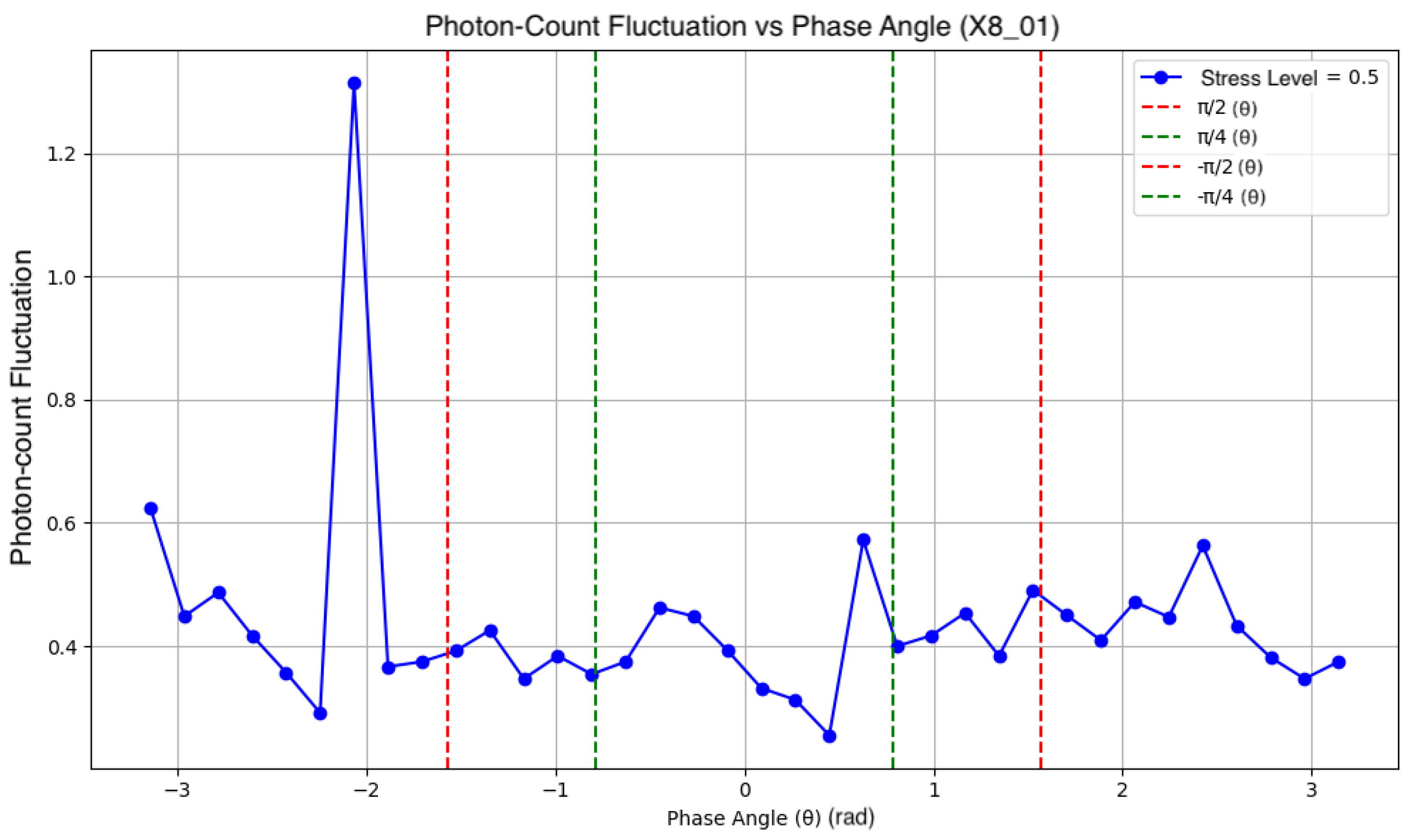
For the representative hardware phase-angle scan used in
Figure 1,
and
, giving a total acquisition budget of
Fock samples. If
denotes the effective wall-clock latency required to acquire and return one estimate of
, then the corresponding sweep time is approximately
Therefore, the offline phase-selection assumption is most credible in the regime , where is the characteristic time over which the effective device/interface mapping changes appreciably. We do not estimate directly in the present experiment, so the proposal is interpreted as an offline proof-of-concept rather than a demonstrated real-time control architecture. As such, a priority next step is to benchmark the end-to-end wall-clock latency of the search workflow against experimentally estimated drift timescales, which would allow the offline regime studied here to be separated more clearly from any future real-time operating regime.
Stationarity Assumption (What Offline Selection Does and Does Not Claim)
Offline phase selection is meaningful when the effective disturbance/measurement behavior is approximately stationary over the acquisition window. Concretely, we assume that the induced map from the commanded setting to the measured objective does not drift substantially during acquisition of the K angle points (or, more weakly, that drift is slow enough that a minimum remains identifiable). If the effective channel varies faster than the offline acquisition window, then a fixed offline may become stale. This limitation motivates future work on faster re-optimization, coarse-to-fine search, or closed-loop tracking; however, establishing the existence of a beneficial phase under controlled stressed conditions is the proof-of-concept objective of this study.
Nonstationary Extensions (Brief)
When disturbance nonstationarity is significant, two practical adaptations are natural: (i) reduce K by using a coarse grid followed by local refinement near the best angle, and/or (ii) interleave angles in time (round-robin sampling) to reduce bias from slow drift. These strategies retain structure while improving robustness to time variation.
2.5.3. Robustness to Phase-Setting Error and Finite Resolution
Phase-first selection is implemented with finite phase resolution (grid spacing) and may be affected by phase-setting error (hardware calibration and compilation variability). Therefore, we treat as an operational minimizer subject to quantization and uncertainty, and we report robustness considerations that enable replication.
Grid Quantization and Local Refinement
Let
denote the grid spacing. Then, the selected
in Equation (
20) is quantized to within
of the true minimizer of the underlying (unknown) smooth objective. In practice, one can improve accuracy without changing the overall workflow by:
- 1.
Coarse-to-fine grid search: Choose a coarse grid to locate an approximate minimizer, then re-evaluate locally on a finer grid with a finer .
- 2.
Local model fit: Fit a quadratic (or sinusoidal) model to in a neighborhood of the minimum and estimate a sub-grid minimizer.
Both methods preserve the offline nature of the experiment and reduce sensitivity to grid choice.
Phase-Setting Error and Sensitivity
Let the implemented phase be , where captures phase-setting error (control calibration, compilation, drift). A first-order robustness characterization is obtained from the local slope/curvature of the measured objective: if is flat near , then modest produces only small performance loss. Operationally, we recommend reporting either (i) a confidence band on across repeated runs or (ii) an uncertainty interval for obtained by bootstrapping the shot data used to compute . This directly addresses the reviewer request to discuss how deviations in are handled.
Finite-Sample Uncertainty (Shot-Noise of the Estimator)
Because is itself estimated from finite data, its uncertainty decreases with the number of shots per angle. For the photon-count proxy, one may estimate uncertainty by standard variance-estimator error bars or by nonparametric bootstrap over shots: resample with replacement, recompute , and report percentile intervals. Analogous resampling applies to quadrature-based statistics in simulation.
A short local sensitivity analysis can be built from the empirical landscape near the selected minimum. In particular, finite-difference slope and curvature estimates around indicate whether the minimum is broad (hence, relatively robust to quantization, drift, and phase-setting error) or sharp (hence, more sensitive to implementation uncertainty). In a fuller experimental study, this local geometry should be reported together with bootstrap confidence intervals for at the best grid point and nearby reference angles.
Practical Selection Rule with Robustness Margin
When multiple nearby angles have statistically indistinguishable objectives, a conservative rule is to choose the best angle within a tolerance band and optionally prefer angles with lower empirical variance across repeats. This reflects a resilience-oriented design that prioritizes stable improvement over a potentially fragile sharp optimum.
These robustness steps ensure that the reported phase-first improvement is not an artifact of a single grid point or a brittle calibration, and provide a clear replication path under finite phase resolution and finite shot budgets.
2.6. Implementation Note on Aggregation in the Hardware Workflow
The hardware result reported in this paper is not a mode-resolved analysis. In the X8_01 workflow used here, the returned Fock counts are aggregated into a shot-level scalar before postprocessing, and the reported hardware observable is the shot-to-shot standard deviation . Mode-resolved extensions are possible, but are outside the scope of the present proof-of-concept.
3. Methods
This section describes the simulation and experimental methodologies used to evaluate phase-first Gaussian modulation as an implementation-layer countermeasure against structured and adversarial disturbances in continuous-variable quantum communication (CVQC) systems. Our methodological objective is to express all performance claims in terms of receiver-observable statistics while making a clear separation between (i) the broader control framework (joint phase-space rotation and squeezing, ) and (ii) what is exercised in the present hardware workflow (phase-only rotation).
Although the phase-first framework is adaptive in principle (estimation → parameter selection), the hardware validation reported here is deliberately instantiated as an offline proof-of-concept. We evaluate a receiver-observable cost on a discrete grid of phase settings and select the minimizing phase, without real-time closed-loop updates. This choice reflects current interface constraints in the demonstrated X8_01 access mode, where programmable phase operations are available but low-latency measurement-to-actuation feedback and dynamic squeezing actuation are not.
Because the simulation environment and the X8_01 workflow expose different native observables, we report two complementary centered second-moment evaluation tracks. In theory/simulation, we quantify degradation using mean-subtracted quadrature second moments (basis-dependent variance and covariance-derived summaries), so that reported metrics capture covariance inflation (excess variance) rather than coherent displacement. In the hardware experiments, the native readout is Fock sampling; thus, we use a tomography-light count-standard-deviation proxy computed directly from photon-number outcomes. Accordingly, the experimental hardware observable is treated as an implementation-layer variability proxy rather than as a direct estimate of the quadrature covariance trace.
Both simulation and hardware studies emphasize DoS-like receiver-observable stress as a conservative benchmark. This stress-focused methodology is aligned with our paper’s containment goal of evaluating whether a lightweight and hardware-compatible phase re-orientation can reduce a receiver-observed degradation proxy under fixed high-stress conditions while clarifying the limits of phase-only control when stronger Gaussian actuation (e.g., squeezing) and real-time adaptation are unavailable.
3.1. Theoretical Framework
3.1.1. Adversarial Disturbances and Qumode Response
Continuous-variable quantum states encoded in qumodes are sensitive to environmental and adversarial disturbances. In this work, we characterize disturbances operationally through their impact on receiver-observable statistics under finite data and practical receiver constraints (
Section 2), rather than attempting unique mechanism identification. In particular, reconnaissance, exploratory, and DoS-like regimes correspond to progressively stronger receiver-facing deviations, including fluctuation inflation in centered second moments, phase-reference dependence, and receiver-interface non-idealities.
Two Receiver-Observable Evaluation Tracks
A key methodological constraint is that the theory/simulation analysis and the X8_01 hardware workflow expose different native observables. Accordingly, we evaluate degradation using two complementary centered second-moment proxies (
Section 2.3):
- 1.
Quadrature-moment track (theory/simulation). When quadrature statistics are available, we work with mean-subtracted second moments of
and the centered covariance
with
(Equation (
4)). This ensures that reported variance/covariance changes reflect fluctuation inflation rather than coherent displacement. We report (i) the basis-dependent monitored-quadrature variance
(Equation (
6)); when a scalar summary is useful, we also report (ii) the covariance-inflation proxy
(Equation (
7)) under the adopted shot-noise-unit (SNU) convention.
- 2.
Photon-count track (hardware). In the X8_01 workflow, the native readout is Fock sampling (
MeasureFock). Therefore, we quantify phase sensitivity using the shot-to-shot standard deviation
(Equation (
8)), where
denotes the shot-level detected count random variable used in the hardware workflow. This statistic is centered by construction (variance about the sample mean) and is treated as an implementation-layer variability proxy, not as an estimator of
or any protocol-specific excess-noise parameter (
Section 2.3.2).
Interpretation of any observed
-dependence follows the invariances and operational rule in
Section 2.4.
3.1.2. Phase-First Modulation Strategy
We investigate a phase-first control strategy in which the defender selects a phase-space rotation angle to minimize a receiver-observable degradation proxy. The framework is adaptive in principle, but the present implementation is instantiated offline via a discrete phase sweep. While the broader framework admits joint Gaussian control , we deliberately restrict the experimental validation to phase-only selection in order to test the minimum viable hardware-compatible mitigation knob under realistic interface constraints. In the demonstrated X8_01 access mode, phase rotations are programmable and repeatable across modes, whereas dynamic squeezing actuation and low-latency measurement-to-actuation feedback are not exposed to user programs during a sweep. Therefore, focusing on phase-only control isolates the effect of basis re-orientation on receiver-observed degradation proxies and provides a conservative proof-of-concept that can transfer to other near-term photonic CV platforms where phase control is accessible but higher-bandwidth Gaussian actuation is limited. This choice emphasizes resilience under constrained control resources: the defense should remain effective even when only low-dimensional tuning is available and when rapid online estimation is impractical during DoS-like stress.
Observable-Dependent Objective
We instantiate the phase-first selection rule in Equation (
17) using an observable-dependent cost
, with the specific instantiation determined by the available measurement track:
where
is defined in Equation (
6),
in Equation (
7), and
in Equation (
8).
Offline Grid Search (Hardware Instantiation)
Operationally, we evaluate
on a discrete grid
and select the minimizing grid point (see Equation (
27)). The postprocessing cost is linear in the shot count per angle, while the dominant cost is data acquisition (shots per tested angle). This offline instantiation demonstrates existence and feasibility of phase selection under approximately stationary stressed conditions; real-time tracking under faster nonstationarity is treated as a future architectural extension.
3.2. Simulation Methodology
3.2.1. Simulation Setup
Numerical simulations were performed using the
Strawberry Fields (SF) library [
16] to (i) prepare single-mode Gaussian states, (ii) visualize phase-space structure via Wigner-function panels, and (iii) sanity-check the shot-noise unit (SNU) normalization on the Gaussian backend. For the phase-sweep objective, we use an analytic/quasi-analytic model for
and Monte Carlo sampling to emulate finite-shot estimation, which keeps the sweep objective transparent and reproducible: the expected curve is available in closed form, and finite-shot effects are emulated via seeded Monte Carlo sampling. This design keeps the simulation objective aligned with the receiver-observable metric emphasized throughout, with the phase-first sweep minimizing a centered second-moment proxy, here the monitored-basis quadrature variance
(
Section 2.3.1).
In simulation, the phase sweep is performed using the basis-dependent objective ; is reported only as a rotation-invariant severity summary and is not used as the sweep objective.
Structured Disturbance Model (Directional Displacement Mixture)
To represent an intentionally structured directional disturbance rather than independent and identically distributed isotropic Gaussian noise, we model a DoS-like stress pattern as a two-component displacement mixture aligned along an adversary-selected phase-space direction
. Starting from the vacuum state
(SNU), we define
where
is chosen such that the displacement magnitude is
d (in quadrature units) and its direction in phase space is
. This mixture is mean-centered by construction and yields a bimodal Wigner-function signature, providing a simple and interpretable phenomenological model of a repeatable directional stress pattern without claiming a unique mechanism-level realization on any specific device.
Phase-First Sweep Observable
For each defender-chosen phase setting
, we consider the rotated quadrature
and evaluate the receiver-observed variance
under
as the simulation-side phase-first objective.
Simulation Procedure
The simulation workflow consists of the following:
- 1.
Reference normalization (vacuum). Initialize a single-mode vacuum state in SF and verify the expected SNU normalization on the Gaussian backend (vacuum covariance ), implying for all in the ideal model.
- 2.
Construct disturbance components and Wigner visualization. Generate the displaced components
(via
Dgate) and form Wigner-function panels for each component on a common grid. Because Equation (
24) is an incoherent mixture, the mixture Wigner function is computed as the equal-weight sum of the two component Wigner functions.
- 3.
Phase sweep and finite-shot realism. For the displacement-mixture model, the expected monitored-quadrature variance admits the closed form
where the constant 1 is the vacuum variance (SNU) and
is the component mean shift in the monitored quadrature. To emulate finite-shot estimation, we sample
outcomes from the corresponding one-dimensional mixture distribution
and compute the sample variance as a function of
.
Parameter Sweeps and Reproducibility
We sweep on a uniform grid with fixed angular resolution (e.g., ≈10°), holding fixed within each sweep. All random draws used for finite-shot sampling are seeded to enable exact reproduction of plotted markers and summary tables.
Shot Notation
In both simulation and experiment, denotes the number of repeated samples collected per tested phase setting.
3.2.2. Performance Metrics
We report two complementary simulation-side metrics:
- 1.
Receiver-observed monitored-quadrature variance (primary). The primary objective is
, reported as both the expected curve in Equation (
26) and the finite-shot estimate from mixture sampling. This is a centered second-moment proxy that captures disturbance-driven fluctuation inflation in the monitored basis.
- 2.
Wigner-function structure (supporting). Wigner panels provide a qualitative phase-space depiction of the vacuum baseline and the structured disturbance mixture, supporting interpretation of phase-first improvement as a projection/orientation effect.
Simulation results are benchmarked against reference angles (e.g., , ) and summarized by reporting the grid-selected minimizer , with the discrete phase grid used in the offline run, the corresponding minimum , and relative improvements versus the reference angles. Because the disturbance model is directional by construction, the optimum is interpretable; it occurs near the measurement axis orthogonal to the disturbance direction (up to grid resolution), consistent with the projection-based mitigation mechanism emphasized in the Results section.
3.3. Experimental Methodology
3.3.1. Experimental Design
Operational Sources of Observed Phase Sensitivity
We do not claim unique mechanism identification from the present hardware data; however, the observed phase dependence is consistent with several concrete classes of non-ideal receiver/interface behavior: (i) interferometric compilation that causes the commanded Rgate to act internally rather than as an isolated terminal Fock-basis phase shift on the effective measured modes, (ii) phase-dependent loss or mode mixing in the realized optical network, (iii) calibration and phase-reference drift during the sweep, and (iv) nonlinear interface/readout effects under stressed conditions. This supports a more predictive interpretation of the hardware landscape: if the effective receiver interface couples disturbance energy anisotropically into the measured observable, then re-orienting the accessible phase basis can systematically reshape the degradation curve rather than merely producing an unexplained empirical correlation.
Compiled Program Versus Device Interface
By “compiled program” we mean the concrete gate sequence and interferometric realization submitted after compilation, including internal decompositions, mode transformations, and placement of phase operations within the realized optical network. By “device interface” we mean the effective input–output behavior seen at measurement, including calibration state, phase-reference behavior, loss, mode mismatch, control electronics, and readout response. Terminal-phase invariance applies only when the applied phase operation is equivalent to a final diagonal Fock-basis phase gate on the measured effective modes. An internal compiled rotation followed by device-interface effects need not satisfy that equivalence, which is why a commanded Rgate can produce -dependent observed statistics even though an ideal terminal phase gate would not.
Offline (Proof-of-Concept) Adaptivity
Because the user-facing workflow does not provide an integrated low-latency measurement-to-actuation loop and because dynamic squeezing actuation is not available during the sweep, the experimental instantiation is restricted to phase-only control with offline parameter selection. Operationally, we evaluate a degradation proxy on a discrete grid of phase settings and select the minimizing phase without closed-loop updates during execution. This isolates phase choice as a standalone hardware-compatible mitigation knob.
Centered-Statistic Interpretation (Hardware Count-Standard-Deviation Proxy)
Because the observable available in this workflow is photon-number samples rather than quadrature outcomes, the experimental objective is a centered second-moment proxy of shot-to-shot count fluctuations. We denote the shot-level detected count by
and evaluate the hardware observable
as defined in Equation (
8), where
is taken over shots at fixed
. Therefore, throughout the hardware sections “improvement” denotes reduced receiver-observed count variability in this fixed workflow, not universal noise cancellation and not a direct measurement of quadrature covariance inflation.
Unless stated otherwise, is computed as the population variance over shots at fixed (i.e., normalization by , consistent with the default numpy implementation used in our analysis), and is reported as the corresponding standard deviation.
3.3.2. Experimental Procedure
We evaluate candidate phase angles on a uniform grid over (approximately spacing); for each tested angle, we collect repeated Fock samples, giving a total acquisition budget of shots across the full offline run. For each tested angle , we execute the following steps:
- 1.
Program compilation and phase-grid evaluation. Compile a fixed-depth eight-output program that applies Rgate identically across the returned outputs, implementing a one-dimensional grid search over .
- 2.
Fixed stressed configuration. To emulate a reproducible DoS-like stressed operating configuration within the available gate set, apply an additional fixed stress phase offset Rgate with (held constant across the offline run) identically within the program prior to measurement. This should be interpreted as a reproducible, phase-sensitive stress configuration within the compiled program/device interface chosen to produce a high-variability operating point for evaluation, not as a claim that an adversary physically applies Rgate to a deployed channel. In an ideal single-mode model, Rgate followed by Rgate is equivalent to a single phase rotation by ; thus, any observed -dependence under Fock readout is interpreted as an implementation/interface effect rather than an intrinsic property of an ideal terminal phase gate.
- 3.
Fock measurement and data acquisition. Measure the program in the Fock basis (MeasureFock) and collect repetitions per . For each shot s, record the returned Fock sample and form the shot-level detected count used in the hardware workflow.
- 4.
Compute the phase-dependent proxy. Compute
as defined in Equation (
8) (using
over shots at fixed
) and store the result for the full phase-angle profile.
Normalization, Recalibration, and Evidentiary Scope
The present hardware dataset should be interpreted as a representative offline sweep obtained under one fixed workflow configuration. We did not implement interleaved pilot/reference states, a per-angle baseline normalization measurement, or a dedicated between-angle recalibration protocol in which the cadence is itself analyzed as an experimental variable. Likewise, this manuscript does not claim that
Figure 1 averages multiple independently recalibrated sessions or that the reported minimum has been separated from all possible temporal drift contributions by a dedicated control experiment. The evidentiary claim is narrower: within the fixed acquisition window used here, the receiver-observed proxy
exhibited a phase-dependent landscape, motivating future studies with explicit drift tracking, reference-state normalization, repeated-session error bars, and controlled recalibration schedules. Future hardware studies will incorporate interleaved reference-state measurements, explicit recalibration schedules, and repeated-session sweeps so that phase-selection effects can be disentangled more rigorously from temporal hardware fluctuations.
Phase Selection and Resolution
Because is evaluated on a discrete grid, the selected minimizer is quantized to the grid spacing. A straightforward refinement is to perform a coarse grid search to localize the minimum followed by a finer local grid search or local interpolation near the best grid point; for transparency and reproducibility, we report the baseline uniform-grid evaluation.
3.3.3. Data Collection and Analysis
The phase-first selection rule is instantiated as
with
being the discrete phase grid. Because the measured observable is photon counts rather than quadrature samples, we do not claim reconstruction of
or estimation of
in this workflow.
Phase dependence is interpreted operationally: under an ideal terminal phase shift immediately before photon-number measurement, photon-number statistics are invariant to for any input state. Therefore, any observed -dependence of indicates phase-sensitive effective behavior in the compiled program/device interface (e.g., phase-dependent coupling/mode mixing, calibration drift, phase-reference effects, or other non-idealities). Within this receiver-centric framing, offline phase selection provides a practical mitigation knob for reducing a directly observed variability proxy under the fixed stressed configuration.
Limitation Under Fast Drift
Because the hardware study does not implement real-time feedback, an offline can become stale if the effective phase-sensitive behavior drifts on timescales shorter than the sweep. This motivates future work on repeated sweeps for uncertainty quantification, shorter-window re-optimization, and closed-loop phase tracking when available.
4. Results
This section reports results from receiver-observable theoretical analysis, numerical simulation, and hardware measurements that collectively evaluate phase-first modulation as a practical implementation-layer countermeasure against adversarial disturbances in CVQC systems. Consistent with the scope clarified throughout the manuscript, the adaptive/feedback-inspired framework is instantiated experimentally as offline phase selection (no real-time closed-loop updates). On hardware, the only validated control action is phase-space rotation. Squeezing modulation is treated as a simulation-only extension that provides an upper-bound reference for what additional Gaussian control could achieve under idealized actuation, and is not claimed as an experimentally demonstrated capability here.
4.1. Two Complementary Centered Second-Moment Proxies
Because the simulation environment and the X8_01 access mode expose different native observables, we report two closely related centered second-moment degradation proxies: (i) in simulation, we track the receiver-observed monitored-quadrature variance as a function of measurement-basis angle,
(and equivalent covariance-derived summaries), which captures disturbance-driven variance/covariance inflation in the monitored basis; (ii) in hardware, we use the count-standard-deviation proxy from
Section 2.3.2,
(Equation (
8)), computed from the shot-level detected count used in the hardware workflow. In the reported X8_01 run, this shot-level count is formed by aggregating the returned Fock counts before postprocessing. Here,
denotes the population variance across shots (normalization by
), consistent with the default
numpy implementation used in our analysis. Both metrics are mean-centered by construction (variance about an estimated mean). Accordingly, throughout this section “improvement” means reduced receiver-observed fluctuation inflation in a centered second-moment proxy, not noise cancellation, and does not represent a protocol-level security claim.
4.2. Interpretation: Phase Dependence Implies an Effective Phase-Dependent Channel
A key interpretive point is that under an ideal phase-invariant additive-noise model, a pure rotation would not change rotation-invariant summaries; likewise, under ideal Fock readout, a terminal phase gate would not change photon-number statistics. Therefore, any observed dependence of or on is interpreted operationally as evidence that the effective disturbance/measurement channel seen by the receiver is phase-dependent, e.g., via anisotropic disturbance statistics, quadrature/mode mixing, LO/phase-reference coupling, calibration drift, or other receiver-interface non-idealities. Within that receiver-centric framing, phase selection provides a lightweight mitigation knob by re-orienting the effective projection so that the disturbance couples less strongly to the monitored observable, resulting in extended operational margin under DoS-like receiver-observable stress.
4.3. Roadmap of Results
Section 4.4 presents an analytic/simulation phase-angle scan in which we compute
across
, compare finite-shot estimates to the expected curve, visualize representative Wigner panels at baseline as well as at the selected
, and summarize key parameters (including improvement versus conventional reference angles such as
and
).
Section 4.5 then reports the corresponding phase-angle scan on Xanadu’s X8_01 platform using offline phase selection and Fock readout, quantifying the observed phase dependence via
and emphasizing that the measured optimum is device- and condition-dependent.
4.4. Simulation Results
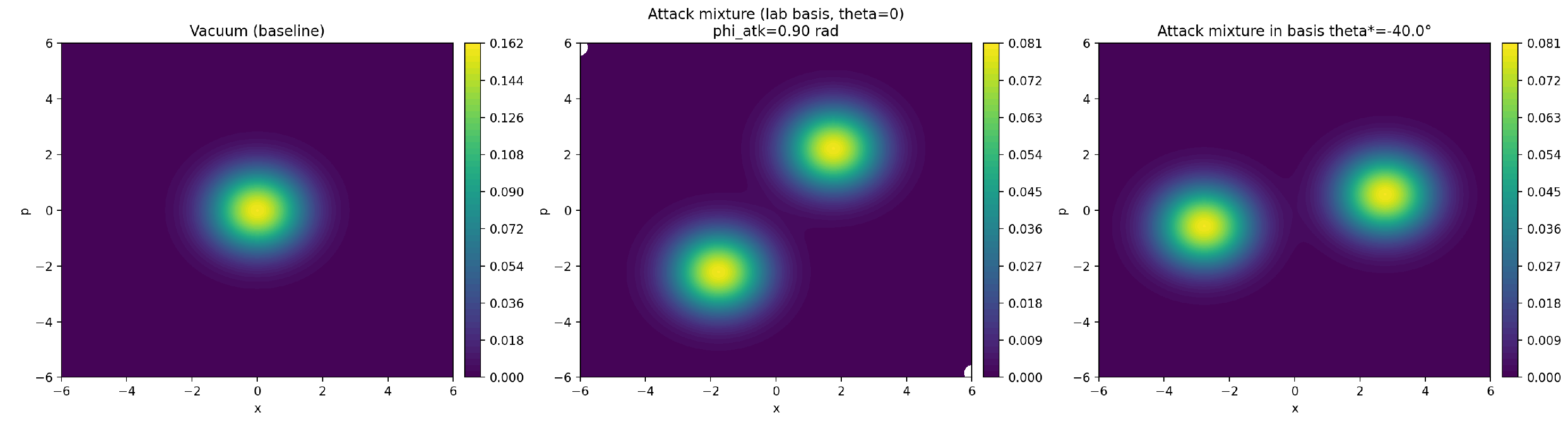
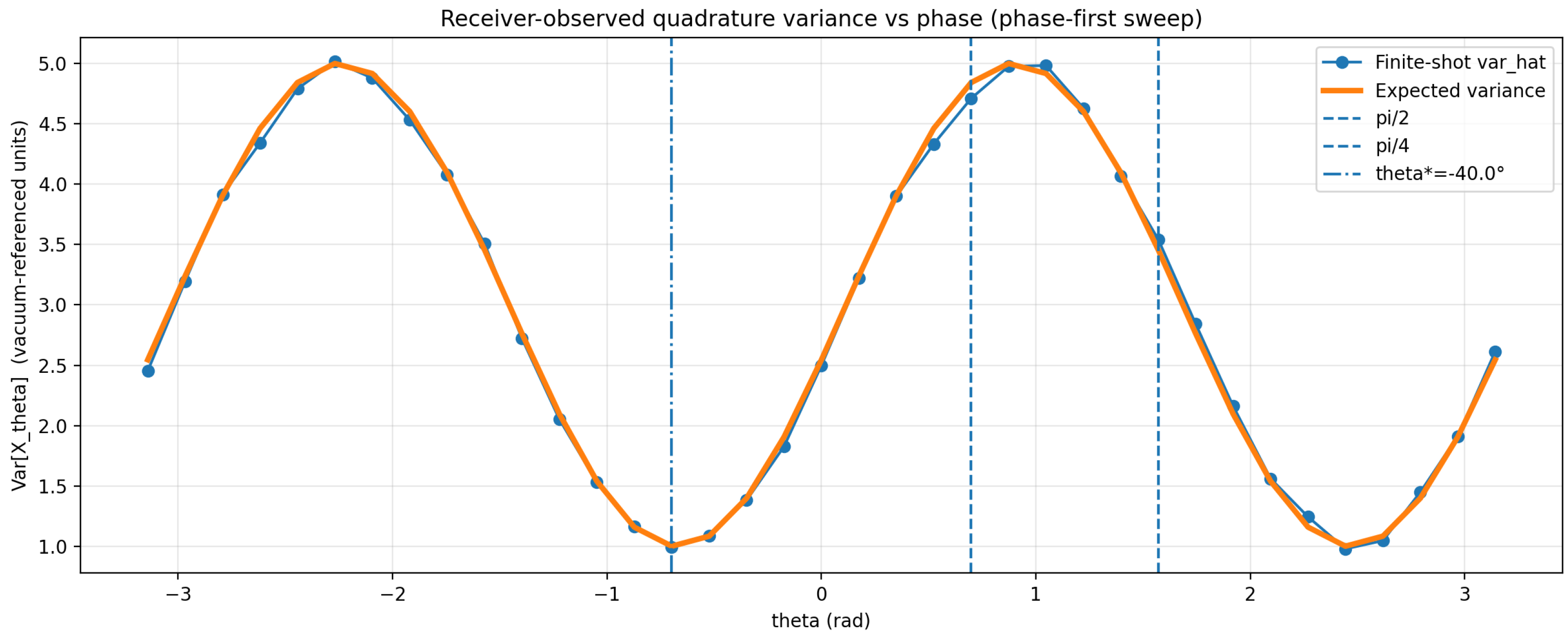
Figure 2 and
Figure 3 summarize the simulation-side evidence for phase-first mitigation under the structured directional displacement-mixture disturbance model defined in
Section 3.2.1 [
8]. Rather than modeling the disturbance as independent and identically distributed additive Gaussian noise, we use a mean-centered mixture of displaced components aligned along a phase-space direction
. Operationally, this captures the idea of a repeatable, directional stress pattern in phase space, while the receiver-facing signature is basis-dependent fluctuation inflation.
4.4.1. Qualitative Phase-Space Picture (Wigner Panels)
The vacuum baseline (left panel) is isotropic. Under the structured disturbance (middle panel), the Wigner function becomes bimodal rather than simply elliptically broadened, consistent with an incoherent displacement-mixture model. The right panel shows the same disturbed state visualized in the defender-selected basis , emphasizing the mechanism of phase-first control in which phase selection does not remove the disturbance but rather changes how its structure projects onto the monitored quadrature.
4.4.2. Phase-Angle Scan Objective (Receiver-Observed )
To quantify this projection effect directly, we sweep the measurement-basis angle
and evaluate the receiver-observed monitored-quadrature variance
. For a directional displacement mixture,
is strongly phase dependent; it is maximized when the monitored quadrature aligns with the disturbance direction and minimized when it is orthogonal (up to the finite grid resolution). This produces the characteristic sinusoidal dependence in
Figure 3 and yields a clear offline optimum
.
In the representative phase-angle scan shown here (with and ), the grid-selected optimum occurs at , yielding a near-vacuum minimum (vacuum-referenced units). In contrast, the same disturbance configuration yields substantially larger variance at common reference angles, e.g., and (from the analytic curve). This corresponds to a reduction of about versus and about versus under the fixed disturbance configuration used in the offline run, illustrating that static operating points can be highly suboptimal under structured directional stress.
4.4.3. Finite-Shot Realism and Implementation Relevance
The markers in
Figure 3 show that finite-shot estimates closely track the expected curve. In this study, finite-shot realism is emulated by sampling
outcomes from the corresponding one-dimensional mixture distribution
implied by Equation (
26), and computing the sample variance. Strawberry Fields is used to generate and visualize the underlying phase-space states (Wigner panels) and to sanity-check the adopted vacuum/SNU normalization [
16].
4.4.4. Key Takeaways from Simulation
- 1.
Phase-first mitigation is a projection effect. The benefit arises because depends on basis choice under a structured directional disturbance; choosing changes how strongly the disturbance appears in the monitored quadrature.
- 2.
The optimum is interpretable. The minimizing occurs near the quadrature orthogonal to the disturbance direction (up to grid resolution), providing a physically transparent explanation for the observed minimum.
- 3.
No claim of universal noise cancellation. The disturbance is not removed; the receiver-observed degradation proxy is reduced in the chosen basis under a fixed disturbance configuration.
Taken together, these simulation results motivate the hardware phase-angle scan study presented next: if the effective disturbance/measurement behavior at the receiver interface is phase dependent (e.g., via anisotropy, mixing, LO/phase-reference coupling, calibration drift, or other non-idealities), then an offline phase sweep can reveal a substantially better operating point even without real-time feedback.
4.5. Experimental Results
Experimental measurements on Xanadu’s X8_01 photonic quantum processor provide a proof-of-concept demonstration that offline phase selection can materially change a receiver-observed degradation proxy under a fixed stressed configuration [
15]. Consistent with
Section 3.3, the hardware study implements phase-only control (programmable phase rotations) with no integrated low-latency feedback and no squeezing actuation. Unlike the simulation section, which evaluates a quadrature-variance objective, the X8_01 workflow uses Fock-basis sampling; accordingly, we quantify phase sensitivity using a tomography-light count-standard-deviation statistic computed directly from measured samples.
4.5.1. Run Structure and Acquisition Details
Figure 1 corresponds to a single offline sweep over
uniformly spaced phase settings on
, with
Fock samples collected per angle, for a total acquisition budget of 3600 shots. For each tested angle, the reported quantity is
, where
is the shot-level detected count used in the hardware workflow. In the reported X8_01 run, this scalar is formed by aggregating the returned Fock counts before post-processing. Under ideal terminal-phase invariance this statistic would be
-independent; thus, the observed variation is interpreted operationally as phase-sensitive effective behavior in the compiled program/device interface rather than as intrinsic variance reduction from a terminal phase gate.
4.5.2. Measured Statistic (Hardware Proxy)
For each phase setting
, we collect
repetitions. From the raw Fock samples returned by the program, we form the shot-level detected count
and report the hardware observable
defined in Equation (
8). In the analysis code,
is implemented as the population variance estimator (
numpy.var,
ddof = 0) [
22], and
is the corresponding standard deviation.
4.5.3. What the Offline Phase-Grid Evaluation Implements (and Why Is a Stress Knob, Not a Mechanism Claim)
In the implementation used here, the “stress” parameter is a deterministic phase offset applied via
Rgate, not a stochastic noise injection. In this experiment, the program applies
Rgate followed by a fixed offset
Rgate with
identically on each measured mode. In an ideal single-mode model, these operations compose to
Rgate, and under ideal Fock readout all photon-number statistics would remain invariant to a terminal phase shift. Therefore, any observed
-dependence in
Figure 1 is interpreted operationally as evidence that the compiled program/device interface induces phase-sensitive effective behavior for the measured modes under this stressed configuration (
Section 2.4), rather than as an intrinsic property of an ideal terminal phase gate.
4.5.4. Drift, Finite-Shot Uncertainty, and Evidentiary Scope
Figure 1 should be interpreted as a single representative offline sweep. The observed phase-angle profile reflects finite-shot estimator uncertainty, and may also reflect slow drift over the acquisition window. Therefore, we treat the reported curve as evidence of a phase-dependent empirical landscape in the realized workflow, not as a fully drift-separated estimate of a stationary response curve. Repeated-session sweeps, interleaved-angle acquisition, and bootstrap uncertainty intervals are left to future work.
4.5.5. Key Observations
- 1.
Existence of a phase-dependent optimum under fixed stress. The statistic exhibits a clear minimizer consistent with the offline selection rule .
- 2.
Static phase choices can be brittle. Reference angles such as and do not generally coincide with the minimizing setting, underscoring that fixed operating points can be suboptimal when the effective interface behavior is phase sensitive.
- 3.
The hardware result is a phase-dependent scalar landscape. The reported curve should be read as a phase-dependent empirical landscape of the shot-to-shot count standard deviation in the realized workflow, not as a mode-resolved analysis.
- 4.
Containment via phase choice, not universal noise cancellation. The observed reduction is consistent with basis-/configuration-dependent containment in a phase-sensitive effective hardware channel, not with intrinsic noise reduction from rotation alone.
Overall, the X8_01 measurements establish a hardware-feasible proof-of-concept: even without real-time feedback and without squeezing control, an offline phase-grid search can identify non-intuitive settings that reduce a directly observed receiver-side fluctuation proxy under a fixed stressed configuration. This motivates follow-on studies that (i) repeat offline runs across sessions to quantify robustness/uncertainty of , and (ii) inspect mode-resolved count statistics and cross-correlations when diagnosing mode-selective or correlated effects.
6. Conclusions
This paper re-frames resilience in continuous-variable quantum communication (CVQC) through a receiver-observable lens: under finite data, finite resolution, and realistic hardware interfaces, robustness is governed by what the receiver can reliably estimate and control, rather than by idealized channel models alone. Building on the receiver-centric threat-modeling viewpoint in [
6], we introduce and evaluate phase-first Gaussian modulation as a lightweight implementation-layer containment mechanism under DoS-like receiver-observable stress.
The core contribution is an operational phase-selection rule: choose a phase-space rotation angle
that minimizes a centered receiver-observable second-moment degradation proxy. Because different platforms expose different native observables, we evaluate this idea using two complementary tracks (
Section 2.3). In theory/simulation, we use mean-subtracted quadrature-level second moments (notably, the basis-dependent variance
) to illustrate the underlying mechanism as a projection/orientation effect under structured directional disturbances. In the X8_01 workflow, where the native readout is Fock sampling, we quantify phase sensitivity using the tomography-light count-standard-deviation proxy
computed from the shot-level detected count used in the hardware workflow. In the reported experiment, this shot-level count is formed by aggregating the returned Fock counts before postprocessing. In this hardware setting, we demonstrate that an offline one-dimensional phase sweep can identify non-intuitive phase settings that reduce a directly observed receiver-side fluctuation proxy relative to static reference angles, establishing feasibility of phase-first containment under current control and readout constraints.
A central interpretive point, made explicit in
Section 2.4, is that under ideal phase-independent additive-noise models, a pure rotation leaves rotation-invariant summaries unchanged, while under ideal photon-number measurement, a terminal phase gate does not change photon-number statistics. Therefore, any empirically observed
-dependence of the reported proxies is interpreted operationally as evidence of a phase-dependent effective disturbance/measurement channel at the receiver interface (e.g., anisotropy, mixing, LO/phase-reference coupling, calibration dynamics, or interface nonlinearities) rather than as intrinsic “noise cancellation” from rotation alone. Within this receiver-centric framing, the existence of a beneficial
is itself deployment-relevant, indicating that phase agility can serve as a practical mitigation knob in phase-sensitive effective environments.
Overall, our results support phase-first modulation as a near-term hardware-compatible component of resilient CVQC operation that requires only low-dimensional tuning (phase rotation), can be implemented as offline selection when feedback bandwidth is limited, and can be composed with monitoring and higher-layer control logic. The most important next steps are to (i) strengthen multi-mode and correlation-aware evaluation with richer observables, (ii) quantify robustness and uncertainty of under drift and finite-shot effects, and (iii) connect phase-first selection to protocol-level quantities (e.g., quadrature parameter estimation in CV-QKD) when the relevant measurement primitives are available. Therefore, the present hardware evidence should be interpreted as demonstrating offline phase-first containment under quasi-static stressed conditions in a phase-sensitive effective receiver interface, rather than as a complete real-time resilience guarantee under fast drift or rapidly adaptive adversarial dynamics. The most important experimental next steps are to benchmark offline search latency, repeat the hardware phase-angle scan across sessions with explicit reference-state/recalibration controls, and place uncertainty bounds on under finite-shot and drift-limited conditions.




 ,
,