Article

Remote Sensing-Based Analysis of Archaeological Site Damage in Syria: Revisiting a Post-War Landscape


Department of Anthropology, Dartmouth College, Hanover, NH 03755, USA
*
Author to whom correspondence should be addressed.
Heritage 2026, 9(6), 209; https://doi.org/10.3390/heritage9060209 (registering DOI)
Submission received: 23 March 2026 / Revised: 15 May 2026 / Accepted: 18 May 2026 / Published: 23 May 2026

Abstract

High-resolution, commercially acquired satellite imagery has been shown to be a powerful tool for documentation and analysis of damage to archaeological sites, particularly in conflict zones where ground-based observations are impractical or dangerous. Using this approach, previous investigations have reported widespread looting and other forms of damage to archaeological sites in Syria during the early years of the civil war (2011–2016). Relying on an expanding suite of satellite imagery resources, this paper presents a renewed analysis of looting and archaeological site damage in Syria over the past decade. The results reveal: (1) severe damage to many sites in northern Syria from a novel form of mechanized looting, (2) intensified impacts from the establishment of military facilities or refugee camps on many prominent sites, and (3) rampant incidents of small-scale looting across all areas of the country. These results highlight the importance of ongoing imagery-based heritage monitoring efforts and will support emerging mitigation, stabilization, and damage assessment efforts in Syria going forward.

1. Introduction

Over the past two decades, archaeologists have increasingly come to rely on high-resolution satellite imagery collected by commercial platforms to undertake analyses of looting and other forms of damage to ancient sites (e.g., [1,2,3,4]). Satellite imagery of a sufficiently high resolution (better than 1 m resolution) can reveal detailed perspectives on the severity and type of damage to sites, as well as when and where damage occurred, and can, therefore, be a powerful tool in building an understanding of the nature of threats to cultural heritage. Remote sensing-based studies of archaeological site damage are particularly useful for analyses in remote or inaccessible regions, especially in conflict zones where ground-based investigations are dangerous or impossible to undertake. Even in areas where sites can be visited today, damage is often much easier to recognize in satellite imagery than when standing on the ground, and can be used to survey vast areas with relative ease.
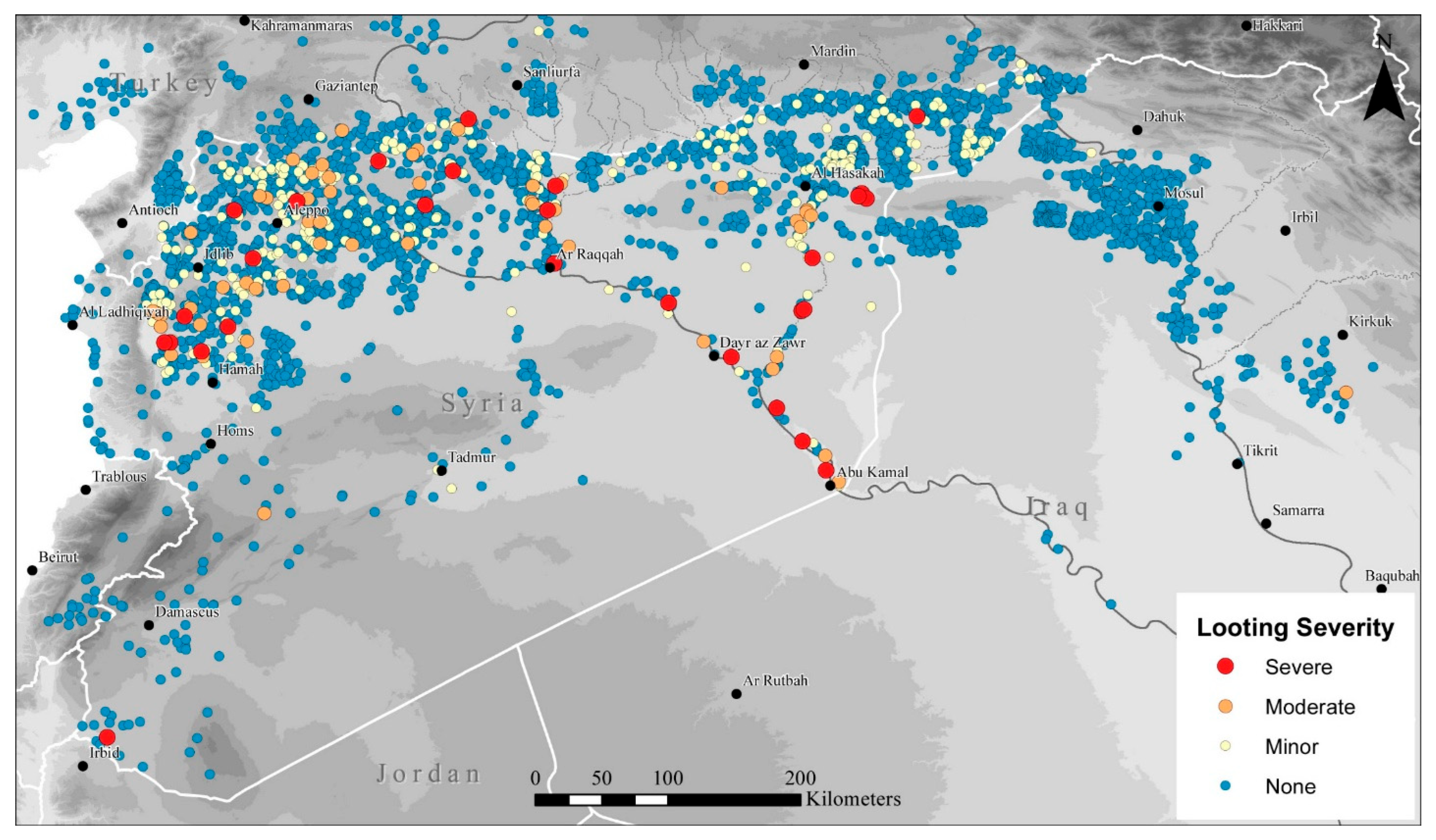
Throughout the early years of the Syrian Civil War, from 2012 to 2016, our research team undertook extensive analysis of damage to archaeological sites and monuments that was being caused by looting, militarization, intentional destruction, and other factors [5,6,7]. While previous investigations had been limited by the high cost of commercial satellite imagery and the limited range of freely accessible imagery resources, our project was undertaken as part of the American Schools of Overseas Research (ASOR) Cultural Heritage Initiative (CHI), sponsored by the US Department of State, through which we gained access to a large, continuously updated database of commercial satellite images. Our results demonstrated the scale of looting and intensive forms of archaeological site destruction rampant across Syria and northern Iraq, and also enabled us to empirically address key questions related to what types of sites were being targeted, the relative severity of damage across regions controlled by various factions within Syria, and the chronology of looting and site destruction as it related to the progress of the war (Figure 1).
The results of our monitoring efforts bring into clear view the severity of damage and the extreme risks to the rich archaeological heritage of the region, leading to widespread public discourse on the issue and the establishment of numerous projects that sought to expand on our results in various ways (e.g., [8,9,10]). With the collapse of the Assad government and the end of the war in late 2024, archaeologists and former antiquities officials have begun to return to Syria, beginning what will be a long process of mitigation and rebuilding [11,12]. To support these new initiatives, our team has undertaken a renewed analysis of archaeological sites in Syria, using recently acquired satellite imagery to assess damage that has occurred since 2016. Some researchers have had success with automated detection of looting holes using computer vision technologies [13,14], while other studies have defined broader threats to archaeological sites from changing land use patterns using similar AI-driven methods [15]. However, for an investigation of this nature, where the possible impacts on sites are so variable and complex, we rely instead on an expert-led, “brute force” approach to imagery analysis [16]. The current study necessarily involves a smaller sample compared to our previous investigation, but our primarily qualitative results nonetheless demonstrate the efficacy of our straightforward approach to 2D imagery analysis. The findings demonstrate that small-scale looting remains rampant across most areas of Syria, and that in areas along the Turkish–Syrian border, many sites have suffered extreme damage from mechanized earthmoving, a novel form of looting. Likewise, militarization of mounded sites has expanded over the past several years, while many other sites have suffered damage from construction and encampments by internally displaced refugees. These findings are intended to assist with ongoing damage assessment efforts by Syrian antiquities officials and also lay the groundwork for future mitigation efforts by archaeologists.

Background

Prior to the launch of the ASOR CHI project, we had undertaken analysis of looting in Syria using only freely available satellite imagery on Google Earth Pro (7.3.7.1155) and a few images donated by the now-defunct Digital Globe Foundation [6]. While necessarily limited in scope, the study nonetheless provided a proof-of-concept for our basic approach to damage assessment. After the launch of the collaborative ASOR CHI project, we gained access to a large archive of high-resolution imagery from Maxar Technologies (Westminster, CO, USA), the leading private satellite imaging company in the world at the time of our study. As much as 90% of Maxar’s revenue derives from contracts with US government agencies [17], and because of this fact, a portion of imagery purchased by US government agencies is made available to other official users through a dedicated web mapping portal. ASOR’s collaborative agreement with the US Department of State earned our team access to this imagery archive, which formed an essential basis for our work.
Although no formal national archaeological site inventory existed in Syria when we began our monitoring efforts, we had already developed a large site database through a previous NASA-funded project [16,18]. We first systematically mapped all previously documented sites in the northern Fertile Crescent (n = 4300), only including sites we could confidently recognize in satellite imagery. We then identified many previously undocumented sites (n = 10,000) that are visible in Cold War-era declassified CORONA satellite imagery. In our initial study, we established three classes of archaeological sites: (1) priority sites (PRYs), a list of approximately 200 sites, which includes all sites that have been excavated by archaeological projects or those which commonly appear on tourist itineraries, thereby capturing most of the sites that are best known and most discussed in archaeological or historical literature, (2) published sites (PUBs), which includes all other sites that have been previously published in academic literature, primarily in archaeological surveys, and, (3) CORONA sites (CRNs), probable sites that our team located through analysis of CORONA satellite imagery, but which have not to our knowledge been otherwise documented in ground-based investigations.
In order to efficiently document damage at a sample of these sites, we built a monitoring system using an ESRI ArcMap interface, enabling us to stream Maxar imagery directly into the platform, undertake analysis of sites, and log observations into a database that could be queried. We developed a system for classifying site damage based on our previous pilot study. Our analysis logged many different types of damage, including looting (graded minor, moderate, or severe), earthmoving, construction, militarization, ordinance damage, cemetery expansion, and others. For each site we analyzed, we compared imagery from 2010 or earlier with the most recent imagery available, enabling us to classify whether damage was present prior to the start of the war or if it had occurred during the conflict. For select sites with significant damage and multiple images available, we also logged specifically when certain forms of damage took place, and developed a probabilistic model for assessing the timing of damage.
Our team analyzed nearly 5000 sites from 2014 to 2016 (Table 1), including all PRY sites, and a large sample of PUB and CRN sites from across all of Syria, ISIS-occupied areas in northern Iraq, and adjacent areas in southern Turkey and Lebanon [5]. With this robust dataset, we were able to conduct complex spatial and temporal queries to address key questions. For example, media and government reports had suggested that looting was primarily taking place in ISIS-controlled areas, but our analysis demonstrated that looting was widespread across all parts of Syria. On the other hand, little evidence of looting was found in northern Iraq, even in areas occupied by ISIS and possessing very similar sites. Our data likewise revealed that while looting drew most international attention, much of the most severe damage to sites was actually caused by militarization, as construction of bunkers and encampments on archaeological sites was widespread. These and many other observations were possible because we had a very large sample, with observations collected in a manner that could be readily queried and replicated.
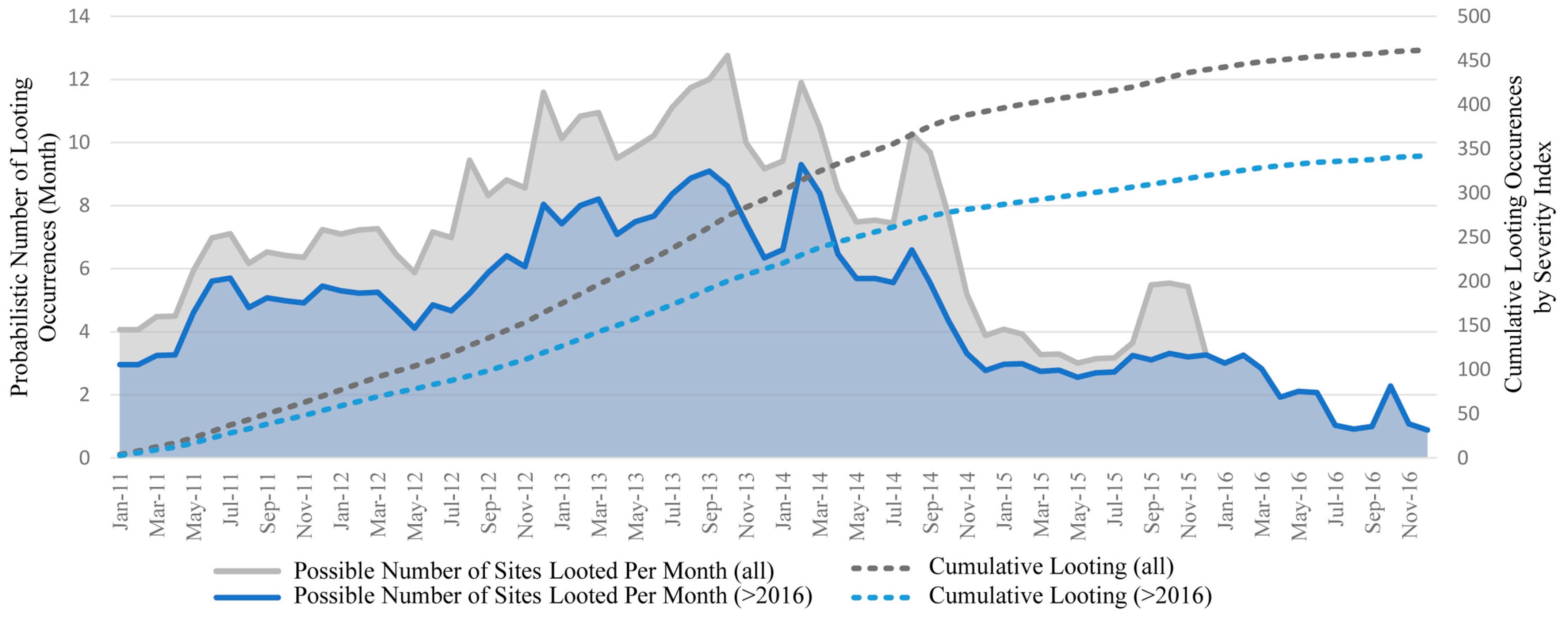
One key result of our previous study concerned the timing of looting events during the course of the war, which suggested a major spike in looting from 2012 to late 2014, with a rapid drop off in looting events after that time (Figure 2). Assessing the timing of looting events is a complex problem because, in some instances, we have only two images of a given site separated by several years, while in other cases, we may have dozens of images, sometimes collected several times per month. This disparity means that for some sites, we can only determine that looting took place within a 4–5-year period, while in other cases, we can know when it occurred within a period of weeks. To account for this challenge, we employed a probabilistic method. First, the cumulative looting at each is assigned a severity score (1 = minor, 2 = moderate, 3 = severe), bracketed by available satellite imagery. We then calculate the probability that the cumulative looting took place within any given month between 2011 and 2016 by dividing the severity index by the number of months over which it may have taken place. For example, if we can determine that a minor looting event (index = 1) took place at some point over a 10-month period, each month in that period is scored as 0.1. The results of this analysis, conducted over our entire sample of observations, enabled us to demonstrate a rapid decline in looting severity and frequency after 2014, with a near cessation of major looting by late 2016 when our initial study concluded. Our current study is in part designed to test this result and evaluate whether looting incidents have continued to decline over the past decade.

2. Materials and Methods

Although the results of our previous research were illuminating in many respects, the war became increasingly entrenched in the years after our study ended in 2016, with little ability by archaeologists or cultural heritage professionals to do much more than decry the destruction. With the fall of the Assad regime in late 2024, and the increasing moves towards normalization of international relationships with the new government of Syria [19], archaeologists from around the world have slowly begun efforts to return to the country. Herein, we present the initial results of a renewed study aimed at assessing the state of archaeological sites in Syria today, providing a tool for future damage assessment and mitigation efforts in the country.

2.1. Imagery Resources

Without access to the Maxar imagery database that formed the basis of our earlier work, we instead rely on publicly available imagery served by Google Earth Pro (Mountainview, CA, USA), supplemented by individual scenes we purchase from private imagery vendors. Fortunately, the quantity and quality of commercial imagery resources has multiplied in recent years, with growing archives available from several satellite programs that were very new or not yet operational in 2016, including the Planet SkySat program (San Francisco, CA, USA), collecting 50–80 cm resolution imagery since 2014, the European Space Agency’s Pleiades-Neo program (Toulouse, France), collecting 30 cm imagery since 2021, and the Chinese Beijing 3C/N program (Beijing, China), collecting 50 cm imagery since 2024. Google has steadily incorporated a growing number of satellite images from these and other vendors and has made accessing this data straightforward using the time-slider tool in Google Earth. For most sites in our study area, these freely available imagery resources are sufficient to provide both a baseline image predating the Syrian war as well as recently acquired imagery.
For key sites where no Google-served imagery is available within the past 12–18 months, we purchase newer imagery. Commercial satellite imagery is much easier to acquire through secondary vendors than it was a decade ago, when high costs and large minimum scene size restrictions would have made purchasing the quantity of imagery required for a study like ours prohibitively expensive. Today, some satellite programs, such as archived 50 cm resolution Pleiades imagery, can be purchased for as little as $10 USD/square kilometer, with no minimum scene size. We utilize purchased commercial imagery for analysis of key sites for which no imagery is freely available from the past 12 to 18 months.

2.2. Archaeological Site Database

Our current study utilizes the same archaeological site database that was employed in our previous research. Rather than providing a comprehensive analysis of all sites in the country, we aim herein to analyze a sample of key sites across different regions of Syria. We began by analyzing all “priority” (PRY) sites from our earlier study that are visible in satellite imagery, which includes those with long-running archaeological excavations, UNESCO World Heritage sites, and nominees for this designation, as well as other notable sites that appear in tourist itineraries and academic publications. We exclude from this analysis sites that were obscured or destroyed by reservoir construction or urban development in the years prior to 2011, as well as those that are individual buildings or monuments whose condition cannot reliably be ascertained by imagery analysis.
We supplement the priority sites with an analysis of sites where we recorded notable episodes of looting or destruction during the earlier years of the Syrian War. Our analysis and other reporting during the period from 2013 to 2016, when the conflict was at its most intense, showed severe, targeted looting at many major sites, including Apamea, Dura Europos, Mari, and others, while other important sites, such as Ebla (Tell Mardikh), Tell Touqan, and Tell Qarqur, saw extreme damage from militarization. Our renewed analysis offers an updated evaluation at many major sites, permitting an assessment of looting and military damage over the past decade. Our current study additionally includes numerous small sites located in areas along the Turkish–Syrian border that were occupied by Turkish-allied forces from 2019 to 2024, where there have been numerous media and scholarly reports of severe damage.

2.3. Imagery Analysis

Analysis of looting and site damage is undertaken following protocols established in our previous research, in which each site in our study is evaluated by a trained analyst and reviewed by a senior team member. Evaluating both Google imagery and recently acquired Pleiades imagery, any observed damage is logged into a database such that results can be queried for specific types of damage, impacts on particular categories of sites, or spatial and temporal analyses of different regions. For the past decade, some researchers have experimented with automating the detection of looting holes using computer-vision technologies [13,14,20] or crowd-sourcing observations of sites through various mechanisms [21]. While both approaches have value, we argue that observations of archaeological site damage are still best undertaken by trained analysts due to the complexity and variability of potential issues, ranging from simple looting holes to construction of military bunkers, to agriculture and earthmoving [5,22]. For this study of modest scale, we employ the same techniques developed in our previous investigations, relying on expert analysts to carefully evaluate sites and log observations within a database that can be queried across a range of dimensions. We provide some basic quantitative assessments herein, but the most significant observations are generally achieved through qualitative analysis.

3. Results and Discussion

In this study, we have analyzed around 200 sites located across all regions of Syria, providing a reasonable sample to assess damage in recent years. Below we outline key observations regarding: (1) “traditional looting,” or the presence of individual holes excavated on sites, (2) “mechanized looting,” a novel form of looting in which sites are systematically bulldozed, (3) “militarization”, seen in the construction of bunkers, dugouts, and other similar installations on sites, and (4) construction or encampments, including those of temporary tents and shelters that provided shelter for displaced refugee populations.

3.1. Traditional Looting

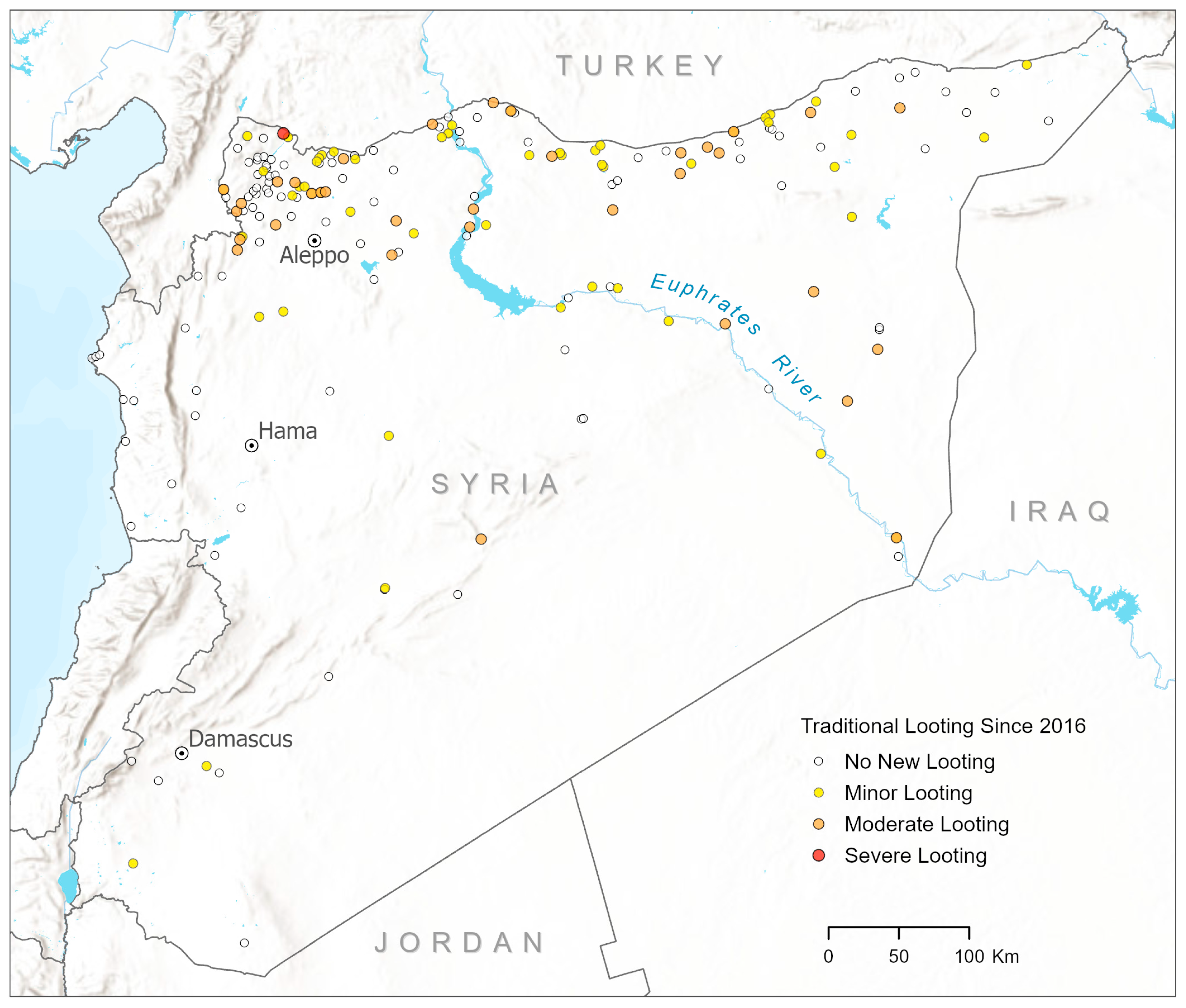
Looting of archaeological sites by individuals or small groups has a very long history in Syria and is a perennial challenge for cultural heritage management in the region. However, the results of our study suggest that the rate of small-scale looting incidents has increased dramatically in recent years. We find evidence of minor (<10 visible holes) or moderate (10–50 visible holes) at 116 of the 199 sites (59%) for which we have observations (Figure 3). This marks a dramatic increase in episodes of looting compared to our previous study, which found 13.4% (355 of 2641) of sites in Syria had evidence of looting from 2011 to 2016. In contrast, looting was found to be extremely rare in northern Iraq, where only 0.2% (two of 825) sites were looted during this same time period, despite being occupied by ISIS for several years, and southern Turkey, where only 1.4% of sites (six of 424) were looted (Figure 1). The rapid increase in the frequency of small-scale, traditional looting is likely related to the absence of police enforcement of laws against looting, combined with the desperate situation most Syrians found themselves facing over the past decade. It also illustrates the ongoing challenge of managing looting in Syria, where the practice appears to have become very common and geographically widespread. We can only hope that as the economic and security situation in the country improves, and as normal policing returns, the frequency of site looting will decrease to the modest levels seen in the years prior to the war.
Although incidents of small-scale looting have proliferated, we find that the severe, organized looting campaigns that characterized earlier years of the war appear to have largely ended prior to 2020. Our previous work documented severe looting of major sites from 2012 to 2016, particularly along the lower Euphrates River, in the Balikh Valley and Raqqa area, the headquarters of ISIS, and in Syrian regime-held areas in western Syria north of Hama (Figure 1). These cases of severe looting were characterized by hundreds or thousands of holes, often larger than those seen at sites with minor looting, evidently dug using machinery and a sizable labor force. Many sites that were targeted in these looting campaigns saw a gradual diminishment of damage in recent years.
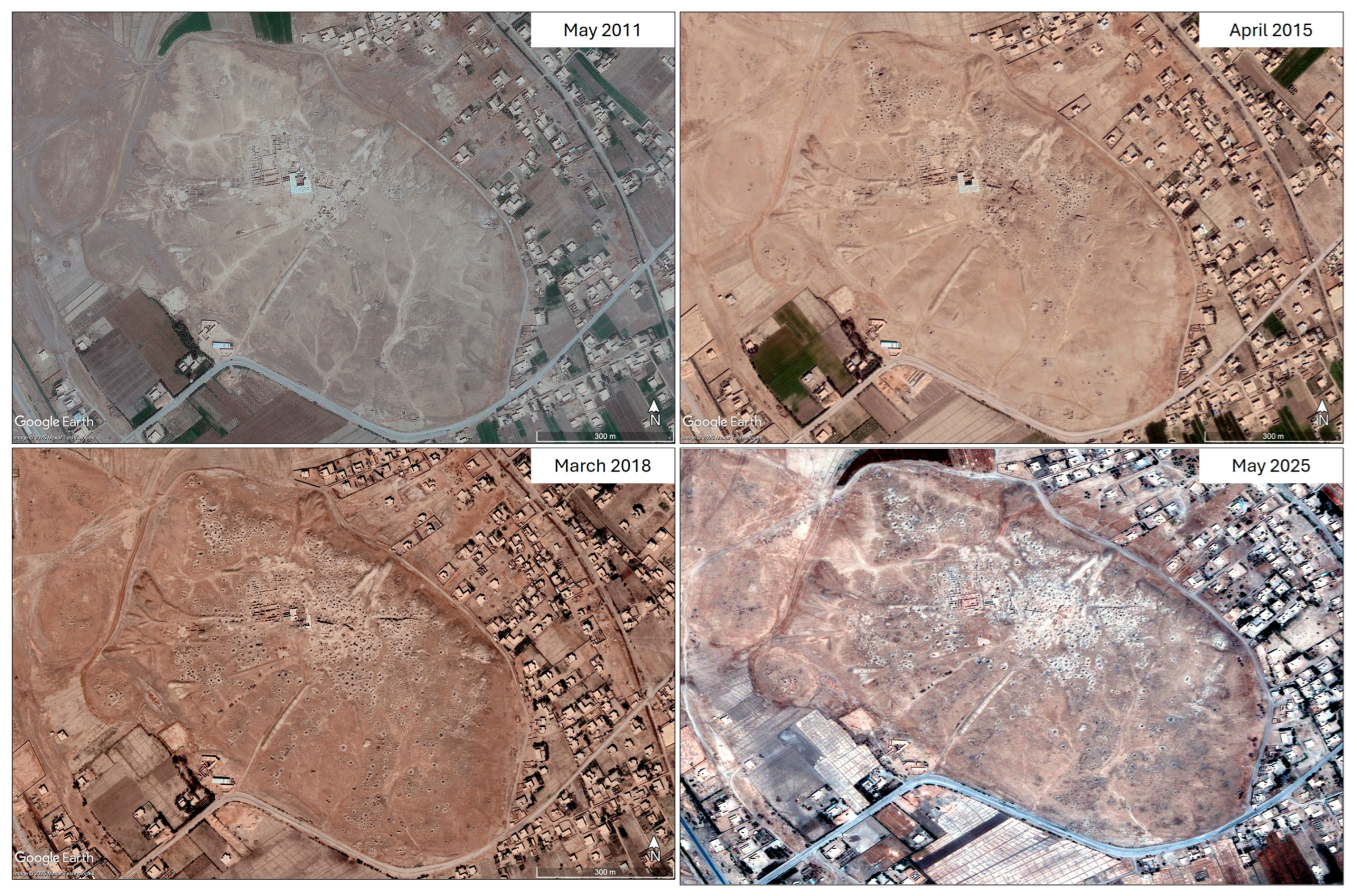
For example, at the well-known Bronze Age site of Mari, on the Euphrates River near the Iraqi border, severe looting took place between 2015 and 2018 (Figure 4). An image from May 2011 shows the site undamaged at that time, with excavated palatial building remains visible around a shelter built to protect a portion of Zimri-Lim’s palace from the early second millennium BC. In April 2015, however, hundreds of looting holes were visible across mounded areas of the site. By March 2018, the number and size of looting holes had increased considerably, covering most of the site area, and the protective structure was largely destroyed. However, in imagery from October 2022 to May 2025, no new looting holes are visible, and many of the decade-old holes have begun to infill and erode.
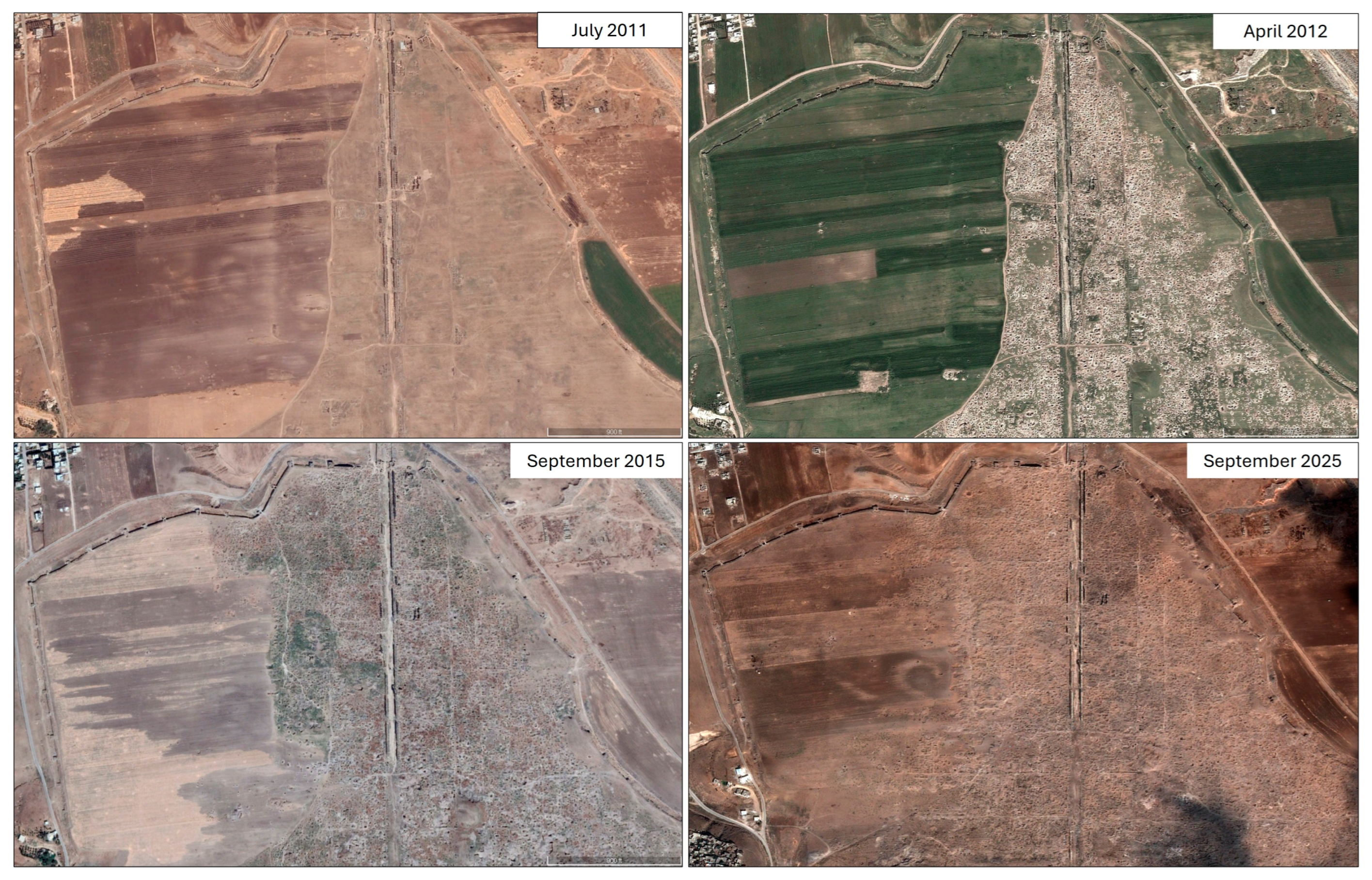
Likewise, at the major Roman site of Apamea, extreme looting was recognized as early as April 2012, with thousands of looting holes dug across the massive ancient city (Figure 5). Initial looting at Apamea was contemporary with the Syrian military occupation of the site and was confined to government-owned areas, with the privately-owned northwestern third of the site left mostly untouched. By September 2015, looting had expanded into the northwestern area, but in controlled hectare-sized blocks, suggesting it was part of a coordinated looting program. Imagery from December 2020 to September 2025 shows only a small number of new looting holes since 2015, infilling looted areas in the government-owned part of the site and occasionally encroaching on private fields or outside the city walls. But for the most part, major looting of Apamea appears to have ceased by 2016.

3.2. Mechanized Looting

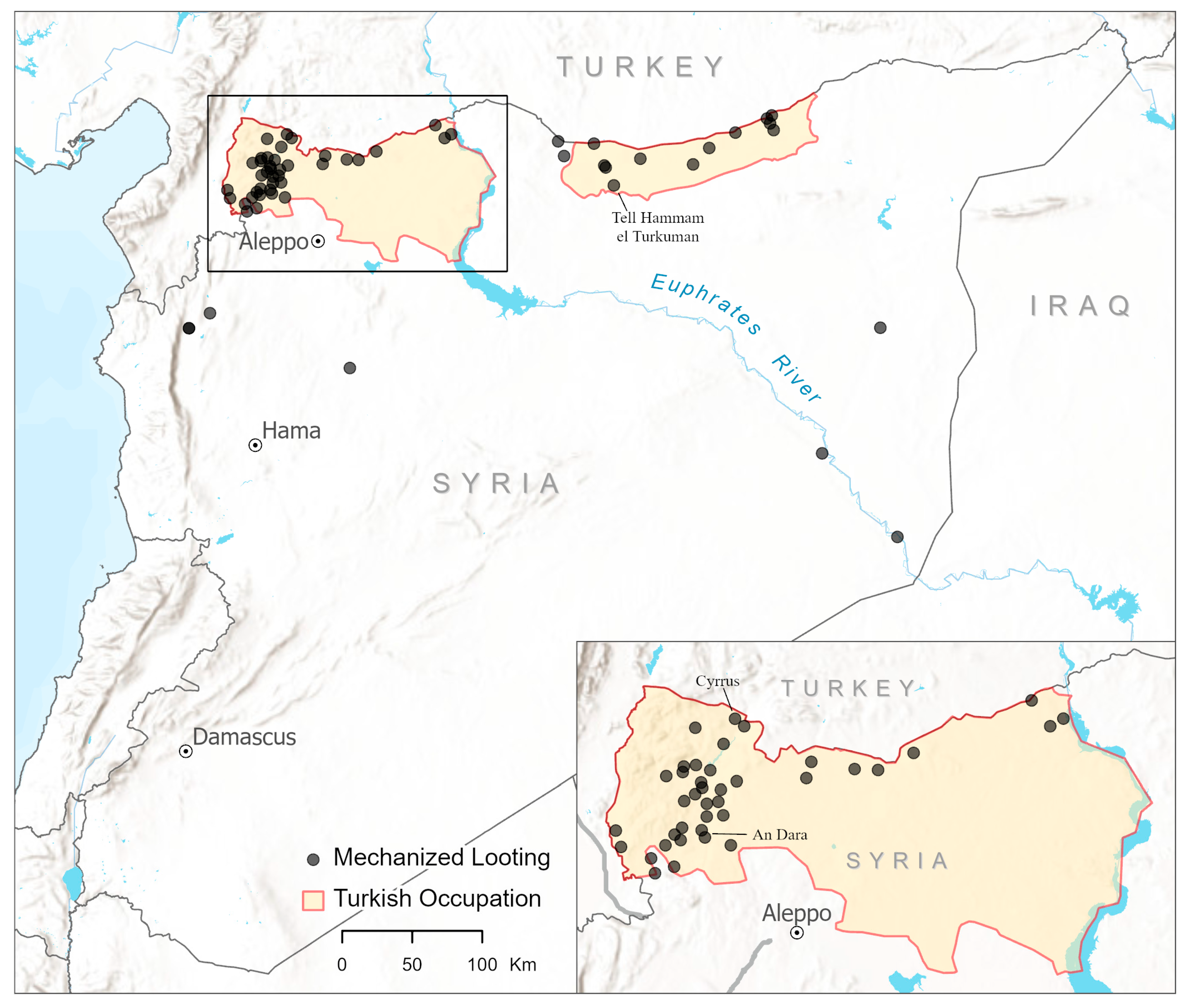
One of the most disturbing findings of our current study concerns the proliferation of a relatively novel form of site destruction that we term mechanized looting, in which large parts of major sites have been destroyed by earthmoving, evidently in hopes of recovering salable artifacts. In the earlier years of the war, we observed rare instances of mechanized earthmoving that appeared to have been driven by artifact recovery, rather than for agriculture or construction, as at Tell Bi’a [5]. However, beginning in late 2018, several areas of northern Syria, including the Afrin Valley and a Kurdish-dominated region around the town of Kobane, were occupied by the Turkish military and their local allied militias [23]. In these same areas, a large number of archaeological sites subsequently suffered extreme damage from mechanized looting, evidently undertaken in coordination with or under the protection of military forces (Figure 6). Media reports by local observers, as well as by cultural heritage professionals working with Kurdish communities in the region, have already documented extensive damage to archaeological sites in the Afrin Valley that took place following Turkish occupation, including bulldozing at the major Roman and early medieval site of Cyrrhus [24], military occupation at Tell Gindaris [25], and looting of numerous other mounded sites [26]. Our new evidence shows how widespread these activities were and provides conclusive documentation of the enormous scale of mechanized looting damage (Figure 5).
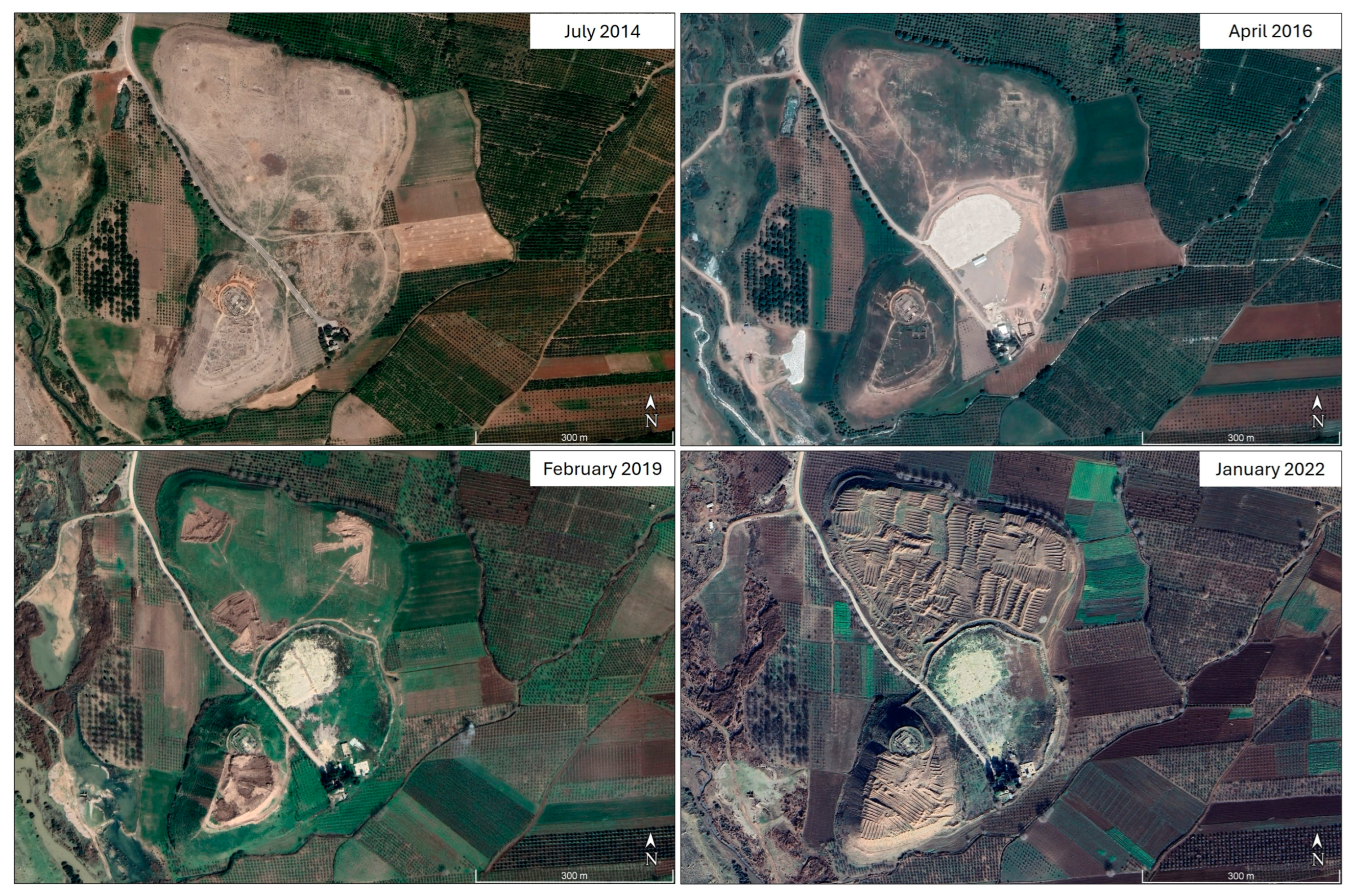
Perhaps the most widely reported incident concerns military damage to the site of Ain Dara in the Afrin Valley, which is best known for its major Iron Age city [27] with excavations revealing a large temple complex with notable statuary and other artworks [28]. In early 2018, this early first millennium BC temple was badly damaged by shelling [29], and subsequently, a monumental stone lion statue was stolen from the site and brought to Turkey [30]. Our analysis shows that as of July 2014, the site showed no evidence of war-related damage, as a circular temple complex was clearly visible on the high mound, and the lower tell remained agricultural or uncultivated, as it had been for decades prior (Figure 7). However, by April 2016, a large military installation was under construction in the southeastern part of the site, with an earthen berm bulldozed to create an enclosure, while several buildings were under construction adjacent to the old farmhouse and excavation storage facility, reportedly by a Turkish-backed Syrian militia group [30] In imagery from February 2019, we can observe the first evidence of mechanized looting, with massive bulldozing scars across the high mound, and in three different areas of the low mound as the military compound was expanded. By January 2022, the entirety of the high and low mounds, with the exception of the stone-built temple complex itself, had been bulldozed, while the military complex appears dilapidated and possibly abandoned.
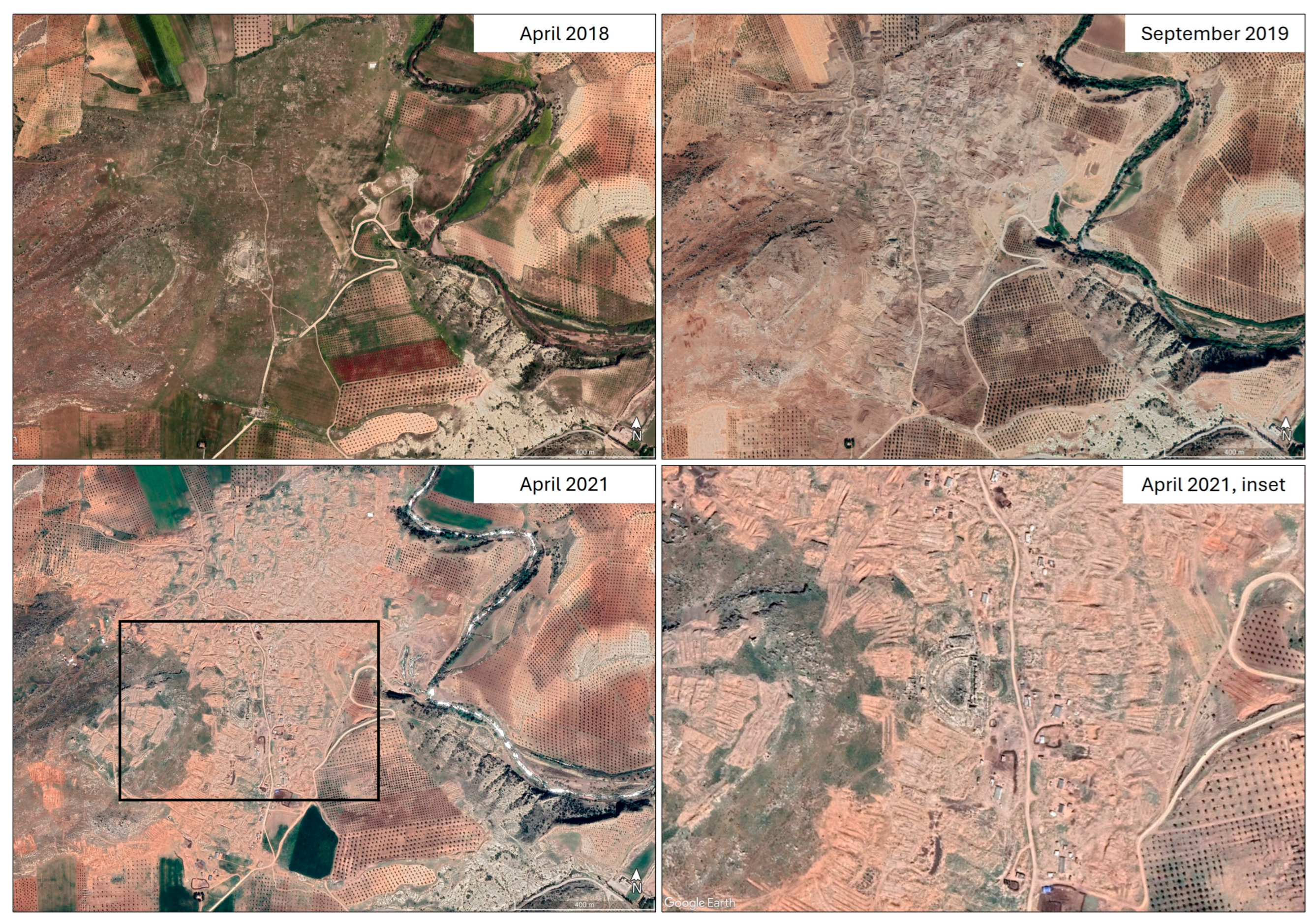
Similarly, at the site of Cyrrhus, a major Hellenistic, Roman, and early medieval site, with an excavated theater, temples, and other monuments [31,32], there was little visible evidence of looting in earlier years of the war (Figure 8). However, in June 2018, numerous small looting holes appeared across the site for the first time, corresponding chronologically with reports of military occupation at the site [24]. Then, in July 2019, we see the first evidence of systematic bulldozing in the center of the ancient city, as the scale of new occupation by apparent military forces expanded in an area just west of the main archaeological remains. By October 2020, the entire site had been destroyed by bulldozing, with photos showing looters posing with mosaics and other artifacts, allegedly from Cyrrhus, circulating widely on social media.
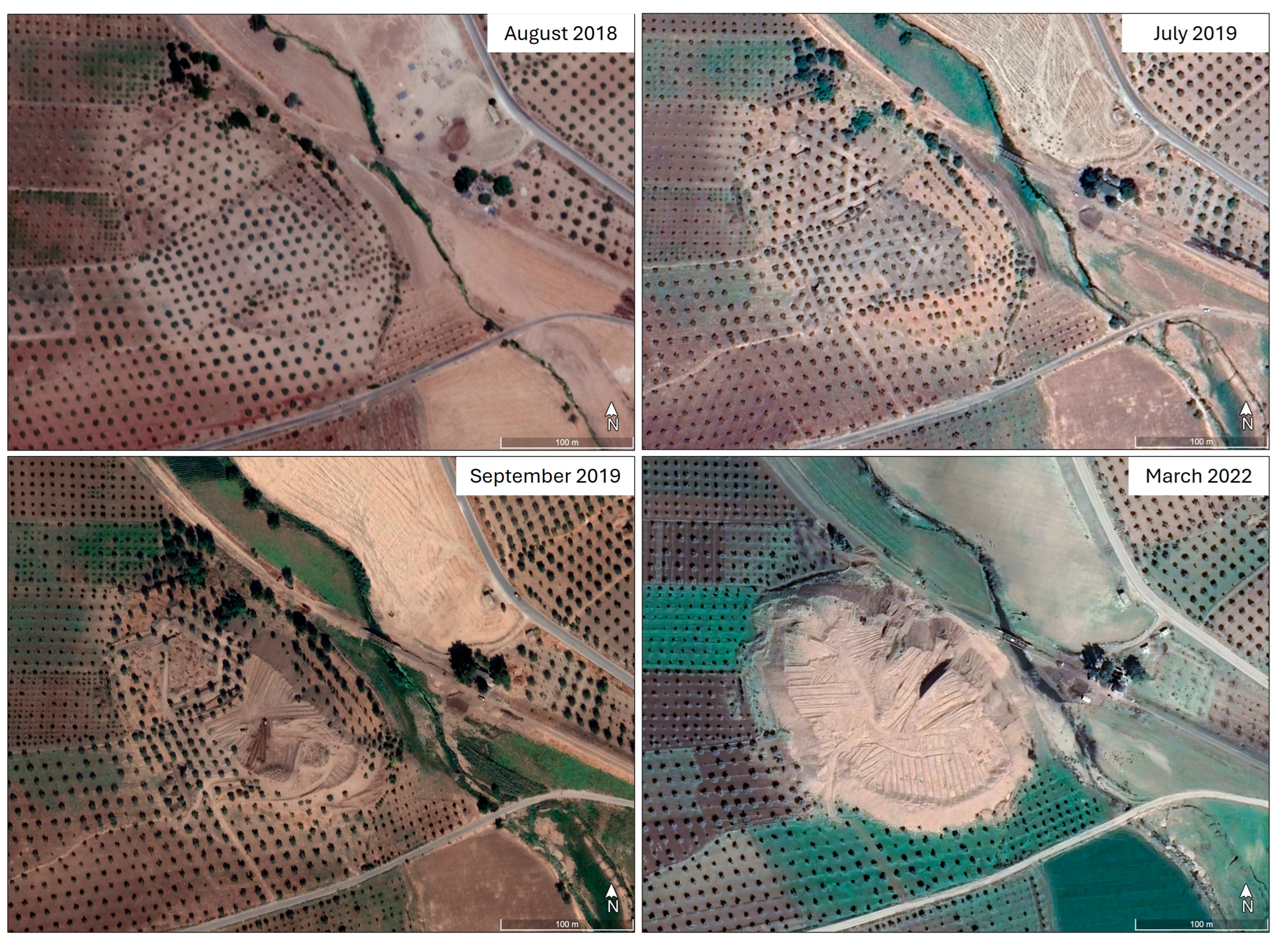
Our analysis shows that mechanized looting was not limited to major sites like Ain Dara and Cyrrhus, but in fact most mounded archaeological sites throughout the entire Afrin Valley area were severely damaged by systematic bulldozing between 2019 and 2022. For example, a modestly sized, unpublished site, labeled CRN 4715 in our database, is situated within a mature olive orchard. As of August 2018, the site was still undamaged, and trees were growing across several parcels that include the mound (Figure 9). However, in July 2019, we can observe the first bulldozing scars cut into the site between tree rows. By September 2019, trees had been destroyed across the top of the mound, replaced with bulldozing scars; in this case, the bulldozer itself was caught in action on the satellite image, plowing the site. By the time the next available image was captured, in March 2022, the entire site had been bulldozed, and all of the olive trees that once grew on the mound had been removed. The destruction of the olive orchard, which requires decades to become productive, aligns with media reports of widespread looting and destruction during the period of Turkish and allied military occupation of the Afrin region.
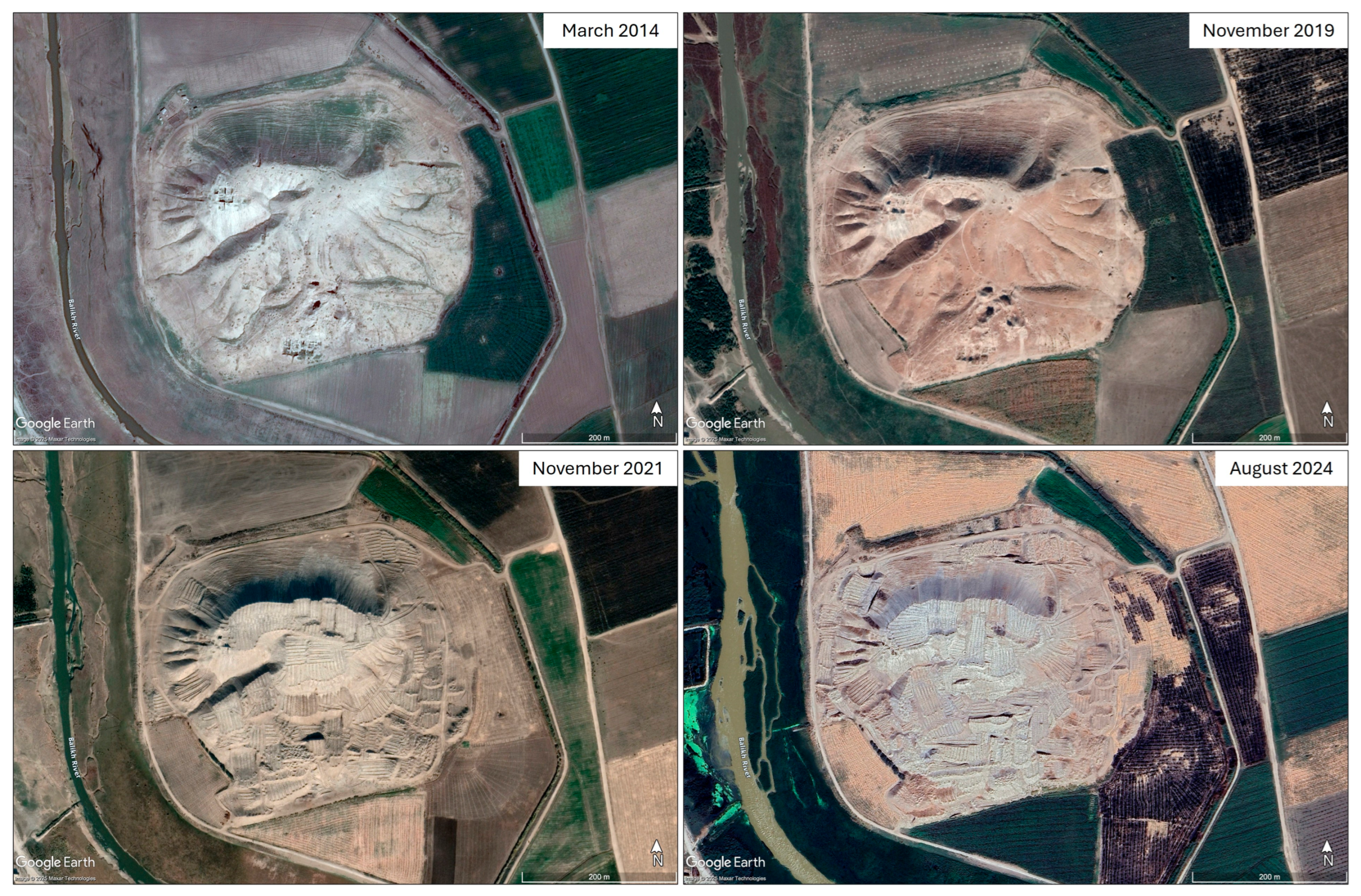
These same kinds of bulldozing activities are found with similar frequency in the Kobane area to the east of Afrin, also occupied by Turkish military and allied forces from 2019 to 2024 (Figure 6). Although looting and military damage to sites in the Kobane region are more rarely reported in international media, the situation is equally dire. For example, the well-known site of Hammam-et Turkman in the Balikh Valley north of Raqqa, with a long history of occupation from the fourth to second millennia BC [33] experienced modest looting earlier in the war [5]. Imagery from March 2014, when looting was extremely common in this region, reveals dozens of small looting holes across much of the high mounded portion of the site, but by November 2019, relatively little change is evident (Figure 10). However, by November 2021, most of the mound was severely bulldozed in a series of methodical combing patterns. These activities continued to expand after February 2022 through August 2024, when remaining areas of the lower mound slopes and surrounding fields were similarly bulldozed.
Mapping the severity of mechanized looting across Syria reveals the intensity of these activities within the two main areas of Turkish military occupation in the Afrin Valley and the Kobane region (Figure 5). The number of sites damaged in this manner and the scale of the destruction are unlike anything we documented in the early years of the war, and pose a major challenge to future mitigation efforts.

3.3. Militarization

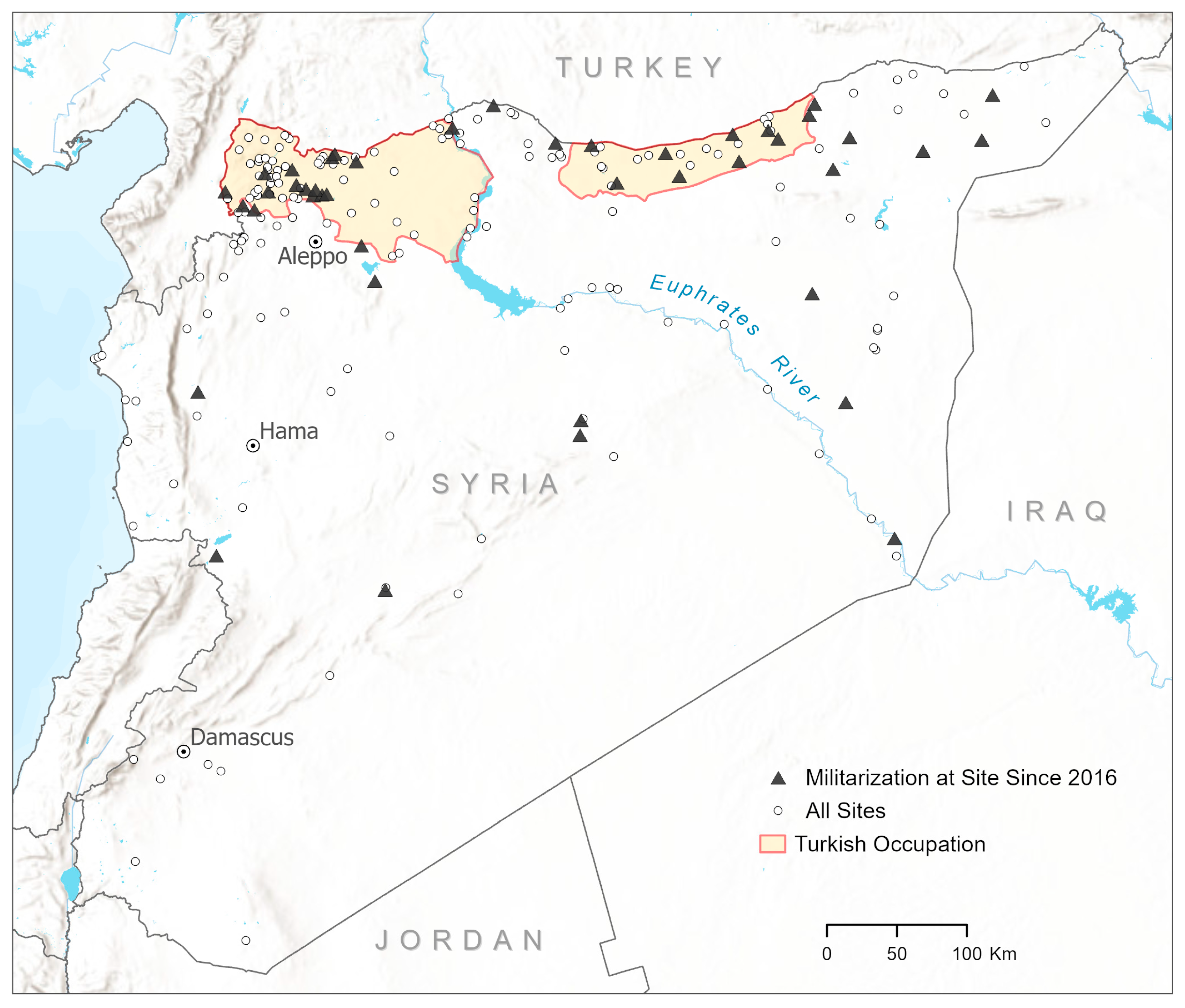
Aside from looting, perhaps the most damaging process impacting sites in Syria during the war was the militarization of sites to create fortified camps, bunkers, and emplacements for tanks or artillery. Large and prominent archaeological sites are typically the remains of ancient cities, and these fortified citadels were usually situated in strategic geographic locations, today forming high points overlooking plains and mountains. As such, archaeological sites are disproportionately targeted by modern militaries seeking to fortify high ground and control movement across terrain. In the early years of the war, many sites were severely damaged by militarization, often in conjunction with looting. In the years since 2017, many sites continued to see extreme damage from military activities.
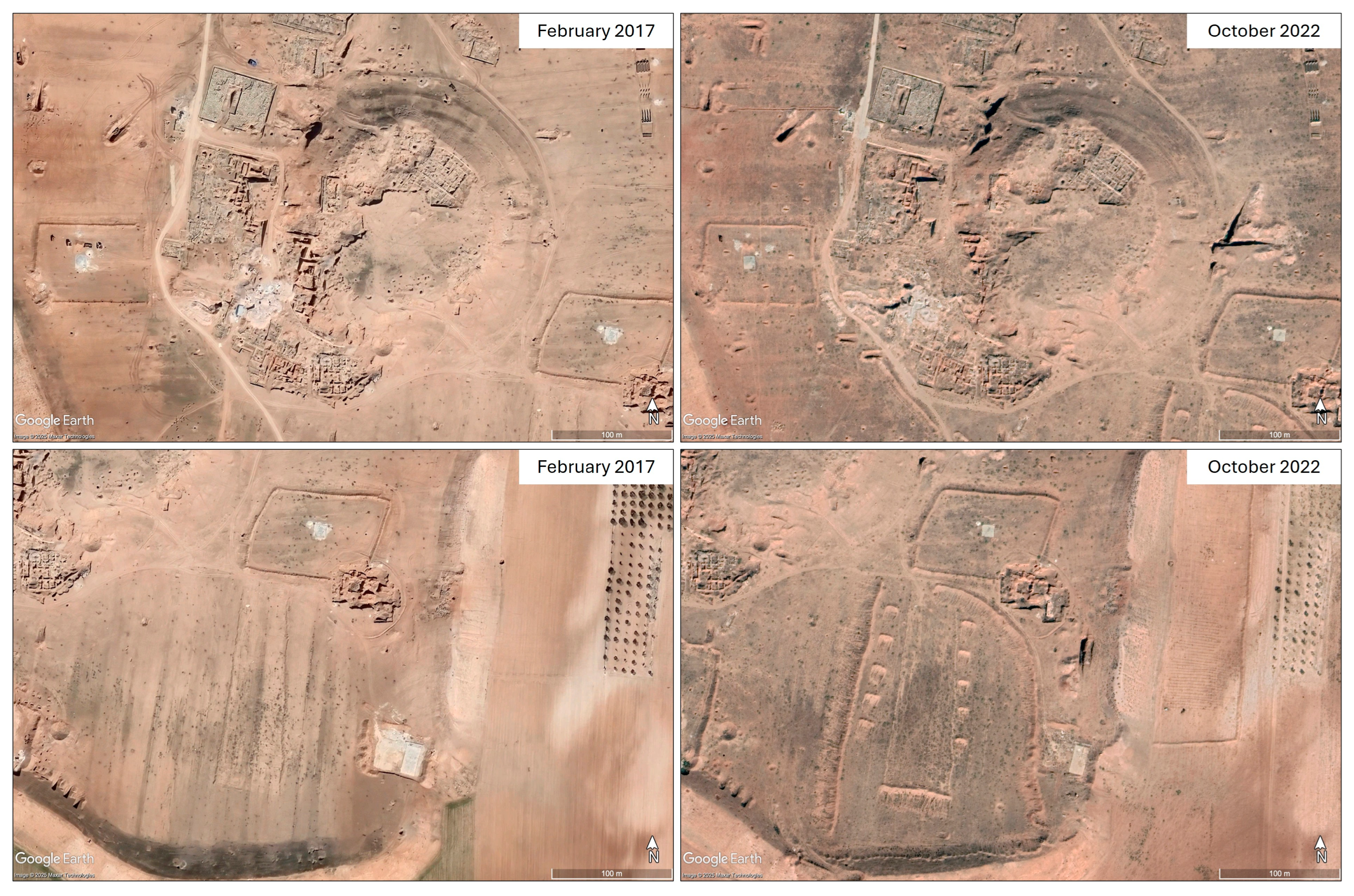
For example, the major site of Ebla (Tell Mardikh) in western Syria is renowned for extensive remains of palatial buildings, cuneiform archives, and rich material culture, dating to the later third and second millennia BC [34]. But the topography of the site also forms a desirable location for military encampment because the ancient city is surrounded by the eroding remains of mudbrick walls that still stand up to 20 m in height (Figure 11). The site was first occupied by military forces in 2012, and a 2014 image revealed the construction of several fortified compounds inside the ancient city walls. Military activities at the site steadily increased over subsequent years, such that by February 2017, the entire interior of the site was badly scarred by dozens of fortified compounds, tank and artillery dugouts, and even the remains of a soldier training grounds with a long obstacle course. An October 2022 image revealed that military activities continued to intensify until that time, while a large number of looting holes were excavated on the high mound and in surrounding areas, adjacent to and sometimes within military areas.
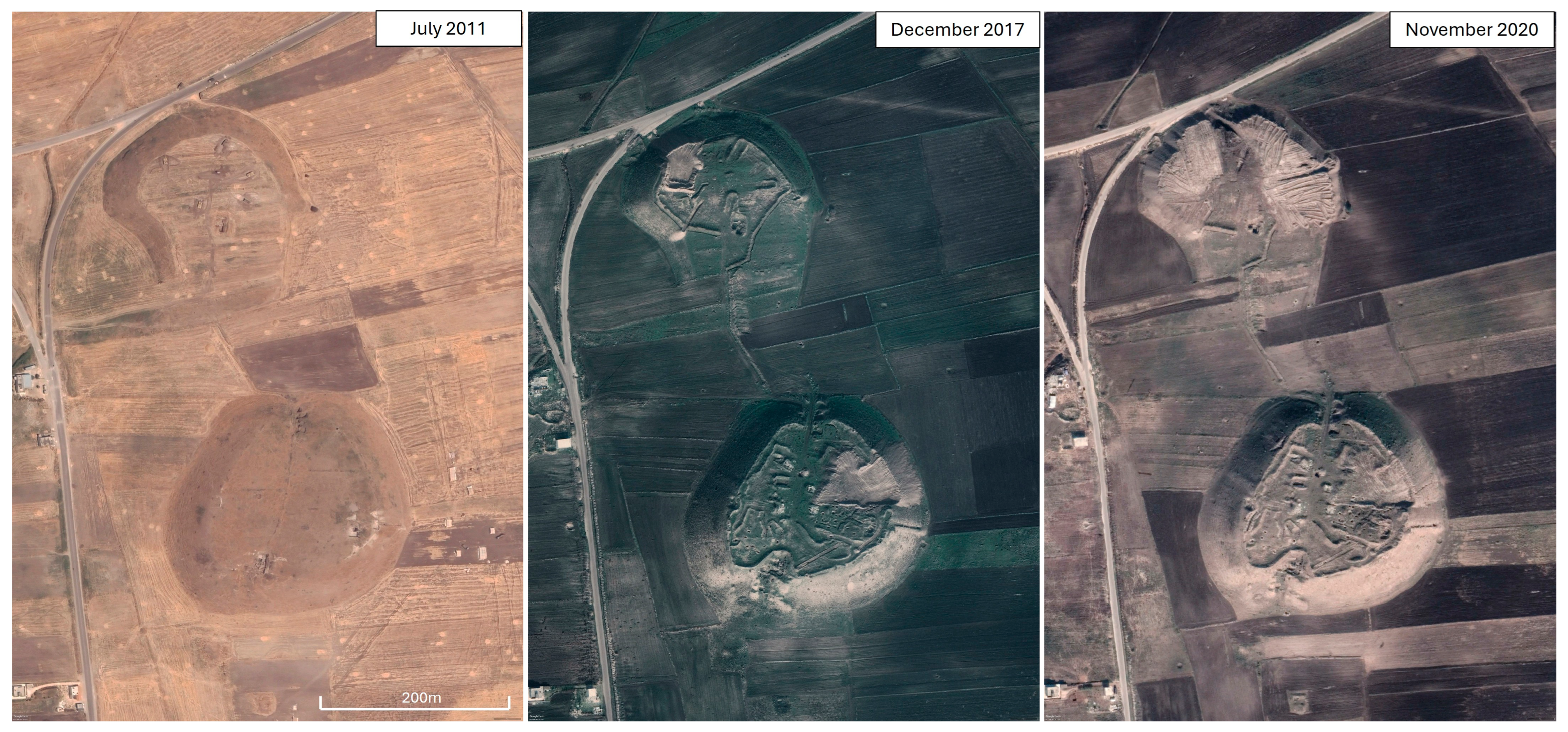
Many other prominent mounded sites were similarly fortified during the war. At Tell Qarqur in the Orontes Valley of western Syria [35], the site saw the first military occupation in 2011, near the start of the conflict in Syria [6], but by December 2017, a large military installation had been constructed, destroying much of the site, while looting holes appeared across the high mound (Figure 12). Then, between December 2019 and May 2020, the entire lower mound and portions of the high mound were bulldozed in a manner similar to that documented in other parts of northern Syria, perhaps as a looting operation. Similar patterns of damage from militarization of mounded sites can be found across all parts of Syria (Figure 13), and will be an ongoing challenge for mitigation efforts, as they frequently involve disposal of unexploded ordinance and toxic substances left behind by military occupation.

3.4. Construction and Encampments

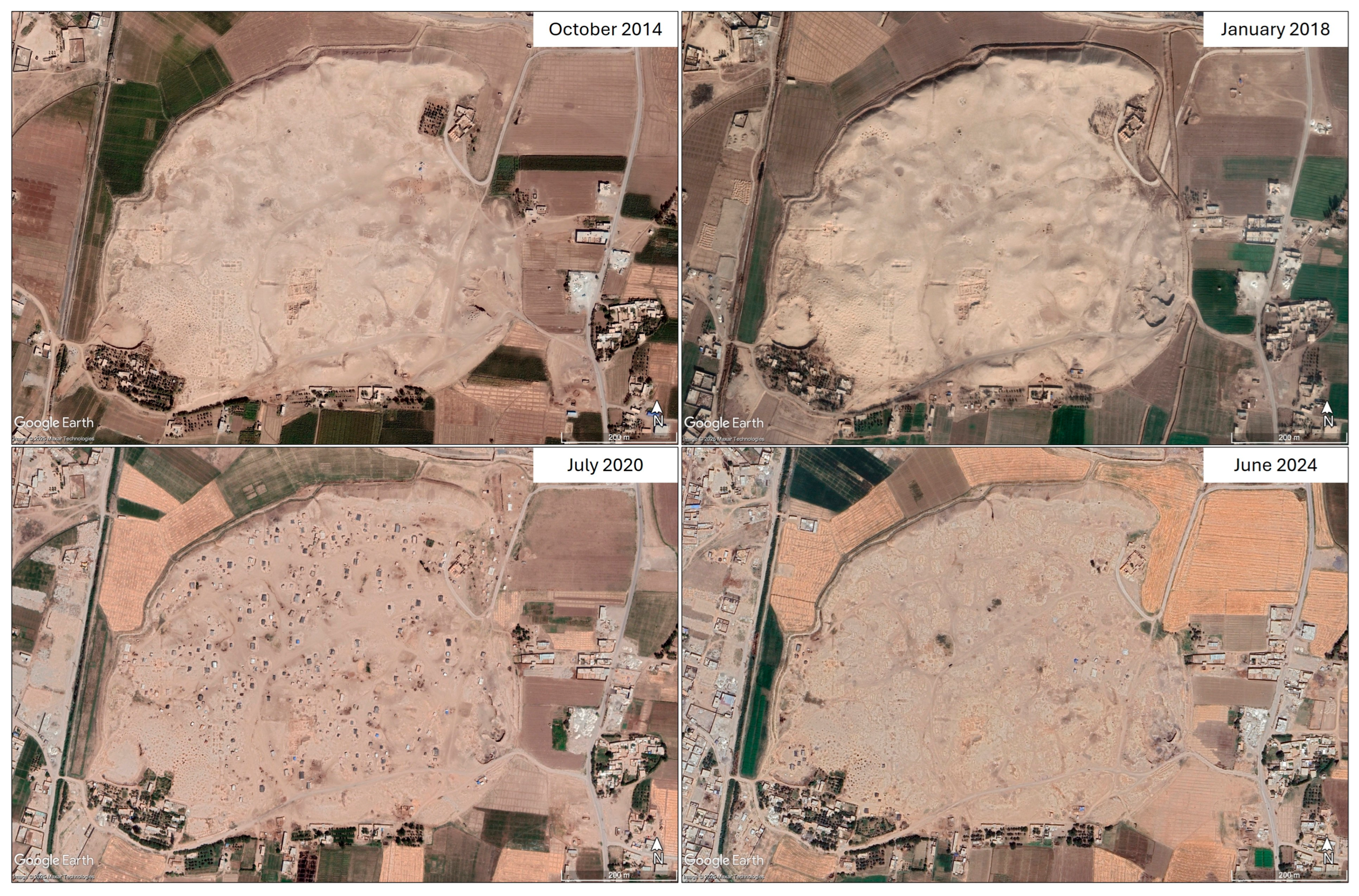
With the massive displacement of civilian populations across Syria, the region witnessed one of the worst refugee crises in the modern era, with more than 14 million civilians displaced and 16 million in the country in dire need of support [36]. While our analysis is focused on the impacts of the war and its aftermath on archaeological sites, we often observe an intersection with the larger humanitarian crisis. Notably, many archaeological sites became loci for expansive refugee encampments during the later years of the war. For example, at Tell Bi’a, a major Bronze Age site that was historically known as Tuttul, located just east of Raqqa [37], our earlier study documented extensive damage [5]. A long history of looting in the decades prior to the war had targeted a Roman and early medieval cemetery, but during the early years of the conflict, many more looting holes appeared across the site, and eventually large portions of the site were removed in what appears to have been an early form of mechanized looting described above (Figure 14). While looting at the site subsided in recent years, sometime between January 2018 and July 2020, a large refugee encampment was built on the site, with over 120 tents visible. By June 2024, the encampment was gone, but the site suffered significant damage from this occupation. Similar incidents of damage from refugee encampments and other war-related occupations are found at many other sites, including, for example, at Qara Keirpu and Mashnaqa, as well as throughout the upland areas of western Syria.

4. Conclusions

The analysis reported herein has sought to provide an update to our previous research, using satellite imagery to monitor looting and other forms of archaeological site damage taking place in the context of the Syrian civil war [5,7]. Utilizing both freely available and commercial satellite imagery resources, we analyzed a sample of 200 archaeological sites located in all regions of Syria. Our results offer several notable findings that will be of interest to archaeologists and cultural heritage professionals, within Syria and beyond.
Our study suggests there has been a significant increase in small-scale looting of archaeological sites across most regions of Syria. Our previous research indicated a gradual decline in the frequency and severity of looting incidents from 2014 to 2016, and we hoped that this trend might have continued. However, our new data indicates a rapid increase in the rate of looting in recent years, such that looting incidents are now more widespread than at any point during the Syrian conflict. The resurgence in looting may be related in part to the decrease in military conflict in many regions, as well as to the desperate situation in which many Syrians find themselves. Although most looting activities remain small in scale, stemming the tide of looting will require vigilance on the part of cultural heritage and antiquities officials in Syria, economic recovery for the people of Syria, and education regarding the importance of these sites and the artifacts they contain.
The extraordinary scale of mechanized looting damage to dozens of major sites across northern Syria is perhaps the most disturbing finding from our study. Although previous observations had reported on the bulldozing of several major sites in Turkish-occupied parts of Syria from 2019 to 2024, the true scale of these activities, impacting nearly every major archaeological site in the entire region, has not previously been recognized. Turkish military forces bear much responsibility for enabling or allowing such destruction to take place during their occupation of these regions. This destruction poses a major challenge to mitigation efforts, as the bulldozing of sites has likely peeled away meters of archaeological deposits from the sites. Mounded archaeological sites tend to form external layers of soil that are heavily bioturbated by plants and animals and disturbed by agriculture. These outermost levels of mounded sites also usually contain remains of relatively recent occupation, burials, or trash dumps. Removal of these protective layers from archaeological sites renders their interior, generally older levels of occupation with better preservation, exposed at the surface and vulnerable to continued destruction or looting. Mitigation efforts in Syria, once underway, should prioritize damage assessments at these many bulldozed sites, documenting newly unearthed stratigraphy, architecture, and artifacts that now undoubtedly litter the surface.
The methods employed in this study, involving expert analysis of 2D optical imagery, are quite straightforward, as we sought to build on the results of our research a decade ago by using the same methodology. However, some aspects of the current study could be undertaken through automated, computer-vision-based approaches, particularly with the growing power of AI-based methods in remote sensing. Although the complexity of various types of damage we observe would be difficult to capture without human analysis, some forms of damage, such as traditional looting holes, are more readily amenable to automated discovery, and recent studies have successfully detected them using computer vision technologies [14,38]. Other complex forms of damage could potentially be captured through more generalized change-detection algorithms [15], helping to focus assessments by human analysts on sites that have seen some significant change in land use or land cover. Future research in these areas should seek to develop protocols for automated damage detection of archaeological site damage, for example, by continuously evaluating new imagery when it is posted on Google Earth. A formal collaboration with a satellite imaging company or with a government agency that has access to a large imagery database would likewise enable observations of damage in near real time, potentially facilitating policing of sites outside of war zones.
As the country emerges from its long civil war, Syria faces extraordinary challenges in providing basic necessities to much of its population and rebuilding critically damaged infrastructure, and these efforts clearly need to be prioritized. However, the state of archaeological sites and monuments in Syria is also dire, with extreme damage across the entire country, and management of these irreplaceable cultural heritage resources should be a part of the rebuilding process. To help mitigate damage from the war, international agencies and foreign governments should provide aid, expertise, and other forms of material support to the cultural heritage professionals working in Syria today. While a handful of archaeologists have recently resumed conventional excavations in Syria, the observations we report herein, building on those from other investigations, highlight the more pressing challenge of undertaking basic damage assessment and mitigation efforts. This important work will help to safeguard the rich archaeological heritage of Syria, offering a key source of national pride and an important economic resource for future generations in the country.

Author Contributions

Conceptualization, J.C.; methodology, J.C.; formal analysis, J.C., J.A.C., M.L., and C.F.; investigation, J.C., J.A.C., M.L., and C.F.; resources, J.C.; data curation, C.F. and J.A.C.; writing—original draft preparation, J.C.; writing—review and editing, J.A.C. and C.F.; visualization, J.A.C., M.L., and C.F.; supervision, J.C.; project administration, J.C.; funding acquisition, J.C. All authors have read and agreed to the published version of the manuscript.

Funding

This research was funded by grants from the Dartmouth Initiative for Middle East Exchange (DIMEX) and Schmidt Sciences, LLC (G-25-69315).

Data Availability Statement

No new data were created in this project. All analyses were undertaken using publicly available imagery resources and site locational information.

Conflicts of Interest

The authors declare no conflicts of interest.

Abbreviations

The following abbreviations are used in this manuscript:
ASORAmerican Schools of Overseas Research
CHICultural Heritage Initiative
PRYsWell-known (priority) archaeological sites examined in our study
PUBsPublished, but lesser known, archaeological sites examined in our study
CRNsArchaeological sites identified only in satellite imagery examined in our study

References

  1. Lasaponara, R.; Leucci, G.; Masini, N.; Persico, R. Investigating Archaeological Looting Using Satellite Images and GEORADAR: The Experience in Lambayeque in North Peru. J. Archaeol. Sci. 2014, 42, 216–230. [Google Scholar] [CrossRef]
  2. Contreras, D.A. ‘Huaqueros’ and Remote Sensing Imagery: Assessing Looting Damage in the Virú Valley, Peru. Antiquity 2010, 84, 544–555. [Google Scholar] [CrossRef]
  3. Parcak, S.; Gathings, D.; Childs, C.; Mumford, G.; Cline, E. Satellite Evidence of Archaeological Site Looting in Egypt: 2002–2013. Antiquity 2016, 90, 188–205. [Google Scholar] [CrossRef]
  4. Stone, E.C. Patterns of Looting in Southern Iraq. Antiquity 2008, 82, 125–138. [Google Scholar] [CrossRef]
  5. Casana, J.; Laugier, E.J. Satellite Imagery-Based Monitoring of Archaeological Site Damage in the Syrian Civil War. PLoS ONE 2017, 12, e0188589. [Google Scholar] [CrossRef]
  6. Casana, J.; Panahipour, M. Notes on a Disappearing Past: Satellite-Based Monitoring of Looting and Damage to Archaeological Sites in Syria. J. East. Mediterr. Archaeol. Herit. Stud. 2014, 2, 128–151. [Google Scholar]
  7. Casana, J. Satellite Imagery-Based Analysis of Archaeological Looting in Syria. Near East. Archaeol. 2015, 78, 142–152. [Google Scholar] [CrossRef]
  8. Fisher, M.; Fradley, M.; Flohr, P.; Rouhani, B.; Simi, F. Ethical Considerations for Remote Sensing and Open Data in Relation to the Endangered Archaeology in the Middle East and North Africa Project. Archaeol. Prospect. 2021, 28, 279–292. [Google Scholar] [CrossRef]
  9. Mamo, A.R.; Ibraheem, I.M.; Al Kassem, A.; Al-Khalil, A.; Hopper, K. The Impact of the Syrian Conflict on Archaeological Sites in Al-Hasakah Province. J. Archaeol. Sci. Rep. 2022, 43, 103486. [Google Scholar] [CrossRef]
  10. Al Kassem, A.; Hopper, K.; Ibraheem, I.M.; Maier, A.; Nassrallah, M.K.; Richter, J. Archaeological Damage Assessment in Conflict Zones: Integrating Satellite Imagery and Ground Surveys in Daraa, Syria. Archaeol. Prospect. 2025, 32, 813–826. [Google Scholar] [CrossRef]
  11. Abou AlJoud, S.; AlSayed, G. Experts Return to Syria’s War-Torn Heritage Sites, Including Roman Ruins at Palmyra. PBN News, 17 February 2025. Available online: https://www.pbs.org/newshour/world/experts-return-to-syrias-war-torn-heritage-sites-including-roman-ruins-at-palmyra (accessed on 17 May 2026).
  12. Oguz, K. Unearthing the Birthplace of the Alphabet: Archaeologists Return After 14 Years of Silence. Arkeonews. 2025. Available online: https://arkeonews.net/unearthing-the-birthplace-of-the-alphabet-archaeologists-return-after-14-years-of-silence/ (accessed on 17 May 2026).
  13. Lauricella, A.; Cannon, J.; Branting, S.; Hammer, E. Semi-Automated Detection of Looting in Afghanistan Using Multispectral Imagery and Principal Component Analysis. Antiquity 2017, 91, 1344–1355. [Google Scholar] [CrossRef]
  14. Vincent, E.; Saroufim, M.; Chemla, J.; Ubelmann, Y.; Marquis, P.; Ponce, J.; Aubry, M. Detecting Looted Archaeological Sites from Satellite Image Time Series. arXiv 2024, arXiv:2409.09432. [Google Scholar] [CrossRef]
  15. Mahmoud, A.M.A.; Sheldrick, N.; Ahmed, M. A Novel Machine Learning Automated Change Detection Tool for Monitoring Disturbances and Threats to Archaeological Sites. Remote Sens. Appl. Soc. Environ. 2024, 37, 101396. [Google Scholar] [CrossRef]
  16. Casana, J. Global-Scale Archaeological Prospection using CORONA Satellite Imagery: Automated, Crowd-Sourced, and Expert-led Approaches. J. Field Archaeol. 2020, 45, S89–S100. [Google Scholar] [CrossRef]
  17. Stenersen, M.; Lenerte, G. Advent International’s $6.4bn Acquisition of Maxar Technologies. MergerSight. 9 January 2023. Available online: https://www.mergersight.com/post/advent-international-s-6-4bn-acquisition-of-maxar-technologies#:~:text=Company%20Details%20(Target%20%2D%20Maxar%20Technologies,285%20Maxar%2Dbuilt%20spacecraft%20launches (accessed on 17 May 2026).
  18. Casana, J. Remote Sensing-Based Approaches to Site Morphology and Historical Geography in the Northern Fertile Crescent. In New Agendas in Remote Sensing and Landscape Archaeology in the Near East. Studies in Honour of Tony J. Wilkinson; Archaeopress: Oxford, UK, 2020; pp. 154–174. [Google Scholar]
  19. Solomon, E.; Hubbard, B. As U.S. Warms Ties with Syria, What Does It Expect? The New York Times, 1 July 2025. Available online: https://www.nytimes.com/2025/07/01/world/europe/syria-sanctions-trump.html (accessed on 17 May 2026).
  20. Bowen, E.F.W.; Tofel, B.B.; Parcak, S.; Granger, R. Algorithmic Identification of Looted Archaeological Sites from Space. Front. ICT 2017, 4, 4. [Google Scholar] [CrossRef]
  21. Parcak, S.; Mumford, G.; Childs, C. Using Open Access Satellite Data Alongside Ground Based Remote Sensing: An Assessment, with Case Studies from Egypt’s Delta. Geosciences 2017, 7, 94. [Google Scholar] [CrossRef]
  22. Casana, J. Rethinking the Landscape: Emerging Approaches to Archaeological Remote Sensing. Annu. Rev. Anthr. 2021, 50, 167–186. [Google Scholar] [CrossRef]
  23. Human Rights Watch. Syria: Abuses, Impunity in Turkish-Occupied Territories. 2024. Available online: https://www.hrw.org/news/2024/02/29/syria-abuses-impunity-turkish-occupied-territories (accessed on 17 May 2026).
  24. Neurdenburg, D. Archaeological Heritage Crimes in Occupied Afrin. Center for Kurdish Studies. 27 March 2024. Available online: https://nlka.net/eng/archaeological-heritage-crimes-in-occupied-afrin/ (accessed on 17 May 2026).
  25. Mohammed, A. Documentation of the Turkish Army’s Use of the Ancient Jenderes Hill as a Military Base [Arabic Text]. North Press Agency. 14 December 2019. Available online: https://npasyria.com/19740/ (accessed on 17 May 2026).
  26. North Press Agency. The Turkish-Backed Opposition Factions Continue to Loot Archaeological Sites in Afrin. North Press Agency. 12 February 2020. Available online: https://npasyria.com/20502/ (accessed on 17 May 2026). (In Arabic)
  27. Stone, E.C.; Zimansky, P.E. The Iron Age Settlement at ‘Ain Dara, Syria: Survey and Soundings; British Archaeological Reports International Series 786. Tempus Reparatum; BAR Publishing: Oxford, UK, 1999. [Google Scholar]
  28. Novak, M. The Temple of Ain Dārā in the Context of Imperial and Neo-Hittite Architecture and Art. In Temple Building and Temple Cult: Architecture and Cultic Paraphernalia of Temples in the Levant (2.-1. Mill. B.C.E.); Kamlah, J., Michelau, H., Eds.; Harrassowitz: Wiesbaden, Germany, 2012. [Google Scholar]
  29. Danti, M.; Ashby, D.; Gabriel, M.; Penacho, S. Special Report: Current Status of the Tell Ain Dara Temple. American Schools of Overseas Research Cultural Heritage Initiative. 2018. Available online: https://www.biblicalarchaeology.org/daily/news/special-report-current-status-tell-ain-dara-temple/ (accessed on 17 May 2026).
  30. Kannawi, A.; Al Quntar, S.; Gahli, D.; Brodie, N. The Lion Statue of Ain Dara: Revealing the Fate of an Icon of Syrian Archaeology Looted During the Conflict. Int. J. Cult. Prop. 2024, 31, 154–176. [Google Scholar] [CrossRef]
  31. Massih, J.A. La Fortification Polygonale et Les Mosaïques d’une Maison Romaine à Cyrrhus (Nebi Houri)—Notes Préliminaires. Syria 2009, 86, 289–306. [Google Scholar] [CrossRef]
  32. Burns, R. The Monuments of Syria: A Guide; I.B. Tauris: London, UK, 2010. [Google Scholar]
  33. Akkermans, P.M.M.G. An Updated Chronology for the Northern Ubaid and Late Chalcolithic Periods in Syria: New Evidence from Tell Hammam Et-Turkman. Iraq 1988, 50, 109. [Google Scholar] [CrossRef]
  34. Marchetti, N.; Matthiae, P. Ebla and Its Landscape: Early State Formation in the Ancient Near East; Routledge: Oxfordshire, UK, 2016. [Google Scholar]
  35. Casana, J. The Late Roman Landscape of the Northern Levant: A view from Tell Qarqur and the Lower Orontes River Valley. Oxf. J. Archaeol. 2014, 33, 193–219. [Google Scholar] [CrossRef]
  36. UNHCR. Syria Refugee Crisis Explained. United Nations Refugee Agency. 2025. Available online: https://www.unrefugees.org/news/syria-refugee-crisis-explained/ (accessed on 17 May 2026).
  37. Dossin, G. Le Site de Tuttul-Sur-Balîh. Rev. D’Assyriol. D’Archéologie Orient. 1974, 68, 25–34. [Google Scholar]
  38. Tadesse, G.A.; Bartette, T.; Hassanali, A.; Kim, A.; Chemla, J.; Zolli, A.; Ubelmann, Y.; Robinson, C.; Becker-Reshef, I.; Ferres, J.L. Satellite-Based Detection of Looted Archaeo-logical Sites Using Machine Learning. arXiv 2026, arXiv:2602.19608. [Google Scholar] [CrossRef]
Figure 1. Looting incidents observed at c.5000 sites from 2011 to 2016 in Syria and surrounding regions, based on analyses undertaken as part of the ASOR CHI project. (Adapted from: [5]).
Heritage 09 00209 g001
Figure 2. A chart illustrating the probability of looting events per month, weighted by looting severity (adapted from [5]).
Heritage 09 00209 g002
Figure 3. Map of traditional looting from 2017 to 2025, as observed in the current study, classified by severity.
Heritage 09 00209 g003
Figure 4. Mari (clockwise, from top-left): May 2011, site is largely undamaged; April 2015, extensive looting appears; March 2018, looting continues to intensify across site (Imagery Source: Google, Maxar Technologies © 2025); and May 2025, little or no new looting visible since October 2022 (Imagery Source: Pleiades © 2025).
Heritage 09 00209 g004
Figure 5. Satellite images of the north end of Apamea, a major Roman city in western Syria, showing the chronology of looting at the site. July 2011, shows very little looting pre-war (source: Google, Maxar Technologies); April 2012, post-war (source: Google, Maxar Technologies); September 2015, more post-war (imagery source: Google, Maxar Technologies © 2025); few if any new looting holes are visible in September 2025 (Imagery Source: Pleiades © 2025).
Heritage 09 00209 g005
Figure 6. Mechanized looting characterized by systematic bulldozing, as documented from 2019 to 2025.
Heritage 09 00209 g006
Figure 7. Satellite images of the Iron Age city of Ain Dara in northwestern Syria, showing the chronology of looting at the site. July 2014, the site is largely undamaged; April 2016, a military compound is constructed in the SE part of the site; February 2019, several areas of the low and high mound are bulldozed; and January 2022, the entire mound outside of the military compound is bulldozed (imagery source: Google, Maxar Technologies © 2025).
Heritage 09 00209 g007
Figure 8. Satellite images revealing evidence of extensive mechanized looting at the Roman and medieval city of Cyrrhus in northwestern Syria. April 2018, only some traditional looting is visible; September 2019, evidence of mechanized looting; April 2021, extensive mechanized looting across the entire site, as shown more clearly in the inset map of the amphitheater (imagery source: Google, Maxar Technologies © 2025).
Heritage 09 00209 g008
Figure 9. A small, unpublished site (CRN 4715) in northwestern Syria: August 2018, no evidence of looting or damage; July 2019, mechanized looting has begun; September 2019, the expansion of bulldozing with a bulldozer in action on the mound; and March 2022, the entire site has been systematically looted by bulldozing (imagery source: Google, Maxar Technologies © 2025).
Heritage 09 00209 g009
Figure 10. Hammam et Turkman, March 2014, many small looting holes; November 2019, no new looting holes are visible since 2014; November 2021, mechanized looting has begun; and August 2024, entire site has been systematically looted by bulldozing (imagery source: Google, Maxar Technologies © 2025).
Heritage 09 00209 g010
Figure 11. Tell Mardikh/Ebla. Top Row: The central high mound was badly damaged in February 2017 by military trenching and looting, which became even more severe by October 2022. Bottom Row: The southeast corner and ancient city wall. Similar patterns in extreme military damage are found across the site, increasing between February 2017 and October 2022 (imagery source: Google, Maxar Technologies © 2025).
Heritage 09 00209 g011
Figure 12. Tell Qarqur: July 2011, one of the first sites to be militarized at the start of the war, with several artillery or tank emplacements on the lower northern mound; December 2017, the entire site is transformed into a fortified military compound, with looting holes on the upper mound; and November 2020, the site is bulldozed, likely for looting (imagery source: Google, Maxar Technologies © 2025).
Heritage 09 00209 g012
Figure 13. Militarization at archaeological sites observed in the current study from 2017 to 2025.
Heritage 09 00209 g013
Figure 14. Tell Bi’a: October 2014, large portions of the site are removed by bulldozing; January 2018, looting holes expand across much of the site; July 2020, a large refugee encampment is constructed on the site; and June 2024, the refugee encampment is gone, and additional looting holes are present (imagery source: Google, Maxar Technologies © 2025).
Heritage 09 00209 g014
Table 1. Pre-war versus war-related looting by country, as documented by our previous research project undertaken from 2011 to 2016 (adapted from [5]). (# indicates number; % indicates percent).
Country# of SitesSite ClassPre-War LootingWar-Related Looting
PUBsPRYsCRNs#%#%MinorModerateSevereNone
All39092142203156452913.5336310.7728154283452
Syria3641170320373545017.0435513.4427652272197
Iraq825233n/a592506.0620.24110823
Turkey424187n/a237286.6061.42211413
Lebanon1919n/a015.2600.0000019
Disclaimer/Publisher’s Note: The statements, opinions and data contained in all publications are solely those of the individual author(s) and contributor(s) and not of MDPI and/or the editor(s). MDPI and/or the editor(s) disclaim responsibility for any injury to people or property resulting from any ideas, methods, instructions or products referred to in the content.