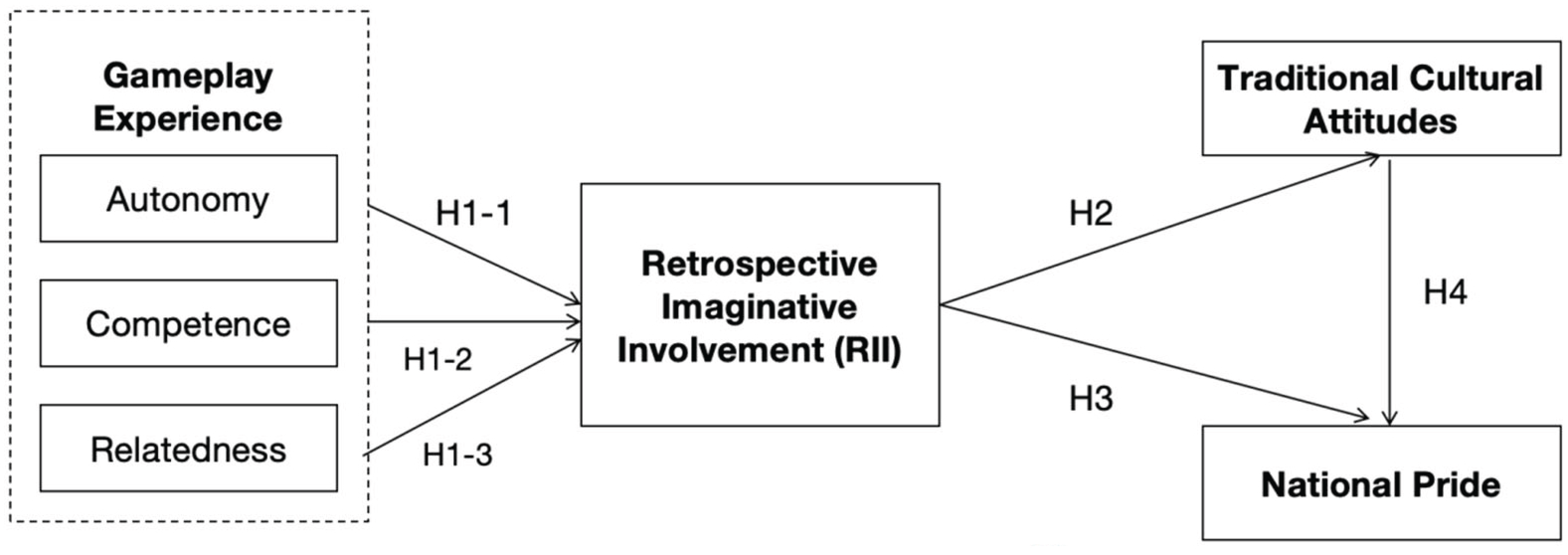

From Gameplay to Cultural Heritage Engagement: How Black Myth Wukong Shapes Traditional Attitudes and National Pride Among Chinese Youth


Abstract
1. Introduction
2. Literature Review
2.1. Myth-Based Cultural Games and Black Myth: Wukong
2.2. Self-Determination Theory and Game Experience
2.3. Retrospective Imaginative Involvement
Retrospective Imaginative Involvement, Traditional Cultural Attitudes, and National Pride
2.4. The Mediating Role of Retrospective Imaginative Involvement
3. Materials and Methods
3.1. Sample and Data Collection
3.2. Measures
3.2.1. Gameplay Experience (Autonomy, Competence, Relatedness)
3.2.2. Retrospective Imaginative Involvement (RII)
3.2.3. Traditional Cultural Attitudes
3.2.4. National Pride
3.3. Statistical Procedures
4. Results
4.1. Analysis Results of Reliability and Validity
4.2. Hypothesis Testing
4.2.1. Direct Effects Testing
4.2.2. Mediation Effects Testing
5. Conclusions
5.1. Empirical Implications
5.2. Practical Implications
5.3. Limitations and Future Research
Author Contributions
Funding
Data Availability Statement
Conflicts of Interest
References
- Newzoo. How Consumers Engage with Games Today: Newzoo’s Global Gamer Study 2024; Newzoo: Amsterdam, The Netherlands, 2024. [Google Scholar]
- China Audio-Video and Digital Publishing Association. China Game Industry Report 2025; China Audio-Video and Digital Publishing Association: Beijing, China, 2025. (In Chinese) [Google Scholar]
- Gee, J.P. What Video Games Have to Teach Us about Learning and Literacy. Comput. Entertain. 2003, 1, 20. [Google Scholar] [CrossRef]
- Isbister, K. How Games Move Us: Emotion by Design; MIT Press: Cambridge, MA, USA, 2016. [Google Scholar]
- Wang, Z.; Zhou, B.; Zhong, Y.; Deng, S. A Three-Dimensional Study on the International Communication of Black Myth: Wukong. Int. Commun. Chin. Cult. 2025, 12, 587–606. [Google Scholar] [CrossRef]
- Ryan, R.M.; Rigby, C.S.; Przybylski, A. The motivational pull of video games: A self-determination theory approach. Motiv. Emot. 2006, 30, 344–360. [Google Scholar] [CrossRef]
- Ryan, R.M.; Deci, E.L. Self-determination theory and the facilitation of intrinsic motivation, social development, and well-being. Am. Psychol. 2000, 55, 68. [Google Scholar] [CrossRef]
- Przybylski, A.K.; Rigby, C.S.; Ryan, R.M. A motivational model of video game engagement. Rev. Gen. Psychol. 2010, 14, 154–166. [Google Scholar] [CrossRef]
- Green, M.C.; Brock, T.C. The role of transportation in the persuasiveness of public narratives. J. Pers. Soc. Psychol. 2000, 79, 701. [Google Scholar] [CrossRef]
- Wolf, M.J. (Ed.) Before the Crash: Early Video Game History; Wayne State University Press: Detroit, MI, USA, 2012. [Google Scholar]
- Slater, M.D.; Ewoldsen, D.R.; Woods, K.W. Extending conceptualization and measurement of narrative engagement after-the-fact: Parasocial relationship and retrospective imaginative involvement. Media Psychol. 2018, 21, 329–351. [Google Scholar] [CrossRef]
- Sethi, N. Retrospective imaginative involvement. In The International Encyclopedia of Media Psychology; Van den Bulck, J., Ed.; Wiley: Hoboken, NJ, USA, 2020; pp. 1–7. [Google Scholar] [CrossRef]
- Ulusoy, E.; Sethi, N.; Baldwin, J.; Grady, S.M.; Ewoldsen, D.R. Can’t stop thinking about Star Wars and the Office: Antecedents of retrospective imaginative involvement. Hum. Commun. Res. 2022, 48, 622–633. [Google Scholar] [CrossRef]
- Yuan, W. An imagological analysis of the video game Black Myth: WuKong. Signs Media 2024, 3, 55–75. [Google Scholar] [CrossRef]
- Meng, Q. Black Myth: Wukong–The internationalization of Chinese games. J. Mod. Soc. Sci. 2025, 2, 13–19. [Google Scholar] [CrossRef]
- Juul, J. Half-Real: Video Games Between Real Rules and Fictional Worlds; MIT Press: Cambridge, MA, USA, 2011. [Google Scholar] [CrossRef]
- Shaw, A. What is video game culture? Cultural studies and game studies. Games Cult. 2010, 5, 403–424. [Google Scholar] [CrossRef]
- Elson, M.; Breuer, J.; Ivory, J.D.; Quandt, T. More than stories with buttons: Narrative, mechanics, and context as determinants of player experience in digital games. J. Commun. 2014, 64, 521–542. [Google Scholar] [CrossRef]
- China Audio-Video and Digital Publishing Association. China Game Industry Report 2024; China Audio-Video and Digital Publishing Association: Beijing, China, 2024. [Google Scholar]
- Liu, L. Transmedia storytelling in Black Myth: Wukong. J. Commun. 2025, 13, 53. [Google Scholar] [CrossRef]
- Ouyang, Y. Representation and communication effects of traditional cultural symbols in game narratives: A case study of Black Myth: Wukong. J. Commun. 2025, 13, 648. [Google Scholar] [CrossRef]
- Deci, E.L.; Ryan, R.M. Intrinsic Motivation and Self-Determination in Human Behavior; Springer: New York, NY, USA, 1985. [Google Scholar] [CrossRef]
- Johnson, D.; Gardner, M.J.; Perry, R. Validation of two game experience scales: The player experience of need satisfaction (PENS) and game experience questionnaire (GEQ). Int. J. Hum. Comput. Stud. 2018, 118, 38–46. [Google Scholar] [CrossRef]
- Yoshimura, K.; Chauveau, P.D.V. Keep your head in the game: Retrospective imaginative involvement with video game narratives. Psychol. Pop. Media 2025. [Google Scholar] [CrossRef]
- Jennett, C.; Cox, A.L.; Cairns, P.; Dhoparee, S.; Epps, A.; Tijs, T.; Walton, A. Measuring and defining the experience of immersion in games. Int. J. Hum. Comput. Stud. 2008, 66, 641–661. [Google Scholar] [CrossRef]
- Busselle, R.; Bilandzic, H. Measuring narrative engagement. Media Psychol. 2009, 12, 321–347. [Google Scholar] [CrossRef]
- Slater, M.D.; Rouner, D. Entertainment–education and elaboration likelihood: Understanding the processing of narrative persuasion. Commun. Theory 2002, 12, 173–191. [Google Scholar]
- Ewoldsen, D.R.; Busselle, R.; Sethi, N.; Slater, M.D. Retrospective imaginative involvement and entertainment narratives: Initial forays. In The Oxford Handbook of Entertainment Theory; Klimmt, C., Vorderer, P., Eds.; Oxford University Press: New York, NY, USA, 2021; pp. 735–754. [Google Scholar] [CrossRef]
- Ott, J.M.; Slater, M.D. Postexposure engagement with more and less eudaimonic films: 10-year patterns of response and the role of parasocial relationship and retrospective imaginative involvement. Psychol. Pop. Media 2024, 13, 150–161. [Google Scholar] [CrossRef]
- Oliver, M.B.; Raney, A.A. Entertainment as pleasurable and meaningful: Identifying hedonic and eudaimonic motivations for entertainment consumption. J. Commun. 2011, 61, 984–1004. [Google Scholar] [CrossRef]
- Sherrick, B.; Hoewe, J.; Ewoldsen, D.R. Using narrative media to satisfy intrinsic needs: Connecting parasocial relationships, retrospective imaginative involvement, and self-determination theory. Psychol. Pop. Media 2022, 11, 266–274. [Google Scholar] [CrossRef]
- Evans, M.D.; Kelley, J. National pride in the developed world: Survey data from 24 nations. Int. J. Public Opin. Res. 2002, 14, 303–338. [Google Scholar] [CrossRef]
- Kim, H.G.; Lee, S.S. National pride, social capital, and perceived prosperity: Determinants of Koreans’ perceived quality of life. J. Northeast Asian Stud. 2012, 17, 293–320. [Google Scholar]
- Chae, S.H. Study on the effects of social capital on national pride. Korean Assoc. Gov. Stud. 2016, 26, 25–49. [Google Scholar]
- Schatz, R.T.; Staub, E.; Lavine, H. On the varieties of national attachment: Blind versus constructive patriotism. Political Psychol. 1999, 20, 151–174. [Google Scholar] [CrossRef]
- Yoon, I.J.; Peng, Z. Multicultural acceptance among Koreans and Taiwanese: Focusing on the effects of national identity and national pride. J. Asian Stud. 2021, 64, 245–288. [Google Scholar] [CrossRef]
- Jung, Y.J.; Jang, Y.J.; Shin, Y.J.; Ko, K.H.; Lee, D.Y.; Yoon, J.H. Development and validation of a need satisfaction scale for adolescent game users. Asian Educ. Res. 2022, 23, 755–786. [Google Scholar] [CrossRef]
- Grasse, K.M.; Kreminski, M.; Wardrip-Fruin, N.; Mateas, M.; Melcer, E.F. Reevaluating the role of relatedness in single-player roleplaying games. In Proceedings of the CHI 2022 Workshop on Self-Determination Theory in HCI: Shaping a Research Agenda, New Orleans, LA, USA, 1 May 2022; ACM: New York, NY, USA, 2022; 4p. [Google Scholar]
- Lu, A.S.; Moller, A.C. Elaborating the role of narrative and self-determination theory in video game design research. Interact. Comput. 2024, 38, 501–515. [Google Scholar] [CrossRef] [PubMed]
- Huang, W.; Bi, C. Development of a brief general cultural identity scale. Adv. Psychol. 2021, 11, 620–628. [Google Scholar] [CrossRef]
- ISSP Research Group. International Social Survey Programme: National Identity III–ISSP 2013; GESIS: Mannheim, Germany, 2015. [Google Scholar]
- Podsakoff, P.M.; MacKenzie, S.B.; Lee, J.Y.; Podsakoff, N.P. Common method biases in behavioral research: A critical review of the literature and recommended remedies. J. Appl. Psychol. 2003, 88, 879–903. [Google Scholar] [CrossRef] [PubMed]


| Factors/Items | Standardized Loading (β) | CR | AVE |
|---|---|---|---|
| Autonomy Experience | 0.843 | 0.642 | |
| Choice and freedom of exploration | 0.777 | ||
| Playing in a self-determined way | 0.823 | ||
| Freedom of action in gameplay | 0.804 | ||
| Competence Experience | 0.814 | 0.597 | |
| Ability to complete difficult tasks | 0.696 | ||
| Full utilization of personal skills | 0.896 | ||
| Capability to handle in-game challenges | 0.709 | ||
| Relatedness Experience | 0.803 | 0.577 | |
| Satisfaction with character interactions | 0.760 | ||
| Personal meaning of character relationships | 0.700 | ||
| Emotional connection with game characters | 0.814 | ||
| RII Static Imagination | 0.934 | 0.613 | |
| Mental replay of character actions | 0.720 | ||
| Memory of specific scenes or dialogues | 0.781 | ||
| Recall of impressive battles or events | 0.770 | ||
| Reflection on characters’ emotions and motives | 0.779 | ||
| Recall of narrative sequence | 0.792 | ||
| Memory of key plot points | 0.803 | ||
| Recall of combat or boss fights | 0.784 | ||
| Vivid visualization of the storyline | 0.806 | ||
| Recall of important story moments | 0.806 | ||
| RII Dynamic Imagination | 0.931 | 0.599 | |
| Imagining alternative character choices | 0.831 | ||
| Imagining alternative endings | 0.726 | ||
| Imagining characters in real life | 0.755 | ||
| Imagining alternative dialogues | 0.790 | ||
| Imagining different character traits or relationships | 0.780 | ||
| Imagining game events in real life | 0.826 | ||
| Relating the story to personal experience | 0.719 | ||
| Imagining altering the protagonist’s fate | 0.731 | ||
| Recalling game events as personal experiences | 0.801 | ||
| RII Background Narrative Imagination | 0.939 | 0.632 | |
| Imagining events before the journey | 0.802 | ||
| Imagining post-game character outcomes | 0.799 | ||
| Imagining untold past stories | 0.773 | ||
| Imagining relationship formation between characters | 0.809 | ||
| Imagining events before key battles | 0.802 | ||
| Imagining hidden conflicts or secrets | 0.799 | ||
| Imagining hidden legends of the game world | 0.773 | ||
| Imagining origins of abilities or artifacts | 0.809 | ||
| Expanding the game’s worldview | 0.806 | ||
| Traditional Cultural Attitude | 0.921 | 0.566 | |
| Pride in Chinese traditional culture | 0.789 | ||
| Sense of belonging to traditional culture | 0.719 | ||
| Perceived personal significance of tradition | 0.759 | ||
| Emotional attachment to traditional culture | 0.734 | ||
| Personal pride from others’ praise | 0.751 | ||
| Willingness to learn about tradition | 0.774 | ||
| Willingness to inherit and promote traditions | 0.755 | ||
| Willingness to introduce tradition to others | 0.674 | ||
| Concern for the future of traditional culture | 0.809 | ||
| National Pride | 0.876 | 0.586 | |
| Preference for Chinese national identity | 0.752 | ||
| Positive evaluation of Chinese people globally | 0.781 | ||
| Perceived national superiority | 0.729 | ||
| Support for the country despite mistakes | 0.799 | ||
| Pride in international sports performance | 0.762 |
| χ2 | χ2/df | GFI | RMSEA | CFI | TLI | |
|---|---|---|---|---|---|---|
| CFA | 1540.895, df = 1147, p < 0.001. | 1.343 | 0.840 | 0.033 | 0.959 | 0.957 |
| SEM | 333.069, df = 290, p < 0.001. | 1.149 | 0.918 | 0.022 | 0.922 | 0.912 |
| Variables | 1 | 2 | 3 | 4 | 5 | 6 | 7 | 8 |
|---|---|---|---|---|---|---|---|---|
| Autonomy | 0.801 | |||||||
| Competence | 0.167 | 0.773 | ||||||
| Relatedness | 0.244 | 0.210 | 0.759 | |||||
| Static Imagination | 0.225 | 0.145 | 0.206 | 0.786 | ||||
| Dynamic Imagination | 0.230 | 0.176 | 0.150 | 0.476 | 0.777 | |||
| Background Narrative | 0.231 | 0.164 | 0.200 | 0.487 | 0.656 | 0.792 | ||
| Traditional Cultural Attitude | 0.253 | 0.236 | 0.216 | 0.157 | 0.222 | 0.278 | 0.753 | |
| National Pride | 0.311 | 0.243 | 0.256 | 0.268 | 0.280 | 0.323 | 0.417 | 0.765 |
| Structural Path | Std. Estimate | C.R. | Result |
|---|---|---|---|
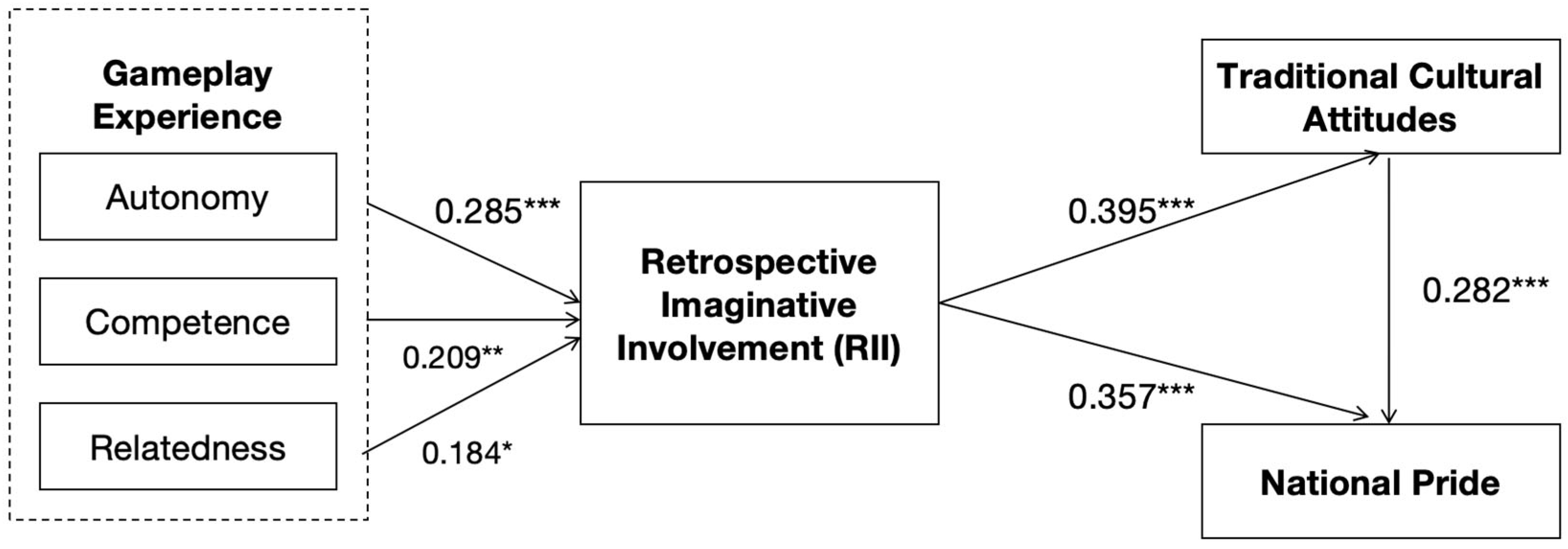
| H1-1: Autonomy → RII | 0.285 *** | 3.784 | Supported |
| H1-2: Competence → RII | 0.209 ** | 2.761 | Supported |
| H1-3: Relatedness → RII | 0.184 * | 2.389 | Supported |
| H2: RII → Traditional attitude | 0.395 *** | 4.939 | Supported |
| H3: RII → National pride | 0.357 *** | 4.431 | Supported |
| H4: Traditional attitude → National pride | 0.282 *** | 3.906 | Supported |
| Indirect Path | Direct Effect (β) | Direct 95% CI | Indirect Effect (β) | Indirect 95% CI | Total Effect (β) | Mediation Type |
|---|---|---|---|---|---|---|
| H5-1: Autonomy → RII → NP | 0.203 ** | [0.041, 0.365] | 0.091 ** | [0.019, 0.232] | 0.294 *** | Partial |
| H5-2: Competence → RII → NP | 0.176 * | [0.008, 0.344] | 0.084 * | [0.010, 0.248] | 0.260 ** | Partial |
| H5-3: Relatedness → RII → NP | 0.148 (ns) | [−0.021, 0.312] | 0.054 * | [0.002, 0.176] | 0.202 * | Full |
| H6-1: Autonomy → RII → TCA | 0.164 * | [0.015, 0.307] | 0.048 ** | [0.014, 0.121] | 0.212 ** | Partial |
| H6-2: Competence → RII → TCA | 0.137 (ns) | [−0.018, 0.289] | 0.044 * | [0.007, 0.125] | 0.181 * | Full |
| H6-3: Relatedness → RII → TCA | 0.109 (ns) | [−0.030, 0.252] | 0.028 * | [0.003, 0.099] | 0.137 * | Full |
| H7: RII → TCA → NP | 0.244 *** | [0.115, 0.382] | 0.144 ** | [0.042, 0.333] | 0.388 *** | Partial |
Disclaimer/Publisher’s Note: The statements, opinions and data contained in all publications are solely those of the individual author(s) and contributor(s) and not of MDPI and/or the editor(s). MDPI and/or the editor(s) disclaim responsibility for any injury to people or property resulting from any ideas, methods, instructions or products referred to in the content. |
© 2026 by the authors. Licensee MDPI, Basel, Switzerland. This article is an open access article distributed under the terms and conditions of the Creative Commons Attribution (CC BY) license.
Share and Cite
Jiang, H.J.; Kang, S.; Yoo, S.-C. From Gameplay to Cultural Heritage Engagement: How Black Myth Wukong Shapes Traditional Attitudes and National Pride Among Chinese Youth. Heritage 2026, 9, 181. https://doi.org/10.3390/heritage9050181
Jiang HJ, Kang S, Yoo S-C. From Gameplay to Cultural Heritage Engagement: How Black Myth Wukong Shapes Traditional Attitudes and National Pride Among Chinese Youth. Heritage. 2026; 9(5):181. https://doi.org/10.3390/heritage9050181
Chicago/Turabian StyleJiang, Hui Jie, Seungmi Kang, and Seung-Chul Yoo. 2026. "From Gameplay to Cultural Heritage Engagement: How Black Myth Wukong Shapes Traditional Attitudes and National Pride Among Chinese Youth" Heritage 9, no. 5: 181. https://doi.org/10.3390/heritage9050181
APA StyleJiang, H. J., Kang, S., & Yoo, S.-C. (2026). From Gameplay to Cultural Heritage Engagement: How Black Myth Wukong Shapes Traditional Attitudes and National Pride Among Chinese Youth. Heritage, 9(5), 181. https://doi.org/10.3390/heritage9050181