Article

One Bacterium, Dual Conservation Strategy: Towards the Sequential Biocleaning and Biocementation of Heritage Brick Masonry Structures by Stutzerimonas stutzeri


1
Faculty of Technology Novi Sad, University of Novi Sad, Bulevar cara Lazara 1, 21000 Novi Sad, Serbia
2
Faculty of Technical Sciences, University of Novi Sad, Trg Dositeja Obradovića 6, 21000 Novi Sad, Serbia
3
Faculty of Mining and Geology, University of Belgrade, Đušina 7, 11000 Belgrade, Serbia
4
BioSense Institute, University of Novi Sad, Dr Zorana Đinđića 1, 21000 Novi Sad, Serbia
*
Authors to whom correspondence should be addressed.
Heritage 2026, 9(5), 170; https://doi.org/10.3390/heritage9050170
Submission received: 19 March 2026 / Revised: 17 April 2026 / Accepted: 28 April 2026 / Published: 30 April 2026
(This article belongs to the Special Issue Innovative Materials and Tools for the Cleaning of Cultural Heritage)

Abstract

The integration of salt removal and structural consolidation remains a major challenge in heritage brick conservation. This research proposes a preliminary experimental setup for a dual-function microbial strategy using a single bacterium, Stutzerimonas stutzeri D1, capable of sequential denitrification (biocleaning) and ureolysis-driven microbially induced calcium carbonate precipitation (biocementation). After the pre-check assessment, which compared standalone, simultaneous, and sequential metabolic configurations, sequential denitrification followed by ureolysis (A→B) optimized functional compatibility, achieving 90.1% nitrate removal within 48 h and the highest precipitation rate during the biocementation phase. Application on authentic demolition waste (solid fired-clay brick specimens) demonstrated highly efficient nitrate reduction, alkalization (from pH value of 6.4 to 9.12), surface mineral deposition confirmed by visual inspection, SEM imaging, and XRD analysis. Furthermore, reduced water absorption (by 30%) and improved compressive strength (by 25%) for only 72 h of this dual treatment indicate a promising and holistic approach in the field of construction biotechnology of heritage brick conservation. These pioneer findings demonstrate that metabolic sequencing governs compatibility in dual-function bacterial systems and validate a sustainable, single-strain platform for combined biocleaning and biocementation of historic brick masonry structures.

1. Introduction

Brick and stone are among the most widely used building materials in historic architecture. Although the ceramic manufacturing process was well known since the prehistoric period, in ancient Greece, fired bricks were frequently used in masonry structures from the 4th century BC [1]. Historic bricks are characterized by high porosity and significant water absorption, particularly in structures where material quality and construction methods vary across periods. These properties facilitate moisture transport, making the material inherently vulnerable to environmental deterioration processes [2,3,4]. One of the main problems in the conservation of heritage brick masonry structures is the usage of inappropriate repair materials, which leads to alteration of the original materials. At the same time, salvaged and reclaimed bricks are increasingly used in historic building restoration, when it is necessary to replace whole original bricks. In cases where the deterioration has not progressed to the stage requiring complete brick replacement, less invasive conservation strategies should be considered. Furthermore, extending the life cycle of existing materials reduces the environmental burden associated with new production and aligns with current circular economy strategies in heritage management [5]. As a consequence of prolonged environmental exposure, both historic and reused bricks frequently develop salt contamination. Repeated crystallization cycles, especially of nitrates, progressively weaken the pore structure and reduce mechanical integrity [6,7,8]. Microbial biocleaning has been developed over several decades, with initial studies on bacteria-mediated transformation of sulfate compounds in stone materials reported in the late 1980s [9], followed by significant methodological advancements and consolidation in the early 2000s [10]. Instead of aggressive washing or extraction procedures, biocleaning uses metabolically active microorganisms to selectively transform harmful compounds in situ. Denitrifying bacteria are especially suitable for nitrate removal because they reduce nitrate to gaseous nitrogen species under controlled conditions [11].
Our previous study [12] demonstrated the high efficiency of aerobic denitrification-based biocleaning systems using Pseudomonas stutzeri strains incorporated into mineral poultices. In that research, nitrate reduction was successfully achieved not only on the surface but also at significant material depths, reaching up to 95% removal at 20 mm in brick substrates when using the natural isolate P. stutzeri D1. This study also introduced a method for monitoring nitrate reduction in depth, addressing a common limitation in previous conservation research. However, the focus of that investigation remained strictly on nitrate removal, as in numerous other papers [13,14,15]. Almost in parallel with biocleaning, microbially induced calcium carbonate precipitation (MICP) has emerged as a promising strategy for biocementation of porous mineral substrates. Through specific metabolic pathways, particularly ureolysis, bacteria increase local alkalinity and carbonate availability, leading to in situ calcium carbonate formation within the pore network and consequent consolidation of the substrate [16]. This mineral precipitation can enhance cohesion, reduce permeability, and contribute to the sealing of microcracks. The principles of MICP have been extensively investigated in cement-based materials, soil stabilization, and construction biotechnology in general [17,18,19,20], while Raut et al. [21] were the first to examine the effectiveness of MICP for strengthening masonry building structures. More recently, Mu et al. [22] demonstrated that MICP using Sporosarcina pasteurii CGMCC 1.3687 can effectively repair surface cracks in historic bricks from the Ming Dynasty wall in Nanjing, improving durability and limiting degradation without altering the clay matrix.
However, even with its potential compatibility with mineral substrates, the integration of MICP into conservation-oriented biocleaning workflows remains limited. Despite these advances, biocleaning and biocementation have largely evolved as separate research directions. The integration of nitrate removal and subsequent biocementation within a single microbial framework remains unexplored. Bacteria previously known as Pseudomonas stutzeri and now reclassified into the genus Stutzerimonas are recognized for efficient denitrification, and may also express metabolic activities linked to calcium carbonate formation [12,23]. This dual potential opens the possibility of developing an integrated treatment approach. A sequential biological treatment that first removes nitrates and then promotes controlled calcium carbonate precipitation could therefore enhance both durability and sustainability performance, while at the same time bricks taken from demolition site represent adequate substrates for preliminary tests. Importantly, using a single strain reduces system complexity. This dual-function bacterial approach, applied to demolition-derived bricks as models of aged materials, supports several Sustainable Development Goals (SDGs) [24], including SDG 9 (Industry, Innovation and Infrastructure), SDG 11 (Sustainable Cities and Communities), SDG 12 (Responsible Consumption and Production), and SDG 13 (Climate Action). Therefore, the research presented in this paper aims to investigate a sequential two-step strategy in which one bacterium, Stutzerimonas stutzeri, performs two complementary functions on demolition waste brick samples.

2. Materials and Methods

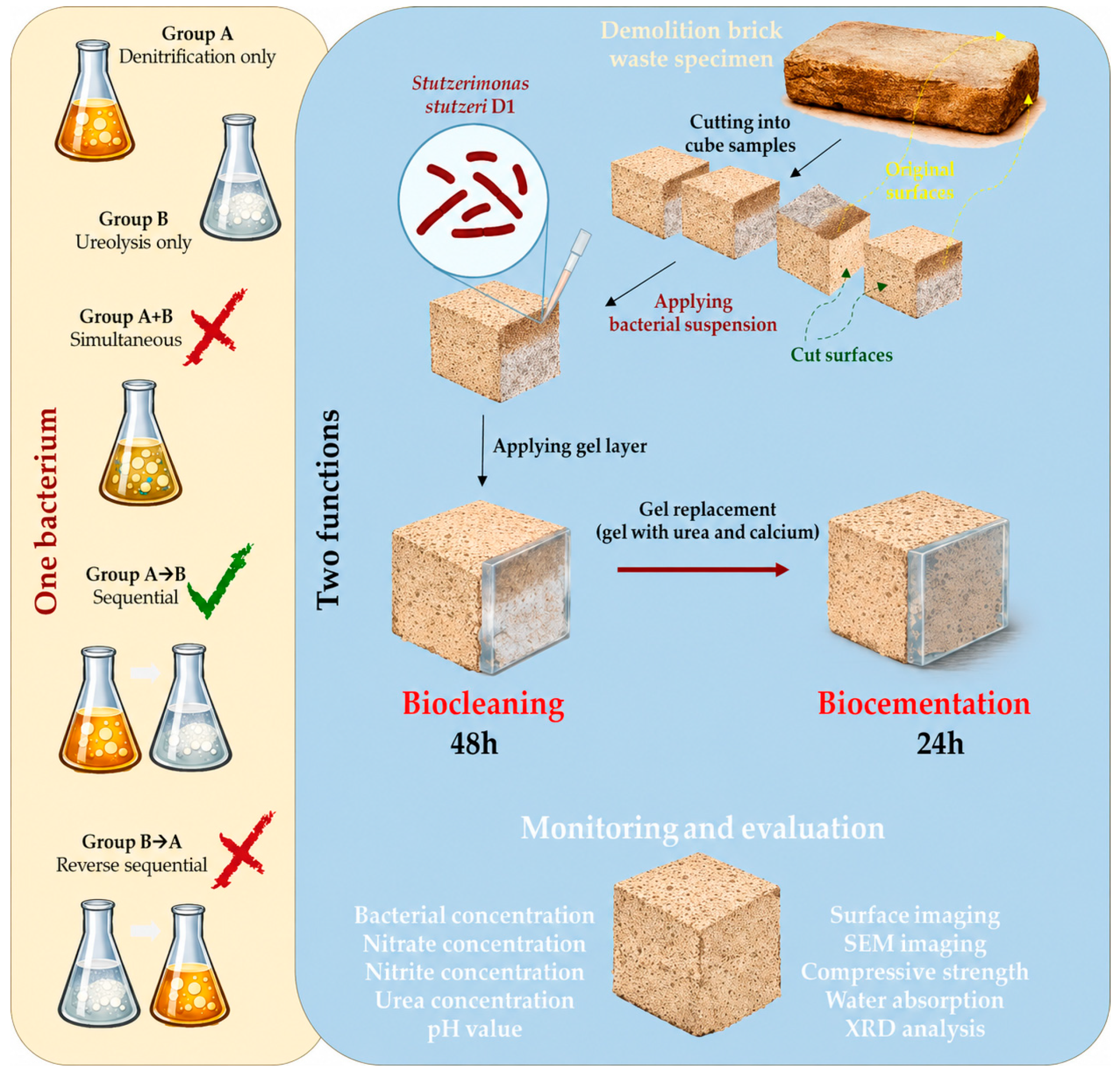
The experimental setup was designed to investigate the sequential application of microbial denitrification and ureolysis for combined biocleaning and biocementation of demolition waste brick samples (DWBSs). A schematic overview of the experimental workflow is presented in Figure 1, illustrating the sequential treatment steps, including bacterial inoculation, the biocleaning phase (denitrification), and the subsequent biocementation phase (ureolysis).
The pre-check procedure consisted of five experimental groups, enabling comparative evaluation of metabolic sequence effects on contaminant removal, microbial viability, metabolic capacity and precipitation efficiency. Each treatment phase (biocleaning and biocementation) was carried out under controlled laboratory conditions using DWBS prepared from brick specimens. It should be emphasized that the present investigation represents a preliminary experimental phase designed to evaluate the feasibility and metabolic compatibility of the proposed treatment under controlled laboratory conditions. Therefore, fired-clay brick specimens from demolition waste were selected as experimental substrates. This choice was guided by principles of the circular economy (that support SDGs), and sustainable production, reasoned consumption, and efficient waste management aiming to valorize secondary materials while avoiding any risk to historically significant building material during method development.

2.1. Bioagent

The bacterial strain used in this study was Stutzerimonas stutzeri D1, previously isolated from the Danube River water (Novi Sad, Serbia) and characterized as an efficient aerobic denitrifier. The strain, previously named Pseudomonas stutzeri, was originally identified and described by Vidaković et al. [25]. Before each experimental run, the strain was reactivated by streaking onto fresh Plate Count agar (HiMedia, Mumbai, India) plates and incubated at 30 °C for 24 h under aerobic conditions.

2.2. Pre-Checking of Standalone, Simultaneous, and (Reverse) Sequential Metabolic Responses of S. stutzeri

A preliminary experiment was conducted to verify the independent and sequential metabolic capabilities of S. stutzeri D1 for denitrification and ureolysis. For inoculum, a single colony was transferred into sterile nutrient broth and cultivated at 30 °C with agitation (150 rpm) until reaching the exponential growth phase. The bacterial suspension was adjusted to approximately 109 CFU/mL. Five experimental stage groups were prepared in sterile 250 mL Erlenmeyer flasks with 100 mL working volume:
  • Stage A (denitrification only): Using BD Difco™ Nitrate Broth (Becton, Dickinson and Company, France) with KNO3 in a concentration of 1.0 g/L and under aerobic conditions;
  • Stage B (ureolysis only): Urea (20 g/L) in a basal medium containing (per liter): peptone (5.0 g), yeast extract (3.0 g), NaCl (5.0 g), supplemented with calcium lactate (4.36 g/L), under aerobic conditions;
  • Stage A→B (sequential): Denitrification phase for 48 h (as in Stage A), followed by centrifugation, washing, and resuspension in ureolysis medium for 24 h;
  • Stage B→A (reverse sequential): Ureolysis phase first (for 48 h), followed by the denitrification phase (for 24 h) as described above;
  • Stage A + B (simultaneous): Co-incubation in a combined medium consisting of nitrate broth (BD Difco™ Nitrate Broth with KNO3, 1.0 g/L) supplemented with urea (20 g/L) and calcium lactate (4.36 g/L), under aerobic conditions.
Each group was inoculated with S. stutzeri D1 to an initial optical density OD600 = 0.1 and incubated at 30 °C. Samples were collected at 0 h, 12 h, 24 h, 48 h, and 72 h. NO3 and NO2 concentrations were measured spectrophotometrically using standard colorimetric assays (Griess reaction) [26]. NH4+ was quantified by the phenol-hypochlorite method [27]. pH values were recorded with a pH meter. CaCO3 precipitates are measured after centrifugation and a drying process (all supernatants were dried to a constant mass and measured). All treatments were performed in triplicate.
For a deeper analysis of all monitored parameters, some statistical and kinetic calculations were done. Namely, bacterial growth dynamics were assessed by calculating the specific growth rate (µ) during the exponential phase (0–12 h), according to Equation (1), while the biomass decline rate constant (kd) was based on Equation (2). Negative kd values indicate biomass decline during late-phase metabolic stress.
µ = [2.303 × (log X12 − log X0)]/Δt
kd = [2.303 × (log X72 − log Xpeak)]/Δt
where X represents bacterial concentration (log CFU/mL), and Δt is the time interval.
Nitrate concentration (NO3) was monitored to assess denitrification efficiency. Removal efficiency (%) was calculated using Equation (3).
Removal (%) = [(NO30 − NO3t)/NO30] × 100
Additionally, the average nitrate removal rate (mM·h−1) was determined over the full incubation period (Equation (4)). The average ammonium production rate was calculated between the first detectable NH4+ value and 72 h (Equation (5)). Only time points with detectable precipitation were included in the calculation.
Nitrate removal rate = (NO30 − NO372)/72
Ammonium removal rate = (NH4+72 − NH4+_initial)/Δt
Precipitation kinetics were expressed as: average precipitation rate (mg/100 mL·h−1), precipitation yield per log CFU (mg per log CFU) and precipitation-to-ammonium ratio (mg CaCO3 per mM NH4+) obtained from Equations (6) and (7).
Precipitation rate = (Precip72 − Precipinitial)/Δt
Precip/NH4+ ratio = Precip72/NH4+72
Correlation coefficients (r) were calculated using paired time-point data (Equation (8)). For pH–CFU analysis, only values from 12 to 72 h were included to focus on the alkalization phase. Linear regression was used to determine the slope of precipitation vs. NH4+ concentration, representing mineralization efficiency per unit of ureolysis product formed (Equation (9)).
r = Σ[(x − x̄)(y − ȳ)]/√[Σ(x − x̄)2 × Σ(y − ȳ)2]
Slope = ΔPrecipNH4+

2.3. Demolition Waste Brick Samples: Models for Heritage Masonry Substrate

Construction and demolition waste (C&DW) brick specimens were obtained from a demolition site in Novi Sad, Serbia (45.243351, 19.849644). Solid fired-clay bricks (Supplement Figure S1a,b) were recovered as part of C&DW generated during renovation activities in a park area adjacent to a reconstruction site. The use of DWBS from C&DW was intentional, addressing the growing environmental burden of such waste and supporting circular economy valorization. Using real demolition-derived bricks instead of newly manufactured ones provides a more realistic model of historic masonry, as long-term environmental exposure leads to increased porosity, microcracking, and salt-induced degradation [28]. Material characterization studies confirm that historic brick substrates display significant heterogeneity in mineralogical composition and physical properties due to differential firing conditions and long-term weathering [29]. Obtained brick specimens from C&DW were subjected to preliminary visual inspection to eliminate fragments with severe structural collapse or macroscopic contamination. Structurally intact specimens with preserved ceramic matrix and no visible exogenous surface pollutants were selected to ensure reproducibility while maintaining the intrinsic physicochemical characteristics typical of aged bricks from demolition. The selected specimens were cut into uniform cubic samples (with one remaining original side/surface) measuring approx. 25 × 25 × 25 mm (Supplement Figure S1c) using a water-cooled electric circular saw. All prepared DWBS were stored in standard laboratory conditions, at a temperature of (21 ± 2) °C and a relative humidity of (60 ± 10)% until further use. Prior to experimentation, all samples were cleaned to remove fine particles and then sterilized at 160 °C for 2 h.

2.4. Sequential Treatment: Biocleaning and Biocementation of Demolition Waste Brick Samples and Evaluation of the Dual Treatment

Based on pre-check capacities of S. stutzeri D1, a two-step biotechnological treatment was applied to the original surface of DWBS to evaluate the feasibility of using a single bacterial strain for both nitrate removal (A—biocleaning phase) and calcium carbonate precipitation (B—biocementation phase). The experimental design consisted of sequential metabolic activities (Stage A→B in pre-checking testing of the bacterium. DWBS were examined at the following phases of the treatment:
  • Control (intact, non-treated).
  • Biocleaning 0 h (inoculated only).
  • Biocleaning 24 h.
  • Biocleaning 48 h (=Biocementation 0 h).
  • Biocementation 12 h.
  • Biocementation 24 h.
The bacterial strain was cultivated aerobically in nitrate broth (containing 1.0 g/L KNO3) at 30 °C for 24 h under agitation (150 rpm). Cells were harvested by centrifugation (6000× g, 10 min), washed twice with sterile distilled water, and resuspended to gain 9.7 log CFU/mL. For all samples, a standardized inoculum volume (5 mL) was uniformly applied onto the DWBS surface area (25 × 25 mm) to ensure consistent bacterial distribution across the treated zone. Immediately following bacterial inoculation, a structured hydro-layer was applied to the treated DWBS surface to establish a localized and relatively controlled microenvironment. The hydro-layer served multiple functions: (i) sustained moisture retention within the porous ceramic matrix, (ii) regulated diffusion of soluble substrates and metabolic intermediates, and (iii) stabilization of bacterial activity by preventing rapid desiccation of the treated zone. The hydro-layer was formulated as a composite polysaccharide matrix prepared per 100 mL of distilled water containing: 1.5 g of agar, 0.3 g of carboxymethyl cellulose (CMC), 0.15 g of xanthan gum, 0.1 g of sorbitol, and 3 mL of glycerol. The mixture was heated to complete polymer dissolution under continuous stirring and subsequently cooled under sterile conditions in Petri dishes to allow uniform gelation. After solidification, hydrogel sheets of approximately 10 mm thickness were obtained and aseptically cut into standardized quadrangular segments (approx. 25 × 25 mm). Individual hydrogel segments were then gently applied to the inoculated DWBS surface, ensuring full contact without mechanical compression.
In the moment of applying hydro-layer, biocleaning phase was started and performed directly on DWBS. Samples were incubated at 30 °C under aerobic conditions for 48 h. The nitrate and nitrite concentrations in all sample groups and all sampling times were determined using procedure by Tomić et al. [12] using ion chromatography (Ion Chromatography System ICS-1000, Thermo Fisher, Waltham, MA, USA). Prior to this study, it was supposed that DWBS used in this study contained measurable concentrations of nitrate salts accumulated during years of environmental exposure. Samples were analyzed at: 0 h (immediately after inoculation), 24 h, and 48 h. Additionally, pH value (extract-based measurement) and bacterial concentration were determined at each time point. Specifically, bacterial concentration was determined by recovering cells from DWBSs, followed by serial dilution and enumeration using the standard plate count method. Results were expressed as log CFU/g of DWBS.
After 48 h of the biocleaning phase, the hydrogel layer was carefully removed mechanically to avoid disturbance of the treated DWBS surface. A newly prepared hydro-layer was then applied to initiate the biocementation phase. The replacement gel consisted of the previously described polymer matrix (agar–CMC–xanthan–sorbitol–glycerol composite) supplemented with urea (20 g/L) and calcium lactate (4.56 g/L) as the ureolytic substrate and calcium source, respectively. This hydro-gel enabled localized delivery of reactants while maintaining controlled moisture conditions within the DWBS pore network. Incubation was performed under aerobic conditions at 30 °C for up to 24 h to promote urease-mediated hydrolysis of urea and subsequent MICP process. During this phase, nitrate (NO3) and nitrite (NO2) concentrations (to assess residual denitrification activity), urea concentration (to evaluate ureolytic kinetics), pH evolution (as an indicator of alkalinization), and bacterial concentration (to determine cell viability and persistence within the substrate) were monitored using the previously described methods. The DWBS after 48 h of biocleaning were designated as biocementation 0 h.
After removing the gel layer, the treated DWBS surface was monitored by camera (Canon EOS R50V, Canon, Oita, Japan). Following this step, scanning electron microscopy (SEM) was performed on the final samples (after complete dual treatment), i.e., treated DWBS surfaces and edges were imaged by Apreo 2 C Scanning Electron Microscope (Thermo Fisher Scientific, Waltham, MA, USA). Specimens for SEM analyses were prepared as described in our previous work [30]. The mineral phase compositions of the samples were determined by powder X-ray diffraction (XRD) method. The data were collected on a Rigaku SmartLab X-ray diffractometer (Rigaku, Akishima, Tokyo) using Bragg–Brentano geometry (CuKα radiation, 40 kV, 30 mA) at standard laboratory temperature. The scan range was from 2 to 70° 2θ with a scanning speed of 10°/min while step size was 0.01°. Rigaku PDXL 2 software [31] with PDF-2 database [32] was used for mineral phase identification. Compressive strength tests were conducted immediately after each treatment phase using the standardized mechanical testing method [33] (Supplement Figure S2) to validate the effect of each treatment phase on the DWBS mechanical property. DWBS used for compressive strength testing (6 per each treatment phase, total of 36 cubes) were the same ones used for all other tests, except for water absorption. Separate DWBS were prepared and used for testing water absorption (6 per each treatment phase, total of 36 cubes) in order to indirectly determine the assessed changes in porosity and pore connectivity induced by microbial treatment. The standard procedure was used in accordance with BS EN 772-21:2012 [34], with the exception that the samples were dried for 24 h in an oven at a temperature of (105 ± 5) °C.

3. Results

3.1. Pre-Checking of Standalone, Simultaneous, and (Reverse) Sequential Metabolic Responses of S. stutzeri

The experimental results demonstrated different metabolic responses across treatment configurations involving S. stutzeri D1 with marked differences in nitrate reduction, pH evolution, and precipitation rate (Table 1). In Stage A, where denitrification was performed as a standalone process, a consistent decrease in nitrate was observed, dropping for 90.7% at 72 h. A peak in nitrite concentration was noted at 48 h, followed by a decline to 0.30 mM. Throughout this period, the pH value remained relatively stable (7.2–7.5), and no ammonium or precipitate was detected. In contrast, the Stage B group, which received only urea and calcium lactate as a nutrient option for the bacterium, showed a rapid onset of ureolysis. The pH value rose from 7.2 to 9.1, while precipitation was initially high with a slight additional increase at the end of incubation.
Simultaneous exposure to both substrates in Stage A + B produced moderate results across all metrics. Nitrate declined only partially (38%), and precipitation peaked at 32 mg/100 mL. The pH gradually increased to 8.40, but the overall system efficiency appeared lower than in the sequential A→B approach. Namely, the A→B sequence, combining initial denitrification followed by ureolysis, resulted in near-complete nitrate removal within 48 h, comparable to Stage A. Upon transition to ureolytic conditions, S. stutzeri D1 resumed metabolic activity, with pH reaching 9.00 by 72 h. This coincided with a sharp increase in precipitate formation, from 16.32 ± 0.44 mg at 48 h to 57.21 ± 6.00 mg at 72 h, confirming effective biocementation following successful nitrate depletion. In the reversed configuration (B→A) ureolysis dominated the early phase, as indicated by elevated pH levels, which inhibit denitrification-related enzymes. Specifically, subsequent nitrate reduction was limited because only a partial decrease in NO3 (25%) was observed, with persistently low nitrite levels. Precipitation remained constant across time points, suggesting no ongoing microbial activity or inhibition during the second phase. Quantitative comparison of precipitate yields at 72 h further emphasized these differences, with the Stage B group reaching the highest value (62.31 ± 5.96 mg), followed closely by Stage A→B (57.21 ± 1.27 mg). Stage groups B→A and A + B both plateaued near 25−32 mg/100 mL, while no precipitation was detected in the Stage A group. Therefore, the gained results indicate a clear advantage of the sequential A→B approach for the potential use of tested S. stutzeri D1 as a unique bioagent for a two-function approach of biocleaning based on denitrification and biocementation based on ureolysis.
Additionally, statistical and kinetic parameters are summarized in Table 2. The recalculated data further emphasize pronounced stage-dependent differences in metabolic compatibility and mineralization performance. The highest initial specific growth rate was observed in the ureolysis-only configuration (Stage B) followed by simultaneous metabolism (A + B) and denitrification-only conditions (Stage A). Sequential denitrification followed by ureolysis (A→B) exhibited moderate early growth, whereas reverse sequencing (B→A) resulted in immediate net biomass decline, indicating strong alkaline stress effects during early exposure. Denitrification efficiency remained highest in Stage A, achieving 90.7% nitrate removal over 72 h with an average rate of 0.126 mM/h. Importantly, the A→B configuration demonstrated even faster nitrate depletion during the denitrification phase, reaching 90.1% removal within 48 h at a rate of 0.188 mM/h. In contrast, the A + B configuration resulted in substantially lower efficiency, while reverse sequencing (B→A) showed minimal nitrate reduction, which confirms that prior alkalization severely impaired denitrification activity. Ureolysis-driven ammonium production displayed marked differences among stages. The highest production rate was observed in the sequential A→B system during the ureolysis phase, indicating a strong metabolic activation after nitrate depletion. Stage B exhibited moderate ammonium production, while A + B and B→A showed lower rates. Precipitation kinetics further distinguished the treatment configurations.
The sequential A→B approach generated the highest mineralization rate, substantially exceeding Stage B, A + B, and B→A. Precipitation-to-ammonium ratios were comparable in Stage B, A + B, and A→B, whereas reverse sequencing exhibited markedly lower mineralization efficiency, suggesting partial decoupling between ureolysis and CaCO3 formation. Pearson correlation analysis showed strong negative correlations between pH and viable biomass in all alkalizing systems which confirms that elevated alkalinity constitutes a primary driver of biomass decline. In Stage B, a strong positive correlation between precipitation and ammonium concentration (r = 0.97) demonstrated tight coupling between ureolytic activity and CaCO3 formation, whereas this coupling was substantially weaker in B→A (r = 0.17). Collectively, these quantitative indicators confirm that metabolic sequencing governs functional compatibility, with the A→B configuration providing the most efficient integration of denitrification and biomineralization.

3.2. Sequential Biocleaning and Biocementation of Demolition Waste Brick Samples

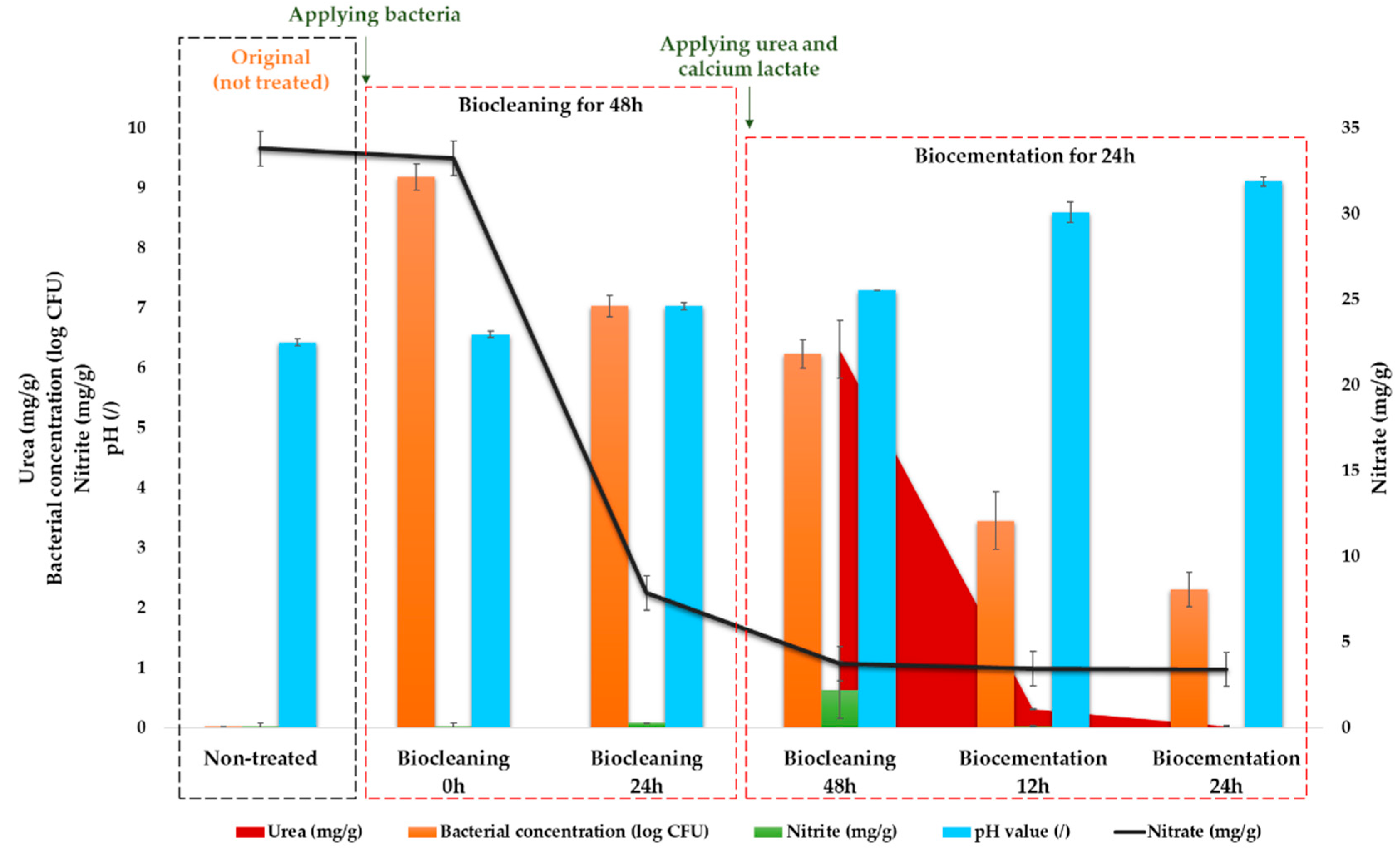
As can be seen in Figure 2, immediately after inoculation (Biocleaning 0 h), the bacterial concentration in the specimen reached 9.19 log CFU, confirming successful bacterial deposition of the clay substrate. During biocleaning, cell counts progressively decreased to 7.04 log CFU (24 h) and 6.24 log CFU (48 h). Nitrate concentration decreased markedly from 34.5 mg/g to 7.9 mg/g after 24 h, and further to 3.4 mg/g after 48 h, corresponding to an overall removal efficiency of 90.1%. Simultaneously, nitrite was transiently detected, increasing from zero to 0.1 mg/g (24 h) and 0.6 mg/g (48 h). Urea was not measured during the biocleaning stage (0–24 h), but reached 6.3 mg/g at 48 h after applying hydro-gel supplemented with this nutrient corresponding to the transition toward the biocementation phase. During biocementation, bacterial concentration further decreased to 3.46 log CFU/g (12 h) and 2.31 log CFU/g (24 h). Nitrate remained low and stable (3.0–3.1 mg/g), while nitrite dropped to undetectable levels. Urea concentration decreased from 0.3 mg/g (12 h) to 0.0 mg/g (24 h) which suggests potential complete utilization of this organic substrate by active bacterial cells. The pH value increased progressively throughout the treatment, from 6.43 (non-treated) to 7.30 (48 h biocleaning) and further to 8.60 (12 h biocementation) and 9.12 (24 h biocementation).
Additionally, Supplement Figure S3 shows a time-dependent visual transformation of the DWBS, progressing from a heterogeneous, deposit-rich and unevenly colored original state to a cleaner, more homogeneous, brighter surface after 24−48 h of biocleaning, with reduced deposits and less pronounced irregularities. Subsequent biocementation (12−24 h) leads to visible lightening and whitish mineral precipitation, indicating progressive surface modification and crack filling.
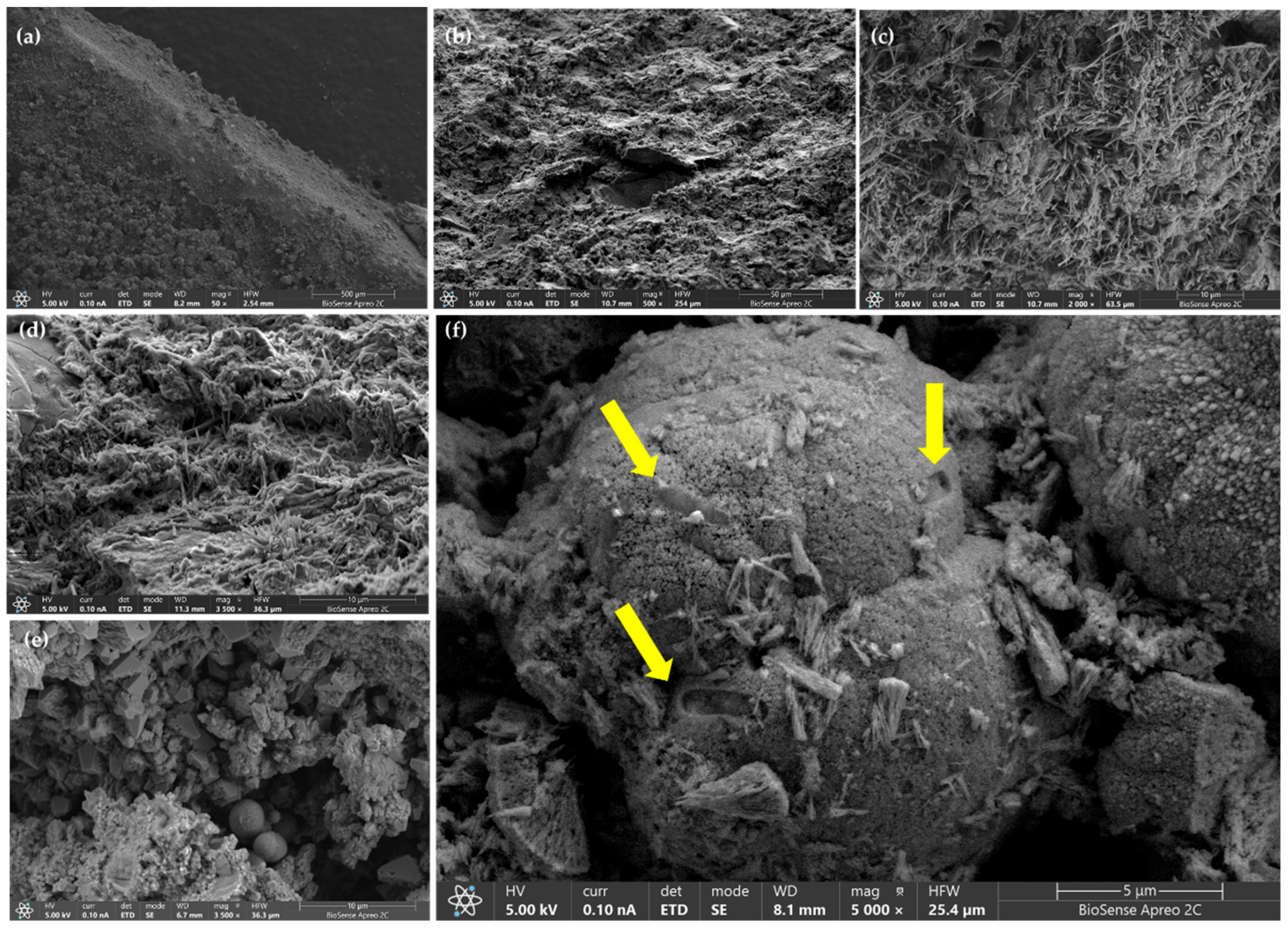
SEM micrographs (Figure 3) of the treated DWBS surface discovered substantial microstructural modifications following sequential biocleaning and MICP treatment. The edge region of the treated DWBS (Figure 3a) exhibited a compact surface layer composed of fine granular deposits partially covering the original ceramic matrix. The mineral layer appeared continuous along the outer edge, suggesting localized precipitation of mineral phases along exposed surfaces and pore entrances. The treated surface (Figure 3b–d) showed clear evidence of mineral deposition within the porous microstructure. The original brick matrix, characterized by irregular pores and fractured mineral grains, was partially filled with newly formed crystalline aggregates. These deposits formed interconnected networks of elongated and needle-like crystals, creating a bridging structure between adjacent mineral particles. In Figure 3c, the surface exhibits a heterogeneous and porous granular morphology typical of fired clay materials. The matrix consists of irregularly shaped aluminosilicate particles separated by intergranular voids. Discrete mineral precipitates are visible on the substrate, including scattered acicular (needle-like) crystals and small clustered deposits. Precipitation appears localized, predominantly occurring along pore edges, grain boundaries, and microtopographic irregularities. In addition, thin amorphous coatings partially cover certain areas of the surface. At higher magnification (Figure 3d), the mineral deposits formed dense clusters that appeared to connect pore walls and partially occlude pore throats. Such crystal networks can significantly reduce capillary connectivity within the pore system. Compared to Figure 3a, pore spaces are visibly reduced due to crystal growth and coalescence, and several microvoids appear bridged by the newly formed mineral phase. The surface crack detail (Figure 3e) represents extensive mineral precipitation within microfractures. The crack interior was filled with rhombohedral and irregular carbonate crystals, along with spherical mineral particles embedded within the crystalline matrix. The presence of these mineral phases indicates that precipitation occurred on exposed surfaces but also within internal defect structures. Evidence of microbial involvement in mineral formation was observed in Figure 3f, where crystal surfaces exhibited bacterial cell imprints. These features appear as elongated or rod-shaped imprints on mineral surfaces (indicated by yellow arrows), suggesting that bacterial cells acted as nucleation sites for mineral growth.
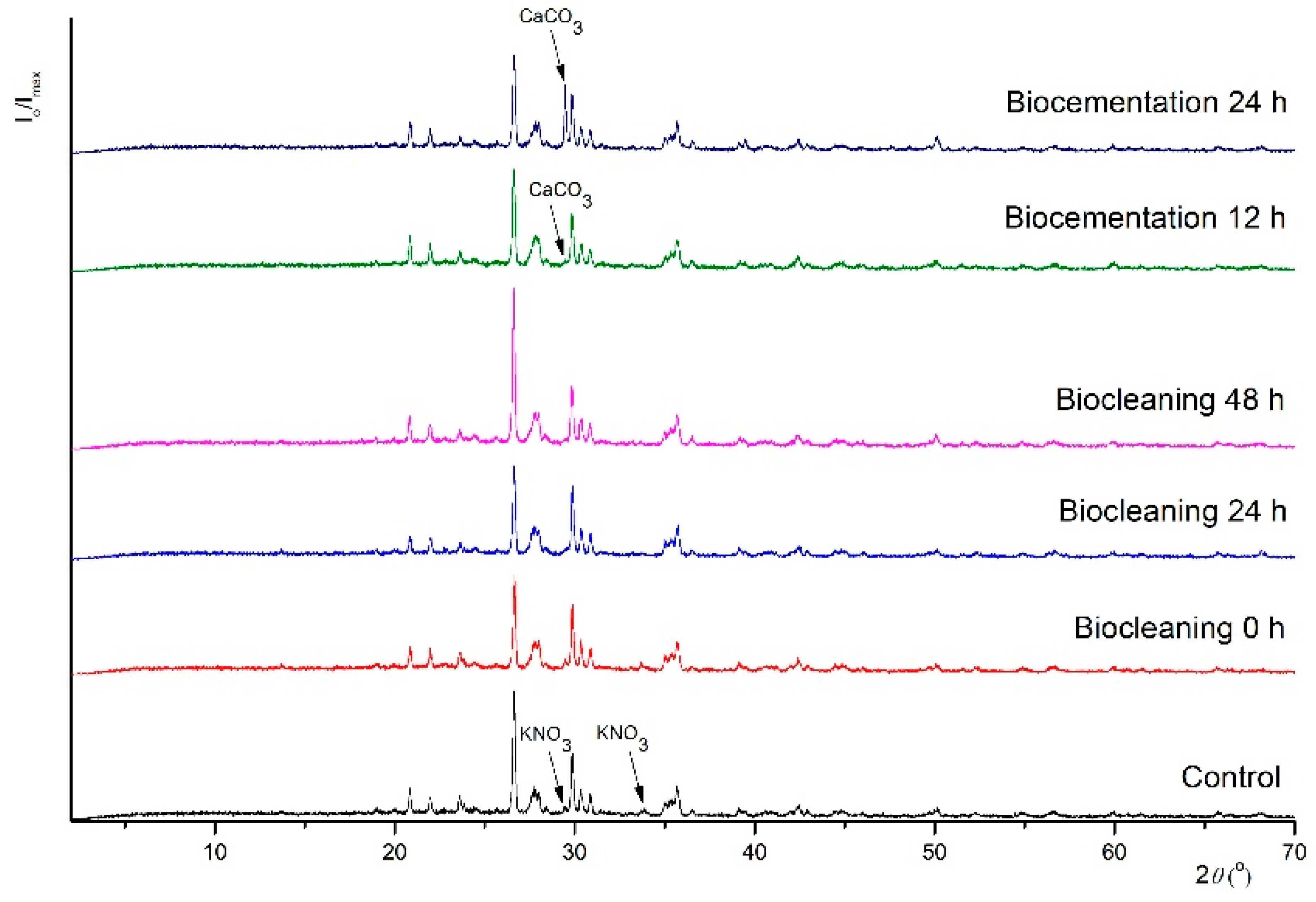
Furthermore, XRD analysis confirms clear mineralogical differences between untreated and biologically treated samples (Figure 4). In the control sample, three dominant crystalline phases were identified: quartz (SiO2), plagioclase feldspar, and a monoclinic pyroxene phase. These minerals are characteristic components of fired clay bricks and reflect the mineral transformations occurring during the ceramic firing process. In addition to these phases, reflections corresponding to potassium nitrate (KNO3) were also detected in the control sample, indicating the presence of soluble nitrate salts within the pore system of the material. The biocleaning 0 h sample exhibited a diffraction pattern essentially identical to the control, confirming that bacterial inoculation alone did not alter the mineral composition or remove nitrate salts immediately after application. After 24 h of biocleaning, the intensity of the strongest diffraction peak associated with KNO3 was significantly reduced compared with previously described samples. The remaining nitrate reflections were difficult to distinguish because they partially overlapped with reflections belonging to pyroxene and plagioclase phases. Nevertheless, the observed decrease in peak intensity suggests that nitrate removal had already begun during the early stages of microbial denitrification.
Following 48 h of biocleaning, the diffraction pattern no longer showed identifiable reflections corresponding to KNO3, indicating effective removal of nitrate salts from the brick matrix. In the biocementation stage, further mineralogical changes were observed. In the 12 h biocementation sample, a weak reflection corresponding to the characteristic calcite reflection at 29.5° 2θ (d ≈ 3.03 Å), corresponding to the most intense calcite peak (relative intensity 100). Although the presence of calcite cannot be unequivocally confirmed without the appearance of the three most intense diagnostic reflections, the emergence of this peak suggests the initial formation of CaCO3. In the 24 h biocementation sample, calcite was clearly identified, confirming the formation of microbially induced calcium carbonate during the ureolysis phase. The appearance of characteristic calcite reflections indicates successful biocementation within the treated brick matrix.
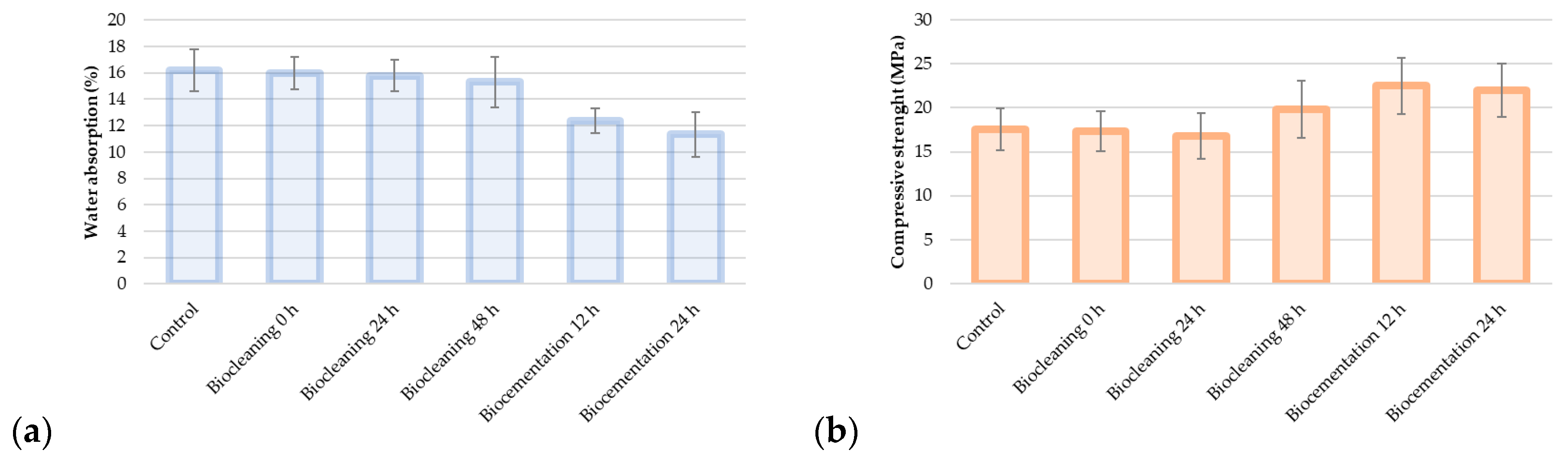
As the final part of experimental work, water absorption (Figure 5a) and compressive strength (Figure 5b) of DWBS were determined after each phase of the treatment. Cold water absorption results indicate measurable changes in hygric behavior following sequential microbial treatment of the DWBS. The non-treated samples exhibited water absorption of 16.2%, consistent with typical values reported for aged fired-clay bricks characterized by open capillary porosity. Inoculation alone (Biocleaning 0 h) did not significantly alter absorption values, indicating that bacterial application did not immediately affect pore connectivity. After 24 h of biocleaning, absorption remained comparable to the control, suggesting that denitrification-driven salt removal does not directly change the open porosity within this time frame; i.e., the difference was still less than 5% compared to the control one. A slight reduction was observed after 48 h of biocleaning (by 5.6%), which may reflect partial pore modification following nitrate removal and minor mineral redistribution. More pronounced changes occurred during the biocementation phase. After 12 h of ureolysis, water absorption was significantly reduced (by 23.5%), and the lowest value was recorded after 24 h of biocementation (11.33%), representing a relative reduction by 30.1% compared to the control (initial) one. The decrease in water absorption of the DWBS after each treatment phase was generally accompanied by an increase in compressive strength (Figure 5b). Considering that the samples were derived from demolition debris (although carefully selected), the standard deviations are higher, which is consistent with the claims of Stepien et al. [35] regarding bricks obtained from existing buildings and demolition sites. The compressive strength of control (non-treated) DWBS was 17.56 MPa.
As in the case of water absorption, inoculation alone and biocleaning during the first 24 h did not have a significant impact on the DWBS compressive strengths; i.e., the changes were less than 5%. After 48 h of biocleaning, there was an increase in compressive strength by 12.9%. Furthermore, the biocementation phase led to a significant increase in the strength of DWBS. After 12 h and 24 h of MICP, the compressive strengths of DWBS were 22.48 MPa and 22.01 MPa, respectively. Hence, after the dual treatment of DWBS that lasts 72 h, the compressive strength of treated DWBS was increased by 25.3% compared to the control (initial) one.

4. Discussion

The integration of biocleaning and MICP-related technologies, such as biocementation, into a single biotechnological workflow requires careful validation of metabolic compatibility prior to substrate application. Although denitrification and ureolysis are independently well-documented microbial processes, their simultaneous or sequential expression within the same strain is highly sensitive to environmental parameters such as pH, substrate availability, and ion saturation state. Previous studies have shown that denitrification enzymes are active predominantly under near-neutral to mildly alkaline conditions, whereas ureolysis rapidly drives alkalinization and increases carbonate supersaturation, potentially altering enzyme stability and membrane transport processes [36]. Therefore, prior metabolic pre-checking is essential to determine whether functional switching between pathways can occur without mutual inhibition. In addition, the simultaneous presence of nitrate and urea may introduce metabolic competition and physicochemical interference. Ureolysis generates ammonium and elevates pH above 9, which has been reported to suppress nitrate reductase activity in several denitrifying bacteria [37]. Moreover, early CaCO3 precipitation can physically obstruct pore spaces and limit substrate diffusion, thereby constraining metabolic efficiency. These interactions justify the need to experimentally determine the optimal temporal sequencing of denitrification and biomineralization.

4.1. Pre-Checking of the Sequential Metabolic Response of S. stutzeri

In the denitrification stage (A), S. stutzeri D1 achieved efficient nitrate removal (>90%), with only a slight pH increase (7.2–7.5), which is favorable for subsequent ureolysis and CaCO3 precipitation [38]. However, excessive alkalinity can inhibit denitrification enzymes [39], and nitrate reduction by S. stutzeri has been reported to cease at a pH value of approximately 11.5 [40], highlighting the importance of maintaining near-neutral conditions during this phase. In contrast, ureolysis-driven MICP (Stage B) induced rapid alkalization, ammonium production, and substantial CaCO3 precipitation (Table 1). When both processes were combined simultaneously (A + B), performance was reduced, suggesting metabolic interference likely caused by elevated pH and early precipitation, which may have limited enzymatic activity and substrate diffusion [39]. Sequential treatment (A→B) proved optimal, enabling complete nitrate removal before ureolysis while preserving microbial functionality. This temporal separation prevented early alkalinity-induced inhibition and allowed an effective transition to biomineralization. Conversely, reverse sequencing (B→A) resulted in limited denitrification, confirming that ureolysis-generated alkaline conditions are unfavorable for nitrate reduction [39,40]. The gained results show that metabolic sequencing governs functional compatibility, with denitrification preceding ureolysis ensuring more effective nitrogen removal and mineralization performance. The kinetic analysis further supports this interpretation, indicating that early alkalization compromises biomass stability and denitrification efficiency, whereas controlled sequencing enhances ureolytic activity and CaCO3 precipitation. It can be summarized that the decision to implement a sequential rather than simultaneous treatment was driven by the metabolic incompatibility observed during pre-checking experiments (Table 1 and Table 2). Denitrification by S. stutzeri D1 occurred optimally under near-neutral conditions, whereas ureolysis rapidly elevated pH and induced carbonate supersaturation. The gained results demonstrate that process order determines metabolic compatibility in dual-function bacterial systems. Sequential denitrification followed by ureolysis enhances CaCO3 productivity while preserving nitrogen removal capacity, whereas reverse sequencing induces metabolic suppression and reduced mineralization efficiency. The presented mechanistic separation explains why the A→B sequence produced complete nitrate removal and enhanced mineral deposition, whereas the reverse order or simultaneous exposure resulted in suboptimal performance.

4.2. Sequential Biocleaning and Biocementation of Demolition Waste Brick Samples

The selection of substrate is critical for biotreatment performance. While most studies on MICP and microbial salt removal use artificially contaminated, newly manufactured ceramics, heritage and demolition-derived bricks exhibit complex microstructural heterogeneity [29]. Therefore, the use of authentic demolition waste bricks provides a more realistic representation of field conditions. The development of a coupled biocleaning–biocementation strategy requires validation under realistic substrate conditions (Figure 2, Figure 3, Figure 4 and Figure 5). As can be seen in the mentioned data, the used DWBSs represent matrix characterized by intrinsic nitrate accumulation, irregular pore networks, and weathering-induced microcracks which corresponded with previously reported DWBS brick samples. These features directly influence substrate diffusion, bacterial deposition and potential colonization, and mineral nucleation processes [41]. Therefore, sequential metabolic activation on authentic DWBS was designed to simulate conservation-relevant conditions rather than simplified laboratory models.
The monitoring of five parameters during microbial treatment (Figure 2) confirms the sequential metabolic functionality of S. stutzeri D1 during the two-stage bioprocess. The substantial nitrate reduction (91% within 48 h) demonstrates active denitrification in DWBS. The transient accumulation of nitrite indicates incomplete reduction at intermediate stages, which is consistent with classical denitrification pathways (NO3 → NO2 → NO → N2O → N2). The gradual decline in viable cell counts suggests substrate limitation or environmental stress during prolonged exposure to clay substrate [8]. The moderate pH increase during biocleaning is consistent with denitrification, which consumes protons and tends to shift the environment toward neutral–alkaline conditions [42]. This pH elevation may contribute to improved specimen stability and partial mineral dissolution–reprecipitation dynamics. The introduction of urea and calcium initiates the second functional phase induce the strong increase in pH during biocementation (up to 9.12). This indicates active alkalization, consistent with enzymatic hydrolysis of urea. Such alkaline conditions significantly increase carbonate supersaturation and favor CaCO3 precipitation. The rapid decrease in urea concentration from 6.3 mg/g (transition) to a non-detectable level (24 h biocementation) confirms active urea utilization. Simultaneously, the sharp reduction in viable cell counts suggests that high mineral encrustation may affect bacterial viability. Since Stutzerimonas stutzeri is a non-sporogenic bacterium [40], the observed persistence of mineral formation despite declining viable counts likely indicates that cells were either entrapped within CaCO3 crystals and pore structures or had lost viability while retaining residual enzymatic activity. The dataset clearly demonstrates efficient nitrate removal during biocleaning, sequential metabolic shift toward ureolytic alkalization, progressive increase in pH to levels favorable for MICP, and substrate-dependent decline in bacterial viability. The alkalization during biocementation provides thermodynamically favorable conditions for CaCO3 formation, which aligns with SEM observations of acicular mineral precipitation and macroscopic whitening of the treated DWBS surface (Figure 3). However, the decrease in bacterial concentration during the MICP stage suggests that precipitation may occur under partially declining metabolic activity, potentially leading to heterogeneous mineral distribution [43]. This phenomenon may influence mechanical performance and could explain variations in compressive strength observed after treatment. The SEM observations indicate progressive mineral formation on the treated DWBS surface as a consequence of the sequential bioprocess mediated by S. stutzeri D1. The SEM observations confirm that the sequential microbial treatment induced extensive mineral precipitation within the DWBS. The morphology of the observed crystals is consistent with MICP, a process in which bacterial metabolic activity triggers carbonate supersaturation and subsequent mineral formation [36]. The presence of needle-like and clustered carbonate crystals suggests rapid nucleation and growth within confined pore spaces. Such morphologies are commonly reported in MICP systems where bacterial surfaces and extracellular polymeric substances serve as nucleation templates for CaCO3 crystallization [44]. Particularly important is the observation that mineral deposition occurred inside microcracks and pore channels rather than forming only a superficial crust. This indicates that bacterial colonization penetrated into the pore system before the onset of ureolysis-driven mineralization. This type of internal precipitation is desirable for conservation applications because it allows reinforcement of the internal structure without sealing the surface completely. The mineral bridging observed between pore walls likely contributed to the mechanical stabilization of the material. Similar microstructural features have been associated with increased compressive strength and reduced permeability in MICP-treated materials [17,36]. Furthermore, bacterial imprints visible on crystals provide strong evidence that mineral nucleation occurred directly on microbial cell envelopes. Bacterial cell walls possess negatively charged functional groups (e.g., carboxyl and phosphate groups) that bind Ca2+ ions and facilitate nucleation of carbonate minerals. During crystal growth, bacterial cells can become partially embedded within the mineral matrix, leaving morphological imprints once cells degrade or detach [20,30]. These microstructural observations are consistent with XRD results (Figure 4), confirming calcite formation during the biocementation stage. The control sample exhibited typical fired-clay brick mineral phases (quartz, plagioclase feldspar, and pyroxenes), originating from high-temperature recrystallization of clay components [45]. The presence of potassium nitrate indicates salt contamination, a common deterioration factor in historic masonry due to increased hygroscopicity and moisture transport [7]. The progressive disappearance of nitrate reflections during biocleaning confirms effective microbial denitrification, where nitrate is converted to gaseous nitrogen species, reducing salt content within the pore system [11,46]. The apparent increase in quartz peak intensity likely reflects a relative enrichment effect following salt removal, as reported in desalinated masonry units. During biocementation, calcite formation was detected, with early reflections indicating the onset of biomineralization and clearer peaks confirming successful CaCO3 deposition. This process is driven by ureolysis-induced alkalization and ammonia production, promoting carbonate supersaturation [39]. Bacterial surfaces and extracellular polymeric substances facilitate crystal nucleation within pores, supporting in situ mineral growth. This sequential treatment is advantageous, combining salt removal with structural consolidation. The absence of calcite prior to biocementation confirms that mineral formation is microbially induced, consistent with previous MICP studies on construction materials [44].
As can be seen in Figure 5a, denitrification alone did not significantly alter porosity, consistent with previous findings that microbial salt removal primarily affects chemical composition rather than pore structure [11]. In contrast, ureolysis-driven MICP reduced water absorption through pore filling and throat constriction caused by CaCO3 precipitation [36]. SEM observations support this, showing crystal networks and pore bridging that reduce permeability. The observed reduction (~30%) indicates partial pore sealing rather than complete densification, which is desirable in heritage conservation to preserve vapor diffusion and prevent moisture accumulation [29]. This suggests a controlled mineralization process associated with sequential metabolic activation. The A→B strategy likely promoted more uniform in situ precipitation within pore networks, avoiding superficial crust formation reported in some MICP treatments [43]. Reduced water absorption correlates with improved compressive strength which increased by approx. 25% at the end of dual treatment (Figure 5b), indicating enhanced pore refinement and load transfer capacity. Similar relationships have been widely reported for MICP-treated materials [18]. For example, Raut et al. [21] reported significant reductions in water absorption and corresponding strength increases in treated bricks, depending on the growth medium. From a conservation perspective, controlled reduction in water uptake is beneficial, as moisture transport drives salt crystallization damage in masonry units [7]. The proposed sequential biocleaning–biocementation approach effectively combines salt remediation, moisture control, and mechanical improvement.

5. Conclusions

This study demonstrates that sequential activation of denitrification and ureolysis enables the integration of biocleaning and biocementation within a single microbial system. The results highlight that metabolic sequencing is critical for maintaining functional compatibility, allowing efficient nitrate removal followed by effective CaCO3 precipitation. The dual treatment led to measurable improvements in material performance, including reduced water absorption and increased compressive strength, associated with controlled mineral deposition within the pore structure. Importantly, the use of demolition-derived bricks provides a realistic model for conservation applications while supporting circular economy principles. Although the findings confirm the feasibility of this dual-function approach, further research is required to optimize long-term performance, assess durability under environmental conditions, and evaluate applicability across different masonry units.

Supplementary Materials

The following supporting information can be downloaded at: https://www.mdpi.com/article/10.3390/heritage9050170/s1, Figure S1. Example of brick specimen and sample: (a,b) original brick taken from demolition site; (c) prepared demolition waste brick cube sample; Figure S2. Demolition waste brick sample: (a) before, and (b) after the compressive strength testing (the front surface is original/treated one); and Figure S3. Monitoring of the treated surface of DWBS by camera.

Author Contributions

Conceptualization, A.T. and T.M.; methodology, O.Š.; validation, T.M., M.D. and L.M.; formal analysis, O.Š., M.R., S.K. and T.M.; investigation, T.M.; resources, O.Š.; data curation, M.R. and L.M.; writing—original draft preparation, O.Š. and A.T.; writing—review and editing, T.M.; visualization, O.Š.; supervision, O.Š. All authors have read and agreed to the published version of the manuscript.

Funding

This research has been supported by the Ministry of Science, Technological Development and Innovation (Contracts No. 451-03-34/2026-03/200134, 451-03-33/2026-03/200134, 451-03-33/2026-03/200358, 451-03-34/2026-03/200126, and 451-03-34/2026-03/200156) and the Faculty of Technical Sciences, University of Novi Sad through project “Scientific and Artistic Research Work of Researchers in Teaching and Associate Positions at the Faculty of Technical Sciences, University of Novi Sad 2026” (No. 01-3609/1).

Data Availability Statement

The original contributions presented in the study are included in the article; further inquiries can be directed to the corresponding authors.

Acknowledgments

During the preparation of this manuscript, the authors used Grammarly (version v.1.2.250.1876) to correct the English language throughout the text as well as BioRender (version Basic) to prepare schematic presentation. The authors have reviewed and edited the output and take full responsibility for the content of this publication.

Conflicts of Interest

The authors declare no conflicts of interest.

References

  1. Stefanidou, M.; Papayianni, I.; Pachta, V. Analysis and characterization of Roman and Byzantine fired bricks from Greece. Mater. Struct. 2015, 48, 2251–2260. [Google Scholar] [CrossRef]
  2. Balksten, K.; Strandberg-de Bruijn, P. Understanding Deterioration due to Salt and Ice Crystallization in Scandinavian Massive Brick Masonry. Heritage 2021, 4, 349–370. [Google Scholar] [CrossRef]
  3. Balksten, K.; Mebus, U. Bruk av Ruiner: Kulturarv, Konstruktion, Kalkbruk, Komfort & Kalsonger; Fornsalens Förlag: Visby, Sweden, 2012. [Google Scholar]
  4. Balksten, K.; Strandberg-de Bruijn, P.B. Hampakalk. Tilläggsisolering på Reveterade Trähus och Saltskadat Tegelmurverk: Research Report 2019; Lund University: Lund, Sweden, 2019. [Google Scholar]
  5. Gajzler, M.; Nowotarski, P.; Ratajczak, M. Economic and Environmental Analysis of Using Recycled Ceramic Demolition Materials in Construction Projects. Sustainability 2025, 17, 7560. [Google Scholar] [CrossRef]
  6. Ergenç, D.; Cizer, Ö.; Akgül, C.M.; Conde, J.F. Sustainable conservation of salt-damaged bricks using multi-functional lime mortar with bio-based and waste admixtures. Case Stud. Constr. Mater. 2025, 23, e05038. [Google Scholar] [CrossRef]
  7. Charola, A.E. Salts in the Deterioration of Porous Materials: An Overview. J. Am. Inst. Conserv. 2000, 39, 327–343. [Google Scholar] [CrossRef]
  8. Vučetić, S.; Ranogajec, J.; Markov, S.; Vidaković, A.; Hiršenberger, H.; Bera, O. Develompent and modeling of the effective bioactive poultices for reducing the nitrate content in building materials. Constr. Build. Mater. 2017, 142, 506–513. [Google Scholar] [CrossRef]
  9. Atlas, R.M.; Chowdhury, A.N.; Gauri, K.L. Microbial calcification of gypsum-rock and sulfated marble. Stud. Conserv. 1988, 33, 149–153. [Google Scholar] [CrossRef]
  10. Cappitelli, F.; Zanardini, E.; Ranalli, G.; Mello, E.; Daffonchio, D.; Sorlini, C. Improved methodology for bioremoval of black crusts on historical stone artworks by use of sulfate-reducing bacteria. Appl. Environ. Microbiol. 2006, 72, 3733–3737. [Google Scholar] [CrossRef][Green Version]
  11. Bosch-Roig, P.; Ranalli, G. The safety of biocleaning technologies for cultural heritage. Front. Microbiol. 2014, 5, 155. [Google Scholar] [CrossRef]
  12. Tomić, A.; Vučetić, S.; Šovljanski, O.; Pezo, L.; Ranogajec, J.; Markov, S. Effective bioactive systems for nitrate removal from building materials. Constr. Build. Mater. 2022, 338, 127514. [Google Scholar] [CrossRef]
  13. Ranalli, G.; Alfano, G.; Belli, C.; Lustrato, G.; Colombini, M.P.; Bonaduce, I.; Zanardini, E.; Abbruscato, P.; Cappitelli, F.; Sorlini, C. Biotechnology applied to cultural heritage: Biorestoration of frescoes using viable bacterial cells and enzymes. J. Appl. Microbiol. 2005, 98, 73–83. [Google Scholar] [CrossRef]
  14. Lustrato, G.; Alfano, G.; Andreotti, A.; Colombini, M.P.; Ranalli, G. Fast biocleaning of mediaeval frescoes using viable bacterial cells. Int. Biodeter. Biodegrad. 2012, 69, 51–61. [Google Scholar] [CrossRef]
  15. Bosch-Roig, P.; Decorosi, F.; Giovannetti, L.; Ranalli, G.; Viti, C. Connecting phenome to genome in Pseudomonas stutzeri 5190: An artwork biocleaning bacterium. Res. Microbiol. 2016, 167, 757–765. [Google Scholar] [CrossRef] [PubMed]
  16. Erdmann, N.; Strieth, D. Influencing factors on ureolysis microbiologically induced calcium carbonate precipitation for biocementation. World J. Microbiol. Biotechnol. 2023, 39, 61. [Google Scholar] [CrossRef] [PubMed]
  17. DeJong, J.T.; Mortensen, B.M.; Martinez, B.C.; Nelson, D.C. Bio-mediated soil improvement. Ecol. Eng. 2010, 36, 197–210. [Google Scholar] [CrossRef]
  18. Igbal, D.M.; Wong, L.S.; Kong, S.Y. Bio-Cementation in Construction Materials: A Review. Materials 2021, 14, 2175. [Google Scholar] [CrossRef]
  19. Šovljanski, O.; Milović, T.; Bulatović, V.; Erceg, T.; Stanojev, J.; Bajac, B.; Tomić, A. Insights into self-healing capacity of cement matrix containing high-efficiency bacteria under challenging conditions. J. Build. Eng. 2024, 98, 111094. [Google Scholar] [CrossRef]
  20. Šovljanski, O.; Bulatović, V.; Milović, T.; Grahovac, J.; Erceg, T.; Dramićanin, M.; Tomić, A. Bioaugmentation of Industrial Wastewater and Formation of Bacterial–CaCO3 Coupled System for Self-Healing Cement. Buildings 2024, 14, 4011. [Google Scholar] [CrossRef]
  21. Raut, S.H.; Sarode, D.D.; Lele, S.S. Biocalcification using B. pasteurii for strengthening brick masonry civil engineering structures. World J. Microbiol. Biotech. 2013, 30, 191–200. [Google Scholar] [CrossRef] [PubMed]
  22. Mu, B.; Gui, Z.; Lu, F.; Petropoulos, E.; Yu, Y. Microbial-Induced Carbonate Precipitation Improves Physical and Structural Properties of Nanjing Ancient City Walls. Materials 2021, 14, 5665. [Google Scholar] [CrossRef] [PubMed]
  23. Singh, R.; Yoon, H.; Sanford, R.A.; Katz, L.; Fouke, B.W.; Werth, C.J. Metabolism-Induced CaCO3 Biomineralization During Reactive Transport in a Micromodel: Implications for Porosity Alteration. Environ. Sci. Technol. 2015, 49, 12094–12104. [Google Scholar] [CrossRef]
  24. United Nations: The 17 Goals. Available online: https://sdgs.un.org/goals (accessed on 28 February 2026).
  25. Vidaković, A.; Šovljanski, O.; Vučurović, D.; Racić, G.; Đilas, M.; Ćurčić, N.; Markov, S. Novel denitrifying bacteria Pseudomonas stutzeri strain D1-from isolation to the biomass production. Chem. Ind. Chem. Eng. Q. 2019, 25, 403–415. [Google Scholar] [CrossRef]
  26. Griess, P. Bemerkungen zu der Abhandlung der HH. Weselsky und Benedikt “Ueber einige Azoverbindungen”. Berichte Dtsch. Chem. Ges. 1879, 12, 426–428. [Google Scholar] [CrossRef]
  27. Weatherburn, M.W. Phenol-hypochlorite reaction for determination of ammonia. Anal. Chem. 1967, 39, 971–974. [Google Scholar] [CrossRef]
  28. An, L.; Qiao, Z.; Wang, J.; Wang, F. Experimental study on weathering mechanism of ancient bricks in Jiayuguan Wei-Jin tombs, Gansu, China. Herit. Sci. 2024, 12, 114. [Google Scholar] [CrossRef]
  29. Lopez-Arce, P.; Garcia-Guinea, J. Weathering traces in ancient bricks from historic buildings. Build. Environ. 2005, 40, 929–941. [Google Scholar] [CrossRef]
  30. Šovljanski, O.; Pezo, L.; Milović, T.; Pezo, M.; Radenković, M.; Mejić, L.; Bulatović, V.; Dramićanin, M.; Tomić, A. Bio-Intelligent Approach for Rapid Healing of Cracks via Artificial Neural Network-Optimized Urban Bacterial Consortium. J. Build. Eng. 2025, 117, 114851. [Google Scholar] [CrossRef]
  31. Rigaku. PDXL 2: Integrated Powder X-Ray Diffraction Software, version 2.8.4.0; Rigaku Corporation: Tokyo, Japan, 2007. Available online: https://rigaku.com/products/x-ray-diffraction-and-scattering/xrd/smartlab-studio-ii (accessed on 3 April 2026).
  32. Gates-Rector, S.; Blanton, T. The powder diffraction file: A quality materials characterization database. Powder Diffr. 2019, 34, 352–360. [Google Scholar] [CrossRef]
  33. BS EN 772-1:2011; Methods of Test for Masonry Units—Part 1: Determination of Compressive Strength. British Standards Institution: London, UK, 2011.
  34. BS EN 772-21:2012; Methods of Test for Masonry Units—Part 21: Determination of Water Absorption of Clay and Calcium Silicate Masonry Units by Cold Water Absorption. British Standards Institution: London, UK, 2012.
  35. Stepien, P.; Spychał, E.; Skowera, K. A Comparative Study on Hygric Properties and Compressive Strength of Ceramic Bricks. Materials 2022, 15, 7820. [Google Scholar] [CrossRef]
  36. Anbu, P.; Kang, C.H.; Shin, Y.J.; So, J.S. Formations of calcium carbonate minerals by bacteria and its multiple applications. SpringerPlus 2016, 5, 250. [Google Scholar] [CrossRef] [PubMed]
  37. Philippot, L.; Hallin, S. Finding the missing link between diversity and activity using denitrifying bacteria as a model functional community. Curr. Opin. Microbiol. 2005, 8, 234–239. [Google Scholar] [CrossRef]
  38. Shen, X.; He, S.; Takaya, Y.; Yakata, T.; Yoshida, K.; Kobayashi, H. Ureolysis-Driven Microbially Induced Carbonate Precipitation by a Facultatively Anaerobic Thermophilic Bacterium Under High-Temperature and Anaerobic Conditions. Microorganisms 2025, 13, 1102. [Google Scholar] [CrossRef]
  39. Pan, Y.; She, D.; Shi, Z.; Cao, T.; Xia, Y.; Shan, J. Salinity and high pH reduce denitrification rates by inhibiting denitrifying gene abundance in a saline-alkali soil. Sci. Rep. 2023, 13, 2155. [Google Scholar] [CrossRef]
  40. Lalucat, J.; Bennasar, A.; Bosch, R.; García-Valdés, E.; Palleroni, N.J. Biology of Pseudomonas stutzeri. MMBR 2006, 70, 510–547. [Google Scholar] [CrossRef]
  41. Yang, X.; Jin, C.; Liu, T.; Jiang, J.; Mao, N.; Huang, J.; Wu, Y.; Lu, Z.; Li, J. Effect of brick-based construction and demolition waste on the performance and microstructure of lightweight aggregate concrete. J. Build. Eng. 2023, 78, 107665. [Google Scholar] [CrossRef]
  42. Saleh-Lakha, S.; Shannon, K.E.; Henderson, S.L.; Goyer, C.; Trevors, J.T.; Zebarth, B.J.; Burton, D.L. Effect of pH and temperature on denitrification gene expression and activity in Pseudomonas mandelii. Appl. Environ. Microbiol. 2009, 75, 3903–3911. [Google Scholar] [CrossRef] [PubMed]
  43. Jhuo, Y.S.; Wong, H.E.; Tung, H.H.; Ge, L. Effectiveness of microbial induced carbonate precipitation treatment strategies for sand. Environ. Technol. Innov. 2025, 38, 104132. [Google Scholar] [CrossRef]
  44. Achal, V.; Mukerjee, A.; Reddy, M.S. Biogenic treatment improves the durability and remediates the cracks of concrete structures. Constr. Build. Mater. 2013, 48, 1–5. [Google Scholar] [CrossRef]
  45. Rice, R.W. Mechanical Properties of Ceramics and Composites: Grain and Particle Effects; CRC Press: Boca Raton, FL, USA, 2000. [Google Scholar]
  46. Cappitelli, F.; Cattò, C.; Villa, F. The Control of Cultural Heritage Microbial Deterioration. Microorganisms 2020, 8, 1542. [Google Scholar] [CrossRef]
Figure 1. Graphical overview of sequential biocleaning and biocementation of DWBS using S. stutzeri D1.
Heritage 09 00170 g001
Figure 2. Monitoring of biocleaning and biocementation indicators during treatment of DWBS.
Heritage 09 00170 g002
Figure 3. SEM images of the DWBS surface after dual conservation treatment: (a) edge; (bd) the treated surface; (e) surface crack detail; (f) bacterial cell imprints on the formed crystals (yellow arrows indicate bacterial cell imprints).
Heritage 09 00170 g003
Figure 4. XRD analysis of each phase in the dual conservation treatment of DWBS.
Heritage 09 00170 g004
Figure 5. Water absorption (a) and compressive strength (b) during DWBS treatment.
Heritage 09 00170 g005
Table 1. Sequential metabolic response and precipitate yield of S. stutzeri D1.
StageTime (h)Bacterial
Concentration
(log CFU/mL)
NO3
(mM)
NO2
(mM)
NH4+
(mM)
pH Value
(/)
Precipitate
(mg/100 mL)
A07.20 ± 0.1210.00 ± 1.12ndnd7.2 ± 0.76nd
128.60 ± 0.187.70 ± 0.761.50 ± 0.11nd7.3 ± 0.71nd
248.30 ± 0.153.80 ± 0.472.20 ± 0.24nd7.3 ± 0.75nd
487.50 ± 0.210.96 ± 0.341.40 ± 0.31nd7.4 ± 0.67nd
726.40 ± 0.250.93 ± 0.070.30 ± 0.1nd7.5 ± 0.77nd
B07.20 ± 0.14ndndnd7.2 ± 0.64nd
128.90 ± 0.16ndnd3.51 ± 0.38.0 ± 0.7535.01 ± 1.55
245.10 ± 0.20ndnd6.23 ± 0.668.4 ± 0.8553.86 ± 2.45
484.70 ± 0.18ndnd7.53 ± 0.828.6 ± 0.8454.42 ± 3.56
723.90 ± 0.22ndnd8.31 ± 0.869.1 ± 0.862.31 ± 5.96
A + B07.20 ± 0.1010.00 ± 1.06ndnd7.2 ± 0.6nd
128.70 ± 0.178.60 ± 0.890.70 ± 0.11.00 ± 0.147.6 ± 0.7525.11 ± 2.43
244.90 ± 0.157.80 ± 0.70.90 ± 0.142.54 ± 0.187.8 ± 0.8125.71 ± 2.51
484.60 ± 0.207.00 ± 0.651.00 ± 0.13.10 ± 0.288.0 ± 0.8925.65 ± 2.48
724.80 ± 0.246.20 ± 0.621.30 ± 0.134.51 ± 0.468.2 ± 0.7832.03 ± 0.72
AB07.20 ± 0.1110.00 ± 0.97ndnd7.2 ± 0.74nd
128.20 ± 0.147.00 ± 0.641.20 ± 0.10.24 ± 0.067.3 ± 0.62nd
247.90 ± 0.164.10 ± 0.382.10 ± 0.210.31 ± 0.027.4 ± 0.67nd
486.90 ± 0.190.98 ± 0.122.30 ± 0.150.40 ± 0.017.7 ± 0.8nd
723.30 ± 0.20ndnd8.20 ± 0.729.0 ± 0.9157.21 ± 1.27
BA07.20 ± 0.13ndndnd7.2± 0.74nd
126.00 ± 0.18ndnd3.03± 0.258.0± 0.7825.43 ± 2.6
244.80 ± 0.17ndnd6.01 ± 0.578.8 ± 0.925.01 ± 2.58
483.40 ± 0.228.50 ± 0.881.20 ± 0.127.15 ± 0.759.0 ± 0.9125.56 ± 2.52
722.60 ± 0.247.50 ± 0.731.50 ± 0.137.30 ± 0.769.2 ± 0.8925.54 ± 2.56
Note: nd—not detected; dashed line indicates the moment of a switching metabolic pathway using nutrient supplementation.
Table 2. Kinetic and statistical parameters (calculated from data presented in Table 1).
Stageµ0–12
(h−1)
kd peak (h−1)NO3
removal rate (mM/h)
NO3
removal efficiency
(%)
NH4+
production rate (mM/h)
A 0.269−0.0840.12690.7/
B 0.326−0.192//0.115
A + B 0.288−0.1500.05338.00.059
A→B 0.192−0.1880.188 *90.2 *0.325 **
B→A −0.230−0.1470.042 ***11.8 ***0.071
Stage Precipitation rate
(mg/100 mL·h)
Precip/NH4+ ratio
(mg/mM)
r
(pH, log CFU)
r
(precip, log CFU)
r
(precip, NH4+)
Slope
(mg/mM)
A −0.99///
B 0.8657.50−0.89−0.990.975.35
A + B 0.4457.10−0.79−0.400.841.89
A→B 2.38 ****6.98−1.00/*****/*****5.24
B→A 0.3553.50−0.94−0.460.170.02
Notes: * calculated for 0–48 h (complete denitrification phase); ** calculated for 48–72 h (ureolysis phase after switching); *** calculated for 48–72 h interval only; **** calculated for 48–72 h (active precipitation window); ***** insufficient paired time points for reliable Pearson calculation.
Disclaimer/Publisher’s Note: The statements, opinions and data contained in all publications are solely those of the individual author(s) and contributor(s) and not of MDPI and/or the editor(s). MDPI and/or the editor(s) disclaim responsibility for any injury to people or property resulting from any ideas, methods, instructions or products referred to in the content.