4.1. De-Colonial Iconographic Analysis of the Pieces Identified by Jacinto Jijón and Camaaño
Before presenting the analysis of the individual pieces, it is important to note that the publications by Jijón and Caamaño [
10,
11] offer predominantly morphological and chromatic descriptions of the ceramic pieces, without addressing the compositional organization of the decorative field or its possible symbolic significance. This limitation is not attributable exclusively to the author, but rather to the archaeological paradigm of his time, which prioritized typological and chronological classification over iconographic interpretation.
In Volume I, Jacinto Jijón y Caamaño begins his description of the Puruhá people by defining them as a country, a territorial unit that fits the social context of the time but limits and overlooks the nation-state dimension of this group due to the limited archaeological research conducted to date in Ecuadorian territory. This initial stance constitutes one of the first indications of a colonial interpretation of the Puruhá territory and sociopolitical organization, an aspect that directly influences the subsequent interpretation of the material record.
During the first section, the author provides a convoluted description of the territory occupied by the Puruhá, emphasizing the harsh climate of the area. However, it is crucial to acknowledge that their strategic location enabled them to access other territories, allowing them to mitigate agricultural challenges by obtaining products from nearby regions through trade routes. Additionally, there is evidence of significant pastoral activity, which was not characteristic of the peak of Puruhá culture but contributed to the region’s development as one of the most prominent textile workshops in the Audiencia of Quito [
30]. This shift may explain the replacement of llamas with sheep to enhance the production of animal fiber for these workshops. This observation highlights a temporal overlap between pre-Hispanic practices and colonial dynamics, a distinction that the author does not clearly address.
Regarding the remains identified on the Macaxí plain, the presence of an advanced culture is noted. However, in terms of power, the author suggests a diminished position relative to the surrounding cultures, as he fails to recognize the organizational capacity of the enclosed territories, thus justifying the subordination imposed on the cultures of the region. These types of statements reinforce a cultural hierarchy that responds to parameters external to the Andean context.
The text adds information about the population reductions implemented in the territory during the second half of the 16th century, specifically acknowledging a decrease in the population of Guano. However, it is important to note that this control measure over the indigenous population not only led to a reduction in numbers but also resulted in the fusion of cultural practices within the territories. This fusion contributed to the homogenization of cultural processes and elements, ultimately diminishing the cultural identity of the people involved. Additionally, it facilitated processes of syncretism, which excluded pre-existing cultures. This phenomenon serves as a crucial antecedent for understanding the loss of their symbolic references and the subsequent reinterpretation of ancestral iconography.
The descriptions provided do not adequately capture the diverse connections that humans maintain with their environment. While the iconography found on archaeological artifacts demonstrates an understanding of space and its elements, it also indicates that the environment is in a constant state of change, a reality recognized by its inhabitants. The sole relationship described is “the worship the Indians offered,” which refers to the connection this group had with the Chimborazo volcano, a central element in their activities. Therefore, the Puruhá people’s knowledge of the Chimborazo volcano must have been extensive and far more complex than merely an act of worship. This complexity is evidenced by the sacred spaces found there, such as the Machay Temple, located on the southern flank of the Whymper summit at an altitude of 4700 m above sea level. This conceptual reductionism obscures the symbolic and territorial dimensions of the sacred Puruhá landscape.
During the description of the decorative elements of the artifacts, the author limits himself to a geometric description of the elements, without linking their meaning to their relationship with the Puruhá worldview. Consequently, the ritual value of these objects is minimized, neglecting the message conveyed through their unique decoration. This is reinforced by various statements made by the author in which he argues that the Puruhá failed to “imitate” the representations of other groups, labeling the existing representations as errors. This approach consolidates a comparative aesthetic reading that disregards the symbolic autonomy of the Puruhá culture.
Based on these observations, a decolonial iconographic analysis of the archaeological pieces was conducted, with the aim of reinterpreting the symbols from an Andean worldview and highlighting the symbolic messages omitted or distorted in traditional interpretations.
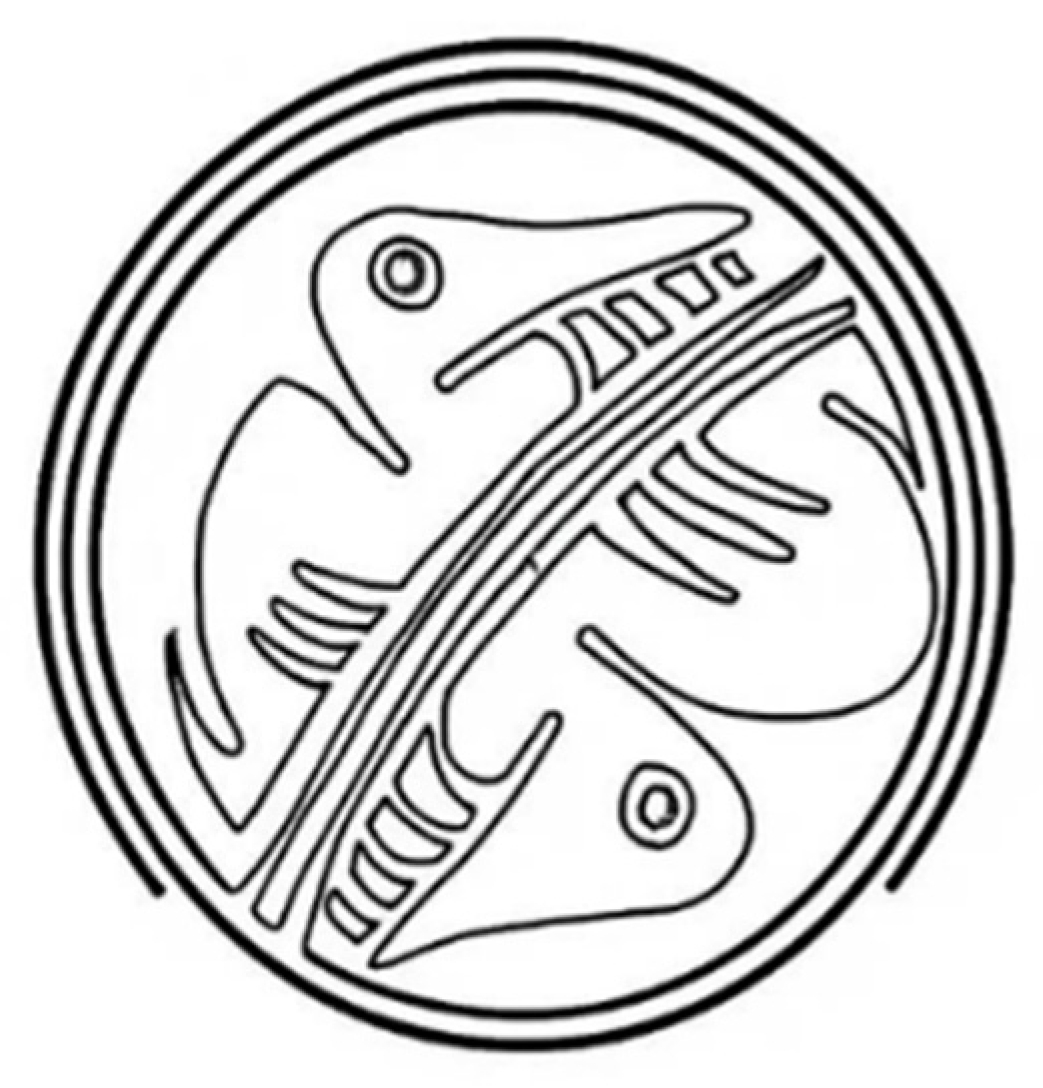
This iconography is depicted on a compote bowl from the Macaxí phase (
Figure 4). The description [
10] indicates that it corresponds to “two superimposed dragon figures, with the tail of one resting on the head of the other. The monster’s body is serpentine and ends in a fish-like tail, and it has two feet.” This description reinforces the Western perspective used in understanding Andean decorative characteristics, which is based on the integration of mythological beings from outside the territory, such as “dragons.” It ultimately imposes a hegemonic cultural horizon by determining that this iconography is repetitive even in geographical areas like Costa Rica and Nicaragua, although to date there is no representative evidence to prove an influence of Northern cultures on the study area.
From an Andean perspective, Fink [
28] and Milla [
18] highlight the presence of snakes as mythical beings that, in duality, represent water and fertility as vehicles of connection between the three worlds that make up the mythical order of the universe. Some interpretations of this dualism are, initially, earthly–celestial, followed by life–death and good–evil. Regarding the detailed parts of the head and tail, Narváez [
29] points out that these two parts “represent an indivisible and harmonious dual unity,” emphasizing the power of the head as an element of magnificence, which is why the opposite tail connects with the opposite head.
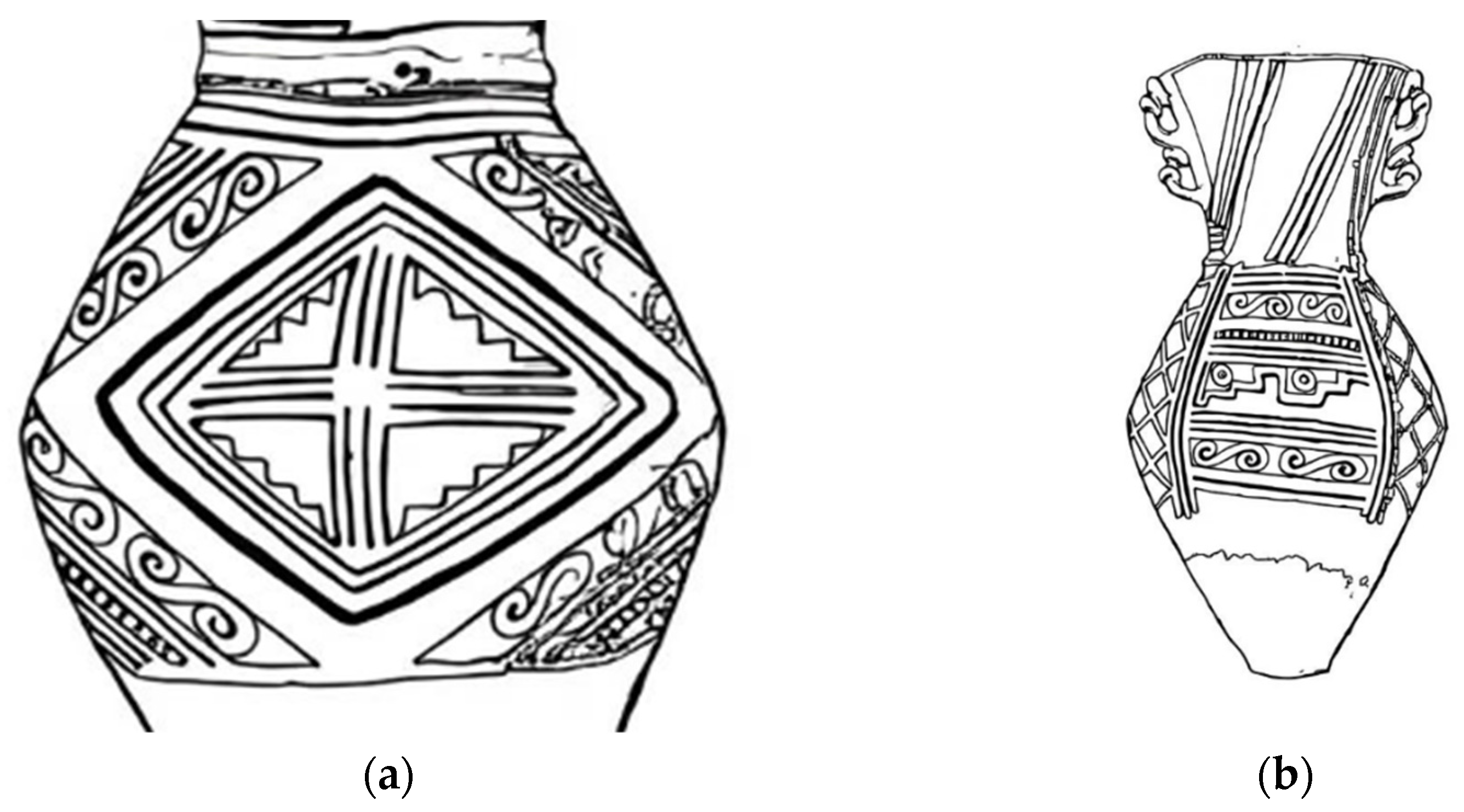
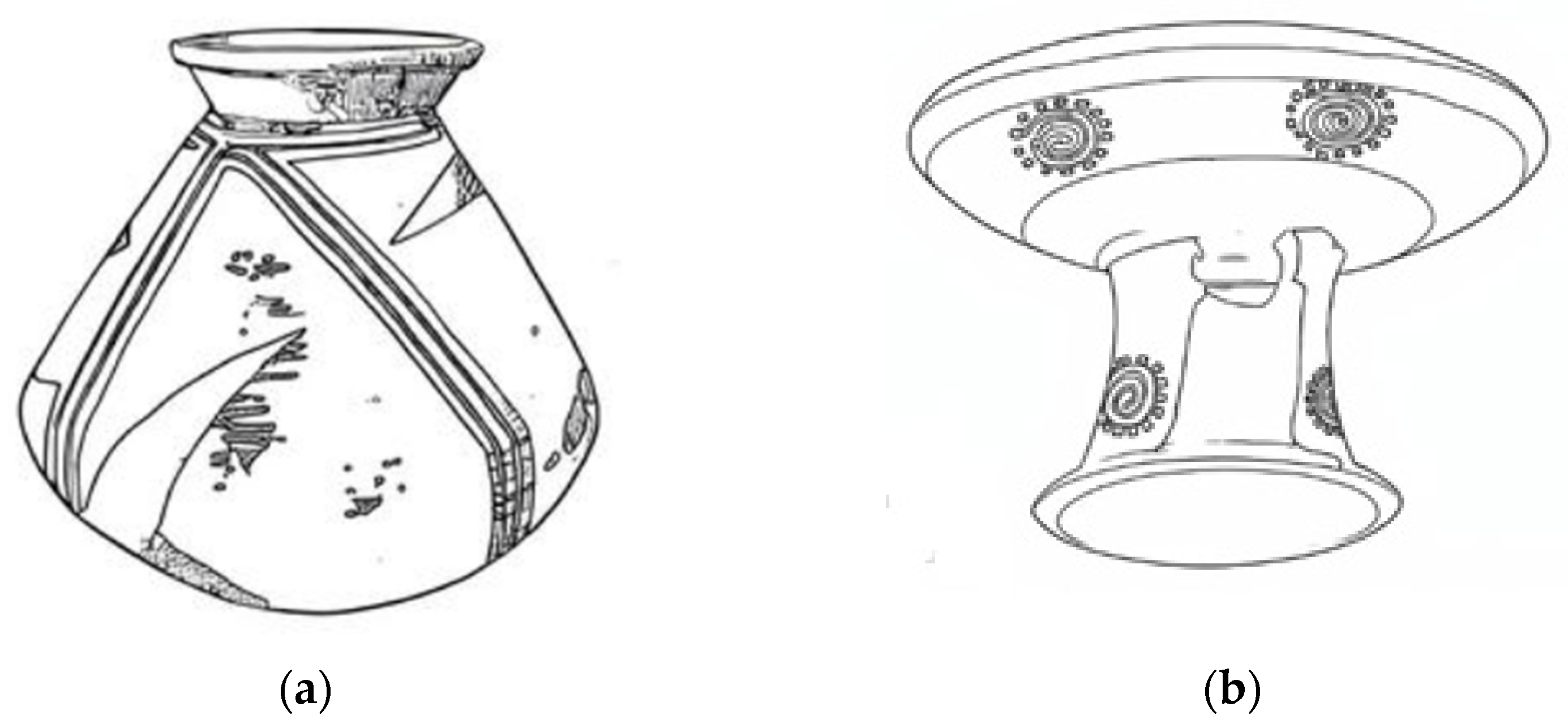
During the Tuncahuán period (
Figure 5a), the pot is described as having “contrasting yellow and black decoration” [
10], without providing an analysis of its compositional organization or its possible symbolic meaning. The decorative field is divided into clearly delimited sections: a central area framed by lateral bands, with diagonal lines that segment the space into alternating triangular zones of yellow and black. This organization is not arbitrary; it responds to a structure of bilateral symmetry that distributes the space into opposing and complementary halves. In this way, the bipartite organization is consistent with the principle of complementary duality established in the Andean worldview [
18], where opposites—up/down, right/left, light/dark—are not conceived as contradictions but as a dynamic unity. The yellow–black color contrast could be associated with the day/night or sun/earth opposition, although this attribution requires corroboration with additional evidence.
Also noteworthy are a compote dish and a stand (
Figure 5b), which, according to Jijón and Caamaño [
10], correspond to a compote dish with “red and white decorations,” though no description is provided of the spatial arrangement of the decorative field. The decorative field is identified as being organized into three distinct horizontal registers: an upper one with linear geometric motifs, a central one that is the most complex, including spirals, and a lower one with closing bands. This tripartite division of the decorative space was not noted by Jijón and Caamaño. The organization suggests a correspondence with the tripartite division of the Andean cosmos: Hanan Pacha (world above), Kay Pacha (world of the present), and Uku Pacha (world below) [
18,
29]. The spirals in the central register could be interpreted as representations of cyclical movement and regeneration, recurring elements in Andean iconography associated with Kay Pacha as a space of transformation. It should be noted that Jijón and Caamaño’s description [
10] overlooks both the tripartite compositional structure and the symbolic density of the motifs, limiting the piece to its material-chromatic dimension.
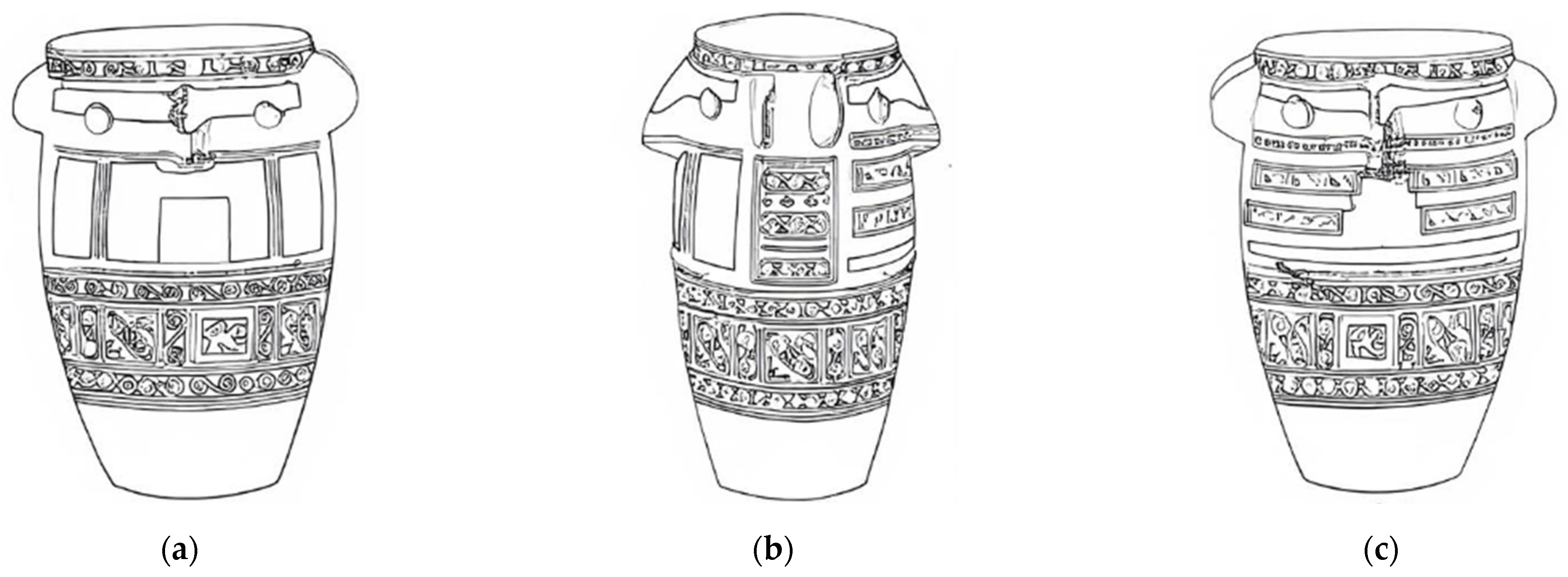
In the San Sebastián phase, the presence of faces stands out, as in the case of the drum shown in
Figure 6, which is described in terms of its morphology and decoration without attributing any symbolic meaning to the motifs present. The piece features a modeled face as its central element, framed by horizontal bands decorated with double spirals arranged in sequence. These spirals are organized in symmetrical pairs that create an alternating visual rhythm along the decorative band. The double spirals suggest the representation of opposites contained within a single sign, consistent with the principle of complementary duality in the Andean worldview [
18]. Their alternating arrangement could be associated with the cyclical rhythm that runs through all living beings, expressing the experience of duality as a dynamic equilibrium rather than a contradiction. Additionally, the shape of the double spirals has been interpreted as a representation of the two-headed serpent, a figure associated with the generative principle of life and linked to Uku Pacha—the inner or subterranean world—where the forces of origin and transformation reside [
29,
30]. In the characterization of the piece, both its compositional structure and symbolic density are omitted, reducing it to its morphological attributes.
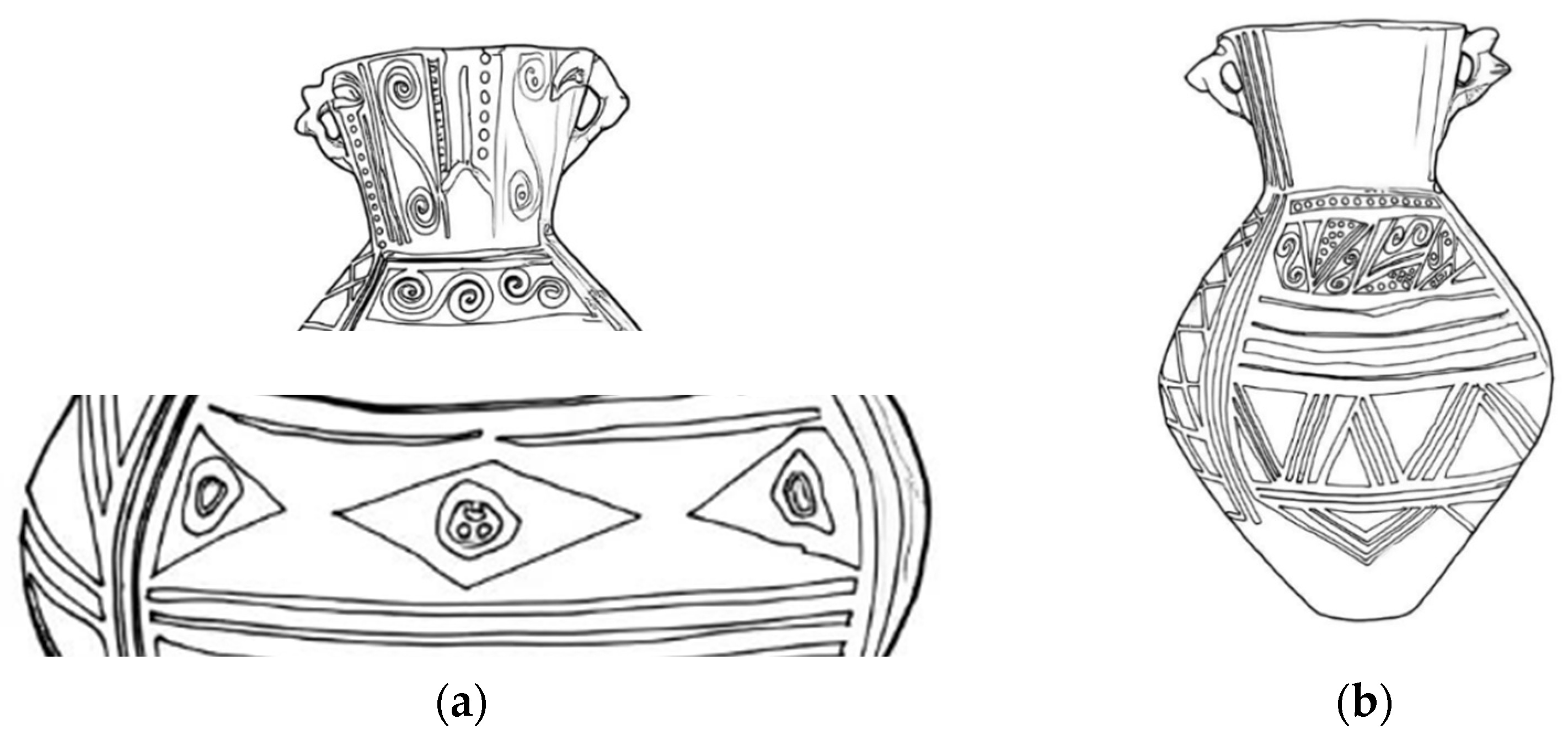
The jug from the Elén-pata phase (
Figure 7) is described solely in terms of its shape and geometric decorative elements. The piece features a central band decorated with a sequence of rhombuses, within which a circle is inscribed, containing, in turn, three points arranged in a defined pattern, while the remaining elements of the decorative field are distributed around this band, forming a system in which the rhombus shape functions as the dominant structural unit. From the Andean worldview, this structure suggests a representation of the pacha or world, a recurring motif in which the rhombus functions as a sign of totality [
18]; the circle inscribed within it could be associated with the concept of “soul” or “essence” and with the cycle of life, while the three points are consistent with the tripartite division of the cosmos. Taken together, they can be attributed notions of protection, duality, and proportionality of life conceived from the sacred [
29].
In another jar from the Elén-pata phase (
Figure 8), a decorative band can be seen at the neck level, in which a stepped sequence is depicted, from which a sense of ascent or a connecting bridge is given.
Figure 9 features a rhombus in its central section, interpreted as a head, symbolizing the pacha, or world. It is notable for its illustration of the four cardinal points, which converge at the union of the wipalas, forming a square cross. The surrounding triangles represent the Uku pacha, or inner world, suggesting the regeneration of life cycles on Earth, as they ascend and descend along the stairs.
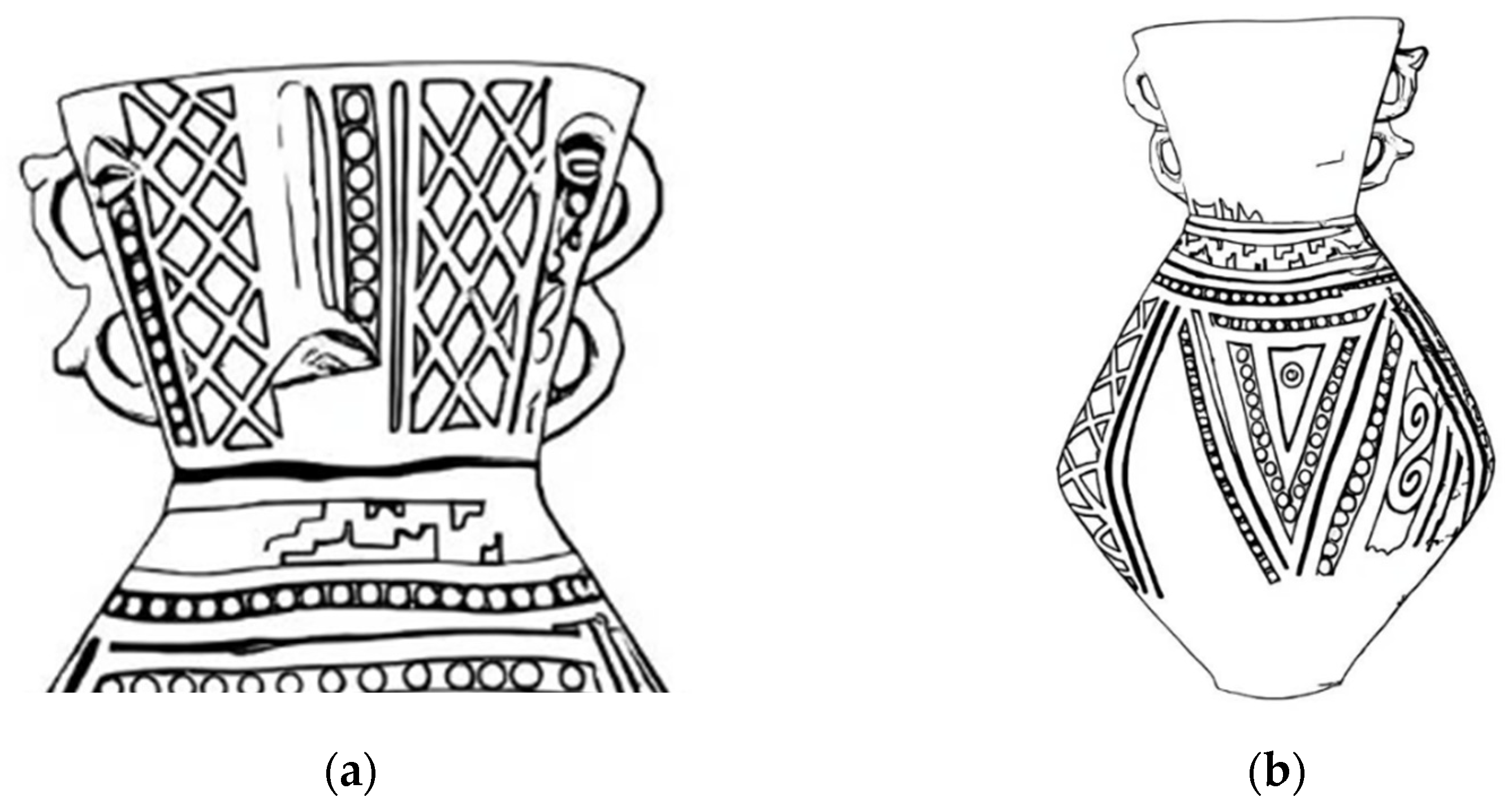
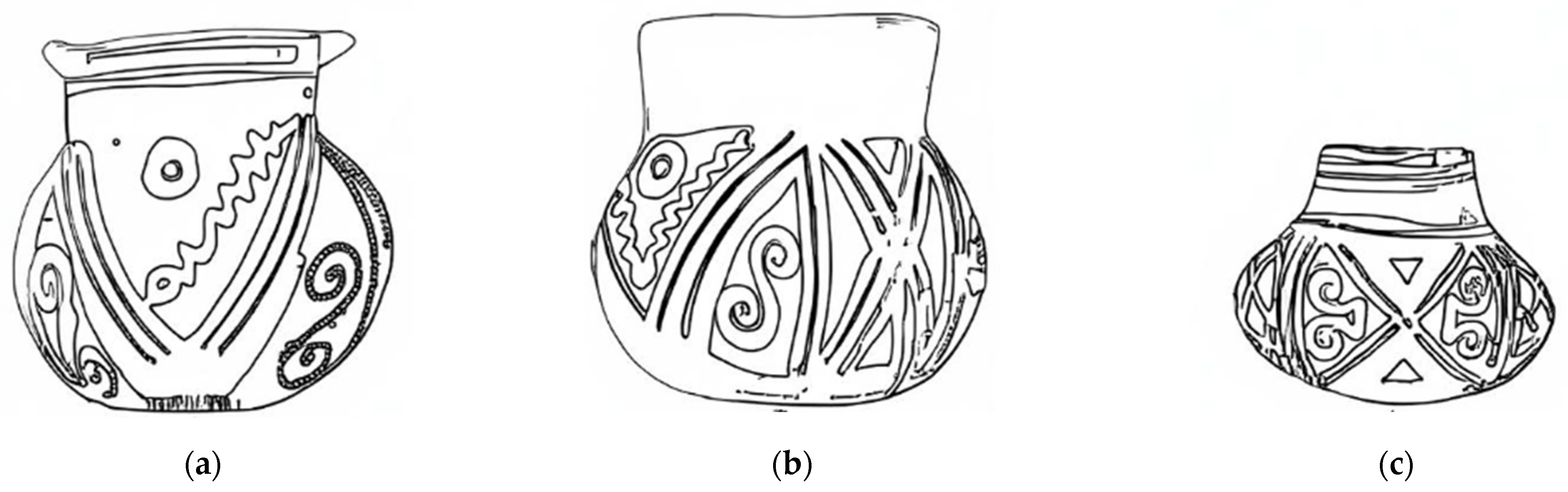
During the same period, a group of vessels was produced whose decoration is dominated by basic geometric elements. The decoration on this set of vessels features triangles, rectangles, diagonals, and steps, arranged in such a way as to create a marked ascending and descending verticality; one of the vessels (
Figure 10a) also incorporates a circle inscribed within a triangle, accompanied by a serpentine figure. This verticality suggests the representation of the passage between the three worlds of the Andean cosmos, where the steps and diagonals function as pathways of ascent or descent; the circle contained within the triangle could be interpreted as the receptacle of the soul, and the serpent—a mythical being whose dual nature represents water and fertility—serves as a vehicle connecting the three planes that constitute the order of the universe [
18,
28].
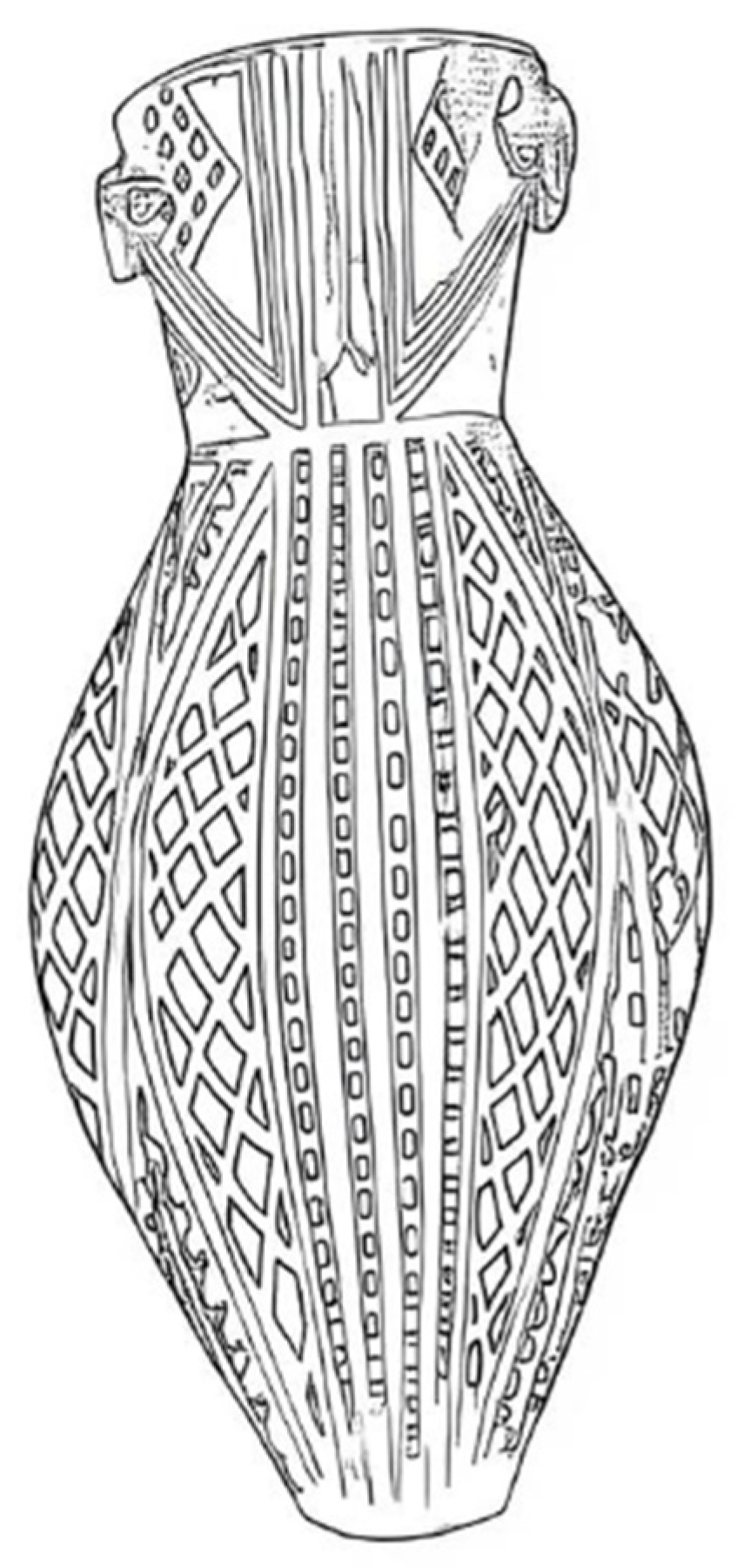
In the Huavalac phase (
Figure 11), a pitcher adorned with a network of rhombuses stands out. This design alludes to the extensive coverage that the pacha, or earth, possesses. The rhombuses are intertwined, symbolizing the union or connections between the elements. The vertical lines complement this design, indicating the parallelism and proportion associated with the protection of the origin, or God.
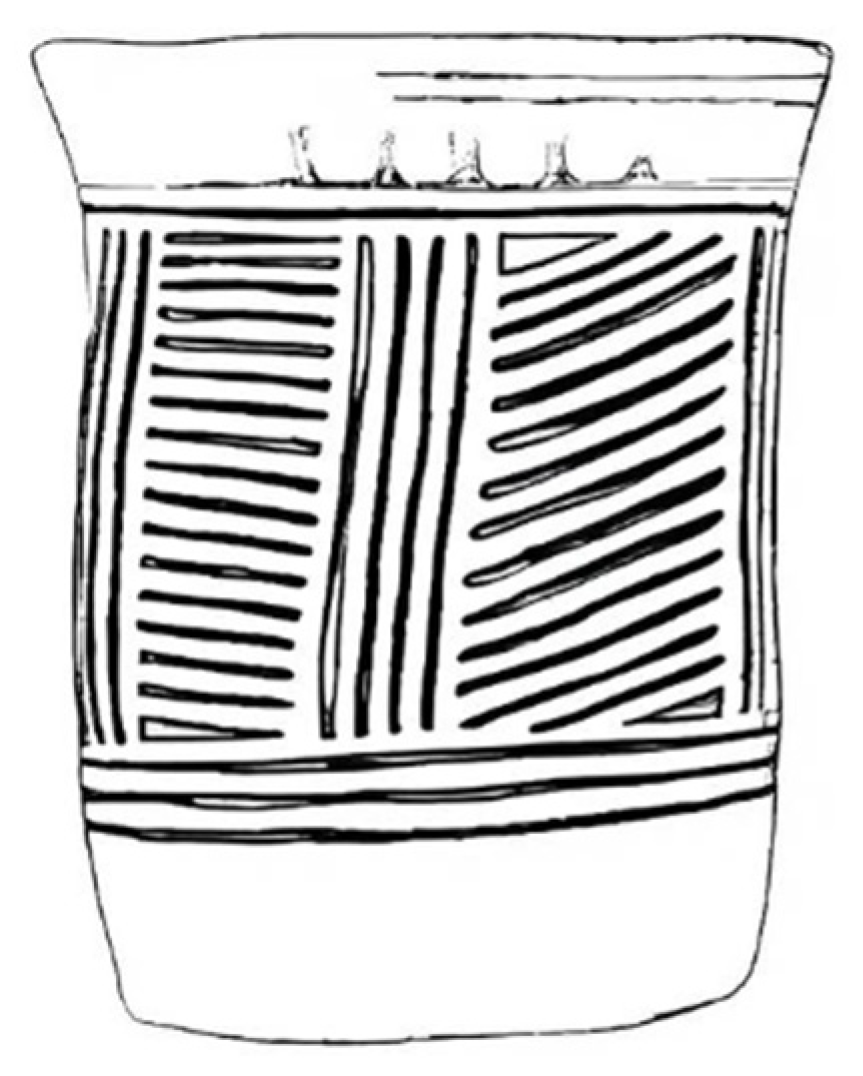
Finally, in the Puruhá-Inca phase, there is a predominance of vessels decorated with bands and lines, without a detailed analysis of their symbolic meaning (
Figure 12). The pieces feature a recurring decorative field with a tripartite division of space, complemented by diagonals that trace ascending and descending paths; there is also a notable simplification of the decoration compared to earlier phases. The tripartite organization is consistent with the structural order of Andean design which, according to Milla [
18], achieves compositional balance and reflects an understanding of spacetime and social organization, while the vertical lines suggest the representation of the sun’s paths, whose complementary diagonals express the transit between cosmic planes. The decorative simplification, for its part, could be associated with the cultural transformations that occurred following the arrival of the Inca culture in the Puruhá territory, which introduced changes in certain symbolic and productive practices.
4.2. Textile Association with Guano Knotted Carpets
This section presents the results derived from the formal and symbolic association between Puruhá archaeological iconography and the designs found in contemporary knotted rugs from Guano.
This section is based on in-depth interviews conducted with rug makers from Guano, who indicate that the rug designs have undergone several transitions. Don Alfonso Allauca, in his 2024 interview, notes that the earliest designs depicted on the rugs were Inca, which are still produced today but have been adapted to current color trends in the market. Don Mario Amaguaya indicates that pre-Columbian designs continue to be used, followed by Don Medardo Pancho, who points to the incorporation of floral designs as a Spanish influence. Finally, all agree on the integration of landscapes, faces, and gradients as distinctive designs, which increase in complexity depending on the shadows and gradients incorporated. These testimonies allow us to identify a cumulative process of cultural layers in the textile design.
At this point, it is necessary to note that Padilla [
31] partially corroborates the designs compiled in this study. He specifies that artisans categorize the “pre-Columbian lion, chacana, deer, and llamas” as pre-Columbian designs; the “redskin Indian and the Inca in profile” as pre-Incan; and finally, he groups the remaining designs as the artisans’ own creations. However, no mention was made of pre-Incan designs during the research process. This discrepancy reveals a flexible and unsystematic symbolic categorization.
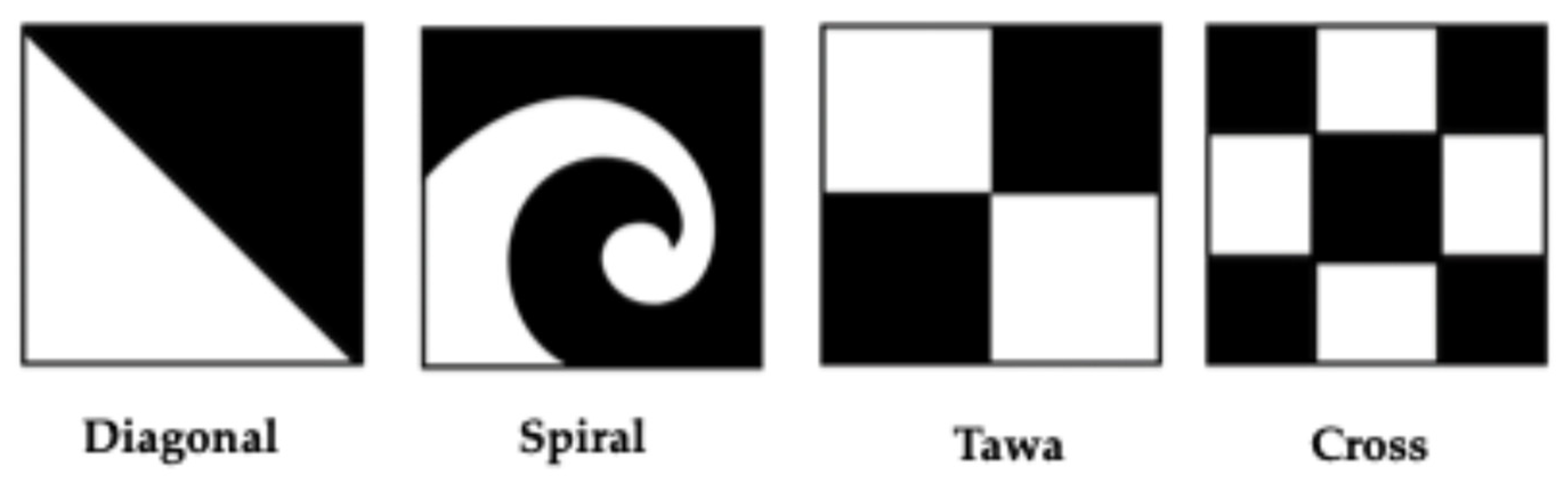
After establishing the presence of four design types, this study addresses the relationship between the rug designs and the iconography of archaeological pieces, emphasizing the Incan and pre-Columbian designs that artisans have in their personal archives and in their workshops. The comparative analysis allowed for the identification of direct formal correspondences between archaeological symbols and contemporary textile designs.
It begins with one of the most representative symbols of the study of Jijón and Caamaño [
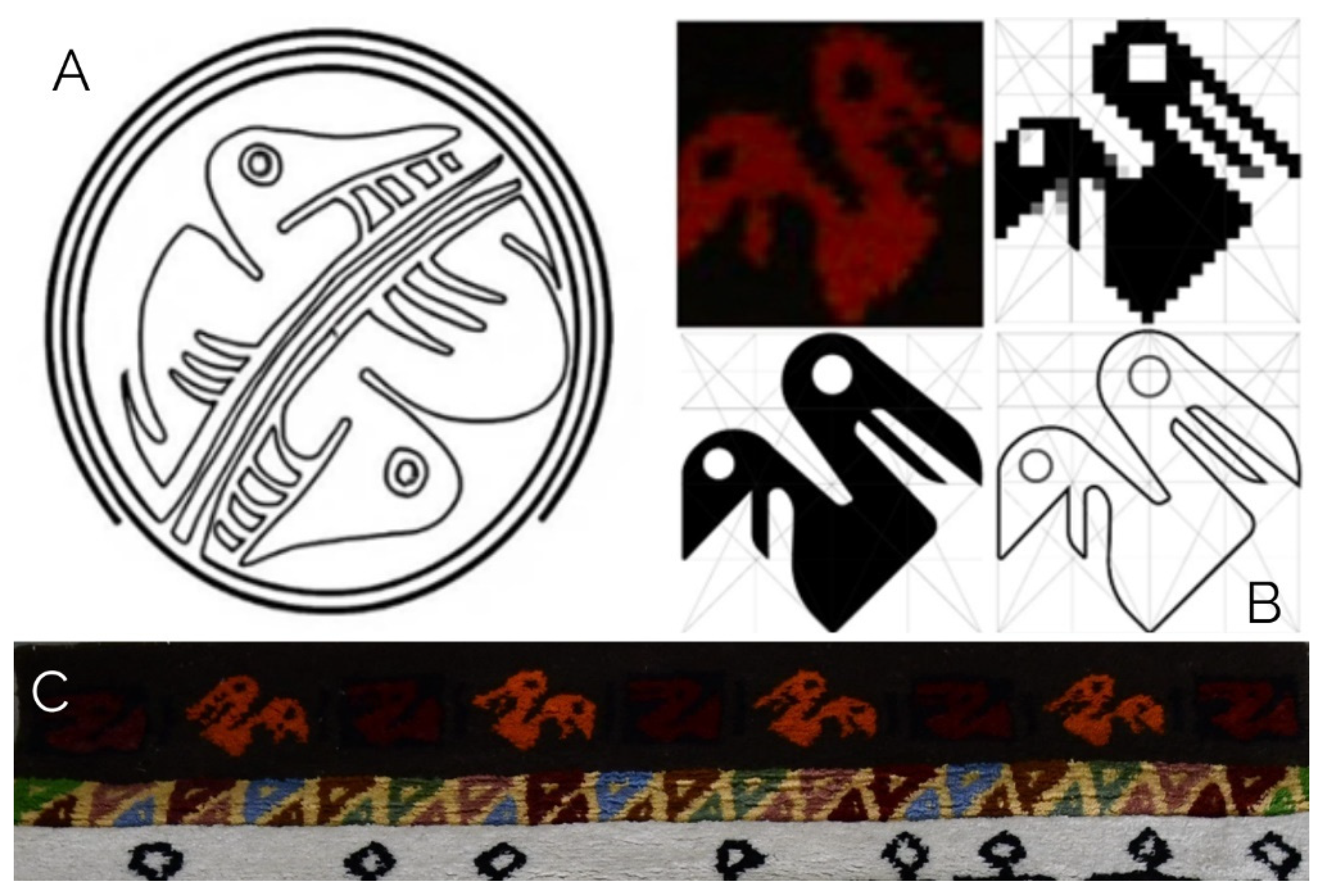
10], which is the two-headed serpent, which is linked to the Proto-Panzaleo II period; this symbol has been depicted in various textiles, as well as at various scales of work.
In
Figure 13, section A shows the symbol depicted on the archaeological piece. Then, in section B, using the drawing technique employed by carpet weavers, the symbol is transferred to the design grids to determine the size of the design and, consequently, the number of knots per quadrant required for its creation. These numbers will influence the amount of material the loom will need. Finally, section C shows how the design is incorporated into the knotted carpet.
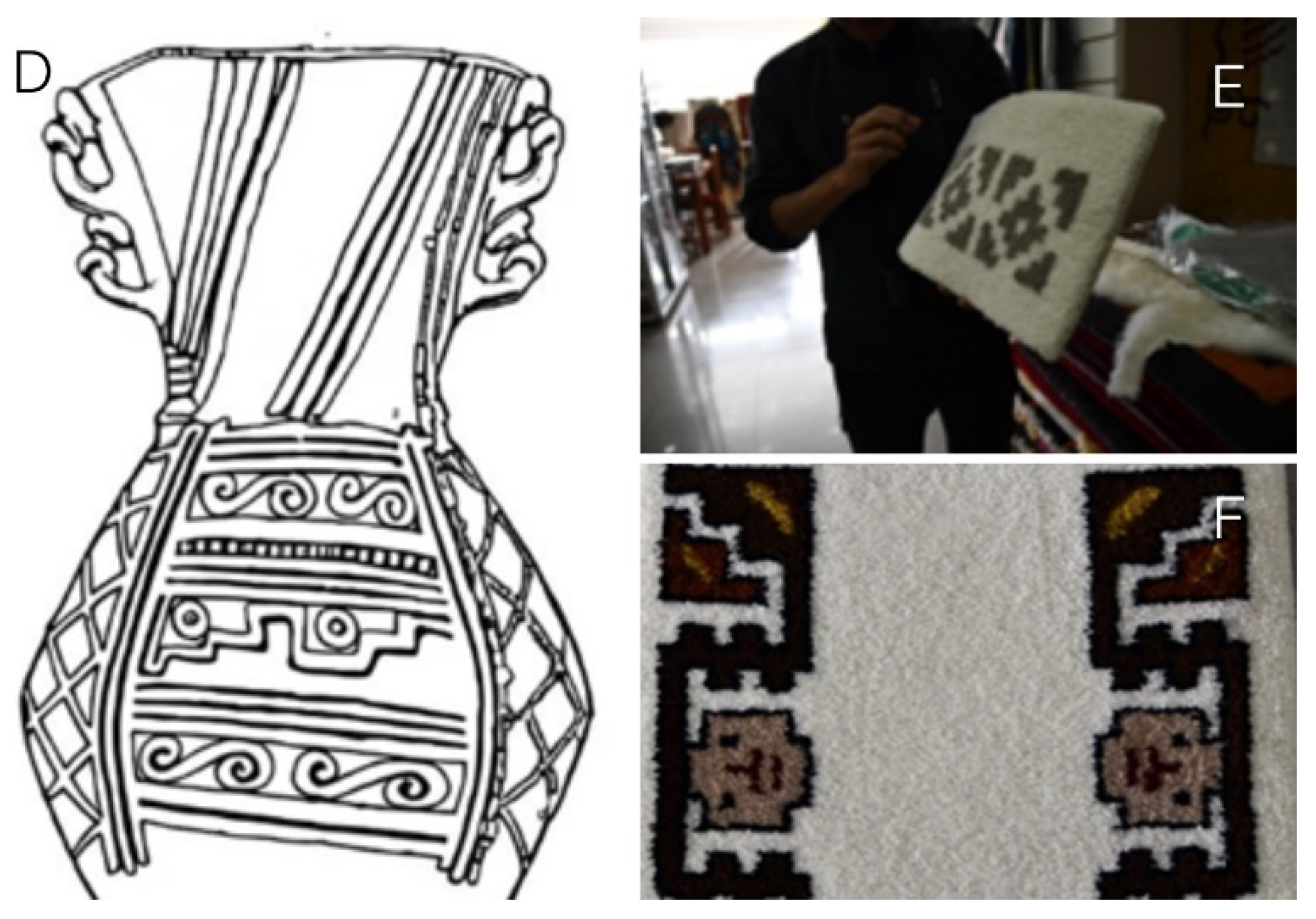
In
Figure 14, we observe the transfer of various symbols onto the rugs. Section E is particularly notable for its integration of the stairs with the Chakana, which features a central circle symbolizing the container of life. This circle points to the central point, representing the soul or essence. Cabezas [
32] notes that it “symbolizes, above all, time: without beginning or end, as a continuous and unchanging succession of instants identical to one another.”
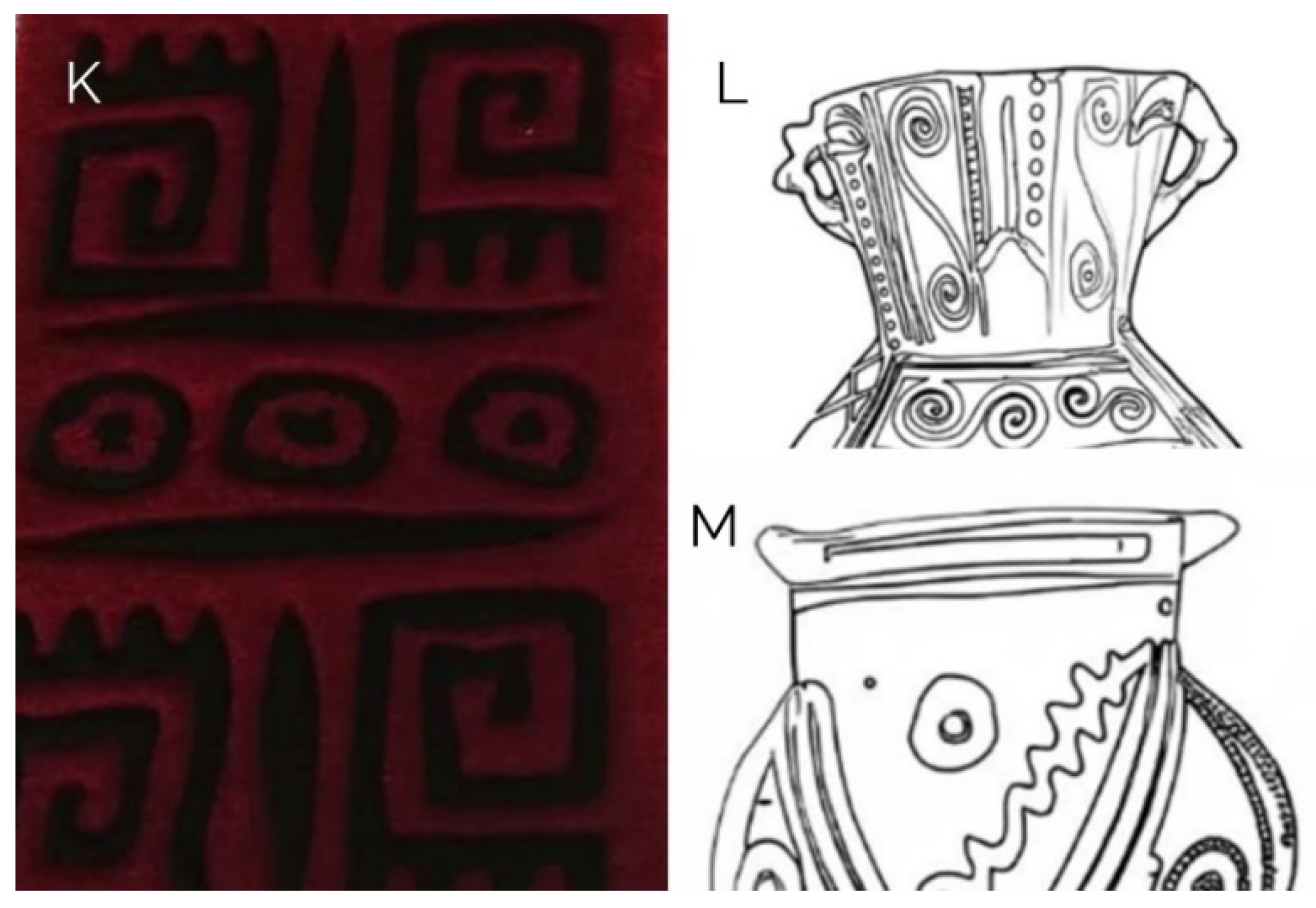
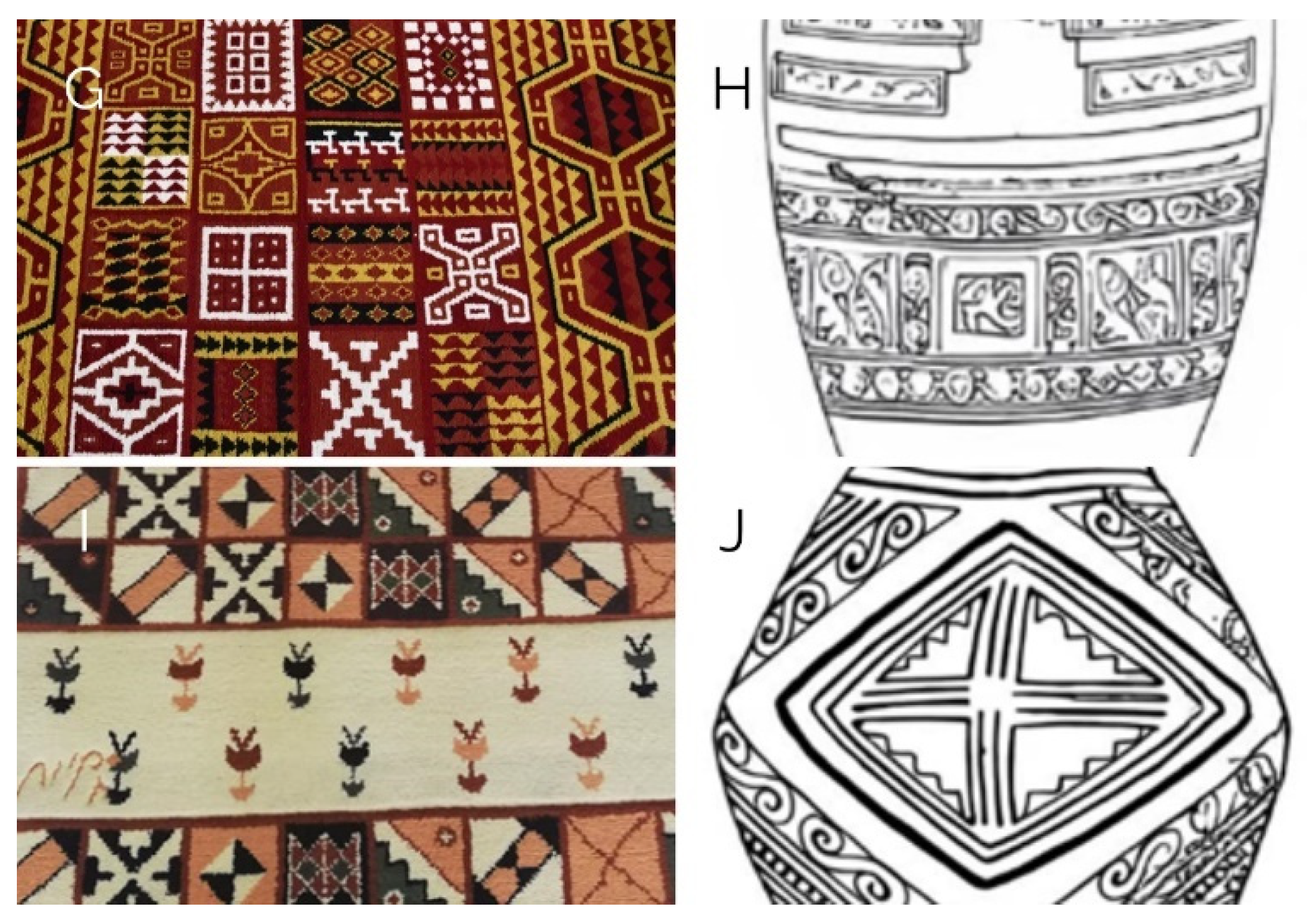
Finally, in
Figure 15 and
Figure 16, the use of different signs individually is shown with the aim of creating a symmetrical design using color contrast, but the integration of geometric elements, pre-Columbian designs and contemporary Andean designs can be appreciated.
4.3. Channels of Transmission and Circulation of Designs
Interviews conducted with the knowledge bearers in the Guano workshops reveal that none of them claim to have derived their designs directly from images taken from museum collections or archaeological documents of any kind, establishing that access to the works of Jijón and Caamaño [
10] or to specialized archaeological literature is not part of the educational background of any of the workshops visited. Far from undermining the thesis of symbolic continuity, this finding necessitates a more precise reframing of the mechanism of transmission.
Thus, the primary transmission mechanism identified is intergenerational practice within the workshop, which stems from master-apprentice teachings. As a result, many of the designs have been shared among workshop members through inherited patterns, reproduced or adapted by each generation, and incorporated in response to specific client requests, without necessarily involving an explicit conceptualization of their cultural origins. This mechanism is consistent with what Parada [
25] describes regarding contemporary Puruhá clothing: aesthetic elements of indigenous origin persist as living heritage through community practice, without their transmission requiring an academic or documentary process; it also highlights the ability to maintain and adapt formal repositories without the need to recognize them as such before external observers [
25] (pp. 89–112).
Another resource available to artisans for incorporating symbolism and iconography is the canton’s collective visual memory, which serves as a symbolic repository of geometric patterns, spirals, rhombuses, stepped designs, and anthropomorphic and zoomorphic figures that are present in everyday life in the form of handicrafts, pottery passed down through families, building facades, and more, which each generation of rug weavers is familiar with before beginning formal training in the technique.
However, it must be acknowledged that this study cannot definitively establish the historical moment when certain motifs were incorporated into Guano’s textile repertoire, nor the exact chain of transmission between the archaeological record and living artisanal production. This gap between the archaeological record and contemporary practice constitutes an inherent limitation of this work and opens a line of future research.
4.4. Discourse Association
This section presents the results of the discourse analysis obtained from interviews and direct observation during the Guano knotted carpet tourism experience.
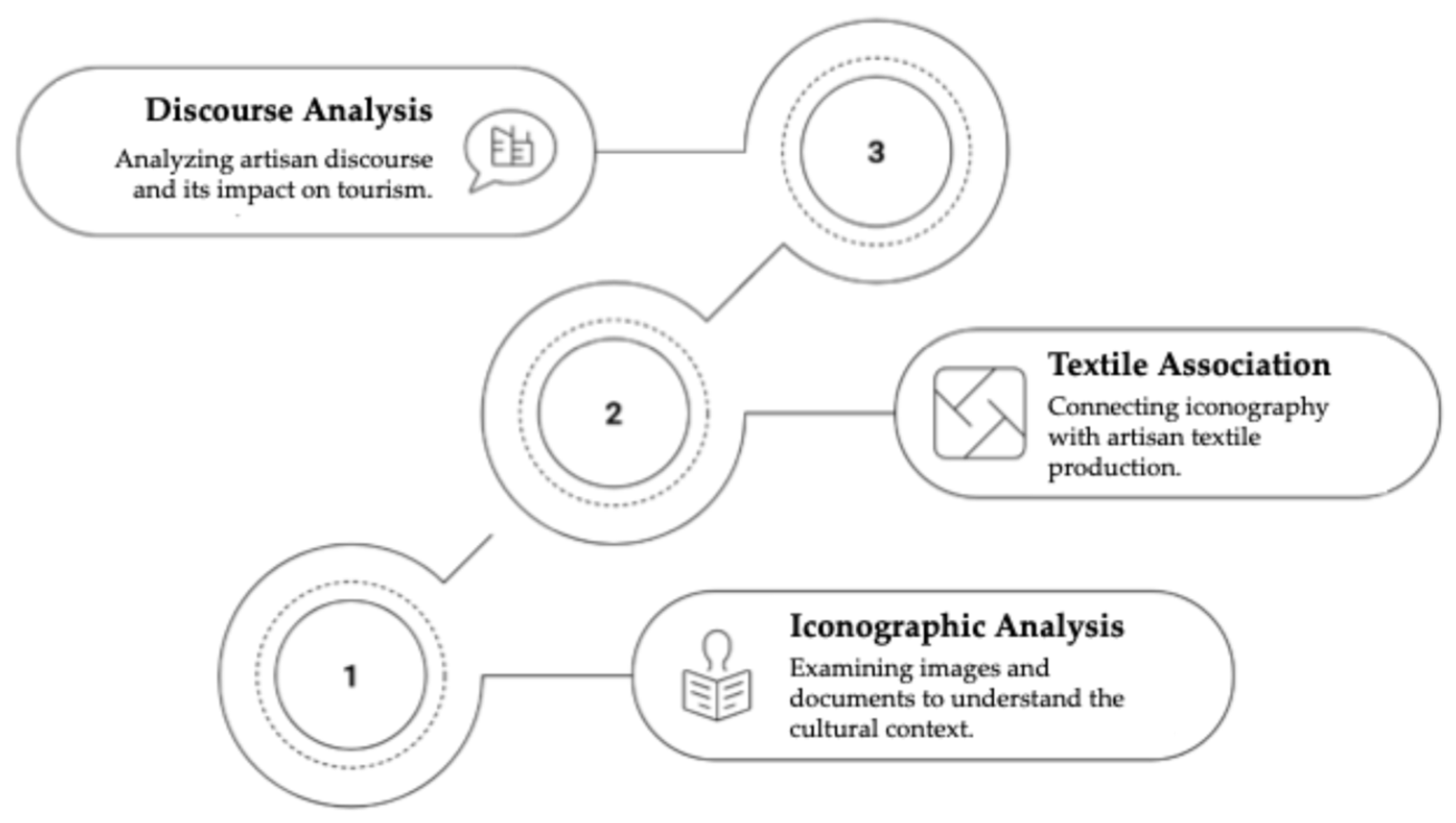
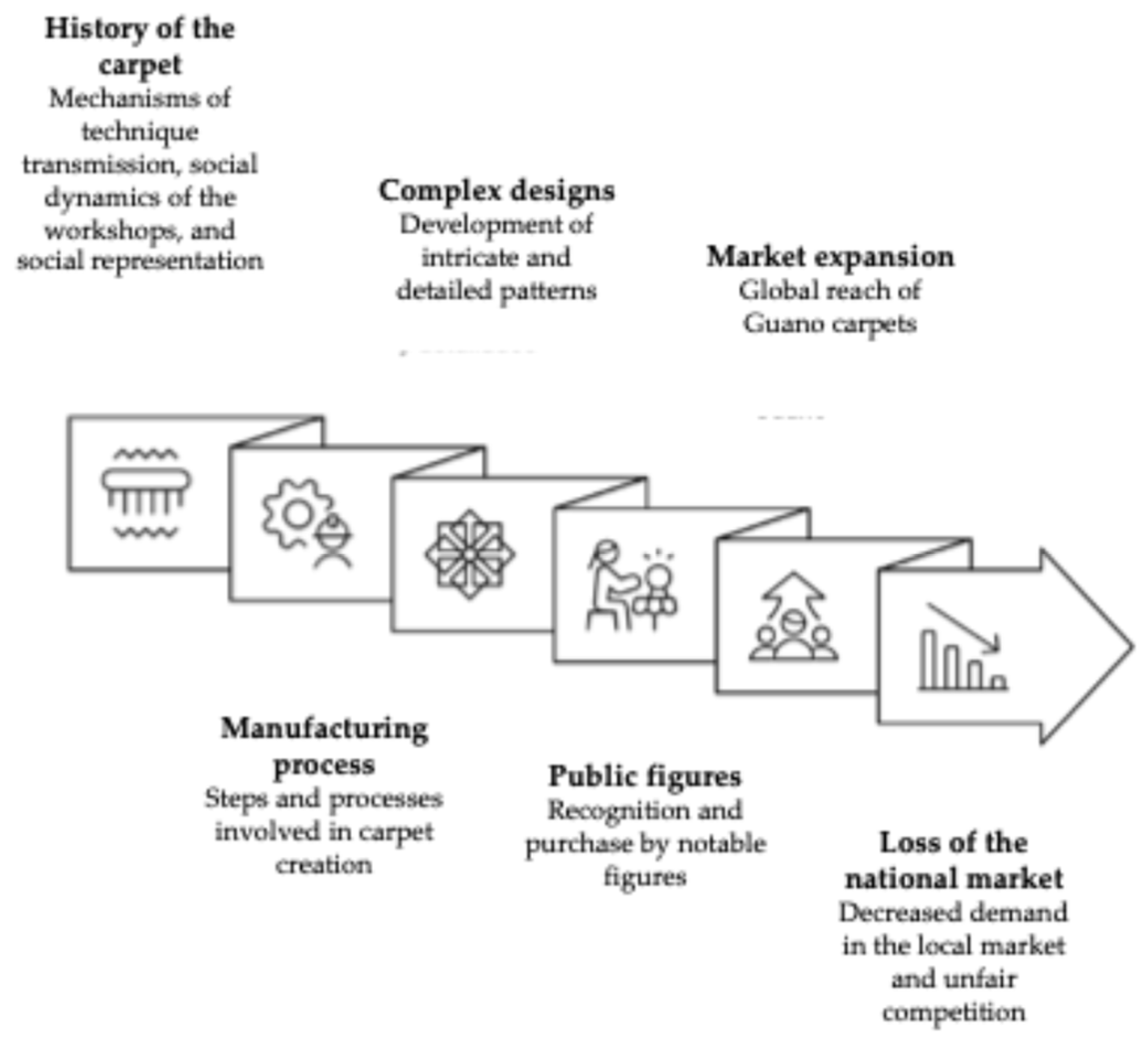
In the next phase, researchers identified the most frequently shared topics of information through in-depth interviews with knowledge holders and direct observation in workshops and guided groups within the carpet tourism experience, establishing six main topics (
Figure 17).
The first three topics are associated with the interpretation of the workshops within the tourist experience, for which a brief description of the different steps, materials, and tools required for making the carpet is provided. During the guided tour, the guides intersperse their own experiences regarding: the social and labor dynamics of the workshops during their heyday, the specialization time required to advance to a higher position, the length of the workday, the tasks performed by women and men, how the materials were obtained, and the time required to fulfill each workshop’s orders. Details are also shared about the most intricate designs that have been created, which feature the faces of national and international public figures depicted on the carpets.
The phenomenon of attributing artisanal designs to “Inca culture”—as documented in the discourses of knowledge bearers—is part of a regional dynamic that far exceeds the scope of any single archaeological publication. Throughout the Andes, the term “Inca” has historically functioned as a signifier of high semantic plasticity: it simultaneously designates a specific pre-Hispanic state, a historical period, a Pan-Andean cultural horizon, and, more generally, everything that existed before the Spanish arrival. Furthermore, this is reinforced by an educational system that has devoted extensive attention to Inca civilization while treating pre-Tawantinsuyu local cultures as marginal, as noted by Rodríguez-Cruz [
33], compounded by five centuries of mestizaje that have acted as a force for cultural homogenization.
In this context, the use of the term “Inca” by rug weavers to refer to the symbolic heritage of their rugs is not so much a historical error as a functional adaptation of identity: it allows them to connect with a past that is recognized internationally without bearing the burden of a local ethnic specificity that could be subject to discrimination. Janeta [
30] documents this tension in the Puruwa worldview, where the depth of ancestral knowledge coexists with a narrative that attributes its origin to Inca culture, which contributes to obscuring the uniqueness of the local tradition.
An additional factor influencing the cultural attribution of these designs is the linguistic dimension. The Kichwa language—a standardized variant adopted following the Inca expansion—gradually supplanted the local names of iconographic motifs, replacing them and establishing a symbolic association with the Inca. Terms such as chakana or pachamama, widely used today to designate elements of Andean design, belong to standardized Kichwa and do not necessarily reflect the original conceptual categories of the Puruhá. This lexical homogenization, brought about by the expansion of the Tawantinsuyu as well as by colonial missionary language policies and contemporary intercultural bilingual education programs, has contributed to Guano artisans naming their designs with vocabulary that refers to the Inca, even when the forms they reproduce have local roots.
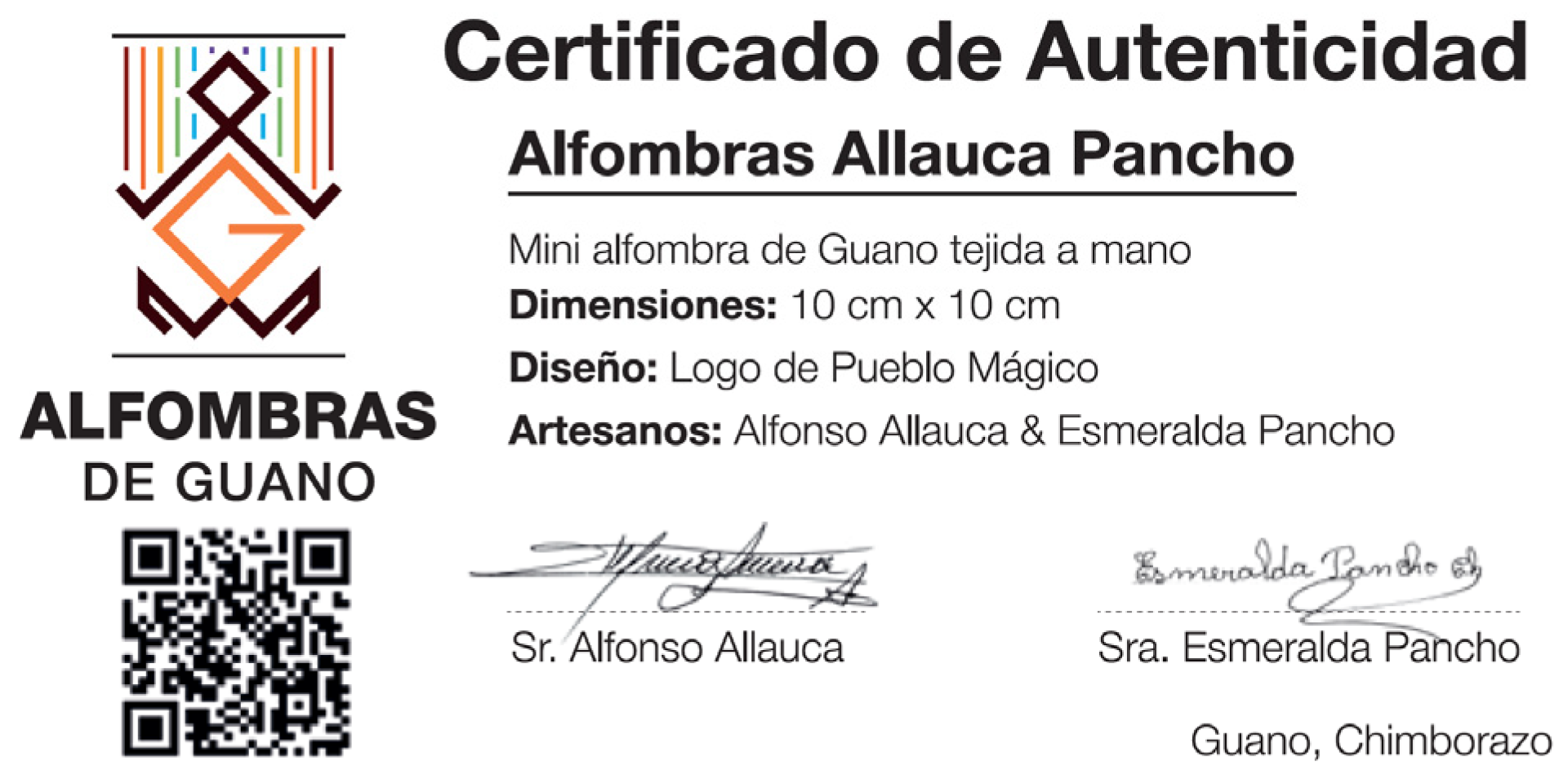
The last three topics are most frequently used during visits to stores where the aim is to highlight the value of the carpet-making technique. It’s important to note that the topic of “Loss of Market Share” is one of the most common ways to discourage the purchase of “Chinese” carpets, as they call those mass-produced or industrially manufactured carpets sold in various souvenir shops throughout the city. To prevent potential buyers from feeling cheated by purchasing counterfeit carpets, the artisans have partnered with the Higher Polytechnic School of Chimborazo. Through this collaboration, they have designed and implemented a logo based on the patterns of archaeological artifacts to create a product identity, as well as a certificate of origin for carpets or souvenirs produced using the knotted carpet weaving technique (
Figure 18).
Unfortunately, it was determined that none of the bearers engaged with the details and interpretations of the iconography found in the archaeological artifacts of the Puruhá culture. Instead, they associate these symbols and icons with the Inca culture, highlighting a cultural disconnect stemming from inadequate interpretation. This finding represents a key result of the study, as it illustrates the existence of erroneous cultural narratives that create historical inaccuracies and contribute to the ongoing erosion of local identities.




 ,
,