Article

Threads of War: Scientific Analysis of the Dyes, Fibres and Mordants Used in the Production of Afghan War Rugs

Department of Scientific Research, British Museum, Great Russell Street, London WC1B 3DG, UK
*
Author to whom correspondence should be addressed.
Heritage 2026, 9(2), 81; https://doi.org/10.3390/heritage9020081
Submission received: 16 January 2026 / Revised: 5 February 2026 / Accepted: 10 February 2026 / Published: 19 February 2026
(This article belongs to the Special Issue Dyes in History and Archaeology 44)

Abstract

So-called ‘war rugs’ started being produced in Afghanistan after the Soviet invasion in 1979. These textiles have sparked debate as symbols of resilience and political commentary but also as controversial commodification of human suffering. However, their manufacture and materiality have not been studied so far. In the framework of the British Museum exhibition “War rugs: Afghanistan’s knotted history”, a scientific investigation was conducted on nine rugs from the collection. Approximately 65 samples were analysed by optical microscopy (OM), scanning electron microscopy coupled to energy dispersive X-ray spectroscopy (SEM-EDX) and high-pressure liquid chromatography coupled to diode array detector and tandem mass spectrometry (HPLC-DAD-MS/MS) to study the fibres, mordants and dyes used in the production of the rugs. Scanning X-ray fluorescence (MA-XRF) and multiband imaging (MBI) were also used directly on the rugs to map the distribution of specific mordants and dyes, respectively. The results revealed the intentional use of white or dark wool as the substrate for dyeing, to obtain specific colour shades. A wide range of synthetic dyes was detected, including Acid Orange 7, Acid Red 88, Basic Green 4, Acid Blue 92, Acid Black 1 and Direct Black 38 in the earlier rugs, whereas Direct Yellow 1, Direct Brown 1, Direct Yellow 12, Acid Green 25, Acid Blue 113 and Direct Blue 15 were identified in the later rugs. Some synthetic dyes remained unidentified. Additionally, natural dyes were used in three rugs. An emodin-based colourant, possibly obtained from dock or sorrel (Rumex spp.), was detected in two light brown areas. A berberine-based colourant consistent with barberry (Berberis spp.) was detected in a yellow area. These results represent the first scientific study of these objects and enable preliminary insights into the details of this complex craft that has evolved from centuries of carpet making in this area.

1. Introduction

The history of Afghanistan has been full of conflict. Geographically situated on major trade routes between China, India, Central Asia and Iran, and rich in natural resources, Afghanistan has often been targeted by forces seeking to extend their power in the region. Its borders have fluctuated across time as its territory was conquered and ruled by numerous empires and dynasties, which reflect in the rich diversity of Afghan carpet-weaving. The practice was traditionally carried out by women of nomadic groups, such as the Turkmen and Baluch, who used their own styles and motifs. They made knotted rugs with tufted piles as well as flatweave rugs, which were also made by groups such as the Hazara, Uzbek and Kyrgyz. Most knotted rugs from Afghanistan were weaved on horizontal looms, using the asymmetric Persian knot and including two weft threads between each row of knots [1].
The rise of the Russian and British empires in the 1700s and 1800s turned Afghanistan into a zone of political and economic rivalry. In December 1979, a few months after the coup-d’état led by the filo-American Mujahideen movement, the Soviet Union invaded Afghanistan. By the fall of the USSR in 1990, Afghanistan was left in chaos. Islamist groups, such as the Taliban and al-Qaeda, became increasingly powerful. Al-Qaeda’s involvement in the 9/11 attacks ultimately led to military intervention by the United States and its allies [2]. In this complex framework of war and conflict, weavers started introducing military imagery into their rugs. Birds, flowers and centuries-old symbols were replaced by helicopters, guns, tanks and artillery, creating the new artform of Afghan war rugs. However, the imagery of war rugs extends beyond representations of military equipment. Some motifs relate to specific local, ethnic or religious traditions. Others are drawn from the rich literary and cultural heritage that connects Afghanistan to Iran, Central Asia and Northern India [3]. Over the last few decades, vast numbers of Afghans have been displaced to refugee camps, both within Afghanistan or to neighbouring Iran or Pakistan. Here, weavers from various ethnic backgrounds have met, combining different rug-making aesthetics and adapting to workshop conditions, resulting in a general homogenisation of traditional motifs and styles in these rugs [3].
Nevertheless, stylistic differences often enable war rugs to be broadly classified according to their production period. First generation rugs date to the Soviet–Afghan War (1979–1989). Traditional imagery is mixed with war motifs discreetly woven into the design, including weapons and aircraft often hidden among other elements. In some cases, war motifs are more evident, especially Kalashnikov rifles, as symbols of the Mujahideen resistance and heavy Soviet weaponry (tanks, ships and helicopters organised in columns and rows). Second generation rugs are associated with the civil war and Taliban period (1990–2001). In these, traditional rug symmetry blurs and English inscriptions appear, emphasising the growing commercialisation aimed at Western markets. Themes include Soviet troops leaving Afghanistan and strong political satire. Third generation rugs correspond to post-9/11 attacks (2001 to present). Following the U.S. invasion of Afghanistan, war rugs began depicting the events of the attack on the Twin Towers, as well as U.S. flag and military hardware and slogans echoing Western perspectives [4].
Early war rugs appealed to soldiers fighting in Afghanistan and to humanitarian workers, journalists and diplomats, fuelling two main markets, aimed mostly at foreigners: small pieces that could be rolled into a soldier’s backpack, and larger, more complex rugs for international collectors. Traders and workshop owners quickly began direct production, providing a variety of templated designs and lowering the quality of materials and production methods. As a result, war rugs are often criticised as inauthentic and manufactured under exploitative conditions, although they continue to provide Afghan weavers with a source of income in dire times [5].
Despite their relative popularity as heritage objects, the materiality of war rugs has not hitherto been investigated, especially with attention to the changes in materials, such as dyes, fibres and mordants over time. Within this framework, nine rugs from the British Museum’s collection were scientifically studied using a combination of techniques. Optical microscopy (OM) was used to investigate the colour distribution in the threads [6,7]. Scanning electron microscopy coupled to energy dispersive X-ray spectroscopy (SEM-EDX) was used on samples to study the fibre morphology [8,9,10] and gather indications on the use of mordants [11]. Scanning X-ray fluorescence (MA-XRF) [12,13,14] and multiband imaging (MBI) [11] were adopted to map the distribution of chemical elements and specific dyes, respectively. High-pressure liquid chromatography coupled to diode array detector and tandem mass spectrometry (HPLC-DAD-MS/MS) is the state-of-the-art technique for dye identification [15,16,17,18,19,20]. This thorough investigation was carried out with the aim to highlight the connections between modern and traditional practice, shed light into material availability and market trade, and reveal the details of this complex craft that has evolved from centuries of carpet making in Afghanistan and beyond.

2. Materials and Methods

2.1. Afghan War Rugs

The rugs studied are presented in the following sections in order of production date. Their accession numbers are included, but for conciseness the rugs will be henceforth referred to as “RX” (X = last digits of the accession number). Samples are referred to as “RX_colour” (colour being the colour of the sample).

2.1.1. Accession Number 2010,6013.7—R7

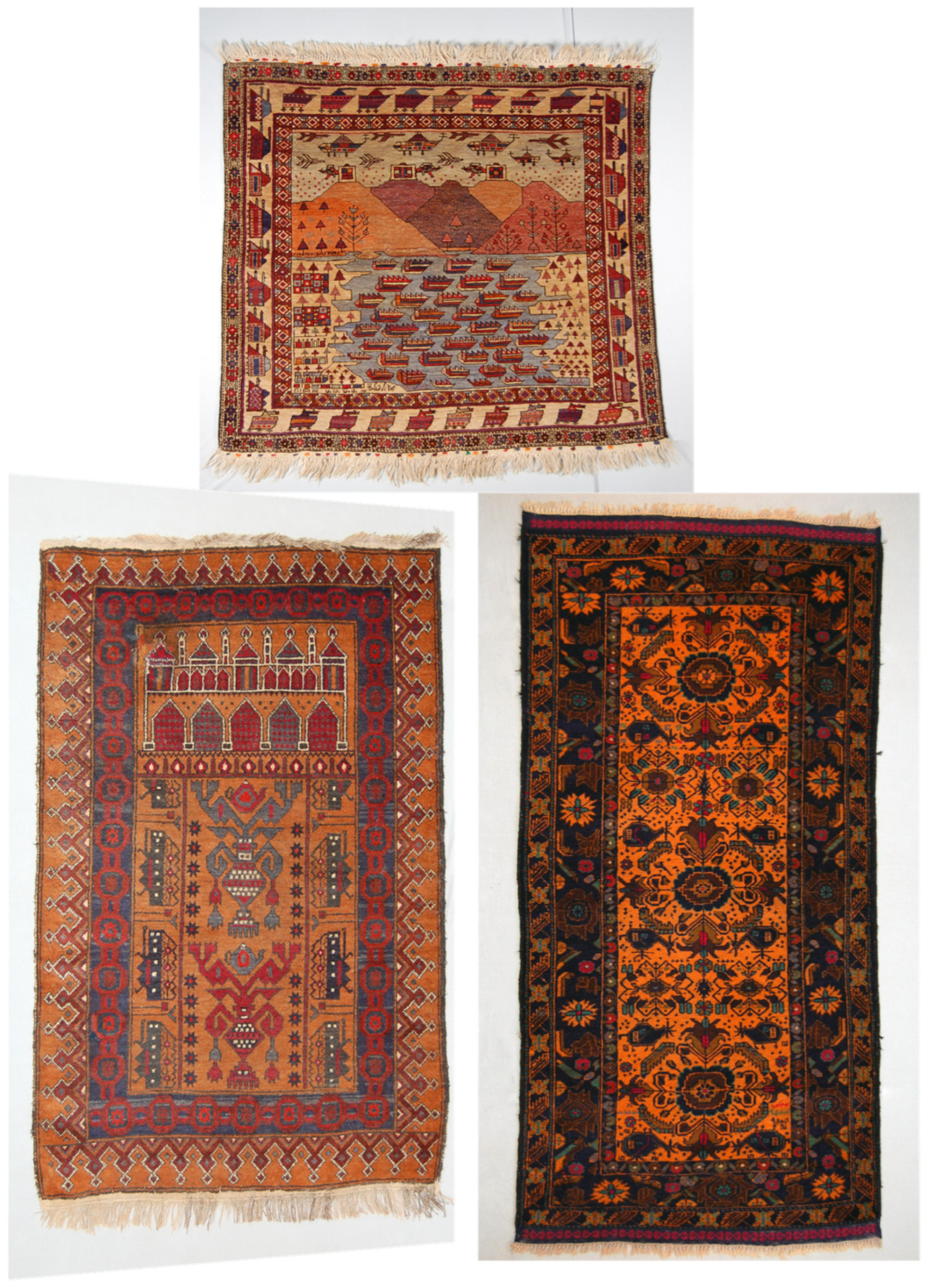
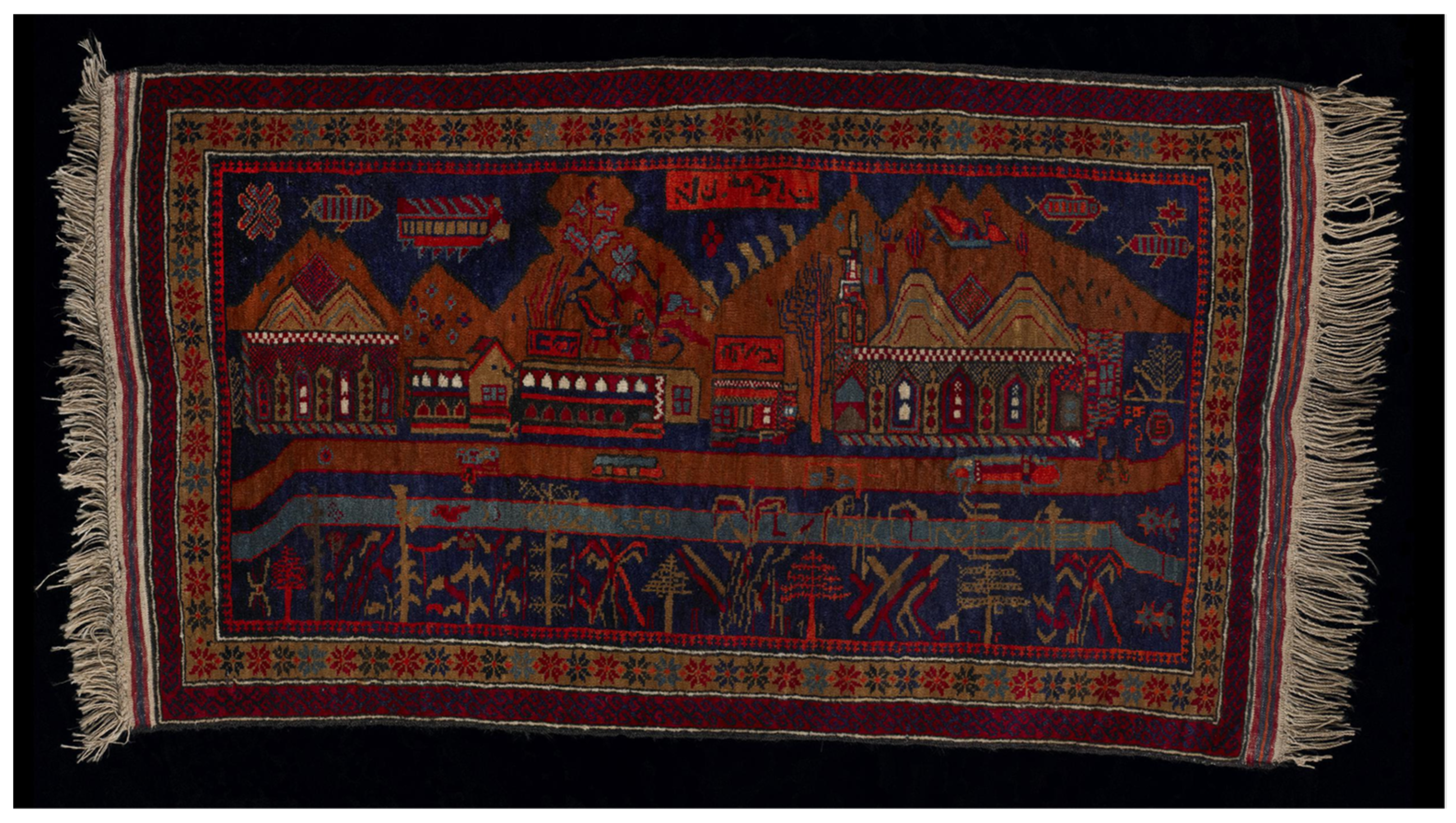
This rug (Figure 1) represents a scene of an attack on a small town or village with a mountain range. The depiction includes houses, a mosque, trees, a river, a roadway and flowers, as well as jets with exploding bombs overhead. Explosions are depicted along the lower section of the scene as well. The borders have abstract and floral motifs. The combination of motifs and the inscriptions in Farsi probably place this rug as an early production (1980–1989). The colours are orange, bright orange, red, beige, brown, black, light blue and blue. Samples were taken for all colours.

2.1.2. Accession Number 2010,6013.10—R10

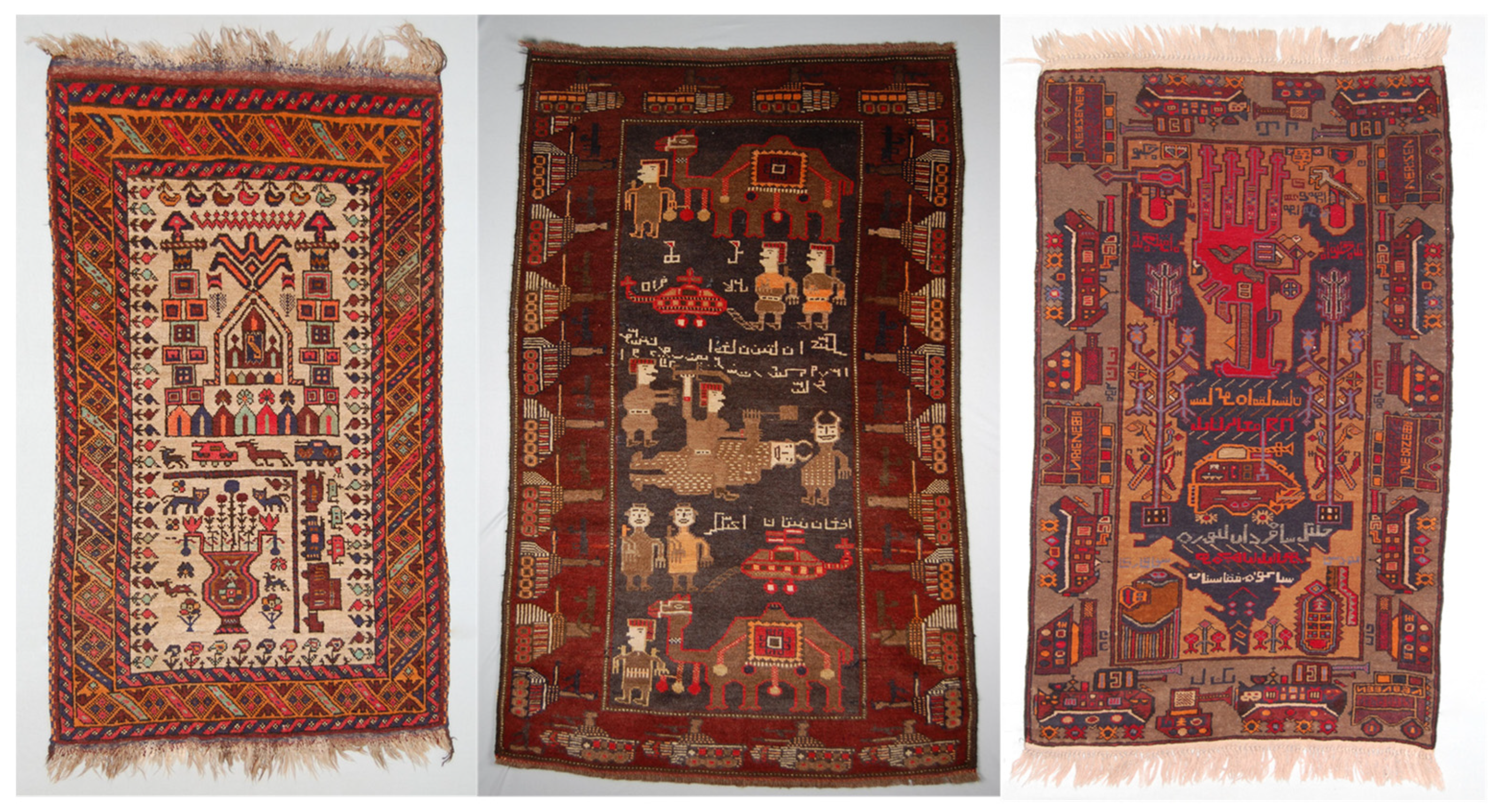
The main design features a building, possibly a mosque, with two tower minarets, a large vase with flowers, animals, a convoy of military vehicles and helicopters (Figure 2, left). Borders of multi-coloured flowers and geometrical patterns frame the design. The V-shaped pattern topping the building resembles the rams’ horns motif, which is symbol of prosperity and protects against evil spirits in Turkmen culture. The floral vase with symmetrical paired felines is often found in Baluch rugs and picks on decorative patterns in paintings, carpets and architecture from Iran, India and Central Asia. The combination of traditional motifs with a few images connected to war subtly inserted in the design probably places this rug as an early production (1980–1989). It has a beige ground, and the colours are orange, bright orange, red, light brown, brown, dark brown, aqua and blue. Samples were taken for all colours.

2.1.3. Accession Number 2010,6013.12—R12

The central image shows an Afghan soldier attacking a Russian soldier, surrounded by onlookers, helicopters and soldiers leading camels (Figure 2, centre). The Russians are depicted as horned demons (divs in Persian) in the style of traditional Persian miniature paintings of scenes from the Shahnameh (Book of Kings) depicting the hero, Rustam, slaying the evil White Div. The wide border around the carpet features a convoy of tanks with machine guns. Several inscriptions in Farsi are placed around the main scene. Some are reversed, suggesting that they were woven from a template. The references to traditional motifs suggest that this rug might be an early production (1980–1989). The colours are orange, red, dark red, yellow, brown-grey, dark brown and dark blue. Samples were taken for all colours.

2.1.4. Accession Number 2010,6013.13—R13

The complex iconography (Figure 2, right) includes a large tank and a four-barrel anti-aircraft gun in the central field flanked by tall poppy plants, probably referring to the opium trade to finance the war effort. The anti-aircraft gun bears similarity with hand-shaped standards displayed during processions to commemorate revered individuals. The corners of the central field include a grenade, a rocket launcher and other unidentified weapons. The wide border includes a train of tanks and other armoured vehicles. The inscriptions are in Farsi and Russian indicating that the rug is probably an early production (1980–1989). The colours are orange, red, dark red, beige, grey, brown, light blue and dark blue. Samples were taken for all colours.

2.1.5. Accession Number 2010,6013.14—R14

This almost-square rug features a large body of water with military boats surrounded by buildings, trees and a mountain range (Figure 3, top). Russian block houses are depicted on the mountain tops, and the sky is full of military helicopters and planes dropping star shells. The middle and widest decorative border includes a variety of tanks and armoured vehicles, whereas the inner and outer borders feature geometrical patterns. The inscriptions are in Farsi and the rug is probably an early production (1980–1989). The colours are orange, red, dark red, beige, brown, aqua, light blue and blue. All colours of the design were sampled.

2.1.6. Accession Number 2010,6013.15—R15

The rug features five niches and five buildings with minarets at the top (Figure 3, left), suggesting that it may have been used as a prayer carpet. The two large central motifs appear to be stylised vases with flowers with images of teapots above. Teapots and water ewers were often included in Central Asian embroideries to represent hospitality and generosity. The colours are orange, red, dark red, black, light blue and navy blue, which are typical of traditional Baluch rugs. However, the floral vases recall ikat patterns on Uzbek and Tajik textiles. Light and dark blue tanks frame the main design. The mixture of motifs suggests an early production of this rug (1980–1990). Samples were taken for all colours.

2.1.7. Accession Number 2010,6013.17—R17

Referred to as the “garden carpet” (Figure 3, right), this rug features a main design on a peach ground with a repeating abstract floral pattern. Blue helicopters are subtly incorporated in the corners, whereas a conventional pattern might have included birds. A small inscription in Farsi has been incorporated on one corner of the rug (possibly the weaver’s signature). The multiple blue floral borders frame the peach ground. A flatweave blue border with bright pink patterns is included along the weft edges. Reminiscent of Baluch “zakani” rugs, the textile is probably of early production (1980–1990). The colours are orange, bright pink, brown, olive green, green, light blue and blue. Samples were taken for all colours.

2.1.8. Accession Number 2010,6013.24—R24

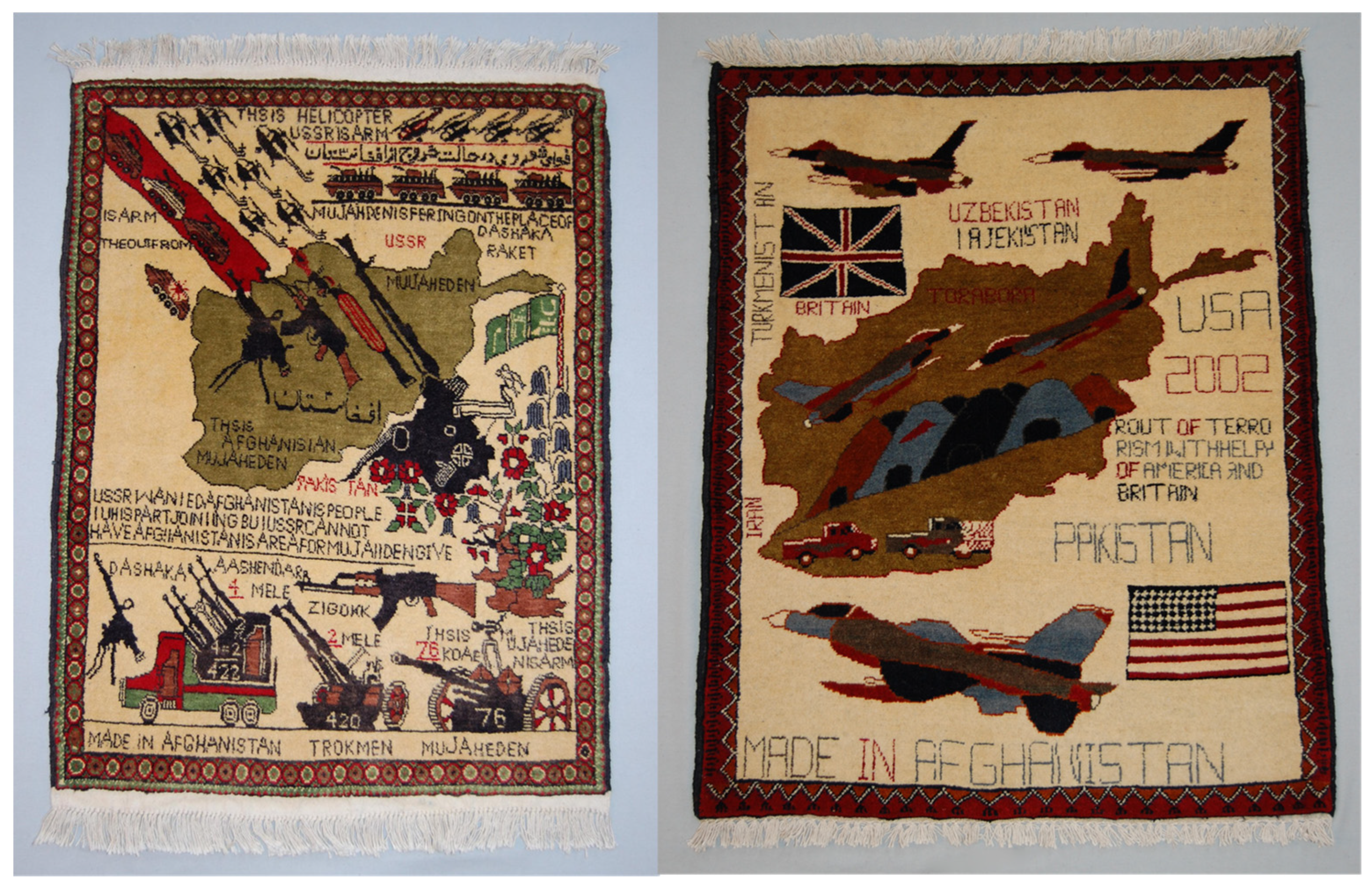
The main design features a map of Afghanistan in green with rocket launchers and Kalashnikov machine guns depicted inside the map (Figure 4, left). These point at several armoured vehicles and helicopters shown leaving Afghanistan. These rugs are sometimes referred to as ‘exit rugs’, ‘protest rugs’ or ‘mujahideen rugs’, as they depict the Soviet forces leaving Afghanistan. The rug also includes a large poppy plant, a green flag on the right and a flowering shrub, which traditionally refers to happiness and well-being and may have been an expression of joy at the Soviet withdrawal. The lower third of the rug features various types of anti-aircraft guns, which are labelled in English script. Several bands of inscriptions in English and Farsi are spaced around the rug, describing the images. The inscription in the lowest part of the rug states that it was made in Afghanistan by a Turkmen weaver. This is probably a second-generation rug produced between 1989 and 2000. The colours include a cream background, as well as red, green, olive green, light blue, brown and black. Samples were taken for all colours.

2.1.9. Accession Number 2010,6013.27—R27

A map of Afghanistan is depicted in the centre in olive green with a scene of military action taking place against terrorists in the Tora Bora cave complex (situated in the White Mountains or Safed Koh of Eastern Afghanistan) in 2001 (Figure 4, right). Two jet planes with laser-guided missiles are shown bombing the caves where Osama bin Laden and the Taliban insurgents were thought to be based. The British and American flags, three fighter jets, several inscriptions in English and a date, probably indicating the production year as 2002, are also included. These rugs are sometimes referred to as ‘War on Terror rugs’; ‘Alliance rugs’; or ‘Tora Bora rugs’. The colours include a cream background, as well as orange, red, grey, olive green, light blue and dark blue. Samples were taken for all colours.

2.2. Instrumentation

2.2.1. Optical Microscopy (OM)

OM was performed after placing the samples on a microscope glass slide without any pre-treatment., A Leica DM 4000M microscope with Leica EL6000 light source (Leica Microsystems GmbH, Wetzlar, Germany) was used to image the fibres under visible and UV light, respectively. The images were processed by means of the Leica LAS X software (v. 4).

2.2.2. Scanning Electron Microscopy—Energy Dispersive X-Ray Spectroscopy (SEM-EDX)

Samples were placed, uncoated, on an adhesive carbon disc mounted onto an aluminium SEM stub. Examination was carried out with a variable pressure VP SEM S-3700 N (Hitachi, Hitachinaka, Japan) using the backscatter electron (BSE) detector, mostly at 16 kV. The working distance was 10 mm. The SEM chamber was only partially evacuated (mostly 40 Pa). The EDX spectra were collected using an AZtec EDX spectrometer (Oxford Instruments, High Wycombe, UK) with a 0 ± 20 keV spectral range, 150 s live time, and 2048 channels. AZtec-Energy analysis software (Oxford Instruments, v. 3.1) was used to process the data.

2.2.3. Multiband Imaging (MBI)

R12 and R17 were imaged using a modified Nikon D7000 camera (Nikon, Ayutthaya, Thailand) body with a maximum resolution of 4928 × 3264 (16.2 megapixels). The modification consists of the removal of the inbuilt UV-IR blocking filter, to exploit the full sensitivity of the CMOS sensor (c. 300–1000 nm). The lens used is a Canon EF 50 mm f/1.8 II. The camera is operated in fully manual mode. A reference grey scale, comprising a set of Lambertian black, grey and white tiles, is placed in the same plane as the object under investigation. In each case the object is illuminated by two radiation sources symmetrically positioned at approximately 45° with respect to the focal axis of the camera and at about the same height. A filter, or combination of filters, is placed in front of the camera lens in order to select the wavelength range of interest. Combinations of radiation sources and filter(s) enable six sets of images to be acquired: visible-reflected (VIS), ultraviolet-induced visible luminescence (UVL), infrared-reflected (IRR), ultraviolet-reflected (UVR), visible-induced visible luminescence (VIVL) and multiband-reflected (MBR) images. Details are reported in [7,21].
All images are acquired as RAW images and transformed into 4928 × 3264 pixel resolution images in 16-bit TIF (tagged image file) format, and by turning off all enhancements (e.g., recovery, fill light, blacks, contrast, brightness, clarity, vibrance, and saturation), as well as setting the tone-curve to linear. This procedure can be carried out using the camera software or external programs such as Adobe Photoshop. Post-processing procedures for the standardisation and calibration of the VIS, IRR, UVL and UVR images and the creation of infrared-reflected false colour (IRRFC) and ultraviolet-reflected false colour (UVRFC) images are then carried out using “BM_workspace”, a plug-in for Nip2, the open-source graphical user-interface of VIPS, a free image processing software. For details regarding the post-processing of these images, see the manual on multispectral imaging techniques [22].

2.2.4. Scanning X-Ray Fluorescence (MA-XRF)

Representative areas of R10, R12, R13, R15, R17, R24 and R27 were scanned with no preparation required to be carried out on the rugs. Elemental mapping was carried out using a M6 JETSTREAM large area micro-XRF scanner (Bruker, Berlin, Germany). The X-ray tube was set to 35 kV and 800 µA and the analysis was carried out in air. The maps were taken using a spot size of 100 µm and a pixel time of 25 ms/pixel, and two silicon drift detectors were used. The overall size of the map, pixel size, measurement time and stage speed varied between each map, and these details are listed in Table S1 (Supplementary Information).

2.2.5. High Pressure Liquid Chromatography Coupled with a Diode Array Detector and Tandem Mass Spectrometry (HPLC-DAD-MS/MS)

The dye extraction was performed using a method previously published [23], which briefly consists of a double mild extraction procedure, using dimethylsulphoxide (DMSO) first, and secondly a mixture of methanol/acetone/water/0.5 M oxalic acid 30:30:40:1 (v/v/v/v). The instrumentation consisted of a 1260 Infinity HPLC (Agilent Technologies, Waldbronn, Germany), coupled to a 1100 DAD detector (Agilent Technologies, Waldbronn, Germany) and to a Quadrupole-Time of Flight tandem mass spectrometer 6530 Infinity Q-ToF detector (Agilent Technologies, Waldbronn, Germany) equipped with a Jet Stream ESI interface (Agilent Technologies, Waldbronn, Germany). Separation was achieved using a Zorbax Extend-C18 column (2.1 mm × 50 mm, 1.8 μm particle size) with a 0.4 mL/min flow rate, a 40 °C column temperature, and a gradient of water with 0.1% formic acid (eluent A) and acetonitrile with 0.1% formic acid (eluent B). The elution gradient was programmed as follows: nitial conditions 95% A, followed by a linear gradient to 100% B over 10 min. Then, 100% B was held for 2 min. Re-equilibration time for each analysis was 10 min. A 5 μL injection volume was adopted for MS experiments and a 10 μL for MS/MS experiments. The DAD detector (cell volume 50 μL) scanned in the range 190–700 nm with 2 nm resolution. The ESI operating conditions were drying gas (N2, purity > 98%) temperature 350 °C and 10 L/min flow; capillary voltage 4.0 kV; nebulizer gas pressure 40 psig; and sheath gas (N2, purity > 98%) temperature 375 °C and flow 11 L/min. High resolution MS and MS/MS spectra were acquired in both negative and positive mode in the range 100–1700 m/z. The fragmentor was kept at 100 V, nozzle voltage 1000 V, skimmer 65 V, and octapole RF 750 V. For the MS/MS experiments, different voltages (from 10 to 50 V) in the collision cell were tested for Collision Induced Dissociation (CID) to maximize the information obtained from the fragmentation of the single molecules. The collision gas was N2 (purity 99.999%). The data were collected by targeted MS/MS acquisition with an MS scan rate of 1.0 spectra/s and a MS/MS scan rate of 3.0 spectra/s. Auto-calibration was performed daily using Agilent tuning mix HP0321 prepared in 90% water and 10% acetonitrile. MassHunter Workstation Software (v.10) was used to carry out diode array detector and mass spectrometer control, data acquisition, and data analysis. Molecular identification was based on comparison with in-house molecular databases of natural [23] and synthetic dyes [24], as well as data available in the relevant literature (see corresponding sections). Calculations based on mass fragmentations were carried out in the cases where database matches were not obtained [15]. Additionally, complex MS/MS spectra were further processed using the SIRIUS software (v.6), which has been developed for the structure elucidation of novel molecules. It combines the analysis of isotope patterns in MS spectra with the analysis of fragmentation patterns in MS/MS spectra, and uses CSI:FingerID as a web service for searching molecular structure databases [25].

3. Results

3.1. Optical Microscopy (OM)

Micrographs of all samples are included in Table S2, showing a certain variability of colour distribution on the fibres.
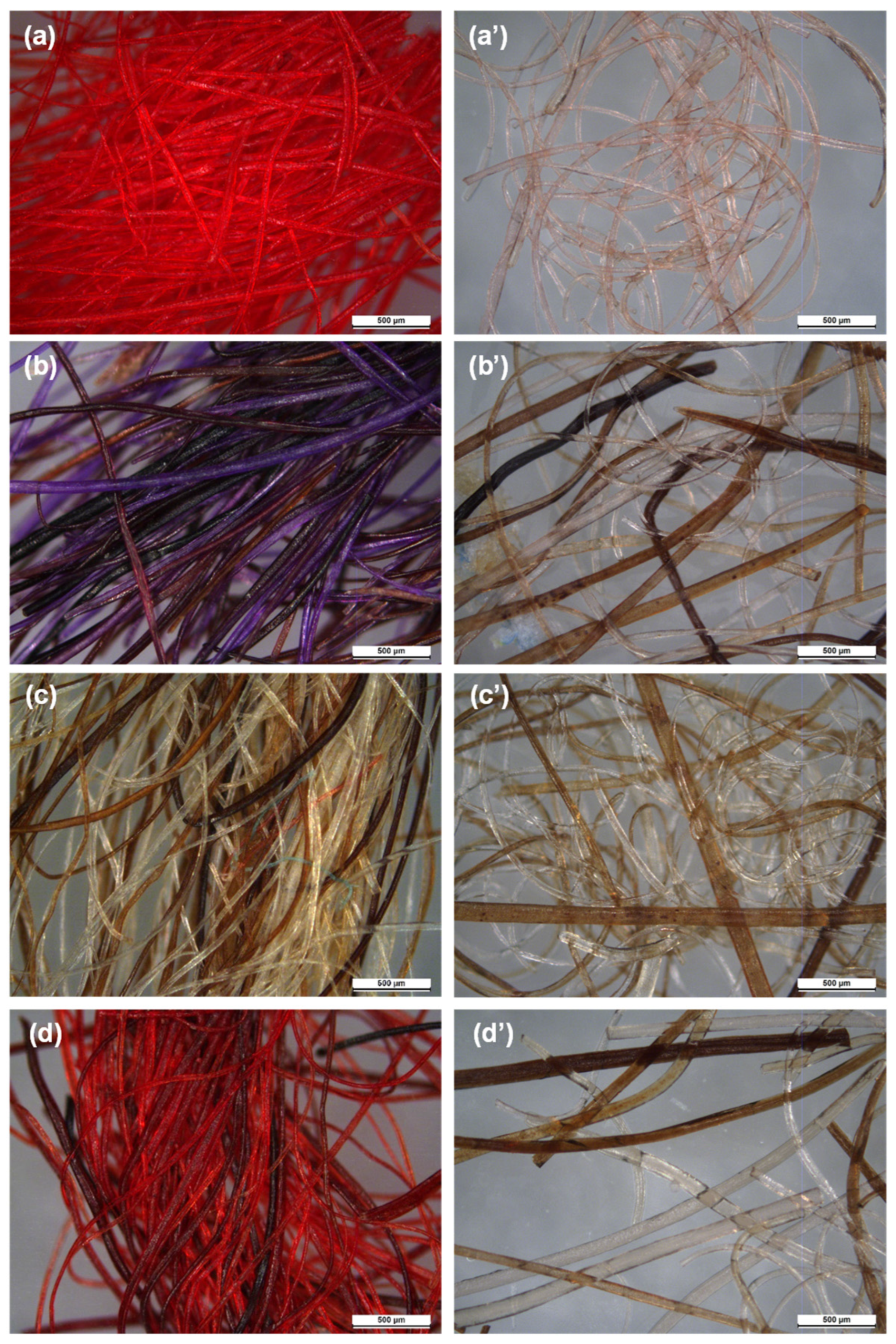
Generally, light shades, such as yellow, orange, red and beige, show a relatively homogeneous distribution of colour, whereas dark shades, such as burgundy, brown, blue and black, appear to contain fibres of different colours in the same thread. These observations are summarised in Figure 5a–d, which shows the red, blue, brown-grey and dark red samples of R12. These samples were re-observed under the microscope after the dye extraction (Figure 5a’–d’). The red sample, which showed a bright homogeneous red dyeing before extraction (Figure 5a), almost completely lost its colouration (Figure 5a’), as expected after a successful dye extraction. By contrast, the other samples retained light and dark brown fibres. This is a clear indication that naturally pigmented wool was used to obtain these colours. The melanosomes (also called pigment granules), typically observed in brown wool [6], are visible in the images obtained after extraction. The use of naturally pigmented wool is consistent across all rugs, but selectively reserved to dark shades of colour, indicating that its use is intentional and functional to the obtainment of a precise colour. The use of white or dark/mixed wool is indicated in Table 1 for all samples/colours.
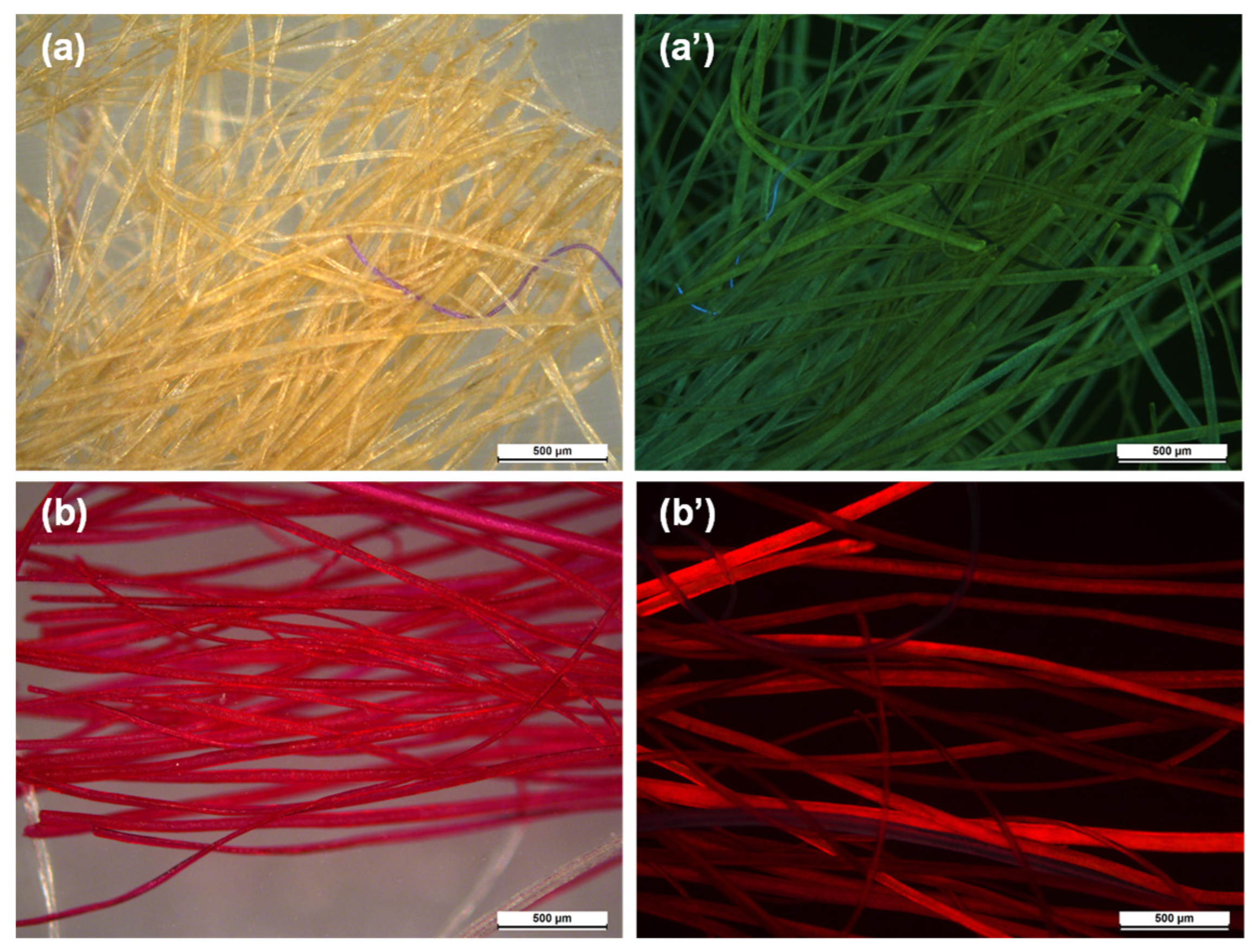
When observed under UV light, R12_yellow and R17_pink exhibit UV-induced visible luminescence (Figure 6). The luminescence produced by the yellow samples is not particularly useful to narrow down the type of dye used, considering that numerous natural and synthetic yellow dyes exhibit this characteristic [21]. By contrast, the bright orange luminescence produced by the dark pink sample of R17 may be taken as indication that a synthetic xanthene dye, probably of the rhodamine family, was used for this colour [11].

3.2. Multiband Imaging (MBI)

In the light of the results obtained by optical microscopy and with the aim to better study the distribution of materials and their behaviour when exposed to different light wavelengths, R12 and R17 were investigated using MBI.
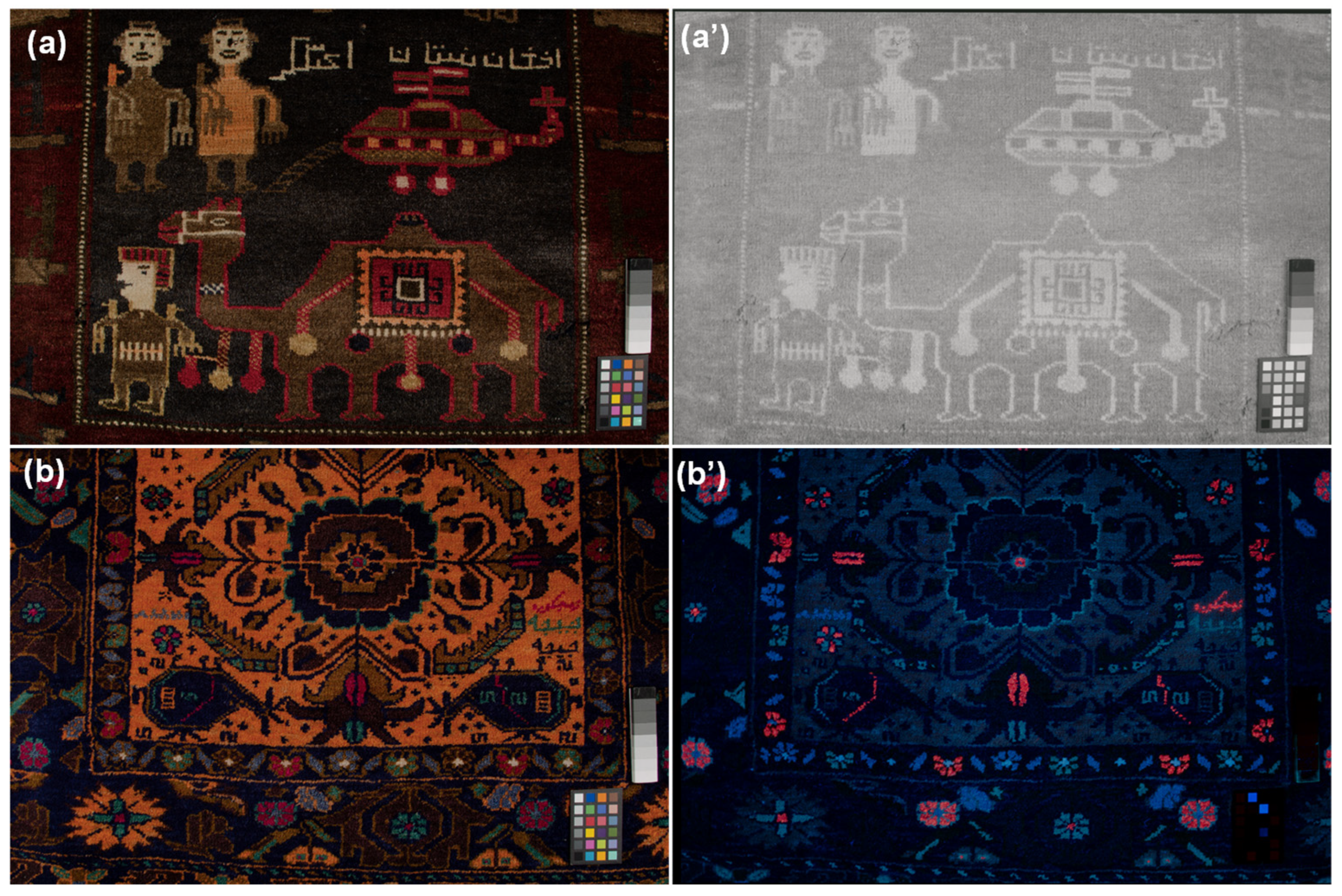
Infrared reflected images (IRR) highlight areas of slight absorption of the infrared radiation. These areas appear dark, as exemplified in Figure 7a’, while other areas are infrared transparent, thus appearing white. This was in correspondence with the use of naturally pigmented wool versus white wool. Melanin is known to strongly absorb electromagnetic radiation particularly in the UV–Vis range, with absorption gradually declining in the near-IR [26,27]. However, in IRR images, where the absorbance of most dyes is low, and hence does not interfere with the response of the wool substrate, sufficient absorbance from the melanin is observed, resulting in a distribution map of where naturally pigmented wool is used.
UV luminescent dyes were also confirmed. However, only a weak yellowish luminescence is observed in the UVL images of R12, corresponding to the outline of the soldier in the left corner and the rounded decorations of the camel saddle, suggesting that natural ageing may have attenuated the response of the luminescent dye over time.
By contrast, a strong orange luminescence is produced by all bright pink areas of R17, suggesting that the same luminescent dye, likely a synthetic xanthene dye of the rhodamine family [11], was used for this colour (Figure 7b’).

3.3. Scanning Electron Microscopy and Energy Dispersive X-Ray Spectroscopy (SEM-EDX)

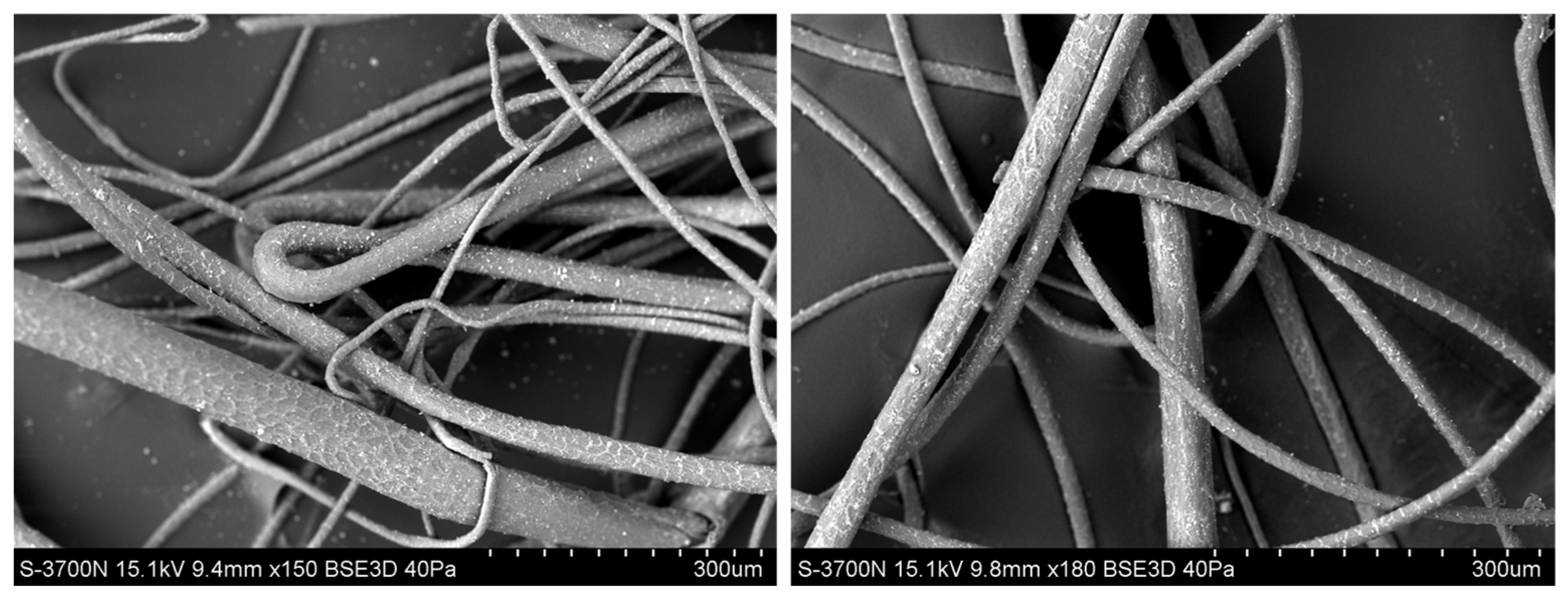
The use of wool as sole fibre used in the rugs was confirmed by SEM. Images clearly show the typical surface scale pattern of wool (Figure 8). Fibres of various diameters are observed in most samples, ranging from ca. 5 to 50 μm in width. Such variability is common in sheep fleece and does not point directly to a specific type of breed being used [9,28].
EDX was used to explore the possible presence of mordants. However, no clear indication was obtained for any of the samples. Generally, S, Ca, Si, Al, Na and Cl were detected in the EDX spectra. These elements are quite ubiquitous in wool textiles, with S partially deriving from the wool itself and the other elements being part of environmental contamination. NaCl and CaCO3 are sometimes added to dye baths [29], but their presence as a result of intentional use cannot be proved based solely on these results. An exception was represented by sample R13_beige. Although the fibres are particularly contaminated, areas clear from particles retained relatively high levels of Al, possibly pointing toward alum being used as a mordant [11]. Sample R10_light brown also showed slightly higher Al levels compared to the other samples.

3.4. Scanning X-Ray Fluorescence (MA-XRF)

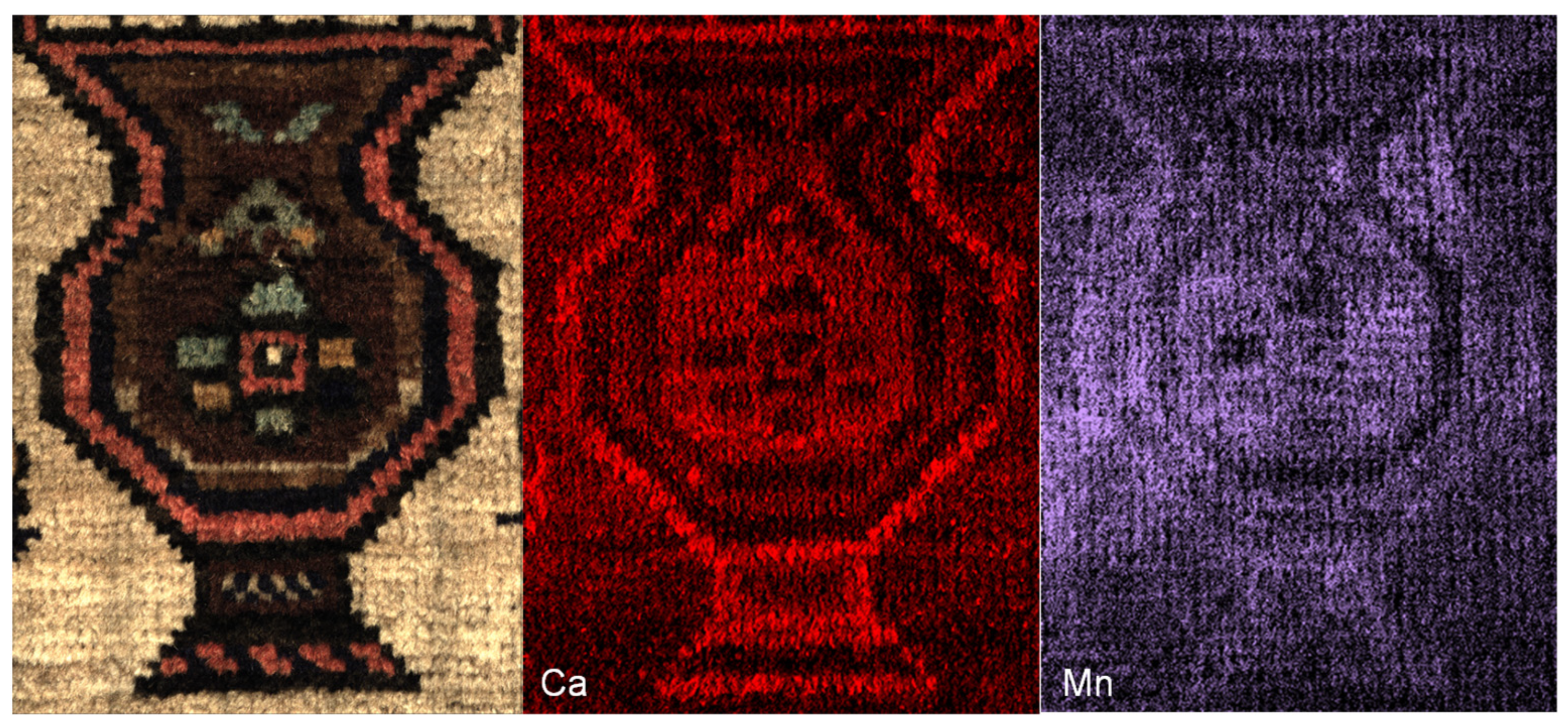
To further investigate the presence of chemical elements and their distribution, representative areas of R10, R12, R13, R15, R17, R24 and R27 were scanned. In all cases the maps of Ca and Mn appear to correlate with dark colours, such as dark brown and dark blue, whereas the elements are significantly less abundant in light or bright colours, as shown in Figure 9 and Figures S1–S4 (Supplementary Information). Based on optical microscopy, dark colours are associated with the use of naturally pigmented wool. Ca and Mn are reported as elements associated with melanin in dark wool [30]. Therefore, the results can be interpreted as an indication of the use of dark as opposed to white wool. Nevertheless, other elements, such as Cu and Zn, seem to be associated with melanin [30], but they were not significantly detected in our analyses. Thus, the presence of Ca and Mn in association with dyeing practices cannot be ruled out and a conclusive interpretation cannot be made based solely on these results.
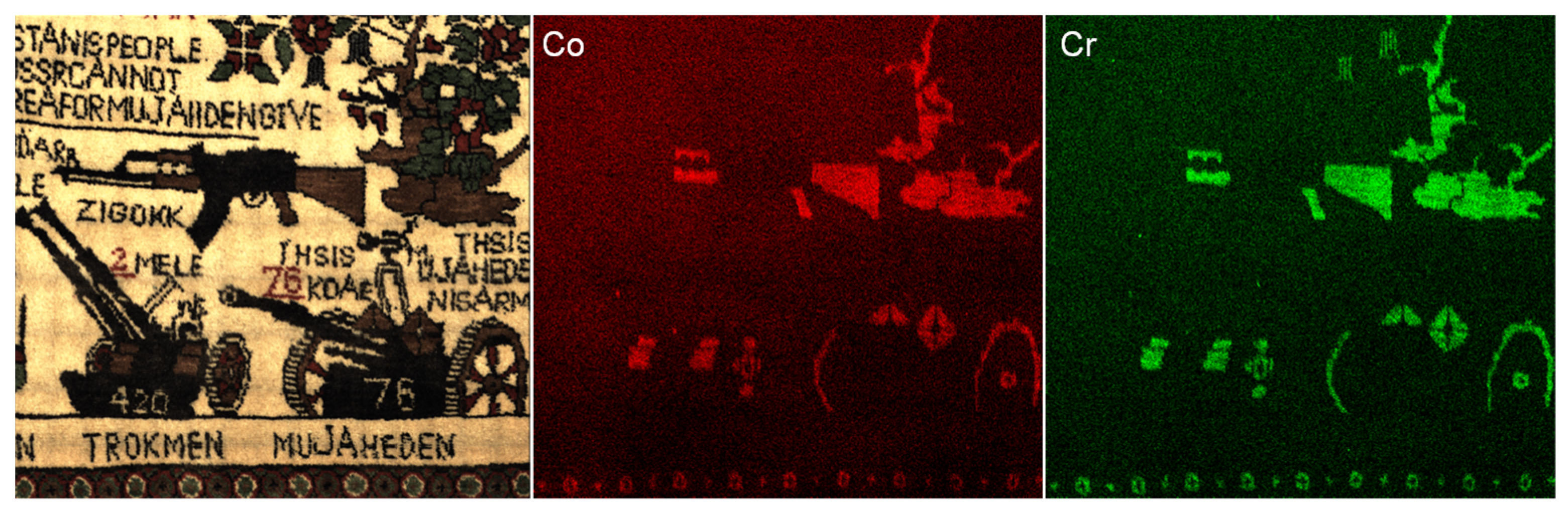
The maps obtained for R24 revealed the clear presence of Co and Cr in association with the brown dye (Figure 10). These metals are known for being used in so-called metal complex dyes or pre-metallised dyes [31,32]. These dyes are usually of the azo acid family and are structured so that a central metal ion, such as Cr3+ or Co3+, forms a co-ordination complex with one or two organic dye molecules. They started being produced in 1912 and were popular in the 1950s, when they were commonly used for dyeing wool, silk, and nylon to produce colourfast shades [33]. The maps obtained for R27 reveal some differences in the distribution of Ca and Fe, which are less straightforward to interpret (Figure S4, Supplementary Information), but seem to be again associated with the darkest colours.
It is noteworthy that EDX analysis could not detect significant differences among the samples in terms of elemental content. Co and Cr were also not detected in the R24_brown. The difficulties of detecting mordants in dyed fibres using EDX have been partially addressed in the literature [11,13,34], as well as the need to often use both EDX and XRF to obtain more accurate results [13]. This study reiterates this important point, highlighting that, while EDX can be better exploited to suggest the presence of light elements such as Al, other heavier elements, such as Fe, Cu, Co, Cr, etc, are often better detected by XRF. This is partially related to intrinsic limitations of the techniques, e.g., EDX being sensitive to the surface of the sample and not the bulk. Thus, the detection of mordants and metals in textile fibres remains an area that requires careful and well-controlled experimental investigation.

3.5. High Pressure Liquid Chromatography Coupled with a Diode Array Detector and Tandem Mass Spectrometry (HPLC-DAD-MS/MS)

The results of the dye analyses are summarised in Table 1. For all dyes identified or discussed, the molecular details are reported in Table S3 (Supplementary Information).

3.5.1. Natural Dyes

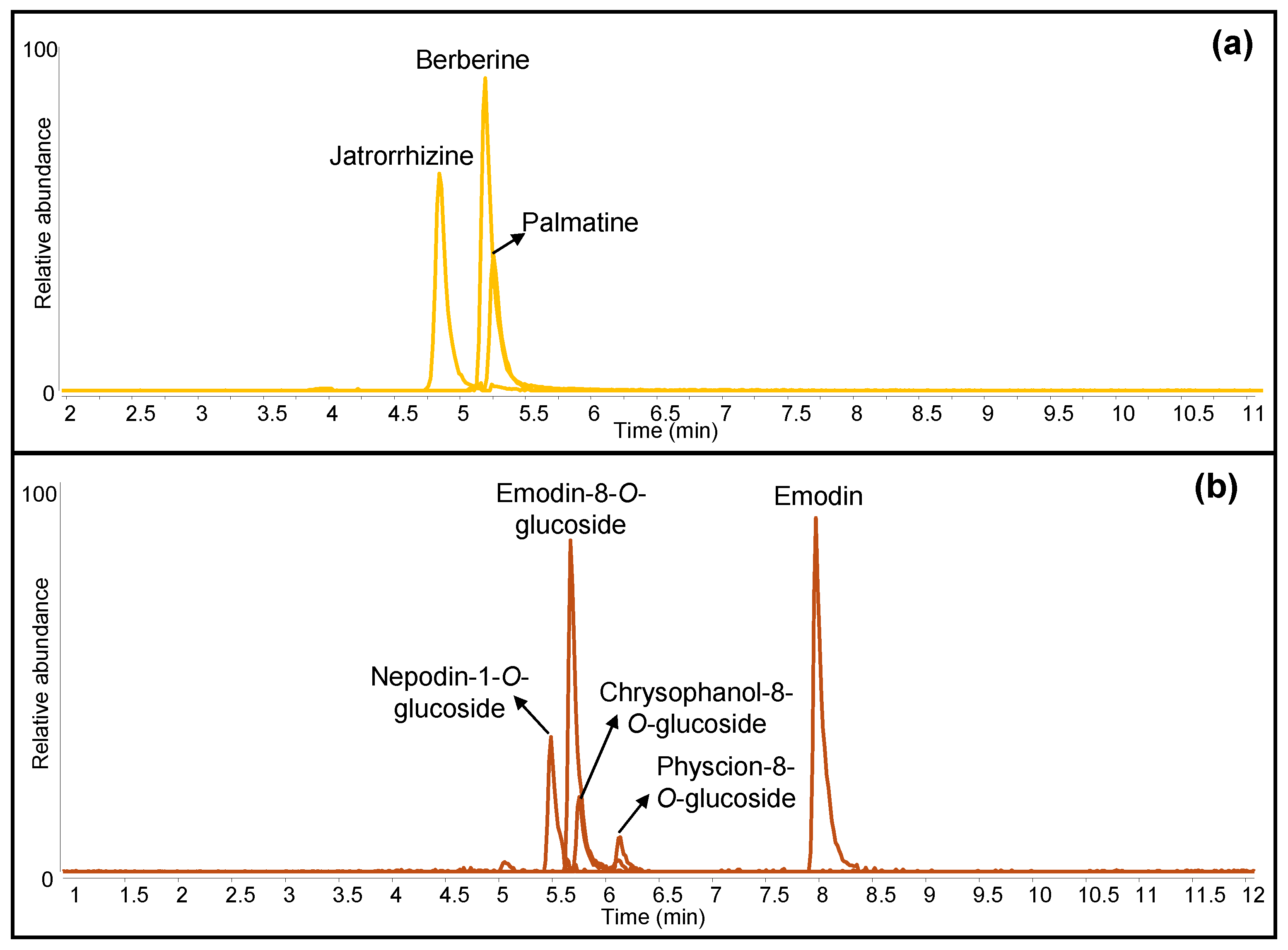
Out of all samples analysed, three revealed the use of natural dyes. The yellow areas of R12 were obtained using a protoberberine dye rich in jatrorrhizine, berberine and palmatine (Figure 11a). Various alkaloid dyes of this family are available throughout Asia. These include Phellodendron, Berberis, Coptis, Mahonia and Fibraurea species [35,36]. Distinguishing among these genera is not always straightforward. However, the molecule coptisine is found in Coptis spp. [23], while Fibraurea spp. do not contain berberine [37], thus excluding these sources. The relatively high content of jatrorrhizine also seems to exclude Phellodendron spp., which are richer in berberine [23,37,38,39]. Mahonia has recently been reclassified under the Berberis genus [40]. In fact, their dye composition is also reported to be very similar [37]. The results constitute a good match with data reported on Berberis asiatica, aristata, vulgaris and thunbergii, all showing relative high content of jatrorrhizine compared to berberine and palmatine [23,37,38,39]. Although a precise species identification is not possible and unpredictable changes in compound ratios due to ageing and plant variability should be considered, Berberis spp., commonly referred to as barberry, emerges as the most likely source of this yellow dye. Barberry is reported as a local plant in Central Asia [23,41]. Protoberberine dyes exhibit bright yellow UV-induced luminescence [21], in agreement with the UV-microscopy and MBI observations.
The samples taken from the light brown areas of R10 and the beige background of R13 revealed emodin and emodin-8-O-glucoside as the main components, as well as nepodin-1-O-glucoside, chrysophanol-8-O-glucoside and physcion-8-O-glucoside (mass fragmentation spectra are reported in Figure S5, Supplementary). Emodin is a relatively common anthraquinone found in various plants [42] and fungi [43] that is used for dyeing. In the context of Asian dyes, the most common sources of emodin-containing dyes discussed in the literature are Rheum (rhubarb) and Rumex (dock or sorrel) plants [44,45,46,47]. Some Rhamnus plants (buckthorn) and Frangula alnus (alder buckthorn) are also mentioned as sources of emodin-rich colourants [44,48]. However, in the case of Rhamnus spp., various flavonoids (e.g., rhamnetin glycosides) are present; in the case of Frangula alnus, various emodin glycosides (e.g., frangulin A and B) are present [49].
By contrast, Rheum and Rumex plants are reported to contain other anthraquinones, such as chrysophanol and physcion, as well as their glycosides [23,46,50], in agreement with our results. Nevertheless, the composition of rhubarb extracts is generally more complex, including other molecules, such as stilbenes [23], whereas good correspondence with reference samples from Rumex spp. is observed [51]. In particular, nepodin-1-O-glucoside was identified in our samples. This molecule has been specifically reported as a component of some Rumex species [52]. As various species of Rumex are native or available in Central Asia [53], this plant emerges as the most probable source of the dye.

3.5.2. Synthetic Dyes

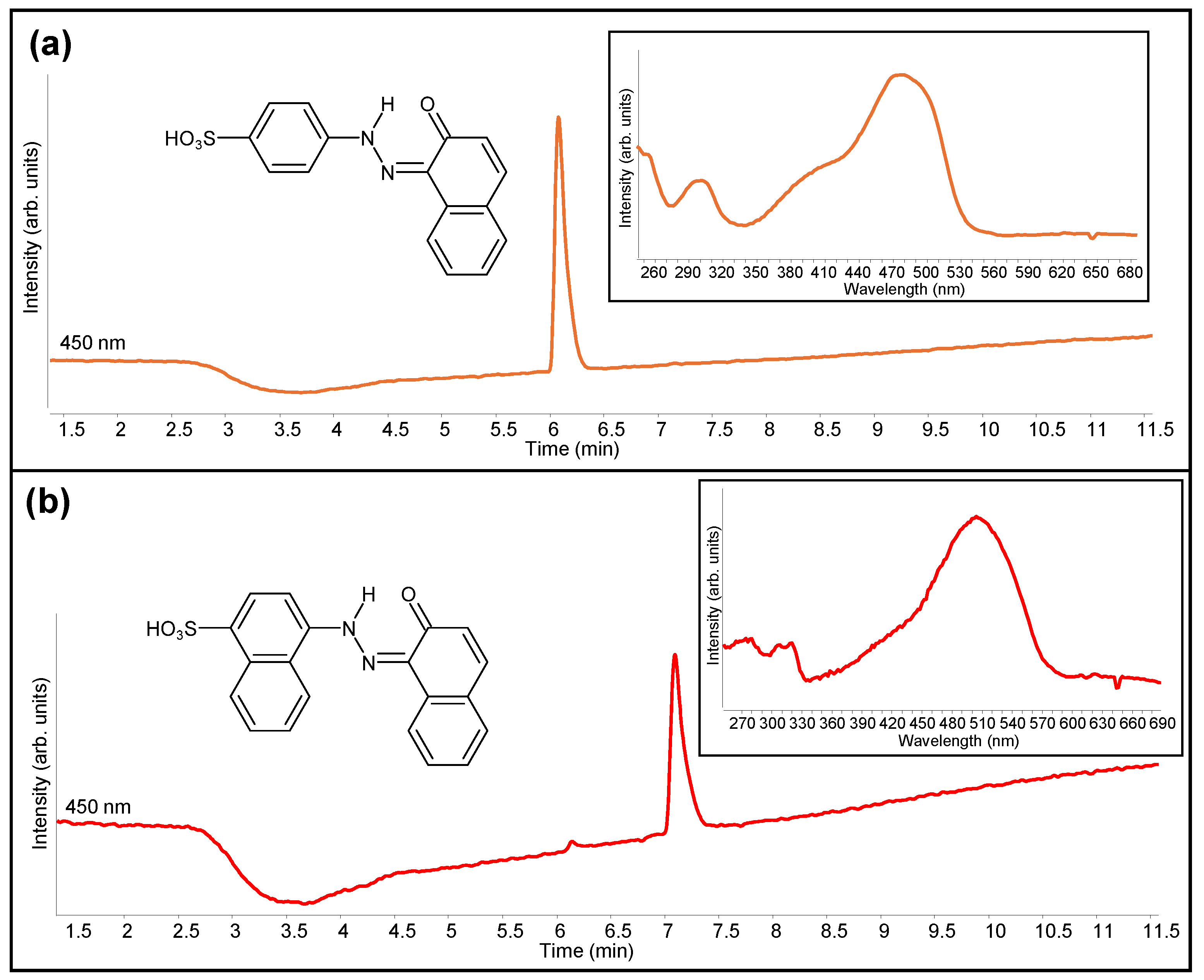
The two main orange and red colourants in all rugs are identified as Acid Orange 7 (C.I. 15510) and Acid Red 88 (C.I. 15620), as shown in Figure 12. The two dyes are often combined to obtain bright orange colourations. Dark red and brown shades are often obtained by using one or both dyes on naturally brown wool, as summarised in Table 1.
In addition to orange, red and brown shades, most rugs feature light and dark blue colours, as well as black. The dyes used to obtain these colours in R7, R10, R12 and R13 are similar. The light blue/turquoise shades in these rugs, as well as R14, contain Basic Green 4 (C.I. 42000) as the main colourant. The dye is identified thanks to its distinctive molecular pattern (Figure S6, Supplementary Information), and the presence of the leuco-components and degradation products is observed, as often reported in the literature [11,24,54]. If applied on white wool, as in R10 and R14, the colour appears as a light aqua, whereas on naturally-brown wool, as in R10 and R13, it appears as a light blue. In R13 and R14, the dye is also mixed with orange and red in the former and with an unidentified blue colourant in the latter. These mixtures need to be observed with caution, as cross-sample contamination is particularly easy in carpets and rugs due to their use. Nevertheless, the intentional use of red/orange to darken the blue colour is a possibility.
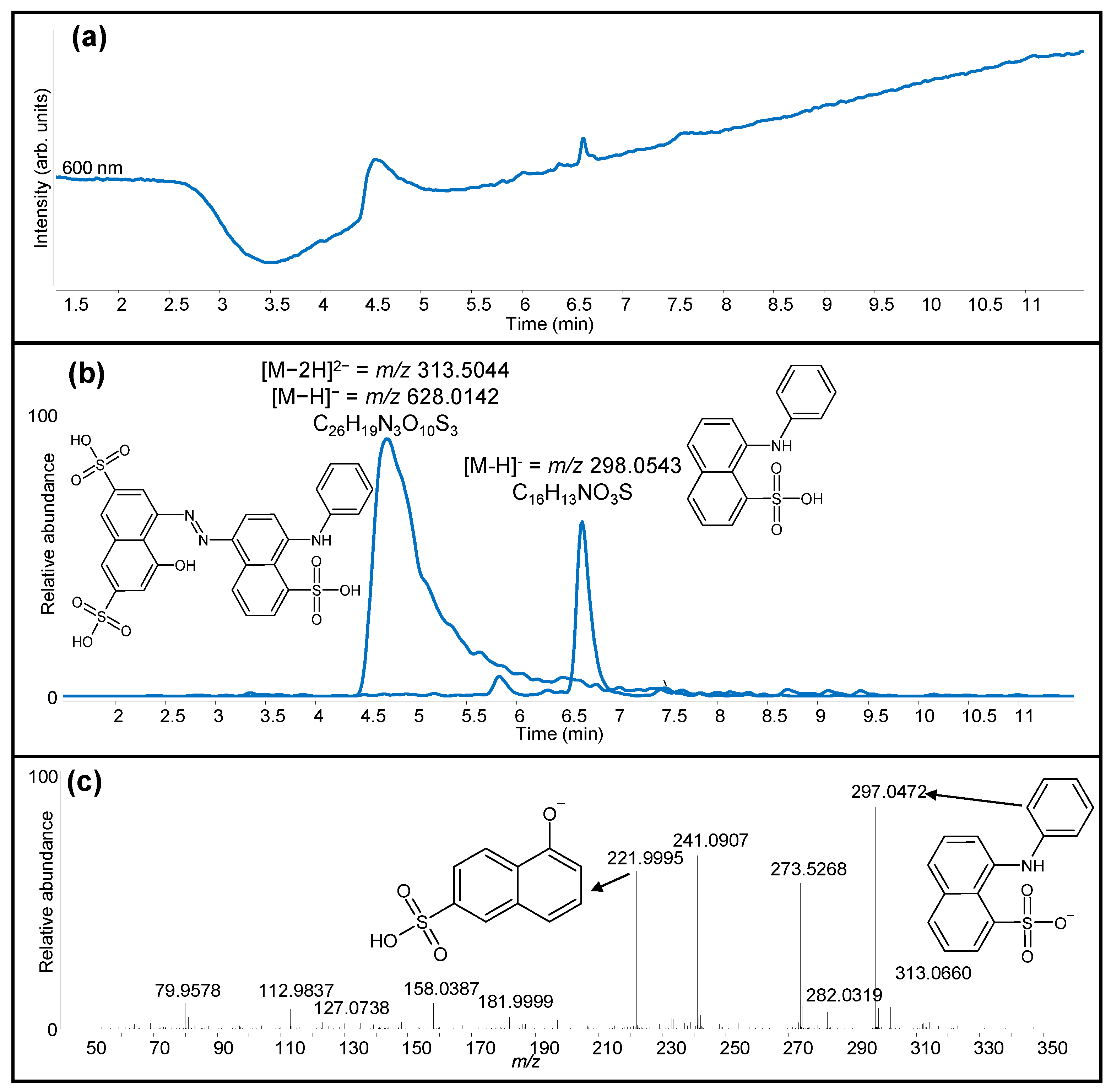
The dark blue shades in R7, R10, R12 and R13 contain Acid Blue 92 (C.I. 13390) as the main colourant applied on naturally brown wool. The identification was challenging. As shown in Figure 13, the analyses revealed two main components. The main one produced a doubly charged ion [M-2H]2− = m/z 313.5044 and a very weak singly charged ion [M-H] = m/z 628.0142, enabling the molecular formula to be assigned to C26H19N3O10S3 (dppm = −2.83). The study of the MS/MS fragmentation enabled some key fragment ions to be identified, ultimately allowing the structure of the molecule to be elucidated, as shown in Figure 13. The second molecule was also identified as a fragment of the main molecule, most likely a degradation product or synthesis by-product, further strengthening the identification. However, a standard was not available to corroborate the identification. This is a common scenario in the analysis of historic synthetic dyes. However, high-resolution tandem mass spectrometry often enables molecular structure elucidation with a high level of confidence, as in this case [15,16,24].
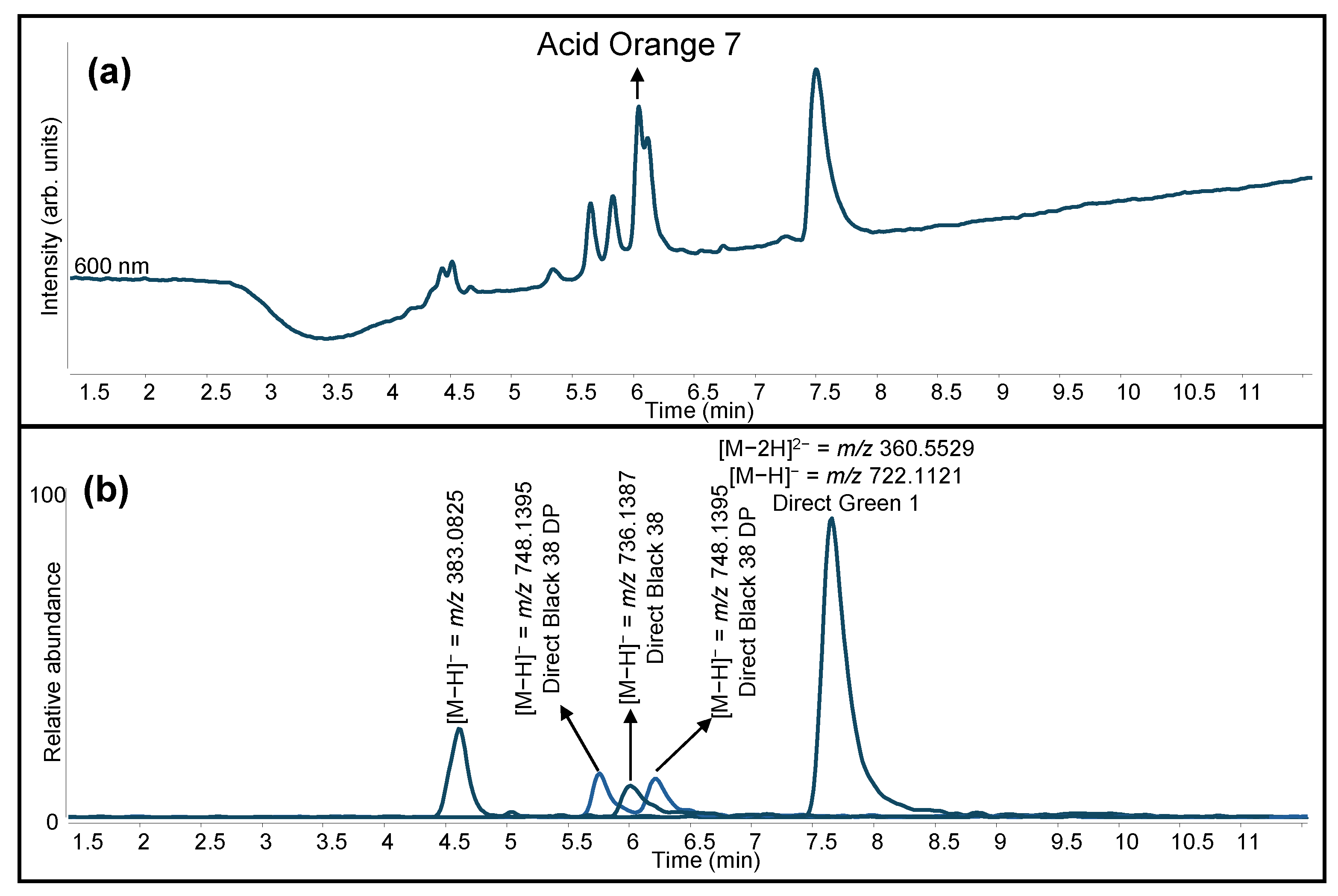
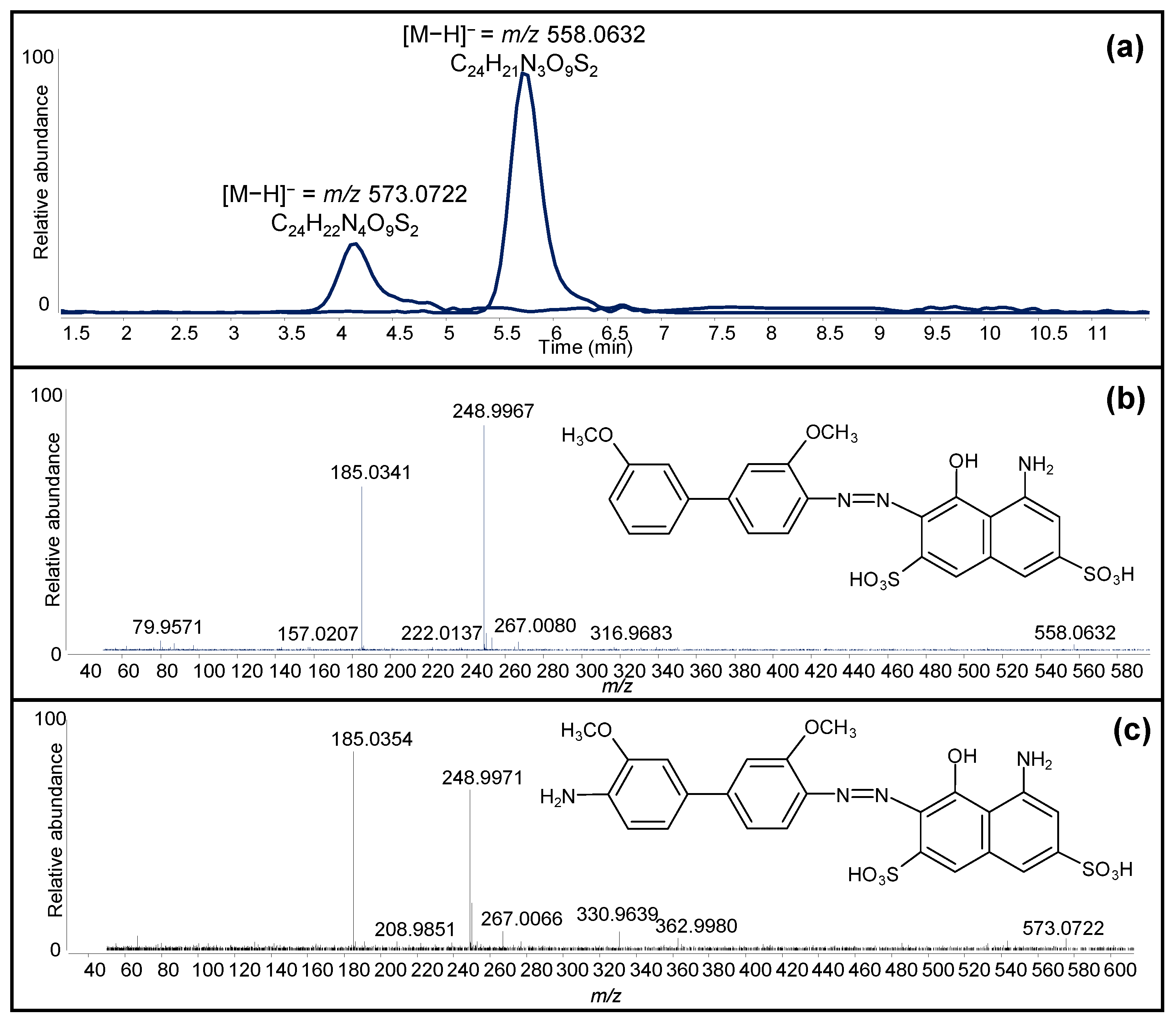
The dark brown/blackish colour of R10 is obtained with a mixture of Acid Orange 7 (C.I. 15510) and Acid Black 1 (C.I. 20470) on naturally brown wool (Figure S7, Supplementary). However, the dark shades in R7, R12 and R15 produced more complex results. As shown in Figure 14 for R7_black, various molecules were detected. Except for Acid Orange 7, none of these molecules produced a match with available mass spectrometric databases of dye molecules.
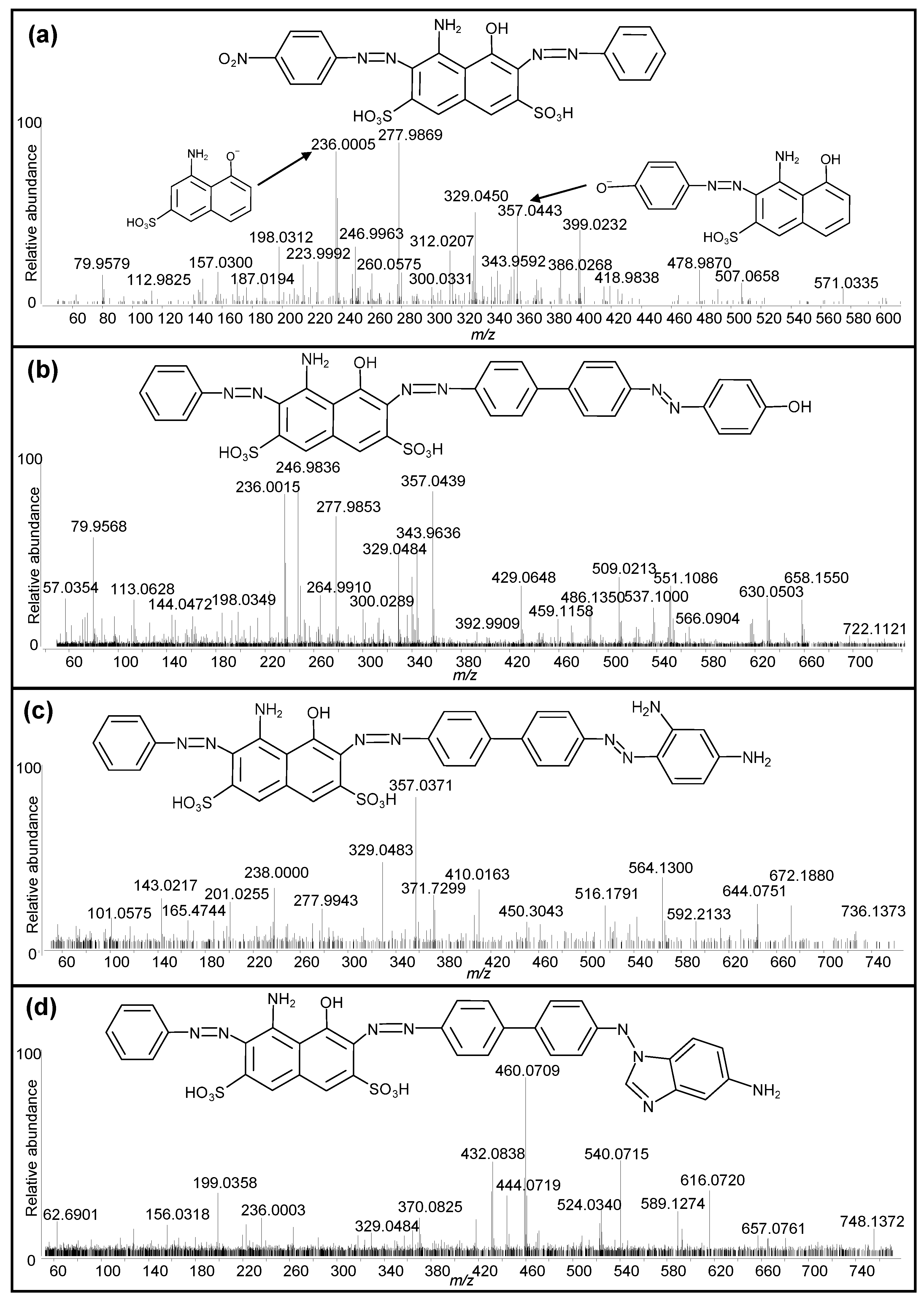
Nevertheless, the tandem mass spectra of two of the main molecules show great similarities with the fragmentation pattern of Acid Black 1 (Figure 15). In particular, the assignment of specific fragment ions (Figure 15a) suggests that these molecules share the diazotised 1-amino-8-naphthol-3,6-disulfonic acid core. The compound with [M-H] = m/z 722.1121 is assigned to a tentative chemical formula C34H25N7O8S2 (dppm = −1.7). The compound with [M-H] = m/z 736.1387 possibly corresponds to C34H27N9O7S2 (dppm = −2.05). The two isomers with [M-H] = m/z 748.1395 are tentatively assigned to C35H27N9O7S2 (dppm = −0.95). Although these results suggest that these molecules are likely to be related, a full structural elucidation proved extremely difficult solely based on these data. Therefore, the software SIRIUS was used. SIRIUS exploits computational algorithms to interpret complex mass spectral fragmentation and proposes results based on matching each fragment ion to a sensible structure. It then searches all accessible databases (ChemSpider, PubChem, etc.) for possible molecular matches, ultimately proposing a chemical structure [25]. The software produced an excellent match for both [M-H] = m/z 722.1121 and [M-H] = m/z 736.1387, assigning these compounds to Direct Green 1 (C.I. 30280) and Direct Black 38 (C.I. 30235), respectively. The structures of these molecules are reported in Figure 15 and Table S3, confirming that they indeed share the same core as Acid Black 1, coupled to a diazotized benzidine. The two molecules are also related, with Direct Green 1 having a phenol side group instead of a m-phenylenediamine group. This suggests that Direct Green 1 may be present as an oxidation product of Direct Black 38. The two isomers with [M-H] = m/z 748.1395 did not produce a convincing match using SIRIUS. However, their tentative formula has an additional C atom compared to Direct Black 38. This enabled these compounds to be hypothetically assigned to degradation products of Direct Black 38. Various azo dyes with an amine group placed at the ortho position to the azo bond are susceptible to formaldehyde attack, resulting in the addition of a C atom and creation of a 5-ring structure [16,24,55]. Direct Black 38 has two of these positions, in agreement with the presence of these two isomers, whose structure is tentatively reported in Table S3. Although these results could not be confirmed by analysing standard molecules, the accuracy of the mass spectrometric results coupled with the capabilities of the SIRIUS software emerged as a powerful tool for structure elucidation.
R14 and R15 share similarities with R7, R10, R12 and R13. However, the blue colourant used in R14 and the dark blue shades of R15 remain unidentified. The dye was poorly soluble in the solvents used for extraction, producing weak signals. Nevertheless, a small signal for a molecule with [M-H] = m/z 435.1871 was detected. The signal was too small to obtain a satisfactory tandem mass spectrum, which prevented us from further exploring the identification.
R17 shows a different palette of colours compared to the rugs discussed so far, apart from the bright orange colour, which is obtained with Acid Orange 7. The brown colour is obtained by dyeing naturally brown wool with a mixture of Acid Orange 7 and a sulfonated derivative of Acid Red 88 (Figure S8, Supplementary). There are various dyes corresponding to this structure, including Acid Red 14 (C.I. 14720), Acid Red 102 (C.I. 14730), Acid Red 12 (C.I. 14835), Acid Red 3 (C.I. 14910), Acid Red 13 (C.I. 16045), Acid Red 25 (C.I. 16050), Acid Red 17 (C.I. 16180) and Acid Red 44 (C.I. 16250). These dyes differ by the position of the sulfonic acid groups on the molecule. Although the retention times of these dyes may vary slightly, distinguishing exactly among them is challenging. For the purpose of this study, this dye is annotated as an azo red of the Fast Red family [24].
R17 also exhibits a bright dark pink colouration, which contains Basic Violet 10 (C.I. 45170), also referred to as Rhodamine B. The dye is identifiable by its characteristic molecular composition (Figure S9, Supplementary), which is abundantly described in the literature [16,24,56,57,58]. The result is consistent with the observation of the strong UV-induced visible luminescence of this sample presented in Section 3.2, as well as the results of MBI [11]. The lighter shade of brown in R17, indicated as olive green, is obtained with a mixture of Acid Orange 7, Basic Violet 10, Acid Red 88 and its sulfonated derivative on naturally brown wool.
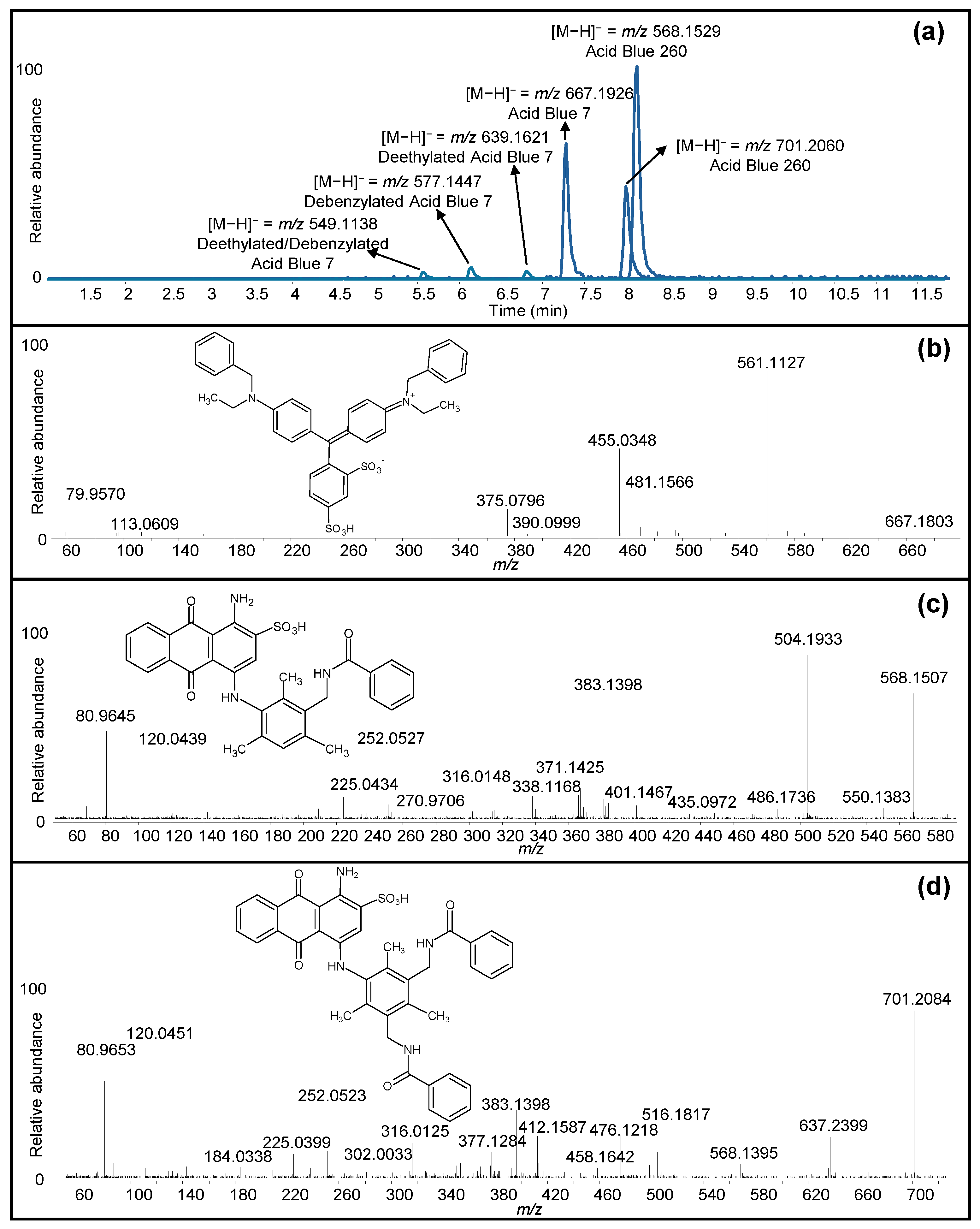
The dark blue colour of R17 contains various molecules. In addition to Acid Orange 7 and Acid Red 88, two blue dyes were identified (Figure 16a). Acid Blue 7 is present along with its de-ethylated and debenzylated derivatives, which is in agreement with molecular patterns observed for other triarylmethane dyes of the “patent blue” class [18]. The study of the mass fragmentation (Figure 16b) and the comparison with references of similar dyes [24] enabled Acid Blue 7 to be distinguished from isomeric formulations. For example, Acid Green 3 (C.I. 42085) is an isomer with sulfonic acids on the N-benzyl groups. However, N-benzyl sulfonic acids produce a distinct fragment ion at 170.0043 m/z [24], which is absent in the tandem mass spectrum obtained from sample R17_dark blue (Figure 16b), confirming that the sulfonic acids are on the triarylmethane core. SIRIUS also confirmed this identification. The two other main molecules detected were assigned to Acid Blue 260 components. These are substituted anthraquinoid molecules with one and two benzamide substituents, respectively. Benzamide groups are easily recognisable by the fragment ion [C7H6NO] = 120.0455 m/z (Figure 16c,d). The rest of the fragmentation is also straightforwardly assigned to bond cleavages between the anthraquinoid core and the substituents, as well as loss of SO2.
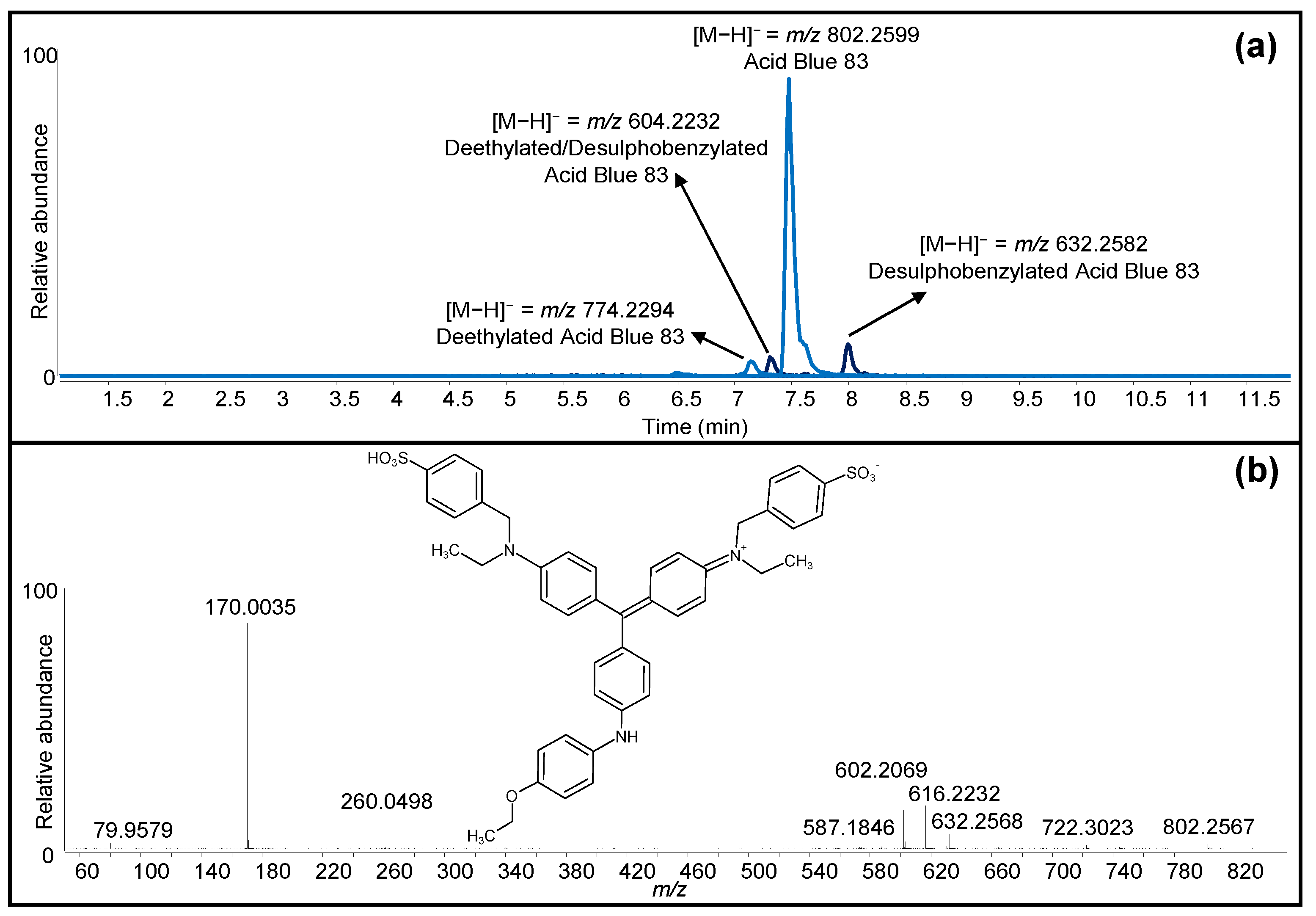
The green bluish shade in R17 is obtained with pure Acid Blue 7, which is indeed described as a greenish blue dye [59]. A different blue dye is used in the light blue areas. This was identified as Acid Blue 83 (C.I. 42660), another “patent blue” dye with two N-benzyl sulfonic acid groups and one ethoxyphenyl substituent on the triarylmethane core (Figure 17). De-ethylated and desulphobenzylated derivatives were also detected as being commonly encountered with this category of dyes [24]. The tandem mass spectrum is consistent with N-benzyl sulfonic acid losses, and SIRIUS confirmed the identification.
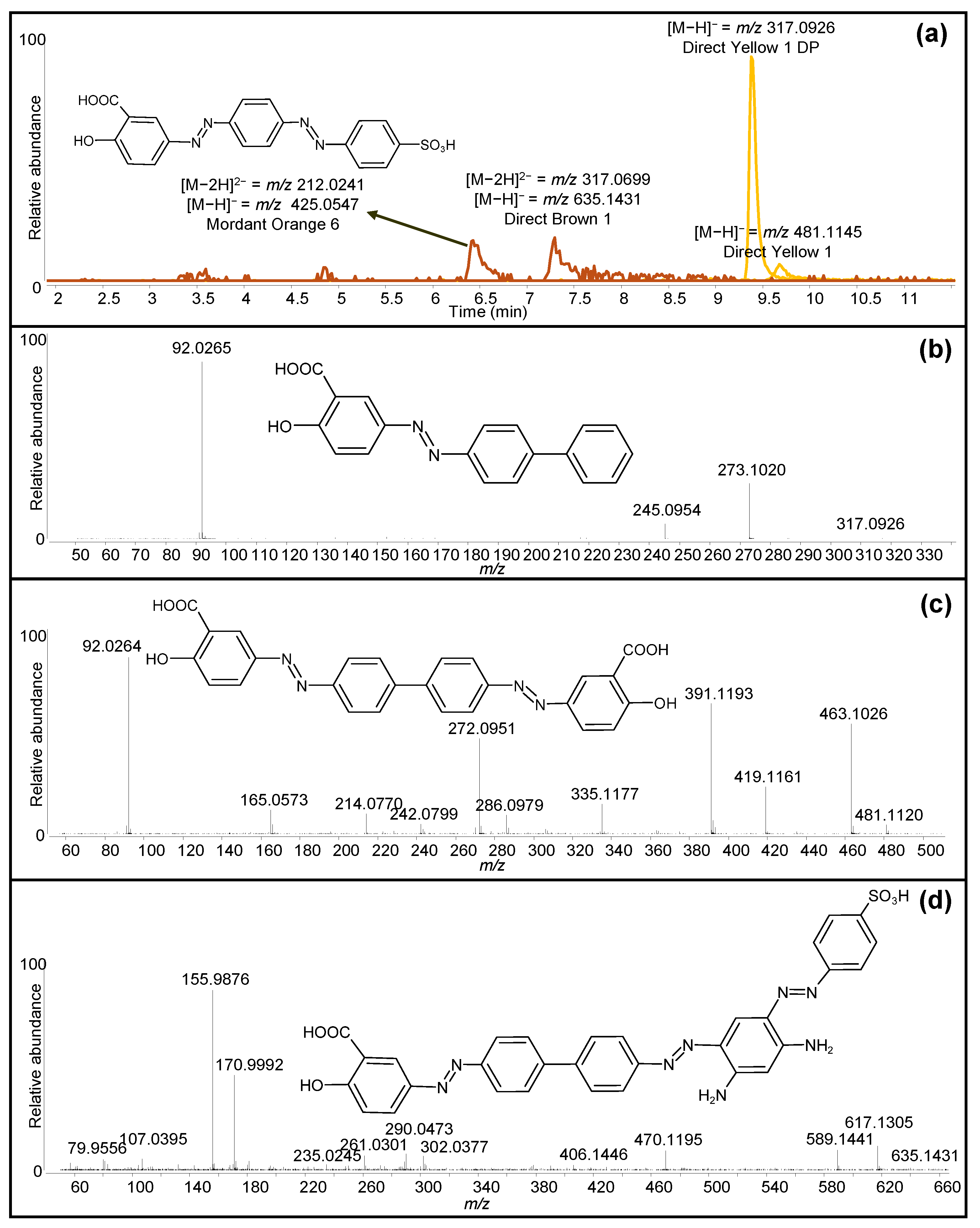
R24 and R27 were produced mostly using different dyes compared to the rugs discussed so far. Both R24 and R27 exhibit an olive-green colour, which was obtained by mixing Direct Yellow 1 (C.I. 22250) and Direct Brown 1 (C.I. 30045) (Figure 18a). Direct Yellow 1 was identified by comparison with a historic reference sample of this dye [56]. In all cases, the intact molecule ([M-H] = m/z 481.115) is accompanied by a smaller one ([M-H] = m/z 317.093), corresponding to a degradation product or synthesis by-product (Figure 18b,c). The identification of Direct Brown 1 was obtained by using SIRIUS, which produced a convincing interpretation of the mass fragmentation of the singly charged molecular ion [M-H] = m/z 635.1431 (Figure 18d), dominated by cleavages at the azo bond positions. R24 contained an additional molecule with [M-H] = m/z 425.0547, for which a tandem mass spectrum was not obtained due to the low concentration. The accurate mass can be tentatively assigned to the molecular formula C19H14N4O6S (dppm = −3.35), which may correspond to Mordant Orange 6 (C.I. 26520), whose structure is depicted in Figure 18a. As a tandem mass spectrum or standard molecule are not available, the identification remains tentative. Isomeric configurations of this molecule could also be seen as degradation products of Direct Brown 1, highlighting the importance of checking against reference material, when available.
Direct Yellow 1 was also used in the yellow background of R24. A combination of Direct Yellow 1, Direct Brown 1 and Acid Red 88 was used in the orange colour of R27. Acid Red 88 was the dye used in the red areas of both rugs, establishing a similarity throughout all rugs studied.
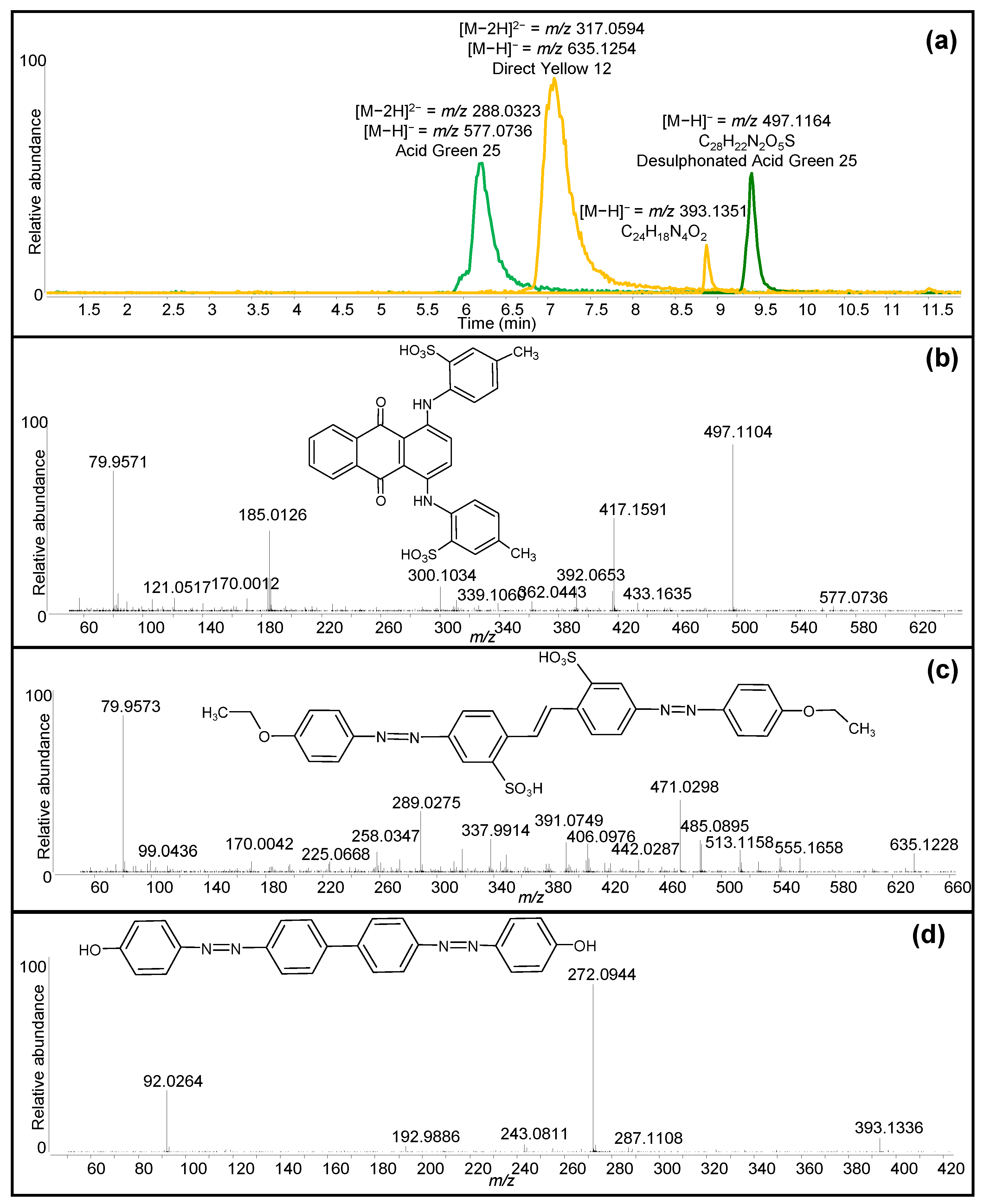
The bright green colour of R24 was obtained with a mixture of Direct Yellow 12 and Acid Green 25 (Figure 19a). The former was identified through comparison with a reference sample [56], while the latter produced a convincing match using SIRIUS. The characteristic fragment ion [C7H8NO3S] at m/z 185.0141 fully justifies the two substituents on the anthraquinone ring (Figure 19b). The desulphonated derivative of Acid Green 25 was also detected. This is probably present as a degradation product or synthesis by-product. Another molecule was detected, corresponding to a molecular ion with [M-H] = m/z 393.1351 and formula C24H18N4O2 (dppm = −1.52) (Figure 19d). This compound has been detected in a reference sample of Direct Green 6 (C.I. 30295) and interpreted as a degradation product or synthesis by-product. Therefore, the possible original presence of Direct Green 6 or a similar dye cannot be excluded.
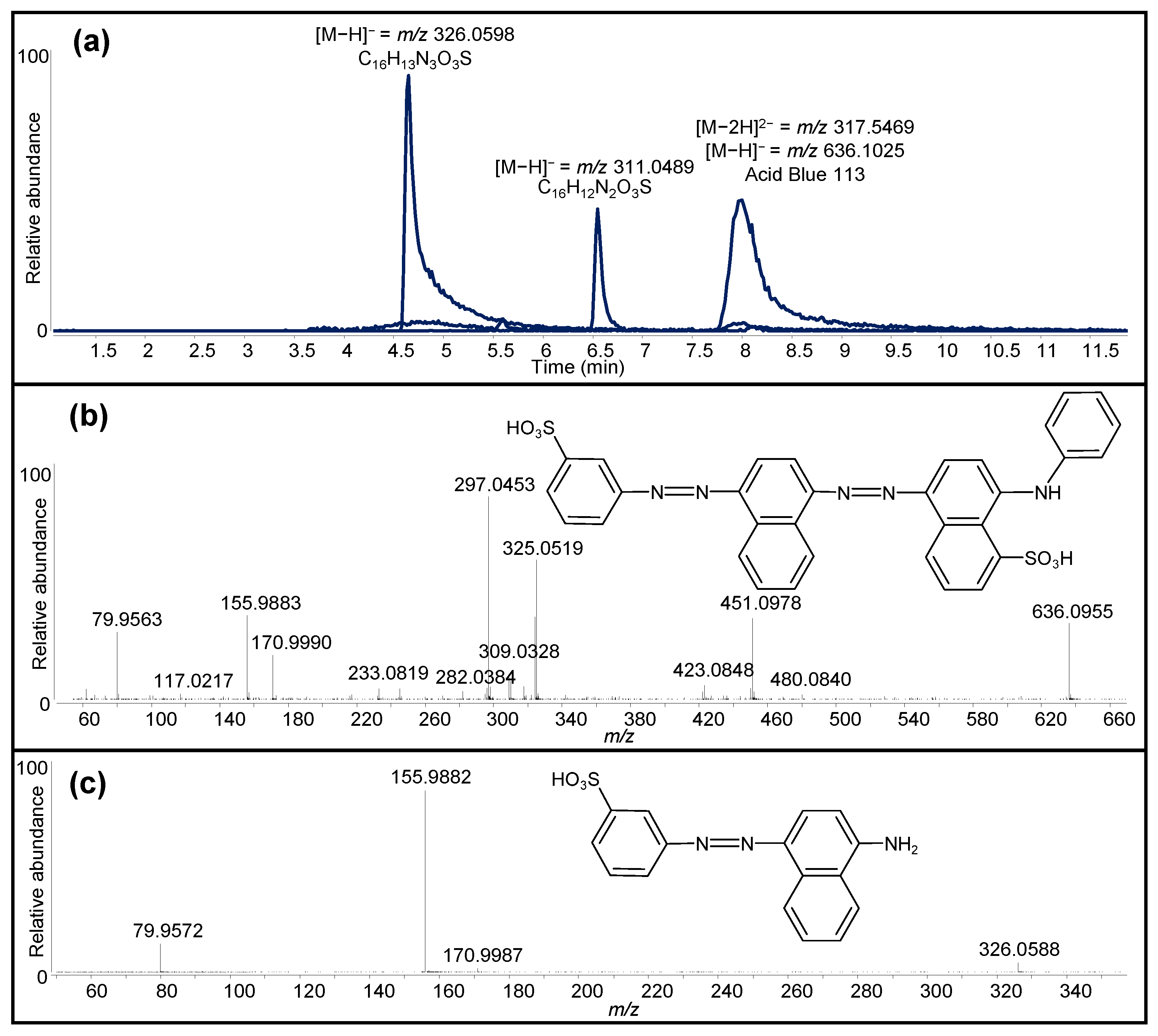
The main dye in the black areas of R24 is Acid Blue 113 (C.I. 26360). The observation of the sample under the microscope showed a blue hue for this dye (Table S2). The HPLC results revealed three compounds, corresponding to the intact molecule and two degradation products or synthesis by-products (Figure 20a). Although a reference sample for this dye was not available, a reference sample of Acid Blue 120 (C.I. 26400), a methylated homologue of Acid Blue 113, produced very similar results [56]. In particular, the degradation product or synthesis by-product at [M-H] = m/z 326.0598 was detected in both cases. Additionally, Acid Blue 113 has an isomer, which is Acid Blue 116 (C.I. 26380). In this molecule, both sulfonic acids are on the naphthalene rings. By contrast, the fragment ion at m/z 170.999 proves that one of the sulfonic acids is on the benzene ring, in agreement with the molecular structure of Acid Blue 113.
The results of the light blue colour of the poppies represented in R24 did not produce a straightforward identification. The degradation product or synthesis by-product at [M-H] = m/z 326.0598, also observed in the black sample, was detected, indicating that the dye is probably also an azo blue dye (Figure S10, Supplementary). However, the main molecule with molecular ion [M-H] = m/z 876.1070 was not univocally assigned to a chemical formula and a complex mass fragmentation spectrum was obtained. SIRIUS did not manage to fully interpret this spectrum, giving 2/3 possible matches for formulas, but no match for chemical structures. Another minor compound with [M-H] = m/z 552.0029 and similarities in mass fragmentation to the main molecule suggests that this might also be a degradation product or synthesis by-product, but its structure was also not disclosed. Our hypothesis is that this dye might be a trisazo blue dye sharing part of the molecular structure with Acid Blue 113.
The brown colour of R24 remained unidentified as well. Five compounds were detected with clear molecular ions and fragmentation spectra (Figure S11, Supplementary). However, neither calculation nor SIRIUS enabled the structures of these molecules to be disclosed. Some clearly contain halogens, most likely Cl, as inferred by the isotopic patterns. The high molecular masses suggest possible complex multiazo structures for these dye molecules.
R27 shared the use of similar dyes to R24, specifically Direct Yellow 1 and Direct Brown 1. It also exhibited a grey colouration that remained unidentified. The R27_grey sample revealed weak signals (Figure S12, Supplementary), mostly ascribed to degradation products or synthesis by-products observed in other samples (Figure S12, Supplementary), leaving the identification of a grey dye unclear. These products have also been observed in reference samples of diazo diamine dyes, indicating that the dye might belong to this category [56].
Finally, the two shades of blue of R27 were obtained using the same dye. Two molecules were detected and identified (Figure 21) as degradation products or synthesis by-products of Direct Blue 15 (C.I. 24400). These molecules were detected in a reference sample of this colourant referred to as Diamine Sky Blue and, in this case, the expected intact molecule was also not detected [60]. The dark blue sample also contained Acid Red 88 and Acid Orange 7, probably added to darken the blue colour. These were not present in the light blue sample.

4. Conclusions

Dyes, fibres and mordants used to produce nine Afghan war rugs in the British Museum collection were investigated by optical microscopy, MBI, SEM-EDX, MA-XRF and HPLC-DAD-MS/MS.
Early production war rugs (R7, R10, R12, R13, R14 and R15) showed similarities in the synthetic dyes used. These were Acid Orange 7, Acid Red 88, Basic Green 4, Acid Blue 92, Acid Black 1 and Direct Black 38. A light brown natural dye, probably from dock or sorrel (Rumex spp.), was used in R10 and R13 with the aid of an alum mordant. The natural dye extracted from the barberry plant (Berberis spp.) was found in the yellow areas of R12. The use of natural dyes in such late textile productions is a significant observation, which resonates with the combination of traditional and war motifs still present in first generation rugs. The variety of shades present in the rugs was often obtained by using the same dyes on either white or naturally pigmented wool, especially to create browns, reds, greys, blacks and blues. Such craftmanship also echoes centuries-old practices in Baluch and Turkmen carpet-making, often drawing from limited available materials to create colourful textiles. Interestingly, naturally dark wool could also be mapped on the rugs by using both the Mn maps from MA-XRF measurements and IRR images from MBI.
R17 revealed a wider variety of dyes used, adding Basic Violet 10, Acid Blue 7, Acid Blue 83 and Acid Blue 260 to the previously mentioned Acid Orange 7 and Acid Red 88. Although this is probably also a first-generation rug, the intricate floral motifs reminiscent of Baluch zakani rugs may set this apart from the rest of the rugs in terms of production.
R24 and R27 are later productions and were entirely dyed with synthetic dyes, mostly different from the ones in the first-generation rugs. These include Direct Yellow 1, Direct Brown 1, Direct Yellow 12, Acid Green 25, Acid Blue 113 and Direct Blue 15. The identification of some of these dyes was challenged by the availability of molecular databases and commercial standards, which remains a key area of further development in this research field. Nevertheless, the SIRIUS software emerges as a powerful resource to tackle complex mass fragmentation spectra, often resulting in solid spectral interpretations and convincing structural assignments. Harnessing the depth of information of mass spectrometry data in the analysis of synthetic dyes is crucial to navigate the high number of formulations potentially present in modern textiles. Despite these advancements, some of the dyes remain unidentified. However, the detection of Co and Cr in correspondence to a brown dye in R24 enables this to be categorised as a metal-complex or pre-metallised dye.
Furthermore, the differences in dye use between first and second/third generation rugs may be the result of different supplies of synthetic dyes to Afghanistan between the 1980s and the 2000s or deliberate choices by the rug makers in adjusting to the demands of a shifting export market. However, the full contextualisation of these results would require additional study of the economic and anthropological aspects around the production of these fascinating and complex objects, as well as the analysis of a larger corpus of rugs.

Supplementary Materials

The following supporting information can be downloaded at: https://www.mdpi.com/article/10.3390/heritage9020081/s1, Table S1: Mapping and acquisition parameters of scanning XRF analysis; Table S2: Micrographs of all samples obtained by optical microscopy. Scale bars in micrographs are 500 μm; Table S3: Summary of the molecular details of the dyes detected in the Afghan war rugs under investigation; Figure S1: Visible reconstructed image (top) and corresponding maps of Ca and Mn distribution of a detail of R12; Figure S2: Visible reconstructed image (left) and corresponding maps of Ca and Mn distribution of a detail of R13; Figure S3: Visible reconstructed image (left) and corresponding maps of Ca and Mn distribution of a detail of R17; Figure S4: Visible reconstructed image (left) and corresponding maps of Ca and Mn distribution of a detail of R27; Figure S5: Tandem mass spectra in negative ionisation mode acquired during the analysis of sample R10_light brown; (a) emodin (collision energy = 30 eV), (b) nepodin-1-O-glucoside (collision energy = 30 eV), (c) chrysophanol-8-O-glucoside (collision energy = 40 eV), (d) emodin-8-O-glucoside (collision energy = 35 eV) and (e) physcion-8-O-glucoside (collision energy = 40 eV); Figure S6: HPLC-DAD chromatogram obtained at 600 nm for sample R7_light blue, showing the identification of Basic Green 4 (C.I. 42000); Figure S7: Extracted ion chromatograms in negative ionisation of sample R10_dark brown. The molecular structure of Acid Black 1 (C.I. 20470) is shown; Figure S8: Extracted ion chromatograms in negative ionisation of sample R17_brown; Figure S9: Extracted ion chromatograms in positive ionisation of sample R17_pink; Figure S10: Results obtained from sample R24_light blue, showing a) MS extracted ion chromatograms of the main components in negative ionisation; b-c) tandem mass spectra acquired in negative ionisation mode of [M-H] = m/z 876.1070 (collision energy = 70 eV) and [M-H] = m/z 552.0029 (collision energy = 40 eV), respectively; Figure S11: Results obtained from sample R24_brown, showing a) MS extracted ion chromatograms of the main components in negative ionisation; b-d) tandem mass spectra acquired in negative ionisation mode of [M-H] = m/z 734.0276 (collision energy = 70 eV), [M-H] = m/z 794.0769 (collision energy = 70 eV) and [M-H] = m/z 874.9910 (collision energy = 50 eV); Figure S12: HPLC-DAD chromatogram obtained at 350 nm for sample R27_grey, showing the detection of various degradation products or synthesis by-products.

Author Contributions

Conceptualization: D.T.; methodology: all authors; software: all authors; validation, all authors; formal analysis: all authors; investigation: all authors; resources: D.T.; data curation: D.T.; writing—original draft preparation: D.T.; writing—review and editing: all authors; visualization: D.T.; supervision: D.T.; and project administration: D.T. All authors have read and agreed to the published version of the manuscript.

Funding

This research received no external funding.

Data Availability Statement

The raw data presented in this study are available on request from the corresponding author.

Acknowledgments

The authors would like to thank Zeina Klink-Hoppe (former Curator in the Department of Middle East at the British Museum), who curated the “War rugs: Afghanistan’s knotted history” exhibition at the British Museum, facilitated access to the rugs under investigation and contributed with useful discussions. The authors would also like to thank Caroline Cartwright for the useful discussions around the use of wool and its interpretation. The Bruker M6 JETSTREAM XRF used in this study was supported by the Department for Science, Innovation and Technology through the Research and Innovation Organisations Infrastructure Fund.

Conflicts of Interest

The authors declare no conflicts of interest.

References

  1. Mascelloni, E. War Rugs: The Nightmare of Modernism; Skira: Milan, Italy, 2009. [Google Scholar]
  2. Barfield, T. Afghanistan: A Cultural and Political History; Princeton University Press: Princeton, NJ, USA, 2010. [Google Scholar]
  3. Bonyhady, T.; Lendon, N. The Rugs of War; ANU School of Art Gallery: Canberra, Autralia, 2003. [Google Scholar]
  4. Hosseini, H. Afghan War Rugs: Evolution of Art Through Decades of Conflict. Rug Rock. 2024. Available online: https://rugtherock.com/blogs/magazine/weaving-through-war-the-evolution-of-afghan-war-rugs?srsltid=AfmBOoptIs01jHiyVEfa3Mn4F0c2BklpFq3yVZnbpV6Cjs23gkGasHmn (accessed on 1 December 2025).
  5. Dedman, R. An introduction to War Rugs. MacGuffin Mag. 2020, 9. [Google Scholar]
  6. Scharff, A.B. The assessment of natural pigmentation in archaeological wool. In Proceedings of the NESAT XIII. North European Symposium for Archaeological Textiles XI, Liberec, Czech Republic, 22–26 May 2017. [Google Scholar]
  7. Dyer, J.; Tamburini, D.; O’Connell, E.R.; Harrison, A. A multispectral imaging approach integrated into the study of Late Antique textiles from Egypt. PLoS ONE 2018, 13, e0204699. [Google Scholar] [CrossRef]
  8. Lukesova, H. Microscopy of Historical Textiles. In Handbook of Museum Textiles; Wiley: Hoboken, NJ, USA, 2022; pp. 45–60. [Google Scholar]
  9. Cartwright, C.R.; King, J.C.H. Identifications of hairs and fibres in Great Lakes objects from the eighteenth and nineteenth centuries using variable pressure scanning electron microscopy. Br. Mus. Tech. Res. Bull. 2012, 6, 69–81. [Google Scholar]
  10. Gleba, M. From textiles to sheep: Investigating wool fibre development in pre-Roman Italy using scanning electron microscopy (SEM). J. Archaeol. Sci. 2012, 39, 3643–3661. [Google Scholar] [CrossRef]
  11. Tamburini, D.; Dyer, J.; Cartwright, C.; Green, A. Changes in the production materials of Burmese textiles in the nineteenth century—Dyes, mordants and fibres of Karen garments from the British Museum’s collection. Herit. Sci. 2023, 11, 150. [Google Scholar] [CrossRef]
  12. Vermeulen, M.; Tamburini, D.; McGeachy, A.C.; Meyers, R.D.; Walton, M.S. Multiscale characterization of shellfish purple and other organic colorants in 20th-century traditional enredos from Oaxaca, Mexico. Dye. Pigment. 2022, 206, 110663. [Google Scholar] [CrossRef]
  13. Sabatini, F.; Bacigalupo, M.; Degano, I.; Javér, A.; Hacke, M. Revealing the organic dye and mordant composition of Paracas textiles by a combined analytical approach. Herit. Sci. 2020, 8, 122. [Google Scholar] [CrossRef]
  14. Vanden Berghe, I.; van Bos, M.; Vandorpe, M.; Coudray, A. Non-invasive analysis of heritage textiles with MA-XRF mapping—Exploring the possibilities. The study of Bishop Jacques de Vitry’s mitres and fragile medieval reliquary purses from Namur (Belgium). Herit. Sci. 2023, 11, 183. [Google Scholar] [CrossRef]
  15. Millbern, Z.; Trettin, A.; Wu, R.; Demmler, M.; Vinueza, N.R. Synthetic dyes: A mass spectrometry approach and applications. Mass Spectrom. Rev. 2024, 43, 327–344. [Google Scholar] [CrossRef]
  16. Tamburini, D.; Sabatini, F.; Berbers, S.; van Bommel, M.R.; Degano, I. An Introduction and Recent Advances in the Analytical Study of Early Synthetic Dyes and Organic Pigments in Cultural Heritage. Heritage 2024, 7, 1969–2010. [Google Scholar] [CrossRef]
  17. Astefanei, A.; Adamson, B.; Gaibor, A.P.; Berbers, S.; van Bommel, M.R. Simultaneous detection of a wide range of synthetic and natural dyes in artworks using UHPLC-PDA-HRMS. J. Chromatogr. A 2025, 1740, 465562. [Google Scholar] [CrossRef]
  18. Degano, I.; Sabatini, F.; Braccini, C.; Colombini, M.P. Triarylmethine dyes: Characterization of isomers using integrated mass spectrometry. Dye. Pigment. 2019, 160, 587–596. [Google Scholar] [CrossRef]
  19. Degano, I.; Mattonai, M.; Sabatini, F.; Colombini, M.P. A Mass Spectrometric Study on Tannin Degradation within Dyed Woolen Yarns. Molecules 2019, 24, 2318. [Google Scholar] [CrossRef] [PubMed]
  20. Nasilowska, I.A.; Pawlak, K.; Lech, K. From logwood to brazilwood: A chemometric approach to classifying wood-derived dyes in artworks. J. Cult. Herit. 2025, 73, 325–335. [Google Scholar] [CrossRef]
  21. Tamburini, D.; Dyer, J. Fibre optic reflectance spectroscopy and multispectral imaging for the non-invasive investigation of Asian colourants in Chinese textiles from Dunhuang (7th–10th century AD). Dye. Pigment. 2019, 162, 494–511. [Google Scholar] [CrossRef]
  22. Dyer, J.; Verri, G.; Cupitt, J. Multispectral Imaging in Reflectance and Photo-Induced Luminescence Modes: A User Manual; European CHARISMA Project/The British Museum: London, UK, 2013. [Google Scholar]
  23. Tamburini, D. Investigating Asian colourants in Chinese textiles from Dunhuang (7th–10th century AD) by high performance liquid chromatography tandem mass spectrometry—Towards the creation of a mass spectra database. Dye. Pigment. 2019, 163, 454–474. [Google Scholar] [CrossRef]
  24. Tamburini, D. On the reliability of historic books as sources of reference samples of early synthetic dyes—The case of “The Coal Tar Colours of the Farbwerke vorm. Meister, Lucius & Brüning, Höchst on the Main, Germany—A General Part” (1896). Dye. Pigment. 2024, 221, 111796. [Google Scholar] [CrossRef]
  25. London: European CHARISMA Project/The British Museum. Available online: https://v6.docs.sirius-ms.io/ (accessed on 1 December 2025).
  26. Matas, A.; Sowa, M.G.; Taylor, G.; Mantsch, H.H. Melanin as a confounding factor in near infrared spectroscopy of skin. Vib. Spectrosc. 2002, 28, 45–52. [Google Scholar] [CrossRef]
  27. Zamudio Díaz, D.F.; Busch, L.; Kröger, M.; Klein, A.L.; Lohan, S.B.; Mewes, K.R.; Vierkotten, L.; Witzel, C.; Rohn, S.; Meinke, M.C. Significance of melanin distribution in the epidermis for the protective effect against UV light. Sci. Rep. 2024, 14, 3488. [Google Scholar] [CrossRef]
  28. Wild, J.P. Sheep and Man, 2015/01/02 ed.; Cambridge University Press: London, UK, 1984; p. 846. [Google Scholar]
  29. Knecht, E.; Rawson, C.; Loewenthal, R. A Manual of Dyeing: For the Use of Practical Dyers, Manufacturers, Students, and All Interested in the Art of Dyeing (Volume I); Charles Griffin and Company: London, UK, 1893; Volume I. [Google Scholar]
  30. Hawkins, D.P.; Ragnarsdóttir, K.V. The Cu, Mn and Zn concentration of sheep wool: Influence of washing procedures, age and colour of matrix. Sci. Total Environ. 2009, 407, 4140–4148. [Google Scholar] [CrossRef]
  31. Szymczyk, M.; Freeman, H.S. Metal–complexed dyes. Rev. Prog. Color. Relat. Top. 2004, 34, 39–57. [Google Scholar] [CrossRef]
  32. Chakraborty, J.N. 16—Dyeing with metal-complex dye. In Fundamentals and Practices in Colouration of Textiles; Chakraborty, J.N., Ed.; Woodhead Publishing India: New Delhi, India, 2014; pp. 187–199. [Google Scholar]
  33. Beffa, F.; Back, G. Metal-complex Dyes for Wool and Nylon—1930 to date. Rev. Prog. Color. Relat. Top. 1984, 14, 33–42. [Google Scholar] [CrossRef]
  34. Koestler, R.J.; Sheryll, R.; Indictor, N. Identification of Dyeing Mordants and Related Substances on Textile Fibers: A Preliminary Study Using Energy Dispersive X-Ray Spectrometry. Stud. Conserv. 1985, 30, 58–62. [Google Scholar] [CrossRef]
  35. Zasada-Kłodzińska, D.; Basiul, E.; Buszewski, B.; Szumski, M. Analysis of Natural Dyes from Historical Objects by High Performance Liquid Chromatography and Electromigration Techniques. Crit. Rev. Anal. Chem. 2021, 51, 411–444. [Google Scholar] [CrossRef]
  36. Laursen, R. The Analysis of Dyes in Textiles. Text. Mus. J. 2020, 47, 54–69. [Google Scholar] [CrossRef]
  37. Zhang, X.; Corrigan, K.; MacLaren, B.; Leveque, M.; Laursen, R. Characterization of Yellow Dyes in Nineteenth-Century Chinese Textiles. Stud. Conserv. 2007, 52, 211–220. [Google Scholar] [CrossRef]
  38. Sasaki, Y.; Sasaki, K. Analysis of protoberberines in historical textiles: Determining the provenance of East Asian textiles by analysis of phellodendron. e-Preserv. Sci. 2013, 10, 83–89. [Google Scholar]
  39. Zhang, X.; Mouri, C.; Mikage, M.; Laursen, R. Preliminary Studies Toward Identification of Sources of Protoberberine Alkaloids used as Yellow Dyes in Asian Objects of Historical Interest. Stud. Conserv. 2010, 55, 177–185. [Google Scholar] [CrossRef]
  40. POWO—Plants of the World Online; Royal Botanic Gardens: Kew, UK.
  41. Chen, V.J.; Smith, G.D.; Holden, A.; Paydar, N.; Kiefer, K. Chemical analysis of dyes on an Uzbek ceremonial coat: Objective evidence for artifact dating and the chemistry of early synthetic dyes. Dye. Pigment. 2016, 131, 320–332. [Google Scholar] [CrossRef]
  42. Degano, I.; Ribechini, E.; Modugno, F.; Colombini, M.P. Analytical Methods for the Characterization of Organic Dyes in Artworks and in Historical Textiles. Appl. Spectrosc. Rev. 2009, 44, 363–410. [Google Scholar] [CrossRef]
  43. Gessler, N.N.; Egorova, A.S.; Belozerskaya, T.A. Fungal anthraquinones. Appl. Biochem. Microbiol. 2013, 49, 85–99. [Google Scholar] [CrossRef]
  44. Petroviciu, I.; Teodorescu, I.; Albu, F.; Virgolici, M.; Nagoda, E.; Medvedovici, A. Dyes and biological sources in nineteenth to twentieth century ethnographic textiles from Transylvania, Romania. Herit. Sci. 2019, 7, 15. [Google Scholar] [CrossRef]
  45. Shibayama, N.; Wypyski, M.; Gagliardi-Mangilli, E. Analysis of natural dyes and metal threads used in 16th–18th century Persian/Safavid and Indian/Mughal velvets by HPLC-PDA and SEM-EDS to investigate the system to differentiate velvets of these two cultures. Herit. Sci. 2015, 3, 12. [Google Scholar] [CrossRef]
  46. Liang, Z.; Sham, T.; Yang, G.; Yi, L.; Chen, H.; Zhao, Z. Profiling of secondary metabolites in tissues from Rheum palmatum L. using laser microdissection and liquid chromatography mass spectrometry. Anal. Bioanal. Chem. 2013, 405, 4199–4212. [Google Scholar] [CrossRef]
  47. Petroviciu, I.; Albu, F.; Medvedovici, A. LC/MS and LC/MS/MS based protocol for identification of dyes in historic textiles. Microchem. J. 2010, 95, 247–254. [Google Scholar] [CrossRef]
  48. Luhamaa, L.; Rammo, R.; Bamford, D.; Vanden Berghe, I.; Veenhoven, J.; Wright, K.; Räisänen, R. Rotting for Red: Archival, Experimental and Analytical Research on Estonian Traditions of Decomposing Alder Buckthorn Bark Before Dyeing. Heritage 2025, 8, 220. [Google Scholar] [CrossRef]
  49. Cardon, D. Natural Dyes. Sources, Tradition, Technology and Science; Archetype Publications Ltd.: London, UK, 2007. [Google Scholar]
  50. Ye, M.; Han, J.; Chen, H.; Zheng, J.; Guo, D. Analysis of Phenolic Compounds in Rhubarbs Using Liquid Chromatography Coupled with Electrospray Ionization Mass Spectrometry. J. Am. Soc. Mass Spectrom. 2007, 18, 82–91. [Google Scholar] [CrossRef]
  51. Laursen, R.; Mouri, C.; Zhang, X. The Boston Database of Natural Dyestuffs. 2019. Available online: http://www.dyeanalysislcms.net/ (accessed on 1 December 2025).
  52. Demirezer, Ö.; Kuruüzüm, A.; Bergere, I.; Schiewe, H.J.; Zeeck, A. Five naphthalene glycosides from the roots of Rumex patientia. Phytochemistry 2001, 56, 399–402. [Google Scholar] [CrossRef]
  53. Litvinenko, Y.A.; Muzychkina, R.A. Phytochemical Investigation of Biologically Active Substances in Certain Kazakhstan Rumex Species. 1. Chem. Nat. Compd. 2003, 39, 446–449. [Google Scholar] [CrossRef]
  54. Sabatini, F.; Degano, I.; van Bommel, M. Investigating the in-solution photodegradation pathway of Diamond Green G by chromatography and mass spectrometry. Color. Technol. 2021, 137, 456–467. [Google Scholar] [CrossRef]
  55. Chen, V.; Minto, R.; Manicke, N.; Smith, G. Structural elucidation of two Congo red derivatives on dyed historical objects indicative of formaldehyde exposure and the potential for chemical fading. Dye. Pigment. 2022, 201, 110173. [Google Scholar] [CrossRef]
  56. Tamburini, D.; Shimada, C.M.; McCarthy, B. The molecular characterization of early synthetic dyes in E. Knecht et al’s textile sample book “A Manual of Dyeing” (1893) by high performance liquid chromatography—Diode array detector—Mass spectrometry (HPLC-DAD-MS). Dye. Pigment. 2021, 190, 109286. [Google Scholar] [CrossRef]
  57. Sabatini, F.; Giugliano, R.; Degano, I. Photo-oxidation processes of Rhodamine B: A chromatographic and mass spectrometric approach. Microchem. J. 2018, 140, 114–122. [Google Scholar] [CrossRef]
  58. Ferreira, B.R.V.; Correa, D.N.; Eberlin, M.N.; Vendramini, P.H. Fragmentation Reactions of Rhodamine B and 6G as Revealed by High Accuracy Orbitrap Tandem Mass Spectrometry. J. Braz. Chem. Soc. 2017, 28, 136–142. [Google Scholar] [CrossRef]
  59. Society of Dyers and Colourists. Colour Index, 3rd ed.; Society of Dyers and Colourists: Bradford, UK, 1971; Volume 1–5. [Google Scholar]
  60. Knecht, E.; Rawson, C.; Loewenthal, R. A Manual of Dyeing: For the Use of Practical Dyers, Manufacturers, Students, and All Interested in the Art of Dyeing (Specimen of Dyed Fabrics); Charles Griffin and Company: London, UK, 1893. [Google Scholar]
Figure 1. Afghan war rug with accession number 2010,6013.7 (R7). Length: 139 cm (excl. tassels). Width: 83.5 cm. ©The Trustees of the British Museum.
Heritage 09 00081 g001
Figure 2. Afghan war rugs with accession numbers 2010,6013.10 (left; length: 159 cm—excl. tassels—width: 92 cm); 2010,6013.12 (centre; length: 158 cm—incl. tassels—width: 101 cm); and 2010,6013.13 (right; length: 146 cm—incl. tassels—width: 82.5 cm). ©The Trustees of the British Museum.
Heritage 09 00081 g002
Figure 3. Afghan war rugs with accession numbers 2010,6013.14 (top; length: 135 cm—incl. tassels—width: 133.5 cm); 2010,6013.15 (left; length: 151 cm—incl. tassels—width: 99 cm); and 2010,6013.17 (right; length: 207 cm—incl. tassels—width: 99 cm). ©The Trustees of the British Museum.
Heritage 09 00081 g003
Figure 4. Afghan war rugs with accession numbers 2010,6013.24 (left; length: 94 cm—incl. tassels—width: 63 cm) and 2010,6013.27 (right; length: 82 cm—incl. tassels—width: 61.5 cm). ©The Trustees of the British Museum.
Heritage 09 00081 g004
Figure 5. Images obtained by optical microscopy (dark field, reflected light, scale bar = 500 μm) of the red (a), blue (b), brown-grey (c) and dark red (d) samples of R12. The corresponding images of the samples after dye extraction are shown in (a’d’). ©The Trustees of the British Museum.
Heritage 09 00081 g005
Figure 6. Images obtained by optical microscopy of R12_yellow (a) and R17_pink (b) (dark field, reflected light). The corresponding images of the samples under UV light are shown in (a’,b’). Scale bar = 500 μm. ©The Trustees of the British Museum.
Heritage 09 00081 g006
Figure 7. (a) VIS and (a’) IRR images of a detail of R12. (b) VIS and (b’) UVL images of a detail of R17. ©The Trustees of the British Museum.
Heritage 09 00081 g007
Figure 8. SEM images of R7_black (left) and R7_brown (right). ©The Trustees of the British Museum.
Heritage 09 00081 g008
Figure 9. Visible reconstructed image (left) and corresponding maps of Ca and Mn distribution of a detail of R10. ©The Trustees of the British Museum.
Heritage 09 00081 g009
Figure 10. Visible reconstructed image (left) and corresponding maps of Co and Cr distribution of a detail of R24. ©The Trustees of the British Museum.
Heritage 09 00081 g010
Figure 11. HPLC-MS chromatograms of (a) sample R12_yellow (positive ionisation mode) and (b) sample R10_light brown (negative ionisation mode). MS details are reported in Table S3. ©The Trustees of the British Museum.
Heritage 09 00081 g011
Figure 12. HPLC-DAD chromatograms obtained at 450 nm for samples (a) R7_orange and (b) R7_red. UV–Vis spectra (inserts) and mass spectrometric details (Table S3) confirm the identification of Acid Orange 7 (C.I. 15510) and Acid Red 88 (C.I. 15620), respectively. ©The Trustees of the British Museum.
Heritage 09 00081 g012
Figure 13. Results obtained from sample R7_blue showing (a) a DAD chromatogram obtained at 600 nm; (b) MS extracted ion chromatograms in negative ionisation; and (c) a tandem mass spectrum (collision energy = 20 eV) of Acid Blue 92 (C.I. 13390). ©The Trustees of the British Museum.
Heritage 09 00081 g013
Figure 14. Results obtained from sample R7_black showing (a) a DAD chromatogram obtained at 600 nm and (b) MS extracted ion chromatograms of the main molecules in negative ionisation (Acid Orange 7 is not reported; DP = degradation product). ©The Trustees of the British Museum.
Heritage 09 00081 g014
Figure 15. Tandem mass spectra acquired in negative ionisation mode of (a) a reference sample of Acid Black 1 (C.I. 20470)—collision energy = 45 eV; (b) tentatively identified Direct Green 1 (C.I. 30280)—collision energy = 50 eV; (c) tentatively identified Direct Black 38 (C.I. 30235)—collision energy = 50 eV; and (d) tentatively identified degradation product of Direct Black 38—collision energy = 50 eV. ©The Trustees of the British Museum.
Heritage 09 00081 g015
Figure 16. Results obtained from sample R17_blue showing (a) MS extracted ion chromatograms of the blue components in negative ionisation (Acid Blue 7 and Acid Blue 260); (bd) tandem mass spectra acquired in negative ionisation mode of Acid Blue 7 (collision energy = 50 eV) and the two components of Acid Blu 260 (collision energy = 55 eV and 65 eV, respectively) with corresponding molecular structures. ©The Trustees of the British Museum.
Heritage 09 00081 g016
Figure 17. Results obtained from sample R17_light blue showing (a) MS extracted ion chromatograms of the blue components in negative ionisation and (b) tandem mass spectrum acquired in negative ionisation mode of Acid Blue 83 (collision energy = 50 eV). ©The Trustees of the British Museum.
Heritage 09 00081 g017
Figure 18. Results obtained from sample R24_olive green showing (a) MS extracted ion chromatograms of the main components in negative ionisation and (bd) tandem mass spectra acquired in negative ionisation mode of Direct Yellow 1 (collision energy = 40 eV), its degradation product/synthesis by-product (DP) (collision energy = 30 eV) and Direct Brown 1 (collision energy = 50 eV). ©The Trustees of the British Museum.
Heritage 09 00081 g018
Figure 19. Results obtained from sample R24_green showing (a) MS extracted ion chromatograms of the main components in negative ionisation and (bd) tandem mass spectra acquired in negative ionisation mode of Acid Green 25 (collision energy = 50 eV), Direct Yellow 12 (collision energy = 50 eV), and a degradation product or synthesis by-product (collision energy = 35 eV). ©The Trustees of the British Museum.
Heritage 09 00081 g019
Figure 20. Results obtained from sample R24_black showing (a) MS extracted ion chromatograms of the main components in negative ionisation and (b,c) tandem mass spectra acquired in negative ionisation mode of Acid Blue 113 (collision energy = 45 eV) and its degradation product or synthesis by-product (collision energy = 30 eV). ©The Trustees of the British Museum.
Heritage 09 00081 g020
Figure 21. Results obtained from sample R27_dark blue showing (a) MS extracted ion chromatograms of the main blue components in negative ionisation and (b,c) tandem mass spectra of the degradation/by-products of Direct Blue 15 acquired in negative ionisation mode (collision energy = 45 eV). The molecular structure of the expected intact molecule is reported in Table S3. ©The Trustees of the British Museum.
Heritage 09 00081 g021
Table 1. Summary of the results obtained from the observation and analysis of all samples taken from the rugs under investigation.
ColourFibresUV-MicroscopyDyesElements *
Accession number 2010,6013.7–R7
OrangeWhite wool-Acid Orange 7 (C.I. 15510)S, Ca, Si, Al, Na, Cl
Bright OrangeWhite wool-Acid Orange 7 (C.I. 15510)
Acid Red 88 (C.I. 15620)
S, Ca, Si, Al, Na, Cl
RedWhite wool-Acid Red 88 (C.I. 15620) S, Ca, Si, Al, Na, Cl
BeigeWhite wool-Nitrobenzenes and nitrophenolsS, Ca, Si, Al, Na, Cl
BrownBrown wool-Acid Red 88 (C.I. 15620)S, Ca, Si, Al, Na, Cl, Mn
BlackBrown wool-Acid Orange 7 (C.I. 15510)
Direct Green 1 (C.I. 30280)
Direct Black 38 (C.I. 30235)
Direct Black 38 degradation products
Unidentified molecules
S, Ca, Si, Al, Na, Cl, Mn
Light blueBrown wool-Basic Green 4 (C.I. 42000)S, Ca, Si, Al, Na, Cl, Mn
BlueBrown wool-Acid Blue 92 (C.I. 13390)S, Ca, Si, Al, Na, Cl, Mn
Accession number 2010,6013.10–R10
OrangeWhite wool-Acid Orange 7 (C.I. 15510)S, Ca, Si, Al, Na, Cl
Bright orangeWhite wool-Acid Orange 7 (C.I. 15510)
Acid Red 88 (C.I. 15620)
S, Ca, Si, Al, Na, Cl
RedWhite wool-Acid Red 88 (C.I. 15620)S, Ca, Si, Al, Na, Cl
Light brownBrown wool-Rumex spp.S, Ca, Si, Al, Na, Cl
BrownBrown wool-Acid Orange 7 (C.I. 15510)
Acid Red 88 (C.I. 15620)
S, Ca, Si, Al, Na, Mn, Cl
Dark brownBrown wool-Acid Orange 7 (C.I. 15510)
Acid Black 1 (C.I. 20470)
S, Ca, Si, Al, Na, Mn, Cl
TurquoiseWhite wool-Basic Green 4 (C.I. 42000)S, Ca, Si, Al, Na, Mn, Cl
BlueBrown wool-Acid Blue 92 (C.I. 13390)S, Ca, Si, Al, Na, Mn, Cl
Accession number 2010,6013.12–R12
YellowWhite woolYellow
luminescence
Berberis spp.S, Ca, Si, Al, Na, Cl
Orange White wool-Acid Orange 7 (C.I. 15510)S, Ca, Si, Al, Na, Cl
RedWhite wool-Acid Red 88 (C.I. 15620)S, Ca, Si, Al, Na, Cl
Dark redBrown wool-Acid Red 88 (C.I. 15620) S, Ca, Si, Al, Na, Cl, Mn
Brown-greyBrown wool-Acid Orange 7 (C.I. 15510)
Acid Red 88 (C.I. 15620)
S, Ca, Si, Al, Na, Cl, Mn
Dark brownBrown wool-Acid Orange 7 (C.I. 15510)
Acid Red 88 (C.I. 15620)
Direct Green 1 (C.I. 30280)
Direct Black 38 (C.I. 30235)
Direct Black 38 degradation products
Unidentified molecules
S, Ca, Si, Al, Na, Cl, Mn
BlueBrown wool-Acid Orange 7 (C.I. 15510)
Acid Red 88 (C.I. 15620)
Acid Blue 92 (C.I. 13390)
S, Ca, Si, Al, Na, Cl, Mn
Accession number 2010,6013.13–R13
Orange White wool-Acid Orange 7 (C.I. 15510)S, Ca, Si, Al, Na, Cl
RedWhite wool-Acid Red 88 (C.I. 15620)S, Ca, Si, Al, Na, Cl
Dark redBrown wool-Acid Red 88 (C.I. 15620)S, Ca, Si, Al, Na, Cl, Mn
BeigeWhite wool-Rumex spp.S, Ca, Si, Al, Na, Cl
BrownBrown wool-Acid Orange 7 (C.I. 15510)S, Ca, Si, Al, Na, Cl, Mn
GreyBrown wool-Acid Orange 7 (C.I. 15510)
Acid Red 88 (C.I. 15620)
S, Ca, Si, Al, Na, Cl, Mn
Light blueBrown wool-Acid Orange 7 (C.I. 15510)
Acid Red 88 (C.I. 15620)
Basic Green 4 (C.I. 42000)
S, Ca, Si, Al, Na, Cl, Mn
Dark blueBrown wool-Acid Orange 7 (C.I. 15510)
Acid Red 88 (C.I. 15620)
Acid Blue 92 (C.I. 13390)
S, Ca, Si, Al, Na, Cl, Mn
Accession number 2010,6013.14–R14
Orange White wool-Acid Orange 7 (C.I. 15510)S, Ca, Si, Al, Na, Cl
RedWhite wool-Acid Red 88 (C.I. 15620)S, Ca, Si, Al, Na, Cl
Dark redWhite wool-Acid Red 88 (C.I. 15620)S, Ca, Si, Al, Na, Cl
BrownBrown wool-Acid Red 88 (C.I. 15620)S, Ca, Si, Al, Na, Cl
BlueBrown wool-Unidentified blueS, Ca, Si, Al, Na, Cl
Light blueWhite wool-Acid Orange 7 (C.I. 15510)
Acid Red 88 (C.I. 15620)
Basic Green 4 (C.I. 42000)
Unidentified blue
S, Ca, Si, Al, Na, Cl
Accession number 2010,6013.15–R15
Orange White wool-Acid Orange 7 (C.I. 15510)S, Ca, Si, Al, Na, Cl
RedWhite wool-Acid Orange 12 (C.I. 15970)
Acid Red 88 (C.I. 15620)
S, Ca, Si, Al, Na, Cl
Dark redWhite wool-Acid Red 88 (C.I. 15620)S, Ca, Si, Al, Na, Cl
BlackBrown wool-Direct Black 38 (C.I. 30235)
degradation products
S, Ca, Si, Al, Na, Cl
Light blueBrown wool-Direct Blue 15 (C.I. 24400)
maybe something else
S, Ca, Si, Al, Na, Cl
BlueBrown wool-Acid Orange 7 (C.I. 15510)
Acid Red 88 (C.I. 15620)
Unidentified blue (same as R14)
S, Ca, Si, Al, Na, Cl
Accession number 2010,6013.17–R17
Orange White wool-Acid Orange 7 (C.I. 15510)S, Ca, Si, Al, Na, Cl
PinkWhite woolBright orange
luminescence
Basic Violet 10 (C.I. 45170)S, Ca, Si, Al, Na, Cl
BrownBrown wool-Acid Orange 7 (C.I. 15510)
Acid Red 88 (C.I. 15620)
Sulphonated Fast Red
S, Ca, Si, Al, Na, Cl, Mn
Olive greenBrown wool-Acid Orange 7 (C.I. 15510)
Acid Red 88 (C.I. 15620)
Basic Violet 10 (C.I. 45170)
Sulphonated Fast Red
S, Ca, Si, Al, Na, Cl, Mn
GreenBrown wool-Acid Blue 7 (C.I. 42080)S, Ca, Si, Al, Na, Cl, Mn
Light blueBrown wool-Acid Orange 7 (C.I. 15510)
Acid Blue 83 (C.I. 42660)
S, Ca, Si, Al, Na, Cl, Mn
BlueBrown wool-Acid Orange 7 (C.I. 15510)
Acid Red 88 (C.I. 15620)
Acid Blue 7 (C.I. 42080)
Acid Blue 260
S, Ca, Si, Al, Na, Cl, Mn
Accession number 2010,6013.24–R24
YellowWhite wool-Direct Yellow 1 (C.I. 22250)
degradation product or synthesis by-product (317.0926)
S, Ca, Si, Al, Na, Cl
Olive green White wool-Direct Yellow 1 (C.I. 22250)
degradation product or synthesis by-product (317.0926)
Direct Brown 1 (C.I. 30045)
Tentatively Mordant Orange 6 (C.I. 26520)
S, Ca, Si, Al, Na, Cl
Red White wool-Acid Red 88 (C.I. 15620)S, Ca, Si, Al, Na, Cl
BrownWhite wool-[M-H] = m/z 409.034
794.0769
734.0276
874.9910 (2 isomers)
S, Ca, Si, Al, Na, Cl, Co, Cr
GreenWhite wool-Direct Yellow 12 (C.I. 24895)
Acid Green 25 (C.I. 61570)
and degradation products or synthesis by-product
S, Ca, Si, Al, Na, Cl
Light blueBrown wool-[M-H] = m/z 876.1070S, Ca, Si, Al, Na, Cl, Mn
BlackBrown wool-Acid Blue 113 (C.I. 26360)
Acid Orange 7 (C.I. 15510)
Acid Red 88 (C.I. 15620)
S, Ca, Si, Al, Na, Cl, Mn
Accession number 2010,6013.27–R27
Orange White wool-Acid Red 88 (C.I. 15620)
Direct Yellow 1 (C.I. 22250)
and degradation product or synthesis by-product
Direct Brown 1 (C.I. 30045)
S, Ca, Si, Al, Na, Cl
Red Brown wool-Acid Red 88 (C.I. 15620)S, Ca, Si, Al, Na, Cl
GreyBrown wool-UnidentifiedS, Ca, Si, Al, Na, Cl
Olive greenBrown wool-Direct Yellow 1 (C.I. 22250)
and degradation product or synthesis by-product
Direct Brown 1 (C.I. 30045)
S, Ca, Si, Al, Na, Cl, Mn, Fe
Light blue Brown wool-Direct Blue 15 (C.I. 24400)
degradation products or synthesis by-products
S, Ca, Si, Al, Na, Cl
Dark blueBrown wool-Direct Blue 15 (C.I. 24400)
degradation products or synthesis by-products
Acid Red 88 (C.I. 15620)
Acid Orange 7 (C.I. 15510)
S, Ca, Si, Al, Na, Cl, Mn, Fe
* Results obtained from both EDX and XRF. In bold are the most abundant elements.
Disclaimer/Publisher’s Note: The statements, opinions and data contained in all publications are solely those of the individual author(s) and contributor(s) and not of MDPI and/or the editor(s). MDPI and/or the editor(s) disclaim responsibility for any injury to people or property resulting from any ideas, methods, instructions or products referred to in the content.