1. Introduction
Short-horizon equity forecasting remains a difficult problem in applied time-series analysis because daily market data are noisy, heavy-tailed, and repeatedly affected by structural breaks, regime shifts, and evolving market conditions [
1,
2]. Under such non-stationarity, performance can vary sharply across assets and horizons, and no single modeling paradigm is uniformly superior; moreover, simple combinations or robust baselines can be competitive when regimes change [
3].
A large and heterogeneous literature has explored linear and non-linear statistical learning methods and, more recently, deep neural architectures for forecasting prices or returns. Surveys and comparative studies report broad experimentation with artificial neural networks, support vector machines, and LSTM variants [
4,
5], while architecture-focused contributions propose specialized CNN–(Bi)LSTM pipelines for next-day prediction [
6,
7] and related deep-learning designs for commodity or index forecasting [
8]. Other streams incorporate sentiment from news or social media into recurrent or convolutional models [
9], optimize technical analysis rules with machine learning [
10], or reinterpret moving-average forecasting as an adaptive weighting problem using attention-based mechanisms [
11]. Despite these advances, results are often difficult to compare because studies typically differ in asset universes, horizons, feature definitions, training/validation designs, and reporting conventions, which can blur whether observed gains reflect genuine improvements or evaluation artifacts.
A recurring limitation in prior empirical studies is that competing models are often not evaluated under a fully standardized protocol: chronological splits, purging rules for overlapping targets, preprocessing fitted on training data only, and reporting conventions frequently differ across model families. This makes it difficult to determine whether reported gains reflect genuine predictive improvements or differences in evaluation design. The present study addresses this gap by enforcing a homologated protocol across baselines, XGBoost, LSTM, and CNN/TCN, so that cross-model differences are interpreted under a common leakage-controlled framework.
A central methodological issue is that time-series forecasting is especially vulnerable to information leakage and optimistic bias if temporal causality is not enforced throughout preprocessing, model selection, and performance assessment. Small design choices, for example, fitting scalers using future observations, selecting hyperparameters using the evaluation segment, or ignoring the overlap structure of multi-day targets can materially distort out-of-sample conclusions. Recent evidence in AI-driven financial forecasting also highlights that a large share of empirical studies still under-report validation details and often fails to assess temporal robustness across market regimes, which can inflate reported accuracy and yield overstated conclusions [
12]. Recent statistical evaluations further emphasize that robust conclusions require homogeneous protocols, careful temporal splitting, principled model comparison, and formal significance assessment when competing forecasts are close in accuracy [
13,
14]. Accordingly, operationally useful forecasting systems should provide auditable, time-respecting validation procedures and transparent baselines, rather than relying on architecture-specific claims.
At the same time, the practical context of equity forecasting increasingly demands not only point forecasts, but also (i) coherent, comparable summaries of out-of-sample performance across horizons and assets; (ii) robust benchmarking against transparent baselines; and (iii) interpretable outputs that can be monitored and audited over time. These requirements are particularly stringent in multi-asset settings, where volatility profiles, liquidity regimes, and shock sensitivities differ across instruments. Interpretability also matters for downstream decision making, as user behavior and financial literacy can influence how forecast information is consumed and acted upon [
15]. Moreover, directional evaluation must be treated with care, because small deviations from chance-level hit rates can be difficult to interpret without appropriate accuracy assessment and uncertainty considerations [
16]. Any short-horizon improvement in price-level accuracy should nevertheless be interpreted cautiously, since the present study does not evaluate directional predictability, trading rules, transaction costs, or risk-adjusted economic value.
Forecast horizon is a further first-order dimension. Evidence from short-dated S&P 500 index options suggests horizon-dependent risk pricing and steep changes in effective risk aversion across short maturities [
17]. Related preferred-habitat mechanisms in term-structure models show that maturity-segmented demand can generate horizon-specific premia [
18]. Multi-horizon forecast comparison procedures and heterogeneous-horizon asset-pricing evidence likewise support the view that both predictability and the economic environment can differ by horizon [
13,
19,
20]. These findings motivate horizon-wise evaluation and selection, which is a configuration that performs well at
may be suboptimal at
, and vice versa.
Although the framework supports longer horizons, we report results only for to focus on short-horizon daily forecasting (next day and one trading week).
Motivated by these considerations, we propose an automated multi-model framework for daily equity forecasting and horizon-specific model selection under a strictly time-respecting, leakage-controlled evaluation design. The framework orchestrates complementary predictors—gradient-boosted decision trees (XGBoost), LSTM networks, convolutional/temporal convolutional models (CNN/TCN), and moving-average baselines—all operating on a common representation derived from daily OHLCV data and causally computed technical features. A key design principle is homologation, where all model families share the same target definition, the same chronological splitting logic with an explicit purging gap, a unified preprocessing schema, and a common metric suite computed consistently in return and implied price spaces. Within this controlled setting, we perform horizon-wise selection based on aggregated out-of-sample evidence, aligning with data-driven selection principles in complex time-series settings [
21].
This study is guided by two working hypotheses. First, when heterogeneous predictors are evaluated under a common, rigorous protocol, tree-based ensembles with carefully engineered, causally computed features can match or outperform deep sequence models for short-horizon level forecasting, while deep temporal models may be competitive in calibration for specific assets or horizons. Second, performance is inherently horizon-dependent; therefore, explicit horizon-specific model selection driven by out-of-sample metrics yields more robust and interpretable forecasting rules than adopting a single global architecture across horizons.
The main contributions of this paper are as follows:
An auditable, end-to-end forecasting pipeline with explicit leakage control (including purging for multi-day targets) and homogeneous evaluation across assets, horizons, and model families;
A systematic, horizon-wise benchmarking of boosted trees, LSTM, CNN/TCN, and moving-average baselines on a diversified equity universe using only OHLCV-derived information;
An operational horizon-specific selection procedure supported by unified metric reporting and reproducible artifacts suitable for monitoring and deployment.
The remainder of the paper is organized as follows:
Section 2 describes the data, target definition, feature construction, and the leakage-controlled training/validation protocol.
Section 3 details the model families and implementation choices.
Section 4 reports out-of-sample results and horizon-wise model selection patterns, and
Section 5 discusses implications, limitations, and directions for future work.
2. Materials and Methods
2.1. Overall Architecture of the Forecasting Pipeline
We implement a reproducible, fully automated multi-model forecasting pipeline whose core objectives are as follows: (i) acquire and curate daily market data; (ii) transform each asset time series into supervised learning instances for multiple horizons and lookback lengths; (iii) train, validate, and benchmark heterogeneous model families under a unified, leakage-controlled chronological protocol; and (iv) generate and persist current forecasts together with diagnostics, metadata, and error metrics.
All components are implemented in Python 3.10.11 using standard scientific and machine-learning libraries (NumPy, pandas, TensorFlow/Keras, and XGBoost). The pipeline is organized as modular scripts that can be executed sequentially (manual runs) or via a scheduled daily job. Each run produces an auditable set of artifacts written to disk under a fixed directory structure, including updated OHLCV files, serialized model objects, per-run metadata (hyperparameters, feature names and training configuration), validation predictions, future forecasts, and aggregated summary tables.
A key design principle is homologation, where all model families share the same target definition, the same time-respecting splitting logic (with explicit purging to avoid label-window overlap), a common metric suite computed in both return and price spaces, and a standardized artifact schema. This ensures that performance differences are attributable to modeling choices rather than to inconsistent preprocessing or evaluation.
2.2. Data Sources and Universe of Assets
The empirical analysis uses daily OHLCV (open, high, low, close, and volume) time series for three instruments available in the current study universe: DELL (Dell Technologies, US equity), MT (ArcelorMittal, US listing), and the S&P 500 index (downloaded as ˆSPX from Stooq and stored locally as data_spx500.csv). Historical prices are obtained through programmatic access to public market-data providers, with Stooq used as the primary source and Yahoo Finance as a fallback for tickers or periods not covered by the primary provider. Experiments are conducted using a nominal start date of 2 January 2018 whenever available. In the current implementation, the two equity series (MT and DELL) effectively follow this recent window design, whereas the final ˆSPX build retains a longer historical span because the local index file preserved the full available provider history during data consolidation. Accordingly, each asset is evaluated under the same leakage-controlled protocol, but cross-asset comparisons should not be interpreted as perfectly matched in calendar span.
All time series are stored locally as CSV files under a unified schema with required columns Date, Open, High, Low, Close, and Volume. The trading-day index excludes weekends and exchange holidays by construction. Core experiments evaluate horizons trading days (next day and next week).
Table 1 summarizes the effective sample period and number of observations per asset in the current implementation.
2.3. Data Acquisition, Cleaning, and Incremental Updates
Daily OHLCV series are downloaded programmatically using custom Python scripts. All downloads are normalized to the common OHLCV schema, and timestamps are converted to time-zone–naive dates.
A sanitization routine enforces consistency constraints: dates are parsed into datetime objects, sorted in ascending order, and deduplicated by Date. Non-numeric values in OHLCV fields are coerced to missing values. Rows with missing Date or Close are removed. If a Volume column is absent, it is created and set to zero to preserve a uniform schema across assets. Remaining missing OHLCV values are handled by forward fill; any residual missing rows are dropped. When used as an input feature, volume is stabilized via the transform .
Updates are incremental. For each asset, the system reads the existing local CSV file, identifies the last available date, and requests data from the next calendar day up to the current date in the local time zone (America/Mexico_City). Newly downloaded data undergo the same sanitization and are appended to the local file, followed by a
Date-keyed deduplication. If a local file is missing or corrupted, the dataset is reconstructed from the nominal start date. This mechanism keeps all assets current while maintaining consistent, well-formed inputs across executions [
22].
2.4. Forecasting Tasks and Target Definition
For each asset and horizon
H (trading days), the primary forecasting task is to predict the cumulative
H-day log-return from time
t to
. Let
denote the closing price on trading day
t with
. The one-day log-return is
and the
H-day cumulative log-return is
All model families operate in a return-target mode by default, producing a prediction
. The implied forecast on the price scale is recovered through
2.5. Feature Construction and Supervised Instance Generation
From each cleaned OHLCV series, supervised learning instances are built using a sliding-window scheme. For a lookback length L, each instance uses information available up to the anchor time t to predict the target at . The framework supports lookback families to capture short-, medium-, and long-memory regimes.
In the current implementation, the feature set is composed of causally computed technical descriptors derived from the close series (and, when enabled, a stabilized volume transform). Specifically, we compute the following: one-, 5-, and 20-day log returns; simple momentum ratios; rolling volatility proxies (standard deviation of 1-day log returns); relative moving-average deviations; and the log-close level. Rolling indicators are computed without backward imputation; warm-up periods required by rolling operators are handled by discarding initial rows with undefined indicators, thereby preventing any look-ahead bias.
Let
denote the feature vector at time
s. A windowed instance is
For computational efficiency and determinism, windows are generated with a vectorized stride-based routine (NumPy sliding_window_view) and a robust axis-order correction to guarantee the canonical shape .
2.6. Scaling and Robustification (Training-Only)
To stabilize training under heavily tailed returns, we apply robustification steps using training data only. Training targets are winsorized at symmetric quantiles (e.g., ) to reduce the influence of extreme outliers. In addition, predicted log-returns are clipped to an adaptive bound determined from the training distribution of (quantile-based, capped at a maximum absolute value) to prevent implausible implied prices.
For models sensitive to feature scaling (neural networks and, optionally, tree-based models in flattened form), inputs are normalized using parameters fitted exclusively on the training portion of each time-respecting split [
23]. The implemented normalization is a per-feature min–max transform fitted on training rows up to the last training anchor date, then applied unchanged to tuning, hold-out, and future-forecast windows. For tabular learners on flattened windows (e.g., XGBoost), an additional standardization (z-score) may be applied after flattening, again fitted on training data only.
2.7. Model Families
The pipeline orchestrates five model families spanning complementary inductive biases and complexity levels:
Baselines (mean-return and zero-return). Two transparent baselines are included: (i) a historical-mean predictor that outputs the mean of the (winsorized) training targets, and (ii) a zero-return predictor (), which implies .
Gradient-boosted trees (XGBoost). For each asset, lookback
L and horizon
H, an ensemble of regression trees is trained using
xgboost.train. The input vector is formed by flattening the
L-step multivariate feature window into a tabular vector. The objective is configured to be robust (e.g., pseudo-Huber), with early stopping performed on an internal time-respecting split. Related studies apply XGBoost to financial time-series prediction and explore hybrid variants with generative adversarial networks [
24], while stacking ensembles combining tree-based models and recurrent architectures have been proposed in stock-index prediction settings [
25,
26].
Long short-term memory networks (LSTM). The recurrent architecture processes sequences of length of multivariate technical features. Training uses early stopping on an internal tuning segment carved from the training portion, retaining the epoch with the lowest tuning loss. Loss functions are robust (Huber) to reduce sensitivity to outliers.
Convolutional and temporal convolutional networks (CNN/TCN). Convolutional models operate on causal sliding windows of technical features. A causal one-dimensional convolution is followed by a small stack of dilated temporal convolutional blocks with residual connections, and a pooling head maps the representation to a scalar log-return. Training uses the same time-respecting tuning logic and robust losses.
Hyperparameter Configuration and Tuning Protocol
Hyperparameter tuning was performed exclusively for non-baseline models (XGBoost, LSTM, and CNN/TCN) using Bayesian optimization with Optuna’s Tree-structured Parzen Estimator (TPE) sampler. The optimization procedure was strictly confined to the pre-evaluation segment under a time-respecting walk-forward validation scheme.
For each asset, prediction horizon (), model family, and candidate lookback window (), hyperparameters were calibrated by minimizing return-space forecasting error (RMSEy) across rolling validation folds. The lookback length itself was then selected separately within the pre-evaluation block using the walk-forward procedure described below. This ensured that model calibration remained aligned with the primary target variable of the study.
To preserve strict temporal causality and avoid information leakage, the final external hold-out set was never used during hyperparameter tuning or model selection. All optimization steps were completed exclusively within the pre-evaluation block.
Baseline models (BASE_ZERO and BASE_MEAN) do not involve hyperparameter optimization and were evaluated directly under the same leakage-controlled framework. Lookback selection remained horizon-specific and was determined within the pre-evaluation period.
All preprocessing parameters were computed using training information only, including winsorization thresholds, adaptive clipping bounds, and feature scaling parameters. For auditability and reproducibility, each run stores the selected hyperparameters, model configuration, and protocol settings in machine-readable artifacts (e.g.,
config.json) together with hold-out predictions and plots. Additional implementation details and representative configurations are summarized in
Appendix A (
Table A1).
2.8. Training Protocol, Walk-Forward Selection, and Leakage Control
All models are trained and evaluated using a strict chronological protocol designed to avoid look-ahead bias. For each asset, lookback L, and horizon H, the ordered supervised instances are split into the following: (i) a pre segment containing the first 85% of windows and (ii) a final hold-out segment containing the remaining 15%. To prevent leakage induced by overlapping label windows ( depends on ), an explicit purging rule is enforced. The training portion includes only windows whose label horizon ends strictly before the first anchor of the hold-out segment.
Within the pre segment, the pipeline performs a walk-forward evaluation scheme to support both hyperparameter calibration for non-baseline models and horizon-specific selection of the lookback length. Walk-forward schemes are a standard way to evaluate models under evolving market conditions while maintaining strict temporal causality, and have been used in LSTM-based stock forecasting settings [
27]. Specifically, a sequence of expanding-window folds is created, where each fold trains on an initial block and validates on the subsequent block, advancing forward in time by a fixed step. This yields fold-wise performance estimates that reflect time variation and regime shifts.
In the current implementation, the walk-forward selector uses an initial training fraction of 0.60 of the pre-evaluation block, a validation fraction of 0.12, and a forward step of 0.06, yielding between 3 and 6 expanding-window folds depending on the effective sample size after lookback and horizon constraints. If the initial step does not produce the minimum required number of folds, the step is internally reduced to increase fold count while preserving the same expanding-window logic. These settings are fixed across runs and ensure a deterministic internal selection of the lookback length before final model fitting.
After lookback selection, a final model is trained on the full pre segment using early stopping and an internal tuning slice carved from the end of the training portion (time-respecting). A light bias correction can be applied by estimating the mean prediction error on the internal tuning slice and adding the negative of this bias to the hold-out and future predictions. All transformations (winsorization parameters, clipping bounds, and scaling parameters) are computed using training and internal tuning data only.
Compact Pipeline Summary
For each asset and forecast horizon H: (1) construct causally computed supervised windows for each ; (2) split the ordered instances into a pre-evaluation segment (85%) and an external hold-out segment (15%) with explicit purging at the boundary; (3) within the pre-evaluation segment, apply an expanding-window walk-forward selector to choose the lookback length for each model family; (4) train the final model on the pre-evaluation segment using a time-respecting internal validation slice and early stopping; (5) generate predictions on the external hold-out segment; (6) compute metrics in target and implied-price spaces; and (7) store models, predictions, metrics, plots, and machine-readable run configuration files as auditable artifacts.
For every combination of asset, horizon, lookback, and model family, the pipeline stores: (i) serialized model objects and metadata; (ii) hold-out predictions in return and price spaces; (iii) per-run metric files (CSV/JSON); and (iv) run manifests linking each trained configuration to its artifacts (models, metrics, predictions, and plots).
2.9. Evaluation Metrics
For every asset, horizon, and model, we compute metrics on the final hold-out segment in both target space (y) and implied price space (P). The core suite includes
RMSE and in target and price spaces;
SMAPE (scale-free relative error) in target and price spaces;
LogRMSE on prices, computed as RMSE on to emphasize relative price accuracy;
NRMSE on prices, defined as over the evaluated segment for comparability across instruments.
2.10. Model Comparison, Horizon-Specific Selection, and Future Forecast Generation
All per-run metric files are aggregated into unified summary tables indexed by (asset, horizon, model family, lookback). Within each model family and horizon, candidate lookback values are evaluated within the pre-evaluation block under the walk-forward protocol. For non-baseline models, hyperparameters are calibrated via Bayesian optimization the best-performing configurations are identified by their price-space errors (e.g., LogRMSE and RMSE) together with stability indicators. After training, each model configuration generates a one-step-ahead future forecast using the most recent available date as the anchor time t. The target date is computed as the H-th subsequent trading day, and the predicted price is stored together with the last observed price and identifying tags (model family and lookback). A dedicated aggregation step consolidates the latest forecasts into a single comparison table indexed by (asset, H, target date), maintained both as a full historical log and as a compact “latest” view (one entry per asset and horizon).
2.11. Software Implementation and Automation
The pipeline can be executed automatically via a scheduler that triggers a daily job at a fixed local time. Each execution performs the following: (i) incremental update (or repair) of local datasets; (ii) training and hold-out evaluation of all model families under the current configuration; (iii) generation of new future predictions for each asset and horizon; and (iv) aggregation of metrics and forecasts into unified summary tables. All artifacts (datasets, models, metadata, hold-out predictions, metric summaries, manifests, and forecast tables) are written to disk under a fixed directory structure to ensure traceability and reproducibility. Experiments are configured via lightweight settings controlling the asset universe, horizons, lookback lengths, and training hyperparameters, enabling repeated experimentation and deployment without modifying the core code base.
3. Results
Predictive performance in return space remains weak across all assets, with values close to zero or negative. Diebold–Mariano tests do not provide consistent evidence of statistical superiority over naive benchmarks. These results indicate that apparent accuracy in price space, largely driven by persistence in the price process, does not translate into genuine predictive skill.
This section reports out-of-sample performance on the external evaluation block (the last 15% of the supervised instances), using a horizon-dependent purging gap of length H trading days between the training and evaluation segments. All results correspond to the datasets available up to 3 February 2026.
The empirical universe in the current implementation comprises three instruments: ArcelorMittal (MT), Dell Technologies (DELL), and the S&P 500 index (ˆSPX). For each model family and each , the lookback length is selected using an internal walk-forward procedure on the pre-evaluation block, prioritizing stability on the price scale by minimizing the mean LogRMSE (with mean as a secondary tie-breaker). After selecting L, we report performance on the external hold-out block.
Unless stated otherwise, metrics are computed on the implied price scale, RMSE is measured in price units, SMAPE is reported in percent, and is computed on the price scale. Given the small universe and the robustification mechanisms used in the pipeline (winsorization and adaptive clipping applied using training information only), no additional stability filtering is applied in this section.
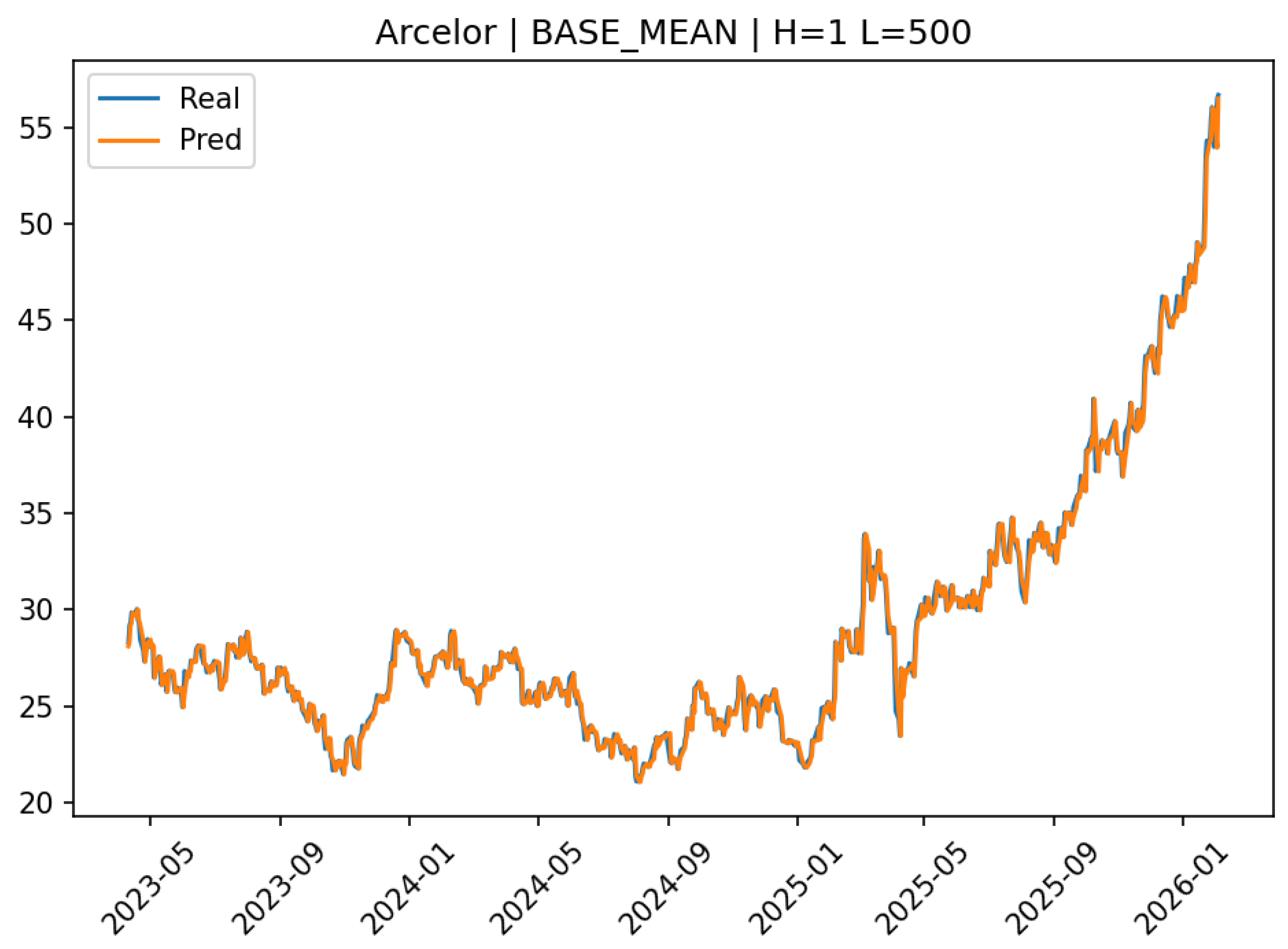
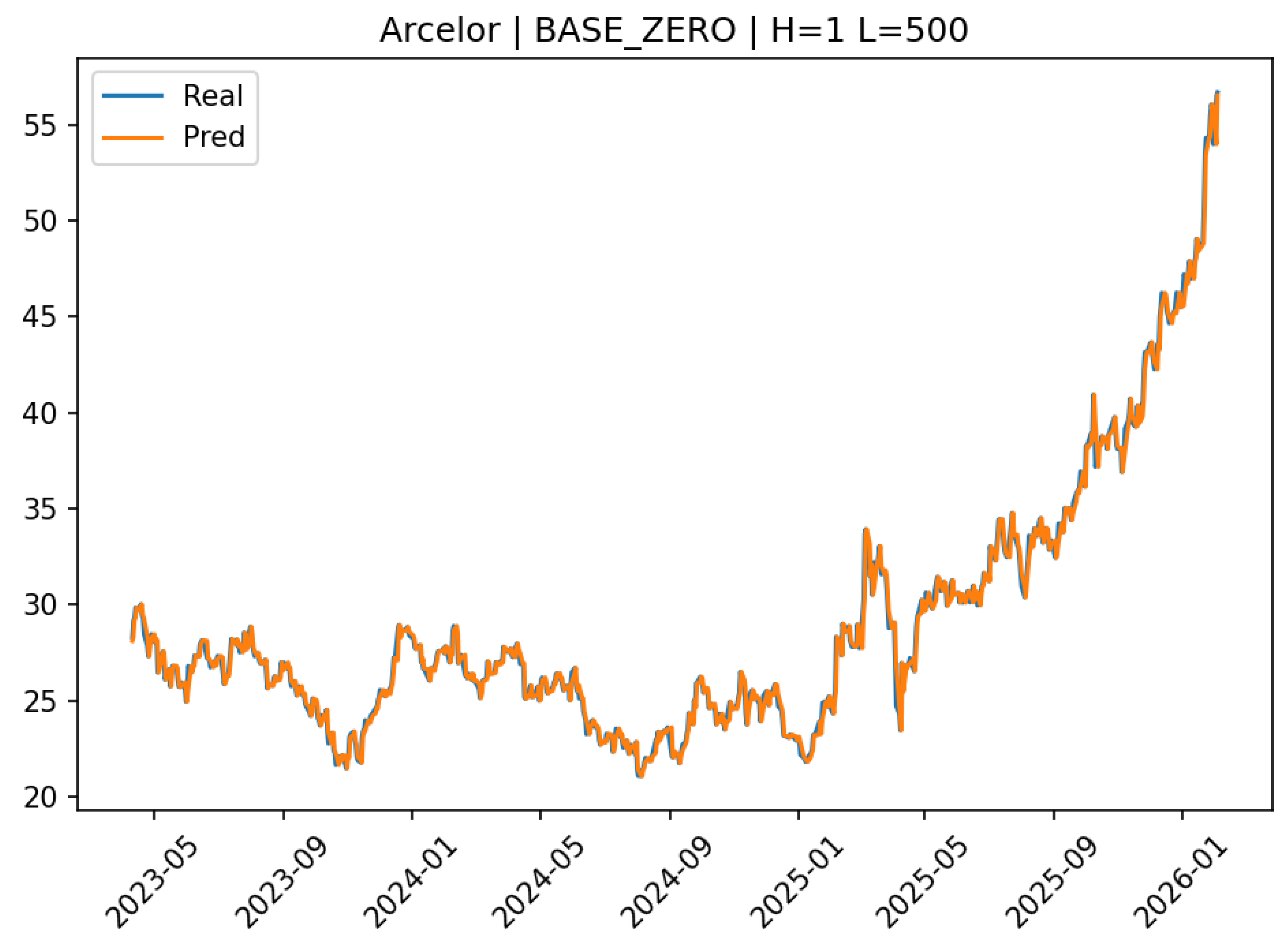
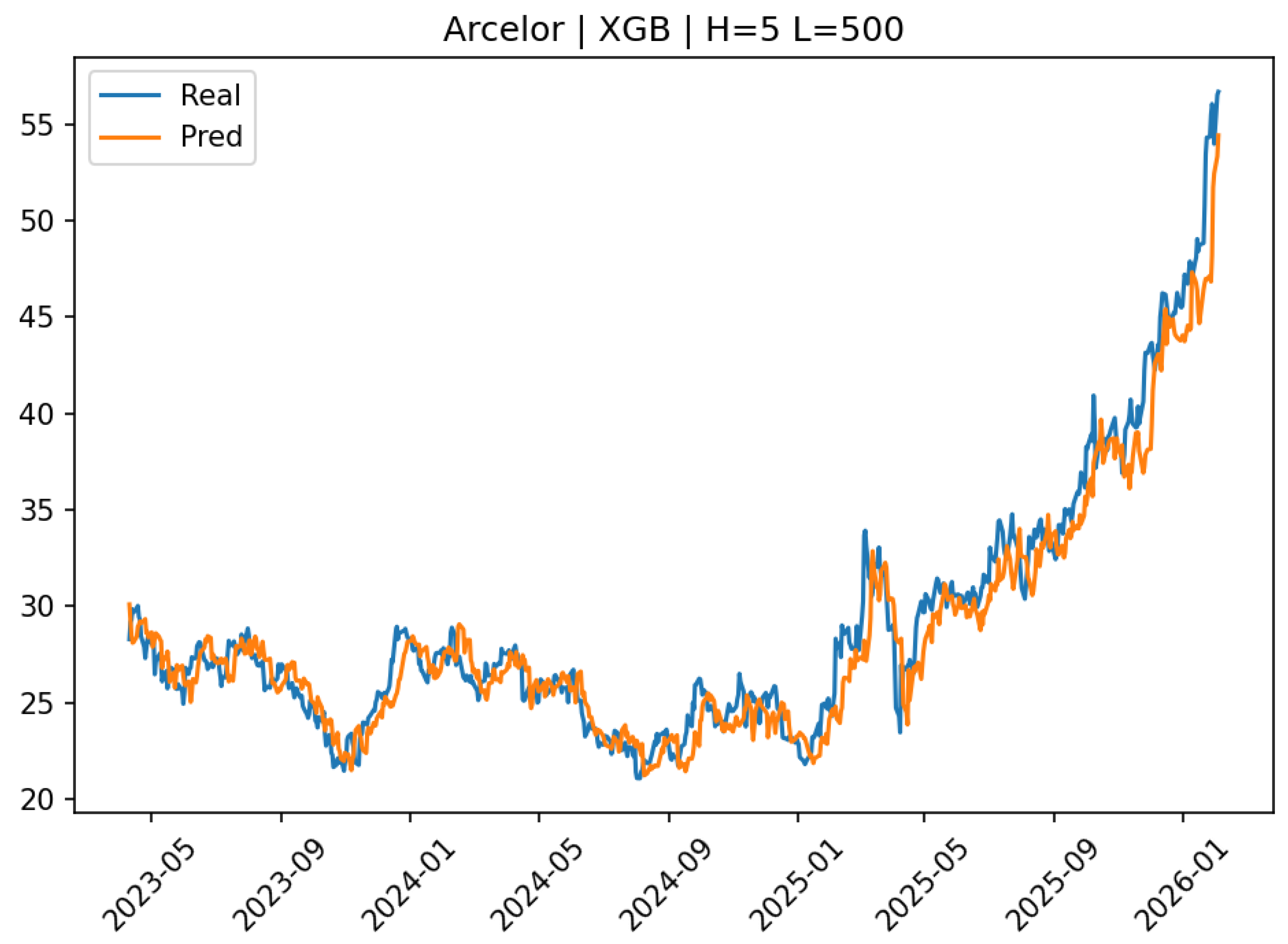
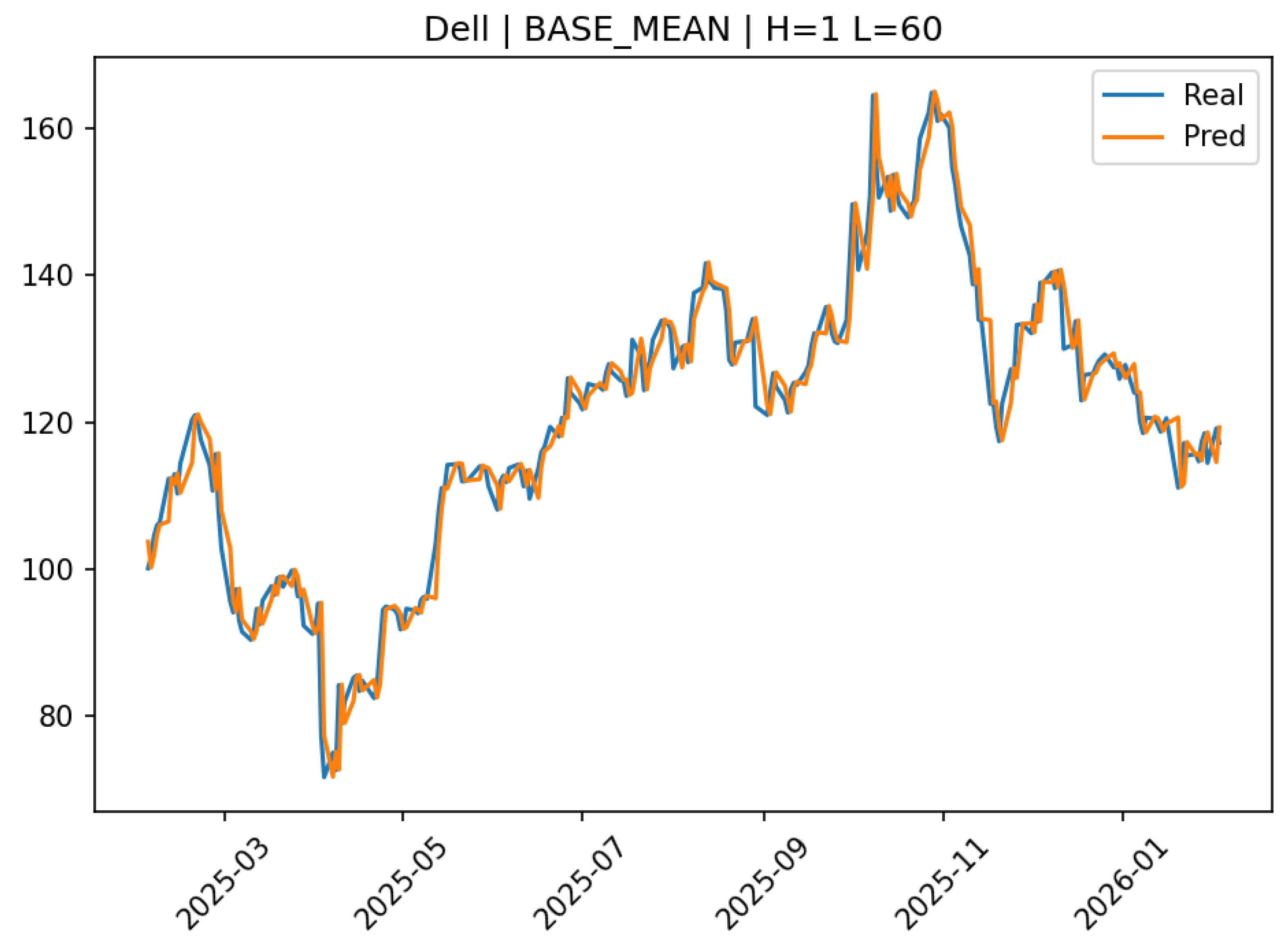
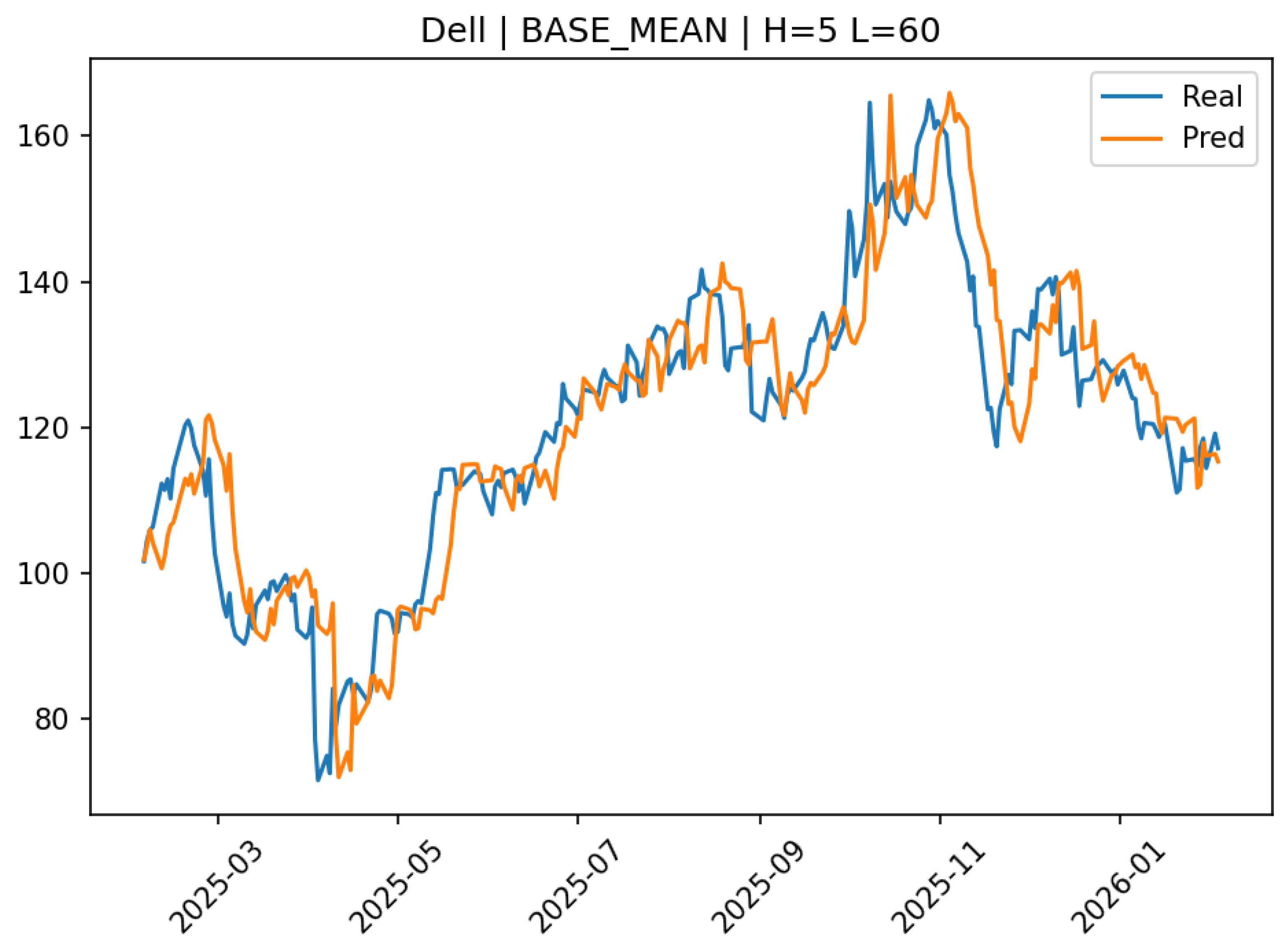
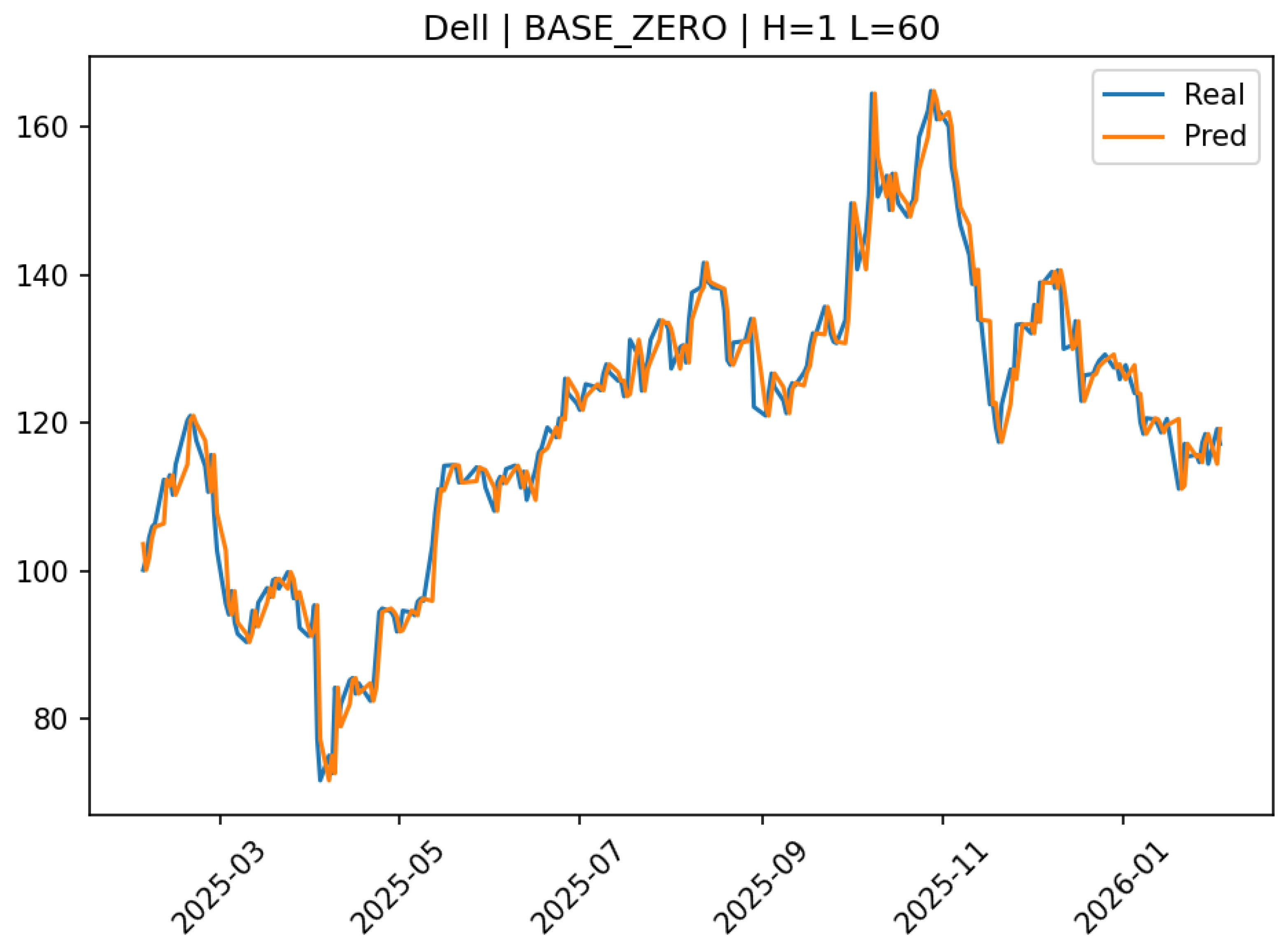
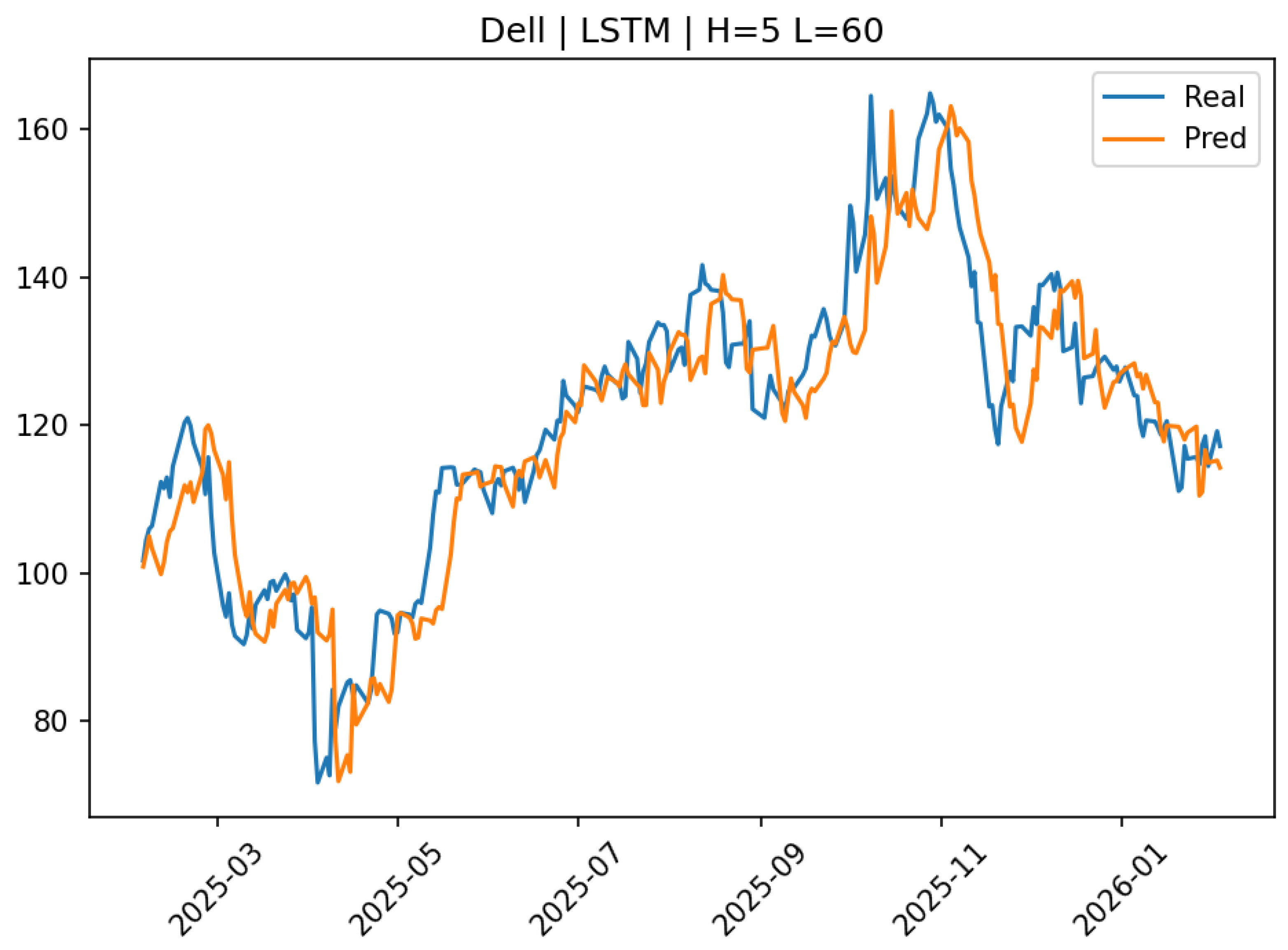
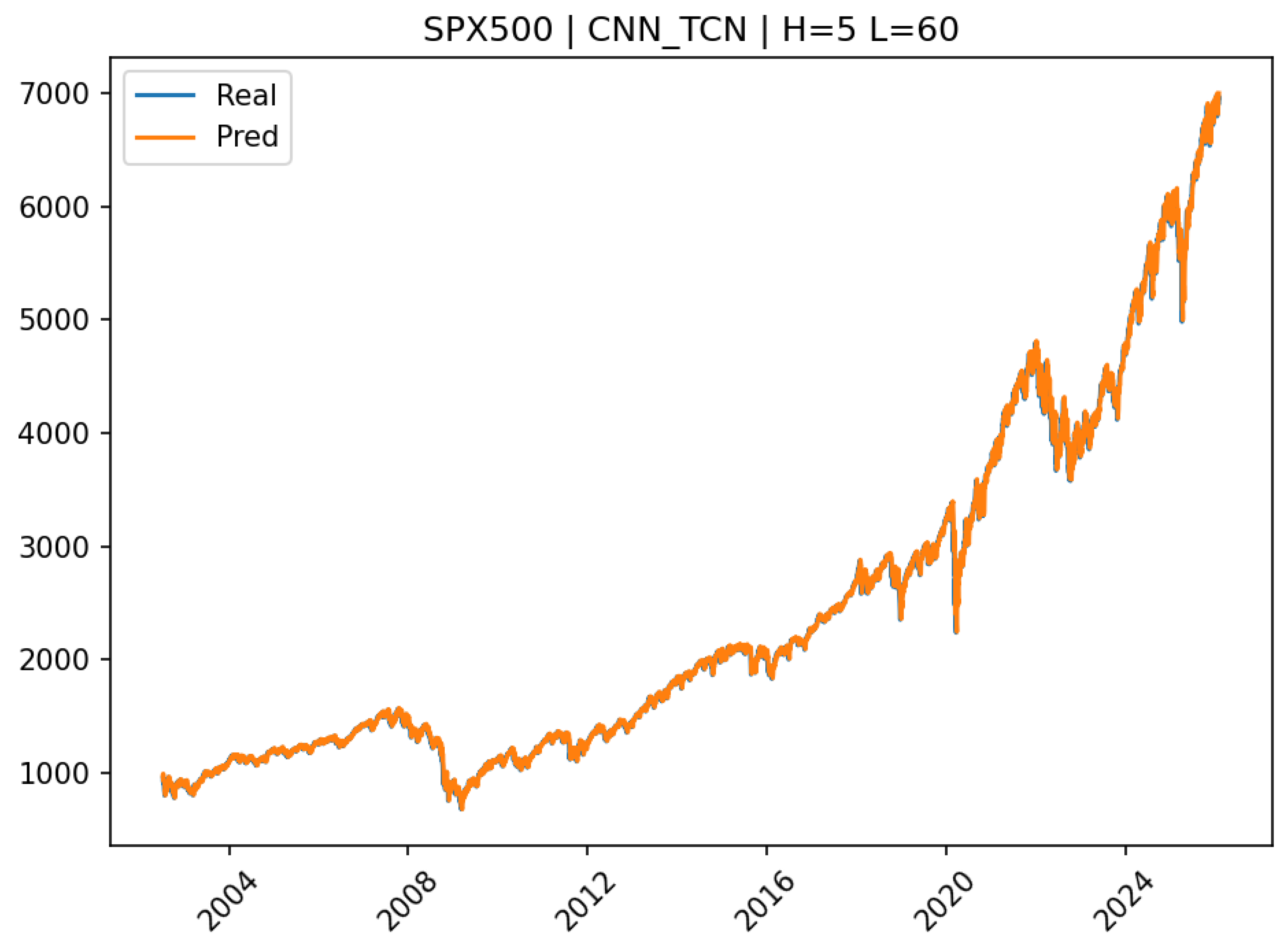
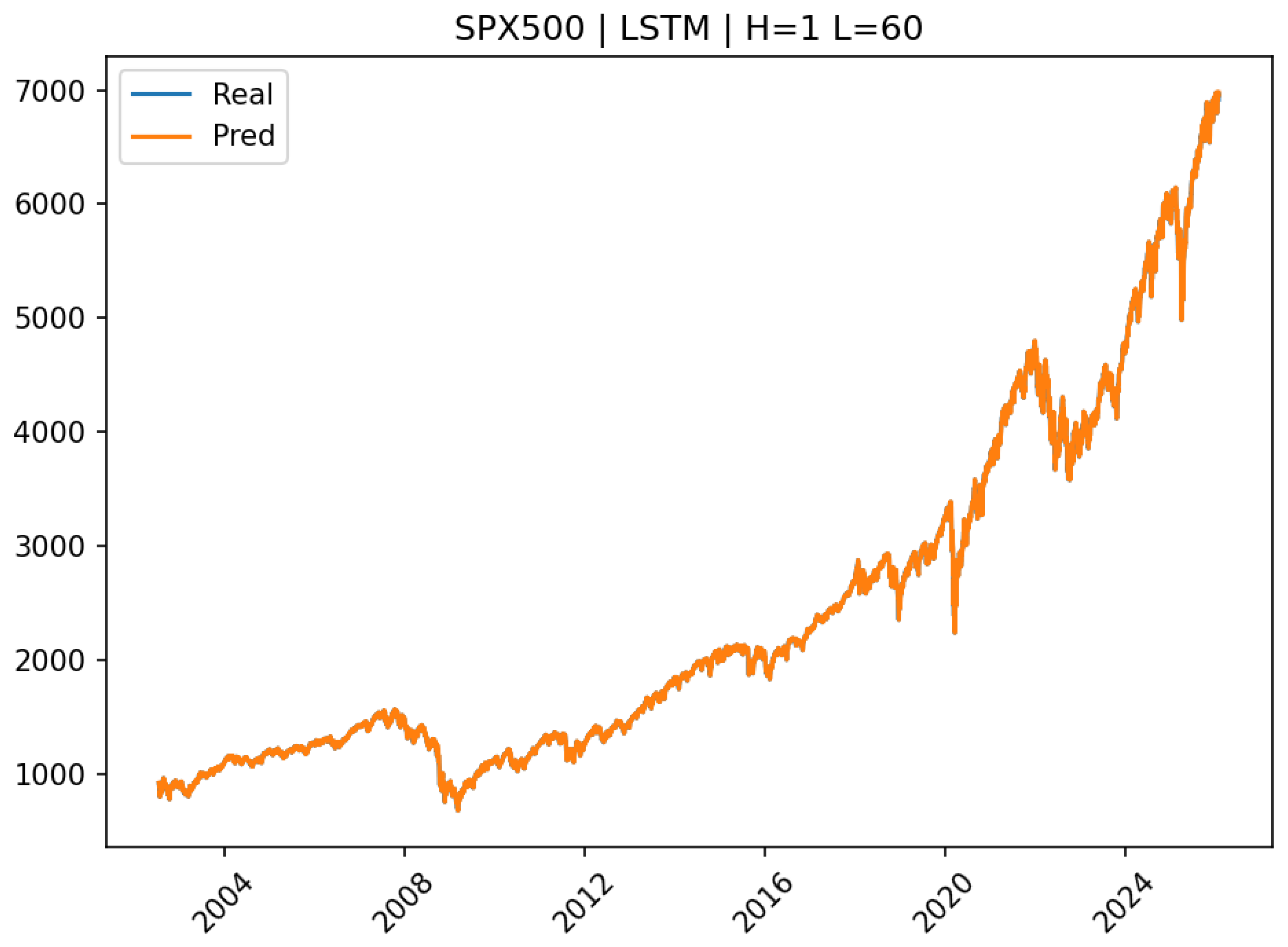
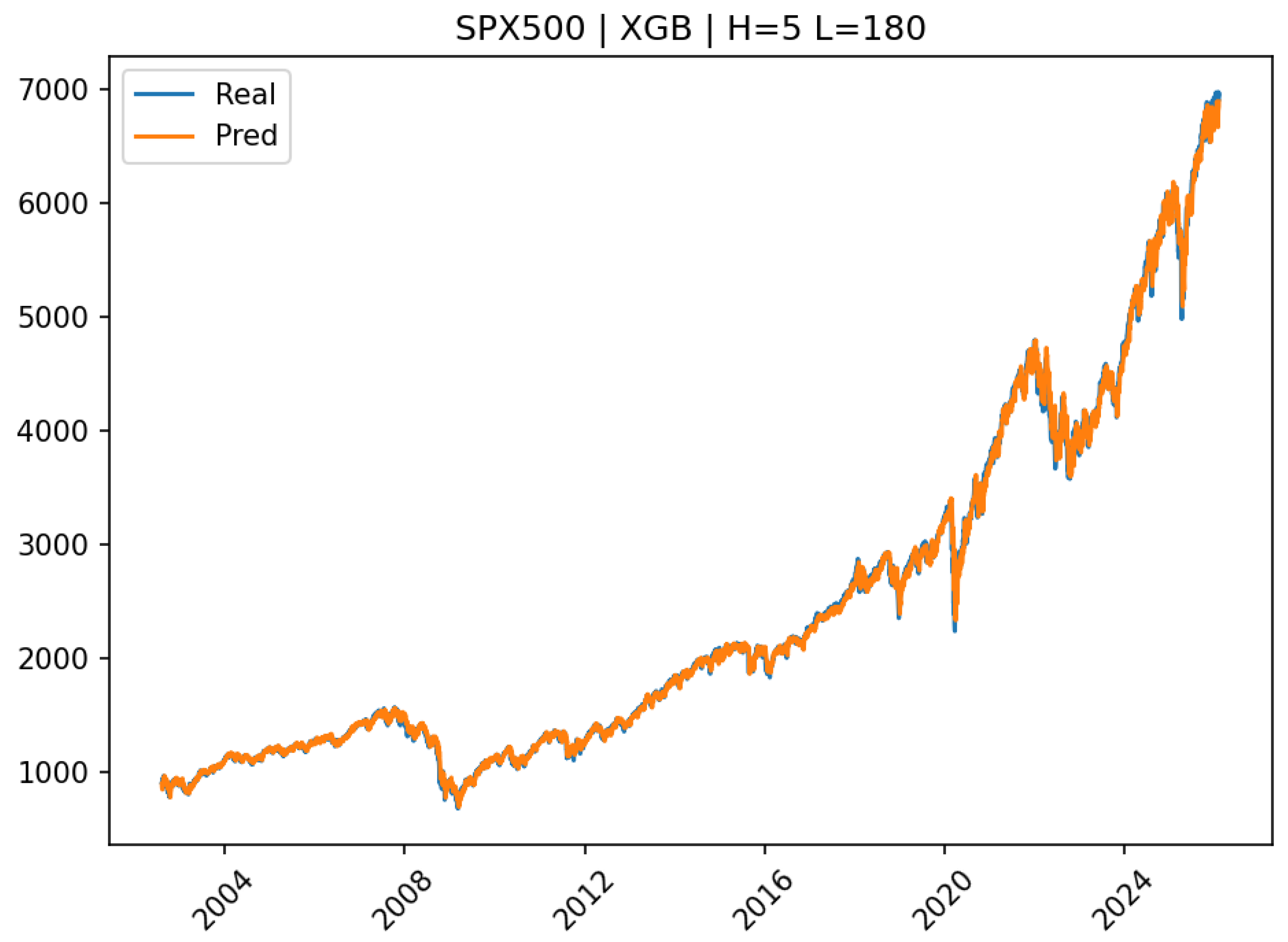
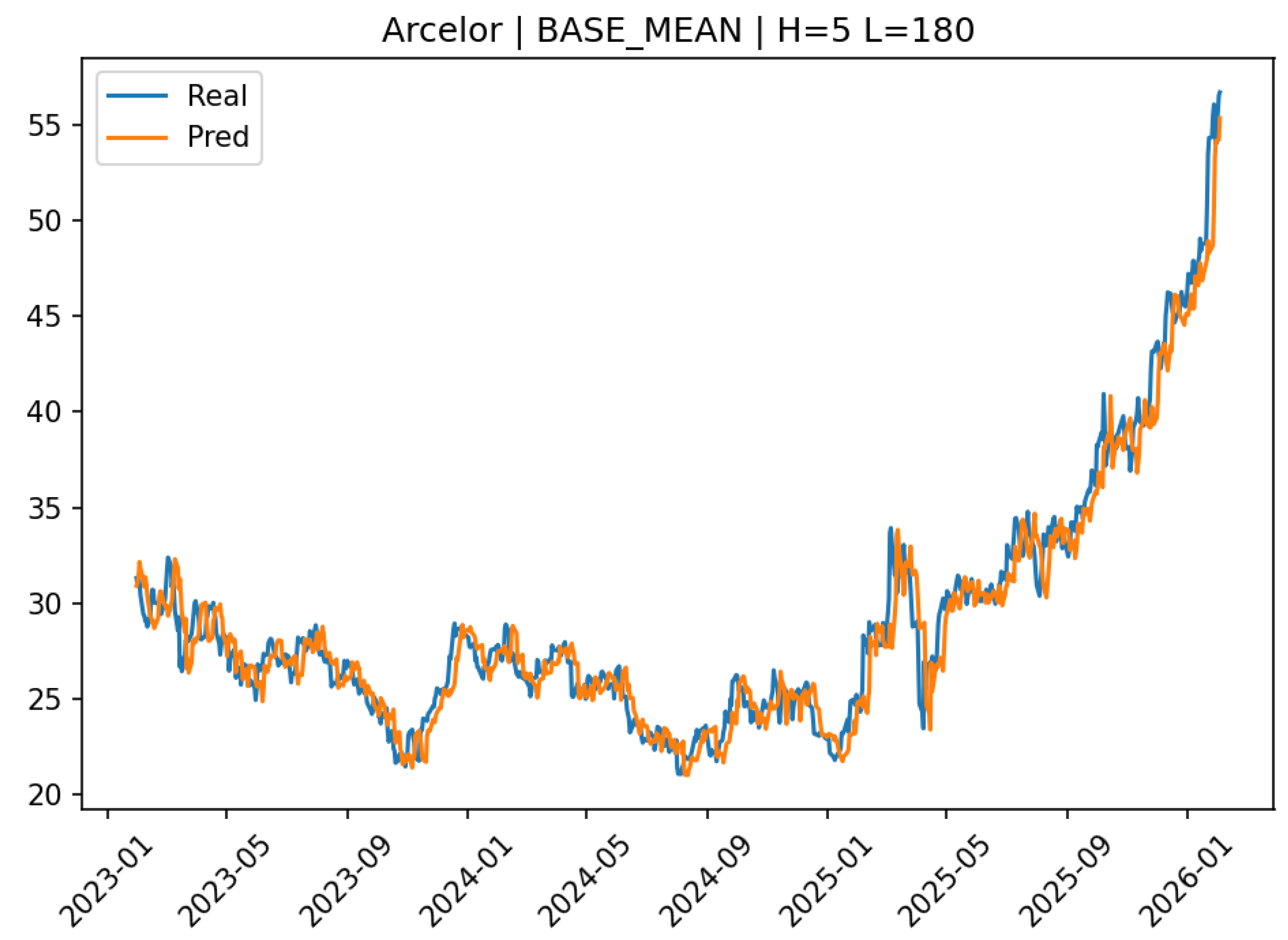
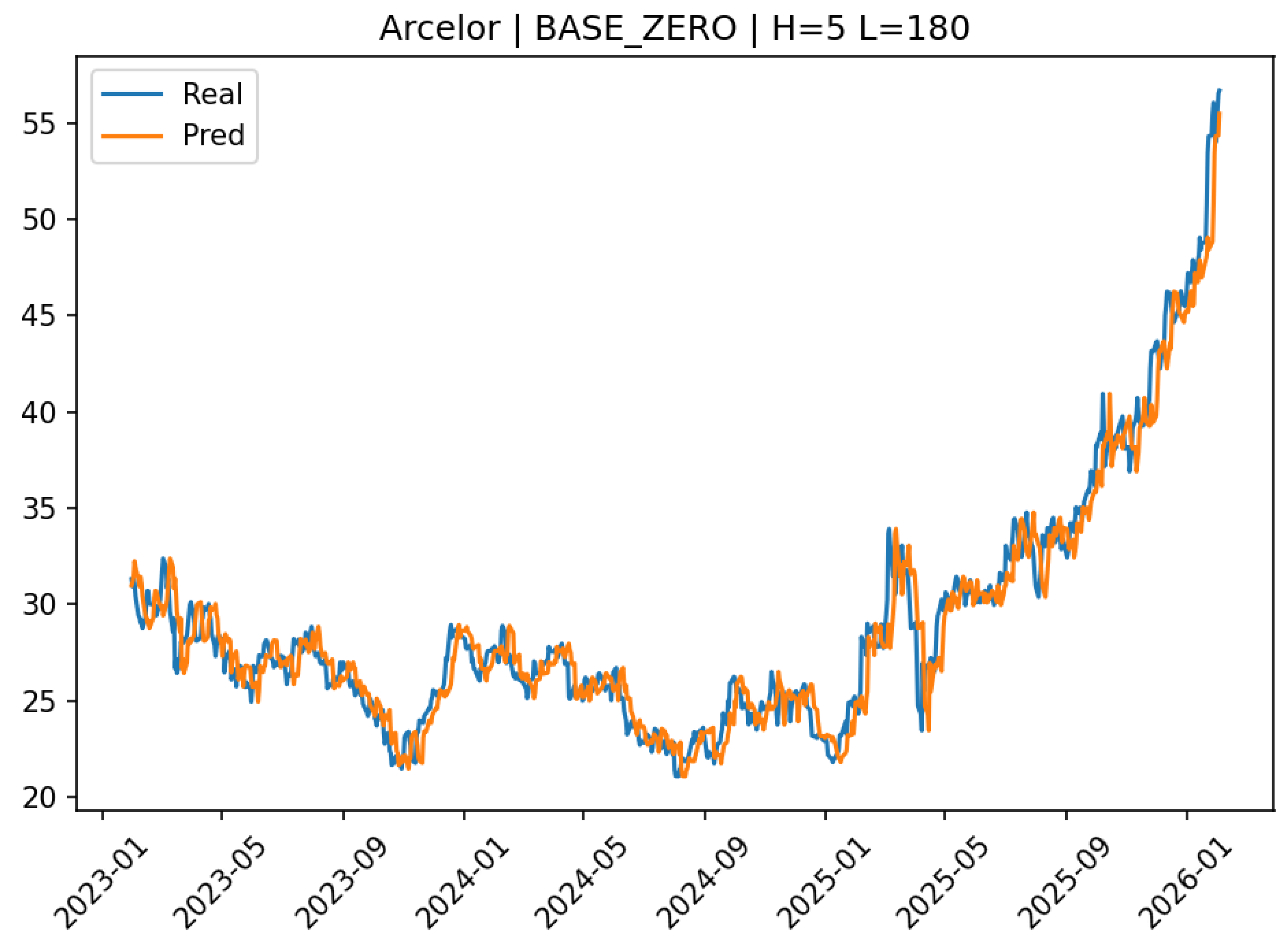
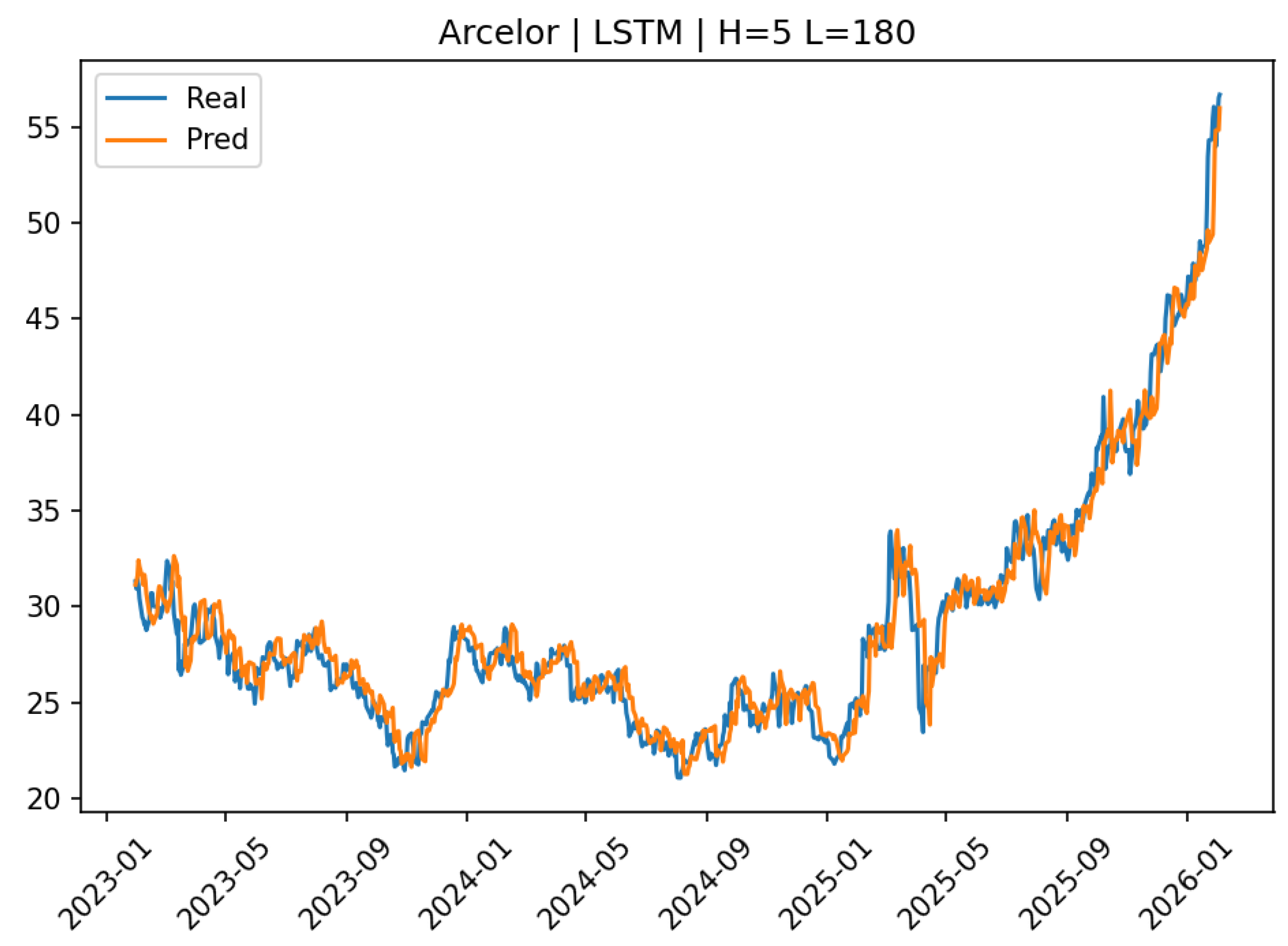
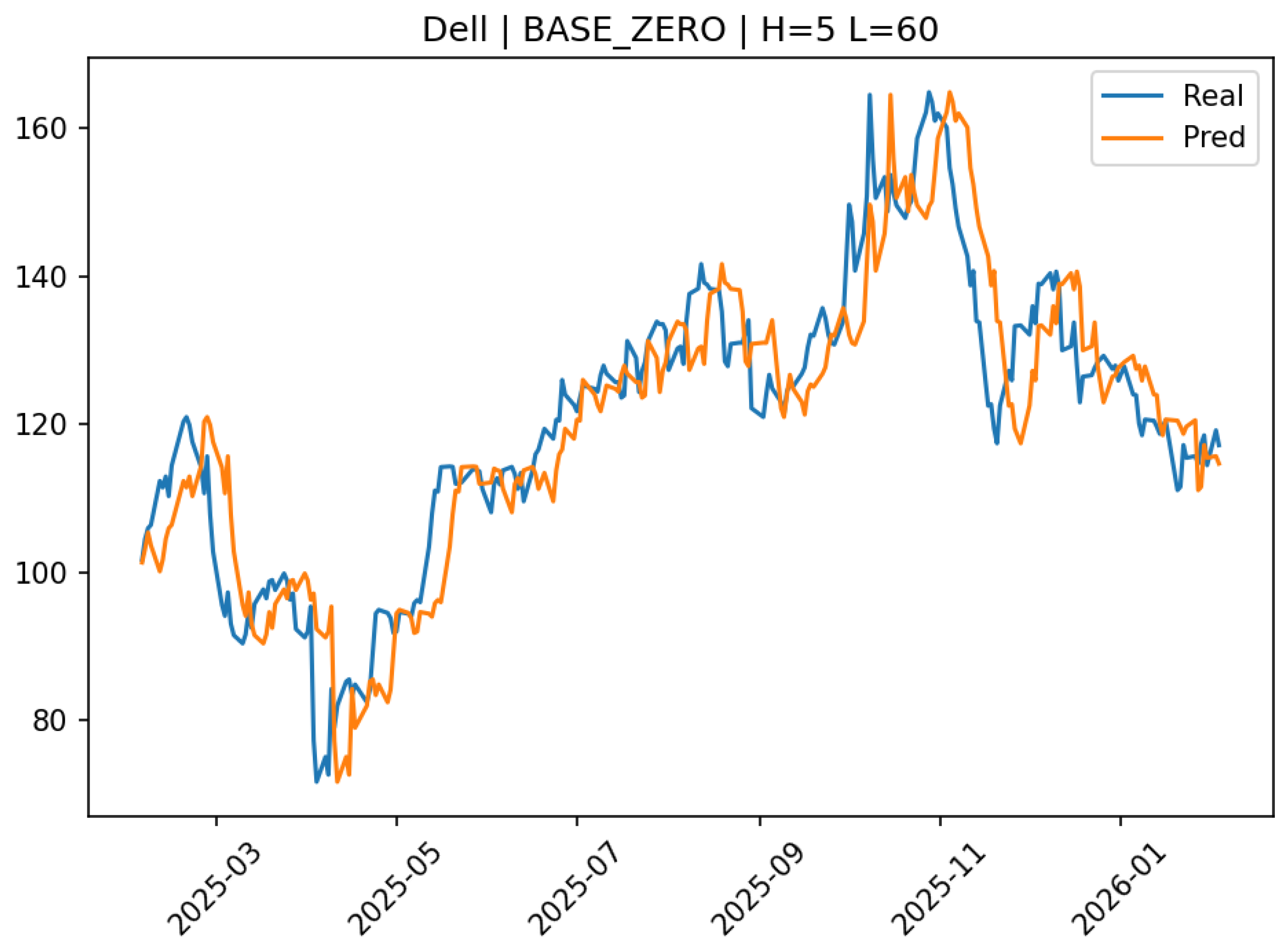
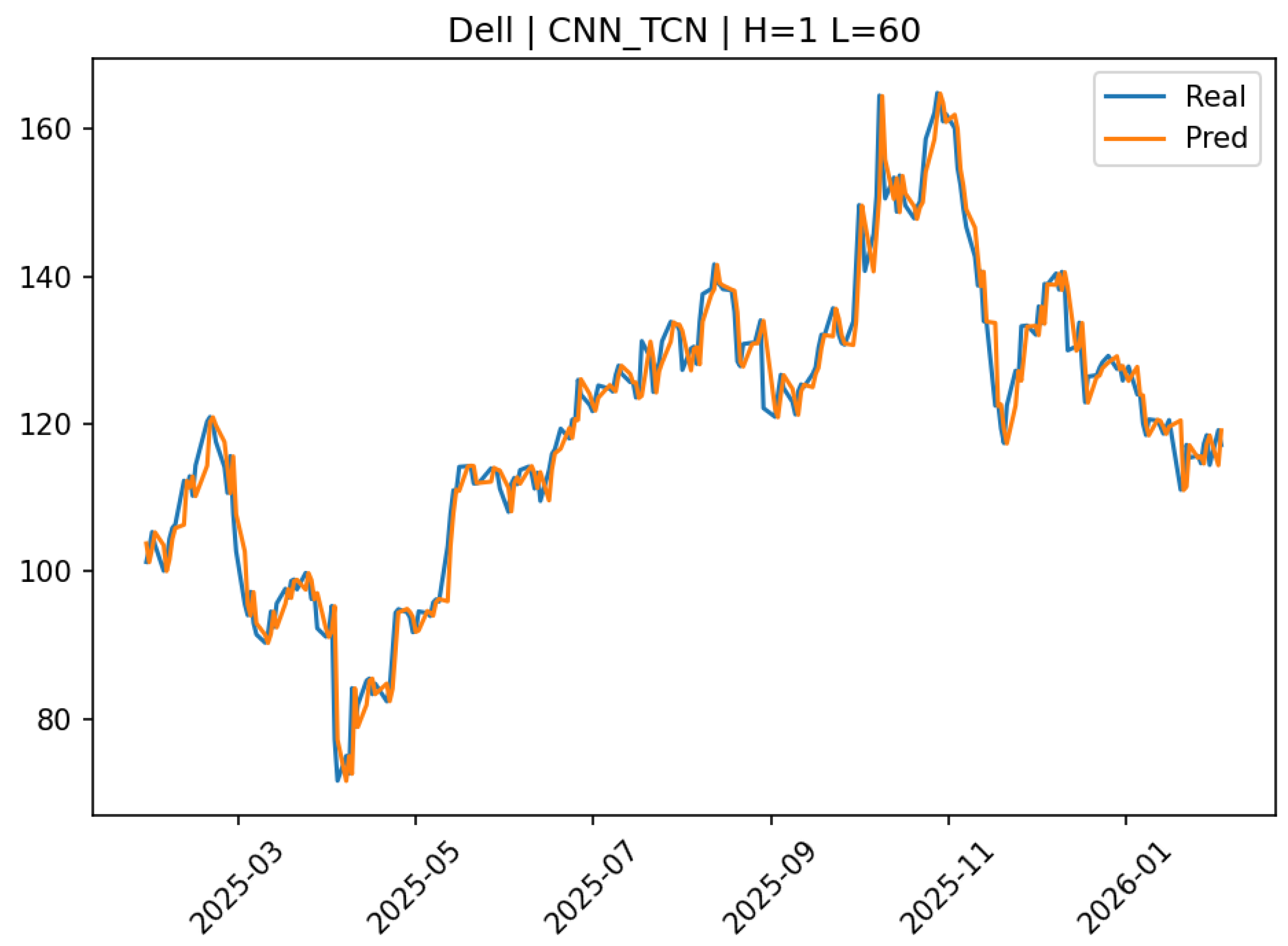
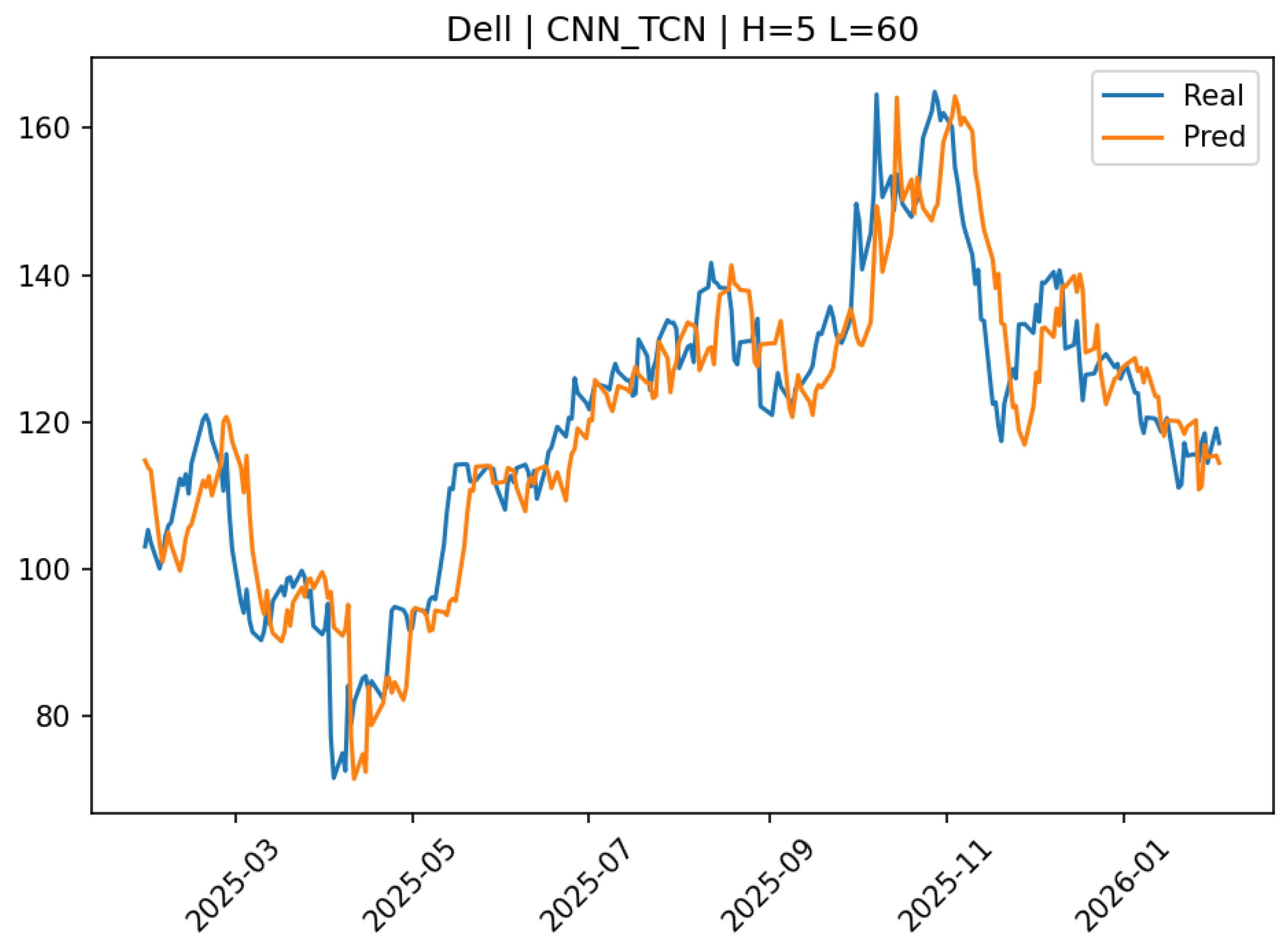
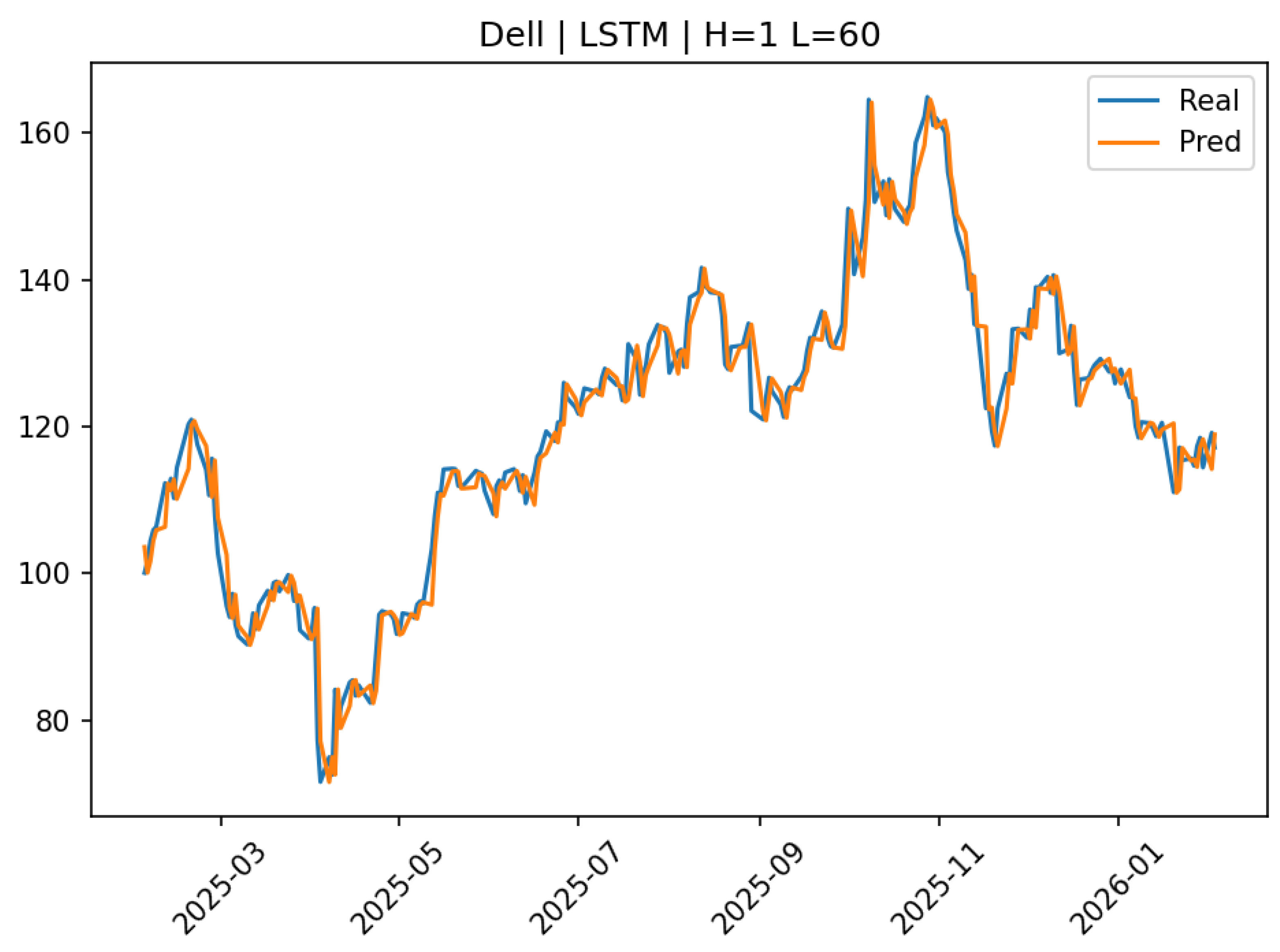
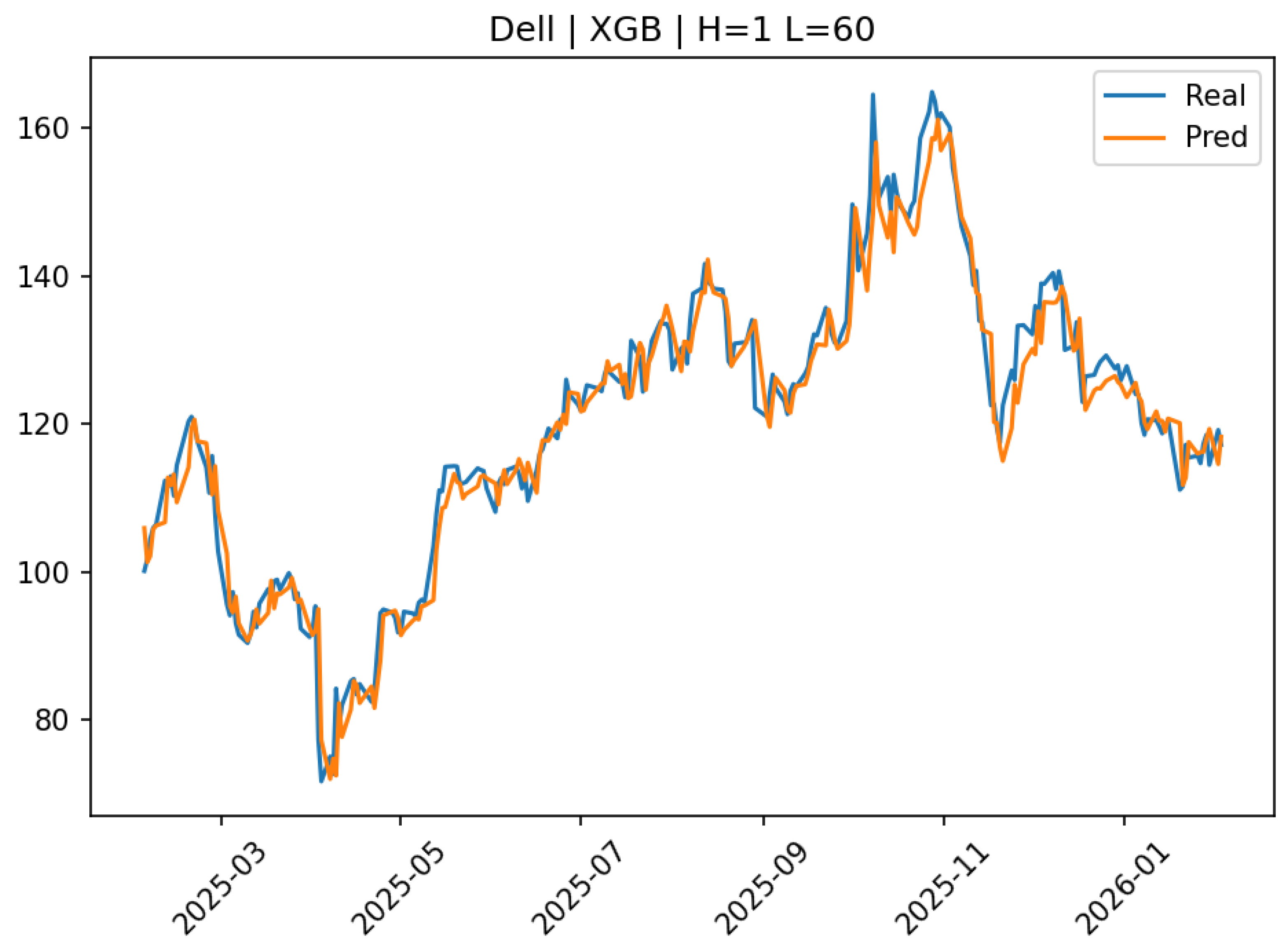
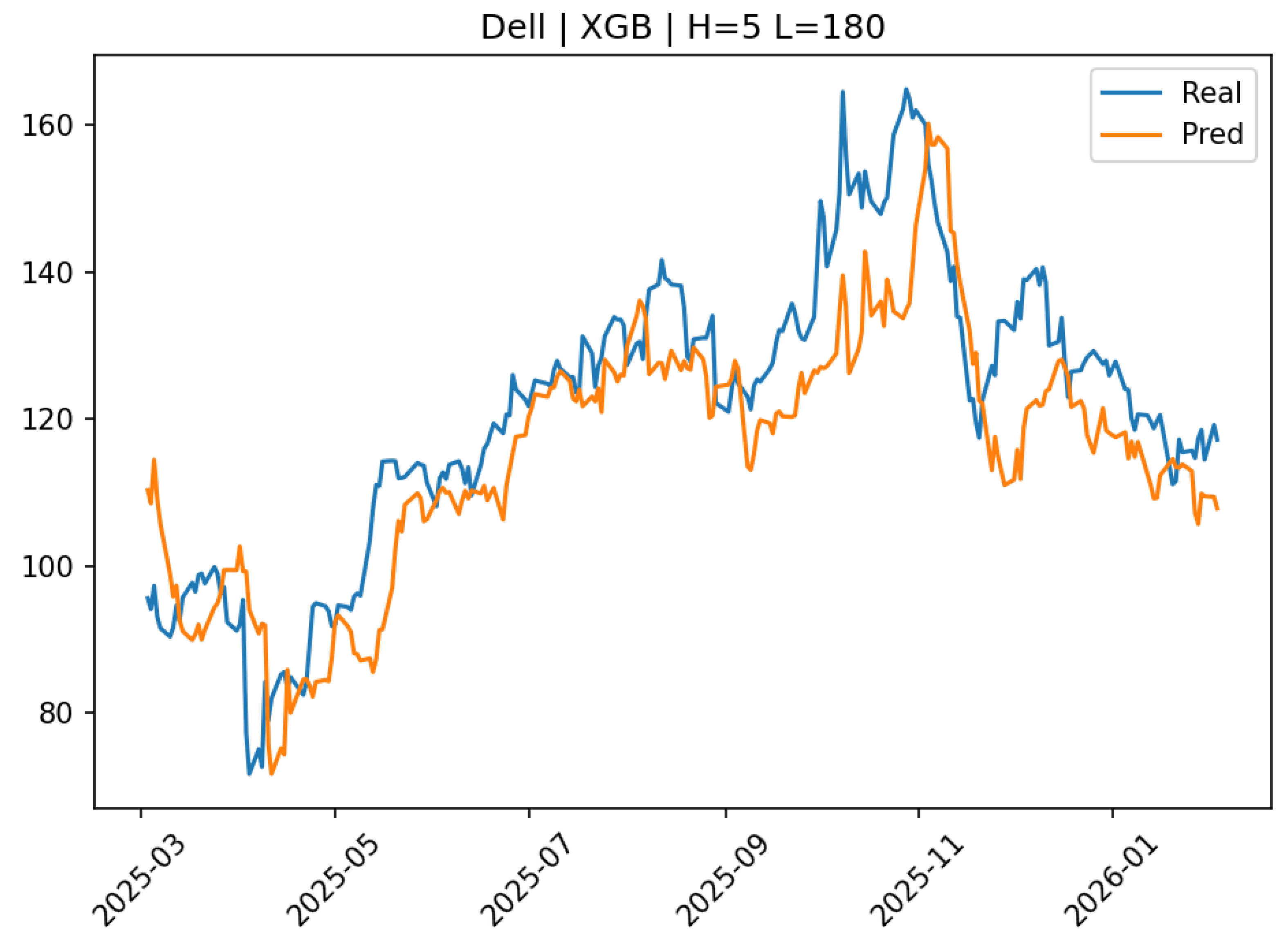
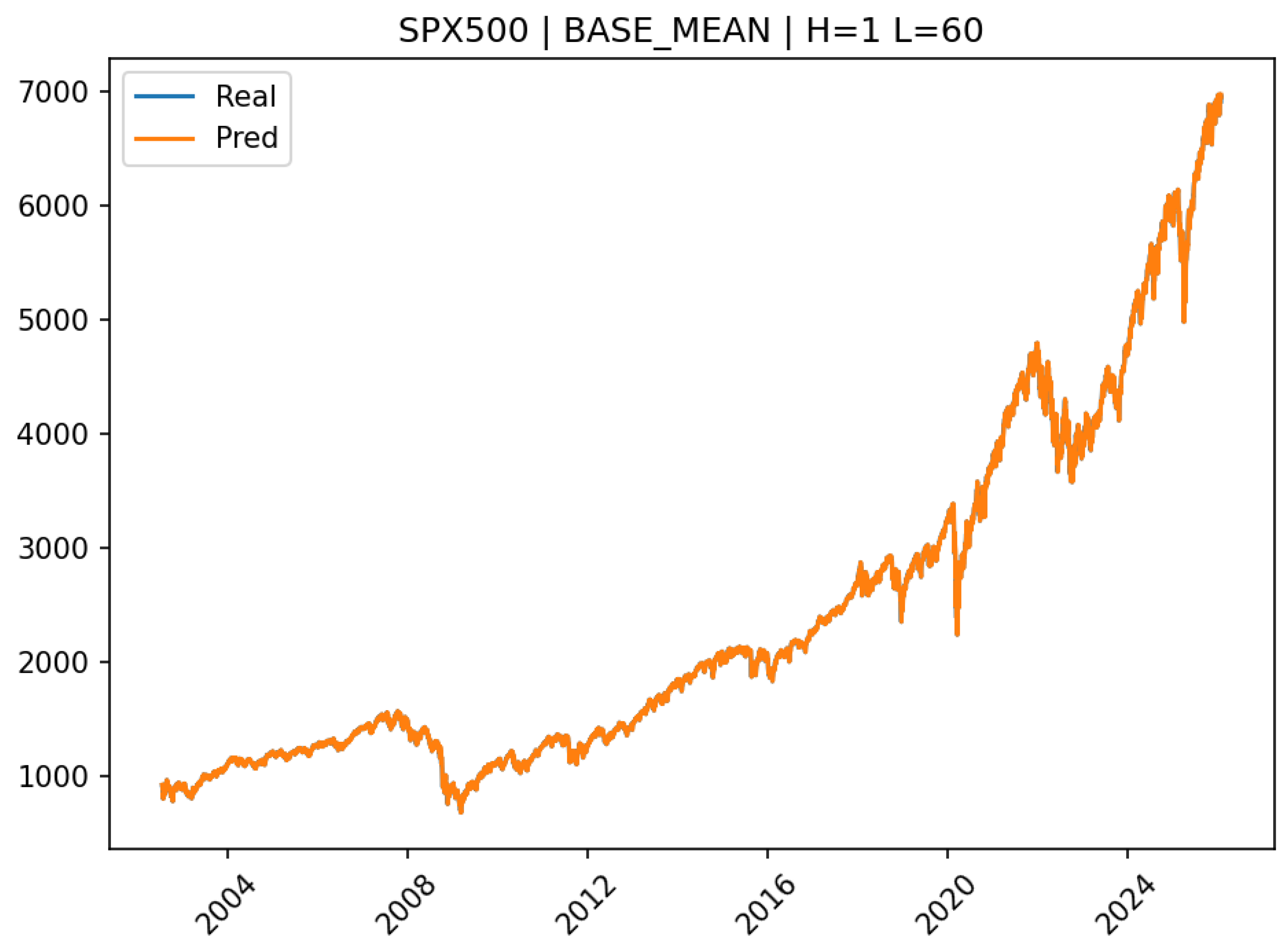
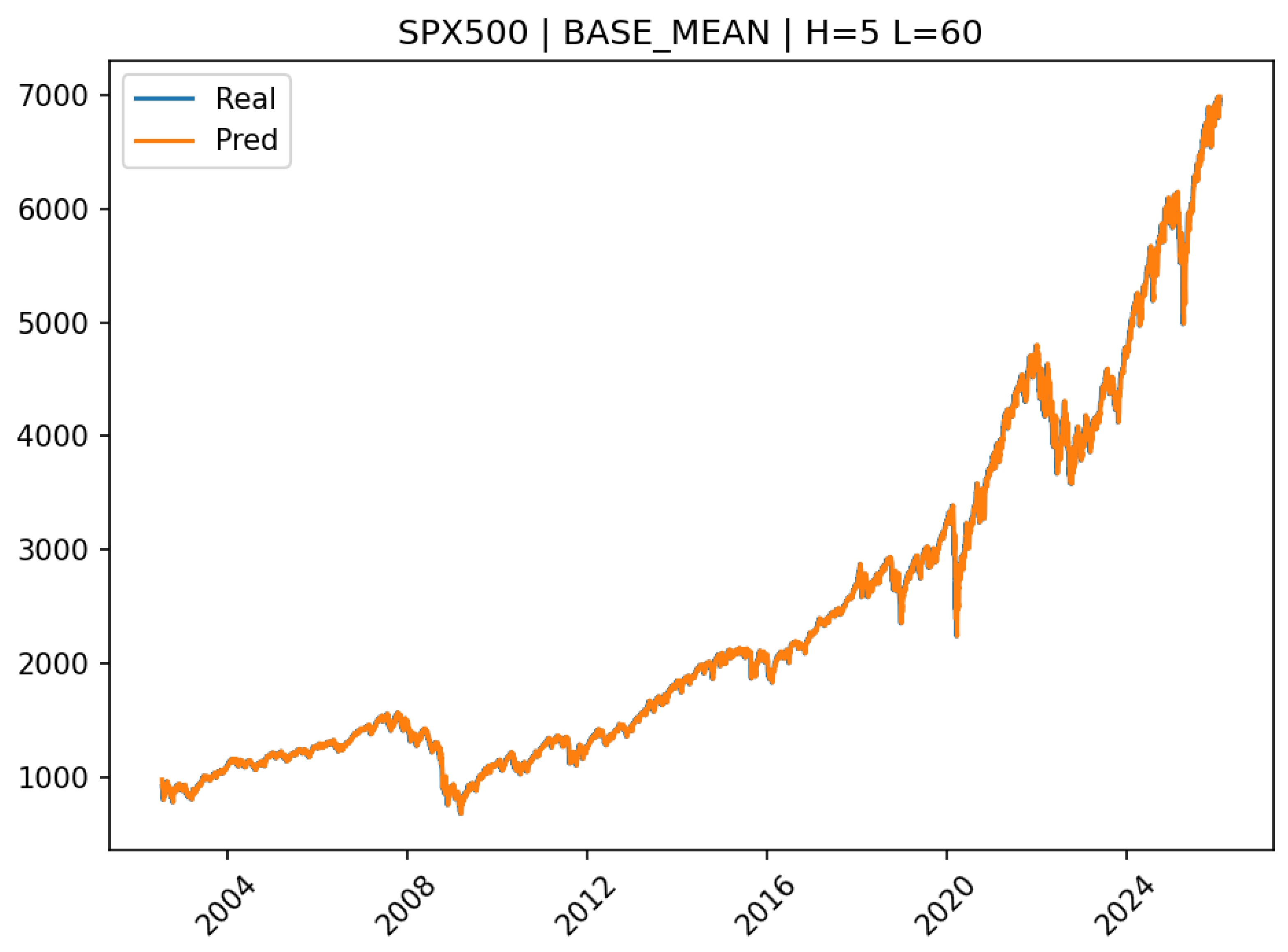
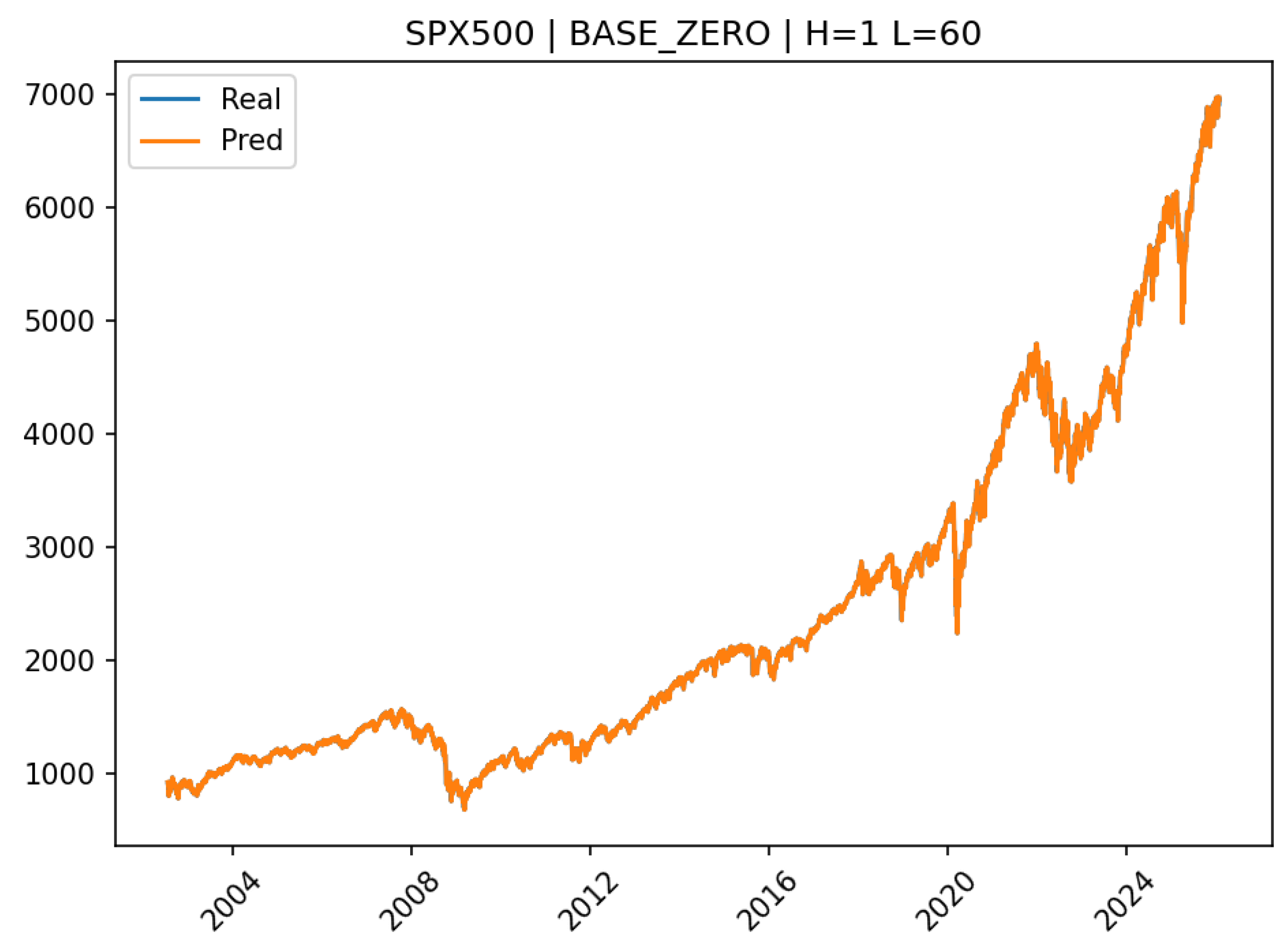
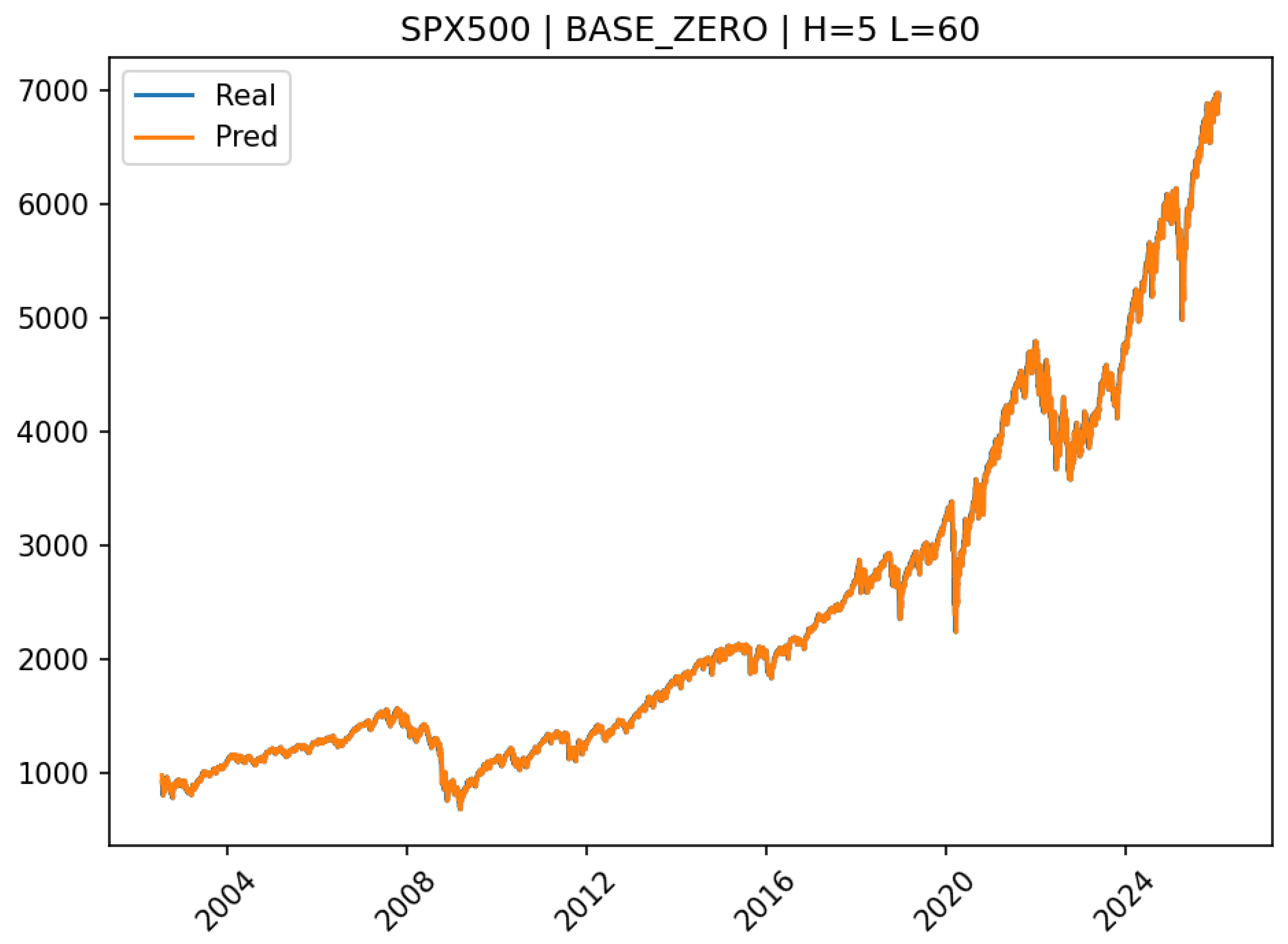
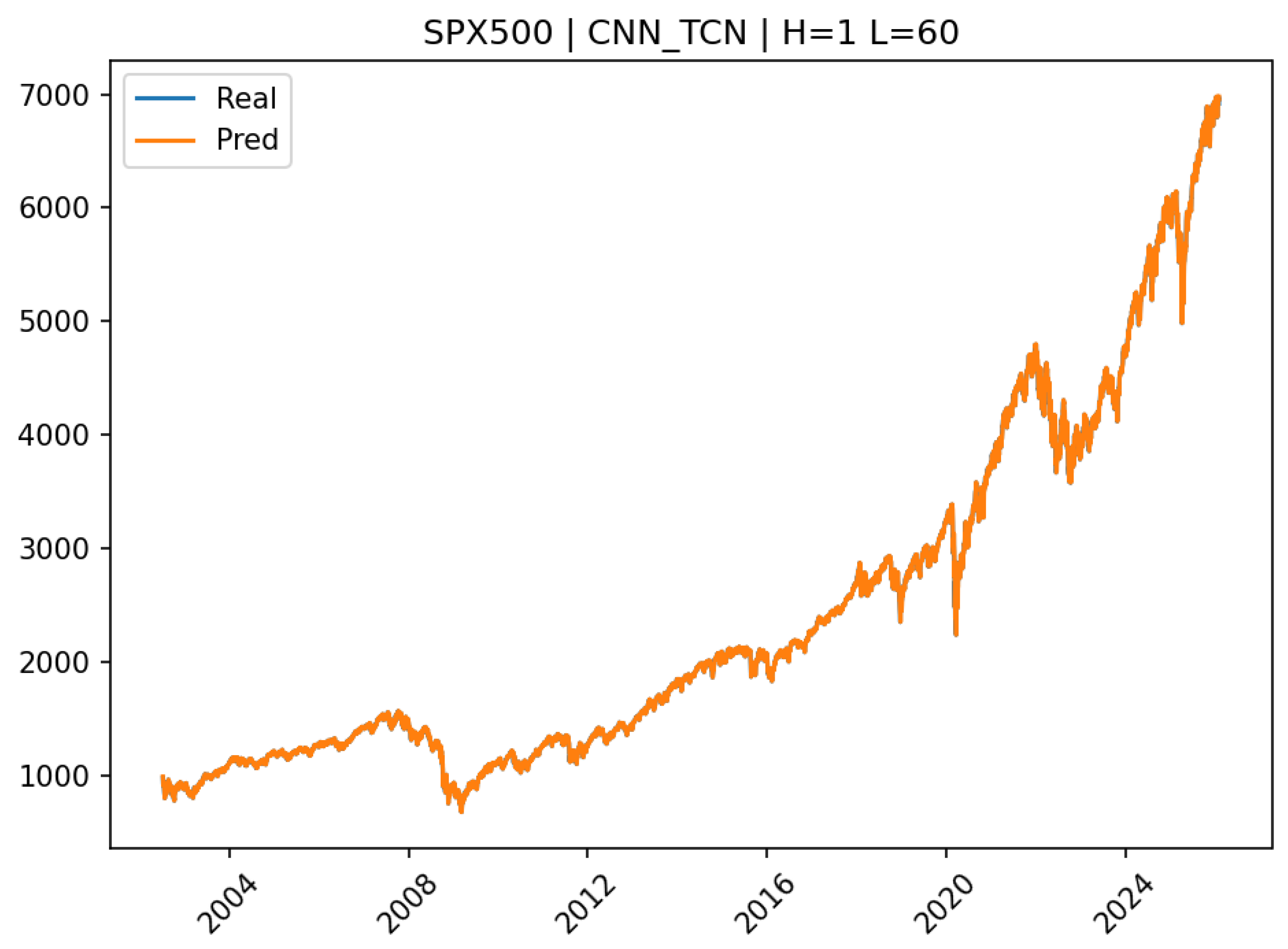
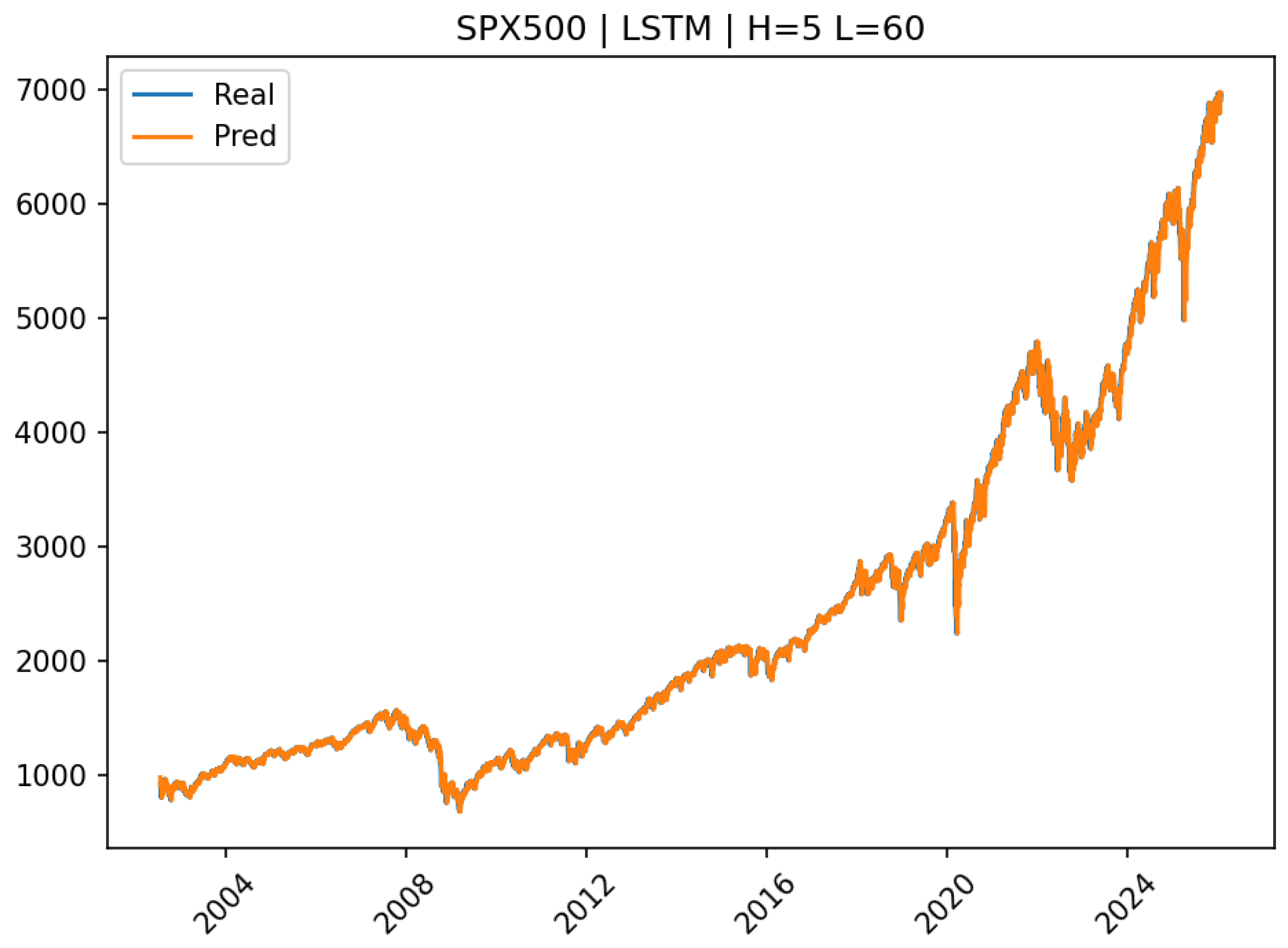
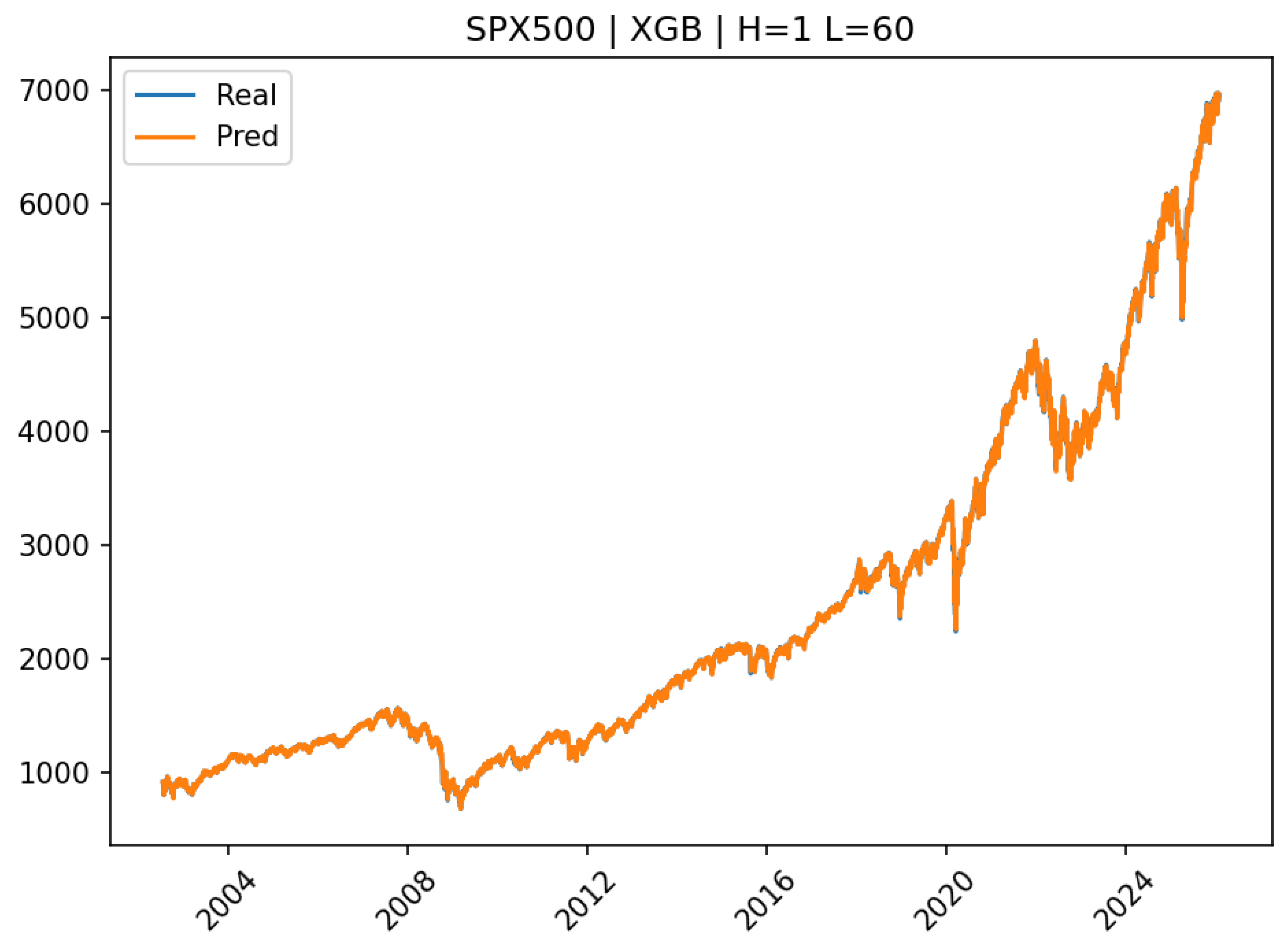
For compactness, the main summary tables report Baseline (0) as the most transparent operational reference. The historical-mean baseline is nevertheless part of the evaluated benchmark set, is documented in
Appendix B (
Figure A1,
Figure A2,
Figure A3,
Figure A4,
Figure A5,
Figure A6,
Figure A7,
Figure A8,
Figure A9,
Figure A10,
Figure A11,
Figure A12,
Figure A13,
Figure A14,
Figure A15,
Figure A16,
Figure A17,
Figure A18,
Figure A19,
Figure A20,
Figure A21,
Figure A22,
Figure A23,
Figure A24,
Figure A25,
Figure A26,
Figure A27,
Figure A28,
Figure A29 and
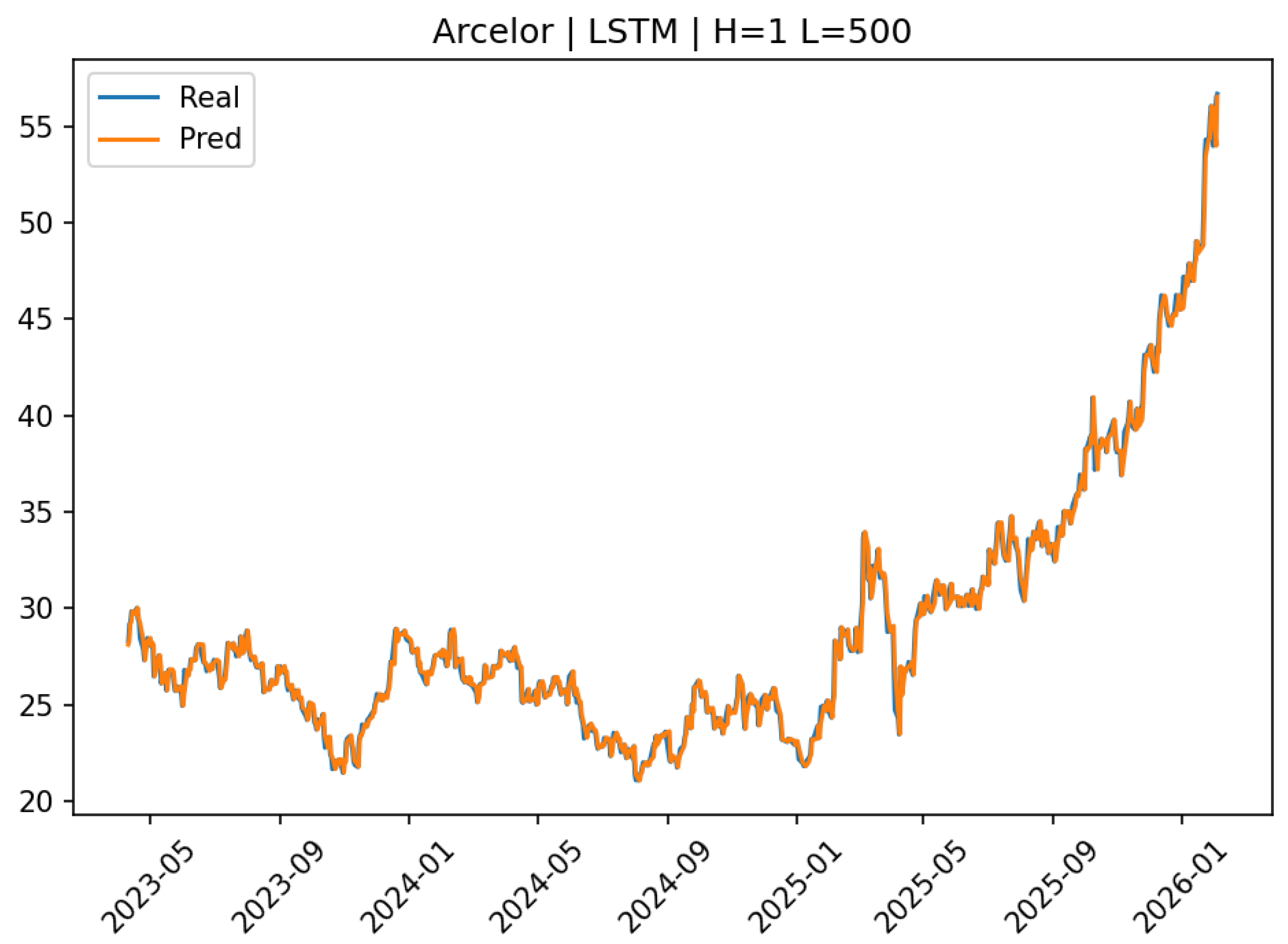
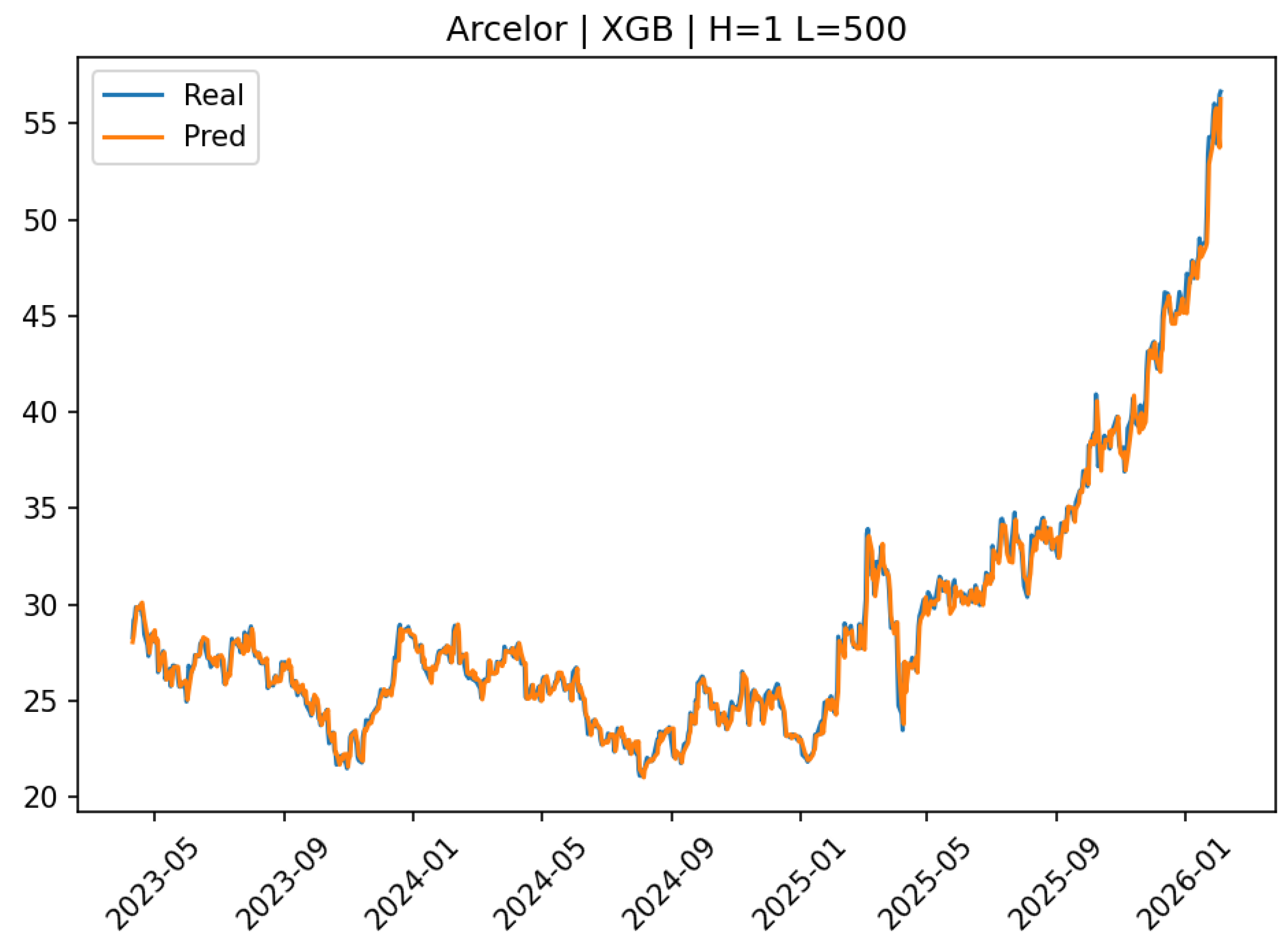
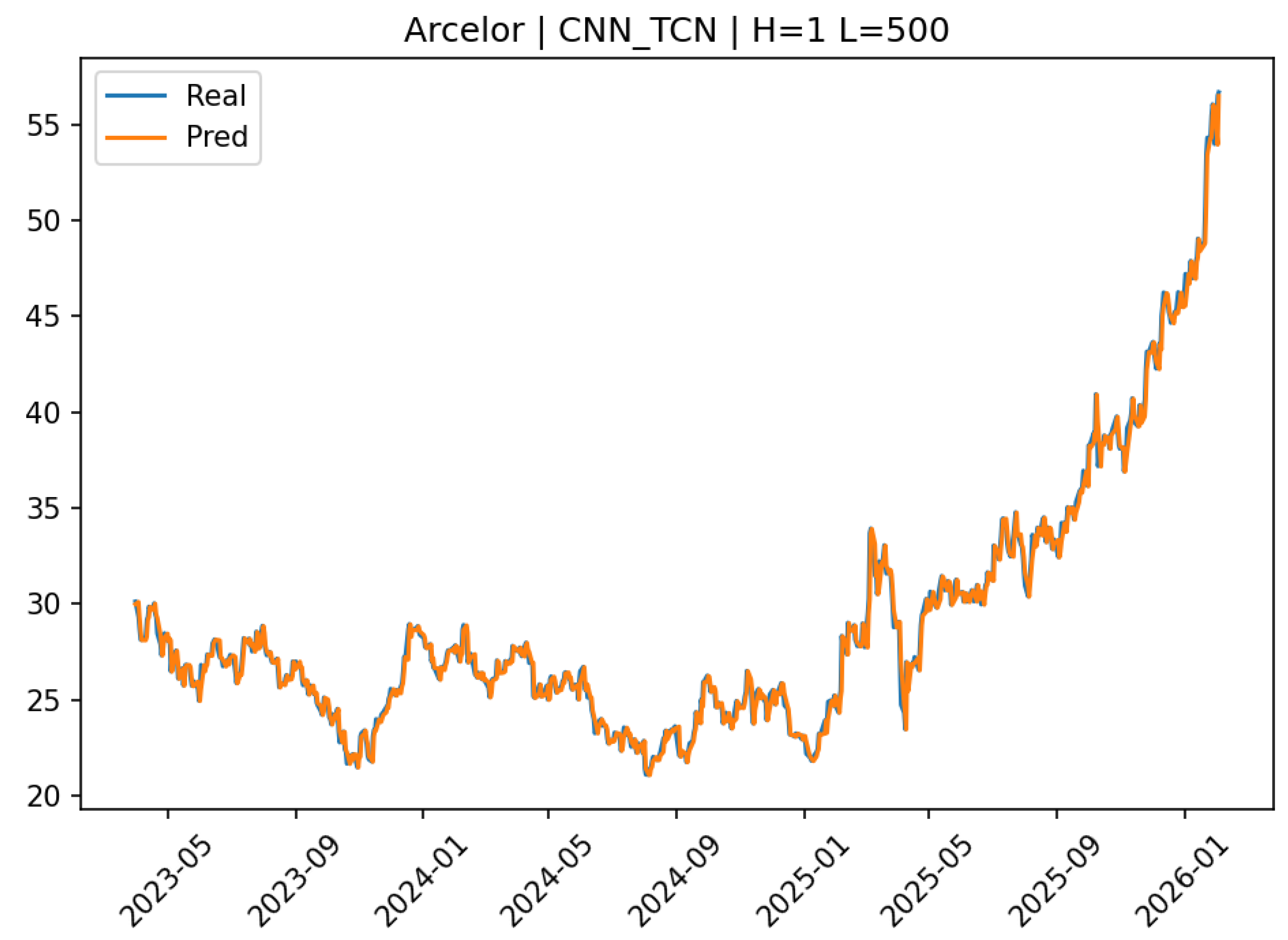
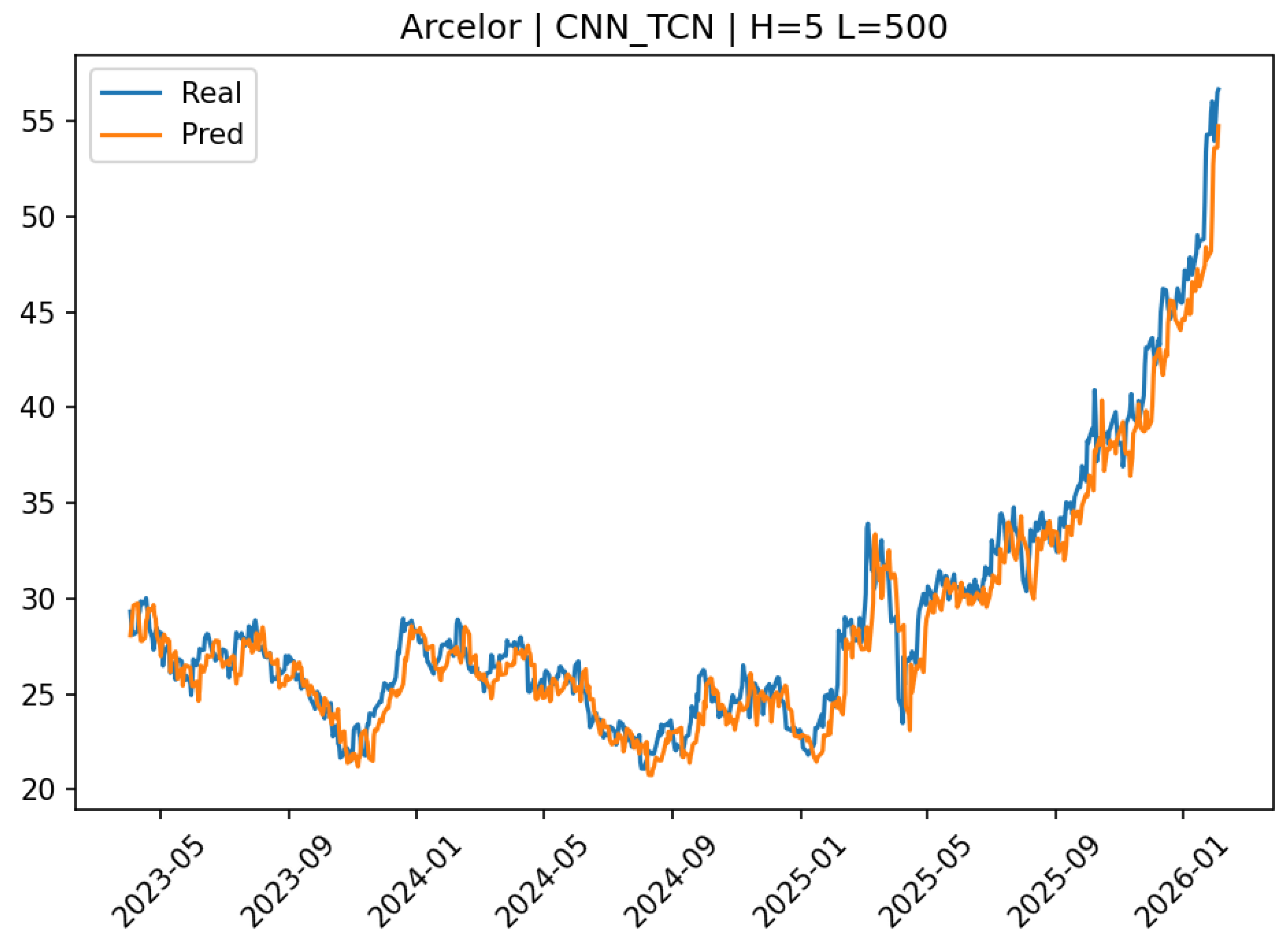
Figure A30) through the complete external hold-out plots, and is preserved in the stored run artifacts.
3.1. Next-Day Forecasts ()
At , all learning-based families and the transparent baselines deliver very similar price-level accuracy on this three-instrument universe. Price-space remains uniformly high, and relative errors are low, reflecting the strong persistence of daily price levels at the next-day horizon. Differences in RMSE and SMAPE across model families are therefore small and should be interpreted as marginal within this limited universe.
These high values are largely driven by the strong persistence of financial price series and should not be interpreted as evidence of true predictive ability. Accordingly, price-level metrics are treated as descriptive rather than indicative of genuine forecasting performance. However, return-space remains close to zero across all assets, indicating limited predictive power.
Cross-asset comparisons at
require care because RMSE is scale-dependent. In particular, the larger RMSE observed for
ˆSPX mainly reflects the substantially higher price level of the index, rather than poorer relative predictive performance. Accordingly, cross-asset interpretation should rely primarily on scale-free or normalized measures such as SMAPE, NRMSE, and LogRMSE. Under these relative metrics, next-day errors remain of comparable order across the evaluated assets, so the high absolute RMSE of the index should be read mainly as a scale effect rather than as evidence that
ˆSPX is intrinsically harder to forecast in relative terms.
Table 2 reports the corresponding results.
3.2. One-Week-Ahead Forecasts ()
As expected, errors increase at as uncertainty accumulates over the weekly horizon. Relative calibration (SMAPE) and fit () remain strong on the price scale in this universe, with the LSTM family providing the best mean SMAPE at in this run, and CNN/TCN remaining competitive. However, return-space predictive performance remains weak, with values close to zero or negative, so these price-space differences should not be interpreted as evidence of robust predictive superiority. The boosted-tree configuration reported here is consistently weaker on MT and DELL at in both RMSE and SMAPE.
Horizon effects and differing behavior of RMSE vs. SMAPE. As the horizon increases, absolute errors (RMSE) naturally accumulate in price units. For individual stocks (DELL and MT), both RMSE and SMAPE increase, consistent with higher uncertainty at longer horizons. For the index, RMSE can increase substantially while SMAPE remains stable (or even improves) because SMAPE is a relative error—when the underlying level is large and the index aggregates idiosyncratic noise, the same absolute deviation may represent a small percentage error. This also helps explain why may remain high for ˆSPX across horizons, where the index level is highly persistent and smoother due to cross-sectional aggregation, whereas single stocks contain more idiosyncratic variation that can reduce explained variance as H grows. Therefore, horizon-dependent comparisons are most informative when interpreted jointly through scale-dependent (RMSE) and scale-free (SMAPE/NRMSE/LogRMSE) metrics.
Table 3 reports the corresponding results.
3.3. Horizon-Specific Model Choice
We now apply the operational selection rule used to recommend a deployable forecaster per
:
minimize external hold-out RMSE on the price scale, with SMAPE used only as a tie-breaker.
Table 4 summarizes the selected model for each asset and horizon.
Under this RMSE-on-price criterion, the selected family is horizon- and asset-dependent. LSTM is selected for MT at both horizons and for DELL at , while CNN/TCN is selected for ˆSPX at both horizons and for DELL at . In this run, neither baseline nor XGB is selected by the operational rule for any pair. However, this selection should be interpreted as an operational price-space choice rather than as evidence of consistent predictive superiority in return space.
These findings are further reinforced by additional assets reported in
Appendix C (including Bitcoin,
Table A2,
Table A3,
Table A4 and
Table A5), where return-space
remains close to zero or negative and Diebold–Mariano tests do not indicate consistent statistical superiority over naive benchmarks. This cross-asset evidence confirms that the limited predictive power observed is not specific to the main equity universe but reflects a broader empirical pattern.
3.4. Statistical Comparison: Diebold–Mariano Tests
To assess whether the performance differences across model families are statistically meaningful, we conduct Diebold–Mariano (DM) tests of equal predictive accuracy on the full aligned forecast sample available for each asset–horizon–lookback configuration. For each asset and forecast horizon H, we compare model A against a reference model B (XGBoost in our main comparisons) using two loss functions: squared error in price space, , and squared error in log-price space, .
Let
denote the loss differential. Hence,
indicates that model
A achieves lower loss (better accuracy) than model
B on average. Because multi-step horizons induce serial correlation in forecast errors, we report two-sided DM
p-values computed with a heteroskedasticity- and autocorrelation-consistent (HAC) variance estimator (Newey–West) using lag
to account for overlapping multi-step errors.
Table 5 summarizes the pairwise DM results.
Overall, the DM results corroborate that several of the performance gaps observed in RMSE/SMAPE are not merely descriptive. In particular, at most comparisons against XGBoost are statistically significant on both and for the evaluated assets, consistent with the clearer separation across model families at the weekly horizon. At , significance is more mixed for some cases, which aligns with the strong persistence of daily price levels and the smaller expected performance separation at the shortest horizon.
Overall, across all assets and horizons, predictive performance in return space remains weak, and Diebold–Mariano tests do not provide consistent evidence of statistical superiority of machine learning models over naive benchmarks. Additional appendix results for assets such as Bitcoin further reinforce this interpretation, where return-space predictability remains negligible or negative, and any statistical advantages are not robust enough to support a general claim of model superiority.
Taken together, these results indicate that the predictive performance in the return space is consistently weak across all assets and horizons, and no model family demonstrates robust statistical superiority over naive benchmarks.
4. Discussion
The results highlight a practical point that is central to this study, when heterogeneous predictors are compared under a consistent, leakage-controlled chronological protocol with purging and homologated preprocessing, model choice should be made per asset and per horizon using an explicit operational criterion.
On the present three-instrument universe (MT, DELL, and ˆSPX), all families achieve strong price-level fit, especially at , where differences in RMSE and SMAPE are marginal. This behavior is consistent with the well-known persistence of daily price levels. Even simple baselines can appear competitive under level-forecast metrics when the horizon is short and prices are strongly autocorrelated. Consequently, small metric gaps at should not be over-read as strong evidence of structural superiority.
At the weekly horizon (), separation across families becomes more visible on the price scale, and the sequence models reported here (LSTM and CNN/TCN) are more frequently selected by the RMSE-on-price operational rule. In particular, LSTM is selected for MT at both horizons and for DELL at , while CNN/TCN is selected for the index (ˆSPX) at both horizons. However, these patterns should be interpreted cautiously because return-space performance remains weak and does not support a consistent conclusion of predictive superiority. In this sense, the present results are better understood as part of a leakage-controlled benchmarking exercise than as evidence of robust forecasting gains.
The horizon- and asset-dependent lookback patterns reinforce the need to treat both H and L as first-class configuration parameters. The operationally selected configurations favor short context () for DELL and ˆSPX in most cases, while MT benefits from longer memory at () and a moderate memory at (). This supports deploying a horizon-specific selection policy rather than enforcing a single architecture and lookback across all tasks.
Several limitations qualify the scope of these conclusions. First, the empirical universe is intentionally small in the current implementation; broader claims require extending the evaluation to a larger and more diverse set of instruments. Second, the information set is restricted to price-derived signals; macroeconomic covariates, volatility proxies, order-flow information, and textual sentiment are not included. Third, evaluation focuses on statistical accuracy of price-level forecasts; transaction costs, bid–ask spreads, market impact, and risk-adjusted economic value are not assessed, so no claims are made about trading profitability.
Finally, although pairwise Diebold–Mariano tests against XGBoost are now reported on the full aligned forecast sample available for each asset–horizon–lookback configuration, broader uncertainty quantification, interval estimation, and more comprehensive multiple-model comparison procedures remain outside the present scope. In particular, block-bootstrap confidence intervals would be a natural next step to assess whether small metric differences are practically meaningful, especially at . Therefore, small metric differences should still be interpreted with caution, especially at the shortest horizon. However, these results are not robust across assets and horizons, and do not support a consistent conclusion of model superiority.
Future extensions should therefore (i) expand the asset universe and perform robust cross-asset aggregation; (ii) incorporate richer exogenous predictors while preserving the leakage-controlled design; (iii) extend uncertainty quantification and forecast comparison analysis beyond the current pairwise DM tests; and (iv) embed the forecasts into explicit decision rules to evaluate economic value under realistic transaction costs and constraints. In practical deployment, the pipeline should also be coupled with scheduled retraining, rolling drift and performance monitoring, and explicit trigger rules for model replacement when degradation persists.
5. Conclusions
We presented a fully automated, reproducible, leakage-controlled framework for daily market forecasting with a horizon-specific model and lookback selection. The system integrates transparent baselines (zero- and mean-return), a boosted-tree learner (XGBoost), and deep temporal models (LSTM and CNN/TCN) under the following homogeneous protocol: (i) causal feature construction from OHLCV-derived information; (ii) strict chronological splitting with an explicit purging rule to avoid overlap between training windows and multi-day return labels; (iii) training-only robustification (winsorization and adaptive clipping); and (iv) auditable persistence of datasets, model objects, predictions, and metric tables.
Empirically, on the current three-instrument universe (MT, DELL, and the S&P 500 index), all model families achieve strong price-level fit at the next-day horizon (), but this behavior is largely explained by the strong persistence of daily price levels. In contrast, predictive performance in return space remains weak, with values close to zero or negative, and machine learning models do not consistently outperform naive benchmarks in a statistically robust manner.
At the weekly horizon (), separation across model families becomes more visible on the price scale, and the operational rule (minimizing external hold-out RMSE on the implied price scale, using SMAPE only as a tie-breaker) selects deep temporal models more frequently in this run. However, these selection patterns should be interpreted as operational and asset-specific rather than as evidence of consistent predictive superiority. Thus, the main value of the proposed framework lies in leakage-controlled benchmarking and horizon-wise comparison, not in demonstrating reliable predictive gains across assets.
The proposed pipeline is best interpreted as an engineering and evaluation template for calibrated level forecasting and systematic benchmarking, rather than as evidence of reliable short-horizon directional timing. The current study also has clear limitations: the asset universe is intentionally small; the information set is restricted to price-derived inputs; statistical forecast comparisons are limited to pairwise Diebold–Mariano tests on the full aligned forecast sample available for each asset–horizon–lookback configuration; and no uncertainty quantification or economic-value evaluation (e.g., transaction costs and risk-adjusted performance) is provided. Therefore, the numerical differences reported here should be viewed as illustrative of the framework’s capabilities under a controlled protocol, not as definitive claims of superiority for any architecture. Therefore, the primary contribution of this work is methodological, providing a rigorous and leakage-controlled benchmarking framework, rather than demonstrating consistent predictive gains in financial time series forecasting.
Future work should expand the universe of instruments, incorporate exogenous predictors (macroeconomic variables, volatility proxies, order-flow measures, and/or sentiment), and extend uncertainty quantification and statistical comparison beyond the current pairwise Diebold–Mariano tests to assess whether small metric differences are practically meaningful. An additional priority is to embed forecasts into explicit decision rules and evaluate out-of-sample economic value under realistic trading frictions. Within these extensions, the central contribution of this work remains, a transparent, auditable, leakage-controlled pipeline that enables fair, horizon-specific model selection and reproducible monitoring of forecasting performance over time.




 ,
,