1. Introduction
Small cell lung cancer (SCLC) is an aggressive neuroendocrine tumor that accounts for approximately 13% of all lung cancer diagnoses in the United States [
1]. It is characterized by early and extensive metastasis; in a SEER-based study, Wells et al. evaluated 111,263 patients diagnosed with SCLC between 2000 and 2019 and reported that >70% had distant metastases or extensive-stage SCLC (ES-SCLC) at diagnosis [
2]. Other studies have reported similar findings, indicating that approximately 60–85% of patients have ES-SCLC at diagnosis [
3,
4,
5,
6,
7]. The central nervous system (CNS) is a common site of metastasis, with ~10–19% of patients having CNS metastases at diagnosis and ~40–78% developing CNS involvement later [
4,
5,
6,
7,
8,
9,
10]. The prognosis of ES-SCLC remains poor, with a median overall survival (OS) of approximately 12–13 months with current first-line therapies (platinum–etoposide plus immunotherapy) [
11,
12]. Notably, these pivotal trials largely excluded patients with symptomatic or untreated CNS metastases.
Given the high risk of CNS metastasis, prophylactic cranial irradiation (PCI) is recommended for patients with limited-stage disease and for select patients with extensive-stage disease who have a good response to systemic treatment and no evidence of CNS metastasis [
7]. For patients with detectable CNS metastases, whole-brain radiation therapy (WBRT) has historically been a standard approach; however, stereotactic radiosurgery (SRS) is also increasingly utilized with non-inferiority and fewer neurocognitive adverse effects demonstrated in selected patients with lower burden CNS disease on imaging [
7,
13,
14]. Despite CNS-directed therapies, many patients relapse and require second-line systemic agents such as lurbinectedin, topotecan/irinotecan, platinum rechallenge in selected cases, or tarlatamab [
6,
15].
Lurbinectedin is an alkylating derivative of the marine drug trabectedin with increased clinical practice since 2020 for the treatment of patients with ES-SCLC who relapse after platinum-based chemotherapy [
16]. The mechanism of action involves targeting guanine and cytosine-rich sequences in promoter regions of DNA to induce double-strand breaks as well as inhibiting RNA polymerase binding and transcription, leading to apoptosis [
17]. In a phase 2 basket trial, Trigo et al. treated 105 patients with relapsed SCLC with lurbinectedin and reported an objective response rate of 35.2% and a median OS of 9.3 months [
18]. However, patients with active CNS metastases were excluded [
18]. Another study by Aix et al. (ATLANTIS) compared lurbinectedin plus doxorubicin to the physician’s choice of chemotherapy and found no statistically significant difference in OS or response [
19]. Although patients with asymptomatic CNS metastases were allowed, intracranial outcomes were not specifically reported.
Due to the exclusion or underrepresentation of patients with CNS metastases in prospective trials, data on lurbinectedin’s intracranial activity remain limited. In this study, we aimed to evaluate real-world intracranial disease control and clinical outcomes among patients with SCLC and CNS metastases treated with lurbinectedin at a single academic institution over a five-year period. Patients with baseline CNS metastases at lurbinectedin initiation were analyzed for intracranial response outcomes, while patients who developed CNS metastases during treatment were included descriptively to characterize CNS events occurring during lurbinectedin exposure. Given the small number of patients with baseline CNS metastases, this study was designed as a descriptive, hypothesis-generating retrospective case series rather than a definitive efficacy analysis.
2. Methods
A single-institution retrospective case series was conducted among adult patients with histologically confirmed SCLC who received lurbinectedin at our institution between July 2020 and April 2025. Patients were included in the intracranial outcomes analysis if they had radiologic evidence of CNS metastases prior to initiation of lurbinectedin. Patients who developed CNS metastases after lurbinectedin initiation were not included in the primary intracranial response analysis because they did not have measurable baseline CNS disease at the start of treatment; these patients were retained only for descriptive characterization of CNS events during lurbinectedin exposure. Electronic medical records were reviewed to collect demographic data, Eastern Cooperative Oncology Group (ECOG) performance status, prior systemic therapies, CNS imaging findings, neurological symptoms, and survival outcomes.
All available brain MRI or CT scans performed before and during lurbinectedin treatment were evaluated. CNS disease status was determined based on radiology report assessment, with progression determined by RECIST (Response Evaluation Criteria in Solid Tumors) [
20]. Details of prior brain-directed radiotherapy, including whole-brain radiation therapy (WBRT), stereotactic radiosurgery (SRS), or other focal radiation modalities, as well as the timing of radiotherapy relative to lurbinectedin initiation and subsequent CNS imaging or progression, were extracted from the electronic medical record when available.
Primary endpoints were defined by:
CNS disease control rate (CNS-DCR): the proportion of patients who achieved radiologic stability or improvement of CNS lesions lasting ≥8 weeks after initiation of lurbinectedin.
Intracranial progression-free survival (iPFS): time from the first dose of lurbinectedin to clinically or radiographically confirmed CNS progression or death, whichever occurred first.
Secondary data collected included extracranial progression, systemic response assessments (when available), and treatment-related adverse events, with special attention to CNS-specific toxicities.
Statistical Analysis
Outcomes were summarized descriptively given the small sample size; iPFS was calculated from lurbinectedin initiation to intracranial progression or death, with censoring at last CNS imaging follow-up when applicable. No inferential statistics, comparative hypothesis testing, or multivariable modeling were performed due to the descriptive case-series nature of the cohort.
3. Results
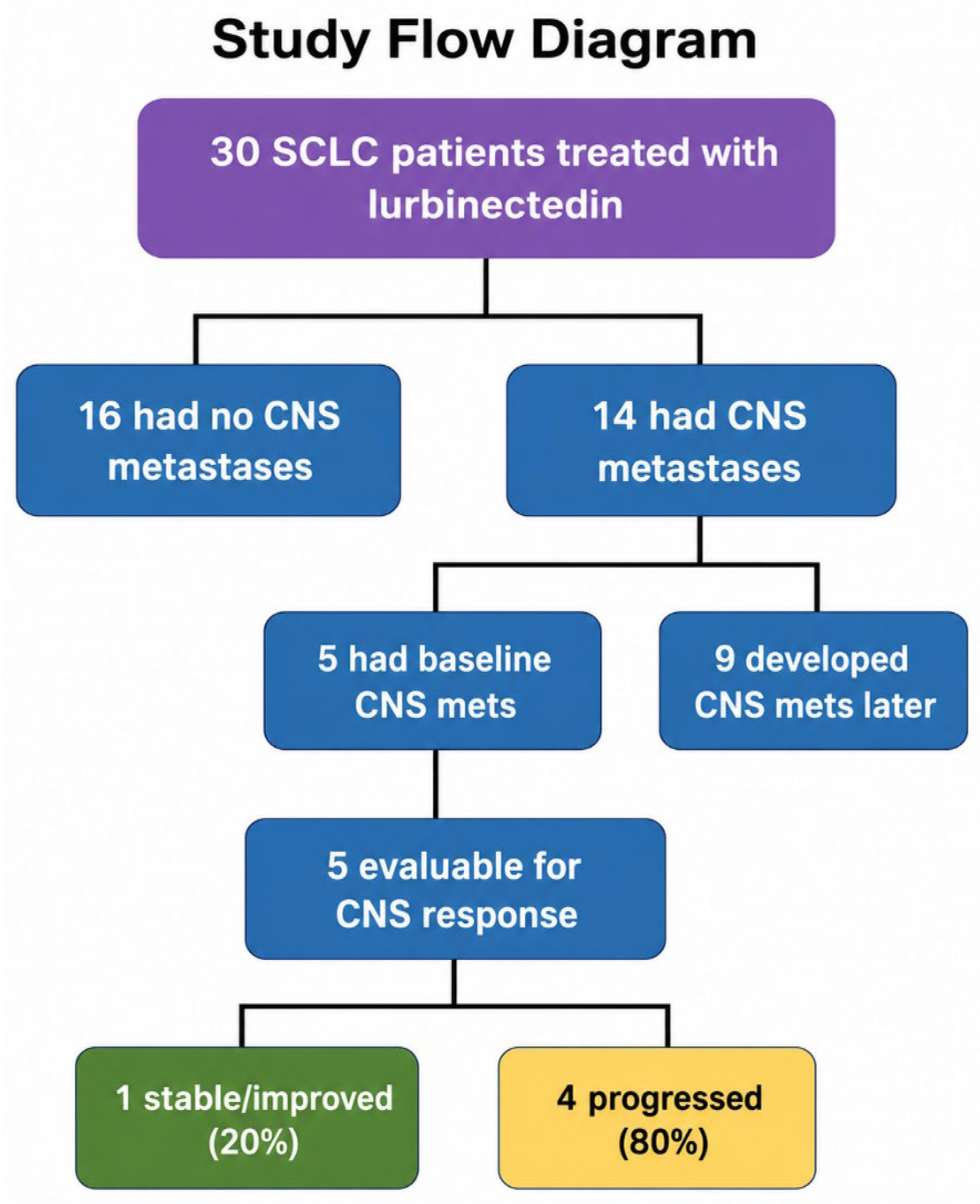
Between July 2020 and April 2025, 30 patients with SCLC received lurbinectedin at our institution. Fourteen patients (46.7%) had evidence of CNS metastases at any point during their disease course. Five patients (16.7%) had CNS metastases at baseline (prior to lurbinectedin initiation) and comprised the analytic cohort for intracranial outcomes, while nine patients (30.0%) developed CNS involvement during treatment. Because these nine patients did not have baseline CNS metastases at lurbinectedin initiation, they were not evaluable for CNS-DCR or baseline intracranial response endpoints and were included only as a descriptive subgroup.
Baseline demographic and clinical characteristics of the five patients with baseline CNS metastases are summarized in
Table 1, including age, sex, ECOG performance status, stage at diagnosis, prior systemic therapies, and prior brain-directed radiotherapy modality when available. The timing of brain-directed radiotherapy relative to lurbinectedin initiation and subsequent CNS imaging outcomes is summarized in
Table 2.
Among the five patients with baseline CNS disease, one patient (20%) demonstrated radiographic improvement in intracranial lesions at approximately 4 months following lurbinectedin initiation. However, systemic disease progression was identified at 5 months, leading to treatment discontinuation; therefore, the duration of CNS response beyond that time point could not be determined. The remaining four patients (80%) experienced radiographic CNS progression within 2–4 months of treatment initiation. One of five patients with baseline CNS metastases met the predefined CNS disease control endpoint. Given the small sample size, this finding is reported descriptively rather than as a precise estimate of treatment effect. The median intracranial progression-free survival (iPFS) was approximately 2.5 months. No CNS-specific adverse events attributable to lurbinectedin were observed. The overall cohort distribution and intracranial response outcomes are shown in
Figure 1.
4. Discussion
CNS involvement remains a major therapeutic challenge in SCLC, with limited effective systemic options and historically poor outcomes. In this single-institution retrospective case series, we described intracranial outcomes among patients with SCLC and baseline CNS metastases treated with lurbinectedin. One of five patients met the predefined CNS disease control endpoint, and median intracranial progression-free survival was approximately 2.5 months. Given the small sample size, these findings should be interpreted descriptively and should not be considered a precise estimate of lurbinectedin’s intracranial efficacy. The nine patients who developed CNS metastases during lurbinectedin treatment were included to describe CNS events occurring during systemic therapy exposure, but they were not part of the primary intracranial response analysis. Because these patients lacked baseline measurable CNS disease, they could not be used to estimate CNS-DCR or intracranial response. Their development of CNS metastases during treatment should therefore be interpreted cautiously and does not establish whether lurbinectedin failed to prevent CNS progression. Rather, this subgroup highlights the ongoing risk of CNS involvement in SCLC and the need for prospective studies that evaluate both treatment of established CNS disease and prevention of new CNS metastases during systemic therapy.
The majority of patients with baseline CNS metastases experienced rapid intracranial progression within 2–4 months of therapy. Only one patient exhibited radiographic improvement at four months, although subsequent systemic disease progression limited the duration of clinical benefit. These findings suggest that while lurbinectedin has demonstrated systemic activity in relapsed SCLC, its effectiveness in controlling CNS disease appears limited in patients with baseline intracranial metastases.
Lurbinectedin exerts its antitumor activity primarily by binding guanine-rich sequences in the minor groove of DNA, disrupting transcriptional regulation and DNA repair pathways, and ultimately promoting tumor cell death. However, activity within CNS metastases may be limited by the unique brain metastatic microenvironment and uncertain intracranial drug exposure. Lurbinectedin is a relatively large molecule, with a molecular weight of approximately 784.87 g/mol, and reliable blood–brain barrier penetration has not been established. Although the blood–brain barrier may be disrupted in established brain metastases, blood–tumor barrier permeability is variable and may not ensure adequate therapeutic concentrations. These factors may help explain why systemic activity does not necessarily translate into durable intracranial disease control [
21,
22].
The available prospective evidence for lurbinectedin in SCLC provides limited guidance for patients with active CNS disease. In the phase 2 basket trial that supported lurbinectedin’s approval, patients with active CNS metastases were excluded, and intracranial-specific outcomes were not reported [
18]. Similarly, although the ATLANTIS trial allowed selected patients with asymptomatic CNS metastases, the study did not provide dedicated CNS response or intracranial progression data [
19]. Therefore, even small real-world case series may provide useful clinical context for populations that remain underrepresented in prospective trials.
The limited intracranial disease control observed in this small cohort may have important clinical implications. Although lurbinectedin remains an approved systemic treatment option for relapsed SCLC, our findings suggest that its intracranial activity may be limited in patients with baseline CNS metastases. Therefore, in patients with CNS-predominant relapse, lurbinectedin should not be assumed to provide reliable intracranial control, and treatment decisions should continue to incorporate brain-directed therapy, clinical status, prior radiation history, and consideration of systemic agents with stronger CNS-specific evidence when available.
Our findings underscore the need for therapies with reliable CNS activity and support further studies focused on improving intracranial disease control in relapsed SCLC. While the topoisomerase inhibitor irinotecan has demonstrated intracranial responses, the recently approved DLL3-targeted bispecific T-cell engager, tarlatamab, may also represent an important option in the evolving treatment landscape [
15,
23]. While, like lurbinectedin, the preliminary study for tarlatamab excluded patients with untreated CNS metastasis, emerging data suggest promising results in such patients [
24,
25]. Nevertheless, future studies with CNS-specific endpoints such as intracranial response rates and time to CNS progression will be helpful in supporting the use of tarlatamab and other therapies for intracranial disease in SCLC.
5. Limitations
Several factors may have influenced these outcomes, including the small sample size, variable CNS imaging intervals, heterogeneous prior brain-directed therapies, and the retrospective design, which may introduce selection and documentation bias. Because the baseline CNS analytic cohort included only five patients, no statistical inference regarding lurbinectedin’s intracranial efficacy can be made, and these findings should be interpreted as descriptive and hypothesis-generating rather than definitive evidence of treatment effect. Several patients also received brain-directed radiotherapy shortly before or during lurbinectedin treatment; therefore, early radiographic changes could not always be definitively distinguished from true progression, incomplete local control, radiation-related change, or pseudoprogression. This limitation is particularly relevant for patients whose CNS imaging occurred within a few months of brain-directed radiotherapy, as summarized in
Table 2. Because imaging was obtained as part of routine clinical care rather than at protocol-defined intervals, progression was based on available scans and clinical documentation without systematic confirmatory imaging. Intracranial response was assessed from radiology reports rather than a prospective RANO-BM evaluation, which is specifically designed for brain metastases assessment [
26]. Despite these limitations, this series provides descriptive real-world clinical context regarding lurbinectedin use in patients with SCLC and CNS metastases, a population often excluded or underrepresented in prospective clinical trials.
6. Conclusions
In this single-institution retrospective case series, limited intracranial disease control was observed among patients with SCLC and baseline CNS metastases treated with lurbinectedin. Although lurbinectedin remains an approved systemic treatment option for relapsed SCLC, these findings suggest that its role in CNS-predominant relapse may be limited. Given the small sample size and retrospective design, these results should be interpreted as descriptive and hypothesis-generating rather than definitive evidence of intracranial efficacy. Future prospective studies incorporating CNS-specific endpoints are needed to better define the role of lurbinectedin and other systemic therapies in patients with intracranial SCLC involvement.
Author Contributions
Conceptualization, S.R.; methodology, N.B.; data curation, N.B.; formal analysis, N.B.; investigation, N.B.; writing—original draft preparation, N.B. and C.S.; writing—review and editing, N.B., C.S. and S.R.; supervision, S.R.; project administration, S.R. All authors have read and agreed to the published version of the manuscript.
Funding
This research received no external funding.
Institutional Review Board Statement
The Institutional Review Board of Tower Health Reading Hospital was consulted and determined that this retrospective, de-identified chart review was exempt from formal review.
Informed Consent Statement
Patient consent was waived due to the retrospective nature of the study and the use of de-identified data in accordance with the institutional policy of Tower Health Reading Hospital.
Data Availability Statement
The data presented in this study are available on request from the corresponding author due to privacy concerns.
Conflicts of Interest
The authors declare no conflicts of interest.
References
- American Cancer Society. Lung Cancer Statistics: How Common is Lung Cancer? Available online: https://www.cancer.org/cancer/types/lung-cancer/about/key-statistics.html (accessed on 3 March 2026).
- Wells, L.E.; Cohen, S.; Brennan, B.; Banerjee, M.; Kalemkerian, G.P. Epidemiology of SCLC in the United States from 2000 to 2019: A study utilizing the Surveillance, Epidemiology, and End Results registry. JTO Clin. Res. Rep. 2025, 6, 100799. [Google Scholar] [CrossRef]
- Byers, L.A.; Rudin, C.M. Small cell lung cancer: Where do we go from here? Cancer 2015, 121, 664–672. [Google Scholar] [CrossRef] [PubMed]
- Oronsky, B.; Abrouk, N.; Caroen, S.; Lybeck, M.; Guo, X.; Wang, X.; Yu, Z.; Reid, T. A 2022 update on extensive stage small-cell lung cancer (SCLC). J. Cancer 2022, 13, 2945–2953. [Google Scholar] [CrossRef]
- Li, H.; Zhao, Y.; Ma, T.; Shao, H.; Wang, T.; Jin, S.; Liu, Z. Radiotherapy for extensive-stage small-cell lung cancer in the immunotherapy era. Front. Immunol. 2023, 14, 1132482. [Google Scholar] [CrossRef] [PubMed]
- Kim, S.Y.; Park, H.S.; Chiang, A.C. Small cell lung cancer: A review. JAMA 2025, 333, 1906. [Google Scholar] [CrossRef]
- Gaebe, K.; Erickson, A.W.; Chen, S.; Menjak, I.B.; Lok, B.H.; Sahgal, A.; Chan, K.K.; Das, S. Brain metastasis burden and management in patients with small cell lung cancer in Canada: A retrospective population-based cohort study. eClinicalMedicine 2024, 77, 102871. [Google Scholar] [CrossRef]
- Megyesfalvi, Z.; Tallosy, B.; Pipek, O.; Fillinger, J.; Lang, C.; Klikovits, T.; Schwendenwein, A.; Hoda, M.A.; Renyi-Vamos, F.; Laszlo, V.; et al. The landscape of small cell lung cancer metastases: Organ specificity and timing. Thorac. Cancer 2021, 12, 914–923. [Google Scholar] [CrossRef]
- Gaebe, K.; Li, A.Y.; Park, A.; Lok, B.H.; Sahgal, A.; Chan, K.K.W.; Erickson, A.W.; Das, S. Stereotactic radiosurgery versus whole brain radiotherapy in patients with intracranial metastatic disease and small-cell lung cancer: A systematic review and meta-analysis. Lancet Oncol. 2022, 23, 931–939. [Google Scholar] [CrossRef] [PubMed]
- Rittberg, R.; Banerji, S.; Kim, J.O.; Rathod, S.; Dawe, D.E. Treatment and prevention of brain metastases in small cell lung cancer. Am. J. Clin. Oncol. 2021, 44, 629–638. [Google Scholar] [CrossRef]
- Paz-Ares, L.; Dvorkin, M.; Chen, Y.; Reinmuth, N.; Hotta, K.; Trukhin, D.; Statsenko, G.; Hochmair, M.J.; Özgüroğlu, M.; Ji, J.H.; et al. Durvalumab plus platinum-etoposide versus platinum-etoposide in first-line treatment of extensive-stage small-cell lung cancer (CASPIAN): A randomized, controlled, open-label, phase 3 trial. Lancet 2019, 394, 1929–1939. [Google Scholar] [CrossRef]
- Liu, S.V.; Reck, M.; Mansfield, A.S.; Mok, T.; Scherpereel, A.; Reinmuth, N.; Garassino, M.C.; De Castro Carpeno, J.; Califano, R.; Nishio, M.; et al. Updated overall survival and PD-L1 subgroup analysis of patients with extensive-stage small-cell lung cancer treated with atezolizumab, carboplatin, and etoposide (IMpower133). J. Clin. Oncol. 2021, 39, 619–630. [Google Scholar] [CrossRef]
- Rusthoven, C.G.; Yamamoto, M.; Bernhardt, D.; Smith, D.E.; Gao, D.; Serizawa, T.; Yomo, S.; Aiyama, H.; Higuchi, Y.; Shuto, T.; et al. Evaluation of first-line radiosurgery vs whole-brain radiotherapy for small cell lung cancer brain metastases: The FIRE-SCLC cohort study. JAMA Oncol. 2020, 6, 1028–1037. [Google Scholar] [CrossRef]
- Viani, G.A.; Gouveia, A.G.; Louie, A.V.; Moraes, F.Y. Stereotactic radiosurgery for brain metastases from small cell lung cancer without prior whole-brain radiotherapy: A meta-analysis. Radiother. Oncol. 2021, 162, 45–51. [Google Scholar] [CrossRef]
- Ahn, M.J.; Cho, B.C.; Felip, E.; Korantzis, I.; Ohashi, K.; Majem, M.; Juan-Vidal, O.; Handzhiev, S.; Izumi, H.; Lee, J.-S.; et al. Tarlatamab for patients with previously treated small-cell lung cancer. N. Engl. J. Med. 2023, 389, 2063–2075. [Google Scholar] [CrossRef]
- Singh, S.; Jaigirdar, A.A.; Mulkey, F.; Cheng, J.; Hamed, S.S.; Li, Y.; Liu, J.; Zhao, H.; Goheer, A.; Helms, W.S.; et al. FDA approval summary: Lurbinectedin for the treatment of metastatic small cell lung cancer. Clin. Cancer Res. 2021, 27, 2378–2382. [Google Scholar] [CrossRef]
- Santamaría Núñez, G.; Robles, C.M.G.; Giraudon, C.; Martínez-Leal, J.F.; Compe, E.; Coin, F.; Aviles, P.; Galmarini, C.M.; Egly, J.-M. Lurbinectedin specifically triggers the degradation of phosphorylated RNA polymerase II and the formation of DNA breaks in cancer cells. Mol. Cancer Ther. 2016, 15, 2399–2412. [Google Scholar] [CrossRef]
- Trigo, J.; Subbiah, V.; Besse, B.; Moreno, V.; López, R.; Sala, M.A.; Peters, S.; Ponce, S.; Fernández, C.; Alfaro, V.; et al. Lurbinectedin as second-line treatment for patients with small-cell lung cancer: A single-arm, open-label, phase 2 basket trial. Lancet Oncol. 2020, 21, 645–654. [Google Scholar] [CrossRef] [PubMed]
- Aix, S.P.; Ciuleanu, T.E.; Navarro, A.; Cousin, S.; Bonanno, L.; Smit, E.F.; Chiappori, A.; Olmedo, M.E.; Horvath, I.; Grohé, C.; et al. Combination lurbinectedin and doxorubicin versus physician’s choice of chemotherapy in patients with relapsed small-cell lung cancer (ATLANTIS): A multicentre, randomized, open-label, phase 3 trial. Lancet Respir. Med. 2023, 11, 74–86. [Google Scholar] [CrossRef] [PubMed]
- Eisenhauer, E.A.; Therasse, P.; Bogaerts, J.; Schwartz, L.H.; Sargent, D.; Ford, R.; Dancey, J.; Arbuck, S.; Gwyther, S.; Mooney, M.; et al. New response evaluation criteria in solid tumours: Revised RECIST guideline (version 1.1). Eur. J. Cancer 2009, 45, 228–247. [Google Scholar] [CrossRef] [PubMed]
- Jazz Pharmaceuticals, Inc. ZEPZELCA® (Lurbinectedin) for Injection, for Intravenous Use: Prescribing Information; Jazz Pharmaceuticals, Inc.: Palo Alto, CA, USA, 2025. Available online: https://www.accessdata.fda.gov/drugsatfda_docs/label/2025/213702s011lbl.pdf (accessed on 28 May 2026).
- Nau, R.; Sörgel, F.; Eiffert, H. Penetration of drugs through the blood–cerebrospinal fluid/blood–brain barrier for treatment of central nervous system infections. Clin. Microbiol. Rev. 2010, 23, 858–883. [Google Scholar] [CrossRef]
- Mountzios, G.; Sun, L.; Cho, B.C.; Demirci, U.; Baka, S.; Gümüş, M.; Lugini, A.; Zhu, B.; Yu, Y.; Korantzis, I.; et al. DeLLphi-304 Investigators. Tarlatamab in small-cell lung cancer after platinum-based chemotherapy. N. Engl. J. Med. 2025, 393, 349–361. [Google Scholar] [CrossRef] [PubMed]
- Dowlati, A.; Hummel, H.D.; Champiat, S.; Olmedo, M.E.; Boyer, M.; He, K.; Steeghs, N.; Izumi, H.; Johnson, M.L.; Yoshida, T.; et al. Sustained clinical benefit and intracranial activity of tarlatamab in previously treated small cell lung cancer: DeLLphi-300 trial update. J. Clin. Oncol. 2024, 42, 3392–3399. [Google Scholar] [CrossRef] [PubMed]
- Parma, M.; Singhi, E.K.; Solis, L.M.; Wang, W.L.; Altan, M.; Franco-Vega, M.C.; Halliday, A.J.; Jacome, J.; Zhang, J.; Heymach, J.; et al. Real-world efficacy and safety of tarlatamab in patients with relapsed extensive-stage small cell lung cancer. J. Clin. Oncol. 2025, 43, 8088. [Google Scholar] [CrossRef]
- Lin, N.U.; Lee, E.Q.; Aoyama, H.; Barani, I.J.; Barboriak, D.P.; Baumert, B.G.; Bendszus, M.; Brown, P.D.; Camidge, D.R.; Chang, S.M.; et al. Response assessment criteria for brain metastases: Proposal from the RANO group. Lancet Oncol. 2015, 16, e270–e278. [Google Scholar] [CrossRef] [PubMed]
| Disclaimer/Publisher’s Note: The statements, opinions and data contained in all publications are solely those of the individual author(s) and contributor(s) and not of MDPI and/or the editor(s). MDPI and/or the editor(s) disclaim responsibility for any injury to people or property resulting from any ideas, methods, instructions or products referred to in the content. |