All articles published by MDPI are made immediately available worldwide under an open access license. No special
permission is required to reuse all or part of the article published by MDPI, including figures and tables. For
articles published under an open access Creative Common CC BY license, any part of the article may be reused without
permission provided that the original article is clearly cited. For more information, please refer to
https://www.mdpi.com/openaccess.
Feature papers represent the most advanced research with significant potential for high impact in the field. A Feature
Paper should be a substantial original Article that involves several techniques or approaches, provides an outlook for
future research directions and describes possible research applications.
Feature papers are submitted upon individual invitation or recommendation by the scientific editors and must receive
positive feedback from the reviewers.
Editor’s Choice articles are based on recommendations by the scientific editors of MDPI journals from around the world.
Editors select a small number of articles recently published in the journal that they believe will be particularly
interesting to readers, or important in the respective research area. The aim is to provide a snapshot of some of the
most exciting work published in the various research areas of the journal.
Grigor Alaverdyan received his qualifications as a physicist from Yerevan State University in 1971, [...]
Grigor Alaverdyan received his qualifications as a physicist from Yerevan State University in 1971, and in the period of 1974-1977, he conducted postgraduate research at the Joint Institute for Nuclear Research in Dubna. He received his PhD degree in 1980. He has worked as an associate professor at Yerevan State University since 1982. His research topics mainly include nuclear physics, particle physics, superdense matter, quark matter, phase transitions, and neutron star physics.
Ani Alaverdyan received her bachelor's degree from Yerevan State University in 2003, and in 2005, as [...]
Ani Alaverdyan received her bachelor's degree from Yerevan State University in 2003, and in 2005, she received her master's degree from the same institution. In 2017, she received her PhD degree. She has worked as an assistant professor at Yerevan State University since 2005. Her research topics mainly include strange quark matter, superdense matter, EOS of hot quark matter, hadronic matter, phase transition, and neutron star physics.
We study the effect of trapped neutrinos on the properties of the deconfinement phase transition from hot -equilibrated, electrically neutral hadronic matter to quark matter. To describe the thermodynamic properties of hot hadronic matter, an extended relativistic mean field (RMF) theory is used, which also incorporates the isovector–Lorentz-scalar -meson effective field. The three-flavor quark phase is described within the framework of the local Nambu–Jona-Lasinio (NJL) model. It was assumed that the surface tension at the quark-hadron interface is so strong that the phase transition occurs according to Maxwell’s construction. The thermodynamic properties of the quark and hadronic phases were calculated for both neutrino-trapped and neutrino-transparent regimes at various temperatures ranging from 0 to 100 MeV and baryon number densities from 0 to 1.8 . The impact of trapped neutrinos on the thermodynamic properties of the coexistence state has been investigated. It has been demonstrated that the baryon chemical potential in the coexistence state decreases as temperature increases. The critical endpoint parameters in the plane of the phase diagram were obtained for the case of trapped neutrinos (74 MeV; 0.269 ) and for the case of the absence of neutrinos (75.6 MeV; 0.255 ).
The investigation of the structure, constituent composition, and thermodynamic properties of strongly interacting superdense matter is one of the fundamental problems in modern nuclear physics, particle physics, and astrophysics. Quantum chromodynamics (QCD) predicts that at extremely high temperatures and/or densities, a quark–gluon plasma (QGP) consisting of deconfined quarks and gluons is formed [1,2].
The only currently available opportunity to obtain information about the formation and properties of quark matter in terrestrial laboratory conditions is through heavy ion collisions. During heavy-ion collisions, when hundreds of nucleons hit each other, conditions arise for the formation of short-lived states in which quarks are deconfined and a QGP is formed. Analyzing the final particles produced from collisions, along with the various patterns observed in this process, enables researchers to identify the formation of the QGP. This analysis, combined with modern theoretical insights, allows for the study of the properties of QGP and the QCD processes that contribute to its formation and evolution (see e.g., [3,4,5,6,7,8]).
Review articles [9,10] provide a thorough overview of the current understanding of QGP formed in high-energy collisions. It explores the properties of this state of matter, key experimental observables, and the theoretical framework that describes it. Another way to determine the existence of quark matter and learn about its properties is to study cosmic-scale bodies, such as compact stars, whose central density is so high that conditions are created for the formation of quark matter [11,12,13,14].
The properties of compact stars depend on the equation of state of matter across a wide density range, from ordinary atomic matter to densities much higher than nuclear density. At these extreme levels, exotic phases can emerge, such as pion and kaon condensates [15], deconfined quark phases, and color superconducting phases [16,17].
Theoretical studies of macroscopic parameters of compact stars help refine the equation of state of superdense matter by comparing them with observational data and ruling out conflicting models. This approach to refining the equation of state has been made more efficient by the Neutron Star Interior Composition Explorer (NICER) astrophysics mission, which has allowed it to simultaneously determine the mass and radius of the same pulsar [18,19,20].
In the last few decades, the equations of state of cold hadronic matter and quark matter have been intensively discussed, both separately and in hybrid cases involving phase transitions. In a significant number of works, a phenomenological model, such as the MIT quark bag model [21], has been chosen to describe the quark phase (see e.g., [22,23,24,25,26,27,28,29,30]). Using the equation of state of cold matter, the observable global characteristics of hybrid stars have been calculated. Such equations of state clearly do not apply to heavy ion collisions, the core collapse of supernovae, proto-neutron stars, or the merger of binary compact stars, since the temperatures in these cases are quite high. In the post-merger phase, temperatures are expected to reach as high as approximately 50 to 100 MeV, making it suitable for studies at finite temperatures [31].
The equation of state of hot quark matter within the framework of the MIT–bag model was studied in Refs. [32,33,34,35,36,37]. Given that the matter of a neutron star at high temperatures is not transparent to neutrinos, in these works, in addition to quarks, electrons, and muons, the presence of various neutrino types was also taken into account.
Recently, the Nambu–Jona-Lasinio (NJL) model [38,39] has been frequently used to describe quark matter. It is well known that the NJL model successfully reproduces many features of QCD [40,41,42]. Within the framework of the NJL model, the equation of state of quark matter was studied and applied to calculate the structure and observable global parameters of hybrid stars with quark cores [43,44,45,46,47,48].
While the properties of proto-hybrid stars have been extensively studied, the precise influence of neutrino trapping on the deconfinement phase transition remains poorly understood. In this work, we perform a systematic investigation of the effects of trapped neutrinos on the phase transition from hot, -equilibrated hadronic matter to three-flavor quark matter. The hadronic phase is described within the relativistic mean-field (RMF) theory [49,50]. Crucially, unlike previous studies, our framework explicitly incorporates the isovector-scalar -meson field [27,51,52], allowing for a more nuanced treatment of isospin asymmetry under extreme conditions.
Hot quark matter was analyzed using the NJL SU(3) local model [38,39]. The thermodynamic properties were evaluated in two scenarios: one where neutrinos are trapped within the system, and another where the neutrinos produced by -decays have already escaped [53].
It should be noted that the NJL model used in this paper does not account for confinement (e.g., via a Polyakov loop), nor does it include vector channel interactions [54] or color superconductivity [55]. These factors are known to stiffen the equation of state and can influence the phase structure of QCD. Nevertheless, to study the influence of trapped neutrinos on the hybrid equation of state, we limited ourselves to the minimal model, which is the NJL. Accounting for these factors will be the topic of a separate study.
For the phase transition from hadronic matter to quark matter, Maxwell’s construction was used, which is based on the condition of local charge neutrality.
The paper is organized as follows: In Section 2, we outline the theoretical framework for the thermodynamic description of strongly interacting hot matter. This section is divided into three Subsections. In Section 2.1 we present the thermodynamic description of beta-equilibrium hot quark matter under neutrino trapping conditions within the framework of the three-flavor local NJL model. In Section 2.2, we present the thermodynamic description of hot hadronic matter under neutrino trapping conditions within the framework of RMF theory. Section 2.3 is devoted to determining the characteristics of the first-order phase transition from hadronic matter to quark matter at finite temperatures based on Maxwell’s construction. The graphical and tabular results of the numerical calculations, along with their discussion, are presented in Section 3, and conclusions are drawn in Section 4.
2. Theoretical Framework
2.1. Neutrino-Trapped Quark Matter Within the Local SU(3) NJL Model
For the thermodynamic description of quark matter, we will utilize the local SU(3) model developed by Nambu–Iona-Lasinio [38,39]. Our focus will be on a multiparticle system that consists of up (u), down (d), and strange (s) quarks; electrons (); electron neutrinos (); muons (); and muon neutrinos (), as well as their corresponding antiparticles. We overlook the -leptons, assuming they are too heavy to be produced in a medium.
The Lagrangian density of the system will be represented in the form of two summands, the first of which will describe the quark component, and the second the lepton part:
The Lagrangian density of the quark component in terms of the SU(3) NJL model is given by
Here, is the Fermion quark spinor field c with three flavors, , and three colors, . The first term is the density of the Dirac Lagrangian of free quark fields with a mass matrix of current quarks, diag . The second corresponds to a chirally symmetric four-quark interaction with a coupling constant G, where () are the Gell-Mann matrices and generators of the SU(3) group in flavor space, ( is the unit 3 × 3 matrix). The third term corresponds to the six-quark Kobayashi–Maskawa-’t Hooft interaction, which breaks the axial symmetry.
For the leptonic component, we used the Lagrangian density of free particles,
where MeV and MeV are the masses of the electrons and muons, respectively. We assumed that neutrinos are massless particles.
The NJL model is an effective, nonrenormalizable model, so a cut-off is implemented in 3-momentum space to regularize divergent integrals.
Based on the expression for the Lagrangian density (1), we can derive a formula for the grand canonical potential of the quark component, which is determined up to an additive constant. Assuming that in the case of a vacuum, the grand canonical potential is equal to zero, for a quark matter, we can write the following (we use the natural system of units with ):
Here, represents the constituent quark mass of flavor f, while represents the constituent quark mass in vacuum, also known as the dressed mass. Similarly, represents the quark condensate, whereas refers to the same quantity in a vacuum. Additionally, provides the energy of the quark quasiparticle with momentum k, while stands for the chemical potential. Similarly, and represent the energy and chemical potential of a lepton, respectively.
In the mean-field approximation, the gap equations for the constituent masses of the quarks and are given by
The equations for quark condensates , are written as follows:
The quark number densities are determined by the expression
The lepton number densities are calculated using the following formula:
where , and is the lepton degeneracy factor, whose values are .
For the electrical neutrality condition of quark matter, we have
In this work, we have ignored neutrino oscillation effects [56,57] and assumed that the lepton number for different lepton flavors is separately conserved. Let us denote the fraction of the electron lepton number (the electron lepton number per baryon) by , and the fraction of the muon lepton number by .
The relationship between lepton concentrations will be written as
When trapped neutrinos are introduced into the model, additional parameters appear, such as the chemical potentials of neutrinos: and . It becomes necessary to have two new known characteristics. As such characteristics, we have chosen the lepton fractions, assuming that they are constant and equal: , [58,59,60,61].
For quark matter in -equilibrium, the following conditions will be satisfied for the chemical potentials of the particles:
The baryon number density is expressed in terms of quark densities as follows:
For a given baryon number density and temperature T, by numerically solving the system of 20 Equations (5)–(13), we will find the 20 unknown characteristics for the electrically neutral quark matter in -equilibrium: , , , and ().
Knowledge of these characteristics makes it possible, for specified values of the baryon number density and temperature T, to determine the other key thermodynamic parameters of electrically neutral -equilibrium quark matter, such as pressure, energy density, and entropy density.
The pressure of quark matter with neutrino trapping is determined by the following expression:
The expression for the energy density of quark matter with neutrino trapping has the form
The entropy density of quark matter with neutrino trapping is given by
The parameters used to calculate the thermodynamic characteristics of three-flavor quark matter are MeV, and , MeV, and MeV, obtained in Ref. [40], for reproducing the values of the coupling constant of the pion, MeV, as well as the masses of the , K, and mesons, MeV, MeV, MeV, and MeV, respectively.
2.2. Neutrino-Trapped Hadronic Matter Within the RMF Model
For the thermodynamic description of beta-equilibrium hadronic matter consisting of neutrons (n), protons (p), electrons (e), electron neutrinos (), muons (), and muon neutrinos (), we will use the relativistic mean field (RMF) approach within the framework of quantum hadrodynamics (QHD) [49,50]. In this theory, the strong interaction between nucleons is mediated by the exchange of mesons. The exchanged mesons include the isoscalar-Lorentz-scalar meson ; the isoscalar-Lorentz-vector meson ; the isovector-Lorentz-scalar meson ; and the isovector-Lorentz-vector meson . The relativistic nonlinear Lagrangian density for hadronic matter of this composition is expressed as follows:
As in the case of quark matter, here, we will also ignore the interaction between leptons and use Equation (3) for the Lagrangian density of the leptonic component.
The Lagrangian density for the hadronic component within the nonlinear RMF model is given by
Here, is isospin doublet of nucleon bispinors; are Pauli isospin matrices; , , , are exchange meson fields at space-time point ; , , , , , are the masses of the free particles; and and are antisymmetric tensors of the vector fields and . Additionally, , , , denote the coupling constants of the strong interaction between nucleons and corresponding mesons.
In the mean-field approach, the meson fields , , , and are replaced by the (effective) fields , , , and , respectively. A convenient redefinition of the meson mean-fields and coupling constants,
allows us to eliminate the meson masses in the Euler–Lagrange equations for meson mean-fields:
Nucleon number densities are determined as follows:
where and are the effective masses of nucleon, and and are the effective chemical potentials for nucleons.
The functions and are the Fermi–Dirac distribution functions of particles and antiparticles, which are defined as:
In the field Equations (21) and (23) for the Lorentz-scalar and mesons, the quantities and represent the scalar number densities of nucleons, which are determined as follows:
The lepton number density in the hadronic phase is determined by the same formula as in the quark phase (see (8)):
where , and is the lepton degeneracy factor, whose values are .
In this case, the condition of electrical neutrality will be
Equations (10) and (11) written for the fractions of electron and muon lepton numbers and will also remain valid in the case of hadronic matter.
For hadronic matter in -equilibrium, the following conditions will be satisfied for the chemical potentials of the particles:
The baryon number density is expressed in terms of nucleon densities as follows:
The system of Equations (10), (11), (21) –(24) and (29)–(31) for a given value of baryon number density and temperature T is a closed set of ten equations, the numerical solution of which makes it possible to find the meson mean-fields , , , , as well as the chemical potentials of the particles , , , , , and . Knowledge of these quantities allows us to determine the remaining thermodynamic characteristics of beta-equilibrium hadronic matter under neutrino-trapped conditions.
The pressure of hadronic matter in a neutrino trapping regime is determined by the following expression:
The expression for the energy density of hadronic matter in a neutrino trapping regime is given by the following form:
The entropy density of hadronic matter under a neutrino trapping regime is expressed as follows:
For numerical calculation of thermodynamic characteristics of hadronic matter, the following values of RMF model parameters were used: , , , , , [27]. These values were obtained based on the requirement of an acceptable description of such well-known nuclear parameters as: bare nucleon mass MeV, nuclear matter saturation density , nucleon effective mass at saturation density , nuclear matter compressibility modulus MeV, binding energy per nucleon MeV, and symmetry energy MeV.
2.3. Deconfinement Phase Transition in Presence of Trapped Neutrinos
To construct the hybrid equation of state for hot and dense strongly interacting matter, it is not sufficient to only know the separate equations of state for hadronic and quark matter. It is also very important to know what kind of phase transition occurs in the change from hadronic matter to quark matter. In the case of phase transitions of atomic-structured matter, there is one conserved quantity, namely the number of atoms. The phase transition occurs according to Maxwell’s construction. Phase coexistence occurs at a specific pressure , while other thermodynamic quantities, such as energy density and baryon number density, change abruptly. In contrast, in the phase transition from hadronic matter to quark matter, there are two conserved quantities: baryon number and electric charge.
As shown in Ref. [62], in the case of more than one conserved quantity, the Gibbs equilibrium condition between phases allows for a phase transition in which the thermodynamic parameters change continuously. The coexistence between phases in this case occurs not at a single pressure value , but in a continuously changing range, starting from the pressure value to the pressure value , during which the volume fraction of the quark phase in the mixed phase increases from zero to one. In Maxwell’s construction, the assumption is made that the condition of local electrical neutrality applies, meaning that each of the two phases is electrically neutral on its own. In contrast, Gibbs construction relies on the principle of global electroneutrality, where the two phases can have separate charges but still ensure that the overall system remains electrically neutral.
Which of the two phase transition scenarios described here is energetically more preferable depends on the value of the surface tension at the interface between the quark phase and hadronic phase. Currently, there are no reliable data on the surface tension of the hadron–quark interface. Theoretical estimates are model-dependent and predict a range of values from a few MeV/ to hundreds of MeV/ [63,64,65,66,67,68,69,70]. This uncertainty in the surface tension coefficient at the hadron–quark interface does not allow for unambiguous conclusions as to which scenario of phase transition is occurring.
In this work, we have assumed that the surface tension is so strong that the formation of a mixed phase is not energetically favorable, so that the transition from hadronic matter to quark matter will be a normal first-order phase transition determined by the Maxwellian construction.
The thermodynamic description of quark matter presented in Section 2.1 allows us to numerically determine the dependence of pressure on temperature and baryon number density, . Similarly, the dependence of the baryon chemical potential on the temperature and baryon density is also determined: . As a result, we have the dependence . In the same way, within the framework of the model described in Section 2.2, the dependence of hadronic matter is numerically determined.
The baryon chemical potentials in the hadronic and quark phases are determined as follows:
The characteristics of the first-order phase transition at a given temperature are determined according to Maxwell’s construction:
Knowing the phase transition pressure and the baryon chemical potential in the phase coexistence state allows one to determine the other characteristics of the transition, such as: the baryon number densities of coexistence and , as well as the energy densities and , and the entropy densities and in coexistence.
3. Numerical Results and Discussion
Within the framework of the models described above, we calculated the thermodynamic characteristics of beta-equilibrated, electrically neutral hadronic matter and three-flavor quark matter. Based on these results, we determined the parameters for the Maxwellian phase transition at different temperatures. The calculations were conducted under two conditions: one where neutrinos are trapped, and another where neutrinos have already left the stellar matter.
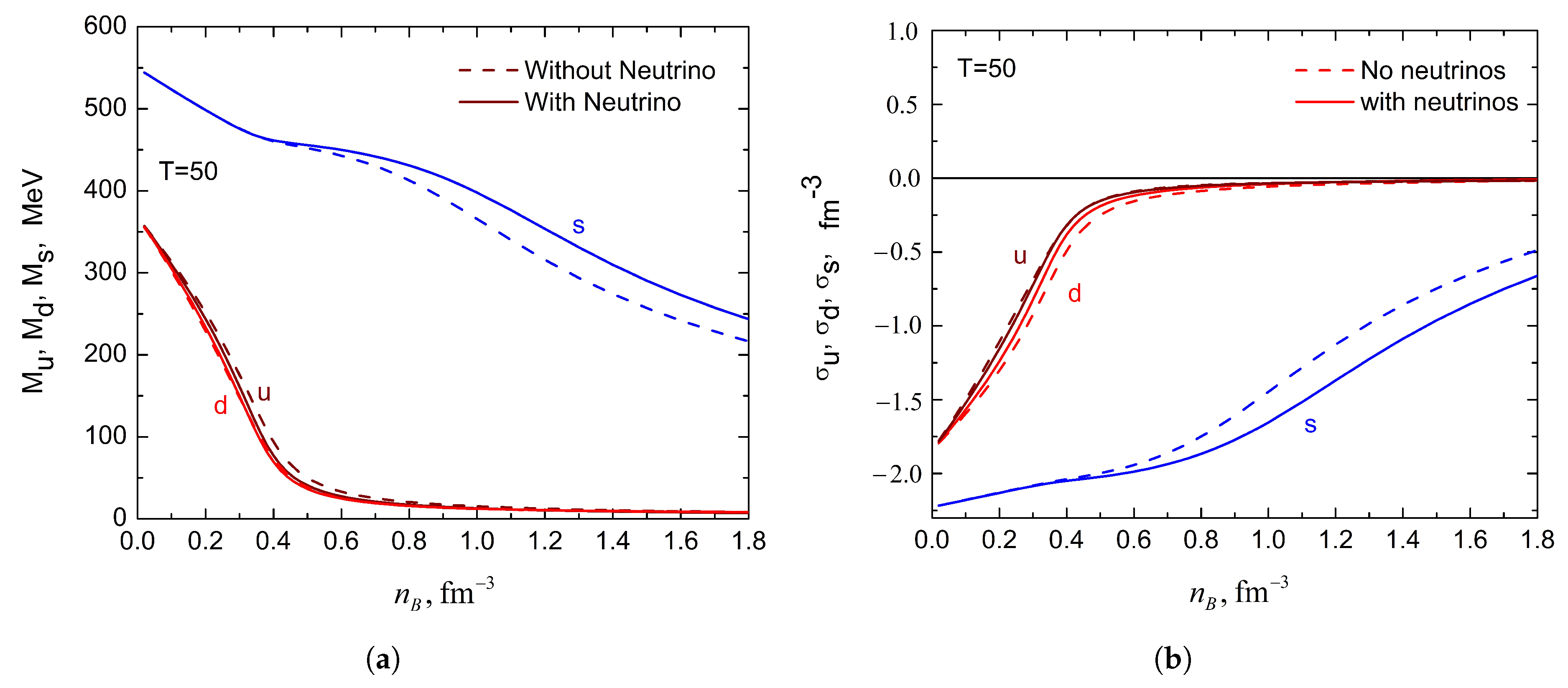
Figure 1 shows the dependence of the masses of constituent quarks and quark condensates on the baryon number density at a temperature of MeV, both in the presence and absence of neutrinos. The divergent behavior of the s-quark mass compared to u- and d-quarks under neutrino trapping (Figure 1a) originates from the shift in the charge neutrality condition and beta-equilibrium. The presence of trapped neutrinos increases the electron chemical potential, which in turn alters the threshold for strangeness onset. The enhancement of the condensate at high densities suggests that neutrino trapping delays the restoration of chiral symmetry for the strange sector, effectively “stiffening” the constituent mass compared to the neutrino-transparent case.
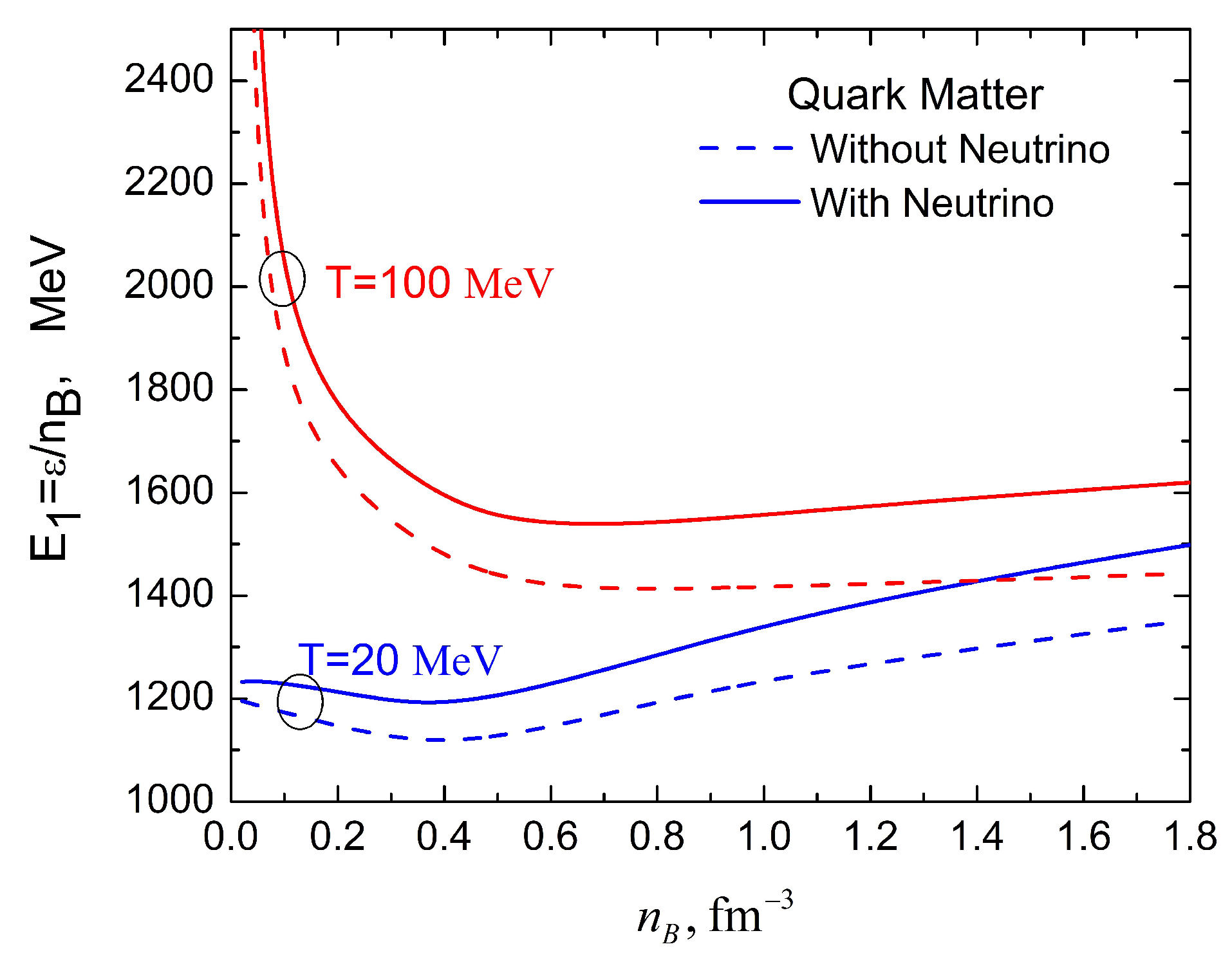
The behavior of the energy per baryon, , shown in Figure 2 reflects the interplay between thermal effects and the contribution of the lepton component. The overall increase in energy in the neutrino-trapped regime is primarily due to the additional contribution of trapped neutrinos to the total energy density and the subsequent shift in the chemical equilibrium of the system.
At MeV, the disappearance of the energy minimum in neutrino-free matter signifies that the system is no longer self-bound due to high thermal pressure. However, in the neutrino-trapped regime, the persistence of the minimum and its shift toward higher densities suggests that neutrino-trapping effectively stabilizes the quark matter against thermal expansion by altering the pressure balance between the vacuum and the kinetic terms of the quarks and leptons. This shift is a key feature of the hybrid model, indicating that proto-neutron star matter (with trapped neutrinos) can maintain a bound state at higher temperatures than cold, deleterious matter.
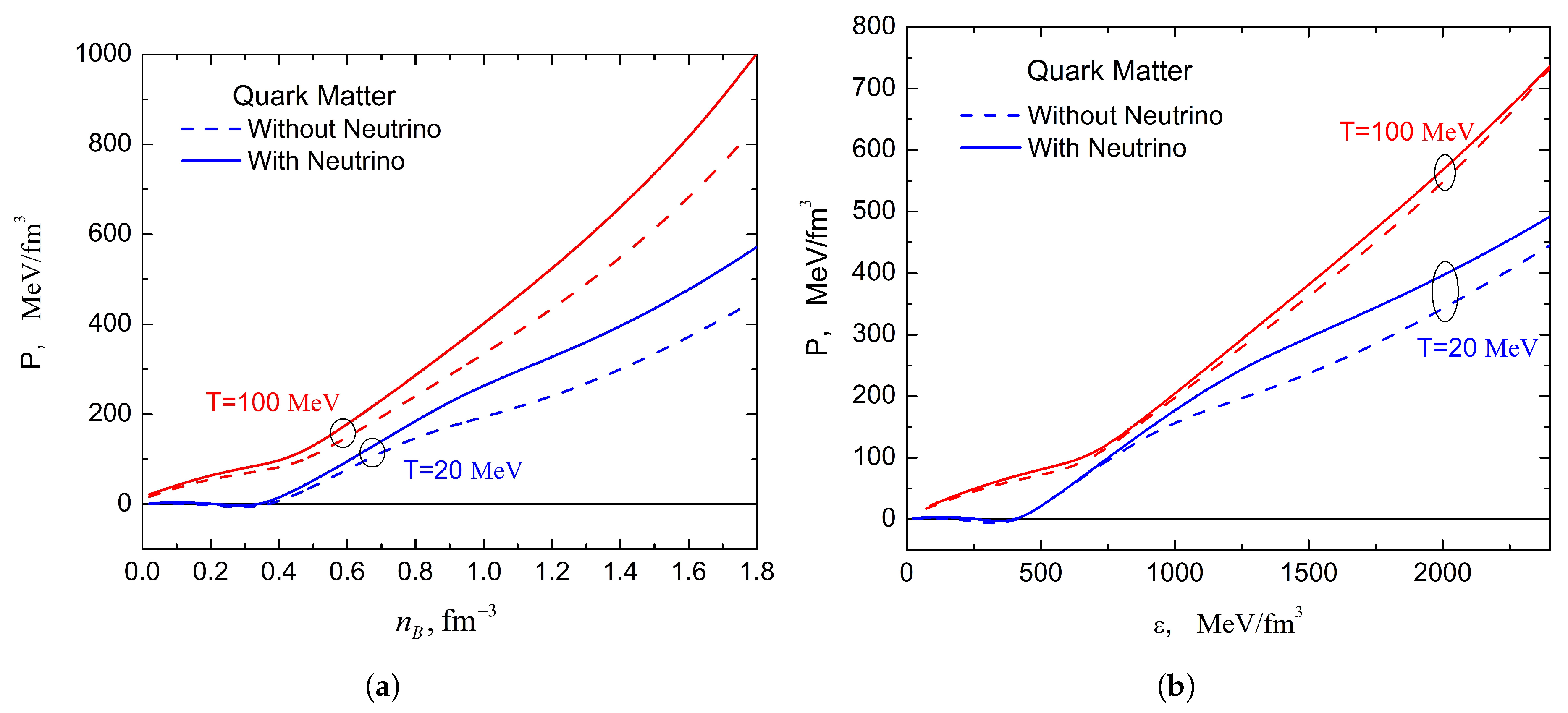
Figure 3 illustrates the equation of state (EoS) for the two considered regimes. The increase in pressure P at a fixed baryon density (Figure 3a) in the neutrino-trapped case is a direct consequence of the additional leptonic pressure contributed by trapped neutrinos and the corresponding electrons required to maintain beta-equilibrium.
A crucial physical observation is seen in Figure 3b: as temperature increases from 20 MeV to 100 MeV, the difference between the curves for the same neutrino regime becomes less pronounced. This suggests that at high energy densities, the thermal pressure of quarks begins to dominate over the specific effects of neutrino trapping. Effectively, the “stiffening” of the EoS provided by leptons is partially compensated by the thermal excitation of the quark sea, leading to a convergence of the EoS trajectories in the plane. This behavior is critical for modeling proto-neutron star evolution, where the thermal and leptonic contributions to pressure determine the maximum stable mass against gravitational collapse.
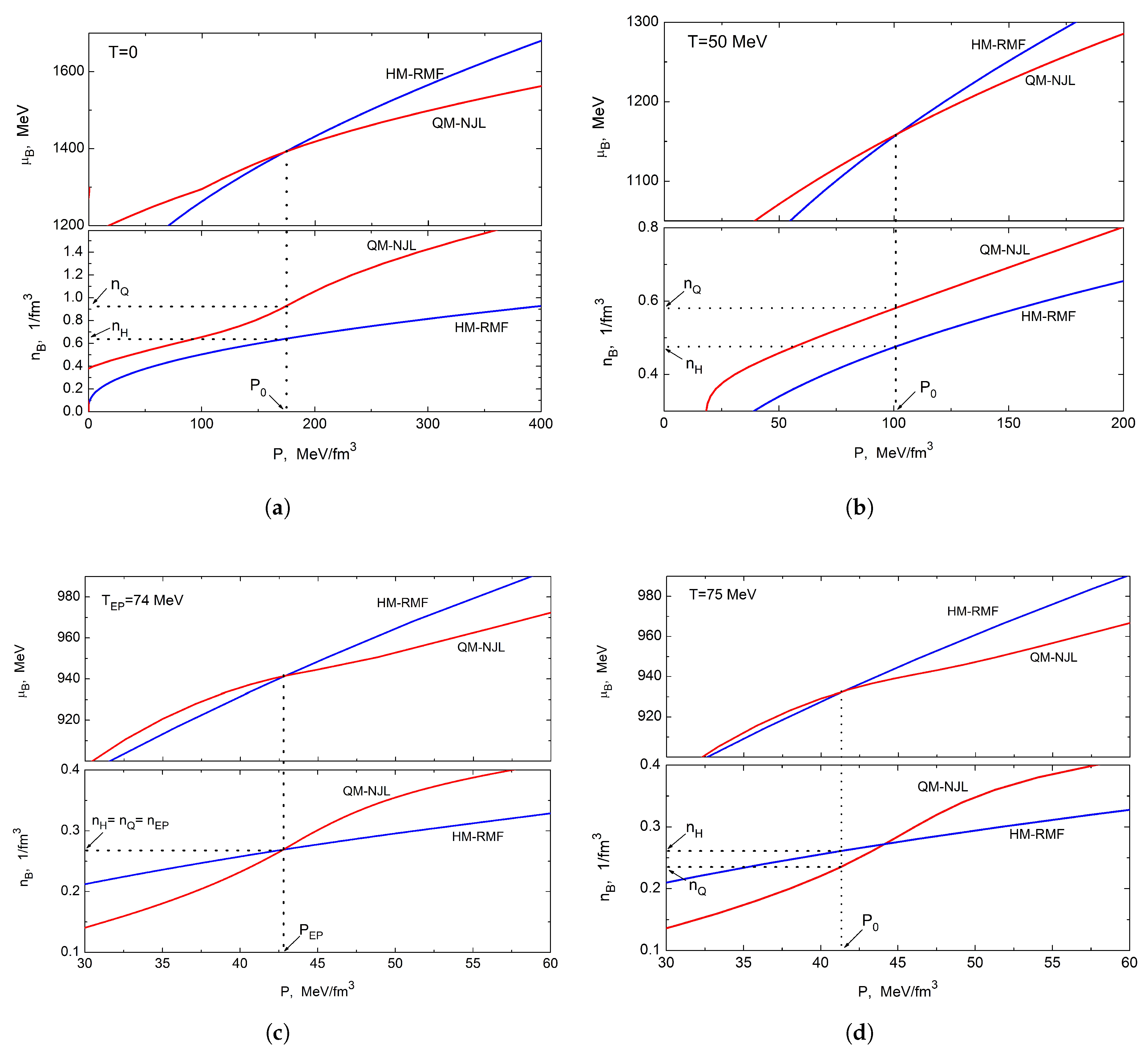
Figure 4 illustrates the thermodynamic consistency of the Maxwell construction for the hadron–quark phase transition. The intersection of the chemical potential curves defines the equilibrium pressure and , where both phases coexist.
A key physical insight here is the temperature dependence of the density jump . At low temperatures (Panels a, b), the large gap between and indicates a strong first-order phase transition driven by the significant difference in the degrees of freedom between the confined hadronic and deconfined quark phases. However, as temperature approaches MeV (Panel c), the thermal excitations in both phases begin to smooth out these differences. The convergence of and at the critical endpoint signifies that the mechanical properties of the two phases become indistinguishable at this density. Above (Panel d), the condition suggests that a simple Maxwell construction is no longer physically applicable, marking the transition from a first-order regime to a continuous crossover. This behavior is a direct consequence of the interplay between chiral symmetry restoration and the thermal pressure of the quark–lepton plasma in our hybrid model.
In Table 1, we present the coexistence parameters of the hadronic phase and quark phase for stellar neutrino-trapped matter at different temperatures. The first line shows the phase transition parameters for cold neutrino-free matter. The last line presents the characteristic parameters of the critical endpoint in the neutrino-trapped regime, when the baryon number densities of both phases in the coexistence state become equal.
The numerical calculation results of the parameters for the equilibrium state of coexistence between the quark and hadron phases at various temperatures in the neutrino-transparent regime are presented in Table 2. When we compare the results from the neutrino trapping regime to those from the neutrino-transparent regime, we observe that, at a given temperature, the presence of neutrinos increases the phase equilibrium pressure . Concurrently, it decreases the equilibrium chemical potential . The presence of neutrinos at a given temperature decreases the baryon number density of the quark phase, , in the phase coexisting state. However, the baryon number density of the hadron phase in the phase coexistence state does not change consistently; it increases at low temperatures and decreases at high temperatures. The presence of neutrinos leads to an increase in the entropy per baryon and for both phases in a state of phase equilibrium.
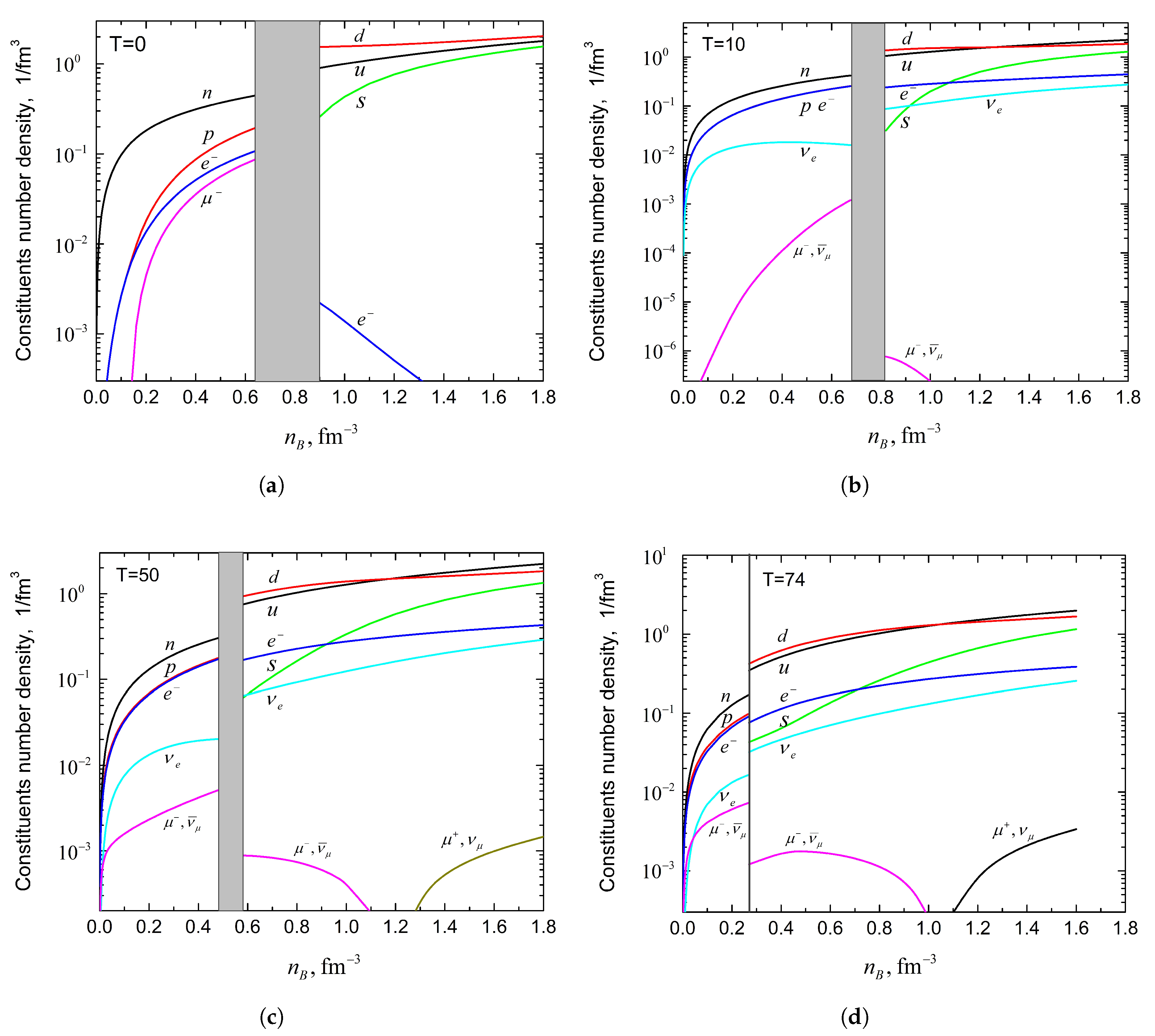
Figure 5 provides a microscopic view of the phase transition through the evolution of particle fractions. A key physical insight is the competition between different leptonic degrees of freedom under the constraints of beta-equilibrium and charge neutrality.
In the neutrino-trapped regime (Panels b, d), the high chemical potential of neutrinos suppresses the population of muons. Physically, this occurs because the presence of raises the energy threshold for electron decay into muons, effectively “locking” the leptons in the electron sector. Furthermore, the transition in the quark phase from d-quark dominance to u-quark dominance at high densities and temperatures (Panel d) is driven by the interplay between chiral symmetry restoration and electrical neutrality. As the constituent masses of quarks drop, the system favors a more symmetric distribution of flavors to minimize the Fermi energy. The appearance of at high temperatures is a purely thermal effect, where the high-energy tail of the distribution function allows for the creation of heavier lepton states to balance the increasing charge density of the quark sea. This redistribution of charges is what ultimately leads to the softening of the EoS seen in previous sections.
The potential existence of a critical end point (CEP) and its location on the phase diagram remain central problems in modern strong interaction physics. It is well established that the predicted CEP position is highly sensitive to the models employed for hadronic and quark matter. The position of the critical endpoint on the phase diagram is influenced by the model used to describe the matter, its constituent composition, and external conditions such as magnetic fields, trapped neutrinos, and beta-equilibrium. Different theoretical approaches yield different predictions for the coordinates of the critical endpoint (). Even within a single theoretical framework, varying input parameters can lead to significant shifts in CEP location.
By analyzing Lee–Yang edge singularities using a multi-point Padé approach, the study presented in Ref. [71] estimated the coordinates for the critical endpoint of Quantum Chromodynamics (QCD) as () MeV. Functional renormalization group methods [72] provided a value of (107, 635) MeV. A holographic model of QCD [73] estimated the coordinates at () MeV.
Additionally, the (2+1) Polyakov–Nambu–Jona–Lasinio (PNJL) model [74] predicted values of (126.3, 915.4) MeV, while the Nambu–Jona-Lasinio (NJL) model for QCD matter provided predictions of (67.7, 955.2) MeV [75].
While CEP predictions are model-dependent and require careful interpretation, we present the characteristics obtained within our specific framework below.
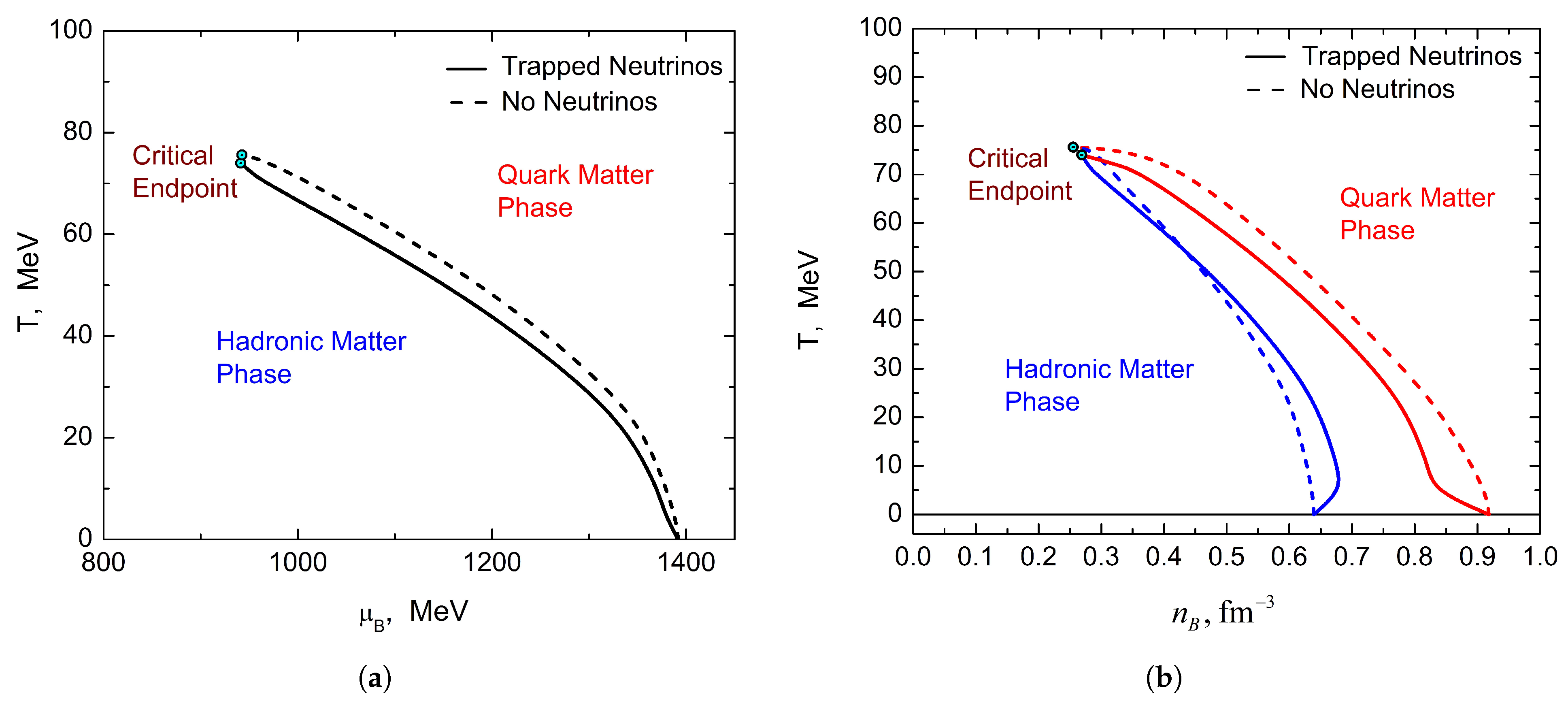
The phase diagrams in Figure 6 reveal the impact of neutrino trapping on the stability of the deconfinement transition. A key physical insight is that neutrino trapping shifts the Critical End Point (CEP) toward lower temperatures and lower chemical potentials. Physically, this shift occurs because the presence of trapped neutrinos increases the total lepton fraction, which effectively shields the strong interactions and alters the balance between the hadronic and quark pressure components. In the neutrino-trapped regime, the extra degeneracy pressure from leptons makes the hadronic phase less “stable” at lower densities compared to the neutrino-transparent case. This leads to an earlier onset of deconfinement.
Furthermore, the narrowing of the coexistence region in the plane (Figure 6b) as temperature increases indicates that thermal fluctuations begin to dominate over the density-dependent interaction potential. The fact that our model predicts a CEP at MeV, which is higher than some pure NJL estimates, is attributed to the inclusion of beta-equilibrium and charge neutrality constraints. These constraints impose additional thermodynamic costs on the phase transition, requiring higher thermal energy to reach the crossover regime compared to symmetric nuclear matter.
Table 1 presents the coexistence parameters for the hadronic and quark phases in stellar neutrino-trapped matter at various temperatures. The first line shows the transition parameters for cold neutrino-free matter, while the last line highlights the CEP where the baryon number densities of both phases become equal.
The results for the neutrino-transparent regime are summarized in Table 2. Comparing the two regimes, we find that at a given temperature, the presence of neutrinos increases the equilibrium pressure but decreases the chemical potential . Furthermore, neutrino trapping reduces the baryon density of the quark phase (). For the hadronic phase, however, the density shows an inconsistent trend: it increases at low temperatures and decreases at high temperatures. Finally, the presence of neutrinos leads to higher entropy per baryon () in both equilibrium phases.
The presence of neutrinos leads to a decrease in the critical temperature from 75.6 MeV to 74 MeV, while the critical baryon chemical potential also decreases from 942.4 MeV to 941.2 MeV.
4. Conclusions
In this study, we investigated how trapped neutrinos affect the properties of the quark deconfinement phase transition in hot -equilibrated electrically neutral hadronic matter. To describe the thermodynamic properties of hot hadronic stellar matter, we utilized the relativistic mean-field theory, which also incorporated the isovector–Lorentz-scalar -meson effective field. We used the local SU(3) NJL model to describe the three-flavor quark phase.
The thermodynamic properties of the quark and hadronic phases, in both the neutrino-trapped and neutrino-transparent regimes, have been calculated for various temperature and baryon number density values. It has been shown that at high baryon number densities, the presence of neutrinos leads to a significant increase in the constituent mass of the s quark, while the masses of the u and d quarks experience a slight decrease. The presence of neutrinos also leads to similar changes in the absolute values of quark condensates , , and , which dictate the strong interaction among quarks of different flavors.
Our study indicates that in the neutrino-trapping regime, the energy per baryon of quark matter is higher for a given baryon density compared to the neutrino-transparent regime. In the temperature range considered, the pressure of quark matter with neutrinos present at the same baryon number density is significantly higher than in their absence. Additionally, the presence of neutrinos contributes to an increase in energy density; however, this increase becomes quite minimal as the temperature rises.
The effect of trapped neutrinos on the thermodynamic characteristics of the coexistence of quark matter and hadronic matter has been studied. It has been shown that the baryon chemical potential of the coexistence state decreases with increasing temperature. The corresponding baryon number densities of phases , also decrease. At some temperature , the baryon densities of the coexistence state of the two phases become equal to each other. At temperatures higher than this temperature, the density of hadronic matter in the coexistence state exceeds the density of quark matter. The temperature of is the critical endpoint of the first-order deconfinement phase transition, above which we deal with a crossover transition. Within the framework of the model we used, the temperature corresponding to the critical endpoint was found to be 74 MeV in the neutrino-trapping regime, and 75.6 MeV in the neutrino-transparent regime.
By examining the alterations in the phase diagram in the plane caused by the presence of trapped neutrinos, we have concluded that at a given temperature, neutrinos decrease the baryon number density of quark matter in phase equilibrium with hadronic matter. The effect of neutrinos on the baryon number density of hadronic matter in phase equilibrium with quark matter varies across different temperature ranges. At temperatures below 54.4 MeV, the presence of neutrinos increases the baryon number density of hadronic matter in equilibrium with quark matter. However, in the temperature range of 54.4 MeV to the critical temperature , neutrinos cause a decrease in the baryon number density of hadronic matter in a coexistence state of two phases.
While detailed stellar modeling is beyond the scope of this paper, qualitative considerations allow us to draw some conclusions regarding the astrophysical properties of compact stars within this framework. Our results demonstrate that, at a given temperature, the presence of neutrinos leads to a decrease in the energy density jump parameter, . This reduction implies that neutrino trapping shifts the maximum mass of a hybrid star toward higher values. Furthermore, since the jump parameter in our model does not reach the critical value of required for a local minimum in the M-R relationship, the model does not support an intermediate unstable branch [76]. Consequently, these findings indicate the absence of “twin star” configurations—stars with the same mass but different radii—within the considered parameter space.
In this article, we have not taken into account the neutrino flavor changes, also known as neutrino oscillations. The effects of incorporating neutrino oscillations will be the focus of a separate study that we plan to conduct in the near future.
Author Contributions
Conceptualization, G.A.; methodology, G.A. and A.A.; software, A.A.; formal analysis, G.A. and A.A.; investigation, G.A.; writing—original draft preparation, A.A. and G.A.; writing—review and editing, G.A.; visualization, A.A.; supervision, G.A. All authors have read and agreed to the published version of the manuscript.
Funding
This work was done in Research Laboratory of Superdense Star Physics at Yerevan State University and is supported by the Higher Education and Science Committee of the Ministry of ESCS of the Republic of Armenia.
Data Availability Statement
The data presented in this study are available on request.
Karsch, F. The phase transition to the quark gluon plasma: Recent results from lattice calculations. Nucl. Phys. A1995, 590, 367–381. [Google Scholar] [CrossRef][Green Version]
STAR Collaboration; Adams, J.; Aggarwal, M.M.; Ahammed, Z.; Amonett, J.; Anderson, B.D.; Arkhipkin, D.; Averichev, G.S.; Badyal, S.K.; Bai, Y.; et al. Experimental and theoretical challenges in the search for the quark gluon plasma: The STAR Collaboration’s critical assessment of the evidence from RHIC collisions. Nucl. Phys. A2005, 757, 102–183. [Google Scholar] [CrossRef]
Busza, W.; Rajagopal, K.; van der Schee, W. Heavy ion collisions: The big picture, and the big questions. Annu. Rev. Nucl. Part. Sci.2018, 68, 339–376. [Google Scholar] [CrossRef]
ALICE Collaboration; Acharya, S.; Adamová, D.; Adler, A.; Aglieri Rinella, G.; Agnello, M.; Agrawal, N.; Ahammed, Z.; Ahmad, S.; Ahn, S.U.; et al. The ALICE experiment: A journey through QCD. Eur. Phys. J. C2024, 84, 813. [Google Scholar] [CrossRef]
CMS Collaboration; Hayrapetyan, A.; Tumasyan, A.; Adam, W.; Andrejkovic, J.W.; Bergauer, T.; Chatterjee, S.; Damanakis, K.; Dragicevic, M.; Hussain, P.S.; et al. Overview of high-density QCD studies with the CMS experiment at the LHC. Phys. Rep.2025, 1115, 219–367. [Google Scholar] [CrossRef]
Lu, Y.; Gao, F.; Luo, X.; Chang, L.; Liu, Y. Revealing the signal of QCD phase transition in heavy-ion collisions. Sci. China Phys. Mech. Astron.2025, 68, 251012. [Google Scholar] [CrossRef]
Kumar, R.; Dexheimer, V.; Jahan, J.; Noronha, J.; Noronha-Hostler, J.; Ratti, C.; Yunes, N.; Acuna, A.R.N.; Alford, M.; Anik, M.H.; et al. Theoretical and experimental constraints for the equation of state of dense and hot matter. Living Rev. Relativ.2024, 27, 3. [Google Scholar] [CrossRef]
Elfner, H.; Müller, B. The exploration of hot and dense nuclear matter: Introduction to relativistic heavy-ion physics. J. Phys. G Nucl. Part. Phys.2023, 50, 103001. [Google Scholar] [CrossRef]
Shapiro, S.L.; Teukolsky, S.A. Holes, White Dwarfs, and Neutron Stars: The Physics of Compact Objects; John Wiley & Sons: New York, NY, USA, 1983. [Google Scholar]
Glendenning, N. Compact Stars: Nuclear Physics, Particle Physics, and General Relativity; Springer: Berlin/Heidelberg, Germany, 2000. [Google Scholar]
Lattimer, J.M.; Prakash, M. The physics of neutron stars. Science2004, 304, 536–542. [Google Scholar] [CrossRef] [PubMed]
Weber, F.; Negreiros, R.; Rosenfield, P.; Stejner, M. Pulsars as astrophysical laboratories for nuclear and particle physics. Prog. Part. Nucl. Phys.2007, 59, 94–113. [Google Scholar] [CrossRef]
Arai, R.; Yoshinaga, N. Pion and kaon condensations in three-flavor random matrix theory. Phys. Rev. D2008, 78, 094014. [Google Scholar] [CrossRef]
Alford, M.; Harutyunyan, A.; Sedrakian, A.; Tsiopelas, S. Bulk viscosity of two-color superconducting quark matter in neutron star mergers. Phys. Rev. D2024, 110, 061303. [Google Scholar] [CrossRef]
Gholami, H.; Rather, I.A.; Hofmann, M.; Buballa, M.; Schaffner-Bielich, J. Astrophysical constraints on color-superconducting phases in compact stars within the RG-consistent NJL model. Phys. Rev. D2025, 111, 103034. [Google Scholar] [CrossRef]
Riley, T.E.; Watts, A.L.; Bogdanov, S.; Ray, P.S.; Ludlam, R.M.; Guillot, S.; Arzoumanian, Z.; Baker, C.L.; Bilous, A.V.; Chakrabarty, D.; et al. A NICER View of PSR J0030+0451: Millisecond Pulsar Parameter Estimation. Astrophys. J. Lett.2019, 887, L21. [Google Scholar] [CrossRef]
Miller, M.C.; Lamb, F.K.; Dittmann, A.J.; Bogdanov, S.; Arzoumanian, Z.; Gendreau, K.C.; Guillot, S.; Harding, A.K.; Ho, W.C.G.; Lattimer, J.M.; et al. PSR J0030+0451 Mass and Radius from NICER Data and Implications for the Properties of Neutron Star Matter. Astrophys. J. Lett.2019, 887, L24. [Google Scholar] [CrossRef]
Salmi, T.; Vinciguerra, S.; Choudhury, D.; Riley, T.E.; Watts, A.L.; Remillard, R.A.; Ray, P.S.; Bogdanov, S.; Guillot, S.; Arzoumanian, Z.; et al. The Radius of PSR J0740+6620 from NICER with NICER Background Estimates. Astrophys. J.2022, 941, 150. [Google Scholar] [CrossRef]
Chodos, A.; Jaffe, R.L.; Johnson, K.; Thorn, C.B.; Weisskopf, V.F. New extended model of hadrons. Phys. Rev. D1974, 9, 3471–3495. [Google Scholar] [CrossRef]
Schertler, K.; Greiner, C.; Schaffner-Bielich, J.; Thoma, M.H. Quark phases in neutron stars and a third family of compact stars as signature for phase transitions. Nucl. Phys. A2000, 677, 463–490. [Google Scholar] [CrossRef]
Alaverdyan, G.B.; Harutyunyan, A.R.; Vartanyan, Y.L. Low-mass quark stars or quark white dwarfs. Astrophysics2001, 44, 265–275. [Google Scholar] [CrossRef]
Burgio, G.F.; Baldo, M.; Sahu, P.K.; Schulze, H.-J. Hadron-quark phase transition in dense matter and neutron stars. Phys. Rev. C2002, 66, 025802. [Google Scholar] [CrossRef]
Alaverdyan, G.B.; Harutyunyan, A.R.; Vartanyan, Y.L. Neutron stars with a quark core. II. basic integral and structural parameters. Astrophysics2004, 47, 52–64. [Google Scholar] [CrossRef]
Sharma, B.K.; Panda, P.K.; Patra, S.K. Phase transition and properties of a compact star. Phys. Rev. C2007, 75, 035808. [Google Scholar] [CrossRef]
Alaverdyan, G.B. Relativistic mean-field theory equation of state of neutron star matter and a Maxwellian phase transition to strange quark matter. Astrophysics2009, 52, 132–150. [Google Scholar] [CrossRef][Green Version]
Alaverdyan, G.B. Influence of a Scalar-isovector δ-meson field on the quark phase structure in neutron stars. Res. Astron. Astrophys.2010, 10, 1255–1264. [Google Scholar] [CrossRef][Green Version]
Negreiros, R.; Dexheimer, V.A.; Schramm, S. Quark core impact on hybrid star cooling. Phys. Rev. C2012, 85, 035805. [Google Scholar] [CrossRef]
Alaverdyan, G.B.; Vartanyan, Y.L. Maximum mass of hybrid stars in the quark bag model. Astrophysics2017, 60, 563–571. [Google Scholar] [CrossRef][Green Version]
Perego, A.; Bernuzzi, S.; Radice, D. Thermodynamics conditions of matter in neutron star mergers. Eur. Phys. J. A2019, 55, 124. [Google Scholar] [CrossRef]
Hajyan, G.; Alaverdyan, A. Hot Strange Stars. I. Equation of State of Hot Strange Quark Matter. Astrophysics2014, 57, 559–569. [Google Scholar] [CrossRef]
Cardoso, P.H.G.; Nunes da Silva, T.; Deppman, A.; Menezes, D.P. Quark matter revisited with non-extensive MIT bag model. Eur. Phys. J. A2017, 53, 191. [Google Scholar] [CrossRef]
Hajyan, G.S. Characteristics of Hot Quark Matter with Neutrino Confinement. Astrophysics2020, 63, 125–132. [Google Scholar] [CrossRef]
Xu, S.-S. Phase structures of neutral dense quark matter and application to strange star. Chin. Phys. C2022, 46, 014105. [Google Scholar] [CrossRef]
Pal, S.; Chaudhuri, G. Medium effects in the MIT bag model for quark matter: Self-consistent thermodynamical treatment. Phys. Rev. D2023, 108, 103028. [Google Scholar] [CrossRef]
Podder, S.; Pal, S.; Sen, D.; Chaudhuri, G. Constraints on density dependent MIT bag model parameters for quark and hybrid stars. Nucl. Phys. A2024, 1042, 122796. [Google Scholar] [CrossRef]
Nambu, Y.; Jona-Lasinio, G. Dynamical Model of Elementary Particles Based on an Analogy with Superconductivity. I. Phys. Rev.1961, 122, 345–358. [Google Scholar] [CrossRef]
Nambu, Y.; Jona-Lasinio, G. Dynamical Model of Elementary Particles Based on an Analogy with Superconductivity. II. Phys. Rev.1961, 124, 246–254. [Google Scholar] [CrossRef]
Rehberg, P.; Klevansky, S.P.; Hüfner, J. Hadronization in the SU (3) Nambu–Jona-Lasinio model. Phys. Rev. C1996, 53, 410–429. [Google Scholar] [CrossRef]
Buballa, M. NJL–model analysis of dense quark matter. Phys. Rep.2005, 407, 205–375. [Google Scholar] [CrossRef]
Volkov, M.K.; Radzhabov, A.E. The Nambu–Jona-Lasinio model and its development. Phys. Uspekhi2006, 49, 551–562. [Google Scholar] [CrossRef]
Bonanno, L.; Sedrakian, A. Composition and stability of hybrid stars with hyperons and quark color-superconductivity. Astron. Astrophys.2012, 539, A16. [Google Scholar] [CrossRef]
Alaverdyan, G.B.; Vartanyan, Y.L. Hybrid Stars in the Framework of the Local Nambu-Jona-Lasinio Model for Quark Matter. Astrophysics2018, 61, 483–498. [Google Scholar] [CrossRef]
Alaverdyan, G. Hadron–Quark Phase Transition in the SU (3) Local Nambu–Jona-Lasinio (NJL) Model with Vector Interaction. Symmetry2021, 13, 124. [Google Scholar] [CrossRef]
Contrera, G.A.; Blaschke, D.; Carlomagno, J.P. Quark-nuclear hybrid equation of state for neutron stars under modern observational constraints. Phys. Rev. C2022, 105, 045808. [Google Scholar] [CrossRef]
Yuan, W.-L.; Gao, B.; Yan, Y.; Xu, R. Hybrid stars with large quark cores within the parity doublet model and modified NJL model. Phys. Rev. D2025, 112, 023019. [Google Scholar] [CrossRef]
Serot, B.D.; Walecka, J.D. Recent progress in quantum hadrodynamics. Int. J. Mod. Phys. E1997, 6, 515–631. [Google Scholar] [CrossRef]
Alaverdyan, G.B.; Alaverdyan, A.G. Isospin-Asymmetric Cold Nuclear Matter in the Relativistic Mean-Field Theory with a Scalar-Isovector Interaction Channel. Astrophysics2024, 67, 215–230. [Google Scholar] [CrossRef]
Alaverdyan, G.B.; Hajyan, G.S.; Alaverdyan, A.G. Numerical Modeling of Thermodynamic Parameters for Hot Neutron Star Matter in Neutrino-Trapped Regime. Phys. Part. Nucl.2025, 56, 1318–1322. [Google Scholar] [CrossRef]
Hajyan, G.S.; Alaverdyan, G.B. Hot Quark Matter with Neutrino Confinement in Terms of the Local Nambu–Jona-Lasinio SU(3) Model. Astrophysics2021, 64, 370–387. [Google Scholar] [CrossRef]
Ali, M.S.; Biswas, D.; Islam, C.A. Vector interaction bounds in NJL-like models from LQCD estimated curvature of the chiral crossover line. Eur. Phys. J. A2025, 61, 240. [Google Scholar] [CrossRef]
Yang, L.-K.; Fan, D.-S.; Li, C.-M.; Ma, Y.-L. Two-flavor color superconductivity in a Nambu-Jona-Lasinio model with color and charge neutrality. Phys. Rev. D2025, 112, 094042. [Google Scholar] [CrossRef]
Pontecorvo, B. Mesonium and Antimesonium. Sov. Phys. JETP1958, 6, 429–431. [Google Scholar]
Pontecorvo, B. Inverse Beta Processes and Nonconservation of Lepton Charge. Sov. Phys. JETP1958, 7, 172–173. [Google Scholar]
Prakash, M.; Bombaci, I.; Prakash, M.; Ellis, P.J.; Lattimer, J.M.; Knorren, R. Composition and structure of protoneutron stars. Phys. Rep.1997, 280, 1–77. [Google Scholar] [CrossRef]
Roark, J.; Dexheimer, V. Deconfinement phase transition in proto-neutron-star matter. Phys. Rev. C2018, 98, 055805. [Google Scholar] [CrossRef]
Xia, C.-J.; Maruyama, T.; Yasutake, N.; Tatsumi, T. Constraining quark-hadron interface tension in the multimessenger era. Phys. Rev. D2019, 99, 103017. [Google Scholar] [CrossRef]
Malfatti, M.; Orsaria, M.G.; Contrera, G.A.; Weber, F.; Ranea-Sandoval, I.F. Hot quark matter and (proto-) neutron stars. Phys. Rev. C2019, 100, 015803. [Google Scholar] [CrossRef]
Glendenning, N.K. First-order phase transitions with more than one conserved charge: Consequences for neutron stars. Phys. Rev. D1992, 46, 1274–1287. [Google Scholar] [CrossRef]
Alford, M.; Rajagopal, K.; Reddy, S.; Wilczek, F. Minimal color-flavor-locked–nuclear interface. Phys. Rev. D2001, 64, 074017. [Google Scholar] [CrossRef]
Wen, X.J.; Li, J.Y.; Liang, J.Q.; Peng, G.X. Medium effects on the surface tension of strangelets in the extended quasiparticle model. Phys. Rev. C2010, 82, 025809. [Google Scholar] [CrossRef]
Lugones, G.; Grunfeld, A.G.; Ajmi, M.A. Surface tension and curvature energy of quark matter in the Nambu–Jona-Lasinio model. Phys. Rev. C2013, 88, 045803. [Google Scholar] [CrossRef]
Gao, F.; Liu, Y. Interface effect in QCD phase transitions via Dyson-Schwinger equation approach. Phys. Rev. D2016, 94, 094030. [Google Scholar] [CrossRef]
Xia, C.-J.; Peng, G.-X.; Sun, T.-T.; Guo, W.-L.; Lu, D.-H.; Jaikumar, P. Interface effects of strange quark matter with density dependent quark masses. Phys. Rev. D2018, 98, 034031. [Google Scholar] [CrossRef]
Fraga, E.S.; Hippert, M.; Schmitt, A. Surface tension of dense matter at the chiral phase transition. Phys. Rev. D2019, 99, 014046. [Google Scholar] [CrossRef]
Lugones, G.; Grunfeld, A.G. Surface tension of hot and dense quark matter under strong magnetic fields. Phys. Rev. C2019, 99, 035804. [Google Scholar] [CrossRef]
Constantinou, C.; Guerrini, M.; Zhao, T.; Han, S.; Prakash, M. Framework for phase transitions between the Maxwell and Gibbs constructions at finite temperature. Phys. Rev. D2025, 112, 094014. [Google Scholar] [CrossRef]
Clarke, D.A.; Dimopoulos, P.; Di Renzo, F.; Goswami, J.; Schmidt, C.; Singh, S.; Zambello, K. Searching for the QCD critical end point using multipoint Padé approximations. Phys. Rev. D2025, 112, 091504. [Google Scholar] [CrossRef]
Fu, W.-J.; Pawlowski, J.M.; Rennecke, F. QCD phase structure at finite temperature and density. Phys. Rev. D2020, 101, 054032. [Google Scholar] [CrossRef]
Hippert, M.; Grefa, J.; Manning, T.A.; Noronha, J.; Noronha-Hostler, J.; Vazquez, I.P.; Ratti, C.; Rougemont, R.; Trujillo, M. Bayesian location of the QCD critical point from a holographic perspective. Phys. Rev. D2024, 110, 094006. [Google Scholar] [CrossRef]
Costa, P.; Pereira, R. Phase Diagram, Scalar-Pseudoscalar Meson Behavior and Restoration of Symmetries in (2 + 1) Polyakov-Nambu-Jona-Lasinio Model. Symmetry2019, 11, 507. [Google Scholar] [CrossRef]
Costa, P.; Ruivo, M.C.; de Sousa, C.A. Thermodynamics and critical behavior in the Nambu-Jona-Lasinio model of QCD. Phys. Rev. D2008, 77, 096001. [Google Scholar] [CrossRef]
Seidov, Z.F. The stability of a star with a phase change in general relativity theory. Sov. Astron.1971, 15, 347–348. [Google Scholar]
Figure 1.
(a) Constituent quark masses , , and as a function of the baryon number density at temperature MeV. (b) Quark condensates , , and as a function of the baryon number density at temperature MeV. Solid lines correspond to the neutrino-trapped regime, and dashed lines to the neutrino-transparent regime.
Figure 1.
(a) Constituent quark masses , , and as a function of the baryon number density at temperature MeV. (b) Quark condensates , , and as a function of the baryon number density at temperature MeV. Solid lines correspond to the neutrino-trapped regime, and dashed lines to the neutrino-transparent regime.
Figure 2.
Energy per baryon as a function of the baryon number density at MeV and MeV. Solid lines correspond to the neutrino-trapped regime, and dashed lines to the neutrino-transparent regime.
Figure 2.
Energy per baryon as a function of the baryon number density at MeV and MeV. Solid lines correspond to the neutrino-trapped regime, and dashed lines to the neutrino-transparent regime.
Figure 3.
(a) Pressure P of strange quark matter as a function of the baryon number density at MeV and MeV. (b) Pressure P of strange quark matter as a function of the energy density at MeV and MeV. Solid lines correspond to the neutrino-trapped regime, and dashed lines to the neutrino-transparent regime.
Figure 3.
(a) Pressure P of strange quark matter as a function of the baryon number density at MeV and MeV. (b) Pressure P of strange quark matter as a function of the energy density at MeV and MeV. Solid lines correspond to the neutrino-trapped regime, and dashed lines to the neutrino-transparent regime.
Figure 4.
The baryon chemical potential and baryon number density are plotted as functions of pressure P for both quark matter and hadronic matter at various temperatures: (a) MeV; (b) MeV; (c) MeV; and (d) MeV. The dotted lines indicate the parameter values corresponding to the coexistence of the two phases.
Figure 4.
The baryon chemical potential and baryon number density are plotted as functions of pressure P for both quark matter and hadronic matter at various temperatures: (a) MeV; (b) MeV; (c) MeV; and (d) MeV. The dotted lines indicate the parameter values corresponding to the coexistence of the two phases.
Figure 5.
Number densities of constituents as a function of baryon number density , considering a first-order phase transition at different temperatures: (a) MeV; (b) MeV; (c) MeV; and (d) MeV. The grey rectangular regions correspond to the abrupt change in the baryon number density during an ordinary first-order phase transition in accordance with Maxwell’s construction.
Figure 5.
Number densities of constituents as a function of baryon number density , considering a first-order phase transition at different temperatures: (a) MeV; (b) MeV; (c) MeV; and (d) MeV. The grey rectangular regions correspond to the abrupt change in the baryon number density during an ordinary first-order phase transition in accordance with Maxwell’s construction.
Figure 6.
Phase diagrams for stellar matter with a first-order deconfinement phase transition within the RMF-NJL model used in this paper: (a) Phase diagram . The solid line indicates the coexistence of hadronic and quark phases in the neutrino-trapping regime, while the dashed line indicates the coexistence of hadronic and quark phases in the neutrino-transparent regime. (b) Phase diagram . The solid blue line indicates the boundary of the hadronic matter region within the neutrino-trapping regime, while the solid red line represents the boundary of the quark matter region in the same regime. The dashed blue line denotes hadronic matter in the neutrino-transparent regime, and the dashed red line represents quark matter in a similar regime.
Figure 6.
Phase diagrams for stellar matter with a first-order deconfinement phase transition within the RMF-NJL model used in this paper: (a) Phase diagram . The solid line indicates the coexistence of hadronic and quark phases in the neutrino-trapping regime, while the dashed line indicates the coexistence of hadronic and quark phases in the neutrino-transparent regime. (b) Phase diagram . The solid blue line indicates the boundary of the hadronic matter region within the neutrino-trapping regime, while the solid red line represents the boundary of the quark matter region in the same regime. The dashed blue line denotes hadronic matter in the neutrino-transparent regime, and the dashed red line represents quark matter in a similar regime.
Table 1.
First-order deconfinement phase transition parameters for hot and dense stellar neutrino-trapped matter. and represent the phase equilibrium energy densities for the hadron and quark phases, respectively, while and denote the entropy per baryon for these phases in their coexistence state.
Table 1.
First-order deconfinement phase transition parameters for hot and dense stellar neutrino-trapped matter. and represent the phase equilibrium energy densities for the hadron and quark phases, respectively, while and denote the entropy per baryon for these phases in their coexistence state.
T
MeV
MeV/
MeV
MeV/
MeV/
0
173.6
1391.8
0.639
0.918
716.3
1109.2
0
0
5
198.7
1377.9
0.683
0.829
795.9
1058.7
0.154
0.346
10
194.8
1370.5
0.676
0.821
787.1
1049.8
0.307
0.683
20
181.3
1343.8
0.652
0.792
756.1
1015.0
0.601
1.322
30
159.2
1298.4
0.609
0.738
703.4
950.1
0.865
1.858
50
101.9
1160.2
0.478
0.583
547.0
766.3
1.232
2.509
70
46.2
966.9
0.290
0.371
336.4
522.2
1.253
2.541
72
44.1
953.1
0.278
0.325
324.6
467.4
1.251
2.442
74
42.7
941.2
0.269
0.269
315.6
397.2
1.261
2.275
Table 2.
First-order deconfinement phase transition parameters for hot and dense stellar neutrino-free matter.
Table 2.
First-order deconfinement phase transition parameters for hot and dense stellar neutrino-free matter.
T
MeV
MeV/
MeV
MeV/
MeV/
0
173.6
1391.8
0.639
0.918
716.3
1109.3
0
0
5
172.2
1389.3
0.637
0.914
713.2
1098.9
0.148
0.355
20
159.6
1360.2
0.611
0.847
683.2
1018.5
0.570
1.313
30
143.6
1320.6
0.576
0.784
642.6
945.6
0.784
1.792
50
97.5
1195.5
0.469
0.629
520.0
773.5
1.134
2.372
70
50.7
1016.2
0.318
0.448
356.0
580.6
1.187
2.515
75
39.7
959.0
0.290
0.344
304.5
465.0
1.137
2.329
75.6
36.0
942.4
0.255
0.255
288.0
357.6
1.106
2.027
Disclaimer/Publisher’s Note: The statements, opinions and data contained in all publications are solely those of the individual author(s) and contributor(s) and not of MDPI and/or the editor(s). MDPI and/or the editor(s) disclaim responsibility for any injury to people or property resulting from any ideas, methods, instructions or products referred to in the content.
Alaverdyan, G.; Alaverdyan, A.
Quark Deconfinement Phase Transition in Hot Neutron-Star Matter: Effects of Neutrino Trapping. Particles2026, 9, 64.
https://doi.org/10.3390/particles9020064
AMA Style
Alaverdyan G, Alaverdyan A.
Quark Deconfinement Phase Transition in Hot Neutron-Star Matter: Effects of Neutrino Trapping. Particles. 2026; 9(2):64.
https://doi.org/10.3390/particles9020064
Chicago/Turabian Style
Alaverdyan, Grigor, and Ani Alaverdyan.
2026. "Quark Deconfinement Phase Transition in Hot Neutron-Star Matter: Effects of Neutrino Trapping" Particles 9, no. 2: 64.
https://doi.org/10.3390/particles9020064
APA Style
Alaverdyan, G., & Alaverdyan, A.
(2026). Quark Deconfinement Phase Transition in Hot Neutron-Star Matter: Effects of Neutrino Trapping. Particles, 9(2), 64.
https://doi.org/10.3390/particles9020064
Article Metrics
No
No
Article Access Statistics
For more information on the journal statistics, click here.
Multiple requests from the same IP address are counted as one view.
Alaverdyan, G.; Alaverdyan, A.
Quark Deconfinement Phase Transition in Hot Neutron-Star Matter: Effects of Neutrino Trapping. Particles2026, 9, 64.
https://doi.org/10.3390/particles9020064
AMA Style
Alaverdyan G, Alaverdyan A.
Quark Deconfinement Phase Transition in Hot Neutron-Star Matter: Effects of Neutrino Trapping. Particles. 2026; 9(2):64.
https://doi.org/10.3390/particles9020064
Chicago/Turabian Style
Alaverdyan, Grigor, and Ani Alaverdyan.
2026. "Quark Deconfinement Phase Transition in Hot Neutron-Star Matter: Effects of Neutrino Trapping" Particles 9, no. 2: 64.
https://doi.org/10.3390/particles9020064
APA Style
Alaverdyan, G., & Alaverdyan, A.
(2026). Quark Deconfinement Phase Transition in Hot Neutron-Star Matter: Effects of Neutrino Trapping. Particles, 9(2), 64.
https://doi.org/10.3390/particles9020064