Article

Clusters of PBHs in a Framework of Multidimensional f(R)-Gravity

1
Research Institute of Physics, Southern Federal University, 344090 Rostov on Don, Russia
2
National Research Nuclear University “MEPHI”, 115409 Moscow, Russia
*
Author to whom correspondence should be addressed.
Particles 2026, 9(1), 12; https://doi.org/10.3390/particles9010012
Submission received: 26 September 2025 / Revised: 17 December 2025 / Accepted: 13 January 2026 / Published: 3 February 2026

Abstract

We investigate primordial black hole (PBH) production via the collapse of supercritical domain walls in a quadratic f ( R ) -gravity model with tensor extensions. The effective field theory for an extra space’s scalar curvature provides a foundation for the formation of these dense walls. In our work, domain walls are found to be supercritical. Their properties were extensively studied in the literature, where it was demonstrated that they create wormholes and escape into baby universes through them. Closure of the wormhole leads to black hole creation, providing a mechanism for the production of primordial black holes in our model. We calculate the mass spectrum of such black holes and mass distribution within clusters of them. When accretion is accounted for, the black holes produced under this mechanism present viable dark matter candidates.

1. Introduction

Today, various modifications of gravity are being thoroughly studied by researchers. Among them are various multidimensional extensions [1,2,3], f ( R ) [4] and f ( T ) [5] theories, and scalar-tensor extensions [6]. All the theories should reproduce general relativity in the low-energy limit, but they may have different high-energy implications. They can influence cosmological evolution [7], and it is important to look for new manifestations of these theories in the early universe, as an observational search for such new manifestations is actively underway today.
One class of general relativity extensions is based on high-order corrections to the Ricci scalar, often including tensor corrections, known as f ( R ) . From a fundamental point of view, it has been shown that quantum effects inevitably lead to corrections in the Einstein action [8]. This approach is particularly attractive as the quadratic f ( R ) -model proposed by Starobinsky [9,10] remains highly consistent with observational constraints on inflationary parameters [11]. The versatility of f ( R ) -gravity is well-documented [4,12,13,14,15], with applications ranging from addressing dark matter [16] and dark energy [17] to explaining inhomogeneous compactifications [18,19,20].
A principal challenge in theories featuring compact extra dimensions is achieving a stable configuration that persists throughout cosmological evolution [21]. This stabilization can be implemented, among other methods, by modifying gravity within the f ( R ) framework [22,23]. Furthermore, in multidimensional f ( R ) -gravity, the concurrent processes of cosmological inflation and compactification emerge as interconnected manifestations of the underlying gravitational dynamics acting on different subspaces [24].
This work explores the potential of multidimensional f ( R ) -gravity to account for the existence and mass spectrum of primordial black holes [25]. The mechanism we propose is based on the established concept of domain wall formation during cosmological inflation and their subsequent gravitational collapse into PBHs [26,27,28]. In our work, domain walls arise effectively as manifestation of pure multidimensional f ( R ) -gravity without additional matter fields. The requisite scalar potential with multiple minima for such wall formation arises naturally in multidimensional f ( R ) -models upon transition to the Einstein frame [23,24,29].
The paper is organized as follows: in Section 2 we present the considered modified gravity model, in Section 3 we discuss the process of the generation of domain walls, in Section 4 we calculate the initial mass spectrum of PBHs, in Section 5 we take accretion process into account and modify the mass spectrum, and finally, in Section 6 we discuss our results and future work.

2. f ( R ) -Gravity Model

In this section, it will be shown (in general terms) how an effective 4-dimensional theory, with a scalar field forming domain walls, arises from pure multidimensional f ( R ) -gravity. We examine a quadratic f ( R ) theory incorporating tensor corrections (a special case of which, for example, is Einstein–Gauss–Bonnet gravity). The action in the Jordan frame is given as follows (this paper employs the following conventions: the Riemann curvature tensor is defined as R μ ν α β = α Γ μ ν β ν Γ μ α β + Γ σ α β Γ ν μ σ Γ σ ν β Γ μ α σ , and the Ricci tensor is R μ ν = R μ α ν α ):
S [ g μ ν ] = m D D 2 2 d 4 + n x g D f ( R ) + c 1 R A B R A B + c 2 R A B C D R A B C D ,
with
f ( R ) = a 2 R 2 + R 2 Λ D ,
where m D denotes the fundamental Planck mass in D = 4 + n dimensions. The spacetime is assumed to be a direct product M = M 4 × M n , where M 4 is the four-dimensional physical spacetime and M n is a compact, maximally symmetric n-dimensional extra space with positive curvature, i.e., n-dimensional sphere. The metric is
d s 2 = g μ ν d x μ d x ν e 2 β ( t , x ) d Ω n 2 ,
where g μ ν is the 4-dimensional metric, β ( t , x ) is the dynamical scale factor of the extra dimensions, and d Ω n 2 is the volume element of M n . The higher-dimensional Ricci scalar R decomposes as
R = R 4 + R n + P k , where P k = 2 n 2 β + n ( n + 1 ) ( β ) 2 ,
under the hierarchy
R n R 4 , P k .
Using the smallness of compact space (of R 4 and P k ), we can consider a Taylor decomposition f ( R ) f ( R n ) + f ( R n ) ( R 4 + P k ) + to linearize the multidimensional action, and the same for tensor terms R A B R A B and R A B C D R A B C D . Then we integrate out the extra dimensions to derive an effective four-dimensional action (for all details, see [23]):
S J = m 4 2 2 d 4 x g e n β [ f ( R n ) + f ( R n ) ( R 4 + P k ) + ] .
The resulting effective 4-dimensional theory contains a non-minimal coupling between gravity R 4 and the new effective field ϕ R n . To exclude such non-minimal coupling, it is helpful to perform conformal transformation of the metric g μ ν g ^ μ ν = e n β f ( ϕ ) g μ ν (that is, to go from the Jordan frame to the Einstein frame [23]). Then an effective four-dimensional theory with a minimally coupled scalar field is obtained:
S = m 4 2 2 d 4 x g sign ( f ) R 4 + K ( ϕ ) ( ϕ ) 2 2 V ( ϕ ) .
Here, the effective Planck mass is m 4 = 2 π ( n + 1 ) / 2 / Γ ( ( n + 1 ) / 2 ) , g μ ν is the observable metric, and the scalar field ϕ R n is identified with the Ricci scalar of the extra space. The kinetic term K ( ϕ ) and the potential V ( ϕ ) are determined by the parameters of the original Lagrangian (1) [24]:
K ( ϕ ) = 1 4 ϕ 2 6 ϕ 2 f f 2 2 n ϕ f f + n ( n + 2 ) 2 + c 1 + c 2 f ϕ ,
V ( ϕ ) = sign f 2 ( f ) 2 | ϕ | n ( n 1 ) n / 2 f ( ϕ ) + c 1 + 2 c 2 / ( n 1 ) n ϕ 2 .
To simplify the Lagrangian, we perform a field redefinition d ϕ / d ψ = 1 / ( m 4 K ( ϕ ) ) , transforming the action into the canonical Einstein–Hilbert form with a minimally coupled scalar field:
S = m 4 2 2 d 4 x g 4 R 4 + d 4 x g 4 1 2 ( ψ ) 2 V ( ψ ) .
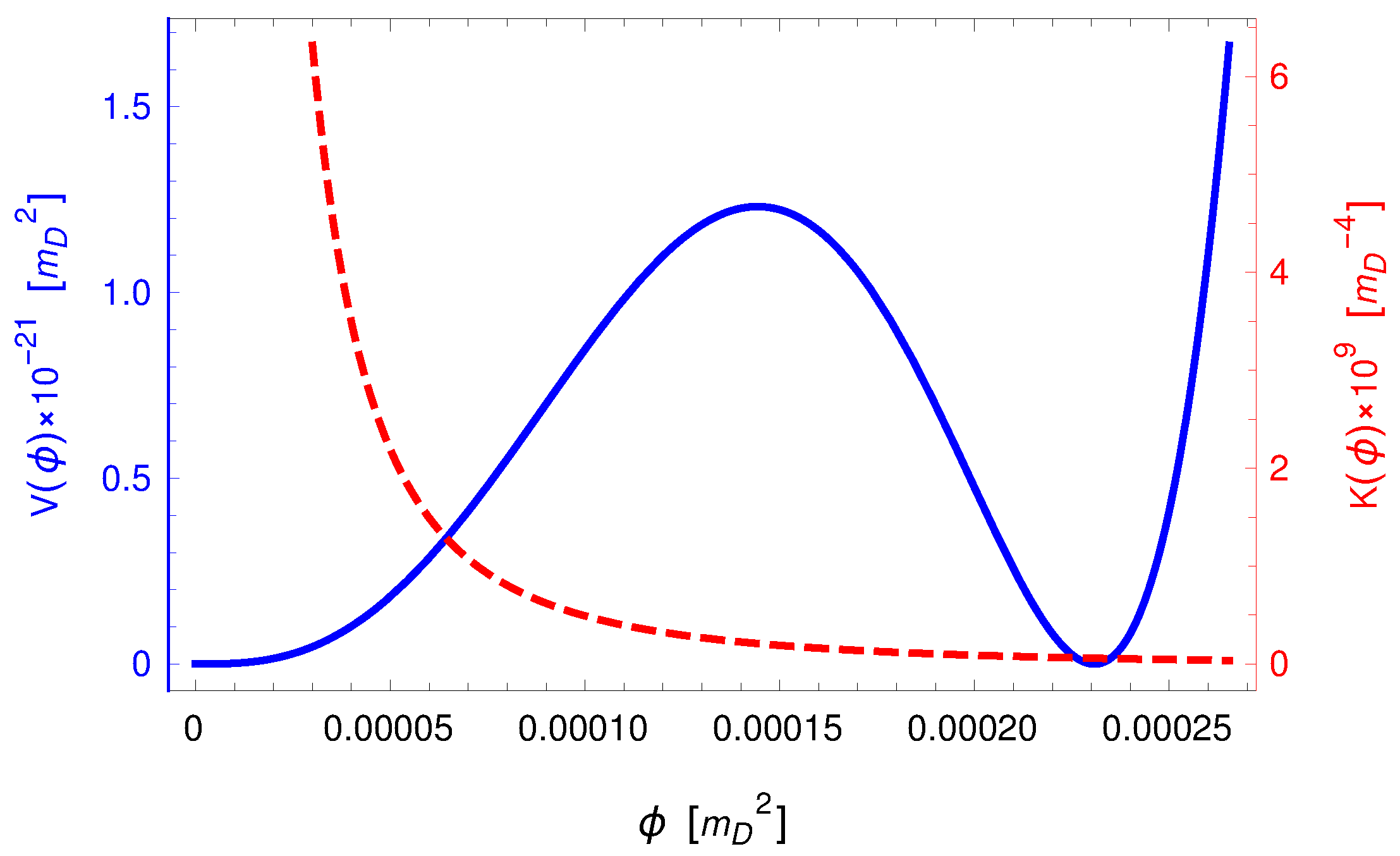
The presence of 2 minima in the potential (Figure 1) leads to the production of domain walls. In our previous work [25], we also computed characteristic parameters of the domain walls arising in this model. The surface energy density and characteristic width are given by
σ = 5 · 10 9 m D 3 , δ 1.2 · 10 11 m D 1 .
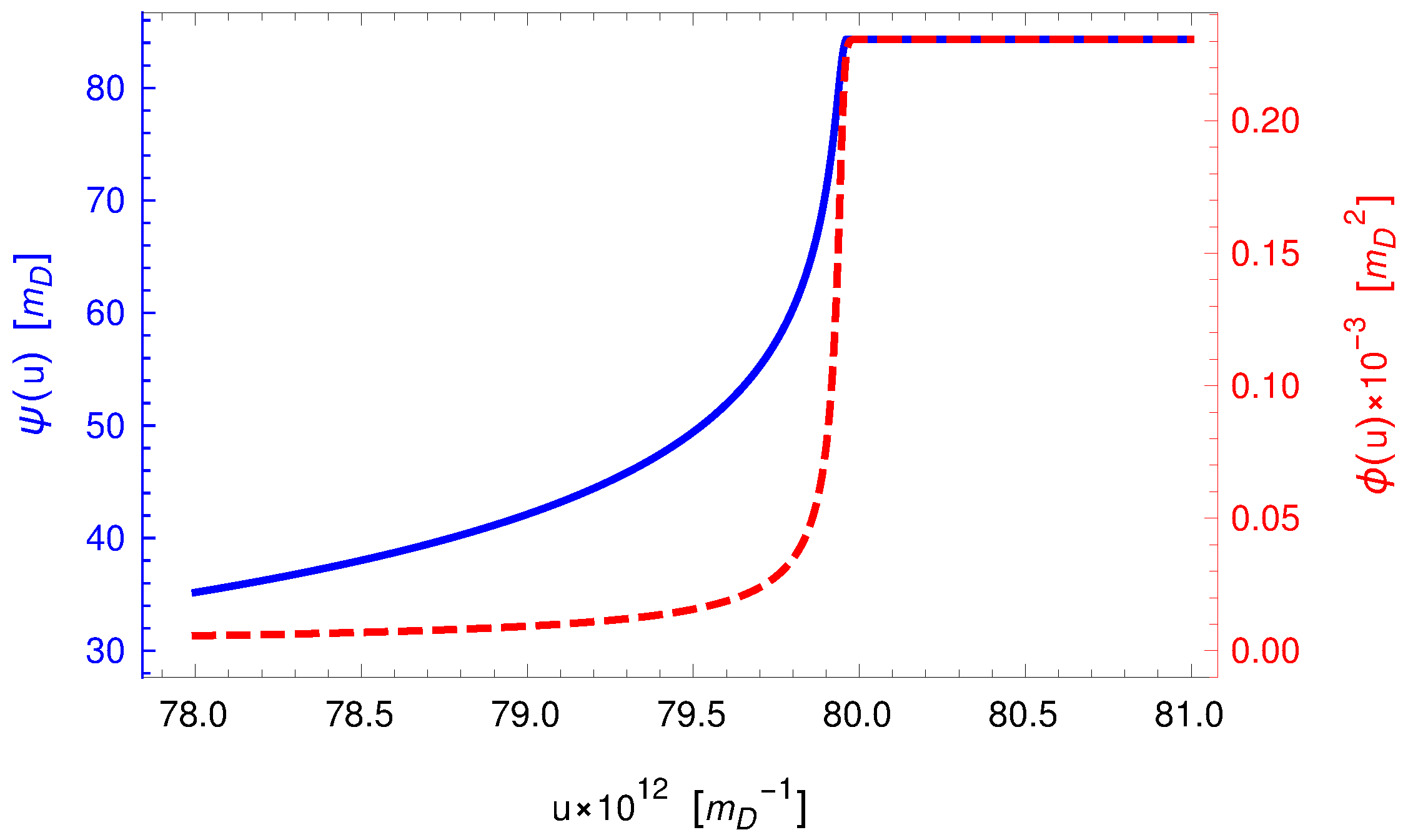
The field configuration of the domain wall obtained in [25] is demonstrated in Figure 2. We also note that in addition to domain walls, the theory will contain oscillations of the scalar field ϕ . The energy density of the scalar field oscillations was set to be negligible compared to the inflaton energy density for the given model parameters so the field ϕ should not dominate the total density (constraints were studied in [25]). However, it is possible that the density of scalar field oscillations will be large compared to the density of domain walls. This may lead to significant isocurvature fluctuations. We would like to consider this issue in our further works, since in this paper, we are only interested in non-trivial field configurations connecting different vacua (domain walls) and their observable manifestations.
Extra space is set to be a multidimensional sphere; thus, R n = ϕ = n ( n 1 ) e 2 β implies that we have found the scale factor of extra space. From numerical solution, one may easily see the transition region where compact extra space becomes macroscopically large. Such configurations were originally found in [30] and named “funnels”, and it was found that they may have properties similar to wormholes.
A key result from our previous work [25] is the derived relation between a domain wall’s physical radius u w and its gravitational radius u g :
u g u w = 8 π G σ u w > m 4 2 σ δ 16 .
As will be shown subsequently, this condition is satisfied for supercritical domain walls.

3. Generation of the Domain Walls

In this section, we describe the mechanism for domain wall formation. The resulting mass spectrum of primordial black holes (PBHs) is dictated by the spectrum of scalar field fluctuations generated during cosmological inflation. To compute this spectrum, we adopt the approach developed by Linde [31], where quantum fluctuations of a light scalar field in a de Sitter background are treated as a random walk process [32]. Within this framework, the probability density function f ( ψ , t ) for the field value ψ at time t satisfies a Fokker–Planck equation.
During inflation, the field ψ evolves in the slow-roll regime. Neglecting the detailed shape of the potential, the probability distribution for ψ at time t is well-approximated by a Gaussian [31,33,34,35,36]:
f ( ψ , t ) = 1 2 π σ ( t ) exp ( ψ ψ u ) 2 2 σ 2 ( t ) , with σ ( t ) = H inf 2 π H inf t .
Here, ψ u represents the initial field value, and σ ( t ) is the time-dependent standard deviation of the fluctuations.
The abundance of fluctuations capable of forming black holes is highly sensitive to the initial parameters. The probability P ( t ) that the field ψ fluctuates into the alternative (left) vacuum of the potential is given by the integral of the tail of the distribution:
P ( t ) = ψ c r f ( ψ , t ) d ψ ,
where ψ c r denotes the field value at the potential maximum. Post-inflationary field evolution results in the formation of a domain wall around such a critical field fluctuation. The size of the resulting domain wall is determined by the time of the critical fluctuation at the inflationary stage u 0 = H inf 1 e H inf t . Setting ψ c r = ψ u Δ with Δ > 0 , the number density of critical fluctuations takes the form:
n c ( t ) = P ( t ) e 3 H inf t = 1 2 erfc Δ 2 σ ( t ) e 3 H inf t .
The cosmological fate of a domain wall is governed by its surface energy density σ . A wall possesses its own gravitational field, and the timescale on which this field becomes gravitationally dominant within the Hubble horizon is given by [37,38]:
t σ = 1 2 π G σ .
Initially comoving with the Hubble flow, a wall’s radius u 0 (determined by quantum fluctuations) grows with the scale factor until it crosses the Hubble horizon. The horizon-crossing time t H depends on the equation of state parameter ω of the dominant energy component. For a radiation-dominated era ( ω = 1 / 3 ), this time is
t H = H inf u 0 2 / 4 .
The relation between t σ and t H determines the wall’s destiny:
  • If t σ > t H , the wall crosses the horizon before its self-gravity becomes significant. Such subcritical configurations, discussed in [27,39], do not collapse but shrink due to surface tension. Large domain walls have a chance to shrink below the gravitational radius, forming a black hole.
  • If t σ < t H , gravitational dominance occurs before horizon crossing (supercritical domain wall), leading to immediate collapse into a black hole. It is this latter regime, explored in [40,41], that we adopt in the present work to calculate the resulting mass spectrum of black holes.
Such a mechanism of wall generation also provides a possibility of the formation of clusters of primordial black holes [27]. We will study the internal structure of possible clusters in the next sections.

4. Initial PBH Mass Spectrum

In this section, we derive the initial mass spectrum of PBHs in the entire universe and study the mass spectrum of PBHs in clusters that could arise in the considered model of modified gravity.

4.1. Mass Spectrum in the Entire Universe

The defining criterion for a supercritical domain wall is the following inequality:
t σ < t H .
This condition can be re-expressed by incorporating the characteristic width of the domain wall δ :
t σ 2 G < δ 2 G < t H 2 G .
From (17), it follows that
2 π G δ σ > 1 ,
which is equivalent to the previously derived condition (10).
The primary observational signature of collapsing supercritical domain walls is the mass spectrum of the resulting primordial black holes (PBHs). For this mechanism, the final mass of a PBH is determined by the initial comoving size of the domain wall from which it formed. The region of our universe containing the collapsing wall becomes external to it, as the wall itself effectively migrates to a separate baby universe via wormhole [40,41].
Following the formalism established in [41] for supercritical domain walls, which accounts for accretion during the radiation-dominated era, the mass of a formed black hole is given by
M b h = 5.6 t H / G .
As noted in [40,41], accretion of radiation can increase the mass of the black hole by a factor of no more than 2 during this stage.
Assuming nearly instantaneous decay of the inflaton field, meaning reheating occurs on a timescale much shorter than the Hubble time, the universe is radiation-dominated ( ω = 1 / 3 ) when domain walls are evolving. For a wall formed at a time t during inflation, the radius of the corresponding comoving volume when it crosses the horizon during radiation domination is [27]
r ( t ) = e 2 ( N inf H inf t ) 2 H inf N inf .
By definition, this radius is equal to the Hubble radius r H at the time of crossing t H . The Hubble radius in a radiation-dominated universe evolves as
r H = 2 t H .
The time t H is related to the final PBH mass (including accretion) through Equation (19):
t H = G M b h 5.6 r H = G M b h 2.8 .
We can now express the formation time t in terms of the PBH mass by substituting (22) into (20) and solving for t:
t = N inf H inf 1 H inf ln N inf H inf G M b h 1.4 .
The PBH mass spectrum is finally obtained by substituting the expression for time (23) into the formula for the number density of critical fluctuations (13):
n c ( M b h ) = 1 2 erfc 2 π Δ H inf N inf ln N inf H inf G M b h / 1.4 × 1 . 4 3 / 2 e 3 N inf ( N inf G H inf M b h ) 3 / 2 .
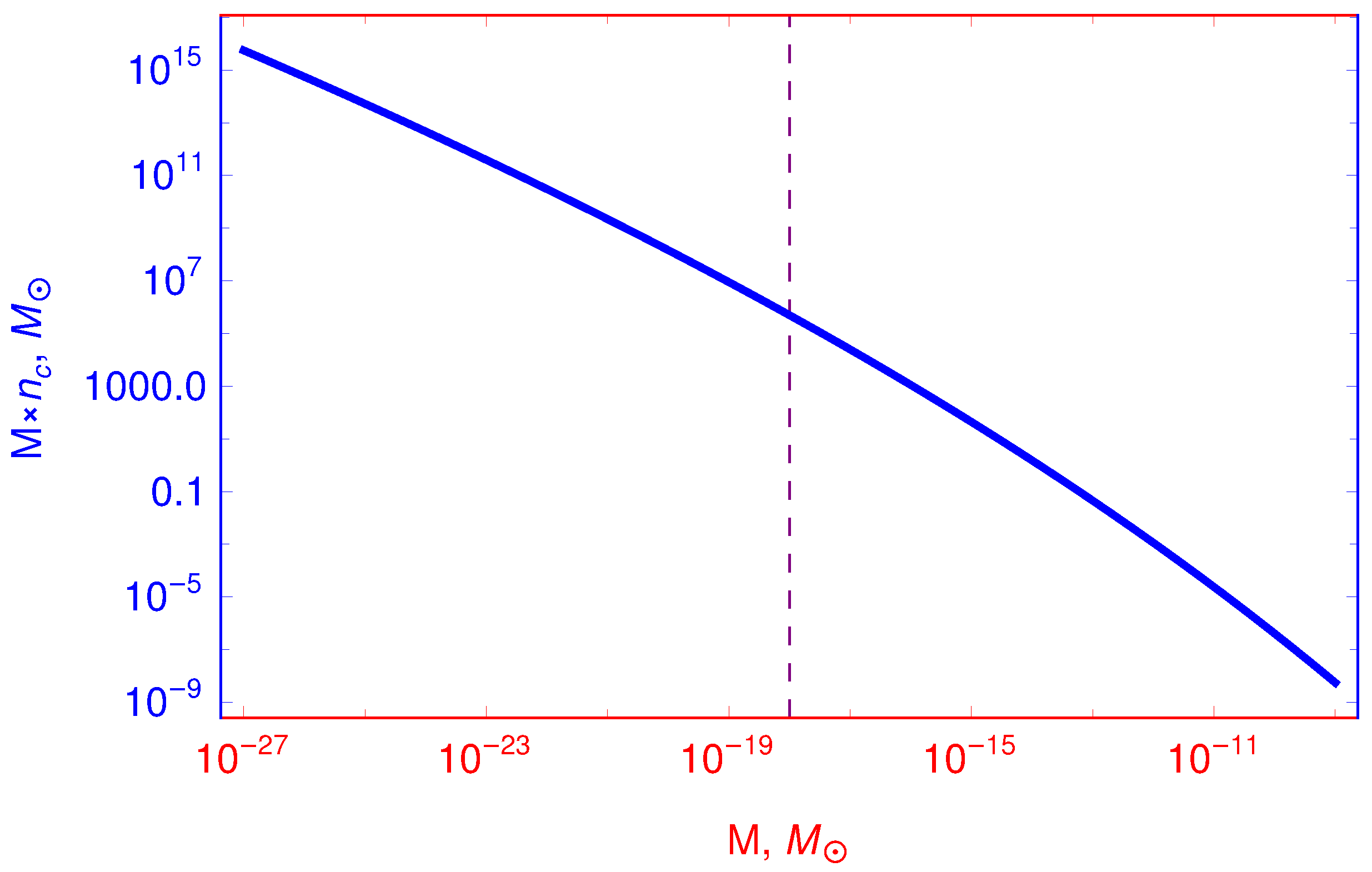
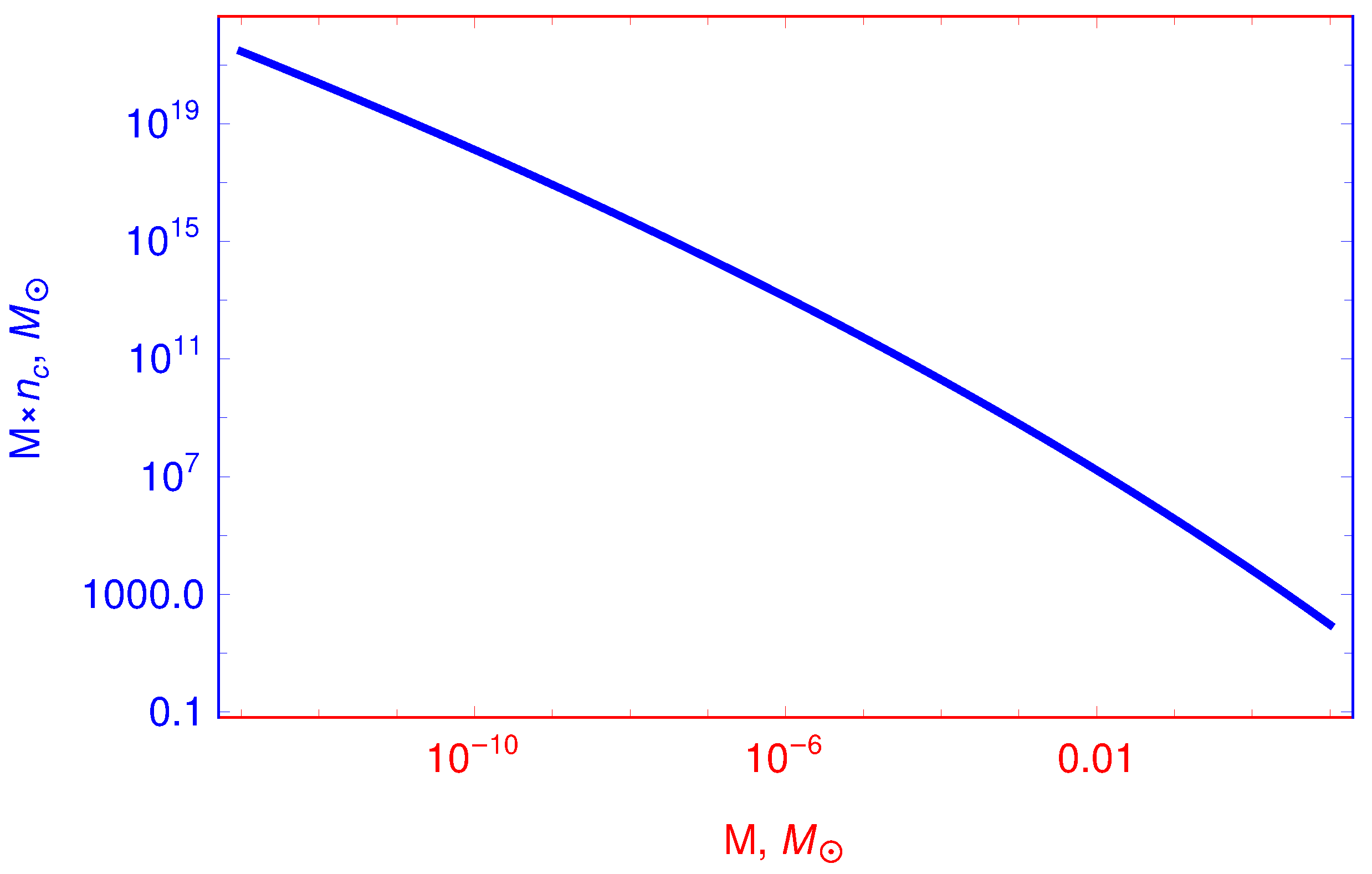
We present an example of spectrum given by (24) in Figure 3, where accretion of radiation is taken into account. Notably, the final expression for the mass spectrum (24) does not explicitly depend on the parameters of the original multidimensional modified gravity model (1). The minimal PBH mass in this spectrum is governed solely by the characteristic width of the domain wall.

4.2. Mass Spectrum of PBHs in Clusters

We would follow [27] in order to study the structure of possible clusters. We should choose the seed PBH with mass M 0 and fix a size r c l of a region that would contain a cluster. The moment in time when this region formed is t c l = t ( r c l ) . The moment of the formation of the seed PBH is given by t 0 = t ( r ( M 0 ) ) . During period of time t 0 t c l , only one fluctuation should occur. Thus, using (13) we arrive at
n c ( ψ , t 0 t c l ) = 1 .
Equation (25) is a relation between initial field value in the considered region and the size of this region. By solving it, we can find ψ ( M 0 , r c l ) , which allows us to obtain spatial mass distribution within the cluster:
n c ( ψ ( M 0 , r c l ) , t ( r ( m ) ) t ( r c l ) ) = n c ( M 0 , r c l , m ) .
Using (19) and (20) we could obtain t 0 and t c l . They are as follows:
t c l = N inf H inf ln ( 2 N inf H inf r c l ) 2 H inf ; t 0 = N inf H inf ln ( N inf H inf G M 0 / 1.4 ) 2 H inf .
By solving (25) we found
ψ ( M 0 , r c l ) = ψ c r + 2 σ ( t 0 t c l ) erfc 1 2 e 3 H inf ( t c l t 0 ) .
By substituting (28) and (27) into expression (26) we obtain
n c ( M 0 , r c l , m ) = 1 2 2.8 r c l G m 3 / 2 erfc ln 2.8 r c l G M 0 ln 2.8 r c l G m erfc 1 2 G M 0 2.8 r c l 3 / 2 .
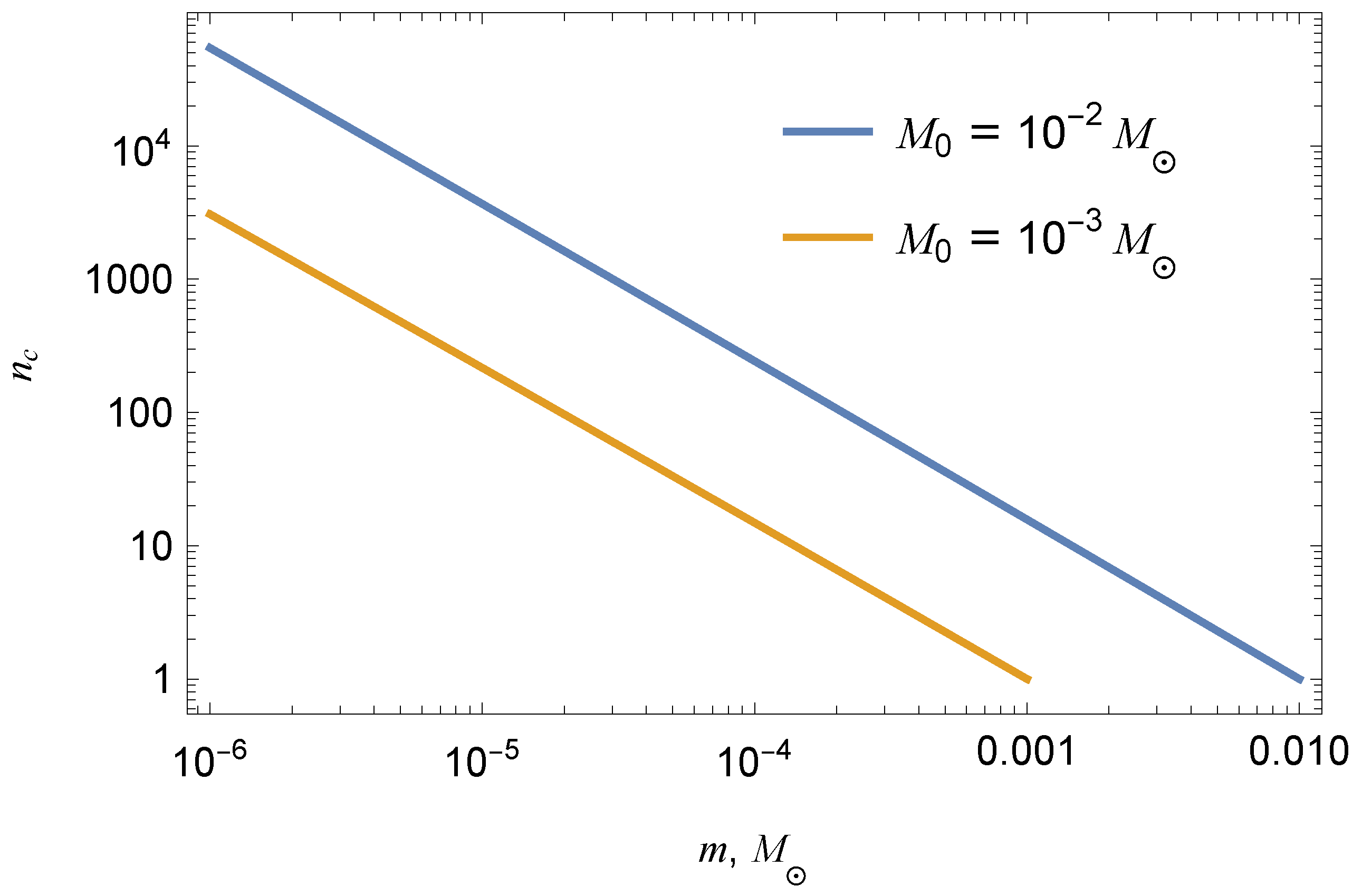
We present spectrum given in (29) in Figure 4. In [27], it is demonstrated that the cluster detaches from expansion at the moment of the RD-MD transition with a size of r c l 1 pc , which was found by performing numerical simulations in the model, with a potential having a similar scale of parameters to our model. In the following section, we will demonstrate the expected mass distribution, taking accretion into account.

5. PBH Mass Spectrum in the Modern Universe

In this section, we will propose two different estimations of accretion’s impact on mass spectrum via different models. Here we do not study accretion problem, we only utilize known models and apply their results. First, we consider Eddington-limited accretion as a marginal estimate of the accretion process and then we consider the McVittie model as a conservative estimation.
For the sake of simplicity of our consideration, we will take evaporation of PBHs into account only via cut off of the mass spectrum in modern times.

5.1. Eddington-Limited Accretion

To propose an estimation of the present-day mass spectrum, we consider growth via Eddington-limited accretion, acknowledging that super-Eddington accretion may occur in non-spherical scenarios [42]. The mass growth under Eddington accretion is given by
M ( t ) = M 0 exp t τ Edd ,
where M 0 is the initial mass, and τ Edd 45.1 million years is the characteristic Eddington timescale. The existence of supermassive black holes ( M 10 10 M ) at high redshifts ( z 6 , cosmic age ∼900 Myr) [43,44,45] suggests prolonged efficient accretion. Assuming our seed PBHs accreted at the Eddington limit from formation until z 6 , their masses would increase by the following factor:
k = M f / M i = exp 900 · 10 6 years 45.1 · 10 6 years e 20 5 · 10 8 .
To incorporate this accretion factor into the mass spectrum, we perform the substitution M b h M b h / k into Equation (24), yielding
n c ( M b h ) = 1 2 erfc 2 π Δ H inf N inf ln N inf H inf G M b h / ( 1.4 · k ) × ( 1.4 · k ) 3 / 2 e 3 N inf ( N inf G H inf M b h ) 3 / 2 .
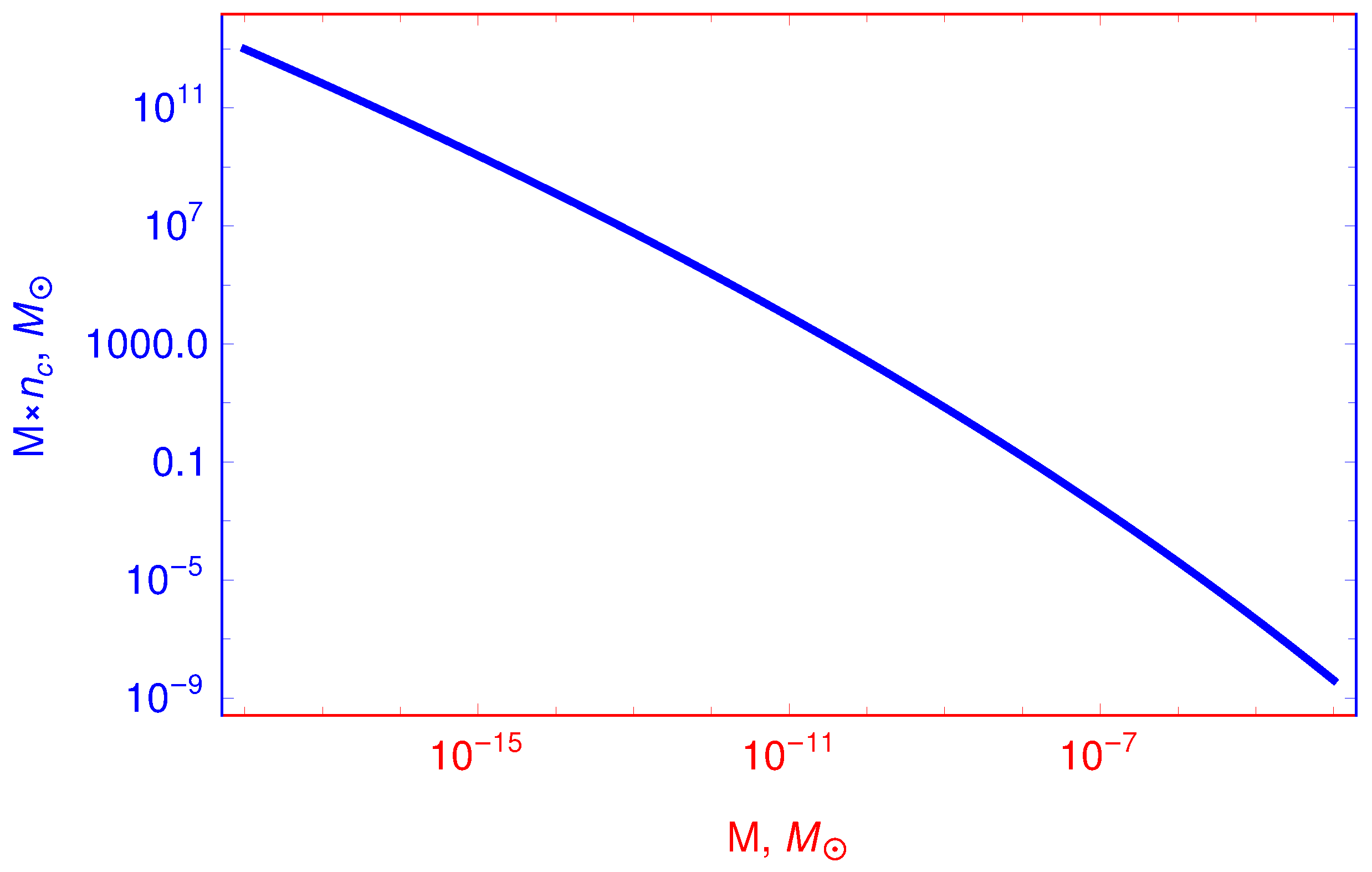
Now let us consider the possible mass distribution within clusters of PBHs that could take place in our model of modified gravity. For this purpose, we put r c l 1 pc in (29). Let us assume that we would have 10 10 clusters of PBHs in our universe. The number of observed galaxies in the universe is of the same order. From Figure 5 we see that the appropriate mass of the central black hole is M 0 0.01 M .
Figure 4. Mass distribution in clusters of PBHs at z = 6 assuming Eddington-limited accretion. M 0 represents mass of central black hole. Blue line corresponds to the assumption about existence of 10 10 clusters of PBHs in our universe following our calculations presented in Figure 5. Orange line is shown for comparison.
Particles 09 00012 g004
Figure 5. Mass spectrum in the entire universe under the assumption of Eddington-limited accretion at z 6 (value of z is chosen for comparison with high-redshift quasar data). Here, Δ = 8.5 σ ( t inf ) . The minimal mass is scaled by the accretion factor k 5 · 10 8 , giving M min 10 13 M = 10 20 g. The parameter Δ is chosen to ensure consistency with current constraints.
Particles 09 00012 g005
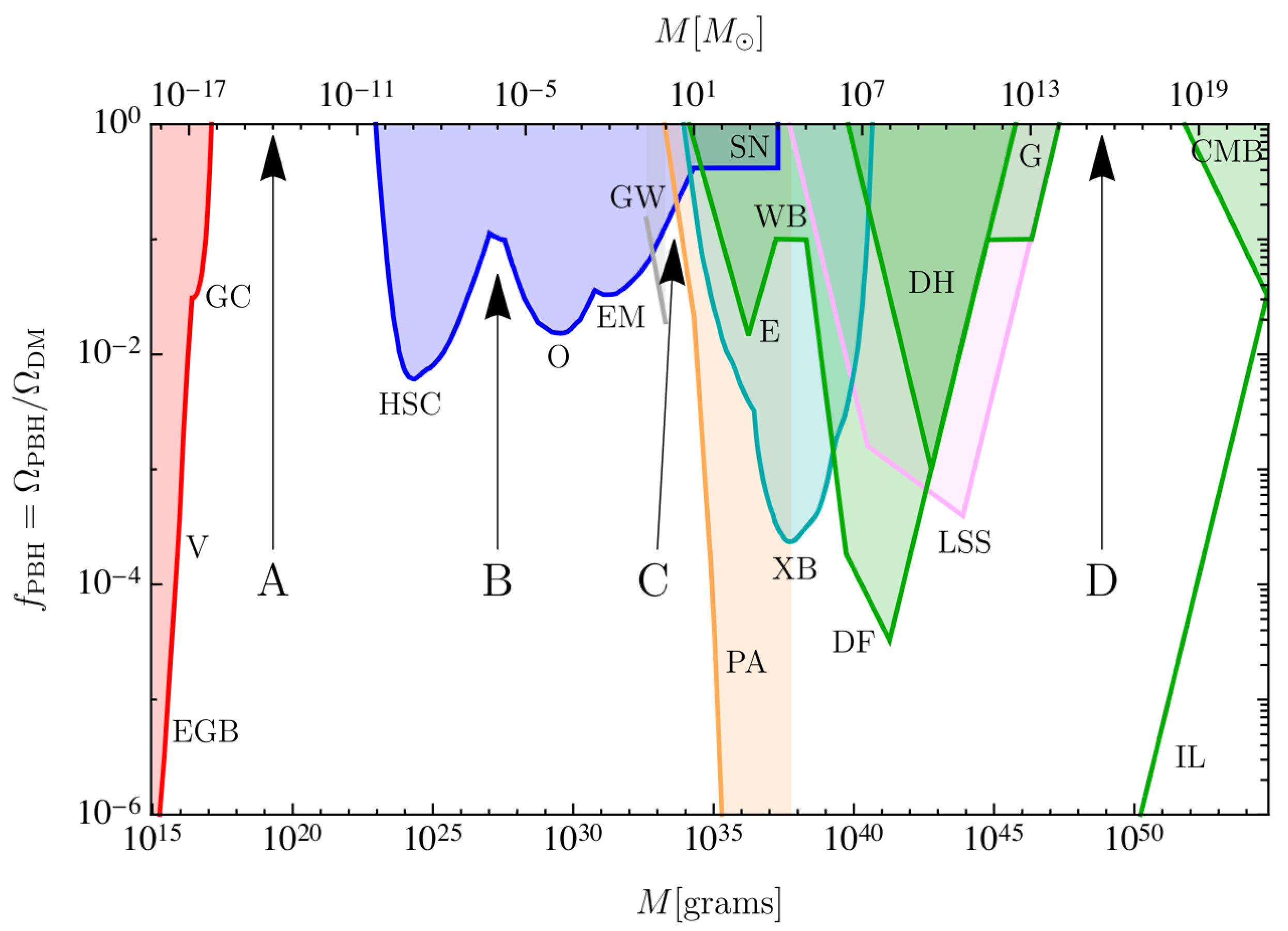
According to the comprehensive review in [46], the masses of black holes produced by this f ( R ) -gravity mechanism, after accounting for Eddington-limited accretion, reside in a mass window that is currently unconstrained by observations (see Figure 6). Consequently, these objects remain viable candidates to the dark matter.

5.2. McVittie Accretion Model

Now, let us move to McVittie model. It is known that density fluctuations during the non-relativistic matter domination era grow proportionally to the scale factor. Black holes can be considered density fluctuations; accordingly, their growth proportional to the scale factor can be anticipated. In this context, it is interesting to consider the accretion model within the McVittie metric, which, for the matter-dominated era, yields black hole mass growth proportional to the scale factor. The works [47,48] examine exact solutions to the accretion problem, in particular, a solution using the McVittie metric and an energy-momentum tensor (EMT) for an imperfect fluid with radial flow. Within this model, one can compute the factor by which the PBH mass changes; the PBH mass grows along with the universe, depending on the equation of state parameter ω . In [47], the metric is considered:
d s 2 = B 2 A 2 d t 2 + a 2 ( t ) A 4 d r ¯ 2 + r ¯ 2 d Ω 2 ,
where A = 1 + G m ( t ) 2 r ¯ , B = 1 G m ( t ) 2 r ¯ . This metric is asymptotically Friedmann, and upon “stopping” the expansion of the universe, it transforms into the Schwarzschild metric via a change in the radial coordinate. Obviously, it describes a strongly gravitating object. In this spacetime, the physically relevant [49,50,51] mass is the quasi-local mass m H ( t ) = m ( t ) a ( t ) , while m ( t ) is merely a metric coefficient. The EMT of the matter surrounding the black hole is
T a b = ( p + ρ ) u a u b + p g a b + q a u b + q b u a ,
where
u a = A B 1 + a 2 A 4 u 2 , u , 0 , 0 , q c = 0 , q , 0 , 0 ,
where q c describes the radial energy flow, and u a is the four-velocity of the surrounding fluid. Thus, we arrive at the accretion rate:
m ˙ H = 1 2 a B 2 1 + a 2 A 4 u 2 ( p + ρ ) A u ,
where A = d θ d φ g Σ = 4 π a 2 A 4 r ¯ 2 . Let us consider formula (36). It will be useful to find the dependence of the accretion rate on cosmological parameters; for this we utilize result obtained in [48] for the quasi-local mass as a function of the scale factor:
m H ( t ) = C 1 a 1 + 3 ω ( t ) C 2 a 3 ( 1 + ω ) / 2 ( t ) + 3 ( 1 + ω ) 3 ω + 5 m 0 a ( t ) ,
where C 1 , C 2 are determined from the initial mass m H ( t 0 ) and the initial accretion rate m ˙ H ( t 0 ) . It can be seen that for ω = 0 , the mass m H ( t ) a ( t ) . The RD-MD transition occurs at approximately z e q 3000 . The redshift corresponding to the transition to dark energy domination is z 1.32 . Thus, throughout the entire stage of non-relativistic matter domination in the universe, according to this model, a black hole can increase its mass by approximately a factor of ∼2000. This estimate agrees in order of magnitude with the result obtained within Newton mechanics [52]. Let us denote the final mass at the end of the MD stage with the subscript “f”, and the initial mass, corresponding to the time of the RD-MD transition, with the subscript “i”, and write the following relation:
M f 2000 M i .
The mass spectrum utilizing this mass increase is demonstrated in Figure 7.
We should note that the mass growth predicted by this model is much less than that predicted by Eddington-limited accretion. For this reason it is obvious that the mass spectrum presented in Figure 7 does not violate known constraints, even though the value of Δ is slightly higher.

6. Discussion and Conclusions

We have proposed a mechanism for generating primordial black holes from domain walls based on pure f(R)-gravity.
The domain walls obtained in this framework are supercritical—their gravitational field becomes very significant within the Hubble horizon long before the walls could cross the cosmological horizon. Supercritical domain walls were studied by A. Vilenkin and collaborators [40,41], where it was shown that such walls create wormholes and escape into baby universes, leaving only a black hole, which is formed after the wormhole pinches off. They have also demonstrated the creation of wormholes by scalar fields in their early studies, e.g., in [53]. The creation of wormholes by thin shells was also studied by other researches [54].
In our proposed mechanism domain walls are effective and formed by pure f(R)-gravity. On the other hand, a purely gravitational description interprets these structures as regions of space with macroscopic extra dimensions, separated from the rest of the universe. Such configurations were originally found in [30] and named “funnels”, and it was concluded that they may have properties similar to wormholes. It could be considered as a support of results in [40,41], where authors also conclude that very dense domain walls form wormholes.
In this work, we used the spherical domain wall approximation. In fact, during the inflationary stage, non-spherical domain walls of complex shape should be created due to field fluctuations. Their formation and dynamics have been studied in [28]. It was concluded that domain walls actually form a “soliton foam” consisting of closed domain walls and scalar field radiation. This should lead to additional effects, such as the emission of scalar particles and gravitational waves during the spherization of the domain walls. These effects are not considered in the current work because such configurations would be extremely difficult to study within the framework of modified gravity.
To study the clusters of PBHs we have utilized the approach from [27] and derived mass and spatial distributions of PBHs. A distinctive feature of this model is the absence of dependence of the shape of the black hole mass spectrum on the parameters of multidimensional modified gravity. Only the left boundary of the spectrum (minimal mass) depends on the model parameters through the properties of the domain wall.
In this study, we have also tried to take accretion process into account by using two different models: Eddington-limited accretion and the McVittie model. In both cases, the considered model of modified gravity provides a possibility to produce PBHs that are not constrained as dark matter candidates. One may see a review of accretion models, e.g., in [55]. With regard to accretion process, we can only state that the problem of accretion is still to be studied.
For the PBHs obtained in our model, the only possible source of detection appears to be micro- and femtolensing observations. Therefore, our PBHs belong to the class of massive astrophysical compact halo objects (MACHOs), with corresponding search techniques. Unfortunately due to the small mass of PBHs arising in our model, they cannot be detected by modern gravitational wave’s interferometers.

Author Contributions

Conceptualization, M.K.; writing—original draft preparation, M.K.; writing—review and editing, V.N.; All authors have read and agreed to the published version of the manuscript.

Funding

The work of M. K. was performed in Southern Federal University with financial support of grant of the Russian Science Foundation № 25-07-IF. The work of V. N. was funded by the Ministry of Science and Higher Education of the Russian Federation, Project <<Studying physical phenomena in the micro- and macro-world to develop future technologies>> FSWU-2026-0010.

Data Availability Statement

No data was used in this research.

Acknowledgments

We highly appreciate M. Yu. Khlopov and V. D. Stasenko for their fruitful discussions.

Conflicts of Interest

The authors declare no conflicts of interest.

Abbreviations

The following abbreviations are used in this manuscript:
PBHPrimordial Black Hole
RDRadiation-Dominated
MDMatter-Dominated
EMTEnergy Momentum Tensor

References

  1. Modesto, L. Super-renormalizable quantum gravity. Phys. Rev. D 2012, 86, 044005. [Google Scholar] [CrossRef]
  2. Eingorn, M.; Zhuk, A. Classical tests of multidimensional gravity: Negative result. Class. Quantum Gravity 2010, 27, 205014. [Google Scholar] [CrossRef]
  3. Carroll, S.; Geddes, J.; Hoffman, M.; Wald, R. Classical stabilization of homogeneous extra dimensions. Phys. Rev. D 2002, 66, 024036. [Google Scholar] [CrossRef]
  4. Sotiriou, T.P.; Faraoni, V. F(R) Theories of Gravity. Rev. Mod. Phys. 2010, 82, 451–497. [Google Scholar] [CrossRef]
  5. Sarkidas, E.N.; Kofinas, G. Cosmological applications of F(T,TG) gravity. Phys. Rev. D 2014, 90, 084045. [Google Scholar]
  6. Nojiri, S.; Odintsov, S.D. Unified cosmic history in modified gravity: From F(R) theory to Lorentz non-invariant models. Phys. Rep. 2011, 505, 59–144. [Google Scholar] [CrossRef]
  7. Sáez-Gómez, D. Cosmological evolution, future singularities, Little Rip and Pseudo-Rip in viable f(R) theories and their scalar–tensor counterpart. Class. Quantum Gravity 2013, 30, 095008. [Google Scholar] [CrossRef]
  8. Donoghue, J.F. General relativity as an effective field theory: The leading quantum corrections. Phys. Rev. D 1994, 50, 3874–3888. [Google Scholar] [CrossRef] [PubMed]
  9. Starobinsky, A. A New Type of Isotropic Cosmological Models Without Singularity. Phys. Lett. B 1980, 91, 99–102. [Google Scholar] [CrossRef]
  10. Vilenkin, A. Classical and quantum cosmology of the Starobinsky inflationary model. Phys. Rev. D 1985, 32, 2511. [Google Scholar] [CrossRef]
  11. Planck Collaboration. Planck 2018 results. X. Constraints on inflation. Astron. Astrophys. 2018, 641, A10. [Google Scholar]
  12. Nojiri, S.; Odintsov, S.D. Introduction to Modified Gravity and Gravitational Alternative for Dark Energy. Int. J. Geom. Methods Mod. Phys. 2007, 04, 115–145. [Google Scholar] [CrossRef]
  13. Fernandes, P.; Carrilho, P.; Clifton, T.; Mulryne, D.J. The 4D Einstein–Gauss–Bonnet theory of gravity: A review. Class. Quantum Gravity 2022, 39, 063001. [Google Scholar] [CrossRef]
  14. Felice, A.D.; Tsujikawa, S. F(R) Theories, Living Reviews in Relativity. Living Rev. Relativ. 2010, 13, 3. [Google Scholar] [CrossRef] [PubMed]
  15. Capozziello, S.; De Laurentis, M. Extended Theories of Gravity. Phys. Rep. 2011, 509, 167–321. [Google Scholar] [CrossRef]
  16. Capozziello, S.; De Laurentis, M. The Dark Matter problem from f(R) gravity viewpoint. Ann. Der Phys. 2012, 524, 545–578. [Google Scholar] [CrossRef]
  17. Chatterjee, A.; Roy, R.; Dey, S.; Bandyopadhyay, A. Dynamics of viable f(R) dark energy models in the presence of curvature–matter interactions. Eur. Phys. J. C 2024, 84, 236. [Google Scholar] [CrossRef]
  18. Bronnikov, K.; Konoplich, R.; Rubin, S. The diversity of universes created by pure gravity. Class. Quantum Gravity 2007, 24, 1261–1277. [Google Scholar] [CrossRef]
  19. Bronnikov, K.; Budaev, R.; Grobov, A.; Dmitriev, A.; Rubin, S. Inhomogeneous compact extra dimensions. J. Cosmol. Astropart. Phys. 2017, 2017, 001. [Google Scholar] [CrossRef][Green Version]
  20. Bronnikov, K.; Popov, A.; Rubin, S. Inhomogeneous compact extra dimensions and de Sitter cosmology. Eur. Phys. J. C 2020, 80, 970. [Google Scholar] [CrossRef]
  21. Witten, E. Instability of the Kaluza-Klein vacuum. Nucl. Phys. B 1982, 195, 481–492. [Google Scholar] [CrossRef]
  22. Tonguç, R. Acceleration of the Universe via f(R) gravities and the stability of extra dimensions. Phys. Rev. D 2007, 75, 064033. [Google Scholar]
  23. Rubin, S.; Bronnikov, K. Self-stabilization of extra dimensions. Phys. Rev. D 2006, 73, 124019. [Google Scholar] [CrossRef]
  24. Fabris, J.; Popov, A.; Rubin, S. Multidimensional gravity with higher derivatives and inflation. Phys. Lett. B 2020, 806, 135458. [Google Scholar] [CrossRef]
  25. Nikulin, V.; Krasnov, M.; Rubin, S. Compact extra dimensions as the source of primordial black holes. Front. Astron. Space Sci. 2022, 9, 8. [Google Scholar] [CrossRef]
  26. Rubin, S.; Khlopov, M.; Sakharov, A. Primordial Black Holes from Non-Equilibrium Second Order Phase Transition. Gravit. Cosmol. 2000, 6, 51–58. [Google Scholar]
  27. Belotsky, K.; Dokuchaev, V.; Eroshenko, Y.; Esipova, E.; Khlopov, M.; Khromykh, L.; Kirillov, A.; Nikulin, V.; Rubin, S.; Svadkovsky, I. Clusters of Primordial Black Holes. Eur. Phys. J. C 2019, 79, 246. [Google Scholar] [CrossRef]
  28. Kirillov, A.A.; Murygin, B.S.; Nikulin, V.V. Soliton foam formation in the early Universe. Phys. Lett. B 2025, 860, 139201. [Google Scholar] [CrossRef]
  29. Lyakhova, Y.; Popov, A.; Rubin, S. Classical evolution of subspaces. Eur. Phys. J. C 2018, 78, 1–13. [Google Scholar] [CrossRef]
  30. Rubin, S.G. Interpenetrating subspaces as a funnel to extra space. Phys. Lett. B 2016, 759, 622–625. [Google Scholar] [CrossRef]
  31. Linde, A. Scalar field fluctuations in the expanding universe and the new inflationary universe scenario. Phys. Lett. B 1982, 116, 335–339. [Google Scholar] [CrossRef]
  32. Starobinsky, A. Spectrum of relict gravitational radiation and the early state of the universe. J. Exp. Theor. Phys. Lett. 1979, 30, 682–685. [Google Scholar]
  33. Dokuchaev, V.; Eroshenko, Y.; Rubin, S.; Samarchenko, D. Mechanism for the suppression of intermediate-mass black holes. Astron. Lett. 2010, 36, 773–779. [Google Scholar] [CrossRef]
  34. Vilenkin, A.; Ford, L. Gravitational effects upon cosmological phase transitions. Phys. Rev. D 1982, 26, 1231–1241. [Google Scholar] [CrossRef]
  35. Starobinsky, A. Dynamics of phase transition in the new inflationary universe scenario and generation of perturbations. Phys. Lett. B 1982, 117, 175–178. [Google Scholar] [CrossRef]
  36. Hardwick, R.; Vennin, V.; Byrnes, C.; Torrado, J.; Wands, D. The stochastic spectator. J. Cosmol. Astropart. Phys. 2017, 2017, 018. [Google Scholar] [CrossRef]
  37. Vilenkin, A. Gravitational field of vacuum domain walls and strings. Phys. Rev. D 1981, 23, 852–857. [Google Scholar] [CrossRef]
  38. Ipser, J.; Sikivie, P. The Gravitationally Repulsive Domain Wall. Phys. Rev. D 1984, 30, 712. [Google Scholar] [CrossRef]
  39. Khlopov, M.; Rubin, S. Cosmological Pattern of Microphysics in the Inflationary Universe; Springer: Dordrecht, The Netherlands, 2004. [Google Scholar]
  40. Garriga, J.; Vilenkin, A.; Zhang, J. Black holes and the multiverse. J. Cosmol. Astropart. Phys. 2016, 2016, 064. [Google Scholar] [CrossRef]
  41. Deng, H.; Garriga, J.; Vilenkin, A. Primordial black hole and wormhole formation by domain walls. J. Cosmol. Astropart. Phys. 2017, 2017, 050. [Google Scholar] [CrossRef]
  42. Inayoshi, K.; Haiman, Z.; Ostriker, J. Hyper-Eddington accretion flows on to massive black holes. Mon. Not. R. Astron. Soc. 2016, 459, 3738–3755. [Google Scholar] [CrossRef]
  43. Paliya, V.S.; Ajello, M.; Marcotulli, L.; Tomsick, J.; Perkins, J.S.; Prandini, E.; D’Ammando, F.; Angelis, A.D.; Thompson, D.; Li, H.; et al. Supermassive black holes at high redshifts. arXiv 2019, arXiv:1903.06106. [Google Scholar] [CrossRef]
  44. Willott, C.; Albert, L.; Arzoumanian, D.; Bergeron, J.; Crampton, D.; Delorme, P.; Hutchings, J.; Omont, A.; Reylé, C.; Schade, D. Eddington–limited accretion and the black hole mass funstion at redshift 6. Astron. J. 2010, 140, 546–560. [Google Scholar] [CrossRef]
  45. Ba nados, E.; Venemans, B.; Mazzucchelli, C.; Farina, E.; Walter, F.; Wang, F.; Decarli, R.; Stern, D.; Fan, X.; Davies, F.; et al. An 800-million-solar-mass black hole in a significantly neutral Universe at a redshift of 7.5. Nature 2017, 553, 473–476. [Google Scholar] [CrossRef] [PubMed]
  46. Carr, B.; Kühnel, F. Primordial black holes as dark matter candidates. Phys. Lect. Notes 2017, 2017, 018. [Google Scholar] [CrossRef]
  47. Faraoni, V.; Jacques, A. Cosmological expansion and local physics. Phys. Rev. D 2007, 76, 063510. [Google Scholar] [CrossRef]
  48. Sun, C.-Y. Dark Energy Accretion onto a Black Hole in an Expanding Universe. Commun. Theor. Phys. 2009, 52, 441–444. [Google Scholar] [CrossRef]
  49. Gao, C.J.; Zhang, S.N. Reissner–Nordström metric in the Friedman–Robertson–Walker universe. Phys. Lett. B 2004, 595, 28–35. [Google Scholar] [CrossRef]
  50. Hawking, S. Gravitational radiation in an expanding universe. J. Math. Phys. 1968, 9, 598–604. [Google Scholar] [CrossRef]
  51. Hayward, S.A. Quasilocal gravitational energy. Phys. Rev. D 1994, 49, 831–839. [Google Scholar] [CrossRef]
  52. Mack, K.J.; Ostriker, J.P.; Ricotti, M. Growth of Structure Seeded by Primordial Black Holes. Astrophys. J. 2007, 665, 1277–1287. [Google Scholar] [CrossRef]
  53. Cho, I.; Vilenkin, A. Spacetime structure of an inflating global monopole. Phys. Rev. D 1997, 56, 7621–7626. [Google Scholar] [CrossRef]
  54. Berezin, V.A.; Kuzmin, V.A.; Tkachev, I.I. Thin-wall vacuum domain evolution. Phys. Lett. B 1983, 120, 91–96. [Google Scholar] [CrossRef]
  55. Krasnov, M.; Nikulin, V. Mechanisms of Producing Primordial Black Holes and Their Evolution. Particles 2023, 6, 580–594. [Google Scholar] [CrossRef]
Figure 1. Profiles of the potential V ( ϕ ) and kinetic function K ( ϕ ) defined by Equations (6) and (7). The parameters, chosen as in [25], are n = 6 , c 1 = 8000 , c 2 = 5000 , and a 2 = 500 . The potential features a left minimum at ϕ = 0 , which is asymptotically inaccessible due to the behavior of the kinetic term, and a chosen minimum at ϕ min = 3 / 13 , 000 .
Particles 09 00012 g001
Figure 2. Field configuration obtained by solving corresponding equation of motion, derived from Lagrangian (5).
Particles 09 00012 g002
Figure 3. Integral mass spectrum from Equation (24), incorporating radiation accretion. Here, Δ = 9 σ ( t inf ) . The minimal mass is set by the domain wall width: M min δ / 2 G 10 27 M . The dashed line indicates the mass scale below which black holes would have evaporated by the present epoch.
Particles 09 00012 g003
Figure 6. Constraints on the fraction of dark matter that can consist of primordial black holes, as a function of PBH mass (taken from [46]). The spectrum derived in this work and shown in Figure 5 falls within an unconstrained region.
Particles 09 00012 g006
Figure 7. Mass spectrum in the modern universe, bounded by black hole evaporation, accounting for accretion during the MD and RD stages. The accretion factor during the MD stage is k 2000 , according to (38). The shift of the initial field value relative to the potential maximum is taken to be Δ = 9 σ ( t inf ) . The lower (left) boundary of the spectrum is determined by M e v 10 18 M .
Particles 09 00012 g007
Disclaimer/Publisher’s Note: The statements, opinions and data contained in all publications are solely those of the individual author(s) and contributor(s) and not of MDPI and/or the editor(s). MDPI and/or the editor(s) disclaim responsibility for any injury to people or property resulting from any ideas, methods, instructions or products referred to in the content.