


Research on Edge Feature Extraction Methods for Device Monitoring Based on Cloud–Edge Collaboration

Abstract
1. Introduction
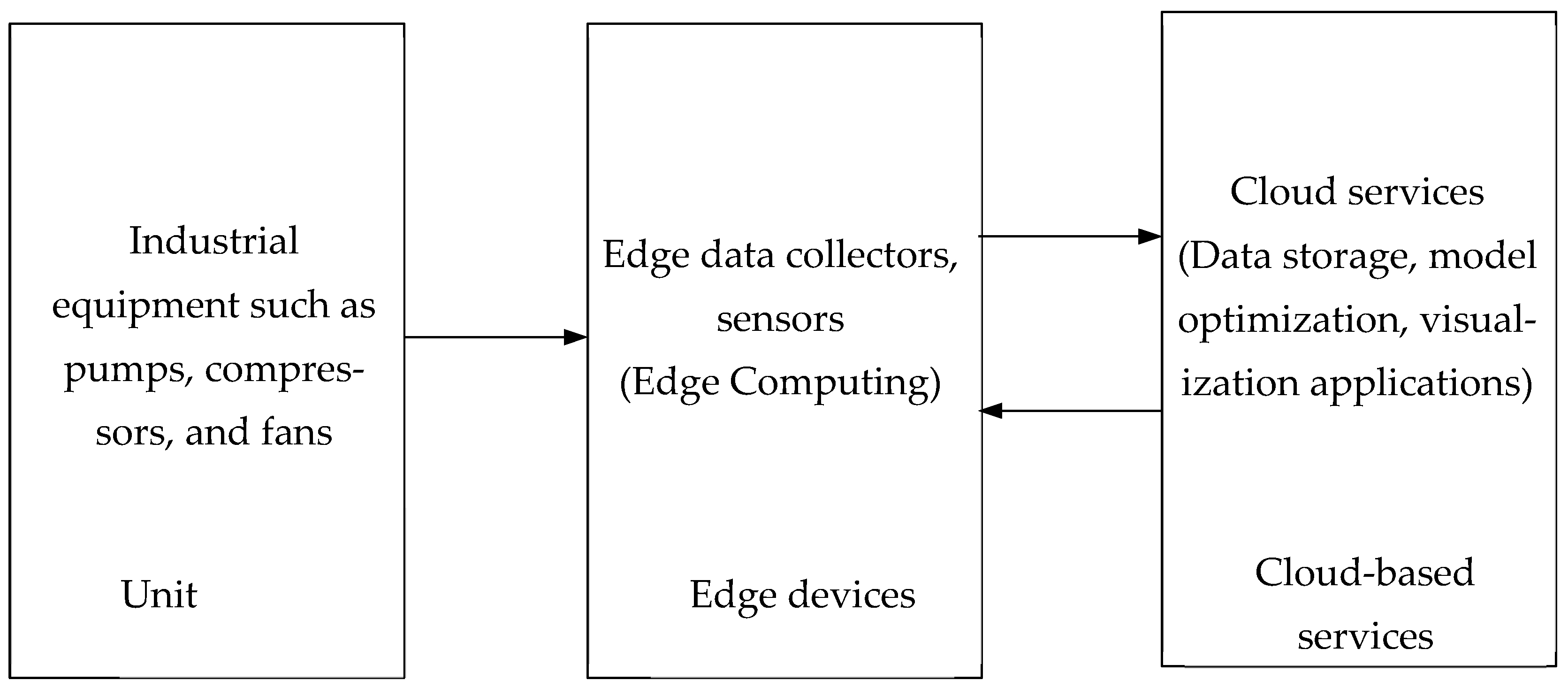
2. Design of Edge-Cloud Collaborative Structure for Monitoring System
3. Edge Feature Extraction and Data Transmission
3.1. Principles and Methods for Equipment Status Feature Assessment
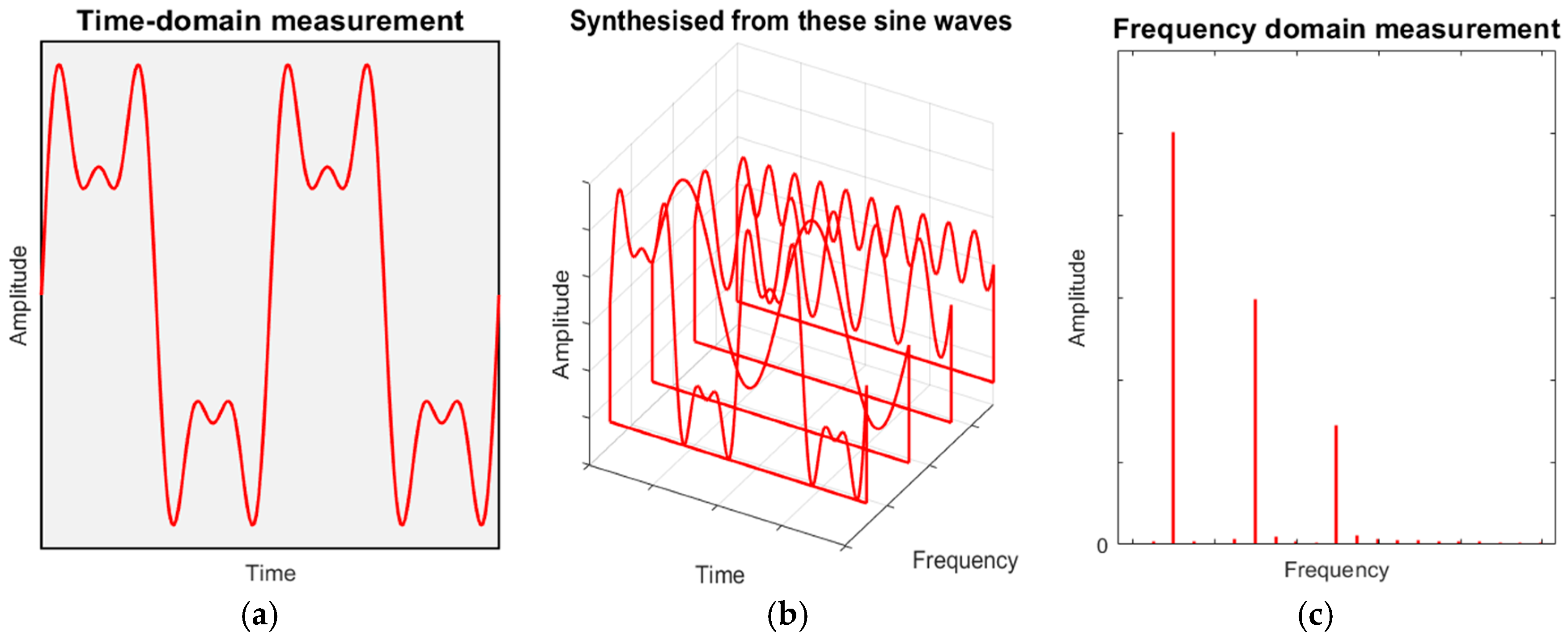
3.2. Edge Feature Computation
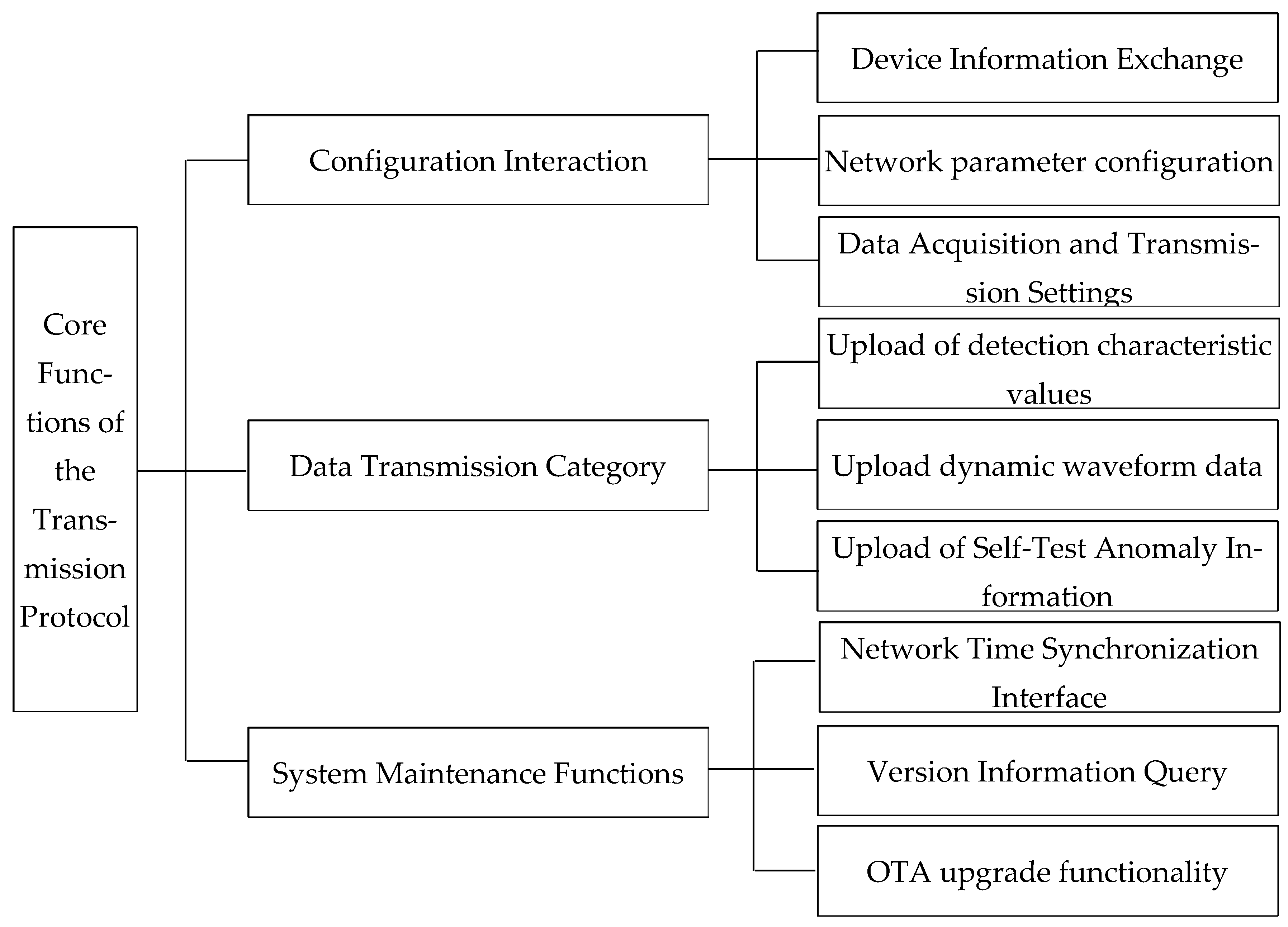
3.3. Edge Data Transmission
3.3.1. Transmission Format and Content
3.3.2. Transmission Scheduling Strategy
3.4. Model Optimization and Parameter Distribution
4. Application and Validation
4.1. Project Overview
4.2. Comparative Analysis of Data Transmission Before and After Implementing Edge Computing
4.2.1. Without Edge Computing
4.2.2. When Utilizing Edge Computing
4.2.3. Comparative Analysis
4.3. Fault Diagnosis Analysis
5. Conclusions
Author Contributions
Funding
Data Availability Statement
Acknowledgments
Conflicts of Interest
References
- Zhang, Y.; Yin, H.; Wang, R.; Zhang, T. A two-phase federated learning framework for machinery fault diagnosis with cloud–edge collaborative computing. Expert Syst. Appl. 2026, 297, 129323. [Google Scholar] [CrossRef]
- Zhang, X.; Ma, L.; Peng, K.; Zhang, C.; Shahid, M.A. A cloud–edge collaboration based quality-related hierarchical fault detection framework for large-scale manufacturing processes. Expert Syst. Appl. 2024, 256, 124909. [Google Scholar] [CrossRef]
- Zhang, Q.; Zhang, Y.; Luo, Q.; Yu, C.; Yu, N.; Wang, Q.; Ke, Y. Cloud–edge-end-based aircraft assembly production quality monitoring system framework and applications. J. Manuf. Syst. 2024, 75, 116–131. [Google Scholar] [CrossRef]
- Zhang, C.; Wang, Y.; Zhao, Z.; Chen, X.; Ye, H.; Liu, S.; Yang, Y.; Peng, K. Performance-driven closed-loop optimization and control for smart manufacturing processes in the cloud–edge-device collaborative architecture: A review and new perspectives. Comput. Ind. 2024, 162, 104131. [Google Scholar] [CrossRef]
- Xue, H.; Huang, B.; Qin, M.; Zhou, H.; Yang, H. Edge Computing for Internet of Things: A Survey. In Proceedings of the 2020 International Conferences on Internet of Things (iThings) and IEEE Green Computing and Communications (GreenCom) and IEEE Cyber, Physical and Social Computing (CPSCom) and IEEE Smart Data (SmartData) and IEEE Congress on Cybermatics (Cybermatics), Rhodes, Greece, 2–6 November 2020; pp. 755–760. [Google Scholar]
- Raza, S.M.; Minerva, R.; Crespi, N.; Alvi, M.; Herath, M.; Dutta, H. A comprehensive survey of Network Digital Twin architecture, capabilities, challenges, and requirements for Edge–Cloud Continuum. Comput. Commun. 2025, 236, 108144. [Google Scholar] [CrossRef]
- Qiu, S.; Malik, M.; Ehsan, H.; Wang, W.; Wang, J.; Cheng, R.; Wei, W.; Zaheer, Q. Trends and perspectives in structural health monitoring through edge computing: A review with zero-shot natural language processing categorization. J. Railw. Sci. Technol. 2025, 1, 59–74. [Google Scholar] [CrossRef]
- Ma, S.; Huang, Y.; Liu, Y.; Yan, Z.; Lv, J.; Cai, W. Edge-cloud cooperation driven surface roughness classification method for selective laser melting. Adv. Eng. Inform. 2025, 66, 103473. [Google Scholar] [CrossRef]
- Ma, S.; Huang, Y.; Cai, W.; Leng, J.; Xu, J. Integrated sustainable benchmark based on edge-cloud cooperation and big data analytics for energy-intensive manufacturing industries. J. Manuf. Syst. 2024, 74, 1037–1056. [Google Scholar] [CrossRef]
- Li, X.; Zhang, J.; Zhou, H.; Pang, X.; Xu, Z.; Ji, Y. Adjustable Resource Flexible Control Architecture Based on Cloud Edge Collaboration Technology. In Proceedings of the 2024 5th International Conference on Artificial Intelligence and Electromechanical Automation (AIEA), Shenzhen, China, 14–16 June 2024; pp. 1025–1028. [Google Scholar]
- Li, X.; Wang, N.; Li, D.; Ruan, J.; Liu, H. A Cloud–Edge-Devices Computing Power Allocation Algorithm Based on Intelligent Collaborative Computing. In Proceedings of the 2025 IEEE 3rd International Conference on Image Processing and Computer Applications (ICIPCA), Shenyang, China, 28–30 June 2025; pp. 157–161. [Google Scholar]
- Li, C.; Chen, X.; Liu, K.; Zhang, L.; Wu, L. A Cloud–Edge Collaborative Framework for Industrial IoT Device Fault Detection and Prediction. In Proceedings of the 2025 5th International Conference on Artificial Intelligence, Big Data and Algorithms (CAIBDA), Beijing, China, 20–22 June 2025; pp. 1592–1596. [Google Scholar]
- Khan, W.Z.; Ahmed, E.; Hakak, S.; Yaqoob, I.; Ahmed, A. Edge computing: A survey. Future Gener. Comput. Syst. 2019, 97, 219–235. [Google Scholar] [CrossRef]
- Chen, Z.; Cao, Y.; Ding, S.X.; Zhang, K.; Koenings, T.; Peng, T.; Yang, C.; Gui, W. A Distributed Canonical Correlation Analysis-Based Fault Detection Method for Plant-Wide Process Monitoring. IEEE Trans. Ind. Inform. 2019, 15, 2710–2720. [Google Scholar] [CrossRef]
- Feng, Z.; Lin, R.; Zhang, Y.; Lin, Z. Vibration signal analytical models and signature analysis for harmonic drive fault diagnosis. Mech. Syst. Signal Process. 2025, 241, 113419. [Google Scholar] [CrossRef]
- Feng, Z.; Lin, R.; Zhang, Y.; Lin, Z. Vibration signal analytical model and signature analysis for harmonic drive flexible bearing fault diagnosis. Mech. Syst. Signal Process. 2025, 237, 112877. [Google Scholar] [CrossRef]
- Lin, H.; Yu, Q.; He, G. Vibration analysis and fault diagnosis of thin-walled bearing in harmonic reducer under periodic loading. J. Sound Vib. 2025, 614, 119174. [Google Scholar] [CrossRef]
- Sun, B.; Li, H.; Wang, C.; Ma, Z.; Guan, X. Optimized weights Time-Frequency Analysis: A novel method for fault diagnosis in rotating Machinery under Time-Varying speeds. Mech. Syst. Signal Process. 2025, 226, 112345. [Google Scholar] [CrossRef]
- Feng, Z.; Gao, T.; E., Y.; Chen, X.; Zhang, Y. Motor current analytical models and signature analysis for rotate vector reducer fault diagnosis. Mech. Syst. Signal Process. 2025, 239, 113240. [Google Scholar] [CrossRef]
- Mutra, R.R.; Mallikarjuna Reddy, D.; Babu Rao, K. Crack fault diagnosis in rotor bearing system by transient and study state time domain analysis. Measurement 2025, 241, 115667. [Google Scholar] [CrossRef]
- Li, J.; Chen, H.; Wang, X.-B.; Yang, Z.-X. A comprehensive gear eccentricity dataset with multiple fault severity levels: Description, characteristics analysis, and fault diagnosis applications. Mech. Syst. Signal Process. 2025, 224, 112068. [Google Scholar] [CrossRef]
- Zhang, C.; Dong, J.; Peng, K.; Zhang, H. Spatio-temporal information analytics based performance-driven industrial process monitoring framework with cloud–edge-device collaboration. J. Manuf. Process. 2024, 110, 224–237. [Google Scholar] [CrossRef]
- Chen, L.; Gao, H.; Guo, L.; Liang, J.; Peng, L. Remaining useful life prediction of machinery using federated public feature representation in edge-cloud collaboration architecture. Eng. Appl. Artif. Intell. 2025, 143, 110059. [Google Scholar] [CrossRef]
- Wang, L.; Pang, S.; Zhao, Z.; He, X.; Zhang, K.; Gui, H.; Wang, N. Fed3Scale: A cloud–edge-client tri-scale collaborative semi-supervised hierarchical federated learning framework. Knowl. -Based Syst. 2025, 325, 113921. [Google Scholar] [CrossRef]
- Jiang, Y.; Zhao, P.; Zhao, C.; Lin, J. Towards bandwidth efficient edge–cloud collaborative deep learning with Data Importance driven Compression. Neurocomputing 2025, 650, 130835. [Google Scholar] [CrossRef]
- Zeng, C.; Wang, X.; Zeng, R.; Li, Y.; Shi, J.; Huang, M. Joint optimization of multi-dimensional resource allocation and task offloading for QoE enhancement in Cloud–Edge-End collaboration. Future Gener. Comput. Syst. 2024, 155, 121–131. [Google Scholar] [CrossRef]
- Yi, Y.; Lu, X.; Gao, S.; Robles-Kelly, A.; Zhang, Y. Graph classification via discriminative edge feature learning. Pattern Recognit. 2023, 143, 109799. [Google Scholar] [CrossRef]



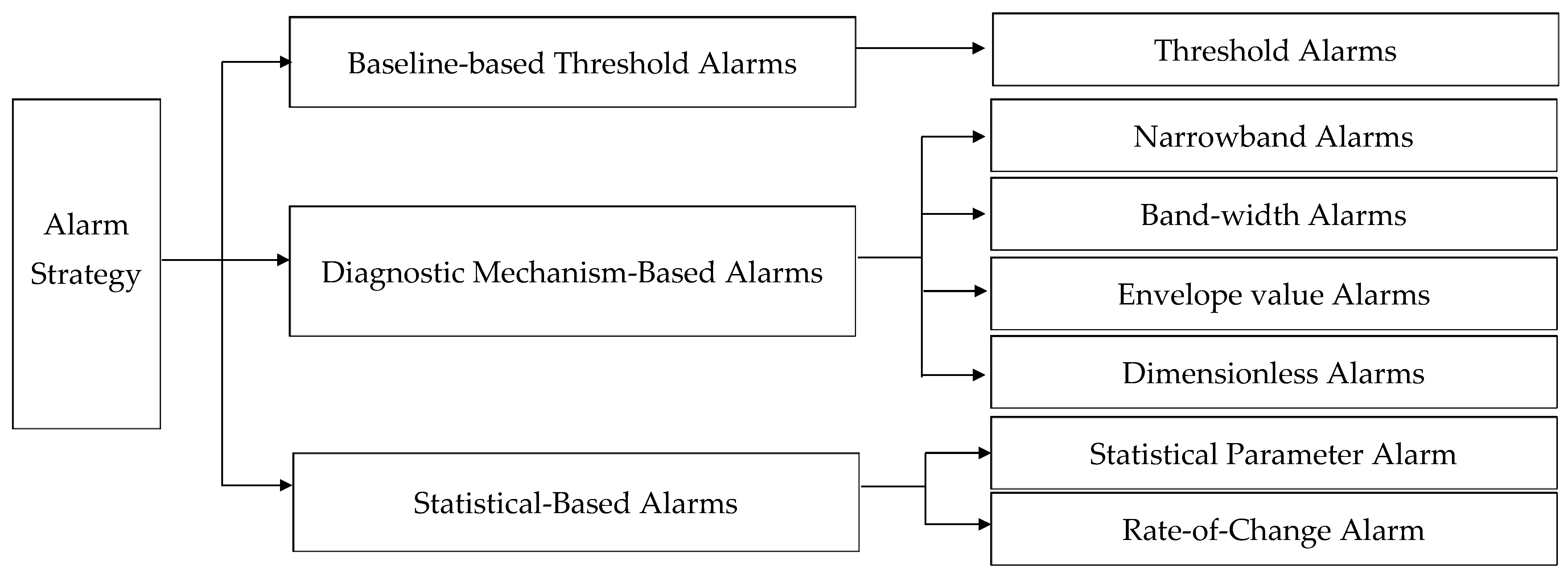
| Alarm Method Type | Applicable Scope |
|---|---|
| Threshold Alarms | Vibration full-frequency amplitude alarms and process value alarms are widely applied in industrial equipment condition monitoring scenarios. |
| Narrowband Alarms | Precision alarms are designed for specific fault characteristic frequencies, exhibiting heightened sensitivity to signals with clearly identified fault occurrence frequencies. |
| Band-width Alarms | An amplitude alarm for a specific frequency band in the vibration frequency domain, sensitive to characteristic signals with known fault occurrence frequencies |
| Envelope value alarm | An amplitude alarm for specific frequency bands within the vibration frequency domain after envelope detection processing, particularly suitable for early warning scenarios in bearing and gear faults. |
| Dimensionless alarms | Alarms designed based on dimensionless amplitude domain parameters, highly suitable for early warning scenarios of bearing and gear failures. |
| Three-sigma alarm | Statistical analysis of vibration characteristic values within a specified time window calculates the mean and variance, defining the normal vibration range as “mean ± 3σ”. Abnormal vibrations are identified by detecting measurement signals exceeding this range, thereby providing early warning of potential equipment faults. |
| Rate-of-Change Alarm | The rate of change is calculated by determining the magnitude of variation in vibration parameters over a defined time period. When this rate of change exceeds a pre-set “normal change rate threshold”, the system triggers an anomaly alarm. |
| Monitoring Scope | Data Type | Without Edge Computing | With Edge Computing | Post-Implementation Data Reduction |
|---|---|---|---|---|
| 200 devices | Data volume (kB) | 4,608,000 | 82,425 | 98.21% |
| Transmission bandwidth (Kbps) | 20.48 | 0.358 | 98.25% | |
| Monitoring interval (s) | 30 | 3 | 90% |
Disclaimer/Publisher’s Note: The statements, opinions and data contained in all publications are solely those of the individual author(s) and contributor(s) and not of MDPI and/or the editor(s). MDPI and/or the editor(s) disclaim responsibility for any injury to people or property resulting from any ideas, methods, instructions or products referred to in the content. |
© 2025 by the authors. Licensee MDPI, Basel, Switzerland. This article is an open access article distributed under the terms and conditions of the Creative Commons Attribution (CC BY) license.
Share and Cite
Chen, L.; Cui, L.; Zou, D.; Wang, Y.; Wang, P.; Shi, W. Research on Edge Feature Extraction Methods for Device Monitoring Based on Cloud–Edge Collaboration. Vibration 2026, 9, 2. https://doi.org/10.3390/vibration9010002
Chen L, Cui L, Zou D, Wang Y, Wang P, Shi W. Research on Edge Feature Extraction Methods for Device Monitoring Based on Cloud–Edge Collaboration. Vibration. 2026; 9(1):2. https://doi.org/10.3390/vibration9010002
Chicago/Turabian StyleChen, Lei, Longxin Cui, Dongliang Zou, Yakun Wang, Peiquan Wang, and Wenxuan Shi. 2026. "Research on Edge Feature Extraction Methods for Device Monitoring Based on Cloud–Edge Collaboration" Vibration 9, no. 1: 2. https://doi.org/10.3390/vibration9010002
APA StyleChen, L., Cui, L., Zou, D., Wang, Y., Wang, P., & Shi, W. (2026). Research on Edge Feature Extraction Methods for Device Monitoring Based on Cloud–Edge Collaboration. Vibration, 9(1), 2. https://doi.org/10.3390/vibration9010002