Article

Experimental Study of Air Curtain Smoke Confinement and Vehicle Obstruction Effects in a Modular Scaled Tunnel Model


1
Department of Public Safety and Fire Science, Chia Nan University of Pharmacy and Science, Tainan City 717301, Taiwan
2
Department of Safety, Taiwan Police College, Taipei City 116078, Taiwan
3
Mechanical Engineering Department, CECI Engineering Consultants, Inc., Taipei City 114710, Taiwan
4
Department of Safety, Health and Environmental Engineering, National Kaohsiung University of Science and Technology, Kaohsiung City 824005, Taiwan
*
Author to whom correspondence should be addressed.
Fire 2026, 9(4), 162; https://doi.org/10.3390/fire9040162
Submission received: 8 March 2026 / Revised: 6 April 2026 / Accepted: 10 April 2026 / Published: 12 April 2026

Abstract

Air curtain systems have been proposed as a supplementary smoke control strategy for vehicle tunnels, particularly where structural constraints limit the installation or upgrading of conventional ventilation systems. However, most previous studies rely on numerical simulations or fixed experimental facilities, while flexible experimental platforms and the influence of vehicle obstruction on smoke behavior remain less explored. This study experimentally investigates the smoke confinement performance of an air curtain using a 1:18 modular detachable scaled vehicle tunnel model. The modular configuration enables flexible assembly and adjustment of the experimental setup for different test conditions. A series of laboratory experiments was conducted using a liquefied petroleum gas (LPG) burner to simulate a vehicle fire. Temperature measurements and smoke visualization were performed under different air curtain jet velocities and vehicle obstruction conditions to analyze the interaction between the air curtain jet and buoyancy-driven smoke flow. The results show that the air curtain significantly restricts the upstream propagation of hot smoke and modifies the thermal field inside the tunnel. When the jet velocity reached approximately 5 m/s, the temperature in the protected region decreased by about 25–35% compared with the case without an air curtain. In addition, the presence of vehicle models altered the airflow structure and increased heat accumulation in the middle region of the tunnel cross-section. These results demonstrate that the proposed modular tunnel model provides a reliable experimental platform for tunnel fire research and highlights the importance of considering vehicle obstruction effects in tunnel smoke control studies.

1. Introduction

1.1. Tunnel Development in Mountainous Regions

Taiwan consists largely of mountainous and hilly terrain, where steep slopes and irregular landforms frequently disrupt direct transport routes [1,2,3]. To overcome these geographic constraints, vehicle tunnels have become essential components within the national transportation network [4,5]. Their ability to shorten travel distance and eliminate terrain-related bottlenecks has made them indispensable for supporting regional mobility, economic development, and daily commuting activities [6].
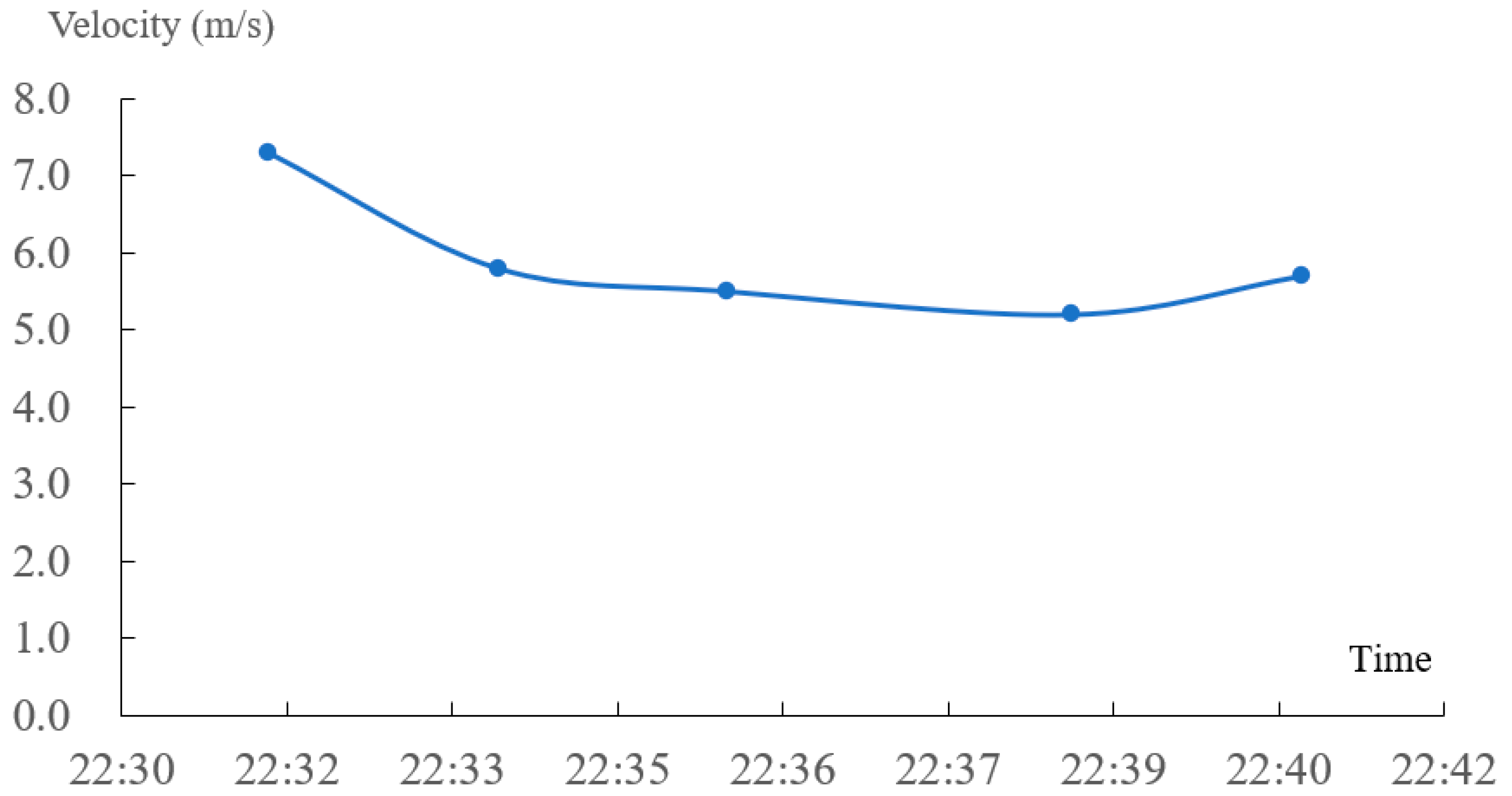
Field observations from mountain tunnel environments indicate that relatively high longitudinal airflow may occur under certain operating conditions. In the present study, Figure 1 presents a representative measurement case obtained on 14 June 2022 in the Caopu-Senyong Tunnel (southern Taiwan) show velocities of up to approximately 7 m/s [7]. Such airflow conditions can significantly influence smoke propagation during fire events [8]. Over time, the continuous expansion of transportation demands has further increased tunnel utilization. The high frequency of tunnel operation, combined with the limited availability of alternative routes, underscores the necessity of ensuring that tunnels remain safe under fire scenarios [9,10]. In many mountainous corridors, these tunnels also serve as critical emergency links; any interruption caused by fire events can have extensive social and economic consequences [11,12]. These factors highlight the need to improve understanding of tunnel fire phenomena and to develop more effective fire protection strategies [13].
Furthermore, the structural environment of mountain tunnels often limits opportunities for large-scale upgrades once construction is complete. Electrical and mechanical systems are typically embedded within narrow service spaces, making retrofits difficult [14,15,16]. Consequently, research must explore approaches that offer performance benefits without requiring significant structural alterations, thereby supporting the long-term resilience of these crucial transportation facilities [17,18].

1.2. Fire Load Characteristics and Associated Risks in Vehicle Tunnels

Vehicle tunnels contain substantial fire loads due to vehicle fuel, combustible components, and transported materials [19,20]. When a fire occurs, the confined geometry facilitates the rapid accumulation of hot gases, while the longitudinal configuration of vehicle tunnels often promotes smoke propagation through buoyancy-driven flow and ventilation-induced movement. These combined effects can quickly generate hazardous temperatures and severe visibility reduction, posing serious threats to evacuation safety and firefighting operations [21,22,23].
Many vehicle tunnels, particularly older ones, have limited space for installing or upgrading large mechanical smoke extraction systems. Electrical and ventilation facilities are often integrated within restricted service spaces, making large-scale retrofits technically difficult and economically demanding. Consequently, even moderate vehicle fires may escalate into high-risk situations that exceed the original design capacity of existing ventilation systems.
These limitations highlight the importance of developing supplementary smoke control strategies that can improve safety conditions without requiring major structural modifications [24]. Such approaches are particularly valuable for existing vehicle tunnels where installing additional ventilation infrastructure is difficult. Therefore, alternative smoke management technologies capable of providing localized smoke confinement and thermal protection have attracted increasing attention in tunnel fire safety research [25,26].

1.3. Research Need for Practical Smoke Control Strategies and Scaled Experimental Models

Computational fluid dynamics (CFD) tools, such as the Fire Dynamics Simulator (FDS), are widely used to study smoke propagation and thermal behavior in tunnel fires, providing insight into flow characteristics and mitigation strategies [27,28]. However, numerical predictions require experimental validation, particularly for complex smoke–flow interactions, turbulence, and stratification. Scaled physical models therefore provide valuable data for validating simulations and supporting engineering applications [29,30].
Conventional scaled tunnel models are typically fixed structures designed for long-term laboratory use. Although they provide good geometric similarity, they require large space, involve relatively high costs, and offer limited flexibility for modifying experimental configurations [31,32,33]. These limitations restrict experimental adaptability and long-term research continuity.
To address these issues, the present study proposes a modular detachable scaled tunnel model that can be easily assembled, adjusted, and relocated. This configuration enables repeatable experiments under different fire locations, ventilation conditions, and air-curtain parameters, while supporting smoke visualization and temperature measurements.
Compared with conventional models, the modular design provides greater flexibility for parametric studies and facilitates systematic investigation of air curtain performance under varying conditions. This approach contributes to more adaptable and engineering-oriented research in tunnel fire safety [34,35].
The primary objective of this study is to evaluate the feasibility and applicability of the modular tunnel experimental approach for investigating smoke confinement behavior relevant to tunnel fire safety. Limited field observations and previous studies are used as reference bases to examine whether the observed experimental trends are reasonably consistent with real tunnel conditions. The main contributions of this study can be summarized as follows:
(1)
Development of a modular detachable scaled tunnel model that provides a flexible experimental platform for tunnel fire studies;
(2)
Experimental evaluation of air curtain smoke confinement performance under controlled fire conditions;
(3)
Investigation of the influence of vehicle obstruction on temperature distribution and smoke behavior inside the tunnel model.

1.4. Application of Air Curtain Systems in Vehicle Tunnel Fire Scenarios

Air curtain systems generate a high-momentum planar jet that forms a virtual barrier, restricting the spread of smoke and hot gases [36,37]. In tunnel fire scenarios, a downward air curtain can interact with the buoyant plume and longitudinal airflow, reducing smoke propagation and thermal exposure in protected regions.
Previous studies have investigated air curtain performance using both numerical and experimental approaches. Gao et al. [38] showed that smoke confinement strongly depends on jet velocity, curtain thickness, and installation location, while Ji et al. [39] demonstrated that air curtains influence smoke layer stability, temperature distribution, and visibility under different ventilation conditions. Additional studies have examined thermal shielding and system integration, indicating that appropriate air curtain configurations can reduce temperature rise and heat flux, limit smoke penetration, and improve overall smoke management performance [40,41,42,43,44].
Although these studies demonstrate the effectiveness of air curtain systems, most rely on numerical simulations or fixed experimental facilities, which limit experimental flexibility and restrict the investigation of complex configurations such as vehicle obstruction effects [45,46,47].
Therefore, there is a need for experimental studies using flexible and reconfigurable tunnel models to better represent realistic conditions. The present study addresses this gap by developing a modular detachable scaled tunnel model and investigating the combined effects of air curtain operation and vehicle obstruction on smoke behavior.

2. Research Methodology

2.1. Principles of Air Curtain Systems in Vehicle Tunnel Fire Scenarios

Scaled physical models provide an essential platform for validating smoke control strategies by reproducing key fluid-dynamic behaviors under manageable laboratory conditions [48,49]. The present study employs a 1:18 modular detachable tunnel model designed to preserve the dominant force balance governing smoke transport, particularly buoyancy effects and ventilation-driven flow. The model is constructed to allow flexible adjustment of tunnel length, internal configuration, and measurement layout, offering a level of versatility not achievable with traditional fixed tunnel structures. This flexibility supports a wide range of experiments while avoiding the spatial and operational limitations associated with full-length permanent installations.
To ensure meaningful correspondence with real tunnel behavior, the experimental design follows established scaling principles that emphasize Froude-number similarity for fire-induced smoke flows. To preserve the dominant buoyancy–inertia balance governing smoke movement in tunnel fires, the Froude number is expressed as [50,51]:
F r = U g H
where U is the characteristic flow velocity (m/s), g is the gravitational acceleration (m/s2), and H is the characteristic tunnel height (m).
Based on this scaling principle, appropriate relationships between heat release rate, characteristic length, and air curtain jet parameters were maintained in the experimental design. This approach enables the scaled model to reproduce key flow phenomena observed in real tunnel fires, including smoke stratification beneath the ceiling, plume rise behavior, and smoke-layer development [52,53]. Combined with multi-point temperature measurements and smoke visualization techniques, the modular tunnel model enables systematic evaluation of air curtain performance and provides empirical data for benchmarking CFD simulations and supporting future engineering applications [54,55]. Temperature was assumed to be scale-independent because the experiments focus on temperature differences and flow behavior rather than absolute temperature similarity.
In this study, the air curtain flow is scaled based on Froude similarity to preserve the dominant buoyancy–inertia balance in fire-induced flows. Although Reynolds number similarity and thermal radiation scaling cannot be fully satisfied, the flow remains within the turbulent regime and is governed primarily by buoyancy-driven dynamics, allowing key phenomena such as plume rise, stratification, and air curtain interaction to be reasonably reproduced.
The plenum chamber functions as a flow-conditioning unit that stabilizes pressure and produces a uniform planar jet, ensuring consistent air curtain performance.
Temperature is treated as scale-independent since the analysis focuses on relative variations rather than absolute values. These assumptions introduce limitations that should be considered when extrapolating the results to full-scale conditions.

2.2. Scaled Tunnel Model Configuration

The experimental program was conducted using a 1:18 scaled vehicle tunnel model developed with a modular detachable configuration. The scale ratio was selected based on representative geometric parameters of real vehicle tunnels while also considering model fabrication, observation requirements, and future expandability. The 1:18 scale corresponds to a widely available commercial vehicle model scale, enabling realistic placement of vehicle models for fire source configuration, smoke observation, and evacuation scenario simulation. At the same time, this scale preserves sufficient geometric detail while maintaining manageable laboratory space requirements.
The tunnel model was constructed using aluminum alloy frames and calcium silicate boards with high thermal resistance. The calcium silicate boards have a thickness of 10.0 mm, providing sufficient thermal insulation during fire experiments. The module connections were secured using mechanical fasteners and high-temperature-resistant sealants to ensure airtightness and structural stability. This design minimizes air leakage at the joints and maintains consistent airflow conditions during the experiments.
To ensure that the scaled experiments maintain physically meaningful relationships with real vehicle tunnel fire scenarios, similarity principles were applied in the experimental design. These scaling relationships were used to maintain appropriate correspondence between characteristic parameters such as length, velocity, time, and heat release rate in the model and the prototype tunnel conditions. The scaling relationships adopted in this study are summarized in Table 1 [56]. The external views and structural details of the tunnel model are shown in Figure 2.
The cross-sectional geometry of the model follows representative proportions of vehicle tunnels. A width-to-height ratio of approximately 2:1 was adopted to reproduce typical tunnel cross-section characteristics and to facilitate the realistic simulation of buoyancy-driven smoke stratification beneath the tunnel ceiling. Based on a prototype tunnel with a cross section of 11.16 m in width and 5.04 m in height, the scaled model dimensions were determined as 0.62 m in width and 0.28 m in height. This size provides sufficient space for installing the fire source apparatus, vehicle models, and measurement instruments while allowing convenient installation within the experimental facility and clear visualization of smoke flow behavior.
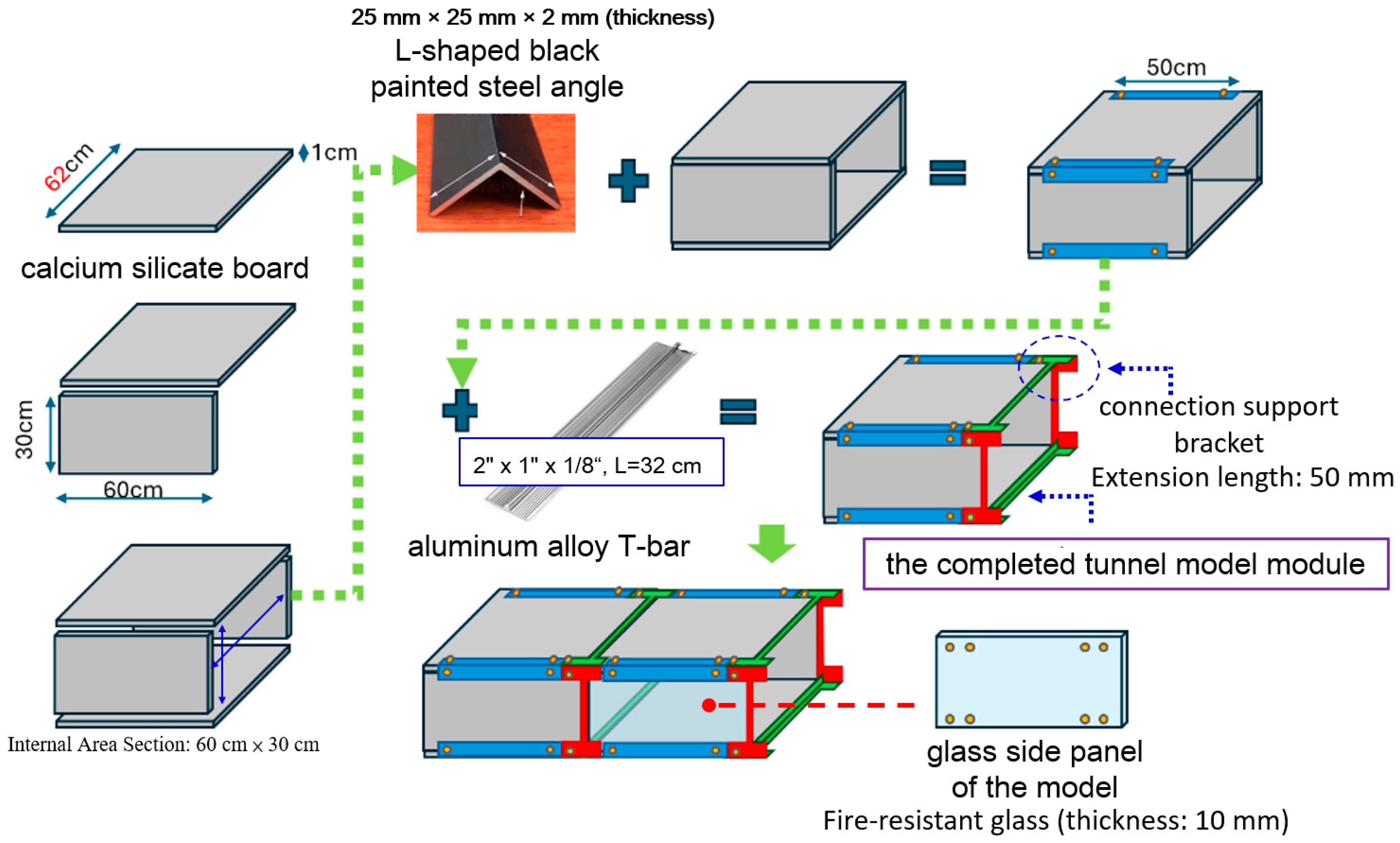
The tunnel model adopts a modular detachable structure, in which each section is fabricated as an independent unit that can be easily assembled or removed. Transparent observation panels were installed to facilitate smoke visualization, and reinforced connection joints ensure structural stability and airtight alignment between modules. In the fire-source region, aluminum alloy T-sections were used at module joints to improve sealing performance and structural strength. The modular configuration allows the tunnel length to be adjusted according to experimental requirements and provides flexibility for repeated experimental campaigns and potential future extensions. Mounting interfaces were integrated into the model floor and sidewalls for installing the fire source, air curtain discharge nozzle, and measurement instruments, while ventilation openings at both ends allow airflow control when needed. The dimensioning of components and the assembly method of the modular tunnel model are illustrated in Figure 3, providing detailed geometric information and installation guidance.

3. Experimental Setup of the Modular Detachable Tunnel Model

3.1. Characteristics of the Modular Tunnel Model

The experimental results demonstrate that the modular detachable tunnel model can reproduce key thermal and smoke dispersion behaviors observed in vehicle tunnel fire scenarios. The measured temperature distributions and smoke visualization results are consistent with those reported in previous studies using conventional fixed tunnel models, indicating that the modular configuration captures the essential physical processes governing smoke movement and heat transfer.

3.1.1. Reliability of the Modular Tunnel Model

The modular tunnel model provides improved flexibility and operational efficiency compared with conventional fixed tunnel models. The main advantages are summarized as follows:
(1)
Flexible tunnel length configuration
The modular structure allows the tunnel length and configuration to be adjusted according to experimental requirements.
(2)
Improved portability and mobility
Each module can be easily transported and assembled, enabling use in different experimental environments.
(3)
Efficient storage and space management
The tunnel model can be disassembled when not in use, reducing space requirements.
(4)
Flexible experimental scenario configuration
Different experimental conditions can be achieved by rearranging modules.
(5)
Reduced experimental cost and reusability
The modular design allows repeated use in multiple experimental studies.
(6)
Potential for educational and demonstration applications
The model can also serve as a demonstration platform for tunnel fire safety.

3.1.2. Practical Considerations for Modular Tunnel Experiments

Despite its flexibility, several practical considerations should be addressed. Proper alignment and sealing between modules are required to maintain airflow consistency and experimental reliability. Measurement instruments must be carefully repositioned and calibrated after each assembly to ensure data consistency.
In addition, the integrity of module joints should be regularly inspected to prevent airflow leakage that may influence smoke behavior. Environmental conditions, such as background airflow, should also be controlled to maintain stable experimental conditions.

3.2. Fire Source and Ventilation Conditions

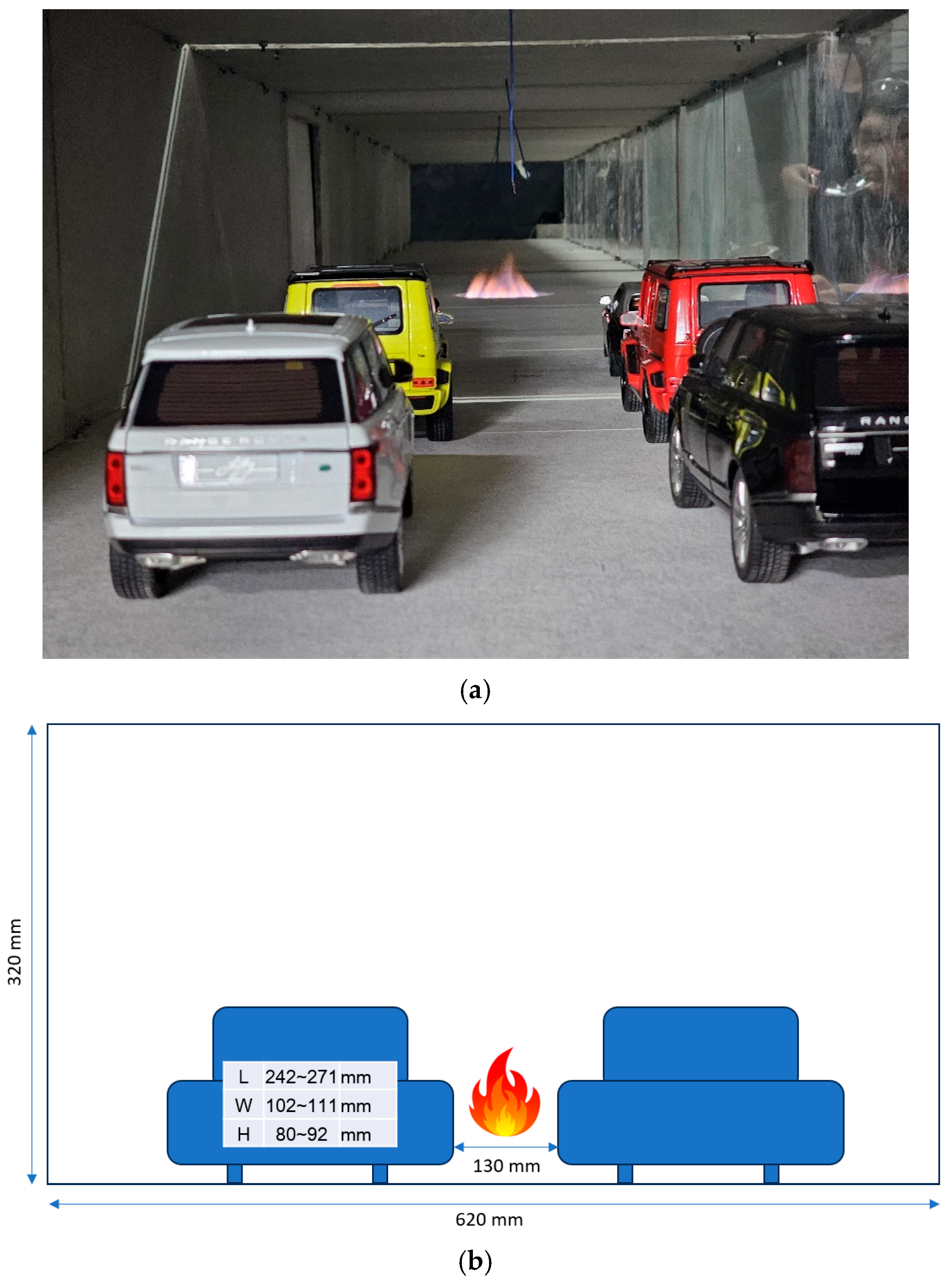
A liquefied petroleum gas (LPG) burner was adopted as the primary fire source in this study because it provides stable, controllable, and repeatable heat release conditions suitable for comparative experimental investigations [57,58]. Compared with liquid fuels such as gasoline, LPG offers advantages in terms of environmental friendliness, operational safety, and experimental stability, particularly for laboratory-scale tunnel fire experiments conducted in indoor environments. The burner output was regulated using a calibrated pressure-control system to maintain consistent heat release during each test. This configuration enables the scaled model to reproduce thermal and smoke behaviors representative of the early stages of vehicle tunnel fires while avoiding the variability often associated with solid-fuel combustion. During preliminary tests, 1:18-scale vehicle models with detailed geometric features were placed inside the tunnel to represent typical traffic conditions. Compared with simplified block-type models commonly adopted in previous studies, these models provide a more realistic representation of vehicle obstruction effects on airflow and smoke movement. The burner operation and experimental configuration during the preliminary tests are illustrated in Figure 4.
To visualize smoke movement within the tunnel model, smoke generated by burning sandalwood powder was used [59,60]. This approach produces fine and stable smoke particles that remain suspended in the airflow and effectively represent smoke transport behavior during fire scenarios. The generated smoke is particularly suitable for laser sheet illumination, enabling clear observation of smoke propagation paths, stratification behavior, and layer interface movement. Compared with chemical smoke generators or artificial smoke agents, sandalwood powder is a natural material that burns at relatively low temperatures and does not produce harmful gases or corrosive residues. Consequently, it provides an environmentally friendly and safe method for smoke visualization while maintaining stable experimental conditions.
All experiments were conducted under quiescent ambient conditions without externally imposed longitudinal airflow in order to isolate the interaction between the fire plume and the air curtain jet. This approach eliminates the influence of external longitudinal ventilation and allows a clearer examination of buoyancy-driven smoke flow.
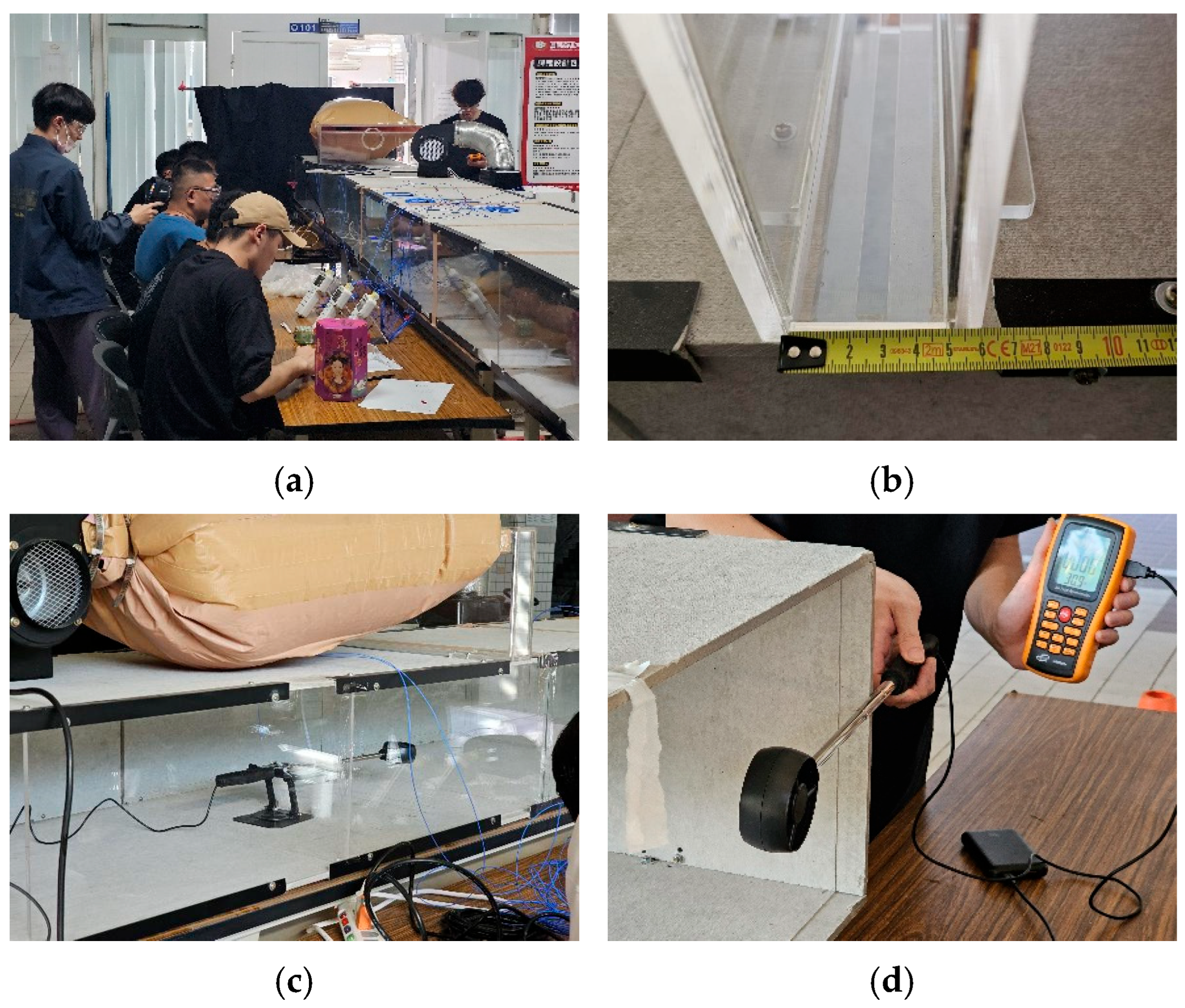
The background airflow inside the tunnel model was measured using an anemometer prior to the experiments and confirmed to be approximately 0.0 m/s. During the experiments, personnel conducted temperature measurements and data recording while monitoring the air curtain system and tunnel flow conditions. The experimental environment, including the air curtain outlet opening, plenum chamber configuration, outlet velocity measurements, and the tunnel interior under undisturbed ambient conditions, is shown in Figure 5.
Figure 5c illustrates the calibration of the air curtain outlet velocity. Measurements were conducted at multiple locations along the discharge opening to verify the uniformity and stability of the jet velocity before each experiment.
Figure 5d shows the tunnel interior under quiescent conditions prior to ignition. The background airflow velocity was confirmed to be approximately 0.0 m/s, ensuring that the experimental results were not influenced by unintended ambient airflow.
The fire source, air curtain system, and measurement devices were arranged along the tunnel axis in a fixed configuration. The fire source was positioned at the designated location inside the tunnel, while the air curtain system was installed above the control section. Temperature sensors were distributed along the longitudinal direction of the tunnel to capture the thermal response of different regions. This arrangement ensures consistent data acquisition and enables systematic comparison between different experimental conditions.

3.3. Air Curtain System and Jet Configuration

The air curtain system consisted of a compact fan connected to a plenum chamber and a linear slot-type discharge nozzle installed above the designated control section of the tunnel model. The nozzle generated a vertically downward planar jet intended to form a high-momentum air barrier that interacts with the buoyant smoke plume inside the tunnel. The jet velocity was adjusted by controlling the fan rotational speed, enabling systematic evaluation of its influence on smoke confinement and thermal shielding performance. The installation height and location of the air curtain were selected to represent practical engineering scenarios, such as localized smoke control near evacuation exits or protected zones in vehicle tunnels.
The interaction between the air curtain jet and the buoyant smoke plume can be interpreted using the momentum ratio, defined as Equation (2) [61,62]:
J = ρ a · U a 2 ρ s · U s 2
where Ua is the air curtain jet velocity (m/s), Us is the characteristic smoke velocity (m/s), and ρ a and ρ s are the air and smoke densities (kg/m3), respectively. For buoyancy-driven tunnel smoke flows, this relationship can be further approximated by Equation (3):
J = U a 2 g · H
where g is the gravitational acceleration (m/s2), and H is the characteristic tunnel height (m). In general, a larger value of J indicates that the jet momentum is sufficient to resist buoyancy-driven smoke movement, thereby improving smoke confinement.
In this study, the classification of weak and strong air curtain conditions is based on the relative magnitude of the momentum ratio (J). When the jet momentum is insufficient to counteract buoyancy effects, the air curtain is considered weak, whereas higher jet momentum capable of suppressing smoke penetration is categorized as a strong condition. The selected velocities of 3 m/s and 5 m/s correspond to representative weak and strong jet conditions, respectively, based on previous experimental studies. Although no universally accepted threshold exists, the classification adopted in this study follows a performance-based interpretation consistent with previous literature.
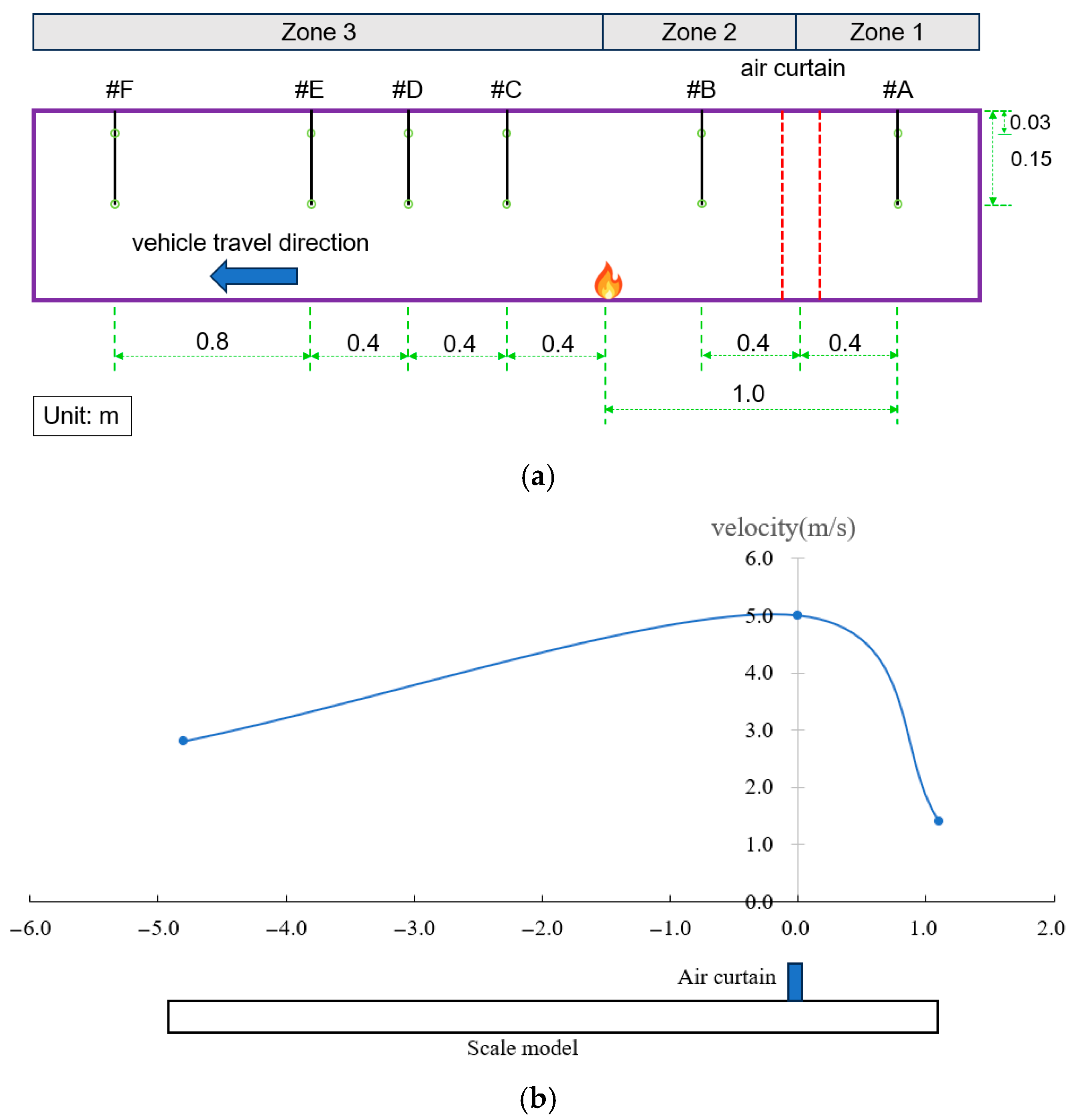
Prior to the main experiments, preliminary tests were conducted to evaluate the outlet velocity distribution and uniformity of the air curtain jet. The slot opening of the discharge nozzle was set to 2.0 cm, and air velocity measurements were taken at multiple positions along the outlet using an anemometer to verify the jet discharge characteristics and flow-field uniformity [63]. The fan rotational speed and nozzle configuration were adjusted to obtain a stable and controllable air curtain flow suitable for repeated experiments. The resulting air velocity values, measured at representative locations, are summarized in Table 2 and illustrated in Figure 6b. The selected jet velocities (3 m/s and 5 m/s) represent typical operational ranges used in previous tunnel air curtain studies and allow comparison between weak and strong jet momentum conditions.
Air velocity measurements were conducted at three representative locations, including the air curtain outlet and the upstream and downstream sections of the tunnel, to characterize the airflow conditions. Due to the limited number of measurement points, the data are not intended to represent a detailed spatial distribution, but rather to provide representative values of the flow conditions in the experimental setup. Future studies will incorporate more advanced and spatially resolved velocity measurement techniques to provide a more comprehensive characterization of the flow field.
In addition, calibration procedures were performed for the temperature and airflow measurement systems to ensure reliable experimental data. Thermocouples, anemometers, and the data acquisition system were tested for synchronization and measurement accuracy, while alignment tests were conducted for the laser sheet visualization system to confirm the visibility and scattering characteristics of the laser sheet in smoke-laden flow conditions. The experimental site conditions during velocity measurement and system adjustment are shown in Figure 5.

3.4. Instrumentation and Measurements

Several instruments were employed to observe and measure the influence of the air curtain on smoke flow and heat transfer in the scaled vehicle tunnel model. A single-burner LPG stove (manufactured in Taiwan) was used as the fire source to simulate a tunnel fire. The burner provided a stable and controllable heat source, and the combustion intensity was regulated using a gas regulator to produce an approximately constant heat release rate (HRR). The burner operates with liquefied petroleum gas (LPG) at 2.8 kPa, with a maximum gas consumption corresponding to approximately 4.5 kW, and uses a 2.8 kPa regulator (Q = 1 kg/h). The burner dimensions are 27.5 cm (width) × 37 cm (depth) × 16 cm (height, including the support frame).
Based on the scaling relationships summarized in Table 1, the heat release rate between the prototype and the scaled model follows the Froude scaling principle, as shown in Equation (4):
Q ˙ m = Q ˙ p λ 5 / 2
where Q ˙ m is the heat release rate of the model fire (kW), Q ˙ p is the prototype heat release rate (kW), and λ is the geometric length scale ratio. According to this scaling relationship, the burner output used in the experiments corresponds to a prototype heat release rate of approximately 6.2 MW, which is representative of the fire load associated with a passenger vehicle fire in a vehicle tunnel [63,64]. This value is consistent with previously reported heat release rates for passenger vehicle fires in tunnel environments and is supported by experimental studies such as Yu et al. [63] and PIARC [64].
Air velocity inside the tunnel model was measured using an anemometer (model Wsensor GM8902+, Shenzhen, China), which was used to determine both the air curtain jet velocity and the background airflow within the tunnel. These measurements were used to verify that the air curtain achieved the intended jet velocity and to evaluate the influence of airflow on smoke confinement and heat transfer. Temperature measurements were obtained using thermocouples installed at multiple vertical and longitudinal locations in the tunnel model. A total of six measurement locations were arranged along the tunnel, with two thermocouples installed at each location.
For clarity, the tunnel is divided into three regions (Zones 1–3), as defined in Figure 6. The sensors were positioned 3.0 cm below the tunnel ceiling and at the tunnel centerline to capture the ceiling-layer temperature and the temperature within the main flow region. The arrangement of the thermocouples is illustrated in Figure 6a. The measurement locations represent different regions along the tunnel axis, including upstream, fire, and downstream sections, allowing systematic evaluation of temperature variation along the flow direction. At each location, thermocouples were installed near the ceiling and at the tunnel centerline to capture the vertical temperature distribution.
The experimental process was recorded using a high-definition camera (GoPro Hero 10 Black, GoPro, Inc., San Mateo, CA, USA) mounted on a tripod to capture smoke movement, flame development, and airflow patterns. Air velocity inside the tunnel model was measured using an anemometer (Wsensor GM8902+), which was used to determine representative average velocities under steady-state conditions. Due to flow disturbances induced by combustion, instantaneous velocity measurements were not stable; therefore, averaged values were adopted.
Temperature data were recorded using a data acquisition system (TES 1384, TES Electrical Electronic Corp., Taipei, Taiwan) to capture the transient thermal response during the experiments. The temperature field was observed to gradually reach a quasi-steady state after the initial development period.
To ensure measurement reliability, all temperature and airflow sensors were calibrated prior to the experiments. The thermocouples have an accuracy of approximately ±1.5 °C within the operating temperature range. Repeated preliminary tests showed consistent temperature evolution trends, indicating that the measurements were stable and reproducible.
The main experiments were conducted under identical operating conditions to ensure consistency of the results. Although repeated tests under each condition were limited due to time and resource constraints, preliminary repeated trials confirmed that the overall temperature trends and smoke behavior were reproducible. Therefore, the results presented in this study are considered representative for comparative analysis rather than for statistical evaluation.
Although a detailed uncertainty analysis was not performed in the present study, the measurement accuracy and repeatability indicate that the experimental data are sufficiently reliable for comparative analysis. A comprehensive uncertainty analysis will be considered in future work.

4. Results and Discussion

4.1. Validation of the Modular Tunnel Model

Preliminary tests were conducted under the maximum fire source condition to examine the baseline temperature distribution in the scaled vehicle tunnel model and to verify the reliability of the experimental setup.
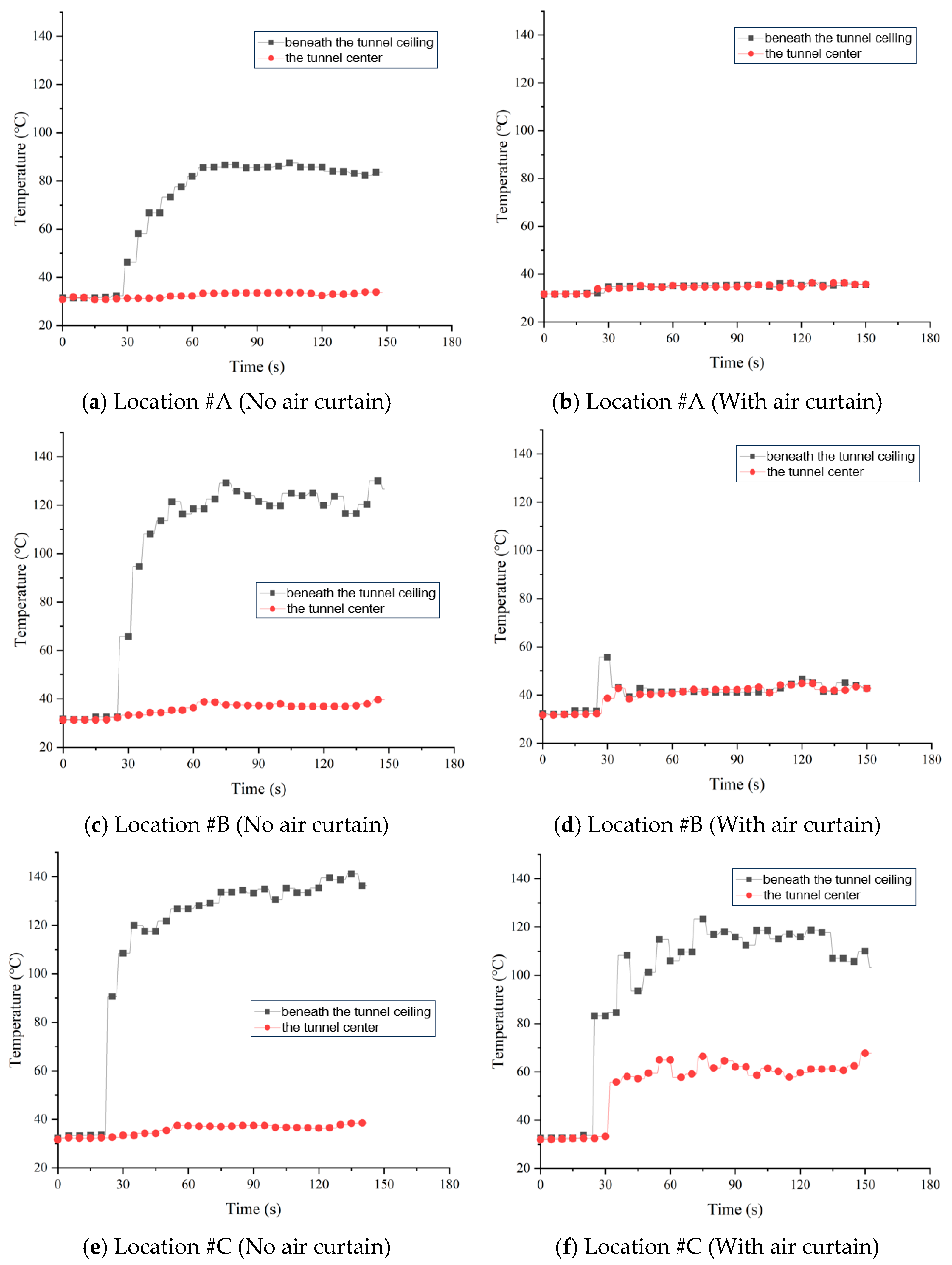
Figure 7 presents the temporal evolution of temperature at representative measurement locations (A, B, and C) under conditions with and without the air curtain. As shown in the figure, the temperature increases rapidly after ignition and gradually approaches a quasi-steady state after approximately 60 s.
In the absence of the air curtain, higher temperatures are observed due to the unrestricted propagation of hot gases along the tunnel ceiling. When the air curtain is activated, the temperature at the upstream location (A) is significantly reduced, indicating that the air curtain effectively restricts the upstream spread of smoke. The comparison further confirms that the air curtain modifies the thermal field and improves thermal protection in the upstream region.
When the air curtain was not activated, the highest temperatures measured at points A, B, and C were 85.0 °C, 130.0 °C, and 139.2 °C, respectively. The results indicate that buoyancy-driven hot gases rose above the fire source and propagated along the tunnel ceiling, forming a typical ceiling smoke layer that gradually spread toward both directions of the tunnel.
When the air curtain was activated under the same fire condition, the temperature distribution changed significantly. The maximum temperatures at measurement points A and B decreased to 35.0 °C and 48.0 °C, respectively, while the maximum temperature at point C was 122.4 °C. The reduction in temperature near the upstream region indicates that the downward air curtain jet effectively restricted the upstream propagation of hot gases and redirected the smoke flow toward the downstream region. This behavior demonstrates the capability of the air curtain to modify the thermal field inside the tunnel and to reduce heat exposure in the protected area.
The temporal evolution of temperature during the preliminary tests also showed that the temperature increase gradually stabilized after approximately 60 s, indicating that the thermal field approached a quasi-steady condition. Similar temperature growth behavior has been reported in previous reduced-scale tunnel fire experiments, where the ceiling temperature rapidly increases after ignition and stabilizes as the smoke layer develops beneath the tunnel ceiling.
The agreement in both temperature magnitude and evolution trend suggests that the modular tunnel model used in this study can reproduce the fundamental thermal characteristics observed in conventional fixed tunnel experiments. This consistency provides confidence in the reliability of the measured temperature data and supports the use of the present experimental model for the subsequent analysis of temperature distribution and smoke confinement performance.

4.2. Temperature Distribution in the Tunnel Model with Vehicle Obstruction

To examine the influence of air curtain operation and vehicle obstruction on the thermal field inside the tunnel model, temperature measurements were conducted under four experimental scenarios. These cases include baseline conditions without an air curtain, air curtain cases with different jet velocities, and a configuration with vehicle models placed inside the tunnel.
(A)
Baseline condition: No air curtain and no vehicle model
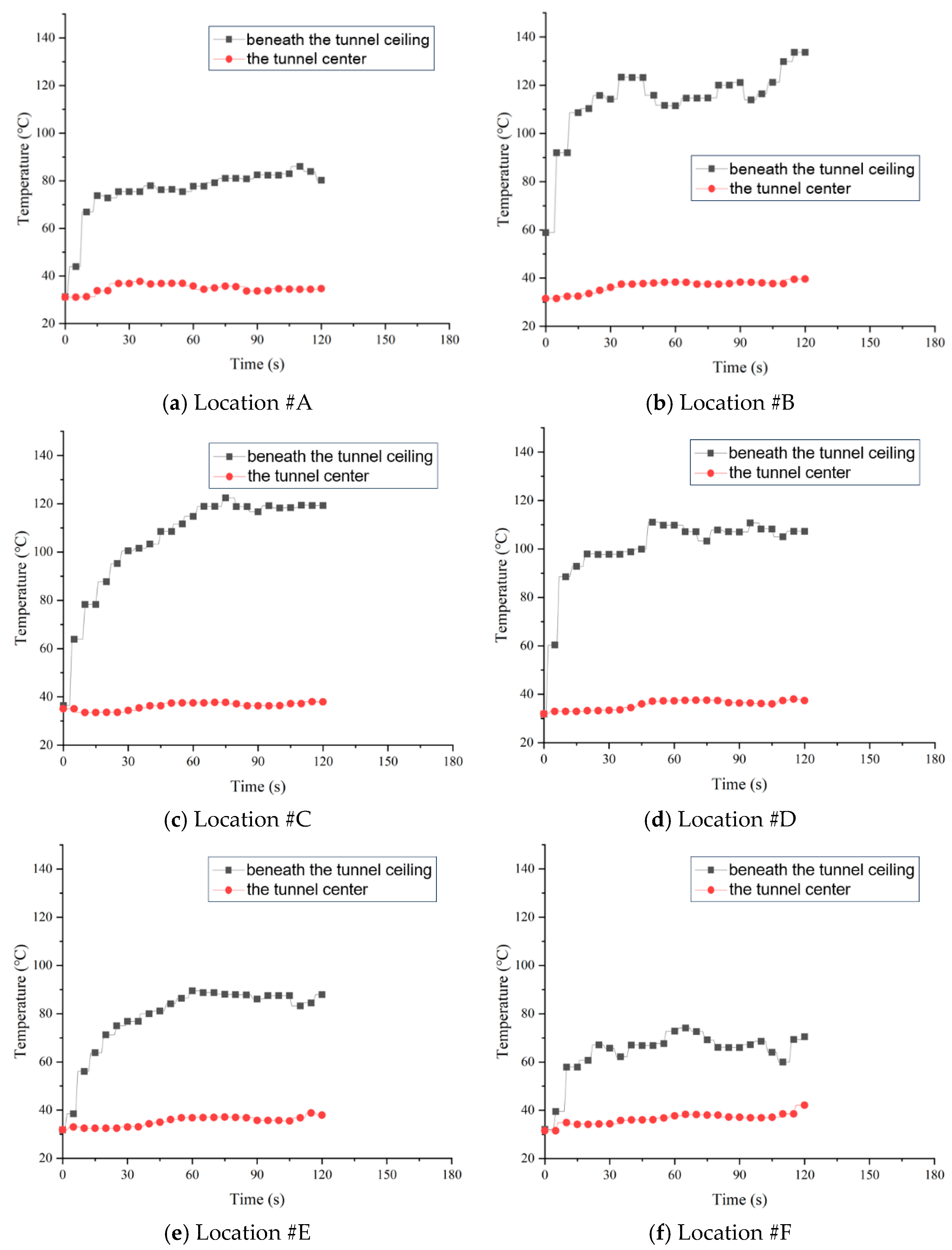
Under the baseline condition without activating the air curtain and without placing vehicle models inside the tunnel, the measured temperature distribution reflects the natural convection and buoyancy-driven smoke movement generated by the fire source. Figure 8 shows the temperature distribution for Case 1 (air curtain off and no model vehicles inside the tunnel). After ignition, the temperature increased rapidly and approached a quasi-steady condition after approximately 60 s. At measurement point A, the ceiling temperature reached 87.1 °C while the center temperature was 39.6 °C. At point B, the ceiling temperature increased to 134.2 °C while the center temperature remained about 39.5 °C. At point C, the ceiling temperature was 122.6 °C and the center temperature was 39.1 °C, indicating that hot gases rose above the fire source and accumulated beneath the tunnel ceiling.
The temperature decreased gradually with increasing distance from the fire source. At measurement points D, E, and F, the ceiling temperatures were 114.3 °C, 90.5 °C, and 75.7 °C, respectively, while the center temperatures remained close to 38–39 °C. These results show that the hot smoke layer was mainly confined near the tunnel ceiling, while the middle region remained relatively cool due to limited mixing. Overall, in the absence of an air curtain the buoyant hot gases spread along both directions of the tunnel ceiling and formed a typical stratified smoke layer.
(B)
Weak air curtain condition (3.0 m/s) without vehicle model
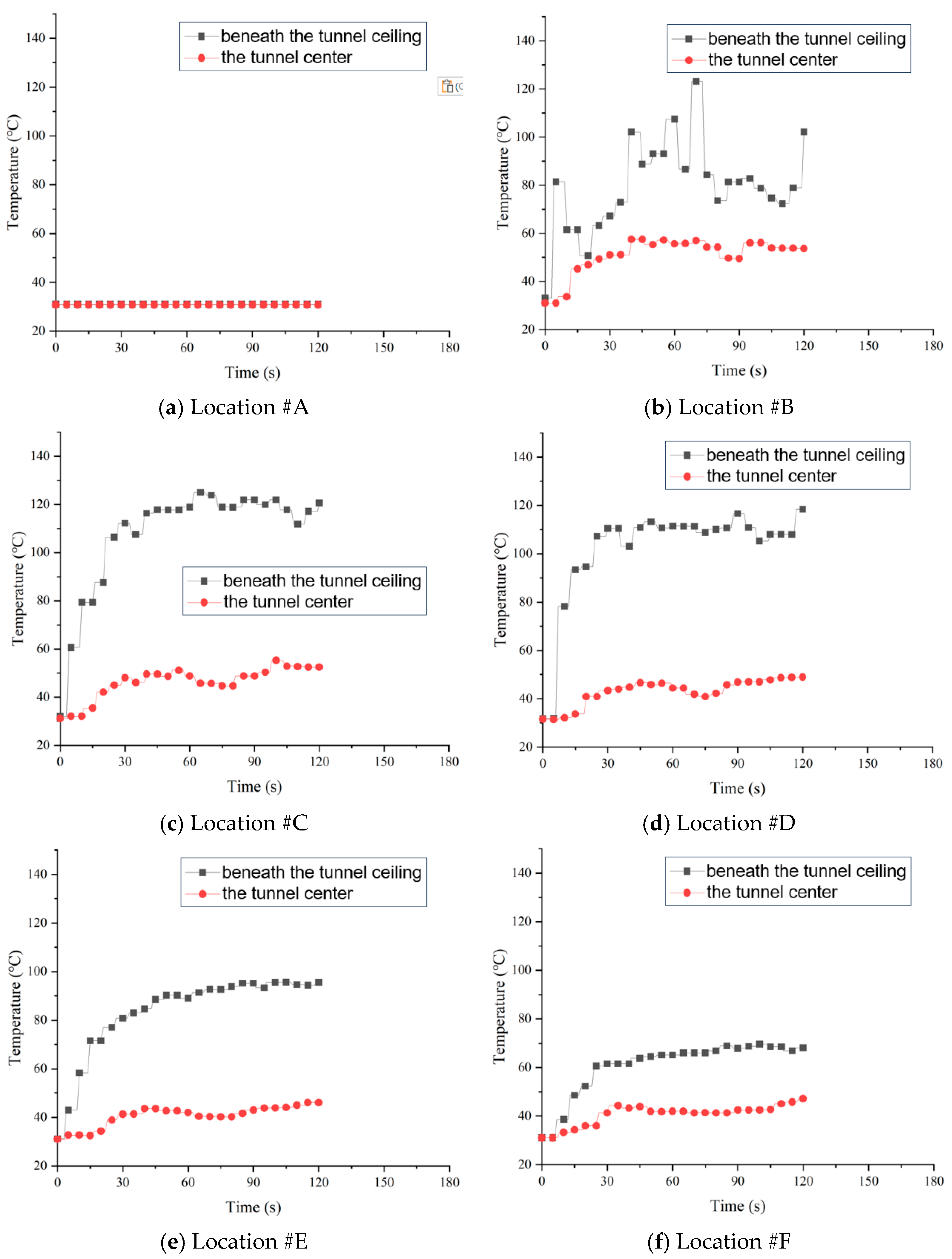
When a weak air curtain with a jet velocity of 3.0 m/s was activated and no vehicle models were placed inside the tunnel, the temperature distribution changed compared with the baseline case. Figure 9 shows the temperature distribution for Case 2 (weak air curtain at 3.0 m/s without model vehicles inside the tunnel). At measurement point A, both the ceiling and center temperatures remained at approximately 30.0 °C throughout the test, indicating that the hot gases generated by the fire were effectively prevented from propagating into the protected region. At point B, however, the ceiling temperature reached 123.6 °C while the center temperature increased to 56.7 °C. At point C, the ceiling and center temperatures were 116.5 °C and 56.3 °C, respectively.
Further along the tunnel, the ceiling temperatures at points D, E, and F were 113.4 °C, 93.4 °C, and 68.3 °C, while the center temperatures ranged from 43.1 °C to 46.5 °C. Compared with the baseline case, the center temperatures increased noticeably. This indicates that the downward jet of the air curtain enhanced mixing between the hot smoke layer and the cooler air below. As a result, the hot gases were confined on the fire side of the air curtain and accumulated within a limited region, leading to higher temperatures in the middle part of the tunnel cross-section.
(C)
High-velocity air curtain condition (5.0 m/s) without vehicle model
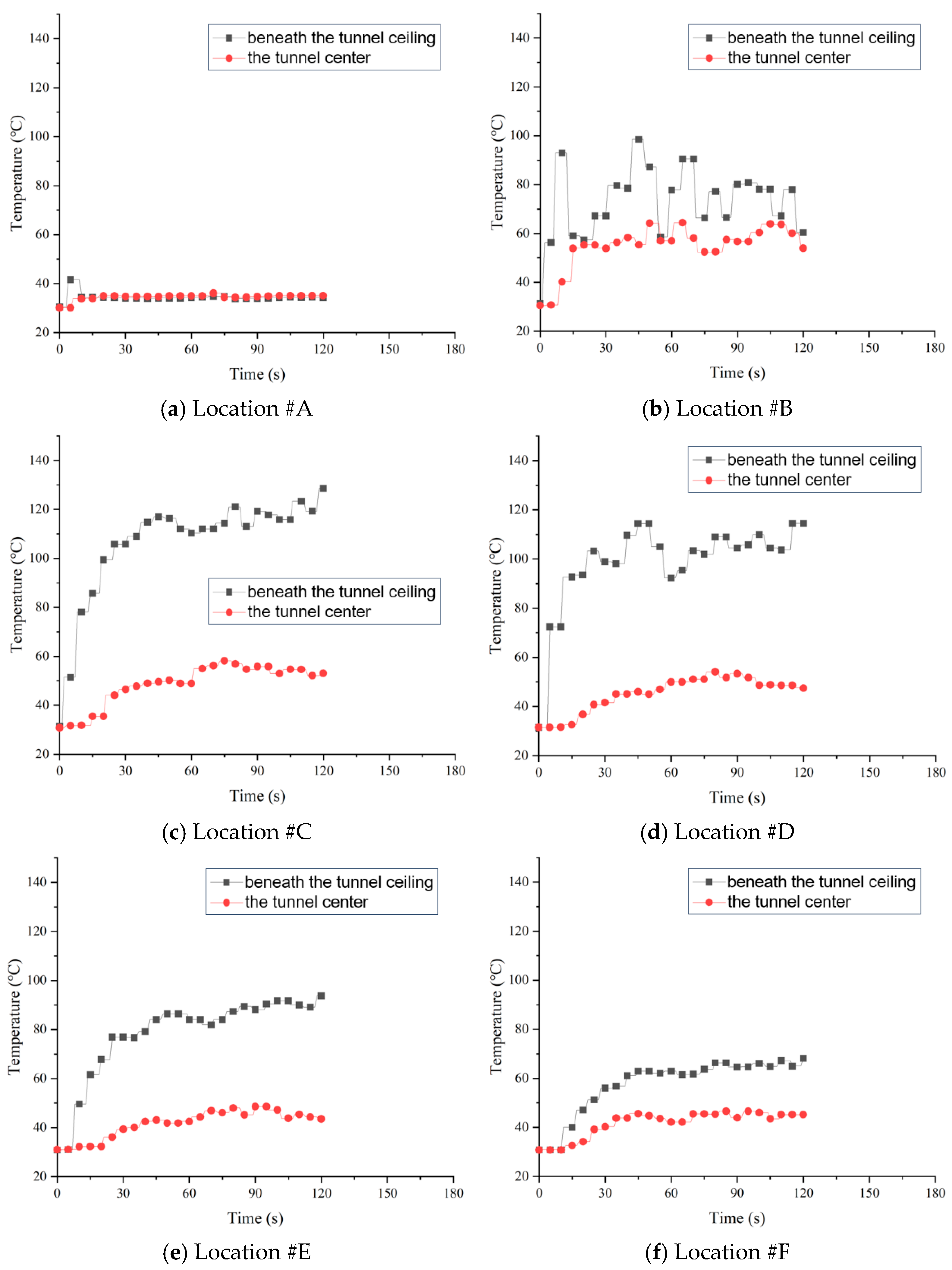
When the air curtain velocity was increased to 5.0 m/s, a stronger blocking effect was observed. Figure 10 shows the temperature distribution for Case 3 (high-velocity air curtain at 5.0 m/s without model vehicles inside the tunnel). At measurement point A, both the ceiling and center temperatures remained at approximately 32.4 °C throughout the test, indicating that the high-momentum air curtain effectively prevented hot gases from entering the protected region. At point B, the ceiling temperature reached 99.7 °C while the center temperature increased to 62.4 °C. At point C, the ceiling temperature was 129.7 °C and the center temperature was 59.1 °C.
At measurement points D, E, and F, the ceiling temperatures were 116.2 °C, 92.7 °C, and 66.5 °C, while the center temperatures ranged from 45.9 °C to 53.4 °C. Compared with the weak air curtain case, the stronger jet momentum enhanced turbulence and mixing near the air curtain region. This mixing redistributed the heat within the tunnel cross-section, resulting in increased temperatures in the middle region while still preventing the hot smoke from penetrating into the protected upstream area.
(D)
High-velocity air curtain condition (5.0 m/s) with vehicle models
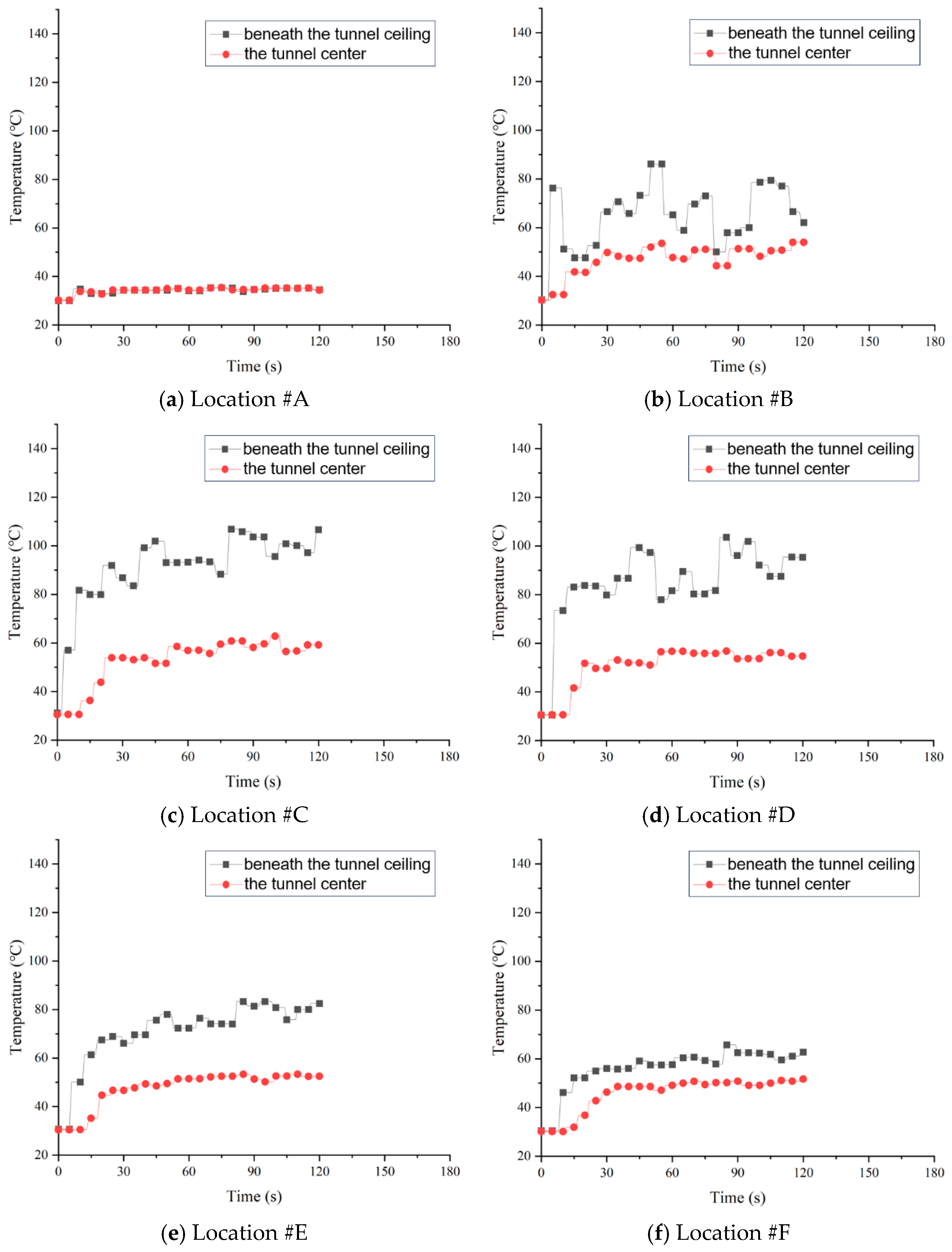
When vehicle models were placed inside the tunnel while maintaining the air curtain velocity at 5.0 m/s, the temperature distribution was further modified by the obstruction effect of the vehicles. Figure 11 shows the temperature distribution for Case 4 (high-velocity air curtain at 5.0 m/s with model vehicles inside the tunnel). At measurement point A, both the ceiling and center temperatures remained at approximately 35.1 °C, indicating that the air curtain continued to effectively block the hot gases from entering the protected region. At point B, the ceiling temperature reached 88.9 °C while the center temperature was 55.7 °C. At point C, the ceiling and center temperatures were 107.2 °C and 60.8 °C, respectively.
At measurement points D, E, and F, the ceiling temperatures were 104.5 °C, 86.0 °C, and 68.3 °C, while the center temperatures ranged from 50.1 °C to 57.1 °C. Compared with the case without vehicle models, the ceiling temperatures were slightly lower while the center temperatures were relatively higher. This behavior indicates that the presence of vehicles altered the airflow structure and partially obstructed the longitudinal smoke movement. As a result, the hot gases accumulated more in the middle region of the tunnel, producing a more uniform temperature distribution across the tunnel cross-section.
The use of detailed vehicle models allows for a more realistic assessment of obstruction-induced flow modification compared with simplified representations.
Overall, the comparison of the four experimental cases illustrates the influence of air curtain velocity and vehicle obstruction on the thermal field inside the tunnel. In the baseline case without an air curtain, the hot smoke layer propagated along both directions of the tunnel ceiling and produced a typical stratified temperature distribution. When the air curtain was activated, the upstream propagation of hot gases was effectively restricted and the thermal field shifted toward the fire side of the curtain. The measured peak temperature values summarized in Table 3 further confirm that increasing the air curtain velocity enhances the blocking effect and modifies the temperature distribution inside the tunnel. When vehicle models were introduced, the airflow pattern was altered and heat accumulation increased in the middle region of the tunnel cross-section. These results indicate that both air curtain velocity and vehicle presence influence smoke propagation and heat transfer in vehicle tunnel fires.
The observed differences between the weak (3 m/s) and strong (5 m/s) air curtain conditions can be interpreted in terms of the momentum ratio (J). A higher jet velocity increases the jet momentum relative to the buoyancy-driven smoke flow, resulting in a stronger resistance to smoke penetration.
Under the weak air curtain condition, the jet momentum is insufficient to fully counteract the buoyant plume, leading to partial mixing and higher temperatures in the intermediate region. In contrast, the strong air curtain condition provides sufficient momentum to suppress upstream smoke propagation and maintain a more stable separation between the smoke region and the protected zone.
These results are consistent with the conceptual interpretation of air curtain performance based on momentum ratio, as discussed in Section 3.4.
The present findings are consistent with previous studies on air curtain smoke confinement in tunnel fire scenarios. For example, Gao et al. [38] reported that increasing jet velocity enhances smoke-blocking performance, while Ji et al. [39] highlighted the importance of the interaction between the air curtain jet and buoyant smoke flow in determining temperature distribution and smoke layer stability. Numerical studies have also shown that air curtain performance is influenced by factors such as jet velocity, tunnel geometry, and ambient flow conditions [40].
These consistencies provide indirect validation of the present results and support the applicability of the modular tunnel model. The purpose of this comparison is not to establish statistical generality based on extensive field measurements, but to examine whether the modular tunnel experiments can reproduce key thermal and smoke-flow trends reported in representative field observations and previous studies. In this sense, the agreement supports the feasibility of the proposed modular experimental approach. The experimental data may also serve as reference data for future CFD validation.
The observed temperature distribution can be interpreted based on plume dynamics and flow interaction mechanisms. The buoyant plume rises and entrains surrounding air, forming a stratified smoke layer beneath the tunnel ceiling. When the air curtain is introduced, the downward jet interacts with the plume, enhancing turbulence and mixing, which redistributes thermal energy within the tunnel cross-section.
As the jet velocity increases, the air curtain momentum becomes sufficient to counteract the buoyancy-driven plume, resulting in a more stable separation between the smoke region and the protected area. This explains the reduction in upstream temperature and the increased mixing in the intermediate region.

4.3. Visualization of Smoke Dispersion

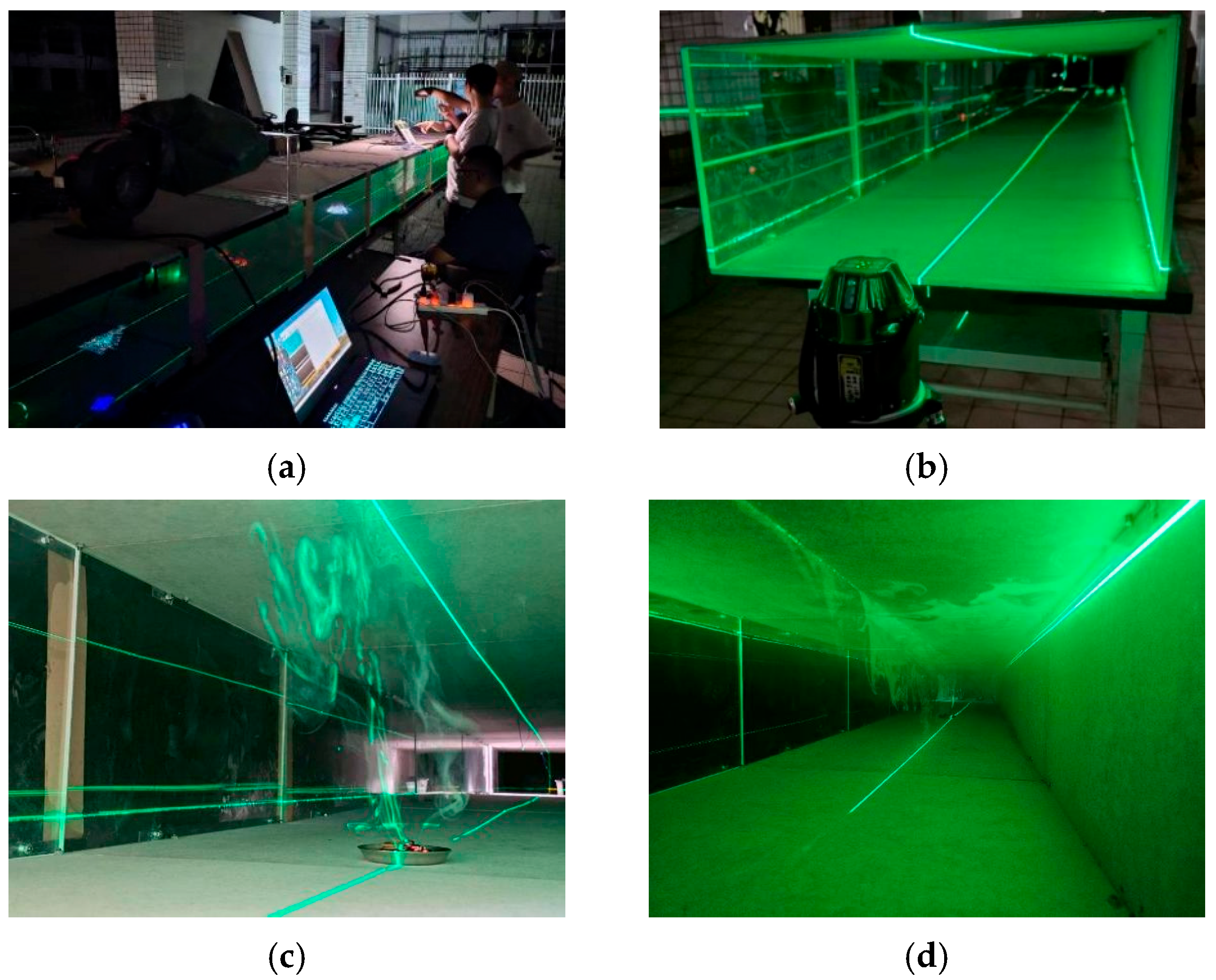
To obtain clearer observations of smoke dispersion inside the tunnel model, a light-sheet visualization system was established. The arrangement of the lighting equipment and the observation environment is shown in Figure 12a. A green laser light source (GPI RY-980SG) was used to generate the light sheet for flow visualization. The laser system provides a stable planar light source suitable for visualizing smoke layer development and flow patterns. In order to ensure both environmental safety and minimal health risk during the experiments, sandalwood incense powder commonly used in temples was adopted as the smoke source. The smoke generated from the burning incense powder is stable and clearly visible, making it suitable for visualizing smoke movement and dispersion patterns inside the tunnel model.
During the visualization tests, smoke dispersion was observed at several locations, including the tunnel center and the tunnel outlet, as illustrated in Figure 12b. The results show that the green light sheet remained clearly visible even under the luminous conditions produced by the LPG burner flame. Consequently, the smoke movement inside the tunnel could be clearly identified, including the development of the smoke layer and the curling motion of the smoke flow. These observations confirm that the experimental setup provides sufficient contrast and clarity for recording smoke dispersion behavior.
During the formal experiments, the light sheet was arranged in two configurations to capture different flow characteristics. A vertical light sheet was positioned at the center of the tunnel to observe the longitudinal movement of smoke along the tunnel axis. In addition, a horizontal light sheet was placed 3.0 cm below the tunnel ceiling to visualize the accumulation and spreading of smoke beneath the ceiling layer. The resulting airflow patterns and smoke movement are shown in Figure 12c. Without the light-sheet visualization system, the detailed dispersion behavior of smoke inside the tunnel would be difficult to observe and document. The combined use of temperature measurements and light-sheet smoke visualization provides complementary information for interpreting both the thermal field and smoke transport behavior inside the tunnel model, thereby improving the reliability of the experimental observations.

4.4. Temperature Evolution Above the Fire Source

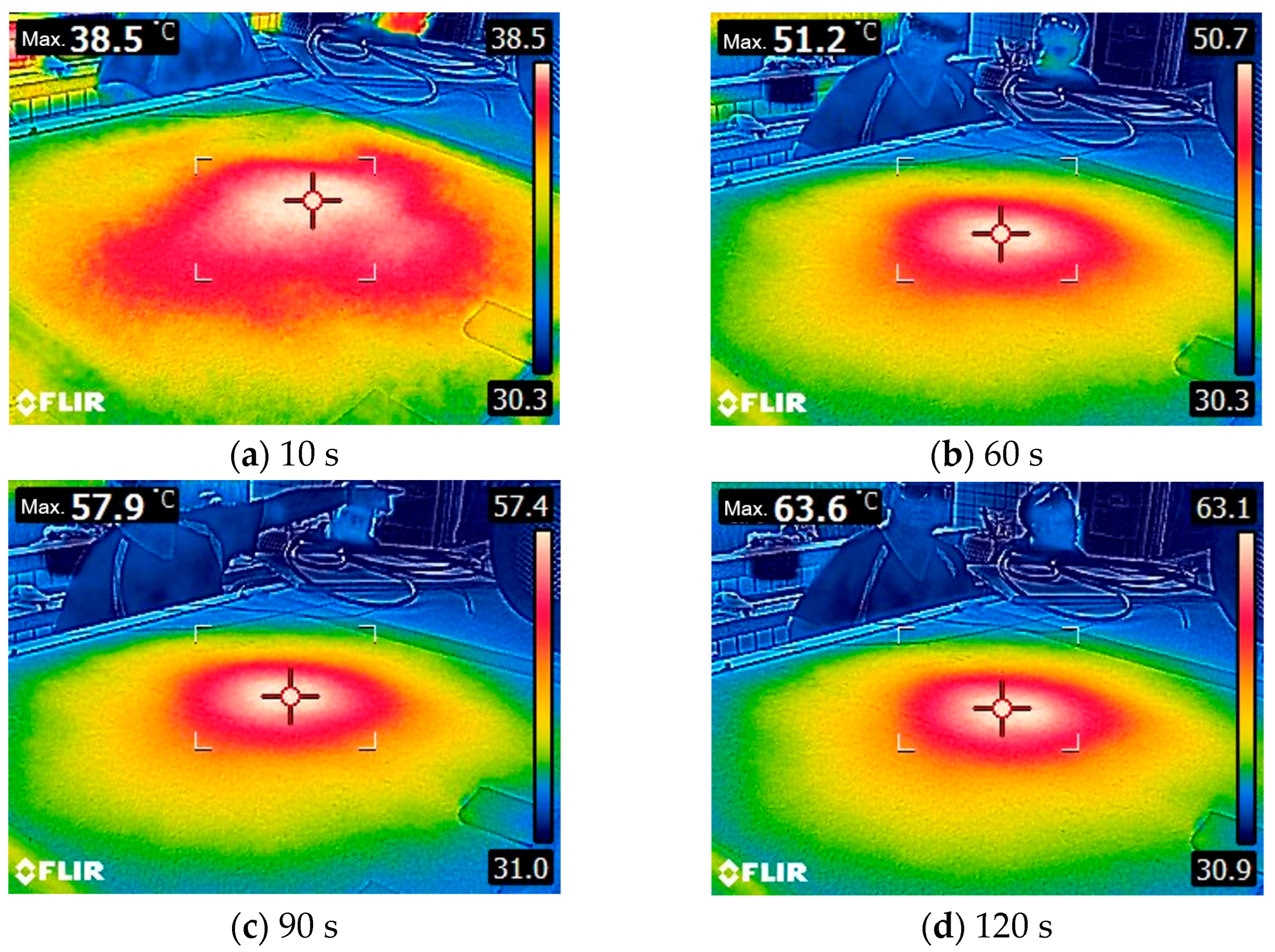
Because the fire source in the tunnel model was generated by burning liquefied petroleum gas (LPG), the thermal condition of the tunnel structure was continuously monitored to ensure experimental safety. The temperature distribution above the tunnel model was recorded using a thermal imaging camera (FLIR E5), as shown in Figure 13. The emissivity was set to 0.95 to ensure accurate surface temperature measurement. The thermal imaging camera provides non-contact measurement of surface temperature, allowing continuous monitoring of the thermal condition during the experiments. The initial surface temperature of the tunnel model was approximately 30.3 °C, and it gradually increased to 63.6 °C after 120 s of heating. This result indicates that the internal gas temperature within the tunnel was significantly higher than the external surface temperature measured by the thermal camera. For safety considerations, personnel operating near the fire source were required to wear protective goggles during the experiments.
To ensure consistent experimental conditions between different test cases, the tunnel model needed to cool down to its initial temperature before the next experiment. Initially, natural cooling was applied, and the model was left to cool for about 30 min, which proved inefficient. Therefore, a non-contact cooling method using industrial fans was adopted to increase airflow and accelerate heat dissipation inside the tunnel. This forced-air cooling approach significantly reduced the cooling time and allowed the experimental conditions to be restored more quickly, thereby improving the repeatability and efficiency of the testing process.
It should be noted that the present results are obtained from a reduced-scale tunnel model under controlled laboratory conditions. In addition, the field reference used in this study was limited to a representative measurement case obtained from one tunnel over a relatively short duration. Therefore, the comparison with field conditions should be interpreted as a case-based assessment of consistency rather than a statistically generalized validation. Therefore, the experimental results should be interpreted with consideration of these limitations, and caution should be exercised when extrapolating the findings to full-scale tunnel scenarios.

5. Conclusions

This study experimentally investigated the smoke confinement performance of an air curtain system using a 1:18 detachable modular tunnel model under controlled fire conditions. Based on temperature measurements and smoke visualization observations, the following conclusions can be drawn.
1.
Feasibility and experimental reliability of the modular tunnel model
The detachable modular tunnel model developed in this study provides a flexible and reliable experimental platform for tunnel fire investigations. The measured temperature distributions and smoke dispersion patterns exhibit trends consistent with those reported in previous studies using conventional fixed tunnel models. The agreement with representative field observations and previous studies supports the feasibility of the modular tunnel approach for controlled experimental investigation of tunnel fire related airflow and smoke behavior. These results confirm that the modular configuration can reproduce the essential thermal and smoke flow characteristics of vehicle tunnel fires while providing improved flexibility for experimental configuration and future parametric studies.
2.
Effectiveness of the air curtain in smoke confinement
The experimental results demonstrate that the air curtain can effectively restrict the upstream propagation of hot smoke and reduce thermal exposure in the protected region. When the air curtain was activated, the spread of smoke toward the upstream section was significantly suppressed and the temperature in the protected zone decreased noticeably compared with the baseline case without an air curtain. These results indicate that the air curtain acts as a dynamic flow barrier that modifies the smoke transport pathway and improves thermal protection in localized tunnel regions.
3.
Influence of air curtain jet velocity on smoke control performance
The smoke confinement performance strongly depends on the jet velocity of the air curtain. When the jet velocity increased to approximately 5 m/s, the blocking effect became significantly stronger and the smoke layer remained relatively stable. Temperature measurements indicate that the tunnel center temperature decreased by approximately 25–35% compared with the case without an air curtain. This behavior can be interpreted as the competition between the jet momentum of the air curtain and the buoyancy-driven smoke plume. When the jet momentum exceeds the buoyant driving force of the plume, the air curtain can effectively resist smoke penetration and maintain a relatively stable interface between the smoke region and the protected area.
4.
Influence of vehicle obstruction on the thermal field and smoke behavior
The presence of vehicle models inside the tunnel modifies the airflow structure and influences the temperature distribution. Vehicle obstructions disturb the longitudinal smoke movement and introduce additional turbulence and mixing within the tunnel cross-section. As a result, ceiling temperatures near the fire source decrease slightly, while heat accumulation increases in the middle region of the tunnel cross-section. This enhanced mixing leads to a more uniform temperature distribution and indicates that vehicle blockage effects should be considered when evaluating smoke propagation and smoke control strategies in tunnel fire scenarios.
5.
Engineering value and application potential of the modular experimental platform
The modular tunnel model provides high flexibility, portability, and reusability for tunnel fire experiments. The detachable structure allows rapid modification of tunnel configurations, fire source locations, and experimental conditions, making it suitable for extended parametric studies, validation of numerical simulations, and evaluation of various smoke control technologies. In addition to research applications, the system also offers potential for engineering education, demonstration experiments, and safety training related to tunnel fire protection.
This study was conducted using a scaled modular tunnel model under controlled laboratory conditions. While the experimental design preserves the key physical mechanisms governing smoke movement, the results are subject to limitations related to scaling effects, simplified fire source conditions, and controlled airflow environments. In addition, the experiments were not extensively repeated under identical conditions; therefore, the findings should be interpreted as representative observations rather than statistically generalized results.
The absence of longitudinal ventilation in the present experiments further limits direct applicability to real tunnel conditions, where background airflow can influence smoke propagation. Future research may extend the investigation to different fire sizes, ventilation conditions, and vehicle configurations to further evaluate practical applicability.
Moreover, the field reference adopted in this study is based on a representative measurement case rather than a comprehensive dataset. Accordingly, the findings support the feasibility of the proposed approach but do not constitute a statistically generalized field validation.

Author Contributions

Conceptualization, M.H., R.P. and L.T.; methodology, M.H. and C.L.; validation, M.H., R.P. and L.T.; formal analysis, L.T.; investigation, M.H. and C.L.; resources, S.W. and P.H.; data curation, L.T.; writing—original draft preparation, S.W. and P.H.; writing—review and editing, C.S.; visualization, M.H.; supervision, C.S.; project administration, C.S.; funding acquisition, C.S. All authors have read and agreed to the published version of the manuscript.

Funding

This research was funded by the National Science Council (NSC) under Grant No. MOST 110-2221-E-992-013, and by China Engineering Consultants, Inc. (CECI) under Grant No. 10932.

Institutional Review Board Statement

Not applicable.

Informed Consent Statement

Not applicable.

Data Availability Statement

The data presented in this study are included in the article. Additional data are available from the corresponding author upon reasonable request, subject to approval.

Acknowledgments

The authors acknowledge financial support from the National Science Council and China Engineering Consultants, Inc. The authors also acknowledge Cheng-Hung Yu, Yi-Kai Wang, and Yu-Hsien Chou for their assistance in the assembly and video recording.

Conflicts of Interest

Authors LiYuTseng, PoWenHuang and ChiJi Ling are employed by CECI Engineering Consultants, Inc. The remaining authors declare that the research was conducted in the absence of any commercial or financial relationships that could be construed as a potential conflict of interest.

References

  1. Chou, Y.C. Deterioration assessment of an immersed-tube road tunnel in Taiwan. Proc. Inst. Civ. Eng. Forensic Eng. 2016, 169, 6–13. [Google Scholar] [CrossRef]
  2. Hsu, W.S.; Huang, Y.H.; Shen, T.S.; Cheng, C.Y.; Chen, T.Y. Analysis of the Hsuehshan tunnel fire in Taiwan. Tunn. Undergr. Space Technol. 2017, 69, 108–115. [Google Scholar] [CrossRef]
  3. Tung, P.W.; Chung, H.C.; Kawabata, N.; Seike, M.; Hasegawa, M.; Chien, S.W.; Shen, T.S. Numerical study of smoke distribution in inclined tunnel fire ventilation modes considering traffic conditions. Buildings 2023, 13, 714. [Google Scholar] [CrossRef]
  4. Caliendo, C.; Russo, I.; Genovese, G. A resilience analysis of a motorway tunnel affected by a traffic accident using the average vehicles’ speed as a metric. Int. J. Civ. Eng. 2024, 22, 505–522. [Google Scholar] [CrossRef]
  5. Lu, C.; Liu, D.; Huang, Y.; Li, Y.; Chen, S.; Liu, W.; Wang, J. Enhancing fire safety knowledge among underwater road tunnel users: A survey in China. Fire 2024, 7, 333. [Google Scholar] [CrossRef]
  6. Tušer, I.; Hošková-Mayerová, Š. Traffic safety sustainability and population protection in road tunnels. Qual. Quant. 2023, 57, 249–270. [Google Scholar] [CrossRef]
  7. CECI Engineering Consultants, Inc. Precise Control and Validation of Emergency Mode in Smoke Exhaust Ventilation Systems of Long Vehicle Tunnels; Research Project No. 11935; Taiwan Fire Technology Foundation: Taoyuan City, Taiwan, 2023. [Google Scholar]
  8. Yi, L.; Luan, D.; Yang, L.; Chen, T.; Tao, H.; Xu, Z.; Fan, C. Flow field and fire characteristics inside a tunnel under the influence of canyon cross wind. Tunn. Undergr. Space Technol. 2020, 105, 103575. [Google Scholar] [CrossRef]
  9. Ntzeremes, P.; Kirytopoulos, K.; Filiou, G. Quantitative risk assessment of road tunnel fire safety: Improved evacuation simulation model. ASCE-ASME J. Risk Uncertain. Eng. Syst. Part A Civ. Eng. 2020, 6, 04019020. [Google Scholar] [CrossRef]
  10. Yao, Y.; Wang, Y.; Chen, L.; Ren, F.; Shi, C. Numerical study on coupled smoke control using longitudinal ventilation and naturally ventilated shafts during fires in a road tunnel. Fire 2023, 6, 126. [Google Scholar] [CrossRef]
  11. Król, A.; Król, M. Numerical investigation on fire accident and evacuation in a urban tunnel for different traffic conditions. Tunn. Undergr. Space Technol. 2021, 109, 103751. [Google Scholar] [CrossRef]
  12. Zhu, R.; Zhang, D.M.; Huang, Z.K.; Guo, X.Y.; Gan, B.L.; Zhou, W.D. Traffic-based resilience assessment on urban road tunnel affected by fire accident. Tunn. Undergr. Space Technol. 2025, 161, 106543. [Google Scholar] [CrossRef]
  13. Zisis, T.; Vasilopoulos, K.; Sarris, I. Numerical simulation of a fire accident in a longitudinally ventilated railway tunnel and tenability analysis. Appl. Sci. 2022, 12, 5667. [Google Scholar] [CrossRef]
  14. Zhang, Z.; Zhang, X.; Rasim, Y.; Wang, C.; Du, B.; Yuan, Y. Design, modelling and practical tests on a high-voltage kinetic energy harvesting system (EH) for a renewable road tunnel based on linear alternators. Appl. Energy 2016, 164, 152–161. [Google Scholar] [CrossRef]
  15. Zhu, H.; Yan, J.; Liang, W. Challenges and development prospects of ultra-long and ultra-deep mountain tunnels. Engineering 2019, 5, 384–392. [Google Scholar] [CrossRef]
  16. Lu, Y.; Wang, J.; Bai, X.; Wang, H. Design and implementation of LED lighting intelligent control system for expressway tunnel entrance based on Internet of things and fuzzy control. Int. J. Distrib. Sens. Netw. 2020, 16, 1550147720925742. [Google Scholar] [CrossRef]
  17. Jiang, C.; He, J.; Zhu, S.; Zhang, W.; Li, G.; Xu, W. Injury-based surrogate resilience measure: Assessing the post-crash traffic resilience of the urban roadway tunnels. Sustainability 2023, 15, 6615. [Google Scholar] [CrossRef]
  18. Xu, C.; Hu, H.; Wang, H. A theoretical study on the resilience evaluation method of operational road tunnel systems. Appl. Sci. 2023, 13, 13279. [Google Scholar] [CrossRef]
  19. Gehandler, J. Road tunnel fire safety and risk: A review. Fire Sci. Rev. 2015, 4, 2. [Google Scholar] [CrossRef]
  20. Li, X.; Cheng, Y. Comparative study on fire resistance of different thermal insulation materials for electric vehicle tunnel fire. Appl. Sci. 2024, 14, 11533. [Google Scholar] [CrossRef]
  21. Vianello, C.; Fabiano, B.; Palazzi, E.; Maschio, G. Experimental study on thermal and toxic hazards connected to fire scenarios in road tunnels. J. Loss Prev. Process Ind. 2012, 25, 718–729. [Google Scholar] [CrossRef]
  22. Caliendo, C.; Russo, I. CFD simulation to assess the effects of asphalt pavement combustion on user safety in the event of a fire in road tunnels. Fire 2024, 7, 195. [Google Scholar] [CrossRef]
  23. Gao, Z.; Jia, Z.; Wu, Z.; Wang, P.; Cai, J.; Li, L. Characteristics of thermal smoke temperature and CO hazardous substance in tunnel fires: A review. J. Therm. Anal. Calorim. 2025, 150, 11781–11798. [Google Scholar] [CrossRef]
  24. Zhang, Y.; Huang, X. A review of tunnel fire evacuation strategies and state-of-the-art research in China. Fire Technol. 2024, 60, 859–892. [Google Scholar] [CrossRef]
  25. Yao, Y.; Li, Y.Z.; Ingason, H.; Cheng, X. Numerical study on overall smoke control using naturally ventilated shafts during fires in a road tunnel. Int. J. Therm. Sci. 2019, 140, 491–504. [Google Scholar] [CrossRef]
  26. Zhou, Y.; Tong, Z.; Tong, Y.; Xiong, D.; Liu, Z.; Chen, K.; Zhang, G.; Gong, Y. Full-scale experiments on fire smoke spreading respectively under natural and hybrid ventilation in a real urban road tunnel with shafts. Appl. Therm. Eng. 2025, 260, 124865. [Google Scholar] [CrossRef]
  27. Tomar, M.S.; Khurana, S. Impact of passive fire protection on heat release rates in road tunnel fire: A review. Tunn. Undergr. Space Technol. 2019, 85, 149–159. [Google Scholar] [CrossRef]
  28. Glasa, J.; Valasek, L.; Weisenpacher, P.; Kubisova, T. Improvement of modeling velocity of airflow created by emergency ventilation in a road tunnel using FDS 6. Appl. Sci. 2023, 13, 2762. [Google Scholar] [CrossRef]
  29. Ho, Y.T.; Kawabata, N.; Seike, M.; Hasegawa, M.; Chien, S.W.; Shen, T.S. Scale model experiments and simulations to investigate the effect of vehicular blockage on backlayering length in tunnel fire. Buildings 2022, 12, 1006. [Google Scholar] [CrossRef]
  30. Feng, S.; Kan, D.; Guo, C. Full-scale experimental investigation of temperature distribution and smoke flow in a road tunnel with a novel water mist fire fighting system. Fire 2025, 8, 216. [Google Scholar] [CrossRef]
  31. Cascetta, F.; Musto, M.; Rotondo, G. Innovative experimental reduced scale model of road tunnel equipped with realistic longitudinal ventilation system. Tunn. Undergr. Space Technol. 2016, 52, 85–98. [Google Scholar] [CrossRef]
  32. Lombardi, M.; Berardi, D.; Galuppi, M. A critical review of fire tests and safety systems in road tunnels: Limitations and open points. Fire 2023, 6, 213. [Google Scholar] [CrossRef]
  33. Galuppi, M.; Berardi, D.; Lombardi, M. The contribution from asphalt pavement to road tunnel fire risk. Case Stud. Constr. Mater. 2025, 23, e05029. [Google Scholar] [CrossRef]
  34. Seike, M.; Kawabata, N.; Hasegawa, M. Quantitative assessment method for road tunnel fire safety: Development of an evacuation simulation method using CFD-derived smoke behavior. Saf. Sci. 2017, 94, 116–127. [Google Scholar] [CrossRef]
  35. Zhang, X. Smart Tunnel Fire Forecast and Safety Management Driven by Artificial Intelligence of Things. Ph.D. Thesis, The Hong Kong Polytechnic University, Hong Kong, China, 2024. [Google Scholar]
  36. Yoo, Y.H.; Shin, H.J.; Kim, H.G.; Lee, C.W.; Qui, T. Experimental study on enhancing performance of the air curtain in subsea tunnels. J. Min. Earth Sci. 2018, 59, 44–49. [Google Scholar]
  37. Elicer-Cortés, J.C.; Molina, N.; Severino, G.; Cecchi, P.; Fuentes, A. Heat transfer across an air curtain for heat confinement in road tunnels: Influence of the heat source. Int. J. Therm. Sci. 2024, 198, 108877. [Google Scholar] [CrossRef]
  38. Gao, D.; Li, T.; Mei, X.; Chen, Z.; You, S.; Wang, Z.; Wang, K.; Lin, P. Effectiveness of smoke confinement of air curtain in tunnel fire. Fire Technol. 2020, 56, 2283–2314. [Google Scholar] [CrossRef]
  39. Ji, J.; Lu, W.; Li, F.; Cui, X. Experimental and numerical simulation on smoke control effect and key parameters of push–pull air curtain in tunnel fire. Tunn. Undergr. Space Technol. 2022, 121, 104323. [Google Scholar] [CrossRef]
  40. Xu, H.; Lin, K.; Mao, S.; Wang, J.; Ding, Y.; Lu, K. Numerical investigation of air curtain jet effect upon the compartment-facade fire safety protection based on temperature evolution and thermal impact. Therm. Sci. Eng. Prog. 2023, 43, 101988. [Google Scholar] [CrossRef]
  41. Chen, Z.; Liu, Z.; Li, X.; Linqi, H.; Niu, G. Numerical study of the effect of air curtains on smoke blocking and leakage heat flux in tunnel fires. Case Stud. Therm. Eng. 2022, 35, 102164. [Google Scholar] [CrossRef]
  42. Wang, S.; Jin, L.; Ou, S.; Li, Y. Experimental air curtain solution for refuge alternatives in underground mines. Tunn. Undergr. Space Technol. 2017, 68, 74–81. [Google Scholar] [CrossRef]
  43. Cao, B.; Liu, H.; Fan, R.; Ju, X.; Yang, L. Experimental and modelling study on smoke retaining effect of air curtain jet in urban utility tunnel fire. Therm. Sci. Eng. Prog. 2025, 57, 103143. [Google Scholar] [CrossRef]
  44. Wang, Y.; Li, A. Analysis of smoke confinement in underground buildings: Design of air curtains against tunnel fire. Buildings 2026, 16, 263. [Google Scholar] [CrossRef]
  45. Caliendo, C.; Ciambelli, P.; De Guglielmo, M.L.; Meo, M.G.; Russo, P. Simulation of people evacuation in the event of a road tunnel fire. Procedia Soc. Behav. Sci. 2012, 53, 178–188. [Google Scholar] [CrossRef]
  46. Haghighat, A.; Luxbacher, K.; Lattimer, B.Y. Development of a methodology for interface boundary selection in the multiscale road tunnel fire simulations. Fire Technol. 2018, 54, 1029–1066. [Google Scholar] [CrossRef]
  47. Tomar, M.S.; Khurana, S.; Chowdhury, S. A numerical method for studying the effect of calcium silicate lining on road tunnel fires. Therm. Sci. Eng. Prog. 2022, 29, 101245. [Google Scholar] [CrossRef]
  48. Cafaro, E.; Stantero, L. Fire smoke movements in tunnel scale models: Theory and experimental observations. Int. J. Heat Technol. 2003, 21, 159–164. [Google Scholar]
  49. Huang, Y.; Zhou, X.; Cao, B.; Yang, L. Computational fluid dynamics-assisted smoke control system design for solving fire uncertainty in buildings. Indoor Built Environ. 2020, 29, 40–53. [Google Scholar] [CrossRef]
  50. Costantino, A.; Musto, M.; Rotondo, G.; Zullo, A. Numerical analysis for reduced-scale road tunnel model equipped with axial jet fan ventilation system. Energy Procedia 2014, 45, 1146–1154. [Google Scholar] [CrossRef]
  51. Yan, W.; Li, C.; Zhao, P.; Gao, Z. Validation of the Froude model applicability for flame and thermal properties of tunnel fires with different cross-section scale ratios. Int. Commun. Heat Mass Transf. 2025, 164, 108916. [Google Scholar] [CrossRef]
  52. Vauquelin, O.; Wu, Y. Influence of tunnel width on longitudinal smoke control. Fire Saf. J. 2006, 41, 420–426. [Google Scholar] [CrossRef]
  53. Ji, J.; Gao, Z.H.; Fan, C.G.; Sun, J.H. Large eddy simulation of stack effect on natural smoke exhausting effect in urban road tunnel fires. Int. J. Heat Mass Transf. 2013, 66, 531–542. [Google Scholar] [CrossRef]
  54. Von Funck, W.; Weinkauf, T.; Theisel, H.; Seidel, H.P. Smoke surfaces: An interactive flow visualization technique inspired by real-world flow experiments. IEEE Trans. Vis. Comput. Graph. 2008, 14, 1396–1403. [Google Scholar] [CrossRef]
  55. Zhang, N.; Liang, Y.; Zhou, C.; Niu, M.; Wan, F. Study on fire smoke distribution and safety evacuation of subway station based on BIM. Appl. Sci. 2022, 12, 12808. [Google Scholar] [CrossRef]
  56. Zwart, S.D. Scale modelling in engineering: Froude’s case. In Philosophy of Technology and Engineering Sciences; North-Holland: Amsterdam, The Netherlands, 2009; pp. 759–798. [Google Scholar]
  57. Sugawa, O.; Oka, Y. Experimental study on flame merging behavior from 2 by 3 configuration model fire sources. Fire Saf. Sci. 2003, 7, 891–902. [Google Scholar] [CrossRef]
  58. Kumar, A.; Kumar, R.; Ansari, A.A.; Kumar, R. Experimental and numerical simulation studies of liquefied petroleum gas fire in a full-scale compartment. Process Saf. Prog. 2022, 41, 195–206. [Google Scholar] [CrossRef]
  59. Shen, Y.; Jiao, A.; Chen, T.; Li, Y.; Gao, Y.; Xu, Z.; Jiang, B.; Fan, C. Experimental study on smoke movement characteristics in tunnel fires with different canyon cross wind yaw angles. Tunn. Undergr. Space Technol. 2021, 117, 104129. [Google Scholar] [CrossRef]
  60. Li, Z.; Zhang, Y.; Qiao, M.; Gao, Y.; Huang, Y. Experimental and theoretical study of the smoke back-layering length in a tunnel with cross-passage: Effects of longitudinal fire source locations. Railw. Eng. Sci. 2025, 34, 184–199. [Google Scholar] [CrossRef]
  61. Heskestad, G. Dynamics of the fire plume. Philos. Trans. R. Soc. A 1998, 356, 2815–2833. [Google Scholar] [CrossRef]
  62. Quintiere, J.G.; Grove, B.S. A unified analysis for fire plumes. Symp. (Int.) Combust. 1998, 27, 2757–2766. [Google Scholar] [CrossRef]
  63. Yu, L.X.; Liu, F.; Beji, T.; Weng, M.C.; Merci, B. Experimental study of the effectiveness of air curtains of variable width and injection angle to block fire-induced smoke in a tunnel configuration. Int. J. Therm. Sci. 2018, 134, 13–26. [Google Scholar] [CrossRef]
  64. PIARC. Fire and Smoke Control in Road Tunnels; Report No. 05.05.B; Permanent International Association of Road Congresses: Paris, France, 1999.
Figure 1. Representative field measurements of longitudinal airflow velocity in the Caopu-Senyong Tunnel (southern Taiwan, 14 June 2022), showing velocities reaching up to approximately 7 m/s.
Fire 09 00162 g001
Figure 2. Dimensioned schematic of the modular tunnel model and experimental setup.
Fire 09 00162 g002
Figure 3. Dimensioning of components and illustration of the assembly method of the modular tunnel model.
Fire 09 00162 g003
Figure 4. Conditions during the preliminary tests: (a) model testing conditions; (b) geometric dimensions and annotations.
Fire 09 00162 g004
Figure 5. Conditions at the experimental site: (a) personnel conducting temperature measurements and recording data; (b) air curtain model outlet opening; (c) plenum chamber of the air curtain model and measurement of outlet velocity; (d) tunnel interior under undisturbed ambient conditions (V = 0.0 m/s).
Fire 09 00162 g005
Figure 6. (a) Temperature measurement layout showing thermocouple positions along the tunnel axis. Definition of zones: Zone 1 denotes the upstream region from the tunnel portal to the air curtain; Zone 2 denotes the intermediate region between the air curtain and the fire source; Zone 3 denotes the downstream region from the fire source to the opposite tunnel portal. (b) Measured air velocity at representative locations in the tunnel model.
Fire 09 00162 g006
Figure 7. Temporal evolution of temperature at measurement locations under conditions with and without the air curtain: (a) Location A (no air curtain); (b) Location A (with air curtain); (c) Location B (no air curtain); (d) Location B (with air curtain); (e) Location C (no air curtain); (f) Location C (with air curtain).
Fire 09 00162 g007
Figure 8. Temperature variation over time for Case 1: air curtain off and no model vehicles inside the tunnel.
Fire 09 00162 g008
Figure 9. Temperature variation over time for Case 2: air curtain activated (Vcur = 3.0 m/s) with no model vehicles inside the tunnel.
Fire 09 00162 g009
Figure 10. Temperature variation over time for Case 3: air curtain activated (Vcur = 5.0 m/s) with no model vehicles inside the tunnel.
Fire 09 00162 g010
Figure 11. Temperature variation over time for Case 4 with the air curtain activated (Vcur = 5.0 m/s) and model vehicles positioned inside the tunnel.
Fire 09 00162 g011
Figure 12. Recorded visualization of smoke dispersion (a) night-time testing conditions; (b) setup of the light-sheet equipment; (c) visualization of airflow patterns using tracer smoke; (d) visualization of airflow patterns in the upper region of the tunnel model.
Fire 09 00162 g012
Figure 13. Measurement of thermal conditions in the tunnel model during burner operation.
Fire 09 00162 g013
Table 1. Scaling laws used for the tunnel model experiments.
ParameterScale Ratio
GeometryXm = Xf (lm/lf)
VelocityVm = Vf (lm/lf)1/2
Timetm = tf (lm/lf)1/2
TemperatureTm = Tf
Densityρm = ρf
PressurePm = Pf (lm/lf)
Convective heat release rateQm = Qf (lm/lf)5/2
Note: Ratio between the model and the full-scale prototype (lm:lf).
Table 2. Measured air velocity during the experiments.
Below Air Curtain OutletUpstream Portal
of the Model Tunnel
Downstream Portal
of the Model Tunnel
Measured Air Velocity (m/s)
5.01.42.8
Table 3. Measured peak temperature values for each test case.
LocationHeightABCDEF
Case No. Temperature (°C)
Case 1Beneath
ceiling
87.1134.2122.6114.390.575.7
Tunnel
center
39.639.539.138.938.638.1
Case 2Beneath
ceiling
30.0123.6116.5113.493.468.3
Tunnel
center
30.056.756.346.543.143.3
Case 3Beneath
ceiling
32.499.7129.7116.292.766.5
Tunnel
center
32.462.459.153.448.545.9
Case 4Beneath
ceiling
35.188.9107.2104.586.068.3
Tunnel
center
35.155.760.857.151.950.1
Disclaimer/Publisher’s Note: The statements, opinions and data contained in all publications are solely those of the individual author(s) and contributor(s) and not of MDPI and/or the editor(s). MDPI and/or the editor(s) disclaim responsibility for any injury to people or property resulting from any ideas, methods, instructions or products referred to in the content.