Article

Modeling Moisture Factors in Grassland Fire Danger Index for Prescribed Fire Management in the Great Plains

Department of Biological and Agricultural Engineering, Kansas State University, Manhattan, KS 66506, USA
*
Author to whom correspondence should be addressed.
Fire 2025, 8(12), 469; https://doi.org/10.3390/fire8120469 (registering DOI)
Submission received: 19 October 2025 / Revised: 24 November 2025 / Accepted: 28 November 2025 / Published: 1 December 2025

Abstract

Prescribed fire is a critical land management practice in the Great Plains of North America, helping to maintain native rangelands and reduce wildfire risk. Barriers to prescribed fire practice remain due to concerns on potential fire escape and fire danger. A localized fire danger index can help address these concerns by providing clear, science-based guidance, encouraging safer and confident use of prescribed fire. Our goal is to support the development of a localized Grassland Fire Danger Index (GFDI) for prescribed fire management in the Great Plains. The specific objective of this study is to develop user-friendly sub-models for dead fuel moisture content (DFMC) and grass curing, which serve as components of the proposed GFDI. DFMC reflects short-term fuel moisture that affects ignition and fire spread, while grass curing represents seasonal drying that controls fuel availability. Both are critical for fire prediction and safe burns. Lower DFMC and higher grass curing levels are strongly associated with wildfire risks. Using Oklahoma Mesonet weather data, the DFMC sub-model improves the accuracy and sensitivity of existing models. The grass curing sub-model shows that 50% curing usually occurs around April 15–16, which matches the time for the most intensive prescribed fire activities in the region, indicating it as a safe and effective window for prescribed fire recognized by landowners. Our sub-models lay the foundation for development of GFDI in the region.

1. Introduction

Prescribed fire of grasslands is a crucial element of rangeland management in the Great Plains, effectively managing the destructive effects of woody plant germination. It supports the structure and function of the tallgrass ecosystem by enhancing the nutritional quality of native grasses, suppressing weeds and invasive shrubs, and reducing the risk of large-scale wildfires [1,2]. Prescribed fire, as a fuel management strategy, mitigates risks to human life and ecological assets by altering fire behavior dynamics [3]. However, when inadequately implemented, it can result in escape fires, posing significant threats to surrounding environments. Consequently, a comprehensive understanding of the interactions among meteorological conditions, fuel characteristics, and topographic variables is essential for the safe and effective planning of prescribed fires [4].
The grasslands of the Great Plains are critical to the U.S. beef industry, contributing significantly to national production while supporting regional economies [1]. These ecosystems also provide essential services, including biodiversity conservation, climate regulation, and hydrologic stability. Predicting fire behavior remains a major management challenge due to the dominance of fine fuels and the potential for rapid fire spread across expansive prairie landscapes [5].

1.1. Existing Fire Danger Indexes

Fire danger refers to the likelihood of wildfire ignition, spread, and potential impact on valued assets [6]. It includes both static and dynamic components of the fire environment that influence ease of ignition, fire behavior, and suppression difficulty [7,8]. Fire danger indexes, which are calculated using meteorological and fuel variables, serve as critical tools for forecasting wildfire risk and supporting fire management decisions [9]. They can be applied across a range of temporal and spatial scales [10,11].
The Burning Index (BI) is a key component of the National Fire Danger Rating System (NFDRS) and is widely used for fire prevention and suppression planning [12]. BI is derived from a combination of Spread Component (SC) and Energy Release Component (ERC), producing a scale that remains open-ended and accommodates a wide range of values to characterize fire potential, including during periods of low to moderate risk [13]. It serves as an indicator of fire behavior intensity, particularly flame length, and is extensively used by fire management agencies for resource allocation and operational planning [13]. However, its reliance on coarse meteorological data and generalized fuel models limits its suitability for localized prescribed fires. BI lacks sensitivity to site-specific fuel and weather conditions, and validation efforts have shown weak correlations with observed fire behavior [12].
The Keetch–Byram Drought Index (KBDI), developed by the USDA Forest Service in 1968, is a slow-responding drought metric originally designed for the southeastern United States [14]. It estimates cumulative soil moisture deficiency in the upper 0.2 m. KBDI values range from 0 (saturated) to 800 (extreme drought), with values above 600 indicating elevated wildfire risk [15,16,17]. Its simplicity and reliance on limited meteorological inputs have made it widely used in wildfire prediction for over five decades [18,19,20]. KBDI increases on dry days, decreases with rainfall, and reflects seasonal drying trends. High values are associated with low fuel moisture, increased fire intensity, and greater suppression difficulty [21,22]. KBDI is not designed to assess grassland fire danger directly, as it was developed to measure long-term soil moisture drought.
The Grassland Fire Danger Index (GFDI) is a short-term, rapid-response index that utilizes high-resolution weather data such as air temperature, relative humidity (RH), wind speed, and grass curing, to provide regional warnings of grassland fire danger [23]. Empirical equations have been developed and updated multiple times to calculate GFDI based on realistic weather conditions in Australia and GFDI have been widely used in Australia for fire danger forecasting [24,25]. GFDI was operationalized through the McArthur Grassland Fire Danger Meter (Mark V), an analog tool that calculates the DFMC and combines it with weather inputs to produce a GFDI value. Under typical dry conditions (100% curing, 20 °C, 20% RH), GFDI values ranged from 4 to 99, depending on wind speed. The meter integrates fuel and weather variables and has been proven effective for modeling fire behavior in grassland [26]. The GFDI provided a seminal approach to quantify grassland fire danger through a simple functional form and interpretable parameters. While the interpretability of the model is one of its strengths, the fixed fuel load assumption limits its use outside Australia [25,26] and other continuous fuel landscapes. The Australian Fire Danger Rating System updated the GFDI with fuel-specific empirical models in 2022 [27,28], acknowledging that practical fire danger assessment must be local fuel-driven systems.

1.2. Proposed GFDI for the Great Plains, USA

The Australian GFDI was previously adapted for the U.S. Central Plains, showing initial promise [5]. It generates hourly forecasts several days in advance at a spatial resolution of a few kilometers and can potentially provide timely guidance for determining safe burn windows. However, the Australian GFDI exhibited limited sensitivity to RH, occasionally reporting low danger ratings under low-RH conditions that are known to enhance fuel drying and fire spread. This limitation indicates that the Australian GFDI model does not fully capture RH influence in the Central Plains. To improve accuracy and operational relevance, region-specific historical weather and fuel data should be incorporated.
The proposed GFDI for the Great Plains builds on the core structure of the Australian model, incorporating wind speed, temperature, grass curing, and DFMC as key predictors, as illustrated in Figure 1. In the proposed GFDI, the overall wildland fire risk is defined as a product of seasonal fire risk and daily fire risk, with each modeled by ecologically relevant explanatory factors [29]. Grass curing contributes to seasonal fire risk, and DFMC contributes to daily fire risk.

1.3. Existing DFMC Models

DFMC, expressed as a percentage of the fuel’s dry weight, is a critical variable influencing fire behavior, ignition potential, and wildfire risk. Lower DFMC values increase the probability of ignition and fire spread, thereby intensifying fire exposure and suppression difficulty [30,31]. For prescribed fire, DFMC levels between 8% and 15% are generally considered optimal. Moisture levels below 8% substantially increase the likelihood of spot fires and erratic fire behavior, while levels above 15% may inhibit ignition and reduce burn consistency [32]. DFMC is highly responsive to meteorological conditions, particularly temperature, RH, and surface moisture, which are in turn influenced by solar radiation, precipitation, and heat and vapor exchange processes [33]. DFMC can fluctuate rapidly in response to weather changes [34], making it an effective indicator of short-term fire danger. This sensitivity is particularly important in grass-dominated systems, where fine fuels respond quickly to drying conditions [35]. However, regional variability in vegetation structure, microclimate, and exposure can result in substantial differences in DFMC, limiting the effectiveness of generalized models. Incorporating localized meteorological and fuel data is therefore essential for improving DFMC estimation and ensuring reliable fire behavior predictions in operational contexts.
Nelson [34] developed a mechanistic model to simulate DFMC based on a complex set of partial differential equations that represent the movement of liquid water and vapor through porous materials, such as conifer needles or grass leaves. This physically based framework was designed to capture fuel moisture dynamics in detail, accounting for evaporation, absorption, and internal moisture transport within fuel particles [36]. It was originally developed for 10 h fuels and was later adapted to simulate other dead fuel classes using weather-based fuel stick parameters. It requires inputs such as air temperature, RH, solar radiation, and rainfall to simulate moisture transfer processes within fuels [37].
For quick estimation of DFMC in the field, two empirical DFMC models were also developed. McArthur [38] developed a simple empirical DFMC model as part of the Australian GFDI system to provide rapid, field-ready estimates of 1 h DFMC from standard meteorological observations. Derived from empirical measurements in open grasslands, the model uses a simple linear relationship between RH (%), and air temperature T (°C), expressed as
DFMC = 12.5 + 0.111RH − 0.279T
Marsden-Smedley [39] developed a simple empirical model to estimate 1 h DFMC in the button grass moorlands of western Tasmania, where fine, surface-level dead fuels are intermixed with live vegetation under cool, moist, maritime conditions. Using gravimetric sampling of near-surface fuels and 1 h fuel stick measurements across a wide range of weather conditions, the researchers identified RH and dew point temperature as the most effective predictors. Dew point temperature was chosen in place of air temperature to reduce multicollinearity, as RH and air temperature were strongly negatively correlated (r = −0.80) in the study area. The model is expressed as
DFMC = exp (1.660 + 0.0214RH − 0.0292TDew)
where TDew is dew point temperature (°C). These empirical models’ simplicity and reliance on widely available weather data have made it operationally valuable for fire danger assessment. However, because they were developed under the climatic and fuel conditions of its original study area, their predictive accuracy can decline in regions with different vegetation structures, humidity–temperature correlations, and diurnal drying patterns. Adjustments would be needed before applying them to environments with very different weather–fuel relationships.

1.4. Existing Grass Curing Assessment Methods

Grass curing refers to the physiological drying and senescence of grasses, during which live fuel transitions to dead fuel, and is defined as the percentage of dead material in the grass fuel bed, reaching 100% when all fuels are dead and dry [40]. It is controlled by species genetics and influenced by environmental factors such as temperature, photoperiod, evapotranspiration, soil type, water availability, competition, and disturbance. Annual grasses typically cure completely at the end of the growing season, generally about six weeks after the onset of yellowing, while many perennial grasses retain live material and can reshoot after rainfall [26].
Grass curing is a critical variable influencing fire behavior in grassland ecosystems, as it simultaneously increases the proportion of dead fuel while reducing live fuel moisture content. These changes enhance ignition potential and elevate fire intensity and spread rates as curing progresses [41]. The degree of curing directly affects fire propagation by altering fuel continuity and flammability, thereby influencing fire danger assessments and fire behavior prediction [42]. Fires rarely sustain when curing is below 20% but spread rate and flame height increase progressively between 20% and 60%, and fire spread potential rises sharply above 60 to 70%, reaching near-maximum levels at full curing [43]. Grasslands with less than 50% curing typically do not sustain fire spread due to insufficient dead fuel, whereas curing levels between 75% and 90% result in a marked increase in fire spread potential [42]. Cured grasses are significantly more flammable than green vegetation and are more likely to ignite under dry and windy conditions [44], with increased combustibility accelerating spread rates [45]. Fuel continuity is also important, as patchy curing caused by uneven grazing or variable soil moisture can limit fire spread despite high average curing.
Accurate measurement of grass curing is essential for reliable fire danger assessment, yet each available method has distinct advantages and limitations. Direct sampling, which involves physically harvesting and drying plant material is labor-intensive and impractical for frequent or large-scale monitoring. Visual assessments are faster and widely applied in operational contexts, although they are subjective; though consistency can be improved by linking observations to clearly defined phenological stages, such as flowering, seed head emergence, and browning [26]. Remote sensing techniques, particularly those based on vegetation indices such as the Normalized Difference Vegetation Index (NDVI), enable broad-scale and repeatable monitoring but require site-specific calibration for vegetation type and seasonal variation [46]. In heterogeneous landscapes, mixed pixels containing bare soil or evergreen vegetation can lead to significant under- or overestimation of curing [11,47]. More recently, advances in high-resolution satellite imagery, such as Sentinel-2 with red-edge spectral bands and MODIS-derived indices, have improved both the spatial and temporal accuracy of curing estimates [48,49]. The GRAZPLAN pasture simulation model was incorporated into the GFDI for Canberra, Australia, using simulated pasture growth, and curing dynamics from different grass functional types (annual, exotic perennial, and native perennial) to estimate curing as a driver of fire danger [50]. This demonstrates that process-based models can represent grass curing in ways that reflect ecological processes, complementing empirical field assessments and remote sensing approaches; however, curing is difficult to represent consistently because it varies among functional types, is strongly influenced by climatic variability, and shows considerable spatial heterogeneity across landscapes [50].

1.5. Objective of the Study

This study aims to develop region-specific, user-friendly sub-models for DFMC and grass curing, which function as components of the proposed GFDI for the Great Plains of USA. These tailored components are intended to enhance predictive accuracy and more effectively support prescribed fire management decisions in grassland ecosystems.

2. Materials and Methods

2.1. Weather and Fuel Data

Weather and fuel data (2006 to 2019) from four Oklahoma Mesonet [51,52] stations, Bixby, Forza, Wyno, and Skiatook were used to develop the DFMC and grass curing sub-models. Environmental variables collected included 1 h DFMC, hourly air temperature and RH. The dataset encompassed a wide range of environmental conditions across the four stations and are characterized by tallgrass vegetation. The 1 h DFMC reflects the moisture content of fine dead fuels, such as grasses and small twigs less than 0.25 inches in diameter, which respond rapidly to atmospheric conditions. The Nelson DFMC model was used by the Oklahoma Mesonet system to calibrate DFMC values. Originally developed for 10 h fuels, the Nelson model was later adapted to simulate other dead fuel classes using weather-based fuel stick parameters. For the development of the DFMC sub-model, observations were filtered to include only non-rainy days from 08:00 to 17:00 h, corresponding to operational burning hours for prescribed fires.
Grass curing was estimated using relative greenness derived from satellite-based NDVI [47] and reported by the Oklahoma Mesonet. This NDVI-based curing approach is well established in the remote-sensing literature [53,54,55]. Daily relative greenness values were smoothed using locally estimated scatterplot smoothing (LOESS), a non-parametric regression method that fits locally weighted polynomials to subsets of the data to reduce short-term fluctuations while preserving seasonal trends [56]. The smoothed series was then rescaled using min–max normalization, with the annual maximum set to 0% curing (completely green) and the annual minimum set to 100% curing (fully cured).

2.2. Wildfire Data

Wildfire records were obtained from the Fire Program Analysis Fire Occurrence Database, maintained by the U.S. Forest Service. This database consolidates fire reports from federal, state, and local agencies and is standardized according to National Wildfire Coordinating Group protocols, including updated wildfire cause classifications. Each record is georeferenced to at least the public land survey system section, enabling spatially consistent regional analysis [57]. For this study, all geo-referenced wildfire records within the Great Plains from 1992 to 2020 were extracted.
Although the source dataset had undergone initial error-checking, additional data cleaning was conducted to improve accuracy. Duplicate entries were removed, resulting in a refined dataset of 497,749 wildfire incidents spanning approximately 18 million hectares over 30 years. Of the more than 50 available variables, this study focused on key attributes: fire discovery date, final fire size (in hectares), and geospatial location, which was recorded to at least the Public Land Survey System section level.
Geospatial processing was conducted using the tigris [58] and sf [59] packages in R (v 4.3.1). This involved reading spatial coordinates, importing county-level shapefiles, and subsetting fire records by geographic location to enhance spatial precision for subsequent analysis.

2.3. Development of the Sub-Models

For the development of the DFMC sub-model, an exponential model was developed through regression using daily air temperature and RH as predictors. Air temperature and RH were selected due to their relatively weaker correlation in the dataset (r = −0.11), comparing with the correlation between dew point temperature and RH (r = 0.16). This selection minimizes multicollinearity concerns. This contrasts with prior study of Marsden-Smedley [39], who avoided using air temperature and RH together as predictors due to their high negative correlation (r = −0.80) in their dataset, and used dew point temperature and RH instead. To benchmark model performance, the two existing empirical DFMC models McArthur [38] and Marsden-Smedley [39] were compared with our proposed DFMC sub-model under the Great Plains conditions. Performance of the models was evaluated using statistical metrics, including the coefficient of determination (R2), root mean square error (RMSE) and mean absolute error (MAE).
For the development of the grass curing sub-model, a logistic regression model was fitted using data from January 1 to June 30, aligning with the early growing season and primary window for prescribed fires. The KBDI estimates the moisture deficit in the upper soil layer that influences vegetation dryness and fire potential. In this study, annual average KBDI in the previous year was used as a categorical grouping factor to differentiate between normal pre-season moisture conditions (annual average KBDI ≤ 280) and severe drought conditions (annual average KBDI > 280). Across the 14 years of data used in this study, extreme drought conditions (annual average KBDI > 280) occurred only twice (2012 and 2013). Model parameters were estimated, respectively, for normal pre-season moisture conditions and severe drought conditions, using nonlinear least squares (nls) in R (v 4.3.1). This stratification enabled the model to capture distinct curing dynamics under contrasting moisture regimes. The 95% confidence intervals (CI) of model parameters were calculated to demonstrate the accuracy of the logistic regression model.

3. Results

3.1. The DFMC Sub-Model

The DFMC sub-model takes the following form:
DFMC = exp(1.313 + 0.020RH − 0.009T)
where RH is relative humidity (%) and T is air temperature (°C).
The model accounted for 88% of the variance in DFMC, with both predictors statistically significant (p < 0.001). As expected, DFMC increases with increasing RH and decreases with increasing temperatures.
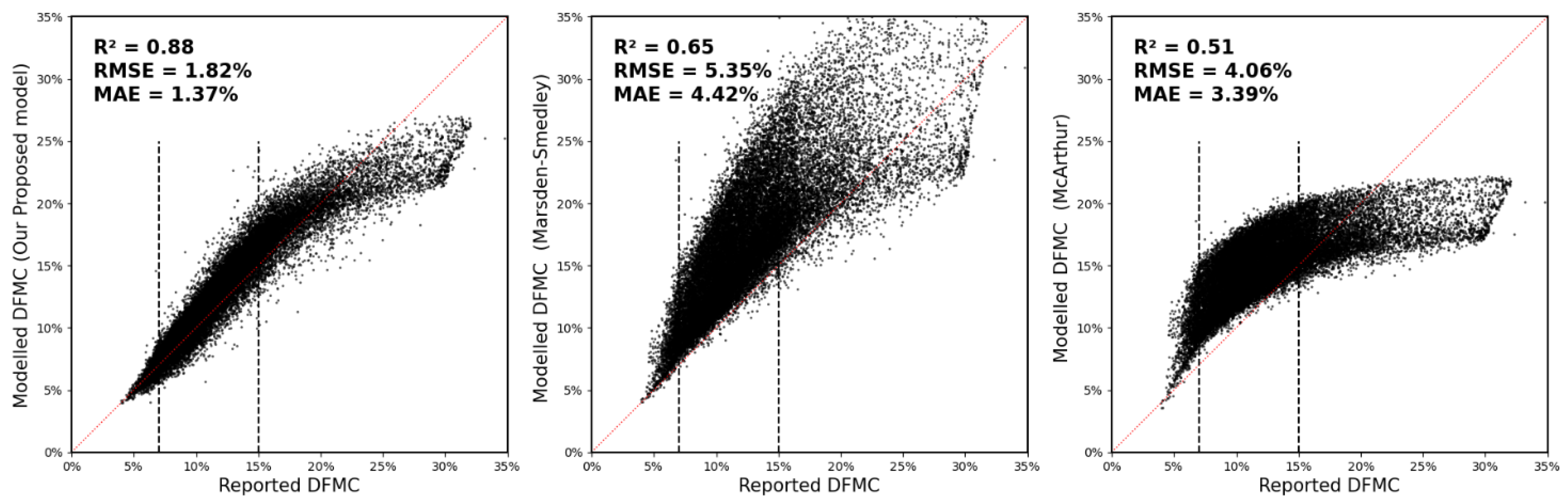
Figure 2 compares the performance of the three DFMC empirical models using the weather and fuel data from Oklahoma Mesonet stations. It shows that the proposed DFMC sub-model reproduces reported values with high accuracy, particularly within the operationally critical range of DFMC (8–15%). The Marsden-Smedley model [39] progressively overestimates DFMC at higher values, whereas the McArthur model [38] exhibits greater deviations, characterized by overestimation at lower DFMC and underestimation at higher DFMC.
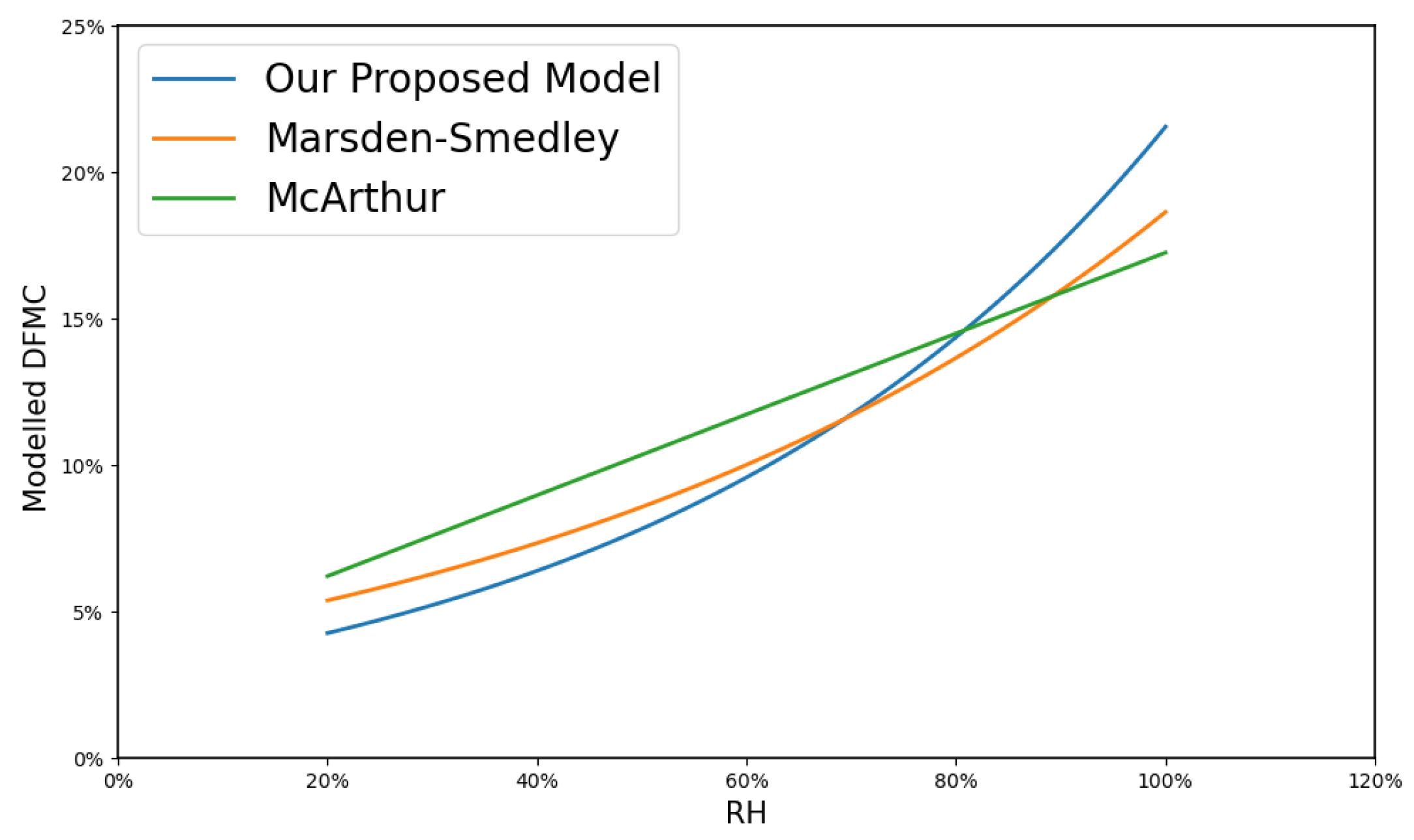
Figure 3 compares the responses of the three DFMC models to changes in RH at air temperature of 30 °C. The proposed sub-model exhibits a strong nonlinear increase beyond 70% RH, indicating higher sensitivity to moisture accumulation under humid conditions. The McArthur model follows a nearly linear trend across the RH range, showing limited responsiveness to increasing humidity. The Marsden-Smedley model displays moderate curvature, with sensitivity intermediate between the proposed and McArthur models.

3.2. The Grass Curing Sub-Model

The grass curing sub-model takes the following form:
Grass curing (%) = 100/[1 + exp (−B × (DOY-C))]
where DOY is the day of year; B and C are model parameters determined by regression. The B value represents the rate of change in curing levels, determining the steepness of the transition. The C value represents the inflection point of the model and the DOY at 50% curing.
Under normal pre-season moisture conditions, when the annual average KBDI in the previous year was less than 280, C = 111 (95% CI: 111–112) and B = −0.0527 (95% CI: −0.0539 to −0.0516). The narrow 95% confidence interval for C demonstrates high precision in the timing of 50% curing, while the tight confidence bounds for B indicate consistent rate of change in curing levels across years with moderate drought influence.
During extreme drought years, when the annual average KBDI in the previous year was more than 280, C = 89 (95% CI: 88–90), B = −0.057 (95% CI: −0.058 to −0.056), which indicated an earlier and more rapid rate of change in curing levels. Curing levels decreased more quickly and reached key thresholds earlier in the season, highlighting interannual variability in vegetation response [41].
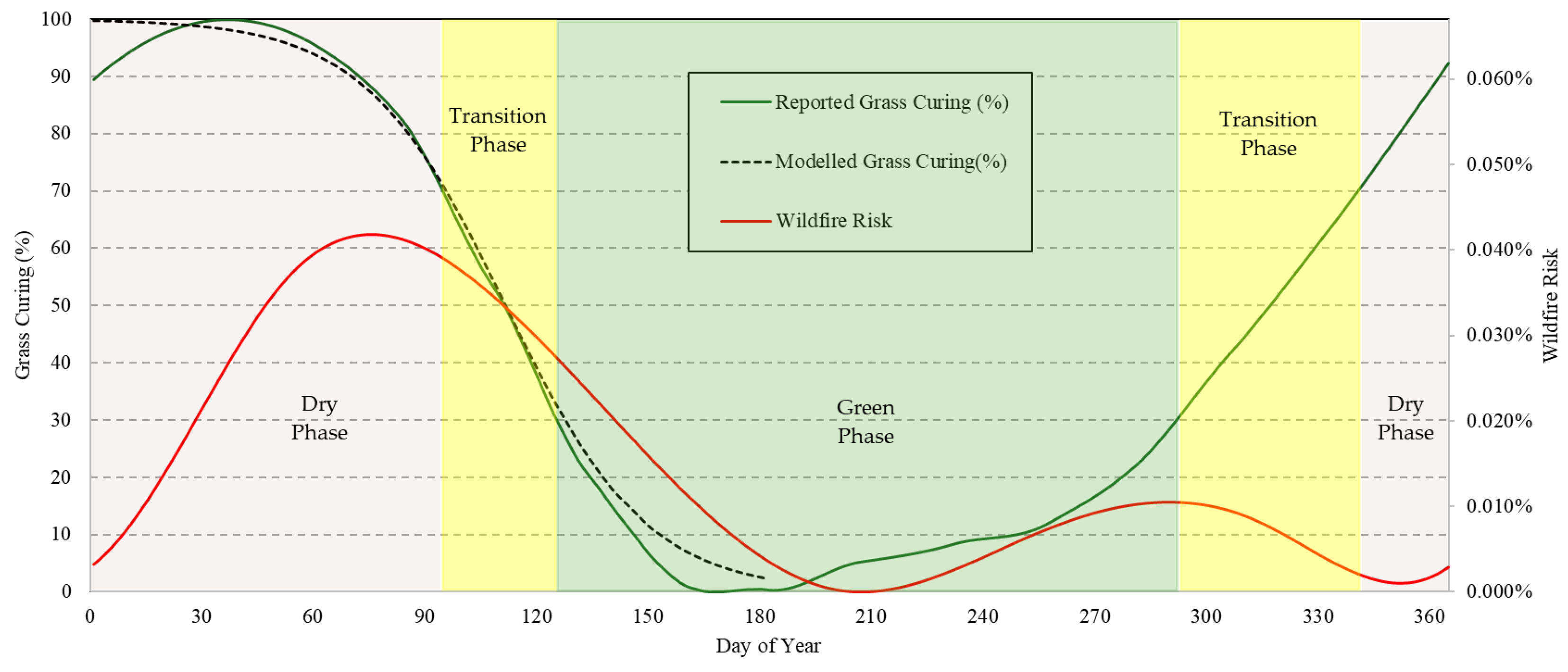
Seasonal patterns of reported and modeled grass curing and associated wildfire risk are shown in Figure 4. Wildfire risk was quantified as the ratio of daily wildfire burned area to total land area in Osage county, OK, averaged across 1994–2020. Variations in grass curing and seasonal temperature explain the bimodal pattern of the quantified wildfire risks. Figure 4 demonstrated the close relationship of grass curing and seasonal change in wildfire risks in the Great Plains. While winter represents the close to 100% curing and the driest fuel conditions, wildfire risk is constrained by cold temperatures, or snow cover. In early March, when curing is still at above 70%, wildfire risk is at highest level, peaking near 0.043%. During spring green-up, both grass curing and wildfire risk decreases sharply with time. In the transition phase, when curing decreases from 70% to 30%, wildfire risk correspondingly decreases from 0.039% to 0.027%. At the end of July, wildfire risk is at lowest level and close to 0%. From late summer to fall, wildfire risk increases again to about 0.012% as late-season curing progresses under favorable thermal conditions. The lower peak of wildfire risk in the fall transition phase reflects reduced fine-fuel loads and disrupted continuity following extensive spring burning and grazing. For this study, modeling was focused on the first half of the year because this period encompasses the prescribed fire season in the Great Plains, when curing dynamics most strongly influence fire planning.

4. Discussion

4.1. DFMC as a Daily Fire Risk Factor

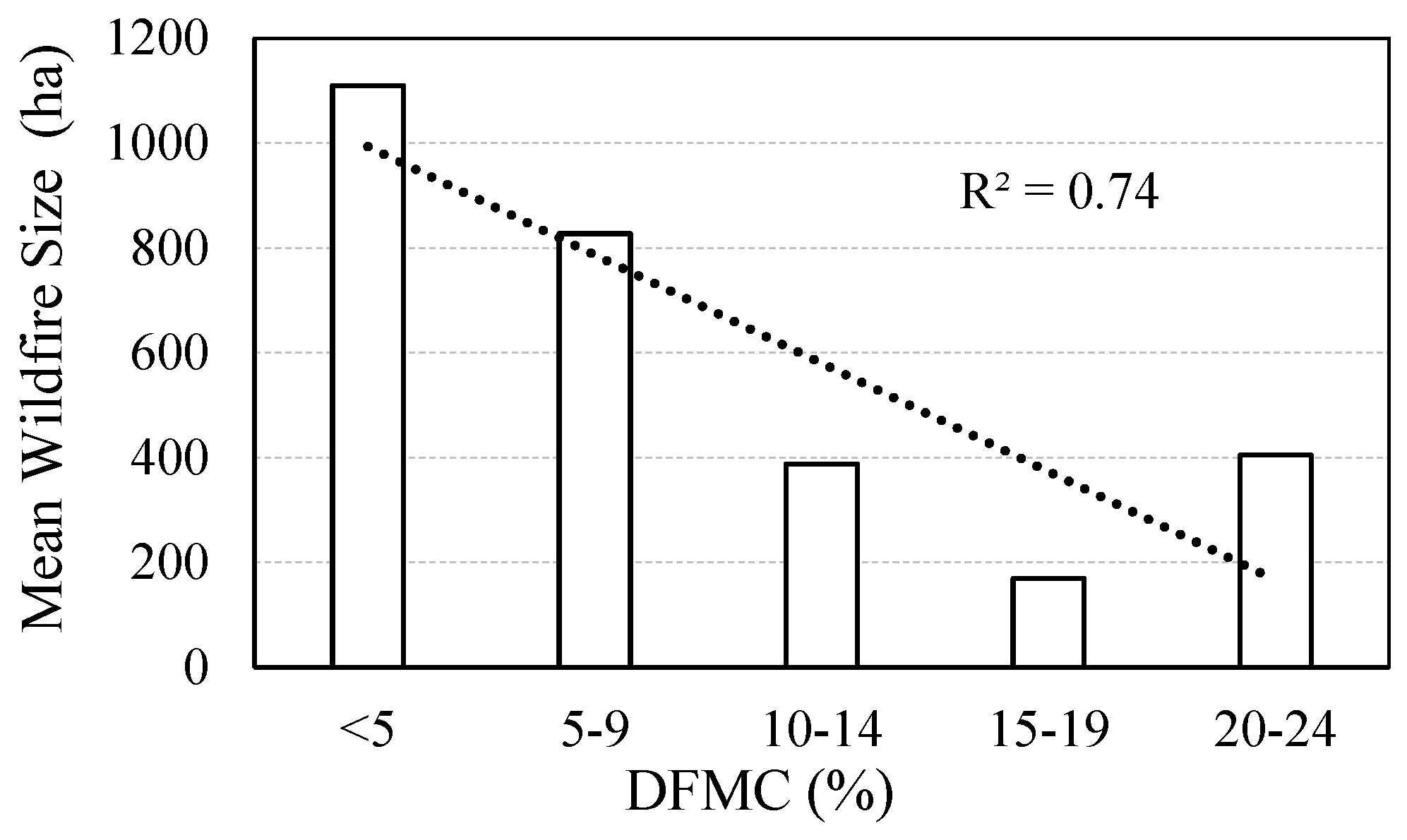
DFMC is a daily fire risk factor because it directly controls fuel ignitability and flame sustainability. Reductions in DFMC substantially increase ignition likelihood and accelerate fire spread, a relationship well documented in grassland and savanna ecosystems [5]. The mean wildfire size under different reported DFMC levels in Osage county, OK, is shown in Figure 5. It shows that the mean wildfire size linearly increased with decreasing DFMC levels. About 99% of the total burned area from wildfires ≥ 100 ha occurred when DFMC was less than 15%. This observation underscores the importance of DFMC as a daily fire risk factor. Incorporating DFMC as a daily fire risk factor within the proposed GFDI enables explicit representation of short-term variability in wildfire danger, thereby improving the operational utility of fire danger assessments in the Great Plains.
The Great Plains dataset used in this study encompassed a broad and variable range, with temperatures from 5.0 °C to 32.3 °C, RH from 18% to 100%, and DFMC from 4.6% to 31.7%. These gradients reflect the region’s continental climate, characterized by strong seasonal contrasts and frequent weather extremes, and the dominance of tallgrass prairie fuels, which differ markedly from Australian fuel types in structure, curing dynamics, and moisture retention. By contrast, McArthur’s [38] and Marsden-Smedley [39] DFMC models were developed using datasets with relatively narrower temperature and RH ranges suited to temperate or Mediterranean climates. Marsden-Smedley [39] derived their model from button grass moorland fuels in Tasmania, where temperatures ranged from 10.3 °C to 34.4 °C, RH from 24.6% to 99%, and DFMC from 6.1% to 31.7%. McArthur’s [38] dataset covered temperatures from 10 °C to 38 °C, RH from 5% to 80%, and DFMC from 2% to 18%. These narrower environmental conditions limit the direct applicability of such models to the Great Plains. The proposed DFMC sub-model for the Great Plains demonstrates superior predictive performance compared to both McArthur’s and Marsden-Smedley’s models when applied to this region.
As shown in Figure 2, the proposed DFMC exhibits the highest overall accuracy and the lowest error, particularly within the ignition-relevant DFMC range of 8% to 15%. This DFMC range corresponds to fire behavior thresholds where fuels burn well yet remain controllable [51,52] and thus is common for prescribed fires in grasslands. The alignment with local grassland fuel dynamics and meteorological conditions makes the DFMC sub-model a robust tool for operational fire danger assessments, prescribed fire planning, and ecological forecasting in the Great Plain.
The empirical model developed in this study is based on only two variables, RH and temperature, yet explains 88% of the variance in DFMC. This high performance, combined with a simpler structure, makes the model not only statistically robust but also more accessible and easier to implement for real-time fire danger assessments in the Great Plains. The model’s simplicity supports its practical utility in fire management, particularly in regions with limited meteorological inputs or rapid decision-making needs. Our approach follows the principle of keeping the model as simple as possible while still maintaining strong agreement with the calibrated values produced by the Nelson model.

4.2. Grass Curing as a Seasonal Fire Risk Factor

Grass curing patterns in the Great Plains are strongly influenced by regional differences in dominant grass functional types and the climatic gradients that shape their growth. Northern portions of the region contain more C3 grasses that begin senescing earlier in the spring, while southern portions are dominated by C4 grasses that retain green tissue longer and cure more slowly under normal moisture conditions [60,61,62,63]. These physiological traits create predictable north–south differences in the timing of seasonal drying and the transition from fully cured winter fuels to actively growing summer vegetation [60,64]. These ecological patterns are reflected in our grass curing sub-model. Under normal moisture conditions, the sub-model identifies mid-April as the inflection point at which 50% curing occurs (C = 111). This corresponds to the typical timing of early-season green-up in mixed C3 and C4 tallgrass systems in the region [60,65,66]. During years with severe antecedent drought, curing advances more rapidly, and the model estimates an earlier 50% curing date (C = 89). This shift is consistent with accelerated senescence observed in both C3 grasses and drought-stressed C4 grasses when soil moisture is limited [64].
The grass curing sub-model provides landowners and fire managers with a practical tool to estimate seasonal fuel availability, identify safe and effective burn windows, and anticipate wildfire potential under varying drought conditions, thereby improving both prescribed fire implementation and wildfire preparedness. Visual field assessments remain essential for operational decision-making. Aligning model predictions with visual indicators such as seed maturity and stalk color improves site-specific fire planning, especially in areas with limited real-time data access. Grass curing is influenced by interannual variability in temperature and precipitation, site-specific soil moisture conditions, species composition, grazing pressure, and microclimatic differences [42]. These factors create fine-scale heterogeneity that may not be fully captured by regional greenness indices or weather-station data. Localized rainfall or differences in dominant grass species can accelerate or delay curing relative to modeled averages, while heavy grazing can make pastures appear more cured than they are physiologically.
Table 1 outlines characteristic changes in grass color and landscape appearance associated with key curing thresholds. The table highlights observable transitions from fully cured to fully green vegetation. The driest conditions occur before January 3rd, when curing is close to 100%. In early March, curing levels are around 90%, representing peak dryness but with early signs of green-up beginning to appear. Around March 15th–16th, the landscape remains mostly dry and straw-colored, but some stalks begin to show green at the base (70% cured). Around April 15th–16th, the green-up process is at the midpoint (50% cured). Many landowners perceive this stage as a time for safe and effective prescribed fire, since partial greenness reduces fire intensity, though fuel conditions can still support active fire spread. By June 23rd, the landscape is fully green and dominated by live vegetation (less than 10% cured).
Landowners, fire managers, and prescribed fire planners should integrate visual field observations with model outputs when planning burns. While the alignment between modeled and observed curing values supports the use of curing percentages as an operational guide, acknowledging these uncertainties ensures more cautious and effective application in practice. Integrating model outputs with visual cues such as seed maturity and stalk coloration can enhance site-specific burn planning, particularly in areas with limited real-time fuel moisture data.

5. Conclusions

This study developed region-specific sub-models for DFMC and grass curing as foundational components of a proposed Great Plains GFDI. DFMC is a daily fire risk factor because it regulates ignition probability and fire spread, while grass curing represents seasonal fuel availability readiness to burn. By explicitly modeling both processes, the proposed framework captures short-term weather-driven variability and mid-term seasonal dynamics. Our results show that tailoring sub-models to Great Plains conditions improves the reliability of fire danger assessment, strengthens operational planning, and provides landowners and fire managers with ecologically meaningful metrics for prescribed fire. The unique strength of this approach lies in its ability to separate daily and seasonal risks while integrating them into a single index that is both interpretable and operationally relevant. This work provides practical tools for safer prescribed fire implementation, improved wildfire preparation, and more informed decision-making across Great Plains landscapes, while laying the foundation for a fully localized and operationally relevant fire danger index system for the region.

Author Contributions

Writing—original draft and data analysis, M.B.G.; Review and editing of the original draft, and supervision of the overall study, Z.L.; Data curation, I.O.O. All authors have read and agreed to the published version of the manuscript.

Funding

This research was funded by National Science Foundation, grant number 2306603 (SCC-IRG Track 1: Smart and Safe Prescribed Burning for Rangeland and Wildland Urban Interface Communities).

Institutional Review Board Statement

Not applicable.

Informed Consent Statement

Not applicable.

Data Availability Statement

The raw data supporting the conclusions of this article will be made available by the authors on request.

Conflicts of Interest

The authors declare no conflicts of interest. The funders had no role in the design of the study; in the collection, analyses, or interpretation of data; in the writing of the manuscript; or in the decision to publish the results.

Abbreviations

The following abbreviations are used in this manuscript:
GFDIGrassland Fire Danger Index
DOYDay of year
KBDIKeetch–Byram Drought Index
MODIS Moderate Resolution Imaging Spectroradiometer
NASANational Aeronautics and Space Administration
NDVINormalized Difference Vegetation Index

References

  1. McEowen, R.A.; Baldwin, C. Kansas Prescribed Burning—Rules and Regulations; MF3601; Kansas State University: Manhattan, KS, USA, 2024. [Google Scholar]
  2. Liu, Z.; Okafor, I.O.; George, M.B. Characterizing risks for wildfires and prescribed fires in the Great Plains. Fire 2025, 8, 235. [Google Scholar] [CrossRef]
  3. Penman, T.D.; Clarke, H.; Cirulis, B.; Boer, M.M.; Price, O.F.; Bradstock, R.A. Cost-effective prescribed burning solutions vary between landscapes in eastern Australia. Front. For. Glob. Change 2020, 3, 79. [Google Scholar] [CrossRef]
  4. Volesky Jerry, D.; Stubbendieck James, L.; Mitchell Rob, B. Conducting a Prescribed Burn and Prescribed Burning Checklist; Nebraska Forest Service: Lincoln, NE, USA, 2010; Available online: https://digitalcommons.unl.edu/nebforestpubs/23 (accessed on 1 October 2025).
  5. Schreck, M.B.; Howerton, P.J.; Cook, K.R. Adapting Australia’s Grassland Fire Danger Index for the United States’ Central Plains; 10-02; Central Region Technical Attachment; NWS Weather Forecast Offices: Silver Spring, MD, USA, 2010.
  6. Sharples, J.J.; McRae, R.H.D.; Weber, R.O.; Gill, A.M. A simple index for assessing fire danger rating. Environ. Model. Softw. 2009, 24, 764–774. [Google Scholar] [CrossRef]
  7. Varela, V.; Sfetsos, A.; Vlachogiannis, D.; Gounaris, N. Fire Weather Index (FWI) classification for fire danger assessment applied in Greece. Tethys J. Weather Clim. West. Mediterr. 2018, 15, 31–40. [Google Scholar]
  8. Merrill, D.; Alexander, M. Glossary of Forest Fire Management Terms, 4th ed.; National Research Council of Canada, Canadian Committee on Forest Fire Management: Ottawa, ON, Canada, 1987; Publication NRCC No. 26516. [Google Scholar]
  9. Podschwit, H.; Jolly, W.; Alvarado, E.; Markos, A.; Verma, S.; Barreto-Rivera, S.; Tobón-Cruz, C.; Ponce-Vigo, B. Effects of fire danger indexes and land cover on fire growth in Peru. EGUsphere 2022, preprints. [Google Scholar] [CrossRef]
  10. Chuvieco, E.; Cocero, D. Remote sensing of large wildfires in the European Mediterranean Basin. Remote Sens. Environ. 1996, 60, 153–168. [Google Scholar]
  11. Chuvieco, E.; Aguado, I.; Cocero, D.; Riaño, D. Design of an empirical index to estimate fuel moisture content from NOAA-AVHRR images in forest fire danger studies. Int. J. Remote Sens. 2003, 24, 1621–1637. [Google Scholar] [CrossRef]
  12. Andrews, P.L.; Bradshaw, L.S. FIRES: Fire Information Retrieval and Evaluation System; US Department of Agriculture, Forest Service, Intermountain Research Station: Logan, UT, USA, 1997. Available online: https://www.fs.usda.gov/rm/pubs_int/int_gtr367.pdf (accessed on 1 October 2025).
  13. Schoenberg, F.P.; Chang, C.H.; Keeley, J.E.; Pompa, J.; Woods, J.; Xu, H. A critical assessment of the burning index in Los Angeles County, California. Int. J. Wildl. Fire 2007, 16, 473–483. [Google Scholar] [CrossRef]
  14. Keetch, J.J.; Byram, G.M. A Drought Index for Forest Fire Control; US Department of Agriculture, Forest Service, Southeastern Forest Experiment Station: Asheville, NC, USA, 1968; Volume 38.
  15. Carlson, J.D.; Burgan, R.E.; Engle, D.M.; Greenfield, J.R. The Oklahoma fire danger model: An operational tool for mesoscale fire danger rating in Oklahoma. Int. J. Wildl. Fire 2002, 11, 183–191. [Google Scholar] [CrossRef]
  16. Sullivan, A. Review of the operational calculation of McArthur’s drought factor; Client Report Number 921; CSIRO Forestry and Forest Products: Canberra, Australia, 2001. [Google Scholar]
  17. Taufik, M.; Setiawan, B.I.; van Lanen, H.A. Modification of a fire drought index for tropical wetland ecosystems by including water table depth. Agric. For. Meteorol. 2015, 203, 1–10. [Google Scholar] [CrossRef]
  18. Kumar, V.; Dharssi, I. Evaluation of daily soil moisture deficit used in Australian forest fire danger rating system. For. Ecol. Manag. 2017, 259, 685–697. [Google Scholar]
  19. Krueger, E.S.; Levi, M.R.; Achieng, K.O.; Bolten, J.D.; Carlson, J.D.; Coops, N.C.; Holden, Z.A.; Magi, B.I.; Rigden, A.J.; Ochsner, T.E. Using soil moisture information to better understand and predict wildfire danger: A review of recent developments and outstanding questions. Int. J. Wildl. Fire 2022, 32, 111–132. [Google Scholar] [CrossRef]
  20. Plucinski, M.P.; Tartaglia, E.; Huston, C.; Stephenson, A.G.; Dunstall, S.; McCarthy, N.F.; Deutsch, S. Exploring the influence of the Keetch–Byram Drought Index and McArthur’s Drought Factor on wildfire incidence in Victoria, Australia. Int. J. Wildl. Fire 2023, 33. [Google Scholar] [CrossRef]
  21. Janis, M.J.; Johnson, M.B.; Forthun, G. Near-real time mapping of Keetch–Byram Drought Index in the southeastern United States. Int. J. Wildl. Fire 2002, 11, 281–289. [Google Scholar] [CrossRef]
  22. Finkele, K.; Mills, G.A.; Beard, G.; Jones, D.A. National gridded drought factors and comparison of two soil moisture deficit formulations used in prediction of Forest Fire Danger Index in Australia. Aust. Meteorol. Mag. 2006, 55, 183–197. [Google Scholar]
  23. Sullivan, A. Grassland Fire Danger Meter. 2008. Available online: http://www.csiro.au/products/GrassFireSpreadMeter.html (accessed on 1 October 2025).
  24. Noble, I.R.; Gill, A.M.; Bary, G.A.V. McArthur’s fire-danger meters expressed as equations. Aust. J. Ecol. 1980, 5, 201–203. [Google Scholar] [CrossRef]
  25. Purton, C.M. Equations for the McArthur Mark 4 Grassland Fire Danger Meters; Meteorological Note 147; Bureau of Meteorology: Melbourne, Australia, 1982.
  26. Cheney, P.; Sullivan, A. Grassfires: Fuel, Weather and Fire Behaviour; Csiro Publishing: Clayton, Australia, 2008. [Google Scholar]
  27. Hollis, J.J.; Matthews, S.; Fox-Hughes, P.; Grootemaat, S.; Heemstra, S.; Kenny, B.J.; Sauvage, S. Introduction to the Australian fire danger rating system. Int. J. Wildl. Fire 2024, 33. [Google Scholar] [CrossRef]
  28. Kenny, B.J.; Matthews, S.; Sauvage, S.; Grootemaat, S.; Hollis, J.J.; Fox-Hughes, P. Australian Fire Danger Rating System: Implementing Fire Behaviour Calculations to Forecast Fire Danger in a Research Prototype. Int. J. Wildl. Fire 2024, 33. [Google Scholar] [CrossRef]
  29. Okafor, I.O.; Liu, Z.; George, M.B. Quantifying and modeling wildland fire risk for prescribed fire management in the Great Plains. Fire Ecol. 2025, in press.
  30. Cruz, M.G.; Sullivan, A.L.; Gould, J.S.; Sims, N.C.; Bannister, A.J.; Hollis, J.J.; Hurley, R.J. Anatomy of a catastrophic wildfire: The Black Saturday Kilmore East fire in Victoria, Australia. For. Ecol. Manag. 2012, 284, 269–285. [Google Scholar] [CrossRef]
  31. Nolan, R.H.; Boer, M.M.; Resco de Dios, V.; Caccamo, G.; Bradstock, R.A. Large-scale, dynamic transformations in fuel moisture drive wildfire activity across southeastern Australia. Geophys. Res. Lett. 2016, 43, 4229–4238. [Google Scholar] [CrossRef]
  32. Sullivan, A.L. Grassland fire management in future climate. United_Nation_2021_Wildfires—A growing concern for sustainable development. Adv. Agron. 2010, 106, 173–208. [Google Scholar] [CrossRef]
  33. Viney, N.R. A review of fine fuel moisture modelling. Int. J. Wildl. Fire 1991, 1, 215–234. [Google Scholar] [CrossRef]
  34. Nelson, R.M. Water relations of forest fuels. In Forest Fires: Behavior and Ecological Effects; Johnson, E.A., Miyanishi, K., Eds.; Academic Press: Amsterdam, The Netherlands, 2001; pp. 79–149. [Google Scholar]
  35. Yebra, M.; Dennison, P.E.; Chuvieco, E.; Riaño, D.; Zylstra, P.; Hunt, E.R., Jr.; Jurdao, S.; Kane, V.; Rothermel, R.C.; Roberts, D.A.; et al. A global review of remote sensing of live fuel moisture content for fire danger assessment: Moving towards operational products. Remote Sens. Environ. 2013, 136, 455–468. [Google Scholar] [CrossRef]
  36. Jolly, W.M.; Freeborn, P.H.; Page, W.G.; Butler, B.W. Severe fire danger index: A forecastable metric to inform firefighters and community wildfire risk management. Fire 2019, 2, 47. [Google Scholar] [CrossRef]
  37. Carlson, J.D.; Bradshaw, L.S.; Nelson, R.M., Jr.; Bensch, R.R.; Jabrzemski, R. Field evaluation of the Nelson dead fuel moisture model and comparisons with National Fire Danger Rating System (NFDRS) predictions. In Proceedings of the Sixth Symposium on Fire and Forest Meteorology, Canmore, AB, Canada, 25–27 October 2005. [Google Scholar]
  38. McArthur, A.G. Weather and Grassland Fire Behavior; Forestry and Timber Bureau: Canberra, Australia, 1966. [Google Scholar]
  39. Marsden-Smedley, J.B.; Catchpole, W.R. Fire modelling in Tasmanian buttongrass moorlands. III. Dead fuel moisture. Int. J. Wildl. Fire 2001, 10, 241–253. [Google Scholar] [CrossRef]
  40. Duff, T.J.; Chong, D.M.; Penman, T.D. Quantifying wildfire growth rates using smoke plume observations derived from weather radar. Int. J. Wildl. Fire 2018, 27, 514–524. [Google Scholar] [CrossRef]
  41. Garvey, M.F.; Millie, S. Grassland Curing Guide; Country Fire Authority, Community Safety Department: Melbourne, Australia, 2001.
  42. Anderson, S.A.; Anderson, W.R.; Hollis, J.J.; Botha, E.J. A simple method for field-based grassland curing assessment. Int. J. Wildl. Fire 2011, 20, 804–814. [Google Scholar] [CrossRef]
  43. Cruz, M. The Vesta Mk 2 Rate of Fire Spread Model: A User’s Guide; CSIRO: Canberra, Australia, 2021. [Google Scholar]
  44. Cheney, N.P.; Gould, J.S.; Catchpole, W.R. The influence of fuel, weather and fire shape variables on fire spread in grasslands. Int. J. Wildl. Fire 1993, 3, 31–44. [Google Scholar] [CrossRef]
  45. Catchpole, W.R.; Wheeler, C.J. Estimating plant biomass: A review of techniques. Aust. J. Ecol. 1992, 17, 121–131. [Google Scholar] [CrossRef]
  46. Roberts, G.; Wooster, M.J.; Lagoudakis, E. Annual and diurnal African biomass burning temporal dynamics. Biogeosciences 2009, 6, 849–866. [Google Scholar] [CrossRef]
  47. Peterson, S.H.; Roberts, D.A.; Dennison, P.E. Mapping live fuel moisture with MODIS data: A multiple regression approach. Remote Sens. Environ. 2008, 112, 4272–4284. [Google Scholar] [CrossRef]
  48. Martin, D.; Jones, S.; Grant, I.; Anderson, S. Assessment of grassland curing using field-based spectrometry and satellite imagery. In Innovations in Remote Sensing and Photogrammetry; Jones, S., Reinke, K., Eds.; Lecture Notes in Geoinformation and Cartography; Springer: Berlin/Heidelberg, Germany, 2009. [Google Scholar] [CrossRef]
  49. Duff, T.J.; Chong, D.M.; Tolhurst, K.G. Quantifying spatio-temporal differences between fire shapes: Estimating fire travel paths for the improvement of dynamic spread models. Environ. Model. Softw. 2013, 46, 33–43. [Google Scholar] [CrossRef]
  50. Gill, A.M.; King, K.J.; Moore, A.D. Australian grassland fire danger using inputs from the GRAZPLAN grassland simulation model. Int. J. Wildl. Fire 2010, 19, 338–345. [Google Scholar] [CrossRef]
  51. Brock, F.V.; Crawford, K.C.; Elliott, R.L.; Cuperus, G.W.; Stadler, S.J.; Johnson, H.L.; Eilts, M.D. The Oklahoma Mesonet: A technical overview. J. Atmos. Ocean. Technol. 1995, 12, 5–19. [Google Scholar] [CrossRef]
  52. McPherson, R.A.; Fiebrich, C.; Crawford, K.C.; Elliott, R.L.; Kilby, J.R.; Grimsley, D.L.; Martinez, J.E.; Basara, J.B.; Illston, B.G.; Morris, D.A.; et al. Statewide monitoring of the mesoscale environment: A technical update on the Oklahoma Mesonet. J. Atmos. Ocean. Technol. 2007, 24, 301–321. [Google Scholar] [CrossRef]
  53. Newnham, G.J.; Verbesselt, J.; Grant, I.F.; Anderson, S.A. Relative Greenness Index for Assessing Curing of Grassland Fuel. Remote Sens. Environ. 2011, 115, 1456–1463. [Google Scholar] [CrossRef]
  54. Chaivaranont, W.; Evans, J.P.; Liu, Y.Y.; Sharples, J.J. Estimating Grassland Curing with Remotely Sensed Data. Nat. Hazards Earth Syst. Sci. 2018, 18, 1535–1554. [Google Scholar] [CrossRef]
  55. Sharma, S.; Carlson, J.D.; Krueger, E.S.; Engle, D.M.; Twidwell, D.; Fuhlendorf, S.D.; Patrignani, A.; Feng, L.; Ochsner, T.E. Soil Moisture as an Indicator of Growing-Season Herbaceous Fuel Moisture and Curing Rate in Grasslands. Int. J. Wildl. Fire 2021, 30, 57. [Google Scholar] [CrossRef]
  56. Cleveland, W.S. Robust locally-weighted regression and smoothing scatterplots. J. Am. Stat. Assoc. 1979, 74, 829–836. [Google Scholar] [CrossRef]
  57. Short, K.C. Spatial Wildfire Occurrence Data for the United States, 1992–2020 [FPA_FOD_20221014], 6th ed.; Forest Service Research Data Archive: Fort Collins, CO, USA, 2022. [CrossRef]
  58. Walker, K. Tigris: An R Package to Access and Work with Geographic Data from the US Census Bureau. R J. 2016, 8, 231. [Google Scholar] [CrossRef]
  59. Pebesma, E. Simple Features for R: Standardized Support for Spatial Vector Data. R J. 2018, 10, 439. [Google Scholar] [CrossRef]
  60. Tieszen, L.L.; Reed, B.C.; Bliss, N.B.; Wylie, B.K.; DeJong, D.D. NDVI, C3 and C4 production, and distributions in Great Plains grassland land cover classes. Ecol. Appl. 1997, 7, 59–78. [Google Scholar]
  61. Luo, X.; Zhou, H.; Satriawan, T.W.; Tian, J.; Zhao, R.; Keenan, T.F.; Griffith, D.M.; Sitch, S.; Smith, N.G.; Still, C.J. Mapping the global distribution of C4 vegetation using observations and optimality theory. Nat. Commun. 2024, 15, 1219. [Google Scholar] [CrossRef]
  62. Still, C.J.; Berry, J.A.; Collatz, G.J.; DeFries, R.S. Global distribution of C3 and C4 vegetation: Carbon cycle implications. Glob. Biogeochem. Cycles 2003, 17, 6-1–6-14. [Google Scholar] [CrossRef]
  63. Wang, C.; Wylie, B.K.; Tieszen, L.L. Phenology-assisted classification of C3 and C4 grasses in the U.S. Great Plains. Remote Sens. Environ. 2013, 135, 46–58. [Google Scholar] [CrossRef]
  64. Havrilla, C.A.; Blumenthal, D.M.; Derner, J.D.; Knapp, A.K.; Reichmann, L.G.; Wilcox, K.R.; Collins, S.L. Divergent climate impacts on C3 versus C4 grasses imply widespread 21st century shifts in grassland functional composition. Divers. Distrib. 2023, 29, 379–394. [Google Scholar] [CrossRef]
  65. Barnes, P.W.; Harrison, A.T. Species distribution and community organization in Nebraska Sandhills mixed-prairie as influenced by plant/soil-water relationships. Oecologia 1982, 52, 192–201. [Google Scholar] [CrossRef]
  66. Schacht, W.H.; Volesky, J.D.; Bauer, D.; Smart, A.J.; Mousel, E.M. Plant community patterns on upland prairie in the eastern Sandhills of Nebraska. Prairie Nat. 2000, 32, 43–58. [Google Scholar]
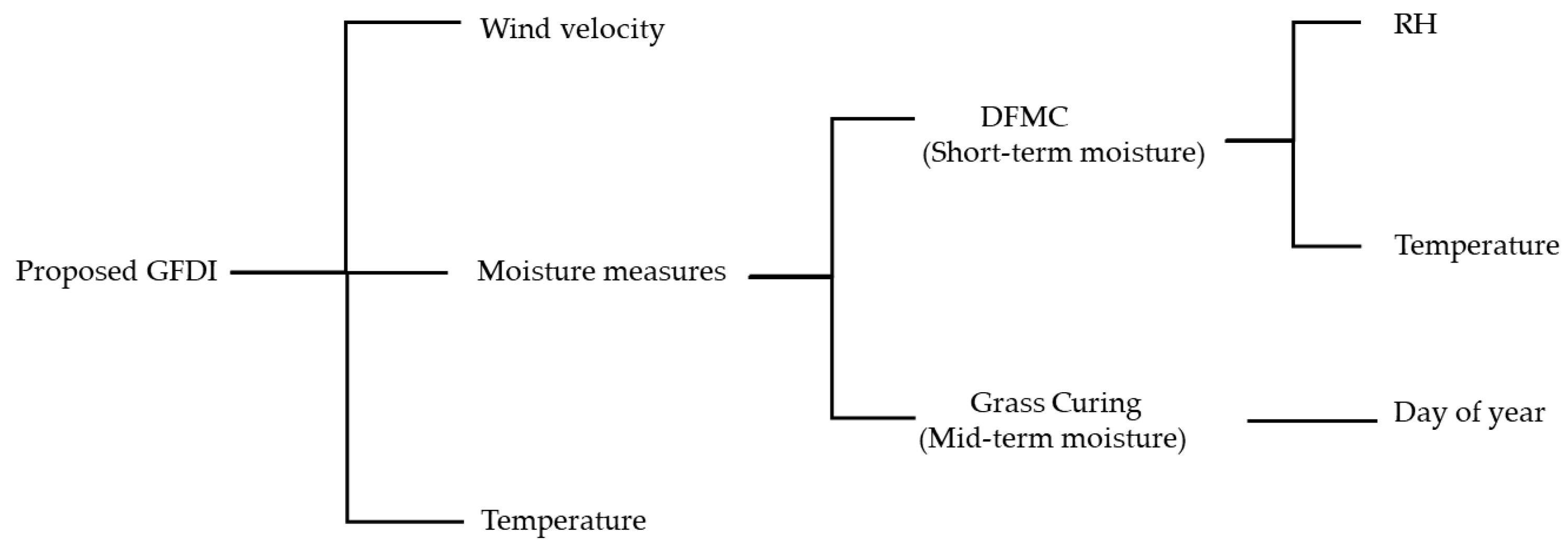
Figure 1. Structure of the proposed GFDI for the Great Plains.
Fire 08 00469 g001
Figure 2. Performance of the three empirical DFMC models using the weather and fuel data from Oklahoma Mesonet stations.
Fire 08 00469 g002
Figure 3. Sensitivity of the three empirical DFMC models to RH at air temperature of 30 °C.
Fire 08 00469 g003
Figure 4. Seasonal trends in observed and modeled grass curing (%) and wildfire risk throughout the year. Wildfire risk was quantified as the ratio of daily wildfire burned area to total land area in Osage county, OK, averaged across 1994–2020, and the data was smoothed using LOESS method.
Fire 08 00469 g004
Figure 5. The mean wildfire size (from 1994 to 2020) under different reported DFMC levels in Osage County, OK, for wildfires ≥ 100 ha.
Fire 08 00469 g005
Table 1. Change in grass curing levels from January to June in the Great Plains.
Date 1Grass Curing Landscape FeaturesPhoto 2
Dry
phase
Before Jan 3rdClose to 100%Grass is fully cured. Stalks are dry and bleached, seed heads are empty, and stems are brittle with no moisture.Fire 08 00469 i001
March 1st–2nd90%The landscape is still largely dry and straw-colored, with early signs of green-up. Fire 08 00469 i002
March 15th–16th70%The landscape remains mostly dry and straw-colored.Fire 08 00469 i003
Transition phaseApril 15th–16th50%Green-up is at the midpoint. The landscape has a mix of cured and uncured grasses.Fire 08 00469 i004
Green phaseMay 10th–11th30%All grasses are almost green.Fire 08 00469 i005
After June 23rdLess than 10%All the grass is fully green.Fire 08 00469 i006
1. Dates are based on normal conditions in Osage county, OK. 2. Photo credit: Mark Garvey.
Disclaimer/Publisher’s Note: The statements, opinions and data contained in all publications are solely those of the individual author(s) and contributor(s) and not of MDPI and/or the editor(s). MDPI and/or the editor(s) disclaim responsibility for any injury to people or property resulting from any ideas, methods, instructions or products referred to in the content.