
Advances in Zirconia Crowns: A Comprehensive Review of Strength, Aesthetics, Digital Manufacturing, and Clinical Performance


Abstract
1. Introduction
2. Materials and Methods (Literature Search Strategy)
3. Evolution of Zirconia Materials in Dentistry
3.1. Historical Development
3.2. Classification of Zirconia
4. Manufacturing Processes and Digital Workflow
4.1. CAD/CAM Technology in Zirconia Crown Fabrication
4.2. Innovations in Manufacturing Techniques
5. Enhancements in Aesthetic Properties of Zirconia
6. Clinical Performance and Longevity of Zirconia Restorations
6.1. Clinical Decision-Making Guidelines for Zirconia Restorations
6.1.1. Tooth Location-Based Selection
6.1.2. Occlusal Load Considerations
6.1.3. Restoration Type and Span
6.1.4. Patient-Specific Risk Factors
6.1.5. Implant vs. Tooth-Supported Restorations
7. Limitations, Controversies, and Comparison with Other Indirect Aesthetic Restorative Materials
8. Future Perspectives and Research Directions for Zirconia Restorations
9. Conclusions
Funding
Data Availability Statement
Conflicts of Interest
References
- Pjetursson, B.E.; Sailer, I.; Makarov, N.A.; Zwahlen, M.; Thoma, D.S. All-Ceramic or Metal-Ceramic Tooth-Supported Fixed Dental Prostheses (FDPs)? A Systematic Review of the Survival and Complication Rates. Part II: Multiple-Unit FDPs. Dent. Mater. 2015, 31, 624–639. [Google Scholar] [CrossRef]
- Zhang, Y.; Lawn, B.R. Novel zirconia materials in dentistry. J. Dent. Res. 2018, 97, 140–147. [Google Scholar] [CrossRef] [PubMed]
- Sailer, I.; Makarov, N.A.; Thoma, D.S.; Zwahlen, M.; Pjetursson, B.E. All-ceramic or metal–ceramic tooth-supported fixed dental prostheses (FDPs)? A systematic review of the survival and complication rates. Part I: Single crowns (SCs). Dent. Mater. 2015, 31, 603–623. [Google Scholar] [CrossRef]
- Denry, I.; Kelly, J.R. State of the art of zirconia for dental applications. Dent. Mater. 2008, 24, 299–307. [Google Scholar] [CrossRef] [PubMed]
- Huang, B.; Chen, M.; Wang, J.; Zhang, X. Advances in zirconia-based dental materials: Properties, classification, applications, and future prospects. J. Dent. 2024, 147, 105111. [Google Scholar] [CrossRef] [PubMed]
- Chevalier, J.; Gremillard, L.; Virkar, A.V.; Clarke, D.R. The tetragonal–monoclinic transformation in zirconia. J. Am. Ceram. Soc. 2009, 92, 1901–1920. [Google Scholar] [CrossRef]
- Cesar, P.F.; de Paula Miranda, R.B.; Santos, K.F.; Scherrer, S.S.; Zhang, Y. Recent advances in dental zirconia: 15 years of material and processing evolution. Dent. Mater. 2024, 40, 824–836. [Google Scholar] [CrossRef]
- Garvie, R.C.; Hannink, R.H.J.; Pascoe, R.T. Ceramic steel? Nature 1975, 258, 703–704. [Google Scholar] [CrossRef]
- Sulaiman, T.A.; Abdulmajeed, A.A.; Donovan, T.E.; Vallittu, P.K.; Närhi, T.O.; Lassila, L.V. The effect of staining and vacuum sintering on optical and mechanical properties of partially and fully stabilized monolithic zirconia. Dent. Mater. J. 2015, 34, 605–610. [Google Scholar] [CrossRef]
- Shahmiri, R.; Standard, O.C.; Hart, J.N.; Sorrell, C.C. Optical properties of zirconia ceramics for esthetic dental restorations: A systematic review. J. Prosthet. Dent. 2018, 119, 36–46. [Google Scholar] [CrossRef]
- Sulaiman, T.A. Materials in digital dentistry—A review of zirconia and CAD/CAM technologies. J. Esthet. Restor. Dent. 2020, 32, 171–181. [Google Scholar] [CrossRef]
- Alzanbaqi, S.D.; Alogaiel, R.M.; Alasmari, M.A.; Al Essa, A.M.; Khogeer, L.N.; Alanazi, B.S. Zirconia crowns for primary teeth: A systematic review and meta-analyses. Int. J. Environ. Res. Public Health 2022, 19, 2838. [Google Scholar] [CrossRef]
- Zhong, C.; Wang, X. Advancements and challenges in the application of zirconia ceramics for dental restorations. Ceramics–Silikáty 2024, 68, 610–623. [Google Scholar] [CrossRef]
- Hatton, P.V.; Mulligan, S.; Martin, N. The safety and biocompatibility of direct aesthetic restorative materials. Br. Dent. J. 2022, 232, 611–614. [Google Scholar] [CrossRef]
- Alqutaibi, A.Y.; Ghulam, O.; Krsoum, M.; Binmahmoud, S.; Taher, H.; Elmalky, W. Revolution of current dental zirconia: A comprehensive review. Molecules 2022, 27, 1699. [Google Scholar] [CrossRef]
- Wang, J.; Yang, L. Clinical application principles and new developments of zirconia crown. Hua Xi Kou Qiang Yi Xue Za Zhi 2024, 42, 135–141. [Google Scholar] [CrossRef]
- Shelar, P.; Abdolvand, H.; Butler, S. On the behaviour of zirconia-based dental materials: A review. J. Mech. Behav. Biomed. Mater. 2021, 124, 104861. [Google Scholar] [CrossRef] [PubMed]
- Stawarczyk, B.; Keul, C.; Eichberger, M.; Figge, D.; Edelhoff, D.; Lümkemann, N. Three generations of zirconia: From veneered to monolithic. Part I. Quintessence Int. 2017, 48, 369–380. [Google Scholar] [CrossRef]
- Mohseni, P.; Soufi, A.; Chrcanovic, B.R. Clinical outcomes of zirconia implants: A systematic review and meta-analysis. Clin. Oral Investig. 2024, 28, 15. [Google Scholar] [CrossRef] [PubMed]
- Han, M.K. Advances and challenges in zirconia-based materials for dental applications. J. Korean Ceram. Soc. 2024, 61, 783–799. [Google Scholar] [CrossRef]
- Ban, S. Classification and properties of dental zirconia as implant fixtures and superstructures. Materials 2021, 14, 4879. [Google Scholar] [CrossRef]
- de Mendonça, A.; Shahmoradi, M.; Gouvêa, C.V.D.; De Souza, G.M.; Ellakwa, A. Microstructural and mechanical characterization of CAD/CAM materials for monolithic dental restorations. J. Prosthodont. 2019, 28, e587–e594. [Google Scholar] [CrossRef]
- Kontonasaki, E.; Giasimakopoulos, P.; Rigos, A.E. Strength and Aging Resistance of Monolithic Zirconia: An Update to Current Knowledge. Jpn. Dent. Sci. Rev. 2020, 56, 1–23. [Google Scholar] [CrossRef] [PubMed]
- Nakamura, K.; Harada, A.; Kanno, T. The influence of low-temperature degradation and cyclic loading on the fracture resistance of monolithic zirconia molar crowns. J. Mech. Behav. Biomed. Mater. 2015, 47, 49–56. [Google Scholar] [CrossRef] [PubMed]
- Silva, L.H.D.; Lima, E.; Miranda, R.B.P.; Favero, S.S.; Lohbauer, U.; Cesar, P.F. Dental ceramics: A review of new materials and processing methods. Braz. Oral Res. 2017, 31, e58. [Google Scholar] [CrossRef]
- Pereira, G.K.R.; Guilardi, L.F.; Dapieve, K.S.; Kleverlaan, C.J.; Rippe, M.P.; Valandro, L.F. Mechanical reliability, fatigue strength and survival analysis of new polycrystalline translucent zirconia ceramics for monolithic restorations. J. Mech. Behav. Biomed. Mater. 2018, 85, 57–65. [Google Scholar] [CrossRef]
- Elsaka, S.E. Optical and mechanical properties of newly developed monolithic multilayer zirconia. J. Prosthodont. 2019, 28, e279–e284. [Google Scholar] [CrossRef]
- Inokoshi, M.; Liu, H.; Yoshihara, K.; Yamamoto, M.; Tonprasong, W.; Benino, Y.; Minakuchi, S.; Vleugels, J.; Van Meerbeek, B.; Zhang, F. Layer characteristics in strength-gradient multilayered yttria-stabilized zirconia for dental applications. Dent. Mater. 2023, 39, 430–441. [Google Scholar] [CrossRef]
- Muhetaer, A.; Tang, C.; Anniwaer, A.; Yang, H.; Huang, C. Advances in ceramics for tooth repair: From bench to chairside. J. Dent. 2024, 146, 105053. [Google Scholar] [CrossRef] [PubMed]
- Alsubaiy, E.F.; Chaturvedi, S.; Qutub, O.A.; Mously, H.A.; Zarbah, M.A.; Haralur, S.B. Novel CAD-CAM zirconia coping design to enhance the aesthetics and strength for anterior PLZ crowns. Technol. Health Care 2021, 29, 1161–1171. [Google Scholar] [CrossRef]
- Vohra, M.; Pandurangan, K.; Shenoy, A.; Varun, K. A Comprehensive Review of the Surface and Chromatic Properties of Monolithic Zirconia: Evaluating the Impact of Polishing and Finishing Methods on Aesthetics and Performance. Cureus 2024, 16, e66029. [Google Scholar] [CrossRef]
- Manziuc, M.; Kui, A.; Chisnoiu, A.; Labuneț, A.; Negucioiu, M.; Ispas, A. Zirconia-reinforced lithium silicate ceramic in digital dentistry: A comprehensive literature review. Medicina 2023, 59, 2135. [Google Scholar] [CrossRef]
- Rabel, K.; Nold, J.; Pehlke, D.; Shen, J.; Abram, A.; Kocjan, A. Zirconia fixed dental prostheses fabricated by 3D gel deposition show higher fracture strength than conventionally milled counterparts. J. Mech. Behav. Biomed. Mater. 2022, 135, 105456. [Google Scholar] [CrossRef]
- Atsu, S.S.; Kilicarslan, M.A.; Kucukesmen, H.C.; Aka, P.S. Effect of zirconium-oxide ceramic surface treatments on the bond strength to adhesive resin. J. Prosthet. Dent. 2006, 95, 430–436. [Google Scholar] [CrossRef]
- Batista, A. Zirconia cementation: A systematic review of the most currently used protocols. Open Dent. J. 2024, 18, e18742106300869. [Google Scholar] [CrossRef]
- Pekkan, G.; Hekimoğlu, C.; Subaşı, M.G. Factors affecting the translucency of monolithic zirconia ceramics: A review from materials science perspective. Dent. Mater. J. 2019, 39, 1–8. [Google Scholar] [CrossRef]
- Nakai, H.; Inokoshi, M.; Liu, H.; Uo, M.; Kanazawa, M. Evaluation of extra-high translucent dental zirconia: Translucency, crystalline phase, mechanical properties, and microstructures. J. Funct. Biomater. 2025, 16, 13. [Google Scholar] [CrossRef]
- Ahmed, N.; Adil, H.; Batool, U.; Sakrani, H.; Heboyan, A. Transforming smiles: Aesthetic rehabilitation with layered zirconia veneers and crowns for spaced dentition and faulty crowns—A case report. SAGE Open Med. Case Rep. 2024, 12, 2050313X241248385. [Google Scholar] [CrossRef] [PubMed]
- Chen, H.; Li, T.; Ng, J.P.Z.; Almeheni, L.; Li, K.Y.; Burrow, M.F. Clinical performance of zirconia-based tooth-supported fixed dental prostheses: A systematic review and meta-analysis. J. Dent. 2024, 151, 105382. [Google Scholar] [CrossRef] [PubMed]
- Laumbacher, H.; Strasser, T.; Knüttel, H.; Rosentritt, M. Long-term clinical performance and complications of zirconia-based tooth- and implant-supported fixed prosthodontic restorations: A summary of systematic reviews. J. Dent. 2021, 111, 103723. [Google Scholar] [CrossRef]
- Lolos, D.; Mihali, S.G.; Dinu, S.; Mitariu, M.; Tudor, A.; Oancea, R. Retrospective long-term survival rate and clinical performance of zirconium oxide restorations over the past 5 years: A comparative study between single crowns and fixed dental prostheses. Medicina 2025, 61, 210. [Google Scholar] [CrossRef] [PubMed]
- Spitznagel, F.A.; Balmer, M.; Wiedemeier, D.B.; Jung, R.E.; Gierthmuehlen, P.C. Clinical outcomes of all-ceramic single crowns and fixed dental prostheses supported by ceramic implants: A systematic review and meta-analyses. Clin. Oral Implant Res. 2021, 33, 1–20. [Google Scholar] [CrossRef] [PubMed]
- Topdagi, B.; Kurum, M.; Cakar Guler, C.; Abo Haoran, M. Comparison of long-term clinical outcomes of zirconia and lithium disilicate prostheses: A retrospective cohort study. Biomimetics 2025, 10, 740. [Google Scholar] [CrossRef]
- AbdElaziz, M.H.; Aldamaty, M.F.; Omar, E.A.; Elbadawy, A.A.; Borzangy, S.; Alqutaibi, A.Y. Fracture resistance of monolithic gradient zirconia crowns with different finish line designs and cement spaces. J. Taibah Univ. Med. Sci. 2024, 19, 1108–1116. [Google Scholar] [CrossRef]
- Soleimani, F.; Jalali, H.; Mostafavi, A.S.; Zeighami, S.; Memarian, M. Retention and clinical performance of zirconia crowns: A comprehensive review. Int. J. Dent. 2020, 2020, 8846534. [Google Scholar] [CrossRef]
- Indergård, J.A.; Skjold, A.; Schriwer, C.; Øilo, M. Effect of cementation techniques on fracture load of monolithic zirconia crowns. Biomater. Investig. Dent. 2021, 8, 160–169. [Google Scholar] [CrossRef] [PubMed]
- Vijan, K. Emerging trends and clinical recommendations for zirconia ceramic crowns: A concise review. Br. Dent. J. 2024, 237, 28–32. [Google Scholar] [CrossRef]
- Güngör, M.N.; Özcan, S.; Atilla, A.O.; Evis, Z. A review of zirconia-based dental materials. J. Aust. Ceram. Soc. 2024, 61, 235–249. [Google Scholar] [CrossRef]
- Palma, P.J.; Nascimento, F.D. Biomaterials in restorative dentistry and endodontics. J. Funct. Biomater. 2026, 17, 17. [Google Scholar] [CrossRef]
- Benli, M.; Turkyilmaz, I.; Martinez, J.L.; Schwartz, S. Clinical performance of lithium disilicate and zirconia CAD/CAM crowns using digital impressions: A systematic review. Prim. Dent. J. 2022, 11, 71–76. [Google Scholar] [CrossRef]
- Mihali, S.G. State-of-the-art zirconia and glass-ceramic materials in dentistry. Appl. Sci. 2025, 15, 12841. [Google Scholar] [CrossRef]
- Fadhil Mohammed, S.; Yhaya, M.F.; Nongman, A.F.; Al-Rawas, M.; Arbilei, M.N.; Noorani, T.Y. From Industry to Dentistry: A Comprehensive Review of Zeolite as a Next-Generation Multifunctional Filler for Enhanced Mechanical Reinforcement and Antimicrobial Efficacy. Dent. J. 2025, 13, 540. [Google Scholar] [CrossRef] [PubMed]
- Niu, J.Y.; Ge, K.X.; Yin, I.X.; Zhang, O.L.; Zhao, I.S.; Chu, C.H. Next-gen restorative materials to revolutionise smiles. Bioengineering 2026, 13, 143. [Google Scholar] [CrossRef] [PubMed]



| Generation | Yttria Content | Dominant Phase Composition | Strength (MPa) | Fracture Toughness (MPa·m1/2) | Translucency | Recommended Applications | References |
|---|---|---|---|---|---|---|---|
| 1st Gen (3Y-TZP) | 3 mol% Y2O3 | Predominantly tetragonal | ~1000–1200 | 8–10 | Low | Posterior crowns, long-span bridges (FDP frameworks), implant abutments | [18,21] |
| High-Translucent 3Y-TZP | 3 mol% Y2O3 (reduced alumina) | Tetragonal with improved optical phase distribution | ~900–1100 | 6–8 | Moderate | Monolithic crowns, short-span bridges | [18,25] |
| 2nd Gen (4Y-PSZ) | 4 mol% Y2O3 | Mixed tetragonal–cubic | ~800–1000 | 4–6 | Moderate–High | Monolithic crowns, anterior and posterior restorations | [2,26] |
| 3rd Gen (5Y-PSZ) | 5 mol% Y2O3 | Increased cubic phase (~40–50%) | ~600–800 | 2–4 | High | Veneers, anterior crowns, esthetic applications | [2,26] |
| Ultra-Translucent Zirconia (6Y-PSZ) | 6 mol% Y2O3 | Mostly cubic phase | ~400–600 | 2–3 | Very High | Highly esthetic anterior restorations | [2] |
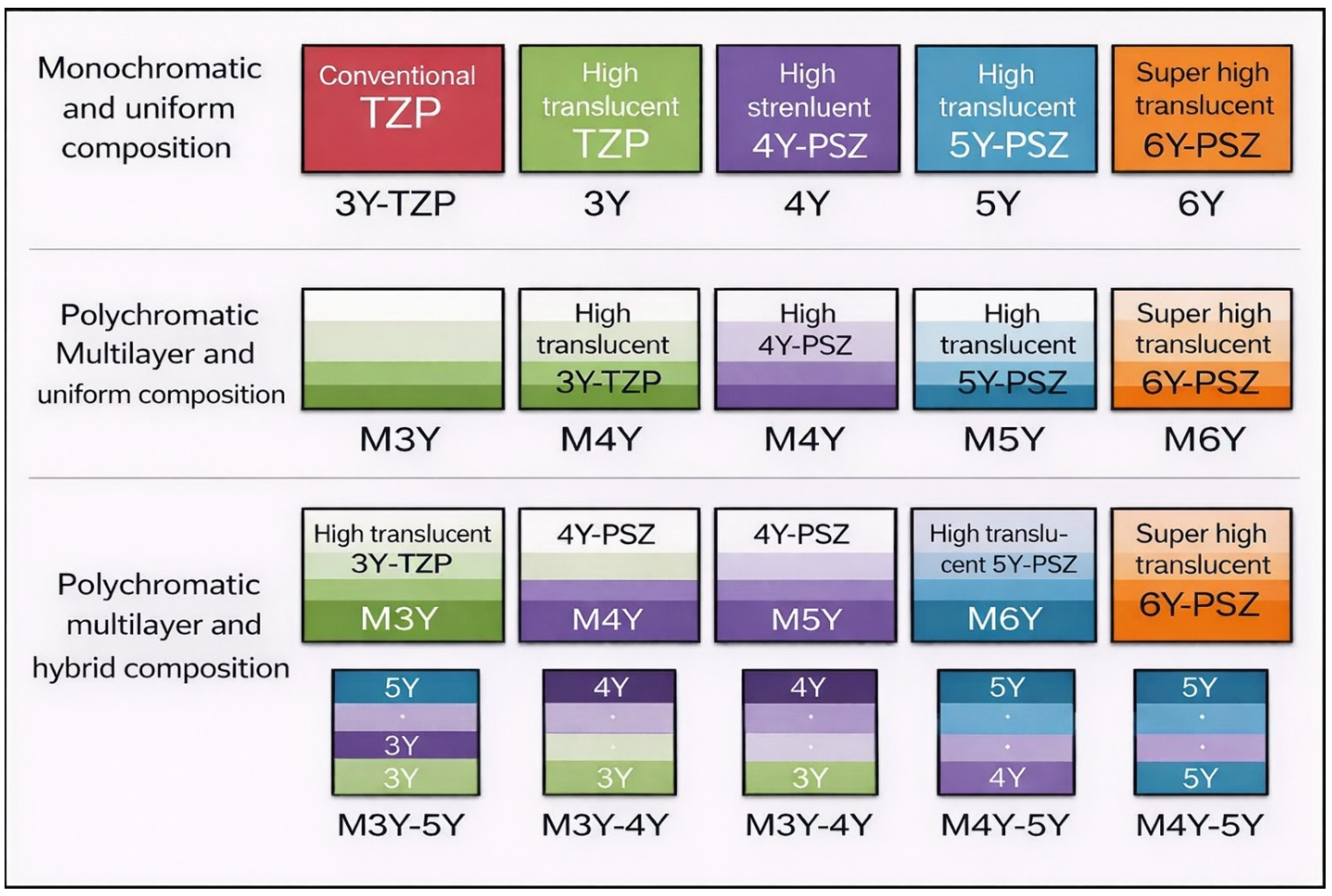
| Polychromatic Multilayer Zirconia (Uniform Composition: M3Y, M4Y, M5Y, M6Y) | Same yttria throughout block | Same phase composition across layers | ~700–1100 | 4–8 | Gradient color translucency | Monolithic crowns with natural shade gradient | [27] |
| Hybrid Multilayer Zirconia (e.g., M3Y–5Y, M3Y–4Y, M4Y–5Y) | Mixed (3Y–5Y) | Layered tetragonal–cubic gradient | ~700–1100 | 4–8 | Variable (incisal high translucency) | Full-contour crowns, full-arch prostheses, esthetic monolithic restorations | [2,27] |
| Study | Design | Participants (Studies/Patients) | Restoration Type | Support Type | Follow-Up | Survival Rate | Key Notes (Heterogeneity) |
|---|---|---|---|---|---|---|---|
| [39] | Meta-analysis | 30+ studies (~1000+ pts) | FDPs | Tooth-supported | 3–10 yrs | 85–95% | Variation due to zirconia type and design |
| [1] | Systematic review | 40 studies | Multiple-unit FDPs | Tooth-supported | 5yrs | ~94% survival | Higher complication rates in all-ceramic FDPs compared with metal-ceramic FDPs |
| [40] | Review of systematic reviews | Multiple reviews | FDPs and crowns | Tooth + Implant | Long-term | 85–95% | Complication variability (chipping, failure) |
| [41] | Retrospective study | Clinical cohort | Crowns and FDPs | Tooth-supported | 5 yrs | >90% | Higher survival in single crowns |
| Clinical Scenario | Recommended Zirconia | Supporting Evidence |
|---|---|---|
| Posterior molars, high load | 3Y-TZP | [2,4] |
| Anterior crowns | 5Y-PSZ/6Y-PSZ | [2,7] |
| Bruxism/high occlusal force | 3Y-TZP (monolithic) | [2,4] |
| Esthetic multilayer crowns | Hybrid multilayer zirconia | [7] |
| Long-span FDPs | 3Y-TZP/hybrid zirconia | [1,39] |
| Implant-supported restorations | High-strength zirconia (3Y-TZP) | [40] |
| Material | Aesthetic Properties | Mechanical Strength | Clinical Performance | Patient Acceptance and Biocompatibility | Advantages | Disadvantages/Limitations | References |
|---|---|---|---|---|---|---|---|
| Zirconia (3Y–6Y, monolithic or multilayer) | Moderate-high translucency; multilayer zirconia provides improved shade gradients | Very high strength (≈700–1200 MPa for 3Y-TZP; lower for highly translucent zirconia) | >90% survival (5–10 yrs) | High biocompatibility; low plaque accumulation; high patient satisfaction reported in clinical studies | High fracture resistance; suitable for posterior crowns and bridges; durable | Bonding more complex; translucency still lower than glass ceramics; strength decreases as translucency increases | [2,4,39] |
| Lithium Disilicate Glass Ceramic | Very high translucency and enamel-like optical properties | Moderate strength (≈360–500 MPa) | ~85–95% survival (5–10 yrs) | Excellent soft tissue response; high esthetic satisfaction in anterior restorations | Excellent esthetics; strong adhesive bonding capability | Lower fracture resistance than zirconia; limited use for long-span prostheses | [50] |
| Feldspathic Porcelain | Excellent translucency and natural optical depth | Low strength (≈60–120 MPa) | Limited to veneers | High biocompatibility; favorable gingival response | Superior optical appearance; ideal for veneers | Very brittle; high fracture risk under functional loads | [2] |
| Metal–Ceramic (Porcelain Fused-to-Metal) | Good esthetics but limited translucency due to metal framework | Very high mechanical strength | >95% survival (10–15 yrs) | Good biocompatibility; lower patient acceptance in esthetic zones due to metal | Reliable mechanical performance; suitable for bridges | Difficult detection of secondary caries; gray margins; possible metal allergy | [4] |
| Resin-Matrix Ceramics/Hybrid Ceramics | Good translucency and polishability | Moderate strength (≈150–250 MPa) | Acceptable short-medium term | Good patient comfort; elastic modulus similar to dentin | Easy milling and repair; conservative preparations | Lower wear resistance and strength compared with zirconia or lithium disilicate | [51] |
| Indirect Composite Resins | Acceptable esthetics but limited translucency | Low-moderate strength | Moderate longevity; mainly for conservative restorations | Good patient comfort; repairable | Easy adjustment and repair | Higher wear and discoloration; lower long-term durability | [51] |
Disclaimer/Publisher’s Note: The statements, opinions and data contained in all publications are solely those of the individual author(s) and contributor(s) and not of MDPI and/or the editor(s). MDPI and/or the editor(s) disclaim responsibility for any injury to people or property resulting from any ideas, methods, instructions or products referred to in the content. |
© 2026 by the authors. Licensee MDPI, Basel, Switzerland. This article is an open access article distributed under the terms and conditions of the Creative Commons Attribution (CC BY) license.
Share and Cite
Mohammed, S.F.; Yhaya, M.F.; Al-Rawas, M.; Noorani, T.Y. Advances in Zirconia Crowns: A Comprehensive Review of Strength, Aesthetics, Digital Manufacturing, and Clinical Performance. Ceramics 2026, 9, 50. https://doi.org/10.3390/ceramics9050050
Mohammed SF, Yhaya MF, Al-Rawas M, Noorani TY. Advances in Zirconia Crowns: A Comprehensive Review of Strength, Aesthetics, Digital Manufacturing, and Clinical Performance. Ceramics. 2026; 9(5):50. https://doi.org/10.3390/ceramics9050050
Chicago/Turabian StyleMohammed, Sohaib Fadhil, Mohd Firdaus Yhaya, Matheel Al-Rawas, and Tahir Yusuf Noorani. 2026. "Advances in Zirconia Crowns: A Comprehensive Review of Strength, Aesthetics, Digital Manufacturing, and Clinical Performance" Ceramics 9, no. 5: 50. https://doi.org/10.3390/ceramics9050050
APA StyleMohammed, S. F., Yhaya, M. F., Al-Rawas, M., & Noorani, T. Y. (2026). Advances in Zirconia Crowns: A Comprehensive Review of Strength, Aesthetics, Digital Manufacturing, and Clinical Performance. Ceramics, 9(5), 50. https://doi.org/10.3390/ceramics9050050