Article

Electrochemical Performance of Ti3C2Tx MXenes During Structural Evolution

1
School of Materials Science and Engineering, Anhui Polytechnic University, Wuhu 241000, China
2
Institute of Nanocatalysis and Energy Conversion, College of Chemistry and Materials Engineering, Zhejiang A&F University, Hangzhou 311300, China
*
Authors to whom correspondence should be addressed.
Ceramics 2026, 9(5), 45; https://doi.org/10.3390/ceramics9050045
Submission received: 10 March 2026 / Revised: 15 April 2026 / Accepted: 20 April 2026 / Published: 24 April 2026
(This article belongs to the Special Issue Advances in Electronic Ceramics, 2nd Edition)

Abstract

MXenes, with a high surface area, abundant active sites, and excellent ion transport properties, have demonstrated excellent electrochemical performance. However, systematic comparisons of the structural evolution process and electrochemical performance for MXene are lacking. In this study, multilayer MXene (M-Ti3C2Tx) was successfully fabricated by in situ etching. During the subsequent centrifugation process, the thicker and heavier multilayer sheets settled due to their faster sedimentation rate, while the lighter, surface-functionalized monolayer sheets remained colloidally stable in the supernatant due to solvation and electrostatic repulsion, thereby achieving separation and obtaining delaminated MXene (D-Ti3C2Tx). Structural analysis indicates that the removal of the aluminum layer synergizes with the exfoliation of the nanosheets, significantly increasing the interlayer spacing and making the sheet structure more pronounced, and the pore structure is more abundant. Especially, in three-electrode and two-electrode systems at an identical mass loading of 5 mg on carbon paper, D-Ti3C2Tx delivered a higher specific capacitance, more pronounced pseudocapacitive behavior, and a superior rate capability compared to Ti3AlC2 and M-Ti3C2Tx. Such excellent electrochemical performance of D-Ti3C2Tx is due to the shortened ion diffusion path in the delaminated structure, which enables rapid ion migration, an extremely large specific surface area, and a mesoporous structure that provides abundant active sites. This study underscores the significant potential of D-Ti3C2Tx in emerging energy storage systems and offers insights into guiding MAX phase synthesis during its preparation.

1. Introduction

The development of new energy storage materials is a research priority owing to the depletion of fossil fuels and the energy crisis. Two-dimensional (2D) materials have become a research hotspot in the field of new energy storage materials due to their unique layered structure, abundant surface active sites, and excellent electron/ion transport properties [1,2,3,4,5].
MXenes, as a class of emerging 2D materials, are derived from MAX phases (a ternary carbide composed of M, A, and X elements, where M represents the transition metal, A is the main-group sp elements, and X represents C or/and N) with a general formula of Mn+1XnTx, where M represents a transition metal, X is carbon or nitrogen, and Tx denotes surface terminal functional groups (e.g., –OH, –O, and –F) [6,7]. Naguib et al. first reported on the successful synthesis of M-Ti3C2Tx in 2011 [8]. After that, MXenes have rapidly attracted academic attention due to their excellent metallic conductivity, good water dispersibility, controllable interlayer structure, and outstanding mechanical stability. Subsequently, Mashtalir et al. expanded the research and application prospects of MXenes by introducing organic small molecule intercalants such as dimethyl sulfoxide (DMSO) and employing ultrasonic delamination to successfully obtain D-Ti3C2Tx [9], opening a new chapter in the study of MXene-based 2D materials.
Especially, MXenes present metal-grade conductivity, which can reduce internal resistance and improve the charge/discharge rate [10,11,12]. Their abundant surface functional groups not only impart high hydrophilicity, facilitating electrolyte ion infiltration and diffusion, but also enable strong chemical adsorption with active species, thereby enhancing the structural and mechanical stability of the electrodes and suppressing volume expansion and structural collapse during cycling. Meanwhile, the tunable interlayer spacing of MXenes provides ample space for ion intercalation/de-intercalation, effectively mitigating diffusion kinetic limitations and enhancing the specific capacity. For instance, Ghidiu et al. investigated M-Ti3C2Tx clay materials for use in supercapacitors. They found that MXene’s clay-like characteristics provides flexibility in electrode fabrication, and it has a volumetric capacitance of up to 900 F/cm3, making it a promising candidate for next-generation high-power energy storage devices [13]. Subsequently, Wang et al. synthesized D-Ti3C2Tx directly via vapor deposition. The CVD-derived structures exhibited superior electronic properties and charge transport pathways, contributing to the further improved capacitance and rate capability of MXene-based electrodes [14]. Afterwards, Zong’s research group modified M-Ti3C2Tx electrodes with polypyridine (PPy), achieving a specific capacitance of 274 F/g at a current density of 1 A/g, which significantly enhanced the energy storage performance in symmetric supercapacitors [15]. Djire’s team studied the charge storage mechanism of M-Ti3C2Tx in aqueous electrolytes, and through an in situ activation strategy, enabled switchable charge storage behavior with a capacitance of up to 580 F/g at 5 mV/s [16]. Although numerous studies have demonstrated the outstanding energy storage capabilities of MXenes, current research mainly focuses on material functionalization or composite design, with limited attention given to the systematic comparison of the electrochemical performance of MXenes during structural evolution, as well as the impact of their different layered structures on electrochemical performance. It is particularly noteworthy that the delamination process exerts a crucial influence on various properties of MXenes. This process not only directly determines their electrochemical performance but also profoundly affects mechanical properties, ion transport kinetics, and structural stability by modifying the interlayer stacking state and surface chemical environment. Therefore, studying the structural evolution of MXenes and the corresponding changes in their electrochemical performance is of significant importance for the design of MXene supercapacitors.
In this work, structural characterization and electrochemical performance are employed to investigate the intrinsic mechanisms underlying their performance variations and to clarify the influence of structural features on electrochemical behavior. Specifically, we emphasize a systematic comparison between M-Ti3C2Tx and D-Ti3C2Tx in both three-electrode and two-electrode configurations, along with the correlation between structural evolution and electrochemical properties. This work provides in-depth theoretical insights and lays the foundation for optimizing the electrochemical performance of MXenes and promoting their widespread application in high-efficiency energy storage devices through experimental data.

2. Experimental Section

2.1. Experimental Materials

Ti3AlC2 (AR), LiF (AR), and N-methyl-2-pyrrolidone (NMP, AR) were supplied by Shanghai Macklin Biochemical Co., Ltd. (Shanghai, China). HCl (AR) was provided by Sinopharm Chemical Reagent Co., Ltd. (Shanghai, China). Polyvinylidene fluoride (PVDF) was provided by Arkema S.A. (Colombes, France). Acetylene black was supplied by Helue lida Co., Ltd. (Xinxiang, China). Carbon paper was supplied by Toray Industries, Inc. (Tokyo, Japan). All chemicals are of analytical grade purity without further treatment.

2.2. The Preparation of M-Ti3C2Tx and D-Ti3C2Tx MXene

Ti3C2Tx MXene was produced by etching Ti3AlC2 with HCl/LiF. Specifically, 1 g LiF was added to a beaker placed in an oil bath with 20 mL HCl (12 M) until LiF was dissolved. Then, 1 g Ti3AlC2 was gradually added to the above solution, and the oil bath was heated to 36 °C and kept stirring for 24 h. After that, the resulting suspension was transferred to a centrifuge tube and centrifuged at 3500 rpm for 3 min [17]. The solid precipitate at the bottom of the container was repeatedly washed with deionized water until the pH of the remaining liquid was approximately 6. Finally, the precipitate collected after centrifugation was named M-Ti3C2Tx, and the upper suspension was named D-Ti3C2Tx. Both types of MXenes were freeze dried to obtain M-Ti3C2Tx and D-Ti3C2Tx. The particle size ranges of Ti3AlC2, M-Ti3C2Tx, and D-Ti3C2Tx are approximately 20–22 μm, 13–15 μm, and 3–5 μm, respectively [18].

2.3. Electrode Preparation

To prepare the electrode, the active materials (Ti3AlC2, M-Ti3C2Tx, and D-Ti3C2Tx) were mixed with acetylene black and polyvinylidene fluoride with a mass ratio of 8:1:1 by grinding. Then, 0.5 mL of N-methyl-2-pyrrolidone (NMP) was added to the above mixed powder and stirred magnetically at 500 rpm for 3 h at room temperature. The slurry was uniformly coated onto a carbon paper substrate, with an effective area of 1 cm × 1 cm. The thickness of the active electrode was precisely controlled by the doctor-blading method, and the specific value was 13 μm [19]. The mass loading of the active material on each electrode was controlled to be approximately 5 mg cm−2 for all samples. Finally, the prepared electrodes were dried in a vacuum oven at 40 °C for 12 h. Cyclic Voltammetry (CV), Galvanostatic Charge–Discharge (GCD), and Electrochemical Impedance Spectroscopy (EIS) were measured on an electrochemical workstation using both three-electrode and two-electrode systems. A platinum sheet and Hg/Hg2SO4 were employed as the counter electrode and reference electrode, respectively, with a 1 M H2SO4 aqueous solution as the electrolyte.

2.4. Characterization

The morphology of the samples was analyzed by scanning electron microscopy (SEM, S-4800, Tokyo, Japan). The phase composition and surface chemical states of the samples were analyzed using X-ray diffraction (XRD, SmartLab SE, Tokyo, Japan), X-ray photoelectron spectroscopy (XPS, Thermo K-Alpha, East Grinstead, UK), energy-dispersive X-ray spectroscopy (EDS, Tokyo, Japan), and Fourier transform infrared spectroscopy (FTIR, IRPrestige-21, Kyoto, Japan). The nitrogen adsorption and desorption curves of each specimen were examined using a specific surface and pore size analyzer (NOVA 2000e, Niagara Falls, NY, USA), and the electrochemical properties of each specimen were evaluated using a Shanghai Chenhua electrochemical workstation (CHI700E, Shanghai, China).

3. Results and Discussion

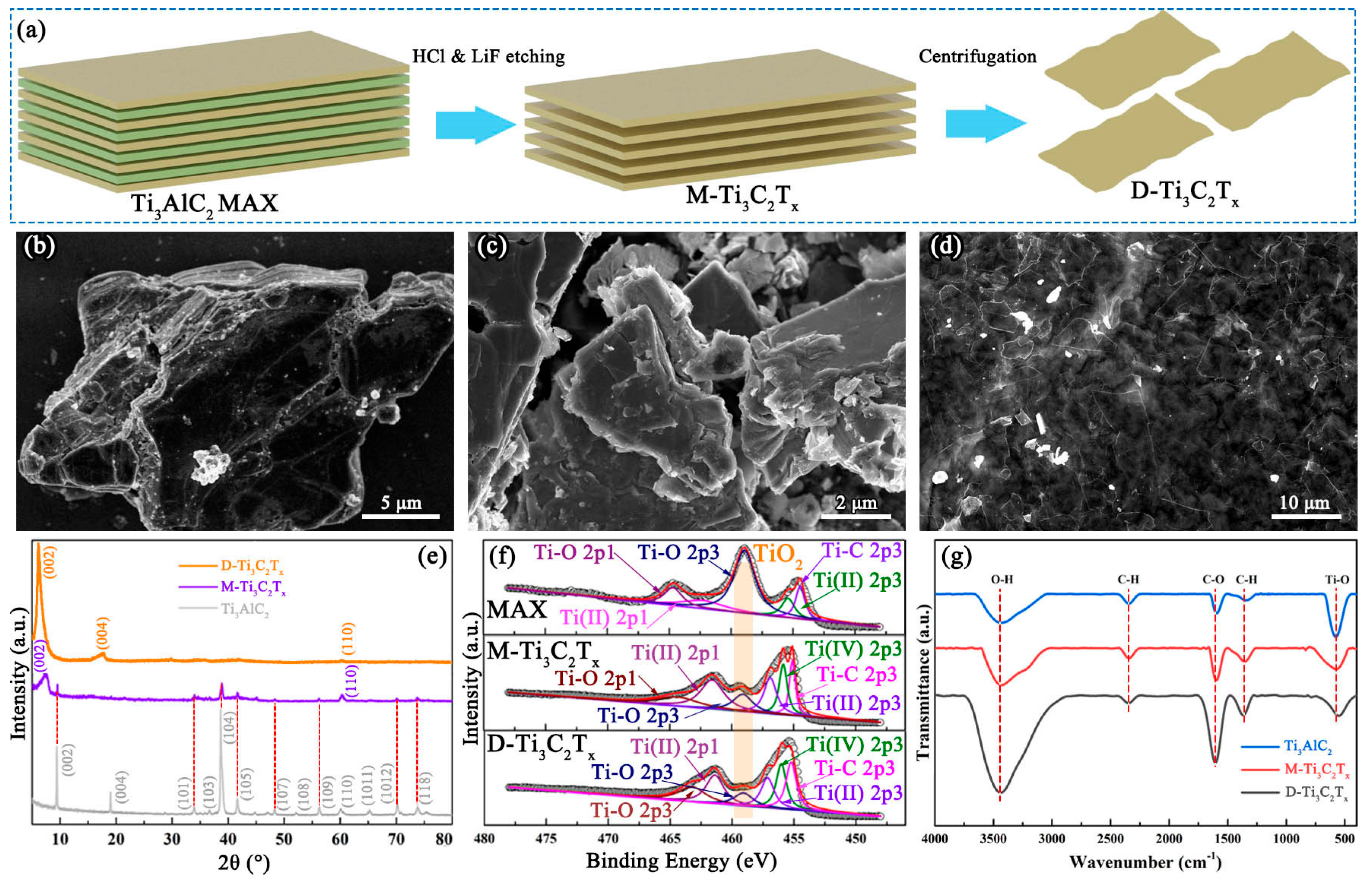
The preparation process of MXenes is illustrated in Figure 1a. In brief, HCl reacts with LiF to generate in situ hydrofluoric acid, which selectively etches the Al layer in Ti3AlC2. This etching process removes Al atoms, yielding Ti3C2Tx layers terminated with surface functional groups including -O, -OH, and -F. These surface terminations provide abundant active sites, which enhance the ion adsorption and charge storage. However, the etched MXene typically exhibits a multilayer structure with strong interlayer van der Waals forces, which restricts ion penetration and reduces the exposure of electroactive sites. To overcome this limitation, subsequent centrifugal treatments are performed to obtain D-Ti3C2Tx. The collected D-Ti3C2Tx significantly increases the specific surface area and facilitates ion transport during electrochemical processes. The scanning electron microscope (SEM) image of the Ti3AlC2 precursor shows that it has an aggregated structure instead of the characteristic layered structure (Figure 1b), which can be attributed to the strong bonding between the Ti3C2 layers and the interleaved Al atomic layers that limit the interlayer spacing and reduce effective surface exposure. Thus, the removal of these Al layers during the etching process is crucial, which not only disrupts the strong interlayer bonding but also creates open channels between the Ti3C2 layers, thereby enabling subsequent centrifugal delamination into monolayer nanosheets. The morphological features of M-Ti3C2Tx (Figure 1c), obtained after selective etching of the aluminum layer by the in situ etching method, were significantly altered. The material exhibits a stacked multilayer structure, confirming the effective transformation of the MAX phase and enhancing ion accessibility for electrochemical applications [20,21]. Subsequent centrifugal delamination produced D-Ti3C2Tx (Figure 1d), characterized by thin and slightly wrinkled two-dimensional nanosheets with lateral dimensions of tens of micrometers. These nanosheets are loosely stacked with minimal aggregation and a more pronounced layered structure, indicating successful exfoliation and efficient separation into monolayer MXene sheets [22]. The comparison between M-Ti3C2Tx and D-Ti3C2Tx highlights the structural evolution of the nanosheets from multilayers to monolayers, which is crucial for improving the electrochemical performance. As illustrated in Figure 1e, the X-ray diffraction (XRD) patterns of Ti3AlC2, M-Ti3C2Tx, and D-Ti3C2Tx highlight the structural differences among the precursor, etched, and delaminated samples. The pristine Ti3AlC2 exhibits sharp and distinct diffraction peaks, including the characteristic MAX phase reflections of (002), (004), (104), (105), (108), and (110), indicating a highly ordered layered crystal structure maintained by strong interlayer interactions provided by the Al atomic layers [23]. After the in situ etching process, the (002) peak in the XRD pattern of M-Ti3C2Tx shows a clear shift toward lower angles compared to the initial MAX phase. This shift is attributed to the removal of Al atomic layers and the intercalation of surface functional groups (-OH, -O, and -F), water molecules, and Li+ ions, resulting in an increased interlayer spacing [24]. Residual Li+ ions can increase the interlayer spacing and specific surface area; during charging, they adsorb more sulphate ions to enhance charge storage capacity, and during discharging, they act as charge carriers, thereby effectively improving ion transport efficiency. Meanwhile, diffraction peaks in the high-angle region (2θ > 35°) become undetectable, indicating the destruction of the MAX structure and successful transformation into the MXene phase. The presence of a weak residual (104) peak suggests that some layer stacking order is retained [25]. Deeper in D-Ti3C2Tx, the (002) peak shifts further to approximately 2θ ≈ 7°, indicating larger interlayer spacing due to more extensive intercalation and exfoliation, leading to the formation of layered MXene nanosheets [26]. Additionally, the intensity of high-angle diffraction peaks significantly decreases and almost disappears, providing further evidence for the loss of interlayer order and the formation of a highly exfoliated layered structure. Compared with Ti3AlC2, both M-Ti3C2Tx and D-Ti3C2Tx (Figure 1f) exhibit the disappearance of Al peaks and the emergence of Ti-O and Ti-OH components, confirming successful etching and surface termination formation. D-Ti3C2Tx shows stronger Ti-C peaks and a lower Ti-O proportion than M-Ti3C2Tx, indicating reduced oxidation and the better preservation of conductive Ti-C bonds. To further verify the surface terminations, Fourier transform infrared spectroscopy (FTIR) was performed (Figure 1g). Characteristic bands of -OH and -O groups were observed in both MXenes, with D-Ti3C2Tx showing higher -OH intensity, suggesting improved hydrophilicity and ion accessibility. The combination of XPS and FTIR results confirms that delamination not only enlarges the accessible surface area but also optimizes the surface chemistry, giving D-Ti3C2Tx superior electrochemical activity compared with M-Ti3C2Tx. Figure S1 shows the EDS elemental distribution maps of Ti, C, O, and F. The results indicate that the elements are uniformly distributed within the selected area, with no obvious elemental segregation. Moreover, the uniform distribution of O and F confirms the successful introduction of surface termination groups.
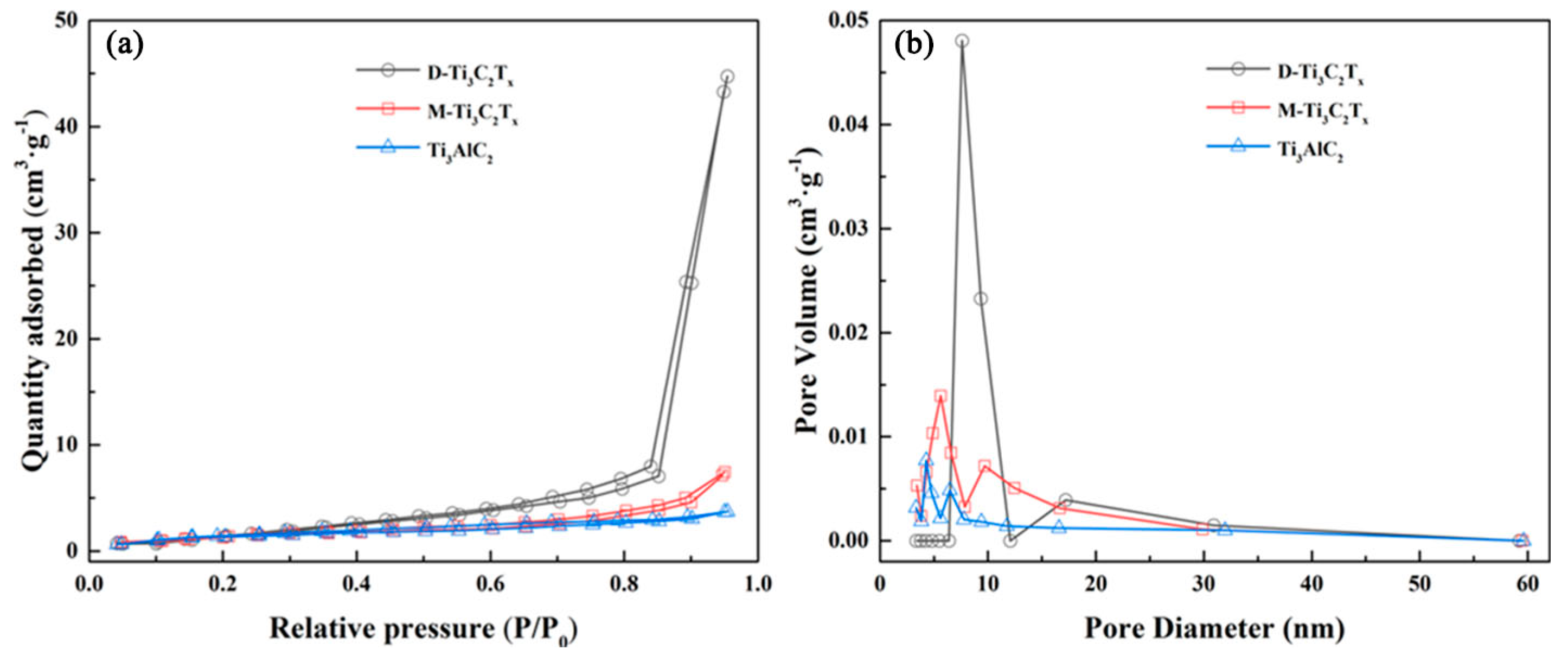
As shown in Figure 2a, Ti3AlC2 displays a conventional type III isotherm with a negligible hysteresis loop and a maximum adsorption volume of approximately 3.7 cm3·g−1, suggesting a dense overall structure and an absence of effective porous architecture [27]. The low specific surface area and non-ideal pore size distribution of the material restrict electrolyte infiltration and ion diffusion, which limits its potential as a high-performance electrode material for energy storage. In contrast, the M-Ti3C2Tx displays features of a mesoporous structure, with an increased adsorption volume of approximately 7.5 cm3·g−1. However, the narrow hysteresis loop suggests that, although the interlayer structure is partially loosened, significant restacking and confined channels still exist between the nanosheets. The reduced number of accessible pores leads to a still-limited specific surface area, thereby constraining its ion storage capability. In comparison, the D-Ti3C2Tx displays a characteristic type IV isotherm, accompanied by a discernible adsorption increase at a relative pressure of P/P0 ≈ 0.8. This is accompanied by a pronounced H3-type hysteresis loop, indicative of the presence of numerous irregular mesopores and partial slit-like pores between the layers [28]. The maximum adsorption volume of D-Ti3C2Tx exceeds 50 cm3·g−1, which is significantly higher than that of Ti3AlC2 and M-Ti3C2Tx. The results suggest that the layering process results in the formation of a large number of interlayer pores and open channels. Such mesoporous structures have been demonstrated to enhance the affinity toward electrolytes and improve ion accessibility, thereby contributing to the improved rate capability and specific capacitance in energy storage applications [29,30]. The pore size distribution curves in Figure 2b reveal that Ti3AlC2 and M-Ti3C2Tx exhibit narrow distributions, mainly around 5~10 nm. In contrast, D-Ti3C2Tx shows a broader range of meso- and macropores, which facilitates electrolyte penetration and ionic transport. These results suggest that the layering process not only reduces stacking but also increases the accessible surface area through the formation of meso- and macropores.
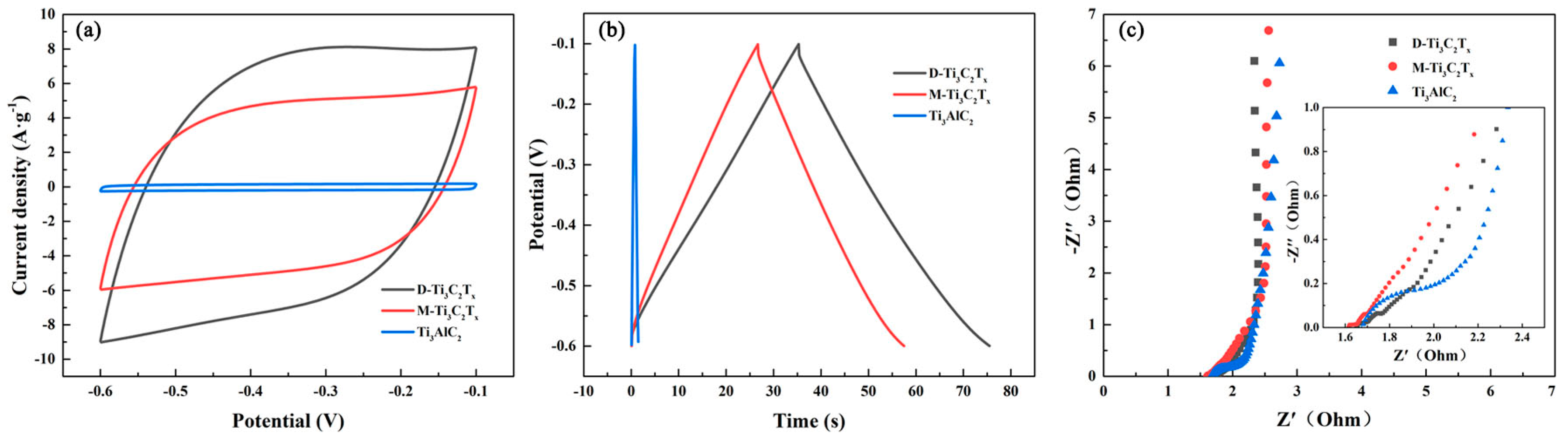
As shown in Figure 3a, the CV curve of D-Ti3C2Tx, at a scan rate of 100 mV s−1, exhibits a nearly rectangular and symmetrical shape with the largest enclosed area, suggesting ideal electric double-layer capacitance (EDLC) behavior and excellent charge/ion transport properties. This favorable electrochemical performance can be attributed to the enlarged interlayer spacing and increased specific surface area induced by delamination, which collectively expose more electroactive sites and promote interfacial energy storage processes [31]. In contrast, the CV curve of M-Ti3C2Tx retains capacitive characteristics but shows a noticeably smaller area, indicating more restricted ion diffusion pathways and the partial inaccessibility of internal surfaces due to residual interlayer stacking. The Ti3AlC2 displays an almost flat current response, implying negligible electrochemical activity and a poor capacitive performance. A more detailed analysis of the GCD profiles in Figure 3b supports these observations. The Ti3AlC2 electrode exhibits minimal charge–discharge behavior, while M-Ti3C2Tx shows a modest discharge duration, reflective of its limited charge storage capability. In comparison, D-Ti3C2Tx exhibits the longest discharge time, highly symmetric charge–discharge curves, and high coulombic efficiency, indicating excellent reversibility and low polarization. These results confirm the superior ion/electron transport and interfacial kinetics endowed by the delaminated structure [32]. In Figure 3c, D-Ti3C2Tx shows the lowest equivalent series resistance (Rs) and the smallest charge transfer resistance (Rct), outperforming M-Ti3C2Tx and Ti3AlC2. The steepest slope in the low-frequency Warburg region for D-Ti3C2Tx indicates the fastest ion diffusion. This improvement results from its enlarged interlayer spacing, reduced stacking, and high conductivity, which synergistically accelerate the charge transfer and ion transport.
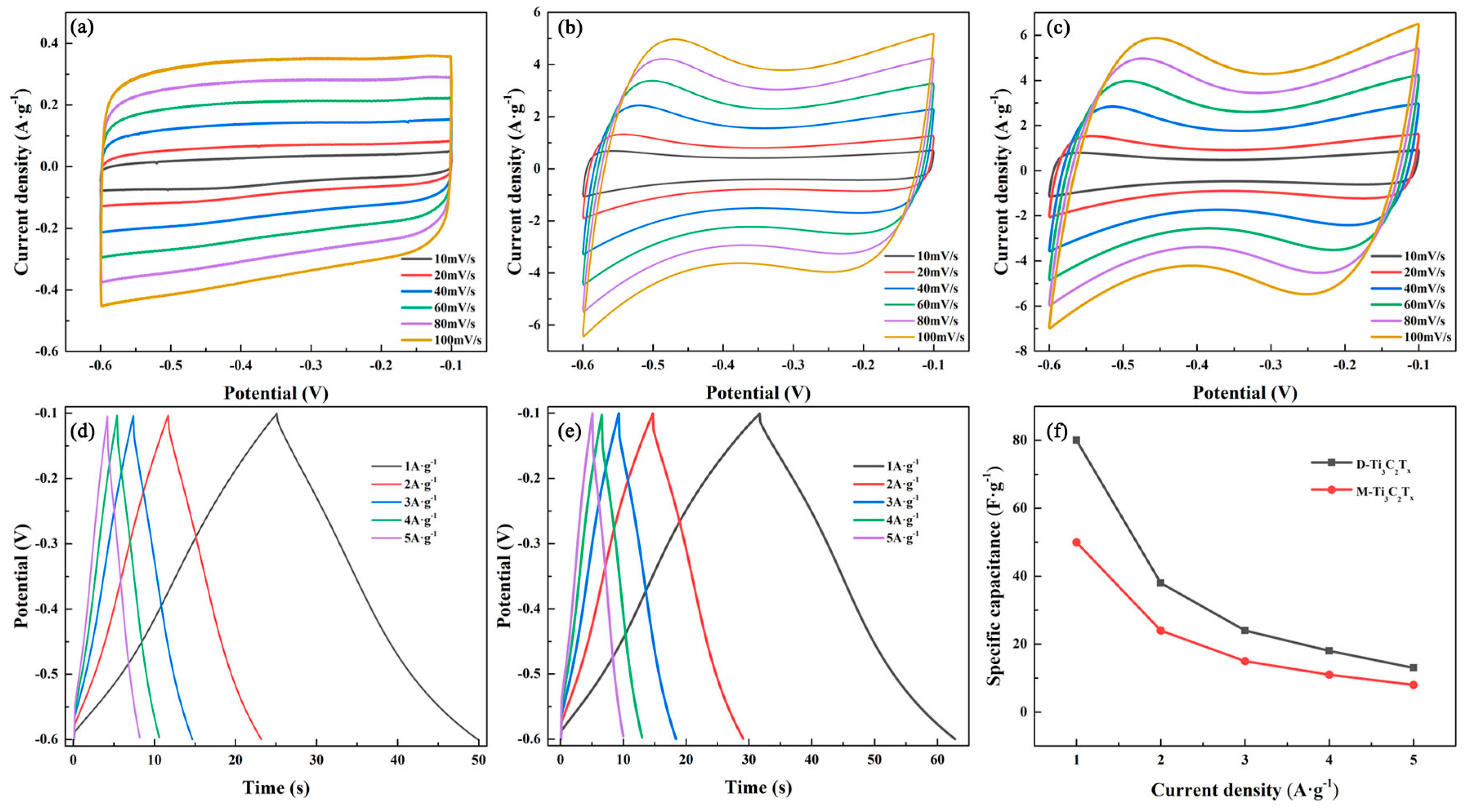
The CV curve of Ti3AlC2 (Figure 4a) displays a nearly rectangular shape with a comparatively low current response, suggesting typical electric double-layer capacitance behavior and restricted electrochemical activity. As scan rates are increased from 10 to 100 mV·s−1, the CV curves maintain good symmetry without obvious distortion. This suggests that ion diffusion channels within the material are restricted and charge transfer is sluggish [33]. In contrast, the CV curves of M-Ti3C2Tx (Figure 4b) show a significantly increased area and slight pseudocapacitive characteristics, indicating successful removal of the Al layer and formation of M-Ti3C2Tx with enlarged interlayer spacing [34]. This configuration enables electrolyte ion intercalation and migration, thereby significantly enhancing the specific capacitance. The curves remain symmetrical at various scan rates, indicative of an enhanced charge transport and rate performance. Furthermore, D-Ti3C2Tx (Figure 4c) exhibits the most pronounced current response and largest CV curve area accompanied by redox peaks, indicating pseudocapacitive behavior. Even at elevated scan rates, the curves maintain good symmetry, suggesting the presence of open ion diffusion channels and abundant electrochemical active sites, thus indicating its potential as new energy storage material [35]. These observations were further confirmed by the GCD test results. D-Ti3C2Tx (Figure 4e) exhibited the longest discharge time and the most symmetrical charge–discharge profiles across various current densities (1–5 A·g−1) compared with M-Ti3C2Tx (Figure 4d), indicating excellent electrochemical reversibility and superior rate performance. Further quantitative comparison of specific capacitance under varying current densities is presented in Figure 4f. At a current density of 1 A·g−1, the D-Ti3C2Tx electrode delivers the highest specific capacitance of 80.1 F·g−1, far exceeding that of M-Ti3C2Tx (50.2 F·g−1). Even at a high current density of 5 A·g−1, D-Ti3C2Tx still retains a capacitance of 13.3 F·g−1. In comparison, M-Ti3C2Tx drops to 8 F·g−1. In summary, the results of both CV and GCD demonstrate that effective interlayer D-Ti3C2Tx significantly improves its energy storage performance. The delaminated structure has been shown to enhance ion accessibility, charge transport kinetics, and overall capacitive behavior.
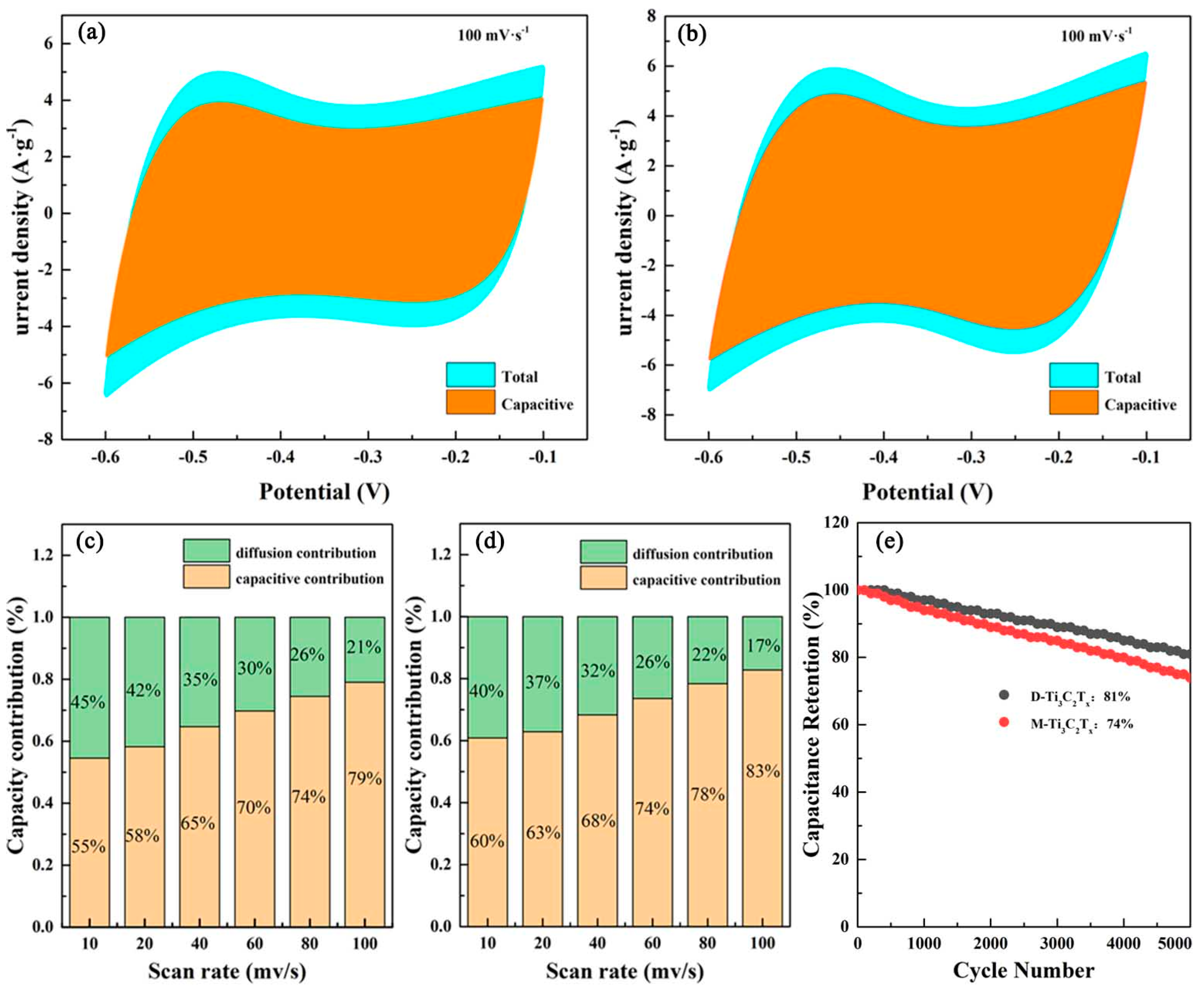
As shown in Figure 5a–d, the capacitive and diffusion-controlled contributions of M-Ti3C2Tx and D-Ti3C2Tx were compared at various scan rates. At a low scan rate (10 mV·s−1), both samples exhibit a higher proportion of diffusion-controlled contribution (45% for M-Ti3C2Tx; 40% for D-Ti3C2Tx), indicating sufficient time for ion intercalation into the MXene layers. As the scan rate increases to 100 mV·s−1, the capacitive contribution becomes dominant, reaching 79% for M-Ti3C2Tx and 83% for D-Ti3C2Tx. Notably, D-Ti3C2Tx consistently exhibits a slightly higher capacitive contribution across all scan rates compared to M-Ti3C2Tx. This contribution stems from rapid, reversible redox reactions at the material’s surface, which facilitate rapid ion transport and surface-controlled charge storage and synergize with the double-layer capacitance to enhance the overall capacitive performance. These results suggest that delamination enhances the rate capability of MXene electrodes by promoting capacitive behavior while retaining a certain level of diffusion-controlled storage. The cycling stability of M-Ti3C2Tx and D-Ti3C2Tx was evaluated at a current density of 2 A·g−1 in 1 M of the H2SO4 electrolyte (Figure 5e). After 5000 charge–discharge cycles, D-Ti3C2Tx retained 81% of its initial capacitance, outperforming M-Ti3C2Tx, which maintained 74%. The D-Ti3C2Tx structure facilitates ion transport and helps maintain a higher number of accessible electrochemically active sites during long-term cycling. In contrast, M-Ti3C2Tx exhibits relatively lower capacity retention, and partial restacking of the multilayer structure hinders ion accessibility and results in increased internal resistance during prolonged operation.
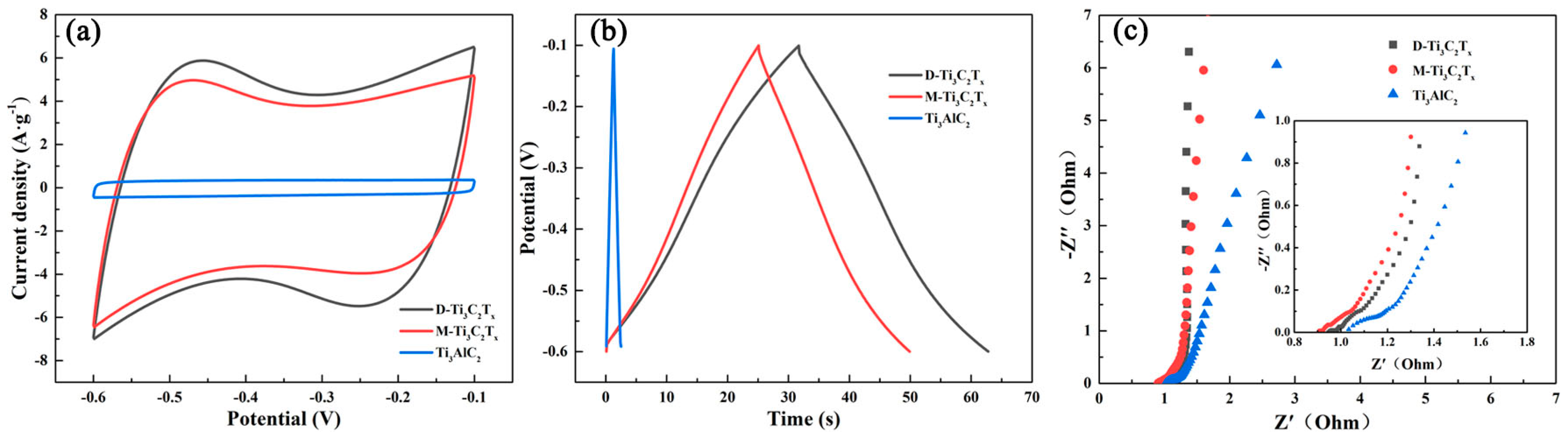
In the two-electrode system (Figure 6 and Figure 7), the material exhibits electrochemical behavior essentially consistent with that observed in the three-electrode system. As shown in Figure 6a,b, the CV and GCD measurements exhibit consistent trends. The D-Ti3C2Tx electrode consistently delivers superior electrochemical performance, characterized by the largest CV curve area and the longest charge–discharge duration, indicative of excellent capacitive behavior and a high charge storage efficiency. These findings confirm that delamination significantly improves ion accessibility and enhances charge transfer kinetics. In the two-electrode symmetric device (Figure 6c), D-Ti3C2Tx still retains the lowest Rs and Rct, confirming its superior electrochemical kinetics in practical device configurations. The overall impedance values are higher than those in the three-electrode system due to the added resistance from current collectors, electrolytes, and separators; however, the relative performance ranking remains unchanged.
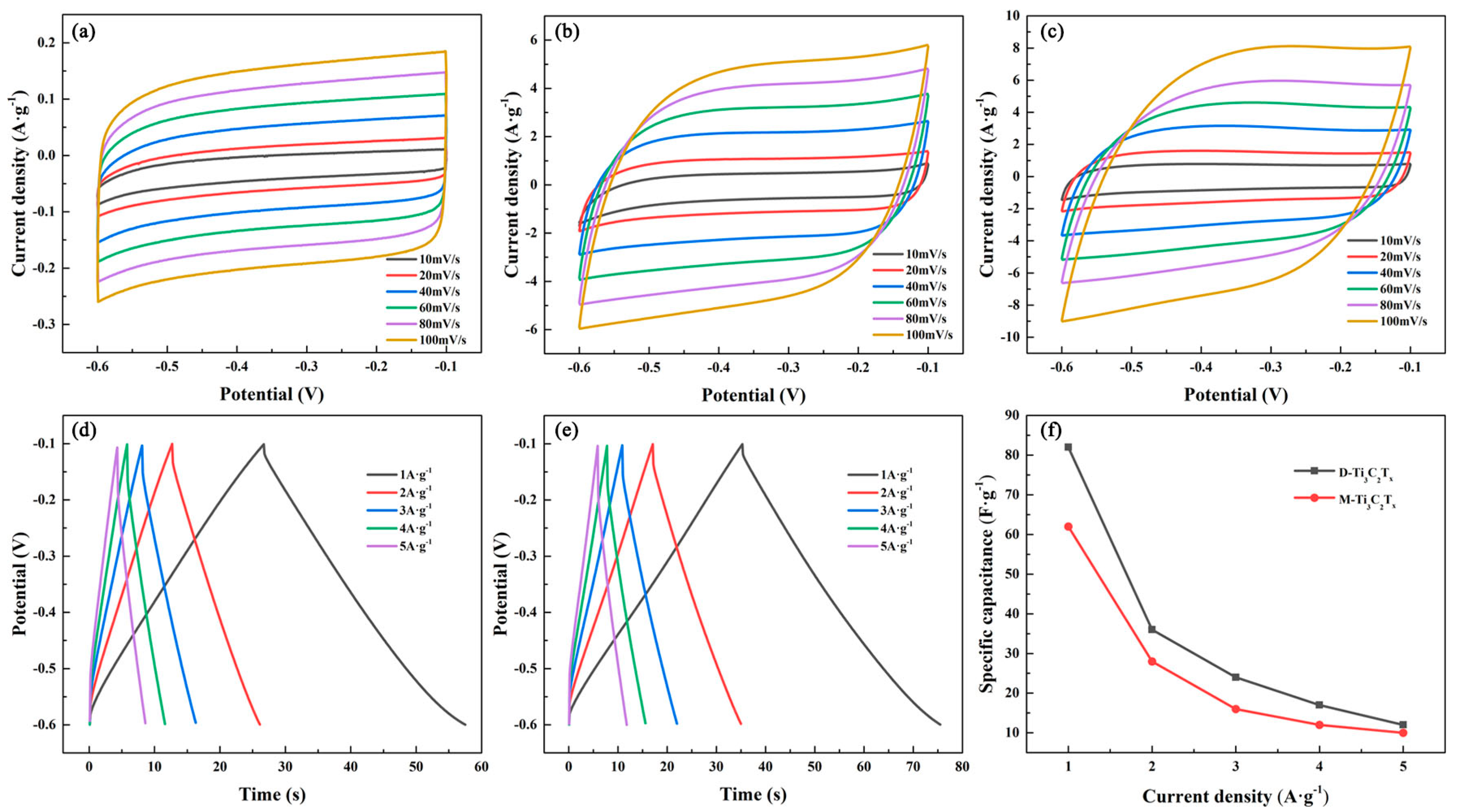
Among the CV curves, Ti3AlC2 (Figure 7a) exhibits the smallest CV curve area with no observable redox peaks, indicating that its interlayer space is occluded, its electronic structure remains inactive, and it has poor ionic and electronic conductivity [36]. Consequently, its inherent energy storage capability is extremely limited. In contrast, both M-Ti3C2Tx (Figure 7b) and D-Ti3C2Tx (Figure 7c) exhibit distinct redox peaks, indicating pseudocapacitive behavior. The current response increases with the scan rate without significant peak distortion, suggesting good reversibility and favorable ion diffusion. Compared to M-Ti3C2Tx, the D-Ti3C2Tx shows a higher current density and larger CV curve area, reflecting its higher specific capacitance and enhanced charge storage capability. Consequently, its intrinsic energy storage capacity is extremely limited. In the GCD curves, compared to M-Ti3C2Tx (Figure 7d), D-Ti3C2Tx (Figure 7e) exhibits a longer discharge time, lower IR drop, and a slower potential change rate at the same current density, reflecting its superior specific capacitance and enhanced charge transport properties [37]. In addition, Figure 7f presents a quantitative comparison of the specific capacitance at various current densities. At 1 A·g−1, the D-Ti3C2Tx electrode achieves a specific capacitance of 82.2 F·g−1, significantly higher than that of M-Ti3C2Tx (62.3 F·g−1). Notably, D-Ti3C2Tx retains a capacitance of 13.4 F·g−1 even at 5 A·g−1, whereas M-Ti3C2Tx’s capacitance drops to 8.1 F·g−1 under the same conditions.

4. Conclusions

In this study, M-Ti3C2Tx and D-Ti3C2Tx were successfully synthesized from the Ti3AlC2 MAX phase by in situ etching and the interlayering process. Structural characterization confirmed the effective removal of Al layers, significant expansion of interlayer spacing, and the transformation from multilayer stacked structures to well-exfoliated monolayer nanosheets. The delamination process not only enlarged the accessible surface area but also optimized the surface chemistry, as evidenced by XPS and FTIR analyses, which contributed to enhanced hydrophilicity and ion accessibility. Furthermore, XRD and XPS analyses revealed the synergistic mechanism between residual intercalated ions (Li+) and surface terminal groups (-O, -F, and -OH): the residual Li+ constructs fast ion transport channels by expanding the interlayer spacing, while the increased proportion of -OH groups significantly enhances the redox activity of the material. EDS mapping shows a uniform distribution of Ti, C, O, and F, confirming no elemental segregation and successful surface termination. Nitrogen adsorption–desorption shows that D-Ti3C2Tx has abundant mesoporous structures and excellent porosity with a much higher surface area than M-Ti3C2Tx and Ti3AlC2, featuring a type IV isotherm with an H3 hysteresis loop that enhances electrolyte infiltration and ion transport.
Electrochemical tests, including CV, GCD, and EIS in both three- and two-electrode configurations, demonstrated that D-Ti3C2Tx exhibited superior capacitive behavior with larger enclosed CV areas, longer discharge times, lower internal resistance, and better charge transfer kinetics than M-Ti3C2Tx and Ti3AlC2. Notably, D-Ti3C2Tx delivered a high specific capacitance of 80.1 F·g−1 at 1 A·g−1 and maintained 13.3 F·g−1 even at a high current density of 5 A·g−1, highlighting its excellent rate capability. Additionally, the pronounced pseudocapacitive behavior underscores the importance of interlayer expansion and ion-accessible active surface area in charge storage. The D-Ti3C2Tx also shows outstanding cycling stability, retaining 81% of its capacitance after 5000 cycles. These findings underline the importance of structural engineering strategies—especially delamination—in enhancing both ion diffusion kinetics and electrochemical accessibility. In conclusion, this work systematically compares the structure and electrochemical performance of Ti3AlC2-derived materials at different structural stages. It reveals the intrinsic mechanisms by which interlayer expansion and exfoliation modulate energy storage capabilities. This study not only expands the understanding of the structure–property relationships in MXenes but also provides theoretical insights and experimental data to guide the rational design of MXenes for new energy storage applications. In the future, the mechanism of surface termination groups can be further analyzed via first-principles calculations, and the mechanical stability of the electrodes will be evaluated.

Supplementary Materials

The following supporting information can be downloaded at: https://www.mdpi.com/article/10.3390/ceramics9050045/s1, Figure S1: Element mapping images of D-Ti3C2Tx MXene.

Author Contributions

Conceptualization, P.H.; methodology, Z.C.; validation, Y.W.; formal analysis, Z.C.; investigation, Q.Z.; resources, P.H.; data curation, Z.C. and P.H.; writing-original draft preparation, Z.C.; writing-review and editing, P.H., F.T., Q.L. and Y.L.; visualization, Z.C.; supervision, P.H., Y.L., F.T. and Q.L.; project administration, P.H.; funding acquisition, P.H. and Q.L. All authors have read and agreed to the published version of the manuscript.

Funding

This work was supported by the National Natural Science Foundation of China (No. 52207021), the Natural Science Foundation of Anhui Province (No. 2208085QE128), University Natural Science Research Project of Anhui Province (No. 2024AH040017), Outstanding Youth Fund of Anhui Provincial Department of Education (2022AH020064).

Data Availability Statement

The original contributions presented in this study are included in the Article/Supplementary Material. Further in-quiries can be directed to the corresponding authors.

Conflicts of Interest

The authors declare no conflict of interest.

References

  1. Yang, R.; Mei, L.; Lin, Z.; Fan, Y.; Lim, J.; Guo, J.; Liu, Y.; Shin, H.S.; Voiry, D.; Lu, Q.; et al. Intercalation in 2D materials and in situ studies. Nat. Rev. Chem. 2024, 8, 410–432. [Google Scholar] [CrossRef] [PubMed]
  2. Nan, J.; Guo, X.; Xiao, J.; Li, X.; Chen, W.; Wu, W.; Liu, H.; Wang, Y.; Wu, M.; Wang, G. Nanoengineering of 2D MXene-Based Materials for Energy Storage Applications. Small 2021, 17, 1902085. [Google Scholar] [CrossRef]
  3. Baig, M.M.; Gul, I.H.; Baig, S.M.; Shahzad, F. 2D MXenes: Synthesis, properties, and electrochemical energy storage for supercapacitors-A review. J. Electroanal. Chem. 2022, 904, 115920. [Google Scholar] [CrossRef]
  4. Cui, H.; Guo, Y.; Ma, W.; Zhou, Z. 2D Materials for Electrochemical Energy Storage: Design, Preparation, and Application. ChemSusChem 2020, 13, 1155–1171. [Google Scholar] [CrossRef] [PubMed]
  5. Das, K.; Majumdar, D. Prospects of MXenes/graphene nanocomposites for advanced supercapacitor applications. J. Electroanal. Chem. 2022, 905, 115973. [Google Scholar] [CrossRef]
  6. Naguib, M.; Mochalin, V.N.; Barsoum, M.W.; Gogotsi, Y. 25th Anniversary Article: MXenes: A New Family of Two-Dimensional Materials. Adv. Energy Mater. 2014, 26, 992–1005. [Google Scholar] [CrossRef]
  7. Tang, Q.; Zhou, Z.; Shen, P. Are MXenes Promising Anode Materials for Li Ion Batteries? Computational Studies on Electronic Properties and Li Storage Capability of Ti3C2 and Ti3C2X2 (X = F, OH) Monolayer. J. Am. Chem. Soc. 2012, 134, 16909–16916. [Google Scholar] [CrossRef]
  8. Naguib, M.; Kurtoglu, M.; Presser, V.; Lu, J.; Niu, J.; Heon, M.; Hultman, L.; Gogotsi, Y.; Barsoum, M.W. Two-Dimensional Nanocrystals Produced by Exfoliation of Ti3AlC2. Adv. Mater. 2011, 23, 4248–4253. [Google Scholar] [CrossRef]
  9. Mashtalir, O.; Naguib, M.; Mochalin, V.N.; Dall’Agnese, Y.; Heon, M.; Barsoum, M.W.; Gogotsi, Y. Intercalation and delamination of layered carbides and carbonitrides. Nat. Commun. 2013, 4, 1716. [Google Scholar] [CrossRef]
  10. Naguib, M.; Barsoum, M.W.; Gogotsi, Y. Ten Years of Progress in the Synthesis and Development of MXenes. Adv. Mater. 2021, 33, 2103393. [Google Scholar] [CrossRef] [PubMed]
  11. Ling, Z.; Ren, C.E.; Zhao, M.-Q.; Yang, J.; Giammarco, J.M.; Qiu, J.; Barsoum, M.W.; Gogotsi, Y. Flexible and conductive MXene films and nanocomposites with high capacitance. Proc. Natl. Acad. Sci. USA 2014, 111, 16676–16681. [Google Scholar] [CrossRef] [PubMed]
  12. Ren, C.E. Cation Intercalation and High Volumetric Capacitance of Two-Dimensional Titanium Carbide. Science 2013, 341, 970–974. [Google Scholar] [CrossRef]
  13. Ghidiu, M.; Lukatskaya, M.R.; Zhao, M.-Q.; Gogotsi, Y.; Barsoum, M.W. Conductive two-dimensional titanium carbide ‘clay’ with high volumetric capacitance. Nature 2014, 516, 78–81. [Google Scholar] [CrossRef]
  14. Wang, D.; Zhou, C.; Filatov, A.S.; Cho, W.; Lagunas, F.; Wang, M.; Vaikuntanathan, S.; Liu, C.; Klie, R.F.; Talapin, D.V. Direct synthesis and chemical vapor deposition of 2D carbide and nitride MXenes. Science 2023, 379, 1242–1247. [Google Scholar] [CrossRef]
  15. Lin, P.; Wang, S.; Liu, A.; Yi, T.; Su, F.; Wang, H.; Xue, S.; Zong, X. Multilayer Ti3C2Tx MXene electrode decorated with polypyridine for efficient symmetric supercapacitors. Sustain. Energy Fuels 2024, 8, 4873–4881. [Google Scholar] [CrossRef]
  16. Hsiao, C.-C.; Kasten, J.; Johnson, D.; Ngozichukwu, B.; Yoo, R.M.S.; Lee, S.; Erdemir, A.; Djire, A. Switchable Charge Storage Mechanism via in Situ Activation of MXene Enables High Capacitance and Stability in Aqueous Electrolytes. ACS Nano 2024, 18, 7180–7191. [Google Scholar] [CrossRef]
  17. Alhabeb, M.; Maleski, K.; Anasori, B.; Lelyukh, P.; Clark, L.; Sin, S.; Gogotsi, Y. Guidelines for Synthesis and Processing of Two-Dimensional Titanium Carbide (Ti3C2Tx MXene). Chem. Mater. 2017, 29, 7633–7644. [Google Scholar] [CrossRef]
  18. Lipatov, A.; Alhabeb, M.; Lukatskaya, M.R.; Boson, A.; Gogotsi, Y.; Sinitskii, A. Effect of Synthesis on Quality, Electronic Prop-erties and Environmental Stability of Individual Monolayer Ti3C2 MXene Flakes. Adv. Electron. Mater. 2016, 2, 1600255. [Google Scholar] [CrossRef]
  19. Buczek, S.; Barsoum, M.L.; Uzun, S.; Kurra, N.; Andris, R.; Pomerantseva, E.; Mahmoud, K.A.; Gogotsi, Y. Rational Design of Titanium Carbide MXene Electrode Architectures for Hybrid Capacitive Deionization. Energy Environ. Mater. 2020, 3, 398–404. [Google Scholar] [CrossRef]
  20. Zhao, M.; Ren, C.E.; Ling, Z.; Lukatskaya, M.R.; Zhang, C.; Van Aken, K.L.; Barsoum, M.W.; Gogotsi, Y. Flexible MXene/Carbon Nanotube Composite Paper with High Volumetric Capacitance. Adv. Mater. 2015, 27, 339–345. [Google Scholar] [CrossRef]
  21. Dixit, P.; Maiti, T. A facile pot synthesis of (Ti3AlC2) MAX phase and its derived MXene (Ti3C2Tx). Cream. Int. 2022, 48, 36156–36165. [Google Scholar] [CrossRef]
  22. Malaki, M.; Maleki, A.; Varma, R.S. MXenes and ultrasonication. J. Mater. Chem. A 2019, 7, 10843–10857. [Google Scholar] [CrossRef]
  23. Naguib, M.; Mashtalir, O.; Carle, J.; Presser, V.; Lu, J.; Hultman, L.; Gogotsi, Y.; Barsoum, M.W. Two-Dimensional Transition Metal Carbides. ACS Nano 2012, 6, 1322–1331. [Google Scholar] [CrossRef]
  24. Zhang, X.; Zhang, W.; Zhao, H. Comparative study on fabrication and energy storage performance of Ti3C2Tx MXene by us-ing hydrofluoric acid and in situ forming of hydrofluoric acid-based approaches. Int. J. Energy Res. 2022, 46, 15559–15570. [Google Scholar] [CrossRef]
  25. Anasori, B.; Xie, Y.; Beidaghi, M.; Lu, J.; Hosler, B.C.; Hultman, L.; Kent, P.R.C.; Gogotsi, Y.; Barsoum, M.W. Two-Dimensional, Ordered, Double Transition Metals Carbides (MXenes). ACS Nano 2015, 9, 9507–9516. [Google Scholar] [CrossRef]
  26. Adomaviciute-Grabusove, S.; Popov, A.; Ramanavicius, S.; Sablinskas, V.; Shevchuk, K.; Gogotsi, O.; Baginskiy, I.; Gogotsi, Y.; Ramanavicius, A. Monitoring Ti3C2Tx MXene Degradation Pathways Using Raman Spectroscopy. ACS Nano 2024, 18, 13184–13195. [Google Scholar] [CrossRef] [PubMed]
  27. von Treifeldt, J.E.; Firestein, K.L.; Fernando, J.F.; Zhang, C.; Siriwardena, D.P.; Lewis, C.-E.M.; Golberg, D.V. The effect of Ti3AlC2 MAX phase synthetic history on the structure and electrochemical properties of resultant Ti3C2 MXenes. Mater. Des. 2021, 199, 109403. [Google Scholar] [CrossRef]
  28. Zhang, X.; Wang, Y.; Li, J.; Liu, Y.; Chen, S. Two-dimensional Ti3C2Tx MXene nanosheets for CO2 capture. RSC Adv. 2023, 13, 7200–7209. [Google Scholar]
  29. Abdolhosseinzadeh, S.; Heier, J.; Zhang, C. Coating Porous MXene Films with Tunable Porosity for High-Performance Soli-State Supercapacitors. ChemElectroChem 2021, 8, 1911–1917. [Google Scholar] [CrossRef]
  30. Allah, A.E. Three-dimensional N-doped mesoporous carbon-MXene hybrid architecture for supercapacitor applications. RSC Adv. 2023, 13, 9983–9997. [Google Scholar] [CrossRef]
  31. Qian, A.; Seo, J.Y.; Shi, H.; Lee, J.Y.; Chung, C. Surface Functional Groups and Electrochemical Behavior in Dimethyl Sulfoxide-Delaminated Ti3C2Tx MXene. ChemSusChem 2018, 11, 3719–3723. [Google Scholar] [CrossRef] [PubMed]
  32. Sarycheva, A.; Polemi, A.; Liu, Y.; Dandekar, K.; Anasori, B.; Gogotsi, Y. 2D titanium carbide (MXene) for wireless communication. Sci. Adv. 2018, 4, eaau0920. [Google Scholar] [CrossRef]
  33. Lukatskaya, M.R.; Kota, S.; Lin, Z.; Zhao, M.-Q.; Shpigel, N.; Levi, M.D.; Halim, J.; Taberna, P.-L.; Barsoum, M.W.; Simon, P.; et al. Ultra-High-Rate Pseudocapacitive Energy Storage in Two-Dimensional Transition Metal Carbides. Nat. Energy 2017, 2, 17105. [Google Scholar] [CrossRef]
  34. Hu, M.; Cheng, R.; Li, Z.; Hu, T.; Zhang, H.; Shi, C.; Yang, J.; Cui, C.; Zhang, C.; Wang, H.; et al. Yang, Interlayer engineering of Ti3C2Tx MXenes towards high capacitance supercapacitors. Nanoscale 2020, 12, 763–771. [Google Scholar] [CrossRef]
  35. Li, R.; Zhang, L.; Shi, L.; Wang, P. MXene Ti3C2: An Effective 2D Light-to-Heat Conversion Material. ACS Nano 2017, 11, 3752–3759. [Google Scholar] [CrossRef]
  36. Ferrara, C.; Gentile, A.; Marchionna, S.; Quinzeni, I.; Fracchia, M.; Ghigna, P.; Pollastri, S.; Ritter, C.; Vanacore, G.M.; Ruffo, R. The Missing Piece: The Structure of the Ti3C2Tx MXene and Its Behavior as Negative Electrode in Sodium Ion Batteries. Nano Lett. 2021, 21, 8290–8297. [Google Scholar] [CrossRef] [PubMed]
  37. Wang, X.; Kajiyama, S.; Iinuma, H.; Hosono, E.; Oro, S.; Moriguchi, I.; Okubo, M.; Yamada, A. Pseudocapacitance of MXene Nanosheets for High-Power Sodium-Ion Hybrid Capacitors. Nat. Commun. 2015, 6, 6544. [Google Scholar] [CrossRef] [PubMed]
Figure 1. (a) The experimental process of MXene. (bd) SEM images of Ti3AlC2, M-Ti3C2Tx, and D-Ti3C2Tx. (e) XRD patterns of Ti3AlC2, M-Ti3C2Tx, and D-Ti3C2Tx. (f) Ti 2p XPS spectra of Ti3AlC2, M-Ti3C2Tx, and D-Ti3C2Tx. (g) FTIR spectra of Ti3AlC2, M-Ti3C2Tx, and D-Ti3C2Tx.
Ceramics 09 00045 g001
Figure 2. (a) N2 adsorption–desorption isotherm of Ti3AlC2, M-Ti3C2Tx, and D-Ti3C2Tx. (b) Pore size distribution of Ti3AlC2, M-Ti3C2Tx, and D-Ti3C2Tx.
Ceramics 09 00045 g002
Figure 3. CV and GCD curves obtained using the three-electrode system. (a) CV curves of Ti3AlC2, M-Ti3C2Tx, and D-Ti3C2Tx at a scan rate of 100 mV·s−1. (b) GCD curves of Ti3AlC2, M-Ti3C2Tx, and D-Ti3C2Tx at a current density of 1 A·g−1. (c) Nyquist plots of Ti3AlC2, M-Ti3C2Tx, and D-Ti3C2Tx (0.01–100,000 Hz).
Ceramics 09 00045 g003
Figure 4. CV curves of (a) Ti3AlC2, (b) M-Ti3C2Tx, and (c) D-Ti3C2Tx at various scan rates. GCD curves of (d) M-Ti3C2Tx and (e) D-Ti3C2Tx at different current densities. (f) Specific capacitance in different current densities of M-Ti3C2Tx and D-Ti3C2Tx.
Ceramics 09 00045 g004
Figure 5. CV curves showing the capacitive and diffusion-controlled contributions to charge storage for (a) M-Ti3C2Tx and (b) D-Ti3C2Tx at a scan rate of 100 mV·s−1. Ratios of capacitive contribution from capacitive process and diffusion process to charge storage of (c) M-Ti3C2Tx and (d) D-Ti3C2Tx at different scan rates. (e) Cycling stability of M-Ti3C2Tx and D-Ti3C2Tx.
Ceramics 09 00045 g005
Figure 6. CV and GCD curves obtained using the two-electrode system. (a) CV curves of Ti3AlC2, M-Ti3C2Tx, and D-Ti3C2Tx at a scan rate of 100 mV·s−1. (b) GCD curves of Ti3AlC2, M-Ti3C2Tx, and D-Ti3C2Tx at a current density of 1 A·g−1. (c) Nyquist plots of Ti3AlC2, M-Ti3C2Tx, and D-Ti3C2Tx (0.01–100,000 Hz).
Ceramics 09 00045 g006
Figure 7. (ac) CV curves of Ti3AlC2, M-Ti3C2Tx, and D-Ti3C2Tx at various scan rates. (d,e) GCD curves of M-Ti3C2Tx and D-Ti3C2Tx at different current densities. (f) Specific capacitance in different current densities of M-Ti3C2Tx and D-Ti3C2Tx.
Ceramics 09 00045 g007
Disclaimer/Publisher’s Note: The statements, opinions and data contained in all publications are solely those of the individual author(s) and contributor(s) and not of MDPI and/or the editor(s). MDPI and/or the editor(s) disclaim responsibility for any injury to people or property resulting from any ideas, methods, instructions or products referred to in the content.