1. Introduction
Subsurface modelling represents a powerful tool for the sustainable exploitation of natural resources and the conscious development of human activities. Water availability is one of the most important factors for the development of an area, particularly where the presence of human population, agricultural and industrial activities strongly impact on groundwater reserves. The knowledge of the subsurface geology and the spatial distribution of groundwater volumes is, therefore, crucial for the management and protection of water resources, especially under changing climate conditions.
Within the framework of the government project of the new Italian geological cartography (ISPRA-CARG, Sheet N. 646 Siracusa [
1]), this paper aims to provide new insights on a peculiar geological and structural element of southeastern Sicily (Italy), one which represents the main water reservoir that supplies the city of Siracusa and its countryside. This is the Floridia Graben [
2], a structural depression located along the Ionian coast of the Hyblean Plateau (
Figure 1), which covers an area of about 120 km
2.
The area has been historically exploited for water supply since the Greek period, with the construction of an aqueduct (the Galermi aqueduct, in operation since 480 B.C) that captures water from the Anapo River and which represents the largest watercourse in the Floridia Graben (
Figure 2a,b).
From the geological point of view, the Floridia Graben hosts quaternary shallow marine carbonates and alluvial deposits, generally characterized by high porosity/permeability, interbedded by clayey levels. The graben has been shaped by the activity of tectonic structures (mostly NW–SE oriented) since Late Pliocene–Pleistocene [
7,
8], with evidence of Quaternary reactivation.
The presence of various human settlements (total population about 160–170 k) and cultivated fields in the surrounding area may have direct effects on the aquifer vulnerability. For this reason, the proper and forward-looking management of such an important natural resource requires detailed knowledge of the subsurface architecture. For this study, newly acquired and available field and well data have been collected and reinterpreted, with the aim of achieving a new interpretation of the architecture of the Floridia Graben and its tectonic evolution, achieved through the development of 3D geological and hydrogeological models.
2. Geological–Structural Setting
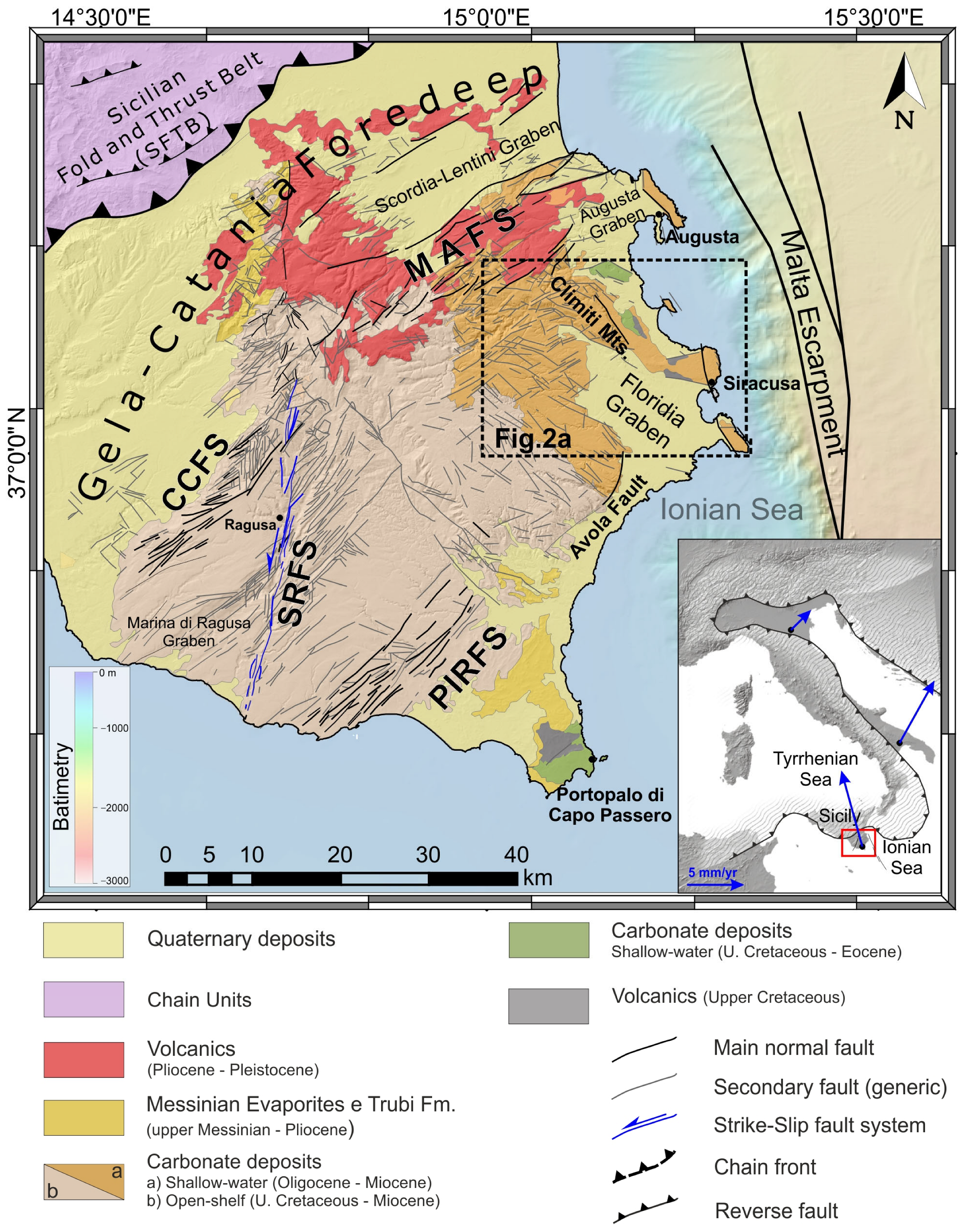
The Floridia Graben is located at the eastern border of the Hyblean Plateau, which represents the foreland domain of the Sicilian Thrust and Fold Belt (SFTB,
Figure 1) and is part of a broader foreland domain known as the Pelagian block [
9,
10]. The 25–30 km-thick, continental-like crust of the Hyblean Plateau is capped by a Mesozoic–Cenozoic carbonate sedimentary succession with intercalated volcanic rocks, belonging to the African–Pelagian continental margin [
8,
11,
12,
13]. The outcropping sedimentary units are mostly Oligocene–Miocene carbonate deposits that can be distinguished into an eastern and a western facies association: the eastern one is characterized by shallow-water carbonate facies overlying Cretaceous volcanic paleo-seamounts, while the western one is represented by open-shelf carbonate facies deriving from reworked platform deposits (
Figure 1, [
8,
14]).
The Hyblean Plateau is bounded by two regional-scale tectonic features represented by the Sicilian Fold and Thrust Belt (SFTB), to the NW, and the Hyblean–Malta Escarpment (also known as ‘Malta Escarpment’), to the E. The SFTB represents a portion of a broader collisional system in the central Mediterranean (the Apenninic–Maghrebian Chain, [
15] where various tectono-stratigraphic domains are piled up in a nappe structure. Conversely, the Malta Escarpment is a ≈300 km-long, crustal and morpho-structural discontinuity separating the 25–30 km-thick, continental-like foreland (Hyblean Plateau) from the 10–12 km-thick oceanic Ionian Sea domain [
16,
17]. The northern segment of this inherited Permian–Triassic discontinuity has been reactivated in Neogene–Quaternary time as a response to the ongoing Nubia–Eurasia convergence, controlling the evolution of the eastern Hyblean Plateau and western Ionian margin [
18,
19,
20,
21,
22].
The tectonic framework of the Hyblean Plateau shows a rather complex structural pattern marked by a diffuse network of fault systems variously oriented and characterised by normal to strike-slip kinematics. The main fault system is oriented NE–SW and affects the entire carbonate plateau, down-faulting it with significant offset (3–4 km) toward both the NW (below the Sicilian chain) and the SE [
23,
24,
25,
26]. These faults are probably related to the peripheral bulge resulting from Hyblean crustal underplating beneath the Sicilian chain [
13,
23,
27], although recent studies suggest they may also be inherited Mesozoic–Cenozoic structures, exploited during the Late Miocene–Quaternary doming due to deep-seated magmatic intrusion [
28]. Two main lineaments belonging to the general NE–SW fault system bound the Hyblean Plateau on its northwestern and southwestern borders: (1) the Comiso–Chiaramonte and Monterosso–Agnone fault systems (respectively, CCFS and MAFS in
Figure 1) to the NW, and (2) the Pozzallo–Ispica–Rosolini fault system (PIRFS in
Figure 1) and the Avola fault to the SE. In addition, the central sector of the Hyblean Plateau between the MAFS and the PIRFS is further affected by a system of NW–SE trending faults and joints, interpreted as a transfer zone between the NE–SW-oriented systems that delimit the structural high [
25]. Since the Late Miocene, the coeval activity of both systems led to the formation of structural depressions, characterised by Pliocene–Quaternary syntectonic deposition, such as the Scordia–Lentini, Augusta and Floridia Grabens (
Figure 1).
To the east, the Ionian coastal sector is controlled by NNW–SSE-trending faults which give rise to horst structures between Augusta and Siracusa, including the Climiti Mts. ridge (
Figure 1). This fault system is likely correlated to the Pliocene–Quaternary reactivation of the Malta Escarpment offshore [
29]. Finally, a roughly N–S, strike-slip fault system known as the Scicli–Ragusa fault system (SRFS, in
Figure 1) cuts through the southwestern sector of the Hyblean Plateau, showing evidence of activity during the Late Pliocene and Early Pleistocene [
2,
26]. This complicated network of Quaternary/active faults is associated with frequent seismicity (both instrumental and historical) that makes the Hyblean Plateau one of the most seismically active region of Italy [
30,
31,
32,
33,
34].
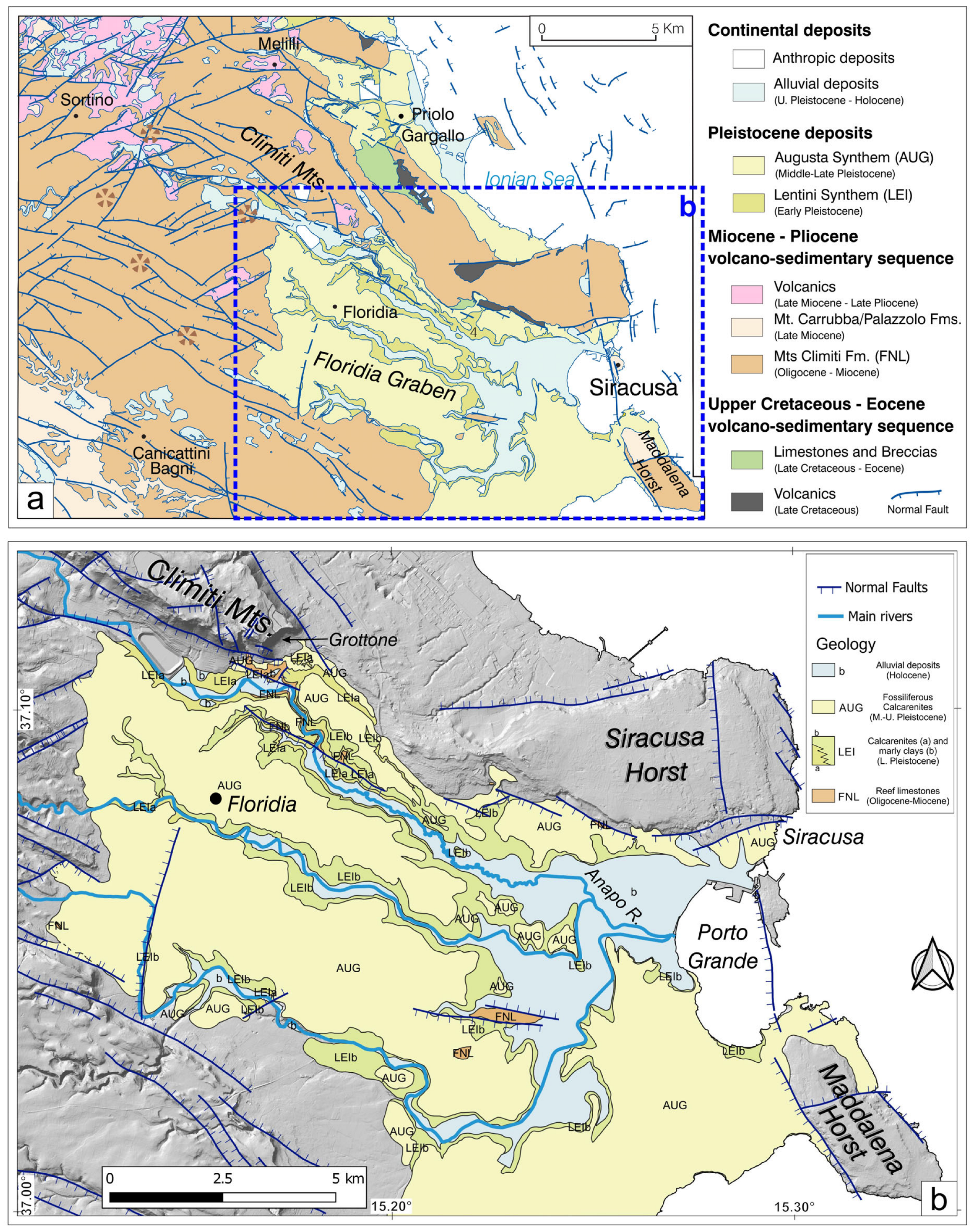
The sedimentary and tectonic evolution of the Floridia Graben is strictly related to the activity of interconnected fault systems, mostly belonging to the NE–SW and NW–SE systems. It is a structural depression bounded by NW–SE-trending normal faults, filled by transgressive–regressive Quaternary sequences unconformably covering Miocene reef limestones (
Figure 2) [
35,
36]. To the northeast, the Floridia Graben is delimited by a system of NW–SE-trending normal faults, southwest dipping, separating the graben from the structural high of the Climiti Mts (
Figure 1). To the southwest, the same NW–SE system (with NE dipping), and associated minor synthetic structures, bounds the graben, showing a very irregular scarp due to the erosive processes prevailing on the tectonic movements during the Middle-Pleistocene emergence of the structural depression. The fault scarp is in fact incised by some paleo-coastlines, highlighted by alignments of marine caves [
37]. Eastward, the Floridia Graben is closed by the Maddalena Horst (
Figure 2), a roughly NNW–SSE-oriented structural high, gently dipping to the east, whose western-bounding fault extends northward through the Porto Grande to the urban area of Siracusa [
1].
The stratigraphic succession of the Floridia Graben consists of a Miocene substrate represented by rhodolithic limestones of the ‘Monti Climiti’ formation (FNL), which in turn lays above Cretaceous volcanics (not reached by wells within the graben). Substrate rhodolithic limestones outcrop diffusely outside the graben but can also be observed inside it in correspondence with local horst structures in its central portion (
Figure 2). The Quaternary deposits unconformably covering the substrate consist of two transgressive cycles separated by an erosional unconformity [
1]: (1) the Lower Pleistocene calcarenites (LEIa in
Figure 2b) heteropically passing to prevalent clays and marly clays (LEIb in
Figure 2b) of the Lentini Synthem and (2) the Middle–Upper Pleistocene calcarenites of the Augusta Synthem (AUG in
Figure 2b), known in the literature as ‘Panchina’. Pliocene horizons are missing within the graben but are locally preserved outside it along the coastal sector of the ‘Maddalena Horst’.
The relationships between tectonic structures and sedimentary succession provide some indications on the age of formation of the Floridia Graben. The NW–SE-oriented faults must have been active between the end of the Late Pliocene and the Early Pleistocene. Synsedimentary activity is suggested by the intercalations of breccias within the Lower Pleistocene calcarenites of the Lentini Synthem outcropping in the Grottone area (
Figure 2), close to the northeastern-bounding fault. New data on shear zones were collected during our file mapping, indicating that some faults were active at least until the Late Pleistocene and may be still quiescent (see below).
3. Materials and Methods
The subsurface architecture of the Floridia Graben has been defined from the reinterpretation and analysis of field and well data, integrated with surface geology, DEM 2 × 2 of the Siracusa area, 2D geologic sections as well as by developing and comparing 3D geologic and hydrogeologic models. In the absence of geophysical data useful for the horizontal correlation of wells, the models have been achieved by the analysis and integration of field data (geological mapping) and borehole logs for water wells drilled in the last 50 years (provided by the Siracusa civil engineering office—Genio Civile, Siracusa).
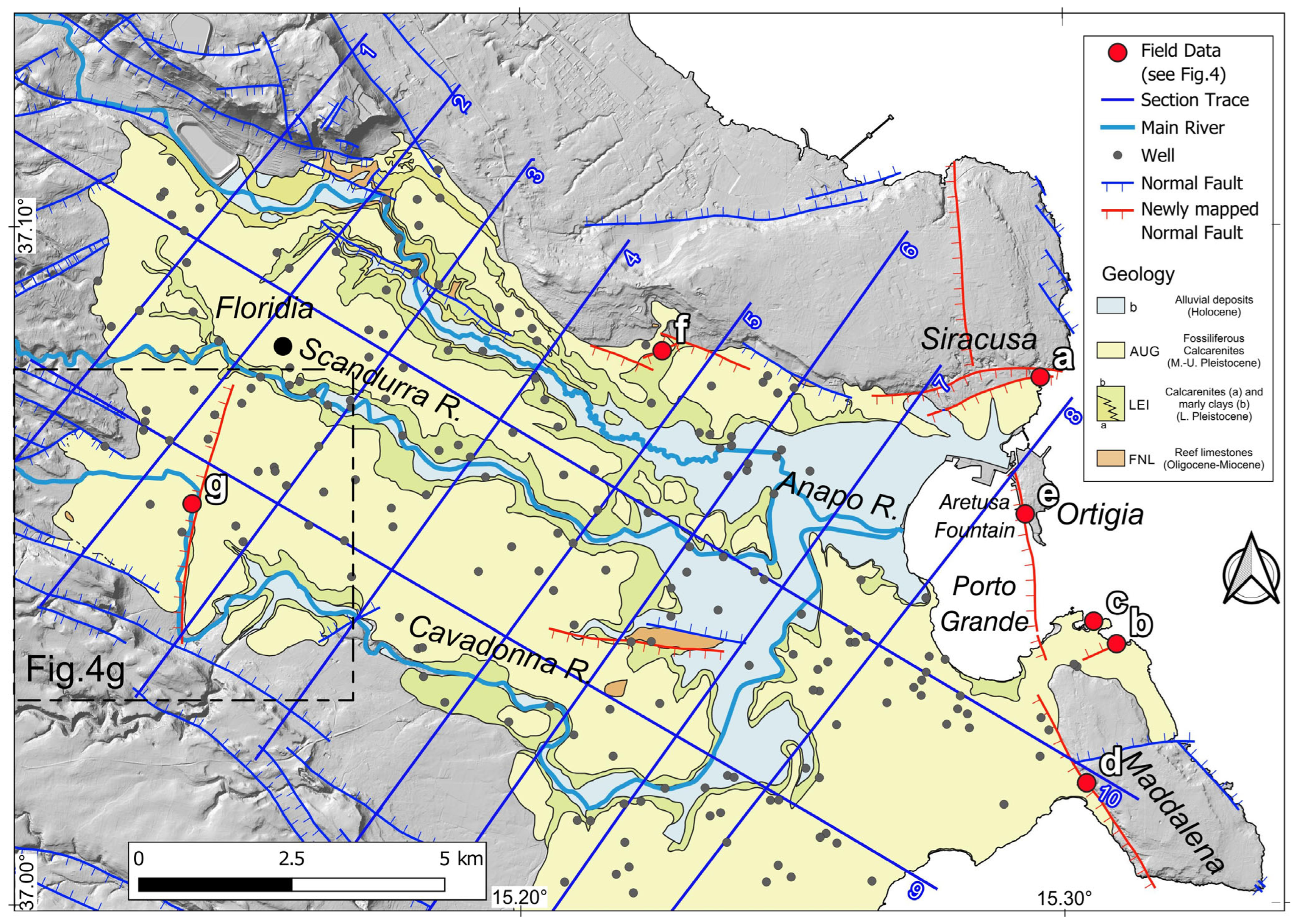
Surface data consist of linear features (vector format,
Figure 3) representing the geologic boundaries, collected by means of a detailed (1:10,000) and revised field survey performed within the national CARG project [
1] for the development of the geological map of the Siracusa sheet (N. 646 scale 1:50,000). The field-derived data, collected using both classical and digital methodologies, have been managed within a GIS environment (ArcGIS Pro v.3.5.3 licensed and the open-sourced QGIS software v.3.40) and organised in a database publicly available at the CARG Project website (
https://progetto-carg.isprambiente.it/) (accessed on 1 May 2026). The topographic reference surface is represented by a 2 × 2 grid digital elevation model (DEM,
Figure 3) publicly available at the Sicily Region geoportal Sistema Informativo Territoriale Regionale (S.I.T.R.,
https://www.sitr.regione.sicilia.it/).
Figure 3.
Image showing the dataset used to develop the Floridia Graben 3D model. Well data provided by the Siracusa civil engineering office (Genio Civile—Siracusa). Red dots (and letters) refer to the locations of field evidence reported in
Figure 4. Blue lines with numbers indicate cross and longitudinal sections used to provide further constraints on the subsurface geometry of main horizon. FNL: Mts. Climiti formation; LEI: Lower Pleistocene calcarenites (a) and marly clays (b) of the Lentini Synthem; AUG: Middle–Upper Pleistocene calcarenites of the Augusta Synthem; b: Alluvials.
Figure 3.
Image showing the dataset used to develop the Floridia Graben 3D model. Well data provided by the Siracusa civil engineering office (Genio Civile—Siracusa). Red dots (and letters) refer to the locations of field evidence reported in
Figure 4. Blue lines with numbers indicate cross and longitudinal sections used to provide further constraints on the subsurface geometry of main horizon. FNL: Mts. Climiti formation; LEI: Lower Pleistocene calcarenites (a) and marly clays (b) of the Lentini Synthem; AUG: Middle–Upper Pleistocene calcarenites of the Augusta Synthem; b: Alluvials.
The well dataset consists of 230 selected boreholes for water wells (see
Figure 3) appropriately reinterpreted and classified. The wells are rather heterogeneous in term of maximum investigated depth (up to 550 m, but generally within 150 m from ground level), well-log description (data acquired over 50 years from different operators) and drilling technology. The punctual nature of the geognostic data and their heterogeneous degree of precision (due to different drilling methods, subjective interpretations of stratigraphic logs etc.) make well-log correlation rather challenging. This is even more evident for shallow-marine transgressive environments, such as those of the Floridia Graben, which can be quite heterogeneous and laterally discontinuous. For this reason, well logs have been reinterpreted and validated according to field survey evidence, organised in a database and managed in GIS environment. The analysis of borehole data, with specific reference to lithological descriptions, allowed for the grouping of the lithologies into main complexes with similar permeability features, which were then used to develop the final hydrogeological conceptual model. The available measures of groundwater table elevation data allowed the generation of a map of the potentiometric surface of the aquifers applying the natural neighbour algorithm for data interpolation using the Surfer program.
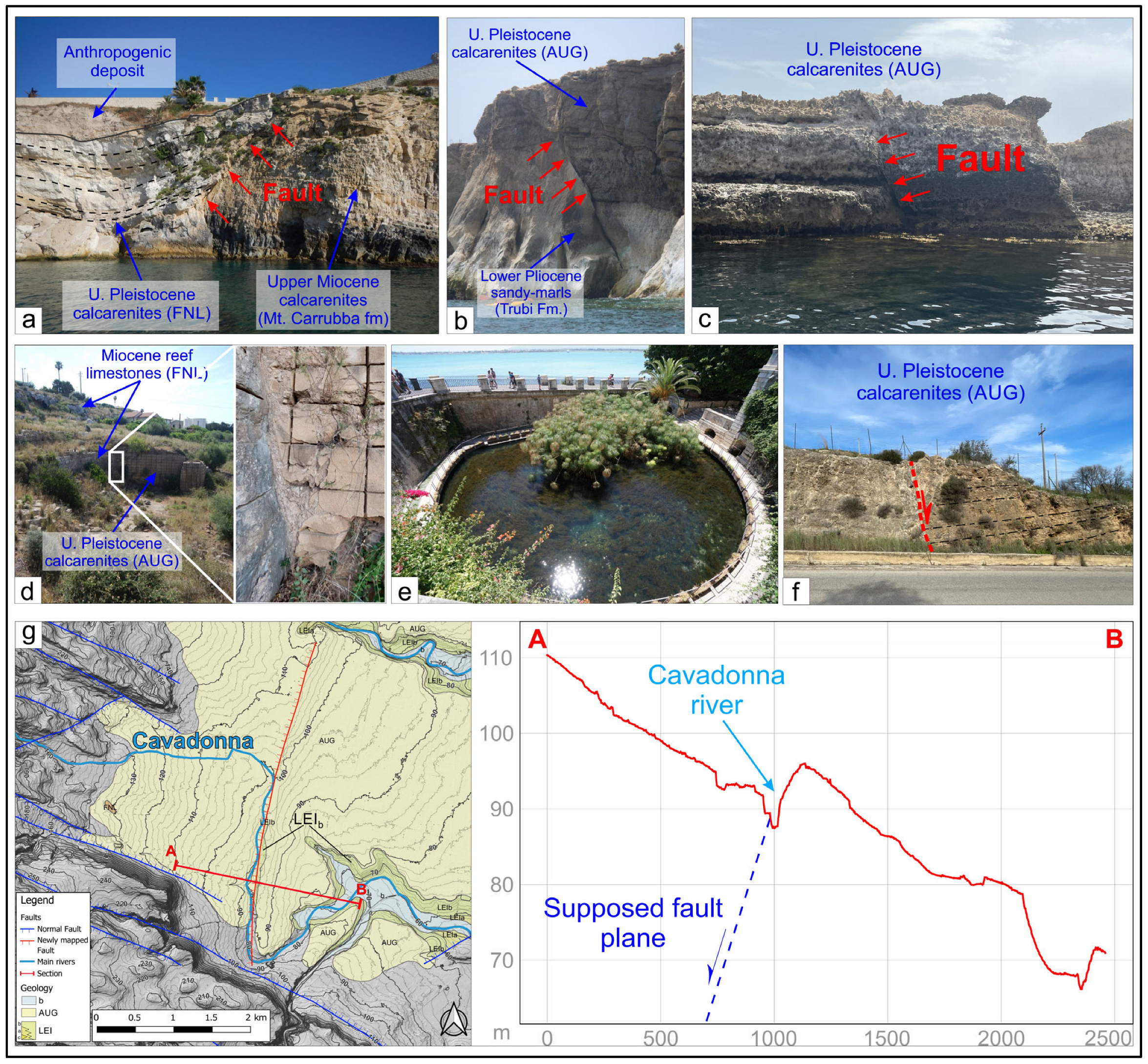
Figure 4.
Field evidence of Quaternary faulting. The letters of figures (
a–
g) refer to the letters of field-data (red dots) in
Figure 3. (
a) View from the east of a normal fault bounding the Floridia Graben to the north (site a in
Figure 3). Note the drag fold (layering in dotted lines) in the Middle–Late Pleistocene calcarenites of the Augusta Synthem (AUG) and the sealing of the structure by the uppermost levels of the calcarenites. (
b) View from the north of a normal fault along the coast of the Maddalena Peninsula (site b in
Figure 3). Note the thickening of the lower part of the calcarenites of the Augusta Synthem (AUG) close to the fault and the onlap of the uppermost levels of the same calcarenites against the structure. (
c) Evidence of recent activity along a normal fault located along the coast of the Maddalena Peninsula (site c in
Figure 3). (
d) View from the northwest of the normal fault scarp that delimits the horst of the Maddalena Peninsula to the west (site d in
Figure 3). At the top centre, a paleo coastline occurs at the footwall of the uplifted block; at the bottom right, the excavation of a quarry has allowed for the observation of the shear zone (see inset) that brings the limestones of the Monti Climiti fm (FNL), greyish on the left, into contact with the downfaulted calcarenites of the Augusta Synthem (AUG), brownish on the right. (
e) The Aretusa fountain (site e in
Figure 3). (
f) Evidence of recent activity along the normal fault located on the northern boundary of the Floridia Graben (site f in
Figure 3). (
g) Morphologic evidence of recent fault activity along the
Cavadonna River, southwest of Floridia (see site g in
Figure 3).
Figure 4.
Field evidence of Quaternary faulting. The letters of figures (
a–
g) refer to the letters of field-data (red dots) in
Figure 3. (
a) View from the east of a normal fault bounding the Floridia Graben to the north (site a in
Figure 3). Note the drag fold (layering in dotted lines) in the Middle–Late Pleistocene calcarenites of the Augusta Synthem (AUG) and the sealing of the structure by the uppermost levels of the calcarenites. (
b) View from the north of a normal fault along the coast of the Maddalena Peninsula (site b in
Figure 3). Note the thickening of the lower part of the calcarenites of the Augusta Synthem (AUG) close to the fault and the onlap of the uppermost levels of the same calcarenites against the structure. (
c) Evidence of recent activity along a normal fault located along the coast of the Maddalena Peninsula (site c in
Figure 3). (
d) View from the northwest of the normal fault scarp that delimits the horst of the Maddalena Peninsula to the west (site d in
Figure 3). At the top centre, a paleo coastline occurs at the footwall of the uplifted block; at the bottom right, the excavation of a quarry has allowed for the observation of the shear zone (see inset) that brings the limestones of the Monti Climiti fm (FNL), greyish on the left, into contact with the downfaulted calcarenites of the Augusta Synthem (AUG), brownish on the right. (
e) The Aretusa fountain (site e in
Figure 3). (
f) Evidence of recent activity along the normal fault located on the northern boundary of the Floridia Graben (site f in
Figure 3). (
g) Morphologic evidence of recent fault activity along the
Cavadonna River, southwest of Floridia (see site g in
Figure 3).

The 3D model of the Floridia Graben subsurface has been developed from point data (230 boreholes for water wells) appropriately reinterpreted and classified (see
Figure 3), as well as from ad hoc geologic sections developed integrating linear features (representing the geologic boundaries), well logs and a 2 × 2 grid digital elevation model (DEM). The input data have been managed in a GIS environment (ArcGis Pro licensed and QGIS open-source software) and elaborated in a vectorial 3D environment within the MOVE geological package (Petex). The well-log reinterpretation represents a crucial step on defining well-data stratigraphy, as the boreholes have been drilled over the last 50 years from different operators and without a proper chrono-stratigraphically oriented approach. Although such a collected dataset could potentially be affected by errors, reinterpretation and cross-correlation based on field observation and stratigraphic relationships represent a powerful approach to reduce uncertainties and provide a geologically consistent model.
3.1. Field-Data
The field work allowed the revision and validation of geologic units and related boundaries as well as the identification of Quaternary faults previously unmapped (
Figure 2). Field investigations have provided important evidence regarding the activity and timing of faults within the graben and at its boundaries.
The faults bounding the Floridia Graben (to the north and south) apparently show no clear evidence of recent deformation. However, along the coast on the northeastern sector of the graben (
Figure 3 and
Figure 4a), an ENE-oriented fault juxtaposes Upper Miocene calcarenites (Mt. Carrubba fm.) with Upper Pleistocene calcarenites (AUG). This latter show syncline geometry interpreted as drag folding due to normal fault slip. In addition, the upper portion of the fault is sutured by the younger level of the AUG. Another fault with a similar orientation is observed about 5 km southward, along the coast of the Maddalena Peninsula (
Figure 3 and
Figure 4b). Here, the fault plane juxtaposes the Middle–Upper Pleistocene calcarenites (AUG) with Lower Pliocene marls (Trubi Fm.), showing an offset of about 3 m. The AUG shows thickening in the downfaulted block (fault growth) and suture the fault plane in its upper levels. Nearby, other faults are observed to offset the Upper Pleistocene calcarenites (AUG,
Figure 3 and
Figure 4c).
The Floridia Graben is bounded to the east by the horst structure represented by the Maddalena Peninsula (
Figure 2 and
Figure 3). The Upper Pleistocene deposits (AUG) appear to be offset eastwards by the NNW–SSE-trending, W-dipping, bounding fault of the horst. In particular, in a quarry along this fault (
Figure 3 and
Figure 4d), it is possible to observe the effect of shearing within the AUG calcarenites. The recent synsedimentary activity of this structure is evidenced by the presence of a fluidized cataclastic zone along the fault that truncates the Upper Pleistocene deposits (see inset in
Figure 4d). The same deposits suture the fault plane toward the top and terminate (with onlap geometry) on a paleo cliff consisting of Miocene carbonates (FNL). The fault extends northwards through the Porto Grande (see the sparker profile in Figure 102 of the explanatory notes of sheet N. 646 Siracusa [
1]) to the urban area of Siracusa, bounding the Ortigia island to the west where the historical centre of Siracusa is built. Here, the influence of this fault on the deep water system of the Floridia Graben is testified by the occurrence of the pressurized fresh-water spring, the ‘Aretusa fountain’, along the western coast of the Ortigia island (
Figure 3 and
Figure 4e).
Within the Floridia Graben, the relatively flat topography and the nature of outcropping rocks generally do not favour the recognition of shear zones along the outcropping faults. However, a road trench at the northern bound of the graben west of Siracusa (
Figure 3 and
Figure 4f) allowed for the observation of an ENE-trending fault cutting through the Upper Pleistocene calcarenites (AUG), characterized by a well-developed cataclastic zone. The calcarenites appear relatively horizontal at the footwall, while appearing to be definitely tilted (about 5°) toward the fault plane at the hanging wall. Another example of recent fault activity is suggested by clear morphologic evidence of the
Cavadonna River. The right-angled deviation of the river, southwest of Floridia village (
Figure 3 and
Figure 4g), is caused by a fault oriented approximately NNE–SSW and dipping towards the west with a scarp approximately 5 metres high, as highlighted by the topographic profile on a high-resolution DTM (
Figure 4g, see also [
38]). This fault juxtaposes the Middle–Upper Pleistocene calcarenites (AUG) at the hanging wall (to the west), with Pleistocene marly clays (LEIb) at the footwall. The geologic-morphological features indicate the very recent activity (Holocene?) of this fault.
3.2. 3D Model
In order to develop a 3D geologic model of the Floridia Graben subsurface, we made use of 10 pseudosections (8 cross-sections and 2 longitudinal, see
Figure 3) integrating subsurface (well) data and field observations to better constrain the subsurface geometry of the main horizons and structures, particularly for areas less covered by point data.
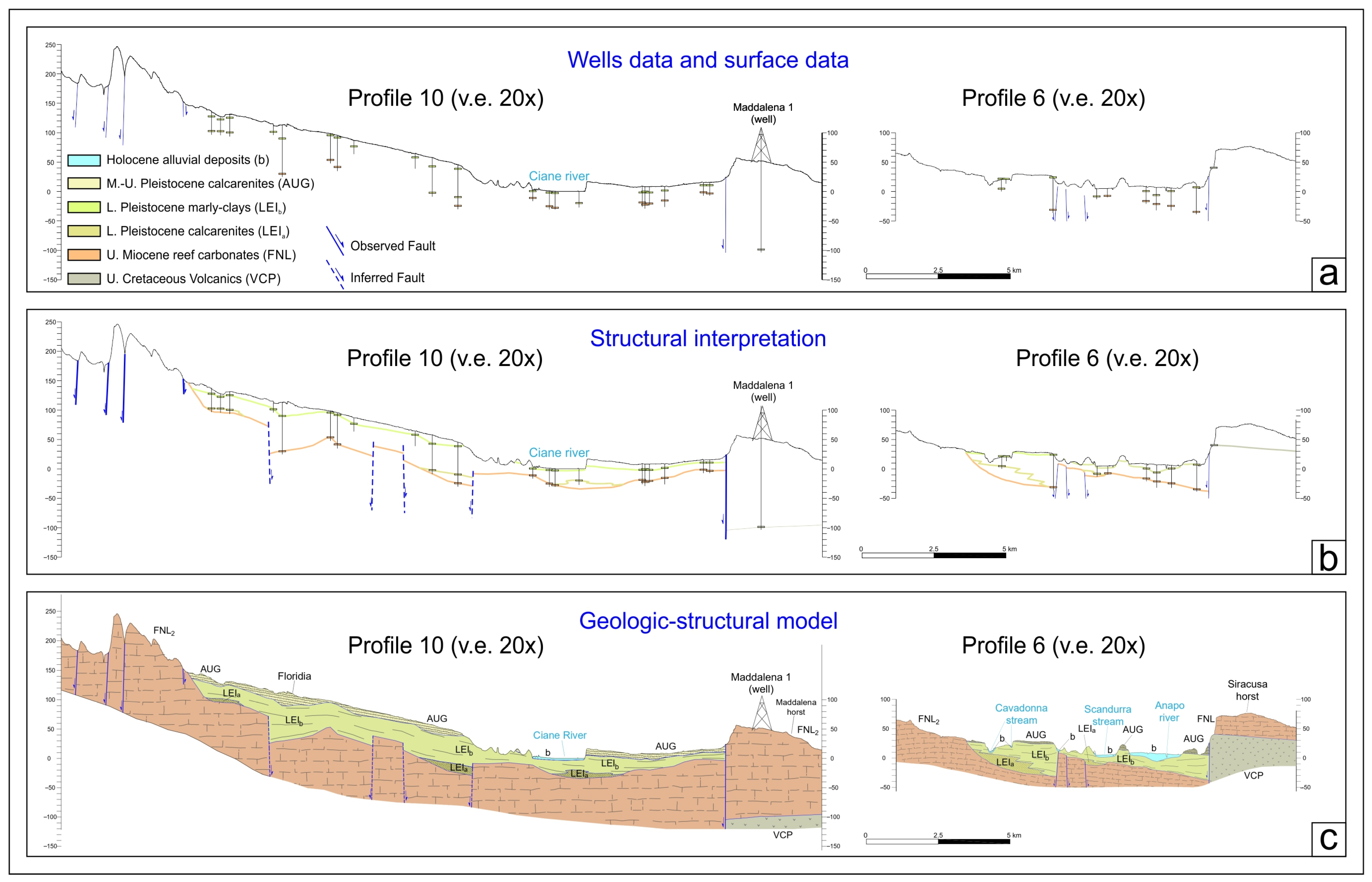
Linear features (faults and geologic boundaries) and intersections have been visualised and well data within a buffer of 300 m have been projected to each pseudosection (
Figure 5a). This procedure was fundamental to highlight any vertical offset of the considered horizons due to fault activity; information that would otherwise be lost by the application of interpolation algorithms. In
Figure 5, examples of profiles 6 and 10 are shown (see
Figure 3 for location) and propose a geologic interpretation.
Internal and bounding tectonic structures (faults) observed in the field have been 3D modelled by extruding surface linear features according to field-measured geometric attitudes (strike and dip). The thus-modelled faults were used as structural terminations for the stratigraphic 3D horizons. Finally, points and linear features have been 3D interpolated using statistic algorithms (Kriging and IDW) considering their termination to other surfaces (fault planes or horizons) to create a geologically consistent 3D model.
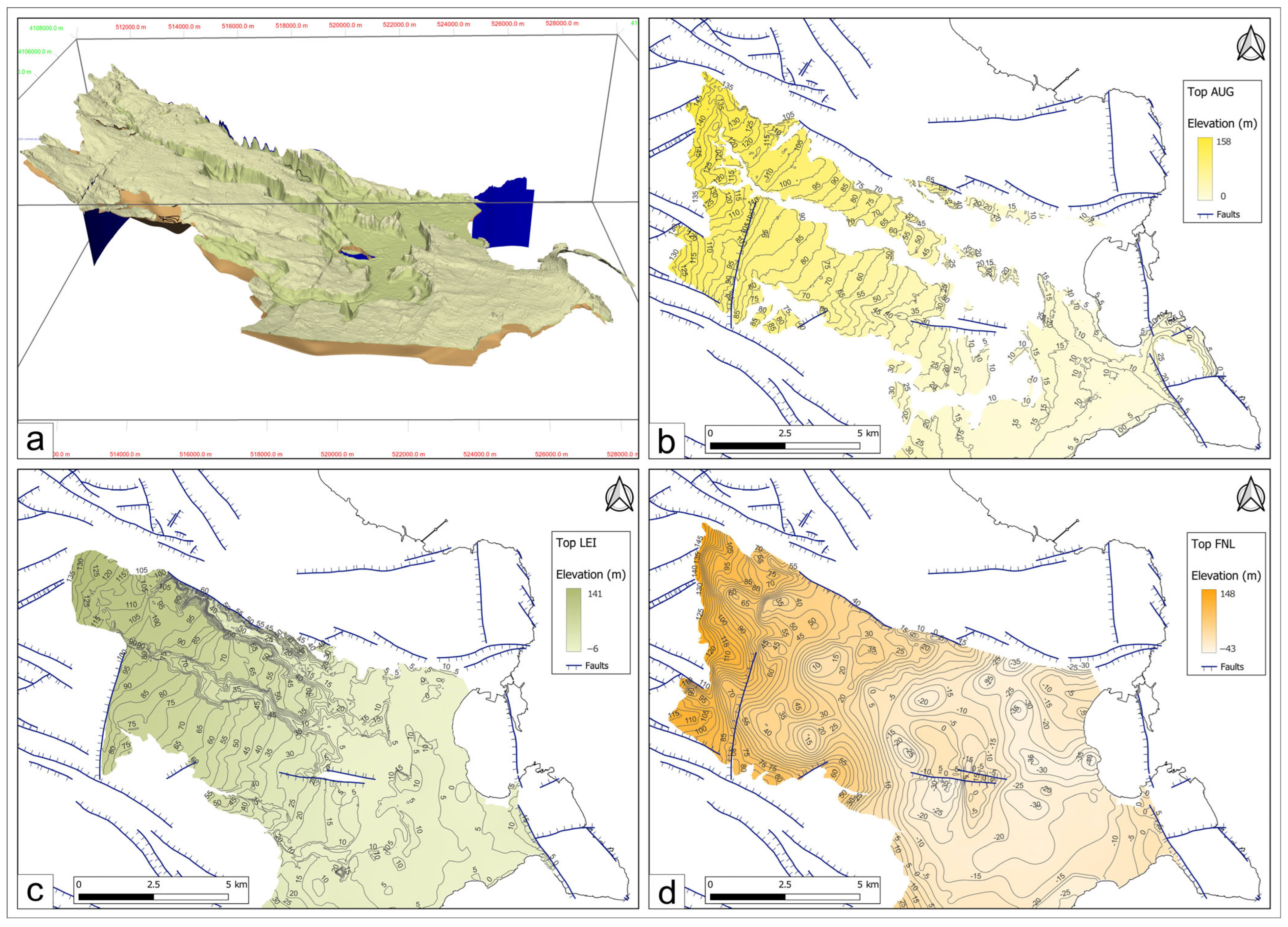
The 3D model of the Floridia Graben subsurface (
Figure 6), so constructed, consists of three horizons representing (from bottom to top) (1) the top of the Monti Climiti formation (FNL), (2) the top of the Lower Pleistocene marly–clayey member (LEIb) and (3) the top of the Middle–Upper Pleistocene calcarenitic unit (AUG). The succession is capped by Holocene alluvial deposits (b), which, due to their limited thickness and discontinuity, have not been included in the 3D model. The top of the LEIa member (Lower Pleistocene calcarenites) has not been modelled due to its discontinuous nature and limited extension as well as for the difficulty encountered in distinguishing it univocally from the underlying Miocene carbonate formation (FNL). Moreover, the similarities in hydrogeological behaviour (discussed below) between the calcarenitic facies of the Lentini Synthem (LEIa) and the underlying Miocene carbonates (FNL), led us to consider them as a single volume, making them more suitable for the purposes of the study.
The uppermost top AUG horizon, where preserved, matches the topographic surface, covering an area of about 67.6 km
2, and extends vertically from 158 m (upslope) to sea-level. It is laterally discontinuous due to the presence of surface drainages mostly trending NW–SE (Anapo River and the
Scandurra and
Cavadonna streams, see
Figure 2,
Figure 3 and
Figure 6b) that expose the lower formations (LEI and FNL).
The top of LEIb generally shows a gentle, relatively homogeneous slope (less than 1° seaward) and extends vertically from 147 m a.s.l. to −6.2 m, covering an area of about 94.9 km
2. Its geometry appears strongly affected by local erosion due to surface drainages that produced incisions as deep as 25–30 m (
Figure 6c). As expected, the portions out of the incisions appears rather flat due to the presence of a marine erosional surface separating this synthem from the upper Augusta Synthem.
The top FNL surface shows a rather complex morphology that differs from the upper horizons discussed above. Conversely from overlying horizons, the top FNL does not, in fact, show the clear influence of channelling but its morphology is instead characterised by troughs and highs (
Figure 6d) mostly observed in the central and western portion of the modelled surface. These structural features show two main alignments trending roughly NW–SE and NE–SW.
The 3D geologic–structural modelling also allowed for the definition of a total of 15 volumes confined between main horizons, as summarised in
Table 1.
4. Results
The field survey carried out for the development of sheet N. 646 Siracusa (scale 1:50,000 [
1] allowed for the revision of geological units and related boundaries, including the identification of Quaternary faults previously unmapped. Newly identified faults provided additional information on the timing of the most recent activity, which is not yet well defined. The mapped faults clearly dislocate the Middle–Upper Pleistocene calcarenites (Augusta Synthem, AUG—
Figure 2 and
Figure 3) with an offset spanning from a few tens of centimetres up to 2–3 m (
Figure 4). The offset is visible for almost the entire vertical extension of the Augusta Synthem, but, locally, the faults appear sutured by the youngest levels of the synthem. This would constrain the age of the last deformation to the Late Pleistocene. Moreover, geological and morphological evidence within the Floridia Graben (see
Figure 4f,g) would suggest that the deformation occurred after the deposition of the Augusta Synthem, thus rejuvenating the fault activity within the U. Pleistocene—a Holocene time interval.
Once the role played by Quaternary tectonics on the evolution of the Floridia Graben has been ascertained, the geological–structural architecture of the basin and the influence of tectonic features on the development of a complex reservoir system needs to be characterised. In this regard, the morpho-structural pattern of the Floridia Graben subsurface, as highlighted by the 3D modelling and 2D cross-sections (
Figure 5 and
Figure 6), further suggests that the sedimentary processes were controlled by bounding and internal faults. The particular pattern of the top FNL horizon (
Figure 6d), characterised by rapid morphological variations, delineates troughs and highs aligned according to two main directions, NW–SE and NE–SW. This pattern perfectly overlaps the orientations of Quaternary faults observed inside and outside the investigated graben and suggests the occurrence of buried fault scarps dislocating the carbonate substratum (
Figure 1,
Figure 2a,
Figure 3 and
Figure 4).
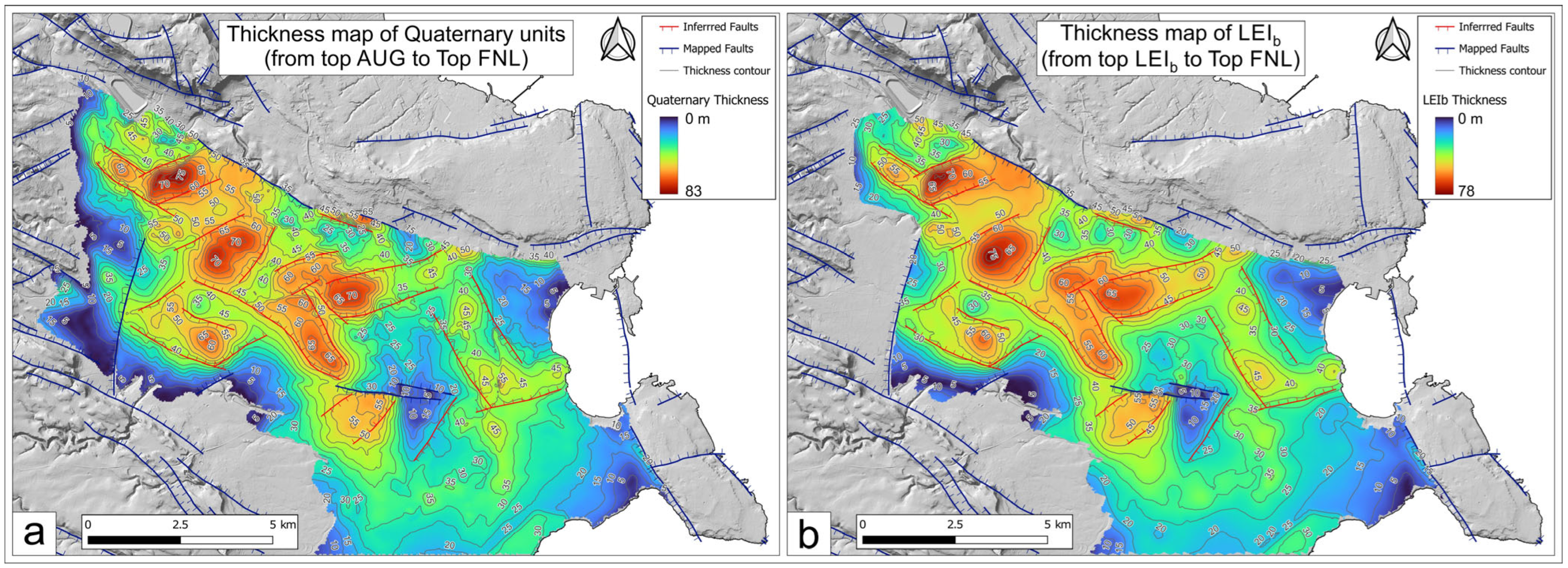
In order to achieve information about the control of faults on the Floridia Graben Quaternary infill, thickness maps between the main horizons have been developed. The concept is based on the fact that, as the
Augusta and
Lentini synthems are dislocated by faults (
Figure 4), any variation in thickness can be interpreted as the effect of Quaternary fault activity. The thickness maps of Quaternary units are derived by subtracting the elevation of the carbonate basement (top FNL) to the elevation of the top Quaternary horizons (
Figure 7). In order to recover the effects of fluvial erosion (V-shape river valleys—see top LEI in
Figure 6c), we have spatially interpolated top horizons (top LEI and top AUG) through river canyons. Most of the thickness of the Quaternary units is here represented by clays and marly clays of the Lentini Synthem (LEIb), while the calcarenites of the Augusta Synthem (AUG) show a limited thickness (5–15 m in general, with maximum thickness of 20 m). To provide a comprehensive view of the thickness variations we developed two maps (
Figure 7) representing, respectively, (i) the thickness variation between the top AUG horizon and the top FNL horizon (therefore, the entire Quaternary interval,
Figure 7a) and (ii) the volume between the top LEI horizon and the top FNL horizon (therefore, the LEIb unit,
Figure 7b).
In detail, the uppermost AUG unit, confined between the topography (above) and the top LEI is represented by 13 independent volumes (
Table 1), laterally separated from each other by fluvial incisions. Stratigraphically below is the LEI synthem (almost entirely represented by the LEIb member), consisting of a single, continuous volume of about 1.7 km
3. Lastly, we find the L. Pleistocene calcarenitic level (LEIa) whose actual vertical and lateral size is poorly constrained due to its limited extension and lateral discontinuity. The constructed thickness maps (
Figure 7) show Quaternary thickness variations through the Floridia Graben, highlighting troughs (depocenters) and peaks mostly located in the central–western portion of the graben. The geometrical pattern here represented by trough alignments (red areas) shows a preferred orientation consisting of two main trends, NW–SE and SE–NE, with the former being the most evident. Such a morpho-structural pattern, observed in both reconstructions, is in line with the fault pattern (blue lines in
Figure 7) observed outside the Floridia Graben (see
Section 2), and allows us to assume that it is the result of the synsedimentary activity of faults.
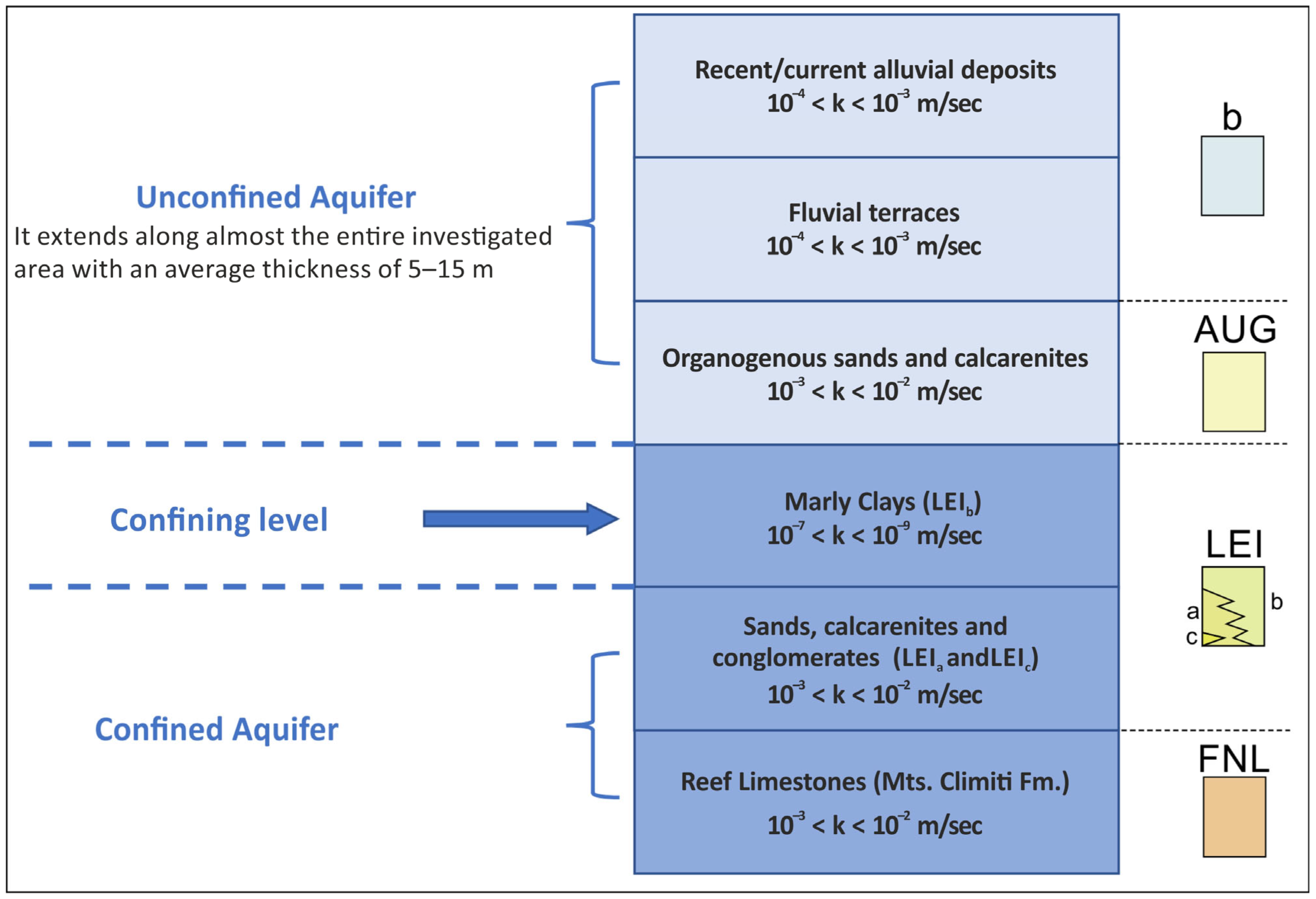
The hydrogeological conceptual model resulting from the stratigraphic data interpretation shows that the Floridia Graben hosts two aquifers (
Figure 8).
The shallow unconfined aquifer is mostly hosted within the Middle–Upper Pleistocene calcarenitic sandy unit (Augusta Synthem) and partially within the recent continental deposits, with a thickness ranging from 5 to 15 m. The deep confined aquifer is hosted within the Miocene limestones of the Monti Climiti formation (FNL), the Lower Pleistocene calcarenites, and yellowish fossiliferous sands (Lentini Synthem, calcareous sandy lithofacies—LEIa). The total thickness of the confined aquifer cannot be constrained from available data as the water wells never reach the Miocene limestone base (only reached by the ‘Maddalena 1’ well located outside the Graben—
Figure 5c). These aquifers are separated by the grey-blue marly clays (LEIb), which act as a confining layer (
Figure 8). The marly clays thickness is about 40–50 m in the Floridia town area and decreases towards the coast.
The limestones of the Mts. Climiti formation (FNL in
Figure 8), the Lower Pleistocene calcarenites (LEIa), and the yellowish fossiliferous sands (AUG) exhibit high secondary permeability due to the intense degree of rock mass fracturing. Consequently, groundwater circulation is discontinuous and occurs predominantly along preferential pathways oriented according to the structural patterns such as bedding planes, faults, and diaclases. Moreover, permeability is further conditioned by the occurrence of karst cavities, which are widespread in the study area [
39,
40].
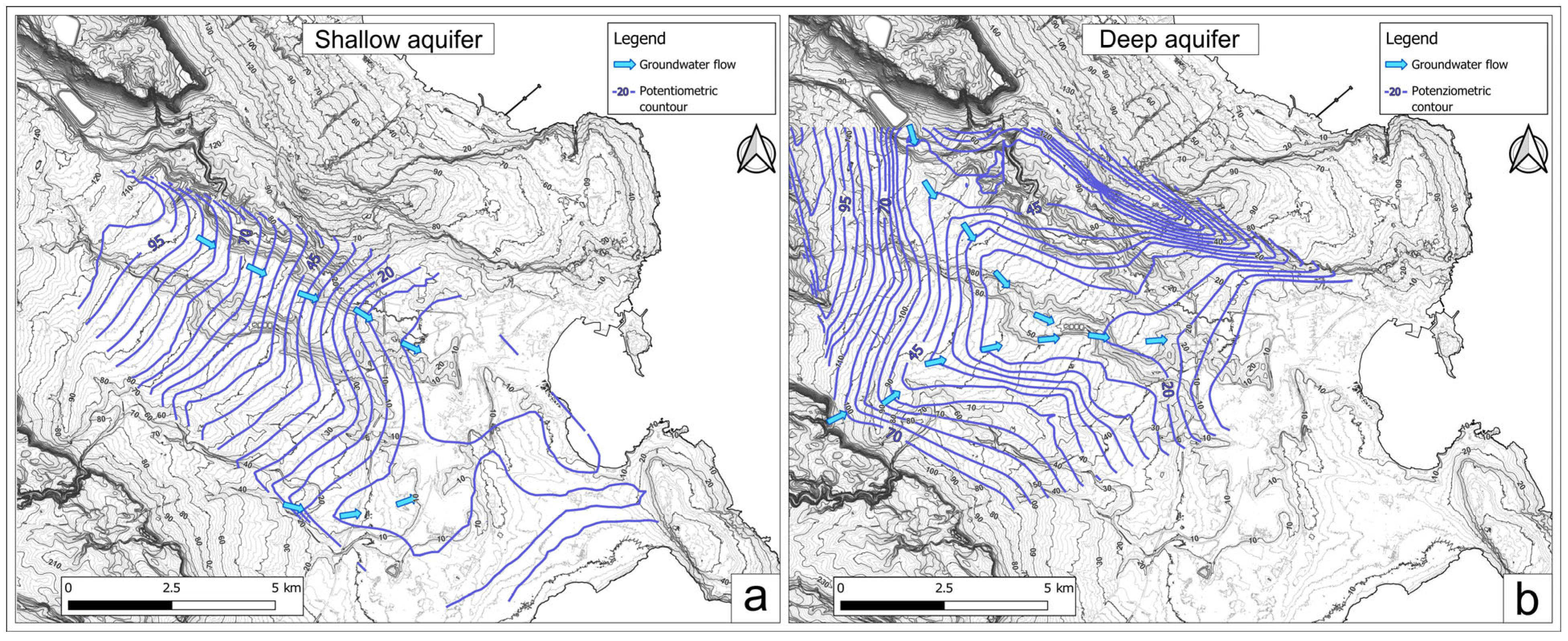
Groundwater flow within the unconfined shallow aquifer exhibits a preferential WNW–ESE direction (
Figure 9a). In the confined deep aquifer, two main flow axes (NW–SE and SW–NE) were identified, converging toward the coastline along an approximately W–E direction (
Figure 9b).
5. Discussion
The field survey across the Floridia Graben allowed the revision and validation of geologic units and related bounds as well as the identification of Quaternary faults (both outcropping and buried) previously unmapped, providing new insights in to the evolution of the Floridia Graben and the Ionian coastal sector of the Hyblean Plateau. The morpho-structural pattern of the Floridia Graben subsurface, as highlighted by the 3D modelling, suggests that the sedimentary evolution of the basin was controlled by bounding and internal faults. The fault arrangement, derived from the subsurface 3D modelling, results from the interaction of reactivated Quaternary faults and is in line with the fault pattern observed outside the Floridia Graben.
Geological evidence suggests the way in which faults worked until the Late Pleistocene, as evidenced by the offsets observed within the Augusta Synthem calcarenites (M.-U. Pleistocene). On the one hand, the observation of the Augusta Synthem locally suturing fault planes could suggest the inactivity or quiescence of tectonic structures, but on the other hand, morphological evidence within the Floridia Graben (see
Figure 4f,g) clearly indicate that the deformation occurred also after the deposition of the Augusta Synthem. This constraint rejuvenates the fault activity to the U. Pleistocene—a Holocene time interval.
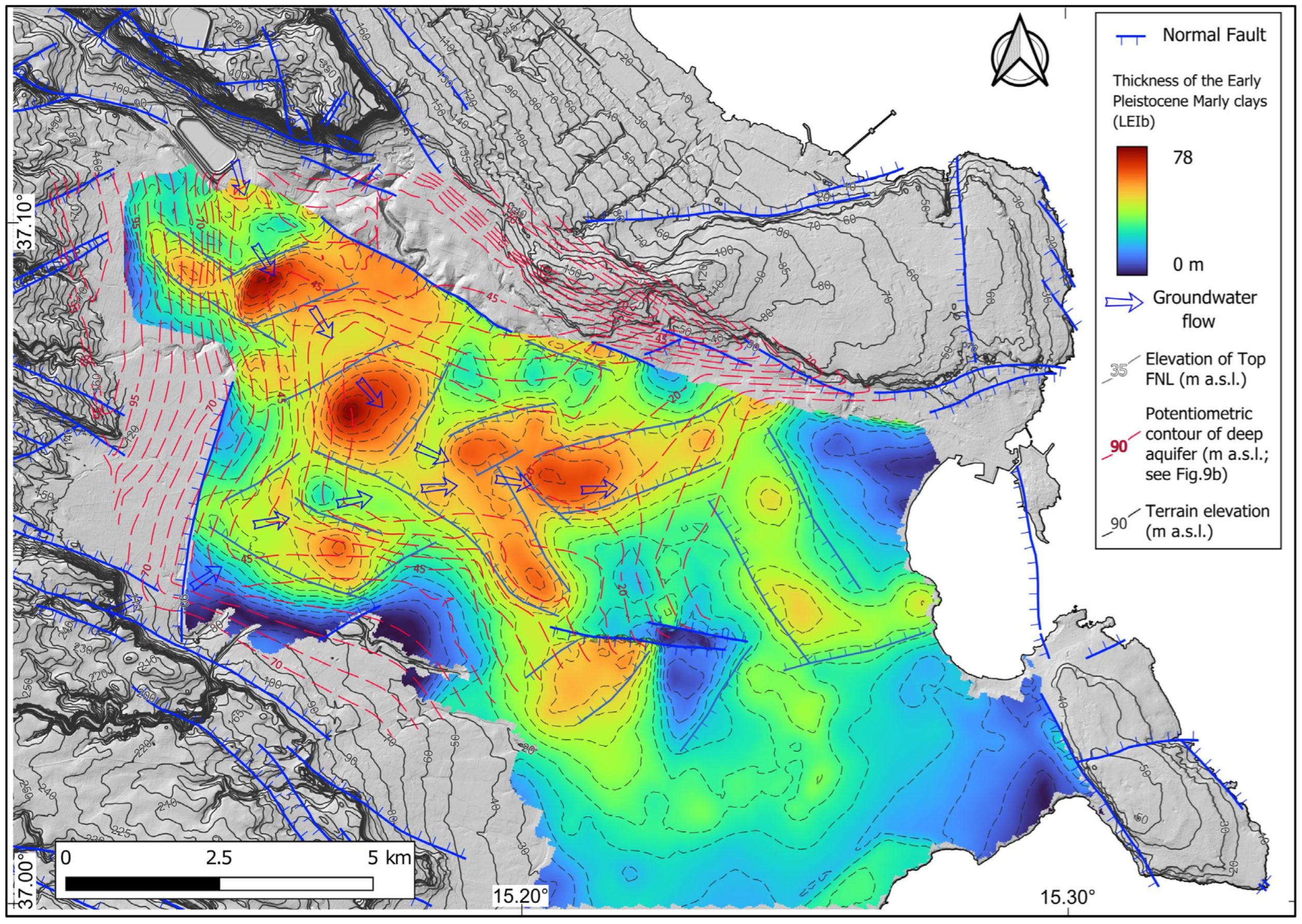
The hydrogeologic modelling led to the identification of three hydrogeological complexes giving rise to a shallow, unconfined aquifer and a deeper, confined aquifer, separated by the silty marly clay of the Lentini Synthem (LEIb, up to 78 m thick,
Figure 7 and
Figure 8). The shallow groundwater trend generally follows the direction of main surface drainage (Anapo and
Cavadonna rivers, see
Figure 2). Conversely, the groundwater trend within the confined aquifer is characterized by two main directions (NW–SE and SW–NE) converging eastward in a roughly W–E direction (
Figure 9). The presence of converging valleys highlighted by the 3D model of the top FNL horizons and thickness maps (
Figure 6 and
Figure 7) led us to hypothesize a strong influence of buried tectonic structures on groundwater flow. In fact, the integrated model (
Figure 10) achieved by overlapping the potentiometric map of the deep aquifer of
Figure 9b with the thickness map of
Figure 7 shows a strong agreement between the main groundwater flow directions and the troughs bounded by normal faults (see also
Figure 7).
This supports the hypothesis of a strong relationship between groundwater circulation and the structural setting of the study area. Furthermore, it should be noted that the Upper Pleistocene deposits of the Augusta Synthem at the top of the Lower Pleistocene succession of the Floridia Graben appear to be offset eastwards by the bounding fault of the Maddalena
Peninsula Horst (
Figure 2), a roughly NNW–SSE, W-dipping structure whose western bounding fault extends northward through the Porto Grande to the urban area of Syracuse. The influence of this fault on the deep water system of the Floridia Graben is testified by the occurrence of pressurised fresh-water springs along the western coast of Ortigia island (e.g., Aretusa fountain,
Figure 4e). Future studies may focus on the analysis of data relative to water temperature and isotopic composition to further corroborate the proposed model in terms of the residence time of the groundwater.
The subsurface modelling led to the redefinition of the role that tectonic structures play on the stratigraphic architecture and geometry of Quaternary deposits within the Floridia Graben. Moreover, the study shed new light on the 3D spatial distribution of hydrogeologic complexes within the Graben and related water flows. These results provide precious tools for the better prediction of geologic and hydrogeologic volumes, enhancing, therefore, the efficiency for future management and protection of natural resources (first and foremost water) in light of the changes (climatic, urban planning, social) that have already been underway for several years.




 ,
,