
Can Computed Tomography Findings for Kidney, Ureter and Bladder Correlate with Medical Comorbidity in Renal Colic Patients?
 ,
, 
Abstract
1. Introduction
- Availability and feasibility: Blacktown Hospital’s electronic medical record (eMR) already contains a large database of CT-KUB scans, which are routinely performed for suspected renal colic [6].
- Representative sampling: CT-KUB scans are performed without restrictions on age, sex, or ethnicity, ensuring a representative sample of the hospital’s patient population.
2. Materials and Methods
2.1. Study Design and Setting
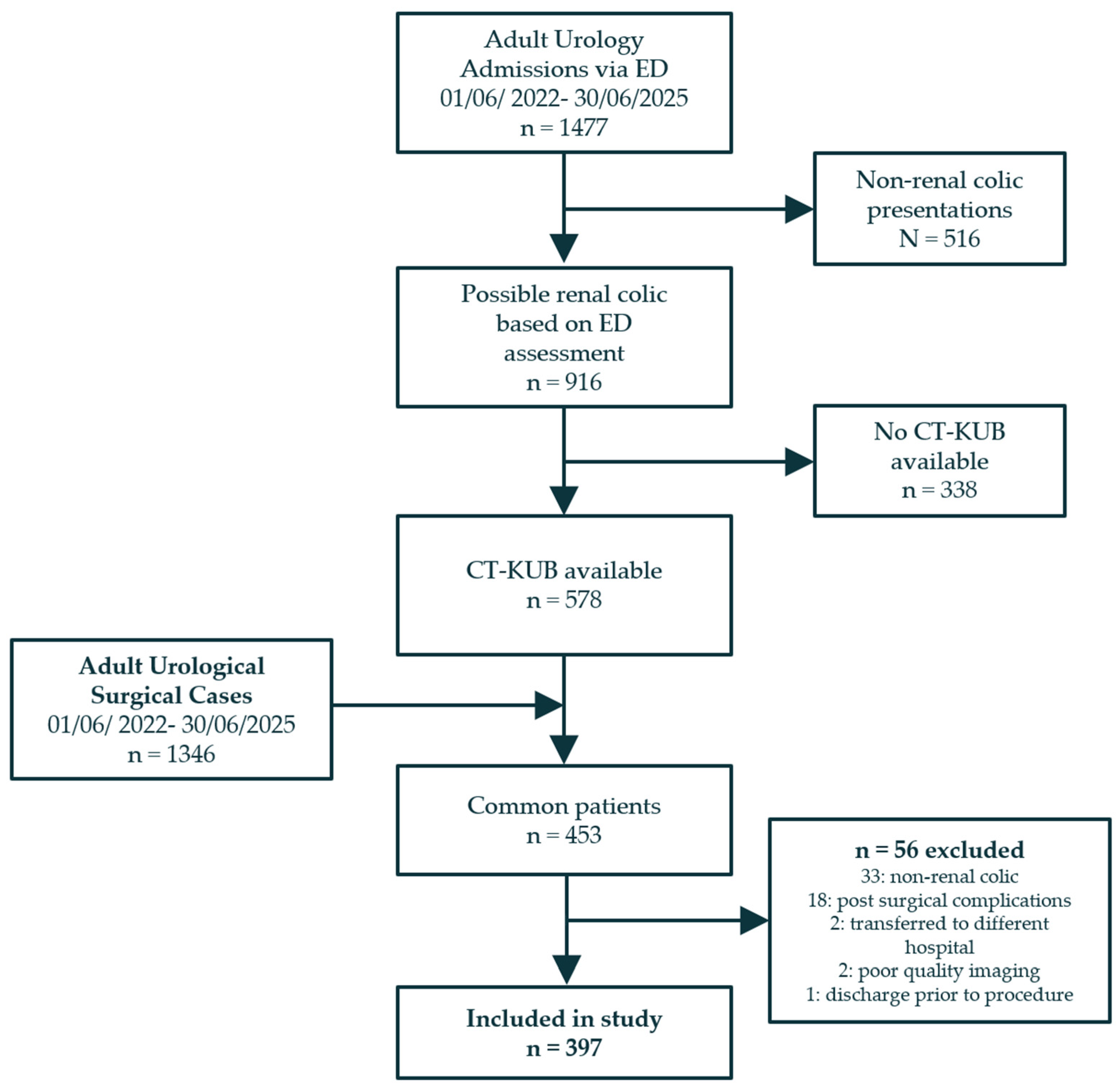
2.2. Study Population
- All adult patients who presented to the Blacktown Emergency Department with renal colic AND were admitted to the Urology Department AND underwent a cystoscopy as the primary intervention.
- Poor-quality or incomplete scans (i.e., not including the level of aorta bifurcation).
- Insufficient clinical and demographic data to calculate the CCI.
2.3. Data Collection
- Demographics: age, sex.
- Anthropometrics: height (for calculation of skeletal muscle index).
- Comorbidities.
- Imaging metrics: perimeter and area (minimum 8 points circumscribing the psoas on a single axial slice), height, width and Hounsfield unit of psoas muscle at the level of aorta bifurcation.
- Outcomes: length of stay, Intensive Care Unit (ICU) admission, 30-day readmission.
2.4. Imaging Analysis
2.5. Statistical Analysis
2.6. Data Handling and Confidentiality
3. Results
3.1. Patient Characteristics
3.2. Association Between Charlson Comorbidity Index and Clinical Outcomes
3.3. Association Between Psoas Muscle Metrics and Clinical Outcomes
3.4. Combined Predictive Value of Comorbidity and Muscle Metrics
3.5. Skeletal Muscle Index
3.6. Multivariable Analysis
4. Discussion
5. Conclusions
Author Contributions
Funding
Institutional Review Board Statement
Informed Consent Statement
Data Availability Statement
Conflicts of Interest
Abbreviations
| CT | Computed Tomography |
| CCI | Charlson Comorbidity Index |
| SMI | Skeletal Muscle Index |
| SMA | Skeletal Muscle Area |
| HU | Hounsfield Unit |
| LOS | Length of Stay |
| eMR | Electronic Medical Record |
| CT-KUB | Computed Tomography of the Kidneys, Ureters, and Bladder |
| ICU | Intensive Care Unit |
| ED | Emergency Department |
| AIDS | Acquired Immunodeficiency Syndrome |
References
- Cruz-Jentoft, A.J.; Bahat, G.; Bauer, J.; Boirie, Y.; Bruyère, O.; Cederholm, T.; Cooper, C.; Landi, F.; Rolland, Y.; Sayer, A.A.; et al. Sarcopenia: Revised European consensus on definition and diagnosis. Age Ageing 2019, 48, 16–31. [Google Scholar] [CrossRef] [PubMed]
- Shachar, S.S.; Williams, G.R.; Muss, H.B.; Nishijima, T.F. Prognostic value of sarcopenia in adults with solid tumours: A meta-analysis and systematic review. Eur. J. Cancer 2016, 57, 58–67. [Google Scholar] [CrossRef] [PubMed]
- Nemec, U.; Heidinger, B.; Sokas, C.; Chu, L.; Eisenberg, R.L. Diagnosing Sarcopenia on Thoracic Computed Tomography: Quantitative Assessment of Skeletal Muscle Mass in Patients Undergoing Transcatheter Aortic Valve Replacement. Acad. Radiol. 2017, 24, 1154–1161. [Google Scholar] [CrossRef] [PubMed]
- Uldin, H.; McGlynn, E.; Cleasby, M. Using the T11 vertebra to minimise the CT-KUB scan field. Br. J. Radiol. 2020, 93, 20190771. [Google Scholar] [CrossRef]
- Ghoshal, N.; Gaikstas, G. CT KUB scans for renal colic: Optimisation of scan range to reduce patient radiation burden. Radiography 2021, 27, 784–788. [Google Scholar] [CrossRef]
- Kasi, A.; Steffens, T.; Starkey, D.; Braithwaite, V. The proportion of computed tomography kidneys, ureters and bladder (CTKUB) scans that comply with scan extent protocol in an emergency department: A clinical audit and dose ramification study. J. Med. Radiat. Sci. 2021, 68, 13–20. [Google Scholar] [CrossRef]
- Van Jacobs, A.; Coltman, A.; Gomez-Perez, S.L.; Bienia, B.; Sclamberg, J.S.; Peterson, S.J. Prevalence of low computed tomography–measured skeletal muscle index and handgrip strength in a general medical population. Nutr. Clin. Pract. 2022, 37, 102–109. [Google Scholar] [CrossRef]
- Troschel, F.M.; Jin, Q.; Eichhorn, F.; Muley, T.; Best, T.D.; Leppelmann, K.S.; Yang, C.-F.J.; Troschel, A.S.; Winter, H.; Heußel, C.P.; et al. Sarcopenia on preoperative chest computed tomography predicts cancer-specific and all-cause mortality following pneumonectomy for lung cancer: A multicenter analysis. Cancer Med. 2021, 10, 6677–6686. [Google Scholar] [CrossRef]
- Troschel, F.M.; Kuklinski, M.W.; Knoll, S.J.; Best, T.D.; Muniappan, A.; Gaissert, H.A.; Fintelmann, F.J. Preoperative thoracic muscle area on computed tomography predicts long-term survival following pneumonectomy for lung cancer. Interact. Cardiovasc. Thorac. Surg. 2019, 28, 542–549. [Google Scholar] [CrossRef]
- Boutin, R.D.; Bamrungchart, S.; Bateni, C.P.; Beavers, D.P.; Beavers, K.M.; Meehan, J.P.; Lenchik, L. CT of patients with hip fracture: Muscle size and attenuation help predict mortality. AJR Am. J. Roentgenol. 2017, 208, W208–W215. [Google Scholar] [CrossRef]
- Faron, A.; Kreyer, S.; Sprinkart, A.M.; Muders, T.; Ehrentraut, S.F.; Isaak, A.; Fimmers, R.; Pieper, C.C.; Kuetting, D.; Schewe, J.-C.; et al. CT fatty muscle fraction as a new parameter for muscle quality assessment predicts outcome in venovenous extracorporeal membrane oxygenation. Sci. Rep. 2020, 10, 22391. [Google Scholar] [CrossRef] [PubMed]
- Lenchik, L.; Lenoir, K.M.; Tan, J.; Boutin, R.D.; Callahan, K.E.; Kritchevsky, S.B.; Wells, B.J. Opportunistic measurement of skeletal muscle size and muscle attenuation on computed tomography predicts 1-Year mortality in medicare patients. J. Gerontol. A. Biol. Sci. Med. Sci. 2019, 74, 1063–1069. [Google Scholar] [CrossRef] [PubMed]
- Charlson, M.E.; Pompei, P.; Ales, K.L.; MacKenzie, C.R. A new method of classifying prognostic comorbidity in longitudinal studies: Development and validation. J. Chronic Dis. 1987, 40, 373–383. [Google Scholar] [CrossRef] [PubMed]
- de Oliveira Bezerra, M.R.; de Sousa, I.M.; Miranda, A.L.; Ferreira, G.M.C.; Chaves, G.V.; Verde, S.M.M.L.; Maurício, S.F.; Pereira, J.P.d.C.; Gonzalez, M.C.; Prado, C.M.; et al. Age-adjusted Charlson comorbidity index and its association with body composition and overall survival in patients with colorectal cancer. Support. Care Cancer 2024, 32, 517. [Google Scholar] [CrossRef]
- Wagner, D.; Marsoner, K.; Tomberger, A.; Haybaeck, J.; Haas, J.; Werkgartner, G.; Cerwenka, H.; Bacher, H.; Mischinger, H.J.; Kornprat, P. Low skeletal muscle mass outperforms the Charlson Comorbidity Index in risk prediction in patients undergoing pancreatic resections. Eur. J. Surg. Oncol. 2018, 44, 658–663. [Google Scholar] [CrossRef]
- MDCalc. Charlson Comorbidity Index (CCI). Available online: https://www.mdcalc.com/calc/3917/charlson-comorbidity-index-cci (accessed on 17 August 2025).
- Daffrè, E.; Prieto, M.; Martini, K.; Hoang-Thi, T.-N.; Halm, N.; Dermine, H.; Bobbio, A.; Chassagnon, G.; Revel, M.P.; Alifano, M. Total psoas area and total muscular parietal area affect along-term survival of patients undergoing pneumonectomy for non-small cell lung cancer. Cancers 2021, 13, 1888. [Google Scholar] [CrossRef]
- Hou, X.; Hu, H.; Kong, C.; Zhang, S.; Wang, W.; Lu, S. Psoas attenuation is associated with early postoperative complications in geriatric patients undergoing multilevel lumbar fusion surgery for degenerative lumbar spinal stenosis. BMC Musculoskelet. Disord. 2024, 25, 659. [Google Scholar] [CrossRef]
- IBM SPSS Statistics for macOS, version 30.0; IBM: Armonk, NY, USA, 2024.
- Kou, H.-W.; Yeh, C.-H.; Tsai, H.-I.; Hsu, C.-C.; Hsieh, Y.-C.; Chen, W.-T.; Cheng, H.-T.; Yu, M.-C.; Lee, C.-W. Sarcopenia is an effective predictor of difficult-to-wean and mortality among critically ill surgical patients. PLoS ONE 2019, 14, e0220699. [Google Scholar] [CrossRef]
- Joglekar, S.; Asghar, A.; Mott, S.L.; Johnson, B.E.; Button, A.M.; Clark, E.; Mezhir, J.J. Sarcopenia is an independent predictor of complications following pancreatectomy for adenocarcinoma. J. Surg. Oncol. 2015, 111, 771–775. [Google Scholar] [CrossRef]
- Mitobe, Y.; Morishita, S.; Ohashi, K.; Sakai, S.; Uchiyama, M.; Abeywickrama, H.; Yamada, E.; Kikuchi, Y.; Nitta, M.; Honda, T.; et al. Skeletal muscle index at intensive care unit admission is a predictor of intensive care unit-acquired weakness in patients with sepsis. J. Clin. Med. Res. 2019, 11, 834–841. [Google Scholar] [CrossRef]
- Giani, A.; Famularo, S.; Fogliati, A.; Riva, L.; Tamini, N.; Ippolito, D.; Nespoli, L.; Braga, M.; Gianotti, L. Skeletal muscle wasting and long-term prognosis in patients undergoing rectal cancer surgery without neoadjuvant therapy. World J. Surg. Oncol. 2022, 20, 51. [Google Scholar] [CrossRef]
- McIntyre, A.; Janzen, S.; Shepherd, L.; Kerr, M.; Booth, R. An integrative review of adult patient-reported reasons for non-urgent use of the emergency department. BMC Nurs. 2023, 22, 85. [Google Scholar] [CrossRef]
- Driesen, B.; Merten, H.; Barendregt, R.; Bonjer, H.J.; Wagner, C.; Nanayakkara, P.W.B. Root causes and preventability of emergency department presentations of older patients: A prospective observational study. BMJ Open 2021, 11, e049543. [Google Scholar] [CrossRef]
- Driesen, B.E.J.M.; Merten, H.; Wagner, C.; Bonjer, H.J.; Nanayakkara, P.W.B. Unplanned return presentations of older patients to the emergency department: A root cause analysis. BMC Geriatr. 2020, 20, 365. [Google Scholar] [CrossRef]


| Predictor | LOS r (p) | ICU Admission | ED Re-Presentation | Age r (p) |
|---|---|---|---|---|
| CCI (10-yr survival %) | −0.303 (<0.001) | ns (0.393) | ns (0.854) | −0.676 (<0.001) |
| SMA (cm2) | −0.293 (<0.001) | 99.3 vs. 130.8 (0.023) | ns (0.402) | −0.161 (0.001) |
| HU | −0.270 (<0.001) | 37.5 vs. 43.6 (0.029) | ns (0.628) | −0.428 (<0.001) |
| Length (cm) | −0.288 (<0.001) | 3.6 vs. 4.2 (0.009) | ns (0.980) | ns (0.066) |
| Width (cm) | −0.281 (<0.001) | ns (0.070) | ns (0.272) | −0.205 (<0.001) |
| Perimeter (cm) | −0.283 (<0.001) | 12.2 vs. 14.0 (0.007) | ns (0.731) | ns (0.069) |
| SMI (subset, n = 187) | −0.347 (<0.001) | ns (0.706) | ns (0.975) | not reported |
| Length of Stay (Linear Regression) | |||
|---|---|---|---|
| Variable | Effect Estimate (β) | 95% CI | p-Value |
| CCI (10 year survival %) | −0.019 | −0.029 to −0.009 | <0.001 |
| HU | −0.026 | −0.049 to −0.002 | 0.033 |
| SMA (cm2) | −0.006 | −0.012 to −0.000 | 0.056 |
| Age | 0.001 | −0.008 to −0.010 | 0.809 |
| Sex (male) | −0.374 | −0.768 to 0.021 | 0.061 |
| 30-Day ED Re-Presentation (Logistic Regression) | |||
| Variable | OR | 95% CI | p-Value |
| CCI | 1.00 | 0.98 to 1.02 | 0.987 |
| HU | 0.99 | 0.96 to 1.02 | 0.437 |
| SMA (cm2) | 1.01 | 0.99 to 1.02 | 0.219 |
| Age | 1.00 | 0.98 to 1.02 | 0.874 |
| Sex (Male) | 0.86 | 0.57 to 1.30 | 0.480 |
| SMI Subset (n = 187)—Length of Stay | |||
| Variable | Effect Estimate (β) | 95% CI | p-Value |
| CCI | −0.020 | −0.038 to −0.003 | 0.020 |
| SMI | −0.022 | −0.037 to −0.006 | 0.008 |
| HU | −0.041 | −0.079 to −0.003 | 0.036 |
Disclaimer/Publisher’s Note: The statements, opinions and data contained in all publications are solely those of the individual author(s) and contributor(s) and not of MDPI and/or the editor(s). MDPI and/or the editor(s) disclaim responsibility for any injury to people or property resulting from any ideas, methods, instructions or products referred to in the content. |
© 2026 by the authors. Published by MDPI on behalf of the Société Internationale d’Urologie. Licensee MDPI, Basel, Switzerland. This article is an open access article distributed under the terms and conditions of the Creative Commons Attribution (CC BY) license.
Share and Cite
Sharpe, L.; Razi, B.; Fung, C.; Lal, R.; Basto, M.; Woo, H.H. Can Computed Tomography Findings for Kidney, Ureter and Bladder Correlate with Medical Comorbidity in Renal Colic Patients? Soc. Int. Urol. J. 2026, 7, 25. https://doi.org/10.3390/siuj7020025
Sharpe L, Razi B, Fung C, Lal R, Basto M, Woo HH. Can Computed Tomography Findings for Kidney, Ureter and Bladder Correlate with Medical Comorbidity in Renal Colic Patients? Société Internationale d’Urologie Journal. 2026; 7(2):25. https://doi.org/10.3390/siuj7020025
Chicago/Turabian StyleSharpe, Lara, Basil Razi, Cheryl Fung, Rajni Lal, Marnique Basto, and Henry H. Woo. 2026. "Can Computed Tomography Findings for Kidney, Ureter and Bladder Correlate with Medical Comorbidity in Renal Colic Patients?" Société Internationale d’Urologie Journal 7, no. 2: 25. https://doi.org/10.3390/siuj7020025
APA StyleSharpe, L., Razi, B., Fung, C., Lal, R., Basto, M., & Woo, H. H. (2026). Can Computed Tomography Findings for Kidney, Ureter and Bladder Correlate with Medical Comorbidity in Renal Colic Patients? Société Internationale d’Urologie Journal, 7(2), 25. https://doi.org/10.3390/siuj7020025