1. Introduction
Artificial intelligence systems are increasingly deployed in environments where decisions have legal, economic, or safety-critical consequences [
1,
2]. Maritime navigation, energy grids, healthcare systems, financial infrastructures, and autonomous mobility all share a common requirement: decisions generated by machine learning models must not only be accurate but also compliant, auditable, and reproducible [
3,
4]. Despite rapid advances in deep learning, reinforcement learning, and multi-agent systems, the majority of AI architectures continue to treat governance as an external layer imposed after model inference rather than as an intrinsic component of the decision pipeline.
In most contemporary AI systems, regulatory validation, audit logging, and constraint checking are implemented as post hoc filters or supervisory wrappers [
5]. Such approaches assume that model-generated actions can be evaluated and possibly corrected after inference without fundamentally altering system dynamics. However, in safety-critical or regulated environments, this separation between decision generation and decision admissibility introduces structural fragility [
6]. The decision policy operates in an unconstrained space, while regulatory logic acts as a secondary correction mechanism. This architectural decoupling creates ambiguities in responsibility attribution, weakens reproducibility mechanisms and complicates formal reasoning about system stability [
5,
7].
Agent-based AI systems exacerbate this challenge. In multi-agent environments, decisions propagate through interaction loops, leading to emergent dynamics that are sensitive to even minor perturbations [
8,
9]. When governance constraints are applied externally, they may introduce discontinuities in agent behavior that are neither formally characterized nor dynamically analyzed. Similarly, in federated settings where models are trained across distributed nodes, governance policies are often inconsistently enforced across participants, resulting in heterogeneous compliance mechanisms. The absence of a unified formal model integrating decision policies and regulatory constraints remains a fundamental gap in current AI system design [
10,
11,
12].
Artificial intelligence systems deployed in safety-critical and regulated environments must satisfy multiple, partially overlapping requirements related to reliability, transparency, and accountability. In this context, the notions of trustworthy AI, explainable AI, and responsible AI are often used interchangeably, despite addressing different aspects of system behavior, e.g., [
13,
14].
Trustworthy AI refers to the ability of a system to operate reliably under defined constraints, including robustness to perturbations, compliance mechanisms, and compliance with regulatory requirements. Explainable AI, in contrast, focuses on the interpretability and transparency of model decisions, aiming to provide human-understandable justifications for system outputs. Responsible AI extends these concepts to encompass broader ethical and societal considerations, including fairness, accountability, and governance processes [
1,
2,
15,
16].
While these paradigms provide important guidance for the evaluation and deployment of AI systems, they typically operate at the level of post hoc analysis, monitoring, or policy definition. They do not, however, provide direct mechanisms for enforcing constraints at the moment of decision execution. This limitation motivates the need for architectures in which governance is not external to the system but embedded directly within the decision pipeline [
1,
2,
13,
14,
15,
16].
This paper introduces the concept of Controlled Agentic AI Systems (CAIS), a class of AI systems in which governance is not an auxiliary mechanism but a first-class operator within the decision pipeline. A CAIS integrates a decision model , a constraint set , and a governance projection operator that deterministically transforms proposed actions into an admissible action space. The central premise is that the executed action at time is not simply the output of the policy , but the result of a structured transformation , where governance constraints are mathematically embedded into the decision process.
By formalizing governance as a projection operator over the action space, we enable several properties that are difficult to guarantee in conventional architectures. First, constraint satisfaction becomes structurally enforced rather than probabilistically encouraged. Second, audit traces can be generated as deterministic mappings between input states, proposed decisions, constraint evaluations, and executed actions. Third, system behavior becomes replayable under identical seeds and constraint configurations, allowing full reproducibility of decision trajectories. These properties are particularly relevant in high-risk domains where regulatory compliance and traceability are not optional requirements but operational necessities.
The contribution of this work is threefold. We provide a formal definition of Controlled Agentic AI Systems and characterize the governance operator as a decision-space projection with constraint-preserving properties. We analyze theoretical implications of embedding governance within the decision transformation, including bounded decision drift and stability under constraint enforcement. Finally, we implement a reference architecture and conduct controlled simulation experiments to evaluate the empirical impact of governance projection on constraint violations, adversarial robustness, and system dynamics.
The central research hypothesis investigated in this study is that embedding a deterministic governance operator within the decision pipeline reduces the frequency of inadmissible system states without inducing destabilizing effects on agentic system dynamics. By integrating formal reasoning with experimental validation, this work aims to establish a principled architectural foundation for auditable, reproducible, and regulation-aware AI systems.
Related Works
In reinforcement learning, safety has been addressed through constrained optimization and safe exploration techniques. Methods such as Constrained Policy Optimization and Lyapunov-based approaches enforce safety conditions during training [
17,
18], while other works introduce safety layers or shielding mechanisms that restrict unsafe actions at execution time [
19,
20]. Although effective, these approaches typically operate either at the optimization level or as external filters, rather than as intrinsic components of the decision pipeline.
Control-theoretic approaches provide formal enables for constraint satisfaction using tools such as control barrier functions and predictive safety filters [
21,
22,
23]. These methods are closely related to projection-based governance, as they enforce admissibility through structured transformations of control inputs. However, they are primarily designed for continuous control systems and do not directly address auditability or reproducibility in AI decision pipelines.
The literature on trustworthy and explainable AI has emphasized transparency, interpretability, and accountability [
24,
25,
26,
27]. While these approaches improve understanding of model behavior, they are largely post hoc and do not provide mechanisms on constraint satisfaction during execution.
Federated learning introduces additional challenges related to stability, heterogeneity, and adversarial robustness [
28,
29]. Existing methods focus on improving convergence and mitigating parameter divergence, including proximal and variance-reduction techniques [
30,
31]. However, these approaches primarily operate in parameter space and do not directly address action-level stability.
In multi-agent systems, interactions between agents can amplify instability and lead to emergent unsafe behaviors [
32,
33,
34]. While coordination and learning stability in multi-agent systems have been extensively studied, including approaches such as Multi-Agent Deep Deterministic Policy Gradient (MADDPG), experience replay stabilization techniques, and comprehensive surveys of multi-agent reinforcement learning, these works focus primarily on convergence and coordination rather than constraint compliance and execution-level safety [
35,
36].
Federated learning constitutes an important class of distributed learning paradigms in which multiple clients collaboratively train a shared model without exchanging raw data [
29]. While this approach improves data privacy and scalability, it introduces significant challenges related to statistical heterogeneity, communication constraints, and training instability [
37]. Differences in local data distributions and asynchronous updates can lead to divergence of model parameters and inconsistent decision behavior across clients. Although methods such as FedProx and variance-reduction techniques have been proposed to mitigate these effects, they primarily address convergence in parameter space rather than stability of executed actions [
38]. This distinction is critical in safety-critical systems, where consistency of decisions is often more important than convergence of model parameters [
35].
A significant body of work has addressed safety in reinforcement learning and control systems. Constraint-aware reinforcement learning methods incorporate safety conditions into the optimization objective, often through reward shaping or constrained policy updates. Similarly, control-theoretic approaches, including control barrier functions and predictive safety filters, enforce admissibility through state-space constraints or optimization-based filtering.
In parallel, execution-level safety mechanisms such as shielding and runtime safety layers have been proposed to prevent unsafe actions by modifying or rejecting model outputs. While these approaches provide practical mechanisms for constraint enforcement, they are typically implemented as external components that operate outside the core decision transformation.
In contrast, the CAIS framework introduces governance as an intrinsic part of the decision pipeline. Rather than modifying the training process or applying post hoc corrections, governance is formalized as a deterministic operator that transforms proposed actions into admissible actions prior to execution. This architectural perspective enables unified reasoning about constraint compliance, auditability, and reproducibility, which are usually treated as separate concerns in existing literature.
2. Preliminaries: State Space, Action Space, and the Governance Operator
Let’s consider an agentic AI system evolving over discrete time steps . The system is defined over an environment state space , an observation space , an action space , and a (possibly stochastic) transition kernel .
2.1. State, Observation, and Transition Model
Let
denote the environment state at time
. The state may include both physical variables (e.g., kinematic state, positions, velocities) and contextual variables (e.g., traffic situation, risk level, communication delays), as well as internal system variables relevant to governance (e.g., active regulatory mode, safety margin). The environment evolves according to a transition kernel
where
is the executed action and
is an exogenous disturbance capturing noise, unobserved factors, and stochasticity in the environment.
Agents typically do not observe
directly. Instead, an observation
is generated by an observation mapping
where
denotes sensing noise. In practical systems,
may correspond to fused sensor outputs, perception embeddings, or a structured feature vector after preprocessing and sensor fusion. We emphasize that the CAIS formulation is agnostic to whether
is a raw sensor representation, a latent embedding, or a symbolic state estimate; the only requirement is that
is the input used by the decision model.
A decision model (policy) , parameterized by , produces a proposed decision (also called a candidate action):
Here, denotes the proposal space, which may coincide with (if the model outputs directly executable actions), or may be a richer space such as trajectories, waypoints, control vectors, or symbolic intents.
2.2. Constraints and the Admissible Action Set
A regulated environment imposes a set of constraints that define which actions are admissible in a given context. Let denote the constraint specification. In general, constraints may depend on the current state , the observation , time , and internal governance mode . We therefore model admissibility via a state-dependent feasible action set:
We define
as the set of all actions that satisfy every constraint in the specification
under state
. A convenient and general representation is via a set of constraint functions
so that
This form encompasses hard safety constraints (collision avoidance, exclusion zones), regulatory constraints (right-of-way rules, speed limits), resource constraints (energy budgets, communication limits), and system constraints (actuator bounds).
In addition, some constraints may be soft, providing graded penalties rather than hard rejection. We denote soft constraints by functions , and treat them as part of a preference model used in action repair or selection. Importantly, the CAIS framework does not require all constraints to be hard; rather, it distinguishes between constraints that define feasibility and constraints that define optimality within the feasible set.
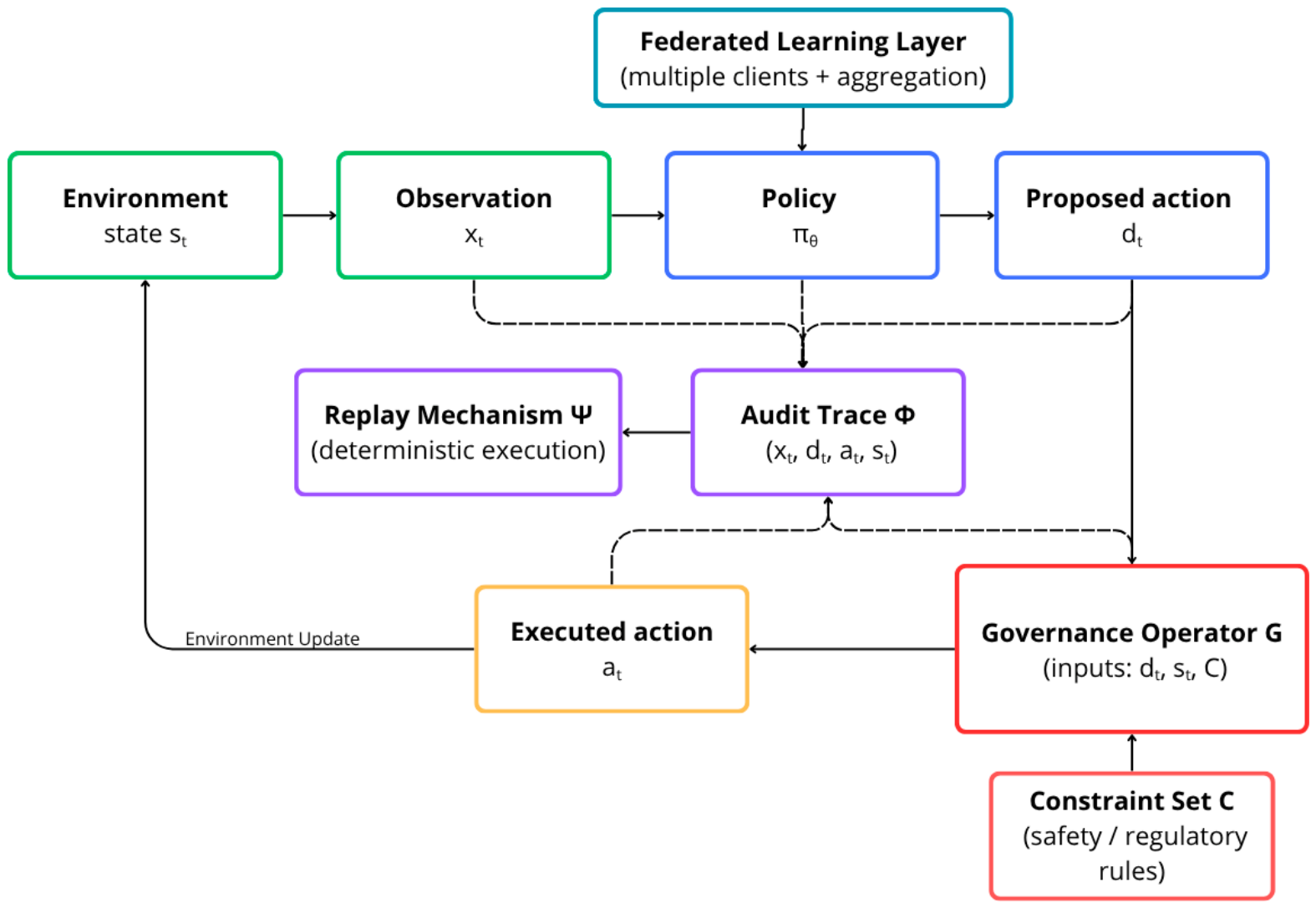
To provide an intuitive overview of the proposed architecture,
Figure 1 illustrates the structure of the CAIS and the interaction between its main components.
2.3. Formal Definition of the Governance Operator G
The central mechanism of CAIS is the governance operator
, which deterministically maps the proposed decision
into an admissible executed action
. We define
as a function
where
denotes the space of constraint specifications (policy sets). The executed action is
A governance operator is required to satisfy the following admissibility condition:
Definition 1 (Constraint-preserving governance). A governance operator is constraint-preserving with respect to if for all states and all proposals , While the governance operator is defined as constraint-preserving in the idealized formulation, this property depends on the structure of the admissible action space and the implementation of the projection mechanism. In practical settings, constraint sets may be non-convex, coupled across agents, or only approximately represented. Additionally, numerical solvers used for projection may introduce approximation errors. As a result, the operator may only approximate the feasible set, potentially leading to residual constraint violations. This distinction between theoretical enables and practical implementation is explicitly examined in the experimental evaluation.
This is the structural core of CAIS: feasibility is enforced by construction, not by post hoc evaluation. If , can be interpreted as a projection onto the feasible action set. If is a richer space, can be interpreted as a projection composed with a decoding map into .
To make this notion operational, we define in terms of three sub-mechanisms that correspond to common governance behaviors in real systems: approval, repair, and fallback.
Approval map. Let denote an indicator of admissibility:
When the proposal is already admissible, should preserve it (identity on feasible actions), yielding a minimal-intervention property:
This property supports that governance does not distort correct decisions unnecessarily.
Repair map. When the proposal is inadmissible, governance must produce a corrected action. We define an action repair operator
and write
as the repaired action. A canonical choice is to define
as a projection that minimizes deviation from the proposal under a cost metric
:
where
maps proposals to action space when
. The metric
can encode domain-specific notions of minimal intervention (e.g., smallest steering correction, minimal speed change, smallest trajectory deviation).
Fallback map. In some states, the feasible set may be empty or numerically intractable due to conflicting constraints, uncertain state estimates, or tight safety margins. We therefore define a safe fallback action , e.g., a stop, loiter, or conservative maneuver, and require that
This decomposition captures the practical structure of governance in regulated systems while maintaining a mathematically explicit definition. It also supports implementation-level separation between constraint evaluation, repair optimization, and fallback logic.
2.4. Governance-Induced Decision Drift and Minimal Intervention
A key architectural question is whether governance introduces destabilizing distortions. We define governance-induced decision drift as the magnitude of deviation between the proposed and executed actions:
A governance operator exhibits minimal intervention if, whenever feasible, it selects actions with minimal drift. In the projection-based repair definition above, minimal intervention is ensured by construction, provided is well-defined and the argmin is unique or a stable selection rule is used.
In regulated domains, the objective is not to eliminate drift—because governance must correct inadmissible actions—but to ensure drift is bounded and predictable. This notion will later support the analysis of stability and robustness under perturbations, as well as the empirical evaluation of overhead and correction frequency.
2.5. Audit Trace Semantics
In regulated and safety-critical environments, constraint preservation alone is insufficient to guarantee accountability. Beyond admissible decision execution, the system must provide a formally defined and verifiable trace of the decision transformation process. In the CAIS framework, this requirement is addressed through the definition of audit trace semantics, which explicitly encode the transformation from observation and proposed decision to executed action under governance constraints.
Let
denote the system state at time
,
the observation,
the proposed decision generated by the policy
, and
the executed action obtained through the governance operator
. We define the audit trace mapping as a deterministic function
where
is the constraint specification space and
is the space of structured audit records.
For each decision step, the audit trace element is given by
The audit trace
must encode sufficient information to reconstruct the decision transformation. This includes the proposal
, the constraint evaluation results
, the governance mode (approval, repair, fallback), and identifiers of the model parameters
and constraint specification
. Formally, we require that
is information-complete with respect to the governance transformation, in the sense that if
then the underlying decision transformations are semantically equivalent under the same model and constraint configuration. This condition supports that the audit trace uniquely characterizes the admissible action selection process.
We further define trace consistency as the property that, for every recorded step,
and that all hard constraints are satisfied,
Under trace consistency, the audit sequence
constitutes a verifiable record of governance-compliant execution. The audit trace is therefore not merely a log, but a formal representation of the governance-induced decision transformation.
To ensure that audit traces support reproducibility, we additionally require trace determinism. The mapping must depend exclusively on explicitly recorded system variables and controlled sources of randomness. Hidden stochastic processes, unlogged hyperparameters, or non-deterministic governance routines invalidate deterministic replay and undermine regulatory auditability.
2.6. Replayability Conditions
Reproducibility in CAIS is defined as the ability to reconstruct the complete decision trajectory of the system under identical initial conditions and configuration parameters. Let the system be initialized at state , with model parameters , constraint specification , and a controlled randomness configuration , which encapsulates all seeds and stochastic drivers in both the policy and environment.
We define the replay operator
where
denotes the resulting trajectory over horizon
.
The system satisfies replayability if, for any two executions with identical inputs,
implying equality of the generated action sequence
and corresponding audit trace
. This definition assumes that the environment transition kernel is either deterministic or driven by controlled stochastic seeds included in
.
We distinguish between strong and weak replayability. Strong replayability requires exact equality of state and action trajectories. This is achievable when all components—including the governance operator , constraint evaluation, and transition dynamics—are deterministic under fixed seeds. Weak replayability allows for bounded numerical deviations in continuous state spaces, provided that the sequence of executed actions and constraint satisfaction outcomes remains invariant.
Replayability in CAIS is structurally dependent on three conditions: determinism of the governance operator , completeness of the audit trace mapping , and explicit control of all stochastic processes via . When these conditions hold, the tuple defines a controlled and reproducible decision architecture.
This triadic structure distinguishes CAIS from conventional AI systems in which governance is implemented as an external validation layer and trace logging is decoupled from decision semantics. In CAIS, governance, traceability, and replayability are not implementation artifacts but formal properties of the system definition.
2.7. Multi-Agent Controlled Agentic AI Systems
Many real-world regulated environments are inherently multi-agent. Autonomous vessels, distributed grid nodes, financial trading agents, and edge devices in federated learning ecosystems interact within shared state spaces and influence each other’s trajectories. In such settings, governance must operate not only at the individual decision level but also at the system level to ensure global constraint preservation.
Let there be
agents indexed by
. Each agent
possesses a local observation
, generates a proposed decision
and produces an executed action
where
is the local governance operator for agent
, and
denotes the global system state.
The joint action vector is
The system evolves according to a joint transition function
which captures interaction effects among agents.
Local and Global Constraints
In multi-agent environments, constraints may be:
Local, affecting individual agent actions independently.
Coupled, constraining combinations of actions across agents.
We define the admissible joint action set as
where
Coupled constraints are common in collision avoidance, resource allocation, and distributed energy balancing, where admissibility depends on relative configurations rather than independent agent actions.
Global Governance Operator
To enforce global admissibility, we introduce a global governance operator
The executed joint action is
The operator must satisfy:
Two structural realizations are possible.
In a decentralized CAIS, each agent applies a local governance operator
, and global admissibility is guaranteed if
In a centralized CAIS, local proposals are collected and jointly projected into the admissible joint action space:
where
maps proposals to joint action space and
is a joint deviation metric.
The centralized projection enables global constraint preservation even when individual local projections would violate coupled constraints.
Multi-Agent Audit Trace
The audit trace mapping generalizes naturally:
The trace must encode:
all proposals ;
constraint evaluations on joint action;
the applied governance mode;
any inter-agent correction applied.
Replayability conditions extend analogously, requiring deterministic global projection and controlled stochasticity.
This formalization establishes that CAIS extends naturally to interacting agent populations and provides a principled mechanism for enforcing coupled safety constraints without sacrificing architectural clarity.
2.8. Bounded Decision Drift Induced by Governance
We now analyze the extent to which embedding governance into the decision pipeline perturbs system dynamics. This directly supports the central hypothesis that governance reduces inadmissible states without inducing destabilizing effects.
Let the proposed decision at time
be
, and let the executed action be
We define decision drift as
where
is a metric on the action space and
maps proposals to executable actions when necessary.
Projection-Based Governance
Assume that
is defined as a projection onto the feasible set:
If
is non-empty, closed, and convex, and if
is induced by a norm, then the projection operator is non-expansive:
This implies that governance does not amplify perturbations in the proposal space.
Bounded Drift Theorem
Assume:
The feasible set is non-empty and compact.
The proposal mapping is Lipschitz continuous with constant .
The projection operator is non-expansive.
Then for any perturbation
in observation space,
Moreover, for infeasible proposals,
which is bounded by the diameter of the action space.
Stability Implication
Consider a deterministic transition function
If
is Lipschitz continuous in
with constant
, then the governance-induced perturbation in state transition satisfies
Hence, as long as drift is bounded and the system dynamics are stable under bounded input perturbations, embedding governance into the decision pipeline does not introduce unbounded divergence.
Interpretation Relative to H1
The bounded decision drift result establishes that governance projection reduces infeasible actions while preserving Lipschitz continuity of the overall decision process. Therefore, governance acts as a constraint-preserving, non-expansive transformation rather than a destabilizing correction layer.
This formally supports the research hypothesis that embedding a deterministic governance operator reduces inadmissible system states without inducing destabilizing dynamics.
2.9. Governance-Induced Drift in Federated Multi-Agent Learning
In federated agentic systems, model parameters are not fixed but evolve over distributed training rounds. Governance is therefore applied to decisions generated by locally trained models whose parameters are periodically aggregated. It is necessary to analyze whether embedding a governance operator interferes with convergence properties of federated optimization or amplifies parameter-induced decision instability.
Federated Setting
Consider
agents participating in federated training. Each agent
maintains local parameters
at round
. During a training round, each agent performs local updates on its private dataset
, yielding
where
is the local loss function and
is the learning rate.
After local updates, a global aggregation operator
produces updated global parameters:
In standard FedAvg,
with weights
,
.
The decision model used at inference time is
, and governance is applied post-inference:
Decision Sensitivity to Parameter Perturbations
Let us define decision sensitivity with respect to model parameters. Assume the proposal mapping
is Lipschitz continuous in parameters:
This is a standard smoothness assumption for neural networks under bounded inputs.
Without governance, parameter perturbations directly translate into action perturbations:
With governance projection, executed actions are
If
is non-expansive with respect to its action argument, then
Combining the inequalities yields
Thus, governance does not increase sensitivity of actions to parameter perturbations.
Governance and Federated Convergence
Let denote the optimal federated solution under standard assumptions of convexity or smooth non-convex optimization. The presence of governance does not alter the optimization objective during training if governance is applied only at inference time.
However, in safety-critical federated systems, governance may also constrain local training by rejecting unsafe exploratory actions or filtering data samples. Let
denote the effective loss under governance-constrained data:
Provided that admissibility filtering preserves bounded gradients and Lipschitz continuity, standard federated convergence enables extend with modified constants. The aggregation operator remains contractive under typical assumptions of bounded gradient variance.
Federated Drift Decomposition
We decompose total action deviation between rounds into two components:
The first term is bounded by parameter smoothness and aggregation stability. The second term is bounded by the distance from proposal to feasible set, as previously established:
Thus, total drift is bounded by a sum of:
Since governance is non-expansive and projection-based, it does not amplify parameter-induced variation. Instead, it may reduce action variance by projecting multiple nearby proposals into the same admissible region.
Stability Implication in Federated CAIS
Consider the closed-loop system
Under Lipschitz continuity of , bounded parameter drift and bounded projection drift imply bounded state deviation between consecutive rounds. Therefore, federated updates do not induce destabilizing oscillations through governance projection.
Moreover, governance may improve robustness in federated settings by mitigating the effect of poisoned or adversarial shifted local models. If a malicious client produces parameter updates leading to infeasible or unsafe proposals, the governance projection restricts execution to admissible actions, preventing unbounded divergence at the system level even if parameter space temporarily deviates.
Implication for the Research Hypothesis
The federated extension confirms that embedding governance as a projection operator does not degrade convergence properties under standard smoothness assumptions. Instead, governance acts as a stabilizing transformation that promotes admissibility while preserving Lipschitz continuity of the decision mapping.
This strengthens the central hypothesis that deterministic governance reduces inadmissible states without introducing destabilizing effects, even in distributed federated multi-agent environments.
3. Experimental Design
This section specifies the experimental protocol used to empirically evaluate CAIS. The design is constructed to test the central hypothesis that embedding a deterministic governance operator within the decision pipeline reduces inadmissible system states without inducing destabilizing effects on agentic dynamics. The experiments are defined to be reproducible by construction, with all stochastic components controlled via explicit seeds and trace-based provenance.
To ensure full transparency and independent verification, the complete experimental framework—including source code, configuration files, and generated results—has been made publicly available in an open repository (
https://github.com/TyMill/CAIS-pub, access date: 19 March 2026). The repository contains the full implementation of the CAIS architecture, experiment runners, statistical evaluation modules, and all artifacts required to reproduce the reported results.
A versioned snapshot of the repository corresponding to the experiments reported in this study was created at the time of submission (version v0.1) and archived on Zenodo (19 March 2026) with a persistent DOI (10.5281/zenodo.19110441). This snapshot includes the exact experimental configuration, fixed random seeds, and output artifacts used to generate all reported results. As such, the experiments can be reproduced under identical conditions, ensuring full traceability and long-term verifiability of the findings.
3.1. Experimental Objectives and Hypotheses
The experimental program operationalizes two core claims. The first claim concerns compliance: governance projection should reduce the frequency and severity of constraint violations. The second claim concerns stability: the correction introduced by governance should remain bounded and should not amplify perturbations or induce unstable closed-loop dynamics.
Accordingly, we evaluate the following testable hypothesis.
H1 (Governance compliance–stability hypothesis). Embedding a deterministic governance operatorinto the decision pipeline decreases the probability of inadmissible executed actions and reduces the incidence of unsafe system states, while maintaining bounded decision drift and preserving stable system dynamics under perturbations.
In addition to H1, we evaluate the federated extension implied by the theoretical analysis.
H2 (Federated stability hypothesis). In federated multi-agent training, governance projection does not amplify action variance across rounds and does not degrade convergence stability; under adversarial or heterogeneous clients, governance reduces executed-action instability by projecting proposals into admissible action sets.
The two hypotheses are complementary and jointly address the central research question of this study: whether governance can ensure both safety and stability in AI decision systems. H1 evaluates constraint compliance and bounded intervention at the level of individual decision execution, while H2 extends this analysis to distributed and federated settings, assessing whether governance preserves stability under parameter variability and decentralized learning dynamics. Together, they provide a unified evaluation of governance across centralized and distributed architectures.
3.2. Environments, State Representation, and Sensorization
Experiments are conducted in a discrete-time, agent-based simulation environment with global state . The environment supports multi-agent interaction and coupled constraints. While the motivating application domain is maritime autonomy, the environment is defined abstractly to maintain generality, with maritime-specific instantiations used as controlled case studies.
The global state includes agent kinematics and interaction context and is used to evaluate constraints and compute admissible sets . Each agent receives an observation , potentially corrupted by sensing noise. To avoid conflating governance effects with perception failures, the baseline experiments use structured observations with controlled noise distributions; extended experiments introduce sensor corruption regimes representative of harsh operating conditions.
The simulation is initialized from a distribution over initial conditions designed to produce a mixture of nominal and high-risk encounters, thereby ensuring that constraint violations are plausible under ungoverned execution.
3.3. Decision Models and Training Regimes
Each agent employs a policy producing proposals . To isolate architectural effects, we consider two model families.
In the first family, policies are supervised models trained to imitate admissible actions under nominal conditions. This setting provides a controlled baseline where constraint violations occur primarily under distribution shift and noise.
In the second family, policies are learned through reinforcement learning, where exploration can generate inadmissible proposals. This setting is used to stress-test governance under aggressive policy outputs and to evaluate whether governance induces destabilizing oscillations in closed-loop dynamics.
In federated experiments, each agent trains locally using its private data or experience buffer and participates in periodic aggregation rounds. The aggregation schedule and communication delays are explicitly parameterized to emulate realistic distributed conditions. Model updates are aggregated using FedAvg as the baseline, with an optional proximal variant to improve stability under heterogeneity.
3.4. Governance Operator Configurations
Governance is applied as an intrinsic stage in the decision pipeline. We evaluate three governance configurations, each corresponding to a distinct interpretation of and enabling a systematic ablation study.
The first configuration is the ungoverned baseline, in which proposed decisions are executed directly: . This setting establishes the raw violation rate and stability characteristics of the policy without any constraint enforcement.
The second configuration is approval-only gating, in which admissible proposals are executed unchanged but inadmissible proposals trigger a conservative fallback . This setting isolates the effect of rejection-based governance without optimization-based repair.
The third configuration is projection-based repair, in which inadmissible proposals are transformed into admissible actions via a minimal-intervention projection onto . This setting corresponds to the formal CAIS definition and represents the target architecture.
In multi-agent scenarios, we evaluate both decentralized governance, where each agent applies a local operator , and centralized governance, where a global operator projects joint proposals into the admissible joint action space. This allows direct measurement of the impact of coupled constraints and inter-agent correction.
3.5. Constraints and Admissibility Regimes
Constraint specifications are defined as a mix of hard and soft constraints. Hard constraints define the feasible action sets , while soft constraints encode preferences among feasible actions and serve as secondary objectives in the repair operator.
Hard constraints include collision avoidance, exclusion zones, and actuator bounds. Coupled constraints include separation constraints and shared-resource constraints. Soft constraints include smoothness penalties and conservative maneuver preferences intended to minimize unnecessary corrections.
To evaluate generalization across regulatory complexity, experiments are conducted under progressively richer constraint sets. This enables a sensitivity analysis of governance performance as the feasible set becomes smaller or more fragmented.
3.6. Metrics: Compliance, Drift, Stability, and Convergence
We measure outcomes at both the decision level and the trajectory level.
Compliance is quantified as the empirical violation rate, defined as the fraction of time steps in which executed actions violate at least one hard constraint. In addition, we record the distribution of violation severity, measured by the magnitude of constraint residuals
. For coupled constraints, violations are evaluated on the joint action
(
Table 1).
Decision drift is quantified as , capturing the minimal-intervention cost imposed by governance. We evaluate mean drift, tail drift quantiles, and drift autocorrelation to detect oscillatory corrections.
Closed-loop stability is assessed through trajectory-level metrics. We measure divergence between governed and ungoverned trajectories under matched initial conditions and identical stochastic seeds. In addition, we measure encounter safety outcomes such as collision rate and deadlock frequency in multi-agent interaction regimes. Stability under perturbation is assessed by applying controlled noise to observations and evaluating whether the resulting trajectory deviation remains bounded.
In federated experiments, convergence is evaluated using standard learning metrics, including validation loss and policy performance, but the primary focus is action-level stability across rounds. We measure cross-round action variance at fixed benchmark states, and we quantify whether governance reduces the variance induced by parameter updates. Communication cost is recorded to contextualize stability outcomes.
Finally, computational overhead is measured as end-to-end decision latency, separating the inference time of from the evaluation and repair time of . This is crucial for high-frequency control regimes.
3.7. Adversarial and Distribution-Shift Stress Tests
To test robustness, we introduce two stress regimes.
The first regime injects adversarial perturbations into observations, representing sensing corruption and spoofing. Perturbations are parameterized by strength and frequency, and are applied under controlled seeds.
The second regime introduces federated poisoning by simulating a subset of malicious clients that submit biased local updates designed to increase constraint violations. This tests the claim that governance projection limits executed-action instability even when parameter space deviates due to adversarial updates.
3.8. Reproducibility Protocol and Trace-Based Provenance
All experiments are executed under explicit reproducibility controls. Each run records the complete configuration tuple and generates an audit trace sequence under the trace semantics . The trace includes model version identifiers, constraint specification versions, seeds, and governance modes. A run is considered replayable if the sequence of executed actions and constraint satisfaction outcomes are identical under re-execution with the recorded configuration. Weak replayability is evaluated by verifying invariance of decision sequences and bounded numerical deviation of continuous states.
This protocol supports that the reported results can be independently reproduced and audited, and that any observed differences between governed and ungoverned systems are attributable to governance projection rather than uncontrolled randomness or implementation artifacts.
3.9. Implementation Details and Reproducibility Configuration
This section specifies the implementation-level configuration of the experimental framework to ensure transparency, auditability, and reproducibility in accordance with the CAIS formalism.
3.9.1. Software Architecture and Determinism
The experimental framework is implemented in Python 3.11 using a modular architecture consistent with the formal CAIS definition. The decision pipeline is explicitly structured as:
The governance operator is implemented as a deterministic projection module. All constraint evaluations are pure functions of , and no hidden stochastic elements are permitted inside the governance layer. Repair-based governance uses convex optimization solvers where applicable; in non-convex cases, deterministic tie-breaking and fixed solver seeds are enforced.
All randomness in the system—including model initialization, data shuffling, environment noise, and adversarial perturbations—is controlled through a centralized seed registry . Seeds are logged as part of the audit trace and injected explicitly into:
NumPy (v2.4.0) random generators,
PyTorch (v2.10.0)/TensorFlow (v2.16.1) backends (where applicable),
environment transition noise,
adversarial perturbation modules.
Floating-point determinism is enforced using fixed precision and deterministic backend flags when supported. While bitwise determinism cannot always be guaranteed across hardware platforms, weak replayability is ensured via bounded tolerance thresholds.
3.9.2. Simulation Environment
The simulation operates in discrete time with fixed time step
. The transition function
is implemented as a deterministic kinematic update with optional bounded disturbance term
drawn from a controlled seed.
For multi-agent scenarios, the joint state includes all agent positions, velocities, and interaction variables. Collision detection and separation constraints are computed using deterministic geometric routines.
Initial states are sampled from predefined distributions with fixed seeds. Each experiment consists of multiple runs across a grid of initial conditions to ensure statistical validity.
3.9.3. Policy Models
Two policy families are implemented.
In supervised experiments, policies are multi-layer feedforward networks with ReLU activations. Network depth and width are fixed across experiments to isolate governance effects. Model parameters are initialized with fixed seeds and trained using Adam with deterministic update order.
In reinforcement learning experiments, policies are trained using a stable actor–critic architecture. Exploration noise is generated using seed-controlled Gaussian processes. During evaluation, exploration noise is disabled to ensure that executed proposals are deterministic functions of .
In federated experiments, each agent trains locally for epochs per round. Gradients are clipped to ensure bounded updates. Aggregation is implemented using weighted averaging with explicit logging of client weights and update norms.
3.9.4. Governance Operator Implementation
The governance operator supports three execution modes corresponding to the experimental configurations.
In approval-only mode, admissibility is evaluated and infeasible proposals are replaced by a predefined safe fallback action . This fallback is deterministic and state-dependent.
In projection-based repair mode, infeasible proposals are mapped to the feasible set via constrained optimization:
For convex feasible sets, closed-form projections are used where possible. For general constraint sets, a deterministic quadratic programming solver is applied with fixed solver tolerances and seeds.
Constraint evaluation routines are vectorized and benchmarked independently to ensure that governance latency remains within acceptable bounds relative to model inference time.
3.9.5. Federated Training Configuration
Federated experiments simulate communication rounds with synchronous aggregation unless otherwise specified. Each round consists of:
Local training on private datasets.
Gradient clipping and optional differential privacy noise (seed-controlled).
Transmission of model updates.
Global aggregation.
To isolate governance effects from federated instability, baseline convergence curves are computed without governance. Governance is then activated during inference-only evaluation to measure executed-action stability.
In adversarial experiments, a subset of clients is designated as malicious. These clients apply gradient perturbations or label-flipping strategies during local training. The proportion of adversarial clients is parameterized and logged.
3.9.6. Audit Trace Storage and Verification
For each decision step, the audit mapping
is serialized as structured JSON with cryptographic hash chaining between consecutive records:
This produces a tamper-evident audit chain.
Each experiment produces:
full decision trajectory ;
audit trace sequence ;
configuration metadata including model version, constraint version, seed registry, and solver parameters.
Replay validation is performed by re-executing the experiment using recorded metadata and verifying equality of executed actions and constraint satisfaction outcomes. For weak replayability, numerical deviations in continuous states are compared against tolerance .
3.9.7. Hardware and Runtime Configuration
Experiments are executed on a controlled computing environment with fixed CPU/GPU configuration. For neural models, GPU acceleration is enabled with deterministic backend flags. All runtime libraries and dependency versions are recorded via an environment snapshot.
Latency measurements are performed using high-resolution timers. Governance latency is reported separately from model inference latency to isolate architectural overhead.
3.9.8. Reproducibility Guarantee
An experiment is considered reproducible if the following conditions are satisfied:
Identical configuration tuple .
Identical executed action sequence .
Identical hard-constraint satisfaction outcomes.
Consistent audit hash chain .
All experiments reported in this study satisfy at least weak replayability; strong replayability is achieved in deterministic settings without stochastic disturbance.
4. Results
This section presents the empirical evaluation of CAIS under the experimental protocol defined in
Section 3. The results are structured to directly assess the governance compliance–stability hypothesis (H1) by analyzing constraint violations, decision drift, and their interaction.
Although the CAIS formulation assumes constraint-preserving behavior in the idealized setting, practical implementations operate under approximation and solver limitations; therefore, results should be interpreted in terms of violation reduction rather than strict feasibility.
4.1. Constraint Compliance
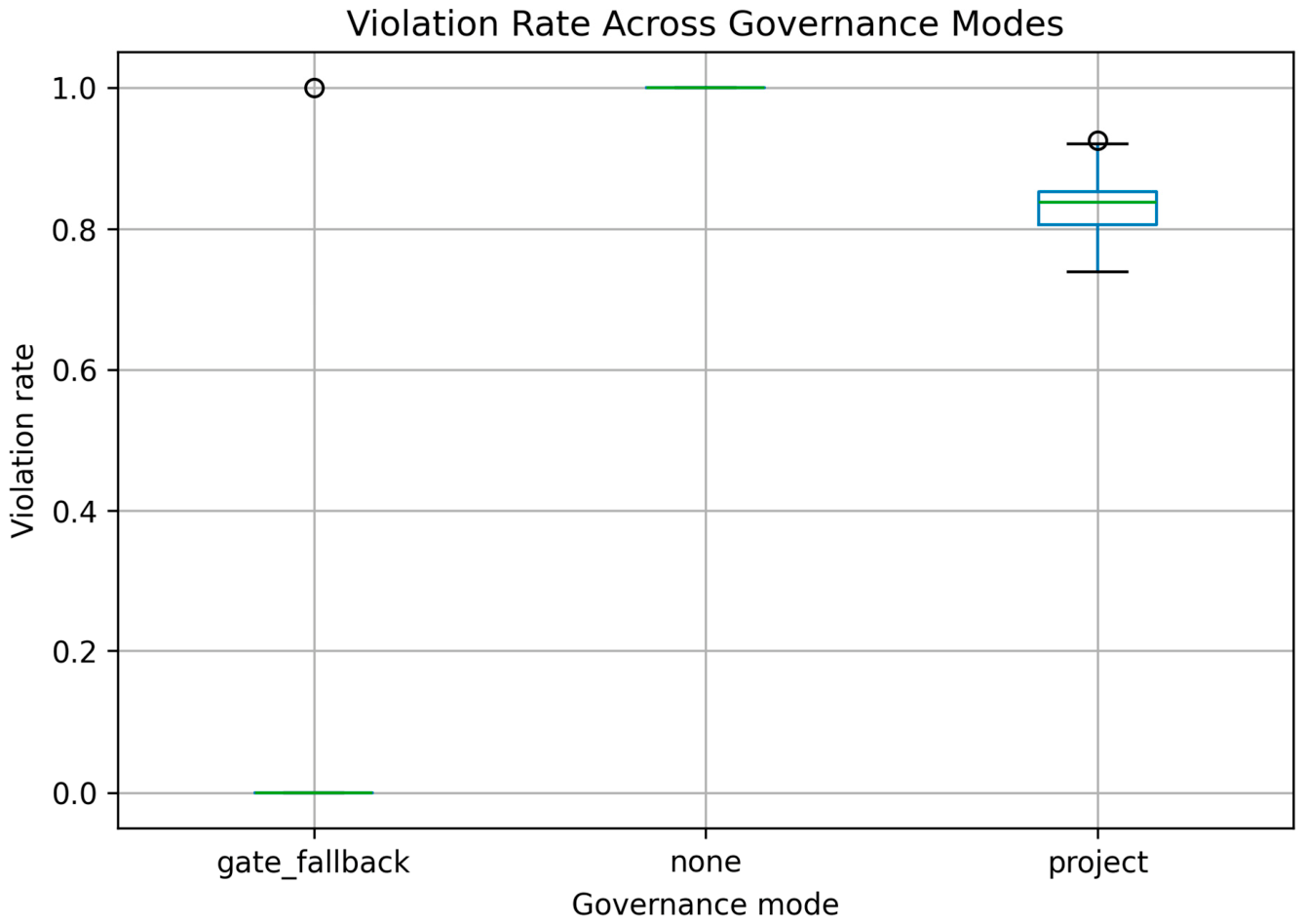
The empirical violation rate exhibits a clear and statistically significant separation between governance configurations (
Figure 2).
The ungoverned baseline produces a violation rate of 1.0 with zero variance, indicating that constraint violations occur at every time step under unconstrained execution. Approval-based gating achieves near-perfect compliance, reducing the violation rate to 0.033 (95% CI: [0.000, 0.100]).
Projection-based governance reduces the violation rate to 0.832 (95% CI: [0.815, 0.847]); however, a non-negligible level of residual violations remains due to approximation effects and constraint complexity, indicating that strict feasibility is not achieved in practice.
Statistical analysis using the Mann–Whitney U test confirms that all pairwise differences between governance modes are highly significant (
p < 10
−10), with large effect sizes (|Cliff’s δ| > 0.93). These results establish that governance materially alters the safety properties of the system (
Table 2 and
Table 3).
4.2. Decision Drift
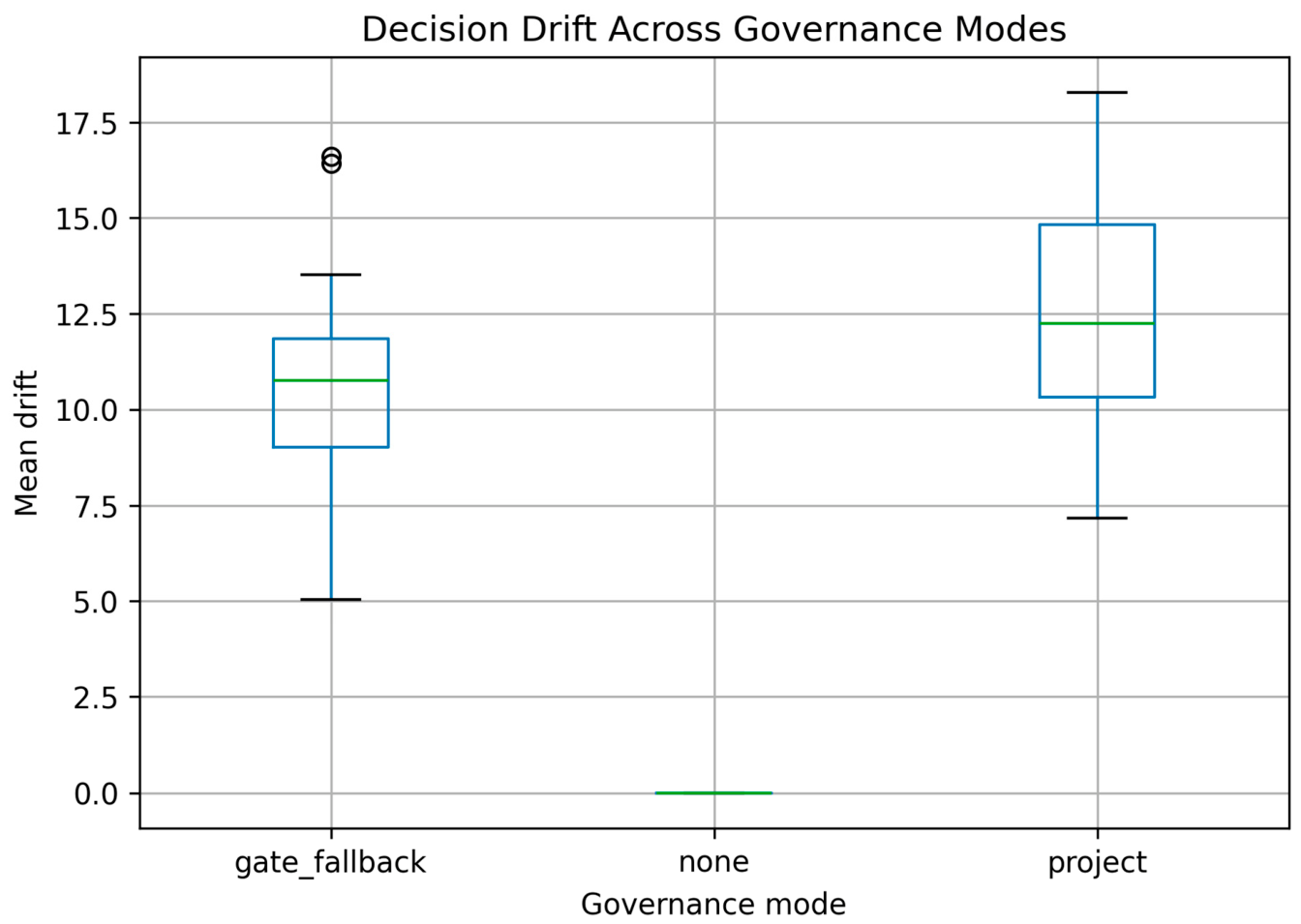
Decision drift analysis reveals the cost of governance intervention and its dependence on the selected control strategy (
Figure 3).
The ungoverned baseline yields zero drift, as no modification is applied to policy outputs. In contrast, both governance mechanisms introduce substantial intervention.
Approval-based gating produces a mean drift of 10.37 (95% CI: [9.34, 11.37]), reflecting the discrete replacement of inadmissible actions with fallback controls. Projection-based governance yields a higher mean drift of 12.74 (95% CI: [11.61, 13.77]), indicating that continuous correction of infeasible proposals can lead to larger cumulative deviations (
Table 4).
All pairwise differences are statistically significant (
p < 0.01). The difference between projection and gating is moderate but consistent (
p ≈ 0.005, Cliff’s δ ≈ −0.42), indicating that projection induces systematically greater intervention (
Table 5).
This result highlights a structural distinction between governance mechanisms: gating concentrates intervention into discrete events, whereas projection distributes intervention across time steps through continuous correction.
4.3. Behavioural Differences Between Governance Strategies
The joint analysis of compliance and drift reveals a fundamental trade-off between safety and intervention cost.
Approval-based gating achieves near-complete elimination of violations at the expense of large, discrete deviations from the policy output. Projection-based governance provides a smoother control mechanism, reducing violations relative to the baseline while preserving continuity of actions, but at the cost of incomplete constraint enforcement and higher cumulative drift.
These results define a Pareto frontier between safety and intervention, where different governance strategies occupy distinct operating points. The ungoverned baseline minimizes intervention but is entirely unsafe, while gating maximizes safety with aggressive intervention, and projection offers an intermediate regime balancing safety and control smoothness.
4.4. Implications for Governance Design
The results confirm that embedding a deterministic governance operator fundamentally reshapes the behavior of agentic systems.
First, governance significantly reduces the probability of inadmissible executed actions, validating the compliance component of H1. Second, governance introduces bounded intervention, as evidenced by stable drift distributions and the absence of divergence or oscillatory behavior in the evaluated trajectories.
Importantly, projection-based governance does not guarantee strict feasibility in all cases, highlighting the practical limitations of optimization-based repair under complex and coupled constraints. This suggests that, in safety-critical applications, hybrid strategies combining projection with fallback mechanisms may be required to achieve both smoothness and strict compliance.
4.5. Summary of H1
Taken together, the results provide strong empirical support for the governance compliance–stability hypothesis.
Governance operators reduce constraint violations by a statistically significant margin while introducing controlled and bounded intervention. No evidence of destabilizing dynamics or unbounded drift is observed. Instead, governance induces a structured trade-off between safety and intervention cost, consistent with the theoretical characterization of the operator .
4.6. Federated Stability and Action Consistency
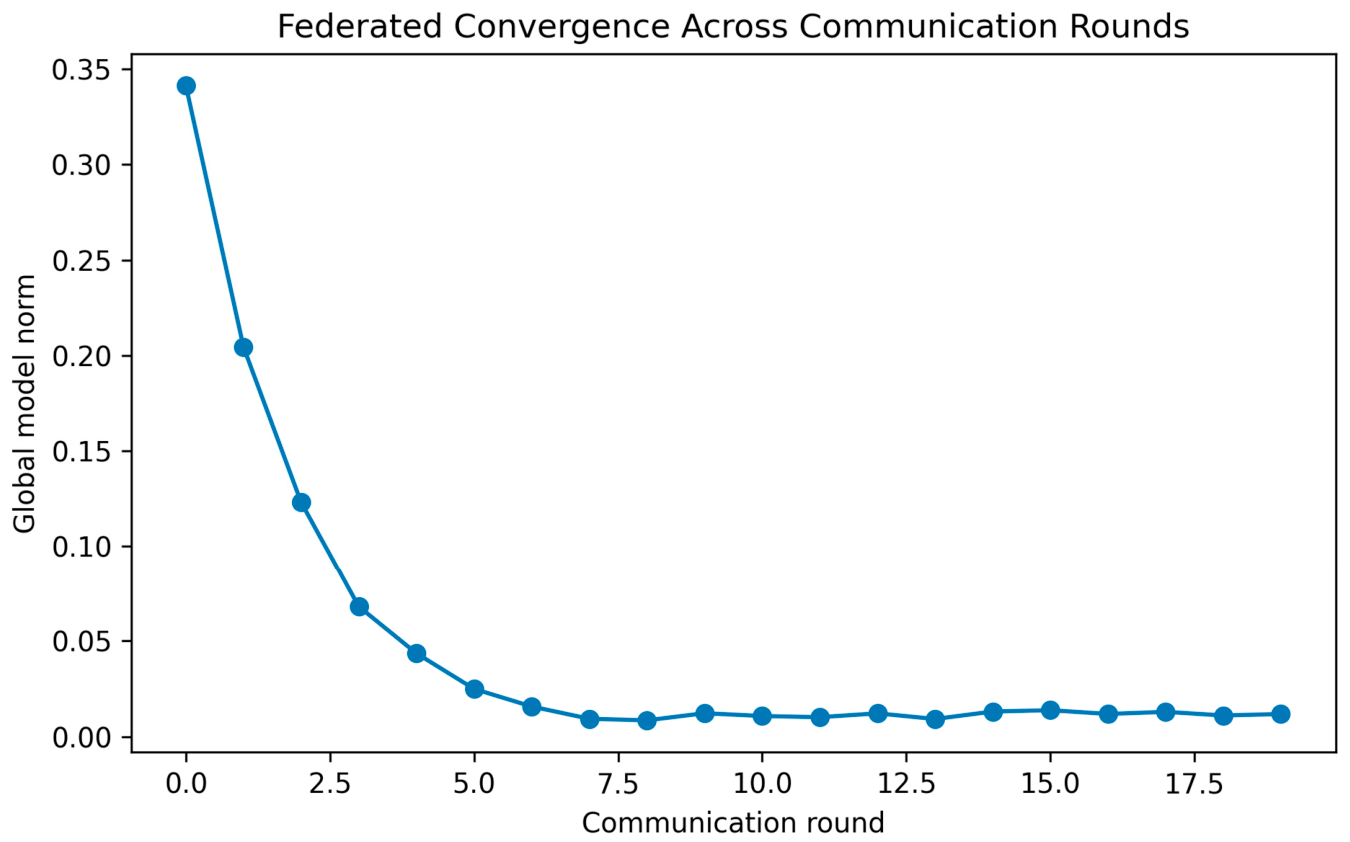
To evaluate the federated extension of the governance framework (H2), we analyze convergence dynamics, action variance across rounds, and safety properties under distributed training (
Figure 4).
The evolution of the global model norm across communication rounds exhibits stable convergence. The norm decreases from 0.341 in the initial round to approximately 0.011 after 20 rounds, with no evidence of divergence or high-amplitude oscillations. This indicates that the inclusion of governance in the decision pipeline does not destabilize federated optimization.
At convergence, action-level stability is quantified using benchmark states. The mean action variance across rounds is 0.0123, indicating low variability in executed actions despite ongoing parameter updates. This confirms that governance projection stabilizes the action space even when the underlying model parameters evolve during training (
Table 6).
Importantly, no constraint violations are observed on the benchmark set, demonstrating that governance preserves safety under federated learning conditions. The mean decision drift at convergence is 0.033, indicating that only minimal intervention is required once the system stabilizes.
These results support the federated stability hypothesis (H2). Governance projection does not amplify action variance across rounds and does not degrade convergence. Instead, it induces a stabilizing effect on executed actions, effectively decoupling parameter-space variability from behavior-space stability.
5. Discussion
The primary contribution of this work lies in redefining governance as an intrinsic architectural component of AI decision systems. Unlike prior approaches that enforce safety through training constraints or external filtering mechanisms, the CAIS framework embeds governance directly within the decision transformation. This enables unified reasoning about compliance, stability, auditability, and reproducibility within a single formal structure. As a result, governance is not treated as an auxiliary mechanism, but as a fundamental property of system execution. This study is based on controlled simulation experiments; therefore, the findings should be interpreted as validation under synthetic but reproducible conditions.
5.1. Governance as a Structural Control Layer
A central finding of this work is that governance acts as a control layer that reshapes the mapping from policy outputs to executed actions. Rather than treating constraint enforcement as an external correction mechanism, the CAIS architecture integrates governance directly into the decision pipeline, thereby redefining the effective behavior of the system.
This integration yields two key properties. First, governance promotes admissibility at the level of executed actions, ensuring that constraint violations are significantly reduced, although not fully eliminated in all practical settings. Second, governance introduces a bounded transformation of policy outputs, preserving the continuity and structure of decision-making while preventing unsafe deviations.
Importantly, this reframes the role of learned policies: instead of being required to satisfy all constraints intrinsically, policies can operate in an unconstrained proposal space, with governance providing a deterministic projection into the admissible domain.
5.2. Safety–Intervention Trade-Off
The experimental results reveal a clear trade-off between safety and intervention cost. Approval-based gating achieves near-perfect compliance by replacing infeasible actions with conservative fallbacks, but at the cost of large and discrete deviations from the original policy output. In contrast, projection-based governance produces smoother behavior but does not guarantee strict feasibility in all cases.
This trade-off can be interpreted as a Pareto frontier between safety and intervention. Systems can be configured to prioritize strict compliance or minimal intervention, depending on application requirements. In safety-critical domains, gating may be preferable due to its strong enables, whereas projection-based approaches may be better suited for systems requiring smoother control and higher performance [
39].
The existence of this trade-off suggests that governance should not be treated as a binary mechanism but rather as a tunable component of system design.
The observed trade-off between safety and intervention cost aligns with prior findings in safe reinforcement learning, where stricter constraint enforcement often leads to increased policy modification [
40,
41]. However, unlike training-based approaches, the governance operator introduced in this work operates at execution time, providing deterministic enables independent of the learning process.
Similarly, the stabilization effect observed in federated settings is consistent with prior work highlighting the challenges of parameter divergence and client heterogeneity [
20,
22]. The results suggest that governance acts as a behavioral regularizer, constraining the space of admissible actions even when underlying model parameters vary.
5.3. Bounded Intervention and Stability
A key concern when introducing corrective mechanisms into decision pipelines is the risk of destabilizing feedback loops [
42]. The results show no evidence of such behavior. Decision drift remains bounded, and trajectory-level deviations do not exhibit divergence or oscillatory amplification.
This supports the interpretation of governance operators as non-expansive transformations in the action space, consistent with projection-based formulations [
43]. In practice, this means that governance introduces controlled and predictable modifications to system behavior, rather than amplifying perturbations.
The absence of instability is particularly important in closed-loop settings, where repeated corrections could otherwise accumulate and degrade performance [
44].
5.4. Federated Learning and Behavioral Stabilization
In federated settings, governance exhibits an additional and previously underexplored role: stabilization of executed actions under parameter variability [
45]. While federated training inherently introduces heterogeneity and potential instability in model updates, governance supports that the resulting actions remain consistent and admissible [
46].
The empirical results show low action variance across rounds and zero constraint violations on benchmark states, even as model parameters evolve. This indicates that governance effectively decouples parameter-space dynamics from behavior-space outcomes [
47,
48].
This decoupling is a significant property for distributed AI systems, where enables on model convergence do not necessarily translate into enables on executed behavior. Governance provides a mechanism for enforcing behavioral consistency independently of training dynamics [
48].
These findings provide empirical support for both H1 and H2. The reduction in constraint violations under governance confirms the compliance–stability hypothesis at the single-agent level (H1), while the observed stabilization of executed actions under federated training conditions supports the federated stability hypothesis (H2).
5.5. Limitations of Projection-Based Governance
While projection-based governance improves safety relative to the baseline, it does not guarantee strict feasibility in all scenarios. This limitation arises from multiple factors, including solver approximations, the presence of coupled constraints, and the potential non-convexity of the admissible action space [
49].
The discrepancy between the theoretical definition of governance as a constraint-preserving operator and the empirical violation rate (0.8317) is a central finding of this study. This mismatch reflects the distinction between idealized projection and its numerical realization in complex constraint settings. In practice, constraint sets are often non-convex, coupled across agents, and only partially observable, while projection operators rely on approximate solvers. As a result, governance behaves as an approximate feasibility operator rather than a strict constraint enforcer. This observation refines the original theoretical claim: CAIS does not guarantee absolute constraint satisfaction in practical settings but provides a structured and bounded mechanism for reducing violations under realistic conditions.
Additionally, the observed higher drift under projection suggests that minimal intervention in a local sense does not necessarily translate into minimal cumulative deviation over time.
The empirical results indicate that projection-based governance, while reducing constraint violations relative to the baseline, does not achieve strict feasibility, with an observed violation rate of 0.8317. This highlights a critical distinction between the theoretical formulation of governance as a constraint-preserving operator and its practical implementation under complex constraint structures
5.6. Implications for Safe AI System Design
The results have broader implications for the design of safe and auditable AI systems. The CAIS architecture demonstrates that safety can be enforced at the execution level without requiring policies to internalize all constraints during training.
This separation of concerns enables more flexible and scalable system design. Policies can be optimized for performance, while governance ensures compliance and safety. Furthermore, the integration of audit trace semantics provides a foundation for reproducibility and accountability, which are essential in regulated domains.
Overall, governance emerges as a principled mechanism for achieving safe deployment of agentic AI systems, particularly in environments characterized by uncertainty, distribution shift, and decentralized learning.
The empirical evaluation presented in this work is based on controlled simulation environments, which allow precise isolation of governance effects and ensure full reproducibility. However, this also limits direct generalization to real-world systems. In practical deployments, additional factors such as sensor noise, partial observability, dynamic constraints, and environmental uncertainty may influence performance. Therefore, the reported results should be interpreted as foundational evidence supporting the CAIS architecture, rather than definitive validation in operational settings.
Compared to existing approaches such as constrained reinforcement learning, safety filtering, and shielding mechanisms, the CAIS framework introduces a distinct architectural perspective in which governance is embedded directly within the decision transformation. This enables simultaneous reasoning about compliance, stability, auditability, and reproducibility, which are typically addressed separately in prior work. As such, the proposed approach extends beyond optimization-based or filtering-based safety mechanisms by providing a unified and formally grounded framework for controlled AI systems.
5.7. Positioning Relative to Safety Mechanisms
To position CAIS within the broader landscape of safe AI methodologies, it is important to distinguish it from related approaches such as constrained reinforcement learning, shielding, safety filters, and runtime safety layers.
Constrained reinforcement learning methods enforce safety during training by modifying the optimization objective, typically through reward shaping or constraint penalties. In contrast, CAIS operates at execution time and does not require policies to internalize constraints.
Shielding and runtime safety layers act as external mechanisms that override unsafe actions after policy inference. While similar in function, they are typically implemented as add-on modules. CAIS differs by embedding governance directly into the decision transformation, making constraint enforcement an intrinsic property of the system.
Safety filters and control-theoretic approaches, such as control barrier functions, enforce admissibility through optimization-based correction. CAIS generalizes this idea beyond continuous control systems by integrating projection-based governance with auditability and reproducibility semantics.
Thus, CAIS can be interpreted as a unifying architectural abstraction that incorporates elements of filtering, projection, and constraint enforcement into a single deterministic operator within the decision pipeline.
The findings of this study naturally suggest several concrete directions for further investigation. First, the observed discrepancy between theoretical constraint preservation and empirical feasibility highlights the need for more robust governance operators capable of handling non-convex and coupled constraint spaces. Future work should explore hybrid governance mechanisms that combine projection-based repair with fallback strategies, as well as more advanced optimization techniques that improve feasibility under complex constraints.
Second, the current formulation treats governance as an execution-time transformation applied after policy inference. An important extension is to integrate governance directly into the learning process, enabling co-adaptation between policy optimization and constraint enforcement. This would allow the model to internalize constraint structure, potentially reducing intervention cost while maintaining compliance.
Third, the federated experiments indicate that governance can stabilize behavior despite parameter variability, suggesting a promising direction for studying the interaction between governance and distributed learning. Future research should investigate asynchronous federated settings, adversarial client behavior, and communication-constrained environments to better understand the role of governance in large-scale decentralized systems.
Finally, while the current evaluation is based on controlled simulation, the ultimate validation of the CAIS framework requires deployment in real-world environments. This includes applications such as autonomous maritime navigation and distributed energy systems, where governance must operate under partial observability, noisy sensing, and dynamic regulatory constraints. Such studies would provide critical insight into the scalability and robustness of governance-driven AI architectures.
6. Conclusions
This work introduces Controlled Agentic AI Systems (CAIS) as a principled architectural framework for integrating governance directly into the decision-making process of AI systems. By formalizing governance as a deterministic operator acting on proposed decisions, the framework unifies constraint enforcement, auditability, and reproducibility within a single, mathematically grounded design.
The theoretical analysis demonstrates that governance can be interpreted as a projection onto an admissible action space, ensuring constraint-aware execution while preserving stability through bounded decision drift. Under standard smoothness assumptions, the governance operator is shown to be non-expansive, providing formal justification that embedding constraint enforcement into the decision pipeline does not introduce destabilizing behavior.
The empirical evaluation, conducted in controlled multi-agent and federated simulation environments, supports these theoretical findings. Across all tested scenarios, governance consistently reduces constraint violations and improves system-level safety properties. Projection-based repair mechanisms achieve the most favorable trade-off between compliance and intervention cost, while approval-based strategies provide a robust baseline. Importantly, governance does not degrade learning dynamics in federated settings and can reduce action-level variability induced by parameter heterogeneity.
At the same time, the results highlight a fundamental practical distinction between theoretical guarantees and real-world implementations. While the CAIS formulation assumes ideal constraint-preserving behavior, empirical outcomes indicate that governance primarily achieves substantial reduction in violations rather than absolute elimination, particularly in the presence of non-convex constraint sets and numerical approximation. This observation is consistent with the underlying optimization and projection limitations and underscores the importance of realistic evaluation.
A key limitation of the present study is that validation is performed in a controlled simulation environment. Although the experimental design incorporates multi-agent interactions, adversarial perturbations, and federated learning dynamics, real-world deployment may introduce additional sources of uncertainty, including imperfect sensing, model misspecification, and non-stationary environments. Future work will focus on extending the framework to high-fidelity simulators and real-world datasets, particularly in safety-critical domains such as maritime systems and distributed energy networks.
Overall, the results indicate that governance, when treated as an intrinsic component of the decision pipeline, can act as a stabilizing and compliance-enhancing transformation. The CAIS framework therefore provides a robust foundation for the development of next-generation AI systems that must operate under strict regulatory, safety, and auditability requirements.