
Engineering Analysis and Design Method for Blast-Resistant Laminated Glass Composite Systems



Abstract
1. Introduction
2. Blast Design Methodology
2.1. Response of Glass Under Static and Dynamic Loading
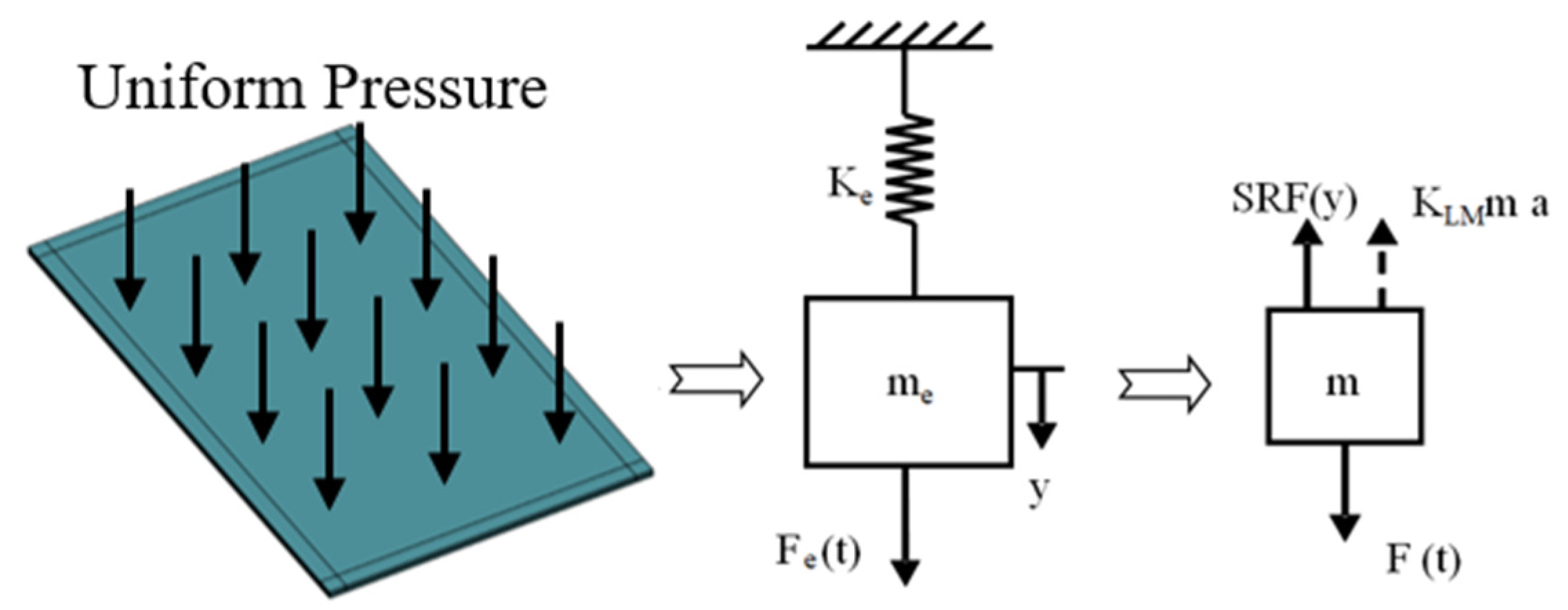
2.2. Single-Degree-of-Freedom (SDOF)
2.3. Resistance Function
2.4. Analytical Model for Resistance Function
3. Static Resistance Function Calibration
3.1. Water Chamber Static Testing Validation
3.1.1. Square LG Panels
3.1.2. Rectangular LG Panels
4. Dynamic Response Verification
4.1. Field IGU Panels
4.2. Shock Tube LG Panels
5. Conclusions
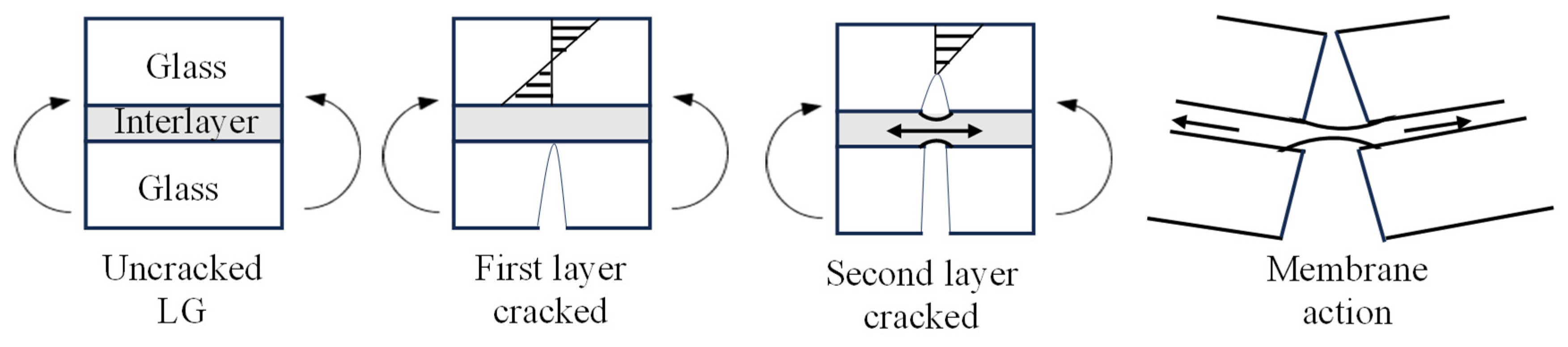
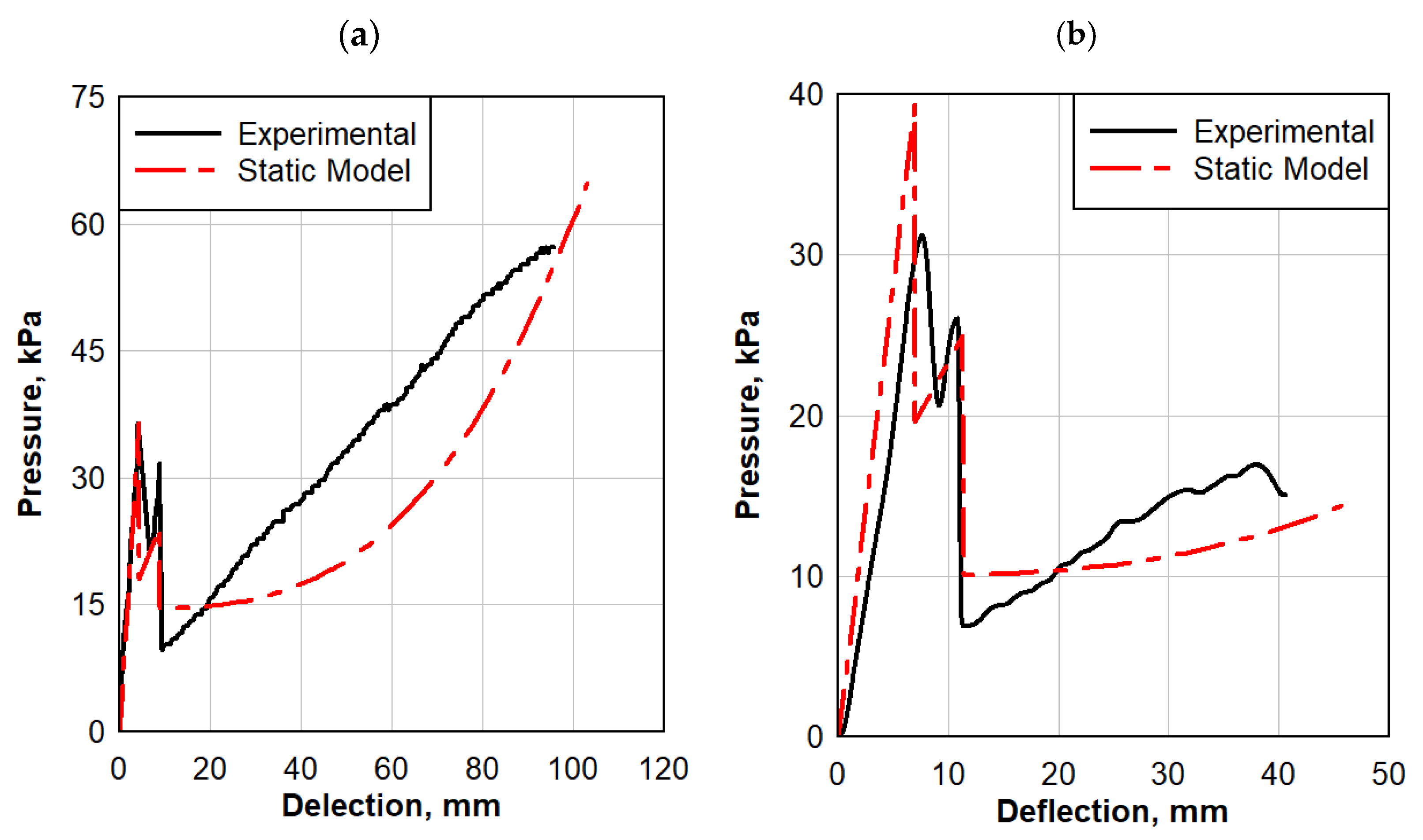
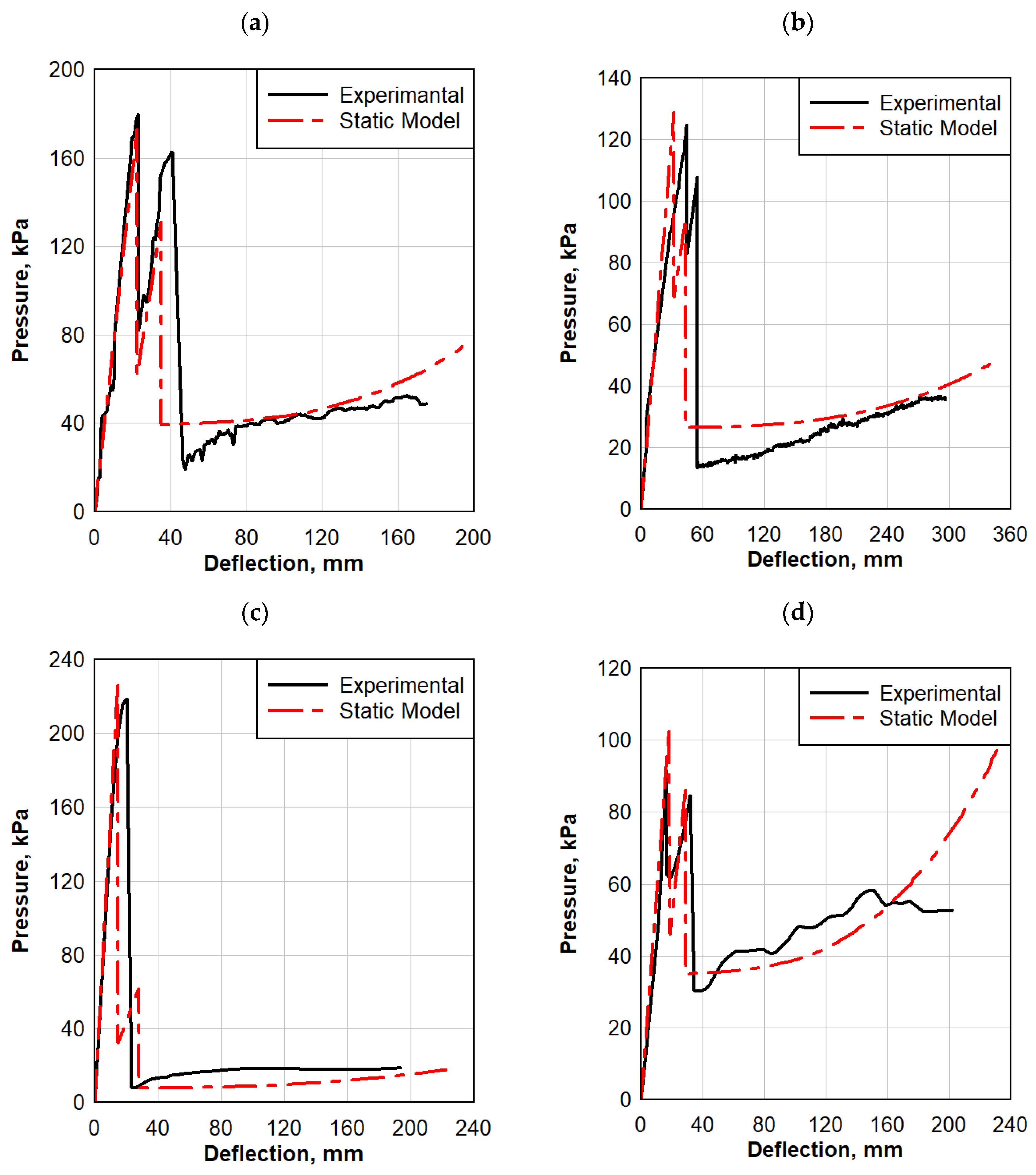
- LG panels typically exhibit a two-stage response: an initial elastic phase until the glass breaks, followed by the tension membrane response.
- LG systems subjected to blasts undergo plastic deformation due to the polymeric interlayer, enabling them to develop higher energy absorption capabilities.
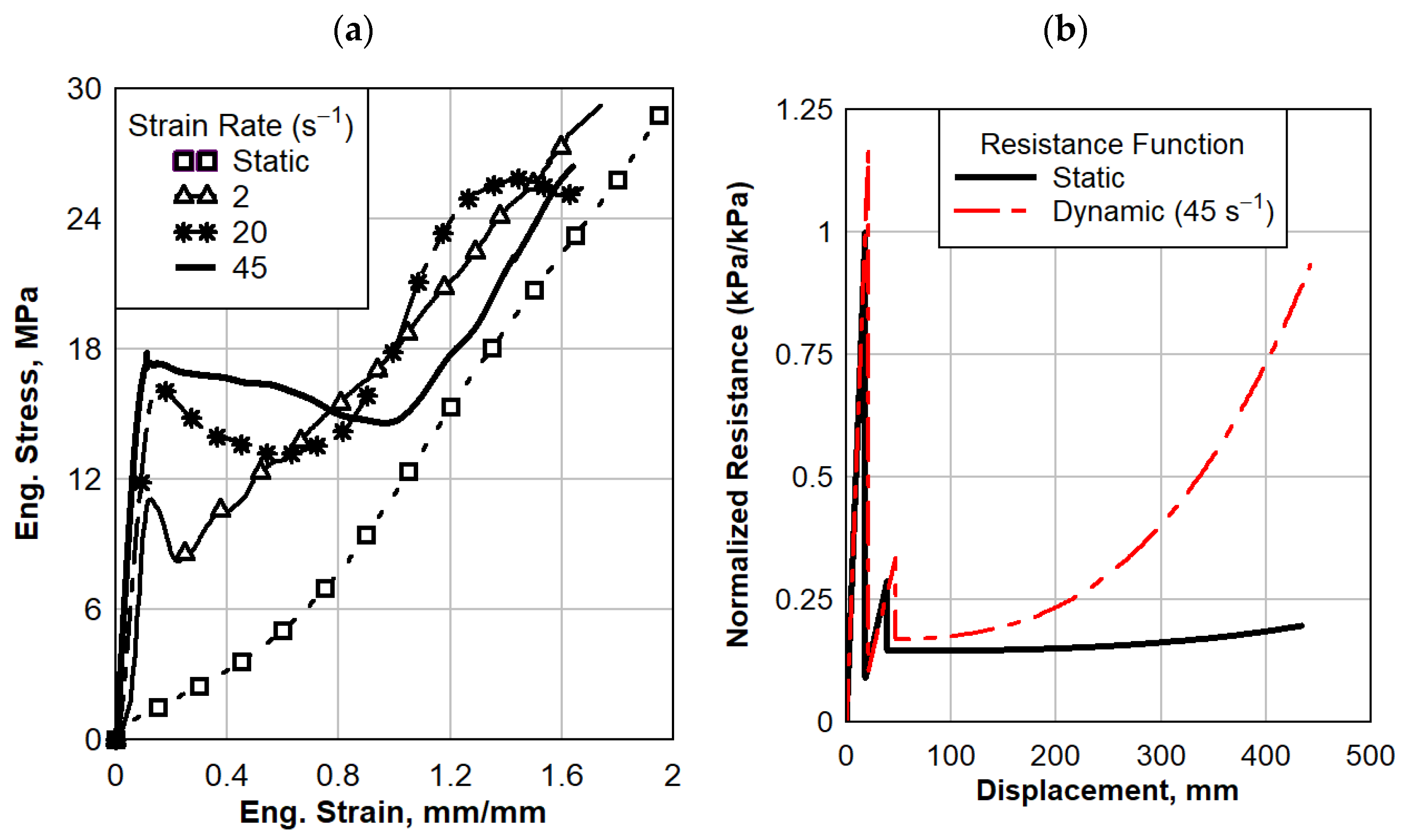
- The interlayers exhibit different dynamic and static material responses.
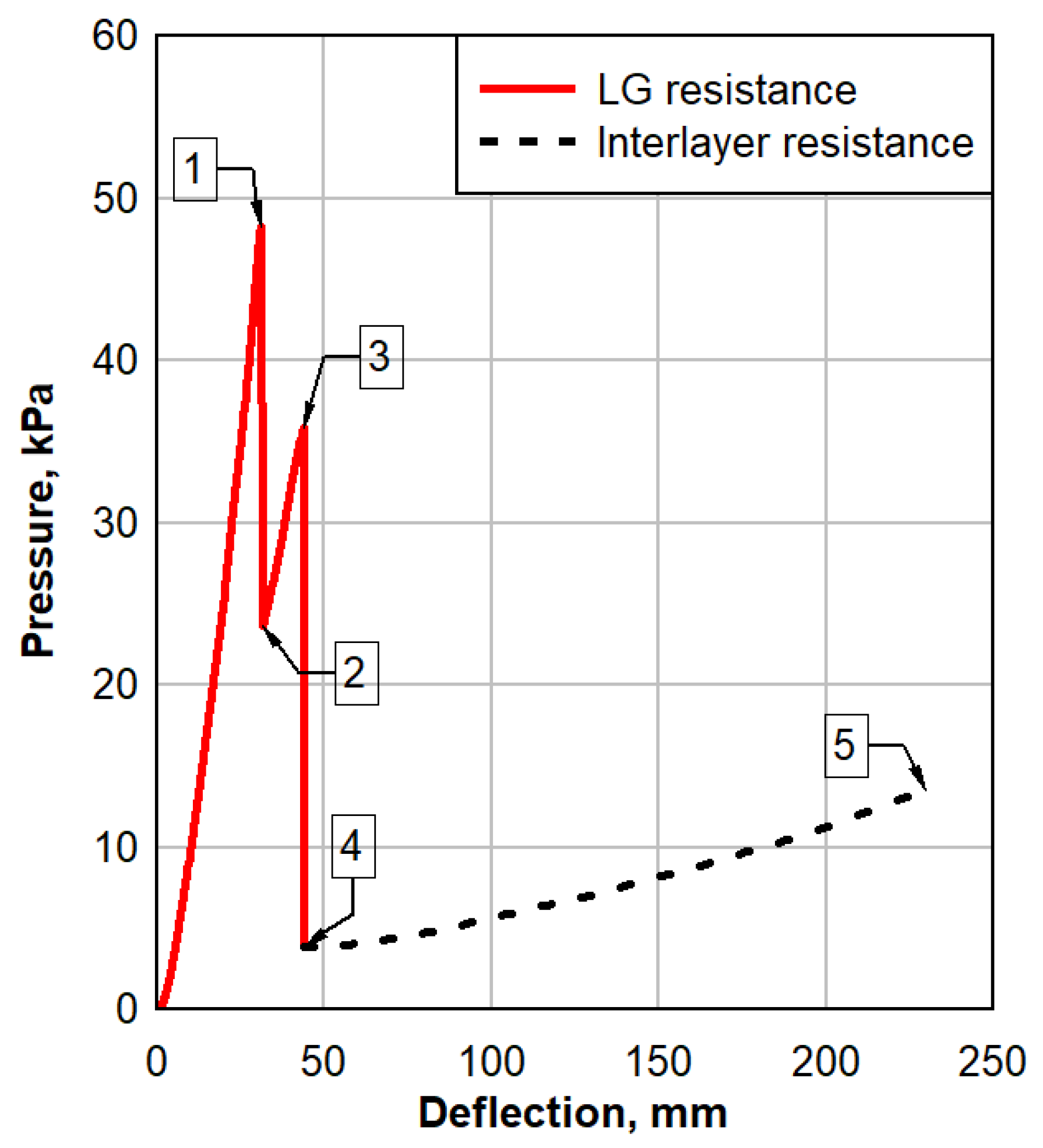
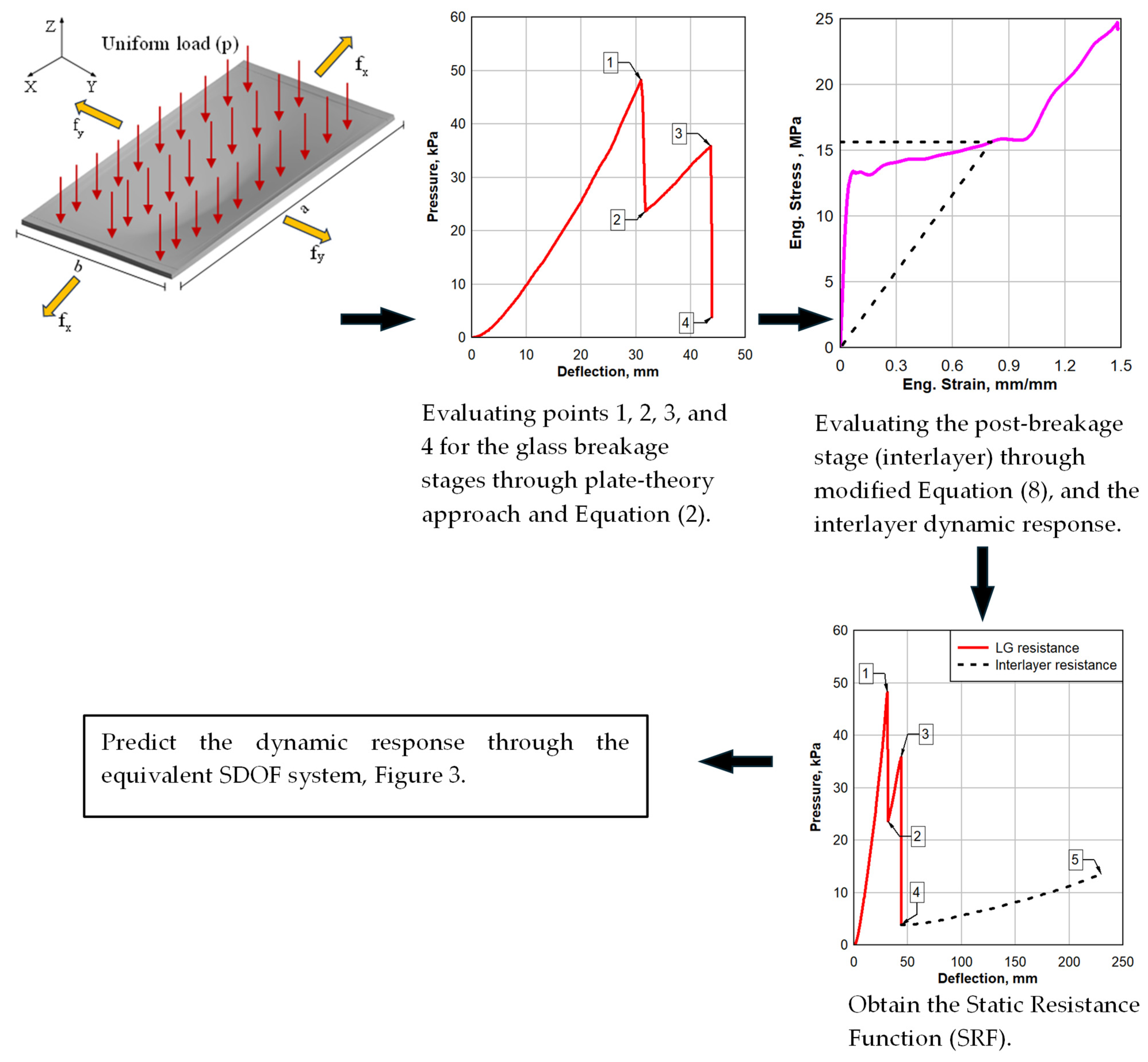
- For the static resistance function, the static material response of the interlayer was used, whereas, for the dynamic resistance, the high-strain-rate material response of the interlayer and the DIF for the glass were employed.
- In the analytical model, the failure pressures of both the first and second glass layers were obtained through the plate-bending approach. After the glass breakage, the resistance of the LG system is dominated by the tension membrane resistance of the interlayer.
- The static energy absorption comparisons between the analytical and quasi-static LG panel responses varied from 1% to 17%.
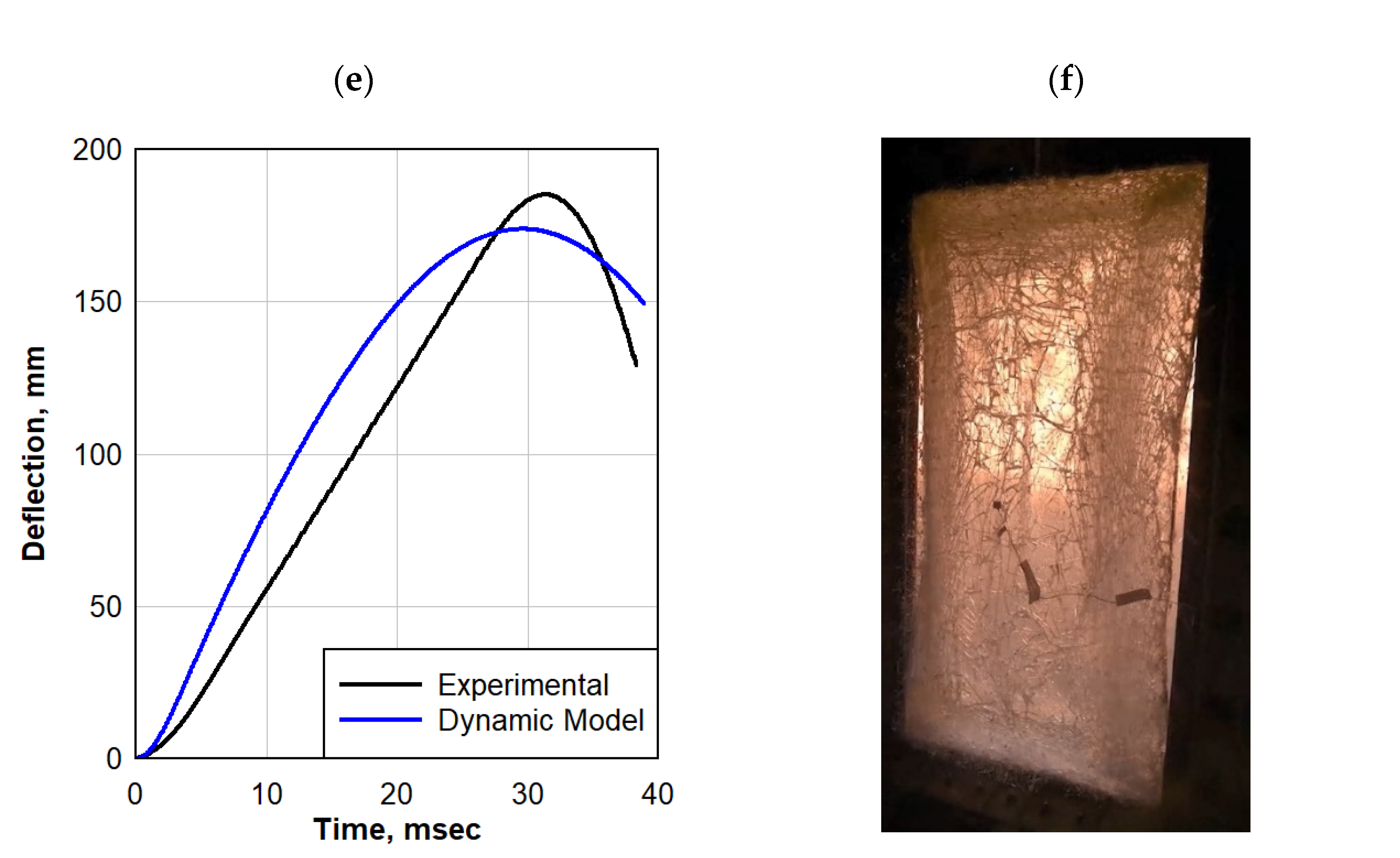
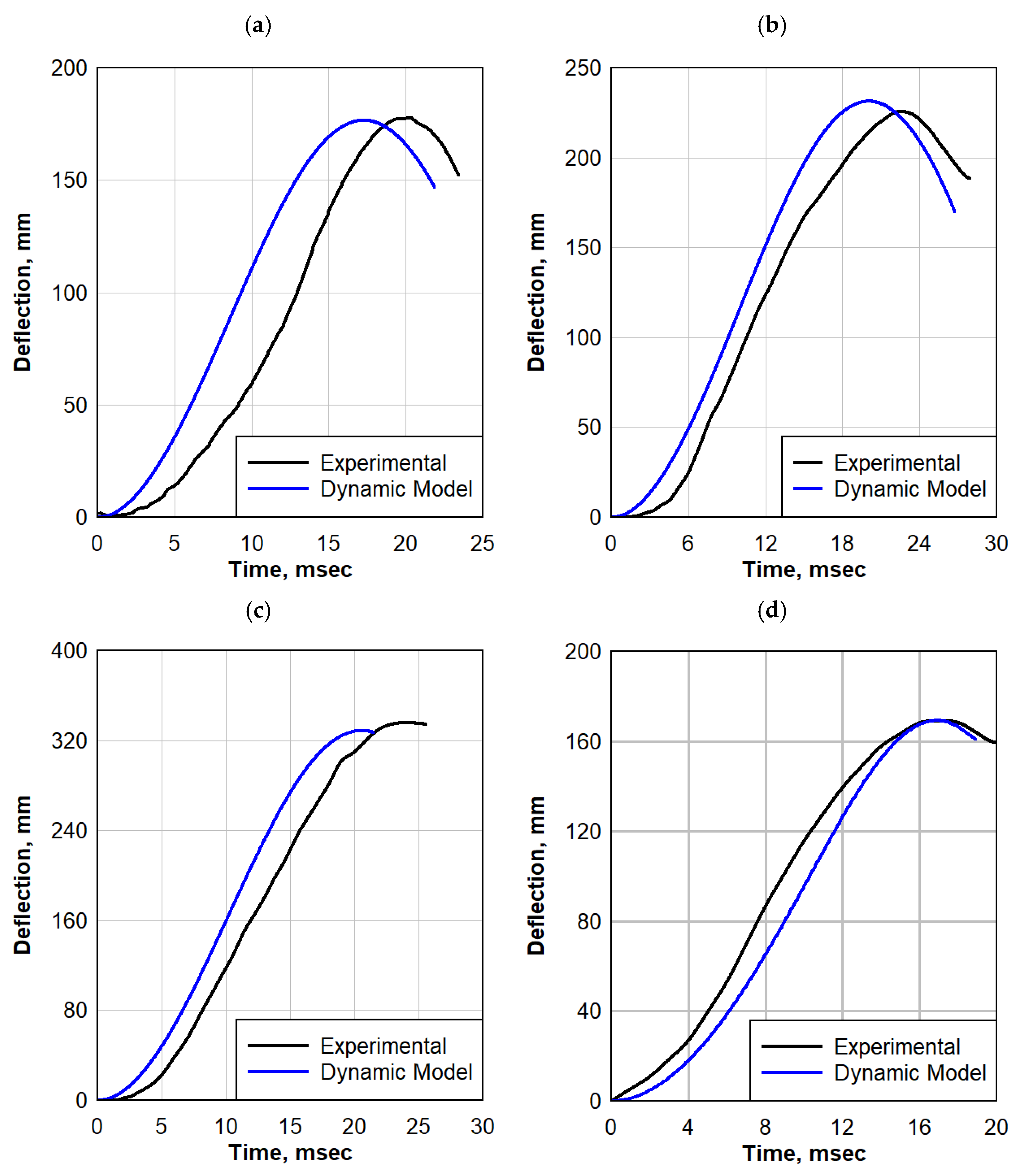
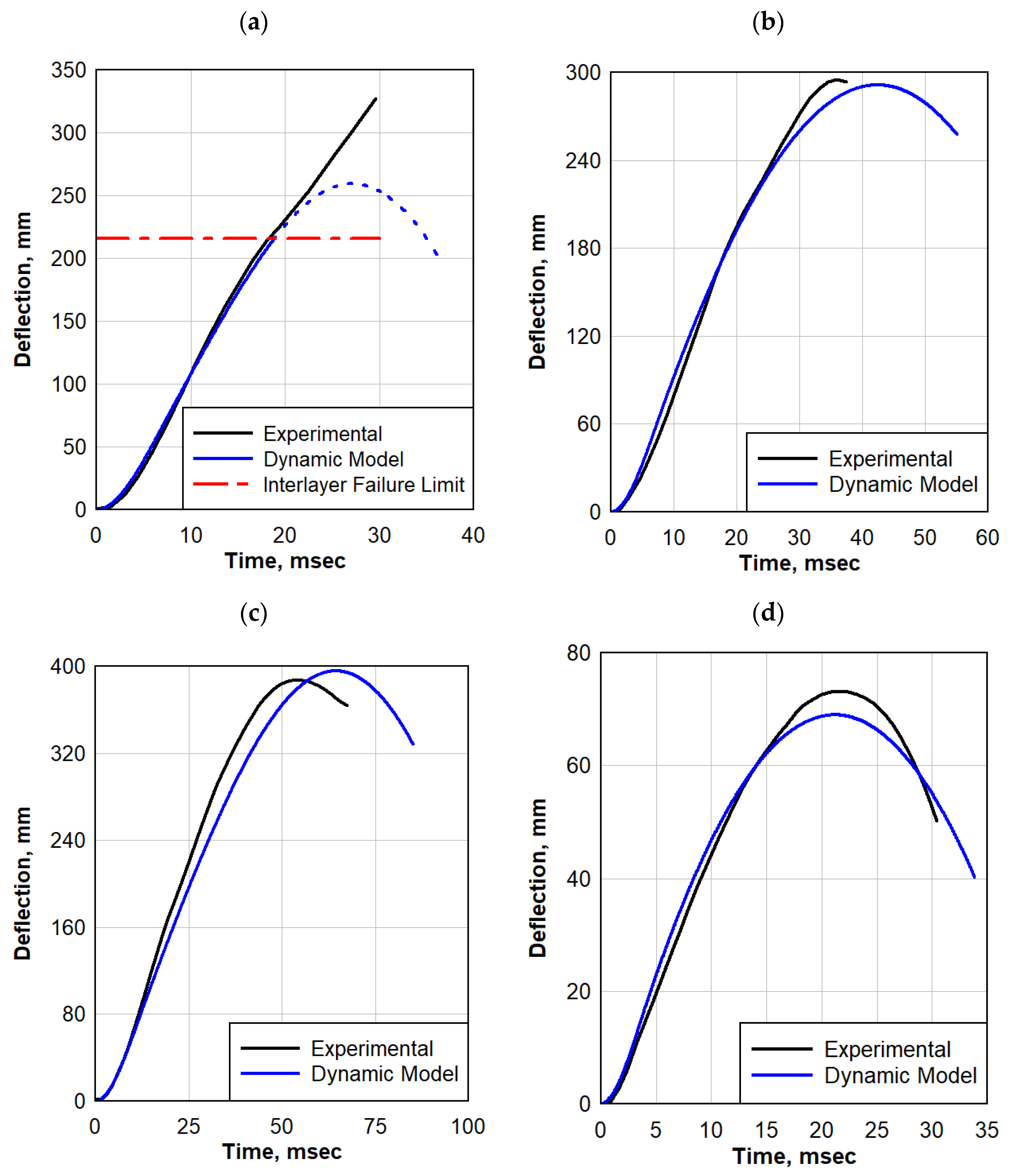
- Throughout the entire LG responses up to the peak values, the blast dynamic deflection time history was closely aligned with the dynamic model.
- If severe damage occurs during a blast event, the dynamic model cannot accurately predict the post-peak response since it does not account for rebound.
- The dynamic model assumes the tension membrane resistance continues to increase, and thus, an upper deflection limit based on the interlayer’s tensile strength should be incorporated into the blast analysis and design methods presented in this paper.
Author Contributions
Funding
Data Availability Statement
Conflicts of Interest
References
- El-Sisi, A.; Bowman, A.; Elbelbisi, A.; Elkilani, A.; Robert, S.; Salim, H.; Nawar, M. Performance of LG Window Systems with Different Materials under Extreme Static Loading. Constr. Build. Mater. 2023, 409, 133923. [Google Scholar] [CrossRef]
- Centelles, X.; Pelayo, F.; Lamela-Rey, M.J.; Fernández, A.I.; Salgado-Pizarro, R.; Castro, J.R.; Cabeza, L.F. Viscoelastic Characterization of Seven Laminated Glass Interlayer Materials from Static Tests. Constr. Build. Mater. 2021, 279, 122503. [Google Scholar] [CrossRef]
- López-Aenlle, M.; Noriega, A.; Pelayo, F. Mechanical Characterization of Polyvinil Butyral from Static and Modal Tests on Laminated Glass Beams. Compos. Part. B Eng. 2019, 169, 9–18. [Google Scholar] [CrossRef]
- Pelayo, F.; Lamela-Rey, M.J.; Muniz-Calvente, M.; López-Aenlle, M.; Álvarez-Vázquez, A.; Fernández-Canteli, A. Study of the Time-Temperature-Dependent Behaviour of PVB: Application to Laminated Glass Elements. Thin-Walled Struct. 2017, 119, 324–331. [Google Scholar] [CrossRef]
- Knight, J.T.; El-Sisi, A.A.; Elbelbisi, A.H.; Newberry, M.; Salim, H.A. Mechanical Behavior of Laminated Glass Polymer Interlayer Subjected to Environmental Effects. Polymers 2022, 14, 5113. [Google Scholar] [CrossRef]
- Elkilani, A.; EL-Emam, H.; Elsisi, A.; Elbelbisi, A.; Salim, H. The Influence of Strain Rate Behavior on Laminated Glass Interlayer Types for Cured and Uncured Polymers. Polymers 2024, 16, 730. [Google Scholar] [CrossRef]
- Elkilani, A.; Elsisi, A.; Elemem, H.; Elbelbisi, A.; Helal, Z.; Salim, H. Interlaminar Bond Strength of Laminated Glass Composites under Accelerated Environmental Effects. Constr. Build. Mater. 2025, 487, 142005. [Google Scholar] [CrossRef]
- López-Aenlle, M.; Pelayo, F. Static and Dynamic Effective Thickness in Five-Layered Glass Plates. Compos. Struct. 2019, 212, 259–270. [Google Scholar] [CrossRef]
- Serafinavičius, T.; Lebet, J.-P.; Louter, C.; Lenkimas, T.; Kuranovas, A. Long-Term Laminated Glass Four Point Bending Test with PVB, EVA and SG Interlayers at Different Temperatures. Procedia Eng. 2013, 57, 996–1004. [Google Scholar] [CrossRef]
- Martín, M.; Centelles, X.; Solé, A.; Barreneche, C.; Fernández, A.I.; Cabeza, L.F. Polymeric Interlayer Materials for Laminated Glass: A Review. Constr. Build. Mater. 2020, 230, 116897. [Google Scholar] [CrossRef]
- Elkilani, A.; Salim, H.; Elemam, H.; Elsisi, A.; Bowman, A.; Johnson, C.; Elbelbisi, A. Numerical and Experimental Blast Response of Multilayer Laminated Glass Panels. Constr. Build. Mater. 2024, 449, 138520. [Google Scholar] [CrossRef]
- Belis, J.; Depauw, J.; Callewaert, D.; Delincé, D.; Van Impe, R. Failure Mechanisms and Residual Capacity of Annealed Glass/SGP Laminated Beams at Room Temperature. Eng. Fail. Anal. 2009, 16, 1866–1875. [Google Scholar] [CrossRef]
- Zhang, X.; Shi, Y.; Hao, H.; Cui, J. The Mechanical Properties of Ionoplast Interlayer Material at High Strain Rates. Mater. Des. 2015, 83, 387–399. [Google Scholar] [CrossRef]
- Elkilani, A.; Elsisi, A.; Knight, J.; Elbelbisi, A.; Salim, H. Thermomechanical High Strain Rate Behavior of LG Polymeric Interlayer Materials. Constr. Build. Mater. 2025, 464, 140183. [Google Scholar] [CrossRef]
- Hinman, E. Lessons from Ground Zero—Oklahoma City Bombing and Bombresistant Structures. Secur. Manag. J. 1995, 39, 26–31. [Google Scholar]
- Shetty, M.S.; Wei, J.; Dharani, L.R.; Stutts, D.S. Analysis of Damage in Laminated Architectural Glazing Subjected to Wind Loading and Windborne Debris Impact. Buildings 2013, 3, 422–441. [Google Scholar] [CrossRef]
- Timmel, M.; Kolling, S.; Osterrieder, P.; Du Bois, P.A. A Finite Element Model for Impact Simulation with Laminated Glass. Int. J. Impact Eng. 2007, 34, 1465–1478. [Google Scholar] [CrossRef]
- Biggs, J.M. Introduction to Structural Dynamics; McGraw-Hill Companies: New York, NY, USA, 1964. [Google Scholar]
- Behr, R.A.; Minor, J.E.; Linden, M.P.; Vallabhan, C.V.G. Laminated Glass Units under Uniform Lateral Pressure. J. Struct. Eng. 1985, 111, 1037–1050. [Google Scholar] [CrossRef]
- Behr, R.A.; Minor, J.E.; Linden, M.P. Load Duration and Interlayer Thickness Effects on Laminated Glass. J. Struct. Eng. 1986, 112, 1441–1453. [Google Scholar] [CrossRef]
- Feldmann, M.; Langosch, K. Zum Biegeverhalten von VSG-Laminaten Unter Quer-oder Längsbelastung. Stahlbau 2011, 80, 52–60. [Google Scholar] [CrossRef]
- Minor, J.E.; Reznik, P.L. Failure Strengths of Laminated Glass. J. Struct. Eng. 1990, 116, 1030–1039. [Google Scholar] [CrossRef]
- Wei, J.; Shetty, M.S.; Dharani, L.R. Stress Characteristics of a Laminated Architectural Glazing Subjected to Blast Loading. Comput. Struct. 2006, 84, 699–707. [Google Scholar] [CrossRef]
- Ghugal, Y.M.; Dahake, A.G. Flexure of Thick Beams Using Refined Shear Deformation Theory. Int. J. Civil. Struct. Eng. 2012, 3, 321–335. [Google Scholar]
- Auricchio, F.; Sacco, E. Refined First-Order Shear Deformation Theory Models for Composite Laminates. J. Appl. Mech. 2003, 70, 381–390. [Google Scholar] [CrossRef]
- E1300-16; ASTM Standard Practice for Determining Load Resistance of Glass in Buildings. ASTM International: West Conshohocken, PA, USA, 2023.
- Galuppi, L.; Royer-Carfagni, G. Enhanced Effective Thickness of Multi-Layered Laminated Glass. Compos. Part. B Eng. 2014, 64, 202–213. [Google Scholar] [CrossRef]
- HazL, Protective Design Center. Omaha District Corps of Engineers; HazL, Protective Design Center: Omaha, NE, USA, 1998. [Google Scholar]
- ARA. WINGARD PE (Version 6.0); Applied Research Associates, Inc.: Albuquerque, NM, USA, 2010. [Google Scholar]
- US Army Corps of Engineers Protective Design Center. Methodology Manual for the Singledegree-of-Freedom Blast Effects Design Spreadsheets (SBEDS); US Army Corps of Engineers Protective Design Center: Omaha, NE, USA, 2008. [Google Scholar]
- Timoshenko, S.; Woinowsky-Krieger, S. Theory of Plates and Shells; McGraw-hill: New York, NY, USA, 1959; Volume 2. [Google Scholar]
- Pelfrene, J.; Kuntsche, J.; Van Dam, S.; Van Paepegem, W.; Schneider, J. Critical Assessment of the Post-Breakage Performance of Blast Loaded Laminated Glazing: Experiments and Simulations. Int. J. Impact Eng. 2016, 88, 61–71. [Google Scholar] [CrossRef]
- Parratt, M. Behaviour of Multi-Layered Laminated Glass Under Blast Loading; University of Toronto (Canada): Toronto, ON, Canada, 2016; ISBN 1369644132. [Google Scholar]
- Task Committee on Blast-Resistant Design of the Petrochemical Committee of the Energy Division of ASCE. Design of Blast-Resistant Buildings in Petrochemical Facilities; American Society of Civil Engineers: Reston, VA, USA, 2010. [Google Scholar]
- UFC 3-340-02; Structures to Resist the Effects of Accidental Explosions. Department of Defense: Arlington, VA, USA, 2008.
- Zhang, X.; Zou, Y.; Hao, H.; Li, X.; Ma, G.; Liu, K. Laboratory Test on Dynamic Material Properties of Annealed Float Glass. Int. J. Prot. Struct. 2012, 3, 407–430. [Google Scholar] [CrossRef]
- ASTM C158-02; Standard Test Methods for Strength of Glass by Flexure (Determination of Modulus of Rupture). ASTM: West Conshohocken, PA, USA, 2017.
- Chang, T.P.; Chang, H.C. Perturbation Method for Probabilistic Dynamic Finite Element Analysis of a Rectangular Plate. J. Struct. Mech. 1997, 25, 397–415. [Google Scholar] [CrossRef]
- Evans, T.H. Tables of Moments and Deflections for a Rectangular Plate Fixed on All Edges and Carrying a Uniformly Distributed Load. J. Appl. Mech. 1939, 6, A7–A10. [Google Scholar] [CrossRef]
- Hutchinson, J.R. On the Bending of Rectangular Plates with Two Opposite Edges Simply Supported. J. Appl. Mech. 1992, 59, 679–681. [Google Scholar] [CrossRef]
- Imrak, C.E.; Gerdemeli, I. The Problem of Isotropic Rectangular Plate with Four Clamped Edges. Sadhana 2007, 32, 181–186. [Google Scholar] [CrossRef][Green Version]
- Wojtaszak, I.A. Stress and Deflection of Rectangular Plates. J. Appl. Mech. 1936, 3, A71–A73. [Google Scholar] [CrossRef]
- Taylor, R.L.; Govindjee, S. Solution of Clamped Rectangular Plate Problems. Commun. Numer. Methods Eng. 2004, 20, 757–765. [Google Scholar] [CrossRef]
- Maddux, G.E.; Vorst, L.A.; Giessler, F.J.; Moritz, T. Stress Analysis Manual; Technology Incorporated: Dayton, OH, USA, 1969. [Google Scholar]
- El-Sisi, A.; Elbelbisi, A.; Elemam, H.; Elkilani, A.; Newberry, M.; Salim, H. Effect of Glass Type and Thickness on the Static and Blast Response of LG Panels. J. Build. Eng. 2024, 86, 108870. [Google Scholar] [CrossRef]
- Elbelbisi, A.; El-Sisi, A.; Knight, J.; Philipps, J.C.; Newberry, M.; Salim, H. Influence of Panels Size on the Static and Dynamic Performance of Laminated Glass Panels. Constr. Build. Mater. 2023, 399, 132562. [Google Scholar] [CrossRef]
- Elbelbisi, A.; El-Sisi, A.; Mahmoud, M.E.; Newberry, M.; Salim, H. Influence of Interlayer Types and Thicknesses on the Blast Performance of Laminated Glass Panels. Structures 2023, 57, 105231. [Google Scholar] [CrossRef]
- Mark, K.W.; Eric, K.; Leila Abdul, H.; Michael, N. Construction Specification Guidance For EVA-Laminated Glazing Used. In Blast Protection Designs Results From Blast Tests Of Eva-Laminated Glazing Panels; Battelle, Air Force Civil Engineer Center: Tyndall AFB, FL, USA, 2022. [Google Scholar]
- Idriss, J.S.; Lowak, M.J.; Wesevich, J.W.; Montoya, J.R.; Skrzycki, S.M. Laminated Glass Response Validation and Modeling—Task 2: Dynamic Testing; U.S. Army Corps of Engineering, Protictive Design Center: Omaha, NE, USA, 2013. [Google Scholar]
- Zobec, M.T. Blast Enhanced Glass Facades: An Integrated and Holistic Design Approach. Ph.D. Thesis, University of Technology, Sydney, New South Wales, Australia, 2013. [Google Scholar]
- Morison, C. The Resistance of Laminated Glass to Blast Pressure Loading and the Coefficients for Single Degree of Freedom Analysis of Laminated Glass. Ph.D. Thesis, Cranfield University, Cranfield, Bedfordshire, UK, 2007. [Google Scholar]
- Morison, C. Response of Glazed Facades to Blast Loading; MSc Dissertation University of Westminster: Westminster, UK, 1999. [Google Scholar]







| Software | Analysis Method | Analysis Modules | Analysis Output |
|---|---|---|---|
| HazL (v 1.2) |
|
|
|
| WINGARD (v 6.2) |
|
|
|
| SBEDS-W (v 5.1) |
|
|
|
| WinDAS (v 1.0) |
|
|
|
| # | Specimen ID | Interlayer Type | Interlayer and Glass Thickness | Glass Type ** | |
|---|---|---|---|---|---|
| Interlayer, mm (in) | Inner and Outer * Layers, mm (in) | ||||
| S-LGS-1 | 1/16A-0.09 UVEKOL-1/16A | UVEKOL-S | 2.29 (0.09) | 1.59 (1/16) | A |
| S-LGS-2 | 1/8A-0.12PVB-1/8A | PVB | 3.05 (0.12) | 3.18 (1/8) | |
| # | Specimen ID | Interlayer Type | Interlayer and Glass Thickness | Glass Type ** | |
|---|---|---|---|---|---|
| Interlayer, mm (in) | Inner and Outer * Layers, mm (in) | ||||
| S-LGR-1 | 0.375T-0.09 SG-0.375T | SG | 2.29 (0.09) | 9.53 (0.375) | T |
| S-LGR-2 | 0.375T-0.09 EVA-0.375T | EVA | |||
| S-LGR-3 | 0.375T-0.09 EVA-0.5T | EVA | 12.7 (0.5) and 9.53 (0.375) | ||
| S-LGR-4 | 0.375HS-0.09 SG-0.375HS | SG | 9.53 (0.375) | HS | |
| # | Experimental (kPa-mm) | Analytical (kPa-mm) | Differences % |
|---|---|---|---|
| S-LGS-1 | 3208 | 2834 | −11.5% |
| S-LGS-2 | 568 | 627 | +10% |
| S-LGR-1 | 10,264 | 10,477 | +2% |
| S-LGR-2 | 10,090 | 10,742 | +6.5% |
| S-LGR-3 | 5905 | 4880 | −17% |
| S-LGR-4 | 9840 | 9986 | +1% |
| # | Specimen ID | Panel Size, mm × mm (in × in) | Interlayer Type | Interlayer and Glass Thickness | Blast Loading | |||
|---|---|---|---|---|---|---|---|---|
| Interlayer, mm (in) | Inner and Outer * Layers, mm (in) | Middle Layer, mm (in) | Pressure (kPa) | Impulse (kPa-msec) | ||||
| D-IGU-1 | 0.25A-0.5AIR-0.25A-0.12EVA-0.25A | 711 × 1321 (28 × 52) | EVA | 3.05 (0.12) | 6.35 (0.25) | - | 192 | 635 |
| D-IGU-2 | 0.25A-0.5AIR-0.5A-0.12EVA-0.5A | 1321 × 1321 (52 × 52) | EVA | 3.05 (0.12) | 12.7 (0.5) | - | 195 | 929 |
| D-IGU-3 | 0.25A-0.5AIR-0.5A-0.18EVA-0.5A | 2540× 1321 (100 × 52) | EVA | 4.57 (0.18) | 12.7 (0.5) and 9.53 (0.375) | - | 171 | 909 |
| D-IGU-4 | 0.25A-0.5AIR-0.5A-0.06PVB-0.5A-0.06PVB-0.5A | 1727 × 1118 (68 × 44) | PVB | 1.53 (0.06) | 12.7 (0.5) | 12.7 (0.5) | 427 | 821 |
| D-IGU-5 | 0.25A-0.5AIR-0.5A-0.06PVB-0.5A-0.06PVB-0.5A-0.06PVB-0.5A | 1059 | 1772 | |||||
| # | Specimen ID | Interlayer Type | Interlayer and Glass Thickness | Blast Loading | ||
|---|---|---|---|---|---|---|
| Interlayer, mm (in) | Inner and Outer * Layers, mm (in) | Pressure (kPa) | Impulse (kPa-msec) | |||
| D-LG-1 | 1/8A-0.06PVB-1/8A | PVB | 1.53 (0.06) | 3.18 (1/8) | 33 | 248 |
| D-LG-2 | 1/8A-0.06PVB-1/8A | 40 | 310 | |||
| D-LG-3 | 1/8A-0.06PVB-1/8A | 56 | 414 | |||
| D-LG-4 | 1/8A-0.1SG-1/8A | SG | 2.54 (0.1) | 3.18 (1/8) | 48 | 379 |
Disclaimer/Publisher’s Note: The statements, opinions and data contained in all publications are solely those of the individual author(s) and contributor(s) and not of MDPI and/or the editor(s). MDPI and/or the editor(s) disclaim responsibility for any injury to people or property resulting from any ideas, methods, instructions or products referred to in the content. |
© 2025 by the authors. Licensee MDPI, Basel, Switzerland. This article is an open access article distributed under the terms and conditions of the Creative Commons Attribution (CC BY) license (https://creativecommons.org/licenses/by/4.0/).
Share and Cite
Elkilani, A.; Salim, H.; Elbelbisi, A. Engineering Analysis and Design Method for Blast-Resistant Laminated Glass Composite Systems. J. Compos. Sci. 2025, 9, 466. https://doi.org/10.3390/jcs9090466
Elkilani A, Salim H, Elbelbisi A. Engineering Analysis and Design Method for Blast-Resistant Laminated Glass Composite Systems. Journal of Composites Science. 2025; 9(9):466. https://doi.org/10.3390/jcs9090466
Chicago/Turabian StyleElkilani, Ahmed, Hani Salim, and Ahmed Elbelbisi. 2025. "Engineering Analysis and Design Method for Blast-Resistant Laminated Glass Composite Systems" Journal of Composites Science 9, no. 9: 466. https://doi.org/10.3390/jcs9090466
APA StyleElkilani, A., Salim, H., & Elbelbisi, A. (2025). Engineering Analysis and Design Method for Blast-Resistant Laminated Glass Composite Systems. Journal of Composites Science, 9(9), 466. https://doi.org/10.3390/jcs9090466