1. Introduction
Concrete-filled tubes (CFTs) represent a composite structural system widely used in civil engineering applications. CFT members have attracted significant research and engineering interest because of their combined structural and functional advantages. Their efficiency derives from the confinement effect provided by the steel casing and the high compressive strength of the infilled concrete. This interaction improves strength, stiffness, ductility and energy dissipation, making CFTs particularly suitable for high-rise buildings, bridge piers and infrastructures where both monotonic and cyclic loads govern design requirements.
Over the last decades, several experimental and numerical studies have investigated the behaviour of CFTs [
1,
2,
3]. Research on concrete-filled steel tubular structures has generally focused on members, connections/joints and structural systems. Various aspects have been examined, including static, dynamic and fire performance, as well as construction and durability issues. A large body of work has addressed axial performance [
4,
5,
6] and torsional behaviour [
7,
8], including investigations into fibre-reinforced CFTs [
9] and probabilistic capacity models [
10]. Design recommendations in codes and guidelines, such as ACI, AISC and Eurocode provisions, are also primarily based on axial resistance.
The introduction of reinforcing fibres into the concrete matrix stems from the need to improve tensile strength and crack control, thereby enhancing the interaction between steel and concrete. However, several authors have observed that the use of fibres may lead to an incomplete exploitation of the composite material’s properties, particularly in the elastic range, as discussed by Lai et al. [
11,
12].
Numerous studies have also investigated the buckling behaviour of CFTs and confirmed their superior performance [
13,
14,
15,
16,
17,
18,
19]. For instance, Zhang et al. [
20] analysed the buckling characteristics of CFT columns and demonstrated that the presence of concrete significantly enhances load-bearing capacity and resistance to buckling failure, with results validated by analytical and numerical models.
Regarding flexural behaviour, both monotonic and cyclic experimental tests have been performed. Elchalakani et al. [
21] first investigated the monotonic flexural response of steel–concrete composite elements across a wide range of width-to-thickness ratios (d/t) from 20 to 110. Their subsequent work extended this research to constant-amplitude cyclic behaviour, providing valuable insights into cyclic degradation mechanisms [
22]. Other studies have analysed the effects of cross-sectional confinement [
23,
24] and the cyclic behaviour of high-strength concrete-filled pipes [
25,
26]. Nevertheless, most of these contributions focus on specific geometries or material strengths, and only a limited number of tests explore low-cycle performance under predominant bending with low axial load, despite its relevance for real structures such as long-span bridge girders.
Finite element modelling (FEM) of CFTs has also been addressed in several works, though with significant limitations, particularly under cyclic loading [
27]. According to Alatshan et al. [
28], the number of FE studies capable of simulating full cyclic tests is still limited. A significant gap in the literature concerns damage modelling and degradation mechanisms. Existing parametric studies typically evaluate the influence of geometry and material properties but neglect the progressive deterioration of steel and concrete, especially in the low-cycle regime. While some research has dealt with axial behaviour [
29] or with flexural behaviour and the interface interaction between concrete and steel [
30], very few studies provide sufficient detail to fully replicate experimental cyclic tests, particularly regarding the definition of elastic–plastic laws and the characterisation of damage models for both materials [
31]. Lu et al. [
32], for example, conducted a finite element analysis (FEA) to investigate the flexural behaviour of circular concrete-filled thin-walled steel tube (CFST) beams, achieving good correlation with experiments, although their study mainly focused on composite interaction effects rather than progressive degradation. Similarly, Mujdeci et al. [
33] validated nonlinear FE procedures for rubberized concrete-filled steel tubes subjected to different load conditions, confirming the reliability of their numerical models, yet without performing an extensive damage-oriented parametric exploration.
Overall, the existing numerical literature tends to either: (i) concentrate on model calibration for a limited number of specimens, or (ii) perform parametric studies based on simplified elastic–plastic descriptions, without explicitly tracking damage evolution, stiffness degradation and strength loss under repeated cyclic loading. In addition, systematic parametric studies on CFT beams subjected to cyclic bending with negligible axial force are essentially missing, even though such stress states are representative of many practical configurations (e.g., large-dimension bridge beams where the normal force is relatively small compared to bending moments). This gap is partly due to the high computational cost and modelling effort required to run large sets of nonlinear cyclic simulations with refined damage models.
The present study builds directly on the authors’ previous experimental and numerical investigations on circular and square CFT members, in which the finite element framework, constitutive assumptions and damage calibration were developed and validated against cyclic bending tests [
34,
35]. In that earlier work, the focus was placed on model definition, calibration and specimen-level validation.
The original contribution of the present paper is the development and application of a Python-based automated analysis framework, implemented within the Abaqus Scripting Interface, to systematically extend that validated modelling strategy to a wide parametric domain. The scripting procedure is not limited to model generation, but also governs input updating, batch execution, response extraction, cycle-by-cycle post-processing and the construction of synthetic performance maps. In this way, analyses that would otherwise require extensive manual intervention become repeatable, traceable and computationally feasible on a larger scale.
Accordingly, the novelty of this work does not lie in introducing a new constitutive law or a new calibration strategy, but in demonstrating how a validated damage-capable FE model can be transformed into a reproducible parametric investigation tool for the low-cycle cyclic bending of CFT beams. The resulting trends in dissipated energy, residual strength and degradation class should therefore be interpreted as the first application of the proposed scripting-based framework to standard code-based materials under a fixed loading protocol.
From this perspective, the study provides two main outcomes: (i) a reproducible computational workflow for the automatic generation and post-processing of nonlinear cyclic FE analyses of CFT members; and (ii) an application example showing how such a workflow can be used to derive comparative degradation trends as a function of diameter-to-thickness ratio and span length.
The paper is structured as follows.
Section 2 and
Section 3 describe the finite element model, including geometry, material laws and damage implementation, consistently with the validated framework established in previous studies.
Section 4 presents the Python-based automation procedure and its logic.
Section 5 illustrates the application of the workflow to the parametric campaign and discusses the resulting performance trends. Finally,
Section 6 summarises the main findings and limitations of the proposed approach.
2. Finite Element Modelling
This section summarises the finite element framework adopted in the study, including geometry, boundary conditions, contact definition and mesh strategy. The modelling choices are consistent with the experimentally calibrated numerical approach previously developed by the authors for circular and square CFT members [
31,
35]. In the present paper, this base FE model is used as the reference template for the automated scripting workflow described later in
Section 4.
Geometry, Constraints, Interactions and Mesh
The finite element (FE) model was developed in Abaqus/Explicit [
36] to reproduce the experimental setup of the cyclic bending tests performed in [
34]. The model was defined by considering the actual geometry, boundary conditions, steel–concrete interaction and imposed displacement history associated with a constant chord rotation.
The CFT specimens were modelled as circular hollow steel sections filled with concrete and connected to rigid end plates. The geometric dimensions were consistent with the investigated test series, with outer diameters ranging from 100 to 400 mm and wall thicknesses of 5, 10, 15 and 20 mm, resulting in sixteen diameter-to-thickness ratios (
) for each specimen length. The specimen length
varied from 2.0 to 5.5 m, leading to a total of 64 FE models.
The modelling procedure followed a structured workflow. Each component was partitioned into smaller regions to facilitate meshing, interaction assignment and the application of boundary conditions.
The interaction between the steel tube and the concrete core was modelled through a surface-to-surface contact formulation. Tangential behaviour was defined by a penalty friction law with friction coefficient
, consistently with previous studies [
29,
37], while normal behaviour was described by hard contact to prevent interpenetration.
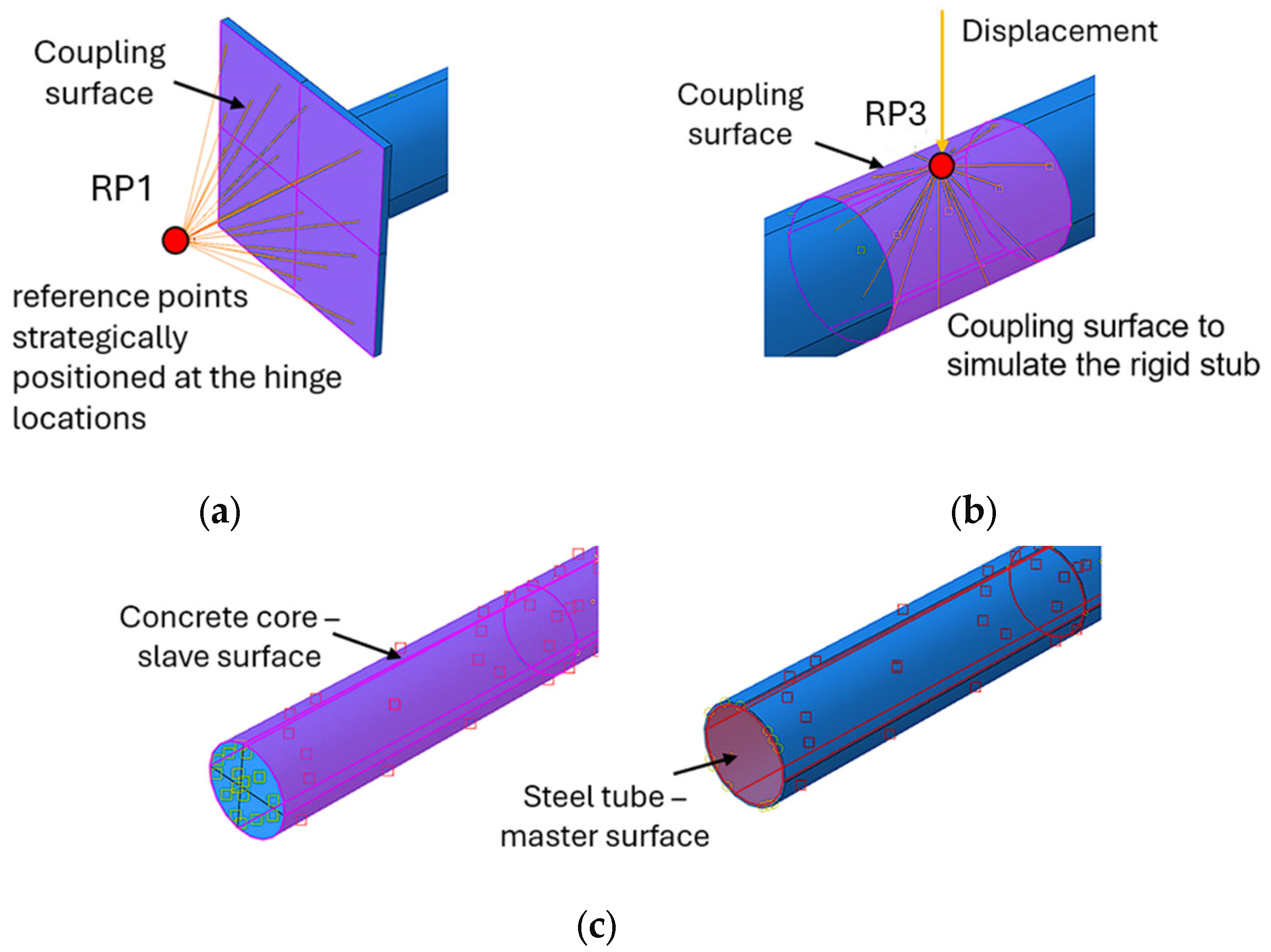
Boundary conditions and constraints reproduced the experimental hinge–slider system. Reference points (RPs) were introduced to represent the hinge axes at the specimen ends (RP1 and RP2) and the load application point at midspan (RP3). Coupling constraints were assigned to RP1 and RP2, linking them to the outer surfaces of the end plates to reproduce rigid-body motion, while tie constraints were adopted at the welded plate interfaces (
Figure 1a). A vertical displacement-controlled condition was imposed at RP3 to reproduce the cyclic loading history applied during the tests (
Figure 1b). The interaction arrangement is reported in
Figure 1c. Since the flexural response was evaluated at a prescribed chord rotation, the imposed displacement
was scaled for each length according to the imposed chord rotation (θ = 0.0933 rad) (see
Table 1).
where
(
is the distance between the hinges of the experimental setup).
The mesh was discretized using linear eight-node brick elements with reduced integration (C3D8R) and enhanced hourglass control.
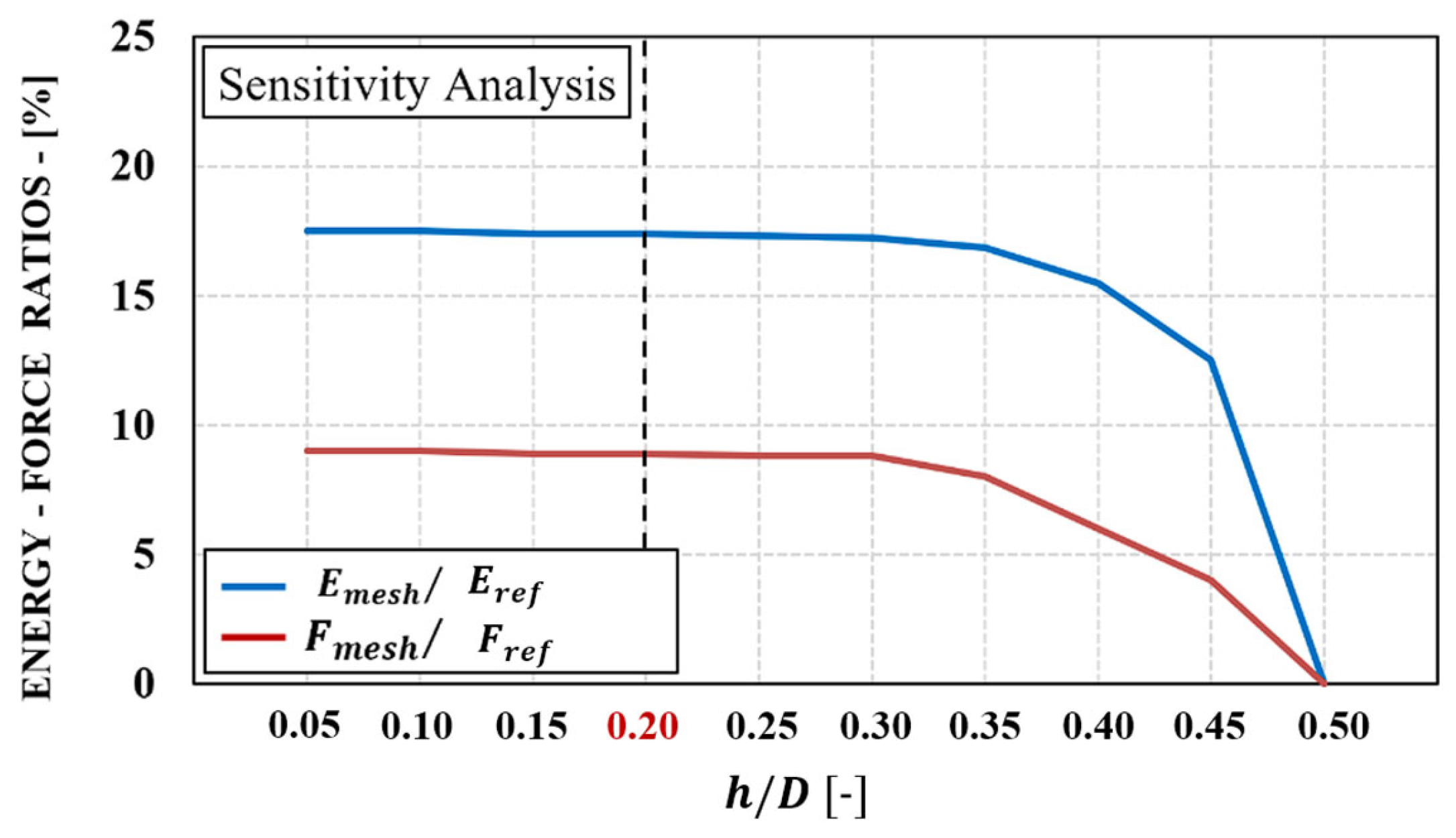
Based on the mesh-sensitivity study previously conducted by the authors on comparable CFT models [
31], and in agreement with the normalised trends shown in
Figure 2, a characteristic mesh size
h of approximately
was adopted in the present analyses. The sensitivity study was defined with respect to a reference
ratio, and the corresponding energy and force ratios were evaluated to quantify the variation in dissipated energy and reaction force relative to the reference mesh. To maintain a suitable balance between computational efficiency and an accurate description of the global cyclic response across the whole parametric range, lower and upper bounds of 20 mm and 40 mm, respectively, were additionally imposed.
Abaqus/Explicit was adopted because of its robustness in the presence of contact interaction, material softening and progressive damage evolution. No artificial mass scaling was introduced. Quasi-static conditions were enforced by assigning a sufficiently long analysis time and by applying the loading history through a smooth-step amplitude, so as to limit inertial effects during cyclic loading. The minimum stable time increment was approximately 1.5 × 10⁻⁵ s. The quasi-static admissibility of the analyses was assessed by monitoring the kinetic-to-internal energy ratio (ALLKE/ALLIE). Although local transient increases may occur during selected stages of the cyclic response, this ratio remained generally within the conventional 5% reference range during the mechanically relevant phases of the analyses, thus supporting the quasi-static interpretation of the results. The scripting framework can also be extended to perform an automatic check of quasi-static admissibility based on the evolution of the ratio. Rather than relying on a strict pointwise threshold over the entire analysis, the procedure may identify analyses in which the prescribed limit is exceeded within stable response intervals, excluding short transients associated with cycle reversal or local damage progression. Simulations not satisfying the prescribed criterion may then be automatically re-submitted with increased step time, thereby improving numerical stability and reducing inertial effects.
ratio = ALLKE/ALLIE if ALLIE > 1 × 10⁻⁹ else 0.0
if stable_phase and ratio > 0.05:
print(‘ALLKE/ALLIE > 5% in stable phase’)
restart_analysis = True
new_step_time = step_time * 1.5
else:
print(‘ALLKE/ALLIE within acceptable range’)
restart_analysis = False
new_step_time = step_time
In this model, “stable_phase” is a logical variable defined according to the interval to be monitored.
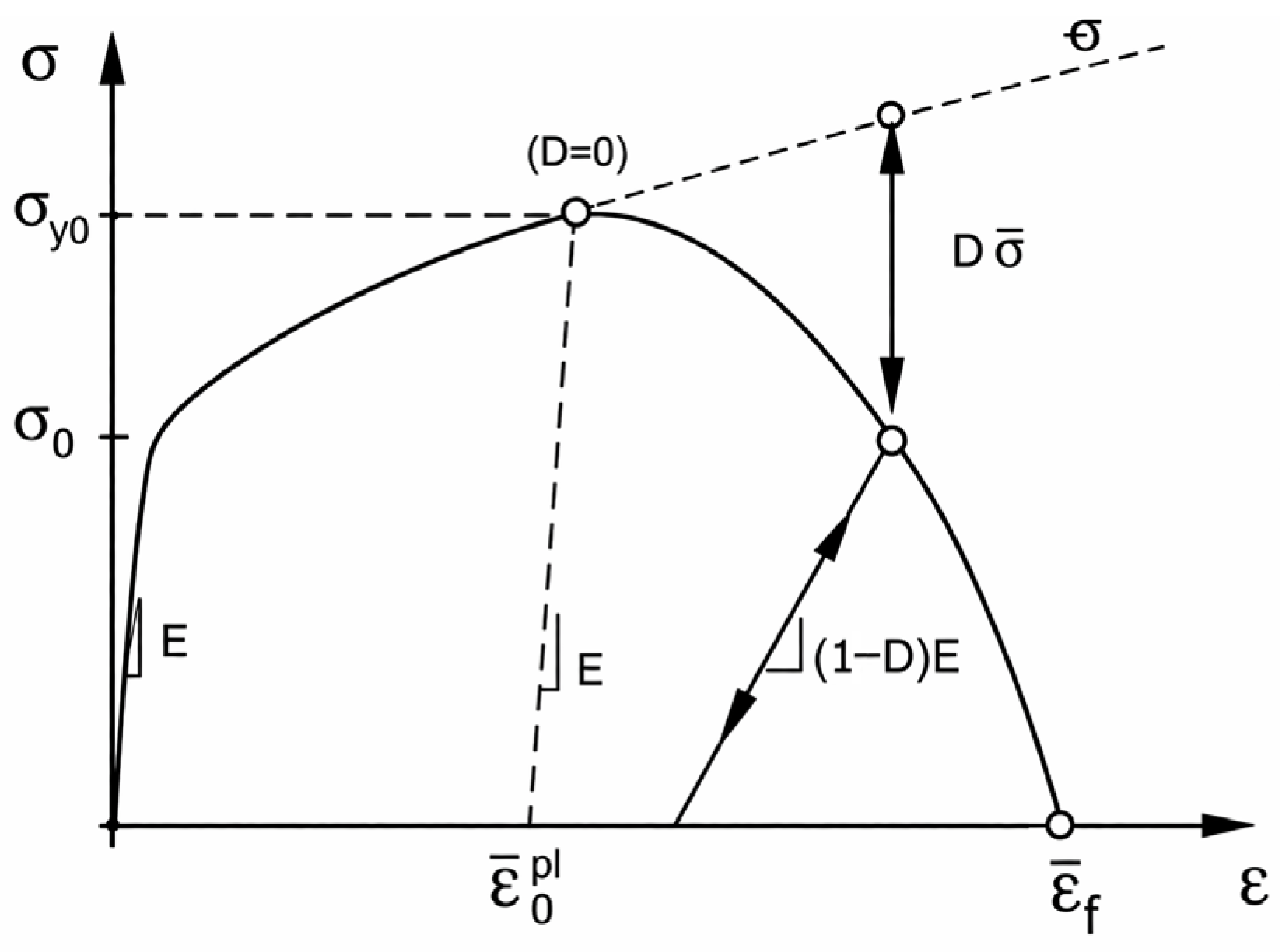
Element deletion was activated for the steel tube only, so that elements reaching the complete damage condition () were removed from the analysis. This option was adopted to reproduce local fracture and the associated loss of load-carrying capacity in the steel shell.
4. Optimisation by Script
The numerical procedure adopted in this study was implemented through a Python 3.11.0-based scripting framework developed within the Abaqus Scripting Interface. The purpose of this framework was to automate the full finite element workflow required for the parametric investigation of CFT members under cyclic bending, including model generation, the updating of input variables, job submission, output extraction and the post-processing of the results.
Although Abaqus allows for model definition and analysis control through Python commands, this type of fully integrated workflow is not available as a standard automatic procedure in Abaqus/CAE. In particular, the software does not provide, in a built-in form, a ready-to-use routine capable of creating a CAE model from variable input parameters, updating geometry and material definitions, managing repeated nonlinear analyses over a wide parametric domain, and automatically assembling the corresponding response dataset. For this reason, a dedicated Python script was developed in the present work.
The novelty of the proposed approach lies in the fact that the finite element model is not manually rebuilt for each configuration but is generated directly from a set of Python-controlled input variables. This makes the procedure generalisable and readily extendable to different geometries, material properties and damage laws. In this sense, the script should not be regarded simply as a tool for the automation of repetitive tasks, but as a computational framework that transforms a validated FE procedure into a reusable methodology for systematic parametric analysis.
More specifically, the developed Python workflow was conceived to support damage-based cyclic analyses of CFT members by linking, within a single logical structure, the creation of the model, the assignment of constitutive parameters, the execution of the analysis, the numerical verification of the results and the extraction of response quantities of engineering interest. This aspect is central to the present study, since the main contribution of the paper is precisely the development of a scripting strategy that makes large-scale parametric investigation feasible, traceable and reproducible.
For clarity, the Python workflow was organised into four main stages: general workflow logic, the parametric generation of FE models, automated job execution with numerical checks, and output extraction with post-processing.
4.1. General Workflow Logic
The Python script was organised as a modular workflow in which each stage corresponded to a specific operation of the finite element procedure. Rather than acting as a simple sequence of Abaqus commands, the script was conceived as a control structure able to manage the full analysis chain, from the definition of the input parameters to the generation of the final response dataset.
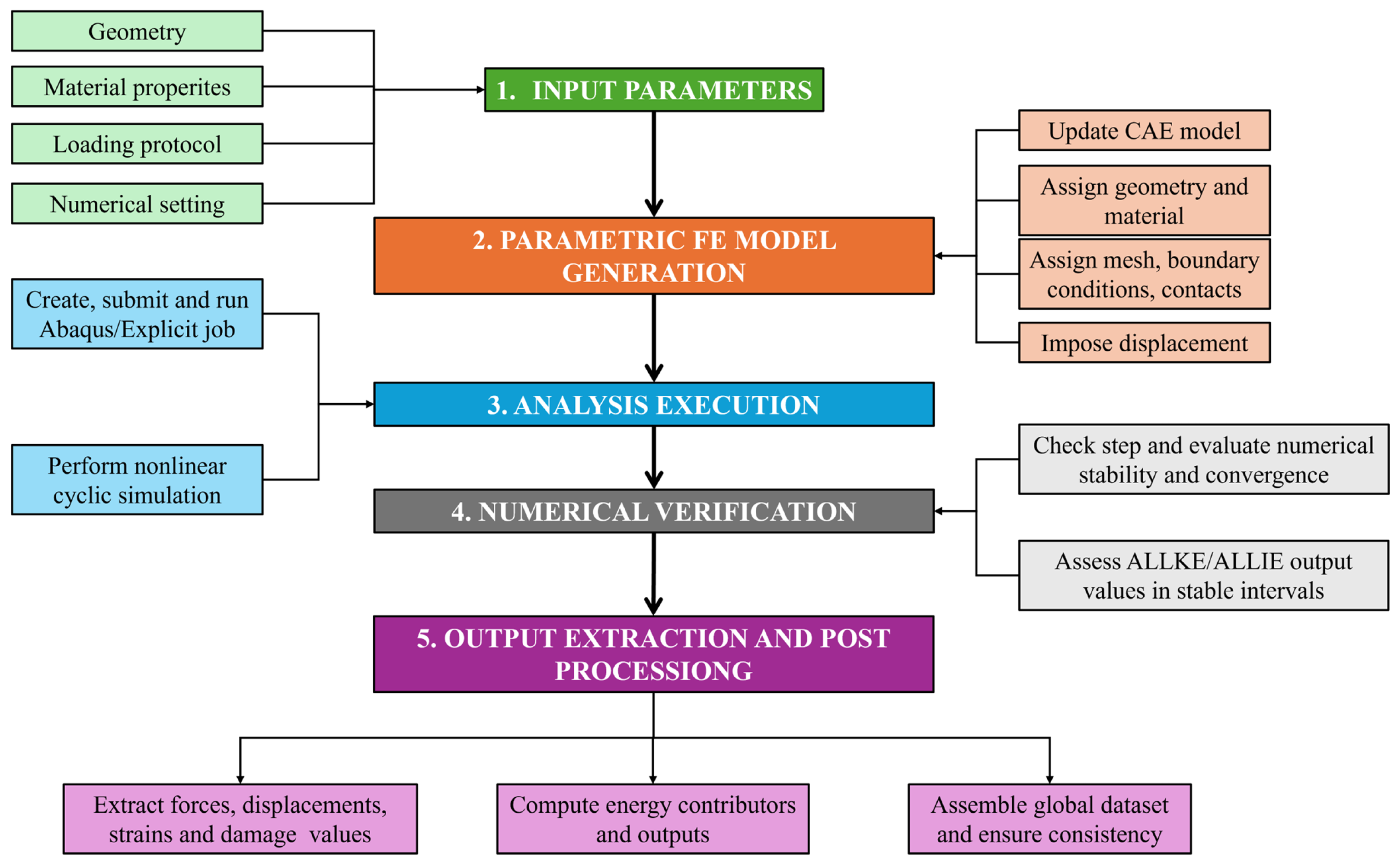
The general logic of the procedure was based on four main steps. First, the script read the input variables defining the parametric domain, including geometry, material properties, displacement demand and numerical settings. Second, these variables were used to automatically generate or update the FE model in Abaqus/CAE, including geometry, mesh, boundary conditions, contact definitions and damage parameters. Third, the corresponding Abaqus/Explicit job was created and submitted, with the possibility of introducing numerical admissibility checks during or after execution. Finally, once the analysis was completed, the relevant output quantities were extracted from the output database and organised into structured files for post-processing and comparison across configurations.
In this way, the same validated FE formulation could be repeatedly instantiated over many configurations without manual rebuilding of the model. This aspect is particularly important in nonlinear cyclic analyses, where the number of input variables, output quantities and numerical checks makes a fully manual procedure time-consuming and potentially error-prone. By embedding the whole sequence into Python, the modelling strategy becomes reproducible, scalable and readily adaptable to extended parametric studies.
For clarity, the workflow implemented in the script can be summarised by a flowchart (
Figure 9) where it is possible to recognise the main steps: input definition, model generation, analysis execution, numerical verification and post-processing.
4.2. Parametric Generation of FE Models
The Python workflow was designed to directly generate the Abaqus/CAE model from a set of input variables, so that the same finite element procedure could be automatically extended to a wide parametric domain without manually rebuilding model. Rather than modifying an existing CAE model specimen by specimen, the script instantiated the numerical model from a variable-driven definition of geometry, materials, loading and numerical settings.
For each simulation, the model was defined by the following input set:
where
is the tube diameter,
is the wall thickness,
is the specimen length,
is the target chord rotation,
and
denote the steel and concrete material parameter sets, respectively, and
represents the numerical settings adopted for the analysis.
In the present study, the script automatically updated:
The geometry of the steel tube, concrete core and end plates;
The partition scheme required for meshing and boundary-condition assignment;
The contact properties and support conditions;
The displacement amplitude imposed at the loading point;
The steel damage parameter
, evaluated through the predictive law described in
Section 3.1.3.
The displacement demand at the loading point was determined automatically from the prescribed chord rotation so that each specimen length was associated with the correct imposed displacement while preserving the same loading criterion across the whole campaign.
From a programming standpoint, the generation phase followed a nested parametric logic, which can be summarised as:
For each specimen length L:
For each diameter D:
For each thickness t:
Generate geometry
Assign materials
Update damage parameters
Compute imposed displacement
Apply boundary conditions and interactions
Generate mesh
This variable-based generation strategy ensured that the finite element model was treated as a parametric object rather than as a fixed CAE file. As a result, the same computational structure could be reused consistently across all analysed configurations, while remaining readily adaptable to different geometries, material properties or alternative constitutive and damage formulations. Once the current parameter set was assigned, the script automatically completed the FE model definition and prepared it for job submission. The variable parameters considered in the automated campaign are summarised in
Table 6 and
Table 7.
4.3. Automated Job Execution and Numerical Checks
Once the FE model corresponding to the current parameter set was generated, the Python routine automatically defined the Abaqus/Explicit analysis step, assigned the total analysis time and applied the prescribed displacement history through the selected loading protocol. The corresponding job was then created and submitted without further manual intervention. Depending on the available computational resources, the same workflow could be executed either sequentially or in batch mode over multiple configurations.
From the numerical standpoint, the execution phase can be associated with the following control set:
where
is the total step time,
is the minimum stable time increment,
is the admissible threshold for the kinetic-to-internal energy ratio, and
denotes the set of response intervals classified as mechanically stable.
From a logical viewpoint, the execution phase can be summarised as:
In addition to job submission, the script was conceived to include numerical admissibility checks aimed at verifying the quasi-static consistency of the Explicit analyses. In particular, the kinetic-to-internal energy ratio was considered (η(t) = ALLKE/ALLIE).
Although local transient peaks may occur during selected stages of the cyclic response, the analysis can be considered numerically acceptable when this ratio remains within a prescribed range during the mechanically stable phases of the response.
In the proposed workflow, this control can be implemented by checking the evolution of over the stable intervals , according to the following logic:
If η(t) > ηmax within stable intervals:
flag analysis
increase step time
restart job
Else:
accept analysis
In this way, the script can automatically identify simulations affected by excessive inertial contributions and re-submit them with updated time settings, thereby improving the quasi-static admissibility of the numerical solution. This type of control is particularly useful in large parametric campaigns, where a fully manual verification of all analyses would be inefficient and potentially inconsistent.
4.4. Output Extraction and Post-Processing
After the completion of each Abaqus/Explicit analysis, the Python routine automatically accessed the corresponding output database and extracted the response quantities required for the interpretation of cyclic behaviour. The main outputs collected from each simulation can be represented as:
where
is the reaction force history,
is the displacement history,
is the plastic strain history,
is the evolution of the damage variables, and
denotes the set of energy-related quantities extracted during the analysis.
From a logical viewpoint, the post-processing stage can be summarised as:
Open output database
Extract force and displacement histories
Extract strain, damage and energy variables
Organise results by cycle
Compute response indicators
Save processed data in structured files
Assemble global dataset for comparison
The extracted outputs were associated with the corresponding parameter set and organised in a structured format so that each simulation could be uniquely identified within the global parametric campaign. In this way, the workflow not only produced raw FE outputs, but also processed datasets ready for comparison across different configurations.
Particular attention was devoted to the cycle-based interpretation of the response. The extracted histories were therefore reorganised cycle by cycle in order to derive synthetic response indicators related to strength evolution, deformation demand, damage progression and dissipated energy. This operation transformed the numerical output into quantities directly suitable for comparative analysis.
The same workflow also allowed the energy dissipation capacity of the specimens to be evaluated in a consistent manner. By integrating the force–displacement response over the loading history, the script automatically generated the quantities required for the subsequent comparison of cumulative dissipative behaviour among the analysed CFT configurations.
Finally, all processed outputs were stored in structured files, such as CSV tables, which were then used to generate plots, comparative datasets and parametric performance maps. This completed the transformation of the FE procedure into a Python-driven workflow in which model generation, analysis execution and post-processing were integrated into a single reproducible framework.
5. Results
The results presented in this chapter should be interpreted as the application of the proposed Python-based automation workflow to a fixed cyclic-demand level, defined here by the selected loading protocol and target chord rotation. Accordingly, the obtained response trends do not represent a complete behavioural classification of CFT members, but rather one response layer within a broader performance domain.
In the present study, this layer is explored by varying the main geometric parameters of the CFT members while keeping the cyclic demand level fixed. Within this restricted domain, the numerical results are organised into comparative response classes, here denoted as Classes A, B and C, which distinguish different levels of degradation and residual performance. These classes should therefore be understood as internal categories identified within the investigated dataset, rather than as universal behavioural classes.
More generally, the same automated procedure could be repeated for different levels of cumulative plastic demand, progressively extending the current response layer into a broader response surface. Such an extension may provide a structured basis for the derivation of simplified degrading analytical laws, for example in terms of moment–curvature or moment–rotation relationships parameterised by cumulative plastic demand.
5.1. Definition of Performance Indicators
The parametric analysis produced a structured set of finite element simulations covering different combinations of diameter-to-thickness ratio and span length. For each configuration, the cyclic response was obtained in terms of imposed displacement at RP3 and reaction forces at the supports, from which the corresponding hysteretic – curves were derived over the 25 loading cycles.
In order to synthesise the numerical response within the investigated demand layer, two performance indicators were adopted.
The first one is the total dissipated energy over the imposed loading history, evaluated as the sum of the areas enclosed by the hysteretic loops:
where
is the number of cycles
is the reaction force and
is the imposed vertical displacement at midspan, while
denotes the loading–unloading path of the k-th cycle. This indicator provides a global measure of the cyclic dissipative capacity of the member within the selected loading protocol.
The second indicator is a strength degradation index, defined in terms of reaction force (and, equivalently, bending moment). Since the adopted loading protocol consists of repeated cycles from 0 to the target displacement and back to 0, the degradation index is defined by comparing the reaction-force peak attained at in the first and in the twenty-fifth cycle.
The degradation index
is expressed as
where
and
are the maximum reaction forces recorded in the first and in the 25th cycle, respectively.
According to this definition, corresponds to no strength degradation, whereas positive values of indicate a reduction in strength, with larger values associated with more severe degradation (.
The two indicators provide complementary information. The dissipated energy describes the global cyclic dissipation capacity of the member, while the degradation index quantifies the residual mechanical performance after repeated inelastic excursions. Their combined use is therefore useful for distinguishing configurations that are highly dissipative but strongly degrading from those exhibiting lower energy dissipation together with a more stable residual response [
34,
35]. Within the interpretation framework introduced at the beginning of this chapter, these indicators should be regarded as response descriptors associated with the present layer of the broader performance domain. On this basis, the degradation index is subsequently used to define comparative classes A, B and C and to construct performance maps over the investigated geometric grid. These classes are intended as internal classification bands for the current dataset and loading level, rather than as general behavioural categories.
5.2. Trends in Energy Dissipation
Within the present demand layer, defined by the fixed loading protocol and target chord rotation, the dissipated energy can be interpreted as a scalar response field distributed over the investigated geometric domain. The purpose of the following analysis is therefore to identify the main trends of this field with respect to the parameters , and , while postponing the broader generalisation of the response to future extensions involving multiple demand layers.
A first comparison was carried out by grouping the numerical results according to the diameter-to-thickness ratio.
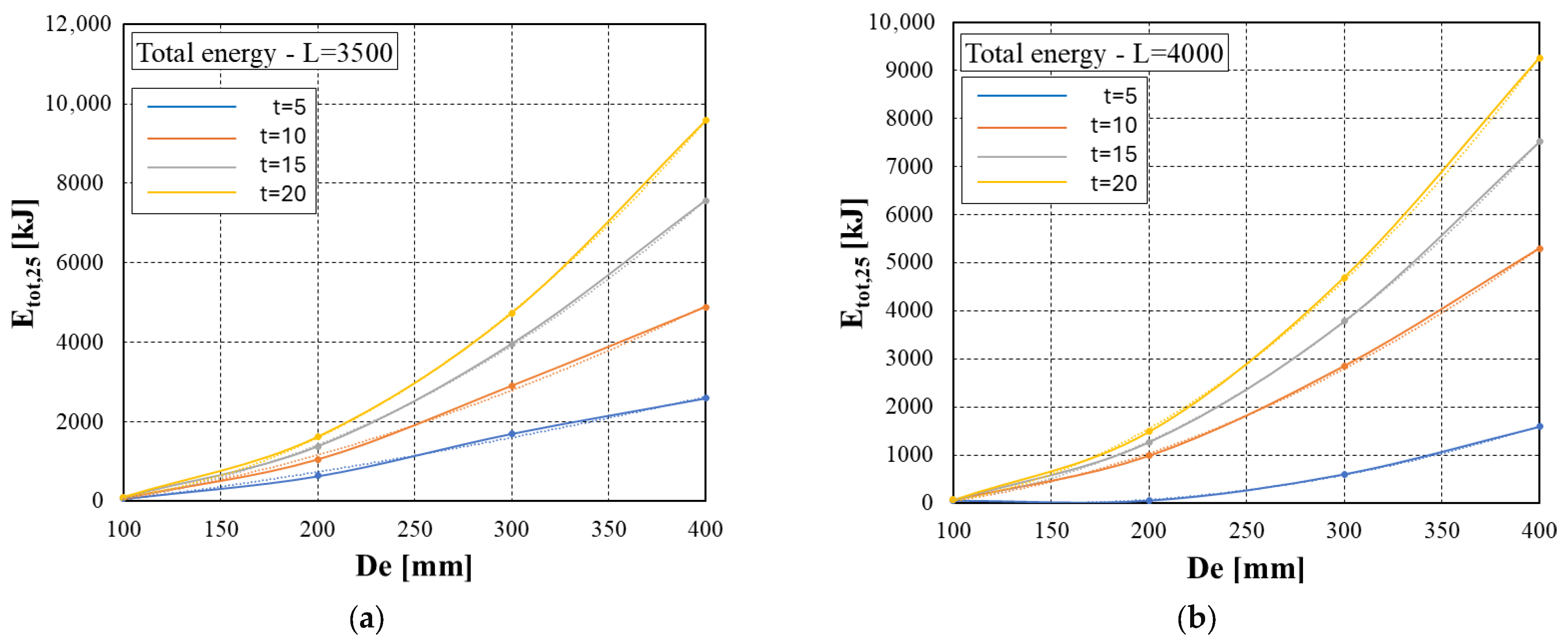
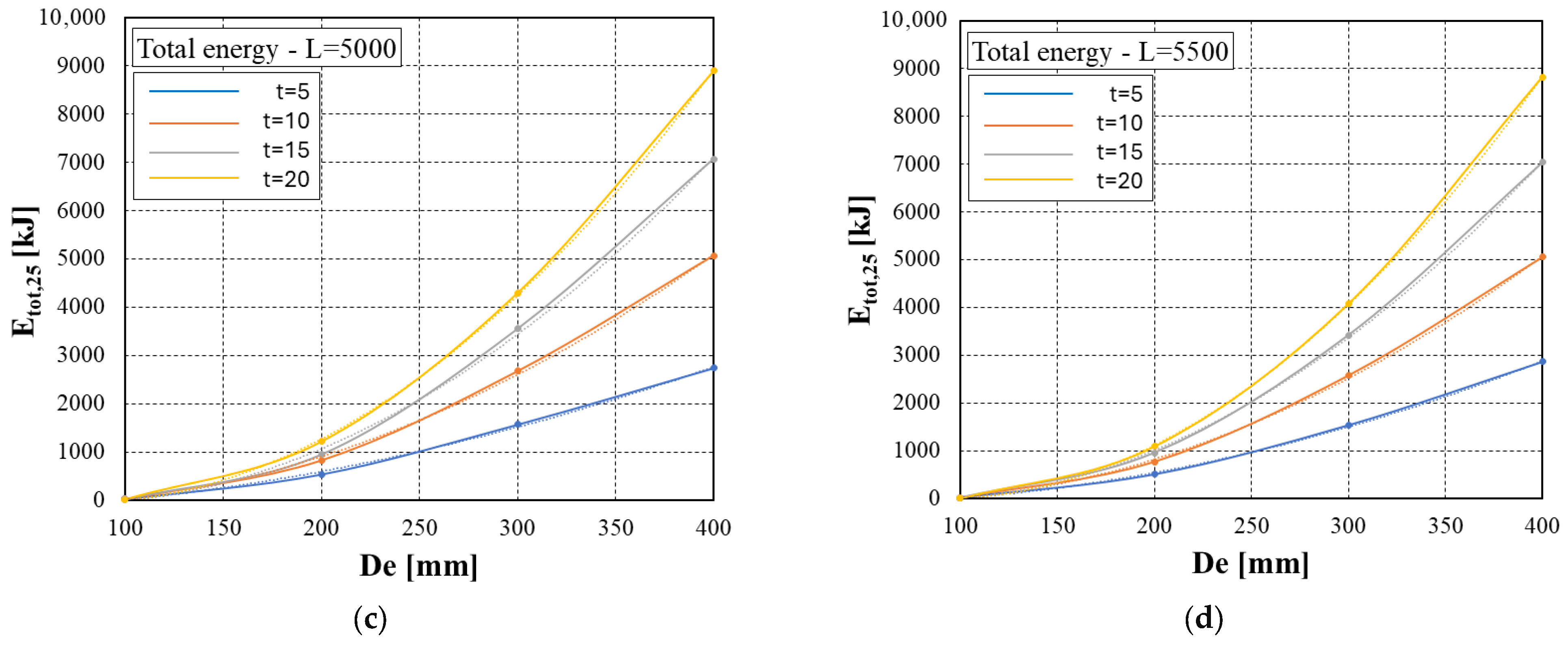
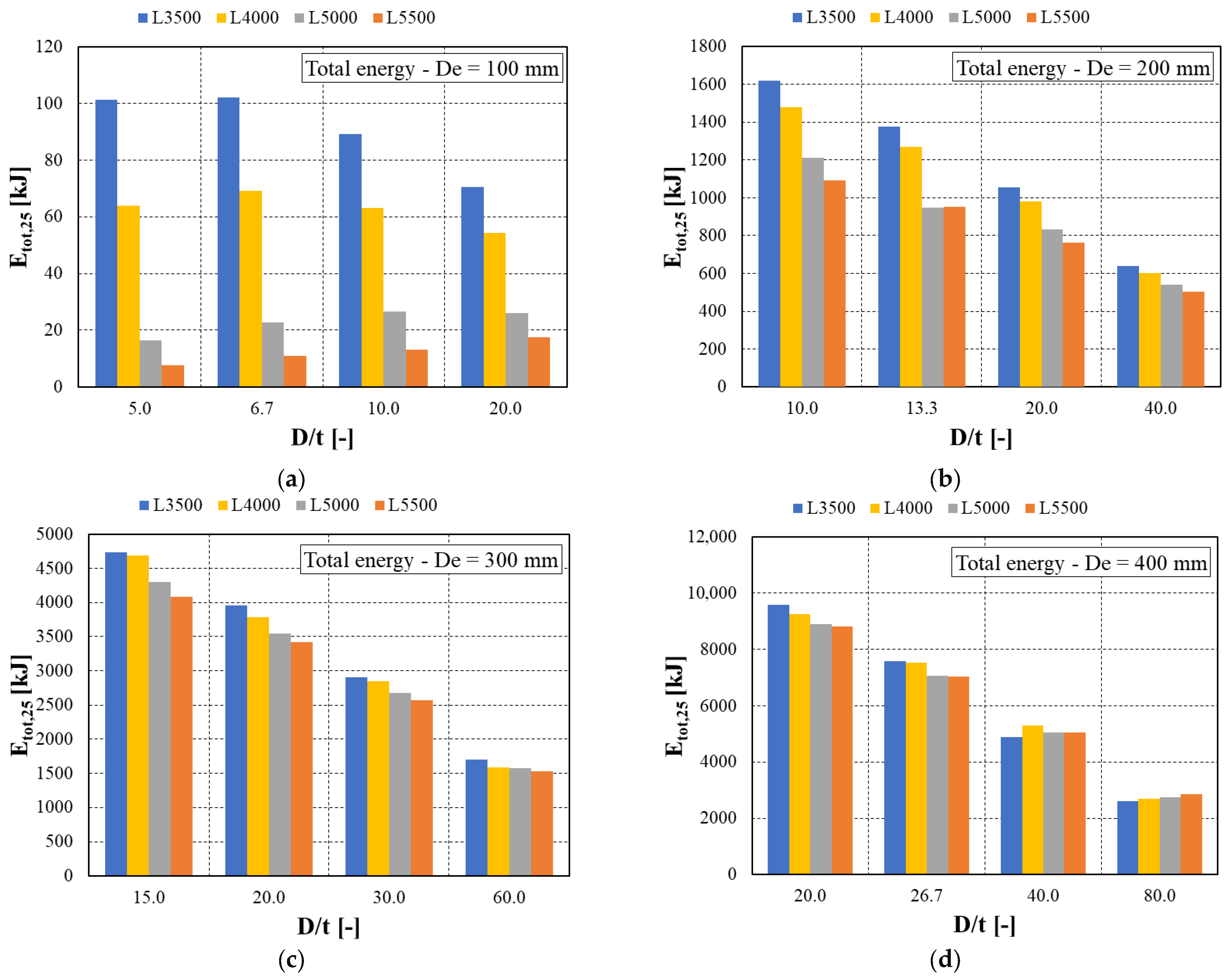
Figure 10a–d and 11a–d report the total dissipated energy over 25 cycles,
, as a function of
and
De for different span lengths and for the four external diameters considered in the study. The selected number of cycles should be interpreted as the loading history associated with a prescribed cumulative chord-rotation demand, adopted as a common reference level for comparative parametric investigation.
For a given external diameter, increasing the span length generally leads to a reduction in . This trend reflects the lower force levels developed by more flexible members under the same imposed chord rotation and, consequently, a lower hysteretic energy dissipation over the loading history. The effect is particularly evident for the smallest diameters, where the difference in between short and long spans is more pronounced. As the external diameter increases, the dispersion among the various lengths progressively decreases, indicating that the sensitivity of energy dissipation to span length becomes less marked for stockier CFT beams.
At a fixed span length, moving towards higher values, i.e., towards thinner steel tubes at constant diameter, generally results in a reduction in , especially for the larger diameters. This behaviour is consistent with the lower bending resistance and reduced plastic capacity of more slender cross-sections, which limit the hysteretic force level and therefore the total dissipated energy. Conversely, lower values, corresponding to thicker and more compact sections, promote larger force demands and more extensive inelastic activity in the plastic hinge region.
The influence of the outer diameter and wall thickness can be observed more clearly in
Figure 11, where
is plotted against
for different thicknesses at a fixed span length. For all the considered lengths,
increases markedly with increasing external diameter, and this trend is consistently observed for all thickness values. For a given diameter, thicker tubes systematically exhibit higher dissipated energy, since the larger steel area mobilises greater bending resistance and allows for a more pronounced hysteretic response to develop under the imposed cyclic rotation.
The coefficients of the polynomial fitting curves of equation
are reported in
Table 8. In all cases, the corresponding
values were practically equal to 1, indicating an excellent fit of the numerical data over the investigated range.
These results indicate that the energy dissipation capacity is strongly governed by the combined effect of cross-sectional size, wall thickness and member length. Larger and stockier members tend to dissipate more energy within the investigated demand layer, whereas longer and more slender members dissipate less. However, a larger should not be interpreted by itself as a better cyclic performance, since higher dissipation may also be associated with more severe local plastic concentration and stronger degradation mechanisms. For this reason, the energy results must be interpreted together with the degradation trends discussed in the following section.
Within the present response layer, the observed distribution therefore provides a first quantitative description of the dissipative capacity of the investigated CFT members, while the subsequent degradation analysis is required to distinguish between highly dissipative yet strongly degrading configurations and more stable, less dissipative responses.
5.3. Trends in Strength Degradation
While the dissipated energy discussed in the previous section provides a measure of the global cyclic dissipation capacity, the degradation index is introduced here to quantify the loss of resisting capacity that accumulated over the imposed loading history. Within the present demand layer, this indicator allows the numerical response to be interpreted not only in terms of energy absorption, but also in terms of residual mechanical performance after repeated inelastic cycles.
In the framework adopted in this study, the degradation response may be formally interpreted as a function of the geometric parameters under a fixed cyclic demand, namely:
where
,
and
define the CFT geometry, while
and
identify the fixed loading layer considered in the present work. Accordingly, the following discussion refers to a specific section of a broader degradation domain and should not be interpreted as a complete general description of CFT cyclic behaviour.
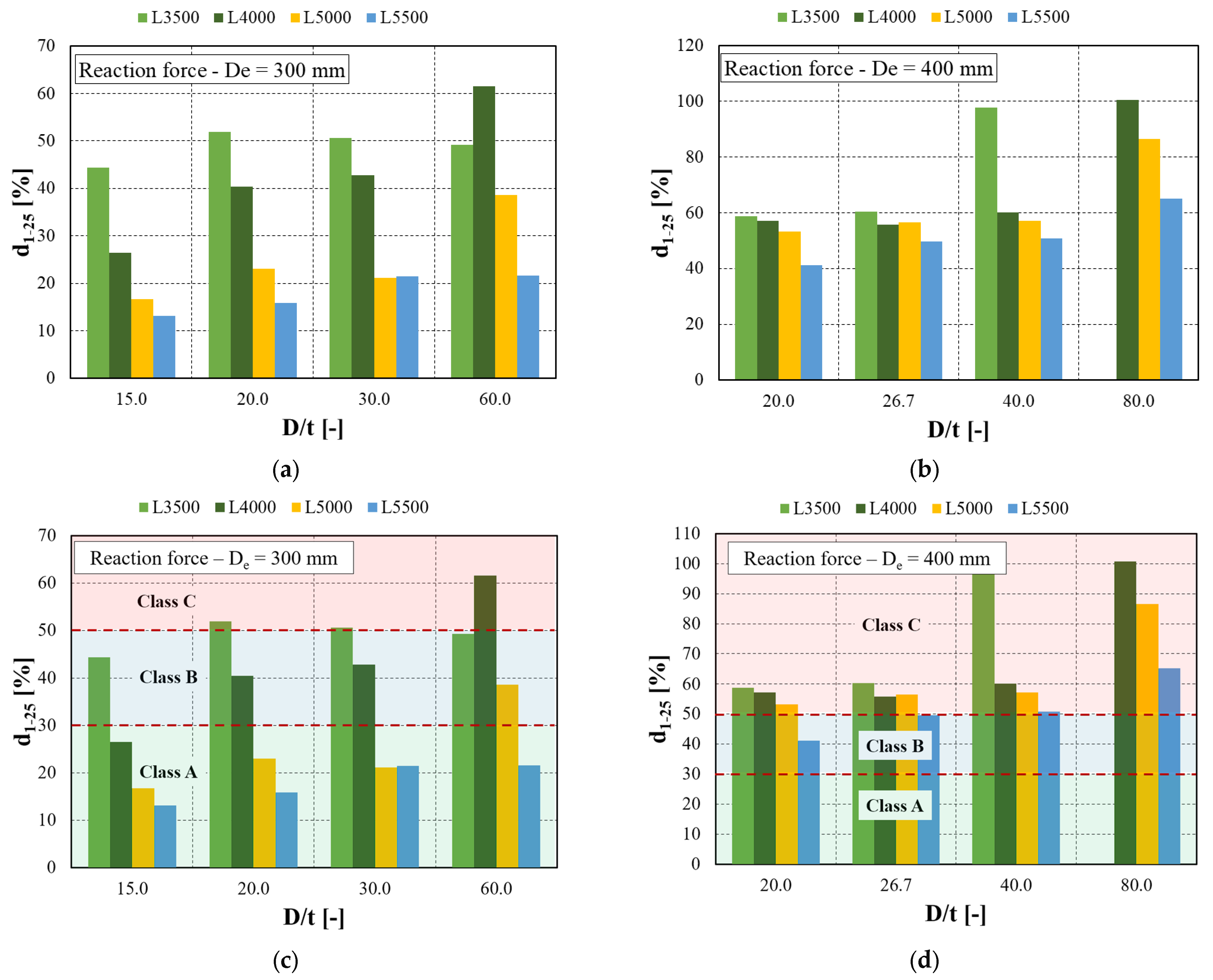
Figure 12a,b show the distribution of
over the investigated geometric domain. In general, the degradation index highlights a response pattern complementary to that observed for the dissipated energy. Configurations capable of developing higher hysteretic dissipation may also exhibit stronger local plastic concentration and a more pronounced reduction in force capacity by the end of the loading sequence. For this reason,
represents an essential counterpart to
in the interpretation of cyclic response.
For a fixed external diameter, increasing the span length generally leads to higher values of , reflecting the greater flexibility of the member and the more severe accumulation of inelastic demand in the plastic hinge region. Similarly, increasing the diameter-to-thickness ratio tends to promote larger degradation levels, since thinner steel tubes are more sensitive to local damage accumulation and progressive strength loss under repeated cycling. Conversely, shorter members and stockier cross-sections tend to preserve a more stable resisting response within the investigated loading layer.
On the basis of the obtained values, the numerical results were grouped into three comparative classes, denoted as A, B and C.
The strength degradation measure was also used to define comparative performance classes and to construct degradation maps as a function of the geometric parameters. In
Figure 9, the background of each chart is divided into three coloured bands corresponding to three degradation classes: Class A (limited degradation) for
, Class B (moderate degradation) for
, and Class C (severe degradation) for
. With this definition, the histograms can be interpreted as performance maps in the
domain for the selected chord rotation and number of cycles.
For
mm (
Figure 12c), the degradation generally ranges between approximately 10% and 60%, so that the configurations associated with longer spans and intermediate
values mostly remain within Classes A and B. By contrast, shorter members with lower sectional slenderness, i.e., smaller
, tend to shift towards the upper bands, entering Class B or even Class C. This indicates that the combination of a short span and stockier cross-section promotes a more severe loss of resisting capacity after 25 cycles. Increasing either the span length or the diameter-to-thickness ratio generally shifts the response towards the lower bands, with a larger proportion of specimens remaining within the limited or moderate degradation classes.
For
mm (
Figure 12d), the bars are predominantly located in the upper portion of the chart, with strength losses typically ranging between 50% and 100%. In this case, almost all configurations belong to Classes B and C, and a significant number of them fall within the severe degradation range. This confirms that increasing the external diameter, without a corresponding increase in wall thickness or a reduction in span length, leads, under the same imposed chord rotation, to higher force demand and therefore to a more pronounced accumulation of damage in the plastic hinge region.
The adopted classes A, B and C are intended as comparative classification bands within the present dataset and loading layer, rather than as universal behavioural categories or code-based classes. Their role is to provide a synthetic interpretation of the numerical response over the investigated geometric grid and to support the construction of the corresponding performance maps. In this sense, the present classification should be regarded as a first organisation of one response layer of a broader degradation domain.
In a more general form, the degradation response may be written as:
where
denotes a generic cumulative inelastic-demand variable. Repeating the same automated procedure for different values of imposed chord rotation, or more generally for different levels of cumulative plastic demand, would progressively populate additional layers of this domain and could eventually lead to a broader behavioural description of strength degradation as a joint function of geometry and loading history.
From a modelling perspective, such an extension could support the derivation of simplified analytical laws for degrading cyclic response. In a general form, a degrading analytical moment law may be expressed as:
where
is the monotonic envelope moment–rotation law associated with the considered geometry, and
is a degradation function, with
, accounting for the progressive reduction in strength as the cumulative plastic rotation demand increases. Within this perspective, the present FE results can be interpreted as one calibrated response layer of a broader methodology aimed at deriving simplified degrading analytical relationships from systematically generated numerical data.
6. Conclusions
This work presented a Python-based automated finite element framework for the damage-informed investigation of the low-cycle cyclic bending response of concrete-filled steel tubes (CFTs). The proposed procedure was implemented within the Abaqus Scripting Interface and was developed to automate the full numerical workflow, including model generation, parameter updating, job execution, numerical verification and post-processing of the results. In this sense, the main contribution of the study lies not only in the parametric FE application itself, but also in the development of a reproducible scripting strategy capable of transforming a validated nonlinear FE model into a general computational framework for systematic cyclic analysis.
The workflow was applied to an extensive parametric campaign involving code-based material properties, four external diameters, several diameter-to-thickness ratios and span lengths, under a fixed chord rotation and 25 constant-amplitude cycles. Within this setting, the numerical response was synthesised through two performance indicators, namely the total dissipated energy over 25 cycles and the strength degradation index , defined from the loss of reaction force between the first and the twenty-fifth cycle. These quantities were then used to construct performance maps in the space and to organise the results into comparative degradation classes.
The main findings can be summarised as follows:
The developed Python workflow proved effective in automatically generating, executing and post-processing a large number of nonlinear FE analyses in a consistent and traceable manner, significantly reducing the manual effort required by a conventional Abaqus/CAE-based procedure.
Within the investigated loading layer, geometric slenderness strongly influenced the cyclic response. For a given external diameter, longer spans generally dissipated less energy but also experienced lower strength degradation, whereas shorter and stockier members showed higher energy dissipation together with more severe loss of resisting capacity.
At fixed span length, increasing the external diameter and/or the wall thickness enhanced the dissipative capacity of the member, with larger and less slender sections generally exhibiting the highest values of total dissipated energy within the investigated demand layer.
The degradation measure highlighted a complementary trend. Configurations combining short spans and low ratios were more likely to undergo severe degradation, whereas longer spans and intermediate values were more commonly associated with limited or moderate strength loss under the same imposed loading history.
The degradation classes introduced in the study were defined as follows: Class A for , Class B for , and Class C for . Within the analysed domain, the cases with mm generally exhibited degradation values between about 10% and 60%, while for mm the strength loss typically ranged between 50% and 100%, with most configurations falling within Classes B and C.
The proposed degradation classes and associated histograms should be interpreted as comparative performance bands defined within the present dataset and loading level. They do not represent universal behavioural classes, but rather one possible way of organising the numerical response over the investigated geometric grid. More broadly, the results presented in this work should be regarded as one response layer within a wider multidimensional performance domain. Since the cyclic demand was fixed, the obtained maps and degradation classes represent only one section of a more general response space.
Repeating the same automated procedure for additional values of chord rotation, number of cycles, or cumulative plastic demand would progressively populate further layers of this domain, enabling a richer description of cyclic degradation as a joint function of geometry and loading history. Within this perspective, the proposed framework may provide the basis for future derivation of simplified analytical degrading laws, such as moment–rotation or moment–curvature relationships parameterised by cumulative plastic demand. The present study should therefore be interpreted as the first computational layer of a broader methodology aimed at bridging detailed FE simulations, automated parametric analysis and the simplified analytical modelling of degrading cyclic response in CFT members.