Communication

Enhancing Two-Photon Polymerization Productivity: Beam Shaping and Parallelization via Spatial Light Modulators


by
Jaime Cuartero
,
Nerea Otero
and
Francisco Gontad
*
AIMEN Laser Technology Centre, Polígono Industrial de Cataboi SUR-PPI-2 (Sector) 2, Parcela 3, ES-36418 O Porriño, Spain
*
Author to whom correspondence should be addressed.
J. Manuf. Mater. Process. 2026, 10(6), 182; https://doi.org/10.3390/jmmp10060182
Submission received: 12 March 2026 / Revised: 24 April 2026 / Accepted: 20 May 2026 / Published: 22 May 2026

Abstract

Two-Photon Polymerization (2PP) has been established in recent decades as one of the most promising additive manufacturing processes for the fabrication of freeform 3D micro- and nanostructures. In 2PP, the photochemical reaction, induced by the absorption of the energy of two photons, is confined to a small and well-defined region of the space known as voxel, enabling the manufacture of 3D features with high accuracy and resolutions in the submicrometric range. Unfortunately, 2PP shows some drawbacks, among which its low productivity appears as one of its main limitations nowadays. In this regard, different approaches have recently been explored aiming at increasing 2PP throughput, like the use of Spatial Light Modulators (SLMs), which allows dynamically adjusting the shape of the laser beam into different geometries, patterns or even complex images. In this work an experimental 2PP setup comprising a femtosecond visible laser in combination with high accuracy linear stages and different optical solutions including an SLM has been used to explore the improvement achieved in productivity and additional advantages for the manufacturing of different 2.5 and 3D microstructures. A commercial photoresist has been used as base for these experiments, adjusting its photoinitiator content to obtain the optimal sensitivity to the wavelength provided by the laser.

1. Introduction

Additive manufacturing (AM) is a field of great interest today, with applications across multiple sectors due to the immense possibilities it offers for producing prototypes and small batches of customized 3D parts [1]. Within AM, several categories are officially recognized by the American Society of Testing and Materials (ASTM) [2], including some of the most extended solutions based on the solidification of liquid resins layer by layer through the absorption of light. This reaction is commonly known as photopolymerization, while the corresponding techniques are categorized as Vat Photo-Polymerization (VPP) processes [3].
Among VPP methods, stereolithography (SLA) is nowadays one of the first and most commercially adopted techniques thanks to its great accuracy, resolution and surface finish compared to other additive manufacturing technologies [4,5]. In SLA the polymerization is achieved by the absorption of the energy of a single photon emitted by an ultraviolet light source within a small region of the space known as voxel (volumetric pixel). The highly energetic nature of the process that triggers SLA photopolymerization limits the minimum achievable size of this voxel and, consequently, the layer depth and resolution. Conventional SLA systems usually offer resolutions in the range of tens or hundreds of microns [5,6,7,8], thus making it necessary to find different approaches when accuracy in the order of a micron or even below it is required. In order to address this limitation, Multi-Photon Polymerization (MPP) and particularly Two-Photon Polymerization (TPP) arise as potential alternatives for printing micron-sized parts with extremely high accuracy and lateral and vertical resolutions in the range of nanometres [8]. This possibility opens a huge range of applications in multiple fields like photonics [9,10,11,12], microbotics [13], microelectronics [14] and biomedicine [15,16,17].
In contrast to traditional VPP technologies which involve high-energetic photons coming from an ultraviolet light source, 2PP makes use of laser sources with longer wavelengths that enable the photopolymerization by the cumulative contribution of two photons, restricting in this way the volume of cured material, commonly called voxel in 2PP, to the region where the volumetric density of photons is high enough so the probability of the cumulative effect is large enough [18]. Hence, since the region where this probability is significant is much smaller than the beam waist, the resolution of the features that can be fabricated is several orders of magnitude smaller than in the case of traditional methods [18]. However, the increase in resolution has a negative impact on the fabrication productivity, since the fabrication of any targeted design requires the volumetric scan of the resin with a voxel that is much smaller than in the case of traditional VPP. There are several alternatives for overcoming this issue, mainly the use of fast scanning strategies [19], or the use of advanced optical parallelization approaches, like the use of Diffractive Optical Elements [20] or Spatial Light Modulators [21]. This work follows the parallelization approach as the main option to boost the productivity of 2PP for the fabrication of optical metasurfaces; in particular, the use of SLMs in image mode is explored to increase the fabrication speed of meta-atoms designed for different optical functions, while keeping the resolution granted by 2PP. In this way, this work explores the fabrication of 3D metasurfaces (using meta-atoms of different sizes), which is a subject of increasing interest [22], in a single fabrication layer approach, targeting the fabrication of different metaatom sizes by individual voxel size modulation through a controlled radiation dose. The new approach will enable the fabrication of 3D metasurfaces without the need for multilayer fabrication.

2. Materials and Methods

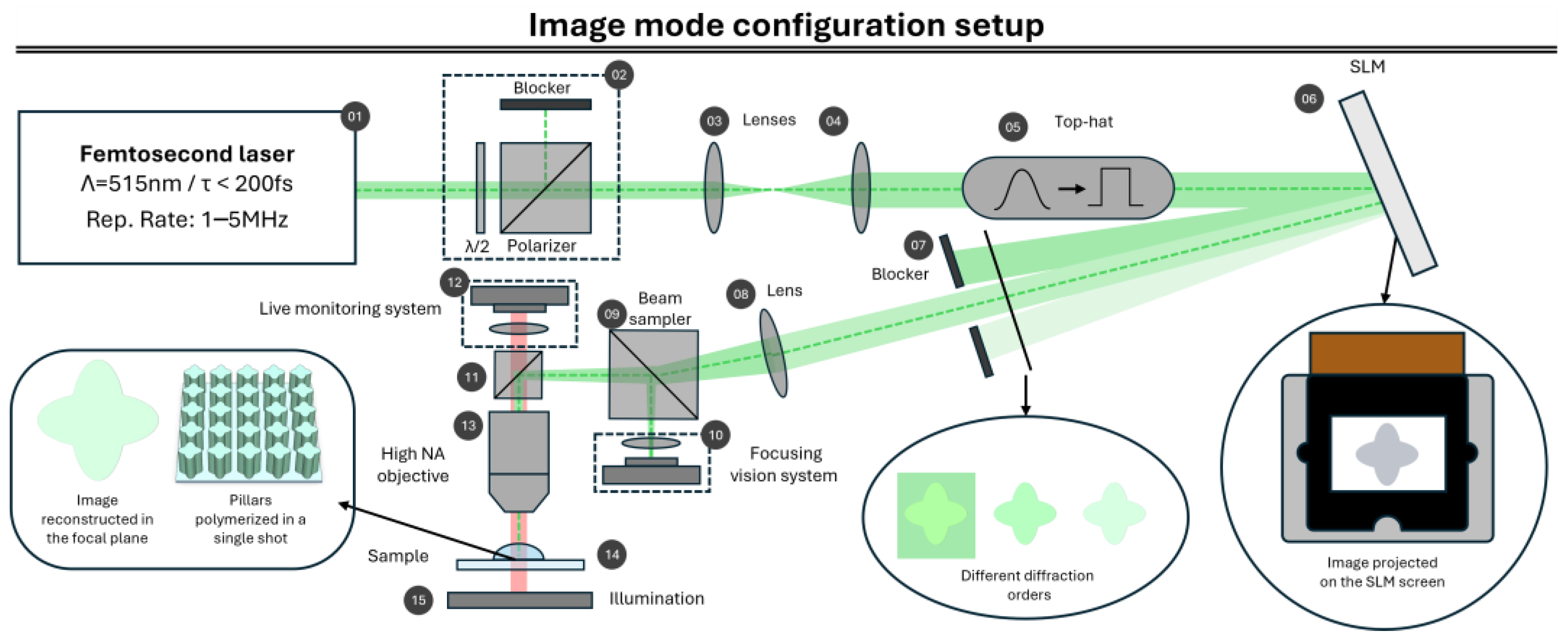
Experiments were conducted using an EKSPLA FemtoLux3 femtosecond laser source (Vilnius, Lithuania) operating in the visible range (515 nm wavelength) with a pulse duration below 200 fs and a tuneable repetition rate between 1 and 5 MHz. The laser’s original average power of 1.5 W is reduced by an attenuation system consisting of a waveplate and a polarizer, allowing precise adjustment to the low energy levels required to attain a controlled polymerization. The laser beam is then expanded and passed through a top-hat filter to ensure homogeneous illumination of the Holoeye pluto-2.1 Spatial Light Modulator (SLM) (Berlin, Germany) screen with a resolution of 1920 × 1080 pixels. The SLM modulates the amplitude and phase distribution of the incoming beam, shaping the outgoing beam according to the projected amplitude image. Among the multiple diffraction orders reflected from the SLM, the one selected based on resolution and intensity is directed towards a final lens, which then focuses the beam through a high Numerical Aperture (NA) microscope objective (magnification ×40, NA 0.95). This results in a tightly focused spot, producing a reduced voxel (with a size dependent on the radiation dose) where photopolymerization occurs.
Additionally, two vision systems are integrated for different purposes. The first system, featuring a monochrome camera, facilitates the initial focusing of the beam across the sample. The second system, consisting of an RGB camera, an illumination device and a notch filter to block the laser wavelength, enables real-time monitoring of the polymerization process during fabrication. The setup also includes a piezoelectric axis for accurate focusing and high-resolution linear stages for the positioning and movement of the sample. A simplified scheme of the introduced setup is presented in Figure 1.
During the experiments, a commercial resin developed and distributed by Micro Resist Technology GmbH (Berlin, Germany) was used. Among the options available in their catalogue, OrmoComp® was selected due to its great balance between achievable resolution and the optical and mechanical properties of this material after polymerization. For this series of experiments, a preparation of OrmoComp® with a 2% of Irgacure OXE02 as photoinitiator (PI) was used. This PI renders the hybrid photoresin, originally intended for UV, sensitive to the 515 nm wavelength of the laser.
The laser was focused onto the glass substrate through the resin, using different laser powers and exposure times to modify the size of each individual voxel. In this way, the microstructures were fabricated with a fixed z, modulating their height just by using different radiation doses, and so, different voxel vertical sizes.

2.1. Sample Preparation

Samples were prepared by the deposition of thin layers of resin over a microscope cover glass. For this purpose, two different deposition methods were initially explored: using a doctor blade or spin-coating. Two dilutions of the original resin recipe were prepared adding acetone in different percentages (2:1 and 1:1) to obtain different layer thicknesses. Thicker films were used to analyze the height control of the fabricated microstructures.

2.2. Targeted Structures

Arrays of different geometries, pillars, squared boxes and annular structures, were chosen as targeted structures due to their use as meta-atoms in metaoptics, as shown in previous theoretical studies carried out by Tsilipakos et al. [23]. All the arrays were fabricated through the projection of the targeted pattern displayed on the SLM, with the aim of increasing the productivity of 2PP by dynamic beam shaping. The resin layer was exposed to different doses by adjusting the laser power and frequency, which define the energy emitted per pulse, and the exposure time, getting different meta-atom lateral sizes and heights.

2.3. Development Procedure

Once the printing process is completed, the non-polymerized liquid resin should be removed leaving the fabricated structures over the glass substrate. Cleaning is performed by immersion of the samples into a 1:1 dilution of iso-propanol and iso-methyl-butyl-ketone for several minutes. Then the samples are rinsed again with isopropanol and distilled water to completely remove any remaining resin residues. For those samples containing structures with a high aspect ratio, a supercritical drying system is available to clean the samples, avoiding the collapse of the printing.

2.4. Samples Characterization

For the assessment of the printed structures a Sensofar® S neox 3D optical profiler (Terrassa, Spain) was used to evaluate the lateral and vertical resolution through the reconstruction of the topographical profile. Additionally, detailed images of the surfaces covered by the printed microstructures were also acquired with a scanning electron microscope (SEM). For this purpose, samples were coated with an ultrathin layer of gold (X nm) deposited by low-vacuum sputter coating, electroless deposition or high-vacuum evaporation, rendering the specimens electrically conductive.

3. Results

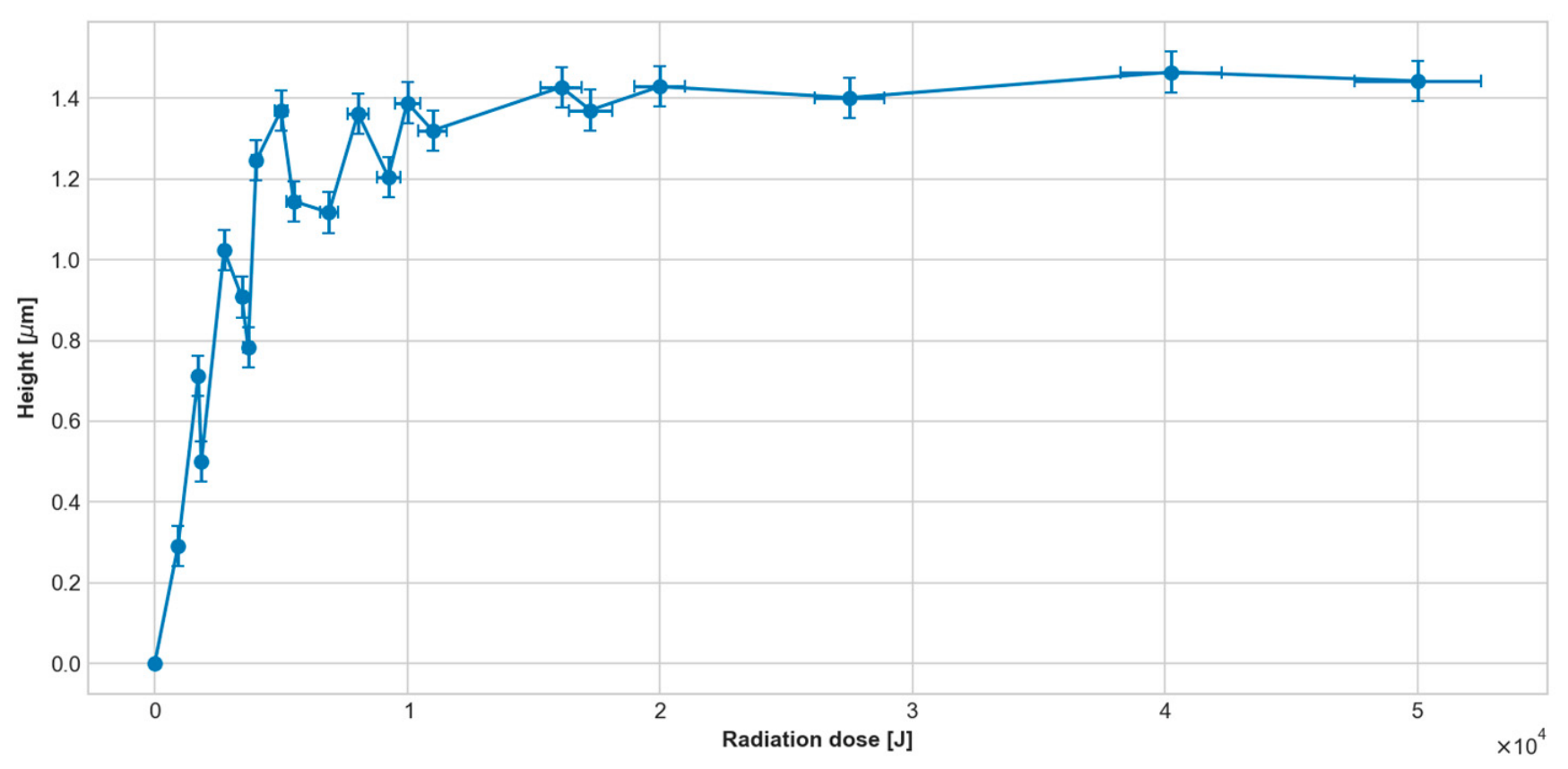
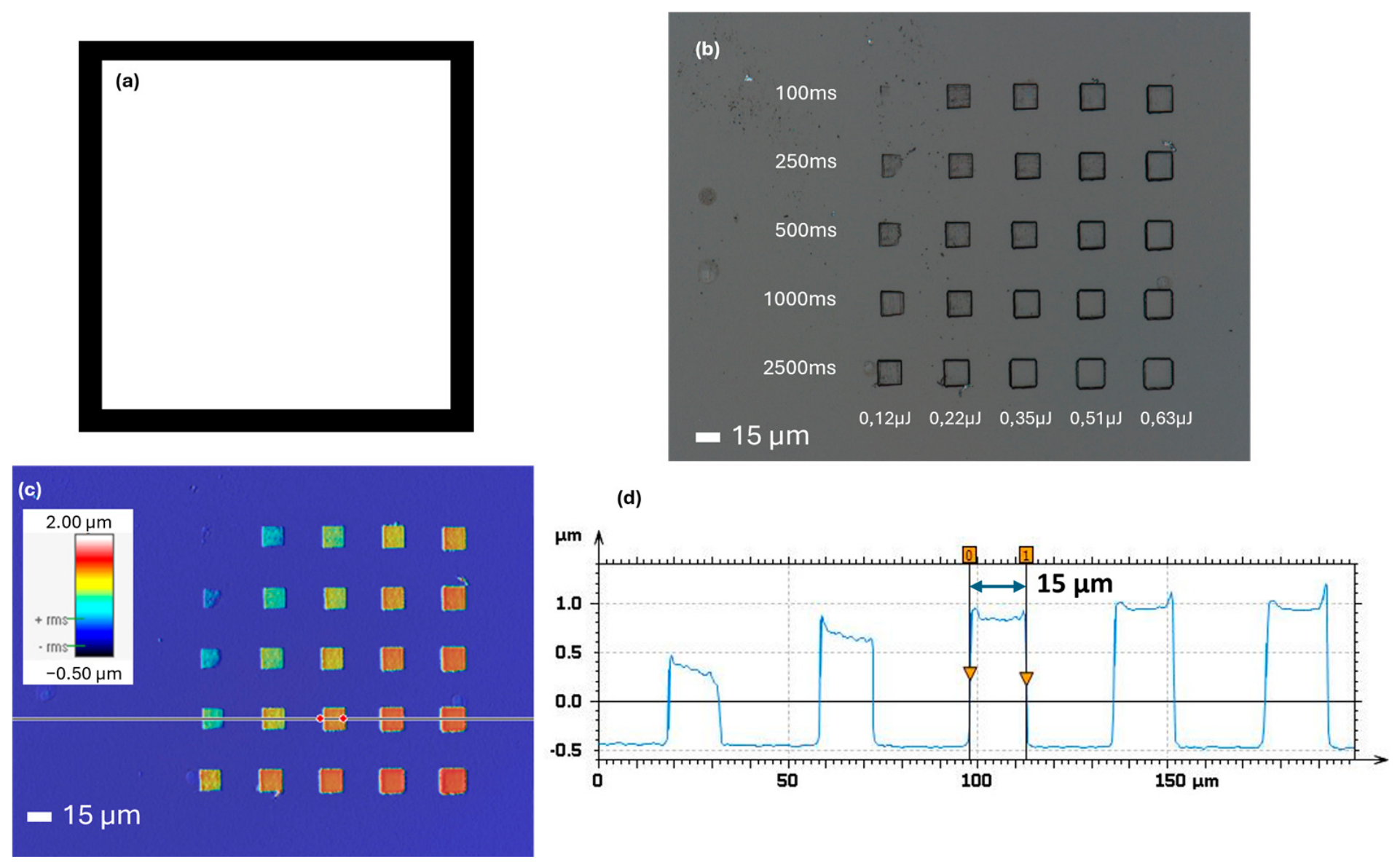
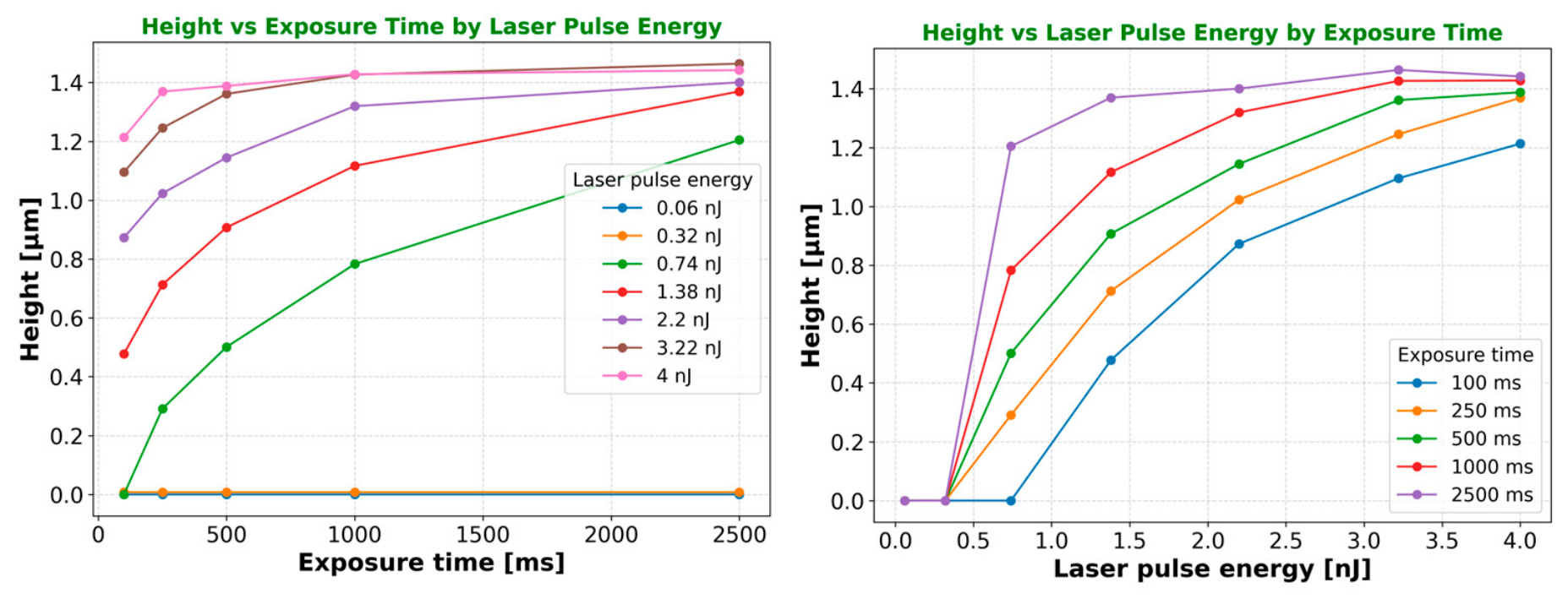
The initial trials aimed to identify the optimal process parameter window to perform TPP with the assembled SLM-based setup. In this regard, squared boxes were fabricated by projecting a squared white pattern in the resin, using different laser energies and exposure times, as shown in Figure 2. It was found that the use of exposure times between 100 and 2500 ms, with pulse energies between 0.12 and 0.65 μJ, enabled the fabrication of the squared boxes with good height control, between 0.25 and 1.5 μm. In fact, Figure 3 shows how, for each exposure time used in the fabrication window, the height of the microstructure grows with the laser pulse energy until it reaches a plateau, which can be attributed to a saturation of crosslinking effect inside the resin. As expected, this saturation effect appears at lower pulse energies with increasing exposure times, indicating there is a relationship between the height of the structures and the radiation dose (estimated as energy per pulse × rep. rate × exposure time, as shown in Figure 4). In addition, a tendency regarding the XY dimensions of the printed structures was also observed, with longer and more energetic exposures resulting in wider pillars. Nevertheless, the percentage difference in the lateral dimensions of the structures fabricated using the minimum and maximum radiation doses within the selected parameter window was considerably smaller than that observed for height. This finding indicates that, although the lateral dimensions of structures produced by pattern projection with the SLM can be controlled to some extent, the technique provides a more precise control over the height of the structures.
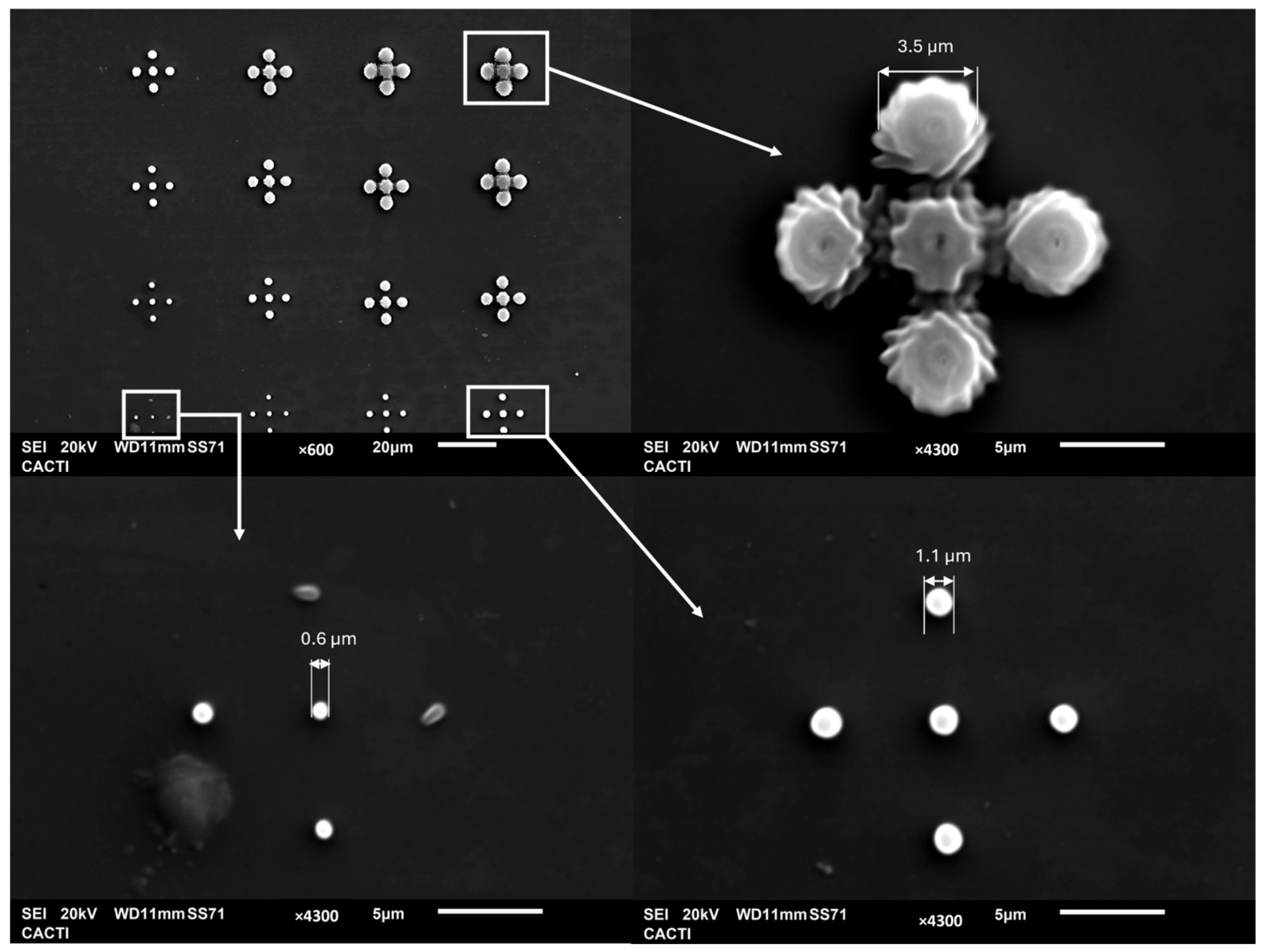
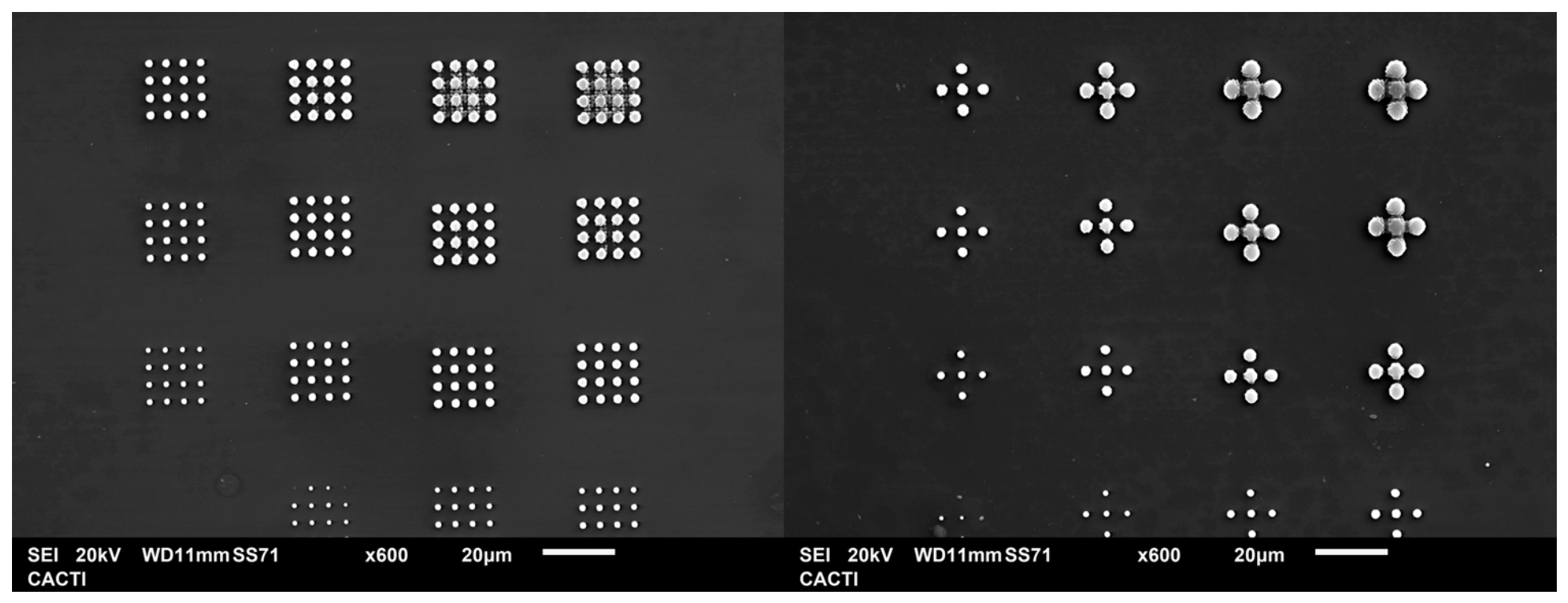
Once the adequate processing window for the fabrication of parallel structures with different heights was established, this study was extended to the fabrication of arrays of multiple smaller pillars in a single exposure. To this end, different images were projected onto the SLM screen, composed of different distributions arrays of points with different diameter–separation ratios, as the two SEM images show in Figure 5. These distributions of points were fabricated with different energy per pulse (0.6–4 nJ) and exposure time (100–2500 ms), in order to analyze the impact of the radiation dose on the size and shape of the individual pillars.
There is a clear relationship between the lateral size of the pillars fabricated by parallel TPP and the radiation dose, as can be seen in Figure 5. By increasing the exposure time, pulse energy, or both in turn, the diameter of the pillars increases considerably, from 0.6 up to 3.5 μm. The shape of the pillars is affected by the irradiation dose as well. While the pillars fabricated with lower exposure times or pulse energies have a circular shape, pillars fabricated with larger irradiation doses present irregular edges, as can be clearly seen in the top-right SEM micrograph of Figure 6. The minimum achievable lateral size within the fabrication window seems to be around 600 nm, since pillars with smaller sizes do not resist the development process. In fact, the pillars with a diameter below 600 nm fall after fabrication. Another interesting point that can be observed in Figure 6 is the fact that the lateral size can be controlled between 0.6 and 1.2 μm, through single exposure. The pillars fabricated within this diameter range present a circular and uniform shape, with the only difference being the diameter that, as shown in the same figure, can be controlled by adjusting exposure time and pulse energy. However, larger irradiation doses resulted in the appearance of cross-linking effects between adjacent structures, leading to the deformation of the pillar shapes and, in the most critical cases, the interconnections between pillars, as can be seen in the top-right image of Figure 6. This cross-linking effect can be attributed to two main effects acting simultaneously. By increasing the irradiation dose, the appearance of large undesired illuminated areas between adjacent pillars can reach the photopolymerization threshold, which in turn is reduced by the overpolymerization of the pillars, as shown in the micrograph.
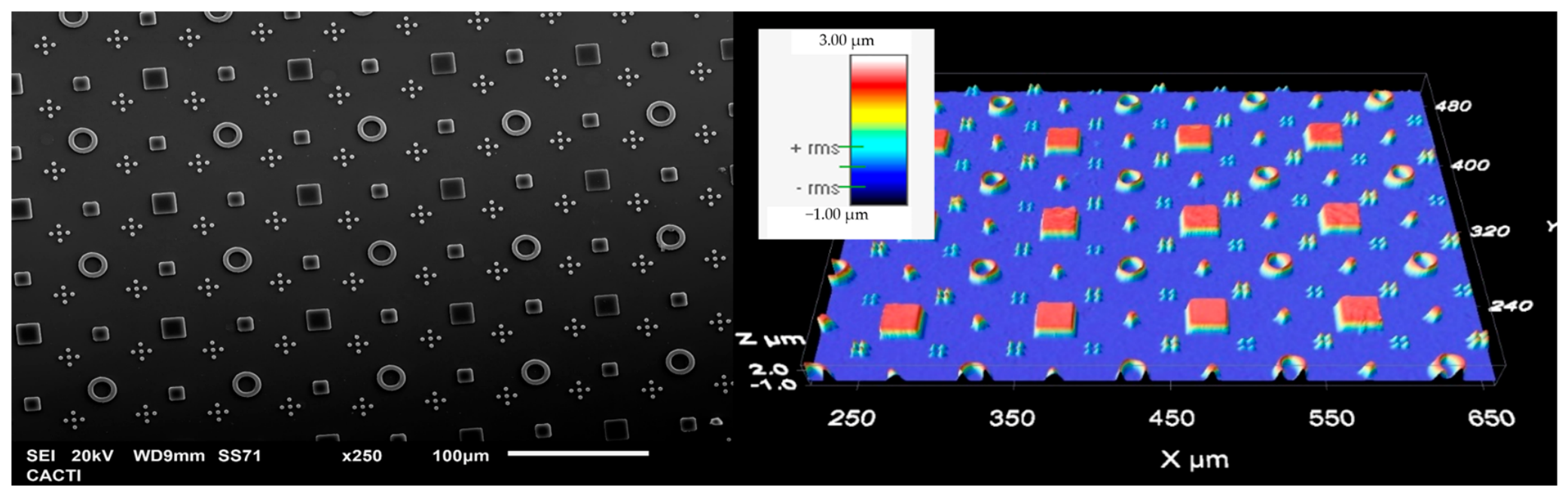
A further study to analyze the repeatability of the size of the fabricated structures was carried out by fabricating three different patterns (Figure 7) over an area of 20 × 20 mm2. The first pattern was the same crossed distribution of pillars with an approximate diameter of 3 μm, using in this case a larger pillar distance. The second pattern was an annular structure, which are commonly used meta-atoms for meta-optics and meta-antennas. The third pattern was a square box, which was fabricated with two different sizes. These structures were fabricated by using the same exposure time and pulse energy and flashing the crossed pattern on different places of a sample with a size of 20 × 20 mm2. All the fabricated structures presented a similar shape (for each pattern), without apparent deviations in their size. In fact, a statistical analysis of the diameter of the fabricated pillars showed a mean diameter of 3.16 μm with a standard deviation of 0.35 μm. On the other hand, the height of the fabricated structures presented a uniform distribution, as can be clearly seen in the confocal image of Figure 7.

4. Conclusions

The presented findings demonstrate that TPP can be efficiently parallelized by using SLMs maintaining the resolution but increasing the technique throughput. The height and lateral size of the fabricated microstructures can be controlled by selecting the adequate exposure time and pulse energy. Overexposure can lead to the fabrication of microstructures with irregular edges, and even to the appearance of a cross-linking effect between adjacent structures. Once the adequate processing parameters within the fabrication window are selected, microstructures with different shapes can be fabricated by using SLMs in imaged configuration, obtaining a deviation in size around 10% over an area of at least 20 × 20 mm2. In summary, this work demonstrates that SLMs can be used to fabricate parallel microstructures of different shapes and sized with a good repeatability, enabling the fabrication of 3D metasurfaces in one single scanning layer.

Author Contributions

Conceptualization, F.G.; validation, J.C.; investigation, J.C.; writing—original draft preparation, J.C.; writing—review and editing, J.C., N.O. and F.G.; visualization, N.O.; supervision, F.G.; project administration, N.O. and F.G.; funding acquisition, N.O. All authors have read and agreed to the published version of the manuscript.

Funding

This project has received funding from the European Union’s Horizon Europe Research and Innovation Programme under Grant Agreement No. 101091644. FABulous is a Research and Innovation Action (RIA) started in December 2022 that will run until November 2026. The project’s EU contribution is €5,475,680.00 on a total budget of €5,475,680.00.

Data Availability Statement

The original data presented in the study are openly available in Zenodo at [10.5281/zenodo.18595766].

Acknowledgments

The authors would like to acknowledge Stefano Chiussi and Adrián Pérez from the University of Vigo for the support with the SEM images, as well as with the discussions on the results of the SEM image analysis.

Conflicts of Interest

The authors declare no conflicts of interest.

References

  1. Calignano, F.; Manfredi, D.; Ambrosio, E.P.; Biamino, S.; Lombardi, M.; Atzeni, E. Overview on additive manufacturing technologies. Proc. IEEE 2017, 105, 593–612. [Google Scholar] [CrossRef]
  2. ASTM International. Standard terminology for additive manufacturing technologies. ASTM Int. 2012, 46, 10918–10928. [Google Scholar] [CrossRef]
  3. Gibson, I.; Rosen, D.; Stucker, B.; Khorasani, M. Vat photopolymerization. In Additive Manufacturing Technologies; Springer: Cham, Switzerland, 2021; pp. 77–124. [Google Scholar] [CrossRef]
  4. Schmidleithner, C.; Kalaskar, D.M. Stereolithography; IntechOpen: London, UK, 2018. [Google Scholar] [CrossRef]
  5. Robles Martinez, P.; Basit, A.W.; Gaisford, S. The history, developments and opportunities of stereolithography. In AAPS Advances in the Pharmaceutical Sciences Series; Springer: Cham, Switzerland, 2018; Volume 31, pp. 55–79. [Google Scholar] [CrossRef]
  6. Pham, D.T.; Gault, R.S. A comparison of rapid prototyping technologies. Int. J. Mach. Tools Manuf. 1998, 38, 1257–1287. [Google Scholar] [CrossRef]
  7. Gardan, J. Additive manufacturing technologies: State of the art and trends. Int. J. Prod. Res. 2016, 54, 3118–3132. [Google Scholar] [CrossRef]
  8. Huang, J.; Qin, Q.; Wang, J. A review of stereolithography: Processes and systems. Processes 2020, 8, 1138. [Google Scholar] [CrossRef]
  9. Rykov, A.; Asharchuk, I.; Obydennov, D.; Mumlyakov, A.; Bitkov, M.; Kungurtsev, E.; Trofimov, I.; Shibalov, M.; Sokolov, S.; Ponomarev, R.; et al. Optical polymer aligner fabricated by 2PP for connecting angled fiber to an optical chip. J. Micromech. Microeng. 2025, 35, 105005. [Google Scholar] [CrossRef]
  10. Wang, Z.; Wu, Y.; Qi, D.; Yu, W.; Zheng, H. Two-photon polymerization for fabrication of metalenses for diffraction-limited focusing and high-resolution imaging. Opt. Laser Technol. 2024, 169, 110128. [Google Scholar] [CrossRef]
  11. Serbin, J.; Egbert, A.; Ostendorf, A.; Chichkov, B.N.; Houbertz, R.; Domann, G.; Schulz, J.; Cronauer, C.; Fröhlich, L.; Popall, M. Femtosecond laser-induced two-photon polymerization of inorganic–organic hybrid materials for applications in photonics. Opt. Lett. 2003, 28, 301–303. [Google Scholar] [CrossRef] [PubMed]
  12. Toulouse, A.; Drozella, J.; Motzfeld, P.; Fahrbach, N.; Aslani, V.; Thiele, S.; Giessen, H.; Herkommer, A.M. Ultra-compact 3D-printed wide-angle cameras realized by multi-aperture freeform optical design. Opt. Express 2022, 30, 707–720. [Google Scholar] [CrossRef] [PubMed]
  13. Ryu, J.; D’Amato, M.; Cui, X.; Long, K.N.; Qi, H.J.; Dunn, M.L. Photo-origami—Bending and folding polymers with light. Appl. Phys. Lett. 2012, 100, 161908. [Google Scholar] [CrossRef]
  14. Ganitidis, T.; Athanasiou, M.; Dalakleidi, K.; Melanitis, N.; Golemati, S. Stratification of carotid atheromatous plaque using interpretable deep learning methods on B-mode ultrasound images. In Proceedings of the 43rd Annual International Conference of the IEEE Engineering in Medicine & Biology Society (EMBC); IEEE: Piscataway, NJ, USA, 2021; pp. 1197–1200. [Google Scholar] [CrossRef]
  15. Freeman, M.; Webb, J.G. Edwards SAPIEN™ and Edwards SAPIEN XT™ transcatheter heart valves for the treatment of severe aortic stenosis. Expert Rev. Med. Devices 2014, 9, 563–569. [Google Scholar] [CrossRef] [PubMed]
  16. Marakis, E.; Papamakarios, S.; Farsari, M.; Zacharakis, G. Hybrid photonic circuits for high-precision diagnostics. In Translational Biophotonics: Diagnostics and Therapeutics IV; SPIE: Munich, Germany, 2025; Volume 13934, p. 139343I. [Google Scholar] [CrossRef]
  17. Behlau, F.; Riveiro Rodriguez, A.; Esen, C.; Pou, J.; Ostendorf, A. Fabrication of biodegradable drug-eluting scaffolds by two-photon polymerization. Sci. Rep. 2025, 15, 1322. [Google Scholar] [CrossRef] [PubMed]
  18. Skliutas, E.; Merkininkaitè, G.; Shoji, M.; Wenxin, Z.; Wenyuan, C.; Weiting, D.; Greer, J.; Freynmann, G.; Malinauskas, M. Multiphoton 3D lithography. Nat. Rev. Methods Primers 2025, 5, 15. [Google Scholar] [CrossRef]
  19. Pearre, B.W.; Michas, C.; Tsang, J.-M.; Gardner, T.J.; Otchy, T.M. Fast micron-scale 3D printing with a resonant-scanning two-photon microscope. Addit. Manuf. 2019, 30, 100887. [Google Scholar] [CrossRef] [PubMed]
  20. Arnoux, C.; Pérez-Covarrubias, L.A.; Khaldi, A.; Carlier, Q.; Baldeck, P.L.; Heggarty, K.; Banyasz, A.; Monnereau, C. Understanding and overcoming proximity effects in multi-spot two-photon direct laser writing. Addit. Manuf. 2022, 49, 102491. [Google Scholar] [CrossRef]
  21. Yang, L.; Li, J.; Hu, Y.; Zhang, C.; Lao, Z.; Huang, W.; Chu, J. Projection two-photon polymerization using a spatial light modulator. Opt. Commun. 2014, 331, 82–86. [Google Scholar] [CrossRef]
  22. Hu, S.; Park, C.; Jeong, S.; Jeon, N.; Kim, J.T.; Rho, J. Additive manufacturing of metastructures at the micro- and nano-scale. Chem. Soc. Rev. 2026, 55, 1666–1716. [Google Scholar] [CrossRef] [PubMed]
  23. Tsilipakos, O.; Perrakis, G.; Farsari, M.; Kafesaki, M. Polymeric optical metasurfaces by two-photon lithography: Practical designs for beam steering. In Proceedings of the 18th International Congress on Artificial Materials for Novel Wave Phenomena (Metamaterials 2024); Crete, Greece, 14 September 2024; IEEE: Piscataway, NJ, USA, 2024; pp. 1–3. [Google Scholar] [CrossRef]
Figure 1. Scheme of the TPP setup used during the photopolymerization experiments. Laser path is marked in green. Illumination of the sample with a red LED for inspection purposes is marked in red.
Jmmp 10 00182 g001
Figure 2. TPP parametrization results using SLM to obtain complex pillars. (a) Beam shape captured by the integrated vision system. (b) Optical image of pillar array obtained at 5MHz with different exposure times and energies. (c) 3D confocal image of the microstructures shown in (b), and (d) topographical profile of the squared structures indicated with the horizontal line of (c).
Jmmp 10 00182 g002
Figure 3. Pillar height according to the exposure time and energy per pulse applied.
Jmmp 10 00182 g003
Figure 4. Height as a function of the radiation dose for samples fabricated with a repetition rate of 5 MHz.
Jmmp 10 00182 g004
Figure 5. SEM images of two distributions of arrays fabricated by parallel TPP with increasing laser energy (0.6–4 nJ, from left to right) and exposure time (100–2500 ms, bottom to top).
Jmmp 10 00182 g005
Figure 6. SEM images of pillars fabricated with a crossed distribution at different irradiation doses and detail of three distributions fabricated with small, medium and high irradiation doses.
Jmmp 10 00182 g006
Figure 7. SEM (left) and confocal (right) images of the patterns fabricated for the repeatability analysis.
Jmmp 10 00182 g007
Disclaimer/Publisher’s Note: The statements, opinions and data contained in all publications are solely those of the individual author(s) and contributor(s) and not of MDPI and/or the editor(s). MDPI and/or the editor(s) disclaim responsibility for any injury to people or property resulting from any ideas, methods, instructions or products referred to in the content.