Article

Effect of Pulse Repetition Frequency on Crater Evolution and Surface Integrity in Finishing EDM of 4Cr13 Steel: Numerical and Experimental Investigation

School of Materials Science and Engineering, Shanghai University of Engineering Science, 333 Longteng Road, Songjiang District, Shanghai 201000, China
*
Author to whom correspondence should be addressed.
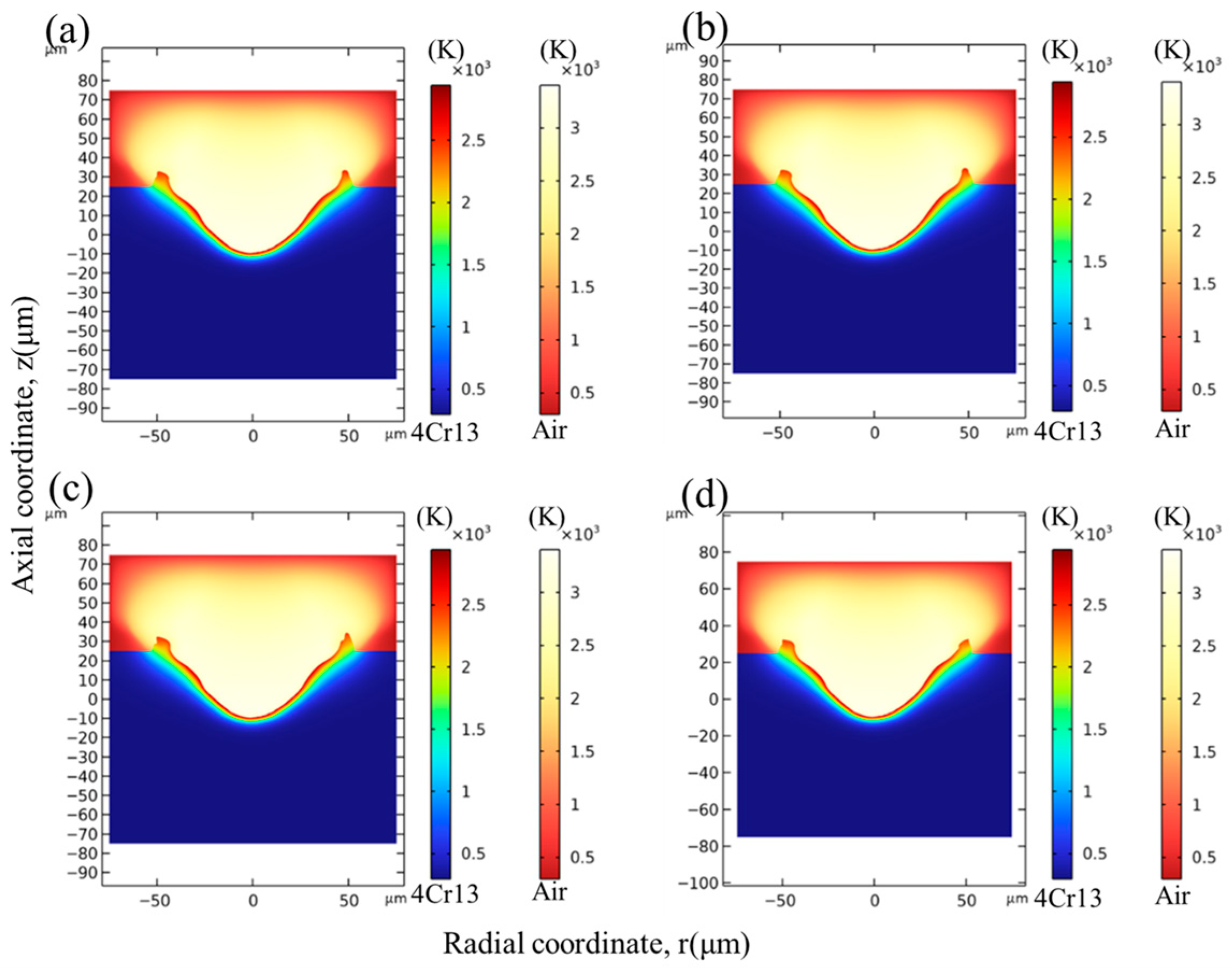
J. Manuf. Mater. Process. 2026, 10(4), 131; https://doi.org/10.3390/jmmp10040131
Submission received: 13 March 2026 / Revised: 9 April 2026 / Accepted: 10 April 2026 / Published: 14 April 2026

Abstract

Pulse repetition frequency (PRF) controls pulse off-time and, therefore, the extent of thermal accumulation, melt expulsion, and dielectric recovery in finishing electrical discharge machining (EDM). This study clarifies how PRF modifies crater evolution and surface integrity in finishing EDM of 4Cr13 martensitic stainless steel, a corrosion-resistant mold steel used in precision dies and molds. A 2D axisymmetric electro-thermo-fluid model was established in COMSOL, where Gaussian current density, heat-flux, and plasma pressure were periodically imposed at PRFs of 25–100 kHz, while pulse-on time (6 μs) and peak current (8 A) were kept constant. The simulations tracked the transient pressure, heat-flux, velocity, and temperature fields over a common elapsed time of 25 μs. Finishing experiments were then carried out on flat 4Cr13 coupons at 50, 75, and 100 kHz using a copper electrode and deionized water, followed by characterization by laser confocal microscopy, SEM/EDS, and X-ray diffraction using the cosα method. Increasing PRF localized the coupled pressure-heat-flow fields near the crater rim, but shortened off-time and intensified inter-pulse heat accumulation. Accordingly, the surface roughness decreased from Ra = 1.18 μm at 50 kHz to 0.63 μm at 75 kHz, and then slightly increased to 0.71 μm at 100 kHz because of crater overlap, re-melting, and incomplete gap recovery. SEM observations confirmed large irregular craters with cracks at 50 kHz, more uniform fine craters at 75 kHz, and overlapping re-solidified traces at 100 kHz. The residual stress remained compressive for all tested conditions (−341 to −409 MPa). Overall, 75 kHz offers the best compromise between crater uniformity, roughness, and compressive stress for finishing EDM of 4Cr13 steel.

1. Introduction

Electrical discharge machining (EDM) is a non-contact thermo-electrical manufacturing process widely used to machine hard and difficult-to-cut alloys with complex geometries, where conventional cutting can suffer from high tool wear or poor dimensional control [1,2,3]. For die and mold manufacturing, EDM remains especially attractive because it can generate intricate cavities and finishing patches on electrically conductive materials irrespective of their hardness.
Surface integrity is critical for precision mold and die components because it influences appearance, demolding behavior, corrosion performance, fatigue resistance, and service life [3,4,5]. For corrosion-resistant mold steels such as 4Cr13 martensitic stainless steel, mechanical polishing is time-consuming and may introduce additional residual stresses, whereas EDM finishing can generate a characteristic recast layer, cratered topography, and near-surface stress field through rapid melting and solidification [4,5]. Therefore, optimizing finishing EDM parameters for 4Cr13 requires not only high dimensional control, but also a mechanistic understanding of how processing conditions alter crater morphology and surface integrity.
In finishing EDM, pulse repetition frequency (PRF) denotes the number of discharge pulses applied per unit time. Physically, PRF determines the pulse period (T = 1/PRF), and, at fixed pulse-on time and peak current, the off-time available for cooling, dielectric deionization, bubble collapse, and debris evacuation between successive discharges. PRF is therefore a key control variable because it governs both the duty cycle and the degree of inter-pulse thermal interaction. Very low PRF tends to produce separated and deeper craters, whereas excessively high PRF promotes thermal accumulation, crater overlap, re-melting, and unstable discharges when the recovery interval becomes insufficient [1,2,3,6,7]. For finishing mold steels, the practical objective is to suppress large isolated craters without entering a regime of severe overlap, redeposition, and discharge instability.
Because the present study uses an axisymmetric Gaussian-source finite-element framework, the most relevant prior work is the body of EDM modeling that connects source description, plasma evolution, and thermo-fluid crater response. Classical electrothermal Gaussian heat-source models established efficient prediction routes for crater size, temperature field, and material-removal tendency, but they usually simplified plasma expansion, melt hydrodynamics, stochastic multi-discharge interaction, and experimentally calibrated energy partition [3,8,9,10,11]. More recent studies refined the specific mechanisms directly relevant to the present model. Papazoglou et al. [12] showed that the assumed plasma-radius expansion law strongly affects energy absorption and crater morphology. Raza et al. [13] combined multiphysics modeling with high-speed imaging to validate plasma-channel evolution in micro-EDM. Singh et al. [14] developed a thermo-hydraulic crater-evolution model with explicit plasma pressure and experimental single-crater validation. Alshaer et al. [15] used a multi-phase smoothed particle hydrodynamics (SPH) framework to capture debris motion and redeposition, which are difficult to represent in a conventional fixed-mesh finite-element model.
Recent surface-integrity studies have also pointed out that the link between single-discharge behavior and the morphology of continuously machined surfaces is not yet fully resolved. Ishfaq et al. [16] related multiple-crater geometry to roughness and material-removal behavior. Liu and Guo [17] and Schneider et al. [18] showed that residual stress evolution under EDM is strongly influenced by repeated random or multiple discharges rather than by isolated sparks alone. Wittenburg et al. [19], Gokcekaya et al. [20], Singh et al. [21], and Ye et al. [22] further emphasized that finishing strategy, transient discharge control, and surface-integrity assessment must be considered together when evaluating final EDM surface quality. Taken together, the literature establishes the importance of plasma-radius evolution, thermo-fluid response, repeated-discharge interactions, and surface-integrity characterization. However, it still does not directly explain how PRF-driven changes in off-time and duty cycle reshape the coupled pressure–heat-flow fields and the resulting surface integrity of high-chromium martensitic steels during finishing EDM. This is the specific gap addressed in the present work.
Accordingly, the objective of this work is to establish a mechanistic connection between PRF, crater evolution, and surface integrity during finishing EDM of 4Cr13 steel. Unlike prior studies that focused on plasma evolution, single-crater response, or general surface-integrity assessment separately, the present study isolates PRF as the main control variable under fixed pulse-on time and peak current and links a coupled electro-thermo-fluid model directly to finishing experiments on 4Cr13 mold steel. The model is used to compare PRFs of 25, 50, 75, and 100 kHz, and the predicted trends are then examined experimentally by confocal topography, SEM/EDS, and XRD residual stress measurements. The practical motivation is the finishing of corrosion-resistant mold steels for precision cavities and fine surface patches, where both low roughness and controlled surface integrity are required.

2. Materials and Methods

2.1. Experimental Material

Commercial 4Cr13 martensitic stainless steel (mold grade) was used as the workpiece material. The chemical composition measured by chemical analysis is summarized in Table 1.
Because EDM involves rapid heating, melting, and partial vaporization, the model requires representative thermophysical inputs. The values listed in Table 2 were treated as effective constant thermophysical parameters for comparative modeling of PRF effects rather than as a fully temperature-dependent material-property database. These parameters were kept unchanged for all PRF cases to isolate the influence of frequency. The high-temperature thermophysical correlations were mainly taken from Refs. [23,24], while the alloy designation/composition information is consistent with Ref. [25].

2.2. Experimental and Numerical Methods

2.2.1. Numerical Simulation

A coupled EDM model was built in COMSOL Multiphysics 6.2. Figure 1 and Table 3 are used together to summarize the 2D axisymmetric computational domain, the principal source locations, the boundary conditions, and the simplifying assumptions. The upper subdomain represents the dielectric region corresponding to the deionized-water dielectric used in the experiments, and the lower subdomain represents the 4Cr13 workpiece. The 2D axisymmetric formulation was adopted because the present study focuses on the average response of a nominal single discharge on a flat surface under axisymmetric Gaussian current, heat-flux, and plasma-pressure loading. This assumption captures the first-order coupling among current conduction, phase change, and melt-flow, although it does not reproduce the stochastic landing position of consecutive discharges or local asymmetry induced by debris. These limitations are considered when comparing the deterministic simulation with the experimental multi-crater surfaces.
Three physics interfaces were coupled: electric currents, heat transfer with phase change, and laminar flow. PRF was implemented by periodically repeating the time-dependent boundary conditions with T = 1/PRF for PRF = 25, 50, 75, and 100 kHz. The pulse-on time was fixed at 6 μs and the peak current at 8 A to match the experiments. The corresponding periods were 40, 20, 13.33, and 10 μs, giving off-times Toff of 34, 14, 7.33, and 4 μs and duty cycles of 0.15, 0.30, 0.45, and 0.60, respectively. Each case was simulated for a common elapsed time of 25 μs so that the cumulative influence of different off-times could be compared at the same physical time rather than at the same pulse count.
These four PRF levels were selected in 25 kHz increments as a compromise between parametric resolution and computational cost; more importantly, they span the transition from isolated-pulse cooling (25 kHz) to strong inter-pulse interaction (100 kHz) under the fixed 6 μs pulse-on time. This selection makes it possible to observe how frequency modifies crater evolution by simultaneously changing discharge repetition rate and cooling interval.
The discharge source was represented by Gaussian current density, heat-flux, and plasma pressure applied on the workpiece surface within the effective plasma channel, which is commonly adopted in EDM spark models [8,9,11,12,13,14,15]. The radial distributions were written as J(r,t) = J0(t)exp(−3r2/Rp(t)2), q(r,t) = q0(t)exp(−3r2/Rp(t)2), and p(r,t) = p0(t)exp(−3r2/Rp(t)2), where Rp(t) is the time-dependent plasma radius.
Rp(t) was described by a power-law expansion and reached approximately 10 μm at t = 6 μs, consistent with recent studies showing that crater prediction is sensitive to the assumed plasma-radius evolution [12,13]. During pulse-on, Ip = 8 A was imposed as a rectangular pulse. The prefactor J0 = 3Ip/(πRp2) was selected so that the axisymmetric integral of the Gaussian current density equals the peak current Ip.
The heat-flux amplitude was calculated from q0 = 3ηwP/(πRp2), where P = VdIp and ηw = 0.18 is the fraction of discharge energy transferred to the workpiece. The value ηw = 0.18 was adopted as an effective workpiece energy-partition coefficient because it lies in the range commonly used in electrothermal EDM models and is close to values back-calculated from crater-based studies for steel/copper systems [3,8,13,14]. To isolate the influence of PRF, ηw was kept constant for all cases instead of being re-fitted frequency by frequency. A constant pulse-on discharge voltage Vd = 25 V was used as the effective average gap voltage during a stable discharge. Although the instantaneous gap voltage varies during breakdown and plasma evolution, a constant 25 V was adopted as a representative pulse-on plateau for comparative modeling.
In the present study, no explicit COMSOL routine for stepwise geometric material removal, moving mesh, or deforming-boundary updating was activated during the transient solution. Instead, each time step was solved on a fixed 2D axisymmetric domain, and crater evolution was inferred from the coupled thermo-fluid response, namely the molten-zone extent and the evolving surface-profile tendency generated by the temperature, plasma pressure, and melt-flow fields. This fixed-domain proxy treatment follows the trend-analysis logic commonly adopted in electrothermal EDM simulations [3,11,15], and it is used here to compare relative PRF effects rather than to reconstruct the exact final cavity geometry of each discharge. Accordingly, the numerical results should be interpreted as PRF-dependent crater-evolution tendencies, while the experiments provide the physical validation of the resulting surface morphology.
Given the microsecond time scale, external convective and radiative heat losses were neglected within the 25 μs window. Accordingly, the side and bottom boundaries of the workpiece were treated as adiabatic. In the fluid module, the workpiece surface was treated as a no-slip wall and the top boundary of the dielectric was set as an open boundary at 0.1 MPa. The initial temperature of both domains was 293 K and the initial velocity field was zero. Grid-convergence checks were performed before extracting the transient pressure, heat-flux, velocity, and temperature fields.

2.2.2. Surface Morphology Characterization and Experiments

Guided by the simulation trends and focused on the practical finishing window, EDM experiments were conducted at 50, 75, and 100 kHz on a DK7632 CNC EDM machine. The corresponding experimental conditions are summarized in Table 4.The 25 kHz condition was retained in the simulations as a low-frequency reference for isolated-crater behavior, but the experimental campaign concentrated on 50–100 kHz because these settings correspond to the finishing regime used on the employed machine. This study used a single-factor repeated-trial design in which PRF was the only varied factor, while the pulse-on time and current were fixed at 6 μs and 8 A, respectively. Three independent specimens were machined under each condition to ensure reproducibility.
Commercial copper electrodes (diameter 0.3 mm) and 4Cr13 steel coupons (20 × 20 × 5 mm) were used. Each test produced a planar finishing patch on the flat surface of the coupon rather than a hole or microchannel. Deionized water (resistivity ≥ 18 MΩ·cm) was supplied to the inter-electrode gap at 0.3 MPa. Because the present work isolates the effect of PRF, the pulse-on time and peak current were fixed across all experimental conditions.
After machining, three-dimensional surface topography was measured by laser confocal microscopy (Leica DCM8; lateral resolution, 0.1 μm; vertical resolution, <1 nm). Surface roughness (Ra) was extracted from multiple profiles within each scanned area. Surface morphology was examined by field-emission SEM (Hitachi SU5000, 10 kV). EDS was used to qualitatively compare elemental signals between conditions while acknowledging that carbon quantification can be affected by surface contamination and sample preparation. Crater size and defect statistics were quantified using ImageJ 1.54k and Leica LAS X 4.7.0.
Surface residual stresses were measured by X-ray diffraction using the cosα method with Cu Kα radiation (λ = 1.5406 Å), targeting the {211} reflection of martensite in 4Cr13 steel. The in-plane normal residual stress component along the tool feed direction (σx) and the in-plane shear component (τxy) were obtained from the ε-cosα and ε-sinα relationships, respectively. For each condition, measurements were repeated at three locations on the machined surface, and the average values were reported [26].

3. Results

3.1. Multiphysics Simulation: Pressure, Heat-Flux, Flow and Temperature

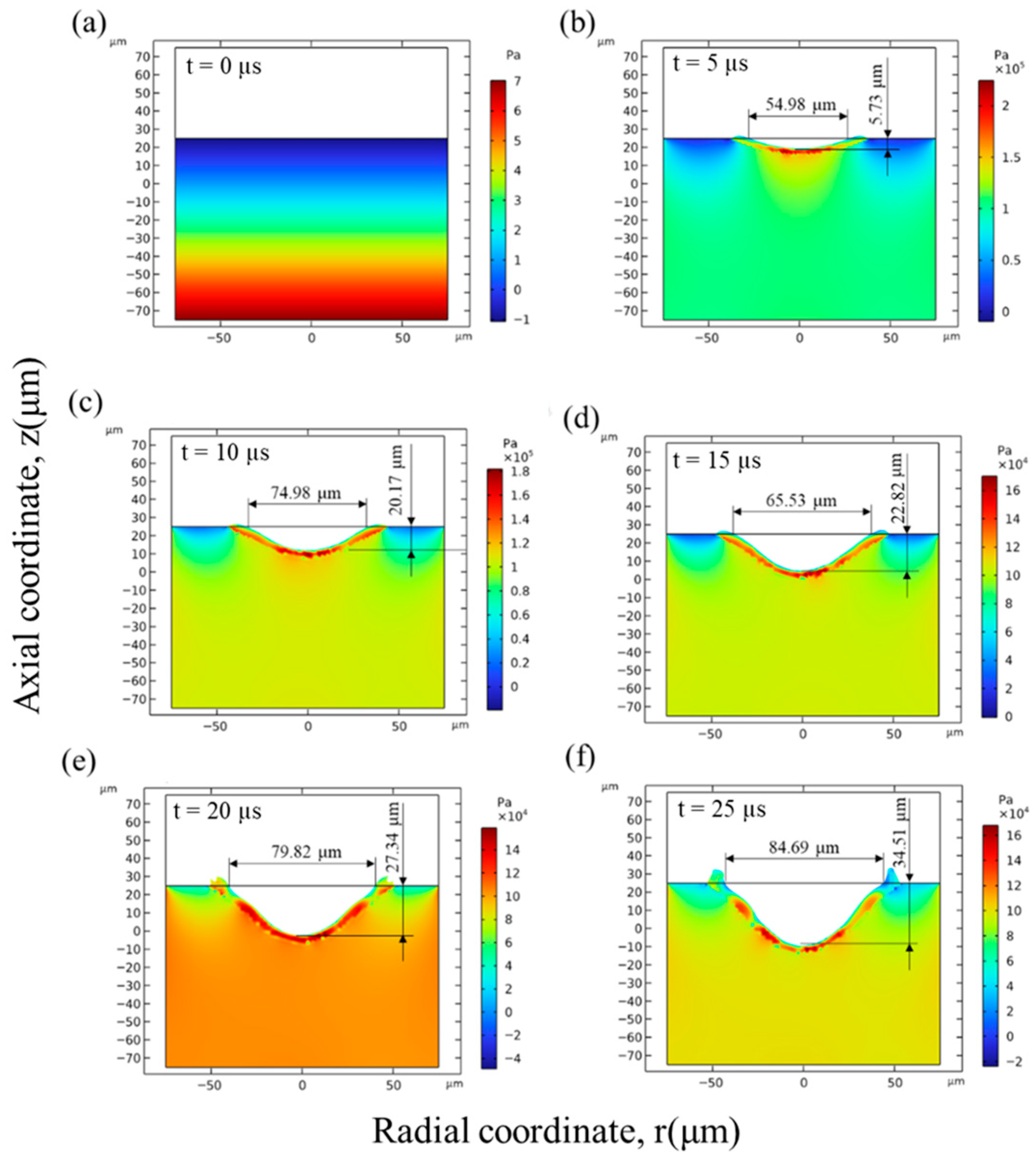
The coupled simulation provides the transient distributions of plasma pressure, heat-flux, melt-flow velocity, and temperature, enabling interpretation of crater evolution and the dominant material removal mechanisms under different PRFs. Figure 2 illustrates the transient evolution of the plasma-pressure field and the associated crater profile for 50 kHz, which is representative of the intermediate condition and allows for the temporal stages of crater formation to be visualized most clearly.
Immediately after discharge initiation (Stage I; Figure 2a), the workpiece surface is heated, but no evident crater is formed. As the discharge develops (Stage II; Figure 2b), the plasma pressure rises near the channel center and a shallow depression appears, indicating the onset of melting and deformation of the surface layer. During Stage III (Figure 2c), the molten pool expands and the pressure-driven outward flow becomes pronounced, which promotes melt ejection and crater growth. In Stage IV (Figure 2d,e), the pressure distribution stabilizes while the crater continues to widen, indicating a quasi-steady melt-expulsion regime. Finally, during Stage V (Figure 2f), the net crater growth approaches saturation as the molten layer thins, and re-solidification becomes dominant at the crater rim.
A useful quantitative trend can be extracted from the simulated crater-profile tendency in Figure 2. For the representative 50 kHz case, the inferred crater-width proxy increases from 54.98 μm at 5 μs to 84.69 μm at 25 μs, while the corresponding depth proxy increases from 5.73 μm to 34.51 μm over the same interval. These values are used here to describe the relative temporal evolution within the model rather than the exact final crater dimensions measured experimentally. This trend confirms that the rapid-growth stage occurs within the first 10–20 μs and motivates the choice of 25 μs as a common comparison snapshot for different PRFs.
To facilitate direct comparison among the experimentally investigated PRFs, Supplementary Tables S1 and S2 summarize the simulated crater-width and crater-depth proxies at representative elapsed times (0, 5, 10, 15, 20, and 25 μs) for 50, 75, and 100 kHz.
The 25 μs fields were used for cross-frequency comparison because, in the present model, most of the geometric change occurs within the first 20–25 μs while the cumulative effect of different off-times becomes evident by this stage. Comparing all PRFs at the same elapsed physical time rather than at the same pulse count is important because the purpose is to reveal how PRF changes the thermo-fluid state through repeated heating and cooling cycles.
Figure 3 compares the heat-flux distribution at 25 μs for PRFs of 25–100 kHz. At 25 kHz, the long off-time (34 μs) allows for substantial cooling after the 6 μs pulse, so the thermal footprint is broader and less cumulative; material removal is therefore dominated by separated, deeper craters. At 50 kHz, the off-time falls to 14 μs, which begins to promote overlap of the thermal fields while still allowing for adequate gap recovery. At 75 and 100 kHz, the off-time decreases further to 7.33 and 4 μs, respectively. The next pulse therefore encounters a warmer subsurface and a less recovered dielectric gap, which intensifies inter-pulse heat accumulation and confines the highest heat-flux to the already disturbed crater-rim region. This is the physical origin of the stronger thermal localization observed at high PRF.
The higher-frequency cases therefore do not simply increase the heat accumulated per unit time; they also change where the heat is concentrated and how effectively the surface can relax before the next discharge. In practical terms, low PRF favors isolated crater growth with larger local thermal gradients, whereas very high PRF favors the overlap of thermal cycles, partial re-melting, and a higher probability of re-solidified material remaining on the surface.
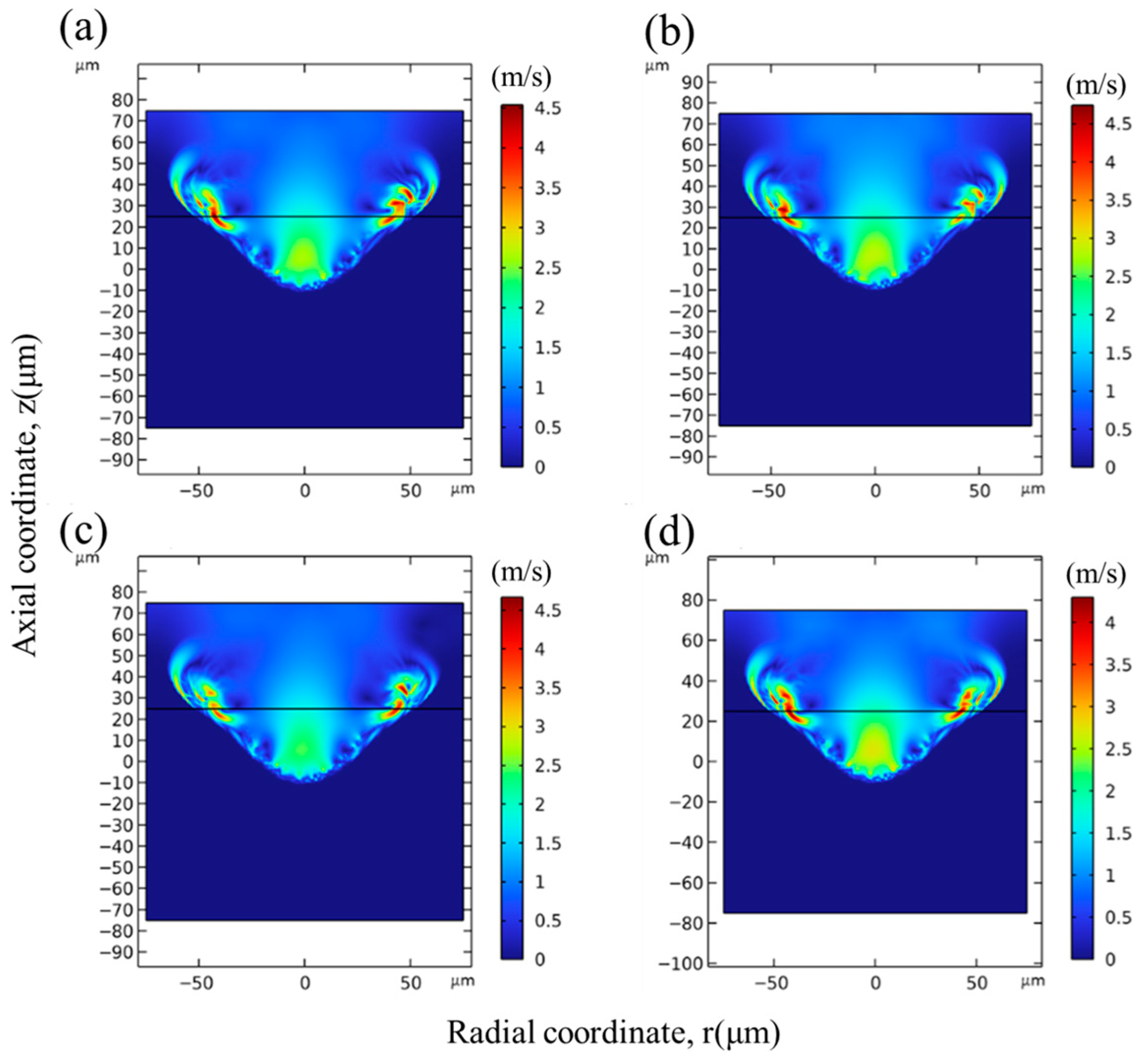
Figure 4 shows the fluid-velocity field at 25 μs. As PRF increases, melt motion becomes more concentrated near the crater edge. At 25 kHz, high-speed regions are distributed over a wider area, indicating more diffuse pressure-driven transport and a stronger tendency for random splashing. At 50–75 kHz, the high-velocity zones become more localized and symmetric, which is beneficial for controlled ejection of molten material. At 100 kHz, however, the central velocity becomes smaller and the flow field is confined to a narrow region. This suggests that molten material is not expelled efficiently from the entire crater volume, which favors local re-melting and partial redeposition on the previously machined surface.
The reason for evaluating the fluid field at 25 μs is therefore not that earlier stages are unimportant, but that 25 μs provides a common near-saturated snapshot in which the net result of pressure-driven transport can be compared across PRFs at the same elapsed time. The 50 kHz pressure evolution in Figure 2 already shows that the strongest shape changes occur earlier in the pulse sequence, while Figure 4 emphasizes the frequency-dependent state that remains after those transient events.
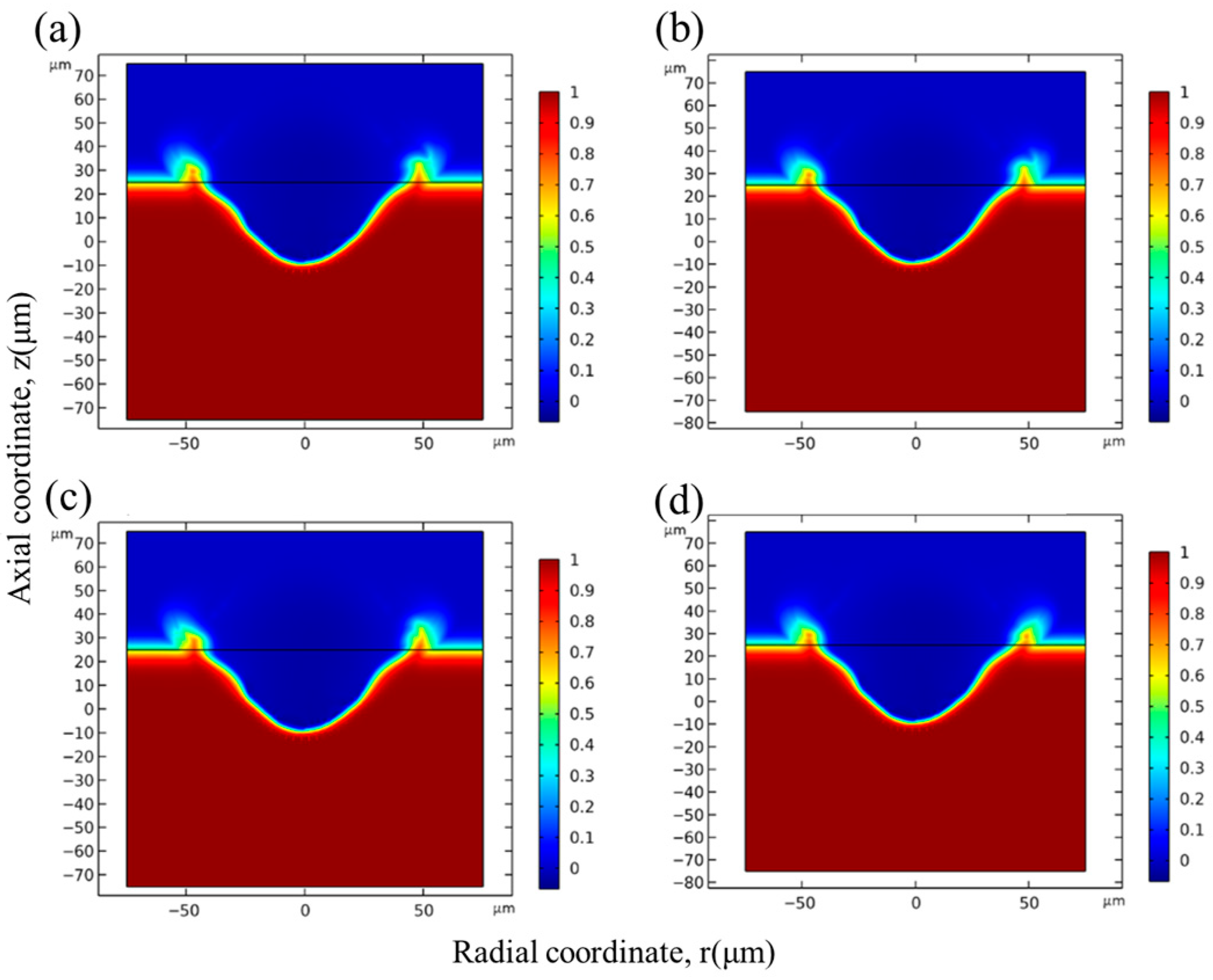
Figure 5 shows that both the maximum and the subsurface temperatures increase with PRF. This originates from the progressive reduction in off-time: heat deposited by one discharge cannot fully diffuse before the next discharge begins. As a result, the initial temperature for the next pulse rises, the thermal gradient penetrates deeper, and the molten/re-solidified layer is more likely to overlap with the previous thermal cycle. Therefore, the stronger thermal accumulation observed from 50 to 100 kHz is understood here as the superposition of consecutive thermal fields caused by shortened off-time, rather than as an increase in the single-pulse energy itself.
Mechanistically, PRF influences the process through two coupled levers: (i) the number of discharges per unit time, and (ii) the time available for cooling, deionization, and debris evacuation between pulses. The shift from 25 to 100 kHz therefore changes the dominant response from isolated crater formation to cumulative thermo-fluid interaction. This provides a direct mechanistic basis for the non-monotonic roughness response observed experimentally.

3.2. Experimental Validation: Surface Morphology and Roughness

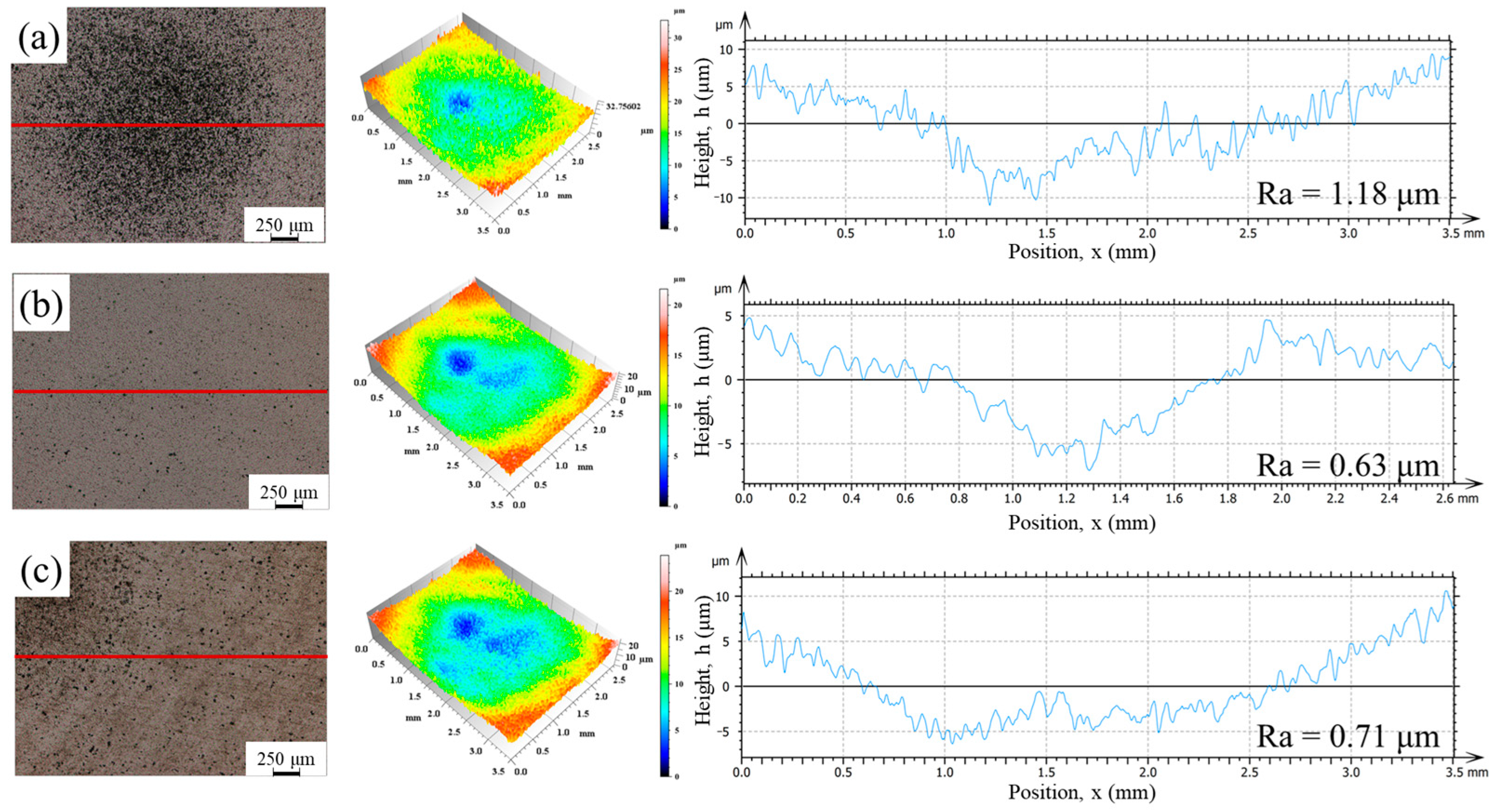
Based on the simulation trends, finishing experiments were conducted at 50, 75, and 100 kHz. The resulting surface topographies were characterized by laser confocal microscopy to quantify roughness and crater features (Figure 6).
At 50 kHz (Figure 6a), the surface exhibits pronounced craters and irregular molten traces, indicating aggressive material removal and incomplete smoothing. The average roughness is Ra = 1.18 μm, as summarized in Table 5, consistent with deeper craters and stronger thermal disturbance. At 75 kHz (Figure 6b), crater size and height variation decrease and the distribution becomes more uniform. The roughness drops to Ra = 0.63 μm, which is the best surface finish among the tested conditions and agrees with the predicted stabilization/localization of the thermo-fluid response. At 100 kHz (Figure 6c), the surface remains relatively smooth, but Ra increases slightly to 0.71 μm. The minor deterioration is attributed not only to thermal accumulation, but also to incomplete gap recovery and hindered debris evacuation under the very short 4 μs off-time, which can destabilize consecutive discharges and promote overlapping re-solidified traces.
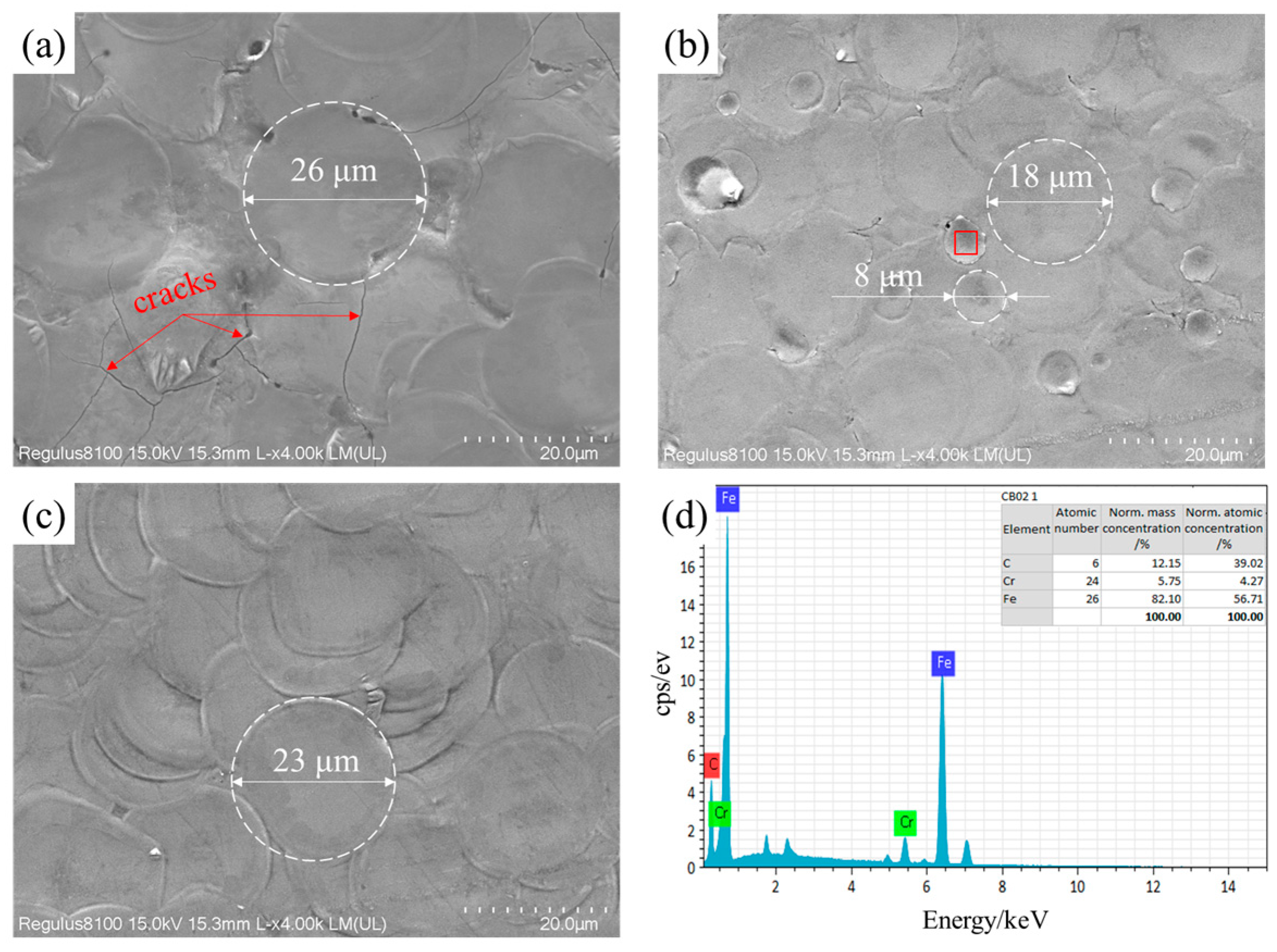
Figure 7 shows SEM images of the machined surfaces and a representative EDS spectrum from the 75 kHz condition. At 50 kHz (Figure 7a), large craters (≈26 μm) with irregular rims and visible cracking are observed, indicating strong thermal gradients during rapid heating and cooling. Re-solidified material is also apparent, which contributes to higher roughness. At 75 kHz (Figure 7b), the crater diameter decreases to ≈18 μm and the distribution is more uniform, with no obvious cracks. This morphology suggests that the discharge energy and melt ejection are better balanced, limiting thermal damage and redeposition. At 100 kHz (Figure 7c), overlapping crater features and layered re-solidified traces are more evident, consistent with repeated re-melting under strong heat accumulation and reduced gap recovery. Such an overlap can slightly degrade surface uniformity even though individual craters are not as deep as at 50 kHz. The EDS spectrum (Figure 7d) confirms that Fe and Cr are the dominant elements in the analyzed area.
From a topography-formation standpoint, the lowest roughness at 75 kHz is justified by a balance between two competing mechanisms. Compared with 50 kHz, the higher PRF suppresses the formation of large isolated craters and reduces the height contrast between adjacent peaks and valleys. Compared with 100 kHz, however, the off-time at 75 kHz is still long enough to allow for more effective cooling, deionization, and debris removal, so that the surface is not yet dominated by overlap and re-solidified splash layers. This explains why the roughness trend is non-monotonic rather than continuously decreasing with PRF.

3.3. Residual Stress Response

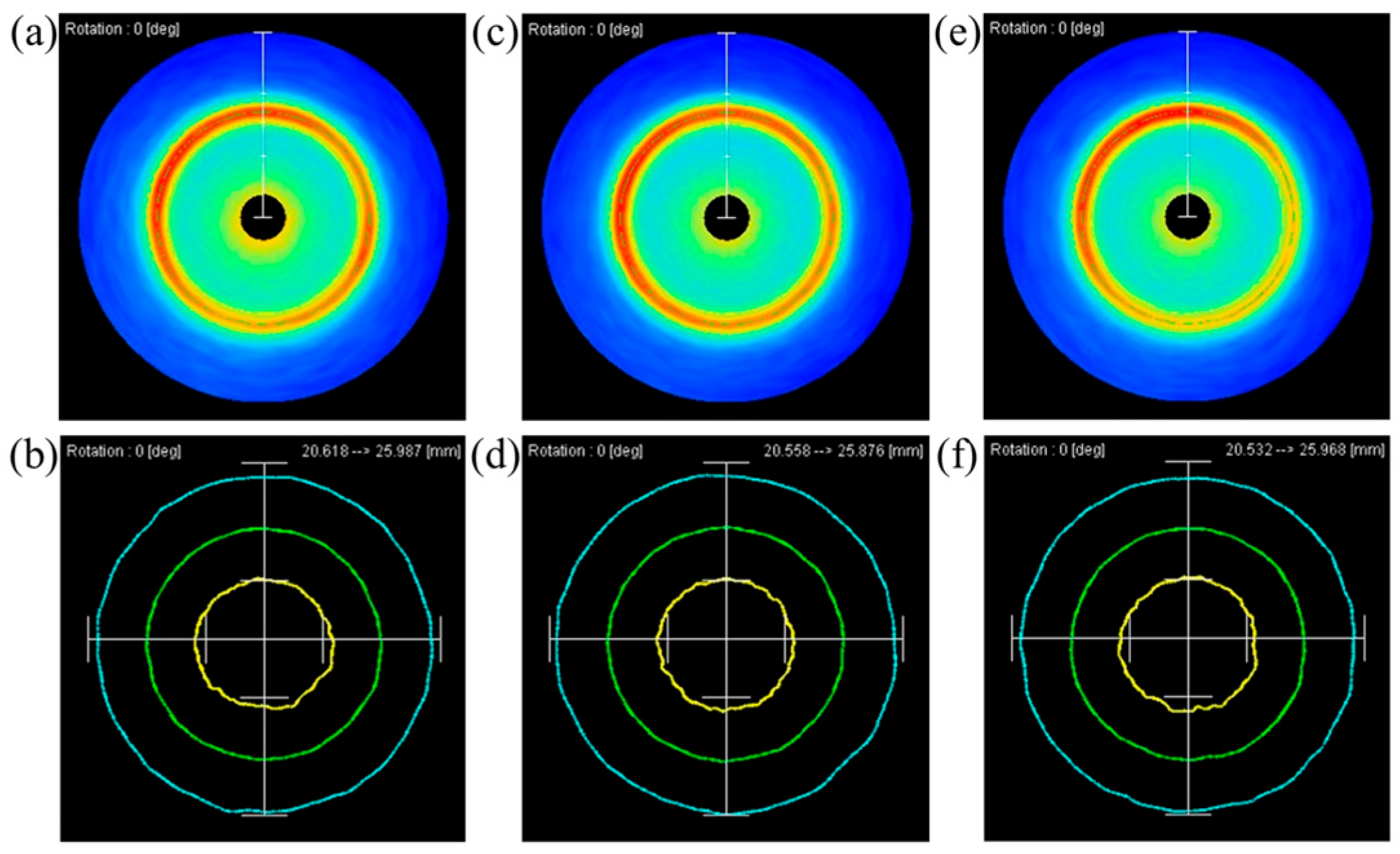
Residual stresses on EDM-machined surfaces were evaluated by X-ray diffraction using the cosα method. Representative two-dimensional Debye-ring patterns and the corresponding ring-distortion maps are shown in Figure 8.
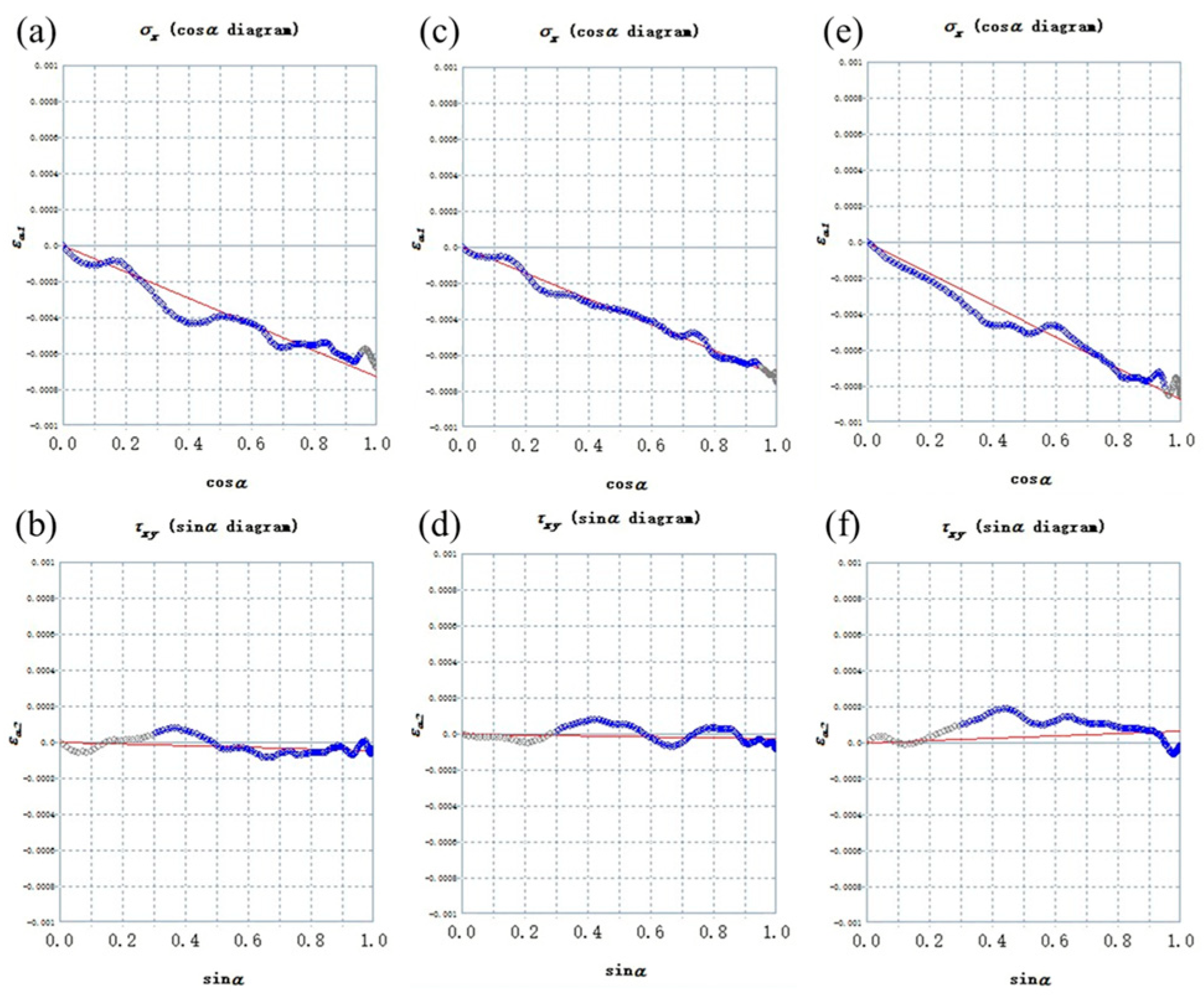
The corresponding ε-cosα and ε-sinα diagrams are presented in Figure 9. The ε-cosα data show good linearity with a negative slope, indicating a dominant in-plane compressive residual stress component. The calculated stresses are −341, −334, and −409 MPa at 50, 75, and 100 kHz, respectively. The larger compressive stress at 100 kHz is consistent with the stronger overlap of thermal cycles and higher constraint during cooling.
The more compressive stress at 100 kHz can be rationalized by stronger thermal cycle overlap: repeated rapid heating keeps the near-surface layer hot while the underlying substrate remains comparatively cooler and mechanically constraining. During cooling and re-solidification, this mismatch promotes shrinkage incompatibility and a larger compressive residual stress state in the surface layer. Because no through-depth stress profile was measured, this interpretation should be regarded as a surface-level mechanism consistent with the XRD trend rather than a full thermo-mechanical proof. Overall, under the present finishing conditions, the machined surface exhibits a reproducible biaxial compressive residual stress state on the order of 300–400 MPa, with only a moderate dependence on PRF.

3.4. Comparison Between Simulation and Experiment

Comparing the numerical results with the surface observations reveals consistent trend-level agreement. The simulations predict that lower PRF produces broader thermal/fluid footprints and more diffuse crater growth, whereas higher PRF localizes the discharge effects at the crater rim while increasing heat accumulation. Experimentally, this is mirrored by large irregular ≈26 μm craters and the highest roughness at 50 kHz, finer and more uniform ≈18 μm craters and the lowest roughness at 75 kHz, and overlapping re-solidified features with slightly larger apparent craters (≈23 μm) at 100 kHz.
The optimum at 75 kHz can therefore be understood as a balance between two competing mechanisms. Moderate localization of the pressure–heat–flow fields suppresses deep isolated craters and improves uniformity, yet the 7.33 μs off-time still allows for more effective cooling and gap recovery than at 100 kHz. Once the off-time is reduced to 4 μs, the benefits of localized removal are partly offset by re-melting, redeposition, and probable discharge instability. This interpretation is consistent with the slight roughness rebound at 100 kHz and with the SEM evidence of overlap and re-solidified traces.
Accordingly, the present model is most useful for explaining average PRF-dependent tendencies rather than predicting the exact position of each crater on a continuously machined surface. This distinction is important because the experiments involve stochastic multi-discharge surfaces, whereas the numerical framework is deterministic and axisymmetric. Even with this limitation, the model provides a physically coherent explanation of why an intermediate PRF window is more suitable for finishing of 4Cr13 steel.

4. Conclusions

This combined numerical–experimental study elucidates how PRF affects thermo–fluid-mechanical coupling, crater evolution and surface integrity in EDM of 4Cr13 martensitic stainless steel. The main conclusions are as follows:
(1) PRF acts mainly through off-time and duty cycle. Under ton = 6 μs and Ip = 8 A, increasing PRF from 25 to 100 kHz reduces Toff from 34 to 4 μs, causing a transition from isolated-pulse cooling to pronounced inter-pulse thermal accumulation. In the model, this localizes plasma pressure, heat-flux, and melt-flow near the crater rim and raises the subsurface temperature.
(2) In the experiments, this transition produces a non-monotonic roughness response. Ra decreases from 1.18 μm at 50 kHz to 0.63 μm at 75 kHz because craters become finer and more uniformly distributed, but rises to 0.71 μm at 100 kHz due to crater overlap, re-melting, and incomplete gap recovery.
(3) SEM observations are consistent with the simulations: 50 kHz yields large irregular craters with cracks, 75 kHz yields the most uniform fine-crater morphology, and 100 kHz shows overlapping re-solidified traces. XRD results show a stable compressive residual stress state for all tested conditions (−341 to −409 MPa), with the highest magnitude at 100 kHz.
(4) For finishing EDM of 4Cr13 mold steel under the present conditions, 75 kHz provides the best overall balance between roughness, crater uniformity, and compressive stress. The current 2D axisymmetric model captures the average PRF effect well, but future work should extend the present model to incorporate stochastic multi-crater sequencing and full thermo-mechanical coupling.

Supplementary Materials

The following supporting information can be downloaded at https://www.mdpi.com/article/10.3390/jmmp10040131/s1. Table S1: Simulated crater width (μm) at representative elapsed times under different PRFs; Table S2: Simulated crater depth (μm) at representative elapsed times under different PRFs.

Author Contributions

Conceptualization, Q.W. and T.W.; methodology, Q.W. and Q.L.; software, Q.W.; validation, Q.W., Q.L. and K.Z.; formal analysis, Q.W. and K.Z.; investigation, Q.W.; resources, T.W.; data curation, Q.W. and K.Z.; writing—original draft preparation, Q.W.; writing—review and editing, T.W., Q.L. and K.Z.; visualization, Q.W.; supervision, T.W.; project administration, T.W. All authors have read and agreed to the published version of the manuscript.

Funding

This research received no external funding.

Data Availability Statement

The data presented in this study are available on request from the corresponding author. The data include COMSOL simulation outputs, laser confocal surface topography data, SEM/EDS images, and X-ray diffraction residual stress measurements generated during this study. The data are not publicly available because they form part of an ongoing study.

Conflicts of Interest

The authors declare no conflicts of interest.

References

  1. Ho, K.H.; Newman, S.T. State of the art electrical discharge machining (EDM). Int. J. Mach. Tools Manuf. 2003, 43, 1287–1300. [Google Scholar] [CrossRef]
  2. Abbas, N.M.; Solomon, D.G.; Bahari, M.F. A review on current research trends in electrical discharge machining (EDM). Int. J. Mach. Tools Manuf. 2007, 47, 1214–1228. [Google Scholar] [CrossRef]
  3. Kunieda, M.; Lauwers, B.; Rajurkar, K.P.; Schumacher, B.M. Advancing EDM through fundamental insight into the process. CIRP Ann. Manuf. Technol. 2005, 54, 64–87. [Google Scholar] [CrossRef]
  4. Rebelo, J.C.; Dias, A.M.; Kremer, D.; Lebrun, J.L. Influence of EDM pulse energy on the surface integrity of martensitic steels. J. Mater. Process. Technol. 1998, 84, 90–96. [Google Scholar] [CrossRef]
  5. Duan, X.; Saxena, K.K.; Wang, J.; Arshad, M.H.; Ayesta, I.; Wang, Y.; Reynaerts, D.; Yang, X.D. Residual stress and its modification strategies in the surface/sub-surface layer of components machined by electrical discharge machining: A review. Int. J. Adv. Manuf. Technol. 2025, 139, 41–58. [Google Scholar] [CrossRef]
  6. Salonitis, K.; Stournaras, A.; Stavropoulos, P.; Chryssolouris, G. Thermal modeling of the material removal rate and surface roughness for die-sinking EDM. Int. J. Adv. Manuf. Technol. 2009, 40, 316–323. [Google Scholar] [CrossRef]
  7. Shabgard, M.; Ahmadi, R.; Seyedzavvar, M.; Oliaei, S.N.B. Mathematical and numerical modeling of the effect of input-parameters on the flushing efficiency of plasma channel in EDM process. Int. J. Mach. Tools Manuf. 2013, 65, 79–87. [Google Scholar] [CrossRef]
  8. DiBitonto, D.D.; Eubank, P.T.; Patel, M.R.; Barrufet, M.A. Theoretical models of the electrical discharge machining process. I. A simple cathode erosion model. J. Appl. Phys. 1989, 66, 4095–4103. [Google Scholar] [CrossRef]
  9. Patel, M.R.; Barrufet, M.A.; Eubank, P.T.; DiBitonto, D.D. Theoretical models of the electrical discharge machining process. II. The anode erosion model. J. Appl. Phys. 1989, 66, 4104–4111. [Google Scholar] [CrossRef]
  10. Marafona, J.; Chousal, A.G. A finite element model of EDM based on the Joule effect. Int. J. Mach. Tools Manuf. 2006, 46, 595–602. [Google Scholar] [CrossRef]
  11. Eubank, P.T.; Patel, M.R.; Barrufet, M.A.; Bozkurt, B. Theoretical models of the electrical discharge machining process. III. The variable mass, cylindrical plasma model. J. Appl. Phys. 1993, 73, 7900–7909. [Google Scholar] [CrossRef]
  12. Papazoglou, E.L.; Karmiris-Obratański, P.; Karkalos, N.E.; Thangaraj, M.; Markopoulos, A.P. Theoretical and experimental analysis of plasma radius expansion model in EDM: A comprehensive study. Int. J. Adv. Manuf. Technol. 2023, 126, 2429–2444. [Google Scholar] [CrossRef]
  13. Raza, S.; Kishore, H.; Nirala, C.K.; Rajurkar, K.P. Multiphysics modelling and high-speed imaging-based validation of discharge plasma in micro-EDM. CIRP J. Manuf. Sci. Technol. 2023, 43, 15–29. [Google Scholar] [CrossRef]
  14. Singh, M.; Sharma, S.; Ramkumar, J. Numerical simulation and experimental validation on the mechanism of crater evolution in electrical discharge micromachining. CIRP J. Manuf. Sci. Technol. 2024, 51, 126–144. [Google Scholar] [CrossRef]
  15. Alshaer, A.W.; Abdallah, R.; Rajab, F.H.; Barzinjy, A.A.; Otanocha, O.B. Understanding the machined material’s behaviour in electro-discharge machining (EDM) using a multi-phase smoothed particle hydrodynamics (SPH) modelling. Int. J. Adv. Manuf. Technol. 2024, 134, 369–387. [Google Scholar] [CrossRef]
  16. Ishfaq, K.; Mahmood, M.A.; Khan, A.R.; Rehman, M. Mathematical modelling with experimental correlation for multiple craters dimension, material removal rate and surface roughness in electrical discharge machining. Int. J. Adv. Manuf. Technol. 2022, 120, 227–236. [Google Scholar] [CrossRef]
  17. Liu, J.F.; Guo, Y.B. Residual stress modeling in electric discharge machining (EDM) by incorporating massive random discharges. Procedia CIRP 2016, 45, 299–302. [Google Scholar] [CrossRef]
  18. Schneider, S.; Vorspohl, J.; Frerichs, F.; Klink, A.; Meinke, M.; Schröder, W.; Lübben, T. Investigation on residual stress induced by multiple EDM discharges. Procedia CIRP 2021, 102, 482–487. [Google Scholar] [CrossRef]
  19. Wittenburg, J.; Küpper, U.; Herrig, T.; Klink, A.; Bergs, T. Surface integrity analysis of single discharge characteristics derived from the continuous wire EDM process. Procedia CIRP 2024, 123, 203–208. [Google Scholar] [CrossRef]
  20. Gokcekaya, O.; Günen, A.; Ceritbinmez, F.; Bahador, A.; Nakano, T.; Çetin, M. Wire-EDM performance and surface integrity of Inconel 718 with unique microstructural features fabricated by laser powder bed fusion. Int. J. Adv. Manuf. Technol. 2024, 130, 4513–4528. [Google Scholar] [CrossRef]
  21. Singh, D.; Goyal, P.; Sehgal, S. The machining and surface modification of H13 die steel via the electrical discharge machining process using graphite mixed dielectric. J. Manuf. Mater. Process. 2024, 8, 125. [Google Scholar] [CrossRef]
  22. Ye, L.; Saxena, K.K.; Ehmann, K.; Qian, J.; Reynaerts, D. Closed-loop control of μEDM surface quality with alternate on-machine metrology and in-process roughness prediction. J. Mater. Process. Technol. 2024, 327, 118357. [Google Scholar] [CrossRef]
  23. Mills, K.C.; Su, Y.; Li, Z.; Brooks, R.F. Equations for the calculation of the thermo-physical properties of stainless steel. ISIJ Int. 2004, 44, 1661–1668. [Google Scholar] [CrossRef]
  24. Kim, C.S. Thermophysical Properties of Stainless Steels; ANL-75-55; Argonne National Laboratory: Argonne, IL, USA, 1975.
  25. GB/T 20878-2007; Stainless and Heat-Resisting Steels-Designation and Chemical Composition. Standardization Administration of China: Beijing, China; Standards Press of China: Beijing, China, 2007.
  26. Tanaka, K. The cosα method for X-ray residual stress measurement using two-dimensional detector. Mech. Eng. Rev. 2019, 6, 18-00378. [Google Scholar] [CrossRef]
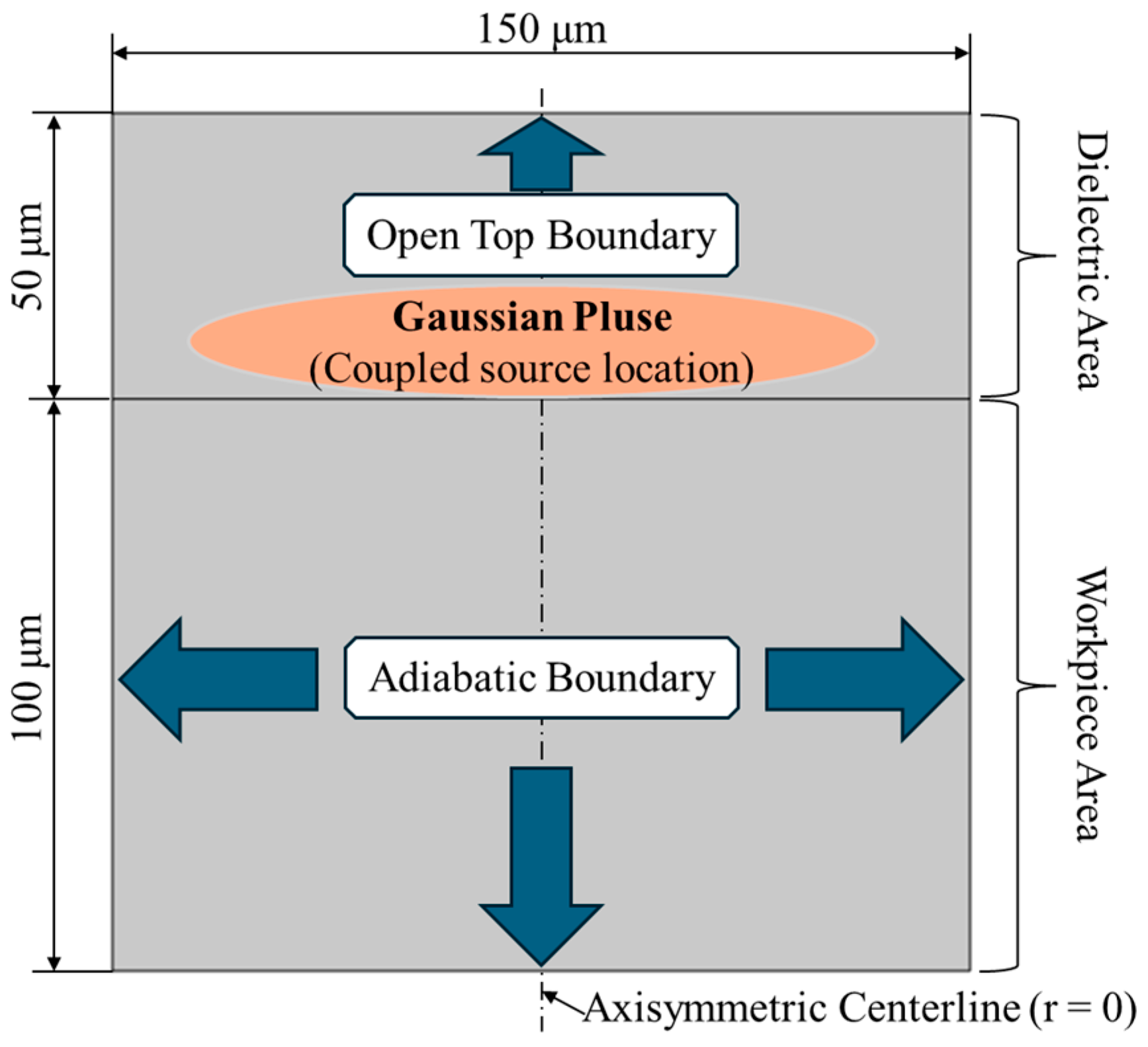
Figure 1. Schematic 2D axisymmetric computational domain of the EDM model. The arrows indicate the locations of the applied boundary conditions.
Jmmp 10 00131 g001
Figure 2. Transient evolution of plasma-pressure distribution and crater profile at 50 kHz: (a) 0 μs; (b) 5 μs; (c) 10 μs; (d) 15 μs; (e) 20 μs; (f) 25 μs.
Jmmp 10 00131 g002
Figure 3. Heat-flux distribution at 25 μs under different discharge frequencies: (a) 25 kHz; (b) 50 kHz; (c) 75 kHz; (d) 100 kHz.
Jmmp 10 00131 g003
Figure 4. Fluid-velocity distribution at 25 μs under different discharge frequencies: (a) 25 kHz; (b) 50 kHz; (c) 75 kHz; (d) 100 kHz.
Jmmp 10 00131 g004
Figure 5. Temperature distribution at 25 μs under different discharge frequencies: (a) 25 kHz; (b) 50 kHz; (c) 75 kHz; (d) 100 kHz.
Jmmp 10 00131 g005
Figure 6. Confocal surface topography and representative profiles under different discharge frequencies: (a) 50 kHz; (b) 75 kHz; (c) 100 kHz.
Jmmp 10 00131 g006
Figure 7. SEM morphology and EDS analysis under different discharge frequencies: (a) 50 kHz; (b) 75 kHz; (c) 100 kHz. (d) EDS spectrum from the marked by the red box area in (b).
Jmmp 10 00131 g007
Figure 8. Two-dimensional Debye-ring patterns (top row) and ring-distortion maps (bottom row) of EDM-machined 4Cr13 steel surfaces at different PRFs: (a,b) 50 kHz, (c,d) 75 kHz, and (e,f) 100 kHz.
Jmmp 10 00131 g008
Figure 9. ε-cosα and ε-sinα diagrams obtained by the X-ray cosα method for EDM-machined 4Cr13 steel surfaces at different PRFs: (a,b) 50 kHz, (c,d) 75 kHz, and (e,f) 100 kHz.
Jmmp 10 00131 g009
Table 1. Chemical composition of 4Cr13 steel (wt%).
CSiMnPSCrVFe
0.360.8740.5310.00350.00213.640.32Bal.
Table 2. Effective thermophysical parameters used for 4Cr13 steel in the present model [23,24,25].
NameUnitValue
Solid/liquid densityg/cm37.75/7
Solid/liquid thermal conductivityW/(m·K)28.1/35
Solid/liquid specific heatJ/(kg·K)460/800
Liquid/gas dynamic viscosityPa·s5.5 × 10−3/4 × 10−5
Latent heat of fusionkJ/kg270
Latent heat of vaporizationkJ/kg7410
Melting pointK1773
Boiling pointK3080
Surface tensionN/m1.8
Thermal expansion coefficientK−110.5 × 10⁻⁶
Table 3. Simulation parameters, boundary conditions, and simplifying assumptions.
CategoryParameterValueNote
Geometry/meshComputational domain150 μm × 150 μmDielectric above flat 4Cr13 workpiece; 2D axisymmetric formulation
Minimum element size0.008 μmLocal refinement at the discharge region
Time integrationTime step0.1 μsUniform step used for all simulations
Total simulated time25 μsCommon elapsed time for PRF comparison (250 increments)
Pulse schedulePRF25, 50, 75, 100 kHz25 kHz increments selected to span low to high duty cycles
Pulse-on time, Ton6 μsConstant for all cases
Pulse period, T40, 20, 13.33, 10 μsT = 1/PRF
Pulse off-time, Toff34, 14, 7.33, 4 μsToff = T − Ton
Duty cycle0.15, 0.30, 0.45, 0.60Ton/T
Electrical sourcePeak current, Ip8 ARectangular pulse during pulse-on
Effective discharge voltage, Vd25 VRepresentative average pulse-on gap voltage
Workpiece energy fraction, ηw0.18Kept constant to isolate PRF effect
Nominal pulse energy1.2 mJVd × Ip × Ton
Plasma sourceCurrent/heat/pressure profileGaussianJ(r,t), q(r,t), p(r,t) applied on workpiece surface
Plasma radius, Rp(t)Power-law growthRp ≈ 10 μm at t = 6 μs
Peak plasma pressure, p05 MPaApplied during pulse-on; zero during pulse-off
Initial/boundaryInitial temperature293 KWorkpiece and dielectric
Initial velocity0 m/sEntire domain
Top dielectric boundaryOpen, 0.1 MPaFluid outlet/open boundary
Side and bottom workpiece boundariesAdiabaticExternal heat loss neglected within 25 μs
Workpiece surface (flow module)No-slip wallUsed in laminar flow calculation
AssumptionsHeat loss mechanismsExternal convection/radiation neglectedJustified by microsecond simulation window
Model scopeSingle nominal discharge kernelUsed to explain average PRF trend, not stochastic landing
Table 4. Machining conditions and characterization protocol for the EDM experiments.
ItemValue
Machine toolCNC EDM machine (DK7632, Aigesen Corporation, Suqian, China)
Workpiece4Cr13 steel coupons, 20 mm × 20 mm × 5 mm
ElectrodeCopper, diameter 0.3 mm
Machined featurePlanar finishing patch on flat coupon surface
PRF levels50, 75, and 100 kHz
Pulse-on time6 μs
Peak current8 A
DielectricDeionized water, resistivity ≥ 18 MΩ·cm
Flushing pressure0.3 MPa
Open-circuit voltage80 V
Servo/discharge gap setting20 μm
Experimental designSingle-factor repeated-trial design; only PRF varied
ReplicatesThree specimens per condition
Topography characterization3D surface metrology microscope (DCM8, Leica Microsystems GmbH, Wetzlar, Germany)
Microstructure characterizationField-emission scanning electron microscope (SU5000, Hitachi High-Tech Corporation, Tokyo, Japan)
Residual stress characterizationXRD using the cosα method, Cu Kα radiation
Table 5. Summary of key surface metrics under different PRFs.
PRF (kHz)Ra (μm)Typical Crater Diameter (μm)Residual Stress σx (MPa)
501.18 ± 0.42≈26−341
750.63 ± 0.11≈18−334
1000.71 ± 0.24≈23−409
Disclaimer/Publisher’s Note: The statements, opinions and data contained in all publications are solely those of the individual author(s) and contributor(s) and not of MDPI and/or the editor(s). MDPI and/or the editor(s) disclaim responsibility for any injury to people or property resulting from any ideas, methods, instructions or products referred to in the content.