Article

Joint 3D Trajectory Design and Resource Optimization for Multi-UAV-Relay-Assisted Hybrid FSO/RF Airborne Communication Networks

by
Xiwen Zhang
1,
Yuan Wang
2,*,
Shanghong Zhao
1,
Hang Hu
1 and
Jianjia Li
1
1
School of Information and Navigation, Air Force Engineering University, Xi’an 710077, China
2
School of Astronautics, Northwestern Polytechnical University, Xi’an 710072, China
*
Author to whom correspondence should be addressed.
Drones 2026, 10(5), 362; https://doi.org/10.3390/drones10050362
Submission received: 16 March 2026 / Revised: 4 May 2026 / Accepted: 5 May 2026 / Published: 9 May 2026
(This article belongs to the Section Drone Communications)

Highlights

What are the main findings?
  • This study proposes a joint optimization framework for multi-UAV-relay-assisted aviation FSO/RF networks. The model jointly optimizes trajectory, ground station association, and power allocation, while systematically incorporating multi-dimensional practical constraints—including platform dynamics, information causality, co-channel interference, meteorological effects, and multi-UAV collision avoidance—thereby significantly enhancing its engineering applicability.
  • This study introduces a dynamic power control strategy that achieves an optimal trade-off between desired signal enhancement and co-channel interference suppression. By flexibly adjusting power to partially substitute for spatial adjustments, this strategy proves effective in complex multi-station and multi-UAV scenarios.
What are the implications of the main findings?
  • This study addresses a critical gap in existing aviation FSO/RF research, which often relies on idealized models while overlooking practical engineering constraints. This work provides both a systematic theoretical framework and a practically implementable technical pathway for multi-UAV relay communications in complex aviation scenarios.
  • The proposed “multi-node, multi-constraint, multi-variable” joint optimization approach can be extended to the trajectory and resource co-design of other space-based communication networks (e.g., high-altitude platforms and satellite relays), laying a theoretical and algorithmic foundation for high-capacity, high-reliability transmission in future integrated space–air–ground information networks.

Abstract

The utilization of unmanned aerial vehicle (UAV) relays has significantly improved the availability and reliability of free-space optical (FSO) communication links within airborne communication backhaul networks. This paper proposes an FSO/RF dual-hop backhaul network employing multiple UAV relays and investigates a joint optimization scheme for three-dimensional (3D) trajectories and resource allocation of multiple UAVs. In this scheme, network throughput is maximized by jointly optimizing three variables: the association between the UAVs and the ground stations (GSs), power allocation, and the UAVs’ trajectories. Moreover, to enhance the engineering applicability of this research, we systematically incorporate multi-dimensional practical constraints—including the motion of the AWACS, platform dynamics, information causality, co-channel interference, the influence of weather variations, and multi-UAV collision avoidance. Furthermore, to address this challenging mixed-integer non-convex optimization problem, an iterative algorithm is developed. This algorithm integrates the principles of block coordinate descent with successive convex approximation, thereby alternately optimizing the three variable blocks within each iterative cycle. Numerical simulations confirm that the proposed scheme achieves a substantial throughput improvement in the multi-UAV-assisted FSO/RF hybrid backhaul network in comparison with other benchmark schemes.

1. Introduction

The Airborne Warning and Control System (AWACS) conducts systematic surveillance and reconnaissance of air, sea, and ground targets using its onboard radars, sensors, and other electronic systems. It transmits the collected intelligence data in real time to the ground command station or coordinates with other combat units for command, decision making, and coordinated operations. With the advancement in radar detection capabilities and the increasingly complex electromagnetic environment on the battlefield, the information backhaul link of the AWACS imposes higher demands on real-time performance, large-capacity information transmission, and strong confidentiality.
A.
Related Works and Challenges
Currently, AWACS-to-ground communication primarily relies on radio frequency (RF) links, such as high-frequency (HF) or ultra-high-frequency (UHF) bands, which suffer from significant limitations in spectrum resources and severe malicious electromagnetic interference. Free-space optics (FSO) communication is characterized by its capability to deliver high data rates, a large bandwidth, and strong immunity to electromagnetic interference for wireless systems. Compared with RF, FSO also offers additional advantages, such as lower energy consumption per bit, inherent immunity to multipath dispersion, and higher deployment flexibility due to the absence of spectrum licensing requirements [1,2,3]. Due to these advantages, FSO systems are regarded as a promising complementary solution in next-generation aeronautical communication systems, particularly for wireless fronthaul and backhaul applications [1,2,3]. Despite their unique advantages, FSO links are more susceptible than RF to fog-induced scattering and physical blockages, whereas RF is more adversely affected by rain. Under clear weather conditions, atmospheric turbulence causes scintillation that significantly degrades FSO link performance over distances exceeding approximately 1 km. Thereby, by leveraging complementary properties, hybrid FSO/RF communications can fully exploit the advantages of both RF and FSO communication. This enables the implementation of innovative network and link technology based on channel diversity, which is essential for achieving a high-throughput airborne network and offers superior performance over using FSO or RF independently [4,5].
Deploying unmanned aerial vehicles (UAVs) presents an effective solution for the on-demand deployment of hybrid FSO/RF communication links. The utilization of UAVs as relays can alleviate the stringent line-of-sight (LOS) requirements imposed on FSO systems between transceivers [6]. UAV-assisted hybrid RF/FSO systems have been extensively studied in recent years. In [7], a heterogeneous FSO/RF link was constructed using UAVs as relays, where the FSO link formed a high-capacity aerial backbone network, while the RF channel provided last-mile connectivity to end users, and the communication performance was experimentally validated. Furthermore, a hybrid FSO/RF mobile high-altitude platform (HAP)-assisted communication system was developed for UAV support in [8]. In [9], the performance of an asymmetric, double-hop UAV-assisted FSO/RF system employing an amplified relay protocol within a space–air–ground integrated network (SAGIN) was investigated. In these studies, UAV relays were considered as communication nodes. While the optimal deployment positions of UAV relays were taken into account, the mobile capabilities and flight trajectories were not adequately addressed. A multi-UAV aeronautical communication system is proposed in [10] that considers the velocity variations of both the AWACS and the mobile ground station (GS).
Unlike the use of fixed relays, one of the most significant challenges in UAV-assisted systems is the optimization of relay trajectories. In [11], a joint optimization problem was formulated in an FSO/RF satellite–UAV–terrestrial integrated network, taking into account adaptive modulation and coding schemes, power allocation, and UAV trajectory optimization to maximize system throughput. In [12], an energy efficiency-maximizing 3D trajectory of the UAV relay for an FSO/RF network with moving obstacles was proposed. Moreover, a scheme for enhancing the communication security of FSO/RF links was proposed and analyzed through the joint optimization of power allocation and trajectory planning [13]. In [14], FSO/RF cooperative communication was further employed in integrated sensing and communication, where the UAV was capable of adjusting its antenna beamwidth, downlink bandwidth allocation, and flight trajectory according to different weather conditions. However, existing research has predominantly concentrated on trajectory optimization for single-UAV relay, leaving a gap in the comprehensive investigation of joint trajectory and resource allocation strategies for multi-UAV scenarios within airborne hybrid FSO/RF networks.
B.
Contributions and Organization
To tackle the above challenges, we propose a joint resource and trajectory optimization method for multi-UAV-relay-assisted hybrid FSO/RF airborne communication networks. The main contributions are as follows:
  • First, we investigate the throughput maximization in double-hop hybrid FSO/RF networks with multi-UAV relays. Specifically, we jointly optimize the three-dimensional (3D) trajectories of the UAVs and the communication resource allocation between multiple UAVs and GSs. To our knowledge, a comprehensive investigation of this joint optimization problem specific to multi-UAV-assisted airborne hybrid FSO/RF networks has yet to be reported in the literature.
  • Next, we consider the motion trajectory of the source node (referring to the AWACS). In the existing research, it is usually set as a fixed point, but this assumption lacks practical applicability.
  • In addition, we impose an information causality constraint on the double-hop link, that is, the data achievable rate of the first-hop FSO link is higher than that of the second hop. Therefore, considering the weather sensitivity of the FSO channel, the influence of different weather conditions on network throughput and UAV trajectory is analyzed.
  • Furthermore, collision avoidance among multiple UAVs is taken into account. In addition, a trajectory initialization method for collision avoidance based on altitude differentiation is designed to prevent potential collisions among multiple UAVs at the initial position.
  • Finally, we formulated an optimization problem aimed at maximizing the weighted sum of throughput by using three variables: the connection relationship between UAVs and the GSs, power allocation, and the UAVs’ trajectories. To address the highly coupled and non-convex problem, we decomposed the original problem into three sub-problems. Subsequently, these sub-problems were then iteratively addressed within a block coordinate descent (BCD) framework. By comparing our proposed joint optimization scheme with existing schemes, its advantages were clearly demonstrated.
The remainder of this paper is organized as follows: In Section 2, the multi-UAV-relay-assisted hybrid FSO/RF airborne communication networks scenario is presented, and the channel model and rate model for FSO and RF links are constructed. The network throughput maximization problem is formulated in Section 3. Section 4 divides the multivariate problem into three sub-problems and iteratively optimizes them using BCD and successive convex optimization techniques. Section 5 provides numerical results that demonstrate the effectiveness of our proposed scheme, with conclusions summarized in Section 6.
Notation: In this paper, scalars are denoted by normal-face font, and vectors are denoted by boldface font. D × 1 represents the D-dimensional space of real-valued vectors. We also use to denote the Euclidean norm.

2. System Model

2.1. Network Scenario

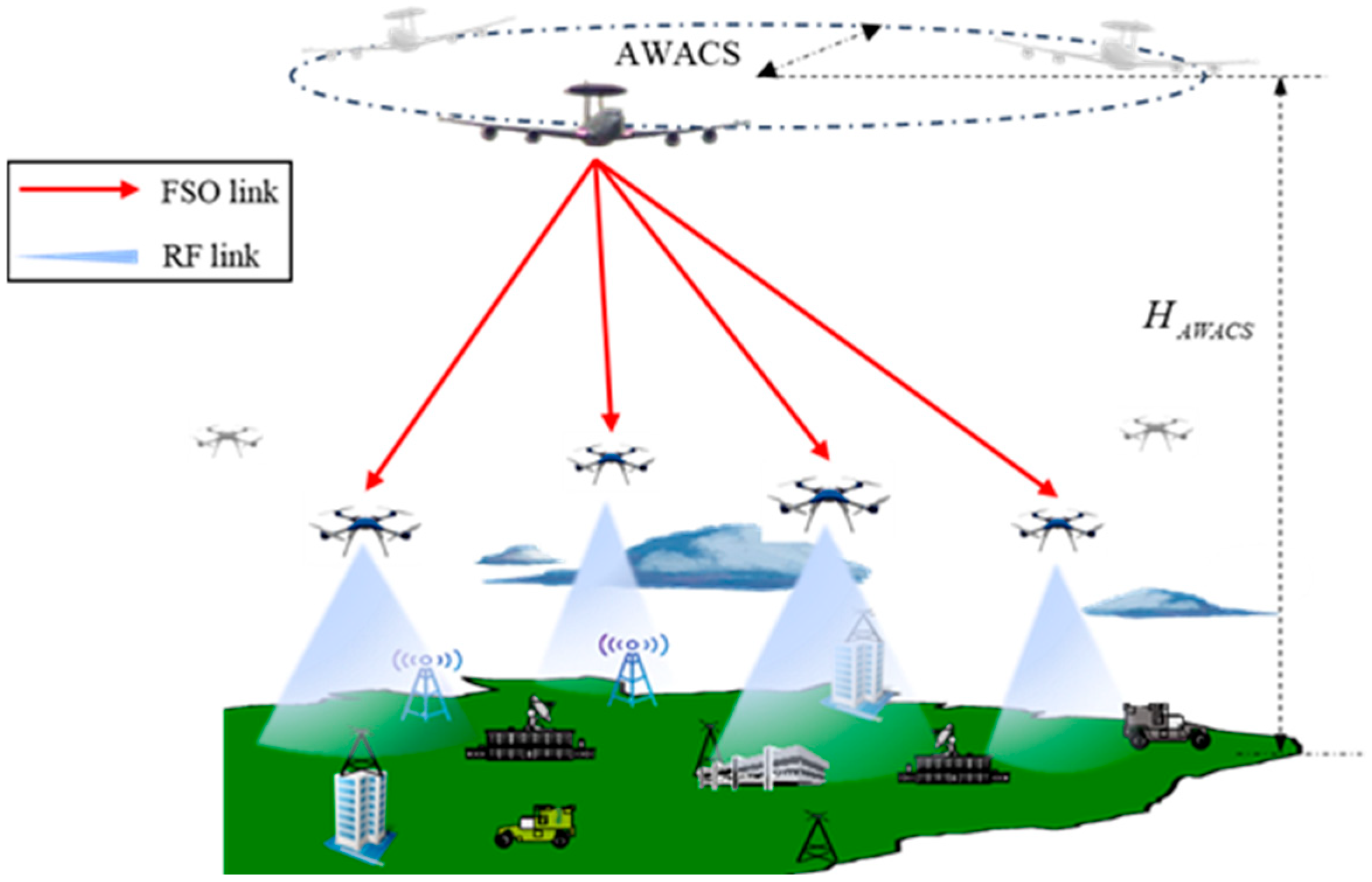
Figure 1 shows an example of the airborne backhaul network scenario considered in this paper. As illustrated in Figure 1, the AWACS establishes high-speed backhaul links for early warning detection information with multiple GSs. Additionally, we deploy multiple UAVs as relay nodes to construct a wireless backhaul network. Among these, the first-hop AWACS-to-UAV relays utilize the FSO links to meet the large-capacity demand, while the access link for the second-hop UAV-to-GS employs the RF links, considering the high density of obstacles, such as mountains and tall buildings, near the ground.
Here, we introduce a 3D Cartesian coordinate system for spatial modeling and assume that the aerial network consists of I UAV relays and J GSs, where I < J . All UAVs communicate over a continuous time period T using the same frequency band, with each UAV serving its associated GSs through periodic time division multiple access (TDMA). The time period T is discretized into N equal-time slots, and the time interval between the time slots is δ t = T / N . It assumes that the AWACS moves in a uniform circular motion with an angular range from −π to π, centered at point O A W A C S = 0 , 0 , H A W A C S T 3 × 1 with a radius R , and the position vectors are denoted by q A W A C S n = x A W A C S n , y A W A C S n , H A W A C S T 3 × 1 , where n = 0 , 1 , , N . The position vector of the i th UAV can be expressed as q i n = x i n , y i n , h i n T 3 × 1 , where i = 1 , 2 , , I ,   n = 0 , 1 , , N , and the position set for GSs is denoted as w j = x j , y j , 0 T 3 × 1 , where j = 1 , 2 , , J on the x-y plane, and is assumed to be a uniform distribution.
The UAV’s trajectory is defined by its velocity vector v i n and acceleration vector a i n , which can be expressed as
q i n + 1 = q i n + v i n δ t + 1 2 a i n δ t 2 , n = 0 , N
v i n + 1 = v i n + a i n δ t , n = 0 , N
The initial and final time slots are denoted by n = 0 and n = N , respectively. The initial position q i I and final position q i F , as well as the initial velocity v i I and final velocity v i F of the UAV, are determined in advance and can be expressed as
q i I = q i F
v i I = v i F
Moreover, practical constraints on the UAV’s speed and acceleration are formulated mathematically as
v i n V max , a i n A max
where V max and A max are the maximum velocity and acceleration, respectively. Accordingly, the distance between the i th UAV and the j th GS is given by
d i j n = q i n w j
We consider that the association variable between UAV and GS is represented as a binary variable a i j n , where a i j n = 1 indicates that GS j is served by UAV i in time slot n , whereas a i j n = 0 indicates its absence. In addition, considering the reasonable allocation of resources, we assume that each GS can only be served by one UAV in a time slot, while a UAV has the capability to serve multiple GSs. The association constraints are represented as
a i j n 0 , 1 , i , j , n
i = 1 I a i j [ n ] 1
The transmit power allocation between UAV i and GS j is denoted as p i j n . Given the limited payload of UAVs, the transmit power for UAV i is subject to
p i [ n ] j = 1 J a i j p i j n ,   i , j , n
0 p i [ n ] P m a x ,   i , n
where P m a x denotes the maximum allowed UAV transmit power. In a multi-UAV network, collisions resulting from the overlap of UAV trajectories can damage the UAVs and cause communication interruptions. Therefore, collision avoidance must be considered a critical factor in multi-UAV trajectory planning [15]. The minimum distance interval constraint between UAVs can be mathematically formulated as
q i n q m n 2 d min 2 , n , i , i m ,
where d min represents the minimum safety distance between UAVs. Various factors, including size, speed, and physical vibration, influence the minimum distance threshold between UAVs.

2.2. Channel Model

2.2.1. FSO Channel

It is worth noting that this study focuses on scenarios in which weather-dependent attenuation (e.g., fog, rain, and snow) is the dominant factor. For the first hop of the system, the AWACS-to-UAV links are established utilizing FSO, and the atmospheric attenuation, which follows the Beer–Lambert law, leads to optical power loss. Accordingly, the channel gain from the AWACS to UAV i can be represented as [16]
h F S O , i n = exp ( ω q A W A C S n q i n ) ,   i , n
where ω is the weather-dependent attenuation coefficient of the FSO link, which can be expressed as
ω = 3.91 V λ f s o 550 μ
where λ f s o is the optical wavelength, and μ denotes the size distribution of the scattering particles, which is associated with the atmospheric visibility V , as established in Kim’s model [17], and V = 1.002 / N C M C L W C 0.6473 . Both N C and M C L W C are crucial parameters related to the optical thickness of the cloud.
Since an exact closed-form expression for the capacity of the FSO system is not yet known, current research is focused on investigating its capacity limits [18,19]. In this study, the lower bound on the achievable rate between the AWACS and UAV i in time slot n   , as introduced in [20], is adopted and expressed as
R F S O , i n = B F S O 2 log 2 log 1 + k 1 exp ( k 2 q A W A C S n q i n 2 ) , i , j , n
where B F S O denotes the bandwidth of the FSO link, and the parameters k 1 and k 2 , related to the average optical signal-to-noise ratio γ F S O , are formulated as
k 1 = e 2 α μ * 2 π e 1 e μ * μ * γ F S O 2 α 2 ,   0 < α < 1 2 γ F S O 2 2 π e α 2 , 1 2 < α < 1
k 2 = 2 ω
where the free parameter μ * is the unique solution to α = 1 / μ * e μ * / 1 e μ * .

2.2.2. RF Channel

For the second hop of the system, the channel gain of the RF link h R F n between the i th UAV and the j th GS can be modeled as [21]
h R F , i j n = τ R F , i j n h ˜ R F , i j n , i , j , n
where τ R F , i j n and h ˜ R F , i j n denote the effect of large-scale fading, such as path loss and shadowing, and the effect of small-scale fading, respectively. Note that E h ˜ R F , i j n 2 = 1 .
In addition, for the RF link between UAVs and GSs, large-scale attenuation models differ for LOS and non-LOS (NLOS) links due to shadowing effects and signal reflections from obstacles. These differences can be mathematically represented as
τ R F , i j n = β 0 | d i j n | α R F   ,     LoS   channel ε β 0 | d i j n | α R F ,   NLoS   channel
where β 0 denotes the received power at the reference distance d 0 = 1   m , α R F is the path loss exponent, assumed to be 2 in this paper, and ε represents the additional attenuation factor due to the NLOS link.
The expected channel gain h R F , i j n is a random variable characterized by both the random occurrence of LOS and NLOS conditions and small-scale fading. Consequently, the expected channel gain can be expressed by
E h R F , i j n 2 = P ¯ L o S , i j n β 0 | d i j n | α R F = P ¯ L o S , i j n β 0 q i n w j 2
where P ¯ L o S n = P L o S n + ε ( 1 P L o S n ) , and the LOS probability between UAVs and GSs P L o S , i j n is represented as P L o S , i j n = 1 / 1 + C exp ( D [ φ i j n C ] ) , where the parameters C and D are propagation-dependent parameters, and φ i j n is the elevation angle (the angle between the LOS link and x - y plane) in degrees. Correspondingly, the signal-to-interference-plus-noise ratio (SINR) at the GS j is given by
γ R F , i j n = a i j [ n ] p i j [ n ] g i j h R F , i j n 2 I j n + σ 2 R F
where σ 2 R F is the noise variance for the RF link, and I j represents the co-channel interference experienced by j . The g i j denotes the beamforming gain for desired signals.
Note that apart from the communication signal transmitted from UAV i to the GS j , all other signals constitute interference to the GS j . These interferences include signals from other UAVs as well as signals sent by UAV i to GSs other than j . Consequently, the SINR of GS j in time slot n is given by I j n = m = 1 I k = 1 , k j J a m k [ n ] p m k [ n ] g m j I h R F , m j n 2 , where a m k denotes the connectivity relationship between all UAVs and GSs other than j , while p m k represents their power allocation. g m j I denotes the beamforming gain for interference signals, and h R F , m j n is the gain of the interference channel. It is assumed that all UAVs share the same frequency band, and TDMA is used to achieve collision-free access among ground stations. Co-channel interference only arises from simultaneous transmissions by different UAVs. Therefore, the corresponding achievable rate expression between the UAV i and the GS j in time slot n can be mathematically formulated as [22]
R R F , i j n = B R F log 2 1 + a i j [ n ] p i j [ n ] g i j h R F , i j n 2 I j n + σ 2 R F  
where B R F represents the RF bandwidth. The total achievable received by the GS j can be expressed as R R F , j n = i = 1 I R R F , i j n . Without considering network damage and other factors such as packet loss, the network throughput of all GSs in a time slot n can be approximately expressed as
T n = j = 1 J i = 1 I ω j R R F , i j n
It is worth noting that each GS has its unique weight ω j based on its application type and relative importance, and j = 1 J ω j = 1 . Thus, the average network throughput of all GSs over N time slots is given by T = 1 N n = 1 N T n .

3. Problem Formulation

This section formulates the joint optimization problem for the hybrid FSO/RF airborne backhaul network. The objective is to maximize network throughput through the joint optimization of resource allocation and UAV trajectory. A = a i j n , i , j , n is the variable of association, P = p i j n , i , j , n is the power allocation, and Q = q i j n , i , j , n represents the trajectory. We introduce an auxiliary variable η n to represent the minimum value of R R F , i j n as η min   R R F , i j n . Mathematically, the optimization problem is formulated as follows:
( P 1 )   max A , P , Q , η   Φ = 1 N n = 1 N j = 1 J i = 1 I ω j η n
s . t .     ( 1 ) ( 5 ) , ( 7 ) ( 11 )
R R F , i j n η n , i , j , n
j = 1 J R R F , i j n R F S O , i , i , j , n
γ R F , i j n a i j n γ t h , i , j , n
H min h i n H max , i , n
where γ t h represents the minimum SINR threshold for GS, and constraint (23e) ensures the minimum fairness of data rates. Constraint (23d) specifies the causality requirement for information transmission that the achievable rate of the first hop must exceed that of the second hop. Equation (23f) sets the altitude limit when deploying UAVs.
However, it is evident that (P1) constitutes a non-convex optimization problem, characterized by non-convex targets and constraints, primarily due to the achievable rate expression of FSO and RF, as given by (14) and (21). Furthermore, the associated optimization variable A is binary, meaning Equations (7) and (8) include integer constraints. Thus, it is a non-convex mixed-integer optimization problem that is inherently difficult to solve to global optimality.

4. Optimal Solution

To decouple optimization variables, we employ an efficient iterative algorithm based on the BCD optimization method [23]. The joint optimization problem is divided into multiple sub-problems, which are then solved iteratively. Specifically, we formulate three sub-problems focusing on association optimization, power allocation optimization, and trajectory optimization, respectively.

4.1. Association Optimization

Firstly, for any given power allocation P and trajectory Q , the association can be optimized by solving the following sub-problem (P2):
( P 2 )                             max A , η   Φ = 1 N n = 1 N j = 1 J i = 1 I ω j η n
s . t .     ( 7 ) , ( 8 ) , ( 23 c ) , ( 23 d ) , ( 23 e )
For the non-concave objective function   T , we first relax the data rate expression R R F , i j n using the first-order Taylor approximation. For a tractable optimization, we simplify (21) by defining κ i j [ n ] a i j [ n ] P i j [ n ] as the desired signal, and κ m k [ n ] a m k [ n ] P m k [ n ] as the interference signal, the achievable rate expression between the UAV i and the GS j in (21) can be reformulated as
R R F , i j n = B R F log 2 R R F , i j n R R F , i j n , i , j , n
where
R R F , i j n log g i j κ i j [ n ] h R F , i j n 2 + m = 1 I k = 1 , k j J g m j I κ m k [ n ] h R F , m j n 2 + σ 2 R F , i , m , j , n
R R F , i j n log m = 1 I k = 1 , k j J g m j I κ m k [ n ] h R F , m j n 2 + σ 2 R F , i , m , j , n
We relax the R R F , i j n and R R F , i j n using the first-order Taylor approximation of a bivariate function. Therefore, with the given local point κ i j r n and κ m k r n in the r th iteration, the R R F , i j n is upper-bounded by
R R F , i j n α n + β n g i j h R F , i j n 2 ( κ i j [ n ] κ i j r [ n ] ) + m = 1 I k = 1 , k j J g m j I h R F , m j n 2 ( κ m k [ n ] κ m k r [ n ] ) R R F , i j u b n , i , j , n
Note that α n and β n are constants, which can be expressed as
α n = log g i j κ i j r [ n ] h R F , i j n 2 + m = 1 I k = 1 , k j J g m j I κ m k r [ n ] h R F , m j n 2 + σ 2 R F , i , j , n
β n = 1 g i j κ i j r [ n ] h R F , i j n 2 + m = 1 I k = 1 , k j J g m j I κ m k r [ n ] h R F , m j n 2 + σ 2 R F ,       i , j , n
In addition, we upper-bound the R R F , i j n as
R R F , i j n α n + β n m = 1 I k = 1 , k j J g m j I h R F , m j n 2 ( κ m k [ n ] κ m k r [ n ] ) R R F , i j u b n , i , j , n
where α n and β n are given by
α n = log m = 1 I k = 1 , k j J g m j I κ m k r [ n ] h R F , m j n 2 + σ 2 R F , i , j , n
β n = 1 m = 1 I k = 1 , k j J g m j I κ m k r [ n ] h R F , m j n 2 + σ 2 R F , i , j , n
By using Equations (27) and (28), the upper bound of R R F , i j n is expressed as
R R F , i j u b n = B R F log 2 R R F , i j u b n R R F , i j n , i , j , n
Note that R R F , i j u b n is a convex function with respect to κ i j n and κ m k n . The lower bound of R R F , i j n can be expressed as
R R F , i j l b n = B R F log 2 R R F , i j n R R F , i j u b n , i , j , n
Note that R R F , i j l b n is a concave function with respect to κ i j n and κ m k n . Thus, R R F , i j n is bounded as R R F , i j l b n R R F , i j n R R F , i j u b n .
In addition, the high-SNR approximation can be applied to the R F S O , i n , and the lower-bounded achievable rate of FSO R F S O , i l b n is given by [10]
R F S O , i n B F S O 2 log 2 log k 1 k 2 q i n q A W A C S n R F S O , i l b n , i , n
It is worth noting that R F S O , i l b n is a concave function with respect to q i n .
With the relaxed expression of upper-bound R R F , i j u b n in (34), lower-bound R R F , i j l b n in (35), and R F S O , i l b n in (36), the problem (P2) is approximated as the following problem:
( P 2.1 )             max A , η   Φ = 1 N n = 1 N j = 1 J i = 1 I ω j η n
s . t .     ( 7 ) , ( 8 )
R R F , i j l b n η n , i , j , n
j = 1 J R R F , i j u b n R F S O , i l b n , i , j , n
κ i j [ n ] g i j h R F , i j n 2 a i j n γ t h m = 1 I k = 1 , k j J κ m k [ n ] g m j I h R F , m j n 2 + σ 2 R F , i , j , n
However, the problem (P2.1) is still difficult to solve for the integer variable a i j n . Due to the complexity and non-convexity of integer programming, integer variables are often relaxed into continuous variables to facilitate more efficient processing. So, the binary association variable constraint in (7) can be rewritten as
0 a i , j [ n ] 1 , i , j , n
Thus, problem (P2.1) can be reformulated by
( P 2.2 )                         max A , η   Φ = 1 N n = 1 N j = 1 J i = 1 I ω j η n
s . t .     ( 8 ) , ( 37 c ) ( 37 e ) , ( 38 )
Now, (P2.2) is the convex optimization problem with multiple convex constraints, which can be directly solved by standard convex optimization solvers such as CVX [24].

4.2. UAV Transmit Power Allocation Optimization

For the given association A between UAV i and GS j and trajectory Q , the transmit power allocation of UAV in problem (P1) can be optimized by solving the following sub-problems (P3):
( P 3 )                           max p , η   Φ = 1 N n = 1 N j = 1 J i = 1 I ω j η n
s . t .     ( 9 ) , ( 10 ) , ( 37 c ) ( 37 e )
It is evident that (P3) is a convex problem, which can be efficiently addressed using standard convex optimization tools.

4.3. UAV Trajectory Optimization

For the given association A and UAV transmit power allocation P , (P1) can be divided into the UAV trajectory optimization sub-problem (P4), written as
( P 4 )                                       max Q , η   Φ = 1 N n = 1 N j = 1 J i = 1 I ω j η n
s . t .     ( 1 ) ( 5 ) , ( 11 ) , ( 23 c ) ( 23 f )
The constraints (1)–(5) of the trajectory optimization problem (P4) are all convex. However, problem (P4) is non-convex for the optimization variable Q due to the non-convex objective and constraints in (11), (23c)–(23e). We employ the successive convex optimization technique for trajectory optimization. For this reason, R R F , i j n and R R F , i j n in (26) and (27) can be rewritten as
R R F , i j q n = log g i j κ i j [ n ] P ¯ L o S β 0 q i n w j 2 + m = 1 I k = 1 , k j J g m j I κ m k [ n ] P ¯ L o S β 0 q m n w j 2 + σ 2 R F , i , j , n
R R F , i j q n = log m = 1 I k = 1 , k j J g m j I κ m k [ n ] P ¯ L o S β 0 q m n w j 2 + σ 2 R F , i , j , n
Note that R R F , i j q n and R R F , i j q n are neither convex nor concave with respect to q i n and q m n , even though q i n w j 2 is convex with respect to q i n , and q m n w j 2 is convex with respect to q m n . The first-order Taylor expansion of any convex function at any given point is globally lower-bounded. Therefore, with given local points q i r n and q m r n in the r th iteration, we obtain the lower bound for the R R F , i j q n as (44)
R R F , i j q n α ˙ n + β ˙ n g i j κ i j n P ¯ L o S β 0 q i r n w j 2 2 q i r n w j 2 q i n w j 2 + m = 1 I k = 1 , k j J g m j I κ m k n P ¯ L o S β 0 q m r n w j 2 2 q m r n w j 2 q m n w j 2 R R F , i j q , l b n , i , j , n
where α ˙ n and β ˙ n are represented as
α ˙ n = log g i j κ i j n P ¯ L o S β 0 q i r n w j 2 + m = 1 I k = 1 , k j J g m j I κ m k n P ¯ L o S β 0 q m r n w j 2 + σ 2 R F , i , j , n
β ˙ n = 1 g i j κ i j n P ¯ L o S β 0 q i r n w j 2 + m = 1 I k = 1 , k j J g m j I κ m k n P ¯ L o S β 0 q m r n w j 2 + σ 2 R F , i , j , n
By employing the same approach, we derive the lower bound of R R F , i j q n as (47).
R R F , i j q n α ¨ n + β ¨ n m = 1 I k = 1 , k j J g m j I κ m k n P ¯ L o S β 0 q m r n w j 2 2 q m r n w j 2 q m n w j 2 R R F , i j q , l b n , i , j , n
where α ¨ n and β ¨ n are given by
α ¨ n = log m = 1 I k = 1 , k j J g m j I κ m k n P ¯ L o S β 0 q m r n w j 2 + σ 2 R F , i , j , n
β ¨ n = 1 m = 1 I k = 1 , k j J g m j I κ m k n P ¯ L o S β 0 q m r n w j 2 + σ 2 R F , i , j , n
By using Equations (42) and (47), the upper bound of R R F , i j n can be rewritten as
R ˜ R F , i j u b n = B R F log 2 log g i j κ i j [ n ] P ¯ L o S β 0 q i n w j 2 + m = 1 I k = 1 , k j J g m j I κ m k [ n ] P ¯ L o S β 0 q m n w j 2 + σ 2 R F   R R F , i j q , l b n , i , j , n
In addition, the lower bound of R R F , i j n can be expressed as
R ˜ R F , i j l b n = B R F log 2 R R F , i j q , l b n   log m = 1 I k = 1 , k j J g m j I κ m k [ n ] P ¯ L o S β 0 q m n w j 2 + σ 2 R F , i , j , n
Thus, sub-problem (P4) is approximated as the following problem:
( P 4.1 )               max Q , η   Φ = 1 N n = 1 N j = 1 J i = 1 I ω j η n
s . t .     ( 1 ) ( 5 ) , ( 11 ) , ( 23 e ) , ( 23 f )
R ˜ R F , i j l b n η n
j = 1 J R ˜ R F , i j u b n R F S O , i l b n , i , j , n
However, the constraints in (52c) and (52d) are still difficult to solve using CVX, and we introduce slack variable μ = μ i j n , μ m j n , i , m , j , n , so the constraint (52c) can be rewritten as
B R F log 2 R R F , i j q , l b n   log m = 1 I k = 1 , k j J g m j I κ m k [ n ] P ¯ L o S β 0 e μ m j + σ 2 R F η n , i , j , n
In addition, the constraint (52d) can be rewritten as
n = 1 J B R F log 2 log g i j κ i j [ n ] P ¯ L o S β 0 e μ i j + m = 1 I k = 1 , k j J g m j I κ m k [ n ] P ¯ L o S β 0 e μ m j + σ 2 R F R R F , i j q , l b n   R F S O , i l b n , i , j , n
Now, the problem (P4.1) can be reformulated as
( P 4.2 )                         max Q , μ , η   Φ = 1 N n = 1 N j = 1 J i = 1 I ω j η n
s . t .     ( 1 ) ( 5 ) , ( 11 ) , ( 23 f ) , ( 53 ) , ( 54 )
g i j κ i j [ n ] P ¯ L o S β 0 e μ i j a i j n γ t h m = 1 I k = 1 , k j J g m j I κ m k [ n ] P ¯ L o S β 0 e μ m j + σ 2 R F , i , j , n
e μ i j q i n w j n 2 , i , j , n
e μ m j q m n w j n 2 , m , j , n
Since q i n w j n 2 and q m n w j n 2 are convex with respect to q i n and q m n , their lower bound in the r th iteration is obtained through the first-order Taylor expansion, so the constraints (55d) and (55e) can be approximated as
e μ i j q i r n w j n 2   + 2 q i r n w j n T q i n q i r n , i , j , n
e μ m j q m r n w j n 2   + 2 q m r n w j n T q m n q m r n , m , j , n
Next, by applying the first-order Taylor expansion at the given points q i r n and q m r n to q i n q m n 2 in a similar way, the constraint (11) can be rewritten as
q i r n q m r n 2 + 2 q i r n q m r n T q i n q m n d min 2 , i , n
Thus, problem (P4.2) is approximated as
( P 4.3 )   max Q , μ , η   Φ = 1 N n = 1 N j = 1 J i = 1 I ω j η n
s . t .     ( 1 ) ( 5 ) , ( 23 f ) , ( 53 ) , ( 54 ) , ( 55 c ) , ( 56 ) ( 58 )
Now, problem (P4.3) is a convex optimization problem, which can be solved by using the standard convex optimization tool CVX.
On this basis, the three variables A , P , Q are optimized sequentially in each iteration. The solution from each step serves as the initial point for the next, forming an alternating optimization cycle for (P2.2), (P3), and (P4.3) until convergence. The complete process is detailed in Algorithm 1.
Algorithm 1: Block coordinate descent algorithm for (P1)
Input: System parameters
Output: Optimized results of A , P , Q
1: Initialize the values of A 0 , P 0 , Q 0 , Set r = 0 .
2: while the fractional decrease of the objective value is above a given tolerance ε , do
3: Solve problem (P2.2) for given A r , P r , Q r , and denote the optimal solution as A r + 1 .
4: Solve problem (P4.3) for given A r + 1 , P r , Q r , and denote the optimal solution as Q r + 1 .
5: Solve problem (P3) for given A r + 1 , P r , Q r + 1 , and denote the optimal solution as P r + 1 .
6:  Update r = r + 1 .
7:  end
The communication scenario considered in this paper involves multiple relays and multiple GSs. Simultaneously optimizing the three variables—the user association A , UAV trajectory Q , and transmission power P —results in a non-convex optimization problem that is challenging to solve directly. Therefore, we decouple the problem into three independent convex subproblems. Using the block coordinate descent method, each subproblem is independently optimized, while the other two variables are held fixed, and the results are passed on as updated inputs to the next optimization step. The specific process is as follows: First, based on A r , P r and Q r obtained from the previous iteration, the user scheduling matrix A r is optimized to obtain A r + 1 . Then, using A r + 1 , P r and Q r , the UAV trajectory Q r + 1 is optimized. Finally, with A r + 1 , P r and Q r + 1 , the transmission power P r + 1 is optimized. This iterative process continues until convergence is achieved. The details of the algorithm are summarized in Algorithm 1. Among them, the matrix dimension of A is A ( I , J , N ) , the matrix dimension of Q is Q 3 , N , I , and the matrix dimension of P is P I , J , N .

4.4. Convergence and Complexity Analysis

4.4.1. Convergence and Optimality Guarantee

To prove the convergence of the proposed iterative Algorithm 1, let η A l , P l , Q l denote the objective value of problem (P1) at the l -th iteration. In step 3 of Algorithm 1, for a given power allocation P l and trajectory Q l , the optimal association A l + 1 is obtained. Since the relaxed constraints in (P2.2) represent a tight lower bound of the original rate, it follows that η A l , P l , Q l η A l + 1 , P l , Q l . Similarly, optimizing the trajectory and power allocation in steps 4 and 5 yields η A l + 1 , P l , Q l η A l + 1 , P l , Q l + 1 η A l + 1 , P l + 1 , Q l + 1 .
Thus, the objective value is monotonically non-decreasing after each iteration. Because the network throughput is strictly bounded above by the finite bandwidth and the maximum transmit power limit P m a x of the UAVs, the sequence of objective values is guaranteed to converge, and the limit point satisfies the KKT conditions of the original problem under standard SCA regularity, providing a stable local optimum for the multi-variable coupled problem.

4.4.2. Computational Complexity

The computational complexity of Algorithm 1 is dominated by the interior-point method used to solve the convex sub-problems. Let I , J and N denote the numbers of UAVs, GSs, and time slots, respectively. The association sub-problem (P2.2) and the power allocation sub-problem (P3) each involve O ( I J N ) optimization variables, and solving them via interior-point methods incurs a per-iteration complexity of approximately O ( I J N ) 3.5 . The trajectory optimization sub-problem (P4.3) involves O ( I N ) variables for the 3D coordinates, with a corresponding complexity of O ( I N ) 3.5 . Therefore, the overall computational complexity of Algorithm 1 is O L i t e r ( I J N ) 3.5 + ( I N ) 3.5 , where L i t e r denotes the number of BCD outer iterations. In our simulations with N = 200 , the algorithm typically converges within 15–20 outer iterations. This polynomial–time complexity confirms that the proposed algorithm is computationally scalable and well-suited for practical mission planning.

5. Numerical Results

This section presents numerical results to validate the proposed design. A system is assumed with the maximum velocity of the UAV V max = 50   m / s , and the maximum acceleration is set to A max = 5   m / s 2 . The time slot size δ t = 1   s , and N = 200 . The GSs are randomly and uniformly distributed within a working area of 3000 × 3000   m 2 . The relevant simulation parameters are specified in Table 1.
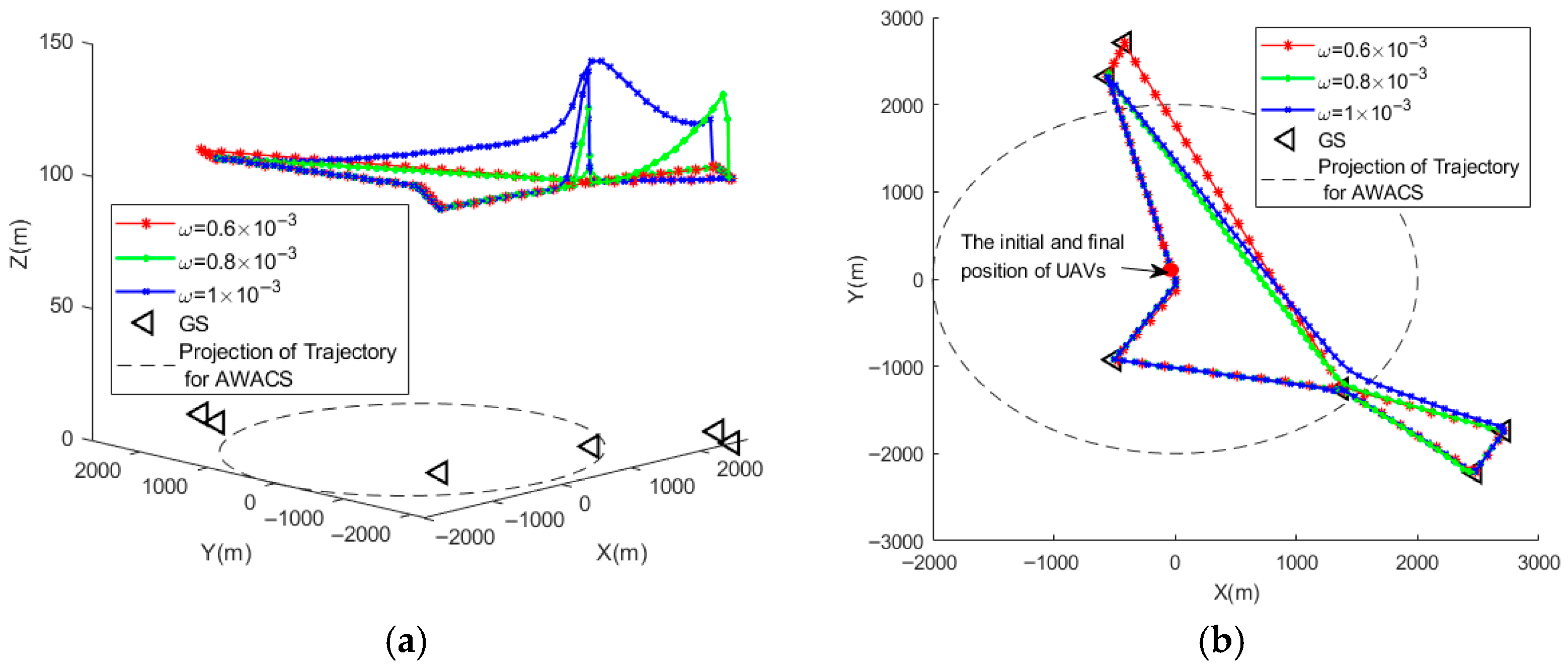
In Figure 2, the special case with I = 1 and J = 6 is analyzed. In this scenario, the UAV consistently transmits at P m a x . The 3D trajectories of the UAV under varying weather conditions are depicted in Figure 2. Trajectories 1, 2, and 3 correspond to the trajectories that maximize the throughput of the UAV for attenuation coefficients ω = [ 0.6 ,   0.8 ,   1.0 ] × 10 3   m 1 , respectively.
In Figure 2a, it can be observed that as the attenuation coefficient ω varies, the motion trajectory of the UAV relay is altered. Specifically, an increase in ω results in a significant decrease in the R F S O of the first hop. To compensate for this reduction and satisfy constraint condition (23d), the UAV adopts a strategy of increasing its flight altitude to decrease the distance between the AWACS and the UAV. Moreover, the impact of atmospheric attenuation is closely linked to the degree of height adjustment needed and the length of time required to sustain that adjustment. It can be seen from Figure 2b, consistent with the conclusion in [24,25], that the UAV is capable of accessing all users sequentially and remaining stationary above each user for a specific duration, thereby achieving maximum throughput. However, when ω = [ 0.8 ,   1.0 ] × 10 3   m 1 , due to the degradation of the atmospheric environment and taking into account the constraint (23d), the UAV is incapable of reaching all GSs.
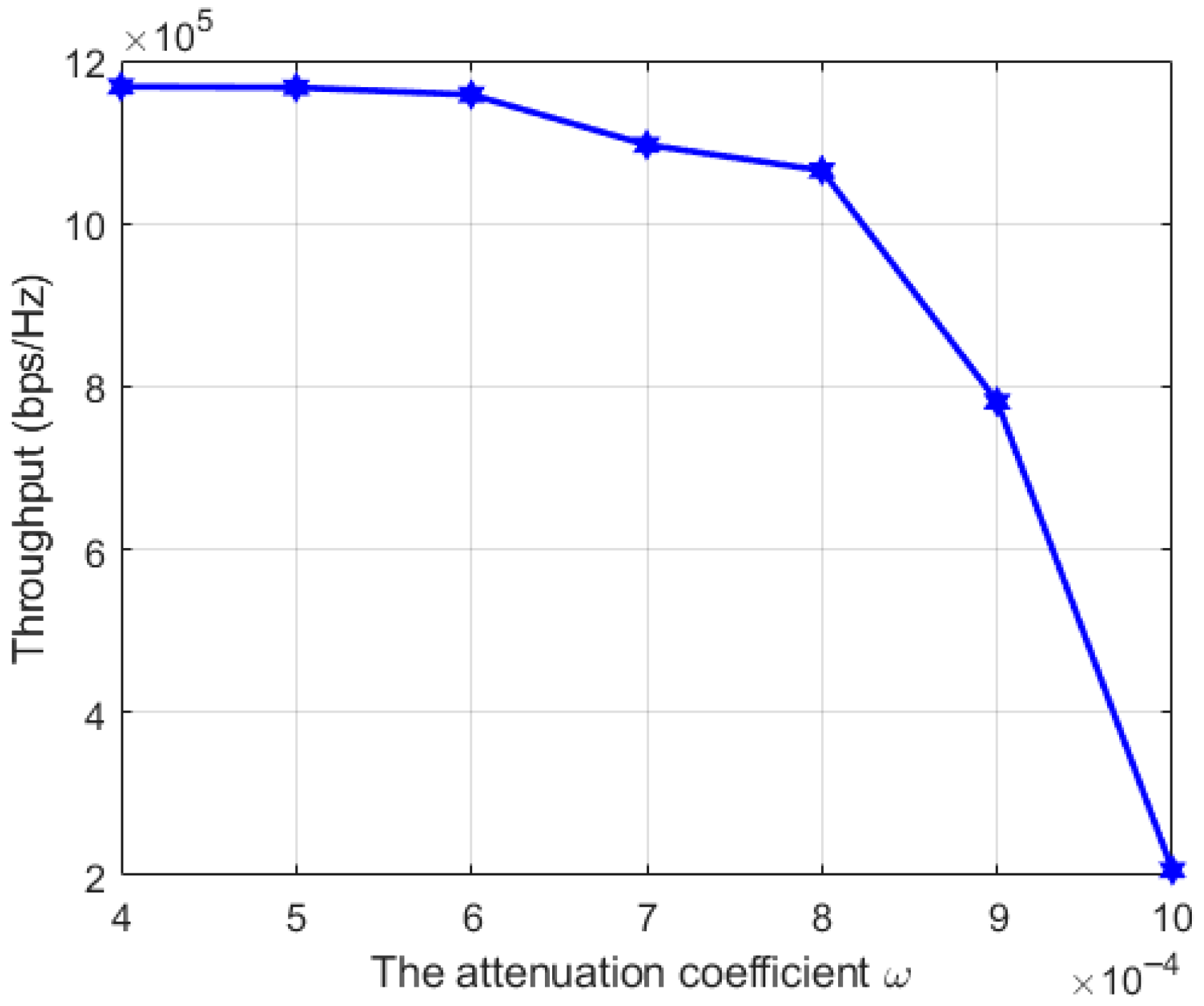
Figure 3 shows the variation in the maximum network throughput as the attenuation coefficient increases with I = 1 and J = 6 . It is found that when the attenuation coefficient is less than 6 × 10 4   m 1 , the throughput remains approximately constant at around 11.5 × 10 5   bps . The variation in the attenuation coefficient does not significantly affect the throughput, suggesting that the transmission rate of the first hop remains relatively high under this condition. During this period, the network throughput is primarily influenced by the transmission rate of the second hop. When the attenuation coefficient exceeds 6 × 10 4   m 1 , the throughput decreases exponentially with increasing attenuation. Specifically, when the attenuation coefficient increases to 10 × 10 4   m 1 , the throughput drops by 82.6 % compared with when ω = 6 × 10 4   m 1 . This occurs because the transmission rate of the first hop declines sharply when the attenuation coefficient exceeds 6 × 10 4   m 1 , severely constraining the overall network throughput due to the constraint (23d).
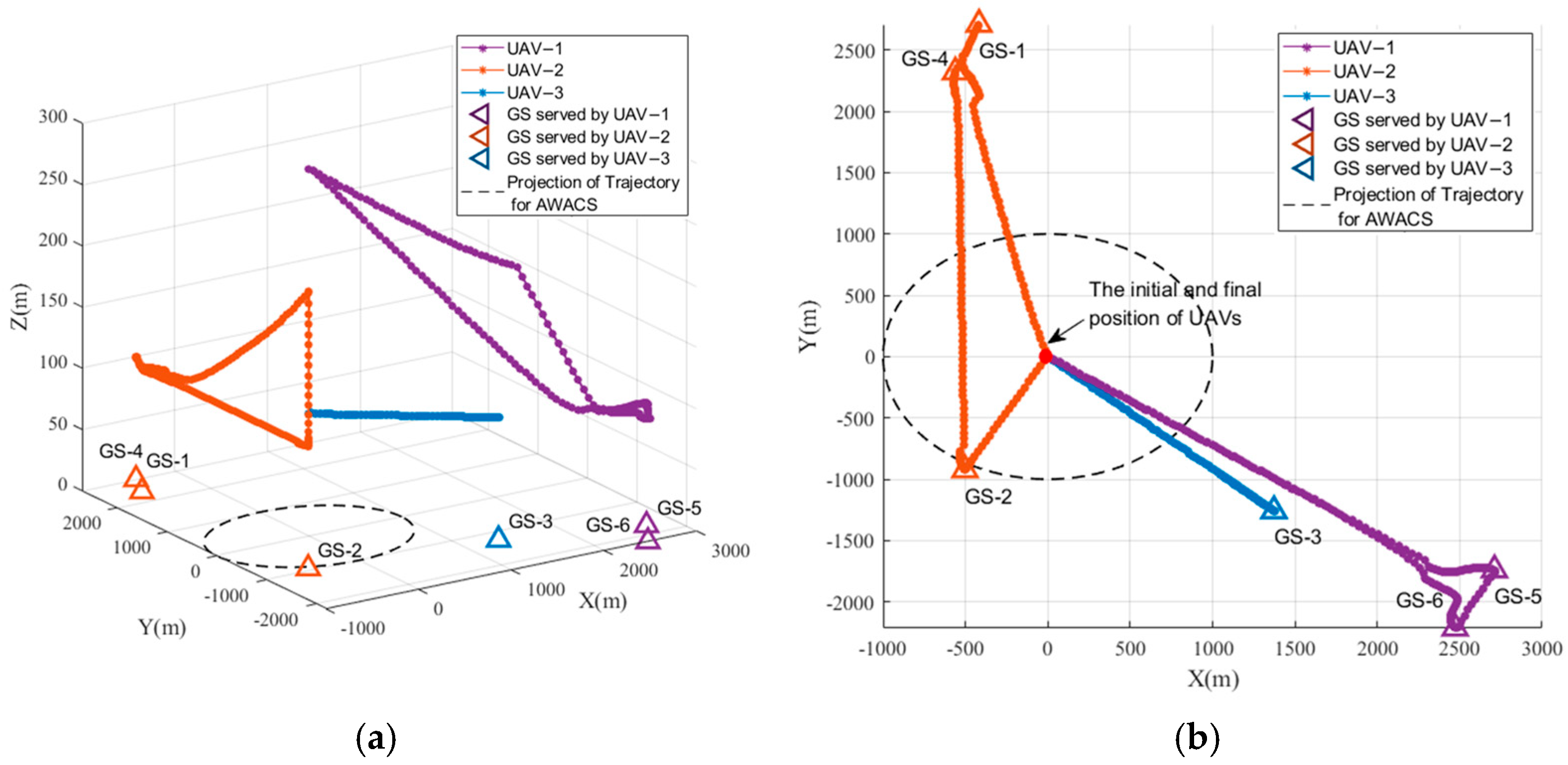
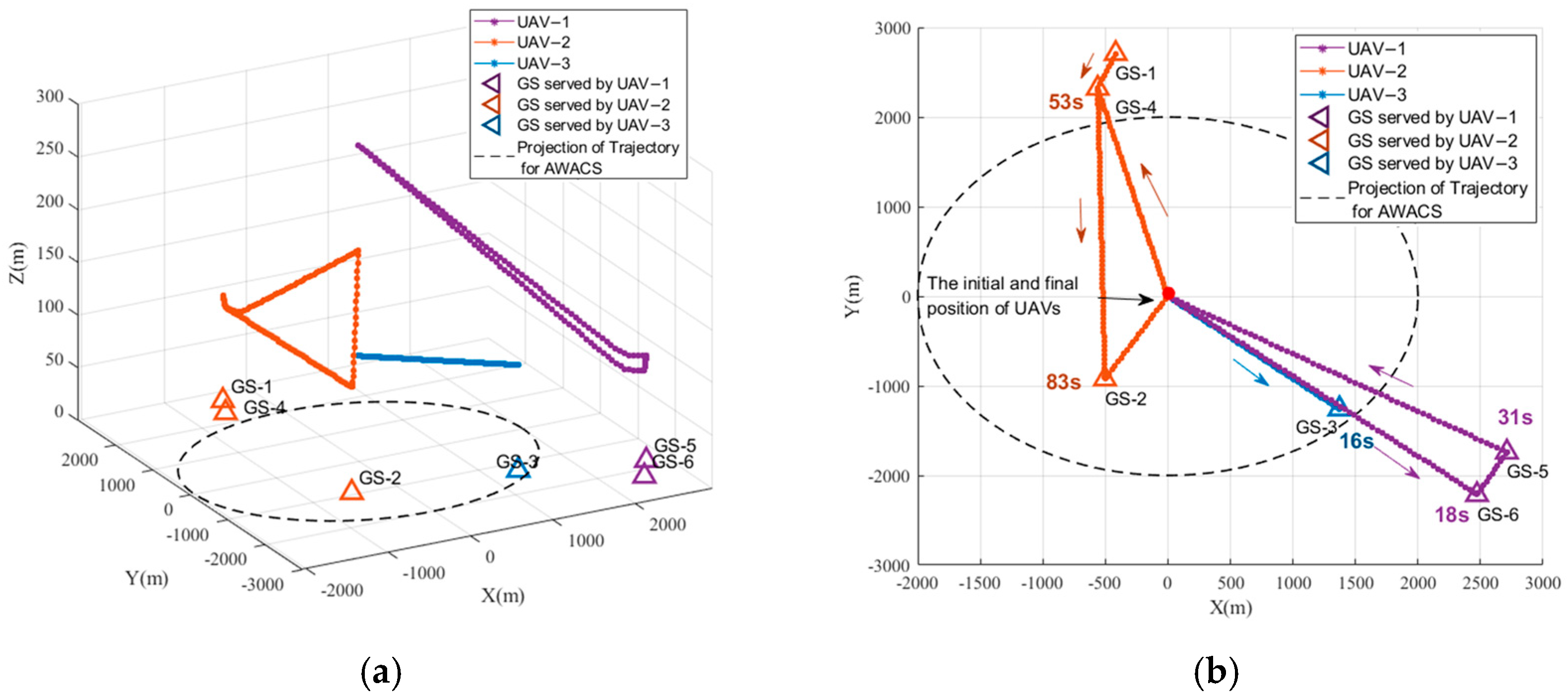
Figure 4 illustrates the throughput maximization trajectories generated by Algorithm 1 in the scenario I = 3 and J = 6 . In this figure, arrows represent the movement directions of the UAV trajectories. Adjacent to the GS, the arrival time of the UAV relay at that particular GS is clearly marked. As shown in this figure, the GSs j = 5 , 6 are assigned to UAV-1, the GSs j = 1 , 2 , 4 are allocated to UAV 2, and the GS j = 3 is designated for UAV-3. In Figure 4a, it can be observed that the three UAVs starting from their respective initial positions q i I descend to the lowest flight altitude H min . At this altitude, they sequentially approach the GSs they were assigned to serve. Upon completing the service, they return to their destinations q i F . It can be observed in Figure 4b that the UAVs visit all GSs and remain hovering above each GS for a period of time.
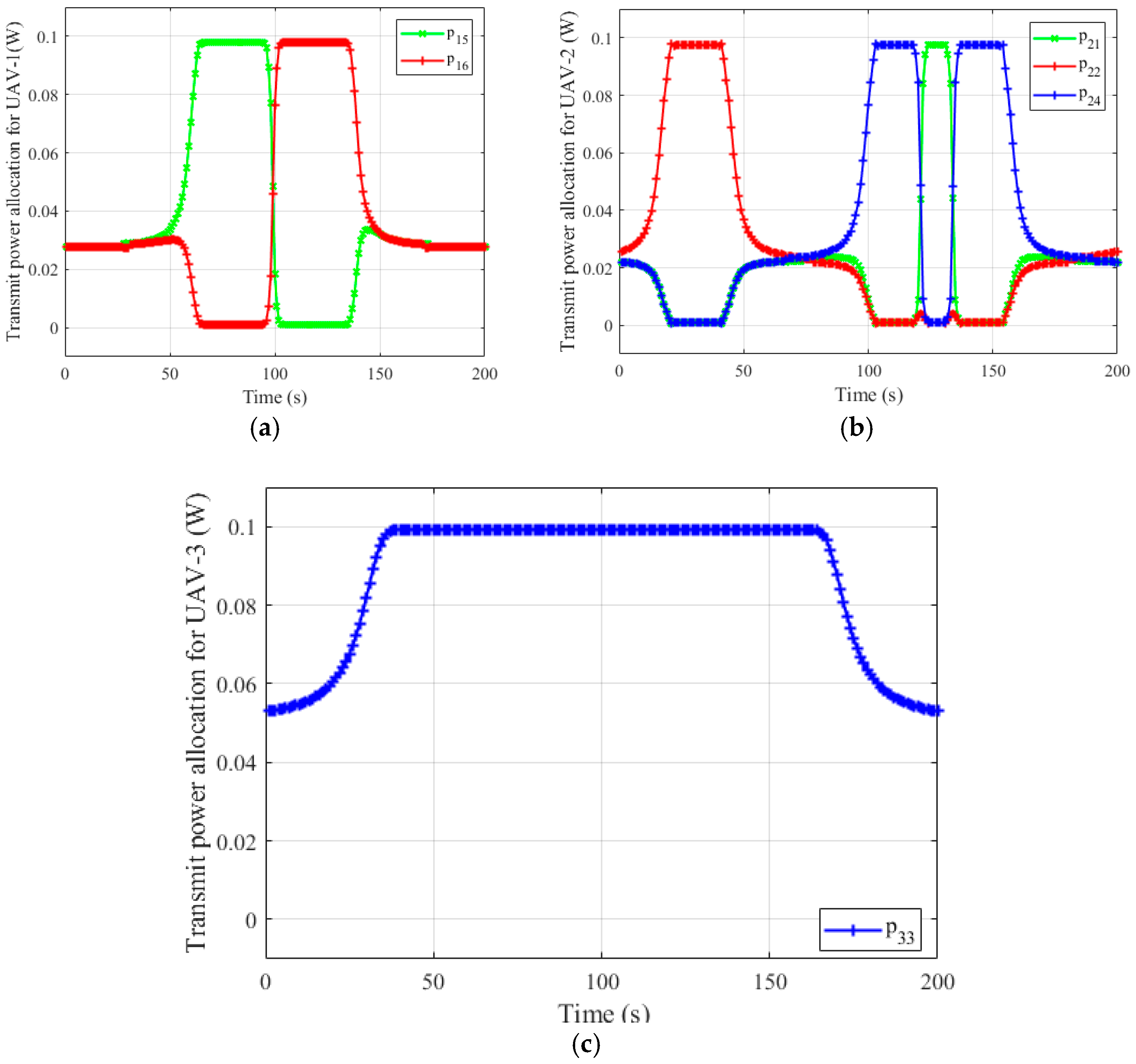
The corresponding transmit power allocation of the three UAVs is illustrated in Figure 5. It can be observed that each UAV prioritizes allocating maximum transmit power to the nearest GS, thereby enhancing throughput while minimizing co-channel interference during information transmission. For instance, as shown in Figure 4b and Figure 5a, at t = 65   s , UAV−1 reaches above GS-6. At this moment, the power p 16 allocated by UAV−1 to GS-6 reaches its peak value of 0.1 W, whereas the power p 15 allocated to the adjacent GS-5 is 0. Conversely, at t = 105   s , when UAV−1 moves above GS-5, the values of p 16 and p 15 are reversed. The transmit power allocation of UAV−2 and UAV-3 is presented in Figure 5b and Figure 5c, respectively, and it follows the same principle as well. Furthermore, when the three UAVs are relatively far away from each other, they tend to operate at maximum transmit power to improve spectral efficiency. However, when the three UAVs are in close proximity, such as near the initial and final positions, one or more UAVs reduce their transmission power to avoid severe interference. For example, UAV-1 reduces its power between t = 1   s and t = 50   s .
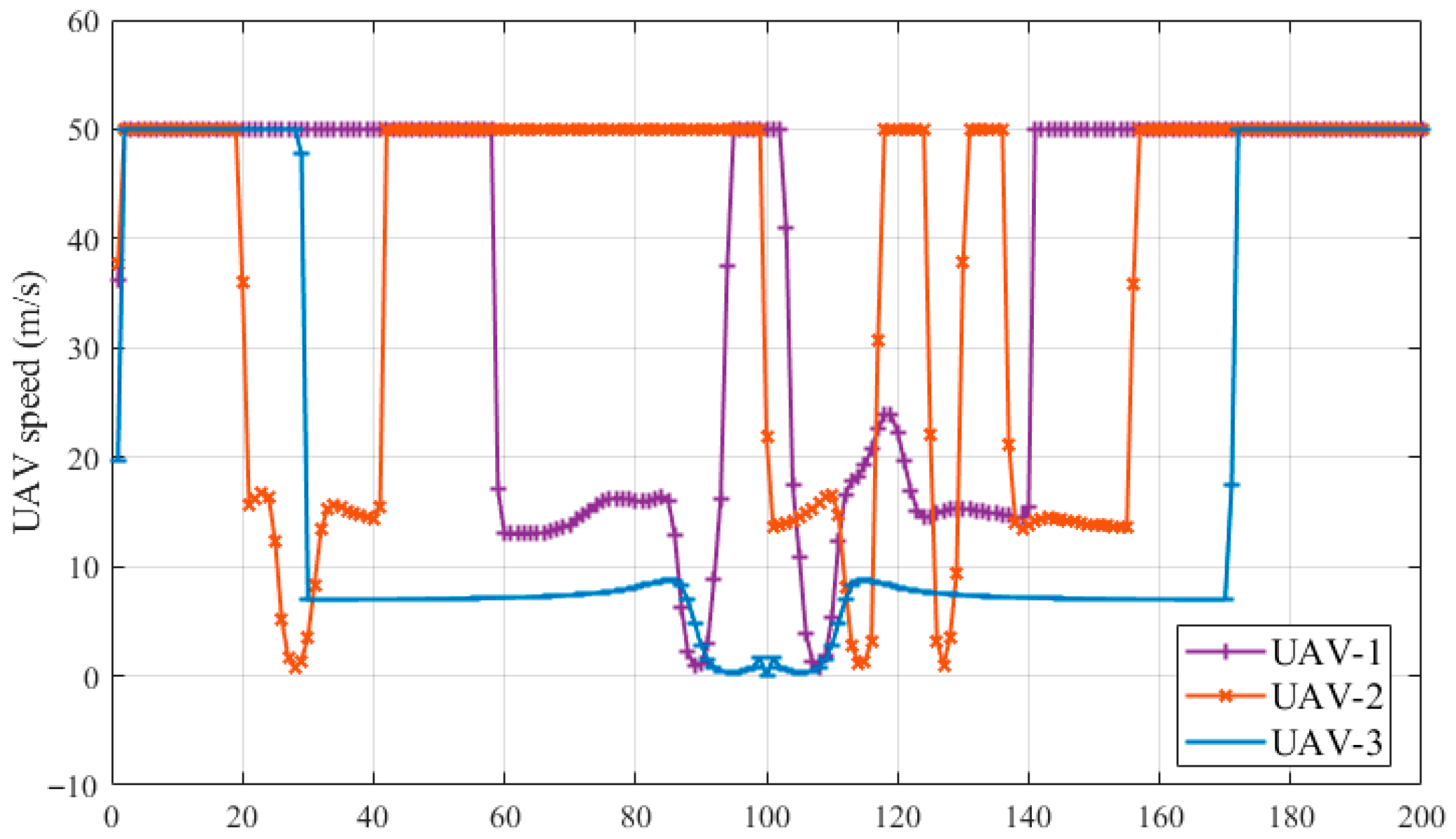
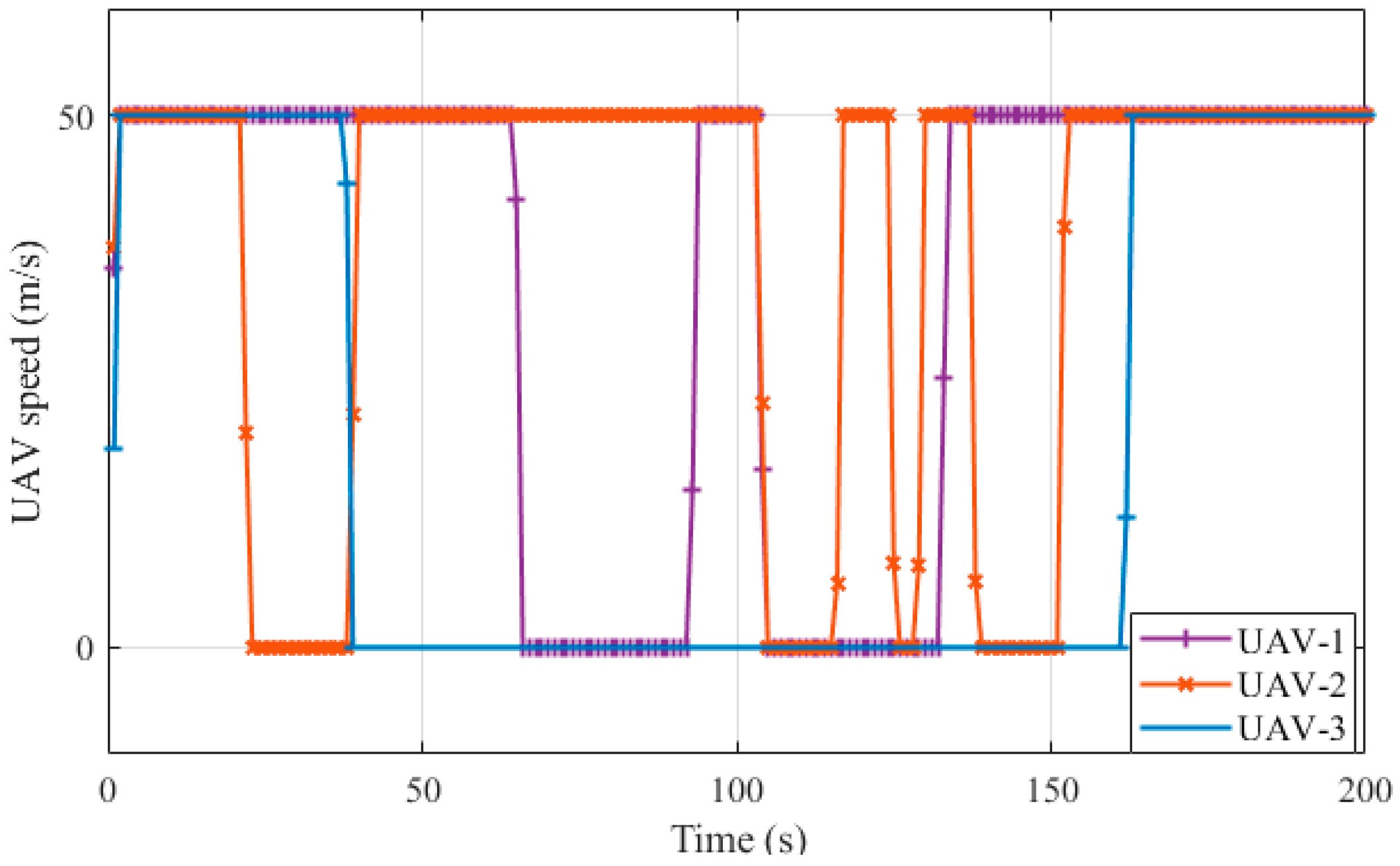
The speeds of the three UAV relays are illustrated in Figure 6. As shown in the results, all UAV relays fly at their maximum speed, V max = 50   m / s , to efficiently approach GSs within the limited time. Upon reaching the optimal communication position, the UAVs decelerate to V min = 0   m / s and hover above the GS to ensure information transmission occurs at the highest rate. In addition to the time required for flying between user positions, UAVs sequentially hover above GSs to maximize network throughput.
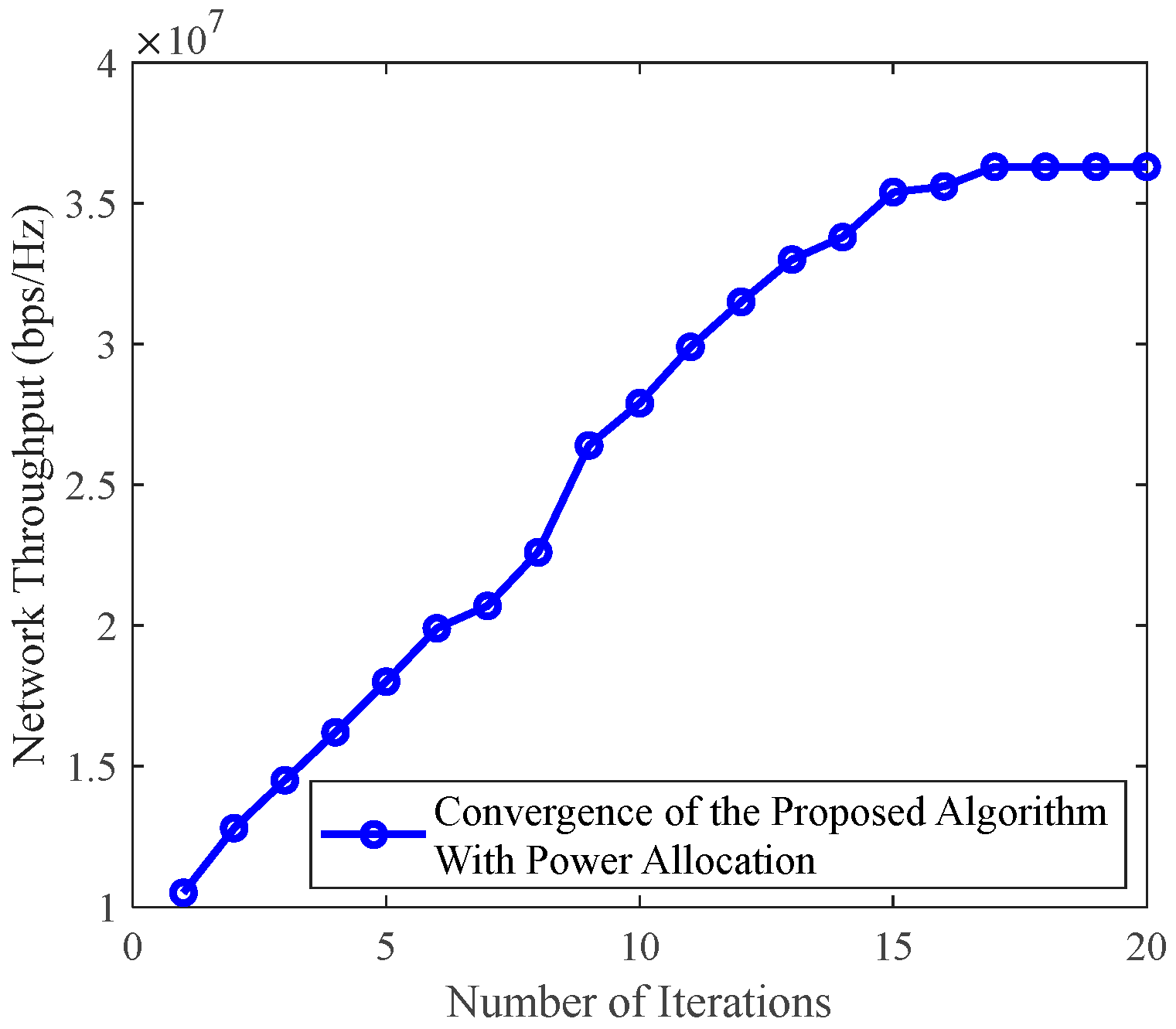
In Figure 7, the throughput increases steadily from 1.05 × 10 7   [ bps / Hz ] to 3.54 × 10 7   [ bps / Hz ] over the first 15 iterations, with a brief plateau between iterations 5 and 6. After 17 iterations, it converges to a stable value of approximately 3.63 × 10 7   [ bps / Hz ] bps/Hz, demonstrating the algorithm’s reliable convergence across different spatial topologies.
Figure 8 illustrates that under the same GS distribution and association as in Figure 4, but without considering transmit power allocation. It presents the throughput maximization trajectories under the method of equal power allocation. In Figure 8, it can be observed that in the absence of power allocation, co-channel interference can only be reduced by optimizing the trajectories of the UAVs. Specifically, the UAVs are unable to hover directly above the GSs and instead must fly near a position close to the GSs, where they achieve the best balance between maximizing the achievable rate and minimizing co-channel interference.
In Figure 9, we observe that the speed variation pattern is similar to that in Figure 6. However, the minimum speed, 0   m / s , is not reached. The UAV relays fly near the GSs at relatively low speeds: about 15   m / s for UAV-1 and UAV-2, and 8   m / s for UAV-3.
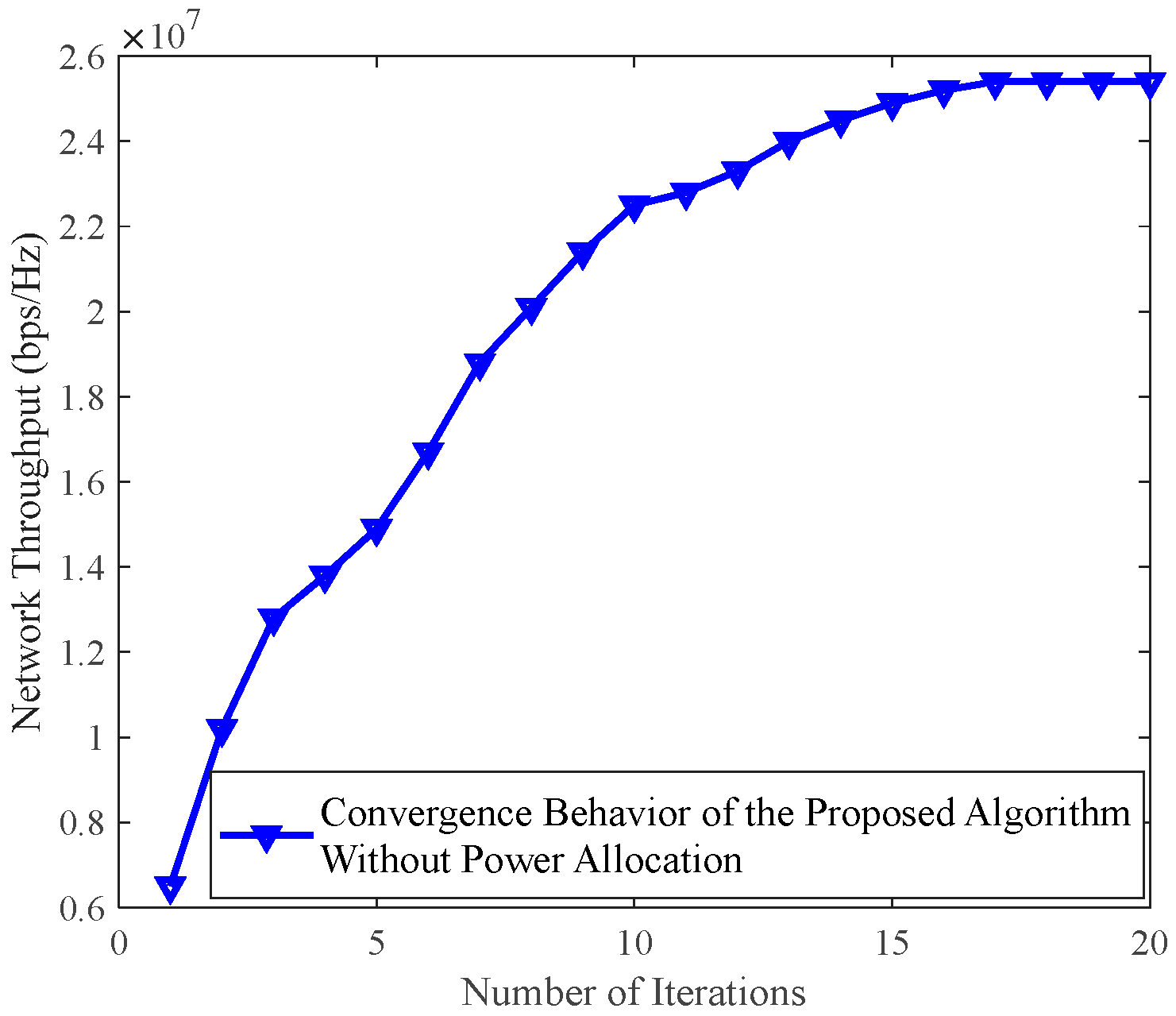
In Figure 10, the network throughput exhibits a clear monotonic increase during the first 11 iterations, rising from 6.5 × 10 6   [ bps / Hz ] to 2.28 × 10 7   [ bps / Hz ] . The growth then gradually levels off, and the throughput stabilizes at approximately 2.54 × 10 7   [ bps / Hz ] after 16 iterations.
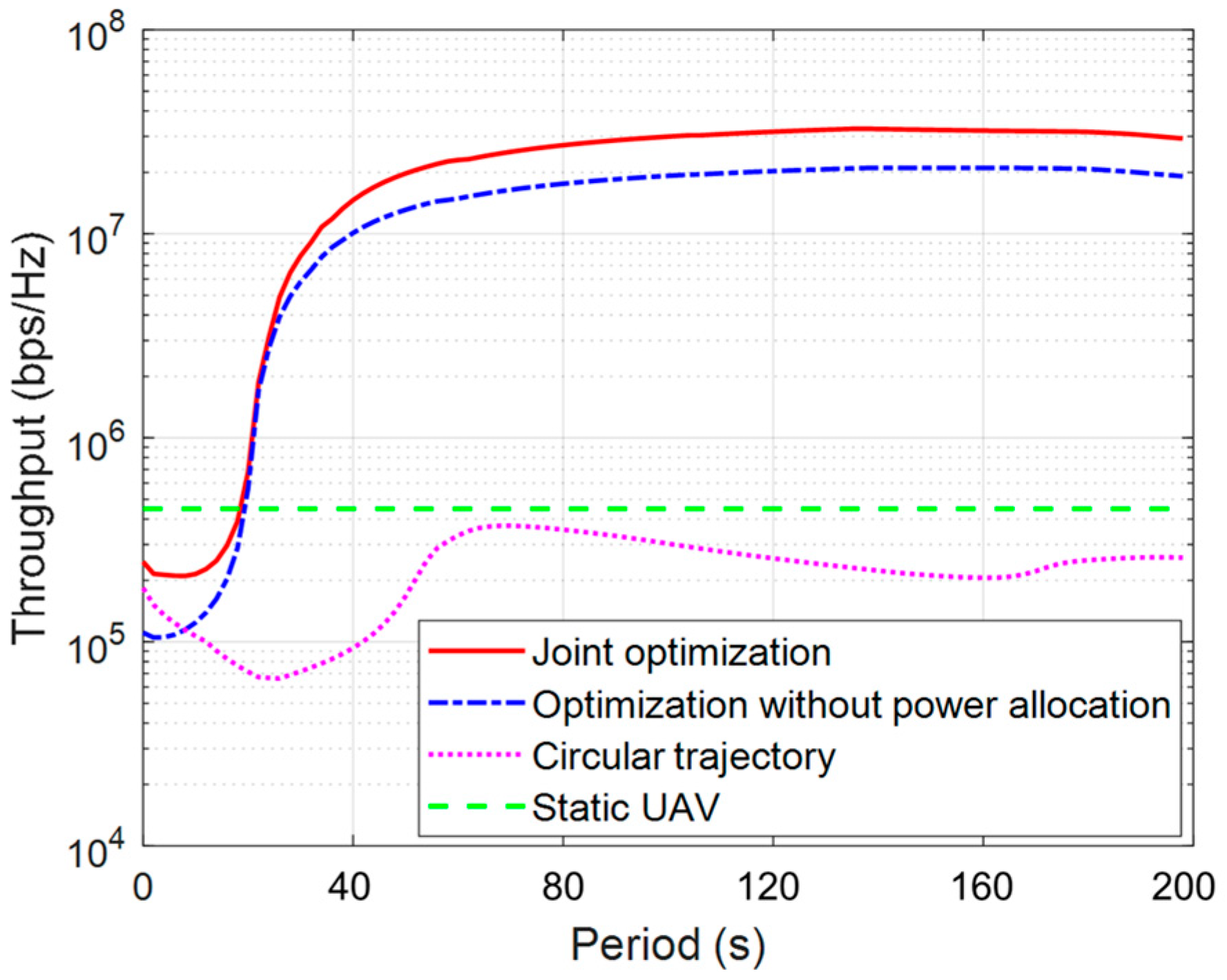
In Figure 11, we present a comparison of the average throughput achieved by four UAV relay deployment schemes in the three-UAV system. These schemes include (1) the proposed joint optimization trajectory; (2) the optimized trajectory obtained using the power equal distribution method without power allocation optimization; (3) the circular trajectory derived from the initialization scheme, with I = 3 , as shown in Figure 2; and (4) static UAVs, where each UAV remains stationary at its initial position q i I throughout the entire period. It can be observed from Figure 11 that the throughput of the optimized trajectory scheme increases as time progresses. The joint optimization scheme incorporating power optimization demonstrates the best throughput performance, with its maximum throughput stabilizing at 3.63 × 10 7   [ bps / Hz ] . The optimization scheme with equal power distribution maintains a stable throughput of about 2.54 × 10 7   [ bps / Hz ] . The scheme involving the deployment of UAVs at fixed positions has a constant throughput over time, which is approximately 4.5 × 10 5   [ bps / Hz ] , and this value depends on the deployment locations of the UAVs. In contrast, the scheme utilizing an initialized circular trajectory flight does not employ any optimization methods and exhibits the poorest throughput performance, about 2.58 × 10 5   [ bps / Hz ] in period T = 200   s . Table 2 gives a detailed numerical comparison of different UAV relay deployment schemes.
In Table 3, to further assess the contribution of joint optimization, we compare the proposed scheme with both the scheme without power allocation and the scheme without association optimization under varying numbers of UAV relays. It is observed that in both schemes, increasing the number of UAV relays can enhance the network throughput. Moreover, when I = 1 , the joint optimization scheme increases throughput by 9.1% compared with the trajectory scheme without power optimization. Since there is only one UAV, the throughput of Scheme 1 and Scheme 3 is the same. When I = 2 , the throughput of Scheme 1 is 23.8% higher than that of Scheme 2, and 29.2% higher than that of Scheme 3. Furthermore, in the three-UAV relay system I = 3 , this ratio increases to 42.9% and 59.9% when compared with Scheme 2 and Scheme 3, respectively. This indicates that multi-UAV relay systems would benefit significantly from the optimization of power allocation to enhance throughput performance.


6. Conclusions

In this paper, a joint 3D trajectory and resource-optimized scheme that maximizes the throughput of multi-UAV-relay-assisted hybrid FSO/RF airborne communication networks was proposed, considering the characteristics of the airborne communication scenario, and the mobility of the platform was taken into account. Furthermore, the causality requirement for information transmission of the serial FSO/RF links was analyzed. In order to enhance the practicality of the optimization scheme, several practical constraints of the system, such as the SINR threshold, collision avoidance among multiple UAVs, and UAV flight limitations, were incorporated. For the constrained joint optimization, the block coordinate descent and the successive convex optimization techniques were proposed. The numerical results present the optimized 3D trajectories and analyze the impact of weather conditions. By comparing with existing schemes, the advantages of the joint optimization scheme proposed in this paper were demonstrated, specifically in terms of enhancing the throughput of the multi-UAV relay system.

Author Contributions

X.Z., methodology, software and writing; Y.W., software and validation; S.Z., conceptualization and supervision; H.H., funding acquisition; J.L., data curation. All authors have read and agreed to the published version of the manuscript.

Funding

This work was supported by the Shaanxi Province Natural Science Basic Research Program (2024JC-YBMS-514). This work was supported by the Fundamental Research Funds for the Central Universities.

Data Availability Statement

The original contributions presented in this study are included in this article. Further inquiries can be directed to the corresponding author.

Conflicts of Interest

The authors declare no conflict of interest.

References

  1. Chowdhury, M.Z.; Hossan, M.T.; Islam, A.; Jang, Y.M. A comparative survey of optical wireless technologies: Architectures and applications. IEEE Access 2018, 6, 9819–9840. [Google Scholar] [CrossRef]
  2. Khalighi, M.A.; Uysal, M. Survey on free space optical communication: A communication theory perspective. IEEE Commun. Surv. Tutor. 2014, 16, 2231–2258. [Google Scholar] [CrossRef]
  3. Alzenad, M.; Shakir, M.Z.; Yanikomeroglu, H.; Alouini, M.-S. FSO-based vertical backhaul/fronthaul framework for 5G+ wireless networks. IEEE Commun. Mag. 2018, 56, 218–224. [Google Scholar] [CrossRef]
  4. Majumdar, A.K. Advanced Free Space Optics (FSO): A Systems Approach; Springer: Berlin/Heidelberg, Germany, 2014. [Google Scholar]
  5. Sun, Q.; Hu, Q.; Wu, Y.; Chen, X.; Zhang, J.; López-Benítez, M. Performance analysis of mixed FSO/RF system for satellite-terrestrial relay network. IEEE Trans. Veh. Technol. 2024, 73, 11378–11393. [Google Scholar] [CrossRef]
  6. Zhang, X.; Zhao, S.; Wang, Y.; Wang, X.; Tian, Q.; Song, X.; Li, X. A weather-dependent UAV relay-assisted hybrid FSO/RF airborne communication system. Opt. Commun. 2024, 554, 130196. [Google Scholar] [CrossRef]
  7. Zhou, W.; Wu, T.; Song, S.; Zhao, L.; Wang, D.; Li, J.; Zhou, L.; Wen, H.; Wang, Y.; Guo, L. Development and Field Testing of a Robust UAV Relay-Assisted Hybrid FSO/RF System for Emergency Communications. J. Light. Technol. 2026, 44, 3060–3070. [Google Scholar] [CrossRef]
  8. Mohsan, S.A.H.; Khan, M.A.; Amjad, H. Hybrid FSO/RF networks: A review of practical constraints, applications, and challenges. Opt. Switch. Netw. 2023, 47, 100697. [Google Scholar] [CrossRef]
  9. Xu, G.; Zhang, N.; Xu, M.; Zhang, Q.; Song, Z. Outage probability and average BER of UAV-assisted dual-hop FSO communication with amplify-and-forward relaying. IEEE Trans. Veh. Technol. 2023, 72, 8287–8302. [Google Scholar] [CrossRef]
  10. Malik, S.; Saxena, P.; Chung, Y.H. Performance analysis of a UAV-based IRS-assisted hybrid RF/FSO link with pointing and phase shift errors. J. Opt. Commun. Netw. 2022, 14, 303–315. [Google Scholar] [CrossRef]
  11. Li, X.; Liu, Y.; Guo, S.; Li, Z.; Zhao, X. Robust Joint Optimization for Efficient and Reliable FSO/RF Satellite-UAV-Terrestrial Networks with Random Fading and Imperfect Channel Information. IEEE Internet Things J. 2025, 12, 45307–45324. [Google Scholar] [CrossRef]
  12. Qu, L.; Xu, G.; Zeng, Z.; Zhang, N.; Zhang, Q. UAV-assisted RF/FSO relay system for space-air-ground integrated network: A performance analysis. IEEE Trans. Wirel. Commun. 2022, 21, 6211–6225. [Google Scholar] [CrossRef]
  13. Zhang, X.; Zhao, S.; Wang, Y.; Hu, H.; Yang, G.; Song, X.; Li, X.; Li, J. Performance Analysis of Multiple UAV-Based Hybrid Free-Space Optical/Radio Frequency Aeronautical Communication System in Mobile Scenarios. Drones 2024, 8, 729. [Google Scholar] [CrossRef]
  14. Nafees, M.; Baniasadi, M.; Hopgood, J.R.; Safari, M.; Thompson, J.S. Integrated Sensing and Communication for UAV Trajectory Optimization in Mixed FSO-RF Networks in Dynamic Weather Conditions. In Proceedings of the 2025 IEEE Wireless Communications and Networking Conference (WCNC), Milan, Italy, 24–27 March 2025; IEEE: Piscataway, NJ, USA, 2025. [Google Scholar]
  15. Lee, J.H.; Park, K.H.; Ko, Y.C.; Alouini, M.-S. Throughput maximization of mixed FSO/RF UAV-aided mobile relaying with a buffer. IEEE Trans. Wirel. Commun. 2020, 20, 683–694. [Google Scholar] [CrossRef]
  16. Mashiko, K.; Kawamoto, Y.; Kato, N.; Yoshida, K.; Ariyoshi, M. Combined control of coverage area and HAPS deployment in hybrid FSO/RF SAGIN. IEEE Trans. Veh. Technol. 2025, 74, 10819–10828. [Google Scholar] [CrossRef]
  17. Zhang, Y.; Gao, X.; Yuan, H.; Yang, K.; Kang, J.; Wang, P.; Niyato, D. Joint UAV trajectory and power allocation with hybrid FSO/RF for secure space-air-ground communications. IEEE Internet Things J. 2024, 11, 31407–31421. [Google Scholar] [CrossRef]
  18. Song, S.; Choi, M.; Ko, D.E.; Chung, J.-M. Multi-UAV trajectory optimization considering collisions in FSO communication networks. IEEE J. Sel. Areas Commun. 2021, 39, 3378–3394. [Google Scholar] [CrossRef]
  19. Rani, R.; Mandpura, A.; Chauhan, K.; Yadav, D.; Lakshmanan, M. Performance of adaptive combining-based hybrid FSO/RF communication system. Photonic Netw. Commun. 2026, 51, 4. [Google Scholar] [CrossRef]
  20. Kaushal, H.; Kaddoum, G. Optical communication in space: Challenges and mitigation techniques. IEEE Commun. Surv. Tutor. 2016, 19, 57–96. [Google Scholar] [CrossRef]
  21. Lapidoth, A.; Moser, S.M.; Wigger, M.A. On the capacity of free-space optical intensity channels. IEEE Trans. Inf. Theory 2009, 55, 4449–4461. [Google Scholar] [CrossRef]
  22. Chaaban, A.; Morvan, J.M.; Alouini, M.S. Free-space optical communications: Capacity bounds, approximations, and a new sphere-packing perspective. IEEE Trans. Commun. 2016, 64, 1176–1191. [Google Scholar] [CrossRef]
  23. Lee, J.H.; Park, K.H.; Ko, Y.C.; Alouini, M.-S. A UAV-mounted free space optical communication: Trajectory optimization for flight time. IEEE Trans. Wirel. Commun. 2019, 19, 1610–1621. [Google Scholar] [CrossRef]
  24. Lee, J.H.; Park, K.H.; Ko, Y.C.; Alouini, M.-S. Spectral-efficient network design for high-altitude platform station networks with mixed RF/FSO system. IEEE Trans. Wirel. Commun. 2022, 21, 7072–7087. [Google Scholar] [CrossRef]
  25. Zeng, Y.; Zhang, R.; Lim, T.J. Throughput maximization for UAV-enabled mobile relaying systems. IEEE Trans. Commun. 2016, 64, 4983–4996. [Google Scholar] [CrossRef]
Figure 1. The multi-UAV-relay-assisted dual-hop mixed FSO/RF airborne communication network model.
Drones 10 00362 g001
Figure 2. The obtained 3D throughput maximization trajectory with I = 1 . Figure 2a,b from different perspectives. (a) Front view. (b) Top view.
Drones 10 00362 g002
Figure 3. The impact of different weather-dependent attenuation coefficients.
Drones 10 00362 g003
Figure 4. The trajectories for throughput maximization in a scenario I = 3 and J = 6 with transmit power allocation. Figure 4a,b from different perspectives. (a) Front view. (b) Top view.
Drones 10 00362 g004
Figure 5. The transmit power allocation p i j versus time for the scenario I = 3 and J = 6 . (a) UAV−1. (b) UAV−2. (c) UAV-3.
Drones 10 00362 g005
Figure 6. The speed of UAVs versus time for T = 200   s with transmit power allocation.
Drones 10 00362 g006
Figure 7. The throughput versus the number of BCD iterations with power allocation.
Drones 10 00362 g007
Figure 8. The trajectories for throughput maximization in scenario I = 3 and J = 6 without transmit power allocation. Figure 8a,b from different perspectives. (a) Front view. (b) Top view.
Drones 10 00362 g008
Figure 9. The speed of UAVs versus time for T = 200   s without transmit power allocation.
Drones 10 00362 g009
Figure 10. The throughput versus the number of BCD iterations without power allocation.
Drones 10 00362 g010
Figure 11. The throughput versus period T for a three-UAV system with different UAV relay deployment schemes.
Drones 10 00362 g011
Table 1. Simulation parameters and values [6].
ParametersValues
Altitude of AWACS H A W A C S 8 km
Hovering radius of AWACS R 2 km
Bandwidth for FSO B F S O 10 11   Hz
Bandwidth for RF B R F 10 8   Hz
Wavelength λ F S O 1550 nm
Parameters α 0.1
Average SNR of FSO γ F S O 90 dB
Parameters C and D 10, 0.6
Received power at the reference distance β 0 −50 dBm
Additional attenuation factor ε 0.2
Noise variance for RF link σ 2 R F −90 dBm
Beamforming gain for desired signal g i j 1
Beamforming gain for interference signal g m j I 0.1
Maximum UAV transmit power P m a x 0.1 W
Table 2. Throughput comparison of different UAV relay deployment schemes (I = 3; T = 200s).
SchemeMaximum Throughput Gain Over Baseline [%]
Joint optimization trajectory [ bps / Hz ] (baseline) 3.63 × 10 7  
Trajectory design without power optimization [ bps / Hz ] 2.54 × 10 7   30
Circular trajectory [ bps / Hz ] 4.5 × 10 5 98.8
Static UAVs [ bps / Hz ] 2.58 × 10 5 99.3
Table 3. Throughput comparison of different numbers of UAV relays.
I = 1I = 2I = 3
Scheme 1:
Joint optimization trajectory [ bps / Hz ]
1.21 × 10 6   2.39 × 10 7   3.63 × 10 7  
Scheme 2:
Trajectory design without power optimization [ bps / Hz ]
1.11 × 10 6   1.93 × 10 7   2.54 × 10 7  
Scheme 3:
Trajectory design without association optimization [ bps / Hz ]
1.21 × 10 6   1.85 × 10 7   2.27 × 10 7  
Disclaimer/Publisher’s Note: The statements, opinions and data contained in all publications are solely those of the individual author(s) and contributor(s) and not of MDPI and/or the editor(s). MDPI and/or the editor(s) disclaim responsibility for any injury to people or property resulting from any ideas, methods, instructions or products referred to in the content.