
A Risk-Aware Robust Navigation Framework for UAVs in GNSS-Degraded Low-Altitude Environments
Highlights
- A novel DPAP framework is proposed, integrating robust single-point positioning, passive differential refinement, and scenario-aware fusion to tackle geometric ill-conditioning in low-altitude UAV navigation.
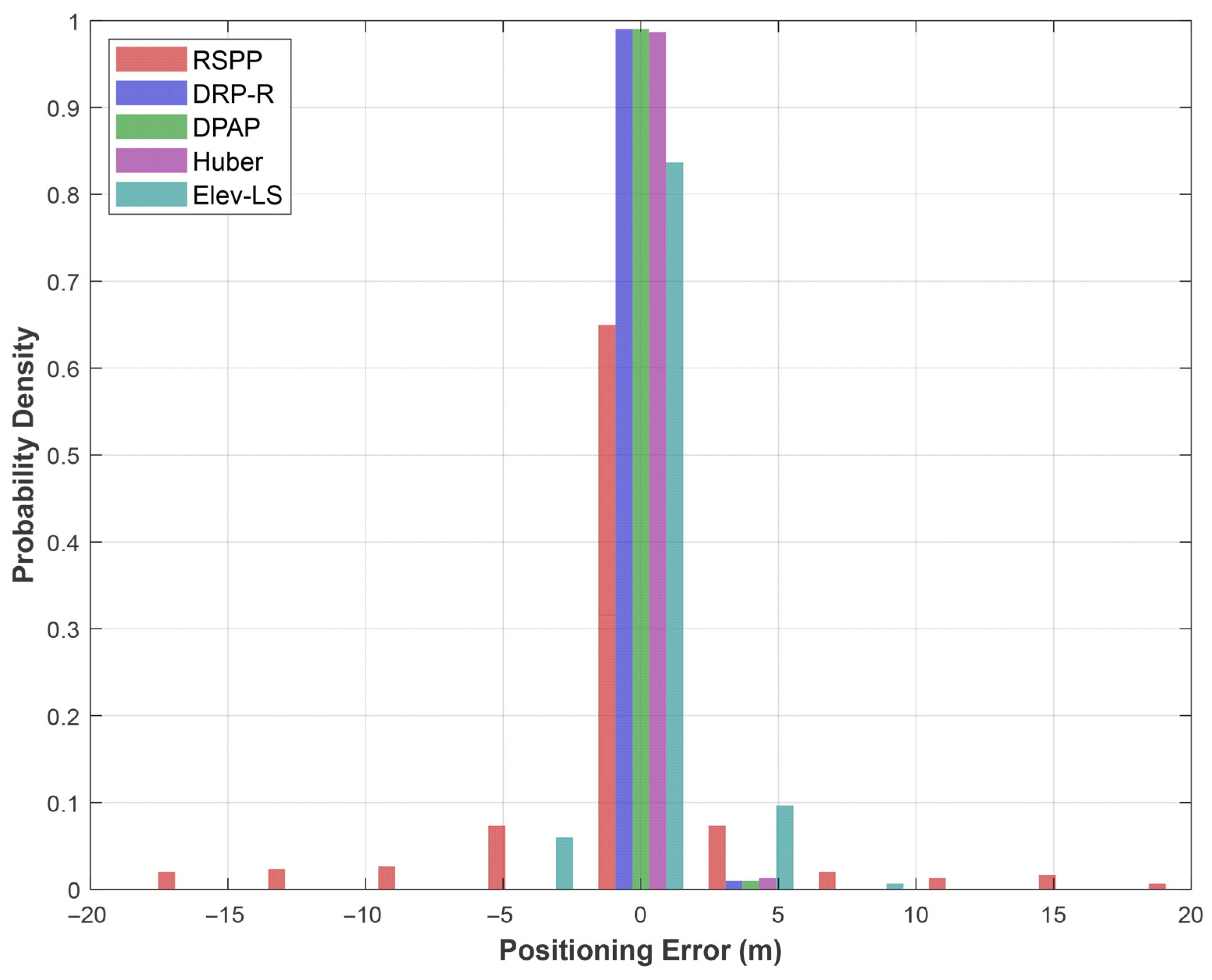
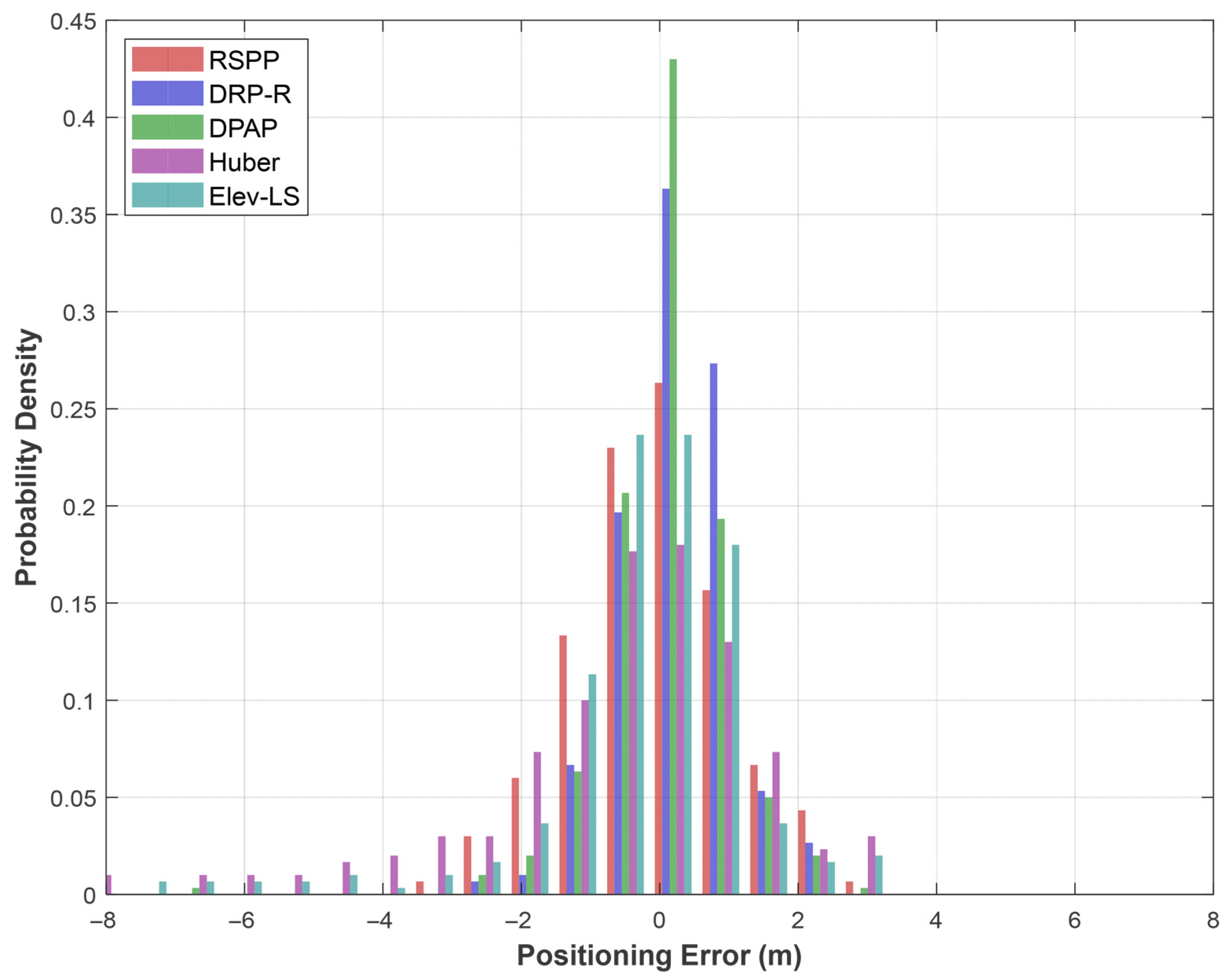
- Experiments under severe conditions (≥200 km baselines, 15% NLOS) demonstrate a 0.588 m RMS accuracy, outperforming traditional Huber M-estimation and elevation-weighted methods by 13% and 60%, respectively.
- The framework provides a critical GNSS-independent backup for UAVs, enabling safe operations in the emerging low-altitude airspace even when satellite signals are degraded or denied.
- The proposed three-stage architecture establishes a practical paradigm for robust positioning in sparse infrastructure scenarios, demonstrating that meter-level accuracy is achievable using only limited ground-based broadcast transmitters.
Abstract
1. Introduction
2. System Model
- Lateral motion is tightly controlled. In low-altitude corridor operations, UAVs are required to stay close to a nominal path. Airspace rules and autopilot systems actively suppress cross-track deviations. Modern controllers typically keep lateral errors near zero [25]. Thus, omitting the lateral dimension does not sacrifice realism for this scenario.
- Positioning geometry is dominated by the vertical plane. When ground stations lie approximately along the flight path, cross-track observability is weak. Recent GDOP analyses for UAV corridors show that geometric strength comes mainly from the along-track and vertical directions [26]. Therefore, the key challenge-ill-conditioning due to low elevation angles is fully captured in the plane.
- Reduced-dimensional modeling is a common and valid approach. Many advanced GNSS-denied methods first prove their core ideas in 2D before extending to 3D [27]. This lets researchers isolate the fundamental issue, in our case, elevation-dependent NLOS bias without unnecessary complexity.
2.1. Basic Assumptions
2.2. Observation Model
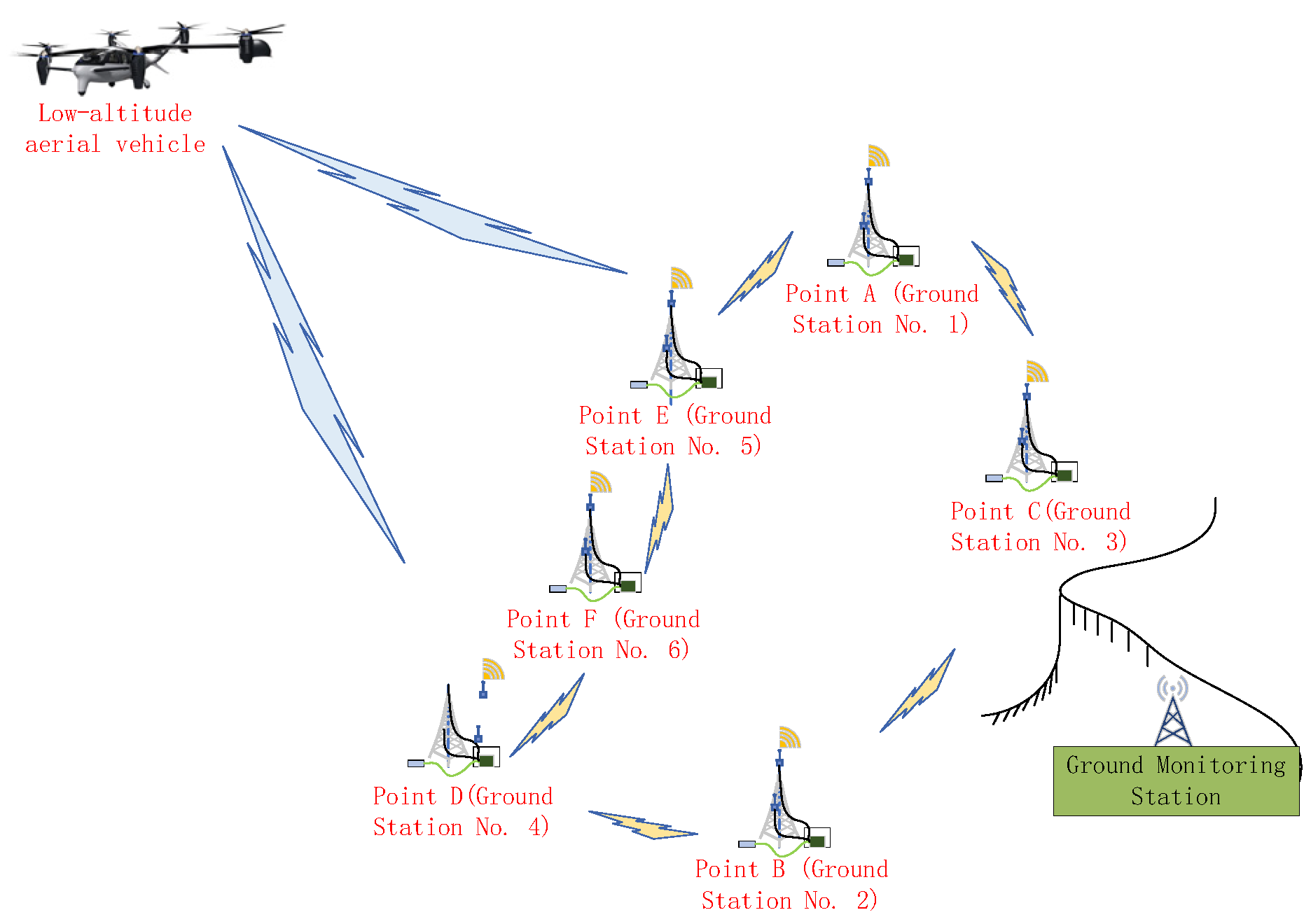
- Ground Station Deployment: Referring to the deployment conditions of terrestrial radio positioning systems such as eLoran [28] and Locata [29], and to meet the requirement that the distance between ground stations and users is no less than 200 km in this study, we assume the deployment of 6 ground stations, i.e., M = 6. In this paper, system modeling is conducted within a one-dimensional along-track profile. The two-dimensional coordinates of the i-th ground station are denoted as , where i ∈ {1, 2, …, M} and = 30.
- User State: The two-dimensional coordinates of the user in this paper are denoted as , where represents the user’s horizontal position coordinate, and represents the user’s flight altitude with a value of , which is set according to the application scenario.
- Observation Model: This paper defines the geometric distance from the i-th ground station to the user as , which satisfies Equation (1):where the vertical height difference is defined as , then the i-th pseudorange observation must satisfy Equation (2):where
- -
- ).
- -
- is the user receiver clock bias.
- -
- is the transmit clock bias of the i-th ground station, where .
- -
- is the positive bias introduced by Non-Line-of-Sight (NLOS) propagation.
- -
- is zero-mean Gaussian measurement noise, including thermal noise.
3. DPAP Positioning Method
3.1. Robust Single-Point Positioning Initialization (RSPP)
3.1.1. Coarse Grid Initialization
- Calculate the geometric distance as in (3):where .
- Estimate the initial clock bias as in (4):leveraging the robustness of the median to outliers.
- Calculate the total L1 residual as in (5). The grid point corresponding to the minimum value of the objective function is established as the initial state , thereby avoiding the dependence of non-convex optimization on initial value selection.
3.1.2. IRLS Refinement
3.2. Differential Radio Positioning–Refinement (DRP-R)
3.3. Safe Fusion
- Scenario Branch Decision
- 2.
- Remarks on Real-Time NLOS Probability Estimation
- 3.
- Risk-Aware Covariance Modeling
- 4.
- Constrained Inverse-Variance Weighted Fusion
3.4. Integrated Workflow of the DPAP Framework
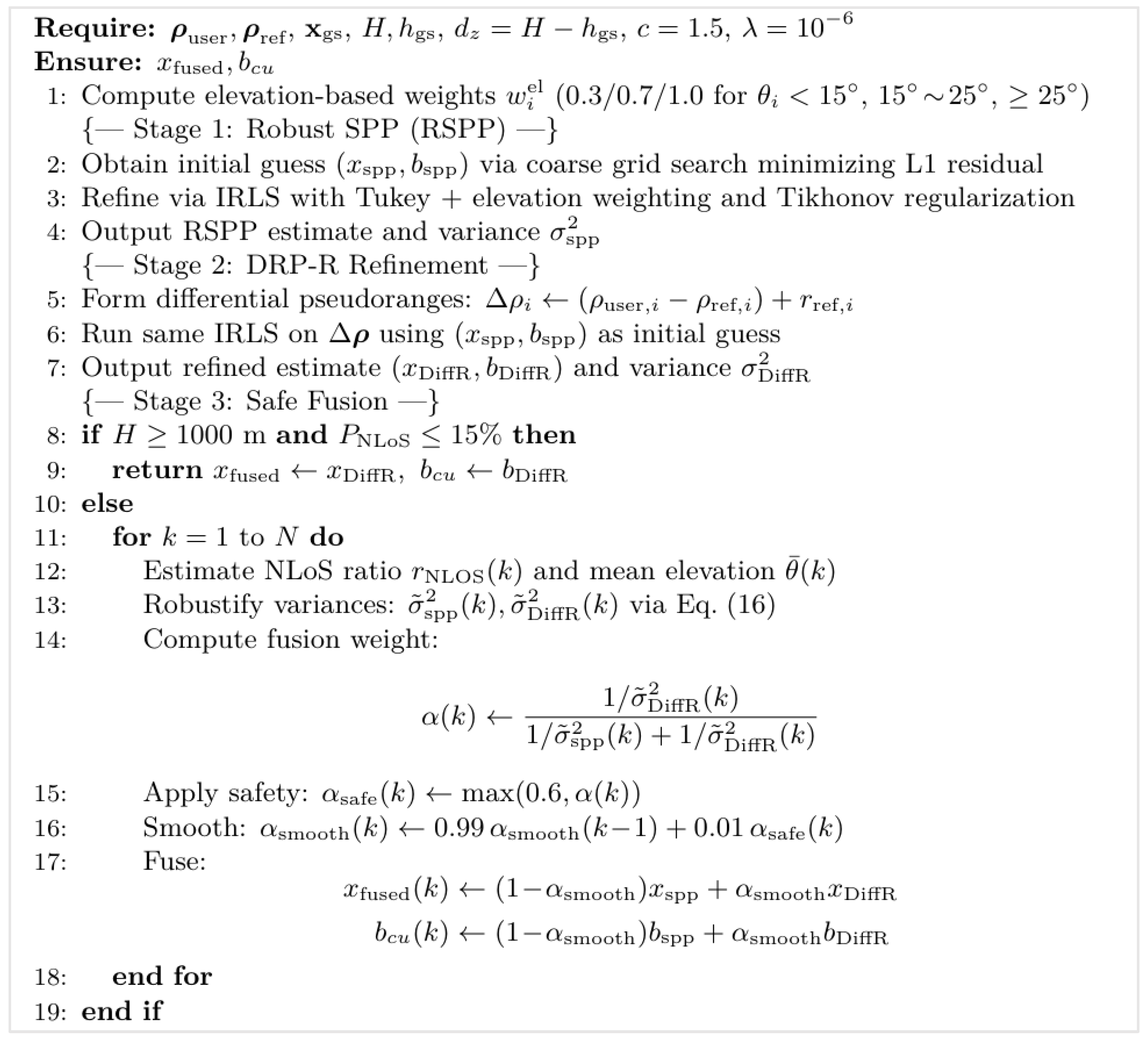
- RSPP Initialization: Taking the grid-search initialized state from the previous epoch (or a nominal starting point) as the input, the RSPP module calculates a robust initial position estimate and its associated uncertainty by means of the Tikhonov-regularized IRLS algorithm (Section 3.1).
- Differential Refinement (DRP-R): This robust initial estimate is transmitted to the DRP-R module, which constructs differential pseudorange observations with the aid of a nearby reference station (Section 3.2). A weighted least-squares estimation is then performed to generate the refined position estimate and its corresponding covariance .
- Safe Fusion: Both the two position estimates and their raw covariance values are fed into the Safe Fusion module. After conducting risk-aware covariance inflation (Equation (16)) to derive and , the module computes the smoothed fusion weight (Equations (17)–(19)) and yields the final fused state in accordance with Equation (20).
- Feedback: The fused state is stored and utilized as the initial guess for the RSPP module in the subsequent epoch k + 1. This feedback mechanism guarantees the temporal consistency of the estimation results and prevents positioning drift.
4. Simulation Results
4.1. System Deployment and Parameter Settings
4.2. Simulation Results and Analysis
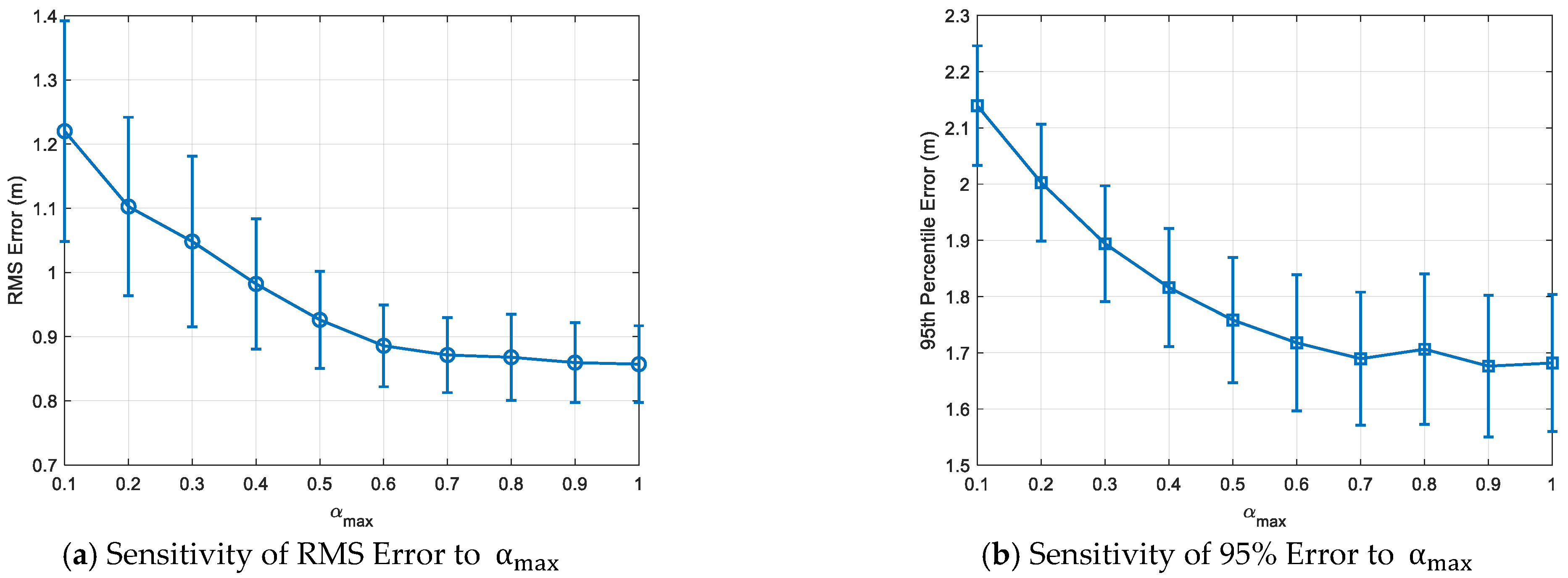
4.3. Ablation Study on the Safety Constraint Parameter
4.4. Computational Complexity and Performance Trade-Off Analysis
- Optimal Accuracy–Efficiency Balance: In the challenging urban scenario, DPAP achieves the highest positioning accuracy with an RMS error of 0.858 m. This represents a 3.4% improvement over the second-best method (DRP-R, 0.888 m), and substantial improvements of 63.8% and 69.3% over the Huber M-estimator (2.756 m) and Elev-LS (2.342 m), respectively. Although DPAP requires a slightly longer computation time (0.15 s) than DRP-R (0.12 s)—a cost attributed to the additional covariance inflation and safe fusion steps (Equations (16)–(20))—this marginal increase (0.03 s) delivers critical gains in operational safety and reliability. Consequently, DPAP secures the top rank in positioning accuracy while maintaining a competitive composite index (7.87).
- Real-Time Feasibility: The average processing time of DPAP (0.15 s) corresponds to an update rate of approximately 6.7 Hz, which comfortably exceeds the typical control loop frequencies reported for low-altitude UAVs in the literature [38]. The remaining computational margin enables seamless integration with other onboard sensors and communication protocols, confirming that DPAP meets the stringent real-time requirements of practical field deployments.
- Limitations of Classical Robust Methods: While the Huber M-estimator (0.08 s) and Elev-LS (0.06 s) feature lower computational complexity, their markedly higher positioning errors (2.756 m and 2.342 m, respectively) result in significantly lower composite indices (4.53 and 7.12). This demonstrates that their computational efficiency does not translate into a favorable performance trade-off in scenarios with severe non-line-of-sight (NLOS) interference and geometric ill-conditioning. Their suboptimal performance underscores the necessity of the proposed fusion-based architecture.
- Baseline Method Limitations: Notably, the standalone RSPP method incurs the highest computational burden (0.85 s) alongside the poorest positioning accuracy (1.295 m), yielding the lowest composite index (0.91). This high latency is primarily attributed to the difficulty in converging to a reliable positioning solution under conditions of sparse geometric coverage and severe multipath interference without differential corrections. This result confirms that traditional single-point positioning is not suitable for safety-critical low-altitude UAV operations.
4.5. Sensitivity to Altitude Errors
4.6. Discussion of Key Parameters
4.6.1. Regularization Parameter
4.6.2. Covariance Floor
4.6.3. Risk Amplification Factors and
- Under simulated conditions with 30% NLOS satellite visibility, the baseline DRP-R solution exhibits an RMS error approximately three times higher than in ideal LOS environments, justifying = 3.0.
- When the mean satellite elevation angle drops below 25°, geometric dilution of precision (GDOP) increases by a factor of 2–3, consistent with empirical error amplification patterns observed in urban GNSS multipath studies [21].
4.6.4. Smoothing Factor β and Differential Refinement Context
4.6.5. Iteration Termination Threshold ε
4.6.6. Summary of Parameter Robustness
5. Conclusions
- Robust Single-Point Positioning (RSPP) is performed using grid-search initialization followed by Iteratively Reweighted Least Squares (IRLS) to obtain a reliable initial estimate.
- Differential Refinement (DRP-R) is applied using a reference station with known coordinates to eliminate common-mode errors such as clock biases and atmospheric delays.
- A scenario-aware safe fusion strategy dynamically combines RSPP and DRP-R: in ideal conditions, it automatically degrades to the DRP-R solution, while in challenging environments (e.g., urban canyons), it adaptively weights both solutions to ensure the final output never performs worse than the better individual estimator.
Author Contributions
Funding
Data Availability Statement
Conflicts of Interest
Abbreviations
| DF-TC | Dual-Filter Tightly Coupled |
| DPAP | Differential and Robust Positioning for Airborne Platforms |
| DRP-R | Differential Radio Positioning–Refinement |
| EA-WLS | Elevation-Angle-Weighted Least Squares |
| GDOP | Geometric Dilution of Precision |
| GNSS | Global Navigation Satellite Systems |
| IRLS | Iteratively Reweighted Least Squares |
| NLOS | Non-Line-of-Sight |
| RLPS | Radio Local Positioning Systems |
| RMS | Root Mean Square Error |
| RSPP | Robust Single-Point Positioning |
| UAV | Unmanned Aerial Vehicle |
Appendix A

| RSPP RMS (m) | DRP-R RMS (m) | DPAP RMS (m) | |
|---|---|---|---|
| 0 | 1.285 | 0.923 | 0.878 |
| 10 | 1.331 | 0.889 | 0.865 |
| 50 | 1.259 | 1.029 | 0.936 |
References
- Qian, Z.; Wang, Y. Intelligent Unmanned Aerial Vehicles for Low-altitude Economy: A Review of the Technology Framework and Future Prospects. J. Electron. Inf. Technol. 2026, 48, 1–33. [Google Scholar] [CrossRef]
- Qin, R. Revisiting the Low-altitude Economy: Conceptual Definition and Structural Analysis. J. Civil Aviat. Univ. China 2023, 41, 59–64. [Google Scholar]
- Jiang, C.; Zhou, X.; Chen, H.; Liu, T. UAV Positioning Using GNSS: A Review of the Current Status. Drones 2026, 10, 91. [Google Scholar] [CrossRef]
- Yuan, L.; Chen, H.; Ewing, R.; Blasch, E.P.; Li, J. 3-D Indoor Positioning Based on Passive Radio Frequency Signal Strength Distribution. IEEE Internet Things J. 2023, 10, 13933–13944. [Google Scholar] [CrossRef]
- Kassas, Z.M.; Khairallah, N.; Khalife, J.J.; Lee, C.; Jurado, J.; Wachtel, S.; Duede, J.; Hoeffner, Z.; Hulsey, T.; Quirarte, R.; et al. Aircraft Navigation in GNSS-Denied Environments via Radio SLAM with Terrestrial Signals of Opportunity. IEEE Trans. Intell. Transp. Syst. 2024, 25, 14164–14182. [Google Scholar] [CrossRef]
- Whiton, R.; Chen, J.; Tufvesson, F. Wiometrics: Comparative Performance of Artificial Neural Networks for Wireless Navigation. IEEE Trans. Veh. Technol. 2024, 73, 13883–13897. [Google Scholar] [CrossRef]
- Zhao, Y.; Li, Z.; Lin, B.; Li, Z.; Yu, Z.; Zou, W. Robust High-Accuracy Cellular Base Station Positioning for User Equipment Based on Multi-Signal Fusion Passive Imaging. IEEE Trans. Veh. Technol. 2025, 75, 6404–6417. [Google Scholar] [CrossRef]
- Bednarz, K.; Wojtuń, J.; Szczepanik, R.; Kelner, J.M. UAV Equipped with SDR-Based Doppler Localization Sensor for Positioning Tactical Radios. Drones 2025, 9, 698. [Google Scholar] [CrossRef]
- Dou, Z.; Yao, Z.; Lu, M. Distributed Autonomous Establishment of Spatial Reference for Radio Regional Positioning Systems. Acta Electron. Sin. 2022, 50, 841–848. [Google Scholar] [CrossRef]
- Fan, C. Research and Application of Key Technologies for High-Precision Pseudolite Systems. Acta Geod. Cartogr. Sin. 2024, 53, 396. [Google Scholar]
- Chang, H.-T.; Chang, J.-Y. Iterative Robust Ellipsoid Fitting Based on M-Estimator with Geometry Radius Constraint. IEEE Sens. J. 2023, 23, 1397–1407. [Google Scholar] [CrossRef]
- Abeida, H.; Glentis, G.-O.; Alsharef, M.; Li, J. Robust Iterative Sparse ML-Based Approaches for CES Data Model: Application to DOA Estimation. IEEE Trans. Aerosp. Electron. Syst. 2024, 60, 8635–8650. [Google Scholar] [CrossRef]
- Guo, Y.; Weng, H.; Maleki, A. Signal-to-Noise Ratio Aware Minimaxity and Higher-Order Asymptotics. IEEE Trans. Inf. Theory 2024, 70, 3538–3566. [Google Scholar] [CrossRef]
- Luo, H.; Liu, J.; He, D. GNSS Signal Labeling, Classification, and Positioning in Urban Scenes Based on PSO–LGBM–WLS Algorithm. IEEE Trans. Instrum. Meas. 2023, 72, 1–13. [Google Scholar] [CrossRef]
- Wang, Z.; Zhang, X.; Zhou, Z.; Lu, M.; Li, H. GNSS Spoofer Localization for Vehicles Based on Doppler and Clock Drift Double Difference. IEEE Trans. Veh. Technol. 2023, 72, 4466–4481. [Google Scholar] [CrossRef]
- Liu, Y.; Wang, Y.; Shen, Y.; Shi, X. Hybrid TOA-AOA WLS Estimator for Aircraft Network Decentralized Cooperative Localization. IEEE Trans. Veh. Technol. 2023, 72, 9670–9675. [Google Scholar] [CrossRef]
- Liu, L.; Li, Z.; Lu, R.; Zhou, Z.; Chen, H.; Jiang, W. An Enhanced Smartphone GNSS/MEMS-IMU Integration Seamless Positioning Method in Urban Environments. IEEE Sens. J. 2024, 24, 41251–41263. [Google Scholar] [CrossRef]
- Zhang, J.; Chen, X.; Mi, J.; Fang, S.; Cheng, B. Differential Implementation of BDS/GPS Grid-Based Virtual Pseudorange Differential and Pseudorange Correction Differential. Bull. Surv. Mapp. 2018, 83–86. [Google Scholar] [CrossRef]
- Hu, W.; Neupane, A.; Farrell, J.A. Using PPP Information to Implement a Global Real-Time Virtual Network DGNSS Approach. IEEE Trans. Veh. Technol. 2022, 71, 10337–10349. [Google Scholar] [CrossRef]
- Borowski, Ł.; Kudrys, J.; Kubicki, B.; Slámová, M.; Maciuk, K. Phase centre corrections of GNSS antennas and their consistency with ATX catalogues. Remote Sens. 2022, 14, 3226. [Google Scholar] [CrossRef]
- Larson, K.M.; Williams, S.D.P. Water level measurements using reflected GNSS signals. Int. Hydrogr. Rev. 2023, 29, 66–76. [Google Scholar] [CrossRef]
- Gholami, A.; Gazzola, S. Optimal Space-Variant Anisotropic Tikhonov Regularization for Full Waveform Inversion of Sparse Data. IEEE Geosci. Remote Sens. Lett. 2025, 22, 1–5. [Google Scholar] [CrossRef]
- Huo, W.; Tuo, X.; Zhang, Y.; Zhang, Y.; Huang, Y. Balanced Tikhonov and Total Variation Deconvolution Approach for Radar Forward-Looking Super-Resolution Imaging. IEEE Geosci. Remote Sens. Lett. 2022, 19, 3505805. [Google Scholar] [CrossRef]
- Mohamad, N.; Khanan, M.F.A.; Ahmad, A.; Din, A.H.M.; Shahabi, H. Evaluating Water Level Changes at Different Tidal Phases Using UAV Photogrammetry and GNSS Vertical Data. Sensors 2019, 19, 3778. [Google Scholar] [CrossRef]
- Akram, W.; Wang, X. Cross-track control of UAVs during circular and straight path following using sliding mode approach. In Proceedings of the 2012 12th International Conference on Control, Automation and Systems, Jeju, Republic of Korea, 17–21 October 2012; pp. 123–128. [Google Scholar]
- Ding, Y.; Shen, D.; Pham, K.; Chen, G. Measurement Along the Path of Unmanned Aerial Vehicles for Best Horizontal Dilution of Precision and Geometric Dilution of Precision. Sensors 2025, 25, 3901. [Google Scholar] [CrossRef] [PubMed]
- Yao, F.; Lan, C.; Wang, L.; Wan, H.; Gao, T.; Wei, Z. GNSS-denied geolocalization of UAVs using terrain-weighted constraint optimization. Int. J. Appl. Earth Obs. Geoinf. 2024, 135, 104277. [Google Scholar] [CrossRef]
- Yang, M.; Yan, B.; Yang, C.; Jiang, X.; Li, S. Research on the eLoran/GNSS Combined Positioning Algorithm and Altitude Optimization. Remote Sens. 2025, 17, 633. [Google Scholar] [CrossRef]
- Rizos, C.; Yang, L. Background and Recent Advances in the Locata Terrestrial Positioning and Timing Technology. Sensors 2019, 19, 1821. [Google Scholar] [CrossRef]
- RTCA DO-229D; Minimum Operational Performance Standards for GPS. RTCA, Inc.: Washington, DC, USA, 2006.
- Olesen, D.H.; Jensen, A.B.O.; Larsen, S.S.; Lukac, S. Robustness of High Accuracy GNSS-based Positioning using GNSS Reference Stations in Urban Environments. In Proceedings of the ION GNSS+ 2020, Online, 22–25 September 2020; pp. 2453–2467. [Google Scholar] [CrossRef]
- Liu, F.; Elsheikh, M.; Gao, Y.; Jiang, Y.; Lyu, Z.; Zangenhnejad, F.; El-Sheimy, N. Fast Convergence Real-Time Precise Point Positioning with Android Smartphone GNSS Data. In Proceedings of the ION GNSS+ 2021, St. Louis, MO, USA, 20–24 September 2021. [Google Scholar] [CrossRef]
- Xu, H.; Gao, Y.; Li, W. Machine learning based GNSS signal classification and weighting scheme design in the built environment: A comparative experiment. Satell. Navig. 2023, 4, 12. [Google Scholar] [CrossRef]
- Titouni, S.; Mezache, A.; Benhadda, F. Enhancing GNSS Localization in Urban Canyons With a Hybrid CNN-Autoencoder Approach to LOS/NLOS Classification. IEEE Access 2025, 13, 164426–164441. [Google Scholar] [CrossRef]
- Li, L.; Xu, Z.; Jia, Z.; Lai, L.; Shen, Y. An efficient GNSS NLOS signal identification and processing method using random forest and factor analysis with visual labels. GPS Solut. 2024, 28, 77. [Google Scholar] [CrossRef]
- Kubo, N.; Suzuki, T.; Ito, K. GNSS NLOS Signal Classification Based on Machine Learning and Pseudorange Residual Check. Front. Robot. AI 2022, 9, 868608. [Google Scholar] [CrossRef] [PubMed]
- Xu, B.; Liu, C.; Chen, Z. Enhanced Precise Point Positioning Method Based on Intelligent Identification of NLOS Signal. IEEE Internet Things J. 2025, 12, 33925–33944. [Google Scholar] [CrossRef]
- Kumar, V.; Michael, N. Opportunities and Challenges with Autonomous Micro Aerial Vehicles. In Robotics Research; Christensen, H., Khatib, O., Eds.; Springer Tracts in Advanced Robotics; Springer: Cham, Switzerland, 2017; Volume 100. [Google Scholar] [CrossRef]
- Cutugno, M.; Robustelli, U.; Pugliano, G. Low-Cost GNSS Software Receiver Performance Assessment. Geosciences 2020, 10, 79. [Google Scholar] [CrossRef]
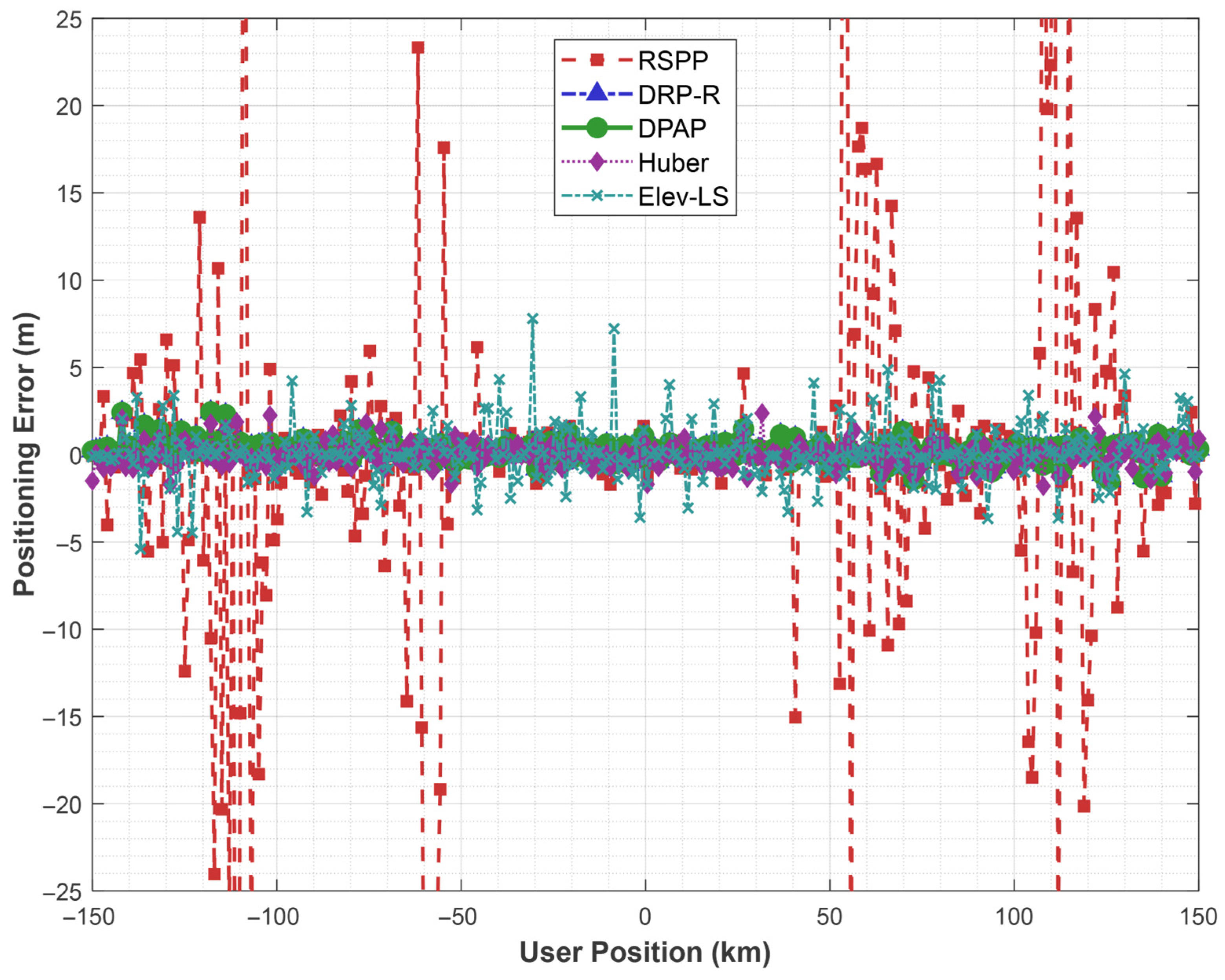

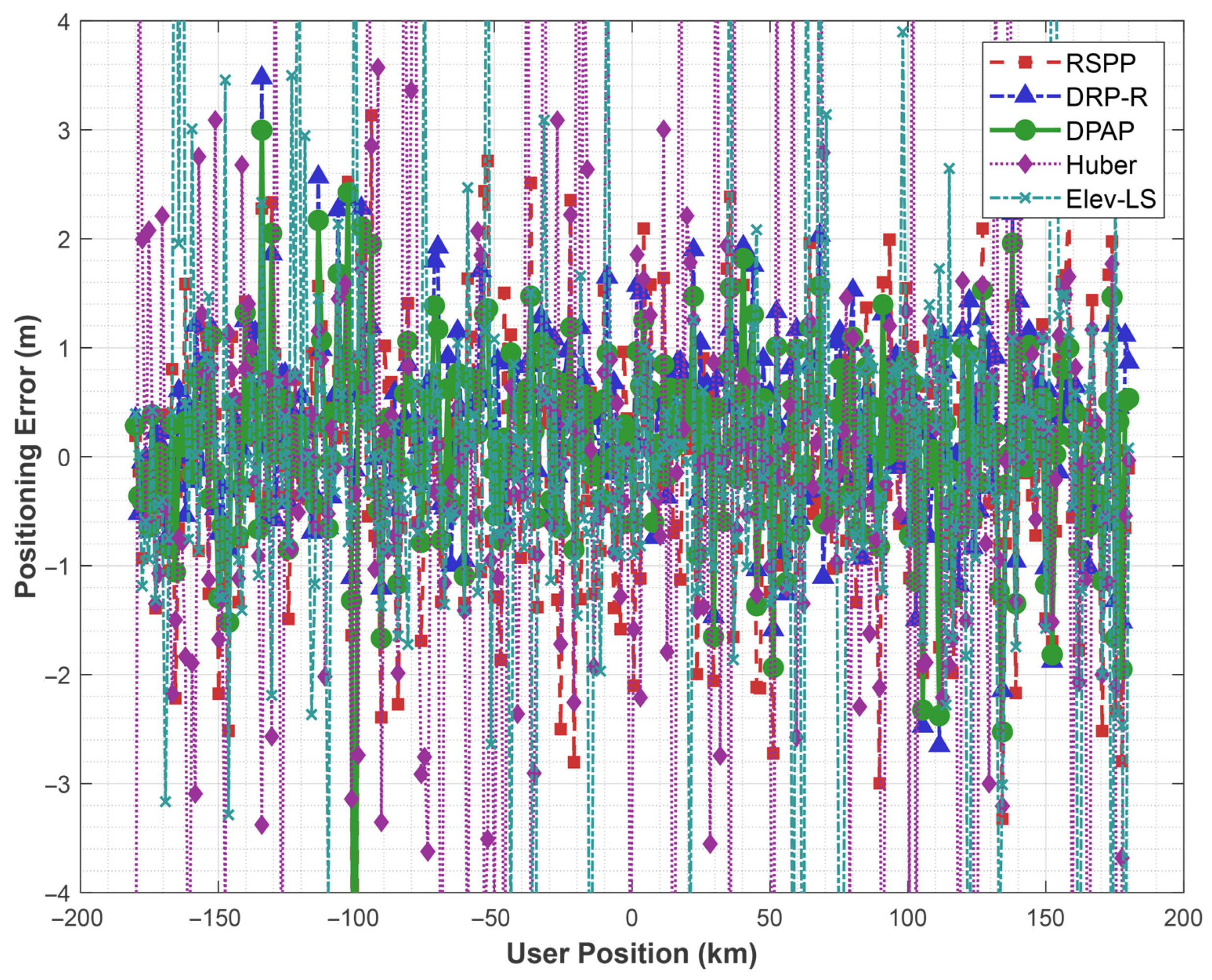


| Scenario Name | User Altitude H (m) | (m) | Transmission Power (W) | Code Rate (Mcps) | User Trajectory Range (km) | |
|---|---|---|---|---|---|---|
| Ideal Low-Altitude Environment | 1000 | 0.3 | 30 | 32 | 0.15 | [−150, 150] |
| Urban Challenging Environment | 50 | 1.0 | 30 | 32 | 0.30 | [−180, 180] |
| Ideal Low-Altitude Environment | Urban Challenging Environment | ||
|---|---|---|---|
| 12.304 | 23.411 | 1.295 | 2.258 |
| 0.588 | 1.158 | 0.888 | 1.760 |
| 0.588 | 1.158 | 0.858 | 1.677 |
| 0.678 | 1.496 | 2.756 | 6.366 |
| 1.462 | 3.280 | 2.342 | 5.749 |
| 12.304 | 23.411 | 1.295 | 2.258 |
| Fusion Method | RMS (m) | 95% Error (m) |
|---|---|---|
| RSPP | 12.304 | 23.411 |
| DRP-R | 0.588 | 1.158 |
| Simple Average | 6.446 | 12.892 |
| DPAP | 0.588 | 1.158 |
| RMS (m) | 95% Error (m) | |
|---|---|---|
| 0.1 | 1.220 ± 0.172 | 2.140 ± 0.106 |
| 0.2 | 1.103 ± 0.139 | 2.003 ± 0.104 |
| 0.3 | 1.048 ± 0.133 | 1.894 ± 0.103 |
| 0.4 | 0.982 ± 0.101 | 1.816 ± 0.105 |
| 0.5 | 0.926 ± 0.076 | 1.758 ± 0.111 |
| 0.6 | 0.926 ± 0.076 | 1.718 ± 0.121 |
| 0.7 | 0.871 ± 0.059 | 1.689 ± 0.118 |
| 0.8 | 0.868 ± 0.067 | 1.706 ± 0.134 |
| 0.9 | 0.859 ± 0.062 | 1.676 ± 0.126 |
| 1.0 | 0.857 ± 0.060 | 1.682 ± 0.122 |
| Method | Avg. Computation Time (s) | Relative Time | RMS in Urban Challenging Environment (m) | Time–Accuracy Composite Index * | Accuracy Rank |
|---|---|---|---|---|---|
| DPAP (Proposed) | 0.15 | 0.18 | 0.858 | 7.87 | 1 |
| DRP-R | 0.12 | 0.14 | 0.888 | 9.38 | 2 |
| Elev-LS | 0.06 | 0.07 | 2.342 | 7.12 | 3 |
| Huber M-est. | 0.08 | 0.09 | 2.756 | 4.53 | 4 |
| RSPP | 0.85 | 1.00 | 1.295 | 0.91 | 5 |
| Δz (m) | RSPP RMS (m) | DRP-R RMS (m) | DPAP RMS (m) |
|---|---|---|---|
| 0 | 1.313 | 0.892 | 0.865 |
| 10 | 1.314 | 0.893 | 0.863 |
| 50 | 1.250 | 1.189 | 1.079 |
Disclaimer/Publisher’s Note: The statements, opinions and data contained in all publications are solely those of the individual author(s) and contributor(s) and not of MDPI and/or the editor(s). MDPI and/or the editor(s) disclaim responsibility for any injury to people or property resulting from any ideas, methods, instructions or products referred to in the content. |
© 2026 by the authors. Licensee MDPI, Basel, Switzerland. This article is an open access article distributed under the terms and conditions of the Creative Commons Attribution (CC BY) license.
Share and Cite
Ma, Y.; Chen, G.; Wang, Y.; Liu, D. A Risk-Aware Robust Navigation Framework for UAVs in GNSS-Degraded Low-Altitude Environments. Drones 2026, 10, 317. https://doi.org/10.3390/drones10050317
Ma Y, Chen G, Wang Y, Liu D. A Risk-Aware Robust Navigation Framework for UAVs in GNSS-Degraded Low-Altitude Environments. Drones. 2026; 10(5):317. https://doi.org/10.3390/drones10050317
Chicago/Turabian StyleMa, Yuan, Guifen Chen, Yijun Wang, and Dakun Liu. 2026. "A Risk-Aware Robust Navigation Framework for UAVs in GNSS-Degraded Low-Altitude Environments" Drones 10, no. 5: 317. https://doi.org/10.3390/drones10050317
APA StyleMa, Y., Chen, G., Wang, Y., & Liu, D. (2026). A Risk-Aware Robust Navigation Framework for UAVs in GNSS-Degraded Low-Altitude Environments. Drones, 10(5), 317. https://doi.org/10.3390/drones10050317