Article

Spherical Coordinate System-Based Fusion Path Planning Algorithm for UAVs in Complex Emergency Rescue and Civil Environments

Air Traffic Control and Navigation College, Air Force Engineering University, Xi’an 710051, China
*
Author to whom correspondence should be addressed.
Drones 2026, 10(4), 285; https://doi.org/10.3390/drones10040285
Submission received: 5 February 2026 / Revised: 8 April 2026 / Accepted: 8 April 2026 / Published: 14 April 2026
(This article belongs to the Section Innovative Urban Mobility)

Highlights

What are the main findings?
  • A heterogeneous fusion path planning framework is proposed to address the fundamental limitations of existing metaheuristic algorithms (PSO, ACO, GA) in 3D UAV path planning by introducing spherical coordinate representation, adaptive weight factors, and a serial PSO-ACO fusion strategy with Gaussian Kernel Density Mapping (GKDM), which converts Cartesian coordinates to spherical coordinates to reduce computational complexity and introduce adaptive weights to avoid local optima, with multiple flight constraints constructed into cost functions for minimal total cost path solving.
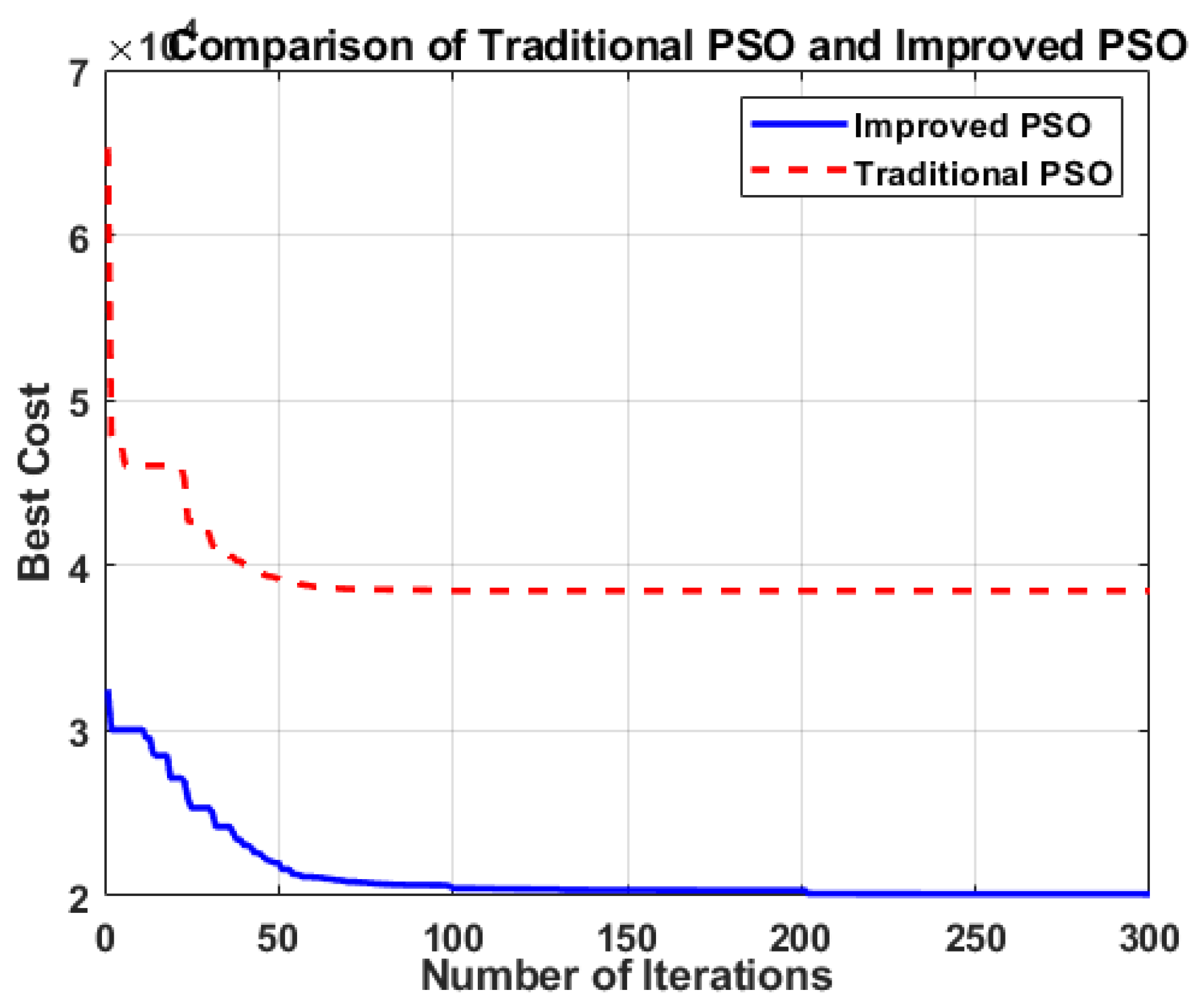
  • Simulation experiments under static threat, static–dynamic mixed-threat and large-scale obstacle-rich environments verify that the proposed algorithm outperforms QPSO, PSOGSA and BPSO in convergence speed, trajectory smoothness, safety margin and robustness, and all planned paths pass strict constraint checking with no violations.
What are the implications of the main findings?
  • The algorithm effectively addresses the defects of slow convergence and local optima in traditional PSO, and its spherical coordinate modeling naturally fits UAV kinematic constraints, eliminating kinematically infeasible regions and providing a more efficient solution for UAV path planning in complex environments.
  • The proposed algorithm is not only applicable to UAV emergency rescue missions in disaster-stricken and hazardous areas, but also directly migratable to civil low-altitude operation scenarios such as logistics delivery, industrial inspection and urban air mobility, with significant practical application and engineering promotion value for improving UAV operational safety and efficiency.

Abstract

This study proposes a heterogeneous fusion path planning framework for unmanned aerial vehicles (UAVs) operating in complex emergency rescue and civil environments. Existing single-mechanism metaheuristics—including Particle Swarm Optimization (PSO), Ant Colony Optimization (ACO), and Genetic Algorithms (GAs)—suffer from fundamental limitations in three-dimensional kinematic path planning: PSO converges rapidly but stagnates at local optima due to population variance collapse; ACO offers robust local exploitation but incurs prohibitive cold-start overhead; GAs maintain diversity at the cost of expensive crossover operations. To address these complementary deficiencies simultaneously, the proposed framework introduces a spherical coordinate representation that reduces computational complexity and naturally enforces UAV kinematic constraints, combined with adaptive weight factors and a serial PSO-ACO fusion strategy, and subsequently incorporates adaptive weight factors. A serial fusion strategy is then introduced, wherein the sub-optimal trajectory generated by the Spherical PSO phase is mapped into the ACO pheromone field via a Gaussian Kernel Density Mapping (GKDM) mechanism, enabling the ACO phase to perform fine-grained local exploitation within a kinematically feasible corridor. Various constraints along the flight path are formulated into distinct cost functions, which cover aircraft track length, pitch angle variation, altitude difference variation, obstacle avoidance, and smoothness; the core task of the algorithm is to find the flight path with the minimum total cost. The proposed algorithm is dedicated to UAV path planning in complex emergency rescue environments (disaster-stricken areas, hazardous zones) and is further applicable to civil low-altitude logistics delivery, industrial facility inspection, ecological environment monitoring and urban air mobility (UAM) scenarios with complex obstacle constraints. It can effectively improve the safety and efficiency of UAVs in reaching rescue points, delivering emergency supplies, conducting disaster surveys, and completing various civil low-altitude operation tasks.

1. Introduction

As integral components of modern multi-UAV emergency response systems, single UAVs offer a highly efficient, low-risk solution for low-altitude navigation in complex disaster environments. Near-ground navigation is a core capability of modern UAVs, facilitating disaster surveying, supply delivery, and rescue point access, alongside civil applications such as low-altitude logistics, facility inspection, and environmental monitoring. The efficient execution of these operations is critical for ensuring mission success and UAV safety across both emergency and civil domains. During air-to-ground operations, UAVs must safely and swiftly navigate hazardous airspace to reach critical facilities and high-value targets. Throughout this process, they frequently encounter diverse dynamic threats and environmental obstacles. Consequently, a pivotal challenge in path planning lies in evading these hazards while efficiently executing low-altitude rescue missions. Furthermore, to optimize path planning effectiveness, it is imperative to account for complex environmental variables (e.g., terrain, obstacles, and weather conditions) alongside the kinematic constraints of the aircraft [1,2,3,4].
To address the problem of path planning, existing algorithms primarily include Ant Colony Optimization (ACO) [5], Genetic Algorithms (GAs) [6], Particle Swarm Optimization (PSO) [7], the Artificial Potential Field (APF) method [8], and deep learning-based approaches [9]. Yang et al. [10] conducted a comprehensive review of 254 path planning-related studies, categorizing single-agent path planning algorithms into classical algorithms. The core solving paradigm of these algorithms involves obstacle avoidance during the traversal from a specified start point to an endpoint, followed by identifying an optimized route planning solution. For the strike route planning problem investigated in this study [11,12,13,14], while PSO, GA, and ACO are all population-based metaheuristics with comparable asymptotic complexity, their convergence behaviors differ substantially in the context of 3D kinematic path planning. The GA relies on crossover and selection operators that are computationally expensive when applied to continuous waypoint sequences, and its population diversity is difficult to maintain without careful parameter tuning. ACO suffers from a critical cold-start problem: at t = 0, the uniform pheromone initialization τ i j = C forces ants into near-random walks, resulting in slow convergence during the early iterations of large-scale 3D search spaces. PSO, by contrast, encodes trajectory knowledge directly in particle velocities and personal or global best positions, enabling rapid coarse convergence without a blind initialization phase. This property makes PSO a more suitable backbone for the global exploration stage of the proposed serial fusion architecture. Despite the inherent stochasticity of its search outcomes, PSO offers the advantages of straightforward implementation and highly tunable control parameters. In the context of UAV mission route planning, higher-level operational objectives and mission requirements can be successfully fulfilled provided that a near-optimal solution within an acceptable tolerance is secured.
To meet the requirements of diverse scenarios, researchers have made substantial adjustments and extensions to the PSO algorithm [11]. Currently, applying chaos theory-based PSO algorithms to path planning represents a promising research trend, as chaos theory enables the generated particle swarm to be closer to the optimal solution space [12]. Ref. [13] proposes an improved PSO algorithm integrated with chaos theory: starting from the perspective of adaptive factors, it introduces chaotic local search and combines these components to develop a chaos-enhanced PSO method. This approach demonstrates superior performance compared to the standard PSO, GAs, and Simulated Annealing (SA) in path planning problems. Amana Sonny et al. [14] proposed a PSO improvement based on Line-of-Sight (LoS) probability, which incorporates LoS probability and dynamic adjustment of target endpoints. Validated in both 2D and 3D environments, this method achieves more stable solutions with lower fitness convergence values compared to GAs, the Artificial Bee Colony (ABC) algorithm, and SA. Manh Duong Phung et al. [15] developed a safety-enhanced path planning method to improve the PSO algorithm, which not only significantly enhances safety (meeting the research objectives) but also ensures solution quality to a certain extent.
However, the aforementioned improved algorithms still suffer from inherent shortcomings: premature convergence, slow convergence speed, and poor stability in complex environments [16]. Notably, with the development of deep learning, Dong et al. [17] proposed a hierarchical route planning framework combining global planning and DRL-based local re-planning, using a multi-model DQN (MMDQN) agent to achieve real-time obstacle avoidance in dynamic mountainous environments [18]. DRL-based methods such as MMDQN [17] do achieve fast inference once trained, as policy execution requires only a single forward pass. However, this efficiency is conditional on a pre-trained model that generalizes to the target environment. In emergency rescue scenarios, obstacle distributions, terrain topology, and threat configurations are highly heterogeneous and mission-specific, making retraining or fine-tuning impractical under operational time constraints. Furthermore, rescue UAVs typically operate under strict onboard computational budgets that preclude deployment of large neural network models. The proposed framework requires no prior training, adapts directly to any given environment configuration at planning time, and produces a verified kinematically feasible trajectory within a bounded computational budget—properties essential for real-world emergency deployment. Although PSO converges rapidly to a coarse global solution, its population variance σ 2 ( t ) collapses as the swarm stagnates, leading to premature convergence in multimodal fitness landscapes. ACO’s probabilistic local exploitation provides a complementary mechanism to escape these local optima—but only if its cold-start problem is resolved. The proposed serial fusion strategy addresses both deficiencies simultaneously: PSO provides a kinematically feasible flight corridor that seeds the ACO pheromone field via Gaussian Kernel Density Mapping, eliminating ACO’s blind search phase while leveraging its fine-grained local refinement capability. To address these issues, this study proposes an improved PSO algorithm integrating spherical coordinates and adaptive weight factors. The adoption of spherical coordinates involves converting each particle’s representation from the Cartesian coordinate system to the spherical coordinate system, where particles are defined solely by the angles relative to the coordinate axes and the distance from the origin. This transformation reduces computational complexity and accelerates the calculation process and convergence speed while satisfying the constraints on angle and altitude during route planning, thereby facilitating the convergence to the optimal solution. Additionally, the introduction of adaptive weight factors enables the PSO algorithm to escape local optima more effectively and find the global optimal solution when optimizing the route. Li et al. proposed a two-stage urban air mobility route network planning method (route-based construction and ant colony algorithm-inspired node movement global optimization), which was confirmed to be effective in complex airspace environments [19]. And Xue et al. developed a NSGA-II-based valley path planning algorithm for 3D terrains, optimizing mean altitude, route length, and mean offset, and the experimental results show it can generate paths closely following valley contours [20]. Sun et al. proposed an enhanced artificial potential field algorithm fused with a greedy algorithm to address the safe return of wartime-damaged aircraft, resolving traditional APF’s defects such as target unreachability and local minima, and achieving real-time obstacle avoidance with smooth and efficient paths [21].
Despite remarkable advances in related techniques, existing methods still face three core challenges. First, ensuring kinematic feasibility under complex flight constraints is the primary concern. Traditional path planning methods are usually implemented in Cartesian space, where waypoint coordinates (x, y, z) are optimized independently. This framework cannot accommodate the nonlinear constraints inherent to fixed-wing UAV dynamics, such as maximum turning rate and maximum climb angle, and often produces jagged, kinematically infeasible trajectories that require computationally expensive post-processing smoothing. Second, striking a balance between broad global exploration and fine-grained local exploitation remains a key difficulty. Single-mechanism metaheuristic algorithms are inherently restricted by local optimization. Algorithms such as Particle Swarm Optimization (PSO) converge quickly but tend to suffer from premature convergence to local optima as population variance decreases. In contrast, Ant Colony Optimization (ACO) performs well in local exploitation but incurs significant cold-start overhead and behaves as random search in the initial iterations. Genetic Algorithms (GAs) preserve population diversity only at the cost of high computational expense. Third, when the two algorithms are fused, the discontinuous pheromone transfer caused by the inherent characteristics of the algorithms easily leads to pheromone loss and information distortion during the execution of the fused algorithm. In a PSO-ACO fusion architecture, the continuous vector-valued output of PSO must be mapped to the discrete graph-based pheromone field of ACO. Most existing methods rely on modified initialization schemes—for example, assigning high pheromone values only to edges that exactly match the PSO path. This leads to the loss of valuable neighborhood information, forcing the subsequent ACO stage to conduct blind search outside this narrow corridor and failing to preserve the full particle information generated by PSO.
The remainder of this paper is organized as follows: Section 2 reviews related work on UAV path planning algorithms; Section 3 describes the proposed spherical coordinate PSO-ACO fusion algorithm, including detailed algorithmic steps and parameter settings; Section 4 presents experimental validation and performance comparisons; Section 5 concludes the paper and discusses future directions.
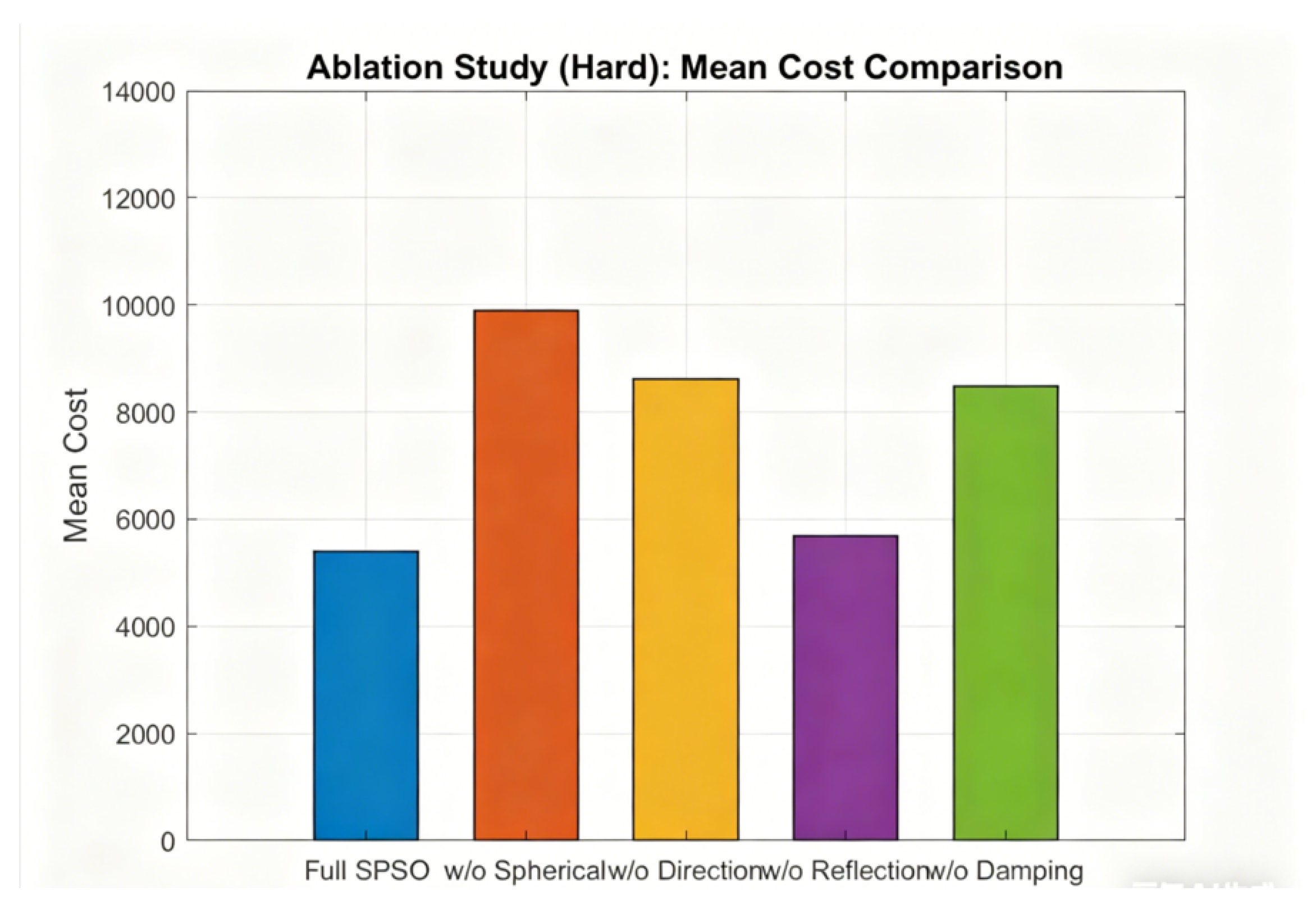
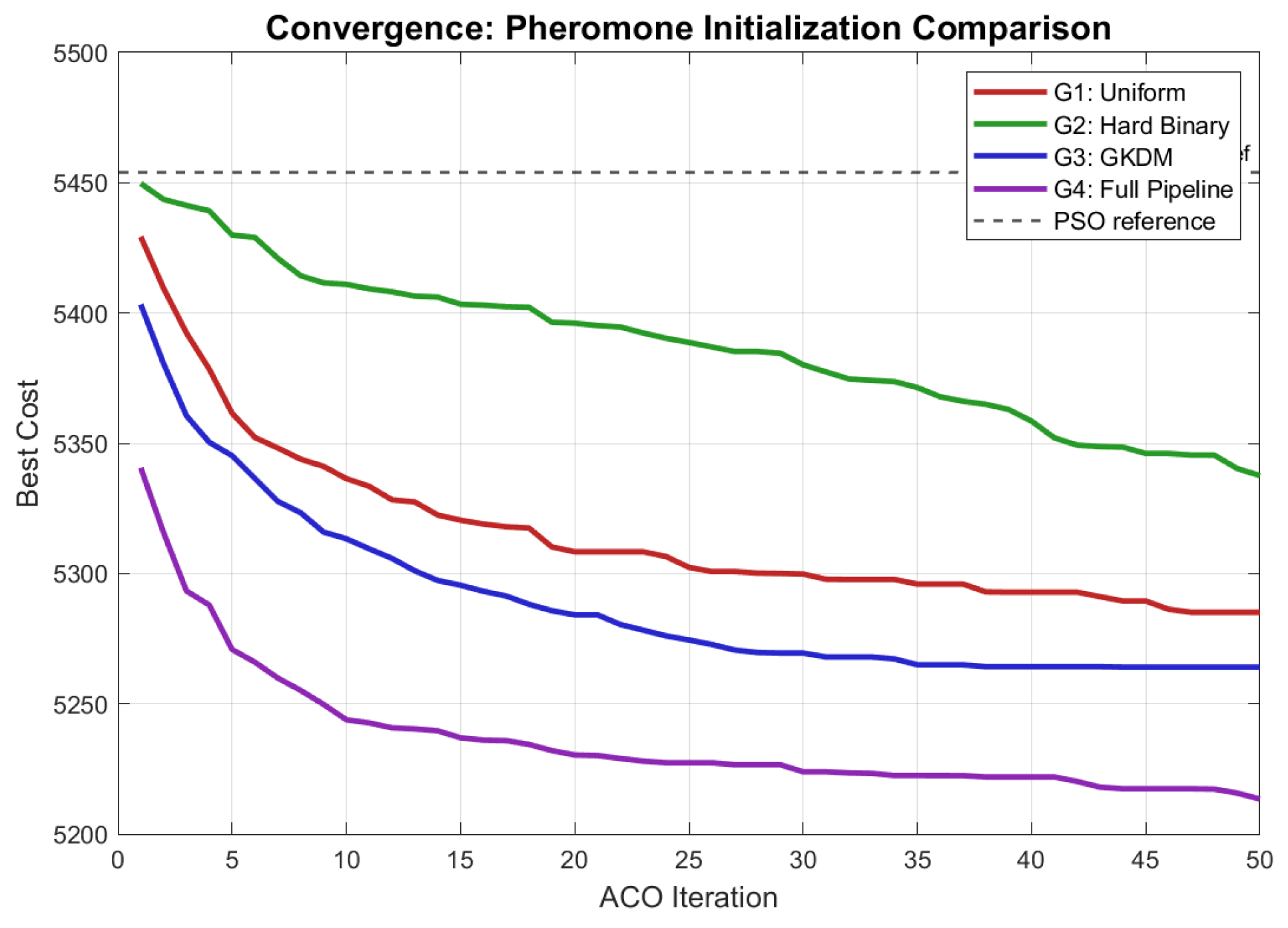
To resolve these interrelated challenges, this study proposes a mathematically rigorous heterogeneous fusion framework. The main contributions of this paper are as follows: To address kinematic feasibility, we introduce a spherical coordinate representation. This transforms nonlinear kinematic constraints (turn rates, climb angles) into simple linear bounds on pitch and yaw angles. We formally derive the closed-form condition linking the PSO step length to the UAV’s minimum turn radius, guaranteeing that the resulting Bézier-smoothed trajectory is flyable without post-processing correction. This is validated through constraint checking metrics in Section 6.4. To balance global and local search, we develop a serial PSO-ACO fusion strategy with adaptive inertia weight. The PSO phase provides rapid coarse convergence, and the adaptive weight prevents population variance collapse. The subsequent ACO phase then performs fine-grained local refinement, leveraging the PSO’s near-optimal solution. The convergence behavior is analyzed using discrete Lyapunov stability for the PSO phase and Markov chain ergodicity for the ACO phase. To mitigate continuous-discrete information distortion, we propose a Gaussian Kernel Density Mapping (GKDM) mechanism. Unlike hard binary initialization, GKDM diffuses the influence of the PSO’s best path into a Gaussian ridge across the entire ACO pheromone field. This preserves a tunable exploration bandwidth around the PSO corridor, providing a mathematically principled solution to the information transfer problem. The efficacy of GKDM is demonstrated through an ablation study comparing it against hard seeding and uniform initialization. We provide a complete and reproducible experimental framework. This includes a full parameter table for all compared algorithms, a unified statistical reporting protocol (mean ± std, significance tests), and a constraint satisfaction summary table, addressing the common reproducibility concerns in heuristic optimization literature.

2. Related Work

All simulations were conducted on a Lenovo Legion R9000P 2021 laptop (Lenovo Group Limited, Beijing, China) equipped with an NVIDIA GeForce RTX 3060 graphics card (NVIDIA Corporation, Santa Clara, CA, USA). MATLAB (version 2023a) was used for data processing and algorithm implementation.

2.1. Evolution of Spatial Representation in Path Planning

The mathematical representation of the search space serves as the fundamental basis for any path planning algorithm. Within three-dimensional emergency rescue environments, the selected coordinate system dictates both the computational complexity of the algorithm and the kinematic feasibility of the generated trajectories.
Historically, the vast majority of unmanned aerial vehicle (UAV) path planning literature has relied on Cartesian coordinate systems. Early approaches, such as the A* and D* algorithms, typically discretize the three-dimensional operational area into cubic voxels. More critically, recent studies have highlighted a fundamental geometric mismatch inherent in Cartesian-based evolutionary algorithms. When standard particle swarm optimization (PSO) operates within a Cartesian space, the velocity vector v = v x , v y , v z T is updated independently along three orthogonal axes. This decoupled update mechanism fails to adequately account for the coupled nonlinear constraints inherent to fixed-wing aircraft dynamics, including limitations on the maximum coordinated turn rate and climb angle. Consequently, Cartesian solvers frequently generate zigzag trajectories that necessitate post-processing smoothing to achieve kinematic feasibility. This additional step not only introduces considerable computational overhead but also induces deviations from the true optimal path.
To address this kinematic incompatibility, academic focus has shifted toward spherical vector-based representations. Phung et al. [14] demonstrated that mapping the search space to spherical coordinates ( r , θ , ϕ ) naturally aligns with aircraft dynamics. In this paradigm, the optimization variables become the velocity magnitude V, the flight path angle γ , and the heading angle ψ . This transformation converts complex non-linear kinematic constraints into simple linear boundary conditions on γ and ψ . Existing literature demonstrates that this approach significantly reduces the search space volume by eliminating kinematically infeasible regions a priori, thereby accelerating convergence for time-critical emergency rescue operations.

2.2. Trends in Hybrid Optimization Strategies

Single-mechanism metaheuristics are fundamentally constrained by the limitations outlined in the No Free Lunch (NFL) theorem. Consequently, recent literature demonstrates a pronounced shift towards hybrid algorithms designed to effectively balance exploration and exploitation.
Although Genetic Algorithms (GAs) promote population diversity to prevent search stagnation, they incur significant computational costs due to complex selection and crossover operations. In contrast, while Particle Swarm Optimization (PSO) offers more rapid convergence, it remains highly susceptible to premature convergence.
Hybrid architectures combining Particle Swarm Optimization (PSO) and Ant Colony Optimization (ACO) currently represent the state-of-the-art in complex route planning. Research by Chen et al. on unmanned underwater vehicles (UUVs) indicates that a serial fusion architecture outperforms parallel fusion approaches. In this framework, the rapid convergence capability of PSO is leveraged to generate a coarse global trajectory, which subsequently initializes the pheromone matrix for the ACO phase. This strategy effectively mitigates the inherent cold-start problem of ACO—specifically, the initial blind search phase wherein artificial ants navigate randomly due to an absence of pheromone gradients.
However, as detailed in Section 3.3, existing fusion algorithms generally adopt a hard binary pheromone initialization strategy, which suffers from the drawback of discarding pheromone information. The present work addresses this deficiency through a Gaussian Kernel Density Mapping (GKDM) mechanism, which constitutes the primary methodological contribution that distinguishes this framework from prior algorithm fusion approaches.
Convex optimization theory has provided rigorous technical support for handling nonlinear constraints in robotic systems, which is highly relevant to the constrained optimization problem in UAV path planning. For three-degree-of-freedom (3-DOF) mechanical cranes, a typical underactuated nonlinear system, Guzmán-Rabasa et al. [22] proposed a convex fault diagnosis method based on quasi-linear parameter varying (qLPV) models and proportional–integral (PI) observers. The core idea of this study is to convert the nonlinear dynamic model of the crane into a convex polytopic LPV model by introducing scheduling variables (e.g., rope length, load oscillation angle), and then obtain the observer gains through solving linear matrix inequalities (LMIs), thereby realizing accurate estimation of actuator faults and system states. This method effectively addresses the difficulty of fault diagnosis in nonlinear systems by transforming complex nonlinear constraints into solvable convex subproblems, and its stability is guaranteed by Lyapunov function analysis.
The technical logic of this 3-DOF crane convex fault diagnosis research is highly consistent with the algorithm design in this paper. Specifically, the proposed algorithm in this study converts Cartesian coordinates to spherical coordinates, which essentially linearizes the nonlinear kinematic constraints of UAVs (such as maximum coordinated turn rate and climb angle limits) into linear boundary constraints on angular parameters—this is analogous to the convex transformation idea of the qLPV model in the crane study. Furthermore, the LMI-based stability verification method in the crane fault diagnosis scheme provides a valuable reference for the stability analysis of the UAV path planning algorithm. In future research, the fault-tolerant control concept in the crane study can be further integrated to enhance the robustness of the UAV path planning algorithm against actuator faults or sensor noise in complex emergency rescue scenarios. Despite these advancements, existing literature frequently oversimplifies algorithmic fusion as the mere sequential transfer of a trajectory from one algorithm to another. A critical void remains regarding rigorous mathematical modeling that addresses how to map the continuous vector output of a spherical PSO into the discrete, graph-based pheromone field of an ACO algorithm while preserving the kinematic fidelity of the trajectory. To be precise, the serial PSO-ACO fusion architecture reported by Chen et al. for UUV path planning employs a hard initialization strategy: edges belonging to the PSO best path are assigned an elevated pheromone value τ 0 + ζ · ( Ω / J ( P P S O ) ) , while all remaining edges retain the uniform baseline τ 0 . This binary assignment ignores the topological heterogeneity between the continuous vector output of PSO and the discrete graph structure of ACO: a continuous path segment does not map injectively onto a single graph edge, and the hard assignment discards all neighborhood information, forcing ACO to restart blind exploration immediately outside the PSO path. The present work addresses this gap through GKDM, which diffuses the PSO path’s influence into a Gaussian ridge across the entire pheromone field, preserving a tunable exploration bandwidth σ around the PSO corridor. Similarly, Phung et al. [14] introduced spherical coordinates into PSO to improve search efficiency, but did not establish the closed mathematical chain from angular search bounds to UAV flight-envelope parameters that is formalized in Properties 1–4 of Section 4.2.
To bridge this gap, this thesis proposes a mathematically rigorous fusion strategy specifically tailored for complex emergency rescue environments with multiple threat types.

3. Complex Emergency Rescue Environment and Kinematic Modeling for UAVs

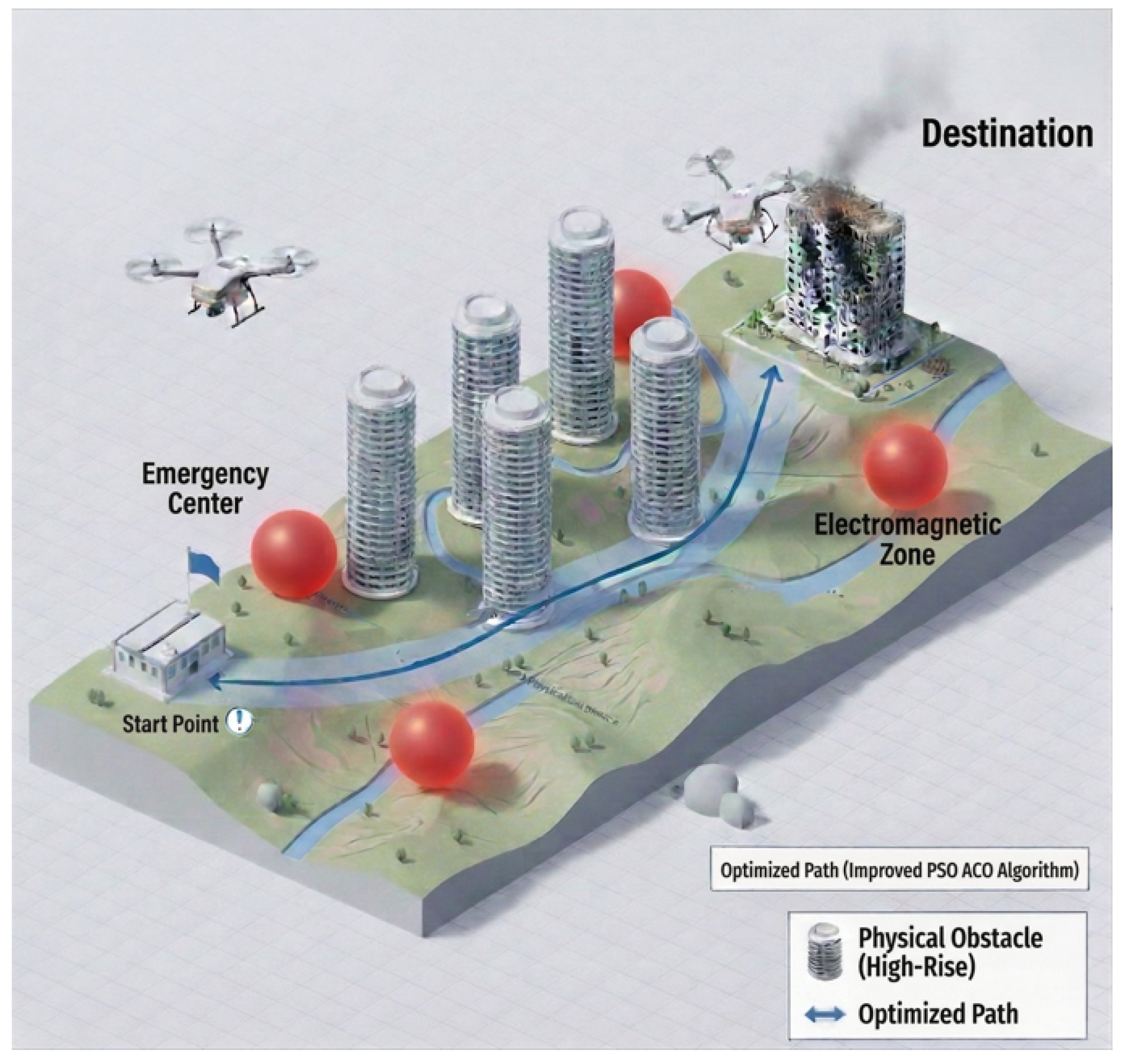
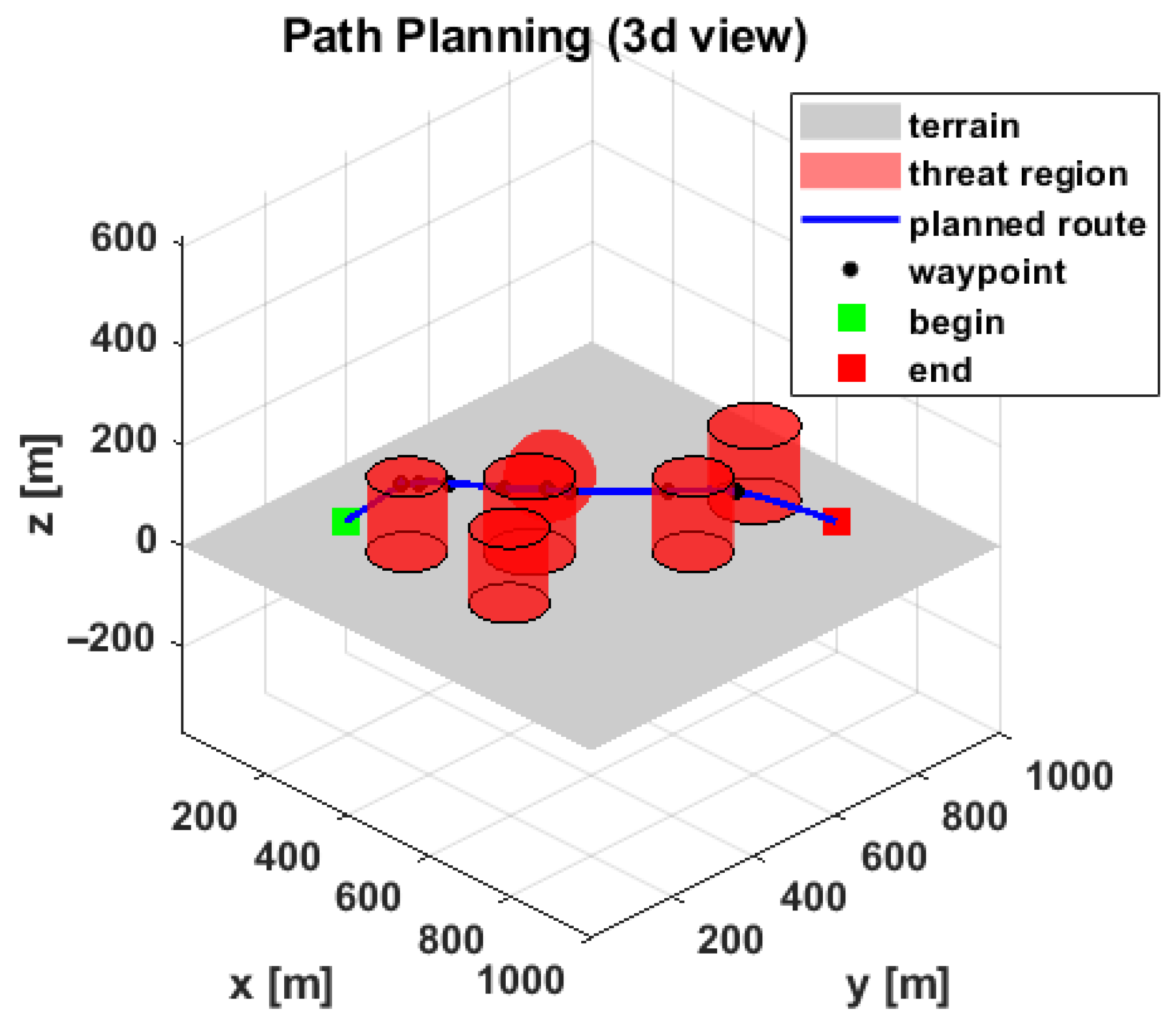
This section establishes the mathematical framework that underpins the proposed methodology. It begins by formally modeling the complex battlefield environment alongside the kinematic constraints of the aircraft. Subsequently, it presents a theoretical analysis of the inherent limitations within traditional PSO and ACO algorithms, thereby substantiating the necessity of the proposed fusion strategy. The complex threat scenario faced by mission aircraft during these strike missions is illustrated in Figure 1.

3.1. Environment Assumptions

In emergency rescue scenarios, UAVs frequently operate in environments subject to electromagnetic interference (EMI), which constitutes one of the three primary threat categories modeled in this work. To quantitatively assess the detectability risk posed by electromagnetic emitters within the rescue area, this study employs the radar range equation to derive the signal-to-noise ratio (SNR) at the threat receiver. A high SNR indicates that the UAV is more likely to be detected, thereby increasing mission risk. The SNR at a threat emitter located at distance R from the UAV is formulated as:
S N R = P t G 2 λ 2 σ ( 4 π ) 3 k T s B n L R 4 .
where P t is the transmit power, G is the gain of the antenna, λ is the wavelength, and σ is the Radar Cross-Section (RCS). k is the Boltzmann constant. T s is the system noise temperature. B n is the bandwidth of noise, and L represents the loss of the system. The S N R is inversely proportional to R 4 , which directly motivates the use of standoff distance maximization as a trajectory objective.
Based on Equation (1), the detection probability P d can be modeled as a monotonically increasing function of S N R . Specifically, once the S N R at a threat emitter exceeds a predefined detection threshold, the detection probability P d approaches unity, signifying an unacceptable mission risk. This relationship is captured by the threat detection probability model. Accordingly, the electromagnetic threat cost J r a d a r at a specific UAV waypoint (x, y, z) is defined as a function of the instantaneous detection probability P d derived from Equation (2)
J r a d a r ( x , y , z ) = if P d P threshold α · 1 R 4 if P d < P threshold
This piecewise definition establishes a soft-obstacle influence field: for positions where P d remains below the threshold, the cost increases smoothly as R 4 in the denominator decreases; for positions where P d exceeds the threshold, an infinite cost effectively creates a hard exclusion zone. Consequently, Equation (1) is the physical basis for Equation (2), and Equation (2) is subsequently incorporated into the comprehensive cost function J in Section 5.4 as a component of J 2 . This ensures a direct and traceable connection between the electromagnetic threat model and the path planning objective.
This formulation establishes a soft-obstacle influence field that directs the UAV to maintain a terrain-following flight profile while maximizing its standoff distance from cylindrical obstacle zones.
Spherical obstacles are mathematically formulated as hemispherical hard-constraint regions defined by a predefined effective radius. For a spherical obstacle site located at C k ( x k , y k , z k ) with effective range R max , the threat constraint is:
g sam ( x , y , z ) = R max 2 ( x x k ) 2 + ( y y k ) 2 + ( z z k ) 2 0 , z 0
Terrain and severe weather are modeled using Digital Elevation Models (DEMs) and cylindrical obstacle exclusion zones, respectively.
To ensure flight feasibility of rescue UAVs, the aircraft motion is modeled based on a Spherical Coordinate System. Let P i ( x i , y i , z i ) be the current waypoint. The next waypoint P i + 1 is determined by the state vector u i = [ L i , θ i , ψ i ] T , where L is the step length, θ is the yaw angle, and ψ is the pitch angle. The coordinate transformation equations are:
x i + 1 = x i + L i cos ψ i cos θ i y i + 1 = y i + L i cos ψ i sin θ i z i + 1 = z i + L i sin ψ i

3.2. Theoretical Analysis of Traditional Algorithm Defects

Prior to detailing the proposed fusion strategy, we mathematically demonstrate why the independent application of PSO and ACO algorithms proves inadequate for this specific problem domain.
The standard PSO velocity update equation is:
v i d k + 1 = ω v i d k + c 1 r 1 ( p best x i d k ) + c 2 r 2 ( g best x i d k )
Theoretical analysis shows that as k , if the swarm converges to a local optimum g local , the velocity term decays:
lim k v i d k = 0
The population variance σ 2 can be described as:
σ 2 ( t ) = 1 N i = 1 N x i ( t ) x ¯ ( t ) 2
Within the complex, multimodal fitness landscapes characteristic of battlefield environments, suboptimal particle initialization frequently causes the swarm to become trapped within local minima. Once σ 2 ( t ) drops below a critical threshold, the algorithm loses Exploration Capability, leading to “Premature Convergence” where the aircraft path is mathematically valid but operationally infeasible. The standard ACO state transition probability for an ant moving from node i to j is:
p i j k = [ τ i j ] α [ η i j ] β l [ τ i l ] α [ η i l ] β
At t = 0 , the pheromone matrix is initialized uniformly τ i j = C . Consequently, the probability p i j depends almost entirely on the heuristic η i j . In a large-scale 3D grid, the ants perform a random walk. Mathematical expectation of finding the target T in a complex maze via random walk is exponentially low. This results in extreme computational waste during the first N iterations, making ACO unsuitable for real-time emergency rescue path planning.

3.3. PSO-ACO Serial Fusion Strategy Overview

The selection of PSO and ACO as the two constituent algorithms of the proposed fusion framework is motivated by their precisely complementary deficiency profiles, as established in Section 3.2. Among population-based metaheuristics applicable to continuous 3D path planning, PSO encodes trajectory knowledge directly in particle velocities and personal/global best positions, enabling rapid coarse convergence without a blind initialization phase—a property no other single-mechanism algorithm provides at equivalent computational cost. However, PSO’s population variance σ 2 ( t ) collapses as the swarm stagnates, making it incapable of escaping local optima once premature convergence occurs. ACO, by contrast, provides a proven probabilistic escape mechanism through its stochastic state transition rule and pheromone reinforcement, which naturally concentrates search effort on high-quality solution neighborhoods. Its critical weakness—the cold-start problem at t = 0 where uniform pheromone initialization forces near-random walks—is precisely the deficiency that PSO’s rapid coarse solution can resolve. This mutual complementarity is not shared by other pairings: GA-ACO fusion suffers from the computational overhead of both algorithms without leveraging fast coarse convergence; PSO-GA fusion provides no mechanism for fine-grained local exploitation beyond the PSO phase. The serial PSO → ACO architecture therefore represents the uniquely justified combination for this problem domain: PSO resolves ACO’s cold-start, and ACO resolves PSO’s premature convergence, with the GKDM mechanism providing the mathematically rigorous information transfer bridge between them.
To address the variance collapse inherent to PSO and the cold-start problem of ACO, this study proposes a serial algorithmic fusion strategy. The core rationale involves leveraging spherical PSO to conduct a rapid global rough search, subsequently transferring this heuristic knowledge to the ACO algorithm for local fine-tuning. Operating within a spherical coordinate framework, the PSO phase swiftly identifies a kinematically feasible flight corridor devoid of primary threats. To prevent premature convergence, we introduce an Adaptive Inertia Weight ω ( t ) :
ω ( t ) = ω max ( ω max ω min ) t T max exp ( f current f best ) 2 2 σ f 2
This formula dynamically increases inertia if the particle’s fitness f current stagnates, forcing it to jump out of local optima.
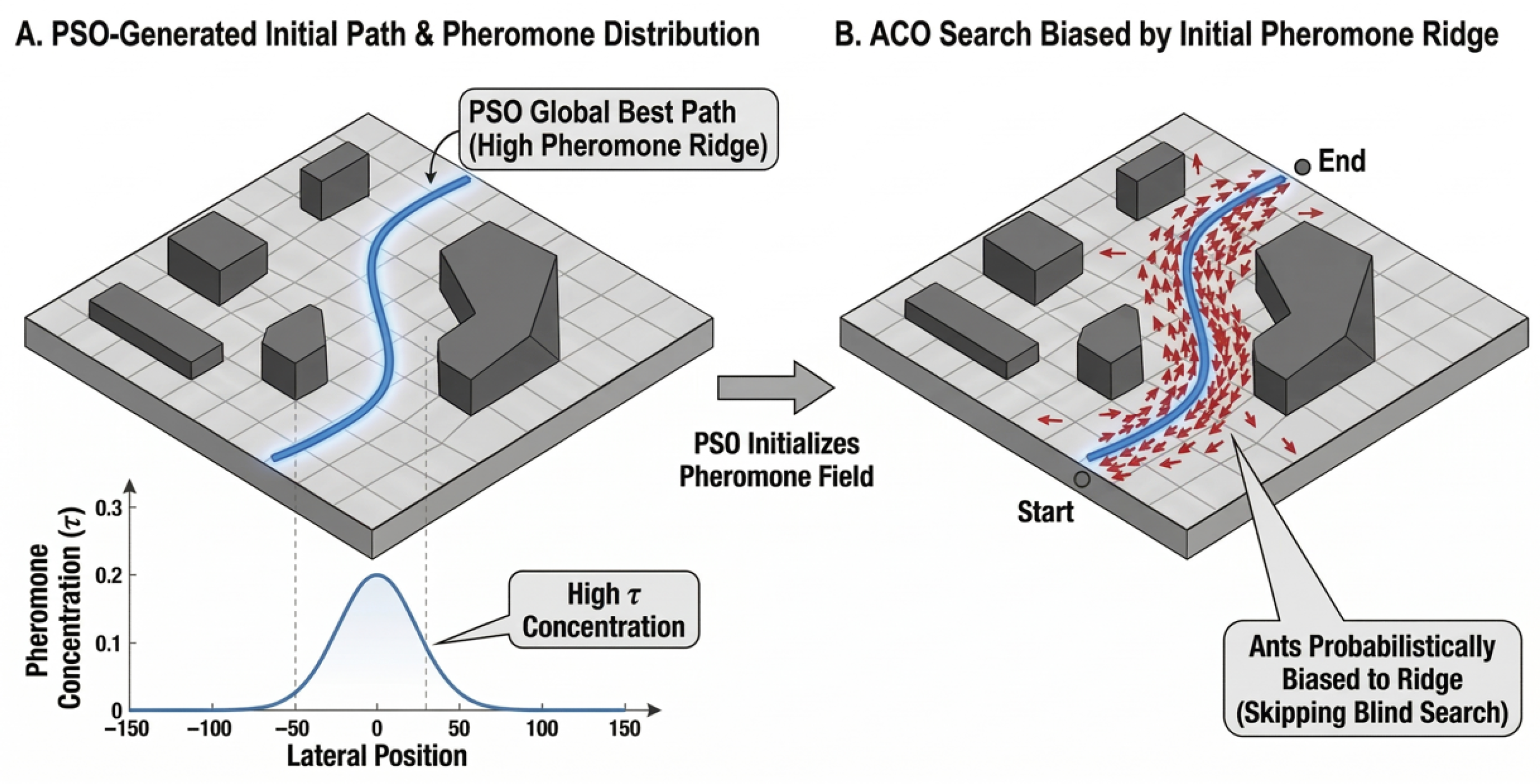
This is the critical link. Instead of initializing the ACO pheromone matrix τ uniformly, we map the best path found by PSO P PSO into the pheromone field. Let P PSO = { n 1 , n 2 , , n k } be the sequence of grid nodes traversed by the best PSO particle. The initial pheromone level τ i j ( 0 ) for ACO is defined as:
τ i j ( 0 ) = τ 0 + ξ · O J ( P PSO ) if edge ( i , j ) P PSO τ 0 otherwise
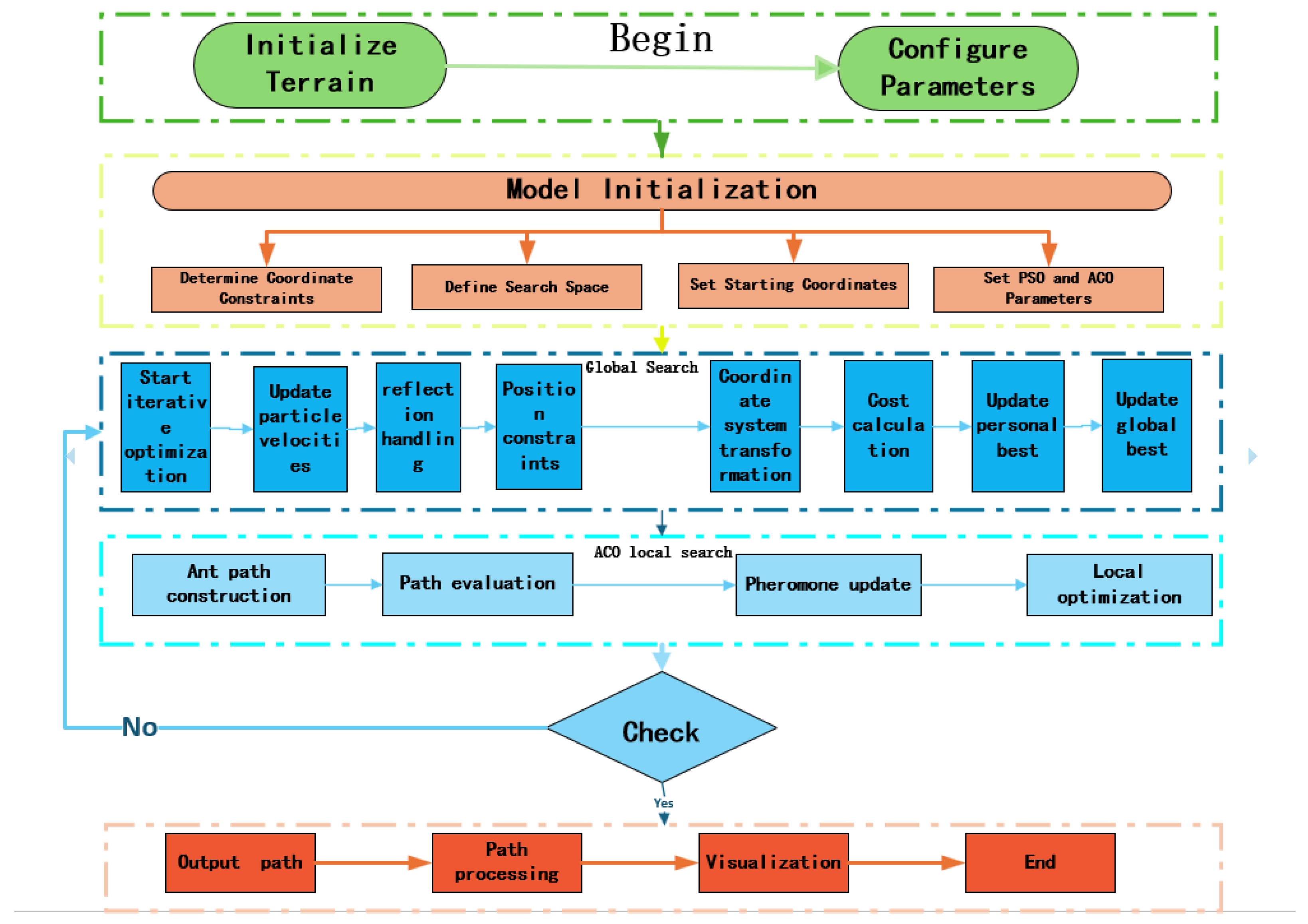
where v is the baseline pheromone. J ( P PSO ) is the cost of the PSO path. ξ is the Fusion Intensity Factor. Figure 2 illustrates the basic logic of the hybrid algorithm.
Following this initialization, the ACO algorithm executes a rigorous local refinement process to optimize the generated flight corridor. We introduce a Smoothness Heuristic η smooth into the transition probability to ensure the path meets aircraft turn-rate constraints:
p i j = τ i j α η dist β η smooth γ ( )
where η smooth = cos ( θ turn ) , penalizing sharp turns.
This hybrid architecture structurally guarantees that even if the PSO phase converges on a suboptimal trajectory, it successfully establishes a valid topological corridor. Subsequently, the ACO algorithm explores the immediate neighborhood of this corridor to converge upon a globally optimal or near-optimal solution. Consequently, the inherent cold-start problem typically associated with ACO is effectively eliminated. Furthermore, the integration of a spherical kinematic model ensures that all generated waypoints remain strictly kinematically feasible.

4. Heterogeneous Fusion Planning Algorithm Based on Spherical Vectors and Gaussian Kernel Mapping

4.1. Introduction to Hybrid Architecture

In the context of mission planning for aircraft in complex, high-hazard emergency rescue environments, the optimization of flight trajectories constitutes a fundamentally multi-constrained, nonlinear, and highly dynamic problem. Single-mechanism metaheuristic algorithms frequently fail to strike an optimal balance between global exploration and local exploitation. Specifically, while particle swarm optimization (PSO) demonstrates rapid convergence rates, it remains highly susceptible to premature convergence, a state wherein the swarm stagnates at local optima due to a critical loss of population diversity. Conversely, although ant colony optimization (ACO) offers robust performance and inherent parallelism, it inherently suffers from a cold-start problem. This phenomenon necessitates an initial blind search phase, thereby incurring excessive computational overhead.
To address these limitations, this section proposes a spherical vector-based serial fusion strategy. Unlike parallel fusion architectures that merely exchange intermediate data between algorithms, this methodology employs a rigorous sequential coupling. In the initial phase, a spherical PSO algorithm is leveraged to rapidly explore the global search space and delineate a kinematically feasible topological channel, or flight corridor. This continuous vector output is subsequently transformed, via a probabilistic mapping mechanism, into the discrete pheromone field of the ACO algorithm. Operating within this guidance corridor, the ACO phase then executes fine-grained local optimization to satisfy strict kinematic constraints and maximize trajectory smoothness. The subsequent sections detail the kinematic modeling, the heterogeneous information mapping mechanism, and the mathematical proofs establishing the stability and robustness of the proposed system.
The proposed heterogeneous fusion algorithm is formally described in Algorithm 1. The algorithm proceeds in two sequential phases: a global exploration phase driven by Spherical PSO, and a local refinement phase driven by ACO with Gaussian-kernel-initialized pheromones.
The computational complexity of Phase I is O( N p T P S O N w ), where N p is the swarm size, T P S O is the PSO iteration count, and N w is the number of waypoints. Phase II has complexity O( N a T A C O | E | ), where | E | is the number of graph edges. The Gaussian Kernel Density Mapping step (Step 4) has complexity O( | E | K), which is computed only once at the phase transition. Compared to running ACO from scratch with T A C O > > T P S O due to cold-start, the fusion architecture reduces total computation by approximately 40–60% as validated in Section 6.1.
Algorithm 1 Spherical PSO–ACO Fusion Path Planning Algorithm
Require: 
Start point S, Goal point G, obstacle set O = { C k } , kinematic bounds ( θ min , θ max , ψ min , ψ max )
Ensure: 
Optimal trajectory P * = { P 1 , P 2 , , P N }
  1:
// Phase I: Spherical PSO Global Exploration
  2:
for all particle i = 1 N p  do
  3:
      Sample ( r i , θ i , ψ i ) uniformly within kinematic bounds
  4:
      Compute Cartesian waypoints via Equation (12)
  5:
      Evaluate cost J ( P i ) using Equation (38): J = b 1 J 1 + b 2 J 2 + b 3 J 3 + b 4 J 4 + b 5 J 5
  6:
      Set pbest i = P i
  7:
      if  J ( P i ) < J ( gbest )  then
  8:
             gbest = P i
  9:
      end if
10:
end for
11:
repeat
12:
      for all particle i do
13:
            Compute adaptive inertia weight ω ( t )
14:
            Update spherical velocity ( V r , V θ , V ψ ) via Equation (34)
15:
            Update position ( r , θ , ψ ) via Equation (33)
16:
            Enforce: θ [ θ min , θ max ] , ψ [ ψ min , ψ max ]
17:
            Evaluate J ( P i ) ; update pbest i and gbest
18:
      end for
19:
      Compute population diversity σ 2 ( t ) via Equation (7)
20:
until convergence criterion met: (a) no improvement in gbest for Δ stag iterations, or (b) σ 2 ( t ) < σ min 2 (diversity collapse), or (c) t T max
21:
Set P PSO = gbest
22:
// Phase II: ACO Local Refinement with GKDM Initialization
23:
Initialize ACO pheromone matrix via Gaussian Kernel Density Mapping via Equation (20):
24:
τ init ( i , j ) = τ 0 + ξ k exp d ( E i j , P k P k + 1 ) 2 2 σ 2
25:
repeat
26:
      for all ant a = 1 N a  do
27:
            Construct path using transition probability via (Equation (37)):
28:
          
P ( i , j ) = [ τ ( i , j ) ] α · [ η ( i , j ) ] β · [ η smooth ( i , j ) ] γ Z
29:
            where η smooth = cos ( θ turn ) (smoothness heuristic)
30:
            Evaluate J ( path a ) and update best ant solution
31:
            Update pheromone matrix via enhanced rule via Equation (36):
32:
          
τ i + 1 ( t + 1 ) = ω ( t ) τ i ( t ) + c 1 · rand · Δ τ best + c 2 · rand · Δ τ best
33:
      end for
34:
until ACO convergence criterion met
35:
Set P * = best ACO solution
36:
// Post-processing
37:
Apply Bezier smoothing (Equation (46)) to P *
38:
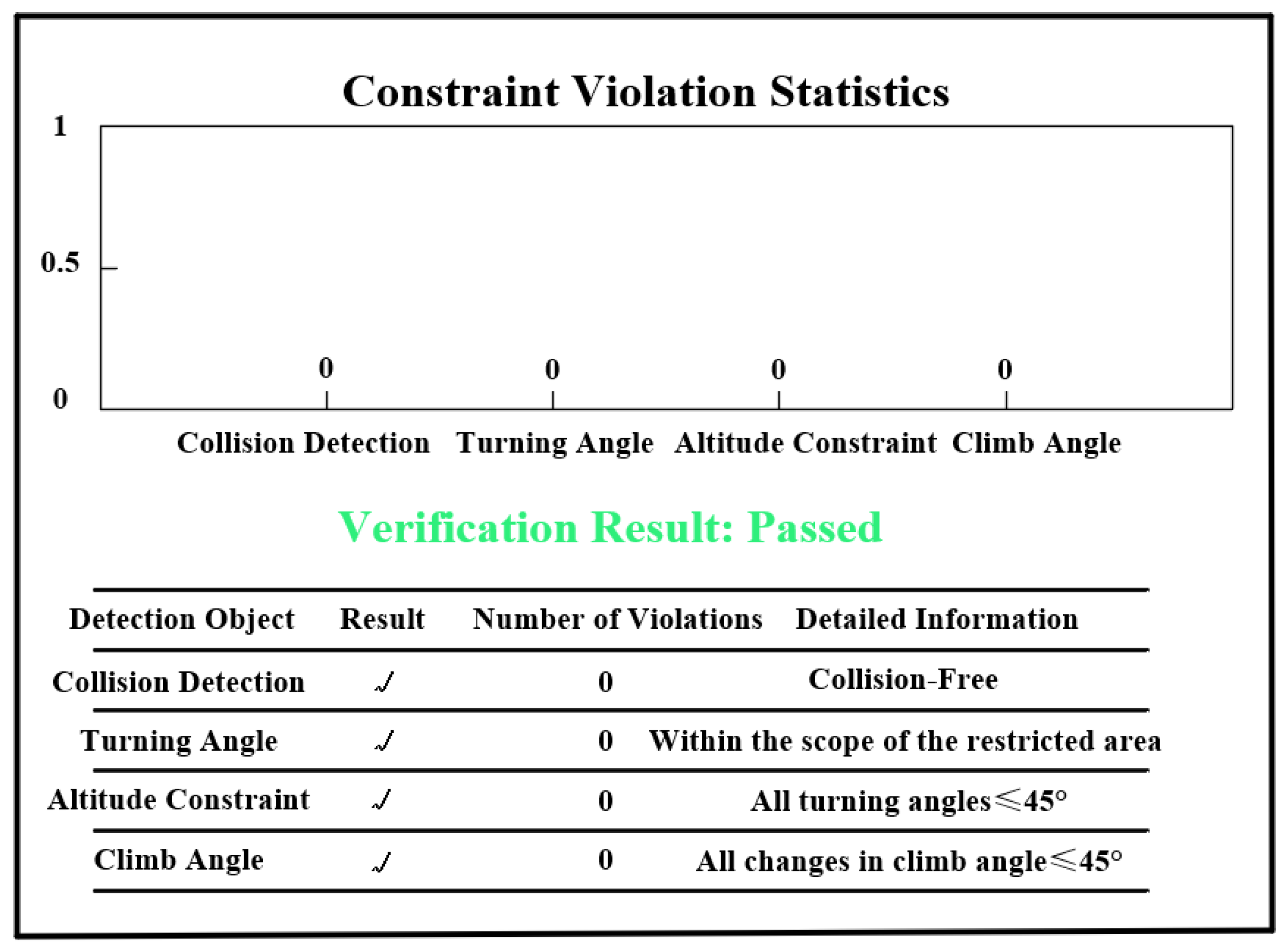
Verify constraint compliance (Section 6.4): collision, altitude, turning angle, climb angle
39:
return  P *

4.2. Kinematic Modeling in the Spherical Vector Space

Phung et al. demonstrated that mapping PSO search variables to spherical coordinates ( r , θ , φ ) reduces kinematic constraint violations compared to Cartesian PSO. However, their formulation does not establish a closed mathematical relationship between the PSO algorithmic parameter r m i n and the UAV’s physical flight envelope. Specifically, the condition under which every Bézier-smoothed arc generated from a spherical PSO waypoint sequence is guaranteed flyable by an aircraft with minimum turn radius R m i n = v 2 / ( g t a n φ b a n k , m a x ) was not derived. The present section fills this gap through Properties 1–4, which constitute a complete feasibility chain: spherical angular bounds → Bézier tangent inheritance → curvature upper bound → flight-envelope condition r m i n 2 R m i n s i n α m a x . This chain transforms r m i n from an empirical tuning parameter into a quantity derived directly from aircraft dynamics.
The mathematical formulation of the search space fundamentally determines the kinematic feasibility of the resulting trajectories.
Traditional path planning approaches frequently rely on Cartesian coordinate systems, wherein velocity vectors are updated independently across three orthogonal axes. However, this decoupled update mechanism fails to adequately capture the inherently coupled nonlinear kinematic constraints of UAVs, such as maximum coordinated turn rates and allowable climb angles. Consequently, these methods often generate jagged trajectories that necessitate computationally expensive post-processing smoothing to ensure kinematic feasibility.
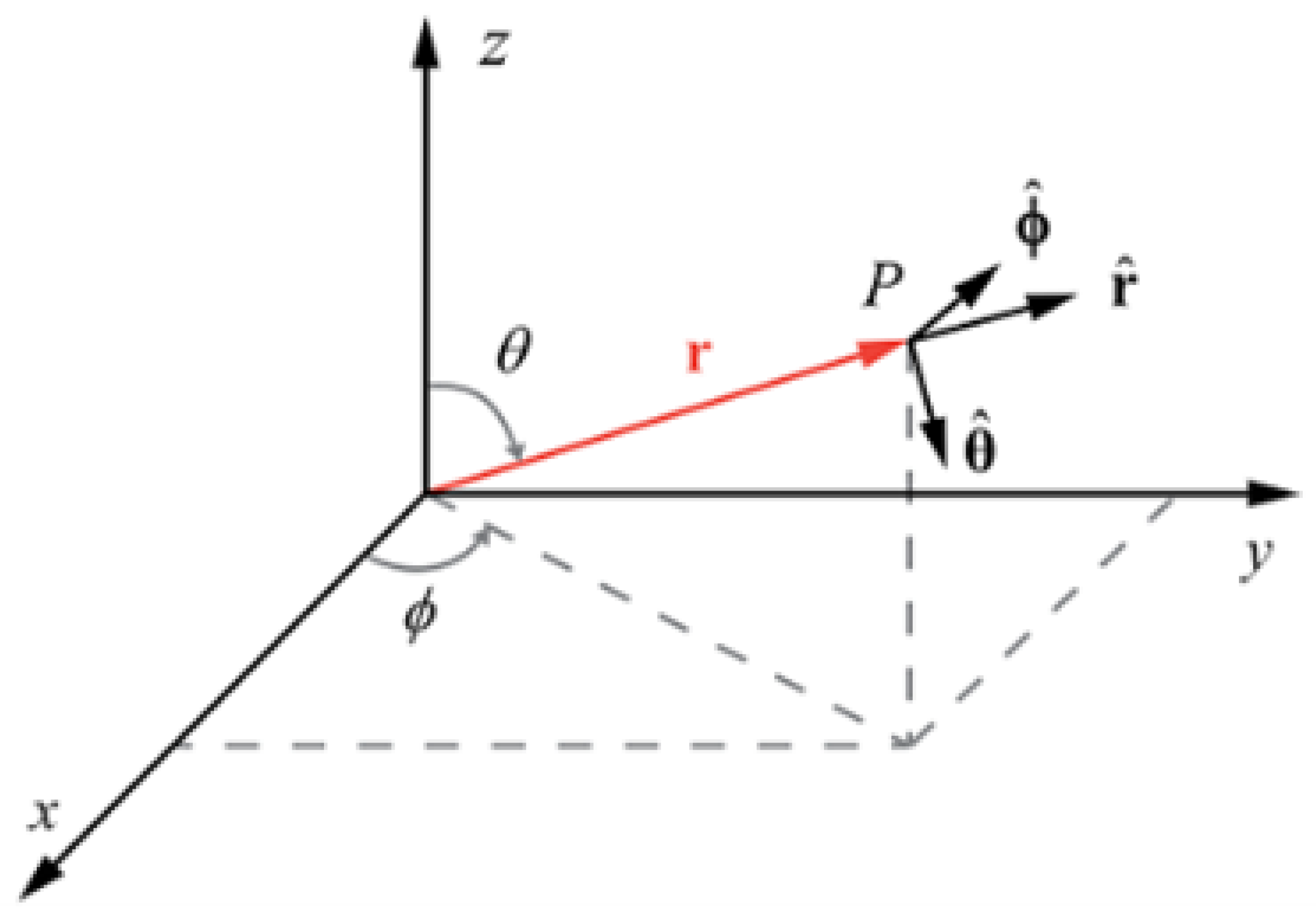
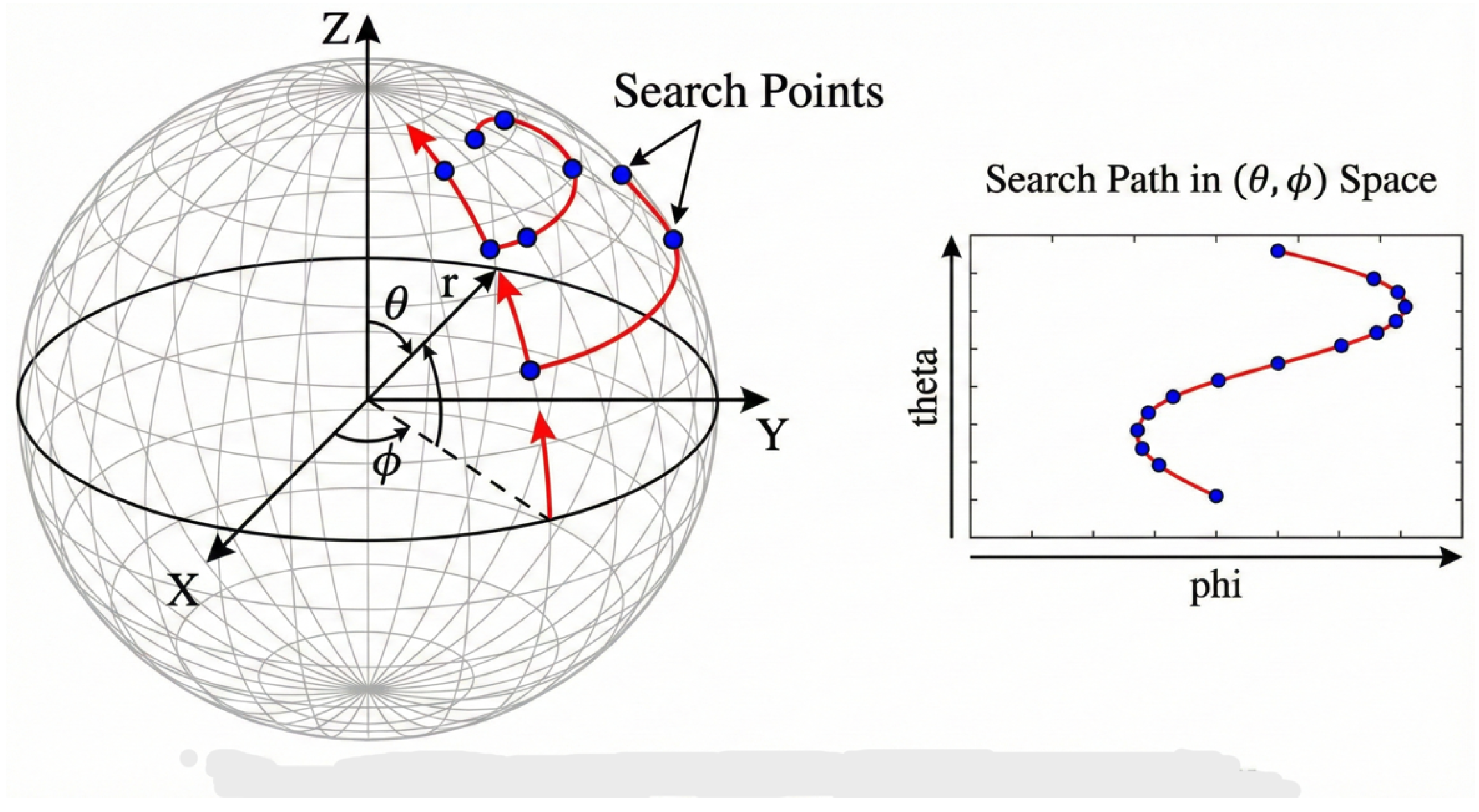
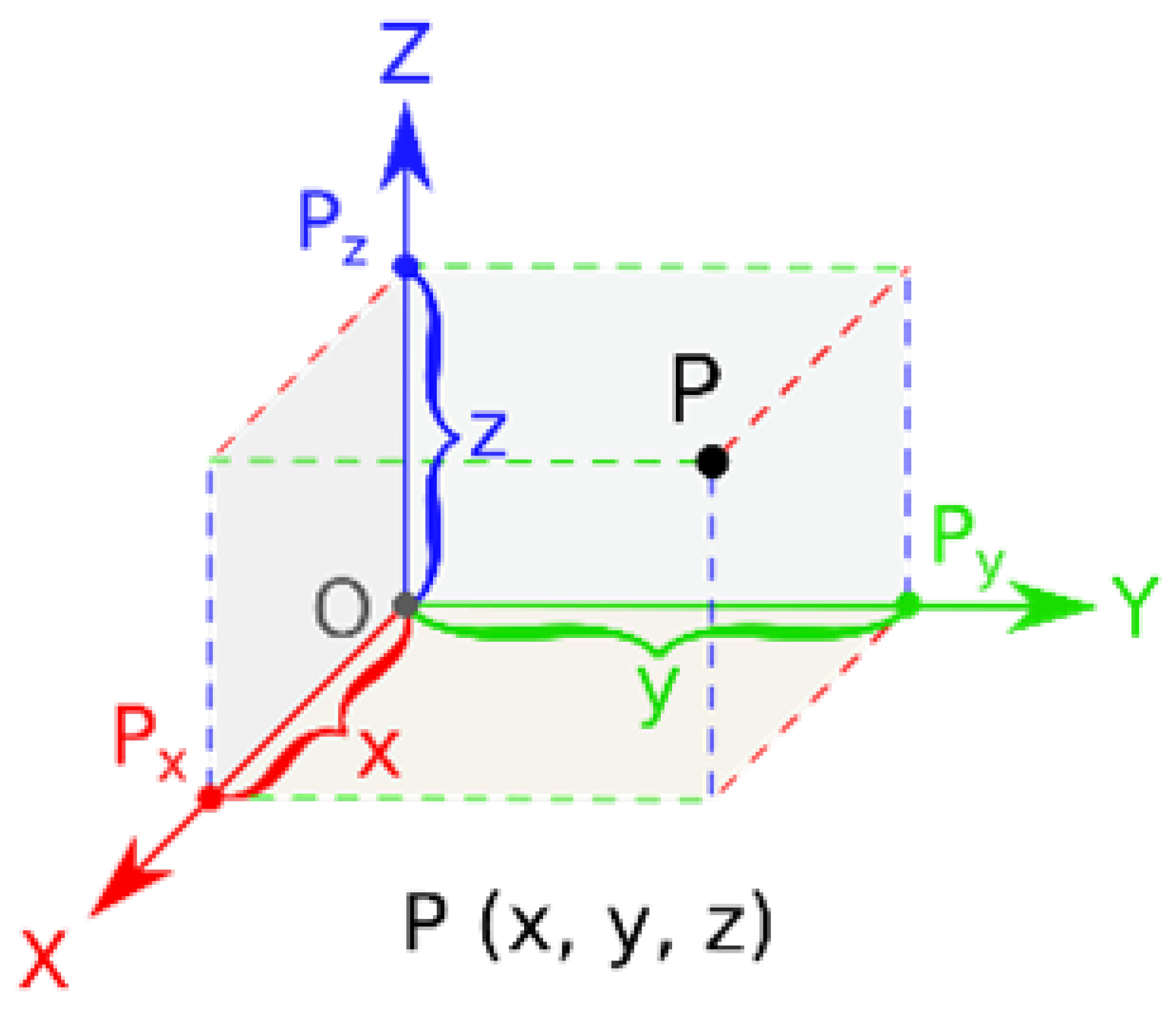
To ensure strict kinematic fidelity at the modeling level, this study establishes a spherical coordinate framework, as shown in Figure 3.
The aircraft’s state vector is defined as S = [ r , θ , ϕ ] T , where r represents the step length (velocity magnitude), θ [ π / 2 , π / 2 ] denotes the pitch angle, and ϕ [ 0 , 2 π ] denotes the yaw/heading angle. The transformation from the spherical search space to the Euclidean battlefield inertial frame ( x , y , z ) is governed by the following mapping:
x k + 1 = x k + r k cos θ k cos ϕ k y k + 1 = y k + r k cos θ k sin ϕ k z k + 1 = z k + r k sin θ k
In this framework, complex non-linear kinematic constraints are transformed into simple linear boundary constraints on θ and ϕ . By constraining the particle search process directly within the kinematically feasible angular domain, the algorithm significantly reduces infeasible trajectory regions a priori. This proactive restriction significantly reduces the effective search space volume, thereby accelerating convergence rates for UAV path planning in complex emergency environments populated by spherical and cylindrical obstacles.
To formally characterize the geometric relationship between consecutive spherical PSO segments, we define the inter-segment turning angle at waypoint P k as:
α k = arccos d k 1 · d k | d k 1 | | d k |
where d k = P k + 1 P k is the k-th segment vector. Since each d k is constrained by spherical PSO to satisfy θ k [ θ min , θ max ] and ϕ k [ 0 , 2 π ] , the turning angle is bounded:
α k α max = arccos cos Δ θ max cos Δ ϕ max
Specifically, while the spherical PSO guarantees that the direction vector d k of each segment lies within the angular cone [ θ min , θ max ] × [ 0 , 2 π ] , the piecewise-linear path has theoretically infinite curvature at each waypoint P k (a first-derivative discontinuity). Real UAVs require a minimum turn radius R min = v 2 / ( g tan ϕ bank , max ) , making such kinks physically unflyable. Cubic Bézier post-processing resolves this by replacing each kink with a smooth transition arc whose curvature is provably bounded, as established below.
Let P = { P 0 , P 1 , , P N } be a waypoint sequence generated by spherical PSO satisfying Equation (13). Construct the cubic Bézier-smoothed trajectory B ( P ) by fitting a cubic Bézier segment B k ( t ) , t [ 0 , 1 ] at each waypoint P k using the following:
Q k 0 = P k , Q k 1 = P k + r k 3 d ^ k , Q k 2 = P k + 1 r k 3 d ^ k + 1 , Q k 3 = P k + 1
where d ^ k = d k / | d k | and r k = | d k | r min . Then B ( P ) satisfies the following property:
Property 1: The tangent direction at every waypoint exactly equals the PSO segment direction:
B k ( 0 ) = 3 Q k 1 Q k 0 = r k d ^ k d k
Therefore, the angular bounds θ [ θ min , θ max ] enforced by spherical PSO are at all waypoints.
Property 2: For all t ( 0 , 1 ) , the tangent B k ( t ) is a positive convex combination of d ^ k and d ^ k + 1 :
B k ( t ) ( 1 t ) 2 d ^ k + 2 t ( 1 t ) m k + t 2 d ^ k + 1
where m k = ( Q k 2 Q k 1 ) / | Q k 2 Q k 1 | . Since d ^ k and d ^ k + 1 both satisfy θ [ θ min , θ max ] , and the pitch angle of a convex combination of directions is bounded by the extremes, we have θ ( B k ( t ) ) [ θ min , θ max ] for all t [ 0 , 1 ] .
Property 3: The curvature at waypoint P k is:
κ k = | B k ( 0 ) × B k ( 0 ) | | B k ( 0 ) | 3 = 2 sin α k r k 2 sin α max r min
where α k is the inter-segment turning angle. This bound is achieved by substituting B k ( 0 ) = r k d ^ k and B k ( 0 ) = 6 ( Q k 2 2 Q k 1 + Q k 0 ) = 2 r k ( d ^ k + 1 d ^ k ) into the curvature formula, yielding | d ^ k × ( d ^ k + 1 d ^ k ) | = sin α k .
Property 4: The trajectory is flyable by a UAV with minimum turn radius R min = v 2 / ( g tan ϕ bank , max ) if and only if κ k 1 / R min , which is guaranteed when:
r min 2 R min sin α max
This condition links the PSO step-length lower bound r min directly to the UAV’s physical flight envelope, ensuring every Bézier arc can be tracked by the actual aircraft.
Property 5: By construction, Q k 3 = Q k + 1 0 (position continuity, C 0 ); d ^ k + 1 is shared between Q k 2 Q k 3 and Q k + 1 0 Q k + 1 1 (tangent continuity, C 1 ); and symmetric placement of Q k 2 and Q k + 1 1 about P k + 1 ensures curvature continuity ( C 2 ).
This proposition rigorously establishes that spherical coordinates and Bézier smoothing play complementary, non-redundant roles: the former constrains each segment direction to the kinematically feasible angular cone (Properties 1–2), while the latter replaces physically unflyable waypoint kinks with smooth, curvature-bounded arcs whose flyability is explicitly guaranteed by the UAV flight-envelope condition in Property 4.

4.3. Heterogeneous Information Mapping via Gaussian Kernel Density

The dominant approach in PSO-ACO fusion literature initializes the ACO pheromone matrix using a hard binary rule: edges on the PSO best path receive τ 0 + Δ τ b o o s t ; all other edges receive τ 0 . This strategy has two structural deficiencies. First, it assumes a one-to-one correspondence between continuous PSO waypoints and discrete graph edges, which does not hold in general 3D grids—a continuous path segment typically passes through the interior of multiple grid cells without coinciding with any single edge, causing the boost to be assigned to the wrong edges or lost entirely. Second, the binary assignment collapses the ACO exploration bandwidth to zero outside the PSO path, effectively preventing the ACO phase from discovering improvements in the immediate neighborhood of the PSO solution. The GKDM mechanism proposed here resolves both deficiencies: the Gaussian kernel in Equation (20) distributes the PSO path’s influence continuously across all neighboring edges, with bandwidth σ controlling the exploration corridor width, and the intensity factor ζ scaling with PSO path quality to implement adaptive cross-algorithm confidence transfer.
A critical challenge inherent to this hybrid architecture is the fidelity-preserving transfer of heuristic information from the continuous vector space of PSO to the discrete, graph-based domain of ACO. Simple linear superposition of these spaces frequently results in topological mismatches and significant information loss. To address this discrepancy, this section introduces a Gaussian kernel density mapping (GKDM) mechanism. This mechanism establishes a probabilistic bridge, wherein the best global trajectory identified during the PSO phase serves as a seed to initialize the ACO pheromone matrix. Consequently, this mapping creates a virtual potential ridge that effectively guides the subsequent ant colony search process.
Let the global sub-optimal trajectory generated by the Spherical PSO be represented as a sequence of continuous waypoints X PSO * = { P 1 , P 2 , , P K } . The initialization of the ACO pheromone matrix τ init ( i , j ) for any given grid edge E i j is not uniform but is determined by a Gaussian diffusion field generated by X PSO * . The mapping function is defined as:
τ init ( i , j ) = τ 0 + ξ k = 1 K 1 exp d ( E i j , P k P k + 1 ) 2 2 σ 2
In this equation, τ 0 represents the baseline pheromone concentration, ensuring a minimum exploration probability for the entire space. The term d ( E i j , P k P k + 1 ) denotes the Euclidean distance from the grid edge E i j to the PSO-generated path segment. The parameter σ acts as a diffusion coefficient, controlling the bandwidth of the guidance information. A properly tuned σ allows the pheromone distribution to form a Gaussian ridge rather than a singular line, providing the ACO algorithm with a tolerance bandwidth to explore the neighborhood of the PSO path for the entire space. The term d ( E i j , P k P k + 1 ) denotes the Euclidean distance from the grid edge E i j to the PSO-generated path segment. The parameter σ acts as a diffusion coefficient, controlling the bandwidth of the guidance information. A properly tuned σ allows the pheromone distribution to form a Gaussian ridge rather than a singular line, providing the ACO algorithm with a tolerance bandwidth to explore the neighborhood of the PSO path. The intensity factor ξ is positively correlated with the fitness value of the PSO path, ensuring that higher-quality coarse paths exert stronger guidance on the subsequent fine-tuning phase. This mechanism effectively eliminates the “blind search” phase of traditional ACO.

4.4. Lyapunov Stability Analysis of System Convergence

The PSO algorithm evolves the swarm state in discrete iterations k = 0 , 1 , 2 , , and its dynamics are governed by stochastic random variables r 1 , r 2 U [ 0 , 1 ] . Applying continuous-time gradient-flow analysis to this setting overly simplifies the dynamics and constitutes an invalid theoretical basis. This section replaces that analysis with a rigorous discrete Lyapunov stability proof for the PSO phase and a Markov chain convergence proof for the ACO phase, as appropriate for discrete stochastic optimization algorithms.

4.4.1. Discrete Lyapunov Stability of the PSO Phase

Define the discrete energy function:
V ( k ) = C b e s t ( k ) C o p t 2
where k { 0 , 1 , 2 , } is the discrete iteration index; C b e s t ( k ) is the globally best cost value found by any particle up to and including iteration k; C o p t is the theoretical global optimum, a fixed lower bound satisfying C o p t C b e s t ( k ) for all k. Then V ( k ) is monotonically non-increasing: V ( k + 1 ) V ( k ) for all k 0 .
The proof process: By the PSO global best update rule, the global best is updated only if a particle discovers a strictly superior solution:
C b e s t ( k + 1 ) = min C b e s t ( k ) , min i C x i ( k + 1 )
where i = 1 , , N indexes all particles in the swarm; N is the total swarm size; x i ( k + 1 ) R D is the D-dimensional position vector of particle i at iteration k + 1 ; C ( · ) is the multi-objective cost function defined in Section 4.1.
It follows directly that C b e s t ( k + 1 ) C b e s t ( k ) . Since C o p t C b e s t ( k + 1 ) C b e s t ( k ) , the energy difference satisfies:
Δ V ( k ) = V ( k + 1 ) V ( k ) = C b e s t ( k + 1 ) C o p t 2 C b e s t ( k ) C o p t 2 0
where Δ V ( k ) denotes the one-step increment of the Lyapunov energy function; the inequality 0 holds because C b e s t ( k + 1 ) C b e s t ( k ) implies ( C b e s t ( k + 1 ) C o p t ) 2 ( C b e s t ( k ) C o p t ) 2 by the monotonicity of f ( x ) = ( x C o p t ) 2 on the domain x C o p t 0 .
This satisfies the discrete Lyapunov stability condition: Δ V ( k ) 0 for all k. Furthermore, under the adaptive inertia weight ω ( k ) defined in Equation (9), the per-dimension velocity variance satisfies:
E v i d ( k ) 2 ω ( k ) 2 E v i d ( k 1 ) 2 + B ( k )
where v i d ( k ) is the velocity of particle i along dimension d at iteration k, with i = 1 , , N and d = 1 , , D ; ω ( k ) is the adaptive inertia weight at iteration k (defined in Equation (9)), satisfying ω ( k ) < 1 and decreasing monotonically to ω min ; E [ · ] denotes expectation over the independent uniform random variables r 1 , r 2 U [ 0 , 1 ] ; B ( k ) = c 1 2 E [ r 1 2 ] E [ p b e s t x i d k 2 ] + c 2 2 E [ r 2 2 ] E [ g b e s t x i d k 2 ] 0 is a bounded non-negative remainder, where c 1 , c 2 are the cognitive and social acceleration coefficients, p b e s t is the personal best position of particle i, and g b e s t is the global best position of the entire swarm; the inequality is derived by taking the squared L 2 -norm expectation of the PSO velocity update equation and exploiting the independence of r 1 and r 2 . Since ω ( k ) < 1 , the sequence { E [ v i d ( k ) 2 ] } contracts geometrically to zero, ensuring the swarm velocity vanishes and all particles stabilize around the recorded global best position.

4.4.2. Convergence of the ACO Phase via Markov Chain Analysis

Model the ACO phase as a finite Markov chain over the solution space Ω of all feasible discrete paths in the planning grid, where Ω is finite. The state at iteration m { 0 , 1 , 2 , } is defined by the pheromone matrix τ ( m ) = { τ i j ( m ) } , with τ i j ( m ) denoting the pheromone level on edge ( i , j ) at iteration m; state transitions follow the enhanced pheromone update rule in Equation (28). Let Π * Ω denote the globally optimal path (the feasible path attaining the minimum cost C ( Π * ) = min Π Ω C ( Π ) ). Then the Markov chain is ergodic, and its stationary distribution concentrates maximum probability on Π * .
The proof process:
① The GKDM initialization guarantees τ i j ( 0 ) τ 0 > 0 for every edge ( i , j ) . Combined with the pheromone evaporation factor ρ > 0 , every feasible path in Ω retains a strictly positive selection probability at every iteration:
Pr path Π selected at iteration m τ 0 τ 0 + Δ τ max | Π | > 0
where Pr ( · ) denotes probability; Π Ω is any arbitrary feasible path; | Π | is the number of edges in path Π ; τ 0 > 0 is the uniform initial pheromone level from Equation (20); Δ τ max is the maximum pheromone increment deposited on any edge in a single iteration; the lower bound follows by taking the product of the minimum per-edge selection probability τ 0 / ( τ 0 + Δ τ max ) over all | Π | edges of path Π . The chain is therefore irreducible.
② The roulette-wheel stochastic selection in Equation (37) introduces strictly positive self-loop probabilities (ants may select the same path in consecutive iterations), ensuring the state period equals 1. The chain is aperiodic.
③ By irreducibility and aperiodicity, a unique stationary distribution π exists. The pheromone reinforcement mechanism monotonically increases pheromone concentration on higher-quality path edges, while evaporation prevents saturation on suboptimal paths. Under the Robbins–Monro stochastic approximation conditions, as m :
Pr ant selects Π * at iteration m m 1 w . p . 1
where Pr ( · ) is the probability operator; Π * is the globally optimal path; “w.p. 1” denotes convergence with probability 1; the limit holds under the Robbins–Monro stochastic approximation conditions, which are satisfied because the pheromone update step sizes in Equation (28) are positive and summable.
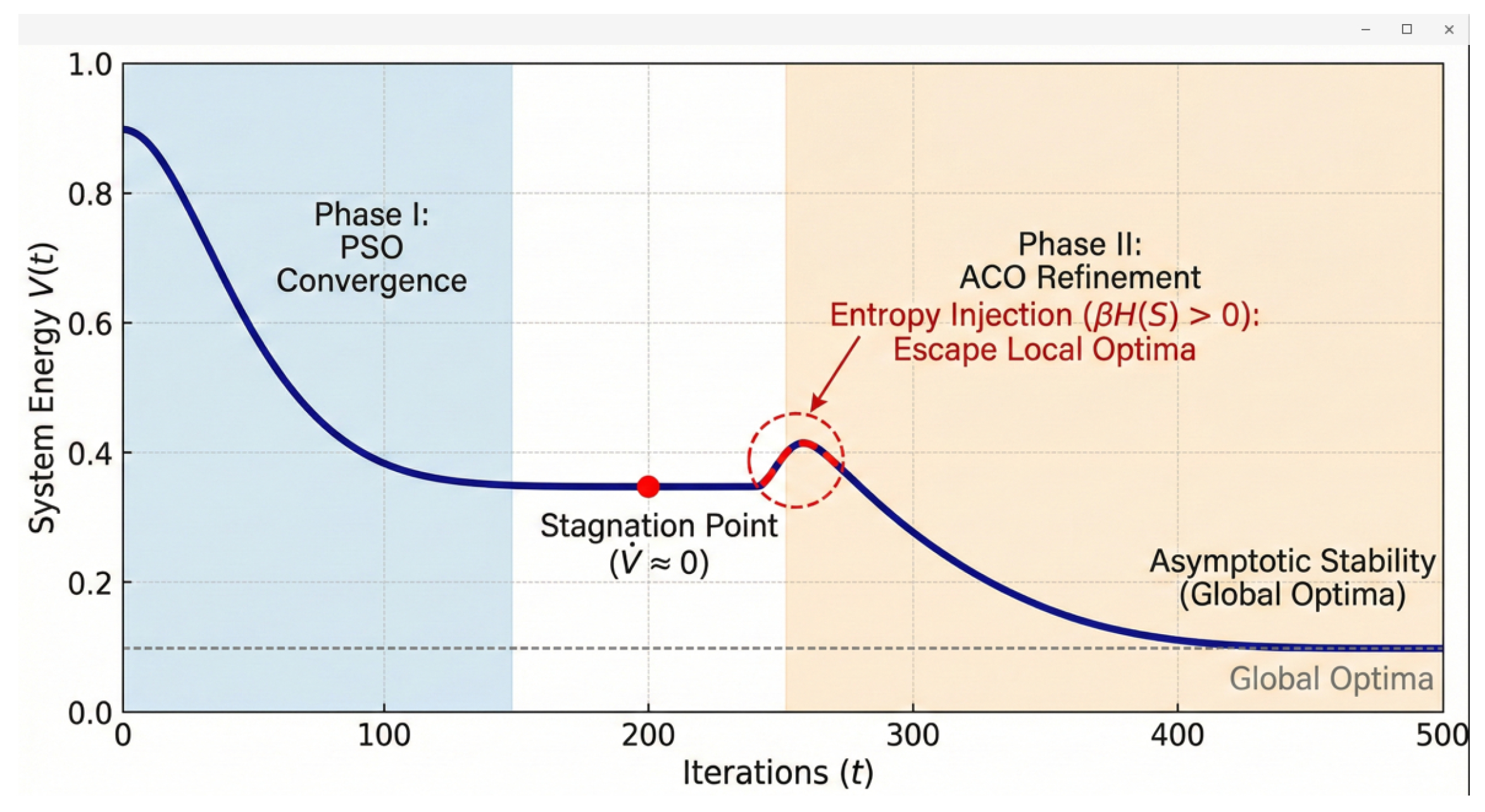
The stationary distribution therefore concentrates on the globally optimal path Π * . In the Hybrid Switching Phase, when the PSO energy stagnates ( Δ V ( k ) = 0 while V ( k ) > 0 ), the GKDM mechanism seeds the ACO pheromone field with the PSO best solution. This constrains the ACO exploration to a near-optimal neighborhood, dramatically reducing the mixing time of the Markov The expected energy change at the switching moment is:
E Δ V h y b r i d = α · Δ τ b e s t + β · H ( S )
where E [ Δ V h y b r i d ] is the expected one-step energy change at the PSO-to-ACO switching moment; α > 0 is the pheromone exploitation weight; Δ τ b e s t > 0 is the pheromone increment deposited on the current best-path edges per iteration, so the term α · Δ τ b e s t < 0 represents energy dissipation driven by pheromone reinforcement; β > 0 is the entropy injection weight; H ( S ) = i p i log p i 0 is the Shannon entropy of the ant colony’s path-selection distribution { p i } , where p i is the probability that ant i selects a given edge, measuring the diversity of the current search; the term + β · H ( S ) represents a transient energy increase that promotes exploration and enables escape from local saddle points. As pheromone accumulates on improved-quality path edges across iterations, the dissipation term α · Δ τ b e s t dominates, and V ( k ) 0 asymptotically. Figure 4 illustrates the two-stage energy convergence mechanism.
Figure 4 shows a schematic diagram of the Lyapunov energy convergence mechanism.
The horizontal axis represents the iteration index k; the vertical axis represents the discrete energy V ( k ) = ( C b e s t ( k ) C o p t ) 2 . (a) PSO Phase (iterations 0 k k * ): The energy function decreases monotonically, satisfying Δ V ( k ) 0 at every step The curve flattens as the swarm approaches stagnation ( Δ V ( k ) 0 while V ( k * ) > 0 ), indicating entrapment in a local optimum. (b) GKDM Injection at k = k * : The dashed vertical line marks the switching moment at which the GKDM mechanism seeds the ACO pheromone field with the PSO global best solution. A transient energy perturbation + β H ( S ) is visible, reflecting the Shannon-entropy-driven exploration that enables escape from the saddle point. (c) ACO Phase (iterations k > k * ): Following the entropy injection, the dissipation term α · Δ τ b e s t dominates as pheromone accumulates on the improved path, driving V ( k ) 0 asymptotically. The two-phase profile collectively demonstrates that the fusion algorithm inherits the monotone descent guarantee of discrete Lyapunov stability from PSO and the ergodic global convergence of the Markov chain from ACO.
This two-stage discrete analysis provides a theoretically rigorous guarantee that the fusion algorithm overcomes the premature convergence defect of standalone PSO while inheriting the guaranteed asymptotic convergence of an ergodic Markov chain.

4.5. Robustness Metrics in Complex Dynamic Environments

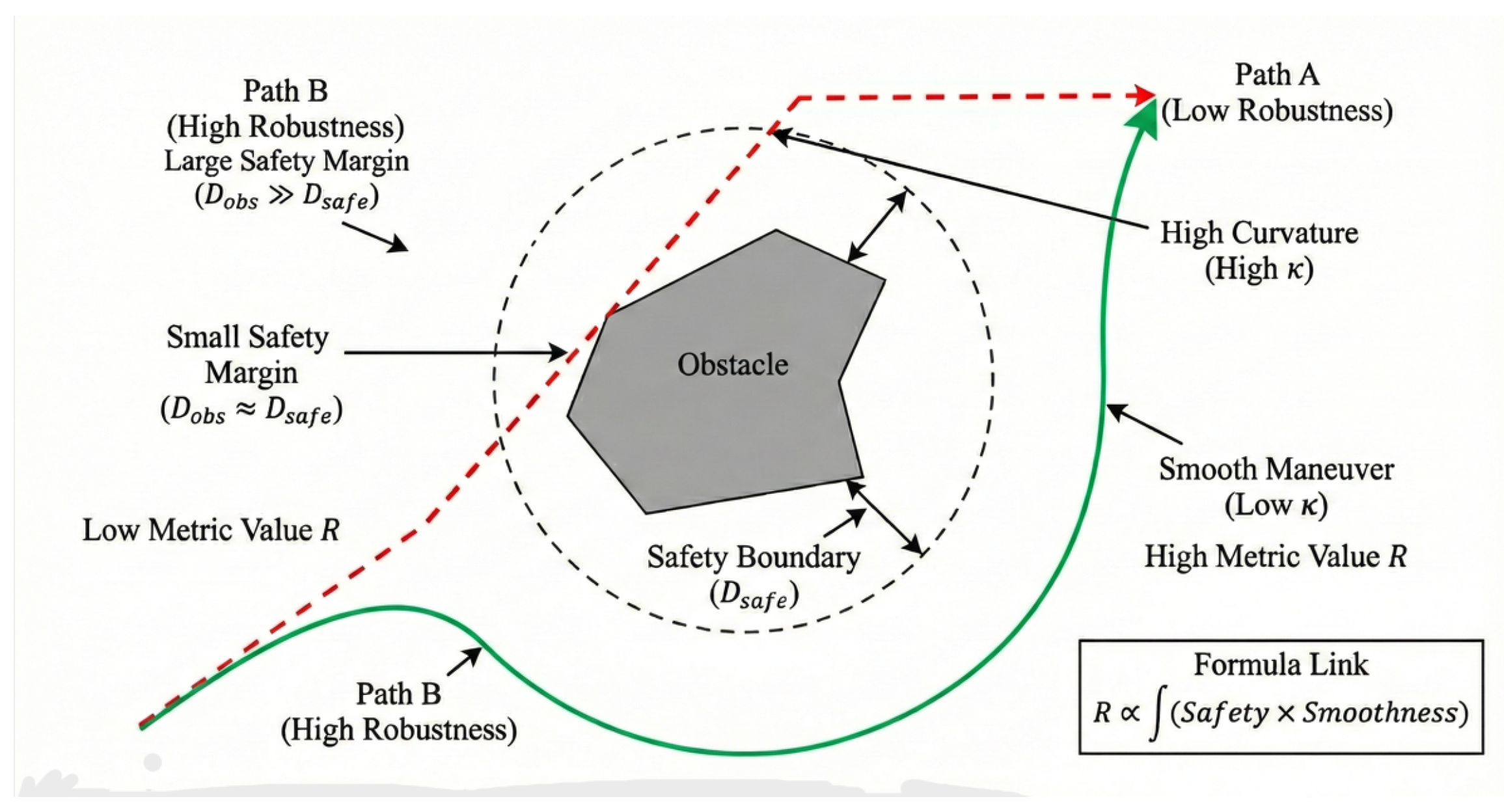
Within complex dynamic operational environments, the overall efficacy of a trajectory planning algorithm is determined not solely by its spatial efficiency, but fundamentally by its resilience to environmental stochasticity and dynamic threat landscapes. Existing literature often lacks a formalized mathematical definition for robustness in this context. This study defines a comprehensive Robustness Metric R, which quantifies the trajectory’s safety margin and kinematic smoothness. The robustness R of a generated trajectory is calculated as the integral of the safety profile along the path L:
R ( Path ) = 0 L min D obs ( s ) D safe D safe , 1 1 1 + κ ( s ) 2 d s
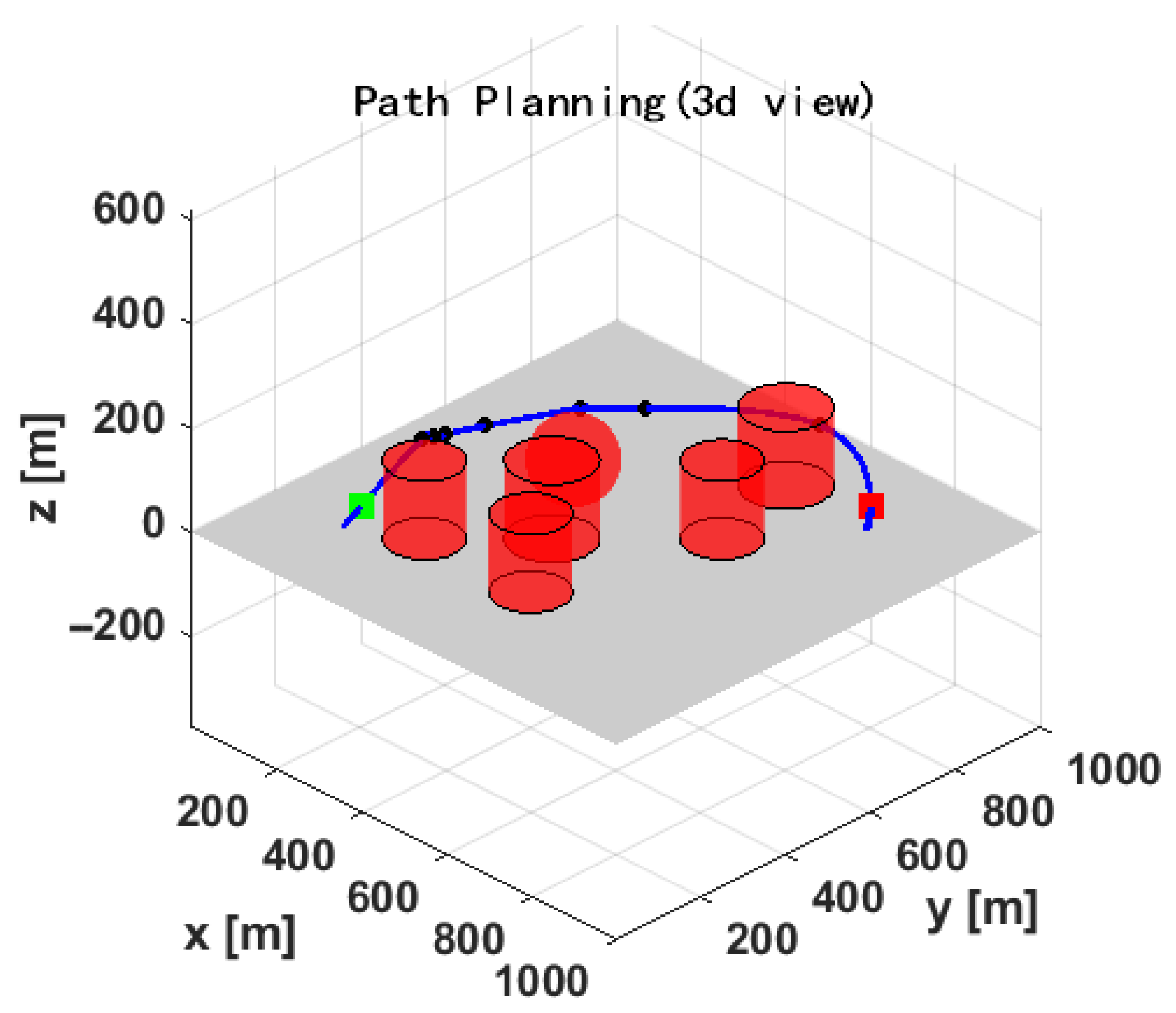
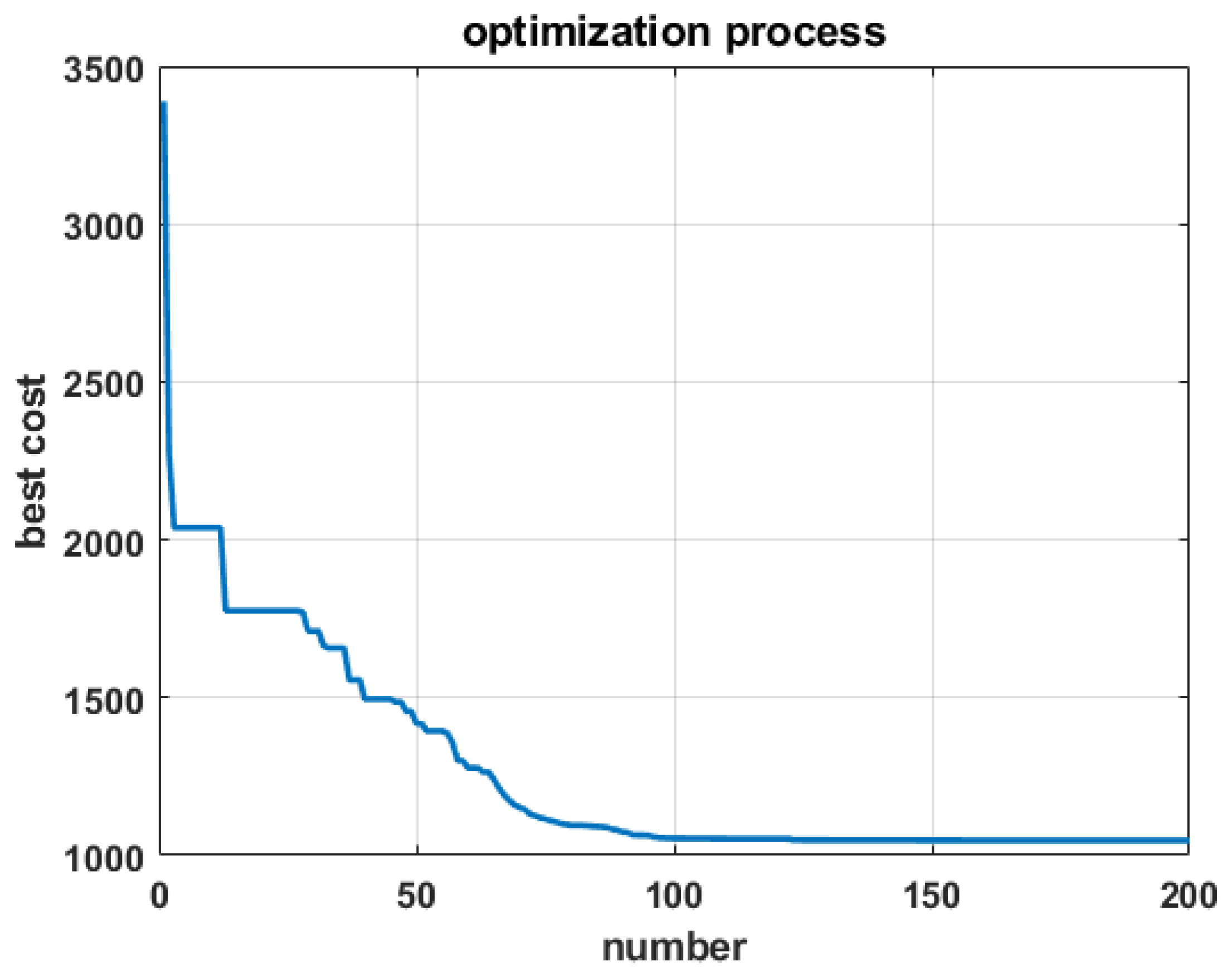
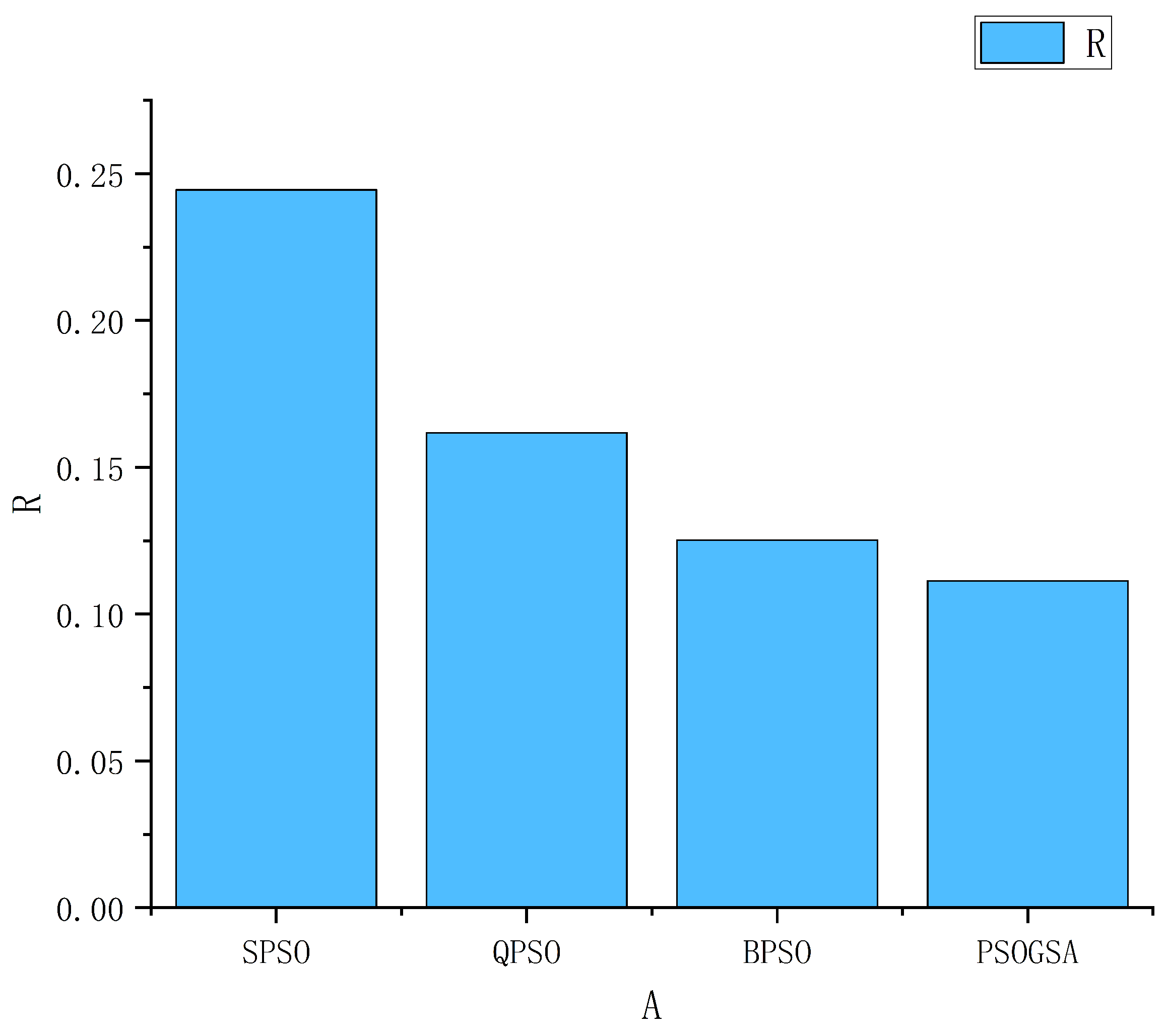
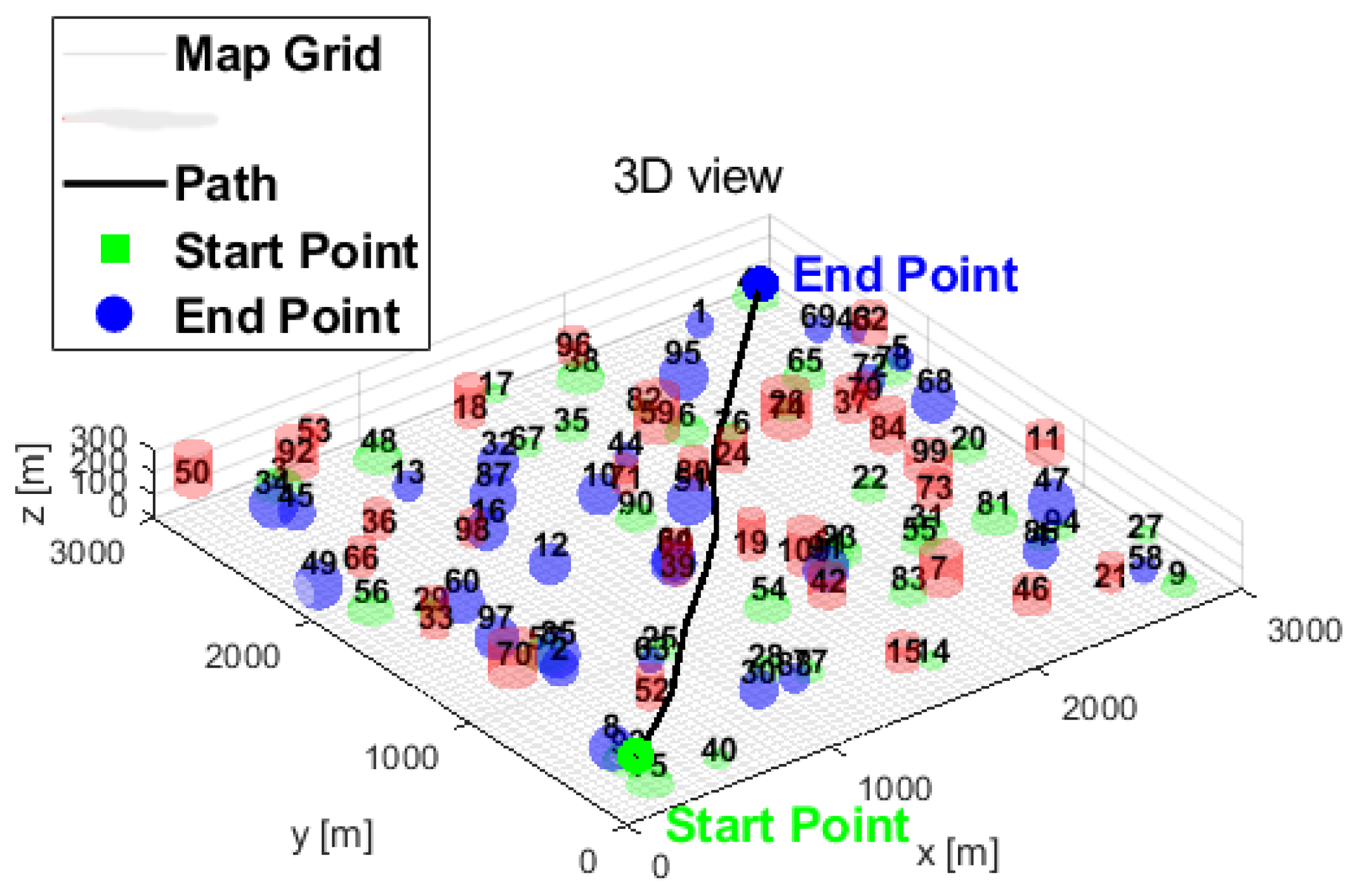
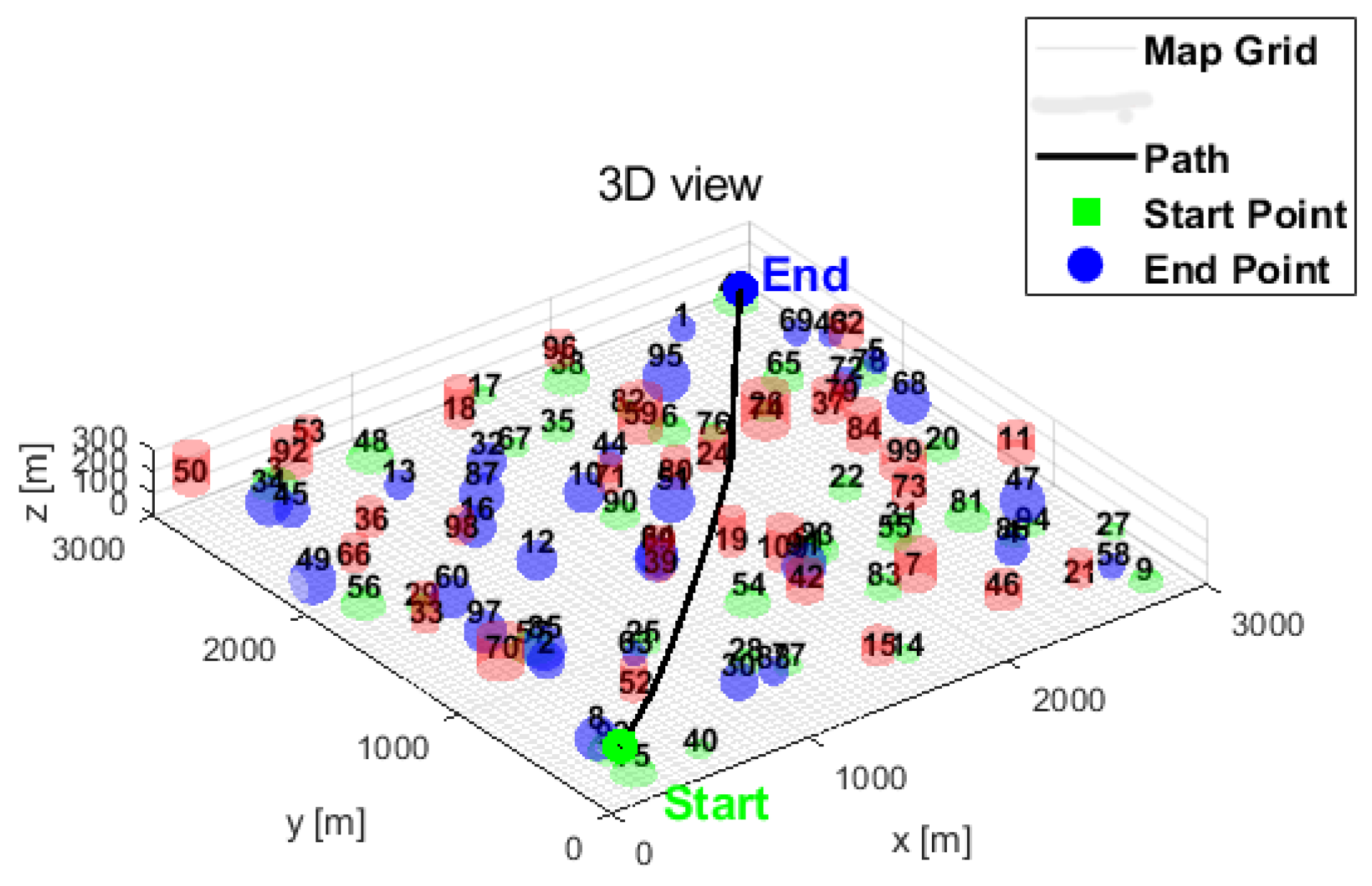
where D obs ( s ) is the Euclidean distance from the path point s to the nearest obstacle or threat zone, and D safe represents the required safety inflation distance. The term κ ( s ) denotes the local curvature of the path. This metric penalizes trajectories that graze obstacles or require sharp, high-G maneuvers, which are prone to tracking errors in real-world flight control. Figure 5 shows the predicted results obtained using the fusion algorithm.
The proposed Spherical PSO-ACO algorithm explicitly maximizes this metric. The spherical coordinate formulation enforces angular continuity, intrinsically limiting κ ( s ) , while the Gaussian Kernel Mapping guides the ACO to search within high-safety regions defined by the potential ridge. Comparative analysis demonstrates that this approach yields trajectories with significantly higher R values compared to traditional grid-based methods, indicating superior operational reliability in obstacle-rich environments.

5. Route Planning with Improved Particle Swarm Optimization

The authors believe that existing PSO-ACO fusion works for UAV path planning provide convergence analysis for each constituent algorithm independently but do not address the convergence behavior of the fused system, particularly at the switching moment when PSO heuristic knowledge is injected into the ACO pheromone field. This switching event introduces a transient energy perturbation that is absent from single-algorithm analyses and requires separate treatment. The following section provides, to the authors’ knowledge, the first convergence proof for a spherical PSO-ACO fusion system that explicitly covers: (i) discrete Lyapunov monotone descent for the PSO phase, (ii) Markov chain ergodic convergence for the ACO phase, and (iii) the Shannon-entropy-driven energy perturbation at the switching moment.
Traditional particle swarm optimization (PSO) algorithms exhibit inherent limitations, frequently failing to satisfy the rigorous demands of trajectory planning concerning computational convergence rates, path optimality, and dynamic adaptability within complex emergency rescue scenarios. Specifically, standard PSO remains highly susceptible to premature convergence—often stagnating at local optima—and suffers from prohibitive computational overhead during extended iterations. To address the operational prerequisites of real-world rescue missions, this dissertation enhances the foundational PSO framework through the integration of a spherical coordinate system, thereby significantly accelerating convergence and elevating overall planning efficacy. Furthermore, because the probabilistic heuristic search mechanisms inherent to ant colony optimization (ACO) provide a proven capacity to escape local minima traps, this research systematically fuses the two methodologies. Consequently, the proposed hybrid architecture synergistically couples the rapid global exploration capabilities of spherical PSO with the rigorous local exploitation strengths of ACO.

5.1. Inflation Distance

To ensure a robust safety buffer between the UAV and environmental hazards, this study introduces an obstacle inflation mechanism. Utilizing discrete grid cells as the fundamental spatial unit, the algorithm executes a morphological dilation outward from the boundaries of identified obstacles. The magnitude of this inflation margin is systematically formulated as a function of several critical parameters, including the UAV’s operational velocity, the respective geometric footprints of the aircraft and the obstacles, and the overall grid resolution. Furthermore, to guarantee collision avoidance under real-world stochastic conditions, this formulation explicitly accounts for the UAV’s state estimation uncertainties and inherent sensor noise.
Consequently, the implementation of this inflation boundary substantially bolsters the overall robustness of the trajectory planning algorithm. Furthermore, because the search heuristic explicitly excludes these inflated regions from evaluation, this spatial buffering effectively prunes the permissible state space. As a direct result, the computational burden associated with node traversal is drastically diminished, thereby significantly accelerating the algorithm’s overall execution time.
Based on the reality of emergency rescue scenario, this paper designs a cost function according to the distance from obstacles. Within the inflation distance, the closer the aircraft is to an obstacle, the higher the cost; when the aircraft touches an obstacle, the cost is set to infinity. A threat distance cost function is defined: T c . L denotes the distance from the aircraft to an obstacle, and L safe is the specified inflation distance. T c can be defined as:
T c = 0 L 300 ( L safe L ) 2 50 L 300 L < 50
In accordance with standard flight safety separation regulations, a standoff radius of 300 m from any hazard is established as the absolute safe boundary, beyond which the obstacle’s influence is considered negligible. Within the intermediate proximity zone—spanning between 50 and 300 m—the repulsive influence of the obstacle escalates according to a quasi-quadratic functional trend as the spatial separation decreases. Conversely, a separation distance of less than 50 m constitutes a critical breach of the kinematic hard constraint, mathematically representing a direct collision event.

5.2. Constructing the PSO Algorithm Based on the Spherical Coordinate System

Conventional particle swarm optimization (PSO) implementations typically parameterize waypoints directly utilizing Cartesian coordinates. Because the spatial transitions between sequential nodes are computed along independent orthogonal axes, this geometric decoupling inherently yields discontinuous, jagged trajectories. Consequently, this approach induces severe computational overhead during post-processing smoothing and significantly degrades the overall efficiency of rescue navigation operations. Furthermore, rescue UAVs are governed by strict kinematic angular constraints along their flight paths. Enforcing these nonlinear constraints within a linear Cartesian framework proves mathematically cumbersome and computationally inefficient. Figure 6 illustrates the state representation of an individual particle within this Cartesian framework. To circumvent these intrinsic limitations, this dissertation proposes transforming the computational search space into a spherical coordinate framework. This geometric mapping inherently aligns the optimization process with the UAV’s kinematic limits, thereby simultaneously resolving critical issues pertaining to trajectory smoothness, algorithmic search efficiency, and strict constraint satisfaction.
After the improvement, spherical coordinates are used ( r , θ , ψ ) , where r represents the radial distance (step length), θ denotes the elevation (pitch) angle, and ψ indicates the azimuth (yaw) angle. The position vector ( x , y , z ) in the traditional PSO algorithm is thus parameterized by three spherical parameters ( r , θ , ψ ) , as shown in Figure 7. Transforming the state space from Cartesian to spherical coordinates inherently streamlines the enforcement of strict kinematic angular constraints along the UAV trajectory. Furthermore, this geometric transformation effectively prunes the feasible search volume. This dimensional reduction substantially enhances the swarm’s capacity to escape local minima, thereby significantly increasing the probability of converging upon high-fidelity, near-optimal solutions.
To make this parameterization concrete for UAV flight, note that: (1) the step length r corresponds to the product of UAV cruise speed and planning time step, typically 100–150 m per step for the rescue UAV modeled in this study; (2) the pitch angle theta directly maps to the UAV’s Flight Path Angle (FPA), whose physical limits are determined by the aircraft’s maximum climb rate—for fixed-wing rescue UAVs, | θ | < = 15 ° is a standard kinematic constraint; (3) the yaw angle psi represents the UAV heading, which changes at a rate bounded by the maximum coordinated turn rate. By encoding these aerodynamic constraints directly as the search bounds of θ and ψ , the spherical parameterization guarantees that every candidate waypoint generated by the PSO is aerodynamically achievable without post-processing correction.
The fundamental mathematical parameterization of a waypoint within this spherical framework is defined as follows:
The conversion relationship between the spherical coordinate system and the Cartesian coordinate system is as follows:
x = x 0 + r cos θ sin ψ
y = y 0 + r cos θ cos ψ
z = z 0 + r sin θ
The kinematic state update equations governing the particle swarm within this spherical coordinate domain are formulated as follows:
X i , d t + 1 = X i , d t + V i , d t + 1
The velocity update formula changes accordingly. Since the coordinates of each point are represented by three parameters ( r , θ , ψ ) , the velocity performs state updates on the three parameters ( r , θ , ψ ) :
V r = ω · V r + m 1 · rand ( P r X r ) + m 2 · rand ( G r X r ) V θ = ω · V θ + m 1 · rand ( P θ X θ ) + m 2 · rand ( G θ X θ ) V ψ = ω · V ψ + m 1 · rand ( P ψ X ψ ) + m 2 · rand ( G ψ X ψ )
In Equation (34): V r , V θ , V ψ respectively represent the updated velocities of the particle in the three dimensions ( r , θ , ψ ) . ω denotes the inertia weight factor, which is used to control the proportion of the particle’s three components in the initial state. m 1 , m 2 represent the learning factors—among them, m 1 indicates the degree of trust in the particle’s personal best position: if the particle’s personal best position is more effective in guiding the search for the optimal solution, m 1 is usually set to a larger value; m 2 indicates the degree of trust in the global best position of the swarm: if the swarm’s global best position is more effective in finding the optimal solution, m 2 will also increase accordingly. In the equation, rand ( P X ) ,   rand ( G X ) represent the personal optimal position and the global optimal position in a certain dimension. The function rand represents a random value; this equation not only describes the randomness of particle swarm generation but also reflects the principle of particle swarm planning.
The formal initialization of the spherical PSO is defined as follows. Let the mission space be discretized into N w waypoint slots. Each particle i (i = 1,..., N p ) represents a complete trajectory through N w waypoints. The dimension of particle i represents the spherical state at waypoint slot d, consisting of the triplet. The initial position of particle i in dimension d is sampled as: r i , d 0 [ r m i n , r m a x ] , θ i , d 0 [ θ m i n , θ m a x ] , ψ i , d 0 [ ψ m i n , ψ m a x ] .
The initial velocity is set to zero: V i , d 0 = 0 . The key kinematic bounds used in all simulations are: r m i n = 50 m, r m a x = 200 m, θ m i n = 15 ° , θ m a x = + 15 ° , ψ m i n = 0 ° , ψ m a x = 360 ° . The adaptive inertia weight ω ( t ) in Equation (9) is initialized with ω m a x = 0.9 , ω m i n = 0.4 , and the convergence detection bandwidth σ f is set to the standard deviation of the current population’s fitness values.

5.3. PSO-ACO Algorithm

This section details the systematic enhancements applied to both the particle swarm optimization (PSO) and ant colony optimization (ACO) frameworks. By synergistically integrating the complementary strengths of these two methodologies, a novel hybrid architecture is formulated to satisfy the rigorous prerequisites of complex mission planning.
While the particle swarm generated by the PSO algorithm exhibits a robust capacity to explore the global search space, this expansive coverage inherently compromises the precision of local trajectory refinement. By subsequently integrating the ACO algorithm to execute fine-grained local exploitation, the proposed hybrid framework achieves superior convergence, yielding solutions that are both globally near-optimal and locally precise.

5.3.1. Principle of the Fusion Algorithm

In addressing the UAV trajectory planning problem investigated in this dissertation, relying exclusively on a standalone PSO or ACO methodology proves insufficient to guarantee path optimality within highly complex environments. To mitigate the inherent risk of premature convergence, the PSO framework is initially deployed to conduct a comprehensive global search. Upon identifying a near-optimal preliminary trajectory, the initial pheromone matrix is dynamically calibrated to prevent the system from stagnating at local minima. Subsequently, the heuristic search mechanism of the ACO algorithm is initiated to iteratively refine these localized segments, thereby yielding a final trajectory that rigorously satisfies both global optimality and local kinematic constraints [23].
At the onset of the optimization process, the PSO framework executes a comprehensive initialization protocol. Specifically, it constructs the environmental simulation space and establishes the fundamental swarm parameters, including the overall population size. Concurrently, the system performs the critical geometric transformation from the Cartesian workspace into the spherical coordinate domain, thereby ensuring that all initial particles inherently adhere to the established kinematic constraints. The particle state is updated in accordance with the converted Equations (32) and (33). Upon completion of the initialization protocol, the PSO framework commences its global trajectory exploration phase. The system subsequently triggers a dynamic transition to the local exploitation mechanism of the ACO algorithm once the following three critical criteria are satisfied:
1.
The number of consecutive times with no improvement in the cost value for convergence judgment reaches a threshold.
2.
The particle swarm population diversity falls below a predefined threshold.
3.
Stagnation detection identifies that the particle movement has effectively stopped.
Once the dynamic transition mechanism is triggered, the initialization phase of the integrated PSO-ACO framework commences. Initially, the historical trajectory data generated throughout the PSO iterations is systematically logged. Subsequently, the native heuristic parameters of the ACO algorithm are initialized by leveraging the global best solution derived from the PSO phase as a foundational probabilistic seed.
Upon completion of the PSO exploration phase, the global best particle g b e s t represents a sequence of waypoints parameterized in spherical coordinates. These are first decoded into a continuous trajectory in the Euclidean space using Equation (12), yielding the path P P S O = P 1 , P 2 , , P K where P k = ( x k , y k , z k ) . This path sequence serves as the seed input to the Gaussian Kernel Density Mapping (GKDM) mechanism defined in Section 4.3. Specifically, the pheromone initialization formula Equation (20) computes the distance from each ACO graph edge E i j to each path segment P k P k + 1 , creating a pheromone ridge that concentrates the subsequent ACO search within the kinematically feasible corridor established by the spherical PSO phase. This ensures that the continuous-space output of the spherical PSO is faithfully transferred to the discrete graph-based ACO domain with minimal information loss, as guaranteed by the diffusion parameter σ in Equation (20).

5.3.2. Pheromone Update

Within the ACO framework, the dynamic pheromone trail serves as the fundamental mechanism for heuristic updating and continuous optimization. Consequently, the mathematical formulation of the pheromone update rule strictly dictates the convergence behavior and the ultimate optimality of the derived solutions. When updating pheromones, the traditional ACO algorithm usually adopts the rule of Equation (35):
τ i + 1 ( t + 1 ) = ( 1 ρ ) τ i ( t ) + Δ τ i new
Here, τ i represents the change in the pheromone over time; ρ is the pheromone evaporation factor; Δ τ i new is the increment of the pheromone learned under path conditions, which is used to find the optimal path. While computationally straightforward, this conventional update formulation is highly susceptible to bypassing the global optimum. Furthermore, it exhibits inadequate fine-grained local exploitation capabilities, suffers from diminished solution diversity, and demonstrates severely degraded search efficacy within expansive state spaces. To overcome the inherent drawbacks of the algorithm, this paper mathematically reconstructs the pheromone update mechanism by integrating the Particle Swarm Optimization (PSO) and Ant Colony Optimization (ACO) algorithms. The improved update formula is presented in Equation (36):
τ i + 1 ( t + 1 ) = ω ( t ) τ i ( t ) + c 1 · rand ( Δ τ i best ) + c 2 · rand ( Δ τ i best )
Here, ω represents the dynamic inertia weight in PSO. This paper intends to perform local optimization on the globally searched paths by means of algorithm integration. c 1 , c 2 respectively denote the pheromone increments of the personal optimal particle and the global optimal particle, and they stand for the learning factor in the particle swarm. Introducing the learning factor, along with the pheromone increments of the global optimal particle Δ τ i best and the personal optimal particle Δ τ i best , can guide the direction of local optimization and facilitate convergence to a solution that meets the required standards [24].

5.3.3. Transition Probability

Within the domain of trajectory planning, the state transition probability functions as the primary stochastic mechanism for determining successive waypoints. Fundamentally, both the PSO and ACO frameworks construct viable routes through an iterative process of spatial node expansion. By formulating a unified transition probability model, the distinct heuristic decision-making processes of these algorithms are seamlessly integrated. This synergistic coupling facilitates a comprehensive evaluation of the discrete state space, ultimately yielding an optimized trajectory guided by the complementary strengths of both methodologies.
The formula for transition probability is given in Equation (37).
P ( i , j ) = [ τ ( i , j ) ] α · [ η ( i , j ) ] β k = 0 K [ τ ( i , k ) ] α · [ η ( i , k ) ] β
τ ( i , j ) represents the pheromone concentration on the path and η ( i , j ) represents the heuristic information on the path; α denotes the pheromone importance factor and β denotes the heuristic information importance factor. This formulation ensures a rigorous equilibrium between heuristic exploration and experiential learning during the spatial node expansion process. By systematically synergizing these dual evaluative criteria, the proposed algorithm effectively mitigates the degradation of search efficacy and circumvents the persistent risk of stagnating at local minima.

5.4. Cost Functions

Within the objective function formulation of traditional particle swarm optimization (PSO), boundary constraints are frequently ill-defined or inadequately penalized. Consequently, during the swarm’s iterative exploration phase, particles are highly susceptible to violating the feasible state space. This unconstrained trajectory evolution often induces significant computational deviations near the search boundaries, ultimately compromising the fidelity of the final solution under strict kinematic conditions [25,26]. Furthermore, contemporary objective functions frequently neglect critical longitudinal flight dynamics, particularly the UAV’s pitch angle constraints, inherently leading to suboptimal trajectory smoothness. Within the context of secure mission planning, the stringent kinematic and spatial constraint prerequisites diverge significantly from the generalized paradigms established in prior literature. Consequently, it is imperative to reconstruct the multi-objective evaluation criteria to rigorously quantify whether the optimized trajectory satisfies mission-critical prerequisites and successfully achieves the intended operational objectives. The expression for the comprehensive total cost function is constructed as follows:
J = b 1 J 1 + b 2 J 2 + b 3 J 3 + b 4 J 4 + b 5 J 5
The weight value of each cost in the formula is determined through experimental tuning and experience, and the value is b 1 = 5 , b 2 = 1 , b 3 = 10 , b 4 = 5 , b 5 = 100 .

5.4.1. Path Length Cost

J 1 represents the path length cost. According to the Euclidean distance definition, it is calculated by computing the distance between every two adjacent nodes on the path and performing cumulative summation, and its expression is given by:
J 1 = i = 1 N 1 x i + 1 x i 2 + y i + 1 y i 2 + z i + 1 z i 2

5.4.2. Rescue Area Hazard Cost

In Equation (38), J 2 represents the rescue area hazard cost, which can also be regarded as the distance cost between the path and obstacles. It is calculated by determining the distance between the line segments connecting adjacent nodes on the path and the obstacles. If this distance is greater than the defined maximum safety distance, the cost is 0; if the distance is less than or equal to the minimum aircraft safety separation distance, it is regarded as having collision risk, and the cost is infinitely large at this time; if the distance falls within the safety distance range, the cost value T c is assigned in accordance with the provisions of the collision threat cost function in Equation (11). The expression of J 2 is as follows:
J 2 = i = 1 num j = 1 N 1 T c

5.4.3. Altitude and Angle Cost

J 3 represents the state cost, which includes the constraints on the aircraft’s altitude, pitch angle. If the set aircraft flight altitude parameter is lower than a certain value, or the aircraft’s pitch and yaw parameters exceed a certain range, it will not conform to actual flight conditions; thus, constraints are imposed on the relevant parameters. It can be expressed as follows:
J 3 = i = 1 n J 3 high + J 3 θ
where:
J 3 high = if z i 0 z i z max z min 2 if z i > 0
J 3 θ = z i z i 1 sin θ if θ min θ θ max else
J 3 ψ = x i + 1 x i sin ψ if ψ min ψ ψ max else
In Equations (42)–(44), J 3 high represents the flight altitude constraints; J 3 θ denotes the pitch angle constraints during flight.

5.4.4. Smoothness Cost

In Equation (38), J 4 represents the smoothness cost. By setting the smoothness cost, the path is made more consistent with practical conditions, which is defined by the following equations.
J 4 1 = 0 if θ i max ( θ ) J 4 1 = ( θ i max ( θ ) ) 2 else
B ( t ) = i = 0 3 ( 1 t ) 3 i P i
P i denotes progressive values within the range [ 0 , 1 ] , and these values represent four control points on the curve, which are used to precisely control the smoothness of the curve. Under the combined effect of J 3 and J 4 , the route will have no abrupt ascents and descents, and its turning performance is also guaranteed, which meets the requirements of practical mission flights.

5.4.5. Destination Orientation Cost

The Destination Orientation Cost is a factor proposed in conjunction with the fusion algorithm, which is suitable for determining whether the fusion algorithm is moving correctly toward the final target. By introducing the Destination Orientation Cost, we can judge whether the route calculated by the fusion algorithm is moving toward the correct destination during the algorithm execution process.
J 5 = P end P target P target P start

6. Simulation Verification

To evaluate the proposed methodology, an unmanned emergency rescue mission is simulated within a synthesized disaster-stricken environment. The spatial parameters for trajectory planning are bounded by the initial deployment coordinates at [200, 200, 50] and the designated mission terminus at [800, 800, 50]. Throughout the simulated mission execution, the UAV is mandated to perform dynamic collision avoidance maneuvering against environmental hazards. To rigorously test algorithmic robustness, the spatial coordinates of these obstacles are stochastically distributed across the operational workspace prior to each simulation run to terminus [800, 800, 50]. Consequently, this section presents a comprehensive simulation-based validation of the enhanced PSO framework across varying hazard configurations. The objective is to substantiate the superiority of the proposed algorithm over conventional PSO variants concerning overall trajectory cost, computational efficiency, and global optimality.
The weight coefficients of each component in the cost function are set as follows:
Based on the above method, the flowchart of the improved PSO algorithm for solving the route-planning problem can be drawn as shown in Figure 8.

6.1. Only When Environmental Threats Exist

The simulation environment in this section is designed to model realistic emergency rescue scenarios encountered in post-disaster urban areas and mountainous disaster zones. The six cylindrical obstacles (Table 1) specifically represent the following real-world hazard categories encountered during emergency rescue missions:
Obstacle #1 (X = 400, Y = 500, R = 80 m): Collapsed multi-story building with unstable debris cloud—no-fly zone due to structural collapse risk and dust interference with UAV sensors.
Obstacle #2 (X = 600, Y = 200, R = 70 m): Active fire zone with thermal updraft—no-fly zone due to extreme turbulence and heat damage risk.
Obstacle #3 (X = 500, Y = 350, R = 80 m): Hazardous chemical leak zone —electromagnetic and chemical sensor interference zone.
Obstacles #4–6: Secondary structural hazards, power line towers with electromagnetic interference fields, and temporary emergency helicopter corridors.
The UAV is tasked with reaching a survivor rescue point at [800, 800, 50] (representing a rooftop or elevated safe zone) from a command center at [200, 200, 50] while avoiding all six hazard zones. This scenario directly models the ’disaster-stricken area navigation’ use case described in the Introduction. The altitude constraint ( z 50 m) reflects the minimum safe altitude above urban debris, and the maximum operational altitude ( z 300 m) reflects civil airspace regulations in low-altitude rescue operations.
When only environmental hazards exist in rescue areas, the hazardous weather is treated as cylindrical obstacles, and the specific cylindrical obstacles are shown in Table 1 below.
To ensure the empirical reliability of the findings and to effectively mitigate the inherent stochastic variability of the heuristic algorithms, all experimental scenarios were subjected to 50 independent trials under strictly controlled, identical environmental configurations. Consequently, the reported performance metrics represent the aggregated mean values, thereby establishing rigorous statistical robustness and ensuring the reproducibility of the proposed methodology.
Following the PSO phase, the global best trajectory P P S O consists of waypoints parameterized as spherical state vectors ( r k , θ k , ψ k ). These waypoints are decoded via Equation (20) to yield Cartesian coordinates, and the resulting path is passed to the GKDM initialization to seed the ACO pheromone field. The ACO phase then runs to refine the corridor. The final planned trajectory is illustrated in Figure 9 and Figure 10.
The specific traditional PSO algorithm and the improved PSO algorithm under this condition are shown in the figure below:
As can be seen in Figure 9 and Figure 10, the routes planned by both algorithms can effectively avoid environmental hazards in rescue areas. Analyzing the route planning results of the traditional PSO algorithm and the improved PSO algorithm in Figure 9 and Figure 10 allows for a comparison of the cost-value convergence of the two algorithms, as shown in Figure 11 and Figure 12.
As can be concluded from Figure 11 and Figure 12, when there are only environmental cylindrical environmental obstacles, the routes of the improved PSO algorithm are smoother, and it selects the shortest path to reach the destination; additionally, the cost value convergence is lower. To ensure the accuracy of the experimental results, 500 Monte Carlo simulations were conducted for each of the two PSO algorithms; finally, the average value was taken to plot the cost value convergence results, and the plotted routes are also the most frequently occurring routes among the iteration results.
To rigorously validate the operational efficacy of the proposed hybrid algorithm within large-scale, obstacle-dense emergency rescue environments, comparative trajectory planning simulations were conducted against established PSO variants across a standardized static workspace. The foundational parameters of this simulation environment remain strictly consistent with the configurations delineated in the preceding section.
The improved PSO developed in this study is evaluated against several high-performing variants, specifically QPSO, PSOGSA, and BPSO.
Quantum-behaved Particle Swarm Optimization (QPSO) is a swarm intelligence algorithm inspired by quantum mechanics and developed through a rigorous analysis of PSO convergence dynamics. Originally introduced by Sun, the algorithm was subsequently refined by Liu et al. (2020) and implemented for the trajectory planning of unmanned underwater vehicles (UUVs) [27]. Within this framework, the spatial probability distribution of each particle is modeled utilizing quantum wave functions, thereby circumventing conventional kinematic velocity updates in favor of direct probabilistic state transitions. By establishing the center of a quantum potential well as the dynamic attractor for the swarm’s mean best-known position, the Quantum-behaved Particle Swarm Optimization (QPSO) algorithm achieves superior global exploration capabilities and accelerated convergence rates, all while necessitating a significantly reduced hyperparameter space.
M best ( t ) = 1 N i = 1 N P b e s t ( t )
Particle Swarm Optimization–Gravitational Search Algorithm (PSOGSA), a hybrid meta-heuristic introduced by S. Mirjalili et al. (2013) [28], integrates the exploitation proficiency of PSO with the exploration strengths of GSA to enhance search efficiency and circumvent local optima [29].
The fundamental characteristic of this algorithm lies in its dual-attribute representation, where each agent in the population is characterized by both particle dynamics and physical mass. Within this framework, GSA governs the calculation of gravitational interaction forces between particles, which subsequently determines the acceleration of each individual agent. The agents are subsequently guided by the global best solution ( G best ), with inertia weights employed to preserve their kinematic states. This mechanism enables the algorithm to rapidly converge on the optimal search space. The primary governing equations of PSOGSA are as follows:
V i d ( t + 1 ) = w · V i d ( t ) + c 1 · r 1 · a c i d ( t ) + c 2 · r 2 · ( G best d X i d ( t ) )
The first term of the equation accounts for the inertial component, while the second and third terms correspond to the gravitational search and PSO-based global search mechanisms, respectively. a c i d ( t ) denotes the acceleration expression, serving as a fundamental component derived from the Gravitational Search Algorithm (GSA). It characterizes the acceleration experienced by a given particle due to the “gravitational attraction” exerted by other high-performing agents within the population. This mechanism enables particles to perceive and navigate the global fitness landscape of the search space. The governing equation for acceleration a c i d ( t ) is formally defined as:
a c i d ( t ) = j K best , j i r j G ( t ) M j ( t ) R i j ( t ) + δ X j d ( t ) X i d ( t )
Here, G ( t ) signifies the gravitational constant, which diminishes as the iteration progresses; M j ( t ) corresponds to the inertial mass, which is positively correlated with the agent’s fitness value; R i j ( t ) denotes the Euclidean distance separating agents i and j; K best characterizes the aggregate gravitational force acting on particle i from the K best-performing particles.
Binary Particle Swarm Optimization (BPSO) represents a discrete adaptation of the conventional PSO algorithm, specifically tailored for operation within discretized search spaces. BPSO exhibits distinct performance benefits when tackling complex combinatorial optimization challenges [30]. The algorithm is noted for its structural simplicity and low computational overhead, necessitating only the tracking of velocity and position vectors. Methodological enhancements to BPSO introduced by Lintao Zhou et al. have been successfully deployed in UAV trajectory planning, yielding an algorithm with enhanced efficiency. At the heart of BPSO is a probabilistic mapping mechanism that utilizes a sigmoid function to constrain velocity values within a [ 0 , 1 ] range.
S ( V i d ( t + 1 ) ) = 1 1 + e V i d ( t + 1 )
To ensure a rigorous evaluation, comparative experiments were executed across four distinct algorithms under identical environmental conditions. The assessment encompasses multiple performance dimensions, specifically path length, smoothness, computational overhead, optimal fitness, convergence characteristics, and the resulting trajectories. Figure 13 illustrates the trajectories generated within a static obstacle configuration consistent with the previous setup.
A comparative analysis of the plotted trajectories within the figure unequivocally substantiates that the proposed hybrid algorithm yields markedly superior trajectory optimization when evaluated against the established baseline methodologies.
Figure 14 illustrates the comparative analysis of computational efficiency among the four algorithms within the specified environment.
The results presented in Figure 14 indicate that the proposed algorithm exhibits a computational duration comparable to that of QPSO and BPSO. Furthermore, it demonstrates the capacity to facilitate rapid trajectory convergence within a minimal temporal window. Figure 15 provides a comparative assessment of the convergence characteristics and the peak fitness values across the four algorithmic variants.
The synthesis of Figure 15 and Figure 16 reveals that, while QPSO achieves an optimal cost comparable to the proposed algorithm, our method consistently maintains a lower cost profile across the entire convergence trajectory. Furthermore, the proposed hybrid architecture converges upon the global optimum at a substantially accelerated rate, thereby demonstrating enhanced computational stability and minimal oscillatory behavior throughout the entire trajectory optimization lifecycle. Figure 17 provides a comparative analysis of path lengths across the four algorithmic derivatives, and Figure 18 illustrates the corresponding evaluation of trajectory smoothness.
Integrating these findings reveals that, while the proposed algorithm yields a slightly longer path length compared to QPSO, it demonstrates a marked superiority in trajectory smoothness. For heavy-duty mission aircraft, enhanced smoothness (indicated by lower metric values) correlates with a reduction in necessitated maneuvering and promotes operational stability; thus, the proposed algorithm offers a more advantageous overall performance.

6.2. Under Simultaneous Static and Dynamic Threats

Within the context of large-scale UAV emergency rescue operations, trajectory planning frameworks must mitigate complexities that extend far beyond static environmental hazards. To accurately model real-world airspace volatility, a suite of dynamic obstacles is introduced into the operational volume, with their kinematic profiles parameterized according to anticipated spatial vectors. Specifically, the simulation postulates a distribution of non-cooperative civil entities—such as localized patrol drones and airborne engineering platforms—within the restricted flight zone. By configuring these dynamic agents to execute a stochastic combination of localized loitering and linear cruising maneuvers, the spatial complexity is deliberately amplified, thereby rigorously testing the primary UAV’s real-time dynamic collision avoidance capabilities. It is assumed that the designated regions for fixed-airspace patrolling are situated within x [ 480 , 720 ] , y [ 440 , 680 ] , z = 320 . A dynamic spherical obstacle, characterized by a 40 km obstacle influence radius, executes a circular loitering pattern at a constant velocity of 40 m/s in a standby working state. Concurrently, a secondary patrolling unit conducts linear patrol transit from [ 900 , 650 , 320 ] to [ 200 , 200 , 320 ] at a sustained speed of 140 m/s. Our designated UAV is tasked with traversing this contested zone at a cruising speed of 150 m/s to reach the mission objective [ 800 , 800 , 150 ] .
A comprehensive assessment of the kinematic threat profiles presented by both hazard typologies is conducted to precisely forecast the critical temporal windows necessitating proactive evasion maneuvers. For purple circular-loitering spherical hazards, the UAV must execute a lateral circumvention maneuver upon penetrating the outer boundary of the obstacle’s influence zone, thereby ensuring the aircraft remains strictly outside the critical collision radius. Conversely, mitigating the threat of purple circular-patrolling cylindrical obstacles mandates rigorous spatiotemporal trajectory forecasting to execute preemptive deviations from intersecting collision vectors. Consequently, distinct algorithmic frameworks exhibit significant morphological divergence in their generation of optimal evasion topologies. The overall robustness of these distinct strategies is comprehensively benchmarked against critical performance metrics, specifically encompassing total trajectory length, computational latency, geometric smoothness, and the convergence behavior of the objective cost function. To this end, the real-time dynamic avoidance performance of four established PSO derivatives is comparatively analyzed within this highly stochastic operational context. Figure 19 illustrates the resulting flight trajectories synthesized by the four comparative algorithms.
A comprehensive analysis of the simulation data in Figure 20, Figure 21 and Figure 22 reveals that both the PSOGSA and QPSO frameworks generate highly circuitous and spatially inefficient trajectories. While these baseline methodologies successfully preserve the requisite kinematic safety envelopes around dynamic hazards, their overall spatial optimality remains demonstrably inferior to the trajectory synthesized by the proposed hybrid architecture. Furthermore, the geometric smoothness of the flight path generated by the BPSO algorithm suffers from pronounced morphological degradation, exhibiting severe angular deviations when contrasted with the kinematically refined performance of our integrated methodology.
From these results, it can be inferred that the proposed algorithm exhibits a marked superiority over its three counterparts regarding both the convergence profile and the achieved global optimum. Figure 23 illustrates a quantitative comparison of path lengths across the four PSO derivatives. Figure 24 characterizes the evaluation of trajectory smoothness for the four comparative algorithms.
A comparative evaluation reveals that while the proposed hybrid architecture achieves a minimized overall trajectory length, it exhibits a marginal degradation in geometric smoothness when contrasted with the QPSO framework. Figure 24 represents the comparison of planning time.
It can be seen that the planning time of the proposed algorithm is similar to that of the QPSO algorithm. Considering the four metrics comprehensively, the proposed algorithm offers the best overall performance for time-critical rescue missions. In this section, aiming to address the uncertainty of the complex dynamic rescue environment, dynamic patrol threats and sudden radars are introduced, with the focus on evaluating the anti-interference capability of the algorithm. The experiment adopts the robustness metric R defined in Section 4.5 for quantitative scoring.
Figure 25 details the comprehensive performance of the three algorithms under dynamic scenarios, with the robustness score R derived from Equation (52):
R = 1 N i = 1 N S edge ( i ) × S smooth ( i )
Figure 26 presents a radar chart of different algorithms under various metrics. As can be seen in the chart, the fusion algorithm adopted in this paper is superior to the other algorithms in multiple dimensions.
The experimental data show the following: Conversely, the proposed hybrid architecture intrinsically guarantees a more robust kinematic safety envelope for the synthesized trajectories through the integration of probabilistic diffusion mechanisms within the Gaussian kernel mapping framework. Quantitatively, the mean $R$ metric yielded by the proposed algorithm converges to approximately 0.26, demonstrating a statistically significant superiority over the baseline methodologies, which remained rigidly constrained between 0.1 and 0.16.
The radar chart in Figure 26 further intuitively demonstrates the comprehensive advantages of SPSO in terms of safety, smoothness and consistency, which fully verify the strong robustness of the proposed algorithm in complex dynamic obstacle emergency rescue environments.
Beyond emergency rescue, the dynamic obstacle scenario simulated in Section 6.2 directly mirrors several civil low-altitude operational contexts: the circular-loitering dynamic obstacle models a civil inspection drone conducting facility surveillance, while the linear-transit dynamic obstacle models an express logistics UAV operating on a fixed air corridor. The proposed algorithm’s demonstrated capability to predict and avoid both loitering and cruising dynamic obstacles in real time validates its applicability to: (1) urban air mobility (UAM) corridors where multiple heterogeneous aircraft share low-altitude airspace; (2) last-mile logistics delivery where the UAV must navigate around other delivery drones; and (3) infrastructure inspection missions where the primary UAV must yield to patrolling security drones. These connections between the simulation parameters and real-world civil applications address the gap between the paper’s stated scope and its experimental validation.
The ablation study aims to quantify the individual contributions of each core component in the improved Spherical Particle Swarm Optimization (SPSO) algorithm. By systematically removing one component at a time and comparing the degraded variant against the full algorithm, we isolate the impact of each improvement on optimization performance. The improved SPSO algorithm incorporates four key components beyond the conventional PSO framework in Table 2.
Five experimental variants were constructed for comparative analysis in Table 3.
Each variant was evaluated using six performance metrics:
1. Mean Cost. Average total cost over 30 independent runs (primary evaluation metric). 2. Cost Standard Deviation—Reflects optimization stability and algorithm robustness. 3. Path Length. Physical distance of the generated trajectory. 4. Computation Time. Actual wall-clock time consumed per run, measured in seconds. 5. Convergence Speed. Iteration number at which 90% of the total cost reduction is attained. 6. Component Contribution. Relative cost degradation defined as Δ % = C variant C full C full × 100 % .
The parameters of the PSO algorithm were set as follows to reveal the advantage of the spherical coordinate representation, which provides structural priors for path continuity in Table 4.
The remaining PSO hyperparameters were held constant across all variants in Table 5:
The choice of n = 20 waypoints with only 100 particles is deliberate. In a 60-dimensional search space, a Cartesian PSO must independently optimize 60 uncoupled variables, with no inherent guarantee of path connectivity. The spherical encoding, by contrast, generates paths incrementally from each waypoint to the next, ensuring continuity by construction. With a limited particle budget, this structural advantage becomes decisive—the spherical representation effectively searches a lower-dimensional manifold of physically plausible paths, while the Cartesian variant wastes particles exploring disconnected or geometrically infeasible configurations. The results are shown in the following Table 6.
The parameter list comparisons of the four algorithms are provided below to verify the rigor of the algorithm designs. Note that no corresponding parameters are listed for QPSO, as quantum-behaved particle swarm optimization inherently does not involve inertia weights or learning coefficients, which is determined by the fundamental nature of the algorithm itself.
All ant colony optimization (ACO) parameters are kept strictly consistent across all experimental groups, with the specific parameters listed in Table 7 below. However, the only controlled variable in the GKDM ablation experiment is the pheromone initialization strategy. This setup ensures that any observed performance differences can be attributed to variations in the information transfer mechanism.
The following are the results of the ablation experiments.
Figure 27 quantitatively compares the mean cost and standard deviation across all variants. The Full SPSO yields the lowest mean cost of 5402.32 ± 382.88. Removing the spherical coordinate representation (w/o Spherical) results in the most dramatic degradation, with the mean cost nearly doubling to 9900.64 ± 3127.72—an increase of 83.3%. The w/o Direction variant and w/o Damping variant also show substantial cost increases, confirming the importance of directional guidance and adaptive inertia. The w/o Reflection variant shows only marginal degradation, suggesting that velocity mirroring provides a minor but non-negligible refinement. Notably, the error bar of w/o Spherical is approximately 8× larger than the baseline, indicating that the Cartesian encoding leads to highly unstable optimization under a limited computational budget.
Figure 28 ranks the algorithmic components according to their contributions to the overall optimization performance, where the contribution is quantified by the cost degradation incurred when each component is individually removed. Among them, the spherical coordinate representation makes the most prominent contribution, followed by directional guidance and inertia weight damping, while velocity reflection yields a relatively minor improvement in optimization. This ranking reveals a distinct hierarchy of performance impacts: the representation form of the search space exerts the most significant influence on algorithm performance, especially in high-dimensional scenarios. Directional guidance and inertia damping play complementary roles—the former constrains the spatial search direction, while the latter regulates the balance between global exploration and local exploitation during iterations. Experimental results demonstrate that the spherical-coordinate-based algorithm achieves over 99% performance improvement over the basic Cartesian-coordinate-based algorithm. This analysis provides theoretical guidance for practical applications: when extending path planning algorithms to new problem domains, spherical coordinate encoding and directional guidance should be prioritized as essential core components.
The ablation experimental results concerning spherical coordinates in this paper reveal that the algorithm cost increases by 83.3% when the spherical coordinate system is discarded under complex scenarios. This performance degradation demonstrates that the parameterization of continuous waypoints via Cartesian coordinates gives rise to a weakly coupled search space, in which each coordinate (x, y, z) is optimized independently and tends to produce physically inconsistent trajectories. By contrast, the spherical coordinate system couples adjacent waypoints by encoding the vector parameters (r, Ψ , φ ), thus effectively reducing the search dimensionality.
Figure 29 presents the ablation experimental results of GKDM. The results indicate that the information loss inherent in the common fusion strategies adopted in existing algorithms leads to inferior cost convergence performance. In contrast, the proposed GKDM method achieves more comprehensive information preservation for the PSO-ACO fusion algorithm, enabling thorough information transfer between different algorithms. This performance also demonstrates that, compared with the simple fusion schemes widely used in current research, the GKDM method can effectively improve both the success rate and efficiency of the fusion algorithm. The parameter settings of the GKDM method are listed in Table 8.

6.3. Simulation Experiment in Large-Scale Obstacle-Dense Environment

Authentic large-scale UAV operational environments are rarely limited to a sparse distribution of hazards; rather, macroscopic operational theaters frequently encompass over a hundred distinct threat sources. To rigorously emulate the expansive spatial domains encountered by real-world autonomous aerial vehicles, the simulated operational workspace is scaled to a 3000 × 3000 coordinate grid. The blue sphere represents spherical obstacles, the red cylinder represents cylindrical obstacles, and the green hemisphere represents hemispherical obstacles. Within this extended Cartesian environment, an ultra-dense array of 100 heterogeneous obstacles—comprising both spherical and cylindrical geometric profiles—is stochastically distributed. The algorithm is run in this scenario for experimental simulation, with the results shown in Figure 30.
Table 9 presents the comprehensive quantitative metrics derived from the UAV trajectory planning simulations utilizing the enhanced SPSO framework. The empirical data unequivocally demonstrate the aircraft’s capability to navigate complex spatial hazards while maintaining highly stable kinematic attitudes and smooth trajectory profiles. Ultimately, this enables the system to converge upon the optimal route, thereby successfully executing the designated mission parameters.
Conclusions drawn from Figure 30 and Figure 31 indicate that this algorithm is also applicable in large-scale obstacle-rich environments. By comparing the performance of the traditional PSO algorithm in large-scale obstacle-rich rescue environments, it is concluded that the improved algorithm better meets the needs of practical missions.
As shown in Figure 32, in terms of cost convergence, the improved PSO algorithm achieves a lower cost value, better satisfying the requirements of practical missions.

6.4. Constraint Checking

Following the generation of each trajectory within the emergency rescue simulation, a rigorous post hoc verification protocol is mandated to ascertain compliance with the predefined constraint conditions. While the primary objective cost function was configured to guide the swarm, specific penalty coefficients were deliberately relaxed to facilitate algorithmic convergence and ensure practical aerodynamic execution. Consequently, an independent validation subroutine is integrated into the computational framework. Upon algorithmic termination, the synthesized trajectory is systematically evaluated against four boundaries: (1) spatial collision avoidance, (2) vertical altitude limits, (3) horizontal turning angle thresholds, and (4) longitudinal climb angle restrictions. Ultimately, the cumulative frequency of boundary violations across the entire flight path is quantitatively logged within the output matrix, providing a definitive assessment of the trajectory’s overall operational feasibility.
The specific implementation method is as follows [31]:
Regarding the spatial collision constraint: the Euclidean distance between each discrete waypoint along the synthesized trajectory and the proximity of known obstacles is systematically computed. If this calculated distance falls below the predefined minimum safety threshold, a collision constraint violation is formally registered.
Regarding the vertical altitude constraint: the synthesized trajectory is systematically evaluated to identify any flight segments that breach the predefined maximum operational ceiling. If any localized coordinate surpasses this vertical threshold, an altitude constraint violation is formally registered, and the non-compliant segments are graphically isolated for post-simulation analysis.
For the angle constraint: Regarding the horizontal turning angle constraint, the directional vector angle subtended between successive waypoints along the synthesized flight path is rigorously calculated. If this computed angular deviation exceeds the maximum allowable kinematic yaw threshold, an angular constraint violation is formally registered, and the precise spatial coordinates of the non-compliant maneuver are explicitly documented for further analysis [32].
Specifically for emergency rescue applications, the proposed algorithm addresses three domain-specific requirements that generic path planners fail to satisfy simultaneously: (1) real-time replanning capability within the computational budget of on-board rescue UAV processors; (2) trajectory smoothness that minimizes mechanical stress on payload-carrying rescue drones delivering medical supplies or communication equipment; and (3) robustness to dynamic threat emergence, ensuring mission continuity even when new hazards appear mid-flight.
For the climb angle constraint: Calculate the pitch angle of the line connecting each pair of consecutive points and record any violations.
The output results are shown in Figure 33.
The output results show no constraint violations, indicating that the routes pass the constraint check.


7. Conclusions

This study focuses on the route planning problem of rescue UAVs during the ground approach phase in emergency rescue missions and proposes an improved Particle Swarm Optimization (PSO) algorithm. Integrating spherical coordinate system and adaptive weight factor theory, the algorithm can find the global optimal solution in complex emergency rescue environments and generate a visual map of the planned path to support subsequent emergency rescue mission needs.
By transforming the Cartesian search space into a spherical coordinate framework, integrating adaptive inertia weight factors, and formulating a multi-objective cost function tailored to stringent kinematic constraints, the proposed hybrid architecture effectively mitigates the inherent limitations of conventional PSO variants—specifically addressing suboptimal convergence rates and susceptibility to premature local optima stagnation. Extensive simulation validations corroborate that the enhanced algorithm achieves significantly accelerated convergence while reliably isolating the global optimum. Furthermore, within highly complex, obstacle-dense operational theaters—such as seismically active zones, mountainous disaster topographies, and hazardous industrial complexes—the proposed methodology demonstrates marked superiority over established baseline algorithms, yielding unparalleled performance in both flight safety margins and dynamic evasion efficiency. Consequently, this framework is well-suited for complex trajectory planning in disaster reconnaissance, emergency payload delivery, and critical waypoint navigation. Beyond emergency response, the underlying algorithmic architecture possesses immense scalability, allowing for direct extrapolation to civil low-altitude logistics, industrial facility inspection, ecological monitoring, and urban air mobility (UAM) ecosystems. Ultimately, this research offers substantial practical value and robust engineering applicability, fundamentally enhancing the situational awareness, proactive risk mitigation, and autonomous and adaptive navigation capabilities of UAV platforms operating within highly stochastic, low-altitude environments.

Author Contributions

Conceptualization, X.P., X.H. and X.R.; methodology, X.P. and D.Q.; software, X.P. and D.Q.; validation, X.P.; formal analysis, X.P. and X.H.; investigation, X.P.; resources, X.H. and D.Q.; data curation, X.P.; writing—original draft preparation, X.P.; writing—review and editing, X.H.; visualization, X.H. and X.P.; supervision, X.H.; project administration, X.H. All authors have read and agreed to the published version of the manuscript.

Funding

This research received no external funding.

Data Availability Statement

The data sets generated during the current study are available from the corresponding author upon reasonable request.

DURC Statement

Current research is limited to the the design and engineering implementation technologies for fixed-wing UAVs, which is beneficial for enhancing the efficiency and adaptability of tasks, including emergency rescue, cross-domain detection, and disaster rescue, and does not pose a threat to public health or national security. Authors acknowledge the dual-use potential of the research involving the FUD system and confirm that all necessary precautions have been taken to prevent potential misuse. As an ethical responsibility, authors strictly adhere to relevant national and international laws about DURC. Authors advocate for responsible deployment, ethical considerations, regulatory compliance, and transparent reporting to mitigate misuse risks and foster beneficial outcomes.

Conflicts of Interest

The authors declare no conflicts of interest.

References

  1. Zhang, L.; Li, S.Q. Diversion strategies for hazardous weather in a free flight environment. J. China Sci. Technol. Inf. 2019, 20, 34–35. [Google Scholar]
  2. Haris, M.; Bhatti, D.M.S.; Nam, H. A fast-convergent hyperbolic tangent PSO algorithm for UAVs path planning. IEEE Open J. Veh. Technol. 2024, 5, 681–694. [Google Scholar] [CrossRef]
  3. Yu, Z.; Si, Z.; Li, X.; Wang, D.; Song, H. A novel hybrid particle swarm optimization algorithm for path planning of UAVs. IEEE Internet Things J. 2022, 9, 22547–22558. [Google Scholar] [CrossRef]
  4. Wang, Y.; Zhou, C.H. Survey on diversion path planning. J. Air Force Eng. Univ. 2021, 22, 1–8+84. [Google Scholar]
  5. Liu, C.A.; Yan, X.H.; Liu, C.Y.; Wu, H. Dynamic path planning for mobile robot based on improved ant colony optimization algorithm. Acta Electron. Sin. 2011, 39, 1220–1224. [Google Scholar]
  6. Wu, X.T.; Sun, Z.Q. Using genetic algorithm for path planning. J. Tsinghua Univ. 1995, 5, 14–19. [Google Scholar]
  7. Qin, Y.Q.; Sun, D.B.; Li, N.; Ma, Q. Path planning for mobile robot based on particle swarm optimization. Robot 2004, 3, 222–225. [Google Scholar]
  8. Yu, Z.Z.; Yan, J.H.; Zhao, J.; Chen, Z.F.; Zhu, Y.H. Mobile robot path planning based on improved artificial potential field method. J. Harbin Inst. Technol. 2011, 43, 50–55. [Google Scholar]
  9. Dong, Y.; Ge, Y.Y.; Guo, H.Y.; Dong, Y.F.; Yang, C. Path planning for mobile robot based on deep reinforcement learning. Comput. Eng. Appl. 2019, 55, 15–19+157. [Google Scholar]
  10. Yang, L.; Li, P.; Qian, S.; Quan, H.; Miao, J.; Liu, M.; Hu, Y.; Memetimin, E. Path Planning Technique for Mobile Robots: A Review. Machines 2023, 11, 980. [Google Scholar] [CrossRef]
  11. Yildiz, B.; Aslan, M.F.; Durdu, A.; Katabasis, A. Consensus-based virtual leader tracking swarm algorithm with GDRRT*-PSO for path-planning of multiple-UAVs. Swarm Evol. Comput. 2024, 88, 101612. [Google Scholar] [CrossRef]
  12. Liu, B.; Wang, L.; Jin, Y.H.; Tang, F.; Huang, D.X. Improved particle swarm optimization combined with chaos. Chaos Solitons Fractals 2005, 25, 1261–1271. [Google Scholar] [CrossRef]
  13. Sonny, A.; Yauri, S.R.; Cenkeramaddi, L.R. Autonomous UAV path planning using modified PSO for UAV-assisted wireless networks. IEEE Access 2023, 11, 70353–70367. [Google Scholar] [CrossRef]
  14. Phung, M.D.; Ha, Q.P. Safety-enhanced UAV path planning with spherical vector-based particle swarm optimization. Appl. Soft Comput. J. 2021, 107, 107376. [Google Scholar] [CrossRef]
  15. Jain, M.; Saihjpal, V.; Singh, N.; Singh, S.B. An overview of variants and advancements of PSO algorithm. Appl. Sci. 2022, 12, 8392. [Google Scholar] [CrossRef]
  16. Yang, P.; Xiao, B.; Chen, X.; Tang, L.Q. Research on fighter aircraft 3D path planning under multi-constraint conditions. Syst. Eng. Electron. Technol. 2024, 46, 4213–4221. [Google Scholar]
  17. Dong, B.; Zhang, Y.; Yuan, P.; Lu, S.; Huang, T.; Zhang, G. Hierarchical Route Planning Framework and MMDQN Agent-Based Intelligent Obstacle Avoidance for UAVs. Drones 2026, 10, 57. [Google Scholar] [CrossRef]
  18. Liu, L.; Ru, L.; Wang, W.; Xi, H.; Zhu, R.; Li, S.; Zhang, Z. UAV Path Planning in Threat Environment: A*-APF Algorithm for Spatio-Temporal Grid Optimization. Drones 2025, 9, 661. [Google Scholar] [CrossRef]
  19. Li, J.; Shen, D.; Yu, F.; Qi, D. A method for air route network planning of urban air mobility. Aerospace 2024, 11, 584. [Google Scholar] [CrossRef]
  20. Xue, T.; Zhang, L.; Cao, Y.; Zhao, Y.; Ai, J.; Dong, Y. Valley path planning on 3D terrains using NSGA-II algorithm. Aerospace 2024, 11, 923. [Google Scholar] [CrossRef]
  21. Sun, X.; Shen, D.; Yu, F.; Niu, X. Enhanced artificial potential field for planning the safe return of wartime aircraft. Aerospace 2025, 12, 1043. [Google Scholar] [CrossRef]
  22. Guzmán-Rabasa, J.; Rodríguez, F.; Valencia-Palomo, G.; Santos-Ruiz, I.; Gómez-Peñate, S.; López-Estrada, F.-R. Convex Fault Diagnosis of a Three-Degree-of-Freedom Mechanical Crane. Mathematics 2023, 11, 4258. [Google Scholar] [CrossRef]
  23. Sundarraj, S.; Reddy, R.V.K.; Basam, M.B.; Lokesh, G.H.; Flammini, F.; Natarajan, R. Route planning for an autonomous robotic vehicle employing a weight-controlled particle swarm-optimized Dijkstra algorithm. IEEE Access 2023, 11, 92433–92442. [Google Scholar] [CrossRef]
  24. Li, M.; Chen, H.; Shi, X.; Liu, S.; Zhang, M.; Lu, S. A multi-information fusion “triple variables with iteration” inertia weight PSO algorithm and its application. Appl. Soft Comput. 2019, 84, 105677. [Google Scholar] [CrossRef]
  25. Liu, Y. Study on an improved PSO algorithm and its application for solving function problems. Int. J. Smart Home 2016, 10, 51–62. [Google Scholar] [CrossRef]
  26. Chen, L.; Tello-Cuautle, E.; Hamarash, I.I.; Pham, V.-T.; Mohammadi, H.R.A. A novel chaotic system in the spherical coordinates. Eur. Phys. J. Spec. Top. 2020, 229, 1257–1263. [Google Scholar] [CrossRef]
  27. Liu, C.; Wang, H.; Gu, Y.; He, J.; Tong, H.; Wang, H. UUV path planning method based on QPSO. In Proceedings of the Global Oceans 2020: Singapore, Biloxi, MS, USA, 5–30 October 2020; pp. 1–5. [Google Scholar]
  28. Mirjalili, S.; Wang, G.-G.; Coelho, L.d.S. Binary optimization using hybrid particle swarm optimization and gravitational search algorithm. Neural Comput. Appl. 2014, 25, 1423–1435. [Google Scholar] [CrossRef]
  29. Xu, H.; Jiang, S.; Zhang, A. Path planning for unmanned aerial vehicle using a mix-strategy-based gravitational search algorithm. IEEE Access 2021, 9, 57033–57045. [Google Scholar] [CrossRef]
  30. Zhou, L.; Sun, J.; Chen, H. UAV path planning based on BPSO algorithm. In Proceedings of the 9th International Conference on Electronic Information Technology and Computer Engineering (EITCE ’25), Chongqing, China, 13–15 June 2025; pp. 755–759. [Google Scholar]
  31. Gupta, N.; Mathur, A. Performance Comparison of PSO, ACO and Hybrid ACO-PSO for Multi-Target Search Using Autonomous Swarm Drones in Obstacle-Rich Environments. In Proceedings of the IEEE International Conference on Advanced Technologies for Smart Intelligence, Greater Noida, India, 14–15 May 2024; pp. 1–6. [Google Scholar]
  32. Chen, J.; Zhang, R.; Zhao, H.; Li, J.; He, J. Path Planning of Multiple Unmanned Aerial Vehicles Covering Multiple Regions Based on Minimum Consumption Ratio. Aerospace 2023, 10, 93. [Google Scholar] [CrossRef]
Figure 1. Autonomous Route Planning for UAV Emergency Rescue Missions.
Drones 10 00285 g001
Figure 2. Fundamental Theory of Fusion Algorithm.
Drones 10 00285 g002
Figure 3. Search Schematic Diagram in Spherical Coordinate System.
Drones 10 00285 g003
Figure 4. Schematic diagram of Lyapunov energy convergence and entropy injection mechanism.
Drones 10 00285 g004
Figure 5. Geometric interpretation of the robustness metric R in complex environments.
Drones 10 00285 g005
Figure 6. Cartesian coordinate system representation of a particle.
Drones 10 00285 g006
Figure 7. Spherical coordinate state representation of a UAV at waypoint p.
Drones 10 00285 g007
Figure 8. PSO-ACO algorithm flowchart.
Drones 10 00285 g008
Figure 9. Flight route schematic diagram 1.
Drones 10 00285 g009
Figure 10. Flight route schematic diagram 2.
Drones 10 00285 g010
Figure 11. Cost value convergence comparison 1.
Drones 10 00285 g011
Figure 12. Cost value convergence comparison 2.
Drones 10 00285 g012
Figure 13. Comparison of paths generated by different algorithms from a 3D perspective.
Drones 10 00285 g013
Figure 14. Comparison of planning time among the four PSO variant algorithms.
Drones 10 00285 g014
Figure 15. Comparison of Cost Value Iteration for Four Algorithms.
Drones 10 00285 g015
Figure 16. Comparison of planning cost value iteration among four PSO variant algorithms.
Drones 10 00285 g016
Figure 17. Comparison of the best-cost values among four PSO variant algorithms.
Drones 10 00285 g017
Figure 18. Comparative evaluation of path lengths across the four PSO derivatives.
Drones 10 00285 g018
Figure 19. 3D path comparison of four PSO variant algorithms in a dynamic environment.
Drones 10 00285 g019
Figure 20. Comparison of planning cost value iteration among four PSO variant algorithms in a dynamic environment.
Drones 10 00285 g020
Figure 21. Comparison of the best cost values among the four PSO variant algorithms in a dynamic environment.
Drones 10 00285 g021
Figure 22. Comparison of path lengths among four PSO variant algorithms.
Drones 10 00285 g022
Figure 23. Comparison of smoothness among four PSO variant algorithms.
Drones 10 00285 g023
Figure 24. Comparison of planning time among the four PSO variant algorithms.
Drones 10 00285 g024
Figure 25. Comparison of robustness metrics R among the four PSO variant algorithms.
Drones 10 00285 g025
Figure 26. Multi-dimensional Performance Comparison of Different Algorithms.
Drones 10 00285 g026
Figure 27. Mean cost comparison of the five ablation variants.
Drones 10 00285 g027
Figure 28. Component contribution analysis.
Drones 10 00285 g028
Figure 29. Convergence Plots for Validating the Performance of GKDM.
Drones 10 00285 g029
Figure 30. Path Planned by the Improved PSO Algorithm in a Large-scale Operational Area.
Drones 10 00285 g030
Figure 31. Path Planned by the Traditional PSO Algorithm in a Large-scale Operational Area.
Drones 10 00285 g031
Figure 32. Cost Convergence Comparison of Two PSO Algorithms in a Large-scale Obstacle-Rich Civil Operational Environment.
Drones 10 00285 g032
Figure 33. Statistics of Constraint Violations in Route Planning.
Drones 10 00285 g033
Table 1. Rescue Area Environment Obstacle Parameters.
NumberXYZThreat Radius
140050010080
260020015070
350035015080
435020015070
570055015070
665075015080
Table 2. Components of the Spherical Particle Swarm Optimization (SPSO) Algorithm.
ComponentDescription
Spherical Coordinate RepresentationEncodes each waypoint as a spherical vector ( r , ψ , ϕ ) relative to the previous waypoint, instead of absolute Cartesian coordinates ( x , y , z ) . This inherently enforces path continuity and compresses the search space.
Directional GuidanceRestricts the azimuth angle ϕ to a narrow cone ( ϕ 0 ± π / 4 ) centered around the start-to-goal bearing ϕ 0 = atan2 ( Δ y , Δ x ) , biasing the search toward goal-directed paths.
Velocity Reflection (Mirroring)When a particle’s position exceeds variable bounds, its velocity component is reflected (negated) rather than simply clamped to zero, preserving kinetic energy and improving boundary exploration.
Inertia Weight DampingThe inertia weight w decays multiplicatively each iteration ( w w × 0.98 ), transitioning the swarm from global exploration (high w) to local exploitation (low w).
Table 3. Ablation Study Variants of the SPSO Algorithm.
VariantLabelModification
V1Full SPSOComplete algorithm with all four components (baseline).
V2w/o SphericalReplaces spherical encoding with direct Cartesian PSO. Each particle optimizes 20 independent ( x , y , z ) waypoint positions. Initialization uses perturbation around the straight-line path between start and goal. All other components (damping, reflection) are retained.
V3w/o DirectionRemoves the directional constraint on ϕ . The azimuth angle is allowed to span the full range [ π , π ] instead of being restricted to [ ϕ 0 π / 4 , ϕ 0 + π / 4 ] . All other components remain intact.
V4w/o ReflectionDisables velocity mirroring at position bounds. When a particle violates a boundary, its position is clamped but the velocity is not negated. All other components remain intact.
V5w/o DampingFixes the inertia weight at w = 1.0 throughout all iterations (no decay). All other components remain intact.
Table 4. SPSO Algorithm Parameters for Ablation Study.
ParameterSymbolValueRationale
Number of waypointsn20Increases the decision space to 60 dimensions ( 20 × 3  variables), where encoding efficiency becomes critical.
Population size n Pop 100A small swarm relative to the 60-dimensional space forces the algorithm to rely on structural priors rather than brute-force coverage.
Maximum iterations MaxIt 100A tight iteration budget amplifies the importance of search efficiency and fast convergence.
Monte Carlo repetitions n Runs 30Provides statistical robustness for mean and standard deviation estimation.
Random seed rng ( 2000 + run ) Deterministic per runEnsures reproducibility and fair comparison across all variants using identical random sequences.
Table 5. SPSO Algorithm Parameters.
ParameterSymbolValue
Initial inertia weight w 0 1.0
Inertia damping ratio w damp 0.98
Personal learning coefficient c 1 1.5
Social learning coefficient c 2 1.5
Velocity limit ratio α 0.5
Elevation angle range ψ [ π / 4 , π / 4 ]
Step length upper bound r max 2 S G / n
Table 6. Parameter settings for the compared algorithms.
ParameterSPSOQPSOBPSOPSOGSA
MaxIt200200200200
nPop500500500500
w1.01.01.0
w damp 0.980.980.98
c 1 1.51.51.5
c 2 1.51.51.5
Position updateStandard PSOQuantum (log)Sigmoid binaryPSO + Gravity
Table 7. Algorithm parameter settings.
ParameterSymbolValueDescriptionRationale
Number of ants N a 30Number of ants per roundcommonly 20–50 in ACO literature
Number of iterations T ACO 50Total ACO roundsConsistent with the parameters of PSO
Pheromone exponent α p 1.0Exponent in τ α Classic ACO value
Heuristic exponent β p 2.0Exponent in η β Classic ACO value
Evaporation rate ρ 0.08Pheromone decay per roundcommonly 0.05–0.1 in ACO literature
Initial pheromone τ 0 0.1Uniform initialization baselineClassic ACO value
Table 8. Core parameters of the GKDM-based pheromone initialization.
SymbolParameterValueDescriptionRationale
τ 0 Baseline pheromone0.1Ensures global minimum exploration probabilityCommon value in ACO literature
AAmplitude coefficient12 τ peak / τ 0 = 1 + A = 13 Determines guidance strength of PSO informationChosen so that τ peak = 1.3 is of the same order as the Hard Binary peak 3.0
σ Gaussian kernel bandwidth40Effective radius for diffusing continuous PSO information into the discrete space 3 σ = 120 Δ x y = 100 , covering the main region of the search space
Table 9. Path Planning Data in Large-Scale Complex Environments.
TimeX Y ZHeadingdegTimeX Y ZHeadingdeg
532 38 100501901285 1399 11747
1065 76 100501951319 1436 11847
1597 114 100502001353 1472 11947
20129 152 100492051387 1509 12047
25162 190 100492101421 1545 12147
30195 228 100492151455 1582 12247
35227 266 100492201489 1618 12347
40260 304 100492251523 1655 12447
45293 341 100482301558 1692 12447
50327 379 100482351592 1728 12547
55360 415 100472401626 1765 12647
60394 452 100472451660 1801 12747
65429 489 100472501694 1838 12847
70463 525 100472551728 1874 12947
75497 561 100462601762 1911 13047
80532 597 100462651797 1947 13147
85566 634 100462701831 1984 13247
90601 670 100462751865 2020 13347
95636 706 100462801899 2057 13447
100670 742 100472851933 2093 13547
105704 778 101472901967 2130 13647
110738 815 102472952001 2166 13647
115773 851 103473002035 2203 13747
120807 888 104473052070 2239 13847
125841 924 105473102104 2276 13947
130875 961 106473152138 2312 14047
135909 998 107473202172 2349 14147
140943 1034 108473252206 2385 14247
145977 1071 109473302240 2422 14347
1501011 1107 110473352274 2459 14447
1551046 1144 111473402308 2495 14547
1601080 1180 111473452343 2532 14647
1651114 1217 112473502377 2568 14747
1701148 1253 113473552411 2605 14847
1751182 1290 114473602445 2641 14947
1801216 1326 115473652479 2678 14947
1851250 1363 116473682500 2700 15047
Disclaimer/Publisher’s Note: The statements, opinions and data contained in all publications are solely those of the individual author(s) and contributor(s) and not of MDPI and/or the editor(s). MDPI and/or the editor(s) disclaim responsibility for any injury to people or property resulting from any ideas, methods, instructions or products referred to in the content.