
Drone-Enabled Practices in Modern Warehouse Management: A Comprehensive Review





Highlights
- This study builds a clear taxonomy of warehouse-drone research (tasks, platforms, single vs multi-drone systems, simulation vs real-world validation, AI/IoT stack).
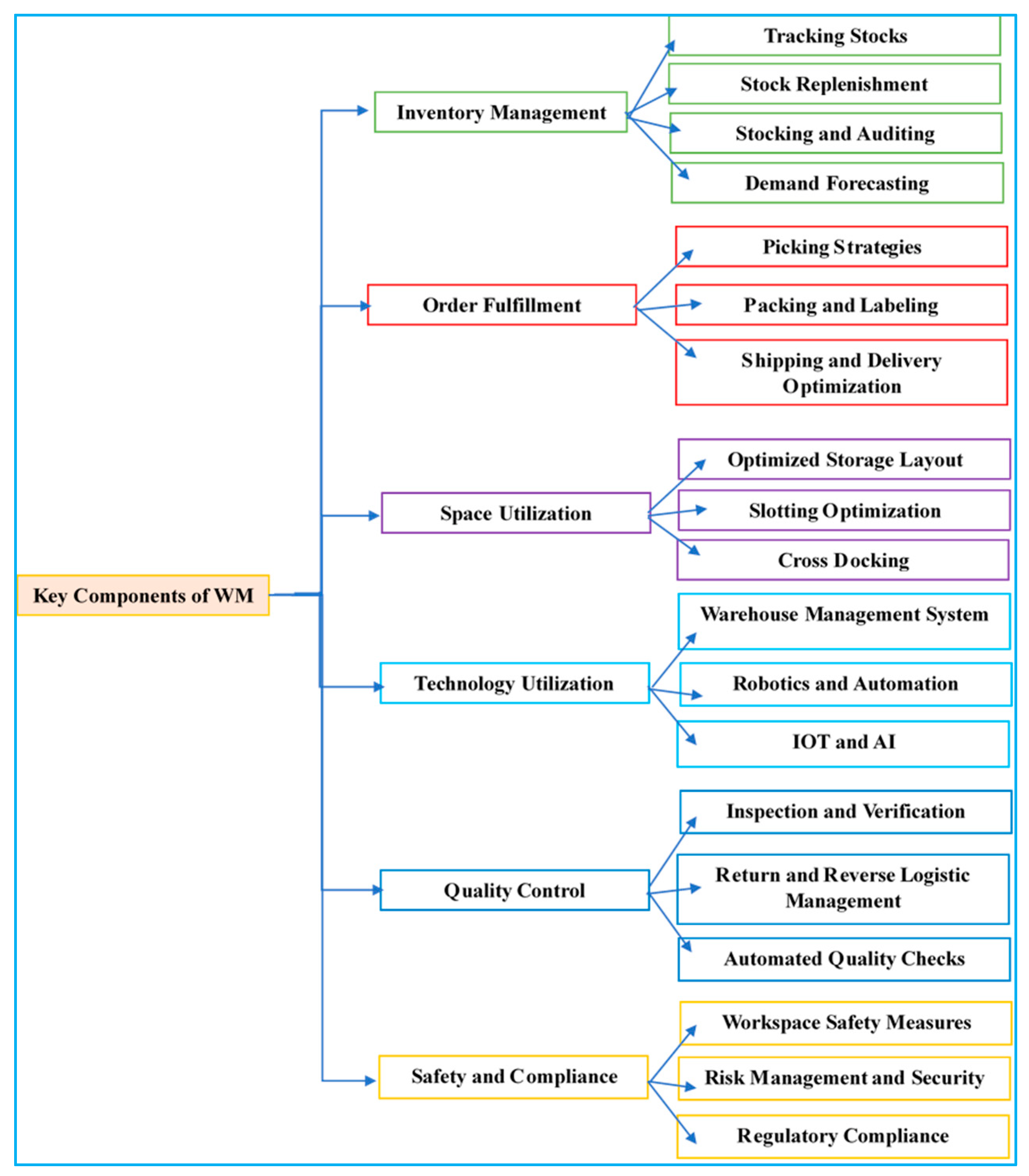
- The main application areas (inventory and mapping, inspection/maintenance, intralogistics transport/support, security/surveillance, picking support, layout optimization) are mapped.
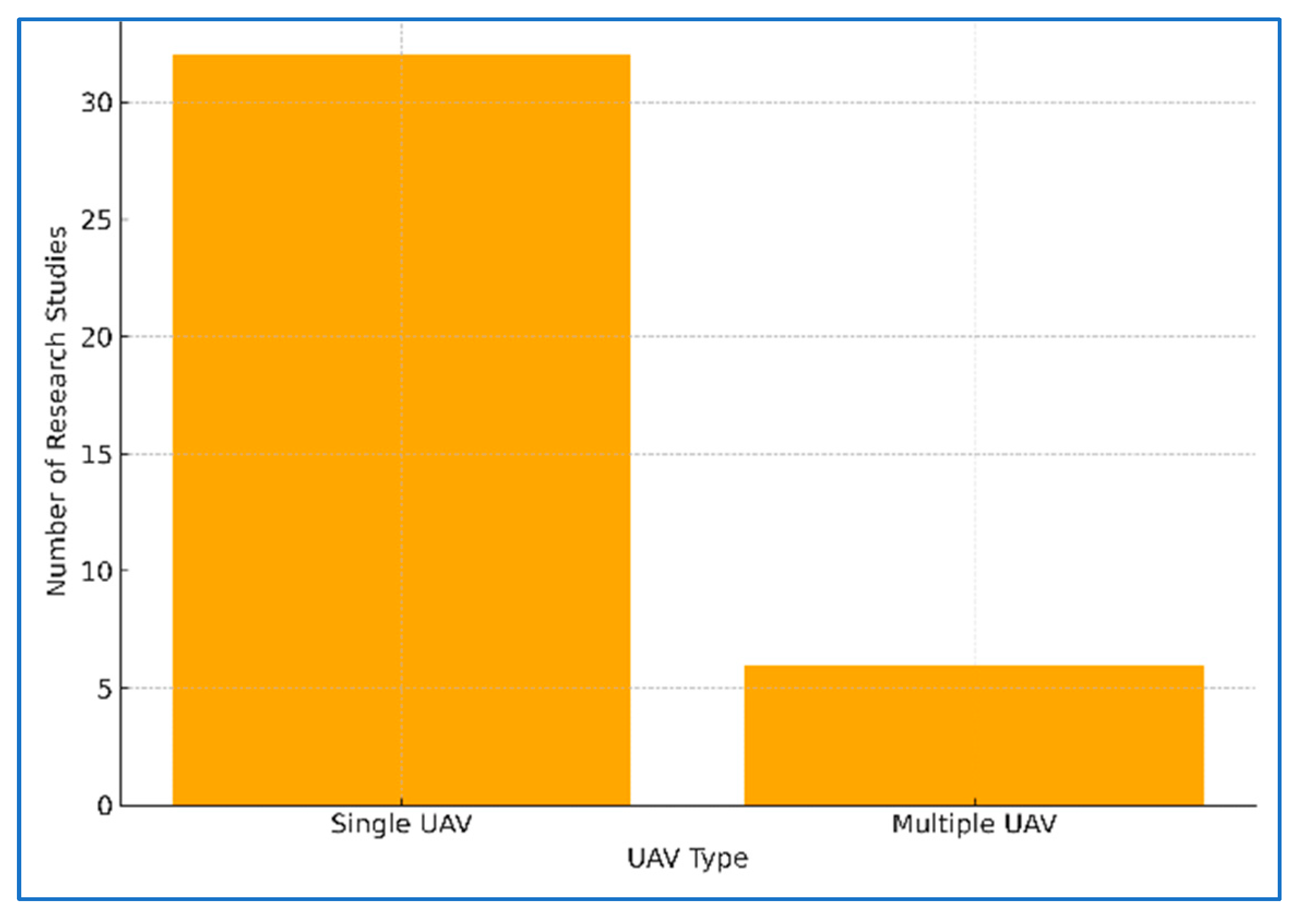
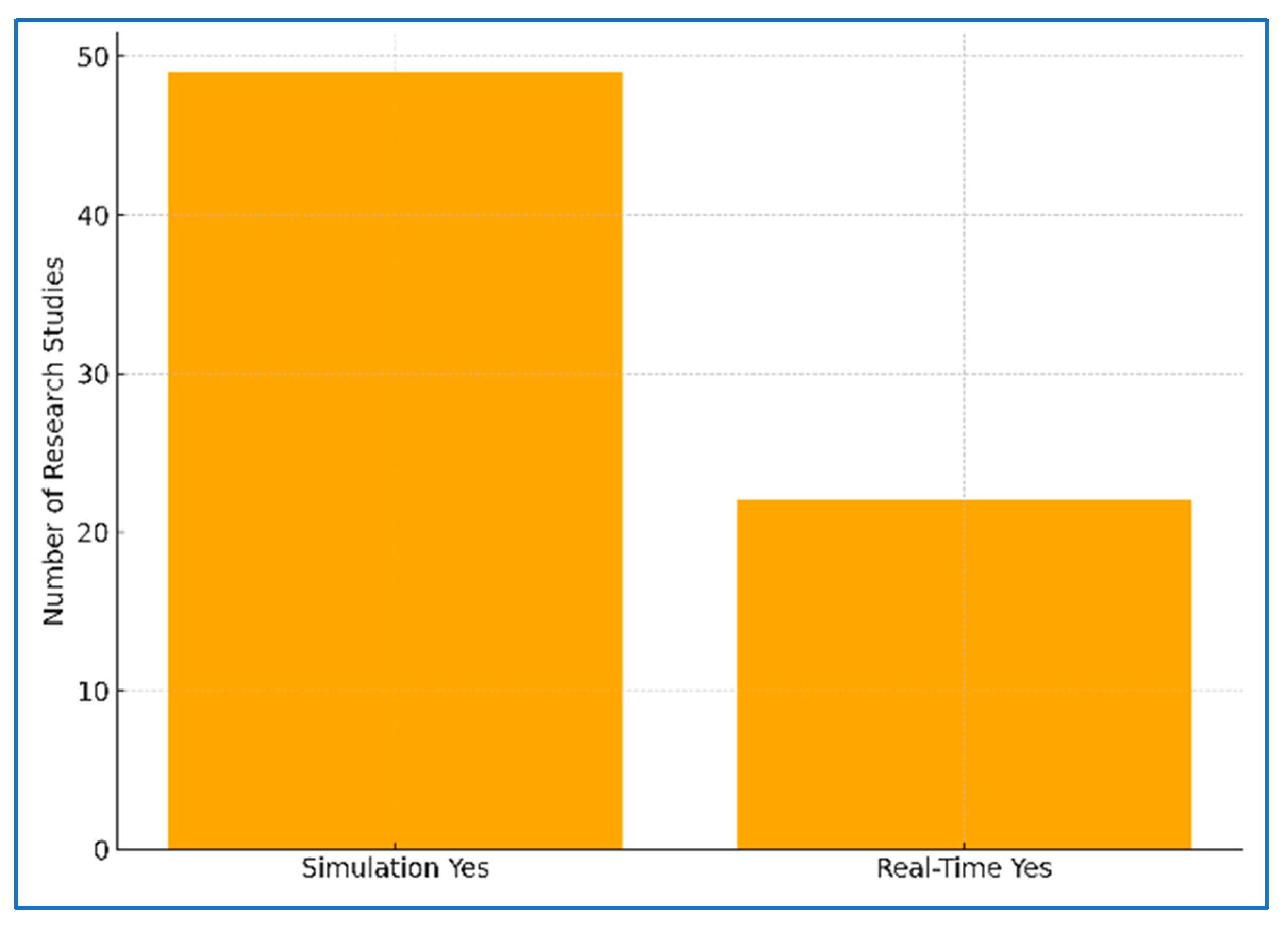
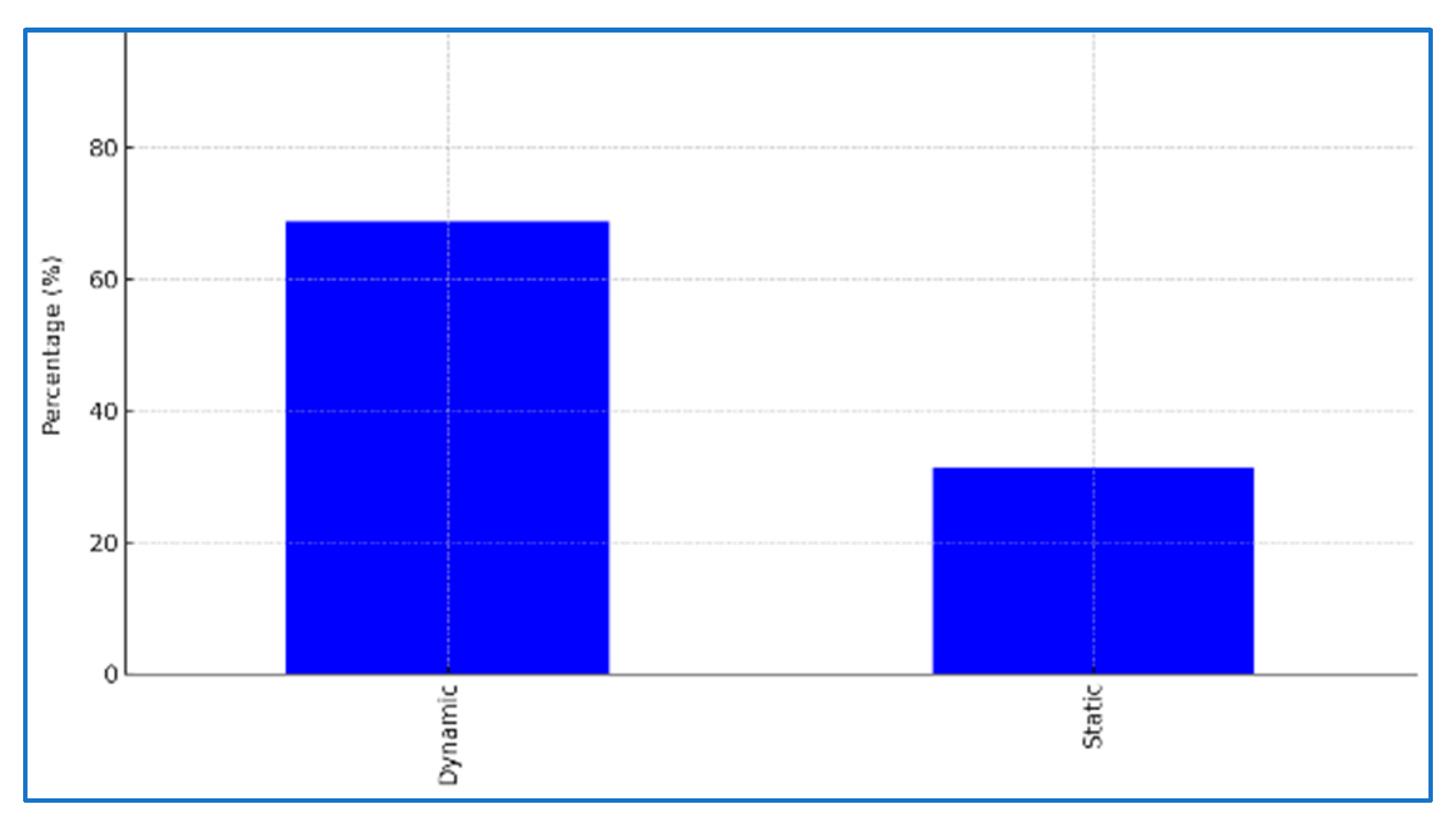
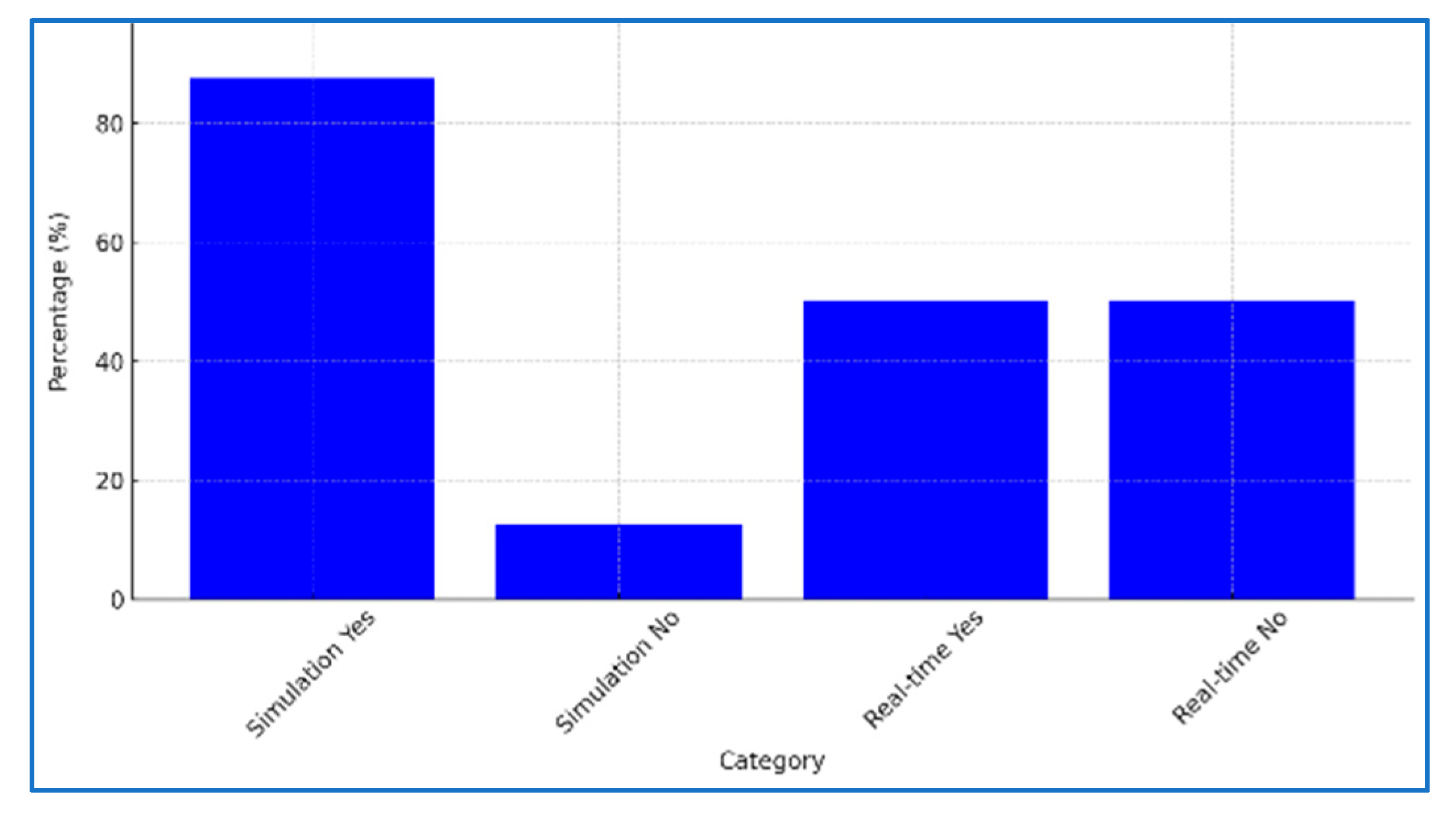
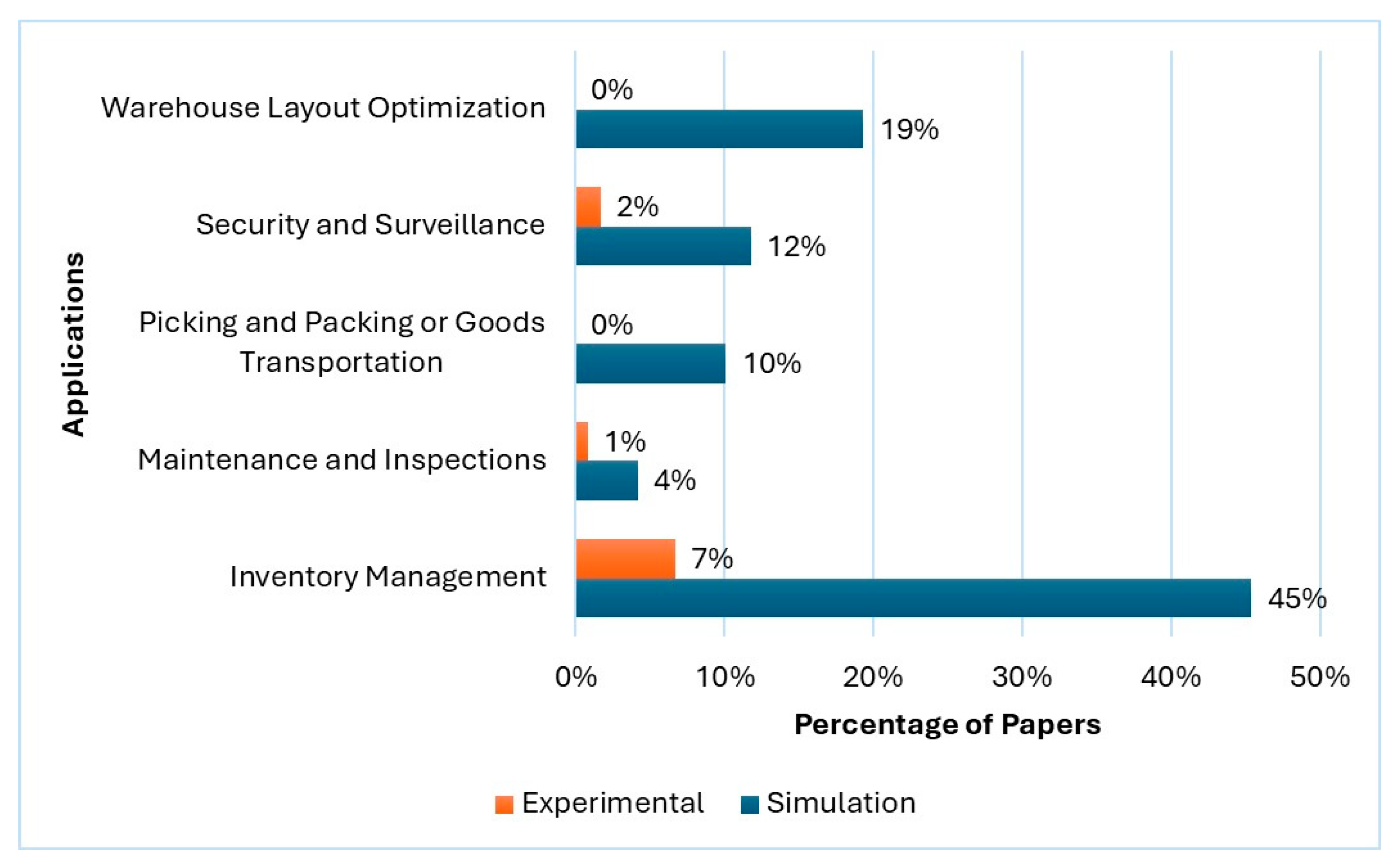
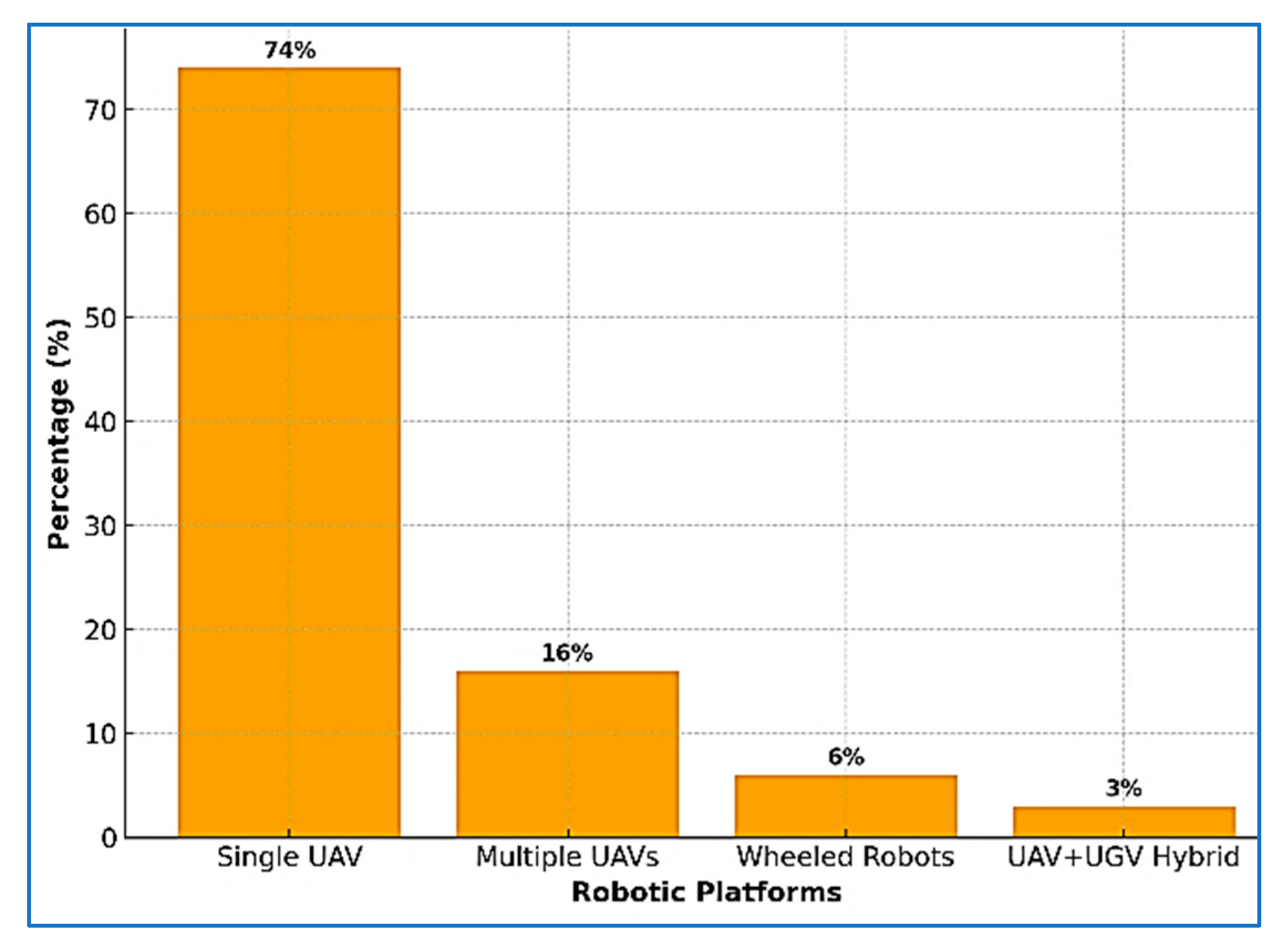
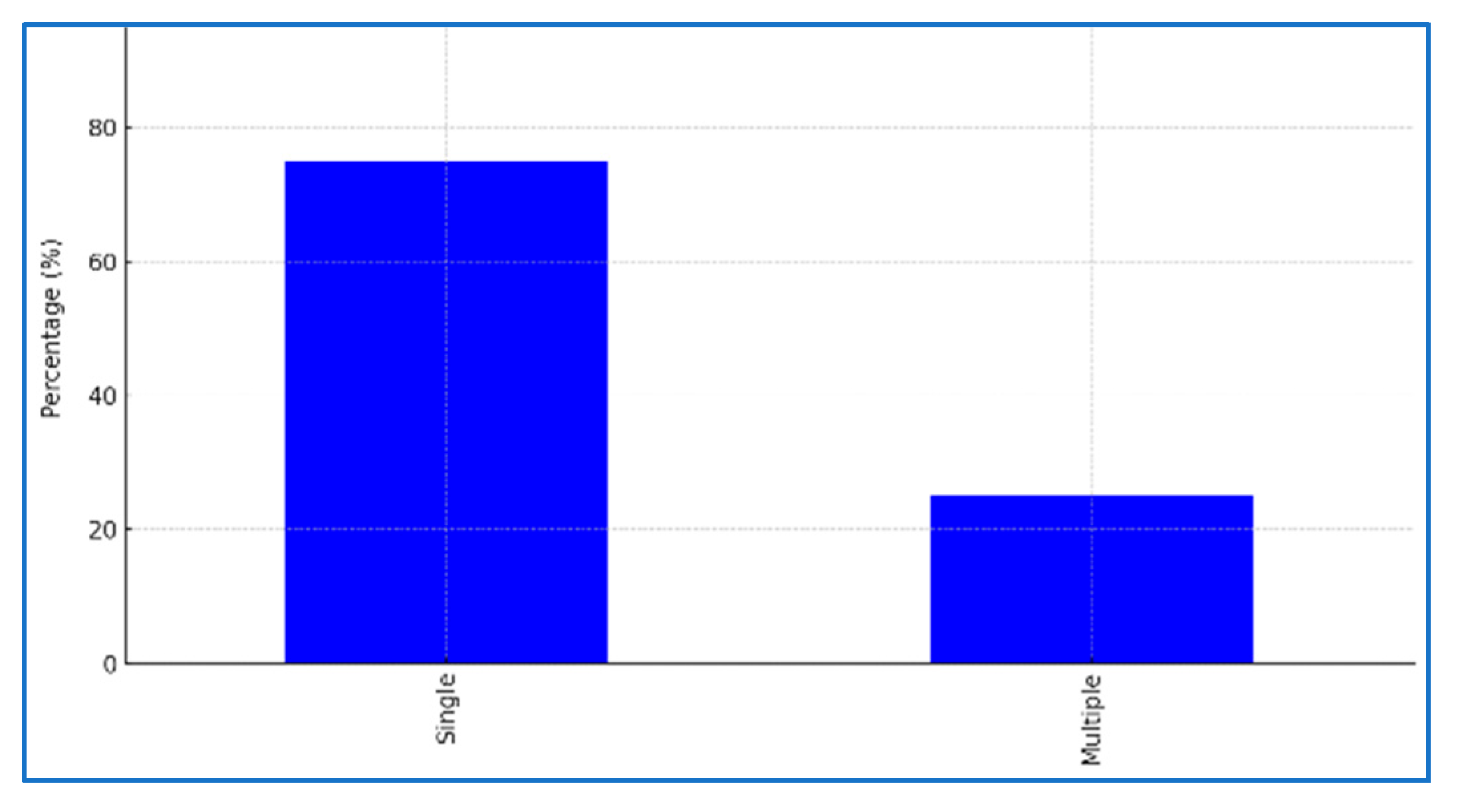
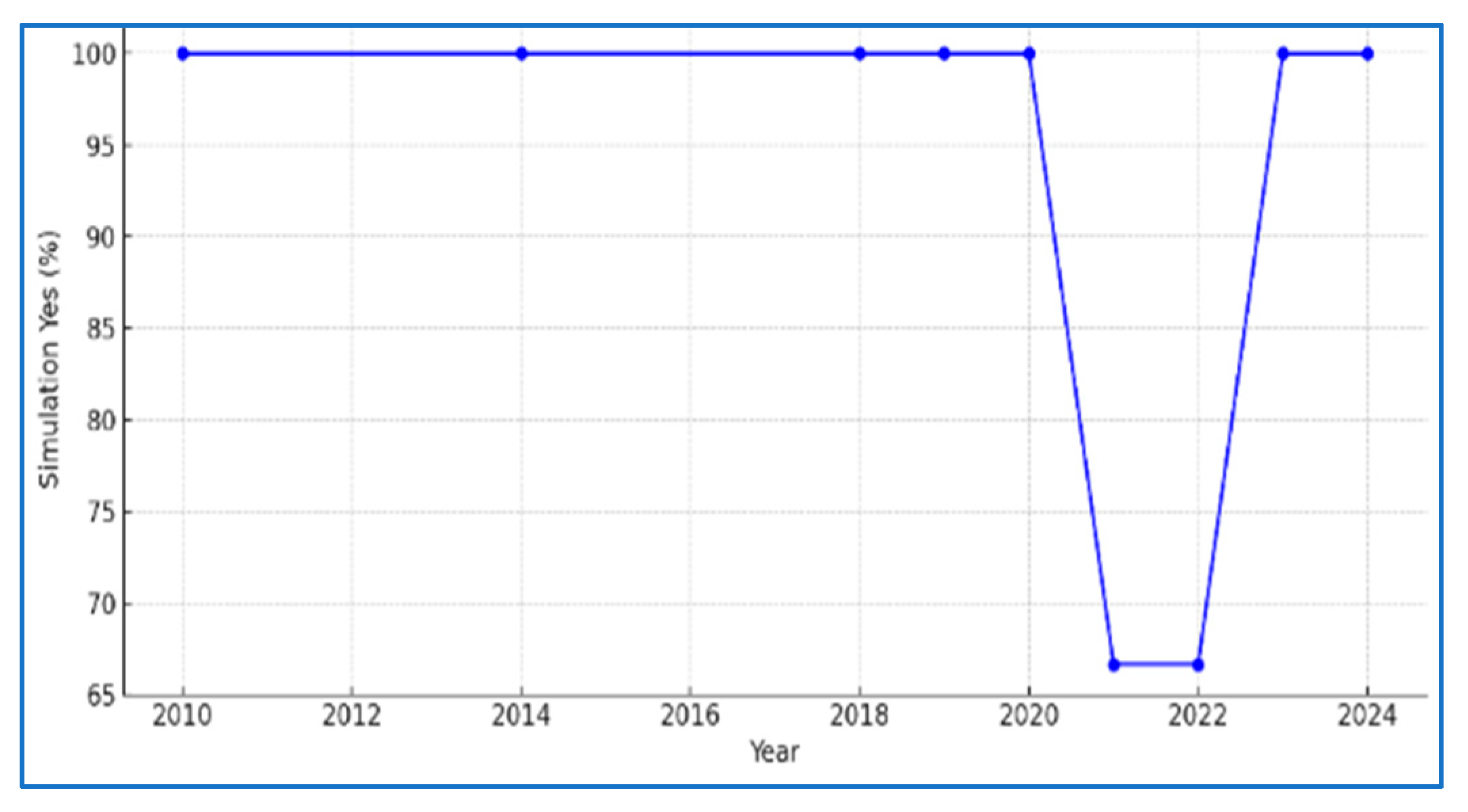
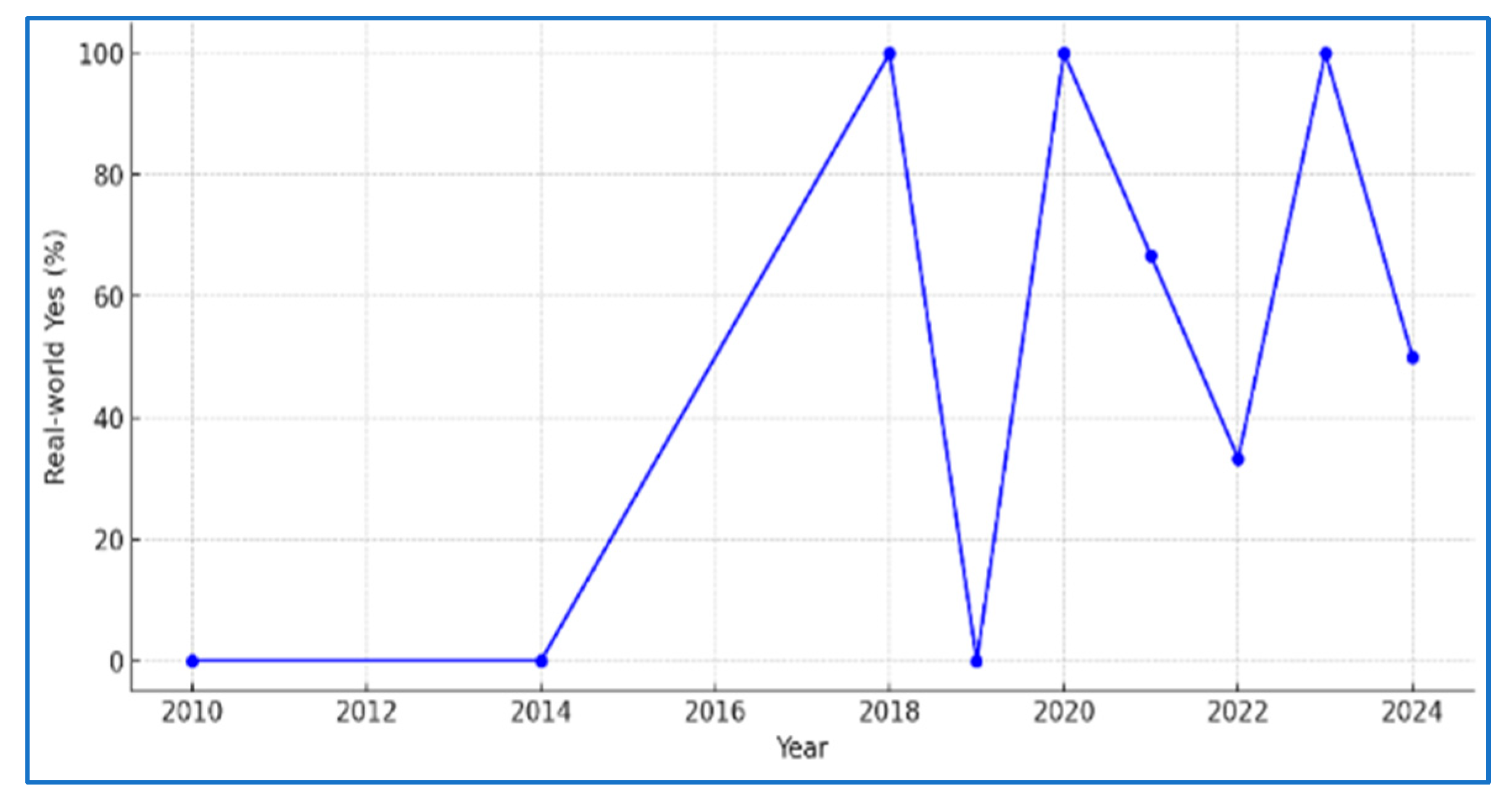
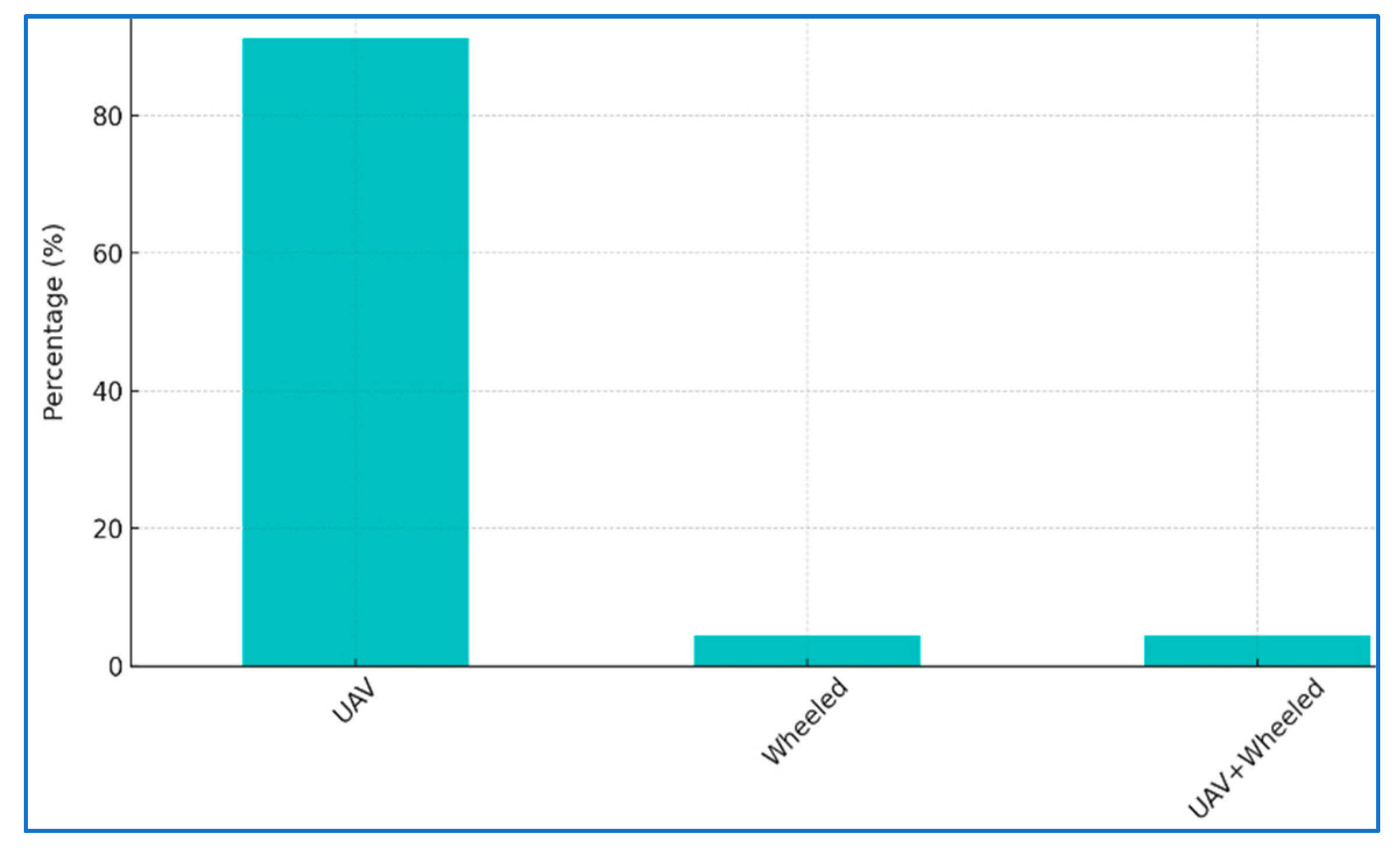
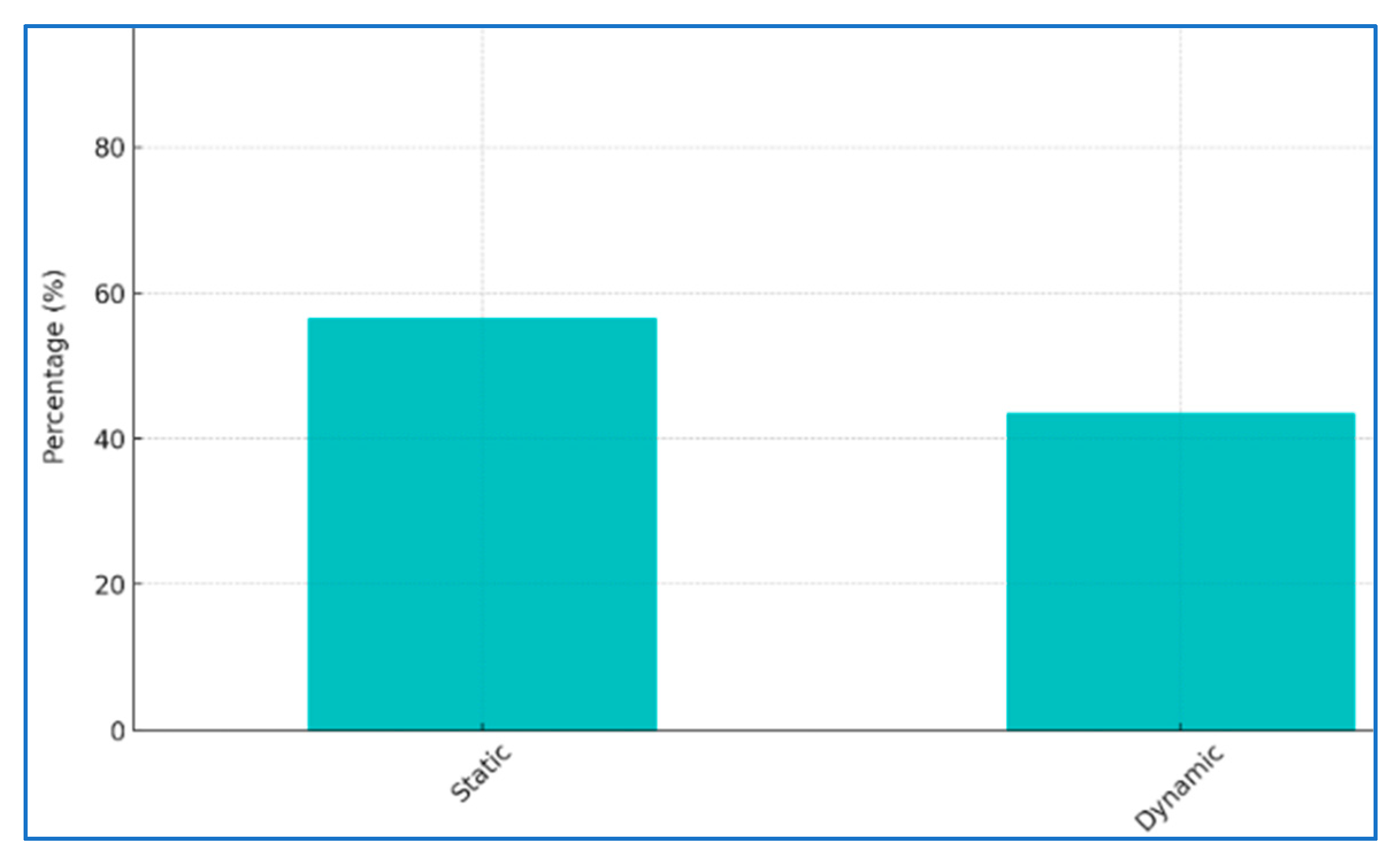
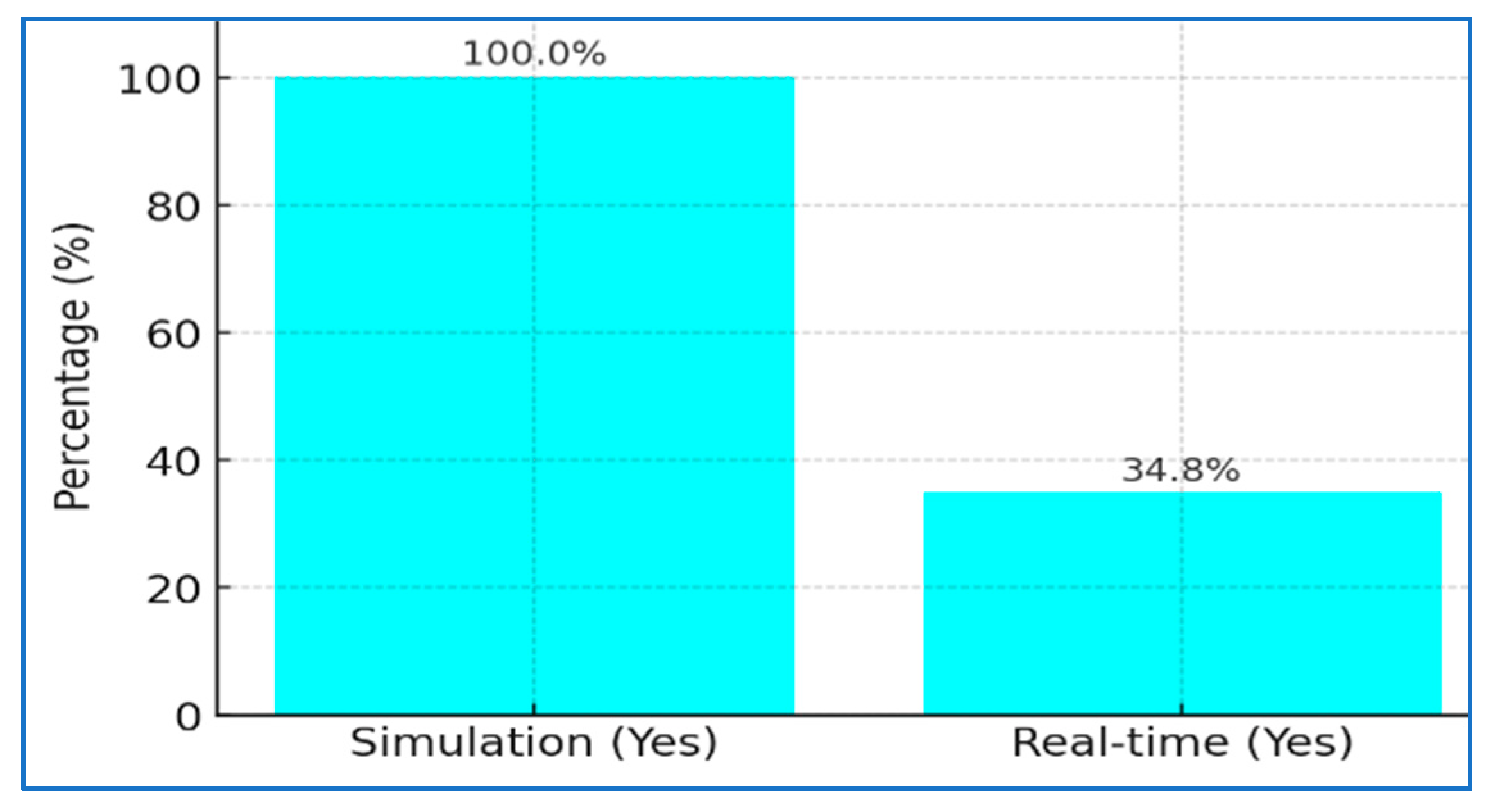
- The maturity gap is revealed: research is still single-UAV and simulation-heavy, with few fully autonomous real-warehouse deployments.
- The key gaps cited are highlighted: multi-drone coordination/safety remains unresolved, and dynamic warehouse environments are under-studied.
Abstract
1. Introduction
2. Review Methodology
3. Drone Technology in the Warehouse
3.1. Hardware Components
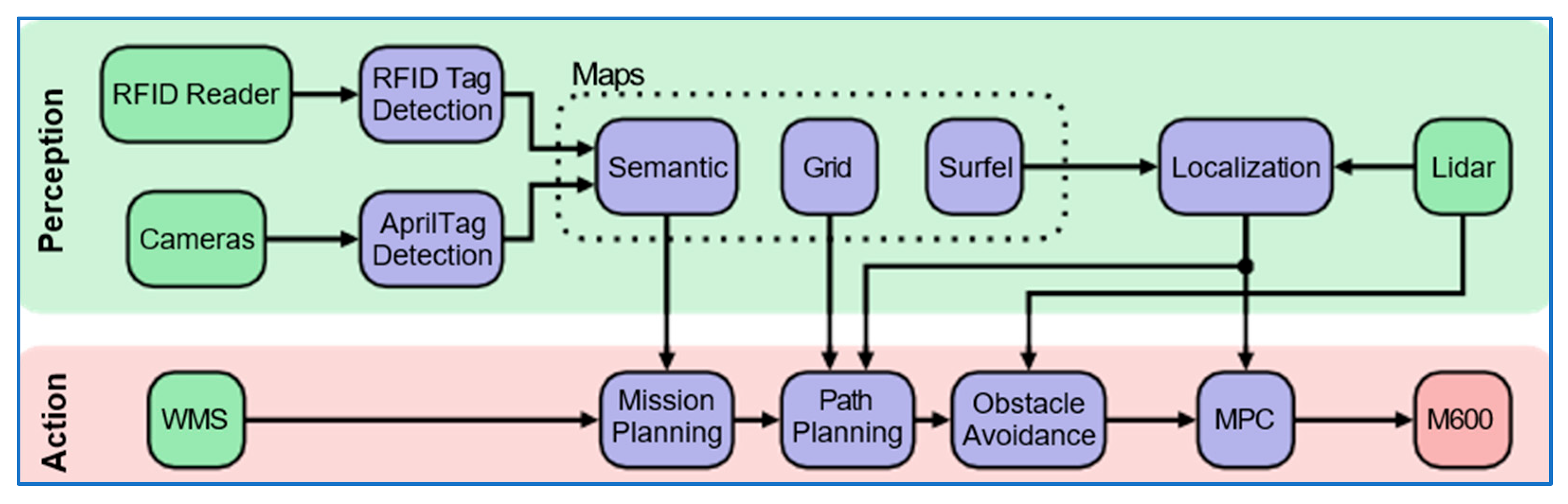
3.2. Software and Communication
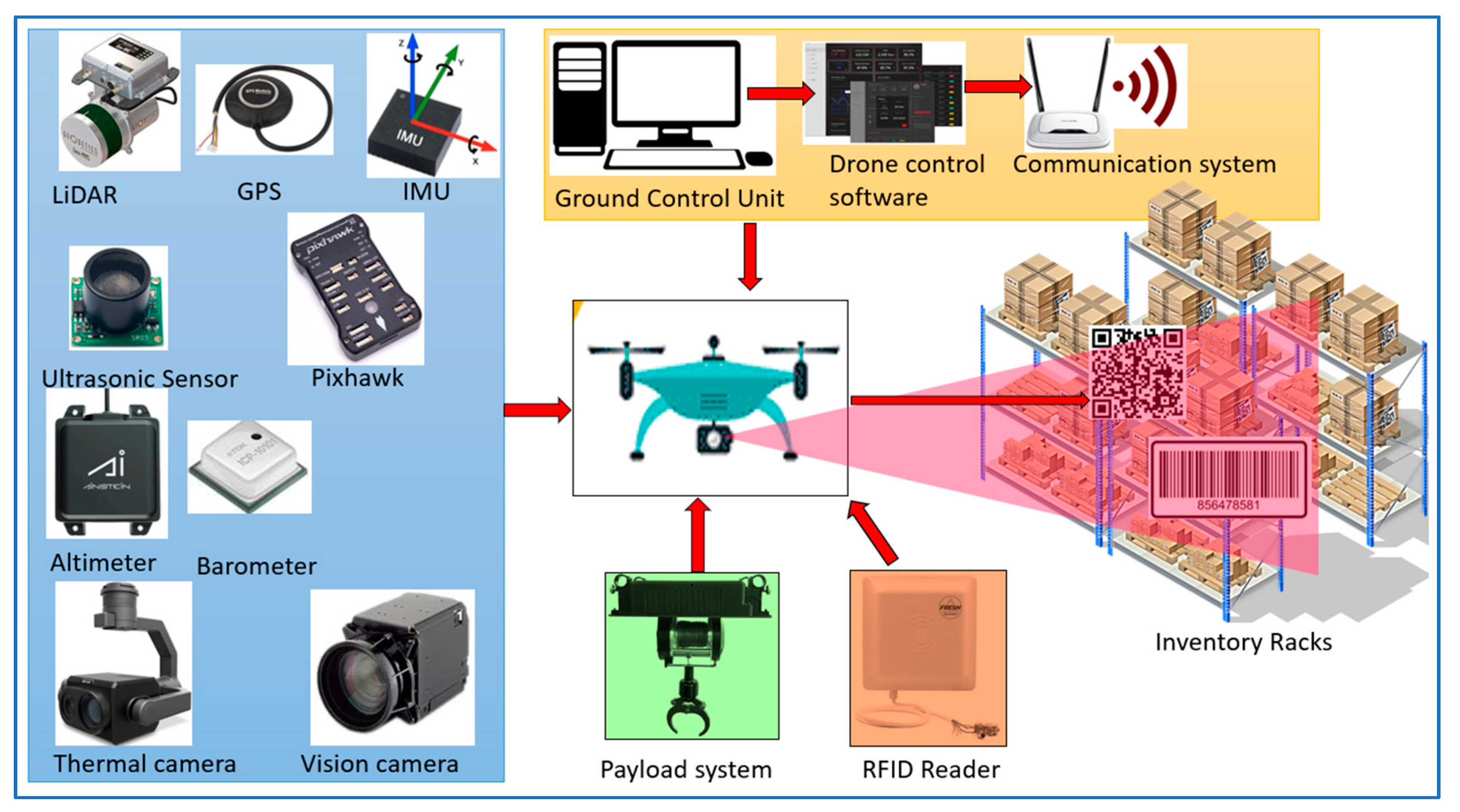
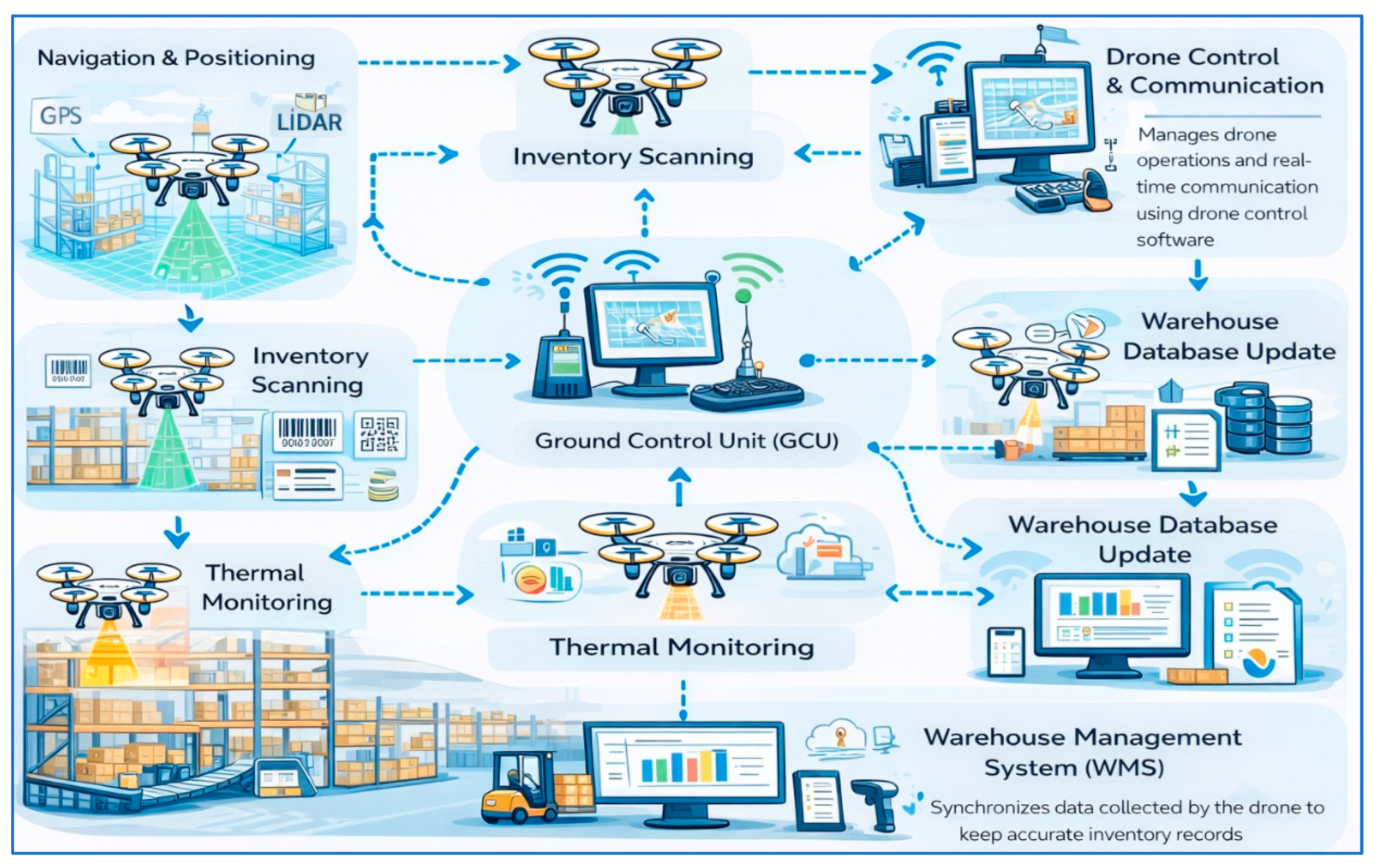
3.3. Working of Warehouse Management Drone
4. Applications of Warehouse Drones in Industrial Environments
4.1. Inventory Management (IM)
- Compression of audit cycle time via autonomous coverage planning: UAVs reduce stocktaking time, primarily by converting aisle traversal into an automated coverage path problem, enabling high-frequency cycle counting (shift/night audits) without proportional labor scaling.
- Improved reachability and reduced access overhead in high-bay storage: UAV mobility enables direct sensing of elevated rack levels without forklifts/scissor lifts, reducing aisle disruption and exposure to fall hazards while preserving regular picking flow.
- Higher inventory data consistency through repeatable sensing pipelines: By standardizing flight speed, standoff distance, and scan geometry, drones produce more repeatable observations than manual scanning, lowering variance in counts and location confirmation.
- Near real-time discrepancy detection when connected to WMS: When barcode/QR/RFID observations are streamed to the WMS, mismatches (missing SKU, mis-slotting, wrong quantity) can be flagged as exceptions early, improving reconciliation latency and replenishment decisions.
- Scalable deployment with modular autonomy stacks: UAV inventory workflows can scale from small to large warehouses by adjusting mission segmentation and fleet size; the scaling driver is software (task allocation + path planning) rather than manpower.
- Endurance–coverage trade-off: Limited battery capacity constrains coverage per sortie, increasing dependency on docking, battery swap logistics, and mission partitioning; this becomes critical in large facilities and with high-frequency audit schedules.
- Identification reliability depends on modality and environment: Vision-based barcode/QR scanning is sensitive to glare, low illumination, occlusion, motion blur, and label orientation; RFID is sensitive to multipath and attenuation near metal racks. These effects can increase false negatives unless the sensing strategy is tuned.
- GPS-denied localization requirements: Dense indoor environments degrade GNSS, often requiring UWB/VIO/SLAM/marker-based localization; this adds infrastructure cost, calibration burden, and maintenance overhead.
- Collision and safety constraints in narrow aisles: Tight rack spacing plus dynamic obstacles (forklifts, workers) increases collision risk; safe deployment demands conservative speed planning and reliable obstacle sensing, which can reduce throughput.
- Integration overhead and workflow coupling: The benefit depends strongly on WMS integration (data schema, reconciliation logic, exception handling); without robust integration, drone counts may not translate into actionable inventory updates.
4.2. Maintenance and Inspections (MI)
- Rapid access to elevated or constrained inspection zones: UAVs remove the need for scaffolding/lifts for roof, HVAC, lighting, and structural checks, enabling faster inspections with lower operational interruption.
- Higher inspection fidelity through multi-modal sensing: High-resolution imaging and thermal sensing enable early anomaly detection (overheating components, insulation loss, abnormal hotspots) and support preventive maintenance scheduling.
- Repeatable inspection trajectories for trend monitoring: Automated flight paths allow time-series comparison of the same asset region (same viewpoint and distance), making degradation detection more reliable than ad hoc manual inspections.
- Reduced downtime via off-peak autonomous routines: Scheduled autonomous runs can be executed during low-activity windows, minimizing disruption related to manual inspection procedures that often require area shutdown.
- Digitized evidence and traceability: UAV-collected imagery and thermal maps provide auditable records that support maintenance reporting, compliance, and root-cause analysis.
- Indoor navigation complexity in cluttered industrial environments: Close-proximity inspection requires stable position holding and precise obstacle avoidance near racks and machinery; this typically demands SLAM/VIO and robust control, raising system complexity.
- Sensor payload and cost escalation: Thermal cameras, high-quality optics, and stabilization hardware increase payload and platform cost and may shorten endurance, creating a cost–capability trade-off.
- Limited flight time constrains inspection completeness: Large warehouses may require multiple sorties; frequent docking/charging becomes a scheduling bottleneck.
- Data management burden: Continuous visual/thermal capture produces large datasets; storage, labeling, and analytics pipelines are non-trivial and can become the limiting factor rather than flight.
- Safety and privacy compliance: Indoor UAV operation must meet site safety policies (human proximity, rotor safety, noise) and privacy rules when cameras operate near personnel or sensitive operations.
4.3. Picking and Packing or Goods Transportation (PPGT)
- Reduced internal transport latency for light-load workflows: UAVs can shorten the time required to move small parts, tools, and documents between stations by bypassing ground congestion and reducing human walking time.
- Task automation through WMS-driven dispatching: When orders trigger UAV missions directly, retrieval/delivery can be coordinated with packing and sortation workflows, improving responsiveness during peak demand.
- Lower congestion around picking aisles (in suitable layouts): For selected facility designs, UAVs can reduce ground traffic and aisle interference by shifting micro-transport tasks into the air.
- Precision delivery to defined drop points: Controlled landing or hover-drop procedures can improve repeatability of “handoff” to packing stations (especially in tightly timed production logistics).
- Potential for multi-agent throughput scaling: In principle, fleet scheduling enables parallelism, where multiple UAVs handle simultaneous micro-deliveries to reduce queueing delays.
- Payload and grasping constraints: Most UAV systems remain limited to lightweight items and require reliable gripping mechanisms; heavy/bulky or fragile goods still demand ground robots or humans.
- Safety constraints near humans and inventory: Airborne movement near workers introduces risk; safe speeds, separation distances, and protective hardware may reduce practical throughput.
- Fleet coordination remains under-validated in real warehouses: Many studies demonstrate routing/scheduling in simulation; real-world multi-UAV coordination faces communication delays, localization drift, and collision avoidance complexity.
- Endurance limits under frequent transport cycles: Repeated pick–carry–deliver loops create high energy consumption; frequent recharging or swap cycles must be engineered into operations.
- Reliability depends on perception and handling accuracy: Incorrect identification, grasp slippage, or unstable hover can cause mis-picks, product damage, or operational stoppage, requiring robust perception and control.
4.4. Security and Surveillance (SS)
- Adaptive coverage beyond fixed-camera blind spots: UAVs provide mobile viewpoints and can re-route patrol paths based on alerts, addressing occluded zones that fixed CCTV cannot cover reliably.
- Faster incident verification through real-time aerial feed: During alarms (intrusion, fire risk), UAVs can deliver immediate visual/thermal confirmation, improving response prioritization and decision-making.
- Enhanced sensing capability with thermal/night vision: In low-light or smoky conditions, thermal imaging can detect anomalies that visible cameras miss, supporting early hazard detection.
- Reduced dependence on continuous human patrol: Semi-autonomous patrol missions reduce repetitive monitoring workload and allow guards to focus on interventions rather than constant inspection.
- Environmental condition monitoring: UAV-mounted sensors can monitor temperature/humidity patterns in sensitive storage areas, enabling compliance monitoring and early detection of abnormal conditions.
- False alarms and perception uncertainty: Vision-based detection is sensitive to shadows, reflections, moving machinery, and occlusions, which can increase false positives without robust models and calibration.
- Privacy and data governance constraints: Continuous imaging can capture sensitive operational details; strict policies and data handling protocols are required to avoid compliance violations.
- Localization and obstacle avoidance in dynamic indoor spaces: Reliable indoor navigation is difficult in the presence of moving forklifts and workers; safe operation increases autonomy complexity and cost.
- Endurance limits for continuous patrol: Persistent surveillance requires fleet rotation, charging strategy, and uptime planning; otherwise, coverage continuity suffers.
- Cybersecurity risks: UAV communication links and onboard compute can become attack surfaces; secure communication and access control are needed for industrial deployment.
4.5. Warehouse Layout Optimization (WLO)
- Rapid mapping and geometry capture for digital twins: UAVs equipped with vision/LiDAR can generate 3D maps faster than manual surveying, enabling frequent layout assessment and iterative optimization.
- Operational insight through congestion and utilization observation: Repeated aerial scans can reveal bottlenecks (traffic hotspots, underutilized zones) and support evidence-based layout redesign rather than static assumptions.
- Change detection over time: UAV mapping supports monitoring of layout drift (racks moved, temporary storage growth) and helps maintain accurate facility models for planning.
- Improved decision support for slotting and routing: Spatial models can be used to redesign slotting strategies and travel corridors, reducing unnecessary motion and improving throughput.
- Reduced disruption compared with manual measurement: UAV-based data collection can often be performed off-peak with minimal interference to operations.
- Mapping quality depends on lighting and surface properties: Reflective surfaces, repetitive textures, and narrow corridors can degrade vision-based mapping; LiDAR improves robustness but adds cost/payload constraints.
- SLAM drift and loop-closure failures in repetitive aisles: Warehouse geometry is highly repetitive; without strong loop closure cues, SLAM can accumulate errors and degrade map accuracy.
- Endurance constraints for large-scale 3D capture: Full-facility mapping may require multiple sorties and careful mission partitioning to ensure consistent coverage.
- Safety constraints in active operations: Conducting mapping flights in dynamic conditions increases risk and may require reduced speed or restricted flight windows.
- Data processing and integration overhead: Converting raw scans into actionable layout recommendations requires analytics pipelines (digital twin generation, congestion modeling), which can be more demanding than the data collection itself.
5. Results and Discussions
- ➢
- Increased Efficiency and Speed: Drones can be used to accomplish tasks at a much faster rate than manual systems. As an example, a physical audit of stock in a warehouse, which would otherwise require days, can be completed in a matter of hours. RFID scanners and cameras attached to drones can scan and track stock automatically and speed up operations significantly. DHL uses drones in warehouses, for example, to conduct automated stock checks and save man-hours on manual stock counts and throughputs.
- ➢
- Improved accuracy and minimized human error: Drones are very precise in the data that they capture. They are able to read the barcodes or RFID tags of items without human intervention, which negates the chances of human error in recording stock quantities or mislocation. One example is the use of drones by Amazon to perform live stocktaking to ensure the proper tracking of stock and, subsequently, do away with costly errors that are the result of human variation.
- ➢
- Enhanced Safety: The use of drones does not require human workers to enter areas of the warehouse that may be dangerous, like high shelves or dangerous locations. For example, Walmart employs drones to scan the upper shelves in their huge distribution centers to enable them to monitor their stock without risking the safety of their employees through falling or injuries they may incur due to forklifts.
- ➢
- Labor and Operation Cost Savings: Drones require a certain initial investment, but in the long run will save the cost of manual work since they are able to replace some of the work performed by humans, such as tracking inventories, monitoring, and inspection, among others. UPS has used drones to sort packages, which reduces its reliance on human employees to carry out routine tasks. This saves on operational costs in the long run since fewer employees will be used to do the jobs that can be handled effectively by drones.
- ➢
- Real-time Data and Analytics: Drones with cameras, temperature sensors, and LiDAR can supply real-time visual and spatial data to WMS, providing managers with immediate insights into the performance of their warehouses. As an example, Best Buy uses drones to track live information from its distribution centers so that it can optimize the amount of stock, as well as the design of warehouses, to improve its stock management and use of space.
- ➢
- Improved Warehouse Layout Optimization: Drones have the potential to constantly scan and map warehouses so that their layouts are optimized to ensure better flow and productivity. For example, Zara uses drones in its warehouses to track real-time product locations and also track the workflow; hence, it can continually improve its layout to be as efficient as possible.
- ➢
- Scalability and Flexibility: Drone systems can be modified to suit the needs of a warehouse with minimal adjustment to the existing infrastructure. It is possible to start with a few drones in a small warehouse, and, as the operations grow, more drones can be introduced. This is what FedEx did in the case of drones in its warehouses as a response to the increased number of packages in e-commerce, which required minimal infrastructure changes.
- ➢
- Advanced Emergency Response: Drones can be flown very quickly in case of an emergency to check what is going on, be it a fire, a gas leak, or an injured employee. The presence of thermal imaging drones will allow the detection of hotspots and ensure the safety of the workers before an inspection. An example here is Google Wing, which uses drones in emergency response, where human presence would be dangerous, to allow first responders to have much-needed real-time information in an emergency or a disaster.
- ➢
- Sustainability: Drones are also energy-efficient in comparison to traditional equipment used in warehouses, such as forklifts, which saves on power consumption. Drones can contribute to eliminating the carbon footprint of warehouses by reducing the use of systems that burn fuel. L’Oréal uses drones in its warehouses to automate work, hence minimizing its dependence on manual labor as well as power-guzzling machinery, allowing the company to achieve sustainability targets.
5.1. Challenges of Drone-Based Warehouse Solutions
- ▪
- One is the high initial cost of drones, sensors, software, and the upgrading of infrastructure, which is a hindrance to small businesses.
- ▪
- Another is that one has to go through complicated regulatory entities, adhere to air traffic and privacy laws, and thereafter find the required permits, which can be costly and time-intensive.
- ▪
- Drones also need to be regularly serviced and maintained, which only skilled repairmen can provide, which in turn adds to their long-term costs. It is also necessary to train the existing workforce, which makes it expensive in terms of raising man-hour costs, along with low scalability.
- ▪
- Drones have a small payload and cannot handle heavy objects; they need to be supported by conventional equipment.
- ▪
- Weather conditions, including rainfall, wind, or fog, may compromise the functionality of drones, especially in open spaces or outdoors.
- ▪
- There is also the technical aspect of adopting drones in conjunction with the existing warehousing systems; this requires a lot of IT assistance.
- ▪
- Security is also a concern, as drones are vulnerable to cyberattacks that can cause system shutdown or hacked facilities.
- ▪
- Resistance of employees because of the perceived violation of their privacy, and the limited battery capacity and range of drones may affect both adoption and normal usage.
5.2. Determining Literature Gaps
- ▪
- Not much is known regarding the long-term impact on the workforce in terms of job displacement, role change, and reskilling requirements.
- ▪
- There is also a lack of information regarding successful human–drone cooperation, such as the ability to build trust, user interfaces, and safe coordination.
- ▪
- Privacy and ethical concerns, such as how to keep the data of drones private as well as the problem of workers being monitored by them, are poorly studied and require more definite rules.
- ▪
- Although drones are viewed as sustainable, there is no empirical evidence on the power efficiency of drones versus conventional equipment and their impact on the environment.
- ▪
- Technical challenges, e.g., the connection of drones with outdated warehouse systems, also require additional research.
- ▪
- Most papers assume large-scale operations, not paying attention to cost feasibility for small- and medium-sized warehouses.
- ▪
- Health and safety concerns, including noise and risk of injury, as well as physical impact, have not been sufficiently researched.
- ▪
- Studies are also necessary on enabling real-time decision-making with AI and machine learning, as well as multiple-drone management.
- ▪
- Regulatory advancement and ensuring that drone systems comply with legal documents must be continually evaluated.
- ▪
- Combining warehouse drones with last-mile delivery is an undeveloped avenue of research.
5.3. Future Prospects
5.4. Industrial Case Studies and Recent Real-World Deployments
6. Conclusions
Author Contributions
Funding
Data Availability Statement
Conflicts of Interest
References
- Richards, G. Warehouse Management: The Definitive Guide to Improving Efficiency and Minimizing Costs in the Modern Warehouse; Kogan Page Publishers: London, UK, 2025. [Google Scholar]
- Guo, Y.; Liu, F.; Song, J.S.; Wang, S. Supply chain resilience: A review from the inventory management perspective. Fundam. Res. 2025, 5, 450–463. [Google Scholar] [CrossRef]
- Leung, E.K.; Lee, C.K.H.; Ouyang, Z. From traditional warehouses to Physical Internet hubs: A digital twin-based inbound synchronization framework for PI-order management. Int. J. Prod. Econ. 2022, 244, 108353. [Google Scholar] [CrossRef]
- Tubis, A.A.; Rohman, J. Intelligent warehouse in industry 4.0—Systematic literature review. Sensors 2023, 23, 4105. [Google Scholar] [CrossRef]
- Ali, S.S.; Khan, S.; Fatma, N.; Ozel, C.; Hussain, A. Utilisation of drones in achieving various applications in smart warehouse management. Benchmarking Int. J. 2024, 31, 920–954. [Google Scholar] [CrossRef]
- Hassan, M.; Ali, M.; Aktas, E.; Alkayid, K. Factors affecting selection decision of auto-identification technology in warehouse management: An international Delphi study. Prod. Plan. Control 2015, 26, 1025–1049. [Google Scholar] [CrossRef]
- Malang, C.; Charoenkwan, P.; Wudhikarn, R. Implementation and critical factors of unmanned aerial vehicle (UAV) in warehouse management: A systematic literature review. Drones 2023, 7, 80. [Google Scholar] [CrossRef]
- Anderson, J.R. Automation of Inventory Management. Ph.D. Thesis, Massachusetts Institute of Technology, Cambridge, MA, USA, 2002. [Google Scholar]
- Radhakrishnan, S.; Prasanth, A.; Sowndarya, K.D.; Elngar, A.A. Drone-Based Application of Warehouse Logistics—A Case Study. In Drones for Transportation Logistics and Disaster Management; John Wiley & Sons: Hoboken, NJ, USA, 2025; pp. 299–327. [Google Scholar]
- Sawant, S.; Davari, A.; Wang, J. Trajectory tracking of UAV using robust inventory control techniques. In Proceedings of the Thirty-Seventh Southeastern Symposium on System Theory, SSST’05, Morgantown, WV, USA, 16–18 March 2005; IEEE: Piscataway, NJ, USA; pp. 98–101.
- Ong, J.H.; Sanchez, A.; Williams, J. Multi-UAV system for inventory automation. In Proceedings of the 2007 1st Annual RFID Eurasia, Istanbul, Turkey, 5–6 September 2007; IEEE: Piscataway, NJ, USA; pp. 1–6.
- Ehrenberg, I.; Floerkemeier, C.; Sarma, S. Inventory management with an RFID-equipped mobile robot. In Proceedings of the 2007 IEEE International Conference on Automation Science and Engineering, Scottsdale, AZ, USA, 22–25 September 2007; IEEE: Piscataway, NJ, USA; pp. 1020–1026.
- Miller, T.H.; Stolfo, D.A.; Spletzer, J.R. An Automated Asset Locating System (AALS) with Applications to Inventory Management. In Field and Service Robotics: Results of the 7th International Conference; Springer: Berlin/Heidelberg, Germany, 2007; pp. 163–172. [Google Scholar]
- Guérin, F.; Guinand, F.; Brethé, J.F.; Pelvillain, H. Towards an autonomous warehouse inventory scheme. In Proceedings of the 2016 IEEE Symposium Series on Computational Intelligence (SSCI), Athens, Greece, 6–9 December 2016; IEEE: Piscataway, NJ, USA; pp. 1–8.
- Bae, S.M.; Han, K.H.; Cha, C.N.; Lee, H.Y. Development of inventory checking system based on UAV and RFID in open storage yard. In Proceedings of the 2016 International Conference on Information Science and Security (ICISS), Pattaya, Thailand, 19–22 December 2016; IEEE: Piscataway, NJ, USA; pp. 1–2.
- Beul, M.; Krombach, N.; Nieuwenhuisen, M.; Droeschel, D.; Behnke, S. Autonomous Navigation in a Warehouse with a Cognitive Micro Aerial Vehicle. In Robot Operating System (ROS). Studies in Computational Intelligence; Springer: Berlin/Heidelberg, Germany, 2017; Volume 2, pp. 487–524. [Google Scholar]
- Beul, M.; Droeschel, D.; Nieuwenhuisen, M.; Quenzel, J.; Houben, S.; Behnke, S. Fast autonomous flight in warehouses for inventory applications. IEEE Robot. Autom. Lett. 2018, 3, 3121–3128. [Google Scholar] [CrossRef]
- Mtita, C.; Laurent, M.; Sauveron, D.; Akram, R.N.; Markantonakis, K.; Chaumette, S. Serverless protocols for inventory and tracking with a UAV. In Proceedings of the 2017 IEEE/AIAA 36th Digital Avionics Systems Conference (DASC), St. Petersburg, FL, USA, 17–21 September 2017; IEEE: Piscataway, NJ, USA; pp. 1–11.
- Yearling, M. Digital inventory powered by drones and robots. J. Supply Chain. Manag. Logist. Procure. 2018, 1, 41–47. [Google Scholar] [CrossRef]
- Fernández-Caramés, T.M.; Blanco-Novoa, O.; Suárez-Albela, M.; Fraga-Lamas, P. A UAV and blockchain-based system for industry 4.0 inventory and traceability applications. Proceedings 2018, 4, 26. [Google Scholar] [CrossRef]
- Han, K.H.; Bae, S.M.; Lee, W. Integrated inventory management system for outdoors stocks based on small UAV and beacon. In Trends and Advances in Information Systems and Technologies; Springer International Publishing: Cham, Switzerland, 2018; Volume 26, pp. 533–541. [Google Scholar]
- Cho, H.; Kim, D.; Park, J.; Roh, K.; Hwang, W. 2D barcode detection using images for drone-assisted inventory management. In Proceedings of the 2018 15th International Conference on Ubiquitous Robots (UR), Honolulu, HI, USA, 26–30 June 2018; IEEE: Piscataway, NJ, USA; pp. 461–465.
- Xu, L.; Kamat, V.R.; Menassa, C.C. Automatic extraction of 1D barcodes from video scans for drone-assisted inventory management in warehousing applications. Int. J. Logist. Res. Appl. 2018, 21, 243–258. [Google Scholar] [CrossRef]
- De Falco, A.; Narducci, F.; Petrosino, A. An UAV autonomous warehouse inventorying by deep learning. In Proceedings of the Image Analysis and Processing–ICIAP 2019: 20th International Conference, Trento, Italy, 9–13 September 2019; Springer International Publishing: Cham, Switzerland; pp. 443–453.
- Fernández-Caramés, T.M.; Blanco-Novoa, O.; Froiz-Míguez, I.; Fraga-Lamas, P. Towards an autonomous industry 4.0 warehouse: A UAV and blockchain-based system for inventory and traceability applications in big data-driven supply chain management. Sensors 2019, 19, 2394. [Google Scholar] [CrossRef]
- Jhunjhunwala, P.; Shriya, M.; Rufus, E. Development of hardware based inventory management system using UAV and RFID. In Proceedings of the 2019 International Conference on Vision Towards Emerging Trends in Communication and Networking (ViTECoN), Vellore, India, 30–31 March 2019; IEEE: Piscataway, NJ, USA; pp. 1–5.
- Macoir, N.; Bauwens, J.; Jooris, B.; Van Herbruggen, B.; Rossey, J.; Hoebeke, J.; De Poorter, E. UWB localization with battery-powered wireless backbone for drone-based inventory management. Sensors 2019, 19, 467. [Google Scholar] [CrossRef]
- Choi, Y.; Martel, M.; Briceno, S.I.; Mavris, D.N. Multi-UAV trajectory optimization and deep learning-based imagery analysis for a UAS-based inventory tracking solution. In Proceedings of the AIAA SciTech 2019 Forum, Reston, VA, USA, 7–11 January 2019; p. 1569. [Google Scholar]
- Barlow, S.; Choi, Y.; Briceno, S.; Mavris, D.N. A multi-UAS trajectory optimization methodology for complex enclosed environments. In Proceedings of the 2019 International Conference on Unmanned Aircraft Systems (ICUAS), Atlanta, GA, USA, 11–14 June 2019; IEEE: Piscataway, NJ, USA; pp. 596–604.
- Cristiani, D.; Bottonelli, F.; Trotta, A.; Di Felice, M. Inventory management through mini-drones: Architecture and proof-of-concept implementation. In Proceedings of the 2020 IEEE 21st International Symposium on “A World of Wireless, Mobile and Multimedia Networks” (WoWMoM), Cork, Ireland, 31 August–3 September 2020; IEEE: Piscataway, NJ, USA; pp. 317–322.
- Kwon, W.; Park, J.H.; Lee, M.; Her, J.; Kim, S.H.; Seo, J.W. Robust autonomous navigation of unmanned aerial vehicles (UAVs) for warehouses’ inventory application. IEEE Robot. Autom. Lett. 2019, 5, 243–249. [Google Scholar] [CrossRef]
- Chen, S.; Meng, W.; Xu, W.; Liu, Z.; Liu, J.; Wu, F. A warehouse management system with UAV based on digital twin and 5G technologies. In Proceedings of the 2020 7th International Conference on Information, Cybernetics, and Computational Social Systems (ICCSS), Guangzhou, China, 13–15 November 2020; IEEE: Piscataway, NJ, USA; pp. 864–869.
- Kalinov, I.; Petrovsky, A.; Ilin, V.; Pristanskiy, E.; Kurenkov, M.; Ramzhaev, V.; Idrisov, I.; Tsetserukou, D. Warevision: Cnn barcode detection-based UAV trajectory optimization for autonomous warehouse stocktaking. IEEE Robot. Autom. Lett. 2020, 5, 6647–6653. [Google Scholar] [CrossRef]
- Zhong, Y.; Wang, Z.; Yalamanchili, A.V.; Yadav, A.; Srivatsa, B.R.; Saripalli, S.; Bukkapatnam, S.T. Image-based flight control of unmanned aerial vehicles (UAVs) for material handling in custom manufacturing. J. Manuf. Syst. 2020, 56, 615–621. [Google Scholar] [CrossRef]
- Rhiat, A.; Chalal, L.; Saadane, A. A smart warehouse using robots and drone to optimize inventory management. In Proceedings of the Future Technologies Conference, Vancouver, BC, Canada, 28–29 October 2021; Springer International Publishing: Cham, Switzerland; pp. 475–483.
- Manjrekar, A.; Jha, D.S.; Jagtap, P.; Yadav, V. Warehouse inventory management with cycle counting using drones. In Proceedings of the 4th International Conference on Advances in Science & Technology (ICAST2021), Bahir Dar, Ethiopia, 27–29 August 2021. [Google Scholar]
- Guinand, F.; Guérin, F.; Petitprez, E. UAV-UGV multi-robot system for warehouse inventory: Scheduling issues. In Proceedings of the International Conference on Computational Collective Intelligence, Rhodes, Greece, 29 September–1 October 2021; Springer International Publishing: Cham, Switzerland; pp. 241–254.
- Karamitsos, G.; Bechtsis, D.; Tsolakis, N.; Vlachos, D. Unmanned aerial vehicles for inventory listing. Int. J. Bus. Syst. Res. 2021, 15, 748–756. [Google Scholar] [CrossRef]
- Li, C.; Tanghe, E.; Suanet, P.; Plets, D.; Hoebeke, J.; De Poorter, E.; Joseph, W. ReLoc 2.0: UHF-RFID relative localization for drone-based inventory management. IEEE Trans. Instrum. Meas. 2021, 70, 1–13. [Google Scholar] [CrossRef]
- Martinez-Martin, E.; Ferrer, E.; Vasilev, I.; Del Pobil, A.P. The UJI aerial librarian robot: A quadcopter for visual library inventory and book localisation. Sensors 2021, 21, 1079. [Google Scholar] [CrossRef]
- Martinez-Martin, E.; Ferrer, E.; Vasilev, I.; Del Pobil, A.P. An Autonomous Drone for Image-Based Inspection of Bookshelves. In Proceedings of the 2021 29th European Signal Processing Conference (EUSIPCO), Dublin, Ireland, 23–27 August 2021; IEEE: Piscataway, NJ, USA; pp. 751–755.
- Yoon, B.; Kim, H.; Youn, G.; Rhee, J. 3D position estimation of drone and object based on QR code segmentation model for inventory management automation. In Proceedings of the 2021 IEEE International Symposium on Safety, Security, and Rescue Robotics (SSRR), New York, NY, USA, 25–27 October 2021; IEEE: Piscataway, NJ, USA; pp. 223–229.
- Liu, H.; Chen, Q.; Pan, N.; Sun, Y.; An, Y.; Pan, D. UAV stocktaking task-planning for industrial warehouses based on the improved hybrid differential evolution algorithm. IEEE Trans. Ind. Inform. 2021, 18, 582–591. [Google Scholar] [CrossRef]
- Fontaine, J.; De Waele, T.; Shahid, A.; Tanghe, E.; Suanet, P.; Joseph, W.; Hoebeke, J.; De Poorter, E. Drone-mounted RFID-based rack localization for assets in warehouses using deep learning. In Proceedings of the 2021 26th IEEE International Conference on Emerging Technologies and Factory Automation (ETFA), Vasteras, Sweden, 7–10 September 2021; IEEE: Piscataway, NJ, USA; pp. 1–4.
- Khropot, S.; Volkanova, V. Use of UAVs for land inventory. In Proceedings of the International Conference of Young Professionals “GeoTerrace-2021”, Lviv, Ukraine, 4–6 October 2021; European Association of Geoscientists & Engineers: London, UK; Volume 2021, pp. 1–5.
- Benes, F.; Stasa, P.; Svub, J.; Alfian, G.; Kang, Y.S.; Rhee, J.T. Investigation of UHF signal strength propagation at warehouse management applications based on drones and RFID technology utilization. Appl. Sci. 2022, 12, 1277. [Google Scholar] [CrossRef]
- Stanko, J.; Stec, F.; Palkovic, L.; Rodina, J.; Rau, D. Towards automatic inventory checking using an autonomous unmanned aerial vehicle. In Proceedings of the 2022 IEEE 27th International Conference on Emerging Technologies and Factory Automation (ETFA), Stuttgart, Germany, 6–9 September 2022; IEEE: Piscataway, NJ, USA; pp. 1–8.
- Ribeiro, C.C.; dos Santos, L.H.; Macharet, D.G. Collaborative UGV/UAV path planning for inventory management in warehouses. In Proceedings of the 2022 Latin American Robotics Symposium (LARS), 2022 Brazilian Symposium on Robotics (SBR), and 2022 Workshop on Robotics in Education (WRE), São Bernardo do Campo, Brazil, 18–21 October 2022; IEEE: Piscataway, NJ, USA; pp. 121–126.
- Radácsi, L.; Gubán, M.; Szabó, L.; Udvaros, J. A path planning model for stock inventory using a drone. Mathematics 2022, 10, 2899. [Google Scholar] [CrossRef]
- Gubán, M.; Udvaros, J. A path planning model with a genetic algorithm for stock inventory using a swarm of drones. Drones 2022, 6, 364. [Google Scholar] [CrossRef]
- Najy, W.; Archetti, C.; Diabat, A. Collaborative truck-and-drone delivery for inventory-routing problems. Transp. Res. Part C Emerg. Technol. 2023, 146, 103791. [Google Scholar] [CrossRef]
- Proia, S.; Cavone, G.; Camposeo, A.; Ceglie, F.; Carli, R.; Dotoli, M. Safe and ergonomic human-drone interaction in warehouses. In Proceedings of the 2022 IEEE/RSJ International Conference on Intelligent Robots and Systems (IROS), Kyoto, Japan, 23–27 October 2022; IEEE: Piscataway, NJ, USA; pp. 6681–6686.
- Li, C.; Tanghe, E.; Suanet, P.; Plets, D.; Hoebeke, J.; Martens, L.; De Poorter, E.; Joseph, W. Deep learning enables robust drone-based UHF-RFID localization in warehouses. In Proceedings of the 2022 3rd URSI Atlantic and Asia Pacific Radio Science Meeting (AT-AP-RASC), Gran Canaria, Spain, 30 May–4 June 2022; IEEE: Piscataway, NJ, USA; pp. 1–4.
- Ekici, M.; Seçkin, A.Ç.; Özek, A.; Karpuz, C. Warehouse drone: Indoor positioning and product counter with virtual fiducial markers. Drones 2022, 7, 3. [Google Scholar] [CrossRef]
- Sales, A.; Mira, P.; Nascimento, A.M.; Brandão, A.; Saska, M.; Nascimento, T. Heterogeneous multi-robot systems approach for warehouse inventory management. In Proceedings of the 2023 International Conference on Unmanned Aircraft Systems (ICUAS), Warsaw, Poland, 6–9 June 2023; IEEE: Piscataway, NJ, USA; pp. 389–394.
- Maweni, T.; Setati, T.; Botha, N. Optimised path planning of a UAV for inventory management applications. MATEC Web Conf. 2023, 388, 04021. [Google Scholar] [CrossRef]
- Masnavi, H.; Shrestha, J.; Kruusamäe, K.; Singh, A.K. Vacna: Visibility-aware cooperative navigation with application in inventory management. IEEE Robot. Autom. Lett. 2023, 8, 7114–7121. [Google Scholar] [CrossRef]
- Lorenzo, A.V.; Espinal, M.; Banegas, M.; Perdomo, M.E. Accuracy and Capability Study of the Drone-Assisted Inventory Taking and Recording Process. In Proceedings of the 2023 IEEE Central America and Panama Student Conference (CON-ESCAPAN), Guatemala, Guatemala, 26–29 September 2023; IEEE: Piscataway, NJ, USA; pp. 76–80.
- Yang, S.Y.; Jan, H.C.; Chen, C.Y.; Wang, M.S. CNN-Based QR Code Reading of Package for Unmanned Aerial Vehicle. Sensors 2023, 23, 4707. [Google Scholar] [CrossRef]
- Qiu, Z.; Lin, D.; Lv, J.; Sun, Z.; Zheng, Z. A Closed Stockyard UAV Intelligent Inventory System. J. Phys. Conf. Ser. 2023, 2513, 012010. [Google Scholar] [CrossRef]
- Kumar, I.N.; Bandyopadhyay, S.; Reddy, P.; Godkhindi, S.S.; Prabhakar, T.V. Watcher of the Warehouse: Edge-Based Low Power Inventory Management Using Nano Drones. In Proceedings of the 2024 16th International Conference on COMmunication Systems & NETworkS (COMSNETS), Bengaluru, India, 3–7 January 2024; IEEE: Piscataway, NJ, USA; pp. 315–317.
- Tsakiridis, S.; Papakonstantinou, A.; Kapandelis, A.; Mastorocostas, P.A.; Tsimpiris, A.; Varsamis, D. Optimizing UAV-based inventory detection and quantification in industrial warehouses: A lidar-driven approach. WSEAS Trans. Syst. 2024, 23. [Google Scholar] [CrossRef]
- Lin, H.Y.; Chang, K.L.; Huang, H.Y. Development of unmanned aerial vehicle navigation and warehouse inventory system based on reinforcement learning. Drones 2024, 8, 220. [Google Scholar] [CrossRef]
- Afandi, M.; Dewi, T.K.; Widianingrum, S.; Farizki, M.A.; Endrasari, F.; Saptaji, K.; Hadisujoto, I.B.; Djamari, D.W. Warehouse Drone Inventory Management System Using OpenCV. In Proceedings of the 2024 International Seminar on Intelligent Technology and Its Applications (ISITIA), Mataram, Indonesia, 10–12 July 2024; IEEE: Piscataway, NJ, USA; pp. 172–177.
- Moreira, M.S.M.; Villa, D.K.D.; Sarcinelli-Filho, M. Controlling a virtual structure involving a UAV and a UGV for warehouse inventory. J. Intell. Robot. Syst. 2024, 110, 121. [Google Scholar] [CrossRef]
- De Guzman, C.J.P.; Chua, A.Y.; Chu, T.S.C. Path Planning of Multiple Quadrotors with Ultrawideband Localization for Warehouse Inventory Management. J. Robot. 2024, 2024, 2566619. [Google Scholar] [CrossRef]
- Dias, A.; Martins, J.J.; Antunes, J.; Moura, A.; Almeida, J. MANTIS: UAV for Indoor Logistic Operations. In 2024 7th Iberian Robotics Conference (ROBOT), Madrid, Spain, 6–8 November 2024; IEEE: Piscataway, NJ, USA; pp. 1–7.
- Pawale, S.; Kunder, H.; Prajwal, P.; Shriprasad, D.J.; Vinay, S. Warehouse Inventory Management: Drone-Powered Semi-Automation with Raspberry Pi and Network Integration. In Proceedings of the 2024 IEEE International Conference on Electronics, Computing and Communication Technologies (CONECCT), Bangalore, India, 12–14 July 2024; IEEE: Piscataway, NJ, USA; pp. 1–5.
- Chen, B.; Huang, J. Drone-Assisted QR Code Recognition Method for Warehouse Management. In Proceedings of the 2024 International Conference on Networking, Sensing and Control (ICNSC), Hangzhou, China, 18–20 October 2024; IEEE: Piscataway, NJ, USA; pp. 1–6.
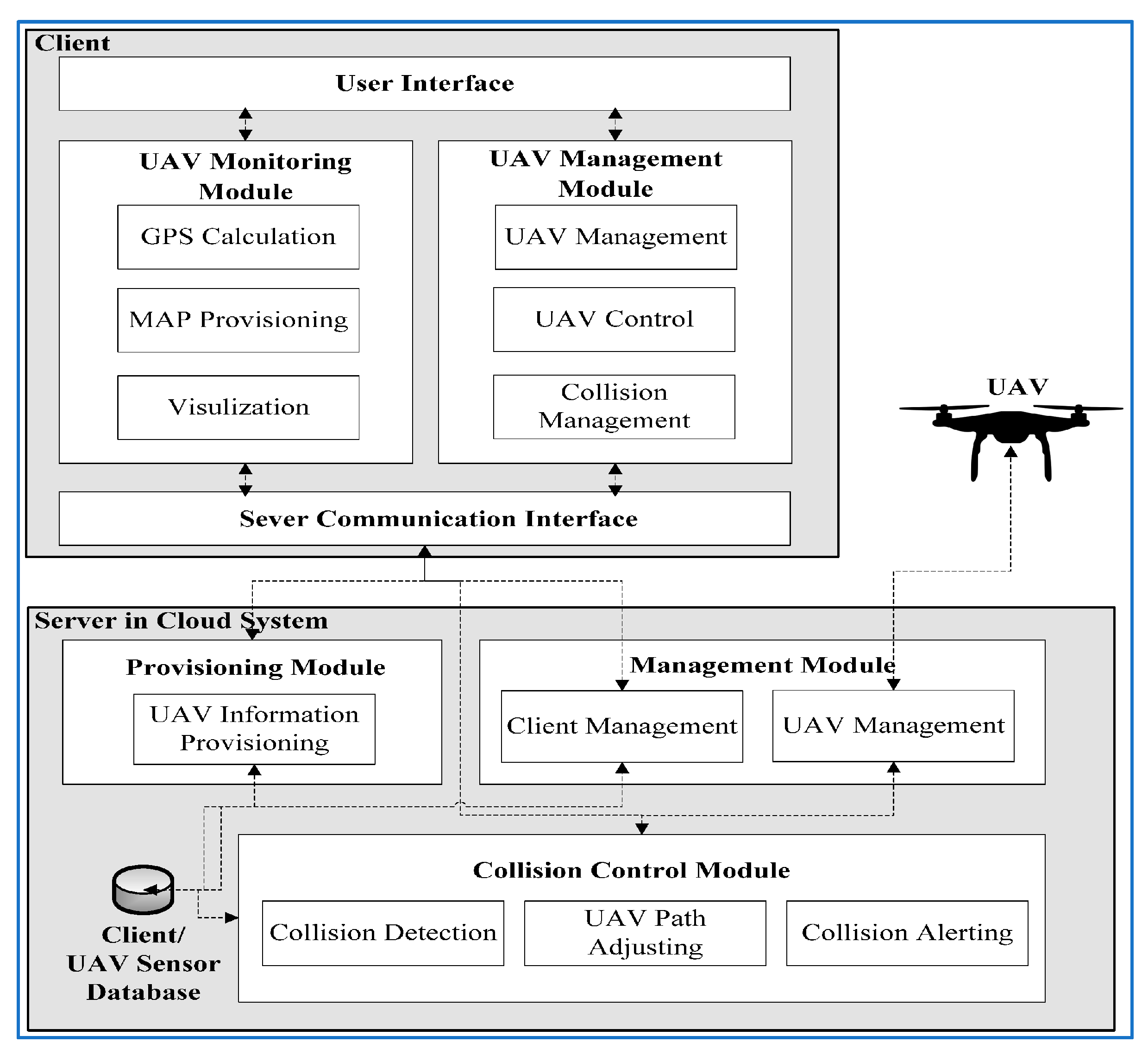
- Itkin, M.; Kim, M.; Park, Y. Development of cloud-based UAV monitoring and management system. Sensors 2016, 16, 1913. [Google Scholar] [CrossRef]
- Eudes, A.; Marzat, J.; Sanfourche, M.; Moras, J.; Bertrand, S. Autonomous and safe inspection of an industrial warehouse by a multi-rotor MAV. In Proceedings of the Field and Service Robotics: Results of the 11th International Conference, Zurich, Switzerland, 12–15 September 2017; Springer International Publishing: Cham, Switzerland; pp. 221–235.
- Mészáros, B.; Bóna, K.; Bertalan, M. Monitoring of Production Line Supply Systems with Drones. IOP Conf. Ser. Mater. Sci. Eng. 2018, 448, 012037. [Google Scholar] [CrossRef]
- Galar, D.; Kumar, U.; Seneviratne, D. Robots, Drones, UAVs, and UGVs for Operation and Maintenance; CRC Press: Boca Raton, FL, USA, 2020. [Google Scholar]
- Tripicchio, P.; Unetti, M.; D’Avella, S.; Avizzano, C.A. Smooth coverage path planning for UAVs with model predictive control trajectory tracking. Electronics 2023, 12, 2310. [Google Scholar] [CrossRef]
- Batistatos, M.C.; Mazilu, A.I.; Kourtis, M.A.; Xilouris, G.K.; Santorinaios, D.; Oikonomakis, A.; Oikonomakis, G.; Leonis, P.E.; Sygrimis, P.A.; Ntouros, K.G.; et al. UAV Swarm Management Platform for Autonomous Area and Infrastructure Inspection. In Proceedings of the 2024 Panhellenic Conference on Electronics & Telecommunications (PACET), Thessaloniki, Greece, 28–29 March 2024; IEEE: Piscataway, NJ, USA; pp. 1–5.
- Olivares, V.; Córdova, F. Evaluation by computer simulation of the operation of a fleet of drones for transporting materials in a manufacturing plant of plastic products. In Proceedings of the 2015 CHILEAN Conference on Electrical, Electronics Engineering, Information and Communication Technologies (CHILECON), Santiago, Chile, 28–30 October 2015; IEEE: Piscataway, NJ, USA; pp. 847–853.
- Cordova, F.; Olivares, V. Design of drone fleet management model in a production system of customized products. In Proceedings of the 2016 6th International Conference on computers communications and control (ICCCC), Oradea, Romania, 10–14 May 2016; IEEE: Piscataway, NJ, USA; pp. 165–172.
- Carlsson, J.G.; Song, S. Coordinated logistics with a truck and a drone. Manag. Sci. 2018, 64, 4052–4069. [Google Scholar] [CrossRef]
- Derpich, I.; Miranda, D.; Sepulveda, J. Using drones in a warehouse with minimum energy consumption. In Proceedings of the 2018 7th International Conference on Computers Communications and Control (ICCCC), Oradea, Romania, 8–12 May 2018; IEEE: Piscataway, NJ, USA; pp. 97–102.
- Kuru, K.; Ansell, D.; Khan, W.; Yetgin, H. Analysis and optimization of unmanned aerial vehicle swarms in logistics: An intelligent delivery platform. IEEE Access 2019, 7, 15804–15831. [Google Scholar] [CrossRef]
- Lieret, M.; Kogan, V.; Döll, S.; Franke, J. Automated in-house transportation of small load carriers with autonomous unmanned aerial vehicles. In Proceedings of the 2019 IEEE 15th International Conference on automation science and engineering (CASE), Vancouver, BC, Canada, 22–26 August 2019; IEEE: Piscataway, NJ, USA; pp. 1010–1015.
- Sorbelli, F.B.; Corò, F.; Pinotti, C.M.; Shende, A. Automated picking system employing a drone. In Proceedings of the 2019 15th International Conference on Distributed Computing in Sensor Systems (DCOSS), Santorini, Greece, 29–31 May 2019; IEEE: Piscataway, NJ, USA; pp. 633–640.
- Kloetzer, M.; Burlacu, A.; Enescu, G.; Caraiman, S.; Mahulea, C. Optimal indoor goods delivery using drones. In Proceedings of the 2019 24th IEEE International Conference on Emerging Technologies and Factory Automation (ETFA), Zaragoza, Spain, 10–13 September 2019; IEEE: Piscataway, NJ, USA; pp. 1579–1582.
- Alam, F.; Hasan, K.S.B.; Varshney, A. Low-Cost Autonomous Vehicle for Inventory Movement in Warehouses. In Proceedings of the 2020 Sixth International Conference on Parallel, Distributed and Grid Computing (PDGC), Waknaghat, India, 6–8 November 2020; IEEE: Piscataway, NJ, USA; pp. 400–405.
- Ham, A. Drone-based material transfer system in a robotic mobile fulfillment center. IEEE Trans. Autom. Sci. Eng. 2019, 17, 957–965. [Google Scholar] [CrossRef]
- Jeong, H.Y.; Song, B.D.; Lee, S. Optimal scheduling and quantitative analysis for multi-flying warehouse scheduling problem: Amazon airborne fulfillment center. Transp. Res. Part C: Emerg. Technol. 2022, 143, 103831. [Google Scholar] [CrossRef]
- Han, C.; Jeon, H.; Oh, J.; Lee, H. Dynamic Order Picking Method for Multi-UAV System in Intelligent Warehouse. Remote Sens. 2022, 14, 6106. [Google Scholar] [CrossRef]
- Lioulemes, A.; Galatas, G.; Metsis, V.; Mariottini, G.L.; Makedon, F. Safety challenges in using AR. Drone to collaborate with humans in indoor environments. In Proceedings of the 7th International Conference on PErvasive Technologies Related to Assistive Environments, Rhodes, Greece, 27–30 May 2014; pp. 1–4. [Google Scholar]
- Jyothsnaa, S.; Gandhe, A.; Deshpande, A.; Bodas, S. Automated inventory management and security surveillance system using image processing techniques. In Proceedings of the TENCON 2010–2010 IEEE Region 10 Conference, Fukuoka, Japan, 22–25 November 2010; IEEE: Piscataway, NJ, USA; pp. 2318–2321.
- Kalinov, I.; Safronov, E.; Agishev, R.; Kurenkov, M.; Tsetserukou, D. High-precision UAV localization system for landing on a mobile collaborative robot based on an IR marker pattern recognition. In Proceedings of the 2019 IEEE 89th Vehicular Technology Conference (VTC2019-Spring), Kuala Lumpur, Malaysia, 28 April–1 May 2019; IEEE: Piscataway, NJ, USA; pp. 1–6.
- Dawaliby, S.; Aberkane, A.; Bradai, A. Blockchain-based IoT platform for autonomous drone operations management. In Proceedings of the 2nd ACM MobiCom Workshop on Drone Assisted Wireless Communications for 5G and Beyond, London, UK, 25 September 2020; pp. 31–36. [Google Scholar]
- Anwar, N.; Izhar, M.A.; Najam, F.A. Construction monitoring and reporting using drones and unmanned aerial vehicles (UAVs). In Proceedings of the Tenth International Conference on Construction in the 21st Century (CITC-10), Colombo, Sri Lanka, 2–4 July 2018; CITC Global: Colombo, Sri Lanka; Volume 8, pp. 2–4.
- Oommen, S.; Nair, A.D.; Mandi, R.P. A Hybrid Unmanned Arieal Vehicle with A Rover For Disaster Rescue Management Operation. IOP Conf. Ser. Mater. Sci. Eng. 2021, 1057, 012088. [Google Scholar] [CrossRef]
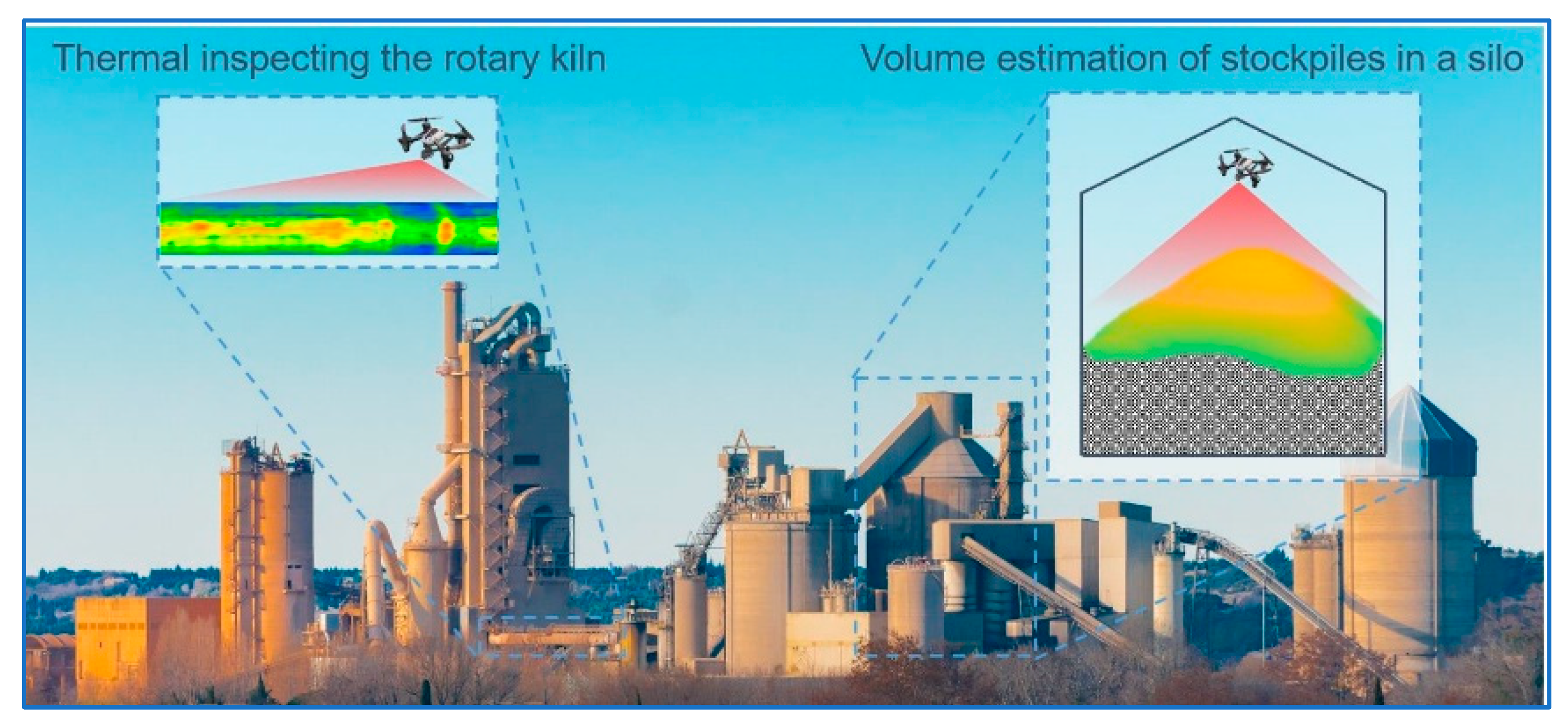
- Alsayed, A.; Yunusa-Kaltungo, A.; Quinn, M.K.; Arvin, F.; Nabawy, M.R. Drone-assisted confined space inspection and stockpile volume estimation. Remote Sens. 2021, 13, 3356. [Google Scholar] [CrossRef]
- Yi, W.; Qu, X. Drone-Based Image Processing for Construction Site Safety, Transportation, and Progress Management. In Smart Transportation Systems 2021, Smart Innovation, Systems and Technologies; Springer: Singapore, 2021; pp. 21–26. [Google Scholar]
- Stanko, J.; Stec, F.; Rodina, J. Process automation of warehouse inspection using an autonomous unmanned aerial vehicle. MM Sci. J. 2022, 5864–5869. [Google Scholar] [CrossRef]
- Martinez-Carranza, J.; Rojas-Perez, L.O. Warehouse inspection with an autonomous micro air vehicle. Unmanned Syst. 2022, 10, 329–342. [Google Scholar] [CrossRef]
- Awasthi, S.; Gramse, N.; Reining, C.; Roidl, M. UAVs for industries and supply chain management. arXiv 2022, arXiv:2212.03346. [Google Scholar]
- Kamal, A.M.; Al-Ayyoub, M.; Deriche, M. A UAV-Assisted Multirobot Network for Surveillance and Tracking Applications: Design and Implementation. In Proceedings of the 2023 24th International Arab Conference on Information Technology (ACIT), Ajman, United Arab Emirates, 6–8 December 2023; IEEE: Piscataway, NJ, USA; pp. 1–7.
- Masuduzzaman, M.; Raza, S.M.; Shin, S.Y. Multi-UAV Employed Secure Product Management and Surveillance System in Industry 4.0 using Blockchain. In Proceedings of the 2024 IEEE International Conference on Industry 4.0, Artificial Intelligence, and Communications Technology (IAICT), Bali, Indonesia, 4–6 July 2024; IEEE: Piscataway, NJ, USA; pp. 367–372.
- Kumar, A.; Eswaran, S.; Harshawarthan, C.N. Smart Thermowing Explorer using Drone System and IoT Technology. In Proceedings of the 2024 International Conference on Power, Energy, Control and Transmission Systems (ICPECTS), Chennai, India, 8–9 October 2024; IEEE: Piscataway, NJ, USA; pp. 1–5.
- Mourya, G.S.; Jami, A.; Ajith, A.; Seikh, A.H.; Kumar, J.S. Multi-Trajectory Drone Surveillance: Amplifying Monitoring Capabilities in Disaster Management. In Proceedings of the 2024 IEEE International Students’ Conference on Electrical, Electronics and Computer Science (SCEECS), Bhopal, India, 24–25 February 2024; IEEE: Piscataway, NJ, USA; pp. 1–6.
- Mezouari, A.; Benaly, M.; El Karch, H.; Dahou, H.; Hlou, L.; Elgouri, R. Security Surveillance Using UAVs and Embedded Systems in Industrial Areas. Int. J. Saf. Secur. Eng. 2024, 14, 387. [Google Scholar] [CrossRef]
- Parkison, S.A.; Psota, E.T.; Pérez, L.C. Automated indoor RFID inventorying using a self-guided micro-aerial vehicle. In Proceedings of the IEEE International Conference on Electro/Information Technology, Milwaukee, WI, USA, 5–7 June 2014; IEEE: Piscataway, NJ, USA; pp. 335–340.
- Olivares, V.; Cordova, F.; Sepúlveda, J.M.; Derpich, I. Modeling internal logistics by using drones on the stage of assembly of products. Procedia Comput. Sci. 2015, 55, 1240–1249. [Google Scholar] [CrossRef]
- Fan, Y.; Aramrattana, M.; Shahbandi, S.G.; Nemati, H.M.; Åstrand, B. Infrastructure mapping in well-structured environments using MAV. In Proceedings of the Towards Autonomous Robotic Systems: 17th Annual Conference, TAROS 2016, Sheffield, UK, 26 June–1 July 2016; Springer International Publishing: Cham, Switzerland; pp. 116–126.
- Kattepur, A.; Rath, H.K.; Simha, A.; Mukherjee, A. Distributed optimization in multi-agent robotics for industry 4.0 warehouses. In Proceedings of the 33rd Annual ACM Symposium on Applied Computing, Pau, France, 9–13 April 2018; pp. 808–815. [Google Scholar]
- Elmokadem, T. Distributed coverage control of quadrotor multi-UAV systems for precision agriculture. IFAC Pap. 2019, 52, 251–256. [Google Scholar] [CrossRef]
- Bartoli, L.; Sorbelli, F.B.; Coro, F.; Pinotti, C.M.; Shende, A. Exact and approximate drone warehouse for a mixed landscape delivery system. In Proceedings of the 2019 IEEE International Conference on Smart Computing (SMARTCOMP), Washington, DC, USA, 12–15 June 2019; IEEE: Piscataway, NJ, USA; pp. 266–273.
- Guerra, E.; Grau, A.; Bolea, Y.; Munguia, R. Sampling Operation with Robotic UAV. In Proceedings of the2019 24th IEEE International Conference on Emerging Technologies and Factory Automation (ETFA), Zaragoza, Spain, 10–13 September 2019; IEEE: Piscataway, NJ, USA; pp. 1583–1586.
- Bulgakov, A.; Sayfeddine, D.; Bock, T.; Emelianov, S. Dispersed cyber-physical coordination and path planning using unmanned aerial vehicle. In Proceedings of the International Symposium on Automation and Robotics in Construction ISARC, Banff, AB, Canada, 21–24 May 2019; IAARC Publications: Huddersfield, UK; pp. 730–734.
- Gago, R.M.; Pereira, M.Y.; Pereira, G.A. An aerial robotic system for inventory of stockpile warehouses. Eng. Rep. 2020, 3, e12396. [Google Scholar] [CrossRef]
- Rahmadya, B.; Sun, R.; Takeda, S.; Kagoshima, K.; Umehira, M. A framework to determine secure distances for either drones or robots based inventory management systems. IEEE Access 2020, 8, 170153–170161. [Google Scholar] [CrossRef]
- Orgeira-Crespo, P.; Ulloa, C.; Rey-Gonzalez, G.; Pérez García, J.A. Methodology for indoor positioning and landing of an unmanned aerial vehicle in a smart manufacturing plant for light part delivery. Electronics 2020, 9, 1680. [Google Scholar] [CrossRef]
- de-Dios, J.R.; Pérez-Grau, F.J.; Torres-González, A.; Acevedo, J.J.; Paneque, J.L.; Viguria, A.; Fuego, D.; Astorga, J.R.; Ollero, A. GRVC-CATEC: Aerial Robot Co-Worker in Plant Servicing (ARCOW). In Bringing Innovative Robotic Technologies from Research Labs to Industrial End-users: The Experience of the European Robotics Challenges; Springer International Publishing: Cham, Switzerland, 2020; pp. 211–242. [Google Scholar]
- Bulgakov, A.G.; Pakhomova, E.G. Coordination of construction manipulation robotic system using UAV. IOP Conf. Ser. Mater. Sci. Eng. 2020, 789, 012007. [Google Scholar] [CrossRef]
- Galtarossa, L.; Navilli, L.F.; Chiaberge, M. Visual-Inertial Indoor Navigation Systems and Algorithms for UAV Inspection Vehicles. In Industrial Robotics-New Paradigms; IntechOpen: London, UK, 2020. [Google Scholar][Green Version]
- Moura, A.; Antunes, J.; Dias, A.; Martins, A.; Almeida, J. Graph-SLAM approach for indoor UAV localization in warehouse logistics applications. In Proceedings of the 2021 IEEE International Conference on Autonomous Robot Systems and Competitions (ICARSC), Santa Maria da Feira, Portugal, 28–29 April 2021; IEEE: Piscataway, NJ, USA; pp. 4–11.
- Alajami, A.A.; Moreno, G.; Pous, R. Design of a UAV for Autonomous RFID-Based Dynamic Inventories Using Stigmergy for Mapless Indoor Environments. Drones 2022, 6, 208. [Google Scholar] [CrossRef]
- Wang, C.; Sherry, L. Design of A local area integrated drone, aircraft, vehicle, and asset management system (laidavams). In Proceedings of the 2022 Integrated Communication, Navigation and Surveillance Conference (ICNS), Dulles, VA, USA, 5–7 April 2022; IEEE: Piscataway, NJ, USA; pp. 1–6.
- Geetha, D.M.; Arunachalam, A.C.; Deepikarani, K.; Shanmugam, K.B. Autonomous Cargo Drone with Collision Avoidance and Warehouse Management IoT. In Proceedings of the 2023 2nd International Conference on Automation, Computing and Renewable Systems (ICACRS), Pudukkottai, India, 11–13 December 2023; IEEE: Piscataway, NJ, USA; pp. 1611–1617.
- Yoon, B.; Kim, H.; Youn, G.; Rhee, J. 3D position estimation of objects for inventory management automation using drones. Appl. Sci. 2023, 13, 10830. [Google Scholar] [CrossRef]
- Yang, R.; Qi, Y.; Pan, C.; Wang, J.; Li, X.; Chen, H.; Jin, R. Integrated Localization Method for a Ground-Aerial Robotic System in Warehouse Inventory Scenarios. Unmanned Syst. 2024, 13, 1123–1141. [Google Scholar] [CrossRef]
- Tsiakas, K.; Tsardoulias, E.; Symeonidis, A.L. Autonomous Full 3D Coverage Using an Aerial Vehicle, Performing Localization, Path Planning, and Navigation towards Indoor Inventorying for the Logistics Domain. Robotics 2024, 13, 83. [Google Scholar] [CrossRef]
- Pan, P.; Hu, K.; Huang, X.; Ying, W.; Xie, X.; Ma, Y.; Zhang, N.; Kang, H. Developing Smart MAVs for Autonomous Inspection in GPS-denied Constructions. arXiv 2024, arXiv:2408.06030. [Google Scholar] [CrossRef]
- Li, H.; Xiong, T. Cyber Physical System Information Collection: Robot Location and Navigation Method Based on QR Code. arXiv 2023, arXiv:2310.03470. [Google Scholar] [CrossRef]
- Ingka Group. IKEA is Elevating Human–AI-Powered Drone Collaboration. 6 October 2025. Available online: https://www.ingka.com/newsroom/ikea-is-elevating-human-ai-powered-drone-collaboration/ (accessed on 8 January 2026).

























| Metric | Value | Analysis |
|---|---|---|
| Total Papers Analyzed | 128 | Comprehensive literature review |
| Total Citations (approx.) | ~5424 | Based on reported counts |
| Average Citations/Paper | ~39 | Skewed by highly cited papers |
| Median Citations/Paper | ~12 | More representative of a typical paper |
| Papers with 100+ citations | 5 | 3.6% of papers |
| Papers with 50–99 citations | 8 | 5.7% of papers |
| Papers with 10–49 citations | 42 | 30% of papers |
| Papers with <10 citations | 85 | 60.7% of papers |
| h-index of field | ~15 | Based on citation distribution |
| Application Area | Average Citations | Papers in Category | Key Technologies |
|---|---|---|---|
| Warehouse Robotics | 181 | 5 | Kiva, autonomous vehicles |
| Delivery Systems | 158 | 4 | Truck-drone coordination |
| Inventory Technology | 45 | 52 | RFID, computer vision, barcodes |
| Localization | 32 | 18 | UWB, LiDAR, SLAM |
| Path Planning | 28 | 22 | Optimization algorithms |
| Security/Surveillance | 12 | 15 | Computer vision, monitoring |
| Mapping/Modeling | 8 | 10 | 3D reconstruction, digital twins |
| Multi-Robot Systems | 15 | 14 | UAV-UGV collaboration |
| Ref. No. | Year | Function | Robot Type | Single/Multiple Drones | Simulation Results | Real-Time Results | Technology/Methodology Used | Environment |
|---|---|---|---|---|---|---|---|---|
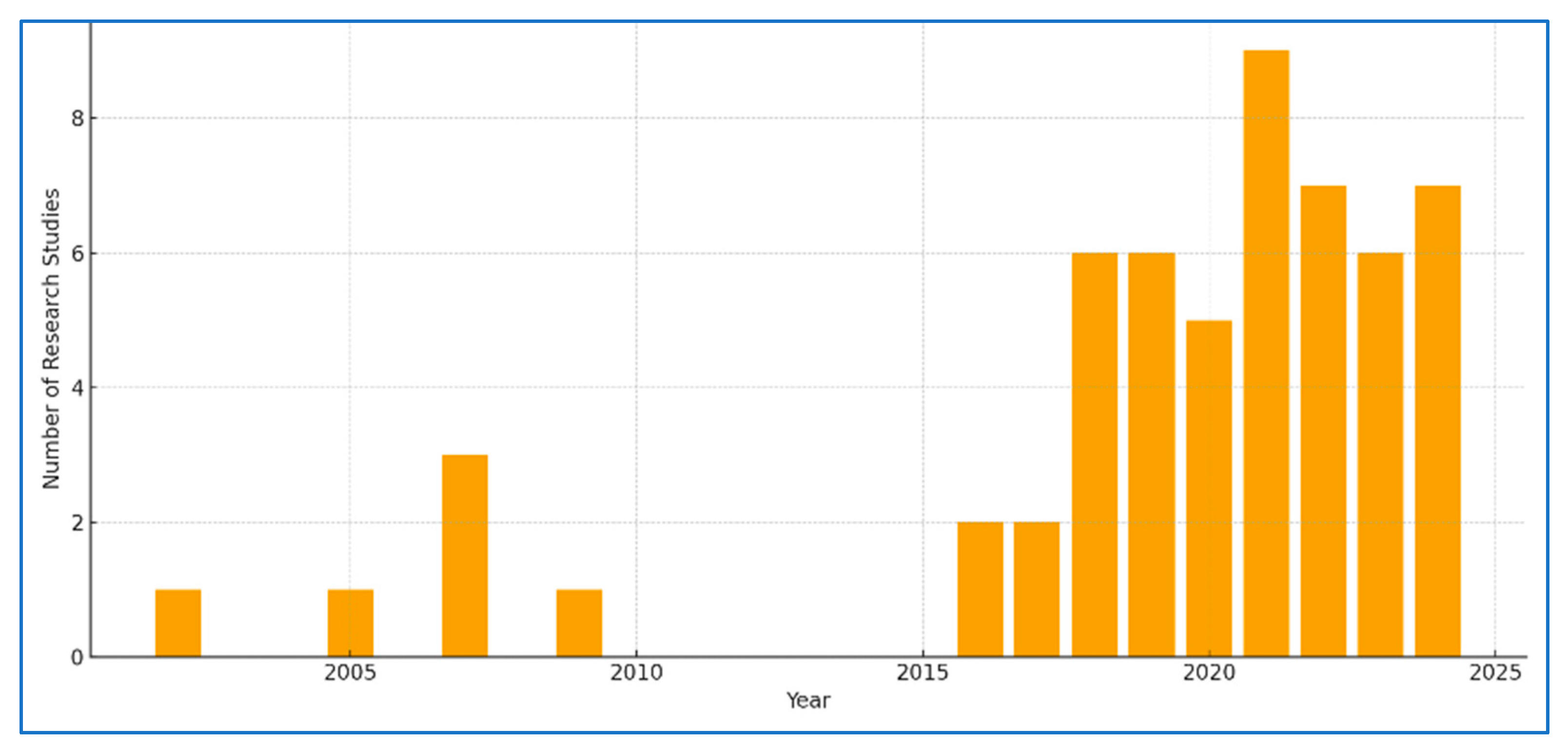
| 11 | 2002 | Inventory Management | UAV | Single | Yes | No | RRT*, MATLAB r2001b | Static |
| 12 | 2005 | Inventory Management | UAV | Single | Yes | No | RICS | Dynamic |
| 13 | 2007 | Inventory Management | UAV | Multiple | Yes | No | RFID | Static |
| 14 | 2007 | Inventory Management | Wheeled Robot | Single | Yes | No | AI and multi-robot coordination | Dynamic |
| 15 | 2007 | Inventory Management | Wheeled Robot | Multiple | Yes | No | RFID | Static |
| 16 | 2009 | Inventory Management | Wheeled Robot | Single | Yes | Yes | RFID, LiDAR, Rao-Blackwellized particle filter | Static |
| 17 | 2016 | Inventory Management | UAV + UGV | Single | Yes | No | RFID | Static |
| 18 | 2016 | Inventory Management | UAV | Single | Yes | Yes | RFID | Static |
| 19 | 2017 | Inventory Management | UAV | Single | Yes | Yes | ROS-based mapping and navigation | Static |
| 20 | 2017 | Inventory Management | UAV | Single | No | No | RFID | Static |
| 21 | 2018 | Inventory Management | UAV | Single | Yes | Yes | 6D LiDAR-based localization | Static |
| 22 | 2018 | Inventory Management | UAV | Single | Yes | No | Autonomous vehicles, drones, digital inventory | Static |
| 23 | 2018 | Inventory Management | UAV | Single | No | Yes | Blockchain-based system | Static |
| 24 | 2018 | Inventory Management | UAV | Single | Yes | No | iBeacon-based ID reader | Static |
| 25 | 2018 | Inventory Management | UAV | Single | No | Yes | LBP, HOG, SVM classifier | Static |
| 26 | 2018 | Inventory Management | UAV | Single | Yes | No | Harris corner detector, Hough transform | Static |
| 27 | 2019 | Inventory Management | UAV | Single | Yes | No | R-CNN | Static |
| 28 | 2019 | Inventory Management | UAV | Single | Yes | No | Blockchain-based system | Static |
| 29 | 2019 | Inventory Management | UAV | Single | Yes | No | RFID | Static |
| 30 | 2019 | Inventory Management | UAV | Single | No | Yes | UWB localization system | Static |
| 31 | 2019 | Inventory Management | UAV | Multiple | Yes | Yes | Deep learning | Static |
| 32 | 2019 | Inventory Management | UAV | Multiple | Yes | No | Multi-UAV inventory tracking | Static |
| 33 | 2020 | Inventory Management | UAV | Multiple | Yes | No | Generic architecture | Static |
| 34 | 2020 | Inventory Management | UAV | Single | No | Yes | EKF-based multi-sensor fusion | Static |
| 35 | 2020 | Inventory Management | UAV | Single | – | – | Digital twin, 5G, cloud control | – |
| 36 | 2020 | Inventory Management | UAV | Single | Yes | Yes | CNN | Static |
| 37 | 2020 | Inventory Management | UAV | Single | Yes | No | Kalman filter-based pose estimation | Static |
| 38 | 2021 | Inventory Management | UAV | Single | – | – | ROS robots, RFID, bin-packing optimization | Static |
| 39 | 2021 | Inventory Management | UAV | Single | Yes | Yes | Barcode scanning with markers | Static |
| 40 | 2021 | Inventory Management | UAV + UGV | Multiple | Yes | No | UAV–UGV multi-robot system | Static |
| 41 | 2021 | Inventory Management | UAV | Single | Yes | No | Autonomous UAV routing, web interface | Static |
| 42 | 2021 | Inventory Management | UAV | Single | No | Yes | RFID relative localization | Static |
| 43 | 2021 | Inventory Management | UAV | Single | Yes | Yes | Computer vision techniques | Static |
| 44 | 2021 | Inventory Management | UAV | Single | Yes | No | QR segmentation, 3D localization | Static |
| 45 | 2021 | Inventory Management | UAV | Single | – | – | RFID drones, hybrid DE-Lion optimization | Static |
| 46 | 2021 | Inventory Management | UAV | Single | Yes | No | Hybrid differential evolution + RFID | Static |
| 47 | 2021 | Inventory Management | UAV | Single | Yes | No | Deep learning + RFID localization | Static |
| 48 | 2021 | Inventory Management | UAV | Single | Yes | Yes | Machine vision camera | Static |
| 49 | 2022 | Inventory Management | UAV | Single | – | – | RFID, RSSI-based altitude estimation | Static |
| 50 | 2022 | Inventory Management | UAV | Single | Yes | No | UHF RFID | Static |
| 51 | 2022 | Inventory Management | UAV | Single | Yes | No | Multi-robot systems | Static |
| 52 | 2022 | Inventory Management | UAV | Single | Yes | No | QR code | Static |
| 53 | 2022 | Inventory Management | UAV | Multiple | Yes | No | Genetic algorithm | Static |
| 54 | 2022 | Inventory Management | UAV | Single | Yes | No | MILP formulation | Static |
| 55 | 2022 | Inventory Management | UAV | Single | Yes | No | APF, LQR, iLQR | Static |
| 56 | 2022 | Inventory Management | UAV | Single | No | Yes | RFID + TCN | Static |
| 57 | 2022 | Inventory Management | UAV | Single | Yes | No | Virtual fiducial markers | Static |
| 58 | 2023 | Inventory Management | UAV | Multiple | Yes | No | Micro-drone + ground mobile robot | Static |
| 59 | 2023 | Inventory Management | UAV | Single | Yes | No | VACNA, CEM, CVAE | Static |
| 60 | 2023 | Inventory Management | UAV | Single | Yes | No | Visibility-aware cooperative navigation | Static |
| 61 | 2023 | Inventory Management | UAV | Single | Yes | No | Image capture and error classification | Static |
| 62 | 2023 | Inventory Management | UAV | Single | Yes | Yes | CNN-based QR reading | Static |
| 63 | 2023 | Inventory Management | UAV | Single | Yes | No | Visual mapping and volume estimation | Static |
| 64 | 2024 | Inventory Management | UAV | Multiple | Yes | Yes | Lightweight QR + dead reckoning | Dynamic |
| 65 | 2024 | Inventory Management | UAV | Single | Yes | No | LiDAR-driven approach | Static |
| 66 | 2024 | Inventory Management | UAV | Single | Yes | Yes | Reinforcement learning | Static |
| 67 | 2024 | Inventory Management | UAV | Single | Yes | Yes | Computer vision | Static |
| 68 | 2024 | Inventory Management | UAV | Multiple | Yes | Yes | VIO, SLAM, UWB, AprilTag | Dynamic |
| 69 | 2024 | Inventory Management | UAV | Multiple | Yes | Yes | SLAM and RFID | Static |
| 70 | 2024 | Inventory Management | UAV | Single | Yes | No | Visual odometry | Static |
| 71 | 2024 | Inventory Management | UAV | Single | No | Yes | Raspberry Pi and network integration | Static |
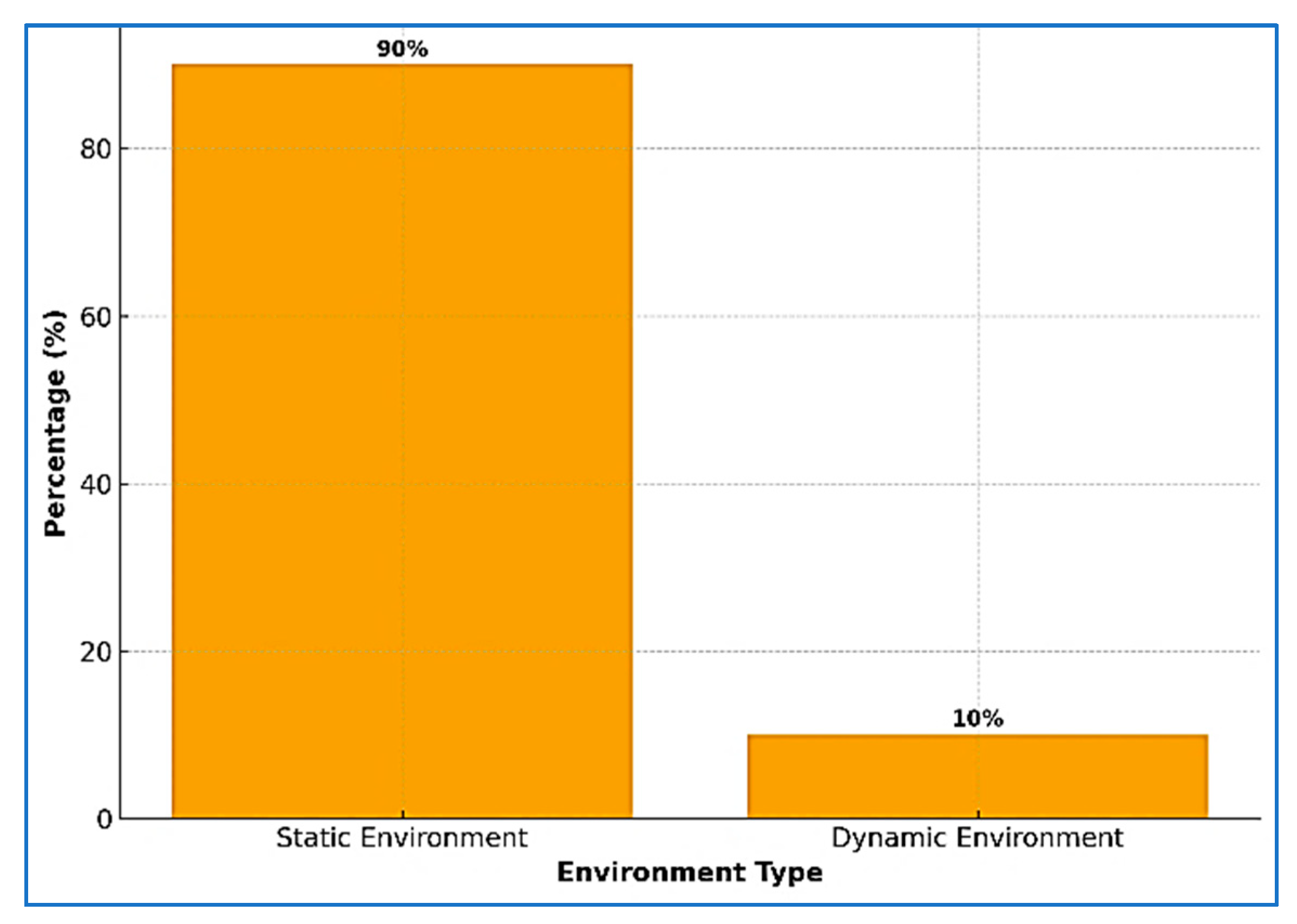
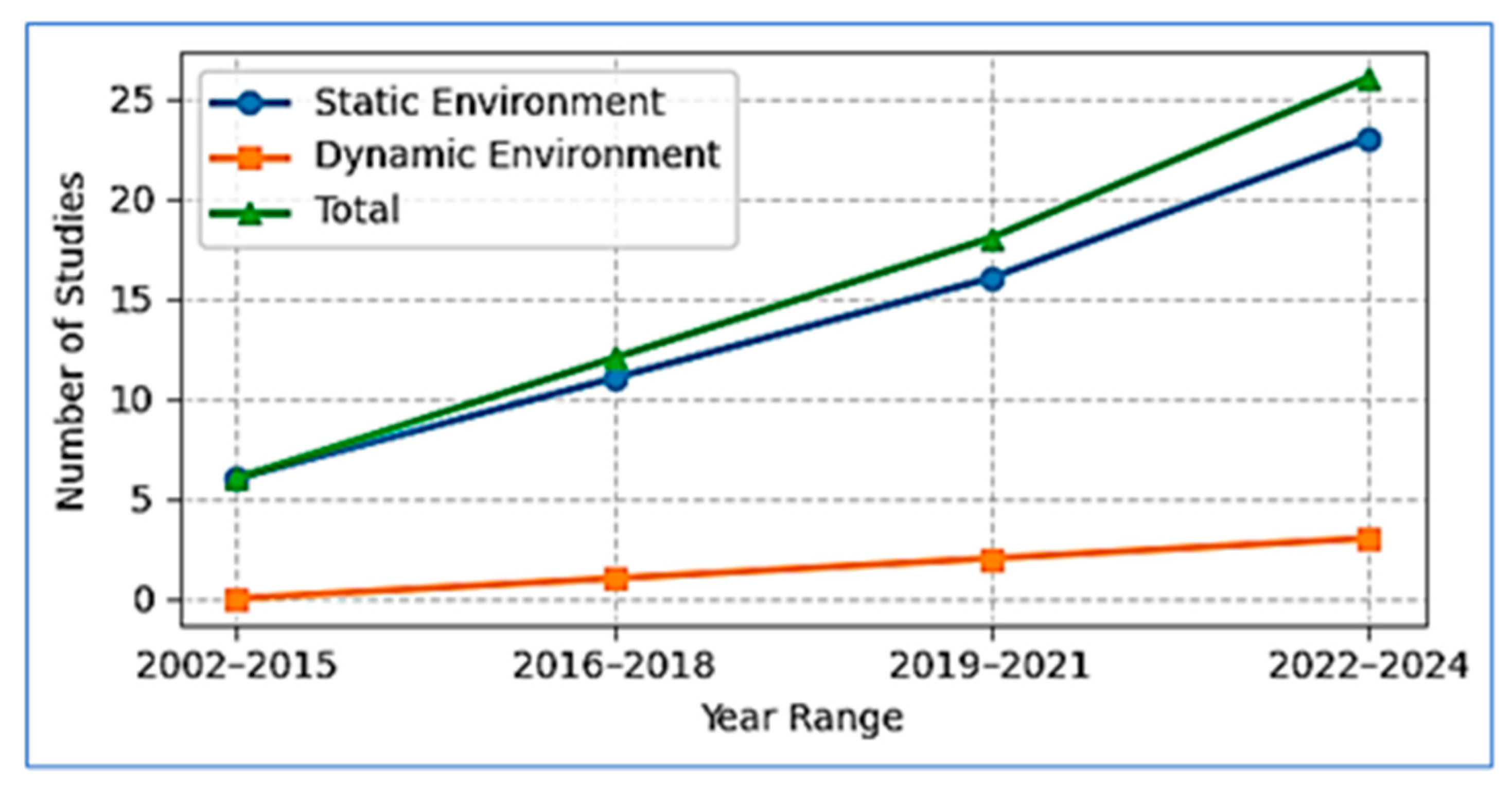
| Year Range | Static Environment | Dynamic Environment | Total |
|---|---|---|---|
| 2002–2015 | 6 | 0 | 6 |
| 2016–2018 | 11 | 1 | 12 |
| 2019–2021 | 16 | 2 | 18 |
| 2022–2024 | 23 | 3 | 26 |
| Total | 56 | 6 | 62 |
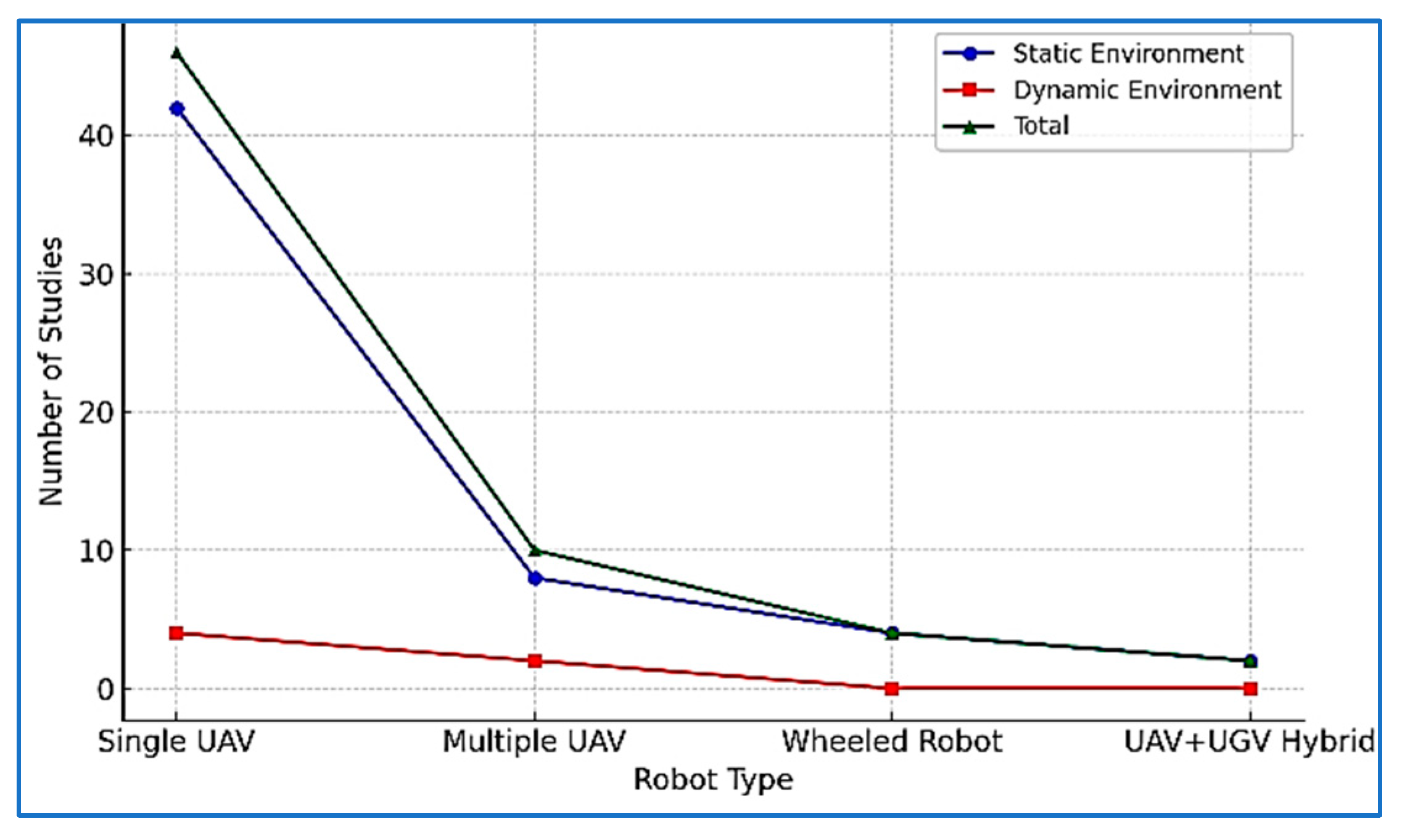
| Robot Type | Static Environment | Dynamic Environment | Total |
|---|---|---|---|
| Single UAV | 42 | 4 | 46 |
| Multiple UAVs | 8 | 2 | 10 |
| Wheeled Robot | 4 | 0 | 4 |
| UAV + UGV Hybrid | 2 | 0 | 2 |
| Total | 56 | 6 | 62 |
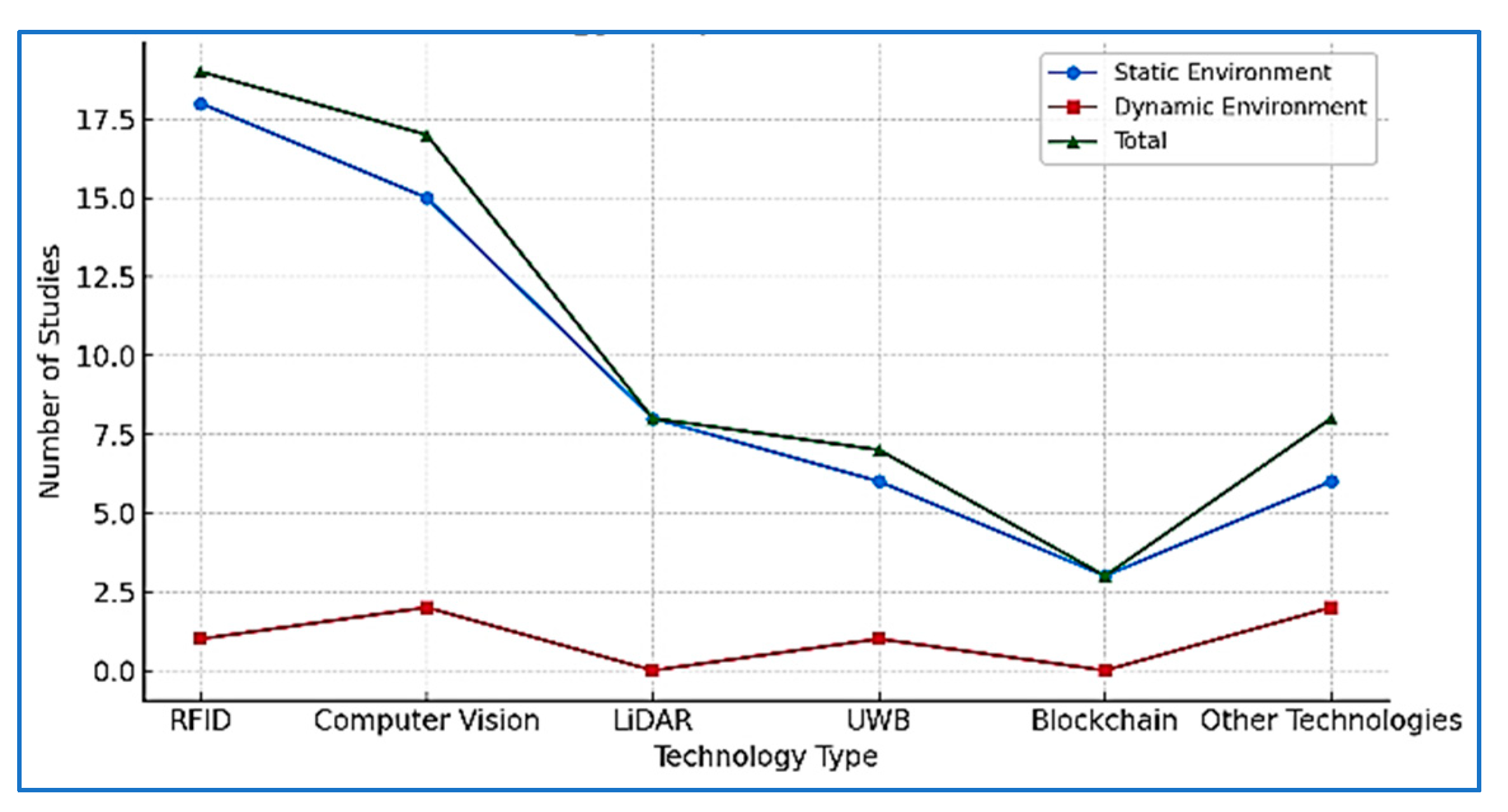
| Technology | Static Environment | Dynamic Environment | Total |
|---|---|---|---|
| RFID | 18 | 1 | 19 |
| Computer Vision | 15 | 2 | 17 |
| 8 | 0 | 8 | |
| UWB | 6 | 1 | 7 |
| Blockchain | 3 | 0 | 3 |
| Other Technologies | 6 | 2 | 8 |
| Total | 56 | 6 | 62 |
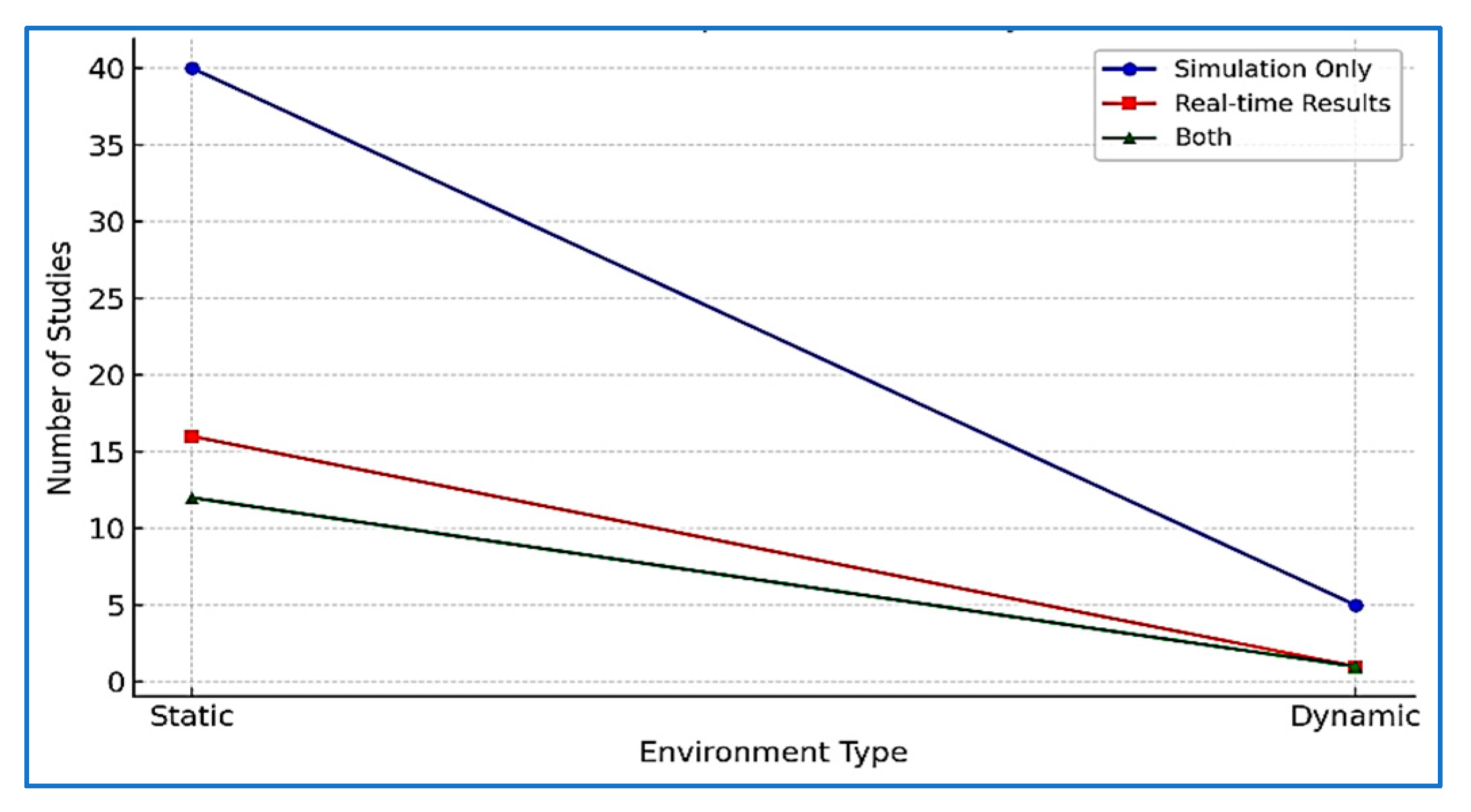
| Environment | Simulation Only | Real-Time Results | Both (Simulation + Real-Time) | Total |
|---|---|---|---|---|
| Static | 40 | 16 | 12 | 56 |
| Dynamic | 5 | 1 | 1 | 6 |
| Total | 45 | 17 | 13 | 62 |
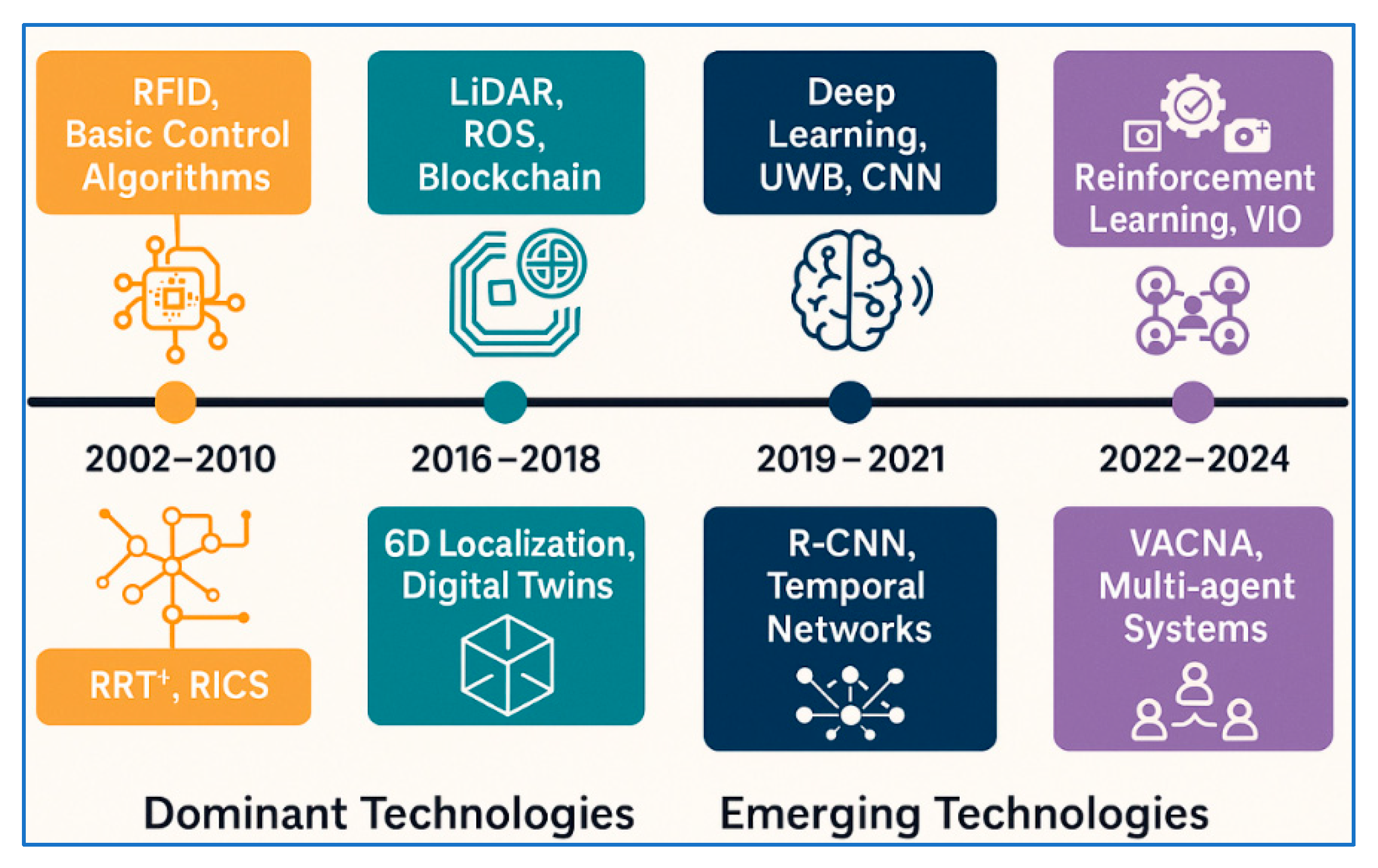
| Period | Dominant Technologies | Emerging Technologies |
|---|---|---|
| 2002–2010 | RFID, basic control algorithms | RRT*, RICS |
| 2016–2018 | LiDAR, ROS, blockchain | 6D localization, digital twins |
| 2019–2021 | Deep learning, UWB, CNN | R-CNN, temporal networks |
| 2022–2024 | Reinforcement learning, VIO | VACNA, multi-agent systems |
| Function | Primary Technologies | Accuracy Metrics | Real-Time Performance |
|---|---|---|---|
| Localization | UWB, LiDAR, VIO | 5 cm–80 cm accuracy | Up to 2892 Hz update rate |
| Object Detection | CNN, R-CNN, SVM | 87–95% detection accuracy | Real-time processing |
| Path Planning | RRT*, genetic algorithms | 27% efficiency gain | Optimized trajectories |
| Data Processing | Blockchain, cloud computing | Secure and transparent | Real-time synchronization |
| Ref. No. | Year | Function of Drone | Robot Type | Single/Multiple Drones | Simulation Results | Real-Time Results | Technology/Methodology Used | Environment |
|---|---|---|---|---|---|---|---|---|
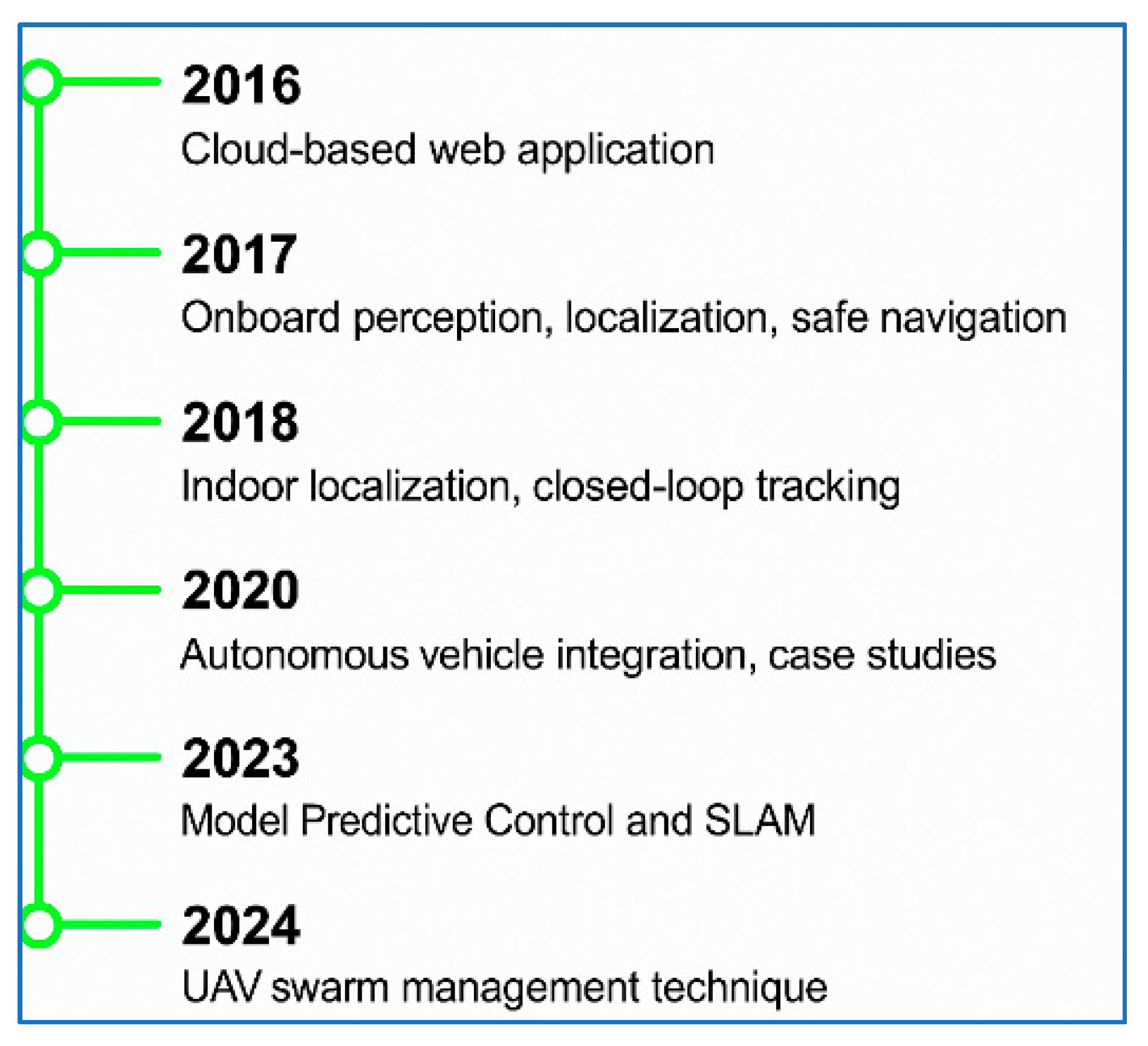
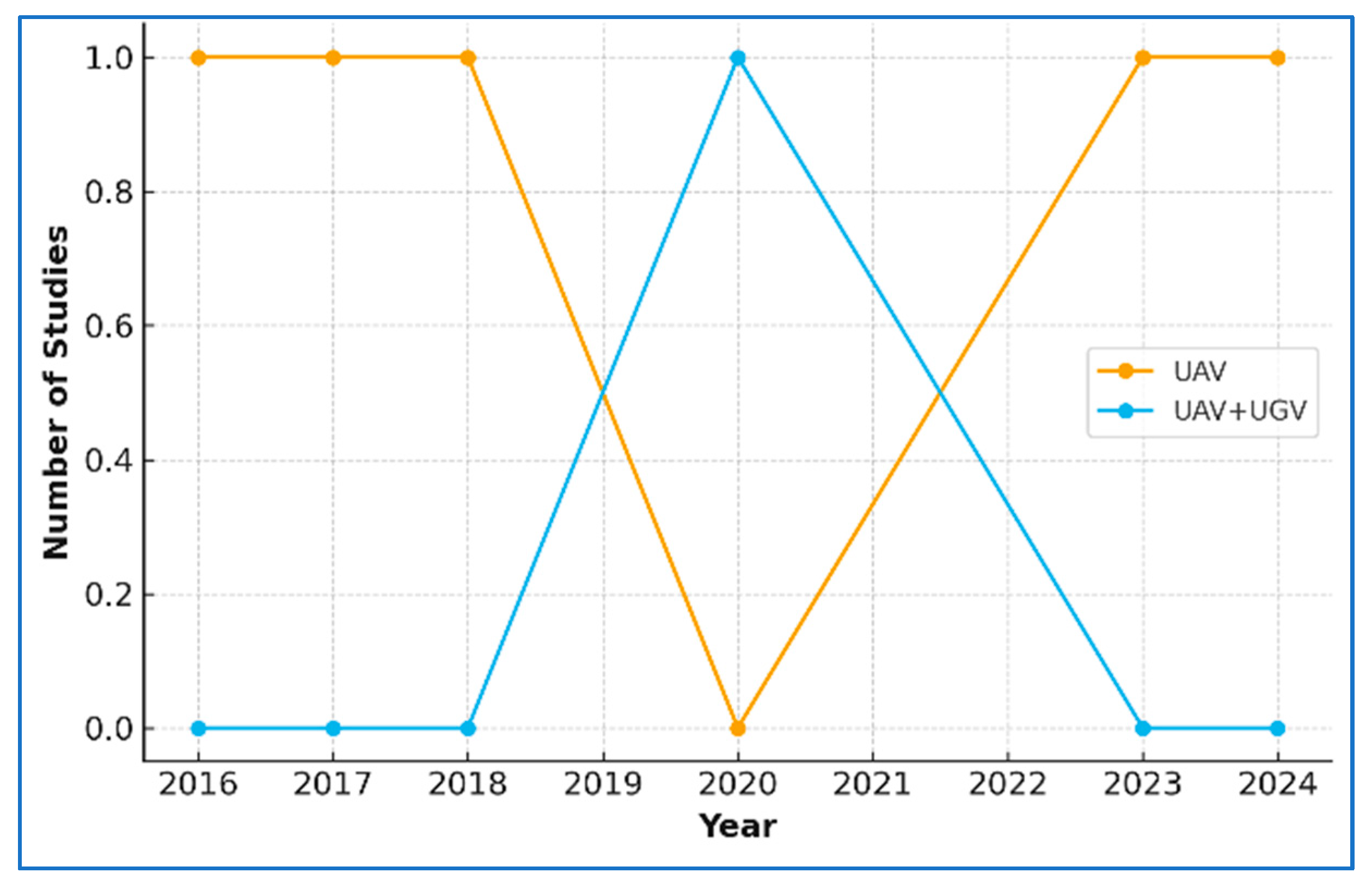
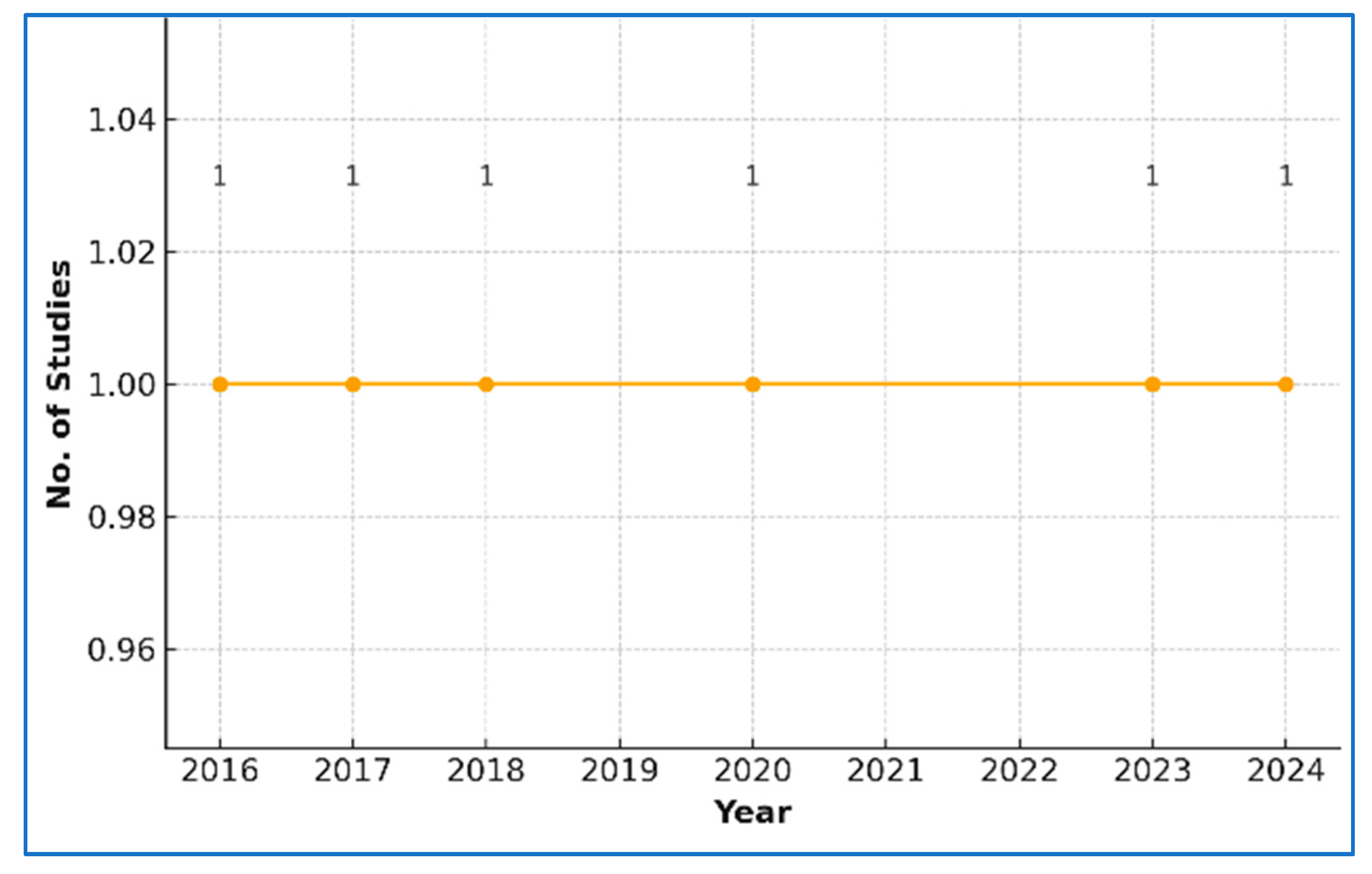
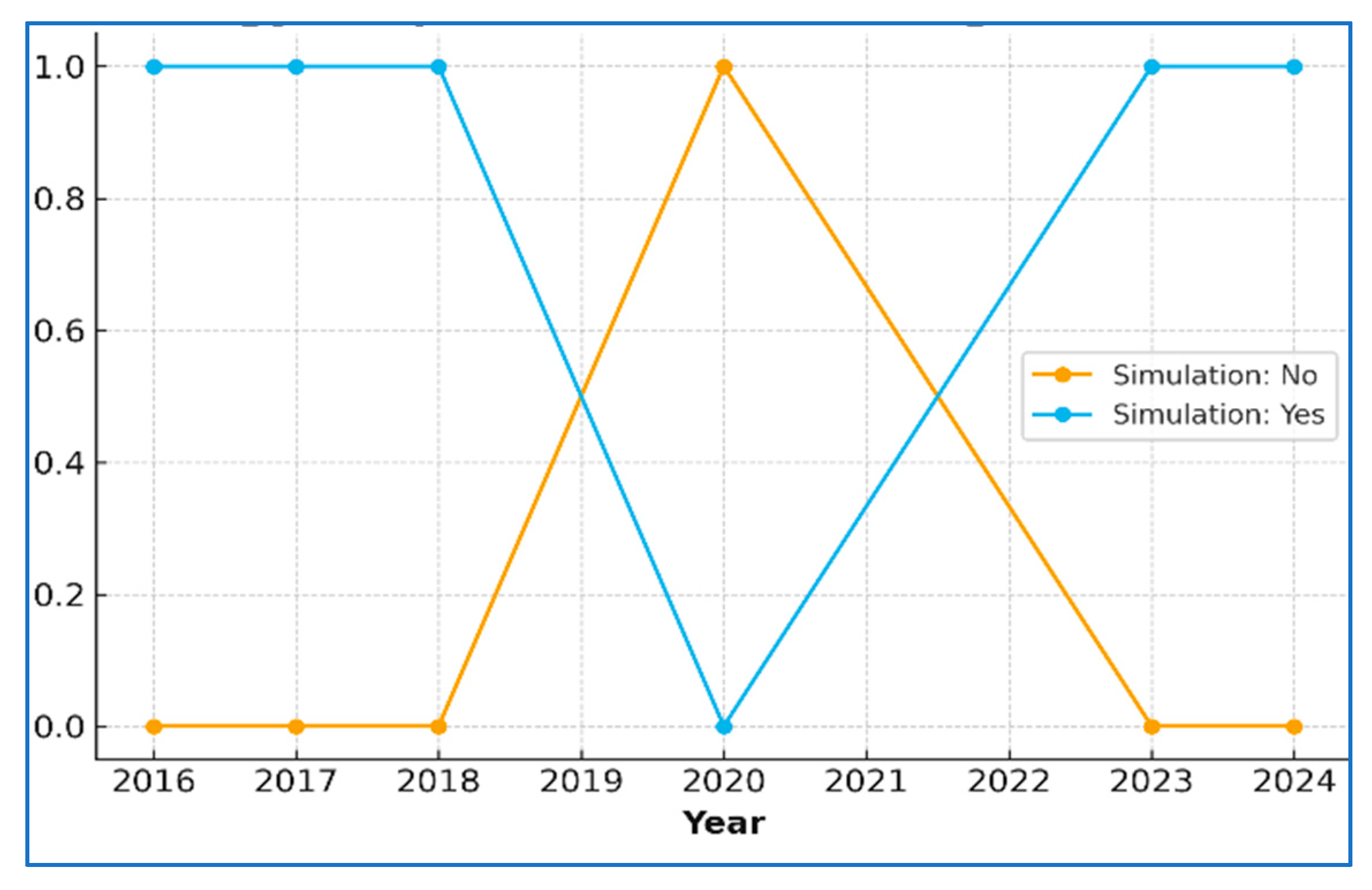
| 72 | 2016 | Maintenance and inspection | UAV | Multiple | Yes | No | Cloud-based web application | Dynamic |
| 73 | 2017 | Maintenance and inspection | UAV | Single | Yes | Yes | Onboard perception, localization, safe navigation | Static |
| 74 | 2018 | Maintenance and inspection | UAV | Single | Yes | No | Indoor localization, closed-loop tracking | Static |
| 75 | 2020 | Maintenance and inspection | UAV, UGV | Multiple | No | No | Autonomous vehicles, system integration, case studies | Static and dynamic |
| 76 | 2023 | Maintenance and inspection | UAV | Single | Yes | Yes | Model predictive control and SLAM | Dynamic |
| 77 | 2024 | Maintenance and inspection | UAV | Single | Yes | No | UAV swarm management technique | Dynamic |
| Year Range | Static Environment | Dynamic Environment | Total |
|---|---|---|---|
| 2016–2017 | 1 | 1 | 2 |
| 2018–2020 | 1 | 1 | 2 |
| 2023–2024 | 0 | 2 | 2 |
| Total | 2 | 4 | 6 |
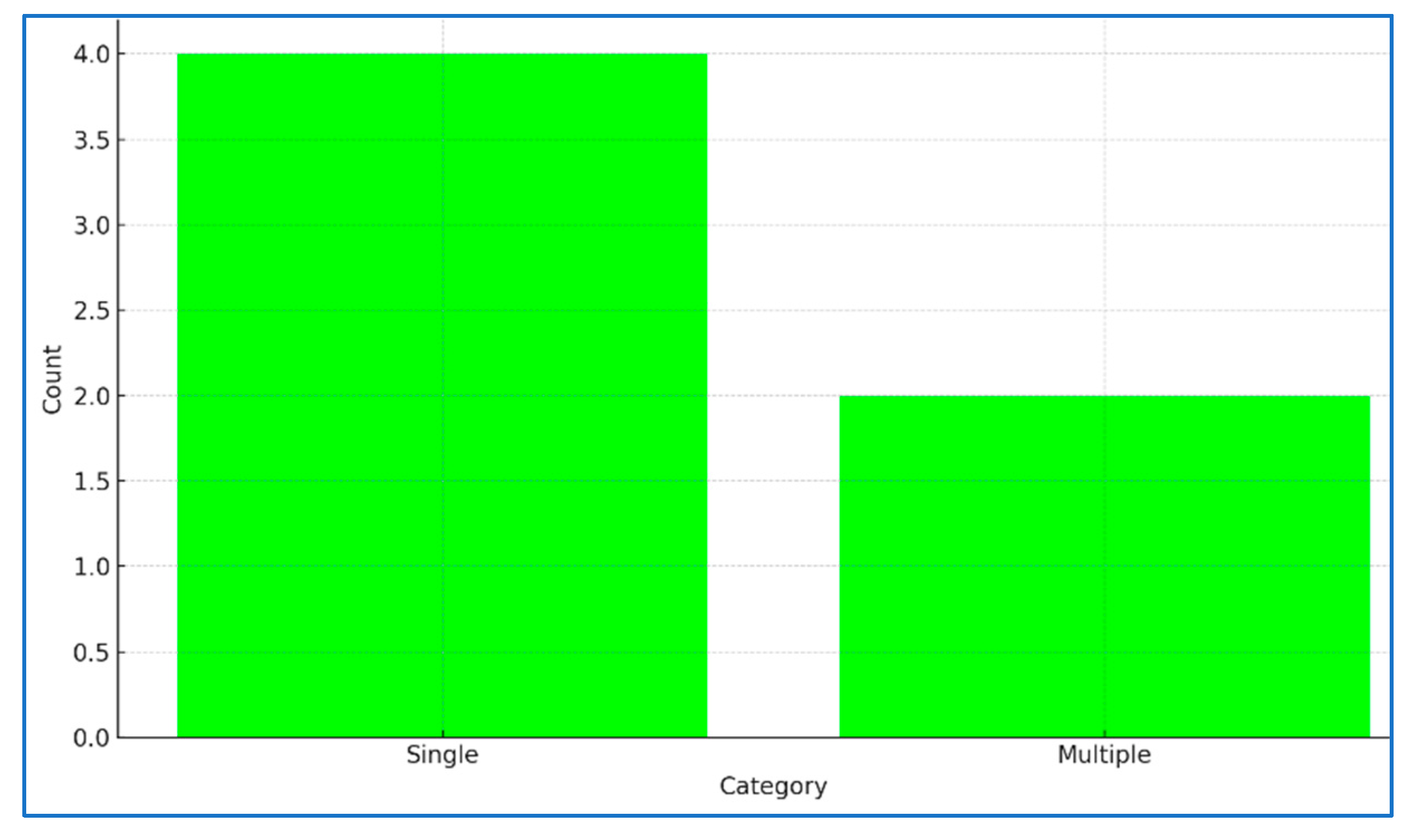
| Robot Type | Static Environment | Dynamic Environment | Total |
|---|---|---|---|
| Single UAV | 2 | 2 | 4 |
| Multiple UAVs | 0 | 1 | 1 |
| UAV + UGV Hybrid | 0 | 1 | 1 |
| Total | 2 | 4 | 6 |
| Technology | Static Environment | Dynamic Environment | Total |
|---|---|---|---|
| Cloud computing | 0 | 1 | 1 |
| Perception and navigation | 1 | 1 | 2 |
| Localization systems | 1 | 0 | 1 |
| Vehicle integration | 0 | 1 | 1 |
| Advanced control | 0 | 1 | 1 |
| Total | 2 | 4 | 6 |
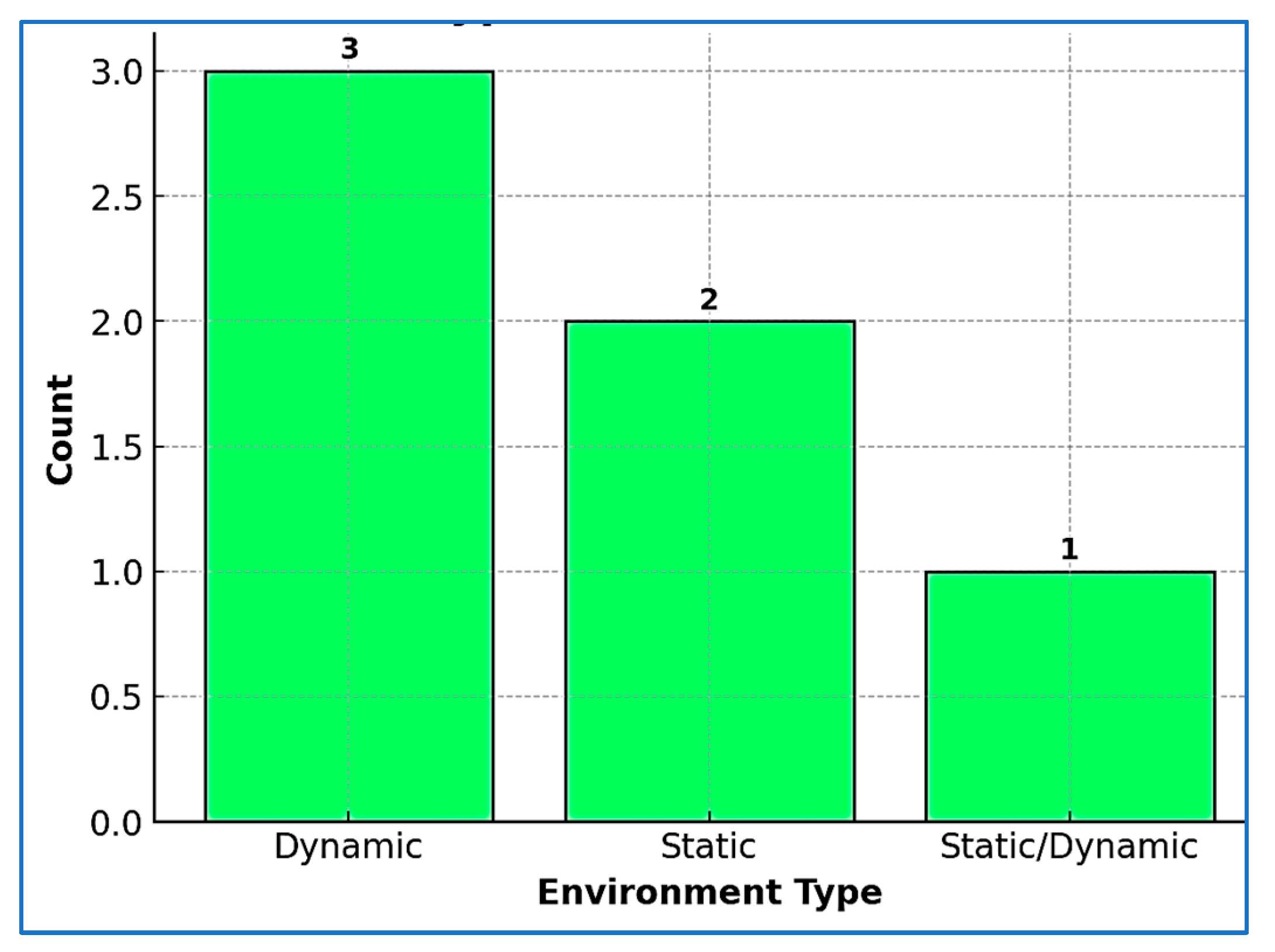
| Environment | Simulation Only | Real-Time Results | Both (Simulation + Real-Time) | Total |
|---|---|---|---|---|
| Static | 2 | 1 | 0 | 3 |
| Dynamic | 2 | 1 | 0 | 3 |
| Total | 4 | 2 | 0 | 6 |
| Period | Dominant Technologies | Emerging Technologies |
|---|---|---|
| 2016–2017 | Cloud computing, basic perception systems | Web-based drone applications, onboard navigation |
| 2018–2020 | Localization systems, vehicle integration | Closed-loop tracking, multi-vehicle coordination |
| 2023–2024 | Advanced control (MPC), SLAM, swarm management | Model predictive control, swarm intelligence algorithms |
| Function | Primary Technologies | Accuracy Metrics | Real-Time Performance |
|---|---|---|---|
| Localization and positioning | Indoor localization, closed-loop tracking, IR markers | Centimeter-level precision, sub-meter accuracy | Medium (limited real-time validation) |
| Perception and navigation | Onboard perception, safe navigation, vision-based methods | Object detection accuracy, collision avoidance reliability | High (proven real-time capability) |
| Advanced control | Model predictive control (MPC), SLAM | Predictive accuracy, mapping precision | High (100% real-time success rate) |
| Multi-robot coordination | UAV swarm management, vehicle integration | Coordination efficiency, task allocation success | Low (simulation-only, no real-time results) |
| Cloud and distributed systems | Cloud-based web applications | Processing latency, data synchronization | Low (no real-time implementation) |
| Ref. No. | Year | Function of Drone | Robot Type | Single/Multiple Drones | Simulation Results | Real-Time Results | Technology /Methodology Used | Environment |
|---|---|---|---|---|---|---|---|---|
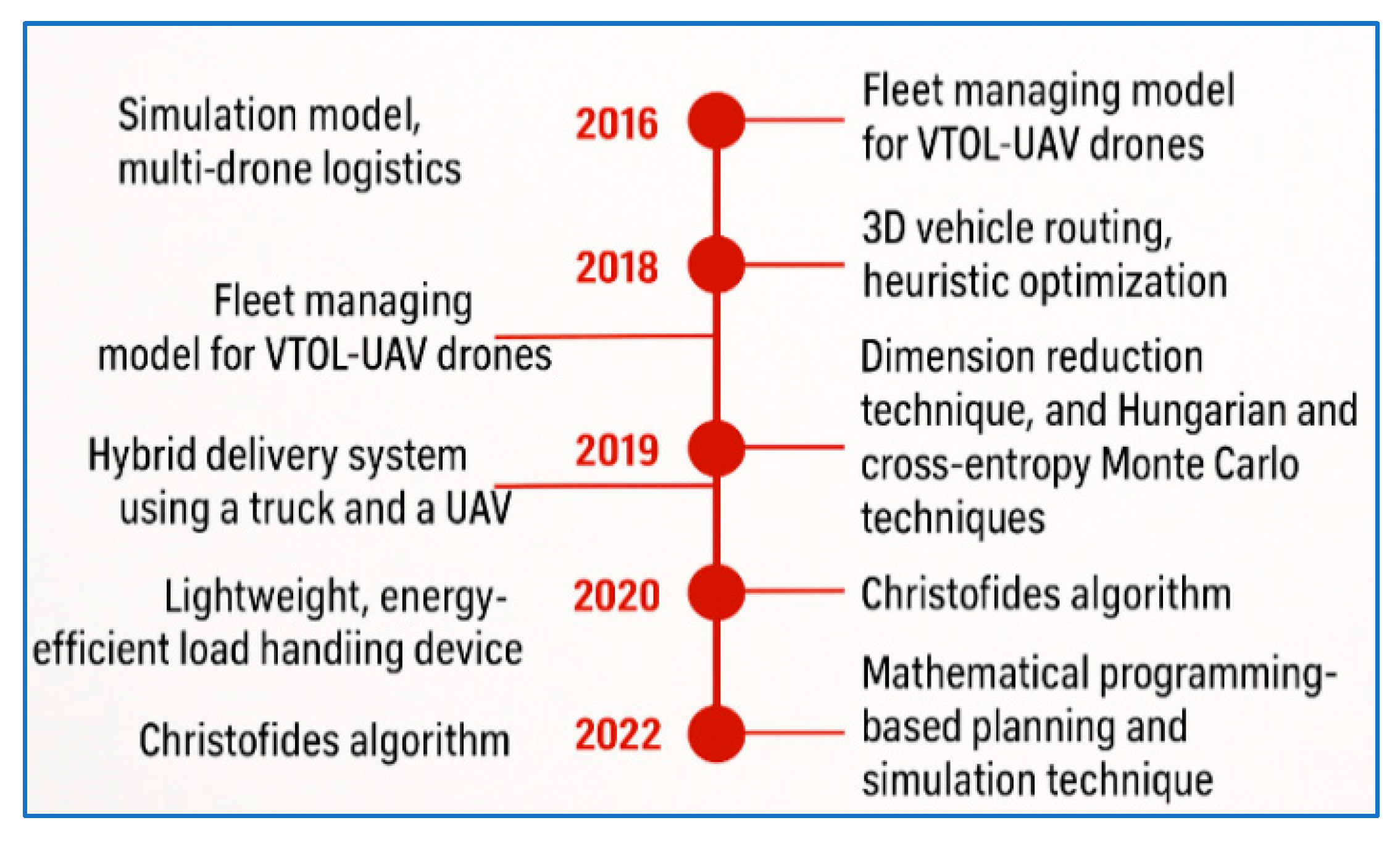
| 78 | 2015 | Picking, packing, and goods transportation | UAV | Multiple | Yes | No | Simulation model, multi-drone logistics | Dynamic |
| 79 | 2016 | Picking, packing, and goods transportation | UAV | Multiple | Yes | No | Fleet management model for VTOL-UAVs | Dynamic |
| 80 | 2018 | Picking, packing, and goods transportation | UAV | Multiple | Yes | No | Hybrid delivery system using truck and UAV | Static |
| 81 | 2018 | Picking, packing, and goods transportation | UAV | Multiple | Yes | No | 3D vehicle routing, heuristic optimization | Static |
| 82 | 2019 | Picking, packing, and goods transportation | UAV | Single | Yes | No | Dimensionality reduction, Hungarian and cross-entropy Monte Carlo methods | Static |
| 83 | 2019 | Picking, packing, and goods transportation | UAV | Single | Yes | No | Autonomous navigation, flight tracking, energy-efficient load handling | Static |
| 84 | 2019 | Picking, packing, and goods transportation | UAV | Single | Yes | Yes | Christofides algorithm | Static |
| 85 | 2019 | Picking, packing, and goods transportation | UAV | Single | Yes | Yes | Mathematical programming, routing, real-time optimization | Static |
| 86 | 2020 | Picking, packing, and goods transportation | UAV | Single | Yes | No | Mathematical programming-based planning and simulation | Static |
| 87 | 2020 | Picking, packing, and goods transportation | UAV | Single | Yes | No | Mixed integer programming and constraint programming | Static |
| 88 | 2022 | Picking, packing, and goods transportation | UAV | Multiple | Yes | No | Mixed integer linear programming (MILP) model | Dynamic |
| 89 | 2022 | Picking, packing, and goods transportation | UAV | Multiple | Yes | No | Ant colony optimization and k-opt-based algorithms | Dynamic |
| Year Range | Static Environment | Dynamic Environment | Total |
|---|---|---|---|
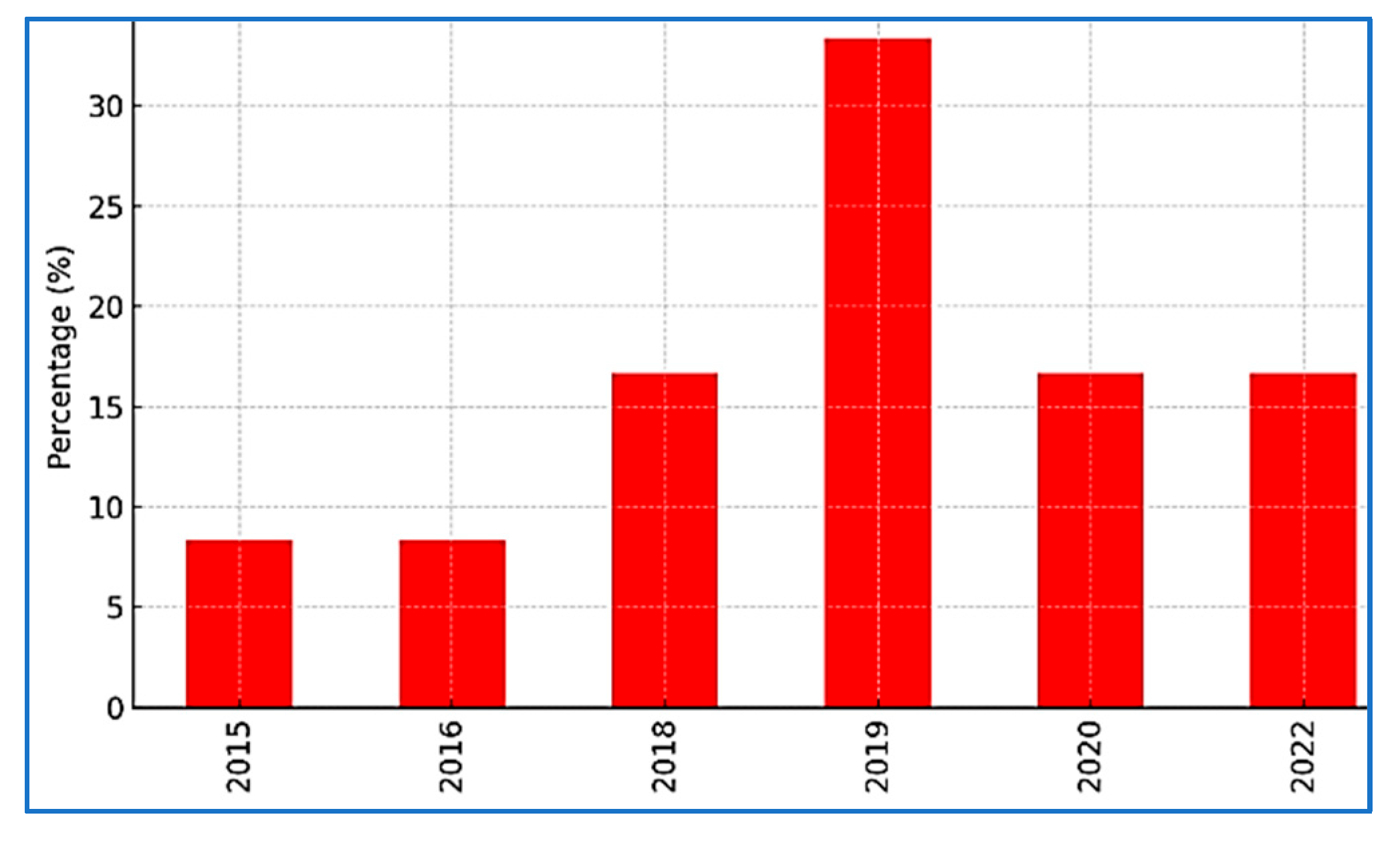
| 2015–2016 | 0 | 2 | 2 |
| 2017–2018 | 2 | 0 | 2 |
| 2019–2020 | 6 | 0 | 6 |
| 2021–2022 | 0 | 2 | 2 |
| Overall Total | 8 | 4 | 12 |
| Robot Type | Static Environment | Dynamic Environment | Total |
|---|---|---|---|
| Single UAV | 6 | 0 | 6 |
| Multiple UAVs | 2 | 4 | 6 |
| Total | 8 | 4 | 12 |
| Technology/Method Used | Static Environment | Dynamic Environment | Total |
|---|---|---|---|
| Simulation-based logistics models | 0 | 1 | 1 |
| Fleet management (VTOL) | 0 | 1 | 1 |
| Hybrid delivery system (truck + UAV) | 1 | 0 | 1 |
| 3D vehicle routing and heuristics | 1 | 0 | 1 |
| Dimension reduction, Hungarian, and CEMC | 1 | 0 | 1 |
| Autonomous navigation with lightweight load system | 1 | 0 | 1 |
| Christofides algorithm | 1 | 0 | 1 |
| Mathematical programming (routing and planning) | 2 | 0 | 2 |
| Mixed integer programming and constraint programming | 1 | 0 | 1 |
| MILP model | 0 | 1 | 1 |
| Ant colony optimization and k-opt | 0 | 1 | 1 |
| Total | 8 | 4 | 12 |
| Environment | Simulation Only | Real-Time Results | Both (Simulation + Real-Time) | Total |
|---|---|---|---|---|
| Static environment | 6 | 0 | 2 | 8 |
| Dynamic environment | 4 | 0 | 0 | 4 |
| Overall total | 10 | 0 | 2 | 12 |
| Period | Dominant Technologies | Emerging Technologies |
|---|---|---|
| 2015–2016 | Simulation-based logistics; VTOL fleet management | Multi-UAV coordination models |
| 2017–2018 | 3D routing; heuristic optimization | Hybrid delivery systems |
| 2019 | Mathematical programming; Christofides algorithm; autonomous navigation | Cross-entropy Monte Carlo; advanced dimensionality reduction |
| 2020 | Mixed integer programming; constraint programming | Real-time routing integration |
| 2021–2022 | MILP models; ant colony optimization (ACO) | k-opt optimization; swarm-oriented MILP |
| Function | Primary Technologies | Accuracy Metrics | Real-Time Performance |
|---|---|---|---|
| Routing and path planning | Heuristic algorithms, Christofides algorithm, MILP, ACO | Route optimality, path length deviation | Limited real-time validation in selected 2019 studies |
| Navigation and tracking | Autonomous navigation systems, onboard perception | Localization accuracy, tracking precision | Partially real-time (reported mainly in 2019) |
| Load handling and delivery | Lightweight UAV load devices, hybrid truck–UAV systems | Load balance, payload efficiency | Mostly simulation-based |
| Fleet and swarm coordination | VTOL fleet models, multi-drone logistics, MILP | Scheduling efficiency, conflict avoidance | No real-time demonstrations |
| Optimization and planning | Integer programming, constraint programming, k-opt | Convergence speed, optimal cost | Simulation-only |
| Ref. No. | Year | Function of Drone | Robot Type | Single/Multiple Drones | Simulation Results | Real-Time Results | Technology/Methodology Used | Environment |
|---|---|---|---|---|---|---|---|---|
| 90 | 2010 | Security and surveillance | Wheeled robot | Single | Yes | No | AI algorithms, image processing, path planning | Static |
| 91 | 2014 | Security and surveillance | UAV | Single | Yes | No | Vision-based navigation, pedestrian detection | Static |
| 92 | 2019 | Security and surveillance | UAV | Single | Yes | No | Sensor fusion, IR markers, localization | Static |
| 93 | 2020 | Security and surveillance | UAV | Single | Yes | Yes | Blockchain platform, Z-score anomaly detection | Static |
| 94 | 2018 | Security and surveillance | UAV | Single | Yes | Yes | Photogrammetry techniques | Dynamic |
| 95 | 2021 | Security and surveillance | UAV | Single | Yes | Yes | Hybrid UAV with integrated rover | Dynamic |
| 96 | 2021 | Security and surveillance | UAV | Single | Yes | Yes | LiDAR sensors and 3D static scanners | Dynamic |
| 97 | 2021 | Security and surveillance | UAV | Single | No | No | Drone-based visual data acquisition and dynamic planning | Dynamic |
| 98 | 2022 | Security and surveillance | UAV | Single | Yes | No | Autonomous drone with human–machine interface | Dynamic |
| 99 | 2022 | Security and surveillance | UAV | Multiple | No | Yes | UAV swarm, motion capture system, ROS, Unity | Dynamic |
| 100 | 2022 | Security and surveillance | UAV | Single | Yes | No | Metric monocular SLAM | Static |
| 101 | 2023 | Security and surveillance | UAV | Multiple | Yes | Yes | UAV-assisted multi-robot system | Dynamic |
| 102 | 2024 | Security and surveillance | UAV | Multiple | Yes | No | Multi-UAV system | Dynamic |
| 103 | 2024 | Security and surveillance | UAV | Single | Yes | Yes | Drone technology and IoT integration | Dynamic |
| 104 | 2024 | Security and surveillance | UAV | Multiple | Yes | No | Multiple autonomous drones | Dynamic |
| 105 | 2024 | Security and surveillance | UAV | Single | Yes | Yes | Raspberry Pi 4B with Intel Neural Compute Stick 2 VPU | Dynamic |
| Year | Static Environment | Dynamic Environment | Total |
|---|---|---|---|
| 2010 | 1 | 0 | 1 |
| 2014 | 1 | 0 | 1 |
| 2018 | 0 | 1 | 1 |
| 2019 | 1 | 0 | 1 |
| 2020 | 1 | 0 | 1 |
| 2021 | 0 | 3 | 3 |
| 2022 | 1 | 2 | 3 |
| 2023 | 0 | 1 | 1 |
| 2024 | 0 | 4 | 4 |
| Total | 5 | 11 | 16 |
| Robot Type | Static Environment | Dynamic Environment | Total |
|---|---|---|---|
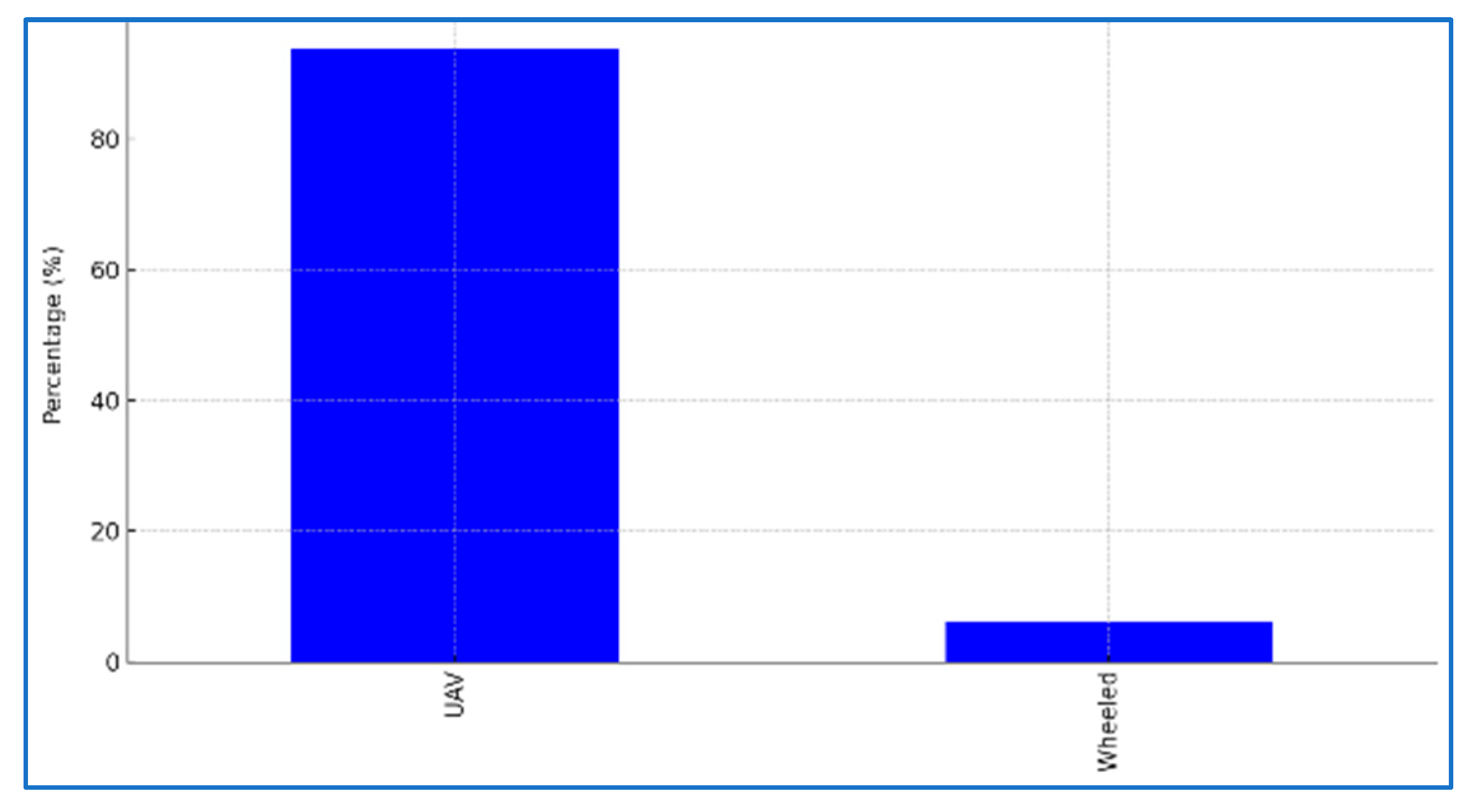
| UAV | 4 | 11 | 15 |
| Wheeled robot | 1 | 0 | 1 |
| Total | 5 | 11 | 16 |
| Technology/Method Used | Static Environment | Dynamic Environment | Total |
|---|---|---|---|
| AI algorithms, image processing, path planning | 1 | 0 | 1 |
| Vision-based navigation, pedestrian detection | 1 | 0 | 1 |
| Sensor fusion, IR markers, localization | 1 | 0 | 1 |
| Blockchain platform, Z-score anomaly detection | 1 | 0 | 1 |
| Photogrammetry techniques | 0 | 1 | 1 |
| Hybrid UAV with integrated rover | 0 | 1 | 1 |
| LiDAR sensors and 3D static scanners | 0 | 1 | 1 |
| Drone-based visual monitoring and dynamic planning | 0 | 1 | 1 |
| Autonomous drone with human–machine interface | 0 | 1 | 1 |
| UAV swarm with motion capture, ROS, and Unity | 0 | 1 | 1 |
| Metric monocular SLAM | 1 | 0 | 1 |
| UAV-assisted multi-robot system | 0 | 1 | 1 |
| Multi-UAV system | 0 | 1 | 1 |
| Drone and IoT integration | 0 | 1 | 1 |
| Raspberry Pi 4B with Intel Neural Compute Stick 2 VPU | 0 | 1 | 1 |
| Total | 5 | 11 | 16 |
| Environment Type | Simulation Only | Real-Time Only | Both (Simulation + Real-Time) | Total |
|---|---|---|---|---|
| Static | 4 | 0 | 1 | 5 |
| Dynamic | 4 | 2 | 5 | 11 |
| Total | 8 | 2 | 6 | 16 |
| Period | Dominant Technologies | Emerging Technologies |
|---|---|---|
| 2010–2014 | AI-based surveillance, vision navigation, IR markers | Early SLAM, lightweight path planning |
| 2015–2019 | Indoor localization, photogrammetry, cloud tools | Blockchain, hybrid UAV–rover systems, LiDAR scanning |
| 2020–2022 | Multi-UAV systems, motion capture with ROS, HMI-based UAVs | IoT-enabled drones, advanced SLAM, Unity-based virtual testing |
| 2023–2024 | UAV-assisted multi-robot systems, dynamic planning | Edge AI (Intel NCS2), swarm intelligence |
| Function | Primary Technologies | Accuracy Metrics | Real-Time Performance |
|---|---|---|---|
| Surveillance and security | Vision processing, AI-based detection, path planning | Object detection accuracy, false alarm rate | Low-latency video streaming and stable tracking |
| Navigation and localization | SLAM, IR markers, LiDAR, sensor fusion | Pose estimation error, drift rate | Real-time mapping and localization |
| Dynamic planning and control | Blockchain validation, Z-score anomaly detection, predictive control | Anomaly detection success rate | High responsiveness under dynamic conditions |
| Multi-robot coordination | Swarm algorithms, ROS with motion capture, Unity simulation | Robot synchronization accuracy | Real-time fleet coordination |
| Human–machine interaction | HMI-based UAV, autonomous control | Response time, user command accuracy | Direct real-time control execution |
| Edge AI processing | Raspberry Pi 4B with Intel NCS2, onboard inference | Inference accuracy, FPS performance | High-speed onboard decision-making |
| Ref. No. | Year | Function of Drone | Robot Type | Single/Multiple Drones | Simulation Results | Real-Time Results | Technology/ Methodology Used | Environment |
|---|---|---|---|---|---|---|---|---|
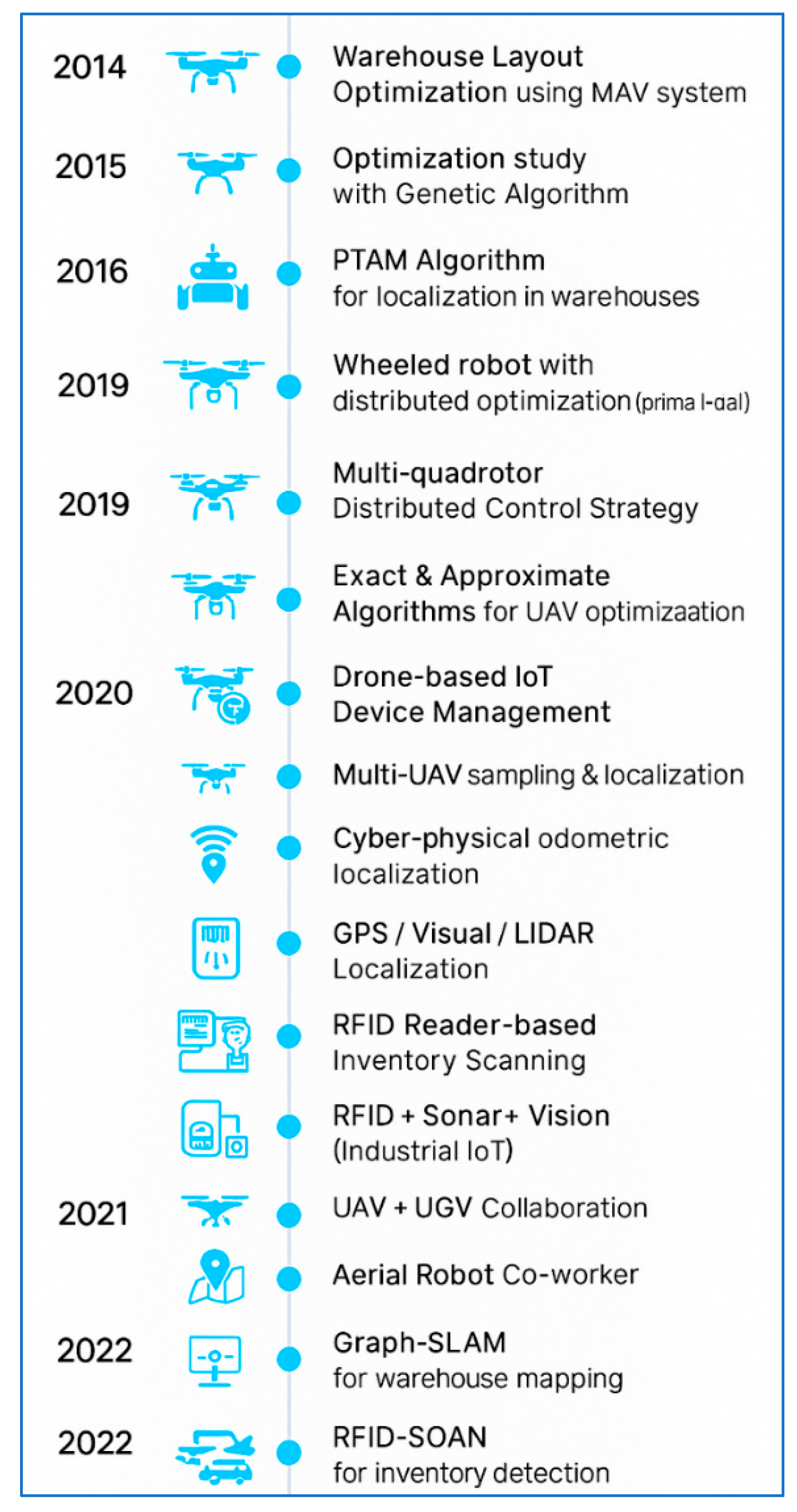
| 106 | 2014 | Warehouse layout optimization | UAV | Multiple | Yes | No | MAV system | Static |
| 107 | 2015 | Warehouse layout optimization | UAV | Single | Yes | No | Genetic algorithm | Static |
| 108 | 2016 | Warehouse layout optimization | UAV | Single | Yes | No | PTAM algorithm | Static |
| 109 | 2018 | Warehouse layout optimization | Wheeled robot | Single | Yes | No | Distributed optimization using primal–dual decomposition | Static |
| 110 | 2019 | Warehouse layout optimization | UAV | Multiple | Yes | No | Distributed control strategy for multi-quadrotor UAVs | Dynamic |
| 111 | 2019 | Warehouse layout optimization | UAV | Single | Yes | No | Exact and approximate algorithms | Dynamic |
| 112 | 2019 | Warehouse layout optimization | UAV | Single | Yes | No | Drone-based IoT device management platform | Static |
| 113 | 2019 | Warehouse layout optimization | UAV | Single | Yes | Yes | Multi-UAV network, sampling, localization | Dynamic |
| 114 | 2019 | Warehouse layout optimization | UAV | Single | Yes | No | Cyber–physical system and odometric approach | Dynamic |
| 115 | 2020 | Warehouse layout optimization | UAV | Single | Yes | Yes | GPS-based and visual/LiDAR-based localization | Dynamic |
| 116 | 2020 | Warehouse layout optimization | UAV | Single | Yes | Yes | RFID reader | Dynamic |
| 117 | 2020 | Warehouse layout optimization | UAV | Single | Yes | No | RFID, sonar sensors, artificial vision, industrial IoT | Static |
| 118 | 2020 | Warehouse layout optimization | UAV + wheeled robot | Multiple | Yes | No | Chebyshev–Gauss collocation method | Dynamic |
| 119 | 2020 | Warehouse layout optimization | UAV | Single | Yes | Yes | Aerial robot co-worker system | Static |
| 120 | 2020 | Warehouse layout optimization | UAV | Single | Yes | Yes | Visual–inertial algorithms and SLAM | Dynamic |
| 121 | 2021 | Warehouse layout optimization | UAV | Single | Yes | No | Graph-SLAM approach | Static |
| 122 | 2022 | Warehouse layout optimization | UAV | Single | Yes | Yes | RFID-SOAN | Static |
| 123 | 2022 | Warehouse layout optimization | UAV | Single | Yes | No | LAIDAVAMS (integrated drone and asset management system) | Static |
| 124 | 2023 | Warehouse layout optimization | UAV | Single | Yes | No | Wi-Fi-based positioning and RFID | Dynamic |
| 125 | 2023 | Warehouse layout optimization | UAV | Single | Yes | Yes | Deep learning with video frame continuity for 3D estimation | Static |
| 126 | 2024 | Warehouse layout optimization | UAV | Multiple | Yes | Yes | LiDAR–inertial odometry and target-based relative localization | Static |
| 127 | 2024 | Warehouse layout optimization | UAV | Single | Yes | No | Particle filter using distance sensors and IMU | Static |
| 128 | 2024 | Warehouse layout optimization | UAV | Single | Yes | No | Smart micro aerial vehicles (MAVs) | Static |
| Year Range | Static Environment | Dynamic Environment | Total |
|---|---|---|---|
| 2014–2015 | 2 | 0 | 2 |
| 2016–2018 | 2 | 0 | 2 |
| 2019–2020 | 3 | 7 | 10 |
| 2021–2022 | 3 | 0 | 3 |
| 2023–2024 | 5 | 1 | 6 |
| Total | 14 | 8 | 23 |
| Robot Type | Static Environment | Dynamic Environment | Total |
|---|---|---|---|
| UAV | 13 | 8 | 21 |
| Wheeled robot | 1 | 0 | 1 |
| UAV + wheeled hybrid | 0 | 1 | 1 |
| Total | 14 | 9 | 23 |
| Technology/Methodology Used | Static Environment | Dynamic Environment | Total |
|---|---|---|---|
| Genetic algorithm | 1 | 0 | 1 |
| PTAM | 1 | 0 | 1 |
| Distributed optimization (primal/dual) | 1 | 0 | 1 |
| IoT device management | 1 | 0 | 1 |
| Aerial co-worker system | 1 | 0 | 1 |
| Graph-SLAM | 1 | 0 | 1 |
| RFID-SOAN | 1 | 0 | 1 |
| LAIDAVAMS | 1 | 0 | 1 |
| Deep learning vision | 1 | 0 | 1 |
| LiDAR–inertial odometry | 1 | 0 | 1 |
| Particle filter with IMU | 1 | 0 | 1 |
| MAV/smart MAV | 1 | 0 | 1 |
| Distributed multi-UAV control | 0 | 1 | 1 |
| Exact and approximation algorithms | 0 | 1 | 1 |
| Multi-UAV network, sampling, localization | 0 | 1 | 1 |
| Cyber–physical system with odometry | 0 | 1 | 1 |
| GPS-based or visual–LiDAR localization | 0 | 1 | 1 |
| RFID reader | 0 | 1 | 1 |
| Chebyshev–Gauss collocation | 0 | 1 | 1 |
| Visual–inertial SLAM | 0 | 1 | 1 |
| Wi-Fi positioning with RFID | 0 | 1 | 1 |
| Total | 14 | 9 | 23 |
| Environment | Simulation Only | Real-Time Results | Both (Simulation + Real-Time) | Total |
|---|---|---|---|---|
| Static | 11 | 3 | 0 | 14 |
| Dynamic | 4 | 5 | 0 | 9 |
| Total | 15 | 8 | 0 | 23 |
| Period/Phase | Dominant Technologies | Emerging Technologies |
|---|---|---|
| 2014–2016 | MAV systems, basic UAV navigation, PTAM | Optimization techniques |
| 2018–2019 | Distributed optimization, IoT platforms | Multi-UAV coordination, network sampling |
| 2020 (peak activity) | RFID with sensors, cyber–physical systems, visual–LiDAR, Graph-SLAM | Chebyshev–Gauss approximation, hybrid UAV–UGV |
| 2021–2022 | RFID-SOAN, SLAM enhancements | Asset management automation (LAIDAVAMS) |
| 2023–2024 | Deep learning for 3D estimation, LiDAR–inertial odometry | Smart MAVs, real-time localization |
| Function | Primary Technologies | Accuracy Metrics | Real-Time Performance |
|---|---|---|---|
| Localization | SLAM, GPS–LiDAR, RFID-SOAN, Wi-Fi + RFID | Centimeter-level precision, multi-sensor fusion accuracy | Good performance under dynamic constraints |
| Path planning and control | Chebyshev–Gauss methods, distributed multi-UAV control, optimization techniques | Smooth trajectory generation, reduced jerk | Real-time feasible |
| Inventory scanning and tracking | Deep learning-based vision, RFID, IoT sensors | Frame continuity and detection accuracy | Moderate to high |
| Mapping and warehouse navigation | PTAM, Graph-SLAM, visual–inertial methods | Map consistency, drift reduction | Strong performance in structured layouts |
| Swarm coordination | Multi-UAV strategies, sampling and localization | Collision avoidance reliability | Requires motion capture or external anchors |
| S. No. | Parameter | Traditional Warehouse Management | Drone-Enabled Warehouse Management |
|---|---|---|---|
| 1 | Data collection | Semi-automated or manual; time-consuming and error-prone | Fully automated, fast, and precise using cameras, RFID, and LiDAR |
| 2 | Inventory tracking | Manual scanning or fixed systems; limited reach and coverage | Dynamic, real-time tracking with access to hard-to-reach areas |
| 3 | Layout optimization | Based on periodic audits, manual measurements, and static analysis | Continuous optimization using 3D maps, digital twins, and workflow analytics |
| 4 | Emergency response | Dependent on human availability; higher risk in hazardous zones | Immediate access to dangerous areas with live visual feedback |
| 5 | Speed of operations | Slow and labor-intensive, especially during audits | Fast and automated, covering large warehouse areas efficiently |
| 6 | Cost | High operational cost due to labor dependency and inefficiencies | Higher initial cost but reduced labor and long-term operational savings |
| 7 | Accuracy | Prone to human error in data recording and audits | High accuracy through automated sensing and data processing |
| 8 | Adaptability | Limited adaptability to dynamic inventory or workflow changes | Highly adaptable with real-time monitoring and rapid response |
| 9 | Safety | Manual operations in hazardous zones increase risk | Safer operations by eliminating human exposure to danger |
| 10 | Scalability | Scaling requires significant labor and infrastructure investment | Easily scalable with minimal infrastructure modification |
| 11 | Promotional and marketing | Limited to ground-level visuals and static imagery | High-quality aerial visuals showcasing innovation and efficiency |
| 12 | Energy efficiency | Relies on energy-intensive equipment, such as forklifts | More energy-efficient for comparable inspection and monitoring tasks |
| 13 | Technology integration | Disparate systems for inventory, inspection, and emergency tasks | Seamless integration with WMS, IoT, and analytics platforms |
| 14 | Maintenance | Manual inspection with downtime for equipment | Automated maintenance checks reduce downtime |
| 15 | Real-time insights | Delayed insights due to manual data processing | Real-time analytics enabling faster decision-making |
Disclaimer/Publisher’s Note: The statements, opinions and data contained in all publications are solely those of the individual author(s) and contributor(s) and not of MDPI and/or the editor(s). MDPI and/or the editor(s) disclaim responsibility for any injury to people or property resulting from any ideas, methods, instructions or products referred to in the content. |
© 2026 by the authors. Licensee MDPI, Basel, Switzerland. This article is an open access article distributed under the terms and conditions of the Creative Commons Attribution (CC BY) license.
Share and Cite
Pore, E.; Patle, B.K.; Thorat, S.; Patel, B. Drone-Enabled Practices in Modern Warehouse Management: A Comprehensive Review. Drones 2026, 10, 189. https://doi.org/10.3390/drones10030189
Pore E, Patle BK, Thorat S, Patel B. Drone-Enabled Practices in Modern Warehouse Management: A Comprehensive Review. Drones. 2026; 10(3):189. https://doi.org/10.3390/drones10030189
Chicago/Turabian StylePore, Eknath, Bhumeshwar K. Patle, Sandeep Thorat, and Brijesh Patel. 2026. "Drone-Enabled Practices in Modern Warehouse Management: A Comprehensive Review" Drones 10, no. 3: 189. https://doi.org/10.3390/drones10030189
APA StylePore, E., Patle, B. K., Thorat, S., & Patel, B. (2026). Drone-Enabled Practices in Modern Warehouse Management: A Comprehensive Review. Drones, 10(3), 189. https://doi.org/10.3390/drones10030189