1. Introduction
Generative artificial intelligence enables the rapid production and circulation of images that depict everyday life, professional roles, and social situations with high perceptual plausibility Text-to-image systems generate visual forms consistent with textual prompts, producing representations that acquire truth value through their perceptual plausibility. This condition, defined by Eco [
1] as hyporealism, marks a shift from correspondence with reality to the credibility of the plausible: what appears true tends to be accepted as such, regardless of its referential grounding. In this context, reference itself becomes a surface effect, produced by the interaction between cultural familiarity and statistical coherence. Synthetic images operate through mechanisms of recognition that conceal their biases, since resemblance to pre-existing visual models legitimises as “natural” what is in fact the result of probabilistic and cultural selection. As Manovich observes [
2], in computational media, style becomes data: the visual is organised as an archive of learned patterns that reproduce, rather than transcend, dominant symbolic structures.
This scenario raises fundamental questions about the educational and cognitive roles of generative images. Understanding their logic requires recognising their biases and, above all, developing tools for critical verification capable of restoring transparency to synthetic representation processes. This paper explores these issues through an analysis of prompting as a dialogic and reflective practice, aimed at revealing the implicit rules that govern the production of the plausible. Drawing on several case studies that highlight the biases emerging from the prevailing data culture in which AI systems are trained, it presents NEGOTIA, a seven-step process designed to foster critical and conscious visual literacy, useful for decoding the mechanisms that construct plausibility and for restoring to vision its epistemic function.
2. Material and Methods
This study conducts a qualitative and empirical investigation into the epistemic implications of generating synthetic images from textual input. The aim is to analyse how synthetic images produce an effect of hyporealism, based on stylistic consistency that replaces reference with plausibility, concealing the algorithmic nature of the generative process. The methodological approach is based on two case studies, each designed to explore the interaction between prompting practices and the outputs produced by a text-to-image model (ChatGPT-4, OpenAI, San Francisco, CA, USA), used as the sole generator in order to ensure methodological consistency. The systematic comparison of the cases allowed the development of the operational model of Visual AI Literacy NEGOTIA, which emerged inductively from the analysis rather than being predefined. The method is based on an iterative and dialogic process with the system, aimed at identifying emerging patterns, recurring visual biases, and the role of semantic proximity in shaping the generated images. At the core of this approach lies the idea that prompting constitutes an epistemic and cognitive act: the human agent does not simply issue commands but engages in a recursive dialogue to deconstruct the system’s responses, verify its assumptions, and progressively refine its outputs. Interactive prompting thus becomes a heuristic tool that allows us to investigate the operational logic of the generative model and highlight the statistical weight of training data in image production. This process helps to expand the limits of the system’s representational capacity, reducing visual standardisation and highlighting areas of latent bias. From this perspective, prompting takes the form of a situated investigation, in which human interpretation and automatic modelling participate in a reciprocal process of adjustment and discovery.
2.1. Task Design and Experimental Setup
For the experimental phase, two tasks were identified and assigned to the ChatGPT-4 model, each designed to explore a different domain of visual generation.
Realistic public communication–“Work.” This task focused on producing a realistic image intended for public or informational contexts, such as journalistic or institutional communication. The aim was to observe how the model visualised an ordinary work situation, and how it operationalised “social realism” through the representation of roles, postures, objects, and workplace settings
Artistic inquiry–“Memory in the Post-Covid Context.” This task aimed to generate an expressive image exploring the rhetorics of memory while deliberately avoiding sentimental or nostalgic overtones. The prompt was explicitly structured around three dimensions: the theme (memory), the situational context (post-COVID), and specific aesthetic objectives related to visual composition and tone.
Both tasks were developed through an iterative and dialogic prompting process, which made it possible to observe how linguistic and semantic variations influenced the visual configuration of the outputs. The resulting images were analysed through visual semiotics and bias-audit methods, with particular attention to the fair representation of gender, ethnicity, and role. The bias-audit was conducted using a shared coding grid covering gender presentation, ethnicity cues, role seniority, posture/agency, and workplace or symbolic setting.
2.2. Evaluation Criteria and Ethical Considerations
The selection of final images was guided by qualitative criteria adapted to the nature of each case. Criteria and coding were applied consistently across cases to enable systematic comparison despite the exploratory design. For “Work”, evaluation focused on the correspondence between the generated image and the intended communicative goal, privileging representations that conveyed realism without reinforcing stereotypes. For “Memory”, assessment emphasised the expressive coherence of the image, its originality, and its ability to address the theme without sentimental excess. Ethical precautions were observed throughout the process. All materials were synthetically generated, and no real data or identifiable individuals were involved. Images were reviewed collaboratively to ensure transparency, minimise bias, and maintain consistency with the educational and analytical purposes of the study. Rather than testing a predefined hypothesis, the study followed an exploratory design aimed at identifying how prompting practices shape the emergence of visual plausibility and reveal latent biases within generative models.
For the AI Literacy framework, we analysed the overlaps and distinctive features in relation to three widely recognized international frameworks:
AILit Framework [
3],
DEC Framework [
4], and
Explicating AI Literacy for Employees and Digital Workspaces [
5].
3. Results
3.1. Task 1, Work: Situated Image Analysis and Generative Hyporealism
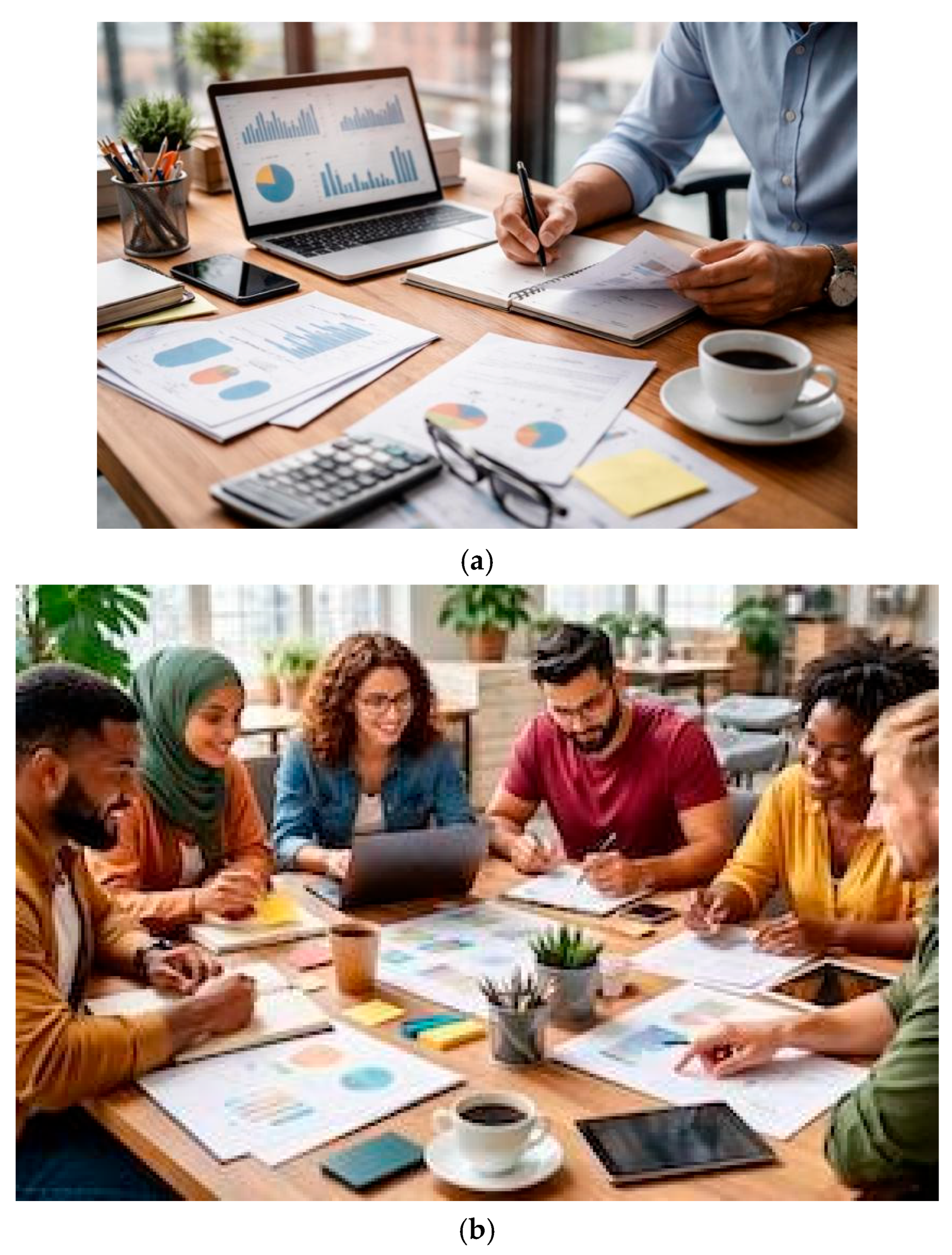
The two images show how prompt design activates different visual archives and biases (
Figure 1a,b). A seemingly neutral prompt yields a narrow, masculine, Western template of office-based knowledge work, whereas a dialogic, user-guided refinement foregrounds multicultural, multigenerational, and ambidextrous collaboration, producing a more inclusive frame of “work”. Yet both remain within a hyporealistic aesthetic: what looks realistic is a stylised, culturally normalised simulation. This reflects
epistemia—an illusion of knowledge in which plausibility replaces verification [
6]. Visually, “work” is performed through dominant repertoires rather than anchored in lived experience: coherent and credible-looking, but epistemically thin.
3.2. Task 2 Artistic Inquiry
In Task 2 (“Memory in the post-Covid context”), the prompt asked for an artistic artifact conveying values (absence, loss, resilience, and the duty not to erase) rather than realistic depiction.
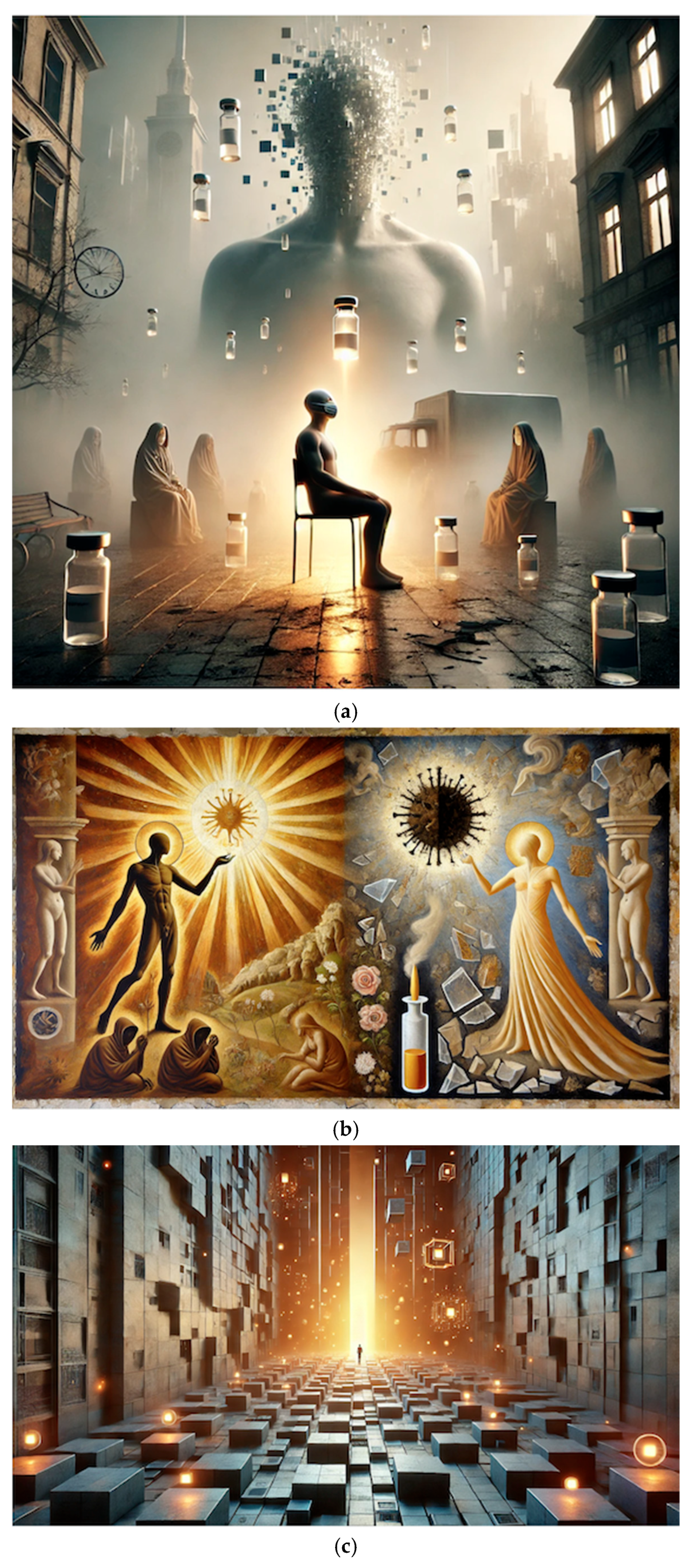
Figure 2a shows the model’s initial convergence on globally shared pandemic iconography, fog, emptied streets, a monumental masked face, and a suspended vial as an affective “anchor”, using a cold palette punctuated by amber light to signal meaning.
As iterations progressed, the model drifted toward a sacralised visual grammar (
Figure 2b), introducing halos, altar-like symmetry, and an explicit light–shadow moral split despite the non-religious framing of the task. This recurrent drift suggests that open-ended requests for “collective memory” are often resolved through high-recognition cultural templates that compress ambiguity into familiar forms. Through tighter constraints, the trajectory finally shifts toward a secular memorial idiom (
Figure 2c): memory is rendered as an architectural field of repeated blocks and a central corridor leading to a luminous threshold, with a small human figure positioned as a witness rather than a devotee. The composition evokes commemorative spatial logics, memory as traversal, weight, and repetition, while also displaying a “digital sublime” aesthetic (floating geometric fragments and calibrated glow), consistent with the model’s tendency to stabilise abstraction through learned stylistic bundles. Across the sequence, plausibility remains high, but the epistemic function of the image changes: from iconographic shorthand, to moral–sacral framing, to a more processual, experience-oriented representation of remembering.
Overall, the sequence indicates that “artistic freedom” in text-to-image generation is bounded by learned cultural priors: abstract prompts are systematically resolved through recognizable iconographies that maximize plausibility. The dialogic iterations functioned as a diagnostic tool, making visible where negations and constraints were necessary to prevent semantic drift (e.g., toward sacralised compositions) and to steer the output toward a secular, processual representation of remembering. These observations motivate NEGOTIA as a practical framework to surface default visual bundles, audit emergent biases, and support verification-oriented visual literacy.
4. Discussion
Across both case studies, the same pedagogical lesson emerges: generative images tend to look “true” because they are recognizable, not because they are evidential. This is hyporealism as a structural tendency: plausibility is produced through culturally familiar visual templates. In Manovich’s terms [
2], style becomes data, and the model recombines statistically rewarded tropes; thus,
Work defaults to a standardised office syntax, and
Memory drifts toward chiaroscuro, sacralised or memorial iconographies. For this reason, the key competence is not “better taste” but better guidance. When prompts are open, the system fills gaps with its learned repertoire; when prompting becomes dialogic, it turns into a learning practice: naming defaults, adding constraints, testing alternatives, and making assumptions visible. This shifts the image from a passive illustration to an object of inquiry and verification. NEGOTIA is designed to teach exactly this posture: a step-by-step method to surface visual defaults, negotiate them intentionally, and build bias-aware, verification-oriented visual literacy.
4.1. The NEGOTIA Framework
From this practice emerged NEGOTIA, not as a pre-defined method but as a heuristic pathway for critically engaging with generative visual systems. NEGOTIA consolidates the iterative strategies into a seven-step framework for Visual AI Literacy that foregrounds co-construction, accountability, and semantic alignment:
N—Necessity and Narrative: Define the epistemic purpose of the image and the communicative frame.
E—Explicitate: Anticipate where stereotypes and stylistic clichés are likely to surface.
G—Generate: Craft modular prompts with both affirmative and negative constraints.
Observe: Analyse outputs with semiotic and aesthetic lenses; triangulate with the model’s metaprompt.
T—Tuning: Iteratively refine the image through lexical, compositional, or stylistic adjustments.
Insight: Make the image’s epistemic status explicit; document what was learned and why it matters.
Archive: Store outputs, prompts, and rationales with traceability and transparency in mind.
4.2. Links and Distinctive Features of the NEGOTIA Framework
NEGOTIA operationalises competencies from major international models (DEC, AILit) by translating general principles into specific visual actions. It transforms ‘Critical Thinking’ and ‘Ethics’ into practical stages like Observe and Explicitate to dismantle visual normalization. By defining prompting as ‘symbolic co-creation,’ the framework preserves human agency, shifting human–machine interaction from a technical command to a negotiational act centered on augmented intelligence.
NEGOTIA stands out for being an approach deeply rooted in semiotics and aesthetics, elements often overlooked by more operational or managerial frameworks:
Algorithmic Hyporealism: Unlike DEC or AILit, which focus on technical accuracy, NEGOTIA introduces concepts drawn from Umberto Eco to expose hyporealism: a regime in which stylistic familiarity masks the falsity of content.
Prompting as Performance: While AILit frames prompting as “clear and structured instructions”, NEGOTIA approaches it as a performative, dialogic act. It is not merely “engineering”, but an epistemic practice for revealing the model’s “invisible grammar.”
Style-as-Data [
2]
: NEGOTIA incorporates Manovich’s view that aesthetics today function as statistical sampling from data. This sets it apart from general frameworks by focusing on how visual styles (lighting, framing, palettes) become
“normative tropes” learned from datasets.
4.3. Suitability for Visual Education
NEGOTIA appears particularly well suited to Visual Education for several structural reasons:
Learning by Doing/Making: Visual Education is grounded in learning through active creation. NEGOTIA shifts the user from a passive consumer to a prompt designer and producer of meaning.
The Image as a Form of Thought: in line with Visual Education, where the visual is understood as a complex communicative practice, NEGOTIA treats the synthetic image as an epistemic field (a site of inquiry), not a merely decorative illustration.
Developing Agency: Visual Education aims to cultivate students’ personal and cultural agency. NEGOTIA supports this by requiring users to “negotiate” with the machine, resisting its statistical inertia to express an original voice.
Multimodal Literacy: because generative AI requires “writing” in order to “see,” NEGOTIA responds to the challenge of multimodality [
7], where textual competence becomes the key to both creating and decoding visual meaning.
5. Conclusions
This research shows that AI-generated images operate within a regime of algorithmic hyporealism, where perceptual plausibility and statistical coherence replace the function of referential verification. From an inductive analysis of the case studies emerged the NEGOTIA framework: a heuristic and operational pathway that transforms prompting from a mere technical command into an epistemic and cognitive act. The methodological evidence demonstrates that a dialogic and recursive interaction with the system makes it possible to deconstruct implicit biases and to release the “cramp of iconism,” that is, the tendency to accept as natural what is in fact the result of probabilistic selection.
Within this process, Visual Education finds its full realization: the framework enables a shift from the user as a passive consumer to a designer of meanings through a practice of learning by doing. NEGOTIA responds to the need for teaching approaches that treat the synthetic image not as a purely decorative illustration, but as a complex form of thought and a site of active inquiry. Ultimately, the negotiational and performative practice outlined here fosters personal and cultural agency, providing the critical tools needed to resist the statistical inertia of models and to restore transparency and responsibility to visual representation in the generative era.
Author Contributions
Conceptualization, G.D. and F.R.M.; methodology, G.D.; investigation, G.D.; image generation and prompting, G.D.; writing—original draft preparation, G.D.; writing—review and editing, G.D. and F.R.M.; formal analysis, G.D. and F.R.M.; visualization, G.D.; framework development, F.R.M. All authors have read and agreed to the published version of the manuscript.
Funding
This research received no external funding.
Institutional Review Board Statement
Not applicable.
Informed Consent Statement
Not applicable.
Data Availability Statement
Data are available in this manuscript.
Conflicts of Interest
The authors declare no conflict of interest.
References
- Eco, U. Sugli Specchi e Altri Saggi; Bompiani: Milan, Italy, 1985. [Google Scholar]
- Manovich, L. Cultural Analytics; MIT Press: Cambridge, MA, USA, 2020. [Google Scholar]
- AILit Framework: OECD. Empowering Learners for the Age of AI: An AI literacy Framework for Primary and Secondary Education (Review Draft). Joint Initiative of the European Commission and the OECD. 2025. Available online: https://ailiteracyframework.org/wp-content/uploads/2025/05/AILitFramework_ReviewDraft.pdf (accessed on 10 December 2025).
- DEC Framework: Digital Education Council. DEC AI Literacy Framework. 2025. Available online: https://moodle.net/.pkg/@moodlenet/ed-resource/dl/ed-resource/lei05IDJ/771_DEC_AI_Literacy_Framework.pdf (accessed on 10 December 2025).
- Cetindamar, D.; Kitto, K.; Wu, M.; Zhang, Y.; Abedin, B.; Knight, S. Explicating AI Literacy of Employees at Digital Workplaces. IEEE Trans. Eng. Manag. 2021, 71, 810–823. [Google Scholar] [CrossRef]
- Loru, E.; Nudo, J.; Di Marco, N.; Santirocchi, A.; Atzeni, R.; Cinelli, M.; Cestari, V.; Rossi-Arnaud, C.; Quattrociocchi, W. The Simulation of Judgment in LLMs. Proc. Natl. Acad. Sci. USA 2025, 122, e2518443122. [Google Scholar] [CrossRef] [PubMed]
- Panciroli, C.; Rivoltella, P.C. Didattica delle New Literacies; Mondadori Education: Milano, Italy, 2025. [Google Scholar]
| Disclaimer/Publisher’s Note: The statements, opinions and data contained in all publications are solely those of the individual author(s) and contributor(s) and not of MDPI and/or the editor(s). MDPI and/or the editor(s) disclaim responsibility for any injury to people or property resulting from any ideas, methods, instructions or products referred to in the content. |