
Proceeding Paper

The Prompt as a Philosophical Educational Tool: Generating an Image Through AI †
Independent Researcher, 70120 Bari, Italy
Presented at the Learning and Teaching Strategies Mediated by Visual Education: Horizons of Research and Action (ASTERA 2025), Bari, Italy, 2 October 2025.
Proceedings 2026, 139(1), 13; https://doi.org/10.3390/proceedings2026139013
Published: 5 May 2026

Abstract

This article aims to highlight the close connection between prompt engineering and philosophy, with particular attention to how AI can be used in educational and teaching contexts. The study of philosophy, traditionally oriented toward the analysis of language, logic, and critical thinking, makes it possible to produce and refine prompts that are more precise and effective in the creation and modification of images through major chatbots and large language models (LLMs – ChatPGT-5, Gemini 2.5). By bringing into the school educational context the theories proposed and supported by the scientific literature on the didactics of philosophy and AI education, this contribution will exemplify a phenomenological analysis of the image as developed by Sartre. It will show how refining the description of an image, typical of the phenomenological method, can lead to a more accurate and appropriate prompt, which is useful for generating increasingly sophisticated images. This approach can guide students toward formulating more effective image-oriented prompts.

1. Introduction

It is becoming increasingly common to look at an image and wonder whether it is real or generated by artificial intelligence, but what does this question actually imply? What do we mean when we talk about an image generated by AI?
An AI-generated image, commonly produced by chatbots such as ChatGPT-5, Gemini 2.5, is typically the result of entering a textual prompt that provides instructions for creating the image. As many of us know, these instructions are often not precise enough for the generated image to match the one we had in mind. Therefore, we refine the prompt, adding new details or directions, allowing the chatbot to generate a new version, and so on, until we reach a satisfactory compromise where the created image aligns with our original intent.
But what do these iterative steps signify? And how can this process of questioning and analysis offer educational tools?
The discussion here will focus primarily on the need for AI literacy, a user’s understanding of AI and its mechanisms, alongside an examination of the literature on prompt engineering and its philosophical relationship to the concept of the image [1]. Philosophy, in this sense, is not merely a bridge between disciplines or a theoretical framework for understanding definitions; rather, it is, by its very nature, a privileged instrument for learning and improving one’s ability to use prompts effectively, both for dialogue and for image generation.
It is therefore essential to consult the relevant literature in order to understand what we are actually doing when we set out to create an image.

2. AI Literacy

It is essential to begin with a basic literacy concerning what artificial intelligence is and how this tool functions, a tool that, even today, is often approached with fear or mistrust. Research on the topic is already extensive, yet in order to proceed effectively [2], it is necessary to define, albeit not exhaustively, the key areas that constitute AI literacy [3]. Among the many fundamental domains that determine what AI literacy entails, one aspect stands out as particularly significant in this context: evaluating and creating through AI.
Of course, evaluation and creation are not the only aspects that should be addressed, starting from ethical considerations for the use of AI in various specific contexts, through to the practical skills required to interact with chatbots (such as accessing a particular website or app, entering a prompt in the appropriate field, and so forth).
Why is such a definition of AI literacy necessary? Because, as can be observed, the general areas of reference open numerous pathways for further exploration. Indeed, to achieve meaningful AI literacy, it is not enough to simply know which chatbots are most widely used or how to type a query into a given website. Rather, it is crucial to understand, at least in broad terms, how a large language model (LLM) operates, why we receive certain answers phrased in specific ways, and the fact that chatbots do not actually “think”; instead, they sometimes lack access to the web or may not use it when responding, and some other times they can provide inaccurate answers due to incomplete or biased sources, even when those sources are commonly relied upon. The potential issues are numerous.
Another key aspect is the ability to use different generative tools depending on one’s needs. For instance, Gemini has recently introduced AI Overview, a feature that extracts answers directly from websites, a development that arose because AI systems like ChatGPT had begun functioning as faster and more precise search engines. Consequently, for research purposes, Gemini may be more effective than ChatGPT, while both tend to be more efficient than tools such as Midjourney V7 or DALL-E3.
The ability to evaluate and create through AI is perhaps the most intriguing point in this discussion. For proper AI literacy, the content creation aspect is crucial, particularly within educational contexts. Data show that the use of AI in schools has now become commonplace [4].
Content creation through AI is, in fact, one of the most widespread learning and support tools available to students. However, within the educational system, there is still no structured guidance or support that can provide students with even a minimal level of literacy regarding these tools, which they already use daily and will continue to rely on more and more in the future.
Finally, an equally fundamental aspect concerns ethics, specifically, what we can do with AI, and what, for ethical reasons, we may choose not to do or should refrain from doing. One example is the creation of simulations, generated using user-provided content, that reproduce deceased individuals with whom users can “interact”, obtaining responses in their style and constructing unreal dialogues motivated, perhaps, by the desire to speak once more with someone who is no longer here. Such deeply complex themes must be approached ethically, with an understanding of the issues and implications they entail.

3. Prompt Engineering

It immediately becomes evident that the centrality of these aspects of literacy is primarily focused on two key dimensions. The first concerns knowledge of the tools themselves, how AI systems function, how they formulate responses, and how they analyze the data on which they operate (as well as the quality and type of data they access; here, an important discussion could be opened regarding copyright and AI’s access to data, although this is not the place to address that topic in detail). The second crucial aspect is undoubtedly the prompt provided by the user. What, in fact, is the difference between the prompt we have always used, for instance, when searching for something on Google, and what we can now ask a chatbot? As Lee and Palmer write:
“Each instruction must be ‘initiated with a clear and precise directive’ and maintain alignment with the learning objectives and educational goals. It is also important the user understands the AI tool’s capabilities and limitations, and the types of queries which elicit the best performance from each tool. This knowledge will help users engineer prompts that maximally align with the tool’s performance.” [5]
In recent months, the need for a philosophical approach to AI literacy has become increasingly evident, particularly concerning content creation, which crucially depends on the correct formulation of a prompt, cross-disciplinary skills related to formulation, and soft skills in general [6]. Such formulation requires study in areas related to language, logic, and the art of constructing meaningful questions. Philosophy naturally emerges in this context because of its focus on language, the logic of language, the word, and the capacity to communicate concepts effectively.
But how, then, can philosophy be used within school education to construct an effective prompt for image creation?

4. The Image

Here, a practical example is useful in understanding how the teaching of philosophy can help students grasp the strategies necessary for image generation, whether the image is photographic, artistic, imaginative, or based on real-world elements (for instance, a reinterpretation of an existing image or a photograph).

Sartre, Phenomenology and the Image

Explaining what phenomenology is can sometimes be a challenging task for high school seniors, as it often appears abstract and difficult to apply to everyday experience. However, when phenomenology emerged in the early 1900s, it represented a concrete way of engaging with the world. Many of its characteristic methods later became foundational tools within psychology, literature, art criticism, and, of course, philosophy itself. One of the many examples that can be used is Sartre’s discussion of the image:
“Voglio ricordarmi il viso del mio amico Pierre. Faccio uno sforzo e produco una certa coscienza d’immagine di Pierre. L’oggetto è colto in modo molto imperfetto: mancano certi particolari, altri sono incerti, l’insieme è abbastanza sfumato. Volevo rievocare di fronte a quel viso una certa sensazione di simpatia e di piacere, ma non ci sono riuscito. Non rinuncio al mio proposito, mi alzo e tiro fuori da un cassetto una fotografia. È un ottimo ritratto di Pierre, in cui ritrovo tutte le particolarità del suo viso, perfino alcune che mi erano sfuggite. Ma la fotografia manca di vita: riproduce alla perfezione le caratteristiche esteriori del viso di Pierre, ma non l’espressione. Per fortuna possiedo una sua caricatura fatta da un abile disegnatore. Questa volta il rapporto fra le parti del viso è deliberatamente alterato, il naso è troppo lungo, gli zigomi troppo sporgenti ecc. Comunque, qualcosa che mancava alla fotografia, la vita, l’espressione, si manifestano chiaramente in questo disegno: “ritrovo” Pierre.” [7]
Which translates to:
“I want to remember the face of my friend Pierre. I make an effort and produce a certain image-consciousness of Pierre. The object is grasped very imperfectly: certain details are missing, others are uncertain, the whole is rather blurred. I wanted to revive, in the presence of that face, a certain feeling of sympathy and pleasure, but I did not succeed. I do not give up my intention; I get up and take a photograph out of a drawer. It is an excellent portrait of Pierre, in which I find again all the details of his face, even some that had escaped me. But the photograph lacks life: it reproduces perfectly the external features of Pierre’s face, but not the expression. Fortunately, I possess a caricature of him made by a skillful draftsman. This time the relation between the parts of the face is deliberately altered, the nose is too long, the cheekbones too prominent, etc. However, something that was missing from the photograph—life, expression—appears clearly in this drawing: I ‘find’ Pierre again.”
Sartre’s phenomenological description responds perfectly to our need to understand the phenomenological method. In this case, we can use his reflections as if Sartre himself were engaging in a dialogue with AI. It is Sartre who seeks to represent Pierre: he begins with vague mental descriptions, attempting to evoke a specific image, the face of Pierre, a face capable of expressing the same warmth and emotion that Pierre conveys when he is with Sartre.
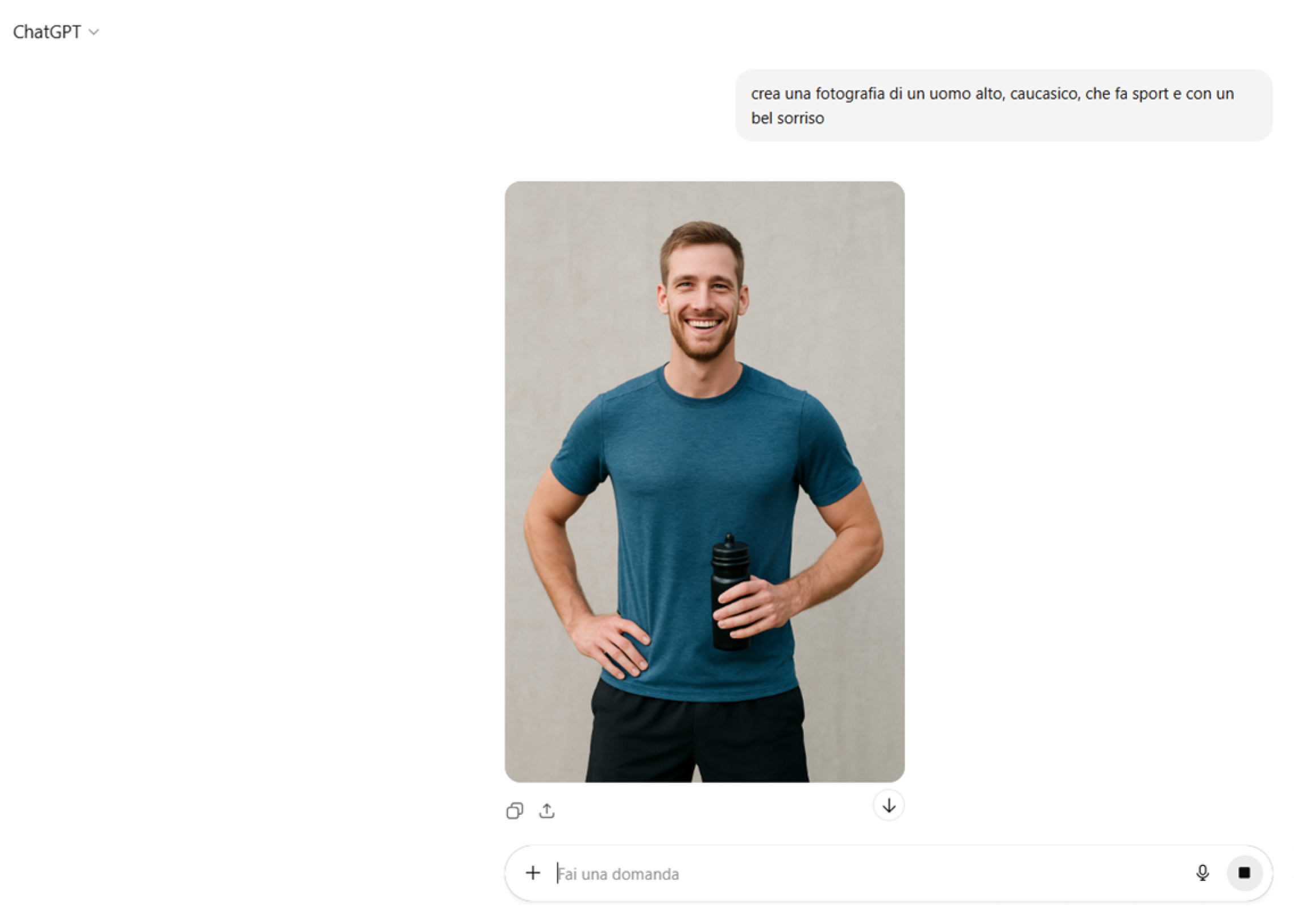
We could imagine, then, a prompt such as (Figure 1): crea una fotografia di un uomo alto, caucasico, che fa sport e con un bel sorriso, proprio come fa Sartre inizialmente.
The result, however, is not relevant. One might say that the prompt needs to be refined. It therefore becomes necessary to describe Pierre more precisely, to arrive at a more accurate formulation of the description. Sartre identifies particular features of his face, perhaps certain postures, but not what he had initially set out to find.
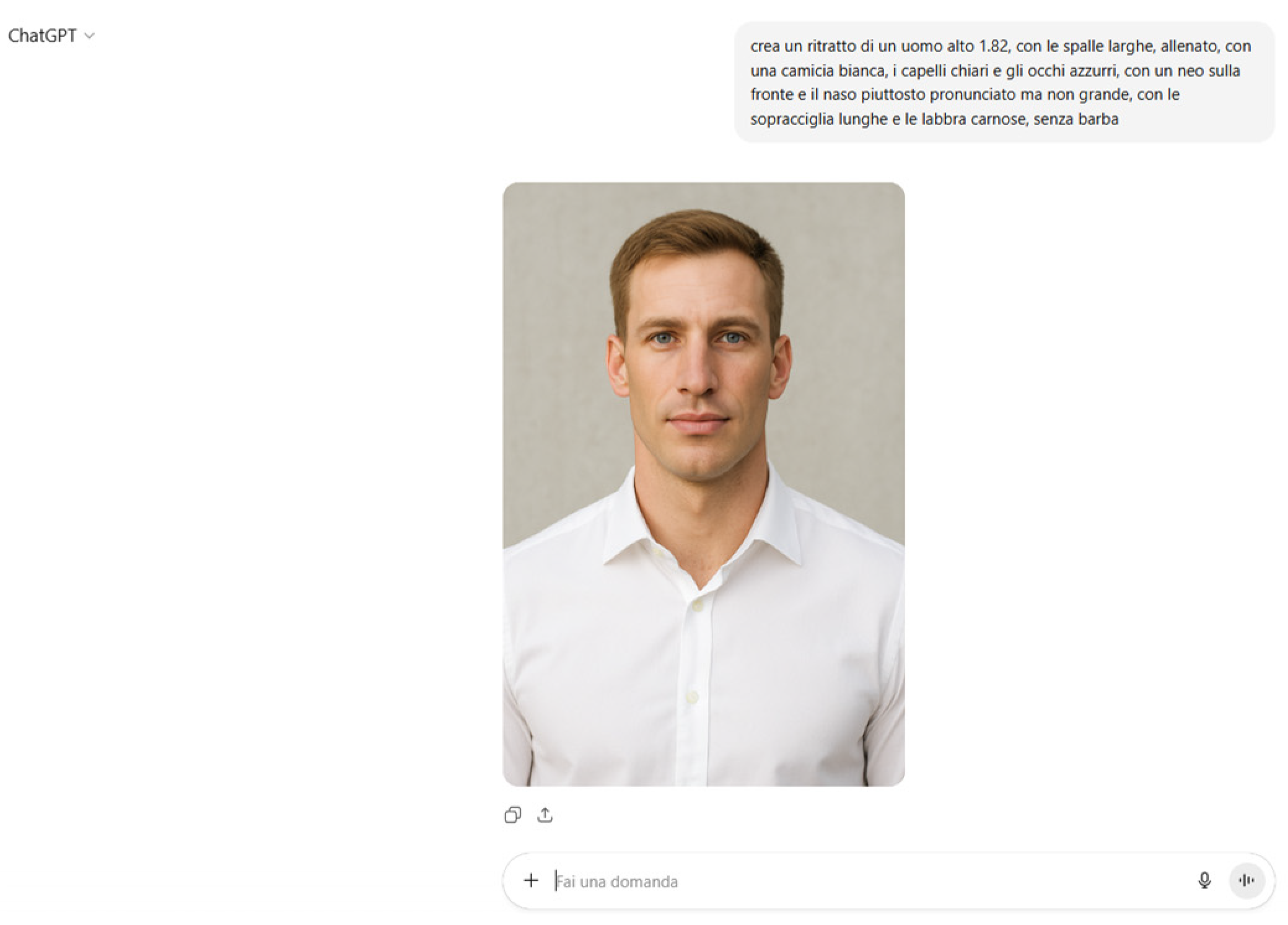
In this sense, we can describe accurately what we want; for example, we could say to ChatGPT-5 (Figure 2): create a portrait of a man who is 1.82 meters tall, with broad shoulders, athletic, wearing a white shirt, with light-colored hair and blue eyes, a mole on his forehead, and a rather prominent but not large nose, with long eyebrows and full lips, clean-shaven, and so on.
This prompt could yield a good result, producing an image of a man with those characteristics (Figure 2). Yet, the initial premise, the idea of what we wanted to create, of what Sartre aspired to, was his friend Pierre, whose face evokes the feeling of friendliness and joy when seen again.
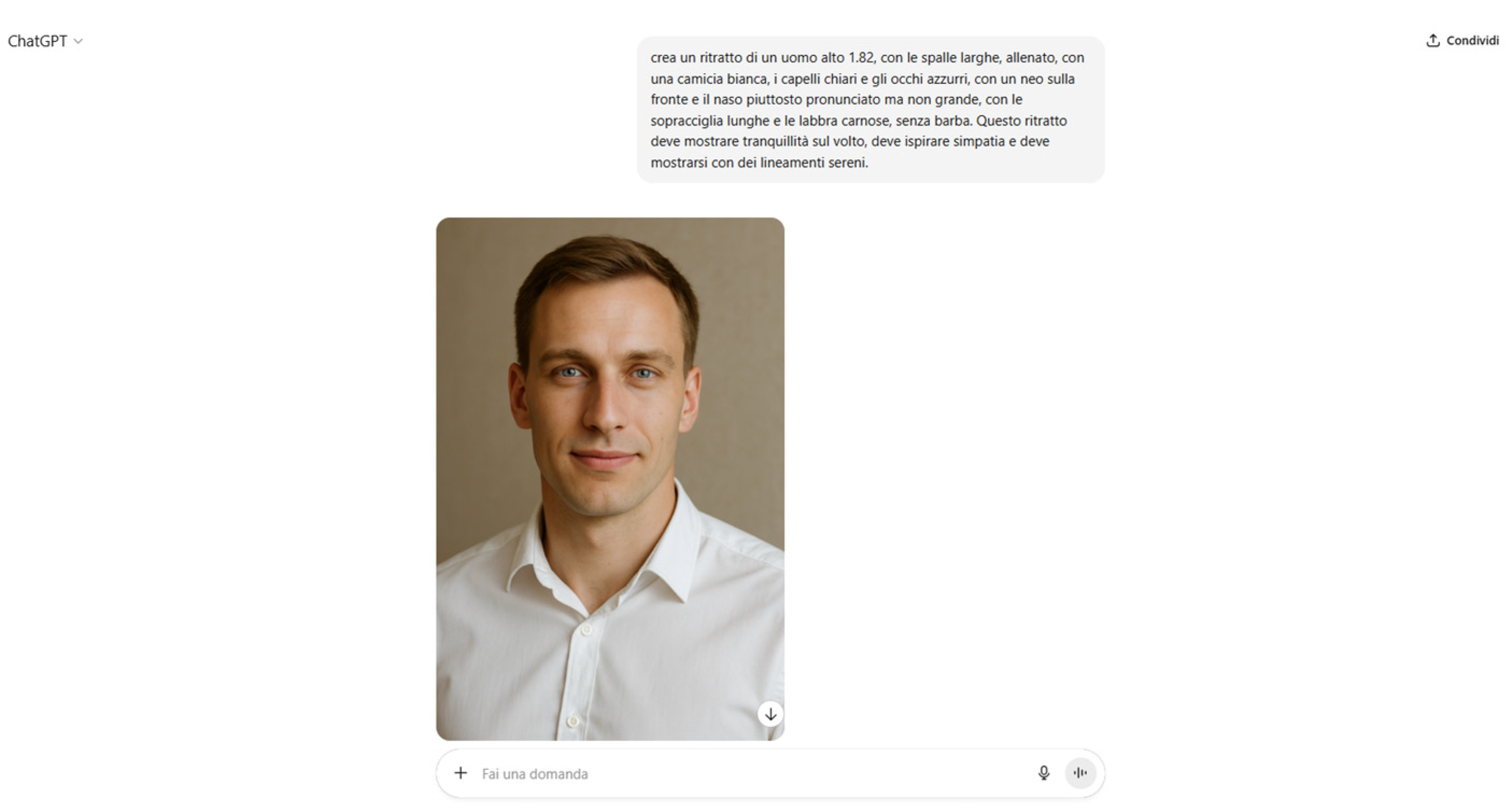
It is therefore necessary to work on other characteristics that we had not considered in the first two versions of the prompt; namely, to include some indications that can provide the artificial intelligence with tools to bring the generated image closer to my original intention. Thus, I might write (Figure 3):
Create a portrait of a man who is 1.82 m tall, broad-shouldered, athletic, wearing a white shirt, with light-colored hair and blue eyes, a mole on his forehead, and a rather prominent but not large nose, with long eyebrows and full lips, clean-shaven. The portrait should convey calmness, inspire friendliness, and display serene facial features.
The result:
Figure 3. Image generated by ChatGPT-5 from the prompt: “Create a portrait of a man who is 1.82 m tall, broad-shouldered, athletic, wearing a white shirt, with light-colored hair and blue eyes, a mole on his forehead, and a rather prominent but not large nose, with long eyebrows and full lips, clean-shaven. The portrait should convey calmness, inspire friendliness, and display serene facial features.” The prompt was provided in Italian to remain as faithful as possible to the version of Sartre’s book used.
Proceedings 139 00013 g003
The result will now be much closer to what I had originally imagined (Figure 3), to what Sartre himself sought to achieve. If this exercise is then carried out using a real person, someone we know, perhaps a classmate or a relative, the text can be refined even further to generate an image as faithful as possible to the intended subject. Moreover, this allows for metacognitive reflection on the process and on the text studied, helping students to understand what the phenomenological method truly entails.
Sartre’s description shows us that, in order to grasp an object or phenomenon—or, in this case, a person: Pierre—it is necessary to describe carefully every aspect that appears in our mind when we imagine it. Each element of the phenomenological description becomes essential for exploring the phenomenon in its totality. It is also important to emphasize that the context within which the image of Pierre is produced in the mind is been put aside, allowing us to focus exclusively on Pierre himself and to disregard any contingent or irrelevant aspects.
Through this example, which could easily be transformed into a learning unit (in Italy, it is called UDA—Unità di apprendimento) and developed in the final year of high school, students can clearly see how philosophical insight is structurally important for understanding how to write an effective prompt. It demonstrates how one must work on what is taken for granted, on what may seem unnecessary to include in a description but must in fact be elaborated and transformed into part of the prompt to achieve the desired result. The assessment system proposed here would merit careful analysis, though space does not permit full treatment here. Nevertheless, this type of continuous prompt refinement process allows for ongoing, in-progress evaluation of the process as a whole, through the multiple outputs produced by the AI. Clearly, the closer the generated image is to the original intentions and thus (in this case, to Sartre’s text) the more refined and well-crafted the prompt will be considered. Attention to language thus becomes fundamental, and this process reveals its centrality.

5. Conclusions

This is just one of the many possible examples [8] that demonstrate how philosophy, by its very nature, is oriented toward dialogue [9] in this case, a dialogue with artificial intelligence, as well as toward the analysis of what an image is and of the idea we hold in our minds regarding that image.
Numerous learning paths and analytical approaches can be developed around these themes. However, what defines the specific role of philosophy in relation to prompt engineering or prompt design is not only this method of inquiry, but rather the discipline’s inherent focus on language analysis and the structure of logic. These provide students with the tools needed to interact consciously with all forms of artificial intelligence.
Thus, if one were to follow a learning path centered on logic, from Aristotle to American Pragmatism in the early twentieth century, one of its core structures would lie in the analysis of cause–effect relationships, enabling students to understand the mechanisms through which pertinent algorithms or dialogues, supported by relevant questions, can be generated.

Funding

This research received no external funding.

Institutional Review Board Statement

Not applicable.

Informed Consent Statement

Not applicable.

Data Availability Statement

No new data were created or analyzed in this study. Data sharing is not applicable to this article.

Acknowledgments

The author wishes to thank Giada Maiullari for her assistance with the English-language version of the manuscript. During the preparation of this manuscript, the author used ChatGPT-5 for the purposes of Image generation. The author has reviewed and edited the output and takes full responsibility for the content of this publication.

Conflicts of Interest

The author declares no conflicts of interest.

References

  1. How to Unmask AI-Written Text: New Tools. Available online: https://www.agendadigitale.eu/cultura-digitale/come-smascherare-un-testo-scritto-dallai-ecco-i-nuovi-strumenti/ (accessed on 1 March 2025).
  2. Cuomo, S.; Biagini, G.; Ranieri, M. Artificial intelligence literacy: Che cos’è e come promuoverla. Dall’analisi della letteratura ad una proposta di framework. Media Educ. 2022, 13, 161–172. [Google Scholar] [CrossRef]
  3. Ng, D.T.K.; Leung, J.K.L.; Chu, S.K.W.; Qiao, M.S. Conceptualizing AI literacy: An exploratory review. Comput. Educ. Artif. Intell. 2021, 2, 100041. [Google Scholar] [CrossRef]
  4. Reuters. OpenAI’s Weekly Active Users Surpass 400 Million. Available online: https://www.reuters.com/technology/artificial-intelligence/openais-weekly-active-users-surpass-400-million-2025-02-20/ (accessed on 1 March 2025).
  5. Lee, D.; Palmer, E. Prompt Engineering in Higher Education: A Systematic Review to Help Inform Curricula. Int. J. Educ. Technol. High. Educ. 2025, 22, 13–14. [Google Scholar] [CrossRef]
  6. Peconio, G. Potenzialità e sviluppo delle soft skills nel metaverso. In Verso1Meta; Toto, G., Ed.; FrancoAngeli: Milan, Italy, 2024; pp. 52–63. [Google Scholar]
  7. Sartre, J.-P. L’immaginario; Kirchmayr, R., Ed.; Einaudi: Turin, Italy, 2007. [Google Scholar]
  8. Romano, L. La didattica dell’AI è una didattica filosofica? Le basi filosofiche della prompt engineering. J. Philos. 2025, 27, 345–358. Available online: https://logoi.ph/edizioni/numero-xi-27-25/questioni-di-confine/la-didattica-dellai-e-una-didattica-filosofica-le-basi-filosofiche-della-prompt-engineering.html (accessed on 1 March 2025).
  9. Caputo, A. Manuale di Didattica Della Filosofia; Armando Editore: Rome, Italy, 2019. [Google Scholar]
Figure 1. Image generated by ChatGPT-5 from the prompt: “Create a photograph of a tall, Caucasian man who does sports and has a nice smile, just as Sartre does initially.” The prompt was provided in Italian to remain as faithful as possible to the version of Sartre’s book used.
Proceedings 139 00013 g001
Figure 2. Image generated by ChatGPT-5 from the prompt: “create a portrait of a man who is 1.82 meters tall, with broad shoulders, athletic, wearing a white shirt, with light-colored hair and blue eyes, a mole on his forehead, and a rather prominent but not large nose, with long eyebrows and full lips, clean-shaven, and so on.” The prompt was provided in Italian to remain as faithful as possible to the version of Sartre’s book used.
Proceedings 139 00013 g002
Disclaimer/Publisher’s Note: The statements, opinions and data contained in all publications are solely those of the individual author(s) and contributor(s) and not of MDPI and/or the editor(s). MDPI and/or the editor(s) disclaim responsibility for any injury to people or property resulting from any ideas, methods, instructions or products referred to in the content.