1. Introduction
Fractional calculus, as a generalization with high practical value and wide application scope, goes beyond the limitation of classical integer-order differentiation and integration. By incorporating fractional derivatives, models have been successfully applied in various scientific and engineering fields, establishing a crucial research direction for mathematicians and physicists [
1,
2,
3,
4]. Accordingly, extensive research has been conducted on fractional partial differential equations (FPDEs), especially space-time fractional types, to develop rigorous theories about the existence, uniqueness, and well-posedness of their solutions [
5,
6,
7].
In a broad academic context, fractional orders are typically categorized into two fundamental classes: time fractional order and space fractional order. As a core branch of fractional calculus, the time fractional derivative quantifies the memory effect and historical dependence of a system via a non-local integral kernel, which serves as a pivotal tool for characterizing non-classical dynamic behaviors in fields such as viscoelastic mechanics and anomalous diffusion [
8,
9]. To date, it has formed a well-developed research paradigm that features a robust theoretical system, efficient numerical methodologies, and diverse application contexts. Based on their intrinsic physical meanings and kernel function characteristics, the main types of time fractional derivatives can be classified as follows: the Caputo derivative [
10,
11,
12] (which is particularly suitable for addressing initial and boundary value problems and corresponds to the variable-order form
adopted in this study), the Riemann–Liouville derivative, the variable-order time fractional derivative and the distributed derivative [
13,
14], among others. The transformation rules and equivalence theories among different derivatives have been gradually clarified, and the theoretical systems regarding the existence, uniqueness, regularity, and stability of solutions for Caputo-type time fractional partial differential equations have been essentially matured. At critical points of second-order phase transitions, systems exhibit scale invariance, which serves as a core characteristic of fractal structures. At such critical points, the order parameter tends to zero and the correlation length diverges [
15,
16,
17]. This scale-invariant property renders classical integer-order calculus insufficient for depicting these non-local spatial structures, which promotes the extensive adoption of fractional Laplacian operators. In particular, the Riesz fractional Laplacian
adopted in this paper is inherently correlated with fractal dimension quantification and critical phenomenon analysis [
18,
19]. Recent progress in fractal dynamics has further demonstrated that multiple fractal dimensions exist within phase transition systems. Meanwhile, the Riesz fractional dimension
proposed by Lima et al. [
19] establishes an explicit correlation between the fractional order
s and the geometrical features of non-integer dimensional spaces. The types of space fractional derivatives include the Riesz symmetric fractional derivative (i.e., fractional Laplacian), the Riesz–Feller space fractional derivative with skewness parameter [
20,
21], the fundamental one-sided Riemann–Liouville and Grünwald–Letnikov space fractional derivatives [
22,
23], the local fractional space derivative for fractal and rough media, and the space variable-order fractional derivative applicable to inhomogeneous and non-stationary transport processes [
24]. Among these operators, Riesz, Riesz–Feller, and variable-order fractional derivatives are the most widely utilized in current research on fractional advection-diffusion models and anomalous diffusion phenomena.
Several state-of-the-art methods have been developed for fractional Laplacian problems in recent years, including spectral methods, fast Fourier-based algorithms, physics-informed neural networks (PINNs), and operator learning methods. Spectral methods achieve high-order accuracy but require regular domains and global basis functions, leading to poor flexibility for variable-coefficient and nonlinear problems. Fast Fourier-based schemes enjoy high efficiency but are limited to uniform grids and linear problems. PINNs and operator learning methods exhibit strong generalization ability, yet they often suffer from low precision, lack of rigorous convergence guarantees, and high training costs, especially for high-dimensional and oscillatory solutions. In contrast, the proposed finite difference–Richardson extrapolation method combines the advantages of robustness for variable-coefficient nonlinear problems, clear convergence theory, and high efficiency up to sixth-order accuracy, making it more suitable for scientific computing tasks requiring both reliability and high precision. Here we will consider the following the nonlinear multi-dimensional space fractional advection-diffusion equation
where
and
are positive functions and the following initial and boundary conditions:
where
is unknown functions.
Equation (
1) describes a general diffusion system that contains two distinct diffusion mechanisms:the standard second-order diffusion governed by the integer-order Laplacian
, and the nonlocal anomalous diffusion induced by the fractional Laplacian
. The equation also incorporates a nonlinear reaction term
and an external source term
, making it suitable for modeling complex nonlinear fractional diffusion processes in high-dimensional spaces.
To investigate the dynamic behavior of fractional differential equations, the construction of reliable and efficient numerical and analytical methods for fractional partial differential equations (FPDEs) has been a persistent research hotspot among mathematicians over the past two decades. The relevant mathematical literature indicates that FPDEs have been extensively applied to address various practical problems in science and engineering, including fractional equations of the type Schrödinger, diffusion equations and telegraph equations [
5,
25,
26,
27,
28]. Nevertheless, analytical solutions are not available for most FPDEs; thus, numerous researchers have focused on developing approximate or numerical methods for such fractional-order systems over the past twenty years, so as to obtain feasible solution approaches. For example, Ref. [
29] established a mathematical model for the surface transport process by adopting a spatiotemporal fractional advection-diffusion equation (a class of linear pseudo-partial differential equations) with the Feller spatial fractional derivative. In Ref. [
30], the Adomian decomposition method (ADM) was applied to approximately solve the spatiotemporal FPDEs in the Caputo sense. The researchers proposed a multi-dimensional spatiotemporal variable-order fractional Schrödinger equation, which incorporates the Caputo time-fractional derivative and the Riesz–Feller spatial fractional derivative in [
31]. Ref. [
32] investigated a spatiotemporal fractional diffusion equation with the Caputo time-fractional derivative (
) and the Riesz–Feller spatial fractional derivative (
), and derived the convergence order of the corresponding solution method. In Ref. [
33], Cusimano constructed a fast algorithm for the fractional Laplacian. Additionally, Cusimano and co-workers explored a spatiotemporal fractional telegraph equation with local fractional derivatives. Nevertheless, studies focusing on the fractional Laplacian operator remain relatively scarce, which constitutes a notable research gap that requires further exploration in [
34].
The Runge–Kutta method not only effectively addresses the low accuracy inherent in traditional single-step methods but also enables the systematic construction of high-order temporal discretization schemes via multi-stage slope weighting and rigorous order condition design [
35,
36], without relying on high-order derivative information, thus significantly enhancing the convergence accuracy and approximation quality of numerical solutions. Meanwhile, this method exhibits inherent advantages for solving nonlinear differential equations: it avoids the need for analytical differentiation of nonlinear terms on the right-side and accomplishes single-step advancement solely through multiple function evaluations, showing strong adaptability to highly nonlinear, nonsmooth, and even stiff systems [
37,
38]. As a single-step that self-starts, it does not require historical solution data, facilitating efficient coupling with nonlinear solvers such as Newton iteration and enabling the straightforward implementation of adaptive step selection-size and error control [
39]. Its flexible explicit/implicit formulation allows for a favorable balance between computational efficiency and numerical stability [
40,
41]. Among these variants, the fourth-order Runge–Kutta scheme (RK4)—first formally proposed by Kutta [
42] following Runge’s initial framework [
36]—with its well-balanced accuracy, stability, and computational cost, has emerged as the most representative and widely adopted classical algorithm for the numerical solution of nonlinear ordinary differential equations and spatiotemporally coupled partial differential equations [
43,
44].
Owing to the high precision of RK4 scheme, the focus of addressing this problem has shifted toward the spatial dimension. However, due to the inherent particularity of the fractional Laplace operator, when the central difference scheme is used as the base matrix for spatial fractional discretization, its approximation error is strictly confined to the order
. Given that few existing methodologies have explicitly tackled this limitation, this paper aims to resolve it by leveraging the fundamental idea of Richardson Extrapolation (RE). First, we need to address the construction challenge of high-order Richardson Extrapolation, whose core essence lies in determining the optimal RE coefficients. One of the key innovations of this work is the development of a coefficient-solving matrix for Richardson Extrapolation through the introduction of consistency conditions. Subsequently, by reducing this constructed matrix, the problem of solving the coefficient equations is transformed into a well-posed problem of inverting a Vandermonde matrix from which the explicit analytical expressions of the RE coefficients are rigorously derived. Meanwhile, this paper achieves a significant breakthrough by successfully extending the one-dimensional Richardson Extrapolation framework to the multi-dimensional case under general conditions, thereby enhancing its applicability to complex practical problems in
Section 3. In addition,
Section 2 incorporates RK4 formulation.
Section 4 presents the computational results of several numerical experiments and compares them with existing results. Finally,
Section 5 discusses the conclusions of this study.
2. Temporal Discretization Scheme Based on the Runge–Kutta Method
For clarity, the governing Equation (
1) are rewritten in the following general matrix form.
where
For Equation (
3), the analytical solution is obtained using the constant variation method
In this formula, the numerical solution is to evaluate the unknown function at discrete time instants within a computational domain
. Within each time step, the Runge–Kutta method performs several intermediate derivative evaluations, which are then combined as a weighted sum to update the solution. The constant mentioned above refers to the undetermined integral constant introduced when solving the homogeneous form of Equation (
1).
In particular, RK4 scheme is employed here to solve the coupled Equation (
5). The solution at time
is updated from that at
as follows:
where
and
denote numerical solutions at time levels
and
, respectively. The coefficients
(
) and
represent the weighted increments of the corresponding components of the solution and the truncation error. Consequently, the coefficients
are computed as
By appropriately weighting these intermediate increments, the RK4 method achieves fourth-order accuracy and effectively reduces the truncation error. Higher-order RK methods can be constructed by introducing more derivative evaluations and optimized weights. In the present work, numerical results obtained from the RK4 scheme are used as a benchmark solution to verify the accuracy and performance of the proposed high-order Richardson extrapolation algorithm.
Suppose the error vector
satisfies the equation
where
is a constant matrix and
where
represents a constant number.
The boundedness and stability analysis of calculation errors for integral formulas have been well studied in classical numerical analysis [
45,
46]. Motivated by these works, we present the following error estimate.
Theorem 1.
Assume that the calculation error of the integral formula (11) occurs. Then, it obtains the following estimate Proof. Using the iterative error formula multiple times, it obtains
Taking infinite norms on both sides of the above equation, it obtains
Let
towards zero, and it obtains
Taking K as , the result follows. □
Corollary 1.
Under the condition of Theorem 1, the scheme (5) and (6) is L-stable. Theorem 2.
Let be the analytical and numerical solution of (1) and (5). Then, the following inequality holdswhere represents a constant number. Proof. Take
and put it into Formula (
14), it obtains
where
L is denoted as the temporal scale in the time domain.
Introducing truncation error
in inequality (
12), the result is obtained. □
3. Richardson Extrapolation Formula and Coefficients
In the previous section, we introduced the RK4 scheme to ensure the stability and high temporal accuracy of the algorithm. Next, we adopt the second-order central finite difference scheme to discretize the Laplace operator
; i.e.,
where
denotes the matrix form of the discretized Laplace operator
using the central finite difference scheme. Similarly, the matrix representation of the fractional Laplace operator
is given by
. Thus, we use the following finite difference approximation for
:
Substituting the above approximations into (
6),
in (
7)–(
10) is replaced by
,
From further analysis of the central difference scheme in (
15)–(
17), the spatial error can be expressed as
where
are the expansion coefficients.
In order to obtain a high super convergence numerical scheme, we assume that there exists
n differential format, and we suppose that
where
and
is named the high-order Richardson extrapolation function and its coefficients.
In order to solve for these coefficients
while guaranteeing accuracy of
-order, it is necessary to generate
-medium lattice schemes in the temporal direction. Let the grid scale parameter for each scheme be
, and the following error representation is obtained according to (
18):
Higher-order Richardson extrapolation expressions are obtained by solving by the Gaussian elimination method, and it can be abbreviated to the matrix format
It is clear that the equation has an infinite number of solutions, in order to make the equation solvable. Each line simultaneously eliminates
and introduces the solvability condition
. This is consistent with the initial first order Richardson extrapolation coefficients:
The left-hand side of the system of equation is the Vandermonde matrix, so there is an analytical solution for the Richardson extrapolation coefficients in the one-dimensional case:
As a result, we get the high-order Richardson extrapolation formula,
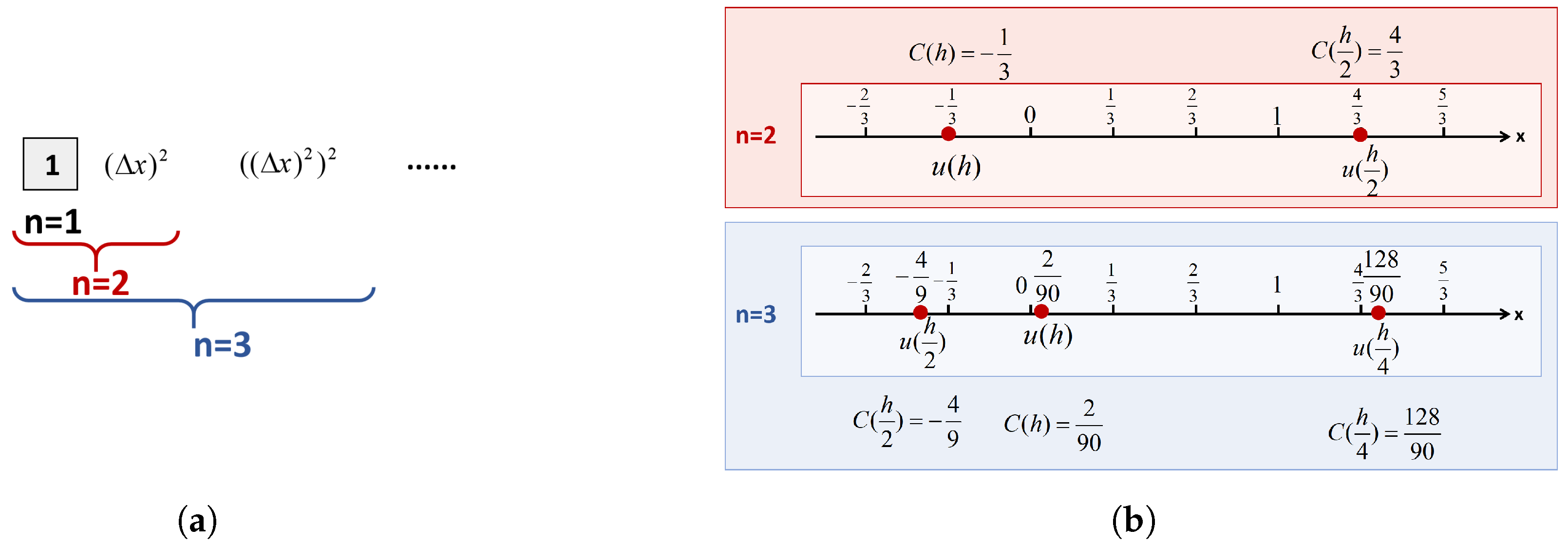
Next, we attempt to generalize the Richardson extrapolation formula to higher-dimensional spaces. First, we present the error distribution and the high-order Richardson extrapolation coefficients in the one-dimensional case, as illustrated in
Figure 1.
In
Figure 1a, it can be seen that the order of error is
and each coupling of the difference scheme improves the accuracy by one order. In addition,
Figure 1b presents the coefficients and their usage for the two extrapolation schemes (
), respectively.
Formula (
23) has successively addressed both the formulation and coefficient issues associated with the Richardson extrapolation scheme in one dimension. In light of this, we generalize the coefficients to the multi-dimensional case. The following theorem is established.
Richardson extrapolation and multi-level mesh refinement techniques have been systematically investigated for high-order convergence improvement in numerical partial differential equations [
47]. Based on these techniques, we establish the following general extrapolation theorem.
Theorem 3.
Suppose that the step size in the n-dimensional space is set to , and the refinement ratio in each spatial dimension is . Then schemes are required, with a convergence rate of the order ; i.e.,and the corresponding combination coefficients satisfywith and . To clearly illustrate the Richardson extrapolation coefficients in higher dimensions, we set
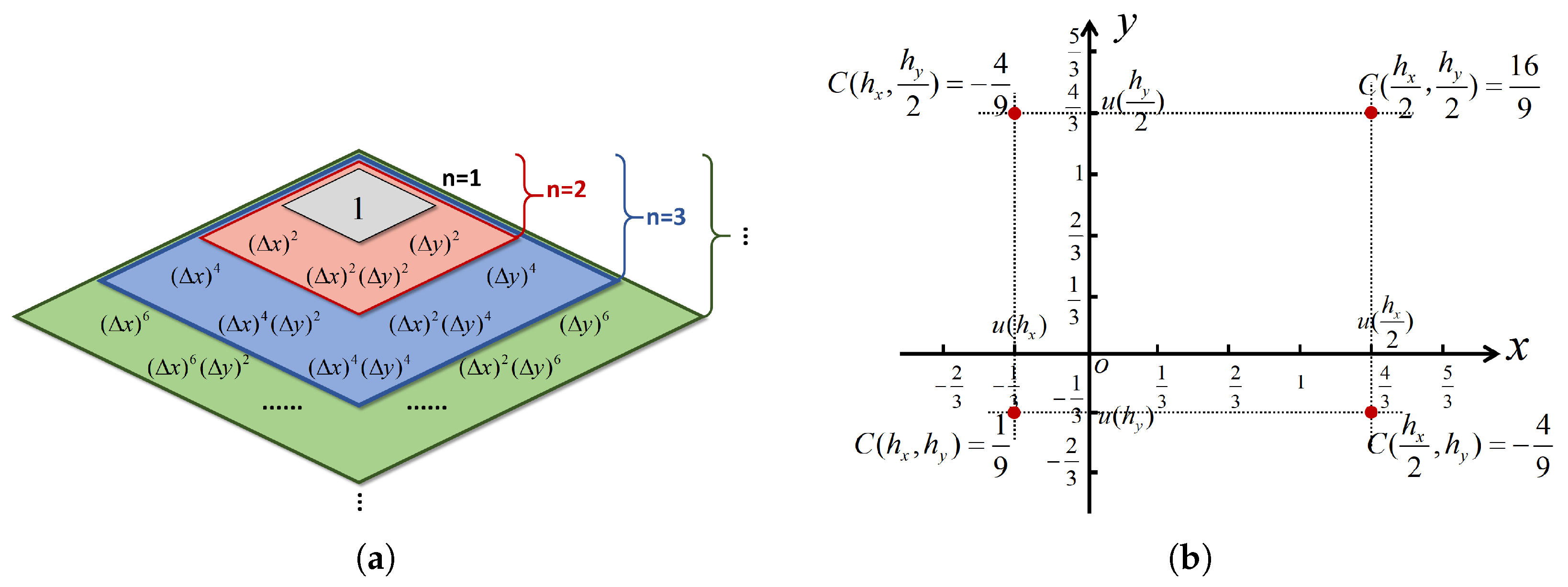
. The error terms and the parameters in two dimensions are presented in
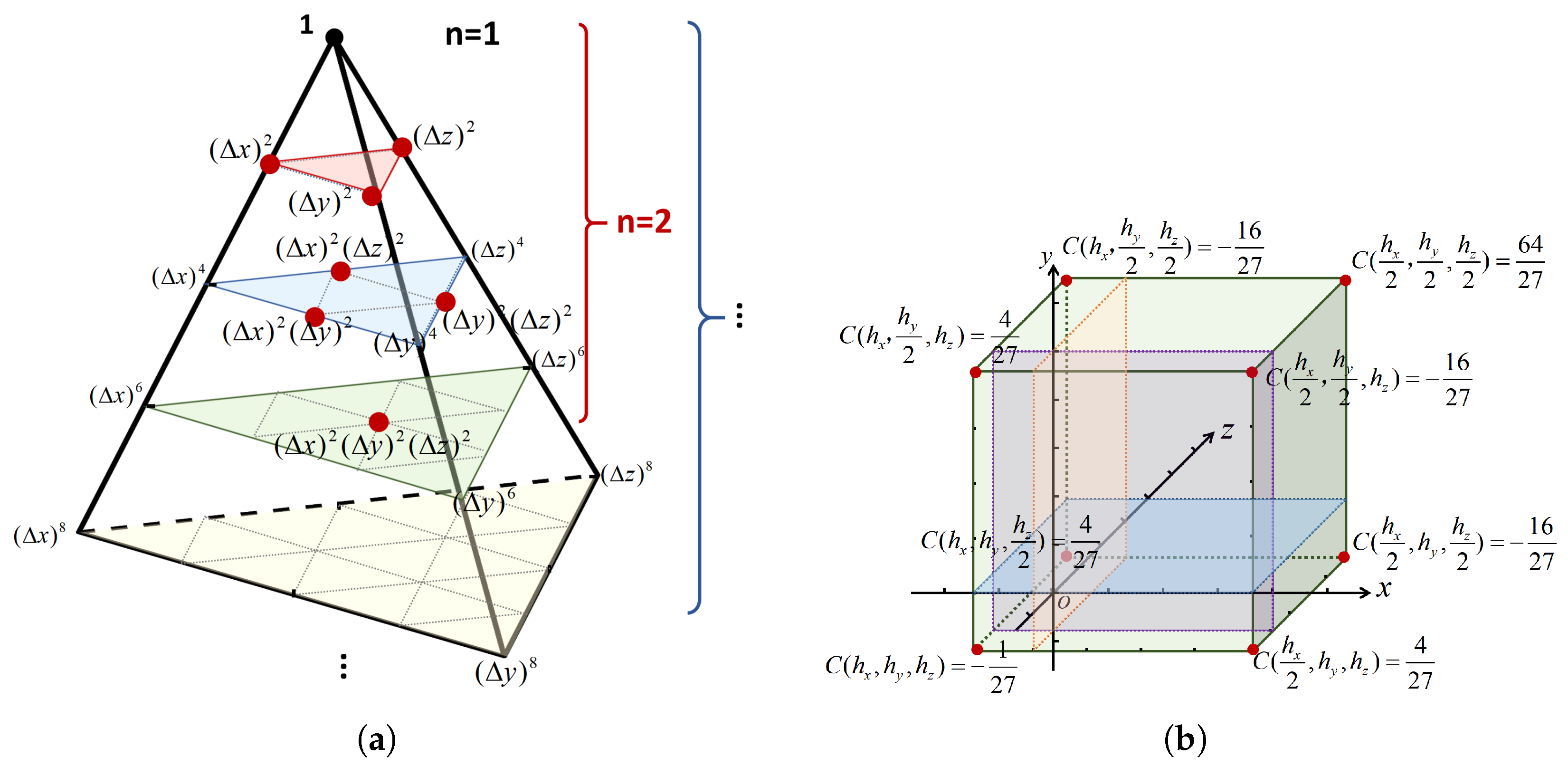
Figure 2, and those in three dimensions are shown in
Figure 3.
Figure 2a clearly illustrates the composition of error polynomials, with the number of its elements being
. For
, elementary error polynomials are as follows, 1,
,
,
,
,
,
,
, which includes the elementary polynomials for
. Meanwhile,
Figure 2b clearly shows that the corresponding
re parameters are given by
.
A similar behavior is observed in
Figure 3 for the three-dimensional case. As shown in
Figure 3a, the red points represent the additional elementary error polynomials, where the quantity is
. This is in full agreement with the predefined number of three-dimensional elementary polynomials, i.e.,
. Furthermore, the values of the RE coefficient corresponding to
are provided in
Figure 3b.
4. Numerical Experiments
In this section, several numerical experiments are presented to illustrate the stability, accuracy, convergence, and efficiency of the novel efficient algorithm. In all numerical experiments, the methods presented are local approximate schemes in spatial dimensions . The numerical results were performed in MATLAB 2023b on an i7-14700KF (32G RAM) Windows Win11 system.
4.1. Verification of the Fourth-Order Runge–Kutta Scheme
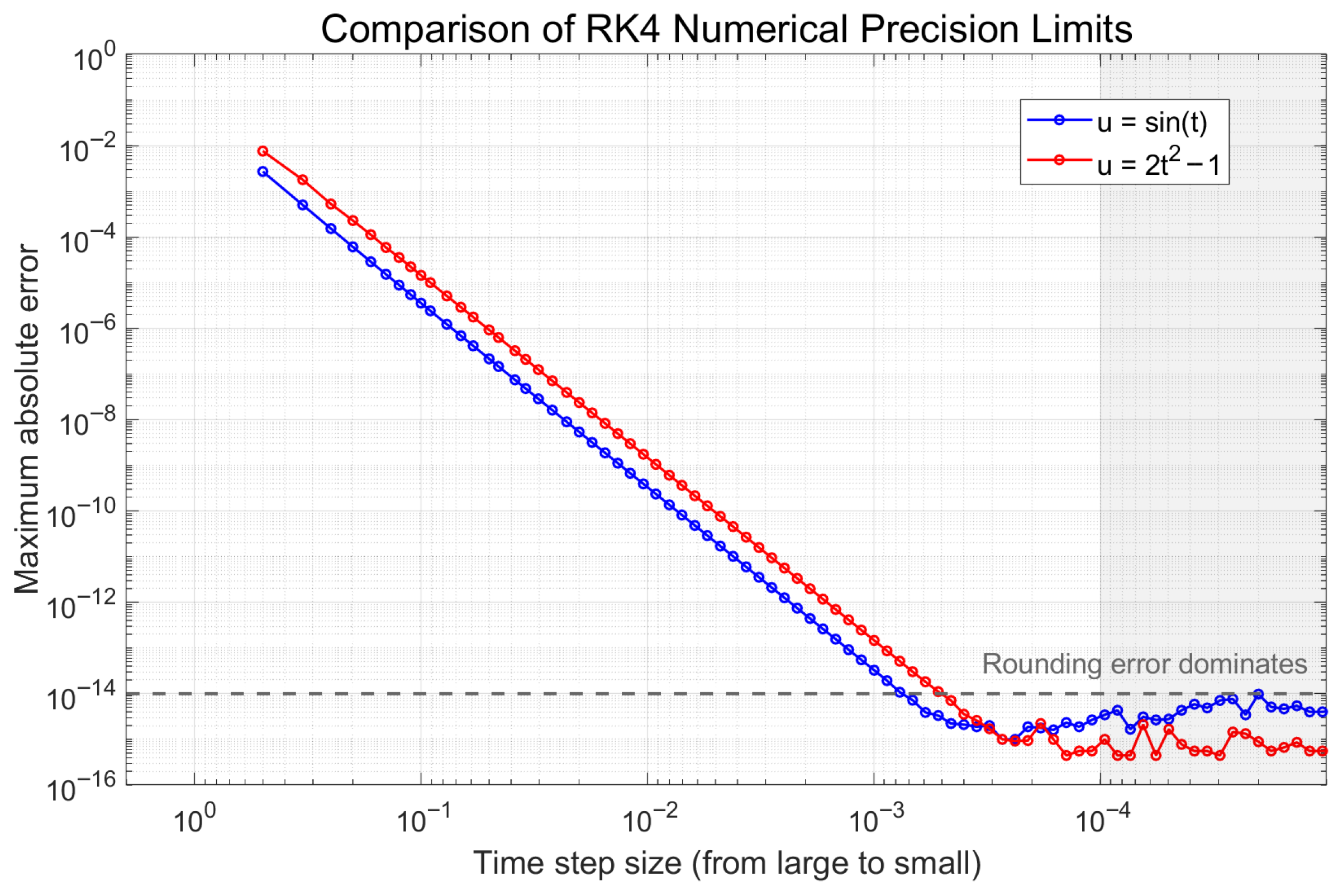
In this section, the high-precision behavior of the RK4 method is discussed. The log-log plot in
Figure 4 provides a clear verification of the RK4 method’s fourth-order temporal accuracy. The slope of
in the large-step regime (
) exactly matches the theoretical prediction. The slightly lower error of the polynomial solution
compared to the oscillatory solution
arises because the polynomial has zero fifth and higher derivatives; thus, its local truncation error is smaller in magnitude. When
, the error stops decreasing and fluctuates around
. This is not due to instability but to the limits of double-precision floating-point arithmetic (machine epsilon
). The observed error floor of
–
is typical for fourth-order methods where round-off errors accumulate through multiple RK4 stages. This result sets a practical upper bound on achievable temporal accuracy.
4.2. One-Dimensional Space Fractional Laplace Case
This section investigates the rate-error convergence behavior associated with the one-dimensional spatial fractional Laplace equation, with a focus on characterizing the numerical performance and precision limits under refined discretization schemes.
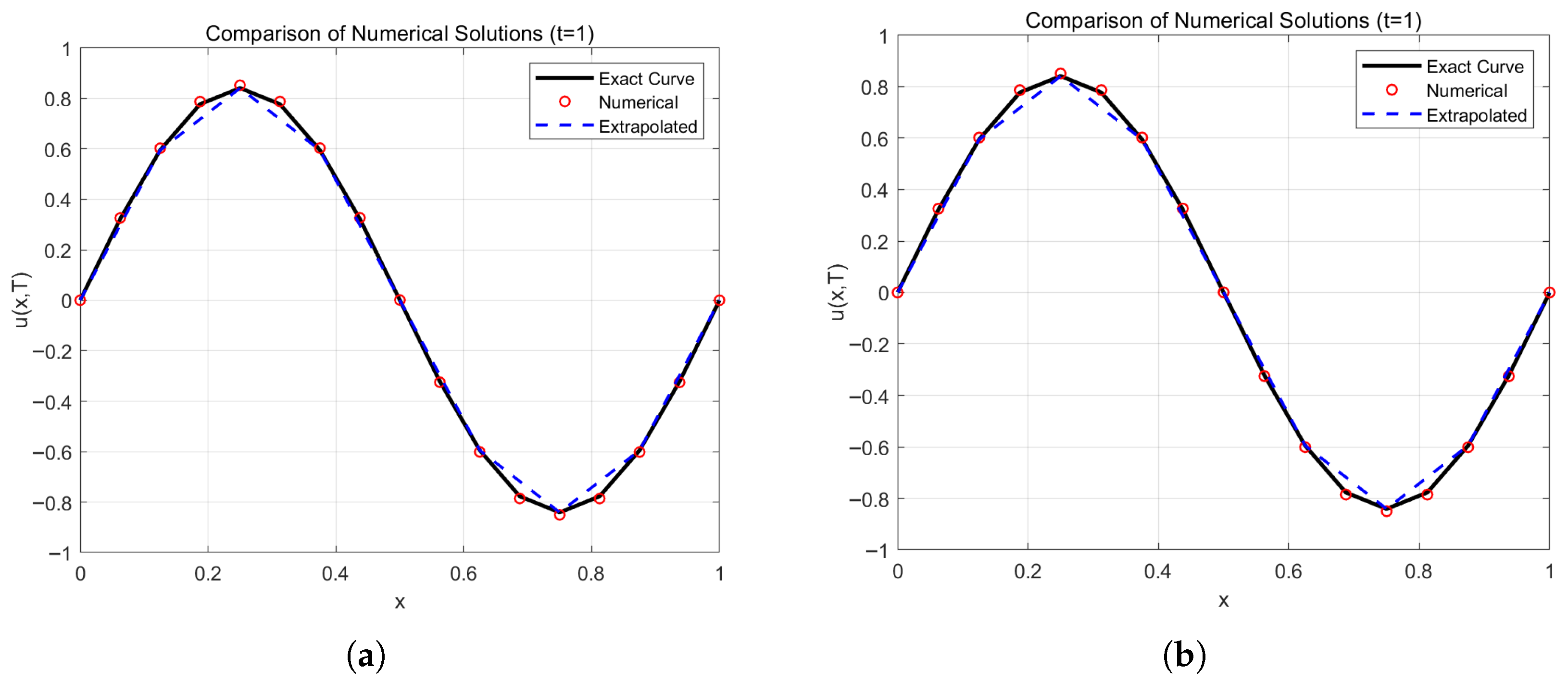
Figure 5 presents a comparative analysis of numerical solutions, extrapolated solutions, and exact analytical solutions for partial differential equations of the variable-coefficient in time
, with two distinct forms of the coefficient
investigated:
(subfigure
Figure 5a) and
(subfigure
Figure 5b).
The exact solution exhibits a single-peak sinusoidal profile over the spatial domain for both cases, with a maximum value of approximately at and a minimum value of around at ; the numerical solutions (red hollow circles) align almost perfectly with the exact solution curve (black solid line), while the extrapolated solutions (blue dashed lines) show only negligible deviations near the extreme points. Quantitatively, the maximum absolute error of the raw solution is on the order of for both coefficients, while the extrapolated error is reduced to –. This confirms that the proposed scheme achieves high accuracy for both oscillatory () and nonlinear () coefficients, and the extrapolation further refines the solution with minimal additional error.
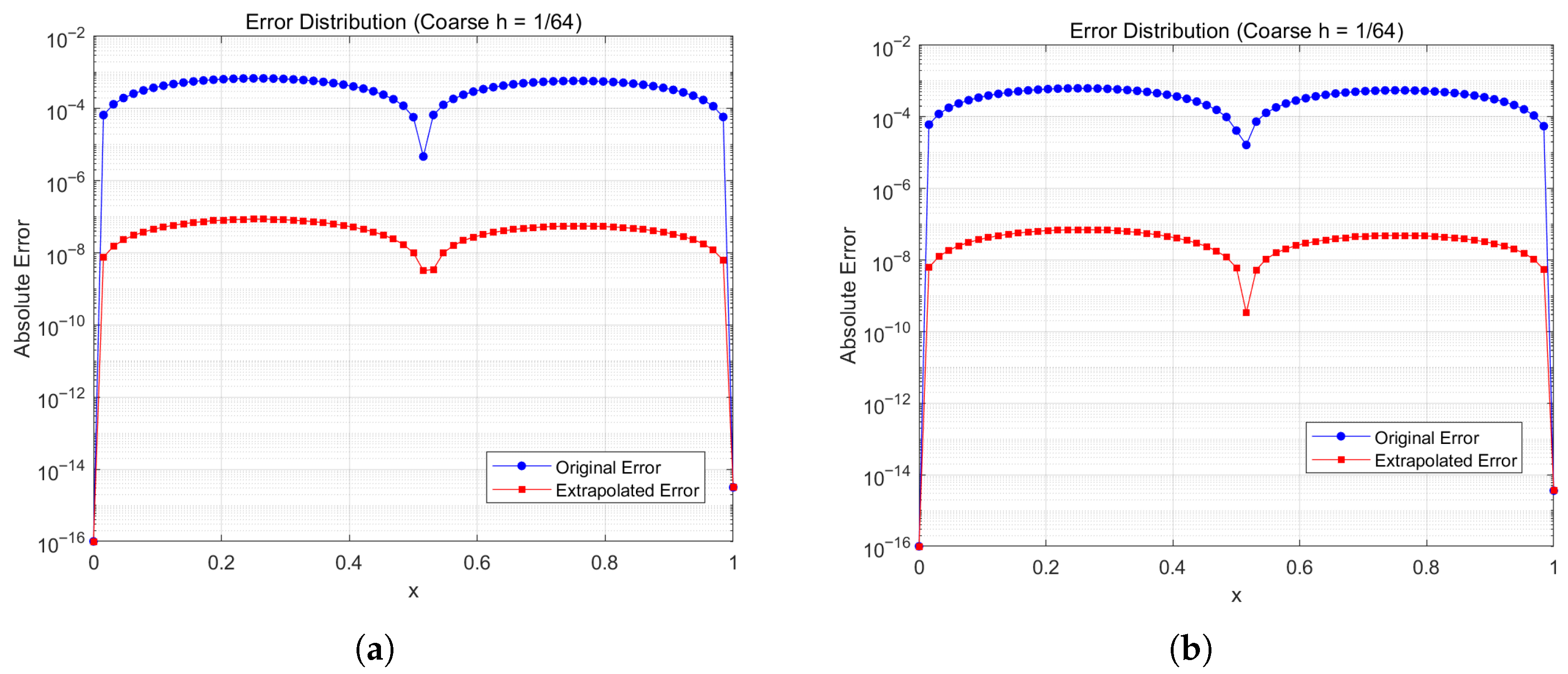
Figure 6 illustrates the spatial distribution of absolute numerical errors for the original and extrapolated solutions under coarse spatial resolution
, evaluated for two variable coefficients
Figure 6a and
Figure 6b on the domain
. In both cases, the original error (blue circles) remained on the order of
to
across most of the domain, with a local minimum near
, while the extrapolated error (red squares) was consistently reduced to magnitudes between
and
, representing a reduction of approximately two to four orders of magnitude compared to the original error; at the boundaries
and
, both errors decayed to machine precision (
), confirming that the extrapolation technique effectively suppresses discretization errors and significantly improves the numerical accuracy for both oscillatory and nonlinear coefficient configurations.
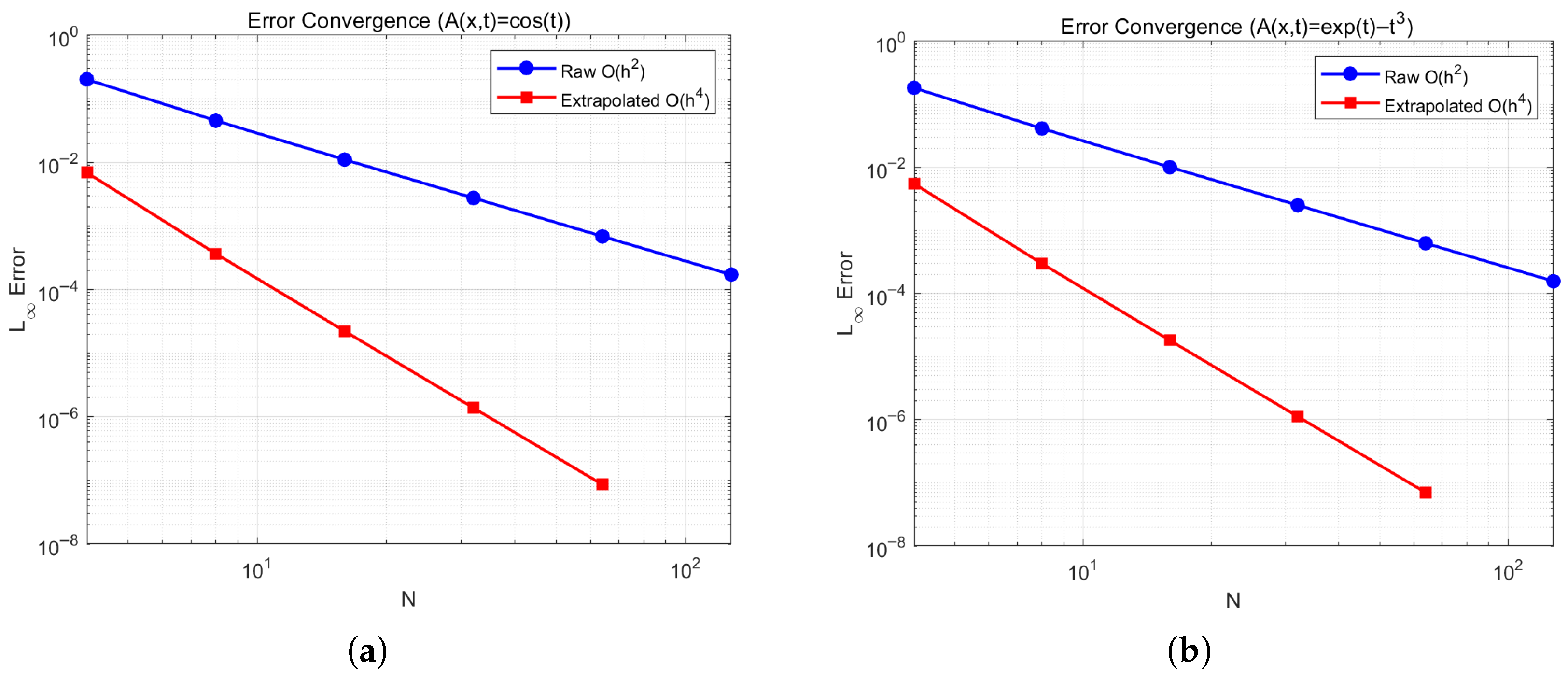
Figure 7 presents a comparative analysis of the
error convergence rates for the raw numerical scheme and the extrapolated scheme under two distinct variable coefficients
Figure 7a and
Figure 7b, with the number of spatial grid points
N varying on a logarithmic scale. For both coefficient configurations, the raw scheme (blue circles) exhibits second-order convergence (
), while the extrapolated scheme (red squares) demonstrates fourth-order convergence (
), as evidenced by the steeper decay of the
error with increasing
N; the extrapolated error consistently remains several orders of magnitude lower than the raw error across all grid resolutions. At the finest resolution
(
), the raw error is approximately
, while the extrapolated error drops to
—an improvement of four orders of magnitude. The convergence orders computed from successive refinements are
for the raw scheme and
for the extrapolated scheme, matching the theoretical expectations exactly, confirming that the extrapolation technique effectively elevates the convergence rate and significantly enhances the overall accuracy of the numerical method for variable-coefficient partial differential equations.
Further considering the case of higher-order convergence, we design the scenario to evaluate the extended extrapolation framework.
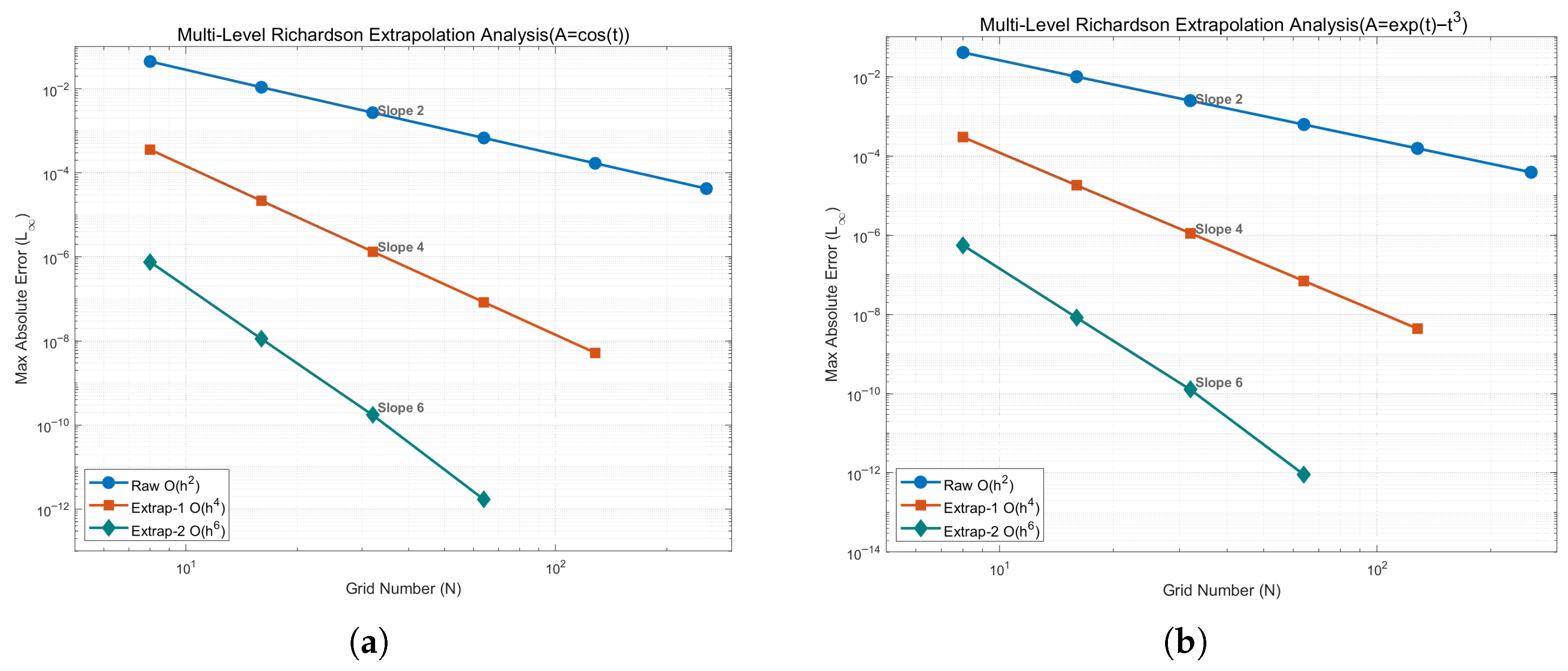
Table 1 and
Table 2 summarize the error analysis and convergence orders of the numerical scheme with Richardson extrapolation for 1D variable-coefficient problems, considering
and
, respectively, across spatial resolutions
to
. For both coefficient configurations, the raw numerical scheme achieves second-order convergence (
), while the first Richardson extrapolation step elevates the convergence order to approximately
, and the second extrapolation step further boosts it to around
, as confirmed by the computed order values and the log-log plots in
Figure 8, where the slopes of the error decay curves for the raw, first-extrapolated, and second-extrapolated schemes align closely with theoretical slopes of 2, 4, and 6, respectively; these results demonstrate that multi-level Richardson extrapolation effectively enhances the convergence order of the base numerical scheme, delivering substantial accuracy improvements for both oscillatory and nonlinear variable-coefficient settings.
Beyond confirming the theoretical slopes,
Figure 8 reveals two subtle features. First, the second extrapolation curve (slope 6) begins to flatten near
for both coefficient cases, with errors stagnating around
. This indicates that the truncation error has been reduced to the level of floating-point round-off, beyond which further grid refinement yields no accuracy gain. Second, the
case exhibits slightly lower errors than the
case at coarse grids (
), but both converge to the same noise floor. This suggests that the nonlinear coefficient does not adversely affect the asymptotic convergence, and the extrapolation is robust. These observations reinforce that the practical accuracy limit of the proposed method is governed by machine precision rather than the scheme itself.
4.3. Two-Dimensional Space Fractional Laplace Case
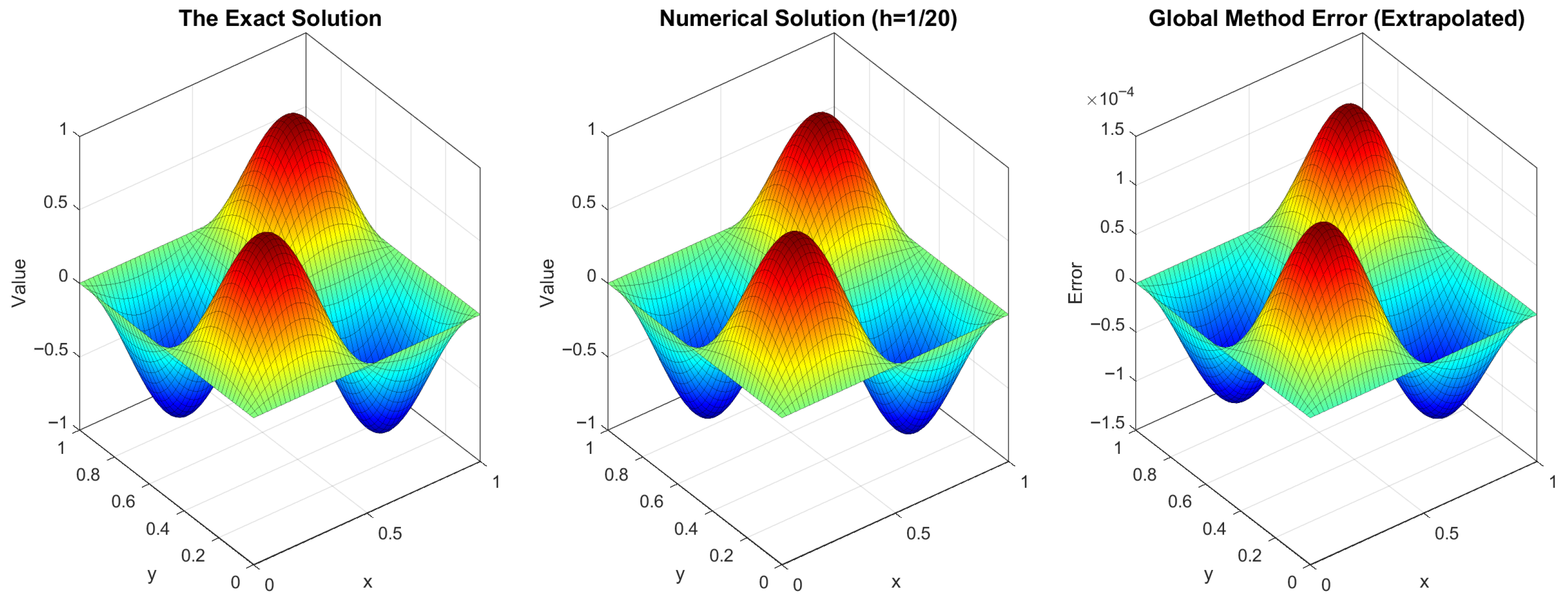
Figure 9 presents the numerical results for the 2D fractional model with fractional order
and time step
, including the exact solution, the numerical solution obtained with spatial step
, and the corresponding global method error after extrapolation. The exact and numerical solutions exhibit consistent double-peak spatial profiles across the domain
, with the numerical solution closely replicating the shape and magnitude of the exact solution; the extrapolated global method error remains bounded within
, confirming that the proposed numerical scheme combined with extrapolation achieves high accuracy for the 2D fractional model, effectively capturing the solution’s spatial structure while maintaining low discretization errors even at a relatively coarse spatial resolution
.
To facilitate a rapid investigation of convergence behavior, we first restricted our attention to the case with equal spatial steps; i.e.,
.
Table 3 summarizes the numerical results and convergence orders for the 2D fractional model with equal spatial steps
h, ranging from
to
. The raw numerical scheme achieves consistent second-order convergence (
), with the computed convergence orders approaching 2.00 as the grid is refined, confirming the theoretical convergence rate. After the first Richardson extrapolation (Extrap_1), the convergence order was elevated to approximately
, with the error magnitude reduced by up to two orders of magnitude compared to the raw scheme at the same grid resolution; these results validate that the extrapolation technique effectively enhances both the convergence order and numerical accuracy for the 2D case, extending the high-order performance observed in 1D problems to multi-dimensional fractional models.
The case with unequal spatial steps
also represents an effective approach to demonstrate the high-dimensional convergence formula.
Table 4 presents the numerical errors and the Richardson extrapolation results for the 2D case with variable spatial steps
and
, where
is refined proportionally to
. The raw numerical errors decrease consistently as both spatial steps are refined, while the second-level Richardson extrapolation (Extrap_2) yields a further reduced error magnitude with computed convergence orders approaching 4.0 (3.8961, 3.9222, 3.9959, 3.9988), confirming that the extrapolation technique maintains high-order convergence behavior even for unequal spatial steps in the 2D setting, thus validating the robustness and generality of the proposed method for high-dimensional fractional problems with non-uniform spatial discretizations. The above asynchronous convergence results in two directions validate the correctness of Theorem 3.
4.4. Three-Dimensional Space Fractional Laplace Case
In this section, we consider a three-dimensional example, where we restrict our investigation to the case of 3D equidistant finite differencing.
Table 5 presents a comparison of computational errors, extrapolated results, and convergence rates for high-order numerical schemes in 3D complex domains, with spatial step sizes ranging from
to
. The raw numerical scheme achieves consistent second-order convergence (
), with computed convergence orders approaching 2.00 as the grid is refined, confirming the theoretical convergence rate for the base method. After Richardson extrapolation (Extrap), the convergence order was elevated to approximately fourth-order (
), with the error magnitude reduced by up to two orders of magnitude compared to the raw scheme at the same grid resolution; these results validate that the extrapolation technique effectively enhances both the convergence order and numerical accuracy for 3D complex domain problems, extending the high-order performance observed in 1D and 2D settings to three-dimensional fractional models.
However, several limitations of the current approach should be acknowledged. First, the fractional Laplacian is discretized using central finite differences, which, while straightforward to implement, is not optimal for nonlocal operators. This choice may limit scalability and computational efficiency, especially in higher dimensions. The computational complexity of the matrix-based discretization scales as for the fractional power via matrix exponentiation (or if dense matrices are formed), and the memory cost grows rapidly with d, making the method less attractive for very large 3D problems. Second, this study is restricted to regular domains (cubes) with homogeneous Dirichlet conditions; the applicability to irregular geometries or more complex boundary conditions has not been investigated. Third, Richardson extrapolation, while effective, incurs additional computational overhead because it requires solving the problem on three nested grids. This overhead is modest for the grid sizes considered here (a factor of about 1.5–2 in CPU time), but it may become more pronounced for finer resolutions. Future work will explore spectral or fast Fourier-based methods for the fractional Laplacian, as well as adaptive extrapolation strategies to reduce computational cost.
5. Conclusions
In this paper, an efficient numerical framework combining RK4 method and Richardson extrapolation is proposed for solving nonlinear time-space fractional partial differential equations (PDEs) involving the fractional Laplacian operator. The RK4 method is adopted for temporal discretization to achieve fourth-order accuracy in the time direction, and its L-stability is rigorously proven.
By combining the second-order central finite difference scheme for discretizing the spatial fractional operator, high-order Richardson extrapolation formulas (with the highest convergence order up to ) are derived for one-dimensional (1D), two-dimensional (2D), and three-dimensional (3D) cases. A series of numerical experiments are designed, including 1D variable-coefficient cases, 2D cases with equal/unequal spatial steps, and 3D cases with equidistant differencing. The results demonstrate that the proposed method stably elevates the convergence order from second-order to fourth-order and further to sixth-order under both oscillatory and nonlinear variable-coefficient settings, with the extrapolated numerical error reduced to the magnitude of .
Moreover, the asynchronous convergence results in the 2D case with unequal spatial steps verify the correctness of Theorem 2. In 3D complex domains, the base scheme still maintains second-order convergence, and fourth-order convergence is achieved after extrapolation. This method features high accuracy, strong robustness, and high computational efficiency, effectively breaking through the limitations of traditional high-precision numerical algorithms in terms of dimensionality and convergence order.
Compared with state-of-the-art methods for fractional Laplacian problems, such as spectral methods, FFT-based algorithms, PINNs, and operator learning methods, the proposed framework achieves a better balance among accuracy, robustness, applicability to variable-coefficient nonlinear problems, and computational cost. Specifically, it provides guaranteed high-order convergence, supports non-uniform meshes and multi-dimensional complex domains, and avoids the strict limitations of spectral/FFT-based methods on problem types, as well as the lack of theoretical guarantees and high computational overhead of deep learning-based methods. These advantages make it particularly suitable for large-scale scientific computing requiring both reliability and high precision.