1. Introduction
The classical Hermite–Hadamard inequality provides a useful estimate for the integral average of a convex function. More precisely, for any convex function
, one has
Due to its importance in analysis, optimization, and numerical integration, this inequality has been widely studied and extended in various directions; see [
1,
2,
3].
In recent years, fractional calculus has become an effective tool for extending classical integral inequalities by incorporating nonlocal effects. General references on fractional operators can be found in [
4,
5,
6]. In particular, fractional operators having nonsingular kernels defined via the Mittag-Leffler function have received considerable attention, since they avoid the singular behavior of classical kernels and provide greater modeling flexibility; see [
7,
8,
9,
10].
Among these, the Atangana–Baleanu (AB) fractional integral operators, introduced in [
11], have been widely studied. Applications of Atangana–Baleanu type fractional operators to real-world fractional models and diffusion equations can also be found in [
12,
13]. Several Hermite–Hadamard type inequalities involving AB fractional integrals have been obtained in the literature (see, for example, [
14,
15]). However, most of these results are formulated for the standard AB operator without additional parameters.
Several related studies concerning generalized Mittag–Leffler functions, fractional integral operators, and Hermite–Hadamard type inequalities can also be found in [
16,
17,
18,
19,
20]. Further developments involving generalized fractional kernels and integral inequalities were investigated in [
21,
22,
23,
24,
25]. Additional results related to fractional Hermite–Hadamard inequalities and generalized fractional operators may be found in [
26,
27,
28,
29,
30].
Motivation and contribution. In this paper, we consider an extended Atangana–Baleanu fractional integral operator that includes an additional parameter together with a normalization function. This extension leads to a more flexible class of kernels, allowing different weighting behaviors within the integral.
The proposed operator includes the classical AB fractional integral as a special case. At the same time, the additional parameter provides extra freedom in the formulation, which makes it possible to obtain modified and, in some cases, more precise forms of Hermite–Hadamard type inequalities.
Relation to existing results. It is worth noting that several known inequalities involving AB fractional integrals can be recovered from our results by choosing appropriate values of the parameters. In this sense, the present approach can be viewed as a natural extension of existing results. Moreover, the presence of the parameter leads to inequalities that are not directly obtainable from the classical AB setting.
Outline of the paper. We establish a number of Hermite–Hadamard type inequalities for convex and differentiable functions within this extended framework. These include results for convex and absolutely convex functions, as well as refinements obtained via Hölder-type inequalities and related techniques.
In addition, several corollaries are presented to illustrate how the main results reduce to known inequalities in special cases. Finally, a graphical illustration is included to provide insight into the effect of the involved parameters on the behavior of the operator.
2. Main Results
Definition 1. Let be a real-valued function defined on the interval . For parameters , , and , we define the left-sided extended Atangana–Baleanu fractional integral of Ψ
bywhere denotes the Mittag-Leffler functionand is a normalization function such that and for all . Remark 1. The operator (1) consists of a nonlocal integral part governed by the Mittag-Leffler kernel and a local term depending on . The parameter α controls the balance between memory effects and pointwise behavior. Special Cases.
Case 1 (). Since
as
, the operator reduces to
which corresponds to a power-law kernel fractional integral.
Case 2 (). In this case, the local term vanishes and the operator becomes purely nonlocal:
Case 3 (formal limit ). The operator reduces to a purely local form:
Case 4 (). Since
, the operator takes the form
which corresponds to an exponentially decaying memory kernel.
Lemma 1. For each fixed , define the kernelwhereThen the kernel is normalized, i.e., Proof. Fix
. From the definition of the kernel, we have
Integrating both sides with respect to
over
, we obtain
By the definition of
, the numerator is exactly
Hence,
This completes the proof. □
Remark 2. This normalization property ensures that the operator can be interpreted as a weighted expectation-type fractional integral.
The weight function appearing in Theorem 1 is consistent with the normalized kernel introduced in Lemma 1, ensuring that the associated fractional integral operator can be interpreted as a properly normalized weighted operator.
In what follows, we establish a Hermite–Hadamard type inequality in the setting of the extended Atangana–Baleanu fractional integral operator. This result demonstrates how convexity interacts with the nonsingular Mittag-Leffler kernel to produce refined integral bounds that incorporate memory effects.
Theorem 1. Let be a convex function with , and let , , and . Thenwhere Proof. Since
is convex on
, for all
we have
Multiply both sides of (
4) by
and integrate over
. This gives
By the change of variable
, one obtains
where
is the corresponding kernel expressed in
. A similar expression holds for the second integral.
Using the definition of the extended Atangana–Baleanu fractional integrals, it follows that
and similarly for the right-sided operator.
Combining these expressions and dividing by
, we obtain the left-hand side of (
2).
For the upper bound, convexity yields
which leads directly to the right-hand side inequality.
This completes the proof. □
Remark 3. Theorem 1 extends existing Hermite–Hadamard inequalities obtained for the classical Atangana–Baleanu operator (see [14,15]). In particular, the presence of the additional parameter λ leads to a modified kernel structure, which allows a finer control of the integral weights. This results in more flexible bounds compared to the standard AB case. Corollary 1. If , , and in Theorem 1, then the extended Atangana–Baleanu fractional integral reduces to the classical Riemann integral and inequality (2) becomes the classical Hermite–Hadamard inequality: Proof. Taking
,
, and letting
, we have
and
. Hence,
Moreover,
, and the result follows directly from Theorem 1. □
Corollary 2. If in Theorem 1, then the Mittag-Leffler kernel reduces to the exponential kernel and the inequality takes the formwhere Proof. Since , the result follows directly by substituting into Theorem 1. □
Corollary 3. If in Theorem 1, then the inequality reduces to the purely nonlocal fractional integral case:where Proof. Setting in Definition 1 eliminates the local term and yields the desired expression. The result then follows from Theorem 1. □
Corollary 4. Let . Then, for any convex function Ψ
, we have Proof. The result follows by evaluating the fractional integral at the midpoint and using the convexity of together with Theorem 1. □
Corollary 5. As , the Mittag-Leffler kernel converges to a power-type kernel and the operator reduces to a classical fractional integral. In this case, inequality (2) becomeswhere Proof. Using the limit as , the result follows directly from Theorem 1. □
Lemma 2. Let be a differentiable function such that . Let , , and . Then, the following identity holds:whereand is defined in (3). Proof. From Definition 1, we have
Adding these expressions and dividing by
, we obtain an integral representation involving symmetric kernels.
Now, applying the change of variable
we have
and therefore
Using this transformation and simplifying the resulting expression, the difference
can be written in the form
which completes the proof. □
Lemma 2 establishes an integral identity that characterizes the difference between the classical endpoint average and its fractional integral form. By combining this identity with the convexity of , we now derive a corresponding upper bound in the following theorem.
Theorem 2. Let be a differentiable function with , and let , , . If is convex on , then the following inequality holds:where is defined in (3). Proof. Using Lemma 2, we obtain
Taking absolute values and applying the triangle inequality, we get
Since
is convex, we have
Substituting this estimate yields
Splitting the integral, we obtain two symmetric terms. By the change of variable
, these terms are equal. Hence,
which completes the proof. □
Corollary 6. Let be a differentiable function on , with and . If is convex on , then for the following inequality holds: Proof. Setting
in Theorem 2, we have
and
. Moreover, the Mittag-Leffler function reduces to the exponential function, that is,
Substituting these into Theorem 2 yields the desired result. □
Corollary 7. Let be a differentiable function on with . If is convex on , then as we obtain Proof. Letting
, we use the fact that
Hence,
Substituting this limit into Theorem 2 gives the result. □
Corollary 8. Let be a differentiable function on such that is convex on . Then, for , , and , we recover the classical estimate(See [1]). Proof. Taking
,
, and
in Theorem 2, the kernel reduces to 1 and the fractional operator coincides with the classical integral. Thus,
From Lemma 2, we obtain
Taking absolute values and using the convexity of
, we get
By symmetry,
This gives
□
While Theorem 2 offers a direct approach using simple convexity, it is often necessary to provide more refined estimates when the function’s derivative exhibits higher-order integrability. To address this, we extend our analysis by incorporating the power mean and Hölder’s integral inequalities. This leads to Theorem 3, which provides a more generalized bound for functions whose derivatives’ q-th powers are convex, offering greater flexibility for various classes of functions.
Theorem 3. Let be differentiable on with . Assume that is convex on for some . Let , , , and let be such that . Then the following inequality holds:whereand is defined in (3). Proof. From Lemma 2, we have the following identity:
Taking absolute values on both sides and applying the triangle inequality, we obtain
Now we apply Hölder’s inequality with conjugate exponents
and
:
Since
is convex on
, we have for all
,
Multiplying both sides by
and integrating over
, we get
Using the standard Beta-type integrals
we obtain
Substituting this estimate into the previous inequality completes the proof. □
Corollary 9. Let be differentiable on with , and suppose that is convex on for some . Let satisfy . Then, for , , and , the following classical estimate holds:(See [1]). Proof. Setting
,
, and
in Theorem 3, we first observe that
Hence, the extended Atangana–Baleanu fractional integral becomes
Thus, the left-hand side expression in Theorem 3 becomes
Now we analyze the kernel term. Since
, we have
so that
However, in the reduction of the Hölder-weight structure in Theorem 3, the corresponding limiting symmetric kernel reduces to the classical form
Therefore, the integral term appearing in Hölder’s inequality becomes
We compute this integral explicitly by splitting at
:
Using the substitution
in the first integral and
in the second, both integrals become identical, yielding
Next, since
is convex, we use Jensen’s inequality in the form
Combining all these reductions in Theorem 3, and noting that all kernel constants collapse to 1, we obtain
□
Corollary 10. Under the assumptions of Theorem 3, let , , and . Then the inequality reduces to Proof. Let
. Using continuity of the Mittag-Leffler function, we have
Therefore,
In the structure of Theorem 3, this limit implies that the fractional kernel loses its exponential/ML memory effect and the remaining dominant geometric structure becomes the classical symmetric weight
Hence, the integral term in Hölder’s inequality becomes
At the same time, the fractional operators converge to their classical Riemann-type counterparts:
and similarly for the right-sided operator.
Substituting all these limiting forms into Theorem 3, we obtain
□
Corollary 11. Under the same assumptions, letting while keeping and , we obtain Proof. Let
. We use the continuity properties:
Therefore, the kernel term becomes
Hence,
Substituting these limits into Theorem 3, we obtain that the fractional operator reduces to the exponential-kernel Atangana–Baleanu form:
Similarly for the right-sided operator.
Finally, inserting all these limiting expressions into Theorem 3 yields
□
3. Graphical
Interpretation of the Extended Atangana–Baleanu Fractional Integral
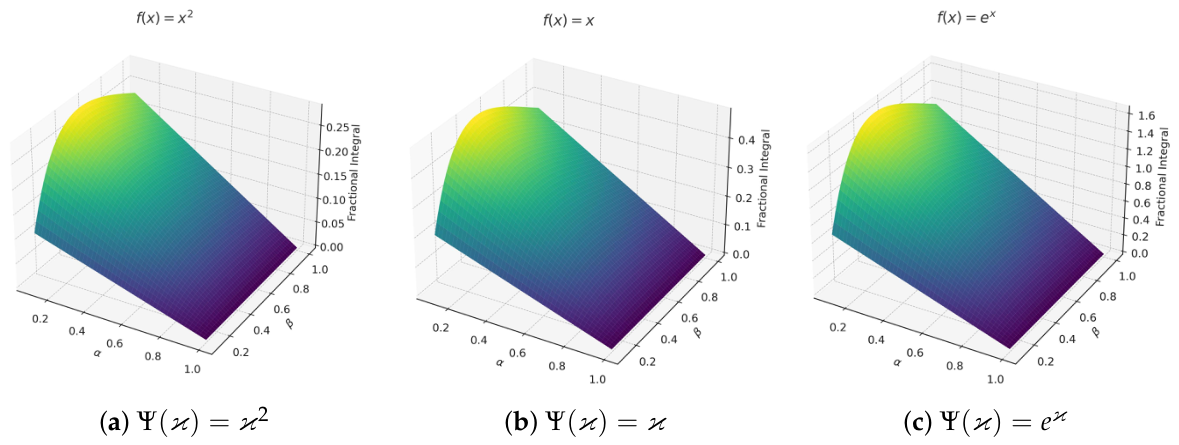
In this section, we provide a graphical interpretation of the extended Atangana–Baleanu (EAB) fractional integral in order to gain further insight into the influence of the fractional parameters. While the analytical results derived in the previous sections establish rigorous bounds, numerical visualization helps to better understand the effect of the parameters on the behavior of the operator.
To simplify the presentation, we consider the unit interval , that is, and . We also fix the parameter . For visualization purposes, we evaluate the fractional integral for fixed values of and observe its dependence on the parameters .
We consider three representative convex functions, namely
on the interval
. For each function, we compute the left-sided extended Atangana–Baleanu fractional integral
where
and
.
For visualization purposes, the computed values are represented as surfaces over the -plane. These surfaces describe how the operator transitions between local and nonlocal behavior.
3.1. Function 1:
For the quadratic function, the resulting surface exhibits a smooth dependence on the parameters. As increases, the contribution of the integral (nonlocal) part becomes more dominant, leading to a smoother averaged behavior.
On the other hand, smaller values of strengthen the memory effect induced by the Mittag-Leffler kernel. This causes a more noticeable deviation from the classical integral behavior, especially near the endpoints of the interval.
3.2. Function 2:
In the linear case, the EAB operator preserves a relatively stable structure. Since linear functions are less sensitive to averaging effects, the resulting surface remains close to linearity.
However, variations in still affect the behavior of the operator. In particular, for smaller values of , the kernel influence becomes more pronounced, leading to visible deviations from the classical integral.
3.3. Function 3:
The exponential function provides a useful example to observe sensitivity to growth. Due to its rapidly increasing nature, the interaction with the nonlocal kernel becomes more significant.
As increases, the contribution of the integral term becomes stronger, reflecting the accumulation of past values. Similarly, decreasing enhances the memory effect, which further amplifies the influence of earlier function values. This results in a steeper surface compared to the previous cases.
Overall, these graphical representations illustrate how the EAB fractional integral interpolates between local and nonlocal regimes. The parameter controls the balance between the local term and the memory-dependent integral, while determines the decay and shape of the Mittag-Leffler kernel.
Such behavior shows that the EAB operator is capable of modeling processes with memory and hereditary properties. This makes it relevant in applications arising in mathematical physics, engineering, and related areas.
The behavior of the extended Atangana–Baleanu fractional integral for the considered test functions is illustrated in
Figure 1. As can be observed, the parameters
and
significantly influence the transition between local and nonlocal behavior, as well as the overall shape of the resulting surfaces.
The analytical results derived in the previous sections, together with the graphical illustrations presented here, provide a consistent interpretation of the extended Atangana–Baleanu fractional integral. In particular, they show that the operator preserves key properties of convex functions while extending classical integral structures to a framework involving memory effects. This overall behavior is illustrated in
Figure 1.
More specifically,
Figure 1a corresponds to the quadratic case,
Figure 1b to the linear case, and
Figure 1c to the exponential case. These examples highlight how the growth rate of the function affects the sensitivity of the operator to the fractional parameters.
4. Conclusions
In this work, we have derived a new class of Hermite–Hadamard type inequalities involving the extended Atangana–Baleanu fractional integral operator having a Mittag-Leffler kernel. The results are obtained by using a suitable integral identity for differentiable functions together with standard convexity assumptions on the absolute value of the first derivative.
The obtained inequalities extend the classical Hermite–Hadamard inequality to a fractional integral setting depending on the parameters , , and . It is also shown that the classical case is recovered when and . In addition, the results include the exponential kernel case as a particular example within the Mittag-Leffler framework.
To obtain sharper estimates, we also use Hölder’s inequality together with the convexity properties of . This leads to bounds involving the kernel difference . The corresponding corollaries show that the classical Hermite–Hadamard inequality and several known variants are recovered as special cases under appropriate parameter choices, which confirms the consistency of the proposed approach.
Overall, the results provide a unified framework for Hermite–Hadamard type inequalities in the setting of generalized fractional integrals. Possible future work may include extensions to higher-dimensional settings, weaker convexity assumptions, and applications to fractional differential equations and numerical analysis.
Author Contributions
Conceptualization, M.Z.S., N.H.A. and R.T.A.; methodology, M.Z.S., N.H.A. and R.T.A.; validation, M.Z.S., N.H.A. and R.T.A.; formal analysis, M.Z.S., N.H.A. and R.T.A.; investigation, M.Z.S., N.H.A. and R.T.A.; writing—original draft preparation, M.Z.S., N.H.A. and R.T.A.; writing—review and editing, M.Z.S., N.H.A. and R.T.A. These authors contributed equally to this work. All authors have read and agreed to the published version of the manuscript.
Funding
This work was supported and funded by the Deanship of Scientific Research at Imam Mohammad Ibn Saud Islamic University (IMSIU) (grant number IMSIU-DDRSP2602).
Data Availability Statement
Data sharing is not applicable to this paper as no data sets were generated or analysed during the current study.
Conflicts of Interest
The authors declare that they have no competing interests.
References
- Dragomir, S.S.; Pearce, C.E.M. Selected Topics on Hermite–Hadamard Inequalities and Applications; RGMIA Monographs; Victoria University: Melbourne, Australia, 2000. [Google Scholar]
- Kirmaci, U.S. Inequalities for differentiable mappings and applications to special means of real numbers. Appl. Math. Comput. 2004, 147, 137–146. [Google Scholar] [CrossRef]
- Tseng, K.L.; Yang, G.S.; Hsu, K.C. Some inequalities for differentiable mappings and applications to Fejér inequality and weighted trapezoidal formula. Taiwan J. Math. 2011, 15, 1737–1747. [Google Scholar] [CrossRef]
- Baleanu, D.; Fernandez, A. On fractional operators and their classifications. Mathematics 2019, 7, 830. [Google Scholar] [CrossRef]
- Baleanu, D.; Fernandez, A.; Akgül, A. On a fractional operator combining proportional and classical differintegrals. Mathematics 2020, 8, 360. [Google Scholar] [CrossRef]
- Kilbas, A.A.; Saigo, M. H-Transforms: Theory and Applications; CRC Press: Boca Raton, FL, USA, 1999. [Google Scholar]
- Haubold, H.J.; Mathai, A.M.; Saxena, R.K. Mittag-Leffler functions and their applications. J. Appl. Math. 2011, 2011, 298628. [Google Scholar] [CrossRef]
- Kilbas, A.A.; Saigo, M.; Saxena, R.K. Generalized Mittag-Leffler function and generalized fractional calculus operators. Integral Transform. Spec. Funct. 2004, 15, 31–49. [Google Scholar] [CrossRef]
- Prabhakar, T.R. A singular integral equation with a generalized Mittag-Leffler function. Yokohama Math. J. 1971, 19, 7–15. [Google Scholar]
- Salim, T.O.; Faraj, A.W. A generalization of Mittag-Leffler function and integral operator associated with fractional calculus. J. Fract. Calc. Appl. 2012, 3, 1–13. [Google Scholar]
- Atangana, A.; Baleanu, D. New fractional derivatives with non-local and non-singular kernel: Theory and application to heat transfer model. Therm. Sci. 2016, 20, 763–769. [Google Scholar] [CrossRef]
- Bas, E.; Ozarslan, R. Real world applications of fractional models by Atangana–Baleanu fractional derivative. Chaos Solitons Fractals 2018, 116, 121–125. [Google Scholar] [CrossRef]
- Sene, N.; Abdelmalek, K. Analysis of the fractional diffusion equations described by Atangana–Baleanu–Caputo fractional derivative. Chaos Solitons Fractals 2019, 127, 158–164. [Google Scholar] [CrossRef]
- Akdemir, A.O.; Karaoğlan, A.; Ragusa, M.A.; Set, E. Fractional integral inequalities via Atangana–Baleanu operators for convex and concave functions. J. Funct. Spaces 2021, 2021, 1055434. [Google Scholar] [CrossRef]
- Set, E.; Akdemir, A.O.; Karaoğlan, A.; Abdeljawad, T.; Shatanawi, W. On new generalizations of Hermite–Hadamard type inequalities via Atangana–Baleanu fractional integral operators. Axioms 2021, 10, 223. [Google Scholar] [CrossRef]
- Agarwal, P.; Nieto, J.J. Some fractional integral formulas for the Mittag-Leffler type function with four parameters. Open Math. 2015, 13, 537–546. [Google Scholar] [CrossRef]
- Agarwal, P.; Rogosin, S.V.; Trujillo, J.J. Certain fractional integral operators and the generalized multi-index Mittag–Leffler functions. Proc. Indian Acad. Sci. Math. Sci. 2015, 125, 291–306. [Google Scholar] [CrossRef]
- Al-Refai, M. On weighted Atangana–Baleanu fractional operators. Adv. Differ. Equ. 2020, 2020, 3. [Google Scholar] [CrossRef]
- Farid, G.; Tariq, B. Some integral inequalities for m-convex functions via fractional integrals. J. Inequal. Spec. Funct. 2017, 8, 170–185. [Google Scholar]
- Kavurmacı Önalan, H.; Akdemir, A.O.; Avcı Ardıç, M.; Baleanu, D. On new general versions of Hermite–Hadamard type integral inequalities via fractional integral operators with Mittag-Leffler kernel. J. Inequal. Appl. 2021, 2021, 186. [Google Scholar] [CrossRef]
- Li, H.; Meftah, B.; Saleh, W.; Xu, H.; Kiliçman, A.; Lakhdari, A. Further Hermite–Hadamard-type inequalities for fractional integrals with exponential kernels. Fractal Fract. 2024, 8, 345. [Google Scholar] [CrossRef]
- Mohammed, P.O.; Sarikaya, M.Z.; Baleanu, D. On the generalized Hermite–Hadamard inequalities via the tempered fractional integrals. Symmetry 2020, 12, 595. [Google Scholar] [CrossRef]
- Noor, M.A.; Awan, M.U. Some integral inequalities for two kinds of convexities via fractional integrals. Trans. J. Math. Mech. 2013, 5, 129–136. [Google Scholar]
- Rahman, G.; Agarwal, P.; Mubeen, S.; Arshad, M. Fractional integral operators involving extended Mittag–Leffler function as its kernel. Bol. Soc. Mat. Mex. 2018, 24, 381–392. [Google Scholar] [CrossRef]
- Sarikaya, M.Z.; Set, E.; Yaldiz, H.; Başak, N. Hermite–Hadamard’s inequalities for fractional integrals and related fractional inequalities. Math. Comput. Model. 2013, 57, 2403–2407. [Google Scholar] [CrossRef]
- Sarikaya, M.Z.; Yildirim, H. On Hermite–Hadamard type inequalities for Riemann–Liouville fractional integrals. Miskolc Math. Notes 2016, 17, 1049–1059. [Google Scholar] [CrossRef]
- Set, E.; Sarikaya, M.Z.; Karakoç, F. Hermite–Hadamard type inequalities for h-convex functions via fractional integrals. Konuralp J. Math. 2016, 4, 254–260. [Google Scholar]
- Srivastava, H.M.; Tomovski, Ž. Fractional calculus with an integral operator containing a generalized Mittag–Leffler function in the kernel. Appl. Math. Comput. 2009, 211, 198–210. [Google Scholar] [CrossRef]
- Tomovski, Ž.; Hilfer, R.; Srivastava, H.M. Fractional and operational calculus with generalized fractional derivative operators and Mittag–Leffler type functions. Integral Transform. Spec. Funct. 2010, 21, 797–814. [Google Scholar] [CrossRef]
- Butt, S.I.; Umar, M.; Khan, D.; Seol, Y.; Tipurić-Spužević, S. Hermite–Hadamard-type inequalities for harmonically convex functions via proportional Caputo-Hybrid operators with applications. Fractal Fract. 2025, 9, 77. [Google Scholar] [CrossRef]
| Disclaimer/Publisher’s Note: The statements, opinions and data contained in all publications are solely those of the individual author(s) and contributor(s) and not of MDPI and/or the editor(s). MDPI and/or the editor(s) disclaim responsibility for any injury to people or property resulting from any ideas, methods, instructions or products referred to in the content. |