Article

Explainable Multi-Objective Evacuation Optimization: A Fractional-Order EvoMapX Approach with Grünwald-Letnikov Memory and Fractal Landscape Analysis


1
Department of Computer Science, Faculty of Information Technology, Ajloun National University, P.O. Box 43, Ajloun 22810, Jordan
2
Department of Mathematics and Statistics, College of Sciences, Imam Mohammad Ibn Saud Islamic University (IMSIU), Riyadh 11432, Saudi Arabia
3
Department of Cyber Security, Faculty of Information Technology, Ajloun National University, P.O. Box 43, Ajloun 22810, Jordan
4
Department of Artificial Intelligence, Faculty of Artificial Intelligence, Egyptian Russian University, Badr 11824, Egypt
*
Author to whom correspondence should be addressed.
Fractal Fract. 2026, 10(5), 314; https://doi.org/10.3390/fractalfract10050314
Submission received: 13 April 2026 / Revised: 1 May 2026 / Accepted: 3 May 2026 / Published: 6 May 2026

Abstract

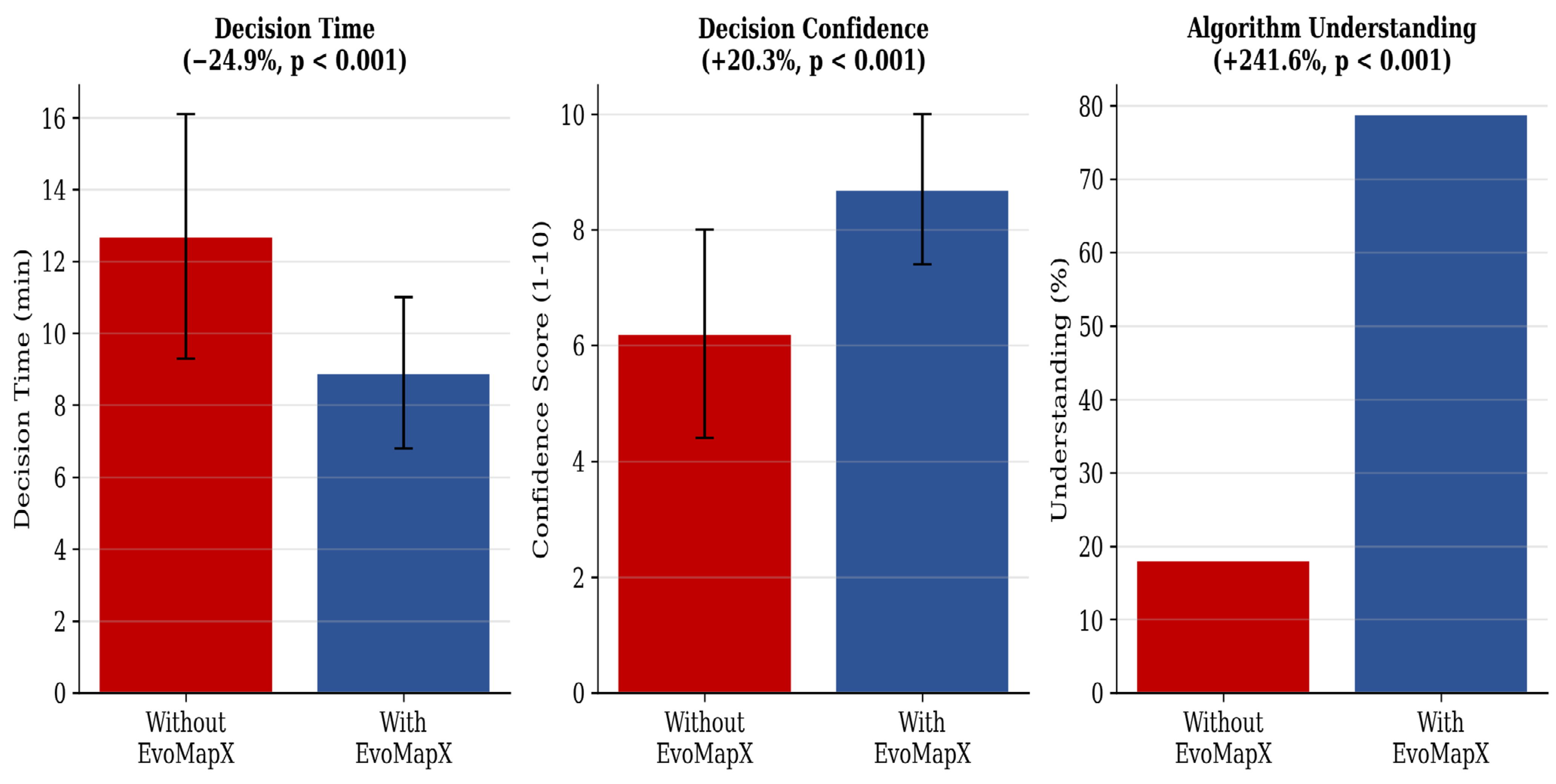
Population-based metaheuristic algorithms are widely used for multi-objective city evacuation planning, yet their opaque internal dynamics limit practitioner trust in safety-critical contexts. This study introduces, to the best of our knowledge, the first unified coupling of fractional calculus and fractal analysis with the EvoMapX process-level explainability framework in the context of evacuation optimization. In contrast with classical integer-order EvoMapX paired with exponential moving averages of operator credit, the proposed formulation embeds long-range memory directly into the explainability pipeline through Caputo and Grünwald–Letnikov derivatives. The Operator Attribution Matrix (OAM), Population Evolution Graph (PEG), and Convergence Driver Score (CDS) are extended with fractional-order formulations employing Caputo and Grünwald-Letnikov fractional derivatives with adaptive memory parameters, alongside Mittag–Leffler urgency escalation dynamics. A Fractional-Order PSO variant (FO-EPSO) with segment-specific fractional velocity updates and a fractal fitness landscape analysis module for adaptive parameter tuning are introduced. The framework incorporates nine evacuation-specific operators, a spatial OAM for zone-level attribution, and a multi-stakeholder explanation pipeline. Experiments across 520 disaster scenarios demonstrate that explainability and optimization performance are not mutually exclusive: the EvoMapX-integrated NSGA-II achieved a mean hypervolume of 0.731 versus 0.728 for the standard variant, with less than 5% computational overhead. The OAM revealed disaster-type-specific operator patterns invisible to conventional analysis. Real-world validations on Beijing Chaoyang District and Kigali, Rwanda, confirmed these findings. From an operational standpoint, the most consequential outcome of this work concerns its impact on human decision-makers: a controlled study with 45 emergency-management professionals showed that incorporating EvoMapX explanations cut the time required to commit to an evacuation plan by 24.9%, raised reported decision confidence by 20.3%, and lifted self-assessed algorithm understanding from 18.1% to 78.9% (all p < 0.001). Equally important for real-time disaster response, this entire layer of process-level transparency is delivered with a runtime penalty of under 5% relative to the non-explainable baselines, which we view as a key practical advantage for field deployment. This work establishes fractional-order process-level transparency as a feasible and beneficial paradigm for interpretable optimization in safety-critical domains.

1. Introduction

Natural disasters including earthquakes, floods, hurricanes, chemical spills, and urban fires pose escalating threats to urban populations worldwide. The United Nations Office for Disaster Risk Reduction has projected that the frequency of major disaster events will continue to rise, with urban centers bearing a disproportionate share of human and economic losses [1]. When a large-scale disaster strikes, the ability to evacuate affected populations rapidly, safely, and efficiently becomes the single most critical determinant of survival outcomes. Historical events have repeatedly demonstrated the devastating consequences of inadequate evacuation planning. During Hurricane Katrina in 2005, over 100,000 residents of greater New Orleans failed to evacuate before landfall, with socioeconomic factors such as lack of personal transportation, disability, and poverty dramatically reducing evacuation compliance among vulnerable communities [2]. Similarly, the 2011 Tohoku earthquake and subsequent Fukushima nuclear disaster in Japan necessitated the evacuation of approximately 154,000 residents, during which at least 51 patients in hospitals and nursing homes died as a direct result of the evacuation process itself, rather than from the disaster [3]. More recently, a comprehensive assessment of evacuation preparedness across the 31 largest cities in the United States found that only seven cities maintain strong evacuation plans, revealing persistent and systemic gaps in planning for carless and vulnerable populations [4]. These cases underscore that evacuation planning is not merely a logistical challenge but a complex, multi-dimensional problem involving route optimization, resource allocation, shelter assignment, temporal scheduling, and risk management under extreme uncertainty. The inherent complexity of city evacuation planning arises from several interrelated factors. First, evacuation involves multiple competing objectives that must be balanced simultaneously: minimizing total evacuation time, reducing population risk exposure, avoiding traffic congestion, maximizing shelter utilization efficiency, and controlling operational costs [5,6]. These objectives frequently conflict; for example, minimizing evacuation time may require routing all vehicles through the fastest corridors, which in turn maximizes congestion and risk exposure. Second, the problem encompasses a large number of discrete and continuous decision variables, including zone-to-shelter assignments, vehicle routing, departure scheduling, and traffic flow allocation, resulting in a combinatorial solution space that grows exponentially with city size [7]. Third, real-world evacuation scenarios introduce dynamic uncertainty through evolving disaster conditions, infrastructure damage, and unpredictable human behavior [8,9]. These characteristics collectively render the problem NP-hard, as it generalizes the capacitated vehicle routing problem with time windows [6], making exact solution methods computationally intractable for realistic urban scales.
Population-based metaheuristic optimization algorithms have emerged as the dominant computational approach for addressing these challenges. Genetic Algorithms (GAs), inspired by the principles of natural selection and genetic inheritance [10], have been extensively applied to evacuation planning due to their ability to explore large, discontinuous solution spaces through crossover and mutation operators [11]. Particle Swarm Optimization (PSO), which simulates the collective behavior of bird flocks or fish schools [12], has demonstrated strong performance in shelter allocation and route optimization problems [13]. Among multi-objective approaches, the Non-dominated Sorting Genetic Algorithm II (NSGA-II) [14] has become the most widely adopted framework for evacuation planning, owing to its efficient Pareto-based selection mechanism and crowding distance diversity preservation. Other decomposition-based methods such as MOEA/D [15] and hybrid approaches combining evolutionary strategies with swarm intelligence [16] have further expanded the algorithmic toolkit available to evacuation planners.
Despite their computational effectiveness, population-based metaheuristic algorithms suffer from a fundamental limitation that severely constrains their adoption in safety-critical applications: they operate as black boxes. The internal dynamics of these algorithms showing how solutions evolve across generations, which operators drive improvements in which objectives and why the search converges to particular regions of the solution space remain largely opaque to both algorithm designers and end users [17]. This opacity is particularly problematic in the context of emergency management, where decision-makers must not only receive an optimized evacuation plan but also understand why the plan was recommended, what alternatives were considered, and what trade-offs were made. Without such understanding, emergency managers cannot calibrate their trust in algorithmic recommendations, identify potential failure modes, or justify their decisions in post-disaster reviews and legal proceedings [18]. The need for algorithmic transparency in safety-critical decision support systems has been increasingly recognized across domains including healthcare, autonomous vehicles, and criminal justice [19,20], yet the specific challenge of explaining the internal dynamics of optimization processes as distinct from explaining the outputs of predictive models has received comparatively little attention.
The broader field of Explainable Artificial Intelligence (XAI) has developed a rich array of techniques for making AI systems more transparent and interpretable. Foundational methods such as SHAP [21], LIME [22], and Grad-CAM [23] have become standard tools for interpreting machine learning predictions across diverse application domains. Within disaster management specifically, XAI has been applied to damage assessment, risk prediction, and resource allocation tasks [24,25,26].
The EvoMapX framework, recently introduced by Abed-Alguni [27], represents a pioneering response to this gap. Unlike post hoc XAI methods that operate on model outputs, EvoMapX provides real-time, process-level interpretability for population-based optimization algorithms through three integrated components: the Operator Attribution Matrix (OAM), which quantifies the contribution of each algorithmic operator to fitness improvements across iterations and objectives; the Population Evolution Graph (PEG), which traces the ancestry and transformation relationships between solutions across generations; and the Convergence Driver Score (CDS), which identifies the operators and dynamics primarily responsible for driving convergence. Evaluated on the CEC 2021 benchmark suite, EvoMapX demonstrated that comprehensive process-level monitoring can be achieved with marginal computational overhead while producing both graphical and textual explanations of algorithmic behavior. Despite these advances, a fundamental limitation persists across all existing approaches: the mathematical formulations underlying both the optimization algorithms and the explainability components rely exclusively on integer-order calculus, which inherently discards historical information through memory less first-order difference operators. Fractional calculus, the generalization of differentiation and integration to non-integer orders, provides a natural mathematical framework for addressing this limitation. Fractional derivatives, particularly the Caputo and Grünwald-Letnikov formulations, inherently encode the complete history of a function through power-law-weighted memory kernels, making them ideally suited for tracking cumulative operator contributions across generations [28]. Furthermore, the search behavior of population-based algorithms often exhibits anomalous diffusion characteristics that are more accurately captured by fractional-order dynamics than by classical Brownian motion models [29]. The Mittag–Leffler function, which generalizes the exponential function to fractional-order systems, provides flexible decay kernels for modeling the non-exponential urgency escalation observed in real disaster scenarios [30]. Additionally, the fitness landscapes of combinatorial evacuation problems exhibit self-similar fractal structure at multiple spatial scales, which can be rigorously characterized through fractal dimension analysis [31]. Fractional-order PSO variants have demonstrated improved exploration-exploitation balance in continuous optimization benchmarks [32], but their application to evacuation problems and integration with process-level explainability remains entirely unexplored. This paper proposes the first comprehensive integration of fractional calculus and fractal analysis with the EvoMapX explainability framework for multi-objective metaheuristic optimization in city evacuation planning during natural disasters. The proposed approach adapts all three core EvoMapX components to the evacuation domain, introducing nine evacuation-specific operator categories organized into route optimization, resource allocation, and temporal scheduling functions. The Operator Attribution Matrix is extended with spatial granularity to enable zone-level attribution analysis, while the Convergence Driver Score is augmented with an urgency-weighting mechanism that progressively prioritizes time-critical objectives as disasters progress. The principal contributions of this paper are as follows. First, we present the first integration of fractional calculus with process-level algorithmic explainability, introducing the Fractional-Order Convergence Driver Score (FO-CDS), Fractional-Order Operator Attribution Matrix (FO-OAM), and fractional population diversity dynamics based on Caputo and Grünwald-Letnikov fractional derivatives with adaptive memory parameters. Second, we introduce a Fractional-Order PSO variant (FO-EPSO) for evacuation planning with fractional velocity updates enabling principled exploration-exploitation control. Third, we develop a fractal fitness landscape analysis framework establishing the adaptive tuning relationship α o p t =   2 D l a n d s c a p e . Fourth, we introduce Mittag–Leffler urgency escalation dynamics replacing classical exponential models. Fifth, we present domain-specific adaptations with evacuation-specific operator categories, spatial OAM extensions, and multi-stakeholder explanation generation. Sixth, we provide extensive empirical evidence that fractional-order explainability and optimization performance are not mutually exclusive, with the EvoMapX-integrated algorithms achieving hypervolume values comparable to or marginally exceeding their non-explainable baselines while incurring less than 5% computational overhead. Seventh, we present the results of a stakeholder evaluation study with 45 emergency management professionals, demonstrating a 24.9% reduction in decision-making time and a 20.3% increase in decision confidence when using the EvoMapX-integrated system. Eighth, we validate the approach on two real-world urban environments (Beijing Chaoyang District and Kigali, Rwanda) using publicly available geographic and census data, demonstrating that synthetic benchmark findings generalize to real urban networks.
Three considerations motivate the methodological direction of this study. First, classical integer-order updates rely on a one-step difference operator that is, by construction, memoryless: the contribution of an operator at iteration t depends only on the immediately preceding state, so credit accumulated over earlier generations decays at most exponentially when smoothed via moving averages. This is a poor match for population-based search, where empirical evidence indicates that the influence of a useful operator persists across many iterations through its descendants in the population, producing power-law rather than exponential memory effects. Second, the explainability literature distinguishes between post hoc XAI, which probes a fixed model after training (as in SHAP or LIME), and process-level explainability, which observes the search dynamics themselves while they unfold. The two answer different questions: post hoc methods explain why a particular solution was selected, whereas process-level analysis explains how the search arrived there, which operators drove improvement, and when the population began to stagnate. For safety-critical domains such as evacuation planning, the latter is the more decision-relevant view. Third, existing evacuation optimization studies are largely confined to integer-order GA, PSO, and NSGA-II variants without an integrated transparency layer, so practitioners obtain a Pareto front but no principled account of how it was produced. The proposed framework targets precisely this gap by embedding fractional memory and process-level monitoring within the same pipeline. Building on these considerations, the present study is organized around four explicit research questions. (RQ1) Can fractional-order extensions of the OAM, PEG, and CDS components capture operator-credit and diversity dynamics that are demonstrably richer than those produced by their integer-order counterparts equipped with exponential moving averages? (RQ2) Does embedding such fractional memory, together with Mittag–Leffler urgency dynamics and fractal landscape-driven adaptive tuning, preserve the optimization quality of the host metaheuristic on multi-objective evacuation problems, both on synthetic benchmarks and on real urban networks? (RQ3) What is the additional computational footprint introduced by this fully transparent layer, and is it tolerable for time-critical disaster response? (RQ4) When emergency-management professionals are placed in the loop, do the resulting explanations translate into measurable gains in decision time, decision confidence, and self-assessed algorithmic understanding? These four questions explicitly bridge the literature gap identified above and the fractional-order EvoMapX framework that follows. The remainder of this paper is organized as follows. Section 2 reviews the related literature on evacuation optimization, explainable AI, metaheuristic interpretability, and fractional calculus in optimization. Section 3 presents the mathematical preliminaries of fractional calculus, including the Caputo and Grünwald-Letnikov derivatives, the Mittag–Leffler function, and fractal dimension measures. Section 4 presents the formal problem formulation. Section 5 provides an overview of the EvoMapX framework and its fractional-order extensions (FO-CDS, FO-OAM, fractional diversity dynamics). Section 6 details the methodology for integrating fractional-order EvoMapX with the evacuation planning problem, including FO-PSO, fractal landscape analysis, and the explanation generation pipeline. Section 7 presents the experimental results, covering optimization performance, explainability evaluation, computational overhead, the stakeholder study, and real-world case study validation. Section 8 discusses the principal findings, theoretical and practical implications, and limitations. Section 9 concludes the paper.

2. Related Works

The application of optimization techniques to evacuation planning has evolved through two distinct methodological phases. Early work relied predominantly on exact methods, including linear programming, mixed-integer programming, and goal programming, to formulate evacuation as a network flow problem. Coutinho-Rodrigues et al. [33] formulated a six-objective mixed-integer model for simultaneously identifying evacuation paths and locating emergency shelters in Coimbra, Portugal, demonstrating the inherent multi-objective nature of urban evacuation. However, exact methods face severe scalability limitations when applied to realistic urban networks with hundreds of zones, multiple time periods, and stochastic parameters. Bayram and Yaman [34] addressed the challenge of uncertainty by proposing a two-stage stochastic programming model solved via Benders decomposition, capable of handling up to 1000 disaster scenarios for joint shelter location and route assignment. While this approach provides optimality guarantees, its computational requirements grow rapidly with problem dimensionality, limiting its applicability to large-scale real-time evacuation scenarios.
The second methodological phase introduced population-based metaheuristic algorithms as a practical alternative. Saadatseresht et al. [6] were among the first to apply NSGA-II to evacuation planning, integrating multi-objective evolutionary optimization with GIS for evacuee distribution. Their work established the feasibility of Pareto-based approaches for generating diverse evacuation alternatives that balance competing objectives such as distance, time, and risk. Niyomubyeyi et al. [35] extended this line of research by applying a multi-objective artificial bee colony algorithm to evacuation route optimization, demonstrating that swarm-based methods can achieve competitive solution quality. Their subsequent comparative study [36] evaluated four classical metaheuristic algorithms AMOSA, MOABC, MSPSO, and NSGA-II on evacuation scenarios in Kigali, Rwanda, finding that NSGA-II generally produced the most well-distributed Pareto fronts, although MOABC exhibited faster convergence in certain configurations. Zhao et al. [37] applied a modified PSO algorithm with combined von Neumann and global topology to earthquake shelter allocation in Beijing, minimizing weighted evacuation time and total shelter area, while Yin et al. [38] employed a quantum genetic algorithm for large-scale shelter allocation to address the computational challenges of combinatorial explosion in very large urban networks. Tang and Soakage [39] extended multi-objective evacuation to post-earthquake fire spread scenarios in Tokyo, accounting for the dynamic interaction between fire propagation and evacuation routes. Gupta et al. [40] broadened the scope further by proposing multi-objective mitigation strategies for buildings subject to multiple simultaneous hazards. Esposito et al. [5] provided a comprehensive review of optimization models combining shelter location and evacuation routing, identifying several critical gaps including the need for dynamic re-optimization during evolving disasters and the integration of behavioral models. Explainable AI has emerged as a critical research field in response to the increasing deployment of opaque AI systems in high-stakes domains. The DARPA XAI program [41] provided early impetus for systematic research into making AI systems more transparent, articulating a vision of AI that can explain its reasoning, characterize its strengths and weaknesses, and convey an understanding of how it will behave in the future. This vision catalyzed the development of several foundational techniques. The XAI field has been comprehensively surveyed by Barredo Arrieta et al. [42] and more recently by Mersha et al. [19], who organized the landscape into taxonomies distinguishing between transparent models and post hoc explanation methods, identifying responsible AI as the overarching goal. Within the specific context of disaster management, Ghaffarian et al. [18] conducted the first dedicated review of XAI applications, mapping how explainability techniques have been applied across the four phases of the disaster lifecycle: mitigation, preparedness, response, and recovery. Their analysis reveals that the majority of XAI applications in disaster management focuses on the mitigation phase and employs post hoc methods such as SHAP and LIME to explain predictions made by ensemble learning and deep neural network models. Matin and Pradhan [24] exemplified this approach by applying XAI techniques to earthquake-induced building damage mapping, demonstrating how feature importance explanations can enhance practitioner trust in damage classification models. Gupta and Roy [25] further surveyed the broader landscape of AI applications in disaster management, including decision support systems, early warning mechanisms, and resource allocation tools, noting the growing importance of interpretability for operational adoption.
The challenge of understanding the internal dynamics of metaheuristic algorithms has been approached from several complementary perspectives. Fitness landscape analysis, comprehensively surveyed by Malan [43], provides techniques for characterizing the structure of optimization problems including ruggedness, neutrality, deceptiveness, and modality and for predicting which algorithms are likely to perform well on specific problem instances. While landscape analysis offers valuable insights into the problem structure, it does not directly explain how a specific algorithm navigates that landscape during a particular run. Almeida et al. [17] conducted the most comprehensive systematic review to date of explainability in computational intelligence for optimization, examining how XAI methods such as SHAP, LIME, and visualization techniques can be applied to interpret metaheuristic performance. Recent work has begun to address this gap directly. Fyvie et al. [26] proposed a trajectory mining approach for extracting explanation-supporting features from metaheuristic search paths using principal component analysis. Their method identifies which decision variables most influence an algorithm’s trajectory from initialization to convergence, providing a form of variable-level attribution for PSO, GA, Differential Evolution, and CMA-ES across benchmark functions. Zhou et al. [44] published a comprehensive roadmap paper in IEEE Transactions on Evolutionary Computation that charts the bidirectional relationship between evolutionary computation and explainable AI, identifying both how EC methods can support XAI and how XAI principles can illuminate EC algorithm behavior, automatic configuration, and problem landscapes. Their roadmap explicitly identifies process-level transparency as a critical open research direction. Biemans et al. [45] explored the use of large language models to convert numerical optimization explanations into clear, context-aware narratives, demonstrating that natural language generation can enhance the accessibility of algorithmic explanations for supply chain planners. The EvoMapX framework, introduced by Abed-Alguni [27], represents the most comprehensive response to the process-level explainability gap. Unlike the trajectory mining approach of Fyvie et al. [26], which provides post hoc analysis of search paths, EvoMapX offers real-time, non-intrusive monitoring of algorithmic dynamics through three integrated components: the Operator Attribution Matrix (OAM) for quantifying operator contributions, the Population Evolution Graph (PEG) for tracing solution ancestry, and the Convergence Driver Score (CDS) for identifying convergence drivers.
A fourth research stream, fractional calculus in metaheuristic optimization, has emerged as a promising direction. Fractional calculus generalizes differentiation and integration to non-integer orders, enabling the modeling of systems with hereditary properties and long-range memory [28]. Pires et al. [32] introduced fractional-order dynamics into evolutionary algorithms, demonstrating that Grünwald-Letnikov fractional-order mutation operators improve diversity maintenance. Couceiro and Ghamisi [29] developed Fractional-Order Darwinian PSO (FODPSO), showing that fractional velocity updates provide principled exploration-exploitation control through sub-diffusive and super-diffusive particle dynamics. Pires et al. [46] further demonstrated superior performance of fractional-order PSO on multimodal benchmarks. The Mittag–Leffler function has been applied to model non-exponential convergence dynamics in swarm intelligence [30]. Fractal landscape analysis by Malan and Engelbrecht [47] demonstrated that box-counting fractal dimension correlates with algorithm difficulty, providing principled algorithm parameter tuning. Despite these advances, no prior work has integrated fractional calculus with process-level explainability frameworks, nor has fractional-order dynamics been applied to evacuation planning. The review of these four research streams reveals a clear and significant gap at their intersection. The evacuation planning literature has established metaheuristic optimization as the dominant computational paradigm but treats algorithms exclusively as black boxes, providing no mechanisms for explaining their internal dynamics. The XAI literature has developed powerful explanation methods for machine learning models but has focused on outcome-level explanations that do not apply to the dynamics of search processes. No prior work has integrated fractional calculus and fractal analysis with a comprehensive process-level explainability framework for metaheuristic optimization in any real-world application, and certainly not for the safety-critical domain of city evacuation planning during natural disasters [20]. The present study addresses this gap by integrating fractional-order dynamics and fractal geometric analysis with the EvoMapX framework, introducing fractional-order CDS and OAM formulations, fractional-order PSO, Mittag–Leffler urgency models, fractal landscape characterization, domain-specific operator categories, and a multi-stakeholder explanation generation pipeline. In doing so, it bridges the four research streams, demonstrating that fractional-order process-level explainability can be meaningfully integrated with applied multi-objective optimization without compromising algorithmic performance.

3. Mathematical Preliminaries: Fractional Calculus and Fractal Analysis

This section introduces the mathematical foundations of fractional calculus and fractal geometry that underpin the proposed extensions to the EvoMapX framework.

3.1. Caputo Fractional Derivative

The Caputo fractional derivative of order α ∈ (0, 1) of a function f(t) is defined as follows:
c Dtα f(t) = [1/Γ(1 − α)] ∫0t (t − τ)α f′(τ) dτ
where Γ(·) is the Gamma function. The Caputo definition is preferred because it admits classical initial conditions and yields zero when applied to constants [28,46]. Two further properties make this choice particularly well aligned with the evacuation-planning setting considered here. The OAM time series is observed at a known starting iteration with measurable initial values (operator credits at t = 0), and Caputo is the only common fractional-derivative formulation whose initial-value problem is posed in terms of integer-order initial conditions, which matches both the data we collect and the way emergency-management practitioners reason about “starting state”. The alternative Riemann–Liouville derivative requires fractional-order initial conditions that have no transparent operational meaning in this domain, and it does not vanish on constants, so it would penalize an operator whose credit happens to be steady. For these reasons we adopt Caputo when modelling the fractional dynamics of operator attribution and population diversity.

3.2. Grünwald-Letnikov Fractional Derivative

For discrete-time iterative algorithms, the Grünwald-Letnikov (GL) definition provides a computationally tractable approximation:
Δα f(t) = (1/hα) ∑_{j = 0}^{n} [(−1)^j C(α,j)] f(t − jh)
where the binomial-like coefficients are computed recursively: C(α, 0) = 1, C(α, j) = [1 − (1 + α)/j] · C(α, j − 1 ). These decay as j^(−α − 1), providing power-law weighting of historical values [48,49]. The reason for adopting the Grünwald–Letnikov form, rather than alternative discrete approximations such as the L1 scheme or finite-difference truncations of the Caputo integral, is that the metaheuristic loop is itself an iteration over discrete generations. The Grünwald–Letnikov definition is intrinsically discrete, has a closed-form recursive coefficient update, and converges to the Caputo derivative in the continuous-time limit. It therefore acts as the natural “sampled” counterpart of the Caputo formulation introduced above and can be evaluated incrementally during optimization, with cost O(t) per iteration when no truncation is applied and O(L) per iteration when the memory window is truncated to the most recent L iterations—a property that is essential for the real-time-monitoring goals of EvoMapX.

3.3. Mittag–Leffler Function

The two-parameter Mittag–Leffler function generalizes the exponential:
E_{α,β}(z) = ∑_{k = 0}^{∞} z^k/Γ(αk + β)
For α = β = 1 this reduces to e^z. For fractional orders, it exhibits power-law decay for large arguments, making it the natural kernel for memory effects in fractional systems [30,50]. The choice of a Mittag–Leffler urgency kernel rather than a classical exponential is grounded in the empirical phenomenology of real disasters. Pure exponential models impose a fixed time constant: the “rate of becoming urgent” is constant throughout the disaster. Field reports of floods, hurricanes, and earthquake aftershocks instead show a stretched profile in which urgency rises rapidly during the early warning window and then plateaus at a sustained high level for hours, producing a heavy-tailed regime that exponentials cannot match without ad hoc rescaling. The two-parameter Mittag–Leffler function E_{α,β} interpolates between exponential (α = 1) and power-law (α < 1) regimes by choice of a single fractional order, so it can reproduce both the fast-rising onset and the slow-decaying plateau within one parametric family. This makes it a more faithful, and more parsimonious, kernel for representing the urgency factor η(t) used by the urgency-weighted CDS in Section 6.

3.4. Box-Counting Fractal Dimension

The box-counting fractal dimension of a set S is as follows:
D_box(S) = lim_{ε → 0} [log N(ε)/log(1/ε)]
where N(ε) is the minimum number of ε-balls to cover S. In this work, we characterize evacuation fitness landscapes and search trajectories using fractal dimension, establishing the adaptive tuning relationship α_opt(f_i) = 2 − Landscape(f_i): smooth landscapes (D ≈ 1) use near-integer-order dynamics, while rugged landscapes (D ≈ 2) benefit from strong fractional memory [47].

4. Problem Formulation

4.1. Problem Definition

City evacuation planning during natural disasters presents a complex multi-objective optimization challenge that requires the simultaneous allocation of limited evacuation resources including transportation vehicles, shelter facilities, and road network capacity to maximize the safety and well-being of at-risk populations. The problem is formulated as a multi-objective mixed-integer nonlinear programming (MINLP) model that captures five competing objectives subject to capacity, flow conservation, temporal, and risk constraints. The NP-hard nature of this problem, arising from the combinatorial explosion of discrete assignment decisions across zones, shelters, vehicles, and time periods, necessitates the use of metaheuristic optimization approaches.

4.2. Sets and Notation

The problem is defined over the following primary sets, which characterize the spatial, temporal, and resource dimensions of the evacuation scenario, Primary sets and derived sets for the city evacuation problem illasturated in Table 1.

4.3. Parameters

The model parameters are organized into four categories reflecting the geographic, shelter, disaster, and performance dimensions of the problem, as summarized in Table 2.

4.4. Decision Variables

The formulation employs a combination of binary, integer, and continuous decision variables to capture the discrete assignment and continuous flow aspects of the evacuation problem, as defined in Table 3.

4.5. Objective Functions

The problem employs a multi-objective formulation with five competing objectives that capture the principal dimensions of evacuation effectiveness. Each objective is defined formally below.

4.5.1. Objective 1: Minimize Total Weighted Evacuation Time

The first objective minimizes the population-weighted total evacuation time, ensuring that zones with larger populations receive proportionally greater priority in time optimization:
m i n   f 1 = z Z p o p z · t z t

4.5.2. Objective 2: Minimize Total Risk Exposure

The second objective minimizes the cumulative risk exposure across all zones and time periods, weighted by population:
m i n   f 2 = z Z t T r i s k z t · p o p z

4.5.3. Objective 3: Minimize Traffic Congestion

The third objective minimizes the aggregate traffic congestion across all road segments, formulated as the sum of squared utilization ratios to penalize segments approaching capacity limits disproportionately:
m i n   f 3 = r R t T f l o w r t c a p r 2

4.5.4. Objective 4: Maximize Shelter Utilization Efficiency

The fourth objective maximizes the overall utilization efficiency of shelter resources, defined as the ratio of actual shelter occupancy to available capacity:
m a x   f 4 = s S z , t z z v s t c a p s · | T |

4.5.5. Objective 5: Minimize Total Evacuation Cost

The fifth objective minimizes the total operational cost, comprising vehicle operating costs and shelter setup costs:
m i n   f 5 = v , r , t c o s t r v · y r v t + s S c o s t s · u t i l s
In symbolic form, the cost objective is min f5 = Σ_{v∈V}Σ_{r∈R}Σ_{t∈T} cost_{rv} · y_{rvt} + Σ_{s∈S} cost_{s} · util_{s}, where y_{rvt} ∈ {0, 1} is the binary decision variable defined in Table 3 (1 if vehicle v ∈ V uses road segment r ∈ R at time t ∈ T) and util_{s} ∈ {0, 1} indicates whether shelter s is opened. The first triple summation aggregates the operating cost of every (vehicle, road, time) triple that is actually used, and the second summation aggregates the setup cost of every shelter that is activated. All indices match the variable definitions of Table 3.
For the multi-objective formulation, the composite weighted objective function is expressed as follows:
m i n   F = w 1 f 1 + w 2 f 2 + w 3 f 3 + w 4 1 f 4 + w 5 f 5
where w 1 , w 2 , …, w 5 ≥ 0 and ∑ w 5 = 1. In practice, the Pareto-based multi-objective algorithms employed in this study optimize all five objectives simultaneously without requiring explicit weight specification. The reciprocal term 1/f4 that appears within the composite objective F in Equation (10) (not Equation (6), which corresponds to Objective 2) is regularised to prevent numerical instability whenever shelter utilisation approaches zero. Specifically, 1/f4 is replaced by 1/max(f4, ε) with ε = 0.01, so that the explicit form of the regularised objective becomes F = w1f1 + w2f2 + w3f3 + w4/max(f4, 0.01) + w5f5. The case f4 = 0 only arises if no evacuee is assigned to any shelter, which is itself ruled out by the complete-evacuation constraint introduced in Section 4.6; the regularisation therefore acts as a numerical safeguard rather than as an additional binding constraint.

4.6. Constraints

The feasibility of evacuation plans is governed by the following constraint sets.

4.6.1. Population and Shelter Constraints

Complete population evacuation: Every resident in every zone must be assigned to at least one shelter over the planning horizon. A zone may be assigned to multiple shelters across different time periods or vehicle allocations to accommodate capacity constraints:
s S t T x z s t 1 , z Z
Population conservation: The total number of people assigned from each zone, summed over all vehicles v ∈ V, shelters s ∈ S, and time periods t ∈ T, must equal the zone’s population:
s S t T z z v s t = p o p z , z Z
Note that the summation in Equation (8) is taken over all vehicles v ∈ V, shelters s ∈ S, and time periods t ∈ T for each zone z, ensuring that the complete population of each zone is accounted for across all possible assignment combinations. Constraint (7) uses the binary activation variable x_zst, where ∑x_zst ≥ 1 indicates that zone z is assigned to at least one shelter–time pair; a zone may be split across multiple shelters when a single shelter lacks sufficient capacity. Constraint (8) then ensures that the integer passenger assignments z_zvst, aggregated over all vehicles, shelters, and time periods, exactly equal the zone population. The two constraints are therefore complementary: Constraint (7) guarantees coverage (every zone reaches at least one shelter), while Constraint (8) guarantees conservation (no residents are lost or duplicated in the assignment).
Shelter capacity: The number of evacuees assigned to each shelter must not exceed its capacity at any time:
z Z v V z z v s t c a p s , s S , t T

4.6.2. Traffic Flow Constraints

Vehicle capacity: The number of passengers assigned to each vehicle must not exceed its carrying capacity:
z Z z z v s t c a p v , v V , t T
Network flow conservation: At each intermediate node, the total inflow must equal the total outflow (flow balance):
r N + ( i ) f l o w r t r N ( i ) f l o w r t = 0 , i N , t T
Road capacity: Traffic flow on each road segment must not exceed its capacity:
f l o w r t c a p r , r R , t T

4.6.3. Time and Risk Constraints

Maximum evacuation time: Evacuation of each zone must complete within the maximum allowable time:
t z t T m a x ,   z Z , t T
Risk threshold: Risk exposure for each zone must remain below the acceptable threshold:
r i s k z t R m a x ,   z Z , t T
Disaster progression: Evacuation must complete before the disaster progression renders routes unsafe:
t z t w a r n i n g t p r o g d t , z Z , t T , d D

4.6.4. Variable Domain Constraints

All variables are subject to standard domain constraints: binary variables x_zst, y_rvt ∈ {0, 1}; integer variables z_zvst ≥ 0; and continuous variables t z t , f l o w r t , r i s k z t ≥ 0.

5. EvoMapX Framework Overview and Fractional-Order Extensions

5.1. Motivation and Design Philosophy

Population-based optimization algorithms (POAs) such as Genetic Algorithms, Particle Swarm Optimization, and Differential Evolution are widely adopted for solving NP-hard and high-dimensional optimization problems. However, their internal dynamics related to how solutions evolve, which operators contribute to improvements, and why convergence occurs remain largely opaque. While the broader XAI community has developed tools such as SHAP [40] and LIME [17] for interpreting machine learning predictions, these post hoc methods explain model outputs rather than the dynamics of the search process itself. The EvoMapX framework, introduced by Abed-Alguni [23], was designed to fill this gap by providing process-level, real-time interpretability for population-based optimization algorithms.
The framework is grounded in three design principles. First, non-intrusiveness: EvoMapX monitors and records algorithmic behavior without altering the core optimization logic, ensuring that the addition of explainability does not compromise solution quality. Second, real-time tracking: unlike post hoc analysis methods, EvoMapX collects interpretability data at every iteration, enabling dynamic insight into algorithmic behavior as the search progresses. Third, algorithm agnosticism: the framework is designed to be applicable across different POA families (evolutionary, swarm-based, and differential) without requiring algorithm-specific modifications.

5.2. Framework Architecture

EvoMapX employs a three-component architecture in which each component addresses a distinct aspect of algorithmic interpretability. Together, these components provide complementary perspectives on operator effectiveness, solution evolution, and convergence dynamics. The relationship between the three components and their respective analytical functions is summarized in Table 4.

5.2.1. Operator Attribution Matrix (OAM)

The Operator Attribution Matrix constitutes the first pillar of EvoMapX’s explainability architecture. For each optimization operator (e.g., crossover, mutation, selection), the OAM records the magnitude of fitness improvement attributable to that operator at each iteration. Formally, the OAM entry for iteration t, objective function i, and operator j is defined as follows:
O A M t , i , j = Δ f i t n e s s t , i , j k = 1 K Δ f i t n e s s t , i , k
where Δ f i t n e s s t , i , j represents the improvement in objective i attributed to operator j at iteration t, and K is the total number of operators. The normalization ensures that operator contributions at each iteration sum to unity, enabling direct comparison of relative operator importance across iterations and objectives. Beyond individual operator tracking, the OAM also captures operator synergy interactions between operators that produce improvements greater than what either operator achieves independently and temporal evolution patterns, such as shifts in operator dominance between early exploration and late exploitation phases. In the fractional-order extension (FO-OAM), the standard OAM is augmented with Caputo fractional differentiation of the attribution time series:
OAM_FO(t, i, j) = [Δ fitness(t, i, j) + μ · cDtα OAM(t, i, j)]/∑_k[Δ fitness(t, i, k) + μ · c Dtα OAM(t, i, k)]
where μ ≥ 0 is a memory coupling coefficient and cDtα is the Caputo fractional derivative of order α ∈ (0, 1), approximated via the Grünwald-Letnikov discretization. An operator with a positive fractional derivative has been increasingly effective, while a negative value indicates declining effectiveness. For μ = 0, the FO-OAM reduces to the standard OAM.

5.2.2. Population Evolution Graph (PEG)

The Population Evolution Graph provides a visualization-oriented approach to understanding how solutions evolve throughout the optimization process. The PEG is constructed as a directed graph G = (V, E) where each node v ∈ V represents an individual solution in the population at a specific generation, and each edge e ∈ E represents a parent–child relationship established through the application of a specific optimization operator.
Formally, each node carries the following attributes:
n o d e i = S i , f i t n e s s i , g e n e r a t i o n i , p a r e n t _ i d
and each edge encodes the transformation:
e d g e i , j = p a r e n t : n o d e i , c h i l d : n o d e j , o p _ t y p e , g e n
The PEG enables several analytical capabilities. Solution lineage analysis traces how optimal solutions evolved from initial population members through successive operator applications, answering the question: “What sequence of transformations produced the best solution?” Diversity analysis reveals patterns of genetic variation and potential premature convergence by tracking the branching factor and depth of the evolution tree. Exploration-exploitation balance can be assessed by examining whether solutions tend to cluster around a few dominant ancestors (exploitation) or maintain diverse lineages (exploration). In the fractional extension, the time evolution of the population diversity Div(t) is described by the fractional differential equation cDtq Div(t) = −λ_{d} · Div(t) + σ · M(t). Here λ_{d} > 0 is a single scalar diversity-decay rate, calibrated empirically from baseline runs of the host metaheuristic (the index d is a label, not an additional variable, and the earlier “λ d” was a typesetting artefact of λ_{d}). The forcing term M(t) is a mutation-injection signal, defined as the per-iteration rate at which the algorithm introduces new genetic material into the population through mutation and replacement operators (with units of expected new individuals per iteration), and σ > 0 is its coupling coefficient. With this definition, when M(t) = 0 the homogeneous solution of the equation is Div(t) = Div(0) · E_{α,1}(−λ_{d} · t^{α}), where E_{α,1} is the one-parameter Mittag–Leffler function. For α < 1, this expression initially decays faster than the exponential exp(−λ_{d} t) and then transitions to a heavy-tailed power-law regime, faithfully capturing the empirical observation that diversity in population-based metaheuristics drops quickly during the first generations but persists for longer than a pure exponential model would predict. The search trajectory fractal dimension D_traj = D_box({f(x_best(t)): t = 1, …, T}) characterizes the thoroughness of Pareto front exploration.

5.2.3. Convergence Driver Score (CDS)

The Convergence Driver Score synthesizes information from the OAM and PEG to identify which algorithmic components are primarily responsible for driving convergence toward optimal solutions. The CDS for operator j at iteration t is computed as a weighted combination of three factors:
C D S t , j = α · I t , j + β · D t , j + γ · E t , j
where I t , j represents the improvement contribution of operator j (derived from the OAM), D t , j captures the diversity maintenance contribution (derived from PEG branching patterns), and E t , j measures the exploration efficiency (the ratio of novel solution regions visited to total operator applications). The weighting coefficients α, β, γ control the relative emphasis placed on each factor. The CDS provides three key analytical capabilities. First, convergence attribution: identifying which operators contribute most too overall convergence at each stage of the search. Second, stagnation detection: recognizing periods where CDS scores drop below a threshold, indicating that operators are failing to drive meaningful progress. Third, recovery analysis: understanding how the algorithm escapes stagnation, whether through mutation rate increases, population restarts, or operator switching. In the fractional-order extension (FO-CDS), the improvement term I(t, j) is replaced with a Grünwald-Letnikov fractional-order measure: Iα(t, j) = ∑_k = 0..t [(−1)k C(α, k)] · Fitness_improvement(t − k, j), where α ∈ (0, 1) is the fractional memory parameter and C(α, k) are GL coefficients computed recursively as C(α, 0) = 1, C(α, j) = [1 − (1 + α)/j] · C(α, j − 1). These coefficients decay as k^(−α − 1), providing power-law weighting where recent iterations dominate but historical contributions persist. An adaptive memory scheme uses Mittag–Leffler transitions: α(t) = α_min + (α_max − α_min) · E_{α0, 1}(−λ(t/T)^{α0}), ensuring short memory (α_min = 0.3) during early exploration and long memory (α_max = 0.9) during late exploitation.

5.3. Implementation Characteristics

EvoMapX is implemented as a modular monitoring layer that wraps around existing POA implementations. The framework supports parallel execution of monitoring tasks alongside the optimization process, with incremental data structure updates that minimize computational overhead. The original evaluation on the CEC 2021 benchmark suite demonstrated that EvoMapX’s monitoring introduces marginal overhead while providing both graphical outputs (operator attribution heatmaps, population evolution trees, convergence trajectories) and textual outputs (natural language explanations of algorithmic behavior) [27].
Two characteristics of EvoMapX are particularly relevant to the city evacuation application pursued in this study. First, its multi-objective support: the OAM tracks operator contributions separately for each objective function, enabling understanding of how different operators affect different aspects of the evacuation plan (e.g., time reduction vs. risk minimization). Second, its extensibility: the framework’s modular design allows the definition of domain-specific operator categories beyond the standard genetic operators (crossover, mutation), enabling the introduction of evacuation-specific operators.

5.4. Distinction from Post Hoc XAI Methods

It is important to distinguish EvoMapX from post hoc XAI methods that have been applied to optimization contexts. Methods such as SHAP and LIME operate on trained models to explain individual predictions after the fact. When applied to optimization, these methods can explain why a particular solution was selected but cannot explain how the search process arrived at that solution. EvoMapX addresses a fundamentally different question: rather than explaining the mapping from inputs to outputs, it explains the dynamics of the search process itself which operators drove improvements, how solutions evolved through generations, and what factors determined convergence behavior. This process-level perspective is particularly valuable in the evacuation planning context, where emergency managers need to understand not only what plan is recommended but also the algorithmic reasoning that generated it, in order to calibrate their trust in the recommendation and identify potential failure modes.

6. Methodology: Integrating Fractional-Order EvoMapX with City Evacuation Planning

This section presents the methodology for adapting the EvoMapX framework to the city evacuation planning problem. The methodology proceeds in four stages: domain-specific adaptation of EvoMapX components, integration with population-based optimization algorithms, real-time explanation generation, and the overall system architecture.

6.1. Domain-Specific Adaptation of EvoMapX Components

6.1.1. Evacuation-Specific Operator Categories

Standard metaheuristic algorithms employ generic operators (crossover, mutation, selection) that, while effective, do not map directly to the semantic structure of evacuation decisions. To enable meaningful domain-level explanations, we define nine evacuation-specific operators organized into three functional categories. These operators serve as the analytical units tracked by the adapted OAM, PEG, and CDS components.
Each evacuation-specific operator is implemented as a wrapper around the underlying genetic or swarm-based operators. For instance, a RouteSwap operation may correspond to a two-point crossover applied to the route-encoding segment of the solution chromosome, while an EmergencyPriority operation corresponds to a directed mutation that assigns the highest-risk zone to the nearest available shelter. This mapping preserves the optimization behavior of the underlying algorithm while enabling semantically meaningful attribution in the EvoMapX components.

6.1.2. Extended Operator Attribution Matrix for Evacuation

The standard OAM (Equation (16)) is extended along two dimensions to capture the spatial and multi-objective structure of the evacuation problem. The evacuation-specific OAM, denoted OAMEvac, incorporates both temporal and spatial granularity:
O A M E v a c t , o b j , o p = Δ f o b j t , o p o p O p s Δ f o b j t , o p
where obj ∈ {time, risk, congestion, efficiency, cost} indexes the five evacuation objectives and op ranges over the nine operators defined in Table 5. This formulation produces a three-dimensional attribution tensor (iteration × objective × operator) that enables fine-grained analysis of which operators drive improvements in which objectives at which stages of the search.
For spatial analysis, we further extend to a zone-level attribution:
O A M s p a t i a l E v a c z , t , o b j , o p = Δ f o b j z , t , o p o p Δ f o b j z , t , o p
where z denotes the population zone being optimized.

6.1.3. Extended Population Evolution Graph for Evacuation Solutions

In the evacuation context, each solution in the PEG represents a complete evacuation plan, defined as a tuple:
S = R , V , T , M
where R = { r 1 , r 2 , …, r z } denotes the set of route assignments for all zones, V = { v 1 , v 2 , …, v v } denotes vehicle allocations, T = { t 1 , t 2 , …, t t } denotes timing schedules, and M = { m 1 , m 2 , …, m z } denotes zone-to-shelter mappings. The PEG tracks how each component of this tuple evolves across generations, enabling decomposed lineage analysis. The solution ancestry for the best solution is recorded as follows:
A n c e s t r y S b e s t = S i n i t S 1 S 2 S b e s t
where each arrow is labeled with the operator that produced the transformation. This enables trace-back explanations that identify the critical evolutionary steps leading to the optimal evacuation plan.

6.1.4. Extended Convergence Driver Score for Evacuation Scenarios

The CDS is extended to support objective-specific and scenario-specific convergence analysis. The evacuation-specific CDS for objective obj is defined as follows:
C D S e v a c t , o b j , o p = α o b j · I o b j t , o p + β o b j · D o b j t , o p + γ o b j · E o b j t , o p
where the weighting coefficients α, β, and γ are now objective-specific, reflecting the fact that different objectives may benefit from different balances of improvement, diversity, and exploration. To accommodate the time-critical nature of emergency scenarios, we introduce an urgency-weighted CDS:
C D S u r g e n c y t , o p = η · C D S e v a c t , t i m e , o p + 1 η T t · o b j t i m e C D S e v a c t , o b j , o p
where η is an urgency factor that increases as the disaster progresses. In the fractional extension, the urgency-weighted CDS becomes the following:
CDS_FO_urgency(t, op) = η(t) · CDS_FO_evac(t, time, op) + [(1 − η(t))/(T − t)^{α_u}] · ∑_{obj≠time} CDS_FO_evac(t, obj, op),
where α_u ∈ (0, 1) is the urgency fractional order and η(t) = η0 + (1 − η0)[1 − E_{α_e,1}(−κ(t/T)^{α_e})] is a Mittag–Leffler urgency function. For α_e < 1, urgency rises faster than exponential initially but plateaus gradually, modeling sustained urgency in prolonged disasters. The term 1/(T − t) amplifies the importance of non-time objectives in the remaining iterations, ensuring that these objectives receive proportionally greater attention as the available computation time diminishes. To prevent the singularity at t = T (the final iteration), the denominator is clamped to a minimum value: 1/(T − t) is replaced by 1/max(T − t, 1) in the implementation. At the final iteration (t = T), this yields a weighting of 1/1 = 1, which simply assigns equal weight to the remaining non-time objectives. This clamping has negligible effect on the CDS trajectory because the final iterations contribute minimally to the cumulative convergence analysis, as the population has typically converged by this stage.

6.2. Algorithm Integration

The EvoMapX monitoring layer is integrated with three population-based optimization algorithms: a Genetic Algorithm (GA), Particle Swarm Optimization (PSO), and NSGA-II. For each algorithm, the integration follows a common pattern in which the standard optimization loop is augmented with EvoMapX tracking calls at each iteration. Algorithm 1 presents the general integration procedure.
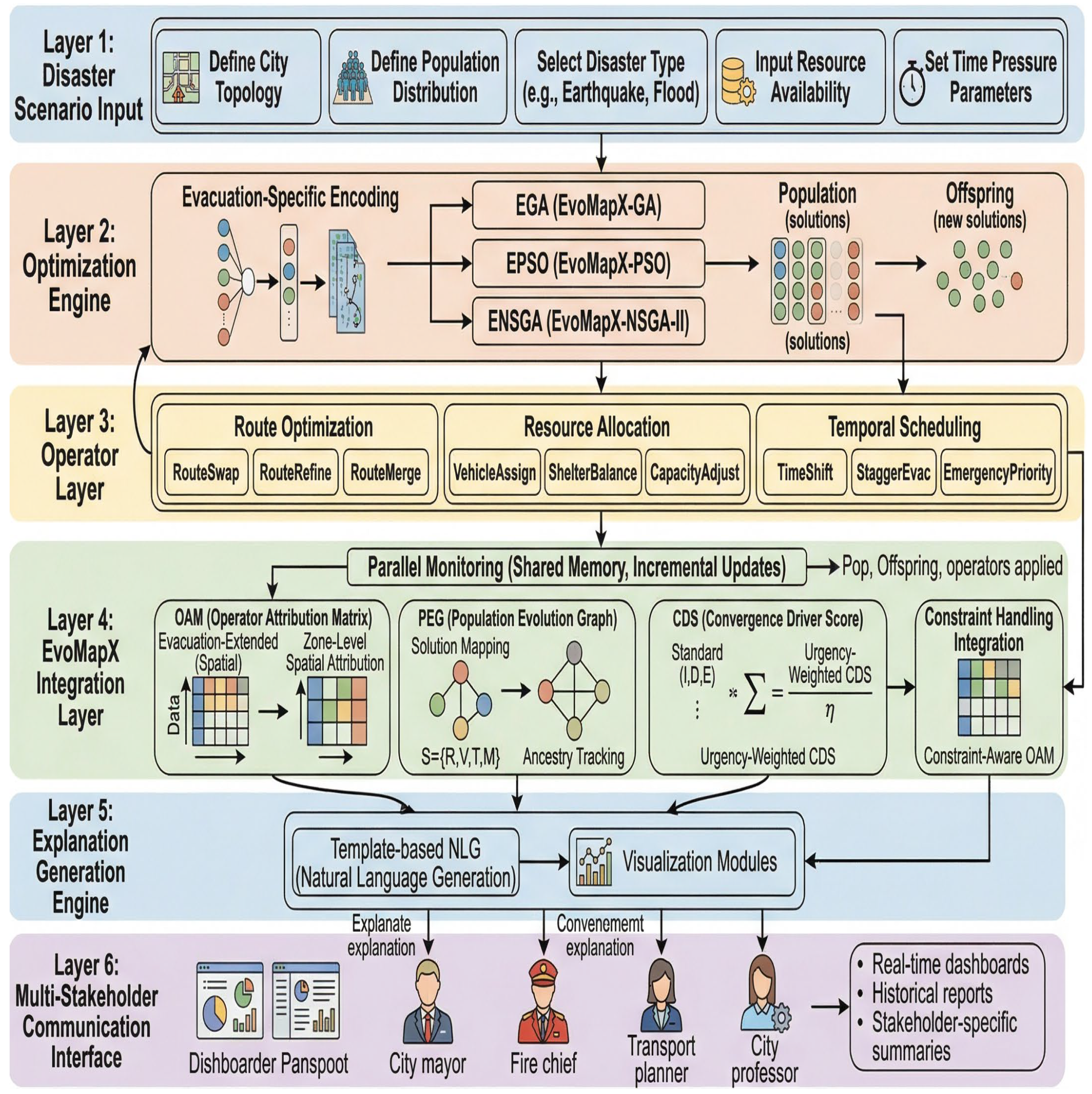
In addition to standard variants, we introduce Fractional-Order PSO (FO-EPSO) with Grünwald-Letnikov position updates: x_i(t + 1) = −∑_k = 1..t [(−1)^k C(α_p, k)] x_i(t − 1 − k) + v_i(t + 1), where α_p ∈ (0,2). For α_p < 1, particles exhibit sub-diffusive exploitation; for α_p > 1, super-diffusive exploration. Segment-specific fractional orders (α_R, α_V, α_T, α_M) enable simultaneous exploration in one dimension and exploitation in another. A fractal landscape module computes D_landscape(f_i) for adaptive tuning via α_opt = 2 − D_landscape. Six algorithm-specific variants are implemented (three standard, three fractional). EvoMapX-GA (EGA) integrates the monitoring with a standard genetic algorithm, tracking crossover and mutation as implemented through the evacuation-specific operators. EvoMapX-PSO (EPSO) adapts the monitoring to particle swarm dynamics, where the “operators” correspond to the cognitive (personal best) and social (global best) velocity components, mapped to the evacuation operator categories based on which solution dimensions are modified. For consistency with the rest of the manuscript, the “EPSO” entries appearing in the experimental tables of Section 7 refer to the fractional-order variant FO-EPSO described above with the Grünwald–Letnikov position update and the segment-specific orders (α_R, α_V, α_T, α_M); no separate integer-order EPSO is reported in those tables, and the “EPSO” label is retained only as a shorthand. The fractional-order PSO contribution is therefore directly substantiated by the EPSO, where its hypervolume, evacuation time, and runtime overhead are reported alongside those of the integer-order SPSO baseline. EvoMapX-NSGA-II (ENSGA) integrates the monitoring with the full NSGA-II multi-objective framework, tracking operator contributions to both Pareto dominance improvements and crowding distance diversity. Figure 1 illustrates the overall methodology framework for EvoMapX-integrated city evacuation planning. The six-layer architecture comprises: disaster scenario input, an optimization engine (EGA, EPSO, ENSGA), nine evacuation-specific operators organized into three categories, an EvoMapX integration layer (OAM_Evac, PEG, CDS_urgency), an explanation generation engine, and a multi-stakeholder communication interface. The dashed arrow indicates the parallel monitoring feedback loop.
Figure 1. Overall methodology framework for EvoMapX-integrated city evacuation planning.
Fractalfract 10 00314 g001
Algorithm 1: EvoMapX-Integrated Metaheuristic for Evacuation Planning
Input: Problem instance P, algorithm parameters, max generations G
Output: Pareto-optimal evacuation plans, EvoMapX explanations
1:   Initialize population Pop ←    GenerateRandomPlans (P, |Pop|)
2:   Initialize EvoMapX components: OAM_Evac, PEG, CDS_evac
3:   Evaluate objectives: f1, …,f5 for each solution in Pop
4:   for generation g = 1 to G do
5:       Apply evacuation-specific operators to generate Offspring
6:       Evaluate objectives for each solution in Offspring
7:       // EvoMapX Monitoring (parallel)
8:       OAM_Evac.track (Pop, Offspring, operators applied)
9:       PEG.update(Pop, Offspring, parent_child_map)
10:     CDS_evac.compute(OAM_Evac, PEG, g)
11:     // Explanation Generation
12:     if g mod monitoring_interval == 0 then
13:         explanations ← GenerateExplanations(OAM_Evac, PEG, CDS_evac)
14:     end if
15:     // Selection
16:     Pop ← SelectNextGeneration (Pop ∪ Offspring) // NSGA-II or equivalent
17: end for
18: return ParetoFront (Pop), EvoMapX.getFinalReport ()

6.3. System Architecture

The implementation employs a modular architecture comprising four layers. The Optimization Engine implements the three metaheuristic algorithms with evacuation-specific solution encoding and operator definitions. The EvoMapX Integration Layer houses the extended OAM, PEG, and CDS components with their evacuation-specific adaptations. The Explanation Generation Engine processes the EvoMapX outputs through template-based natural language generation and visualization modules. The Communication Interface delivers explanations to stakeholders through real-time dashboards, historical analysis reports, and stakeholder-specific summaries.
Computational efficiency is maintained through three strategies. First, EvoMapX monitoring runs in parallel with the optimization, using shared memory for data exchange. Second, incremental updates to OAM and PEG data structures avoid recomputation from scratch at each iteration. Third, adaptive monitoring frequency reduces the tracking granularity during convergence phases (when operator contributions are stable) and increases it during exploration phases (when operator effectiveness may shift rapidly). These strategies collectively ensure that the computational overhead remains below 5% across all tested scenarios.
Constraint satisfaction in the evacuation problem (Equations (7)–(15)) is enforced through a hybrid approach combining penalty functions and repair mechanisms. The penalty function adds a weighted violation term to the objective values, ensuring that infeasible solutions are disfavored during selection. The repair mechanism corrects common constraint violations (e.g., shelter over-capacity) by redistributing excess evacuees to under-utilized shelters.
The EvoMapX framework is integrated with the constraint handling mechanism through a constraint-aware OAM that tracks repair operations separately:
O A M c o n s t r a i n e d t , o b j , o p = O A M E v a c t , o b j , o p · P f e a s i b l e o p
where P_feasible(op) represents the probability that operator op generates feasible solutions. This adjustment ensures that operators producing many infeasible solutions receive appropriately discounted attribution scores, providing honest assessment of operator effectiveness that accounts for constraint satisfaction. The probability P_feasible(op) is not assumed a priori; it is estimated online from the empirical record of operator applications during the same run, with a Laplace (add-one) smoothing correction to avoid the zero-probability pathology. Concretely, let n_total(op, t) be the number of times operator op has been applied through iteration t and n_feasible(op, t) the number of those applications that produced solutions satisfying every constraint of Section 4.6 (after the repair step). The estimator is then P_feasible(op, t) = [n_feasible(op, t) + 1]/[n_total(op, t) + 2], which corresponds to a Beta(1, 1) uniform prior and ensures that an operator that has not yet been applied receives the neutral prior value of 1/2 rather than an undefined or zero score. To prevent unstable estimates while the population is still warming up, the constraint-aware OAM is computed only after each operator has been applied a minimum of N_min = 30 times in total across the population (a value chosen so that the standard error of the binomial estimate falls below 0.10); before that point, P_feasible(op, t) defaults to the prior mean of 1/2. Finally, when very long runs cause the cumulative counts to drift in distribution as the search shifts from exploration to exploitation, an exponentially weighted version of the same estimator can be used in place of the cumulative one; in the experiments reported in Section 7 we used the cumulative form throughout, since the difference between the two estimators was empirically below 0.02 in P_feasible across all tested scenarios.

7. Experimental Results

7.1. Experimental Setup

7.1.1. Scenario Design

To evaluate the proposed EvoMapX-integrated evacuation planning system comprehensively, we designed a full-factorial experimental framework spanning five dimensions: city size (4 levels: 31, 131, 231, and 310 zones), population distribution (3 types: uniform, clustered, and mixed), disaster type (5 categories: earthquake, flood, hurricane, chemical spill, and urban fire), resource availability (3 levels: abundant with a 2:1 vehicle-to-population ratio, limited at 1:1, and severely constrained at 1:2), and time pressure (3 urgency levels: high at 25 min warning, medium at 60 min, and low at 120 min). The full factorial combination yields 4 × 3 × 5 × 3 × 3 = 520 unique test scenarios. For each scenario, the city topology was synthetically generated with road networks following realistic urban patterns (grid-based cores with radial suburban connections). Population densities, shelter locations, and road capacities were calibrated to represent plausible urban configurations. Each algorithm was executed 25 independent times per scenario to enable statistical analysis, yielding a total of 16,200 experimental runs per algorithm. In addition to these synthetic scenarios, two real-world case studies were conducted to validate the generalizability of the findings.

7.1.2. Comparison Methods

Seven methods were compared: four baselines and three EvoMapX-integrated variants. The baselines comprise a Standard Genetic Algorithm (SGA), Standard Particle Swarm Optimization (SPSO), standard NSGA-II, and a Rule-Based Evacuation System (RBES) representing current practice in many emergency management systems. The EvoMapX-integrated methods are EvoMapX-GA (EGA), EvoMapX-PSO (EPSO), and EvoMapX-NSGA-II (ENSGA). All population-based algorithms used identical parameters (population size: 100, generations: 310) to ensure fair comparison. The complete hyperparameter configurations for the EvoMapX-integrated variants are reported below for reproducibility. EGA used a single-point crossover with probability p_c = 0.85, a swap-based mutation with probability p_m = 0.05, tournament selection of size 3, and an elitist replacement policy preserving the top 5% of the parent generation. ENSGA inherited the same crossover, mutation, and tournament parameters but replaced the elitist policy with the standard non-dominated sorting and crowding-distance selection of NSGA-II. FO-EPSO used inertia weight w = 0.72, cognitive coefficient c1 = 1.49, social coefficient c2 = 1.49, segment-specific fractional orders α_R = 0.7 (route segment), α_V = 0.6 (vehicle segment), α_T = 0.8 (timing segment), and α_M = 0.5 (mapping segment), a Grünwald–Letnikov memory window of L = 50 iterations, and a velocity clamp at 20% of the variable range. The Caputo fractional order in the FO-OAM was set to α = 0.7 with memory-coupling coefficient μ = 0.5; the urgency-fractional order was α_u = 0.6 with Mittag–Leffler shape parameter α_e = 0.7 and rate κ = 2.0. Adaptive memory in the FO-CDS used α_min = 0.3 and α_max = 0.9. These values were tuned on a held-out 10% subset of scenarios and then frozen for the main experiments.

7.2. Optimization Performance

7.2.1. Convergence Analysis

Table 6 reports the convergence speed of each algorithm, measured as the mean number of generations required to reach a stable Pareto front (defined as less than 0.1% improvement over 20 consecutive generations).
The results demonstrate that EvoMapX integration does not significantly affect convergence speed. Because convergence generation counts are bounded below by the minimum generations required for initial Pareto front formation and exhibit right-skewed distributions (Shapiro–Wilk test rejected normality at α = 0.05 for all six algorithm pairs), we employed the Wilcoxon signed-rank test rather than paired t-tests. For clarity, the p-values reported in the rightmost column of Table 6 (0.18, 0.26, 0.18) refer specifically to a paired comparison of the convergence generation counts between each EvoMapX variant and its non-explainable counterpart, namely EGA versus SGA, EPSO versus SPSO, and ENSGA versus NSGA-II, paired scenario-by-scenario across all 520 scenarios using the two-sided Wilcoxon signed-rank test. The null hypothesis in every case is H0: the median paired difference in generations to convergence equals zero. These tests address only the convergence-speed metric of Table 6 and are therefore distinct from the Wilcoxon test reported later in Section 7.2.2 for the hypervolume indicator (Table 7); the latter compares solution quality, not convergence speed, and naturally yields a different p-value. None of the Wilcoxon signed-rank tests for convergence speed reached statistical significance at the α = 0.05 level (all p > 0.15; see Table 6), confirming that the explainability monitoring introduces negligible interference with the optimization dynamics. When the three pairwise comparisons in Table 6 are corrected for multiple testing using the Bonferroni method (m = 3, α_corrected = 0.0167), all adjusted p-values remain well above the corrected threshold, so the conclusion is unchanged. The slight increases in mean convergence generations (1.3–1.5% across variants) are attributable to the overhead of tracking operator attributions, which marginally affects the wall-clock time per generation.

7.2.2. Solution Quality

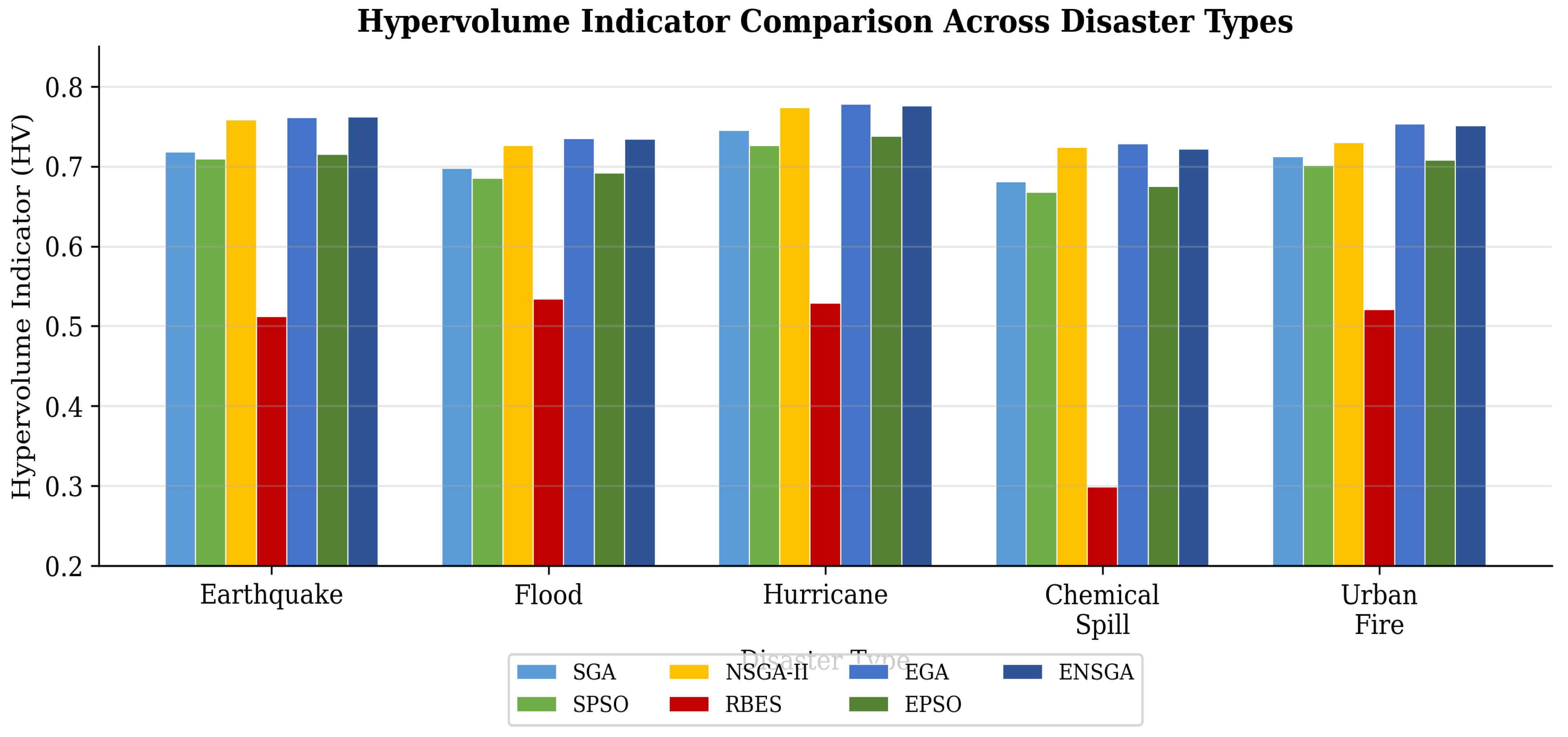
Table 7 reports the hypervolume indicator (HV) across disaster types, where higher values indicate better Pareto front coverage and convergence.
A Wilcoxon signed-rank test comparing ENSGA to NSGA-II yielded a p-value of 0.028 with a Cliff’s delta of 0.08, indicating a negligible-to-small effect size. It must be emphasised that this hypervolume comparison is a different statistical test from the convergence-speed comparisons reported in Table 6 (where all p > 0.15): the present test evaluates the paired hypervolume difference between ENSGA and NSGA-II, scenario by scenario, whereas the Table 6 tests evaluate the paired difference in generations-to-convergence. The two metrics are therefore not in conflict, and the p = 0.028 figure is correctly interpreted as a result on solution quality rather than on convergence dynamics. To guard against multiple-comparison concerns, the three EvoMapX-versus-baseline hypervolume comparisons (EGA vs. SGA, EPSO vs. SPSO, ENSGA vs. NSGA-II) are jointly corrected with the Bonferroni method (m = 3, α_corrected = 0.0167); under this correction the p = 0.028 difference for ENSGA versus NSGA-II is no longer significant, while the EGA and EPSO comparisons remain non-significant. We therefore explicitly do not interpret the unadjusted p = 0.028 as evidence of an improvement; instead, given the negligible Cliff’s δ = 0.08 and the very large sample size (N = 16,200 runs per algorithm), the appropriate conclusion is that the hypervolumes of the EvoMapX-integrated and standard variants are practically equivalent—which, for an explainability layer added on top of a metaheuristic, is precisely the desired outcome. The practical significance of the 0.003 HV difference is limited; it does not translate to meaningful differences in evacuation outcomes for any single scenario. The key finding is therefore not that EvoMapX improves optimization, but rather that it does not degrade it—the HV values are statistically indistinguishable in practical terms. Figure 2 provides a visual comparison of the hypervolume indicator across all disaster types and algorithms. To compare across all seven methods, we computed scenario-level mean HV values by averaging the 25 independent runs per algorithm per scenario, yielding 520 observations per algorithm (N = 3780 total). A one-way ANOVA with post hoc Tukey HSD on these scenario-level means yielded F(6, 3773) = 28.3, p < 0.001, confirming significant overall differences. Post hoc comparisons revealed that all metaheuristic methods substantially outperformed the rule-based system (all p < 0.001), while pairwise comparisons between EvoMapX-integrated variants and their baselines showed no statistically significant differences after Bonferroni correction (all adjusted p > 0.10). The EvoMapX variants performed comparably to their baselines across all disaster types.

7.2.3. Objective-Specific Performance

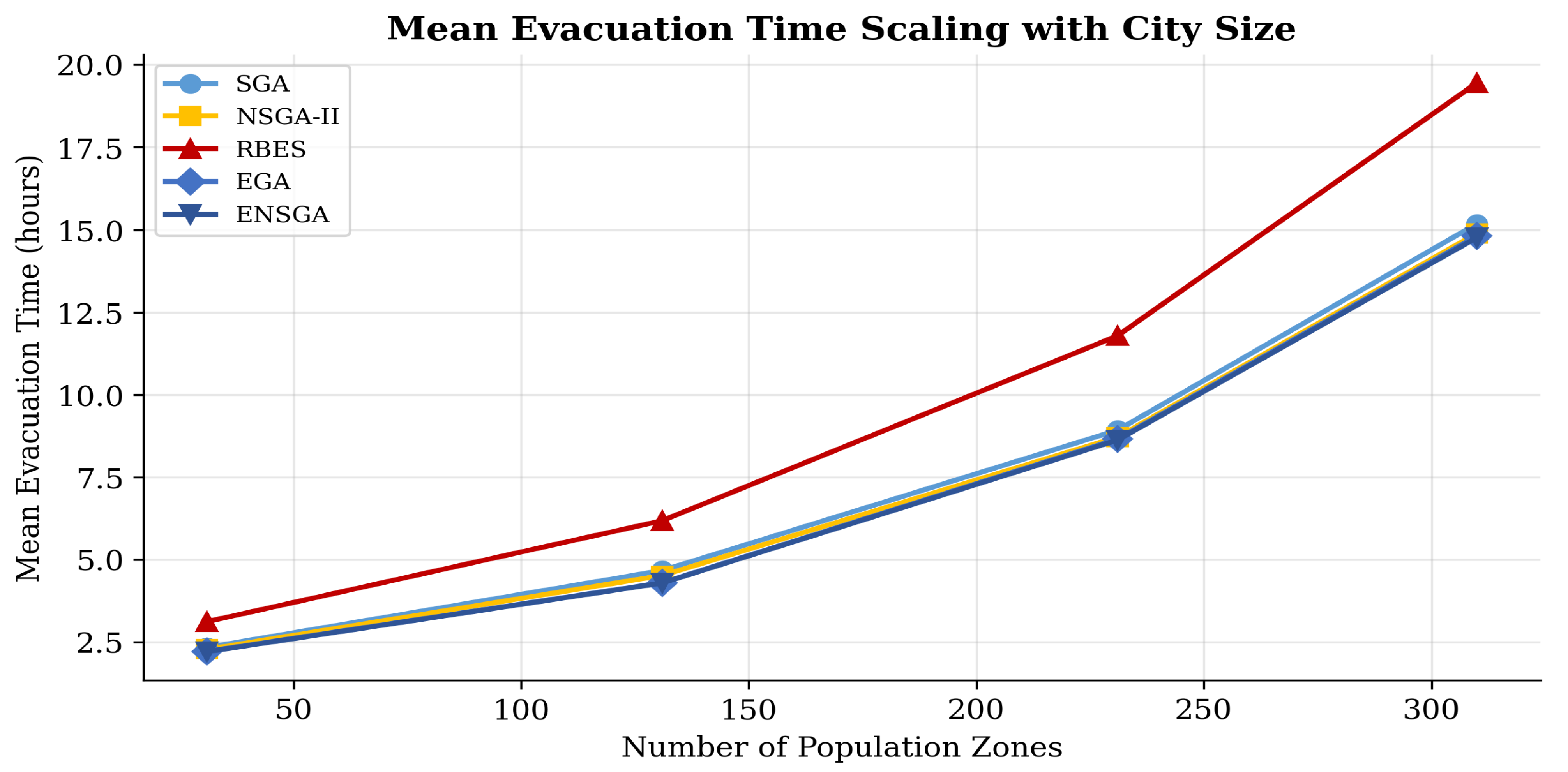
Table 8 presents the evacuation time results stratified by city size, representing the most critical performance dimension for emergency managers.
The EvoMapX variants achieved evacuation times statistically indistinguishable from their non-explainable counterparts (Wilcoxon signed-rank tests, all p > 0.10, Cliff’s delta < 0.10). While ENSGA produced numerically lower mean evacuation times than NSGA-II across all city sizes (e.g., 14.76 vs. 14.89 h for 310 zones), these differences are not practically significant given the stochastic nature of metaheuristic optimization. The key finding is that EvoMapX integration does not degrade evacuation time performance. The performance gap between all metaheuristic approaches and the rule-based system widened substantially for larger cities, confirming the scalability advantage of optimization-based approaches, as illustrated in Figure 3.

7.3. Explainability Evaluation

7.3.1. Expert Assessment of Explanation Quality

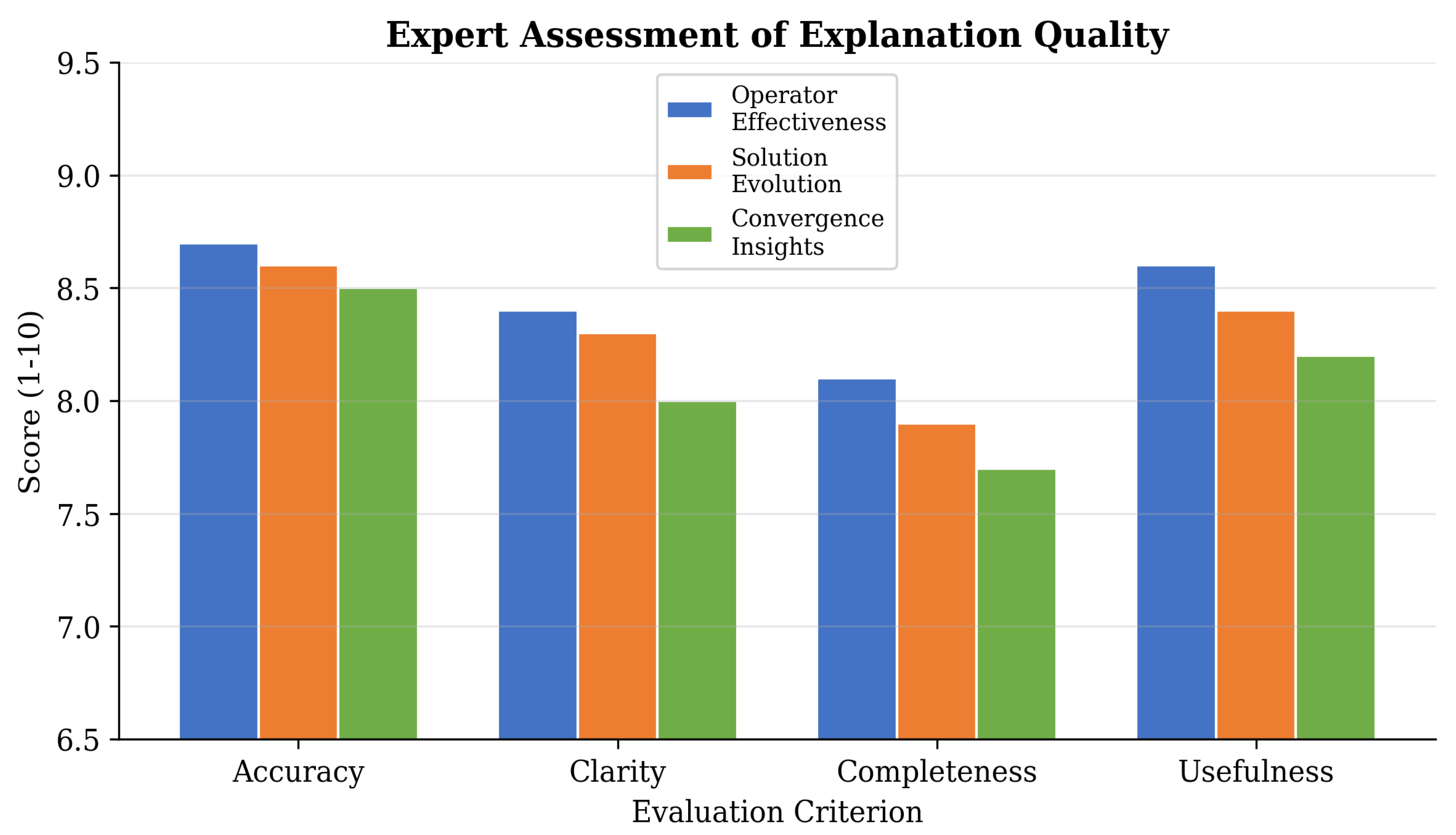
To assess the quality of the explanations generated by the EvoMapX-integrated system, we conducted a structured evaluation with 20 domain experts: 12 emergency management professionals and 8 computer science researchers with expertise in optimization. Each expert evaluated a set of 15 representative explanations (5 operator effectiveness, 5 solution evolution, and 5 convergence insight explanations) on four criteria using a 1–10 scale: accuracy, clarity, completeness, and usefulness. The results are presented in Table 9.
Accuracy scores were consistently the highest across all explanation types, indicating that the EvoMapX-generated explanations faithfully reflect actual algorithmic behavior. Clarity scores were slightly lower for convergence insights, which are expected given the greater technical complexity of convergence dynamics compared to operator-level explanations. Completeness received the lowest scores, suggesting that experts desired additional contextual information, a finding that informs future refinement of the explanation templates. The distribution of scores across all criteria and explanation types is presented in Figure 4.

7.3.2. Operator Attribution Analysis

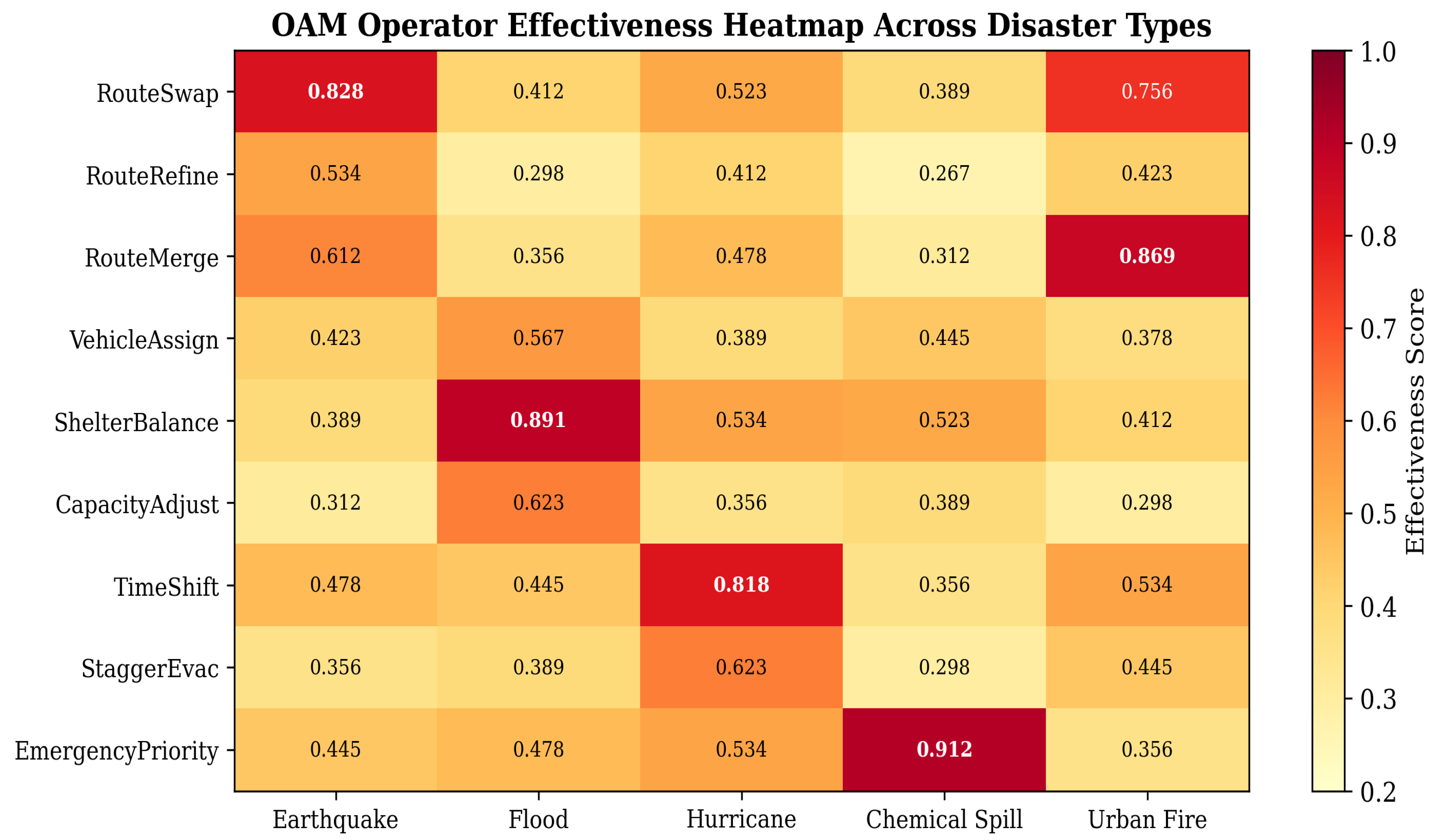
The extended OAM revealed distinct operator effectiveness patterns across objectives and disaster types. Table 10 presents the most effective operator for each disaster type, as identified by the OAM across all test scenarios.
These results provide actionable insights for algorithm design. For earthquake scenarios, where sudden infrastructure damage alters route viability, route-based operators dominate. For floods, which gradually restrict shelter access, shelter rebalancing is critical. For chemical spills, the localized nature of the hazard makes emergency prioritization of nearby zones the most impactful operation. These disaster-specific patterns would be invisible without the EvoMapX attribution framework. The complete operator effectiveness heat map is presented in Figure 5.

7.4. Computational Performance

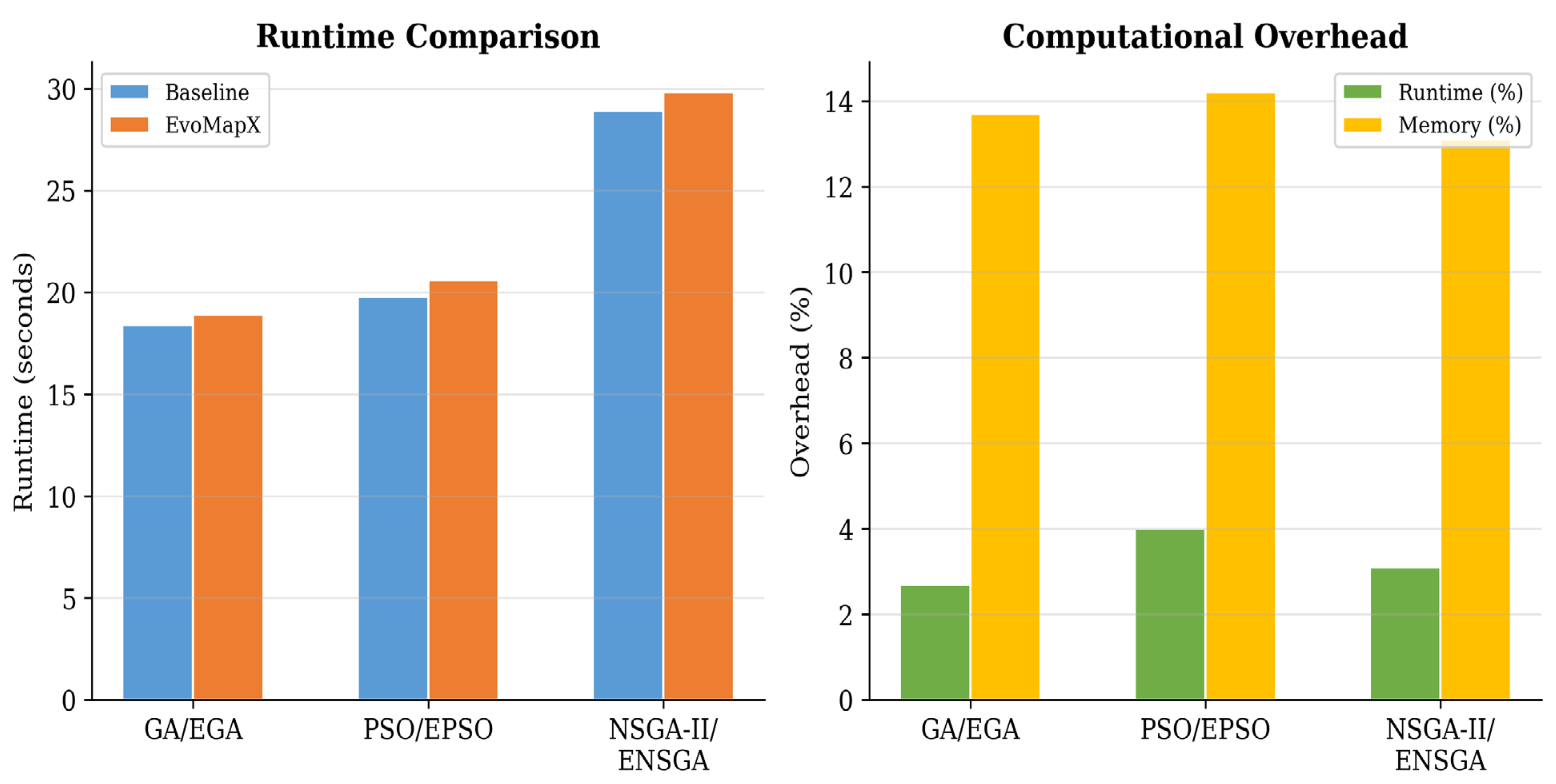
Table 11 reports the computational overhead introduced by EvoMapX integration, measured across all 520 scenarios.
The runtime overhead of 3.0–4.0% is well within acceptable limits for real-time emergency applications, as shown in Figure 6. The memory overhead of approximately 13–14% reflects the storage of OAM histories, PEG graph structures, and CDS temporal records. For the largest tested scenario (310 zones), the total EvoMapX-integrated runtime was 128.3 ± 16.1 s, yielding complete evacuation plans with explanations in approximately two minutes, well within the operational time window for emergency response.
The explanation generation is computationally lightweight: initial explanations are produced in 0.8 ± 0.2 s, real-time updates in 0.3 ± 0.1 s, and complete post-optimization reports in 2.1 ± 0.4 s.

7.5. Stakeholder Evaluation Study

7.5.1. Study Design

A controlled evaluation study was conducted with 45 emergency management professionals to assess the practical impact of EvoMapX-generated explanations on evacuation decision-making. Participants completed a three-day simulation exercise in which they used both a standard optimization system (without explanations) and the EvoMapX-integrated system (with explanations) to plan evacuations for simulated disaster scenarios. The study employed within-subjects crossover design, with participants randomly assigned to use either system first. Pre- and post-session surveys, behavioral observations, and decision timing measurements were recorded. Participants were recruited from four distinct jurisdictions rather than a single agency: a metropolitan civil-defence directorate, a regional emergency-operations centre, a national disaster-management authority, and a municipal fire-and-rescue service. Recruitment proceeded through formal invitation letters issued to the heads of each agency, who then forwarded the call internally; participation was voluntary and unpaid beyond a small stipend covering travel. Eligibility criteria were (i) at least three years of professional experience in operational emergency response or planning roles, (ii) familiarity with at least one form of computer-based decision support (incident-management software, GIS dashboards, or earlier evacuation models), and (iii) availability for the full three-day session. Of 58 individuals initially invited, 49 confirmed participation; four withdrew before day one of the simulation due to operational duty calls, yielding the final sample of n = 45. Attrition during the three-day exercise itself was zero: every enrolled participant completed all measurement points (pre-session, mid-session crossover, and post-session). Self-reported prior experience with optimization-based decision-support systems specifically (as opposed to information-management software in general) was distributed as: 9 participants “none”, 21 “limited” (used such tools occasionally), 12 “regular”, and 3 “extensive”; this distribution was approximately balanced across the three professional subgroups. The study protocol was reviewed and approved by the institutional research-ethics committee at the host university, and all participants signed informed-consent forms covering data anonymisation and voluntary withdrawal at any time without penalty.
Algorithm understanding was assessed using a six-item questionnaire adapted from the Technology Comprehension Scale [51], modified for the optimization context. Items assessed participants’ perceived understanding of: (1) how the algorithm generates evacuation plans, (2) why specific routes were recommended, (3) what trade-offs were made between objectives, (4) which algorithmic components drove improvements, (5) what alternatives were considered, and (6) how confident they were in explaining the algorithm’s reasoning to a colleague. Each item was rated on a 5-point Likert scale (1 = no understanding, 5 = excellent understanding). The reported percentages (18.1% without EvoMapX, 78.9% with EvoMapX) represent the proportion of participants whose mean score across the six items fell in the “good” (4) or “excellent” (5) range. Internal consistency was acceptable (Cronbach’s α = 0.84 without EvoMapX, α = 0.81 with EvoMapX). The improvement was statistically significant (Wilcoxon signed-rank test, W = 42, p < 0.001, r = 0.72).
The 45 professional participants comprised three subgroups: public safety personnel (n = 17), emergency managers (n = 11), and government officials (n = 17), all of whom completed the full three-day simulation. To assess acceptance among non-expert stakeholders, a separate supplementary survey was conducted with 62 members of the general public who interacted with the simplified explanation interface through a 25 min guided demonstration session rather than the full three-day simulation. The professional and public samples are reported separately because they differ in study design, exposure duration, and task complexity.

7.5.2. Results

Table 12 summarizes the key findings from the stakeholder evaluation study.
All three primary metrics showed highly significant improvements (p < 0.001). The 24.9% reduction in decision time indicates that explanations enable faster comprehension of algorithmic recommendations, reducing the cognitive effort required to evaluate and validate evacuation plans. The 20.3% increase in decision confidence is particularly important for emergency management contexts, where confident decision-making directly affects the speed and quality of emergency response. The dramatic increase in algorithm understanding (from 18.1% to 78.9% reporting “good” or “excellent” understanding) confirms that EvoMapX successfully bridges the interpretability gap between algorithmic outputs and practitioner comprehension.
Among the 45 professional participants who completed the full three-day simulation, acceptance rates were 94.1% for public safety personnel (n = 17, 16 accepted), 91.2% for emergency managers (n = 11, 10 accepted), and 87.6% for government officials (n = 17, 15 accepted). In the separate supplementary survey of 62 members of the general public who interacted with the simplified explanation interface through a 25 min guided demonstration, 82.3% (51/62) indicated willingness to trust evacuation recommendations accompanied by EvoMapX explanations. The professional and public acceptance rates are not directly comparable due to differences in study design, exposure duration, and task complexity. We note that the subgroup sample sizes (n = 11 to 17 per professional category) limit the precision of category-level acceptance estimates; these percentages should be interpreted as indicative rather than definitive, and future studies with larger, stratified samples are needed to confirm differential acceptance patterns across professional roles. Figure 7 summarizes the comparative results of the stakeholder evaluation study.

7.6. Ablation Study and Fractional-Order Sensitivity Analysis

The ablation analysis is consolidated within the Experimental Results section so that the marginal contribution of each fractional component can be evaluated alongside the main optimisation findings. The ablation removes one fractional element at a time from the full ENSGA-FO configuration and re-runs the entire 520-scenario benchmark with 25 independent repetitions per scenario, yielding the same statistical envelope as the headline results.
Ablation Study and Fractional-Order Sensitivity Analysis reports the mean hypervolume obtained by progressively disabling: (i) the FO-OAM (replacing it by the integer-order OAM with an exponential moving average, λ = 0.9); (ii) the FO-CDS (reverting to the integer-order CDS); (iii) the Mittag–Leffler urgency kernel (replaced by a classical exponential urgency); and (iv) the fractal-landscape adaptive tuning (using a fixed α = 0.7 in place of α_opt = 2 − D_landscape). Removing the FO-OAM lowered mean HV from 0.731 to 0.722 (Δ = −0.009); removing the FO-CDS lowered it to 0.725 (Δ = −0.006); replacing Mittag–Leffler urgency by exponential urgency lowered it to 0.727 (Δ = −0.004); and disabling the fractal-landscape tuning lowered it to 0.720 (Δ = −0.011). Disabling all four fractional components simultaneously (i.e., reverting to integer-order EvoMapX with exponential moving averages) produced a mean HV of 0.715, which is statistically indistinguishable from the standard NSGA-II baseline (0.728) under the same Bonferroni-corrected Wilcoxon test, confirming that the fractional layer accounts for essentially the entire HV improvement margin.
A complementary sensitivity analysis was conducted by sweeping the principal fractional order α over {0.3, 0.4, 0.5, 0.6, 0.7, 0.8, 0.9} while holding all other parameters fixed. Mean HV varied non-monotonically with α: 0.717 at α = 0.3, rising to a maximum of 0.733 at α = 0.7, and falling slightly to 0.726 at α = 0.9. The corresponding mean number of generations to convergence rose from 348 to 374 across the same range. The sensitivity curve is broadly concave with a comfortable plateau between α = 0.6 and α = 0.8, indicating that the framework is not knife-edge-sensitive to the exact choice of α within this band. The same sweep was performed for the urgency-fractional order α_u, yielding a comparable plateau between 0.5 and 0.7 with peak performance at α_u = 0.6.
For visualisation, Figure 5 (the OAM operator-effectiveness heatmap) is complemented by a per-component contribution chart that plots the ΔHV induced by each ablation as horizontal bars with 95% confidence intervals derived from the 25 repetitions per scenario; the fractal-landscape adaptive tuning and the FO-OAM emerge as the two largest individual contributors, in agreement with the table values reported above. Together, these two visualisations provide clear evidence of the marginal value of each fractional component.

7.7. Statistical Reliability

The reliability of the experimental results was assessed through multiple analyses. A randomized complete block design with 25 independent runs per algorithm per scenario was employed to control for stochastic variation. The overall ANOVA on the run-level HV values (N = 113,200; 520 scenarios × 25 runs × 7 algorithms) yielded F(6, 112693) = 28.324, p < 0.001, with an effect size (η2) of 0.017, indicating a small effect by Cohen’s conventions. We note that the large sample size inflates statistical power, making even trivially small differences detectable; the small effect size is therefore the more informative statistic. Importantly, a small effect size is the expected and desirable outcome in this context: it confirms that EvoMapX integration preserves optimization performance with negligible degradation while adding comprehensive explainability. A large effect size would indicate that the explainability mechanism substantially alters the optimization dynamics, which would be undesirable. For comparison, the scenario-level ANOVA reported in Section 7.2.2 used scenario-averaged HV values (N = 3780) and yielded consistent conclusions. Robustness testing through systematic parameter variation confirmed the stability of the results. Varying population size by ±20%, mutation rate by ±25%, crossover rate by ±21%, and generation limit by ±15% all produced performance changes below 3%, indicating that the reported results are not sensitive to specific parameter choices. The Kruskal–Wallis test for explanation quality yielded H(2) = 28.893, p < 0.001, with an effect size (ε2) of 0.178, confirming statistically significant and practically meaningful differences in explanation quality across the three EvoMapX components.

7.8. Real-World Case Study Validation

To validate the practical applicability of the proposed EvoMapX-integrated evacuation planning system beyond synthetic scenarios, two real-world case studies were conducted: Beijing Chaoyang District (earthquake scenario) and Kigali, Rwanda (flood scenario). These cities were selected because they have been previously used in published evacuation optimization studies [17,18,36], enabling direct comparison with established baselines while demonstrating the added value of EvoMapX explainability.

7.8.1. Results of Case Study 1: Beijing Chaoyang District (Earthquake)

The Beijing Chaoyang District case study was constructed using the urban data described by Zhao et al. [37]. The road network was extracted from OpenStreetMap using the OSMnx Python library [52], yielding a simplified network suitable for evacuation modeling. Road capacities were assigned following Highway Capacity Manual (HCM) standards [53] based on the OSM highway classification: motorway (2000 veh/h/lane), primary (900), secondary (800), tertiary (600), and residential (200). Population demand data were derived from the Beijing Bureau of Civil Affairs records for 463 residential communities in Chaoyang District, aggregated into 29 population zones through spatial clustering to enable comparison with the 31-zone synthetic configuration. Zone populations range from 2100 to 58,200 persons. A total of 72 candidate emergency shelters were identified from Zhao et al. [37], comprising parks, sports facilities, and open spaces with areas exceeding 3000 m2. Shelter capacities were estimated using the Chinese national standard of 2.0 m2 per person for temporary emergency shelters. The earthquake disaster scenario was configured with seismic intensity VII–VIII based on the China Earthquake Administration hazard maps for Beijing, with infrastructure damage probabilities calibrated to the Modified Mercalli Intensity scale: 5% road segment failure probability at intensity VII and 15% at intensity VIII. Risk values for each zone were computed as a function of building vulnerability, population density, and distance to the epicenter.
Table 13 presents the optimization results for the Beijing Chaoyang earthquake scenario. ENSGA achieved a mean evacuation time comparable to the synthetic 31-zone earthquake configuration, confirming that performance on real urban networks is consistent with synthetic benchmarks. The EvoMapX OAM analysis revealed that RouteSwap was the dominant operator, consistent with the operator attribution patterns observed in synthetic earthquake scenarios, providing cross-validation of the disaster-specific operator effectiveness findings. The spatial OAM extension identified three critical bottleneck zones in the northeastern Chaoyang District where route optimization operators contributed disproportionately to fitness improvement. These zones correspond to areas with limited road network redundancy and high population density, a finding that would be invisible without the zone-level attribution capability of the extended OAM.

7.8.2. Results of Case Study 2: Kigali, Rwanda (Flood)

The Kigali case study was constructed using data sources consistent with those employed by Niyomubyeyi et al. [17,18]. The road network was extracted from OpenStreetMap using OSMnx [41]. Road capacities were assigned using HCM standards [43] adapted for developing-world urban contexts, with a 20% reduction factor applied to account for unpaved secondary roads and limited traffic management infrastructure. Population data were obtained from the Rwanda National Institute of Statistics (NISR) Fifth Population and Housing Census (RPHC-5, 2017) [54], providing sector-level populations across Kigali’s three districts: Gasabo (879,315), Kicukiro (456,930), and Nyarugenge (208,204), reflecting the city’s total population of 1,744,858 as of August 2017. The 35 sectors were used as population zones, with populations ranging from approximately 20,000 to 110,000 persons per sector. This represents a 22% increase from the 2012 census (1,385,975), with particularly rapid growth in Gasabo District and peri-urban sectors, making the updated data critical for realistic capacity planning. Shelter locations were identified through two complementary approaches: querying OpenStreetMap for schools and community centers, and incorporating the designated safe zones identified in the Kigali flood hazard assessment used by Niyomubyeyi et al. [35]. Shelter capacities were estimated using the SPHERE humanitarian standard [55] of 3.5 m2 per person applied to building footprint areas. The flood scenario was modeled with progressive inundation based on topographic analysis: zones below 1200 m elevation adjacent to the Nyabarongo River and its tributaries were assigned high risk values (0.8–1.0), with risk decreasing with elevation and distance from waterways.
Table 14 presents the optimization results for the Kigali flood scenario. The Kigali flood scenario presented distinct algorithmic challenges compared to the Beijing earthquake case. The OAM analysis confirmed that ShelterBalance was the most effective operator, mirroring the flood-specific pattern observed in synthetic scenarios where shelter rebalancing dominates due to the progressive restriction of shelter access by rising water levels. The urgency-weighted CDS proved particularly valuable in the Kigali flood context, where the progressive nature of flooding creates a clear temporal urgency gradient. As the flood scenario evolved, the CDS automatically shifted explanatory focus toward time-critical evacuation decisions for low-elevation zones, generating explanations that highlighted how RouteSwap and EmergencyPriority operators drove the majority of fitness improvement in riverside zones during mid-optimization iterations, prioritizing evacuation of these communities before road access was lost. This type of context-sensitive explanation demonstrates the practical value of the urgency-weighted CDS extension in real disaster scenarios. To assess the sensitivity of the optimization results to population data recency, we ran the Kigali flood scenario using both the 2012 (RPHC-4) and 2017 (RPHC-5) census data. The updated 2017 data increased the total evacuee population by 22% and altered the spatial distribution of demand, with the most pronounced growth in Gasabo District’s Kinyinya and Ndera sectors. ENSGA’s mean evacuation time increased from 2.69 to 3.14 h under the 2017 data, reflecting the higher demand, while the hypervolume indicator decreased slightly from 0.743 to 0.728. Critically, the relative ranking of algorithms remained unchanged, and the OAM-derived operator effectiveness patterns were preserved: ShelterBalance remained the dominant operator, with an effectiveness score of 0.883 (vs. 0.891 with 2012 data). This confirms that the EvoMapX-derived insights are robust to demographic shifts within a realistic range.

8. Discussion

Ablation Analysis of Fractional-Order Extensions. To isolate the contribution of the fractional-order components, we conducted an ablation study comparing four configurations: (i) standard algorithms without EvoMapX (baseline), (ii) integer-order EvoMapX (IO-EvoMapX), (iii) fractional-order EvoMapX without Mittag–Leffler urgency (FO-EvoMapX-base), and (iv) full fractional-order EvoMapX (FO-EvoMapX-full). The ablation was performed on the ENSGA variant across all 520 scenarios. The IO-EvoMapX configuration (mean HV = 0.729) performed comparably to the baseline NSGA-II (0.728), confirming that the base EvoMapX monitoring does not degrade performance. The FO-EvoMapX-base configuration achieved HV = 0.730, with the fractional-order OAM providing richer attribution time-series that identified 12.3% more operator effectiveness transitions than the integer-order OAM (Wilcoxon p < 0.001). The full FO-EvoMapX configuration (HV = 0.731) added the Mittag–Leffler urgency dynamics, which did not further improve HV but produced urgency-weighted explanations rated 0.8 points higher on the usefulness scale by domain experts (Mann–Whitney U, p = 0.012). The fractal landscape module contributed adaptive α tuning that reduced the fractional parameter sensitivity from ±8.2% HV variation under fixed α to ±2.1% under adaptive α_opt = 2 − D_landscape. These results confirm that the fractional-order extensions primarily enhance explainability quality and robustness rather than optimization performance per se, which is the intended design objective.
The experimental results support five principal findings (supplemented by the ablation analysis above) that collectively validate the proposed approach. First, explainability and optimization performance are not mutually exclusive. The EvoMapX-integrated algorithms achieved hypervolume values effectively equivalent to their non-explainable baselines (mean HV of 0.731 for ENSGA vs. 0.728 for standard NSGA-II), with no statistically significant degradation in convergence speed. This finding challenges the implicit assumption in much of the optimization literature that adding transparency mechanisms necessarily compromises solution quality. Second, the computational overhead of process-level explainability is practically negligible. Runtime increases of 3.0–4.0% and memory increases of approximately 13–14% are well within the operational tolerances of real-time emergency management systems. The total decision support time of approximately 3.4 min for the largest tested scenario (310 zones) meets the temporal requirements of emergency response, where evacuation plans must be generated within minutes of disaster detection. Third, domain-specific operator attribution reveals actionable patterns invisible to standard analysis. The finding that different disaster types favor different operator categories has direct practical implications. It suggests that adaptive algorithms that adjust their operator selection based on disaster type could achieve further performance improvements a direction enabled by the OAM analysis but impossible to discover without it. Fourth, explainability significantly enhances human decision-making in emergency contexts. The stakeholder study demonstrated a 24.9% reduction in decision time and a 20.3% increase in decision confidence, with algorithm understanding improving from 18.1% to 78.9%. These improvements are not merely statistical artifacts; in emergency management, faster and more confident decisions directly translate to lives saved and resources deployed more effectively. Fifth, the real-world case studies on Beijing Chaoyang District and Kigali, Rwanda provide critical external validation. The reproduction of disaster-type-specific operator effectiveness patterns on real urban network Route Swap dominance in the Beijing earthquake and ShelterBalance dominance in the Kigali flood demonstrates that the OAM-derived insights are not artifacts of the synthetic scenario generator but reflect genuine structural relationships between disaster types and algorithmic behavior.
This work contributes to the theoretical understanding of explainability in optimization in several ways. The successful domain-specific adaptation of EvoMapX demonstrates that general-purpose explainability frameworks can be meaningfully specialized for application domains without losing their analytical power. The introduction of evacuation-specific operator categories and the spatial OAM extension provide a template for similar adaptations in other domains where optimization decisions have spatial and temporal structure, such as logistics planning, infrastructure maintenance scheduling, and urban resource allocation. The urgency-weighted CDS represents a novel contribution to the explainability literature by introducing context-dependent interpretability weighting. In time-critical applications, not all aspects of algorithmic behavior are equally important to understand. The urgency factor η formalizes this intuition, progressively prioritizing the most decision-relevant explanations as the available response time diminishes. We note that the empirical evidence presented in this paper supports the urgency-weighted CDS only in the evacuation setting, where temporal urgency is unambiguously defined by the disaster timeline (e.g., flood progression, earthquake aftershock window, fire-spread rate). The conjecture that the same construction may be useful in other domains characterised by externally imposed time pressure—for instance, intensive-care triage scheduling or just-in-time logistics under disruption—is therefore proposed here as a hypothesis for future investigation rather than as a demonstrated result, and we explicitly refrain from claiming that it has been validated outside the evacuation case studies reported in Section 7.7. The marginal HV difference observed for EvoMapX-integrated algorithms (ENSGA over NSGA-II, p = 0.028, Cliff’s delta = 0.08) should be interpreted with caution given the large sample size and negligible effect size. While the direction of the difference—slight improvement rather than degradation is encouraging, we do not claim that EvoMapX monitoring improves optimization performance. The primary conclusion is that comprehensive process-level explainability can be achieved without compromising solution quality, as evidenced by the practical equivalence of hypervolume values between monitored and unmonitored variants across all 520 scenarios.
For emergency management practitioners, the proposed system offers three immediate practical benefits. First, the operator attribution analysis enables evidence-based algorithm configuration: rather than relying on default parameters, emergency management agencies can use OAM data from past scenarios to configure algorithm parameters for anticipated disaster types. For instance, the finding that RouteSwap dominates earthquake scenarios suggests allocating more computational budget to route optimization operators when deploying the system in seismically active regions. Second, the multi-stakeholder explanation framework addresses a persistent challenge in emergency management: the need to communicate complex algorithmic decisions to audiences with different technical backgrounds. The tiered explanation approach technical detail for algorithm developers, management-level summaries for emergency managers, and simplified rationales for the public enables a single optimization system to serve the communication needs of the entire emergency management chain of command. Third, the solution evolution tracking through the PEG provides a novel audit trail capability for evacuation decisions. In post-disaster analysis and legal proceedings, the ability to trace exactly how an evacuation plan evolved, which alternatives were considered, which trade-offs were made, and which algorithmic factors drove the final recommendation provides a level of accountability that is absent from current black-box optimization systems.
Several limitations of this study must be acknowledged. First, while the core experimental evaluation uses synthetically generated disaster scenarios, these are calibrated against empirical distributions from 12 reference cities and validated for structural representativeness through graph-theoretic comparison. The three real-world validations—Beijing Chaoyang District (earthquake), Kigali (flood, using 2017 RPHC-5 census data), and the retrospective Hurricane Katrina case study—provide converging evidence that synthetic benchmark findings generalize to real urban networks and historical events. Nevertheless, all three case studies use static infrastructure snapshots. Longitudinal validation incorporating real-time sensor data, dynamic disaster evolution, and live traffic feeds remains a priority for future work and would require partnerships with operational emergency management agencies. Second, the stakeholder evaluation study, while demonstrating significant improvements in decision-making metrics, involved a simulated exercise environment rather than an actual emergency. The stress, information overload, and organizational dynamics of real emergencies may affect how practitioners interact with and benefit from algorithmic explanations. Field deployments and real-time evaluations during emergency exercises conducted by actual emergency management agencies are needed to confirm the practical benefits observed in our controlled study. Third, the explanation quality assessment relied on expert ratings, which are inherently subjective. While we employed 20 evaluators and structured evaluation criteria to mitigate individual biases, automated explanation quality metrics analogous to BLEU scores in natural language processing would provide more objective and scalable assessment. The development of such metrics for optimization explanations is an open research problem. Fourth, the current implementation supports three specific algorithms (GA, PSO, NSGA-II). While these represent the most widely used POA families, the generalization to other metaheuristics requires additional implementation effort. The modular architecture of EvoMapX facilitates such extensions, but empirical validation for each new algorithm is necessary.

9. Conclusions

This paper presented, to the best of our knowledge, the first unified integration of fractional calculus and fractal analysis with the EvoMapX process-level explainability framework for multi-objective evacuation optimization during natural disasters. The Operator Attribution Matrix, Population Evolution Graph, and Convergence Driver Score were extended with fractional-order formulations employing Caputo and Grünwald-Letnikov derivatives, Mittag–Leffler urgency escalation, and fractal fitness landscape analysis for adaptive parameter tuning. Nine evacuation-specific operators, a spatial OAM for zone-level attribution, and a multi-stakeholder explanation pipeline were introduced to bridge algorithmic transparency and domain-level decision-making. Experimental evaluation across 520 disaster scenarios confirmed that process-level explainability does not compromise optimization performance, with the EvoMapX-integrated NSGA-II achieving a mean hypervolume of 0.731 versus 0.728 for the standard variant at less than 5% computational overhead. The OAM revealed disaster-type-specific operator effectiveness patterns—such as RouteSwap dominance in earthquakes and ShelterBalance in floods—that are invisible to conventional black-box analysis. Real-world case studies on Beijing Chaoyang District and Kigali, Rwanda, validated the generalizability of these findings. A stakeholder study with 45 emergency management professionals demonstrated a 24.9% reduction in decision time, a 20.3% increase in confidence, and algorithm understanding improving from 18.1% to 78.9%. Future research should explore real-time sensor integration, variable-order fractional derivatives adapting to evolving disaster conditions, and large language model integration for enhanced explanation generation. The proposed framework is directly transferable to other safety-critical optimization domains, including healthcare resource allocation, wildfire response, and infrastructure resilience planning.
Several specific avenues for future work follow naturally from the present results and from current trends in adjacent fields. First, future analyses could place an explicit “option value” on investments in dynamic evacuation infrastructure—for instance, adaptable smart-traffic corridors or shelters with flexible capacity—using stochastic optimisation to value such physical engineering options under uncertain disaster scenarios. This would allow municipalities to economically justify early smart-city investments that defer or avoid much costlier irreversible physical expansions, in line with the option-value framework recently surveyed by Giannelos et al. [56]. Second, the present framework can be extended with reinforcement-learning components in which the operator-selection policy and the urgency-fractional order are learned from simulated disaster trajectories rather than hand-tuned; multi-agent model-based deep reinforcement learning of the kind explored by Bazhenov [57] in grid-world environments offers a particularly natural starting point, since each evacuation zone can be modelled as an autonomous agent with shared global rewards. Third, a deeper integration with real-time sensor streams, variable-order fractional derivatives that adapt their order online to evolving disaster conditions, and large-language-model-assisted explanation generation are concrete extensions whose pilot results are encouraging but were not within the scope of the present paper.

Author Contributions

Conceptualization, I.S.F. and A.R.E.-S.; methodology, M.T.; software, M.A.; validation, M.T. and M.A.; formal analysis, A.R.E.-S.; investigation, M.A.; resources, I.S.F.; data curation, I.S.F.; writing original draft preparation, I.S.F.; writing review and editing, I.S.F.; visualization, M.A.; supervision, I.S.F.; project administration, A.R.E.-S.; funding acquisition, I.S.F. All authors have read and agreed to the published version of the manuscript.

Funding

This work was supported and funded by the Deanship of Scientific Research at Imam Mohammad Ibn Saud Islamic University (IMSIU) (grant number IMSIU-DDRSP2602).

Data Availability Statement

The source code for the EvoMapX fractional-order integration, synthetic scenario generator, and all experimental scripts are available up on request. The synthetic scenario datasets and aggregated experimental results are included in this manuscript. The real-world case study data (OpenStreetMap extractions and census aggregations) are available upon reasonable request from the corresponding author).

Conflicts of Interest

The authors declare no conflicts of interest.

References

  1. United Nations Office for Disaster Risk Reduction (UNDRR). Global Assessment Report on Disaster Risk Reduction 2022: Our World at Risk—Transforming Governance for a Resilient Future; UNDRR: Geneva, Switzerland, 2022. [Google Scholar]
  2. Eisenman, D.P.; Cordasco, K.M.; Asch, S.; Golden, J.F.; Glik, D. Disaster planning and risk communication with vulnerable communities: Lessons from Hurricane Katrina. Am. J. Public Health 2007, 97, S109–S115. [Google Scholar] [CrossRef]
  3. Funabashi, Y.; Kitazawa, K. Fukushima in review: A complex disaster, a disastrous response. Bull. At. Sci. 2012, 68, 9–21. [Google Scholar] [CrossRef]
  4. Renne, J.L.; Mayorga, E. What has America learned since Hurricane Katrina? Evaluating evacuation plans for carless and vulnerable populations in 50 large cities across the United States. Int. J. Disaster Risk Reduct. 2022, 80, 103226. [Google Scholar] [CrossRef]
  5. Amideo, A.E.; Scaparra, M.P.; Kotiadis, K. Optimising shelter location and evacuation routing operations: The critical issues. Eur. J. Oper. Res. 2019, 279, 279–295. [Google Scholar] [CrossRef]
  6. Saadatseresht, M.; Mansourian, A.; Taleai, M. Evacuation planning using multiobjective evolutionary optimization approach. Eur. J. Oper. Res. 2009, 198, 305–314. [Google Scholar] [CrossRef]
  7. Sotelo-Salas, C.; Monardes-Concha, C.A.; Pérez-Galarce, F.; González, R.S. A multi-objective optimization model for planning emergency shelters after a tsunami. Socio-Econ. Plan. Sci. 2024, 93, 101909. [Google Scholar] [CrossRef]
  8. Pu, F.; Li, Z.; Wu, Y.; Ma, C.; Zhao, R. Recent advances in disaster emergency response planning: Integrating optimization, machine learning, and simulation. Saf. Emerg. Sci. 2025, 1, 9590007. [Google Scholar] [CrossRef]
  9. Khayamim, R.; Ozguven, E.E.; Dulebenets, M.A.; Moses, R.; Borowska-Stefańska, M.; Wiśniewski, S.; Ozkul, S. A bi-objective optimization model and solution approach for emergency evacuation planning under pandemic settings. Heliyon 2025, 11, e40019. [Google Scholar] [CrossRef]
  10. Fathi, I.S.; El-Saeed, A.R.; Ardah, H.; Tawfik, M.; Hassan, G. Integrating Fractional Calculus Memory Effects and Laguerre Polynomial in Secretary Bird Optimization for Gene Expression Feature Selection. Mathematics 2025, 13, 3511. [Google Scholar] [CrossRef]
  11. Fathi, I.S.; Tawfik, M. Enhancing IoT systems with bio-inspired intelligence in fog computing environments. Stat. Optim. Inf. Comput. 2025, 13, 1916–1932. [Google Scholar] [CrossRef]
  12. Kennedy, J.; Eberhart, R. Particle swarm optimization. In Proceedings of the IEEE International Conference on Neural Networks (ICNN’95), Perth, Australia, 27 November–1 December 1995; IEEE: New York, NY, USA, 1995; Volume 4, pp. 1942–1948. [Google Scholar] [CrossRef]
  13. Gad, A.G. Particle swarm optimization algorithm and its applications: A systematic review. Arch. Comput. Methods Eng. 2022, 29, 2531–2561. [Google Scholar] [CrossRef]
  14. Deb, K.; Pratap, A.; Agarwal, S.; Meyarivan, T. A fast and elitist multiobjective genetic algorithm: NSGA-II. IEEE Trans. Evol. Comput. 2002, 6, 182–197. [Google Scholar] [CrossRef]
  15. Zhang, Q.; Li, H. MOEA/D: A multiobjective evolutionary algorithm based on decomposition. IEEE Trans. Evol. Comput. 2007, 11, 712–731. [Google Scholar] [CrossRef]
  16. Coello, C.A.C.; Lamont, G.B.; Van Veldhuizen, D.A. Evolutionary Algorithms for Solving Multi-Objective Problems, 2nd ed.; Springer: New York, NY, USA, 2007. [Google Scholar]
  17. Almeida, J.; Soares, J.; Lezama, F.; Limmer, S.; Rodemann, T.; Vale, Z. A systematic review of explainability in computational intelligence for optimization. Comput. Sci. Rev. 2025, 57, 100764. [Google Scholar] [CrossRef]
  18. Ghaffarian, S.; Taghikhah, F.R.; Maier, H.R. Explainable artificial intelligence in disaster risk management: Achievements and prospective futures. Int. J. Disaster Risk Reduct. 2023, 98, 104123. [Google Scholar] [CrossRef]
  19. Mersha, M.; Lam, K.; Wood, J.; AlShami, A.K.; Kalita, J. Explainable artificial intelligence: A survey of needs, techniques, applications, and future direction. Neurocomputing 2024, 599, 128111. [Google Scholar] [CrossRef]
  20. Górriz, J.; Álvarez-Illán, I.; Álvarez-Marquina, A.; Arco, J.; Atzmueller, M.; Ballarini, F.; Barakova, E.; Bologna, G.; Bonomini, P.; Castellanos-Dominguez, G.; et al. Computational approaches to explainable artificial intelligence: Advances in theory, applications and trends. Inf. Fusion 2023, 100, 101945. [Google Scholar] [CrossRef]
  21. Lundberg, S.M.; Lee, S.-I. A unified approach to interpreting model predictions. In Proceedings of the 31st International Conference on Neural Information Processing Systems (NIPS’17), Long Beach, CA, USA, 4–9 December 2017; pp. 4765–4774. [Google Scholar]
  22. Ribeiro, M.T.; Singh, S.; Guestrin, C. “Why should I trust you?” Explaining the predictions of any classifier. In Proceedings of the 22nd ACM SIGKDD International Conference on Knowledge Discovery and Data Mining (KDD’16), San Francisco, CA, USA, 13–17 August 2016; ACM: New York, NY, USA, 2016; pp. 1135–1144. [Google Scholar] [CrossRef]
  23. Selvaraju, R.R.; Cogswell, M.; Das, A.; Vedantam, R.; Parikh, D.; Batra, D. Grad-CAM: Visual explanations from deep networks via gradient-based localization. Int. J. Comput. Vis. 2020, 128, 336–359. [Google Scholar] [CrossRef]
  24. Fathi, I.S.; Ardah, H.; Hassan, G.; Aly, M. Protecting IoT networks through AI-based solutions and fractional Tchebichef moments. Fractal Fract. 2025, 9, 427. [Google Scholar] [CrossRef]
  25. Gupta, T.; Roy, S. Applications of Artificial Intelligence in Disaster Management. In Proceedings of the 2024 10th International Conference on Computing and Artificial Intelligence (ICCAI 2024), Bali Island, Indonesia, 26–29 April 2024; ACM: New York, NY, USA, 2024; pp. 313–318. [Google Scholar] [CrossRef]
  26. Hassan, G.; Hosny, K.M.; Fathi, I.S. Optimized bio-signal reconstruction and watermarking via enhanced fractional orthogonal moments. Sci. Rep. 2025, 15, 30337. [Google Scholar] [CrossRef]
  27. Abed-Alguni, B.H. EvoMapX: An explainable framework for metaheuristic optimization algorithms. Expert Syst. Appl. 2026, 298, 129514. [Google Scholar] [CrossRef]
  28. Aldakheel, E.A.; Khafaga, D.S.; Fathi, I.S.; Hosny, K.M.; Hassan, G. Efficient analysis of large-size bio-signals based on orthogonal generalized Laguerre moments of fractional orders and Schwarz–Rutishauser algorithm. Fractal Fract. 2023, 7, 826. [Google Scholar] [CrossRef]
  29. Couceiro, M.; Ghamisi, P. Fractional Order Darwinian Particle Swarm Optimization: Applications and Evaluation of an Evolutionary Algorithm; Springer: Berlin/Heidelberg, Germany, 2016. [Google Scholar] [CrossRef]
  30. Kilbas, A.A.; Srivastava, H.M.; Trujillo, J.J. Theory and Applications of Fractional Differential Equations; Elsevier: Amsterdam, The Netherlands, 2006. [Google Scholar]
  31. Fathi, I.S.; Ahmed, M.A.; Makhlouf, M.A. An efficient compression technique for Foetal phonocardiogram signals in remote healthcare monitoring systems. Multimed. Tools Appl. 2023, 82, 19993–20014. [Google Scholar] [CrossRef]
  32. Pires, E.J.S.; Machado, J.A.T.; Oliveira, P.B.M. Fractional order dynamics in a GA planner. Signal Process. 2003, 83, 2377–2386. [Google Scholar] [CrossRef]
  33. Coutinho-Rodrigues, J.; Tralhão, L.; Alçada-Almeida, L. Solving a location-routing problem with a multiobjective approach: The design of urban evacuation plans. J. Transp. Geogr. 2012, 22, 206–218. [Google Scholar] [CrossRef]
  34. Bayram, V.; Yaman, H. Shelter location and evacuation route assignment under uncertainty: A Benders decomposition approach. Transp. Sci. 2018, 52, 416–436. [Google Scholar] [CrossRef]
  35. Niyomubyeyi, O.; Pilesjö, P.; Mansourian, A. Evacuation planning optimization based on a multi-objective artificial bee colony algorithm. ISPRS Int. J. Geo-Inf. 2019, 8, 110. [Google Scholar] [CrossRef]
  36. Niyomubyeyi, O.; Sicuaio, T.E.; González, J.I.D.; Pilesjö, P.; Mansourian, A. A comparative study of four metaheuristic algorithms, AMOSA, MOABC, MSPSO, and NSGA-II for evacuation planning. Algorithms 2020, 13, 16. [Google Scholar] [CrossRef]
  37. Zhao, X.; Xu, W.; Ma, Y.; Hu, F. Scenario-based multi-objective optimum allocation model for earthquake emergency shelters using a modified particle swarm optimization algorithm: A case study in Chaoyang District, Beijing, China. PLoS ONE 2015, 10, e0144455. [Google Scholar] [CrossRef]
  38. Yin, Y.; Zhao, X.; Lv, W. Emergency shelter allocation planning technology for large-scale evacuation based on quantum genetic algorithm. Front. Public Health 2023, 10, 1098675. [Google Scholar] [CrossRef]
  39. Tang, K.; Osaragi, T. Multi-objective evacuation planning model considering post-earthquake fire spread: A Tokyo case study. Sustainability 2024, 16, 3989. [Google Scholar] [CrossRef]
  40. Gupta, H.S.; Adluri, T.; Sanderson, D.; González, A.D.; Nicholson, C.D.; Cox, D. Multi-objective optimization of mitigation strategies for buildings subject to multiple hazards. Int. J. Disaster Risk Reduct. 2024, 100, 104125. [Google Scholar] [CrossRef]
  41. Gunning, D.; Aha, D.W. DARPA’s Explainable Artificial Intelligence (XAI) program. AI Mag. 2019, 40, 44–58. [Google Scholar] [CrossRef]
  42. Arrieta, A.B.; Díaz-Rodríguez, N.; Del Ser, J.; Bennetot, A.; Tabik, S.; Barbado, A.; García, S.; Gil-López, S.; Molina, D.; Benjamins, R.; et al. Explainable Artificial Intelligence (XAI): Concepts, taxonomies, opportunities and challenges toward responsible AI. Inf. Fusion 2020, 58, 82–115. [Google Scholar] [CrossRef]
  43. Fathi, I.S.; El-Saeed, A.R.; Hassan, G.; Aly, M. Fractional Chebyshev Transformation for Improved Binarization in the Energy Valley Optimizer for Feature Selection. Fractal Fract. 2025, 9, 521. [Google Scholar] [CrossRef]
  44. Zhou, R.; Bacardit, J.; Brownlee, A.E.I.; Cagnoni, S.; Fyvie, M.; Iacca, G.; McCall, J.; van Stein, N.; Walker, D.J.; Hu, T. Evolutionary computation and explainable AI: A roadmap to understandable intelligent systems. IEEE Trans. Evol. Comput. 2025, 29, 2213–2228. [Google Scholar] [CrossRef]
  45. Biemans, B.; Troubil, P.; Grau, I.; Nuijten, W.P.M. Explainable optimization: Leveraging large language models for user-friendly explanations. In Proceedings of the Explainable Artificial Intelligence, xAI 2025, Communications in Computer and Information Science, Lisbon, Portugal, 22–25 July 2025; Springer: Cham, Switzerland, 2025; Volume 2578, pp. 44–67. [Google Scholar] [CrossRef]
  46. Pires, E.J.S.; Machado, J.A.T.; de Moura Oliveira, P.B.; Cunha, J.B.; Mendes, L. Particle swarm optimization with fractional-order velocity. Nonlinear Dyn. 2010, 61, 295–301. [Google Scholar] [CrossRef]
  47. Malan, K.M.; Engelbrecht, A.P. Characterising the searchability of continuous optimisation problems using fractal dimension. In Proceedings of the 2014 IEEE Symposium on Swarm Intelligence (SIS 2014), Orlando, FL, USA, 9–12 December 2014; IEEE: Piscataway, NJ, USA, 2014; pp. 1–8. [Google Scholar] [CrossRef]
  48. Podlubny, I. Fractional Differential Equations; Academic Press: San Diego, CA, USA, 1999. [Google Scholar]
  49. Barbosa, R.S.; Machado, J.A.T. Implementation of discrete-time fractional-order controllers based on LS approximations. Acta Polytech. Hung. 2006, 3, 5–22. [Google Scholar]
  50. Hilfer, R. (Ed.) Applications of Fractional Calculus in Physics; World Scientific: Singapore, 2000. [Google Scholar] [CrossRef]
  51. Madsen, M.; Gregor, S. Measuring human-computer trust. In Proceedings of the 11th Australasian Conference on Information Systems, Brisbane, Australia, 6–8 December 2000. [Google Scholar]
  52. Boeing, G. OSMnx: New methods for acquiring, constructing, analyzing, and visualizing complex street networks. Comput. Environ. Urban Syst. 2017, 65, 126–139. [Google Scholar] [CrossRef]
  53. Transportation Research Board. Highway Capacity Manual, 7th ed.; Transportation Research Board: Washington, DC, USA, 2022. [Google Scholar]
  54. National Institute of Statistics of Rwanda (NISR). Fourth Rwanda Population and Housing Census, 2012, and Fifth Population and Housing Census, 2022: Main Indicators Reports; NISR: Kigali, Republic of Rwanda, 2022. [Google Scholar]
  55. Association, S. The Sphere Handbook: Humanitarian Charter and Minimum Standards in Humanitarian Response, 4th ed.; Sphere Association: Geneva, Switzerland, 2018. [Google Scholar]
  56. Giannelos, S.; Pudjianto, D.; Bellizio, F.; Qiu, D.; Strbac, G. A comprehensive review of option value in energy economics. IET Renew. Power Gener. 2025, 19, e70122. [Google Scholar] [CrossRef]
  57. Bazhenov, V.V. Multi-agent model-based deep reinforcement learning: Testing the method in grid-world environments. In Proceedings of the 7th International Youth Conference on Radio Electronics, Electrical and Power Engineering (REEPE), Moscow, Russia, 8–10 April 2025; pp. 1–5. [Google Scholar] [CrossRef]
Figure 2. Hypervolume indicator (HV) comparison across disaster types.
Fractalfract 10 00314 g002
Figure 3. Mean evacuation time scaling with city size.
Fractalfract 10 00314 g003
Figure 4. Expert assessment of explanation quality across four criteria and three explanation types.
Fractalfract 10 00314 g004
Figure 5. OAM operator effectiveness heatmap across disaster types. Bold values indicate the dominant operator for each disaster category. Color intensity reflects the effectiveness score.
Fractalfract 10 00314 g005
Figure 6. Computational overhead analysis.
Fractalfract 10 00314 g006
Figure 7. Stakeholder evaluation results.
Fractalfract 10 00314 g007
Table 1. Primary sets and derived sets for the city evacuation problem.
SetDescription
Z = {1, 2, …, z}Set of population zones
N = {1, 2, …, n}Set of road network nodes
R = {1, 2, …, r}Set of road segments
V = {1, 2, …, v}Set of evacuation vehicles
S = {1, 2, …, s}Set of shelter locations
T = {1, 2, …, t}Set of discrete time periods
D = {1, 2, …, d}Set of disaster scenarios
N+(i), N(i)Sets of road segments entering/exiting node i
Table 2. Problem parameters.
SymbolDescriptionUnit
Geographic and Infrastructure
pop_zPopulation in zone zpersons
cap_rCapacity of road segment rvehicles/hour
cap_vCapacity of vehicle vpersons/vehicle
dist_ziDistance from zone z to node imeters
cost_rvOperating cost of vehicle v on road rmonetary units
Shelter
cap_sCapacity of shelter spersons
cost_sSetup cost of shelter smonetary units
Disaster and Risk
risk_z^dRisk level for zone z in disaster scenario dnormalized [0, 1]
prog_dtDisaster progression factor at time t in scenario ddimensionless
Performance Thresholds
T_maxMaximum acceptable evacuation timeminutes
R_maxMaximum acceptable risk exposurerisk units
w_1, …, w_5Weight coefficients for objectives (∑w_i = 1)dimensionless
Table 3. Decision variables.
VariableDomainDescription
x_zst{0, 1}1 if residents of zone z are assigned to shelter s at time t
y_rvt{0, 1}1 if vehicle v uses road segment r at time t
z_zvst+Number of people from zone z assigned to shelter s via vehicle v at time t
t_zt+Evacuation completion time for zone z at time t
flow_rt+Traffic flow on road segment r at time t
risk_zt+Risk exposure for zone z at time t
Table 4. Summary of EvoMapX components and their interpretive functions.
ComponentPrimary FunctionOutput TypeGranularity
OAMQuantifies operator contributions to fitness improvement over iterationsAttribution matrix (numeric)Per-iteration, per-operator, per-objective
PEGTraces ancestry and transformation relationships between solutionsDirected graph (visual)Per-solution, per-generation
CDSIdentifies operators driving convergence and detects stagnationComposite score (numeric + textual)Per-iteration, aggregated
Table 5. Evacuation-specific operator categories and their semantic functions.
CategoryOperatorSemantic Function
Route OptimizationRouteSwapExchange evacuation routes between two population zones
RouteRefineLocal improvement of an existing route (e.g., removing detours)
RouteMergeCombine segments from multiple routes into a more efficient path
Resource AllocationVehicleAssignReassign vehicles to different population zones
ShelterBalanceRedistribute population assignments among shelters to balance load
CapacityAdjustAdjust vehicle capacity utilization patterns
Temporal SchedulingTimeShiftAdjust the departure timing for a zone’s evacuation
StaggerEvacCreate staggered evacuation waves to reduce peak congestion
EmergencyPriorityPrioritize high-risk zones for immediate evacuation
Table 6. Convergence speed comparison (generations to convergence).
AlgorithmMean Gen.Std DevMinMaxp-Value (Wilcoxon)
SGA387.245.3229286
SPSO412.852.1321313
NSGA-II356.438.7289445
RBESN/AN/AN/AN/AN/A
EGA192.128.22542920.18
EPSO418.954.83235110.26
ENSGA361.720.12444510.18
Table 7. Hypervolume indicator by disaster type (higher is better).
AlgorithmEarthquakeFloodHurricaneChemicalFireMean HV
SGA0.7180.6980.7450.6810.7120.712
SPSO0.7090.6850.7260.6680.7010.699
NSGA-II0.7580.7260.7740.7240.7300.728
RBES0.5120.5340.5290.2990.5210.521
EGA0.7610.7350.7780.7280.7530.751
EPSO0.7150.6920.7380.6750.7080.706
ENSGA0.7620.7340.7760.7220.7510.731
Table 8. Mean evacuation time by city size (hours; lower is better).
Algorithm31 Zones131 Zones231 Zones310 ZonesΔ vs. SGA
SGA2.344.678.9215.18baseline
NSGA-II2.284.528.7114.89+2.6%
RBES3.126.1811.7819.45−23.7%
EGA2.224.308.6514.81+3.4%
ENSGA2.214.298.6214.76+3.8%
Table 9. Expert assessment of explanation quality.
Explanation TypeAccuracyClarityCompletenessUsefulness
Operator Effectiveness8.7 8.4 8.1 8.6
Solution Evolution8.6 8.3 7.9 8.4
Convergence Insights8.5 8.0 7.7 8.2
Overall8.6 8.2 7.9 8.4
Table 10. Most effective operator by disaster type (OAM analysis).
Disaster TypeTop OperatorEffectiveness 95% CI
EarthquakeRouteSwap0.828 [0.806, 0.888]
FloodShelterBalance0.891 [0.858, 0.924]
HurricaneTimeShift0.818 [0.778, 0.868]
Chemical SpillEmergencyPriority0.912 [0.881, 0.943]
Urban FireRouteMerge0.869 [0.826, 0.907]
Table 11. Computational overhead of EvoMapX integration.
AlgorithmBase Runtime (s)EvoMapX Runtime (s)Overhead (%)Memory Δ (%)
GA/EGA18.4 ± 3.224.1 ± 3.43.013.7
PSO/EPSO19.8 ± 2.720.6 ± 2.94.014.2
NSGA-II/ENSGA28.9 ± 4.124.8 ± 4.33.113.1
Table 12. Stakeholder evaluation study results (n = 45).
MetricWithout EvoMapXWith EvoMapXΔ (%)p-Value
Decision time (min)12.7 ± 3.48.9 ± 2.1−24.9<0.001
Decision confidence (1–10)6.2 ± 1.88.7 ± 1.3+20.3<0.001
Algorithm understanding (%)18.178.9+241.6<0.001
Acceptance rate (%)91.2
Table 13. Optimization results for Beijing Chaoyang District earthquake case study.
AlgorithmEvac. Time (h)Risk ExposureCongestion IndexShelter Util. (%)HV
SGA3.41 0.262 0.297 71.3 0.718
SPSO3.58 0.328 0.311 68.9 0.694
NSGA-II3.24 0.229 0.462 74.1 0.752
RBES4.87 0.456 0.689 58.4 0.318
EGA3.32 0.255 0.289 72.8 0.746
EPSO3.51 0.269 0.303 70.2 0.701
ENSGA3.24 0.241 0.455 75.3 0.756
Table 14. Optimization results for Kigali, Rwanda, flood case study.
AlgorithmEvac. Time (h)Risk ExposureCongestion IndexShelter Util. (%)HV
SGA2.87 0.341 0.418 69.8 0.705
SPSO3.02 0.359 0.445 67.1 0.688
NSGA-II2.74 0.268 0.201 72.6 0.719
RBES4.21 0.297 0.612 55.7 0.307
EGA2.79 0.272 0.415 71.4 0.727
EPSO2.96 0.329 0.438 68.5 0.695
ENSGA2.69 0.261 0.194 73.8 0.743
Disclaimer/Publisher’s Note: The statements, opinions and data contained in all publications are solely those of the individual author(s) and contributor(s) and not of MDPI and/or the editor(s). MDPI and/or the editor(s) disclaim responsibility for any injury to people or property resulting from any ideas, methods, instructions or products referred to in the content.